Research Articles

From Text to Database: Leveraging LLMs and AI for Automated Data Extraction in Materials Science
The exponential growth of scientific publications has made manual data extraction for materials databases a critical bottleneck.
LLMs for Materials Property Prediction: Transforming Discovery with AI
Large Language Models (LLMs) are revolutionizing materials property prediction by leveraging natural language descriptions of materials to achieve state-of-the-art accuracy.
Foundation Models for Materials Discovery: Current State, AI Applications, and Future Directions in Biomedical Research
Foundation models, a class of AI trained on broad data and adaptable to diverse tasks, are revolutionizing materials discovery.
Beyond Stability: Accuracy Metrics for Predicting Crystalline Material Synthesizability
Accurately predicting which computationally designed crystal structures can be experimentally synthesized is a critical bottleneck in materials discovery.
Composition vs. Structure: A Comparative Analysis of Synthesizability Models in Drug and Materials Discovery
Predicting the synthesizability of novel chemical compounds is a critical challenge in drug and materials discovery.
Benchmarking Machine Learning Architectures for Molecular Synthesizability: A New Paradigm for Drug Discovery
The critical challenge in computational drug discovery is the generation of molecules with optimal pharmacological properties that are also synthesizable in the laboratory.
Beyond Thermodynamics: Evaluating Next-Gen AI for Predicting Synthesis of Complex Crystal Structures
Accurately predicting which computationally designed crystal structures can be experimentally synthesized is a critical bottleneck in materials discovery, particularly for complex systems relevant to pharmaceutical development.
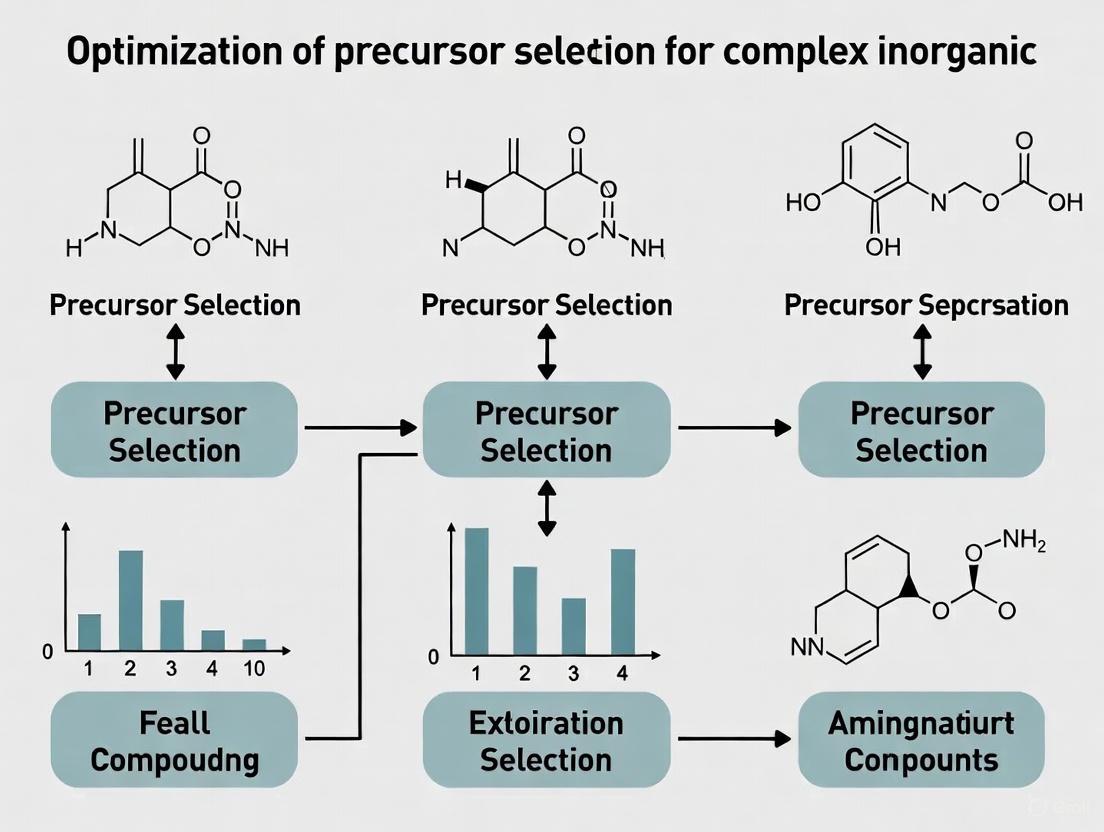
AI-Driven Precursor Selection for Complex Inorganic Compounds: From Foundational Principles to Advanced Optimization
Selecting optimal precursors is a critical yet challenging step in the synthesis of complex inorganic materials, directly impacting the success and efficiency of research in areas ranging from battery technology...

Beyond the Training Set: Strategies for Generalizing Synthesizability Models to Novel Material Classes
This article addresses the critical challenge of generalizing AI-based synthesizability models beyond their training data to accelerate the discovery of new materials and drug candidates.

Beyond Energy: AI and Data-Driven Strategies for Predicting Synthesizability Beyond Thermodynamic Limits
For researchers and drug development professionals, accurately predicting whether a theoretically designed material or molecule can be synthesized remains a formidable challenge.