Composition vs. Structure: A Comparative Analysis of Synthesizability Models in Drug and Materials Discovery
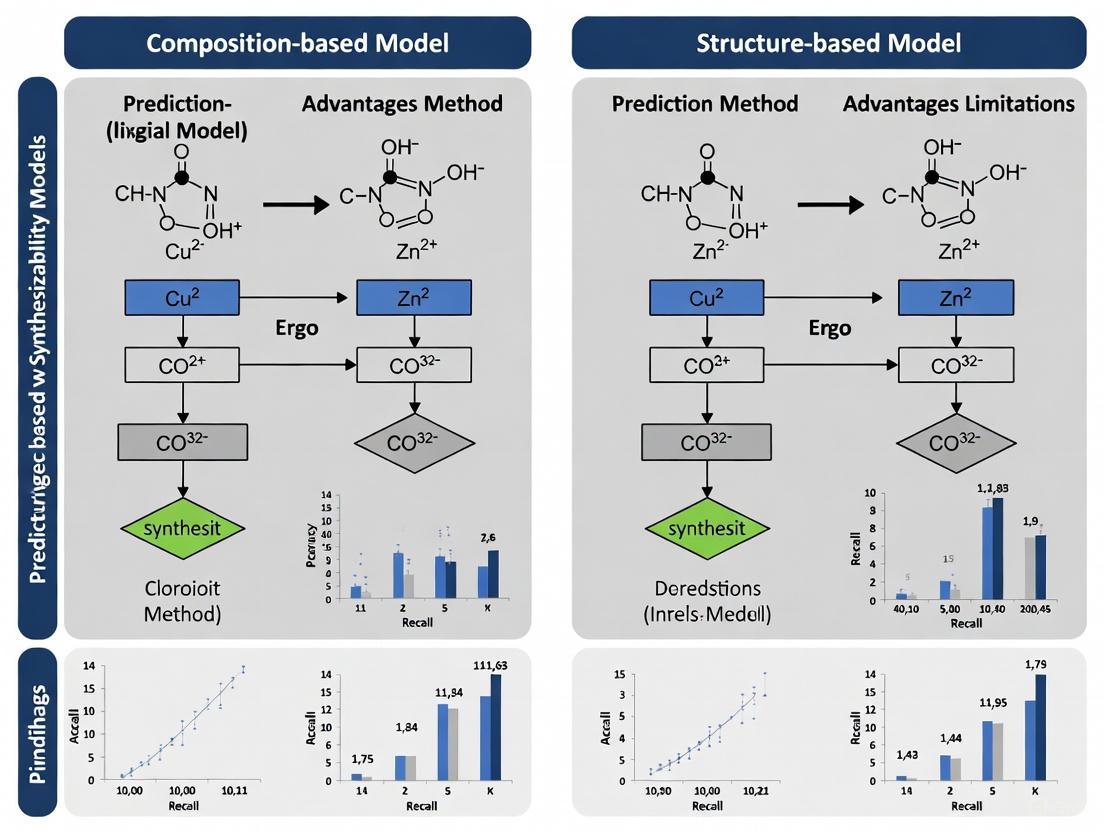
Predicting the synthesizability of novel chemical compounds is a critical challenge in drug and materials discovery.
Composition vs. Structure: A Comparative Analysis of Synthesizability Models in Drug and Materials Discovery
Abstract
Predicting the synthesizability of novel chemical compounds is a critical challenge in drug and materials discovery. This article provides a comprehensive comparison of two dominant computational approaches: composition-based models, which rely solely on chemical formulas, and structure-based models, which incorporate three-dimensional atomic arrangements. We explore the foundational principles, methodological workflows, and practical applications of each paradigm, drawing on recent advances in machine learning and retrosynthesis tools. The analysis addresses key challenges such as data scarcity and computational cost, while presenting validation studies that benchmark model performance against experimental outcomes. Aimed at researchers and development professionals, this review synthesizes strategic insights for selecting and optimizing synthesizability prediction tools to accelerate the design of viable therapeutic candidates and functional materials.
Defining the Battle: Core Principles of Composition-Based and Structure-Based Predictors
In the accelerated discovery of new materials and drug candidates, predicting whether a proposed compound can actually be synthesized is a critical bottleneck. Computational models for assessing synthesizability have largely evolved into two distinct paradigms: composition-based and structure-based approaches. Composition-based models predict synthesizability using only the chemical formula of a material, analyzing elemental combinations and stoichiometries. In contrast, structure-based models require detailed three-dimensional atomic coordinates, leveraging the complete crystallographic information to make predictions [1].
This division is fundamental, as each approach operates on different input data, captures distinct aspects of chemistry and physics, and offers unique advantages and limitations. Understanding this dichotomy is essential for researchers selecting appropriate tools for specific discovery pipelines. This guide provides an objective comparison of these methodologies, supported by experimental data and implementation protocols, to inform their application in scientific research and drug development.
Core Principles and Technical Implementation
Composition-Based Models: Learning from Elemental Relationships
Composition-based models treat a chemical formula as their sole input, completely disregarding how atoms are arranged in space. The foundational premise is that the synthesizability of a compound is implicitly encoded in the identity and proportion of its constituent elements [2]. These models convert stoichiometries into machine-readable numerical vectors (features) using properties such as atomic radius, electronegativity, ionization energy, and valence electron counts, often combined through weighted averages, maximum/minimum values, or other statistical aggregations [1].
Common featurizers like MAGPIE and JARVIS implement this approach, generating hundreds of descriptors from elemental properties [1]. For example, a composition-based model might represent a material like TiO₂ by creating features from the atomic radius and electronegativity of titanium and oxygen, their stoichiometric ratio, and the overall Mendeleev number of the composition. These models are particularly valuable in the early stages of exploration when thousands of potential compositions need to be screened rapidly, and structural data is unavailable [2].
Structure-Based Models: Decoding Atomic Arrangements
Structure-based models operate on the principle that atomic-level structure—including bonding networks, coordination environments, and symmetry—is a primary determinant of a material's stability and synthesizability. These models require a full description of the crystal structure, typically from a CIF or POSCAR file, which includes lattice parameters, atomic coordinates, and space group information [3] [4].
These models employ sophisticated representations to encode periodic crystal structures. The Crystal Graph Convolutional Neural Network (CGCNN) creates a graph where atoms are nodes and edges represent bonds, capturing local connectivity [5]. The Smooth Overlap of Atomic Positions (SOAP) descriptor quantifies the local chemical environments around each atom [1]. Recent advancements include the Fourier-Transformed Crystal Properties (FTCP) representation, which incorporates information from both real and reciprocal space to better describe periodicity [5]. Large Language Models (LLMs) have also been adapted for this purpose by converting crystal structures into specialized text sequences ("material strings") that can be processed by natural language algorithms [4].
Performance Comparison: A Quantitative Analysis
Direct experimental comparisons reveal distinct performance profiles for composition and structure-based models. The following table summarizes key performance metrics from recent studies.
Table 1: Comparative Performance of Composition and Structure-Based Models
| Model Type | Representative Approach | Reported Accuracy | Key Strengths | Principal Limitations |
|---|---|---|---|---|
| Composition-Based | Semi-supervised learning on stoichiometry [2] | Recall: 83.4%, Precision: 83.6% | Rapid screening, high throughput, applicable when structures are unknown | Cannot distinguish polymorphs, misses structural stability cues |
| Structure-Based | Crystal Graph Neural Networks (CGCNN) [5] | Precision/Recall: ~82% | Accounts for polymorphs, captures bonding and coordination | Requires full 3D structure, computationally more intensive |
| Structure-Based | Fourier-Transformed Crystal Properties (FTCP) with Deep Learning [5] | Precision: 82.6%, Recall: 80.6% | Incorporates reciprocal-space information, high fidelity | Complex feature calculation, requires structural data |
| Structure-Based | Crystal Synthesis Large Language Models (CSLLM) [4] | Accuracy: 98.6% | State-of-the-art accuracy, generalizes to complex structures | Requires extensive data curation and computational resources |
The data demonstrates a clear accuracy advantage for structure-based models, with the CSLLM framework achieving remarkable 98.6% accuracy on testing data, significantly outperforming traditional thermodynamic and kinetic stability metrics [4]. However, composition-based models remain valuable for high-throughput initial screening due to their computational efficiency and applicability when structural data is unavailable.
Table 2: Hybrid Model Performance in Experimental Validation
| Study Focus | Model Architecture | Experimental Validation Result |
|---|---|---|
| Synthesizability-guided pipeline for materials discovery [6] | Rank-average ensemble of composition and structure encoders | Successfully synthesized 7 out of 16 targeted compounds (44% success rate) within 3 days |
| Machine-Learning-Assisted prediction of synthesizable structures [3] | Symmetry-guided structure derivation with Wyckoff encode-based ML | Identified 92,310 potentially synthesizable structures from 554,054 GNoME candidates |
Methodologies: Experimental Protocols and Workflows
Protocol for Composition-Based Synthesizability Prediction
Data Curation: Collect a dataset of known synthesizable and non-synthesizable compositions from databases like the Materials Project (MP) [6]. Label a composition as synthesizable if any polymorph has an associated experimental entry in the Inorganic Crystal Structure Database (ICSD). Compositions where all polymorphs are flagged as theoretical are considered non-synthesizable [6].
Feature Generation: Use featurizers such as Composition Analyzer Featurizer (CAF) or mat2vec to convert chemical formulae into numerical feature vectors. These typically include stoichiometric attributes, elemental property statistics (average, range, variance), and electron orbital characteristics [1].
Model Training: Implement a classifier such as XGBoost or a fine-tuned transformer model (e.g., MTEncoder). For data with limited negative examples, apply Positive-Unlabeled (PU) learning techniques, which treat unlabeled data as a mixture of positive and negative samples [7] [2].
Validation: Evaluate using time-split validation, training on data before a specific date and testing on compositions added afterward, to simulate real-world discovery progression [5].
Protocol for Structure-Based Synthesizability Prediction
Data Preparation: Obtain crystal structures in CIF or POSCAR format. For synthesizable examples, use experimentally confirmed structures from ICSD. For non-synthesizable examples, use theoretical structures with low "crystal-likeness" scores from computational databases [4].
Structure Representation: Convert crystals into a model-ready format. Options include:
- Crystal Graphs for CGCNN [5]
- Material Strings for LLM-based approaches (e.g., "SP | a, b, c, α, β, γ | (AS1-WS1[WP1])...") [4]
- Smooth Overlap of Atomic Positions (SOAP) descriptors [1]
Model Training: Fine-tune a Graph Neural Network (e.g., from JMP model) or a Large Language Model (e.g., LLaMA) on the structured data. For LLMs, this involves domain-specific adaptation to align linguistic features with crystallographic concepts [6] [4].
Evaluation: Assess model performance on hold-out test sets containing diverse crystal systems and compositions, including complex structures with large unit cells to evaluate generalization capability [4].
Integrated Hybrid Workflow
Leading-edge research increasingly combines both approaches. The following diagram illustrates a synthesizability-driven crystal structure prediction (CSP) framework that integrates both methodologies:
Synthesizability-Driven Crystal Structure Prediction Workflow
Essential Research Reagents and Computational Tools
Table 3: Key Research Resources for Synthesizability Prediction
| Resource Name | Type | Primary Function | Access/Implementation |
|---|---|---|---|
| Materials Project (MP) Database [3] [5] | Data Repository | Source of computed material properties and structures; provides training data and benchmark candidates | Public database (https://materialsproject.org/) |
| Inorganic Crystal Structure Database (ICSD) [7] [4] | Data Repository | Curated collection of experimentally synthesized crystal structures; serves as ground truth for synthesizable materials | Licensed database |
| Composition Analyzer Featurizer (CAF) [1] | Software Tool | Generates numerical compositional features from chemical formulas for ML model input | Open-source Python program |
| Structure Analyzer Featurizer (SAF) [1] | Software Tool | Extracts numerical structural features from CIF files by generating supercells | Open-source Python program |
| AiZynthFinder [8] [9] | Software Tool | Computer-Aided Synthesis Planning (CASP) tool; used for retrosynthesis analysis and route prediction | Open-source toolkit |
| Positive-Unlabeled (PU) Learning [7] [2] | Methodology | Enables training classification models when only positive (synthesizable) and unlabeled examples are available | Algorithmic implementation |
The fundamental divide between composition-based and structure-based models represents a trade-off between computational efficiency and predictive accuracy. Composition-based approaches provide rapid, high-throughput screening capabilities essential for exploring vast compositional spaces, while structure-based methods deliver superior accuracy by accounting for the critical role of atomic arrangement in determining synthesizability.
The emerging trend toward hybrid models that integrate both compositional and structural signals demonstrates promising results, achieving experimental synthesis success rates that significantly advance the field [6]. Furthermore, the application of large language models to synthesizability prediction represents a paradigm shift, achieving unprecedented accuracy above 98% by effectively processing textual representations of crystal structures [4].
For researchers and drug development professionals, the selection of an appropriate model depends critically on the discovery context: composition-based screening for initial exploration of large chemical spaces, structure-based evaluation for prioritizing candidates with known structures, and hybrid approaches for maximizing experimental success rates in resource-constrained environments. As these methodologies continue to evolve, they promise to significantly narrow the gap between computational materials design and experimental realization, accelerating the discovery of novel functional materials and therapeutic agents.
The accuracy of machine learning models in predicting material synthesizability is fundamentally governed by the type of input data they utilize. The field is currently divided between two principal paradigms: composition-based models that rely solely on chemical formulas, and structure-based models that require full 3D atomic coordinates. Composition-based approaches offer simplicity and computational efficiency, operating on readily available stoichiometric data. In contrast, structure-based models demand more complex, computationally derived crystal structure information but capture richer geometric and topological features. This guide objectively compares the performance, data requirements, and experimental validation of these competing approaches, examining how each data type influences predictive accuracy, practical utility, and ultimately, success in guiding experimental synthesis.
Comparative Performance Analysis: Composition vs. Structure-Based Models
Quantitative Performance Metrics
Table 1: Performance comparison of synthesizability prediction models based on input data type
| Model Category | Specific Model | Key Input Data | Accuracy/Performance | Key Advantages | Key Limitations |
|---|---|---|---|---|---|
| Composition-Based | StoiGPT-FT [10] | Stoichiometric formula only | Outperforms structure-based GPT on polymorph-level synthesizability [10] | Computational efficiency; works without structural data [10] | Cannot distinguish between different polymorphs of the same composition [10] |
| Structure-Based | StructGPT-FT [10] | Text description of crystal structure | High accuracy; slightly outperforms graph-based models (PU-CGCNN) [10] | Distinguishes between polymorphs; captures spatial relationships [4] [10] | Requires full crystal structure; computationally intensive [10] |
| Structure-Based | PU-GPT-embedding [10] | Text-embedding representation of structure | Superior to both StructGPT-FT and PU-CGCNN [10] | LLM embeddings outperform traditional graph representations [10] | Depends on quality of structural description and conversion [10] |
| Structure-Based | Crystal Synthesis LLM (CSLLM) [4] | Text representation ("material string") of 3D crystal structure | 98.6% accuracy in synthesizability classification [4] | Outperforms thermodynamic (74.1%) and kinetic (82.2%) stability methods [4] | Requires comprehensive structural data representation [4] |
| Integrated Approach | Unified Composition+Structure [6] | Combined composition and crystal structure data | Successfully synthesized 7 of 16 predicted candidates experimentally [6] | Rank-average ensemble leverages strengths of both data types [6] | Increased model complexity and data requirements [6] |
Experimental Validation and Real-World Performance
Recent experimental studies provide critical validation of these computational approaches. A synthesizability-guided pipeline that integrated both compositional and structural signals identified 24 highly synthesizable candidates from a pool of 4.4 million computational structures [6]. Through automated laboratory synthesis, researchers successfully characterized 16 targets and confirmed 7 matched the predicted crystal structure, including one novel and one previously unreported compound [6]. This demonstrates that models using structural data can indeed transition from computational prediction to successful laboratory synthesis.
The performance advantage of structure-based models is particularly evident in their ability to overcome limitations of traditional stability metrics. The CSLLM framework achieves 98.6% accuracy in synthesizability classification, significantly outperforming traditional thermodynamic screening based on energy above hull (74.1%) and kinetic stability assessment via phonon spectrum analysis (82.2%) [4]. This substantial performance gap highlights how data-driven structural approaches capture synthesizability factors beyond pure thermodynamic considerations.
Experimental Protocols and Methodologies
Data Curation and Preprocessing Protocols
Table 2: Data preparation methodologies for synthesizability prediction models
| Experimental Step | Composition-Based Protocols | Structure-Based Protocols | Integrated Approach Protocols |
|---|---|---|---|
| Positive Sample Collection | Use known synthesized compositions from databases like Materials Project [10] | Extract experimentally validated crystal structures from ICSD or COD [4] [11] | Combine both compositional and structural databases; label based on experimental confirmation [6] |
| Negative Sample Generation | Treat compositions with no synthesized polymorphs as unsynthesizable [10] | Use PU learning models (CLscore <0.1) to identify non-synthesizable structures [4] | Apply rank-average ensemble methods to combine signals from both data types [6] |
| Data Representation | Direct use of stoichiometric formulas [10] | Convert CIF files to text descriptions using tools like Robocrystallographer [10] | Use separate encoders for composition (transformer) and structure (graph neural network) [6] |
| Model Training | Fine-tune LLMs on composition-only data [10] | Fine-tune LLMs on text descriptions of crystal structures [4] [10] | End-to-end fine-tuning of both encoders with binary cross-entropy loss [6] |
| Validation Approach | Hold-out test sampling of positive and unlabeled data [10] | α-estimation for precision and false positive rates in PU learning [10] | Experimental synthesis validation of top-ranked candidates [6] |
Structural Representation Methods
A critical methodological challenge for structure-based models is converting 3D atomic coordinates into machine-readable formats. Several advanced representation techniques have emerged:
- Material Strings: CSLLM uses a specialized text representation that integrates space group, lattice parameters, and atomic coordinates in Wyckoff positions, efficiently capturing essential crystal information in a compact format [4].
- Text Descriptions: Robocrystallographer generates human-readable text descriptions of crystal structures, which can be processed by LLMs to create embedding representations [10].
- 3D Pixel-wise Images: Some deep learning models represent crystals as 3D color-coded images, enabling convolutional neural networks to learn hidden structural and chemical patterns [11].
- Graph Representations: Crystal structures can be represented as graphs with atoms as nodes and bonds as edges, processed by graph neural networks [10].
- Atom Pair Maps (APM): This numerical matrix representation encodes physicochemical properties of all atom pairs and their interatomic distances, capturing 3D shape information for both compounds and protein binding pockets [12].
Data Processing Pathways for Synthesizability Models
Table 3: Key databases, tools, and computational resources for synthesizability prediction research
| Resource Name | Type/Function | Specific Application in Synthesizability Research |
|---|---|---|
| Inorganic Crystal Structure Database (ICSD) [4] | Experimental crystal structure database | Source of synthesizable (positive) crystal structures for model training [4] |
| Materials Project [4] [10] | Computational materials database | Provides both synthesized and hypothetical structures; source of composition and structure data [4] [10] |
| Crystallographic Open Database (COD) [11] | Open-access crystal structure database | Source of experimentally synthesized crystalline materials for training data [11] |
| Robocrystallographer [10] | Text description generator | Converts CIF-formatted crystal structures into textual descriptions for LLM processing [10] |
| Atom Pair Map (APM) [12] | Molecular representation tool | Generates numerical matrices encoding 3D spatial arrangement of atoms for structure-based screening [12] |
| Positive-Unlabeled (PU) Learning [4] [10] | Machine learning framework | Addresses the challenge of lacking true negative samples in synthesizability prediction [4] [10] |
| Retro-Rank-In [6] | Precursor-suggestion model | Generates ranked lists of viable solid-state precursors for target compounds after synthesizability assessment [6] |
The comparative analysis reveals that the choice between composition-based and structure-based models involves fundamental trade-offs between computational efficiency and predictive precision. Composition-based models offer practical advantages for high-throughput screening of large chemical spaces where structural data is unavailable or computationally prohibitive. However, structure-based models demonstrate superior accuracy in distinguishing synthesizable materials, particularly for polymorph prediction, and have proven capable of guiding successful experimental synthesis campaigns. The emerging trend toward integrated approaches that combine both compositional and structural signals represents a promising direction, leveraging the strengths of both data types while mitigating their individual limitations. As experimental validation continues to benchmark computational predictions, the field appears to be evolving toward context-dependent model selection, where the optimal data input type is determined by specific research goals, available computational resources, and the desired balance between screening throughput and prediction accuracy.
The acceleration of computational materials discovery has created a fundamental bottleneck: the experimental synthesis of predicted compounds. For years, thermodynamic stability metrics, particularly energy above the convex hull (Ehull), served as the primary proxy for synthesizability. However, this composition-centric approach has proven insufficient, as many compounds with favorable formation energies remain unsynthesized, while various metastable structures are experimentally realized [4]. This limitation has spurred the development of a new generation of predictive models that leverage structural data—the precise three-dimensional atomic arrangements within crystal structures—to achieve a more accurate assessment of synthesizability.
This guide provides an objective comparison of these two methodological paradigms: traditional composition-based models versus emerging structure-based approaches. By examining their underlying protocols, performance metrics, and practical applications, we aim to delineate the specific advantages that structural information provides in bridging the gap between theoretical prediction and experimental realization in materials science and drug discovery.
Performance Comparison: Composition-Based vs. Structure-Based Models
Quantitative comparisons across recent studies consistently demonstrate that models incorporating structural data significantly outperform those relying solely on composition. The table below summarizes key performance metrics from several investigations.
Table 1: Performance Comparison of Synthesizability Prediction Models
| Model / Framework | Input Data Type | Key Performance Metric | Result | Reference |
|---|---|---|---|---|
| Thermodynamic (Ehull) | Composition | Accuracy | 74.1% | [4] |
| Kinetic (Phonon) | Structure | Accuracy | 82.2% | [4] |
| CSLLM (Synthesizability LLM) | Structure (Textualized) | Accuracy | 98.6% | [4] |
| FTCP + Deep Learning | Structure (FTCP) | Overall Accuracy | 82.6% | [5] |
| Compositional MTEncoder | Composition | (AUPRC - Rank-Based) | Part of Ensemble | [6] |
| PU Learning (Jang et al.) | Structure | Recall | 86.2% | [5] |
| Human-Curated PU Learning | Structure & Synthesis Data | (Identified 134 synthesizable compositions) | Applied to Ternary Oxides | [7] |
The performance advantage of structure-based models is multifaceted. The Crystal Synthesis Large Language Model (CSLLM) framework not only achieves state-of-the-art accuracy in binary classification but also extends its capability to predict viable synthetic methods and appropriate precursors with over 90% and 80% accuracy, respectively [4]. Furthermore, structure-based models demonstrate superior generalization ability, accurately predicting the synthesizability of complex experimental structures that far exceed the complexity of their training data [4].
In drug design, the integration of structural data is equally critical. Frameworks like DiffSBDD and Rag2Mol leverage 3D structural information from protein pockets to generate novel drug candidates with superior binding affinities and drug-like properties, directly addressing the synthesizability and practicality challenges that plague composition-only or simple graph-based approaches [13] [14].
Experimental Protocols and Methodologies
The fundamental difference between the two classes of models lies in their input representation and data processing. The following workflow diagrams and protocol details illustrate these distinctions.
Composition-Based Model Protocol
Composition-based models primarily operate on the stoichiometric chemical formula of a material.
Step-by-Step Protocol:
- Input: A chemical composition (e.g., NaCl, CaTiO₃).
- Featurization: The composition is converted into a numerical vector. Common methods include:
- One-Hot Encoding: A 94-dimensional vector representing presence/absence of each element in the periodic table [5].
- Stoichiometric Features: Properties derived from the elemental ratios.
- Elemental Property Vectors: Using properties like electronegativity, atomic radius, etc., averaged over the composition.
- Model Training: A classifier (e.g., a neural network or tree-based model) is trained on a dataset where labels ("synthesizable" or "non-synthesizable") are assigned based on database records (e.g., presence in the ICSD for positive labels) [6] [5].
- Output: A synthesizability score or a binary classification.
Structure-Based Model Protocol
Structure-based models use the full crystallographic information, capturing atomic coordinates, lattice parameters, and symmetry.
Step-by-Step Protocol:
- Input: A crystal structure file (e.g., CIF or POSCAR) containing lattice parameters, atomic species, and fractional coordinates.
- Structure Representation: The 3D structure is transformed into a computationally usable format. Key methods include:
- Crystal Graph: A graph where nodes are atoms and edges represent bonds or spatial proximity. This is used by Graph Neural Networks (GNNs) like CGCNN [5].
- Material String: A specialized text representation developed for LLMs, condensing symmetry information (space group, Wyckoff positions) into a compact string format, avoiding redundant coordinate listings [4].
- Fourier-Transformed Crystal Properties (FTCP): A representation that incorporates both real-space and reciprocal-space features to capture crystal periodicity and elemental properties [5].
- 3D Point Cloud: Used in SBDD, representing the protein pocket and ligand as 3D coordinates and atom types [13].
- Model Training: Specialized architectures process these representations:
- Graph Neural Networks (GNNs): Operate directly on crystal graphs [6] [5].
- Large Language Models (LLMs): Fine-tuned on material strings to predict synthesizability and synthesis pathways [4].
- Equivariant Diffusion Models: Used in SBDD to generate molecules in 3D space conditioned on protein pockets [13].
- Output: A comprehensive synthesis report, often including a synthesizability score, recommended synthesis method (e.g., solid-state or solution), and a list of potential precursors.
The experimental protocols above rely on a suite of computational tools and data resources. The following table details the key components of the modern synthesizability predictor's toolkit.
Table 2: Key Research Reagents and Resources for Synthesizability Prediction
| Item Name | Type | Primary Function | Relevance |
|---|---|---|---|
| ICSD (Inorganic Crystal Structure Database) | Database | Source of experimentally confirmed, synthesizable crystal structures for model training. | Serves as the primary source of positive examples in supervised learning [4] [7] [5]. |
| Materials Project (MP) | Database | Provides a large repository of DFT-calculated structures (both theoretical and experimental). | Used to construct balanced datasets and for large-scale screening of candidate materials [4] [6] [5]. |
| Pymatgen | Software Library | Python library for materials analysis; enables manipulation of crystal structures and parsing of CIF/POSCAR files. | Crucial for featurization, data preprocessing, and accessing databases via the Materials API [5]. |
| CrabNet | Model | Composition-based model using self-attention to capture elemental interactions. | A high-performing baseline for composition-only approaches [5]. |
| CGCNN | Model | Graph Neural Network that operates on crystal graphs. | A foundational architecture for structure-based property prediction [5]. |
| FTCP | Featurization Method | Generates a Fourier-transformed representation of crystal properties. | Captures periodicity and elemental features in both real and reciprocal space [5]. |
| Positive-Unlabeled (PU) Learning | Algorithm | A semi-supervised learning technique for when only positive (synthesizable) and unlabeled data are available. | Addresses the critical lack of confirmed negative samples (non-synthesizable structures) [7] [5]. |
| Robocrystallographer | Software | Generates text-based summaries of crystal structures from CIF files. | Can be used to create descriptive text for fine-tuning LLMs on structural data [3]. |
The evidence from recent research presents a clear and compelling case: structural data provides a decisive information advantage over composition alone in predicting material synthesizability. While composition-based models offer a valuable and computationally lightweight first pass, their accuracy is fundamentally limited because they cannot discern polymorphs or account for the kinetic and spatial factors that govern real-world synthesis.
Structure-based models, through representations like crystal graphs, material strings, and FTCP descriptors, capture the essential atomic-level interactions and symmetry constraints that determine whether a theoretical structure can be realized in the laboratory. This is evidenced by their dramatic performance improvements, with accuracy reaching up to 98.6% in the most advanced frameworks [4]. The paradigm is shifting from merely identifying stable compositions to holistically evaluating synthesizable structures, complete with actionable guidance on methods and precursors. For researchers and drug development professionals, this means that prioritizing structural data and the models that leverage it is no longer an optimization—it is a necessity for efficient and successful discovery.
In the field of computational materials science and drug development, predicting whether a theoretical chemical structure can be successfully synthesized in the laboratory remains a fundamental challenge. The journey of materials design has evolved through multiple paradigms, from trial-and-error experiments to the current data-driven approaches that leverage machine learning (ML) and artificial intelligence [15]. Synthesizability prediction – determining the probability that a proposed material or compound can be experimentally realized – sits at the critical junction between computational prediction and practical application. This capability is essential for transforming theoretical innovations into real-world technologies, from novel pharmaceuticals to advanced energy materials.
The central methodological divide in synthesizability prediction lies between composition-based approaches that analyze chemical formulas and elemental properties, and structure-based methods that incorporate spatial arrangement and bonding information. Compositional models offer computational efficiency but lack structural insights, while structural models provide richer information at greater computational cost. Hybrid frameworks that integrate both compositional and structural features represent an emerging trend that aims to balance comprehensiveness with efficiency. This review provides a systematic comparison of representative tools and featurizers across these categories, with particular focus on their experimental performance in predicting synthesizability.
Composition and Structure Analyzer/Featurizer (CAF/SAF)
The Composition Analyzer Featurizer (CAF) and Structure Analyzer Featurizer (SAF) are open-source Python tools designed to generate explainable features for machine learning models in materials science [1]. CAF operates on chemical formulas provided in Excel files, generating 133 numerical compositional features derived from elemental properties and stoichiometric relationships. SAF processes crystal structure files (.cif format), creating supercells and extracting 94 numerical structural features that describe spatial arrangements and coordination environments.
A key innovation of the CAF/SAF framework is its emphasis on human-interpretable features that maintain physical significance, contrasting with "black box" representations that dominate some deep learning approaches. The featurizers implement sophisticated chemical sorting algorithms, using principles like electronegativity ordering or Mendeleev numbers to ensure consistent representation of chemical formulas [1]. This interpretability enables researchers to understand which physical and chemical factors drive synthesizability predictions, making the tools particularly valuable for scientific discovery rather than mere prediction.
Graph-Based Encoding Methods
Graph-based encodings represent materials as mathematical graphs where atoms correspond to nodes and chemical bonds form edges. The Crystal Graph Convolutional Neural Network (CGCNN) framework processes these graphs to learn material properties directly from atomic connections and coordinates [1]. Unlike predefined feature sets, CGCNN automatically learns relevant representations through graph convolution operations that propagate information across bonded atoms.
For large language models (LLMs), specialized graph encoding techniques have been developed to represent graph structures as text. Research from Google Research identifies three critical factors in graph encoding for LLMs: node encoding (representing individual nodes), edge encoding (describing relationships), and structural characteristics of the graph itself [16]. Its study introduced the "incident" encoding method, which significantly improved LLM performance on graph reasoning tasks – in some cases by up to 60% compared to other encoding schemes [16]. This approach enables LLMs to reason about connectivity patterns, detect cycles, and calculate network properties, extending their capabilities beyond traditional natural language processing.
Crystal Synthesis Large Language Models (CSLLM)
The Crystal Synthesis Large Language Models (CSLLM) framework represents a specialized application of LLMs to synthesizability prediction [15]. CSLLM employs three distinct models: a Synthesizability LLM that predicts whether a structure can be synthesized, a Method LLM that recommends synthesis approaches (solid-state or solution), and a Precursor LLM that identifies suitable chemical precursors. The system uses a novel "material string" representation that encodes essential crystal information in a compact text format, enabling efficient fine-tuning of LLMs on crystallographic data.
Table 1: Overview of Representative Featurizers and Their Capabilities
| Featurizer | Type | Input Format | Number of Features | Key Capabilities |
|---|---|---|---|---|
| CAF | Compositional | Chemical formula (Excel) | 133 | Elemental properties, stoichiometric ratios |
| SAF | Structural | Crystal structure (.cif) | 94 | Spatial arrangements, coordination environments |
| CGCNN | Graph-based | Crystal structure | N/A (learned representations) | Automatic feature learning from atomic connections |
| CSLLM | Hybrid (LLM) | Material string text | N/A (embedding dimensions) | Synthesizability prediction, method recommendation, precursor identification |
| Incident Encoding | Graph-to-text | Graph structure | Varies | LLM-compatible graph representation |
Experimental Performance Comparison
Synthesizability Prediction Accuracy
Recent research demonstrates substantial performance differences between featurization approaches for synthesizability prediction. The CSLLM framework achieved remarkable 98.6% accuracy in predicting synthesizability of 3D crystal structures, significantly outperforming traditional screening methods based on thermodynamic stability (74.1% accuracy) and kinetic stability (82.2% accuracy) [15]. This performance advantage persisted even for complex structures with large unit cells, where CSLLM maintained 97.9% accuracy, demonstrating exceptional generalization capability.
Alternative machine learning approaches also show promising results. A synthesizability-guided pipeline that integrated compositional and structural signals through a rank-average ensemble method successfully identified synthesizable candidates from millions of simulated structures [6]. In experimental validation, this approach successfully synthesized 7 of 16 target materials, with the entire experimental process completed in just three days – demonstrating the practical utility of accurate synthesizability prediction [6].
Table 2: Synthesizability Prediction Performance Across Methods
| Prediction Method | Accuracy | Advantages | Limitations |
|---|---|---|---|
| Thermodynamic (Energy above hull) | 74.1% | Physical interpretability, well-established | Misses synthesizable metastable phases |
| Kinetic (Phonon spectrum) | 82.2% | Accounts for dynamic stability | Computationally expensive, limited predictive value |
| CSLLM Framework | 98.6% | High accuracy, suggests methods and precursors | Requires substantial training data |
| Composition-Structure Ensemble | High experimental success (7/16 targets) | Balanced approach, practical validation | Complex implementation |
Classification Performance for Material Structures
In crystal structure classification tasks, the combined SAF+CAF feature set demonstrated competitive performance against established featurizers. When classifying nine structure types in equiatomic AB intermetallics, SAF+CAF achieved F-1 scores of 0.983 (XGBoost), 0.978 (SVM), and 0.94 (PLS-DA) – comparable to results from JARVIS, MAGPIE, mat2vec, and OLED datasets [1]. The Smooth Overlap of Atomic Positions (SOAP) featurizer achieved similar performance (F-1 scores: 0.983 XGBoost, 0.978 SVM, 0.94 PLS-DA) but required 6,633 features, making it significantly more computationally expensive than the more interpretable SAF+CAF approach [1].
The performance of graph-based encodings in LLMs varies substantially based on task complexity. For basic graph tasks like edge existence detection, LLMs performed only marginally better than random guessing in some configurations, but the optimal "incident" encoding provided dramatic improvements [16]. Model scale generally correlated with performance on graph reasoning tasks, though even the largest models struggled with certain challenges like cycle detection in path graphs [16].
Experimental Protocols and Methodologies
CSLLM Training and Evaluation
The CSLLM framework was trained on a balanced dataset comprising 70,120 synthesizable crystal structures from the Inorganic Crystal Structure Database (ICSD) and 80,000 non-synthesizable structures identified from 1,401,562 theoretical structures using positive-unlabeled learning [15]. The training approach involved:
- Data Curation: Selecting crystal structures with ≤40 atoms and ≤7 different elements, excluding disordered structures
- Negative Sample Identification: Using a pre-trained PU learning model with CLscore threshold <0.1 to identify non-synthesizable examples
- Model Architecture: Employing multiple specialized LLMs fine-tuned on material-specific data
- Evaluation: Rigorous testing on held-out datasets including complex structures with large unit cells
This comprehensive training strategy enabled the CSLLM to learn the subtle relationships between crystal features and synthesizability, achieving state-of-the-art performance through domain-specific fine-tuning that aligned the LLMs' attention mechanisms with materials science principles [15].
CAF/SAF Feature Generation and Validation
The CAF and SAF featurizers were validated through systematic comparison with established feature sets on standardized classification tasks [1]. The experimental protocol included:
- Feature Generation: CAF processed chemical formulas to generate 133 compositional features; SAF analyzed .cif files to produce 94 structural features
- Model Training: Using PLS-DA, SVM, and XGBoost algorithms on the generated features
- Performance Benchmarking: Comparing classification accuracy against JARVIS, MAGPIE, mat2vec, and OLED feature sets
- Interpretability Analysis: Identifying the most statistically significant features contributing to classification accuracy
This methodology demonstrated that the CAF/SAF feature set provided a cost-efficient and reliable solution for structure classification, with the advantage of human-interpretable features that facilitate scientific insight rather than functioning as black-box predictors [1].
Graph Encoding for LLMs
The experimental evaluation of graph encoding methods employed the GraphQA benchmark specifically designed to evaluate LLMs on graph reasoning tasks [16]. The methodology encompassed:
- Graph Generation: Creating diverse graph types using Erdős-Rényi, scale-free, Barabasi-Albert, and stochastic block models
- Encoding Variations: Testing different node encodings (integers, names, letters) and edge encodings (parenthesis notation, phrases, symbolic representations)
- Prompting Strategies: Comparing zero-shot, few-shot, chain-of-thought, and specialized graph prompting approaches
- Task Evaluation: Assessing performance on edge existence, node degree calculation, connectivity checks, and cycle detection
This systematic approach identified the critical importance of encoding selection, with the "incident" encoding consistently outperforming other methods across most graph reasoning tasks [16].
Workflow and Signaling Pathways
Featurization and Prediction Workflow for Material Synthesizability
Research Reagent Solutions
Table 3: Essential Computational Tools for Synthesizability Prediction
| Tool/Resource | Type | Primary Function | Application Context |
|---|---|---|---|
| Materials Project Database | Data Resource | Provides computational material properties | Source of training data and benchmarking |
| Inorganic Crystal Structure Database (ICSD) | Data Resource | Experimentally confirmed crystal structures | Source of synthesizable positive examples |
| Derwent Innovations Index | Data Resource | Patent information and technological applications | Tracking innovation in specific domains like sustainable aviation fuels [17] |
| Python Scikit-learn | Software Library | Machine learning algorithms (SVM, XGBoost) | Model training and evaluation |
| Matminer | Featurization Toolkit | Composition and structure feature generation | Benchmarking and comparison of feature sets |
| PyTorch/TensorFlow | Deep Learning Frameworks | Neural network implementation | Graph neural networks and transformer models |
| JMP/MTEncoder | Pre-trained Models | Compositional transformers for materials | Base models for fine-tuning synthesizability predictors |
The comparative analysis of representative featurizers reveals distinct performance advantages for different synthesizability prediction scenarios. Composition-based approaches like CAF offer computational efficiency and interpretability, while structure-based methods like SAF and graph encodings capture essential spatial relationships that significantly enhance prediction accuracy. Hybrid frameworks that integrate multiple feature types, particularly the CSLLM approach achieving 98.6% accuracy, demonstrate the profound benefits of combining compositional and structural information.
For researchers and drug development professionals, selection criteria should balance accuracy requirements with interpretability needs and computational resources. The emerging generation of large language models fine-tuned on materials science data represents a transformative development, offering unprecedented accuracy while additionally providing synthesis method recommendations and precursor identification. As these tools continue to evolve, their integration into automated discovery pipelines promises to accelerate the transformation of theoretical predictions into synthesized materials, ultimately bridging the critical gap between computational design and experimental realization.
Inside the Models: Methodologies, Workflows, and Real-World Application Scenarios
The accelerated discovery of new materials and molecules through computational methods has unveiled a significant bottleneck: many theoretically predicted candidates are not synthetically accessible. Synthesizability prediction has thus emerged as a critical frontier in materials science and drug discovery, aiming to bridge the gap between in-silico design and experimental realization. Current machine learning approaches for this challenge can be broadly categorized into two paradigms: composition-based models, which rely solely on chemical formulas, and structure-based models, which utilize full crystallographic or structural information. Composition-based methods offer the advantage of applicability even when atomic arrangements are unknown, making them suitable for the earliest stages of discovery where countless compositions are screened. In contrast, structure-based methods can differentiate between polymorphs of the same composition, capturing essential physics that governs synthetic accessibility but requiring detailed structural data that may not be available for truly novel materials. This article provides a comparative analysis of these competing architectures, examining their underlying algorithms, performance metrics, and practical utility in guiding experimental synthesis, with a focus on providing researchers with actionable insights for selecting and implementing these powerful tools.
Comparative Analysis of Model Architectures and Performance
Composition-Based Models: Learning from Chemical Formulas Alone
Composition-based models operate on the principle that a material's synthesizability can be inferred from its elemental components and their stoichiometric relationships, without requiring knowledge of its atomic structure. These models are particularly valuable for high-throughput screening of vast compositional spaces where structural data is unavailable or computationally prohibitive to generate.
SynthNN: This deep learning model employs an atom2vec representation, which learns optimal embeddings for each element directly from the distribution of synthesized materials in databases like the Inorganic Crystal Structure Database (ICSD). By treating synthesizability prediction as a positive-unlabeled (PU) learning problem, SynthNN addresses the fundamental challenge that most unsynthesized materials are merely unlabeled rather than definitively unsynthesizable. In benchmark tests, SynthNN demonstrated a remarkable 7× higher precision at identifying synthesizable materials compared to traditional density functional theory (DFT) formation energy calculations, and outperformed 20 expert materials scientists with 1.5× higher precision while completing tasks five orders of magnitude faster. The model autonomously learned fundamental chemical principles including charge-balancing, chemical family relationships, and ionicity from the data alone, without explicit programming of these concepts [18].
Compositional MTEncoder: This approach adapts transformer architecture—foundationally designed for natural language processing—to interpret chemical formulas as sequential data. Fine-tuned specifically for synthesizability prediction, it captures complex, long-range dependencies between elements in a stoichiometry. In a combined pipeline with structural models, it contributes to a rank-average ensemble method that successfully identified hundreds of highly synthesizable candidates from millions of computed structures [6].
Table 1: Key Performance Metrics of Composition-Based Models
| Model Name | Architecture | Key Advantage | Reported Performance | Primary Application |
|---|---|---|---|---|
| SynthNN | Atom2Vec + Deep Neural Network | No structural data required; high throughput | 7× higher precision than DFT-based screening | Inorganic crystalline materials discovery |
| Compositional MTEncoder | Fine-tuned Transformer | Captures long-range elemental dependencies | Effective in rank-average ensembles with structural models | Broad inorganic crystal screening |
| CSLLM (Compositional Component) | Fine-tuned Large Language Model | Exceptional accuracy on balanced datasets | 98.6% accuracy on test set [4] | 3D crystal structure synthesizability |
Structure-Based Models: Leveraging Atomic Arrangements for Accurate Predictions
Structure-based synthesizability models utilize the full three-dimensional atomic configuration of materials, enabling them to capture polymorph-specific synthetic accessibility and local coordination environments that composition-based approaches cannot discern.
Crystal Graph Neural Networks: These models represent crystal structures as graphs where nodes correspond to atoms and edges represent interatomic interactions within a specified cutoff radius. The JMP model, fine-tuned for synthesizability prediction, processes these graphs to learn both local coordination environments and global crystal symmetry patterns. This approach directly addresses the limitation of composition-only models that cannot distinguish between different structural polymorphs of the same composition, such as diamond and graphite, which have dramatically different synthetic pathways and accessibility [6] [3].
Crystal Synthesis Large Language Models (CSLLM): This innovative framework adapts large language models (LLMs) to process crystal structures by converting them into specialized "material strings"—a text representation that integrates space group, lattice parameters, and essential atomic coordinates while eliminating redundant information. The structural component of CSLLM achieved state-of-the-art accuracy (98.6%) in synthesizability classification, significantly outperforming traditional thermodynamic (74.1%) and kinetic (82.2%) stability metrics. The model also demonstrated exceptional generalization capability when tested on complex structures with large unit cells that considerably exceeded the complexity of its training data [4].
Wyckoff Encode-Based Models: These approaches leverage the mathematical language of crystallography by encoding the Wyckoff positions—the set of equivalent positions in a space group—that atoms occupy in a crystal structure. This representation captures essential symmetry information that governs synthetic accessibility. Integrated within a synthesizability-driven crystal structure prediction framework, this method enabled the identification of 92,310 potentially synthesizable structures from 554,054 candidates in the GNoME database and successfully reproduced 13 experimentally known XSe (X = Sc, Ti, Mn, Fe, Ni, Cu, Zn) structures [3].
Table 2: Key Performance Metrics of Structure-Based Models
| Model Name | Architecture | Structural Representation | Reported Performance | Notable Application |
|---|---|---|---|---|
| Crystal Graph Neural Network | Graph Neural Network | Crystal structure graphs | Part of ensemble identifying 7/16 successful syntheses [6] | Metal oxide screening |
| CSLLM | Fine-tuned Large Language Model | "Material string" text representation | 98.6% accuracy; outperforms stability metrics [4] | General 3D crystal structures |
| Wyckoff Encode-Based Model | Custom ML Model | Wyckoff position encoding | Identified 92k synthesizable candidates from GNoME [3] | Chalcogenide materials discovery |
Hybrid and Ensemble Approaches: Combining Multiple Signals
Recognizing the complementary strengths of composition and structure-based approaches, several research groups have developed hybrid models that integrate both signals for enhanced synthesizability assessment.
Rank-Average Ensemble: This approach combines predictions from separate composition and structure models through a Borda fusion method, which converts probabilities to ranks and averages them across both models. This ensemble technique was applied to screen over 4.4 million computational structures, identifying approximately 500 high-priority candidates after applying practical filters (removing platinoid elements, non-oxides, and toxic compounds). Experimental validation of 16 targets resulted in 7 successful syntheses that matched the target structure, including one completely novel and one previously unreported compound. The entire experimental process from screening to characterization was completed in just three days, demonstrating the remarkable acceleration enabled by these integrated ML approaches [6].
Synthesizability-Driven Crystal Structure Prediction: This framework combines symmetry-guided structure derivation from known prototypes with machine learning-based synthesizability evaluation. By generating candidate structures through group-subgroup relations from synthesized prototypes rather than random generation, this method ensures that sampled structures retain atomic spatial arrangements of experimentally realizable materials. The resulting structures are classified into configuration subspaces using Wyckoff encodes and filtered by synthesizability probability before final evaluation, creating a more efficient search path for synthesizable candidates [3].
Experimental Protocols and Validation Methodologies
Data Curation and Training Strategies
The performance of synthesizability models heavily depends on their training data and learning frameworks. Key considerations include:
Positive and Negative Sample Selection: Most models use experimentally synthesized structures from databases like the Inorganic Crystal Structure Database (ICSD) as positive examples. The critical challenge lies in constructing reliable negative sets of unsynthesizable materials, often addressed through positive-unlabeled (PU) learning approaches. For instance, one method applies a pre-trained PU learning model to assign CLscores to theoretical structures, with scores below 0.1 indicating non-synthesizability [4] [18].
Data Balancing and Representation: The CSLLM framework utilized a balanced dataset containing 70,120 synthesizable crystal structures from ICSD and 80,000 non-synthesizable structures screened from over 1.4 million theoretical structures. This balanced approach prevents model bias toward either class and enhances generalization [4].
Text-Based Crystal Representations: For LLM-based approaches, converting crystal structures into efficient text formats is essential. The "material string" representation condenses essential crystallographic information (space group, lattice parameters, atomic coordinates) while eliminating redundancy by leveraging symmetry information rather than listing all atomic positions [4].
Experimental Validation and Performance Metrics
Rigorous experimental validation remains the gold standard for assessing synthesizability model performance:
Experimental Synthesis Success Rates: The most compelling validation comes from actual synthesis attempts of model-predicted candidates. In one notable study, a combined compositional and structural synthesizability score was used to evaluate structures from the Materials Project, GNoME, and Alexandria databases, identifying several hundred highly synthesizable candidates. Subsequent experimental synthesis across 16 targets successfully yielded 7 matches to the predicted structures, with the entire process completed in just three days [6].
Comparison to Traditional Methods: Models are typically benchmarked against traditional synthesizability proxies like formation energy calculations and charge-balancing criteria. The CSLLM framework significantly outperformed both thermodynamic (energy above hull ≥0.1 eV/atom) and kinetic (lowest phonon frequency ≥ -0.1 THz) stability metrics, achieving 98.6% accuracy compared to 74.1% and 82.2%, respectively [4].
Retrospective Prediction Accuracy: Models are frequently tested on their ability to correctly classify known synthesized and non-synthesized materials. SynthNN demonstrated 7× higher precision than DFT-calculated formation energies at identifying synthesizable materials and outperformed all 20 expert materials scientists in a head-to-head comparison [18].
Essential Research Reagents and Computational Tools
Table 3: Key Research Reagents and Computational Tools for Synthesizability Prediction
| Resource Name | Type | Primary Function | Access Information |
|---|---|---|---|
| Materials Project | Database | Source of computed material structures and properties | https://materialsproject.org/ |
| Inorganic Crystal Structure Database (ICSD) | Database | Curated experimental crystal structures for training | https://icsd.fiz-karlsruhe.de/ |
| AiZynthFinder | Software Tool | Retrosynthesis planning for synthesizability assessment | Open-source (GitHub) |
| GNoME Database | Database | Source of predicted crystal structures for screening | https://github.com/google-deepmind/materials_discovery |
| DeepSA | Web Tool | Deep learning predictor for compound synthesis accessibility | https://bailab.siais.shanghaitech.edu.cn/services/deepsa/ |
| Retro* | Algorithm | Neural-based A*-like algorithm for synthetic route finding | Implementation dependent |
| JMP Model | Pre-trained Model | Graph neural network for crystal structure property prediction | https://github.com/facebookresearch/jmp |
The comparative analysis of composition-based and structure-based synthesizability prediction models reveals a complementary relationship rather than a clear superiority of one approach over the other. Composition-based models like SynthNN offer unparalleled screening throughput and applicability to early discovery stages where structural data is unavailable. In contrast, structure-based approaches such as crystal graph networks and CSLLM provide higher resolution predictions that account for polymorph-specific synthesizability, albeit with increased computational requirements and data dependencies. The most promising results emerge from hybrid approaches that leverage both compositional and structural signals through ensemble methods, as demonstrated by the successful experimental synthesis of 7 out of 16 predicted candidates.
Future research directions should address critical challenges such as data bias in training sets [19], domain adaptation for specialized material classes, and integration of synthesis route planning directly into the prediction pipeline. As these models continue to mature, they will play an increasingly vital role in accelerating the discovery of functional materials and therapeutic compounds by ensuring that computationally designed candidates are not only theoretically promising but also experimentally accessible.
The discovery of new inorganic crystalline materials is a fundamental driver of technological innovation. However, a significant bottleneck exists in translating computationally predicted materials into experimentally realized compounds. The central challenge lies in accurately predicting synthesizability—whether a proposed material can be synthesized in a laboratory using current methods. Traditionally, this task has relied on the expertise of solid-state chemists or computational proxies like thermodynamic stability, but these approaches are either slow, subjective, or inaccurate [18]. The failure to account for kinetic stabilization, precursor availability, and complex human factors means that many materials predicted to be stable are, in practice, unsynthesizable [5].
To address this, machine learning models have emerged as powerful tools for predicting synthesizability. These models largely fall into two categories: composition-based models, which use only the chemical formula as input, and structure-based models, which require full crystal structure information. Composition-based models like SynthNN are exceptionally well-suited for the initial, high-throughput screening of vast chemical spaces where structures are unknown. This guide provides an objective comparison of these approaches, detailing their performance, methodologies, and ideal use cases to inform researchers and drug development professionals in their materials discovery pipelines.
Model Performance Comparison
The performance of synthesizability prediction models varies significantly based on their input data and design. The table below summarizes key performance metrics for prominent models as reported in the literature.
Table 1: Performance Comparison of Selected Synthesizability Prediction Models
| Model Name | Input Type | Key Performance Metric | Reported Result | Key Advantage |
|---|---|---|---|---|
| SynthNN [18] | Composition | Precision | 7x higher than DFT formation energy | High-speed screening of compositional space |
| CSLLM [4] | Structure | Accuracy | 98.6% | State-of-the-art accuracy; predicts methods & precursors |
| FTCP-based Model [5] | Structure | Precision/Recall | 82.6%/80.6% | Uses Fourier-transformed crystal properties |
| PU-CGCNN [10] | Structure | True Positive Rate (Recall) | ~83% (estimated from graph) | Traditional graph-based structure model |
| PU-GPT-embedding [10] | Structure (Text Embedding) | True Positive Rate (Recall) | ~87% (estimated from graph) | Combines LLM embeddings with PU learning |
Quantitative benchmarks show a clear performance-efficiency trade-off. Structure-based models like the Crystal Synthesis Large Language Model (CSLLM) achieve top-tier accuracy (98.6%) by leveraging rich structural information [4]. In a direct material discovery challenge, the composition-based SynthNN outperformed 20 expert material scientists, achieving 1.5× higher precision and completing the task five orders of magnitude faster than the best human expert [18]. This highlights the primary strength of composition-based models: unparalleled efficiency for initial screening.
Detailed Experimental Protocols
Understanding the experimental setup and training methodologies is crucial for interpreting model performance claims.
Protocol for Composition-Based Models (e.g., SynthNN)
Composition-based models are trained to distinguish synthesizable compositions from a background of hypothetical ones.
- Data Curation: The standard practice involves using the Inorganic Crystal Structure Database (ICSD) as a source of positive examples (synthesized materials) [18] [2] [10]. A critical challenge is the lack of a definitive set of unsynthesizable materials. To address this, researchers often use Positive-Unlabeled (PU) learning, which treats hypothetical materials from databases like the Materials Project (MP) as unlabeled data, probabilistically reweighting them according to their likelihood of being synthesizable [18] [10].
- Model Input & Architecture: These models, including SynthNN, often use learned vector representations (embeddings) for each atom in the periodic table. These embeddings are optimized alongside a deep neural network that processes the chemical formula [18]. This allows the model to learn chemical principles like charge-balancing and ionicity directly from data without explicit human guidance.
- Training Objective: The model is trained as a binary classifier, learning to output a synthesizability score or probability. The loss function is adjusted to account for the PU learning framework, preventing the model from simply labeling all unobserved materials as unsynthesizable [18] [2].
Protocol for Structure-Based Models (e.g., CSLLM, PU-CGCNN)
Structure-based models predict synthesizability from the atomic arrangement of a crystal structure.
- Data Curation: These models also use the ICSD for positive examples. For negative examples, a common method is to use a pre-trained PU learning model to screen large databases of theoretical structures (e.g., from MP) and select those with the lowest "crystal-likeness" scores as non-synthesizable examples, creating a balanced dataset [4].
- Structure Representation: A key differentiator is how the 3D crystal structure is converted into a model-readable input. Methods include:
- Crystal Graphs (CGCNN): Represents the crystal as a graph with atoms as nodes and bonds as edges, capturing periodicity and local environments [5] [10].
- Text Descriptions (CSLLM): A more recent approach uses a "material string" or tools like Robocrystallographer to generate a human-readable text description of the structure, which is then fed into a fine-tuned Large Language Model (LLM) [4] [10].
- LLM Embeddings: The text description of a structure can be converted into a numerical vector (embedding) using a pre-trained LLM, which is then used as input to a standard classifier [10].
- Training Objective: Similar to composition models, the goal is binary classification. The CSLLM framework fine-tunes three specialized LLMs not only for synthesizability classification but also for predicting synthetic methods and suitable precursors [4].
Workflow Visualization
The following diagram illustrates the contrasting workflows for composition-based and structure-based synthesizability prediction, highlighting their different inputs, processes, and primary applications.
Successful synthesizability prediction and materials discovery rely on a ecosystem of computational tools and data resources.
Table 2: Key Resources for Synthesizability Research
| Resource Name | Type | Primary Function in Research |
|---|---|---|
| Inorganic Crystal Structure Database (ICSD) [18] [4] | Materials Database | The authoritative source of experimentally synthesized inorganic crystal structures; serves as the primary source of positive training data. |
| Materials Project (MP) [5] [10] | Materials Database | A large repository of DFT-calculated material structures and properties; a common source of hypothetical/unlabeled data for training. |
| Positive-Unlabeled (PU) Learning [18] [2] [10] | Machine Learning Framework | A semi-supervised learning technique critical for training models where only positive (synthesized) examples are definitively known. |
| CrabNet [5] | Machine Learning Model | A composition-based model using self-attention mechanisms; often used as a benchmark for composition-only property prediction. |
| CGCNN [5] [10] | Machine Learning Model | A pioneering model that uses graph neural networks on crystal structures; a standard baseline for structure-based prediction. |
| Robocrystallographer [10] | Software Tool | Generates text descriptions of crystal structures, enabling the use of LLMs for structure-based tasks. |
Composition-based and structure-based models for synthesizability prediction are not mutually exclusive but are complementary tools that address different stages of the materials discovery pipeline. Composition-based models like SynthNN are the workhorses for initial exploration, capable of rapidly filtering millions of potential formulas down to a manageable set of promising candidates based on chemical composition alone [18]. Their speed and efficiency are unmatched for surveying vast, uncharted chemical spaces.
In contrast, structure-based models like CSLLM provide a powerful tool for detailed validation and synthesis planning, offering higher accuracy and the ability to predict not just if a material can be made, but how and from what [4]. The emerging trend of using LLMs and their embeddings shows significant promise for both improving performance and providing explainable insights [10].
The most effective future research pipelines will likely leverage a hybrid approach: using composition-based models for the initial wide net and applying more computationally intensive structure-based models to the resulting shortlist for final prioritization and experimental guidance. As these models continue to evolve, integrating them directly with automated synthesis platforms will further close the loop between computational prediction and experimental realization, dramatically accelerating the discovery of new functional materials [6].
The accelerating discovery of novel materials and molecules through computational methods has unveiled a significant bottleneck: many theoretically predicted structures are not experimentally realizable. This challenge has propelled the development of synthesizability models, which aim to prioritize candidates that can be practically fabricated. These models largely fall into two competing paradigms: those based solely on chemical composition and those that incorporate detailed three-dimensional structural information. Composition-based models leverage elemental stoichiometry and properties to estimate synthesizability, offering computational speed and applicability early in the design process when structural data may be unavailable. In contrast, structure-based models utilize atomic coordinates, bonding networks, and symmetry information to make more nuanced predictions that account for kinetic accessibility and synthetic pathways. This guide objectively compares the performance of these approaches, examining their underlying methodologies, predictive accuracy, and practical utility in guiding experimental synthesis across materials science and drug discovery. The emergence of sophisticated techniques like retrosynthesis planning and 3D conditional generation represents a pivotal advancement, enabling a more integrated strategy that bridges the historic divide between compositional and structural analysis for targeted design.
Comparative Performance: Composition-Based vs. Structure-Based Models
Table 1: Performance Metrics of Representative Synthesizability Models
| Model Name | Model Type | Key Features / Representation | Reported Accuracy / Performance | Key Advantages | Limitations |
|---|---|---|---|---|---|
| CSLLM (Synthesizability LLM) [4] | Structure-based | Fine-tuned LLM using "material string" text representation | 98.6% accuracy | Exceptional generalization to complex structures; predicts methods & precursors | Requires structured crystal data; computationally intensive |
| Integrative Model [6] | Hybrid (Composition & Structure) | Ensemble of composition transformer + structure GNN | High synthesizability ranking (7/16 targets successfully synthesized) | Combines complementary signals; demonstrated experimental success | Complex training procedure; requires both composition and structure data |
| FTCP Deep Learning Model [5] | Structure-based | Fourier-Transformed Crystal Properties (real & reciprocal space) | 82.6% precision, 80.6% recall for ternary crystals | Captures crystal periodicity; faster than DFT | Performance varies by material system |
| CLscore (Jang et al.) [4] | Structure-based | Positive-unlabeled learning on crystal structures | 87.9% accuracy for 3D crystals | Effective with limited negative data | Accuracy constrained by training data quality |
| Composition-only MTEncoder [6] | Composition-based | Fine-tuned transformer on elemental stoichiometry | Provides baseline synthesizability probability | Fast prediction; applicable when structure unknown | Lacks structural nuance; generally lower accuracy than structure-aware models |
| SynthNN [4] | Composition-based | Composition embeddings from elemental properties | Moderate accuracy (specific metrics not provided) | Simple and fast for initial screening | Cannot distinguish polymorphs |
The quantitative comparison reveals a consistent performance advantage for structure-based models, which achieve notably higher accuracy in predicting synthesizability across diverse material systems. The CSLLM framework exemplifies this superior performance, achieving 98.6% accuracy on testing data by leveraging a comprehensive text representation of crystal structures that encodes lattice parameters, space groups, and Wyckoff positions [4]. This significantly outperforms traditional thermodynamic and kinetic stability metrics, which achieve only 74.1% and 82.2% accuracy, respectively, as primary synthesizability filters [4]. Structure-based approaches fundamentally excel because they account for atomic arrangements, coordination environments, and symmetry elements that directly influence synthetic accessibility—factors completely absent in composition-only analysis.
However, composition-based models maintain utility for high-throughput initial screening when structural data is unavailable or for prioritizing elemental combinations for further exploration. Their principal limitation is the inability to distinguish between different polymorphs of the same composition, such as diamond versus graphite, which exhibit dramatically different synthesizability and properties [3]. The integrative model demonstrates the power of hybrid approaches, combining compositional and structural signals through a rank-average ensemble to successfully guide experimental synthesis, resulting in seven successfully characterized novel compounds from a prioritized candidate list [6].
Methodological Approaches: Experimental Protocols and Workflows
Structure-Based Synthesizability Prediction with CSLLM
The Crystal Synthesis Large Language Model (CSLLM) framework employs a sophisticated methodology for predicting synthesizability, synthetic methods, and suitable precursors [4]. The experimental protocol involves several critical stages:
Data Curation and Balanced Dataset Construction: Researchers compiled a dataset of 70,120 synthesizable crystal structures from the Inorganic Crystal Structure Database (ICSD), ensuring experimental validity by excluding disordered structures and limiting to compositions with ≤40 atoms and ≤7 elements. For negative examples, they applied a pre-trained positive-unlabeled (PU) learning model to screen 1.4 million theoretical structures from computational databases, selecting 80,000 with the lowest crystal-likeness scores (CLscore <0.1) as non-synthesizable examples. This balanced dataset encompasses seven crystal systems and elements spanning atomic numbers 1-94 [4].
Text Representation via Material String: A crucial innovation involves converting crystal structures into a condensed text representation called "material string" to efficiently fine-tune LLMs. This representation follows the format:
SP | a, b, c, α, β, γ | (AS1-WS1[WP1-x1,y1,z1]; AS2-WS2[WP2-x2,y2,z2]; ...)where SP is the space group, a/b/c/α/β/γ are lattice parameters, and AS-WS[WP-x,y,z] represents atomic symbol, Wyckoff site symbol, and Wyckoff position coordinates. This format eliminates redundancy in CIF files while preserving essential crystallographic information [4].Model Architecture and Fine-Tuning: The framework employs three specialized LLMs fine-tuned on the material string representations: a Synthesizability LLM for binary classification, a Method LLM for classifying solid-state vs. solution synthesis, and a Precursor LLM for identifying suitable precursor compounds. Domain-focused fine-tuning aligns the LLMs' linguistic capabilities with material-specific features, refining attention mechanisms and reducing hallucinations [4].
Validation and Generalization Testing: The model underwent rigorous testing on holdout datasets and demonstrated 97.9% accuracy on complex structures with large unit cells, significantly exceeding thermodynamic (energy above hull ≥0.1 eV/atom) and kinetic (lowest phonon frequency ≥ -0.1 THz) screening methods [4].
Retrosynthesis Planning with GDiffRetro
GDiffRetro introduces a dual-graph enhanced molecular representation and 3D diffusion generation for retrosynthesis prediction, addressing limitations in existing semi-template methods [20] [21]. The experimental methodology comprises:
Dual Graph Reaction Center Identification: The approach represents molecular structures using both the original molecular graph and its corresponding dual graph, where each node corresponds to a face in the original graph. This integration enables the model to capture face information critical for identifying stable structural motifs (e.g., benzene rings) that are unlikely to serve as reaction centers. Given a product molecule (\mathcal{M} = {\mathbf{A}, \mathbf{X}}) with adjacency matrix (\mathbf{A}) and node features (\mathbf{X}), the model processes both representations to predict bond breakage probabilities for reaction center identification [20].
3D Conditional Diffusion for Reactant Generation: Following synthon formation, GDiffRetro employs a 3D conditional diffusion model to generate complete reactants. This process involves a forward diffusion process that gradually adds noise to 3D reactant coordinates (\mathbf{x}0) over (T) steps: (q(\mathbf{x}t | \mathbf{x}{t-1}) = \mathcal{N}(\mathbf{x}t; \sqrt{1-\betat} \mathbf{x}{t-1}, \betat \mathbf{I})), and a reverse denoising process (p\theta(\mathbf{x}{t-1} | \mathbf{x}t)) that generates realistic 3D molecular structures conditioned on the synthons. This 3D generation approach preserves molecules' inherent structural properties often overlooked in 2D sequence-based generation [20].
Training and Evaluation: The model is trained end-to-end to minimize a variational lower bound, with experimental results demonstrating state-of-the-art performance across multiple metrics compared to contemporary semi-template models [20] [21].
Integrative Composition-Structure Screening Pipeline
A synthesizability-guided pipeline for materials discovery successfully integrates both compositional and structural signals for experimental prioritization [6]:
Data Curation and Labeling: The training dataset was constructed from the Materials Project, using the "theoretical" field (indicating absence of ICSD entries) as the labeling source. Compositions were labeled as synthesizable ((y=1)) if any polymorph had experimental evidence, and unsynthesizable ((y=0)) if all polymorphs were theoretical. The final dataset contained 49,318 synthesizable and 129,306 unsynthesizable compositions [6].
Dual-Encoder Model Architecture: The model integrates complementary signals through two encoders: a compositional MTEncoder transformer (fc) processing stoichiometry (xc), and a graph neural network (fs) processing crystal structure (xs). The encoders output separate synthesizability scores, with the final model fine-tuned end-to-end using binary cross-entropy loss: (\mathbf{z}c = fc(xc; \thetac), \mathbf{z}s = fs(xs; \thetas)) [6].
Rank-Average Ensemble Screening: During inference, probabilities from both models are aggregated via rank-average ensemble (Borda fusion): (\mathrm{RankAvg}(i) = \frac{1}{2N} \sum{m\in{c,s}} \left(1 + \sum{j=1}^N \mathbf{1}[sm(j) < sm(i)]\right)). Candidates are ranked by (\mathrm{RankAvg}) values rather than applying probability thresholds, enabling effective prioritization from large screening pools [6].
Experimental Validation: The pipeline screened ~4.4 million computational structures, identifying ~15,000 highly synthesizable candidates. Subsequent retrosynthetic planning and experimental synthesis characterized 16 targets, with 7 successfully matching the predicted structures, validating the integrative approach [6].
Table 2: Key Research Reagents and Computational Tools for Synthesizability Research
| Category | Item / Resource | Function / Application | Key Features & Considerations |
|---|---|---|---|
| Computational Databases | Materials Project (MP) | Source of DFT-calculated material structures & properties; training data for ML models | Contains "theoretical" flag for synthesizability labeling [6] [5] |
| Inorganic Crystal Structure Database (ICSD) | Source of experimentally verified crystal structures; positive examples for training | Contains synthesized materials but may include disorders [4] [7] | |
| USPTO Datasets | Reaction datasets for retrosynthesis model training | Limited to millions of reactions; often supplemented with synthetic data [22] | |
| Structure Representations | Material String | Condensed text representation for LLM fine-tuning | Preserves space group, Wyckoff positions; eliminates CIF redundancy [4] |
| Fourier-Transformed Crystal Properties (FTCP) | Crystal representation in real & reciprocal space | Captures periodicity; suitable for deep learning models [5] | |
| Crystal Graph | Atomic & bonding information in periodic structures | Used in CGCNN; encodes atomic properties and edges [5] | |
| Software & Models | AiZynthFinder | Open-source synthesis planning toolkit | Configurable for commercial or in-house building blocks [23] |
| GDiffRetro | Dual-graph retrosynthesis with 3D diffusion | Captures face information; generates 3D molecular structures [20] [21] | |
| CSLLM Framework | LLM-based synthesizability & precursor prediction | Three specialized models; high accuracy (98.6%) [4] | |
| Experimental Resources | In-House Building Block Collections | Limited chemical inventories for practical synthesis | ~6000 building blocks sufficient for viable synthesis planning [23] |
| Automated Synthesis Platforms | High-throughput experimental validation | Enables rapid testing of computational predictions [6] |
The comparative analysis reveals that structure-based synthesizability models consistently outperform composition-based approaches in prediction accuracy and practical utility, achieving up to 98.6% classification accuracy in controlled testing [4]. The fundamental advantage of structure-aware methods lies in their capacity to account for polymorphic variations, atomic coordination environments, and symmetry constraints that directly influence synthetic accessibility. However, composition-based models retain value for rapid preliminary screening and prioritization when structural data remains unavailable.
The most promising developments emerge from hybrid methodologies that integrate both compositional and structural signals. The rank-average ensemble approach demonstrated remarkable experimental success, with seven out of sixteen computationally prioritized candidates successfully synthesized and characterized [6]. This integrative strategy leverages the speed of composition-based filtering with the precision of structure-based evaluation, effectively bridging the historical divide between these paradigms. Furthermore, the emergence of retrosynthesis planning with 3D conditional generation represents a significant advancement, moving beyond mere synthesizability classification to actionable synthetic pathway design. These developments collectively signal a shift toward more holistic computational frameworks that not only predict which structures can be made but also provide explicit guidance on how to make them, ultimately accelerating the discovery of novel functional materials and therapeutic compounds.
The accelerated discovery of new crystalline materials through computational methods has created a critical bottleneck: the experimental synthesis of predicted structures. While density functional theory (DFT) has been instrumental in screening for thermodynamic stability, this approach often fails to accurately predict real-world synthesizability, as numerous metastable structures can be synthesized and various stable ones remain elusive [4]. This limitation has catalyzed the development of data-driven machine learning methods to better assess synthesizability.
Two dominant paradigms have emerged: composition-based models, which predict synthesizability from chemical stoichiometry alone, and structure-based models, which incorporate the full crystal structure. This guide provides a performance comparison of these approaches, with a focus on the transformative role of Large Language Models (LLMs). We objectively evaluate their performance using published experimental data and detail the methodologies that underpin these emerging technologies.
Performance Comparison: Composition-Based vs. Structure-Based Models
Quantitative comparisons reveal distinct performance advantages for structure-based approaches, while also highlighting the utility of simpler composition-based models for specific tasks.
Table 1: Comparative Performance of Synthesizability Prediction Models
| Model Name | Model Type | Input Data | Key Performance Metric | Score | Reference / Test Set |
|---|---|---|---|---|---|
| CSLLM (Synthesizability LLM) | Structure-based | Material String (Text) | Accuracy | 98.6% | Balanced test dataset [4] |
| StructGPT-FT | Structure-based | Text Description | AUPRC (Approx.) | ~0.78 | Materials Project Hold-out Test [10] |
| PU-GPT-embedding | Structure-based | GPT Text Embedding | AUPRC (Approx.) | ~0.82 | Materials Project Hold-out Test [10] |
| PU-CGCNN | Structure-based | Crystal Graph | AUPRC (Approx.) | ~0.75 | Materials Project Hold-out Test [10] |
| StoiGPT-FT | Composition-based | Stoichiometric Formula | AUPRC (Approx.) | ~0.80 | Materials Project Hold-out Test [10] |
| RankAvg Ensemble | Hybrid (Comp. & Struct.) | Composition & Structure | Experimental Success Rate | 7/16 Targets | Laboratory Synthesis [6] |
| Thermodynamic (E_hull) | Heuristic | Structure | Accuracy | 74.1% | Comparative Benchmark [4] |
| Kinetic (Phonon) | Heuristic | Structure | Accuracy | 82.2% | Comparative Benchmark [4] |
Table 2: Performance of LLMs on Broader Materials Property Prediction Tasks
| Model Name | Task | Input Data | Performance | Outperformed GNN Baseline |
|---|---|---|---|---|
| LLM-Prop | Band Gap Prediction | Crystal Text Description | ~8% improvement | ALIGNN [24] |
| LLM-Prop | Band Gap Direct/Indirect | Crystal Text Description | ~3% improvement | ALIGNN [24] |
| LLM-Prop | Unit Cell Volume Prediction | Crystal Text Description | ~65% improvement | ALIGNN [24] |
| Method LLM (CSLLM) | Synthetic Route Classification | Material String (Text) | 91.0% Accuracy | N/A [4] |
| Precursor LLM (CSLLM) | Solid-State Precursor Identification | Material String (Text) | 80.2% Success Rate | N/A [4] |
Experimental Protocols and Methodologies
A critical factor in the performance of these models is the rigorous methodology used for their training and evaluation. Below, we detail the core protocols found in the cited literature.
Data Curation and Dataset Construction
Robust dataset construction is a foundational step for training reliable synthesizability models.
- Positive Samples (Synthesizable): The standard practice involves curating experimentally verified crystal structures from established databases. The Inorganic Crystal Structure Database (ICSD) is the most common source, providing confirmed synthesizable structures [4] [10]. Preprocessing typically involves filtering for ordered structures and limiting unit cell size or the number of distinct elements to ensure manageability [4].
- Negative Samples (Non-Synthesizable): Constructing a set of non-synthesizable structures is a greater challenge. A prominent method uses Positive-Unlabeled (PU) Learning. In this framework, all experimentally synthesized structures are treated as "positive," while a vast set of hypothetical structures from computational databases (e.g., Materials Project, OQMD, JARVIS) are considered "unlabeled." A PU learning model, such as the one by Jang et al., is then used to assign a "non-synthesizability" score (e.g., CLscore), allowing researchers to select structures with the lowest scores as high-confidence negative samples [4].
- Data Sources: Key databases include the Materials Project (MP), the Open Quantum Materials Database (OQMD), the Computational Materials Database (CMD), and JARVIS [4] [25]. The LLM4Mat-Bench benchmark, which aggregates data from ten public sources, has emerged as a valuable tool for standardized evaluation [25].
Structural Representation for LLMs
Since LLMs process text, converting crystal structures into a efficient text representation is crucial. Common methods include:
- CIF/POSCAR: Direct use of CIF or VASP's POSCAR files is possible but contains significant redundancy [4].
- Material String: A custom text representation designed to be concise and information-dense. It typically includes space group, lattice parameters, and a condensed list of atomic species with their Wyckoff positions, avoiding the repetition of symmetrically equivalent atoms [4].
- Robocrystallographer: A tool that generates a deterministic, human-readable text description of a crystal structure from a CIF file. This description includes information on symmetry, local coordination environments, and bonding [25] [10]. This method has been shown to provide a performance boost for property prediction tasks compared to direct CIF use [24].
Model Fine-Tuning and Workflow
The general workflow for deploying LLMs for synthesizability prediction involves:
- Model Selection: Starting with a pre-trained foundation LLM (e.g., GPT series, LLaMA, T5) [4] [24].
- Input Preprocessing: Converting crystal structures into the chosen text representation (e.g., Material String, Robocrystallographer description).
- Fine-Tuning: The model is trained (fine-tuned) on the curated dataset of synthesizable and non-synthesizable text descriptions. This process aligns the model's broad linguistic knowledge with the specific features relevant to crystal synthesis [4].
- Task-Specific Heads: For predictive tasks like regression or classification, the decoder of an encoder-decoder model may be discarded, and a simple linear layer added on top of the encoder to predict the target value [24].
Diagram 1: LLM fine-tuning workflow for crystal synthesis prediction.
Advanced Techniques and Integrated Pipelines
Beyond standalone models, advanced techniques are enhancing performance and bridging the gap to laboratory synthesis.
Explainability and Reasoning
A significant advantage of LLMs is their potential for explainability. After fine-tuning, an LLM can be prompted to generate human-readable explanations for its synthesizability predictions, inferring the underlying chemical or structural rules that influenced its decision [10]. This moves beyond a "black box" prediction and can guide chemists in modifying non-synthesizable structures to make them more feasible [10].
Integrated Synthesizability-Guided Discovery
A complete pipeline for materials discovery integrates synthesizability prediction with subsequent experimental steps.
- Candidate Screening: A large pool of computational structures (e.g., from MP, GNoME) is screened using a synthesizability model [6].
- Ensemble Ranking: A hybrid model that integrates complementary signals from both composition (
f_c) and structure (f_s) via a rank-average ensemble (Borda fusion) has demonstrated state-of-the-art performance in guiding experimental efforts [6]. - Retrosynthesis Planning: For high-priority candidates, precursor-suggestion models (e.g., Retro-Rank-In) are used to generate a ranked list of viable solid-state precursors. A second model (e.g., SyntMTE) can then predict the required calcination temperature [6].
- Experimental Execution: The planned synthesis is executed in a high-throughput laboratory, with products characterized by techniques like X-ray diffraction (XRD) for validation [6].
Diagram 2: Integrated synthesizability-guided discovery pipeline.
The Scientist's Toolkit: Essential Research Reagents
This table details key computational and data "reagents" essential for working with LLMs for crystal synthesis.
Table 3: Key Research Reagents for LLM-based Crystal Synthesis
| Tool / Resource Name | Type | Primary Function | Relevance to Research |
|---|---|---|---|
| ICSD | Database | Provides a curated collection of experimentally synthesized crystal structures. | Serves as the primary source of "positive" data for training and benchmarking synthesizability models [4] [10]. |
| Materials Project (MP) | Database | A repository of computed crystal structures and their properties. | A major source of both "unlabeled" data for PU learning and a benchmark for testing predictions [4] [6] [10]. |
| Robocrystallographer | Software Tool | Generates human-readable text descriptions from crystal structure files (CIF). | Converts structural data into a format optimized for LLM comprehension, often improving prediction performance [25] [10]. |
| LLM4Mat-Bench | Benchmark | A large-scale benchmark for evaluating material property prediction with LLMs. | Provides standardized datasets and splits to ensure fair and reproducible comparison of different models [25]. |
| PU Learning Model | Algorithmic Framework | Estimates the likelihood that a structure from a computational database is non-synthesizable. | Critical for constructing balanced training datasets by providing high-confidence negative samples [4]. |
Navigating Challenges: Data Scarcity, Cost, and Strategic Model Selection
The accelerated discovery of new materials through computational screening has created a critical bottleneck: the experimental synthesis of predicted candidates. While density functional theory (DFT) and machine learning can generate millions of plausible crystal structures, most prove impossible to synthesize in laboratory conditions. This challenge stems from a fundamental data dilemma—the scarcity of reliable negative examples (failed synthesis attempts) and the complexity of representing atomic structures for machine learning models. The materials science community has responded with innovative approaches that can be broadly categorized into composition-based models (using only elemental stoichiometry) and structure-based models (incorporating full crystallographic information). This comparison guide examines how leading methodologies overcome data limitations to deliver practical synthesizability predictions, providing researchers with objective performance data and implementation protocols.
Quantitative Performance Comparison of Leading Approaches
The table below summarizes key performance metrics for recently published synthesizability prediction frameworks, highlighting their approaches to overcoming data scarcity.
Table 1: Performance Comparison of Synthesizability Prediction Models
| Model/Framework | Model Type | Key Innovation | Reported Accuracy | Data Handling Strategy | Experimental Validation |
|---|---|---|---|---|---|
| CSLLM [4] | LLM-based | Material string representation | 98.6% | Balanced dataset (70k synthesizable + 80k non-synthesizable) | Generalization to complex structures |
| Synthesizability-Guided Pipeline [6] | Hybrid (composition + structure) | Rank-average ensemble | N/A | 49k synthesizable + 129k unsynthesizable compositions | 7/16 successful syntheses |
| SynCoTrain [26] | Dual-classifier GCNN | PU learning with co-training | High recall (specifics N/A) | Focus on oxides; iterative labeling | Internal and leave-out test sets |
| Synthesizability-Driven CSP [3] | Structure-based ML | Wyckoff encode-based screening | N/A | Symmetry-guided derivation from prototypes | Reproduction of 13 known XSe structures |
| Human-Curated PU Learning [7] | PU learning | Manual data curation | N/A | 4,103 manually vetted ternary oxides | Analysis of Ehull limitations |
Detailed Experimental Protocols and Methodologies
Positive-Unlabeled (PU) Learning Implementation
PU learning addresses the critical absence of confirmed negative examples by treating all unlabeled data as potentially negative but with reduced confidence. The SynCoTrain framework implements a sophisticated dual-classifier approach using the following protocol [26]:
- Classifier Selection: Two graph convolutional neural networks with complementary biases—ALIGNN (encoding bonds and angles) and SchNet (using continuous convolution filters).
- Iterative Co-training Process:
- Each classifier trains on labeled positive data
- Classifiers exchange predictions on unlabeled data
- Consensus predictions update training labels
- Process repeats until convergence
- Oxide-Focused Training: Specifically optimized for oxide crystals to balance dataset variability with computational efficiency while maintaining high recall on test sets.
Composition and Structure Integration Methodology
The synthesizability-guided pipeline employs a multi-modal approach that combines complementary signals from composition and crystal structure [6]:
- Compositional Encoding: Fine-tuned MTEncoder transformer processes stoichiometric information and elemental properties
- Structural Encoding: Graph neural network (based on JMP model) processes crystal structure graphs
- Rank-Average Ensemble: Converts probabilities from both models to ranks, then computes RankAvg(i) = (1/2N)Σ(1 + Σ1[sm(j) < sm(i)]) for enhanced ranking
- Training Data Construction: Uses Materials Project "theoretical" flag to label compositions (49,318 synthesizable vs. 129,306 unsynthesizable)
LLM-Based Prediction with Material Strings
The Crystal Synthesis Large Language Model (CSLLM) framework introduces a novel text representation for crystal structures to enable LLM processing [4]:
- Material String Formulation: Creates reversible text format containing lattice parameters, composition, atomic coordinates, and symmetry information without redundancy
- Balanced Dataset Construction: 70,120 synthesizable structures from ICSD combined with 80,000 non-synthesizable structures identified via PU learning pre-screening
- Specialized LLM Fine-tuning: Three dedicated models for synthesizability prediction, method classification, and precursor identification
- Validation: Extensive testing on structures with complexity exceeding training data demonstrates 97.9% accuracy on challenging cases
Visualization of Core Workflows and Methodologies
SynCoTrain Dual-Classifier Co-training Workflow
Dual-Classifier Co-training Workflow
Integrated Composition and Structure Prediction Pipeline
Integrated Composition-Structure Prediction Pipeline
Table 2: Essential Research Tools for Synthesizability Prediction
| Tool/Resource | Type | Primary Function | Application Context |
|---|---|---|---|
| Materials Project Database [6] [7] | Data Source | Provides DFT-calculated structures with "theoretical" flags | Training data creation; positive/unlabeled labeling |
| ICSD (Inorganic Crystal Structure Database) [4] [7] | Data Source | Experimentally verified crystal structures | Positive example sourcing; model validation |
| CAF (Composition Analyzer Featurizer) [1] | Featurization Tool | Generates 133 numerical compositional features from chemical formulas | Composition-based model input |
| SAF (Structure Analyzer Featurizer) [1] | Featurization Tool | Extracts 94 structural features from CIF files | Structure-based model input |
| ALIGNN [26] | Model Architecture | Graph neural network encoding bonds and angles | Structure-based synthesizability classification |
| SchNet [26] | Model Architecture | Continuous-filter convolutional neural network | Alternative structure representation learning |
| Retro-Rank-In [6] | Precursor Model | Suggests viable solid-state precursors | Synthesis planning after synthesizability prediction |
| Human-Curated Ternary Oxides [7] | Benchmark Dataset | 4,103 manually verified synthesis outcomes | Model validation; text-mining quality assessment |
The comparative analysis reveals distinct advantages for different experimental needs. Structure-based models (particularly graph neural networks like ALIGNN and SchNet) generally capture synthesizability constraints more effectively than composition-only approaches, as they encode coordination environments and bonding patterns critical to synthetic accessibility. However, hybrid approaches that combine composition and structure signals demonstrate the most robust performance in experimental validation, successfully guiding synthesis of novel materials [6].
For researchers implementing these methodologies, the key recommendation is to select models based on data availability and specific material families. The PU learning framework is essential when negative examples are scarce, while human-curated datasets provide superior training data where available. As synthesis prediction continues to evolve, the integration of large language models and specialized material representations shows particular promise for bridging the gap between computational materials design and experimental realization.
In the pursuit of novel functional materials and therapeutics, computational screening has identified millions of candidate structures. However, a fundamental challenge lies in assessing which of these candidates are synthesizable—capable of being realized in a laboratory. The computational approaches for this assessment exist on a spectrum, creating a direct trade-off between the depth of analysis (often using structure-based models or retrosynthesis planning) and the screening throughput. On one end, high-throughput composition-based filters can rapidly screen vast databases but may lack accuracy. On the other, detailed structure-based models and multi-step retrosynthesis algorithms offer greater predictive power at a significantly higher computational cost. This guide objectively compares the performance of these competing paradigms, providing researchers with the data needed to make informed decisions based on their specific computational budgets and project goals.
Quantitative Performance Comparison of Screening Methodologies
The table below summarizes the key performance metrics for various synthesizability prediction approaches, highlighting the direct correlation between computational expense and predictive accuracy.
Table 1: Performance Comparison of Synthesizability Prediction Methods
| Methodology | Representative Model | Reported Accuracy/Performance | Key Strengths | Computational Cost & Throughput |
|---|---|---|---|---|
| Thermodynamic Stability | Energy above convex hull | 74.1% accuracy [4] | Physically intuitive; fast to compute for single structures | Very Low. Suitable for screening millions of candidates. |
| Kinetic Stability | Phonon spectrum analysis | 82.2% accuracy [4] | Assesses dynamic stability | High. Phonon calculations are computationally intensive, limiting throughput. |
| Composition-Based ML | MTEncoder (composition-only) [6] | High throughput, lower accuracy | Extremely fast; useful for initial broad prioritization | Very Low. Can screen millions of compositions rapidly. |
| Structure-Based ML | CSLLM Framework [4] | 98.6% accuracy [4] | High accuracy for crystal structures; generalizes to complex cells | Medium. Requires full crystal structure; fine-tuning LLMs is costly, but inference is faster than retrosynthesis. |
| Retrosynthesis Planning (Search-based) | InterRetro [27] | 100% success on Retro*-190 benchmark [27] | Provides actionable synthetic routes; high reliability | Very High. Requires hundreds of model calls per target [27]; throughput is low. |
| Retrosynthesis Planning (Search-free) | Fine-tuned Policy [27] | Reduces route length by 4.9% [27] | Faster than search-based methods; more practical for large-scale use | Medium-High. Eliminates real-time search, but still involves multi-step decomposition. |
| Unified Synthesizability Score | Rank-average ensemble (Composition + Structure) [6] | Successfully synthesized 7/16 predicted novel materials [6] | Balances speed and accuracy; effective for experimental validation | Medium. Combines cost of structure-based and composition-based models. |
Detailed Experimental Protocols and Workflows
High-Throughput Workflow for Vast Candidate Pools
For projects requiring the screening of millions of candidates, such as those leveraging databases like the Materials Project or GNoME, a tiered workflow is essential for managing the computational budget.
Table 2: Key Reagents and Computational Tools for Synthesizability Prediction
| Research Reagent / Tool | Type | Primary Function in Research |
|---|---|---|
| ICSD (Inorganic Crystal Structure Database) [4] | Database | Source of confirmed synthesizable (positive) crystal structures for model training. |
| Materials Project (MP) [4] [6] | Database | Source of theoretical (negative) and synthesizable structures; provides stability data. |
| GNoME [3] [6] | Database | A large-scale database of predicted crystal structures for screening. |
| AiZynthFinder [8] | Software Tool | A retrosynthesis platform used to propose viable synthetic routes and assess synthesizability. |
| Wyckoff Encode / Material String [4] [3] | Data Representation | An efficient text representation for crystal structures that simplifies information for LLMs. |
| Composition & Structure Encoders (e.g., MTEncoder, JMP) [6] | ML Model | Encodes material composition and structure into features for synthesizability classification. |
Protocol:
- Initial Composition-Based Filtering: The first step involves applying a fast composition-based machine learning model, such as a fine-tuned transformer, to score all candidates based solely on their stoichiometry [6]. This rapidly narrows the pool from millions to a more manageable subset of high-priority compositions.
- Structure-Based Prioritization: The shortlisted candidates from step 1 are then analyzed using a structure-based model. This involves:
- Generating a crystal structure for each composition if not already available.
- Using a graph neural network (GNN) or a fine-tuned Large Language Model (LLM) like the CSLLM framework to predict synthesizability from the atomic arrangement [4] [6]. This step is more computationally expensive but adds critical accuracy.
- Rank-Average Ensemble: The predictions from the composition and structure models are combined using a rank-average ensemble (Borda fusion). This method converts the probability scores from each model into ranks and averages them, providing a robust final ranking that leverages both signals without requiring calibrated probability scores [6].
- Output: The final output is a prioritized list of candidates with high synthesizability scores, ready for further experimental or computational analysis.
The following diagram illustrates this multi-stage, tiered workflow:
High-Depth Workflow for Critical Targets
For a smaller set of high-value targets, or for molecules where a viable synthetic route is imperative, a deeper analysis using retrosynthesis planning is warranted.
Protocol:
- Problem Formulation as Tree MDP: The retrosynthesis problem is formalized as a tree-structured Markov Decision Process (MDP). Each state represents a molecule, each action represents a retrosynthetic reaction, and the transition function maps a molecule and a reaction to a set of simpler reactant molecules [27].
- Single-Step Model as Agent: A pre-trained single-step retrosynthesis model serves as the agent, proposing possible reactions for a given molecule.
- Worst-Path Optimization with Interactive Search: Unlike methods that optimize for average performance, advanced algorithms like InterRetro reframe the objective as a worst-path optimization problem [27]. The goal is to ensure that every branch of the synthesis tree terminates in a purchasable building block. This is achieved through:
- Interaction: The agent interacts with the tree MDP to construct full synthetic routes.
- Learning: The model learns a value function for worst-path outcomes.
- Self-Imitation: The policy is fine-tuned through weighted self-imitation, preferentially reinforcing past decisions that led to successful routes with shallow trees [27].
- Output: The result is a complete synthetic route for the target molecule, with all leaf nodes confirmed as commercially available.
The logical structure of this deep analysis is captured in the diagram below:
Discussion and Strategic Recommendations
The experimental data clearly demonstrates that no single approach is superior in all contexts; the choice is fundamentally governed by the computational budget and the stage of the discovery pipeline.
For Initial Database-Scale Screening: The unified synthesizability score combining composition and structure models offers the best balance [6]. While pure composition-based filters are faster, the marginal additional cost of the structure-based component dramatically increases accuracy, preventing the premature dismissal of viable candidates. The rank-average ensemble is a computationally efficient method for leveraging both models.
For Validating High-Priority Candidates: When a shortlist of critical targets has been established, high-depth retrosynthesis planning is justified. The move from search-based to search-free planning is a key development for managing budgets. Methods like InterRetro, which fine-tune a policy to generate routes without real-time search, can reduce the computational cost from "hundreds of model calls per molecule" to a more manageable level while maintaining high success rates [27].
Regarding the Composition vs. Structure Debate: The evidence strongly supports the superiority of structure-based models for final accuracy. The CSLLM framework's 98.6% accuracy in predicting synthesizability of 3D crystals significantly outperforms traditional stability metrics [4]. Composition alone is insufficient to distinguish polymorphs (e.g., diamond vs. graphite), which can have vastly different synthesizability [3]. Therefore, while composition-based models are a necessary tool for initial throughput, structure-based models are indispensable for confident prediction.
In conclusion, balancing the computational budget is not about choosing one method over another, but about strategically sequencing them. An effective strategy employs high-throughput filters to create a candidate shortlist, followed by high-depth retrosynthesis analysis on the most promising targets. This tiered approach ensures that precious computational resources are allocated efficiently, accelerating the transition from in-silico prediction to synthesized material.
In the pursuit of accelerated materials and drug discovery, accurately predicting synthesizability—whether a proposed chemical structure can be reliably synthesized—is a critical bottleneck. The computational approaches to this challenge largely fall into two competing paradigms: composition-based models and structure-based models. Composition-based models rely solely on the chemical formula of a compound, leveraging elemental properties and stoichiometric ratios to predict stability and synthesizability. In contrast, structure-based models incorporate the three-dimensional atomic arrangement, bonding, and spatial relationships within a material or molecule, providing a more complete picture of its chemical identity [1].
The choice between these approaches is not merely technical but strategic, with profound implications for prediction accuracy, computational cost, and practical applicability. This guide provides an objective comparison grounded in experimental data to help researchers navigate this critical decision. Performance differences between these model types can be significant; for instance, in classifying equiatomic AB intermetallic crystal structures, structure-based models have demonstrated superior performance with F1-scores of 0.98-0.99 compared to 0.91-0.97 for composition-based approaches across various machine learning algorithms [1]. This framework examines the underlying causes of such performance disparities and provides a structured path for model selection.
Model Performance: A Quantitative Comparison
The relative performance of composition versus structure models varies significantly across tasks, datasets, and evaluation protocols. The table below summarizes key experimental findings from recent literature.
Table 1: Performance Comparison of Composition vs. Structure Models
| Task Domain | Model Type | Architecture | Key Metric | Performance | Experimental Context |
|---|---|---|---|---|---|
| AB Intermetallic Crystal Structure Classification | Composition-based | XGBoost | F1-Score | 0.97 | CAF features on 9 structure types [1] |
| Structure-based | XGBoost | F1-Score | 0.99 | SAF features on 9 structure types [1] | |
| Composition-based | SVM | F1-Score | 0.91 | CAF features on 9 structure types [1] | |
| Structure-based | SVM | F1-Score | 0.98 | SAF features on 9 structure types [1] | |
| Target-Based Drug Design | Composition & Structure (3DSynthFlow) | GFlowNet + Flow Matching | Docking Score (Vina Dock) | -9.38 kcal/mol | CrossDocked2020 benchmark [28] |
| Synthesis Success Rate (AiZynth) | 62.2% | CrossDocked2020 benchmark [28] | |||
| Protein Structure Tasks | Structure-based (X-ray trained) | GVP/GCNN | Performance on NMR/Cryo-EM | Worse than X-ray | Test set performance drop due to training data bias [29] |
| Structure-based (Mixed training) | GVP/GCNN | Performance on NMR/Cryo-EM | Mitigated gap | Inclusion of all structure types in training [29] |
The consistency of the structure-based advantage across multiple tasks and architectures is noteworthy. However, composition-based models remain highly competitive, particularly considering their computational efficiency and lower data requirements.
Experimental Protocols and Methodologies
Standardized Cross-Validation for Materials Models
Robust evaluation requires specialized cross-validation (CV) protocols that account for the unique challenges of materials data. The MatFold toolkit provides standardized, increasingly strict splitting protocols to prevent optimistic performance estimates from data leakage [30]:
- Random Splitting: Basic benchmark that randomly assigns compounds to training and test sets.
- Leave-One-Cluster-Out: Groups chemically similar materials using unsupervised learning.
- Leave-One-Element-Out: Tests ability to generalize to compositions containing elements not seen during training.
These protocols systematically assess model generalizability, with performance typically decreasing as splitting criteria become more strict. Structure-based models generally show more graceful performance degradation under stringent CV protocols compared to composition-based approaches [30].
Compositional Featurization Approaches
Compositional models transform chemical formulas into numerical descriptors using featurizers such as:
- Composition Analyzer Featurizer (CAF): Generates 133 compositional features from chemical formulas, including elemental properties (electronegativity, atomic radius), stoichiometric metrics, and statistical aggregates (mean, range, variance) of elemental properties weighted by composition [1].
- JARVIS and MAGPIE: Alternative featurizers that generate 438 and 115-145 features respectively, leveraging similar elemental property databases with different aggregation schemes [1].
These features enable machine learning models to identify relationships between elemental composition and synthesizability without explicit structural information.
Structural Featurization Techniques
Structure-based models employ more complex representations of atomic arrangements:
- Structure Analyzer Featurizer (SAF): Generates 94 human-interpretable structural features from CIF files, including bond lengths, angles, coordination environments, and polyhedral connectivity [1].
- Smooth Overlap of Atomic Positions (SOAP): Produces high-dimensional (6,633 features) descriptors that capture local atomic environments but sacrifice interpretability [1].
- Crystal Graph Convolutional Neural Networks (CGCNN): Directly operates on graph representations of crystal structures, avoiding explicit featurization [1].
The superior performance of structure-based models comes at significant computational cost, with SOAP features being particularly resource-intensive [1].
Training Data Composition and Bias
Experimental evidence demonstrates that the source of structural data introduces significant bias. Models trained exclusively on X-ray crystallography data perform worse on structures determined by NMR or cryo-EM, but this performance gap can be mitigated by including all structure types in training data [29]. This highlights the importance of considering training data provenance when evaluating model performance.
Table 2: Key Software Tools and Datasets for Synthesizability Prediction
| Tool Name | Type | Primary Function | Applicability |
|---|---|---|---|
| CAF (Composition Analyzer Featurizer) | Software | Generates 133 compositional features from chemical formulas | General solid-state materials [1] |
| SAF (Structure Analyzer Featurizer) | Software | Generates 94 structural features from CIF files | General solid-state materials [1] |
| MatFold | Software Toolkit | Standardized cross-validation splits for materials data | Model evaluation and benchmarking [30] |
| 3DSynthFlow | Integrated Framework | Joint generation of synthesis pathways and 3D structures | Target-based drug design [28] |
| NNAA-Synth | Synthesis Planning | Plans and evaluates synthesis of non-natural amino acids | Peptide therapeutic development [31] |
| Protein Data Bank (PDB) | Database | Experimentally-determined protein structures | Structure-based model training [29] |
| Matminer | Software Toolkit | Featurization and data retrieval from materials databases | General materials informatics [1] |
Decision Framework: Selecting the Right Approach
The choice between composition and structure-based models involves trade-offs between accuracy, computational cost, data requirements, and interpretability. The following diagram illustrates the key decision pathways:
When to Prefer Composition-Based Models
- Early-Stage Exploration: When screening vast chemical spaces where structural data is unavailable or computationally prohibitive to obtain.
- Resource-Constrained Environments: When computational resources are limited, as composition-based models typically require less memory and processing power.
- Interpretability Requirements: When understanding elemental contributions to synthesizability is paramount, as features are human-interpretable.
- Data-Scarce Scenarios: When only compositional data exists for the target materials class.
When to Prefer Structure-Based Models
- High-Accuracy Demands: When prediction accuracy is more important than computational efficiency, particularly for final candidate validation.
- Complex Phenomena: When modeling properties strongly dependent on spatial arrangement (catalytic activity, binding affinity, mechanical properties).
- Sufficient Structural Data: When experimental or computationally-derived structures are available for training.
- Subtle Structural Effects: When distinguishing between polymorphs or similar compositions with different arrangements.
Emerging Hybrid Approaches
The integration of both paradigms shows significant promise. Combined SAF+CAF features achieve performance comparable to advanced black-box models while maintaining interpretability [1]. Frameworks like 3DSynthFlow demonstrate the power of jointly modeling compositional construction (synthesis pathway) and continuous state (3D conformation), achieving state-of-the-art results in binding affinity and synthesis success rate [28].
The dichotomy between composition and structure-based models represents a fundamental trade-off in computational materials science and drug discovery. Composition-based models offer computational efficiency and interpretability, while structure-based models provide superior accuracy for structure-sensitive properties. The experimental evidence clearly indicates that structure-based approaches generally outperform composition-based methods when sufficient structural data is available, but the margin varies significantly across domains and evaluation protocols.
Future progress will likely come from several directions: improved hybrid approaches that leverage both paradigms, better standardization of evaluation protocols as exemplified by MatFold [30], more sophisticated handling of training data biases [29], and frameworks that jointly optimize composition and structure as demonstrated by 3DSynthFlow [28]. As these computational approaches mature, the careful consideration of the trade-offs outlined in this framework will remain essential for selecting the right tool for the discovery challenge at hand.
Predicting whether a hypothetical material can be successfully synthesized is a fundamental challenge in accelerating the discovery of new inorganic crystals and organic molecules. Two primary computational paradigms have emerged: composition-based models that analyze chemical formulas alone, and structure-based models that incorporate detailed atomic arrangements. The growing complexity of this task has driven the adoption of hybrid and ensemble machine learning methods, which combine multiple models or data types to achieve performance superior to any single approach. Ensemble methods leverage the strengths of diverse models to enhance predictive accuracy, robustness, and generalizability across different chemical domains. This review provides a comprehensive performance comparison of these advanced computational strategies, examining their experimental validation, implementation workflows, and practical applications in materials science and drug discovery.
Performance Comparison: Composition-Based vs. Structure-Based Models
The table below summarizes key performance metrics for different synthesizability prediction approaches, highlighting the comparative advantages of composition-based and structure-based methods.
Table 1: Performance Comparison of Synthesizability Prediction Models
| Model Type | Key Features | Reported Performance | Strengths | Limitations |
|---|---|---|---|---|
| Composition-Based (SynthNN) | Uses atom2Vec embeddings; trained on ICSD data; requires only chemical formula [18] | 7× higher precision than DFT formation energies; outperformed human experts by 1.5× precision [18] | Fast screening of billions of candidates; no structural data needed [18] | Cannot differentiate polymorphs; limited by training data completeness [18] |
| Structure-Based (PU-CGCNN) | Graph convolutional networks; uses crystal structure graphs [32] [10] | 87.4% true positive rate on Materials Project data [32] | Captures structural motifs beyond thermodynamic stability [32] | Requires full crystal structure; computationally intensive [10] |
| LLM-Embedding (PU-GPT-Embedding) | Combines text embeddings of structural descriptions with PU-learning [10] | Outperforms both StructGPT-FT and PU-CGCNN models [10] | Leverages structural information without graph construction; cost-effective [10] | Dependent on quality of text descriptions [10] |
| Fine-Tuned LLM (StructGPT-FT) | Uses GPT-4o-mini fine-tuned on text descriptions of crystal structures [10] | Comparable performance to PU-CGCNN [10] | Provides human-readable explanations for predictions [10] | Higher inference costs than embedding approaches [10] |
Experimental Protocols and Workflows
Data Curation and Preparation
The foundation of effective synthesizability prediction lies in rigorous data curation. For structure-based models, the Materials Project database serves as a primary source, containing over 150,000 synthesized and hypothetical structures [10]. The standard protocol involves:
- Data Conversion: Crystal structures in CIF format are converted to textual descriptions using tools like Robocrystallographer, which generates human-readable descriptions of crystal structures including space groups, Wyckoff positions, and coordination environments [10].
- Positive-Unlabeled Learning: Synthesized materials are treated as positive examples, while hypothetical structures are considered unlabeled rather than true negatives, acknowledging that some may be synthesizable but not yet reported [18] [10].
- Feature Representation: Composition-based models typically use learned atom embeddings (e.g., atom2vec), while structure-based models employ graph representations or text embeddings [18] [10].
Ensemble Model Implementation
Hybrid ensemble models for synthesizability prediction typically follow these methodological steps:
- Base Model Selection: Multiple diverse models are chosen, such as GBDT, LGBM, and CatBoost for composition-based prediction, or graph neural networks with different architectures for structure-based prediction [33] [10].
- Hyperparameter Optimization: Meta-heuristic algorithms like the Sand Cat Swarm Optimization (SCSO) algorithm efficiently search the hyperparameter space to optimize model performance [33].
- Model Integration Strategy:
- Rank-Average Ensemble: Converts prediction probabilities to ranks across different models and computes an average rank for final prioritization [10].
- Stacking: Combines multiple model predictions using a meta-learner (e.g., logistic regression) to generate final synthesizability scores [34] [35].
- Positive-Unlabeled Classifiers: Neural network classifiers trained on LLM-derived representations of crystal structure descriptions [10].
Performance Evaluation Metrics
Standard evaluation protocols employ multiple metrics to assess model performance:
- True Positive Rate (Recall): Measures the proportion of actually synthesizable materials correctly identified [10].
- Precision: Assesses the proportion of correctly predicted synthesizable materials among all predicted positives [10].
- Area Under ROC Curve: Evaluates the trade-off between true positive and false positive rates across different classification thresholds [36].
Workflow Visualization
The following diagram illustrates a typical synthesizability-driven crystal structure prediction workflow that integrates both composition and structure-based approaches:
Synthesizability-Driven Crystal Structure Prediction Workflow
The workflow demonstrates how hybrid approaches leverage both composition and structure information. Composition-based screening enables rapid filtering of candidate materials, while structure-based analysis provides more refined predictions. Ensemble methods integrate predictions from both approaches to generate final synthesizability rankings.
Table 2: Essential Research Reagents and Computational Tools
| Resource Name | Type | Function | Access |
|---|---|---|---|
| Materials Project (MP) | Database | Provides crystallographic information and computed properties of both synthesized and hypothetical materials [10] [3] | Online portal |
| Inorganic Crystal Structure Database (ICSD) | Database | Comprehensive collection of experimentally determined inorganic crystal structures for training and validation [18] | Licensed access |
| Robocrystallographer | Software Tool | Generates text descriptions of crystal structures for LLM-based prediction models [10] | Open source |
| AiZynthFinder | Software Tool | Computer-aided synthesis planning tool for evaluating synthetic accessibility [9] | Open source |
| PU-CGCNN | Model Architecture | Graph neural network implementing positive-unlabeled learning for structure-based prediction [10] | Open source |
| SynthNN | Model Architecture | Deep learning classification model for composition-based synthesizability prediction [18] | Research code |
| ZINC Database | Database | Commercial compound catalog used for synthesizability assessment of organic molecules [9] | Online portal |
Hybrid and ensemble approaches represent the cutting edge in synthesizability prediction, effectively combining the complementary strengths of composition-based and structure-based methods. The experimental data consistently demonstrates that these integrated strategies outperform individual models across multiple metrics, including precision, recall, and generalizability. As the field advances, key challenges remain in improving the explainability of predictions, adapting models to resource-constrained environments, and enhancing validation through experimental synthesis. The continued development of these sophisticated computational approaches will play a crucial role in bridging the gap between theoretical materials design and experimental realization, ultimately accelerating the discovery of novel functional materials and therapeutic compounds.
Benchmarks and Reality Checks: Quantifying Performance and Experimental Validation
The accelerating use of computational methods to design novel materials and drug candidates has created a critical bottleneck: many theoretically promising candidates are impractical or impossible to synthesize in laboratory settings. This challenge has spurred the development of specialized synthesizability prediction models that aim to bridge the gap between computational design and experimental realization. These approaches broadly fall into two methodological categories: composition-based models that assess synthesizability from elemental stoichiometry alone, and structure-based models that incorporate detailed crystallographic or molecular structure information. Establishing standardized benchmarks for these tools is essential for comparing their performance and guiding their application in materials science and drug development. This guide provides an objective comparison of current synthesizability prediction methodologies, their underlying experimental protocols, and their performance across key quantitative metrics, framed within the broader thesis of composition-based versus structure-based model evaluation.
Core Metrics for Synthesizability Prediction Performance
Synthesizability prediction models are primarily evaluated as classification systems, with performance measured through standard binary classification metrics adapted for the unique challenges of materials science data. The table below summarizes the key metrics and their significance in model evaluation.
Table 1: Key Performance Metrics for Synthesizability Prediction Models
| Metric | Definition | Interpretation in Synthesizability Context | Methodological Considerations |
|---|---|---|---|
| True Positive Rate (Recall) | Proportion of actually synthesizable materials correctly identified | Measures ability to capture known synthesizable compounds; high recall minimizes false negatives | Precisely calculable in PU learning; primary metric when missing negatives exist [10] |
| Precision | Proportion of correctly identified synthesizable materials among those predicted as synthesizable | Measures prediction reliability; high precision minimizes false positives | Requires α-estimation in PU learning due to absence of true negative data [10] |
| Accuracy | Overall proportion of correct predictions | General performance measure across both classes | Can be misleading with imbalanced datasets common in materials science |
| F1-Score | Harmonic mean of precision and recall | Balanced measure when both false positives and negatives matter | Useful when seeking single metric for model comparison |
| Area Under ROC Curve (AUC-ROC) | Ability to distinguish between synthesizable and non-synthesizable classes | Overall discrimination power independent of classification threshold | Requires reliable negative examples; challenging in PU learning contexts |
Composition-Based Versus Structure-Based Methodologies
Fundamental Methodological Differences
The core distinction between composition-based and structure-based approaches lies in their input data and underlying assumptions:
Composition-Based Models: These methods operate on the principle that elemental composition and stoichiometry contain sufficient information to estimate synthesizability. They typically transform chemical formulas into feature vectors using elemental properties (electronegativity, atomic radius, valence electron count) and stoichiometric proportions [1] [2]. These models are particularly valuable in early discovery phases when structural information is unavailable, but they cannot distinguish between different polymorphs of the same composition.
Structure-Based Models: These approaches incorporate detailed structural information including space group symmetry, Wyckoff positions, lattice parameters, and atomic coordinates [3] [10]. They can differentiate between polymorphs and capture structural motifs that influence synthetic accessibility. Structure-based methods have demonstrated superior performance in direct comparisons, with one study showing that structure-based models achieved significantly higher accuracy compared to composition-only approaches [10].
Experimental Protocols and Workflows
The experimental workflow for developing and validating synthesizability predictors follows a systematic process with distinct stages for each approach:
Diagram 1: Experimental workflows for composition-based versus structure-based synthesizability prediction.
Data Preparation and Feature Engineering Protocols
The quality of synthesizability prediction models heavily depends on rigorous data preparation and feature engineering:
Positive Data Sources: Experimentally confirmed synthesizable structures are primarily sourced from the Inorganic Crystal Structure Database (ICSD) [4] [5] and Materials Project (MP) [7] [10] entries with associated ICSD identifiers. Standard preprocessing includes filtering by element count (typically ≤7 elements) and atom count (often ≤40 atoms per unit cell) to ensure computational tractability [4].
Negative Data Challenges: The absence of confirmed non-synthesizable materials represents a fundamental challenge. Researchers address this through:
- Positive-Unlabeled (PU) Learning: Treating hypothetical structures without experimental confirmation as unlabeled rather than negative examples [7] [10] [2]
- CLscore Filtering: Using crystal-likeness scores to identify low-probability candidates as negative examples [4]
- Temporal Splitting: Using materials discovered after model training as prospective validation [5]
Feature Engineering Techniques:
- Compositional Features: Generated using tools like Composition Analyzer Featurizer (CAF) which calculates 133 numerical descriptors from elemental properties and stoichiometric ratios [1]
- Structural Representations: Fourier-Transformed Crystal Properties (FTCP) [5], crystal graph convolutional networks [10], Wyckoff position encodings [3], and text-based representations using tools like Robocrystallographer [10]
Performance Comparison of Leading Approaches
Quantitative Performance Metrics Across Model Types
Direct comparison of model performance reveals distinct strengths and limitations across architectural approaches:
Table 2: Performance Comparison of Synthesizability Prediction Models
| Model/Approach | Input Type | Reported Performance | Key Advantages | Limitations |
|---|---|---|---|---|
| CSLLM Framework [4] | Structure (Text) | 98.6% accuracy, 97.9% generalizability to complex structures | Exceptional accuracy, precursor prediction capability | Computational intensity, data requirements |
| PU-GPT-Embedding [10] | Structure (Text Embedding) | Outperforms StructGPT-FT and PU-CGCNN | Combines LLM representation with PU-classifier efficiency | Requires text representation of structures |
| StructGPT-FT [10] | Structure (Text) | Comparable to PU-CGCNN | Human-readable explanations, transfer learning | Lower performance than embedding approaches |
| FTCP-based Classifier [5] | Structure (FTCP) | 82.6% precision, 80.6% recall for ternary crystals | Incorporates reciprocal space information | Moderate performance compared to LLM approaches |
| Compositional PU Learning [2] | Composition | 83.4% recall, 83.6% estimated precision | Applicable when structures unknown | Cannot distinguish polymorphs |
| Thermodynamic Stability [4] | Structure (Energy) | 74.1% accuracy (Ehull ≥0.1 eV/atom) | Strong theoretical foundation | Misses metastable phases, kinetic effects |
| Kinetic Stability [4] | Structure (Phonons) | 82.2% accuracy (frequency ≥ -0.1 THz) | Accounts for dynamic stability | Computationally expensive, limited database |
Specialized Applications and Model Variants
Beyond general synthesizability prediction, specialized models have emerged for distinct applications:
Solid-State Synthesis Prediction: Models trained on human-curated literature data for ternary oxides specifically predict synthesizability via solid-state reaction pathways, accounting for practical factors like precursor selection and heating conditions [7].
In-House Synthesizability Scoring: For drug discovery, models can be retrained on specific building block inventories, enabling prediction of synthesizability within constrained laboratory resources [9]. These models trade slight decreases in overall solvability rates (approximately -12%) for dramatically improved practical utility in specific experimental settings.
Retrosynthesis-Based Evaluation: For molecular design, synthesizability can be assessed using retrosynthesis models like AiZynthFinder that explicitly plan synthetic routes, though computational cost typically limits this approach to post-hoc filtering rather than direct optimization [8].
Implementation and Validation Frameworks
The Scientist's Toolkit: Essential Research Reagents
Successful implementation of synthesizability prediction requires carefully selected data resources and computational tools:
Table 3: Essential Research Reagents for Synthesizability Prediction
| Resource Category | Specific Tools/Databases | Primary Function | Access Considerations |
|---|---|---|---|
| Crystal Structure Databases | Materials Project (MP), Inorganic Crystal Structure Database (ICSD) | Sources of experimentally verified structures for training and validation | MP: Open access; ICSD: Licensed content |
| Computational Frameworks | Pymatgen, Matminer, CrabNet, CGCNN | Structure analysis, feature generation, and model implementation | Open-source Python libraries |
| Representation Methods | Fourier-Transformed Crystal Properties (FTCP), Crystal Graphs, Wyckoff Encodes | Converting crystal structures to machine-readable formats | Implementation varies in computational requirements |
| Large Language Models | GPT-4, LLaMA, Specialized Crystal LLMs | Text-based structure interpretation and prediction | API access costs for commercial models |
| Retrosynthesis Platforms | AiZynthFinder, ASKCOS, SYNTHIA | Molecular synthesizability assessment and route planning | Open-source and commercial options available |
| Validation Metrics | CSPBenchMetrics, Custom similarity scores | Quantitative evaluation of prediction quality | Open-source implementations available [37] |
Validation Protocols and Benchmarking Standards
Robust validation of synthesizability predictors requires specialized protocols addressing the unique characteristics of materials data:
Temporal Validation: Splitting data based on discovery date (e.g., training on pre-2015 data, testing on post-2019 materials) provides realistic assessment of predictive capability for genuinely novel materials [5].
Structural Complexity Gradients: Testing model performance across structures with increasing complexity (e.g., number of unique atomic sites, space group symmetry) evaluates generalizability beyond training distributions [4].
Prospective Experimental Validation: The most rigorous validation involves experimental synthesis attempts for predicted candidates, as demonstrated in the discovery of new phases like Cu₄FeV₃O₁₃ guided by synthesizability predictions [2].
Diagram 2: Synthesizability prediction validation workflow with key assessment metrics.
The evolving landscape of synthesizability prediction demonstrates a clear trajectory toward structure-based approaches that leverage large language models and graph neural networks, which generally outperform composition-based methods that rely solely on stoichiometric information. The most promising frameworks combine structural representations with semi-supervised learning strategies to address the fundamental challenge of missing negative examples in materials data.
Despite significant advances, important challenges remain in standardizing evaluation metrics, improving interpretability, and expanding applicability across diverse material classes. The emergence of explainable AI approaches for synthesizability prediction represents a critical direction for future research, enabling researchers to not only identify promising candidates but also understand the structural and compositional factors influencing synthetic accessibility. As these tools continue to mature, standardized benchmarking using the metrics and protocols outlined in this guide will be essential for tracking progress and directing resources toward the most promising methodological developments.
For practical implementation, researchers should prioritize structure-based approaches when crystallographic data is available, while recognizing that composition-based methods remain valuable for high-throughput screening of compositional spaces. The integration of synthesizability prediction early in the materials discovery pipeline will increasingly serve as a critical filter for directing experimental resources toward candidates with the highest probability of successful realization.
The accelerated discovery of novel materials and molecules through computational methods has created a critical bottleneck: the experimental realization of predicted candidates. Synthesizability prediction models have emerged as essential tools to bridge this gap between theoretical design and laboratory synthesis. These models largely fall into two fundamental approaches: composition-based models that analyze only chemical formulas, and structure-based models that incorporate full crystallographic or molecular structure information. Composition-based methods offer the advantage of applicability early in the discovery process when structural data may be unavailable, while structure-based approaches can differentiate between polymorphs and account for spatial arrangement effects on synthetic accessibility. This guide provides a comprehensive, data-driven comparison of these competing methodologies, evaluating their performance across key metrics including accuracy, precision, and generalizability to inform selection for research and development applications.
Performance Metrics and Quantitative Comparison
Direct comparison of model performance reveals a consistent advantage for structure-based approaches in predictive accuracy, while composition-based methods remain valuable for high-throughput screening where structural data is unavailable.
Table 1: Comparative Performance of Composition-Based vs. Structure-Based Models
| Model | Model Type | Reported Accuracy | Reported Precision | Key Strengths |
|---|---|---|---|---|
| SynthNN [38] | Composition-based | Not specified | 7x higher than DFT formation energy | Efficient for screening billions of candidates; learns chemical principles from data |
| CSLLM Synthesizability LLM [4] | Structure-based | 98.6% | Significantly outperforms thermodynamic (74.1%) and kinetic (82.2%) methods | Exceptional generalization to complex structures; integrates method and precursor prediction |
| Fine-tuned StructGPT [10] | Structure-based | Comparable to graph-based models | Outperforms traditional graph-based models | Uses text descriptions of structures; provides explainable predictions |
| PU-GPT-embedding [10] | Structure-based (LLM-embedding) | Superior to StructGPT and PU-CGCNN | Better precision than fine-tuned LLMs | Combines LLM text embeddings with PU-classifier for optimal performance |
| SynCoTrain [26] | Structure-based (co-training GCNNs) | High recall on test sets | Robust performance on oxide crystals | Co-training reduces model bias; effective for well-studied material families |
Table 2: Performance on Experimental Validation
| Study/Model | Experimental Validation | Success Rate | Key Outcome |
|---|---|---|---|
| Synthesizability-Guided Pipeline [6] | 16 targets synthesized and characterized | 7/16 (44%) | Successfully synthesized novel and previously unreported structures in 3-day process |
| Synthesizability-Driven CSP [3] | Applied to XSe compounds (X = Sc, Ti, Mn, Fe, Ni, Cu, Zn) | Reproduced 13 known structures | Identified 92,310 potentially synthesizable candidates from GNoME database |
Experimental Protocols and Methodologies
Data Curation and Training Approaches
The development of synthesizability models requires careful data curation strategies to address the fundamental challenge of incomplete negative data (unsynthesizable materials):
Positive and Unlabeled (PU) Learning: This semi-supervised approach treats synthesized materials as positive examples and theoretically generated materials as unlabeled data, probabilistically reweighting them according to their likelihood of being synthesizable [38] [26]. SynCoTrain implements an advanced PU-learning framework with co-training, using two distinct graph convolutional neural networks (ALIGNN and SchNet) that iteratively exchange predictions to mitigate model bias and enhance generalizability [26].
Data Sources and Processing: Most models utilize the Materials Project [6] [3] [10] and Inorganic Crystal Structure Database (ICSD) [4] [38] as primary data sources. The CSLLM framework constructed a balanced dataset of 70,120 synthesizable crystal structures from ICSD and 80,000 non-synthesizable structures screened from over 1.4 million theoretical structures using a pre-trained PU learning model [4].
Text Representation for LLMs: Structure-based LLM approaches convert crystal structures into human-readable text descriptions using tools like Robocrystallographer [10] or custom "material string" representations that integrate essential crystal information including space groups, lattice parameters, and atomic coordinates [4].
Model Architectures and Implementation
Composition-Based Models: SynthNN utilizes atom2vec embeddings, representing each chemical formula by a learned atom embedding matrix optimized alongside all other parameters of the neural network [38]. This approach learns chemical principles like charge-balancing and ionicity directly from the distribution of synthesized materials without explicit feature engineering.
Structure-Based Graph Models: Models like PU-CGCNN represent crystal structures as graphs where atoms form nodes and bonds form edges [10]. The ALIGNN model used in SynCoTrain extends this by directly encoding both atomic bonds and bond angles into its architecture [26].
Large Language Models: The CSLLM framework employs three specialized LLMs for synthesizability prediction, synthetic method classification, and precursor identification [4]. Similarly, StructGPT fine-tunes OpenAI's GPT-4o-mini model on text descriptions of crystal structures [10].
Synthesizability Model Development Workflow
Table 3: Key Research Reagents and Computational Tools
| Resource/Tool | Type | Function | Access |
|---|---|---|---|
| Materials Project [6] [3] [10] | Database | Provides computational and experimental data for known and predicted materials | Public |
| Inorganic Crystal Structure Database (ICSD) [4] [38] | Database | Comprehensive collection of experimentally determined inorganic crystal structures | Subscription |
| Robocrystallographer [10] | Software Tool | Generates text descriptions of crystal structures for LLM-based models | Open Source |
| ALIGNN [26] | Graph Neural Network | Encodes atomic bonds and bond angles for structure-based prediction | Open Source |
| SchNetPack [26] | Graph Neural Network | Uses continuous convolution filters for encoding atomic structures | Open Source |
| Atom2Vec [38] | Representation Learning | Learns optimal composition representations from data distribution | Open Source |
| Enamine Building Blocks [39] | Chemical Database | Commercially available molecular fragments for synthesis planning | Commercial |
The head-to-head comparison reveals that structure-based models generally achieve superior accuracy and precision in synthesizability prediction, with CSLLM reaching 98.6% accuracy [4] and integrated pipelines demonstrating experimental success rates of 44% for novel materials [6]. However, composition-based models remain valuable for initial high-throughput screening of billions of candidates [38] when structural data is unavailable. The emerging trend of hybrid approaches that combine compositional and structural information [6] [1], along with LLM-based methods that offer explainable predictions [4] [10], represents the most promising direction for the field. Researchers should select models based on their specific application: composition-based methods for exploratory chemical space screening, and structure-based approaches for targeted development with higher confidence in experimental realizability. Future advancements will likely focus on improving generalizability across material classes and integrating synthesis pathway prediction directly into the design process.
The acceleration of materials discovery through computational prediction has created a critical bottleneck: the transition from theoretical candidate to experimentally synthesized material. Accurately predicting a material's synthesizability—the likelihood it can be realized in a laboratory—is paramount. This guide compares two dominant computational approaches for this task: composition-based models, which rely solely on chemical formula, and structure-based models, which incorporate the three-dimensional atomic arrangement. By examining their performance through experimental data and case studies, this article provides researchers with a clear, objective comparison to inform their choice of predictive tools.
Performance Comparison of Synthesizability Models
The table below summarizes the core performance metrics of leading composition-based and structure-based models as reported in recent literature. Performance is measured primarily by prediction accuracy on testing datasets.
Table 1: Performance Comparison of Synthesizability Prediction Models
| Model Name | Model Type | Key Input Features | Reported Test Accuracy | Key Strengths | Primary Limitations |
|---|---|---|---|---|---|
| Composition-based Model (Antoniuk et al.) [3] | Composition-Based | 94-dimensional vector from chemical formula [3] | Specific accuracy not provided [3] | Useful for initial, high-throughput screening [3] | Cannot distinguish between polymorphs (e.g., diamond vs. graphite) [3] |
| CSLLM (Synthesizability LLM) [4] | Structure-Based (LLM) | Material string (text representation of crystal structure) [4] | 98.6% [4] | High accuracy; generalizes to complex structures; can predict methods/precursors [4] | Requires curated structural data for training [4] |
| PU Learning Model (Jang et al.) [4] | Structure-Based (PU Learning) | Structural representation (e.g., graph-based, 3D images) [4] | 87.9% for 3D crystals [4] | Effective for identifying non-synthesizable structures [4] | Accuracy is moderate compared to newer LLM approaches [4] |
| Teacher-Student Model [4] | Structure-Based (Dual Network) | Structural representation [4] | 92.9% for 3D crystals [4] | Improved accuracy over earlier PU learning models [4] | Outperformed by state-of-the-art LLM models [4] |
| Thermodynamic Stability [4] | Traditional | Energy above convex hull [4] | ~74.1% (as synthesizability proxy) [4] | Intuitive link to thermodynamics [4] | Poor correlation with actual synthesizability; many stable compounds remain unsynthesized [4] |
| Kinetic Stability [4] | Traditional | Phonon spectrum frequencies [4] | ~82.2% (as synthesizability proxy) [4] | Assesses dynamic stability [4] | Computationally expensive; structures with imaginary frequencies can be synthesized [4] |
The data demonstrates a significant performance gap, with modern structure-based models, particularly the CSLLM framework, achieving superior accuracy (up to 98.6%) by leveraging the complete structural information. Traditional thermodynamic and kinetic stability metrics are less reliable as synthesizability proxies [4].
Experimental Protocols and Methodologies
Dataset Construction for Structure-Based Models
A robust model requires a high-quality, balanced dataset. The protocol used for training the CSLLM framework is illustrative [4]:
- Positive Samples (Synthesizable): 70,120 crystal structures were meticulously curated from the Inorganic Crystal Structure Database (ICSD). Structures were limited to a maximum of 40 atoms and seven different elements, and disordered structures were excluded [4].
- Negative Samples (Non-Synthesizable): A pre-trained Positive-Unlabeled (PU) learning model was used to screen 1,401,562 theoretical structures from various databases (Materials Project, CMD, OQMD, JARVIS). The 80,000 structures with the lowest "CLscore" (a synthesizability score below 0.1) were selected as negative examples, creating a balanced dataset of 150,120 structures [4].
The "Material String" Representation for LLMs
A key innovation enabling the high performance of structure-based LLMs is the development of efficient text representations for crystal structures. The "material string" format overcomes the redundancy of CIF or POSCAR files by incorporating symmetry information [4]. The general format is:
Space Group | a, b, c, α, β, γ | (Atom Symbol1-Wyckoff Site1[Wyckoff Position1-x1,y1,z1]; Atom Symbol2-Wyckoff Site2[Wyckoff Position2-x2,y2,z2]; ...) [4].
This compact representation provides the LLM with all essential crystallographic information—space group, lattice parameters, and unique atomic coordinates—without redundancy, allowing for efficient model fine-tuning [4].
Case Study: Screening the GNoME Database
A synthesizability-driven crystal structure prediction (CSP) framework was applied to 554,054 candidates from the Graph Networks for Materials Exploration (GNoME) database. The framework used a symmetry-guided strategy to identify promising configuration subspaces. A structure-based synthesizability evaluation model, fine-tuned on recently synthesized structures, was then employed to screen these candidates. The result was the identification of 92,310 structures filtered from GNoME as having high synthesizability potential, demonstrating the power of data-driven synthesizability assessment in large-scale materials discovery [3].
Workflow Diagrams of Model Approaches
The following diagrams illustrate the logical workflows for the two main types of synthesizability prediction models.
Diagram 1: Composition-Based Model Workflow. This workflow uses only the chemical formula as its input, making it fast but unable to account for different structural polymorphs.
Diagram 2: Structure-Based Model Workflow. This workflow ingests the full 3D crystal structure, enabling a more accurate assessment and the ability to predict synthetic methods and precursors.
Research Reagent Solutions
Table 2: Essential Computational Tools for Synthesizability Prediction
| Tool / Resource | Type | Primary Function in Research | Relevance to Model Type |
|---|---|---|---|
| ICSD (Inorganic Crystal Structure Database) [4] | Database | Source of experimentally verified crystal structures for training and validation [4]. | Structure-Based |
| Materials Project (MP) [4] [3] | Database | Source of computationally predicted crystal structures; used for generating negative samples or candidates for screening [4] [3]. | Both |
| CIF File [4] | Data Format | Standard file format for storing crystallographic information. | Structure-Based |
| POSCAR File [4] | Data Format | File format (VASP) containing lattice and atomic position data. | Structure-Based |
| Material String [4] | Data Format | Efficient text representation for fine-tuning LLMs, incorporates symmetry [4]. | Structure-Based (LLM) |
| PU Learning Model [4] | Algorithm | Semi-supervised method to identify non-synthesizable structures from unlabeled data [4]. | Structure-Based |
| Wyckoff Encode [3] | Method | A symmetry-oriented method to efficiently label and search configuration subspaces in CSP [3]. | Structure-Based |
Predicting whether a theoretical material can be successfully synthesized is a fundamental challenge in materials science and drug development. Current computational approaches for synthesizability prediction primarily fall into two categories: composition-based models that analyze elemental constituents and their ratios, and structure-based models that incorporate atomic arrangement and crystallographic data. Composition-based methods offer computational efficiency and applicability early in the discovery pipeline when structural data may be unavailable. In contrast, structure-based approaches capture essential spatial relationships and symmetry features that profoundly influence material stability and synthetic accessibility. However, both paradigms exhibit distinct capabilities and limitations rooted in their underlying methodologies and data dependencies. This review systematically evaluates the performance of these competing frameworks, examining their predictive accuracy, domain applicability, and capacity to overcome current bottlenecks in accelerated materials discovery. By synthesizing findings from recent experimental validations and benchmarking studies, we provide researchers with a clear assessment of model trade-offs to inform method selection for specific discovery contexts.
Performance Comparison: Composition-Based vs. Structure-Based Models
Table 1: Performance Metrics of Composition-Based vs. Structure-Based Synthesizability Models
| Model Category | Specific Model/Approach | Predictive Accuracy | Key Strengths | Principal Limitations |
|---|---|---|---|---|
| Composition-Based | SynthNN (on compositions) [4] | Moderate | Rapid screening; No structure required | Cannot distinguish polymorphs [3] |
| Atom2vec [1] | Moderate | Captures elemental trends | Limited to composition-only data [1] | |
| Structure-Based | CSLLM (Synthesizability LLM) [4] | 98.6% (Tested on 3D crystals) | Superior accuracy; Generalizes to complex structures | Requires complete crystal structure data |
| Wyckoff encode-based ML model [3] | High (Validated on XSe compounds) | Identifies synthesizable subspaces | Dependent on symmetry derivation | |
| PU Learning Model (CLscore) [4] | 87.9%-92.9% (3D crystals) | Effective for identifying non-synthesizable structures | Relies on quality negative samples | |
| Hybrid | CAF + SAF Featurizers [1] | Comparable to other featurizers (e.g., F-1 score 0.978 with SVM) | Combines compositional and structural data; Explainable features | Lower performance than specialized structure-based LLMs |
Table 2: Application Scope and Experimental Validation of Model Types
| Model Type | Typical Input Data | Experimentally Validated Examples | Synthesizability Proxy / Descriptor |
|---|---|---|---|
| Composition-Based | Chemical formula (e.g., "HfV2O7") | Limited to specific composition families [1] | Formation energy, elemental properties [4] |
| Structure-Based | CIF file, Material String [4], Wyckoff positions [3] | 13 known XSe structures reproduced [3]; HfV2O7 phases predicted [3] | Energy above convex hull, phonon stability, ML-predicted score [4] |
| Hybrid | Formula + .cif file [1] | Classification of AB intermetallic structure types [1] | Combined compositional and structural features |
Quantitative comparisons reveal a significant accuracy gap between advanced structure-based models and other approaches. The Crystal Synthesis Large Language Model (CSLLM), a structure-based framework, achieves a remarkable 98.6% accuracy in predicting synthesizability, substantially outperforming traditional thermodynamic (74.1%) and kinetic (82.2%) stability metrics [4]. Composition-based models face a fundamental limitation: they cannot distinguish between different polymorphs of the same composition, such as diamond and graphite, which share identical formulas but exhibit vastly different synthetic pathways and properties [3]. Structure-based models address this limitation by explicitly encoding spatial relationships, enabling them to identify specific atomic arrangements that correspond to synthesizable materials, as demonstrated by the successful reproduction of 13 experimentally known XSe structures [3].
Experimental Protocols and Methodologies
Workflow for Structure-Based Synthesizability Prediction
The workflow for structure-based synthesizability prediction involves multiple stages, beginning with diverse data sourcing from experimental databases like the Inorganic Crystal Structure Database (ICSD) for synthesizable structures and theoretical databases (Materials Project, OQMD, JARVIS) for non-synthesizable examples [4]. A critical step involves creating balanced datasets through techniques like positive-unlabeled (PU) learning, which calculates CLscores to identify non-synthesizable structures [4]. For LLM-based approaches, crystal structures are converted into efficient text representations (e.g., "material strings") that encapsulate essential crystallographic information including space group, lattice parameters, and Wyckoff positions [4]. The core of the approach involves fine-tuning specialized LLMs on these text representations to predict synthesizability, synthetic methods, and suitable precursors [4].
Methodology for High-Throughput HEO Screening
High-throughput screening of high entropy oxides (HEOs) employs machine learning interatomic potentials (MLIPs) like the MACE foundation model to overcome the computational limitations of density functional theory (DFT) [40]. The methodology begins with constructing large random supercells (approximately 1000 atoms) populated with cations in the correct ratios [40]. These structures are relaxed using the MLIP, and key descriptors are calculated: (1) enthalpy of mixing (ΔHHEO) derived from the energy difference between the HEO and its constituent binary oxides; (2) an entropy descriptor based on the variance of individual cation energies; and (3) a bond-length descriptor (σbond) calculated from the radial distribution function to quantify local structural disorder [40]. Promising candidates are identified based on low enthalpy of mixing and favorable descriptor values, with formation temperature estimated using the relationship T = ΔHHEO/ΔSmix [40].
The Scientist's Toolkit: Research Reagent Solutions
Table 3: Essential Computational Tools for Synthesizability Prediction
| Tool Name | Type/Format | Primary Function | Relevance to Model Type |
|---|---|---|---|
| Material String [4] | Text Representation | Encodes crystal structure (space group, lattice, Wyckoff positions) for LLM processing | Structure-Based |
| CIF File [1] [4] | Standard Crystallographic File | Standard format for storing crystal structure information | Structure-Based |
| Composition Analyzer Featurizer (CAF) [1] | Python Package | Generates 133 numerical compositional features from chemical formulae | Composition-Based |
| Structure Analyzer Featurizer (SAF) [1] | Python Package | Extracts 94 numerical structural features from .cif files | Structure-Based |
| Wyckoff Encode [3] | Structural Descriptor | Enables symmetry-guided structure derivation and subspace filtering | Structure-Based |
| MACE Foundation Model [40] | Machine Learning Interatomic Potential | Provides DFT-level accuracy for rapid energy and force calculations | Structure-Based |
| CLscore [4] | Synthesizability Metric | Score from PU learning model; values <0.1 indicate non-synthesizability | Structure-Based |
| DScribe [1] | Software Package | Generates structural representations like SOAP descriptors | Structure-Based |
The experimental toolkit for synthesizability prediction encompasses specialized software and data formats. For structure-based approaches, the material string representation provides a concise text format containing space group information, lattice parameters, and atomic coordinates with Wyckoff positions, enabling efficient processing by LLMs [4]. Traditional CIF files remain the standard for structural information exchange [1]. Featurization tools like Composition Analyzer Featurizer (CAF) and Structure Analyzer Featurizer (SAF) offer explainable features for both compositional and structural data, supporting model interpretability [1]. Advanced computational methods leverage machine learning interatomic potentials like MACE for rapid energy calculations and symmetry-aware descriptors like Wyckoff encode for efficient configuration space exploration [3] [40].
Critical Analysis of Model Limitations and Blind Spots
Fundamental Constraints of Composition-Based Approaches
Composition-based models suffer from an inherent inability to distinguish polymorphic forms, a critical limitation since materials with identical composition can exhibit vastly different synthesizability depending on their crystal structure [3]. These models typically rely on averaged elemental properties that may not capture the complex interactions governing solid-state synthesis, particularly for multi-component systems [1]. Their training data often incorporates historical biases toward previously explored compositional spaces, potentially overlooking novel synthesizable regions [1]. While composition-based approaches can rapidly screen vast compositional spaces, they ultimately provide only initial prioritization that requires subsequent structural validation [4].
Challenges in Structure-Based Modeling
Structure-based models face significant data requirements, needing comprehensive structural information that may be unavailable for truly novel materials [3] [4]. The quality and balance of training data profoundly impact model performance; constructing representative negative sample sets (non-synthesizable structures) remains particularly challenging [4]. While advanced featurization methods like SOAP descriptors achieve high performance, they often produce black-box representations that lack the interpretability of simpler, human-engineered features [1]. Computational costs escalate for complex structures, especially those requiring large supercells to model disorder, as in high-entropy materials [40].
Domain-Specific Blind Spots
Both model types struggle with kinetic factors in synthesis, such as activation barriers and precursor reactivity, which are rarely encoded in standard structural or compositional descriptors [3] [4]. Predicting metastable phases remains particularly challenging, as these materials may be synthesizable despite not being the thermodynamic ground state [3]. Most models are trained on bulk crystalline materials and may perform poorly for low-dimensional, amorphous, or nanoscale systems [1]. There is also limited incorporation of synthesis process parameters (temperature, pressure, time) which critically influence experimental outcomes [3].
The comparative analysis reveals that structure-based models currently achieve superior predictive accuracy for synthesizability assessment, particularly through advanced frameworks like CSLLM that approach 99% accuracy [4]. However, composition-based methods retain utility for initial screening when structural data is unavailable. The most significant limitations across both approaches include inadequate modeling of kinetic factors, poor transferability to novel material classes, and insufficient incorporation of experimental process parameters.
Promising research directions include developing hybrid models that leverage both compositional and structural features while maintaining interpretability [1]. Transfer learning approaches could enhance model generalization across material classes, while multimodal frameworks incorporating synthesis conditions and kinetic parameters would address critical blind spots. The integration of generative AI for synthetic pathway prediction and precursor identification represents another frontier for advancing synthesizability prediction [41] [4]. As these computational tools evolve, rigorous validation against experimental outcomes remains essential for translating predictive accuracy into tangible materials discoveries.
Conclusion
The comparison between composition-based and structure-based synthesizability models reveals a landscape of complementary, rather than competing, technologies. Composition-based models, such as SynthNN, offer unparalleled speed for initial, large-scale screening of chemical spaces where structural data is absent, achieving high precision by learning from vast databases of known materials. In contrast, structure-based models, including advanced frameworks like CSLLM and equivariant diffusion models, provide a deeper, more accurate assessment by accounting for 3D atomic arrangements and steric factors, which is crucial for later-stage lead optimization in drug design. The future of synthesizability prediction lies in the strategic integration of these approaches—using fast composition filters to narrow candidate pools, followed by rigorous structure-based validation and retrosynthetic analysis. For biomedical research, this evolving capability directly translates to a more efficient DMTA (Design-Make-Test-Analyze) cycle, reducing the costly synthesis of non-viable candidates and accelerating the delivery of novel therapeutics to the clinic. Future work must focus on improving model generalizability across diverse chemical domains, developing standardized benchmarks, and creating more holistic pipelines that seamlessly incorporate synthesizability scoring into generative molecular design.
References
- 1. Composition and structure analyzer/featurizer for explainable ... [https://pubs.rsc.org/en/content/articlehtml/2025/dd/d4dd00332b]
- 2. Synthesizability of materials stoichiometry using semi- ... [https://www.sciencedirect.com/science/article/pii/S2590238524002273]
- 3. Machine-Learning-Assisted Prediction of Synthesizable ... [https://arxiv.org/html/2505.09161v1]
- 4. Accurate prediction of synthesizability and precursors of 3D ... [https://www.nature.com/articles/s41467-025-61778-y]
- 5. Predicting Synthesizability using Machine Learning on ... [https://pmc.ncbi.nlm.nih.gov/articles/PMC9996807/]
- 6. A Synthesizability-Guided Pipeline for Materials Discovery [https://arxiv.org/html/2511.01790v1]
- 7. Solid-state synthesizability predictions using positive ... [https://pubs.rsc.org/en/content/articlehtml/2025/dd/d5dd00065c]
- 8. Directly optimizing for synthesizability in generative molecular ... [https://pubs.rsc.org/en/content/articlehtml/2025/sc/d5sc01476j]
- 9. Generate what you can make: achieving in-house ... [https://jcheminf.biomedcentral.com/articles/10.1186/s13321-024-00910-4]
- 10. Explainable Synthesizability Prediction of Inorganic Crystal... [https://pmc.ncbi.nlm.nih.gov/articles/PMC12051750/]
- 11. Predicting synthesizability of crystalline materials via deep learning [https://www.nature.com/articles/s43246-021-00219-x?error=cookies_not_supported&code=145a80af-555f-4568-963a-09c247a77ca0]
- 12. Application of 3D atom pair map in an attention model for ... [https://pmc.ncbi.nlm.nih.gov/articles/PMC12054049/]
- 13. Structure-based drug design with equivariant diffusion ... [https://www.nature.com/articles/s43588-024-00737-x]
- 14. Rag2Mol: structure-based drug design based on retrieval ... [https://pmc.ncbi.nlm.nih.gov/articles/PMC12159289/]
- 15. Accurate prediction of synthesizability and precursors of 3D ... [https://pmc.ncbi.nlm.nih.gov/articles/PMC12264133/]
- 16. Talk like a graph: Encoding graphs for large language ... [https://research.google/blog/talk-like-a-graph-encoding-graphs-for-large-language-models/]
- 17. A Graph-Based Analysis of Sustainable Aviation Fuel Patents [https://www.mdpi.com/1996-1073/17/15/3683]
- 18. Predicting the synthesizability of crystalline inorganic ... [https://www.nature.com/articles/s41524-023-01114-4]
- 19. Impact of Data Bias on Machine Learning for Crystal ... [https://dmref.org/highlights/4819]
- 20. GDiffRetro: Retrosynthesis Prediction with Dual Graph ... [https://arxiv.org/html/2501.08001v1]
- 21. GDiffRetro: Retrosynthesis Prediction with Dual Graph ... [https://scholars.cityu.edu.hk/en/publications/gdiffretro-retrosynthesis-prediction-with-dual-graph-enhanced-mol/]
- 22. RSGPT: a generative transformer model for retrosynthesis ... [https://www.nature.com/articles/s41467-025-62308-6]
- 23. Generate what you can make: achieving in-house ... [https://pmc.ncbi.nlm.nih.gov/articles/PMC11954305/]
- 24. LLM-Prop: predicting the properties of crystalline materials ... [https://www.nature.com/articles/s41524-025-01536-2]
- 25. LLM4Mat-Bench: Benchmarking Large Language Models ... [https://arxiv.org/html/2411.00177v1]
- 26. SynCoTrain: a dual classifier PU-learning framework for ... [https://pubs.rsc.org/en/content/articlehtml/2025/dd/d4dd00394b]
- 27. Retrosynthesis Planning via Worst-path Policy Optimisation ... [https://arxiv.org/html/2509.10504v1]
- 28. Compositional Flows for 3D Molecule and Synthesis ... [https://arxiv.org/html/2504.08051v1]
- 29. Training data composition affects performance of protein ... [https://pmc.ncbi.nlm.nih.gov/articles/PMC8669736/]
- 30. MatFold: systematic insights into materials discovery ... [https://www.sciencedirect.com/org/science/article/pii/S2635098X24002432]
- 31. integrating protection group strategy and reaction feasibility ... [https://pubs.rsc.org/en/content/articlehtml/2025/sc/d5sc04898b]
- 32. Structure-Based Synthesizability Prediction of Crystals ... [https://pubmed.ncbi.nlm.nih.gov/33104335/]
- 33. Performance comparison of several explainable hybrid ... [https://www.sciencedirect.com/science/article/abs/pii/S2352710224028146]
- 34. A Review of Hybrid and Ensemble in Deep Learning ... [https://arxiv.org/html/2312.05589v2]
- 35. Hybrid and Ensemble Methods: Advanced Approaches to ... [https://pandian-shanthababu.medium.com/hybrid-and-ensemble-methods-advanced-approaches-to-address-imbalanced-data-in-machine-learning-b16548122e5f]
- 36. An empirical assessment of ensemble methods and ... [https://www.sciencedirect.com/science/article/pii/S1319157823000381]
- 37. Towards quantitative evaluation of crystal structure ... [https://www.sciencedirect.com/science/article/abs/pii/S0927025624000235]
- 38. Predicting the synthesizability of crystalline inorganic materials from... [https://www.nature.com/articles/s41524-023-01114-4?error=cookies_not_supported&code=42e0df74-4f12-47b6-b24f-a44b58abbf6e]
- 39. SynLlama: Generating Synthesizable Molecules and Their ... [https://arxiv.org/html/2503.12602]
- 40. Expanding the search space of high entropy oxides and ... [https://arxiv.org/html/2508.13389v1]
- 41. Generative AI for drug discovery and protein design [https://www.sciencedirect.com/science/article/pii/S2590098625000107]