Research Articles
ECCNN: The Electron Configuration Convolutional Neural Network for Predictive Materials Science and Drug Discovery
This article explores the Electron Configuration Convolutional Neural Network (ECCNN), a novel machine learning framework that uses raw electron configuration data to predict material properties with exceptional accuracy and sample...
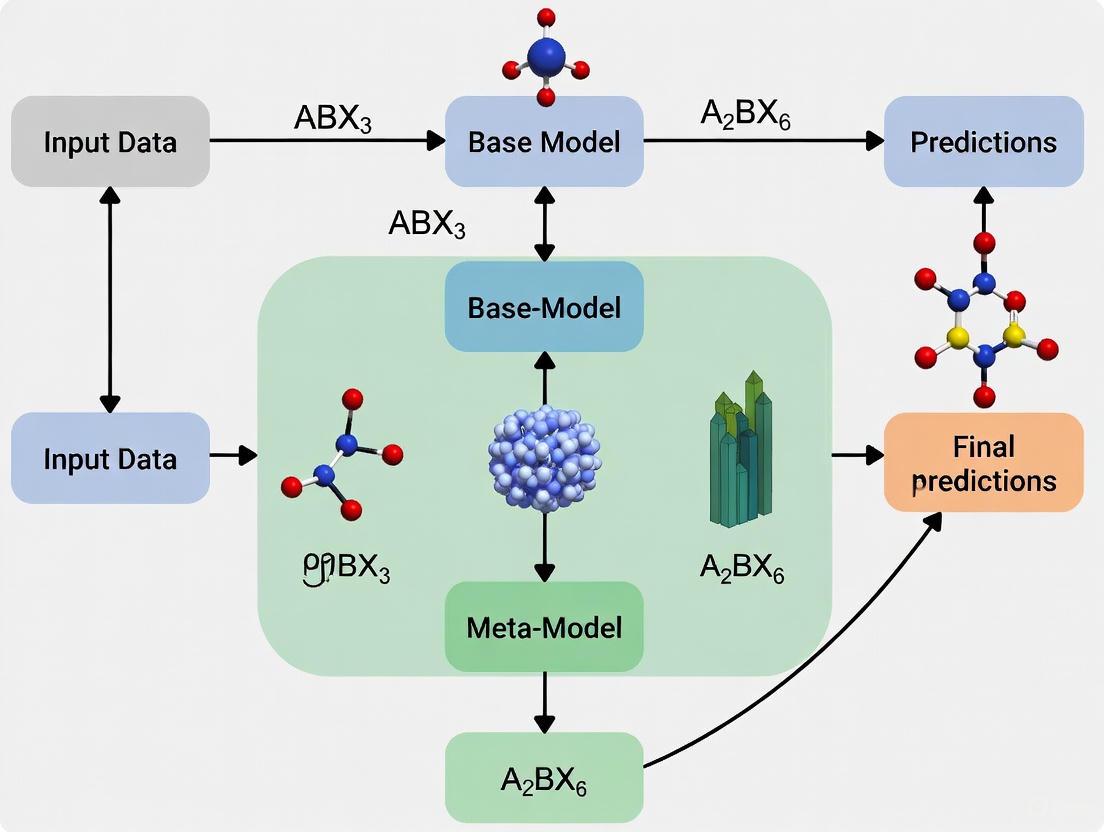
Stacked Generalization Machine Learning: Advanced Predictive Modeling for Material Stability and Drug Development
This article provides a comprehensive exploration of stacked generalization, an advanced ensemble machine learning technique, and its application in predicting material stability and properties crucial for drug development.
CPLAP: A Comprehensive Guide to Chemical Potential Analysis for Materials and Drug Discovery
This article provides a complete overview of the Chemical Potential Limits Analysis Program (CPLAP), a computational tool critical for determining material stability and thermodynamic properties.
First-Principles Calculations: Validating Stable Compounds for Advanced Materials and Drug Development
This article provides a comprehensive overview of how first-principles calculations, rooted in density functional theory (DFT), are revolutionizing the validation of stable compounds in materials science and drug development.
Machine Learning for Predicting Energy Above Convex Hull in Inorganic Materials: A Comprehensive Guide
This article provides a comprehensive overview of how machine learning (ML) is revolutionizing the prediction of the energy above the convex hull, a key metric for assessing the thermodynamic stability...
High-Throughput DFT for Thermodynamic Stability Screening: Accelerating Materials and Drug Discovery
This article provides a comprehensive overview of high-throughput Density Functional Theory (DFT) calculations for thermodynamic stability screening, a transformative approach in materials science and drug development.
Ensemble Machine Learning with Electron Configuration: A New Paradigm for Predicting Thermodynamic Stability in Materials and Drug Discovery
Predicting thermodynamic stability is a critical yet resource-intensive challenge in materials science and drug development.
Automated Procedures for Thermodynamic Stability and Chemical Potentials: A Guide for Materials and Drug Development
This article provides a comprehensive overview of automated computational and experimental procedures for determining material thermodynamic stability and synthesizable chemical potential ranges.
Beyond Graphene: Discovering New 2D Wide Bandgap Semiconductors for Next-Generation Technology
This article explores the rapidly advancing field of two-dimensional (2D) wide bandgap semiconductors, a class of materials poised to revolutionize power electronics, optoelectronics, and biomedical devices.
Universal Phase Stability Networks: A Complex Network Theory Framework for Drug Discovery and Materials Design
This article explores the transformative potential of universal phase stability networks, analyzed through complex network theory, for accelerating discovery in materials science and drug development.