Research Articles
Generative AI for Inverse Materials Design: Models, Applications, and Breakthroughs
This article explores the transformative role of generative artificial intelligence (AI) in revolutionizing inverse materials design, a paradigm that maps desired properties directly to material structures.
Hydrothermal Synthesis of Inorganic Materials: A Comprehensive Guide from Fundamentals to Advanced Biomedical Applications
This comprehensive review explores hydrothermal synthesis as a powerful bottom-up approach for creating diverse inorganic nanomaterials with tailored properties.
Solid-State Synthesis of Inorganic Materials: A Modern Guide to Principles, Methods, and Optimization
This article provides a comprehensive overview of direct solid-state reaction methods for synthesizing inorganic materials, a cornerstone technique for developing new compounds in research and industry.
Accelerating Discovery: A Guide to Computational and Data-Driven Inorganic Material Synthesis
This article provides a comprehensive overview of the computational guidelines and data-driven methods that are revolutionizing the synthesis of inorganic materials.
Beyond Neutrality: Rethinking Charge-Balancing Criteria for Next-Generation Inorganic Compounds and Materials
This article provides a comprehensive examination of the charge-balancing criterion for inorganic compounds, a foundational yet often insufficient principle for predicting synthesizability and stability.
Predicting Thermodynamic Stability of Inorganic Materials: Machine Learning, Generative AI, and Biomedical Applications
This article provides a comprehensive overview of modern approaches for predicting and designing thermodynamically stable inorganic materials, crucial for advancing biomedical and technological applications.
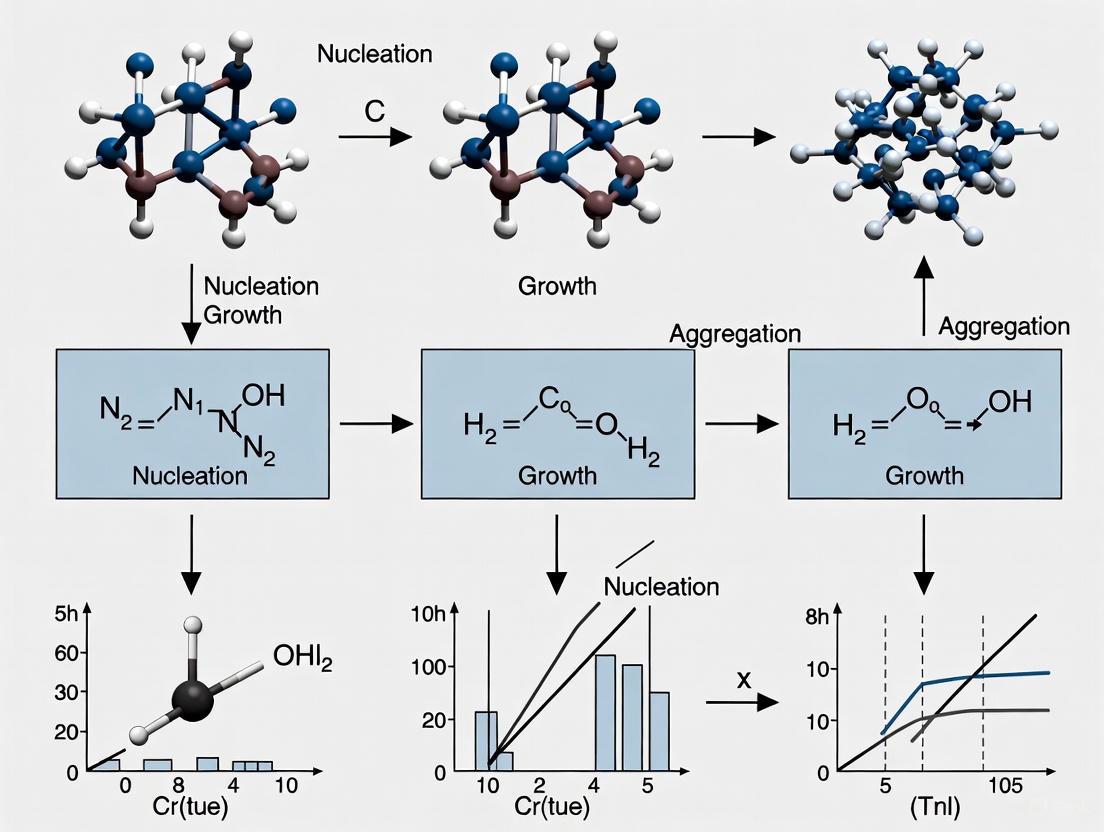
Nucleation and Growth in Inorganic Crystal Formation: Mechanisms, Control, and Pharmaceutical Applications
This article provides a comprehensive overview of recent advances in the nucleation and growth of inorganic crystals, with a specific focus on implications for pharmaceutical development.
Unlocking Materials Discovery: A Comprehensive Guide to High-Throughput Experimental Databases
This article explores High-Throughput Experimental Materials (HTEM) Databases, powerful resources transforming materials science by providing large-scale, publicly accessible experimental data.
Inorganic Materials and Compounds: A Foundational Guide for Biomedical Research and Drug Development
This article provides a comprehensive overview of inorganic materials and compounds, tailored for researchers and professionals in drug development.
Bottling Chemistry: How AI is Quantifying Human Intuition to Accelerate Inorganic Materials Discovery
This article explores the transformative integration of human chemical intuition with artificial intelligence for discovering novel inorganic materials.