Substrate Temperature Control in Perovskite Crystal Growth: From Fundamental Mechanisms to Advanced Optimization Strategies
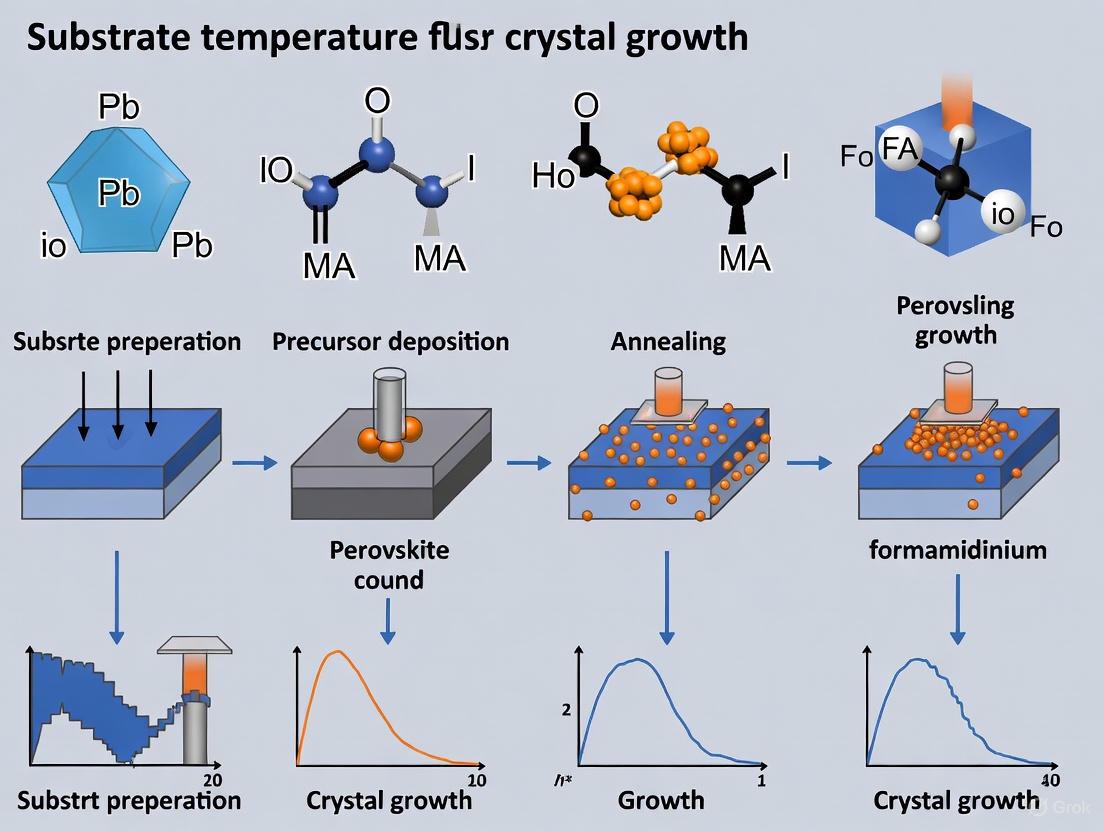
This article provides a comprehensive analysis of substrate temperature control as a critical parameter for directing perovskite crystal growth, film morphology, and ultimate device performance.
Substrate Temperature Control in Perovskite Crystal Growth: From Fundamental Mechanisms to Advanced Optimization Strategies
Abstract
This article provides a comprehensive analysis of substrate temperature control as a critical parameter for directing perovskite crystal growth, film morphology, and ultimate device performance. Covering both vacuum-deposited and solution-processed techniques, we explore the fundamental thermodynamics of nucleation, practical methodological applications across different fabrication scales, and advanced troubleshooting for common temperature-related defects. The content synthesizes recent scientific advances with practical optimization strategies, highlighting how precise thermal management enables the fabrication of high-efficiency, stable perovskite solar cells. Special emphasis is placed on validation techniques and comparative analysis of temperature effects across different perovskite compositions and device architectures, providing researchers with a unified framework for implementing temperature control in both laboratory and industrial settings.
The Thermodynamic Foundation: How Temperature Governs Perovskite Nucleation and Crystal Growth
Understanding Chemical Potential and Gibbs Free Energy in Temperature-Controlled Crystallization
In the pursuit of advanced optoelectronic devices, the quality of perovskite crystals has emerged as a critical determining factor. This document establishes the fundamental thermodynamic principles of chemical potential and Gibbs free energy that govern crystallization processes, with specific application to temperature-controlled perovskite crystal growth. Within a broader thesis on substrate temperature control, this framework provides researchers with the theoretical and practical tools to design crystallization protocols that yield large, high-quality single crystals essential for high-performance radiation detectors, solar cells, and other optoelectronic applications.
The Gibbs free energy (G) of a system, defined as (G = H - TS) (where H is enthalpy, T is temperature, and S is entropy) [1], represents the driving force behind chemical reactions and phase changes. The chemical potential ((\mui)), defined as the partial molar Gibbs free energy (\mui = \left( \dfrac{\partial G}{\partial ni} \right) _{p,T,nj\neq i}) [2], dictates the direction of mass transfer during crystallization. At constant temperature and pressure, systems evolve spontaneously toward minimum Gibbs free energy, making the change in Gibbs free energy, (\Delta G = \Delta H - T \Delta S), a crucial predictor of process feasibility [1].
Theoretical Foundation
The Role of Chemical Potential in Crystallization
Chemical potential can be conceptualized as the "escaping tendency" of a component from a phase. During crystallization from a solution, molecules migrate from the solution phase (higher chemical potential) to the crystal phase (lower chemical potential) until equilibrium is reached, wherein the chemical potential of each component is equal across all phases [2]. The difference in chemical potential between the supersaturated solution and the crystal phase, (\Delta\mu), provides the thermodynamic driving force for nucleation and growth.
For an ideal solution, this chemical potential difference relates to supersaturation through the expression: [ \Delta\mu = kT \ln(S) ] where (S) is the supersaturation ratio. Operating at moderate supersaturation levels, controlled by precise temperature profiles, is essential for promoting growth over nucleation, thus enabling the formation of large, defect-free single crystals.
Gibbs Free Energy and Temperature Dependence
The Gibbs free energy change for crystallization, (\Delta G_{cryst}), must be negative for the process to be spontaneous. This value is profoundly influenced by temperature, as evident from the defining equation (\Delta G = \Delta H - T \Delta S) [1]. Crystallization is typically an exothermic process ((\Delta H < 0)) with a decrease in entropy ((\Delta S < 0)) as molecules become ordered in the crystal lattice. Consequently, the term ( -T \Delta S ) is positive, opposing crystallization.
The balance between these competing enthalpy and entropy terms dictates the temperature-dependent behavior of the system. Lower temperatures favor crystallization by reducing the magnitude of the opposing entropy term. However, excessively low temperatures can also increase solution viscosity, impairing molecular mobility and incorporation into the crystal lattice. Therefore, identifying an optimal temperature window is critical for successful crystallization, a principle demonstrated in perovskite crystal growth where substrate temperature dramatically alters morphology [3].
Experimental Evidence in Perovskite Crystallization
Recent studies on perovskite single crystals (PSCs) provide compelling evidence for the application of these thermodynamic principles.
Quantitative Data from Recent Studies
Table 1: Key Performance Metrics of Perovskite Single Crystals Grown via Different Methods
| Growth Method | Crystal Size (mm³) | Mobility-Lifetime Product (cm² V⁻¹) | Trap-State Density (cm⁻³) | Reference |
|---|---|---|---|---|
| Close-to-Equilibrium Crystallization | 51 × 45 × 10 | 2.83 × 10⁻² | Not Specified | [4] |
| Antisolvent Vapor-Assisted Crystallization (AVC) - Optimized | Not Specified | 1.4 × 10⁻² | 2.12 × 10¹⁰ | [5] |
| AVC - High Antisolvent Flux | Not Specified | Lower than optimized | Higher than optimized | [5] |
Table 2: Impact of Process Parameters on Crystal Quality and Kinetics
| Parameter | Impact on Driving Force | Effect on Crystal Quality | System Studied |
|---|---|---|---|
| Substrate Temperature | Alters supersaturation and (\Delta G); outside optimal range leads to dendritic growth and defects [3]. | High temperature causes dendritic/island structures, increasing defect density [3]. | Mixed-ion Perovskite (FAPbI₃)₀.₈₅(MAPbBr₃)₀.₁₅ |
| Antisolvent Vapor Flux (in AVC) | Controls supersaturation rate; high flux causes excessive nucleation [5]. | Lower flux yields double-sided smooth crystals with lower trap density [5]. | MAPbBr₃ PSCs |
| Initial Precursor Concentration | Influences initial chemical potential difference; high concentration can lead to defective growth [5]. | Reduced concentration significantly improves crystal quality [5]. | MAPbBr₃ PSCs |
| Temperature Ramp Rate (in ITC) | Governs growth rate; proportional to solubility derivative with respect to temperature [5]. | Low-temperature-gradient crystallization maintains yield while optimizing quality [5]. | Perovskite Single Crystals |
In-Situ Kinetic Studies
Advanced monitoring techniques have enabled the real-time observation of crystal growth kinetics. For instance, in the antisolvent vapor-assisted crystallization (AVC) of MAPbBr₃, in-situ monitoring with a 2-minute sampling interval revealed a characteristic growth curve where the growth rate initially increases as antisolvent permeates the solution, then decreases as the solution concentration depletes [5]. This kinetic profile aligns with theoretical models where the growth rate is a function of supersaturation, which evolves dynamically throughout the process.
Protocols for Temperature-Controlled Crystallization
Close-to-Equilibrium Crystallization for Large-Scale Perovskite Single Crystals
This protocol, adapted from Yin et al. (2025), is designed to maintain a near-equilibrium state throughout the growth process, minimizing defects and enabling the production of large crystals [4].
Research Reagent Solutions Table 3: Essential Materials for Close-to-Equilibrium Crystallization
| Reagent/Material | Function/Specification | Role in Thermodynamic Control |
|---|---|---|
| FAPbBr₃ Precursors | Formamidinium lead bromide precursors | Source of perovskite-forming ions; purity critical for minimizing parasitic nucleation. |
| High-Purity Solvent | Solvent for precursor salts (e.g., DMF, GBL) | Dissolves precursors to create a homogeneous solution; purity prevents impurity-induced nucleation. |
| Solution Supply Unit | Precision pumping system | Maintains constant solution concentration in the growth unit, counteracting depletion and stabilizing chemical potential. |
| Crystal Growth Unit | Thermostatically controlled vessel | Provides a constant temperature environment to control supersaturation via the solubility-temperature relationship. |
| Solution Recycling Unit | Filtration and concentration adjustment system | Recycles spent solution to maintain a constant overall composition, supporting large-scale growth. |
Experimental Workflow
Precursor Solution Preparation: Dissolve high-purity FAPbBr₃ precursors in an appropriate anhydrous solvent at a concentration near saturation at the target growth temperature. Filter the solution through a 0.22 µm PTFE filter to remove particulate impurities.
System Assembly and Initialization: Assemble the three-unit system (supply, growth, recycling). Fill the crystal growth unit with a small volume of precursor solution. Set the growth unit to the target crystallization temperature ((T{cryst})) with a stability of ±0.1 °C. (T{cryst}) should be precisely determined based on the solubility curve of the target perovskite.
Seeding: Introduce a high-quality seed crystal of FAPbBr₃, fixed to a substrate or holder, into the growth unit once thermal equilibrium is established.
Initiating Solution Flow: Activate the solution supply and recycling units. The solution feeding rate must be systematically optimized to exactly match the crystal's growth rate, thereby maintaining a constant concentration and a near-zero effective supersaturation at the crystal surface.
Crystal Growth and Monitoring: Allow the crystal to grow for the required duration (days to weeks). Monitor the crystal size and morphology periodically.
Harvesting: Once the target crystal size is achieved, carefully stop the solution flow and remove the crystal from the growth unit. Rinse gently with a clean solvent to remove residual solution and dry.
Antisolvent Vapor-Assisted Crystallization (AVC) with Kinetic Control
This protocol, based on Li et al. (2025), emphasizes precise control over nucleation and growth kinetics through antisolvent vapor flux and initial concentration for achieving high-quality MAPbBr₃ single crystals [5].
Research Reagent Solutions Table 4: Essential Materials for Antisolvent Vapor-Assisted Crystallization
| Reagent/Material | Function/Specification |
|---|---|
| MABr (Methylammonium Bromide) | 99.9% purity or higher |
| PbBr₂ (Lead Bromide) | 99.999% purity or higher |
| DMF (N,N-Dimethylformamide) | 99.8% purity, anhydrous |
| DCM (Dichloromethane) | Antisolvent, Analytical Grade |
| In-Situ Monitoring System | Microscope with camera and short-interval timing |
Experimental Workflow
Precursor Solution Preparation: Dissolve MABr and PbBr₂ in stoichiometric ratio (e.g., 1:1 for MAPbBr₃) in DMF to form the precursor solution. For quality improvement, use a moderately reduced initial concentration (e.g., 1.0-1.5 M) rather than the maximum soluble concentration [5].
Growth Chamber Setup: Place the precursor solution in an open container within a sealed chamber. A separate container with the antisolvent (DCM) should be placed in the same chamber. The relative volumes, distances, and chamber seal will determine the antisolvent vapor flux.
Nucleation Induction: Seal the chamber. The antisolvent vapor will slowly diffuse into the precursor solution, reducing the solubility of the perovskite and generating supersaturation. To regulate nucleation location and number, reduce the antisolvent vapor flux by partially covering the antisolvent container or limiting its exposed surface area [5].
Growth Phase and Monitoring: Allow the crystals to grow. Monitor the process in-situ with an optical microscope, recording images at short intervals (e.g., 2 minutes) to accurately track the growth rate and observe morphological development [5].
Crystal Harvesting: Once crystals reach the desired size, carefully remove them from the solution. Rinse with fresh antisolvent to remove residual mother liquor and dry.
The deliberate control of temperature to manipulate chemical potential and Gibbs free energy is a cornerstone of modern crystal growth science, particularly for demanding materials like perovskites. The protocols outlined here, grounded in recent research, demonstrate that achieving high-quality crystals requires moving beyond simple supersaturation generation to the precise, sustained management of the thermodynamic driving force throughout the growth process. Whether through the constant conditions of a close-to-equilibrium system or the kinetically controlled diffusion of an antisolvent, the fundamental goal remains the same: to guide the system along a path of minimal Gibbs free energy that favors orderly, defect-free growth over chaotic nucleation. Integrating these principles with advanced in-situ monitoring will undoubtedly accelerate the development of next-generation perovskite-based devices.
Within the context of substrate temperature control for perovskite crystal growth, thermal energy emerges as a critical parameter governing the fundamental processes of nucleation and crystal development. Nucleation, the initial step in the formation of a new thermodynamic phase, proceeds primarily through two distinct pathways: homogeneous nucleation, which occurs spontaneously within the bulk solution, and heterogeneous nucleation, which is catalyzed at surfaces or interfaces [6] [7]. The kinetics of these pathways exhibit different dependencies on thermal energy, directly influencing the final crystal quality, film morphology, and optoelectronic properties of advanced materials such as metal halide perovskites [8] [9]. This application note examines the role of thermal energy in modulating these competing nucleation mechanisms and provides detailed protocols for manipulating crystallization kinetics in perovskite solar cell research and development.
Theoretical Foundations
Classical Nucleation Theory
Classical Nucleation Theory (CNT) provides the fundamental framework for quantitatively describing nucleation kinetics. The theory predicts a nucleation rate ( R ) that depends exponentially on the nucleation barrier [7]:
[ R = NS Z j \exp\left(-\frac{\Delta G^*}{kB T}\right) ]
where ( \Delta G^* ) represents the free energy barrier for nucleation, ( kB ) is Boltzmann's constant, ( T ) is temperature, ( NS ) is the number of potential nucleation sites, ( j ) is the rate at which monomers attach to the nucleus, and ( Z ) is the Zeldovich factor. The dominant role of thermal energy is evident in both the exponential term and the kinetic prefactor, creating a complex relationship that often results in a non-monotonic dependence of nucleation rate on temperature [7].
Table 1: Key Parameters in Classical Nucleation Theory
| Parameter | Symbol | Definition | Dependence on Thermal Energy |
|---|---|---|---|
| Nucleation Barrier | (\Delta G^*) | Free energy required to form a critical nucleus | Generally decreases with undercooling |
| Attachment Rate | (j) | Frequency of monomer addition to nuclei | Typically increases with temperature |
| Nucleation Rate | (R) | Number of nuclei formed per unit volume per time | Exhibits complex, non-monotonic temperature dependence |
| Critical Radius | (r_c) | Minimum stable nucleus size | Decreases with increasing undercooling |
Homogeneous vs. Heterogeneous Nucleation
The distinction between homogeneous and heterogeneous nucleation pathways lies primarily in their respective energy barriers. For homogeneous nucleation, the energy barrier is given by [7]:
[ \Delta G{\text{hom}}^* = \frac{16\pi\sigma^3}{3|\Delta gv|^2} ]
where ( \sigma ) is the interfacial energy and ( \Delta g_v ) is the volume free energy change. For heterogeneous nucleation occurring on a foreign surface, this barrier is reduced by a factor that depends on the contact angle ( \theta ) between the nucleus and the substrate [7] [10]:
[ \Delta G{\text{het}}^* = \Delta G{\text{hom}}^* \cdot f(\theta), \quad f(\theta) = \frac{2 - 3\cos\theta + \cos^3\theta}{4} ]
This reduction explains why heterogeneous nucleation typically occurs more readily than homogeneous nucleation under identical thermodynamic conditions [6] [7]. In confined systems such as small droplets, competition arises between these pathways, with homogeneous nucleation potentially dominating despite its higher barrier due to the vastly greater number of potential nucleation sites in the volume compared to available surface sites [6].
Figure 1: Competitive pathways for homogeneous and heterogeneous nucleation. Heterogeneous nucleation typically exhibits a reduced energy barrier due to the catalytic effect of surfaces, with f(θ) representing the contact angle dependence.
Thermal Energy Effects on Nucleation Kinetics
Temperature-Dependent Nucleation and Growth
Thermal energy exerts competing influences on nucleation kinetics. As temperature decreases below the phase transition point, the thermodynamic driving force for nucleation increases, while molecular mobility and attachment rates decrease. This creates a maximum in the nucleation rate at intermediate undercooling [7]. In perovskite systems, substrate temperature during deposition significantly influences nucleation mechanisms by affecting precursor adhesion, solvent evaporation, and intermediate phase stability [8] [9].
For methylammonium lead iodide (MAPbI₃) perovskite deposition from different solvents, the crystallization pathway diverges based on processing temperature. At moderate temperatures (below 75°C), crystallization occurs predominantly through solvate intermediate phases, while at higher temperatures, perovskite forms directly [9]. The activation energies for perovskite formation from these solvate intermediates vary with solvent coordination strength, following the trend DMSO > DMF > NMP > GBL [9].
Table 2: Temperature-Dependent Crystallization Parameters for Perovskite Formation
| Solvent System | Intermediate Phase | Activation Energy for Perovskite Formation | Optimal Temperature Range | Dominant Nucleation Pathway |
|---|---|---|---|---|
| DMSO | MA₂Pb₃I₈·2DMSO | Highest | 70-100°C | Heterogeneous at low T, Direct at high T |
| DMF | Lead halide-DMF complex | High | 60-90°C | Heterogeneous |
| NMP | Lead halide-NMP complex | Moderate | 50-80°C | Heterogeneous |
| GBL | None (direct formation) | Lowest | 40-70°C | Homogeneous |
Thermal Influence on Nucleation Pathway Competition
In confined systems, thermal energy affects the competition between homogeneous and heterogeneous nucleation. Numerical simulations of nickel droplet solidification reveal that both nucleation mechanisms can occur simultaneously without significantly influencing each other, despite the consumption of available monomers [6]. The preference for one pathway over another depends on the relative number of nucleation sites and the temperature-dependent reduction of the nucleation barrier.
For vapor-deposited wide-bandgap perovskites (Cs₀.₂FA₀.₈Pb(I₀.₈Br₀.₂)₃), substrate temperature during deposition dramatically affects film morphology and device performance. Increasing substrate temperature from -20°C to 75°C enhances charge carrier mobility and recombination lifetime by an order of magnitude, though these improvements don't always translate directly to better device performance due to competing factors like interface energetics and trap densities [8].
Experimental Protocols
Protocol 1: Temperature-Controlled Vapor Deposition of Wide-Bandgap Perovskites
This protocol describes the vapor deposition of Cs₀.₂FA₀.₈Pb(I₀.₈Br₀.₂)₃ perovskite films with controlled substrate temperature to manipulate nucleation kinetics [8].
Research Reagent Solutions:
- Cesium Iodide (CsI): 99.999% purity, inorganic precursor
- Formamidinium Iodide (FAI): 99.5% purity, organic precursor
- Lead Iodide (PbI₂) and Lead Bromide (PbBr₂): 99.999% purity, 1:8 molar ratio mixture
- Substrates: Patterned ITO/glass or silicon wafers
Equipment:
- Thermal evaporation system with multiple source crucibles
- Oil-cooled copper substrate holder with external temperature bath
- Quartz crystal microbalance (QCM) rate/thickness sensors
- High-vacuum pumping system (base pressure ≤ 5 × 10⁻⁶ Torr)
Procedure:
- Substrate Preparation:
- Clean substrates sequentially in ultrasonic baths of Hellmanex, deionized water, acetone, and isopropanol (15 min each)
- Treat with UV-ozone for 20 minutes to improve wetting and nucleation
System Setup:
- Load precursors into separate crucibles: CsI (0.1 Å/s), FAI (0.45 Å/s), and PbI₂/PbBr₂ mixture (0.35 Å/s)
- Set substrate temperature using the temperature bath (-20°C to 75°C range)
- Evacuate deposition chamber to base pressure
Deposition Process:
- Initiate simultaneous co-evaporation of all precursors
- Use QCM sensors to monitor and control deposition rates
- Continue deposition until PbI₂/PbBr₂ QCM reading reaches 280 nm (yielding 500-550 nm perovskite film)
- Maintain constant substrate temperature throughout deposition
Post-Processing:
- Anneal films at 100°C for 10 minutes in nitrogen atmosphere
- Cool gradually to room temperature before removal from chamber
Applications: This protocol enables systematic investigation of substrate temperature effects on nucleation mechanism, yielding either compact, smooth films at lower temperatures or larger-grained films with enhanced charge transport properties at elevated temperatures [8].
Protocol 2: Temperature-Dependent Crystallization from Solvate Intermediate Phases
This protocol examines the crystallization kinetics of MAPbI₃ from different solvent systems at controlled temperatures, monitoring the phase transformation from solvate intermediates to perovskite [9].
Research Reagent Solutions:
- Precursor Solution: 1.0 M MAPbI₃ in anhydrous DMSO, DMF, NMP, or GBL
- Antisolvents: Chlorobenzene (CB) or ethyl acetate (EA) for quenching
Equipment:
- Temperature-controlled blade coater with heating stage
- Synchrotron-based grazing-incidence wide-angle X-ray scattering (GIWAXS) setup
- Nitrogen flow system with controlled environment
- Anton Paar heating stage with graphite dome
Procedure:
- Solution Preparation:
- Dissolve equimolar CH₃NH₃I and PbI₂ in selected anhydrous solvent
- Heat solution at 60°C for 12 hours in N₂-filled glovebox
- Cool to room temperature before use
Film Deposition:
- Deposit 5 μL precursor solution using manual blade-coating
- Set wet film thickness to approximately 8 μm
- Control processing temperature between 40-100°C using heating stage
- Maintain 6 L/h N₂ flow with 50 mbar overpressure
In Situ GIWAXS Measurement:
- Use radiation energy of 8.048 eV (λ = 1.5406 Å, equivalent to Cu Kα1)
- Set incidence angle at 1°
- Collect time-resolved diffraction patterns during crystallization
- Monitor appearance and disappearance of solvate intermediate and perovskite phases
Data Analysis:
- Quantify phase formation and decomposition rates from intensity changes
- Plot Arrhenius relationships to determine activation energies
- Correlate transformation kinetics with solvent coordination strength
Applications: This protocol enables quantitative determination of activation energies for perovskite formation from different solvent systems, informing the selection of optimal processing temperatures for efficient solvent removal and high-quality film formation [9].
Figure 2: Experimental workflow for studying temperature-dependent crystallization kinetics of perovskites from solvate intermediate phases, incorporating in situ characterization.
The Scientist's Toolkit
Table 3: Essential Research Reagent Solutions for Nucleation Kinetics Studies
| Reagent/Chemical | Function in Nucleation Studies | Example Application | Considerations |
|---|---|---|---|
| Dimethyl Sulfoxide (DMSO) | Strongly coordinating solvent forming solvate intermediates | MAPbI₃ crystallization studies [9] | Requires higher activation energy for solvent removal; forms MA₂Pb₃I₈·2DMSO intermediate |
| Dimethylformamide (DMF) | Moderately coordinating solvent | Perovskite precursor solutions [9] | Intermediate coordination strength; forms lead halide-DMF complexes |
| Gamma-Butyrolactone (GBL) | Weakly coordinating solvent | Direct perovskite crystallization [9] | Minimal intermediate formation; lower processing temperatures required |
| Formamidinium Iodide (FAI) | Organic perovskite precursor | Wide-bandgap perovskite deposition [8] | Temperature-sensitive adhesion coefficient during vapor deposition |
| Cesium Iodide (CsI) | Inorganic perovskite precursor | Triple-cation perovskite formulations [8] | Enhances thermal stability; modifies nucleation kinetics |
| Chlorobenzene (CB) | Antisolvent for nucleation induction | Perovskite film crystallization [11] | Temperature-sensitive performance; optimal at lower temperatures (18°C) |
| Ethyl Acetate (EA) | Antisolvent with moisture sequestration | Ambient fabrication of perovskites [11] [12] | Less sensitive to ambient temperature variations; enables humid processing |
Thermal energy serves as a powerful tool for manipulating the competition between homogeneous and heterogeneous nucleation pathways in crystal growth processes. Through precise temperature control, researchers can direct crystallization along desired pathways, optimize nucleation densities, and ultimately control the morphological and optoelectronic properties of functional materials like metal halide perovskites. The protocols and data presented herein provide a framework for systematically investigating temperature-dependent nucleation kinetics, enabling rational design of processing conditions for specific application requirements. As perovskite photovoltaics advance toward commercial viability, understanding and controlling these fundamental nucleation processes will become increasingly critical for achieving reproducible, high-performance devices across manufacturing-scale operations.
Within the rigorous framework of substrate temperature control for perovskite crystal growth research, the adhesion coefficient—the probability that a vapor molecule sticks to a surface upon collision—stands as a critical parameter governing film formation. This coefficient is not a fixed property but is intrinsically temperature-dependent, profoundly influencing precursor sticking, nucleation dynamics, and ultimately, the morphology and optoelectronic quality of vapor-deposited perovskite thin films. The fundamental process is described by a temperature-dependent Boltzmann term, exp(-E~act~/k~B~T), where E~act~ is the activation energy for adsorption, k~B~ is the Boltzmann constant, and T is the temperature [8]. This relationship means that as substrate temperature increases, the adhesion and subsequent reaction of organic ammonium halides (e.g., FAI, MAI) on the forming perovskite film are significantly reduced [8]. Understanding and controlling this temperature-dependent adhesion is therefore not merely an academic exercise but a cornerstone for achieving precise stoichiometric control and high-quality crystalline films in perovskite photovoltaics and other advanced electronic applications.
Theoretical Foundations and Key Mechanisms
The interplay between temperature and adhesion is governed by well-defined thermodynamic and physical principles. At the molecular level, the adhesion coefficient (s) is a direct function of the thermal energy of the incident vapor molecules and the activation barriers present on the substrate surface.
Primary Theoretical Models
- Thermodynamic Driving Force: The general expression for the sticking coefficient contains a temperature-dependent Boltzmann term, exp(-E~act~/k~B~T), where E~act~ is the activation energy for the adsorption process. At higher substrate temperatures, the thermal energy of adsorbed molecules increases, reducing the probability of them sticking to the surface and leading to a lower effective adhesion coefficient [8].
- Work of Adhesion (W~a~): This thermodynamic quantity, which represents the energy required to separate two phases in contact, is also temperature-sensitive. For 2D materials like graphene and its derivatives, systematic investigation reveals that elevated temperatures significantly influence interfacial interactions by modifying surface energy components [13]. The hierarchy in adhesion energies (G > rGO > GO) remains consistent, but the absolute values shift with thermal fluctuation.
Heterogeneous Nucleation Theory: The energy barrier for heterogeneous nucleation, ΔG~hetero~*, is a key factor in film formation and is directly influenced by temperature and adhesion. The expression for this barrier is:
ΔG~hetero~* = (16π/3) (σ³v²/Δμ²) * [(2 - 3cosθ + cos³θ)/4]
where σ is the interface energy, v is the critical nucleus volume, θ is the contact angle between solution and substrate, and Δμ is the chemical potential difference. The nucleation rate subsequently depends exponentially on this barrier and inversely on temperature [10].
Material-Specific Adhesion Behaviors
Different materials exhibit distinct temperature-adhesion relationships, which must be considered for process optimization:
- Organic Ammonium Halides (FAI, MAI): These precursors show significantly higher sensitivity to substrate temperature compared to their inorganic counterparts (e.g., PbI₂, CsI). Research on the wide-bandgap perovskite Cs~0.2~FA~0.8~Pb(I~0.8~Br~0.2~)~3~ reveals that the temperature-dependent adhesion coefficient of FAI is the primary driver behind morphological changes in the film [8].
- Inorganic Precursors (PbI₂, CsI): These materials demonstrate relatively minor changes in tooling factor (a proxy for adhesion rate) with variations in substrate temperature [8]. This differential temperature response between organic and inorganic precursors creates a narrow processing window for achieving stoichiometric perovskite films.
- Graphene and Derivatives: The London dispersive and polar components of the work of adhesion in graphene (G), reduced graphene oxide (rGO), and graphene oxide (GO) follow a consistent hierarchy (G > rGO > GO) across temperatures, but their absolute surface energies are measurably modified by thermal changes [13].
Table 1: Temperature-Dependent Adhesion Behaviors of Different Material Classes
| Material Class | Key Temperature Dependence | Governing Interactions | Experimental Observations |
|---|---|---|---|
| Organic Perovskite Precursors (FAI, MAI) | Strong negative correlation with temperature | Hydrogen bonding, dipolar forces | Reduced sticking coefficients at elevated temperatures; major driver of film stoichiometry [8] |
| Inorganic Perovskite Precursors (PbI₂, CsI) | Weak temperature dependence | Van der Waals forces, ionic interactions | Minimal change in tooling factor with substrate temperature [8] |
| 2D Materials (Graphene, GO, rGO) | Complex dependence modifying surface energy components | Van der Waals (G), van der Waals + H-bonding + dipolar (GO/rGO) | Consistent hierarchy (G > rGO > GO) maintained across temperatures [13] |
| Metallic Surfaces | Variable based on surface chemistry | Metallic bonding, surface adsorption | Contact angle of water shows decreasing or nearly invariant trend at low temperatures [14] |
Experimental Protocols and Methodologies
Vapor Deposition with Controlled Substrate Temperature
This protocol details the methodology for systematically investigating temperature-dependent adhesion coefficients during vapor deposition of perovskite thin films, specifically adapted for wide-bandgap compositions like Cs~0.2~FA~0.8~Pb(I~0.8~Br~0.2~)~3~ [8].
Materials and Equipment
- Precursor Materials: Cesium iodide (CsI, 99.999% purity), Formamidinium iodide (FAI, 99.5% purity), Lead iodide (PbI₂, 99.999% purity), Lead bromide (PbBr₂, 99.999% purity)
- Substrates: Glass/ITO, pre-cleaned and UV-ozone treated
- Deposition System: High-vacuum thermal evaporation chamber with base pressure <5×10⁻⁶ Torr
- Temperature Control: Oil-cooled copper substrate holder with external temperature bath capable of range -20°C to 100°C
- Rate Monitoring: Quartz crystal microbalance (QCM) sensors (one for each precursor source)
- Characterization: In-situ reflection high-energy electron diffraction (RHEED), ex-situ X-ray diffraction (XRD), scanning electron microscopy (SEM)
Step-by-Step Procedure
Substrate Preparation and Loading
- Clean substrates sequentially in Hellmanex solution, deionized water, acetone, and isopropanol (15 minutes each in ultrasonic bath)
- Perform UV-ozone treatment for 20 minutes immediately before loading into deposition chamber
- Mount substrates onto temperature-controlled holder using thermal paste for optimal heat transfer
System Preparation and Precursor Loading
- Load precursors into separate tungsten boats: CsI, FAI, and PbI₂/PbBr₂ mixture (1:8 molar ratio)
- Ensure proper shielding between sources to prevent cross-contamination
- Pump down chamber to base pressure (<5×10⁻⁶ Torr) before initiating thermal control
Temperature Stabilization
- Set substrate temperature to target value (e.g., -20°C, 25°C, 50°C, 75°C)
- Allow temperature to stabilize for at least 30 minutes before initiating deposition
- Verify temperature stability with calibrated thermocouple in contact with substrate surface
Deposition Process
- Initiate simultaneous co-sublimation of all precursors
- Maintain deposition rates: CsI (0.1 Å/s), FAI (0.45 Å/s), PbI₂/PbBr₂ mixture (0.35 Å/s) as controlled by QCM sensors
- Continue deposition until QCM reading for lead halide reaches 280 nm (typically yielding 500-550 nm perovskite film)
- Monitor growth in real-time with RHEED where available (using ultralow currents to prevent charging)
Post-Deposition Processing
- Maintain substrate temperature for 10 minutes after deposition completion
- Anneal films at 100°C for 30 minutes in nitrogen atmosphere (for specific compositions)
- Cool gradually to room temperature before removing from chamber
Adhesion Coefficient Calculation
- Determine actual film composition through X-ray photoelectron spectroscopy (XPS)
- Compare to ideal stoichiometry based on deposition rates
- Calculate effective adhesion coefficient as ratio of incorporated to incident precursor molecules
Critical Parameters and Troubleshooting
- Temperature Uniformity: Verify ±1°C across substrate surface through independent measurements
- Rate Calibration: Perform QCM calibration for each precursor before main experiment
- Contamination Control: Implement liquid nitrogen cold trap to maintain high vacuum during deposition
- Stoichiometry Verification: Use independent technique (e.g., ICP-MS) to validate XPS composition measurements
Inverse Gas Chromatography (IGC) for Surface Energy Characterization
IGC provides a powerful method for quantifying temperature-dependent surface energy components related to adhesion phenomena [13].
Materials and Equipment
- Solid Samples: Graphene (G), graphene oxide (GO), reduced graphene oxide (rGO) particles
- Probe Solvents: n-alkanes (n-hexane, n-heptane, n-octane, n-nonane) and polar solvents (chloroform, dichloromethane, acetone, ethyl acetate, diethyl ether, tetrahydrofuran)
- Chromatography System: Gas chromatograph equipped with flame ionization detector (FID)
- Column Preparation: Stainless-steel column (2 mm inner diameter, 20 cm length)
Step-by-Step Procedure
Column Preparation
- Pack column with 1.0 g of solid material (G, GO, or rGO)
- Condition column at 130°C overnight under carrier gas flow to desorb water and impurities
Chromatographic Measurements
- Set column temperature to desired value (typically 313.15 K to 373.15 K)
- Maintain injector and detector at 473.15 K
- Inject 1 μL of extremely diluted vapor probes using Hamilton syringes
- Measure retention time (t~R~) with standard deviation <1% across replicates
- Determine dead time (t~0~) using non-adsorbing probe (methane)
Data Analysis
- Calculate net retention volume: V~n~ = jD~c~(t~R~ - t~0~), where j is James-Martin factor, D~c~ is corrected carrier gas flow rate
- Determine London dispersive surface energy using Hamieh thermal model
- Calculate polar free energy of adsorption and specific interaction parameters
- Derive work of adhesion values for different solvent interactions
Quantitative Data and Analysis
The experimental investigation of temperature-dependent adhesion yields critical quantitative relationships essential for process optimization.
Table 2: Experimental Data on Temperature-Dependent Adhesion and Material Properties
| Material System | Temperature Range | Key Measured Parameters | Impact on Film Properties |
|---|---|---|---|
| Cs~0.2~FA~0.8~Pb(I~0.8~Br~0.2~)~3~ | -20°C to 75°C | Adhesion coefficient of FAI decreases with increasing temperature | Morphology changes; carrier mobility and recombination lifetime increase by order of magnitude [8] |
| MAPI (CH~3~NH~3~PbI~3~) | -50°C to 110°C | Non-uniform films at -50°C; uniform/full coverage at 20°C; larger grains but less uniform at >80°C | Optimal morphology at intermediate temperatures (~20°C) [8] |
| Graphene (G) | 313.15 K to 373.15 K | London dispersive surface energy: 120-145 mJ/m²; Polar surface energy: 15-40 mJ/m² | Consistent hierarchy of adhesion energies (G > rGO > GO) across temperatures [13] |
| Water on Metallic Surfaces | Up to 300°C | Contact angle decreases nearly linearly above 100°C; becomes nearly temperature-independent above 210°C | Surface hydrophilicity increases with temperature at higher ranges [14] |
| Ag Nanoparticles/Water Nucleation | 260 K to 300 K | Critical saturation ratio peaks at ~278 K; n* (molecules in critical cluster) decreases with temperature | Maximum nucleation probability at intermediate temperature [15] |
The Scientist's Toolkit: Essential Research Reagents and Materials
Table 3: Key Research Reagent Solutions and Materials for Temperature-Dependent Adhesion Studies
| Reagent/Material | Function/Application | Specific Usage Notes |
|---|---|---|
| Formamidinium Iodide (FAI) | Organic perovskite precursor | High purity (>99.5%) essential; demonstrates strong temperature-dependent adhesion [8] |
| Cesium Iodide (CsI) | Inorganic perovskite precursor | High purity (>99.999%); shows minimal temperature-dependent adhesion variation [8] |
| Lead Iodide (PbI₂) | Metal halide precursor | High purity (>99.999%); typically mixed with PbBr₂ for wide-bandgap perovskites [8] |
| n-Alkane Series (C6-C9) | IGC non-polar probes | For determining London dispersive surface energy component; temperature-dependent surface areas must be accounted for [13] |
| Polar Solvent Probes | IGC polar characterizations | Chloroform (acidic), ethyl acetate (basic), acetone (amphoteric) for specific interaction quantification [13] |
| NaCl/KCl Single Crystal Substrates | Epitaxial growth substrates | Lattice-matched substrates for vapor phase epitaxy; provide suitable wettability for halide perovskites [16] |
| Thermal Control System | Substrate temperature regulation | Oil-cooled copper substrate holder with external bath provides precise control from -20°C to >100°C [8] |
Visualization of Mechanisms and Workflows
Temperature-Dependent Adhesion Workflow
Vapor-Solid Interaction Mechanisms
Application Notes for Perovskite Crystal Growth Research
The precise control of temperature-dependent adhesion coefficients directly enables advanced perovskite crystal growth research with specific implications for film quality and device performance.
Stoichiometric Control Through Differential Adhesion
The divergent temperature dependence of organic (FAI, MAI) versus inorganic (PbI₂, CsI) precursor adhesion provides a powerful mechanism for stoichiometric control. Research demonstrates that the "tooling factor" of MAI is significantly influenced by substrate temperature, while PbI₂ shows only minor changes [8]. This differential response means that:
- At lower temperatures (<0°C), excessive organic precursor incorporation can occur, leading to organic-rich films with compromised crystallinity and potential phase impurities.
- At higher temperatures (>50°C), organic precursor deficiency becomes problematic, resulting in lead-rich films with increased trap densities and non-radiative recombination.
- The optimal temperature window for stoichiometric Cs~0.2~FA~0.8~Pb(I~0.8~Br~0.2~)~3~ deposition is narrow, typically centered near room temperature for many compositions.
Morphological Engineering via Temperature Gradients
Strategic manipulation of adhesion coefficients through temperature programming enables precise morphological control:
- Low-Temperature Initiation (-20°C to 0°C): High organic adhesion promotes rapid nucleation density, establishing a continuous film foundation.
- Gradual Temperature Ramping (0°C to 50°C): Progressive reduction in organic adhesion allows for controlled grain growth while maintaining stoichiometric balance.
- High-Temperature Annealing (>80°C): Further organic desorption from grain boundaries can passivate defects and improve crystallinity without compromising bulk stoichiometry.
This approach has yielded wide-bandgap perovskite solar cells with enhanced thermal stability and state-of-the-art efficiency when optimized at -20°C substrate temperature with adjusted organic/inorganic deposition rate ratios [8].
Epitaxial Stabilization of Metastable Phases
Temperature-controlled adhesion enables the stabilization of metastable perovskite phases that are inaccessible through conventional processing. For CsSnCl₃, vapor phase epitaxy on NaCl substrates at controlled temperatures stabilizes a tetragonal perovskite phase that differs from its non-perovskite monoclinic bulk phase [16]. The adhesion and migration dynamics at specific temperatures facilitate the epitaxial registry necessary for phase stabilization, opening avenues for materials with novel optoelectronic properties.
Temperature-dependent adhesion coefficients represent a fundamental process parameter that directly governs vapor-solid interaction mechanisms in perovskite deposition and beyond. The systematic investigation of these relationships has revealed critical insights for stoichiometric control, morphological development, and phase stabilization in advanced electronic materials. The experimental protocols and theoretical frameworks presented here provide researchers with comprehensive methodologies for quantifying and leveraging these temperature-adhesion relationships.
Future research directions should focus on real-time monitoring of adhesion coefficients during deposition, development of multi-temperature processing protocols for graded compositions, and extension of these principles to emerging material systems including all-inorganic perovskites and 2D/3D heterostructures. The integration of temperature-dependent adhesion control with other processing parameters promises to accelerate the development of high-performance optoelectronic devices with precisely engineered interfaces and properties.
{# Thermodynamic Drivers of Crystal Orientation and Phase Purity}
Achieving precise control over crystal orientation and phase purity is a fundamental challenge in the fabrication of high-performance perovskite optoelectronic devices. The crystallization process, governed by thermodynamic and kinetic principles, directly dictates the final material's structural coherence, defect density, and ultimately, its electronic and operational stability. Within the broader context of substrate temperature control for perovskite crystal growth research, understanding these drivers is paramount. This Application Note provides a detailed examination of the thermodynamic factors that influence crystal orientation and phase purity, supplemented by structured quantitative data, standardized experimental protocols, and visual workflows to guide researchers in optimizing their material synthesis.
Thermodynamic Fundamentals of Crystallization
The transformation from a perovskite precursor solution or vapor to a solid crystalline film is primarily driven by supersaturation. The fundamental equations governing nucleation provide a quantitative framework for this process [17].
Supersaturation (ΔC) is the driving force for nucleation and is defined as: [ \Delta C = C - C_0 ] where C is the actual solute concentration and C₀ is the equilibrium solubility. For perovskites exhibiting inverse temperature crystallization, increasing the temperature decreases solubility, thereby increasing supersaturation and promoting nucleation [17].
The associated nucleation energy barrier (ΔG*) for homogeneous nucleation is given by: [ \Delta G^* = \frac{16\pi\gamma^3}{3\Delta Gv^2} ] where *γ* is the surface energy and *ΔGᵥ* is the volume free energy change. In practice, nucleation on a substrate is heterogeneous. The energy barrier for heterogeneous nucleation is modified by the contact angle (*θ*) between the nucleus and the substrate [10]: [ \Delta G^*{\text{hetero}} = \Delta G^* \cdot \frac{2 - 3\cos\theta + \cos^3\theta}{4} ] A smaller contact angle reduces the nucleation barrier, facilitating the formation of nuclei. The nucleation rate (J), which determines the density of crystal grains, follows [17] [10]: [ J = A \exp\left(-\frac{\Delta G^}{k_B T}\right) ] where *A is a prefactor, k_B is the Boltzmann constant, and T is the temperature. Consequently, higher supersaturation and lower nucleation barriers lead to a higher nucleation rate, typically resulting in a larger number of smaller grains.
Quantitative Data on Thermodynamic Control
Table 1: Thermodynamic and Experimental Parameters in Perovskite Crystal Growth
| Control Parameter | System / Value | Impact on Crystal Orientation & Phase Purity | Quantitative Outcome | Citation |
|---|---|---|---|---|
| Substrate Temperature | Cs~0.2~FA~0.8~Pb(I~0.8~Br~0.2~)~3~ (Vacuum Deposition) | Alters organic precursor adhesion & mobility; Higher temps reduce sticking coefficient, enabling larger grain growth. | Carrier mobility & recombination lifetime increased by an order of magnitude (from -20°C to 75°C). | [8] |
| Additive-Induced Strain | TMA~2~MAPb~2~I~7~ (n=2 LDP) with 10% Cl^-^ | Cl substitutes I in equatorial sites, inducing vertical strain in octahedra, thermodynamically favoring vertical growth. | Crystal orientation switched from horizontal (without Cl) to vertical alignment (with Cl). | [18] |
| Nucleation & Growth Modifier | CsPbBr~3~ with Pb(SCN)~2~ Additive | Coordinates with Pb^2+^ to retard crystallization, reducing nucleation sites & promoting larger, purer grains. | Power Conversion Efficiency (PCE) increased from baseline to 5.85%; superior stability >2000 h. | [19] |
| Phase Transition Energy | Sequential Deposition with EMI-DMP Additive | Lowers energy barrier for δ- to α-phase transition, enabling pure α-phase formation at low temperature (~110°C). | Achieved high open-circuit voltage of 1.21 V and certified PCE of 26.0%. | [20] |
| Localized Thermal Gradient | MAPbBr~3~ via Plasmonic Heating (AuNRs) | Localized heating creates extreme supersaturation, initiating seed-free nucleation with spatiotemporal control. | Enabled nucleation within 0.5 ms and growth of defined ~3x3 μm² crystals in 20 s. | [21] |
Table 2: Key Research Reagent Solutions for Thermodynamic Control
| Reagent / Additive | Function / Mechanism | Application Protocol |
|---|---|---|
| Methylammonium Chloride (MACl) | Induces vertical crystal growth in 2D perovskites by substituting I^-^ in PbI~6~ octahedra, creating axial strain. | Used at 10% total Cl (MAI:MACl 30:70 ratio) in precursor solution with pre-annealing at 60°C for 2h [18]. |
| Lead Thiocyanate (Pb(SCN)~2~) | Coordinates with Pb^2+^ ions, modulates crystallization kinetics, reduces nucleation density, and passivates defects. | Added to PbBr~2~ precursor solution (e.g., 25 mg/mL) in a multistep spin-coating process in ambient air [19]. |
| 1-Ethyl-3-methylimidazolium Dimethyl Phosphate (EMI-DMP) | Forms porous PbI~2~ framework, facilitates organic salt infiltration, and lowers δ-to-α phase transition energy barrier. | Introduced into PbI~2~ precursor solution for low-temperature sequential deposition (LTSD) [20]. |
| Formamidinium Iodide (FAI) | Organic cation source; its adhesion coefficient is highly temperature-dependent during vapor deposition. | Co-evaporated with CsI and Pb(I/Br)~2~; substrate temperature critically controls stoichiometry and morphology [8]. |
| Gold Nanorods (AuNRs) | Plasmonic heating elements that convert laser light to localized heat, triggering supersaturation and nucleation. | Tethered to APTES-functionalized glass substrate; irradiated with 660 nm CW laser (60 mW, 1 ms pulse) [21]. |
Experimental Protocols
Protocol: Substrate Temperature Control for Vapor-Deposited Perovskites
This protocol is adapted from studies on the co-evaporation of wide-bandgap perovskites [8].
1. Materials & Equipment:
- Precursor Sources: CsI, FAI, PbI₂, PbBr₂.
- Substrate: Patterned ITO/glass with underlying charge transport layers.
- Deposition System: High-vacuum thermal evaporation chamber.
- Critical Apparatus: Oil-cooled copper substrate holder with external temperature bath.
- Monitoring: Quartz crystal microbalance (QCM).
2. Procedure: 1. Substrate Preparation: Clean the substrate and load it into the evaporation chamber. Ensure the temperature bath is set to the desired initial temperature (e.g., -20°C). 2. Source & Tooling Calibration: Pre-calibrate the deposition rates for all sources individually. Note that the tooling factor for FAI is highly sensitive to substrate temperature [8]. 3. Temperature Stabilization: Allow the substrate holder to stabilize at the target temperature (±1°C) for at least 30 minutes prior to deposition. 4. Co-evaporation: - Begin deposition of all precursors simultaneously. - Use QCM to control the process, typically via the lead halide deposition rate. - Maintain substrate temperature throughout the deposition. A common range for investigation is -20°C to 75°C. - Stop deposition when the QCM reading corresponds to the target final thickness (e.g., ~500-550 nm). 5. Post-Deposition Annealing: Transfer the film to a hotplate for a mild post-annealing (e.g., 100°C for 10 minutes) to ensure complete crystallization and relieve stress.
3. Analysis:
- Morphology: Characterize grain size and surface coverage using Scanning Electron Microscopy (SEM).
- Optoelectronic Properties: Employ techniques like Time-Resolved Microwave Conductivity (TRMC) to measure charge carrier mobility and recombination lifetime.
- Performance: Fabricate complete solar cell devices (e.g., n-i-p structure) to correlate substrate temperature with power conversion efficiency.
Protocol: Low-Temperature Sequential Deposition (LTSD) with Additives
This protocol enables the formation of high-quality, α-phase perovskite at low temperatures, preserving thermally sensitive interfaces [20].
1. Materials:
- Lead Iodide (PbI₂)
- Formamidinium Iodide (FAI), Methylammonium Bromide (MABr)
- Additive: 1-Ethyl-3-methylimidazolium Dimethyl Phosphate (EMI-DMP)
- Solvents: Dimethylformamide (DMF), Dimethyl Sulfoxide (DMSO), Isopropanol (IPA)
2. Procedure: 1. Porous PbI₂ Film Formation: - Prepare the PbI₂ precursor solution in DMF:DMSO (9:1 v/v) with the addition of EMI-DMP (concentration optimized, e.g., 10-20 mol%). - Spin-coat the PbI₂@EMI-DMP solution onto the substrate. - Anneal the film at 70°C for 1 minute to remove residual solvent, resulting in a porous, fluffy morphology. 2. Organic Salt Conversion: - Prepare a solution of FAI/MABr in IPA. - Spin-coat the organic salt solution onto the porous PbI₂ film. 3. Low-Temperature Phase Transition: - Transfer the film to a hotplate at a low annealing temperature of 100-110°C for 20-30 minutes. - Observe the color change from yellow/transparent (PbI₂/δ-phase) to dark brown/black (α-phase), indicating complete conversion.
3. Analysis:
- X-ray Diffraction (XRD): Confirm the complete conversion to the α-phase and the absence of residual PbI₂ peaks at 12.8° or δ-phase peaks at 12.1°.
- Photovoltaic Characterization: Fabricate inverted PSCs and measure current-density-voltage (J-V) curves to obtain open-circuit voltage (VOC) and power conversion efficiency (PCE).
Visualization of Processes and Workflows
Diagram 1: Thermodynamic drivers of nucleation and crystal orientation. The diagram illustrates how external factors like temperature and additives influence fundamental thermodynamic parameters (supersaturation, nucleation barrier, strain) to dictate final crystal properties.
Diagram 2: Generalized experimental workflow for controlled perovskite crystallization. The diagram outlines the key stages of film formation and the primary control parameters at each step, from ink preparation to the final crystalline film.
In the pursuit of high-performance perovskite-based optoelectronics, the control of crystallization kinetics stands as a fundamental challenge determining both material quality and device performance. The supersaturation principle governs the phase transition from precursor solutions to solid crystalline films, where temperature emerges as a powerful control lever for modulating precursor condensation pathways. This thermodynamic driving force dictates nucleation rates, growth mechanisms, and ultimately, the morphological and structural properties of the resulting perovskite layers [10] [22]. Within crystallization theory, supersaturation represents the metastable state where solute concentration exceeds equilibrium solubility, creating the chemical potential necessary for spontaneous phase transition through nucleation and subsequent crystal growth [22].
The precise manipulation of temperature parameters throughout the deposition process enables researchers to strategically control supersaturation levels, thereby directing crystallization along desired pathways. Thermal energy influences both the thermodynamics and kinetics of crystal formation, affecting reaction rates, diffusion processes, solvent evaporation, and intermediate phase stability [3] [23]. This application note examines the fundamental principles and practical methodologies for utilizing temperature as a primary control variable in perovskite film formation, providing researchers with structured protocols for optimizing crystallization outcomes across various material systems and deposition techniques.
Theoretical Foundation: Temperature-Modulated Supersaturation
Thermodynamics of Nucleation and Growth
The crystallization process comprises two distinct yet interconnected stages: nucleation followed by crystal growth. According to classical nucleation theory, the energy barrier for heterogeneous nucleation (ΔGhetero*)—highly relevant to substrate-based film formation—is expressed as:
Figure 1: Theoretical framework illustrating temperature-dependent nucleation kinetics
where σ represents the interfacial energy between the solution and substrate, v is the critical nucleus volume, Δμ is the chemical potential difference between the precipitated crystal and the mother liquid, and θ is the contact angle between solution and substrate [10]. The corresponding heterogeneous nucleation rate follows an Arrhenius-type relationship:
dNhetero/dt = Γ exp[-ΔGhetero/kBT]
where Γ is the Zeldovich factor, kB is the Boltzmann constant, and T is temperature [10]. This mathematical framework reveals that temperature influences nucleation kinetics through both exponential (thermal energy) and pre-exponential (diffusion) factors, creating multiple control points for manipulation of nucleation density and initial crystal formation.
Temperature-Controlled Supersaturation Pathways
Supersaturation represents the driving force for crystallization, defined as the deviation from equilibrium solute concentration. Temperature modulates supersaturation through its influence on solubility, reaction kinetics, and mass transport. The strategic application of thermal energy at different process stages enables precise control over crystallization pathways:
Figure 2: Temperature modulation points throughout the perovskite crystallization process
Experimental evidence confirms that temperature thresholds exist beyond which undesirable morphological transitions occur. For mixed-ion perovskite systems (FAPbI3)0.85(MAPbBr3)0.15, elevated substrate temperatures during spin-coating alter film morphology from pure dendritic to dendritic/island co-existing structures, with island formation increasing defect density and deteriorating device performance [3]. This highlights the critical nature of maintaining substrate temperature within an optimal range to achieve high crystallinity perovskite layers with favorable morphological characteristics.
Experimental Protocols: Temperature Control Methodologies
Substrate Temperature Optimization During Deposition
Objective: To determine the optimal substrate temperature range for controlled nucleation and growth of mixed-ion perovskite films, minimizing defect density while maximizing crystallinity.
Materials:
- Pre-cleaned and functionalized substrates (e.g., FTO/TiO2)
- Mixed-ion perovskite precursor solution: (FAPbI3)0.85(MAPbBr3)0.15 in DMF:DMSO (4:1 v/v)
- Hot plate with precise temperature control (±1°C)
- Spin coater with controlled environment
- Nitrogen glove box (for oxygen- and moisture-free atmosphere)
Procedure:
- Prepare perovskite precursor solution according to established formulations and stir for 6 hours in N2 atmosphere [24].
- Pre-heat substrates to target temperatures (recommended range: 20-100°C) on temperature-controlled hot plate.
- Transfer 50μL of precursor solution onto pre-heated substrate.
- Immediately initiate spin-coating program: 4000 rpm for 40s.
- At 20s mark during spinning, introduce 500μL diethyl ether as anti-solvent quenching agent.
- Complete spinning and immediately transfer to hot plate for annealing at 100°C for 15min.
- Characterize resulting films using XRD, SEM, and photoluminescence spectroscopy.
Key Control Parameters:
- Temperature uniformity across substrate surface (±2°C)
- Time interval between substrate heating and solution deposition (<10s)
- Environmental humidity control (<10% RH)
Expected Outcomes: Within the optimal temperature range (60-80°C for many perovskite compositions), films should exhibit uniform coverage, high crystallinity, and minimal island formation. Outside this range, morphological defects including dendritic structures, incomplete coverage, or excessive island formation may occur [3] [23].
Precursor Solution Temperature Control (T_perodrip)
Objective: To investigate how precursor solution temperature during deposition affects solution wettability, hydrophilicity, and subsequent crystallization dynamics in ambient air-processing conditions.
Materials:
- Perovskite precursor solution (MAPbI3 or mixed-cation formulations)
- Temperature-controlled bath or hot plate
- Precision pipettes and pre-cooled/heated tips
- Environmental chamber with humidity control
- Contact angle measurement system
Procedure:
- Divide precursor solution into aliquots for temperature variation testing.
- Condition solutions to target temperatures (-20°C to 100°C range) using temperature-controlled bath.
- For sub-ambient temperatures, utilize ice-salt mixtures (-20°C) or refrigeration.
- For elevated temperatures, use heated bath with stabilization time (>5min).
- Deposit 50μL of temperature-controlled solution onto substrates maintained at constant temperature.
- Immediately initiate spin-coating process (4000rpm, 40s) without anti-solvent treatment.
- Anneal films at standardized conditions (100°C, 15min).
- Characterize film properties using SEM, XRD, and current-density-voltage measurements.
Key Control Parameters:
- Solution temperature stability during transfer and deposition
- Substrate temperature maintained constant at 25°C
- Environmental conditions: 25°C, 20% relative humidity [23]
Expected Outcomes: Precursor solution temperature significantly affects solution hydrophilicity and affinity for substrate active sites. Optimal dripping temperature (∼40-60°C for MAPbI3) enhances crystal structure, morphology, and device performance, potentially improving power conversion efficiency by up to 30% compared to non-optimized conditions [23].
In-Situ Crystallization at Elevated Deposition Temperatures
Objective: To achieve in-situ crystallization during deposition without post-annealing for Hf0.5Zr0.5O2 (HZO) thin films using high-temperature atomic layer deposition (ALD).
Materials:
- ALD system with heated substrate holder
- Cyclopentadienyl (CP)-linked Hf and Zr precursors
- Oxygen plasma source
- Heavily doped silicon substrates
- In-situ spectroscopic ellipsometry for growth monitoring
Procedure:
- Pre-clean substrates using standard HF-last cleaning procedure.
- Load substrates into ALD chamber and stabilize at target temperature (290-370°C).
- For HZO deposition, use discrete feeding method with cycle ratio Hf:Zr = 1:1.
- Set precursor pulsing sequence: CP-linked precursor dose → N2 purge → O2 plasma → N2 purge.
- Maintain ALD temperature windows: 330-370°C for HfO2 and 290-330°C for ZrO2 using CP-linked precursors.
- Deposit films to target thickness (5-20nm range).
- Characterize without post-annealing using XRD, TEM, and electrical measurements.
Key Control Parameters:
- Precursor selection (CP-linked precursors enable higher temperature processing)
- Temperature stability throughout deposition (±3°C)
- Film thickness control through cycle number
Expected Outcomes: Films deposited at higher temperatures (330°C) with CP-linked precursors demonstrate higher density, larger grains, lower leakage currents, and exhibit ferroelectric hysteresis at thicknesses as low as 5nm without wake-up process requirement [25]. This contrasts with films from TEMA precursors requiring minimum 18nm thickness for similar properties.
Data Analysis: Temperature Effects on Crystallization Outcomes
Table 1: Quantitative effects of substrate temperature on perovskite film properties
| Temperature Parameter | Optimal Range | Effect on Nucleation | Effect on Crystal Growth | Resulting Film Properties |
|---|---|---|---|---|
| Substrate Temperature (Mixed-ion Perovskite) [3] | 60-80°C | Prevents excessive island formation | Controls dendritic vs. compact growth | High crystallinity, minimal defects, improved device performance |
| Precursor Dripping Temperature (MAPbI3) [23] | 40-60°C | Enhances affinity for substrate active sites | Improves crystal structure and orientation | Up to 30% enhancement in energy conversion efficiency |
| ALD Deposition Temperature (HZO) [25] | 290-370°C | Enables in-situ crystallization without post-annealing | Promotes larger grain formation | Ferroelectric properties at 5nm thickness, low leakage current |
| Blade-Coating Substrate Temperature [10] | 60-100°C | Increases nucleation rate and density | Must be balanced with growth control | Large-area uniform films with complete coverage |
Table 2: Precursor concentration and temperature interactions in perovskite crystallization
| Precursor Concentration | Recommended Temperature Range | Grain Size Trend | Defect Density | Optimal Application |
|---|---|---|---|---|
| 0.8 M [24] | 60-80°C | Small grains | High | Fundamental studies |
| 1.5 M [24] | 70-90°C | Moderate increase | Moderate | Standard devices |
| 2.0 M [24] | 80-100°C | Large grains | Low | Champion devices (21.13% PCE) |
| 2.3 M [24] | 90-110°C | Very large, possible voids | Increased at high T | Thick film applications |
The Scientist's Toolkit: Essential Research Reagents and Materials
Table 3: Key research reagent solutions for temperature-controlled crystallization studies
| Reagent Solution | Composition | Function in Crystallization | Temperature Considerations |
|---|---|---|---|
| Mixed-ion Perovskite Precursor [3] | (FAPbI3)0.85(MAPbBr3)0.15 in DMF:DMSO (4:1 v/v) | Model system for temperature-dependent morphological studies | Intermediate phase stability temperature-dependent |
| Wide-Bandgap Perovskite Formulation [24] | Cs0.05FA0.8MA0.15Pb(I0.84Br0.16)3 in DMF:DMSO | Concentration-temperature interaction studies | Higher temperatures required for higher concentrations |
| CP-Linked Precursor System [25] | Cyclopentadienyl-linked Hf and Zr precursors | High-temperature ALD compatible precursor | Enables deposition at 290-370°C range |
| Anti-Solvent Quenching Solution [24] | Diethyl ether or chlorobenzene | Controls supersaturation initiation | Temperature affects quenching efficiency |
| Passivation Additive [24] | 4 mol% excess PbI2 | Defect passivation during crystallization | Temperature-dependent incorporation efficiency |
Troubleshooting and Optimization Guidelines
Common Temperature-Related Issues and Solutions
Problem: Non-uniform film coverage with island formation. Cause: Elevated substrate temperature beyond optimal range causing excessive island growth. Solution: Reduce substrate temperature to 60-80°C range and ensure temperature uniformity across substrate [3].
Problem: Poor precursor solution wettability on substrate. Cause: Sub-optimal precursor solution temperature affecting hydrophilicity. Solution: Adjust dripping temperature to 40-60°C to enhance affinity for substrate active sites [23].
Problem: Incomplete crystallization requiring post-annealing. Cause: Insufficient thermal energy during deposition for in-situ crystallization. Solution: Implement high-temperature ALD (290-370°C) with CP-linked precursors for in-situ crystallization without post-annealing [25].
Problem: Small grain size with high defect density. Cause: Incorrect precursor concentration and temperature combination. Solution: Increase precursor concentration to 2.0M with corresponding temperature increase to 80-100°C [24].
Problem: Poor reproducibility in large-area films. Cause: Inconsistent temperature control during blade/slot-die coating. Solution: Maintain substrate temperature at 60-100°C with precise thermal uniformity for scalable processing [10].
Advanced Optimization Strategies
For researchers seeking to push beyond standard protocols, several advanced strategies merit consideration:
Gradient Temperature Processing: Implement spatial or temporal temperature gradients to decouple nucleation and growth stages, enabling high nucleation density followed by slow growth for improved crystal quality [10].
Multi-Zone Thermal Control: For large-area substrates, utilize multi-zone heating systems to compensate for edge cooling effects and ensure uniform thermal conditions across the entire deposition area.
In-Situ Thermal Monitoring: Incorporate infrared thermography or embedded temperature sensors to monitor real-time thermal profiles during deposition, enabling dynamic adjustments to maintain optimal supersaturation conditions.
Temperature-Ramp Annealing: Replace isothermal annealing with controlled temperature ramps to sequentially optimize solvent removal, intermediate phase formation, and final crystallization without creating morphological defects.
The strategic integration of these temperature control methodologies provides researchers with a comprehensive toolkit for manipulating supersaturation and condensation pathways across diverse material systems and deposition platforms.
Practical Implementation: Temperature Control Strategies Across Deposition Techniques
Substrate temperature is a critical parameter in the vacuum deposition of perovskite thin films, serving as a powerful tool to control condensation and crystallization processes [8]. Despite its importance, this parameter has been scarcely investigated in a systematic way for perovskites [8]. Within the broader context of substrate temperature control in perovskite crystal growth research, this application note provides detailed protocols and quantitative data for implementing substrate temperature control across a wide spectrum, from cryogenic to elevated conditions. The precise thermal management of the substrate during deposition directly influences fundamental material properties including film morphology, charge carrier mobility, recombination lifetime, and ultimate device performance [8]. This document consolidates recent research findings and methodologies to establish standardized approaches for temperature-controlled vacuum deposition of perovskite semiconductors.
Quantitative Data on Substrate Temperature Effects
Temperature-Dependent Performance Characteristics
Table 1: Substrate temperature effects on wide-bandgap Cs₀.₂FA₀.₈Pb(I₀.₈Br₀.₂)₃ perovskite properties [8]
| Substrate Temperature (°C) | Charge Carrier Mobility | Recombination Lifetime | Morphological Characteristics | Key Performance Limitations |
|---|---|---|---|---|
| -20 | Baseline | Baseline | Optimized morphology with complete coverage | Interface trapping, ion mobility |
| 20 (Room Temperature) | Moderate improvement | Moderate improvement | Uniform and flat morphology (historically optimized) | Balanced limitations |
| 75 | Order of magnitude increase | Order of magnitude increase | Larger grains but less uniform | Competing factors: morphology, interface energetics, trap densities |
Crystallization Kinetics Parameters
Table 2: Theoretical framework for temperature-dependent crystallization kinetics [10]
| Parameter | Symbol | Relationship to Temperature | Impact on Crystal Growth |
|---|---|---|---|
| Heterogeneous nucleation energy barrier | ΔGhetero* | Inverse relationship with temperature | Lower barrier increases nucleation sites |
| Nucleation rate | dNhetero*/dt | Exponential relationship: exp(-ΔGhetero/kBT) | Higher temperature accelerates nucleation |
| Critical nucleus volume | v | Temperature-dependent through solubility | Affects critical cluster size for stable nucleation |
| Contact angle | θ | Substrate-dependent, temperature-sensitive | Lower contact angle reduces nucleation barrier |
| Interface energy | σ | Temperature-modulated | Lower interface energy promotes nucleation |
Experimental Protocols
Vacuum Deposition System Configuration for Temperature Control
Equipment Setup
- Substrate Holder Design: Utilize an oil-cooled copper substrate holder connected to an external temperature bath for precise thermal control [8]. The system must maintain stable temperatures from -20°C to 75°C throughout the deposition process.
- Vacuum Chamber Requirements: Base pressure should be maintained according to standard vacuum deposition protocols. Both high-vacuum (∼1 × 10⁻⁶ mbar) [26] and low-vacuum (2-4 × 10⁻² mbar) [26] systems have been successfully implemented with temperature control.
- Temperature Monitoring: Calibrated thermocouples or resistance temperature detectors (RTDs) should be embedded in the substrate holder in close proximity to the substrate interface. Continuous monitoring and logging throughout deposition is essential.
- Source Configuration: For co-evaporation systems, maintain separate thermal sources for organic (FAI, CsI) and inorganic (PbI₂, PbBr₂) precursors with independent rate control [8].
Substrate Temperature Calibration Protocol
Pre-deposition Calibration:
- Mount representative substrate (identical material and dimensions to experimental samples)
- Set temperature bath to target value and stabilize for 30 minutes
- Verify temperature reading at multiple points on substrate surface
- Document any gradient across substrate and establish correction factors
In-situ Monitoring:
- Record temperature every 30 seconds throughout deposition process
- Note any temperature fluctuations during precursor evaporation
- Maintain stability within ±1°C of target temperature
Cryogenic to Elevated Temperature Deposition Methodology
Wide-Bandgap Perovskite Deposition (Cs₀.₂FA₀.₈Pb(I₀.₈Br₀.₂)₃)
Materials Requirements:
- Precursor Sources: CsI (99.99% purity), FAI (99.99% purity), PbI₂ (99.99% purity), PbBr₂ (99.99% purity)
- Substrate: Pre-cleaned glass/ITO with appropriate charge transport layers
- Thermal Interface: High-thermal conductivity paste for optimal heat transfer
Deposition Parameters [8]:
- Source Rates: CsI (0.1 Å/s), FAI (0.45 Å/s), PbI₂/PbBr₂ mixture (0.35 Å/s)
- Thickness Control: Terminate deposition when quartz crystal microbalance reading reaches 280 nm (equivalent to 500-550 nm perovskite film)
- Temperature Protocol:
- Stabilize substrate at target temperature (-20°C to 75°C) for 15 minutes prior to deposition
- Maintain constant temperature throughout deposition process
- For temperatures below ambient, prevent condensation with purge gas during chamber venting
Low-Temperature Sequential Deposition (LTSD) Protocol
Innovative Approach for Inverted Architectures [20]:
PbI₂-EMI-DMP Complex Formation:
- Prepare PbI₂ precursor solution with tailor-made 1-ethyl-3-methylimidazolium dimethyl phosphate (EMI-DMP) additive
- Deposit porous PbI₂@EMI-DMP complex layer at room temperature
- Characterize porosity through SEM analysis (compare dense vs. porous morphology)
Organic Salt Infiltration:
- Apply organic ammonium salts (FAI, MAI) to porous PbI₂ framework
- Facilitate complete reaction through enhanced infiltration capability
Low-Temperature Annealing:
- Anneal at reduced temperatures (100-110°C vs. conventional 150°C)
- Achieve complete δ- to α-phase transition through reduced energy barrier
- Preserve thermal-sensitive self-assembled monolayers at buried interfaces
Quality Verification:
- Confirm complete phase transition via XRD (absence of PbI₂ peak at 12.8°)
- Verify α-phase purity and large grain size (>1.3 μm) through SEM analysis
Visualization of Experimental Workflows
Temperature-Controlled Vacuum Deposition Workflow
Workflow for Temperature Control - Diagram illustrating the complete experimental workflow for temperature-controlled vacuum deposition of perovskite films.
Temperature-Dependent Crystallization Mechanisms
Temperature-Dependent Mechanisms - Visualization of temperature-dependent crystallization mechanisms and resulting film properties across cryogenic to elevated conditions.
The Scientist's Toolkit: Research Reagent Solutions
Table 3: Essential materials for temperature-controlled perovskite vacuum deposition
| Material/Reagent | Specification | Function | Temperature Considerations |
|---|---|---|---|
| Cesium Iodide (CsI) | 99.99% purity, sublimated grade | Inorganic precursor for bandgap tuning | Stable evaporation across temperature range |
| Formamidinium Iodide (FAI) | 99.99% purity, high-purity grade | Organic cation source for perovskite structure | Temperature-dependent adhesion coefficient critical |
| Lead Iodide (PbI₂) | 99.99% purity, anhydrous | Metal halide framework component | Minimal temperature dependence on sticking coefficient |
| Lead Bromide (PbBr₂) | 99.99% purity, anhydrous | Halide component for bandgap control | Co-evaporated with PbI₂ at fixed ratio |
| 1-ethyl-3-methylimidazolium dimethyl phosphate (EMI-DMP) | Custom synthesis, high purity | Additive for low-temperature sequential deposition | Facilitates porous PbI₂ framework and reduces phase transition energy barrier |
| Thermal interface paste | High thermal conductivity, vacuum-compatible | Ensures efficient heat transfer to substrate | Must maintain performance across entire temperature range |
Discussion and Technical Considerations
Interplay Between Temperature and Material Properties
The research data demonstrates that substrate temperature during vacuum deposition significantly influences multiple aspects of perovskite film formation and ultimate device performance. The observed order-of-magnitude improvement in charge carrier mobility and recombination lifetime with increasing substrate temperature (from -20°C to 75°C) highlights the profound effect of thermal energy on material quality [8]. However, these improvements do not directly translate to enhanced device performance due to competing factors including morphology changes, interface energetics, and trap densities [8].
The temperature-dependent adhesion coefficient of organic precursors (particularly formamidinium iodide) emerges as a critical mechanism governing film growth dynamics [8]. This phenomenon follows a Boltzmann-type relationship, exp(-Eact/kBT), where Eact represents the activation energy for adsorption [8]. At elevated temperatures, reduced organic precursor adhesion leads to altered stoichiometry and morphological changes, necessitating careful optimization of the organic/inorganic deposition rate ratio at each temperature.
Protocol Optimization Guidelines
For wide-bandgap perovskites specifically, the optimal substrate temperature was identified at -20°C with adjusted deposition rates, yielding state-of-the-art efficient devices with enhanced thermal stability [8]. This counterintuitive result – that lower temperature produces better device performance despite superior charge transport properties at higher temperature – underscores the complex interplay between multiple factors in perovskite device optimization.
For sequential deposition approaches, the low-temperature methodology (LTSD) enables complete phase transition at significantly reduced annealing temperatures (100-110°C vs. 150°C), preserving thermal-sensitive interfaces while maintaining high crystallinity and phase purity [20]. This approach demonstrates the potential for decoupling crystallization optimization from substrate temperature constraints through innovative chemical additives.
This application note has established comprehensive protocols for implementing substrate temperature control across cryogenic to elevated conditions in vacuum deposition of perovskite thin films. The quantitative data, experimental methodologies, and visualization tools provide researchers with a foundation for systematic investigation of temperature effects on perovskite crystallization and device performance. The integration of temperature control as a deliberate experimental parameter enables enhanced material quality and device performance, particularly through the optimization of organic precursor adhesion and crystallization kinetics. Future research directions should focus on real-time monitoring of temperature-dependent growth mechanisms and development of dynamic temperature profiles that evolve throughout the deposition process to precisely control nucleation and growth stages separately.
Within the research domain of perovskite crystal growth, substrate temperature control is a critical parameter for directing thin-film morphology and ultimate device performance. Solution-processing techniques, notably spray coating and spin coating, are foundational for fabricating thin-film semiconductor devices. The strategic application of heat during these processes directly influences solvent evaporation kinetics and crystallization dynamics, which are pivotal for achieving high-coverage, pinhole-free perovskite films. This Application Note delineates the optimal thermal operating windows for these deposition methods and provides detailed protocols to guide research and development efforts, framing them within the broader context of advancing substrate temperature control for perovskite research.
Comparative Analysis of Coating Techniques
Spin coating is a benchmark technique in research and development for creating uniform films on small, flat substrates. The process involves depositing a solution onto a substrate, which is then rotated at high speed. Centrifugal force spreads the solution evenly, with final thickness primarily determined by the rotational speed. During spinning, airflow assists solvent evaporation, often making post-deposition heat treatment unnecessary [27].
Spray coating, alternatively, involves atomizing a precursor solution into fine droplets that are directed onto a substrate. This method is lauded for its scalability, compatibility with roll-to-roll processing, and lower material wastage compared to spin coating [27] [28]. A key differentiator is that the substrate is typically heated during deposition. This temperature directly governs droplet spreading, solvent evaporation, and precursor crystallization, making it a fundamental parameter for microstructural control [29].
Optimal Temperature Windows
The table below summarizes the optimal substrate temperature ranges for spray coating and spin coating of perovskite and common charge transport layers, as identified from recent literature.
Table 1: Optimal Temperature Windows for Solution-Processing Techniques
| Material System | Coating Method | Substrate Temperature Range | Key Outcome / Rationale | Citation |
|---|---|---|---|---|
| CH₃NH₃PbI₃ Perovskite | Spray Coating | 100°C – 120°C | Dense films with large equiaxed grains and good coverage. | [29] |
| CH₃NH₃PbI₃ Perovskite | Spray Coating | 60°C – 80°C (Low Range) | Needle-like grains, extra phases, and poor coverage. | [29] |
| CH₃NH₃PbI₃ Perovskite | Spray Coating | > 120°C (High Range) | Thermal decomposition of the perovskite film. | [29] |
| Cs₀.₂FA₀.₈Pb(I₀.₈Br₀.₂)₃ (Vapor-Deposited) | Substrate Heating | -20°C to 75°C (Studied Range) | Enhanced charge carrier mobility and recombination lifetime with higher temperature. | [8] |
| TiO₂ Electron Transport Layer | Spray Coating | Not Explicitly Stated | Achieved a higher PCE (2.92%) vs. spin-coated (2.32%). | [28] |
| Photoresist (General) | Spray Coating | Adjusted via chuck temperature | Controls solvent evaporation and reflow to improve edge coverage and reduce roughness. | [30] |
| General Polymer Films | Spin Coating | Ambient (or post-bake) | Drying is assisted by airflow during rotation; post-bake is often applied. | [27] |
Impact of Temperature on Film Properties
The substrate temperature during spray coating profoundly affects film morphology. For methylammonium lead iodide (CH₃NH₃PbI₃), temperatures between 100°C and 120°C produce dense, well-covered films with large equiaxed grains. In contrast, lower temperatures (60–80°C) result in needle-like or dendritic grain structures and poor substrate coverage due to insufficient solvent evaporation energy. Exceeding the upper thermal limit (e.g., >140°C for CH₃NH₃PbI₃) initiates perovskite thermal decomposition [29].
Beyond perovskite active layers, temperature control is also critical for ancillary layers. For instance, spray-coated titanium dioxide (TiO₂) electron transport layers (ETLs) have demonstrated a 25% higher power conversion efficiency in organic solar cells compared to spin-coated ETLs, a performance linked to the unique film morphology achieved through the spray process [28].
For complex perovskites like Cs₀.₂FA₀.₈Pb(I₀.₈Br₀.₂)₃, studies on vapor-deposited films show that increasing the substrate temperature from -20°C to 75°C can enhance charge carrier mobility and recombination lifetime by an order of magnitude, highlighting temperature's role in optimizing optoelectronic properties [8].
Experimental Protocols
Protocol: Spray Coating of CH₃NH₃PbI₃ Perovskite Films
This protocol outlines a single-step spray deposition for CH₃NH₃PbI₃ under ambient conditions [29].
Table 2: Key Research Reagent Solutions
| Reagent/Material | Function/Description |
|---|---|
| Lead Iodide (PbI₂) | Perovskite precursor (inorganic component) |
| Methylammonium Iodide (CH₃NH₃I) | Perovskite precursor (organic component) |
| Dimethylformamide (DMF) or γ-Butyrolactone (GBL) | Common solvents for precursor dissolution |
| Equipment | Function |
| Automatic spray coating system | Ensures consistent solution flow and nozzle movement |
| Hotplate/Temperature-Controlled Stage | Maintains precise and stable substrate temperature |
| Nitrogen (N₂) Gas | Used as the carrier gas for solution atomization |
| Fume Hood or Glove Box | Provides controlled atmosphere for processing |
Methodology:
- Precursor Solution Preparation: Dissolve stoichiometric amounts of lead iodide (PbI₂) and methylammonium iodide (CH₃NH₃I) in a suitable anhydrous solvent (e.g., DMF) to form a clear solution.
- Substrate Preparation: Clean glass or conductive (e.g., FTO) substrates thoroughly with detergent, deionized water, and organic solvents (acetone, isopropanol). Treat with oxygen plasma for 5 minutes to improve wettability.
- Substrate Temperature Setting: Pre-heat the substrate on a hotplate to the target temperature within the optimal window of 100°C to 120°C. Validate the surface temperature with a calibrated thermocouple.
- Spray Deposition: Load the precursor solution into the spray coater. Using nitrogen as a carrier gas, spray the solution onto the heated substrate. A typical deposition time may be as brief as one second. Critical spray parameters to control include:
- Nozzle-to-substrate distance
- Solution flow rate
- Carrier gas pressure
- Nozzle scan speed
- Post-Deposition Crystallization: Immediately after deposition, maintain the substrate at the same temperature for 30 seconds to facilitate complete solvent evaporation and perovskite crystallization.
- Cooling: Remove the substrate from the hotplate and allow it to cool to room temperature before further processing or characterization.
Protocol: Spin Coating of TiO₂ Electron Transport Layers
This protocol describes the formation of a compact TiO₂ (c-TiO₂) layer for inverted organic solar cells [28].
Methodology:
- Precursor Solution Preparation: Prepare the TiO₂ solution by mixing titanium(IV) isopropoxide (TTIP) as the precursor with a chelating agent like acetyl acetone (AcAc) in absolute ethanol. Dilute the final solution, typically at a 1:10 ratio.
- Substrate Preparation: Clean FTO-coated glass substrates sequentially in an ultrasonic bath using a diluted Hellmanex solution, deionized water, acetone, and isopropanol. Dry with a nitrogen gun and subject to oxygen plasma treatment for 5 minutes.
- Spin Coating: Deposit the TiO₂ solution onto the FTO substrate and immediately spin coat at 2000 rpm for 60 seconds.
- Post-Deposition Heat Treatment (Sintering): Transfer the coated substrate directly to a hot plate pre-heated to 450°C and sinter for 1 hour. This step is crucial for converting the precursor into a crystalline, compact TiO₂ layer.
Workflow and Decision Pathways
The following workflow diagram illustrates the experimental decision process for selecting and optimizing a coating method based on substrate temperature.
Diagram 1: Coating Method Selection Workflow
The Scientist's Toolkit
Table 3: Essential Research Reagent Solutions and Materials
| Category | Item | Typical Function in Experiment |
|---|---|---|
| Perovskite Precursors | Methylammonium Iodide (CH₃NH₃I), Lead Iodide (PbI₂) | Forms the light-absorbing perovskite crystal (e.g., CH₃NH₃PbI₃). |
| Electron Transport Layer (ETL) Materials | Titanium(IV) Isopropoxide (TTIP) | Precursor for solution-processed Titanium Dioxide (TiO₂) ETL. |
| Solvents | Dimethylformamide (DMF), γ-Butyrolactone (GBL), Chlorobenzene | Dissolves perovskite precursors; used in solution preparation. |
| Solvents & Additives | Acetyl Acetone (AcAc), Ethanol, Isopropyl Alcohol (IPA) | Serves as chelating agent (AcAc) or for dilution/cleaning (Ethanol, IPA). |
| Substrates & Electrodes | Fluorine-doped Tin Oxide (FTO) Glass, ITO Glass | Provides transparent conductive electrode for solar cell devices. |
| Cleaning Agents | Hellmanex III, Acetone | Ensures contaminant-free substrates prior to film deposition. |
Low-Temperature Sequential Deposition (LTSD) for Complete Phase Transition
Inverted perovskite solar cells (PSCs) have demonstrated significant progress in recent years, particularly with the integration of self-assembled monolayers (SAMs) at the charge transport interfaces [20]. While the two-step sequential deposition method offers benefits for obtaining high-quality, large-grain perovskite crystals, its implementation in inverted architectures has been limited by a fundamental constraint: the high annealing temperature (typically ~150°C) required to achieve the complete phase transition from δ-phase to α-phase perovskite [20].
This high-temperature requirement creates two critical challenges for inverted PSCs. First, it induces desorption of thermally unstable SAMs at the buried interface, increasing non-radiative recombination [20]. Second, it promotes the loss of organic components, resulting in a PbI₂-rich perovskite surface with high defect density that hinders charge transport [20]. The Low-Temperature Sequential Deposition (LTSD) method overcomes these limitations by enabling complete phase transition at significantly reduced temperatures, preventing SAM damage and suppressing redundant PbI₂ formation while maintaining excellent crystalline quality [20] [31].
Principles and Mechanisms
The Phase Transition Challenge in Sequential Deposition
The sequential deposition method involves first depositing a PbI₂ film followed by reaction with organic ammonium salts to form the perovskite structure. This process requires a phase transition from the δ-phase (non-perovskite) to the α-phase (perovskite), which traditionally demands high thermal energy [20]. At low annealing temperatures (<100°C), incomplete conversion occurs due to dense PbI₂ morphology blocking organic salt infiltration [20]. At high temperatures (>140°C), although phase transition completes, excessive heat causes organic component escape and PbI₂ segregation at the top surface [20]. This narrow processing window has limited the application of sequential deposition in thermally-sensitive inverted architectures.
LTSD Additive Engineering Strategy
The LTSD approach introduces a tailor-made ionic additive, 1-ethyl-3-methylimidazolium dimethyl phosphate (EMI-DMP), into the PbI₂ precursor solution to fundamentally modify the crystallization dynamics [20] [31]. This additive functions through multiple mechanisms:
- Porous PbI₂ Framework Formation: EMI-DMP disrupts the layered PbI₂ structure through hydrogen bonding between C–H on the imidazole rings and the PbI₂ framework, creating a porous, fluffy morphology that facilitates top-down diffusion of organic salts [20].
- Reduced Phase Transition Barrier: The additive lowers the energy barrier for the δ- to α-phase transition by modifying surface free energy, enabling complete transition at low temperatures [20].
- Enhanced Ion Mobility: Similar to other crystallization additives, EMI-DMP facilitates coarsening grain growth by increasing ion mobility across grain boundaries, promoting formation of larger crystals [32].
Table 1: Key Characteristics of EMI-DMP Additive in LTSD
| Parameter | Without EMI-DMP | With EMI-DMP |
|---|---|---|
| PbI₂ Morphology | Dense, layered structure | Porous, fluffy framework |
| PbI₂ Film Roughness | 29.5 nm | 50.9 nm |
| FWHM of PbI₂ (XRD) | 0.35° | 0.58° |
| Phase Transition Completion Temperature | ~150°C | <100°C |
| Average Perovskite Grain Size | <1 μm | >1.3 μm |
Experimental Protocols
Materials and Solution Preparation
Research Reagent Solutions: Table 2: Essential Materials for LTSD Protocol
| Material/Reagent | Function/Role | Specifications |
|---|---|---|
| 1-ethyl-3-methylimidazolium dimethyl phosphate (EMI-DMP) | Key additive for porous PbI₂ and reduced transition barrier | Tailor-made ionic liquid; purity >99% |
| Lead iodide (PbI₂) | Inorganic precursor | Anhydrous, 99.99% trace metals basis |
| Formamidinium iodide (FAI) | Organic ammonium salt | >99.5% purity, stored in dry environment |
| Methylammonium bromide (MABr) | Organic ammonium salt (for mixed cations) | >99.5% purity, stored in dry environment |
| Dimethylformamide (DMF) | Solvent | Anhydrous, 99.8% purity |
| Dimethyl sulfoxide (DMSO) | Solvent | Anhydrous, 99.9% purity |
PbI₂ Precursor Solution Formulation:
- Prepare 1.5M PbI₂ solution in DMF:DMSO (4:1 v/v) mixture
- Add EMI-DMP at 10-15 mol% relative to PbI₂ concentration
- Stir at 60°C for 6-12 hours until complete dissolution
Organic Salt Solution:
- Prepare 20 mg/mL FAI in 2-propanol
- For mixed cation composition: add MABr at appropriate stoichiometric ratio
- Stir at room temperature for 2 hours before use
LTSD Deposition Procedure
Diagram 1: LTSD Experimental Workflow
Step-by-Step Protocol:
- Substrate Preparation
- Clean ITO/glass substrates with sequential ultrasonication
- Apply oxygen plasma treatment for 15 minutes
- Deposit appropriate SAM (e.g., [2-(9H-carbazol-9-yl)ethyl]phosphonic acid) following established protocols
- PbI₂@EMI-DMP Deposition
- Filter PbI₂@EMI-DMP solution through 0.45 μm PTFE filter
- Dynamic spin-coating at 3000 rpm for 30 seconds
- Immediately after spinning, gently dry film with nitrogen flow
- Organic Salt Reaction
- Dynamic spin-coating of FAI solution at 2000 rpm for 20 seconds
- Allow reaction for 60 seconds without disturbance
- Spin at 4000 rpm for 10 seconds to remove residual solution
- Low-Temperature Annealing
- Transfer to hotplate at 100°C for 10-30 minutes
- Monitor color change from yellow/transparent to dark brown
- Cool gradually to room temperature before further processing
Characterization and Quality Control
Critical Quality Assessment Metrics:
- XRD Analysis: Confirm complete phase transition with dominant (110) peak at ~14.1° and absence of PbI₂ peak at 12.8°
- SEM Imaging: Verify large, compact grain structure with >1 μm average grain size
- FTIR Spectroscopy: Check for complete solvent removal and additive coordination
- UV-Vis Spectroscopy: Confirm characteristic absorption edge and bandgap
Table 3: Quality Control Standards for LTSD-Perovskite Films
| Characterization Technique | Target Outcome | Acceptance Criteria |
|---|---|---|
| XRD | Pure α-phase perovskite | PbI₂ peak (12.8°) intensity <2% of perovskite (110) peak |
| SEM | Uniform, pinhole-free morphology | Grain size >1 μm, coverage >95% |
| TOF-SIMS | Uniform EMI-DMP distribution | Homogeneous phosphorus signal throughout depth |
| UV-Vis | Sharp absorption edge | Bandgap ~1.55 eV (for MAPbI₃) |
| GIXRD | No interfacial PbI₂ | Absence of PbI₂ at both top and buried interfaces |
Results and Performance
Material Properties and Film Characteristics
The LTSD method produces perovskite films with exceptional quality at low processing temperatures. Key structural advantages include:
- Enhanced Crystallinity: Films exhibit highly crystalline pure α-phase perovskite with preferential orientation [20]
- Large Grain Growth: Average grain sizes exceeding 1.3 μm reduce grain boundary density and associated recombination centers [20]
- Improved Morphology: Compact, pinhole-free films with complete substrate coverage enhance charge transport [20]
- Optimal Interfaces: Preserved SAM integrity at buried interface and minimal surface PbI₂ prevent interfacial recombination [20]
Device Performance and Stability
The implementation of LTSD in inverted PSCs delivers state-of-the-art performance:
- Power Conversion Efficiency: Certified efficiency of 26.0% (lab-record 26.5%), significantly exceeding conventional sequential deposition methods (24.0-24.5%) [20] [31]
- Open-Circuit Voltage: High VOC of 1.21 V demonstrates effective suppression of non-radiative recombination [20]
- Stability Performance: Encapsulated devices maintain 93.1% efficiency after 1000 hours at 85°C/85% RH (ISOS-D-3) and 95.4% after 1000 hours maximum power point tracking at 65°C (ISOS-L-2) [20]
Diagram 2: LTSD Performance Enhancement Mechanisms
The Low-Temperature Sequential Deposition method represents a significant advancement in perovskite solar cell fabrication, specifically addressing the critical challenge of achieving complete phase transition while preserving thermally-sensitive interface materials. By incorporating the tailor-made EMI-DMP additive, the LTSD process enables the formation of high-quality, large-grain perovskite films at temperatures compatible with SAM-based inverted architectures.
This approach demonstrates that strategic additive engineering can overcome fundamental thermodynamic barriers, enabling low-temperature processing without compromising crystalline quality. The resulting devices achieve certified 26.0% efficiency with exceptional operational stability, positioning sequential deposition as a competitive method for high-performance inverted PSCs. The LTSD strategy provides a framework for future molecule design and process optimization aimed at further advancing perovskite photovoltaics toward commercial viability.
Vapor-Assisted Annealing Methods for Uniform Thermal Distribution
Within the critical research on substrate temperature control for perovskite crystal growth, vapor-assisted annealing has emerged as a powerful technique to overcome the challenges of thermal distribution inherent in conventional hot-plate methods. Traditional hot-plate annealing can cause temperature gradients across the substrate due to non-uniform thermal contact, leading to inconsistent crystal quality and film morphology [33]. These inconsistencies act as a catalyst for device degradation and are a significant barrier to the industrial-scale manufacturing of perovskite photovoltaics. Vapor-assisted methods address this fundamental limitation by creating a uniform thermal and chemical environment during the annealing process, enabling the production of perovskite films with superior crystallinity, reduced defect density, and enhanced optoelectronic properties. This application note details the protocols and mechanistic insights of these advanced annealing strategies, providing a framework for their implementation in perovskite substrate temperature research.
Comparative Analysis of Vapor-Assisted Annealing Techniques
The following table summarizes the core characteristics, performance outcomes, and associated mechanisms of key vapor-assisted annealing methods documented in recent literature.
Table 1: Summary of Key Vapor-Assisted Annealing Methods and Performance Outcomes
| Method Name | Key Vapor Components | Reported Device Performance | Impact on Film Morphology & Crystallinity | Primary Mechanism of Action |
|---|---|---|---|---|
| Vapor-Assisted Pressure-Controlled Annealing (VA-PCA) [34] | 4-fluorophenylmethylammonium bromide (F-PMABr) & Ammonium Fluoride (NH₄F) | 20.10% PCE (WBG, 1.66 eV); >80% initial efficiency retained after 528h at 65°C [34] | Homogeneous, pinhole-free films; reduced halide vacancies; fortified lattice structure [34] | Synergistic defect passivation and crystallization modulation under controlled pressure [34] |
| Mixed-Solvent Vapor Annealing [35] | DMSO & Chlorobenzene (CB) | PCE improved from 16.6% to 18.4%; VOC of 1.11 V, JSC of 23.35 mA/cm² [35] | Grain size increased from ~300 nm to 1 µm; reduced grain boundaries and surface defects [35] | Enhanced crystallization via solvent vapor environment; facilitates precursor ion diffusion [35] |
| Vacuum Thermal Annealing (VTA) [36] | N/A (Process conducted under vacuum) | Peak PCE of 32.0% under indoor light; Average VOC of 0.93 ± 0.02 V [36] | Compact, dense, and hard morphology; suppressed trap states at surfaces and grain boundaries [36] | Promotes rapid solvent removal and robust nucleation; eliminates volatile byproducts [36] |
| Air-Heated Oven Annealing [33] | Ambient air with controlled humidity (Optimum: 30% RH) | Best PCE of 14.9%; superior performance uniformity compared to hot-plate [33] | More uniform films with fewer pinholes; highly continuous at optimal humidity [33] | Provides a uniform temperature environment, eliminating lateral thermal gradients [33] |
The efficacy of substrate temperature control extends beyond the annealing environment to the initial deposition phase. Research on vapor-deposited wide-bandgap perovskites (Cs₀.₂FA₀.₈Pb(I₀.₈Br₀.₂)₃) has demonstrated that the substrate temperature during deposition significantly influences the adhesion coefficient of organic precursors, which in turn dictates film morphology and composition [8].
Table 2: Effect of Substrate Temperature During Vapor Deposition on Perovskite Film Properties [8]
| Substrate Temperature | Film Morphology & Composition | Charge Carrier Mobility & Recombination Lifetime | Implication for Device Fabrication |
|---|---|---|---|
| -20 °C | Altered stoichiometry due to high organic precursor adhesion [8] | Lower compared to high-temperature deposits [8] | Enables state-of-the-art efficient devices with enhanced thermal stability when deposition rate is optimized [8] |
| 75 °C | Altered stoichiometry due to reduced organic precursor adhesion [8] | Increased by an order of magnitude [8] | Improved material properties do not directly translate to better devices due to competing factors like interface traps [8] |
Experimental Protocols
Protocol: Vapor-Assisted Pressure-Controlled Annealing (VA-PCA) for Wide-Bandgap Perovskites
This protocol is adapted from studies producing high-quality, wide-bandgap perovskite absorbers for tandem solar cells [34].
1. Research Reagent Solutions
- Perovskite Precursors: Cesium Iodide (CsI), Lead Bromide (PbBr₂), Lead Iodide (PbI₂), Formamidinium Iodide (FAI).
- Passivation Vapor Source: 4-fluorophenylmethylammonium bromide (F-PMABr).
- Lattice Fortification Source: Ammonium Fluoride (NH₄F).
2. Methodology 1. Inorganic Precursor Deposition: Deposit an inorganic precursor layer of CsI/PbBr₂/PbI₂ onto the substrate using a sequential thermal evaporation process. Precisely control the deposition rates to dope Cs and Br, achieving the target stoichiometry for a ~1.66 eV bandgap (e.g., Cs₀.₂₄FA₀.₇₆Pb(I₀.₈Br₀.₂)₃) [34]. 2. Perovskite Conversion: Convert the inorganic layer to a perovskite film by exposing it to FAI vapor in a reaction chamber [34]. 3. VA-PCA Treatment: a. Place the perovskite sample in a sealed annealing chamber equipped with pressure control. b. Introduce a mixed powder of F-PMABr and NH₄F into the chamber as the vapor source. c. Heat the chamber to the target annealing temperature (e.g., 100-150°C). The exact temperature should be optimized for the specific perovskite composition. d. Actively control the pressure within the chamber to a defined range (e.g., below atmospheric pressure) for a set duration (e.g., 10-20 minutes). This controlled environment facilitates the synergistic action of the vapors. 4. Device Fabrication: Complete the fabrication of the inverted solar cell architecture by depositing the charge transport layers and electrodes.
3. Data Interpretation
- Primary Outcome: Successful implementation is indicated by a homogeneous, pinhole-free film with a bandgap of approximately 1.66 eV.
- Performance Validation: Champion devices should achieve power conversion efficiencies around 20% and demonstrate enhanced operational stability, retaining over 80% of initial PCE after hundreds of hours under thermal stress and illumination [34].
Protocol: Mixed-Solvent Vapor Annealing for Planar Perovskite Solar Cells
This protocol details a simplified mixed vapor annealing process to achieve high-quality perovskite films for planar solar cell architectures [35].
1. Research Reagent Solutions
- Perovskite Precursor Solution: Prepared in a suitable solvent system (e.g., DMF/DMSO).
- Mixed Solvent Vapor Source: Dimethyl Sulfoxide (DMSO) and Chlorobenzene (CB) in a specific volume ratio (e.g., 1:30 DMSO:CB) [35].
2. Methodology 1. Film Deposition: Deposit the wet perovskite precursor film onto the substrate using a one-step spin-coating method. 2. Mixed-Solvent Vapor Exposure: a. Immediately after deposition, transfer the wet film to a sealed container. b. Place an open vial containing the pre-mixed DMSO/CB solution (e.g., 1 mL DMSO and 30 mL CB) inside the container alongside the sample. Do not heat the container externally at this stage. c. Allow the solvent vapor to saturate the container's atmosphere and interact with the wet film for a predetermined time (e.g., 1-2 minutes) to facilitate intermediate phase formation. 3. Thermal Annealing: After vapor exposure, transfer the sample to a hot plate for thermal annealing at standard temperatures (e.g., 100°C for 10-60 minutes) to complete the crystallization process.
3. Data Interpretation
- Morphological Analysis: Analyze the final film via Scanning Electron Microscopy (SEM). Successful treatment results in a significant increase in average grain size (e.g., from 300 nm to 1 µm) and a reduction in pinholes and grain boundaries [35].
- Photovoltaic Performance: Processed devices should show a marked improvement in all photovoltaic parameters (VOC, JSC, FF), leading to a final PCE of ~18.4% under AM 1.5G illumination, up from ~16.6% for the control [35].
Visualization of Workflows and Mechanisms
The following diagrams illustrate the logical workflow of a vapor-assisted annealing experiment and the core mechanism by which it enhances thermal distribution and crystal growth.
Vapor Annealing Workflow
Thermal Distribution Mechanism
The Scientist's Toolkit: Essential Research Reagents
The successful application of vapor-assisted annealing relies on a specific set of chemical reagents that act as vapor sources to modulate crystallization and passivate defects.
Table 3: Key Research Reagent Solutions for Vapor-Assisted Annealing
| Reagent | Function in Vapor-Assisted Annealing | Example Application |
|---|---|---|
| 4-fluorophenylmethylammonium bromide (F-PMABr) | Passivates surface and grain boundary defects; can form a low-dimensional perovskite capping layer to suppress ion migration and non-radiative recombination [34]. | Used in VA-PCA to synergistically passivate defects in wide-bandgap perovskites [34]. |
| Ammonium Fluoride (NH₄F) | Incorporates small fluoride ions to mitigate halide vacancy defects and fortify the perovskite lattice structure, enhancing intrinsic stability [34]. | Combined with F-PMABr in a mixed vapor for bulk and interface defect passivation [34]. |
| Dimethyl Sulfoxide (DMSO) Vapor | Acts as a solvent vapor to create a humid microenvironment, increasing the solubility and diffusion of precursors to facilitate crystal growth and improve crystallinity [35]. | Used in a mixed vapor system with chlorobenzene to achieve large-grained, uniform perovskite films [35]. |
| Chlorobenzene (CB) Vapor | Functions as an anti-solvent vapor, inducing supersaturation in the perovskite precursor film to trigger rapid and uniform nucleation across the substrate [35]. | Combined with DMSO vapor to control the nucleation and growth stages separately [35]. |
| Controlled Humidity Air | Water vapor in a specific humidity range (e.g., 30% RH) can interact with the precursor film to moderate crystal growth dynamics, leading to smoother, more continuous films with fewer pinholes [33]. | Employed in air-heated oven annealing to optimize film morphology and device performance uniformity [33]. |
The transition from lab-scale fabrication to industrial manufacturing of advanced electronic materials, particularly metal halide perovskites, demands precise control over deposition parameters. Among these, substrate temperature emerges as a critical variable directly influencing film morphology, crystallization kinetics, and ultimate device performance. Within the context of meniscus-guided coating techniques—such as slot-die, blade, and meniscus-modulated coating—temperature control provides a powerful lever to expand the processing window, improve film uniformity, and achieve high-quality, pinhole-free films over large areas [37] [38] [39]. This application note details the foundational principles, quantitative relationships, and practical protocols for implementing and optimizing substrate temperature control during the meniscus-coating process, with a specific focus on its implications for perovskite crystal growth.
Theoretical Foundations: Temperature-Dependent Coating Dynamics
The stability of the meniscus and the quality of the resulting film are governed by complex, temperature-dependent fluid mechanical and thermodynamic phenomena.
Meniscus Stability and the Coating Window
The "coating window" defines the range of process parameters (e.g., coating speed, gap height, temperature) that yield defect-free films. Substrate temperature directly influences key factors that determine this window [37]:
- Slurry Viscosity: A primary effect of increased substrate temperature is the reduction of ink or slurry viscosity. This lowers the capillary number (Ca), helping to stabilize the upstream meniscus and prevent air entrainment [37].
- Dynamic Contact Angle: Heating the substrate reduces the dynamic contact angle, which mitigates edge bulging and "heavy edge" defects [37].
- Evaporation Rate: Elevated temperatures accelerate solvent evaporation at the contact line, which must be balanced with solute crystallization kinetics to avoid defects.
Defect Evolution under Thermal Influence
Research has identified three distinct evolutionary stages of coating defects as a function of thermal conditions [37]:
- Break-line Flow: At lower temperatures, the meniscus stretches and breaks, resulting in gaps in the film.
- Bubble Flow: Moderately elevated temperatures can lead to the formation of small air pockets, creating spotted defects.
- Transition Flow: At higher temperatures, the meniscus stabilizes into a sawtooth shape, which can resist rupture but may remain unstable.
Quantitative Data: Temperature Effects on Coating and Material Properties
The following tables summarize key quantitative findings from recent studies on temperature-controlled processing.
Table 1: Effect of Substrate Temperature on Vapor-Deposited Perovskite Film Properties (Cs0.2FA0.8Pb(I0.8Br0.2)3)
| Substrate Temperature (°C) | Charge Carrier Mobility | Recombination Lifetime | Morphology & Composition |
|---|---|---|---|
| -20 | Baseline | Baseline | Optimized stoichiometry at specific organic/inorganic rate ratio [8] |
| 75 | Increase by an order of magnitude | Increase by an order of magnitude | Altered due to temperature-dependent FAI adhesion coefficient [8] |
Table 2: Impact of Thermal Processing Parameters in Meniscus-Guided Coating
| Parameter | Impact of Increasing Temperature | Experimental Observation |
|---|---|---|
| Coating Speed Limit (Vmax) | Increases | Higher temperatures enable faster coating speeds without sacrificing film quality [37]. |
| Edge Bulging | Reduces | A heated substrate reduces the dynamic contact angle, mitigating "heavy edge" defects [37]. |
| Coating Window | Expands | Reduced slurry viscosity stabilizes the upstream meniscus over a wider range of conditions [37]. |
| Crystal Quality (FAPbI3) | Enhances | Meniscus-modulated blade coating with thermal control produces α-FAPbI3 with larger grain sizes and high crystal orientation [39]. |
Experimental Protocols
This section provides a detailed methodology for implementing and investigating temperature-controlled meniscus coating.
Protocol: Setting Up a Lab-Scale Temperature-Controlled Slot-Die Coater
Objective: To integrate a substrate heating module for stabilizing meniscus behavior and expanding the coating window.
Materials and Equipment:
- Slot-die coater integrated with a precision syringe pump.
- Heated backing roller or temperature-controlled substrate stage [37].
- Thermocouples or IR sensor for real-time temperature monitoring.
- Inks or slurries (e.g., perovskite precursors, battery electrode slurries).
- Flexible substrate (e.g., indium tin oxide (ITO)/glass, metal foil).
Procedure:
- System Calibration: Calibrate the temperature of the backing roller/substrate stage across the operational range (e.g., 25°C–80°C) using a contact thermometer to ensure spatial uniformity.
- Ink Preparation: Prepare the precursor ink or slurry according to the desired formulation. Note that optimal concentration and solvent composition may be temperature-dependent.
- Parameter Initialization: Set initial processing parameters based on the "coating window" concept:
- Coating Gap: 50–200 µm [37]
- Flow Rate: Matched to coating speed and wet film thickness
- Coating Speed: 1–10 mm/s (to be optimized)
- Substrate Temperature: Start at 25°C as a baseline.
- Meniscus Observation: Use a high-speed camera to observe the upstream meniscus shape and stability under different temperature and speed conditions. A stable, concave meniscus indicates optimal conditions.
- Defect Identification: Correlate observed film defects (e.g., air entrainment, heavy edges) with the three defect evolution stages (break-line, bubble, transition flow) to diagnose suboptimal temperature settings [37].
- Iterative Optimization: Systematically vary the substrate temperature and coating speed to map out a stable, defect-free parameter space. A key goal is to identify the maximum coating speed (Vmax) achievable at each temperature.
Protocol: Meniscus-Modulated Blade Coating for α-FAPbI3 Perovskite Films
Objective: To fabricate large-area, high-quality α-phase formamidinium lead triiodide (α-FAPbI3) films with enhanced crystal orientation and uniformity.
Materials and Equipment:
- Blade coater.
- Substrate temperature control stage.
- Controlled air knife or gas flow system for meniscus modulation [39].
- FAPbI3 precursor solution in an optimized solvent system [39].
Procedure:
- Substrate Pre-treatment: Clean the substrate and apply any necessary surface treatments (e.g., plasma treatment) to ensure uniform wettability.
- Temperature Equilibration: Set the substrate temperature to a target value (e.g., 60°C–100°C) and allow it to equilibrate.
- Solution Deposition: Dispense the FAPbI3 precursor solution in front of the coating blade.
- Meniscus Modulation: During the coating process, apply a directed airflow across the meniscus to actively control its morphology and evaporation rate. Precisely adjusting the direction and speed of the airflow is critical for inducing preferential crystal growth and suppressing unwanted phases [39].
- Crystallization and Annealing: After deposition, transfer the wet film directly to a hotplate for a thermal annealing step (e.g., 100°C–150°C for 10–30 minutes) to complete solvent removal and crystal formation.
- Film Characterization: Analyze the resulting film using techniques such as X-ray diffraction (XRD) to confirm the phase-pure α-FAPbI3 and preferred crystal orientation, and scanning electron microscopy (SEM) to evaluate grain size and film uniformity.
Visualization of Process Relationships
The following diagram illustrates the logical relationships and decision pathways involved in optimizing a temperature-controlled meniscus-coating process.
The Scientist's Toolkit: Essential Research Reagents and Materials
Table 3: Key Materials for Temperature-Controlled Meniscus-Coating Experiments
| Item | Function/Description | Relevance to Temperature Control |
|---|---|---|
| Temperature-Stable Precursor Inks | Perovskite precursors (e.g., FAI, PbI2) in a solvent mixture (e.g., DMF/DMSO). | Viscosity and evaporation rate are highly temperature-sensitive; formulation must be stable at operating temperatures. |
| Heated Backing Roller/Stage | Provides precise and uniform thermal control of the substrate during coating. | The core component for implementing the substrate heating strategy to reduce ink viscosity and control drying [37]. |
| High-Speed Imaging System | Allows for real-time observation of the meniscus shape and stability. | Critical for diagnosing temperature-induced changes in meniscus behavior and identifying defect formation stages [37]. |
| Controlled Airflow System (Air Knife) | Provides a directed gas flow (e.g., N2) to modulate the meniscus environment. | Used in conjunction with heating to control local evaporation and suppress unwanted nucleation, promoting oriented crystal growth [39]. |
| Flexible or Rigid Substrates | The base for film deposition (e.g., ITO/glass, metal foils). | Thermal conductivity and heat capacity of the substrate directly impact the heat transfer dynamics and temperature uniformity. |
Overcoming Temperature-Related Challenges: Defect Mitigation and Performance Optimization
Substrate temperature is a critical parameter in the fabrication of perovskite materials, exerting direct control over crystallization kinetics, morphological evolution, and ultimately, the formation of defects that compromise device performance and stability. Within the broader context of substrate temperature control in perovskite crystal growth research, understanding the intricate relationship between thermal energy and defect generation is paramount for advancing material quality. This application note provides a comprehensive framework for identifying, characterizing, and mitigating temperature-induced defects, with particular emphasis on pinhole formation and thermal decomposition pathways. We present standardized protocols for characterizing these defects and data-driven strategies for their rectification, supported by quantitative analysis of material properties and device performance.
Temperature-Induced Defect Mechanisms and Characterization
Pinhole Formation and Growth Direction Typology
The formation of pinholes in perovskite films is intrinsically linked to crystallization dynamics, which are profoundly influenced by substrate temperature. Research indicates that the growth direction of perovskite crystals during thermal annealing can be categorized into three distinct types, with Type III (lateral growth) resulting in large, monolithic grains that are essential for efficient perovskite light absorbers [40]. Controlling temperature parameters to promote this lateral growth mode is crucial for minimizing pinholes and achieving high-coverage films.
Advanced characterization techniques have revealed that during spin coating, solvent accumulation occurs predominantly in the upper portion of the perovskite layer, while lead concentrates in the lower region [40]. This stratification creates conditions ripe for pinhole formation during subsequent thermal processing if not properly managed. The solvent gradient must be carefully controlled during thermal annealing to prevent violent outgassing that manifests as pinhole defects in the final film.
Table 1: Characterization Techniques for Temperature-Induced Defects
| Defect Type | Characterization Technique | Key Measurable Parameters | Detection Limits/Resolution |
|---|---|---|---|
| Pinholes | Scanning Electron Microscopy (SEM) | Size distribution, density, surface coverage | Nanoscale resolution [40] |
| Pinholes | Current Scan Shunt (CSS) Mapping | Local reverse currents, current density distribution | 10-100 µm pinhole detection [41] |
| Pinholes | IR Thermography | Local hot spots, temperature distribution | Non-destructive, in situ capability [41] |
| Structural Defects | Glow Discharge-Optical Emission Spectroscopy (GD-OES) | Elemental depth profiling, compositional uniformity | ppm detection limits; nanometric to hundred µm depth [40] |
| Phase Purity | X-ray Diffraction (XRD) | Crystal structure, phase identification, lattice parameters | Phase transitions detection [42] |
| Thermal Stability | Differential Scanning Calorimetry (DSC) | Phase transition temperatures, thermal stability | Detection of transitions at 196, 276, 293 K [42] |
Thermal Decomposition Pathways
Thermal decomposition in perovskites represents a critical failure mode accelerated by improper temperature management. Organic-inorganic hybrid perovskites are particularly susceptible to thermal degradation, with methylammonium-based materials exhibiting vulnerability to ammonium loss and subsequent lattice collapse at elevated temperatures [43]. In contrast, inorganic perovskites such as CsPbBr₃ demonstrate superior thermal stability, maintaining structural integrity under conditions that would degrade their hybrid counterparts [44].
The decomposition process typically initiates at defect-rich regions, including grain boundaries and surfaces, where the activation energy for molecular dissociation is lower. Thermal degradation manifests not only as structural decomposition but also as performance deterioration through increased non-radiative recombination, ion migration, and phase segregation in mixed-halide compositions [43]. These processes are exacerbated by pinhole defects that provide pathways for environmental ingress and facilitate localized heating under operational bias.
Experimental Protocols for Defect Identification
Protocol: Multi-Scale Pinhole Detection and Characterization
Principle: Comprehensive pinhole assessment requires complementary techniques spanning multiple length scales to correlate morphological features with functional performance deficits.
Materials:
- Perovskite films on appropriate substrates
- PCB technology-based current density mapping system (e.g., CSS S++ Simulation Services) [41]
- Scanning Electron Microscope
- IR thermography setup
- Programmable DC electric loader (e.g., PLZ664WA, Kikusui) [41]
Procedure:
- Visual Inspection: Examine films under optical microscope at 100-400× magnification to identify macroscopic pinholes (>10 µm).
- SEM Analysis:
- Acquire top-down images at multiple magnifications (1,000× to 50,000×)
- Capture cross-sectional views to assess pinhole depth and morphology
- Document pinhole density per cm² and size distribution [40]
- Current Density Mapping:
- Configure PCB sensor array between cathode flow field and current collector plate
- Measure under open-circuit voltage (OCV) conditions with anode overpressure
- Identify local reverse currents indicating hydrogen crossover through pinholes [41]
- IR Thermography:
- Operate under identical conditions as current mapping
- Detect localized hot spots correlating with reverse current regions
- Map temperature distribution with ±0.1°C resolution [41]
- Data Correlation:
- Overlay current density, temperature, and morphological maps
- Establish pinhole size-current density relationship
- Classify defects by severity based on multiple parameters
Expected Outcomes: This protocol identifies pinholes ranging from 10-100 µm with precise spatial localization and functional impact assessment. Films with pinhole densities exceeding 10³/cm² typically exhibit significant performance degradation, particularly under reverse bias conditions [41].
Protocol: Thermal Stability Assessment via Combined DSC-XRD
Principle: Simultaneous thermal and structural analysis reveals phase transitions and decomposition pathways activated by temperature stress.
Materials:
- Differential Scanning Calorimeter (e.g., TA Instruments Model 25) [42]
- X-ray Diffractometer with temperature-controlled stage
- High-purity nitrogen gas supply
- Powdered perovskite samples (single crystals or films)
Procedure:
- Sample Preparation:
- Grind single crystals to fine powder using agate mortar and pestle
- For films, carefully scrape from substrate avoiding contamination
- Load 5-10 mg samples into standardized DSC crucibles
- DSC Analysis:
- Set heating/cooling rate to 10°C/min over relevant temperature range (193-500K)
- Maintain constant nitrogen flow at 50 mL/min
- Record three complete heating-cooling cycles to assess reproducibility [42]
- Temperature-Dependent XRD:
- Mount samples on temperature-controlled stage
- Acquire patterns at 20-50°C intervals across temperature range
- Monitor characteristic peak shifts, emergence, or disappearance
- Focus on 2θ range 10-50° with 0.02° step size [42]
- Data Analysis:
- Correlate DSC endotherm/exotherm events with structural changes
- Identify reversible versus irreversible transitions
- Calculate activation energies for decomposition processes
Expected Outcomes: This protocol identifies phase transitions (e.g., at 196, 276, 293 K for [N(CH₃)₄]₂CoCl₄) and decomposition initiation temperatures, enabling the establishment of thermal processing windows for specific perovskite compositions [42].
Diagram 1: Relationship between substrate temperature, morphology, and defect generation in perovskite films. Moderate temperatures promote Type III lateral growth with minimal defects, while temperature extremes drive pinhole formation or thermal decomposition [8].
Rectification Strategies and Optimization Protocols
Temperature Optimization for Defect Reduction
Strategic temperature management during perovskite deposition and processing can significantly suppress defect generation. Systematic investigation of substrate temperature during vapor deposition of Cs₀.₂FA₀.₈Pb(I₀.₈Br₀.₂)₃ revealed that charge carrier mobility and recombination lifetime improve by an order of magnitude when substrate temperature increases from -20°C to 75°C [8]. However, these improvements don't linearly translate to device performance due to competing factors including morphology changes and interface energetics.
Table 2: Temperature Optimization Parameters for Defect Mitigation
| Perovskite System | Optimal Temperature Range | Key Parameter Improvements | Defect Reduction Mechanism |
|---|---|---|---|
| CsPbBr₃ (HBr method) | Temperature-lowering method from optimized starting point [44] | μτ product: 1.3×10⁻² cm²·V⁻¹, Resistivity: 6.8×10¹⁰ Ω·cm [45] | Controlled crystallization, reduced nucleation sites |
| CH₃NH₃PbI₃ (Two-step) | 60-70°C reaction temperature [46] | Conversion time reduction, larger crystal grains | Enhanced conversion kinetics, improved film continuity |
| Cs₀.₂FA₀.₈Pb(I₀.₈Br₀.₂)₃ (Vapor-deposited) | -20°C to 75°C substrate temperature [8] | Charge carrier mobility: 10× increase, Recombination lifetime: 10× increase | Temperature-dependent adhesion coefficient optimization |
| MAPbI₃ (Inverse Temperature Crystallization) | Localized heating in flow reactor [47] | Reduced defect concentrations, improved reproducibility | Homogeneous precursor distribution, controlled nucleation |
Protocol: Digital Flow Platform for Temperature-Controlled Crystallization
Principle: Continuous flow reactors with precise temperature control overcome limitations of batch processes, enabling superior crystal growth with minimal defects.
Materials:
- 3D printed flow reactor (High Temp Resin, Formlabs) [47]
- Programmable syringe pumps with multi-material capability
- Precision temperature controller with external bath
- In-situ monitoring system (video imaging, absorbance, photoluminescence)
- Perovskite precursor solutions
Procedure:
- Reactor Configuration:
- Assemble 3D printed reactor with 1.5 mm height crystallization chamber
- Implement optimized flow diffuser for homogeneous precursor distribution
- Connect to temperature control system with ±0.1°C stability [47]
- Temperature Program Optimization:
- For MAPbBr₃, utilize Inverse Temperature Crystallization (ITC) profile
- Implement linear temperature ramp from 40°C to 80°C over 2-4 hours
- Maintain supersaturation within optimal growth window
- Process Monitoring:
- Implement real-time video imaging with growth kinetics algorithm
- Monitor crystal size, morphology, and nucleation events
- Adjust temperature parameters based on feedback [47]
- Multi-material Synthesis:
- Program pump sequences for composition gradients
- Switch feedstock solutions during crystallization for mixed halide crystals
- Maintain temperature stability during composition shifts
- Crystal Harvesting:
- Carefully disassemble reactor after completion of growth cycle
- Extract crystals with minimal mechanical stress
- Rinse with appropriate solvent and dry under controlled atmosphere
Expected Outcomes: This protocol produces high-quality single crystals with reduced defect densities (trap densities <10¹⁰ cm⁻³), improved reproducibility, and enables fabrication of complex multi-material structures with sharp interfaces [47].
Additive Engineering for Defect Passivation
The strategic incorporation of additives during crystal growth complements temperature optimization by directly addressing specific defect sites. For CsPbBr₃ single crystals, NH₄SCN additives significantly enhance crystalline quality, increasing the μτ product to 1.3×10⁻² cm²·V⁻¹ and bulk resistivity to 6.8×10¹⁰ Ω·cm [45]. Similarly, halide salt additives (KCl, KI, NH₄Cl) suppress J-V hysteresis by blocking iodide ion mobility and passivating defects at grain boundaries [40] [43].
Gold nanoparticles have demonstrated efficacy in directing crystal growth morphology when used as additives, promoting favorable growth directions that minimize pinhole formation [40]. The combination of temperature control and additive engineering creates synergistic effects, where optimized thermal profiles enhance additive incorporation and functionality at critical defect sites.
The Scientist's Toolkit: Research Reagent Solutions
Table 3: Essential Materials for Temperature-Controlled Perovskite Growth and Defect Mitigation
| Reagent/Material | Function | Application Protocol | Impact on Defect Reduction |
|---|---|---|---|
| Hydrobromic Acid (HBr) | Solvent for temperature-lowering growth [44] | Cs/Pb precursor ratio 1.5 in HBr solution with controlled cooling | Enlarged seeded crystals, controlled crystallization |
| NH₄SCN Additive | Crystalline quality enhancement [45] | Incorporation in precursor solution at optimized concentration | Improves μτ product and bulk resistivity |
| Halide Salt Additives (KCl, KI) | Defect passivation, hysteresis suppression [40] | Addition to precursor solution; K⁺ not eliminated upon annealing | Blocks iodide ion mobility, passivates grain boundaries |
| Gold Nanoparticles | Growth direction modification [40] | Controlled dispersion in precursor solution | Promotes lateral growth mode, reduces pinholes |
| N(CH₃)₄Cl | Organic component for hybrid perovskites [42] | Mixed with metal halides in 2:1 molecular ratio for crystallization | Enables study of phase transitions and thermal stability |
| Formamidinium Iodide (FAI) | Organic precursor for vapor deposition [8] | Co-evaporation with inorganic precursors at controlled rates | Temperature-dependent adhesion coefficient affects stoichiometry |
The systematic identification and rectification of temperature-induced defects in perovskite materials represents a critical research frontier with profound implications for device performance and commercial viability. Through the integration of precise temperature control strategies, advanced characterization methodologies, and targeted additive engineering, researchers can significantly suppress pinhole formation and mitigate thermal decomposition pathways. The protocols outlined in this application note provide a standardized framework for achieving high-quality perovskite films and single crystals with minimal defects, enabling the realization of perovskite-based devices approaching their theoretical performance limits. Future research directions should focus on real-time adaptive temperature control systems, machine learning-assisted optimization of thermal profiles, and the development of novel thermal management interfaces that further enhance perovskite stability under operational conditions.
Optimizing Organic/Inorganic Deposition Rate Ratios at Specific Temperature Setpoints
Within the broader research on substrate temperature control for perovskite crystal growth, the precise optimization of organic-to-inorganic deposition rate ratios at defined thermal setpoints emerges as a critical determinant of film quality and device performance. This parameter is particularly vital in vacuum-based deposition techniques, where the substrate temperature directly influences the adhesion and reaction kinetics of the organic and inorganic precursors on the forming film [8]. The strategic balancing of these deposition rates, in concert with temperature, enables control over stoichiometry, morphology, and ultimately, the optoelectronic properties of the resultant perovskite layer [8]. This Application Note provides a detailed experimental framework for determining these optimal ratios, offering validated protocols and datasets to advance the fabrication of high-performance perovskite solar cells.
Theoretical Background: Temperature-Dependent Deposition Dynamics
The fundamental challenge in co-evaporation processes is the differing thermal response of organic and inorganic precursors. The organic precursor's adhesion coefficient is highly sensitive to substrate temperature, following a Boltzmann relationship, exp(-E_act/k_B T), where E_act is the activation energy for adsorption, k_B is the Boltzmann constant, and T is the temperature [8]. This means that as substrate temperature increases, the sticking probability and reaction rate of the organic component (e.g., formamidinium iodide, FAI) can be significantly reduced, while the deposition of the inorganic component (e.g., PbI₂/PbBr₂ mixture) remains relatively less affected [8]. Consequently, a fixed deposition rate ratio will yield different film stoichiometries at different substrate temperatures. Optimizing this ratio for a specific temperature setpoint is therefore non-trivial and essential for achieving the target perovskite composition, Cs₀.₂FA₀.₈Pb(I₀.₈Br₀.₂)₃.
Figure 1: Logical relationship map illustrating how substrate temperature and deposition rates interact to determine final film properties. The adhesion of the organic precursor is a key temperature-dependent variable.
The following tables consolidate experimental data from systematic investigations into the effects of substrate temperature and deposition rates on wide-bandgap perovskite films, specifically Cs₀.₂FA₀.₈Pb(I₀.₈Br₀.₂)₃ [8].
Table 1: Impact of Substrate Temperature on Film and Device Properties (at Fixed Deposition Rates) [8]
| Substrate Temperature (°C) | Film Morphology | Carrier Mobility (cm² V⁻¹ s⁻¹) | Recombination Lifetime | Notes |
|---|---|---|---|---|
| -20 | Uniform, Full Coverage | Lower | Shorter | Optimal for device performance with adjusted rate ratio; enhanced thermal stability. |
| 20 (RT) | Uniform, Flat | Intermediate | Intermediate | Baseline, often the initial optimization point. |
| 75 | Larger Grains, Less Uniform | Higher (by 1 order of magnitude) | Longer (by 1 order of magnitude) | Improved charge transport properties but does not translate directly to better device efficiency. |
Table 2: Optimized Deposition Rate Ratios for Cs₀.₂FA₀.₈Pb(I₀.₈Br₀.₂)₃ at Key Temperatures [8]
| Substrate Temperature (°C) | CsI Rate (Å/s) | FAI Rate (Å/s) | PbI₂/PbBr₂ Rate (Å/s) | Molar Ratio (CsI:FAI:PbX₂) | Key Outcome |
|---|---|---|---|---|---|
| -20 | 0.1 | Optimized Value | 0.35 | ~0.1 : Optimized : 0.35 | State-of-the-art efficient and thermally stable wide-bandgap PSCs. |
| 75 | 0.1 | 0.45 | 0.35 | ~0.1 : 0.45 : 0.35 | Enhanced carrier mobility and lifetime, but potential non-uniform morphology. |
Note: The specific optimized FAI rate at -20°C was the critical finding of the study, though the exact numerical value was part of a broader optimization process [8].
Experimental Protocols
Protocol: Optimization of Deposition Rate Ratio at a Fixed Temperature Setpoint
This protocol details the steps for determining the optimal organic precursor deposition rate for a target perovskite composition at a specific substrate temperature [8].
1. System Setup & Calibration: - Equipment: Vacuum co-evaporation system with individual source control, oil-cooled copper substrate holder with external temperature bath, quartz crystal microbalance (QCM) sensors for each source. - Precursor Preparation: Load high-purity sources: CsI (99.99%), FAI (99.99%), and a pre-mixed PbI₂/PbBr₂ powder at an 8:1 molar ratio (PbI₂:PbBr₂) into separate, dedicated crucibles. - Substrate Preparation: Clean glass/ITO substrates via standard ultrasonic cleaning sequence in deionized water and isopropyl alcohol. For silicon wafers, use a 1% HF dip for 5 minutes to remove the native oxide layer [48]. - QCM Calibration: Calibrate the QCM sensor for the PbI₂/PbBr₂ mixture to serve as the master rate controller. Establish tooling factors for CsI and FAI sources to ensure accurate rate measurement at the substrate position.
2. Establishing a Baseline: - Set the substrate temperature to the desired setpoint (e.g., -20°C, 20°C, 75°C). - Evacuate the chamber to a base pressure of ≤ 2.6 x 10⁻⁵ Pa [48]. - Initiate deposition using a known baseline rate ratio (e.g., CsI: 0.1 Å/s, FAI: 0.45 Å/s, PbI₂/PbBr₂: 0.35 Å/s). Use the PbI₂/PbBr₂ QCM reading to control the process, terminating the deposition when a sensor reading equivalent to ~280 nm is reached, yielding a final perovskite film thickness of 500-550 nm [8].
3. Systematic Variation & Characterization: - Maintain the CsI and PbI₂/PbBr₂ rates constant. Systematically vary the FAI deposition rate in subsequent runs (e.g., ±0.05 Å/s increments around the baseline). - For each resulting film, perform the following characterizations: - Morphology: Scanning Electron Microscopy (SEM) to assess grain size, uniformity, and surface coverage. - Composition: Rutherford Backscattering Spectrometry (RBS) or X-ray Photoelectron Spectroscopy (XPS) to determine the Cs:FA:Pb:I:Br ratio. - Crystallinity: X-ray Diffraction (XRD) to identify crystalline phases and preferred orientation. - Optoelectronic Properties: Photothermal Deflection Spectroscopy (PDS) for absorption/defect analysis, and transient photovoltage/photocurrent measurements for carrier lifetime and mobility.
4. Device Fabrication & Validation: - Integrate the optimized film into a full solar cell architecture (e.g., n-i-p or p-i-n). - Measure current density-voltage (J-V) characteristics under standard AM 1.5G illumination to determine power conversion efficiency (PCE), open-circuit voltage (VOC), short-circuit current (JSC), and fill factor (FF). - Validate the optimal ratio by assessing device performance and thermal stability (e.g., aging at 85°C for 500 hours).
Figure 2: Workflow for the experimental optimization of deposition rate ratios at a fixed substrate temperature.
Protocol: In-line Thermal Control for Scalable Deposition
This protocol leverages a roll-to-sheet (R2S) slot-die coater with an integrated heated roller for real-time thermal management during solution-based deposition, an alternative approach for controlling crystallization [49].
1. Coating System Configuration: - Equipment: R2S slot-die coating system (e.g., model W17RD15) with a temperature-controlled roller. - Ink Preparation: Prepare a stable, filtered perovskite precursor ink (e.g., in DMF/DMSO solvent system). - Substrate Loading: Mount flexible substrate (e.g., PET, PEN) onto the coating stage.
2. Coating Process with Real-time Thermal Input: - Set the heated roller to a predetermined temperature. This provides localized thermal energy during the coating process, governing solvent evaporation kinetics. - Optimize the solution flow rate and roller rotation speed in tandem with the roller temperature to achieve a uniform, pinhole-free wet film. - The in-line thermal input minimizes defect formation at the critical wet-to-dry transition stage, replacing or supplementing post-deposition thermal treatments.
3. Post-processing and Analysis: - Subject the coated film to a brief, rapid post-treatment (e.g., Intense Pulsed Light or Near-Infrared heating) to finalize crystallization. - Characterize film uniformity, crystallinity, and device performance as described in Protocol 4.1.
The Scientist's Toolkit: Research Reagent Solutions
Table 3: Essential Materials for Vacuum-Deposited Perovskite Optimization
| Material / Reagent | Function / Role | Specifications & Notes |
|---|---|---|
| Cesium Iodide (CsI) | Inorganic precursor providing Cs⁺ cations for mixed-cation perovskite formulation. | Purity: ≥99.99%. Hygroscopic; requires handling in a controlled atmosphere. |
| Formamidinium Iodide (FAI) | Organic precursor providing FA⁺ cations. Temperature-sensitive adhesion coefficient is key to optimization. | Purity: ≥99.99%. The deposition rate of this precursor is the primary optimization variable. |
| Lead Halide Mixture (PbI₂/PbBr₂) | Inorganic precursor providing Pb²⁺, I⁻, and Br⁻ ions. Forms the inorganic scaffold of the perovskite. | Molar ratio typically 8:1 (PbI₂:PbBr₂) for wide-bandgap perovskites. QCM-controlled during deposition. |
| Corning 1737F Glass | Rigid substrate for film growth and characterization. | Offers good thermal and chemical stability during deposition. |
| p-type Si Wafer | Substrate for specific characterization techniques like RBS or cross-sectional SEM. | <111> orientation, polished. Requires HF dip for native oxide removal [48]. |
| Nitrogen Gas (N₂) | High-purity environment gas for sputtering systems or glove boxes. | Purity: 99.9999%. Used to create an inert, oxygen- and moisture-free processing environment [48]. |
Strategies for Preventing Organic Component Desorption at Buried Interfaces
In the pursuit of commercially viable perovskite photovoltaics, the thermal instability of organic components, such as methylammonium (MA) and formamidinium (FA), presents a critical challenge for device longevity. This desorption, particularly at buried interfaces, initiates degradation pathways, leading to performance decay. Within the broader context of substrate temperature control for perovskite crystal growth, strategic management of thermal energy during deposition emerges as a primary methodology to stabilize these organic species. This application note details protocols leveraging substrate temperature control and complementary material strategies to mitigate organic component desorption, thereby enhancing the thermal stability of perovskite solar cells (PSCs).
The Science of Organic Desorption and Temperature Control
Organic component desorption is a thermally activated process where organic cations like MA⁺ or FA⁺ escape from the perovskite lattice structure, creating defects such as unsaturated lead (Pb⁰) and triggering bulk degradation [50]. The buried interface between the perovskite absorber and charge transport layer is especially vulnerable, as these regions often act as nucleation points for phase instability and non-radiative recombination.
Controlling the substrate temperature during film deposition and processing is a powerful tool to counteract this. Temperature directly influences precursor sticking coefficients, crystallization kinetics, and final film morphology. Research on wide-bandgap perovskite Cs₀.₂FA₀.₈Pb(I₀.₈Br₀.₂)₃ shows that substrate temperature significantly affects the adhesion coefficient of formamidinium iodide (FAI), thereby dictating film stoichiometry, crystallinity, and defect formation [8]. Furthermore, increasing the processing temperature of methylammonium lead triiodide (MAPbI₃) films, especially when fortified with inorganic quantum dots, has been demonstrated to effectively suppress the formation of metallic lead, a key indicator of organic cation loss [50].
Quantitative Data on Temperature-Dependent Properties
The following tables summarize key experimental findings linking processing temperature to material properties and device performance.
Table 1: Effect of Processing Temperature on Material Properties of MAPbI₃ Doped with CsPbI₃ Quantum Dots [50]
| Film Temperature (°C) | Charge Carrier Mobility (cm²/V·s) | I/Pb Atomic Ratio (XPS) | Primary Phase (XRD) |
|---|---|---|---|
| 80 | 1.97 × 10³ | - | Perovskite |
| 100 | 2.45 × 10³ | - | Perovskite |
| 120 | - | - | Perovskite |
| 140 | - | ~3:1 | Perovskite |
| 160 | - | - | PbI₂ Dominant |
| Pristine MAPbI₃ (for comparison) | 1.95 × 10³ | < 3:1 | PbI₂ present |
Table 2: Optoelectronic Properties of Wide-Bandgap Cs₀.₂FA₀.₈Pb(I₀.₈Br₀.₂)₃ vs. Substrate Temperature [8]
| Substrate Temperature During Deposition | Charge Carrier Mobility | Recombination Lifetime | Film Morphology |
|---|---|---|---|
| -20 °C | Lower | Shorter | Optimized via rate ratio |
| 75 °C | Higher (by an order of magnitude) | Longer (by an order of magnitude) | Less uniform |
Experimental Protocols
Protocol: Optimizing Substrate Temperature for Vapor-Deposited Wide-Bandgap Perovskites
This protocol is adapted from the deposition of Cs₀.₂FA₀.₈Pb(I₀.₈Br₀.₂)₃ [8].
1. Research Reagent Solutions & Materials
- CsI Source: 99.99% purity, for thermal evaporation.
- FAI Source: 99.99% purity, for thermal evaporation.
- PbI₂/PbBr₂ Mixture: 99.99% purity, prepared at an 8:1 molar ratio (PbI₂:PbBr₂) for co-evaporation.
- Substrates: Pre-patterned ITO/HTL (e.g., NiOₓ) substrates.
- Solvents: Anhydrous isopropanol and acetone for substrate cleaning.
2. Equipment Setup
- Thermal Evaporation System with a base pressure of ≤ 1 × 10⁻⁶ mbar.
- Quartz Crystal Microbalance (QCM) sensors for independent rate control of each source.
- Oil-cooled copper substrate holder connected to an external temperature bath.
- Substrate temperature monitor (e.g., calibrated thermocouple).
3. Step-by-Step Procedure 1. Substrate Preparation: Clean substrates sequentially in acetone and isopropanol via sonication for 15 minutes each. Dry with a nitrogen flow and treat with UV-ozone for 20 minutes. 2. System Load & Pump-down: Load the pre-cleaned substrates and precursor sources (CsI, FAI, PbI₂/PbBr₂) into their respective crucibles. Close the chamber and pump down to a base pressure of at least 1 × 10⁻⁶ mbar. 3. Substrate Temperature Stabilization: Activate the temperature bath and set the substrate holder to the desired temperature (e.g., -20°C, 25°C, 75°C). Allow the temperature to stabilize for at least 30 minutes before initiating deposition. 4. Precursor Deposition: a. Start the deposition of the PbI₂/PbBr₂ mixture, stabilizing the rate at 0.35 Å/s using the QCM. b. Simultaneously initiate the co-deposition of CsI and FAI at rates of 0.1 Å/s and 0.45 Å/s, respectively. c. Continue the co-deposition until the QCM sensor for the lead halide reaches a thickness reading of 280 nm (resulting in a final perovskite film of 500-550 nm). 5. Film Annealing: After deposition, vent the chamber and transfer the films to a hotplate for annealing at 100°C for 10 minutes in a nitrogen atmosphere.
4. Key Calculations & Notes
- The tooling factor for FAI is highly sensitive to substrate temperature and must be pre-calibrated for each system.
- At temperatures significantly higher than room temperature, the adhesion coefficient of FAI decreases, which may require an adjustment in its deposition rate to maintain stoichiometry.
Protocol: Enhancing Thermal Stability via Inorganic Quantum Dot Doping
This protocol describes doping MAPbI₃ with CsPbI₃ QDs during film formation at elevated temperatures [50].
1. Research Reagent Solutions & Materials
- CsPbI₃ QD Solution: Synthesized via hot-injection method, dispersed in hexane (~10 mg/mL).
- MAPbI₃ Precursor Solution: 1 M concentration of methylammonium iodide and lead iodide (1:1 molar ratio) in anhydrous DMF:DMSO (4:1 v/v).
- Substrates: ITO/SnO₂ substrates.
2. Equipment Setup
- Nitrogen-glovebox for solution preparation and spin-coating.
- Programmable hotplate for film formation and annealing.
- Spin-coater.
3. Step-by-Step Procedure 1. Solution Mixing: Inside a nitrogen-glovebox, add 0.5 wt% (relative to MAPbI₃) of CsPbI₃ QD solution to the MAPbI₃ precursor solution. Stir for 1 hour to ensure homogeneous mixing. 2. Film Deposition: Dispense the doped precursor solution onto a pre-cleaned substrate and spin-coat at 4000 rpm for 30 seconds. 100 µL of chlorobenzene is poured onto the spinning substrate 10 seconds before the end of the program. 3. Thermal Treatment (Key Step): Immediately transfer the wet film to a hotplate pre-heated to the target 'filming temperature' (e.g., 80°C, 100°C, 120°C, 140°C). Hold the film at this temperature for 10 minutes to crystallize. 4. Post-annealing: Increase the hotplate temperature to 100°C and anneal the film for an additional 20 minutes to remove any residual solvents and improve crystallinity.
4. Key Calculations & Notes
- The optimal filming temperature was found to be 140°C, which maximizes the I/Pb ratio to the stoichiometric 3:1 and eliminates XPS-detectable metallic lead.
- Temperatures exceeding 160°C lead to the degradation of the MAPbI₃ phase and the dominance of PbI₂.
Visualization of Workflows and Pathways
The following diagrams illustrate the logical relationship between substrate temperature, material properties, and device stability, as well as the experimental workflow for the QD-doping protocol.
The Scientist's Toolkit
Table 3: Essential Research Reagent Solutions for Thermal Stability Experiments
| Reagent / Material | Function & Rationale |
|---|---|
| Formamidinium Iodide (FAI) | Organic precursor. Its temperature-dependent sticking coefficient is critical for achieving correct stoichiometry in vapor-deposited films [8]. |
| Cesium Iodide (CsI) | Inorganic precursor used to form mixed-cation perovskites, improving intrinsic thermal stability [8]. |
| CsPbI₃ Quantum Dots (QDs) | Additive for solution-processing. Doping into organic perovskites suppresses metallic lead formation and enhances carrier mobility at elevated processing temperatures [50]. |
| Lead Halide Mixture (PbI₂/PbBr₂) | Inorganic framework precursor. The ratio of I to Br allows for wide-bandgap tuning [8]. |
| Dimethylformamide (DMF) / Dimethyl Sulfoxide (DMSO) | Solvent system for precursor inks. The high boiling point of DMSO aids in controlling crystallization kinetics [51]. |
Interface Engineering and Additive Integration for Enhanced Thermal Stability
Within the broader research on substrate temperature control for perovskite crystal growth, the thermal stability of the resulting films and devices remains a paramount challenge. The interplay between the processing conditions, the resulting film morphology, and the intrinsic stability of the perovskite composition dictates the long-term performance of perovskite solar cells (PSCs). Interface engineering and additive integration have emerged as two pivotal strategies to mitigate degradation pathways, suppress defect formation, and enhance resilience against thermal stress. This document provides detailed application notes and experimental protocols, framed within a thesis on substrate temperature control, to guide researchers in implementing these strategies effectively. The focus is on creating robust, monolithic perovskite structures with improved thermal stability for next-generation photovoltaics and optoelectronic devices.
Quantitative Data on Thermal Stability and Improvement Strategies
The pursuit of enhanced thermal stability requires a quantitative understanding of degradation kinetics and the efficacy of various stabilization strategies. The following tables consolidate key data from recent research to facilitate comparison and informed decision-making.
Table 1: Experimentally Determined Activation Energy (Ea) for Perovskite Solar Cell Degradation
| Perovskite System | Device/Module Format | Testing Conditions | Calculated Activation Energy (Ea) | Reference / Context |
|---|---|---|---|---|
| MAPbI3 | Flexible Module | Aging at 85°C, 95°C, 105°C | 1.062 eV (102.5 kJ/mol) | [52] |
| Various PSCs | Analysis of ~7000 devices from database | Big-data analysis using normalized stability indicator | Assumed 0.6 eV for normalization across datasets | [53] |
Table 2: Impact of Additives and Interface Layers on Stability and Performance
| Material/Strategy | Function | Key Outcome(s) | Reference / Context |
|---|---|---|---|
| Halide Salts (KCl, KI) | B-site doping; Defect passivation | Suppression of J-V hysteresis; Enhanced lattice integrity; Mitigation of ion migration. | [54] [40] |
| MACl, NH4Cl | Additive for crystal growth | Favors formation of large, monolithic grains; Improves film coverage. | [40] |
| Gold Nanoparticles | Additive for crystal growth | Alters growth direction; Assists in preparation of MAPbI3 films. | [40] |
| 2D/3D Hybrid Architectures | Interfacial passivation; Environmental robustness | Synergistic effects: high charge mobility of 3D + robustness of 2D layers. | [54] |
| Inorganic Perovskites (CsPbX3) | Bulk material substitution | Superior thermal stability; Reduced toxicity vs. hybrid perovskites. | [55] |
| Surface Passivation (e.g., PAI, PEAI) | Interfacial engineering | Treatment improves final PCE; Reduces non-radiative recombination. | [40] |
Experimental Protocols
The following protocols detail methodologies for fabricating thermally stable PSCs through interface engineering and additive use, with particular attention to the role of substrate preconditioning.
Protocol: Additive-Assisted Perovskite Film Deposition with Anti-Solvent Treatment
This protocol is foundational for integrating additives and controlling crystallization to achieve homogeneous monolithic structures [40].
- Objective: To deposit a high-quality, pinhole-free perovskite thin film with controlled crystal growth direction and reduced defect density using additive engineering.
- Materials:
- Perovskite Precursor Solution: e.g., Cs₀.₁FA₀.₉PbI₃ in a mixture of DMF and DMSO.
- Additives: Halide salts (KCl, KI, NH₄Cl, MACl) or Au nanoparticles, dissolved in the precursor solution.
- Anti-solvent: Chlorobenzene, Toluene, or Diethyl ether.
- Substrate: ITO/glass or FTO/glass with deposited electron transport layer (e.g., mesoporous TiO₂).
Equipment: Spin coater, Hotplate, Glove box (N₂ atmosphere).
Procedure:
- Substrate Pre-conditioning: Pre-heat the coated substrate on a hotplate to a specific temperature (e.g., 30-70°C). This step tunes the chemical potential (µ) of the system, directly influencing the Gibbs free energy and the subsequent nucleation rate [56].
- Solution Preparation: Prepare the perovskite precursor solution with the desired additive (e.g., 1-5 mol% KCl). Stir overnight to ensure complete dissolution.
- Spin Coating: Deposit the precursor solution onto the pre-heated substrate and initiate dynamic spin coating (e.g., 4000 rpm for 30 s).
- Anti-Solvent Quenching: At a precisely optimized delay time (e.g., 10-15 s after spin start), drip the anti-solvent (e.g., 200 µL chlorobenzene) onto the center of the spinning substrate. This step induces rapid supersaturation, triggering a uniform nucleation event.
- Thermal Annealing: Immediately transfer the wet film to a pre-heated hotplate. Anneal at 100°C for 10-60 minutes to facilitate crystal growth and remove residual solvent. The initial seconds of annealing are critical for eliminating solvent excess in the upper part of the layer [40].
- Key Considerations:
- The timing of the anti-solvent drip is critical and depends on the PPS composition and substrate temperature.
- The growth direction of perovskite crystals (upward, downward, or lateral) is determined by the microstructural and compositional properties of the pre-annealed film. Lateral (Type III) growth must be targeted as it results in large, monolithic grains essential for efficient devices [40].
Protocol: Vapor-Assisted Post-Processing for Interface Passivation
This protocol describes a post-treatment method to passivate interface defects, a major source of thermal instability.
- Objective: To form a stable, passivating layer at the perovskite/hole transport layer (HTL) interface to reduce non-radiative recombination and improve thermal resilience.
- Materials:
- Passivation Precursor: n-Propylammonium Iodide (PAI) or 2-Phenylethylammonium Iodide (PEAI) solution in isopropanol.
- Annealing Environment: Vapor-saturated atmosphere (can be controlled in a petri dish with a few drops of solvent).
- Procedure:
- After the perovskite film is annealed and cooled, spin-coat the PAI or PEAI solution onto its surface at a low speed (e.g., 3000 rpm for 20 s).
- Instead of immediate thermal treatment, place the substrate in a sealed container with a saturated solvent atmosphere for a period (e.g., 10-30 minutes) to allow for interdiffusion and reaction at the interface.
- Subsequently, anneal the substrate at a moderate temperature (e.g., 70-100°C for 10 minutes) to complete the formation of the passivating layer.
- Key Considerations: This vapor-assisted method promotes the formation of a more ordered and stable 2D/3D heterostructure at the interface, which has been shown to improve the final power conversion efficiency (PCE) and stability of devices [40].
Strategic Framework and Experimental Workflows
The following diagrams illustrate the logical relationships between strategies and a generalized workflow for implementing these protocols.
Stability Enhancement Strategy Map
This diagram outlines the interconnected strategies for achieving thermally stable perovskite solar cells.
Additive Integration and Crystallization Workflow
This diagram details the experimental workflow for the additive-assisted deposition protocol, highlighting the critical control points.
The Scientist's Toolkit: Essential Research Reagents and Materials
Table 3: Key Reagent Solutions for Enhanced Thermal Stability Research
| Item | Function / Purpose | Example & Brief Explanation |
|---|---|---|
| Halide Salt Additives | Defect Passivation & Hysteresis Suppression. K+ ions (from KI/KCl) passivate grain boundary defects and suppress iodide ion migration, a key source of J-V hysteresis and degradation. | [40] [54] |
| Volatile Additives (e.g., MACl) | Crystal Growth Modulation. Acts as a structure-directing agent, promoting larger grain growth and better film morphology. Most MACl is eliminated during thermal annealing. | [40] |
| Anti-Solvents | Crystallization Control. Dripped during spin-coating to induce rapid, uniform nucleation by reducing precursor solubility, leading to a dense intermediate film. | [40] [56] |
| Passivation Precursors (PAI, PEAI) | Interface Engineering. Forms a thin 2D perovskite or passivating layer on the 3D perovskite surface, reducing non-radiative recombination at interfaces and enhancing environmental robustness. | [40] [54] |
| Inorganic Cations (Cs+, Rb+) | Phase Stabilization & Reduced Hyproscopicity. Incorporation into the perovskite lattice (e.g., Cs₀.₁FA₀.₉PbI₃) improves the stability of the black perovskite phase and enhances thermal tolerance. | [40] [55] |
| High-Boiling Point Solvents | Solution Processing. Polar aprotic solvents (DMSO, DMF) dissolve perovskite precursors and influence intermediate phase formation, which dictates the final film quality. | [40] [56] |
The pursuit of high-performance, vapor-deposited perovskite solar cells (PSCs) is a critical pathway for bridging laboratory innovations with industrial-scale semiconductor manufacturing. Within this framework, substrate temperature emerges as a powerful, yet underexplored, processing parameter that directly influences the condensation and crystallization of perovskite thin films. This application note, situated within a broader thesis on substrate temperature control, delineates the intricate balance between competing factors—film morphology, interface energetics, and trap densities—in the vapor deposition of wide-bandgap perovskites. We provide a detailed experimental protocol, quantitative data analysis, and visualization tools to guide researchers in leveraging substrate temperature to enhance material quality and device performance.
The following tables consolidate key experimental findings from a systematic study on the co-evaporation of wide-bandgap Cs0.2FA0.8Pb(I0.8Br0.2)3, where substrate temperature (Tsub) was varied from -20 °C to 75 °C [8]. The data reveal that improvements in intrinsic charge carrier properties do not always translate directly to enhanced device performance due to competing factors.
Table 1: Effect of Substrate Temperature on Film Properties and Charge Carrier Dynamics
| Substrate Temperature (°C) | Film Morphology & Composition | Charge Carrier Mobility | Recombination Lifetime | Key Structural Observations |
|---|---|---|---|---|
| -20 | Non-uniform, rough morphology; Altered stoichiometry due to high FAI adhesion [8] | Low | Short | Optimized organic/inorganic deposition rate ratio enables state-of-the-art devices [8] |
| 20 (Room Temp.) | Full coverage, uniform, and flat morphology [8] | Moderate | Moderate | Benchmark condition, previously optimized for MAPI [8] |
| 75 | Larger grains but less uniform morphology; Altered stoichiometry due to reduced FAI adhesion [8] | High (Increase by an order of magnitude) | Long (Increase by an order of magnitude) | Enhanced charge carrier dynamics but competing interface factors limit device performance [8] |
Table 2: Performance-Limiting Parameters Identified via Drift-Diffusion Simulations
| Parameter Category | Specific Parameter | Impact on Device Performance |
|---|---|---|
| Ionic Properties | Ion mobility [8] | Significantly influences J-V characteristics and hysteresis |
| Charge Trapping | Bulk trap density [8] | Increases non-radiative recombination, reducing VOC and FF |
| Interface Energetics | Trap density at interfaces (especially perovskite/HTL) [8] [57] | A major source of carrier loss; hole traps (e.g., cation and lead vacancies) may dominate [57] |
Experimental Protocols
Protocol: Vapor Deposition of Wide-Bandgap Perovskite with Substrate Temperature Control
This protocol details the procedure for depositing Cs0.2FA0.8Pb(I0.8Br0.2)3 films under controlled substrate temperature, adapted from Gil-Escrig et al. [8]
I. Materials and Equipment
- Vacuum Deposition System: High-vacuum evaporation chamber with multiple source thermal cells.
- Precursors: Cesium Iodide (CsI), Formamidinium Iodide (FAI), Lead Iodide (PbI2), Lead Bromide (PbBr2). Purity: >99.99%.
- Substrate: Glass/ITO coated with appropriate charge transport layers (e.g., SnO2 for n-i-p configuration).
- Substrate Holder: Oil-cooled copper holder connected to an external temperature bath (operating range: -20 °C to 100 °C).
- Thickness Monitor: Quartz crystal microbalance (QCM) calibrated for lead halide deposition rate.
- Personal Protective Equipment (PPE): Lab coat, gloves, and safety glasses for handling chemical precursors.
II. Procedure
Substrate Preparation:
- Clean the substrate (e.g., ITO/SnO2) sequentially in Hellmanex solution, deionized water, acetone, and isopropanol for 15 minutes each using an ultrasonic bath.
- Dry the substrate under a stream of nitrogen gas and immediately transfer to the deposition chamber.
- Secure the substrate to the temperature-controlled holder.
System Setup and Precursor Loading:
- Ensure the vacuum chamber is clean and free of previous deposition residues.
- Load precursor materials into separate, dedicated thermal evaporation crucibles:
- Crucible 1: CsI
- Crucible 2: FAI
- Crucible 3: A mixture of PbI2 and PbBr2 at an 8:1 molar ratio.
- Close and evacuate the chamber to a base pressure of at least <1 × 10⁻⁵ Torr.
Substrate Temperature Equilibration:
- Activate the external temperature bath and set the substrate holder to the desired target temperature (e.g., -20 °C, 20 °C, 75 °C).
- Allow the substrate temperature to stabilize for at least 20 minutes before initiating deposition.
Perovskite Film Deposition:
- Initiate the simultaneous co-evaporation of all precursors.
- Use the QCM sensor to control and maintain the deposition rates:
- CsI: 0.1 Å/s
- FAI: 0.45 Å/s
- PbI2/PbBr2 mixture: 0.35 Å/s
- Terminate the deposition process when the QCM reading for the lead halide thickness reaches 280 nm, which typically results in a final perovskite film thickness of 500-550 nm.
- Allow the substrates to cool to room temperature before venting the chamber.
III. Analysis and Validation
- Film Stoichiometry: Use techniques such as X-ray photoelectron spectroscopy (XPS) or inductively coupled plasma mass spectrometry (ICP-MS) to verify the final composition is close to the target Cs0.2FA0.8Pb(I0.8Br0.2)3.
- Morphology: Characterize film uniformity and grain structure using scanning electron microscopy (SEM).
- Crystallinity: Perform X-ray diffraction (XRD) to assess crystal structure and phase purity.
Protocol: Probing Buried Interface Trap Dynamics
This protocol outlines the use of Pump-Push-Surface Photovoltage (PP-SPV) spectroscopy to non-destructively characterize trapped carrier dynamics at the buried interface of a complete perovskite solar cell [57].
I. Sample and Equipment
- Sample: A complete perovskite solar cell (n-i-p or p-i-n structure) or a half-cell (e.g., ITO/ETL/Perovskite stack without a top electrode).
- PP-SPV Spectrometer: A custom system comprising:
- Pump Laser: A pulsed visible light source (e.g., ~400-800 nm) to photogenerate free carriers and fill trap states.
- Push Laser: A time-delayed, pulsed infrared (IR) light source to optically re-excite trapped carriers.
- Surface Photovoltage Detector: A capacitive probe (e.g., a Kelvin probe) to detect the resulting changes in surface potential.
- Time-Delay Generator: To control the delay between the pump and push pulses with nanosecond resolution.
II. Procedure
Sample Mounting:
- Mount the PSC or half-cell sample in the PP-SPV setup, ensuring good electrical contact if necessary.
- Position the SPV probe above the sample surface without making physical contact.
Pump-Push Measurement:
- Illuminate the sample with the visible "pump" pulse. This generates free carriers, a fraction of which will be captured by electronic trap states at the buried interface.
- After a controlled time delay (Δt), illuminate the sample with the IR "push" pulse. This photon energy is selected to be sub-bandgap but sufficient to re-excite the trapped carriers back into the band states.
- The subsequent redistribution of these re-activated charges alters the charge balance at the interface, which is detected as a transient change in the surface photovoltage by the probe.
Data Acquisition:
- Record the SPV transient signal as a function of the pump-push time delay.
- Repeat the measurement for different pump fluences and push wavelengths to map out trap densities and energetics.
- Compare signals from full devices and half-cells to deconvolute the contributions from the top and buried interfaces.
III. Data Analysis
- The amplitude of the PP-SPV signal correlates with the density of filled traps at the time of the push pulse.
- The decay kinetics of the PP-SPV transient reveal the timescales of trap-assisted recombination.
- A longer trap-filling time and higher signal amplitude indicate a higher density of traps at the probed interface [57].
The Scientist's Toolkit: Research Reagent Solutions
Table 3: Essential Materials for Vapor-Deposited Perovskite Solar Cell Research
| Material / Reagent | Function in Device Fabrication | Application Note |
|---|---|---|
| Cesium Iodide (CsI) | Inorganic precursor to adjust crystal structure and stabilize bandgap [8]. | Co-evaporated with organic and lead halide precursors. Rate control is critical for stoichiometry. |
| Formamidinium Iodide (FAI) | Organic cation precursor for forming the perovskite lattice [8]. | Sticking coefficient is highly dependent on substrate temperature, affecting morphology and composition [8]. |
| Lead Halide Mixture (PbI₂/PbBr₂) | Metal halide framework source for the perovskite structure [8]. | The PbI₂:PbBr₂ ratio determines the final halide content and bandgap. QCM is typically used to control its deposition rate. |
| Methylamine Chloride (MACl) | Volatile additive in solution-processing; promotes grain growth and preferred crystal orientation [58]. | In vapor deposition, similar compounds can be explored to manipulate crystallization kinetics and thermal conductivity. |
| Self-Assembled Monolayer (SAM) | Interface modifier to improve charge extraction and passivate surface defects [57] [59]. | Applied to the charge transport layer before perovskite deposition. Critical for reducing interfacial recombination losses. |
| Passivation Agents (e.g., OAI) | Molecular salts used to post-treat the perovskite surface, neutralizing dangling bonds and reducing trap density [57]. | Effective for passivating the top perovskite surface, thereby enhancing VOC and device stability [57] [59]. |
Visualizations
Substrate Temperature Research Workflow
The following diagram illustrates the integrated experimental and computational approach to optimizing substrate temperature, highlighting the key characterization techniques and the role of simulation in identifying performance-limiting factors.
Competing Factors in Temperature Optimization
This diagram conceptualizes the competing factors influenced by substrate temperature during vapor deposition, explaining why improved charge carrier dynamics do not always lead to better device performance.
Characterization and Benchmarking: Validating Temperature Optimization Outcomes
Grazing-Incidence Wide-Angle X-ray Scattering (GIWAXS) has emerged as a powerful analytical tool for investigating the crystal structure and orientation of thin films, with particular value for probing buried interfaces in advanced materials systems. For perovskite solar cell research, GIWAXS provides indispensable insights into the crystalline characteristics of perovskite layers sandwiched between charge transport layers, information that is often inaccessible to conventional characterization techniques. This non-destructive, surface-sensitive method utilizes a grazing-incidence X-ray beam that interacts with the sample surface and subsurface layers, enabling the study of crystal structure, crystallinity, grain size, and orientation of materials within thin films [60] [61]. The technique is especially crucial for understanding the structure-property relationships in perovskite photovoltaics, where interfacial phenomena significantly influence device performance and stability.
The unique capability of GIWAXS to probe buried interfaces stems from its specialized geometry. When X-rays strike the sample at a grazing angle near the critical angle of the material, they undergo total external reflection, creating an evanescent wave that propagates along the surface and penetrates only a few nanometers into the film [62]. This configuration significantly enhances the surface sensitivity while still allowing probing of buried interfaces through the scattering signal. The penetration depth can be controlled by varying the incident angle, enabling depth-resolved structural analysis from the surface through the film bulk to the substrate interface [63]. For perovskite solar cells, this means researchers can investigate the crystalline orientation and phase distribution at critical interfaces such as the perovskite/charge transport layer boundaries, which directly impact charge extraction efficiency and device performance.
Theoretical Foundations and Instrumentation
Fundamental Principles of Grazing-Incidence Geometry
The GIWAXS technique derives its surface sensitivity from the grazing-incidence geometry, where an X-ray beam strikes the sample surface at a very small angle (typically 0.05°-0.5°) [63] [62]. This shallow angle ensures that the X-rays interact primarily with the surface and near-surface region of the thin film rather than penetrating deeply into the substrate. When the incident angle (αi) is below the critical angle (αc) of the material, total external reflection occurs, and the X-rays propagate as an evanescent wave along the sample surface, exponentially decaying in intensity with depth [62]. This phenomenon limits the penetration depth to just a few nanometers, making the technique exceptionally sensitive to surface and interfacial structures.
The critical angle is material-dependent and can be calculated using the formula αc = √(2δ), where δ is the dispersion component of the complex refractive index. For typical perovskite materials, the critical angle falls in the range of 0.1°-0.3° [61]. By carefully controlling the incident angle relative to the critical angles of the film and substrate, researchers can selectively enhance sensitivity to different depth regions within the sample. When the incident angle is between the critical angles of the film and substrate, the X-ray beam penetrates the entire film but is largely reflected by the substrate, creating a standing wave pattern that can be used to enhance scattering from specific depth regions [64].
GIWAXS Instrumentation and Setup
Synchrotron radiation sources are preferred for GIWAXS experiments due to their high photon flux, brightness, and energy resolution, which enable rapid data collection with high signal-to-noise ratios [60]. A typical GIWAXS setup consists of several key components: an X-ray source with monochromator and collimating optics, a multi-axis goniometer for precise sample positioning, an evacuated flight path to minimize air scattering, and a two-dimensional (2D) area detector for capturing the scattering patterns [60] [65].
The beamline BL17B at the Shanghai Synchrotron Radiation Facility (SSRF) exemplifies a modern GIWAXS-capable instrument, featuring a bending magnet source that provides high photon flux in the energy range of 5-23 keV [60]. This beamline incorporates a pre-collimator as the first optical element, followed by a bent mirror for vertical focusing and harmonic rejection. The experimental station accommodates various sample environments, including heating, spin-coating, and atmospheric control stages, enabling in situ studies of film formation and processing effects [60]. Similar GIWAXS capabilities exist at other major synchrotron facilities worldwide, including the Advanced Light Source (ALS) beamline 7.3.3, Cornell High Energy Synchrotron Source (CHESS), Advanced Photon Source (APS), and SPring-8 BL46XU [60] [61].
Table 1: Key Specifications of GIWAXS Instrumentation at SSRF BL17B
| Parameter | Specification | Experimental Significance |
|---|---|---|
| Source Type | Bending magnet | Provides high photon flux for rapid data collection |
| Energy Range | 5-23 keV | Enables tuning of X-ray penetration and scattering contrast |
| Beam Size | 0.2 mm (H) × 0.05 mm (V) | Defines illumination area and spatial resolution |
| Sample-Detector Distance | Adjustable, typically 200-300 mm | Determines angular resolution and accessible q-range |
| Detector Type | 2D pixel array (e.g., Pilatus) | Enables simultaneous capture of wide-angle scattering |
Experimental Protocols for Perovskite Film Analysis
Sample Preparation and Mounting
Proper sample preparation and alignment are critical for successful GIWAXS experiments. Perovskite thin films for solar cell applications are typically deposited on substrates such as indium tin oxide (ITO)-coated glass, silicon wafers, or specialized electron/hole transport layers. For studies focusing on substrate temperature effects during perovskite crystal growth, samples should be prepared using consistent deposition methods (e.g., spin-coating, blade-coating, or vacuum deposition) while systematically varying the substrate temperature parameter [66]. Following deposition, samples must be securely mounted on the goniometer head, ensuring the surface is perpendicular to the rotation axis and centered in the X-ray beam path.
The sample alignment procedure typically involves several steps: First, the sample height is adjusted to intersect the rotation axis. Next, the surface normal is aligned vertically using the goniometer's tilt stages. Finally, the grazing-incidence angle is set using dedicated tilt stages, with the z-axis positioned in the incidence plane [65]. For the BL17B beamline, this alignment ensures the sample is perpendicular to the rotation axis with an accuracy of 0.002°, which is essential for obtaining reliable and reproducible GIWAXS data [65].
Data Collection Parameters
For routine GIWAXS characterization of perovskite films, the X-ray energy is typically set to 10-15 keV (e.g., 13.5 keV at NSLS-II [65]), with a beam size of 0.2 mm (horizontal) × 0.05 mm (vertical) [65]. The incident angle is set at or slightly above the critical angle of the perovskite film (typically 0.1°-0.2°) to optimize surface sensitivity while maintaining sufficient scattering volume [61]. The exact angle should be determined through an angle scan prior to data collection to identify the Yoneda peak, which provides maximum scattering enhancement [67].
Data acquisition times typically range from 1-60 seconds per pattern, depending on the scattering strength of the sample and the flux of the X-ray source [60] [61] [65]. For in-situ studies of perovskite formation kinetics, shorter exposure times (0.1-1 second) may be used to capture rapid structural evolution during processing. The sample-to-detector distance is usually set between 200-300 mm, calibrated using standard reference materials such as silver behenate (AgB) or cerium dioxide (CeO₂) [61]. This configuration typically accesses a q-range of 0.5-25 nm⁻¹, sufficient to capture Bragg peaks corresponding to atomic lattice spacings in perovskite crystals.
Tomographic GIWAXS for Domain Orientation Mapping
For comprehensive analysis of crystalline domain orientation and distribution, GID tomography can be employed [65]. This advanced protocol involves collecting GIWAXS patterns while rotating the sample through a full 360° azimuthal rotation (ϕ) with typical step sizes of 0.5° [65]. Additionally, the sample is translated laterally (x-direction) across the beam with step sizes of 0.2 mm to build a spatially resolved tomographic dataset [65]. Each position requires a brief exposure (e.g., 1 second), resulting in approximately 36,000 scattering patterns (∼130 GB of data) for a complete tomographic scan over a 10 mm sample width [65].
The resulting dataset enables reconstruction of crystalline domain shapes and absolute orientations through computational analysis that leverages knowledge of the reciprocal lattice. Peaks from a single crystal only appear on the detector when the reciprocal lattice intersects with the Ewald sphere, providing information on the crystal orientation at each spatial position [65]. This method has been successfully applied to map domains in organic semiconductor films with sizes up to several millimeters [65].
Diagram 1: GIWAXS Tomography Workflow. This workflow illustrates the comprehensive procedure for mapping crystalline domains in thin films, from sample preparation through data collection to computational analysis.
Data Analysis and Interpretation Methods
Bragg Peak Indexing and Crystal Structure Determination
The primary data from a GIWAXS experiment consists of 2D diffraction patterns displaying Bragg peaks as function of the in-plane (qxy) and out-of-plane (qz) scattering vectors [60]. For perovskite materials, the most prominent peaks typically correspond to the (110) and (220) planes at Q = 10 and 20 nm⁻¹, respectively [66]. Indexing these peaks enables identification of the crystal structure and phase composition of the perovskite film. For example, CH₃NH₃PbI₃−ₓClₓ perovskite films exhibit a cubic or tetragonal structure, with specific peak positions and relative intensities that can be matched to reference patterns [66].
The scattering vector q is related to the Bragg angle (θ) and the X-ray wavelength (λ) by the formula q = 4πsin(θ)/λ, while the d-spacing corresponding to a Bragg peak is calculated as d = 2π/q [67]. For mixed-halide perovskites, peak shifts can indicate changes in halide composition or lattice strain. In the case of CH₃NH₃PbI₃−ₓClₓ, the inclusion of chloride ions causes a slight contraction of the crystal lattice, manifesting as a small shift in Bragg peak positions to higher q-values [66].
Crystallite Orientation Analysis
The distribution of Bragg peak intensity in the 2D GIWAXS pattern provides quantitative information about crystallite orientation within the perovskite film [66]. For preferentially oriented films, certain Bragg peaks exhibit enhanced intensity along specific directions. For instance, perovskite films with (110) planes oriented normal to the substrate show intense diffraction spots along the out-of-plane direction (qz) [66]. The degree of orientation can be quantified by integrating the intensity along azimuthal sectors and calculating orientation distribution functions or order parameters.
The π–π coherence length, which relates to the effective crystallite size, can be estimated using the Scherrer equation: L = 2πK/FWHM, where K is a shape factor (typically 0.9), and FWHM is the full width at half maximum of the diffraction peak in q-space [61]. This parameter is particularly important for understanding charge transport in perovskite solar cells, as larger coherence lengths generally facilitate better carrier mobility and device performance.
Table 2: Key GIWAXS Parameters and Their Significance in Perovskite Film Analysis
| GIWAXS Parameter | Structural Information | Influence on Device Performance |
|---|---|---|
| Bragg Peak Position | Crystal structure, lattice parameters, phase composition, strain | Affects band gap, charge carrier effective masses |
| Peak Intensity Distribution | Crystallite orientation, texture, epitaxial relationships | Influences anisotropic charge transport, interface recombination |
| Azimuthal Intensity Spread | Degree of orientation, mosaic spread, in-plane alignment | Impacts charge transport uniformity, grain boundary effects |
| Peak Width (FWHM) | Crystallite size, microstrain, structural coherence | Affects charge carrier mobility, recombination rates |
| Yoneda Peak Position | Critical angle, electron density, film composition | Provides information on film density, interface quality |
Application to Substrate Temperature Effects in Perovskite Growth
Influence of Substrate Temperature on Crystal Orientation
GIWAXS studies have revealed substantial effects of substrate temperature on crystal orientation in vacuum-deposited CH₃NH₃PbI₃−ₓClₓ perovskite films [66]. For films prepared at substrate temperatures of 65°C, 75°C, and 85°C, all samples showed dominant (110) orientation normal to the substrate surface, as evidenced by strong diffraction spots along the qz direction [66]. However, the degree of orientation and relative intensity of other crystallographic planes varied significantly with temperature. The film deposited at 75°C exhibited optimal crystallinity and orientation, corresponding to its superior photovoltaic performance with power conversion efficiency (PCE) of ~15%, compared to 6.1% and 4.5% for films prepared at 65°C and 85°C, respectively [66].
The mechanism behind this temperature-dependent orientation involves complex interplay between interfacial energies, adatom mobility, and crystallization kinetics. At optimal substrate temperatures (∼75°C), the enhanced mobility of precursor species enables well-ordered growth with preferential orientation, while lower temperatures limit molecular rearrangement, and higher temperatures may promote undesirable phase segregation or decomposition [66]. These structural differences directly impact charge transport and recombination in the resulting solar cells, highlighting the critical importance of substrate temperature control during perovskite deposition.
Chloride Composition and Annealing Effects
For solution-processed CH₃NH₃PbI₃−ₓClₓ perovskite films, GIWAXS has been instrumental in elucidating the role of chloride content and annealing conditions on film structure [66]. Systematic variation of chloride percentage (0%, 10%, 20%, and 40% Cl/(Cl+I)) reveals distinct structural evolution pathways. At optimal chloride content (20%), films develop a dense internal structure with fractal surface morphology, characterized by power-law scattering in the GISAXS regime (I(Q) ∝ Q⁻α with 3 ≤ α ≤ 4) [66]. This surface fractal behavior indicates self-similarity across different length scales, which favorably influences light trapping and interfacial contact in solar cells.
The annealing time study further demonstrates structural evolution in perovskite films, with GIWAXS patterns showing improved crystallinity and sharper Bragg peaks with increasing annealing duration from 1 to 60 minutes [66]. The time-dependent intensity changes of specific Bragg peaks provide insights into crystallization kinetics and phase transformation pathways, enabling optimization of thermal processing conditions for enhanced device performance.
Diagram 2: Temperature Effect on Perovskite Structure. This diagram illustrates the relationship between substrate temperature during deposition, resulting perovskite crystal structure, and ultimate solar cell performance.
Essential Research Reagents and Materials
Table 3: Key Research Reagent Solutions for GIWAXS Studies of Perovskite Thin Films
| Reagent/Material | Function | Application Notes |
|---|---|---|
| Lead Iodide (PbI₂) | Perovskite precursor | Purity >99.99% recommended for high-quality films |
| Lead Chloride (PbCl₂) | Chloride source in mixed-halide perovskites | Enables crystallization control; typically 10-20% in precursor solution |
| Methylammonium Iodide (CH₃NH₃I) | Organic perovskite component | Affects crystallization kinetics and final film morphology |
| Formamidinium Iodide (HC(NH₂)₂I) | Alternative organic component for mixed-cation perovskites | Enhances thermal stability and bandgap tuning |
| Dimethyl Sulfoxide (DMSO) | Solvent for precursor solution | Coordinates with lead ions, affecting intermediate phase formation |
| N,N-Dimethylformamide (DMF) | Co-solvent for precursor preparation | Modulates solution viscosity and drying kinetics |
| Chlorobenzene | Anti-solvent for crystallization control | Used in solvent engineering approaches during spin-coating |
| ITO-coated Glass | Transparent conductive substrate | Enables subsequent device fabrication and characterization |
| PEDOT:PSS | Hole transport layer | Influences perovskite crystallization at buried interface |
| PC₆₁BM | Electron transport layer | Affects perovskite growth at top interface in inverted structures |
GIWAXS has established itself as an indispensable characterization technique for probing the buried interfaces and crystalline structure of perovskite thin films for photovoltaics. Its unique capability to provide statistically relevant information about crystal orientation, phase distribution, and domain morphology at critical interfaces enables researchers to establish clear structure-property relationships in complex multilayer devices. The application of GIWAXS to study substrate temperature effects during perovskite growth has revealed optimal processing conditions that yield superior crystal orientation and device performance. Furthermore, the combination of GIWAXS with complementary techniques such as GISAXS and the development of advanced approaches like GID tomography provides unprecedented insights into the hierarchical structure of perovskite films across multiple length scales. As perovskite photovoltaics continue to advance toward commercial viability, GIWAXS will remain an essential tool for optimizing processing parameters, understanding degradation mechanisms, and designing new materials with enhanced performance and stability.
Drift-Diffusion Simulations for Identifying Performance-Limiting Parameters
Drift-diffusion (DD) modeling has become an indispensable tool for investigating the underlying device physics and complex dynamical phenomena in perovskite solar cells (PSCs) that are difficult to understand solely using experimental techniques [68]. These models numerically solve a set of coupled partial differential equations—Poisson's equation and continuity equations for charge carriers—to simulate the electrical behavior of semiconductor devices under various operating conditions. The fundamental equations governing carrier transport in a basic DD model for PSCs are [68]:
[
-\nabla \cdot (\varepsilon \nabla \psi) = q(p - n + ND^+ - NA^- + \ldots)
]
[
\frac{\partial n}{\partial t} = \frac{1}{q}\nabla \cdot \vec{J}n + Gn - Rn
]
[
\frac{\partial p}{\partial t} = -\frac{1}{q}\nabla \cdot \vec{J}p + Gp - Rp
]
where \(\psi\) is the electrostatic potential, \(\varepsilon\) the permaterial permittivity, \(n\) and \(p\) the electron and hole densities, \(G\) and \(R\) the generation and recombination rates, and \(\vec{J}\) the current densities.
Despite approaching 27% power conversion efficiency in single-junction devices, the commercialization of PSCs is hampered by challenges including low stability, J-V hysteresis, and grain boundary-led performance degradation [68]. DD modeling offers a powerful approach to decouple the effects of individual parameters and physical processes such as ionic-electronic interactions, interface recombination, and grain boundary dynamics, providing insights difficult to obtain through experimental measurements alone [68].
This application note focuses specifically on the implementation of DD simulations to identify performance-limiting parameters in the context of substrate temperature control during perovskite crystal growth, a critical factor in optimizing vapor-deposited perovskite films for solar cell applications.
Theoretical Background of Drift-Diffusion Modeling
Core Physical Principles
The drift-diffusion model for vacancy-assisted charge transport in perovskite solar cells describes the heterostructure composed of classical semiconductor materials and perovskite materials [69]. It consists of continuity equations for electrons, holes, and different kinds of vacancies in the perovskite material that are self-consistently coupled to a Poisson equation [69]. The model employs Fermi-Dirac statistics for electrons and holes and Blakemore statistics for the mobile ionic vacancies in the perovskite to prevent unrealistic accumulation [69].
For the ionic vacancies, the use of the Fermi-Dirac integral of order -1 (Blakemore statistics) is motivated to adequately limit the vacancy concentration, as excessive accumulation would destroy the crystal structure [69]: [ F{-1}(z) = F{B,1}(z), \quad \text{where} \quad F_{B,\gamma}(z) = \frac{1}{\textrm{e}^{-z}+\gamma} \quad \text{for } z\in \mathbb{R} ]
The statistical relation connecting the potentials \(\varphi_i\) and \(\psi\) to the charge carrier densities \(u_i\) is given by [69]:
[
ui = Ni\mathscr{F}i(zi(\varphii-\psi)+\zetai) = Ni\mathscr{F}i(vi+\zetai)
]
where \(v_i = z_i(\varphi_i-\psi)\), with the effective densities of state \(N_n\) and \(N_p\) for electrons and holes, the maximal density of vacancies \(N_i\), and the chemical potentials \(v_i\) and \(\zeta_i = z_i\textrm{E}_i\), where \(\textrm{E}_i\) is the band edge energy [69].
Numerical Implementation Considerations
Recent analytical investigations have established existence, boundedness, uniqueness, and regularity results for weak solutions of the instationary drift-diffusion system for perovskite solar cells [69]. For the uniqueness proof, researchers established improved integrability of the gradients of the charge carrier densities, considering suitably regularized continuity equations with partly frozen arguments [69].
DD modeling of PSCs has been implemented in several commercial and open-source tools, including SCAPS-1D, Fluxim, OghmaNano, COMSOL, AFORS-HET, TCAD, AMPS-1D, TiberCAD, IonMonger, SIMsalabim, and Driftfusion [68]. These platforms enable researchers to simulate device performance without developing numerical solvers from scratch.
Experimental Protocols
Integrated Workflow: Substrate Temperature Optimization with DD Modeling
The following diagram illustrates the integrated experimental and simulation workflow for optimizing substrate temperature using drift-diffusion modeling:
Diagram 1: Integrated workflow combining experimental investigation of substrate temperature effects with drift-diffusion modeling for parameter identification.
Substrate Temperature Control During Perovskite Deposition
Vacuum Deposition Setup
The following protocol applies to vapor-deposited wide-bandgap perovskite Cs~0.2~FA~0.8~Pb(I~0.8~Br~0.2~)~3~ films, adapted from published methodology [8]:
- Equipment: Vacuum evaporation system with multiple source thermal evaporators
- Source materials: Cesium iodide (CsI), formamidinium iodide (FAI), lead iodide (PbI~2~), lead bromide (PbBr~2~)
- Deposition rates: CsI (0.1 Å/s), FAI (0.45 Å/s), PbI~2~/PbBr~2~ mixture (0.35 Å/s) at 1:8 molar ratio
- Substrate temperature control: Oil-cooled copper substrate holder with external temperature bath
- Temperature range: -20°C to 75°C (systematically varied)
- Film thickness: 500-550 nm (controlled via quartz crystal microbalance)
- Base pressure: Typically <10~-6~ mbar
Critical Temperature-Dependent Parameters
The substrate temperature significantly affects the adhesion coefficient of organic precursors, particularly formamidinium iodide (FAI), following a temperature-dependent Boltzmann term: exp(-E~act~/k~B~T), where E~act~ is the activation energy for adsorption [8]. This influences:
- Film morphology and grain structure
- Perovskite stoichiometry and composition
- Degree of crystallinity and phase purity
- Interface formation with charge transport layers
Material and Device Characterization Methods
Structural and Morphological Analysis
- Scanning Electron Microscopy (SEM): Surface morphology and grain size distribution
- X-ray Diffraction (XRD): Crystal structure, phase purity, and orientation
- X-ray Photoelectron Spectroscopy (XPS): Elemental composition and stoichiometry
Optoelectronic Characterization
- UV-Vis Spectroscopy: Absorption coefficient and bandgap determination
- Time-Resolved Photoluminescence (TRPL): Charge carrier recombination lifetime
- Space-Charge-Limited Current (SCLC): Charge carrier mobility and trap density
- Photoconductivity Measurements: Effective carrier mobility and recombination mechanisms
Drift-Diffusion Simulation Protocol
Model Setup in SCAPS-1D
The following protocol outlines the implementation of drift-diffusion simulations using the SCAPS-1D platform:
Device Structure Definition
- Layer sequence: TCO/ETL/Perovskite/HTL/Electrode
- Thickness for each layer (nm)
- Material properties for each layer
Parameter Input from Experimental Data
- Bandgap energies (eV)
- Electron and hole mobilities (cm²/V·s)
- Defect densities (cm⁻³)
- Doping concentrations (cm⁻³)
- Interface recombination velocities (cm/s)
Numerical Settings
- Mesh resolution: Fine enough to ensure convergence
- Voltage sweep range and step size
- Temperature settings (matching experimental conditions)
- Illumination spectrum and intensity
Parameter Extraction Methodology
Key parameters for DD modeling are extracted from experimental characterization:
- Carrier mobilities: From SCLC, Hall effect, or field-effect transistor measurements
- Trap densities: From thermal admittance spectroscopy or SCLC analysis
- Recombination coefficients: From light intensity-dependent VOC measurements
- Band alignments: From ultraviolet photoelectron spectroscopy (UPS) and inverse photoemission spectroscopy (IPES)
- Ionic defect properties: From impedance spectroscopy and transient measurements
Case Study: Substrate Temperature Effects in Vapor-Deposited Perovskites
Temperature-Dependent Material Properties
Recent research systematically investigated the effect of substrate temperature (-20°C to 75°C) on the deposition of wide-bandgap perovskite Cs~0.2~FA~0.8~Pb(I~0.8~Br~0.2~)~3~ [8]. The study revealed significant temperature-dependent changes in material properties:
Table 1: Temperature-Dependent Material Properties of Cs~0.2~FA~0.8~Pb(I~0.8~Br~0.2~)~3~ Perovskite Films
| Substrate Temperature (°C) | Carrier Mobility (cm²/V·s) | Recombination Lifetime (ns) | Film Morphology | Crystallinity |
|---|---|---|---|---|
| -20 | Low (reference) | Short (reference) | Non-uniform | Moderate |
| 20 (Room Temperature) | Moderate | Moderate | Uniform | Good |
| 75 | 10× higher than -20°C | 10× longer than -20°C | Large grains | Excellent |
The enhancement in charge carrier mobility and recombination lifetime with increasing substrate temperature was attributed to improvements in material composition and structural quality [8].
Device Performance Limitations Identified through DD Modeling
Despite significant improvements in material properties with increasing substrate temperature, device performance did not show a direct correlation with these enhancements. DD simulations revealed competing factors that limit device performance [8]:
Table 2: Performance-Limiting Parameters Identified through DD Modeling of Substrate Temperature Effects
| Parameter Category | Specific Parameters | Impact on Device Performance | Temperature Dependence |
|---|---|---|---|
| Charge Transport | Electron and hole mobility | Improves with higher temperature | Strong positive correlation |
| Defect Properties | Bulk trap density | Limits VOC and fill factor | Minimal improvement with temperature |
| Interface Properties | ETL/Perovskite and HTL/Perovskite interface traps | Major limitation for charge extraction | Becomes more significant at higher temperatures |
| Ionic Effects | Ion mobility and concentration | Contributes to J-V hysteresis | Variable with temperature |
| Energetics | Band alignment at interfaces | Affects charge injection and recombination | Modified by temperature-dependent composition |
The DD modeling analysis demonstrated that improvements in carrier mobility and recombination lifetime at higher substrate temperatures were offset by increased interface recombination and unfavorable band alignments [8]. This explained why devices fabricated at intermediate substrate temperatures often outperformed those made at either temperature extreme.
Optimization Strategy Based on Simulation Insights
Guided by DD simulation results, an optimized fabrication protocol was developed:
- Low-temperature deposition (-20°C) to maintain favorable interface properties
- Optimized organic/inorganic deposition rate ratio to enhance material quality
- Interface engineering to address recombination losses identified through modeling
- Post-deposition treatments to further improve crystal quality without compromising interfaces
This optimized approach yielded state-of-the-art efficient wide-bandgap perovskite solar cells with enhanced thermal stability [8], demonstrating the practical value of DD modeling in guiding fabrication optimization.
Research Reagent Solutions and Computational Tools
Essential Materials for Substrate Temperature Studies
Table 3: Key Research Reagent Solutions for Temperature-Controlled Perovskite Deposition
| Material | Function | Application Notes |
|---|---|---|
| Cesium Iodide (CsI) | Inorganic perovskite precursor | Source for A-site cation diversification |
| Formamidinium Iodide (FAI) | Organic perovskite precursor | Temperature-sensitive adhesion coefficient |
| Lead Iodide (PbI₂) | Metal halide framework | Primary B-site source |
| Lead Bromide (PbBr₂) | Halide composition tuning | Bandgap engineering component |
| Pre-patterned Substrates | Device integration | ITO, FTO, or alternative TCO coatings |
| Charge Transport Materials | Electron and hole extraction | TiO₂, SnO₂, Spiro-OMeTAD, PTAA |
Computational Tools for Drift-Diffusion Modeling
Table 4: Computational Tools for Drift-Diffusion Simulations of Perovskite Solar Cells
| Software Platform | Type | Key Features | Applications in Temperature Studies |
|---|---|---|---|
| SCAPS-1D | Open-source | User-friendly interface, dedicated solar cell modeling | Rapid parameter screening, temperature-dependent analysis |
| COMSOL Multiphysics | Commercial | Multi-physics capabilities, flexible geometry | Complex coupled phenomena, thermal modeling |
| TiberCAD | Academic/Commercial | Multi-scale modeling, quantum corrections | Nanoscale effects, interface modeling |
| SETFOS | Commercial | Integrated optoelectronic simulation | Light management, temperature-dependent spectra |
| IonMonger | Open-source | Specialized in ionic effects | Hysteresis analysis, ion migration studies |
Data Analysis and Interpretation Framework
Correlation of Experimental and Simulation Data
The successful application of DD modeling to identify performance-limiting parameters requires systematic correlation between experimental measurements and simulation results:
J-V Characteristic Fitting
- Measure J-V curves at multiple light intensities
- Simulate with identical conditions
- Iteratively adjust parameters to minimize difference
- Focus on key metrics: VOC, JSC, FF, efficiency
Impedance Spectroscopy Analysis
- Measure frequency response under bias
- Extract recombination resistance and chemical capacitance
- Compare with simulated impedance spectra
- Identify dominant recombination mechanisms
Transient Phenomenon Analysis
- Characterize current/voltage transients
- Simulate with ionic and electronic dynamics
- Extract ion mobility and activation energies
- Correlate with temperature-dependent behavior
Identification of Performance-Limiting Parameters
The flow diagram below illustrates the decision process for identifying performance-limiting factors based on DD simulation results:
Diagram 2: Decision framework for identifying performance-limiting factors in perovskite solar cells based on drift-diffusion simulation results.
Temperature-Dependent Parameter Extraction
The analysis of temperature-dependent device performance enables extraction of key physical parameters through DD modeling:
- Activation energy of recombination from VOC vs. temperature
- Carrier mobility temperature dependence from JSC and FF analysis
- Ion migration activation energy from hysteresis temperature dependence
- Trap energy distributions from thermal admittance spectroscopy
- Interface barrier heights from temperature-dependent J-V analysis
Drift-diffusion modeling provides powerful insights into the performance-limiting parameters of perovskite solar cells fabricated under different substrate temperature conditions. By systematically correlating experimental measurements with simulation results, researchers can identify the dominant loss mechanisms and guide optimization strategies.
The case study on substrate temperature effects demonstrates that improvements in bulk material properties (carrier mobility, recombination lifetime) at elevated temperatures can be offset by increased interface recombination and unfavorable band alignments. This explains why intermediate substrate temperatures often yield optimal device performance despite inferior bulk material quality.
The integrated protocol combining substrate temperature control during deposition with comprehensive DD modeling enables researchers to decouple competing effects and identify the most critical parameters limiting device performance. This approach facilitates targeted optimization of fabrication processes, accelerating the development of high-performance perovskite solar cells with enhanced stability.
Comparative Analysis of Temperature Effects Across Perovskite Compositions
The control of temperature during deposition and processing is a critical, yet complex, parameter determining the final properties and performance of metal halide perovskite-based devices. The interplay between thermal energy and the ionic nature of perovskites directly governs crystallization kinetics, morphological evolution, and ultimate optoelectronic quality. This application note provides a comparative analysis of temperature effects across prominent perovskite compositions, synthesizing experimental data and protocols to guide researchers in optimizing thermal processing conditions for targeted applications. The insights are framed within a broader thesis on substrate temperature control, highlighting its role as a powerful tool for bridging the gap between laboratory-scale innovation and industrial-scale manufacturing of perovskite optoelectronics.
Comparative Data on Temperature-Dependent Properties
The following tables summarize key quantitative findings on how temperature influences the properties of different perovskite compositions, as revealed by recent investigations.
Table 1: Impact of Substrate Temperature on Vacuum-Deposited Wide-Bandgap Perovskite Properties [8]
| Substrate Temperature (°C) | Charge Carrier Mobility (cm²/V·s) | Recombination Lifetime | Key Morphological & Performance Observations |
|---|---|---|---|
| -20 | Lower baseline | Lower baseline | Optimized organic/inorganic deposition rate ratio; state-of-the-art efficient and thermally stable devices achieved. |
| 75 | Increased by an order of magnitude | Increased by an order of magnitude | Enhanced material quality; performance limited by competing factors (interface energetics, trap densities). |
Table 2: Effects of High-Temperature Annealing on Solution-Processed Perovskite Films [70]
| Annealing Condition | Crystal Grain Size | Carrier Lifetime | Device Performance & Stability |
|---|---|---|---|
| ~100°C (Conventional) | Smaller grains | 200.6 ns | Lower efficiency; faster degradation (PCE <90% after ~3 weeks). |
| 220°C for 15 seconds | ~800 nm | 440.1 ns | Champion PCE of 17.1%; enhanced stability (PCE >90% after 3 months). |
Table 3: Temperature Coefficients for Different Perovskite Solar Cell Architectures [71]
| Device Stack | Normalized PCE at 80°C (%) | TPCE (rel %/°C) | Main Origin of PCE Change |
|---|---|---|---|
| PTAA / Triple Cation | 79 | -0.36 | Changes in JSC, VOC, and FF |
| NiOx / Triple Cation | 93 | -0.08 (Champion) | Primarily change in FF |
| PTAA / Triple Halide | 85 | -0.25 | Changes in VOC and FF |
| NiOx / Triple Halide | 79 | -0.35 | Changes in VOC and FF |
Experimental Protocols
Protocol 1: Vacuum Deposition with Controlled Substrate Temperature
This protocol is adapted from studies on the co-evaporation of wide-bandgap perovskites like Cs₀.₂FA₀.₈Pb(I₀.₈Br₀.₂)₃ [8].
- Objective: To investigate the effect of substrate temperature on the morphology, composition, and optoelectronic properties of vapor-deposited perovskite thin films.
- Materials: CsI, FAI, PbI₂, PbBr₂; Pre-patterned ITO/glass substrates; Hole transport material (e.g., PTAA or NiOx).
- Equipment: High-vacuum thermal evaporation system; Oil-cooled copper substrate holder with external temperature bath; Quartz crystal microbalance (QCM) rate/thickness sensors.
- Procedure:
- Substrate Preparation: Clean the substrates and deposit a hole transport layer (HTL) via spin-coating or other suitable methods. Load the substrate onto the temperature-controlled holder inside the evaporation chamber.
- System Setup: Pump down the chamber to a high base pressure (e.g., <10⁻⁶ mbar). Set the substrate to the target temperature using the external bath. Temperatures typically range from -20°C to 75°C for a comparative study [8].
- Precursor Calibration: Prior to deposition, calibrate the evaporation rates of each source (CsI, FAI, and the PbI₂/PbBr₂ mixture) using the QCM sensors. A typical stoichiometry for a wide-bandgap perovskite might be achieved with rates of 0.1 Å/s for CsI, 0.45 Å/s for FAI, and 0.35 Å/s for the Pb-halide mixture [8].
- Co-evaporation: Simultaneously evaporate all precursors onto the temperature-controlled substrate. Use the QCM reading from the Pb-halide source to control the process termination point (e.g., a reading of 280 nm corresponding to a final perovskite thickness of 500-550 nm).
- Post-Processing: After deposition, gently anneal the films (if required) and proceed with the deposition of subsequent charge transport layers and metal electrodes.
- Key Analysis: Characterize film morphology (SEM), crystal structure (XRD), composition (EDS/XPS), and optoelectronic properties (TRPL, mobility measurements). Device performance should be evaluated through J-V measurements at multiple light intensities.
Protocol 2: High-Temperature Shaping for Fast Crystallization
This protocol outlines a rapid annealing method for solution-processed mixed-halide perovskites like (FAPbI₃)₀.₈₅(MAPbBr₃)₀.₁₅ [70].
- Objective: To achieve large, oriented crystal grains rapidly via high-temperature annealing, leading to improved carrier lifetime and device stability.
- Materials: FAI, MABr, PbI₂, PbBr₂; Dimethylformamide (DMF) and Dimethyl sulfoxide (DMSO) as solvents; TiO₂ mesoporous layer on FTO glass; spiro-OMeTAD.
- Equipment: Programmable hotplate; Spin coater; Nitrogen glovebox.
- Procedure:
- Precursor Preparation: Prepare the perovskite precursor solution in an inert atmosphere glovebox. A typical composition is (FAPbI₃)₀.₈₅(MAPbBr₃)₀.₁₅ dissolved in a mixture of DMF and DMSO.
- Film Deposition: Spin-coat the precursor solution onto the pre-heated TiO₂/FTO substrate. An anti-solvent quenching step (e.g., dropping toluene or chlorobenzene during spinning) is typically employed to initiate nucleation.
- High-Temperature Annealing: Immediately transfer the wet film to a hotplate pre-heated to 220°C. Anneal the film for exactly 15 seconds [70].
- Rapid Cooling: After 15 seconds, quickly move the substrate to a cold surface or a low-temperature hotplate to halt the crystallization process.
- Device Completion: After the perovskite film cools, deposit the hole-transport layer (e.g., spiro-OMeTAD) and metal electrodes to complete the solar cell.
- Key Analysis: Analyze crystal grain size (SEM), crystallinity (XRD), carrier lifetime (TAS, TRPL), and complete device performance (J-V, MPPT). Long-term stability testing should be conducted under controlled conditions.
The Scientist's Toolkit: Research Reagent Solutions
Table 4: Essential Materials for Temperature-Controlled Perovskite Research
| Reagent/Material | Function/Description | Application Context |
|---|---|---|
| Formamidinium Iodide (FAI) | Organic cation precursor (Cs₀.₂FA₀.₈Pb(I₀.₈Br₀.₂)₃). Exhibits temperature-dependent adhesion coefficient during vapor deposition [8]. | Vapor deposition |
| Cesium Iodide (CsI) | Inorganic cation precursor for bandgap tuning and stability enhancement [8]. | Vapor deposition |
| Lead Halide Mixture (PbI₂/PbBr₂) | Metal halide framework precursors. Deposition rate is often used to control final film thickness [8]. | Vapor & Solution processing |
| Triple Cation Perovskite Precursor | (FA₀.₇₉MA₀.₁₆Cs₀.₀₅Pb(I₀.₈₃Br₀.₁₇)₃). Ubiquitous composition known for robust stability and high efficiency [71]. | Solution processing |
| Triple Halide Perovskite Precursor | (FA₀.₇₅Cs₀.₂₂MA₀.₀₃Pb(I₀.₈₂Br₀.₁₅Cl₀.₀₃)₃). Used in high-efficiency tandems for exceptional operational stability [71]. | Solution processing |
| Hole Transport Layers (PTAA, NiOx) | Organic (PTAA) and inorganic (NiOx) hole transporters. Choice of HTL significantly influences device performance and its temperature coefficient [71]. | Device Fabrication |
| Strongly Coordinating Solvents (DMSO, DMF) | Form solvate intermediates (e.g., MAPbI₃·DMSO) that define the crystallization pathway. Activation energy for solvent removal dictates optimal processing temperature [9]. | Solution processing |
Workflow and Crystallization Diagrams
The following diagrams illustrate the logical workflow for a comparative temperature study and the fundamental mechanism of temperature-induced crystallization.
Diagram 1: Experimental workflow for comparative temperature studies. The red loop indicates the iterative process of varying the temperature parameter for systematic comparison.
Diagram 2: The role of temperature in driving perovskite crystallization from solution. Temperature increase can induce supersaturation via retrograde solubility, subsequently governing the competing processes of nucleation and crystal growth [10] [9] [21].
This comparative analysis underscores that there is no universal optimal temperature for perovskite processing. The effect of thermal energy is profoundly dependent on the composition (e.g., FAPbI₃-based vs. MAPbI₃, mixed cation/halide), the deposition method (vacuum vs. solution), and the specific device architecture. Key findings indicate that lower substrate temperatures (~-20°C) in vapor deposition can yield state-of-the-art devices through morphology control, while extremely brief, high-temperature annealing (~220°C) in solution processing can enhance crystal quality and stability. Furthermore, the choice of charge transport layers introduces an additional layer of complexity, significantly impacting the temperature-dependent performance of the final device. Therefore, a holistic approach, considering the interplay between temperature, composition, and interfaces, is essential for advancing the field of perovskite optoelectronics.
In the field of perovskite photovoltaics, controlling the substrate temperature during deposition has emerged as a critical parameter for optimizing material quality and device performance. The substrate temperature directly influences condensation, crystallization kinetics, and ultimate film morphology, which in turn governs fundamental optoelectronic properties such as charge carrier mobility and recombination lifetime [8]. For researchers and scientists engaged in the development of perovskite-based optoelectronic devices, understanding these correlations is essential for bridging the gap between laboratory-scale innovations and industrial-scale manufacturing. This application note provides a structured framework of quantitative data, experimental protocols, and visualization tools to systematically investigate temperature-dependent optoelectronic properties in vacuum-deposited wide-bandgap perovskite films, with particular emphasis on the Cs₀.₂FA₀.₈Pb(I₀.₈Br₀.₂)₃ system.
Quantitative Data Correlation
The following tables summarize experimental data correlating substrate temperature with morphological, structural, and optoelectronic parameters in wide-bandgap perovskite films.
Table 1: Effect of Substrate Temperature on Film Properties and Optoelectronic Performance
| Substrate Temperature (°C) | Charge Carrier Mobility (cm²/Vs) | Recombination Lifetime | Film Morphology | Primary Performance Limiting Factors |
|---|---|---|---|---|
| -20 | Low | Short | Non-uniform, rough | Interface trap densities, morphology |
| 20 (Room Temperature) | Moderate | Moderate | Full coverage, uniform, flat | Balanced parameters for optimal performance |
| 75 | High (10x increase from -20°C) | Long (10x increase from -20°C) | Larger grains, less uniform | Ion mobility, charge trapping at interfaces |
Table 2: Key Performance-Limiting Parameters Identified via Drift-Diffusion Simulations
| Parameter | Impact on J-V Characteristics | Sensitivity to Substrate Temperature |
|---|---|---|
| Charge Carrier Mobility | Directly affects current density and fill factor | High sensitivity; increases with temperature |
| Bulk Trap Density | Dominates non-radiative recombination, reduces VOC | Moderate sensitivity |
| Interface Trap Density | Impedes charge extraction, increases recombination | High sensitivity at interfaces |
| Ion Mobility | Causes hysteresis and operational instability | High sensitivity; influences long-term stability |
| Ion Concentration | Affects internal field and charge collection | Moderate to high sensitivity |
Experimental Protocols
Substrate Temperature Control during Vacuum Deposition
Objective: To deposit Cs₀.₂FA₀.₈Pb(I₀.₈Br₀.₂)₃ perovskite films with controlled morphology and composition by systematically varying substrate temperature.
Materials & Equipment:
- High-vacuum evaporation system
- Oil-cooled copper substrate holder with external temperature bath
- Quartz crystal microbalance (QCM) sensors
- Precursor sources: CsI, FAI, PbI₂, PbBr₂
- Patterned ITO/glass substrates
Procedure:
- Substrate Preparation: Clean patterned ITO/glass substrates sequentially in ultrasonic baths of detergent, deionized water, acetone, and isopropanol. Treat with UV-ozone for 15 minutes before loading into the evaporation system.
- Temperature Calibration: Mount substrates on the temperature-controlled holder. Calibrate and stabilize the substrate temperature to the target value (-20°C to 75°C range) using the external bath circulation system. Allow 30 minutes for thermal equilibrium.
- Precursor Deposition: Initiate co-evaporation of CsI (0.1 Å/s), FAI (0.45 Å/s), and PbI₂/PbBr₂ mixture (0.35 Å/s at 1:8 molar ratio) simultaneously. Use QCM sensors to monitor and control deposition rates precisely, with the lead halide rate serving as the thickness control.
- Film Growth: Terminate the deposition process when the QCM reading for the lead halide reaches 280 nm, corresponding to a final perovskite film thickness of 500-550 nm.
- Post-processing: Maintain the substrate at the deposition temperature for 10 minutes after deposition completion before gradually returning to room temperature at 2°C/minute.
- Device Fabrication: Complete solar cell device structure by sequentially depositing hole transport and electron transport layers, followed by electrode evaporation.
Characterization of Optoelectronic Properties
Objective: To quantitatively measure charge carrier mobility and recombination lifetime in temperature-processed perovskite films.
Time-Resolved Microwave Conductivity (TRMC) Measurements:
- Sample Preparation: Deposit perovskite films on quartz substrates following the protocol in Section 3.1.
- Experimental Setup: Place samples in a microwave cavity with optical access for laser excitation. Use a pulsed laser source (wavelength tuned to perovskite absorption edge) for carrier generation.
- Data Acquisition: Measure the transient microwave reflection following photoexcitation. The reflected power is proportional to the film's photoconductivity (ΔP/P ∝ Δn × (μₑ + μₕ)), where Δn is the carrier density and μₑ, μₕ are electron and hole mobilities.
- Mobility Extraction: Calculate the sum of electron and hole mobilities (μₑ + μₕ) from the initial peak of the photoconductivity transient, using known excitation fluence and microwave cavity parameters.
- Lifetime Determination: Fit the decay of the photoconductivity transient to extract the charge carrier recombination lifetime. Multi-exponential fitting is typically required to account for trap-assisted and bimolecular recombination pathways.
Visualization of Temperature-Dependent Crystallization
The following diagram illustrates the experimental workflow and the relationship between substrate temperature and the resulting film properties.
Diagram Title: Workflow of Temperature-Dependent Perovskite Crystallization
The Scientist's Toolkit: Research Reagent Solutions
Table 3: Essential Materials for Temperature-Controlled Perovskite Deposition
| Material/Equipment | Function/Role | Specifications/Notes |
|---|---|---|
| CsI (Cesium Iodide) | Inorganic perovskite precursor | 99.99% purity, controls crystallization kinetics |
| FAI (Formamidinium Iodide) | Organic perovskite precursor | Temperature-dependent sticking coefficient |
| PbI₂ (Lead Iodide) | Metal halide framework precursor | 1:8 molar ratio with PbBr₂ |
| PbBr₂ (Lead Bromide) | Halide component for bandgap tuning | 1:8 molar ratio with PbI₂ |
| Oil-cooled Copper Substrate Holder | Precise temperature control | Enables range from -20°C to 75°C |
| Quartz Crystal Microbalance (QCM) | In-situ deposition rate monitoring | Critical for stoichiometric control |
| High-Vacuum Evaporation System | Dry processing environment | Base pressure <10⁻⁶ mbar |
| Temperature Bath | External temperature regulation | ±0.5°C stability |
This application note establishes a rigorous framework for correlating substrate temperature with critical optoelectronic properties in vapor-deposited perovskite films. The data demonstrates that while elevated substrate temperatures (up to 75°C) significantly enhance intrinsic charge carrier mobility and recombination lifetime, these improvements do not automatically translate to superior device performance due to competing factors including interfacial trap densities, ion mobility, and morphological constraints [8]. The provided protocols enable researchers to systematically optimize the substrate temperature parameter space while accounting for the complex interplay between crystallization kinetics, defect formation, and ultimate device performance. For industrial translation, the insights from drift-diffusion modeling highlight the necessity of co-optimizing temperature parameters with interface engineering and defect passivation strategies to fully exploit the enhanced material properties achieved through thermal control.
For researchers developing perovskite photovoltaics, achieving long-term operational stability is as crucial as obtaining high power conversion efficiency. The intrinsic thermal processes within perovskite materials—including ion migration, phase transitions, and interfacial degradation—are accelerated by temperature stressors, making thermal stability a paramount concern for commercial viability. The International Summit on Organic Photovoltaic Stability (ISOS) protocols provide the research community with a unified framework for assessing this stability, enabling comparable and reproducible data across different laboratories and material systems [72]. For investigations focused on substrate temperature control during perovskite crystal growth, these protocols offer essential methodologies for validating whether optimized deposition temperatures yield materials capable of withstanding real-world thermal stresses over extended periods.
This application note details the implementation of key ISOS thermal protocols, with specific emphasis on their application for benchmarking devices fabricated under controlled substrate temperature conditions. Adherence to these standardized procedures allows researchers to systematically distinguish the intrinsic thermal stability of their novel perovskite films from extrinsic failure modes, thereby providing critical feedback for refining crystal growth parameters.
ISOS Thermal Protocols: Definitions and Testing Hierarchies
The ISOS protocols are organized into multiple series based on the primary stressor applied. For thermal stability assessment, the Dark Storage (ISOS-D) and Thermal Cycling (ISOS-T) series are most directly relevant. These protocols are structured in three levels of sophistication, from basic (Level 1) to advanced (Level 3), making them applicable to laboratories with varying instrumental capabilities [73] [72].
Table 1: Key ISOS Protocols for Thermal Stability Assessment
| Protocol Category | Protocol Name | Key Stress Conditions | Stability Information Obtained | Minimum Equipment Required |
|---|---|---|---|---|
| Dark Storage | ISOS-D-1 | Darkness, Room Temperature, Ambient Atmosphere [72] | Shelf-life stability, basic sensitivity to ambient atmosphere [72] | Sealed container in dark storage |
| Dark Storage | ISOS-D-2 | Darkness, Controlled Elevated Temp. (65°C/85°C), Ambient Atmosphere [72] | Thermal degradation kinetics, chemical stability of materials [72] | Oven with temperature control |
| Dark Storage | ISOS-D-3 | Darkness, Elevated Temp. (65°C/85°C), 85% Relative Humidity [72] | Damp-heat stability, vulnerability to combined heat and moisture [73] [72] | Environmental chamber (temp. & humidity control) |
| Thermal Cycling | ISOS-T-1 & T-2 | Repeated Temp. Cycles (e.g., RT to 65°C/85°C) [73] | Resilience to thermal expansion/contraction, interfacial delamination risk | Thermal cycling chamber |
| Thermal Cycling | ISOS-T-3 | Repeated Temp. Cycles (-40°C to 85°C) [74] | Stability under extreme temperature swings, matching outdoor conditions in harsh climates [74] | Advanced thermal cycling chamber |
These protocols are not pass/fail tests but are designed to understand failure modes. It is strongly recommended that the subset of tests intended to probe intrinsic stability (e.g., ISOS-D-2I, performed in a nitrogen atmosphere) be conducted in parallel with ambient tests to differentiate degradation originating from the perovskite active layer itself from that caused by external factors like moisture and oxygen [72].
Connecting Substrate Temperature Control to Thermal Stability Outcomes
The temperature of the substrate during the vapor-based deposition of perovskite films is a powerful tool for controlling condensation and crystallization. Systematic investigation of this parameter is critical because it directly influences the morphology, composition, and ultimately, the optoelectronic quality and intrinsic stability of the resulting film [8].
Research on the wide-bandgap perovskite Cs₀.₂FA₀.₈Pb(I₀.₈Br₀.₂)₃ has demonstrated that varying the substrate temperature from -20 °C to 75 °C during co-evaporation causes significant morphological changes. These are linked to the temperature-dependent adhesion coefficient of the organic precursor (FAI) [8]. Furthermore, increasing substrate temperature enhanced charge carrier mobility and recombination lifetime by an order of magnitude, although competing factors like interface energetics and trap densities meant this did not always directly translate to better device performance [8]. This underscores the necessity of employing stability protocols like ISOS-T and ISOS-D to quantitatively evaluate whether the improved material properties achieved through optimized substrate temperature genuinely confer enhanced thermal robustness in a completed device structure.
The experimental workflow below illustrates how substrate temperature optimization is integrated with thermal stability benchmarking.
Detailed Experimental Protocol: ISOS-D-2 and ISOS-T-3
This section provides a step-by-step methodology for performing two critical protocols: ISOS-D-2 (dark storage at elevated temperature) and ISOS-T-3 (advanced thermal cycling), tailored for assessing devices from substrate temperature studies.
Protocol for ISOS-D-2: Dark Storage at Elevated Temperature
Objective: To evaluate the thermal stability of perovskite solar cells in the dark under controlled elevated temperature, isolating heat-induced degradation from other stressors like light.
Materials and Equipment:
- Device Population: A statistically significant set of devices (minimum n=5) fabricated identically, including those from different substrate temperature conditions.
- Primary Equipment: Temperature-controlled oven capable of maintaining 65 °C or 85 °C ± 2 °C.
- Measurement Equipment: Solar simulator (Class AAA), source measure unit (SMU), IV characterization software.
- Data Logging: Standardized data reporting sheet.
Procedure:
- Initial Characterization: Measure the current-density voltage (J-V) characteristics for all devices under standard test conditions (e.g., AM 1.5G, 100 mW/cm²). Record key parameters: PCE, VOC, JSC, FF.
- Baseline Stabilization: Allow devices to stabilize under open-circuit conditions at room temperature for a short period (e.g., 1-2 hours) if required by the specific perovskite composition.
- Storage Conditions: Place devices in the pre-heated oven in the dark. The devices should be under open-circuit (OC) conditions unless a specific electrical bias is being tested (which would fall under ISOS-V protocols). The atmosphere is ambient unless an inert environment is used for intrinsic stability studies (ISOS-D-2I).
- Periodic Monitoring: At predefined intervals (e.g., 0, 24, 96, 168, 500, 1000 hours), remove the devices from the oven and allow them to cool to room temperature.
- Performance Measurement: Re-measure the J-V characteristics of the devices using the same initial measurement settings.
- Data Reporting: Report the normalized PCE (and other parameters) over time. The environment's relative humidity should be monitored and recorded at the start and end of the test [72].
Protocol for ISOS-T-3: Advanced Thermal Cycling
Objective: To determine the ability of perovskite solar cells to withstand repeated extreme temperature swings, simulating conditions in harsh climates and testing mechanical integrity at interfaces.
Materials and Equipment:
- Device Population: As in ISOS-D-2.
- Primary Equipment: Thermal cycling chamber capable of programmed cycles between -40 °C ± 3 °C and +85 °C ± 2 °C.
- Measurement Equipment: As in ISOS-D-2.
Procedure:
- Initial Characterization: As per Step 1 in ISOS-D-2.
- Cycling Profile: Subject devices to repeated temperature cycles. A single cycle is defined as:
- Ramp from room temperature to +85 °C.
- Dwell at +85 °C for 10-30 minutes.
- Ramp from +85 °C to -40 °C.
- Dwell at -40 °C for 10-30 minutes.
- Ramp back to room temperature.
- The total number of cycles should be reported (e.g., 200 cycles) [74].
- Device Conditions: Devices are typically kept under open-circuit conditions during cycling.
- Intermediate & Final Characterization: Measure J-V characteristics after a predetermined number of cycles (e.g., 50, 100, 200). The performance retention is tracked against the cumulative number of cycles.
Table 2: Key Figures of Merit and Reporting Requirements for Thermal Protocols
| Figure of Merit | Calculation Method | Interpretation & Significance |
|---|---|---|
| T80 (Time/Cycles to 80%) | Time or number of cycles at which normalized PCE drops to 80% of initial value. | Standard metric for comparing technological progress. May not capture complex degradation like burn-in [73]. |
| T95 (Time/Cycles to 95%) | Time or number of cycles at which normalized PCE drops to 95% of initial value. | Useful for identifying the onset of performance decay, relevant for high-stability devices. |
| Normalized PCE (or VOC, JSC, FF) | Parameter(t) / Parameter(initial). | Reveals which specific device parameter is the primary failure mode (e.g., J_SC loss vs. FF collapse). |
| Degradation Rate | Slope of the linear region of the normalized PCE vs. time plot. | Quantifies the speed of degradation under accelerated testing conditions. |
The Scientist's Toolkit: Essential Reagents and Materials
The following table details key materials used in state-of-the-art, stable perovskite solar cells, as referenced in recent literature employing ISOS protocols.
Table 3: Key Research Reagent Solutions for Stable Perovskite Photovoltaics
| Material / Reagent | Function / Role | Example from Literature & Performance |
|---|---|---|
| C60 (Buckminsterfullerene) | Protective interfacial layer | Inserted between the active layer and MoO3 in inverted OPVs to mitigate thermal-induced interfacial "burn-in" degradation, enabling devices to retain 94% of initial PCE after 1032h at 85°C [74]. |
| Aluminum Foil Butyl Tape (ABT) | Encapsulation material | Used as a hot-press encapsulation with 200-μm thickness to achieve low lateral water vapor diffusion rate, preventing moisture ingress and contributing to outstanding damp-heat stability [74]. |
| Ordonezite (ZnSb2O6-x) | Multifunctional Electron Transport Layer (ETL) | Acts as a mobile oxygen capture layer at the SnO2/perovskite interface, preventing oxygen-induced degradation. Enabled devices to retain 90.62% initial PCE after 1000h under ISOS-D-2 and 83.69% after 800h at 85°C MPP [75]. |
| CsI / FAI / PbI2 / PbBr2 | Perovskite Precursors | Used in co-evaporation of wide-bandgap Cs₀.₂FA₀.₈Pb(I₀.₈Br₀.₂)₃ for vapor-deposited perovskites. Substrate temperature during deposition was found to critically impact charge carrier mobility and recombination lifetime [8]. |
| Polymer Blends (e.g., PM6:BO-4Cl) | Organic Photoactive Layer | Used in bulk-heterojunction organic solar cells. When combined with a C60 interlayer and robust encapsulation, achieved a certified 18.0% PCE with high stability under damp heat and thermal cycling tests per ISOS protocols [74]. |
Integrating ISOS thermal stability protocols directly into the research and development cycle for substrate temperature optimization provides a critical feedback mechanism. By employing ISOS-D-2, ISOS-D-3, and ISOS-T-3, researchers can move beyond simple efficiency metrics and acquire quantitative, comparable data on the long-term thermal resilience of their materials. This approach is indispensable for translating promising laboratory growth conditions, such as specific substrate temperatures, into durable perovskite solar cell technologies capable of meeting the decades-long stability requirements of the commercial photovoltaic industry. Consistent application and detailed reporting as outlined in these protocols will accelerate the development of universally understood failure models and, consequently, more robust perovskite formulations and device architectures.
Conclusion
Substrate temperature control emerges as a master variable in perovskite crystal growth, offering precise command over nucleation kinetics, film morphology, and ultimate device performance. The synthesis of research demonstrates that optimal temperature parameters are highly specific to deposition methods and perovskite compositions, with low-temperature sequential deposition enabling complete phase transition while preserving temperature-sensitive interfaces. Future directions should focus on developing real-time thermal monitoring systems, machine learning-assisted temperature profiling, and standardized thermal protocols that bridge laboratory innovations with industrial manufacturing requirements. The strategic implementation of temperature control principles outlined herein provides a clear pathway toward achieving the twin goals of high efficiency and long-term operational stability in perovskite photovoltaics, accelerating their transition from research laboratories to commercial applications.
References
- 1. Gibbs free energy [https://en.wikipedia.org/wiki/Gibbs_free_energy]
- 2. 7.3: Chemical Potential [https://chem.libretexts.org/Courses/Millersville_University/CHEM_341-_Physical_Chemistry_I/07%3A_Mixtures_and_Solutions/7.03%3A_Chemical_Potential]
- 3. Effects of substrate temperature on the crystallization ... [https://pubs.rsc.org/en/content/articlelanding/2019/ta/c8ta10170a]
- 4. Close-to-Equilibrium Crystallization for Large-Scale and High-Quality Perovskite Single Crystals - PubMed [https://pubmed.ncbi.nlm.nih.gov/40072021/]
- 5. Controlled high-quality perovskite single crystals growth for radiation detection: Nucleation and growth kinetics of antisolvent vapor-assisted crystallization - ScienceDirect [https://www.sciencedirect.com/science/article/abs/pii/S1005030225002087]
- 6. Competition between homogeneous and heterogeneous ... [https://www.sciencedirect.com/science/article/abs/pii/S0022024819303203]
- 7. Classical nucleation theory [https://en.wikipedia.org/wiki/Classical_nucleation_theory]
- 8. insights from morphology, charge transport, and drift-diffusion ... [https://pubs.rsc.org/en/content/articlehtml/2025/el/d5el00021a]
- 9. Temperature-Dependent Crystallization Mechanisms of ... [https://www.frontiersin.org/journals/energy-research/articles/10.3389/fenrg.2021.749604/full]
- 10. Manipulating the crystallization kinetics of halide ... [https://www.nature.com/articles/s43246-024-00566-5]
- 11. Studying the effect of ambient temperature variations on ... [https://www.sciencedirect.com/science/article/abs/pii/S0022459624005334]
- 12. A prenucleation strategy for ambient fabrication of ... [https://www.nature.com/articles/s41467-020-14715-0]
- 13. Temperature-controlled surface adhesion in graphene ... [https://pmc.ncbi.nlm.nih.gov/articles/PMC12327492/]
- 14. Temperature dependence of the contact angle of water [https://www.sciencedirect.com/science/article/abs/pii/S0001868620306084]
- 15. Temperature Dependence in Heterogeneous Nucleation ... [https://www.nature.com/articles/s41598-017-16692-9]
- 16. Vapor phase epitaxy of cesium tin chloride perovskite films ... [https://www.nature.com/articles/s43246-025-00887-z]
- 17. Mechanistic insights and optimization strategies for perovskite ... [https://pubs.rsc.org/en/content/articlehtml/2025/sc/d4sc08145e]
- 18. Vertically oriented low-dimensional perovskites for high ... [https://www.nature.com/articles/s41467-024-53339-6]
- 19. Regulating crystal growth and enhancing efficiency in ... [https://www.sciencedirect.com/science/article/abs/pii/S027288422503367X]
- 20. Low-temperature sequential deposition for efficient ... [https://www.nature.com/articles/s41467-025-61144-y]
- 21. Nanoscale Plasmonic Heating-Induced Spatiotemporal ... [https://pmc.ncbi.nlm.nih.gov/articles/PMC12593378/]
- 22. Advanced Strategies to Tailor the Nucleation and Crystal ... [https://pmc.ncbi.nlm.nih.gov/articles/PMC9043105/]
- 23. Unveiling the importance of dripping temperature control ... [https://www.sciencedirect.com/science/article/abs/pii/S0038092X21005582]
- 24. Impact of Precursor Concentration on Perovskite ... [https://pmc.ncbi.nlm.nih.gov/articles/PMC9101143/]
- 25. Influence of deposition temperature and precursor ... [https://www.sciencedirect.com/science/article/pii/S2352847825000917]
- 26. Two-step MAPbI 3 deposition by low-vacuum proximity-space ... [https://pubs.rsc.org/en/content/articlehtml/2021/ta/d1ta02535j]
- 27. Thin Film Deposition | Comparing Coating Methods [https://www.ossila.com/pages/solution-processing-techniques-comparison]
- 28. Spray Coating Versus Spin Coating of Titanium Dioxide as ... [https://link.springer.com/article/10.1007/s11664-025-12126-9]
- 29. Influence of substrate temperature on the chemical, ... [https://www.sciencedirect.com/science/article/pii/S2238785419321143]
- 30. insights into negative tone resists and spray coating [https://www.spiedigitallibrary.org/conference-proceedings-of-spie/13428/134282J/Photolithography-process-optimization--insights-into-negative-tone-resists-and/10.1117/12.3051472.full]
- 31. New low-temperature sequential deposition method for ... [https://www.perovskite-info.com/new-low-temperature-sequential-deposition-method-efficient-inverted-perovskite]
- 32. How crystallization additives govern halide perovskite ... [https://www.nature.com/articles/s41467-025-65484-7]
- 33. Enhancing performance and uniformity of CH 3 NH 3 PbI ... [https://www.nature.com/articles/srep21257]
- 34. A vapor-assisted annealing strategy towards high-quality ... [https://www.sciencedirect.com/science/article/abs/pii/S2211285525002733]
- 35. Mixed-steam annealing treatment for perovskite films to ... [https://www.sciencedirect.com/science/article/abs/pii/S0038092X18311010]
- 36. Robust perovskite formation via vacuum thermal annealing ... [https://www.nature.com/articles/s41598-023-37155-4]
- 37. New Insights on Temperature-Controlled Slot-Die Coating [https://www.infinitypv.com/news/optimizing-meniscus-behavior-in-slot-die-coating-using-temperature-control-new-insights-on-temperature-controlled-slot-die-coating]
- 38. The meniscus-guided deposition of semiconducting polymers [https://www.nature.com/articles/s41467-018-02833-9]
- 39. Meniscus-modulated blade coating enables high-quality α- ... [https://www.sciencedirect.com/science/article/pii/S2542435124002563]
- 40. Control of perovskite film crystallization and growth ... [https://www.nature.com/articles/s41467-022-34332-3]
- 41. The pinhole effect on proton exchange membrane fuel cell ... [https://www.sciencedirect.com/science/article/abs/pii/S0306261923005007]
- 42. Elucidation of crystal growth, structural characterization ... [https://www.nature.com/articles/s41598-025-11360-9]
- 43. Defects engineering for high-performance perovskite solar ... [https://www.nature.com/articles/s41528-018-0035-z]
- 44. CsPbBr 3 Single-Crystal Growth by Temperature-Lowering ... [https://www.sciencedirect.com/science/article/pii/S0969806X25009855]
- 45. Low-temperature solvent evaporation-induced growth of ... [https://www.sciopen.com/article/10.26599/EMD.2025.9370072]
- 46. Temperature-assisted controlling morphology and charge ... [https://www.sciencedirect.com/science/article/abs/pii/S2211285515002311]
- 47. Digital flow platform for the synthesis of high-quality multi ... [https://pubs.rsc.org/en/content/articlehtml/2025/dd/d5dd00099h]
- 48. Effects of Deposition Temperature and Working Pressure ... [https://pmc.ncbi.nlm.nih.gov/articles/PMC10675677/]
- 49. Mechanism-guided design and process optimization of a ... [https://www.sciencedirect.com/science/article/abs/pii/S0038092X25006966]
- 50. Effect of Growth Temperature on the Characteristics ... [https://pmc.ncbi.nlm.nih.gov/articles/PMC8348637/]
- 51. Advances in thin layer deposition techniques in perovskite ... [https://pmc.ncbi.nlm.nih.gov/articles/PMC12542825/]
- 52. Thermal stability test on flexible perovskite solar cell ... [https://www.sciencedirect.com/science/article/pii/S0927024824004604]
- 53. Big data driven perovskite solar cell stability analysis [https://www.nature.com/articles/s41467-022-35400-4]
- 54. The role of perovskite composition, dimensionality, and ... [https://pubs.rsc.org/en/content/articlehtml/2025/se/d5se00738k]
- 55. Engineering inorganic perovskite solar cells [https://www.sciencedirect.com/science/article/pii/S2772834X25000909]
- 56. Advanced Strategies to Tailor the Nucleation and Crystal ... [https://www.frontiersin.org/journals/chemistry/articles/10.3389/fchem.2022.842924/full]
- 57. Revealing Trapped Carrier Dynamics at Buried Interfaces ... [https://pmc.ncbi.nlm.nih.gov/articles/PMC12232217/]
- 58. Facet-orientation-enhanced thermal transfer for ... [https://www.sciencedirect.com/science/article/pii/S2667141725000023]
- 59. A review of interface engineering characteristics for high ... [https://www.sciencedirect.com/science/article/pii/S2950345024000058]
- 60. GIWAXS experimental methods at the NFPS-BL17B ... [https://pmc.ncbi.nlm.nih.gov/articles/PMC11226147/]
- 61. Grazing incident wide-angle X-ray scattering (GIWAXS) [https://bio-protocol.org/exchange/minidetail?id=10637622&type=30]
- 62. GISAXS - GISAXS [https://gisaxs.com/index.php/GISAXS]
- 63. Grazing-incidence small-angle X-ray scattering (GISAXS) | Anton Paar Wiki [https://wiki.anton-paar.com/en/grazing-incidence-small-angle-x-ray-scattering-gisaxs/]
- 64. GISAXS [https://www.classe.cornell.edu/~dms79/gisaxs/GISAXS.html]
- 65. Grazing-incidence X-ray diffraction tomography for ... [https://pmc.ncbi.nlm.nih.gov/articles/PMC8493617/]
- 66. Insight into Evolution, Processing and Performance of Multi ... [https://www.nature.com/articles/srep13657]
- 67. Grazing-incidence small-angle scattering - Wikipedia [https://en.wikipedia.org/wiki/Grazing-incidence_small-angle_scattering]
- 68. Drift-diffusion modeling of perovskite solar cells [https://pubs.rsc.org/en/content/articlehtml/2025/el/d5el00040h]
- 69. Uniqueness and regularity of weak solutions of a drift– ... [https://link.springer.com/article/10.1007/s00028-025-01117-2]
- 70. High-temperature shaping perovskite film crystallization for ... [https://www.sciencedirect.com/science/article/abs/pii/S0927024816304305]
- 71. Coefficients of Temperature Photovoltaics for Energy Yield... Perovskite [https://pmc.ncbi.nlm.nih.gov/articles/PMC10157636/]
- 72. Consensus statement for stability assessment and... | Nature Energy [https://www.nature.com/articles/s41560-019-0529-5?error=cookies_not_supported]
- 73. Perovskite Solar Cell Stability : Comprehensive Guide, Testing ISOS ... [https://www.fluxim.com/perovskite-solarcell-stability-isos-protocols]
- 74. Chinese scientists build 18%-efficient organic solar cells with enhanced... [https://www.pv-magazine.com/2025/11/19/chinese-scientists-build-18-efficient-organic-solar-cells-with-enhanced-stability/]
- 75. Mobile Oxygen Capture Enhances Photothermal Stability of... | CoLab [https://colab.ws/articles/10.1002%2Fadma.202500268]