Solid-State Synthesis of Sub-200 nm Barium Titanate: A Guide for Advanced Material and Drug Delivery Research
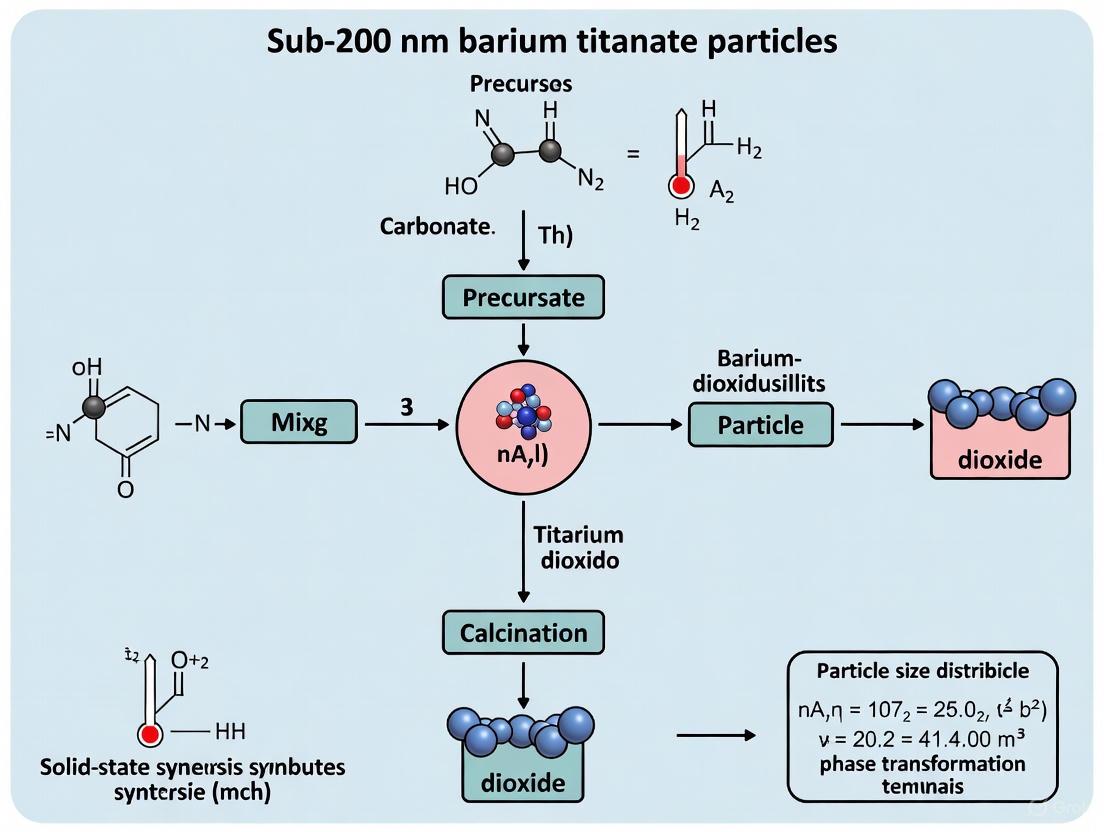
This article provides a comprehensive guide to the solid-state synthesis of sub-200 nm barium titanate (BaTiO3) particles, a critical material for multilayer ceramic capacitors (MLCCs) and emerging biomedical applications.
Solid-State Synthesis of Sub-200 nm Barium Titanate: A Guide for Advanced Material and Drug Delivery Research
Abstract
This article provides a comprehensive guide to the solid-state synthesis of sub-200 nm barium titanate (BaTiO3) particles, a critical material for multilayer ceramic capacitors (MLCCs) and emerging biomedical applications. Tailored for researchers and drug development professionals, it explores the foundational principles of modified solid-state reactions, details advanced methodological protocols for achieving small particle size and high tetragonality, and offers troubleshooting strategies for common pitfalls like impurity formation and particle agglomeration. The content further delivers a comparative analysis against wet-chemical methods, validating solid-state synthesis as a scalable and cost-effective route for producing high-quality BaTiO3 nanoparticles suitable for electronic devices and stimulus-responsive drug delivery systems.
Barium Titanate Fundamentals: Why Sub-200 nm Particles are Crucial for Modern Technology
Barium titanate (BaTiO3) is a prototypical perovskite-type ferroelectric oxide that has held a prominent position in material science since its discovery in the 1940s. As the first ceramic material to exhibit ferroelectric behavior at room temperature, BaTiO3 has become indispensable across electronic and biomedical fields due to its exceptionally high dielectric constant, combined piezoelectric, pyroelectric, and ferroelectric properties [1] [2]. The material's unique crystal structure consists of a Ba²⁺ occupied A-site and a Ti⁴⁺ centered within an oxygen octahedron at the B-site, adopting the characteristic ABO3 perovskite configuration [1]. This structural arrangement enables BaTiO3 to undergo several temperature-dependent phase transitions: from cubic (paraelectric) above approximately 120°C, to tetragonal, orthorhombic, and finally rhombohedral (all ferroelectric) upon cooling [1] [3]. The displacement of Ti⁴⁺ ions from the center of the oxygen octahedron generates electric dipoles, whose alignment under external electric fields defines the ferroelectric behavior and enables the material's remarkable functional properties [1].
Fundamental Properties and Enhancement Strategies
Key Properties and Performance Metrics
BaTiO3 exhibits a suite of exceptional electronic properties that make it valuable for numerous applications. The table below summarizes its key properties and representative values reported in recent studies.
Table 1: Key Properties of BaTiO3-Based Materials
| Property | Representative Value | Material/Composition | Conditions/Notes | Citation |
|---|---|---|---|---|
| Piezoelectric Coefficient (d33) | 180 pC/N | BaTiO3 ceramic via DLP | Sintered ceramic | [4] |
| Piezoelectric Coefficient (d33) | 850 pC/N | Sn-doped BaTiO3 | At multiphase boundary | [5] |
| Dielectric Constant (εr) | 1,543 | BaTiO3 ceramic via DLP | At 1 kHz | [4] |
| Dielectric Constant (εr) | 332 | BaTiO3/epoxy composite sponge | At 1 kHz | [6] |
| Energy Density (Ud) | 105 × 10⁻³ J/cm³ | BaTiO3/epoxy composite sponge | At 100 kV/cm | [6] |
| Band Gap | 3.24 eV | Pristine BaTiO3 | Undoped | [3] |
| Band Gap | 2.92 eV | Mo-doped BaTiO3 (4 wt%) | Extended visible light harvesting | [3] |
Doping and Compositional Engineering
The functional properties of BaTiO3 can be significantly enhanced through strategic doping and compositional engineering. Stannum (Sn) doping has been identified as particularly effective for enhancing piezoelectric performance. Research reveals that optimal Sn⁴⁺ substitution at the Ti⁴⁺ site induces intrinsic enhancement through lattice distortion and increased space for titanium-oxygen bonds, while also producing extrinsic effects through phase structure evolution [5]. This leads to a phase transition from ferroelectric multiphase coexistence to paraelectric phase, with rapidly miniaturized and eventually disappeared domains, facilitating easy polarization rotation and domain wall motion [5]. The synergistic effect of these intrinsic and extrinsic contributions enables ultrahigh piezoelectric coefficients up to 850 pC/N in Sn-doped BaTiO3-based ceramics [5].
Molybdenum (Mo) doping provides another effective strategy for property enhancement, particularly for optical and dielectric applications. Mo incorporation in mixed valence states (Mo³⁺/Mo⁴⁺/Mo⁶⁺) drives a tetragonal to cubic phase transformation and generates abundant oxygen vacancies that promote charge transport and surface reactivity [3]. This results in a red-shifted absorption edge with band gap narrowing from 3.24 eV (pristine BaTiO3) to 2.92 eV (4% Mo-doped), extending visible-light harvesting capacity while simultaneously enhancing room-temperature permittivity with lower dielectric loss [3].
Table 2: Enhancement of BaTiO3 Properties Through Doping
| Dopant | Primary Effects | Property Enhancements | Key Applications |
|---|---|---|---|
| Stannum (Sn⁴⁺) | Lattice distortion; Phase transition to paraelectric; Miniaturized domains | Piezoelectric coefficient (d33) up to 850 pC/N; Low polarization anisotropy | Piezoelectric sensors, actuators, transducers |
| Molybdenum (Mo) | Tetragonal to cubic transformation; Oxygen vacancies; Band gap narrowing | Dielectric constant enhancement; Band gap reduction to 2.92 eV; Enhanced visible light absorption | Photocatalysis, energy storage, environmental applications |
| Rare-earth elements | Modified electronic structure; Intermediate band states | Enhanced optical absorption; Improved water-splitting performance | Photocatalysis, thermostic applications |
Synthesis Protocols for Sub-200 nm BaTiO3 Particles
Solid-State Synthesis from Barium Titanyl Oxalate
The synthesis of sub-200 nm BaTiO3 particles with high tetragonality is crucial for achieving superior dielectric performance. The following protocol, adapted from traditional solid-state methods with modifications to enhance tetragonality, utilizes barium titanyl oxalate (BTO) as a precursor [7].
Materials and Equipment
- Barium titanyl oxalate (BTO, BaTiO(C₂O₄)₂·4H₂O) with Ba/Ti atomic ratio of 1.001
- Ethanol (absolute, analytical grade)
- High-energy mill (e.g., MiniCer, Netzsch) with 0.45 mm ZrO₂ beads
- Dispersant (e.g., BYK-103)
- Carbon black (particle growth inhibitor)
- Muffle furnace with temperature programming capability
Step-by-Step Procedure
- Precursor Preparation: Mix 300 g of BTO with 450 g of ethanol and add 1 wt.% dispersant based on BTO weight.
- High-Energy Milling: Process the mixture using a high-energy mill at 3000 rpm for 7 hours with ZrO₂ beads to reduce particle size. Monitor particle size reduction, which typically plateaus after 3-4 hours.
- Multi-Step Heat Treatment: Subject the milled BTO to a multi-step heat treatment process:
- Heat to 450°C for 2 hours to decompose the oxalate precursor
- Further heat to 1250°C for 6 hours for crystallization
- Particle Growth Inhibition: For enhanced tetragonality while maintaining sub-200 nm size, add 5 wt.% carbon black as a particle growth inhibitor before heat treatment. The carbon black generates a gas phase that increases interparticle distance, retarding particle growth during thermal treatment.
- Characterization: Verify particle size distribution using SEM and crystal structure using XRD. The synthesized powder should exhibit mean particle size of approximately 177 nm with tetragonality (c/a ratio) of 1.0064 and K-factor of approximately 3 [7].
The following workflow diagram illustrates this synthesis process:
Advanced Manufacturing via Digital Light Processing
Digital light processing (DLP) offers an advanced additive manufacturing approach for creating BaTiO3 ceramics with complex geometries and high performance. The following protocol details the DLP process for BaTiO3 fabrication [4].
Materials and Equipment
- BaTiO3 powders (d₅₀ = 600 nm, commercial grade)
- Photosensitive monomers: O-phenylphenoxyethyl acrylate (OPPEOA), 1,6-hexanediol diacrylate (HDDA), tripropylene glycol diacrylate (TPGDA), ethoxylated trimethylolpropane triacrylate (ETPTA)
- Photoinitiator: Diphenyl(2,4,6-trimethylbenzoyl)phosphine oxide (TPO)
- Dispersant (for slurry optimization)
- DLP printer with appropriate wavelength capability
- Sintering furnace
Step-by-Step Procedure
Slurry Preparation:
- Prepare BaTiO3 slurry with 40 vol% solid loading
- Add 1.5 wt% dispersant relative to powder weight for optimal viscosity (~0.98 Pa·s)
- Incorporate 3 wt% TPO photoinitiator for sufficient curing
Printing Parameters:
- Set applied energy dose to 160 mJ/cm² for adequate interlayer combination
- Utilize appropriate layer thickness based on desired resolution
Post-Processing:
- Conduct debinding to remove organic components
- Perform sintering to achieve final density
- The resulting ceramics achieve relative density of 95.4% with pure perovskite tetragonal structure [4]
Characterization:
- Evaluate dielectric and piezoelectric properties (typical values: εr = 1543, tan δ = 0.0185, d33 = 180 pC/N)
- Assess geometric accuracy and structural integrity
Research Reagent Solutions for BaTiO3 Synthesis
Table 3: Essential Research Reagents for BaTiO3 Synthesis and Processing
| Reagent/Chemical | Function/Purpose | Application Notes | Citation |
|---|---|---|---|
| Barium titanyl oxalate | Primary precursor for solid-state synthesis | Enables sub-200 nm particles with high tetragonality; Ba/Ti ratio critical | [7] |
| Carbon black | Particle growth inhibitor | Maintains sub-200 nm size during high-temperature treatment | [7] |
| Molybdenum pentachloride | Dopant precursor for property modification | Introduces mixed valence states; enhances visible light response | [3] |
| Stannum oxide | B-site dopant for piezoelectric enhancement | Optimizes multiphase boundary; facilitates polarization rotation | [5] |
| TPO photoinitiator | Radical initiator for photopolymerization | Enables DLP processing; optimum at 3 wt% for sufficient curing | [4] |
| DDAB surfactant | Surface stabilization agent | Facilitates phase transfer in core-shell nanoparticle synthesis | [8] |
| Oleic acid/oleylamine | Surface ligands for nanoparticle synthesis | Provides hydrophobic coating; controls particle growth and dispersion | [8] |
Advanced Applications of Engineered BaTiO3
Biomedical Applications: Drug Delivery and Bone Tissue Engineering
BaTiO3-based nanocarriers have emerged as versatile platforms for targeted drug delivery due to their unique combination of biocompatibility, piezoelectric properties, and responsiveness to external stimuli [1] [9]. These multifunctional nanoparticles can be engineered for spatiotemporally controlled release of therapeutic agents triggered by physical stimuli including ultrasound, light, magnetic fields, temperature changes, and pH variations [1]. This approach enhances treatment efficacy while reducing systemic side effects, particularly in oncology applications.
In bone tissue engineering, BaTiO3's piezoelectric properties enable it to mimic the natural piezoelectric effect of bone collagen, which is essential for bone regeneration [2]. When mechanical stress is applied through physiological movement, BaTiO3 generates electrical stimulation that promotes osteoblast adhesion, proliferation, and differentiation [2]. This piezoelectric stimulation also attracts Ca²⁺ and PO₄³⁻ ions from body fluids, promoting bone mineralization without requiring external power sources [2].
Energy Storage and Harvesting Applications
BaTiO3 ceramics fabricated via digital light processing demonstrate exceptional promise for piezoelectric energy harvesting [4]. These 3D-printed structures can convert mechanical energy into electrical energy, achieving open-circuit voltage and short-circuit current of approximately 5.5 mV and 5.2 pA, respectively [4]. The ability to create complex geometries through additive manufacturing enables optimized designs for efficient energy harvesting from environmental mechanical sources.
For electrostatic energy storage, BaTiO3/polymer-matrix composite sponges with tunable porosities exhibit dramatically enhanced performance [6]. These composites achieve dielectric constants up to εr ~332 at 1 kHz (compared to εr ~38 for traditional nanoparticle-filled samples) and discharge energy density of Ud ~105 × 10⁻³ J cm⁻³ at 100 kV cm⁻¹ [6]. The sponge architecture creates a regular three-dimensional filler network that enhances local electric displacement, significantly improving energy storage capacity.
Environmental and Photocatalytic Applications
Mo-doped BaTiO3 nanostructures demonstrate remarkable visible-light photocatalytic activity for environmental applications [3]. The 3% Mo-doped BaTiO3 sample achieves approximately 90% degradation efficiency of Congo red dye within 60 minutes under direct sunlight, compared to significantly slower response for undoped BaTiO3 [3]. The corresponding photocatalytic rate constant increases from 0.01754 min⁻¹ (pure BaTiO3) to 0.03673 min⁻¹, underscoring the superior reactivity and light-harvesting capability imparted by Mo incorporation [3].
The following diagram illustrates the multifaceted applications of engineered BaTiO3:
The synthesis of sub-200 nm BaTiO3 particles with controlled properties represents a crucial advancement in functional materials development. Through optimized solid-state synthesis protocols and advanced manufacturing techniques like digital light processing, researchers can now precisely engineer BaTiO3 materials with enhanced piezoelectric coefficients, dielectric constants, and tailored band gaps. The strategic incorporation of dopants such as stannum and molybdenum further expands the property matrix, enabling specialized applications across biomedical, energy, and environmental domains. As synthesis protocols continue to evolve toward greater precision and scalability, BaTiO3-based materials are poised to play an increasingly transformative role in next-generation technologies.
The miniaturization of multilayer ceramic capacitors (MLCCs) and electronic devices has driven the demand for barium titanate (BaTiO₃) powders that combine a small particle size (<200 nm) with high tetragonality (c/a ratio) and superior dielectric properties [10] [11]. However, achieving these properties simultaneously presents a significant challenge due to a phenomenon known as the "size effect," where a reduction in particle size typically leads to a decrease in tetragonality and, consequently, dielectric constant [12] [11] [10]. This application note, framed within broader thesis research on the solid-state synthesis of sub-200 nm BaTiO₃, details the correlation between particle size, tetragonality, and dielectric properties. It provides summarized quantitative data and detailed experimental protocols to guide researchers in synthesizing and characterizing high-performance BaTiO₃ powders.
Quantitative Data on Size, Tetragonality, and Dielectric Properties
The following table consolidates key findings from recent studies on BaTiO₃, highlighting the interplay between synthesis method, particle size, tetragonality, and dielectric constant.
Table 1: Correlation of BaTiO₃ Particle Size, Tetragonality, and Dielectric Properties
| Synthesis Method | Particle/Grain Size (nm) | Tetragonality (c/a ratio) | Dielectric Constant (εr) | Key Findings / Conditions | Reference |
|---|---|---|---|---|---|
| Solid-State (Modified) | ~170 | 1.01022 | Not specified | Used nano raw materials & two-step ball milling. | [11] |
| Solid-State (Vacancy Eng.) | ~200 | 1.005 - 1.0092 | Excellent reliability (X7R) | Tetragonality peaks at Ba/Ti=1.000; Ti vacancies more detrimental than Ba vacancies. | [10] |
| Hydrothermal (Eco-Friendly) | 160, 190, 220, 250 | ~1.009 | Not specified | Used water/ethanol/ammonia (2:2:1) solvent; tetragonality increases with particle size. | [13] |
| Hydrothermal (Ionic Liquid) | 129 (BaTiO₃-N) | Tetragonal Phase | High (comparatively) | Tetragonality and dielectric constant decreased with ionic liquid addition and reduced particle size. | [14] |
| Ceramics (Fine-Grained) | 280 | Not specified | High | Part of the grains remained ferroelectric, leading to a high dielectric constant. | [12] |
| Solvothermal (Methanol) | 12 - 30 | Tetragonal (Raman) | Not specified | Water-free synthesis avoids hydroxyl defects, helping retain tetragonality at small sizes. | [15] |
Experimental Protocols for Key Synthesis Methods
Modified Solid-State Synthesis for High-Tetragonality, Sub-200 nm BaTiO₃
This protocol, adapted from a 2024 study, describes a method to synthesize BaTiO₃ with an average particle size of ~170 nm and a high tetragonality of 1.01022 [11].
The Scientist's Toolkit: Key Reagents and Equipment
- Raw Materials: Nanoscale BaCO₃ (30-80 nm), Nanoscale TiO₂ (Anatase, 5-10 nm, 25 nm, or 40 nm).
- Dispersing Medium: Ethanol (≥99.8%).
- Equipment: High-Energy Ball Mill, Zirconium Oxide (ZrO₂) Grinding Balls, Alumina Crucibles, High-Temperature Furnace, Centrifuge.
Detailed Workflow:
- Stoichiometric Mixing: Weigh and mix 0.6 g of TiO₂ and 2.467 g of BaCO₃ in a stoichiometric molar ratio (Ba:Ti = 1:1) in a laboratory beaker.
- First-Stage Ball Milling: Transfer the mixture to a 50 mL ball milling jar with ZrO₂ grinding balls and ethanol. The mass ratio of raw materials : grinding balls : ethanol should be 1:5:5. Mill the mixture at 240 rpm for several hours to achieve a homogeneous and finely dispersed precursor.
- Calcination: Place the milled mixture in alumina crucibles and calcine in a pre-heated furnace at 1050°C for 3 hours in an ambient air atmosphere to form the BaTiO₃ phase.
- Second-Stage Ball Milling: After calcination, gently pulverize the product and subject it to a second ball milling step using the same parameters as the first (240 rpm, ethanol medium). This step de-agglomerates the synthesized powder and ensures a uniform particle size distribution.
- Washing and Drying: Centrifuge the resulting slurry to separate the powder. Wash the precipitate successively with deionized water and a dilute acetic acid solution to remove impurities and unreacted precursors. Finally, dry the purified powder in an oven at 80°C for 12 hours.
The following workflow diagram visualizes this two-step ball milling process:
Eco-Friendly Hydrothermal Synthesis with Controllable Particle Size
This protocol outlines a one-step hydrothermal method to produce BaTiO₃ powders with high tetragonality (~1.009) and precisely controlled particle sizes from 160 to 250 nm by varying reaction time [13].
The Scientist's Toolkit: Key Reagents and Equipment
- Precursors: TiO₂ (Anatase, 99%), Ba(OH)₂·8H₂O (98%).
- Hydrothermal Solvent: Deionized water, Ethanol (≥99.7%), Ammonia solution (25-28%).
- Equipment: PPL-lined Autoclave (50 mL), Oven, Centrifuge.
Detailed Workflow:
- Dissolve Barium Source: Add 16.900 g of Ba(OH)₂·8H₂O to deionized water. Heat and stir the solution in a water bath at 80°C until completely dissolved.
- Add Titanium Source and Solvents: To the stirred Ba(OH)₂ solution, add 1.712 g of TiO₂ powder. Then, introduce ethanol and ammonia solution sequentially while stirring at room temperature. The optimal solvent ratio is water : ethanol : ammonia solution = 2:2:1. The final pH should be approximately 13.
- Hydrothermal Reaction: Transfer the mixture into a 50 mL PPL-lined autoclave. React at a constant temperature of 260°C for a duration between 20 and 50 hours.
- To achieve different particle sizes, vary the reaction time: ~20 h for 160 nm, ~30 h for 190 nm, ~40 h for 220 nm, and ~50 h for 250 nm.
- Product Recovery: After the reaction, allow the autoclave to cool naturally to room temperature. Collect the contents and centrifuge at 10,000 rpm for 5 minutes.
- Purification: Wash the precipitate multiple times with deionized water and a dilute acetic acid solution to remove barium carbonate and other by-products. Dry the final product at 80°C for 12 hours.
Critical Factors Influencing the Size Effect
The "size effect" is not solely governed by particle dimensions. Experimental evidence indicates that other factors critically influence the retention of tetragonality in small particles.
Stoichiometry and Vacancy Engineering
The Ba/Ti ratio is a critical parameter. Research shows that with a particle size fixed at ~200 nm, the tetragonality first increases from 1.006 to a maximum of 1.0092 as the Ba/Ti ratio approaches 1.000, then decreases to 1.005 with further deviation from stoichiometry [10]. Both Ba and Ti vacancies cause lattice distortion and reduce tetragonality, with Ti vacancies having a more detrimental impact than Ba vacancies [10]. This underscores the importance of precise stoichiometric control beyond just particle size reduction.
Synthesis Medium and Defect Chemistry
The choice of synthesis medium directly impacts crystal structure. Aqueous methods, particularly hydrothermal synthesis, can lead to the incorporation of hydroxyl groups (OH⁻) into the BaTiO₃ crystal lattice, which introduces internal stresses and promotes the stabilization of the cubic phase at the expense of the tetragonal phase [15]. Using organic solvents (e.g., methanol or benzyl alcohol) in solvothermal synthesis can circumvent this issue, enabling the synthesis of tetragonal BaTiO₃ nanoparticles as small as 12–30 nm without a post-synthesis calcination step [15].
The relationships between synthesis parameters, underlying mechanisms, and final powder properties are summarized below:
Successfully mitigating the size effect in sub-200 nm BaTiO₃ requires a multi-faceted approach that goes beyond simple particle size reduction. The protocols and data presented herein demonstrate that through precise stoichiometric control (Ba/Ti ≈ 1), innovative synthesis routes (e.g., modified solid-state or solvent-controlled hydrothermal), and careful management of lattice defects, it is feasible to synthesize fine BaTiO₃ powders that retain high tetragonality. These strategies are essential for advancing the development of next-generation MLCCs with ultra-thin dielectric layers and enhanced volumetric efficiency.
Application Notes
The concurrent advancement in multilayer ceramic capacitor (MLCC) miniaturization and biomedical nanocarriers represents a significant trend in modern technology, driven by sophisticated solid-state synthesis of functional nanoparticles. Both fields rely on precise engineering of sub-200 nm materials, with barium titanate (BaTiO3) nanoparticles serving as a cornerstone material for MLCCs, while polymeric and metallic nanoparticles enable targeted drug delivery systems.
MLCC Miniaturization for Advanced Electronics
The global MLCC market is projected to grow from approximately USD 9.4 billion in 2024 to USD 15.4 billion by 2030, at a compound annual growth rate (CAGR) of 6.5% [16]. This growth is primarily driven by the miniaturization of electronic components across several key industries.
Table 1: Key Application Drivers and Technical Demands for MLCC Miniaturization
| Application Sector | Key Drivers & Trends | MLCC Technical Requirements | Market Share/Forecast |
|---|---|---|---|
| Consumer Electronics | 5G smartphones, wearables, miniaturization | Ultra-small sizes (0201, 0402), high capacitance, high-frequency performance | >40% market share (2024) [16] |
| Automotive (CASE) | Electric vehicles (EVs), autonomous driving, connectivity | High reliability, extended lifespan (20+ years), high-voltage and miniaturized types | Fastest growing segment; 20% share by 2030; 3,000-10,000+ units/vehicle [17] [16] |
| Industrial & Energy | Industrial automation, smart grids, IoT | High capacitance, stability under extreme conditions, energy efficiency | Steady growth driven by IoT and energy storage [16] |
Miniaturization demands dielectric layers thinner than 0.5 μm, requiring highly uniform, monodisperse BaTiO3 nanopowders with particle sizes ≤ 100 nm [18]. Leading manufacturers like Murata Manufacturing have developed MLCCs as small as 1608M (1.6 x 0.8 mm) with a capacitance of 10 μF, balancing miniature size with high performance [17].
Biomedical Nanocarriers for Advanced Therapeutics
Polymeric and metallic nanocarriers have revolutionized biomedical applications, particularly in targeted drug delivery, diagnostics, and regenerative medicine. These systems improve the bioavailability, pharmacokinetics, and therapeutic effectiveness of active compounds while reducing side effects [19].
Table 2: Applications of Polymeric and Metallic Nanocarriers in Biomedicine
| Application Area | Nanocarrier Types | Key Functions & Benefits | Examples & Clinical Status |
|---|---|---|---|
| Cancer Therapeutics | Polymeric nanoparticles, micelles, metal NPs | Targeted drug delivery, controlled release, overcome multidrug resistance, reduced systemic toxicity | Apealea/Paclical (micellar paclitaxel), NK105 (Phase III), CRLX101 [19] |
| Infectious Disease & Vaccines | Lipid nanoparticles, polymeric NCs | Enhanced antigen presentation, improved stability, controlled release of therapeutics | SARS-CoV-2 nanoparticle vaccine (NVX-CoV2373) [19] |
| Regenerative Medicine & Tissue Engineering | Nano-scaffolds, peptide nanocarriers | Mimic natural extracellular matrix, promote cell viability and differentiation, support stem cell therapies | Bioinks incorporating nanomaterials for artificial organ fabrication [20] |
| Wound Healing | Green-synthesized metal nanoparticles (Ag, Au) | Antimicrobial, antifungal, anti-inflammatory properties, promote tissue regeneration | Silver and gold nanoparticles from plant extracts [21] |
Nanocarriers leverage the Enhanced Permeability and Retention (EPR) effect for passive targeting in areas like solid tumors, where leaky vasculature allows selective accumulation of nanoparticles [19]. Active targeting is achieved by functionalizing the nanocarrier surface with specific ligands that recognize receptors on target cells [19].
Experimental Protocols
Protocol 1: Surfactant-Free Hydrothermal Synthesis of Barium Titanate Nanoparticles
This protocol describes a simplified, scalable hydrothermal method for synthesizing BaTiO3 nanoparticles, suitable for MLCC dielectric layers, without complex additives [18].
Research Reagent Solutions:
Table 3: Essential Reagents for BaTiO3 Hydrothermal Synthesis
| Reagent/Material | Specification/Purity | Function in Synthesis |
|---|---|---|
| Titanium Dioxide (TiO2) | 99%, varied specific surface areas (e.g., R-40, R-214, R-838) | Titanium precursor; specific surface area inversely correlates with final BT particle size [18] |
| Barium Hydroxide Octahydrate (Ba(OH)₂·8H₂O) | 98% | Barium precursor |
| Sodium Hydroxide (NaOH) | AR Grade | Mineralizer, controls reaction kinetics and particle formation |
| Deionized Water | N/A | Reaction solvent |
Step-by-Step Procedure:
- Precursor Preparation: In a sealed vessel, dissolve Ba(OH)₂·8H₂O and TiO2 in deionized water. Systematically optimize the molar ratio of Ba/Ti; a ratio of 2.0 is found to yield the smallest particle size (~80 nm) with uniform spherical morphology [18].
- Alkali Concentration Adjustment: Add NaOH to the reaction mixture to achieve a concentration of 1.25 mol L⁻¹. This acts as a mineralizer without requiring surfactants [18].
- Hydrothermal Reaction: Transfer the mixture to a Teflon-lined autoclave. React at 180 °C for 18 hours under autogenous pressure. The dissolution-precipitation nucleation mechanism is governed by the precursor's surface area [18].
- Product Recovery: After reaction, allow the autoclave to cool naturally to room temperature. Collect the resulting white powder by centrifugation.
- Washing and Drying: Wash the precipitate sequentially with deionized water and ethanol to remove impurities and by-products. Dry the purified BaTiO3 nanoparticles in an oven at 60-80 °C.
Protocol 2: Colloidal Organometallic Synthesis of Solution-Processable BaTiO3 Nanoparticles
This protocol outlines an organometallic synthesis route producing colloidally stable, oleyl alkoxide-capped BaTiO3 nanoparticles, ideal for solution-processed nanoelectronic films [22].
Research Reagent Solutions:
Table 4: Essential Reagents for Organometallic BaTiO3 Synthesis
| Reagent/Material | Specification/Purity | Function in Synthesis |
|---|---|---|
| Metallic Barium (Ba) | 99.99% | Barium precursor |
| Titanium(IV) Isopropoxide (TTIP) | 98+% | Titanium precursor |
| Oleyl Alcohol (OLOH) | ≥85% | Solvent and reducing agent; provides oleyl alkoxide ligands for steric stabilization [22] |
| Anhydrous Benzyl Alcohol | 99.8% | Alternative solvent (Note: resulted in precipitate in this method [22]) |
| Toluene, Hexane | ≥99.7%, ~95% | Non-polar solvents for dispersion and washing |
Step-by-Step Procedure:
- Precursor Synthesis in Glovebox: Dissolve 0.5 mmol of metallic Ba in 2.5 mL of oleyl alcohol on a hot plate at 220 °C until gas bubble formation stops and a transparent solution forms. After cooling, add 0.5 mmol of TTIP and stir. A one-step approach, adding Ba and TTIP simultaneously to OLOH and heating at 200 °C until dissolution, is also effective and reduces synthesis time [22].
- Nanoparticle Heat-Up Synthesis: Transfer the precursor to a three-neck flask. Heat under nitrogen flow at a ramp rate of 10 °C/min to 300 °C and maintain for 30 minutes.
- Purification: Cool the reaction mixture to room temperature. Precipitate the nanoparticles by adding ethanol and centrifuging. Redisperse the purified nanoparticles in non-polar solvents like toluene or hexane. The oleyl alkoxide ligands ensure colloidal stability, preventing agglomeration [22].
- Ligand Exchange (Optional - for conductive films): Perform a solution-phase ligand exchange to replace oleyl alkoxide ligands. Use ionic ligands like oxalic acid or KOH in dimethyl sulfoxide (DMSO) to create crack-free dielectric coatings with direct particle contact [22].
Protocol 3: Formulation of Multifunctional Polymeric Nanocarriers
This protocol describes the preparation of polymeric nanocarriers using classical emulsion-templated methods, suitable for drug delivery applications [19].
Research Reagent Solutions:
Table 5: Essential Materials for Polymeric Nanocarrier Formulation
| Reagent/Material | Specification | Function in Formulation |
|---|---|---|
| Biodegradable Polymer | PLGA, PLA, PCL | Matrix-forming material; provides structure and controls drug release kinetics [19] |
| Drug/Therapeutic Agent | Cytostatics, antibiotics, nucleic acids, proteins | Active ingredient for encapsulation |
| Organic Solvent | Dichloromethane, Ethyl Acetate | Dissolves polymer and hydrophobic drugs |
| Aqueous Surfactant Solution | Polyvinyl Alcohol (PVA), Poloxamers | Stabilizes the oil-water emulsion, controls droplet size |
| Distilled Water | N/A | Continuous phase in emulsion |
Step-by-Step Procedure (Emulsion-Solvent Evaporation):
- Organic Phase Preparation: Dissolve the biodegradable polymer (e.g., 50-100 mg PLGA) and the hydrophobic drug in a water-immiscible organic solvent (e.g., 2-5 mL dichloromethane).
- Aqueous Phase Preparation: Prepare an aqueous surfactant solution (e.g., 1-5% w/v Polyvinyl Alcohol in distilled water).
- Emulsification: Add the organic phase to the aqueous phase under high-speed homogenization (10,000-15,000 rpm for 5-10 minutes) to form an oil-in-water (o/w) emulsion. For water-soluble drugs, a double emulsion (w/o/w) method is used [19].
- Solvent Evaporation: Stir the emulsion continuously at room pressure or under reduced pressure for several hours to evaporate the organic solvent, hardening the nanoparticles.
- Purification and Collection: Collect the nanocarriers by ultracentrifugation (>15,000 rpm for 30-60 minutes). Wash with distilled water to remove residual surfactant and unencapsulated drug.
- Lyophilization: Lyophilize the purified nanocarriers using cryoprotectants (e.g., sucrose, trehalose) for long-term storage.
Solid-state synthesis is a cornerstone technique in materials science for producing inorganic solid materials and ceramics. Within the context of advanced electronic materials, this method is particularly crucial for the synthesis of sub-200 nm barium titanate (BaTiO3) particles, which are essential for the miniaturization of multilayer ceramic capacitors (MLCCs) [11]. This application note details the specific advantages of solid-state synthesis—namely its scalability, cost-effectiveness, and ability to produce highly crystalline materials—and provides a detailed experimental protocol for obtaining high-tetragonality, sub-200 nm BaTiO3 particles, a key requirement for next-generation electronic devices.
Core Advantages of Solid-State Synthesis
The solid-state method offers distinct benefits for industrial-scale production of functional materials like barium titanate.
Scalability and Industrial Compatibility
The process is inherently suitable for scaling from laboratory to industrial production. The protocol primarily involves grinding and thermal treatment, which can be seamlessly adapted to large-scale milling and furnace systems without the need for complex liquid handling or vast volumes of solvent, as required by wet chemical methods [23] [11]. This makes it a preferred choice for manufacturing electronic ceramics.
Cost-Effectiveness
Solid-state synthesis is recognized for its economic viability. It typically employs readily available and inexpensive raw materials, such metal carbonates and oxides, avoiding the costly metal-organic precursors and large solvent quantities common in sol-gel or hydrothermal routes [23] [11]. The simplicity of the process and the reduced need for specialized equipment further contribute to lower capital and operational expenditures.
Control over Crystallinity and Phase Purity
A significant advantage of the solid-state route is its capability to produce materials with high crystallinity and desirable phase composition. For barium titanate, this method is known to yield products with high tetragonality (c/a ratio), a critical parameter directly linked to superior dielectric properties [11]. Recent research has successfully combined this high tetragonality with a small, uniform particle size, overcoming the traditional "size effect" where tetragonality decreases with reducing particle size [11].
Table 1: Performance of Solid-State Synthesized Sub-200 nm BaTiO3 [11]
| Property | Value | Significance |
|---|---|---|
| Average Particle Size (D50) | ~170 nm | Suitable for thin-layer dielectric in miniaturized MLCCs |
| Tetragonality (c/a ratio) | 1.01022 | High ferroelectric performance |
| Particle Size Uniformity | Excellent | Consistent electrical properties in final components |
Detailed Protocol: Synthesis of Sub-200 nm BaTiO3
The following is a step-by-step protocol for the solid-state synthesis of high-tetragonality, sub-200 nm BaTiO3 particles, adapted from recent literature [11].
Research Reagent Solutions
Table 2: Essential Materials and Reagents
| Item | Specification | Function |
|---|---|---|
| Barium Carbonate (BaCO3) | 30-80 nm, ≥99% [11] | Barium precursor |
| Titanium Dioxide (TiO2) | Anatase phase, 5-10 nm, 99.8% [11] | Titanium precursor |
| Zirconium Oxide (ZrO2) Grinding Balls | Various sizes | For mechanical grinding and mixing |
| Ethanol (C2H5OH) | ≥99.8% | Milling medium |
| Alumina Crucible | -- | Withstands high-temperature calcination |
Step-by-Step Procedure
Weighing and Preliminary Mixing: Weigh barium carbonate (BaCO3) and titanium dioxide (TiO2) in a stoichiometric molar ratio of 1:1 (Ba:Ti). For a laboratory-scale batch, this translates to 2.467 g of BaCO3 and 0.6 g of TiO2. Place the powders in a laboratory beaker for initial handling.
First-Stage Ball Milling (Pre-treatment):
- Transfer the powder mixture to a 50 mL stainless steel ball milling jar.
- Add zirconium oxide grinding balls and ethanol as the milling medium. The mass ratio of
raw materials : grinding balls : ethanolshould be1 : 5 : 5. - Seal the jar and mount it on the ball mill. Process the mixture at a speed of 240 rpm for several hours to ensure complete homogenization and reduction of particle agglomerates.
Calcination and Reaction:
- Transfer the resulting slurry from the ball mill into alumina crucibles.
- Place the crucibles in a high-temperature furnace for the solid-state reaction.
- Heat the furnace to a temperature of 1050 °C and maintain this temperature (dwell time) for 3 hours in an ambient air atmosphere. A slow heating rate (e.g., 5°C/min) is recommended through critical temperature zones to control nucleation and growth.
- After the dwell time, allow the furnace to cool to room temperature naturally.
Second-Stage Ball Milling (Post-treatment):
- The calcined product will be a sintered mass. Gently pulverize it and subject it to a second ball milling step.
- Use the same parameters as the first ball milling (ratio of
product : balls : ethanol=1 : 5 : 5, 240 rpm) to break up aggregates and obtain a uniform, fine powder.
Washing and Purification:
- Transfer the solid-liquid mixture to centrifuge tubes.
- Centrifuge to separate the solid BaTiO3 powder from the ethanol.
- Wash the collected solid with an acetic acid solution to remove any minor carbonate impurities, followed by rinsing with clean ethanol.
- Decant the supernatant after each washing step.
Drying and Final Processing:
- Transfer the purified BaTiO3 powder to an oven and dry at 80 °C for 12 hours.
- Finally, gently comminute the dried cake into a free-flowing powder using a mortar and pestle. The powder is now ready for characterization.
Workflow Visualization
The diagram below illustrates the optimized synthesis and fabrication process for obtaining sub-200 nm BaTiO3 particles.
Critical Parameters for Success
Achieving the target properties requires meticulous control over several parameters:
- Precursor Particle Size: The use of nanoscale precursors (30-80 nm BaCO3 and 5-40 nm TiO2) is critical. This increases the specific surface area, shortens the diffusion path, and lowers the required reaction temperature, which is essential for obtaining a fine final particle size [11].
- Two-Stage Ball Milling: The initial milling ensures atomic-level homogenization of reactants. The secondary milling after calcination is indispensable for breaking down the weakly agglomerated product, ensuring a narrow particle size distribution and eliminating residual impurities [11].
- Thermal Profile: While a high temperature (1050°C) is used, the combination of nano-precursors and effective milling makes the reaction efficient. A controlled cooling rate is also important for the development of the desired tetragonal crystal phase [23].
Solid-state synthesis remains a highly relevant and powerful method for the industrial production of advanced electronic materials like barium titanate. Its strengths in scalability, cost-effectiveness, and control over crystallinity are evident in the successful synthesis of sub-200 nm BaTiO3 particles with high tetragonality. The protocol detailed herein, which emphasizes the use of nano-precursors and a two-stage milling process, provides a robust pathway for researchers and manufacturers to overcome traditional limitations and produce high-performance materials for the ongoing miniaturization of electronic devices.
Protocols for Success: A Step-by-Step Guide to Modified Solid-State Synthesis
Within the broader scope of research on the solid-state synthesis of sub-200 nm barium titanate (BaTiO3) particles, the selection of precursor materials is a critical determinant of success. The drive for miniaturized multilayer ceramic capacitors (MLCCs) necessitates thin dielectric layers composed of fine, homogeneous powders [10] [24]. Solid-state reaction, a widely used method due to its cost-effectiveness and scalability, traditionally faces challenges in achieving simultaneously small particle size and high crystalline perfection [25] [24]. This application note details how the strategic use of nano-scale barium carbonate (BaCO3) and titanium dioxide (TiO2) precursors directly impacts the reaction kinetics, microstructure, and final particle size of BaTiO3, providing a viable pathway to meet the stringent requirements of next-generation electronic devices.
Data Presentation: Quantitative Impact of Precursor Size
The relationship between the particle size of precursors and the characteristics of the final BaTiO3 powder is quantifiable. The following table summarizes key experimental data from recent studies, demonstrating how nano-scale precursors enable the synthesis of sub-200 nm BaTiO3.
Table 1: Impact of Precursor Particle Size on Final BaTiO3 Properties
| Precursor Types & Sizes | Synthesis Conditions | Final BaTiO3 Particle Size | BaTiO3 Tetragonality (c/a ratio) | Key Observations |
|---|---|---|---|---|
| TiO2: 5-10 nm (Anatase)BaCO3: 30-80 nm [24] | Ball milling + Calcination at 1050°C for 3 h [24] | ~170 nm (D50) [24] | ~1.01022 [24] | Uniform particle size distribution; high tetragonality; minimal impurities [24]. |
| TiO2: ~25 nmBaCO3: Not Specified [26] | Hydrothermal synthesis at 150°C [26] | Smaller crystallites | Cubic Phase Reported [26] | Faster reaction rate compared to coarser TiO2 (~110-125 nm) [26]. |
| TiO2: ~110-125 nm (Coarse)BaCO3: Not Specified [26] | Hydrothermal synthesis at 150°C [26] | Larger crystallites | Cubic Phase Reported [26] | Slower reaction kinetics [26]. |
| BaCO3: 100 nm (D50)TiO2: 60 nm (D50) [10] | High-speed sand milling for 2 h [10] | ~200 nm [10] | ~1.0092 (max at Ba/Ti=1.000) [10] | Precursor size control helps maintain consistent ~200 nm particle size across different Ba/Ti ratios [10]. |
| Micrometer-scale BaCO3 and TiO2 [24] | Direct calcination at 1050°C for 3 h [24] | Larger, aggregated particles | Not Specified | Presence of impurities (BaTi4O9, unreacted TiO2, BaCO3) and uneven particle size distribution [24]. |
Experimental Protocols
Detailed Protocol: Solid-State Synthesis with Two-Step Ball Milling
This protocol, adapted from recent research, is designed for the synthesis of high-tetragonality, sub-200 nm BaTiO3 particles [24].
3.1.1 Reagents and Equipment
- Precursors: Nano-scale anatase TiO2 (5-40 nm), Nano-scale BaCO3 (30-80 nm) [24].
- Dispersing Medium: Anhydrous ethanol [24].
- Equipment: High-energy ball mill, Zirconium oxide grinding balls, Alumina crucibles, Programmable muffle furnace, Centrifuge, Drying oven [24].
3.1.2 Step-by-Step Procedure
- Weighing and Mixing: Weigh TiO2 and BaCO3 in a stoichiometric molar ratio of 1:1 (Ba:Ti). For a lab-scale batch, 0.6 g of TiO2 and 2.467 g of BaCO3 is a typical proportion [24].
- First-Stage Ball Milling (Pre-treatment):
- Transfer the powder mixture to a ball milling jar.
- Add zirconium oxide grinding balls and anhydrous ethanol. The mass ratio of raw materials : grinding balls : ethanol should be 1 : 5 : 5 [24].
- Seal the jar and mill at a speed of 240 rpm for a predetermined time (e.g., 2-24 hours, as optimization may be required) [25] [24]. This step ensures intimate mixing and reduces the agglomeration of nano-precursors.
- Drying and Calcination:
- Second-Stage Ball Milling (Post-treatment):
- After calcination, gently crush the resulting BaTiO3 cake.
- Subject the powder to a second ball milling step under the same parameters as the first (240 rpm, ethanol medium) [24]. This crucial step breaks down aggregates formed during high-temperature treatment.
- Washing and Purification:
- Centrifuge the ball-milled slurry to separate the powder.
- Wash the precipitate sequentially with ethanol and a dilute acetic acid solution. The acid wash helps remove minor carbonate impurities [24].
- Drying and Final Product:
- Dry the purified powder in an oven at 80°C for 12 hours [24].
- Gently grind the dried product to obtain a fine, free-flowing BaTiO3 powder ready for characterization.
The following workflow diagram illustrates the key stages of this synthesis protocol.
Mechanism: The Role of Precursor Size in Reaction Kinetics
The fundamental solid-state reaction for BaTiO3 formation is: BaCO3 + TiO2 → BaTiO3 + CO2 [24]. The particle size of the precursors, particularly TiO2, plays a dominant role in the kinetics of this reaction [25].
- Increased Surface Area: Nano-scale precursors possess a vastly increased specific surface area, providing a greater contact area between BaCO3 and TiO2 particles. This enhances the solid-state diffusion rates of ions, which is the rate-limiting step in the reaction [25].
- Reduced Diffusion Path Length: The shorter diffusion paths for Ba²⁺ and Ti⁴+ ions within nano-precursors allow the reaction to proceed more rapidly and at a lower temperature compared to micrometer-sized precursors [25] [26]. Studies confirm that finer TiO2 precursor particles (~25 nm) react significantly faster than coarser ones (~110-125 nm) [26].
- Suppression of Grain Growth: The use of uniformly mixed nano-precursors promotes a more homogeneous reaction, leading to a finer and more uniform microstructure in the final product. The two-step ball milling process is critical to mitigating particle agglomeration and sintering during calcination, thereby preserving a small particle size [24].
The Scientist's Toolkit: Research Reagent Solutions
Table 2: Essential Materials for Nano-Precursor Driven BaTiO3 Synthesis
| Reagent / Material | Function in Synthesis | Key Specifications for Optimal Performance |
|---|---|---|
| Nano-Titanium Dioxide (TiO2) | Titanium precursor. Its particle size is a critical factor controlling reaction kinetics and final BaTiO3 size [25] [24]. | Crystal Phase: Anatase [25] [24].Particle Size: < 40 nm (e.g., 5-10 nm, 25 nm) [24].Purity: > 99.8% [24]. |
| Nano-Barium Carbonate (BaCO3) | Barium precursor. Nano-size is essential for achieving high reactivity with nano-TiO2 [24]. | Particle Size: 30-80 nm [24].Purity: > 99% [24]. |
| Zirconium Oxide (ZrO2) Grinding Balls | Milling media for ball milling steps. Provides high-impact energy for mixing and de-agglomeration without contamination. | Size: ~0.1 mm diameter for efficient milling of nano-powders [10]. |
| Anhydrous Ethanol | Dispersion medium for ball milling. Prevents premature reaction, facilitates homogeneous mixing, and cools the mixture during milling. | Purity: ≥ 99.8% [24]. |
| Oleic Acid (Optional) | Capping agent or surfactant. Can be used in certain syntheses to control particle growth and prevent agglomeration [15]. | Purity: ~90% [15]. |
The strategic selection of nano-scale BaCO3 and TiO2 precursors is a foundational step in the solid-state synthesis of sub-200 nm BaTiO3 particles. Quantitative data confirms that this approach, coupled with optimized mechanochemical processing like two-step ball milling, directly enables the production of powders with a uniform particle size near 170 nm while maintaining the high tetragonality essential for superior dielectric properties [24]. This methodology successfully addresses the classic "size effect" trade-off and provides a robust and scalable pathway for supplying advanced materials essential for the continued miniaturization of electronic components.
In the solid-state synthesis of advanced electronic materials such as sub-200 nm barium titanate (BaTiO3) particles, achieving a homogeneous precursor mixture and controlling final particle size present significant scientific challenges. Conventional solid-state reactions often result in impurities, uneven particle size distribution, and aggressive grain growth during high-temperature calcination [24]. Ball milling has emerged as a critical mechanochemical processing technique to overcome these limitations by enabling rapid particle size reduction, enhanced chemical homogeneity, and lowered synthesis temperatures [27] [28] [29]. This Application Note provides detailed protocols and analytical frameworks for implementing ball milling in the solid-state synthesis of functional nanomaterials, with specific application to BaTiO3 for multilayer ceramic capacitors (MLCCs) and other miniaturized electronic devices.
Ball Milling Fundamentals and Mechanisms
Ball milling utilizes mechanical energy to induce repeated deformation, fracture, and welding of powder particles through high-energy collisions between milling media and the material being processed. This mechanochemical approach achieves homogeneity and particle size reduction through several interconnected mechanisms:
- Particle Fracture: Impact forces from milling media create cracks that propagate through powder particles, resulting in continual size reduction [30].
- Plastic Deformation: Repeated collision events cause severe lattice distortion and introduce crystal defects that enhance diffusion pathways [28].
- Solid-State Reaction Activation: Mechanical energy input lowers kinetic barriers to solid-state reactions, enabling phase formation at reduced temperatures [28] [29].
- Compositional Homogenization: Intimate mixing of precursor materials at the molecular level occurs through repeated cold welding and fracture cycles [27].
The transformation from precursor mixtures to final product involves a complex interplay between physical and chemical phenomena, beginning with energy accumulation through crystal breaking and defect formation, followed by nucleation and growth processes once a critical energy threshold is surpassed [31].
Figure 1: Ball Milling Transformation Pathway. The mechanochemical process progresses through distinct energy accumulation and chemical transformation phases, with a critical energy threshold required to initiate nucleation [31].
Experimental Protocols
Two-Step Ball Milling Protocol for BaTiO3 Synthesis
This optimized protocol demonstrates the successful synthesis of BaTiO3 particles with an average size of 170 nm and high tetragonality (c/a ratio of 1.01022) [24].
Materials and Equipment
Research Reagent Solutions:
| Material | Specification | Function |
|---|---|---|
| BaCO3 | 30-80 nm, 99.8% purity [24] | Barium source |
| TiO2 | 5-10 nm anatase, 99.8% purity [24] | Titanium source |
| Zirconia grinding balls | 10 mm diameter [28] | Milling media |
| Ethanol | ≥99.8% purity [24] | Milling liquid |
| Planetary ball mill | Retsch PM400 or equivalent [28] | Mechanical processing |
Step-by-Step Procedure
Precursor Preparation: Weigh BaCO3 (2.467 g) and TiO2 (0.6 g) in stoichiometric 1:1 molar ratio [24].
Primary Ball Milling (Precursor Homogenization):
- Transfer powder mixture to 50 mL stainless steel ball milling jar.
- Add zirconia grinding balls with ball-to-powder mass ratio of 5:1.
- Add ethanol as milling liquid with powder-to-ethanol mass ratio of 1:5.
- Seal jar and mount in planetary ball mill.
- Process at 240 rpm for specified duration (typically 2-10 hours).
- Carefully open jar and recover homogenized mixture.
Calcination:
- Transfer homogenized powder to alumina crucible.
- Calcine at 1050°C for 3 hours in ambient air atmosphere.
- Allow to cool gradually to room temperature.
Secondary Ball Milling (Product Size Reduction):
- Transfer calcined product back to ball milling jar.
- Use identical milling parameters as primary milling.
- Process for additional 2-5 hours to deagglomerate and reduce particle size.
Purification and Recovery:
- Centrifuge solid-liquid mixture at 4000 rpm for 10 minutes.
- Decant supernatant and resuspend in acetic acid solution.
- Repeat centrifugation and washing cycle.
- Dry purified product at 80°C for 12 hours.
- Gently grind dried powder to fine particulate form.
Critical Milling Parameters and Optimization
Ball milling efficiency depends on several interdependent parameters that require systematic optimization for each material system [30].
Ball Milling Optimization Table:
| Parameter | Optimal Range | Effect on Process | Impact on Final Product |
|---|---|---|---|
| Ball-to-Powder Ratio | 5:1 - 10:1 [24] [30] | Higher ratios increase collision frequency | Reduces particle size, improves homogeneity |
| Milling Speed | 200 - 500 rpm [28] [30] | Higher speed increases impact energy | Lower synthesis temperature, faster reaction kinetics |
| Milling Time | 2 - 24 hours [28] [30] | Longer duration increases energy input | Completes phase transformation, controls crystallinity |
| Milling Media Size | 5 - 20 mm diameter [30] | Smaller media increases collision frequency | Enhances chemical homogeneity, reduces particle size |
| Milling Atmosphere | Inert (Argon) or air [32] | Prevents oxidation or contamination | Maintains stoichiometry, controls defect chemistry |
Results and Data Analysis
Comparative Analysis of Synthesis Methods
Quantitative Comparison of BaTiO3 Synthesis Approaches:
| Synthesis Method | Particle Size (nm) | Tetragonality (c/a) | Calcination Temperature | Key Advantages | Limitations |
|---|---|---|---|---|---|
| Conventional Solid-State | >500 [33] | ~1.010 [24] | >1200°C [28] | Simple operation, low cost | Large particles, impurities |
| Two-Step Ball Milling | 170 [24] | 1.01022 [24] | 1050°C [24] | High tetragonality, uniform size | Multi-step process |
| High-Energy Ball Milling | 35 (precursor) [28] | Tetragonal at 1150°C [28] | 800°C [28] | Low formation temperature | Post-annealing required |
| Oxalate Precipitation | 25-120 [33] | ~1.010 [33] | 900-1000°C [33] | Narrow size distribution | Complex precursor synthesis |
| Hydrothermal | 60-80 [18] | Varies with conditions | 180-200°C [18] | Small particle size, good crystallinity | High equipment cost, low yield |
Structural and Morphological Characterization
Ball-milled BaTiO3 powders exhibit distinct structural characteristics critical for electronic applications:
- Phase Purity: XRD analysis confirms complete reaction to form perovskite BaTiO3 without secondary phases when optimal milling parameters are employed [24].
- Crystallite Size: Williamson-Hall analysis of XRD peak broadening reveals crystallite sizes between 30-50 nm for high-energy ball milled precursors [28].
- Particle Morphology: SEM imaging shows spherical particles with uniform size distribution and reduced agglomeration after two-step milling process [24].
- Tetragonality Enhancement: Rietveld refinement of XRD patterns demonstrates high c/a ratios (>1.010) in ball-milled samples, indicating preserved ferroelectric properties despite small particle sizes [24].
Troubleshooting and Technical Guidelines
Common Experimental Challenges and Solutions
Ball Milling Troubleshooting Guide:
| Problem | Potential Causes | Solutions |
|---|---|---|
| Incomplete Reaction | Insufficient milling energy, incorrect stoichiometry | Increase milling time/speed, verify precursor purity |
| Particle Agglomeration | High surface energy, van der Waals forces | Implement liquid-assisted milling, add dispersants |
| Contamination | Wear of milling media, improper cleaning | Use harder milling media (ZrO2), include control experiments |
| Phase Instability | Over-milling, excessive local heating | Optimize milling duration, implement cycling protocols |
| Inhomogeneous Product | Insufficient milling time, large batch size | Reduce batch size, extend milling, use size-graded media |
Advanced Processing Considerations
For specialized applications requiring precise control over material properties:
- Liquid-Assisted Grinding: Incorporation of small quantities of solvent (ethanol, isopropanol) can significantly accelerate reaction kinetics and improve product homogeneity [31].
- Cryomilling: Processing at cryogenic temperatures prevents recovery and recrystallization, enabling retention of non-equilibrium phases and enhanced amorphization [30].
- Reactive Milling: Simultaneous milling and chemical reaction enables direct synthesis of complex compositions without intermediate calcination steps [27].
Ball milling represents an indispensable tool in the solid-state synthesis of sub-200 nm BaTiO3 particles, effectively addressing the critical challenges of particle size control, phase homogeneity, and tetragonality preservation. The two-step milling protocol detailed in this Application Note enables researchers to achieve BaTiO3 particles of approximately 170 nm with high tetragonality (c/a = 1.01022), representing a significant advancement toward overcoming the "size effect" limitations in electronic device miniaturization. Through systematic optimization of milling parameters and implementation of the troubleshooting guidelines provided, researchers can leverage ball milling to synthesize advanced functional materials with tailored properties for next-generation electronic applications.
Calcination is a critical thermal treatment process in materials science, used to induce thermal decomposition, phase transitions, and particle crystallization without melting. In the solid-state synthesis of sub-200 nm barium titanate (BaTiO3) particles, optimized calcination profiles precisely control temperature, time, and atmospheric conditions to achieve target material properties. These properties include specific crystal phases, particle size and morphology, ferroelectric behavior, and ultimately, the dielectric and piezoelectric performance essential for advanced applications in electronics and multilayer ceramic capacitors (MLCCs) [34] [33] [11].
This application note provides detailed protocols for establishing optimized calcination parameters, focusing on the synthesis of high-quality, sub-200 nm BaTiO3 particles within the context of solid-state synthesis research.
Quantitative Calcination Parameters for Particle Size Control
The calcination process directly determines the final particle size and characteristics of BaTiO3. The following table summarizes key parameters derived from thermal decomposition studies of barium titanyl oxalate tetrahydrate (BTOT), a common precursor for BaTiO3 nanoparticles.
Table 1: Calcination parameters for BaTiO3 nanoparticle size control from BTOT precursor [33]
| Calcination Parameter | Specific Conditions | Resulting Average BaTiO3 Particle Size | Observations |
|---|---|---|---|
| Heating Rate | 10 K/min | 62 nm | Faster heating rates promote nucleation over crystal growth, yielding smaller particles. |
| 40 K/min | 44 nm | ||
| Calcination Time | 0 minutes (at 1173 K) | 25 nm | Shorter dwell times prevent Ostwald ripening and particle coarsening. |
| 120 minutes (at 1173 K) | 71 nm | ||
| Terminal Temperature | 1173 K (900 °C) | 56 nm | Lower temperatures provide insufficient thermal energy for significant particle growth. |
| 1273 K (1000 °C) | 120 nm |
These quantitative relationships demonstrate that accelerating the heating rate, reducing the calcination time, and lowering the calcination temperature are effective strategies for fabricating smaller BaTiO3 nanoparticles with more uniform morphology [33].
For solid-state synthesis using BaCO3 and TiO2 as starting materials, calcination at 1050 °C for 3 hours in an air atmosphere has been successfully used to synthesize BaTiO3 with an average particle size of ~170 nm and high tetragonality (c/a ratio of 1.01022) [11].
Experimental Protocols for Calcination
Protocol: Solid-State Synthesis of Sub-200 nm BaTiO3
This protocol outlines a two-step ball milling process combined with calcination to achieve fine, high-tetragonality BaTiO3 particles [11].
Key Research Reagents
- Nanoscale Raw Materials: Titanium dioxide (TiO2, anatase, 5-40 nm), Barium carbonate (BaCO3, 30-80 nm). Using nano-precursors is crucial for achieving a fine final particle size.
- Milling Media: Zirconium oxide grinding balls.
- Dispersant: Ethanol (≥99.8%).
Procedure
- Stoichiometric Mixing: Weigh TiO2 and BaCO3 in a 1:1 molar ratio (Ba:Ti). For a typical batch, mix 0.6 g of TiO2 with 2.467 g of BaCO3 in a laboratory beaker.
- First-Stage Ball Milling: Transfer the mixture to a ball milling jar. Add zirconia grinding balls and ethanol as a dispersing medium, maintaining a mass ratio of raw materials:grinding balls:ethanol at 1:5:5. Mill the mixture at 240 rpm for a predetermined time.
- Calcination: Place the milled mixture into alumina crucibles. Calcinate in a box furnace under ambient air conditions at a temperature of 1050 °C for 3 hours, using a standard heating ramp rate (e.g., 5-10 °C/min).
- Second-Stage Ball Milling: After calcination, gently pulverize the resulting BaTiO3 product and subject it to a second ball milling step using the same parameters as the first milling. This step breaks up weakly agglomerated particles.
- Washing and Drying: Centrifuge the ball-milled product. Wash the resultant powder with an acetic acid solution to remove impurities, then rinse. Decant the supernatant and dry the final product in an oven at 80 °C for 12 hours.
The workflow for this synthesis method is illustrated below.
Protocol: Thermal Decomposition of BTOT for Tunable Sizes
This protocol uses BTOT precursor to achieve precise control over BaTiO3 particle size in the 25-120 nm range through careful manipulation of calcination parameters [33].
Key Research Reagents
- Precursor: Barium titanyl oxalate tetrahydrate (BTOT).
- Equipment: Thermogravimetric analyzer (TGA) or tube furnace with controlled atmosphere.
Procedure
- Precursor Preparation: Synthesize or acquire high-purity, amorphous BTOT precursor.
- Parameter Selection: Based on target particle size (refer to Table 1), define the calcination profile:
- Heating Rate: Set between 10-40 K/min.
- Terminal Temperature: Set between 900-1000 °C (1173-1273 K).
- Dwell Time: Set from 0 to 120 minutes at the terminal temperature.
- Calcination: Load the BTOT precursor into a suitable crucible and place it in the furnace. Execute the programmed thermal profile. The process can be performed in air.
- Characterization: Analyze the resulting BaTiO3 powder using XRD and SEM to confirm crystal phase and measure particle size and distribution.
The thermal decomposition of BTOT is a complex, multi-stage process, as shown in the following diagram.
The Scientist's Toolkit: Essential Research Reagents
Table 2: Key reagents for solid-state synthesis of BaTiO₃
| Reagent / Material | Function in Synthesis | Specific Example |
|---|---|---|
| Nanoscale TiO₂ | Titanium source; particle size impacts final BaTiO₃ size and reactivity. | Anatase TiO₂ (5-40 nm) [11]. |
| Nanoscale BaCO₃ | Barium source; nano-particles enhance solid-state reaction kinetics. | BaCO₃ (30-80 nm) [11]. |
| Barium Titanyl Oxalate (BTOT) | Single-source precursor for BaTiO₃; enables precise particle size control. | Amorphous BTOT from oxalate precipitation [33]. |
| Zirconia Grinding Balls | For ball milling; reduces particle agglomeration and mixes reactants homogeneously. | Used in two-step milling process [11]. |
| Ethanol | Dispersion medium for ball milling; prevents overheating and aids mixing. | Purity ≥99.8% [11]. |
Impact of Calcination on Functional Properties
Beyond particle size, calcination significantly influences the functional properties of BaTiO3. Studies have shown that calcination treatment of Ba0.95Ca0.05TiO3 (BCT) powders prior to sintering can markedly improve the dielectric properties and insulation resistance of the final ceramics. The calcination process promotes sintering densification at lower temperatures, leading to higher resistivity, lower leakage currents, and increased conduction activation energies. This is attributed to a reduction in the concentration of oxygen vacancies and Ti3+ defects, which is critical for the reliability of multilayer ceramic capacitors (MLCCs) [34].
Furthermore, the calcination atmosphere is crucial when using base metal electrodes (BME) like nickel. To prevent oxidation of the electrodes, co-sintering must occur in a reducing atmosphere. However, this can create oxygen vacancies within the BaTiO3 lattice, degrading insulation resistance. Optimized calcination and sintering profiles, sometimes including a re-oxidation step, are essential to manage these defects and ensure high performance and reliability of the final electronic component [34].
The solid-state synthesis of sub-200 nm barium titanate (BaTiO₃) particles represents a significant advancement in perovskite material research, yet the presence of agglomerates and synthesis byproducts often compromises the superior dielectric and ferroelectric properties of the resulting powders. Post-synthesis processing, specifically acid washing and deagglomeration, is therefore not merely a purification step but a critical procedure that directly determines the ultimate physicochemical characteristics and application potential of the material. These techniques systematically address the interrelated challenges of impurity removal and particle dispersion, enabling researchers to achieve the precise particle size distribution, phase purity, and colloidal stability required for advanced electronic applications such as multilayer ceramic capacitors (MLCCs) [11] [7]. This protocol details established and emerging methodologies for transforming as-synthesized BaTiO₃ powders into high-performance nanomaterials suitable for cutting-edge research and development.
Acid Washing Protocols
Chemical Purification via Acetic Acid Treatment
Acid washing serves as the primary method for removing inorganic impurities and residual precursors from BaTiO₃ powders following solid-state synthesis. The procedure outlined below is adapted from multiple studies investigating the purification of BaTiO₃ synthesized via solid-state and oxalate precursor routes [11] [7].
Materials and Equipment:
- Synthesized BaTiO₃ powder (post-calcination)
- Dilute acetic acid solution (5-10% v/v)
- Deionized water
- Centrifuge and centrifuge tubes
- pH indicator strips or pH meter
- Vacuum oven or desiccator
- Magnetic stirrer and stir bars
Step-by-Step Procedure:
- Preparation of BaTiO₃ Slurry: Transfer the calcined BaTiO₄ powder into a beaker and add deionized water at a ratio of 1:10 (w/v) to create a homogeneous slurry under constant magnetic stirring.
- Acidification: While maintaining agitation, gradually add the dilute acetic acid solution until the system reaches a pH of approximately 5-6. This mildly acidic environment dissolves carbonate species and other soluble impurities without significantly attacking the BaTiO₃ crystal structure.
- Reaction Time: Maintain the slurry under constant stirring for 30-60 minutes to ensure complete reaction between the acid and impurities.
- Washing Cycles: Transfer the acid-treated slurry to centrifuge tubes and separate the solids at 5000-7000 rpm for 10 minutes. Decant the supernatant and resuspend the pellet in fresh deionized water. Repeat this washing cycle at least three times until the supernatant reaches neutral pH (pH ≈ 7).
- Drying: After the final centrifugation step, transfer the purified BaTiO₃ cake to a vacuum oven and dry at 80°C for 12 hours to remove residual moisture.
Technical Notes: The acetic acid concentration and processing time require optimization based on the specific impurity profile of the synthesized powder. Excessive acid concentration or prolonged exposure may lead to barium leaching from the perovskite structure, potentially degrading dielectric performance [7].
Mechanism and Efficacy of Acid Washing
The acid washing process primarily targets unreacted barium carbonate (BaCO₃), a common impurity in solid-state synthesized BaTiO₃ that forms due to incomplete reaction between BaCO₃ and TiO₂ precursors [11]. The acetic acid facilitates the dissolution of BaCO₃ through the following reaction mechanism:
BaCO₃ (s) + 2CH₃COOH (aq) → Ba²⁺ (aq) + 2CH₃COO⁻ (aq) + H₂O (l) + CO₂ (g)
This reaction effectively removes carbonate contaminants while converting the insoluble carbonate into soluble barium acetate, which is subsequently eliminated during the washing cycles. Studies have demonstrated that this purification step is essential for achieving the high phase purity necessary for enhanced dielectric properties, particularly in sub-200 nm particles where surface defects and impurities disproportionately impact material performance [7].
Deagglomeration Techniques
Ultrasonic De-agglomeration
High-intensity ultrasound irradiation represents one of the most effective and contamination-free methods for de-agglomerating BaTiO₃ powders. This technique leverages acoustic cavitation phenomena to generate intense localized stresses that fracture agglomerate structures [35].
Materials and Equipment:
- Purified BaTiO₃ powder (post-acid washing)
- Dispersion medium (isopropanol or ethanol)
- Ultrasonic horn or bath (with minimum power output of 500W)
- Temperature control system
Step-by-Step Procedure:
- Suspension Preparation: Disperse the purified BaTiO₃ powder in isopropanol at a concentration of 5-10% (w/v) to create a homogeneous suspension.
- Ultrasonic Processing: Subject the suspension to high-intensity ultrasound irradiation using either an ultrasonic bath or probe system. For probe systems, maintain a power density of 100-500 W/cm².
- Temperature Management: Circulate cooling water or use an ice bath to maintain the suspension temperature below 40°C throughout the process, preventing solvent evaporation and potential particle growth.
- Processing Time Optimization: Continue ultrasonic treatment for 60-180 minutes, with duration optimized based on the initial agglomerate size and desired final particle size distribution.
- Post-Processing: Recover the de-agglomerated powder through centrifugation or filtration, followed by drying at 80°C for 12 hours.
Technical Notes: Research has demonstrated that ultrasonic treatment for 180 minutes can effectively reduce BaTiO₃ particle size from approximately 1.4 μm to 64 nm while preserving the tetragonal crystal structure essential for ferroelectric properties [35]. The choice of dispersion medium significantly impacts de-agglomeration efficiency, with low-viscosity, low-surface-tension solvents like isopropanol generally providing superior results.
Bead-Assisted Sonic Disintegration (BASD)
For highly agglomerated powders requiring more intensive processing, Bead-Assisted Sonic Disintegration (BASD) combines mechanical milling media with ultrasonic energy to enhance de-agglomeration efficiency. Although originally developed for nanodiamonds, this approach has proven effective for various ceramic systems [36].
Materials and Equipment:
- BaTiO₃ powder (post-acid washing)
- Zirconia or silica beads (100-500 μm diameter)
- Dispersion medium (ethanol or deionized water)
- Ultrasonic horn system
Step-by-Step Procedure:
- Bead-Powder Mixture: Combine BaTiO₃ powder, dispersion medium, and milling beads at an optimal ratio of 1:4 (powder:beads, w/w) in a robust container resistant to ultrasonic energy.
- BASD Processing: Subject the mixture to ultrasonic irradiation using a horn system, typically operating at 20-30 kHz frequency for 30-120 minutes.
- Bead Separation: After processing, separate the BaTiO₃ powder from the beads using sieving or sedimentation techniques.
- Powder Recovery: Recover the de-agglomerated powder through centrifugation, followed by thorough washing and drying.
Technical Notes: Silica beads offer a cost-effective alternative to zirconia beads with reduced contamination risk, though both materials effectively transmit mechanical energy to break apart agglomerates [36]. The bead size should be selected based on the target final particle size, with smaller beads (100-200 μm) providing more intense localized impacts suitable for nanoscale de-agglomeration.
Quantitative Analysis of Processing Outcomes
Table 1: Comparative Efficiency of De-agglomeration Techniques for BaTiO₃ Powders
| Technique | Initial Size (μm) | Final Size (nm) | Processing Time (min) | Key Parameters | Structural Impact |
|---|---|---|---|---|---|
| Ultrasonication [35] | 1.4 | 64 | 180 | Power: 500W, Medium: Isopropanol | Tetragonal structure maintained |
| BASD [36] | ~1.0 | <100 | 120 | Beads: Silica (500μm), Ratio: 1:4 | No crystal structure distortion |
| Ball Milling [11] | >1.0 | 170 | 240 (total) | Rotation: 240 rpm, Medium: Ethanol | High tetragonality (c/a=1.01022) |
Table 2: Effect of Acid Washing on BaTiO₃ Powder Properties
| Parameter | Pre-Washing | Post-Washing | Analytical Method |
|---|---|---|---|
| BaCO₃ Content | Significant | Minimal/Negligible | XRD [11] |
| Particle Size (D50) | Inconsistent | 170 nm | Laser Particle Sizer [11] |
| Tetragonality (c/a) | Reduced | 1.0064-1.01022 | XRD Peak Splitting [11] [7] |
| K-factor | Low | ~3 | XRD Intensity Ratio [7] |
The Scientist's Toolkit: Essential Research Reagents
Table 3: Key Reagent Solutions for Post-Synthesis Processing of BaTiO₃
| Reagent/Equipment | Function | Application Notes |
|---|---|---|
| Acetic Acid | Dissolves carbonate impurities | Use at 5-10% concentration; pH ~5 for optimal results [11] |
| Zirconia/Silica Beads | Mechanical de-agglomeration media | 100-500 μm diameter; 1:4 powder:bead ratio for BASD [36] |
| Isopropanol/Ethanol | Dispersion medium for de-agglomeration | Low surface tension enhances cavitation efficiency [35] |
| Ultrasonic Horn | Cavitation generation for de-agglomeration | 500W output; 20-30 kHz frequency; cooling required [35] |
| Centrifuge | Solid-liquid separation | 5000-7000 rpm for effective powder recovery [11] |
Integrated Processing Workflow
The following diagram illustrates the sequential relationship between acid washing and de-agglomeration in the post-synthesis processing of BaTiO₃:
Integrated Post-Synthesis Processing Workflow
This optimized sequence ensures systematic impurity removal followed by controlled particle size reduction, ultimately yielding BaTiO₃ powders with the precise characteristics required for advanced electronic applications.
The synergistic application of acid washing and de-agglomeration techniques transforms as-synthesized BaTiO₃ powders into high-performance materials with defined particle characteristics and enhanced functional properties. Through the methodologies detailed in this protocol - specifically acetic acid purification coupled with ultrasonic or bead-assisted de-agglomeration - researchers can consistently achieve sub-200 nm particles with high phase purity and tetragonality. These outcomes directly address the critical materials challenges in electronic device miniaturization, particularly for MLCC applications where thin dielectric layers demand uniform, fine-grained powders with optimal dielectric response. The continued refinement of these post-synthesis processing strategies will undoubtedly support future innovations in perovskite-based materials systems.
The miniaturization of electronic devices, such as multilayer ceramic capacitors (MLCCs), has created a pressing demand for barium titanate (BaTiO3) powders that simultaneously possess a small particle size (sub-200 nm) and high crystallographic tetragonality (c/a ratio). These properties are often mutually exclusive due to the "size effect," where a reduction in particle size typically leads to a decrease in tetragonality, consequently degrading the dielectric performance. This case study, situated within a broader thesis on solid-state synthesis, details an optimized solid-state method that successfully overcomes this challenge. The described protocol yields BaTiO3 particles with an average size of approximately 170 nm and a high tetragonality of 1.01022, demonstrating a significant advancement in material synthesis for next-generation electronics [24].
Experimental Protocol
Materials and Reagents
The following table lists the essential reagents and their specific functions in the synthesis process.
Table 1: Research Reagent Solutions for Solid-State Synthesis of BaTiO3
| Reagent Name | Specifications / Purity | Function in Synthesis |
|---|---|---|
| Barium Carbonate (BaCO3) | 30-80 nm, 99.8% [24] | Nano-sized Ba source to enhance reactivity and reduce final particle size. |
| Titanium Dioxide (TiO2) | Anatase, 5-10 nm, 99.8% [24] | Nano-sized Ti source to enhance reactivity and reduce final particle size. |
| Ethanol (C2H5O) | ≥99.8% [24] | Milling medium for dispersing raw materials and preventing agglomeration. |
| Zirconium Oxide (ZrO2) Grinding Balls | N/A [24] | Milling media for the mechanochemical size reduction and homogenization of reactants. |
Step-by-Step Synthesis Procedure
The synthesis involves a two-step ball milling process critical for achieving a homogeneous mixture and a fine, uniform final product.
Step 1: Primary Ball Milling of Raw Materials
- Weigh barium carbonate (BaCO3) and titanium dioxide (TiO2) in a stoichiometric molar ratio of Ba:Ti = 1:1. For a standard batch, use 2.467 g of BaCO3 and 0.6 g of TiO2 [24].
- Transfer the powder mixture to a 50 mL stainless steel ball milling jar.
- Add zirconium oxide grinding balls and ethanol as the milling medium. The mass ratio of raw materials : grinding balls : ethanol should be maintained at 1 : 5 : 5 [24].
- Seal the jar and process the mixture in a ball mill at a speed of 240 rpm for several hours to ensure complete homogenization and preliminary size reduction [24].
Step 2: Calcination
- After milling, transfer the resulting slurry to alumina crucibles.
- Calcine the mixture in a pre-heated furnace under ambient air conditions at a temperature of 1050 °C for 3 hours. This high-temperature treatment drives the solid-state reaction to form crystalline BaTiO3 [24].
- Allow the product to cool naturally to room temperature.
Step 3: Secondary Ball Milling of Product
- The calcined BaTiO3 product is often lightly sintered. Pulverize it and subject it to a second ball milling step.
- Use the same ball milling parameters as in Step 1 (mass ratio 1:5:5, 240 rpm) to de-agglomerate the powder and reduce the particle size to the target of ~170 nm [24].
Step 4: Washing and Drying
- Transfer the solid–liquid mixture to centrifuge tubes and separate the powder via centrifugation.
- Wash the collected powder successively with ethanol and a dilute acetic acid solution to remove any residual impurities or unreacted starting materials [24].
- Decant the supernatant and dry the final product in an oven at 80 °C for 12 hours [24].
- Gently comminute the dried cake to obtain a fine, free-flowing BaTiO3 powder.
The entire experimental workflow, from raw material preparation to final product, is summarized in the diagram below.
Results and Characterization
The synthesized BaTiO3 powder was characterized using multiple techniques to confirm its structure, morphology, and key properties. The quantitative results are summarized below.
Table 2: Summary of Characterization Data for Synthesized BaTiO3
| Characterization Technique | Key Result / Parameter | Value / Observation |
|---|---|---|
| X-ray Diffraction (XRD) | Crystal Phase | Tetragonal (P4mm space group) [24] |
| Lattice Parameter Ratio (c/a) | 1.01022 [24] | |
| Laser Particle Size Analysis | Average Particle Size (D50) | 170 nm [24] |
| Scanning Electron Microscopy (SEM) | Morphology | Uniform particle size distribution [24] |
Comparative Analysis of Synthesis Methods
The pursuit of sub-200 nm BaTiO3 with high tetragonality has been explored via various synthetic routes. The following table compares the method detailed in this case study with other prominent approaches, highlighting its specific advantages.
Table 3: Comparison of Synthesis Methods for Tetragonal BaTiO3 Nanoparticles
| Synthesis Method | Typical Particle Size | Reported Tetragonality (c/a) | Key Advantages & Challenges |
|---|---|---|---|
| Solid-State (This Work) | ~170 nm [24] | 1.01022 [24] | Advantages: Simple, scalable, high tetragonality. Challenges: Requires precise nano-precursor and milling control. |
| Hydrothermal | 83 nm [37] | 1.0062 [37] | Advantages: Good particle dispersion. Challenges: High pressure, risk of OH⁻ defects reducing tetragonality. [38] [15] |
| Solvothermal (Methanol) | 12 - 30 nm [15] | Predominantly Tetragonal (Raman) [15] | Advantages: Avoids water, minimizing OH⁻ defects. Challenges: Requires anhydrous conditions, complex precursor chemistry. |
| Conventional Solid-State | >200 nm [10] | Varies with Ba/Ti ratio [10] | Challenges: Significant agglomeration, difficult to achieve nanoscale particles. |
Discussion
Critical Factors for Success
The successful synthesis of high-tetragonality, sub-200 nm BaTiO3 via a solid-state route hinges on two key innovations that address the method's traditional limitations:
- Use of Nanoscale Raw Materials: Employing BaCO3 (30-80 nm) and TiO2 (5-10 nm) drastically increases the surface area and reactivity of the precursors. This promotes a more complete and lower-temperature solid-state reaction, directly enabling a finer final particle size and reducing the likelihood of unreacted impurities [24].
- Two-Step Ball Milling Process: The primary ball milling ensures an intimate and homogeneous mixture of the reactants, which is crucial for a uniform reaction. The secondary ball milling of the calcined product is essential for breaking down the lightly sintered aggregates formed during high-temperature treatment, thereby achieving the target particle size of ~170 nm and a narrow size distribution [24].
Impact of Stoichiometry and Vacancies
Research confirms that the Ba/Ti ratio is a critical factor influencing tetragonality, independent of particle size. Studies show that with a particle size fixed around 200 nm, the tetragonality first increases to a maximum at the stoichiometric Ba/Ti ratio of 1.000 and then decreases with off-stoichiometric ratios. Barium (Ba) and Titanium (Ti) vacancies caused by non-stoichiometry lead to lattice distortion and a reduction in tetragonality. Notably, Ti vacancies have a more detrimental effect on tetragonality and dielectric performance than Ba vacancies [10]. This underscores the importance of precise stoichiometric control.
The relationship between synthesis parameters, atomic-scale structure, and final properties is illustrated below.
This case study demonstrates a robust and effective solid-state synthesis protocol for producing BaTiO3 powder that meets the stringent requirements of modern miniaturized electronics. By employing nanoscale precursors and a critical two-step ball milling process, the method successfully circumvents the traditional drawbacks of solid-state synthesis, such as impurity formation and uneven particle size. The resulting material, characterized by a uniform particle size of 170 nm and a high tetragonality of 1.01022, represents a significant achievement. This synthesis strategy provides a valuable and scalable pathway for manufacturing advanced dielectric materials, directly addressing the "size effect" challenge and enabling the further miniaturization of electronic devices like MLCCs.
Solving Common Challenges: Impurity Control and Particle Size Regulation
Identifying and Eliminating Common Impurities (BaCO3, BaTi4O9, TiO2)
The solid-state synthesis of sub-200 nm barium titanate (BaTiO3) particles represents a significant challenge in advanced ceramic materials production, particularly for multilayer ceramic capacitors (MLCCs) and electronic applications where particle size, stoichiometry, and phase purity critically determine dielectric performance. The conventional solid-state reaction between barium carbonate (BaCO3) and titanium dioxide (TiO2) typically proceeds through multiple intermediate phases before forming phase-pure BaTiO3, with several impurity species commonly arising from incomplete reactions, stoichiometric imbalances, or suboptimal processing conditions. These impurities—notably unreacted BaCO3, barium tetratitanate (BaTi4O9), and residual TiO2—can severely compromise the electrical, ferroelectric, and piezoelectric properties of the final ceramic products. Within the context of synthesizing sub-200 nm BaTiO3 particles, impurity control becomes increasingly challenging due to the higher surface area and reactivity of nanoscale precursors. This application note provides a comprehensive framework for identifying, quantifying, and eliminating these common impurities through advanced characterization techniques and optimized synthesis protocols, specifically tailored for research-scale development of high-purity, sub-200 nm BaTiO3 powders.
Barium Carbonate (BaCO3)
BaCO3 frequently persists as an unreacted starting material in conventional solid-state synthesis due to kinetic limitations in the decomposition and diffusion processes. In hydrothermal methods, BaCO3 can form as an undesirable byproduct when carbonate ions from decomposition processes (e.g., urea hydrolysis) react with barium ions before they can incorporate with titanium species. The presence of residual BaCO3 is particularly problematic in fine powders intended for thin-layer MLCC applications, as it leads to stoichiometric deviations, secondary phase formation during sintering, and degraded dielectric properties. Hexagonal pencil-like BaCO3 whiskers with length up to 50 μm and diameter around 5 μm have been observed under specific hydrothermal conditions [39].
Identification Methods:
- X-ray Diffraction (XRD): BaCO3 exhibits characteristic diffraction peaks which are distinct from BaTiO3 patterns. The most intense peaks for BaCO3 (withorthorhombic structure, space group Pmcn) typically occur at approximately 2θ values of 23.9° (111), 24.3° (021), 34.1° (002), and 42.0° (202) using Cu Kα radiation.
- Thermal Analysis: Thermogravimetric analysis (TGA) shows characteristic weight loss between approximately 800-1000°C corresponding to BaCO3 decomposition to BaO and CO2.
- Microscopy: Scanning electron microscopy (SEM) reveals distinctive morphological features, with BaCO3 often appearing as hexagonal prismatic crystals or whisker-like structures compared to the more equiaxed morphology of BaTiO3 particles [39].
Barium Tetratitanate (BaTi4O9)
BaTi4O9 forms as an intermediate compound during the solid-state reaction between BaCO3 and TiO2, particularly under conditions of titanium excess or insufficient mixing. This impurity phase represents a thermodynamically stable intermediate in the BaO-TiO2 system and can persist in the final product if the reaction sequence is incomplete or if local stoichiometric imbalances occur. BaTi4O9 formation is favored at temperatures between 900-1100°C and can be difficult to eliminate once formed due to its high stability. The presence of BaTi4O9 is especially detrimental to dielectric applications as it possesses different electrical properties compared to BaTiO3.
Identification Methods:
- XRD: BaTi4O9 exhibits a characteristic diffraction pattern with primary peaks at approximately 2θ values of 22.5° (110), 25.8° (111), 29.8° (002), 31.5° (102), 33.2° (112), and 43.5° (004) using Cu Kα radiation.
- Reaction Sequence Monitoring: In-situ high-temperature XRD can track the formation and disappearance of BaTi4O9 during thermal processing, typically showing maximal concentration at intermediate temperatures (900-1000°C) before converting to BaTiO3 at higher temperatures.
Titanium Dioxide (TiO2)
Residual TiO2 remains as an unreacted starting material when the solid-state reaction is incomplete or when barium-deficient conditions prevail. The persistence of TiO2 is particularly common in conventional solid-state reactions where diffusion limitations prevent complete reaction between BaCO3 and TiO2 particles. TiO2 exists in several polymorphic forms, with anatase and rutile being most prevalent in synthesis conditions. Anatase is metastable and converts to rutile at elevated temperatures (typically 550-1000°C, depending on impurities and morphology), with each polymorph exhibiting distinct diffraction signatures [40] [41]. Residual TiO2 impurities significantly impact the dielectric properties of BaTiO3 ceramics, leading to reduced permittivity and altered temperature characteristics.
Identification Methods:
- XRD: Anatase TiO2 shows characteristic peaks at 2θ = 25.3° (101), 37.8° (004), 48.0° (200), while rutile TiO2 exhibits peaks at 2θ = 27.4° (110), 36.1° (101), 41.2° (111), and 54.3° (211) using Cu Kα radiation.
- Raman Spectroscopy: Anatase shows distinctive bands at approximately 144, 197, 399, 513, 519, and 639 cm⁻¹, while rutile exhibits bands at 143, 447, 612, and 826 cm⁻¹.
- SEM-EDS: Elemental mapping reveals titanium-rich regions with corresponding barium deficiency, confirming the presence of unreacted TiO2.
Table 1: Characteristic XRD Peaks for Common Impurities in BaTiO3 Synthesis
| Impurity Phase | Crystal Structure | Characteristic XRD Peaks (2θ, Cu Kα) | Relative Intensity |
|---|---|---|---|
| BaCO3 | Orthorhombic | 23.9° (111), 24.3° (021), 34.1° (002) | Very Strong |
| BaTi4O9 | Orthorhombic | 22.5° (110), 25.8° (111), 29.8° (002) | Strong |
| TiO2 (Anatase) | Tetragonal | 25.3° (101), 37.8° (004), 48.0° (200) | Very Strong |
| TiO2 (Rutile) | Tetragonal | 27.4° (110), 36.1° (101), 41.2° (111) | Very Strong |
| Ba2TiO4 | Orthorhombic/Monoclinic | 21.5° (110), 26.8° (112), 30.2° (004) | Medium |
Table 2: Thermal Properties of Common Impurities
| Impurity Phase | Decomposition Temperature | Weight Loss (TGA) | Differential Thermal Analysis Signatures |
|---|---|---|---|
| BaCO3 | 800-1000°C | ~22% (to BaO + CO2) | Strong endothermic peak at ~811°C |
| BaTi4O9 | Stable to >1300°C | None | No distinctive thermal events |
| TiO2 (Anatase) | Phase transformation to rutile at 550-1000°C | None | Exothermic peak at transformation temperature |
| TiO2 (Rutile) | Melting at ~1843°C | None | None |
Experimental Protocols for Impurity Control
Modified Solid-State Reaction with Core-Shell Precursors
The conventional solid-state reaction typically requires high temperatures (>1200°C) and prolonged heating, often resulting in coarse, agglomerated powders with persistent impurities. A modified approach utilizing core-shell precursor architecture enables more homogeneous mixing at the molecular level, significantly reducing impurity formation and allowing synthesis of sub-200 nm BaTiO3 particles.
Protocol:
- TiO2 Core Preparation: Begin with commercial rutile TiO2 powder (99.9% purity). Mill the as-received TiO2 powder for 4 hours in deionized water using yttrium-stabilized tetragonal zirconia polycrystals (Y-TZP) grinding balls (φ = 2 mm) to reduce particle size to 100-150 nm [42].
- BaCO3 Nanoparticle Coating: Prepare an aqueous solution containing barium nitrate (Ba(NO3)2, 99%) and urea (NH2CONH2, >99.5%) with [urea]/[Ba²⁺] atomic ratio of 30. Add the milled TiO2 suspension to this solution under vigorous stirring.
- Precipitation Reaction: Heat the mixture to 90°C for 36 hours with continuous stirring. During this process, urea hydrolyzes to generate CO2 and NH3, leading to the precipitation of nano-sized BaCO3 directly onto the TiO2 surface, forming a homogeneous TiO2@BaCO3 core-shell structure [42].
- Washing and Drying: Separate the core-shell precursor by filtration or centrifugation, wash thoroughly with deionized water to remove soluble byproducts, and dry at 120°C for 12 hours.
- Calcination: Heat the core-shell precursor at 1000°C for 1 hour in a conventional furnace with a moderate heating rate of 5°C/min. This results in phase-pure BaTiO3 particles with size approximately 150-200 nm, corresponding to the original TiO2 core size.
Key Advantages:
- The intimate contact between BaCO3 coating and TiO2 core significantly reduces diffusion path lengths, enabling complete reaction at lower temperatures (1000°C vs. >1200°C for conventional solid-state).
- Stoichiometry can be precisely controlled through the BaCO3 coating thickness, minimizing the formation of Ba-rich (Ba2TiO4) or Ti-rich (BaTi4O9) impurity phases.
- The resulting BaTiO3 particles exhibit narrow size distribution with minimal agglomeration.
Sonochemical Activation in Aqueous Medium
Sonochemical activation leverages ultrasonic irradiation to achieve intensive mixing and particle size reduction of precursors, significantly enhancing solid-state reaction kinetics and enabling lower processing temperatures.
Protocol:
- Precursor Preparation: Prepare equimolar mixtures of BaCO3 (≥99%) and TiO2 (≥99%) powders [43].
- pH-Controlled Suspension: Disperse the precursor mixture in deionized water (150 mL) adjusted to pH = 3 using 0.5 M HCl. The acidic conditions promote Ba²⁺ leaching from BaCO3 surfaces, creating active sites for subsequent reaction.
- Sonochemical Activation: Process the suspension using an ultrasonic homogenizer at 600 W for 5 minutes. This treatment achieves simultaneous particle size reduction (BaCO3 particle size decreases from ~3.4 μm to ~2.2 μm) and intimate mixing [43].
- Drying: Separate and dry the activated precursor mixture at 120°C overnight.
- Calcination: Heat the sonochemically activated precursor at 1000-1100°C for 3 hours. The enhanced reactivity enables complete BaTiO3 formation at temperatures 100-200°C lower than conventional solid-state reactions.
Mechanistic Insights:
- Physical Effects: Ultrasonic cavitation generates intense local heating, high-pressure shock waves, and microjet impacts that effectively fragment BaCO3 agglomerates and reduce particle size.
- Chemical Effects: In aqueous medium, controlled acidic conditions (pH = 3) promote partial Ba²⁺ leaching from BaCO3 surfaces, creating highly reactive surfaces. Simultaneously, the zeta potential of TiO2 is optimized under these pH conditions, promoting electrostatic interactions between the precursors.
- The combined physical and chemical effects result in significantly enhanced solid-state reaction kinetics, minimizing intermediate impurity phases such as Ba2TiO4 and BaTi4O9.
Hydrothermal Synthesis with Controlled Urea Decomposition
Hydrothermal methods offer direct synthesis of crystalline BaTiO3 without high-temperature calcination, effectively avoiding high-temperature impurity phases.
Protocol:
- Precursor Solution: Prepare aqueous solutions of barium chloride (BaCl2) and urea (CO(NH2)2) with mole ratio urea:Ba²⁺ = 6:1 [39].
- Reaction Mixture: Combine the solutions under vigorous stirring at room temperature for 20 minutes, followed by sonication in an ultrasonic water bath for 10 minutes to ensure thorough mixing.
- Hydrothermal Treatment: Transfer the mixture to a Teflon-lined autoclave and maintain at 180°C for 24 hours.
- Product Recovery: After cooling, collect the product by filtration or centrifugation, wash repeatedly with deionized water and ethanol, and dry at 80°C for 12 hours.
Critical Parameters:
- The homogeneous decomposition of urea during hydrothermal treatment provides a controlled release of CO3²⁻ ions, preventing localized high concentrations that lead to BaCO3 impurity formation.
- Temperature control is critical; lower temperatures may result in incomplete crystallinity, while excessive temperatures can promote BaCO3 whisker formation.
- The absence of high-temperature calcination prevents formation of BaTi4O9 and other high-temperature impurity phases.
The Scientist's Toolkit: Essential Research Reagents and Materials
Table 3: Essential Research Reagents for BaTiO3 Synthesis and Impurity Control
| Reagent/Material | Function | Specifications | Impurity Control Considerations |
|---|---|---|---|
| Barium Carbonate (BaCO3) | Barium source | ≥99% purity, submicron particle size | High purity minimizes cationic impurities; fine particle size enhances reactivity |
| Barium Nitrate (Ba(NO3)2) | Barium source for solution-based methods | ≥99% purity | High solubility enables precise stoichiometry control in core-shell methods |
| Titanium Dioxide (TiO2) | Titanium source | 99.9% purity, controlled polymorph (anatase/rutile) | Anatase generally more reactive than rutile; specific surface area >10 m²/g |
| Urea (NH2CONH2) | Precipitation agent for BaCO3 | >99.5% purity | Controlled decomposition provides gradual CO3²⁻ release minimizing BaCO3 impurities |
| Hydrochloric Acid (HCl) | pH adjustment for sonochemical activation | 0.5 M solution in deionized water | Optimizes Ba²⁺ leaching and zeta potential (pH = 3 optimal) |
| Yttria-Stabilized Zirconia (YSZ) Grinding Media | Particle size reduction | φ = 2 mm balls | Enables TiO2 size reduction to 100-150 nm without contamination |
| Poly(styrene)-poly(acrylic acid) (PS-PAA) | Morphological control agent | Amphiphilic block copolymer | Controls BaCO3 morphology in hydrothermal synthesis [44] |
Analytical Methods for Impurity Detection and Quantification
X-ray Diffraction (XRD) Analysis
XRD represents the primary technique for phase identification and impurity detection in BaTiO3 synthesis. For comprehensive analysis:
Protocol:
- Sample Preparation: Prepare a flat, uniform specimen of powder using the back-loading technique to minimize preferred orientation effects.
- Data Collection: Acquire diffraction patterns using Cu Kα radiation (λ = 1.5418 Å) over a 2θ range of 10-80° with a step size of 0.02° and counting time of 2-5 seconds per step.
- Phase Identification: Identify impurity phases by comparing peak positions and intensities with reference patterns from the International Centre for Diffraction Data (ICDD) database:
- BaCO3: PDF #00-005-0378
- BaTi4O9: PDF #00-034-0070
- TiO2 Anatase: PDF #00-021-1272
- TiO2 Rutile: PDF #00-021-1276
- Ba2TiO4: PDF #00-035-0818
- Quantitative Analysis: Employ Rietveld refinement methods for quantitative phase analysis, achieving detection limits of approximately 1-2 wt% for crystalline impurities.
Thermal Analysis (TGA/DTA)
Thermal analysis provides complementary information for detecting and quantifying impurities, particularly BaCO3.
Protocol:
- Instrument Calibration: Calibrate temperature and weight measurements using certified reference materials.
- Measurement Conditions: Heat 20-50 mg of sample in platinum crucibles at 10°C/min from room temperature to 1200°C in flowing air (50 mL/min).
- Data Interpretation:
- BaCO3 decomposition: Characteristic weight loss of ~22% between 800-1000°C accompanied by an endothermic DTA peak.
- Absence of significant weight loss above 1000°C indicates complete BaCO3 reaction.
- Phase transformations (e.g., anatase to rutile, BaTiO3 tetragonal to cubic) appear as endothermic or exothermic DTA events without weight change.
Microscopic and Elemental Analysis
Scanning Electron Microscopy (SEM) with Energy Dispersive X-ray Spectroscopy (EDS):
- Sample Preparation: Disperse powder on conductive carbon tape and apply thin carbon coating to prevent charging.
- Imaging: Acquire secondary electron images at accelerating voltages of 5-15 kV to examine particle morphology and identify distinctive impurity crystals.
- Elemental Mapping: Perform EDS elemental mapping for Ba, Ti, and O to identify regions of stoichiometric deviation indicative of impurity phases.
Impurity Formation Pathways and Mitigation Strategies
The formation of common impurities during BaTiO3 synthesis follows specific reaction pathways that can be targeted for effective mitigation.
Synthesis Impurity Pathways and Mitigation Strategies
Table 4: Troubleshooting Guide for Common Impurities in BaTiO3 Synthesis
| Observed Impurity | Root Causes | Mitigation Strategies | Optimized Parameters |
|---|---|---|---|
| Persistent BaCO3 | Insufficient reaction temperature/time; Large BaCO3 particle size; Inhomogeneous mixing | Core-shell precursor design; Sonochemical activation; Optimized calcination profile | Temperature: 1000-1100°C; Time: 1-3 h; BaCO3 particle size: <2 μm |
| BaTi4O9 Formation | Local Ti-excess conditions; Incomplete reaction sequence; Rapid heating rates | Precise stoichiometry control ([Ba]/[Ti] = 1.00); Moderate heating rates (5°C/min); Two-stage calcination | Heating rate: 5°C/min; Intermediate holding at 900°C for Ba2TiO4 conversion |
| Residual TiO2 | Ba-deficient conditions; Large TiO2 particle size; Diffusion limitations | Barium excess (1-2 mol%) compensation; TiO2 particle size reduction (<150 nm); Extended reaction time | [Ba]/[Ti] = 1.01-1.02; TiO2 size: 100-150 nm; Time: 2-4 h |
| Ba2TiO4 Intermediate | Ba-rich conditions; Low reaction temperature; Inhomogeneous mixing | Precise stoichiometry control; Higher reaction temperature; Intensive mixing methods | [Ba]/[Ti] = 1.00; Temperature: >1000°C; Sonochemical mixing |
The synthesis of high-purity, sub-200 nm BaTiO3 particles demands meticulous control over reaction pathways and processing parameters to minimize common impurities including BaCO3, BaTi4O9, and TiO2. The implementation of advanced synthesis strategies—particularly core-shell precursor architecture, sonochemical activation in controlled pH media, and modified hydrothermal approaches—enables significant suppression of these detrimental phases while maintaining the target particle size distribution. Through systematic application of the characterization techniques and mitigation protocols outlined in this application note, researchers can achieve the phase purity required for advanced electronic applications, particularly for next-generation MLCCs with dielectric layers thinner than 1 μm. Continued refinement of these methodologies, coupled with advanced in-situ monitoring techniques, will further enhance our ability to produce nanoscale BaTiO3 powders with precisely controlled composition and microstructure, ultimately enabling improved performance and reliability of electroceramic devices.
Strategies to Prevent Agglomeration and Ensure Uniform Particle Size Distribution
The solid-state synthesis of functional ceramic powders, such as sub-200 nm barium titanate (BaTiO3), is fundamental to advancing electronic components like multilayer ceramic capacitors (MLCCs). However, this synthesis pathway is persistently challenged by particle agglomeration and broad size distributions, which adversely affect packing density, sintering behavior, and ultimately, the dielectric properties of the final product. Agglomeration refers to the clustering of primary powder particles into larger conglomerates due to various interparticle forces [45]. These phenomena are particularly pronounced in fine and nanopowders due to their high specific surface area and consequent elevated surface energy [46]. Within the context of a thesis focused on synthesizing sub-200 nm BaTiO3 particles, controlling these parameters is not merely beneficial but essential for achieving the requisite high tetragonality (c/a ratio) and dielectric constant demanded by next-generation miniaturized electronics [24] [47]. This document outlines scientifically-grounded strategies and detailed protocols to mitigate agglomeration and ensure uniform particle size distribution during solid-state synthesis.
Fundamental Mechanisms of Particle Agglomeration
A profound understanding of the binding mechanisms that cause particles to agglomerate is the first step in developing effective prevention strategies. These mechanisms can be broadly categorized as follows [45]:
- Solid Bridges: These are the strongest bonds and form through processes such as sintering (where particles merge upon heating), partial melting at contact points, chemical reactions, or recrystallization of dissolved substances during drying. In solid-state synthesis, high calcination temperatures can inadvertently initiate solid bridge formation.
- Liquid Bridges: The presence of liquid, most often moisture, between particles can create capillary forces that powerfully pull particles together. This is a major cause of agglomeration, especially if powders are processed or stored in humid environments.
- Adhesive and Cohesive Forces: Thin layers of binder substances or adsorbed molecules on particle surfaces can cause particles to stick together.
- Attraction Forces Between Solids: At the micron and nano-scale, interparticle forces become significant. These include:
- Interlocking: This mechanical bonding occurs with irregularly shaped particles that physically lock together, restricting movement.
For sub-200 nm BaTiO3, Van der Waals forces and electrostatic effects are particularly critical due to the high surface-area-to-volume ratio of the particles, making them inherently prone to agglomeration to minimize their surface energy [46].
Key Strategies for Agglomeration Prevention and Control
A multi-faceted approach is required to successfully prevent agglomeration. The strategies below can be implemented during powder synthesis, processing, and post-processing stages.
Chemical and Dispersion Aids
The use of chemical additives is a highly effective method to impart repulsive forces between particles.
- Surface Functionalization/Ligand Exchange: Coating particles with organic molecules can create a protective steric barrier. A specific study demonstrated that functionalizing BaTiO3 nanoparticles with tert-butyl phosphonic acid (tBuPA) via a ligand exchange reaction successfully reduced agglomeration in epoxy composites [48].
- Dispersants: Introducing surfactants, polymers, or electrolytes adsorbs onto particle surfaces, creating electrostatic (via charge repulsion) or steric (via polymer chains) stabilization. Common dispersants include surfactants and polymers that form a protective layer, preventing particle adhesion [46]. For powder coatings, nano-silica or nano-alumina are used as anti-caking additives [49].
- pH Control: Adjusting the pH of a suspension can manipulate the surface charge of particles (zeta potential). Maintaining the pH at a point where particles carry a high surface charge (far from the isoelectric point) creates strong electrostatic repulsion between them, preventing agglomeration in liquid media [46].
Mechanical and Physical Processing Methods
Physical techniques apply mechanical energy to break apart agglomerates or process conditions that minimize bonding.
- Ball Milling: This is a cornerstone technique for deagglomeration and ensuring homogeneity. Ball milling utilizes grinding media to apply shear and impact forces, breaking agglomerates. A modified solid-state synthesis of BaTiO3 employed a two-step ball milling process—first on the raw material mixture and again on the synthesized product—using zirconium oxide grinding balls in an ethanol medium. This was critical for achieving a uniform particle size of ~170 nm and removing impurities [24].
- High-Shear Mixing: Industrial mixers, such as those from Silverson, utilize a mechanical rotor-stator system to rapidly shear agglomerates apart in liquid suspensions, ensuring full hydration and dispersion of powder particles [50].
- Ultrasonic Dispersion: This method uses high-frequency sound waves to create cavitation bubbles in a liquid suspension. The implosion of these bubbles generates intense local energy that effectively breaks apart soft and hard agglomerates. It is particularly suitable for nano-scale ceramic powders [46].
Synthesis and Processing Parameter Control
Optimizing the synthesis conditions themselves is crucial for producing primary particles with low agglomeration tendency.
- Use of Nano-scale Raw Materials: The initial size of precursors directly influences the final product. Research shows that using nanoscale BaCO3 (30-80 nm) and TiO2 (5-40 nm) as starting materials, as opposed to micron-sized precursors, facilitates a more complete reaction and helps achieve a finer, more uniform final BaTiO3 particle size [24].
- Controlled Calcination Conditions: While high temperatures are necessary for solid-state reactions, overly high temperatures or long dwell times can promote sintering and solid bridge formation between particles [42] [24]. Optimizing the temperature and time profile is essential.
- Advanced Drying Techniques: Conventional oven drying can lead to the migration of dissolved species to the particle surfaces, forming hard "solid bridges" as the liquid evaporates. Freeze-drying (lyophilization) avoids this by freezing the suspension and subliming the ice under vacuum, preventing the particles from coming into close contact and thereby minimizing agglomeration [46].
- Environmental Control: Regulating the storage and processing environment, specifically humidity and temperature, is vital. High humidity promotes liquid bridges, while dry environments can enhance electrostatic charging. Maintaining moderate, controlled conditions helps minimize both risks [46].
Table 1: Summary of Agglomeration Prevention Strategies and Their Mechanisms
| Strategy Category | Specific Method | Primary Mechanism of Action | Key Consideration |
|---|---|---|---|
| Chemical & Dispersion | Surface Functionalization (e.g., tBuPA) | Steric hindrance from organic ligand shell | Ligand concentration & binding efficiency |
| Dispersants (Surfactants, Polymers) | Electrostatic and/or steric stabilization | Compatibility with solvent & final application | |
| pH Control | Maximizes electrostatic repulsion | Requires zeta potential measurement | |
| Mechanical & Physical | Ball Milling | Breaks agglomerates via shear/impact | Can introduce impurities from media/jar |
| Ultrasonic Dispersion | Cavitation energy breaks bonds | Time & amplitude control to prevent overheating | |
| High-Shear Mixing | Intensive hydraulic shear forces | Effective for liquid-solid systems | |
| Process & Parameter | Nano-scale Raw Materials | Reduces diffusion distance, limits grain growth | Higher cost of nano-precursors |
| Controlled Calcination | Minimizes sintering & solid bridge formation | Balance between phase purity & particle growth | |
| Freeze-Drying | Prevents capillary forces during solvent removal | Higher equipment and operational cost | |
| Humidity/Temperature Control | Mitigates liquid bridges & electrostatic forces | Requires controlled environment facilities |
Quantitative Data from Relevant Studies
Recent research provides quantitative evidence supporting the effectiveness of these strategies in synthesizing high-quality, sub-200 nm BaTiO3.
Table 2: Quantitative Outcomes from Agglomeration Control in BaTiO3 Synthesis
| Synthesis Method | Key Strategy Employed | Average Particle Size (D50) | Tetragonality (c/a ratio) | Dispersion/Agglomeration Outcome | Source |
|---|---|---|---|---|---|
| Modified Solid-State | Two-step ball milling; Nano-precursors | ~170 nm | 1.01022 | Uniform particle size; impurities eliminated | [24] |
| Hydrothermal | Optimal solvent (Water:Ethanol:NH3 = 2:2:1) | 160 - 250 nm | ~1.009 | Good uniformity and dispersion | [47] |
| Hydrolysis + Functionalization | Ligand exchange with tert-Butyl Phosphonic Acid | Not specified | Not specified | Reduced agglomeration in composites | [48] |
| Modified Solid-State | Core-shell precursor (TiO2@BaCO3) | 150-200 nm | Not specified | Dispersed particles obtained | [42] |
Detailed Experimental Protocols
Protocol A: Modified Solid-State Synthesis with Two-Step Ball Milling
This protocol is adapted from a study that successfully synthesized high-tetragonality BaTiO3 with an average size of 170 nm [24].
Research Reagent Solutions & Essential Materials: Table 3: Essential Materials for Modified Solid-State Synthesis
| Material/Reagent | Specification | Function in Protocol |
|---|---|---|
| Titanium Dioxide (TiO2) | Anatase, 5-10 nm, 25 nm, or 40 nm | Titanium source precursor |
| Barium Carbonate (BaCO3) | 30-80 nm scale | Barium source precursor |
| Ethanol (C2H5OH) | ≥99.8% | Milling medium (liquid phase) |
| Zirconium Oxide (ZrO2) Grinding Balls | Diameter ~2 mm | Milling media for mechanical deagglomeration |
| Acetic Acid Solution | Dilute (e.g., 1-5%) | Washing agent to remove impurities |
Step-by-Step Procedure:
- Stoichiometric Weighing: Weigh out TiO2 and BaCO3 powders in a 1:1 molar ratio (e.g., 0.6 g of TiO2 and 2.467 g of BaCO3).
- Initial Dry Mixing: Pre-mix the powders in a laboratory beaker using a spatula.
- First-Stage Ball Milling (Pre-treatment):
- Transfer the mixture to a stainless steel ball milling jar.
- Add zirconium oxide grinding balls and ethanol. The mass ratio of
raw materials : grinding balls : ethanolshould be1 : 5 : 5. - Seal the jar and mount it on a planetary ball mill.
- Process at a speed of 240 rpm for 4-6 hours.
- Calcination:
- Transfer the resulting slurry to alumina crucibles.
- Dry the mixture in an oven at ~80°C.
- Calcine the dry powder in a box furnace at 1050°C for 3 hours in an ambient air atmosphere. Use a heating rate of 5°C/min.
- Second-Stage Ball Milling (Post-treatment):
- Gently crush the calcined product.
- Subject the powder to a second ball milling step using the identical parameters from Step 3 (1:5:5 ratio, 240 rpm, 4-6 hours).
- Washing and Drying:
- Centrifuge the final slurry to separate the powder from the ethanol and grinding media.
- Wash the collected powder with deionized water, followed by a rinse with a dilute acetic acid solution to remove any residual carbonates or impurities.
- Centrifuge again after each wash.
- Dry the purified BaTiO3 powder in an oven at 80°C for 12 hours.
- Gently grind the dried cake with a mortar and pestle to obtain a free-flowing powder.
Protocol B: Surface Functionalization via Ligand Exchange
This protocol is based on the use of organophosphonic acids to passivate BaTiO3 nanoparticle surfaces [48].
Step-by-Step Procedure:
- Nanoparticle Synthesis: Synthesize BaTiO3 nanoparticles via a hydrolysis reaction or obtain lab-synthesized particles.
- Ligand Solution Preparation: Prepare a solution of tert-butyl phosphonic acid (tBuPA) in a suitable anhydrous solvent (e.g., toluene). Typical concentrations range from 0.1 to 1.0 wt%.
- Ligand Exchange Reaction:
- Disperse the as-synthesized BaTiO3 nanoparticles in the ligand solution under vigorous stirring.
- Heat the mixture to reflux (e.g., ~110°C for toluene) for 12-24 hours to allow the phosphonic acid group to covalently bind to the surface of the BaTiO3 particles.
- Purification:
- Cool the reaction mixture to room temperature.
- Precipitate the functionalized particles by adding a non-solvent (e.g., hexane or methanol).
- Separate the particles via centrifugation.
- Re-disperse and wash the particles several times with fresh solvent to remove any unbound ligand.
- Final Drying: Dry the purified, functionalized BaTiO3 nanoparticles under vacuum to remove all residual solvent.
The Scientist's Toolkit: Essential Research Reagents and Materials
Table 4: Key Research Reagent Solutions for Agglomeration Control
| Reagent/Material | Function/Application | Specific Example/Note |
|---|---|---|
| Zirconium Oxide (Y-TZP) Grinding Balls | Mechanical deagglomeration and mixing in ball milling. | High wear resistance, minimizes contamination. Diameter of ~2 mm is effective [24]. |
| tert-Butyl Phosphonic Acid (tBuPA) | Surface functionalization ligand for steric stabilization. | Forms covalent bond with BaTiO3 surface, reducing agglomeration in composites [48]. |
| Nanoscale Precursors (BaCO3, TiO2) | Raw materials for solid-state synthesis. | Using precursors in the 30-80 nm range helps control final particle size and reduces agglomeration [24]. |
| Ethanol (Anhydrous) | Liquid medium for wet ball milling. | Prevents hard agglomerate formation during milling and is easily removed [24]. |
| Nano-Silica (e.g., VK-SP15) | Anti-caking additive for dry powders. | Used as a flow agent to prevent caking in final powder products [49]. |
| Urea (NH₂CONH₂) | Precipitating agent in modified synthesis routes. | Used to slowly generate CO₃²⁻ for controlled BaCO₃ coating on TiO2 cores [42]. |
| Acetic Acid Solution | Washing agent for post-synthesis purification. | Removes unreacted BaCO3 and other impurities from the final BaTiO3 powder [24] [47]. |
Mastering the Thermal Decomposition Mechanism of Precursors
The solid-state synthesis of functional ceramic nanoparticles, such as barium titanate (BaTiO3), with precise control over particle size and crystallographic properties is a cornerstone of modern materials science. For applications in multilayer ceramic capacitors (MLCCs) and other miniaturized electronic devices, a critical target is the production of high-quality, sub-200 nm BaTiO3 particles. The thermal decomposition of molecular precursors presents a powerful pathway to achieve this goal, offering superior control over stoichiometry, phase purity, and particle morphology compared to traditional solid-state reactions between simple oxides and carbonates. This application note, framed within broader thesis research on solid-state synthesis, details the protocols and mechanistic insights for utilizing precursor decomposition to synthesize sub-200 nm BaTiO3 particles with high tetragonality, a key determinant of ferroelectric and dielectric performance.
Precursor Thermal Decomposition: Mechanisms and Workflow
The thermal decomposition of organometallic precursors involves the breakdown of molecular complexes at elevated temperatures to form the desired metal oxide. This process is characterized by distinct thermal events and nucleation stages, which directly influence the final product's characteristics.
Fundamental Mechanism
The transformation from precursor to crystalline ceramic is governed by a sequence of kinetic and thermodynamic events. The process begins with the nucleation of BaTiO3 crystals from the decomposed precursor mixture. This is followed by diffusion-limited growth, where particle size is determined by the competition between the supply of reactive species and the rate of atomic diffusion at the particle surface. The presence of an organic component in the precursor can generate a localized exothermic reaction upon decomposition. This released energy can accelerate the interreaction between the constituent metals (Ba and Ti), promoting crystallization at lower bulk furnace temperatures and limiting excessive grain growth—a crucial factor for achieving sub-micron dimensions [51]. The thermal behavior of individual precursors is critical; for example, the decomposition of TiO(acac)2 is found to finish earlier than that of Ba(acac)2, and the combined reaction for BaTiO3 formation is typically complete by approximately 800 °C [51].
Synthesis Workflow
The following diagram illustrates the generalized experimental workflow for the synthesis of BaTiO3 via precursor thermal decomposition, integrating key steps from referenced protocols [51] [24].
Quantitative Data Comparison of Synthesis Methods
A comparison of key parameters and outcomes for different thermal decomposition and solid-state synthesis routes is summarized in the table below.
Table 1: Comparative analysis of synthesis methods for sub-200 nm BaTiO₃
| Synthesis Method | Precursors Used | Reaction Temperature | Particle Size (nm) | Crystal Phase / Key Property | Remanent Polarization (μC/cm²) |
|---|---|---|---|---|---|
| Acetylacetonate Decomposition [51] | Ba(acac)₂, TiO(acac)₂ | ~800 °C | 200 - 420 (Avg. 330) | Tetragonal | 4.7 |
| Modified Solid-State with Ball Milling [24] | Nano-BaCO₃, Nano-TiO₂ | 1050 °C | ~170 (D₅₀) | Tetragonal (c/a = 1.01022) | Not Specified |
| Solid-State at Low Temp [52] | Ba(NO₃)₂, Metallic Ti | 550 °C | ~30 | Semiconducting | Not Specified |
Detailed Experimental Protocols
Protocol A: Synthesis from Acetylacetonate Precursors
This protocol yields tetragonal BaTiO₃ with a grain size of 200-420 nm and favorable ferroelectric properties [51].
Research Reagent Solutions
Table 2: Essential reagents for acetylacetonate precursor synthesis
| Reagent / Equipment | Function / Role in Synthesis |
|---|---|
| Barium acetylacetonate (Ba(acac)₂·2H₂O) | Barium (Ba²⁺) source precursor |
| Titanium oxide acetylacetonate (TiO(acac)₂) | Titanium (Ti⁴⁺) source precursor |
| Ethyl Alcohol & Deionized Water | Solvent medium for precursor dissolution and mixing |
| PTFE Beaker | Inert container for solution mixing |
| Vacuum Drying Oven | For initial drying of the precursor mixture |
| Tube Furnace / Muffle Furnace | For high-temperature thermal decomposition |
| Thermogravimetric/Differential Thermal Analysis (TG/DTA) | For analyzing the decomposition process |
Step-by-Step Procedure
- Precursor Dissolution: In a PTFE beaker, add 0.01 mol of TiO(acac)₂ and 0.01 mol of Ba(acac)₂·2H₂O.
- Solvent Addition: Add 10 mL of ethyl alcohol and 10 mL of deionized water to the beaker.
- Mixing: Stir the solution constantly for 10 minutes to ensure a homogeneous mixture.
- Drying: Transfer the mixture to a vacuum drying oven and dry at room temperature for 2 hours to obtain a solid precursor mixture.
- Thermal Decomposition: Place the dried product in a furnace and calcine it. The thermal reaction is completed at approximately 800 °C. The heating rate and dwell time should be optimized, though the original study used a rate of 10 °C/min for TG analysis up to 1300 °C [51].
- Characterization: Analyze the final product using X-ray diffraction (XRD) to confirm the tetragonal phase and scanning electron microscopy (SEM) to determine particle size and morphology.
Protocol B: Modified Solid-State Synthesis with Ball Milling
This protocol uses nanoscale raw materials and mechanochemical activation to achieve high-tetragonality BaTiO₃ with a uniform particle size of about 170 nm, directly addressing the "size effect" challenge [24].
Research Reagent Solutions
Table 3: Essential reagents for modified solid-state synthesis
| Reagent / Equipment | Function / Role in Synthesis |
|---|---|
| Nanoscale BaCO₃ (30-80 nm) | Nanoscale Barium source |
| Nanoscale TiO₂ (Anatase, 5-40 nm) | Nanoscale Titanium source |
| Ethanol | Dispersion medium for ball milling |
| Zirconium Oxide Grinding Balls | For mechanochemical grinding and size reduction |
| Stainless Steel Ball Mill Jar | Container for the ball milling process |
| Centrifuge | For post-synthesis washing and separation |
| Acetic Acid Solution | For removal of residual carbonate impurities |
Step-by-Step Procedure
The workflow for this method, which includes two critical ball milling steps, is visualized below.
- Weighing and Mixing: Weigh nanoscale BaCO₃ and TiO₂ in a stoichiometric molar ratio of 1:1 (e.g., 2.467 g BaCO₃ and 0.6 g TiO₂).
- First Ball Milling (Pre-treatment): Transfer the mixture to a ball mill jar with zirconia grinding balls and ethanol. The recommended mass ratio is raw materials : grinding balls : ethanol = 1 : 5 : 5. Mill at 240 rpm.
- Calcination: Transfer the milled slurry to an alumina crucible and calcine in air at 1050 °C for 3 hours.
- Second Ball Milling (Post-treatment): Pulverize the calcined product and subject it to a second ball milling step using the same parameters as the first milling.
- Washing and Drying: Centrifuge the milled product. Wash the residue with an acetic acid solution to remove any unreacted BaCO₃. Decant the supernatant and dry the final product in an oven at 80 °C for 12 hours.
Critical Parameters and Characterization
Key Synthesis Parameters
The success of synthesizing sub-200 nm BaTiO₃ via thermal decomposition hinges on precise control of several parameters:
- Heating Rate: The rate of temperature increase during decomposition is a critical factor influencing nucleation density and particle size. Slower heating rates can lead to larger particle sizes, as demonstrated in the synthesis of iron oxide nanoparticles, a principle that applies broadly to precursor decomposition [53].
- Precursor Chemistry: The choice of precursor directly impacts the decomposition pathway, energy release, and ultimate phase purity. Acetylacetonate precursors can undergo exothermic decomposition that promotes crystallization and limits grain growth [51].
- Stoichiometry and Purity: Using nanoscale raw materials combined with thorough ball milling ensures intimate contact between reactants, reduces diffusion path lengths, and lowers the required reaction temperature, all of which help prevent impurity phases like BaTi₄O₉ and control particle size [24].
Material Characterization
Rigorous characterization is essential to verify the desired material properties.
- X-ray Diffraction (XRD): Used to confirm the formation of the perovskite BaTiO₃ phase and to identify the crystal structure as tetragonal. The degree of tetragonality (c/a ratio) can be calculated from the splitting of certain diffraction peaks (e.g., (002)/(200)) [24].
- Scanning Electron Microscopy (SEM): Provides direct visualization of particle morphology, grain size, and size distribution [51] [24].
- Raman Spectroscopy: An effective technique for probing the local structure and confirming the presence of the non-centrosymmetric tetragonal phase, which has a characteristic Raman spectrum. It can also be used to study the phase transition at the Curie temperature [54].
- Ferroelectric Testing: The measurement of a polarization-electric field (P-E) hysteresis loop confirms the ferroelectric nature of the material. Key parameters include remanent polarization (Pr) and saturation polarization (Ps) [51].
Within the broader research on the solid-state synthesis of sub-200 nm barium titanate (BaTiO₃) particles, the precise control of process parameters is a critical determinant of success. This protocol details the optimization of heating rates and milling durations, two interdependent variables that directly influence phase purity, particle size, and functional properties like tetragonality (c/a ratio). These characteristics are paramount for advanced applications in multilayer ceramic capacitors (MLCCs) and emerging biomedical nanocarriers [55] [1]. The following sections provide a structured, experimental framework for replicating and building upon established synthesis routes.
The following tables consolidate key quantitative data from successful syntheses, providing a reference for experimental design.
Table 1: Optimized Milling Parameters for Sub-200 nm BaTiO₃
| Milling Step | Equipment | Media | Duration | Speed | Solvent | Mass Ratio (Material:Balls:Solvent) | Key Outcome | Source |
|---|---|---|---|---|---|---|---|---|
| Raw Material Mixing | Sand Mill / Stainless Steel Jar | Zirconium Oxide Balls | 12 hours | 240 rpm | Ethanol | 1 : 5 : 5 | Homogeneous mixing; particle size reduction | [11] |
| Post-Calcination Milling | Stainless Steel Jar | Zirconium Oxide Balls | 12 hours | 240 rpm | Ethanol | Not Specified | De-agglomeration; uniform final particle size | [11] [56] |
Table 2: Optimized Heating Protocols for Sub-200 nm BaTiO₃
| Synthesis Step | Temperature Range | Holding Time | Atmosphere / Pressure | Heating/Cooling Rate | Key Outcome | Source |
|---|---|---|---|---|---|---|
| Calcination | 1050 °C | 3 hours | Air / Ambient Pressure | 100 °C/h (sintering context) | Phase-pure BaTiO₃; ~170 nm particle size | [11] [56] |
| Low-Pressure Calcination | 800 - 900 °C | Not Specified | 0.01 MPa | Not Specified | Phase-pure powder; 90-160 nm size; high tetragonality (c/a=1.0095) | [55] |
| Sintering (Pellet) | 1250 °C | 12 hours | Air | 100 °C/h | Dense ceramic pellets for characterization | [56] |
Experimental Protocols
Two-Step Ball Milling and Calcination Protocol
This protocol, adapted from Hao et al., is designed to synthesize high-tetragonality BaTiO₃ with a uniform particle size of approximately 170 nm [11] [57].
3.1.1 Materials and Equipment
- Raw Materials: Nanoscale BaCO₃ (30-80 nm), Nanoscale TiO₂ (Anatase, 5-10 nm, 25 nm, or 40 nm)
- Milling Equipment: Stainless steel ball mill jar, Zirconium oxide (ZrO₂) grinding balls
- Furnace: High-temperature furnace with air atmosphere
- Solvent: Ethanol (≥99.8%)
- Other: Laboratory beaker, alumina crucibles, centrifuge, oven, acetic acid solution
3.1.2 Step-by-Step Procedure
- Weighing: Stoichiometrically weigh BaCO₃ and TiO₂ based on a 1:1 molar ratio of Ba:Ti. For a standard batch, use 2.467 g of BaCO₃ and 0.6 g of TiO₂.
- Initial Ball Milling (Pre-Calcination):
- Transfer the raw material mixture into a 50 mL stainless steel ball milling jar.
- Add ZrO₂ grinding balls and ethanol as a dispersing solvent. The mass ratio of raw materials : grinding balls : ethanol should be 1 : 5 : 5.
- Seal the jar and mount it on the ball mill. Process at a speed of 240 rpm for 12 hours.
- Drying and Calcination:
- After milling, transfer the slurry to an evaporation dish and dry in an oven at ~80°C to remove the ethanol.
- Place the dried mixture into an alumina crucible.
- Insert the crucible into a furnace and calcine in air at 1050 °C for 3 hours. The heating and cooling rates can be set to 100 °C/h, as used in related sintering steps [56].
- Second Ball Milling (Post-Calcination):
- The calcined product will be agglomerated. Gently pulverize it and subject it to a second ball milling step using the same parameters as the first milling (240 rpm, 12 hours, ethanol).
- Washing and Purification:
- Transfer the post-milled slurry to a centrifuge tube and centrifuge to separate the solid product.
- Wash the collected solid with a dilute acetic acid solution to remove residual carbonates or other impurities.
- Decant the supernatant and dry the final product in an oven at 80°C for 12 hours.
- Gently grind the dried powder to obtain a fine, free-flowing BaTiO₃ powder.
Low-Pressure Solid-State Synthesis Protocol
This protocol, based on the work of Zhao et al., leverages reduced pressure to lower synthesis temperature and limit grain growth, enabling the production of phase-pure powders as small as 90 nm [55].
3.2.1 Materials and Equipment
- Raw Materials: Sub-micron BaCO₃ (D₅₀ ≈ 1.4 μm, Sʙᴇᴛ ≈ 20 m²/g), Sub-micron TiO₂ (D₅₀ ≈ 0.55 μm, Sʙᴇᴛ ≈ 25 m²/g)
- Equipment: Sand mill for mixing, Vacuum furnace capable of maintaining 0.01 MPa
3.2.2 Step-by-Step Procedure
- Mixing: Mix equimolar amounts of BaCO₃ and TiO₂ with deionized water in a sand mill. The goal is to achieve a highly dispersed and homogeneous mixture.
- Low-Pressure Calcination: Transfer the mixed slurry to a suitable crucible and place it inside the vacuum furnace.
- Evacuate the furnace to create a low-pressure environment of 0.01 MPa.
- Heat the sample to a temperature between 800°C and 900°C. Lower temperatures within this range will yield smaller particle sizes (e.g., 90 nm at 800°C), while higher temperatures improve tetragonality (c/a = 1.0095 at 900°C).
- The holding time should be sufficient for the reaction to complete, though the specific duration was not detailed in the source.
- Collection: After cooling, collect the resulting fine, nanometer-sized BaTiO₃ powder.
Workflow and Parameter Interplay
The following diagram illustrates the sequential workflow and the critical role of key parameters in the two-step ball milling and calcination protocol.
Diagram 1: Integrated workflow for two-step ball milling synthesis, highlighting critical parameter sets.
The Scientist's Toolkit: Essential Research Reagents & Materials
Table 3: Key Materials for Solid-State Synthesis of Nano BaTiO₃
| Material / Reagent | Specification / Purity | Critical Function in Synthesis | Example from Protocol |
|---|---|---|---|
| Barium Carbonate (BaCO₃) | Nanoscale (30-80 nm) or Sub-micron (Sʙᴇᴛ >20 m²/g); ≥99% | Barium source. Particle size and reactivity dictate synthesis temperature and final particle size. | Nano BaCO₃ (30-80 nm) for ~170 nm BaTiO₃ [11]. |
| Titanium Dioxide (TiO₂) | Anatase phase; Nanoscale (5-40 nm); ≥99.8% | Titanium source. Crystal phase and specific surface area are inversely correlated with final BT particle size [18]. | Anatase TiO₂ (5-10 nm) [11]. |
| Zirconium Oxide (ZrO₂) Balls | Milling media, high density | Provides mechanical energy for particle size reduction and homogeneous mixing of reactants. | Used in both pre- and post-calcination milling [11]. |
| Ethanol | Anhydrous (≥99.7%) | Milling solvent. Disperses raw materials, prevents agglomeration, and facilitates homogenization during milling. | Standard solvent in ball milling steps [11]. |
| Acetic Acid Solution | Dilute (e.g., 0.5 M) | Washing agent. Removes unreacted carbonate precursors and other soluble impurities from the final powder. | Used in post-synthesis purification [11]. |
The Impact of Dopants (e.g., Gadolinium) on Morphology and Sintering
The drive for miniaturization in electronic devices, such as Multilayer Ceramic Capacitors (MLCCs), necessitates the development of lead-free ferroelectric materials with sub-200 nm particle sizes and controlled microstructure [24]. Barium Titanate (BaTiO3) is a cornerstone perovskite material for such applications, but its functional properties are profoundly influenced by its grain size, morphology, and sintering behavior [24]. Doping with rare-earth and other ions represents a critical strategy for tailoring these material characteristics. The incorporation of dopants like Gadolinium (Gd) can modify crystal structure, suppress grain growth, and alter dielectric properties, enabling the synthesis of fine-grained, high-performance ceramics [56] [58]. This Application Note, framed within a thesis on the solid-state synthesis of sub-200 nm BaTiO3 particles, consolidates recent research findings and provides detailed protocols for investigating dopant impacts on morphology and sintering.
Quantitative Impact of Selected Dopants
The systematic introduction of dopants into the BaTiO3 lattice induces quantifiable changes in its structural, morphological, and functional properties. The following tables summarize the effects of key dopants, as reported in recent literature.
Table 1: Structural and Morphological Changes Induced by Dopants in Barium Titanate-Based Systems
| Material System | Dopant Concentration | Crystal Structure | Average Grain/Particle Size | Key Morphological Changes |
|---|---|---|---|---|
| Gd-doped BaTiO3 [56] | 0 - 1 mol% | Transition from tetragonal to orthorhombic; coexisting phases | Reduced with increasing Gd content | More distinct grain boundaries; improved densification |
| Sc/Gd co-doped BaTiO3 [58] | 0 - 4 mol% (total) | Single-phase tetragonal | 30 - 40 nm | Uniform nanoparticles; dense ceramics at lower sintering temp (1150°C) |
| Y-doped BaCaTiO3 [59] | 0 - 20 mol% | Cubic (undoped) to Tetragonal (doped) | 18 - 29 nm (increased with doping) | Suppressed liquid phase formation; distinct grain boundaries |
| Zr-doped BaTiO3 [60] | 0 - 20 mol% | Tetragonal | 26.99 - 53.24 nm (non-monotonic change) | Grain size increased at x=0.05, then decreased with higher Zr |
Table 2: Functional Property Changes Induced by Dopants in Barium Titanate-Based Systems
| Material System | Dielectric Constant (εr) | Dielectric Loss | Other Key Functional Properties |
|---|---|---|---|
| Gd-doped BaTiO3 [56] | Decreased with increasing Gd content & frequency | Not Specified | Broadened dielectric peaks; decline in Curie temperature (Tc) |
| Sc/Gd co-doped BaTiO3 [58] | ~1700 (for 3 mol%) | < 0.02 | Enhanced dielectric temperature stability; Tc = 32°C for 3 mol% |
| Y-doped BaCaTiO3 [59] | Max ~70,000 at 60 Hz for y=0.15 | Increased for y=0.20 due to secondary phase | High resistivity (5×10⁸ Ω·cm) for y=0.15; suitable for energy storage |
| Zr-doped BaTiO3 [60] | Significantly influenced by Zr⁴⁺ addition | Significantly influenced by Zr⁴⁺ addition | Less dielectric loss; high dielectric non-linearity; band gap 3.19-3.37 eV |
Experimental Protocols
Protocol 1: Solid-State Synthesis of Gd-Doped BaTiO3
This protocol outlines the modified solid-state reaction method for synthesizing GdxBa(1−x)TiO3 ceramics, adapted from recent research [56].
- Objective: To synthesize and characterize the impact of Gadolinium (0 to 1 mol%) on the structure, morphology, and dielectric properties of BaTiO3.
- Materials:
- Precursors: Barium Carbonate (BaCO3, 3N), Titanium Dioxide (TiO2, 3N), Gadolinium Oxide (Gd2O3, 4N).
- Equipment: High-energy ball mill, agate mortar and pestle, programmable muffle furnace, uniaxial pellet press, polishing setup.
- Procedure:
- Weighing: Calculate and weigh raw materials according to the stoichiometric formula GdxBa(1−x)TiO3 for x = 0, 0.0025, 0.005, 0.00625, 0.0075, 0.00875, and 0.01.
- Mixing: Combine the powders with ethanol and ball-mill for 12 hours to enhance homogeneity and reduce particle size.
- Drying & Calcination: Dry the mixed slurry and subject it to a two-stage calcination:
- First calcination at 600°C for 3 hours.
- Grind the calcined powder in an agate mortar for 30 minutes.
- Second calcination at 1150°C for 6 hours.
- Milling & Pelletizing: Crush and ball-mill the calcined powder again for 12 hours. Sieve the powder, mix with a binder (e.g., polyvinyl alcohol), and uniaxially press into pellets (e.g., 10 mm diameter) at 8 MPa.
- Sintering: Sinter the green pellets in air at 1250°C for 12 hours with a controlled heating rate of 100°C/h.
- Post-Processing: Polish the sintered ceramics and apply silver electrodes on the surfaces for electrical measurements. For FE-SEM, polish and heat the pellets at 400°C for 15 min to remove humidity and reveal grain details.
- Characterization:
- Structural: X-ray Diffraction (XRD) for phase identification and structural analysis.
- Morphological: Field Emission Scanning Electron Microscopy (FE-SEM) for grain size and microstructure.
- Dielectric: Impedance spectroscopy across frequencies (100 Hz–10 MHz) and temperatures (30–500°C).
Protocol 2: Synthesis of Sub-200 nm BaTiO3 via Optimized Solid-State Method
This protocol describes an improved solid-state synthesis method for achieving high-tetragonality, sub-200 nm BaTiO3 particles, crucial for foundational research in fine-grained ceramics [24].
- Objective: To synthesize high-purity, sub-200 nm BaTiO3 particles with high tetragonality (c/a ratio) for miniaturized electronic devices.
- Materials:
- Precursors: Nanoscale Barium Carbonate (BaCO3, 30-80 nm), Nanoscale Titanium Dioxide (TiO2, anatase, 5-10 nm, 25 nm, or 40 nm).
- Equipment: Planetary ball mill, zirconia grinding balls, alumina crucibles, programmable box furnace, centrifuge.
- Procedure:
- Weighing: Mix BaCO3 and TiO2 in a stoichiometric molar ratio (Ba:Ti = 1:1).
- First Ball Milling: Transfer the mixture to a ball milling jar with zirconia grinding balls and ethanol (mass ratio of powder:balls:ethanol = 1:5:5). Mill at 240 rpm for a set duration.
- Calcination: Transfer the homogenized mixture to alumina crucibles and calcine in air at 1050°C for 3 hours.
- Second Ball Milling: Pulverize the raw BaTiO3 product and subject it to a second ball milling step using identical parameters as the first.
- Purification: Centrifuge the solid-liquid mixture. Wash the product with an acetic acid solution and deionized water to remove impurities.
- Drying: Decant the supernatant and dry the resulting product in an oven at 80°C for 12 hours. Gently grind the dried solid into a fine powder.
- Characterization:
- Particle Size Distribution: Laser particle size analyzer.
- Crystal Structure: XRD for phase identification and calculation of tetragonality (c/a ratio).
- Morphology: Scanning Electron Microscopy (SEM).
- Elemental Analysis: Energy Dispersive X-ray Spectroscopy (EDS).
The Scientist's Toolkit: Key Research Reagent Solutions
Table 3: Essential Materials for Dopant Impact Studies in Barium Titanate Synthesis
| Reagent/Material | Function in Synthesis | Exemplary Purity & Sourcing |
|---|---|---|
| Barium Carbonate (BaCO3) | Primary source of Barium (A-site cation) in the perovskite structure. | 99.8% purity (e.g., from Aladdin Biochemical) [24]. |
| Titanium Dioxide (TiO2) | Primary source of Titanium (B-site cation) in the perovskite structure. | 99.8% purity, anatase phase, nanoscale (5-40 nm) [24]. |
| Gadolinium Oxide (Gd2O3) | Dopant precursor for A-site substitution, modifies structure & dielectric properties [56]. | 4N (99.99%) purity [56]. |
| Yttrium Oxide (Y2O3) | Dopant precursor for modifying dielectric constant and microstructure [59]. | 99% purity (e.g., from Loba Chemie) [59]. |
| Zirconium Oxide (ZrO2) | Dopant precursor for B-site substitution, enhances dielectric performance [60]. | 99% purity (e.g., from BDH, UK) [60]. |
| Polyvinyl Alcohol (PVA) | Binder for providing mechanical strength to green pellets before sintering. | 98% purity [60]. |
Workflow and Dopant Selection Logic
The following diagrams illustrate the experimental workflow for solid-state synthesis and a logical framework for selecting dopants based on desired material properties.
Solid-State Synthesis of Doped BaTiO3
Dopant Selection Strategy
The controlled doping of BaTiO3 with elements such as Gadolinium, Yttrium, and Zirconium is a powerful tool for manipulating material morphology and sintering behavior. Key findings indicate that Gd-doping facilitates a structural phase transition and refines grain size [56], while co-doping strategies (e.g., Sc and Gd) enable lower-temperature sintering of dense nano-ceramics [58]. Furthermore, optimized solid-state synthesis methods successfully produce sub-200 nm BaTiO3 particles with high tetragonality, essential for overcoming the "size effect" in miniaturized devices [24]. The protocols and data summarized in this Application Note provide a validated roadmap for researchers aiming to integrate dopant engineering into the solid-state synthesis of advanced barium titanate ceramics for next-generation electronic applications.
Benchmarking Performance: Solid-State vs. Hydrothermal and Sol-Gel Methods
The solid-state synthesis of barium titanate (BaTiO₃) nanoparticles with a size below 200 nm represents a significant challenge in materials science, particularly for applications in multilayer ceramic capacitors (MLCCs) and advanced biomedical nanocarriers. The primary obstacle is the inverse relationship between particle size and tetragonality (c/a ratio); as size decreases, the crystal structure often stabilizes in the non-ferroelectric cubic phase, diminishing functional properties. This application note provides a detailed, experimentalist-focused comparison of recent advanced solid-state methods, evaluating their success in achieving the critical triad of small particle size, high tetragonality, and exceptional purity. The data and protocols herein are framed within the broader research objective of overcoming the "size effect" to enable next-generation electronic miniaturization and functional nanomedicine.
Quantitative Data Comparison of Synthesis Outcomes
The following tables consolidate key quantitative results from recent studies and commercial sources, providing a benchmark for evaluating synthesis performance.
Table 1: Comparison of Synthesized BaTiO₃ Particle Properties
| Synthesis Method | Average Particle Size (nm) | Tetragonality (c/a ratio) | Ba/Ti Ratio | Key Purity Characteristics |
|---|---|---|---|---|
| Two-Step Ball Milling (Solid-State) [24] | 170 (D50) | 1.01022 | 1:1 | High phase purity; no secondary phases detected via XRD. |
| Ba/Ti Stoichiometry Study (Solid-State) [10] | ~200 | 1.0092 (max at Ba/Ti=1.000) | 0.990 to 1.010 | Lower tetragonality linked to Ba or Ti vacancies; stoichiometric ratio is critical. |
| Sonochemical Activation (Solid-State) [61] | Information missing | Information missing | 1:1 | Successful synthesis at lower temperatures; enhanced reaction kinetics. |
| Commercial Powder (IoLiTec) [62] | 100 | Information missing | Information missing | 99.9% purity. |
| Commercial Powder (Entekno) [63] | <1000 (D50 ≤ 1 µm) | 1.01 | Information missing | >99.0% purity. |
| Commercial Powder (Micron Metals) [64] | 500-3000 | Information missing | Information missing | 99.9% purity. |
Table 2: Impact of Ba/Ti Stoichiometry on Tetragonality [10]
| Ba/Ti Ratio | Particle Size (nm) | Tetragonality (c/a ratio) |
|---|---|---|
| 0.990 | 201.58 | 1.0060 |
| 0.995 | 197.44 | 1.0075 |
| 1.000 | 242.62 | 1.0092 |
| 1.005 | 202.26 | 1.0078 |
| 1.010 | 246.42 | 1.0050 |
Detailed Experimental Protocols
This section outlines the step-by-step methodologies for the most relevant solid-state synthesis protocols, designed for laboratory replication.
Protocol: Two-Step Ball Milling with Nano-Precursors
This protocol successfully produced BaTiO₃ with a particle size of 170 nm and a high tetragonality of 1.01022 [24].
3.1.1 Research Reagent Solutions & Materials
| Item / Reagent | Function / Specification |
|---|---|
| Barium Carbonate (BaCO₃) | Nanoscale precursor (30-80 nm) [24]. Reduces diffusion paths, lowers reaction temperature. |
| Titanium Dioxide (TiO₂) | Nanoscale precursor (5-10 nm anatase) [24]. Key for achieving fine particle size in final product. |
| Zirconium Oxide Grinding Balls | Milling media for mechanochemical processing and particle size reduction. |
| Ethanol | Dispersion medium for ball milling; prevents agglomeration. |
| Acetic Acid Solution | Washing agent to remove impurities and unreacted precursors. |
3.1.2 Experimental Workflow
The following diagram illustrates the sequential steps of this synthesis protocol.
Figure 1: Two-step ball milling synthesis workflow.
Step-by-Step Procedure:
- Precursor Mixing: Weigh barium carbonate (BaCO₃, 30-80 nm) and titanium dioxide (TiO₂, 5-10 nm anatase) in a stoichiometric 1:1 molar ratio (Ba:Ti). For a typical batch, mix 2.467 g of BaCO₃ with 0.6 g of TiO₂ in a laboratory beaker [24].
- First Ball Milling (Pre-treatment): Transfer the mixed powders to a 50 mL stainless steel ball milling jar. Add zirconium oxide grinding balls and ethanol as a dispersing medium, maintaining a mass ratio of raw materials : grinding balls : ethanol = 1 : 5 : 5. Process the mixture in a ball mill at 240 rpm for a specified duration.
- Calcination: Transfer the ball-milled slurry to alumina crucibles and calcine in a pre-heated muffle furnace under ambient air at 1050°C for 3 hours. Use a heating rate of 5-10°C per minute. After the hold time, allow the furnace to cool naturally to room temperature.
- Second Ball Milling (Post-treatment): Gently pulverize the calcined product and subject it to a second ball milling step using the identical parameters from Step 2. This critical step breaks down agglomerates and refines the final particle size.
- Purification and Washing: Transfer the resulting slurry to centrifuge tubes. Centrifuge and discard the supernatant. Resuspend and wash the solid product multiple times with an acetic acid solution to dissolve any residual carbonates or unreacted oxides, followed by rinsing with ethanol or deionized water.
- Drying and Characterization: Dry the purified wet cake in a laboratory oven at 80°C for 12 hours. Finally, gently grind the dried powder into a fine, homogeneous product. Characterize the final powder using XRD (for phase and tetragonality), SEM (for morphology), and laser diffraction (for particle size distribution) [24].
Protocol: Stoichiometry Optimization for Vacancy Control
This protocol highlights the critical role of Ba/Ti stoichiometry in minimizing lattice vacancies to preserve high tetragonality in ~200 nm particles [10].
3.2.1 Research Reagent Solutions & Materials
| Item / Reagent | Function / Specification |
|---|---|
| High-Purity BaCO₃ | 99.95%, D50 = 100 nm [10]. High purity and fine size ensure accurate stoichiometry and reactivity. |
| High-Purity TiO₂ | 98%, D50 = 60 nm (Anatase) [10]. |
| ZrO₂ Grinding Balls (0.1 mm) | Fine milling media for nanoscale mixing and deagglomeration. |
| Deionized Water | Solvent for wet mixing and milling. |
3.2.2 Experimental Workflow
The following diagram illustrates the process for synthesizing samples with controlled stoichiometry.
Figure 2: Stoichiometry optimization synthesis workflow.
Step-by-Step Procedure:
- Stoichiometry Definition: Prepare a series of formulations with Ba/Ti molar ratios ranging from 0.990 to 1.010 (e.g., 0.990, 0.995, 1.000, 1.005, 1.010) [10].
- Precursor Weighing: Accurately weigh commercial BaCO₃ (D50 = 100 nm) and TiO₂ (D50 = 60 nm) powders according to the defined ratios for each sample.
- Wet Mixing and Milling: Combine the powders with deionized water and mix thoroughly. Subject the suspension to high-speed sand milling using 0.1 mm diameter ZrO₂ balls for 2 hours to achieve a homogeneous mixture at the nanoscale [10].
- Drying and Granulation: Dry the resulting slurry in an oven and gently granulate the dried mixture.
- Calcination: Fire the granulated powder at a optimized temperature (e.g., 1100-1200°C) in an air atmosphere to form the crystalline BaTiO₃ phase.
- Analysis: Characterize the sintered powders using X-ray diffraction (XRD) to determine tetragonality and scanning transmission electron microscopy (STEM) to directly observe Ba or Ti vacancies [10].
The Scientist's Toolkit: Key Research Reagents & Equipment
The following table lists essential materials and instruments critical for replicating these high-performance solid-state synthesis protocols.
Table 3: Essential Research Reagents and Equipment
| Category | Item | Critical Function in Synthesis |
|---|---|---|
| Precursors | Nanoscale BaCO₃ (30-100 nm) | Reduces diffusion distance, lowers calcination temperature, enables finer final particle size [24]. |
| Nanoscale TiO₂ (5-40 nm Anatase) | Primary titanium source; particle size and polymorph type (anatase) impact reaction kinetics [24]. | |
| Processing Aids | Zirconium Oxide (ZrO₂) Grinding Balls | Mechanochemical activation, homogenization, and particle size reduction during ball milling [24] [10]. |
| Ethanol / Deionized Water | Dispersion medium for wet ball milling; prevents agglomeration and ensures uniform mixing [24] [61]. | |
| Lab Equipment | High-Energy Ball Mill | Provides mechanochemical energy for particle size reduction and reactant activation [24]. |
| High-Temperature Furnace | For calcination; must reliably reach and maintain temperatures of 1050-1200°C [24] [10]. | |
| Centrifuge | Essential for post-synthesis washing and purification steps to remove impurities [24]. | |
| Characterization | X-ray Diffractometer (XRD) | Determines crystal phase, quantifies tetragonality (c/a ratio), and detects impurity phases [24] [10]. |
| Scanning Electron Microscope (SEM) | Reveals particle morphology, size, and degree of agglomeration [24]. | |
| Laser Particle Size Analyzer | Measures particle size distribution (e.g., D50) of the powder in a dispersed state [24]. |
The data and protocols presented demonstrate that advanced solid-state synthesis is a viable and competitive route for producing BaTiO₃ nanoparticles that meet the demanding requirements of modern applications. The key findings for researchers are:
- Particle Size and Tetragonality Can Be Co-optimized: The two-step ball milling protocol [24] proves that with nanoscale precursors and mechanochemical activation, the "size effect" can be mitigated, achieving both sub-200 nm size (170 nm) and high tetragonality (1.01022).
- Stoichiometry is a Critical Control Point: Precise control of the Ba/Ti ratio is not merely about phase purity but is directly linked to vacancy formation and tetragonality [10]. A stoichiometric ratio of 1.000 is optimal, with deviations leading to significant decreases in the c/a ratio, even at a constant particle size of ~200 nm.
- Purity is a Function of Process Engineering: The combination of ball milling pre-treatment (for intimate mixing) and post-treatment (for deagglomeration), followed by chemical washing, effectively addresses the traditional limitations of solid-state synthesis concerning impurities and uneven particle size distribution [24].
In conclusion, for the synthesis of solid-state sub-200 nm BaTiO₃, the recommended path involves the use of nanoscale precursors, a two-step ball milling strategy, and meticulous control over stoichiometry. These protocols provide a robust foundation for developing high-performance materials for the ongoing miniaturization of electronic devices and the emergence of advanced biomedical nanocarriers.
Cost-Benefit Analysis for Industrial and Biomedical Scale-Up
The drive to synthesize sub-200 nm barium titanate (BaTiO3) particles with high tetragonality represents a significant focus in materials research, aimed at overcoming the "size effect" where reduced particle size often diminishes the coveted ferroelectric properties [11]. Solid-state synthesis, a traditional method known for its simplicity and ability to produce high-tetragonality products, has been innovated to achieve this goal. A modified solid-state approach utilizing ball milling and nanoscale raw materials has successfully yielded BaTiO3 particles with an average size of 170 nm and a high tetragonality (c/a ratio) of 1.01022 [11]. This protocol details the application and cost-benefit analysis of scaling this specific synthesis method for both established industrial electronics and emerging biomedical fields.
Market and Performance Metrics
Table 1: Global Barium Titanate Market Overview (2025-2035)
| Metric | Value in 2025 (E) | Projected Value in 2035 (F) | CAGR (2025-2035) |
|---|---|---|---|
| Overall Market Value | USD 2.0 Billion [65] | USD 3.4 Billion [65] | 5.2% [65] |
| Powder Form Segment Share | 32.7% revenue share [65] | - | - |
| Capacitors Application Segment Share | 27.1% revenue share [65] | - | - |
| Electronics & Semiconductors End-User Share | 25.9% revenue share [65] | - | - |
Table 2: Synthesis Method Comparison for Sub-200 nm BaTiO₃
| Synthesis Method | Reported Particle Size | Key Characteristics | Primary Application Focus |
|---|---|---|---|
| Solid-State (Modified) | 170 nm [11] | High tetragonality (1.01022), uniform particle size [11] | Industrial (MLCCs) [11] |
| Sol-Gel | 20 nm crystallite size [66] | Spherical morphology, high biocompatibility [66] | Biomedical (e.g., anticancer) [66] |
| Sonochemical Activation | - | Enhanced low-temperature solid-state reaction [61] | Industrial (Powders for Ceramics) [61] |
Table 3: Biomedical Performance of BaTiO₃ Nanoparticles
| Parameter | Performance/Value | Significance |
|---|---|---|
| Biocompatibility (L929 cells) | >80% viability at 2000 μg/mL [66] | Low cytotoxicity, essential for in-vivo use [66] |
| Anticancer Activity (MCF-7 cells) | Selective cytotoxicity [66] | Potential for targeted cancer therapy [66] |
| Ba²⁺ Leaching (Unmodified NPs) | 14.4% in PBS over 48 hours [67] | Indicates potential toxicity without surface modification [67] |
| Ba²⁺ Leaching (SiO₂ Coated NPs) | ≤3% in PBS over 48 hours [67] | Surface modification significantly improves biosafety [67] |
Experimental Protocols
Protocol 1: Solid-State Synthesis of Sub-200 nm BaTiO₃
Aim: To synthesize high-tetragonality, sub-200 nm BaTiO₃ particles via a modified solid-state route for industrial electronic applications [11].
Materials:
- Titanium dioxide (TiO₂, anatase, 5-10 nm, 99.8%)
- Barium carbonate (BaCO₃, 30-80 nm, 99.8%)
- Ethanol (≥99.8%)
- Zirconium oxide grinding balls
Procedure:
- Weighing: Mix raw materials in a stoichiometric molar ratio of Ba:Ti = 1:1. For a lab-scale batch, use 0.6 g of nano-TiO₂ and 2.467 g of nano-BaCO₃.
- First Ball Milling: Transfer the mixture to a 50 mL stainless steel ball milling jar. Add zirconium oxide grinding balls and ethanol as a dispersing medium, maintaining a mass ratio of raw materials:grinding balls:ethanol = 1:5:5.
- Milling Process: Process the mixture in a ball mill at 240 rpm for a predetermined time to ensure homogenization.
- Calcination: Transfer the homogenized mixture to alumina crucibles and calcine in a muffle furnace at 1050°C for 3 hours in an ambient air atmosphere.
- Second Ball Milling: After calcination, pulverize the raw BaTiO₃ product and subject it to a second ball milling step using identical parameters from step 2.
- Washing and Drying: Centrifuge the solid-liquid mixture. Wash the pellet with an acetic acid solution to remove impurities, then dry the resulting white solid in an oven at 80°C for 12 hours.
- Characterization: Commute the dried product into a fine powder for characterization using XRD, SEM, and laser particle size analysis [11].
Protocol 2: Surface Functionalization for Biomedical Application
Aim: To achieve aqueous dispersibility and reduce Ba²⁺ ion leaching from BaTiO₃ nanoparticles for biomedical use, using a reverse microemulsion method for silica coating [67].
Materials:
- As-synthesized BaTiO₃ NPs (8 nm, from gel-collection method)
- Oleic acid
- Cyclohexane
- Tetraethyl orthosilicate (TEOS)
- Ammonia solution (28%)
- Polyethylene glycol (PEG)
- Ethanol, Saline solutions
Procedure:
- Oleic Acid Treatment: Mix 1 mL of BT NPs in ethanol (20 mg/mL) with 4 mL of oleic acid solution (5% v/v in cyclohexane) under stirring. This creates a non-polar surface ligand for subsequent steps.
- Reverse Microemulsion: The oleic-acid-treated NPs are transferred to a reverse microemulsion system for silica coating. This method is detailed and allows for encapsulation of a single BT core within a thin (~10 nm) silica shell.
- Silica Coating: Within the microemulsion, hydrolyze and condense a silane precursor (e.g., TEOS) to form a uniform silica (SiO₂) layer around each nanoparticle.
- PEGylation: Use the -OH groups on the silica surface to covalently attach PEG molecules, enhancing colloidal stability in physiological saline solutions and prolonging blood circulation time.
- Purification and Validation: Purify the resulting core-shell BT@SiO₂-PEG nanoparticles via centrifugation. Validate the coating success and reduced ion leaching by measuring Ba²⁺ release in phosphate-buffered saline (PBS) over 48 hours [67].
Visual Workflow and Pathway Diagrams
Diagram 1: Scaling BaTiO3 from lab to applications.
Diagram 2: Solid-state synthesis workflow.
The Scientist's Toolkit
Table 4: Essential Research Reagent Solutions for BaTiO₃ Synthesis and Functionalization
| Reagent / Material | Function / Role | Application Context |
|---|---|---|
| Nano-BaCO₃ & Nano-TiO₂ | Primary precursors for solid-state reaction; nanoscale size enables smaller final particle size [11]. | Industrial Powder Synthesis |
| Zirconium Oxide Grinding Balls | Key milling media for homogenizing raw materials and reducing agglomerate size post-calcination [11]. | Industrial Powder Synthesis |
| Tetraethyl Orthosilicate (TEOS) | Silicon precursor for creating a biocompatible silica (SiO₂) shell via hydrolysis and condensation [67]. | Biomedical Functionalization |
| Polyethylene Glycol (PEG) | A polymer covalently attached to the NP surface to enhance stability in saline solutions and prolong blood circulation time [67]. | Biomedical Functionalization |
| Citric Acid / Citrate Buffer | A capping agent that provides pH-dependent aqueous dispersibility for initial nanoparticle stability studies [67]. | Biomedical Functionalization |
In the solid-state synthesis of sub-200 nm barium titanate (BaTiO₃) particles, precise characterization of crystal structure and morphology is paramount, as these properties directly dictate the material's ferroelectric and dielectric performance. X-ray diffraction (XRD) and scanning electron microscopy (SEM) serve as fundamental techniques for this purpose. XRD provides critical data on phase purity, crystal structure, and tetragonality (c/a ratio)—a key parameter influencing ferroelectric properties. SEM reveals morphological features such as particle size, size distribution, and grain boundaries, which are essential for understanding sintering behavior and final ceramic microstructure. For researchers aiming to develop advanced multilayer ceramic capacitors (MLCCs) with ultra-thin layers, mastering these characterization techniques is indispensable for correlating synthesis parameters with the functional properties of the resulting nanomaterials [68].
X-ray Diffraction (XRD) for Phase and Tetragonality Analysis
Fundamental Principles
X-ray diffraction operates on the principle of Bragg's Law (nλ = 2d sinθ), where constructive interference of monochromatic X-rays occurs from crystalline planes within a material. For BaTiO₃, this technique is particularly valuable for identifying phase composition and measuring the degree of tetragonality, expressed as the c/a axial ratio. At temperatures above its Curie point (approximately 130°C), BaTiO₃ possesses a cubic perovskite structure. Upon cooling below this critical temperature, the structure transforms to a tetragonal phase, characterized by a slight elongation along one crystal axis, which gives rise to its ferroelectric properties [56] [68]. The accurate measurement of this tetragonality is crucial, as it directly correlates with the material's dielectric constant and overall performance in electronic applications.
Experimental Protocol for XRD Analysis
Sample Preparation:
- Pellet Formation: Press the synthesized BaTiO₃ powder into a uniform pellet using a uniaxial press at approximately 8 MPa to create a flat, dense surface for analysis [56].
- Surface Finishing: Ensure the analysis surface is smooth and flat to minimize surface roughness effects on diffraction intensity and peak broadening.
Instrumentation and Parameters:
- Equipment: Utilize a Bruker D8 Advance diffractometer or equivalent system with Cu Kα radiation (λ = 1.54056 Å) [56].
- Operating Conditions: Set the X-ray tube to 40 kV and 40 mA [56].
- Scan Parameters:
Data Processing:
- Perform Kα₂ stripping to remove the contribution of the Kα₂ wavelength from the diffraction pattern [56].
- Apply background subtraction and smoothing algorithms as needed.
- For quantitative phase analysis, employ Rietveld refinement to determine phase fractions and lattice parameters with high precision [69].
Tetragonality Calculation from XRD Data
The tetragonality (c/a ratio) of BaTiO₃ is determined from the lattice parameters calculated from the XRD pattern. For the tetragonal phase, the (002) and (200) diffraction peaks are separated, allowing for individual measurement of the c and a parameters.
Calculation Method:
- Identify the (002) and (200) diffraction peaks in the XRD pattern.
- Calculate the interplanar spacing (dₕₖₗ) for each peak using Bragg's Law.
- Determine the lattice parameters c and a using the relationship for tetragonal crystals:
- 1/d² = (h² + k²)/a² + l²/c² where (hkl) are the Miller indices of the diffraction planes.
- Compute the tetragonality as c/a ratio.
Table 1: Representative XRD-derived Tetragonality Values for BaTiO₃ Synthesized Under Different Conditions
| Synthesis Method | Calcination Conditions | Average Particle Size (nm) | Tetragonality (c/a) | Reference |
|---|---|---|---|---|
| Two-Step Rotary Furnace | 800°C/3 h + 1000°C/3 h | 250 | 1.0096 | [68] |
| Two-Step Sintering | Parameters not specified | 156 | 1.0092 | [68] |
| Solid-State with Gd modification | 1250°C/12 h | Not specified | Phase transition observed | [56] |
The data in Table 1 demonstrates that optimized synthesis protocols, particularly two-step calcination methods, can produce BaTiO₃ powders with significantly high tetragonality, which is desirable for enhanced dielectric properties.
Advanced XRD Applications in Materials Research
The application of XRD extends beyond simple phase identification in BaTiO₃ research. For complex multi-phase materials, advanced peak separation techniques become necessary. Researchers have developed Gaussian multiple peak-fitting methods to deconvolute overlapping diffraction peaks, such as the {200} diffraction peak in martensitic steels, which can be separated into four sub-peaks to quantify different martensite phases with varying carbon contents and tetragonal ratios [70]. Similarly, in doped BaTiO₃ systems, XRD can reveal structural phase transitions induced by substituent elements. For instance, studies on Gd-doped BaTiO₃ have shown a structural transition from near cubic tetragonal to orthorhombic symmetry with increasing Gd content, accompanied by coexisting phases that influence dielectric behavior [56]. These sophisticated XRD analysis methods provide researchers with powerful tools for understanding complex structure-property relationships in advanced materials.
Scanning Electron Microscopy (SEM) for Morphology Characterization
Fundamental Principles
Scanning Electron Microscopy provides high-resolution imaging of material surfaces by scanning them with a focused beam of electrons. The interactions between the electrons and the atoms in the sample generate various signals that reveal information about surface topography, particle size distribution, and grain morphology. For sub-200 nm BaTiO₃ particles, SEM is indispensable for verifying synthesis success, assessing particle size uniformity, and identifying aggregation phenomena that could compromise final material performance. Field emission SEM (FE-SEM) systems offer enhanced resolution capabilities, making them particularly suitable for characterizing nanoscale materials where precise morphological control is critical [56].
Experimental Protocol for SEM Analysis
Sample Preparation:
- Pellet Preparation: Uniaxially press powder samples into pellets at 8 MPa for handling [56].
- Thermal Treatment: Heat polished pellets at 400°C for 15 minutes with a controlled heating rate of 100°C/hour to remove surface humidity and contaminants absorbed during polishing [56].
- Surface Coating: Apply a thin conductive coating (gold or carbon) via sputtering to prevent charging effects during imaging, unless using variable pressure or environmental SEM modes.
Instrumentation and Parameters:
- Equipment: Utilize a high-resolution FE-SEM instrument such as FEI Quanta 200 or equivalent [56].
- Operating Conditions:
- Acceleration voltage: 15-20 kV (optimize for balance between resolution and sample damage)
- Working distance: 5-10 mm (adjust for optimal signal-to-noise ratio)
- Use appropriate detectors: secondary electron (SE) for topography, backscattered electron (BSE) for compositional contrast
Image Analysis:
- Capture micrographs at multiple magnifications (e.g., 10,000× to 100,000×) to assess both overall distribution and individual particle details.
- Use image analysis software (e.g., ImageJ) to measure particle size distribution, calculate average particle size, and determine degree of agglomeration.
- For statistical significance, analyze a minimum of 200-300 particles from multiple regions of the sample.
Table 2: SEM-Derived Morphological Characteristics of Modified BaTiO₃ Particles
| Dopant/Modification | Particle Size Characteristics | Morphological Observations | Reference |
|---|---|---|---|
| Gd (0-1 mol%) | Reduced particle size with increasing Gd content | Particle shape morphology changes with composition | [56] |
| Two-Step Rotary Furnace | Average particle size: 250 nm | Uniform particle size, minimal agglomeration | [68] |
| Conventional Solid-State | Coarse crystallization, agglomeration | Irregular morphology, broad size distribution | [68] |
The data in Table 2 illustrates how synthesis methods and chemical modifications significantly influence the morphological characteristics of BaTiO₃ powders, with optimized protocols yielding more uniform, nanoscale particles.
Correlation Between Morphology and Material Properties
SEM analysis provides crucial insights into the relationship between morphological features and functional properties of BaTiO₃. Research has demonstrated that reducing particle size to the nanoscale significantly impacts dielectric behavior. As grain size decreases below a critical size (approximately 200 nm for BaTiO₃), the dielectric constant initially increases, reaches a maximum, and then decreases [56]. This size-effect phenomenon highlights the importance of precise morphological control through synthesis optimization. Furthermore, Gd-doping of BaTiO₃ has been shown to reduce particle size and alter particle shape morphology, which subsequently affects dielectric properties across varying frequencies and temperatures [56]. These findings underscore the critical role of SEM characterization in developing structure-property relationships that guide the design of advanced electronic materials.
Integrated Characterization Approach
Correlating XRD and SEM Data for Comprehensive Analysis
The true power of materials characterization emerges when XRD and SEM data are integrated to form a complete picture of structure-property relationships. For example, in Gd-doped BaTiO₃ systems, XRD reveals structural phase transitions from near cubic tetragonal to orthorhombic symmetry with increasing dopant concentration, while SEM shows corresponding reductions in particle size and morphological changes [56]. Similarly, in the development of BaTiO₃ for MLCC applications, high tetragonality values measured by XRD (c/a = 1.0096) correlate with uniform particle size distribution observed via SEM (average size = 250 nm), together contributing to enhanced dielectric constant and reliability of the final ceramic [68]. This multimodal characterization approach enables researchers to optimize synthesis parameters with greater precision, ultimately leading to materials with tailored functional properties.
Research Reagent Solutions
Table 3: Essential Research Reagents and Materials for BaTiO₃ Synthesis and Characterization
| Reagent/Material | Specification | Function/Application | Example Source |
|---|---|---|---|
| Barium Carbonate (BaCO₃) | 99.9% purity, D₅₀ = 400 nm | Ba-precursor for solid-state synthesis | Hubei Zhan Peng New Material Co., Ltd. [68] |
| Titanium Dioxide (TiO₂) | 99.9% purity, rutile phase, D₅₀ = 300 nm | Ti-precursor for solid-state synthesis | Hubei Zhan Peng New Material Co., Ltd. [68] |
| Gadolinium Oxide (Gd₂O₃) | 99.99% purity (4N) | Dopant for modifying dielectric properties | Sigma Aldrich [56] |
| Dispersant | BYK-103 | Prevents agglomeration during milling | BYK Additives (Shanghai) Co., Ltd. [68] |
| Zirconia Milling Media | 0.1 mm diameter | Size reduction and homogenization | Various suppliers [68] |
| Silver Paste | Conductive grade | Electrode formation for dielectric measurements | Various suppliers [56] |
The complementary application of XRD and SEM provides researchers with a powerful methodology for comprehensive characterization of sub-200 nm BaTiO₃ particles. XRD enables precise determination of phase composition and tetragonality, while SEM reveals critical morphological features including particle size, distribution, and shape. The integration of data from these techniques facilitates the establishment of robust structure-property relationships essential for optimizing synthesis protocols. As demonstrated in recent studies, this characterization approach has enabled the development of BaTiO₃ nanopowders with high tetragonality (c/a = 1.0096) and uniform particle size (250 nm), representing significant advancements for next-generation MLCC applications [68]. For researchers pursuing solid-state synthesis of functional nanomaterials, mastering these characterization techniques remains fundamental to achieving materials with tailored properties for specific electronic applications.
The solid-state synthesis of sub-200 nm barium titanate (BaTiO₃) particles represents a frontier in advanced materials research, enabling technologies across electronics and biomedicine. These perovskite-structured materials exhibit exceptional ferroelectric and piezoelectric properties that require rigorous validation for specific applications. For multilayer ceramic capacitors (MLCCs), dielectric validation ensures performance under high temperatures and electric fields [71]. In biomedical contexts, it confirms the material's ability to provide electrical cues for cellular stimulation while maintaining biocompatibility [72]. This document establishes standardized protocols for validating dielectric properties of synthesized BaTiO₃ nanoparticles, focusing on the distinct requirements for MLCC miniaturization and bioactive piezoelectric implants.
The critical challenge lies in the size-dependent dielectric behavior of BaTiO₃. As particle dimensions approach the sub-200 nm scale, particularly below 70 nm, the dielectric constant can undergo significant alteration, a phenomenon that remains actively contested in research [73]. Furthermore, the functional integration of these nanoparticles into composite systems—whether ceramic layers for MLCCs or polymer matrices for implants—introduces complex interfacial phenomena that profoundly influence dielectric performance. These application notes provide methodologies to systematically characterize and validate these properties to meet specific operational requirements.
Application Note 1: MLCC Dielectric Validation
Key Property Requirements and Validation Data
For MLCC applications, BaTiO₃-based dielectrics must satisfy stringent requirements for dielectric constant, loss, and stability under temperature and bias voltage. The following table summarizes target properties and representative data from advanced material systems.
Table 1: Dielectric Property Requirements and Performance Data for MLCC Applications
| Material System | Dielectric Constant (ε) | Dielectric Loss (tan δ) | Temperature Stability | Test Conditions | Reference System |
|---|---|---|---|---|---|
| Target for General MLCC | >3000 | <0.02 | ΔC/C₀ ≤ ±15% (-55°C to 125°C) | 1 kHz, 1 Vrms | Industry Standard X7R [74] [71] |
| High-Temp MLCC (BNT-based) | 1088 | <0.02 | ΔC/C₀ ≤ ±15% (-88°C to 400°C) | 1 kHz | 0.99(0.75Bi₀.₅Na₀.₅TiO₃-0.25NaNbO₃)-0.01Sr₀.₈Na₀.₄Nb₂O₆ [75] |
| BaTiO₃ with Ca modification | - | - | Improved IR lifetime >10x | 150°C, 20 kV/mm | (Ba,Ca)TiO₃ vs. BaTiO₃ [71] |
| Power Electronics (BTL Material) | 300 | 0.002 (0.2%) | X7R Characteristics | - | BaTiO₃-Gd-based [71] |
| Thin-Layer MLCC | Maintained high ε | Low loss | Sufficient grain boundaries | Element thickness <1µm | BaTiO₃ with ∼20 at% Gd [71] |
Experimental Protocol: Grain Structure Analysis and Dielectric Strength Prediction
Principle: The dielectric strength and reliability of MLCCs are critically influenced by the ceramic's microstructure, specifically grain size distribution and the presence of defects [76]. This protocol uses microstructural analysis to predict dielectric strength.
Materials and Equipment:
- Scanning Electron Microscope (SEM)
- Image processing software with watershed algorithm capability
- Impedance analyzer
- Dielectric breakdown test system
Procedure:
- Sample Preparation: Section the MLCC to expose the ceramic cross-section. Polish and thermally etch the surface to reveal grain boundaries.
- Microstructure Imaging: Acquire high-resolution SEM images of the dielectric layer at multiple locations.
- Grain Boundary Detection: Process the SEM images using a watershed algorithm to automatically distinguish individual grains and identify defects [76].
- Parameter Extraction: Calculate the following parameters from the processed images:
- Average grain size and size distribution
- Number of grain boundaries in the dielectric layer thickness direction
- Porosity and defect density
- Graphic Modeling: Input the extracted grain structure parameters into a graphic model that correlates microstructure with dielectric breakdown behavior [76].
- Dielectric Strength Prediction: The model outputs a predicted dielectric strength value for the batch.
- Validation: Perform a destructive dielectric breakdown test on sample capacitors from the batch to verify the prediction accuracy.
Interpretation: A higher number of grain boundaries in the dielectric thickness direction correlates strongly with improved reliability and longer time to insulation resistance degradation [71]. Modifications of the BaTiO₃ grain interior, for example, by partial substitution of Ba with Ca, can significantly suppress electromigration of oxygen vacancies, a primary cause of breakdown, thereby enhancing dielectric strength [71].
Workflow: MLCC Dielectric Validation
The following diagram illustrates the integrated workflow for validating MLCC dielectrics, from synthesis to final approval.
Diagram 1: MLCC dielectric validation workflow from synthesis to approval.
Application Note 2: Biomedical Piezoelectric Composite Validation
Key Property Requirements and Validation Data
For biomedical applications such as bone tissue engineering and drug delivery, BaTiO₃ nanocomposites must exhibit balanced piezoelectric response, dielectric properties, and biological compatibility. The table below outlines critical parameters.
Table 2: Dielectric and Biological Property Targets for Biomedical Composites
| Property | Target Value / Requirement | Validation Method | Exemplar Data |
|---|---|---|---|
| Dielectric Constant | Enhanced vs. base polymer | Impedance Analysis | BNT6BT/ZnO-10HA composite showed optimum dielectric properties [77]. |
| Piezoelectric Coefficient | Sufficient for cellular stimulation | Berlincourt Meter | BaTiO₃ NPs used in wearable bioelectronics and for stimulating cells [72]. |
| Biocompatibility | No cytotoxicity; support cell growth | MTT Assay / Live-Dead Staining | BNT6BT/ZnO-10HA showed highest optical density (OD) in MTT test [77]. |
| Bioactivity | Apatite formation in SBF | SEM/EDAX after SBF immersion | Apatite deposited on all BNT6BT/ZnO-HA samples [77]. |
| Mechanical Property | Match target tissue modulus | Vickers Hardness Test | BNT6BT/ZnO-HA composites showed higher hardness & fracture toughness vs. pure HA [77]. |
Experimental Protocol: In Vitro Bioactivity and Piezoelectric Response
Principle: This protocol assesses the ability of a BaTiO₃-based composite to support bone-like apatite formation in simulated body fluid (SBF) and evaluates its piezoelectric performance, which is crucial for applications in bone tissue engineering [77].
Materials and Equipment:
- Simulated Body Fluid (SBF) solution
- Sterile cell culture facility
- Osteoblast or mesenchymal stem cell line
- MTT assay kit
- Simulated physiological force application setup
- Polarization tester
Procedure: Part A: Bioactivity Assessment (SBF Test)
- Specimen Preparation: Cut and polish the composite material to a specific size. Sterilize using UV light or autoclaving.
- SBF Immersion: Immerse the specimen in SBF solution at 37°C for a predetermined period (e.g., 14-28 days), refreshing the solution periodically.
- Surface Analysis: After immersion, remove the specimen, rinse gently with deionized water, and dry. Analyze the surface using SEM equipped with EDAX to detect the morphology and elemental composition (notably Ca/P ratio) of the deposited apatite layer.
Part B: Biocompatibility Testing (MTT Assay)
- Cell Seeding: Seed osteoblasts or suitable mammalian cells onto the sterilized composite samples placed in a culture plate. Include control wells with cells alone.
- Incubation: Incubate for 1, 3, and 7 days in standard culture conditions (37°C, 5% CO₂).
- Viability Measurement: At each time point, add the MTT reagent and incubate further to allow formazan crystal formation. Solubilize the crystals and measure the optical density (OD) using a plate reader. Higher OD values indicate greater cell viability and metabolic activity.
Part C: Piezoelectric Performance
- Poling: Pole the composite material under a high electric field to align the ferroelectric domains.
- Electrical Output Measurement: Place the poled composite in a setup that applies cyclic mechanical loads mimicking physiological forces. Measure the generated piezoelectric voltage or current.
- Cell Response under Stimulation: Culture cells on the composite and apply controlled mechanical stress. Assess enhanced proliferation or differentiation markers compared to static controls.
Interpretation: A successful composite will show a uniform layer of calcium-phosphate-rich apatite after SBF testing [77]. An OD value in the MTT assay that is comparable to or higher than the control indicates good biocompatibility. A significant piezoelectric output under mechanical stress confirms the material's ability to provide electrical stimulation for enhanced bone regeneration.
Workflow: Biomedical Composite Validation
The following diagram outlines the key steps for fabricating and validating BaTiO₃-polymer composites for biomedical applications.
Diagram 2: Biomedical composite fabrication and validation workflow.
The Scientist's Toolkit: Essential Research Reagents and Materials
Table 3: Key Materials and Reagents for BaTiO₃ Dielectric Research
| Item | Function / Application | Specific Example / Note |
|---|---|---|
| Barium Titanate (BaTiO₃) Nanoparticles | Base ferroelectric material; core subject of study. | Sub-200 nm particles; dielectric constant is highly size-dependent [73]. |
| Rare Earth Oxides (e.g., Dy₂O₃, Gd₂O₃) | Dopants to modify Curie point, improve reliability, and control grain growth in MLCCs. | Gd dissolves easily in BaTiO₃, shifting Curie point for power electronics MLCCs [71]. |
| Calcium (Ca) precursors (e.g., CaCO₃) | A-site substituent in BaTiO₃ lattice to enhance intrinsic dielectric strength. | (Ba,Ca)TiO₃ suppresses oxygen vacancy migration, improving reliability under high field [71]. |
| Hydroxyapatite (HA) | Bioactive ceramic component for bone tissue engineering composites. | Provides osteoconductivity; combined with piezoelectric phase (e.g., BNT6BT/ZnO) [77]. |
| Polydimethylsiloxane (PDMS) | Flexible, biocompatible polymer matrix for creating flexible piezoelectric composites. | Used in BaTiO₃-PDMS nanocomposites for wearable devices and sensors [78]. |
| Simulated Body Fluid (SBF) | In vitro assessment of bioactivity by measuring apatite-forming ability. | Standard solution with ion concentrations similar to human blood plasma [77]. |
| Watershed Algorithm | Image processing tool for automated grain size and defect distribution analysis. | Used on SEM images to predict dielectric strength of batch MLCCs [76]. |
Assessing Biocompatibility and Functionalization Potential for Drug Delivery
Barium titanate (BaTiO3) nanoparticles (NPs), particularly those in the sub-200 nm range, have emerged as a highly promising platform for advanced drug delivery applications. Their appeal lies in a unique combination of piezoelectric properties, high biocompatibility, and ease of functionalization, making them suitable for creating stimulus-responsive nanocarriers. This document provides detailed application notes and protocols for assessing the biocompatibility and functionalization potential of synthetically produced BaTiO3 nanoparticles, providing a framework for their development within drug delivery systems. The content is framed within the context of a broader thesis on the solid-state synthesis of sub-200 nm barium titanate particles, focusing on the critical post-synthesis steps that translate synthesized material into a viable biomedical tool.
Biocompatibility Assessment of BaTiO3 Nanoparticles
A comprehensive biocompatibility assessment is a critical first step in evaluating BaTiO3 NPs for biomedical use. The following section summarizes quantitative findings and provides detailed protocols for key assays.
Key Biocompatibility Findings
Extensive in vitro studies consistently demonstrate the high biocompatibility of BaTiO3 nanoparticles across various cell lines. The quantitative data from these studies are summarized in the table below.
Table 1: Summary of In Vitro Biocompatibility Data for BaTiO3 Nanoparticles
| Cell Line Tested | Cell Type | NP Size & Concentration | Key Findings | Citation |
|---|---|---|---|---|
| L929 Fibroblasts | Normal Murine Connective Tissue | ~20 nm, up to 2000 µg/mL | >80% cell viability maintained even at the highest concentration. | [66] |
| PC12 Neuronal Cells | Rat Neuron-like (Differentiated) | Submicrometric, 100 nM | No adverse effects on viability, morphology, or ROS production; stimulated neurite branching. | [79] |
| HEK-293 | Normal Human Embryonic Kidney | Core-shell nanocomposites | Low cytotoxicity, confirming cytocompatibility with normal cells. | [80] |
| Mesenchymal Stem Cells (MSCs) | Human Stem Cells | 100 µg/mL | Demonstrated cytocompatibility, supporting use in tissue engineering. | [80] |
Beyond general cytocompatibility, specific safety profiles must be established. Hemocompatibility, which assesses the interaction of nanoparticles with blood components, is paramount for systemic drug delivery applications.
Table 2: Hemocompatibility and Selective Bioactivity of BaTiO3-Based Nanomaterials
| Material / System | Test Model | Key Findings | Citation |
|---|---|---|---|
| BaTiO3-Coated Spinel Ferrites (MENCs) | Red Blood Cells (RBCs) | Exhibited a range from non-hemolytic to low-hemolytic effects. The BaTiO3 shell provided a protective effect. | [80] |
| BaTiO3 NPs (Sol-gel synthesized) | MCF-7 Breast Cancer Cells | Exhibited selective cytotoxicity against cancer cells while being highly biocompatible with normal fibroblasts (L929). | [66] |
| LiNbO3 NPs (Reference) | PC12 Neuronal Cells | No increase in Reactive Oxygen Species (ROS); significant reduction in ROS at 100 nM after 24h. | [79] |
Experimental Protocols for Biocompatibility Testing
Protocol 1: Assessment of Cytocompatibility Using Alamar Blue Assay
This protocol is adapted from studies demonstrating high biocompatibility of BaTiO3 NPs with L929 fibroblasts [66].
- Objective: To determine the metabolic activity and proliferation of cells after exposure to BaTiO3 nanoparticles.
- Materials:
- Subcultured L929 fibroblast cells
- BaTiO3 nanoparticle dispersion (sterile)
- Complete cell culture medium (e.g., DMEM + 10% FBS)
- Alamar Blue reagent
- 96-well cell culture plate
- Microplate reader (fluorescence or absorbance)
- Methodology:
- Seed L929 cells in a 96-well plate at a density of 1 x 10^4 cells per well and incubate for 24 hours to allow cell attachment.
- Prepare a concentration series of BaTiO3 NPs (e.g., 10 - 2000 µg/mL) in complete culture medium. Sonicate dispersions immediately before use to ensure homogeneity.
- Remove the medium from the seeded plate and replace it with the NP-containing medium. Include a negative control (cells with medium only) and a blank (medium only).
- Incubate the plates for the desired exposure periods (e.g., 24, 48, 72 hours).
- After incubation, carefully remove the treatment medium.
- Add fresh medium containing 10% (v/v) Alamar Blue reagent to each well.
- Incubate for 2-4 hours, protected from light.
- Measure fluorescence (Ex ~560 nm, Em ~590 nm) or absorbance (570 nm and 600 nm) using a microplate reader.
- Data Analysis: Calculate the percentage of cell viability relative to the negative control. A viability >80% at high concentrations (e.g., 2000 µg/mL) indicates excellent biocompatibility [66].
Protocol 2: Hemolysis Assay for Blood Compatibility
This protocol is based on the evaluation of BaTiO3-coated spinel ferrites, which showed low hemolytic activity [80].
- Objective: To evaluate the potential of BaTiO3 NPs to cause damage to red blood cells (RBCs).
- Materials:
- Fresh human whole blood (with anticoagulant)
- BaTiO3 nanoparticle dispersion (sterile, isotonic)
- Phosphate Buffered Saline (PBS), pH 7.4
- Triton X-100 (1% in PBS, positive control)
- Centrifuge tubes
- Centrifuge
- Microplate reader
- Methodology:
- Centrifuge whole blood at 1500 x g for 10 minutes. Wash the RBC pellet with PBS 3-4 times until the supernatant is clear.
- Prepare a 2% (v/v) suspension of RBCs in PBS.
- Incubate the RBC suspension with various concentrations of BaTiO3 NPs (e.g., 10 - 500 µg/mL) for 1 hour at 37°C. Include a negative control (PBS only) and a positive control (1% Triton X-100).
- Centrifuge the samples at 1500 x g for 10 minutes.
- Transfer 100 µL of the supernatant to a 96-well plate.
- Measure the absorbance of the supernatant at 540 nm, which corresponds to released hemoglobin.
- Data Analysis:
Calculate the percentage of hemolysis using the formula:
% Hemolysis = [(Abs_sample - Abs_negative) / (Abs_positive - Abs_negative)] * 100According to ASTM standards, materials with hemolysis <2% are considered non-hemolytic, and <5% are considered low-hemolytic.
Figure 1: Workflow for comprehensive biocompatibility assessment of BaTiO3 nanoparticles, integrating cytocompatibility, hemocompatibility, and selective bioactivity testing.
Functionalization of BaTiO3 Nanoparticles for Drug Delivery
Surface functionalization is essential to enhance the stability, targeting, and therapeutic functionality of BaTiO3 nanocarriers. The following section outlines key strategies and a detailed protocol.
Key Functionalization Strategies and Applications
Table 3: Functionalization Strategies for BaTiO3 Nanoparticles and Their Biomedical Applications
| Functionalization Strategy | Key Reagents / Ligands | Primary Function | Demonstrated Application | Citation |
|---|---|---|---|---|
| Polymer Coating & Antibody Conjugation | Poly(ethylene glycol) (PEG), anti-EGFR antibodies | Improves colloidal stability, enables active molecular targeting. | Targeted delivery to A431 epidermoid carcinoma cells. | [81] |
| Polydopamine (PDA) Coating & Dual-Ligand Targeting | Polydopamine, Trastuzumab (TRZ), β-Estradiol (EST) | Provides photothermal activity, enables stable conjugation, allows targeting of multiple cancer subtypes. | Targeted photothermal/photodynamic therapy for HER2+ and ER+ breast cancer cells. | [82] |
| Hydrophilic Coating & Drug Conjugation | Hydroxycamptothecin (CPT), Folic Acid (FA) | Creates hydrophilic surface for drug attachment, enables active targeting and controlled release. | Self-driven electrical triggering system for bladder cancer therapy. | [83] |
| Core-Shell Formation | Spinel ferrites (e.g., CoFe₂O₄) | Combines magnetic and electric properties for magnetoelectric effects. | Potential drug nanocarriers with dual-stimuli responsiveness. | [80] |
Experimental Protocol: Surface Hydroxylation and PEGylation
This protocol is a foundational step for subsequent covalent functionalization, as described in studies demonstrating stable, targetable nanoparticles [81].
- Objective: To create a hydroxylated BaTiO3 surface for the covalent attachment of silane-functionalized PEG polymers, improving stability and providing a platform for further conjugation.
- Materials:
- BaTiO3 nanoparticles (sub-200 nm, synthetically produced)
- 30% Hydrogen Peroxide (H₂O₂)
- 95% Ethanol
- Silane-functionalized PEG polymer (e.g., mPEG-silane, 10 kDa)
- Deionized Water
- Centrifuge and tubes
- Hot plate with stirrer
- Sonicator (bath and tip)
- Methodology:
- Surface Hydroxylation: a. Disperse 200 mg of BaTiO3 NPs in 200 mL of 30% H₂O₂ in a covered Erlenmeyer flask. b. Heat the mixture to 85 °C with continuous stirring for 1-8 hours (optimize time for desired hydroxyl group density). c. Centrifuge the mixture at 4500 RCF for 10 minutes and discard the supernatant. d. Wash the pellet three times with 95% ethanol to remove residual H₂O₂. e. Re-disperse the hydroxylated NPs in 20 mL of 95% ethanol to create a 10 mg/mL stock solution.
- PEG Coating via Silane Chemistry: a. Dissolve 20 mg of mPEG-silane powder in 9 mL of 95% ethanol (with 5% v/v DI water as a catalyst). b. Combine this solution with 1 mL of the hydroxylated NP stock (10 mg). c. Sonicate the mixture using a tip sonicator for 2-5 minutes to ensure even mixing. d. Incubate the reaction mixture at room temperature for 16-24 hours with gentle stirring. e. Purify the PEG-coated NPs (BT-PEG) by repeated centrifugation and washing with ethanol to remove unbound PEG. f. Re-disperse the final BT-PEG nanoparticles in PBS or the desired buffer for subsequent use.
The Scientist's Toolkit: Key Research Reagent Solutions
Table 4: Essential Materials for BaTiO3 Functionalization and Biotesting
| Reagent / Material | Function / Application | Key Characteristics |
|---|---|---|
| Silane-functionalized PEG | Covalent surface coating to enhance hydrophilicity and colloidal stability in physiological media. | Heterobifunctional options (e.g., Silane-PEG-NH₂, -COOH) allow for further conjugation. |
| Polydopamine (PDA) | Versatile coating that provides a universal adhesion layer and facilitates secondary functionalization with ligands. | Contains catechol/amine groups for strong adhesion and covalent conjugation. |
| Trastuzumab (TRZ) | Targeting ligand for active targeting of HER2-positive cancer cells (e.g., SKBR3). | Monoclonal antibody. |
| β-Estradiol (EST) | Targeting ligand for active targeting of estrogen receptor (ER)-positive cancer cells (e.g., MCF7). | Small molecule hormone. |
| Folic Acid (FA) | Targeting ligand for cancer cells overexpressing folate receptor. | Small molecule, often conjugated via PEG spacers. |
| Alamar Blue / MTS Reagents | Cell viability and proliferation assays for cytocompatibility assessment. | Colorimetric/fluorometric indicators of metabolic activity. |
Figure 2: Strategic pathways for the surface functionalization of BaTiO3 nanoparticles, beginning with hydroxylation and PEGylation as a foundational step for diverse biomedical applications.
Sub-200 nm BaTiO3 nanoparticles synthesized via solid-state routes present a highly promising platform for smart drug delivery. The consistent data on their high biocompatibility across various cell lines, including fibroblasts, neurons, and stem cells, provides a strong foundation for their biomedical application. The ability to functionalize the BaTiO3 surface through well-established chemical protocols enables researchers to engineer nanocarriers with enhanced stability, targeted delivery, and multi-functional therapeutic capabilities. The experimental notes and protocols outlined herein provide a roadmap for rigorously assessing these critical parameters, accelerating the translation of BaTiO3-based nanocarriers from the synthesis lab to pre-clinical evaluation.
Conclusion
The solid-state synthesis method, particularly when enhanced with ball milling and nanoscale precursors, proves to be a robust and viable pathway for producing high-quality, sub-200 nm barium titanate particles. This route successfully balances the often-conflicting goals of small particle size and high tetragonality, which is essential for superior dielectric performance in miniaturized electronics. For biomedical researchers, the scalability and cost-effectiveness of this method open doors to developing advanced stimulus-responsive drug delivery systems. Future research should focus on further refining the interfacial interactions between BaTiO3 and polymer matrices for composite materials, deepening the understanding of long-term biocompatibility and biodistribution, and exploring AI-driven optimization of synthesis parameters to accelerate the development of next-generation theranostic platforms.
References
- 1. BaTiO3 Nanocarriers: Advancing Targeted Therapies with ... [https://pmc.ncbi.nlm.nih.gov/articles/PMC12473860/]
- 2. Piezoelectric biomaterials for providing electrical stimulation in ... [https://pmc.ncbi.nlm.nih.gov/articles/PMC11847244/]
- 3. Synergistic optical, dielectric and visible-light photocatalytic ... [https://www.nature.com/articles/s41598-025-22201-0]
- 4. Fabrication and properties of BaTiO 3 ceramics via digital ... [https://www.sciencedirect.com/science/article/abs/pii/S2214860422003360]
- 5. Origin of ultrahigh-performance barium titanate-based ... [https://www.nature.com/articles/s41467-024-52031-z]
- 6. Enhanced dielectric constant and energy density in a ... [https://www.nature.com/articles/s43246-020-00092-0]
- 7. Properties of BaTiO 3 synthesized from barium titanyl oxalate [https://www.sciencedirect.com/science/article/abs/pii/S0272884209000571]
- 8. Barium Titanate-Coated Cobalt Ferrite Core–Shell ... [https://pmc.ncbi.nlm.nih.gov/articles/PMC12584100/]
- 9. Advancing Targeted Therapies with Smart Drug Release [https://pubmed.ncbi.nlm.nih.gov/41012541/]
- 10. Vacancy engineering for high tetragonal BaTiO 3 ... [https://www.sciencedirect.com/science/article/abs/pii/S0032591024005989]
- 11. Solid-State Synthesis for High-Tetragonality, Small-Particle ... [https://www.mdpi.com/1996-1944/17/22/5655]
- 12. Size effect on dielectric properties of fine-grained BaTiO3 ... [https://www.sciencedirect.com/science/article/abs/pii/S0272884299000097]
- 13. A Facile and Eco-Friendly Hydrothermal Synthesis of High ... [https://www.mdpi.com/1996-1944/16/11/4191]
- 14. Facile preparation and dielectric properties of BaTiO3 with ... [https://pmc.ncbi.nlm.nih.gov/articles/PMC10077948/]
- 15. Synthesis of Tetragonal BaTiO3 Nanoparticles in Methanol [https://pmc.ncbi.nlm.nih.gov/articles/PMC12388706/]
- 16. Multilayer Ceramic Capacitor (MLCC) Market Size ($15.4 ... [https://www.strategicmarketresearch.com/market-report/multilayer-ceramic-capacitor-market]
- 17. Automotive MLCCs Balancing Reliability with ... [https://article.murata.com/en-us/article/automotive-mlcc-1]
- 18. Surfactant-Free Aqueous-Phase Synthesis of Barium ... [https://www.sciencedirect.com/science/article/abs/pii/S0272884225051478]
- 19. Biomedical Applications of Multifunctional Polymeric ... [https://pmc.ncbi.nlm.nih.gov/articles/PMC7654520/]
- 20. Nanotechnology advances for biomedical applications [https://www.frontiersin.org/journals/nanotechnology/articles/10.3389/fnano.2025.1639506/full]
- 21. Green-synthesized metal nanoparticles: a promising ... [https://www.frontiersin.org/journals/bioengineering-and-biotechnology/articles/10.3389/fbioe.2025.1637589/full]
- 22. Colloidal organometallic synthesis of solution-processable ... [https://pubs.rsc.org/en/content/articlehtml/2025/nr/d4nr05133e?page=search]
- 23. Methods in Synthesis - Solid Chemistry | IntechOpen State [https://www.intechopen.com/chapters/72926]
- 24. Solid-State Synthesis for High-Tetragonality, Small-Particle ... [https://pmc.ncbi.nlm.nih.gov/articles/PMC11595672/]
- 25. Insights on the mechanism of solid state reaction between ... [https://www.sciencedirect.com/science/article/abs/pii/S0272884219328329]
- 26. Effect of temperature, time and particle size of Ti precursor ... [https://publications.ait.ac.at/en/publications/effect-of-temperature-time-and-particle-size-of-ti-precursor-on-h-5/]
- 27. Unlocking the potential of ball milling for nanomaterial ... [https://www.sciencedirect.com/science/article/pii/S1226086X25000668]
- 28. Barium titanate derived from mechanochemically activated ... [https://www.sciencedirect.com/science/article/abs/pii/S0925838801019259]
- 29. Solid state reactions induced by ball milling [http://ui.adsabs.harvard.edu/abs/1998HyInt.111..245T/abstract]
- 30. High-Energy Ball Mills: Parameters for Optimizing ... [https://www.msesupplies.com/blogs/news/high-energy-ball-mills-parameters-for-optimizing-milling-efficiency?srsltid=AfmBOor0OJkw010ZyQbEqLlmkVty5pPb3wvOF8i4NsMBFINq0NdnR-1I]
- 31. Understanding the unexpected effect of frequency on ... [https://www.beilstein-journals.org/bjoc/articles/15/120]
- 32. Kinetic effects of ball-milling precursors on the synthesis ... [https://www.sciencedirect.com/science/article/abs/pii/S0272884225022278]
- 33. Thermal decomposition mechanism and particle size ... [https://www.sciencedirect.com/science/article/abs/pii/S1674200125000240]
- 34. Effects of calcination on the dielectric properties and ... [https://www.sciencedirect.com/science/article/abs/pii/S0925838823022223]
- 35. Ultrasonic de-agglomeration of barium titanate powder [https://www.sciencedirect.com/science/article/pii/S1350417707001113]
- 36. Deagglomeration and characterization of detonation ... [https://www.sciencedirect.com/science/article/abs/pii/S1214021X16300874]
- 37. Synthesis of highly disperse tetragonal BaTiO3 ... [https://www.sciencedirect.com/science/article/pii/S2187076417301379]
- 38. Controlled hydrothermal synthesis of highly crystalline ... [https://www.sciencedirect.com/science/article/abs/pii/S0022459625004761]
- 39. Chemical synthesis of BaCO3 with a hexagonal pencil-like ... [https://www.sciencedirect.com/science/article/abs/pii/S0022369706001594]
- 40. Anatase [https://en.wikipedia.org/wiki/Anatase]
- 41. Titanium dioxide (anatase) - the NIST WebBook [https://webbook.nist.gov/cgi/cbook.cgi?ID=C13463677]
- 42. Synthesis of submicron BaTiO 3 particles by modified solid- ... [https://www.sciencedirect.com/science/article/abs/pii/S0925838810001295]
- 43. Sonochemical activation in aqueous medium for solid-state ... [https://pmc.ncbi.nlm.nih.gov/articles/PMC8683772/]
- 44. Synthesis of BaCO 3 with different morphologies using ... [https://link.springer.com/article/10.1134/S0020168509020113]
- 45. Mechanisms of agglomeration of powders [https://powderprocess.net/Agglomeration/Mechanism_Agglomeration.html]
- 46. Preventing And Eliminating Ceramic Powder Agglomeration [https://www.beadszirconia.com/preventing-and-eliminating-ceramic-powder-agglomeration-causes-and-solutions.html]
- 47. A Facile and Eco-Friendly Hydrothermal Synthesis of High ... [https://pmc.ncbi.nlm.nih.gov/articles/PMC10254630/]
- 48. "Reducing Agglomeration of Lab-Synthesized and ... [https://digitalrepository.unm.edu/nsms_etds/77/]
- 49. How to prevent agglomeration of powder coatings [https://www.huacaipowdercoating.com/news/how-to-prevent-agglomeration-of-powder-coatings.html]
- 50. Prevent Agglomeration in Powder/Liquid Mixing [https://www.silverson.com/us/process/deagglomerating/]
- 51. Thermal behavior and characteristic of submicron sized ... [https://www.sciencedirect.com/science/article/abs/pii/S0272884218309921]
- 52. Solid-state synthesis semiconducting BaTiO 3 ... [https://www.sciencedirect.com/science/article/abs/pii/S0254058419313082]
- 53. Synthesis of iron oxide nanoparticles by decomposition ... [https://link.springer.com/article/10.1007/s11051-022-05554-9]
- 54. Chemical Synthesis of Porous Barium Titanate Thin Film ... [https://pmc.ncbi.nlm.nih.gov/articles/PMC5933263/]
- 55. Low-pressure solid-state synthesis of nanometer-sized ... [https://www.sciencedirect.com/science/article/abs/pii/S027288422503250X]
- 56. The impact of Gd on structural, morphology, dielectric ... [https://www.nature.com/articles/s41598-025-93014-4]
- 57. Solid-State Synthesis for High-Tetragonality, Small-Particle ... [https://pubmed.ncbi.nlm.nih.gov/39597479]
- 58. Scandium and gadolinium co-doped BaTiO3 nanoparticles ... [https://www.sciencedirect.com/science/article/abs/pii/S0032591015004568]
- 59. Modification of structural, morphological, and dielectric ... [https://pmc.ncbi.nlm.nih.gov/articles/PMC10915567/]
- 60. Exploring the effects of zirconium doping on barium titanate ... [https://pubs.rsc.org/en/content/articlehtml/2025/ma/d4ma00967c]
- 61. Sonochemical activation in aqueous medium for solid-state ... [https://www.sciencedirect.com/science/article/pii/S1350417721004168]
- 62. (BaTiO3), 100 nm, 99.9% | IoLiTec Nanomaterials Barium titanate [https://nanomaterials.iolitec.de/en/products/oxides/NO-0041-UP]
- 63. (Equiaxed) - Entekno Materials Barium Titanate [https://enteknomaterials.com/en/barium-titanate-equiaxed]
- 64. powder | Barium powder titanate barium titanate [https://micronmetals.com/product/barium-titanate-powder/]
- 65. Barium Titanate Market | Global Market Analysis Report [https://www.futuremarketinsights.com/reports/barium-titanate-market]
- 66. Anticancer potential of Barium titanate nanoparticles [https://www.sciencedirect.com/science/article/pii/S2666845925001710]
- 67. Comparison of Methods for Surface Modification of Barium ... [https://pmc.ncbi.nlm.nih.gov/articles/PMC8335646/]
- 68. Fabrication of BaTiO3 nanopowders with high tetragonality ... [https://www.sciencedirect.com/science/article/abs/pii/S0272884222045242]
- 69. Tetragonality of Fe-C martensite – a pattern matching ... [https://www.sciencedirect.com/science/article/pii/S1359645420304419]
- 70. A New XRD Method to Quantify Plate and Lath Martensites ... [https://link.springer.com/article/10.1007/s11665-016-2053-0]
- 71. Development of Dielectric Materials for Monolithic Ceramic ... [https://corporate.murata.com/en-us/more_murata/techmag/metamorphosis17/paper/02]
- 72. A Comprehensive Review on Barium Titanate ... [https://pubmed.ncbi.nlm.nih.gov/36585372/]
- 73. Investigating the dielectric properties of barium titanate ... [https://www.sandia.gov/research/publications/details/investigating-the-dielectric-properties-of-barium-titanate-nanocomposites-u-2021-09-01/]
- 74. Capacitor Fundamentals: Part 8 – Dielectric Classifications [https://blog.knowlescapacitors.com/blog/capacitor-fundamentals-part-8-dielectric-classifications]
- 75. Dielectric properties of low-temperature co-fired capacitor ... [https://www.sciencedirect.com/science/article/abs/pii/S0025540824004604]
- 76. A method for predicting the dielectric strength of batch ... [https://www.sciencedirect.com/science/article/pii/S2212827125008108]
- 77. A brief study of electrical and biological properties ... [https://www.sciencedirect.com/science/article/abs/pii/S0925838824001099]
- 78. Clinic Team's Barium Titanate Findings Published in MRS ... [https://www.hmc.edu/about/2025/10/22/clinic-teams-barium-titanate-findings-published-in-mrs-communications/]
- 79. Neuron Compatibility and Antioxidant Activity of Barium ... [https://www.mdpi.com/1422-0067/23/3/1761]
- 80. Biocompatibility and colorectal anti-cancer activity study of ... [https://www.nature.com/articles/s41598-022-18306-5]
- 81. Antibody-Conjugated Barium Titanate Nanoparticles for ... [https://pmc.ncbi.nlm.nih.gov/articles/PMC9307239/]
- 82. Barium Titanate Nanoparticles for Targeted Photothermal ... [https://www.sciencedirect.com/science/article/abs/pii/S1773224725010135]
- 83. Self-driven electrical triggering system activates tunneling ... [https://www.nature.com/articles/s41467-025-65017-2]