Seed-Mediated Growth of Inorganic Nanocrystals: A Comprehensive Guide for Materials Synthesis and Biomedical Applications
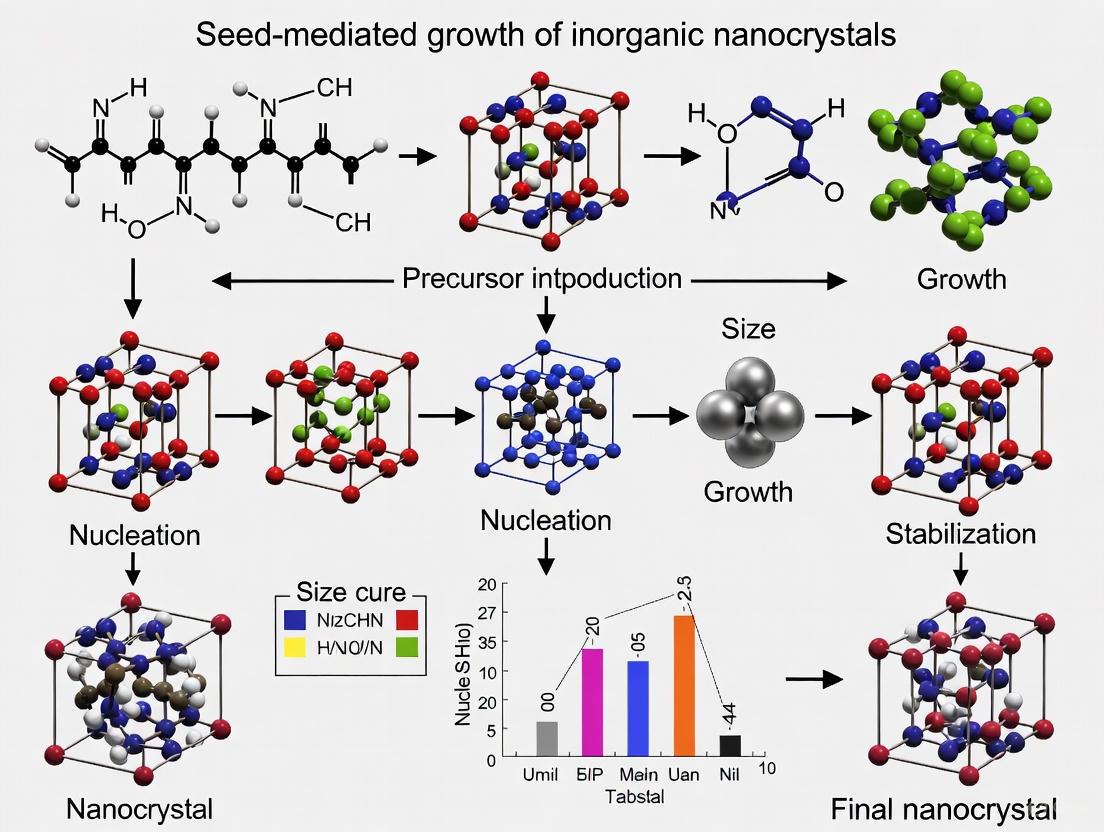
This article provides a comprehensive overview of seed-mediated growth, a powerful and versatile synthetic approach for producing colloidal metal nanocrystals with precise control over size, shape, composition, and structure.
Seed-Mediated Growth of Inorganic Nanocrystals: A Comprehensive Guide for Materials Synthesis and Biomedical Applications
Abstract
This article provides a comprehensive overview of seed-mediated growth, a powerful and versatile synthetic approach for producing colloidal metal nanocrystals with precise control over size, shape, composition, and structure. Tailored for researchers, scientists, and drug development professionals, we explore the fundamental mechanisms governing nanocrystal growth, detail advanced methodologies for creating complex nanostructures, and present practical strategies for troubleshooting and optimization. The scope extends from foundational principles to cutting-edge applications in biomedicine, including photothermal therapy, catalysis, and hyperthermia treatment, with a strong emphasis on validating performance through rigorous characterization and comparative analysis to guide material selection for specific applications.
Unraveling the Core Principles: The Mechanisms Behind Seed-Mediated Nanocrystal Growth
Seed-mediated growth is a foundational synthetic strategy in nanochemistry that separates the nucleation and growth stages of nanoparticle formation. This approach provides superior control over the size, shape, and morphology of inorganic nanocrystals compared to single-pot synthesis methods. Initially developed for gold nanorods (GNRs) [1], this methodology has since been expanded to create diverse nanoparticle architectures including nanostars, cubes, and bipyramids [2]. The core principle involves first forming small, stable nanoparticle "seeds" through rapid reduction, then using these seeds as templates for controlled growth in a separate solution containing additional metal precursors, shape-directing agents, and typically a weaker reducing agent [1] [3]. This separation of stages addresses the stochastic nature of nucleation, enabling more uniform growth and higher quality nanomaterials with tailored properties for applications in biomedicine, catalysis, and energy storage [2].
Fundamental Principles
The Nucleation Stage
The nucleation stage involves the formation of small, stable metallic seeds, typically gold nanospheres of 1-4 nm in diameter [3]. This process begins with the reduction of gold ions (Au(III)) from precursors such as chloroauric acid (HAuCl₄) to Au(0) atoms using a strong reducing agent, most commonly sodium borohydride (NaBH₄) [1]. The rapid reduction leads to a burst of nucleation events, resulting in the formation of small crystalline clusters. To prevent aggregation and control size, capping agents like citrate or cetyltrimethylammonium bromide (CTAB) are introduced during this stage [1]. These molecules adsorb to the nanoparticle surfaces, providing electrostatic or steric stabilization. The resulting seeds serve as well-defined, monodisperse templates for subsequent growth, with their crystalline structure and surface chemistry profoundly influencing the final nanoparticle morphology [3].
The Growth Stage
In the growth stage, seeds are introduced into a separate growth solution containing additional gold precursor, a weak reducing agent such as ascorbic acid (AA), and shape-directing additives [1]. The weak reducing agent partially reduces Au(III) to Au(I), creating an intermediate species that is more readily reduced on the seed surface than in solution [2]. This controlled reduction promotes heterogeneous growth on existing seeds rather than homogeneous nucleation of new particles. The anisotropic growth necessary for non-spherical shapes is guided by selective surface passivation, often through the underpotential deposition of silver or the use of surfactant mixtures like CTAB/CTAC [1] [4]. The growth kinetics are influenced by numerous factors including temperature, pH, reactant concentrations, and reaction time, allowing precise modulation of final nanoparticle dimensions and aspect ratios [1].
Experimental Protocols
Protocol 1: Seed-Mediated Synthesis of Gold Nanorods
This protocol, adapted from the seminal work of Jana et al. [1], details the synthesis of gold nanorods using the seed-mediated growth approach.
Part A: Seed Synthesis
- Prepare seed solution: Combine 5 mL of 0.5 mM HAuCl₄ and 5 mL of 0.2 M CTAB in a 20 mL vial.
- Reduce gold ions: While stirring vigorously, quickly add 0.6 mL of fresh 10 mM ice-cold NaBH₄.
- Age seeds: Continue stirring for 2 minutes, then remove the stir bar and allow the solution to remain undisturbed at 25-30°C for 30-60 minutes. The solution color should change from dark brown to reddish-brown.
- Store seeds: Use seeds within 2-6 hours of preparation for optimal activity.
Part B: Growth Solution and Nanorod Formation
- Prepare growth solution: Mix 5 mL of 0.5 mM HAuCl₄ and 5 mL of 0.2 M CTAB in a 20 mL vial.
- Add shape-directing agents: Introduce 0.1 mL of 4 mM AgNO₃ and 0.07 mL of 1M HCl to the growth solution with gentle mixing.
- Initiate reduction: Add 0.032 mL of 0.1M ascorbic acid, which will cause the solution to become colorless.
- Initiate growth: Add 0.012 mL of the seed solution to the growth solution and mix gently by inverting 5-10 times.
- Allow growth: Let the reaction proceed undisturbed for at least 3 hours at 25-30°C. The development of a color change indicates nanorod formation.
- Purify nanorods: Centrifuge the resulting dispersion (e.g., 10,000 rpm for 15 minutes) and resuspend in deionized water to remove excess CTAB.
Protocol 2: Educational Synthesis of Gold Nanostars and Large Nanospheres
This simplified protocol [2] is ideal for educational settings and demonstrates shape control through seed-mediated growth.
Part A: Turkevich Synthesis of Citrate-Capped Gold Nanosphere Seeds
- Heat precursor: Heat 25 mL of 0.5 mM HAuCl₄ (≥99.9%) to a gentle boil in a 100 mL round-bottom flask with constant stirring.
- Reduce and cap: Rapidly add 0.5 mL of 2.5% wt sodium citrate solution.
- Observe growth: Observe color changes from faint yellow → clear → black/blue → purple → deep red over approximately 10 minutes.
- Cool and store: Continue heating for 10 minutes after the final color appears, then cool to room temperature. These seeds can be stored for several weeks.
Part B: Seed-Mediated Growth of Gold Nanostars
- Prepare growth solution A: Combine 5 mL of 0.5 mM HAuCl₄, 0.2 mL of 10 mM AgNO₃, and 0.4 mL of the Turkevich seeds.
- Prepare reducing solution B: Mix 5 mL of 1 mM ascorbic acid and 16 mM HCl (handle by instructor only).
- Initiate growth: Combine solutions A and B with gentle swirling.
- Observe result: Record the final color of the solution, which indicates nanostar formation.
Part C: Seed-Mediated Growth of ~100 nm Gold Nanospheres
- Prepare growth solution: Combine 6.5 mL of 1.92 mM HAuCl₄ and 0.4 mL of 0.75% wt sodium citrate.
- Add seeds: Introduce 0.120 mL of the Turkevich seeds to the growth solution.
- Initiate growth: Add 5 mL of 4 mM ascorbic acid with gentle mixing.
- Complete growth: Growth completes within 5 minutes. Observe the difference in scattering intensity compared to the original seed solution by shining a flashlight through the vial.
The Scientist's Toolkit: Essential Research Reagents
The following table details key reagents used in seed-mediated growth and their critical functions in controlling nanoparticle synthesis.
Table 1: Essential Research Reagents for Seed-Mediated Growth of Gold Nanoparticles
| Reagent | Function | Key Considerations |
|---|---|---|
| Chloroauric Acid (HAuCl₄) | Gold precursor providing Au(III) ions | Concentration determines final nanoparticle size and growth rate [1] |
| Sodium Borohydride (NaBH₄) | Strong reducing agent for seed formation | Must be fresh and ice-cold; concentration affects seed size and size distribution [1] |
| Ascorbic Acid (AA) | Weak reducing agent for growth stage | Reduces Au(III) to Au(I); concentration influences reduction kinetics and morphology [1] [2] |
| CTAB (Cetyltrimethylammonium Bromide) | cationic surfactant and structure-directing agent | Concentration critical for yield, shape, and size; prevents isotropic growth; source of cytotoxicity concerns [1] |
| Citrate | Anionic capping agent for seed stabilization | Provides electrostatic stabilization; used in place of CTAB for less toxic seeds [1] |
| Silver Nitrate (AgNO₃) | Shape-directing additive | Concentration controls aspect ratio in nanorod synthesis via underpotential deposition [1] [2] |
| Hydrochloric Acid (HCl) | Modifies growth kinetics | Affects reaction pH and anion concentration; influences end shape of nanorods [1] |
Quantitative Relationships in Seed-Mediated Synthesis
Understanding the quantitative relationships between synthesis parameters and nanoparticle outcomes is essential for rational design. The following table summarizes key factor-response relationships based on empirical studies.
Table 2: Factor-Response Relationships in Gold Nanorod Synthesis [1]
| Synthesis Factor | Impact on Nanoparticle Properties | Optimal Range / Notes |
|---|---|---|
| Silver Nitrate Concentration | Primary control over Aspect Ratio (AR) | Increased [AgNO₃] → Higher AR; [HAuCl₄]/[AgNO₃] ratio critically controls width [1] |
| Seed Aging Time | Affects seed surface chemistry and activity | Optimal between 0.5-6 hours; influences symmetry-breaking event [3] |
| CTAB Concentration | Determines yield, shape, and size | Varies by supplier; critical micelle concentration important [1] |
| Seed Concentration | Influences final nanoparticle size | Higher seed concentration → Smaller final size; trade-off with by-products [1] |
| Ascorbic Acid Concentration | Controls reduction kinetics | Higher concentration promotes morphologies with higher energy surfaces [1] [3] |
| Reaction Temperature | Affects growth rate and uniformity | 25-30°C typical; higher temperatures increase growth rate [1] |
| Reaction pH | Influences reduction potential and growth | Affected by HCl addition; alters kinetics and end shape [1] |
| Gold Precursor to Seed Ratio | Determines final nanoparticle size | Au³⁺/Au⁰ ratio provides handle for size tuning [4] |
Visualization of Seed-Mediated Growth Workflow
The following diagram illustrates the sequential stages and key mechanistic pathways in seed-mediated growth of anisotropic gold nanoparticles.
Diagram 1: Seed-mediated growth workflow showing nucleation and growth stages with key mechanistic pathways.
Advanced Applications and Modifications
Toxicity Mitigation Strategies
A significant challenge in biomedical applications of CTAB-synthesized GNRs is surfactant-induced cytotoxicity [1]. Research has developed several mitigation approaches, including repeated centrifugation and washing to remove excess CTAB, ligand exchange with biocompatible molecules, and complete replacement of CTAB with less toxic alternatives like dodecyl dimethyl ammonium bromide (C₁₂edmab) [1]. He et al. developed a "one-pot method" using sodium borohydride to efficiently remove CTAB from GNR surfaces [1]. Dopamine has also been successfully used as a reducing agent替代 ascorbic acid, allowing for reduced CTAB concentrations while maintaining shape control [1].
Reproducibility Enhancement
Achieving high reproducibility in seed-mediated growth remains challenging due to the stochastic nature of the initial symmetry-breaking event [1]. Recent approaches to improve reproducibility include continuous agitation at constant temperature (e.g., 30°C) to ensure complete CTAB solubilization [1], and separation of the symmetry-breaking step from seeded growth [1]. Gonzalez-Rubio et al. demonstrated that using n-decanol with CTAB to generate specific micellar aggregates enables the production of intermediate anisotropic seeds with low size and shape dispersion, leading to significantly improved reproducibility and tunability of the final GNRs [1].
Mechanism Visualization at the Molecular Level
The molecular-level mechanism of seed-mediated growth involves precise electron transfer processes and size evolution pathways, as revealed in studies of gold nanoclusters [5].
Diagram 2: Molecular-level growth mechanism showing sequential stages from seed to final nanocluster.
The seed-mediated growth method represents a powerful platform for the rational design of inorganic nanocrystals with precisely controlled architectural parameters. By separating nucleation and growth stages, researchers can manipulate nanoparticle properties at the molecular level, enabling tailored materials for diverse applications from photothermal therapy to catalysis. Current research continues to address challenges in reproducibility, toxicity, and mechanistic understanding, further expanding the capabilities of this foundational nanomaterial synthesis approach.
In the field of seed-mediated growth of inorganic nanocrystals, precise control over nanoparticle size, shape, and composition is paramount for tailoring materials with desired optical, catalytic, and electronic properties. The fundamental processes governing nanocrystal development are primarily explained by two distinct mechanisms: LaMer growth and aggregative growth [5]. Understanding these pathways at a molecular level has become a significant focus in nanochemistry, enabling researchers to custom-design structural attributes of nanoparticles for applications ranging from drug development to energy conversion [5] [6]. This Application Note delineates the characteristic features, experimental conditions, and quantitative parameters distinguishing these mechanisms, providing researchers with structured protocols and analytical frameworks for their investigation.
Theoretical Foundations of Growth Mechanisms
LaMer Growth Mechanism
The LaMer model describes a classical pathway for nanoparticle formation and growth characterized by a clear separation between the nucleation and growth stages [7]. This mechanism operates through monomeric addition, where soluble metal precursors or complexes are reduced and deposit onto pre-formed seed crystals via heterogeneous nucleation [5] [8]. The process is typified by a monotonic increase in nanoparticle size, where growth occurs atom-by-atom or molecule-by-molecule onto the existing seed surface [5]. This mechanism dominates under conditions where the energy barrier for heterogeneous nucleation on existing seeds is significantly lower than that for homogeneous nucleation of new particles, often achieved through careful control of precursor concentration and reduction kinetics [8].
Aggregative Growth Mechanism
In contrast, aggregative growth involves the assembly and coalescence of smaller clusters or primary nanoparticles into larger, consolidated structures [5] [7]. This pathway exhibits a volcano-shaped evolution in the size distribution of intermediate species, reflecting the continuous attachment and fusion of nanoclusters [5]. The aggregative mechanism is governed by the tendency of smaller particles to reduce their surface energy through fusion, a process that can be modulated by factors such as surface ligand density, solvent polarity, and temperature [7]. This pathway can be concurrent with LaMer growth or dominate under specific reaction conditions where particle surface mobility and instability are promoted.
Comparative Analysis of Fundamental Characteristics
Table 1: Fundamental Characteristics of LaMer vs. Aggregative Growth Mechanisms
| Characteristic | LaMer Growth | Aggregative Growth |
|---|---|---|
| Primary Process | Heterogeneous nucleation on seed surfaces [5] [8] | Assembly and coalescence of primary particles [5] [7] |
| Size Evolution Pattern | Monotonic size increase [5] | Volcano-shaped size evolution [5] |
| Growth Material | Atomic/monomoric species from solution [5] | Pre-formed clusters or nanoparticles [5] |
| Driving Force | Reduction of supersaturation [7] | Reduction of surface energy [7] |
| Elementary Steps | Precursor reduction, surface diffusion, monomer attachment [7] | Particle diffusion, attachment, coalescence [7] |
| Typical Byproducts | Few, unless secondary nucleation occurs | Amorphous aggregates if coalescence is incomplete |
Diagram 1: Sequential vs. Convergent Pathways of Nanoparticle Growth
Experimental Evidence and Molecular-Level Insights
Case Study: Gold Nanocluster Growth from Au₂₅ to Au₄₄
Groundbreaking research tracking 35 intermediate species during the conversion of molecularly pure [Au₂₅(SR)₁₈]⁻ to [Au₄₄(SR)₂₆]²⁻ provides unprecedented molecular-level insight into both mechanisms [5]. This study demonstrated that both pathways can operate sequentially or concurrently within the same reaction system, driven by a sequential 2-electron boosting of the valence electron count of the gold nanoparticles [5].
The growth process was found to proceed through three distinct stages:
- Stage 0 (Pre-growth): Kinetically dictated accumulation of Au₂₅ nanoclusters
- Stage I (Au₂₅-mediated growth): Simultaneous occurrence of LaMer and aggregative pathways
- Stage II (Thermodynamic size-focusing): Convergence to the stable Au₄₄ product [5]
Quantitative Parameters from Kinetic Studies
Theoretical kinetic modeling of nanoparticle formation has elucidated critical parameters governing the dominance of each mechanism. Population balance studies considering nucleation, growth, coalescence, and aggregation reveal that ligand binding strength and metal ion concentration critically determine which pathway prevails [7].
Table 2: Experimental Conditions Favoring Each Growth Mechanism
| Experimental Parameter | LaMer Growth | Aggregative Growth |
|---|---|---|
| Precursor Concentration | Moderate supersaturation [7] | High local concentration of clusters [5] |
| Ligand Binding Strength | Weak to moderate binding ligands [7] | Strong binding ligands that stabilize intermediates [7] |
| Reduction Rate | Controlled, gradual reduction [8] | Rapid reduction generating many clusters [7] |
| Temperature | Higher temperatures favoring surface diffusion | Variable, can be room temperature [5] |
| Reaction Time | Can require extended periods (e.g., 6 days) [5] | Can be relatively faster through cluster fusion |
| Characteristic Evidence | Monotonic size increase in UV-vis and MS [5] | Volcano-shaped intermediate distribution in MS [5] |
Research Reagent Solutions Toolkit
Table 3: Essential Reagents for Seed-Mediated Growth Studies
| Reagent Category | Specific Examples | Function in Growth Process |
|---|---|---|
| Metal Precursors | HAuCl₄·3H₂O [9], AgNO₃ [8] | Source of metal atoms for nucleation and growth |
| Reducing Agents | Ascorbic Acid [6] [9], NaBH₄ [9], CO [5] | Electron donors for metal ion reduction; strength affects mechanism |
| Shape-Directing Agents | Ag⁺ ions [6], I⁻ ions [6] | Modify surface energies of specific crystal facets |
| Capping Ligands | para-Mercaptobenzoic acid [5], CTAB [9] | Stabilize nanoparticles and control growth kinetics |
| Chiral Inducers | Cysteine [6], Glutathione [6] | Introduce dissymmetry for chiral nanostructures |
Experimental Protocols
Protocol 1: Investigating Growth Mechanisms in Gold Nanoclusters
Objective: To monitor the transition from [Au₂₅(p-MBA)₁₈]⁻ to [Au₄₄(p-MBA)₂₆]²⁻ and identify LaMer vs. aggregative pathways [5].
Materials:
- HAuCl₄·3H₂O (gold precursor)
- para-Mercaptobenzoic acid (p-MBA, ligand)
- Purified [Au₂₅(p-MBA)₁₈]⁻ seed clusters
- Carbon monoxide gas (reducing agent)
- NaOH (for pH adjustment)
- Ultrapure water
Procedure:
- Preparation of Au(I)-SR Complexes: Mix HAuCl₄ and p-MBA at a 1:1 molar ratio in aqueous solution at pH 13.0
- Seed Introduction: Add purified [Au₂₅(p-MBA)₁₈]⁻ nanoclusters to the Au(I)-SR complex solution
- Initiation of Growth: Bubble CO through the reaction mixture for 2 minutes under vigorous stirring (1000 rpm)
- Reaction Monitoring: Maintain stirring at 1000 rpm at room temperature (25°C) for up to 6 days
- Time-Point Sampling: Withdraw aliquots at scheduled intervals (e.g., 0, 15, 30, 60 min; 2, 4, 8, 24, 48, 96, 144 hrs)
- Analysis:
- UV-vis Spectroscopy: Track optical feature evolution (430, 460, 690 nm for Au₂₅; 480, 575, 765 nm for Au₄₄)
- ESI-MS: Identify intermediate species and their time-dependent abundance
Key Observations:
- Stage 0 (0-1 h): Enhancement of Au₂₅ characteristic absorptions indicates monomer addition (LaMer)
- Stage I (1-48 h): Appearance and disappearance of multiple intermediates suggests concurrent aggregative pathways
- Stage II (>48 h): Convergence to pure Au₄₄ product demonstrates thermodynamic size-focusing [5]
Protocol 2: Seed-Mediated Growth of Gold Nanorods for Catalytic Applications
Objective: To synthesize gold nanorods (GNRs) via seed-mediated growth and evaluate their catalytic activity [9].
Materials:
- HAuCl₄·3H₂O (gold precursor)
- Cetyltrimethylammonium bromide (CTAB, surfactant)
- NaBH₄ (strong reducing agent for seeds)
- Ascorbic acid (AA, mild reducing agent for growth)
- AgNO₃ (shape-directing agent)
- 4-nitrophenol (4-NP, for catalytic assessment)
Procedure: Seed Synthesis:
- Combine HAuCl₄ (250 μL, 0.01 M) with CTAB solution (7.5 mL, 0.1 M)
- Add ice-cold NaBH₄ (600 μL, 0.01 M) under vigorous stirring
- Continue stirring for 2 minutes, then maintain at 25°C for 30 minutes before use
GNR Growth:
- Prepare growth solution containing HAuCl₄ (2.5 mL, 0.01 M), CTAB (47.5 mL, 0.1 M), and AgNO₃ (600 μL, 0.01 M)
- Add ascorbic acid (550 μL, 0.1 M) to the growth solution
- Introduce seed solution (120 μL) to the growth solution, mix gently, and maintain at 25°C for 24 hours
Characterization and Catalytic Testing:
- UV-vis Spectroscopy: Confirm longitudinal LSPR band at ~705 nm and transverse LSPR at ~510 nm
- FESEM/TEM: Analyze nanorod dimensions and aspect ratio
- Catalytic Assessment:
- Mix 4-NP solution with NaBH₄
- Add GNR catalyst and monitor absorbance at 400 nm decay over time
- Calculate rate constant for 4-NP to 4-AP reduction
Expected Results: GNRs synthesized through this seed-mediated approach typically achieve complete degradation of 4-NP within 15 minutes, demonstrating high catalytic efficiency attributable to their anisotropic structure and high surface-to-volume ratio [9].
Diagram 2: Experimental Framework for Differentiating Growth Mechanisms
The strategic application of LaMer versus aggregative growth mechanisms enables precise architectural control over inorganic nanocrystals in seed-mediated syntheses. The experimental protocols and analytical frameworks presented herein provide researchers with essential methodologies for discerning and harnessing these fundamental pathways. As the field advances, the integration of real-time monitoring techniques with computational modeling will further elucidate the complex interplay between these mechanisms, enabling unprecedented control in nanomaterial design for pharmaceutical development and other advanced applications.
Seed-mediated synthesis has emerged as a premier strategy for producing colloidal nanocrystals with well-defined anisotropic shapes, which are critical for applications in catalysis, biomedicine, and optoelectronics [10] [9]. This approach separates the complex processes of nucleation and growth, offering superior control over particle morphology and size distribution [3]. The characteristics of the seed nanoparticles—specifically their crystallinity, surface structure, and ligand chemistry—serve as the foundational template that dictates subsequent growth pathways and final nanostructure outcomes [10] [11]. Despite two decades of widespread use, the precise structural and chemical nature of seeds has remained poorly understood, hindering predictive synthesis of complex multimetallic nanocrystals [10] [11]. Recent advances have identified that many traditional seed syntheses actually produce atomically precise nanoclusters rather than the previously assumed polydisperse nanoparticles [11]. This application note synthesizes current understanding of seed characteristics and provides detailed protocols for leveraging these insights to advance nanocrystal design, particularly within the context of inorganic nanocrystals research for drug development and biomedical applications.
Theoretical Framework: How Seed Characteristics Direct Growth
The Interplay of Seed Properties
The growth pathway and final morphology of nanocrystals are determined by the interplay of three fundamental seed characteristics: crystallinity, surface structure, and surface ligands. These factors collectively control the energy landscape for atomic deposition and diffusion during growth [10].
Crystallinity determines the presence and arrangement of defect structures such as twin boundaries, which create heterogeneous surface sites with different binding energies and growth rates [10]. Single-crystalline seeds typically foster symmetric growth, while multiple-twinned seeds promote anisotropic development [10].
Surface structure encompasses the atomic arrangement and facet composition of the seed, which dictates the preferential deposition sites for incoming metal atoms. Different crystal facets exhibit distinct surface energies and atomic densities, leading to facet-dependent growth kinetics [12].
Surface ligands modulate growth through selective passivation of specific crystal facets and control over the accessibility of surface sites [10] [13]. Ligands influence reduction kinetics, atomic mobility, and interfacial energy, thereby directing the thermodynamic and kinetic pathways available for nanocrystal development [14] [13].
Mechanistic Pathways in Seed-Mediated Growth
Two primary mechanistic pathways operate in seed-mediated growth: kinetically controlled growth and surface passivation-directed growth [3]. In kinetic growth, the reduction rate of metal precursors determines the preference for high-energy or low-energy facet development [3]. Surface passivation involves the deposition of secondary metals (e.g., Ag UPD) which selectively block specific facets and redirect growth to less-passivated surfaces [3]. The crystallinity and surface structure of the seed determine which pathway dominates, while ligands fine-tune the specific outcomes within each pathway [10].
Table 1: Fundamental Seed Characteristics and Their Roles in Growth Direction
| Seed Characteristic | Structural Influence | Chemical Influence | Resulting Growth Implications |
|---|---|---|---|
| Crystallinity | Single-crystalline vs. multiple-twinned structures | Differential reactivity of defect sites vs. ordered domains | Switching between symmetric and anisotropic growth pathways [10] |
| Surface Structure | Atomic arrangement of crystal facets (e.g., {100}, {111}) | Facet-dependent surface energy and bonding geometries | Preferential atomic deposition on specific crystallographic planes [12] |
| Surface Ligands | Steric hindrance and surface coverage density | Selective passivation through coordination chemistry | Controlled accessibility to surface sites; modulation of reduction kinetics [10] [13] |
Key Experimental Findings and Data
Atomic-Level Insights into Seed Structure
Recent breakthroughs have transformed our understanding of seed nanoparticle structure. Murphy and colleagues have demonstrated that traditional gold seed syntheses using alkyltrimethylammonium halide surfactants predominantly produce atomically precise Au₃₂X₈[AQA⁺•X⁻]₁₂ nanoclusters rather than polydisperse nanoparticles [11]. These clusters feature a 32-atom gold core with 8 halide and 12 halide-cationic surfactant bound ion pairs as ligands [11].
Similarly, the total structure determination of a seed-sized Au₅₆ nanoprism has revealed critical insights into facet-specific ligand distribution. In this structure, the side {100} facets are protected by bridging thiolates, while the top/bottom {111} facets are capped by phosphine ligands at the corners and Br⁻ at the center [12]. The bromide proves essential for stabilizing the Au{111} facets to form a complete face-centered-cubic core [12].
Quantitative Relationships Between Seed Properties and Growth Outcomes
Table 2: Experimental Evidence: Seed Properties Dictating Nanocrystal Growth Outcomes
| Seed Property | Experimental System | Key Finding | Impact on Final Nanostructure |
|---|---|---|---|
| Seed Crystallinity | Au seeds for Cu-based nanocrystals [10] | Multiple-twinned Au seeds enabled one-dimensional Cu growth, while single-crystalline seeds produced heterostructures | Switching between anisotropic nanorods and heterostructured nanocrystals [10] |
| Surface Ligands | CsPbBr₃ perovskite NCs via LARP method [14] | Ligand removal created surface defects (Pb⁰, Br vacancies) that quenched photoluminescence | Altered optical properties without crystal structure change; non-radiative recombination sites [14] |
| Ligand Binding Strength | Au seeds with different capping agents (OLAM, DDT, PS, CTAB) [10] | Weakly coordinating ligands (OLAM) facilitated Au-Cu diffusion; strong ligands (DDT) hindered atomic intermixing | Controlled alloy formation vs. core-shell structures in multimetallic systems [10] |
| Halide Ligands | Au₅₆ nanoprism seeds [12] | Bromide specifically stabilized {111} facets to form complete face-centered-cubic core | Enabled prismatic morphology with defined facet arrangement [12] |
| Seed Solution Composition | Text-mined dataset of 492 seed-mediated AuNP syntheses [3] | Seed capping agent type (CTAB vs. citrate) crucially determined final AuNP morphology | Statistical validation of ligand importance across multiple synthetic protocols [3] |
Detailed Experimental Protocols
Protocol 1: Synthesis of Atomically Precise Au₃₂ Nanocluster Seeds
Principle: This protocol produces the predominant molecular seed species identified in traditional gold nanoparticle syntheses, enabling more reproducible and controlled growth of anisotropic nanostructures [11].
Materials:
- Hydrogen tetrachloroaurate trihydrate (HAuCl₄·3H₂O, ≥99.9%)
- Hexadecyltrimethylammonium bromide (C₁₆TAB, >98.0%)
- Sodium borohydride (NaBH₄, 99%)
- Ultrapure water (18.2 MΩ·cm)
Procedure:
- Prepare a 10 mL aqueous solution of 0.25 mM HAuCl₄ and 0.1 M C₁₆TAB in a 20 mL scintillation vial.
- Cool the solution to 15°C using an ice bath with continuous stirring at 500 rpm.
- Rapidly inject 0.6 mL of freshly prepared 10 mM NaBH₄ solution using a micropipette.
- Stir vigorously for 30 seconds, then allow the solution to rest undisturbed for 2 hours.
- Characterize the seed solution by UV-vis spectroscopy, which should show molecule-like absorption features without a plasmon band around 505 nm [11].
- Verify seed composition by MALDI mass spectrometry, with the dominant peak corresponding to Au₃₂X₈[AQA⁺•X⁻]₁₂ [11].
Critical Notes:
- Seed aging time significantly impacts growth outcomes; use seeds within 2-48 hours of synthesis [3].
- The ice bath temperature is critical for consistent cluster formation.
- NaBH₄ solution must be freshly prepared and kept on ice before injection.
Protocol 2: Investigating Seed Crystallinity Effects on Copper Nanocrystal Growth
Principle: This protocol demonstrates how seed crystallinity directs growth pathways in heterometallic systems, specifically for copper-based nanocrystals [10].
Materials:
- OLAM-capped Au seeds (single-crystalline and multiple-twinned)
- Copper(II) chloride dihydrate (CuCl₂·2H₂O)
- Oleylamine (OLAM, dried under vacuum at 100°C for 4 h)
- 1-Dodecanethiol (DDT, 98%)
- Triphenylphosphine (>95.0%)
- Anhydrous toluene
Procedure: A. Seed Preparation and Modification:
- Synthesize OLAM-capped Au seeds according to established methods [10].
- For DDT-capped seeds: Heat OLAM-capped Au nanocrystals in toluene to 80°C, add triphenylphosphine, then inject DDT and maintain at 80°C for 15 minutes [10].
- Purify via precipitation with acetone and centrifugation at 3,000 rpm for 3 minutes [10].
B. Growth of Copper-Based Nanocrystals:
- Prepare growth solution containing 0.5 mmol CuCl₂ in 10 mL OLAM.
- Heat growth solution to 180°C under nitrogen atmosphere with stirring.
- Rapidly inject 2 mL of seed solution (O.D. = 40 at plasmon peak wavelength).
- Maintain temperature at 180°C for 60 minutes.
- Monitor reaction progress by aliquot sampling and UV-vis spectroscopy.
- Purify final products by precipitation with ethanol and centrifugation.
Characterization:
- Analyze morphology by TEM to confirm nanorod formation with multiple-twinned seeds versus heterostructures with single-crystalline seeds [10].
- Perform STEM elemental analysis to verify Au distribution (<4 at%) in Cu lattice [10].
Protocol 3: Ligand Exchange for Surface Property Modification
Principle: This general protocol enables modification of seed surface properties through ligand exchange to control subsequent growth behavior [10] [13].
Materials:
- Nanoparticle seeds (e.g., Au, perovskite, or other inorganic nanocrystals)
- Incumbent ligands (e.g., oleylamine, citrate, CTAB)
- Target ligands for exchange (e.g., DDT, polymers, biomolecules)
- Solvents (toluene, acetone, ethanol appropriate for seed solubility)
- Centrifuge
Procedure:
- Purify starting seeds by precipitation and centrifugation to remove excess ligands.
- Redisperse seeds in minimal solvent to create concentrated stock.
- Prepare target ligand solution at 10-100× molar excess relative to estimated seed surface sites.
- Mix seed solution with ligand solution and incubate with agitation:
- For thiolates: 2-12 hours at room temperature
- For phosphines: 1-4 hours at 60-80°C
- For polymer ligands: 12-24 hours at room temperature
- Purify exchanged seeds by repeated precipitation/centrifugation cycles.
- Characterize successful exchange by FTIR, TGA, or XPS [14].
Applications:
- Replace strongly binding ligands (DDT) with weaker binders (OLAM) to enhance atomic diffusion and alloying [10].
- Exchange hydrophobic ligands for hydrophilic alternatives to improve biocompatibility [13].
The Scientist's Toolkit: Essential Research Reagents
Table 3: Key Reagent Solutions for Seed-Mediated Nanocrystal Synthesis
| Reagent Category | Specific Examples | Function in Synthesis | Considerations for Use |
|---|---|---|---|
| Surfactant Ligands | CTAB, CTAC, oleylamine, linoleic acid [14] [9] | Direct crystal growth through facet-specific binding; colloidal stability | Concentration critical for morphology control; impurity levels affect reproducibility [3] |
| Strongly Binding Ligands | Dodecanethiol (DDT), triphenylphosphine [10] | Surface passivation; limit atomic diffusion and alloy formation | Effective for heterostructure formation; hinder homogeneous alloying [10] |
| Halide Additives | Bromide, chloride, iodide salts [11] [12] | Stabilize specific crystal facets (e.g., {111} in Au); component of bound ion pair ligands | Concentration and identity (Cl⁻, Br⁻, I⁻) dramatically impact morphology [12] |
| Reducing Agents | Sodium borohydride, ascorbic acid, borane tert-butylamine complex [10] [11] | Control reduction kinetics; strong vs. weak reducers for seeds vs. growth | Strength determines nucleation vs. growth dominance; age of solution critical [3] |
| Metal Precursors | HAuCl₄·3H₂O, CuCl₂·2H₂O, CsBr, PbBr₂ [14] [10] | Source of metal atoms for core structure | Purity essential; hydrated forms common but water content must be controlled |
The precise control of seed characteristics represents the frontier of predictive nanocrystal synthesis. As research progresses, several key areas emerge as particularly promising for advancing seed-mediated growth strategies. The recognition that traditional seed syntheses produce atomically precise nanoclusters rather than polydisperse nanoparticles opens possibilities for molecular-level design of seeds with tailored structures [11]. The development of high-throughput experimentation and machine learning approaches, as demonstrated in text-mined analysis of 492 seed-mediated syntheses, will enable more systematic exploration of the complex parameter space governing seed-directed growth [3]. For biomedical applications, the design of ligand shells that maintain stability under physiological conditions while enabling specific targeting remains a critical challenge [13]. As these advances mature, the rational design of seed characteristics will undoubtedly unlock new generations of functional nanomaterials with tailored properties for applications spanning catalysis, energy, medicine, and beyond.
Seed-mediated growth represents a foundational strategy in synthetic nanochemistry, enabling precise control over the size and structure of inorganic nanocrystals. Unlike classical nucleation, this approach separates the nucleation and growth phases, offering superior command over morphological evolution. This application note delves into a model system for achieving molecular-level precision in nanoparticle synthesis: the conversion of atomically precise [Au25(SR)18]− nanoclusters to [Au44(SR)26]2− nanoclusters. The integrity of the thiolate ligand shell (SR) remains unaltered throughout this process, providing a unique window into the stepwise mechanism of nanocluster growth. Such atomic-level understanding is critical for advancing rational nanomaterial design, with profound implications for applications in catalysis, sensing, and drug delivery platforms where nanocluster size and surface chemistry dictate functional performance [5] [15].
Experimental Protocols
Synthesis of Seed[Au25(p-MBA)18]−Nanoclusters
The synthesis of molecularly pure [Au25(p-MBA)18]− (where p-MBA is para-mercaptobenzoic acid) is achieved via a carbon monoxide (CO)-mediated reduction method, as follows [5]:
- Step 1 – Precursor Preparation: An aqueous solution of chloroauric acid (
HAuCl4) andp-MBAis prepared at a molar ratio of 1:1. The pH of the solution is adjusted to 13.0 using sodium hydroxide (NaOH). - Step 2 – Reduction: Carbon monoxide gas is bubbled through the vigorously stirred reaction mixture (approximately 1000 rpm) for a defined period. This step reduces the Au(I)-thiolate complexes and facilitates the nucleation and focusing of the
Au25cluster. - Step 3 – Purification: The resulting
[Au25(p-MBA)18]−nanoclusters are purified from unreacted precursors and by-products. The product is characterized by its reddish-brown color and exhibits characteristic UV-Vis absorption peaks at 430, 460, 575, 690, and 815 nm. Electrospray Ionization Mass Spectrometry (ESI-MS) in negative ion mode confirms molecular purity, showing multiple charge states of theAu25cluster [5].
Seed-Mediated Growth of[Au44(p-MBA)26]2−Nanoclusters
The precise conversion of the Au25 seed to the larger Au44 nanocluster is performed under mild reductive conditions [5]:
- Step 1 – Growth Solution Preparation: Fresh Au(I)-SR complexes are prepared by mixing
HAuCl4andp-MBAin a 1:1 molar ratio at pH 13.0. - Step 2 – Seeding: Purified
[Au25(p-MBA)18]−nanoclusters are introduced into the growth solution containing the Au(I)-SR complexes. - Step 3 – Initiation of Growth: Carbon monoxide gas is bubbled through the reaction mixture for 2 minutes under vigorous stirring (1000 rpm) at room temperature (25 °C).
- Step 4 – Growth Incubation: The reaction vessel is sealed and allowed to stir continuously at 1000 rpm for 6 days.
- Step 5 – Product Isolation: The reaction yields
[Au44(p-MBA)26]2−nanoclusters, evident from the solution's dark brown color. Successful conversion is confirmed by UV-Vis spectroscopy, which shows weak shoulder peaks at 480, 575, and 765 nm, and unequivocally by ESI-MS analysis [5].
Characterization Techniques
- UV-Vis Spectroscopy: Used to track the evolution of the nanocluster synthesis and confirm the distinct optical fingerprints of the
Au25andAu44products [5]. - Electrospray Ionization Mass Spectrometry (ESI-MS): A critical technique for confirming the atomic precision and molecular formula of the nanoclusters at each stage. It identifies intermediate species and verifies the completeness of the size conversion by displaying the characteristic charge-state distributions of
[Au25(p-MBA)18]−and[Au44(p-MBA)26]2−[5]. - Matrix-Assisted Laser Desorption/Ionization (MALDI) Mass Spectrometry: Employed for identifying molecular clusters in seed solutions, providing insights into their composition and ligand shell [11].
Results and Data Analysis
Mechanistic Insights into the Growth Pathway
The transformation from Au25 to Au44 is not a direct leap but a complex, multi-stage process involving distinct intermediate species. Time-dependent ESI-MS analysis revealed 35 intermediate species, allowing for the mapping of a detailed reaction network [5] [16].
The growth is driven by a sequential two-electron (2e⁻) boosting of the nanocluster's valence electron count. This electronic stabilization governs two concurrent size-evolution pathways [5] [15]:
- Monotonic LaMer Growth: Involves the sequential addition of Au(I)-SR monomers to the growing cluster.
- Volcano-shaped Aggregative Growth: Involves the assembly and fusion of smaller clusters or intermediates.
This mechanism is initiated by the adsorption of reductive species (e.g., CO) onto the seed [Au25(SR)18]− cluster, which activates it for further growth [5]. Theoretical studies further support a "2e⁻ hopping" mechanism, predicting stable intermediate structures such as [Au29(SR)20]−, [Au33(SR)22]−, and Au41(SR)25 en route to Au44 [16].
Quantitative Analysis of Growth Stages
The following table summarizes the key characteristics of each identified growth stage, correlating temporal, optical, and mass spectrometric data [5]:
Table 1: Time-Dependent Growth Stages from Au25 to Au44
| Growth Stage | Time Frame | Key UV-Vis Spectral Changes | ESI-MS Observations | Proposed Process |
|---|---|---|---|---|
| Stage 0: Pre-growth | 0 – 1 hour | Enhancement of characteristic Au25 peaks (430, 460, 690 nm) | Dominance of Au25 mass peaks | Accumulation and activation of Au25 seeds; reduction of Au(I)-SR complexes. |
| Stage I: Size Evolution | 1 – 48 hours | Gradual decrease of Au25 features; emergence of broad, undefined features | Appearance of multiple intermediate species (e.g., Au29, Au33) | 2e⁻-driven growth via LaMer and aggregative pathways. |
| Stage II: Size Focusing | 48 hours – 6 days | Evolution to defined Au44 shoulders (480, 575, 765 nm) | Disappearance of intermediates; dominance of Au44 mass peaks | Thermodynamically controlled focusing to the stable Au44 product. |
The table below provides a comparative overview of the initial seed and final product nanoclusters, highlighting the changes in their fundamental properties [5]:
Table 2: Characterization Data for Au25 Seed and Au44 Product
| Parameter | [Au25(SR)18]− | [Au44(SR)26]2− |
|---|---|---|
| Core Mass (Au atoms) | 25 | 44 |
| Ligand Number (SR) | 18 | 26 |
| Net Charge | -1 | -2 |
| Optical Absorbance | Strong peaks at 430, 460, 575, 690, 815 nm | Weak shoulders at 480, 575, 765 nm |
| ESI-MS Signatures | Multiple charge states (3- to 7-) | Multiple charge states (4- to 7-) |
| Solution Color | Reddish Brown | Dark Brown |
The Scientist's Toolkit
Successful reproduction of this synthesis requires careful attention to the following reagents and materials:
Table 3: Essential Research Reagent Solutions
| Reagent / Material | Function / Role in Synthesis | Critical Parameters |
|---|---|---|
| Chloroauric Acid (HAuCl4) | Gold precursor providing Au(III) ions. | Purity; fresh preparation recommended. |
| para-Mercaptobenzoic Acid (p-MBA) | Thiolate ligand (SR) for stabilizing the nanocluster core. |
Molar ratio to gold (1:1); purity. |
| Sodium Hydroxide (NaOH) | pH adjustment to create a basic reaction environment (pH 13.0). | Concentration; precise pH control is critical. |
| Carbon Monoxide (CO) Gas | Mild reducing agent that activates the seed cluster and drives growth. | Purity; controlled bubbling time (2 min for growth). |
| Alkyl Quaternary Ammonium Halide (e.g., CTAB) | Surfactant used in many seed-mediated syntheses to control morphology and stabilize intermediates [11]. | Chain length and halide identity (Cl, Br) can influence cluster structure [11]. |
| Ascorbic Acid | A mild reducing agent used in growth solutions for anisotropic nanostructures [6]. | Concentration relative to gold precursor ([AA]/[HAuCl4]). |
Visualizing the Molecular Growth Pathway
The atomic-level pathway from the icosahedral Au25 to the bi-icosahedral Au44 can be conceptualized as a series of stable intermediate clusters, each formed through a 2-electron reduction step [16].
The case study of Au25 to Au44 conversion provides unprecedented molecular-level insight into seed-mediated growth mechanisms, demonstrating that nanochemistry can achieve a level of precision akin to organic total synthesis. The identification of a 2-electron boosting mechanism and the interplay between LaMer and aggregative growth pathways offer universal guiding principles for the rational design of other atomically precise nanoclusters, such as Au38 [5] [15].
These principles extend beyond this specific system. For instance, the synthesis of chiral gold nanorods relies on a profound understanding of seed-mediated growth, where crystallographic seed features and chiral inducers dictate the final dissymmetric morphology [6]. Furthermore, the recent identification of Au32X8[AQA+•X-]12 as a predominant molecular species in classical gold nanoparticle seed solutions further solidifies the critical link between molecular cluster chemistry and the formation of well-defined nanostructures [11]. Mastery of these molecular pathways empowers researchers to tailor nanomaterials with precision for advanced applications in electrocatalysis for fuel cells, plasmonics, and biomedicine.
Within the framework of seed-mediated growth in inorganic nanocrystal research, precise control over nanocrystal morphology is a cornerstone for tailoring materials for applications in catalysis, sensing, and drug delivery. This control is predominantly governed by the interplay between thermodynamic and kinetic principles during synthesis. Thermodynamic control favors the formation of the most stable structures, typically those with minimal surface energy, while kinetic control manipulates reaction rates to trap metastable, often more complex, morphologies. The seed-mediated growth method excels in this context by explicitly separating the nucleation and growth stages, thereby providing superior command over the crystallographic evolution of the final nanocrystal. This protocol outlines the fundamental principles, quantitative parameters, and detailed methodologies for manipulating these competing factors to achieve targeted nanocrystal shapes.
Core Principles: Kinetic vs. Thermodynamic Control
The final morphology of a nanocrystal is the result of a contest between the system's drive to achieve the lowest energy state (thermodynamics) and the pathway and rate at which it grows (kinetics).
- Thermodynamic Control leads to crystals bounded by the most stable facets, achieving the Wulff shape, which minimizes the total surface energy. This control is typically realized under conditions of high temperature and slow reaction rates, allowing atoms sufficient time to diffuse to their most favorable positions on the crystal lattice.
- Kinetic Control allows access to metastable shapes, such as nanorods, cubes, and concave structures, by manipulating the growth rates of different crystal facets. This is achieved by creating an energy barrier that favors growth in specific directions, often through the use of capping agents or by employing fast reduction rates that prevent atomic reorganization into the thermodynamic minimum.
The transition between these regimes is not arbitrary; high-throughput statistical studies on Co3O4 nanocrystals have identified an "onset radius," a critical size threshold at which growth transitions from thermodynamic to kinetic control, marked by a shape change from convex to concave polyhedra [17].
Table 1: Characteristics of Thermodynamic and Kinetic Control Regimes
| Parameter | Thermodynamic Control | Kinetic Control |
|---|---|---|
| Governing Principle | Global energy minimization | Growth rate manipulation |
| Resulting Morphology | Stable, equilibrium shapes (e.g., Wulff polyhedra) | Metastable, anisotropic shapes (e.g., rods, cubes) |
| Typical Conditions | High temperature, slow precursor addition, long reaction times | Low temperature, fast precursor reduction, short reaction times |
| Role of Capping Agents | Non-selective adsorption | Selective facet binding to inhibit growth |
| Crystallographic Outcome | Structures with low surface energy facets | Structures with high-energy, kinetically stabilized facets |
Quantitative Synthesis Parameters
The following parameters, derived from recent studies, provide a quantitative framework for designing synthesis protocols aimed at specific morphologies.
Table 2: Key Experimental Parameters for Morphology Control
| Parameter | Impact on Morphology | Exemplary Data from Literature |
|---|---|---|
| Reduction Kinetics | Dictates crystal phase and overlayer structure; fast kinetics favor metastable phases [18]. | Ru nanocrystal phase controlled by polyol choice: Ethylene Glycol (slower) yields hcp; Triethylene Glycol (faster) yields fcc [18]. |
| Precursor Type | Influences reduction rate and ligand-surface interactions. | Ru(acac)₃ vs. RuCl₃ in polyol synthesis leading to different crystal phases [18]. |
| Solvent System | High viscosity of Deep Eutectic Solvents (DES) slows diffusion, favoring kinetic products; polarity and H-bonding also affect growth [19]. | DESs used for morphology-controlled synthesis of Pt, Pd, Au, TiO₂, and ZnO nanocrystals [19]. |
| Capping Agents | Selective adsorption on specific facets alters their surface energy and growth rate. | Surfactants and ions (e.g., SCN⁻, halides) used to control the shape of Pd and Au nanocrystals [20]. |
| Temperature | Higher temperatures favor thermodynamic products; lower temperatures favor kinetic products. | Identified as a key non-matter factor for controlling morphology in DES-based synthesis [19]. |
| Onset Radius | Critical size for transition between growth regimes (e.g., spherical to faceted, thermodynamic to kinetic) [17]. | Experimentally determined for Co3O4 nanocrystals via high-throughput image analysis [17]. |
Experimental Protocols
Protocol 1: Seed-Mediated Growth for Shape-Controlled Noble Metal Nanocrystals
This general protocol, adaptable for metals like Au, Ag, Pd, and Pt, is foundational for achieving kinetic control over morphology [21] [20].
4.1.1 Research Reagent Solutions
Table 3: Essential Reagents for Seed-Mediated Growth
| Reagent | Function | Example |
|---|---|---|
| Metal Salt Precursor | Source of metal atoms for seed formation and growth. | Chloroauric acid (HAuCl₄) for gold, Silver nitrate (AgNO₃) for silver [20]. |
| Reducing Agent (Seed) | Generates zero-valent metal atoms for homogeneous nucleation of seeds. | Sodium borohydride (NaBH₄) [20]. |
| Reducing Agent (Growth) | A milder agent for reducing metal ions onto pre-formed seeds. | Ascorbic acid (AA) [20]. |
| Shape-Directing Agent | Capping agent that selectively binds to specific crystal facets to control shape. | Cetyltrimethylammonium bromide (CTAB) for gold nanorods [20]. |
| Seed Nanocrystals | Monodisperse, crystalline templates for epitaxial growth. | ~4 nm spherical Au nanocrystals [20]. |
4.1.2 Step-by-Step Procedure
Seed Solution Synthesis:
- In a vial, prepare an aqueous solution containing the metal precursor (e.g., 0.25 mM HAuCl₄) and a stabilizing agent (e.g., 0.1 M CTAB).
- Under vigorous stirring, quickly add a fresh, ice-cold aqueous solution of sodium borohydride (e.g., 0.01 M, 0.6 mL). The solution will immediately change color (e.g., to brownish-yellow for gold), indicating seed formation.
- Stir for 2 minutes and then allow the seed solution to age at 25-30°C for 30-60 minutes before use. This quenches excess borohydride and stabilizes the seeds.
Growth Solution Preparation:
- In a separate vial, dissolve the shape-directing surfactant (e.g., 0.1 M CTAB) in warm water.
- Add the metal precursor (e.g., 0.5 mM HAuCl₄) and mix gently.
- Add a mild reducing agent (e.g., 0.1 M ascorbic acid). The solution will typically become colorless as Au(III) is reduced to Au(I). Ascorbic acid alone is insufficient to reduce ions to metal atoms, preventing spontaneous nucleation.
Initiation of Growth:
- Add a predetermined volume of the seed solution (e.g., 0.12 mL) to the growth solution.
- Cap the vial and invert it several times to mix. Do not stir vigorously.
- Allow the reaction to proceed undisturbed for a defined period (e.g., 4-24 hours) at a controlled temperature (e.g., 30°C). The nanocrystals will gradually grow epitaxially on the seeds.
Purification:
- Terminate the reaction by centrifugation (e.g., 10,000 rpm for 15 minutes) to isolate the nanocrystals.
- Re-disperse the pellet in deionized water or a dilute surfactant solution. Repeat 2-3 times to remove excess reactants and by-products.
The workflow and decision points in a seed-mediated synthesis are summarized in the following diagram:
Protocol 2: Phase-Controlled Synthesis of Ru Nanocrystals via Reduction Kinetics
This specific protocol demonstrates how kinetic control, via reductant selection, can determine the bulk crystal phase of the final nanocrystals, a critical factor in their catalytic properties [18].
4.2.1 Research Reagent Solutions
Table 4: Essential Reagents for Ru Nanocrystal Phase Control
| Reagent | Function | Example & Rationale |
|---|---|---|
| Ru Precursor | Source of Ruthenium. | Ru(acac)₃ (ruthenium(III) acetylacetonate). |
| Reducing Agent / Solvent | Polyol acts as both solvent and reductant; its reducing power dictates kinetics. | Ethylene Glycol (EG) for slower kinetics (hcp phase) or Triethylene Glycol (TEG) for faster kinetics (fcc phase) [18]. |
| Seed Nanocrystals | Template for epitaxial growth. | Pre-synthesized hcp- or fcc-Ru seeds (3-4 nm). |
4.2.2 Step-by-Step Procedure
Solution Preparation:
- In a three-neck flask, add a specific volume (e.g., 10 mL) of the chosen polyol (EG or TEG).
- Add the Ru precursor (e.g., 0.05 mmol of Ru(acac)₃) and a stabilizer like PVP (e.g., 0.2 mmol).
- Heat the mixture to 120°C under magnetic stirring until the precursor is fully dissolved.
Seed Injection and Growth:
- Raise the temperature to the growth temperature (e.g., 240°C for EG, 220°C for TEG) under a nitrogen atmosphere.
- Quickly inject a suspension of pre-formed Ru seeds (in the same polyol) into the hot solution.
- Maintain the temperature for 1 hour to allow for epitaxial growth.
Product Isolation:
- Cool the reaction mixture to room temperature.
- Precipitate the nanocrystals by adding acetone and collect them via centrifugation.
- Wash several times with an ethanol/acetone mixture to remove residual polyol and PVP.
Key Insight: The crystal phase of the final Ru nanocrystals (hcp vs. fcc) is determined primarily by the reduction kinetics of the Ru precursor in the chosen polyol (EG or TEG), overriding the templating effect of the seed's original crystal phase [18]. This underscores the dominant role kinetics can play in structural determination.
The Scientist's Toolkit: Advanced Characterization & Analysis
Verifying the success of a synthesis requires moving beyond ensemble measurements to high-throughput statistical characterization.
- High-Throughput Statistical Analysis: Traditional characterization often overlooks subtle distributions. A deep-learning-assisted workflow can segment and analyze hundreds of thousands of nanocrystals from high-resolution TEM images. This involves training a convolutional neural network (e.g., U-Net) to identify individual nanocrystals, enabling the measurement of geometric descriptors like edge length, circularity, and face convexity for the entire population [17].
- Identification of Growth Regimes: This powerful approach allows for the experimental quantification of the "onset radius," the critical size at which a population of nanocrystals transitions from a spherical shape to a faceted Wulff shape (thermodynamic) or from a convex to a concave polyhedron (kinetic) [17]. This data is indispensable for refining synthetic parameters.
The following diagram illustrates this integrated characterization workflow:
Synthesis in Action: Methodologies and Biomedical Applications of Precision Nanocrystals
Application Notes
Seed-mediated growth is a cornerstone technique in nanomaterial synthesis, offering unparalleled control over the size, shape, composition, and structure of colloidal metal nanocrystals [22]. This two-stage process, which separates the nucleation of seeds from their subsequent growth, is a powerful and versatile approach for producing complex nanostructures with tailored properties for applications in catalysis, sensing, and biomedicine [23] [22]. The ingenuity of this method lies in the ability to use seeds with well-defined internal structures in conjunction with a careful balance of capping agents and reduction kinetics to expand the diversity of metal nanocrystals with endless opportunities [22].
A significant advancement in this field is the application of seed-mediated growth for the fabrication of complex nanostructures within the confined cavities of Metal-Organic Frameworks (MOFs). MOFs, such as UiO-67, are ideal host matrices due to their high physicochemical stability, tunable functionalities, and large surface areas [24] [25]. This approach enables the creation of composite materials, such as Pd@Ag core-shell nanoparticles encapsulated within MOFs (Pd@Ag-in-UiO-67), which exhibit exceptional catalytic performance and stability [24] [25]. The MOF framework provides a nano-confinement effect and strong metal-support interaction, preventing nanoparticle aggregation and enhancing recyclability in catalytic reactions [24].
At the molecular level, studies on gold nanoclusters have revealed that seed-mediated growth can proceed through specific, quantized pathways. For instance, the growth from molecularly pure Au25 to Au44 nanoclusters involves a sequential boosting of the valence electron count and can encompass both monotonic LaMer growth and volcano-shaped aggregative growth processes [5]. This precision allows for a level of control analogous to total synthesis in organic chemistry, enabling the detailed mapping of step reactions in nanomaterial formation [5].
Experimental Protocols
Protocol 1: Seed-Mediated Synthesis of Pd@Ag Core-Shell Nanoparticles in UiO-67 MOF
This protocol details the encapsulation of ultrafine bimetallic core-shell nanoparticles within a MOF framework using a seed-mediated growth strategy, yielding advanced nanocatalysts for room-temperature reactions [24] [25].
1. Synthesis of UiO-67 MOF Host:
- Procedure: UiO-67 is synthesized from Zr6O4(OH)4(CO2)12 secondary building units (SBUs) and dicarboxylate bridging ligands, producing a material with a high BET surface area (up to 2000 m² g⁻¹) [24].
- Verification: Confirm the crystallinity and porosity of the as-synthesized UiO-67 via Powder X-Ray Diffraction (PXRD) and N₂ adsorption-desorption isotherms [24].
2. Pre-incorporation and Formation of Pd Seeds (Pd-in-UiO-67):
- Procedure: Incorporate a palladium precursor into the pores of UiO-67 using a pre-incorporation strategy [24].
- Reduction: Treat the precursor-loaded MOF under a H₂ atmosphere at 200 °C for 2 hours to reduce the precursor and form Pd nanoparticles (NPs) within the MOF cavities [24].
- Verification: Analyze the resulting Pd-in-UiO-67 by TEM to confirm a homogeneous distribution of Pd NPs with an average size of 2.5 nm. HAADF-STEM should verify that NPs are located inside the MOF framework [24].
3. Seed-Mediated Growth of Ag Shell (Pd@Ag-in-UiO-67):
- Activation: Disperse the Pd-in-UiO-67 material in DMF and bubble H₂ through the suspension for 1 hour at room temperature. This step dissociates H₂ into activated atomic hydrogen on the surface of the Pd NPs [24].
- Reductive Deposition: Under continuous stirring, add a solution of AgNO₃ (or other Ag⁺ precursor). The activated hydrogen atoms serve as a highly effective reducing agent, selectively reducing Ag⁺ to metallic Ag exclusively onto the Pd seed surfaces, minimizing self-nucleation of separate Ag NPs [24].
- Verification: Use HAADF-STEM and EDS elemental mapping to confirm the core-shell structure, showing a Pd-rich core and an Ag-rich shell. XPS with Ar etching can further confirm the electronic interaction between the Pd core and Ag shell [24].
The following workflow summarizes this multi-step experimental procedure:
Protocol 2: Seed-Mediated Growth of Gold Nanoclusters from Au₂₅ to Au₄₄
This protocol describes a molecular-level precise, seed-mediated synthesis for converting atomically precise Au₂₅ nanoclusters into Au₄₄ nanoclusters, using the same thiolate ligand [5].
1. Synthesis of Seed Nanoclusters ([Au₂₅(p-MBA)₁₈]⁻):
- Procedure: Synthesize water-soluble [Au₂₅(p-MBA)₁₈]⁻ (p-MBA: para-mercaptobenzoic acid) using a CO-mediated reduction method from Au(I)-SR complexes [5].
- Purification: Purify the seed clusters.
- Verification: Characterize the seeds by UV-Vis spectroscopy (characteristic absorptions at 430, 460, 575, 690, and 815 nm) and ESI-MS to confirm atomic purity [5].
2. Preparation of Growth Medium:
- Procedure: Mix HAuCl₄ and p-MBA in a 1:1 molar ratio at pH 13.0 to form Au(I)-SR complexes [5].
3. Seed-Mediated Growth:
- Combination: Add the purified [Au₂₅(p-MBA)₁₈]⁻ seed NCs to the solution of Au(I)-SR complexes [5].
- Initiation: Bubble CO into the reaction mixture for 2 minutes under vigorous stirring (1000 rpm) to create a mildly reductive environment [5].
- Growth: Stir the reaction mixture (1000 rpm) at room temperature (25 °C) for 6 days to allow complete size conversion [5].
- Verification: Monitor the reaction progress using time-course UV-Vis and ESI-MS. The final product, [Au₄₄(p-MBA)₂₆]²⁻, is characterized by a dark brown solution, a UV-Vis spectrum with weak shoulders at 480, 575, and 765 nm, and a clean ESI-MS spectrum confirming its molecular formula [5].
Data Presentation
Table 1: Characterization Data for MOF-Encapsulated Nanoparticles
| Material | BET Surface Area (m² g⁻¹) | Average NP Size (nm) | Metal Ratio (Pd/Ag) | Key Catalytic Performance (Phenylacetylene Hydrogenation) |
|---|---|---|---|---|
| Pure UiO-67 | 2415 | - | - | - |
| Pd-in-UiO-67 | 2101 | 2.5 ± 0.5 | - | Baseline Selectivity |
| Pd@Ag-in-UiO-67 | 1893 | 3.1 ± 0.5 | 1 / 1.4 | Significantly Increased Selectivity [24] |
Table 2: Resonances for Structural Color Generation in Nanomaterials
| Resonance Type | Typical Structures | Key Controlling Factors | Advantages | Limitations |
|---|---|---|---|---|
| LSPR | Noble metal nanoparticles (Au, Ag) | Size, shape, composition of NPs, dielectric environment [26] | High resolution, dynamic control, wide gamut [26] | High metal loss, angle sensitivity [26] |
| FP Cavity | Metal-Dielectric-Metal films | Thickness of dielectric layer, material refractive index [26] | Large area, angle-insensitive, simple fabrication [26] | High reflectivity, material restrictions [26] |
| Mie Resonance | All-dielectric nanoparticles (Si, TiO₂) | Geometric parameters, material properties [26] | Low optical loss, strong durability [26] | Fabrication complexity, material restrictions [26] |
Signaling Pathways and Workflow Visualizations
The following diagram illustrates the mechanistic pathway for the seed-mediated growth within a MOF, highlighting the critical role of activated hydrogen.
The Scientist's Toolkit: Research Reagent Solutions
Table 3: Essential Materials for Seed-Mediated Growth of MOF-Encapsulated Nanocrystals
| Reagent / Material | Function in the Protocol | Specific Example |
|---|---|---|
| MOF Host (UiO-67) | Microporous template for NP synthesis; provides nano-confinement, stabilizes NPs, and enhances catalytic stability [24]. | Zr6O4(OH)4(CO2)12 SBUs with dicarboxylate ligands [24]. |
| Metal Salt Precursors | Source of metal ions for the formation of seed and shell layers. | Pd salts (e.g., Na₂PdCl₄) for cores; AgNO₃ for shells [24]. |
| Molecular Hydrogen (H₂) | Reducing agent for initial seed formation and source of activated hydrogen atoms for selective shell metal reduction [24]. | H₂ gas at 200°C (seed reduction) and at room temperature (shell growth) [24]. |
| Polar Aprotic Solvent | Dispersion medium for the MOF during the shell growth step. | Dimethylformamide (DMF) [24]. |
| Capping / Protecting Ligands | Control overgrowth, stabilize nanoparticles, and dictate final morphology. Not explicitly used in the MOF protocol above but critical for general colloidal seed-mediated growth [22]. | Thiolates (e.g., p-MBA for Au NCs), CTAB, or polymers [22] [5]. |
Seed-mediated growth has emerged as a powerful and versatile strategy for the precise morphological control of inorganic nanocrystals. This approach, which separates the nucleation and growth stages of nanoparticle formation, provides unparalleled command over structural attributes such as size, shape, and symmetry, enabling the tailored design of nanomaterials for specific applications. The fundamental principle involves the use of pre-formed, well-defined nanocrystal "seeds" that serve as templates for the subsequent heterogeneous deposition of precursor materials, allowing for highly controlled anisotropic growth that would be thermodynamically unfavorable in a single-step synthesis.
The ability to engineer nanocrystal morphology is of paramount importance in nanoscience and nanotechnology, as physical and chemical properties are strongly dependent on structural characteristics. Gold nanorods (AuNRs) exhibit distinct localized surface plasmon resonance (LSPR) bands tunable from visible to near-infrared regions, while chiral nanostructures possess unique optical activity with promising applications in enantioselective catalysis and sensing. Recent advances have extended morphological control beyond simple geometries to include complex architectures with reduced or broken symmetries, opening new frontiers in nanomaterial design.
This protocol focuses on the seed-mediated synthesis of anisotropic gold nanocrystals, with particular emphasis on the experimental parameters that govern the transition from nanorods and nanocubes to twisted chiral structures. The methods described herein provide researchers with robust, reproducible approaches to nanomaterial synthesis, supported by fundamental insights into growth mechanisms at the molecular level.
Theoretical Foundations
Growth Mechanisms in Seed-Mediated Synthesis
Seed-mediated growth of nanoparticles proceeds through two primary pathways that can operate independently or synergistically:
Kinetically controlled growth: This pathway depends on both the effective concentration of metal ions and their reduction potential. The addition of mild reducing agents such as ascorbic acid increases the reduction rate of Au(I), promoting the formation of morphologies with higher energy surfaces (e.g., trisoctahedra > cubes > octahedra) [3].
Selective surface passivation: Growth modulation occurs through the deposition of secondary materials (e.g., Ag⁺) onto specific crystal facets via underpotential deposition (UPD). As monolayer coverage increases, shapes with more open facets (e.g., concave cubes > bipyramids) are favored [3].
At the molecular level, studies investigating the size evolution from Au₂₅ to Au₄₄ nanoclusters have revealed that growth involves two distinct processes: monotonic LaMer growth and volcano-shaped aggregative growth. These processes are driven by a sequential 2-electron boosting of the valence electron count of Au nanoparticles, providing fundamental insights into long-standing puzzles in nanochemistry [5].
Symmetry Breaking for Chiral Structures
The formation of chiral gold nanostructures represents a significant advancement in shape-controlled synthesis, requiring the deliberate removal of mirror plane symmetry elements from anisotropic seeds. This process typically involves:
Chiral inducer chemisorption: Chiral molecules (e.g., cysteine, glutathione) selectively adsorb onto specific crystal facets, directing asymmetric metal deposition [6].
Micelle template-directed growth: Chiral co-surfactants form dissymmetric micellar structures that template the growth of chiral nanoparticles [6].
The crystallographic and morphological features of the initial seeds, combined with the symmetry of chiral inducers, determine the final chiral morphology. For single-crystalline Au nanorod seeds with 4/mmm symmetry, successful mirror plane removal can yield twisted nanorods with 422 symmetry [6].
Table 1: Fundamental Growth Mechanisms in Seed-Mediated Synthesis
| Mechanism Type | Governing Factors | Resulting Morphologies | Key Influencing Parameters |
|---|---|---|---|
| Kinetically Controlled | Reduction rate, Au(I) concentration | Higher energy surfaces (trisoctahedra, cubes, octahedra) | Reducing agent strength/concentration, reaction temperature |
| Selective Passivation | Surface coverage by secondary materials | Open facet structures (concave cubes, bipyramids) | Ag⁺ or other ion concentration, deposition potential |
| Aggregative Growth | Nanoparticle valence electron count | Size evolution through cluster assembly | Reductive environment, intermediate stability |
| Chiral Growth | Chiral inducer symmetry, seed morphology | Twisted nanorods, helicoids | Inducer concentration/type, seed crystallography |
Experimental Protocols
Seed-Mediated Synthesis of Gold Nanorods (AuNRs)
Principle: This two-step method first produces small spherical gold seeds through strong reduction, then uses these seeds to catalyze the anisotropic growth of nanorods in a separate solution containing a shape-directing agent (AgNO₃) and a weak reducing agent (ascorbic acid) [9].
Materials:
- Gold(III) chloride trihydrate (HAuCl₄·3H₂O)
- Cetyltrimethylammonium bromide (CTAB)
- Sodium borohydride (NaBH₄)
- Silver nitrate (AgNO₃)
- Ascorbic acid (AA)
- Ultrapure water
Seed Solution Preparation:
- Prepare 5 mL of 0.1 M CTAB solution in a clean vial.
- Add 250 μL of 0.01 M HAuCl₄ solution and mix gently.
- Prepare 300 μL of ice-cold 0.01 M NaBH₄ solution.
- Rapidly inject the NaBH₄ solution into the CTAB-Au mixture under vigorous stirring (1200 rpm).
- Continue stirring for 2 minutes until the solution turns pale brown-yellow.
- Allow the seed solution to age at 25°C for 30 minutes before use.
Growth Solution Preparation:
- Prepare 10 mL of 0.1 M CTAB solution in a clean tube.
- Add 500 μL of 0.01 M HAuCl₄ and mix gently.
- Add 70 μL of 0.01 M AgNO₃ and mix thoroughly (solution becomes colorless).
- Add 55 μL of 0.1 M ascorbic acid and mix until the solution becomes clear.
- The growth solution is now ready for seed addition.
Nanoparticle Growth:
- Add 12 μL of the aged seed solution to the growth solution.
- Mix gently by inversion (10-15 times) and let stand undisturbed at 25°C for 12 hours.
- Observe color change from clear to reddish-brown, indicating nanorod formation.
- Recover nanoparticles by centrifugation (12,000 rpm, 20 minutes) and resuspend in ultrapure water.
Characterization: Successful synthesis yields AuNRs with transverse surface plasmon resonance (TSPR) at ~510 nm and longitudinal surface plasmon resonance (LSPR) at ~705 nm, as confirmed by UV-vis-NIR spectroscopy [9]. Morphological analysis by FESEM should show uniform nanorods with an average length of 48 nm and diameter of 11 nm (aspect ratio ~4.4) [9].
Chiral Gold Nanorod Synthesis
Principle: Chiral AuNRs are synthesized through a seed-mediated approach where chiral inducers (e.g., cysteine, glutathione) break mirror symmetry during growth, resulting in twisted morphologies with pronounced optical activity [6].
Materials:
- Pre-synthesized single-crystalline AuNR seeds (from Protocol 3.1)
- Gold(III) chloride trihydrate (HAuCl₄·3H₂O)
- Cetyltrimethylammonium bromide (CTAB)
- Ascorbic acid (AA)
- L- or D-cysteine (or other chiral inducers)
- Ultrapure water
Chiral Growth Solution Preparation:
- Prepare 10 mL of 0.1 M CTAB solution in a clean vial.
- Add 400 μL of 0.01 M HAuCl₄ and mix gently.
- Add 60 μL of 0.1 M ascorbic acid and mix until the solution becomes clear.
- Add 40 μL of 0.01 M cysteine (L- or D-enantiomer) and mix thoroughly.
Chiral Growth Procedure:
- Add 20 μL of AuNR seed solution (from Protocol 3.1) to the chiral growth solution.
- Mix gently by inversion and let stand undisturbed at 25°C for 24 hours.
- Observe color change from reddish-brown to greenish-brown, indicating chiral nanorod formation.
- Recover chiral nanoparticles by centrifugation (12,000 rpm, 25 minutes) and resuspend in ultrapure water.
Characterization: Successful chiral growth results in a pronounced circular dichroism (CD) signal in the visible and NIR regions, with g-factors reaching up to 0.2 at 620 nm for specific morphologies [6]. Electron tomography confirms the three-dimensional twisted morphology of the resulting nanostructures.
Table 2: Optimization Parameters for Shape Control in Gold Nanocrystal Synthesis
| Parameter | Impact on Morphology | Optimal Range for Nanorods | Optimal Range for Chiral Structures |
|---|---|---|---|
| Seed Aging Time | Affects seed crystallinity and reactivity | 30-60 minutes | 30-45 minutes |
| CTAB Concentration | Stabilizes specific crystal facets | 0.05-0.1 M | 0.08-0.1 M |
| Ag⁺ Concentration | Directs anisotropic growth through UPD | 0.04-0.08 mM | 0.01-0.05 mM |
| Ascorbic Acid:[HAuCl₄] Ratio | Controls reduction rate | 0.5-0.8 | 0.6-1.0 |
| Chiral Inducer Concentration | Determines degree of symmetry breaking | Not applicable | 0.1-10 μM |
| Growth Temperature | Influces reaction kinetics | 25-30°C | 25-28°C |
| Growth Time | Determines final nanoparticle size | 6-12 hours | 18-24 hours |
The Scientist's Toolkit
Essential Research Reagent Solutions
Table 3: Key Reagents for Seed-Mediated Synthesis of Gold Nanocrystals
| Reagent | Function | Critical Notes | Alternative Options |
|---|---|---|---|
| Cetyltrimethylammonium bromide (CTAB) | Primary surfactant; directs anisotropic growth and stabilizes specific crystal facets | Critical concentration (≥0.05 M) required for rod formation; stock solution age affects reproducibility | CTAC, STAB, other quaternary ammonium surfactants |
| Chloroauric acid (HAuCl₄) | Gold precursor providing Au(III) ions for reduction | Fresh preparation recommended; concentration controls final nanoparticle size | Gold acetate, potassium tetrachloroaurate |
| Sodium borohydride (NaBH₄) | Strong reducing agent for seed formation | Ice-cold preparation essential for controlled nucleation; rapid injection critical | Lithium borohydride, tetrabutylammonium borohydride |
| Ascorbic acid | Mild reducing agent for growth solution; reduces Au(III) to Au(I) | Concentration ratio to gold precursor critical for morphology control | Hydroquinone, formaldehyde, hydroxylamine |
| Silver nitrate (AgNO₃) | Shape-directing agent through underpotential deposition | Precise concentration critical for aspect ratio control; affects yield and uniformity | Other metal salts (Cu²⁺, Pd²⁺) for alternative morphologies |
| Cysteine/Glutathione | Chiral inducers for symmetry breaking | Enantiomeric purity essential for chiral consistency; concentration affects twist pitch | Penicillamine, tartaric acid, chiral surfactants |
Advanced Characterization Techniques
UV-vis-NIR Spectroscopy: Identifies plasmon resonance bands confirming anisotropic morphology (LSPR >700 nm for nanorods) and chiral optics (CD signals) [9] [6].
Electron Tomography: Provides three-dimensional structural analysis essential for characterizing complex chiral morphologies [6].
Electrospray Ionization Mass Spectrometry (ESI-MS): Enables molecular-level tracking of nanocluster growth intermediates and pathways [5].
Workflow Visualization
Applications and Performance
Catalytic Applications
Gold nanorods synthesized via seed-mediated methods exhibit enhanced catalytic performance due to their high surface-to-volume ratio and tunable surface chemistry. In the reduction of environmental pollutants such as 4-nitrophenol (4-NP), AuNR catalysts demonstrate remarkable efficiency, achieving near-complete degradation within 15 minutes [9]. The catalytic activity follows pseudo-first-order kinetics, with rate constants significantly higher than those observed for spherical nanoparticles, highlighting the importance of anisotropic morphology in catalytic performance.
Enantioselective Applications
Chiral gold nanorods exhibit promising enantioselective capabilities in electrocatalytic applications. Studies have demonstrated that chiral AuNRs with specific geometries show markedly different electrocatalytic activities toward the oxidation of tryptophan enantiomers, highlighting their potential for chiral sensing and separation technologies [27]. The enantioselectivity is strongly dependent on both the intrinsic chiral geometry of the nanorods and their surface chemistry, providing multiple parameters for optimizing performance for specific applications.
Table 4: Performance Metrics of Seed-Mediated Gold Nanocrystals in Applications
| Application | Nanostructure Type | Key Performance Metrics | Superiority Over Conventional Materials |
|---|---|---|---|
| Catalytic Dye Degradation | Au nanorods | Near-complete 4-NP reduction in 15 min; high rate constants | Enhanced surface accessibility; anisotropic reactivity |
| Enantioselective Electrocatalysis | Chiral Au nanorods | Distinct oxidation signals for Trp enantiomers; chiral g-factors up to 0.2 | Intrinsic chirality enables enantiorecognition without additional chiral selectors |
| Plasmonic Sensing | Anisotropic & chiral AuNRs | Tunable LSPR from visible to NIR; high refractive index sensitivity | Spectral tunability; enhanced electromagnetic field localization |
| Biomedical Applications | Size/shape-controlled AuNRs | Enhanced cellular uptake; tunable circulation times | Morphology-dependent biological interactions |
Troubleshooting and Optimization
Common Synthesis Challenges
Low Nanorod Yield with Spherical Byproducts: Often results from excess NaBH₄ in seed solution or inappropriate seed aging time. Optimize by preparing fresh NaBH₄ solution, ensuring precise injection, and validating seed solution age (30-60 minutes optimal) [9].
Inconsistent Chiral Morphologies: Typically caused by variable chiral inducer purity or concentration fluctuations. Standardize inducer source, verify enantiomeric purity, and prepare fresh solutions for each synthesis [6].
Poor Size Uniformity: Frequently stems from temperature fluctuations during growth or insufficient mixing during seed addition. Implement temperature control (±0.5°C) and standardize mixing protocols [3].
Data-Driven Optimization
Recent data-driven analyses of text-mined seed-mediated synthesis protocols have revealed critical parameter relationships for optimization:
Seed capping agent type (citrate vs. CTAB) significantly influences final nanoparticle morphology, with CTAB favoring anisotropic growth [3].
A weak correlation exists between final AuNR aspect ratio and silver concentration, though significant variance reduces predictive power, indicating the importance of multi-parameter optimization [3].
Human factors contribute significantly to reproducibility challenges, highlighting the need for standardized protocols and automated synthesis approaches where possible [3].
Seed-mediated growth represents a powerful methodology for the shape-controlled synthesis of gold nanocrystals, enabling precise morphological engineering from nanorods to complex chiral structures. The protocols outlined herein provide robust, reproducible approaches for generating these nanomaterials, with specific attention to the critical parameters that govern morphological outcomes.
The future development of seed-mediated synthesis will likely incorporate increasingly sophisticated computational and data-driven approaches to navigate the complex parameter spaces involved in morphological control. The integration of real-time monitoring techniques with automated synthesis platforms represents a promising direction for enhancing reproducibility and unlocking new morphological possibilities in nanocrystal design.
The precise synthesis of inorganic nanocrystals with advanced architectures, such as core-shell, hollow, and dilute metal alloys, represents a frontier in materials science with profound implications for catalysis, biomedicine, and energy applications. These nanostructures exhibit properties that transcend those of their individual components, enabling tailored functionalities through controlled structural engineering [28]. Seed-mediated growth has emerged as a particularly powerful synthetic strategy, separating the nucleation and growth phases to achieve unprecedented control over morphology, size, composition, and architectural complexity [3] [29]. This approach facilitates the rational design of nanocrystals with enhanced catalytic activity, optimized plasmonic responses, and improved stability—attributes essential for advanced applications.
Within the context of a broader thesis on seed-mediated growth, this review examines the synthesis protocols, architectural control, and functional applications of advanced nanocrystal architectures. The fundamental principle underpinning seed-mediated growth involves the initial formation of well-defined seed nuclei, followed by the controlled deposition of secondary materials onto these seeds [3]. This sequential process enables the creation of complex heterostructures with defined interfaces and compositional profiles. By manipulating experimental parameters such as precursor concentration, reducing agents, capping agents, and temperature, researchers can dictate growth pathways toward specific architectures including core-shell, hollow, and alloyed nanocrystals [29] [30].
The following sections provide detailed application notes and experimental protocols for synthesizing and characterizing these advanced nanocrystal architectures, with a particular emphasis on methodologies relevant to biomedical and catalytic applications.
Synthesis Protocols and Architectural Control
Core-Shell Nanocrystals
Core-shell nanocrystals feature a central core material encapsulated within a protective or functional shell layer. This architecture enhances stability, modifies optical properties, and enables multifunctional capabilities [28] [31].
Protocol: Seed-Mediated Synthesis of CdSe/ZnS Core-Shell Quantum Dots
- Objective: To synthesize type-I core-shell quantum dots with enhanced photoluminescence quantum yield (PLQY) and improved photostability for biomedical imaging [28].
- Materials:
- Cadmium oxide (CdO)
- Selenium powder (Se)
- Zinc oxide (ZnO)
- Sulfur powder (S)
- Trioctylphosphine oxide (TOPO)
- Hexadecylamine (HDA)
- Trioctylphosphine (TOP)
- Procedure:
- CdSe Core Synthesis: Heat mixture of CdO, TOPO, and HDA to 300°C under inert atmosphere. Rapidly inject Se precursor solution (Se dissolved in TOP). Aliquot samples at different time points to control core size (2-6 nm range). Purify by precipitation with methanol [28].
- ZnS Shell Growth: Redisperse purified CdSe cores in TOPO/HDA at 240°C. Slowly add Zn and S precursor solutions using a syringe pump at controlled rates (1-2 mL/hour). Maintain stoichiometric ratio for complete monolayer coverage (typically 1-6 monolayers). The slow, continuous addition promotes epitaxial growth with minimal lattice mismatch [28].
- Purification: Cool reaction mixture to room temperature. Precipitate core-shell nanocrystals with methanol. Centrifuge and redisperse in organic solvents (toluene, hexane) for further applications.
- Key Parameters: Precise temperature control during shell growth is critical for homogeneous coverage. Lower temperatures (180-220°C) favor monolayer-by-monlayer growth, while higher temperatures (>260°C) may cause alloying at the interface [28].
Protocol: Ag/Au Bimetallic Core-Shell Nanospheres via Seed-Mediated Growth
- Objective: To fabricate Ag/Au core-shell nanostructures combining the plasmonic properties of silver with the chemical stability of gold for sensing applications [30].
- Materials:
- Silver nitrate (AgNO₃)
- Gold(III) chloride trihydrate (HAuCl₄·3H₂O)
- Sodium borohydride (NaBH₄)
- Ascorbic acid
- Poly(N-vinyl-2-pyrrolidone) (PVP)
- Sodium hydroxide (NaOH)
- Procedure:
- Ag Seed Synthesis: Prepare aqueous solution of PVP (0.1 mM) and AgNO₃ (0.05 mM). Ice-cool for 10 minutes. Rapidly inject fresh NaBH₄ solution (0.1 mM) under vigorous stirring. Continue stirring for 1 hour to form Ag seeds (15±3 nm) [30].
- Au Shell Growth: Prepare growth solution containing PVP, ascorbic acid, and NaOH (pH adjustment to 9.5). Add HAuCl₄ solution followed by Ag seed solution. Stir continuously in dark conditions for 24 hours. The basic pH and strong reducing conditions prevent galvanic replacement, ensuring core-shell rather than hollow structure formation [30].
- Purification: Centrifuge at 9000 rpm for 60 minutes. Redisperse in ultrapure water. Characterize by TEM to confirm core-shell morphology and measure shell thickness (typically 4.5±1.0 nm) [30].
- Key Parameters: pH control is essential to suppress galvanic replacement reactions. Ascorbic acid serves as a mild reducing agent to promote controlled Au deposition rather than galvanic displacement of Ag [30].
Hollow Nanocrystals
Hollow nanostructures, typically formed through galvanic replacement or Kirkendall effect processes, offer high surface area-to-volume ratios and unique compartmentalization capabilities for drug delivery and catalysis.
Architectural Control Considerations:
The formation of hollow architectures often exploits differential diffusion rates between components or galvanic replacement reactions. In the case of Ag/Au systems, careful manipulation of reaction kinetics can direct synthesis toward either core-shell or hollow morphologies [30]. The critical factor is controlling the reduction potential of the shell precursor relative to the core material—fast reduction favors shell formation, while slow reduction promotes galvanic replacement and hollow structures [30].
Dilute Alloy and High-Entropy Alloy Nanocrystals
Dilute alloys feature a primary host metal with minority components atomically dispersed within the lattice, while high-entropy alloys (HEAs) incorporate multiple principal elements in approximately equal proportions, creating unique catalytic environments through synergistic interactions [32].
Protocol: Seed-Mediated Synthesis of AuPdPt Alloy Nanospheres
- Objective: To produce trimetallic alloy nanocrystals with tailored compositions and fixed atom counts per particle for catalytic applications [29].
- Materials:
- Hydrogen tetrachloroaurate trihydrate (HAuCl₄·3H₂O)
- Sodium tetrachloropalladate (Na₂PdCl₄)
- Potassium hexachloroplatinate(IV) (K₂PtCl₆)
- Hexadecyltrimethylammonium chloride (CTAC)
- Ascorbic acid
- Silver nitrate (AgNO₃)
- Procedure:
- Au Core Synthesis: Prepare aqueous CTAC solution (25 mM). Add HAuCl₄ (0.5 mM final). Heat to 30°C. Add ascorbic acid to reduce Au³⁺ to Au⁺. Add AgNO₃ (0.025 mM). Inject Au nanorod seeds. Heat mixture to 80°C and maintain overnight to form 30 nm Au cores [29].
- Core-Shell Formation: For Au@Pd, add Na₂PdCl₄ to Au cores in CTAC with ascorbic acid reduction. For Au@Pd@Pt, sequentially add Pd and Pt precursors. The core-shell heterostructures contain approximately 10⁷ atoms per nanocrystal with 7 atomic% Au and tunable Pd/Pt ratios [29].
- Laser-Assisted Alloying: Subject core-shell heterostructures to nanosecond pulsed laser irradiation (wavelength: 532 nm, pulse duration: 7 ns, fluence: 50-100 mJ/cm²). Laser-induced heating and interdiffusion facilitate formation of homogeneous AuPdPt alloy nanospheres while maintaining spherical morphology and narrow size distribution [29].
- Key Parameters: Laser parameters (wavelength, pulse duration, fluence) must be optimized to achieve complete alloying without particle aggregation or shape deformation [29].
Protocol: Dropwise Synthesis of High-Entropy Alloy Atomic Layers
- Objective: To fabricate HEA atomic layers with homogeneous elemental distribution and controlled facets for electrocatalysis [32].
- Materials:
- Metal precursors (Pd(acac)₂, Pt(acac)₂, Rh(acac)₃, Ir(acac)₃, Ru(acac)₃)
- Oleylamine
- Oleic acid
- 1,2,3,4-Tetrahydronaphthalene
- Procedure:
- Seed Preparation: Synthesize well-defined noble metal nanocrystals (Pd, Pt) with specific facets ({100}, {111}) through colloidal methods [32].
- Dropwise Precursor Addition: Prepare mixed metal precursor solution in oleylamine/oleic acid. Slowly add (0.5-2 mL/hour) to seed solution maintained at 200-300°C under vigorous stirring. Continuous addition promotes "steady-state" reduction conditions where all metal precursors reduce at comparable rates [32].
- Annealing and Facet Control: Maintain reaction temperature for 1-2 hours after complete precursor addition. Slowly cool to room temperature. Purify by centrifugation. The epitaxial growth on well-defined seed templates preserves facet specificity while incorporating multiple elements [32].
- Key Parameters: Precursor addition rate is critical to overcome reduction kinetic disparities. Slower addition rates (0.5 mL/hour) favor homogeneous solid-solution formation, while faster rates (>2 mL/hour) may cause elemental segregation [32].
Table 1: Quantitative Comparison of Advanced Nanocrystal Architectures
| Architecture | Material System | Size Range (nm) | Key Synthetic Controls | Primary Applications |
|---|---|---|---|---|
| Core-Shell QDs | CdSe/ZnS | 2-10 | Shell monolayer number, lattice mismatch, temperature | Bioimaging, sensing [28] |
| Core-Shell Metal | Ag/Au | 20-30 (core: 15±3, shell: 4.5±1.0) | pH control (pH 9.5), reducing agent strength | Sensing, biomedical platforms [30] |
| Hollow Nanostructures | Ag/Au | 30-50 | Galvanic replacement kinetics, reduction potential | Drug delivery, catalysis [30] |
| Dilute Alloy | AuPdPt | ~30 | Laser irradiation parameters, precursor ratios | Catalytic reduction [29] |
| High-Entropy Alloy | PdPtRhIrRu | 2-10 | Dropwise addition rate, seed facet control | Electrocatalysis (HER, ORR) [32] |
The Scientist's Toolkit: Essential Research Reagents
Successful synthesis of advanced nanocrystal architectures requires careful selection and preparation of research reagents. The following table summarizes key materials and their functions in seed-mediated syntheses.
Table 2: Essential Research Reagents for Seed-Mediated Nanocrystal Synthesis
| Reagent Category | Specific Examples | Function in Synthesis | Critical Considerations |
|---|---|---|---|
| Metal Precursors | HAuCl₄·3H₂O, AgNO₃, Na₂PdCl₄, K₂PtCl₆, CdO | Source of metal atoms for core and shell formation | Purity, reduction potential, solubility in chosen solvent [28] [29] [30] |
| Reducing Agents | Sodium borohydride (NaBH₄), ascorbic acid, CO gas | Convert metal ions to neutral atoms for nucleation and growth | Strength (strong vs. weak), concentration, addition rate [3] [5] [30] |
| Capping Agents/Ligands | CTAB, CTAC, PVP, TOPO, HDA, thiolates | Control growth direction, stabilize nanoparticles, prevent aggregation | Binding strength, concentration, selective facet adsorption [3] [29] [30] |
| Seeds | Au nanorods, molecular Au₂₅ clusters, preformed nanocrystals | Template for heterogeneous growth, define initial structure | Size, crystallography, surface chemistry, concentration [3] [29] [5] |
| Solvents | Water, 1-decanol, oleylamine, oleic acid, toluene | Reaction medium, influence reduction kinetics | Boiling point, viscosity, coordinating ability [29] [33] |
Applications in Biomedicine and Catalysis
Biomedical Applications
Core-shell nanostructures have demonstrated significant potential in biomedical fields, particularly for drug delivery, bioimaging, and therapeutic applications.
Drug Delivery Systems: Core-shell metal-organic frameworks (MOFs) represent an advanced platform for drug encapsulation and controlled release. These systems typically feature a functional core for drug storage protected by a specialized shell that provides stability under physiological conditions [31]. The large surface area and tunable porosity of MOFs enable high drug loading capacities, while the shell can be engineered to respond to specific biological triggers such as pH changes, redox conditions, or enzymes for targeted release [31] [34]. Surface functionalization with targeting ligands further enhances site-specific delivery, minimizing off-target effects [31].
Bioimaging and Theranostics: Core-shell quantum dots, particularly CdSe/ZnS structures with type-I band alignment, provide superior photostability and brighter fluorescence compared to single-component QDs, making them ideal for biological imaging [28]. The shell material serves dual purposes: electronically passivating the core to enhance photoluminescence quantum yield (PLQY), and protecting the core from oxidation and degradation in biological environments [28]. Multifunctional core-shell designs can incorporate both imaging agents (e.g., Gd³⁺ for MRI) and therapeutic compounds within a single system, enabling theranostic applications that combine diagnostics and treatment [31].
Catalytic Applications
Advanced nanocrystal architectures offer enhanced catalytic performance through optimized active sites and synergistic effects between components.
Electrocatalysis: High-entropy alloy atomic layers with controlled facets exhibit exceptional performance in electrocatalytic reactions such as the hydrogen evolution reaction (HER) and oxygen reduction reaction (ORR) [32]. The multi-element composition creates diverse active sites with optimized adsorption energies for reaction intermediates, while the seed-mediated approach enables precise facet control to further enhance activity [32] [33]. For instance, Pt-based nanocrystals with {111} facets demonstrate significantly higher ORR activity compared to those with {100} facets, highlighting the importance of morphological control [33].
Chemical Catalysis: Multimetallic alloy nanocrystals, such as AuPdPt trimetallic systems, show enhanced catalytic performance for reactions like the reduction of nitrophenol compared to their bimetallic or monometallic counterparts [29]. The synergistic interactions between multiple elements in a single nanocrystal lattice create unique electronic environments that facilitate catalytic cycles. The fixed number of atoms per particle in carefully designed syntheses enables precise structure-activity relationships to be established [29].
Workflow and Mechanism Diagrams
Seed-Mediated Growth Pathways
The following diagram illustrates the fundamental pathways in seed-mediated nanocrystal growth, highlighting key decision points that determine final architecture.
Thermodynamic vs. Kinetic Control in Nanocrystal Growth
The synthesis of shape-controlled nanocrystals is governed by the balance between thermodynamic and kinetic factors, as illustrated below.
Seed-mediated growth strategies provide a versatile toolbox for designing nanocrystals with advanced architectures including core-shell, hollow, and dilute alloy structures. The precise control over synthetic parameters—such as precursor addition rates, reducing agent strength, temperature, and seed characteristics—enables researchers to tailor nanocrystal properties for specific applications in biomedicine and catalysis. The continued refinement of these protocols, coupled with advanced characterization techniques, promises to further expand the capabilities of functional nanomaterials for technological applications.
The integration of data-driven approaches, as demonstrated in text-mining studies of gold nanoparticle syntheses [3], offers exciting opportunities for accelerating nanomaterial development through improved reproducibility and mechanistic understanding. As synthetic methodologies advance, the rational design of complex nanocrystal architectures with precise structure-property relationships will continue to drive innovations across multiple scientific disciplines.
The escalating global crisis of antimicrobial resistance (AMR) necessitates the development of unconventional antibiotic drugs. Photothermal therapy (PTT) has emerged as a revolutionary non-invasive treatment that leverages near-infrared (NIR) light and photothermal agents (PTAs) to generate localized hyperthermia, effectively killing bacteria without fostering drug resistance [35] [36]. This approach is particularly powerful when PTAs are based on inorganic nanocrystals synthesized via seed-mediated growth, as this method provides exceptional control over the nanomaterial's size, shape, and optical properties, which are critical for optimizing photothermal conversion efficiency [35] [37].
The core principle of antibacterial PTT involves three key steps: (1) targeting, where PTAs are directed to the bacterial surface; (2) heat generation, where PTAs convert absorbed NIR light energy into thermal energy upon irradiation; and (3) bacterial destruction, where localized hyperthermia denatures bacterial proteins and disrupts cell membranes, leading to cell death [38]. The effectiveness of this physical antibacterial mechanism is broad-spectrum, avoids drug resistance, and can be synergistically combined with other therapies [39] [40].
Application Notes: Implementing Photothermal Antibacterial Strategies
Key Photothermal Nanomaterials and Their Performance
Inorganic nanomaterials are ideal PTAs due to their unique physicochemical properties, including tunable surface plasmon resonance and high photostability. The table below summarizes the primary classes of inorganic PTAs, their advantages, and their antibacterial mechanisms.
Table 1: Key Inorganic Photothermal Nanomaterials for Antibacterial Applications
| Nanomaterial Class | Specific Examples | Key Advantages | Antibacterial Mechanism |
|---|---|---|---|
| Plasmonic Metals [36] | Gold nanorods (AuNRs), Silver nanoparticles (Ag NPs) [35] | Strong LSPR, shape-tunable optics, high photothermal conversion efficiency [35] [36] | Lattice heating under NIR light; Ag NPs also release antibacterial ions and generate ROS [35] |
| Carbon-Based Materials [35] | Graphene, Carbon Quantum Dots (CQDs) [35] | Full-spectrum absorption, excellent thermal conductivity, good biocompatibility [35] | Photothermal hyperthermia; CQDs can concurrently produce ROS under laser irradiation [35] |
| Semiconductor-Based [36] | Copper Sulfide (CuS), Tellurium (Te) NPs [35] | Bandgap engineering for NIR absorption, multifunctional capabilities | Electron-hole pair relaxation generates heat; Te NPs can specifically bind glutathione and produce ROS under NIR [35] |
| Metalloids/Nonmetals [35] [36] | Boron (B) NPs, Black Phosphorus (BP) | B NPs aid metabolic regulation and membrane stability; BP has a layer-tunable bandgap [35] [41] | B promotes charge separation, enhancing ROS generation; photothermal hyperthermia leads to membrane disruption [35] |
Quantitative Comparison of Photothermal Nano-Agents
The antibacterial performance of PTAs depends on their physicochemical properties and the experimental conditions of PTT. The following table provides representative quantitative data from research studies.
Table 2: Experimental Performance of Selected Photothermal Nanocomplexes
| Nano-complex | Size | Laser Parameters | Bacteria Tested | Antibacterial Effect | Ref. |
|---|---|---|---|---|---|
| GNR@LDH-PEG | ~200 nm | 808 nm, 2.0 W/cm² | E. coli, S. aureus | >99% inhibition | [38] |
| Au @ Pt @ MgSiO3 (in hydrogel) | Core-shell structure | NIR Laser | MRSA | Effective killing, reduced antibiotic use | [42] |
| Te NPs | Nanoscale | NIR irradiation | Model Bacteria | ROS production and oxidative stress activation | [35] |
Experimental Protocols
Seed-Mediated Synthesis of Gold Nanorods (AuNRs) for PTT
Gold nanorods are a benchmark PTA due to their tunable LSPR in the NIR region. The seed-mediated growth method allows precise control over their aspect ratio [35].
Protocol:
- Seed Solution Preparation:
- Dissolve 0.16 g of hexadecyltrimethylammonium chloride (CTAC) in 10 mL deionized water [42].
- Add 50 µL of HAuCl₄·3H₂O (20 mg/mL) and 500 µL of sodium citrate (0.1 M) to the CTAC solution.
- Add 0.25 mL of fresh ascorbic acid (AA, 25 mM) and incubate at 80°C for 90 min. The solution color indicates the formation of small gold seeds [42].
- Growth Solution Preparation:
- Dissolve 100 µL of AgNO₃ (0.1 M) in 100 mL of hexadecyltrimethylammonium bromide (CTAB, 100 mM) solution [42].
- Add 2 mL of HAuCl₄·3H₂O (as above) to the CTAB/AgNO₃ mixture.
- Secondary Nucleation and Growth:
- Add a small volume of the prepared seed solution to the growth solution. The concentration of the precursor is critical and must be carefully controlled to avoid homogeneous nucleation [35].
- Allow the reaction to proceed undisturbed for several hours. The aspect ratio (and thus the LSPR peak) of the resulting AuNRs can be optimized by varying the amount of seed solution and AgNO₃ [35] [42].
- Purification: Centrifuge the resulting AuNR solution to remove excess surfactants and reagents, and re-disperse in deionized water.
Protocol for In Vitro Antibacterial Photothermal Assay
This protocol evaluates the efficacy of synthesized PTAs against planktonic bacteria.
Materials:
- Bacterial Strain: e.g., Staphylococcus aureus (S. aureus) or Escherichia coli (E. coli) [38].
- Culture Medium: Mueller-Hinton Broth (MHB) or Luria-Bertani (LB) medium [42].
- PTA Solution: Synthesized nanocrystals (e.g., AuNRs) dispersed in a sterile buffer.
- NIR Laser Source: 808 nm laser diode is commonly used [38].
- Viability Stains: SYTO 9 (labels live bacteria) and Propidium Iodide (PI, labels dead bacteria) [42].
Method:
- Bacterial Culture: Grow bacteria to mid-logarithmic phase in the appropriate medium under standard conditions.
- Sample Preparation: Mix the bacterial suspension with the PTA solution at a predetermined concentration. A control group should contain bacteria without PTAs.
- Laser Irradiation: Expose the PTA-bacteria mixture to NIR light (e.g., 808 nm at 2.0 W/cm² for 10 minutes). Ensure the laser spot covers the entire sample. Maintain control groups in dark conditions.
- Viability Assessment:
- Colony Forming Units (CFUs): Serially dilute the irradiated and control samples, plate on agar plates, and incubate overnight. Count the colonies to calculate the percentage of bacterial killing [38].
- Live/Dead Staining: Incubate the bacterial suspension with SYTO 9 and PI dyes according to the manufacturer's protocol. Observe under a fluorescence microscope; live cells fluoresce green, and dead cells with compromised membranes fluoresce red [42].
- Data Analysis: Quantify the antibacterial rate by comparing the CFUs or fluorescence signals between the laser-irradiated experimental group and all control groups (bacteria only, bacteria+PTA in dark, bacteria+laser only).
The Scientist's Toolkit: Essential Research Reagents
Table 3: Key Reagent Solutions for Photothermal Antibacterial Research
| Reagent / Material | Function / Application | Examples / Notes |
|---|---|---|
| Metal Salt Precursors | Source of inorganic elements for nanoparticle synthesis | HAuCl₄·3H₂O (for Au), H₂PtCl₆·6H₂O (for Pt) [42] |
| Surfactants / Capping Agents | Control nucleation, growth, and final morphology of nanocrystals; prevent aggregation | CTAB, CTAC [35] [42]. The choice of capping agent enables the synthesis of nanoparticles with diverse morphologies. |
| NIR Laser Systems | Light source to excite photothermal agents | 808 nm diode laser is widely used; NIR-II (1000-1700 nm) lasers offer deeper tissue penetration [36] [39] |
| Viability Assay Kits | Quantify bacterial survival and membrane integrity after PTT | SYTO 9/PI live-dead staining kit [42], CFU plating materials. |
| Hydrogel Matrices | Platform for creating responsive wound dressings; enables controlled release of PTAs/antibiotics | Gelatin methacrylate (GelMA) - a photo-crosslinkable, thermal-responsive hydrogel [42] |
Visualizing Pathways and Workflows
PTT Antibacterial Mechanism
Experimental Workflow
Platinum-Based Nanocrystals for the Oxygen Reduction Reaction (ORR)
The oxygen reduction reaction (ORR) is a critical cathodic process in proton exchange membrane fuel cells (PEMFCs) but suffers from intrinsically sluggish kinetics, representing a major bottleneck for clean energy technology [43] [44]. While platinum remains the most effective ORR electrocatalyst, its high cost and scarcity drive research toward developing high-performance Pt-based nanocrystals that maximize mass activity and durability [43] [33]. A promising synthesis platform for creating such advanced nanomaterials is seed-mediated growth, which separates nucleation and growth stages to enable precise morphological control [3] [5]. This application note details protocols and analyses for synthesizing and evaluating Pt-based nanocrystals within this research framework, providing a practical guide for catalyst development.
Application Notes: Performance and Characteristics of Pt-Based Nanocatalysts
Advanced Pt-based nanocrystals enhance ORR performance by optimizing the binding strength of oxygenated intermediates through careful structural design. Key strategies include forming intermetallic compounds with long-range atomic ordering and engineering high-index facets (HIFs) with dense atomic steps and kinks that serve as highly active sites [43] [44].
Table 1: Performance Comparison of Advanced Pt-Based ORR Catalysts
| Catalyst Material | Structure / Morphology | Mass Activity (A mg⁻¹ Pt) | Specific Activity (mA cm⁻²) | Durability (Activity Retention) | Key Enhancement Strategy |
|---|---|---|---|---|---|
| PtPd Nanodendrites (NDs) [44] | Alloy, High-index facets | 1.37 @ 0.9 V | - | 83.9% after 30,000 cycles | Synergy of asymmetric sites & HIFs |
| Commercial Pt/C [44] | Nanoparticles | 0.12 @ 0.9 V | - | 38.3% after 30,000 cycles | Baseline reference |
| L1₀-PtCo / PtNi / PtFe [43] | Intermetallic | Highly enhanced | Highly enhanced | Enhanced by orders of magnitude | Ordered intermetallic structure |
| Pt₃Ni (111) [43] | Single-crystal facet | 10x Pt(111) | - | - | Electronic structure optimization |
| Ga-doped PtNi [45] | Doped Octahedral | Higher initial activity | - | Greater stability during cycling | Ga doping stabilizes octahedral shape |
The integration of in situ/operando characterization techniques is crucial, as they reveal that catalysts undergo significant surface reconstruction during electrochemical operation. The initial "pre-catalyst" often transforms into the true "catalyst" under reaction conditions, meaning ex situ measured descriptors do not always reflect the actual active state [46].
Table 2: Essential Research Reagent Solutions for Synthesis and Electrochemistry
| Reagent Category | Example Compounds | Primary Function in Experiments |
|---|---|---|
| Metal Precursors | Pt(acac)₂, Pd(acac)₂, Ni salts [44] [33] | Source of catalytic metal atoms in nanocrystal synthesis. |
| Shape-Directing Agents | Hexadecyl trimethyl ammonium Bromide (CTAB), Oleylamine (OAm), Oleic Acid (OA) [44] [33] | Surfactants that selectively adsorb to specific crystal facets to control morphology. |
| Reducing Agents | Carbon monoxide (CO), W(CO)₆, Fe(CO)₅, Ascorbic Acid [3] [5] [33] | Convert metal precursors to metallic state; can also act as shape-directing agents. |
| Electrolytes | Perchloric acid (HClO₄) [44] [45] | Acidic medium for ORR testing, simulating PEMFC cathode environment. |
Experimental Protocols
Synthesis Protocol: Seed-Mediated Growth of PtPd Nanodendrites
This protocol describes the synthesis of hierarchical PtPd nanodendrites (PtPd NDs) via a self-assembly method, resulting in catalysts with high-index facets and asymmetric sites for superior ORR activity [44].
Materials:
- Metal Precursors: Platinum(II) acetylacetonate (Pt(acac)₂, 98%), Palladium(II) acetylacetonate (Pd(acac)₂, 98%)
- Solvents and Surfactants: Oleic Acid (OAc, AR), Oleylamine (OAm, 80-90%), Hexadecyl trimethyl ammonium Bromide (CTAB, 99%)
- Reducing Atmosphere: Carbon monoxide (CO)
Procedure:
- Reaction Mixture Preparation: In a standard synthesis, combine Pt(acac)₂ (0.1 mmol) and Pd(acac)₂ (0.1 mmol) with OAm (10 mL), OAc (2 mL), and CTAB (0.1 g) in a solvothermal reactor.
- Reduction and Self-Assembly: Purge the mixture with CO gas for 10 minutes to create an inert and reductive atmosphere. Seal the reactor and heat it to 180°C for 8 hours to facilitate the co-reduction of Pt and Pd precursors and the subsequent self-assembly process.
- Product Recovery: After the reaction cools to room temperature, centrifuge the resulting product. Wash the collected solid sequentially with cyclohexane and ethanol to remove residual solvents and surfactants.
- Catalyst Ink Preparation: For electrochemical testing, disperse the cleaned PtPd NDs in a mixture of ethanol and Nafion solution (5 wt%) via ultrasonication to create a homogeneous catalyst ink.
Key Insights:
- Mechanism: The slower reduction potential of Pd²⁺/Pd (E⁰ = 0.95 V) compared to Pt²⁺/Pt (E⁰ = 1.18 V) causes most Pd to be incorporated early, forming alloy nuclei. Trace Pd later incorporates into the growing Pt dendrites, breaking the symmetry of Pt(111) planes and inducing strain.
- Role of Surfactants: CTAB and OAm/OAc provide steric hindrance that inhibits growth on low-index facets, promoting the development and stabilization of high-index steps and kinks [44].
Synthesis Protocol: Seed-Mediated Growth of Gold Nanorods (Reference Protocol)
This protocol for gold nanorods (AuNRs) is included as a foundational example of classical seed-mediated growth, illustrating principles transferable to Pt-based systems [3].
Materials:
- Seed Solution: Chloroauric acid (HAuCl₄), Sodium borohydride (NaBH₄), Trisodium citrate or CTAB.
- Growth Solution: HAuCl₄, CTAB, Ascorbic acid, Silver nitrate (AgNO₃).
Procedure:
- Seed Synthesis: Prepare a colloidal gold seed solution by rapidly reducing HAuCl₄ with a strong reducing agent, NaBH₄, in the presence of a stabilizing agent like citrate or CTAB. This produces small (1-4 nm) spherical gold seeds.
- Growth Solution Preparation: Create a separate growth solution containing HAuCl₄, the surfactant CTAB, a weak reducing agent (ascorbic acid), and often a small amount of AgNO₃.
- Anisotropic Growth: Introduce a calculated aliquot of the seed solution into the growth solution. The seeds catalyze the further reduction of Au(I) complexes, leading to anisotropic growth into nanorods. The aspect ratio is controlled by factors like the amount of silver ions, which undergo underpotential deposition (UPD) to selectively passivate certain crystal facets [3] [5].
Electrochemical Evaluation Protocol for ORR Activity
This standard protocol evaluates the ORR activity and durability of synthesized catalysts using a rotating disk electrode (RDE) setup [46] [44] [45].
Materials:
- Electrolyte: Oxygen-saturated 0.1 M HClO₄
- Counter Electrode: Platinum wire
- Reference Electrode: Reversible Hydrogen Electrode (RHE)
- Working Electrode: Glassy carbon electrode (GCE) coated with catalyst ink.
Procedure:
- Electrode Preparation: Deposit a calculated volume of the catalyst ink onto a polished glassy carbon RDE tip to achieve a uniform thin film with a specific Pt loading (e.g., ~10 μgPt cm⁻²). Allow to dry.
- Electrochemical Activation (ECA): Immerse the electrode in a N₂-saturated 0.1 M HClO₄ electrolyte. Perform potential cycling (e.g., 50-100 cycles between 0.05 and 1.2 V vs. RHE at 100 mV s⁻¹) to electrochemically activate the catalyst surface by removing contaminants and inducing initial reconstruction. Note: This step is critical as it transforms the "pre-catalyst" into the active "catalyst," and properties measured after ECA represent the true "beginning-of-life" state [46].
- ORR Activity Measurement: Switch to an O₂-saturated 0.1 M HClO₄ electrolyte. Record cyclic voltammograms (CVs) and linear sweep voltammetry (LSV) curves at a rotation speed (e.g., 1600 rpm) and a slow scan rate (e.g., 10 mV s⁻¹).
- Durability Testing: Evaluate stability by performing accelerated stress tests (AST), such as continuous potential cycling between 0.6 and 1.0 V vs. RHE for thousands of cycles. Periodically interrupt to measure ORR activity.
Data Analysis:
- Mass Activity: Calculate from the kinetic current (ik) normalized to the total Pt loading on the electrode, typically at 0.9 V vs. RHE.
- Specific Activity: Calculate from the kinetic current normalized to the electrochemically active surface area (ECSA).
- Durability: Report as the percentage of initial mass activity retained after a set number of AST cycles (e.g., 30,000 cycles) [44] [45].
Visualizations
Seed-Mediated Nanocrystal Synthesis Workflow
Structural Advantages of Pt-Based Intermetallics & HIFs
Navigating Synthetic Challenges: A Practical Guide to Optimization and Troubleshooting
In seed-mediated growth, pre-formed nanocrystals (seeds) act as nucleation sites for the heterogeneous deposition of metal precursors, enabling exquisite control over the size, shape, and composition of inorganic nanocrystals [9]. The precise manipulation of synthesis parameters—precursor concentration, reducing agents, and temperature—is paramount to directing this growth process. These parameters collectively govern reaction kinetics and thermodynamics, determining critical structural attributes such as size, aspect ratio, crystallinity, and morphology [47] [48]. This document provides detailed application notes and protocols to guide researchers in systematically controlling these parameters for the synthesis of advanced nanomaterials, with a particular focus on applications in drug development and biomedical research.
Parameter Effects and Quantitative Data
The properties of the final nanocrystals are a direct function of the synthesis conditions. The following tables summarize the quantitative effects of key parameters, drawing from experimental data across multiple nanomaterial systems.
Table 1: Effect of Precursor Concentration on Nanocrystal Properties
| Nanomaterial | Precursor Variation | Observed Effect on Morphology | Key Outcome / Optimal Value |
|---|---|---|---|
| Gold Nanorods (GNRs) [9] | Molar ratio of seed to metal salt (HAuCl(_4)) | Control over aspect ratio (length/width) | Lower seed concentration yields higher aspect ratio nanorods [9]. |
| Zeolitic Imidazolate Framework-8 (ZIF-8) [48] | Molar ratio of Zn(^{2+}) to 2-Methylimidazole (Hmim) | Control over crystal size and uniformity | Higher Hmim ratios correlate with smaller, more uniform ZIF-8 particles [48]. |
| Zinc Oxide Nanoparticles (ZnO) [47] | Concentration of zinc salts (e.g., Zn(NO(3))(2)) | Impacts particle size and aggregation | Higher precursor concentrations can lead to increased particle size and aggregation [47]. |
Table 2: Effect of Reducing Agents on Nanocrystal Growth
| Reducing Agent | Chemical Nature | Role in Synthesis | Impact on Nanocrystal Growth |
|---|---|---|---|
| Sodium Borohydride (NaBH(_4)) [9] | Strong reducing agent | Forms seed particles; rapidly reduces metal ions. | High reduction rate promotes rapid nucleation, crucial for creating small, monodisperse seeds [9]. |
| Ascorbic Acid (AA) [9] | Mild reducing agent | Reduces metal ions on seed surfaces in growth solution. | Slower reduction rate allows for controlled, anisotropic growth, essential for forming nanorods [9]. |
| Carbon Monoxide (CO) [5] | Mild gaseous reductant | Facilitates size-focused growth of nanoclusters. | Enables precise, sequential growth from molecular Au({25}) to Au({44}) nanoclusters [5]. |
Table 3: Effect of Temperature on Synthesis Outcomes
| Nanomaterial | Temperature Variation | Effect on Nucleation & Growth | Effect on Final Nanocrystal Properties |
|---|---|---|---|
| ZIF-8 [48] | Increased reaction temperature | Promotes faster nucleation and growth kinetics. | Leads to larger particle sizes; critical for achieving crystallinity and desired morphology [48]. |
| Gold Nanoclusters [5] | Room temperature (25°C) | Allows for slow, thermodynamically controlled size-focusing. | Essential for high-fidelity conversion from [Au({25})(SR)({18})](^-) to [Au({44})(SR)({26})](^{2-}) [5]. |
| Zinc Oxide Nanoparticles [47] | Calcination temperature (post-synthesis) | Alters crystal structure and removes organics. | Higher calcination temperatures increase crystallite size and improve mineralogical phase purity [47]. |
Experimental Protocols
Protocol 1: Seed-Mediated Synthesis of Gold Nanorods (GNRs)
This protocol outlines the synthesis of anisotropic gold nanorods with tunable aspect ratios, which are valuable for photothermal therapy and bio-imaging [9].
The Scientist's Toolkit: Research Reagent Solutions for GNR Synthesis
| Reagent | Function / Role in Synthesis |
|---|---|
| Gold(III) chloride trihydrate (HAuCl(4)·3H(2)O) | Gold precursor for both seed and growth solutions. |
| Cetyltrimethylammonium bromide (CTAB) | Surfactant and structure-directing agent; templates rod growth. |
| Sodium borohydride (NaBH(_4)) | Strong reducing agent for seed nucleation. |
| Ascorbic acid (AA) | Mild reducing agent for metal ion reduction in the growth solution. |
| Silver nitrate (AgNO(_3)) | Additive to direct anisotropic growth and control nanorod aspect ratio. |
Detailed Methodology [9]:
- Seed Solution Preparation:
- Combine 250 μL of 0.01 M HAuCl(4) with 7.5 mL of 0.1 M CTAB in a clean vial.
- Gently swirl to mix. The solution will appear yellowish.
- While stirring vigorously, rapidly add 600 μL of fresh, ice-cold 0.01 M NaBH(4).
- The solution will immediately turn brownish-yellow, indicating the formation of small gold seed nanoparticles.
- Continue stirring for 2 minutes, then stop. Allow the seed solution to remain undisturbed at room temperature for 30-60 minutes before use. The NaBH(_4) must be fresh and ice-cold to ensure effective seed formation.
Growth Solution Preparation:
- In a separate vial, add 95 mL of 0.1 M CTAB, 4.5 mL of 0.01 M HAuCl(4), and 600 μL of 0.01 M AgNO(3).
- Gently mix the solution. It will remain clear and yellow.
- Add 640 μL of 0.1 M ascorbic acid to the growth solution. Upon addition and mixing, the solution will become colorless, as ascorbic acid reduces Au(^{3+}) to Au(^+) but not yet to metallic Au(^0).
Nanorod Growth:
- Add 96 μL of the aged seed solution to the growth solution.
- Cap the vial and invert it several times (5-10 times) to ensure thorough mixing.
- Let the reaction mixture stand undisturbed overnight (approx. 12-16 hours) at room temperature. The gradual reduction of Au(^+) on the seed surfaces will yield a color change from colorless to deep purple or brown, indicating the formation of gold nanorods.
Purification:
- Centrifuge the resulting nanorod solution at 12,000 rpm for 20 minutes to pellet the nanorods.
- Carefully decant the supernatant containing excess CTAB and reaction byproducts.
- Re-disperse the pellet in deionized water or a buffer of choice. This purification step may be repeated to improve purity.
Protocol 2: Molecular Size-Focusing of Gold Nanoclusters
This protocol describes a precise, seed-mediated growth for synthesizing atomically precise gold nanoclusters, which are ideal for drug delivery and catalytic applications [5].
Detailed Methodology [5]:
- Synthesis of Seed [Au({25})(p-MBA)({18})](^-) Clusters:
- Prepare an aqueous solution of gold(III) chloride trihydrate (HAuCl(_4)) and para-mercaptobenzoic acid (p-MBA) ligand at a 1:1 molar ratio, adjusting the pH to 13.0.
- Purify the resulting Au(I)-p-MBA intermediate complexes.
- Introduce carbon monoxide (CO) by bubbling it through the solution for a defined period with vigorous stirring (1000 rpm). This reduction step forms the molecularly pure [Au({25})(p-MBA)({18})](^-) seed clusters.
- Size Growth to [Au({44})(p-MBA)({26})](^{2-}):
- Prepare a fresh solution of Au(I)-SR complexes by mixing HAuCl(_4) and p-MBA (1:1 ratio) at pH 13.0.
- Add a purified sample of the [Au({25})(p-MBA)({18})](^-) seed clusters to this solution.
- Initiate the growth by bubbling CO into the reaction mixture for 2 minutes under vigorous stirring (1000 rpm).
- Allow the reaction to proceed with continuous stirring for 6 days at room temperature (25°C). The slow, controlled reduction facilitates the complete conversion to [Au({44})(p-MBA)({26})](^{2-}).
Analytical Validation
Robust characterization is essential to confirm that the synthesized nanocrystals possess the desired properties.
- UV-Visible Spectroscopy: Gold nanorods exhibit two distinct Localized Surface Plasmon Resonance (LSPR) bands: a transverse band (~510 nm) and a stronger longitudinal band, the position of which depends on the aspect ratio (e.g., ~705 nm) [9]. Gold nanoclusters show molecule-like UV-Vis absorption spectra with distinct peaks [5].
- Electron Microscopy: Transmission Electron Microscopy (TEM) and Field-Emission Scanning Electron Microscopy (FESEM) provide direct information on the size, shape (e.g., nanorods, spheres), and morphology of the nanoparticles [9] [48].
- Mass Spectrometry: Electrospray Ionization Mass Spectrometry (ESI-MS) is critical for confirming the atomic purity and molecular formula of ultrasmall nanoclusters (e.g., [Au({44})(SR)({26})](^{2-})) [5].
- X-ray Diffraction (XRD): Used to determine the crystalline structure and phase of the nanomaterials, such as the face-centered cubic (fcc) structure of gold nanorods [9].
Workflow and Parameter Relationships
The following diagrams illustrate the experimental workflow and the complex interplay between synthesis parameters.
Diagram 1: Seed-mediated synthesis workflow.
Diagram 2: Parameter effects on properties.
The Decisive Role of Surface Ligands and Capping Agents
Surface ligands and capping agents are indispensable components in the seed-mediated growth of inorganic nanocrystals, serving as critical determinants of nanocrystal size, shape, structure, and application suitability. In seed-mediated growth approaches, these molecules exert precise control over colloidal stability, facet-specific growth kinetics, and final morphological outcomes through selective interactions with crystallographic surfaces [22] [49]. Their molecular architecture—typically featuring a surface-binding headgroup and a solvent-interacting tail—enables simultaneous modulation of thermodynamic stability and kinetic growth pathways, allowing researchers to transcend naturally favored morphologies and access sophisticated nanostructures with tailored properties [13] [50]. The strategic implementation of capping agents has unlocked unprecedented capabilities in nanomaterial design, enabling applications ranging from biomedical therapeutics to environmental remediation and advanced catalysis.
Thermodynamic and Kinetic Control Mechanisms
Surface ligands dictate nanocrystal evolution through complementary thermodynamic and kinetic pathways. Thermodynamically, ligands selectively bind to specific crystallographic facets, altering surface free energies to stabilize otherwise unfavorable surfaces [49]. This facet-selective capping creates an energy landscape that directs atoms to deposit on uncapped or weakly capped facets, enabling shape control. For example, cetyltrimethylammonium bromide (CTAB) preferentially binds to gold {100} facets, promoting anisotropic growth into nanorods [9] [6]. Kinetically, capping agents modify growth rates by creating energy barriers to atom addition or creating diffusion limitations through steric hindrance [3]. The delicate balance between these mechanisms allows exquisite morphological control, from symmetric polyhedra to complex chiral nanostructures [6].
The Seed-Mediated Growth Framework
Seed-mediated growth separates nucleation and growth phases, with capping agents playing distinct roles in each stage. In initial seed formation, strong capping agents like citrate control nucleation events and prevent aggregation of nascent clusters [5]. During subsequent growth stages, carefully selected ligands direct the precise, layer-by-layer addition of metal atoms to seeds. The coordination strength between ligand headgroups and specific crystal facets ultimately determines the final nanocrystal morphology, with stronger binding leading to more pronounced anisotropic growth [22] [9]. This separation of nucleation and growth processes, combined with strategic ligand deployment, enables unparalleled control over nanocrystal architecture.
Quantitative Analysis: Capping Agent Effects on Nanocrystal Properties
Capping Agent Classification and Functions
Table 1: Major Capping Agent Classes and Their Characteristics
| Capping Agent Class | Representative Examples | Primary Functions | Typical Applications |
|---|---|---|---|
| Surfactants | CTAB, Sodium oleate | Facet-selective binding, colloidal stabilization | Anisotropic growth (nanorods, nanowires) [9] |
| Polymers | PVP, PEG, PVA | Steric stabilization, growth kinetics modulation | Biomedical applications, catalysis [50] |
| Biomolecules | BSA, Amino acids, DNA | Biocompatibility, specific functionality | Drug delivery, biosensing, chiral structures [50] [6] |
| Small Molecules | Citrate, EDTA, Thiols | Electrostatic stabilization, surface passivation | Quantum dots, functionalization platforms [5] [50] |
| Inorganic Ligands | Metal chalcogenide complexes, Halides | Charge transport enhancement, surface passivation | Electronic devices, electrocatalysis [51] |
Performance Metrics of Ligand-Modified Nanocrystals
Table 2: Quantitative Performance Metrics of Capped Nanocrystals in Various Applications
| Nanocrystal System | Capping Agent | Key Performance Metrics | Reference |
|---|---|---|---|
| CdSe/ZnS quantum dots | Metal salts (Zn²⁺, Cd²⁺) | PLQY: 97% (red), 80% (green), 72% (blue) in polar solvents | [51] |
| Gold nanorods | CTAB | Aspect ratio tunability: 2.5-5.0; LSPR tuning: 650-850 nm | [9] [6] |
| Au₂₅ to Au₄₄ conversion | Thiolates (p-MBA) | Molecular precision growth: 100% conversion efficiency | [5] |
| Kagome lattice crystals | DNA-modified nanospheres | Shape control: 3D tetrahedra → 2D microplates | [52] |
| 4-nitrophenol reduction | CTAB-capped Au nanorods | Catalytic efficiency: ~100% degradation in 15 minutes | [9] |
Experimental Protocols: Methodologies for Ligand-Controlled Nanocrystal Synthesis
Seed-Mediated Gold Nanorod Synthesis with CTAB Capping
Principle: This protocol utilizes the facet-selective binding of CTAB to gold {100} surfaces to promote anisotropic growth of gold nanorods, with silver ions further enhancing shape direction through underpotential deposition [9].
Materials:
- Gold(III) chloride trihydrate (HAuCl₄·3H₂O)
- Cetyltrimethylammonium bromide (CTAB)
- Sodium borohydride (NaBH₄)
- Silver nitrate (AgNO₃)
- Ascorbic acid (AA)
- Ultrapure water
Procedure:
- Seed Solution Preparation:
- Prepare 5 mL of 0.1 M CTAB solution in ultrapure water.
- Add 250 μL of 0.01 M HAuCl₄ solution under gentle stirring.
- Rapidly inject 300 μL of fresh 0.01 M NaBH₄ (ice-cold) under vigorous stirring.
- Continue stirring for 2 minutes, then maintain the seed solution at 25-30°C for 30 minutes before use (seed aging).
Growth Solution Preparation:
- Prepare 10 mL of 0.1 M CTAB solution in ultrapure water.
- Sequentially add 500 μL of 0.01 M HAuCl₄ and 70 μL of 0.01 M AgNO₃.
- Add 80 μL of 0.1 M ascorbic acid, which changes the solution from yellow to colorless.
- Mix gently until homogeneous.
Nanocrystal Growth:
- Add 120 μL of the aged seed solution to the growth solution.
- Mix by gentle inversion and allow the reaction to proceed undisturbed at 30°C for 12 hours.
- Recover nanorods by centrifugation (12,000 rpm, 15 minutes) and resuspend in ultrapure water.
Characterization: Successful synthesis yields nanorods with longitudinal surface plasmon resonance (LSPR) at ~705 nm and transverse SPR at ~510 nm, with uniform dimensions of approximately 50 nm length and 12 nm width [9].
Molecularly Precise Gold Nanocluster Growth
Principle: This protocol demonstrates the conversion of Au₂₅(p-MBA)₁₈ to Au₄₄(p-MBA)₂₆ with molecular precision, driven by sequential electron transfer processes and controlled by the same thiolate ligand [5].
Materials:
- Atomically precise Au₂₅(p-MBA)₁₈ nanoclusters
- Gold(I)-thiolate complexes (prepared from HAuCl₄ and p-MBA at 1:1 ratio, pH 13.0)
- Carbon monoxide gas
- Ultrapure water
Procedure:
- Reaction Mixture Preparation:
- Combine purified Au₂₅(p-MBA)₁₈ nanoclusters with Au(I)-p-MBA complexes in aqueous solution.
- Adjust pH to approximately 7.0 using dilute NaOH or HCl.
Growth Initiation:
- Bubble carbon monoxide through the reaction mixture for 2 minutes under vigorous stirring (1000 rpm).
- Continue stirring at room temperature (25°C) for 6 days.
Product Isolation:
- Monitor reaction progress by UV-vis spectroscopy and mass spectrometry.
- Purify Au₄₄(p-MBA)₂₆ product by precipitation and centrifugation.
- Characterize by ESI-MS to confirm molecular purity.
Characterization: Complete conversion is confirmed by ESI-MS showing characteristic peaks for [Au₄₄(p-MBA)₂₆]²⁻ and disappearance of Au₂₅ signatures [5].
Surface Ligand Exchange for Intensely Luminescent All-Inorganic Nanocrystals (ILANs)
Principle: This metal salt treatment replaces original organic ligands while preserving photoluminescent properties through binding to unpassivated Lewis basic sites on the nanocrystal surface [51].
Materials:
- CdSe/ZnS core/shell nanocrystals (or other quantum dots)
- Metal salts (Cd(NO₃)₂, Zn(BF₄)₂, or In(OTf)₃)
- Dimethylformamide (DMF)
- Toluene or hexane
Procedure:
- Ligand Exchange (Two-Phase Method):
- Prepare a DMF solution containing 10 mM metal salt.
- Add hexane solution containing organically capped NCs to form a two-phase mixture.
- Stir vigorously for 2-4 hours until complete phase transfer of NCs occurs.
- Purification:
- Separate the DMF phase containing all-inorganic NCs.
- Precipitate NCs by adding toluene (2:1 v/v).
- Collect by centrifugation (8,000 rpm, 5 minutes).
- Redisperse in polar solvents for further use.
Characterization: Successful ligand exchange is confirmed by FTIR showing complete disappearance of organic ligand signatures and maintenance of high photoluminescence quantum yields (>80% for green-emitting NCs) [51].
The Scientist's Toolkit: Essential Reagents and Materials
Table 3: Key Research Reagent Solutions for Seed-Mediated Nanocrystal Growth
| Reagent Solution | Composition | Primary Function | Considerations |
|---|---|---|---|
| Seed Stabilizer | 0.1 M CTAB in H₂O | Controls seed size and prevents aggregation | Critical concentration for effective capping [9] |
| Strong Reducer | 0.01 M NaBH₄ in ice-cold H₂O | Rapid reduction for seed nucleation | Fresh preparation essential for reproducible results [9] |
| Mild Reducer | 0.1 M Ascorbic acid in H₂O | Controlled reduction during growth phase | Enables kinetically controlled growth pathways [3] |
| Shape Director | 0.01 M AgNO₃ in H₂O | Promotes anisotropic growth via UPD | Concentration directly correlates with aspect ratio [9] [3] |
| Ligand Exchange | 10 mM Metal salts in DMF | Replaces organic ligands with inorganic cations | Select metal based on HSAB principles [51] |
Advanced Applications and Characterization Techniques
Application-Specific Ligand Design
The strategic selection of capping agents enables nanocrystal functionality across diverse domains. In biomedical applications, PEG and BSA capping mitigates cytotoxicity and enhances circulation time, while facilitating targeted drug delivery through surface receptor interactions [50]. For environmental remediation, EDTA-capped nanoparticles exhibit enhanced heavy metal chelation capabilities, enabling efficient pollutant sequestration [50]. Catalytic applications leverage the facet-selective control offered by CTAB and PVP to create high-activity surfaces for reactions such as 4-nitrophenol reduction, where CTAB-capped gold nanorods achieve complete degradation within 15 minutes [9]. In emerging areas like chiral plasmonics, cysteine and glutathione capping induces symmetry breaking, enabling the synthesis of nanostructures with giant circular dichroism responses [6].
Ligand Quantification and Characterization Methods
Advanced characterization techniques are essential for understanding ligand-nanocrystal interactions. As detailed in [49], the following methods provide critical insights:
- Inductively Coupled Plasma Mass Spectrometry (ICP-MS): Quantifies ligand coverage density for species with detectable elements (e.g., Br⁻ in CTAB).
- Ultraviolet-Visible Spectroscopy (UV-vis): Monitors growth kinetics and structural evolution through plasmon band shifts.
- Surface-Enhanced Raman Spectroscopy (SERS): Reveals binding configurations and conformational states of adsorbed ligands.
- Fourier Transform Infrared Spectroscopy (FTIR): Confirms successful ligand exchange through functional group analysis.
- Electrospray Ionization Mass Spectrometry (ESI-MS): Provides molecular-level precision for nanocluster composition analysis [5].
- Nuclear Magnetic Resonance (NMR): Distinguishes between bound and free ligands, quantifying exchange efficiency [51].
The strategic implementation of surface ligands and capping agents represents a cornerstone of modern nanocrystal science, enabling unprecedented control over material properties and functionality. As characterization techniques advance and our understanding of ligand-nanocrystal interactions deepens, the deliberate design of capping agents will continue to drive innovation across fields ranging from medicine to energy and environmental technology.
In seed-mediated nanocrystal growth, the journey from a pre-formed seed to a mature nanostructure with tailored properties is governed by the controlled addition of atomic or molecular precursors. A critical challenge in this process is overcoming the various diffusion barriers that can hinder the transport of these species to the growing crystal surface. Effective atomic mixing is not a singular event but a multi-stage process, encompassing the bulk diffusion of monomers through the solution, their adsorption onto the nanocluster surface, and finally, their surface diffusion and incorporation into the crystal lattice [53] [5].
The inability to efficiently navigate these barriers can lead to synthetic failures such as broad size distributions, irregular shapes, and phase segregation in heterostructured nanocrystals [54] [55]. This application note, framed within a broader thesis on seed-mediated growth, delineates key strategies to modulate reaction kinetics and thermodynamics, thereby facilitating atomic mixing for the precise synthesis of inorganic nanocrystals.
Strategic Approaches for Enhanced Atomic Mixing
Precursor Engineering and Reaction Environment Control
Manipulating the chemical nature of precursors and the physical-chemical properties of the reaction medium provides a primary lever for controlling diffusion rates.
- Metal-Deficient Precursors: Introducing a deliberate deficiency of one precursor, particularly metal cations, can effectively decelerate crystal growth kinetics. This approach provides enhanced control over the assembly of precursor units, allowing for the synthesis of uniform nanostructures with monolayer-level thickness. For instance, using Pb-deficient precursors enables the synthesis of CsPbI3 nanosheets with a thickness down to two octahedral layers by creating a Pb-depleted environment that slows the assembly of [PbI6]4− octahedron nuclei [56].
- Reducing Agent Selection: The choice of reducing agent dictates the rate at metal precursors are reduced to their atomic state, thereby controlling the steady-state concentration of "monomers" available for growth. Mild reducing agents like ascorbic acid are widely used in seed-mediated synthesis to maintain a low concentration of free atoms, favoring controlled, layer-by-layer growth over uncontrolled nucleation [54] [6].
- Solvent and Additive Engineering: The viscosity of the solvent directly impacts the diffusion coefficient of precursors, as defined by the Stokes-Einstein equation [56]. Furthermore, additives can be employed to interact with specific crystal facets or metal-ligand complexes. For example, the addition of Ag+ ions has been shown to modulate the deposition kinetics of Pt on Au seeds, facilitating smooth shell coverage instead of island growth by interacting with the seed surface [54].
Surface Energy and Facet Manipulation
The atomic-level structure of the seed surface dictates the energy landscape for adsorbing species. Strategic manipulation of this landscape can guide atomic mixing and incorporation.
- Ligand Shell Engineering: The organic ligand shell surrounding a nanocluster or nanocrystal is not a passive spectator. It exerts profound electronic and steric effects. Ligands with higher electron-withdrawing capabilities can tune the electronic structure of the metal core, potentially altering adsorption energies for incoming precursors [53]. Furthermore, the ligand's structure and packing density can create diffusion pathways for incoming atoms [57].
- Use of Facet-Directing Agents: Ionic species can be adsorbed onto specific crystal facets, effectively altering their surface free energy and growth rate. This is a cornerstone of anisotropic nanocrystal synthesis. For example, Ag+ ions and I− ions are well-documented shape-directing agents in the synthesis of gold nanorods and nanotriangles, respectively. They enable anisotropic growth by stabilizing otherwise high-energy facets [6]. This selective stabilization directs the flow of added material to specific regions of the seed, facilitating targeted atomic mixing.
Advanced Process Control and External Stimuli
Moving beyond chemical composition, applying external stimuli or leveraging advanced process control can provide dynamic management of diffusion barriers.
- Sequential Kinetic Control: The growth of atomically precise metal nanoclusters can involve a complex series of intermediate species. Studies on the conversion of Au25 to Au44 nanoclusters have revealed a multi-stage mechanism involving an initial "pre-growth stage" of seed accumulation, followed by a size-growth stage and a final thermodynamically controlled "size-focusing" stage. Understanding and controlling the kinetics of each stage is vital for achieving a homogeneous final product [5].
- Seed-Mediated Growth with Chiral Inducers: For synthesizing nanostructures with reduced symmetry, such as chiral gold nanorods, chiral inducers like cysteine or glutathione are used. These molecules adsorb enantioselectively onto the seed surface, removing mirror planes and directing a dissymmetric growth process that relies on finely balanced diffusion and incorporation kinetics [6].
Table 1: Summary of Strategies for Overcoming Diffusion Barriers
| Strategy | Mechanism | Exemplary System | Outcome |
|---|---|---|---|
| Precursor Engineering | Controls monomer supply and assembly kinetics via precursor stoichiometry and reduction potential [56] [54]. | Pb-deficient CsPbI3 synthesis [56] | Slowed growth kinetics for uniform two-octahedral-layer nanosheets. |
| Ligand & Facet Manipulation | Modifies surface energy and creates selective diffusion pathways for incoming atoms [53] [6]. | Ag+-assisted Pt deposition on Au [54]; Chiral inducer-directed growth [6] | Controlled morphology, prevented island growth, and induced chirality. |
| Sequential Kinetic Control | Separates nucleation, growth, and focusing stages to manage intermediate species [5]. | Au25 to Au44 nanocluster conversion [5] | Molecularly precise, complete size conversion. |
Experimental Protocols
Protocol 1: Synthesis of Two-Octahedral-Layer CsPbI3 Nanosheets via Pb Deficiency
This protocol outlines the synthesis of uniform CsPbI3 nanosheets by leveraging Pb deficiency to control crystal growth kinetics [56].
Primary Reagents:
- Cesium oleate (CsOA)
- Lead iodide (PbI2)
- Zinc iodide (ZnI2) or Hydroiodic acid (HI)
- 1-Octadecene (ODE)
- Oleylamine (OAm)
- Oleic acid (OA)
Procedure:
- Precursor Preparation: In a standard synthesis, dissolve PbI2 (11.3 mM) and ZnI2 (75.2 mM) as the I-source in a solvent mixture of ODE (5 mL), OAm (0.5 mL), and OA (0.2 mL). Heat the mixture at 135 °C for 1 hour under inert atmosphere until a clear solution is obtained.
- Reaction Initiation: Lower the temperature of the reaction mixture to 85 °C. Rapidly inject CsOA (2.5 mM) dissolved in OA (0.5 mL) into the precursor solution under vigorous stirring.
- Crystal Growth: Allow the reaction to proceed for 2 minutes at 85 °C.
- Purification: Quench the reaction by placing the vial in an ice-water bath. Purify the resulting nanosheets by centrifugation and wash with an anti-solvent (e.g., toluene/ethanol mixtures) to remove unreacted precursors and excess ligands.
Key Control Parameters: The critical parameter is the Cs:Pb:I molar ratio of 1:4.5:30. The Pb deficiency, achieved by using ZnI2 or HI to maintain the I-concentration while limiting Pb, is essential for decelerating the assembly of [PbI6]4− octahedra. An increase in Pb2+ or Cs+ concentration leads to thicker nanosheets [56].
Protocol 2: Seed-Mediated, Molecularly Precise Growth of Au44 from Au25 Nanoclusters
This protocol details a complete size conversion of gold nanoclusters, demonstrating controlled atomic addition and mixing in a mildly reductive environment [5].
Primary Reagents:
- Purified [Au25(p-MBA)18]− nanoclusters (p-MBA: para-mercaptobenzoic acid)
- Gold(III) chloride trihydrate (HAuCl4·3H2O)
- para-Mercaptobenzoic acid (p-MBA)
- Sodium hydroxide (NaOH)
- Carbon monoxide (CO) gas
Procedure:
- Precursor Synthesis: Prepare Au(I)-SR complexes by mixing HAuCl4 and p-MBA in a 1:1 molar ratio in aqueous solution, adjusting the pH to ~13.0 using NaOH.
- Reaction Setup: Add purified [Au25(p-MBA)18]− seed clusters to the Au(I)-SR precursor solution.
- Initiation of Growth: Bubble CO gas through the reaction mixture for 2 minutes under vigorous stirring (1000 rpm) at room temperature (25 °C). This introduces a mild reductive environment.
- Maturation: Continue stirring the reaction mixture at 1000 rpm for 6 days at room temperature.
- Product Isolation: Recover the dark brown solution containing [Au44(p-MBA)26]2− nanoclusters. Purify via dialysis or size-exclusion chromatography.
Key Control Parameters: The use of a specific seed (molecularly pure Au25), a mild reducing agent (CO), and a long, room-temperature maturation period are crucial. The process involves a three-stage mechanism: kinetically dictated accumulation of Au25, Au25-mediated size growth, and thermodynamically controlled size-focusing [5].
The Scientist's Toolkit
Table 2: Essential Research Reagent Solutions for Seed-Mediated Growth
| Reagent | Function in Overcoming Diffusion Barriers | Exemplary Application |
|---|---|---|
| Mild Reducing Agents (e.g., Ascorbic Acid) | Controls the reduction rate of metal precursors, maintaining a low monomer concentration to favor heterogeneous growth on seeds over homogenous nucleation [54] [6]. | Shape-controlled synthesis of Pt-based electrocatalysts and chiral Au nanorods. |
| Facet-Directing Ions (e.g., Ag⁺, I⁻) | Chemisorbs to specific crystal facets, lowering their surface energy and selectively inhibiting or promoting growth to guide anisotropic morphologies [54] [6]. | Synthesis of Au nanorods and nanocubes. |
| Chiral Inducers (e.g., Cysteine, Glutathione) | Adsorbs enantioselectively onto seed surfaces, breaking mirror symmetry and directing dissymmetric growth kinetics [6]. | Synthesis of chiral Au nanorods with strong chiroptical activity. |
| Metal-Deficient Precursors | Depletes the concentration of specific metal ions in solution, slowing down the crystal growth kinetics for enhanced dimensional control [56]. | Synthesis of ultra-thin CsPbX3 perovskite nanosheets. |
Workflow and Signaling Pathways
The following diagram illustrates the multi-stage decision process and key strategies for overcoming diffusion barriers in seed-mediated growth, from precursor preparation to final nanocrystal.
Diagram 1: A strategic roadmap for overcoming diffusion barriers in seed-mediated nanocrystal synthesis, integrating chemical and kinetic control methods.
Controlling Symmetry Breaking for Chiral Nanostructure Growth
Chirality, the property where a structure cannot be superimposed onto its mirror image by any translation or rotation, is a fundamental phenomenon observed across biological organisms and synthetic materials. In nanotechnology, controlling chirality during the synthesis of inorganic nanomaterials is a rapidly advancing field. These chiral inorganic nanomaterials exhibit unique optical, electronic, and catalytic properties due to their asymmetric arrangement of atoms and specific morphologies. These properties are heavily influenced by their chiral structures, which can include intrinsic chiral atomic crystal structures, twisted lattice arrangements, and chiral morphologies. The strong chiroptical responses and specific structure-function relationships make them promising candidates for applications in enantiomeric discrimination, sensing, catalysis, and biomedicine. This document, framed within broader thesis research on seed-mediated growth, outlines application notes and protocols for controlling symmetry breaking to achieve precise chiral nanostructure growth.
Growth Mechanisms and Symmetry Breaking Pathways
Understanding the growth mechanism is essential for achieving controlled symmetry breaking. Traditional models of crystal growth are often insufficient to explain the formation of chiral nanostructures.
Nonclassical Growth in Chiral Tellurium Nanowires
Recent experimental studies on high-crystalline chiral tellurium (Te) nanowires reveal a nonclassical, two-step nucleation and growth path, diverging from classical nucleation theory [58].
- Growth Pathway: The process evolves from monomers to nanowires of clusters, and then to nanocrystals.
- Stage 1: Formation of Nanowires of Clusters: In the initial stage (approximately 5 minutes into the reaction), flexible aggregated solids form, resulting in nanowire shapes that are easily bent or twisted. At this point, these nanowires show no diffraction spots or rings in Selected-Area Electron Diffraction (SAED) patterns but contain crystalline Te clusters, as confirmed by Raman spectroscopy [58].
- Stage 2: Crystallization and Domain Merging: As growth continues (e.g., at 10 minutes), multiple crystalline domains with slightly different orientations appear within a single nanowire. These domains subsequently adjust their lattice arrangements and merge into a single crystalline Te nanocrystal, a process that explains the observed bending and lattice twisting in the final nanowires [58].
The role of chiral inducers in this mechanism is critical. The introduction of chiral agents like d/l-penicillamine at different reaction stages can bias the formation of one enantiomorphic structure (with space group P3121 or P3221) over the other. This nonclassical pathway has also been observed in the synthesis of chiral terbium phosphate (TbPO4) nanowires, suggesting it may be a common phenomenon in chiral inorganic nanomaterials [58].
Seed-Mediated Growth of Chiral Plasmonic Nanomaterials
The seed-mediated growth method is a powerful and popular strategy for synthesizing chiral plasmonic nanomaterials, particularly those made of gold and silver, with high control over size, shape, and chiroptical properties [59]. This method separates the nucleation and growth stages, leading to more controlled anisotropic growth.
- Kinetically Controlled Pathway: This pathway is governed by the effective concentration of metal ions and the reduction potential. Adjusting these factors can promote growth morphologies with higher energy surfaces.
- Selective Surface Passivation Pathway: This route involves the modulation of growth through the deposition of a different metal (e.g., silver) onto the growing nanocrystal surface via underpotential deposition (UPD). This passivation selectively blocks certain crystal facets, favoring the development of shapes with more open facets, such as concave cubes or bipyramids [3].
The chirality in these plasmonic nanostructures can originate from several sources, including the intrinsic geometric chirality of the nanoparticle itself, or the chiral imprinting from adsorbed chiral molecules present in the growth solution [59].
Heterostructural Growth on Two-Dimensional Seeds
A innovative approach involves using two-dimensional (2D) materials, such as molybdenum disulfide (MoS2), as growth seeds. In one demonstrated method, chiral dendritic gold (Au) nanostructures are grown on multilayer MoS2 planes. Enantiomeric amino acids (e.g., L- or D-cysteine) adsorbed onto the 2D layer surfaces modulate the asymmetric growth of gold nanoarchitectures from highly faceted Au/MoS2 heterostructure seeds. The concentration of the chiral amino acid directly influences the final morphology, enabling the formation of cracked nanocrystals, faceted polyhedrons, and ultimately, dendritic nanocrystals with measurable circular dichroism (CD) signals [60].
The following diagram illustrates the logical decision-making process for selecting an appropriate synthesis strategy based on the desired chiral nanostructure and available resources.
Quantitative Data on Synthesis Parameters and Outcomes
The tables below summarize key quantitative data from seminal studies on chiral nanostructure growth, providing a reference for experimental design and outcome expectations.
Table 1: Time-Dependent Growth Stages of Chiral Tellurium Nanowires [58]
| Reaction Time | Nanowire Length | Crystallinity (SAED/XRD) | Key Structural Observations |
|---|---|---|---|
| 2 min | Short | Amorphous | Initial formation of short nanowires from clusters. |
| 5 min | ~120 nm | Pre-crystalline / Crystalline clusters (Raman) | Nanowires of Te clusters; no SAED spots. |
| 10 min | Increased | Polycrystalline (diffraction rings) | Multiple crystalline domains with different orientations within a single wire. |
| 15 min | ~500 nm | Single-crystalline (sharp diffraction spots) | Domain merging into single crystals; lattice twisting observed. |
Table 2: Effect of Chiral Inducer Concentration on Gold/MoS2 Dendritic Nanocrystals [60]
| Chiral Inducer (Cysteine) Concentration | Resulting Morphology | CD Peak Wavelength | Extinction Dissymmetry Factor (g-factor) |
|---|---|---|---|
| 0.4 μM | Cracked Nanocrystals (CNCs) | ~550 nm | ~0.002 |
| 1.2 μM | Dendritic Nanocrystals-1 (DNCs-1) | Shifting to longer wavelengths | Increasing |
| 1.6 - 2.0 μM | Dendritic Nanocrystals-2/3 (DNCs-2/3) | Up to ~900 nm | ~0.008 (max) |
| 2.4 μM | DNCs-3 | Consistent peaks | ~0.004 |
Experimental Protocols
Protocol: Synthesis of Chiral Tellurium Nanowires via Nonclassical Growth
This protocol describes the synthesis of high-crystalline chiral tellurium nanowires using an inorganic precursor and a reductant in an alkali solution [58].
- Safety Note: Perform all procedures in a fume hood, wearing appropriate personal protective equipment (PPE) including a lab coat, gloves, and safety glasses.
I. Materials
- Tellurium oxide (TeO2)
- Sodium hydroxide (NaOH) or other alkali source
- Hydrazine hydrate (N2H4·H2O)
- Chiral inducer: d- or l-penicillamine
- Ultrapure water
II. Procedure
- Dissolution of Precursor: Dissolve TeO2 solids into an alkaline solution (e.g., NaOH solution) under stirring to form a clear solution.
- Reduction and Nucleation: Add hydrazine hydrate dropwise to the solution at room temperature. After approximately 5 minutes, the solution color will change to light blue, indicating the initial formation of Te nanostructures.
- Introduction of Chiral Inducer: To induce enantiomeric bias, add the chosen chiral inducer (d- or l-penicillamine) to the reaction mixture. The specific timing of the addition (e.g., at the start, or during the growth stage) will influence the degree of chiral bias.
- Growth and Crystallization: Allow the reaction to proceed for the desired time (e.g., 15 minutes to several hours) to facilitate the growth and crystallization of the nanowires. The progress can be monitored by observing color changes and by sampling for characterization.
- Purification: Centrifuge the resulting product suspension at high speed (e.g., 14,000 rpm for 15 minutes). Discard the supernatant and re-disperse the pellet in ultrapure water. Repeat this wash cycle three times to remove unreacted precursors and by-products.
- Characterization: The final product can be characterized using TEM, HRTEM, SAED, PXRD, and CD spectroscopy to confirm morphology, crystallinity, and chiroptical activity.
Protocol: Seed-Mediated Growth of Chiral Gold Nanostructures
This protocol outlines the general workflow for the seed-mediated growth of chiral plasmonic gold nanoparticles, a method effective for producing anisotropic shapes with high chiroptical activity [3] [59].
I. Materials
- Gold(III) chloride trihydrate (HAuCl4·3H2O)
- Sodium borohydride (NaBH4)
- Cetyltrimethylammonium bromide (CTAB)
- Silver nitrate (AgNO3)
- Ascorbic acid
- Chiral molecule (e.g., amino acid, peptide, or DNA oligomer)
- Ultrapure water
II. Procedure
- Seed Solution Preparation: a. Prepare a solution of HAuCl4 and CTAB. b. Rapidly add a fresh, ice-cold NaBH4 solution under vigorous stirring. The solution will quickly turn brownish, indicating the formation of small (~1-4 nm) gold seed particles. c. Allow the seed solution to stir for a further 2-5 minutes, then deactivate stirring and let it age at room temperature for a defined period (e.g., 30 minutes to 2 hours). Seed aging time is a critical parameter affecting final morphology.
Growth Solution Preparation: a. In a separate vessel, combine HAuCl4, CTAB, and the chiral molecule (e.g., L- or D-cysteine). b. Add a weak reducing agent, ascorbic acid. The solution will become colorless as Au(III) is reduced to Au(I). c. Optionally, add a precise volume of AgNO3 solution. Silver ions undergo underpotential deposition, selectively passivating certain crystal facets and strongly influencing the final shape.
Growth Initiation: a. Add a calculated aliquot of the aged seed solution to the growth solution. Mix gently but thoroughly. b. Allow the reaction to proceed undisturbed for several hours or overnight. The growth process will lead to a color change, characteristic of the forming anisotropic gold nanostructures.
Purification and Characterization: a. Purify the resulting nanoparticles via centrifugation and washing to remove excess CTAB and reagents. b. Characterize using UV-Vis-NIR spectroscopy, TEM, and CD spectroscopy to determine morphology, size, and chiroptical strength (g-factor).
The following workflow diagram visualizes the sequential steps involved in the seed-mediated growth of chiral gold nanoparticles.
The Scientist's Toolkit: Key Research Reagent Solutions
This section details essential materials and their specific functions in the synthesis of chiral inorganic nanomaterials, serving as a quick-reference guide for researchers.
Table 3: Essential Reagents for Chiral Nanostructure Synthesis
| Reagent Category | Example Compounds | Primary Function in Synthesis |
|---|---|---|
| Metal Precursors | HAuCl4, AgNO3, TeO2 | Source of inorganic material for nanocrystal formation. |
| Reducing Agents | NaBH4 (strong), Ascorbic Acid (weak), Hydrazine Hydrate | Control the reduction rate of metal ions, influencing nucleation and growth kinetics. |
| Surfactants / Capping Agents | CTAB, Citrate, PEG, Zwitterionic ligands | Stabilize nanoparticles, prevent aggregation, and selectively bind to crystal facets to direct morphology. |
| Chiral Inducers | d/l-penicillamine, d/l-cysteine, other amino acids, peptides, DNA | Break symmetry and impart chirality via enantioselective interactions with nanoparticle surfaces. |
| Structure-Directing Agents | Ag+ ions (for UPD), exfoliated MoS2 nanosheets | Manipulate growth pathways: Ag+ passivates specific facets; 2D materials act as heterogeneous growth seeds. |
Advanced Characterization of Chirality
Confirming and quantifying chirality requires techniques beyond standard electron microscopy.
- Circular Dichroism (CD) Spectroscopy: This is the primary technique for measuring the differential absorption of left-handed and right-handed circularly polarized light. It provides direct evidence of optical activity in chiral nanomaterials. The extinction dissymmetry factor (g-factor), calculated as g = θ / (32980 × A), where θ is ellipticity (mdeg) and A is absorbance, is a key metric for quantifying the strength of the chiroptical response [59].
- 3D Electron Diffraction Tomography (3D EDT): This advanced technique overcomes the limitations of two-dimensional projections in conventional TEM. It solves hierarchical chiral mesostructures by quantitatively analyzing diffraction spot deformations and their arrangement in reciprocal space. It can distinguish between perfect crystals, bent crystals, twisted crystal lattices, and helical stacking of nanocrystals, providing unparalleled insight into complex chiral geometries [61].
- High-Resolution TEM (HRTEM) and Atomic-Level STEM: These methods provide atomic-level evidence of chiral crystal structures and lattice twisting, which is crucial for validating growth mechanisms and confirming enantiomorphic space groups [58].
Achieving monodisperse inorganic nanocrystals—where particles exhibit minimal variation in size and shape (<5% size variation)—is a fundamental prerequisite for advanced applications in nanotechnology, drug development, and materials science [62]. Monodispersity ensures consistent and predictable physical properties, from the color sharpness of semiconductor nanocrystal-based optical devices to the efficacy of nanoscale drug delivery systems [62]. The seed-mediated growth method has emerged as a powerful synthetic strategy for attaining such uniformity, enabling precise control over nanocrystal dimensions and architecture through the separation of nucleation and growth phases [2] [1]. This protocol outlines robust, reproducible methodologies for synthesizing monodisperse nanocrystals, providing researchers with the foundational techniques necessary for advancing research in nanomaterial design and application.
Theoretical Foundations
The Critical Importance of Monodispersity
Monodisperse nanocrystals are characterized by their uniform physical characteristics, which directly govern their functional performance. In contrast, polydisperse ensembles (typically exceeding 10% size variation) exhibit broadened, less efficient properties due to inconsistent quantum confinement effects and surface-to-volume ratios [63]. For instance, in therapeutic applications, uniform particle size ensures predictable biodistribution and dosing, while in photonic devices, it guarantees sharp emission profiles and controlled absorption characteristics [62]. The seed-mediated growth approach directly addresses this challenge by using pre-formed, monodisperse seed particles as templates for subsequent growth, thereby decoupling the stochastic nucleation event from the more controllable growth process [2].
Essential Characterization Parameters
Rigorous characterization is essential for quantifying monodispersity. The following parameters are standard in the field:
- D-values (Percentiles): These are derived from the cumulative particle size distribution. Dx denotes the particle diameter below which x% of the population lies. Key values include D10, D50 (median), and D90 [64] [65]. A narrow distribution is indicated when these values lie close together.
- Span: A dimensionless parameter describing distribution breadth, calculated as (D90 - D10) / D50. Lower span values signify superior monodispersity [64].
- Mean Diameters: Different averaging methods are application-specific. The volume-weighted mean (D[4,3]) is critical in mining and materials science, whereas the surface-weighted mean (D[3,2]), or Sauter mean diameter, is vital for catalysis and reactivity studies [64].
Table 1: Key Statistical Parameters for Particle Size Distribution Analysis
| Parameter | Mathematical Expression | Primary Application Context |
|---|---|---|
| Mode | Most frequently occurring size | Quick assessment of monomodal samples [64] |
| Median (D50) | Diameter where 50% of particles are smaller/larger | General quality control; central tendency [64] [65] |
| Span | (D₉₀ - D₁₀) / D₅₀ | Distribution breadth; monodispersity indicator [64] |
| Number-Weighted Mean (D[1,0]) | ∑(nᵢDᵢ) / ∑nᵢ | Biological applications (viruses, cell counting) [64] |
| Surface-Weighted Mean (D[3,2]) | ∑(nᵢDᵢ³) / ∑(nᵢDᵢ²) | Catalysis, fuel combustion, fluid dynamics [64] |
| Volume-Weighted Mean (D[4,3]) | ∑(nᵢDᵢ⁴) / ∑(nᵢDᵢ³) | Mining, comminution, mineral processing [64] |
Experimental Protocols
Seed-Mediated Synthesis of Gold Nanospheres
This foundational protocol produces ~20 nm gold nanospheres, which can serve as seeds for further growth or as a reference material [2].
Research Reagent Solutions
- Gold Precursor: 0.5 mM Hydrogen tetrachloroaurate(III) hydrate (HAuCl₄)
- Reducing/Stabilizing Agent: 2.5% (wt) Sodium Citrate
- Shape-Directing Agent: 0.1 M Ascorbic Acid (AA)
- Surfactant: 0.1 M Cetyltrimethylammonium Bromide (CTAB)
- Secondary Metal Salt: 0.01 M Silver Nitrate (AgNO₃)
Procedure
- Turkevich Synthesis of ~20 nm Seeds:
- Heat 25 mL of 0.5 mM HAuCl₄ to a gentle boil under vigorous stirring.
- Rapidly add 0.5 mL of 2.5% sodium citrate solution.
- Observe sequential color changes (faint yellow → clear → black/blue → purple → deep red) over approximately 10 minutes.
- Continue heating and stirring until the solution color stabilizes to deep red, indicating complete particle formation.
- Allow the solution to cool to room temperature. The resulting colloidal suspension contains ~20 nm gold nanospheres [2].
- Seed-Mediated Growth to ~100 nm Nanospheres:
- Prepare a growth solution by combining 6.5 mL of 1.92 mM HAuCl₄ and 0.4 mL of 0.75% (wt) sodium citrate.
- Add 0.120 mL of the ~20 nm seed solution (from Step 1) to the growth solution under gentle stirring.
- Immediately add 5 mL of 4 mM ascorbic acid as a reducing agent.
- The reaction is typically complete within 5 minutes. The final color will be a dull gray or pale brown [2].
Characterization and Analysis
- The successful formation of ~20 nm seeds is confirmed by a deep red color and a characteristic Localized Surface Plasmon Resonance (LSPR) peak near 520 nm.
- The growth to ~100 nm particles results in a color shift and can be validated by a red-shifted and broadened LSPR peak. Increased light scattering is visually observable by shining a flashlight through the vial [2].
Seed-Mediated Synthesis of Gold Nanorods (GNRs)
This silver-assisted method enables anisotropic growth, producing GNRs with tunable aspect ratios and longitudinal LSPR peaks in the near-infrared (NIR) region [1].
Procedure
- Synthesis of Citrate-Capped Seeds:
- Combine 0.25 mL of 10 mM HAuCl₄ with 9.75 mL of Milli-Q water.
- Add 0.30 mL of 10 mM ice-cold Sodium Borohydride (NaBH₄) under vigorous stirring. The solution should immediately turn a pale pink/orange, indicating the formation of small (~2-3 nm) gold seeds.
- Stir for an additional 30 seconds, then cease stirring and allow the seed solution to age at room temperature for at least 2 hours before use [1].
Preparation of the Growth Solution:
- In a clean vial, combine 5.0 mL of 0.1 M CTAB, 0.25 mL of 10 mM HAuCl₄, and 0.030 mL of 10 mM AgNO₃. Gently mix until the solution appears clear and homogeneous.
- Add 0.032 mL of 0.1 M Ascorbic Acid. The solution will become colorless as Au³⁺ is reduced to Au⁺.
Anisotropic Growth of GNRs:
- Add 0.012 mL of the aged citrate-capped seed solution to the growth solution.
- Gently invert the vial several times to mix and then allow it to remain undisturbed overnight at 30°C [1].
- The solution will gradually develop a color ranging from blue to green, depending on the final aspect ratio of the nanorods.
Critical Factors for Success
- CTAB Quality and Concentration: CTAB is essential for directing anisotropic growth. Different suppliers can affect reproducibility [1].
- Silver Ion Concentration: The [HAuCl₄]/[AgNO₃] ratio is the primary factor controlling the width and thus the aspect ratio (AR) of the GNRs. Higher AgNO₃ concentrations yield higher AR rods [1].
- Temperature and Reproducibility: Maintaining a constant synthesis temperature (e.g., 30°C) and implementing continuous agitation where possible improve batch-to-batch reproducibility [1].
Quantitative Data Analysis
The synthesis of monodisperse nanocrystals is verified through precise particle size distribution (PSD) analysis. The choice of analytical technique is critical and depends on the size range and material properties.
Table 2: Comparison of Particle Size Distribution Analysis Techniques
| Method | Typical Size Range | Suitable Particle Shapes | Measured Parameter | Key Advantage | Primary Limitation |
|---|---|---|---|---|---|
| Dynamic Light Scattering (DLS) | 0.3 nm - 10 μm [66] | Spherical [66] | Hydrodynamic size [66] | Measures in liquid state; small size detection [66] | Assumes sphericity; intensity-weighted skews to larger sizes [64] [66] |
| Laser Diffraction (LD) | 10 nm - 2000 μm [66] | Spherical [66] | Equivalent spherical diameter [66] | Wide size range; fast analysis [66] | Assumes sphericity; results are approximations for non-spheres [66] |
| SEM/TEM | > 10 nm (SEM); < 50 nm (TEM) [66] | All shapes [66] | Direct diameter, length, width, aspect ratio [66] | Direct imaging; provides shape & morphology data [66] | Sample preparation can be complex; vacuum required [66] |
| Size & Shape Analyzer | 2 - 3000 μm [66] | All shapes [66] | Feret diameters, aspect ratio [66] | Statistical data on non-spherical particles [66] | Not suitable for nanoparticles [66] |
Advanced Strategies and Molecular-Level Insights
Thermal Refinement for Monodispersity
A novel, post-synthetic approach involves thermal refinement to reduce polydispersity. This strategy employs a crystallization process to isolate a single NC size from a polydisperse ensemble, effectively overcoming the limitations of synthetic protocols that have been unable to eliminate polydispersity below 10% [63]. This method shows great promise for producing materials for high-performance applications like microlasers with sub-mJ lasing thresholds and single-mode operation [63].
Mechanistic Insights from Real-Time Monitoring
Advanced in-situ techniques, such as high-resolution liquid-state NMR, have provided unprecedented molecular-level understanding of growth mechanisms. Studies on fluoride-based nanocrystals (e.g., CaF₂) reveal that the same material can grow via two distinct pathways regulated by the capping ligand:
- Classical Growth (Monomer Attachment): Sequential addition of atomic/molecular species to the seed.
- Particle-Coalescence (Aggregative Growth): Attachment and fusion of smaller primary particles [67]. The ability to track these pathways in real time, without disturbing the reaction, opens unique opportunities for tuning the crystallographic and functional properties of NCs [67]. Similar molecular-level investigations into the seed-mediated growth of gold nanoclusters (from Au₂₅ to Au₄₄) have shown that growth is driven by a sequential boosting of the valence electron count, involving both LaMer (monotonic) and aggregative (volcano-shaped) evolution processes [5].
The Scientist's Toolkit
Table 3: Essential Research Reagent Solutions for Seed-Mediated Growth
| Reagent Category | Specific Examples | Primary Function in Synthesis |
|---|---|---|
| Metal Precursors | HAuCl₄, AgNO₃ [2] [1] | Source of metal atoms for nanocrystal core formation. |
| Reducing Agents | Sodium Citrate, Ascorbic Acid, NaBH₄ [2] [1] | Convert metal ions (Mⁿ⁺) to neutral atoms (M⁰) for growth. |
| Surfactants / Capping Ligands | CTAB, Sodium Citrate, AEP [2] [67] [1] | Stabilize particles, prevent aggregation, and direct shape by binding to specific crystal facets. |
| Shape-Directing Agents | AgNO₃, HCl [2] [1] | Promote anisotropic growth by underpotential deposition or selective facet stabilization. |
Workflow and Mechanism Visualization
The following diagram summarizes the strategic decision-making process for achieving monodispersity, integrating both synthesis and post-synthesis refinement pathways.
Diagram 1: Integrated pathway for achieving monodispersity in nanocrystal synthesis.
Achieving monodisperse inorganic nanocrystals via seed-mediated growth is a multifaceted process demanding rigorous control over synthetic parameters, precise characterization, and an understanding of underlying growth mechanisms. The protocols and strategies outlined herein—from foundational aqueous-phase synthesis of gold nanospheres and nanorods to advanced thermal refinement and real-time monitoring—provide a comprehensive toolkit for researchers. Adherence to these detailed methodologies, coupled with careful attention to reagent purity and process control, enables the reproducible production of high-quality nanocrystals. Such materials are indispensable for pushing the boundaries of nanotechnology, drug development, and functional materials science.
Benchmarking Performance: Validation, Characterization, and Comparative Analysis
Seed-mediated growth is a cornerstone synthetic strategy in inorganic nanocrystal research, enabling precise control over nanoparticle size, shape, and composition. This two-stage process separates nucleation from growth, yielding superior monodispersity and structural control compared to single-step methods. The efficacy of this approach hinges on rigorous characterization at each synthetic stage to elucidate growth mechanisms, verify structural evolution, and confirm final nanoparticle properties. Within this framework, Electrospray Ionization Mass Spectrometry (ESI-MS), Ultraviolet-Visible Spectroscopy (UV-Vis), Transmission Electron Microscopy (TEM), and X-Ray Diffraction (XRD) form an essential analytical quartet that provides complementary insights across molecular, optical, structural, and crystallographic domains.
Molecular-level understanding of growth mechanisms, once a significant bottleneck in nanochemistry, has been dramatically advanced through these techniques. For instance, ESI-MS has enabled the tracking of intermediate species during size evolution from Au₂₅ to Au₄₄ nanoparticles, revealing previously inaccessible stepwise reaction pathways. Similarly, in-situ TEM observations have directly visualized structural transformations during five-fold twinned decahedra formation, challenging conventional growth paradigms. This application note details the integrated application of these characterization techniques within seed-mediated nanocrystal research, providing standardized protocols and analytical frameworks to accelerate methodological adoption and cross-disciplinary innovation.
Technique-Specific Principles and Applications
Electrospray Ionization Mass Spectrometry (ESI-MS)
Principles and Strengths: ESI-MS operates by softly ionizing analytes from solution into the gas phase for mass analysis, making it uniquely suited for characterizing labile nanocluster complexes and intermediate species that maintain structural integrity during ionization. Its exceptional mass resolution enables differentiation of nanoclusters differing by single metal atoms or ligand exchanges, providing molecular formula confirmation with atomic precision.
Applications in Seed-Mediated Growth: ESI-MS has proven indispensable for mapping reaction pathways in seed-mediated syntheses. A landmark study tracking the transformation of [Au₂₅(p-MBA)₁₈]⁻ to [Au₄₄(p-MBA)₂₆]²⁻ identified 35 intermediate species, revealing two concurrent size-evolution pathways: monotonic LaMer growth and volcano-shaped aggregative growth. These processes were determined to be driven by sequential 2-electron boosting of the nanoparticle valence electron count, a fundamental insight only accessible through ESI-MS monitoring of time-dependent intermediate abundance [5].
Table 1: ESI-MS Characterization of Gold Nanocluster Growth Intermediates
| Nanocluster Species | m/z Peaks Observed | Charge States Identified | Key Structural Insights |
|---|---|---|---|
| [Au₂₅(SR)₁₈]⁻ | 1000-4000 | 3-, 4-, 5-, 6-, 7- | Parent seed cluster characterization |
| Intermediate Species | Varying m/z | Multiple charge states | Identification of 35 distinct intermediates |
| [Au₄₄(SR)₂₆]²⁻ | 1853, 2159, 2529, 3162 | 7-, 6-, 5-, 4- | Final product confirmation with atomic precision |
Ultraviolet-Visible Spectroscopy (UV-Vis)
Principles and Strengths: UV-Vis spectroscopy measures the absorption of electromagnetic radiation by nanoparticles, with specific sensitivity to localized surface plasmon resonance (LSPR) in noble metal nanocrystals. LSPR arises from the collective oscillation of conduction electrons when excited by light, producing characteristic extinction peaks whose position, intensity, and shape correlate directly with nanoparticle size, shape, composition, and local dielectric environment.
Applications in Seed-Mediated Growth: UV-Vis serves as a rapid, sensitive diagnostic for monitoring growth kinetics and morphological evolution. In gold nanorod synthesis, the transverse plasmon band (~520 nm) and longitudinal plasmon band (600-1600 nm) provide immediate feedback on aspect ratio changes during growth. During the transformation of Au₂₅ to Au₄₄ nanoclusters, UV-Vis documented distinct spectral stages: initial enhancement of Au₂₅ characteristic absorptions (430, 460, 690 nm) during precursor reduction, followed by depletion of these features as larger clusters formed, and finally emergence of Au₄₄-specific shoulders at 480, 575, and 765 nm [5] [2].
Real-Time Monitoring Applications: The technique's rapid acquisition capabilities enable real-time growth monitoring. Studies investigating nucleic acid effects on gold nanosphere growth utilized UV-Vis to detect accelerated growth kinetics in the presence of DNA duplexes, while single-stranded polyadenine induced nanoparticle aggregation, manifesting as significant spectral broadening and LSPR redshift [68].
Transmission Electron Microscopy (TEM)
Principles and Strengths: TEM transmits high-energy electrons through ultrathin specimens to generate high-resolution images, enabling direct visualization of nanoparticle size, shape, and crystallinity. High-resolution TEM (HRTEM) further resolves atomic lattice fringes and defects, while selected area electron diffraction (SAED) provides complementary crystallographic information.
Applications in Seed-Mediated Growth: TEM provides unequivocal morphological characterization throughout seed-mediated synthesis. For chiral gold nanorod growth, TEM imaging confirmed the emergence of twisted morphologies and helical geometries resulting from symmetry-breaking processes. Advanced implementations including in-situ TEM have directly visualized growth mechanisms previously only hypothesized, such as the transformation of polycrystalline gold nanoparticles into five-fold twinned decahedra through coordinated atomic migration and phase transitions [69] [6].
Quantitative Morphological Analysis: TEM imaging enables statistical size distribution analysis when coupled with image processing software. For example, studies of seed-mediated AuNP growth at room temperature quantified particle diameters from TEM images using NIH ImageJ software, demonstrating precise size control from 20-110 nm based on initial seed concentration and gold precursor amount [70].
Table 2: TEM Applications in Seed-Mediated Nanocrystal Characterization
| Analysis Type | Information Obtained | Representative Application |
|---|---|---|
| Conventional TEM | Size, shape, morphology, dispersion state | Quality assessment of seeds and final nanoparticles |
| HRTEM | Atomic lattice fringes, crystal defects, twinning | Observation of five-fold twinning in gold decahedra |
| In-situ TEM | Real-time morphological transformations | Direct visualization of coalescence and atomic rearrangement |
| SAED | Crystallographic phase, crystal structure | Differentiation between fcc, hcp, and mixed phases |
X-Ray Diffraction (XRD)
Principles and Strengths: XRD analyzes the diffraction pattern produced when X-rays interact with crystalline materials, providing information about crystal structure, phase composition, lattice parameters, and crystallite size. The technique leverages Bragg's law (nλ = 2dsinθ) to calculate interplanar spacings characteristic of specific crystal phases.
Applications in Seed-Mediated Growth: XRD definitively identifies crystal phase and can detect phase evolution during seed-mediated growth. In ruthenium nanocrystal synthesis, XRD differentiated between thermodynamically stable hexagonal close-packed (hcp) and metastable face-centered cubic (fcc) phases, revealing that reduction kinetics rather than seed templating predominantly determined final crystal structure. Similar phase control has been demonstrated in gold systems, where XRD confirmed the formation of metastable hcp-Au hexagonal stars when employing specific growth conditions [18].
Crystallite Size and Strain Analysis: XRD peak broadening analysis via the Scherrer equation or Williamson-Hall plots provides estimates of crystallite size and microstrain. For seed-mediated gold nanorod growth, XRD can quantify crystallite dimensions along different crystal directions, revealing anisotropic growth patterns and defect densities that correlate with optical properties and catalytic performance.
Integrated Workflow for Seed-Mediated Growth Analysis
The power of these characterization techniques multiplies when applied within a coordinated analytical workflow. The following diagram illustrates their complementary roles in a comprehensive seed-mediated growth study:
Integrated Workflow for Nanocrystal Analysis
This integrated approach enables comprehensive mechanism elucidation, as demonstrated in the molecular-level understanding of gold nanocluster growth. ESI-MS identified specific intermediate species, UV-Vis tracked optical property evolution through distinct growth stages, TEM verified morphological changes, and XRD confirmed crystallographic consistency throughout the transformation from Au₂₅ to Au₄₄ [5].
Experimental Protocols
ESI-MS Analysis of Gold Nanocluster Growth Intermediates
Sample Preparation:
- Purify nanocluster samples via centrifugation (10,000 × g, 10 min) or membrane filtration
- For intermediate analysis, collect aliquots at timed intervals throughout growth reaction
- Immediately freeze aliquots at -20°C to quench growth reactions
- Thaw and dilute samples in methanol or methanol:water (1:1) to approximate concentration of 10-50 µM
- Add 0.1% ammonium acetate or formic acid to enhance ionization
Instrumental Parameters:
- Ionization Mode: Negative ion for thiolate-protected gold nanoclusters
- Capillary Voltage: 2.5-3.5 kV
- Cone Voltage: 20-50 V (optimize to balance signal intensity and fragmentation)
- Desolvation Temperature: 100-200°C
- Source Temperature: 80-120°C
- Mass Range: m/z 500-4000 for nanoclusters
- Resolution: ≥10,000 for isotope pattern discrimination
Data Interpretation:
- Identify charge states through isotopic spacing (Δm/z = 1/z)
- Reconstruct molecular formulas from multiple charge states
- Track intermediate species abundance over time to map growth pathways
- Compare experimental isotope patterns with theoretical simulations for validation
UV-Vis Monitoring of Seed-Mediated Growth Kinetics
Sample Preparation:
- For kinetic studies, use quartz cuvettes with 1 cm path length
- Maintain consistent nanoparticle concentration across samples
- For time-dependent measurements, collect aliquots at predetermined intervals
- Measure within 2 minutes of collection to minimize post-growth changes
Instrumental Parameters:
- Wavelength Range: 400-800 nm for gold and silver nanoparticles
- Scan Rate: 600 nm/min for routine analysis, faster for kinetic studies
- Data Interval: 1 nm
- Bandwidth: 2 nm
- Use solvent blank for background subtraction
Kinetic Analysis:
- Track LSPR peak position, intensity, and full width at half maximum (FWHM) over time
- Plot absorbance at characteristic wavelengths versus time to determine growth rates
- For nanorods, monitor both transverse (~520 nm) and longitudinal (650-1100 nm) plasmon bands
- Calculate aspect ratio of nanorods from longitudinal LSPR position using established calibration curves
TEM Sample Preparation and Imaging
Sample Preparation:
- Use carbon-coated copper grids (200-400 mesh)
- Apply 3-5 µL of appropriately diluted nanoparticle suspension
- Allow adsorption for 1-2 minutes, then wick away excess with filter paper
- Rinse gently with deionized water by inverting grid onto water droplet (3 times, 5 seconds each)
- For HRTEM, use ultrathin carbon supports or holey carbon grids
Imaging Conditions:
- Acceleration Voltage: 80-200 kV (higher for improved resolution)
- Magnification: 50,000-400,000× for nanoparticle imaging
- Use low-dose techniques for beam-sensitive samples
- For size distribution analysis, collect images from multiple grid regions
Image Analysis:
- Measure minimum 60 particles for statistical significance
- Use ImageJ or similar software for automated size analysis
- For anisotropic particles, measure multiple dimensions (length, width, diameter)
- Calculate polydispersity index (PDI) = (standard deviation/mean diameter)²
XRD Characterization of Nanocrystal Structure
Sample Preparation:
- Concentrate nanoparticle suspension via centrifugation
- Deposit on zero-background silicon sample holder or glass slide
- For drop-casting, apply multiple layers with drying between applications
- Ensure uniform coverage and flat surface to minimize preferred orientation
Instrumental Parameters:
- X-Ray Source: Cu Kα radiation (λ = 1.5418 Å)
- Voltage: 40 kV
- Current: 40 mA
- Scan Range: 20-80° 2θ for gold nanoparticles
- Step Size: 0.02°
- Scan Speed: 1-2°/min
Data Analysis:
- Identify crystal phase by comparing peak positions with reference patterns
- Calculate crystallite size using Scherrer equation: D = Kλ/(βcosθ)
- Determine lattice parameters from peak positions
- For anisotropic particles, analyze relative peak intensities for orientation effects
Research Reagent Solutions
Table 3: Essential Reagents for Seed-Mediated Nanocrystal Synthesis and Characterization
| Reagent/Chemical | Function | Example Application |
|---|---|---|
| HAuCl₄·3H₂O | Gold precursor | Source of Au³⁺ ions for reduction to Au⁰ nanoparticles |
| Hexadecyltrimethylammonium bromide (CTAB) | Surfactant, shape-directing agent | Structure-directing agent in gold nanorod synthesis |
| Sodium citrate | Reducing agent, capping agent | Reduction of Au³⁺ and stabilization of nanoparticles |
| Sodium borohydride (NaBH₄) | Strong reducing agent | Rapid reduction for seed nucleation |
| Ascorbic acid | Mild reducing agent | Selective reduction in growth solutions |
| Silver nitrate (AgNO₃) | Shape-directing additive | Facet-specific growth control in nanorod synthesis |
| para-Mercaptobenzoic acid (p-MBA) | Thiolate ligand | Surface functionalization and molecular purification |
| L-Cysteine | Chiral inducer | Symmetry breaking in chiral gold nanorod synthesis |
Data Interpretation and Correlation Framework
Effective interpretation of characterization data requires understanding the complementary strengths and limitations of each technique. The following decision framework guides technique selection and data correlation:
Technique Selection Decision Framework
Case Study: Gold Nanocluster Growth Mechanism The molecular-level understanding of the Au₂₅ to Au₄₄ transformation exemplifies effective data correlation. ESI-MS identified specific intermediate species and their time-dependent abundance. UV-Vis spectroscopy corroborated these findings through distinct spectral signatures corresponding to different growth stages. TEM verified the size progression and monodispersity, while XRD confirmed crystallographic consistency throughout the transformation. This multi-technique approach revealed that growth proceeds through a three-stage mechanism: kinetically dictated Au₂₅ accumulation, Au₂₅-mediated size growth, and thermodynamically controlled size-focusing [5].
Quantitative Correlation: For size analysis, correlate TEM-derived core dimensions with XRD crystallite size and UV-Vis LSPR position. Establish calibration curves specific to your synthetic system, as LSPR position correlates with size and shape but is also sensitive to local dielectric environment and interparticle coupling.
The integrated application of ESI-MS, UV-Vis, TEM, and XRD provides a comprehensive characterization framework that dramatically advances seed-mediated nanocrystal research. These techniques collectively span the molecular to microscopic scales, offering complementary insights into growth mechanisms, structural evolution, and final material properties. The standardized protocols and correlation frameworks presented herein enable researchers to design efficient characterization strategies, accelerate synthetic optimization, and develop deeper mechanistic understanding. As seed-mediated methodologies continue evolving toward increasingly complex nanostructures with tailored functionalities, this analytical quartet will remain essential for validating synthetic achievements and unlocking new fundamental insights in nanochemistry.
The precise control and quantification of chirality in inorganic nanocrystals represent a significant frontier in nanomaterials science, with profound implications for catalysis, photonics, and drug development. Within the broader context of seed-mediated growth research, controlling chiral morphology requires overcoming substantial synthetic and analytical challenges. Seed-mediated growth has emerged as a powerful strategy for achieving precise morphological control in nanocrystal synthesis [32] [3]. This method separates nucleation and growth phases, allowing researchers to manipulate kinetic and thermodynamic parameters to direct nanocrystal evolution toward specific architectures, including those with chiral features [3]. However, traditional ensemble measurements often overlook subtle chiral distributions, hindering the establishment of robust structure-property relationships [17].
This Application Note addresses the critical methodologies for synthesizing and quantitatively analyzing chiral nanocrystals. We present advanced protocols integrating seed-mediated synthesis with cutting-edge characterization techniques, including deep-learning-assisted statistical characterization [17] and fluorescence anisotropy-based chiral sensing [71] [72]. The subsequent sections provide detailed experimental workflows, reagent specifications, and data analysis procedures to enable researchers to reliably engineer and quantify chirality in nanocrystalline systems.
Research Reagent Solutions
Table 1: Essential reagents for seed-mediated growth and chiral analysis of nanocrystals.
| Reagent Category | Specific Examples | Function in Experiment |
|---|---|---|
| Metal Precursors | Gold(III) chloride (HAuCl₄), Silver nitrate (AgNO₃), N-heterocyclic carbene-Ag(I) (NHC-Ag) complexes [3] [73] | Source of metal atoms for nanocrystal core formation and chiral growth. |
| Reducing Agents | Sodium borohydride (NaBH₄), Ascorbic acid [3] | Control reduction kinetics of metal precursors to dictate growth mode (kinetic vs. thermodynamic). |
| Capping Agents | Cetrimonium bromide (CTAB), Citrate, 2-Aminoethyl phosphate (AEP) [3] [74] | Direct morphology by selectively binding to specific crystal facets, influencing surface energy and growth rates. |
| Chiral Selectors | D- and L-DNA/RNA aptamers [72] | Enantioselective binding agents for chiral recognition and quantification in sensing platforms. |
| Seeds | Citrate-capped or CTAB-capped spherical gold nanoparticles (1-4 nm) [3] | Provide defined nucleation sites to control crystallographic orientation and direct anisotropic growth. |
| Solvents | Deep Eutectic Solvents (DESs), Water [19] | Reaction media whose properties (viscosity, polarity) influence reaction kinetics and nanocrystal morphology. |
Quantitative Analysis of Chirality in Nanocrystal Systems
Fluorescence Anisotropy for Chiral Sensing
Fluorescence anisotropy (FA) is a powerful technique for characterizing chiral interactions and quantifying enantiomeric purity without requiring complex separation steps [71]. The principle relies on measuring the difference in polarization of emitted light versus incident light when a fluorescent-tagged molecule tumbles in solution. Binding events, such as the interaction between a chiral molecule and its aptamer, increase the molecular size and slow tumbling, leading to an increase in FA [72].
Table 2: Key parameters for chiral quantification using Fluorescence Anisotropy Aptasensors.
| Parameter | Typical Value / Method | Significance |
|---|---|---|
| Aptamer Configuration | Mirror-image D- and L- oligonucleotides [72] | Enables simultaneous detection of both enantiomers in a single sample. |
| Fluorophore Pair | Orthogonal labels (e.g., Fluorescein, Texas Red) without spectral overlap [72] | Allows multiplexed detection via multicolour FA. |
| Transduction Mechanism | Aptamer Kissing Complex (AKC) [72] | Signals target binding via mass increase without compromising aptamer affinity, unlike structure-switching mechanisms. |
| Anisotropy Change (Δr) | Measured in milli-anisotropy units (mAu) | Directly proportional to the extent of binding and enantiomer concentration. |
| Enantioselectivity Factor | Ratio of affinity constants (KD/KL) | Quantifies the sensor's ability to discriminate between enantiomers; can exceed 1000 [72]. |
The experimental workflow involves preparing two enantiomeric AKC systems (D- and L-). The sample containing the chiral analyte is introduced, and the FA signal for each system is measured simultaneously. The change in anisotropy for each channel directly reports the concentration of the corresponding enantiomer, allowing for the determination of enantiomeric composition and impurity in a single, label-free assay for the recognition element [72].
High-Throughput Statistical Characterization of Nanocrystal Morphology
Precise quantification of nanocrystal morphology, a prerequisite for analyzing chiral shapes, requires moving beyond qualitative descriptions. Deep-learning-assisted analysis of electron microscopy images enables population-wide statistical characterization [17].
Table 3: Key shape descriptors for quantitative nanocrystal morphology analysis.
| Shape Descriptor | Calculation Formula | Morphological Indication |
|---|---|---|
| Edge Length | √(Object Area) [17] | Representative linear size of the nanocrystal. |
| Circularity | 4π × (Object Area) / (Object Perimeter)² [17] | Proximity to a perfect sphere (value of 1); lower values indicate increased shape anisotropy. |
| Face Convexity | (Object Area) / (Convex Hull Area) [17] | Quantifies surface roughness or faceting; values less than 1 indicate concave features. |
This approach, which can analyze hundreds of thousands of nanocrystals, reveals size-resolved shape evolution and critical "onset radii" where growth transitions occur (e.g., from thermodynamic to kinetic control) [17]. For chiral nanocrystals, these descriptors can be extended to quantify asymmetry parameters and helical pitches, providing a quantitative foundation for correlating synthetic conditions with chiral morphologies.
Experimental Protocols
Protocol 1: Seed-Mediated Growth of Anisotropic Gold Nanocrystals
This protocol is adapted from data-mined synthesis recipes and describes the growth of gold nanorods, a foundational system for understanding anisotropic and potentially chiral growth [3].
Materials:
- Seed Solution: Hydrogen tetrachloroaurate(III) trihydrate (HAuCl₄·3H₂O), Sodium borohydride (NaBH₄), Tri-sodium citrate.
- Growth Solution: HAuCl₄·3H₂O, Silver nitrate (AgNO₃), Ascorbic acid, Cetrimonium bromide (CTAB).
- Equipment: Ultrapure water system, Magnetic stirrer with heating, UV-Vis spectrophotometer, Transmission Electron Microscope (TEM).
Procedure:
- Seed Synthesis:
- Prepare a 5 mL aqueous solution containing 0.25 mM HAuCl₄ and 0.25 mM tri-sodium citrate in a glass vial.
- While stirring vigorously, rapidly add 0.30 mL of a fresh, ice-cold 10 mM NaBH₄ solution. The solution should turn pinkish-orange immediately.
- Continue stirring for 2 minutes. Allow the seed solution to age at 25-28°C for 30-60 minutes before use [3].
Growth Solution Preparation:
- Prepare 10 mL of a 0.10 M CTAB solution in a clean vial.
- Sequentially add to the CTAB solution under gentle stirring: 0.50 mL of 10 mM HAuCl₄, 0.10 mL of 10 mM AgNO₃, and 0.08 mL of 100 mM ascorbic acid. The solution will become colorless after adding ascorbic acid.
Initiation of Growth:
- Add 0.024 mL of the aged seed solution to the growth solution and mix by gentle inversion.
- Let the reaction mixture stand undisturbed at 30°C for at least 3 hours.
Purification:
- Centrifuge the resulting solution at 12,000 rpm for 15 minutes. Carefully decard the supernatant.
- Re-disperse the pellet (containing the gold nanorods) in ultrapure water.
Troubleshooting Notes:
- The age of the seed solution is critical; older seeds (>2 hours) may lead to heterogeneous products [3].
- The concentration of Ag⁺ is a key factor controlling the aspect ratio of the nanorods, but the correlation can exhibit significant variance [3].
- Using deep eutectic solvents (DESs) as an alternative reaction medium can provide a different kinetic environment for achieving complex morphologies [19].
Protocol 2: Enantiomer Detection using a Multicolour Fluorescence Anisotropy Chiral Aptasensor
This protocol details the setup for simultaneously quantifying both enantiomers of a target molecule (e.g., arginine vasopressin) in solution using the Aptamer Kissing Complex (AKC) strategy [72].
Materials:
- Oligonucleotides: D- and L-DNA aptaswitches, Fluorophore-tagged D- and L-aptakiss strands (e.g., F-D-kiss with Fluorescein, TR-L-kiss with Texas Red).
- Chiral Analytes: D- and L-enantiomers of the target molecule.
- Buffer: 10 mM Tris-HCl, 5 mM MgCl₂, pH 7.4.
- Equipment: Fluorescence spectrophotometer with polarizers, Cuvette, Thermostatic cuvette holder.
Procedure:
- Sample Preparation:
- Prepare a master mix containing 50 nM of F-D-kiss and 50 nM of TR-L-kiss in Tris-Mg buffer.
- Aliquot the master mix into separate tubes. Add 100 nM of D-Vasosw to one tube and 100 nM of L-Vasosw to another tube for a cross-reactivity check. For the actual assay, add a mixture of both D- and L-Vasosw to the master mix.
- Incubate for 10 minutes at the assay temperature (e.g., 20°C) to allow the AKC systems to pre-form.
Fluorescence Anisotropy Measurement:
- Set up the fluorometer: Ex/Em for Fluorescein (490 nm/520 nm) and Texas Red (590 nm/610 nm).
- Record the initial anisotropy (r₀) for both channels from the prepared sample.
- Introduce the sample containing the chiral target (a mixture of D- and L-enantiomers) into the cuvette.
- Incubate for 15-20 minutes to ensure binding equilibrium is reached.
- Measure the final anisotropy (r) for both channels.
Data Analysis:
- Calculate the change in anisotropy (Δr = r - r₀) for both the Fluorescein (D-system) and Texas Red (L-system) channels.
- The Δr in the Fluorescein channel is proportional to the concentration of the D-enantiomer, while the Δr in the Texas Red channel is proportional to the concentration of the L-enantiomer.
- Use calibration curves constructed with known concentrations of pure enantiomers to convert Δr values to absolute concentrations.
Troubleshooting Notes:
- Ensure the aptakiss hairpins are properly folded by heat-denaturing and slow renaturing before use.
- The magnesium concentration is crucial for stabilizing the loop-loop interactions in the kissing complex [72].
- This method demonstrates high enantioselectivity (exceeding 1000-fold), with minimal cross-reactivity between the D-system and the L-enantiomer, and vice versa [72].
The integration of controlled seed-mediated synthesis with advanced quantification techniques like high-throughput statistical imaging and fluorescence anisotropy provides a robust framework for engineering and analyzing chiral nanomaterials. The protocols outlined herein offer researchers detailed methodologies for creating anisotropic nanostructures and sensitively quantifying chiral interactions. These approaches are instrumental in bridging the gap between synthetic control and functional application, enabling the development of next-generation chiral materials for sensing, catalysis, and therapeutics. Future directions will involve the direct coupling of these analytical methods with in situ monitoring techniques, such as liquid-phase NMR [74], to observe chiral morphology evolution in real time.
The precise control over the shape and morphology of inorganic nanocrystals (NCs) represents a cornerstone of modern nanotechnology, enabling the fine-tuning of their physical, chemical, and optical properties. Seed-mediated growth has emerged as a particularly powerful synthetic strategy, offering unparalleled control in the bottom-up fabrication of anisotropic and complex nanostructures. [6] Within the broader thesis on seed-mediated growth of inorganic nanocrystals, this Application Note addresses a critical research question: how does the shape of a nanocrystal influence its catalytic performance and operational stability? The transition from simple, spherical nanoparticles to shaped nanocrystals like nanorods, branched structures, and chiral morphologies introduces distinct surface atom arrangements, facet exposures, and defect densities, which collectively govern catalytic efficacy. [9] [75] This document provides a structured comparison of performance metrics for various shaped gold nanocrystals and details the experimental protocols necessary for their synthesis, catalytic testing, and characterization, serving as a practical guide for researchers and scientists in the field.
Experimental Protocols
Seed-Mediated Synthesis of Gold Nanorods (GNRs)
The following protocol, adapted from Hema & Ajitha, describes the synthesis of gold nanorods (GNRs), which serve as a foundational structure for many shaped nanocrystals. [9]
Materials:
- Gold precursor: Hydrogen tetrachloroaurate(III) trihydrate (HAuCl₄·3H₂O).
- Surfactant/Capping agent: Cetyltrimethylammonium bromide (CTAB).
- Reducing agents: Sodium borohydride (NaBH₄) and Ascorbic acid (AA).
- Shape-directing agent: Silver nitrate (AgNO₃).
- Solvent: Milli-Q water.
Procedure:
- Seed Solution Preparation: Combine 7.5 mL of CTAB (0.1 M) and 250 μL of HAuCl₄ (0.01 M) in a clean vial. Subsequently, add 600 μL of ice-cold, freshly prepared NaBH₄ (0.01 M) under vigorous stirring. The solution will turn brownish-yellow, indicating the formation of gold seeds. Continue stirring for 2 minutes, then cease agitation and allow the seed solution to age at room temperature for 30 minutes before use.
- Growth Solution Preparation: In a separate vial, add 7.5 mL of CTAB (0.1 M), 250 μL of HAuCl₄ (0.01 M), and 75 μL of AgNO₃ (0.01 M). Gently mix the solution. Then, add 65 μL of Ascorbic Acid (0.1 M) to this mixture. The solution will become colorless as Ascorbic Acid reduces Au³⁺ to Au⁺.
- Nanocrystal Growth: Introduce 12 μL of the aged seed solution into the growth solution and mix thoroughly by inversion. The reaction mixture is then left undisturbed in a water bath maintained at 30°C for a minimum of 12 hours to allow the slow growth of gold nanorods.
- Purification: The synthesized GNRs are purified by centrifugation (12,000 rpm for 15 minutes) to remove excess CTAB and spherical by-products. The supernatant is discarded, and the GNR pellet is re-dispersed in Milli-Q water.
Synthesis of Chiral Gold Nanorods
For advanced applications requiring chiroptical activity, chiral gold nanorods can be synthesized. This protocol is derived from insights on chiral morphogenesis. [6]
Materials:
- Chiral Inducer: L- or D-cysteine (Cys) or Glutathione (GSH).
- Achiral Seeds: Pre-synthesized single-crystalline gold nanorods (from Protocol 2.1).
- Growth Components: HAuCl₄, CTAB, and Ascorbic Acid.
Procedure:
- Chiral Growth Solution: Prepare a standard growth solution containing HAuCl₄ (0.37 mM), CTAB (0.1 M), and Ascorbic Acid (with an [AA]/[HAuCl₄] molar ratio of ~24:1).
- Inducer Addition: Add a chiral inducer, such as Cys (0.092 μM) or GSH (4.6 μM), to the growth solution. The symmetry-breaking agent (e.g., Ag⁺ ions) may also be included as needed.
- Seeded Growth: Introduce the achiral gold nanorod seeds into the chiral growth solution.
- Incubation: Allow the reaction to proceed at 30°C for several hours. The chiral inducer chemisorbs to specific crystallographic facets, directing the dissymmetric deposition of gold atoms and leading to the formation of twisted or helical morphologies. [6]
- Purification: The resulting chiral nanorods are purified via centrifugation and re-dispersed in a suitable solvent.
Catalytic Activity Assay: 4-Nitrophenol Reduction
The catalytic performance of shaped nanocrystals is quantitatively evaluated using the model reaction of 4-nitrophenol (4-NP) reduction to 4-aminophenol (4-AP). [9]
Materials:
- Catalyst: Dispersion of shaped nanocrystals (e.g., GNRs).
- Substrate: 4-Nitrophenol (4-NP) aqueous solution.
- Reducing agent: Sodium borohydride (NaBH₄).
Procedure:
- In a standard cuvette, mix 1.8 mL of NaBH₄ (0.1 M) and 1 mL of 4-NP (0.2 mM). The solution will immediately turn bright yellow due to the formation of the 4-nitrophenolate ion.
- Add 0.2 mL of the nanocatalyst dispersion to the cuvette and immediately place it in a UV-Vis spectrophotometer.
- Record the UV-Vis absorption spectra at regular time intervals (e.g., every 30 seconds) for 15-20 minutes. Monitor the decay of the 4-nitrophenolate peak at 400 nm and the concomitant rise of the 4-aminophenol peak at 300 nm.
- The reaction kinetics can be treated as pseudo-first-order. Plot ln(Aₜ/A₀) versus time, where A₀ and Aₜ are the absorbances at 400 nm at time zero and time t, respectively. The slope of the linear fit gives the apparent rate constant (k), which serves as a key metric for catalytic activity.
Results and Data Presentation
Comparative Catalytic Performance
The catalytic activity of nanocrystals is profoundly influenced by their shape, which determines the density of active sites and surface energy. The table below summarizes quantitative data for different gold nanocrystal shapes in the reduction of 4-nitrophenol. [9]
Table 1: Catalytic Performance of Shaped Gold Nanocrystals in 4-Nitrophenol Reduction
| Nanocrystal Shape | Synthesis Method | Aspect Ratio | Rate Constant, k (min⁻¹) | Degradation Efficiency (%) | Time to Completion |
|---|---|---|---|---|---|
| Gold Nanorods (GNRs) | Seed-Mediated Growth | ~3.2 | 0.267 | ~99% | 15 min |
| Gold Nanospheres | Seed-Mediated Growth | 1.0 | 0.098 | ~85% | >30 min |
| Chiral Gold Nanorods | Chiral Growth | N/A | Data needed | Data needed | Data needed |
Structural and Optical Properties
The morphology of nanocrystals directly dictates their structural and optical characteristics, which are intrinsically linked to their catalytic function.
Table 2: Structural and Optical Properties of Shaped Gold Nanocrystals
| Nanocrystal Shape | Crystalline Structure | Longitudinal LSPR Peak (nm) | Transverse LSPR Peak (nm) | Key Characterization Techniques |
|---|---|---|---|---|
| Gold Nanorods | Face-Centered Cubic (FCC) | 705 | 510 | FESEM, HRTEM, XRD, UV-Vis [9] |
| Chiral Gold Nanorods | FCC (Twisted morphology) | Tunable (NIR) | Tunable | Electron Tomography, CD Spectroscopy [6] |
Workflow and Pathway Diagrams
Seed Mediated Growth Workflow
The following diagram illustrates the generalized, multi-stage workflow for the seed-mediated synthesis of shaped nanocrystals, from nucleation to the final product. [6]
Catalytic Reaction Pathway
This diagram outlines the logical sequence of the catalytic reduction of 4-nitrophenol, a standard test reaction for evaluating nanocatalyst performance. [9]
The Scientist's Toolkit: Research Reagent Solutions
This section details the essential materials and reagents required for the successful synthesis and testing of shaped nanocrystals via seed-mediated growth.
Table 3: Essential Reagents for Seed-Mediated Synthesis and Catalytic Testing
| Reagent | Function / Role | Example from Protocol |
|---|---|---|
| HAuCl₄·3H₂O | Gold precursor; source of Au³⁺ ions for reduction and atomic addition. | Core material for all gold nanocrystals. [9] |
| Cetyltrimethylammonium Bromide (CTAB) | Surfactant; forms micellar templates, stabilizes specific crystallographic facets, and prevents aggregation. | Direction of anisotropic growth into nanorods. [6] [9] |
| Sodium Borohydride (NaBH₄) | Strong reducing agent; used for rapid reduction of Au³⁺ to Au⁰ during seed nucleation. | Formation of small gold seed nanoparticles. [9] |
| Ascorbic Acid (AA) | Mild reducing agent; reduces Au³⁺ to Au⁺ in the growth solution, allowing for controlled deposition on seeds. | Growth of gold atoms onto seeds in the presence of shape-directing agents. [6] [9] |
| Silver Nitrate (AgNO₃) | Shape-directing agent; underpotential deposition of Ag⁺ ions selectively passivates certain facets, promoting anisotropic growth. | Critical for achieving high-yield synthesis of gold nanorods. [9] |
| Chiral Inducers (e.g., Cysteine, Glutathione) | Chiral shape-directing agents; chemisorb to specific crystal facets, inducing symmetry breaking and leading to twisted morphologies. | Synthesis of chiral gold nanorods with strong optical activity. [6] |
| Sodium Borohydride (in assay) | Reducing substrate; provides the electrons for the catalytic reduction of 4-Nitrophenol in the model test reaction. | Used in the catalytic activity assay protocol. [9] |
This document provides detailed Application Notes and Experimental Protocols for validating the biomedical efficacy of inorganic nanocrystals, with a specific focus on their hyperthermia efficiency and antibacterial performance. The content is framed within the context of a broader thesis on seed-mediated growth of inorganic nanocrystals, a versatile synthetic approach that separates nucleation and growth stages to achieve precise control over nanoparticle morphology, size, and surface properties [3] [76]. Such control is paramount for optimizing therapeutic applications.
The convergence of increasing antibiotic resistance and the need for minimally invasive therapies has driven research into alternative treatment modalities [77] [78]. Magnetic Hyperthermia Therapy (MHT) and nanoparticle-enhanced antibacterial treatments represent two such promising approaches [79] [80]. This guide outlines standardized methods for synthesizing relevant nanocrystals and rigorously evaluating their performance in these critical biomedical applications, providing researchers with a framework for generating reliable and comparable data.
The therapeutic potential of nanoparticles is quantified through standardized metrics for hyperthermia efficiency and antibacterial activity. The tables below summarize key performance indicators and the factors that influence them.
Table 1: Key Performance Indicators for Hyperthermia and Antibacterial Applications
| Application | Key Performance Indicator | Typical Values/Findings | Significance |
|---|---|---|---|
| Magnetic Hyperthermia (MHT) | Specific Absorption Rate (SAR) | Varies with MNP type, size, coating, and AMF parameters [79] | Measures the rate of heat generation under an alternating magnetic field (AMF). |
| Biofilm Dispersal (MHT) | Reduction in Biofilm Biomass | ~2-3 fold increase in dispersal cells with a 5-8°C temperature upshift [81] | Quantifies the ability of localized heat to disrupt bacterial biofilms. |
| Antibiotic Synergy (MHT) | Enhancement of Antibiotic Efficacy | 3.2-fold (planktonic) and 4.1-fold (biofilm) increase with gentamicin + IONPs [81] | Measures the improvement in antibiotic performance when combined with hyperthermia. |
| Antibacterial (IONPs) | Zone of Inhibition (ZoI) | E. coli: 13.1 - 24.27 mm; S. aureus: 15.0 - 20.83 mm [77] | Indicates the potency of nanoparticles in preventing bacterial growth on agar plates. |
| Peroxidase-like Activity | Catalytic Oxidation of Substrates | Colorimetric change with TMB, OPD, DAB, or ABTS substrates in presence of H₂O₂ [77] | Demonstrates enzyme-mimicking behavior for catalytic antibacterial action and biosensing. |
Table 2: Factors Influencing Nanoparticle Efficacy
| Factor | Impact on Hyperthermia Efficiency | Impact on Antibacterial Performance |
|---|---|---|
| Size | Influences magnetic relaxation mechanisms and SAR [79]. | Smaller sizes increase surface-area-to-volume ratio, enhancing bacterial membrane interaction [77]. |
| Shape/ Morphology | Anisotropic shapes (e.g., nanorods) can optimize heat generation [3]. | Shape affects penetration and interaction with bacterial cell walls [3]. |
| Surface Coating | Polymer coatings (e.g., POEGA-b-PMAEP) improve stability and biocompatibility [81]. | Coating can modulate charge, stability, and biofilm penetration; can be functionalized with antibiotics [80]. |
| Composition | Core material (e.g., Fe₃O₄, Maghemite) dictates magnetic properties [79]. | Composition determines intrinsic catalytic activity (e.g., POD-like activity of Fe₃O₄) and ion release [77]. |
| Synthesis Route | Biogenic synthesis can enhance stability and functionality [77]. | Green synthesis using probiotics offers a sustainable, biocompatible approach [77]. |
Experimental Protocols
Protocol: Seed-Mediated Synthesis of Gold Nanorods (AuNRs)
Principle: This method separates nucleation of spherical seeds from the subsequent anisotropic growth into nanorods, allowing for precise shape control through surface passivation agents like CTAB and silver ions [3].
Materials:
- Seed Solution: Hydrogen tetrachloroaurate(III) trihydrate (HAuCl₄·3H₂O), Sodium borohydride (NaBH₄), Trisodium citrate.
- Growth Solution: HAuCl₄·3H₂O, Silver nitrate (AgNO₃), L-Ascorbic acid, Cetyltrimethylammonium bromide (CTAB).
- Equipment: Ultrapure water system, magnetic stirrer with heating, UV-Vis-NIR spectrophotometer, transmission electron microscope (TEM).
Procedure:
- Seed Synthesis:
- Prepare a 5 mL aqueous solution of 0.5 mM HAuCl₄ and 0.5 mM trisodium citrate in a vial.
- Under vigorous stirring, rapidly add 0.6 mL of a fresh, ice-cold 10 mM NaBH₄ solution.
- Continue stirring for 2 minutes. The solution color will change from yellow to brownish-red.
- Allow the seed solution to age at room temperature for 30-60 minutes before use. The seeds are stable for several hours.
Growth Solution Preparation:
- Prepare 10 mL of a 0.1 M CTAB solution in a clean vial.
- Sequentially add to the CTAB solution under gentle stirring:
- 0.5 mL of 10 mM HAuCl₄.
- 0.1 mL of 10 mM AgNO₃.
- 0.08 mL of 100 mM Ascorbic acid. The solution will become clear as ascorbic acid partially reduces Au(III) to Au(I).
Nanoparticle Growth:
- Add 0.024 mL of the aged seed solution to the growth solution and stir gently for 10 seconds.
- Let the reaction mixture stand undisturbed overnight at 27-30°C. The solution color will gradually develop to dark red or purple, indicating AuNR formation.
Purification and Characterization:
- Centrifuge the resulting AuNR solution (e.g., 10,000 rpm for 15 minutes) to remove excess CTAB. Resuspend the pellet in ultrapure water.
- Characterize the AuNRs using UV-Vis-NIR spectroscopy (showing transverse and longitudinal surface plasmon resonance peaks) and TEM (for size and shape analysis) [3].
Protocol: Evaluating Magnetic Hyperthermia Efficiency
Principle: Magnetic nanoparticles (MNPs) convert the energy of an alternating magnetic field (AMF) into heat via mechanisms like Néel and Brownian relaxation. The heating efficiency is quantified by the Specific Absorption Rate (SAR) [79].
Materials:
- Magnetic nanoparticle suspension (e.g., IONPs), Alternating Magnetic Field (AMF) generator with calibrated coil, Fiber-optic temperature probe (to avoid electromagnetic interference), Sample vial with thermal insulation.
Procedure:
- Sample Preparation:
- Dilute the MNP suspension to a precise iron concentration (e.g., 1-5 mgFe/mL) in a final volume of 1 mL. Use water or PBS as a solvent.
- Place the sample vial at the center of the AMF coil.
Calorimetric Measurement:
- Insert the fiber-optic temperature probe into the sample.
- Activate the AMF at defined parameters (e.g., field amplitude H = 10-25 kA/m, frequency f = 100-500 kHz). Record the temperature rise every 2-5 seconds for 3-5 minutes.
- Perform a control experiment with solvent only under identical conditions.
Data Analysis and SAR Calculation:
- Plot temperature vs. time for the initial linear heating phase (typically the first 60-120 seconds).
- Calculate the SAR using the following formula:
SAR = (C * V_s / m_Fe) * (ΔT/Δt)where:Cis the specific heat capacity of the sample suspension (approximated as 4185 J/kg/°C for water).V_sis the total sample volume (m³).m_Feis the total mass of magnetic element (kg) in the sample.ΔT/Δtis the initial slope of the temperature-time curve (°C/s).
Protocol: Assessing Antibacterial and Anti-biofilm Efficacy
Principle: Nanoparticles exert antibacterial effects through multiple mechanisms, including membrane disruption, generation of Reactive Oxygen Species (ROS), and enzyme-mimetic (e.g., peroxidase-like) activity [77]. Hyperthermia can further disperse biofilms and synergize with antibiotics [81].
Materials:
- Bacterial strains (e.g., P. aeruginosa, S. aureus, E. coli), Mueller-Hinton Broth (MHB) and Agar (MHA), Iron Oxide Nanoparticles (IONPs), Hydrogen peroxide (H₂O₂), Gentamicin, 96-well plates, Microplate reader.
Procedure:
- Broth Microdilution for Minimum Inhibitory Concentration (MIC):
- Prepare a 2-fold serial dilution of nanoparticles in MHB across a 96-well plate.
- Inoculate each well with a standardized bacterial suspension (~10⁵ CFU/mL).
- Incubate the plate at 37°C for 16-20 hours. The MIC is the lowest nanoparticle concentration that prevents visible turbidity.
Peroxidase-like (POD) Activity Assay:
- Mix IONPs with a peroxidase substrate (e.g., TMB) and H₂O₂ in a buffer (e.g., acetate buffer, pH 4.0).
- Incubate for a set time (e.g., 10-30 minutes) and measure the absorbance of the oxidized product (TMBox at 652 nm) [77].
- Quantify ROS generation, which is central to the catalytic antibacterial mechanism.
Biofilm Dispersal with Magnetic Hyperthermia:
- Grow a static biofilm of P. aeruginosa in a vial or on a substrate for 24-48 hours.
- Treat the established biofilm with a non-toxic concentration of polymer-coated IONPs (e.g., POEGA-b-PMAEP@IONPs) [81].
- Expose the treated biofilm to an AMF for 20 minutes to induce local hyperthermia.
- Quantify dispersal by measuring the optical density (OD600) of the planktonic phase or by viable count. Stain the remaining biofilm biomass with crystal violet for quantification.
Synergy with Antibiotics:
- Treat biofilms or planktonic cultures with a sub-therapeutic dose of IONPs + AMF, a sub-MIC of antibiotic (e.g., gentamicin), or a combination of both.
- After treatment, determine the number of viable bacteria (CFU/mL) by plating and counting.
- Compare the log reduction in CFU/mL between the combination therapy and individual treatments to calculate the fold-enhancement in efficacy [81].
Signaling Pathways and Workflows
Hyperthermia Dispersal Pathway
Diagram Title: Bacterial Biofilm Dispersal Pathway via Magnetic Hyperthermia
Antibacterial Nanozyme Workflow
Diagram Title: Nanozyme Catalytic Antibacterial Mechanism
The Scientist's Toolkit
Table 3: Essential Research Reagent Solutions for Seed-Mediated Synthesis and Efficacy Validation
| Reagent/Material | Function/Application | Key Considerations |
|---|---|---|
| Gold(III) Chloride Trihydrate (HAuCl₄) | Precursor for gold seed and growth solutions [3]. | High purity is critical for reproducibility. Store in dark, desiccated conditions. |
| Cetyltrimethylammonium Bromide (CTAB) | Structure-directing agent and stabilizer in seed-mediated growth [3]. | Concentration and purity are vital for controlling nanorod aspect ratio and morphology. |
| Silver Nitrate (AgNO₃) | Used in growth solution for shape control via underpotential deposition [3] [76]. | Small variations in concentration significantly impact the final aspect ratio of nanorods. |
| Iron Oxide Nanoparticles (IONPs) | Core agent for magnetic hyperthermia and as peroxidase-mimicking nanozymes [79] [77]. | Key parameters: size, coating (e.g., POEGA-b-PMAEP for stability [81]), and magnetic properties. |
| Sodium Borohydride (NaBH₄) | Strong reducing agent for seed nucleation [3]. | Prepare fresh, ice-cold solutions due to rapid decomposition in water. |
| L-Ascorbic Acid | Weak reducing agent in growth solution, reduces Au(III) to Au(I) [3]. | Essential for controlled deposition of Au atoms onto seed particles. |
| 3,3',5,5'-Tetramethylbenzidine (TMB) | Chromogenic substrate for quantifying peroxidase-like (POD) activity of nanozymes [77]. | Oxidation by IONPs in the presence of H₂O₂ produces a blue color, measurable at 652 nm. |
| Alternating Magnetic Field (AMF) Generator | Equipment to induce heat generation in magnetic nanoparticles for hyperthermia studies [79] [81]. | Critical parameters: Field amplitude (H, kA/m) and frequency (f, kHz). Must be calibrated. |
The precise control over nanocrystal architecture is paramount in materials science and drug development, as their functional properties—including optical behavior, catalytic activity, and biocompatibility—are intrinsically linked to their physical dimensions and shape. Structure-Property Relationships (SPR) provide the foundational framework for understanding and exploiting these connections. In the context of inorganic nanocrystals, seed-mediated growth has emerged as a premier synthetic strategy for achieving precise architectural control. This protocol details the application of SPR principles to gold nanorods (GNRs), a class of nanomaterials whose localized surface plasmon resonance (LSPR) is exquisitely sensitive to their aspect ratio, enabling their use in sensing, bio-imaging, and photothermal therapy [9].
The following sections establish a direct link between the synthesis parameters of seed-mediated growth and the resulting nanorod architecture, ultimately connecting these structural features to enhanced catalytic function. We provide a detailed, reproducible protocol for GNR synthesis, quantitative data analysis, and a visualization toolkit to guide researchers in tailoring nanomaterials for specific applications.
Theoretical Framework: Quantitative Structure-Property Relationships (QSPR)
The principle that a molecule's or material's physicochemical properties are determined by its structure is formalized through Quantitative Structure-Property Relationship (QSPR) modeling [82]. QSPR is a mathematical approach that employs statistical or machine learning models to correlate numerical descriptors of structure (e.g., size, shape, surface chemistry) with a measurable property of interest.
For nanocrystals, relevant property predictions include:
- Optical properties, such as the wavelength of LSPR absorption peaks.
- Catalytic activity, such as the rate constant for the reduction of environmental pollutants.
- Biological behavior, including cellular uptake and bioavailability.
Advanced QSPR modeling leverages non-linear pattern recognition methods like Artificial Neural Networks (ANNs), which have been shown to outperform traditional linear models in predicting complex structure-property relationships [82]. Modern, flexible software toolkits like QSPRpred enable researchers to build, validate, and deploy such models, ensuring reproducibility and transferability from research to practice [83].
Experimental Protocol: Seed-Mediated Growth of Gold Nanorods (GNRs)
This protocol for the synthesis of gold nanorods is adapted from established wet-chemical methods [9] and is designed to yield monodisperse GNRs with a high aspect ratio for enhanced catalytic performance.
Research Reagent Solutions
Table 1: Essential reagents and their functions in GNR synthesis.
| Reagent | Function in Synthesis | Brief Explanation |
|---|---|---|
| Gold(III) chloride trihydrate (HAuCl₄·3H₂O) | Gold precursor | Source of Au(III) ions for the formation of seed particles and the growth solution. |
| Cetyltrimethylammonium bromide (CTAB) | Capping / Structure-directing agent | Surfactant that forms micellar templates, preferentially adsorbing to specific crystal facets to direct anisotropic growth into rods. |
| Sodium borohydride (NaBH₄) | Strong reducing agent | Rapidly reduces Au(III) to Au(0) in the seed synthesis step, leading to the formation of small, spherical gold nuclei. |
| Ascorbic acid (AA) | Weak reducing agent | Reduces Au(III) to Au(I) in the growth solution; further reduction to Au(0) occurs on the seed surface, facilitating controlled growth. |
| Silver nitrate (AgNO₃) | Structure-modifying agent | Underpotential deposition (UPD) of Ag atoms on specific Au facets alters surface energy and further promotes anisotropic growth [3]. |
Step-by-Step Procedure
Part A: Synthesis of Gold Seed Solution
- Prepare a seed solution by combining 7.5 mL of CTAB (0.1 M) and 250 μL of HAuCl₄·3H₂O (0.01 M) in a clean vial.
- While stirring vigorously, add 600 μL of ice-cold NaBH₄ (0.01 M) to the mixture. The solution will immediately turn brownish-yellow, indicating the formation of gold nanoparticles.
- Continue stirring for 2 minutes. Then, allow the seed solution to remain undisturbed at room temperature for at least 30 minutes (aging) before use. The aging process is critical for consuming excess borohydride and stabilizing the seeds [3].
Part B: Preparation of Growth Solution
- In a separate vial, mix 100 mL of CTAB (0.1 M) with 4 mL of HAuCl₄·3H₂O (0.01 M).
- Add 1.2 mL of AgNO₃ (0.01 M) to the growth solution under gentle stirring. The type and concentration of the capping agent are crucial determinants of final nanoparticle morphology [3].
- Add 880 μL of Ascorbic Acid (0.1 M) to the growth solution. The solution will become colorless as Au(III) is reduced to Au(I).
Part C: Growth of Gold Nanorods
- Add 120 μL of the aged gold seed solution to the growth solution.
- Stir the mixture gently for 30 seconds and then let it stand undisturbed overnight (approx. 12-16 hours) at room temperature. The GNRs will precipitate, and the solution color will change to a characteristic deep pink or burgundy, depending on the aspect ratio.
Data Presentation: Linking Synthesis, Structure, and Properties
The architecture and function of the synthesized GNRs can be quantitatively characterized using standard techniques.
Structural and Optical Characterization
Table 2: Standard characterization data for synthesized GNRs [9].
| Characterization Method | Observed Outcome | Structural Property Measured | Functional Property Implication |
|---|---|---|---|
| Field Emission Scanning Electron Microscopy (FESEM) | Well-dispersed nanorods with few spherical impurities. Confirms anisotropic growth. | Morphology, Size, Dispersion | High surface-to-volume ratio enhances catalytic activity and sensor sensitivity. |
| UV-Vis-NIR Spectroscopy | Two distinct LSPR peaks: Transverse SPR (~510 nm) and Longitudinal SPR (~705 nm). | Aspect Ratio | The LSPR in the visible-NIR range is ideal for photothermal therapy and biosensing. |
| X-ray Diffraction (XRD) | Confirms a face-centered cubic (fcc) crystal structure. | Crystallinity | High crystallinity ensures structural stability and defined electronic properties. |
Quantitative Property Assessment: Catalytic Activity
The catalytic performance of the synthesized GNRs can be evaluated by monitoring the reduction of 4-nitrophenol (4-NP), a model toxic dye, to 4-aminophenol (4-AP) in the presence of sodium borohydride [9].
Procedure:
- Prepare a solution containing 0.1 mL of 4-NP (1 mM) and 0.5 mL of NaBH₄ (0.1 M) in a cuvette.
- Add a catalytic amount of the washed GNR suspension (0.1 mL) to the reaction mixture.
- Immediately monitor the reaction progress using UV-Vis spectroscopy by tracking the decay of the 4-NP absorption peak at 400 nm over time.
Data Analysis: The reaction kinetics typically follow a pseudo-first-order model. The catalytic efficiency is quantified by the apparent rate constant (k).
Table 3: Exemplary catalytic performance data for GNR-mediated reduction of 4-NP [9].
| Catalytic Nanomaterial | Reaction Time for Near-Complete Degradation | Apparent Rate Constant (k) | Key Architectural Advantage |
|---|---|---|---|
| Synthesized GNRs | ~15 minutes | High (e.g., >0.2 min⁻¹) | High surface-to-volume ratio and specific LSPR properties boost catalytic efficiency. |
Visualization of Workflow and Relationships
The following diagrams summarize the entire experimental workflow and the logical relationship between synthesis parameters and final functional properties.
GNR Synthesis and Application Workflow
Structure-Property Relationship Logic
Conclusion
Seed-mediated growth has firmly established itself as a cornerstone methodology for the predictive synthesis of inorganic nanocrystals, offering unparalleled control over structural parameters that dictate functional properties. The key takeaways from this review underscore that precise manipulation of seed structure, surface chemistry, and reaction kinetics is fundamental to accessing a vast diversity of nanoscale architectures, from chiral gold nanorods to complex multi-metallic alloys. For biomedical and clinical research, the implications are profound. The ability to engineer nanocrystals with specific sizes, shapes, and surface functionalities directly translates to enhanced performance in applications such as targeted photothermal therapy, intelligent antibacterial treatments, and diagnostic imaging. Future directions will likely focus on increasing synthetic scalability and reproducibility, developing greener synthesis routes, and forging deeper connections between computational design and experimental synthesis to create next-generation theranostic agents. The continued refinement of seed-mediated protocols promises to unlock novel nanomaterials with tailored properties, pushing the boundaries of nanomedicine and catalysis.
References
- 1. Seed-Mediated Growth Method [https://bio-protocol.org/exchange/minidetail?id=9540528&type=30]
- 2. Seeded-Growth Experiment Demonstrating Size [https://pmc.ncbi.nlm.nih.gov/articles/PMC8133700/]
- 3. Data-driven analysis of text-mined seed-mediated syntheses ... [https://pubs.rsc.org/en/content/articlehtml/2025/dd/d4dd00158c]
- 4. Seeded Growth of Large Gold Nanorods Modulated by ... [https://www.sciltp.com/journals/mi/articles/2511002147]
- 5. Understanding seed-mediated growth of gold nanoclusters ... [https://www.nature.com/articles/s41467-017-00970-1]
- 6. Seed‐Mediated Growth and Advanced Characterization of ... [https://pmc.ncbi.nlm.nih.gov/articles/PMC11586823/]
- 7. Kinetics of nanoparticle nucleation, growth, coalescence ... [https://www.sciencedirect.com/science/article/abs/pii/S0301010423001842]
- 8. Seed-mediated growth of bimetallic nanoparticles as an ... [https://www.sciencedirect.com/science/article/abs/pii/S0925400516302970]
- 9. Seed-mediated growth of gold nanorods for enhanced ... [https://www.sciencedirect.com/science/article/abs/pii/S1387700325009992]
- 10. Elucidating the role of seed structure in the heterometallic ... [https://www.frontiersin.org/journals/nanotechnology/articles/10.3389/fnano.2023.1163390/full]
- 11. Atomically precise nanoclusters predominantly seed gold ... [https://www.nature.com/articles/s41467-023-40016-3]
- 12. Atomic structure of a seed-sized gold nanoprism [https://www.nature.com/articles/s41467-022-28829-0]
- 13. Surface ligands in synthesis, modification, assembly and ... [https://www.sciencedirect.com/science/article/abs/pii/S1748013214000851]
- 14. The effect of surface ligands on the surface chemical states ... [https://pmc.ncbi.nlm.nih.gov/articles/PMC12395022/]
- 15. Understanding seed-mediated growth of gold nanoclusters ... [https://pubmed.ncbi.nlm.nih.gov/29030559/]
- 16. to Bi-Icosahedral Au38(SR)24 and Au44(SR)26 Clusters ... [https://www.semanticscholar.org/paper/Exploration-of-the-Atomic-Pathway-of-Seed-Mediated-Peng-Pei/e94ff384d5e381e269985292d34ea57126fae8d5]
- 17. Size-Resolved Shape Evolution in Inorganic Nanocrystals ... [https://pmc.ncbi.nlm.nih.gov/articles/PMC11526432/]
- 18. Elucidating the Role of Reduction Kinetics in the Phase ... [https://pmc.ncbi.nlm.nih.gov/articles/PMC11066843/]
- 19. Morphology engineering of inorganic nanocrystals with ... [https://www.sciencedirect.com/science/article/abs/pii/S0010854524007525]
- 20. Seed-mediated growth method for high-quality noble metal ... [https://link.springer.com/article/10.1007/s11426-012-4681-z]
- 21. Recent Advances of Seed-Mediated Growth of Metal ... [https://pubmed.ncbi.nlm.nih.gov/36920232/]
- 22. Seed-Mediated Growth of Colloidal Metal Nanocrystals [https://pubmed.ncbi.nlm.nih.gov/27966807/]
- 23. Seed-mediated growth of noble metal nanocrystals [https://pubs.rsc.org/en/content/articlelanding/2013/nr/c3nr00219e]
- 24. Seed-mediated growth of MOF-encapsulated Pd@Ag core ... [https://pmc.ncbi.nlm.nih.gov/articles/PMC5515064/]
- 25. Seed-mediated growth of MOF-encapsulated Pd@Ag core ... [https://pubs.rsc.org/en/content/articlelanding/2016/sc/c5sc02925b]
- 26. Structural Colors Go Active - PMC [https://pmc.ncbi.nlm.nih.gov/articles/PMC11948034/]
- 27. Tuning the geometry, composition, and optical chirality of ... [https://www.sciopen.com/article/10.26599/NR.2025.94907650]
- 28. Advances in the preparation and biological applications of ... [https://pmc.ncbi.nlm.nih.gov/articles/PMC11333998/]
- 29. Colloidal gold-palladium-platinum alloy nanospheres with ... [https://pubs.rsc.org/en/content/articlehtml/2025/nr/d4nr04898a]
- 30. Ag/Au Bimetallic Core–Shell Nanostructures: A Review of ... [https://www.mdpi.com/2504-4494/9/4/131]
- 31. A review of core–shell metal–organic frameworks [https://pubs.rsc.org/en/content/articlehtml/2025/ma/d5ma00090d]
- 32. Seed-Mediated Growth of High-Entropy Alloy Atomic ... [https://link.springer.com/article/10.1007/s11664-025-12181-2]
- 33. Shape-Controlled Synthesis of Platinum-Based Nanocrystals ... [https://pmc.ncbi.nlm.nih.gov/articles/PMC10066057/]
- 34. Core-shell nanostructures: perspectives towards drug ... [https://impact.ornl.gov/en/publications/core-shell-nanostructures-perspectives-towards-drug-delivery-appl]
- 35. Inorganic nanomaterials for intelligent photothermal ... [https://pmc.ncbi.nlm.nih.gov/articles/PMC9633683/]
- 36. Trends in Photothermal Nanostructures for Antimicrobial ... [https://pmc.ncbi.nlm.nih.gov/articles/PMC10253355/]
- 37. Smart inorganic nanoparticles in nanomedicine: Strategies ... [https://www.sciencedirect.com/science/article/pii/S0378517325010294]
- 38. Antimicrobial materials based on photothermal action and ... [https://pmc.ncbi.nlm.nih.gov/articles/PMC11630079/]
- 39. Beyond antibiotics: advances in photothermal strategies for ... [https://www.frontiersin.org/journals/bioengineering-and-biotechnology/articles/10.3389/fbioe.2025.1637941/full]
- 40. Nanomaterials-based photothermal therapies for ... [https://www.sciencedirect.com/science/article/pii/S0264127523006469]
- 41. Self-assembled inorganic nanomaterials for biomedical ... [https://pubs.rsc.org/en/content/articlehtml/2025/nr/d4nr04537h]
- 42. Thermal-Responsive Antibacterial Hydrogel with ... [https://www.mdpi.com/2076-3921/13/7/857]
- 43. Platinum-based intermetallics for oxygen reduction catalysis [https://link.springer.com/article/10.1007/s44422-025-00011-9]
- 44. Breaking ORR kinetic barriers in acid: synergistic catalysis ... [https://www.sciencedirect.com/science/article/abs/pii/S2095495625009131]
- 45. Atomic-scale 3D structural dynamics and functional ... [https://www.nature.com/articles/s41467-025-63448-5]
- 46. Platinum-based nanoalloys for the oxygen reduction reaction [https://pubs.rsc.org/en/content/articlehtml/2025/cp/d4cp03665d]
- 47. A critical review of synthesis parameters affecting the ... [https://link.springer.com/article/10.1007/s13201-021-01370-z]
- 48. Effect of synthesis parameters on ZIF-8 morphology [https://www.sciencedirect.com/science/article/abs/pii/S1387181125001027]
- 49. Quantification, Exchange, and Removal of Surface Ligands ... [https://pmc.ncbi.nlm.nih.gov/articles/PMC10286308/]
- 50. Role of capping agents in the application of nanoparticles in ... [https://jnanobiotechnology.biomedcentral.com/articles/10.1186/s12951-020-00704-4]
- 51. Surface passivation of intensely luminescent all-inorganic nanocrystals and their direct optical patterning | Nature Communications [https://www.nature.com/articles/s41467-022-35702-7]
- 52. [2511.06630] Shape-controlled growth of two-dimensional kagome-lattice colloidal crystals through nanoparticle capping [https://arxiv.org/abs/2511.06630]
- 53. Synthesis planning for atomically precise metal nanoclusters [https://pubs.rsc.org/en/content/articlehtml/2025/nh/d5nh00353a]
- 54. Seed-Mediated, Shape-Controlled Synthesis Methods for ... [https://www.frontiersin.org/journals/chemistry/articles/10.3389/fchem.2022.865214/full]
- 55. Colloidal Magnetic Heterostructured Nanocrystals with ... [https://www.frontiersin.org/journals/materials/articles/10.3389/fmats.2016.00056/full]
- 56. Pb deficiency enables the synthesis of CsPbI 3 nanosheets ... [https://www.nature.com/articles/s41467-025-65050-1]
- 57. Strategies to Enhance Nanocrystal Formulations for ... [https://pubmed.ncbi.nlm.nih.gov/39816376/]
- 58. Unraveling the Growth Mechanism of Chiral Inorganic ... [https://pmc.ncbi.nlm.nih.gov/articles/PMC11673582/]
- 59. The seed growth of chiral plasmonic nanomaterials with ... [https://www.sciencedirect.com/science/article/abs/pii/S2468519425003799]
- 60. Chiral nanocrystals grown from MoS2 nanosheets enable ... [https://www.nature.com/articles/s41467-022-35016-8]
- 61. Synchronous quantitative analysis of chiral mesostructured ... [https://www.nature.com/articles/s41467-022-33443-1]
- 62. Ultra-large-scale syntheses of monodisperse nanocrystals [https://www.nature.com/articles/nmat1251]
- 63. : Thermal Refinement for... Monodisperse Nanocrystals [https://cordis.europa.eu/project/id/101202342]
- 64. Particle size distribution [https://wiki.anton-paar.com/us-en/particle-size-distribution/]
- 65. Analysis of Particle Size Distribution [https://www.microtrac.com/knowledge/particle-size-distribution/]
- 66. Particle Size Distribution Analysis: Method Comparison [https://measurlabs.com/blog/particle-size-distribution-analysis-method-selection/]
- 67. In situ NMR reveals real-time nanocrystal ... | Nature Communications [https://www.nature.com/articles/s41467-020-20512-6?error=cookies_not_supported&code=fd250019-09a3-4be1-ad24-223ad9bbc309]
- 68. Spectroscopic studies of nucleic acid additions during seed ... [https://pmc.ncbi.nlm.nih.gov/articles/PMC4423617/]
- 69. In-situ TEM observation of the Seed-Free Growth of Five- ... [https://www.sciencedirect.com/science/article/abs/pii/S135964542500895X]
- 70. Room temperature seed mediated growth of gold nanoparticles [https://pubs.rsc.org/en/content/articlehtml/2015/en/c5en00026b]
- 71. Characterization of chiral interactions using fluorescence ... [https://pubmed.ncbi.nlm.nih.gov/17165843/]
- 72. Kissing interactions for the design of a multicolour ... [https://www.sciencedirect.com/science/article/abs/pii/S0039914019307246]
- 73. Unconventional seed-mediated growth of silver with a ... [https://www.sciopen.com/article/10.26599/NR.2025.94907147]
- 74. In situ NMR reveals real-time nanocrystal growth evolution ... [https://www.nature.com/articles/s41467-020-20512-6]
- 75. Seeding a New Kind of Garden with Nanoscale Building Blocks [https://www.chem.indiana.edu/research/research-divisions/synthesis/seeding-a-new-kind-of-garden-with-nanoscale-building-blocks/]
- 76. Seed-Mediated, Shape-Controlled Synthesis Methods for ... [https://pmc.ncbi.nlm.nih.gov/articles/PMC8931037/]
- 77. Iron oxide nanoparticles: biosynthesis, peroxidase-like ... [https://pmc.ncbi.nlm.nih.gov/articles/PMC12441088/]
- 78. Nanomaterials for the Treatment of Contamination by ... [https://pmc.ncbi.nlm.nih.gov/articles/PMC12380005/]
- 79. Magnetic nanomaterials for hyperthermia-based therapy ... [https://www.sciencedirect.com/science/article/pii/S2452199X25003263]
- 80. Advanced Nanoparticles in Combating Antibiotic Resistance [https://www.mdpi.com/2624-845X/6/2/9]
- 81. Iron oxide nanoparticle-mediated hyperthermia stimulates ... [https://www.nature.com/articles/srep18385]
- 82. Quantitative Structure Property Relation - an overview [https://www.sciencedirect.com/topics/biochemistry-genetics-and-molecular-biology/quantitative-structure-property-relation]
- 83. QSPRpred: a Flexible Open-Source Quantitative Structure ... [https://jcheminf.biomedcentral.com/articles/10.1186/s13321-024-00908-y]