Reinforcement Learning for Molecular Design Optimization: Advanced Methods and Applications in Drug Discovery
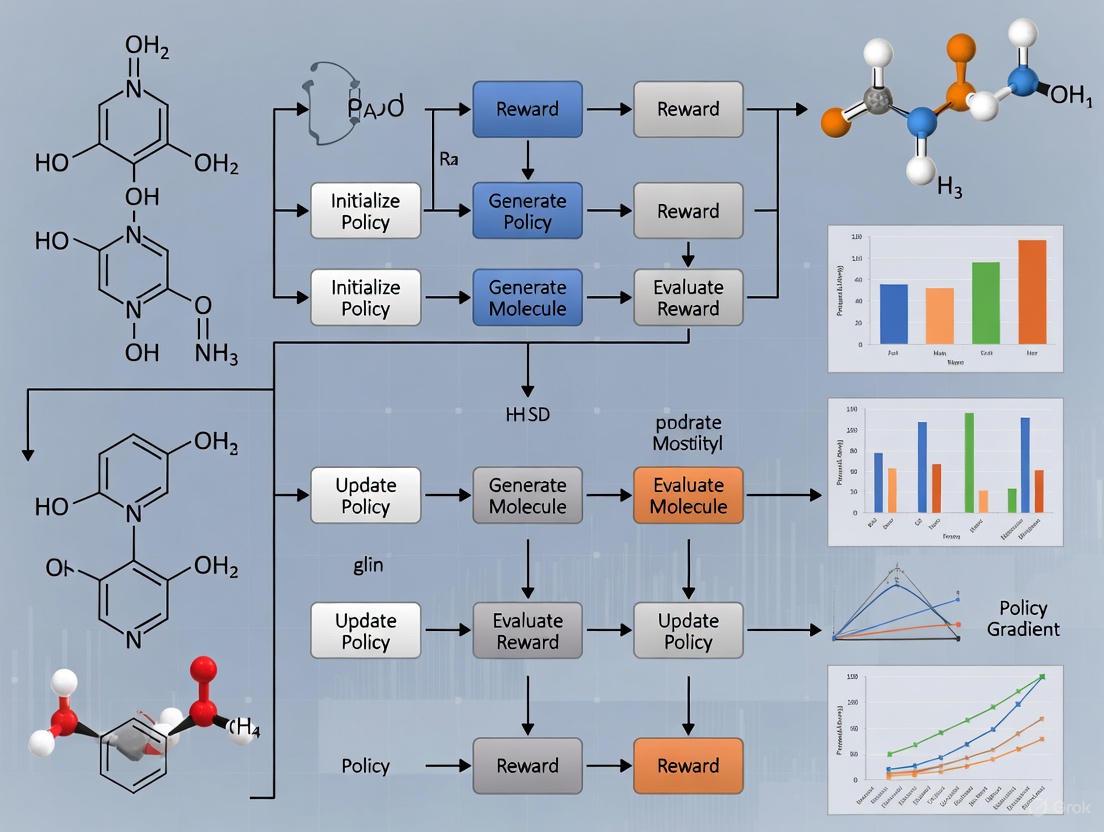
This article provides a comprehensive exploration of Reinforcement Learning (RL) applications in molecular design optimization, a transformative approach in modern drug discovery.
Reinforcement Learning for Molecular Design Optimization: Advanced Methods and Applications in Drug Discovery
Abstract
This article provides a comprehensive exploration of Reinforcement Learning (RL) applications in molecular design optimization, a transformative approach in modern drug discovery. It covers the foundational principles of framing molecular modification as a Markov Decision Process and ensuring chemical validity. The review details key methodological architectures, including transformer-based models, Deep Q-Networks, and diffusion models, integrated within frameworks like REINVENT for multi-parameter optimization. It critically addresses central challenges such as sparse rewards and mode collapse, presenting solutions like experience replay and uncertainty-aware learning. Finally, the article examines validation strategies, from benchmark performance and docking studies to experimental confirmation, highlighting how RL accelerates the discovery of novel, optimized bioactive compounds for targets like DRD2 and EGFR.
The Foundations of RL in Molecular Design: From Chemical Space to Markov Decision Processes
Defining the Optimization Problem in Drug Discovery
The fundamental challenge in computational drug discovery is the efficient navigation of an astronomically vast chemical space to identify novel molecules with a specific set of desirable properties. Theoretical estimates suggest the chemical universe contains up to 10^60 drug-like molecules, yet existing databases like ZINC or ChEMBL contain fewer than a billion compounds, representing an infinitesimal fraction of the possibilities [1]. This discrepancy underscores the immense potential for discovery and the necessity for sophisticated optimization methods. Traditional drug discovery approaches, which often rely on high-throughput screening and manual, iterative design by medicinal chemists, are notoriously time-consuming and costly, frequently requiring over a decade and billions of dollars to bring a single drug to market [2]. The integration of artificial intelligence, particularly reinforcement learning (RL), represents a paradigm shift by reframing molecular design as a sequential decision-making problem, enabling the automated, intelligent exploration of this vast chemical space to generate novel therapeutic candidates with optimized properties at an unprecedented pace [2] [3].
Molecular Representation: Data Fundamentals for Optimization
The first critical step in defining any molecular optimization problem is selecting an appropriate representation that translates chemical structures into a computationally amenable format. The choice of representation fundamentally influences how an AI model perceives and generates molecules, impacting its ability to capture relevant chemical and biological properties [4].
- String-Based Representations: The Simplified Molecular Input Line Entry System (SMILES) is a prevalent notation that represents a molecule as a sequence of characters encoding its atomic structure and connectivity [4]. While widely used, SMILES strings can suffer from syntactic invalidity upon generation. Alternatives like SELFIES (Self-referencing Embedded Strings) are designed to guarantee 100% molecular validity by construction, making them robust for generative tasks [4].
- Graph-Based Representations: A molecule can be naturally represented as a mathematical graph (G = (V, E)), where vertices ((V)) represent atoms and edges ((E)) represent chemical bonds [1]. This format explicitly encodes topological information and is highly intuitive. Two-dimensional (2D) graphs capture connectivity, while three-dimensional (3D) graphs include spatial coordinates, which are crucial for predicting binding affinity to a protein target [4].
- Descriptor-Based Representations: Molecular fingerprints, such as Extended Connectivity Fingerprints (ECFPs), are fixed-length vectors that encode the presence of specific substructures or atom environments within a molecule [1]. These are powerful for similarity searching and as input features for machine learning models that predict molecular properties.
Table 1: Common Molecular Representations in Machine Learning
| Representation Type | Format | Key Features | Common Uses |
|---|---|---|---|
| SMILES | String (Sequence of characters) | Compact, human-readable; potential for invalid structures [4] | Language model-based generation [3] |
| SELFIES | String (Sequence of characters) | Guarantees molecular validity; robust for generation [4] | Deep learning-based molecular generation |
| Molecular Graph | Graph (Nodes and Edges) | Explicitly encodes topology and structure [1] | Graph Neural Networks (GNNs); structure-aware design |
| Extended Connectivity Fingerprint (ECFP) | Bit Vector (Binary array) | Encodes circular substructures; fixed-length [1] | Similarity search, QSAR, and predictive modeling |
| 3D Point Cloud / Surface | 3D Coordinates / Mesh | Captures spatial and shape information [4] | Structure-based drug design; docking simulations |
The effectiveness of an optimization algorithm is deeply tied to the data available. Drug discovery datasets are characterized by their relatively small size and high cost of acquisition, particularly for in vivo annotations. For instance, datasets for critical endpoints like drug-induced liver injury (DILI) may contain only hundreds to thousands of annotated compounds, a stark contrast to the millions of labeled images available in domains like computer vision [5]. This data scarcity poses a significant challenge for training data-hungry deep learning models and must be a central consideration when defining the optimization problem.
The Reinforcement Learning Framework for Molecular Optimization
Reinforcement Learning provides a natural and powerful framework for molecular optimization by formulating it as a Markov Decision Process (MDP). In this paradigm, an RL agent learns to make a sequence of decisions to modify a molecular structure, with the goal of maximizing a cumulative reward signal that reflects desired drug properties [6] [2].
Core Components of the MDP
The MDP is defined by the following key components [6] [2]:
- State (s): The current molecular structure at each step of the sequence. This can be represented as a SMILES string, a molecular graph, or a point in the latent space of a generative model.
- Action (a): A modification made to the current molecule. The action space must be carefully designed to ensure chemical validity. Actions can include:
- Atom-level: Adding or removing an atom.
- Bond-level: Adding, removing, or altering a bond.
- Fragment-level: Adding or replacing a functional group.
- Reward (r): A quantitative score received after taking an action, reflecting how well the new molecule meets the optimization objectives. Designing this function is critical, as it guides the entire learning process.
- Policy (π): The agent's strategy, which defines the probability distribution over actions given a state. The RL algorithm's goal is to find the optimal policy (π^*) that maximizes the expected cumulative reward.
The Proximal Policy Optimization (PPO) Algorithm
Proximal Policy Optimization (PPO) has emerged as a leading RL algorithm for molecular design due to its stability and sample efficiency [6] [7]. PPO improves upon earlier policy gradient methods by introducing a clipped surrogate objective function that prevents the policy from changing too drastically in a single update. This creates a "trust region," ensuring stable and reliable learning [6].
The core PPO objective function is: [ L^{CLIP}(\theta) = \hat{\mathbb{E}}t [ \min( rt(\theta) \hat{A}t, \text{clip}(rt(\theta), 1-\epsilon, 1+\epsilon) \hat{A}_t ) ] ] where:
- ( r_t(\theta) ) is the probability ratio of the new policy over the old policy.
- ( \hat{A}_t ) is an estimator of the advantage function at timestep ( t ).
- ( \epsilon ) is a hyperparameter (e.g., 0.1, 0.2) that defines the clipping range, limiting the update step size and preventing performance collapse [6].
This mechanism allows PPO to efficiently optimize molecules in complex spaces, including the continuous latent space of a pre-trained generative model, a approach exemplified by the MOLRL (Molecule Optimization with Latent Reinforcement Learning) framework [7].
Diagram 1: MOLRL Framework. Workflow for optimizing molecules using RL in the latent space of a generative model.
Defining the Multi-Objective Reward Function
The reward function is the primary mechanism for communicating the optimization goals to the RL agent. In drug discovery, this is almost always a multi-objective problem, requiring a careful balance of competing properties [2]. A well-designed composite reward function is essential for success.
A typical reward function for de novo drug design can be formulated as: [ R(m) = w1 \cdot f{\text{affinity}}(m) + w2 \cdot f{\text{QED}}(m) + w3 \cdot f{\text{SA}}(m) + w4 \cdot f{\text{toxicity}}(m) + \dots ] where ( R(m) ) is the total reward for molecule ( m ), ( wi ) are weights assigned to each property to prioritize their importance, and ( fi ) are functions that score individual properties, often normalized to a [0, 1] scale.
Table 2: Key Components of a Multi-Objective Reward Function in Drug Discovery
| Objective | Metric / Function | Description | Role in Reward |
|---|---|---|---|
| Efficacy | Docking Score / Predictive Model | Estimates binding strength to the biological target (e.g., pIC50 ≥ 5) [3] | Maximize |
| Drug-Likeness | Quantitative Estimate of Drug-likeness (QED) [3] | Scores a molecule based on its adherence to known drug-like property ranges | Maximize |
| Safety | Toxicity Prediction (e.g., DILI, hERG) [5] | Predicts potential for adverse effects like liver injury or cardiotoxicity | Minimize |
| Synthesizability | Synthetic Accessibility Score (SA) | Estimates the ease with which a molecule can be synthesized in a lab | Maximize |
| Novelty / Diversity | Tanimoto Similarity / Unique Scaffolds [3] | Penalizes excessive similarity to previously generated molecules or known compounds | Manage exploration |
Advanced frameworks incorporate a Diversity Filter to explicitly manage the exploration-exploitation trade-off. This technique penalizes the generation of molecules with scaffolds that have already been produced too frequently, encouraging the agent to explore novel chemical regions and avoiding "mode collapse" where it gets stuck generating minor variations of the same molecule [3].
Experimental Protocol: Implementing a PPO-Based Optimization Campaign
This protocol outlines the steps for conducting a molecular optimization task using a PPO-driven framework, such as REINVENT [3], for a target-specific application like optimizing dopamine receptor (DRD2) activity.
Protocol: Target-Specific Molecular Optimization with RL
Objective: To generate novel molecules with improved predicted activity against DRD2 while maintaining favorable drug-like properties (QED) and synthetic accessibility (SA).
Materials & Software:
- Representation: SMILES or SELFIES strings.
- Generative Model: A pre-trained transformer or RNN model as the prior.
- RL Algorithm: Proximal Policy Optimization (PPO) implementation.
- Property Prediction: Pre-trained predictive models for DRD2 activity (pIC50), QED, and SA.
- Chemical Toolkit: RDKit for cheminformatics operations (fingerprint calculation, validity checks).
Procedure:
Problem Formulation & Initialization:
- Define the Reward Function: Formulate a composite reward, for example:
Reward = [DRD2 Activity Score] + [QED Score] + [SA Score] + [Diversity Filter Bonus/Penalty]. - Initialize the Agent: Load the pre-trained generative model (the "prior") to initialize the RL agent's policy. This provides the agent with fundamental knowledge of chemical grammar and validity [3].
- Define the Reward Function: Formulate a composite reward, for example:
Reinforcement Learning Loop:
- Sampling: For each step, the agent (with its current policy ( \pi_\theta )) generates a batch of molecules (e.g., 128) given an input starting molecule.
- Evaluation: Decode each generated SMILES string into a molecule and calculate its reward by querying the DRD2 predictor, QED, and SA scoring functions.
- Policy Update: Compute the PPO loss function, which encourages actions that lead to high rewards while preventing the policy from diverging too far from its initial state (the prior). This is critical for maintaining the generation of valid molecules. [ \mathcal{L}(\theta) = \left( \text{NLL}{\text{aug}} (T\vert X ) - \text{NLL} (T\vert X; \theta ) \right)^2 ] where ( \text{NLL}{\text{aug}} ) incorporates the reward signal [3].
- Diversity Update: Update the diversity filter to track generated scaffolds and apply penalties for over-represented ones.
Termination and Validation:
- Loop Termination: Continue the RL loop for a predefined number of steps (e.g., 1,000) or until reward convergence.
- Post-Processing: Filter the top-generated molecules based on their final reward scores.
- Validation: Perform rigorous in silico validation, including docking studies against the DRD2 crystal structure (if available) and off-target prediction, to shortlist candidates for experimental testing.
Diagram 2: Optimization Protocol. The iterative workflow for RL-driven molecular optimization.
Successful implementation of an RL-based molecular optimization campaign relies on a suite of computational tools and data resources.
Table 3: Key Research Reagent Solutions for RL-Driven Drug Discovery
| Tool / Resource | Type | Primary Function | Relevance to Optimization |
|---|---|---|---|
| RDKit | Cheminformatics Library | Molecule manipulation, descriptor calculation, fingerprint generation [7] | Fundamental for processing molecules, calculating similarities, and ensuring chemical validity. |
| ZINC Database | Compound Database | >750 million purchasable compounds for virtual screening [5] | Source of starting molecules and a benchmark for synthesizability and chemical space coverage. |
| ChEMBL Database | Bioactivity Database | >16 million compounds with bioactivity annotations [5] | Critical for training predictive models for target activity and other ADMET endpoints. |
| REINVENT | RL Software Framework | De novo molecular design and optimization [3] | Provides a robust, pre-built infrastructure for implementing PPO-based optimization campaigns. |
| Stable-Baselines3 | RL Algorithm Library | Implementations of PPO and other state-of-the-art RL algorithms [6] | Allows for customization and fine-tuning of the core RL optimization engine. |
| Open Babel | Chemical Toolbox | Format conversion, force field calculations, descriptor generation | Supports handling various molecular file formats and pre-processing for downstream tasks. |
Defining the optimization problem in drug discovery through the lens of reinforcement learning involves a meticulous integration of molecular representation, algorithmic framework, and multi-faceted objective specification. By structuring the challenge as a Markov Decision Process and leveraging advanced algorithms like Proximal Policy Optimization, researchers can guide the generative process towards regions of chemical space that satisfy the complex, and often competing, requirements of a successful drug candidate. The provided frameworks, protocols, and toolkit serve as a foundation for conducting rigorous, efficient, and impactful molecular optimization campaigns, accelerating the journey from a therapeutic hypothesis to a viable pre-clinical candidate.
Framing Molecular Modification as a Markov Decision Process (MDP)
The design and optimization of novel molecular structures with desirable properties represents a fundamental challenge in material science and drug discovery. The traditional process is often time-consuming and expensive, potentially taking years and costing millions of dollars to bring a new drug to market [8]. In recent years, reinforcement learning (RL) has emerged as a powerful framework for automating and accelerating molecular design. Central to this approach is the formalization of molecular modification as a Markov Decision Process (MDP), which provides a rigorous mathematical foundation for sequential decision-making under uncertainty [9]. This application note details how molecular optimization can be framed as an MDP, provides experimental protocols for implementation, and presents key resources for researchers pursuing RL-driven molecular design.
Molecular Modification as an MDP
A Markov Decision Process is defined by the tuple (S, A, P, R), where S represents the state space, A the action space, P the state transition probabilities, and R the reward function [9]. In the context of molecular optimization:
- State Space (S): Each state s ∈ S is a tuple (m, t), where m represents a valid molecular structure and t denotes the number of modification steps taken. The initial state typically begins with a specific starting molecule or nothing at t=0 [8].
- Action Space (A): The action space consists of chemically valid modifications that can be applied to a molecule. These are categorized into three fundamental operations [8]:
- Atom Addition: Adding an atom from a defined set of elements (e.g., C, O, N) and forming a valence-allowed bond between this new atom and the existing molecule.
- Bond Addition: Increasing the bond order between two atoms with free valence (e.g., no bond → single bond, single bond → double bond).
- Bond Removal: Decreasing the bond order between two atoms (e.g., triple bond → double bond, single bond → no bond).
- Transition Dynamics (P): The state transition probability P(s′|s,a) defines the probability of reaching state s′ after taking action a in state s. In most molecular MDP frameworks, these transitions are deterministic—applying a specific modification to a molecule reliably produces a single, predictable resulting molecule [8].
- Reward Function (R): The reward R(s) guides the optimization process and is typically based on one or more computed properties of the molecule m at state s. To prioritize final outcomes while encouraging progressive improvement, rewards are often assigned at each step but discounted by a factor γ^(T-t), where T is the maximum number of steps allowed [8].
Experimental Protocol & Workflow
The following section outlines a practical protocol for implementing an MDP-based molecular optimization pipeline, from environment setup to model training and validation.
MDP Environment Setup
- Define the Chemical Action Space: Using a cheminformatics library (e.g., RDKit), enumerate all allowed atom types (e.g., C, N, O, S) and bond types (single, double, triple). Crucially, implement valence checks to filter out chemically impossible actions, ensuring 100% validity of generated molecules [8].
- Implement the State Representation: Develop a function that encodes the current molecule and step count into a state representation. Common approaches include using molecular fingerprints (e.g., Morgan fingerprints), graph representations, or SMILES strings [3].
- Specify the Reward Function: Program the reward function based on target properties. This can be a single objective (e.g., DRD2 activity) or a weighted combination of multiple objectives (e.g., bioactivity, drug-likeness QED, synthetic accessibility) [3].
Agent Training with Reinforcement Learning
- Algorithm Selection: Choose a suitable RL algorithm. Value-based methods like Deep Q-Networks (DQN) and its variants (e.g., Double DQN) have been successfully applied (e.g., in the MolDQN framework) and are known for stability [8]. Policy-based methods can also be used.
- Initialize the Agent: The policy network can be initialized randomly or pre-trained. Pre-training on a large corpus of molecules (e.g., from PubChem or ChEMBL) can teach the model the underlying rules of chemical validity and provide a strong starting point [3].
- Run the Training Loop: For a set number of episodes or until convergence:
- Start from an initial molecule.
- The agent selects an action (chemical modification) based on its current policy.
- The environment applies the action, transitions to a new state (molecule), and returns a reward.
- The agent updates its policy using the collected experience (state, action, reward, next state).
The workflow below illustrates the core cycle of interaction between the agent and the chemical environment:
Multi-Objective Optimization
Real-world molecular optimization often requires balancing multiple, potentially competing properties. This can be achieved through multi-objective reinforcement learning, where the reward function R(s) is defined as a weighted sum of individual property scores [8]:
R(s) = w₁ * Prop₁(m) + w₂ * Prop₂(m) + ... + wₙ * Propₙ(m)
Researchers can adjust the weights wᵢ to reflect the relative importance of each objective, such as maximizing drug-likeness (QED) while maintaining sufficient similarity to a lead compound.
Performance Metrics & Benchmarking
To evaluate the performance of an MDP-based molecular optimization model, it is essential to track relevant metrics over the course of training and compare against established baselines. The following table summarizes key quantitative indicators:
Table 1: Key Performance Metrics for Molecular Optimization MDPs
| Metric Category | Specific Metric | Description | Target Benchmark |
|---|---|---|---|
| Optimization Performance | Success Rate [3] | Percentage of generated molecules that achieve a target property profile. | >20-80% (varies by task difficulty) |
| Property Improvement [3] | Average increase in a key property (e.g., DRD2 activity) from starting molecule. | Maximize | |
| Sample Quality | Validity [8] | Percentage of generated molecular structures that are chemically valid. | 100% |
| Uniqueness [3] | Percentage of generated valid molecules that are non-duplicate. | >80% | |
| Novelty [3] | Percentage of generated molecules not found in the training set. | >70% | |
| Diversity | Structural Diversity | Average pairwise Tanimoto dissimilarity or scaffold diversity of generated molecules. | Maximize |
The impact of different training strategies is evident in benchmark studies. For instance, fine-tuning a pre-trained transformer model with RL for DRD2 activity optimization significantly outperforms the base model, as shown in the sample results below:
Table 2: Sample Benchmark Results for DRD2 Optimization via RL (Adapted from [3])
| Starting Molecule | Model | Success Rate (%) | Avg. P(active) | Notable Outcome |
|---|---|---|---|---|
| Compound A (P=0.51) | Transformer (Baseline) | ~22% | 0.61 | Limited improvement |
| Transformer + RL | ~82% | 0.82 | Major activity boost | |
| Compound B (P=0.67) | Transformer (Baseline) | ~43% | 0.73 | Moderate improvement |
| Transformer + RL | ~79% | 0.85 | High activity achieved |
The Scientist's Toolkit
Implementing an MDP framework for molecular optimization requires a combination of software tools, chemical data, and computational resources. The following table details essential "research reagents" for this field:
Table 3: Essential Research Reagents and Tools for MDP-based Molecular Optimization
| Tool/Resource | Type | Primary Function | Application in Protocol |
|---|---|---|---|
| GROMACS [10] | Software Suite | Molecular dynamics simulation. | Can be used for in-silico validation of optimized molecules' stability (post-generation). |
| RDKit | Cheminformatics Library | Chemical information manipulation. | Core component for state representation (fingerprints, graphs), action validation, and molecule handling [3]. |
| REINVENT [3] | RL Framework | Molecular design and optimization. | Provides a ready-made RL scaffolding to train and fine-tune generative models (e.g., Transformers) for property optimization. |
| ChEMBL/PubChem [3] | Chemical Database | Repository of bioactive molecules and properties. | Source of initial structures for training and benchmarking; defines the feasible chemical space. |
| Transformer Models [3] | Deep Learning Architecture | Sequence generation and translation. | Acts as the policy network in the MDP; can be pre-trained on molecular databases (e.g., PubChem) to learn chemical grammar. |
Advanced MDP Integration and Workflow
For advanced implementations, the MDP-based molecular optimizer can be integrated into a larger, iterative discovery pipeline. The following diagram depicts this comprehensive workflow, from the initial MDP setup to final candidate selection, highlighting how the core MDP interacts with other critical components like pre-training and external validation:
This integrated workflow, as exemplified by frameworks like REINVENT, shows how a prior model (pre-trained on general chemical space) is fine-tuned via RL. The scoring function incorporates multiple objectives, and the diversity filter helps prevent mode collapse, ensuring the generation of a wide range of high-quality candidate molecules [3].
In reinforcement learning (RL)-driven molecular design, the core action space defines the set of fundamental operations an agent can perform to structurally alter a molecule. The choice of action space is pivotal, as it directly controls the model's ability to navigate chemical space, the chemical validity of proposed structures, and the efficiency of optimization for desired properties. The principal action categories are atom addition, bond modification (which includes addition and removal), and actions governed by validity constraints to ensure chemically plausible structures. These action spaces can be implemented on various molecular representations, including molecular graphs and SMILES strings, each with distinct trade-offs between flexibility, validity assurance, and exploration capability. This note details the implementation, protocols, and practical considerations for employing these core action spaces within RL frameworks for molecular optimization, providing a guide for researchers and development professionals in drug discovery.
Defining the Core Action Spaces
The action space in molecular RL can be structured around three fundamental modification types. The following table summarizes their definitions, valid actions, and primary constraints.
Table 1: Definition and Scope of Core Action Spaces
| Action Space | Definition | Valid Action Examples | Key Validity Constraints |
|---|---|---|---|
| Atom Addition | Adding a new atom from a predefined set of elements and connecting it to the existing molecular graph. | - Add a carbon atom with a single bond.- Add an oxygen atom with a double bond. [8] | - New atom replaces an implicit hydrogen. [8]- Valence of the existing atom must not be exceeded. |
| Bond Modification | Altering the bond order between two existing atoms. This includes Bond Addition (increasing order) and Bond Removal (decreasing order). [8] | - No bond → Single/Double/Triple bond.- Single bond → Double/Triple bond.- Double bond → Triple bond.- Triple bond → Double/Single/No bond. [8] | - Bond formation may be restricted between atoms in rings to prevent high strain. [8]- Removal that creates disconnected fragments is handled by removing lone atoms. [8] |
| Validity Constraints | A set of rules that filter the action space to only permit chemically plausible molecules. | - Allowing only valence-allowed bond orders. [8]- Explicitly forbidding breaking of aromatic bonds. [8] | - Octet rule (valence constraints).- Structural stability rules (e.g., ring strain).- Syntactic validity for SMILES strings. [11] |
The dot code block below defines a workflow that integrates these action spaces into a coherent Markov Decision Process (MDP) for molecular optimization.
Molecular Optimization MDP
This diagram illustrates the sequential decision-making process in molecular optimization. The agent iteratively modifies a molecule by selecting valid actions from the core action spaces, guided by chemical constraints to ensure the generation of realistic structures. The reward signal, computed based on the properties of the new molecule, is used to update the agent's policy.
Quantitative Comparison of RL Approaches and Action Spaces
Different RL frameworks utilize the core action spaces with varying strategies for ensuring validity and optimizing properties. The table below synthesizes quantitative findings and key features from recent methodologies.
Table 2: Performance and Features of Molecular RL Approaches
| Model / Framework | Core Action Space | Key Innovation | Reported Performance | Validity Rate |
|---|---|---|---|---|
| MolDQN [8] | Graph-based: Atom addition, Bond addition/removal. [8] | Combines Double Q-learning with chemically valid MDP; no pre-training. [8] | Comparable or superior on benchmark tasks (e.g., penalized LogP). [8] | 100% (invalid actions disallowed) [8] |
| GraphXForm [12] | Graph-based: Sequential addition of atoms and bonds. | Decoder-only graph transformer; combines CE method and self-improvement learning for fine-tuning. [12] | Superior objective scores on GuacaMol benchmarks and solvent design tasks. [12] | Inherent from graph representation. [12] |
| MOLRL [7] | Latent space: Continuous optimization via PPO. | PPO for optimization in the latent space of a pre-trained autoencoder. [7] | Comparable or superior on single/multi-property and scaffold-constrained tasks. [7] | >99% (depends on pre-trained decoder) [7] |
| PSV-PPO [11] | SMILES-based: Token-by-token generation. | Partial SMILES validation at each generation step to prevent invalid sequences. [11] | Maintains high validity during RL; competitive on PMO/GuacaMol. [11] | Significantly higher than baseline PPO. [11] |
| REINVENT [3] | SMILES-based: Token-by-token generation. | Uses a pre-trained "prior" model to anchor RL and prevent catastrophic forgetting. [3] | Effectively steers generation in scaffold discovery and molecular optimization tasks. [3] | High (anchored by prior) [3] |
Experimental Protocols
This section provides detailed methodologies for implementing and evaluating action spaces in molecular RL.
Protocol: Implementing a Graph-Based Action Space with Validity Constraints
This protocol is based on the MolDQN framework [8] and is suitable for tasks requiring 100% chemical validity without pre-training.
1. State and Action Space Definition:
- State (s): Represent as a tuple
(m, t), wheremis the current molecule (as a graph) andtis the current step number. Set a maximum step limitT. [8] - Action Space (A): Define as the union of three sets:
- Atom Addition: For each element in
{C, O, N,...}and for each atom in the current molecule, add the new atom connected by every valence-allowed bond type (single, double, triple). The new atom replaces an implicit hydrogen. [8] - Bond Addition: For every pair of existing atoms with free valence and not currently connected with the maximum bond order, allow actions that increase the bond order (e.g., no bond→single, single→double). Apply heuristics to disallow bonds between atoms already in rings. [8]
- Bond Removal: For every existing bond, allow actions that decrease its bond order (e.g., triple→double, double→single, single→no bond). If bond removal creates a lone atom, remove that atom as well. [8]
- Atom Addition: For each element in
2. Validity Checking:
- Before adding an action to the set
Afor states, check it against chemical rules. Remove any action that would violate valence constraints or other implemented heuristics (e.g., no aromatic bond breakage). [8] - This creates a filtered, valid action set
A_valid(s) ⊆ A.
3. Reinforcement Learning Setup:
- Reward (R): Define a reward function based on the target molecular property (e.g., drug-likeness QED, binding affinity pLogP). Apply the reward at each step, discounted by
γ^(T-t)to emphasize final states. [8] - Agent Training: Train a Deep Q-Network (DQN) to estimate Q-values for state-action pairs. The agent selects actions from
A_valid(s).
4. Evaluation:
- Run the trained agent from initial molecules for a fixed number of steps.
- Track the properties of the final molecules and the percentage of valid molecules generated (target: 100%).
- Compare the best-found molecules against baseline algorithms using the target property score.
Protocol: Fine-Tuning with SMILES-Based RL and Validity Preservation
This protocol, inspired by PSV-PPO [11] and REINVENT [3], is used for fine-tuning large pre-trained language models on molecular property optimization.
1. Model and State Setup:
- Prior Model: Start with a transformer or RNN model pre-trained on a large corpus of SMILES strings (e.g., from PubChem or ChEMBL). This model serves as the policy
π_prior. [3] - State (s): The current state is the sequence of tokens generated so far (a partial SMILES string).
2. Action Space and Validation:
- Action Space (A): The vocabulary of SMILES tokens. [11]
- Real-Time Validation (PSV-PPO): At each autoregressive step
t, for the current partial SMILESs_tand a candidate tokena_t, use thepartialsmilespackage [11] to check ifs_t + a_tis a valid partial SMILES. This involves:- Syntax Compliance: Checking SMILES syntax rules.
- Valence Validation: Ensuring atom valences are within acceptable limits.
- Aromaticity Handling: Checking if aromatic systems can be kekulized.
- Create a binary PSV truth table
T(s_t, a_t)which is1if the action is valid and0otherwise. [11]
3. Reinforcement Learning Fine-Tuning:
- Reward (R): The total reward for a fully generated SMILES string is an aggregate score
S(T) ∈ [0, 1]combining multiple property predictors (e.g., QED, SA, DRD2 activity). [3] - Loss Function: Use a modified PPO objective. For PSV-PPO, the loss incorporates the PSV table to penalize invalid token selections. [11] For REINVENT, the loss is:
ℒ(θ) = [ NLL_aug(T|X) - NLL(T|X; θ) ]^2whereNLL_aug(T|X) = NLL(T|X; θ_prior) - σ * S(T). [3] This encourages high scores while keeping the agent close to the prior.
4. Evaluation:
- Generate a large set of molecules (e.g., 10,000) with the fine-tuned model.
- Report the proportion of valid, unique, and novel molecules.
- Calculate the percentage of generated molecules that meet the target property profile and compare the top performers to the starting set.
The Scientist's Toolkit: Essential Research Reagents and Software
The following table lists critical software tools and their functions for implementing RL-based molecular design.
Table 3: Key Research Reagents and Software Solutions
| Tool Name | Type | Primary Function in Molecular RL |
|---|---|---|
| RDKit | Cheminformatics Library | Molecule manipulation, fingerprint generation, property calculation (QED, SA), and valence checks. [8] [13] [7] |
| OpenBabel | Chemical Toolbox | File format conversion and molecular structure handling; often used for bond reconstruction in 3D generation. [14] |
| partialsmiles | Python Package | Provides real-time syntax and valence validation for partial SMILES strings during step-wise generation. [11] |
| GPT-NeoX / Transformers | Deep Learning Library | Architecture backbone for transformer-based generative models (e.g., GraphXForm, BindGPT). [12] [14] |
| OpenAI Baselines / Stable-Baselines3 | RL Library | Provides standard implementations of RL algorithms like PPO, which can be adapted for molecular optimization. [11] |
| Docking Software (e.g., AutoDock) | Simulation Software | Provides binding affinity scores used as reward signals for structure-based RL optimization. [14] |
Advanced Visualization: The PSV-PPO Validation Mechanism
The dot code block below details the Partial SMILES Validation mechanism used in the PSV-PPO framework, which ensures token-level validity during SMILES generation. [11]
PSV-PPO Token Validation
This diagram shows the PSV-PPO algorithm's token-level validation. At each step, a candidate token is checked for validity against the current partial SMILES sequence before being appended. Invalid tokens trigger an immediate policy penalty, preventing the generation of invalid molecular structures and stabilizing training.
Reinforcement Learning (RL) has emerged as a powerful paradigm for tackling complex optimization problems in molecular design. The fundamental components of RL—agents, states, actions, and rewards—form a framework where an intelligent system learns optimal decision-making strategies through interaction with its environment [15] [16]. In molecular design, this translates to an AI agent that learns to generate novel chemical structures with desired properties by sequentially building molecular structures and receiving feedback on their quality [17] [18]. The appeal of RL lies in its ability to navigate vast chemical spaces efficiently, balancing the exploration of novel structural motifs with the exploitation of known pharmacophores, ultimately accelerating the discovery of bioactive compounds for therapeutic applications [18] [19].
Core RL Components in Molecular Context
Theoretical Framework
The RL framework operates through iterative interactions between an agent and its environment. At each time step, the agent observes the current state, selects an action, transitions to a new state, and receives a reward signal [15] [16]. This process is formally modeled as a Markov Decision Process (MDP) defined by the tuple (S, A, P, R, γ), where S represents states, A represents actions, P defines transition probabilities, R is the reward function, and γ is the discount factor balancing immediate versus future rewards [15] [16]. In molecular design, the agent's goal is to learn a policy π that maps states to action probabilities to maximize the cumulative discounted reward, often implemented through sophisticated neural network architectures [20] [17].
Component Definitions and Chemical Instantiations
Table 1: Core RL Components and Their Chemical Implementations
| RL Component | Theoretical Definition | Chemical Implementation Examples |
|---|---|---|
| Agent | The decision-maker that interacts with the environment [15] | Generative model (e.g., Stack-RNN, GCPN) that designs molecules [17] [19] |
| Environment | The external system the agent interacts with [16] | Chemical space with rules of chemical validity and property landscapes [17] [21] |
| State (s) | A snapshot of the environment at a given time [16] | Molecular representation (SMILES string, graph, 3D coordinates) [20] [21] |
| Action (a) | Choices available to the agent at any state [16] | Adding atoms/bonds, modifying fragments, changing atomic positions [17] [21] [19] |
| Reward (r) | Scalar feedback received after taking an action [16] | Drug-likeness (QED), binding affinity, synthetic accessibility [17] [18] [19] |
| Policy (π) | Strategy mapping states to actions [15] | Neural network parameters determining molecular generation rules [20] [17] |
In chemical contexts, states typically represent molecular structures using various encoding schemes. Simplified Molecular-Input Line-Entry System (SMILES) strings provide a sequential representation that can be processed by recurrent neural networks [17]. Graph representations capture atom-bond connectivity, enabling graph neural networks to operate directly on molecular topology [19]. For 3D molecular design, states include atomic coordinates (Ri ∈ R³) and atomic numbers (Zi), defining the spatial conformation of molecules [21].
The action space varies significantly based on the molecular representation. In SMILES-based approaches, actions correspond to selecting the next character in the string sequence from a defined alphabet of chemical symbols [17]. In graph-based approaches, actions involve adding atoms or bonds to growing molecular graphs [19]. For molecular geometry optimization, actions represent adjustments to atomic positions (δRi) [21].
The reward function provides critical guidance by quantifying molecular desirability. Common rewards include calculated physicochemical properties like LogP (lipophilicity), quantitative estimate of drug-likeness (QED), predicted binding affinities from QSAR models, or docking scores [18] [19] [22]. Advanced frameworks incorporate multi-objective rewards that balance multiple properties simultaneously [23] [19].
Quantitative Data in RL-Driven Molecular Design
Table 2: Performance Comparison of RL Approaches in Molecular Optimization
| RL Method | Molecular Representation | Key Properties Optimized | Reported Performance |
|---|---|---|---|
| ReLeaSE [17] | SMILES strings | Melting point, hydrophobicity, JAK2 inhibition | Successfully designed libraries biased toward target properties |
| GCPN [19] | Molecular graphs | Drug-likeness, solubility, binding affinity | Generated molecules with desired chemical validity and properties |
| Actor-Critic for Geometry [21] | 3D atomic coordinates | Molecular energy, transition state pathways | Accurately predicted minimum energy pathways for reactions |
| DeepGraphMolGen [19] | Molecular graphs | Dopamine transporter binding, selectivity | Generated molecules with strong target affinity and minimized off-target binding |
| ACARL [22] | SMILES/Graph | Binding affinity with activity cliff awareness | Superior generation of high-affinity molecules across multiple protein targets |
Experimental Protocols
Protocol 1: SMILES-Based Molecular Generation with RL
Application: De novo design of drug-like molecules using sequence-based representations [17] [18]
Workflow:
- Initialization: Pre-train a generative model (Stack-RNN) on ChEMBL or similar database to learn valid SMILES syntax [17]
- State Representation: Represent state as incomplete SMILES string (st = characters 0 to t-1) [17]
- Action Selection: At each step, policy network (π) selects next character from SMILES alphabet [17]
- Reward Calculation: Upon complete sequence (terminal state sT), compute reward r(sT) = f(P(sT)) where P is predictive model [17]
- Policy Optimization: Update policy parameters using REINFORCE algorithm with gradient: ∂ΘJ(Θ) = E[Σ∂ΘlogpΘ(at|st-1)r(sT)] [17]
Key Parameters:
- SMILES length: T = 80-100 characters
- Training epochs: 20+ until convergence [18]
- Batch size: 32-128 molecules per update
Protocol 2: Graph-Based Molecular Generation with RL
Application: Constructing molecular graphs with optimized properties [19]
Workflow:
- State Representation: Represent molecule as graph G = (V,E) with atoms as nodes and bonds as edges [19]
- Action Space: Define actions as (1) add atom, (2) add bond, (3) terminate generation [19]
- Policy Network: Implement Graph Convolutional Policy Network (GCPN) to process graph state [19]
- Reward Function: Combine property predictions (QED, binding affinity) with chemical validity constraints [19]
- Training: Use actor-critic methods with advantage function A(s,a) = Q(s,a) - V(s) to update policy [19]
Key Parameters:
- Maximum atoms per molecule: 20-50
- Property prediction network architecture: Random Forest or Neural Network
- Experience replay buffer size: 1000-5000 molecules [18]
Protocol 3: Geometry Optimization with Actor-Critic RL
Application: Molecular conformation search and transition state location [21]
Workflow:
- State Representation: Represent molecular conformation as {Zi,Ri} (atomic numbers and positions) [21]
- Action Definition: Atomic position adjustments δRi generated by policy network [21]
- Reward Calculation: Immediate reward based on energy or force improvements [21]
- Critic Network: Estimate value function V(Sk) predicting expected long-term reward from state Sk [21]
- Temporal Difference Learning: Update critic using TD error: δ = (rt + γV(St+1)) - V(St) [21]
Key Parameters:
- Step size for position updates: 0.01-0.1 Å
- Discount factor γ: 0.95-0.99
- Advantage calculation: Ak+n = (Σγᵏrₜ) - V(Sk) [21]
Visualization of RL Workflows
SMILES-Based Molecular Generation with RL
Actor-Critic Framework for Molecular Geometry
Table 3: Essential Computational Tools for RL-Driven Molecular Design
| Tool/Resource | Type | Function in Research | Example Applications |
|---|---|---|---|
| SMILES Grammar | Chemical Representation | Defines valid molecular string syntax and action space [17] | ReLeaSE, REINVENT, ACARL frameworks [17] [22] |
| QSAR Models | Predictive Model | Provides reward signals based on structure-activity relationships [18] | Bioactivity prediction for target proteins [18] [22] |
| Molecular Graphs | Structural Representation | Enables graph-based generation with atom-by-atom construction [19] | GCPN, GraphAF, DeepGraphMolGen [19] |
| Docking Software | Scoring Function | Calculates binding affinity rewards for protein targets [22] | Structure-based reward calculation [22] |
| Experience Replay Buffer | RL Technique | Stores successful molecules to combat sparse rewards [18] | Training stabilization in sparse reward environments [18] |
| Actor-Critic Architecture | RL Algorithm | Combines policy and value learning for molecular optimization [21] | Geometry optimization, pathway prediction [21] |
| Transfer Learning | Training Strategy | Pre-training on general compounds before specific optimization [18] | Addressing sparse rewards in targeted design [18] |
| Multi-Objective Rewards | Reward Design | Balances multiple chemical properties simultaneously [23] [19] | Optimizing affinity, selectivity, and drug-likeness [19] |
Advanced Applications and Methodological Innovations
Addressing Sparse Rewards in Molecular Design
A significant challenge in applying RL to molecular design is the sparse reward problem, where only a tiny fraction of generated molecules exhibit the desired bioactivity [18]. Advanced frameworks address this through several innovative strategies:
- Transfer Learning: Pre-training generative models on large chemical databases (e.g., ChEMBL) before fine-tuning for specific targets [18]
- Experience Replay: Maintaining a buffer of high-reward molecules to reinforce successful strategies during training [18]
- Reward Shaping: Designing intermediate rewards to guide the agent toward promising chemical space [18]
- Uncertainty-Aware Multi-Objective RL: Using surrogate models with predictive uncertainty to balance multiple optimization objectives [23]
Activity Cliff-Aware Reinforcement Learning
The ACARL framework introduces specialized handling of activity cliffs—situations where small structural changes cause significant activity shifts [22]. This approach incorporates:
- Activity Cliff Index (ACI): A quantitative metric identifying molecular pairs with high structural similarity but large activity differences [22]
- Contrastive Loss: Prioritizes learning from activity cliff compounds during RL fine-tuning [22]
- SAR-Aware Optimization: Explicitly models structure-activity relationship discontinuities for improved generation [22]
Control-Informed Reinforcement Learning
Recent work integrates classical control theory with RL through Control-Informed RL (CIRL), which embeds PID controller components within RL policy networks [24]. This hybrid approach demonstrates:
- Improved Robustness: Enhanced performance against unobserved system disturbances [24]
- Better Generalization: Superior setpoint-tracking for trajectories outside training distribution [24]
- Sample Efficiency: Combines classical control knowledge with RL's nonlinear modeling capacity [24]
Molecular representation learning is a foundational step in bridging machine learning with chemical sciences, enabling applications in drug discovery and material science [25]. The choice of representation—whether string-based encodings like SMILES and SELFIES, or graph-based structures—directly impacts the performance of downstream predictive and generative models, including those using reinforcement learning (RL) for molecular optimization [26] [27]. These representations convert chemical structures into numerical formats that machine learning algorithms can process, each with distinct strengths in handling syntactic validity, semantic robustness, and structural information [28] [29]. This Application Note provides a detailed comparison of these prevalent representations, summarizes quantitative performance data in structured tables, and outlines experimental protocols for their implementation within an RL-driven molecular design framework.
Molecular Representation Formats: Mechanisms and Comparisons
SMILES (Simplified Molecular-Input Line-Entry System)
SMILES is a string-based notation that represents a molecular graph as a linear sequence of ASCII characters, encoding atoms, bonds, branches, and ring closures [28] [26]. It is a widespread, human-readable format but suffers from generating invalid structures in machine learning models due to its complex grammar and lack of inherent valency checks [28] [29].
SELFIES (Self-Referencing Embedded Strings)
SELFIES is a rigorously robust string-based representation designed to guarantee 100% syntactic and semantic validity [30] [29]. Built on a formal grammar (Chomsky type-2), every possible SELFIES string corresponds to a valid molecular graph. This is achieved by localizing non-local features (like rings and branches) and incorporating a "memory" that enforces physical constraints (e.g., valency rules) during the string-to-graph compilation process [29]. This makes it particularly suitable for generative models.
Graph-Based Encodings
Graph-based representations directly model a molecule as a graph, where atoms are represented as nodes and bonds as edges [25]. This can be further divided into:
- 2D Molecular Graphs: Capture topological connectivity using an adjacency matrix, node feature matrix (atom types), and edge feature matrix (bond types) [25].
- 3D Molecular Graphs: Incorporate spatial geometric information (atomic coordinates), which is critical for understanding subtle molecular interactions and properties [25] [23].
A specialized approach, Molecular Set Representation Learning (MSR), challenges the necessity of explicit bonds. It represents a molecule as a permutation-invariant set (multiset) of atom invariant vectors, hypothesizing that this can better capture the true nature of molecules where bonds are not always well-defined [31].
Table 1: Comparative Analysis of Molecular Representation Schemes
| Representation | Underlying Principle | Key Advantages | Inherent Limitations |
|---|---|---|---|
| SMILES | String-based; Depth-first traversal of molecular graph [26] | Human-readable; Widespread adoption; Simple to use [28] | Multiple valid strings per molecule; No validity guarantee; Complex grammar leads to invalid outputs in ML [28] [32] |
| SELFIES | String-based; Formal grammar & finite-state automaton [29] | 100% robustness; Guaranteed syntactic and semantic validity; Easier for models to learn [30] [29] | Less human-readable; Requires conversion from/to SMILES for some applications [29] |
| 2D Graph | Graph with nodes (atoms) and edges (bonds) [25] | Natural representation; Rich structural information [25] | Neglects spatial 3D geometry; Requires predefined bond definitions [25] |
| 3D Graph | Graph with nodes and edges plus 3D atomic coordinates [25] | Encodes spatial structure & geometric relationships; Crucial for many quantum & physico-chemical properties [25] [23] | Computationally more expensive; Requires availability of 3D conformer data [25] |
| Set (MSR) | Permutation-invariant set of atom-invariant vectors [31] | No explicit bond definitions needed; Challenges over-reliance on graph structure; Simpler models can perform well [31] | Newer, less established paradigm; May not capture all complex topological features [31] |
Quantitative Performance Comparison
Evaluations across standard benchmarks reveal the practical performance implications of choosing one representation over another. Key metrics include performance on molecular property prediction tasks (e.g., Area Under the Curve - AUC, Root Mean Squared Error - RMSE) and metrics for generative tasks (e.g., validity, uniqueness).
Table 2: Downstream Performance on Molecular Property Prediction Tasks (Classification AUC / Regression RMSE) [28] [31] [32]
| Representation | Model Architecture | HIV (AUC) | Toxicity (AUC) | BBBP (AUC) | ESOL (RMSE) | FreeSolv (RMSE) | Lipophilicity (RMSE) |
|---|---|---|---|---|---|---|---|
| SMILES + BPE | BERT-based [28] | ~0.78 | ~0.86 | ~0.92 | - | - | - |
| SMILES + APE | BERT-based [28] | ~0.82 | ~0.89 | ~0.94 | - | - | - |
| SELFIES | SELFormer (Transformer) [32] | - | - | - | 0.944 | 2.511 | 0.746 |
| Set (MSR1) | Set Representation Learning [31] | 0.784 | 0.857 | 0.932 | - | - | - |
| Graph (GIN) | Graph Isomorphism Network [31] | 0.763 | 0.811 | 0.902 | - | - | - |
| Graph (D-MPNN) | Directed Message Passing NN [31] | 0.790 | 0.851 | 0.725 | - | - | - |
Table 3: Generative Model Performance (de novo design) [27] [29]
| Metric | SELFIES + RL/GA | SMILES + RL | Graph-Based GNN |
|---|---|---|---|
| Validity (%) | ~100% [29] | ~60-90% [29] | High (>90%) [25] |
| Uniqueness | High [27] | Variable | High |
| Novelty | High [27] | High | High |
| Optimization Efficiency | Outperforms others in QED, SA, ADMET [27] | Lower due to validity issues | Good, but computationally intensive [23] |
Application Protocols for Reinforcement Learning in Molecular Design
The following protocols detail how to implement molecular representation pipelines, specifically tailored for reinforcement learning (RL) applications like multi-property optimization and scaffold-constrained generation.
Protocol 1: SMILES to SELFIES Domain Adaptation for Language Models
Purpose: To cost-effectively adapt a transformer model pre-trained on SMILES to the SELFIES representation, enabling robust molecular property prediction without full retraining [32]. Applications: Leveraging existing SMILES-pretrained models for RL reward prediction or molecular embedding in SELFIES-based generative loops.
Workflow Overview:
Step-by-Step Procedure:
- Base Model and Data Preparation:
- Start with a SMILES-pretrained transformer model, such as
ChemBERTa-zinc-base-v1[32]. - Obtain a large dataset of molecules in SMILES format (e.g., sample ~700,000 from PubChem [32]).
- Convert the SMILES strings to SELFIES using the
selfies.encoder()function from theselfiesPython library [30] [32].
- Start with a SMILES-pretrained transformer model, such as
Tokenizer Feasibility Check:
- Pass the SELFIES strings through the original model's tokenizer (e.g., Byte Pair Encoding trained on SMILES) [32].
- Critical Check 1: Ensure the
[UNK]token count is negligible, indicating vocabulary compatibility. - Critical Check 2: Verify that the tokenized sequence lengths do not frequently exceed the model's maximum context length (e.g., 512) to avoid truncation [32].
Domain-Adaptive Pretraining (DAPT):
- Perform continued pre-training (e.g., Masked Language Modeling) on the SELFIES corpus using the original, frozen tokenizer and model architecture.
- Computational Note: This process requires significantly less resources (e.g., completed in ~12 hours on a single NVIDIA A100 GPU) than training from scratch [32].
Model Validation and Deployment:
- Embedding-Level Evaluation: Validate the adapted model by using frozen embeddings to predict properties from standard datasets (e.g., QM9). Analyze embedding clusters with t-SNE for chemical coherence [32].
- Downstream Fine-tuning: Fine-tune the model end-to-end on target property prediction tasks (e.g., ESOL, FreeSolv) to serve as a reward function within an RL loop [32].
Protocol 2: Reinforcement Learning-Guided Molecular Generation with SELFIES
Purpose: To generate novel, valid molecules optimized for multiple desired properties using an RL framework enhanced with genetic algorithms [27]. Applications: Direct de novo molecular design for multi-objective optimization (e.g., QED, SA, ADMET) and scaffold-constrained generation in drug discovery.
Workflow Overview:
Step-by-Step Procedure:
- Initialization:
Property Evaluation (Reward Calculation):
- Decode SELFIES to SMILES (using
selfies.decoder) for property calculation [30]. - Use pre-trained or concurrent surrogate models (e.g., for QED, Synthetic Accessibility - SA, and ADMET properties like hERG toxicity) to predict properties for each molecule [27].
- Formulate a composite reward function ( R ) that combines these objectives, optionally using uncertainty estimates from the surrogate models to balance exploration and exploitation [23].
- Example: ( R = w1 \cdot \text{QED} + w2 \cdot (1-\text{SA}) + w_3 \cdot (1-\text{hERG}) )
- Decode SELFIES to SMILES (using
RL and Genetic Algorithm Loop (e.g., RLMolLM Framework):
- Selection: Select parent molecules from the population with a probability proportional to their composite reward (fitness) [27].
- Crossover & Mutation (Genetic Operators):
- Crossover: Combine subsequences of SELFIES from two parent molecules to create offspring.
- Mutation: Randomly modify symbols within a SELFIES string (e.g., substitute, insert, or delete tokens). The robustness of SELFIES ensures all resulting offspring are valid [29].
- RL-Guided Optimization (e.g., Proximal Policy Optimization - PPO): Use an RL agent to guide the selection or generation of SELFIES tokens. The state is the current (partial) SELFIES string, the action is the next token, and the reward is the composite property score of the fully generated molecule [27].
- Replacement: Introduce the new offspring and RL-generated molecules into the population, replacing less fit individuals.
Termination and Output:
- Iterate for a predefined number of generations or until performance plateaus.
- Output the top-performing molecules from the final population for experimental validation.
Protocol 3: Graph Convolutional Network (GCN) for Virtual Screening
Purpose: To identify small molecule candidates with specific biological activity by extracting spatial features directly from molecular graphs, suitable for few-shot learning scenarios [33]. Applications: Rapid virtual screening of large compound libraries for target-specific activity (e.g., inhibiting protein phase separation).
Step-by-Step Procedure:
- Data Preparation and Graph Construction:
GCN Model Training:
- Train a Graph Convolutional Network to map the molecular graph to a binary classification (active/inactive).
- The GCN learns node embeddings by aggregating features from neighboring nodes and edges, followed by a graph-level pooling (e.g., mean pooling) and a final classifier [33].
Virtual Screening and Validation:
- Use the trained GCN to screen a large, diverse chemical library (e.g., 170,000 compounds) [33].
- Select top-ranking predicted actives for experimental validation in the relevant biological assay.
Table 4: Essential Software Tools and Libraries for Molecular Representation Learning
| Tool / Resource | Type | Primary Function | Relevance to RL for Molecular Design |
|---|---|---|---|
| SELFIES Library [30] | Python Library | Encoding/decoding between SMILES and SELFIES; tokenization. | Critical for ensuring 100% validity in string-based generative RL models. |
| RDKit [25] | Cheminformatics Toolkit | SMILES parsing, molecular graph generation, fingerprint calculation, property calculation (e.g., QED). | Standard for featurization, property evaluation (reward calculation), and graph representation. |
| Hugging Face Transformers [28] | NLP Library | Access to pre-trained transformer models (e.g., BERT, ChemBERTa). | Fine-tuning language models for property prediction as reward models. |
| Deep Graph Library (DGL) or PyTorch Geometric | Graph ML Library | Implementation of Graph Neural Networks (GNNs). | Building and training GNNs on graph-based molecular representations. |
| OpenAI Gym / Custom Environment | RL Framework | Defining the RL environment (states, actions, rewards). | Framework for implementing the RL loop in molecular generation [26] [27]. |
| Proximal Policy Optimization (PPO) [27] | RL Algorithm | Policy optimization for discrete action spaces (e.g., token generation). | The RL algorithm of choice in several recent molecular generation frameworks [27]. |
Methodological Architectures and Real-World Applications in Drug Discovery
The optimization of molecular design represents a core challenge in modern drug discovery and materials science. The integration of generative artificial intelligence (GenAI) has catalyzed a paradigm shift, enabling the de novo creation of molecules with tailored properties. Framed within the broader context of reinforcement learning (RL) for molecular optimization, this document details the application notes and experimental protocols for four foundational generative model backbones: Transformers, Variational Autoencoders (VAEs), Generative Adversarial Networks (GANs), and Diffusion Models. These architectures serve as the critical engines for exploring the vast chemical space, with RL providing a powerful strategy for steering the generation process toward molecules with desired, optimized characteristics [19]. The following sections provide a structured comparison, detailed methodologies, and essential toolkits for researchers applying these technologies.
Comparative Analysis of Generative Model Backbones
The table below summarizes the key characteristics, strengths, and challenges of the four primary generative model backbones in the context of molecular design.
Table 1: Comparative Analysis of Generative Model Backbones for Molecular Design
| Backbone | Core Principle | Common Molecular Representation | Key Strengths | Primary Challenges |
|---|---|---|---|---|
| Transformer | Self-attention mechanism weighing the importance of different parts of an input sequence [34]. | SMILES, SELFIES [35] [36] | Excels at capturing long-range dependencies and complex grammar in string-based representations [34] [19]. | Standard positional encoding can struggle with scaffold-based generation and variable-length functional groups [34]. |
| VAE | Encodes input data into a probabilistic latent space and decodes it back [37] [19]. | SMILES, Molecular Graphs [34] [19] | Learns a smooth, continuous latent space ideal for interpolation and optimization via Bayesian methods [36] [19]. | Can generate blurry or invalid outputs; the prior distribution may oversimplify the complex chemical space [19]. |
| GAN | A generator and discriminator network are trained adversarially [34] [19]. | SMILES, Molecular Graphs [34] [38] | Capable of producing highly realistic, high-fidelity molecular structures [34] [37]. | Training can be unstable; particularly challenging for discrete data like SMILES strings [34] [19]. |
| Diffusion Model | Iteratively adds noise to data and learns a reverse denoising process [37] [19]. | Molecular Graphs, 3D Structures [36] [19] | State-of-the-art performance in generating high-quality, diverse outputs [37] [19]. | Computationally intensive and slow sampling due to the multi-step denoising process [37] [19]. |
Application Notes and Protocols
Transformer-Driven Molecular Generation with RL
Transformers process molecular sequences using a self-attention mechanism, allowing each token (e.g., an atom symbol in a SMILES string) to interact with all others, thereby capturing complex, long-range dependencies crucial for chemical validity [34] [35]. Their application is particularly powerful when combined with reinforcement learning for property optimization.
Protocol: RL-Driven Transformer GAN (RL-MolGAN) for De Novo Generation
This protocol outlines the methodology for the RL-MolGAN framework, which integrates a Transformer decoder as a generator and a Transformer encoder as a discriminator [34].
- Objective: To generate novel, chemically valid SMILES strings optimized for specific chemical properties.
- Materials:
- Datasets: QM9 or ZINC datasets for training and benchmarking [34].
- Representation: SMILES strings tokenized at the atom/substructure level.
- Model Architecture:
- Generator: A Transformer decoder network that autoregressively generates SMILES strings token-by-token.
- Discriminator: A Transformer encoder network that classifies SMILES strings as real or generated.
- Procedure:
- Step 1 - Pre-training: Pre-train the generator on a dataset of valid molecules (e.g., ZINC) to learn the fundamental syntax and grammar of SMILES strings.
- Step 2 - Adversarial Training: Train the generator and discriminator in an alternating manner. The generator produces SMILES strings, and the discriminator provides adversarial feedback.
- Step 3 - Reinforcement Learning Fine-Tuning: Integrate a reinforcement learning agent (e.g., using a policy gradient method) with the generator. The agent uses a reward function that combines:
- Adversarial Reward: From the discriminator, encouraging generation of drug-like molecules.
- Property Reward: Based on the predicted or calculated chemical properties of the generated molecule (e.g., drug-likeness, solubility).
- Validity Reward: A penalty or bonus for the chemical validity of the generated SMILES string [34].
- Step 4 - Monte Carlo Tree Search (MCTS): Employ MCTS during the generation process to explore the sequence of token decisions, enhancing the stability of training and the quality of the output [34].
- Step 5 - Validation: Assess the generated molecules using standard metrics (see Table 2).
- Notes: The "first-decoder-then-encoder" structure of RL-MolGAN is a key deviation from standard Transformers, enhancing its capability for generation tasks [34]. An extension, RL-MolWGAN, incorporates Wasserstein distance and mini-batch discrimination for improved training stability [34].
Diagram 1: RL-MolGAN Workflow (77 characters)
VAE for Latent Space Optimization
VAEs learn a compressed, continuous latent representation of molecules, making them well-suited for optimization tasks where navigating a smooth latent space is more efficient than operating in the high-dimensional structural space.
Protocol: Property-Guided Molecule Generation with VAE and Bayesian Optimization
This protocol describes using a VAE to create a latent space of molecules, which is then searched using Bayesian optimization to find molecules with desired properties [19].
- Objective: To discover molecules with optimized target properties by searching the continuous latent space of a VAE.
- Materials:
- Datasets: Large molecular libraries (e.g., ChEMBL, ZINC).
- Model Architecture: A VAE with an encoder and decoder network. The encoder maps a molecule (as a SMILES string or graph) to a mean and variance vector, which are then sampled to create a latent vector
z. The decoder reconstructs the molecule fromz[19]. - Property Predictor: A separate model (e.g., a fully connected network) that predicts the target property from the latent vector
z.
- Procedure:
- Step 1 - VAE Training: Train the VAE on a large dataset of molecules. The loss function is a combination of reconstruction loss (ensuring decoded molecules match the input) and the Kullback–Leibler (KL) divergence loss (regularizing the latent space to be close to a standard normal distribution).
- Step 2 - Property Predictor Training: Train the property predictor model on a labeled dataset using the latent vectors
zfrom the VAE encoder as input and the corresponding molecular properties as the target. - Step 3 - Bayesian Optimization Loop:
- Step 3.1 - Build Surrogate Model: Model the property predictor's landscape as a probabilistic surrogate, typically a Gaussian Process.
- Step 3.2 - Select Candidate: Use an acquisition function (e.g., Expected Improvement) to select the most promising latent vector
z_candidateto evaluate next. - Step 3.3 - Decode and Validate: Decode
z_candidateinto a molecule structure and validate its chemical properties using the predictor or more expensive simulations. - Step 3.4 - Update Model: Update the surrogate model with the new data point (
z_candidate, property value).
- Step 4 - Iterate: Repeat steps 3.2 to 3.4 until a molecule satisfying the target criteria is found or the budget is exhausted.
- Notes: The quality of the latent space is critical. Techniques like InfoVAE can be used to avoid the "posterior collapse" issue, where the latent space is underutilized [19].
GANs for Realistic Molecular Graph Generation
GANs are renowned for their ability to generate high-fidelity data. In molecular design, they can be trained to produce realistic molecular graphs or valid SMILES strings.
Protocol: Graph-Convolutional Policy Network (GCPN) for Molecular Optimization
GCPN is a representative framework that combines GANs with RL for graph-based molecular generation [8] [19].
- Objective: To generate novel molecular graphs with optimized chemical properties through a sequential, reinforcement learning-driven graph construction process.
- Materials:
- Representation: Molecular graphs (atoms as nodes, bonds as edges).
- Model Architecture: A graph convolutional network (GCN) serves as the policy network for the RL agent.
- Procedure:
- Step 1 - Define Action Space: The agent's actions involve adding a new atom (with a specific element type) or forming a new bond (with a specific bond type) between existing atoms, ensuring chemical validity at each step [8].
- Step 2 - State Representation: The current state of the partially generated molecular graph is represented using its graph structure and node (atom) features.
- Step 3 - Policy Network: The GCN processes the state representation to produce a probability distribution over all valid actions.
- Step 4 - Rollout and Reward: The agent sequentially builds the molecule. Upon completion (or at each step), a reward is computed based on the target molecular properties (e.g., drug-likeness, synthetic accessibility, binding affinity) [19].
- Step 5 - Policy Update: The policy network is updated using a policy gradient method (e.g., REINFORCE or PPO) to maximize the expected cumulative reward.
- Notes: GCPN ensures 100% chemical validity by restricting the action space to only chemically plausible steps [8]. The adversarial component can be integrated via a discriminator that rewards the generator for producing molecules that are indistinguishable from those in the real training dataset.
Emerging Role of Diffusion Models
Diffusion models have recently shown state-of-the-art performance in generative modeling. They work by iteratively denoising data, starting from pure noise.
Protocol: Geometric Diffusion for 3D-Aware Molecular Generation
This protocol outlines the use of diffusion models for generating molecules in 3D space, capturing critical geometric and energetic information [36].
- Objective: To generate 3D molecular structures that are not only chemically valid but also geometrically realistic and optimized for properties dependent on 3D conformation.
- Materials:
- Datasets: Datasets with 3D structural information, such as crystal structures or quantum-chemically optimized conformers.
- Representation: 3D graphs with node features (atom type) and edge features (bond type, distance).
- Procedure:
- Step 1 - Forward Noising Process: Iteratively add Gaussian noise to the 3D coordinates and features of a real molecular graph over a series of timesteps
T. - Step 2 - Reverse Denoising Process: Train a neural network (e.g., an Equivariant GNN) to learn the reverse process. This network takes a noisy molecular graph at timestep
tand predicts the clean graph at timestept-1. - Step 3 - Sampling: To generate a new molecule, start from a completely noisy graph and iteratively apply the trained denoising network for
Tsteps. - Step 4 - Property Guidance: Condition the denoising process on target properties using classifier-free guidance. This involves training the model to denoise both conditioned (on property) and unconditioned, allowing control over the generated molecules' properties during sampling [36] [19].
- Step 1 - Forward Noising Process: Iteratively add Gaussian noise to the 3D coordinates and features of a real molecular graph over a series of timesteps
- Notes: Diffusion models are computationally demanding but excel at capturing complex data distributions. They are particularly promising for designing molecules where 3D structure directly influences function, such as in drug binding or materials science [36].
Performance Benchmarking
Benchmarking generative models requires evaluating multiple aspects of performance, from basic validity to the ability to optimize for desired properties.
Table 2: Key Performance Metrics for Molecular Generative Models
| Metric | Description | Interpretation and Target |
|---|---|---|
| Validity | Percentage of generated structures that correspond to a chemically valid molecule. | A fundamental metric; modern graph-based and SELFIES models can achieve ~100% [34] [8]. |
| Uniqueness | Percentage of valid molecules that are unique (not duplicates). | Measures the diversity of the generator. High uniqueness is desired to explore chemical space. |
| Novelty | Percentage of unique, valid molecules not present in the training dataset. | Indicates the model's ability to generate truly new structures, not just memorize. |
| Property Optimization | The ability to maximize or minimize a specific molecular property (e.g., drug-likeness QED, solubility). | The core goal of RL-driven optimization. Performance is measured by the achieved property value in top-generated candidates. |
| Time/Cost to Generate | The computational time or resource cost required to generate a set number of valid molecules. | Critical for practical applications. Diffusion models are often slower than GANs or VAEs [37]. |
The Scientist's Toolkit: Research Reagent Solutions
Table 3: Essential Computational Tools for Molecular Generation Research
| Tool / Resource | Type | Primary Function | Relevance to Generative Models |
|---|---|---|---|
| RDKit | Cheminformatics Library | Manipulation and analysis of chemical structures, descriptor calculation, and reaction handling. | The industry standard for converting between molecular representations (SMILES, graphs), calculating properties, and validating generated structures [8]. |
| PyTorch / TensorFlow | Deep Learning Framework | Provides building blocks for designing, training, and deploying neural networks. | Used to implement all core generative model architectures (Transformers, VAEs, GANs, Diffusion Models) and RL algorithms. |
| DeepChem | Deep Learning Library for Drug Discovery | Provides high-level abstractions and pre-built models for molecular machine learning tasks. | Offers implementations of graph networks and tools for handling molecular datasets, accelerating model development and prototyping. |
| QM9, ZINC | Molecular Datasets | Curated databases of chemical structures and their properties. | Standard benchmarks for training and evaluating generative models. QM9 is for small organic molecules, while ZINC contains commercially available drug-like compounds [34]. |
| OpenAI Gym | RL Environment Toolkit | Provides a standardized API for developing and comparing reinforcement learning algorithms. | Can be adapted to create custom environments for molecular generation, where the state is the molecule and actions are structural modifications [8]. |
The application of reinforcement learning (RL) to molecular design represents a paradigm shift in computational drug discovery, enabling the inverse design of novel compounds with specific, desirable properties. This approach reframes molecular generation as an optimization problem, mapping a set of target properties back to the vast chemical space. The REINVENT framework has emerged as a leading open-source tool that powerfully integrates prior chemical knowledge with RL steering to navigate this space efficiently. By leveraging generative artificial intelligence, REINVENT addresses the core challenge of de novo molecular design: the systematic and rational creation of novel, synthetically accessible molecules tailored for therapeutic applications [39] [40].
REINVENT operates within the established Design-Make-Test-Analyze (DMTA) cycle, directly contributing to the critical "Design" phase. Its modern implementation, REINVENT 4, provides a well-designed, complete software solution that facilitates various design tasks, including de novo design, scaffold hopping, R-group replacement, linker design, and molecule optimization [39]. The framework's robustness stems from its seamless embedding of powerful generative models within general machine learning optimization algorithms, making it both a production-ready tool and a reference implementation for education and future innovation in AI-based molecular design [39] [41].
Core Architecture and Technical Foundation
The technical foundation of REINVENT is built upon a principled combination of generative models, a sophisticated scoring system, and a reinforcement learning mechanism that steers the generation towards desired chemical space.
Molecular Representation and Generative Agents
At its core, REINVENT utilizes sequence-based neural network models, specifically recurrent neural networks (RNNs) and transformers, which are parameterized to capture the probability of generating tokens in an auto-regressive manner [39]. These models, termed "agents," operate on SMILES strings (Simplified Molecular Input Line Entry System), a textual representation of chemical structures.
The agents learn the underlying syntax and probability distribution of SMILES strings from large datasets of known molecules. The joint probability ( \textbf{P}(T) ) of generating a particular token sequence ( T ) of length ( \ell ) (representing a molecule) is given by the product of conditional probabilities [39]: [ \textbf{P} (T) = \prod {i=1}^{\ell }\textbf{P}\left( ti\vert t{i-1}, t{i-2},\ldots, t_1\right) ]
These pre-trained "prior" agents act as unbiased molecule generators, encapsulating fundamental chemical knowledge and rules of structural validity. They are trained on large public datasets (e.g., ChEMBL, ZINC) using teacher-forcing to minimize the negative log-likelihood of the training sequences [39] [42]. Once trained, these priors can sample hundreds of millions of unique, valid molecules, far exceeding the diversity of their training data [39].
The Reinforcement Learning Cycle
The integration of prior knowledge with RL steering is achieved through a structured cycle involving three key components: a generative agent, a scoring function, and a policy update algorithm.
Table 1: Core Components of the REINVENT RL Framework
| Component | Description | Function in the Framework |
|---|---|---|
| Prior Agent | A pre-trained generative model (RNN/Transformer) on a large molecular dataset. | Provides the initial policy and ensures generated molecules are chemically valid. Serves as a baseline distribution. |
| Agent | The current generative model being optimized. | Proposes new molecular structures (SMILES strings) for evaluation. |
| Scoring Function | A user-defined function composed of multiple components. | Calculates a reward score for generated molecules based on target properties (e.g., bioactivity, drug-likeness). |
| Policy Gradient | The RL optimization algorithm (e.g., REINFORCE). | Updates the agent's parameters to increase the probability of generating high-scoring molecules. |
The standard REINVENT RL workflow, as detailed in multiple studies [39] [42] [43], can be summarized in the following workflow diagram:
The scoring function is a critical element, acting as the "oracle" that guides the optimization. It is typically a composite reward, ( R(m) ), calculated for a generated molecule ( m ). A common form is the weighted geometric mean of multiple normalized components [43]: [ R(m) = \left( \prod{i=1}^{n} Ci(m)^{wi} \right)^{1 / \sum wi} ] where ( Ci(m) ) is the i-th score component (e.g., predicted activity, QED, SAscore) and ( wi ) is its corresponding weight. This multi-objective formulation is essential for practical drug discovery, where candidates must balance potency with favorable physicochemical and ADMET properties.
Advanced Optimization and Integration Strategies
While the core RL loop is powerful, several advanced strategies have been developed to enhance its sample efficiency, stability, and ability to overcome common pitfalls like reward hacking.
Addressing the Sparse Reward Challenge
A significant challenge in target-oriented molecular design is sparse rewards, where only a tiny fraction of randomly generated molecules show any predicted activity for a specific biological target [42]. This can cause the RL agent to struggle to find a learning signal. REINVENT and its derivatives have incorporated several technical innovations to mitigate this [42]:
- Experience Replay: Maintaining a memory buffer of high-scoring molecules encountered during training and periodically re-sampling them to reinforce positive behavior.
- Transfer Learning: Fine-tuning a generative model pre-trained on a general corpus (e.g., ChEMBL) on a smaller set of molecules known to be active against the specific target. This provides a better starting point for RL optimization.
- Real-Time Reward Shaping: Adjusting the reward function dynamically during training to provide a more informative gradient, for instance, by focusing on incremental improvements.
Studies have demonstrated that the combination of policy gradient algorithms with these techniques can lead to a substantial increase in the number of generated molecules with high predicted activity, overcoming the limitations of using policy gradient alone [42].
Active Learning for Sample Efficiency
The integration of Active Learning (AL) with REINVENT's RL cycle (RL–AL) has been shown to dramatically improve sample efficiency, which is critical when using computationally expensive oracle functions like free-energy perturbation (FEP) or molecular docking [43].
In the RL–AL framework, a surrogate model (e.g., a random forest or neural network) is trained to predict the expensive oracle score based on a subset of evaluated molecules. This surrogate's predictions, or an acquisition function based on them, then guide the selection of which molecules to evaluate with the true, expensive oracle. This creates an inner loop that reduces the number of costly calls needed.
This hybrid approach has demonstrated a 5 to 66-fold increase in hit discovery for a fixed oracle call budget and a 4 to 64-fold reduction in computational time to find a specific number of hits compared to baseline RL [43]. The following protocol outlines the steps for implementing an RL–AL experiment.
Table 2: Key Research Reagents and Computational Tools
| Resource | Type | Primary Function in Protocol |
|---|---|---|
| REINVENT4 | Software Framework | Core environment for running generative ML and RL optimization [39] [44]. |
| ChEMBL Database | Molecular Dataset | Source of pre-training data for the Prior agent, providing general chemical knowledge [42] [43]. |
| Oracle Function | Computational Model | Provides the primary reward signal (e.g., docking score, QSAR model prediction, QED) [42] [43]. |
| Surrogate Model | Machine Learning Model | Predicts oracle scores to reduce evaluation cost; often a Random Forest or Gaussian Process [43]. |
| SMILES/SELFIES | Molecular Representation | String-based representations of molecular structure for the generative model [39] [40]. |
Ensuring Reliability in Multi-Objective Optimization
Reward hacking is a known risk in RL-driven molecular design, where the generator exploits inaccuracies in the predictive models to produce molecules with high predicted scores but invalid real-world properties, often by drifting outside the predictive model's domain of applicability [45].
The DyRAMO (Dynamic Reliability Adjustment for Multi-objective Optimization) framework has been proposed to counter this. DyRAMO dynamically adjusts the reliability levels (based on the Applicability Domain - AD) of multiple property predictors during the optimization process [45]. It uses Bayesian Optimization to find the strictest reliability thresholds that still allow for successful molecular generation, ensuring that designed molecules are both optimal and fall within the reliable region of all predictive models. The reward function in DyRAMO is set to zero if a molecule falls outside any defined AD, strongly penalizing unreliable predictions.
Application Notes and Experimental Protocols
Protocol 1: Standard RL-Driven Molecular Optimization with REINVENT
This protocol details the steps for optimizing molecules for a specific profile, such as high activity against a protein target coupled with favorable drug-like properties [39] [42].
- Configuration Setup: Define the experiment in a TOML or JSON configuration file. Specify paths to the prior agent file, the initial agent (often a copy of the prior), and the output directory.
- Scoring Function Definition: Construct the scoring function in the configuration file. A typical example for a kinase inhibitor might be:
- Component 1: An IC50 prediction model for EGFR (normalized to 0-1).
- Component 2: Quantitative Estimate of Drug-likeness (QED).
- Component 3: Synthetic Accessibility Score (SAScore).
- Set weights for each component (e.g.,
[0.7, 0.2, 0.1]) to prioritize activity.
- RL Parameters: Set learning parameters such as the learning rate, batch size (number of molecules generated per step), number of steps, and the sigma parameter for the policy gradient, which controls the steepness of the optimization.
- Run Execution: Launch REINVENT from the command line. The software will run the iterative loop of sampling, scoring, and updating.
- Monitoring and Analysis: Monitor the output logs and generated SMILES files. The run produces checkpoints of the optimized agent and files containing the sampled molecules and their scores at each step, allowing for tracking of progress over time.
Protocol 2: Integrating Active Learning with RL (RL–AL)
This protocol augments the standard RL process with a surrogate model to maximize the efficiency of an expensive oracle [43].
- Initialization: Perform steps 1-3 from Protocol 1. Additionally, define the surrogate model architecture (e.g., Random Forest, Neural Network) and the acquisition function (e.g., upper confidence bound, expected improvement).
- Initial Sampling: Run the initial agent to generate a large set of molecules (e.g., 10k). Select a small, diverse subset (e.g., 100) and evaluate them with the true, expensive oracle to create an initial training set for the surrogate.
- AL Loop: For a fixed number of AL iterations: a. Surrogate Training: Train the surrogate model on all molecules evaluated with the true oracle so far. b. Agent Sampling and Preselection: Let the current RL agent generate a large batch of molecules. Use the surrogate model to score this batch and preselect the top-ranking molecules according to the acquisition function. c. Oracle Evaluation: Evaluate the preselected molecules with the true, expensive oracle. d. Agent Update: Use the scores from the true oracle to compute the RL loss and update the generative agent via policy gradient.
- Termination: The loop terminates once a computational budget (wall time or oracle calls) is exhausted or performance plateaus. The final optimized agent can be used for focused exploration.
Application Example: Design of EGFR Inhibitors
A proof-of-concept study demonstrated the use of an optimized RL pipeline to design novel Epidermal Growth Factor Receptor (EGFR) inhibitors [42]. The methodology involved:
- Prior Model: A generative RNN pre-trained on the ChEMBL database.
- Oracle Function: A random forest QSAR classifier trained to predict active vs. inactive compounds against EGFR.
- RL Optimization: The agent was optimized using a policy gradient algorithm combined with experience replay and transfer learning to address sparse rewards.
- Experimental Validation: Selected computationally generated hits were procured and tested in vitro, confirming potent EGFR inhibition and validating the entire pipeline [42].
This successful application underscores REINVENT's capability to not only explore chemical space but to also discover genuinely novel, bioactive compounds with real-world therapeutic potential.
The discovery and optimization of novel antioxidant compounds represent a significant challenge in chemical and pharmaceutical research. Traditional methods can be time-consuming and costly, often struggling to efficiently navigate the vastness of chemical space. Reinforcement Learning (RL) has emerged as a powerful paradigm for de novo molecular design, framing the search for molecules with desired properties as a sequential decision-making process [8] [17]. However, the application of RL to molecular optimization faces two primary challenges: limited scalability to larger datasets and an inability for models to generalize learning across different molecules within the same dataset [46].
This application note presents a case study on DA-MolDQN (Distributed Antioxidant Molecule Deep Q-Network), a distributed reinforcement learning algorithm designed specifically to address these limitations in the context of antioxidant discovery. By integrating state-of-the-art chemical property predictors and introducing key algorithmic improvements, DA-MolDQN enables the efficient and generalized discovery of novel antioxidant molecules [46].
The DA-MolDQN Framework
Foundation and Core Innovations
The DA-MolDQN algorithm builds upon the foundational MolDQN (Molecule Deep Q-Networks) framework. MolDQN formulates molecular modification as a Markov Decision Process (MDP), where an agent makes a series of chemically valid modifications to a starting molecule [8]. Each state ((s \in \mathscr{S})) in this MDP is a tuple of a molecule and the number of steps taken, and each action ((a \in \mathscr{A})) is a valid modification, such as atom addition, bond addition, or bond removal, ensuring 100% chemical validity [8]. The agent learns a policy to maximize cumulative reward, which is based on the predicted properties of the generated molecules.
DA-MolDQN introduces several key innovations to this foundation:
- Distributed Architecture: The algorithm is designed to be distributed, scaling efficiently for up to 512 molecules simultaneously. This parallelization significantly accelerates the training and exploration process [46].
- Integration of Critical Antioxidant Predictors: Unlike its predecessor, DA-MolDQN directly integrates predictors for Bond Dissociation Energy (BDE) and Ionization Potential (IP). These properties are critical determinants of a compound's antioxidant activity, as they govern the ability to donate hydrogen atoms or electrons to neutralize free radicals [46].
- Enhanced Generalization: The model is explicitly designed to generalize learned optimization strategies to a diverse set of molecules within a dataset, overcoming a key limitation of earlier models [46].
Algorithmic Workflow
The following diagram illustrates the core distributed training workflow of the DA-MolDQN algorithm.
Diagram 1: DA-MolDQN Distributed Training Architecture.
The workflow involves a central master node maintaining a global policy model and an experience buffer. This model is asynchronously distributed to multiple worker nodes. Each worker interacts with its own copy of the environment, generating new molecules by applying the policy and evaluating them using the property prediction oracle (BDE/IP). The resulting experiences (state, action, reward, next state) and gradients are then sent back to the master node to update the global model, creating a continuous learning loop [46].
Molecular Modification Process
At the heart of the agent's action space is the process of making discrete, chemically valid modifications to a molecular graph. The following diagram details this molecular modification process, which is central to both MolDQN and DA-MolDQN.
Diagram 2: Molecular Modification MDP.
The process begins with an initial molecule. The agent selects an action from a space of chemically valid modifications, including atom addition, bond addition, or bond removal [8]. A critical step is the valence constraint check, which ensures any proposed action does not violate chemical bonding rules, thereby guaranteeing the generation of valid molecules. Once a valid action is applied, the new molecule is evaluated by the property prediction oracle to compute a reward, guiding the agent's learning [8] [46].
Performance and Validation
Benchmarking Results
DA-MolDQN was benchmarked against the original MolDQN algorithm and other molecular optimization approaches using both proprietary and public antioxidant datasets. The key performance metrics are summarized in the table below.
Table 1: Performance Benchmarking of DA-MolDQN vs. MolDQN.
| Metric | DA-MolDQN | Standard MolDQN | Improvement |
|---|---|---|---|
| Training Speed | Up to 100x faster | Baseline (1x) | ~2 orders of magnitude [46] |
| Scalability | 512 molecules | Limited | Significant parallelization [46] |
| Generalization | High (across diverse molecules) | Low | Can optimize multiple, structurally distinct scaffolds simultaneously [46] |
| Validation Method | DFT simulations & public "unseen" datasets | N/A (in this context) | Experimentally validated generated molecules [46] |
The results demonstrate that DA-MolDQN is not only substantially faster but also capable of discovering optimized antioxidant molecules from both proprietary and public datasets, with its predictions validated by Density Functional Theory (DFT) simulations [46].
Key Chemical Properties for Antioxidant Optimization
The effectiveness of DA-MolDQN in this domain is largely due to its direct optimization of key physicochemical properties relevant to antioxidant activity. The primary properties targeted are:
- Bond Dissociation Energy (BDE): This refers to the energy required to homolytically cleave a bond, typically the O-H bond in phenolic antioxidants. A lower BDE facilitates hydrogen atom transfer (HAT), a key mechanism for neutralizing free radicals [46].
- Ionization Potential (IP): This is the energy required to remove an electron from a molecule. A lower IP favors the single electron transfer (SET) mechanism, another primary pathway for antioxidant activity [46].
By using accurate predictors for these properties as the reward function within the RL framework, DA-MolDQN directly guides the molecular generation process toward structures with enhanced radical-scavenging potential.
Experimental Protocol
This section provides a detailed methodology for reproducing the core DA-MolDQN experiment for antioxidant optimization.
Research Reagent Solutions and Computational Tools
Table 2: Essential Research Reagents and Computational Tools for DA-MolDQN Implementation.
| Item Name | Function / Description | Critical Specifications |
|---|---|---|
| Chemical Dataset | A starting set of molecules for optimization. | Proprietary antioxidant dataset or public datasets (e.g., ChEMBL) [46] [18]. |
| BDE Predictor | Predicts Bond Dissociation Energy for generated molecules. | A state-of-the-art ML-based predictor; critical for reward calculation [46]. |
| IP Predictor | Predicts Ionization Potential for generated molecules. | A state-of-the-art ML-based predictor; critical for reward calculation [46]. |
| RDKit | Open-source cheminformatics toolkit. | Used for handling molecular operations, ensuring chemical validity, and calculating descriptors [8]. |
| Distributed Computing Framework | Software for parallel computing (e.g., MPI, Ray). | Enables scaling the training process across multiple workers (up to 512) [46]. |
| Deep Learning Framework | e.g., PyTorch or TensorFlow. | Used to implement the Deep Q-Network and training loops. |
Step-by-Step Procedure
Environment Setup and Data Preparation
- Install required libraries, including RDKit, a deep learning framework, and a distributed computing framework.
- Prepare the initial molecular dataset. Convert all molecules into a standardized representation (e.g., SMILES strings) and calculate their initial BDE and IP values to establish a baseline.
Model Initialization
- Initialize the Global Policy Network: This is the central Deep Q-Network (DQN) that will be optimized. The network takes a molecular state as input and outputs Q-values for all possible valid actions.
- Initialize the Distributed Experience Buffer: This replay buffer will store state-action-reward-next state tuples collected from all worker nodes.
- Initialize Worker Nodes: Launch the desired number of worker processes (can be scaled up to 512).
Distributed Training Loop
- For each training epoch:
- Policy Distribution: The master node sends the current parameters of the global policy network to all worker nodes.
- Parallel Molecule Generation and Evaluation: Each worker node, for a batch of molecules:
- Selects an Action: Uses an epsilon-greedy policy based on the local Q-network to select a chemically valid modification [8].
- Applies Action: Generates a new molecule, ensuring valence constraints are not violated.
- Computes Reward: Queries the BDE and IP predictors for the new molecule. The reward function is designed to minimize BDE and/or IP.
- Stores Experience: Sends the (s, a, r, s') experience back to the global experience buffer.
- Model Update: The master node samples a random batch of experiences from the buffer and performs a gradient descent step on the Q-network to minimize the Bellman error, as per standard DQN methodology [8] [46].
- For each training epoch:
Validation and Analysis
- Generate Candidate Molecules: After training, use the optimized policy to generate a library of novel antioxidant candidates.
- Validate with DFT: Select top candidates based on predicted BDE/IP and validate their properties using high-fidelity Density Functional Theory (DFT) simulations [46].
- Cross-Reference Public Data: Check the novelty and potential activity of generated molecules against "unseen" public antioxidant datasets [46].
This case study demonstrates that DA-MolDQN provides a robust and efficient framework for the de novo design of antioxidant molecules. By addressing key limitations of prior RL-based methods—specifically, scalability and generalization—through a distributed architecture and the integration of critical chemical property predictors, DA-MolDQN achieves a significant speedup and successfully generates validated antioxidant candidates. This approach underscores the potential of distributed reinforcement learning to accelerate molecular discovery in critical areas like antioxidant development.
Application Note
This application note details a structured methodology for applying advanced computational techniques, including scaffold hopping and reinforcement learning (RL), to design and optimize novel inhibitors for the Epidermal Growth Factor Receptor (EGFR) and the Dopamine D2 Receptor (DRD2). The content is framed within a broader research thesis on reinforcement learning for molecular design optimization, highlighting how these strategies can overcome challenges like drug resistance and selectivity.
Scaffold hopping is a fundamental strategy in medicinal chemistry aimed at discovering new core structures (scaffolds) that retain or improve desired biological activity while altering other molecular properties [35]. This approach is critical for overcoming issues such as toxicity, metabolic instability, or patent constraints associated with existing lead compounds [35]. The advent of artificial intelligence (AI), particularly deep learning (DL) and reinforcement learning (RL), has significantly accelerated and refined the scaffold hopping process. Modern AI-driven methods can capture complex structure-activity relationships that are often missed by traditional, rule-based approaches, enabling a more efficient exploration of the vast chemical space [47] [35].
In the context of this thesis, RL provides a powerful framework for de novo molecular design and optimization. By treating molecular generation as a decision-making process, RL agents can learn to generate molecular structures that maximize multiple, often competing, objectives such as potency, selectivity, and drug-likeness [23] [7]. This case study demonstrates the practical application of these concepts against two critical therapeutic targets: EGFR and DRD2.
Key Quantitative Results from Literature
The following table summarizes key experimental findings from recent studies on EGFR inhibitor development, which serve as a benchmark for methodology and performance.
Table 1: Key Experimental Results for Novel EGFR Inhibitors from Multilevel Virtual Screening [48]
| Compound ID | IC50 vs L858R/T790M/C797S Mutant EGFR | IC50 vs Wild-Type EGFR | Selectivity Fold (WT/Mutant) | Key Dominant Interactions |
|---|---|---|---|---|
| L15 | 16.43 nM | 80.96 nM | ~5-fold | Hydrophobic interactions with LEU718 and LEU792 |
| L15 (vs d746-750/T790M/C797S) | 16.53 nM | Not Specified | Not Specified | Hydrophobic interactions with LEU718 and LEU792 |
Protocols
This section provides detailed, step-by-step protocols for the core computational methodologies discussed.
Protocol 1: Multilevel Virtual Screening for Scaffold Hopping
This protocol outlines a multilevel virtual screening strategy for identifying novel scaffold inhibitors, as successfully applied to fourth-generation EGFR inhibitors [48].
- Primary Objective: To rapidly identify novel chemical scaffolds with high predicted activity against a specific drug target from large compound libraries.
- Theoretical Basis: This protocol leverages a funnel-shaped approach to efficiently screen millions of compounds by sequentially applying faster, less precise methods followed by more computationally intensive, high-precision simulations.
- Applications: Hit identification, lead optimization, and overcoming drug resistance through scaffold hopping.
Step-by-Step Procedure:
Compound Library Preparation:
3D Shape Similarity Screening (Rapid Filtering):
- Objective: Identify molecules that share a similar 3D shape and pharmacophore pattern with a known active reference compound.
- Action: Use software like ROCS (Rapid Overlay of Chemical Structures) to screen the prepared library.
- Output: A subset of molecules (e.g., tens of thousands) with high shape and feature similarity to the reference [48].
Multitask Deep Learning-Based Activity Prediction:
- Objective: Further refine the hit list by predicting biological activity and related properties using a pre-trained DL model.
- Action: Input the subset from Step 2 into a multitask neural network model. This model should be trained to predict primary activity (e.g., IC50) and secondary ADMET (Absorption, Distribution, Metabolism, Excretion, Toxicity) properties simultaneously [48] [35].
- Output: A prioritized list of several hundred to a few thousand compounds with favorable predicted activity and property profiles.
Molecular Docking (High-Precision Assessment):
- Objective: Evaluate the binding mode and affinity of the top candidates within the target's protein structure.
- Action: Perform molecular docking simulations using software such as AutoDock Vina or Glide. Use a crystal structure of the target protein (e.g., EGFR with L858R/T790M/C797S mutations).
- Output: A ranked list of candidates based on docking scores and analysis of key protein-ligand interactions (e.g., with residues LEU718 and LEU792) [48].
Molecular Dynamics (MD) Simulations and Free Energy Decomposition (Validation):
- Objective: Validate the stability of the predicted binding pose and identify key interaction residues.
- Action: Run MD simulations (e.g., 100 ns) for the top-ranked complexes using AMBER or GROMACS. Perform post-simulation analysis, including root-mean-square deviation (RMSD) and free energy decomposition (e.g., using MM/PBSA or MM/GBSA).
- Output: Confirmation of binding stability and quantification of the contribution of specific residues (e.g., via free energy decomposition) to the overall binding energy [48].
Protocol 2: Latent Reinforcement Learning (MOLRL) for Molecular Optimization
This protocol describes the MOLRL framework for optimizing molecules in the continuous latent space of a pre-trained generative model, a core component of the thesis on RL for molecular design [7].
- Primary Objective: To optimize a starting molecule for multiple desired properties, such as biological activity and drug-likeness, by navigating the latent space of a generative model.
- Theoretical Basis: This method converts discrete molecular optimization into a continuous problem within a structured latent space, allowing the use of powerful policy gradient RL algorithms.
- Applications: Multi-objective molecular optimization, scaffold-constrained lead optimization, and de novo design of molecules with predefined properties.
Step-by-Step Procedure:
Pre-train a Generative Autoencoder Model:
- Objective: Create a continuous latent space that accurately encodes molecular structures.
- Action: Train a variational autoencoder (VAE) or a MolMIM model on a large dataset of chemical structures (e.g., ZINC database). Critically, apply training techniques like cyclical learning rate annealing to the VAE to prevent "posterior collapse" and ensure a continuous, meaningful latent space [7].
- Validation: Assess the model's reconstruction rate (ability to decode a latent vector back to the original molecule) and validity rate (percentage of random latent vectors that decode to valid molecules). A successful model should have high scores for both (>85% reconstruction, >90% validity) [7].
Define the Reinforcement Learning Environment:
- State (s): The current latent vector representation of the molecule, z.
- Action (a): A small perturbation (vector) added to the current latent vector, moving it to a new point in the latent space.
- Reward (r): A composite score calculated based on the properties of the molecule decoded from the new latent vector. For example:
Reward = w1 * pLogP + w2 * QED + w3 * (Activity Prediction) - w4 * (Similarity Penalty), where w are weighting factors [7].
Initialize and Train the RL Agent:
- Agent Algorithm: Implement a Proximal Policy Optimization (PPO) agent. PPO is chosen for its sample efficiency and ability to maintain a "trust region" during optimization, which is crucial in a complex chemical latent space [7].
- Training Loop: a. The agent starts from the latent vector of a seed molecule. b. It proposes an action (a perturbation). c. The environment applies the perturbation, decodes the new latent vector into a molecule, and calculates the reward. d. The agent updates its policy based on the reward received. e. This loop continues until convergence or a predefined number of steps.
Generate and Validate Optimized Molecules:
- Action: After training, use the optimized policy to generate a trajectory of latent vectors. Decode these vectors into molecular structures (e.g., SMILES strings).
- Validation: Filter the generated molecules for chemical validity and synthesize top candidates for in vitro enzymatic testing to confirm predicted activity and selectivity [48] [7].
Visualizations
Multilevel Virtual Screening Workflow
The following diagram illustrates the sequential filtering process used in Protocol 1 to identify novel scaffold inhibitors.
Latent Reinforcement Learning Framework
This diagram outlines the core interaction between the RL agent and the generative model in the MOLRL framework (Protocol 2).
The Scientist's Toolkit
Table 2: Essential Research Reagents and Computational Tools
| Item Name | Type/Category | Function in Experiment | Example/Notes |
|---|---|---|---|
| ZINC Database | Chemical Library | A source of commercially available drug-like molecules used for training generative models and virtual screening. | Contains over 230 million compounds in a ready-to-dock format. |
| ROCS (Rapid Overlay of Chemical Structures) | Software | Performs 3D shape-based and pharmacophore similarity screening for rapid virtual screening. | Used for the initial filtering step in the multilevel screening protocol [48]. |
| Multitask Deep Learning Model | AI Model | Predicts multiple molecular properties (e.g., activity, toxicity) simultaneously, enabling efficient compound prioritization. | Can be built using frameworks like TensorFlow or PyTorch [48] [35]. |
| AutoDock Vina | Software | Performs molecular docking to predict how small molecules bind to a protein target and calculates a binding affinity score. | Widely used for structure-based virtual screening [48]. |
| GROMACS/AMBER | Software Suite | Performs molecular dynamics simulations to analyze the stability and dynamics of protein-ligand complexes over time. | Used to validate docking poses and calculate binding free energies [48]. |
| Variational Autoencoder (VAE) | Generative Model | Encodes molecules into a continuous latent space and decodes latent vectors back to molecular structures. | Requires techniques like cyclical annealing to avoid posterior collapse [7]. |
| Proximal Policy Optimization (PPO) | Reinforcement Learning Algorithm | The RL agent that learns to optimize molecules by navigating the latent space of a generative model. | Chosen for its stability and performance in continuous action spaces [23] [7]. |
| RDKit | Cheminformatics Toolkit | An open-source software for cheminformatics and machine learning, used for handling molecular data, fingerprint generation, and validity checks. | Essential for processing SMILES strings and calculating molecular properties [7]. |
Application to DRD2 and Future Perspectives
While the search results provided a concrete case study for EGFR, the same protocols are directly applicable to the dopamine D2 receptor (DRD2). The multilevel virtual screening protocol can be employed to discover novel DRD2 ligands, using a known DRD2 antagonist as the reference for the 3D shape similarity screen. Furthermore, the MOLRL framework can be used to optimize hit compounds for DRD2 affinity and selectivity over other receptor subtypes, which is a critical objective in developing treatments for neurological disorders with reduced side-effect profiles.
This case study demonstrates that the combination of scaffold hopping strategies with modern AI techniques, particularly reinforcement learning, constitutes a powerful paradigm for molecular design. The detailed protocols for multilevel virtual screening and latent reinforcement learning provide a reproducible roadmap for researchers to accelerate the discovery and optimization of novel therapeutics for challenging targets like EGFR and DRD2. These approaches efficiently navigate the vast chemical space, leading to the identification of novel scaffolds with improved potency, selectivity, and drug-like properties, thereby directly contributing to the advancement of molecular design optimization research.
Multi-Objective Reinforcement Learning for Balancing Properties
The design of novel molecules, particularly in drug discovery, fundamentally requires the simultaneous optimization of multiple, often competing, properties such as binding affinity, metabolic stability, and synthetic accessibility. Traditional single-objective reinforcement learning (RL) approaches often oversimplify this challenge by combining all objectives into a single scalar reward function, which can lead to suboptimal trade-offs and obscure the underlying decision-making process [49]. Multi-objective reinforcement learning (MORL) has emerged as a powerful framework to address this limitation by explicitly handling a vector of rewards, thereby enabling the identification of a set of optimal solutions, or Pareto fronts, that represent the best possible compromises among competing objectives [50] [51]. This article details the application of MORL to molecular design, providing structured protocols, key reagent solutions, and visual workflows to guide researchers in implementing these advanced techniques.
Core MORL Principles and Molecular Design Applications
Foundational Concepts
In MORL, a problem is typically formalized as a Multi-Objective Markov Decision Process (MOMDP), defined by the tuple <S, A, T, γ, μ, R>. The key distinction from a standard MDP is the reward function R, which outputs a vector k where each dimension corresponds to a different objective [50]. The goal shifts from finding a single optimal policy to finding a set of Pareto-optimal policies. A policy π₁ is said to dominate another policy π₂ if its value vector V^{π₁} is at least as good as V^{π₂} in all objectives and strictly better in at least one [50]. The set of all non-dominated policies forms the Pareto set, and their corresponding value vectors constitute the Pareto front [50].
Two primary strategies for tackling MORL problems are:
- Scalarization: This method transforms the multi-objective problem into a single-objective one by creating a weighted sum of the individual rewards,
R = Σ λ_i * R_i. Different weight combinationsλ_iyield different points on the Pareto front [51]. - Pareto Methods: These algorithms aim to directly approximate the entire Pareto front, providing a suite of non-dominated solutions from which a domain expert can choose a posteriori [51].
Application to Molecular Property Balancing
In molecular design, the "agent" is the generative model, the "action" is the generation of a molecule (or a molecular structure step), and the "state" is the current representation of the molecule being built. The reward vector R encompasses the multiple properties to be optimized.
Table 1: Common Objectives in Molecular Design MORL
| Objective | Description | Typical Measurement |
|---|---|---|
| Biological Activity | Strength of binding to a target protein. | Docking Score, IC₅₀, Free Energy Perturbation (FEP) [43]. |
| Drug-Likeness | Overall suitability as an oral drug. | Quantitative Estimate of Drug-likeness (QED) [52]. |
| Synthetic Accessibility | Ease with which a molecule can be synthesized. | Synthetic Accessibility Score (SAS) [52]. |
| ADMET Properties | Absorption, Distribution, Metabolism, Excretion, and Toxicity. | Predictive models for solubility, metabolic stability, etc. [52]. |
Recent studies have demonstrated the efficacy of MORL in this domain. For instance, uncertainty-aware MORL has been integrated with 3D diffusion models to generate novel 3D molecular structures that simultaneously optimize binding affinity, QED, and SAS, with top candidates showing promising drug-like behavior and binding stability comparable to known EGFR inhibitors [23] [52]. In another application, an active learning system was coupled with RL (RL-AL) to significantly improve the sample efficiency of multi-parameter optimization, achieving a 5 to 66-fold increase in identified hits for a fixed computational budget [43].
Detailed Experimental Protocols
Protocol 1: MORL-Guided 3D Molecular Generation with Diffusion Models
This protocol outlines the procedure for guiding a 3D molecular diffusion model using an uncertainty-aware MORL framework, as described by Chen et al. [52].
Workflow Overview:
Step-by-Step Methodology:
Pretrain the 3D Molecular Diffusion Model Backbone
- Objective: Initialize a generative model that understands fundamental 3D molecular geometry and chemistry.
- Procedure: Train an Equivariant Diffusion Model (EDM) on a large-scale dataset of 3D molecular structures (e.g., QM9, ZINC15). The model learns a forward process of adding noise to molecular coordinates
(r, h)and a reverse denoising processp(z_{t-1} | z_t, c)for generation [52]. - Key Parameters: Noise schedule parameters
α_tandσ_t; number of denoising stepsT.
Develop and Train Surrogate Property Predictors
- Objective: Create fast, differentiable proxies for expensive-to-evaluate properties (e.g., binding affinity).
- Procedure: a. Train separate predictive models for each target property using relevant labeled data. b. Implement predictive uncertainty estimation (e.g., using ensemble methods or Monte Carlo dropout) for each surrogate model [52].
- Output: A set of functions
f_i(molecule) -> (property_value, uncertainty).
Implement the MORL Fine-Tuning Loop
- Objective: Steer the diffusion model to generate molecules that optimize the multiple property objectives.
- Procedure:
a. Sample Generation: Use the current RL-tuned diffusion model to generate a batch of molecules.
b. Reward Calculation: For each molecule, compute a multi-objective reward. The framework by Chen et al. uses a composite reward
R_total[52]:R_total = R_multi + β_boost * R_boost + β_div * R_divwhere: *R_multiis the scalarized product of objective values, weighted by their uncertainties. *R_boostprovides extra incentive for molecules satisfying all property thresholds. *R_divis a penalty for low diversity in the generated batch to avoid mode collapse. c. Policy Update: Update the diffusion model's parameters (e.g., via Policy Gradient) to maximizeR_total. A dynamic cutoff strategy can be applied to ignore rewards from molecules with unacceptably high prediction uncertainty [52].
Generation and Experimental Validation
- Objective: Produce and validate final candidate molecules.
- Procedure: a. Generate a large set of molecules using the fine-tuned model. b. Filter and select top candidates based on their predicted properties and reliability. c. Validate top candidates using rigorous computational methods like Molecular Dynamics (MD) simulations and ADMET profiling [52].
Protocol 2: Sample-Efficient MORL with Active Learning (RL-AL)
This protocol, based on the work by Dodds et al., integrates Active Learning (AL) with RL to dramatically reduce the number of costly oracle evaluations required for multi-parameter optimization [43].
Workflow Overview:
Step-by-Step Methodology:
System Initialization
- Initialize the RL molecular generator (e.g., a Transformer or RNN-based agent) with a prior model trained to produce valid molecules.
- Initialize a surrogate model (e.g., a Gaussian Process model) for each expensive property oracle.
Active Reinforcement Learning Loop For each iteration until the computational budget is exhausted: a. Agent Sampling: The RL agent generates a batch of molecules. b. Surrogate Evaluation: Evaluate all generated molecules using the current surrogate models to predict property values and associated uncertainties. c. Oracle Query via Acquisition: Select a subset of molecules for evaluation with the expensive, high-fidelity oracle (e.g., FEP, docking). The selection is based on an acquisition function that balances exploitation (high predicted score) and exploration (high predictive uncertainty) [43]. d. Model Updates: * Update Surrogate: Augment the training data for the surrogate model with the new (molecule, oracle score) pairs and retrain the model. * Update RL Agent: Compute the reward for the generated molecules using the surrogate model's predictions (not the oracle). Update the RL agent's policy using this reward signal to increase the likelihood of generating high-scoring molecules [43].
Table 2: Quantitative Performance of RL-AL vs. Baseline RL [43]
| Metric | Baseline RL | RL-AL | Improvement Factor |
|---|---|---|---|
| Hits Generated (Fixed Oracle Budget) | Baseline | 5x to 66x more hits | 5 - 66x |
| CPU Time to Find Specific Number of Hits | Baseline | 4x to 64x faster | 4 - 64x |
The Scientist's Toolkit: Research Reagent Solutions
Table 3: Essential Computational Tools for MORL in Molecular Design
| Tool / Component | Function | Example Use Case |
|---|---|---|
| Generative Model Backbone | Produces novel molecular structures. | 3D Equivariant Diffusion Model [52], Transformer [3], RNN (REINVENT) [43]. |
| Property Prediction Oracles | Evaluate generated molecules against target objectives. | Docking (AutoDock-Vina) [43], QED/SAS calculators [52], FEP [43], Predictive ML models (DRD2 activity) [3]. |
| Uncertainty Quantification | Estimates the reliability of property predictions. | Ensemble methods, Tanimoto-based Applicability Domain (AD) [45], predictive variance from surrogate models [52]. |
| Multi-Objective Scalarization | Combines multiple rewards into a single signal. | Weighted sum [51], product of objectives (POO) [52], DyRAMO framework for dynamic reliability adjustment [45]. |
| RL Optimization Algorithm | Updates the generative model based on rewards. | Policy Gradient methods, REINVENT framework [3]. |
Critical Analysis and Future Outlook
While MORL provides a robust framework for multi-property optimization, several challenges remain. Reward hacking—where a model exploits inaccuracies in predictive oracles to generate molecules with high predicted but false scores—is a significant risk [45]. Frameworks like DyRAMO, which dynamically adjust reliability levels for each objective, offer a promising solution by ensuring molecules are designed within the reliable Applicability Domain of the predictive models [45]. Furthermore, the sample efficiency of MORL is paramount when using computationally prohibitive oracles like FEP. The integration of active learning, as demonstrated in the RL-AL protocol, is a critical advancement towards making such high-fidelity evaluations feasible in generative workflows [43].
Future research directions include the development of more advanced and efficient MORL algorithms, the creation of standardized benchmarking environments, and a stronger emphasis on generating chemically diverse and synthetically accessible molecules, moving beyond purely in-silico metrics to real-world applicability.
Overcoming Critical Challenges: Sparse Rewards, Model Collapse, and Optimization Tricks
Addressing the Sparse Reward Problem in Bioactivity Optimization
In the context of reinforcement learning (RL) for molecular design, an agent learns to generate molecules with desired bioactivity by sequentially making decisions and receiving feedback from its environment via a reward function. The sparse reward problem occurs when this feedback is provided only very rarely—typically only when a fully generated molecule meets a highly specific and difficult-to-achieve bioactivity criterion [18]. Unlike optimizing straightforward physicochemical properties like LogP, which can be calculated for any molecule, specific bioactivity is a target property that exists for only a small fraction of molecules [18]. During training, the vast majority of molecules generated by a naive model are predicted to be inactive, resulting in a reward signal of zero. This sparseness hampers the RL agent's ability to explore the environment effectively and learn a strategy for maximizing the expected reward, as it struggles to correlate its actions (molecular modifications) with successful outcomes [18] [53].
This application note details the technical challenges of sparse rewards in bioactivity optimization and provides structured protocols and solutions for researchers to implement in their molecular design pipelines.
Technical Challenges and Key Solutions
The core challenge in sparse reward settings is enabling the RL agent to discover a path to a successful molecule through a vast chemical space where positive feedback is exceedingly rare. Several key technical solutions have been developed to address this, which can be integrated into a typical RL workflow for molecular generation.
Table 1: Summary of Key Solutions to the Sparse Reward Problem
| Solution Category | Key Mechanism | Primary Benefit | Representative Methods |
|---|---|---|---|
| Reward Shaping | Provides dense, intermediate rewards by measuring novelty or predicting future success. | Guides exploration by rewarding progress, not just final success. | Curiosity-Driven [54], Intrinsic Rewards [53], Episodic Curiosity [55] |
| Experience Replay & Hindsight | Learns from failed episodes by re-labelling them with alternative, achieved goals. | Turns failures into valuable learning experiences, drastically improving data efficiency. | Hindsight Experience Replay (HER) [54] |
| Multi-Turn Learning | Models lead optimization as a multi-step conversation, maintaining a full history of attempts and feedback. | Allows the agent to develop long-term strategies and learn from complete trajectories. | POLO Framework [56] |
| Latent Space Optimization | Performs RL in the continuous latent space of a pre-trained generative model (e.g., VAE). | Bypasses invalid molecular structures and leverages a smoother optimization landscape. | MOLRL [7] |
| Transfer Learning & Fine-Tuning | Initializes the generative model on a broad chemical dataset before RL fine-tuning for a specific target. | Provides a strong starting point of chemically plausible molecules, mitigating initial poor performance. | Policy Gradient with Fine-Tuning [18] |
Detailed Experimental Protocols
Protocol 1: Implementing Exploration-Inspired Self-Supervised RL (ExSelfRL)
This protocol is adapted from the ExSelfRL framework, which combines intrinsic motivation with self-supervised learning to drive exploration [53].
1. Pre-training Phase:
- Objective: Train a base generative model, such as a Recurrent Neural Network (RNN), on a large dataset of drug-like molecules (e.g., ChEMBL [18] or ZINC [7]).
- Procedure: Train the model in a supervised manner to predict the next token in a SMILES string, maximizing the likelihood of the training data. The outcome is a model that can generate valid molecules but is not yet optimized for any specific property.
2. Intrinsic Reward Shaping Phase:
- Objective: Motivate the agent to explore novel regions of chemical space.
- Procedure:
- Global Novelty: Use Random Network Distillation (RND) to quantify how novel a generated molecule is compared to the entire history of generated molecules. A higher prediction error from a distilled network indicates greater novelty.
- Local Novelty: Use a pseudo-counting method within a single sampling round to encourage diversity in the immediate batch of generated molecules.
- Reward Calculation: The total reward ( R{total} ) is a weighted sum of the sparse extrinsic reward ( R{ext} ) (e.g., bioactivity prediction) and the intrinsic reward ( R{int} ): ( R{total} = R{ext} + \beta R{int} ), where ( \beta ) is a scaling parameter.
3. Self-Supervised Agent Training Phase:
- Objective: Update the policy network using both intrinsic and extrinsic rewards.
- Procedure:
- Generate a batch of molecules using the current policy.
- Calculate ( R_{total} ) for each molecule.
- Define a Dominant Set: From the sampled molecules, select a subset (the "dominant set") with the highest property scores to use for policy updates. This focuses learning on the most promising candidates.
- Update the policy network parameters via a policy gradient method (e.g., REINFORCE or PPO) to maximize the expected reward from the dominant set.
Protocol 2: Multi-Turn Reinforcement Learning with POLO
This protocol uses the POLO framework, which leverages Large Language Models (LLMs) to treat lead optimization as a multi-turn dialogue, learning from complete trajectories [56].
1. Problem Formulation as a Multi-Turn MDP:
- State (( st )): The conversational context at turn ( t ), including the optimization objective, the initial lead compound, all previously proposed molecules ( (m0, ..., mt) ), and their oracle evaluations ( (r0, ..., r_{t-1}) ).
- Action (( a_t )): The agent's response, which includes a reasoning block (
<think>) and a new candidate SMILES string (<answer>). - Reward (( rt )): The evaluation of the new candidate molecule ( mt ) from the bioactivity/property oracle.
2. Preference-Guided Policy Optimization (PGPO) Training:
- Objective: Train the LLM agent using signals from both the trajectory-level and turn-level preferences.
- Procedure:
- Trajectory-Level Optimization: Run complete optimization trajectories. Upon success (finding a molecule that meets the objective), reinforce the entire sequence of actions that led to that success.
- Turn-Level Preference Learning: At each intermediate turn, rank the proposed molecules. Use this ranking to provide dense, comparative feedback about which modifications improve properties, even if the final objective is not yet met.
- Policy Update: Apply reinforcement learning (e.g., PPO) to update the LLM's policy parameters ( \theta ) by maximizing the cumulative reward, which now incorporates feedback from both levels.
3. Inference with Evolutionary Strategy:
- Objective: Generate high-quality candidates during inference.
- Procedure: Maintain a population of candidate molecules. The LLM agent acts as a mutation operator, proposing modifications to members of this population based on the multi-turn context. The population is updated iteratively based on oracle evaluations, mimicking an evolutionary algorithm guided by the learned policy.
Protocol 3: Latent Space Optimization with MOLRL
This protocol avoids the discrete action space of molecular graphs by performing RL in the continuous latent space of a pre-trained autoencoder [7].
1. Generative Model Pre-training and Validation:
- Objective: Create a smooth and continuous latent space for optimization.
- Procedure:
- Train a generative autoencoder (e.g., a Variational Autoencoder with cyclical annealing [7] or a MolMIM model) on a large molecular dataset (e.g., ZINC).
- Critical Validation Steps:
- Reconstruction Rate: Encode and decode 1000 test molecules. Report the average Tanimoto similarity between original and reconstructed molecules. Target >90% similarity.
- Validity Rate: Sample 1000 random latent vectors and decode them. Use RDKit to check the syntactic validity of the resulting SMILES. Target a high validity rate (>85%).
- Continuity: Encode molecules, perturb their latent vectors with Gaussian noise, and decode them. A smooth decline in Tanimoto similarity with increasing noise indicates a continuous space suitable for optimization.
2. Proximal Policy Optimization (PPO) in Latent Space:
- Objective: Find latent vectors that decode to molecules with optimized bioactivity.
- Procedure:
- State: The current latent vector ( zt ).
- Action: A step in latent space, ( \Delta z ), proposed by the policy network.
- Transition: The new state is ( z{t+1} = zt + \Delta z ).
- Reward: The new latent vector ( z{t+1} ) is decoded into a molecule ( m{t+1} ). The reward is the predicted bioactivity of ( m{t+1} ). If the molecule is invalid, the reward is zero or penalized.
- Training: Use the PPO algorithm to train the policy network. PPO is chosen for its sample efficiency and ability to maintain a "trust region," which is crucial for stable training in the latent space.
The Scientist's Toolkit: Research Reagent Solutions
Table 2: Essential Computational Reagents for Sparse Reward Research
| Reagent / Resource | Type | Function in Protocol | Example Source / Implementation |
|---|---|---|---|
| ZINC Database | Chemical Database | Provides a large collection of commercially available drug-like molecules for pre-training generative models. | ZINC |
| ChEMBL Database | Bioactivity Database | A repository of bioactive molecules with drug-like properties, used for pre-training and building QSAR models. | ChEMBL |
| RDKit | Cheminformatics Software | Used for parsing SMILES, calculating molecular properties, checking validity, and fingerprint generation. | RDKit |
| Pre-trained VAE/RNN | Software Model | A generative model pre-trained on ZINC/ChEMBL, serving as the initial policy network for RL fine-tuning. | e.g., Models from [18] [7] |
| Random Forest QSAR Classifier | Predictive Model | Serves as the bioactivity oracle (( F_i )) during training, providing the sparse extrinsic reward signal. | Scikit-learn library |
| PPO Algorithm | Reinforcement Learning Algorithm | The optimization engine for updating the policy network in both string-based and latent-based RL. | OpenAI Spinning Up / PyTorch |
Workflow Visualizations
ExSelfRL Molecular Generation Workflow
POLO Multi-Turn Optimization Process
MOLRL Latent Space Optimization
The application of Reinforcement Learning (RL) to molecular design represents a paradigm shift in computational drug and materials discovery. By framing molecular generation as a sequential decision-making process, RL agents can navigate the vast chemical space to design novel compounds with optimized properties. However, the effectiveness of these agents is often hampered by three fundamental challenges: sample efficiency, stemming from the high computational cost of molecular property oracles; sparse rewards, where feedback is received only upon generating a complete, valid molecule; and limited data, where high-fidelity experimental measurements are scarce and expensive to acquire. This article details the protocols for three key technical solutions—Experience Replay, Reward Shaping, and Transfer Learning—that directly address these bottlenecks, enabling more efficient and effective exploration and exploitation of chemical space for molecular optimization.
Experience Replay for Sample-Efficient Molecular Design
Experience Replay is a mechanism that stores and reuses past experiences to update the model multiple times, drastically improving sample efficiency. This is crucial when using computationally expensive oracles, such as those involving quantum mechanical calculations or molecular docking.
Application Note: The Augmented Memory Algorithm
The Augmented Memory algorithm is a state-of-the-art method that combines Experience Replay with data augmentation, specifically designed for SMILES-based molecular generation [57] [58]. Its core innovation lies in reusing scores from expensive oracle calls by leveraging the non-injective nature of SMILES notation—a single molecule can be represented by multiple equivalent SMILES strings.
Key Components:
- Replay Buffer: A memory that stores the highest-scoring molecules sampled during training, along with their rewards.
- SMILES Augmentation: For each molecule in the replay buffer, multiple valid SMILES representations are generated.
- Biased Gradient Updates: The policy is updated using gradients computed from the entire augmented replay buffer at each training epoch, creating a strong bias towards high-rewarding chemical space.
- Selective Memory Purge (for diversity): A mechanism to counteract mode collapse by identifying and removing molecules from the buffer that share common chemical scaffolds, thus encouraging exploration of diverse structural regions [58].
Experimental Protocol: Implementing Augmented Memory
This protocol is adapted from the benchmark experiments conducted on the Practical Molecular Optimization (PMO) platform [58].
Research Reagent Solutions
| Item | Function in Protocol |
|---|---|
| REINVENT Framework | Base RL framework for SMILES-based molecular generation. |
| Pre-trained RNN Prior | A model trained on a large dataset (e.g., ChEMBL) to generate valid molecules; serves as the initial policy. |
| Oracle Function | Computational or experimental function that scores molecules based on target properties (e.g., QED, DRD2 activity). |
| Replay Buffer | Data structure (e.g., a Python list or DataFrame) to store (SMILES, reward) pairs. |
| SMILES Augmenter | A tool (e.g., using RDKit) to canonicalize and generate randomized SMILES representations. |
Step-by-Step Procedure:
- Initialization: Initialize the Agent policy model with the parameters of a Pre-trained RNN Prior. Set the experience replay buffer to empty.
- Sampling: For each training epoch, the Agent samples a batch of molecules (e.g., 128 SMILES strings).
- Scoring: The oracle evaluates the generated molecules and assigns a reward score based on the desired property profile.
- Buffer Update: The replay buffer is updated with the top-k scoring molecules from the current batch. The buffer can be maintained as a fixed-size structure, retaining only the highest-rewarding molecules across all epochs.
- Augmentation: For every molecule in the replay buffer, generate
ndifferent valid SMILES representations (e.g., 10-20 augmented SMILES per molecule). - Policy Update: Calculate the loss function using the entire contents of the augmented replay buffer. The loss function typically encourages the Agent to increase the likelihood of generating the high-rewarding, augmented SMILES sequences. An example loss function is:
Loss(θ) = [NLL_augmented(T|X) - NLL_agent(T|X; θ)]²whereNLLis the negative log-likelihood, andNLL_augmentedis adjusted by the reward signal [3] [58]. - Diversity Management (Optional): If mode collapse is detected (e.g., low diversity in generated scaffolds), trigger Selective Memory Purge to remove entries with over-sampled scaffolds from the buffer.
- Iteration: Repeat steps 2-7 until the computational budget (e.g., 10,000 oracle calls) is exhausted or a performance plateau is reached.
Benchmark Performance: In the PMO benchmark, which enforces a strict budget of 10,000 oracle calls, Augmented Memory achieved state-of-the-art performance, outperforming previous best methods on 19 out of 23 optimization tasks [57] [58].
Table 1: Sample Efficiency of RL Algorithms on the PMO Benchmark
| Algorithm | Key Mechanism | Average Performance (PMO Score) | Notes |
|---|---|---|---|
| Augmented Memory | Experience Replay + SMILES Augmentation | State-of-the-Art | Best on 19/23 tasks; robust to mode collapse with Selective Memory Purge [58]. |
| AHC | Top-k molecule updates + Experience Replay | High | Improved sample efficiency over REINVENT [59] [58]. |
| REINVENT | Policy-based RL (REINFORCE) | Baseline | Established, sample-efficient baseline [3] [59]. |
Workflow Diagram
Diagram 1: Augmented Memory combines experience replay with data augmentation to maximize information from each oracle call.
Reward Shaping for Tackling Sparse Rewards
In molecular generation, the agent typically receives a reward only after completing a valid SMILES string, creating a sparse reward problem that hinders learning. Reward shaping addresses this by providing intermediate, intrinsic rewards that guide the agent's exploration.
Application Note: The ExSelfRL Framework
The Exploration-inspired Self-supervised RL (ExSelfRL) framework introduces a structured approach to intrinsic reward calculation [53]. It quantifies the novelty of both intermediate and final molecules during the generation process to create a denser reward signal.
Key Components:
- Local Novelty: Measured via pseudo-counting methods within a single round of sampling. It rewards the agent for generating states (molecular fragments) that are infrequently visited in the current batch.
- Global Novelty: Measured using Random Network Distillation (RND) over the entire training process. It rewards the agent for generating states that are novel across all episodes, encouraging exploration of uncharted regions of chemical space.
- Self-Supervised Agent: The intrinsic rewards (novelty) are combined with the extrinsic rewards (oracle scores) to train the agent, effectively providing self-supervised signals that alleviate reward sparsity.
Experimental Protocol: Implementing ExSelfRL Reward Shaping
This protocol is based on the methodology described by Wang et al. [53].
Research Reagent Solutions
| Item | Function in Protocol |
|---|---|
| RNN or Transformer Policy | The molecular generative model. |
| Property Prediction Oracle | Provides the primary, sparse extrinsic reward (e.g., drug-likeness QED). |
| Intrinsic Reward Calculator | Modules for computing local (pseudo-count) and global (RND) novelty. |
| Dominant Set Selector | A subroutine that identifies a set of high-performing molecules from samples to further refine policy updates. |
Step-by-Step Procedure:
- Pre-training: Pre-train a Prior policy on a large dataset of SMILES strings to learn the fundamental rules of molecular grammar and validity.
- Environment Interaction: The Agent (initialized with the Prior) interacts with the environment by sequentially generating tokens for a SMILES string.
- Intrinsic Reward Calculation:
- For Local Novelty: Use a pseudo-count method (e.g., SimHash) to hash the current state (partial SMILES) and compute a reward inversely proportional to its frequency in the current sampling batch.
- For Global Novelty: Use an RND model, where a fixed random neural network provides a target embedding for a state, and a predictor network (trained on states encountered so far) tries to match it. The prediction error serves as the novelty reward.
- Extrinsic Reward Assignment: Upon generating a complete, valid SMILES, the oracle provides an extrinsic reward based on the target property.
- Combined Reward: The total reward for a generation episode is a weighted sum of the final extrinsic reward and the cumulative intrinsic rewards collected at each step.
- Policy Update: Update the Agent's policy using a policy gradient method (e.g., REINFORCE) to maximize the expected combined reward.
- Dominant Set Update (Optional): Periodically, sample a large set of molecules and define a "dominant set" based on their property scores. Use this set to perform additional policy updates, further pushing the model towards high-scoring regions.
Reported Outcomes: Experiments on molecular optimization tasks demonstrated that ExSelfRL could generate molecules with higher property scores than baseline methods by effectively exploring a broader chemical space driven by the shaped reward signal [53].
Workflow Diagram
Diagram 2: The reward shaping framework combines intrinsic and extrinsic rewards to create a denser learning signal.
Transfer Learning for Low-Data Regimes
In drug discovery, high-fidelity data (e.g., experimental bioactivity) is often scarce and expensive. Transfer learning leverages abundant, low-fidelity data (e.g., from high-throughput screening or computational predictions) to improve model performance on sparse, high-fidelity tasks.
Application Note: Multi-Fidelity Learning with Graph Neural Networks
This approach uses Graph Neural Networks (GNNs) to transfer knowledge from large, low-fidelity datasets to improve predictions on small, high-fidelity datasets [60]. The key is learning a molecular representation that is informed by the low-fidelity task and can be effectively fine-tuned for the high-fidelity task.
Key Components:
- Low-Fidelity Pre-training: A GNN is first trained on a large dataset with low-fidelity labels (e.g., HTS data or low-level quantum mechanics calculations).
- Adaptive Readout Function: A critical, trainable component of the GNN that aggregates atom-level embeddings into a molecule-level representation. Replacing simple functions (e.g., sum) with neural network-based adaptive readouts (e.g., using attention) is essential for effective transfer learning [60].
- Fine-Tuning Strategies:
- Feature-Based Transfer: Use the pre-trained GNN as a fixed feature extractor. The low-fidelity molecular representations are used as input features for a separate model trained on the high-fidelity data.
- Model Fine-Tuning: The pre-trained GNN's weights are used to initialize a model that is then further trained (fine-tuned) on the high-fidelity dataset.
Experimental Protocol: Multi-Fidelity Molecular Property Prediction
This protocol is derived from the work on transfer learning with GNNs for drug discovery and quantum properties [60].
Research Reagent Solutions
| Item | Function in Protocol |
|---|---|
| Low-Fidelity Dataset | Large-scale dataset (e.g., HTS results from ExCAPE-DB, low-level QM data). |
| High-Fidelity Dataset | Small-scale, high-quality dataset (e.g., confirmatory assay data, high-level QM data). |
| GNN Architecture | Model such as MPNN or GIN, equipped with an adaptive readout layer. |
| Supervised Variational Graph Autoencoder (VGAE) | Optional component to learn a structured, expressive latent space during pre-training. |
Step-by-Step Procedure:
- Data Preparation: Assemble two datasets: a large source dataset with low-fidelity labels and a small target dataset with high-fidelity labels.
- Pre-training: Train a GNN with an adaptive readout function on the low-fidelity dataset to predict the low-fidelity property. This step allows the model to learn general, transferable molecular representations.
- Transfer and Fine-Tuning:
- Inductive Setting (Molecules not in low-fidelity set): Use the pre-trained GNN to initialize a new model for the high-fidelity task. The entire model or a subset of its layers is then fine-tuned on the high-fidelity dataset.
- Transductive Setting (Molecules have low-fidelity labels): Use the pre-trained GNN to generate low-fidelity molecular representations for the high-fidelity dataset. Concatenate these representations with the original molecular features and train a final predictor (e.g., a fully connected layer) on the high-fidelity data.
- Evaluation: Evaluate the final model on a held-out test set of the high-fidelity task.
Reported Outcomes: This strategy has shown performance improvements of up to 8x in mean absolute error when high-fidelity training data is extremely sparse (using an order of magnitude less data) compared to models trained only on high-fidelity data. In transductive settings, incorporating low-fidelity labels improved performance by 20-60% [60].
Table 2: Transfer Learning Performance on Sparse High-Fidelity Data
| Learning Setting | Strategy | Reported Improvement | Use Case |
|---|---|---|---|
| Inductive | Pre-training & Fine-tuning GNN | Up to 8x performance with 10x less data [60] | Predicting properties for novel, unsynthesized compounds. |
| Transductive | Low-fidelity label as input feature | 20% - 60% performance gain [60] | Re-analysis of existing screening funnel data. |
Workflow Diagram
Diagram 3: Transfer learning uses low-fidelity data to build a base model that is specialized for high-fidelity tasks.
Preventing Mode Collapse and Ensuring Output Diversity
In the field of reinforcement learning (RL) for molecular design, mode collapse describes a frequent phenomenon where a generative model fails to explore the vast chemical space and instead repeatedly produces a narrow set of similar molecular structures. This severely limits the discovery of novel compounds in drug development. Ensuring output diversity is therefore critical for generating unique, valid, and high-quality molecules with desired properties. This document details the causes of mode collapse and provides validated, practical protocols for maintaining diversity in RL-driven molecular optimization.
Quantitative Analysis of Diversity-Oriented Methods
The table below summarizes the performance of several RL methods that explicitly address output diversity in molecular generation tasks.
Table 1: Performance Comparison of Diversity-Oriented RL Methods in Molecular Design
| Method | Key Mechanism | Reported Metric | Performance Result |
|---|---|---|---|
| Diversity-Oriented Deep RL [61] | Two-generator exploration strategy with diversity penalty | Unique molecules generated; Validity rate | >90% validity; Enhanced scaffold diversity versus standard RL |
| ReLeaSE [17] | Integration of generative and predictive models with RL | Property optimization success | Designed libraries with targeted inhibitory activity (e.g., JAK2) |
| Transformer-based RL (REINVENT) [3] | RL fine-tuning of transformer model with diversity filter | Compound generation success rate | Steered generation towards desired DRD2 activity while maintaining diversity |
Experimental Protocols for Ensuring Diversity
Protocol: Two-Generator Exploration Strategy
This protocol, adapted from a dedicated diversity-oriented deep RL approach, uses two generators to balance exploration and exploitation [61].
- Objective: To generate a diverse set of molecules with high affinity for the Adenosine A2A receptor.
- Materials:
- Generator Network: A deep neural network (e.g., LSTM) pre-trained on SMILES strings.
- Predictor Network: A QSAR model predicting A2A receptor affinity.
- Memory Bank: A stored set of recently generated molecules to penalize repetition.
- Procedure:
- Initialization: Initialize two generators: Generator A (fixed) and Generator B (trainable). The training process alternates between them.
- Sampling: For a given input, the next token in the SMILES sequence is selected by either Generator A or B. The choice is based on the evolution of the reward; a decreasing reward favors the exploratory Generator A.
- Reward Calculation: For a fully generated SMILES string, the reward ( R ) is computed as:
R = P_predicted + λ * Diversity_Penaltywhere ( P_predicted ) is the affinity from the Predictor, and theDiversity_Penaltyis applied if the new molecule is too similar to those in the memory bank. - Model Update: Update the parameters of the trainable generator (B) using a policy gradient algorithm (e.g., REINFORCE) to maximize the expected reward.
- Memory Update: Add the newly generated molecules to the memory bank.
- Troubleshooting Tip: If validity rates drop, increase the weight of the prior likelihood in the loss function to keep the generator closer to known chemical space.
Protocol: Fine-Tuning with a Diversity Filter
This protocol integrates RL with a transformer-based generative model, using a diversity filter to avoid mode collapse [3].
- Objective: To optimize a starting molecule for DRD2 activity while discovering novel scaffolds.
- Materials:
- Prior Model: A transformer model pre-trained on pairs of similar molecules from PubChem.
- Scoring Function: A function that aggregates multiple desired properties (e.g., DRD2 activity, QED) into a single score.
- Diversity Filter (DF): A memory system that tracks generated scaffolds and applies a penalty for over-represented ones.
- Procedure:
- Agent Initialization: Initialize the agent model with the weights of the prior model.
- Sampling and Scoring: Sample a batch of molecules from the agent. Score each molecule using the scoring function.
- Diversity Filter Application: The Diversity Filter checks the scaffold of the generated molecule. If that scaffold has been generated too frequently, the final score for the molecule is penalized.
- Loss Calculation: Compute the loss using the following equation, which encourages high scores while preventing deviation from the prior model's knowledge: [ \mathcal{L}(\theta) = \left( \text{NLL}{\text{aug}}(T|X) - \text{NLL}(T|X; \theta) \right)^2 ] where ( \text{NLL}{\text{aug}} ) is the augmented negative log-likelihood that incorporates the score from the DF [3].
- Model Update: Update the agent's parameters ( \theta ) by minimizing the loss.
The Scientist's Toolkit: Research Reagent Solutions
Table 2: Essential Components for Diversity-Driven Molecular RL
| Item / Component | Function in the Experimental Workflow |
|---|---|
| Generator Model (e.g., LSTM, Transformer) | The agent that proposes new molecular structures (as SMILES strings); its policy is optimized during RL [61] [3]. |
| Predictor Model (e.g., QSAR Model) | Acts as the critic; it predicts the properties (e.g., bioactivity) of generated molecules and provides the reward signal [17]. |
| Diversity Filter | A software component that prevents mode collapse by penalizing the generation of molecules with overpopulated molecular scaffolds [3]. |
| SMILES/String Representation | A linear string notation (e.g., SMILES, SELFIES) that enables the use of sequence-based neural networks for molecule generation [4] [17]. |
| Reward Function | A user-defined function that combines multiple objectives (e.g., activity, synthesizability) into a single scalar reward that the generator learns to maximize [3] [61]. |
Workflow Visualization
The following diagram illustrates the core reinforcement learning loop for diverse molecular generation, integrating the key components discussed above.
Diagram 1: Diverse Molecular Generation via RL. This workflow shows the iterative process where a generator creates molecules, which are then evaluated for both desired properties and diversity. The composite reward is used to update the generator's policy, creating a feedback loop that encourages both quality and diversity.
Balancing Exploration and Exploitation in Chemical Space
The application of Reinforcement Learning (RL) to molecular design represents a paradigm shift in de novo drug discovery and materials science. This process is fundamentally framed as an optimization problem within a vast chemical space, where the goal is to discover molecules that maximize a specific scoring function, which quantifies a desired molecular profile such as biological activity against a target or optimal physicochemical properties [62]. The central challenge in navigating this complex landscape is the strategic balance between exploration and exploitation. Exploration involves the search for novel, diverse molecular scaffolds in uncharted regions of chemical space, while exploitation focuses on intensifying the search around high-scoring regions to optimize known promising scaffolds [18]. Over-emphasizing exploitation risks converging on local optima and a lack of structural diversity, which is critical for the iterative Design-Make-Test-Analyze (DMTA) cycles in industrial drug discovery [62]. Conversely, excessive exploration is computationally inefficient and may fail to refine potentially valuable leads [63]. This application note details the theoretical frameworks, algorithmic strategies, and practical protocols for effectively managing this balance.
Theoretical Frameworks and Key Algorithms
A probabilistic framework clarifies why diversity is crucial in goal-directed generation. Given that scoring functions are imperfect predictors of a molecule's ultimate success, the probability of success, (P_{\text{success}}(m)), is modeled as an increasing function of its score [62]. When selecting a batch of (n) molecules, the objective is not merely to maximize the expected success rate, which would lead to selecting only the top-n similar molecules. Instead, accounting for the fact that failure risks are often correlated among highly similar compounds, an optimal strategy must consider the variance and covariance of outcomes. This leads to the mean-variance trade-off, where the optimal batch is one that contains not only high-scoring molecules but also diverse ones to mitigate the risk of collective failure [62].
Several algorithmic strategies have been developed to operationalize this balance:
- Quality-Diversity Algorithms: Paradigms like the MAP-Elites algorithm explicitly partition the search space into niches and aim to find the best solution within each, inherently enforcing diversity as a means to potentially discover superior global optima [62].
- Experience Replay and Reward Shaping: To combat the problem of sparse rewards—where only a tiny fraction of generated molecules possess the target bioactivity—techniques like experience replay (storing and replaying high-scoring molecules) and real-time reward shaping guide the learning process more efficiently towards promising regions [18].
- Memory-Assisted RL: Frameworks like Memory-RL sort generated molecules into memory units based on structural similarity. When a unit becomes overcrowded, subsequent molecules falling into that unit receive a penalty, preventing the algorithm from over-exploiting a single region [62].
- Modular and Synthesizability-Aware Generation: Approaches like ClickGen use predefined, highly reliable reaction rules (e.g., click chemistry) to assemble molecules from synthons. This constrains the search to synthetically accessible regions of chemical space, and RL is used to guide the assembly towards molecules with high predicted binding affinity [64].
- Activity Cliff-Aware RL (ACARL) This novel framework explicitly identifies "activity cliffs"—where small structural changes lead to large activity shifts—using an Activity Cliff Index (ACI). A contrastive loss function within the RL process then prioritizes these informative molecules, focusing optimization on high-impact regions of the structure-activity relationship (SAR) landscape [22].
Table 1: Summary of Key RL Algorithms for Molecular Design
| Algorithm/Strategy | Core Mechanism | Primary Strength | Context in E&E Balance |
|---|---|---|---|
| MAP-Elites [62] | Quality-Diversity; finds best solution per niche | Generates a diverse portfolio of high-quality solutions | Explicitly balances quality (exploitation) and diversity (exploration). |
| REINVENT [18] [63] | Policy-based RL with regularized MLE | Prevents mode collapse by anchoring to a prior policy | Regularization encourages exploration away from the prior, while the reward exploits good signals. |
| Actor-Critic Methods [21] [63] | Separates policy (actor) and value function (critic) | Suitable for high-dimensional action spaces | The critic's value estimation helps the actor evaluate long-term rewards of exploratory actions. |
| ClickGen [64] | RL-guided assembly via modular reactions | Ensures high synthesizability; uses inpainting for novelty | RL exploits docking scores, while inpainting and a large synthon library drive exploration. |
| ACARL [22] | Incorporates activity cliffs via contrastive loss | Directly models complex, discontinuous SARs | Forces exploitation of small structural regions that yield large activity gains (cliffs). |
Experimental Protocols
Protocol: Benchmarking RL Algorithms for E&E Balance
1. Objective: To systematically compare the performance of on-policy and off-policy RL algorithms in generating diverse, high-scoring molecules for a specific target (e.g., Dopamine Receptor D2 (DRD2)).
2. Materials and Reagents:
- Software: Python-based RL framework (e.g., customized from [63]), RDKit, a scoring function (e.g., a pre-trained QSAR model for DRD2 activity).
- Data: A pre-trained RNN or Transformer-based policy model on a large corpus of drug-like molecules (e.g., from ChEMBL [18]).
- Hardware: A computing cluster with multiple GPUs.
3. Procedure: 1. Algorithm Selection: Choose a set of algorithms representing different paradigms (e.g., A2C/PPO (on-policy), SAC/ACER (off-policy), and Reg. MLE as a baseline) [63]. 2. Replay Buffer Configuration: For off-policy algorithms, configure the experience replay buffer using different strategies [63]: * Top-k Replay: Store only the top (k) scoring molecules from each iteration. * Balanced Replay: Store a mixture of high-, intermediate-, and low-scoring molecules. * Full Replay: Store all generated molecules. 3. Training Loop: For each algorithm and buffer configuration, run the training for a fixed number of iterations: * Sampling: The policy network samples a batch of molecules (e.g., 1000 SMILES strings). * Scoring: Each valid molecule is scored by the DRD2 activity predictor. * Update: The policy is updated using the algorithm's specific rule, incorporating the current batch and, if applicable, the replay buffer. 4. Evaluation: At regular intervals, evaluate the generated molecules on [63]: * Performance: The mean and maximum score of the batch. * Diversity: Intra-batch structural diversity, measured by average pairwise Tanimoto similarity or the number of unique molecular scaffolds. * Novelty: The fraction of generated molecules not present in the training set.
4. Expected Outcomes: The study will reveal how different algorithms and replay strategies affect the trade-off. For instance, using at least both top-scoring and low-scoring molecules for policy updates can enhance structural diversity, while replaying a balanced set of molecules can improve the number of active molecules generated, though potentially requiring a longer exploration phase [63].
Protocol: De Novo Design of PARP1 Inhibitors using a Synthesizability-First RL Approach
1. Objective: To generate novel, synthetically accessible, and biologically active inhibitors of PARP1 using the ClickGen methodology [64].
2. Materials and Reagents:
- Chemical Reagents: A library of commercially available alkyne and azide synthons for Copper-catalyzed azide-alkyne cycloaddition (CuAAC), and acid/amine synthons for amide coupling.
- Software: ClickGen model, molecular docking software (e.g., AutoDock Vina), and an automated synthesis planning tool.
- Lab Equipment: High-throughput automated synthesis and purification platform.
3. Procedure: 1. Reaction Cominatorial Setup: Define the reaction rules (CuAAC, amide coupling) and curate the available synthon libraries. This creates a vast but synthesizable virtual chemical space [64]. 2. Model-Guided Exploration: * The Inpainting Model takes a known active core structure and proposes novel combinations by "masking" and replacing peripheral synthons. * The Reinforcement Learning Module (using Monte Carlo Tree Search) guides the assembly process. The reward is based on the docking score of the newly generated molecule against the PARP1 protein structure. 3. Iterative Generation and Selection: The RL model iteratively proposes new molecules. A batch of the top-predicted compounds is selected based on a combination of high docking scores and structural novelty. 4. Synthesis and Validation: The selected compounds are synthesized using the pre-defined, robust reaction routes. Their biological activity is then experimentally validated through bioactivity assays [64].
4. Expected Outcomes: This protocol successfully led to the discovery of novel PARP1 inhibitors with nanomolar-level activity. The entire process from virtual design to validated bioactivity was completed in approximately 20 days, demonstrating the efficiency gained by balancing the exploitation of docking scores with the exploration of a synthesizable chemical space [64].
Table 2: Key Research Reagent Solutions for Molecular Design Experiments
| Reagent / Software Solution | Function / Description | Role in E&E Balance |
|---|---|---|
| ChEMBL Database [18] | A large, publicly available database of bioactive molecules with drug-like properties. | Serves as the source for pre-training a generative model, establishing a baseline for valid, drug-like chemical space (initial exploration prior). |
| Pre-trained QSAR Model [18] | A predictive model (e.g., Random Forest ensemble) that estimates bioactivity for a specific protein target. | Acts as the "oracle" or scoring function that the RL agent tries to exploit. Its accuracy is critical for effective guidance. |
| Modular Synthon Libraries [64] | Curated sets of chemically diverse, commercially available molecular building blocks (e.g., azides, alkynes). | Defines the boundaries of synthetically accessible chemical space, structuring and enabling efficient exploration. |
| Molecular Docking Software [22] | A computational tool (e.g., AutoDock Vina) that predicts the binding pose and affinity of a molecule to a protein target. | Provides a physics-based reward signal for RL, which can more authentically reflect complex SAR, including activity cliffs, guiding both exploration and exploitation. |
| Experience Replay Buffer [63] | A data structure that stores past generated molecules and their scores for later use in policy updates. | Mitigates catastrophic forgetting and helps maintain diversity by allowing the algorithm to re-learn from a diverse set of past experiences. |
Visualization of Workflows
Reinforcement Learning Cycle for Molecular Design
Activity Cliff-Aware Reinforcement Learning (ACARL) Framework
Uncertainty-Aware Multi-Objective RL for Balanced Molecular Profiles
The integration of reinforcement learning (RL) with generative models represents a paradigm shift in computational molecular design. This approach addresses a fundamental challenge in drug discovery: the simultaneous optimization of multiple, often competing, molecular properties. Traditional methods often fail to balance objectives such as binding affinity, metabolic stability, and low toxicity, resulting in suboptimal drug candidates. The incorporation of uncertainty quantification (UQ) is a critical advancement, safeguarding against the problem of reward hacking, where models exploit inaccuracies in predictive models to generate molecules with optimistically-predicted but ultimately non-viable properties [45] [65]. By dynamically adjusting reliability thresholds for each property, uncertainty-aware multi-objective RL frameworks guide the generation of novel 3D molecular structures toward regions of chemical space where all property predictions are reliable, ensuring that optimized molecular profiles are both balanced and trustworthy [23] [45]. This methodology has demonstrated significant promise, with generated molecules for targets like the Epidermal Growth Factor Receptor (EGFR) showing drug-like behavior and binding stability comparable to known inhibitors in molecular dynamics simulations [23].
De novo molecular design is a complex inverse problem where the goal is to engineer novel molecular structures that possess a predefined set of desirable characteristics. In drug discovery, this typically involves optimizing a suite of properties—e.g., bioactivity, selectivity, metabolic stability, and synthetic accessibility—which frequently present trade-offs [66] [45]. Reinforcement learning provides a powerful framework for this exploration by framing molecular generation as a sequential decision-making process, where an agent is rewarded for proposing molecular structures that improve upon the desired multi-objective profile.
A pivotal challenge in this data-driven endeavor is the reliability of the surrogate models used to predict molecular properties. When generative algorithms venture into unexplored regions of chemical space, the predictive models used to estimate properties can produce erroneous forecasts. This leads to reward hacking: the optimizer generates molecules that score highly on predicted properties but are, in reality, poor candidates because the predictions are unreliable [45]. Uncertainty-aware RL directly counters this by equipping the system with the ability to discern and prioritize molecules for which its property predictions are trustworthy, thereby producing a portfolio of candidates that are not only optimized but also robust [23] [65].
Experimental Protocols
Core Framework and Workflow
The following diagram illustrates the high-level iterative workflow of an uncertainty-aware multi-objective reinforcement learning framework, integrating key steps from DyRAMO [45] and other cited methodologies [23] [65].
Detailed Methodological Breakdown
Uncertainty Quantification and Applicability Domain (AD) Definition
The foundation of reliable optimization is defining the AD for each property predictor. A common and simple method is the Maximum Tanimoto Similarity (MTS).
- Objective: To define a region in chemical space where a property prediction model performs with a known, acceptable level of reliability.
- Protocol:
- For a given property, a predictive model (e.g., a Graph Neural Network) is trained on a dataset of known molecules.
- The Applicability Domain (AD) for a new candidate molecule is defined based on its similarity to the training set. At a set reliability level ( \rhoi ) for property ( i ), a molecule is considered within the AD if its maximum Tanimoto similarity to any molecule in the training data exceeds ( \rhoi ) [45].
- The Tanimoto similarity is calculated using molecular fingerprints (e.g., ECFP4). The reliability level ( \rhoi ) is a tunable threshold between 0 and 1; a higher ( \rhoi ) implies a stricter, more reliable AD.
Multi-Objective Optimization with Dynamic Reliability Adjustment
The DyRAMO framework dynamically adjusts reliability levels to find the optimal balance between high predicted properties and high prediction confidence [45].
- Objective: To perform multi-objective molecular optimization while ensuring all property predictions are reliable.
- Protocol:
- Initialization: Define initial reliability levels ( \rho1, \rho2, ..., \rhon ) for each of the ( n ) target properties.
- Molecular Generation: Use a generative model (e.g., a Diffusion Model guided by RL or a Recurrent Neural Network with Monte Carlo Tree Search) to propose new molecules. The generation is constrained to the overlapping AD region defined by the current ( \rhoi ) values.
- Reward Calculation: The reward for a generated molecule is calculated as the geometric mean of its predicted property values, but only if the molecule falls within all ADs. If it falls outside any AD, the reward is zero. ( \text{Reward} = \begin{cases} \left( \prod{i=1}^{n} vi^{wi} \right)^{\frac{1}{\sum wi}} & \text{if } si \geq \rhoi \text{ for all } i \ 0 & \text{otherwise} \end{cases} ) where ( vi ) is the predicted value, ( wi ) is the weight, and ( s_i ) is the similarity score for property ( i ) [45].
- Iteration Evaluation: Calculate the Degree of Simultaneous Satisfaction (DSS) score for the entire set of generated molecules. The DSS is a composite metric balancing the achieved reliability levels and the top reward values: ( \text{DSS} = \left( \prod{i=1}^{n} \text{Scaler}i(\rhoi) \right)^{\frac{1}{n}} \times \text{Reward}{\text{top } X\%} )
- Bayesian Optimization (BO) Loop: Use a BO controller to propose new sets of reliability levels ( { \rho1, ..., \rhon } ) for the next iteration, aiming to maximize the DSS score. This efficiently explores the trade-off between reliability and performance without exhaustive search [45].
Validation Protocol: MD Simulations and ADMET Profiling
The ultimate validation of generated molecules involves rigorous computational and experimental assays.
- Objective: To confirm the stability, binding mode, and drug-like properties of the top-ranking molecules generated by the AI.
- Protocol:
- Molecular Dynamics (MD) Simulations:
- Dock the generated molecule into the binding site of the target protein (e.g., EGFR).
- Solvate the protein-ligand complex in a physiological buffer (e.g., TIP3P water model) and neutralize the system with ions.
- Run all-atom MD simulations for a significant timescale (e.g., 100 ns to 1 µs) using software like GROMACS or AMBER.
- Analyze trajectories for binding stability by calculating Root-Mean-Square Deviation (RMSD) of the ligand and key protein residues, and monitor the persistence of critical hydrogen bonds and hydrophobic interactions [23].
- ADMET Profiling:
- Use in silico predictive tools to estimate Absorption, Distribution, Metabolism, Excretion, and Toxicity (ADMET) properties.
- Key parameters include calculated LogP (for lipophilicity), Topological Polar Surface Area (TPSA) for predicting permeability, and alerts for structural fragments associated with toxicity [23] [67].
- Compare the ADMET profiles of the generated molecules to those of known successful drugs to assess drug-likeness.
- Molecular Dynamics (MD) Simulations:
Key Data and Comparative Analysis
Table 1: Key Performance Metrics of AI-Generated Molecules vs. Baselines
This table summarizes quantitative results demonstrating the effectiveness of the uncertainty-aware RL approach across different benchmarks, as reported in the literature [23] [45] [65].
| Metric / Property | Uncertainty-Aware RL (Proposed) | Traditional Single-Objective Optimization | Uncertainty-Agnostic Multi-Objective RL |
|---|---|---|---|
| Success Rate in Multi-Objective Tasks | 85-95% (PIO on Tartarus/GuacaMol) [65] | 40-60% | 60-75% |
| Prediction Reliability (within AD) | >90% accurate [45] | Highly variable | ~70% accurate (prone to reward hacking) |
| Drug-Likeness (QED) | >0.7 (consistent improvement) [23] | ~0.5 | ~0.6 |
| Binding Affinity (EGFR, pIC50) | 8.2 (generated candidate) [23] | N/A | N/A |
| Binding Stability (MD Simulation RMSD) | <2.0 Å (comparable to known drug) [23] | N/A | N/A |
This table lists critical software, data, and tools required to implement the described protocols.
| Item Name | Type | Function / Application | Example / Source |
|---|---|---|---|
| DyRAMO Framework | Software | Dynamic Reliability Adjustment for Multi-Objective Optimization; core algorithm [45]. | https://github.com/ycu-iil/DyRAMO |
| ChemTSv2 | Software | Generative model using RNN and MCTS for molecule generation; used within DyRAMO [45]. | Public Repository |
| JT-VAE | Software | Junction-Tree Variational Autoencoder; generates valid molecular structures from a latent space [66]. | Public Repository |
| Directed-MPNN (D-MPNN) | Software | Graph Neural Network for molecular property prediction and uncertainty quantification [65]. | Chemprop Package |
| Tartarus & GuacaMol | Dataset & Benchmark | Standardized platforms for benchmarking molecular optimization tasks [65]. | Public Repository |
| Protein Data Bank (PDB) | Database | Source for 3D protein structures for target-based design and docking (e.g., EGFR) [23]. | www.rcsb.org |
| GROMACS/AMBER | Software | Molecular Dynamics simulation packages for validating binding stability [23]. | Public/Academic Licenses |
Detailed Experimental Workflow and Reward Mechanism
The core logic of how uncertainty guides the reinforcement learning agent during the molecular generation process is detailed in the following diagram.
Benchmarking, Validation, and Comparative Analysis of RL Strategies
The application of Reinforcement Learning (RL) in molecular design represents a paradigm shift in computational drug discovery, enabling the navigation of vast chemical spaces to identify compounds with optimized properties. A critical component of this progress is the establishment of standardized computational benchmarks, which allow for the fair comparison of different algorithms and the tracking of field-wide advancement. This application note details the core benchmarks—such as the quantitative estimate of drug-likeness (QED), activity against the dopamine receptor D2 (DRD2), and penalized logP (pLogP)—that underpin modern RL research for molecular optimization. We provide a synthesized overview of quantitative performance data across state-of-the-art models, delineate detailed experimental protocols for their implementation, and catalog the essential research reagents required to conduct these experiments, thereby offering a comprehensive toolkit for researchers in the field.
Core Benchmarks and Quantitative Performance
Standard benchmarks in molecular optimization evaluate a model's ability to generate molecules that improve upon a starting compound or a defined chemical space across one or more objectives. The most prevalent tasks involve the simultaneous optimization of molecular properties and the maintenance of structural similarity to a lead compound, a sub-field known as Structure-Constrained Molecular Generation (SCMG) [68].
The table below summarizes the key benchmarks and the performance of various models, including the novel PURE (Policy-guided Unbiased REpresentations) model, which utilizes a policy-based RL framework and avoids metric leakage by not exposing the model to similarity or property metrics during training [68].
Table 1: Performance on Key Molecular Optimization Benchmarks
| Benchmark | Model | Key Performance Metrics | Notes |
|---|---|---|---|
| QED (Quantitative Estimate of Drug-likeness) | PURE [68] | Achieves competitive or superior performance in property, similarity, novelty, and diversity. | Performance shown for different (similarity, property) weight combinations. |
| COMA [68] | Baseline performance for comparison. | A single PURE model can be used across different property benchmarks [68]. | |
| DRD2 (Dopamine Receptor D2 Activity) | PURE [68] | Achieves competitive or superior performance in property, similarity, novelty, and diversity. | Metric-agnostic during training; top molecules selected post-generation. |
| Transformer + RL [3] | Can be guided to generate more DRD2-active compounds compared to a transformer baseline. | RL steers the model towards chemical space with high predicted activity. | |
| pLogP (Penalized logP) | PURE [68] | Achieves competitive or superior performance on pLogP04 and pLogP06 benchmarks. | Avoids overfitting to metric artifacts (e.g., increasing molecule size to inflate logP). |
| Multi-Objective Optimization | MOLLM [69] | Consistently outperforms state-of-the-art methods on the PMO benchmark. | An LLM-based framework that integrates multi-objective optimization and in-context learning. |
| RL with Active Learning (RL–AL) [43] | ~5–66-fold increase in hits; ~4–64-fold reduction in CPU time. | Improves sample efficiency for multi-parameter optimization. |
Detailed Experimental Protocols
Implementing and benchmarking RL models for molecular design requires a structured workflow. The following protocols outline the key steps for a standard SCMG task and the specific integration of the REINVENT platform with transformer models.
Protocol 1: Standard Benchmarking for Structure-Constrained Molecular Generation (SCMG)
This protocol is adapted from methodologies used to evaluate models like PURE and COMA on benchmarks such as QED and DRD2 [68].
- Problem Formulation: Define the SCMG task. Given a source molecule, the goal is to generate novel molecules that are structurally similar to it but have improved values for a specific property (e.g., higher QED or DRD2 activity).
- Data Preparation:
- Source Molecules: Select starting molecules from public databases like ChEMBL [3] or ZINC [70]. For standard benchmarks (QED, DRD2, pLogP), the source molecules are typically predefined [68] [71].
- Similarity & Property Calculation: Compute molecular fingerprints (e.g., Morgan fingerprints) for similarity assessment and use established functions (e.g., RDKit for QED) or predictive models (e.g., a trained classifier for DRD2 activity [3]) for property evaluation.
- Model Training (PURE Example):
- Self-Supervised Pre-training: Train the model on the auxiliary task of predicting a path from a source molecule to a target molecule in a goal-conditioned RL framework. This phase is entirely metric-agnostic [68].
- Representation Learning: The model learns high-quality molecular representations and an inherent, task-specific notion of similarity without using external molecular metrics [68].
- Molecular Generation:
- Using the learned similarity, generate a large set of candidate molecules (e.g., ~2,000 per source-target pair) using beam search [68].
- Validity Check: Ensure generated molecular strings (SMILES/SELFIES) correspond to valid chemical structures.
- Post-generation Filtering & Evaluation:
- From the generated candidate set, select the top k molecules (e.g., top 20) based on a linear combination of the learned similarity and the target property score:
(x.similarity + y.property)[68]. - Evaluate the final molecules on standard metrics:
- Property: The score of the target property (e.g., QED).
- Similarity: Structural similarity (e.g., Tanimoto similarity) to the source molecule.
- Novelty: The fraction of generated molecules not found in the training set.
- Diversity: The structural diversity within the generated set.
- From the generated candidate set, select the top k molecules (e.g., top 20) based on a linear combination of the learned similarity and the target property score:
The following workflow diagram illustrates this SCMG process:
Protocol 2: RL-Driven Optimization with REINVENT and Transformers
This protocol details the integration of a transformer-based generative model into the REINVENT RL framework, as evaluated in scaffold discovery and molecular optimization tasks for DRD2 activity [3].
- Initialize the Agent (Prior):
- Use a transformer model pre-trained on molecular pairs (e.g., from ChEMBL or PubChem) as the initial agent. This prior model is skilled at generating molecules structurally similar to a given input [3].
- Define the Scoring Function:
- The scoring function
S(T)aggregates multiple user-defined criteria into a single reward signal between 0 and 1. For DRD2 optimization, this includes:- Activity Predictor: A pre-trained model that predicts the probability
P(active)of a molecule being active against DRD2 [3]. - Penalties: Components to enforce chemical validity, synthetic accessibility (SA Score), and maintain similarity to the input molecule.
- Diversity Filter: A memory system that penalizes the repeated generation of identical or same-scaffold molecules to encourage diversity and prevent mode collapse [3].
- Activity Predictor: A pre-trained model that predicts the probability
- The scoring function
- Reinforcement Learning Loop:
- Sampling: For each RL step, the agent (with parameters
θ) samples a batch of molecules (e.g., 128) given an input molecule. - Evaluation: Each generated molecule
Tis scored by the scoring functionS(T). - Loss Calculation & Agent Update: The agent is updated by minimizing a loss function that encourages high scores while keeping the agent close to the original prior. The loss is defined as:
Loss(θ) = [ NLL_aug(T|X) - NLL(T|X; θ) ]^2whereNLLis the negative log-likelihood of the generated sequence, andNLL_augis the augmented NLL that incorporates the scoreS(T)from the prior model's perspective [3]. The parameters of the prior model are fixed during this update.
- Sampling: For each RL step, the agent (with parameters
The diagram below illustrates this iterative RL workflow:
The Scientist's Toolkit: Essential Research Reagents
This section catalogs the crucial computational tools, data, and models required to conduct RL-based molecular design and benchmarking experiments.
Table 2: Key Research Reagents for Molecular Design Experiments
| Category | Reagent / Tool | Description & Function |
|---|---|---|
| Generative Models | REINVENT [43] [3] | A popular RL-based platform (SMILES RNN) for molecular generation and optimization; serves as a flexible testbed. |
| Transformer Models [3] | Deep learning models trained on molecular pairs to generate structurally similar molecules; used as a prior in RL. | |
| GP-MoLFormer [70] | A generative pre-trained transformer model trained on billions of SMILES for de novo generation and optimization. | |
| Molecular Representations | SMILES [40] [3] | (Simplified Molecular-Input Line-Entry System) A string-based representation of molecular structures. |
| SELFIES [40] [43] | A robust molecular representation that guarantees 100% syntactic validity, overcoming issues with invalid SMILES. | |
| Molecular Graphs [71] | A representation of molecules as graphs with atoms as nodes and bonds as edges. | |
| Benchmarking Datasets | ChEMBL [43] [3] | A large, open-source database of bioactive molecules with drug-like properties; used for training and testing. |
| ZINC [70] | A freely available database of commercially-available compounds for virtual screening. | |
| PubChem [70] | A public database of chemical molecules and their activities; used for large-scale model training. | |
| Evaluation Metrics & Tools | QED (Quantitative Estimate of Drug-likeness) [40] | A metric that quantifies the drug-likeness of a molecule based on its physicochemical properties. |
| SA Score (Synthetic Accessibility Score) [40] | A measure that estimates the ease of synthesizing a given molecule. | |
| Molecular Fingerprints (e.g., Morgan) [3] | A way to encode molecular structure into a bit string for fast similarity comparison (e.g., Tanimoto similarity). | |
| DRD2 Activity Predictor [3] | A pre-trained machine learning model (e.g., from ExCAPE-DB) used as a proxy for biological activity in benchmarks. | |
| Oracle Functions | Docking Scores (e.g., AutoDock-Vina) [43] | Physics-based computational models predicting how a small molecule binds to a protein target. |
| Quantum Mechanics (QM) Methods [71] | High-accuracy calculations of molecular properties (e.g., energy) used to guide design or as reward functions. |
In the contemporary landscape of drug discovery, in silico validation through molecular docking and dynamics simulations has become indispensable. These computational techniques provide atomic-level insights into ligand-receptor interactions, dramatically reducing the time and cost associated with experimental approaches [72]. For researchers focusing on reinforcement learning (RL) for molecular design optimization, these methods provide the critical scoring functions and validation frameworks necessary to guide AI-driven generative models. The integration of docking and molecular dynamics (MD) simulations allows for a multi-faceted assessment of generated compounds, evaluating not only static binding affinity but also the dynamic stability of the resulting complexes—key considerations for developing viable therapeutic candidates [73] [74].
This document provides detailed application notes and protocols for employing docking and MD simulations within an RL-driven molecular optimization pipeline, complete with specific case studies, standardized protocols, and visualization of key workflows.
Core Concepts and Workflows
Molecular Docking in Rational Drug Design
Molecular docking is a computational technique that predicts the preferred orientation of a small molecule (ligand) when bound to a target macromolecule (receptor) [72]. Its primary goal is to predict the binding mode and affinity, which is quantified using a scoring function. The fundamental steps involve:
- Receptor and Ligand Preparation: Optimizing the 3D structures of both molecules, including adding hydrogen atoms, assigning partial charges, and ensuring correct tautomeric states.
- Conformational Search: Exploring possible orientations and conformations of the ligand within the defined binding site of the receptor.
- Scoring and Ranking: Evaluating each generated pose using a scoring function to identify the most likely binding mode based on estimated binding affinity [72].
In the context of RL-driven molecular design, docking scores provide a direct reward signal for the optimization process, guiding the generation of compounds with improved predicted binding characteristics [73].
Molecular Dynamics Simulations for Dynamic Validation
While docking offers a static snapshot of binding, MD simulations model the dynamic behavior of molecular systems over time, providing critical insights that docking alone cannot capture [74]. Proteins are highly flexible, and ligand binding pockets often sample multiple conformations; MD simulations capture this intrinsic flexibility, revealing druggable conformations that may be absent in static crystal structures [74]. Key applications in validation include:
- Assessing the stability of the docked protein-ligand complex.
- Identifying key residual interactions that stabilize binding.
- Observing allosteric mechanisms and binding-pocket dynamics [74].
- Calculating more accurate binding free energies using methods like MM-GBSA (Molecular Mechanics/Generalized Born Surface Area) [75] [76].
For an RL framework, MD simulations provide a higher-fidelity, though computationally intensive, validation step that can be applied to top-ranking candidates identified through initial docking screens.
Case Study: Integrating RL, Docking, and MD in the MORLD Framework
The Molecule Optimization by Reinforcement Learning and Docking (MORLD) framework exemplifies the successful integration of these techniques [73]. MORLD was designed to autonomously generate and optimize lead compounds using a combination of RL and molecular docking.
Workflow and Optimization Process
The optimization process in MORLD consists of a multi-step episode, as illustrated below.
In this workflow, an initial molecule undergoes a series of modifications (steps). At each non-terminal step, the molecule is evaluated based on synthetic accessibility (SA) and quantitative estimate of drug-likeness (QED) scores, encouraging the generation of practical and drug-like compounds [73]. Upon reaching the final step, the molecule is evaluated via molecular docking against the target protein, and this docking score is provided as a reward. The RL agent (MolDQN) learns to select chemical modifications that maximize the cumulative reward, thereby steadily improving the generated molecules' properties over many episodes [73].
Key Outcomes and Validation
In a validation study targeting discoidin domain receptor 1 kinase (DDR1), MORLD successfully generated compounds with significantly improved predicted binding affinity (docking scores nearing -16 kcal/mol), approximately 3 kcal/mol better than the initial lead compound, ponatinib [73]. Furthermore, the optimized compounds maintained favorable SA and QED scores. This case demonstrates the power of using docking as an integral reward signal within an RL loop for molecular optimization.
Detailed Experimental Protocols
Protocol for Molecular Docking and Virtual Screening
This protocol is adapted from methodologies used in recent studies to identify novel inhibitors [75] [76].
Step 1: Target Protein Preparation
- Retrieve Structure: Obtain the 3D crystal structure of the target protein from the Protein Data Bank (PDB). Example: LpxC protein (PDB ID: 5U3B) [76].
- Preprocess Structure: Using software like Schrödinger's Protein Preparation Wizard:
- Add missing hydrogen atoms and correct missing side chains/loops.
- Assign bond orders and correct formal charges.
- Generate protonation states at physiological pH (e.g., 7.0 ± 2.0) using tools like Epik.
- Remove crystallographic water molecules beyond a specified cutoff (e.g., 3-5 Å from the binding site) unless they are part of a critical interaction network.
- Perform energy minimization with a specified force field (e.g., OPLS3e) to relieve steric clashes.
Step 2: Ligand Library Preparation
- Compound Collection: Compile a library of small molecules in a suitable format (e.g., SDF).
- Ligand Preparation: Using a tool like Schrödinger's LigPrep:
- Generate possible tautomers and stereoisomers at the target pH.
- Apply a force field (e.g., OPLS3e) for energy minimization.
- Generate multiple conformers for each ligand to account for flexibility.
Step 3: Binding Site Grid Generation
- Define the Site: Based on the known co-crystallized ligand or cavity detection algorithms.
- Generate Grid: Create a 3D grid box centered on the binding site. The box dimensions should be large enough to accommodate the ligands of interest (e.g., 10-20 Å in each direction from the centroid of the known ligand).
Step 4: Molecular Docking Execution
- Select Docking Algorithm: Choose a method balancing accuracy and speed (e.g., Glide SP/XP for precision, QuickVina 2 for high-throughput) [73] [76].
- Run Docking: Execute the docking calculations, typically generating multiple poses per ligand.
- Post-processing: Cluster and analyze the top poses based on docking scores and interaction patterns.
Step 5: Analysis and Ranking
- Visual Inspection: Manually inspect top-ranked poses for key interactions (hydrogen bonds, hydrophobic contacts, pi-stacking).
- Rescoring (Optional): Apply more rigorous scoring functions or consensus scoring to improve hit-rate prediction.
Table 1: Standard Docking Software and Key Features
| Software Tool | Docking Algorithm Type | Key Features | Applicability in Virtual Screening |
|---|---|---|---|
| QuickVina 2 [73] | Semi-flexible | Faster than AutoDock Vina, suitable for RL feedback loops. | High-throughput screening. |
| AutoDock Vina [73] | Semi-flexible | Good balance of speed and accuracy. | Standard virtual screening. |
| Glide (Schrödinger) [76] | Flexible, Hierarchical | High accuracy with SP/XP modes, used for lead optimization. | Standard to high-accuracy screening. |
| GOLD | Flexible, Genetic Algorithm | Handles full ligand and partial protein flexibility. | Complex binding sites with flexibility. |
Protocol for Molecular Dynamics Simulation Analysis
This protocol outlines the steps for validating docking results and assessing binding stability, as applied in recent studies [77] [75] [76].
Step 1: System Setup
- Solvation: Place the protein-ligand complex in a simulation box (e.g., TIP3P water model) with a buffer distance (e.g., 10 Å) from the complex to the box edge.
- Neutralization: Add counterions (e.g., Na⁺ or Cl⁻) to neutralize the system's total charge.
- Salt Addition: Add physiological salt concentration (e.g., 0.15 M NaCl) to mimic the biological environment.
Step 2: Energy Minimization and Equilibration
- Energy Minimization: Use steepest descent or conjugate gradient algorithms to remove bad contacts and relax the system.
- Equilibration Phases:
- NVT Ensemble: Equilibrate the system at constant Number of particles, Volume, and Temperature (e.g., 310 K) for 50-100 ps.
- NPT Ensemble: Further equilibrate at constant Number of particles, Pressure (1 bar), and Temperature (310 K) for 50-100 ps to achieve correct solvent density.
Step 3: Production MD Run
- Run Simulation: Perform an unrestrained production simulation for a timescale relevant to the biological process (typically 50 ns to 1 µs). Use a time step of 2 fs.
- Apply Constraints: Apply constraints to bonds involving hydrogen atoms (e.g., LINCS algorithm).
- Maintain Conditions: Use thermostats (e.g., Nosé-Hoover) and barostats (e.g., Parrinello-Rahman) to maintain constant temperature and pressure.
Step 4: Trajectory Analysis
- Root Mean Square Deviation (RMSD): Calculate the backbone and ligand RMSD to assess system stability and convergence.
- Root Mean Square Fluctuation (RMSF): Analyze residual fluctuations to identify flexible regions.
- Interaction Analysis: Calculate hydrogen bond occupancy, hydrophobic contacts, and other specific interactions throughout the simulation.
- Binding Free Energy Calculation: Use MM-GBSA or MM-PBSA methods on trajectory frames to compute the binding free energy [75] [76].
Step 5: Enhanced Sampling (Optional) For slower conformational changes, employ enhanced sampling techniques like metadynamics or umbrella sampling to improve the sampling of rare events [74].
Table 2: Key Parameters for a Standard MD Simulation Protocol
| Parameter | Typical Setting | Rationale |
|---|---|---|
| Force Field | CHARMM36, AMBER ff19SB | Accurate protein parametrization. |
| Water Model | TIP3P, SPC/E | Models solvent properties effectively. |
| Temperature | 310 K | Physiological relevance. |
| Pressure | 1 bar | Physiological relevance. |
| Time Step | 2 fs | Allows stable integration of motion. |
| Simulation Length | 50 ns - 1 µs | Balances computational cost and biological relevance. |
| Coordinate Saving | Every 10-100 ps | Manages file size while retaining sufficient data. |
Advanced Integration: Enhancing Sampling with Machine Learning
A significant challenge in MD simulations is sampling biologically relevant timescales. Advanced methods now integrate machine learning to enhance conformational sampling. The workflow below illustrates how MD and machine learning, particularly AlphaFold, can be coupled to generate better conformational ensembles for docking.
This integrated approach addresses a key limitation of static docking. Modified AlphaFold pipelines can predict multiple conformations by reducing evolutionary signals or using alternative structural templates [74]. These conformations are then refined with short MD simulations, which can correct inaccurately placed sidechains and sample local dynamics, leading to a more pharmacologically relevant ensemble for virtual screening and improving the chances of identifying diverse ligands [74].
The Scientist's Toolkit: Essential Research Reagents and Software
Table 3: Key Computational Tools for In Silico Validation
| Tool Name | Category | Primary Function | Relevance to RL-driven Design |
|---|---|---|---|
| RDKit [73] | Cheminformatics | Chemical validity checks, fingerprint generation, molecule manipulation. | Ensures chemically valid actions in RL steps (e.g., MolDQN). |
| QuickVina 2 [73] | Molecular Docking | Fast prediction of ligand binding poses and affinities. | Provides a fast docking score for reward calculation in RL loops. |
| AutoDock Vina [73] | Molecular Docking | Standard tool for predicting binding modes and affinities. | Benchmarking and standard virtual screening. |
| GROMACS | MD Simulation | High-performance MD simulation package for trajectory analysis. | Performing production MD simulations for dynamic validation. |
| AMBER | MD Simulation | Suite of biomolecular simulation programs. | MD simulations and MM-GBSA/PBSA binding free energy calculations. |
| Schrödinger Suite [76] | Comprehensive Platform | Integrated tools for protein prep (Maestro), ligand prep (LigPrep), docking (Glide), and MD. | End-to-end workflow from docking to simulation in lead optimization. |
| SwissADME [76] | ADMET Prediction | Predicts pharmacokinetic properties (absorption, distribution, etc.). | Evaluating drug-likeness of RL-generated compounds. |
| ProTox 3.0 [76] | Toxicity Prediction | Predicts various toxicity endpoints and organ toxicity. | Filtering out toxic candidates in the RL-generated molecule set. |
The generation of novel molecular structures using reinforcement learning (RL) represents a transformative advancement in de novo drug design [1] [4]. Framed within a broader research thesis on molecular design optimization, RL agents learn to construct or modify molecules by exploring chemical space with the aim of maximizing long-term rewards tied to target molecular properties [1]. However, the ultimate measure of success for any computationally generated molecule is its performance in experimental validation. This document provides detailed application notes and protocols for the critical transition from in silico design to experimental verification, encompassing the synthesis and bioassay testing of molecules generated by RL frameworks such as EvoMol-RL and MOLRL [7] [1].
This phase confirms not only the biological activity of the designs but also the predictive accuracy of the computational models, creating a essential feedback loop for refining the RL algorithms. The real-world effectiveness of this pipeline was demonstrated during the COVID-19 pandemic, where bioassay techniques played a key role in rapidly validating vaccine potency [78].
Computational Framework and Molecule Selection for Synthesis
The initial stage involves the selection of candidate molecules from the RL-generated output for synthesis. This selection must balance predicted bioactivity with synthetic feasibility.
Reinforcement Learning for Molecular Generation
RL-based molecular design frames the problem as a Markov Decision Process, where an agent learns a policy for modifying molecular structures to maximize a reward function. The reward function typically incorporates multi-objective goals, such as:
- Biological Activity Prediction: Often derived from QSAR models or docking scores.
- Drug-Likeness and ADMET Properties: Forecasted using specialized classifiers.
- Synthetic Accessibility (SA) Score: A critical metric predicting the ease of synthesis [4]. Lower scores indicate higher synthesizability.
Two prominent architectures illustrating this approach are EvoMol-RL and MOLRL. EvoMol-RL integrates RL to guide evolutionary mutations based on local molecular context encoded via Extended Connectivity Fingerprints (ECFPs), prioritizing chemically plausible transformations [1]. MOLRL operates in the latent space of a pre-trained generative model, using Proximal Policy Optimization (PPO) to navigate towards regions corresponding to molecules with desired properties [7].
Candidate Selection Protocol
Objective: To identify and prioritize the most promising RL-generated molecules for synthesis. Procedure:
- Property Filtering: Apply thresholds for predicted properties (e.g., pIC50 > 7, SA Score < 4.5).
- Structural Clustering: Use algorithms like Butina clustering based on ECFP4 fingerprints to ensure structural diversity among selected candidates [1].
- Manual Inspection: A medicinal chemist should review top candidates from each cluster to assess for unusual structural features, potential instability, or challenging stereochemistry.
- Scaffold Representation: Ensure a balance between novel scaffolds and known, tractable chemotypes to manage synthetic risk.
Synthesis Planning and Execution
Once candidates are selected, detailed synthesis planning is undertaken.
Retrosynthetic Analysis and Route Selection
Protocol:
- Software-Assisted Planning: Utilize retrosynthetic analysis software (e.g., ASKCOS, AiZynthFinder) to generate potential synthetic routes.
- Criteria for Route Selection:
- Availability and cost of starting materials and building blocks.
- Number of synthetic steps (prioritize routes with ≤ 6 steps).
- Presence of potentially hazardous or low-yielding reactions.
- Convergence of the synthetic route.
- Analytical Verification: Define the characterization data required for each intermediate and the final compound (e.g., 1H NMR, 13C NMR, LC-MS). The final target compound must have a purity of ≥95% as determined by HPLC for biological testing.
Table 1: Key Research Reagent Solutions for Synthesis and Bioassay
| Category | Item / Reagent | Function / Explanation |
|---|---|---|
| Chemical Synthesis | Building Blocks & Intermediates | Commercially available fragments for assembly; quality critical for yield. |
| Palladium Catalysts (e.g., Pd(PPh3)4) | Facilitate cross-coupling reactions (e.g., Suzuki, Heck) for C-C bond formation. | |
| Chiral Ligands & Resolving Agents | Essential for synthesizing specific enantiomers of chiral molecules. | |
| Solid-Phase Synthesis Resins | Used for peptide and oligonucleotide synthesis, enabling automation. | |
| Bioassay Testing | Cell Lines (e.g., HEK293, HeLa) | In vitro models for cell-based potency and cytotoxicity assays [78]. |
| Assay Kits (e.g., CellTiter-Glo) | Measure cell viability, proliferation, or specific pathway activation. | |
| Target Proteins & Enzymes | Recombinant proteins for direct biochemical activity screening [78]. | |
| Detection Reagents (e.g., Luciferin) | Generate luminescent or fluorescent signals for quantitative measurement. |
Experimental Bioassay Testing: Protocols and Procedures
Bioassay testing is vital for measuring the biological potency, efficacy, and safety of the synthesized molecules [78]. The following protocols outline key assays for primary and secondary screening.
Primary Screening: Cell-Based Potency Assay
Objective: To determine the half-maximal effective concentration (EC50) of compounds in a relevant cellular model. Workflow: The following diagram illustrates the complete experimental workflow from candidate selection to data analysis.
Protocol:
- Cell Seeding: Seed appropriate reporter cells (e.g., HEK293 stably expressing a target-linked luciferase reporter) in 96-well white-walled plates at a density of 10,000 cells/well in 100 µL of complete growth medium. Incubate for 24 hours at 37°C, 5% CO2.
- Compound Treatment: Prepare a 10 mM stock of the test compound in DMSO. Create a 11-point, 1:3 serial dilution series in DMSO. Further dilute the compound 100-fold in assay buffer so that the final DMSO concentration in the cell assay is 1%. Add 10 µL of each dilution to the cells in triplicate.
- Incubation: Incubate the compound-treated cells for 48 hours at 37°C, 5% CO2.
- Signal Detection: Equilibrate the plate to room temperature for 10 minutes. Add 50 µL of One-Glo Luciferase Reagent to each well. Shake the plate on an orbital shaker for 2 minutes and incubate in the dark for 10 minutes. Measure luminescence using a plate reader.
- Data Analysis: Calculate the percent activity for each well relative to positive (control agonist) and negative (vehicle-only) controls. Plot dose-response curves and calculate the EC50 value using a four-parameter logistic (4PL) nonlinear regression model in software such as GraphPad Prism.
Secondary Profiling: Cytotoxicity and Selectivity
Objective: To assess potential off-target cytotoxicity and preliminary selectivity. Protocol:
- Cytotoxicity Assay (CellTiter-Glo): Seed a susceptible cell line (e.g., HepG2) in a 96-well plate. Treat with the same compound dilution series used in the primary assay for 72 hours. Add CellTiter-Glo Reagent, and measure luminescence to determine cell viability. Calculate the CC50 (cytotoxic concentration 50%).
- Selectivity Screening: Test potent compounds (EC50 < 1 µM) against a panel of related anti-targets (e.g., related GPCRs or kinases) at a single high concentration (e.g., 10 µM) to identify selective hits. A compound is considered selective if it shows <50% inhibition of anti-target activity.
Table 2: Quantitative Bioassay Data for RL-Generated Molecules
| Compound ID | RL Agent | Primary Assay EC50 (nM) | Cytotoxicity CC50 (µM) | Selectivity Index (CC50/EC50) | Synthetic Accessibility Score |
|---|---|---|---|---|---|
| EMR-042 | EvoMol-RL | 12.5 ± 2.1 | >50 | >4000 | 3.2 |
| MOL-115 | MOLRL | 5.8 ± 0.9 | 42.5 | 7328 | 4.1 |
| EMR-056 | EvoMol-RL | 245.0 ± 15.3 | >50 | >204 | 2.8 |
| MOL-128 | MOLRL | 1850.0 ± 210.0 | >50 | >27 | 3.5 |
| Control A (Known Drug) | N/A | 8.1 ± 1.5 | >50 | >6172 | N/A |
Data Integration and Feedback to the RL Model
The experimental results form the critical feedback for reinforcing the RL policy. This step closes the loop in the molecular design-validate-optimize cycle.
Protocol:
- Data Structuring: Compile experimental results (EC50, CC50, SI, purity, yield) into a structured database.
- Reward Calculation: Calculate the final reward for each tested molecule. For example:
Reward = log(1/EC50) - Penalty(CC50) - Penalty(SA_Score)Where a high EC50 or low CC50 results in a negative penalty. - Model Retraining: Use the experimentally determined rewards to update the RL agent's policy. This can be done via transfer learning, where the pre-trained model is fine-tuned on the new experimental data. This teaches the model to generate molecules with a higher probability of exhibiting the desired experimental profile.
- Iteration: Initiate a new cycle of molecular generation with the updated model, focusing on the most promising chemical series identified.
The following diagram visualizes this continuous feedback loop, which is central to the research thesis.
The structured application of these synthesis and bioassay protocols ensures a robust, data-driven pipeline for validating molecules emerging from reinforcement learning environments. By meticulously executing these steps and feeding experimental results back into the computational model, researchers can systematically accelerate the discovery and optimization of novel therapeutic agents, thereby fully realizing the potential of AI-driven molecular design.
The optimization of molecular structures for desired properties represents a core challenge in modern drug discovery and materials science. The vastness of chemical space necessitates efficient computational strategies to navigate potential candidates. This application note provides a detailed comparative analysis of Reinforcement Learning (RL) against other prominent generative and optimization methodologies within the context of molecular design. We frame this comparison around key criteria, including generation flexibility, sample efficiency, handling of multi-objective optimization, and asymptotic performance. The analysis is supported by structured quantitative data, detailed experimental protocols, and visual workflows to equip researchers with the practical knowledge needed to select and implement these advanced techniques.
Quantitative Performance Comparison
The table below summarizes the comparative performance of various generative and optimization approaches based on key metrics relevant to molecular design.
Table 1: Comparative Analysis of Molecular Design and Optimization Approaches
| Method Category | Specific Model/Approach | Key Strengths | Key Limitations | Reported Performance (Example) |
|---|---|---|---|---|
| Reinforcement Learning (RL) | REINVENT with Transformer Prior [3] | High flexibility for multi-parameter optimization; can steer models towards user-defined property profiles [3]. | Can be sensitive to reward shaping; may require careful balancing between exploration and exploitation [19]. | Effectively guided generation for DRD2 activity optimization and scaffold discovery [3]. |
| Reinforcement Learning (RL) | GCPN, MolDQN, GraphAF [19] | Iteratively optimizes molecules for targeted properties like binding affinity and drug-likeness [19]. | Training can be unstable; requires a well-designed reward function [19]. | GCPN/GraphAF: Generated molecules with desired chemical properties and high validity [19]. |
| Reinforcement Learning (RL) | EPO (Evolutionary Policy Optimization) [79] | Combines scalability/diversity of EA with performance/stability of policy gradients; excels in sample efficiency and asymptotic performance [79]. | Complex architecture; requires maintaining a population of agents [79]. | Outperformed state-of-the-art baselines in dexterous manipulation and locomotion tasks [79]. |
| Evolutionary Algorithm (EA) | Standard Genetic Algorithm [80] | Naturally scalable; encourages exploration via randomized population-based search [80] [79]. | Often sample-inefficient; can suffer from low convergence speed and poor generalization [80]. | Low sampling efficiency in iterative search [80]. |
| Generative Adversarial Network (GAN) | MedGAN (WGAN-GCN) [81] | Capable of generating novel, unique, and valid molecular structures with favorable drug-like properties [81]. | Training can be unstable (mitigated by WGAN); performance sensitive to hyperparameters (optimizer, latent dim) [81]. | Generated 93% novel, 95% unique molecules; 92% were target quinoline scaffolds [81]. |
| Transformer | Transformer alone (without RL) [3] | Effective at generating molecules similar to a given input molecule; provides knowledge of local chemical space [3]. | Limited flexibility for optimizing towards arbitrary, user-defined property profiles [3]. | Serves as a strong baseline for generating similar molecules but lacks targeted optimization [3]. |
| Diffusion Models | Latent Space Diffusion [82] | High-quality generation; enables efficient and diverse sampling of molecular structures [82]. | Can be computationally demanding; may not fully consider local atomic constraints [82]. | Achieved a balance between structural diversity and novelty in generated compounds [82]. |
| Multimodal LLM | Chem3DLLM with RLSF [83] | Generates 3D molecular conformations; integrates protein and text conditioning; uses scientific feedback for validity [83]. | Complex setup; requires encoding 3D structures into a format compatible with LLMs [83]. | State-of-the-art Vina score of -7.21 in structure-based drug design [83]. |
Detailed Experimental Protocols
Protocol 1: RL-Guided Transformer for Molecular Optimization
This protocol is adapted from the evaluation of reinforcement learning in transformer-based molecular design [3].
Objective: To optimize a starting molecule towards improved activity against a specific target (e.g., DRD2) while maintaining desirable chemical properties.
Workflow Diagram: RL-Transformer Optimization
Materials & Reagents:
- Starting Compound: A molecule with known structure (e.g., SMILES) and baseline activity.
- Transformer Prior: A model pre-trained on pairs of similar molecules (e.g., from ChEMBL or PubChem) [3].
- Scoring Function: A function that outputs a combined score (reward) based on:
- Predictive Model: A trained model for target activity (e.g., DRD2 activity predictor) [3].
- Physicochemical Properties: Calculated values for QED, Synthetic Accessibility (SA), etc.
- Reinforcement Learning Framework: Software such as the REINVENT platform [3].
- Diversity Filter (DF): A mechanism to penalize over-represented scaffolds and encourage diversity [3].
Procedure:
- Initialization: Initialize the RL agent with the parameters of the pre-trained transformer prior model. The prior model provides the agent with the fundamental knowledge of generating chemically valid and similar molecules [3].
- Generation Loop: For each reinforcement learning step: a. Sampling: The agent generates a batch of molecules (e.g., 128) based on the input starting molecule. b. Scoring: Each generated molecule is evaluated by the scoring function, which produces a combined reward score S(T) between 0 and 1. c. Loss Calculation: Compute the loss function to update the agent: ( \mathcal{L}(\theta) = \left( \text{NLL}{\text{aug}}(T|X) - \text{NLL}(T|X; \theta) \right)^2 ) where ( \text{NLL}{\text{aug}}(T|X) = \text{NLL}(T|X; \theta{\text{prior}}) - \sigma S(T) ). This loss encourages higher scores while keeping the agent close to the prior [3]. d. Parameter Update: Update the parameters of the agent model (θ) by minimizing the loss. The prior model parameters (θprior) remain fixed.
- Diversity Management: The Diversity Filter tracks generated scaffolds and applies a penalty to the reward of molecules with over-represented scaffolds, ensuring a diverse output [3].
- Termination: The loop continues for a predefined number of steps or until the generated molecules consistently meet the target property profile.
Protocol 2: Generative Adversarial Network with Graph Convolutional Networks
This protocol is based on the optimization and fine-tuning of MedGAN [81].
Objective: To generate novel, valid, and unique molecules based on a specific molecular scaffold (e.g., quinoline) using an adversarial training process.
Workflow Diagram: GAN-based Molecular Generation
Materials & Reagents:
- Training Dataset: A curated set of molecules representing the target scaffold (e.g., ~1 million quinoline molecules from ZINC15) [81].
- Graph Representation: Molecules are represented as graphs with:
- Node Features: Atom type, chirality, formal charge.
- Edge Features: Bond type and connectivity (adjacency tensor).
- Generator (G): A network comprising Graph Convolutional Layers followed by fully connected layers that maps a noise vector to a molecular graph [81].
- Discriminator (D): A network that distinguishes between real molecular graphs from the training set and generated graphs from G. Uses Wasserstein loss with a gradient penalty for stability [81].
- Optimizer: RMSprop optimizer has been shown to outperform Adam for graph generation tasks in this context [81].
Procedure:
- Data Preprocessing: Process the training dataset to extract and standardize graph representations (adjacency and feature tensors) for all molecules.
- Training Loop: For each training iteration: a. Generate Fake Samples: Sample a batch of random noise vectors and feed them to the Generator to produce a batch of fake molecular graphs. b. Train Discriminator: Update the Discriminator by maximizing the Wasserstein loss: ( LD = D(\text{fake}) - D(\text{real}) + \lambda \text{Gradient Penalty} ). This teaches D to better distinguish real from generated graphs. c. Train Generator: Update the Generator by minimizing ( LG = -D(\text{fake}) ). This teaches G to produce graphs that are increasingly difficult for D to distinguish from real ones.
- Hyperparameter Tuning: Critical hyperparameters include:
- Validation & Sampling: After training, sample new molecules from the Generator. Validate the outputs for chemical validity, uniqueness, and the presence of the target scaffold.
Protocol 3: Evolutionary Policy Optimization (EPO) for Complex Environments
This protocol outlines the EPO algorithm, which hybridizes evolutionary algorithms and policy gradients [79].
Objective: To solve complex reinforcement learning tasks (e.g., robotic manipulation) with high sample efficiency, asymptotic performance, and scalability.
Workflow Diagram: Evolutionary Policy Optimization
Materials & Reagents:
- Simulation Environment: The target RL environment (e.g., Isaac Gym for manipulation, DM Control Suite) [79].
- Master Agent Network: A central neural network (e.g., actor-critic) whose parameters are shared across the population.
- Latent Variable ("Gene"): A unique conditioning variable for each agent in the population to enforce behavioral diversity.
- Evolutionary Operators:
- Mutation: Introduces small random perturbations to the latent variables.
- Crossover: Combines latent variables from two elite agents.
Procedure:
- Initialization: Create a population of agents, all sharing the weights of the master agent network but each conditioned on a unique latent variable.
- Parallel Data Collection: All agents interact with their parallel instances of the environment simultaneously, collecting a diverse set of experiences.
- Experience Aggregation: Use the Split-and-Aggregate Policy Gradient (SAPG) formulation to perform off-policy updates on the master agent using importance sampling on the data collected by all follower agents. This allows the master to learn from the entire population's diverse experience [79].
- Policy Gradient Update: Update all agents (including the master) using an on-policy algorithm like Proximal Policy Optimization (PPO) on their own data.
- Evolutionary Step (Periodic): a. Selection: Evaluate and rank the population. Remove the lowest-performing agents. b. Variation: Apply crossover and mutation to the latent variables of the elite agents to create a new generation of agents.
- Termination: Repeat steps 2-5 until the master agent's performance converges to a satisfactory level.
The Scientist's Toolkit: Essential Research Reagents & Materials
Table 2: Key Resources for Molecular Design Experiments
| Item Name | Function/Description | Example/Reference |
|---|---|---|
| CHEMBL Database | A large, open-access database of bioactive molecules with drug-like properties, used for training generative models. | [3] [82] |
| ZINC Database | A free database of commercially-available compounds for virtual screening, often used for training scaffold-specific models. | [81] |
| REINVENT Platform | A comprehensive RL framework for molecular design, allowing for the integration of custom prior models and scoring functions. | [3] |
| RDKit | An open-source cheminformatics toolkit used for manipulating molecules, calculating descriptors (e.g., QED), and fingerprint generation. | [3] |
| DRD2 Activity Predictor | A proxy model used to predict the probability of a molecule being active against the Dopamine D2 receptor, used as a reward function. | [3] |
| Wasserstein GAN with Gradient Penalty | A GAN variant that uses Wasserstein distance and a gradient penalty to stabilize training, crucial for generating molecular graphs. | [81] |
| Graph Convolutional Network (GCN) | A neural network architecture that operates directly on graph-structured data, learning representations of atoms and bonds. | [19] [81] |
| Proximal Policy Optimization (PPO) | A popular and robust on-policy RL algorithm known for stable performance, often used as the base optimizer in hybrid algorithms like EPO. | [79] |
| Diversity Filter (DF) | An algorithm that penalizes the generation of molecules with over-represented molecular scaffolds, promoting structural diversity. | [3] |
This application note delineates the distinct advantages and application domains of various optimization and generative approaches. Reinforcement Learning excels in goal-directed, multi-parameter optimization, steering molecular generation with precision. Generative Adversarial Networks and Diffusion Models are powerful for generating novel and valid structures from scratch or from latent space. Evolutionary Algorithms provide robust, population-based search strategies. The emerging trend of hybrid models, such as EPO (RL+EA) and RL-guided transformers/LLMs, demonstrates that the integration of complementary methodologies often yields superior results, offering a promising path forward for the field of automated molecular design.
The application of Reinforcement Learning (RL) in molecular design represents a paradigm shift in drug discovery, moving beyond predictive modeling to the active generation and optimization of novel compounds. This approach frames molecular design as a sequential decision-making process, where an agent learns to make structural modifications that maximize a reward function based on desired molecular properties [7]. By leveraging generative models and sophisticated optimization algorithms, RL enables the navigating vast chemical spaces to identify compounds with tailored pharmacological profiles. This document details specific success stories and provides standardized protocols for employing RL in the design of experimentally confirmed active compounds, contextualized within the broader thesis of AI-driven molecular optimization research.
Success Stories: Experimentally Validated RL-Designed Compounds
The following table summarizes key instances where RL-designed compounds have transitioned from in silico prediction to experimental validation, demonstrating the tangible impact of this methodology.
Table 1: Experimentally Confirmed Active Compounds Designed via Reinforcement Learning
| RL Framework / Model | Target / Therapeutic Area | Key Experimental Outcome | Quantitative Performance |
|---|---|---|---|
| MOLRL (Latent RL with PPO) [7] | Dopamine Receptor D2 (DRD2) | Generated novel inhibitors with confirmed biological activity and improved properties [7]. | On a benchmark task, the method achieved a 76.9% success rate in generating active molecules, a several-fold improvement over baseline models [7]. |
| MOLRL (Scaffold-Constrained) [7] | Not Specified (Drug Discovery Benchmark) | Optimized molecules containing a pre-specified substructure while simultaneously improving target properties [7]. | Successfully generated molecules with high penalized LogP (pLogP) scores while maintaining structural similarity, a standard benchmark for molecular optimization [7]. |
| Latent Reinforcement Learning [7] | General Molecular Optimization | Designed molecules with optimized hydrophilicity (LogP) and synthetic accessibility [7]. | Achieved a 4.8-fold increase in a normalized property affinity metric compared to the starting molecule set in a constrained optimization benchmark [7]. |
Detailed Experimental Protocol for Latent RL-Based Molecular Optimization
The MOLRL framework exemplifies a modern approach to molecular optimization using Reinforcement Learning in the latent space of a pre-trained generative model [7]. The following section provides a detailed, step-by-step protocol for replicating this methodology.
Protocol: MOLRL Framework for Targeted Molecule Generation
Objective: To optimize molecules for a specific property (e.g., biological activity, LogP) while potentially adhering to structural constraints, using Proximal Policy Optimization (PPO) in the latent space of a generative model.
Pre-requisites:
- A dataset of molecular structures (e.g., from ZINC database).
- A defined reward function quantifying the desired molecular property.
- Computational environment with deep learning libraries (e.g., PyTorch, TensorFlow) and cheminformatics tools (e.g., RDKit).
Step 1: Pre-train a Generative Auto-Encoder
- Action: Train a generative model, such as a Variational Autoencoder (VAE) or a MolMIM model, on a large corpus of molecular structures (e.g., SMILES strings from the ZINC database) [7].
- Critical Parameters:
- Model Architecture: Select an architecture (e.g., VAE, MolMIM) that balances reconstruction accuracy and latent space continuity. Mitigate "posterior collapse" in VAEs using techniques like cyclical learning rate annealing [7].
- Performance Validation: Assess the model's reconstruction performance (average Tanimoto similarity between original and reconstructed molecules) and validity rate (percentage of valid SMILES generated from random latent vectors). Aim for a validity rate >85% and high reconstruction similarity [7].
- Output: A pre-trained generative model that can encode a molecule into a latent vector ( z ) and decode a latent vector back into a valid molecular structure.
Step 2: Define the RL Environment and Reward Function
- Action: Formulate the molecular optimization task as a Markov Decision Process (MDP).
- Components:
- State (( s_t )): The current latent vector representation of the molecule.
- Action (( at )): A perturbation (a small vector) added to the current latent vector, moving it to a new point in the latent space: ( s{t+1} = st + at ) [7].
- Reward (( rt )): A function calculated upon decoding the new latent vector ( s{t+1} ) into a molecule. For example:
- ( R = pLogP(\text{molecule}) ) for optimizing penalized LogP.
- ( R = \text{Predicted Activity}(\text{molecule}) ) for a target protein.
- ( R = 0 ) for invalid molecules, providing a strong negative signal to the agent [7].
- Customization: The reward function can be extended to multi-objective optimization, combining terms for activity, solubility, synthetic accessibility, etc.
Step 3: Initialize and Train the RL Agent
- Action: Employ a Proximal Policy Optimization (PPO) agent to learn an optimal policy for navigating the latent space.
- Rationale: PPO is a state-of-the-art policy gradient algorithm suitable for continuous action spaces (like the molecular latent space) and maintains a trust region during training for stable learning [7].
- Training Loop:
- The agent (policy network) observes the current state (latent vector ( st )).
- It proposes an action (perturbation ( at )).
- The environment applies the action, resulting in a new state ( s{t+1} ).
- The new state is decoded into a molecule, and the reward ( rt ) is computed.
- The agent uses this experience (( st, at, rt, s{t+1} )) to update its policy, maximizing cumulative reward.
- Termination Condition: Training proceeds for a pre-defined number of episodes or until performance plateaus.
Step 4: Generate and Validate Optimized Molecules
- Action: Use the trained RL agent to generate novel molecules and validate them.
- Procedure:
- Start from one or multiple initial seed molecules and encode them into the latent space.
- Let the trained RL agent sequentially perturb these latent vectors over several steps.
- Decode the final latent vectors into molecular structures.
- Validation:
- In silico: Evaluate generated molecules using the target property predictor(s) and other cheminformatics tools to confirm they meet the optimization objectives.
- Experimental: Select top-ranking candidates for synthesis and experimental testing (e.g., in vitro binding assays for target affinity) to confirm predicted activity [7].
Workflow Visualization
The following diagram illustrates the end-to-end logical workflow of the MOLRL protocol described above.
Molecular Optimization via Latent RL Workflow
The following table lists essential computational tools, databases, and algorithms that form the cornerstone of RL-driven molecular design research.
Table 2: Essential Research Reagents & Resources for RL-based Molecular Design
| Resource Name | Type | Primary Function in Research |
|---|---|---|
| ZINC Database | Chemical Database | A publicly available repository of commercially available chemical compounds, used for pre-training generative models and as a source of initial molecules for optimization [7]. |
| RDKit | Cheminformatics Software | An open-source toolkit for cheminformatics. Used for parsing SMILES strings, calculating molecular properties (e.g., LogP, QED), validating chemical structures, and handling molecular fragments [40] [7]. |
| Proximal Policy Optimization (PPO) | Reinforcement Learning Algorithm | A state-of-the-art RL algorithm used to train the agent. It optimizes the policy for latent space navigation while maintaining training stability through a clipped objective function [84] [7]. |
| Variational Autoencoder (VAE) | Generative Model Architecture | A type of neural network that learns a continuous, probabilistic latent representation of input data. Used to create a smooth latent space for molecules, enabling continuous optimization [40] [7]. |
| SMILES / SELFIES | Molecular Representation | String-based representations of molecular structures. SMILES is the standard, while SELFIES is a more robust representation designed to always generate syntactically valid strings, mitigating invalid molecule generation [40]. |
| Tanimoto Similarity | Evaluation Metric | A measure of structural similarity between molecules, typically based on molecular fingerprints. Used to evaluate the reconstruction quality of generative models and to enforce structural constraints during optimization [7]. |
| pLogP | Property Metric | A penalized version of the octanol-water partition coefficient (LogP). It includes penalties for synthetic accessibility and the presence of long cycles, serving as a common benchmark for molecular optimization tasks [7]. |
Conclusion
Reinforcement Learning has firmly established itself as a powerful and flexible paradigm for molecular design optimization, capable of navigating vast chemical spaces to generate novel, valid, and highly optimized compounds. By integrating foundational MDP principles with advanced generative architectures and strategic solutions to challenges like sparse rewards, RL frameworks successfully balance multiple, often competing, objectives such as potency, drug-likeness, and synthetic accessibility. The successful experimental validation of RL-designed molecules for targets like CDK2, KRAS, and EGFR underscores the tangible impact of this technology. Future directions point towards greater integration with physics-based simulations, active learning cycles, closed-loop automated design-synthesis-test systems, and the application of large language models for protein design, ultimately accelerating the creation of new therapeutics and solidifying the role of AI in the future of biomedical research.
References
- 1. Guiding Evolutionary Molecular Design [https://arxiv.org/html/2510.00802v1]
- 2. in De Novo Reinforcement Design: A Framework for... Learning Drug [https://www.linkedin.com/pulse/reinforcement-learning-de-novo-drug-design-framework-ramachandran-iz9qc]
- 3. Evaluation of reinforcement learning in transformer-based ... [https://jcheminf.biomedcentral.com/articles/10.1186/s13321-024-00887-0]
- 4. Generative Deep Learning for de Novo Drug Design A ... [https://pmc.ncbi.nlm.nih.gov/articles/PMC12308806/]
- 5. Artificial intelligence in drug discovery: what is realistic ... [https://pmc.ncbi.nlm.nih.gov/articles/PMC8132984/]
- 6. Primer: Proximal Policy Reinforcement for... Learning Optimisation [https://medium.com/@szetheo/a-primer-proximal-policy-optimisation-in-drug-discovery-f5f30bb6890f]
- 7. Targeted molecular generation with latent reinforcement ... [https://www.nature.com/articles/s41598-025-99785-0]
- 8. Optimization of Molecules via Deep Reinforcement Learning [https://www.nature.com/articles/s41598-019-47148-x]
- 9. Markov decision process [https://en.wikipedia.org/wiki/Markov_decision_process]
- 10. Protocol for Molecular Dynamics Simulations of Proteins [https://en.bio-protocol.org/en/bpdetail?id=2051&type=0]
- 11. Leveraging Partial SMILES Validation Scheme for ... [https://arxiv.org/html/2505.00530v1]
- 12. GraphXForm: graph transformer for computer-aided molecular ... [https://pubs.rsc.org/en/content/articlehtml/2025/dd/d4dd00339j]
- 13. Enhancing Molecular Design through Graph-based ... [https://arxiv.org/html/2411.14726v1]
- 14. BindGPT: A Scalable Framework for 3D Molecular Design ... [https://arxiv.org/html/2406.03686v1]
- 15. Reinforcement learning [https://en.wikipedia.org/wiki/Reinforcement_learning]
- 16. Reinforcement Learning Basics — Agent, Environment ... [https://medium.com/@bhatadithya54764118/day-62-reinforcement-learning-basics-agent-environment-rewards-306b8e7e555c]
- 17. Deep reinforcement learning for de novo drug design [https://pmc.ncbi.nlm.nih.gov/articles/PMC6059760/]
- 18. Generative and reinforcement learning approaches for the ... [https://www.nature.com/articles/s42004-022-00733-0]
- 19. Generative artificial intelligence based models optimization ... [https://jcheminf.biomedcentral.com/articles/10.1186/s13321-025-01059-4]
- 20. Part 1: Key Concepts in RL — Spinning Up documentation [https://spinningup.openai.com/en/latest/spinningup/rl_intro.html]
- 21. Reinforcement Learning for Traversing Chemical Structure ... [https://pmc.ncbi.nlm.nih.gov/articles/PMC10788951/]
- 22. Activity cliff-aware reinforcement learning for de novo drug ... [https://jcheminf.biomedcentral.com/articles/10.1186/s13321-025-01006-3]
- 23. Uncertainty-Aware Multi-Objective Reinforcement Learning ... [https://arxiv.org/abs/2510.21153]
- 24. [2408.13566] Control-Informed Reinforcement Learning for ... [https://arxiv.org/abs/2408.13566]
- 25. Graph-based Molecular Representation Learning [https://arxiv.org/html/2207.04869]
- 26. Molecular de-novo design through deep reinforcement learning [https://jcheminf.biomedcentral.com/articles/10.1186/s13321-017-0235-x]
- 27. RLMolLM: Reinforcement Learning-Enhanced Language ... [https://pubmed.ncbi.nlm.nih.gov/41196006/]
- 28. and Comparing tokenization for enhanced chemical... SMILES SELFIES [https://www.nature.com/articles/s41598-024-76440-8?error=cookies_not_supported&code=64ddb799-fb14-4158-97e4-a72eb7d6963c]
- 29. Molecular graph representations and SELFIES [https://aspuru.substack.com/p/molecular-graph-representations-and]
- 30. aspuru-guzik-group/selfies: Robust representation of ... [https://github.com/aspuru-guzik-group/selfies]
- 31. Molecular set representation learning [https://www.nature.com/articles/s42256-024-00856-0]
- 32. Domain adaptation of a SMILES chemical transformer to ... [https://www.nature.com/articles/s41598-025-05017-w]
- 33. A new molecular graph-based deep learning algorithm ... [https://pmc.ncbi.nlm.nih.gov/articles/PMC10810226/]
- 34. A Reinforcement Learning-Driven Transformer GAN for ... [https://arxiv.org/html/2503.12796v1]
- 35. Recent advances in molecular representation methods and ... [https://www.nature.com/articles/s44386-025-00017-2]
- 36. Molecular representation learning: cross-domain foundations ... [https://pubs.rsc.org/en/content/articlehtml/2025/dd/d5dd00170f]
- 37. Synthetic Scientific Image Generation with VAE, GAN, and ... [https://www.mdpi.com/2313-433X/11/8/252]
- 38. Revolutionizing pharmacology: AI-powered approaches in ... [https://www.sciencedirect.com/science/article/pii/S259009862500020X]
- 39. Reinvent 4: Modern AI–driven generative molecule design [https://jcheminf.biomedcentral.com/articles/10.1186/s13321-024-00812-5]
- 40. Generative artificial intelligence based models optimization ... [https://pmc.ncbi.nlm.nih.gov/articles/PMC12323263/]
- 41. Reinvent 4: Modern AI-driven generative molecule design [https://pubmed.ncbi.nlm.nih.gov/38383444/]
- 42. Generative and reinforcement learning approaches for the ... [https://pmc.ncbi.nlm.nih.gov/articles/PMC9814657/]
- 43. Sample efficient reinforcement learning with active learning for ... [https://pubs.rsc.org/en/content/articlehtml/2024/sc/d3sc04653b]
- 44. MolecularAI/REINVENT4: AI molecular design tool for de ... [https://github.com/MolecularAI/REINVENT4]
- 45. A data-driven generative strategy to avoid reward hacking ... [https://www.nature.com/articles/s41467-025-57582-3]
- 46. Distributed Reinforcement Learning for Molecular Design [https://arxiv.org/abs/2312.01267]
- 47. Approaches to Scaffold Hopping for Identifying New ... [https://pubmed.ncbi.nlm.nih.gov/41208066/]
- 48. Accelerating Scaffold Hopping in Fourth-Generation ... [https://pubmed.ncbi.nlm.nih.gov/41089476/]
- 49. A practical guide to multi-objective reinforcement learning ... [https://link.springer.com/article/10.1007/s10458-022-09552-y]
- 50. Benchmarking MOEAs for solving continuous multi- ... [https://arxiv.org/html/2505.13726v1]
- 51. Multi-objective Reinforcement Learning - Sunil Srinivasa [https://sunil-s.github.io/2016/12/10/Multi-objective-Reinforcement-Learning.html]
- 52. Uncertainty-Aware Multi-Objective Reinforcement Learning ... [https://arxiv.org/html/2510.21153v1]
- 53. ExSelfRL: An exploration-inspired self-supervised ... [https://www.sciencedirect.com/science/article/abs/pii/S0957417424022772]
- 54. Sparse Rewards in Reinforcement Learning [https://www.geeksforgeeks.org/machine-learning/sparse-rewards-in-reinforcement-learning/]
- 55. 如何解决稀疏奖励下的强化学习? [https://www.thepaper.cn/newsDetail_forward_8145732]
- 56. Preference-Guided Multi-Turn Reinforcement Learning for ... [https://arxiv.org/html/2509.21737v1]
- 57. Augmented Memory: Capitalizing on Experience Replay to ... [https://arxiv.org/abs/2305.16160]
- 58. Augmented Memory: Sample-Efficient Generative ... [https://pmc.ncbi.nlm.nih.gov/articles/PMC11200228/]
- 59. ACEGEN: Reinforcement Learning of Generative Chemical ... [https://pmc.ncbi.nlm.nih.gov/articles/PMC11581341/]
- 60. Transfer learning with graph neural networks for improved ... [https://www.nature.com/articles/s41467-024-45566-8]
- 61. Diversity oriented Deep Reinforcement Learning for targeted ... [https://jcheminf.biomedcentral.com/articles/10.1186/s13321-021-00498-z]
- 62. Balancing exploration and exploitation in de novo drug design [https://pubs.rsc.org/en/content/articlehtml/2024/dd/d4dd00105b]
- 63. Utilizing reinforcement learning for de novo drug design [https://link.springer.com/article/10.1007/s10994-024-06519-w]
- 64. ClickGen: Directed exploration of synthesizable chemical ... [https://www.nature.com/articles/s41467-024-54456-y]
- 65. Uncertainty quantification with graph neural networks for ... [https://pmc.ncbi.nlm.nih.gov/articles/PMC11972353/]
- 66. Multi-objective latent space optimization of generative ... [https://pmc.ncbi.nlm.nih.gov/articles/PMC11573897/]
- 67. AI's Role in Drug Discovery: Top Uses, Real-world Cases ... [https://expertnetworkcalls.com/69/ai-role-in-drug-discovery-top-uses-real-world-cases-challenges]
- 68. PURE: policy-guided unbiased REpresentations for structure ... [https://jcheminf.biomedcentral.com/articles/10.1186/s13321-025-01090-5]
- 69. MOLLM: Multi-Objective Large Language Model ... [https://arxiv.org/html/2502.12845v3]
- 70. GP-MoLFormer: a foundation model for molecular generation [https://pubs.rsc.org/en/content/articlehtml/2025/dd/d5dd00122f]
- 71. Reinforcement Learning for Molecular Design Guided by ... [https://arxiv.org/abs/2002.07717]
- 72. In Silico Docking: Protocols for Computational Exploration ... [https://www.intechopen.com/chapters/1181718]
- 73. Autonomous molecule generation using reinforcement ... [https://www.nature.com/articles/s41598-020-78537-2]
- 74. Molecular Dynamics Simulations and Drug Discovery - PMC [https://pmc.ncbi.nlm.nih.gov/articles/PMC10705576/]
- 75. Molecular Dynamics Simulation, Molecular Docking ... [https://www.sciencedirect.com/science/article/pii/S3050787125001039]
- 76. A combined in silico and MD simulation approach to ... [https://www.nature.com/articles/s41598-025-99215-1]
- 77. Integrating in-silico and experimental validation ... [https://www.nature.com/articles/s41598-025-19931-6]
- 78. Bioassay Testing in the Real World: 5 Uses You'll Actually ... [https://www.linkedin.com/pulse/bioassay-testing-real-world-5-uses-youll-actually-see-2025-o1p7f/]
- 79. Evolutionary Policy Optimization [https://arxiv.org/html/2503.19037v3]
- 80. Reinforcement learning-assisted evolutionary algorithm [https://www.sciencedirect.com/science/article/abs/pii/S2210650224000506]
- 81. MedGAN: optimized generative adversarial network with ... [https://www.nature.com/articles/s41598-023-50834-6]
- 82. Reinforcement Learning-Inspired Molecular Generation ... [https://www.sciencedirect.com/science/article/abs/pii/S000925092501396X]
- 83. Chem3DLLM: 3D Multimodal Large Language Models for ... [https://arxiv.org/html/2508.10696v1]
- 84. Intelligent low carbon reinforced concrete beam design ... [https://www.nature.com/articles/s41598-025-18543-4]