Optimizing Precursor Selection for Target Materials: From Foundational Principles to AI-Driven Discovery
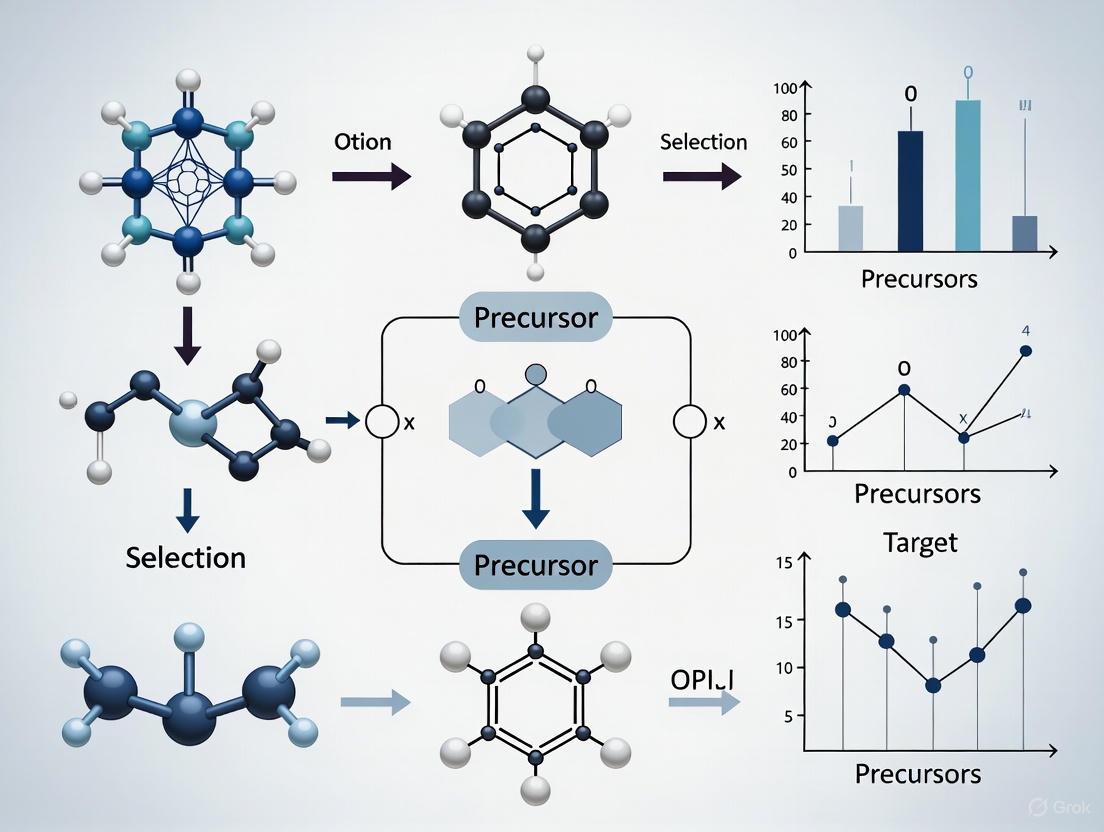
Selecting optimal precursors is a critical, multi-faceted challenge in the synthesis of both inorganic materials and pharmaceutical compounds.
Optimizing Precursor Selection for Target Materials: From Foundational Principles to AI-Driven Discovery
Abstract
Selecting optimal precursors is a critical, multi-faceted challenge in the synthesis of both inorganic materials and pharmaceutical compounds. This article provides a comprehensive guide for researchers and drug development professionals, synthesizing the latest advancements in the field. We explore the foundational principles of precursor selection, detail cutting-edge data-driven and thermodynamic methodological approaches, and present robust strategies for troubleshooting and optimizing synthesis pathways. The discussion is anchored by real-world case studies and comparative analyses of validation techniques, highlighting how integrating domain knowledge with machine learning and high-throughput experimentation is accelerating the discovery and manufacture of novel target materials.
The Critical Role of Precursors: Defining the Problem Space in Materials and Drug Synthesis
Precursor selection is a critical, foundational step in the synthesis of advanced materials and pharmaceuticals. The choice of starting materials directly dictates the success of a reaction, influencing the yield and purity of the target product, and steering the reaction pathways that lead to its formation. A poor choice can lead to stubborn impurity phases, low yields, or complete synthesis failure, creating significant bottlenecks in research and development [1] [2]. This technical resource center is designed to help researchers troubleshoot common synthesis challenges and implement advanced strategies for selecting optimal precursors, thereby accelerating the discovery and manufacture of new materials.
Troubleshooting Guide: Common Precursor-Related Issues
This section addresses frequent challenges encountered during synthesis, providing targeted questions to diagnose issues and data-driven solutions.
FAQ 1: My synthesis consistently results in low yields of the target material, with multiple impurity phases. How can my precursor choice be the cause?
- Diagnostic Questions:
- Have you mapped the potential pairwise reactions between your chosen precursors?
- Are the precursors you selected known to form highly stable intermediate compounds?
- Explanation: Low yields often occur when precursor combinations react to form stable, unwanted intermediate phases in early reaction steps. These intermediates consume reactants and reduce the thermodynamic driving force available to form the final target material [1] [2].
- Solution: Implement a precursor selection strategy that actively avoids precursors known to form these stable intermediates. Research demonstrates that using new selection criteria focused on analyzing pairwise precursor reactions can significantly improve outcomes. In one study, this approach successfully increased phase purity for 32 out of 35 target materials synthesized [1]. The ARROWS3 algorithm, which uses thermodynamic data to rank precursors and then learns from experimental failures to avoid such intermediates, has proven effective in identifying optimal precursor sets with fewer experimental iterations [2].
FAQ 2: I am trying to synthesize a novel, metastable material. Why do my reactions keep resulting in the thermodynamically stable phase instead?
- Diagnostic Questions:
- Does your synthesis pathway involve high-temperature steps that favor thermodynamic products?
- Have you considered precursors that react at lower temperatures or through different kinetic pathways?
- Explanation: Metastable materials are often synthesized using low-temperature routes where kinetic control can prevent the formation of more stable, equilibrium phases [2]. Conventional solid-state synthesis at high temperatures often drives reactions toward the most thermodynamically stable products.
- Solution: Explore precursor systems designed for low-temperature decomposition or alternative synthesis methods like Metal-Organic Chemical Vapour Deposition (MOCVD). For example, novel precursor chemistries, such as specific thiocarbamato complexes or adducts like the triethylamine adduct of dimethylzinc, have been developed to enable the deposition of materials that are problematic to synthesize with conventional precursors [3]. The goal is to find precursors that provide a kinetic pathway to your target, bypassing the stable phases.
FAQ 3: My synthesis results are inconsistent between batches. What precursor-related factors should I investigate?
- Diagnostic Questions:
- Are you sourcing precursors from different suppliers with potentially varying impurity profiles?
- Is the particle size or morphology of your precursor powders consistent?
- Explanation: Inconsistency often stems from variability in precursor properties, including purity, particle size, and crystalline form. Fluctuations in impurity levels during purification can significantly impact downstream processes and final product quality [4].
- Solution:
- Standardize Sources: Establish strict quality control protocols and source precursors from consistent, reputable suppliers.
- Implement Control Systems: Utilize integrated hardware and software platforms, including Laboratory Information Management Systems (LIMS) and sensors for real-time condition monitoring, to ensure consistency, reduce human error, and maintain traceability across batches [4].
Table 1: Summary of Precursor-Related Problems and Solutions
| Problem | Likely Cause | Recommended Solution |
|---|---|---|
| Low yield & high impurities | Formation of stable intermediate phases | Use selection criteria that avoid unfavorable pairwise reactions [1] |
| Failure to form metastable target | Reaction pathway favors thermodynamic products | Employ low-temperature kinetic routes & novel precursor chemistries [3] [2] |
| Inconsistent batch-to-batch results | Variable precursor purity or physical properties | Standardize precursor sources and implement quality control/automation systems [4] |
Advanced Experimental Protocols for Optimal Precursor Selection
The following methodologies outline modern, data-driven approaches to precursor selection, moving beyond traditional trial-and-error.
Protocol 1: The ARROWS3 Algorithm for Autonomous Precursor Selection
This protocol uses thermodynamic data and active learning to iteratively identify the best precursors for a target material [2].
- Input Target and Generate Options: Specify the desired material's composition and structure. The algorithm generates a list of all possible precursor sets that can be stoichiometrically balanced to yield the target.
- Initial Thermodynamic Ranking: In the absence of prior experimental data, the algorithm ranks these precursor sets based on their calculated thermodynamic driving force (ΔG) to form the target. Precursors with the largest (most negative) ΔG are prioritized initially [2].
- Experimental Testing & Pathway Analysis: The top-ranked precursor sets are tested experimentally at a range of temperatures. Techniques like X-ray diffraction (XRD) with machine-learned analysis are used to identify the crystalline intermediates formed at each step [2].
- Algorithm Learning & Re-Ranking: When experiments fail, the algorithm learns which pairwise reactions led to the formation of energy-consuming intermediates. It then updates its ranking to favor precursor sets that are predicted to avoid these intermediates, thereby retaining a larger thermodynamic driving force (ΔG′) for the final target-forming step [2].
- Iteration: Steps 3 and 4 are repeated until the target is synthesized with high purity or all options are exhausted.
The diagram below illustrates this iterative, closed-loop workflow:
Protocol 2: Data-Driven Precursor Recommendation from Literature Knowledge
This strategy leverages large historical datasets to recommend precursors for a novel target, mimicking how a human researcher would consult the literature [5].
- Knowledge Base Construction: A large database of synthesis recipes (e.g., 29,900 recipes text-mined from scientific literature) is used as a knowledge base [5].
- Material Encoding: An encoding neural network learns to represent a target material as a numerical vector based on its composition and, crucially, the precursors typically used to synthesize it. This model is trained to predict masked precursors from a set, capturing the dependencies between different precursors in the same experiment [5].
- Similarity Query: For a new target material, the algorithm computes its encoded vector and queries the knowledge base to find the most similar material for which a synthesis recipe is already known.
- Recipe Completion & Recommendation: The precursor set from the similar "reference" material is proposed. The algorithm may also add missing precursors if the reference set does not contain all required elements, based on conditional predictions. This approach has achieved a success rate of over 82% in historical validation tests [5].
The logical flow of this data-driven recommendation system is shown below:
The Scientist's Toolkit: Key Research Reagents & Solutions
This table details essential components in a modern precursor selection and synthesis workflow.
Table 2: Essential Tools for Advanced Precursor Selection and Synthesis
| Tool / Reagent | Function & Role in Precursor Selection |
|---|---|
| Robotic Synthesis Lab | Automates and parallelizes synthesis experiments, enabling high-throughput testing of hundreds of precursor combinations and conditions in weeks instead of years [1]. |
| Precursor Selector Encoding | A machine learning model that represents materials as vectors based on synthesis context, enabling data-driven similarity searches and precursor recommendations [5]. |
| Statistical Design of Experiments (DOE) | Systematically correlates synthesis parameters with material properties, replacing trial-and-error with structured optimization [6]. |
| Laboratory Information Management System (LIMS) | Tracks raw materials, process parameters, and product specifications, ensuring data integrity and traceability for troubleshooting [4]. |
| In Situ Characterization | Techniques like in-situ XRD provide real-time "snapshots" of reaction pathways, identifying intermediates for algorithm learning [2]. |
Troubleshooting Guides
FAQ: How can I prevent the formation of unwanted intermediates and impurity phases during precursor synthesis?
Root Cause Analysis: The formation of unwanted intermediates and impurity phases often originates from impurities in starting materials, non-optimal reaction kinetics, or inadequate control over processing conditions. Even high-purity commercial precursors can contain trace impurities that significantly alter final material performance [7].
Solutions and Verification Methods:
- Implement Advanced Purification: Techniques like Single Crystal Purification, specifically Solvent Orthogonality Induced Crystallization (SONIC), can remove a broad set of extrinsic impurities from commercial precursors. This method has been shown to improve phase purity and stability in halide perovskite films compared to those made from raw precursors or those purified via common methods like retrograde powder crystallization (RPC) [7].
- Characterize Purification Efficacy: Use detailed chemical analysis to verify the removal of extrinsic impurities. Compare the performance of materials synthesized from purified precursors against those from raw precursors under operational stressors like light and heat to confirm improvements in phase stability [7].
- Control Precursor Rheology and Composition: The physical properties of a preceramic polymer (a common type of precursor), such as its melting point, glass transition temperature, and viscosity, are critical. These can be adjusted by using monofunctional monomers (to lower molecular weight and viscosity) or tri/tetrafunctional monomers (to increase molecular weight and viscosity), ensuring the precursor is suitable for the intended shaping process [8].
FAQ: What strategies can mitigate thermodynamic trapping and its effects on material properties?
Root Cause Analysis: Thermodynamic trapping occurs when solute atoms, such as interstitials or impurities, become immobilized at microstructural defects like grain boundaries or phase interfaces. This is governed by the interaction between lattice sites and "traps," leading to site competition effects, especially in systems with multiple solute species [9].
Solutions and Verification Methods:
- Model Multi-Species Interactions: Use advanced trapping and diffusion models for multiple species of solute atoms in a system with multiple sorts of traps. These models, based on irreversible thermodynamics, can predict kinetics of exchange between the lattice and traps, as well as site competition effects [9].
- Simulate Process Conditions: Implement numerical simulations for processes like charging and discharging in samples containing multiple sorts of traps occupied by multiple species. This helps in understanding the role of trapping parameters, site competition effects, and the interaction of trapping kinetics with diffusion kinetics [9].
- Design Precursor Cross-Linking: To prevent the distillation of low-molecular-weight oligomers or thermal decomposition into volatile compounds—processes that can exacerbate non-equilibrium trapping—cross-link the polymer chains to form a tridimensional network. This must be done after the shaping of the precursor during a curing step and requires the precursor to have reactive substituents [8].
FAQ: How does precursor selection influence the formation of undesired by-products?
Root Cause Analysis: The selection of a precursor directly determines the composition, reactivity, and structure of the intermediate and final products. An ill-suited precursor can lead to undesired by-products through several mechanisms, including the accumulation of unexpected small RNAs in biological systems [10] or the formation of a problematic "free-carbon" phase in polymer-derived ceramics [8].
Solutions and Verification Methods:
- Analyze By-Product Accumulation: When using artificial miRNA (amiRNA) precursors, employ deep-sequencing techniques to analyze the accumulation of small RNAs in transgenic systems. This can reveal the presence of additional, undesired small RNAs originating from other regions of the precursor, which may silence unintended gene targets [10].
- Optimize Precursor Composition: Tune the elemental composition of the precursor to be as close as possible to the target ceramic to maximize ceramic yield and minimize free carbon. This can be achieved through monomer design, copolymerization, or chemical modification of the polymer [8].
- Ensure Precursor Stability: Use precursors that are stable at the processing temperature to ensure stable viscosity and reproducible shaping. Stability to air and moisture is also advantageous for easier processing and longer "pot-life" [8].
Table 1: Impact of Precursor Purity and Purification Methods on Material Performance
| Precursor Type / Purification Method | Key Impurity Change | Impact on Final Material Properties | Verification Method |
|---|---|---|---|
| Low Purity (99%) PbI2 (Raw) | Broad set of extrinsic impurities | Reduced phase purity and stability under light and heat | Chemical analysis, stability testing [7] |
| High Purity (99.99%) PbI2 (Raw) | Fewer initial impurities | Improved performance over low-purity raw precursor | Chemical analysis, stability testing [7] |
| Purification via Retrograde Powder Crystallization (RPC) | Partial impurity removal | Improved performance over raw precursors, but less effective than SONIC | Comparison of phase stability [7] |
| Purification via Solvent Orthogonality Induced Crystallization (SONIC) | Removal of a broad set of extrinsic impurities | Improved phase purity and stability under operational stressors | Detailed chemical analysis, enhanced phase stability [7] |
Table 2: Key Reagent Solutions for Precursor Synthesis and Analysis
| Research Reagent / Material | Function in Experiment | Field of Application |
|---|---|---|
| SONIC (Solvent Orthogonality Induced Crystallization) | Advanced purification technique to remove trace impurities from solid precursors. | Halide Perovskites, Materials Synthesis [7] |
| Electron Microscopy | Enables structural and chemical identification at the atomic scale for precursor and derived material. | MXenes, MAX Phases, 2D Materials [11] |
| Deep-Sequencing Technique | Analyzes the accumulation of small RNAs to identify desired products and undesired by-products. | Artificial miRNA Technology, Genetics [10] |
| Cross-Linking Agents | Substances that connect polymer chains into a 3D network, preventing distillation and increasing ceramic yield. | Preceramic Polymers, Polymer-Derived Ceramics [8] |
| Trapping and Diffusion Model | A theoretical model based on irreversible thermodynamics to simulate solute trapping at defects. | Hydrogen Embrittlement, Multicomponent Diffusion [9] |
Experimental Protocols
Protocol: Single Crystal Purification of Precursors via SONIC
Objective: To remove trace impurities from commercially available halide perovskite precursors to improve the phase purity and stability of the final material [7].
- Selection: Obtain the commercial precursor (e.g., PbI2) of known purity.
- Crystallization: Employ the Solvent Orthogonality Induced Crystallization (SONIC) method to grow bulk single crystals of the target material (e.g., FAPbI3).
- Processing: Isolate the purified single crystals.
- Verification: Subject the purified crystals to detailed chemical analysis to verify the removal of extrinsic impurities.
- Application: Fabricate thin films using the purified precursor material.
- Testing: Evaluate the phase purity and stability of the resulting films under operational stressors (light and heat) and compare against films made from raw or alternatively purified precursors.
Protocol: Analysis of Undesired Small RNA Accumulation from amiRNA Precursors
Objective: To map processing intermediates and identify the accumulation of undesired small RNAs from an artificial microRNA precursor [10].
- Transformation: Express the artificial miRNA (e.g., amiRchs1 based on the Arabidopsis miR319a precursor) in the model organism (e.g., Petunia hybrida).
- Phenotypic Validation: Observe and confirm the intended gene-silencing phenotype in transgenic plants.
- Mapping: Use a modified 5' RACE (Rapid Amplification of cDNA Ends) technique to map small-RNA-directed cleavage sites on the target mRNA and to detect processing intermediates of the amiRNA precursor.
- Sequencing: Analyze the accumulation of small RNAs in the tissue of interest using deep-sequencing technology.
- Bioinformatics: Process the sequencing data to identify the sequences and abundances of all small RNAs, focusing on the desired amiRNA and any additional small RNAs originating from other regions of the precursor.
- Target Prediction: Use computational tools to discover potential unintended targets of the undesired small RNAs within the host genome.
Workflow and Relationship Diagrams
Precursor Selection and Optimization Workflow
Thermodynamic Trapping in Multi-Species Systems
Frequently Asked Questions
What does 'optimal' mean in the context of precursor selection? An optimal precursor set is one that provides a sufficient thermodynamic driving force to form the target material while minimizing kinetic traps. This involves maximizing the free energy difference between the target and competing phases and avoiding reaction pathways that form stable, unreactive intermediates that consume this driving force [2] [12].
My synthesis consistently produces unwanted by-products, even within the target's stability region. Why? Traditional phase diagrams show stability regions but do not visualize the thermodynamic competition from other phases. To minimize by-products, you should aim for synthesis conditions that not only fall within the target's stability region but also maximize the free energy difference (ΔΦ) between your target phase and its most competitive neighboring phase [12]. This approach, known as Minimum Thermodynamic Competition (MTC), reduces the kinetic propensity for by-products to form.
How can I select precursors when I have a constrained set of starting materials? Constrained synthesis planning addresses this exact challenge. Novel algorithms, such as Tango*, use a computed node cost function to guide a retrosynthetic search towards your specific, enforced starting materials (e.g., waste products or specific feedstocks). This method efficiently finds viable synthesis pathways from a limited set of precursors [13] [14].
Is a larger thermodynamic driving force (ΔG) always better? Not necessarily. While a more negative ΔG generally indicates a stronger driving force and faster reaction kinetics, it can sometimes lead to the rapid formation of highly stable intermediate compounds. These intermediates can act as kinetic traps, consuming the available driving force and preventing the formation of your final target material [2]. The optimal pathway avoids such intermediates to retain a large driving force for the target-forming step (ΔG') [2].
Troubleshooting Guides
Problem: Synthesis Fails to Form the Target Phase
Possible Cause 1: Formation of Stable Intermediates The chosen precursors react to form thermodynamically favorable intermediate compounds that are kinetically inert, halting the reaction [2].
- Diagnosis: Use in-situ characterization techniques like XRD at different temperatures to identify which intermediates form. Algorithms like ARROWS3 are designed to automate this analysis [2].
- Solution: Select an alternative precursor set that avoids the pairwise reactions leading to the problematic intermediate. The goal is to find a route that retains a large thermodynamic driving force (ΔG') all the way to the target phase [2].
Possible Cause 2: High Thermodynamic Competition from By-Products Even within the thermodynamic stability region of your target, the driving force to form a competing by-product phase may be similar to that of your target, leading to impure products [12].
- Diagnosis: Calculate the thermodynamic competition metric, ΔΦ(Y) = Φtarget(Y) - min(Φcompeting(Y)), across your synthesis conditions (e.g., pH, E, concentration) [12].
- Solution: Optimize your synthesis conditions (e.g., pH, redox potential) to the point where ΔΦ is minimized—meaning the energy difference between the target and its strongest competitor is maximized [12].
Problem: Inability to Plan a Synthesis with Mandated Starting Materials
Possible Cause: Inflexible Search Algorithm Standard computer-aided synthesis planning (CASP) algorithms are designed to find a pathway to any purchasable building block, not your specific constrained set [13] [14].
- Diagnosis: Your target molecule contains key structural motifs not present in the default purchasable set, or you are required to use specific starting materials for waste valorization or semi-synthesis.
- Solution: Employ a constrained synthesis planning tool like Tango*. This method uses a Tanimoto similarity-based cost function to guide the retrosynthetic search towards your enforced starting materials, significantly improving the solve rate for this specific problem [13] [14].
Experimental Data & Protocols
Table 1: Quantitative Synthesis Outcomes for Different Optimization Algorithms on YBCO Target [2]
| Algorithm / Method | Total Experiments | Successful Syntheses Identified | Key Metric / Principle |
|---|---|---|---|
| ARROWS3 | Substantially fewer | All effective routes | Avoids intermediates to preserve ΔG' |
| Bayesian Optimization | More than ARROWS3 | Not specified | Black-box parameter tuning |
| Genetic Algorithm | More than ARROWS3 | Not specified | Black-box parameter tuning |
| Initial Ranking (DFT ΔG) | N/A | N/A | Ranks by initial driving force (ΔG) only |
Table 2: Key Computational Tools for Synthesis Planning
| Tool Name | Field | Primary Function | Key Principle |
|---|---|---|---|
| ARROWS3 [2] | Solid-State Materials | Autonomous precursor selection | Active learning from experiments to avoid kinetic intermediates. |
| Tango* [13] [14] | Organic Chemistry/Molecules | Starting material-constrained synthesis planning | Guides search using Tanimoto similarity to enforced blocks. |
| MTC Framework [12] | Aqueous Materials Synthesis | Condition optimization (pH, E, concentration) | Maximizes free energy difference between target and competing phases. |
| SynthNN [15] | Inorganic Crystalline Materials | Synthesizability prediction | Deep learning model trained on known materials data. |
Protocol 1: Validating Synthesis with the ARROWS3 Workflow [2]
- Input & Initial Ranking: Provide your target material's composition and a list of potential precursors. The algorithm will stoichiometrically balance the precursors and provide an initial ranking based on the DFT-calculated thermodynamic driving force (ΔG) to form the target.
- Experimental Probing: Synthesize the highest-ranked precursor sets across a range of temperatures (e.g., 600–900 °C) with a short hold time (e.g., 4 hours) to capture reaction snapshots.
- Phase Analysis: Analyze the products at each temperature using X-ray diffraction (XRD). Machine-learning analysis (e.g., XRD-AutoAnalyzer) can be used to automatically identify crystalline intermediates and by-products.
- Pathway Learning: The algorithm identifies which pairwise reactions between precursors led to the observed intermediates.
- Route Optimization: ARROWS3 updates its precursor ranking, now prioritizing sets predicted to avoid energy-consuming intermediates, thereby maintaining a large driving force (ΔG') to the final target.
- Iteration: Repeat steps 2-5 until the target is synthesized with high purity or all precursor sets are exhausted.
Protocol 2: Applying the Minimum Thermodynamic Competition (MTC) Framework for Aqueous Synthesis [12]
- Define System: Identify your target phase and all possible competing solid phases in the chemical space.
- Calculate Free Energy Surfaces: Compute the Pourbaix potential (Ψ) for all phases. This free-energy surface is a function of intensive variables: pH, redox potential (E), and aqueous metal ion concentrations.
- Compute Thermodynamic Competition: For a given set of conditions (pH, E, [ions]), calculate the thermodynamic competition metric: ΔΦ = Φtarget - min(Φcompeting).
- Optimize Conditions: Use a gradient-based algorithm to find the conditions (Y* = pH, E, [ions]*) that minimize ΔΦ. This is the point of maximum energy difference between your target and its closest competitor.
- Experimental Validation: Perform synthesis at the predicted optimal conditions (Y) and at other conditions within the stability region for comparison. Phase-pure yield is expected primarily at Y.
The Scientist's Toolkit: Key Research Reagent Solutions
- DFT-Calculated Reaction Energies (ΔG): Serves as the initial, high-throughput filter for ranking potential precursor sets based on their thermodynamic driving force to form the target material [2].
- In-Situ XRD with ML Analysis: A critical diagnostic tool for "looking into the black box" of solid-state reactions. It identifies intermediate and by-product phases that form during heating, providing essential data for route optimization [2].
- Multi-Element Pourbaix Diagrams: Provide the free-energy surfaces needed to compute the stability of target and competing phases in aqueous electrochemical systems, forming the basis for the MTC analysis [12].
- Tanimoto Similarity & FMS: A simple but powerful cheminformatics calculation used in the Tango* algorithm to measure molecular similarity and guide retrosynthetic searches towards desired starting materials [13] [14].
Workflow and Pathway Diagrams
ARROWS3-Informed Precursor Optimization Cycle
Finding Conditions for Minimum Thermodynamic Competition
Data Mining and Statistical Insights from Historical Synthesis Data
Frequently Asked Questions (FAQs)
Q1: What is the fundamental connection between statistical analysis and data mining in materials research? Data mining and statistical analysis are deeply interconnected fields that together enable powerful insights from complex materials data. Statistical analysis provides the foundational framework for hypothesis testing, inference, and parameter estimation, while data mining offers scalable algorithms for pattern recognition and predictive modeling in large datasets. In precursor materials research, this synergy allows researchers to uncover hidden relationships between synthesis parameters and material properties, validate findings through statistical significance testing, and build robust predictive models for optimizing precursor selection [16] [17].
Q2: How can I troubleshoot a data mining model that shows good training performance but poor predictive accuracy on new precursor datasets? This common issue, known as overfitting, occurs when models memorize training data patterns instead of learning generalizable relationships. Solutions include: (1) Applying cross-validation techniques to assess real-world performance during development [17]; (2) Implementing regularization methods (L1/L2) to penalize model complexity; (3) Using ensemble methods like Random Forests that are naturally more robust to overfitting; (4) Ensuring your training dataset adequately represents the variability in chemical space and synthesis conditions expected in real applications [17].
Q3: What statistical measures are most appropriate for evaluating clustering results in precursor categorization? For clustering analysis in precursor materials, use multiple validation metrics: (1) Internal indices like Silhouette Coefficient measure cluster separation and cohesion; (2) External indices like Adjusted Rand Index compare to known classifications when available; (3) Stability analysis assesses result consistency across subsamples; (4) Domain-specific validation through expert review of chemically similar groupings. The combination of statistical metrics and domain knowledge ensures practically meaningful clusters [17].
Q4: How can I address missing or incomplete data in historical precursor synthesis records? Several statistical approaches can handle missing data: (1) Multiple Imputation creates several complete datasets by estimating missing values with uncertainty; (2) Maximum Likelihood methods model the missing data mechanism; (3) For data missing not-at-random, selection models account for systematic missingness. Document the extent and patterns of missingness first, as this informs the optimal approach and potential biases [16].
Q5: What are the key considerations for ensuring reproducible data mining workflows in collaborative precursor research? Reproducibility requires both technical and methodological rigor: (1) Version control for all code and data processing steps; (2) Comprehensive documentation of preprocessing decisions and parameter settings; (3) Containerization (e.g., Docker) to capture computational environments; (4) Implementation of standardized validation protocols for all models; (5) Clear reporting of effect sizes with confidence intervals alongside statistical significance [17].
Troubleshooting Guides
Problem: Inadequate Model Performance for Precursor Property Prediction
Symptoms
- Low predictive accuracy (R² < 0.7, high RMSE) on test datasets
- Large discrepancies between training and validation performance
- Failure to identify known precursor-property relationships
| Step | Investigation | Diagnostic Methods | Solution Approaches |
|---|---|---|---|
| 1 | Data Quality Assessment | Missing value analysis, outlier detection, feature distributions | Data imputation, outlier treatment, domain-specific data transformation [18] |
| 2 | Feature Relevance | Correlation analysis, mutual information, domain expertise | Feature selection, creation of domain-informed features, dimensionality reduction [17] |
| 3 | Model Complexity | Learning curves, bias-variance analysis | Regularization, ensemble methods, neural network architecture optimization [16] |
| 4 | Validation Methodology | Cross-validation schemes, residual analysis | Stratified sampling, temporal validation splits, statistical testing of differences [17] |
Validation Protocol Implement a rigorous validation workflow: (1) Begin with train-test split (70-30%); (2) Apply k-fold cross-validation (k=5-10) on training set for model selection; (3) Evaluate final model on held-out test set; (4) Compute multiple performance metrics (R², RMSE, MAE) with confidence intervals; (5) Conduct external validation with newly synthesized precursors when possible [17].
Problem: Unstable Clustering Results Across Precursor Datasets
Symptoms
- Cluster assignments change significantly with different algorithm initializations
- Varying results when adding new precursor compounds to the dataset
- Poor alignment between statistical clusters and chemical functionality
Diagnostic and Resolution Workflow
Resolution Steps
- Data Preprocessing Assessment: Ensure consistent feature scaling (standardization/normalization) across datasets. Different scaling approaches can dramatically affect distance-based clustering. Assess feature relevance using domain knowledge to eliminate noisy variables [17].
Parameter Sensitivity Analysis: Systematically test parameter sensitivity, especially for algorithms like k-means (number of clusters) and DBSCAN (epsilon, min_samples). Use stability analysis across multiple runs with different initializations.
Alternative Algorithm Testing: Compare multiple clustering approaches (k-means, hierarchical, DBSCAN, Gaussian Mixture Models) using stability metrics. Ensemble clustering methods often provide more robust results.
Multi-metric Validation: Employ both internal (silhouette, Davies-Bouldin) and external (adjusted Rand index) validation metrics. Incorporate domain expert evaluation to ensure chemically meaningful clusters.
Problem: Spurious Correlations in Historical Precursor Data
Symptoms
- Statistically significant correlations that lack mechanistic explanation
- Model coefficients that contradict established chemical principles
- Failure to generalize across different precursor families
Detection and Mitigation Strategies
| Strategy | Implementation | Interpretation Guidelines |
|---|---|---|
| Causal Analysis | Directed acyclic graphs, domain knowledge mapping | Distinguish causal from correlational relationships using established precursor chemistry [17] |
| Multiple Testing Correction | Bonferroni, Benjamini-Hochberg procedures | Control false discovery rate when testing multiple hypotheses simultaneously [17] |
| Cross-Validation | Leave-one-family-out validation, temporal splits | Test robustness across different precursor classes and synthesis periods |
| Mechanistic Validation | Experimental verification, literature consistency | Ensure statistical relationships align with known chemical mechanisms |
Experimental Protocol for Correlation Validation
- Hypothesis Formulation: Pre-specify expected relationships based on chemical principles before data analysis
- Data Splitting: Implement strict train-validation-test splits with no data leakage
- Significance Testing: Apply appropriate multiple testing corrections for all statistical tests
- Effect Size Reporting: Focus on practically significant effect sizes rather than statistical significance alone
- External Validation: Test identified relationships in independently synthesized precursor datasets
Research Reagent Solutions
| Category | Specific Tools/Frameworks | Application in Precursor Research | Key Considerations |
|---|---|---|---|
| Statistical Analysis | R, Python (Scipy, Statsmodels), SPSS | Experimental design, hypothesis testing, relationship quantification | Ensure appropriate model assumptions, implement multiple testing corrections [17] |
| Data Mining Platforms | KNIME, RapidMiner, Weka | Pattern discovery, predictive modeling, clustering analysis | Balance model complexity with interpretability needs [19] |
| Visualization Tools | Tableau, RAWGraphs, Python (Matplotlib, Seaborn) | Exploratory data analysis, result communication, quality assessment | Prioritize clarity and accurate representation of statistical uncertainty [19] [20] |
| Domain-Specific Databases | ICSD, Materials Project, PubChem | Precursor property data, historical synthesis records, structural information | Address data quality variability, missing values, and standardization issues [16] |
Experimental Workflow for Precursor Selection Optimization
Methodology Details
Historical Data Collection
- Compile comprehensive historical synthesis data including precursor structures, processing conditions, and characterization results
- Standardize data formats and units across different sources
- Document data provenance and quality indicators
Data Preprocessing & Cleaning
- Address missing values using appropriate imputation methods
- Detect and handle outliers using statistical methods (e.g., Tukey's fences)
- Normalize/standardize features based on distribution characteristics
- Engineer domain-informed features capturing relevant chemical descriptors
Exploratory Data Analysis
- Conduct principal component analysis to identify major variation sources
- Perform correlation analysis to identify potential relationships
- Visualize distributions and relationships across precursor classes
- Identify potential confounding variables and data quality issues
Predictive Modeling
- Implement multiple algorithm types (regression, random forests, neural networks)
- Utilize ensemble methods to improve predictive stability
- Optimize hyperparameters using cross-validation
- Assess feature importance for mechanistic insights
Statistical Validation
- Apply rigorous train-test-validation splits
- Compute confidence intervals for all performance metrics
- Conduct sensitivity analysis for key model assumptions
- Perform external validation with newly synthesized precursors
Precursor Optimization
- Utilize validated models for precursor selection and design
- Implement optimization algorithms to identify optimal precursor characteristics
- Balance multiple objectives (performance, cost, sustainability)
- Establish confidence estimates for prediction-based decisions
This troubleshooting framework enables researchers to systematically address common challenges in data mining and statistical analysis of precursor materials data, leading to more robust and reliable insights for materials design and optimization.
The Problem of Precursor Interdependencies and Non-Random Combinations
Frequently Asked Questions
What are precursor interdependencies in materials synthesis? Precursor interdependencies refer to the chemical reactions and interactions that occur between different precursor materials before or during the formation of a target material. These pairwise reactions can dominate the synthesis process, often leading to unwanted impurity phases if not properly controlled [1].
Why is the "non-random" selection of precursors critical? Traditional methods of selecting precursors often result in a final product that is a mix of different compositions and structures. A non-random, criteria-based selection process aims to avoid these unwanted side reactions, thereby significantly increasing the yield and phase purity of the desired target material [1].
What is a key modern method for validating precursor selection? Robotic high-throughput synthesis laboratories are now used to rapidly validate precursor choices. These systems can perform hundreds of separate reactions in a few weeks, a task that would typically take months or years, allowing for the quick identification of the most effective precursor combinations [1].
How can I troubleshoot the formation of impurity phases? The formation of impurity phases is a primary challenge in synthesizing multi-element materials. It is often a direct result of undesirable pairwise reactions between precursors. Consult the troubleshooting guide below for a systematic approach to diagnosing and resolving this issue.
Troubleshooting Guide: Precursor-Related Synthesis Challenges
| Problem | Possible Cause | Recommended Solution |
|---|---|---|
| High impurity phases in final product | Undesirable pairwise reactions between precursors [1] | Re-select precursors using criteria that avoid these specific side reactions, guided by phase diagrams [1]. |
| Low yield of target material | Synthetic pathway dominated by reactions leading to by-products [1] | Adopt a pairwise reaction analysis to map all potential precursor interactions and select precursors that favor the target pathway [1]. |
| Inconsistent results between batches | Variability in raw material purity or supplier quality [4] | Source precursors from reliable, certified vendors and implement strict quality control checks upon receipt [4]. |
Experimental Data: The Impact of Systematic Precursor Selection
Recent research demonstrates the profound impact of a systematic precursor selection strategy. In a large-scale study targeting 35 multi-element oxide materials, a new method of choosing precursors based on pairwise reaction analysis was tested against traditional approaches in 224 separate reactions.
Table: Efficacy of New Precursor Selection Criteria
| Synthesis Method | Number of Target Materials | Success Rate (Higher Purity Achieved) |
|---|---|---|
| New Precursor Selection Criteria | 35 | 32 out of 35 (91%) [1] |
| Traditional Precursor Selection | 35 | Not explicitly stated (Lower yield for 32 materials) [1] |
Detailed Experimental Protocol: Pairwise Precursor Analysis
This protocol is adapted from research on synthesizing inorganic materials using a pairwise reaction strategy to minimize impurities [1].
Objective: To synthesize a target multi-element material with high phase purity by selecting precursors that minimize undesirable intermediary reactions.
Materials and Equipment:
- Precursor powders
- Robotic inorganic materials synthesis laboratory (e.g., ASTRAL) OR conventional furnace [1]
- Analytical equipment for phase purity determination (e.g., X-ray Diffraction)
Methodology:
- Define Target Phase: Clearly identify the chemical composition and crystal structure of the desired final material.
- Map Potential Precursors: List all possible precursor compounds containing the required elements.
- Analyze Pairwise Reactions: Use available phase diagrams to theorize and model the binary reactions that could occur between every possible pair of the identified precursors [1].
- Apply Selection Criteria: Establish and apply criteria for precursor selection that specifically avoid combinations predicted to result in stable impurity phases [1].
- High-Throughput Validation: Use a robotic synthesis lab to rapidly test the selected precursor combinations and hundreds of alternatives in parallel. This involves mixing powders and reacting them at high temperatures [1].
- Characterize Output: Analyze the products of each reaction to determine the phase purity and yield of the target material.
- Optimize and Iterate: Use the results to refine the selection criteria and identify the optimal precursor set for large-scale synthesis.
Research Reagent Solutions
Table: Essential Materials for Precursor Selection and Synthesis
| Item | Function in Research | Relevance to Precursor Interdependencies |
|---|---|---|
| Precursor Powders | The raw materials that react to form the target product. | Their inherent reactivity dictates the success of the synthesis; purity and selection are paramount [1] [21]. |
| Phase Diagrams | Maps that show the equilibrium phases in a material system at different conditions. | Critical for predicting stable intermediary compounds and avoiding them during precursor selection [1]. |
| Robotic Synthesis Lab | An automated system for high-throughput experimentation. | Dramatically accelerates the testing of precursor combinations and validation of selection criteria [1]. |
Workflow Diagram: Systematic Precursor Selection
The following diagram illustrates the logical workflow for selecting optimal precursors to avoid problematic interdependencies, based on the successful methodology validated in recent research.
Modern Methodologies: From Thermodynamic Modeling to AI-Powered Recommendation Systems
Troubleshooting Guides
Guide 1: Addressing Failure to Form Target Material
Problem: Despite favorable overall reaction thermodynamics (ΔG < 0), the target material does not form, or yield is low due to persistent impurity phases.
Diagnosis: This commonly occurs when highly stable intermediates form through competing pairwise reactions, consuming the available thermodynamic driving force before the target material can nucleate and grow [2].
Solution:
- Identify Intermediates: Use in-situ characterization techniques like high-temperature X-ray Diffraction (XRD) to identify intermediate phases that form during the reaction pathway [2].
- Re-select Precursors: Use an algorithm like ARROWS3 to re-evaluate precursor choices. The algorithm prioritizes precursor sets that avoid the formation of the identified stable intermediates, thereby preserving a larger driving force (ΔG′) for the target material's formation [2].
- Validate Robotically: For rapid iteration, use a robotic materials synthesis laboratory to test the new precursor selections across a range of conditions [1].
Guide 2: Correcting Inaccurate ΔG Predictions
Problem: Predicted reaction Gibbs free energy (ΔG) does not match experimental observations, leading to poor precursor selection.
Diagnosis: Inaccuracies can stem from several sources: inadequate level of theory in computational methods, ignoring solvation effects, or incorrect treatment of pH for biochemical reactions [22].
Solution:
- Benchmark Computational Methods: For quantum chemistry calculations, benchmark exchange-correlation functionals and basis sets against a known database like NIST. The SCAN-D3(BJ) meta-GGA functional is recommended for main group thermochemistry [22].
- Include Solvation and pH: Always use an implicit solvation model (e.g., SMD) for reactions in solution. For biochemical reactions, calculate free energies at the relevant pH (e.g., pH 7) [22].
- Apply Calibration: Use a simple linear calibration against experimental data to reduce the mean absolute error of DFT-predicted ΔG values to within 1.60–2.27 kcal/mol [22].
Frequently Asked Questions (FAQs)
Q1: How can I quickly determine if a reaction will be spontaneous? A1: Use the sign of the Gibbs Free Energy change (ΔG). A reaction is spontaneous if ΔG is negative, non-spontaneous if positive, and at equilibrium if zero [23] [24]. The relationship between enthalpy (ΔH), entropy (ΔS), and temperature dictates the sign of ΔG [24]:
| ΔH | ΔS | Spontaneity |
|---|---|---|
| – | + | Spontaneous at all temperatures |
| + | – | Non-spontaneous at all temperatures |
| – | – | Spontaneous at low temperatures |
| + | + | Spontaneous at high temperatures |
Q2: What does a "thermodynamic driving force" mean in materials synthesis? A2: It refers to the negative Gibbs Free Energy change (ΔG) for a reaction. A more negative ΔG value indicates a stronger driving force for the reaction to proceed, often leading to faster reaction rates. The key is to select precursors that maximize this driving force specifically for the formation of the target material, not for competing intermediates [2].
Q3: My target material is metastable. Can I still use thermodynamic data for synthesis planning? A3: Yes. Thermodynamic data is still crucial. The strategy shifts towards selecting precursors and reaction conditions where the kinetic barrier for forming the metastable phase is lower than that for the stable competing phases. This often involves identifying precursors that avoid the formation of very stable, inert intermediates that would consume all the available driving force [2].
Q4: Which thermodynamic parameters are most critical for selecting solid-state synthesis precursors? A4: The Gibbs Free Energy of reaction (ΔG) is the primary master variable. Precursor sets should be initially ranked by how negative their ΔG is for the target material [2]. Furthermore, consulting phase diagrams is essential to understand and avoid unfavorable pairwise reactions between precursors that could lead to stable impurity phases [1].
Q5: What is a common pitfall when using computational chemistry to predict ΔG? A5: A major pitfall is performing calculations in the gas phase for reactions that occur in solution. You must use an implicit solvation model to accurately account for the effects of the solvent environment on the free energy of metabolites and reactions [22].
Quantitative Data for Reaction Analysis
Table 1: Performance of DFT Functionals for Predicting ΔG of Biochemical Reactions [22]
| Exchange-Correlation Functional | Type | Mean Absolute Error (kcal/mol) |
|---|---|---|
| SCAN-D3(BJ) | meta-GGA | ~1.60 |
| B3LYP-D3 | Hybrid | ~2.27 |
| PBE | GGA | Varies (benchmark required) |
Note: Error ranges are achieved after calibration with experimental data. The chemical accuracy benchmark is 1 kcal/mol.
Table 2: Influence of Manganese Precursor on Phosphor Synthesis Efficiency [25]
| Manganese Precursor | Oxidation State | Final Active Ion | Photoluminescence Quantum Yield (PLQY) |
|---|---|---|---|
| MnO₂ | +4 | Mn²⁺ | 17.69% |
| Mn₂O₃ | +3 | Mn²⁺ | 7.59% |
| MnCO₃ | +2 | Mn²⁺ | 2.67% |
Note: Synthesis was performed via a Microwave-Assisted Solid-State (MASS) method, demonstrating how precursor selection directly impacts final material performance, even when the final dopant ion is the same.
Experimental Protocols
Protocol 1: Automated Precursor Selection and Validation using ARROWS3
Purpose: To autonomously select and experimentally validate optimal precursor sets for a target material, avoiding kinetic traps from stable intermediates [2].
Methodology:
- Input: Define the target material's composition and a list of potential precursors.
- Initial Ranking: The algorithm ranks all stoichiometrically balanced precursor sets by their calculated thermodynamic driving force (ΔG) to form the target.
- Experimental Testing: The top-ranked precursor sets are synthesized in a robotic lab across a temperature gradient (e.g., 600–900°C).
- Phase Analysis: Products at each temperature are characterized using XRD, with automated phase analysis to identify the target and any impurity phases.
- Pathway Learning: The algorithm identifies the specific pairwise reactions between precursors that led to the observed intermediate phases.
- Re-ranking: The precursor list is re-ranked to favor sets predicted to avoid these energy-draining intermediates, preserving a large driving force (ΔG′) for the target.
- Iteration: Steps 3-6 are repeated until a high-purity target is achieved or all options are exhausted.
The following workflow visualizes the ARROWS3 algorithm's iterative optimization process:
Protocol 2: Quantum Chemistry Calculation of ΔG for Metabolic Reactions
Purpose: To accurately predict the standard Gibbs free energy change (ΔG°ᵣ) for biochemical reactions using Density Functional Theory (DFT) [22].
Methodology:
- Metabolite Input: Obtain SMILES strings of all reactants and products from a database like ModelSEED.
- Generate Microspecies: Use software (e.g., Chemaxon) to generate the major microspecies of each metabolite at the desired pH (0 or 7).
- Geometry Optimization: Generate 3D geometries and optimize them using a functional like B3LYP-D3 with a 6-31G* basis set.
- Solvation Calculation: Perform a single-point energy calculation on the optimized geometry using a larger basis set (e.g., 6-311++G) and an implicit solvation model (SMD) to account for aqueous effects.
- Thermal Correction: Calculate the vibrational frequencies to determine the entropy (S) and enthalpy (H) contributions to free energy.
- Compute ΔG°ᵣ: Combine the standard Gibbs free energies of all metabolites to calculate the reaction free energy.
- Calibration: Benchmark and calibrate the calculated values against experimental data from the NIST database.
The Scientist's Toolkit: Research Reagent Solutions
Table 3: Essential Materials for Thermodynamics-Driven Materials Synthesis
| Item | Function | Example Application in Synthesis |
|---|---|---|
| ARROWS3 Algorithm | An active learning algorithm that autonomously selects precursors by learning from failed experiments to avoid stable intermediates [2]. | Optimizing precursor choices for YBa₂Cu₃O₆.₅ (YBCO) and metastable Na₂Te₃Mo₃O₁₆ [2]. |
| Robotic Synthesis Lab | Automates high-throughput solid-state synthesis, allowing for rapid testing of dozens of precursor combinations and conditions [1]. | Validating new precursor selection criteria by synthesizing 35 target materials in 224 separate reactions in a few weeks [1]. |
| DFT Computation (e.g., NWChem) | Provides first-principles quantum mechanical calculations of Gibbs free energy for reactions and metabolites, filling gaps where experimental data is lacking [22]. | Predicting ΔG°ᵣ for metabolic reactions with high accuracy, enabling thermodynamic modeling of biological systems [22]. |
| Microwave-Assisted Solid-State (MASS) Reactor | Enables rapid, energy-efficient synthesis by using microwave radiation to heat precursors directly, often leading to different reaction pathways [25]. | Rapid synthesis of Mn²⁺-doped Na₂ZnGeO₄ phosphors, efficiently incorporating Mn from various precursor oxides [25]. |
Frequently Asked Questions (FAQs)
Q1: What is the core function of the ARROWS3 algorithm? ARROWS3 is designed to automate the selection of optimal precursors for solid-state materials synthesis. It actively learns from experimental outcomes to identify which precursor combinations lead to the formation of highly stable intermediates that prevent the target material from forming. Based on this learning, it subsequently proposes new experiments using precursors predicted to avoid such intermediates, thereby preserving a larger thermodynamic driving force to form the desired target material [26] [2].
Q2: How does ARROWS3 differ from black-box optimization methods? Unlike black-box optimization algorithms like Bayesian optimization or genetic algorithms, ARROWS3 incorporates physical domain knowledge, specifically thermodynamics and pairwise reaction analysis. This allows it to identify effective precursor sets while requiring substantially fewer experimental iterations by understanding why certain reactions fail (e.g., by identifying specific energy-draining intermediates) rather than just relying on correlative optimization [26] [2] [27].
Q3: What initial data does ARROWS3 use to propose its first experiments? In the absence of prior experimental data, ARROWS3 initially ranks potential precursor sets based on their calculated thermodynamic driving force (∆G) to form the target material. This thermochemical data is typically sourced from first-principles calculations in databases like the Materials Project [26] [2].
Q4: What key hypotheses about solid-state reactions does ARROWS3 utilize? The algorithm operates on two critical hypotheses:
- Solid-state reactions often proceed through stepwise transformations between two phases at a time (pairwise reactions) [26] [28].
- Intermediate phases that consume a large portion of the available free energy should be avoided, as they leave a small driving force for the final target material to form [26] [29].
Q5: What experimental characterization technique is integral to the ARROWS3 workflow? X-ray diffraction (XRD) is used to characterize the products of synthesis experiments at various temperatures. Machine learning models (e.g., XRD-AutoAnalyzer) are then employed to identify the crystalline intermediates formed at each step of the reaction pathway [26] [2].
Troubleshooting Guide
Issue 1: Algorithm Fails to Propose New Precursors After Failed Experiment
| Possible Cause | Diagnostic Steps | Solution |
|---|---|---|
| Unidentified Intermediates | Verify that XRD patterns were successfully collected and that the machine learning analysis provided a confident phase identification for all major peaks [26]. | Ensure sample preparation for XRD is consistent. Manually review the XRD pattern and phase identification results to confirm accuracy. |
| Insufficient Thermodynamic Data | Check if the observed intermediate phases are present in the thermodynamic database (e.g., Materials Project) used to calculate driving forces [26] [28]. | Manually calculate or locate the formation energy for the missing phase(s) and update the local database. |
| All Proposed Precursor Sets Exhausted | Review the algorithm's log to see how many precursor combinations have been tested [2]. | Expand the list of available precursor candidates for the algorithm to consider. |
Issue 2: Synthesis Fails Despite Favorable Predicted Driving Force
| Possible Cause | Diagnostic Steps | Solution |
|---|---|---|
| Sluggish Reaction Kinetics | Check the calculated driving force (∆G′) for the final step from the last intermediate to the target. If it is low (e.g., < 50 meV/atom), kinetics are likely too slow [28] [29]. | The algorithm should automatically learn to avoid this path. Consider increasing synthesis temperature or time in the next proposed experiment. |
| Precursor Volatility or Decomposition | Review thermal stability data (e.g., TGA) for the precursor materials used. | ARROWS3 may not account for volatility. Manually exclude volatile precursors or precursors that decompose into undesirable phases. |
| Formation of Amorphous Intermediates | Analyze the XRD pattern for a high background, which may suggest the presence of amorphous content that the ML model cannot identify [29]. | Consider alternative characterization techniques or synthesis parameters that promote crystallization. |
Issue 3: Inconsistent Experimental Outcomes at the Same Temperature
| Possible Cause | Diagnostic Steps | Solution |
|---|---|---|
| Inconsistent Powder Mixing | Check the experimental protocol for milling or grinding steps. Inconsistent particle contact can lead to irreproducible reactions [28]. | Standardize the milling procedure (time, intensity) to ensure homogeneous precursor mixtures across all experiments. |
| Furnace Temperature Gradients | Place temperature sensors at different locations within the furnace to map thermal profiles during a heating cycle. | Calibrate furnaces regularly and use a consistent, well-characterized location for sample placement during synthesis. |
Experimental Protocols and Workflows
Core ARROWS3 Algorithmic Workflow
The following diagram illustrates the autonomous decision-making cycle of the ARROWS3 algorithm.
Detailed Methodology for a Synthesis Experiment
The table below summarizes the protocol for the synthesis experiments targeting YBa₂Cu₃O₆.₅ (YBCO) used to validate ARROWS3 [26] [2].
| Experimental Step | Parameter Details | Notes & Considerations |
|---|---|---|
| Precursor Preparation | 47 different combinations of Y-, Ba-, Cu-, and O- containing precursors. | Precursors are commonly available solid powders (e.g., Y₂O₃, BaCO₃, CuO). |
| Mixing | Precursors are mixed and ground into a fine powder to ensure good reactivity. | The physical mixing process is critical for reproducible solid-state reactions [28]. |
| Heating Profile | Heated at four different temperatures: 600°C, 700°C, 800°C, and 900°C. A short hold time of 4 hours was used. | Testing across a temperature gradient provides snapshots of the reaction pathway. |
| Characterization | Products analyzed by X-ray Diffraction (XRD). | |
| Data Analysis | XRD patterns are analyzed using a machine-learned analyzer (XRD-AutoAnalyzer) to identify crystalline phases present [26]. | Automated phase identification is key for high-throughput analysis. |
| Pathway Determination | ARROWS3 determines which pairwise reactions led to the observed intermediates. | This step converts experimental observations into a mechanistic understanding of the failure. |
The Scientist's Toolkit: Key Reagent Solutions
The following table details essential components and their functions within the ARROWS3-driven synthesis ecosystem.
| Item / Solution | Function in the Workflow | Example / Specification |
|---|---|---|
| Thermodynamic Database | Provides initial formation energies (∆G) for ranking precursors and calculating driving forces for pairwise reactions. | Materials Project database [26] [28]. |
| Precursor Library | A comprehensive list of available solid powder precursors that can be stoichiometrically balanced to yield the target's composition. | E.g., For YBCO: Y₂O₃, BaCO₃, CuO, BaO₂, Y(NO₃)₃, etc. [26]. |
| Machine Learning Phase Identifier | Automatically identifies crystalline phases and their weight fractions from XRD patterns of reaction products. | XRD-AutoAnalyzer or probabilistic models trained on the Inorganic Crystal Structure Database (ICSD) [26] [28]. |
| Pairwise Reaction Database | A continuously updated database of observed solid-state reactions between two phases at a time, built from experimental outcomes. | Contains reactions like "Precursor A + Precursor B → Intermediate C" [28]. |
| Active Learning Agent | The core ARROWS3 algorithm that integrates thermodynamic data with experimental results to propose new, optimized experiments. | Proposes precursors that avoid intermediates with low driving force (∆G') to the target [26] [27]. |
Frequently Asked Questions (FAQ) & Troubleshooting Guides
This technical support resource addresses common challenges researchers face when using data-driven methods to recommend material precursors. These guides integrate troubleshooting for both computational and experimental workflows.
FAQ 1: Why are my material similarity results inconsistent with established databases?
Question: I am using a computational framework to find materials similar to my target, but the suggested precursors have different symmetry or lattice parameters compared to what is listed for the same material in the Materials Project (MP) database. What could be causing this?
Answer: Inconsistencies often arise from differences in how crystal structures are analyzed and reported. Key factors to check are:
- Symmetry Tolerance (
symprec): Space-group assignments can vary based on the symmetry tolerance used during analysis. The MP database uses a tolerance ofsymprec = 0.1. If your local analysis tool (e.g., pymatgen or VESTA) uses a smaller tolerance (e.g.,symprec = 0.01), it might assign a lower, less symmetric space group to the same structure [30]. - Choice of Unit Cell: The same crystal can be represented by a primitive cell (fewest atoms) or a conventional cell (often easier to visualize). Ensure you are comparing the same cell type, as their lattice parameters will differ [30].
- Systematic Computational Errors: DFT calculations, particularly those using the PBE functional, can systematically overestimate lattice parameters by 1-3%. This error is more pronounced in layered crystals due to the poor description of van der Waals interactions [30].
Troubleshooting Steps:
- Identify the Discrepancy: Note the specific property that is inconsistent (e.g., space group number, lattice parameter
a, volume). - Verify Your Settings: Check the
symprecparameter in your local symmetry-analysis tool and re-run the analysis withsymprec = 0.1to match the MP standard [30]. - Confirm the Cell Type: On the MP material details page, you can export the structure as either a conventional or primitive cell. Ensure you are using the same type as in your workflow [30].
- Benchmark Expectations: For lattice parameters, a difference of ~1-3% may be expected systematic error rather than a problem in your similarity analysis [30].
Question: My precursor recommendation pipeline needs to integrate data from multiple high-throughput databases (e.g., MP, AFLOW, OQMD). However, the calculated properties for the same material, like unit-cell volume, differ across these sources, causing errors in my similarity assessment. How should I handle this?
Answer: This is a known challenge in materials informatics. Differences arise from variations in computational parameters even when the same underlying theory (e.g., DFT-PBE) is used. These can include the plane-wave energy cutoff, pseudopotentials, and relaxation schemes [31]. One study noted volume differences of up to 2 ų for simple NaCl structures across different databases, all calculated with VASP using PBE [31].
Troubleshooting Steps:
- Acknowledge the Variation: Understand that some level of discrepancy is inherent when merging data from different sources. Document the sources and their known computational settings.
- Use a Standardization Framework: Employ a Python framework like MADAS, designed to handle heterogeneous materials data. Its
Databaseclass provides a unified interface to download data from different sources, converting them into a common internal format that your analysis pipeline can use consistently [31]. - Focus on Relative Similarity: Ensure your similarity measure is robust to small systematic offsets. The goal is to identify materials that are relatively similar across a consistent set of descriptors, not to match absolute property values exactly.
- Establish a Baseline: When working with a new set of elements or crystal classes, manually compare data for a few well-known materials from your different sources to quantify the typical variance, and use this to inform your similarity thresholds.
FAQ 3: What should I do if my data-driven precursor recommendation fails to yield synthesizable materials?
Question: The computational similarity model suggested a list of promising precursors, but initial synthesis attempts failed to produce the target material. How can I troubleshoot this?
Answer: This is a common hurdle where computational stability does not always equate to experimental synthesizability. This can be due to kinetic barriers, complex reaction pathways, or unaccounted-for experimental conditions.
Troubleshooting Steps:
- Verify Stability Predictions: Confirm the predicted stability of your target material. Advanced models like GNoME (Graph Networks for Materials Exploration) provide improved stability predictions by scaling up deep learning with active learning. Check if your target is listed among the millions of stable structures discovered by such large-scale efforts [32].
- Check for Experimental Realization: Some databases indicate if a computationally predicted material has been independently synthesized. For example, 736 of the GNoME-discovered stable structures had already been experimentally realized, providing a stronger validation of their synthesizability [32].
- Refine Your Similarity Criteria: The initial similarity search might have over-emphasized a single property (e.g., crystal structure). Incorporate additional descriptors related to synthesis, such as the energy above the convex hull, or use machine learning models that explicitly predict synthesis conditions [32].
- Implement a Closed Loop: Adopt an autonomous workflow where computational recommendations guide initial experiments, and experimental outcomes (success or failure) are fed back to refine the recommendation model. This iterative process, as discussed in talks on autonomous materials research, helps the model learn the complex rules of synthesizability [33].
Experimental Protocols for Key Cited Works
Protocol 1: Benchmarking a Similarity Framework Against Multiple Databases
This methodology is adapted from the MADAS framework publication [31].
Objective: To validate a materials similarity framework by quantifying property differences for the same material across multiple high-throughput databases.
Materials:
- Python environment with the
MADASpackage installed. - Access to the AFLOW, Materials Project (MP), and Open Quantum Materials Database (OQMD) via their respective APIs.
Methodology:
Data Acquisition:
- Use the
MADASDatabaseclass to implement interfaces for AFLOW, MP, and OQMD. - Download the crystal structure and calculated properties (e.g., unit-cell volume) for a simple, well-known compound like NaCl from all three databases. The
MADASframework will convert the data into a common internal format [31].
- Use the
Structural Equivalence Verification:
- To ensure you are comparing identical polymorphs, verify the structural equivalence using a method like the one implemented in the Atomic Simulation Environment (ASE). This confirms that the symmetry and atomic positions are equivalent despite potential differences in lattice parameter reporting [31].
Property Comparison and Analysis:
- Extract the unit-cell volume for each NaCl entry.
- Calculate the absolute and relative differences between the volumes reported by the different databases.
- The expected outcome, as per the referenced study, is a variance of up to 2 ų for NaCl, attributable to differences in computational parameters like plane-wave cutoff [31].
Protocol 2: Active Learning for Improved Stability Prediction
This methodology is based on the GNoME (Graph Networks for Materials Exploration) discovery pipeline [32].
Objective: To iteratively improve a deep learning model's ability to predict stable crystals, thereby enhancing the quality of precursor recommendations.
Materials:
- A graph neural network (GNN) architecture for predicting crystal energies.
- Initial training data (e.g., a snapshot of ~69,000 materials from the Materials Project).
- Access to DFT computation resources (e.g., VASP) for structure relaxation.
Methodology:
Candidate Generation:
- Generate a diverse pool of candidate crystal structures. The GNoME approach uses two parallel frameworks:
Model Filtration:
- Use the current GNN model to predict the energy and stability (decomposition energy) of all candidates.
- Filter out the candidates predicted to be unstable, retaining only the most promising ones for DFT verification.
DFT Verification and Active Learning:
- Perform DFT calculations to relax the filtered structures and compute their accurate energies.
- Compare the DFT results with the model's predictions. The new, verified stable structures are added to the training dataset.
- Retrain the GNN model on this expanded, higher-quality dataset. This iterative process (steps 1-3) progressively improves the model's accuracy and "hit rate" (the percentage of predicted stable materials that are verified by DFT) [32].
Research Reagent Solutions & Key Computational Descriptors
The following table details key computational tools and concepts essential for building a data-driven precursor recommendation system.
| Item Name | Type/Function | Brief Explanation of Role |
|---|---|---|
| Graph Neural Network (GNN) | Machine Learning Model | A deep learning model that operates on graph data. It represents a crystal structure as a graph (atoms as nodes, bonds as edges) to predict material properties like stability and energy, enabling high-throughput screening [32]. |
| Descriptor | Data Representation | A numerical representation of a material's atomic configuration or properties (e.g., SOAP descriptor). It converts complex structural information into a format usable by machine learning models for similarity comparison [31]. |
| Similarity Measure (Kernel) | Analysis Function | A function that quantifies the similarity between two material descriptors, outputting a score between 0 (completely different) and 1 (identical). It is the core metric for ranking precursor candidates [31]. |
| material_id / mp-id | Database Identifier | A unique identifier (e.g., mp-804) for a specific material polymorph in the Materials Project database. It allows consistent referencing of a material across different studies and calculations [30]. |
| task_id | Database Identifier | A unique identifier for an individual calculation task (e.g., mp-1234567). A single material_id can be associated with multiple task_ids from different calculations [30]. |
| Stability (vs. convex hull) | Energetic Property | A material's decomposition energy relative to competing phases. A negative value indicates the material is thermodynamically stable. It is a key filter for judging viable precursors [32]. |
Workflow Visualization for Precursor Recommendation
The diagram below illustrates the automated, iterative workflow for data-driven precursor recommendation, integrating computational screening with experimental validation.
The solid-state synthesis of multicomponent inorganic materials, crucial for technologies from battery cathodes to solid-state electrolytes, is often hampered by a fundamental challenge: the formation of undesired impurity phases. These by-products kinetically trap reactions in incomplete, non-equilibrium states, preventing the formation of high-purity target materials. Traditional synthesis approaches, which typically involve combining simple oxide precursors, frequently result in low-yield reactions due to the complex energy landscapes of high-dimensional phase diagrams.
Recent research has revealed that solid-state reactions between three or more precursors initiate at the interfaces between only two precursors at a time. The first pair of precursors to react often forms stable intermediate by-products, consuming much of the total reaction energy and leaving insufficient driving force to complete the transformation to the target material. This insight has led to the development of a thermodynamic strategy for navigating multidimensional phase diagrams by focusing specifically on pairwise reaction analysis to identify precursor combinations that circumvent low-energy competing phases while maximizing the reaction energy to drive fast phase transformation kinetics.
Fundamental Principles of Pairwise Reaction Analysis
Core Theoretical Framework
Pairwise reaction analysis operates on several key principles derived from thermodynamic considerations of phase diagrams:
- Principle 1: Initiate with Two Precursors - Reactions should begin between only two precursors whenever possible, minimizing the chances of simultaneous pairwise reactions between three or more precursors that could form multiple impurity phases.
- Principle 2: Utilize High-Energy Precursors - Precursors should be relatively high in energy (unstable), maximizing the thermodynamic driving force and thereby enhancing reaction kinetics to the target phase.
- Principle 3: Target Deepest Hull Point - The target material should represent the deepest point in the reaction convex hull, ensuring the thermodynamic driving force for its nucleation exceeds that of all competing phases.
- Principle 4: Minimize Competing Phases - The composition slice formed between the two precursors should intersect as few competing phases as possible, reducing opportunities for undesired by-product formation.
- Principle 5: Maximize Inverse Hull Energy - When by-product phases are unavoidable, the target phase should have a relatively large inverse hull energy, meaning it sits substantially lower in energy than neighboring stable phases in composition space.
These principles work together to guide researchers toward precursor selections that avoid kinetic traps and favor direct routes to target materials. When multiple precursor pairs could synthesize the target compound, priority is given first to ensuring the target is at the deepest point of the convex hull (Principle 3), followed by maximizing inverse hull energy (Principle 5), as this supersedes the need for a large reaction driving force alone.
Illustrative Case Study: LiBaBO₃ Synthesis
The synthesis of lithium barium borate (LiBaBO₃) demonstrates the power of this approach. When using traditional simple oxide precursors (B₂O₃, BaO, and Li₂CO₃, which decomposes to Li₂O), the reaction energy is substantial at ΔE = -336 meV per atom. However, numerous low-energy ternary phases along the Li₂O-B₂O₃ and BaO-B₂O₃ binary slices form rapidly as intermediates, consuming most of the driving force. The subsequent reaction from these intermediates to the target LiBaBO₃ possesses minimal energy (as low as ΔE = -22 meV per atom), resulting in poor phase purity.
In contrast, when using the high-energy intermediate LiBO₂ as a precursor paired with BaO, the direct reaction LiBO₂ + BaO → LiBaBO₃ proceeds with a substantial reaction energy of ΔE = -192 meV per atom. Furthermore, this reaction slice presents fewer competing phases with smaller formation energies. Experimental validation confirms this pathway produces LiBaBO₃ with significantly higher phase purity compared to traditional precursors.
Technical Support Center: Troubleshooting Guides and FAQs
Frequently Asked Questions
Why does my synthesis consistently produce impurity phases despite using the correct stoichiometric ratios? Your precursors are likely forming stable intermediate compounds that consume the available reaction energy before reaching your target phase. This kinetic trapping occurs when the reaction path crosses low-energy regions in the phase diagram. Apply pairwise analysis to identify a higher-energy reaction pathway that bypasses these intermediates.
How can I determine which pairwise reaction will initiate first in my multi-precursor system? Calculate the reaction energies for all possible pairwise combinations of your precursors. The pair with the largest negative reaction energy (greatest driving force) will typically react first. Computational tools can predict these energies using density functional theory (DFT) and existing thermodynamic databases.
My target phase has a small formation energy. Is synthesis still feasible? Yes, but precursor selection becomes critically important. Choose precursors that create a large inverse hull energy for your target phase, making it significantly more stable than any potential intermediates along your chosen reaction path. This enhances selectivity even with modest overall driving force.
What computational resources are needed to apply this method? Access to thermodynamic databases (e.g., Materials Project) is essential for constructing relevant phase diagrams. DFT calculations may be necessary for systems with incomplete data. Recent methods using pairwise mixing enthalpies can efficiently estimate multicomponent solid solution energies, reducing computational cost.
Troubleshooting Common Experimental Issues
Problem: Incomplete reaction even after extended heating. Solution: Your reaction likely lacks sufficient driving force in the final step. Identify a higher-energy precursor pair using Principles 2 and 5. Consider synthesizing an intermediate precursor (as with LiBO₂ in the case study) to preserve energy for the final transformation.
Problem: Variable phase purity between experimental batches. Solution: Inconsistent intermediate formation suggests multiple competing reaction pathways. Apply Principle 4 to find a precursor pair whose compositional slice intersects minimal competing phases. Ensure thorough mixing and consistent thermal profiles to control which pairwise reaction initiates first.
Problem: Target phase forms initially but decomposes upon prolonged heating. Solution: Your target may not be the deepest energy point along your reaction path (violating Principle 3). Re-analyze the convex hull to identify a more stable precursor combination where the target is the global minimum on the reaction isopleth.
Problem: New impurities form after initial pure target formation. Solution: The target phase may have limited kinetic stability against further reaction with remaining precursors or atmosphere. Ensure your reaction path consumes all precursors completely in a single step, or consider slight non-stoichiometry to make your target phase more robust against decomposition.
Experimental Protocols & Methodologies
Computational Workflow for Precursor Selection
The following diagram illustrates the systematic workflow for identifying optimal precursors using pairwise reaction analysis:
Precursor Selection Workflow
Robotic Validation Methodology
Large-scale experimental validation of predicted precursors utilizes robotic inorganic materials synthesis laboratories:
- Automation Systems: Robotic platforms automate powder precursor preparation, ball milling, oven firing, and X-ray characterization of reaction products.
- High-Throughput Capability: A single experimentalist can conduct hundreds of syntheses in a reproducible manner, dramatically accelerating validation cycles.
- Experimental Design: For a diverse target set of 35 quaternary Li-, Na-, and K-based oxides, phosphates, and borates, the ASTRAL robotic lab performed 224 reactions spanning 27 elements with 28 unique precursors.
- Analysis Protocol: X-ray diffraction patterns of products are analyzed to quantify phase purity of target materials compared to traditional synthesis routes.
Data Presentation & Analysis
Comparative Performance of Pairwise Analysis
Table 1: Experimental Validation Results for Pairwise Reaction Analysis
| Metric | Traditional Approach | Pairwise Analysis Approach | Improvement |
|---|---|---|---|
| Successful Syntheses | 3/35 targets | 32/35 targets | 966% increase |
| Total Reactions | ~35 (estimated) | 224 reactions | 540% more data |
| Elements Covered | Limited | 27 unique elements | Broader chemical scope |
| Precursors Tested | Standard oxides | 28 unique precursors | Expanded precursor space |
| Experimental Efficiency | Months to years | Several weeks | ~80% time reduction |
Thermodynamic Parameter Comparison
Table 2: Key Thermodynamic Parameters for Precursor Evaluation
| Parameter | Definition | Calculation Method | Optimal Characteristic |
|---|---|---|---|
| Reaction Energy (ΔE) | Energy released during precursor → target reaction | DFT + convex hull analysis | Large negative value (high driving force) |
| Inverse Hull Energy | Energy below neighboring stable phases on convex hull | Distance to tie-line above target | Large negative value (high selectivity) |
| Pairwise Mixing Enthalpy | Enthalpy of mixing for binary precursor pairs | SQS-DFT or regular solution model | Appropriate for target phase stability |
| Decomposition Energy | Energy penalty for target phase decomposition | Distance to hull below target | Large positive value (high stability) |
Research Reagent Solutions
Essential Materials for Implementation
Table 3: Key Research Reagents and Computational Resources
| Resource Category | Specific Examples | Primary Function |
|---|---|---|
| Thermodynamic Databases | Materials Project, OQMD, AFLOW | Provide formation energies and crystal structures for phase diagram construction |
| DFT Calculation Tools | VASP, Quantum ESPRESSO, CASTEP | Calculate formation energies and reaction energies for non-database compounds |
| Precursor Compounds | Binary oxides, carbonates, pre-synthesized intermediates | Starting materials with appropriate energy characteristics |
| Robotic Synthesis Platforms | Samsung ASTRAL, custom automated labs | High-throughput experimental validation of predicted precursors |
| Characterization Equipment | XRD, SEM-EDS, TGA-DSC | Phase purity analysis and reaction progression monitoring |
| Specialized Software | pymatgen, AFLOW, PHONOPY | Computational analysis of phase stability and reaction pathways |
Advanced Applications and Future Directions
The pairwise analysis approach extends beyond simple oxide systems to complex concentrated alloys and multicomponent materials. In refractory complex concentrated alloys (RCCAs), pairwise mixing enthalpies successfully predict phase stability across thousands of compositions, demonstrating the method's versatility across material classes.
Emerging research indicates that while pairwise interactions dominate phase selection in most systems, higher-order interactions may become significant in certain complex mixtures, particularly biological and soft matter systems. However, for most inorganic solid-state synthesis, pairwise analysis provides a sufficiently accurate and computationally tractable framework.
Integration of this thermodynamic approach with machine learning algorithms and robotic laboratories creates a powerful closed-loop discovery system. Foundation models trained on broad materials data can suggest novel precursor combinations, which are rapidly tested experimentally, with results feeding back to improve predictive capabilities. This synergy between physical principles, AI guidance, and automated validation represents the future of accelerated materials discovery and development.
Technical Support Center
Troubleshooting Guides and FAQs
This technical support center is designed within the broader thesis context of selecting optimal precursors for target materials research. It addresses common experimental challenges in solid-state synthesis, providing targeted solutions to help researchers efficiently achieve high-purity materials for advanced applications like batteries and catalysis.
FAQ 1: My synthesis reaction fails to produce the target material. How can precursor selection resolve this?
Answer: Failed reactions often occur when precursors form stable intermediate compounds that consume the thermodynamic driving force needed to form the final target material. Selecting precursors that avoid these inert byproducts is critical [26].
- Problem: The reaction pathway is dominated by favorable intermediate reactions that prevent the target material from forming.
- Solution: Use an algorithm like ARROWS3, which actively learns from experimental failures. It analyzes formed intermediates and re-prioritizes precursor sets that avoid these energy-draining side reactions, thereby retaining a sufficient driving force (ΔG) to form the target phase [26].
- Protocol: The ARROWS3 methodology involves:
- Initial Ranking: Generate a list of stoichiometrically balanced precursor sets and rank them based on their calculated thermodynamic driving force (ΔG) to form the target.
- Experimental Snapshot: Test highly-ranked precursor sets at several temperatures to identify the intermediates formed at different stages of the reaction pathway using techniques like X-ray diffraction (XRD).
- Pathway Analysis: Determine which pairwise reactions between precursors led to the observed intermediates.
- Learning and Re-prioritization: Use this information to predict intermediates in untested precursor sets. Prioritize new sets that are predicted to maintain a large driving force (ΔG') for the final target-forming step, even after accounting for intermediates.
FAQ 2: How can I systematically choose the best precursors for a novel target material?
Answer: Systematic precursor selection combines thermodynamic calculation with experimental validation.
- Problem: Traditional selection relies heavily on domain expertise and reported procedures, which may not exist for novel materials.
- Solution: Employ a data-driven strategy that ranks potential precursors based on thermodynamic data and iteratively refines the selection based on experimental outcomes [26].
- Protocol: A generalized workflow for novel target synthesis:
- Define Target: Specify the desired material's composition and crystal structure.
- Generate Candidates: Assemble a list of all possible precursor combinations that can be stoichiometrically balanced to yield the target.
- Thermodynamic Screening: Use data from sources like the Materials Project to calculate the reaction energy (ΔG) for each precursor set. Initially prioritize sets with the largest negative ΔG [26].
- Experimental Validation and Learning: Test the top candidates. If the target is not formed, identify the crystalline intermediates. Use this data to update the precursor ranking, avoiding sets that lead to persistent, stable intermediates.
FAQ 3: I have successfully synthesized my target material, but the yield is low. What are the common causes?
Answer: Low yield is frequently linked to incomplete reaction or the formation of competing phases due to suboptimal precursors or synthesis conditions.
- Problem: The selected precursors may react to form competing phases that reduce the yield of the desired target.
- Solution: Optimize the thermal profile (temperature, heating rate, dwell time) and consider finer precursor milling to improve homogeneity and reaction kinetics. If problems persist, re-evaluate your precursor choice using the troubleshooting method in FAQ 1, as some precursors may have an inherent tendency to form competing byproducts [26].
Quantitative Data on Precursor Selection
The following table summarizes experimental data from a benchmark study targeting YBa₂Cu₃O₆.₅ (YBCO), which demonstrates the impact of precursor selection on synthesis success. The algorithm ARROWS3 was tested against other methods to identify all successful precursor combinations [26].
Table 1: Performance Comparison of Optimization Algorithms for YBCO Synthesis [26]
| Optimization Algorithm | Total Experimental Iterations | Successful Precursor Sets Identified | Key Learning Mechanism |
|---|---|---|---|
| ARROWS3 | Fewer than benchmarks | All effective routes | Learns from intermediates to avoid unfavorable reaction pathways. |
| Bayesian Optimization | Substantially more | All effective routes | Black-box optimization without domain knowledge. |
| Genetic Algorithms | Substantially more | All effective routes | Black-box optimization without domain knowledge. |
Table 2: Summary of Experimental Datasets for Algorithm Validation [26]
| Target Material | Number of Precursor Sets Tested (N_sets) | Synthesis Temperatures (°C) | Total Experiments (N_exp) |
|---|---|---|---|
| YBa₂Cu₃O₆₊ₓ | 47 | 600, 700, 800, 900 | 188 |
| Na₂Te₃Mo₃O₁₆ (Metastable) | 23 | 300, 400 | 46 |
| t-LiTiOPO₄ (Metastable) | 30 | 400, 500, 600, 700 | 120 |
Workflow Visualization
The following diagram illustrates the logical workflow of the ARROWS3 algorithm for optimizing precursor selection, integrating both computational and experimental steps.
The Scientist's Toolkit: Research Reagent Solutions
This table details key reagents and materials essential for planning and executing solid-state synthesis experiments, particularly within a strategy focused on optimal precursor selection.
Table 3: Essential Materials and Reagents for Solid-State Synthesis
| Item | Function / Explanation |
|---|---|
| Precursor Powders | Solid starting materials (e.g., carbonates, oxides, hydroxides) that are stoichiometrically balanced to form the target compound. Their physical properties (particle size, reactivity) are critical. |
| Computational Thermodynamic Data | Databases (e.g., Materials Project) providing calculated reaction energies (ΔG) used for the initial ranking and selection of precursor sets [26]. |
| X-Ray Diffraction (XRD) | An essential analytical technique for identifying crystalline phases in a reaction mixture, confirming the formation of the target material, and detecting undesired intermediates or impurities [26]. |
| Algorithmic Optimization Tools | Software or algorithms (e.g., ARROWS3) that integrate thermodynamic data with experimental outcomes to actively learn and suggest improved precursor combinations [26]. |
Computer-Aided Molecular Design (CAMD) for Novel Precursor Generation
Computer-Aided Molecular Design (CAMD) represents a systematic framework for identifying novel molecular structures that possess desired physicochemical properties and functional characteristics [34]. For researchers focused on target materials development, CAMD provides a powerful alternative to traditional trial-and-error experimental approaches, which are often time-consuming, expensive, and limited to existing precursor compounds [35]. By leveraging sophisticated algorithms and computational methods, CAMD enables the in-silico generation and evaluation of precursor candidates before synthesis, dramatically accelerating the materials discovery pipeline [35] [34].
This technical support center addresses the specific challenges researchers encounter when implementing CAMD methodologies for precursor design, particularly for applications in atomic layer deposition (ALD) and pharmaceutical development. The guidance provided herein draws from established computational frameworks and experimental validations to ensure practical utility for scientists navigating the complexities of molecular design optimization.
FAQs: Addressing Common CAMD Implementation Challenges
FAQ 1: What constitutes a well-defined CAMD problem for precursor design?
A well-defined CAMD problem requires precise specification of several elements: (1) target properties with quantitative constraints (e.g., growth rate > 1.2 Å/cycle for ALD precursors), (2) available functional groups for molecular construction, (3) structural constraints (e.g., valence rules, chemical stability), and (4) an appropriate property prediction model [35] [34]. The optimization problem is typically formulated as a mixed integer nonlinear programming (MINLP) problem, solved using algorithms like efficient ant colony optimization (EACO) [35] [36].
Troubleshooting Tip: If generated molecules are chemically invalid, verify group compatibility rules and valence constraints in your CAMD software configuration.
FAQ 2: How accurate are property predictions in CAMD for novel precursors?
Property prediction accuracy depends heavily on the underlying models. Group Contribution Methods (GCM) show good agreement with experimental ALD data when properly parameterized [35]. For titanium precursors, GCM-predicted growth rates aligned well with observed values, enabling identification of 41 novel structures with enhanced performance [35]. However, accuracy may decrease for highly novel molecular structures far from the training data domain.
Troubleshooting Tip: When working with unprecedented functional group combinations, validate critical predictions with higher-fidelity computational methods (e.g., DFT calculations) before synthesis.
FAQ 3: What are the key limitations of current CAMD approaches?
Key limitations include: (1) dependency on quality training data, (2) computational scalability for complex molecular spaces, (3) accuracy of property prediction methods for novel structures, and (4) ensuring synthesizability of generated molecules [34]. Emerging approaches like diffusion models combined with genetic algorithms address some limitations by enabling targeted generation without expensive model retraining [34].
Troubleshooting Tip: For complex design problems, consider hybrid approaches that combine CAMD with generative AI models to leverage the strengths of both methodologies.
FAQ 4: How can I validate CAMD-generated precursors experimentally?
Implement a staged validation protocol: (1) computational screening using multiple property prediction methods, (2) synthesis of top candidates (typically 3-5 molecules), (3) characterization of physical properties (volatility, thermal stability), and (4) performance testing in target applications (e.g., ALD growth rate measurements) [35]. For ALD precursors, growth rates should be measured across relevant temperature ranges (300-600K) to verify optimal performance conditions [36].
Quantitative Data: CAMD Performance for Precursor Design
The table below summarizes performance data for CAMD-generated titanium precursors in atomic layer deposition applications, demonstrating the methodology's effectiveness:
Table 1: Performance Metrics for CAMD-Generated Titanium ALD Precursors [35] [36]
| Metric | Value | Experimental Context |
|---|---|---|
| Number of novel precursors generated | 41 | Functional groups varied 0-20 times using EACO |
| Growth rate range | 1.23 - 1.65 Å/cycle | Compared to existing titanium precursors |
| Optimal temperature range | 300 - 600 K | Included as decision variable in optimization |
| Key functional groups | 3 groups (unspecified) | Using Group Contribution Method parameters |
| Computational framework | MINLP with EACO | ASST model for growth kinetics |
Table 2: Comparison of CAMD Approaches for Molecular Design [34]
| Method | Strengths | Limitations | Best Use Cases |
|---|---|---|---|
| Group Contribution + Optimization | Property prediction; Established methodology | Limited to known functional groups | ALD precursors; Solvent design |
| Generative Diffusion Models | Novel structure generation; Handles complexity | Computational intensity; Data requirements | Drug discovery; Multi-property optimization |
| Genetic Algorithms | Global optimization; Combines with other methods | Convergence time; Parameter tuning | Targeted generation with pre-trained models |
Experimental Protocols: Methodologies for CAMD Implementation
CAMD Workflow for ALD Precursor Design
The following diagram illustrates the integrated computational-experimental workflow for designing novel precursors using CAMD:
Detailed Protocol: CAMD for Enhanced ALD Growth Kinetics
Objective: Design novel precursor materials with enhanced growth kinetics for atomic layer deposition [35] [36].
Materials and Computational Tools:
- Property Prediction Model: Adsorbate Solid Solution Theory (ASST) with Group Contribution Method parameters
- Optimization Algorithm: Efficient Ant Colony Optimization (EACO)
- Functional Groups: Titanium-containing groups plus organic functional groups (3 groups total, unspecified in literature)
- Computational Environment: Mixed Integer Nonlinear Programming (MINLP) framework
Procedure:
- Define Optimization Objective: Maximize ALD growth rate (Å/cycle) while maintaining thermodynamic constraints [35]
- Set Design Variables: Number of each functional group (0-20 repetitions), temperature (300-600K) [36]
- Configure EACO Parameters: Colony size=50, maximum iterations=1000, convergence tolerance=1e-6 [35]
- Execute CAMD Optimization: Run MINLP solver to generate molecular structures
- Validate Solutions: Check thermodynamic feasibility and structural validity
- Rank Candidates: Sort by predicted growth rate and select top performers for experimental validation
Troubleshooting:
- Poor Convergence: Adjust EACO parameters (pheromone evaporation rate, exploration bias)
- Physically Impossible Structures: Add structural constraints (group compatibility, valence rules)
- Limited Diversity: Implement diversity preservation mechanisms in EACO
Table 3: Essential Resources for CAMD Implementation in Precursor Design [35] [34] [36]
| Resource Category | Specific Tools/Methods | Function in CAMD Workflow |
|---|---|---|
| Property Prediction | Group Contribution Method (GCM) | Estimates thermodynamic properties from molecular structure |
| Optimization Algorithms | Efficient Ant Colony Optimization (EACO) | Solves MINLP problem for molecular generation |
| Physical Models | Adsorbate Solid Solution Theory (ASST) | Predicts growth kinetics for ALD precursors |
| Validation Methods | Experimental ALD growth rate measurement | Benchmarks predicted versus actual precursor performance |
| Emerging Methods | Generative Diffusion Models | Creates novel molecular structures conditioned on properties |
| Alignment Techniques | Genetic Algorithms with pre-trained models | Optimizes generated structures without model retraining |
Overcoming Synthesis Hurdles: Strategies for Troubleshooting and Lead Optimization
Identifying and Characterizing Unfavorable Intermediates with In-Situ Techniques
FAQs: Understanding Unfavorable Intermediates and In-Situ Techniques
Q1: What is an unfavorable intermediate in materials synthesis? An unfavorable intermediate is a phase that forms during a reaction before the target material is produced. These intermediates are often highly stable and consume the thermodynamic driving force needed for the reaction to proceed to the final target, thereby preventing or reducing the yield of the desired material [2].
Q2: Why are in-situ techniques particularly important for identifying these intermediates? In-situ techniques are performed on a catalytic system under simulated reaction conditions (e.g., elevated temperature, applied voltage), while operando techniques probe the catalyst under these conditions while simultaneously measuring its activity [37]. They are crucial because they provide real-time, dynamic snapshots of a reaction pathway, allowing researchers to detect and identify transient and stable intermediate phases that form during synthesis, which might be missed by conventional ex-situ (post-reaction) analysis [2] [38].
Q3: What are common pitfalls in reactor design for in-situ studies? A common pitfall is a mismatch between the characterization environment and real-world experimental conditions. In-situ reactors are often designed for batch operation with planar electrodes, which can lead to poor mass transport of reactants and changes in the local electrolyte composition (e.g., pH gradients). These factors create a different microenvironment at the catalyst surface compared to a benchmarking reactor, which can lead to misinterpretation of the reaction mechanism [37].
Q4: Which in-situ techniques are most effective for characterizing intermediates? Several techniques are highly effective, each providing complementary information [37]:
- Vibrational Spectroscopy (IR, Raman): Useful for identifying molecular reactants, intermediates, and products on the catalyst surface.
- X-ray Absorption Spectroscopy (XAS): Suited for measuring the local electronic and geometric structure of the catalyst under reaction conditions.
- Electrochemical Mass Spectrometry (ECMS): Used to measure reactants, intermediates, and products in the gas or liquid phase.
Q5: How can I use the identification of an unfavorable intermediate to improve my synthesis? Identifying an unfavorable intermediate is a key piece of information for optimizing synthesis. This knowledge allows you to strategically select a different set of precursors that are thermodynamically less likely to form that specific intermediate. The goal is to choose a reaction pathway that avoids these energy sinks, thereby retaining a larger thermodynamic driving force to form your final target material [2].
Troubleshooting Guides
Guide 1: Diagnosing and Overcoming Unfavorable Intermediates
| Problem Observed | Possible Cause | Diagnostic In-Situ Experiment | Proposed Solution |
|---|---|---|---|
| Low yield of target material | Formation of a highly stable crystalline intermediate that consumes reactants. | In-situ X-ray Diffraction (XRD): Heat precursors at multiple temperatures and hold for a short time (e.g., 4 hours) to get snapshots of the reaction pathway. Use machine-learned analysis of XRD patterns to identify intermediate phases [2]. | Change precursor set to avoid the thermodynamic sink. Use an algorithm like ARROWS3 to calculate a new precursor set with a larger driving force (∆G') at the target-forming step [2]. |
| Reaction stalls at intermediate temperature | A metastable intermediate forms a kinetic barrier. | In-situ Raman Spectroscopy: Monitor the catalyst surface to identify the chemical nature of the metastable intermediate and track its appearance and disappearance with temperature or potential [37]. | Modify reaction conditions (e.g., heating rate, use a temperature jump) or use a catalyst to facilitate the decomposition of the metastable phase. |
| Inconsistent results between lab-scale and in-situ reactors | Differences in mass transport and microenvironment between reactor designs [37]. | Operando Electrochemical Mass Spectrometry: Measure product formation rates simultaneously with electrochemical activity in a reactor designed to minimize path length between the catalyst and the probe [37]. | Redesign the in-situ reactor to better mimic the hydrodynamics and mass transport of the benchmarking reactor, such as using flow configurations or gas diffusion electrodes [37]. |
Guide 2: Optimizing Precursor Selection to Avoid Intermediates
| Problem Observed | Possible Cause | Diagnostic In-Situ Experiment | Proposed Solution |
|---|---|---|---|
| Unknown which precursors to use for a novel target | Traditional selection relies on domain expertise and can require many iterations [2]. | Not an experimental problem per se. Use computational pre-screening. | Use an active learning algorithm (e.g., ARROWS3) that initially ranks precursors by thermodynamic driving force (∆G) to form the target, then iteratively learns from experimental failures to suggest improved precursors that avoid stable intermediates [2]. |
| A known precursor set fails to produce the target | The precursor set leads to a reaction pathway dominated by inert byproducts [2]. | In-situ X-ray Absorption Spectroscopy (XAS): Probe the local electronic and geometric structure of the catalyst to observe changes in oxidation state or coordination that indicate the formation of an inactive phase [37]. | Cross-reference the failed experiment with literature or databases to find alternative precursors for the same target. Incorporate isotope labeling (e.g., D, 13C, 18O) in in-situ IR or MS studies to strengthen the identification of intermediates and validate the reaction mechanism [37]. |
Experimental Protocols
Protocol 1: Mapping a Solid-State Synthesis Pathway with In-Situ XRD
Objective: To identify the sequence of phases, including unfavorable intermediates, formed during the solid-state synthesis of a target material.
Methodology:
- Sample Preparation: Mix solid powder precursors in the stoichiometric ratio required for the target material.
- In-Situ Experiment: Load the mixture into a high-temperature X-ray diffraction stage.
- Data Acquisition: Heat the sample from room temperature to the target synthesis temperature (e.g., 900°C) using a controlled ramp rate. Alternatively, perform a series of isothermal holds at key temperatures (e.g., 600, 700, 800, 900°C) for a short duration (e.g., 4 hours). Collect XRD patterns continuously or at the end of each isothermal hold [2].
- Data Analysis: Use machine learning-assisted analysis (e.g., XRD-AutoAnalyzer) to identify the crystalline phases present at each temperature. Plot the appearance and disappearance of phases against temperature/time to reconstruct the reaction pathway [2].
Protocol 2: Identifying Surface Intermediates during Electro catalysis with Operando IR Spectroscopy
Objective: To detect and identify reaction intermediates adsorbed on a catalyst surface under operating conditions.
Methodology:
- Electrode Preparation: Prepare a thin, reflective working electrode from the catalyst material.
- Operando Reactor Design: Use an electrochemical cell with an infrared-transparent window (e.g., CaF2) positioned close to the working electrode surface.
- Data Acquisition: Apply the desired electrochemical potential in the presence of the electrolyte and reactants. Simultaneously, collect IR spectra (e.g., using ATR-FTIR or PM-IRRAS) with high time resolution [37] [39].
- Data Analysis: Analyze the spectra for peaks that appear, change, or disappear with varying potential. Use isotope labeling (e.g., 12CO vs 13CO) to confirm the identity of specific surface species by observing the corresponding shift in the vibrational bands [37].
Research Reagent Solutions
| Item | Function / Application in Research |
|---|---|
| Metal-Organic Precursors | Used in chemical vapor deposition (CVD) for the in-situ growth of materials like carbon nanotubes. Provides a source of the metal catalyst and the desired dopant [40]. |
| Isotope-Labeled Reactants (e.g., D2O, 13CO2, 18O2) | Used as tracers in in-situ spectroscopic studies (IR, MS) to validate the origin of reaction intermediates and products, strengthening mechanistic conclusions [37]. |
| N-(Cyanomethyl)amines | Used in an in-situ method to generate reactive N-methyleneamines for condensation reactions, avoiding the isolation of unstable intermediates [40]. |
| Solid Powder Precursors | The foundation of solid-state synthesis. Selection is critical, as different precursors (e.g., carbonates, nitrates, oxides) can lead to different reaction pathways and intermediates [2]. |
Workflow and Signaling Pathways
The following diagram illustrates the logical workflow for identifying and overcoming unfavorable intermediates using a combination of computational and in-situ experimental techniques.
Optimization Workflow for Precursor Selection
The following diagram illustrates a generalized signaling pathway or logical sequence of a chemical reaction complicated by an unfavorable intermediate, which is the core challenge addressed in this article.
Reaction Pathway with an Unfavorable Intermediate
Troubleshooting Guide: A Step-by-Step Methodology
Adopting a structured approach to troubleshooting is fundamental to diagnosing experimental failures efficiently and transforming them into learning opportunities. The following methodology provides a systematic framework for researchers.
Table 1: Systematic Troubleshooting Steps
| Step | Action | Key Questions to Ask | Desired Outcome |
|---|---|---|---|
| 1 | Identify the Problem | What exactly is the unexpected outcome? Which specific result deviates from the hypothesis or control? | A clear, concise statement of the issue, separated from its potential causes [41]. |
| 2 | List Possible Causes | What are all the obvious and non-obvious explanations? Consider reagents, equipment, procedures, and environmental factors. | A comprehensive list of potential root causes, from most to least likely [41]. |
| 3 | Collect Data | Were proper controls used? Are all reagents fresh and stored correctly? Was the protocol followed exactly? | Data that validates or rules out items from your list of possible causes [41]. |
| 4 | Eliminate Explanations | Based on the collected data, which potential causes can be definitively ruled out? | A shortened list of probable root causes for experimental testing [41]. |
| 5 | Check with Experimentation | What is the simplest experiment I can run to test the remaining probable causes? | A designed experiment that will isolate and identify the single most likely root cause [41]. |
| 6 | Identify the Root Cause | What do the results of the diagnostic experiment confirm? | The verified source of the problem, enabling a targeted solution [41]. |
Frequently Asked Questions (FAQs)
Q1: My team gets discouraged by failed experiments. How can we maintain a productive mindset?
Failure is an inevitable part of scientific discovery. Psychological research shows that people often fall prey to the "sour-grape effect," devaluing a goal after a setback, or the "ostrich effect," avoiding confronting negative outcomes altogether [42]. To counter this:
- Practice Self-Distancing: Instead of asking "Why did I fail?", ask "Why did [Your Name] fail?" This third-person perspective softens emotional reactions and enables more objective analysis [42].
- Give Advice: Studies show that offering troubleshooting advice to colleagues facing similar challenges provides an ego boost and increases your own confidence and motivation to confront your own failures [42].
Q2: Beyond simple fixes, how can I develop better troubleshooting instincts?
Formal training is key. Initiatives like "Pipettes and Problem Solving" simulate experimental failures in a group setting [43]. A leader presents a scenario with an unexpected outcome, and the team must collaboratively propose and consensus on the next best diagnostic experiments, honing their critical thinking and problem-solving skills in a low-stakes environment [43].
Q3: What are the most common avoidable causes of experimental failure?
Many stalled experiments stem from preventable root causes [44]. Common issues include:
- Human Error & Shortcuts: Not following protocols precisely or skipping steps like full incubation periods [44].
- Faulty Materials: Using expired reagents or improperly stored materials [44] [41].
- Insufficient Data & Documentation: Lack of proper controls or poor record-keeping leading to repeated errors [44].
- Equipment Issues: Uncalibrated instruments or those needing service [41] [45].
Q4: How should I approach troubleshooting a completely new assay or material synthesis?
For novel developments where the "correct" outcome is not fully known, a more exploratory approach is needed. This requires:
- Hypothesis Development: Formulating clear, testable hypotheses for why the process is failing.
- Advanced Controls: Implementing a wider range of controls to characterize the system.
- Iterative Characterization: Being prepared to run multiple diagnostic and characterization cycles before reattempting the main experiment [43]. This aligns with the iterative mindset exemplified by Thomas Edison, who viewed each unsuccessful attempt as discovering a way that would not work, thereby narrowing the path to success [46].
Learning from Failure: Data & Protocols
Quantitative Insights from Failure Analysis
Large-scale analyses of failures in high-stakes environments provide critical data on common failure pathways. Research analyzing 1250 safety-significant events in the civil nuclear sector, a field with rigorous protocols, offers valuable parallels for materials research.
Table 2: Analysis of Failure Precursors in a Technical Domain
| Factor | Finding | Implication for Materials Research |
|---|---|---|
| Major Accident Response | Reactive reporting and management changes last 5-6 years post-accident [47]. | Institutional memory of major failures is finite; systematic documentation is crucial for long-term learning. |
| Common Cause Failures (CCF) | CCFs from design, procedural, or maintenance errors occur frequently and significantly erode safety [47]. | Redundant systems in experiments (e.g., multiple controls) can be compromised by a single, common flaw. |
| Aging Infrastructure | Quantitative signs of aging appear after 25 years of operation [47]. | The lifespan and maintenance history of lab equipment and infrastructure are critical variables in troubleshooting. |
| Leading Causes of Multi-Unit Events | External triggers and latent design issues are primary causes [47]. | Experimental designs should be stress-tested for external variables (e.g., temperature swings, power surges) and inherent flaws. |
Case Study: Troubleshooting a Failed MTT Cell Viability Assay
This protocol outlines the specific steps for diagnosing a common problem in biological materials research: high variability and unexpected results in an MTT assay, a method used to assess material cytotoxicity [43].
Experimental Protocol: Diagnosing High Variability in MTT Assay
- 1. Problem Identification: The experiment yields cell viability data with very high error bars and higher-than-expected values, making results unreliable [43].
- 2. List Possible Causes:
- Reagents: Degraded MTT reagent, contaminated fetal bovine serum (FBS).
- Cells: Inconsistent cell seeding density, microbial contamination, over- or under-passaging.
- Procedure: Inconsistent incubation times, inaccurate pipetting during reagent addition or aspiration, incomplete dissolution of formazan crystals.
- Equipment: Malfunctioning plate reader, incorrect calibration, temperature fluctuations in incubator.
- 3. Data Collection & Elimination:
- Check expiration dates and storage conditions of all reagents. If valid, eliminate.
- Inspect cells for contamination under a microscope. If clear, eliminate.
- Verify plate reader calibration with a known standard. If calibrated, eliminate.
- Review protocol steps against established literature and manufacturer instructions, paying close attention to wash and aspiration steps [43].
- 4. Targeted Experimentation:
- Experiment 1: Repeat the assay with a well-established cytotoxic compound as a positive control and a vehicle-only negative control. Carefully observe and document the cell monolayer after each wash step, noting if cells are being dislodged during aspiration.
- Expected Data: If the positive control does not show high cytotoxicity and high variability persists, technique is a likely cause.
- 5. Root Cause Identification:
- Scenario: The group observes that the cell layer is disturbed during the aspiration of supernatant. The proposed experiment is to modify the aspiration technique—using a pipette tip placed against the well wall, tilting the plate, and aspirating slowly—while including both negative and positive controls [43].
- Result: With the modified technique, variability decreases significantly, and control results fall within expected ranges. The root cause is identified as improper aspiration technique leading to inconsistent cell loss [43].
The Scientist's Toolkit: Research Reagent Solutions
Table 3: Essential Materials for Troubleshooting Common Assays
| Item | Function | Troubleshooting Application |
|---|---|---|
| Premade Master Mix | A pre-mixed solution of enzymes, dNTPs, and buffer for PCR. | Eliminates pipetting errors and ensures component compatibility and quality, troubleshooting failed amplification [41]. |
| Competent Cells (Control Strain) | Genetically engineered cells with known high transformation efficiency. | Served as a positive control in cloning experiments to verify that failure is due to the plasmid DNA, not the cells [41]. |
| Validated Positive Control siRNA/Drug | A molecule with a known and robust biological effect. | Used as a benchmark in cell-based assays (e.g., MTT) to confirm the assay is functioning correctly and to distinguish between assay failure and a true negative result [43]. |
| DNA Ladder & Quantification Standards | A mixture of DNA fragments of known sizes and standards for concentration. | Essential controls for gel electrophoresis and quantitation; their failure indicates problems with the gel system or quantification instrument, not the sample [41]. |
Troubleshooting Guides
Guide 1: Addressing Poor Compound Absorption
Problem: Lead compounds show insufficient oral bioavailability despite good target affinity.
Possible Causes & Solutions:
| Problem Cause | Diagnostic Tests | Corrective Actions |
|---|---|---|
| Low solubility | - Thermodynamic solubility assay- Kinetic solubility profile | - Introduce ionizable groups- Reduce crystal lattice energy via flexible bonds- Formulate with solubilizing agents |
| Low permeability | - Caco-2 assay- PAMPA | - Reduce hydrogen bond donors/acceptors- Lower polar surface area- Introduce prodrug moieties |
| Efflux transport | - MDR1-MDCK assay- P-gp inhibition screening | - Modify structure to avoid P-gp substrate recognition- Reduce molecular flexibility |
Typical Optimization Metrics:
- Target aqueous solubility: >100 µg/mL for high absorption.
- Ideal Caco-2 apparent permeability (Papp): >10 x 10⁻⁶ cm/s.
- Target P-gp efflux ratio: <2.5.
Guide 2: Mitigating Toxicity and Metabolic Instability
Problem: Compounds fail due to toxicity signals or rapid clearance in preclinical studies.
Possible Causes & Solutions:
| Problem Cause | Diagnostic Tests | Corrective Actions |
|---|---|---|
| Reactive metabolites | - Cytochrome P450 inhibition/activation- Glutathione trapping assay | - Block metabolic soft spots- Remove/anilines, furans- Introduce metabolically stable groups (e.g., deuterium) |
| hERG inhibition | - hERG binding assay- Patch-clamp electrophysiology | - Reduce lipophilicity (clogP <3)- Introduce polar groups- Remove basic amines near aromatic systems |
| CYP inhibition | - CYP450 panel (3A4, 2D6, etc.) | - Reduce lipophilicity- Modify structure to avoid competitive binding- Introduce steric hindrance near CYP binding moieties |
Typical Optimization Metrics:
- hERG IC50: >10 µM (or 30-fold over efficacy concentration).
- CYP inhibition IC50: >10 µM.
- Target human liver microsome stability: % remaining >70% after 30 minutes.
Frequently Asked Questions (FAQs)
FAQ 1: What are the most critical precursor properties to optimize for successful ADMET outcomes?
The most critical properties form a foundational profile that must be optimized early. The following table summarizes these key properties and their target ranges for drug-like molecules.
| Property | Optimal Range | Rationale | Common Experimental Assays |
|---|---|---|---|
| Lipophilicity (clogP/logD) | clogP 1-3logD₇.₄ 1-3 | Balances permeability, solubility, and reduces metabolic/toxicity risks [48] | Shake-flask HPLC, chromatography |
| Molecular Weight | <500 Da | Impacts absorption, permeability, and solubility [49] | - |
| Polar Surface Area (TPSA) | <140 Ų | Key descriptor for cell permeability and blood-brain barrier penetration [50] | Computational calculation |
| hERG Inhibition | IC₅₀ >10 µM | Critical for avoiding cardiotoxicity; a primary "avoidome" target [48] | hERG binding assay, patch-clamp |
| CYP Inhibition | IC₅₀ >10 µM | Reduces risk of drug-drug interactions [50] | Fluorescent or LC-MS/MS probe assays |
FAQ 2: How can AI and machine learning be applied to precursor optimization?
Artificial Intelligence, particularly machine learning (ML) and large language models (LLMs), is revolutionizing precursor optimization by predicting ADMET properties before synthesis [50] [51] [52].
- Predictive Modeling: ML models trained on large, high-quality datasets like PharmaBench can predict properties such as solubility, metabolic stability, and toxicity directly from chemical structures [49]. These models use various molecular representations, from chemical fingerprints to graph neural networks, to establish structure-activity relationships [48].
- De Novo Design: Generative models, including Generative Adversarial Networks (GANs) and Variational Autoencoders (VAEs), can design novel molecular structures from scratch that are optimized for specific target profiles and ADMET properties [51].
- Data Quality is Key: The success of ML models heavily depends on the quality and volume of experimental training data. Initiatives like OpenADMET focus on generating consistent, high-throughput experimental data specifically to build better predictive models [48].
FAQ 3: What strategies can be used to optimize precursors for reduced hERG channel binding?
hERG inhibition is a common cause of cardiotoxicity-related compound failure. Mitigation strategies are primarily structural [48]:
- Reduce Lipophilicity: Lowering clogP/logD is the most effective strategy, as hERG binding correlates strongly with compound lipophilicity.
- Introduce Polar Groups: Adding ionizable or polar groups (e.g., carboxylic acids, sulfonamides) can disrupt interaction with the hydrophobic hERG channel cavity.
- Modify Basic Amines: If present, reduce the pKa of basic amines or incorporate them into rings to limit their ability to form critical cation-π interactions in the channel.
FAQ 4: How do I choose the right in vitro assays for my optimization workflow?
The choice of assay should be guided by the specific property being optimized and the stage of the discovery pipeline. The following workflow visualizes a tiered, AI-informed approach to experimental testing for efficient precursor optimization.
FAQ 5: What common pitfalls should be avoided during the data collection and modeling phase?
- Ignoring Assay Variability: Experimental results for the same compound can vary significantly between labs and assay conditions (e.g., pH, buffer) [48] [49]. Using inconsistently curated public data without understanding the experimental context can lead to poor model performance.
- Neglecting the Applicability Domain: ML models are only reliable for making predictions on compounds that are structurally similar to those in their training set. Always assess whether your precursor falls within the model's applicability domain [48].
- Over-reliance on Global Models: For optimizing a specific chemical series, building a local model focused on that series can sometimes be more effective than using a general, global model trained on diverse chemistry [48].
The Scientist's Toolkit: Key Research Reagent Solutions
This table details essential reagents, materials, and platforms used in modern, AI-driven precursor optimization.
| Tool / Reagent | Function in Optimization | Example Use-Case |
|---|---|---|
| CACO-2 Cell Line | Model for predicting human intestinal permeability and efflux transport. | Measuring apparent permeability (Papp) to diagnose poor oral absorption. |
| Human Liver Microsomes | In vitro system for assessing metabolic stability and identifying metabolic soft spots. | Determining half-life and intrinsic clearance of a precursor. |
| hERG-expressing Cell Lines | High-throughput screening for potential cardiotoxicity via hERG potassium channel binding. | Counter-screening compounds to eliminate those with high hERG affinity early. |
| DNA-Encoded Libraries (DELs) | Ultra-high-throughput screening technology that allows billions of compounds to be screened for target binding in a single tube [53]. | Identifying novel hit compounds from vast chemical spaces for further optimization. |
| AI/ML Platforms (e.g., PharmaBench) | Curated datasets and models for predicting key ADMET endpoints [49]. | Virtual screening of designed precursors for properties like solubility and metabolic stability before synthesis. |
| Robotic Synthesis Labs (e.g., ASTRAL) | Automated platforms that accelerate the synthesis and testing of target materials, enabling rapid experimental validation [1]. | Quickly synthesizing and testing a series of AI-designed precursors to generate high-quality data for model refinement. |
Troubleshooting Guides
Issue 1: Low Photoluminescence Quantum Yield (PLQY)
Problem: The synthesized Mn²⁺-doped phosphor exhibits lower-than-expected emission intensity and quantum efficiency.
- Potential Cause A: Inefficient reduction of high-valence manganese precursors to the active Mn²⁺ state.
- Solution: Confirm that your synthesis method supports the self-reduction process. Solid-state reactions in air can often reduce Mn⁴⁺ and Mn⁷⁺ to Mn²⁺ via a charge compensation mechanism [54]. For methods without inherent reduction, use Mn²⁺ precursors like MnCO₃.
- Potential Cause B: Suboptimal precursor selection for the specific synthesis technique.
- Potential Cause C: Incomplete integration of Mn ions into the host crystal lattice.
Issue 2: Phase Impurities or Poor Crystallinity
Problem: X-ray Diffraction (XRD) analysis indicates the presence of impurity phases or the product has low crystallinity.
- Potential Cause A: The decomposition products of the precursor interfere with the phase formation.
- Solution: Be aware that precursors like KMnO₄ and MnO₂ decompose to Mn₃O₄ during heating [54]. Ensure the thermal profile and atmosphere are optimized to facilitate complete conversion to the desired phase and oxidation state.
- Potential Cause B: Rapid synthesis methods may not allow sufficient time for atomic diffusion and ordering.
- Solution: For arc plasma synthesis, strictly optimize parameters like current and reaction time. Excess energy can degrade luminescent centers, while insufficient energy may not complete the reaction [56].
Issue 3: Inconsistent Replication of Published Syntheses
Problem: Results from literature procedures cannot be consistently reproduced.
- Potential Cause A: Uncontrolled variability in precursor particle size, morphology, or reactivity.
- Solution: Source precursors from reputable suppliers with high purity (e.g., 99.9% or higher) and document the vendor and product specifications. For nanomaterial synthesis, note that the pH during precursor precipitation can drastically affect the final material's nanostructure and surface area [57].
- Potential Cause B: Subtle differences in furnace atmosphere, heating rates, or crucible material.
Frequently Asked Questions (FAQs)
Q1: Can I use a high-valence manganese precursor like MnO₂ to synthesize an Mn²⁺-activated phosphor? Yes, in many solid-state synthesis routes conducted in air, a self-reduction process occurs. Precursors like MnO₂ and even KMnO₄ (Mn⁷⁺) can be reduced to the divalent Mn²⁺ state in the final product, as confirmed by the characteristic green emission from Mn²⁺ and X-ray Photoelectron Spectroscopy (XPS) data [54].
Q2: How critical is the choice of manganese precursor for the material's performance? It is highly critical. The precursor can significantly impact the photoluminescence quantum yield (PLQY), the material's morphology, and the efficiency of Mn²⁺ incorporation into the host lattice. For example, in one study, using MnO₂ instead of MnCO₃ increased the PLQY from 2.67% to 17.69% for the same host material and synthesis method [55] [25].
Q3: My synthesis method is a rapid, non-conventional technique (e.g., microwave or plasma). Does precursor choice still matter? Absolutely. In fact, precursor selection can be even more crucial in rapid synthesis techniques. These methods often have unique reaction pathways and energy absorption profiles. For instance, the Microwave-Assisted Solid-State (MASS) method has shown a strong dependence on the manganese source, with different precursors leading to vastly different PLQY outcomes [55] [56].
Q4: Are there general rules for selecting the best manganese precursor? While the optimal choice is system-dependent, some trends can be observed (see Table 1). MnO₂ has been shown to be highly effective in multiple studies and across different synthesis methods, often yielding the highest luminescence efficiency [55] [54]. The recommended approach is to consult literature for your specific host material and experimentally validate a small set of promising precursors.
Table 1: Impact of Manganese Precursor on Phosphor Performance in Different Hosts and Synthesis Methods
| Host Material | Synthesis Method | Manganese Precursor | Final Mn Valence | Key Performance Result | Citation |
|---|---|---|---|---|---|
| Na₂ZnGeO₄ | MASS | MnO₂ | 2+ | PLQY = 17.69% | [55] [25] |
| Na₂ZnGeO₄ | MASS | Mn₂O₃ | 2+ | PLQY = 7.59% | [55] [25] |
| Na₂ZnGeO₄ | MASS | MnCO₃ | 2+ | PLQY = 2.67% | [55] [25] |
| Na₂ZnGeO₄ | SSR + MASS | MnO₂ | 2+ | PLQY enhanced from 0.67% to 8.66% | [55] [25] |
| Zn₂GeO₄ | Solid-State (Air) | KMnO₄ | 2+ | Successful self-reduction; Green emission | [54] |
| Zn₂GeO₄ | Solid-State (Air) | MnO₂ | 2+ | Successful self-reduction; Green emission | [54] |
| Zn₂GeO₄ | Solid-State (Air) | MnCO₃ | 2+ | Green emission (baseline) | [54] |
| MgAl₂O₄ | Arc Plasma | MnSO₄·5H₂O | 2+ | Narrow green emission (FWHM ~32 nm) | [56] |
Table 2: Troubleshooting Guide for Common Precursor-Related Problems
| Problem | Possible Cause | Recommended Action |
|---|---|---|
| Low Quantum Yield | Precursor not optimal for synthesis method. | Switch precursor; try MnO₂ for MASS or SSR+MASS [55]. |
| Inefficient reduction to Mn²⁺. | Verify synthesis atmosphere supports self-reduction [54]. | |
| Phase Impurities | Precursor decomposition pathway disrupts host formation. | Adjust thermal profile; characterize intermediate phases [54]. |
| Inconsistent Results | Variability in precursor physical/chemical properties. | Source high-purity (>99.9%) precursors; document supplier and lot. |
Detailed Experimental Protocols
Protocol 1: Microwave-Assisted Solid-State (MASS) Synthesis of Na₂ZnGeO₄:Mn²⁺
This protocol is adapted from the high-PLQY synthesis method [55] [25].
- Precursor Preparation: Stoichiometrically weigh ZnO (99.9%), Na₂CO₃ (99.99%), GeO₂ (99.99%), and your selected Mn precursor (e.g., MnO₂, 99.99%). A typical Mn²⁺ doping concentration is 2 mol% relative to Zn.
- Mixing: Grind the powder mixture thoroughly in an agate mortar to ensure homogeneity.
- Microwave Reactor Setup:
- Fill a large 50 mL alumina crucible with 7 g of activated carbon (10-20 mesh), which acts as the microwave susceptor.
- Transfer the ground precursor mixture into a smaller 5 mL alumina crucible and cover it with an alumina lid.
- Embed the smaller crucible into the bed of activated carbon within the larger crucible.
- Place the entire assembly into a cavity made of high-temperature aluminosilicate insulation bricks.
- Reaction: Insert the setup into a laboratory microwave oven. Irradiate at 700 W (2.45 GHz) for 10-30 minutes.
- Post-processing: After irradiation, allow the crucibles to cool to room temperature. Collect the resulting powder and grind it thoroughly for subsequent characterization.
Protocol 2: Traditional Solid-State Reaction (SSR) Synthesis of Zn₂GeO₄:Mn²⁺
This protocol highlights the self-reduction of manganese precursors [54].
- Precursor Preparation: Stoichiometrically weigh ZnO (99.95%), GeO₂ (99.95%), and the Mn precursor (MnCO₃, MnO₂, or KMnO₄, all 99.99%). A doping level of 2 mol% Mn is typical.
- Mixing and Grinding: Combine the raw materials in an agate mortar and grind vigorously to achieve a uniform mixture.
- Calcination: Transfer the mixture to an alumina crucible and calcine it in a muffle furnace in air. The temperature should be set appropriately for the host material (e.g., 1200°C for 6 hours for Na₂ZnGeO₄, though the exact profile for Zn₂GeO₄ should be determined from literature). Use a standard heating rate of 5°C per minute.
- Cooling and Processing: After the holding time, turn off the furnace and allow the sample to cool naturally to room temperature. Retrieve the sintered product and grind it into a fine powder for analysis.
Experimental Workflow and Precursor Selection Logic
The following diagram illustrates the decision-making workflow for selecting a manganese precursor and synthesis method, based on the target phosphor properties.
The Scientist's Toolkit: Research Reagent Solutions
Table 3: Essential Materials for Manganese-Activated Phosphor Synthesis
| Reagent / Material | Function / Role | Key Considerations for Selection |
|---|---|---|
| Manganese Dioxide (MnO₂) | High-valence Mn precursor. Often reduces to Mn²⁺ during synthesis, yielding high PLQY. | Preferred for MASS and SSR+MASS methods. High purity (≥99.99%) is critical [55] [54]. |
| Manganese Carbonate (MnCO₃) | Divalent Mn²⁺ precursor. Provides Mn in the desired oxidation state from the start. | A standard choice; performance can be lower than MnO₂ in some systems. Good baseline precursor [55] [54]. |
| Potassium Permanganate (KMnO₄) | Mn⁷⁺ precursor. Demonstrates the self-reduction capability in solid-state reactions. | Useful for studying reduction mechanisms. May introduce potassium impurities [54]. |
| Manganese Sulfate (MnSO₄·5H₂O) | Mn²⁺ precursor with sulfate counter-ion. | Effective in arc plasma synthesis for producing narrow-band green emitting phosphors [56]. |
| Activated Carbon | Microwave susceptor in MASS synthesis. Absorbs microwave energy and converts it to heat. | Use specific mesh sizes (e.g., 10-20 mesh). It is not a reactant but a critical energy transfer medium [55] [25]. |
| Alumina Crucibles | High-temperature containers for reactions. | Inert and withstands high temperatures from microwave irradiation and conventional furnaces [55] [56] [54]. |
Frequently Asked Questions (FAQs)
Q1: What does an "iterative feedback loop" mean in the context of materials synthesis? An iterative feedback loop is a cyclical process where computational tools are used to predict promising precursor candidates for a target material. These predictions are then tested in real experiments. The outcomes—whether successful or failed—are fed back into the computational model, which learns from this data to propose a new, refined set of precursors for the next round of testing. This loop continues until a successful synthesis route is identified [26].
Q2: Why do my synthesis experiments often fail to produce the target material even when thermodynamics predict they should form? A common reason for failure is the formation of stable intermediate compounds that consume the reactants, leaving little thermodynamic driving force to form your final target material [26]. Computational algorithms like ARROWS3 are designed specifically to identify and learn from these failed reactions, proposing new precursor sets that avoid these inert intermediates [26].
Q3: What is the difference between tools like AlphaFold and Rosetta for computational design? While both are powerful computational tools, they have different strengths. AlphaFold, a deep learning model, excels at predicting the three-dimensional structure of a protein from its amino acid sequence with remarkable accuracy [58]. Rosetta is a comprehensive software suite that uses both physics-based and knowledge-based methods; it is more flexible and is extensively used for protein design, docking, and predicting the effects of mutations [58]. They are often used as complementary tools.
Q4: How can I check if the colors in my workflow diagram have sufficient contrast?
For any node in a diagram that contains text, you must explicitly set the fontcolor attribute to ensure it has high contrast against the node's fillcolor (background). Adhering to a predefined color palette with tested color pairs (e.g., dark text on a light background, or white text on a dark, saturated background) helps guarantee legibility. The Web Content Accessibility Guidelines (WCAG) recommend a contrast ratio of at least 4.5:1 for normal text [59].
Troubleshooting Guides
Problem: Inaccurate Computational Predictions Your computational model may suggest precursors that consistently lead to failed synthesis attempts.
| Possible Cause | Diagnostic Steps | Solution |
|---|---|---|
| Incomplete Training Data | Review the diversity and quality of the experimental data used to train or validate the model. | Actively incorporate both positive and negative experimental results into the model's dataset to improve its predictive accuracy [26]. |
| Overlooked Kinetic Barriers | Use additional analysis (e.g., DFT calculations) to check for high energy barriers to reaction that thermodynamics alone doesn't capture. | Integrate kinetic analysis into the precursor selection process or use an algorithm that considers competition with byproducts [26]. |
| Model Not Updated with Results | Check if the computational model's parameters have been updated after the latest round of experiments. | Implement a formal feedback mechanism where every experimental outcome is used to automatically refine the model's future predictions [26]. |
Problem: Persistent Formation of Unwanted Byproducts Your reactions are consistently forming stable intermediate phases instead of the desired target material.
| Possible Cause | Diagnostic Steps | Solution |
|---|---|---|
| Highly Stable Intermediates | Analyze powder X-ray diffraction (XRD) data to identify the crystalline phases present at different reaction stages [26]. | Use an algorithm like ARROWS3 that actively learns which precursors lead to these intermediates and then proposes alternatives that avoid them, preserving the driving force for the target [26]. |
| Non-Optimal Precursor Set | Compare the calculated reaction energy (ΔG) of your current precursor set with other possible sets. | Re-rank potential precursor sets based on the updated driving force that remains after accounting for likely intermediate formation [26]. |
| Incorrect Reaction Conditions | Systematically vary the synthesis temperature and time to see if the phase purity of the target improves. | The optimal precursor set can be temperature-dependent. Test promising precursors across a range of temperatures [26]. |
Experimental Protocol: Precursor Selection and Validation via the ARROWS3 Framework
This protocol outlines the steps for using the ARROWS3 algorithm to iteratively select and validate precursors for a target material, as demonstrated in research [26].
1. Initial Computational Precursor Ranking
- Input: Define your target material's composition and structure.
- Action: The algorithm generates a list of all possible precursor sets that can be stoichiometrically balanced to form the target.
- Ranking: In the absence of prior experimental data, these precursor sets are ranked based on the thermodynamic driving force (ΔG) to form the target, with the most negative ΔG values ranked highest [26].
2. Experimental Validation and Pathway Analysis
- Synthesis: Select the top-ranked precursor sets and synthesize them at multiple temperatures (e.g., 600°C, 700°C, 800°C, 900°C).
- Characterization: After each reaction, use powder X-ray Diffraction (XRD) to characterize the products.
- Identification: Use machine-learned analysis of the XRD data to identify all crystalline phases present, including the target and any intermediate compounds [26].
3. Data Integration and Model Learning
- Analysis: For each tested precursor set, determine which specific pairwise reactions between precursors led to the observed intermediate phases.
- Feedback: This information about successful and failed pathways is fed back into the ARROWS3 algorithm.
- Learning: The algorithm uses this data to predict which intermediates will form in precursor sets that have not yet been tested [26].
4. Iterative Re-ranking and Subsequent Testing
- New Priority: The algorithm re-ranks the remaining untested precursor sets. It now prioritizes sets that are predicted to maintain a large thermodynamic driving force (ΔG') for the target material, even after accounting for the formation of intermediates.
- Repetition: Return to Step 2 with the newly ranked list. This process is repeated until the target material is synthesized with high purity or all precursor sets are exhausted [26].
The Scientist's Toolkit: Research Reagent Solutions
| Item | Function |
|---|---|
| ARROWS3 Algorithm | An optimization algorithm that actively learns from experimental outcomes to suggest precursor sets that avoid stable intermediates, maximizing the driving force to form the target material [26]. |
| Rosetta Software Suite | A comprehensive macromolecular modeling platform used for computational protein design, enzyme design, and predicting the effects of mutations on protein stability and function [58]. |
| AlphaFold & RoseTTAFold | Deep learning systems that provide highly accurate protein structure predictions from amino acid sequences, revolutionizing structure-based protein engineering efforts [58]. |
| Computer-Aided Molecular Design (CAMD) | A combinatorial optimization methodology that generates novel molecular structures (like precursors) with desired properties from a library of functional groups [35]. |
| Density Functional Theory (DFT) | A computational method used to model the electronic structure of materials, commonly used to calculate thermodynamic stability and reaction energies for precursor selection [26]. |
| Adsorbate Solid Solution Theory (ASST) | A theoretical framework that can be applied to model growth rates in processes like Atomic Layer Deposition (ALD) as a function of precursor properties [35]. |
ARROWS3 Precursor Selection Workflow
The diagram below visualizes the iterative feedback loop of the ARROWS3 algorithm for selecting optimal precursors.
The Iterative Feedback Loop
This diagram provides a higher-level view of the continuous cycle that integrates computational and experimental work.
Benchmarking Success: Validation Techniques and Comparative Analysis of Approaches
FAQs: Core Concepts and System Setup
1. What is High-Throughput Screening (HTS) and how is it used for validation? High-Throughput Screening (HTS) is a method for scientific discovery that uses robotics, data processing software, liquid handling devices, and sensitive detectors to quickly conduct millions of chemical, genetic, or pharmacological tests [60]. In validation, it helps researchers quickly recognize active compounds, antibodies, or genes that modulate a particular biomolecular pathway. For precursor selection, HTS allows for the simultaneous testing of thousands of chemicals to identify those that trigger key biological events associated with desired material properties or toxicity pathways [61]. This data is crucial for prioritizing the most promising precursor candidates for further, more detailed study.
2. What are the key components of a robotic HTS system? A robotic HTS system is an integrated setup that typically includes:
- Robotics: Transporting assay microplates between different stations [60].
- Liquid Handling Devices: For sample and reagent addition.
- Microtiter Plates: The key labware, with 96, 384, or even 1536 wells, which hold the test compounds and biological entities [60].
- Sensitive Detectors: To measure the assay read-out or detection.
- Data Processing/Control Software: To manage the entire process and collect the generated data [60].
- Incubation Stations: For maintaining optimal reaction conditions.
3. Why is a streamlined validation process important for HTS in precursor selection? A formal, lengthy validation process can be a bottleneck, preventing the timely use of new, mechanistically insightful HTS assays [61]. A streamlined process is particularly suitable for prioritization applications, where the goal is to identify a high-concern or high-potency subset of precursors from a large library. This approach ensures that the most relevant precursors are advanced to further testing sooner, accelerating the overall research cycle without compromising on the reliability and relevance of the data for this specific purpose [61].
4. How do I know if my HTS assay is producing high-quality data? High-quality HTS assays are critical. Effective quality control (QC) involves [60]:
- Good Plate Design: Helps identify and correct for systematic errors.
- Effective Controls: Including positive and negative chemical/biological controls on every plate.
- QC Metrics: Using metrics like the Z-factor or Strictly Standardized Mean Difference (SSMD) to measure the degree of differentiation between positive and negative controls. A good assay will have a clear distinction, indicating it can reliably detect hits.
Troubleshooting Guides
Issue 1: High Assay Variability and Poor Z-factors
Problem: The data from your HTS run shows high variability, making it difficult to distinguish true hits from background noise. The Z-factor, a measure of assay quality, is unacceptably low.
Solution: Follow this systematic troubleshooting guide:
- 1. Review Plate Design and Controls:
- Verify that positive and negative controls are correctly positioned across the plate to identify location-based systematic errors [60].
- Ensure control compounds are fresh and stored properly.
- 2. Check Liquid Handling Systems:
- Inspect robotic pipettors for clogs or wear. Calibrate pipetting heads to ensure accurate and precise liquid dispensing volumes.
- Check for evaporation in outer wells, which can be mitigated by using plate seals or humidity-controlled environments.
- 3. Confirm Reagent and Cell Health:
- Use fresh assay reagents and avoid multiple freeze-thaw cycles.
- For cell-based assays, ensure cells are healthy, at the correct passage number, and seeded uniformly. Check confluence and viability.
- 4. Validate Detector Performance:
- Run calibration plates according to the manufacturer's specifications.
- Ensure the detector is within its maintenance window and that readout parameters (e.g., gain, laser power) are set optimally and consistently.
Issue 2: Robotic System Failure During a Screening Run
Problem: The integrated robotic system halts unexpectedly, or a component (e.g., a pipetting arm) fails to operate correctly.
Solution: Adopt a structured problem-solving approach:
- Step 1: Initial Hardware Checks
- Power and Cables: Ensure all power sources are active and supplying correct voltage. Inspect cables and connectors for proper seating, fraying, or corrosion [62].
- Visible Inspection: Check for signs of mechanical damage, wear, or obstructions in the robot's path.
- Safety Devices: Ensure no emergency stops are activated and that all safety devices (e.g., light curtains, door interlocks) are not tripped [62].
- Step 2: Interpret Error Codes
- Refer to the system's user manual to interpret any error codes displayed on the controller. These codes are designed to guide you to the specific subsystem (e.g., motor, sensor, communication bus) that requires attention [62].
- Step 3: Software and Communication Diagnostics
- Review Logs: Check system logs for a record of events leading to the failure.
- Check I/O: Review the Input/Output tables to confirm all sensor and actuator states match expectations. The system may be waiting for a signal from a faulty sensor [62].
- Restart Cycle: After addressing potential causes, a controlled restart of the software and hardware is often necessary.
- Step 4: Sensor and Actuator Testing
- Sensors: Use diagnostic software or a multimeter to test individual sensors (e.g., barcode readers, level sensors) to confirm they are functioning and providing the correct output [62].
- Actuators: Test actuators (e.g., robotic arms, pipettors) for smooth motion and listen for unusual noises that indicate mechanical issues. Verify they are receiving correct control signals [62].
Issue 3: An Unusually High or Low Hit Rate
Problem: The number of hits identified in a primary screen is significantly higher or lower than expected based on historical data or biological rationale.
Solution:
- For a High Hit Rate:
- Check for Contamination: Look for microbial or cellular contamination in assay wells.
- Verify Compound Integrity: Ensure test compounds, especially from long-term storage, have not degraded or precipitated.
- Re-examine Hit-Selection Criteria: The threshold for defining a hit (e.g., Z-score or percent activity) may be set too low. Recalculate using control data from the specific run. Consider using robust statistical methods for hit selection (like z*-score or B-score) that are less sensitive to outliers [60].
- For a Low Hit Rate:
- Confirm Assay Sensitivity: Test a known, potent reference compound to ensure it is correctly identified as a hit. The assay may have lost sensitivity.
- Review Data Analysis Parameters: Ensure data normalization and analysis algorithms are applied correctly. A error in background subtraction can mask true activity.
- Investigate Reagent Failure: A key reagent (e.g., enzyme, antibody) may have lost activity. Run a full plate with a control compound to test this.
Experimental Protocols for Precursor Validation
Protocol 1: Quantitative HTS (qHTS) for Concentration-Response Profiling
Objective: To generate full concentration-response curves for a library of precursor compounds, enabling the assessment of potency and efficacy.
Methodology:
- Sample Library Preparation: Prepare stock solutions of precursor compounds in dimethyl sulfoxide (DMSO) and serially dilute them to create a concentration series [60].
- Assay Plate Fabrication: Use liquid handling robots to transfer nanoliter volumes of each compound concentration into assay plates [60]. Include controls (positive, negative, vehicle) on every plate.
- Biological System Incubation: Dispense the target biological entity (e.g., cells, enzyme preparation) into the assay plates and incubate under optimal conditions for a defined period [60].
- Endpoint Measurement: Use a plate reader detector to measure the assay signal (e.g., fluorescence, luminescence, absorbance) across all plates.
- Data Analysis: Fit the concentration-response data for each compound to a curve-fitting model to calculate pharmacological parameters such as EC50 (half-maximal effective concentration) and maximal response [60]. This data enables the assessment of nascent structure-activity relationships (SAR) [60].
Key Reagents and Materials:
- Library of precursor compounds
- Assay-specific buffer and reagents
- Target cells, enzymes, or receptors
- Detection reagent (e.g., fluorescent probe, antibody)
- DMSO and microtiter plates (e.g., 384-well)
Protocol 2: The Integrated High-Throughput Rapid Experimental Alloy Development (HT-READ) Workflow
Objective: To create a closed-loop, high-throughput process for screening and validating precursor materials for advanced alloys, integrating computational prediction with experimental validation.
Methodology:
- Computational Screening: Use CALPHAD (Calculation of Phase Diagrams) and machine learning models to analyze phase diagrams and properties, recommending promising precursor compositions for the target material [63].
- Fabrication of Sample Libraries: Synthesize the recommended compositions in a high-throughput format, such as composition-spread libraries on a single substrate, using automated fabrication systems [63].
- High-Throughput Characterization & Testing: Automatically test the sample libraries for critical properties (e.g., hardness, corrosion resistance, electrical conductivity) using rapid, miniaturized tests. The sample configuration allows for multiple tests and processing routes [63].
- Data Analysis and AI Feedback: An artificial intelligence agent analyzes the experimental data to find connections between compositions and material properties. This new data is then used to improve the computational models for the next iteration of design, creating a continuous improvement loop [63].
Key Reagents and Materials:
- High-purity elemental powders or precursor chemicals
- Substrates for library deposition (e.g., silicon wafers)
- Automated synthesis equipment (e.g., sputtering systems, liquid handlers for sol-gel)
- Rapid testing equipment (e.g., nanoindenter, automated four-point probe)
HTS Quality Control Metrics for Assay Validation
The table below summarizes key quantitative metrics used to ensure an HTS assay is robust and reliable before screening a full precursor library.
| Metric | Formula/Description | Interpretation | Optimal Range | ||
|---|---|---|---|---|---|
| Signal-to-Background Ratio (S/B) | ( \frac{\text{Mean Signal}{Positive Control}}{\text{Mean Signal}{Negative Control}} ) | Measures the assay's dynamic range. | > 3-fold [60] | ||
| Signal-to-Noise Ratio (S/N) | ( \frac{\text{Mean Signal}{Positive Control} - \text{Mean Signal}{Negative Control}}{\text{Standard Deviation}_{Negative Control}} ) | Indicates how well a signal can be distinguished from noise. | > 10 [60] | ||
| Z-factor (Z') | ( 1 - \frac{3 \times (\sigma{p} + \sigma{n})}{ | \mu{p} - \mu{n} | } )Where ( \sigma ) = std. dev. and ( \mu ) = mean of positive (p) and negative (n) controls. | A measure of assay quality and suitability for HTS. Accounts for both the dynamic range and the data variation. | 0.5 < Z' ≤ 1.0 (Excellent assay) [60] |
| Strictly Standardized Mean Difference (SSMD) | ( \frac{\mu{p} - \mu{n}}{\sqrt{\sigma{p}^2 + \sigma{n}^2}} ) | A more robust statistical measure for assessing the strength of the effect and data quality. | SSMD | > 3 indicates strong differentiation [60] |
The Scientist's Toolkit: Essential Research Reagents & Materials
This table details key reagents and materials essential for establishing a high-throughput validation workflow for precursor materials.
| Item | Function | Application Example |
|---|---|---|
| Microtiter Plates (96 to 1536-well) | The testing vessel that allows for miniaturization and parallel processing of thousands of samples [60]. | Holding precursor compound solutions and biological targets for reaction and observation. |
| Reference Compounds | Well-characterized compounds (agonists/antagonists for a target) used to demonstrate assay reliability, relevance, and performance during validation [61]. | Serving as positive and negative controls on every assay plate for quality control and hit selection. |
| High-Purity Precursor Chemicals | The foundational substances (e.g., high-purity metal salts, organic molecules) used to produce advanced materials [4] [64]. | Serving as the test items in the screening library for discovering new functional materials. |
| Cell Lines (Engineered) | Genetically modified cell lines designed to report on a specific pathway activation (e.g., luciferase reporter genes) [61]. | Acting as the biological system for probing perturbations to key toxicity or efficacy pathways. |
| Detection Reagents (e.g., Fluorescent Probes) | Chemicals that produce a measurable signal (e.g., fluorescence) upon a biological event (e.g., calcium influx, cell death). | Enabling the quantitative read-out of the assay's endpoint in a high-throughput compatible format. |
Workflow and Troubleshooting Visualizations
Integrated HTS Validation Workflow
Systematic Robotic Troubleshooting Logic
Selecting optimal precursors is a critical step in solid-state materials synthesis, directly influencing the success and efficiency of creating new compounds. Traditional optimization methods like Bayesian optimization and genetic algorithms often face limitations when dealing with the discrete, categorical nature of precursor selection. This article explores the performance of ARROWS3, a specialized algorithm that incorporates domain knowledge, against these more general black-box optimization techniques, providing troubleshooting guidance for researchers in materials science and drug development.
Performance Comparison Table
The following table summarizes the key performance characteristics of ARROWS3 compared to Bayesian optimization and genetic algorithms, based on experimental validations involving over 200 synthesis procedures.
| Feature | ARROWS3 | Bayesian Optimization | Genetic Algorithms |
|---|---|---|---|
| Core Approach | Incorporates physical domain knowledge and thermodynamics [2] [26] | Black-box optimization based on probabilistic models [2] | Black-box optimization inspired by natural selection [2] |
| Optimization Variables | Effective with categorical variables (e.g., precursor choices) [2] [26] | Best with continuous parameters (e.g., temperature, time); struggles with categorical variables [2] [26] | Can struggle with discrete precursor selection [2] |
| Learning Mechanism | Learns from failed experiments by identifying stable intermediates that block synthesis [2] [26] | Updates a surrogate model to predict promising parameters [2] | Evolves a population of solutions through selection, crossover, and mutation [2] |
| Experimental Efficiency | Identifies effective precursor sets with substantially fewer experimental iterations [2] [26] [65] | Can require more iterations for precursor selection problems [2] | Can require more iterations for precursor selection problems [2] |
| Key Advantage | Actionable chemical insights (e.g., identifies which pairwise reactions to avoid) [2] [29] | Strong performance on continuous tuning problems [66] | Broad search capabilities without requiring gradients [2] |
Detailed Experimental Protocols
Protocol for Validating ARROWS3 on YBCO Synthesis
This protocol was used to generate the benchmark dataset for comparing the optimization algorithms [2] [26].
- Objective: To test 47 different precursor combinations for synthesizing YBa₂Cu₃O₆.₅ (YBCO) and create a comprehensive dataset including both successful and failed attempts [2] [26].
- Target Material: YBa₂Cu₃O₆.₅ (YBCO) [2] [26].
- Precursor Sets: 47 different stoichiometrically balanced combinations of commonly available precursors in the Y-Ba-Cu-O chemical space [2] [26].
- Synthesis Conditions:
- Characterization:
- Outcomes: Out of 188 total experiments, only 10 produced pure YBCO without detectable impurities, while 83 resulted in partial yield with byproducts [2]. This mixed dataset was used to benchmark ARROWS3 against other algorithms.
Protocol for Active Learning with ARROWS3 on Metastable Targets
This protocol demonstrates ARROWS3's application in an active, iterative learning loop for complex targets [2] [26] [29].
- Target Materials:
- Precursor Sets:
- Synthesis Conditions:
- ARROWS3 Workflow:
- Initial Proposal: Pre-calculated thermodynamic driving force (ΔG) from databases like the Materials Project ranks precursor sets [2] [26] [29].
- Experiment Execution: The highest-ranked precursor sets are tested at the specified temperatures [2].
- Pathway Analysis: XRD analysis identifies all intermediate phases formed at each temperature. The algorithm then determines the pairwise reactions that led to these intermediates [2] [26].
- Learning and Re-ranking: The algorithm learns which intermediates consume excessive thermodynamic driving force. It then re-ranks untested precursor sets based on the predicted driving force remaining for the target-forming step (ΔG′), prioritizing those that avoid energy-trapping intermediates [2] [26].
- Iteration: Steps 2-4 repeat until the target is synthesized with high purity or all precursors are exhausted [2].
The Scientist's Toolkit: Research Reagent Solutions
| Reagent / Solution | Function in Experiment |
|---|---|
| Solid Powder Precursors | Stoichiometrically balanced starting materials that react to form the target inorganic material. The specific selection is critical and is the primary variable being optimized [2] [26]. |
| Alumina Crucibles | Containers for holding powder samples during high-temperature reactions in box furnaces. They are inert and withstand repeated heating cycles [29]. |
| X-ray Diffraction (XRD) | Primary characterization technique for identifying crystalline phases present in a synthesis product, enabling quantification of target yield and identification of byproducts [2] [29]. |
| Machine-Learning Phase Analysis | Software tool (e.g., XRD-AutoAnalyzer) that automatically identifies phases and their weight fractions from XRD patterns, providing rapid feedback for the autonomous learning loop [2] [29]. |
| Thermochemical Database (e.g., Materials Project) | Source of pre-calculated thermodynamic data (e.g., formation energies, reaction energies) used for the initial ranking of precursors and for calculating driving forces throughout the reaction pathway [2] [26] [29]. |
Frequently Asked Questions
What is the single biggest advantage of ARROWS3 over black-box methods?
The biggest advantage is interpretability and actionability. While black-box methods may find a working solution, ARROWS3 provides chemical insights into why certain precursors fail. By identifying the specific, highly stable intermediate compounds that block the reaction pathway, it gives researchers a concrete understanding of the synthesis landscape, which can inform future experiments beyond the immediate optimization task [2] [26].
My synthesis with ARROWS3-suggested precursors failed. What should I check first?
First, verify the intermediate phases identified in your failed experiment. ARROWS3 uses this data to learn. Ensure your characterization (e.g., XRD) is high-quality and that phase identification is accurate. The algorithm's next suggestion relies on correctly identifying the energy-trapping intermediates that formed [2]. Next, confirm that the algorithm's knowledge base (e.g., its access to thermochemical data from the Materials Project) is correctly updated with the results of your failed attempt [2] [29].
Can I use ARROWS3 for optimizing solution-based or thin-film synthesis?
The current implementation of ARROWS3 is specifically designed for solid-state powder synthesis. It relies on concepts like pairwise reactions between solid precursors. While its core active learning philosophy could be adapted, its reliance on solid-state thermodynamics and pairwise reaction analysis makes it less directly applicable to solution or thin-film synthesis, where other optimization methods like Bayesian optimization have shown more success [2] [26].
How does ARROWS3 handle the "cold start" problem with no initial data?
Without prior experimental data, ARROWS3 uses a thermodynamic heuristic for its initial ranking. It calculates the reaction energy (ΔG) to form the target material from each set of available precursors using data from sources like the Materials Project. Precursor sets with the largest (most negative) ΔG are ranked highest and tested first, providing the initial data points needed to begin the active learning cycle [2] [26].
Why do black-box methods like Bayesian optimization struggle with precursor selection?
They struggle because precursor selection is a categorical optimization problem. Bayesian optimization is most effective when tuning continuous parameters (e.g., temperature, concentration). Choosing from a vast, discrete set of possible precursor chemicals is inherently different and does not play to the strengths of these algorithms, often leading to a need for more experimental iterations to find an optimal solution [2] [26].
ARROWS3 Algorithm Workflow
The following diagram illustrates the core autonomous learning loop of the ARROWS3 algorithm.
FAQ: Troubleshooting Common Experimental Issues
Q1: My synthesis reaction failed to produce the target material. What should I do?
A: Failure is a natural part of the scientific process. Your first action should be to meticulously analyze all collected data for anomalies or patterns that could explain the unexpected results [67]. Determine if the outcome is a true negative or a procedural error. Furthermore, leverage algorithms like ARROWS3, which are designed to learn from failed experiments. They analyze which precursors lead to unfavorable reactions and the formation of stable intermediates that block the target's formation, and then propose new precursor sets predicted to avoid these dead-ends [2].
Q2: How can I systematically troubleshoot an experiment that is not working?
A: A structured, multi-step approach is highly effective [68]:
- Identify the Problem: Pinpoint the specific part of the experiment that is problematic.
- Research: Investigate potential solutions by consulting scientific literature and colleagues.
- Create a Game Plan: Develop a detailed, organized plan for troubleshooting and record everything.
- Implement the Game Plan: Execute the plan, carefully documenting all progress and results.
- Solve and Reproduce: Once the issue is resolved, ensure the desired results can be consistently reproduced.
Q3: My photoluminescence quantum yield (PLQY) measurements are inconsistent. What factors could be affecting them?
A: PLQY, defined as the efficiency of photon emission relative to photons absorbed, is sensitive to many variables [69]. Key factors are grouped below:
- External Factors:
- Excitation Wavelength: The photon energy must be higher than the material's emission energy for effective absorption.
- Solvent Polarity: Can alter the electronic environment of molecules; e.g., placing hydrophobic molecules in polar solvents can enhance aggregation and reduce PLQY.
- Sample Environment: Temperature, pressure, and interactions with other molecules can affect non-radiative decay pathways.
- Material Factors:
- Material Purity: Impurities or defects introduce non-radiative decay processes, reducing PLQY.
- Molecular Aggregation: Aggregation (e.g., π-π stacking) often increases non-radiative pathways, leading to quenching.
- Concentration: High concentrations can cause self-quenching or aggregation-induced quenching.
Key Metrics and Measurement Protocols
Quantifying Phase Purity and Synthesis Yield
The following table summarizes common techniques for quantifying the success of a solid-state synthesis, which is crucial for evaluating precursor selection [2].
Table 1: Metrics for Phase Purity and Synthesis Yield
| Metric | Measurement Technique | Typical Experimental Protocol | Data Interpretation |
|---|---|---|---|
| Phase Purity | X-ray Diffraction (XRD) | Powdered sample is loaded into a sample holder and placed in the diffractometer. Data is collected over a defined 2θ range (e.g., 10-80°). | Collected pattern is compared to a reference pattern (e.g., from ICDD database) for the target phase. The presence and intensity of impurity peaks are quantified using machine-learned analysis or Rietveld refinement to determine phase purity [2]. |
| Synthesis Yield | Quantitative Phase Analysis via XRD | Following the standard XRD protocol, the sample is scanned. | The yield of the target phase is quantified by analyzing the diffraction pattern to determine the relative abundance of the target phase versus all other crystalline phases present [2]. |
Quantifying Photoluminescence Quantum Yield (PLQY)
PLQY (Φ) is a key indicator of a material's suitability for light-emitting applications like OLEDs [69]. It is calculated as: Φ = (Number of Photons Emitted) / (Number of Photons Absorbed) [69]
Table 2: Methods for Measuring PLQY
| Method | Principle | Experimental Protocol | Advantages / Disadvantages |
|---|---|---|---|
| Absolute Method | Direct measurement using an integrating sphere. | The sample is placed inside a reflective integrating sphere coupled to a spectrometer and excited by a monochromatic light source [69]. The sphere collects all emitted and scattered light. The PLQY is calculated from the spectrum as the area of the emission peak divided by the area of the absorbed light [69]. | Advantage: Does not require a reference standard. Considered more accurate. |
| Comparative Method | Relative measurement against a standard with known PLQY. | The absorption and emission spectra of both the target material and a reference material with a known PLQY are measured under identical conditions [69]. | Disadvantage: Requires access to a suitable reference material and is more time-intensive [69]. |
Experimental Protocols for Key Measurements
Protocol: Absolute PLQY Measurement using an Integrating Sphere
This protocol provides a detailed methodology for determining absolute PLQY, a critical metric for emissive materials [69].
Principle: An integrating sphere with a diffuse white reflective interior is used to capture all photons emitted and scattered by the sample, allowing for a direct calculation of quantum yield without a reference standard [69].
Step-by-Step Procedure:
- Sample Preparation:
- For solutions: Prepare the sample in a cuvette. A control cuvette filled with the solvent alone must also be prepared.
- For thin films: Mount the film on a suitable substrate. A blank substrate is used as a control.
- Instrument Setup:
- Use an integrating sphere fiber-coupled to a spectrometer.
- Place the sample cuvette or film at the center of the sphere at a slight angle. This prevents direct reflection of the excitation light out of the entrance port.
- Data Acquisition:
- Irradiate the sample with a monochromatic light source (e.g., laser or LED) whose photon energy is higher than the sample's emission energy.
- Collect the outgoing light, which comprises both source photons and sample emission, using an optical fiber connected to a spectrometer.
- Repeat this measurement for the control (solvent or blank substrate).
- Calculation:
- The spectrometer software overlays the spectra collected with and without the sample.
- The PLQY (Φ) is calculated as: Φ = Area of Emission Peak / Area of Absorbed Light.
- The result is typically expressed as a percentage.
Workflow: Data-Driven Precursor Selection and Validation
The following workflow, implemented by algorithms like ARROWS3, integrates synthesis, characterization, and data analysis to autonomously select optimal precursors [2].
Workflow: Phase Purity and Yield Analysis Pathway
This diagram outlines the standard pathway for verifying the success of a synthesis experiment through phase identification and yield quantification.
The Scientist's Toolkit: Research Reagent Solutions
Table 3: Essential Materials for Synthesis and Characterization
| Item | Function in Experiment |
|---|---|
| Integrating Sphere | A critical component for absolute PLQY measurements. Its diffuse reflective interior ensures all emitted and scattered light from a sample is collected for accurate analysis [69]. |
| Precursor Sets | The starting material powders (e.g., oxides, carbonates, nitrates) that are stoichiometrically balanced to yield the target material's composition. Their selection is paramount, as they govern the reaction pathway and intermediate formation [2]. |
| Reference Material (PLQY Standard) | A material with a known and certified PLQY value. It is essential for the comparative PLQY method to calibrate measurements of unknown samples [69]. |
| X-ray Diffractometer | The primary instrument for determining the crystal structure and phase purity of a solid-state material. It is used to identify the target phase and detect unwanted impurity phases [2]. |
This technical support center provides troubleshooting guides and FAQs to help researchers address specific challenges in selecting optimal precursors for target materials research, with a focus on metastable materials and pharmaceutical leads.
▎Frequently Asked Questions (FAQs)
Q1: What strategies can I use to select precursors for a metastable target material that seems to form stable intermediates instead?
A1: Algorithms like ARROWS3 are specifically designed to address this. They actively learn from failed experiments to identify and avoid precursor combinations that lead to highly stable intermediates, thereby preserving the thermodynamic driving force needed to form your metastable target [2]. The key steps involve:
- Initial Ranking: Precursors are initially ranked by their calculated thermodynamic driving force (ΔG) to form the target.
- Pathway Analysis: Proposed precursors are tested at multiple temperatures, and intermediates are identified via techniques like XRD.
- Learning and Updating: The algorithm uses data on which pairwise reactions led to undesired intermediates to update its precursor rankings, prioritizing sets that maintain a large driving force for the final target-forming step [2].
Q2: How can I computationally predict if a theoretically designed crystal structure is synthesizable and what its precursors might be?
A2: The Crystal Synthesis Large Language Models (CSLLM) framework is a state-of-the-art solution for this task [70]. It uses three specialized models:
- Synthesizability LLM: Predicts whether an arbitrary 3D crystal structure is synthesizable with high accuracy.
- Method LLM: Classifies the likely synthetic method.
- Precursor LLM: Identifies suitable solid-state synthesis precursors. This framework significantly outperforms traditional screening methods based solely on thermodynamic or kinetic stability [70].
Q3: What experimental technique can I use to confirm that a potential drug lead actually engages its intended cellular target?
A3: Cellular Thermal Shift Assay (CETSA) is a leading method for validating direct target engagement in physiologically relevant environments (intact cells or tissues) [71]. It works on the principle that a drug binding to its target protein will often stabilize the protein, shifting its denaturation temperature. By combining CETSA with high-resolution mass spectrometry, you can obtain quantitative, system-level validation of drug-target interactions, closing the gap between biochemical potency and cellular efficacy [71].
Q4: My synthesis of a target material is incomplete, yielding a mixture of phases. How can I diagnose the failure?
A4: A systematic failure analysis is required. The investigation should follow a logical sequence [72]:
- Information Gathering: Collect all data on synthesis circumstances and select specimens.
- Macroscopic & Microscopic Examination: Use visual inspection, stereoscopes, and electron microscopy to analyze fracture surfaces and secondary cracks.
- Material Characterization: Employ metallographic sectioning, mechanical testing, and chemical analysis (e.g., microprobe analysis, EDS) to understand phase composition and properties.
- Root Cause Determination: Correlate all evidence to identify the failure mechanism, such as the formation of inert byproducts that compete with and reduce the yield of the target phase [2] [72].
▎Troubleshooting Guides
Guide 1: Overcoming Unwanted Intermediate Formation in Solid-State Synthesis
This guide addresses the common issue where precursor reactions form stable, inert intermediates that consume the driving force needed to form the final target material.
Table 1: Troubleshooting Unwanted Intermediates
| Observed Problem | Potential Root Cause | Corrective Action | Validated Case Study |
|---|---|---|---|
| Low yield of target; highly stable crystalline intermediates detected via XRD. | Precursor selection leads to rapid formation of thermodynamically favorable intermediates in the reaction pathway [2]. | Use an active learning algorithm (e.g., ARROWS3) to re-prioritize precursor sets that bypass these intermediates [2]. | Successful high-purity synthesis of metastable Na₂Te₃Mo₃O₁₆ and LiTiOPO₄ by avoiding intermediates predicted by the algorithm [2]. |
| Inconsistent results; amorphous phases present at intermediate temperatures. | Difficulty in predicting the crystallization product from an amorphous precursor. | Use deep learning interatomic potentials to sample local structural motifs and predict the most likely nucleating crystal structure [73]. | Accurate prediction of initial nucleating polymorphs across oxides, nitrides, carbides, and metal alloys [73]. |
Experimental Protocol: ARROWS3 for Precursor Optimization
This methodology automates precursor selection by learning from experimental outcomes [2].
- Input: Define your target material's composition and structure. Provide a list of available precursor compounds and a temperature range to investigate.
- Initial Proposal: The algorithm generates a list of stoichiometrically balanced precursor sets and ranks them based on the largest calculated thermodynamic driving force (ΔG) to form the target.
- Iterative Testing:
- Test the highest-ranked precursor sets at several temperatures (e.g., 600°C, 700°C, 800°C, 900°C).
- Use X-ray Diffraction (XRD) with machine-learned analysis to identify the crystalline phases present at each step, mapping the reaction pathway.
- Learning:
- For experiments that fail to produce the target, the algorithm identifies the specific pairwise reactions that led to the formation of unwanted intermediate phases.
- Updated Proposal:
- The algorithm updates its internal model to predict and avoid precursors that lead to these energy-consuming intermediates.
- It then proposes new precursor sets predicted to maintain a large driving force (ΔG′) for the target-forming step, even after accounting for intermediate formation.
- Repeat: Iterate steps 3-5 until the target is synthesized with high purity or all options are exhausted.
The workflow for this algorithm is outlined in the following diagram:
Guide 2: Validating Drug-Target Interactions in Complex Cellular Environments
A major cause of failure in drug discovery is a lack of confirmed target engagement in a physiologically relevant context.
Table 2: Troubleshooting Target Engagement
| Observed Problem | Potential Root Cause | Corrective Action | Application Note |
|---|---|---|---|
| High biochemical potency but no cellular efficacy. | The compound may have poor cell permeability or be effluxed from the cell, failing to engage the target. | Implement Cellular Thermal Shift Assay (CETSA) in intact cells to confirm stabilization of the target protein [71]. | Directly measures drug binding in a native cellular environment, providing higher translational predictivity. |
| Off-target effects or polypharmacology. | The compound interacts with other, unintended proteins. | Use CETSA in combination with high-resolution mass spectrometry (CETSA-MS) to profile engagement across the proteome [71]. | Enables unbiased discovery of both intended and unintended drug-target interactions. |
Experimental Protocol: Cellular Thermal Shift Assay (CETSA)
This protocol validates direct drug-target binding in intact cells [71].
- Sample Preparation: Divide a cell culture suspension (e.g., containing the target protein) into two aliquots. Treat one with the drug compound and the other with a vehicle control (e.g., DMSO).
- Heating: Heat the aliquots to a series of precisely controlled temperatures (e.g., from 45°C to 65°C) for a few minutes. This denatures and aggregates unstable proteins.
- Lysis and Clarification: Lyse the cells and remove the aggregated protein by high-speed centrifugation. The soluble, non-aggregated protein remains in the supernatant.
- Analysis:
- Western Blot: Detect the amount of soluble target protein remaining at each temperature.
- MS Analysis: For a proteome-wide profile, use quantitative mass spectrometry to measure soluble protein levels across thousands of proteins.
- Interpretation: A positive result (target engagement) is indicated by a right-shift in the drug-treated sample's thermal denaturation curve, meaning the target protein is stabilized and remains soluble at higher temperatures than in the control.
The conceptual workflow for CETSA is as follows:
▎The Scientist's Toolkit: Research Reagent Solutions
Table 3: Essential Computational and Experimental Tools
| Tool / Reagent | Function / Application | Key Features |
|---|---|---|
| ARROWS3 Algorithm [2] | Autonomous selection of optimal solid-state precursors. | Actively learns from failed experiments; avoids intermediates; uses thermodynamic data from Materials Project. |
| Crystal Synthesis LLM (CSLLM) [70] | Predicts synthesizability, method, and precursors for 3D crystals. | Achieves 98.6% synthesizability prediction accuracy; suggests precursors with >80% success. |
| Cellular Thermal Shift Assay (CETSA) [71] | Validates drug-target engagement in intact cells and tissues. | Provides quantitative, physiologically relevant binding data in a native cellular environment. |
| Deep Learning Potentials [73] | Predicts crystallization products from amorphous precursors. | Samples local atomistic motifs to identify the most likely nucleating polymorph. |
| Inorganic Crystal Precursors (e.g., Oxides, Carbonates) [2] | Starting materials for solid-state synthesis of inorganic materials. | High purity; reactivity and composition are critical for avoiding inert intermediates. |
Troubleshooting Guides and FAQs
Frequently Asked Questions
Q1: Why is target validation so critical in the drug discovery process? Target validation is a critical first step in drug discovery because it confirms that modulating a specific biological target can provide a therapeutic benefit for a disease. If a target cannot be validated, it will not proceed further in the drug development process. Insufficient validation is a major reason for costly clinical trial failures, often due to a lack of efficacy or toxicity. Robust early-stage validation significantly increases the chances of success in later clinical stages [74] [75] [76].
Q2: What are the key components of a robust target validation strategy? A comprehensive target validation strategy incorporates evidence from multiple sources. Key components include:
- Human Data: Leveraging human genetic data, tissue expression profiles, and clinical experience to build confidence in the target's role in human disease [74].
- Preclinical Models: Using genetically engineered animal models and cell-based assays to qualify the target's function in disease-relevant contexts [74] [76].
- Pharmacological Engagement: Demonstrating that a drug molecule can engage the target and produce the desired biological effect [74].
- Biomarkers: Developing biomarkers to objectively measure target modulation and biological response, which is crucial for assessing therapeutic effect, especially in early-phase trials [74].
Q3: What common issues lead to assay failure in target validation, and how can they be resolved? Assay failures can stem from multiple factors. The table below summarizes common problems and their solutions.
Table 1: Troubleshooting Common Assay Failures in Target Validation
| Problem Scenario | Possible Cause | Recommended Solution |
|---|---|---|
| No assay window in TR-FRET assays | Incorrect emission filters; improper instrument setup | Use exactly the recommended emission filters for your microplate reader. Test the reader's setup with control reagents before running the assay [77]. |
| Inconsistent EC50/IC50 values between labs | Differences in prepared stock solutions | Standardize compound stock solution preparation protocols across collaborating labs to ensure consistency [77]. |
| Lack of efficacy in cell-based assays | Compound cannot cross cell membrane; target is in an inactive state | Verify compound permeability. Consider if the assay is using the correct active form of the target or switch to a binding assay that can study inactive forms [77]. |
| Poor Z'-factor (assay robustness metric) | High signal variability or insufficient assay window | Optimize reagent concentrations and incubation times. Ensure the assay window is sufficiently large, but note that even a small window with low noise can yield a good Z'-factor [77]. |
Q4: How are in-silico and data-driven methods revolutionizing target validation and precursor selection? In-silico approaches are introducing a new paradigm for discovery. In drug discovery, Artificial Intelligence (AI) can analyze complex biological networks to identify novel targets and predict promising drug candidates, enhancing decision-making in pharmaceutical research [78] [76]. In materials science, which often serves as a precursor to target discovery, algorithms can now mine vast historical datasets to recommend optimal precursor materials for synthesizing novel target compounds. These algorithms learn from successful recipes and can even predict and avoid the formation of stable, unwanted intermediates, thereby accelerating the design of synthesis pathways [2] [5].
Experimental Protocols for Key Validation Methodologies
Protocol 1: Cellular Thermal Shift Assay (CETSA) for Target Engagement
Purpose: To confirm that a drug candidate physically binds to its intended protein target within a cellular environment [76].
Methodology:
- Cell Treatment: Divide a suspension of disease-relevant cells (e.g., iPSC-derived neurons, cancer cell lines) into two aliquots. Treat one aliquot with the drug compound and the other with a vehicle control (e.g., DMSO).
- Heating: Subject portions of each aliquot to a range of elevated temperatures (e.g., 50°C to 65°C) for a set time (e.g., 3 minutes).
- Cell Lysis: Lyse the heated cells and remove insoluble debris by centrifugation. The key principle is that drug-bound proteins are often stabilized and remain in the soluble fraction, while unbound proteins denature and aggregate.
- Protein Quantification: Analyze the soluble fraction using a protein detection method such as Western blotting or quantitative mass spectrometry to measure the amount of target protein remaining.
- Data Analysis: Compare the thermal stability profiles (melting curves) of the target protein from drug-treated and control cells. A rightward shift in the melting curve of the treated sample indicates thermal stabilization and confirms direct target engagement by the drug [76] [2].
Protocol 2: Data-Driven Precursor Selection for Novel Material Synthesis
Purpose: To autonomously select optimal precursor compounds for the synthesis of a novel target material, minimizing experimental iterations [2].
Methodology:
- Define Target: Input the desired composition and structure of the target material.
- Initial Ranking: The algorithm (e.g., ARROWS3) forms a list of stoichiometrically balanced precursor sets and ranks them based on their calculated thermodynamic driving force (ΔG) to form the target.
- Experimental Testing & Analysis: Proposed precursor sets are tested at a range of temperatures. Techniques like X-ray diffraction (XRD) with machine-learned analysis are used to identify intermediate phases formed during the reaction.
- Algorithmic Learning: The algorithm learns from experimental outcomes, identifying which pairwise reactions lead to stable, energy-consuming intermediates that block target formation.
- Iterative Optimization: The precursor ranking is updated to prioritize sets predicted to avoid these unfavorable intermediates, maintaining a large driving force for the final target-forming step. This loop continues until a high-purity target is achieved [2].
Visualization of Workflows and Relationships
Diagram: Drug Target Validation Workflow
Diagram: Synthesis Optimization Cycle
The Scientist's Toolkit: Essential Research Reagents and Materials
Table 2: Key Reagent Solutions for Target Validation and Synthesis
| Category | Item | Function |
|---|---|---|
| Assay Technologies | TR-FRET Kits (e.g., LanthaScreen) | Enable time-resolved Förster resonance energy transfer assays for studying biomolecular interactions (e.g., kinase binding) in a high-throughput format [77]. |
| "Tool" Compounds | Well-characterized molecules (agonists/antagonists) used to modulate a target's function and demonstrate the desired biological effect in vitro [75]. | |
| Cell Models | Induced Pluripotent Stem Cells (iPSCs) | Provide a more physiologically relevant human disease model for target identification and validation, improving predictive accuracy over animal models [78]. |
| 3D Cell Cultures & Co-culture Models | Offer a more in-vivo-like environment for functional analysis, allowing for better study of cell-cell interactions and compound effects [75]. | |
| Analytical Tools | Quantitative PCR (qPCR) Platforms | Measure the expression profiles of specific genes to understand how drug treatments affect gene expression levels [76] [77]. |
| Luminex/xMAP Technology | Multiplexed immunoassay platform for simultaneous detection and quantification of multiple protein biomarkers from a single sample [75]. | |
| Synthesis Precursors | Metal Oxides, Carbonates, Nitrates | Common solid-state precursor materials. Selection is optimized computationally to control reaction pathways and avoid inert intermediates [2] [5]. |
Conclusion
The strategic selection of precursors is no longer a purely empirical art but an evolving science. The integration of thermodynamic domain knowledge with powerful data-driven algorithms, such as ARROWS3 and PrecursorSelector encoding, provides a robust framework for navigating complex synthesis landscapes. The demonstrated success of these approaches in both inorganic materials synthesis and pharmaceutical lead optimization underscores their transformative potential. Looking forward, the convergence of these methodologies with autonomous robotic laboratories and AI-driven discovery platforms promises to dramatically accelerate the development cycle for new materials and therapeutics. Future research must focus on creating more generalized models, expanding synthesis databases, and improving the interoperability between simulation, recommendation, and automated validation systems to fully realize the promise of predictive synthesis.
References
- 1. New approach to materials synthesis—with quick ... [https://www.eurekalert.org/news-releases/1078484]
- 2. Autonomous and dynamic precursor selection for solid- ... [https://www.nature.com/articles/s41467-023-42329-9]
- 3. Precursor chemistry: remaining challenges and some ... [https://www.sciencedirect.com/science/article/abs/pii/S0022024896006574]
- 4. How Precursor Materials Works — In One Simple Flow ... [https://www.linkedin.com/pulse/how-precursor-materials-works-one-simple-flow-2025-7ad4e/]
- 5. Precursor recommendation for inorganic synthesis by ... [https://pmc.ncbi.nlm.nih.gov/articles/PMC10256153/]
- 6. Statistics in enabling 2D materials: Optimization, predictive ... [https://www.sciencedirect.com/science/article/pii/S2542529325001701]
- 7. Single Crystal Purification Reduces Trace Impurities in Halide ... [https://research-hub.nrel.gov/en/publications/single-crystal-purification-reduces-trace-impurities-in-halide-pe]
- 8. Precursor Solution - an overview [https://www.sciencedirect.com/topics/engineering/precursor-solution]
- 9. Thermodynamic trapping and diffusion model for multiple ... [https://www.sciencedirect.com/science/article/pii/S1359645422003214]
- 10. Undesired Small RNAs Originate from an Artificial microRNA ... [https://journals.plos.org/plosone/article?id=10.1371/journal.pone.0098783]
- 11. Exploring MXenes and their MAX phase precursors by ... [https://www.sciencedirect.com/science/article/pii/S2590049820300709]
- 12. Optimal thermodynamic conditions to minimize kinetic by-products in aqueous materials synthesis | Nature Synthesis [https://www.nature.com/articles/s44160-023-00479-0]
- 13. Tango*: constrained synthesis planning using chemically ... [https://pubs.rsc.org/en/content/articlehtml/2025/dd/d5dd00130g]
- 14. Tango*: Constrained synthesis planning using chemically ... [https://arxiv.org/html/2412.03424v1]
- 15. Predicting the synthesizability of crystalline inorganic ... [https://www.nature.com/articles/s41524-023-01114-4]
- 16. Evolution of Data : From Mining Foundations to Big Statistical ... Data [https://www.ijcaonline.org/archives/volume187/number4/evolution-of-data-mining-from-statistical-foundations-to-big-data-and-deep-learning/]
- 17. : Data Analysis: The Intersection of... - FasterCapital mining Statistical [https://fastercapital.com/content/Data-mining--Statistical-Analysis--The-Intersection-of-Statistical-Analysis-and-Data-Mining.html]
- 18. TROUBLE SHOOTING DURING BIOANALYTICAL ... [https://pmc.ncbi.nlm.nih.gov/articles/PMC3255387/]
- 19. Data Visualization: Tools - Research Guides [https://research.lib.buffalo.edu/dataviz/tools]
- 20. Best Data Visualization Software: 10 Tools to Try in 2025 [https://www.quadratichq.com/blog/best-data-visualization-software-10-tools-to-try]
- 21. What Is A Precursor In Chemistry? | The Science Blog [https://www.reagent.co.uk/blog/what-is-a-precursor-in-chemistry/]
- 22. Quantum Mechanical Methods Predict Accurate ... [https://pmc.ncbi.nlm.nih.gov/articles/PMC8047721/]
- 23. 19.6: Gibbs Energy Change and Equilibrium [https://chem.libretexts.org/Bookshelves/General_Chemistry/Map%3A_General_Chemistry_(Petrucci_et_al.)/19%3A_Spontaneous_Change%3A_Entropy_and_Gibbs_Energy/19.6%3A_Gibbs_Energy_Change_and_Equilibrium]
- 24. DAT Thermodynamics Simplified: ΔH, ΔS, and ΔG Explained [https://kingofthecurve.org/blog/dat-thermodynamics-deltag]
- 25. Activated Na 2 ZnGeO 4 Phosphors: Insights into Precursor ... [https://www.mdpi.com/2079-4991/15/14/1117]
- 26. Autonomous and dynamic precursor selection for solid- ... [https://pmc.ncbi.nlm.nih.gov/articles/PMC10618174/]
- 27. Autonomous decision making for solid-state synthesis of ... [https://arxiv.org/abs/2304.09353]
- 28. An autonomous laboratory for the accelerated synthesis of ... [https://pmc.ncbi.nlm.nih.gov/articles/PMC10700133/]
- 29. An autonomous laboratory for the accelerated synthesis of ... [https://www.nature.com/articles/s41586-023-06734-w]
- 30. Frequently Asked Questions (FAQ) [https://docs.materialsproject.org/frequently-asked-questions]
- 31. a Python framework for assessing similarity in materials ... [https://pubs.rsc.org/en/content/articlehtml/2024/dd/d4dd00258j]
- 32. Scaling deep learning for materials discovery [https://www.nature.com/articles/s41586-023-06735-9]
- 33. How can automation and AI help with experimental ... [https://engineering.oregonstate.edu/events/how-can-automation-and-ai-help-experimental-materials-research]
- 34. Computer-aided molecular design by aligning generative ... [https://www.sciencedirect.com/science/article/abs/pii/S0098135424004071]
- 35. Optimal design of novel precursor materials for the atomic ... [https://www.sciencedirect.com/science/article/abs/pii/S0009250920309489]
- 36. (406d) Optimal Design of Novel Precursor Material Using ... [https://proceedings.aiche.org/conferences/aiche-annual-meeting/2020/proceeding/paper/406d-optimal-design-novel-precursor-material-using-camd-enhanced-growth-kinetics-ald]
- 37. Best practices for in-situ and operando techniques within ... [https://www.nature.com/articles/s41467-025-57563-6]
- 38. In situ characterization techniques and methodologies for ... [https://www.sciencedirect.com/science/article/pii/S2451929423003236]
- 39. Identifying reaction intermediates and catalytic active sites ... [https://pubs.rsc.org/en/content/articlelanding/2010/cs/c0cs00016g]
- 40. In Situ Methods - an overview | ScienceDirect Topics [https://www.sciencedirect.com/topics/chemistry/in-situ-methods]
- 41. How to be a Better Troubleshooter in Your Laboratory [https://www.goldbio.com/blogs/articles/how-to-be-a-better-troubleshooter?srsltid=AfmBOoofzbsN4CCBjiKSnH7SkWX6ckkixUT06KKiPmhr9OVrYg-CzeNq]
- 42. The smart way to learn from failure [https://www.bbc.com/worklife/article/20221019-the-smart-way-to-learn-from-failure]
- 43. Teaching troubleshooting skills to graduate students - PMC [https://pmc.ncbi.nlm.nih.gov/articles/PMC11407763/]
- 44. How to Troubleshoot Experiments that Just Aren't Working [https://go.zageno.com/blog/how-to-troubleshoot-experiments-that-just-arent-working]
- 45. Designing Materials Science Labs: MEP Essentials [https://www.labmanager.com/designing-materials-science-labs-mep-essentials-33891]
- 46. Real-World Examples of Successful Iteration [https://freshtri.com/learning-through-repeated-effort-real-world-examples-of-successful-iteration/]
- 47. Precursors and startling lessons: Statistical analysis of ... [https://www.sciencedirect.com/science/article/pii/S0951832021003410]
- 48. Time For a New Adventure - Practical Cheminformatics [https://patwalters.github.io/Time-For-a-New-Adventure/]
- 49. PharmaBench: Enhancing ADMET benchmarks with large ... [https://www.nature.com/articles/s41597-024-03793-0]
- 50. Progress of AI-Driven Drug–Target Interaction Prediction and ... [https://pmc.ncbi.nlm.nih.gov/articles/PMC12563295/]
- 51. Revolutionizing pharmacology: AI-powered approaches in ... [https://www.sciencedirect.com/science/article/pii/S259009862500020X]
- 52. Large language models for drug discovery and development [https://www.sciencedirect.com/science/article/pii/S2666389925001941]
- 53. Drug Discovery: Innovations, Challenges & Future of ... [https://www.technologynetworks.com/drug-discovery/ebooks/drug-discovery-innovations-challenges-and-the-future-of-medicine-397710]
- 54. Luminescent properties of Zn2GeO4:Mn2+ phosphors ... [https://www.sciencedirect.com/science/article/abs/pii/S1010603019301844]
- 55. Insights into Precursor Selection and Microwave-Assisted ... [https://pmc.ncbi.nlm.nih.gov/articles/PMC12300849/]
- 56. Technological aspects of Mn-doped MgAl2O4 luminescent ... [https://www.sciencedirect.com/science/article/abs/pii/S0272884225032274]
- 57. Synthesis Conditions Define the Nanostructure of Manganese ... [https://www.titech.ac.jp/english/news/2020/047493]
- 58. Integrating Computational Design and Experimental ... [https://pmc.ncbi.nlm.nih.gov/articles/PMC11430650/]
- 59. has enhanced Text | ACT contrast | WAI | W3C Rule [https://www.w3.org/WAI/standards-guidelines/act/rules/09o5cg/]
- 60. High-throughput screening [https://en.wikipedia.org/wiki/High-throughput_screening]
- 61. Perspectives on Validation of High-Throughput Assays ... [https://pmc.ncbi.nlm.nih.gov/articles/PMC3934015/]
- 62. Troubleshooting Robotic System Failures: A Strategic Guide [https://www.linkedin.com/advice/1/you-encounter-robotic-system-failure-how-adjust-your-problem-solving-gftsf]
- 63. High-throughput rapid experimental alloy development (HT ... [https://www.sciencedirect.com/science/article/pii/S135964542100731X]
- 64. Precursor Materials Market Size & Share 2025-2032 [https://www.360iresearch.com/library/intelligence/precursor-materials]
- 65. Autonomous and dynamic precursor selection for solid ... [https://www.osti.gov/pages/biblio/2280390]
- 66. Optimizing long short-term memory network with genetic ... [https://www.sciencedirect.com/science/article/pii/S2949821X25001887]
- 67. What do you do if your experiments in Materials Science fail? [https://www.linkedin.com/advice/1/what-do-you-your-experiments-materials-15twe]
- 68. 5 Steps to Follow for Troubleshooting Experiments [https://blog.edvotek.com/2022/06/21/5-steps-to-follow-for-troubleshooting-experiments/]
- 69. An Introduction to Photoluminescence Quantum Yield (PLQY) [https://www.ossila.com/pages/plqy]
- 70. Accurate prediction of synthesizability and precursors of 3D ... [https://pmc.ncbi.nlm.nih.gov/articles/PMC12264133/]
- 71. Top 5 Drug Discovery Trends 2025 Driving Breakthroughs [https://www.pelagobio.com/cetsa-drug-discovery-resources/blog/drug-discovery-trends-2025/]
- 72. Metallurgical failure analysis [https://en.wikipedia.org/wiki/Metallurgical_failure_analysis]
- 73. Predicting emergence of crystals from amorphous precursors with deep learning potentials - PubMed [https://pubmed.ncbi.nlm.nih.gov/39695321/]
- 74. Target Validation - NCBI - NIH [https://www.ncbi.nlm.nih.gov/books/NBK195039/]
- 75. Target Validation [https://www.sygnaturediscovery.com/drug-discovery/integrated-drug-discovery/target-validation/]
- 76. Importance of Target Identification & Validation in Drug ... [https://lifesciences.danaher.com/us/en/library/target-identification-validation-drug-discovery.html]
- 77. Drug Discovery Assays Support—Troubleshooting [https://www.thermofisher.com/us/en/home/technical-resources/technical-reference-library/drug-discovery-development-support-center/drug-discovery-assays-support/drug-discovery-assays-support-troubleshooting.html]
- 78. Dealing with the challenges of drug discovery [https://www.cas.org/resources/cas-insights/dealing-challenges-drug-discovery]