Navigating the Free-Energy Landscape: Unraveling Mechanisms and Controlling Crystal Nucleation
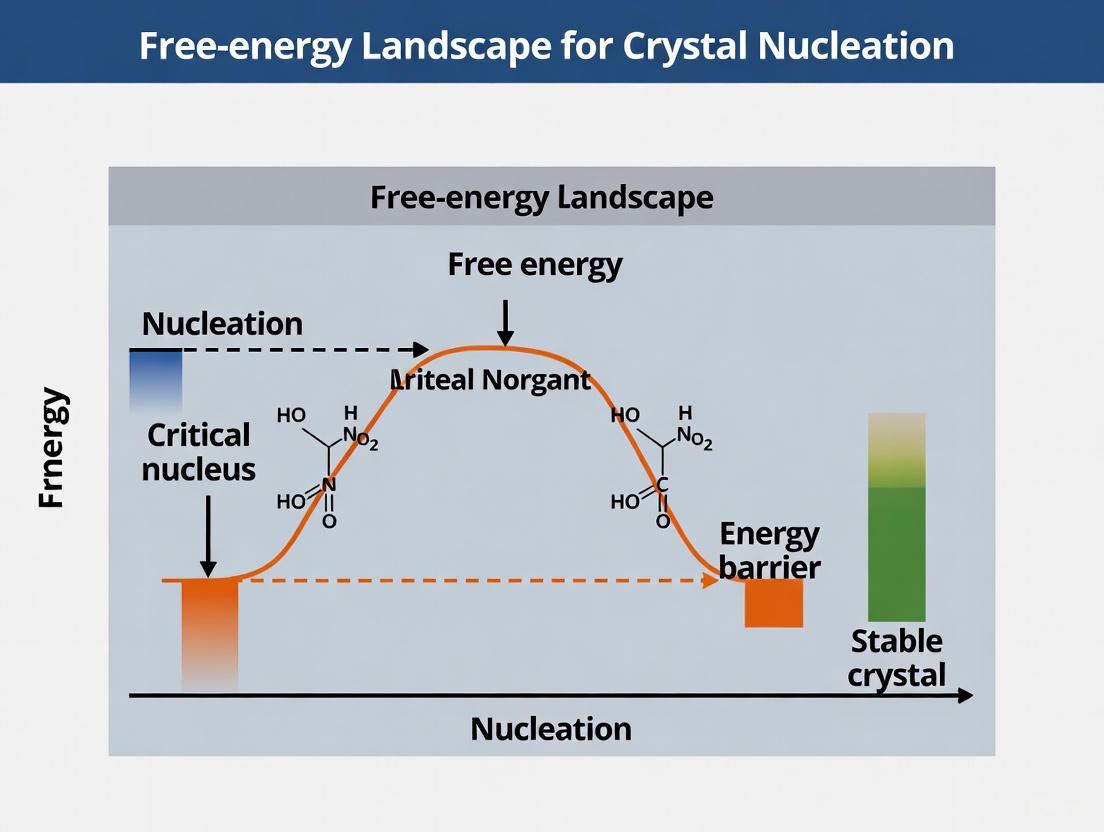
Understanding crystal nucleation is a central challenge in materials science and pharmaceutical development, governed by the complex topology of the free-energy landscape.
Navigating the Free-Energy Landscape: Unraveling Mechanisms and Controlling Crystal Nucleation
Abstract
Understanding crystal nucleation is a central challenge in materials science and pharmaceutical development, governed by the complex topology of the free-energy landscape. This article synthesizes recent advances in molecular simulations and machine learning to explore the foundational principles of these landscapes, where rival polymorphs and metastable intermediates compete. We detail cutting-edge methodological approaches for mapping nucleation pathways and quantifying kinetic barriers, address key challenges in troubleshooting polymorph selection, and validate predictions against experimental observations. By connecting theoretical insights with practical applications, this review provides a framework for controlling crystallization outcomes, with significant implications for the design of stable pharmaceutical solid forms and advanced functional materials.
The Topography of Transformation: Understanding Free-Energy Landscapes and Non-Classical Pathways
The study of crystal nucleation has long been governed by the principles of Classical Nucleation Theory (CNT), which posits a direct, single-step pathway from a disordered fluid to a stable crystalline phase. However, advanced experimental and computational investigations now reveal that crystallization frequently proceeds through far more complex, multi-stage pathways involving metastable intermediates that defy this traditional view [1]. This paradigm shift recognizes nucleation as a process navigated on a multidimensional free-energy landscape, where kinetic traps and competing polymorphs dictate the ultimate crystallization outcome. Understanding these complex pathways is particularly crucial in fields like pharmaceutical development, where the appearance of different polymorphs can dramatically alter a drug's bioavailability and stability [1]. The intricate interplay between thermodynamics and kinetics results in a complex crystal energy landscape spanned by many polymorphs and other metastable intermediates, making prediction of crystallization outcomes a long-standing challenge in solid-state chemistry [1].
Molecular simulations and new experimental methodologies are uniquely positioned to unravel this interplay, as they provide a framework to compute free energies (thermodynamics), barriers (kinetics), and visualize crystallization mechanisms at high resolution [1]. The existence of multiple polymorphs—first reported almost two centuries ago with benzamide—demonstrates that most, if not all, compounds can crystallize into more than one single crystal structure [1]. This review synthesizes recent advances that collectively challenge the classical view and provide new tools for probing, predicting, and controlling nucleation pathways in complex systems relevant to materials science and drug development.
Theoretical Framework: The Free-Energy Landscape of Nucleation
Limitations of Classical Nucleation Theory
Classical Nucleation Theory provides a foundational but incomplete picture of crystallization. CNT assumes a nucleation pathway that proceeds through the formation of an embryo of the new, thermodynamically stable phase within the metastable parent phase, with a free energy barrier arising from a balance between an unfavorable interfacial free energy cost and a favorable bulk free energy gain [1]. However, this model fails to account for the rich phenomenology observed in both natural and synthetic systems, where metastable intermediates often dominate the pathway to the final crystalline state.
The presence of metastable intermediate states during the liquid → solid transition pathway implies that nucleation becomes a two-stage process or, in other words, becomes nonclassical [1]. This deviation from classical behavior is particularly evident in systems ranging from proteins to organic molecules and minerals, where pre-nucleation clusters, dense liquid phases, and metastable polymorphs frequently precede the formation of the stable crystal phase.
The Energy Landscape Concept
The free-energy landscape formalism provides a more comprehensive framework for understanding complex nucleation pathways. In this conceptualization, the system must navigate a multidimensional terrain with multiple minima (stable and metastable states) and barriers, rather than following a single direct path [1]. The complex interplay between thermodynamics and kinetics results in a crystal energy landscape spanned by many polymorphs and other metastable intermediates [1].
The energy landscape perspective helps explain phenomena such as Ostwald's rule of stages, which summarizes the often sinuous crystallization pathway where crystallization generally proceeds through a series of transitions rather than proceeding directly into the stable crystal phase [1]. Each transition corresponds to the system leaving a metastable state to reach the closest (meta)stable state, raising fundamental questions about how to define "closeness" in this context—whether from a geometric standpoint or from an energy standpoint requiring the lowest free energy barrier [1].
Table 1: Key Concepts in Non-Classical Nucleation Theory
| Concept | Description | Experimental Evidence |
|---|---|---|
| Two-Stage Nucleation | Initial formation of dense liquid droplets followed by ordering within them | Demonstrated for proteins, colloids, and organic molecules [1] |
| Polymorphic Selection | Multiple crystalline forms competing during nucleation | Observed in pharmaceutical compounds, with different forms appearing under varying conditions [1] |
| Pre-Nucleation Clusters | Stable molecular aggregates present before nucleation | Identified in calcium carbonate, calcium phosphate, and amino acid systems |
| Non-Classical Pathways | Crystallization through intermediate phases | Amorphous precursors in biomineralization; transient phases in nanoparticle assembly |
Quantitative Experimental Studies of Complex Pathways
Methodologies for Probing Nucleation Kinetics
Advanced experimental approaches have been crucial in revealing the complexities of nucleation pathways. Quantitative studies at constant supersaturation provide particularly valuable insights, as they avoid complications introduced by changing thermodynamic conditions [2]. In these experiments, the cumulative probability P(t) that nucleation has not occurred is plotted as a function of time, providing direct information about nucleation kinetics [2].
The effective nucleation rate can be defined through the differential equation: dP(t)/dt = -h(t)P(t), where h(t) represents the nucleation rate of the subset of systems that remain in the liquid state at time t [2]. When the effective nucleation rate is constant (h(t) = k), the solution follows simple exponential decay: P(t) = exp[-kt] [2]. Deviations from this exponential behavior indicate more complex nucleation mechanisms, such as the involvement of heterogeneous nucleants or time-dependent surface properties [2].
Case Study: Massive-Scale Analysis of Amyloid Nucleation
Recent breakthroughs in high-throughput experimentation have enabled unprecedented quantification of nucleation phenomena. A landmark study quantitatively analyzed amyloid nucleation for >100,000 random protein sequences, revealing the profound complexity of protein aggregation pathways [3]. This massive experimental dataset demonstrated that existing computational methods had limited predictive power, necessitating the development of CANYA, a convolution-attention hybrid neural network that accurately predicts amyloid nucleation from sequence [3].
The analysis revealed subtle but statistically significant differences between nucleating and non-nucleating sequences. Nucleators showed higher frequencies of cysteine, asparagine, and isoleucine, and lower frequencies of arginine, leucine, and lysine [3]. Furthermore, position-specific composition analysis revealed that nucleators were significantly enriched for aliphatic residues toward the N-terminus and depleted for charged residues, with these patterns reversing toward the C-terminus [3]. These subtle, position-dependent preferences highlight the complexity of the sequence-encoded grammar governing amyloid nucleation.
Table 2: Quantitative Analysis of Amyloid Nucleation (>100,000 sequences)
| Parameter | Nucleators | Non-Nucleators | Statistical Significance |
|---|---|---|---|
| Cysteine Frequency | Higher (+0.012) | Lower | p < 2e-16 |
| Asparagine Frequency | Higher (+0.009) | Lower | p < 2e-16 |
| Arginine Frequency | Lower (-0.010) | Higher | p < 2e-16 |
| Leucine Frequency | Lower (-0.008) | Higher | p < 2e-16 |
| Average Hydrophobicity | Higher (+0.130) | Lower | p < 2e-16 |
| Beta-Sheet Propensity | Higher (+0.012) | Lower | p < 2e-16 |
Case Study: Pathway Complexity in Janus Dendrimer Self-Assembly
Research on Janus dendrimer self-assembly has provided striking visual evidence of complex nucleation pathways. These systems demonstrate reversible transitions between lamellar vesicles and inverse cubic structures, guided by temperature-triggered modulation of non-covalent interactions including OEG interdigitation and hydrogen bonding [4]. By engineering the packing parameter (p) to exceed 1 through strategic molecular design, researchers created a rich energy landscape featuring diverse assembly pathways [4].
Time-resolved cryogenic electron microscopy revealed that nonconcentric multivesicular vesicles (MVVs) initially formed after injection, then surprisingly transitioned into an inverse sponge structure encapsulated within bilayers upon annealing at 37°C [4]. These structures displayed characteristic pores representing water channels, known as interlamellar attachments, which are typical intermediate structures during the transition from lamellar membranes to cubosomes via membrane fusion [4]. Quantitative population analysis showed the progression from MVVs (∼90% initially) to vesicular-sponge structures and finally to cubosomes after 72 hours of annealing [4]. This detailed pathway analysis provides a textbook example of how molecular systems navigate complex energy landscapes through well-defined intermediate states.
Computational Advances in Modeling Nucleation
Molecular Simulations of Nucleation Pathways
Molecular simulations have become indispensable tools for deciphering nucleation complexities, offering atomic-level spatial resolution (∼1 Å) and femtosecond temporal resolution [1]. Recent progress in computational methods, particularly through augmentation with machine learning, has significantly advanced our ability to predict crystal structures and simulate crystal nucleation events [1].
Simulations have revealed how preordering of the supercooled liquid phase prior to crystallization occurs in both homogeneous and heterogeneous nucleation processes [1]. For instance, molecular dynamics simulations of silicon crystallization showed that crystallization from the High-Density Liquid (HDL) phase proceeded through a two-step process, with initial formation of a droplet of the metastable Low-Density Liquid (LDL) phase followed by nucleation of the solid phase at the LDL-HDL liquid interface [1]. Similar liquid polymorphism has been observed in water, with structural changes in supercooled water playing an important role in the crystallization process [1].
Machine Learning and Enhanced Sampling
The integration of machine learning with molecular simulation has addressed several longstanding challenges in nucleation research. Machine learning approaches have been particularly valuable for:
- Exploring complex configuration spaces more efficiently than traditional methods [1]
- Identifying meaningful collective variables that describe nucleation pathways [1]
- Developing accurate and efficient force fields for free energy calculations [1]
- Ranking metastable and stable structures reliably [1]
These computational advances now enable researchers to move beyond simple model systems to study far-from-equilibrium crystallization processes that give rise to unusual crystallization patterns and structures, as well as the formation of self-adaptive crystals that can crystallize reversibly in response to environmental cues [1].
Experimental Protocols and Methodologies
Quantitative Nucleation Kinetics at Constant Supersaturation
Well-defined experimental protocols are essential for obtaining reliable, reproducible data on nucleation pathways. For quantitative studies of nucleation at constant supersaturation, the following methodology is recommended:
System Preparation: Prepare a large number (typically ≥50) of nominally identical droplets to ensure statistical significance [2]. For solution-based systems, carefully control solvent composition, impurity levels, and supersaturation.
Data Collection: Monitor droplets over time and record the moment of nucleation, typically identified by the first visual observation of birefringence or other indicators of crystallinity [2].
Data Analysis: Plot the cumulative probability P(t) that nucleation has not occurred as a function of time. For systems with time-independent nucleation rates, this should follow exponential decay: P(t) = exp[-kt], where k is the nucleation rate [2].
Interpretation: Deviations from exponential behavior indicate more complex nucleation pathways, such as the presence of multiple nucleation mechanisms or time-dependent nucleant activity [2].
High-Throughput Amyloid Nucleation Assay
The massive-scale analysis of amyloid nucleation employed the following innovative protocol:
Library Construction: Generate libraries of random 20-amino acid peptides using NNK degenerate codons (where N = A/C/G/T and K = G/T) [3].
Selection System: Express peptide fusions with the nucleation domain of Sup35 (Sup35N), a yeast prion-forming protein that enables fitness-based selection for amyloid nucleation [3].
Selection Process: Apply selection pressure in medium lacking adenine—sequences that nucleate amyloids sequester Sup35, resulting in translational readthrough and enabling cell survival [3].
Quantification: Use deep sequencing to measure enrichment/depletion of each sequence after selection, with enrichment scores linearly related to the log of in vitro amyloid nucleation rates [3].
Classification: Classify sequences with statistically significant nucleation scores (one-sided Z-test, FDR adjusted p-value ≤ 0.05) as nucleators versus non-nucleators [3].
Janus Dendrimer Self-Assembly Pathway Analysis
For mapping energy landscapes in self-assembling systems:
Sample Preparation: Initiate self-assembly using an injection method, where a dendrimer solution in a good solvent (e.g., ethanol) is rapidly injected into water [4].
Annealing Protocol: Apply controlled heating to specific temperatures (e.g., 37°C, 50°C) for defined periods to probe different energy states in the landscape [4].
Kinetic Monitoring: Use dynamic light scattering to track hydrodynamic diameter, polydispersity index, and derived count rates throughout the annealing process [4].
Morphological Characterization: Employ cryogenic transmission electron microscopy (cryo-TEM) to visualize structural evolution at different time points [4].
Population Quantification: Randomly image substantial numbers of particles (>500 per condition) across different areas and batches to determine the populations of different structural types [4].
Visualization of Complex Nucleation Pathways
Diagram 1: Complex nucleation pathways on a free-energy landscape showing multiple routes from disordered fluid to stable crystal through various intermediate states.
Diagram 2: Experimental workflow for quantitative nucleation studies at constant supersaturation, from sample preparation to pathway identification.
The Scientist's Toolkit: Essential Research Reagents and Materials
Table 3: Key Research Reagent Solutions for Nucleation Studies
| Reagent/Material | Function in Nucleation Studies | Example Application |
|---|---|---|
| Janus Dendrimers | Model building blocks with precisely controllable molecular geometry and interactions for studying self-assembly pathways [4] | Mapping energy landscapes between lamellar and inverse cubic structures [4] |
| Sup35 Nucleation Domain | Enable fitness-based selection for amyloid nucleation in high-throughput assays [3] | Massive-scale quantification of amyloid nucleation kinetics for >100,000 sequences [3] |
| Microfluidic Devices | Create monodisperse droplets for statistically significant nucleation studies at constant supersaturation [2] | Investigating homogeneous vs. heterogeneous nucleation in isolated microenvironments |
| Cryogenic TEM | Visualize transient intermediate structures in self-assembly pathways without artifacts from staining or drying [4] | Capturing metastable sponge phases during vesicle-to-cubosome transitions [4] |
| Polyol Synthesis Systems | Provide controlled environment for nanostructure nucleation and growth with tunable parameters [5] | Studying nucleation and growth kinetics of silver nanowires [5] |
| Partitioned Quantum-Based Force Fields | Enable high-quality free energy calculations for reliable ranking of metastable and stable crystal structures [1] | Molecular simulations of complex crystallization pathways [1] |
The study of crystal nucleation has evolved dramatically from the simplistic view of Classical Nucleation Theory to a sophisticated understanding of multidimensional free-energy landscapes with complex pathways and metastable intermediates. This paradigm shift has been driven by advances in both experimental and computational methods, including high-throughput quantification, advanced microscopy, and machine-learning-enhanced simulations.
Key insights emerging from recent research include:
- Pathway complexity is the rule rather than the exception across diverse systems from proteins to organic molecules and minerals.
- Liquid-liquid phase separation and pre-nucleation clusters frequently precede crystallization in both natural and synthetic systems.
- Kinetic control often dominates over thermodynamic control in determining crystallization outcomes, particularly in complex molecular systems.
- Massive-scale experimental data combined with machine learning approaches are overcoming previous limitations in predictive modeling.
Future research directions will likely focus on far-from-equilibrium crystallization processes that give rise to unusual crystallization patterns and structures, and the formation of self-adaptive crystals that can crystallize reversibly in response to environmental cues [1]. As these advances continue, researchers and drug development professionals will gain increasingly powerful tools for predicting and controlling crystallization outcomes across a wide range of scientific and industrial applications.
In the study of crystalline materials, the concept of a free-energy landscape provides a powerful framework for understanding the stability, interconversion, and kinetic trapping of different solid forms. This landscape can be visualized as a topographic map where stable crystalline polymorphs reside in deep energy minima, while metastable forms occupy shallower valleys, separated by energy barriers that determine transition kinetics [6] [7]. The phenomenon of kinetic trapping occurs when a system remains in a metastable state because the activation energy required to transition to a more stable state is prohibitively high under given conditions [8] [9]. This interplay between thermodynamics and kinetics fundamentally governs polymorphic behavior across diverse fields, from pharmaceutical development to materials science [10] [11].
The strategic exploitation of metastable polymorphs offers significant technological opportunities. In pharmaceuticals, metastable forms can provide enhanced bioavailability, while in materials science, they enable the development of responsive systems and energy storage materials [6] [9]. However, the unpredictable disappearance of polymorphs—once obtainable forms that become irreproducible—poses substantial challenges for industrial processes requiring consistent solid-form production [11]. This whitepaper deconstructs the fundamental principles, experimental methodologies, and strategic implications of polymorphic landscapes for research and development professionals.
Theoretical Foundations: Thermodynamics and Kinetics of Polymorphic Systems
Free-Energy Landscape and Polymorphism
The free-energy landscape of a crystalline system is governed by the Gibbs free energy (G), which depends on temperature, pressure, and composition [12]. Polymorphs represent distinct packing arrangements of the same molecular compound, each corresponding to a local minimum on this landscape [7]. The global minimum represents the thermodynamically stable form under given conditions, while local minima correspond to metastable polymorphs with higher free energy [11].
According to the Ostwald-Lussac Rule of Stages (or Rule of Stages), during crystallization from solution, the system typically first forms the polymorph whose free energy is closest to that of the solvated molecules, then progressively transitions through increasingly stable forms before reaching the most stable polymorph [8]. This stepwise progression occurs because nucleation kinetics are often faster for metastable forms with lower interfacial energies, despite their thermodynamic instability [13].
Table 1: Key Thermodynamic Parameters in Polymorphic Systems
| Parameter | Symbol | Description | Experimental Determination |
|---|---|---|---|
| Free Energy Barrier | ΔG* | Energy barrier for nucleation | Calculated from Arrhenius plots [6] |
| Activation Energy | Eₐ | Minimum energy required for phase transition | Derived from temperature-dependent kinetics [6] |
| Latent Heat | ΔH | Heat absorbed/released during first-order transition | Differential Scanning Calorimetry (DSC) [11] |
| Critical Nucleus Size | r_c | Minimum stable nucleus radius | Classical Nucleation Theory [13] |
Classical Nucleation Theory and Kinetic Trapping
Classical Nucleation Theory (CNT) provides a quantitative framework for understanding the kinetic factors governing polymorph formation [13]. The nucleation rate (R) is expressed as:
[ R = NS Z j \exp\left(-\frac{\Delta G^*}{kB T}\right) ]
Where:
- (N_S) is the number of potential nucleation sites
- (Z) is the Zeldovich factor
- (j) is the rate of monomer attachment
- (\Delta G^*) is the free energy barrier for nucleation
- (k_B) is Boltzmann's constant
- (T) is temperature [13]
The free energy barrier (\Delta G^*) depends on the interfacial energy (σ) and the volume free energy change (Δg_v):
[ \Delta G^* = \frac{16\pi\sigma^3}{3|\Delta g_v|^2} ]
Kinetic trapping occurs when the energy barrier for transition from a metastable to stable form is sufficiently high to prevent interconversion within observable timescales [8] [9]. This can result from:
- High interfacial energies between polymorphs
- Low molecular mobility in the solid state
- Structural constraints that impede reorganization
- Rapid solvent evaporation during processing [8]
Experimental Methodologies: Probing Polymorphic Transitions
In-Situ Characterization of Phase Transitions
Understanding polymorphic transitions requires experimental techniques capable of monitoring structural changes in real-time under relevant conditions. In-situ High-Temperature X-ray Diffraction (HTXRD) has been successfully employed to study solid-state phase transitions in metastable amorphous-AlO(x) nanostructures transforming into crystalline alumina polymorphs (θ/γ-Al(2)O(_3)) [6]. The experimental protocol involves:
- Sample Preparation: Metastable m-AlO(_x)@C nanocomposites (<5-8 nm) synthesized via Laser Ablation Synthesis in Solution (LASiS) are deposited as thin layers on a heating stage [6].
- Temperature Programming: Samples are heated to predetermined temperatures (e.g., 750-790°C) at controlled ramp rates (~50°C/min) [6].
- Data Collection: Sequential XRD patterns are collected during isothermal holds, monitoring the growth of characteristic θ/γ-Al(2)O(3) diffraction peaks [6].
- Kinetic Analysis: Peak area integration and fitting to kinetic models (e.g., contracting volume model) to determine transformation rates [6].
For organic systems, Second Harmonic Generation (SHG) microscopy provides exceptional sensitivity for detecting noncentrosymmetric metastable polymorphs, even in microcrystalline samples [8]. The methodology includes:
- Sample Preparation: Inkjet-printing picoliter droplets of racemic amino acid solutions onto hydrophobic substrates [8].
- Rapid Crystallization: Immediate solvent evaporation promotes kinetic trapping of metastable forms [8].
- SHG Imaging: Detection of noncentrosymmetric crystals through frequency-doubled signal using a Ti:sapphire pulsed laser (800 nm, 100 fs pulse width) [8].
- Structural Validation: Correlation with synchrotron X-ray microdiffraction for polymorph identification [8].
Kinetic Analysis of Polymorphic Transformations
Quantifying transformation kinetics enables prediction of polymorphic stability and shelf-life. For the solid-state transition of m-AlO(x) → θ/γ-Al(2)O(_3, kinetic analysis from Arrhenius plots revealed an activation energy barrier of ~270±11 kJ/mol, determined using the geometric volume contraction model [6].
For solvent-mediated phase transformations (SMPTs) in pharmaceutical systems like tegoprazan, the Kolmogorov-Johnson-Mehl-Avrami (KJMA) equation models the conversion kinetics:
[ \alpha(t) = 1 - \exp(-kt^n) ]
Where:
- (\alpha(t)) is the fraction transformed at time t
- k is the temperature-dependent rate constant
- n is the Avrami exponent related to transformation mechanism [11]
Table 2: Experimental Techniques for Polymorph Characterization
| Technique | Information Obtained | Applications in Polymorph Research |
|---|---|---|
| HTXRD | Crystal structure changes with temperature | Phase transition kinetics, stability ranges [6] |
| SHG Microscopy | Presence of noncentrosymmetric crystals | Detection of metastable chiral polymorphs [8] |
| DSC | Thermal transitions and energies | Melting points, solid-solid transitions [11] |
| PXRD | Crystal structure identification | Polymorph identification and quantification [11] |
| In-situ S/TEM | Nanoscale structural changes | Direct observation of phase transitions [6] |
Case Studies: Kinetic Trapping in Diverse Material Systems
Inorganic Nanostructures: Alumina Polymorphs
The phase transition of metastable amorphous-AlO(x) nanostructures provides a exemplary case of kinetic trapping in inorganic systems [6]. Laser Ablation Synthesis in Solution (LASiS) enables kinetic entrapment of a highly disordered amorphous Al-oxide phase (m-AlO(x)@C) with unusual hyper-oxidized stoichiometry (x~2.5-3.0) [6]. Key findings include:
- The atomic density of m-AlO(x) structures is 5-10 times lower than the final θ/γ-Al(2)O(_3) phases, indicating significant volume shrinkage during transformation [6].
- HTXRD studies confirm the phase transition follows a contracting volume kinetics model [6].
- The measured activation energy (~270±11 kJ/mol) approximates the oxidation energy of micron-sized Al particles, suggesting similar atomic rearrangement mechanisms [6].
This system demonstrates how non-equilibrium synthesis routes can access metastable states with distinct properties, enabling their application as solid-solid phase change materials (SS-PCMs) for energy storage [6].
Pharmaceutical Systems: Tegoprazan Polymorphs
Tegoprazan (TPZ), a potassium-competitive acid blocker, exists in three solid forms: amorphous, Polymorph A, and Polymorph B [11]. Comprehensive investigation reveals:
- Polymorph A is thermodynamically stable across all experimental conditions [11].
- Polymorph B and the amorphous form convert to Polymorph A via solvent-mediated phase transformations (SMPTs) [11].
- Transformation pathways are solvent-dependent: methanol induces direct Polymorph A formation, while acetone shows a B→A transition [11].
- Solution-phase conformational preferences and hydrogen bonding dictate polymorph selection during crystallization [11].
Accelerated stability studies (40°C/75% RH) confirm complete conversion of metastable forms to Polymorph A within approximately eight weeks, highlighting the importance of polymorph control for pharmaceutical product consistency [11].
Organic Materials: Amino Acid Polymorphs
Inkjet-printed racemic solutions of amino acids produce nanocrystals trapped in metastable polymorphic forms upon rapid solvent evaporation [8]. This system demonstrates:
- Detection of unfavored noncentrosymmetric crystal forms via SHG microscopy, contrary to thermodynamic expectations [8].
- Evidence supporting the Ostwald Rule of Stages in molecular crystal formation [8].
- The critical role of confinement (picoliter droplets) and rapid desolvation in stabilizing metastable forms [8].
The Scientist's Toolkit: Essential Research Reagents and Materials
Table 3: Key Research Reagents and Materials for Polymorph Studies
| Reagent/Material | Function/Application | Example Use Case |
|---|---|---|
| LASiS-Synthesized Nanoparticles | Source of metastable phases | Kinetic trapping of m-AlO(_x)@C nanocomposites [6] |
| Inkjet Printing System | Controlled microdroplet deposition | Rapid crystallization for metastable polymorph production [8] |
| Anton Paar HTK1200N Chamber | High-temperature XRD studies | In-situ monitoring of phase transitions up to 790°C [6] |
| Synchrotron X-ray Microdiffraction | Structural analysis of microcrystals | Polymorph identification in printed droplets [8] |
| Cyclodextrin-based Polymers | Molecular hosts for poly(pseudo)rotaxanes | Kinetic trapping of meta-stable hydrogel states [9] |
Strategic Implications and Future Directions
The controlled manipulation of polymorphic landscapes presents both challenges and opportunities for research and development. In pharmaceutical development, understanding kinetic trapping mechanisms enables strategies to stabilize metastable forms with desirable bioavailability or to ensure consistent production of the thermodynamically stable form [11]. The phenomenon of disappearing polymorphs underscores the need for comprehensive polymorph screening and rigorous control of crystallization processes [11].
Future research directions include:
- Advanced computational prediction of polymorphic landscapes incorporating solvation effects and conformational flexibility [11].
- Machine learning approaches to correlate molecular structure with polymorphic behavior [14].
- Multi-scale modeling connecting molecular-level interactions to macroscopic crystallization outcomes [13] [11].
- Real-time process analytical technologies (PAT) for dynamic control of crystallization processes [8].
The systematic deconstruction of polymorphic landscapes continues to provide fundamental insights into crystal nucleation and growth while enabling technological advances across materials science, pharmaceuticals, and energy storage applications. Through continued integration of theoretical modeling, advanced characterization, and kinetic analysis, researchers can increasingly navigate the complex topography of polymorphic systems with predictive precision.
The crystallization of a solid phase from a solution, melt, or vapor is a fundamental process in materials science, chemistry, and pharmaceutical development. While classical nucleation theory posits a direct pathway from a disordered fluid to a stable crystalline phase, empirical evidence across diverse systems reveals a more complex, multi-step journey. Ostwald's rule of stages conceptualizes this journey, stating that a system undergoing a phase transformation does not necessarily transition directly to the most thermodynamically stable state but instead proceeds through a series of metastable intermediates of increasing stability [15] [1]. This rule is not a universal law but a common tendency observed in nature, driven by kinetics [15].
This whitepaper examines the action of Ostwald's rule through the lens of free-energy landscape theory, framing crystallization as a journey across a complex energy terrain. Within this landscape, metastable intermediates correspond to local free-energy minima that are kinetically accessed before the system reaches the global minimum represented by the stable phase. We will explore experimental and computational evidence across molecular, peptide, and material systems, provide detailed methodologies for probing these pathways, and discuss the critical implications for controlling solid-form outcomes in scientific and industrial applications.
Theoretical Foundation: Free-Energy Landscapes and Kinetic Pathways
The free-energy landscape provides a conceptual and quantitative framework for understanding Ostwald's rule. In this construct, the conformational states of a system—from disordered monomers to various polymorphic assemblies—are mapped onto a multi-dimensional surface where the vertical axis represents free energy and the horizontal axes represent structural or collective variables.
The Topography of Nucleation
In the context of crystal nucleation, the stable crystalline phase occupies the global free-energy minimum. However, the landscape is often rugged, featuring several local minima that correspond to metastable polymorphs or amorphous intermediates. The presence of these local minima is a prerequisite for Ostwald's rule. The initial formation of a less stable polymorph occurs because the free-energy barrier separating the parent phase from this metastable intermediate is lower than the barrier leading directly to the stable phase [1]. These unstable polymorphs often more closely resemble the structure of the parent phase, providing a kinetic advantage for their formation [15].
A Network of Transitions
Advanced computational studies depict this landscape as a kinetic transition network. For instance, research on Aβ42 amyloid monomers shows that their free-energy landscape is partitioned into distinct basins, including a disordered ground state and multiple assembly-competent states (N) [16]. The transitions between these states can be visualized as pathways on a network, where the system hops between discrete minima. The observation that for Aβ42, "the transitions to the different N states are in accord with Ostwald’s rule of stages, with the least stable structures forming ahead of thermodynamically favored ones" provides a direct molecular-scale validation of the rule within the free-energy landscape paradigm [16].
Table 1: Key Features of a Free-Energy Landscape Governing Ostwald's Rule.
| Feature | Description | Role in Ostwald's Rule |
|---|---|---|
| Global Minimum | The state with the lowest free energy; the thermodynamically stable product. | The final destination of the transformation process. |
| Local Minima | Metastable states with free energy higher than the global minimum but lower than their immediate surroundings. | Act as the transient intermediates in the multi-step pathway. |
| Free-Energy Barriers | The energy input required to transition from one state to another. | Dictate the kinetic accessibility of states; lower initial barriers to metastable states drive the rule. |
| Kinetic Traps | Deep local minima from which escape is slow, potentially halting the transformation. | Can lead to the isolation and persistence of a metastable intermediate. |
Ostwald's Rule in Diverse Experimental Systems
The progression dictated by Ostwald's rule has been observed in a wide array of materials, from organic peptides to metal-organic frameworks, underscoring its broad relevance.
Dipeptide Supramolecular Polymers
A classic demonstration of Ostwald's rule is found in the self-assembly of the dipeptide Boc-diphenylalanine (Boc-FF). The process begins with soluble monomers coalescing into amorphous nanospheres. These spheres are transient, acting as a reservoir of material that subsequently evolves. The next stage involves the formation of a fibrillar gel phase, which possesses a greater degree of short-range order than the spheres but remains largely amorphous. The final, thermodynamically stable product is highly crystalline tubular structures [17]. The conversion from one phase to the next is driven by dissolution and recrystallization, where material from the less stable phase dissolves and is incorporated into the more stable one [17]. This stepwise progression—monomers → spheres → fibrils → tubes—occurs in order of increasing thermodynamic stability, a direct manifestation of Ostwald's rule.
Amyloid-β Protein Aggregation
In the context of neurodegenerative diseases, the aggregation of amyloid-β (Aβ) peptides into fibrillar plaques follows a non-classical nucleation pathway. The monomeric, intrinsically disordered peptides first transition into assembly-competent states (N). These N states are excitations on the monomer free-energy landscape and bear structural resemblance to the final fibril polymorphs [16]. Computational studies using kinetic transition networks show that for the Aβ42 isoform, the system accesses different N* states in sequence. The less stable U-bend N* structure forms before the more stable S-bend N* conformation, in accordance with Ostwald's rule [16]. This initial step is crucial as it initiates the aggregation cascade and dictates the subsequent pathway and morphology of the resulting fibrils.
Metal-Organic Frameworks (MOFs)
The formation of complex materials can also proceed through transient intermediates. The synthesis of the amorphous Fe-BTC framework involves a multi-stage mechanism. In situ X-ray absorption spectroscopy revealed the rapid appearance of a transient intermediate species, characterized by a change in the oxidation state of the iron metal centers, before the formation of the final amorphous framework [18]. This suggests that even for amorphous products, the assembly pathway can be sinuous and involve defined, though short-lived, intermediate states that align with the principles of non-classical nucleation and Ostwald's rule [18].
Calcium Carbonate and Polymer Crystallization
Other well-documented examples include the precipitation of calcium carbonate, which can proceed through an unstable colloidal gel to the metastable vaterite polymorph before transforming to the stable polymorphs aragonite or calcite, depending on temperature [15]. Similarly, molecular-dynamics simulations of polymer crystallization, such as a single polyethylene chain, show the folding process involves several intermediate ordered metastable states before arriving at a well-defined long-lived lamellar structure, a microscopic manifestation of the Ostwald step rule [19].
Table 2: Manifestations of Ostwald's Rule Across Material Systems.
| System | Observed Pathway (Less Stable → More Stable) | Experimental Evidence |
|---|---|---|
| Boc-FF Dipeptide | Monomers → Amorphous Nanospheres → Fibrillar Gel → Crystalline Tubes | Time-lapse optical microscopy, SEM, powder X-ray diffraction [17] |
| Amyloid-β (Aβ42) | Random Coil Monomers → U-bend N* State → S-bend N* State | Molecular dynamics simulations, kinetic transition network analysis [16] |
| Fe-BTC MOF | Metal/Linker Solution → Transient Fe(II) Intermediate → Amorphous MOF | In situ X-ray absorption spectroscopy, kinetic analysis [18] |
| Calcium Carbonate | Unstable Colloidal Gel → Vaterite → Calcite/Aragonite | Crystallization experiments [15] |
Probing the Pathway: Key Experimental and Computational Methodologies
Unraveling transient nucleation pathways requires techniques with high spatial and temporal resolution, capable of capturing short-lived species and quantifying energy landscapes.
Experimental Techniques
- In Situ X-ray Absorption Spectroscopy (XAS): This technique is powerful for probing the local electronic and geometric structure around metal centers during a reaction. As demonstrated in the study of Fe-BTC formation, using a flow reactor coupled with synchrotron XAS allows for the collection of spectra with sub-second time resolution. This high temporal resolution is essential for identifying and characterizing transient intermediates, such as the proposed Fe(II) species that appears during the synthesis [18].
- Time-Lapse Optical Microscopy and Scattering Techniques: Monitoring changes in turbidity, morphology, and size over time provides low-resolution but essential kinetic data. For Boc-FF, time-lapse optical microscopy directly visualized the spatial conversion of spheres into fibrils and tubes [17]. Techniques like dynamic light scattering (DLS) or small-angle X-ray scattering (SAXS) can quantify the size and shape of pre-nucleation clusters and early-stage nuclei in solution.
- Powder X-ray Diffraction (PXRD): This method is used to distinguish between amorphous and crystalline phases and to identify specific polymorphs. By isolating samples at different time points, researchers can track the evolution of crystallinity, as shown by the distinct patterns for amorphous spheres, partially ordered fibrils, and crystalline tubes in the Boc-FF system [17].
Computational Techniques
- Molecular Dynamics (MD) Simulations: MD simulations model the physical movements of atoms and molecules over time, providing atomic-level insight into nucleation mechanisms. They can reveal the formation of liquid-like precursors, intermediate metastable states, and the final crystalline order, as seen in simulations of CO2 crystallization and polyethylene folding [19] [20].
- Free-Energy Landscape Calculation: Using enhanced sampling methods, researchers can compute the free-energy landscape of a system as a function of key collective variables (e.g., structural order parameters, density). This allows for the identification of stable and metastable minima and the free-energy barriers between them. The depiction of the landscape as a disconnectivity graph offers a faithful representation of the underlying kinetics and connectivity between states [16].
- Kinetic Transition Network Analysis: This approach involves discretizing the conformational space into states and modeling transitions between them as a network. This network can be analyzed to identify the most probable pathways of transition and the commitment probabilities between states, providing a quantitative framework for verifying the sequence of events predicted by Ostwald's rule [16].
The Scientist's Toolkit: Essential Reagents and Methods
Table 3: Key Research Reagent Solutions and Computational Tools.
| Item / Technique | Function / Role in Investigation | Example Application |
|---|---|---|
| Synchrotron XAS | Probes local structure/oxidation state of metals in solution with high time resolution. | Identifying a transient Fe(II) intermediate during amorphous Fe-BTC formation [18]. |
| Molecular Dynamics (MD) Software (e.g., LAMMPS) | Simulates the temporal evolution of a molecular system based on a force field. | Modeling the primary nucleation and folding pathway of a polyethylene chain [19] [20]. |
| Well-Calibrated IDP Force Fields | Specialized molecular models for simulating intrinsically disordered proteins (IDPs). | Characterizing the free-energy landscapes and N* states of amyloid-β monomers [16]. |
| Flow Reactor | Enables rapid and reproducible mixing of reagents for initiation of fast reactions. | Coupled with synchrotron XAS to study the rapid synthesis of Fe-BTC [18]. |
| Kinetic Cluster Analysis (e.g., DRID metric) | Partitions conformational simulation data into kinetically relevant states. | Constructing kinetic transition networks from MD simulation trajectories [16]. |
Ostwald's rule of stages provides a foundational principle for understanding the complex, multi-step pathways that characterize crystallization and self-assembly processes. The evidence from dipeptides, proteins, MOFs, and simple organics consistently shows that transformation proceeds through a series of metastable intermediates, guided by the topography of the underlying free-energy landscape. The role of these transient intermediates is critical; they are not mere artifacts but essential waypoints that can dictate the final outcome in terms of polymorph selection, material morphology, and functional properties.
For researchers and drug development professionals, mastering this concept is paramount. The ability to probe, model, and ultimately control these pathways—by manipulating solution conditions, temperature, or through the use of additives—offers a powerful strategy for targeting desired crystalline forms, whether the goal is a specific pharmaceutical polymorph with optimal bioavailability or a functional material with tailored catalytic properties. Recognizing that the first product to form is often not the most stable is the first step toward sophisticated control over solid-state matter.
The formation of crystals from a solution has traditionally been explained by Classical Nucleation Theory (CNT), which posits that solute molecules assemble directly into an ordered crystalline nucleus through the sequential addition of individual monomers [21]. While qualitatively successful, CNT frequently fails to provide quantitative predictions of nucleation phenomena and cannot explain the significant discrepancies—sometimes exceeding ten orders of magnitude—between its predicted nucleation rates and experimental observations, particularly for protein crystals [22]. This limitation has profound implications for fields ranging to structural biology and pharmaceutical development, where control over crystallization is critical.
In response to these shortcomings, the two-step nucleation mechanism has been proposed as a non-classical pathway. This mechanism suggests that crystal formation occurs via an intermediate metastable state, rather than directly from the solution [22]. The first step involves the formation of disordered, dense, liquid-like clusters of the solute. In the second step, crystalline nuclei form within the confines of these pre-existing clusters [22] [23]. Evidence for this mechanism has been found in a diverse range of systems, including proteins, small-molecule organics, colloids, and biominerals [22]. This whitepaper delineates the case for the two-step nucleation mechanism, framing it within the broader context of free-energy landscape research and detailing the experimental and theoretical advances that have solidified its status as a fundamental concept in crystallization science.
Theoretical Framework: Beyond Classical Nucleation Theory
Limitations of the Classical Model
Classical Nucleation Theory is built upon two fundamental assumptions that have been increasingly challenged. First, it employs the "capillary approximation," which assigns the interfacial tension of a macroscopic body to nascent, nanoscale nuclei. Second, it assumes that the internal structure of these nascent nuclei is identical to the bulk crystalline material [21]. CNT envisions a nucleation pathway where monomers are added one-by-one to form a crystalline nucleus, which becomes stable only after reaching a critical size where the bulk free energy gain balances the surface energy cost [23]. The (pre-)critical nuclei are considered rare, high-energy species, and their population is expected to decay exponentially with size [21].
The Two-Step Mechanism and its Free Energy Landscape
The two-step mechanism revolutionizes this view by introducing a metastable intermediate. It posits that the first step is the formation of disordered protein-rich clusters of mesoscopic size. The second step is the formation of crystal nuclei inside these clusters [22]. This pathway is often described as proceeding via prenucleation clusters (PNCs), which are stable solute entities existing in solution even before the formation of a new phase [24] [21]. These PNCs are not considered distinct particles with a phase interface but are rather conceptualized as dynamic, dense liquid phases [22] [25].
From the perspective of the free energy landscape, the two-step pathway can be understood as a means to lower the overall activation barrier for nucleation. The formation of a disordered liquid cluster, while incurring a free energy cost, creates a local environment with a significantly higher solute concentration. This concentrated environment subsequently lowers the barrier for the formation of an ordered crystalline nucleus within it compared to forming one directly from the dilute solution.
Recent theoretical work has successfully formulated and tested the free energy surface for two-step nucleation. Iwamatsu's extension of CNT provides a thermodynamic framework for TSN, and its predictions show excellent quantitative agreement with Monte Carlo simulations of a simple lattice system without requiring adjustable parameters [26]. This demonstrates that the thermodynamics of TSN can be robustly understood and modeled, providing a solid foundation for interpreting experimental data.
Table 1: Core Concepts of Nucleation Pathways
| Concept | Classical Nucleation Theory | Two-Step Nucleation Mechanism |
|---|---|---|
| Fundamental Pathway | One-step, direct assembly from solution | Two-step process via a metastable intermediate |
| Key Intermediate | None (direct formation of crystalline embryo) | Dense liquid clusters / Prenucleation Clusters |
| Nature of Precursors | Rare, unstable, high-energy fluctuations | Metastable, mesoscopic clusters |
| Primary Driving Force | Overall supersaturation of the solution | Local density/concentration fluctuations within clusters |
| Theoretical Status | Established but often quantitatively inaccurate | Emerging, with robust frameworks showing strong agreement with simulation [26] |
The following diagram illustrates the key stages of the two-step nucleation pathway and the methods used to study it.
Quantitative Characterization of Nucleation Precursors
Experimental characterization of the metastable clusters central to the two-step mechanism is technically demanding due to their transient nature, small size, and low population density. Despite these challenges, multiple techniques have converged to provide a quantitative picture of their properties.
For several proteins, including lumazine synthase and lysozyme, these protein-rich clusters have been characterized. They occupy a very small fraction of the total solution volume, between 10⁻⁷ to 10⁻³, and possess radii typically on the order of 50–500 nm [22]. The local protein concentration within these clusters is extraordinarily high, estimated at ~500 mg ml⁻¹ or higher, which is roughly ten times the cluster volume fraction [22]. The average separation between individual clusters in solution is on the order of micrometers [22].
In calcium carbonate systems, prenucleation clusters have been identified as the precursors to liquid-liquid phase separation. The formation and stability of these dense liquid droplets can be quantitatively described by a model based on ion association thermodynamics [25]. This model defines both the binodal limit (the boundary for liquid-liquid demixing) and the spinodal limit (where phase separation is barrier-less). The solubility of amorphous calcium carbonate (ACC) varies depending on where it forms within this metastable zone, with the highest possible solubility defined by the spinodal limit [25]. The ion activity product (IAP) at the spinodal limit can be predicted by the relationship: IAP(spinodal) = [K(cluster)]⁻², where K(cluster) is the ion association constant [25].
Table 2: Experimentally Determined Properties of Nucleation Precursors in Different Systems
| System | Size / Scale | Key Quantitative Features | Experimental Methods |
|---|---|---|---|
| Proteins (e.g., Lumazine Synthase) | Radius: 50–500 nm | Cluster volume fraction: 10⁻⁷ – 10⁻³Intra-cluster concentration: ≥500 mg ml⁻¹ | Dynamic Light Scattering (DLS), Atomic Force Microscopy (AFM), Brownian Microscopy (BM) [22] |
| Calcium Carbonate | Nanoscopic / Molecular | Solubility of ACC varies between binodal and spinodal limits.Spinodal IAP predicted by ion association constant [25] | Potentiometric Titration, Stopped-Flow ATR-FTIR Spectroscopy [25] |
| Organic Molecules (e.g., BF2DBMb) | Molecular Aggregates | Detection of transient amorphous state prior to crystallization.Average aggregate size: ~12 molecules [23] | Fluorescence Spectroscopy, X-Ray Diffraction (XRD) [23] |
Experimental Protocols for Probing Two-Step Nucleation
Dynamic Light Scattering (DLS) for Cluster Detection
DLS is particularly well-suited for detecting mesoscopic clusters because the intensity of scattered light is proportional to the sixth power of the radius of the scatterer (Rayleigh law). Consequently, clusters that are 100 nm in size scatter light ~10¹² times more intensely than individual protein molecules, making them detectable even at very low volume fractions [22].
Protocol Outline:
- Sample Preparation: Prepare a clarified, supersaturated protein solution using appropriate buffers and filtration (e.g., 0.1 μm filter) to remove dust.
- Instrumentation: Use a commercial DLS instrument equipped with a laser light source and a sensitive detector positioned at a fixed angle (commonly 90° or 173° backscatter).
- Measurement: The intensity of scattered light is measured over time, producing fluctuations that correspond to the Brownian motion of particles in solution.
- Data Analysis: The intensity autocorrelation function is calculated. For a solution containing both fast-moving monomers and slow-moving clusters, the correlation function decays over multiple timescales. Specialized algorithms, such as the CONTIN inverse Laplace transform, are used to resolve the distribution of decay rates, which is then converted into a size distribution histogram [22].
Direct Imaging via Atomic Force and Confocal Microscopy
Atomic Force Microscopy (AFM) provides direct topographic images of clusters that have landed on a crystal surface.
- Procedure: A sharp tip on a cantilever scans the surface of a crystal growing in solution. Deflections of the cantilever are used to construct a 3D image of the surface topology.
- Application: This method has visualized clusters ~100 nm in height on the (001) face of lumazine synthase crystals. These clusters were observed to spread and generate new crystal layers, integrating into the crystal lattice [22].
- Limitations: The imaging time (tens of seconds to minutes) can be longer than the intrinsic lifetime of free clusters in solution. The small view field also reduces the probability of observation [22].
Scanning Confocal Microscopy (SCM) has been used to obtain spectacular images of clusters in solutions of various proteins like glucose isomerase and lysozyme.
- Advantage: This technique allows for the direct, three-dimensional visualization of clusters within the bulk solution and can monitor their role in nucleation and crystal growth in real-time [22].
Fluorescence Tracking of Molecular Assembly
Fluorescence spectroscopy is a powerful tool for probing molecular assembly processes, especially for organic molecules whose emission properties are sensitive to their aggregation state.
Protocol (Based on BF2DBMb Evaporative Crystallization) [23]:
- Material Selection: Use a fluorophore that exhibits distinct emission spectra and colors in its monomeric, amorphous aggregate, and crystalline states. The mechanofluorochromic molecule BF2DBMb, for instance, emits purple as a monomer, greenish-orange in an amorphous cluster, and blue as a crystal.
- In-Situ Monitoring: Place a droplet of the fluorophore solution (e.g., 3.1 × 10⁻² mol·dm⁻³ in 1,2-dichloroethane) on a microscope slide and observe under a fluorescence microscope during solvent evaporation.
- Spectral Acquisition: Collect fluorescence spectra at regular time intervals. The evolving spectra are then deconvoluted using non-linear least-squares fitting with Gaussian functions corresponding to the monomer, amorphous, and crystalline species.
- Data Interpretation: Plot the relative abundance of each species over time. A consecutive reaction—monomer → amorphous cluster → crystal—provides direct visual and spectroscopic evidence for the two-step pathway [23].
The Scientist's Toolkit: Essential Reagents and Materials
Table 3: Key Research Reagent Solutions and Materials
| Item / Reagent | Function / Application in Research | Example Use Case |
|---|---|---|
| Model Proteins (Lysozyme, Lumazine Synthase) | Well-characterized model systems for studying protein crystallization kinetics and mechanisms. | Detecting protein-rich clusters via DLS and AFM [22]. |
| Calcium Salts & Carbonate Buffer | Fundamental system for studying biomineralization and non-classical nucleation pathways. | Investigating the PNC pathway and liquid-liquid phase separation in CaCO₃ [25] [21]. |
| Mechanofluorochromic Fluorophores (e.g., BF2DBMb) | Probes for molecular assembly via fluorescence color changes during crystallization. | Direct visualization of the amorphous intermediate state during evaporative crystallization [23]. |
| Polymers (HPMC, PVP, Eudragit) | Additives used to inhibit nucleation and crystal growth in supersaturated drug solutions. | Studying the inhibition mechanism of crystal nucleation of poorly water-soluble drugs like alpha-mangostin [27]. |
| Stopped-Flow ATR-FTIR | Rapid mixing device coupled with spectroscopy for kinetic studies of fast precipitation reactions. | Monitoring the evolution of carbonate vibrational bands immediately after mixing Ca²⁺ and CO₃²⁻ solutions [25]. |
Implications and Applications
Polymorph Control and Material Design
The two-step mechanism provides a new lever for controlling crystal polymorphism, a critical factor in the pharmaceutical industry where different polymorphs can have vastly different bioavailability and stability. By manipulating the properties of the precursor clusters—for instance, through pH, temperature, or additives—it becomes possible to steer nucleation toward a specific polymorph. The existence of distinct "proto-structures" for calcite, vaterite, and aragonite within amorphous calcium carbonate precursors exemplifies this principle [25]. This insight is invaluable for the biomimetic design of advanced functional materials with sophisticated microstructures.
Crystallization Inhibition in Pharmaceutical Science
Understanding nucleation pathways is essential for controlling crystallization, both to promote it (e.g., in API purification) and to inhibit it (e.g., in supersaturated drug formulations). Polymers like polyvinylpyrrolidone can effectively maintain supersaturation of poorly water-soluble drugs by inhibiting nucleation. The efficacy of these polymers is not due to increased solution viscosity but is correlated with the strength of specific polymer-drug molecular interactions, which likely disrupt the formation or evolution of the critical precursor clusters [27]. This allows for a more rational selection of crystallization inhibitors in drug development.
The following diagram summarizes the experimental workflows used to validate the two-step nucleation model across different material systems.
How Intermolecular Interactions Sculpt the Free-Energy Landscape
The formation of ordered molecular crystals from a disordered solution or melt is a fundamental process in materials science and pharmaceutical development. The pathway and outcome of this process are governed by the free-energy landscape (FEL), a conceptual and mathematical mapping of the free energy of a system across all its possible molecular configurations. This landscape is not flat; it is characterized by deep free-energy basins corresponding to stable or metastable states (such as different crystal polymorphs) and free-energy barriers that the system must overcome to transition between these states. The height of these barriers determines the kinetics of crystallization, while the depth of the basins determines the thermodynamic stability of the resulting phases.
Intermolecular interactions—including van der Waals forces, hydrogen bonding, electrostatic, and π-π interactions—are the primary sculptors of this landscape. The subtle balance between enthalpy and entropy, and the competition between intramolecular strain and intermolecular stabilization, dictate the topography of the FEL. For flexible molecules, adopting a crystallization-competent conformation often comes with an intramolecular energy penalty. This cost must be compensated by the stabilization gained from packing efficiently into a crystal lattice. Research has revealed an empirical "40% limit," where up to 40% of the gained intermolecular stabilization energy can be used to compensate for intramolecular strain, beyond which the probability of observing a high-energy conformation in the solid state becomes negligible [28].
Understanding the FEL is particularly critical in the pharmaceutical industry, where different polymorphs of a drug substance can have vastly different bioavailability, stability, and processability. The ability to predict and navigate the FEL enables the targeted crystallization of the most desirable polymorph, preventing the appearance of unexpected and potentially disastrous forms late in the drug development process.
Fundamental Principles: How Interactions Mold the Landscape
The Polymorphic Landscape and Ostwald's Rule
Most compounds can crystallize into more than one crystal structure, or polymorph. This phenomenon is so widespread that it is governed by Ostwald's rule of stages, which posits that crystallization does not necessarily proceed directly to the most stable phase but often traverses a series of metastable intermediates [1]. The FEL for such a system is complex, featuring multiple basins of attraction corresponding to these polymorphs. The order in which these basins appear and their relative depths and connectivity determine the crystallization pathway.
- Metastable Intermediates: The initial phase to nucleate may be a metastable polymorph that, while not the global free-energy minimum, has a lower nucleation barrier. The system may later transition to a more stable form.
- Concomitant Polymorphism: Under certain conditions, multiple polymorphs may nucleate simultaneously, reflecting the fact that their respective free-energy basins are accessible under the same thermodynamic conditions [1].
- Cross-Nucleation: A crystal of the stable polymorph can sometimes act as a substrate for the growth of a metastable polymorph, a phenomenon that underscores the complex kinetics dictated by the FEL [1].
Classical and Non-Classical Nucleation Pathways
The Classical Nucleation Theory (CNT) provides a foundational model for understanding the initial emergence of a crystal from a disordered phase. CNT describes the formation of a critical nucleus as a balance between the bulk free energy gain of forming the new phase and the surface free energy cost of creating the interface [13].
The free energy change for forming a spherical nucleus of radius r is given by:
ΔG = (4/3)πr³Δg_v + 4πr²σ
where Δg_v is the free energy change per unit volume (negative in a supersaturated system), and σ is the interfacial surface free energy [13]. This relationship results in a free-energy barrier, ΔG*, which the system must overcome for a stable nucleus to form.
However, CNT often fails to fully explain experimental observations, particularly for complex molecular systems. This has led to the identification of non-classical nucleation pathways, most notably the two-step mechanism [29]. In this process, the system does not form a crystal nucleus directly. Instead, it first passes through a metastable intermediate, such as a dense liquid droplet, within which the crystal then nucleates. This implies that at least two order parameters are needed to describe the transition: one for density and another for structural order [1]. This two-step process effectively creates a more complex FEL with an additional intermediate basin, which can significantly lower the overall barrier to crystallization.
The Critical Balance: Intra- versus Intermolecular Energy
For flexible molecules, the FEL is shaped by both the conformational energy of the isolated molecule and its packing energy in the crystal. The total lattice energy can be partitioned as [28]:
E_latt-global = E_inter + E_intra-global
E_inter: The intermolecular stabilization energy from crystal packing.E_intra-global: The intramolecular energy penalty, comprising the energy required to distort the molecule from its gas-phase minimum (E_adjustment) and the energy difference of the starting gas-phase conformer relative to the global minimum (ΔE_change-global).
Recent research analyzing 125 crystal structures of flexible molecules has quantified the relationship between these competing energies. The analysis revealed a striking "40% limit": the intramolecular energy penalty incurred rarely exceeds 40% of the intermolecular stabilization energy gained [28]. This defines the energetic crystallizability limit for flexible molecules. If the conformational distortion required for optimal packing demands an energy cost beyond this limit, the crystal structure is unlikely to form. This quantitative finding provides a crucial tool for predicting which molecular conformations are likely to be observed in the solid state and for rationally guiding the sampling of hypothetical crystal structures.
Table 1: Key Energy Terms in Molecular Crystal Free-Energy Landscapes
| Energy Term | Symbol | Description | Role in Sculpting the FEL |
|---|---|---|---|
| Intermolecular Energy | E_inter |
Stabilization from molecule-molecule interactions in the crystal lattice. | Creates deep basins (free-energy minima) for stable crystal packings. |
| Intramolecular Energy | E_intra-global |
Energetic penalty for conformational distortion from the gas-phase global minimum. | Creates barriers between basins; high penalties can make certain packings inaccessible. |
| Adjustment Energy | E_adjustment |
Energy required to distort a gas-phase conformer into its crystal conformation. | A component of E_intra-global; quantifies the strain of the crystal conformation. |
| Free Energy Barrier | ΔG* |
The energy maximum that must be overcome to form a stable crystal nucleus. | Determines the kinetics and rate of nucleation. |
| Lattice Energy | E_latt-global |
The total energy of the crystal, E_inter + E_intra-global. |
Determines the relative thermodynamic stability of different polymorphs. |
Computational Methodologies for Mapping the Landscape
Computational chemistry provides the tools to visualize and quantify the FEL. The choice of method depends on the specific question, whether it is the initial prediction of possible crystal structures (Crystal Structure Prediction, CSP) or the exploration of the pathways and barriers between them.
Crystal Structure Prediction (CSP) and Lattice Energy Ranking
CSP workflows generate thousands of candidate crystal structures and rank them by their lattice energy to identify the most probable polymorphs. The accuracy of the energy model is paramount, as energy differences between polymorphs are often only a few kJ/mol [30].
- Hierarchical Workflows: Traditional CSP uses a multi-stage approach. Initial stages use fast but approximate methods (e.g., classical force fields) to generate and coarsely filter structures. The final ranking relies on highly accurate but computationally expensive dispersion-inclusive Density Functional Theory (DFT) [30].
- The Role of Machine Learning: Recent advances leverage Machine Learning Interatomic Potentials (MLIPs) to achieve DFT-level accuracy at a fraction of the computational cost. For example, the FastCSP workflow uses the Universal Model for Atoms (UMA) MLIP to relax and rank crystal structures, eliminating the need for a final DFT re-ranking step and enabling high-throughput CSP [30].
- Accurate Energy Partitioning: Benchmarking studies have identified that the PBE-MBD/B2PLYPD method (using PBE-MBD for intermolecular and B2PLYPD double hybrid functional for intramolecular energies) most accurately reproduces experimental polymorph stabilities, with a mean absolute deviation of just 2.3 kJ·mol⁻¹ [28]. This allows for a reliable decomposition of the lattice energy into its inter- and intra-molecular components.
Exploring Connectivity and Barriers: The Threshold Algorithm
While CSP identifies local minima on the FEL, the Monte Carlo Threshold Algorithm provides a global picture of the landscape's connectivity. This algorithm explores the FEL by performing random structural perturbations, accepting only those that keep the system's energy below a defined "lid energy" [31].
- Protocol:
- Start from a local energy minimum (e.g., a predicted polymorph).
- Perform Monte Carlo moves (molecular translations, rotations, unit cell changes) with a low initial lid energy.
- Gradually increase the lid energy. Each time the lid is raised, new regions of the landscape become accessible.
- When the trajectory visits a new energy minimum, the energy barrier is estimated as the current lid energy.
- Repeat from multiple starting structures to build a complete map.
- Output - Disconnectivity Graphs: The results are visualized as a disconnectivity graph. This tree-like diagram condenses the high-dimensional FEL, showing all local minima and the energy barriers that separate them. The vertical axis represents energy, and the branching pattern shows which minima interconnect at specific energy levels [31]. This reveals whether a polymorph sits in a deep, isolated basin (kinetically stable) or a shallow one connected by low barriers to other structures (likely to interconvert).
Diagram 1: A disconnectivity graph generated from threshold algorithm simulations. At low lid energies (e.g., 5 kJ/mol), minima are isolated. As the lid energy increases, barriers are overcome, and minima merge into "superbasins," revealing the connectivity of the landscape. Polymorph C is in a deep, stable basin, while Minima 4 and 5 are separated by higher barriers.
Path Sampling and the Committor Analysis
For studying the specific molecular transitions, such as nucleation or solid-solid phase transformations, path sampling methods are used to identify the most probable transition pathways and the critical transition state.
- Gen-COMPAS Framework: This is a generative committor-guided path sampling framework that reconstructs transition pathways without predefined collective variables. It combines a generative diffusion model, which produces physically realistic molecular intermediates, with a learned committor function [32].
- The Committor (q): The committor is the probability that a configuration, initiated with random momenta, will reach the product state (B) before the reactant state (A). The transition state ensemble is defined by configurations with a committor of q = 0.5 [32].
- Protocol:
- Run short, unbiased simulations from states A and B to generate initial data.
- Train a generative model to produce intermediates and a committor predictor.
- Use the model to generate structures near the q=0.5 transition state.
- Shoot unbiased simulations from these points to discover new pathways.
- Iteratively retrain the models with new data until convergence [32].
This framework efficiently pinpoints transition states and dominant pathways, providing both kinetic and thermodynamic information directly from the FEL.
Table 2: Comparison of Computational Methods for Free-Energy Landscape Exploration
| Method | Primary Function | Key Outputs | Advantages | Limitations |
|---|---|---|---|---|
| Crystal Structure Prediction (CSP) [30] | Enumerate and rank stable crystal structures. | List of low-energy polymorphs with structures and energies. | Comprehensive identification of thermodynamically viable polymorphs. | Does not directly provide information on kinetic accessibility or pathways. |
| Threshold Algorithm [31] | Explore connectivity and barriers between known structures. | Disconnectivity graph; energy barriers between minima. | Provides a global view of the landscape connectivity; identifies kinetically stable phases. | Computationally intensive; typically applied to rigid molecules or a limited set of starting structures. |
| Gen-COMPAS Path Sampling [32] | Discover transition pathways and transition states. | Transition-state ensemble, dominant pathways, committor values. | Does not require pre-defined reaction coordinates; recovers both kinetics and thermodynamics. | Relies on iterative training of machine learning models. |
Practical Protocols for Key Experiments
Protocol: Calculating Partitioned Lattice Energies for a Flexible Molecule
This protocol details the steps to compute and analyze the intramolecular and intermolecular energy components of a crystal structure, as described in the benchmarking of flexible molecules [28].
Objective: To determine the intramolecular energy penalty and intermolecular stabilization energy for a given crystal structure using the PBE-MBD/B2PLYPD method.
Required Software and Resources:
- Quantum chemistry software capable of periodic DFT calculations with PBE-MBD and molecular calculations with B2PLYPD (e.g., VASP, CP2K, Gaussian).
- A conformational search tool (e.g., CSD Conformer Generator).
- The experimental crystal structure (e.g., from the Cambridge Structural Database, CSD).
Step-by-Step Procedure:
- Conformational Search: Perform a comprehensive conformational search for the isolated molecule in the gas phase to identify the global minimum energy conformer.
- Extract Molecule from Crystal: Isolate a single molecule from the crystal structure, preserving its geometry. This is the crystal conformation.
- Calculate Intramolecular Energy (E_intra-global):
a. Optimize the geometry of the crystal conformation in the gas phase using the B2PLYPD functional. The single-point energy from this calculation is
E_crystal_conf. b. Calculate the single-point energy of the global minimum conformer (from Step 1) at the B2PLYPD level. This energy isE_global_min. c. The global intramolecular energy penalty is:E_intra-global = E_crystal_conf - E_global_min. - Calculate Intermolecular Energy (E_inter):
a. Perform a single-point energy calculation on the full periodic crystal structure using the PBE-MBD method. This gives the total lattice energy,
E_total. b. The intermolecular energy is obtained by subtracting the intramolecular contribution:E_inter = E_total - E_intra-global. Note: In practice,E_interis often computed directly by a method like PBE-MBD, which effectively captures the interactions between the rigid molecules in the lattice. - Analysis: Calculate the ratio
E_intra-global / E_inter. A value below the empirical 40% limit supports the crystallizability of the observed conformation [28].
Protocol: Running a Threshold Algorithm Simulation
This protocol outlines the steps to perform a threshold algorithm simulation to explore the energy landscape around a known crystal structure [31].
Objective: To find the energy barriers connecting a known crystal structure to other local minima on the FEL.
Required Software and Resources:
- Software for lattice energy calculations with a validated force field or MLIP (e.g., DMACRYS with an exp-6 potential and atomic multipoles).
- An implementation of the Monte Carlo threshold algorithm for molecular crystals.
- A starting crystal structure (e.g., a known polymorph).
Step-by-Step Procedure:
- Initialization: Energy minimize the starting crystal structure to ensure it is a local minimum. Record its energy,
E_min. - Set Simulation Parameters:
- Define the types of Monte Carlo moves (e.g., molecular translations, rotations, unit cell strains) and their step sizes.
- Set the initial lid energy,
E_lid, to a value slightly aboveE_min(e.g.,E_min + 5 kJ/mol). - Define the number of Monte Carlo steps to be performed at each lid energy (e.g., 50,000 steps).
- Run at Constant Lid: Perform the Monte Carlo simulation. For each step:
a. Generate a random trial move.
b. Calculate the single-point (unminimized) energy of the new configuration,
E_trial. c. IfE_trial < E_lid, accept the move. If rejected, return to the previous configuration. - Energy Minimization: Periodically (e.g., every 100 accepted moves), take the current configuration and perform a full energy minimization to find the local minimum it resides in. Record this structure.
- Increase Lid and Repeat: After completing the allotted steps at the current
E_lid, increase the lid energy by a fixed increment (e.g., 5 kJ/mol) and repeat Step 3. Continue this process until the trajectory has connected the starting structure to all other minima of interest. - Construct Disconnectivity Graph: Combine the data from all lid levels and multiple starting points. Group local minima into "superbasins" connected below each lid energy and plot the resulting tree diagram.
The Scientist's Toolkit: Essential Research Reagents and Computational Solutions
Table 3: Key Computational Tools and Methods for Free-Energy Landscape Analysis
| Tool / Method | Category | Function in Research | Application Context |
|---|---|---|---|
| Dispersion-inclusive DFT (e.g., PBE-MBD) | Energy Model | Provides accurate intermolecular interaction energies for periodic crystal structures. | Final ranking of crystal structures in CSP; calculating lattice energies [28] [30]. |
| Double Hybrid DFT (e.g., B2PLYPD) | Energy Model | Provides highly accurate intramolecular energies for flexible molecules. | Calculating conformational energy penalties in partitioned lattice energy studies [28]. |
| Machine Learning Interatomic Potentials (MLIPs, e.g., UMA) | Energy Model | Fast, near-DFT accuracy for energy and force calculations. Powers high-throughput relaxation and ranking in CSP [30]. | Accelerating CSP workflows (e.g., FastCSP); molecular dynamics simulations. |
| Threshold Algorithm | Sampling Method | Maps connectivity and barriers between crystal structures by exploring the FEL under an energy lid [31]. | Understanding polymorph interconversion; identifying kinetically stable metastable forms. |
| Gen-COMPAS Framework | Sampling Method | Discovers transition pathways and states using generative models and committor analysis without pre-defined coordinates [32]. | Studying nucleation mechanisms and complex conformational changes. |
| Committor (q) Analysis | Analysis Method | Identifies the true transition state ensemble (q=0.5) and optimal reaction coordinate. | Validating proposed reaction pathways and determining the rate-limiting step in a transition [32]. |
Diagram 2: The FastCSP high-throughput workflow for crystal structure prediction. Machine Learning Interatomic Potentials (MLIPs) like UMA are used at the core for rapid and accurate relaxation and ranking of generated crystal structures [30].
The concept of the free-energy landscape, sculpted by intermolecular interactions, provides a unifying framework for understanding and predicting crystallization. The ability to computationally map this landscape has transformed our approach to solid-form development, particularly in the pharmaceutical industry. Quantitative insights, such as the 40% energy compensation limit for flexible molecules, provide concrete guidelines for predicting crystallizability [28]. Meanwhile, advanced sampling algorithms like the threshold method and Gen-COMPAS are moving the field beyond simple energy ranking towards a dynamic understanding of kinetic accessibility and transition mechanisms [31] [32].
The future of FEL research lies in the integration of machine learning and high-performance computing. Universal MLIPs, as demonstrated by the FastCSP workflow, are making high-throughput, accurate CSP a reality [30]. The ongoing development of generative models and automated path-sampling techniques promises to further demystify rare events like nucleation. As these tools become more accessible and robust, the rational design of crystalline materials with tailored properties—from drugs with optimal bioavailability to organic semiconductors with enhanced performance—will increasingly become a standard practice in research and industry.
Computational Cartography: Methods for Mapping Nucleation Pathways and Barriers
Computer simulations are indispensable for studying molecular transformation processes, including phase transitions, chemical reactions, and biomolecular conformational changes. While molecular dynamics simulations can, in principle, provide detailed structural, thermodynamic, and kinetic information, a significant challenge persists: the timescale of many activated processes far exceeds what is computationally practical to simulate due to free energy barriers. This timescale gap has motivated the development of enhanced sampling methods that accelerate the exploration and reconstruction of free energy landscapes of complex systems. The core challenge in the field remains the identification of optimal reaction coordinates and reducing the need for extensive expert supervision and algorithm fine-tuning to achieve reproducible results [33].
Within this context, two powerful families of techniques have emerged: Metadynamics and Transition Interface Sampling (TIS). These methods enable researchers to overcome free energy barriers and obtain statistically meaningful information about rare events. Metadynamics works by iteratively filling energy wells to encourage escape from local minima, while TIS focuses on the transition regions between stable states to calculate transition rates and mechanisms. Both are particularly valuable in crystal nucleation research, where understanding the formation of critical nuclei and their associated free energy profiles is essential for predicting and controlling crystallization processes [34] [33].
Theoretical Foundations
The Challenge of Free Energy Barriers
In molecular simulations, the system often becomes trapped in metastable states—local minima on the complex free energy landscape—for timescales that are inaccessible to standard simulation approaches. The probability of observing a spontaneous transition between these states decreases exponentially with the height of the free energy barrier separating them. This fundamental limitation renders direct observation of many biologically and industrially relevant processes—such as protein folding, ligand binding, and crystal nucleation—virtually impossible without enhanced sampling techniques [33].
Metadynamics Core Principles
Metadynamics is a history-dependent sampling method designed to escape free energy minima and reconstruct the underlying free energy surface. The core principle involves adding a repulsive bias potential, typically composed of small Gaussian functions, to the system's Hamiltonian during simulation. This bias is applied along one or more carefully selected collective variables (CVs)—low-dimensional descriptors believed to capture the essential physics of the transition process.
The bias potential ( V(S,t) ) at time ( t ) and CV value ( S ) is given by:
[ V(S,t) = w \sum{t' = \tauG, 2\tau_G, ...}^{t' < t} \exp\left( -\frac{(S - S(t'))^2}{2\delta s^2} \right) ]
where ( w ) is the Gaussian height, ( \delta s ) is the Gaussian width, ( \tau_G ) is the deposition stride, and ( S(t') ) is the value of the CV at time ( t' ). After sufficient simulation time, the accumulated bias potential converges to the negative of the underlying free energy surface, thus allowing reconstruction of ( F(S) \approx -V(S,t \to \infty) ) [35].
Transition Interface Sampling Fundamentals
Transition Interface Sampling (TIS) offers a different philosophical approach. Rather than attempting to reconstruct the complete free energy landscape, TIS focuses specifically on calculating rate constants and characterizing transition pathways between defined states. The key insight of TIS is that the transition rate constant ( k_{AB} ) from state A to state B can be expressed as a product of the probability of reaching a surface in configuration space (the "interface") from A, and the conditional probability that such trajectories proceed to B before returning to A.
The rate constant is computed using:
[ k{AB} = \Phi{A,0} P(B|\lambda_{max}) ]
where ( \Phi{A,0} ) is the flux through the initial interface and ( P(B|\lambda{max}) ) is the probability that a path crossing the outermost interface ( \lambda_{max} ) reaches state B before returning to A. Multi-state TIS (MSTIS) extends this framework to handle multiple stable states and the complex networks of transitions between them, making it particularly suitable for studying systems like crystal nucleation where multiple polymorphs or intermediate states may exist [36].
Metadynamics: Methodologies and Applications
Standard Metadynamics Protocol
The standard metadynamics workflow begins with identifying appropriate collective variables that distinguish between relevant states. During simulation, Gaussian potentials are periodically added at the current location in CV space. As the simulation progresses, these accumulated Gaussians discourage the system from revisiting previously sampled regions, effectively "filling" the free energy basins and pushing the system to explore new territory. The simulation continues until the bias potential has flattened the major features of the free energy landscape, indicated by the system exhibiting diffusive behavior along the CVs [33] [35].
Variants and Specialized Forms
λ-Meta Dynamics: This hybrid approach combines metadynamics with λ-dynamics, treating the coupling parameter λ (which controls solute-solvent interactions) as a dynamic variable. It has demonstrated particular effectiveness in computing absolute solvation free energies, with statistical errors within ±0.5 kcal/mol for small organic molecules [37].
Dissociation Free Energy (DFE) Method: A specialized metadynamics-based procedure designed specifically for calculating protein-protein and protein-ligand binding affinities. Unlike standard metadynamics, DFE employs one-way dissociation runs where the system is pushed from bound to unbound states without requiring back-and-forth sampling [35].
Funnel-Metadynamics: An elegant approach designed primarily for protein-ligand complexes, incorporating funnel-shaped restraints to maintain proper orientation during dissociation while allowing sufficient flexibility to capture realistic unbinding pathways [35].
Table 1: Performance of λ-Meta Dynamics for Solvation Free Energy Calculations
| Molecule | ΔAele (kcal/mol) | ΔAvdw (kcal/mol) | ΔAsolv (kcal/mol) | ΔAexp (kcal/mol) |
|---|---|---|---|---|
| Methanol | -6.79 ± 0.17 | 1.87 ± 0.36 | -4.92 ± 0.46 | -5.11 |
| Methane | -0.23 ± 0.08 | 1.77 ± 0.30 | 1.53 ± 0.32 | 2.0 |
| Methylamine | -6.58 ± 0.22 | 1.76 ± 0.19 | -4.82 ± 0.28 | -4.56 |
| Acetamide | -10.14 ± 0.30 | 2.10 ± 0.49 | -8.04 ± 0.70 | -9.71 |
| Acetic acid | -6.72 ± 0.23 | 2.11 ± 0.31 | -4.76 ± 0.33 | -6.7 |
Data source: [37]
Application to Binding Free Energy Calculations
The DFE method exemplifies metadynamics' power in practical applications. The procedure involves: (1) launching multiple independent metadynamics runs from the same starting structure but with different random seeds; (2) calculating the primitive free energy surface for each run; (3) computing an averaged FES from the ensemble; (4) deriving the DFE value; and (5) performing convergence analysis. If convergence criteria aren't met, additional runs are launched iteratively until the DFE stabilizes [35].
For protein-protein complexes, the DFE method has demonstrated remarkable accuracy, with a correlation coefficient R = 0.92 between calculated DFE and experimental binding free energies across 19 diverse complexes. The relationship follows ( \Delta G_e = 0.4512 \text{ DFE} - 1.02 ), with a standard error of 1.61 kcal/mol [35].
Workflow Visualization
DFE Calculation Workflow: The stepwise procedure for calculating Dissociation Free Energy using metadynamics, showing the iterative convergence check.
Transition Interface Sampling: Methodologies and Applications
Standard TIS Protocol
Implementing TIS requires careful setup of several components. First, stable states must be precisely defined using collective variables, typically employing volume definitions based on CV values. For example, a bound state might be defined as having an atomic distance < 0.25 nm, while an unbound state might be > 1.5 nm [36].
Next, interfaces between states are established as hypersurfaces in CV space. In MSTIS, each state has its own set of interfaces extending toward connecting states. The simulation then proceeds by generating ensembles of paths that connect stable states, using algorithms like shooting and shifting to ensure proper sampling of the transition path ensemble [36].
Multi-State TIS (MSTIS) for Complex Networks
MSTIS extends TIS to handle systems with multiple stable states. For example, in studying enzyme-ligand binding with multiple possible binding modes, MSTIS can be configured with separate states for each binding mode plus an unbound state. The network can be designed to focus on specific transitions of interest, such as from unbound to either bound state, while excluding direct transitions between different bound states if they're not physically relevant [36].
The MSTIS network setup in OpenPathSampling (OPS) typically involves:
This creates a network where each state has its associated interfaces for sampling transitions to other states [36].
Path Sampling and Analysis
The core of TIS involves the path sampling loop, where new trajectories are generated predominantly through shooting moves. A configuration is randomly selected from an existing path, slightly perturbed (typically in momenta), and integrated forward and backward in time until stable states are reached. The new path is accepted or rejected based on specific criteria ensuring detailed balance in path space.
Analysis of the resulting path ensemble provides insights into transition mechanisms and enables calculation of state-to-state rate constants. The path tree visualization helps researchers understand the connectivity and flux between different states in complex systems [36].
Workflow Visualization
TIS Methodology Workflow: The complete Transition Interface Sampling procedure, with detailed expansion of the shooting move mechanism.
Comparative Analysis and Implementation Guidelines
Technique Selection Framework
Choosing between Metadynamics and TIS depends on the specific research questions and system characteristics:
Table 2: Comparison of Metadynamics and Transition Interface Sampling
| Feature | Metadynamics | Transition Interface Sampling |
|---|---|---|
| Primary application | Free energy surface reconstruction | Rate calculation and mechanism analysis |
| Collective variables | Critical selection, defines landscape resolution | Critical for state definition, less sensitive for sampling |
| Computational cost | Moderate to high, depends on CV number and system size | High, requires extensive path sampling |
| Rate constants | Indirect, via free energy barriers | Direct calculation with proper error estimates |
| Handling multiple states | Possible with multiple CVs | Native capability (MSTIS) |
| Best for | Thermodynamics, binding affinities, conformational landscapes | Kinetic studies, complex transition networks, rare events |
Metadynamics excels when the primary goal is understanding thermodynamic properties, reconstructing free energy landscapes, or calculating binding affinities. The DFE method has shown particular success for protein-ligand and protein-protein interactions, achieving high correlation with experimental binding free energies (R = 0.92 for diverse protein-protein complexes) [35]. TIS is preferable when kinetics are paramount—when rate constants and detailed mechanistic understanding of transitions between defined states are needed. MSTIS specifically handles complex systems with multiple stable states and the pathways connecting them [36].
Practical Implementation Considerations
Successful implementation of either method requires careful attention to several practical aspects. Collective variable selection remains perhaps the most critical step—poor CVs will yield misleading results regardless of sampling efficiency. For biomolecular systems, good CVs often include distances between key atoms, coordination numbers, root-mean-square deviation (RMSD) from reference structures, or dihedral angles.
For Metadynamics, parameters like Gaussian height, width, and deposition stride must be carefully tuned—too large and the free energy surface will be distorted, too small and the simulation will never escape local minima. The λ-meta dynamics approach has shown that statistical errors can be controlled within ±0.5 kcal/mol with proper parameterization [37].
For TIS, the key implementation aspects include proper state definitions, interface placement, and ensuring adequate sampling of the path ensemble. As demonstrated in enzyme-ligand binding studies, states should be defined such that they correspond to physically stable basins with clear separation in CV space [36].
Applications in Crystal Nucleation Research
Free Energy Landscape Characterization
Both Metadynamics and TIS provide powerful approaches for investigating crystal nucleation, a process characterized by high free energy barriers and rare events. Understanding nucleation is crucial for controlling crystallization in pharmaceutical development, where polymorph selection determines critical material properties [34].
Recent research has combined classical nucleation theory with free energy calculations to predict nucleation rates and free energies across diverse systems. For Active Pharmaceutical Ingredients (APIs), nucleation rates typically range from 10²⁰ to 10²⁴ molecules/m³s, with Gibbs free energies of nucleation between 4-49 kJ/mol for most compounds, reaching 87 kJ/mol for large molecules like lysozyme [34].
Advanced Nucleation Models
Extensions to classical nucleation theory now incorporate nanoscale effects through curvature-dependent surface tension (Tolman correction) and real-gas behavior (Van der Waals correction). These refinements are particularly important for nanoscale nuclei, where traditional assumptions break down. The Tolman correction significantly affects nuclei below approximately 10 nm, while becoming negligible for larger nuclei [38].
Metadynamics enables direct computation of the free energy profile for nucleation, providing insights into critical nucleus size and the nucleation barrier. This molecular-level information helps validate and refine theoretical models, creating a virtuous cycle between simulation and theory [38].
Table 3: Nucleation Parameters for Various Compounds
| Compound Type | Nucleation Rate (molecules/m³s) | Gibbs Free Energy (kJ/mol) | Temperature Dependence |
|---|---|---|---|
| APIs | 10²⁰ – 10²⁴ | 8 – 62 | Strong, model-dependent |
| Lysozyme | Up to 10³⁴ | Up to 87 | Strong, model-dependent |
| Inorganic compounds | Varies widely | 4 – 49 | System-specific |
| Glycine | Intermediate range | Intermediate values | Moderate to strong |
Software and Implementation Tools
OpenPathSampling (OPS): A Python library for path sampling simulations, including TIS and MSTIS. It provides high-level abstractions for states, interfaces, and path sampling machinery, and supports various molecular dynamics engines including GROMACS [36].
Desmond Metadynamics Module: Implemented in the Maestro suite, this specialized tool enables metadynamics simulations with automated Gaussian deposition and free energy surface reconstruction. It has been successfully used for DFE calculations of protein complexes [35].
PLUMED: A versatile plugin that incorporates metadynamics and other enhanced sampling methods into multiple MD packages (GROMACS, AMBER, LAMMPS, etc.). It offers extensive CV options and flexibility in bias potential formation [33].
GROMACS: A high-performance molecular dynamics package often used as the engine for both metadynamics and TIS simulations, particularly when combined with PLUMED or OpenPathSampling [36].
Key Methodological Components
Collective Variables: The fundamental order parameters that describe the system's progress during transitions. Common choices include distances, angles, coordination numbers, and RMSD. For nucleation studies, CVs often describe degree of crystallinity or size of the largest cluster [33].
Interface Sets: In TIS, these define the hypersurfaces that separate regions of configuration space. Proper spacing is crucial—too far apart and statistics become poor, too close and computational cost increases unnecessarily [36].
Path Sampling Moves: Shooting and shifting moves that generate new trajectories while maintaining detailed balance in path space. The one-way shooting move is particularly common, where small momentum perturbations create new transition paths [36].
Metadynamics Parameters: Gaussian height, width, and deposition frequency that control the bias potential. Optimal values depend on system size, barrier heights, and CV characteristics, often requiring preliminary testing [35] [37].
Ab Initio Molecular Dynamics for Early-Stage Nucleation and Kinetics
The pursuit of a molecular-level understanding of crystal nucleation represents a central challenge in solid-state chemistry and materials science. Predicting the outcome of a crystallization process remains a long-standing problem due to the subtle interplay between thermodynamics and kinetics that results in a complex crystal energy landscape, often spanned by many polymorphs and other metastable intermediates [1]. Within this context, ab initio molecular dynamics (AIMD) has emerged as a powerful computational framework capable of providing an atomic-scale picture of early-stage nucleation events. By using first-principles density functional theory (DFT) to compute interatomic forces, AIMD avoids the empirical approximations of classical force fields, offering high-fidelity insights into the formation of critical nuclei, the structure of transient intermediates, and the topology of the underlying free-energy landscape [1] [40]. This technical guide explores the integration of AIMD with advanced sampling and machine learning (ML) techniques, framing its application within the broader thesis of free-energy landscape crystal nucleation research for an audience of researchers, scientists, and drug development professionals.
Theoretical Background: Nucleation on the Free-Energy Landscape
Classical Nucleation Theory (CNT) provides a foundational, albeit often simplified, thermodynamic and kinetic description of the formation of a new phase. It posits that the formation of a crystalline nucleus from a supersaturated solution or supercooled liquid is governed by a free energy barrier, which arises from the competition between the bulk free energy gain and the surface free energy cost of creating a new interface [41]. The free energy change, ΔG, for forming a spherical nucleus of radius R is given by: ΔG = (4/3)πR³ρ|Δμ| + 4πR*²γ
where ρ is the number density of the crystalline phase, Δμ is the difference in chemical potential (the thermodynamic driving force), and γ is the solid-liquid interfacial free energy [41]. This function reaches a maximum at the critical nucleus size, R*. Nuclei smaller than R* are likely to dissolve, while those larger than R* are likely to grow spontaneously.
However, the pathway from a disordered liquid to an ordered crystal is often not direct. The free-energy landscape can be complex and corrugated, leading to non-classical nucleation pathways [1]. These may involve:
- Metastable Polymorphs: Systems may crystallize through intermediate metastable polymorphs, a phenomenon described by Ostwald's rule of stages [1].
- Pre-ordered Liquid States: Transient local structural ordering, or "preordering," in the supercooled liquid can precede the emergence of a stable crystal nucleus. This is characterized by bond-orientational (BO) order parameters and density fluctuations [1].
- Two-Step Nucleation: A process where dense liquid droplets act as metastable intermediates between the vapor and solid phases, a pathway observed in systems ranging from proteins to simple fluids [1].
AIMD, particularly when enhanced with advanced sampling methods, is uniquely positioned to map these complex, multi-dimensional free-energy landscapes and identify the critical reaction coordinates that govern the nucleation process [42] [1].
Computational Framework: Integrating AIMD with Enhanced Sampling and ML
The Core AIMD Methodology
Ab initio molecular dynamics relies on density functional theory (DFT) to compute the electronic structure and, consequently, the forces acting on atoms at each time step in a simulation. A typical AIMD workflow for studying electrochemical interfaces, which shares similarities with nucleation studies, involves [40]:
- System Preparation: Constructing a stoichiometric slab of the material in contact with a liquid phase (e.g., water), ensuring the system is symmetric to avoid spurious dipole interactions under periodic boundary conditions.
- Equilibration: Performing initial AIMD simulations (e.g., 5-30 ps) in the NVT ensemble, often at an elevated temperature (e.g., 330 K) to avoid glassy behavior, to achieve the correct liquid density in the bulk regions [40].
- Production Run: Conducting a longer AIMD simulation to collect trajectory data. These simulations are computationally demanding, typically restricting the accessible timescales to hundreds of picoseconds [40].
Enhanced Sampling for Free-Energy Landscapes
Standard AIMD is often insufficient to sample the rare events associated with nucleation. Enhanced sampling techniques are therefore critical. A prominent method is metadynamics, which accelerates sampling by adding a history-dependent bias potential to collective variables (CVs) that describe the nucleation process. A study on chiral perovskites successfully combined AIMD with parallel bias metadynamics to explore a broad spectrum of nucleation scenarios [42]. This workflow used parallel replicas initialized from configurations with different root-mean-square deviations (RMSD) relative to the crystallographic coordinates of the chiral ligands, thereby efficiently disclosing the stepwise kinetic pathway from disordered to chiral states [42].
Machine Learning Acceleration
The prohibitive cost of AIMD can be overcome by leveraging machine learning to create interatomic potentials. In this paradigm, a machine learning potential (MLP) is trained on a dataset of atomic configurations, energies, and forces generated from a limited number of accurate DFT calculations [40] [41]. The resulting MLP can then be used in molecular dynamics simulations that maintain near-ab initio accuracy but at a fraction of the computational cost, enabling simulations on nanosecond timescales and for larger systems [41]. An example is the DeePMD-kit code, which can be integrated with active learning workflows (e.g., using DP-GEN or ai2-kit) to autonomously build robust training datasets [40]. This AI-accelerated AIMD (AI²MD) approach has been used to generate large-scale datasets for various interfaces, making quantum-accurate MD simulations of nucleation feasible [40] [41].
The following diagram illustrates the integrated computational workflow that combines these elements to study nucleation.
Case Studies and Quantitative Insights
Stepwise Kinetics in Chiral Perovskites
A recent investigation into chiral hybrid organic–inorganic perovskites (HOIPs) leveraged AIMD-based parallel bias metadynamics to reveal a stepwise nucleation mechanism [42]. The study disclosed how structural deviations (RMSD) affect the formation of chiral aggregates at the atomic scale. The key findings were:
- Free-energy landscape: The kinetic pathways involved in chiral aggregate formation indicated a stepwise mechanism governing the transition from disordered to chiral states.
- Timescales: The computed free-energy barriers and corresponding transition timescales uncovered several critical stages, including rapid initial relaxations and slower, free-energy-intensive steps. The overall timescale for the system to approach its most chiral configuration was on the order of microseconds [42].
This research demonstrates the power of the integrated AIMD-metadynamics approach to disentangle complex kinetic pathways in molecular crystallization.
Crystal-Unbiased Nucleation in Aluminum
A pioneering "crystal-unbiased" study of aluminum nucleation utilized a machine learning potential trained exclusively on liquid-phase DFT configurations [41]. This ML model had no prior knowledge of crystal properties or structures. To identify emergent crystal phases, the researchers applied the pair entropy fingerprint (PEF) method, which discovers crystalline structures without relying on predefined patterns [41]. This ML/MD/PEF setup allowed for a bias-free investigation of the crystallization of a technologically crucial metal, providing direct, quantum-accurate validation of theoretical concepts like CNT and revealing nucleation and growth dynamics that are otherwise inaccessible to both experiment and traditional simulation.
Influence of Interaction Potentials on Polymorph Selection
A study on model systems with modified Lennard-Jones potentials (comparing the standard 12-6 potential with a softer 7-6 potential) demonstrated that changes in intermolecular interactions can alter nucleation pathways and polymorph selection without significantly impacting the nucleation rate when compared at the same driving force [43]. While the nucleation rates for both systems were comparable, the nucleation pathways diverged:
- The 12-6 system nucleated and grew predominantly through the face-centered cubic (FCC) structure.
- The softer 7-6 potential introduced two distinct pathways, leading to critical nuclei with either body-centered cubic (BCC) or FCC arrangements [43].
This work underscores that the free-energy landscape's topology, and thus the available nucleation pathways, can be finely tuned by modifying intermolecular interactions, a finding with significant implications for polymorph control in materials design and pharmaceutical development.
Table 1: Key Parameters from Nucleation Studies
| System / Study | Critical Nucleus Size, n* | Nucleation Work, W* | Nucleation Rate, J | Primary Pathway / Structure |
|---|---|---|---|---|
| Chiral Perovskites [42] | Not Specified | Multiple Free-Energy Barriers | Overall timescale ~ μs | Stepwise, Disordered → Chiral States |
| Aluminum (ML-MD) [41] | Defined by CNT equations | Calculated via Eq. 2, 5, 6 | Calculated via Eq. 1, 4, 6 | Bias-free, identified via PEF method |
| Lennard-Jones (12-6) [43] | Comparable for both systems | Comparable for both systems | Comparable at same driving force | Predominantly FCC |
| Soft Potential (7-6) [43] | Altered composition | Comparable for both systems | Comparable at same driving force | Dual Pathway: BCC or FCC |
Table 2: Core Equations in Classical Nucleation Theory (CNT) [41]
| Parameter | Mathematical Expression | Description | ||
|---|---|---|---|---|
| Steady-State Nucleation Rate | ( J = \rho D^* Z^* \exp\left(-\frac{W^*}{k_B T}\right) ) | Average number of viable nuclei formed per unit time and volume. | ||
| Nucleation Work (Spherical) | ( W^* = \frac{4\pi}{3} \gamma R^{2} = \frac{16\pi}{3} \frac{\gamma^3}{\rho^{2} \Delta\mu^2} ) | Free energy required to form the critical nucleus. | ||
| Corrected Nucleation Work | ( W^{}_{corr} = W^ - W_1 = \frac{ | \Delta\mu | (n^* - 3n^{*1/3} + 2)}{2} ) | A self-consistency correction for small nuclei. |
| Critical Radius | ( R^* = \frac{2\gamma}{\rho^* | \Delta\mu | } ) | The radius of the unstable critical nucleus. |
Experimental Protocols and Methodologies
Protocol: AIMD with Enhanced Sampling for Nucleation
This protocol outlines the key steps for simulating early-stage nucleation using AIMD and metadynamics, as applied in the study of chiral perovskites [42].
Initial System Configuration:
- Generate initial atomic configurations for the system of interest (e.g., a supercooled liquid, a solution with solute molecules).
- Characterize these initial states using a relevant metric, such as the root-mean-square deviation (RMSD) relative to a target crystalline structure [42].
AIMD Simulation Setup:
- Employ a first-principles electronic structure code (e.g., CP2K/QUICKSTEP).
- Select an appropriate DFT functional (e.g., PBE) and basis set (e.g., Gaussian-type DZVP), including dispersion corrections (e.g., Grimme D3) for van der Waals interactions [40].
- Run initial AIMD simulations in the NVT ensemble for system equilibration.
Collective Variable (CV) Selection:
- Define CVs that describe the progress of crystallization. Common choices include:
Parallel Bias Metadynamics:
- Initialize multiple parallel replicas from the configurations generated in Step 1.
- Apply a history-dependent bias potential in the space of the chosen CVs to efficiently push the system over free-energy barriers and explore different nucleation scenarios [42].
- Continue the simulation until the free-energy landscape is sufficiently converged.
Free-Energy and Kinetic Analysis:
- Reconstruct the free-energy landscape as a function of the CVs from the metadynamics bias.
- Identify metastable states, transition states, and the minimum free-energy pathway.
- Compute free-energy barriers (( \Delta G^* )) and estimate transition timescales between states [42].
Protocol: Building a Machine Learning Potential for Nucleation
This protocol describes the active learning workflow for creating a quantum-accurate ML potential, as used in studies of aluminum and electrochemical interfaces [40] [41].
Initial Dataset Generation:
- Perform a short, exploratory AIMD simulation of the parent phase (e.g., the liquid).
- Extract 50-100 atomic structures that are evenly distributed across the trajectory to form an initial training dataset [40].
Active Learning Loop:
- TRAINING: Train multiple (e.g., four) MLPs (e.g., using DeePMD-kit) on the current dataset with different initializations.
- EXPLORATION: Use one of the MLPs to run a long MD simulation (e.g., in LAMMPS) to sample new configurations, including potential nucleation events.
- SCREENING: Analyze the sampled structures by calculating the maximum disagreement (standard deviation) on the forces predicted by the ensemble of MLPs. Categorize structures into "good," "decent," and "poor" groups based on this uncertainty.
- LABELING: Randomly select a batch of structures (e.g., 50) from the "decent" group—which represents the least-known parts of configuration space—and compute their energies and forces with high-fidelity AIMD (e.g., using CP2K). Add these new data to the training dataset [40].
Iteration and Convergence:
- Repeat the active learning loop until a convergence criterion is met (e.g., 99% of sampled structures in the Exploration step are categorized as "good" over two consecutive iterations), indicating the MLP is robust across the relevant configuration space [40].
The Scientist's Toolkit: Essential Research Reagents
Table 3: Key Software and Computational Tools for AIMD Nucleation Studies
| Tool / "Reagent" | Category | Primary Function | Application in Nucleation Research |
|---|---|---|---|
| CP2K/QUICKSTEP [40] | Ab Initio MD | DFT-based MD simulations using mixed Gaussian and plane-wave basis sets. | Performing the underlying quantum-mechanical force calculations for accurate dynamics and generating training data for MLPs. |
| DeePMD-kit [40] | Machine Learning Potential | Training deep neural network potentials on DFT data. | Creating fast and accurate interatomic potentials (MLPs) that enable large-scale, long-timescale MD simulations of nucleation. |
| LAMMPS [40] | Molecular Dynamics | A highly versatile classical MD simulator. | Running production MD simulations using the MLPs trained with DeePMD-kit. |
| DP-GEN / ai2-kit [40] | Active Learning | Automated workflows for generating robust MLP training datasets. | Systematically exploring configuration space and building reliable MLPs through the active learning loop. |
| Plumed | Enhanced Sampling | A library for implementing various free-energy methods. | Applying metadynamics and other advanced sampling techniques to study rare events like nucleation by biasing collective variables. |
| Parallel Bias Metadynamics [42] | Enhanced Sampling | An advanced metadynamics method using parallel replicas. | Efficiently exploring complex nucleation pathways and constructing multi-dimensional free-energy landscapes. |
The integration of ab initio molecular dynamics with advanced sampling techniques and machine learning potentials has created a powerful, multi-faceted toolkit for deconstructing the early-stage nucleation and kinetics of crystals. This integrated computational approach allows researchers to move beyond the limitations of classical theories and empirically derived force fields, providing a definitive, atomic-scale view of the process. By mapping the intricate topography of the free-energy landscape—including the metastable intermediates and kinetic bottlenecks that define non-classical pathways—this methodology provides the fundamental insights required to achieve predictive control over crystallization. For researchers in fields ranging from pharmaceutical development to advanced materials design, mastering these tools is key to engineering crystals with tailored properties and functionalities.
Crystal Structure Prediction (CSP) and Generating Crystal Energy Landscapes
Crystal Structure Prediction (CSP) represents a fundamental challenge in materials science and pharmaceutical development, focusing on determining the three-dimensional arrangement of atoms, ions, or molecules in a crystalline solid from its chemical composition. The process is intrinsically linked to the exploration of crystal energy landscapes – the complex, high-dimensional hypersurfaces that map the relationship between crystal structure configurations and their corresponding lattice energies [44]. Within the broader context of free-energy landscape crystal nucleation research, CSP methodologies provide the computational foundation for understanding molecular self-assembly and predicting polymorphic outcomes during crystallization processes. The energy landscape concept is paramount to nucleation studies, as the formation of a critical nucleus and its subsequent growth into a macroscopic crystal occurs through sampling and stabilization of specific minima on this landscape [45].
Recent advances in computational power, algorithmic sophistication, and machine learning have transformed CSP from a theoretical possibility into a practical tool for industrial and academic research. These developments enable researchers to navigate the complex configuration space of possible crystal structures with increasing accuracy and efficiency, thereby providing crucial insights into polymorph stability, nucleation barriers, and crystallization pathways [46] [44] [47]. For pharmaceutical professionals, robust CSP protocols offer the potential to de-risk solid form selection by identifying stable polymorphs early in drug development, thus avoiding costly late-stage disruptions due to appearing polymorphs [48].
Fundamental Methodologies in Crystal Structure Prediction
Modern CSP approaches generally combine global structural sampling techniques with accurate energy evaluation methods to explore the crystal energy landscape. The core challenge lies in the exponential increase in local minima on the potential energy surface with system size, making comprehensive exploration computationally demanding [47].
Structure Generation and Sampling Algorithms
Evolutionary algorithms, including genetic algorithms (GA), form the backbone of many CSP sampling methodologies. These approaches mimic natural selection by generating populations of candidate structures, applying genetic operators (crossover, mutation), and selecting fit individuals based on energy criteria for subsequent generations [49]. Software implementations like USPEX and CALYPSO have demonstrated remarkable success across diverse material systems [49]. Particle Swarm Optimization (PSO) provides an alternative population-based metaheuristic that navigates the search space through a collaborative approach inspired by bird flocking or fish schooling behavior [49].
Recent innovations incorporate machine learning to guide sampling efficiency. For instance, one developed workflow employs neural network predictors for space group and packing density, substantially reducing the generation of low-density, less-stable structures and achieving an 80% success rate in tests on organic crystals – double that of random sampling [46].
Energy Evaluation Methods
Accurate energy ranking is crucial for meaningful crystal energy landscapes. Approaches span multiple levels of theory:
- Force Fields (FF): Empirical atom-atom potentials offer computational efficiency for initial screening but vary in reliability. Recent developments include intermonomer force fields fitted to symmetry-adapted perturbation theory interaction energies (inter-aiFFs) and intramonomer force fields fitted to ab initio calculations (intra-aiFFs), which have shown improved performance for flexible molecules [50].
- Density Functional Theory (DFT): Dispersion-augmented periodic DFT (pDFT+D) provides higher accuracy for final energy rankings and structure optimization, though at significantly greater computational cost [49] [50].
- Machine Learning Potentials: Neural network potentials trained on DFT data are increasingly bridging the accuracy-efficiency gap, enabling faster evaluations while maintaining quantum-mechanical accuracy [44] [49].
Table 1: Energy Evaluation Methods in CSP
| Method | Accuracy | Computational Cost | Best Use Cases |
|---|---|---|---|
| Empirical Force Fields | Low to Moderate | Low | Initial sampling, large systems |
| ab Initio Force Fields (aiFF) | High | Low to Moderate | Flexible molecules, intermediate ranking |
| Periodic DFT (pDFT+D) | Very High | Very High | Final structure optimization, accurate ranking |
| Neural Network Potentials | High (DFT-level) | Moderate | High-throughput screening, multiscale workflows |
Emerging Generative AI Approaches
Deep learning-based generative models represent a paradigm shift in CSP, directly learning the underlying distribution of known crystal structures to propose novel configurations. Flow-based models like CrystalFlow utilize Continuous Normalizing Flows and Conditional Flow Matching to transform simple prior distributions into complex crystal structures, explicitly incorporating periodic-E(3) symmetries through equivariant graph neural networks [47]. Diffusion models have also shown promising results in generating diverse, valid crystal structures by progressively denoising random initial configurations [47]. These approaches enable conditional generation based on chemical composition, external pressure, or target properties, opening new avenues for materials design.
Quantitative Performance of CSP Methodologies
Large-scale validation studies provide critical benchmarks for assessing CSP reliability. One comprehensive investigation performed CSP for over 1,000 small, rigid organic molecules, demonstrating that 99.4% of experimentally observed structures were located computationally, with 74% ranked among the most stable possible structures when accounting for thermal effects [44]. This remarkable success rate highlights the maturity of CSP approaches for well-behaved systems.
For more challenging flexible molecules, specialized protocols have been developed. One reliable approach combining aiFF-based initial screening with subsequent pDFT+D optimization successfully ranked the experimental crystal structure of 2-acetamido-4,5-dinitrotoluene (with 6 soft degrees of freedom) as number 2 among 100 fully optimized polymorphs [50].
Machine learning enhancements continue to push performance boundaries. In tests on 20 organic crystals of varying complexity, a workflow incorporating neural network potential relaxations achieved an 80% success rate, twice that of random structure prediction [46]. These quantitative improvements demonstrate how targeted machine learning integration addresses CSP's exponential scaling challenges.
Table 2: Performance Metrics Across CSP Approaches
| CSP Approach | System Type | Success Rate | Key Strengths |
|---|---|---|---|
| Force-Field Based CSP [44] | Small, rigid organic molecules | 99.4% structure location, 74% top ranking | High reliability, excellent scalability |
| AI-Sampled & Relaxed [46] | Organic crystals (varying complexity) | 80% success rate | Efficient search space reduction |
| Flexible Molecule Protocol [50] | Molecules with soft degrees of freedom | Experimental structure ranked #2 | Balanced accuracy/cost for flexible systems |
| CrySPAI [49] | Inorganic materials | Not specified | Broad applicability, automated workflow |
Experimental Protocols for CSP Workflows
Protocol for Organic Molecular Crystals Using AI-Guided Sampling
This protocol outlines the methodology for predicting organic crystal structures through machine learning-based lattice sampling and neural network potential relaxation [46]:
Input Preparation: Provide the molecular structure as a 2D or 3D representation, ensuring proper ionization and tautomeric state relevant to experimental conditions.
Machine Learning-Based Lattice Sampling:
- Utilize trained space group and packing density predictors to generate plausible initial crystal packings.
- The space group model restricts sampling to statistically likely space groups for organic molecular crystals.
- The packing density predictor eliminates low-density, less-stable configurations from consideration.
- Generate initial structures with diverse molecular orientations and packing motifs.
Structure Relaxation:
- Optimize sampled structures using a neural network potential trained on quantum mechanical data.
- Perform local minimization of lattice parameters and atomic coordinates while maintaining crystallographic symmetry.
- Apply constraints to prevent unrealistic molecular deformations during relaxation.
Energy Ranking and Analysis:
- Calculate final lattice energies using dispersion-corrected DFT (pDFT+D) for all low-energy relaxed structures.
- Cluster structurally similar polymorphs to eliminate duplicates.
- Rank structures by lattice energy, applying small energy windows (typically 2-5 kJ/mol) to account for computational uncertainty and thermal effects.
Validation and Output:
- Compare predicted structures with experimental data if available.
- Generate comprehensive crystal energy landscape visualization.
- Analyze structural relationships between low-energy polymorphs to identify potential transformation pathways.
Protocol for Inorganic Materials via CrySPAI
The CrySPAI software implements an automated workflow for inorganic crystal structure prediction through tight integration of evolutionary algorithms, DFT calculations, and deep neural networks [49] [51]:
System Initialization:
- Input chemical composition and optionally specify crystal system or volume constraints.
- Activate seven parallel evolutionary procedures corresponding to different crystal systems (triclinic, monoclinic, orthorhombic, tetragonal, trigonal, hexagonal, cubic).
Evolutionary Structure Search:
- Generate initial population of candidate structures using database-derived templates and random sampling.
- For each generation (default population: 64 structures):
- Select top one-third lowest-energy structures as parents for genetic operations.
- Apply crossover (combination of two parent structures) and mutation (random modifications) operators.
- Select 16 optimal structures with lowest energies to propagate to next generation.
- Continue evolution until convergence criteria met (typically 20-100 generations).
Energy Evaluation via DFT and DNN:
- For structures requiring accurate energy evaluation:
- Prepare VASP input files (POTCAR, INCAR, POSCAR) automatically.
- Execute DFT calculations with appropriate exchange-correlation functional and k-point sampling.
- Extract and store energies, lattice parameters, and atomic positions in standardized database.
- After sufficient DFT data accumulated, train deep neural network to predict energies directly from structures.
- Use trained DNN to screen new candidate structures, reducing DFT computation.
- For structures requiring accurate energy evaluation:
Structure Recommendation:
- Output default of 16 recommended structures per crystal system (112 total if all systems considered).
- Provide final energy ranking with structural parameters and symmetry information.
Free-energy Reconstruction from Stable Clusters (FRESC) Protocol
The FRESC method provides a novel approach to evaluating nucleation barriers – a critical connection between crystal energy landscapes and crystallization kinetics [45]:
System Setup:
- Prepare a supersaturated system in the canonical (NVT) ensemble with particle number comparable to expected critical cluster size.
- For molecular systems, employ appropriate force fields capturing relevant intermolecular interactions.
Stable Cluster Generation:
- Simulate the NVT system until a stable liquid-like cluster forms spontaneously or is artificially stabilized.
- Ensure the cluster satisfies equilibrium conditions: equal chemical potentials between cluster and vapor (μl = μv) and Laplace relation (pl - pv = 2γ/R).
Property Measurement:
- Measure the pressure difference (Δp) between liquid cluster and surrounding vapor.
- Determine the cluster radius (R) from molecular coordinates using appropriate cluster identification algorithms.
- Calculate the surface tension (γ) at the identified interface.
Nucleation Barrier Calculation:
- Compute the Gibbs free energy of formation for the critical cluster using the relationship: ΔG* = 16πγ³/3(Δp)².
- Alternatively, determine the critical cluster radius as R* = 2γ/Δp.
- The nucleation rate can be estimated as J = K exp(-ΔG*/k_BT), where K is a kinetic prefactor.
This method offers advantages over traditional techniques like Umbrella Sampling by stabilizing clusters of interest directly, eliminating the need for reaction coordinate definitions, and reducing computational demands.
Connecting CSP to Free-Energy Landscape Crystal Nucleation Research
Crystal energy landscapes generated through CSP provide the foundational framework for understanding nucleation phenomena. The minima on these landscapes correspond to potentially crystallizable polymorphs, while the energy barriers between them dictate nucleation kinetics and polymorph selection [45].
The free energy of formation for critical clusters (ΔG*) represents the central connection between thermodynamic landscapes and kinetic nucleation rates. Computational approaches like the FRESC method leverage the equivalence between stable clusters in the canonical ensemble and critical clusters in grand canonical or isothermal-isobaric ensembles to determine these nucleation barriers [45]. This connection enables researchers to bridge the gap between static crystal structure prediction and dynamic crystallization processes.
Recent advances in integrating enhanced sampling molecular dynamics with CSP-generated landscapes allow researchers to reconstruct nucleation pathways and identify rate-determining steps in polymorph formation. These approaches provide molecular-level insights into how specific intermolecular interactions direct assembly toward particular minima on the energy landscape, ultimately controlling crystallization outcomes.
Essential Research Reagents and Computational Tools
Table 3: Research Reagent Solutions for CSP and Nucleation Studies
| Tool/Reagent | Function | Application Context |
|---|---|---|
| Schrödinger CSP Platform [48] | Thermodynamic stability ranking of crystal polymorphs | Pharmaceutical solid-form selection, de-risking development |
| CrySPAI Software [49] [51] | AI-powered structure prediction for inorganic materials | Discovery of novel inorganic materials, high-throughput screening |
| Neural Network Potentials [46] [44] | Machine-learned force fields for accurate energy evaluation | Accelerated CSP with quantum-mechanical accuracy |
| FRESC Method [45] | Nucleation barrier evaluation from stable clusters | Connecting crystal energy landscapes to nucleation kinetics |
| CrystalFlow Generative Model [47] | Flow-based generation of novel crystal structures | Inverse design of materials with targeted properties |
| Evolutionary Algorithms (USPEX, CALYPSO) [49] | Global optimization of crystal structures | Comprehensive exploration of complex energy landscapes |
| Density Functional Theory (VASP, Quantum ESPRESSO) [48] [49] | Quantum-mechanical energy evaluation | Final structure optimization and accurate energy ranking |
| Density-Guided Molecular Dynamics [52] | Fitting atomic models to cryo-EM densities | Modeling alternative conformational states in membrane proteins |
Crystal Structure Prediction has matured into a powerful methodology for mapping crystal energy landscapes, with demonstrated success across diverse molecular and material systems. The integration of machine learning with quantum-mechanical methods continues to enhance the accuracy, efficiency, and applicability of CSP protocols. When framed within free-energy landscape crystal nucleation research, CSP provides the essential structural and thermodynamic foundation for understanding and predicting crystallization outcomes. For pharmaceutical and materials researchers, these computational approaches offer increasingly reliable tools for polymorph prediction, solid-form selection, and nucleation control – ultimately enabling more robust manufacturing processes and novel material discoveries.
Leveraging Machine Learning for Enhanced Sampling and Energy Ranking
The prediction of crystal nucleation pathways and the accurate ranking of polymorph stability represent long-standing challenges in computational chemistry and materials science. These processes are governed by the free-energy landscape, where the subtle interplay between thermodynamics and kinetics results in a complex energy terrain spanned by many polymorphs and metastable intermediates [1]. Molecular dynamics (MD) simulations serve as a computational microscope for probing these rare events, but their effectiveness is often constrained by the long timescales involved [53]. Enhanced sampling methods overcome this by accelerating the exploration of configurational space, and the integration of machine learning (ML) is now profoundly reshaping this field [53]. This technical guide details how ML methodologies are being leveraged to construct superior collective variables, enhance biasing schemes, and ultimately provide a more robust framework for free-energy landscape analysis in crystal nucleation research, with direct implications for drug development and materials design.
Machine Learning for Collective Variable Discovery
The Critical Role of Collective Variables
In atomistic simulations, the configuration space for a system of N atoms has 3N-1 degrees of freedom, making direct exploration of the Boltzmann distribution intractable [53]. The standard approach to mitigate this complexity is to reduce the dimensionality by introducing a set of collective variables (CVs), which are functions of the atomic coordinates designed to capture the slow and thermodynamically relevant modes of the system [53]. The free energy surface (FES) is then defined as F(s) = -1/β log p(s), where p(s) is the equilibrium distribution along the CVs [53]. The success of any enhanced sampling simulation hinges on the quality of the chosen CVs, as poor CVs can lead to inadequate sampling and incorrect predictions.
Data-Driven CV Construction with Machine Learning
Machine learning offers a powerful, data-driven alternative to the manual, intuition-based design of CVs. ML models can automatically identify low-dimensional representations that capture the essential structural changes and reaction coordinates from high-dimensional simulation data.
Key methodologies include:
- Dimensionality Reduction Techniques: Unsupervised learning methods such as autoencoders, principal component analysis, and diffusion maps can compress atomic coordinates or structural descriptors (e.g., atom-centered symmetry functions or smooth overlap of atomic positions) into a lower-dimensional latent space. The components of this space can serve as highly informative CVs [53].
- Classification and State Identification: Supervised learning models can be trained to distinguish between different metastable states (e.g., liquid, polymorph A, polymorph B) based on structural fingerprints. The output probabilities or decision functions of these classifiers, such as a neural network or support vector machine, are excellent candidates for CVs as they naturally measure the progression between states [53].
- Variational Autoencoders for Reaction Coordinates: These models are particularly effective at learning a continuous, meaningful latent representation of molecular configurations. The latent variables of a VAE trained on simulation data often correspond to physically interpretable order parameters, such as bond-orientational order or density, which are critical for describing crystallization pathways [1].
Table 1: Machine Learning Methods for Collective Variable Discovery
| ML Method | Primary Function | Key Advantage for CV Development | Typical Input Features |
|---|---|---|---|
| Autoencoder | Unsupervised dimensionality reduction | Learns a non-linear, compressed representation of the system's state. | Atomic coordinates, interatomic distances, internal coordinates. |
| Variational Autoencoder (VAE) | Generative modeling & dimensionality reduction | Learns a continuous, regularized latent space ideal for defining reaction coordinates. | Structural descriptors (e.g., SOAP, GROMs). |
| Principal Component Analysis (PCA) | Linear dimensionality reduction | Identifies the orthogonal directions of greatest variance in the data; computationally efficient. | Cartesian coordinates (often after alignment). |
| Neural Network Classifier | Supervised classification | Provides a CV that directly quantifies the likelihood of belonging to a specific state. | Bond-orientational order parameters (qₗ), coordination numbers. |
ML-Enhanced Sampling and Biasing Schemes
Once effective CVs are identified, ML can further optimize the sampling process itself. This involves learning and adapting the free-energy landscape or the biasing potential on the fly.
Protocols for Adaptive Biasing
A prominent ML-enhanced method is the Variational Free Energy Profile approach, which iteratively updates a bias potential to flatten the free-energy landscape along the learned CVs.
Detailed Experimental Protocol:
- Initialization: Run a short, unbiased simulation to collect an initial dataset of configurations.
- CV Training: Train an ML model (e.g., a VAE) on the collected data to obtain a low-dimensional latent space
z. - Biasing Potential Setup: Define an initial biasing potential
V(z, θ), typically parameterized by a neural network with weightsθ. - Iterative Learning Loop:
a. Sampling Phase: Run an MD simulation with the current biasing potential
V(z, θ)applied. b. Data Collection: Accumulate new configurations from the simulation. c. Update Phase: Retrain the CV model and the biasing potential parametersθto minimize the variational loss function, which forces the sampled distribution alongztowards a uniform distribution. - Convergence Check: The loop continues until the free-energy profile along the key CVs no longer changes significantly. The final FES is computed as the negative of the converged bias potential:
F(z) ≈ -V(z)[53].
Generative Models for Sampling
Beyond adaptive biasing, generative models like Generative Adversarial Networks (GANs) and Normalizing Flows offer a novel strategy. These models learn the underlying probability distribution of configurations from data and can directly generate new, thermodynamically relevant samples, effectively creating a "smart" sampler that bypasses high energy barriers [53].
Applications in Crystal Nucleation Research
The integration of ML and enhanced sampling is providing crucial insights into the atomistic mechanisms of crystal nucleation, a process often characterized by non-classical pathways and pre-ordering in the liquid state.
Unraveling Complex Crystallization Pathways
Simulations have revealed that crystallization rarely follows a simple one-step pathway from a disordered liquid to a stable crystal. ML-augmented sampling has been instrumental in identifying and characterizing these complex routes:
- Two-Step Nucleation: For systems like silicon and water, ML-CVs have helped confirm a two-step nucleation mechanism. This process involves the initial formation of a metastable liquid precursor (e.g., a low-density liquid droplet in silicon) followed by the nucleation of the crystal phase within this precursor [1]. This pathway is facilitated by a reduction in the crystal-liquid interfacial energy due to critical-like fluctuations associated with the liquid-liquid transition [54].
- Polymorph Selection and Cross-Nucleation: The phenomenon where multiple polymorphs can form from the same solution is a major challenge. Enhanced sampling allows for the computation of the free-energy barriers for the formation of different polymorphs. ML helps identify the CVs that distinguish these rivaling structures, enabling researchers to predict which polymorph will nucleate under specific conditions and even understand cross-nucleation events, where a seed of one polymorph acts as a substrate for the growth of another [1].
- Role of Bond-Orientational Order: A key finding enabled by data-driven analysis is the critical role of bond-orientational (BO) order parameters. Crystallization is not solely controlled by density fluctuations; the emergence of crystal-like BO order in the supercooled liquid acts as a precursor that significantly reduces the interfacial tension and promotes nucleation [54]. ML techniques are adept at learning and extracting these complex, multi-faceted order parameters from simulation data.
Table 2: Key Metrics from ML-Enhanced Nucleation Studies
| System Studied | Enhanced Sampling Method | Key ML Contribution | Quantitative Impact / Observation |
|---|---|---|---|
| Triphenyl Phosphite | Metadynamics with path CVs | Identification of order parameters linked to Liquid-Liquid Transition (LLT). | Crystal nucleation frequency enhanced by many orders of magnitude near the LLT spinodal [54]. |
| Silicon | Umbrella Sampling & VAE-CVs | Learning a latent space that distinguishes HDL, LDL, and crystal phases. | Identification of a two-step pathway: HDL → LDL droplet → crystal nucleation at the interface [1]. |
| Generic Molecular Liquids | Variational Free Energy Estimation | Automated discovery of bond-orientational and density order parameters. | Quantitative separation of thermodynamic (interfacial tension γ) and kinetic (transport time τ_t) factors governing nucleation rate J [54]. |
The Scientist's Toolkit: Essential Research Reagents
Implementing the methodologies described requires a suite of specialized software and computational tools. The table below details the essential "research reagents" for this field.
Table 3: Key Research Reagent Solutions for ML-Enhanced Sampling
| Tool Name / Category | Function / Purpose | Relevance to Crystal Nucleation & Energy Ranking |
|---|---|---|
| PLUMED | A library for enhanced sampling, CV analysis, and MD plugin. | The central hub for implementing most biasing methods (metadynamics, umbrella sampling) and integrating ML-based CVs. Essential for calculating FESs. |
| DeepMD | A deep learning package for building molecular potential energy surfaces. | Provides near ab-initio accuracy potentials for long, stable simulations of nucleation events at a fraction of the computational cost [53]. |
| VAMPNet | A framework for building variational approaches to Markov processes using neural networks. | Used for learning optimal CVs directly from simulation data, ideal for identifying reaction coordinates in complex nucleation pathways. |
| PySAGES | A Python suite for advanced sampling and ML-enhanced simulation setup. | Simplifies the implementation of methods like the Variational Free Energy Profile, lowering the barrier to using ML in enhanced sampling. |
| OpenMM | A high-performance toolkit for molecular simulation. | Provides the GPU-accelerated MD engine that runs the simulations, often integrated with PLUMED and ML potential interfaces [55]. |
Chiral hybrid organic–inorganic perovskites (HOIPs) represent a rapidly advancing class of materials that integrate chiral organic molecules into perovskite frameworks, yielding unique symmetry-breaking properties with applications in chiroptoelectronics, sensing, and quantum computing [56]. Despite growing experimental interest, the formation mechanisms of these materials at the molecular level remain poorly understood [56]. The early-stage nucleation process is particularly crucial, as it dictates the structural and chiroptical properties of the final material [56].
This case study examines the stepwise kinetics of early-stage nucleation in chiral perovskites, framing the investigation within broader free-energy landscape crystal nucleation research. We explore how advanced computational methods reveal the discrete, multi-stage pathway through which disordered molecular arrangements transition into ordered chiral configurations, providing a fundamental framework for understanding and tailoring the synthesis of chiral crystalline materials.
Theoretical Framework and Computational Methodology
System Description
The study focused on a two-dimensional S-MBA₂PbI₄ chiral perovskite model, where S-MBA denotes (S)-methyl benzyl ammonium chiral organic ligands [56]. The periodic simulation cell contained two lead iodide octahedra forming the inorganic framework and four S-MBA chiral ligands [56]. This system was constructed from experimental crystallographic coordinates and served as the reference chiral configuration throughout the simulations [56].
Enhanced Sampling Workflow
The investigation employed a sophisticated computational workflow combining ab initio quantum mechanical methods with enhanced sampling techniques:
- Ab Initio Molecular Dynamics (AIMD): Simulations were based on density functional theory (DFT), providing quantum-mechanically accurate forces and energies for the system [42] [56].
- Parallel Bias Metadynamics: This advanced sampling technique accelerates the exploration of complex free-energy landscapes by applying multiple bias potentials along different collective variables [56] [57].
- Parallel Replica Strategy: Ten independent simulation replicas were initialized from configurations characterized by different root-mean-square deviation (RMSD) values relative to the crystallographic coordinates of the chiral ligands, spanning from 0 Å to 6 Å [56]. This approach enabled comprehensive exploration of nucleation scenarios from highly disordered to ordered chiral states.
The primary reaction coordinate for analyzing the nucleation pathway was the RMSD of the four organic ligand positions relative to the perfectly ordered chiral reference configuration [56]. This collective variable effectively captured the progression from structural disorder to chiral order.
Free Energy and Kinetics Analysis
The parallel bias metadynamics simulations enabled reconstruction of the free-energy landscape as a function of RMSD [56]. Kinetic constants (k) for each transition stage were estimated from the computed free-energy barriers using the relationship:
[ k = \kappa \cdot \nu \cdot e^{-\Delta G^\ddagger / RT} ]
where (\Delta G^\ddagger) represents the free-energy barrier, (\nu) is the attempt frequency, (\kappa) is the transmission coefficient, R is the gas constant, and T is temperature [56]. The corresponding timescales for each transition were calculated as the inverse of the kinetic constants (( \tau = 1/k )).
Results: Stepwise Nucleation Pathway
The reconstructed free-energy landscape revealed that the transition from disordered to chiral configurations follows a stepwise mechanism with four distinct stages, each corresponding to metastable ensembles of configurations with progressively higher chiral order [56].
Quantitative Kinetics of the Nucleation Pathway
Table 1: Free-energy barriers and transition timescales for chiral perovskite nucleation
| Stage | RMSD Range (Å) | Free-Energy Barrier (kcal mol⁻¹) | Kinetic Constant (ps⁻¹) | Transition Time |
|---|---|---|---|---|
| Stage 1 | 3.0 → 2.1 | 4.3 | 4.4 × 10⁻³ | 227 ps |
| Stage 2 | 2.1 → 1.3 | 3.0 | 3.9 × 10⁻² | 26 ps |
| Stage 3 | 1.3 → 0.7 | 7.0 | 4.6 × 10⁻⁵ | 21 ns |
| Stage 4 | 0.7 → 0.2 | 10.6 | 1.1 × 10⁻⁷ | 9 μs |
Structural Evolution During Nucleation
The analysis identified distinct structural transformations characteristic of each nucleation stage:
Stage 1 (Disordered to Initial Order): This initial rapid transition involves the reorganization of ligands from a highly disordered configuration with minimal intermolecular interactions to a more structured arrangement stabilized by initial salt-bridge interactions between the NH₃⁺ groups of the aromatic rings and iodide atoms of the inorganic octahedra [56].
Stage 2 (Consolidation of Chiral Order): The system reaches the global free-energy minimum at RMSD ≈ 1.2 Å, characterized by a more packed ligand arrangement with strengthened chiral interactions [56]. Comparison with the potential-energy profile indicates this absolute minimum represents an entropic minimum [56].
Stage 3 (Structural Refinement): This nanosecond-scale transition involves precise ligand repositioning into a staggered arrangement of aromatic molecules along the C₂ symmetry axis, accompanied by minor adjustments in the Pb–I coordination distances of the inorganic octahedra [56].
Stage 4 (Crystallographic Alignment): The slowest and most energetically demanding stage achieves the closest crystal packing with RMSD ≈ 0.2-0.3 Å [56]. The enhanced system rigidity from optimal ligand alignment with the C₂ rotational symmetry creates significant structural constraints, making this the rate-limiting step in the nucleation process [56].
The structural evolution demonstrates how chirality propagates through the system, beginning with asymmetric orientation of organic ligands that gradually induces distortions in the inorganic sublattice, ultimately resulting in a fully chiral configuration [56].
Figure 1: Stepwise nucleation pathway from disordered to chiral perovskite configurations, showing RMSD progression, transition times, and free-energy barriers at each stage [56]
Experimental and Computational Protocols
Simulation Setup and Parameters
For researchers seeking to replicate or extend this work, the following methodological details are essential:
System Preparation Protocol:
- Obtain crystallographic coordinates of the target chiral perovskite (e.g., S-MBA₂PbI₄) [56]
- Construct a periodic simulation cell containing the inorganic framework (2 PbI₆ octahedra) and organic ligands (4 S-MBA molecules) [56]
- Generate initial configurations with systematically varying RMSD values (0-6 Å) relative to the reference structure [56]
Simulation Parameters:
- DFT Functional: PBE-D3 for dispersion-corrected density functional theory calculations [58]
- Ensemble: NVT or NpT with temperature control appropriate to experimental conditions
- Timestep: 0.5-1.0 fs for AIMD integration
- Metadynamics: Deposit Gaussian hills with carefully selected height and width parameters [56]
- Collective Variables: RMSD of organic ligand positions as primary reaction coordinate [56]
Research Reagent Solutions
Table 2: Essential materials and computational resources for chiral perovskite nucleation studies
| Category | Specific Item/Software | Function/Application |
|---|---|---|
| Chiral Perovskite Components | (S)-methyl benzyl ammonium (S-MBA) | Chiral organic ligand that induces asymmetric structure [56] |
| Lead iodide (PbI₂) | Inorganic precursor for perovskite framework [56] | |
| Computational Software | Ab Initio Molecular Dynamics (AIMD) | Quantum-mechanical simulation of nuclear dynamics [42] [56] |
| Density Functional Theory (DFT) | Electronic structure calculations for accurate forces [42] [56] | |
| Metadynamics/Parallel Bias Metadynamics | Enhanced sampling of free-energy landscapes [56] [57] | |
| Visualization & Analysis | CrystalMaker | Native crystal and molecular structure visualization [59] |
| VMD, PyMOL, Chimera | Trajectory analysis and visualization of nucleation pathways | |
| Specialized Resources | High-Performance Computing Cluster | Parallel replica simulations with significant computational resources [56] |
| Root-Mean-Square Deviation (RMSD) | Quantitative metric for structural evolution toward chiral order [56] |
Discussion: Implications for Free-Energy Landscape Research
The stepwise nucleation mechanism observed in chiral perovskites provides significant insights for broader crystal nucleation research:
Multi-Stage Nucleation Theory
The presence of multiple distinct metastable states along the nucleation pathway challenges classical nucleation models that posit a direct transition from disordered to ordered states [56]. The identified stepwise mechanism with discrete kinetic stages suggests that complex molecular systems often navigate through several intermediate ensembles before reaching stable crystalline configurations [56].
The significant timescale separation between stages (picoseconds to microseconds) indicates that different molecular processes govern each transition, with early stages involving rapid local rearrangements and later stages requiring more cooperative, global reorganization of the structure [56].
Energetic and Entropic Contributions
The divergence between the free-energy profile and potential-energy profile highlights the crucial role of entropic effects in chiral nucleation [56]. The global free-energy minimum at RMSD ≈ 1.2 Å, which differs from the potential-energy minimum closer to RMSD ≈ 0 Å, demonstrates how configurational entropy influences the stability of intermediate states [56].
The progressively increasing free-energy barriers with advancing nucleation stages suggest that structural rigidity develops as the system approaches crystallographic order, creating kinetic traps that must be overcome to achieve the most stable configuration [56].
Chirality Transfer Mechanisms
The study provides atomistic insight into how chirality transfers from molecular constituents to extended crystalline structures. The process begins with asymmetric orientation of organic ligands, which gradually induces distortions in the inorganic sublattice through specific interfacial interactions [56]. This chirality propagation mechanism has implications for designing materials with tailored chiroptical properties.
This case study demonstrates that early-stage nucleation in chiral perovskites occurs through a stepwise mechanism governed by a complex free-energy landscape with multiple metastable states. The combination of ab initio molecular dynamics and parallel bias metadynamics has revealed distinct kinetic stages characterized by progressively increasing free-energy barriers and transition times spanning from picoseconds to microseconds.
These findings establish that achieving highly ordered chiral configurations requires navigating multiple kinetic bottlenecks, with the final stage involving crystallographic alignment presenting the most significant energetic barrier. This mechanistic understanding provides a foundation for rationally designing synthesis approaches that manipulate these nucleation pathways, potentially through targeted additives or external fields that influence specific transition states.
The methodology and conceptual framework presented here extend beyond chiral perovskites to inform free-energy landscape research across diverse crystalline materials, highlighting the importance of intermediate states and multi-stage pathways in complex nucleation processes.
Controlling the Crystallization Outcome: Strategies for Polymorph Selection and Optimization
Identifying and Overcoming Kinetic Barriers to Access Metastable Forms
In the realm of materials science and pharmaceutical development, metastable forms of substances—those trapped in local free-energy minima rather than the global minimum of the thermodynamic ground state—often exhibit highly desirable properties, including enhanced solubility, improved bioavailability, and superior mechanical characteristics. The pursuit of these forms is fundamentally a journey across the free-energy landscape, a conceptual map of all possible configurations of a system and their corresponding energy levels. Within this landscape, kinetic barriers, the energy hurdles separating metastable states from more stable ones, serve as both gatekeepers and guardians. They prevent spontaneous access to metastable forms during synthesis yet, once overcome, can ensure the form's temporary persistence. This technical guide examines the theoretical underpinnings, characterization methods, and experimental strategies for identifying and overcoming these kinetic barriers to reliably access metastable materials, framed within the critical context of free-energy landscape crystal nucleation research.
Theoretical Foundations: Free-Energy Landscapes and Nucleation Kinetics
The Free-Energy Landscape of Nucleation
The process of nucleation—the initial formation of a new phase from a parent phase—is governed by the topology of the free-energy landscape. Within the framework of Classical Nucleation Theory (CNT), the formation of a critically sized cluster involves overcoming a free energy barrier, ΔG, resulting from the competition between the favorable free energy of bulk formation and the unfavorable free energy cost of creating an interface [45]. The nucleation rate, J, exhibits an exponential dependence on this barrier: J = K exp(–ΔG/kBT), where K is a kinetic prefactor, kB is Boltzmann's constant, and T is temperature [45]. This relationship underscores that even minor inaccuracies in barrier estimation lead to errors in rate predictions spanning orders of magnitude.
The nature of the free-energy landscape differs significantly between thermodynamic ensembles. In the grand canonical (μVT) or isothermal-isobaric (NPT) ensembles, the critical cluster corresponds to an unstable maximum in the free energy profile. In contrast, the canonical (NVT) ensemble can stabilize clusters at a local minimum of the Helmholtz free energy, enabling direct study of clusters that would be transient in other ensembles [45]. This principle underlies the Free-energy REconstruction from Stable Clusters (FRESC) method, which leverages stable clusters in NVT simulations to determine nucleation barriers without relying on CNT or predefined reaction coordinates [45].
Kinetic Barriers in Polymorphic Systems
In polymorphic systems, such as active pharmaceutical ingredients (APIs), different solid forms (polymorphs, hydrates, amorphous) possess distinct free energies and physical properties [60]. The kinetic barrier separating a metastable form from the thermodynamically stable form determines its lifetime and practical utility. These barriers are influenced by molecular-level interactions and system topology. For instance, in protein folding—a process analogous to polymorph nucleation—the relative contact order (RCO), a metric of topological complexity, correlates strongly with folding rates [61]. Studies indicate the transition state ensemble for folding acquires approximately 70% of the native state's RCO, highlighting how native-like topology forms during the rate-limiting step [61]. Similar principles govern the nucleation of molecular crystals, where the arrangement of molecules in the critical nucleus presages the final crystal structure.
Table 1: Key Metrics for Topological Complexity in Nucleation Processes
| System Type | Metric | Definition | Relationship to Kinetics |
|---|---|---|---|
| Protein Folding | Relative Contact Order (RCO) | Average sequence separation of native contacts divided by protein length [61] | Higher RCO correlates with slower folding rates [61] |
| RNA Folding | Reduced Contact Order (RedCO) | Residues outside Watson-Crick pairs between long-range contacts [61] | Separates folding into distinct kinetic classes [61] |
| Molecular Crystals | – | – | – |
Quantitative Characterization of Kinetic Barriers
Experimental Measurement of Nucleation Barriers
Direct experimental measurement of nucleation barriers is essential for process control. A foundational approach involves determining the Metastable Zone Width (MSZW), the region in a phase diagram between the saturation curve and the spontaneous nucleation boundary where a solution is supersaturated but no nucleation occurs [62]. The MSZW is typically mapped by monitoring the onset of turbidity during cooling crystallization, using tools like infrared (IR) transmission probes [62]. For the compound psilocybin, hydrolysis kinetics (0.14–0.64%/hour from 60–75°C) had to be quantified to accurately interpret MSZW data, revealing that time is three times more critical than temperature for degradation [62]. This knowledge enabled the design of a faster, higher-temperature dissolution process to minimize degradation before crystallization.
Induction time measurements, the time elapsed between achieving supersaturation and the detectable appearance of crystals, provide another route to estimate nucleation rates and, consequently, free-energy barriers. These methods rely on the stochastic nature of nucleation as a rare event.
Analytical Techniques for Quantitative Phase Analysis
Monitoring polymorphic form and quantifying mixtures during processing requires robust analytical techniques. The choice of method depends on sensitivity, specificity, and ruggedness [60].
Table 2: Analytical Techniques for Quantifying Solid-State Forms
| Technique | Principle | Quantitative Application | Considerations |
|---|---|---|---|
| X-ray Powder Diffraction (XRPD) | Diffraction of X-rays by crystalline planes [60] | Quantification of polymorphic mixtures and degree of crystallinity using peak intensities or whole-pattern fitting [60] | Sensitive to preferred orientation; requires careful sample preparation [60] |
| Raman Spectroscopy | Inelastic scattering of light by molecular vibrations [60] | Quantitative analysis of polymorphic mixtures based on spectral differences [60] | Less sensitive to hydration state than IR; can be used for in-line monitoring [60] |
| Solid-State NMR (ssNMR) | Absorption of radio waves by atomic nuclei in a magnetic field [60] | Highly specific quantification of polymorphs, even disordered or amorphous phases [60] | Requires specialized expertise and cross-polarization magic-angle spinning (CPMAS) [60] |
| Differential Scanning Calorimetry (DSC) | Measurement of heat flow during thermal events [63] | Quantification of polymorphs based on distinct melting endotherms [63] | Can induce solid-state transformations during measurement [63] |
Computational and Experimental Protocols
Workflow for Metastable Phase Diagram Construction
Mapping the free-energy landscape beyond equilibrium phases requires an integrated computational workflow. A proven approach for generating metastable phase diagrams involves several automated stages [64]:
- Configurational Landscape Sampling: Use evolutionary algorithms (e.g., genetic algorithms) to identify low-enthalpy structures at fixed pressures (0 K). This samples both global and local minima (metastable states) in the enthalpy landscape. For carbon, this identified diamond (ground state), lonsdaleite, and numerous other allotropes within a defined excess enthalpy cutoff (e.g., 670 meV/atom) [64].
- Free Energy Surface Mapping: Calculate the Gibbs free energy, G(T,P), for each identified metastable phase across the temperature and pressure range of interest. This is computationally intensive and often employs ab initio molecular dynamics.
- Machine Learning of Equations of State: Train a neural network or other surrogate model on the calculated free energy points to create a continuous function for each phase, enabling efficient interpolation and extrapolation.
- Phase Boundary Identification: Automatically detect the crossing points of the free-energy surfaces of different phases to establish the boundaries of relative stability in (T,P,ΔG) space, where ΔG is the excess free energy with respect to the ground state.
This workflow successfully mapped hundreds of metastable carbon states, predicting domains of synthesizability up to 400 meV/atom above diamond, which were later confirmed experimentally [64].
Seeded Crystallization and MSZW Protocol
A controlled crystallization process to produce a specific metastable polymorph involves precise determination of MSZW and strategic seeding [62].
Materials:
- Active Pharmaceutical Ingredient (API)
- Solvent (e.g., Water)
- IR Transmission Probe and Reactor
- Temperature Control System
- Seeds of Desired Polymorph
Procedure:
- Solubility and Stability Analysis: Determine the API's equilibrium solubility at target temperatures. Quantify any solution-phase degradation kinetics (e.g., hydrolysis) as a function of time and temperature.
- MSZW Determination: Dissolve the API at an elevated temperature. Cool the solution at a controlled rate (e.g., 1°C/min) while monitoring with an IR probe. The point of complete dissolution (Tdiss) and the onset of turbidity (Tcryst) are recorded. Repeat to establish reproducibility [62].
- Design of Experiment (DoE): Conduct a DoE to optimize seeding parameters. Key factors are seed temperature (just below Tcryst) and seed loading (% w/w). The response variable is often final particle size.
- Seeded Crystallization: Heat the solution to achieve complete dissolution. Cool to the predetermined seed temperature. Add seeds of the target metastable polymorph. Follow a controlled cooling profile to grow the crystals. Use inline microscopy (e.g., Keyence VHX-1000E) to monitor particle size and morphology in real-time [62].
For psilocybin, this protocol revealed that particle size was positively related to seed temperature but negatively impacted by seed loading, enabling a fourfold improvement in particle size distribution (d50 ~47.9 μm) [62].
Overcoming Barriers: Stabilization Strategies for Metastable Forms
Nanoconfinement and Surface Templating
A primary strategy for stabilizing metastable forms is to physically restrict their transformation using nanoconfinement. A demonstrated method involves crystallizing APIs within high-surface-area, porous scaffolds like cellulose nanocrystal (CNC) aerogels [63]. The nanocellulose fibers provide a heterogeneous surface that can direct crystallization toward a specific polymorph via hydrogen bonding and electrostatic interactions, while the confined pore space physically impedes the molecular reorganization required for phase transformation [63].
In a study on indomethacin, the metastable α-form was successfully crystallized and stabilized within a CNC aerogel. The α-form remained stable against interconversion to the stable γ-form even when subjected to heat and, crucially, in the presence of γ-form seed crystals—a strong trigger for transformation in unconfined systems [63]. This approach effectively raises the kinetic barrier for transformation by introducing a physical constraint.
Advanced Simulation-Guided Synthesis
Computational methods can now directly guide the synthesis of metastable materials by predicting their existence and synthesizability. The metastable phase diagram for carbon, generated via the workflow in Section 4.1, identified a domain of stability for a previously ambiguous phase referred to as n-diamond [64]. High-pressure, high-temperature (HPHT) experiments on graphite in a diamond anvil cell, coupled with high-resolution transmission electron microscopy (HRTEM), confirmed the predicted phase's existence and identified its structure as a cubic-analog of a diaphite-like lonsdaleite phase [64]. This demonstrates a powerful paradigm: use computational metastable phase diagrams to identify promising synthetic targets, then use precise HPHT experiments to navigate to those points in (T,P) space.
The Scientist's Toolkit: Key Reagents and Materials
Table 3: Essential Research Reagents and Materials for Metastable Form Research
| Reagent/Material | Function/Application | Example Use Case |
|---|---|---|
| Cellulose Nanocrystal (CNC) Aerogels | Porous, high-surface-area scaffold for nanoconfinement [63] | Stabilization of metastable α-indomethacin against transformation to γ-form [63] |
| Infrared (IR) Transmission Probe | In-line monitoring of dissolution and crystallization onset [62] | Determination of Metastable Zone Width (MSZW) by detecting turbidity [62] |
| Diamond Anvil Cell (DAC) | Generation of high pressures and temperatures for synthesis [64] | Accessing predicted domains of metastable carbon allotropes [64] |
| Seeds of Target Polymorph | Providing a controlled surface for heterogeneous nucleation [62] | Directing crystallization towards a specific metastable polymorph in a seeded cooling process [62] |
| Genetic Algorithm Software | Global optimization of atomic structure in configurational space [64] | Identifying low-enthalpy metastable crystal structures in evolutionary structure prediction [64] |
The targeted access and stabilization of metastable forms is a multifaceted challenge rooted in the principles of free-energy landscape theory. Success requires a combined approach: computational methods like the FRESC method and machine-learned metastable phase diagrams can identify viable targets and quantify intrinsic kinetic barriers; advanced analytical techniques like XRPD, Raman, and ssNMR are essential for quantitative monitoring; and strategic experimental protocols involving MSZW determination, controlled seeding, and physical stabilization via nanoconfinement provide the means to navigate the kinetic traps of the energy landscape. As these methodologies continue to mature, the deliberate design and synthesis of metastable materials with tailored properties will become an increasingly central paradigm in pharmaceutical and materials science.
Tuning Intermolecular Potentials to Direct Polymorph Selection
The ability to direct polymorph selection is a fundamental challenge in solid-state chemistry with profound implications for industries ranging from pharmaceuticals to organic electronics. Polymorphism—the capacity of a single chemical compound to crystallize in multiple distinct structures—exhibits a direct dependence on intermolecular interactions, which dictate the free-energy landscape that governs nucleation and crystal growth [65] [1]. Although these polymorphs share identical chemical compositions, their differing solid-state arrangements can result in dramatically different physicochemical properties, including solubility, dissolution rate, stability, and mechanical behavior [65]. The energy differences between polymorphs are often minute—typically only a few kJ/mol—creating a complex energy landscape with many shallow local minima [66] [1]. This subtlety makes predictive control exceptionally challenging, as the polymorph accessed during crystallization is frequently kinetically favored rather than thermodynamically preferred [66].
The central thesis of this guide is that deliberate tuning of intermolecular potentials provides a powerful pathway to navigate this complex free-energy landscape and direct polymorphic outcomes. Intermolecular interactions serve as the architectural blueprint that defines relative stabilities and kinetic accessibility within the polymorphic energy landscape [67] [1]. Recent advances in computational chemistry, materials informatics, and molecular simulation have now advanced to a point where we can begin to quantify these relationships systematically and translate them into predictive strategies for polymorph control [1] [68]. This guide provides researchers with both the theoretical framework and practical methodologies to harness these interactions for targeted polymorph selection.
Computational Frameworks for Energy Landscape Mapping
Crystal Structure Prediction and Energy Landscape Characterization
The foundation of polymorph control lies in comprehensively mapping the crystal energy landscape, which encompasses all potentially accessible crystalline forms of a compound. Modern computational approaches have revolutionized our ability to generate and evaluate these landscapes in silico before experimental work begins. Crystal Structure Prediction (CSP) methodologies systematically generate plausible crystal packing arrangements and rank them according to their lattice energy [68]. The key outcome of a CSP study is a crystal energy landscape—a plot of calculated lattice energies against density or other structural descriptors—that reveals the relative thermodynamic stability of potential polymorphs and their structural relationships [1].
Advanced CSP protocols employ dispersion-corrected periodic Density Functional Theory (DFT-D) for final energy rankings, providing quantum-mechanically accurate relative energies of predicted structures [68]. For molecular crystals, it is crucial to account for the subtle balance of intermolecular interactions—including van der Waals forces, hydrogen bonding, π-π interactions, and electrostatic complementarity—that collectively define the energy landscape [67]. The case studies of ABT-072 and ABT-333, two hepatitis C drug analogs, exemplify how minor molecular modifications significantly alter the crystal energy landscape [68]. ABT-072, with its flexible trans-olefin group, exhibits a diverse landscape with numerous low-energy structures, correlating with its observed polymorphic diversity. In contrast, the more rigid ABT-333 presents a sparse landscape with limited low-energy options, explaining its tendency to form only a single polymorph [68].
Beyond Thermodynamics: Incorporating Kinetic Factors
While CSP landscapes primarily reflect thermodynamic stability, polymorph access is often governed by kinetics. The classical nucleation theory (CNT) framework describes the steady-state nucleation rate (I) as a function of both thermodynamic and kinetic factors [69]:
[I = Z_e \cdot D(T) \cdot \exp\left(-\frac{W^*}{kT}\right)]
where (Z_e) is the Zeldovich factor, (D(T)) is the kinetic diffusion coefficient, and (W^*) is the thermodynamic energy barrier for forming a critical nucleus [69]. Recent energy landscape modeling approaches have successfully parameterized this equation by explicitly calculating the interfacial free energy, kinetic barriers, and free energy differences between supercooled liquid and crystalline states [69].
Non-classical nucleation pathways further complicate this picture, with systems frequently proceeding through metastable intermediate states rather than direct formation of the stable polymorph [1]. Pre-ordering in the liquid phase, liquid-liquid separation, and the formation of amorphous precursors can all divert the crystallization pathway toward specific polymorphs [1]. Molecular dynamics simulations have revealed that even simple systems like silicon exhibit two-step nucleation processes involving metastable liquid phases that template subsequent crystal formation [1].
Table 1: Key Parameters in Classical Nucleation Theory and Their Molecular Determinants
| Parameter | Molecular Interpretation | Computational Assessment Method |
|---|---|---|
| Interfacial free energy (σ) | Energetic cost of creating interface between crystal and solution; depends on complementarity of intermolecular interactions at interface | Umbrella sampling simulations; capillary fluctuation method; metadynamics |
| Free energy difference (ΔG) | Thermodynamic driving force for crystallization; depends on relative strength of solute-solute vs solute-solvent interactions | Free energy perturbation; thermodynamic integration; sublimation energy calculations |
| Kinetic factor (D) | Molecular mobility in solution; reflects energy barriers to molecular reorientation and diffusion | Molecular dynamics simulations; viscosity calculations; transition path sampling |
Practical Strategies for Tuning Intermolecular Potentials
Molecular Design: Functional Group Selection and Steric Engineering
Strategic molecular design provides the most direct approach to tuning intermolecular potentials. The introduction, removal, or repositioning of functional groups can systematically alter the balance of intermolecular interactions to favor specific polymorphs. In the cHBC (contorted hexabenzocoronene) system, progressive fluorination at the molecular periphery creates subtle changes in electrostatic potential and molecular shape that shift polymorph preferences during solvent vapor annealing [66]. The degree and pattern of fluorination influence the balance between dispersive interactions, electrostatic complementarity, and molecular packing efficiency, thereby reshaping the energy landscape.
Steric effects represent another powerful design parameter. The comparison between ABT-072 and ABT-333 demonstrates how a minor steric modification—the replacement of a naphthyl group with a trans-olefin—disrupts molecular planarity and dramatically alters the crystal energy landscape [68]. This loss of planarity in ABT-333 reduces opportunities for efficient π-π stacking, resulting in a less diverse polymorphic landscape compared to ABT-072 [68]. Similarly, introducing conformational flexibility through rotatable bonds expands the accessible conformational space, potentially increasing polymorph diversity, while molecular rigidity typically constrains the number of accessible polymorphs [68].
Processing Conditions: Solvent Selection and Environmental Control
Processing conditions provide a powerful external handle on intermolecular potentials by modulating the environment in which crystallization occurs. Solvent vapor annealing of cHBC derivatives exemplifies how solvent choice can direct polymorph selection [66]. In this technique, amorphous thin films are exposed to solvent vapors that plasticize the material and enable molecular reorganization. Different solvents selectively stabilize one polymorph over another through specific solvent-solute interactions that effectively modify the effective intermolecular potentials between solute molecules.
Data mining of cHBC crystallization results revealed correlative relationships between solvent properties and polymorphic outcomes [66]. By employing twenty-seven chemically diverse solvents and mining the resulting polymorph selections, researchers developed predictive models that successfully forecast which polymorph would emerge based on molecular properties of both the solvent and the cHBC derivative [66]. This materials informatics approach demonstrates how computational analysis of experimental data can extract meaningful structure-processing-property relationships without requiring explicit first-principles calculation of all interactions.
Table 2: Experimental Parameters for Solvent-Vapor Annealing Polymorph Selection in cHBC Derivatives
| Processing Parameter | Experimental Range | Impact on Polymorph Selection |
|---|---|---|
| Solvent type | 27 chemically diverse solvents | Directs formation of either polymorph I (e.g., hexanes) or polymorph II (e.g., THF) through specific solvent-solute interactions |
| Annealing time | 4 hours (crystallization typically complete within 30 minutes) | Ensues complete crystallization; extended exposure does not alter film structure after completion |
| Film thickness | Not specified in study | Known to influence polymorph access in other systems; optimal range should be determined empirically |
| Substrate properties | Not specified in study | Surface energy and chemical modification can template specific polymorphs |
Thermal processing represents another critical environmental control parameter. The thermal history—including cooling rates, annealing temperatures, and holding times—can direct polymorph selection by influencing which region of the energy landscape the system accesses [69]. In glass-ceramic systems, precise control of nucleation and growth temperatures is essential for achieving desired crystalline phases and microstructures [69]. For organic molecular crystals, thermal annealing can facilitate solid-state transformations from kinetic to thermodynamic polymorphs by providing sufficient thermal energy to overcome transition barriers while avoiding melting.
Experimental Protocols and Validation Methods
Computational Protocol for Crystal Energy Landscape Mapping
Objective: To generate and analyze the crystal energy landscape of a target molecule to identify potentially accessible polymorphs and their relative thermodynamic stability.
Methodology:
- Conformational Sampling: Perform a comprehensive scan of the molecule's torsional degrees of freedom to identify low-energy conformers. For flexible molecules, this typically involves quantum mechanical calculations (e.g., DFT at the B3LYP/6-31G(d) level) to map the rotational potential energy surface [68].
- Structure Generation: Using the low-energy molecular conformations, generate crystal packing arrangements in common space groups (typically P1, P2₁, P2₁/c, C2/c, Pbca, P2₁2₁2) using random search algorithms implemented in packages like CrystalPredictor or GRACE [68].
- Lattice Energy Minimization: Optimize generated structures using force field methods (e.g., anisotropic atom-atom potentials) to account for van der Waals, electrostatic, and hydrogen-bonding interactions [67].
- Final Ranking with Periodic DFT: Refine the lattice energies of low-energy structures (typically within 10-15 kJ/mol of the global minimum) using dispersion-corrected periodic DFT (DFT-D) for quantum-mechanically accurate relative energies [68].
- Energy Landscape Analysis: Plot calculated lattice energies against density to visualize the crystal energy landscape. Identify potential polymorphs (structures within ~7 kJ/mol of the global minimum) and analyze their structural relationships and interaction motifs [68].
Validation: Compare predicted low-energy structures with experimentally known polymorphs through powder X-ray diffraction pattern matching and comparison of unit cell parameters [68].
Experimental Protocol for Solvent-Vapor Annealing Polymorph Selection
Objective: To experimentally access different polymorphs of a compound by controlling post-deposition processing conditions.
Methodology:
- Thin Film Preparation: Deposit amorphous thin films of the target compound onto appropriate substrates (e.g., silicon wafers) using thermal evaporation or solution processing techniques. Standard thickness ranges from 50-200 nm [66].
- Solvent Vapor Annealing: Place the amorphous film in a sealed chamber with a reservoir of selected solvent. Control solvent vapor concentration by regulating temperature or using carrier gas flow. Use chemically diverse solvents to explore polymorphic space [66].
- Crystallization Monitoring: Anneal films for sufficient time to ensure complete crystallization (typically 30 minutes to 4 hours). Monitor crystallization progress in situ using optical microscopy or grazing-incidence X-ray diffraction [66].
- Polymorph Identification: Characterize resulting crystalline films using grazing-incidence X-ray diffraction (GIXD). Identify polymorphs based on characteristic diffraction peaks (e.g., primary reflections at specific q-values for cHBC derivatives) [66].
- Quantitative Analysis: Estimate polymorph fractions by integrating intensities of characteristic diffraction peaks. For mixed polymorph films, calculate fraction of polymorph I as I₁/(I₁ + I₂), where I₁ and I₂ are integrated intensities of primary reflections for polymorphs I and II, respectively [66].
Validation: Correlate optical micrograph features with polymorph identities—domains of different polymorphs often exhibit distinct morphologies and contrast under polarized light [66].
The Scientist's Toolkit: Essential Research Reagents and Materials
Table 3: Key Research Reagent Solutions for Polymorph Selection Studies
| Reagent/Material | Function in Polymorph Selection | Application Notes |
|---|---|---|
| Chemically diverse solvent libraries | Solvent vapor annealing to access different polymorphs through specific solvent-solute interactions | Select solvents spanning range of polarity, hydrogen bonding capability, and molecular size [66] |
| Functionalized substrates | Template specific polymorphs through epitaxial matching with crystal planes | Self-assembled monolayers; crystalline substrates with tailored surface energies [66] |
| High-throughput crystallization platforms | Rapid screening of polymorphic space across multiple conditions | Automated liquid handling systems; multi-well plates with varying solvent compositions [65] |
| Molecular modeling software with CSP capabilities | In silico prediction of crystal energy landscapes and polymorph stability | Packages include CrystalPredictor, GRACE, MOE CSP; require dispersion-corrected DFT for final ranking [68] |
| Molecular dynamics simulation packages | Investigation of nucleation mechanisms and kinetic factors | GROMACS, LAMMPS, Desmond; enable free energy calculations and pathway analysis [1] |
Visualization: Workflow for Computational and Experimental Polymorph Selection
The following diagram illustrates the integrated computational and experimental approach to polymorph selection, highlighting the key decision points and feedback loops:
Integrated Workflow for Polymorph Selection
The strategic tuning of intermolecular potentials represents a paradigm shift from serendipitous polymorph discovery to predictive control. By integrating computational mapping of crystal energy landscapes with targeted experimental validation, researchers can now navigate the complex free-energy landscape of crystal nucleation with increasing precision. The methodologies outlined in this guide—from advanced CSP protocols and solvent-vapor annealing to data mining of crystallization outcomes—provide a comprehensive toolkit for directing polymorph selection through deliberate modification of intermolecular interactions.
As molecular simulation methods continue to advance, particularly through the integration of machine learning approaches and more accurate force fields, our ability to predict and control polymorphic outcomes will further improve [1] [68]. This progress promises to accelerate the development of functional materials across diverse applications, from pharmaceuticals with optimized bioavailability to organic electronics with enhanced charge transport characteristics. The era of predictive polymorph control is within reach, guided by a fundamental understanding of how intermolecular potentials shape the crystalline world.
The Critical Role of Supersaturation, Substrates, and Solution Chemistry
Crystal nucleation, the initial step in the formation of a new crystalline phase from a solution, melt, or vapor, represents a fundamental process with profound implications across scientific disciplines and industrial applications. This process governs phenomena ranging from the formation of ice clouds in the atmosphere to the purification of active pharmaceutical ingredients (APIs) and the synthesis of advanced materials [70] [71] [72]. Despite its century-long study, nucleation remains a complex and often poorly understood phenomenon, with critical gaps persisting between theoretical predictions and experimental observations [70] [73] [69].
The investigation of crystal nucleation is now increasingly framed within the context of free-energy landscape research, which provides a powerful conceptual and computational framework for understanding the pathways and barriers that dictate nucleation kinetics and outcomes [69]. Within this framework, three interconnected factors emerge as critical determinants: supersaturation, which provides the thermodynamic driving force; substrates, which lower kinetic barriers through interfacial interactions; and solution chemistry, which modulates molecular recognition and self-assembly pathways [70] [74] [72]. This technical guide synthesizes current understanding of how these factors collectively control nucleation within the free-energy landscape paradigm, providing researchers with both theoretical foundations and practical methodologies for investigating and manipulating crystallization processes.
Theoretical Foundations: The Free-Energy Landscape of Nucleation
Classical Nucleation Theory and Its Limitations
Classical Nucleation Theory (CNT) has served as the predominant theoretical framework for describing crystal nucleation for decades. According to CNT, the formation of a stable crystal nucleus from a supersaturated solution occurs through a series of monomer attachment and detachment events, leading to the formation of nanoscopic clusters with the same structure as the macroscopic crystal [72] [70]. The steady-state nucleation rate in CNT is expressed as:
$$I = Z_e \cdot D(T) \cdot \exp\left(-\frac{W^*}{kT}\right)$$
where $Z_e$ is the Zeldovich factor, $D(T)$ is the kinetic diffusion coefficient, $W^$ is the work required to form a critical nucleus, $k$ is Boltzmann's constant, and $T$ is temperature [69]. The critical work $W^$ for homogeneous nucleation is given by:
$$W^* = \frac{16\pi \gamma^3}{3(\Delta G_v)^2}$$
where $\gamma$ is the interfacial free energy and $\Delta G_v$ is the bulk free energy difference between the crystalline and liquid phases per unit volume [69].
While CNT provides a valuable conceptual foundation, it frequently fails to accurately predict nucleation rates, particularly in complex systems such as glass-forming liquids and protein solutions [69]. This discrepancy arises from CNT's simplifying assumptions, including the treatment of nuclei as having bulk crystal structure and sharp interfaces, and its neglect of non-monotonic pathways to crystallization [72].
The Free-Energy Landscape Paradigm
The free-energy landscape approach represents a more comprehensive framework for understanding nucleation, conceptualizing the process as diffusion on a multidimensional energy surface where coordinates represent collective variables describing the state of the system [69]. Within this landscape, crystal nucleation corresponds to a rare transition from a metastable liquid basin to a more stable crystalline basin across a free-energy barrier.
Recent computational studies have successfully mapped these landscapes for model systems. For instance, energy landscape modeling of barium disilicate glass-ceramics has enabled the first-principles prediction of nucleation rates by independently calculating CNT parameters (interfacial free energy, kinetic barrier, and free energy difference) without empirical fitting [69]. This approach revealed that while CNT can be quantitatively valid when properly parameterized, nucleation frequently proceeds through more complex pathways than the classical picture suggests [69].
Table 1: Key Parameters in Energy Landscape Modeling of Crystal Nucleation
| Parameter | Symbol | Physical Significance | Calculation Method |
|---|---|---|---|
| Free Energy Difference | $\Delta G$ | Thermodynamic driving force for crystallization | Thermodynamic integration/perturbation |
| Interfacial Free Energy | $\gamma$ | Excess free energy at crystal-liquid interface | Capillary fluctuation method; umbrella sampling |
| Kinetic Prefactor | $D(T)$ | Molecular mobility in supercooled liquid | Mean first-passage time analysis |
| Critical Nucleus Size | $N^*$ | Number of molecules in stable nucleus | Committor probability analysis |
Beyond Classical Pathways: Non-Monotonic Nucleation Mechanisms
Mounting experimental and computational evidence indicates that nucleation often proceeds through non-classical pathways involving intermediate states rather than direct organization into the final crystal structure [72]. These mechanisms include:
Two-Step Nucleation: This pathway involves the initial formation of a dense liquid droplet or disordered cluster, within which crystalline order subsequently develops [72]. This mechanism can significantly reduce the nucleation barrier by decoupling density fluctuations from structural ordering.
Pre-Nucleation Clusters: In some systems, particularly biominerals, stable clusters of ions exist in solution prior to nucleation and may serve as building blocks for crystal formation [72].
Amorphous Intermediates: Many systems first form metastable amorphous phases that later transform to crystalline states, following Ostwald's rule of stages which posits that nucleation proceeds through increasingly stable phases [72].
The dominance of classical versus non-classical pathways is heavily influenced by solution chemistry, supersaturation levels, and the presence of interfaces or impurities [72].
Supersaturation: The Thermodynamic Driving Force
Fundamental Definitions and Quantification
Supersaturation represents the fundamental thermodynamic driving force for crystallization, describing a metastable state where a solution contains more dissolved solute than the equilibrium saturation value [75] [74]. This state of thermodynamic instability provides the chemical potential difference that drives nucleation and crystal growth [74].
Supersaturation can be quantified through several related expressions:
- Concentration Difference: $\Delta C = C - C^*$ [74]
- Supersaturation Ratio: $S = \frac{C}{C^*}$ [74]
- Relative Supersaturation: $\sigma = \frac{C - C^}{C^} = S - 1$ [74]
where $C$ is the actual solute concentration and $C^*$ is the equilibrium saturation concentration at a given temperature. From a thermodynamic perspective, the driving force for nucleation originates from the difference in chemical potential ($\Delta \mu$) between the solute in supersaturated and saturated states:
$$\Delta \mu = \mu{\text{supersaturated}} - \mu{\text{saturated}} = RT \ln\left(\frac{C}{C^*}\right) = RT \ln S$$
where $R$ is the gas constant and $T$ is absolute temperature [74]. This relationship directly links supersaturation to the reduction in Gibbs free energy that occurs when solute molecules transfer from solution to the crystalline phase.
The Metastable Zone and Nucleation Kinetics
The relationship between supersaturation and spontaneous nucleation is characterized by the metastable zone, a region of supersaturation where the solution is thermodynamically unstable yet kinetically stabilized against nucleation [74]. As illustrated in Figure 1, this zone lies between the normal solubility curve (saturation) and the supersolubility curve (spontaneous nucleation) [74].
The width of the metastable zone is system-dependent and influenced by factors including cooling rate, presence of impurities, and mixing efficiency [76] [74]. From a free-energy landscape perspective, the metastable zone corresponds to a region where the system resides in a deep local minimum separated from the global crystalline minimum by a significant activation barrier. Supersaturation reduces this barrier, increasing the probability of nucleation events.
Recent studies of membrane distillation crystallization have demonstrated that precise control of supersaturation through manipulation of membrane area enables regulation of nucleation mechanisms [76]. Increasing the concentration rate shortens induction time and raises supersaturation at induction, broadening the metastable zone width and favoring homogeneous primary nucleation over heterogeneous pathways [76].
Table 2: Supersaturation Regimes and Their Characteristics in Crystallization
| Supersaturation Regime | Supersaturation Ratio (S) | Nucleation Behavior | Practical Significance |
|---|---|---|---|
| Undersaturated | S < 1 | No nucleation possible; existing crystals dissolve | Crystal growth impossible |
| Metastable | S > 1 (moderate) | No spontaneous nucleation; existing crystals grow | Controlled crystal growth possible |
| Labile | S >> 1 | Spontaneous nucleation probable | Difficult to control; results in small crystals |
Supersaturation Control in Practical Applications
Effective control of supersaturation is critical in industrial crystallization processes to achieve desired crystal size distribution, purity, and morphology [76] [74]. Several strategies have been developed for this purpose:
Membrane Distillation Crystallization: This emerging technology enables precise supersaturation control by manipulating membrane area to adjust concentration kinetics without altering mass and heat transfer characteristics in the boundary layer [76].
Seeding: The intentional addition of small seed crystals to a supersaturated solution within the metastable zone can initiate controlled growth without spontaneous nucleation [75] [77].
Controlled Cooling/Anti-Solvent Addition: Carefully designed temperature profiles or addition rates of anti-solvents can maintain supersaturation within optimal ranges to promote growth over nucleation [75].
In pharmaceutical applications, supersaturated drug delivery systems (SDDS) leverage intentionally created supersaturated states to enhance bioavailability of poorly soluble APIs [75]. These systems incorporate precipitation inhibitors to stabilize the metastable supersaturated state and prevent crystallization in vivo [75].
Substrates and Interfacial Effects on Nucleation
Heterogeneous Nucleation Mechanisms
The presence of substrates dramatically alters nucleation behavior by providing surfaces that can catalyze the formation of crystalline phases through reduction of the interfacial energy barrier [70] [73]. In atmospheric science, for example, ice nucleation often proceeds heterogeneously on insoluble substrates such as mineral dust, soot, or biological particles, with significant implications for cloud formation and climate [70].
Theoretical treatments of heterogeneous nucleation build upon CNT but incorporate the catalytic efficiency of substrates through an effectiveness factor $f(m,x)$ that depends on the contact angle ($\theta$) between the nucleating phase and the substrate:
$$W{\text{heterogeneous}}^* = W{\text{homogeneous}}^* \cdot f(m,x)$$
where $m = \cos\theta$ and $x$ is the relative size of the substrate [70]. This relationship explains why effective ice-nucleating particles typically feature high lattice matching with ice crystals and hydrophilic surfaces [70].
Nanoconfinement and Adsorbed Films
Under conditions of nanoscale confinement or in thin adsorbed films, nucleation behavior deviates significantly from bulk systems due to modified water structure and chemical potentials [70]. Recent theoretical work on homogeneous ice nucleation in adsorbed water films has demonstrated that freezing-point depression can reach up to 5 K on hydrophilic substrates when water film thickness is approximately 1 nm [70].
The Frenkel-Halsey-Hill (FHH) adsorption theory provides a framework for modeling nucleation in such confined systems, describing how substrate-adsorbate interactions alter chemical potentials and nucleation barriers [70]. According to this approach, the equilibrium saturation ratio $S$ for an adsorbed film is given by:
$$\ln S = -\frac{A(T)}{N^B}$$
where $A(T)$ and $B$ are parameters characterizing substrate-adsorbate interactions, and $N$ is the number of adsorbed monolayers [70]. This model successfully predicts humidity conditions required for ice nucleation on silica particles, validating the concept that freezing of adsorbed films represents a likely mechanism for deposition ice nucleation in the atmosphere [70].
Experimental Approaches for Studying Interfacial Nucleation
Advanced characterization techniques are revealing unprecedented details about nucleation at interfaces:
X-ray Micro-Computed Tomography: This non-destructive technique enables three-dimensional visualization of crystal formation within opaque media such as liquid metals, revealing how environmental boundaries influence crystal morphology and spatial distribution [78]. Studies of platinum crystal growth in gallium-based solvents have demonstrated that cooling rate and solvent composition significantly affect crystal morphology and intermetallic phases formed at interfaces [78].
In Situ Optical Spectroscopy: The combination of optical trapping with Raman microspectroscopy allows monitoring of nucleation events at single-crystal resolution with millisecond time resolution [72]. This approach has revealed non-classical nucleation pathways for glycine, with transitions from disordered oligomers to β-glycine preceding final conversion to the stable α-glycine polymorph [72].
Molecular Dynamics Simulations: Advanced computational methods now enable direct observation of nucleation processes at molecular resolution, providing insights into structural evolution at interfaces [70] [69]. For instance, simulations have shown that water films as thin as four monolayers can freeze on silver iodide surfaces at 253 K [70].
Solution Chemistry and Molecular Recognition
Ion Hydration and Pairing
Solution chemistry profoundly influences nucleation through its effects on solute speciation, hydration, and intermolecular interactions. In electrolyte solutions, ions exist in dynamic equilibrium between free hydrated ions and associated ion pairs, with the distribution affecting nucleation thermodynamics and kinetics [74].
For sparingly soluble salts like barium sulfate, the nucleation process involves intermediate formation of ion pairs:
$$\text{Ba}^{2+}(aq) + \text{SO}4^{2-}(aq) \rightleftharpoons \text{BaSO}4^0(aq) \rightleftharpoons \text{BaSO}_4(s)$$
where $\text{BaSO}4^0(aq)$ represents the aqueous ion pair [74]. The existence of these ion pairs explains discrepancies between calculated and measured solubilities; for calcium sulfate, the measured solubility is approximately twice the value predicted from $K{sp}$ due to significant ion pair formation [74].
Additives and Impurities
The presence of additives, impurities, or deliberately introduced modifiers can dramatically alter nucleation behavior through several mechanisms:
Stabilization of Precursors: Charged polymers or nanoparticles can promote non-classical nucleation pathways by stabilizing dense liquid phases or pre-nucleation clusters [72].
Selective Polymorph Stabilization: Solution composition can favor specific polymorphs through selective stabilization of nucleation precursors. For glycine crystallization, the addition of NaCl (>0.5 molal) promotes formation of the polar γ-glycine polymorph over the more common α-form by stabilizing charged crystal faces [72].
Inhibition of Nucleation: Molecular additives that strongly adsorb to incipient crystal surfaces can effectively poison nucleation by increasing the interfacial energy barrier [75]. Pharmaceutical precipitation inhibitors such as hydroxypropyl methylcellulose (HPMC) and polyvinylpyrrolidone (PVP) operate through this mechanism to maintain supersaturation in drug delivery systems [75].
The Role of Solution Chemistry in Free-Energy Landscapes
Solution chemistry effectively reshapes the free-energy landscape for nucleation by modifying the relative stability of different minima and the barriers between them. Ionic strength, pH, and specific ion effects can alter:
- Debye screening lengths and electrostatic interactions
- Solvation shells and dehydration kinetics
- Structural fluctuations in the pre-nucleation solution
- Interfacial tensions between emerging phases and the solution
This landscape perspective explains why subtle changes in solution conditions can trigger dramatic shifts in nucleation mechanisms, polymorph selection, and crystallization kinetics [72].
Experimental Methodologies and Research Tools
Advanced Characterization Techniques
Modern nucleation research employs sophisticated characterization methods to overcome the inherent challenges of studying rare, stochastic events occurring at nanoscopic scales:
Table 3: Advanced Techniques for Studying Crystal Nucleation
| Technique | Key Capabilities | Limitations | Representative Applications |
|---|---|---|---|
| In Situ Raman Microspectroscopy | Monitors molecular structural changes during nucleation with ~46 ms time resolution [72] | Limited to optically transparent systems; laser heating effects | Identification of transient polymorphs during glycine nucleation [72] |
| X-ray Micro-Computed Tomography | 3D visualization of crystal growth inside opaque solvents [78] | Limited spatial resolution; requires density contrast | Observation of Pt crystal morphologies in liquid Ga solvents [78] |
| Liquid-Phase Transmission Electron Microscopy | Direct visualization of nucleation at near-molecular resolution [72] | Electron beam effects; thin sample geometry (~100 nm) | Observation of two-step nucleation pathways [72] |
| Atomic Force Microscopy | High-resolution surface imaging of nucleation events | Limited to surface processes | Study of interfacial nucleation mechanisms [72] |
The Scientist's Toolkit: Essential Research Reagents and Materials
Table 4: Key Research Reagents and Materials for Nucleation Studies
| Reagent/Material | Function/Application | Specific Examples |
|---|---|---|
| Liquid Metal Solvents | High-density reaction media for metallic crystal growth; enable study of nucleation in electronic liquids [78] | Gallium (Ga), Eutectic Gallium-Indium (EGaIn) [78] |
| Model Nucleating Systems | Well-characterized systems for fundamental nucleation studies | Glycine (polymorphism), BaSO₄ (ionic precipitation), Ice (atmospheric relevance) [70] [72] |
| Precipitation Inhibitors | Stabilize supersaturated solutions by suppressing nucleation; pharmaceutical applications [75] | Hydroxypropyl methylcellulose (HPMC), Polyvinylpyrrolidone (PVP) [75] |
| Seeding Crystals | Initiate controlled crystallization within metastable zone; polymorph-specific seeds enable selective crystallization [75] [77] | Orientation-controlled seeds for anisotropic crystals |
| Ice-Nucleating Particles | Study heterogeneous nucleation under atmospheric conditions [70] | Silver iodide, silica particles, biological ice nucleators [70] |
Protocol for Quantitative Nucleation Studies at Constant Supersaturation
Quantitative nucleation research requires meticulous experimental design to obtain reproducible, interpretable data. The following protocol outlines best practices for studies at constant supersaturation:
Solution Preparation: Prepare saturated solutions at precisely controlled temperature using purified materials. Filter through 0.02 μm membranes to remove dust and pre-existing nuclei.
Supersaturation Generation: Create supersaturation by:
- Temperature change (typically cooling)
- Anti-solvent addition
- Evaporation (particularly in membrane distillation crystallization) [76]
Supersaturation Monitoring: Employ in situ analytical probes such as:
- UV-Vis spectroscopy for concentration measurement
- Raman spectroscopy for molecular structure information [72]
- Turbidity measurement for detection of nucleation events
Induction Time Measurement: Record time between supersaturation establishment and first detection of crystals. Repeat statistically significant number of times (typically 50-100 replicates) to account for stochasticity [73].
Nucleation Rate Calculation: Determine nucleation rates from induction time distributions using established statistical methods [73].
Product Characterization: Analyze resulting crystals using:
- X-ray diffraction (polymorph identification)
- Optical and electron microscopy (morphology and size distribution)
- Image analysis for crystal counting and size measurement
This protocol enables rigorous testing for heterogeneous versus homogeneous nucleation and provides quantitative data for comparison with theoretical predictions [73].
The investigation of crystal nucleation through the integrated lens of supersaturation, substrates, and solution chemistry within the free-energy landscape framework represents a powerful approach for advancing both fundamental understanding and practical control of crystallization processes. Key insights emerging from recent research include:
Pathway Complexity: Nucleation frequently proceeds through non-classical pathways involving intermediate states rather than direct organization into the final crystal structure [72]. The dominance of specific pathways depends critically on supersaturation, interfacial properties, and solution conditions.
Multi-scale Interactions: Nucleation behavior emerges from coupled processes occurring across multiple length and time scales, from molecular-scale ion pairing to mesoscale cluster formation and macroscopic phase separation [74] [72].
Dynamic Free-Energy Landscapes: Solution chemistry and interfacial effects continuously reshape the free-energy landscape, making nucleation outcomes highly sensitive to experimental conditions [69] [72].
Future research directions will likely focus on developing predictive computational models that integrate across these scales, creating designer interfaces for selective nucleation control, and exploiting non-classical pathways for materials with tailored properties. The continued development of advanced in situ characterization techniques, particularly those capable of probing the structure of pre-nucleation clusters and transient intermediates, will be essential for validating and refining these models.
For researchers and drug development professionals, the practical implications are significant: enhanced ability to control polymorphism in pharmaceutical compounds, improved strategies for preventing scale formation in industrial processes, and more efficient design of crystalline materials with targeted functionalities. By embracing the complexity of the free-energy landscape and its modulation through supersaturation, substrates, and solution chemistry, the scientific community moves closer to the ultimate goal of predictive control over crystallization processes.
Managing Concomitant Polymorphism and Cross-Nucleation Phenomena
The phenomenon of concomitant polymorphism, where multiple crystal forms of the same substance nucleate and grow simultaneously under identical conditions, presents a significant challenge across pharmaceutical, materials, and chemical industries. This complexity is further compounded by cross-nucleation, a process where one polymorph acts as a nucleation substrate for another, different polymorph. The ability to manage these interconnected phenomena is crucial for controlling the physical, chemical, and mechanical properties of crystalline materials, particularly in pharmaceutical development where different polymorphs can exhibit vastly different bioavailability, stability, and processability.
Advances in molecular simulation and free-energy landscape analysis have fundamentally transformed our understanding of these processes, revealing that crystallization pathways are often sinuous and proceed through a series of metastable intermediate states rather than following direct routes to the thermodynamically stable phase [1]. This review integrates recent computational and theoretical advances to provide a comprehensive framework for understanding and managing concomitant polymorphism and cross-nucleation, with particular emphasis on their underpinnings in free-energy landscape theory.
Theoretical Framework: Free-Energy Landscapes and Nucleation Pathways
Beyond Classical Nucleation Theory
Classical Nucleation Theory (CNT) has long provided the foundational framework for understanding phase transitions, describing nucleation as an activated process where the system must overcome a free-energy barrier arising from the competition between the bulk free-energy gain and surface free-energy cost of forming a new phase [13]. The CNT expression for the nucleation rate, ( R ), is given by:
[ R = NS Z j \exp\left(-\frac{\Delta G^*}{kB T}\right) ]
where ( \Delta G^* ) represents the free-energy barrier, ( kB ) is Boltzmann's constant, ( T ) is temperature, ( NS ) is the number of nucleation sites, ( j ) is the rate at which molecules attach to the critical nucleus, and ( Z ) is the Zeldovich factor [13]. However, CNT oversimplifies polymorphic systems by assuming a single, direct pathway to a stable phase, failing to account for the complexity of real systems where multiple competing pathways exist through various metastable intermediates [1].
The free-energy landscape perspective reveals that crystallization occurs on a multidimensional surface with multiple minima (metastable states) and saddle points (transition states). The particular pathway a system follows depends on the relative heights of the free-energy barriers connecting these states, which are influenced by external conditions such as temperature, pressure, and concentration [1].
The Molecular Basis of Concomitant Polymorphism and Cross-Nucleation
Concomitant polymorphism occurs when the free-energy barriers to multiple polymorphic forms are comparable under given conditions, allowing different nuclei to surpass the critical size simultaneously. Cross-nucleation represents a more specific scenario where the growth of one polymorph creates an interface that lowers the nucleation barrier for a different polymorph [79]. Molecular simulations of Lennard-Jones systems have demonstrated that cross-nucleation is selective, preferentially occurring between polymorphs of nearly equivalent free energy [79]. This selectivity suggests that management strategies should focus on altering the relative free-energy differences between polymorphs to discourage unfavorable cross-nucleation events.
The prevalence of nonclassical nucleation pathways further complicates this picture. Rather than proceeding directly from solution to crystal, many systems undergo a two-step process involving the initial formation of a metastable liquid or amorphous precursor [1]. For instance, in the crystallization of silicon, molecular dynamics simulations revealed a pathway involving the initial formation of a metastable low-density liquid (LDL) phase, followed by nucleation of the solid phase at the interface between LDL and the high-density liquid (HDL) phase [1]. Similar phenomena have been observed in protein solutions and polymer mixtures, where pre-ordering of the liquid phase precedes the emergence of crystalline order [1].
Table 1: Key Concepts in Polymorphism Management
| Concept | Molecular-Level Description | Practical Implications |
|---|---|---|
| Concomitant Polymorphism | Simultaneous formation of multiple polymorphs due to comparable nucleation barriers | Batch-to-batch variability; requires stringent process control |
| Cross-Nucleation | One polymorph nucleating on the surface of a different polymorph | Can lead to unexpected phase transformations during processing or storage |
| Ostwald's Rule of Stages | System transitions through a series of metastable states before reaching the stable polymorph | Suggests targeting intermediate states for process control |
| Liquid-Liquid Phase Separation | Formation of dense liquid precursors prior to crystallization | Provides an additional control point for polymorph selection |
| Two-Order Parameter Model | Competition between density and bond-orientational order parameters | Explains complex crystallization behavior in systems like water and silicon |
Computational Methodologies for Free-Energy Landscape Mapping
Advanced Sampling Techniques
Accurately mapping the free-energy landscapes of polymorphic systems requires sophisticated sampling techniques that overcome the rare-event nature of nucleation. Traditional molecular dynamics simulations are often inadequate for observing spontaneous nucleation events due to the timescale disparity between molecular vibrations and nucleation rates. Several advanced methods have been developed to address this challenge:
The Free-energy REconstruction from Stable Clusters (FRESC) method represents a significant innovation by stabilizing small clusters in the NVT ensemble, converting their properties into the Gibbs free energy of formation for the critical cluster [45]. This approach is computationally efficient, requires relatively few particles, and avoids the need for predefined reaction coordinates or cluster definitions [45]. By circumventing the inherent instability of critical clusters in standard ensembles, FRESC opens possibilities for studying nucleation in complex molecular systems of pharmaceutical interest.
Parallel bias metadynamics enables comprehensive exploration of nucleation pathways by running multiple replicas of a system initialized from configurations with varying degrees of structural order. In a recent study of chiral hybrid organic-inorganic perovskites (HOIPs), this approach involved initializing ten independent simulation replicas with root-mean-square deviation (RMSD) values ranging from 0 Å to 6 Å relative to the crystallographic configuration [56]. This setup allowed researchers to explore a broad spectrum of nucleation scenarios and reconstruct the free-energy landscape connecting disordered and crystalline states [56].
Umbrella sampling and metadynamics employ bias potentials to enhance sampling along predefined reaction coordinates, facilitating the calculation of free-energy barriers. These methods have been instrumental in quantifying the stability of different polymorphic forms and the barriers between them, though they require careful selection of collective variables that capture the essential structural changes during nucleation.
Machine Learning-Enhanced Simulations
Recent advances have integrated machine learning with molecular simulations to enhance both the accuracy and efficiency of free-energy calculations. Machine-learned potentials can achieve near-quantum accuracy at a fraction of the computational cost of ab initio methods, enabling more realistic simulations of complex molecular systems [1]. Additionally, machine learning techniques can identify relevant collective variables from simulation data, reducing the reliance on intuition-based selection of order parameters and potentially revealing previously unrecognized nucleation pathways [1].
Quantitative Insights from Recent Studies
Stepwise Kinetics in Chiral Perovskites
A recent investigation into the nucleation of chiral hybrid organic-inorganic perovskites (S-MBA₂PbI₄) using ab initio molecular dynamics and parallel bias metadynamics revealed a stepwise nucleation mechanism with distinct kinetic stages [56]. The study quantified free-energy barriers and transition timescales across different stages of chiral ordering, providing a detailed picture of the nucleation pathway:
Table 2: Stepwise Nucleation Kinetics in Chiral Perovskites (S-MBA₂PbI₄)
| Stage | RMSD Range (Å) | Free-Energy Barrier (kcal mol⁻¹) | Kinetic Constant (ps⁻¹) | Transition Timescale |
|---|---|---|---|---|
| Stage 1 | 3.0 → 2.1 | 4.3 | 4.4 × 10⁻³ | 227 ps |
| Stage 2 | 2.1 → 1.3 | 3.0 | 3.9 × 10⁻² | 26 ps |
| Stage 3 | 1.3 → 0.7 | 7.0 | 4.6 × 10⁻⁵ | 21 ns |
| Stage 4 | 0.7 → 0.2 | 10.6 | 1.1 × 10⁻⁷ | 9 μs |
The data reveals that the early stages of nucleation (Stages 1 and 2) occur rapidly on picosecond timescales, involving initial organization of ligands into more packed arrangements stabilized by salt-bridge interactions between NH₃⁺ groups and iodide atoms [56]. In contrast, the later stages (Stages 3 and 4) require nanoseconds to microseconds, with the highest barrier associated with achieving the closest crystal packing and proper alignment along the C₂ axis [56]. This stepwise progression with increasing barriers illustrates the complex energy landscape that must be navigated during polymorph selection.
Experimental Protocol: Chiral Perovskite Nucleation Study
The following detailed methodology was employed in the chiral perovskite study, providing a template for similar investigations of polymorphic systems:
System Preparation:
- Model Construction: Build a periodic model of the 2D S-MBA₂PbI₄ chiral perovskite from experimental crystallographic coordinates, containing two lead iodide octahedra and four (S)-methyl benzyl ammonium (MBA) ligands [56].
- Configuration Generation: Generate multiple initial configurations with varying degrees of structural distortion, quantified by root-mean-square deviation (RMSD) values relative to the crystallographic structure, ranging from 0 Å to 6 Å [56].
Simulation Framework:
- Ab Initio Molecular Dynamics: Perform AIMD simulations based on density functional theory (DFT) to model the dynamics of the system with quantum mechanical accuracy [56].
- Parallel Bias Metadynamics: Employ parallel bias metadynamics across 10 independent simulation replicas, each initialized from a different RMSD value, to enhance sampling of the configuration space [56].
- Free-Energy Calculation: Reconstruct the free-energy profile as a function of RMSD using the metadynamics data, identifying local minima and transition states [56].
- Kinetic Analysis: Estimate rate constants for transitions between metastable states using the calculated free-energy barriers and appropriate kinetic models [56].
Analysis Protocol:
- Pathway Identification: Trace the minimum free-energy path connecting disordered and ordered configurations through the identified transition states [56].
- Structural Characterization: Analyze intermolecular interactions (e.g., salt-bridge formations, aromatic stacking) that stabilize intermediate states [56].
- Timescale Estimation: Compute characteristic timescales for each stage of the nucleation process from the kinetic constants [56].
Table 3: Research Reagent Solutions for Polymorphism Studies
| Category | Specific Tools/Methods | Function in Polymorphism Research |
|---|---|---|
| Enhanced Sampling Algorithms | Metadynamics, Umbrella Sampling, Parallel Bias Metadynamics | Enhance configuration space sampling to overcome free-energy barriers |
| Free-Energy Methods | FRESC, Thermodynamic Integration, Free Energy Perturbation | Quantify stability differences between polymorphs and nucleation barriers |
| Structure Analysis Metrics | Root-Mean-Square Deviation (RMSD), Bond-Orientational Order Parameters, Potential Energy | Quantify structural evolution and identify different polymorphic forms |
| Machine Learning Approaches | Neural Network Potentials, Dimensionality Reduction Techniques | Accelerate simulations and identify relevant collective variables |
| Experimental Characterization | In situ XRD, Raman Spectroscopy, Differential Scanning Calorimetry | Validate computational predictions and monitor polymorphism in real systems |
Management Strategies for Concomitant Polymorphism and Cross-Nucleation
Tailoring Crystallization Conditions
The management of polymorphic outcomes requires strategic manipulation of crystallization conditions to favor desired pathways and suppress undesirable ones. Based on free-energy landscape principles, several strategic approaches have emerged:
Supersaturation Control: Since nucleation barriers decrease with increasing supersaturation, careful modulation of supersaturation can selectively promote or suppress specific polymorphs. The CNT expression for the critical cluster radius, ( rc = \frac{2\sigma}{\Delta Hf} \frac{V{at}Tm}{T_m - T} ), demonstrates the temperature dependence of nucleation, providing a lever for polymorph selection [13]. Lower supersaturations typically favor the stable polymorph by increasing the relative barrier for metastable forms, while high supersaturations may promote concomitant polymorphism by making multiple pathways accessible.
Template-Based Selection: Introducing pre-designed templates or seeds that structurally match the desired polymorph can effectively direct nucleation outcomes through heterogeneous nucleation. The barrier for heterogeneous nucleation, ( \Delta G^{het} = f(\theta)\Delta G^{hom} ), where ( f(\theta) = \frac{2 - 3\cos\theta + \cos^3\theta}{4} ), is significantly lower than for homogeneous nucleation, making seeded crystallization a powerful strategy for controlling polymorphic form [13].
Interface Engineering: Since cross-nucleation occurs at interfaces between polymorphs, modifying interface properties through additives or surface treatments can selectively inhibit this process. Molecular simulations have shown that cross-nucleation is selective between polymorphs of similar free energy [79], suggesting that increasing free-energy differences through appropriate additives could suppress cross-nucleation.
Computational Prediction and Pathway Design
The integration of computational prediction into polymorph management strategies represents a paradigm shift from empirical screening to rational design:
Crystal Structure Prediction (CSP): Modern CSP algorithms can generate the set of plausible polymorphs for a given molecule and rank them by stability, providing a preliminary map of the polymorphic landscape before experimental work begins [1]. This pre-emptive knowledge allows researchers to identify high-risk systems prone to concomitant polymorphism and design crystallization strategies that avoid problematic regions of the energy landscape.
Pathway Engineering: With detailed knowledge of the free-energy landscape, it becomes possible to design crystallization pathways that strategically navigate through or around specific intermediate states. For systems following Ostwald's rule of stages, where the system transitions through a series of metastable states, pathway engineering might involve stabilizing a specific intermediate to control the final outcome [1].
Multi-component Control: For co-crystals and multi-component systems, the additional degrees of freedom provide more control points for managing polymorphism. The composition and ratio of components can be optimized to maximize the free-energy difference between desired and undesired forms, reducing the risk of concomitant crystallization [1].
The management of concomitant polymorphism and cross-nucleation represents a significant challenge in crystal engineering, but recent advances in free-energy landscape analysis and molecular simulation have dramatically improved our ability to understand and control these phenomena. The integration of computational prediction with experimental validation provides a powerful framework for designing crystallization processes that reliably produce the desired polymorphic form.
Future progress in this field will likely come from several emerging directions. The study of far-from-equilibrium crystallization processes may reveal novel strategies for accessing polymorphs that are inaccessible under standard conditions [1]. The development of self-adaptive crystals that can reversibly transform in response to environmental cues represents another frontier with implications for smart materials design [1]. Additionally, the increasing integration of machine learning approaches with experimental automation promises to accelerate the discovery of optimal crystallization conditions for complex polymorphic systems.
As these methods continue to mature, the vision of reliably predicting and controlling crystallization outcomes—first articulated decades ago—is gradually becoming a practical reality with profound implications for pharmaceutical development, materials science, and industrial crystallization processes.
Optimization Frameworks for Single-Crystal Thin Film Growth
The pursuit of high-quality single-crystal thin films (SCTFs) represents a fundamental challenge in materials science, with far-reaching implications for optoelectronics, pharmaceutical development, and advanced technology. These materials offer superior carrier diffusion and reduced recombination losses compared to their polycrystalline counterparts, which suffer from efficiency and stability limitations due to grain boundaries [80] [81]. Within the context of free-energy landscape crystal nucleation research, the formation of SCTFs can be understood as a navigational process across a complex topological energy surface spanned by multiple polymorphs, intermediate states, and pathways [1].
The crystallization process is governed by a subtle interplay between thermodynamics and kinetics that determines the final structural outcome. Predicting this outcome remains a "long-standing challenge in solid-state chemistry" due to the inherent complexities of crystal energy landscapes [1]. Molecular simulations provide a powerful framework for unraveling this interplay, as they enable the computation of free energies (thermodynamics), barriers (kinetics), and direct visualization of crystallization mechanisms at molecular resolution [1]. This review integrates these fundamental principles with practical optimization strategies to provide researchers with a comprehensive framework for SCTF growth, emphasizing how manipulation of the free-energy landscape can direct nucleation pathways toward desired crystalline outcomes.
Theoretical Foundations: Nucleation Pathways and Landscape Navigation
Classical and Non-Classical Nucleation Theories
Traditional crystallization models are largely based on Classical Nucleation Theory (CNT), which posits a direct pathway from a metastable parent phase to the stable crystalline phase through the formation of a critical nucleus. This process exhibits a free energy barrier arising from the balance between the unfavorable energy cost of creating a new interface and the favorable energy gain from phase conversion [1]. However, advanced simulation and experimental studies have revealed that crystallization frequently proceeds through more complex, non-classical pathways [1].
Ostwald's rule of stages predicts that systems typically transition through a series of metastable intermediates rather than proceeding directly to the most thermodynamically stable phase [1]. This stepwise progression often involves the system sequentially moving to the closest metastable state, raising fundamental questions about how "closeness" should be defined—whether by structural similarity or by the lowest free energy barrier [1].
Complex Nucleation Pathways in Practice
Modern research has uncovered several sophisticated nucleation mechanisms that deviate from classical predictions:
Two-Step Nucleation Mechanisms: Systems often form metastable liquid droplets as transient intermediates between vapor and solid phases, particularly in simple fluids and model globular proteins [1]. This represents a departure from CNT expectations, creating a two-stage process where the initial formation of a metastable intermediate precedes crystallization.
Liquid Polymorphism and Preordering: Many molecular liquids exhibit multiple distinct phases below the melting point. For instance, silicon displays both high-density liquid (HDL) and low-density liquid (LDL) phases, with crystallization from the HDL phase proceeding through initial formation of LDL droplets followed by solid nucleation at the liquid-liquid interface [1]. Similar behavior has been observed in water and other molecular systems.
Preordering in Supercooled Liquids: The preordering of supercooled liquid phases prior to crystallization onset occurs in both homogeneous and heterogeneous nucleation processes [1]. This can lead to component demixing before crystallization, as observed in metal alloy simulations and polymer mixture experiments [1].
Table 1: Nucleation Pathways and Their Characteristics
| Nucleation Pathway | Key Features | System Examples | Free-Energy Landscape Implications |
|---|---|---|---|
| Classical (CNT) | Direct formation of stable crystalline phase; single energy barrier | Idealized systems | Simple double-well landscape |
| Ostwald's Step Rule | Progression through metastable intermediates; multiple transitions | Benzamide, organic compounds | Complex landscape with multiple minima |
| Two-Stage Nucleation | Liquid droplet intermediate between vapor and solid | Globular proteins, simple fluids | Additional metastable basin on landscape |
| Liquid Polymorphism | Transition between distinct liquid phases before crystallization | Silicon, water | Multiple liquid states on landscape |
| Preordering & Demixing | Component separation prior to crystallization | Metal alloys, polymer mixtures | Composition-dependent landscape features |
Influence of Interaction Potentials on Nucleation Pathways
The fundamental intermolecular interactions governing crystallization can significantly influence nucleation pathways and polymorph selection. Studies with modified Lennard-Jones potentials reveal that softening both repulsive and attractive components (e.g., transitioning from 12-6 to 7-6 potential) can alter critical nucleus composition and introduce distinct nucleation pathways without significantly impacting nucleation kinetics [43]. This demonstrates that polymorph selection can be achieved through careful modulation of intermolecular interactions, enabling targeted navigation of the free-energy landscape.
Optimization Frameworks for Single-Crystal Thin Film Growth
Growth Mode Engineering: The 3D-2D Transition Strategy
A sophisticated approach to growing SCTFs on lattice-mismatched substrates involves engineering a transition from three-dimensional (3D) to two-dimensional (2D) growth modes. Conventional heteroepitaxy of large lattice-mismatched systems typically follows Volmer-Weber (island formation) or Stranski-Krastanov (layer-plus-island) modes, both resulting in 3D islands that prevent continuous film formation [82].
The innovative island-plus-layer growth mode enables the fabrication of single-crystalline films through a controlled 3D-2D transition [82]. This approach involves:
Initial formation of a buffer layer consisting of densely packed nano-sized 3D islands, facilitated by impurities that reduce islanding costs [82].
Coalescence of islands into a continuous 2D layer after impurity desorption, driven by increased surface energy [82].
Continued 2D growth on the coalesced buffer layer, resulting in atomically flat terraces [82].
This method has been successfully demonstrated for ZnO film growth on 18%-lattice-mismatched sapphire substrates using nitrogen impurities [82]. The resulting films exhibit significantly improved crystalline quality, with full width at half maximum (FWHM) values for (0002) and (10-11) planes reduced to 0.01° and 0.09°, respectively, compared to 0.25° and 0.35° for films grown without the buffer layer [82].
Thermal Profile Optimization: Gradient Heating and Room-Temperature Growth
Strategic thermal management provides another powerful optimization framework for SCTF growth. The gradient heating nucleation and room-temperature growth strategy addresses key challenges in achieving high-quality perovskite SCTFs [83]:
Gradient heating nucleation overcomes high nucleation energy barriers while reducing crystal nucleus density, enabling controlled initiation of crystallization [83].
Room-temperature growth following nucleation decreases the crystal growth rate, allowing orderly deposition and diffusion of atoms for high-quality film formation [83].
This approach has yielded FAPbBr3 perovskite SCTFs with exceptional characteristics, including a record area-to-thickness ratio of 1.84 × 10^5 mm and remarkably low trap density of 3.76 × 10^8 cm^(-3) [83]. The methodology demonstrates versatility across various perovskite compositions and transport layers [83].
Substrate Engineering and Interface Control
The properties of substrates and interfaces critically influence SCTF quality by affecting nucleation dynamics and strain accommodation. Key considerations include:
Surface energy modulation: Impurity-assisted reduction of island formation energy enables initial 3D island growth on mismatched substrates [82].
Lattice mismatch accommodation: Nano-sized islands with large surface-to-volume ratios effectively relieve elastic strain at surfaces, enabling better crystal alignment [82].
Epitaxial relationship management: Proper alignment of lattice planes between initially formed 3D islands and substrates is essential for subsequent coalescence into continuous films [82].
Quantitative Analysis of SCTF Growth Parameters and Outcomes
Table 2: Quantitative Performance Metrics of Optimized SCTF Growth Techniques
| Growth Parameter | Traditional Methods | 3D-2D Transition Method | Gradient Heating + RT Growth |
|---|---|---|---|
| Trap Density (cm⁻³) | ~10¹⁰ - 10¹¹ (polycrystalline) [80] | 6.0 × 10⁷ (dislocation, ZnO) [82] | 3.76 × 10⁸ (FAPbBr₃) [83] |
| Area/Thickness Ratio (mm) | Not specified | Not specified | 1.84 × 10⁵ [83] |
| Rocking Curve FWHM | 0.25°-0.35° (ZnO without buffer) [82] | 0.01° (0002), 0.09° (10-11) (ZnO) [82] | Not specified |
| Carrier Mobility (cm²/Vs) | ~60 (ZnO without buffer) [82] | 90 (ZnO with buffer) [82] | Not specified |
| Nucleation Rate Control | Limited | Moderate (via impurities) | High (via thermal profile) |
| Polymorph Selection | Limited | Moderate | High |
Experimental Protocols and Methodologies
Protocol 1: Impurity-Assisted 3D-2D Mode Transition for Oxide Films
This protocol details the methodology for growing high-quality zinc oxide (ZnO) films on lattice-mismatched sapphire substrates (18% mismatch) [82]:
Materials Requirements:
- High-purity zinc oxide target
- Single-crystal sapphire substrates
- High-purity oxygen gas
- High-purity nitrogen gas
- Plasma generation system
Procedure:
- Substrate Preparation: Standard cleaning and thermal treatment of sapphire substrates.
- Buffer Layer Deposition:
- Deposit 10-nm-thick buffer layer at 735°C with nitrogen gas flow
- Maintain specific pressure and power conditions to generate active nitrogen species
- Monitor until densely packed nano-sized 3D islands form (lateral size ~10 nm)
- Transition Phase:
- Cease nitrogen supply while maintaining temperature
- Continue deposition with oxygen only
- 2D Film Growth:
- Maintain deposition conditions for 1-1000 nm thickness range
- Observe coalescence of islands into continuous 2D layer
- Termination: Cool gradually under controlled atmosphere
Critical Parameters:
- Nitrogen flow rate and timing must be precisely controlled
- Temperature stability during transition phase is essential
- Island size distribution in buffer layer determines coalescence effectiveness
Validation Metrics:
- Atomic force microscopy (AFM) showing atomically flat terraces with step height of 0.26 nm
- X-ray diffraction (XRD) rocking curves with FWHM <0.01° for (0002) plane
- Transmission electron microscopy (TEM) confirming single-crystal structure
Protocol 2: Gradient Heating Nucleation for Perovskite SCTFs
This protocol describes the growth of formamidinium lead bromide (FAPbBr₃) perovskite SCTFs with low trap density [83]:
Materials Requirements:
- High-purity formamidinium lead bromide precursors
- Appropriate solvent system
- Charge transport layer substrates (various options)
- Inert atmosphere processing environment
Procedure:
- Substrate Functionalization: Prepare and clean charge transport layers
- Precursor Deposition: Apply precursor solution using controlled method
- Gradient Heating Nucleation:
- Apply precisely controlled temperature gradient
- Overcome nucleation energy barrier while limiting nucleus density
- Monitor nucleation density optically
- Room-Temperature Crystal Growth:
- Maintain stable room temperature conditions
- Allow slow, controlled crystal growth over extended period (hours)
- Enable orderly atom deposition and diffusion
- Annealing and Stabilization: Optional low-temperature annealing
Critical Parameters:
- Heating rate and maximum temperature in gradient phase must be optimized for specific perovskite composition
- Environmental control is essential to prevent degradation
- Growth time determined by desired thickness and quality metrics
Validation Metrics:
- Trap density measurement via space-charge-limited current (SCLC) method
- Area-to-thickness ratio quantification
- External quantum efficiency (EQE) measurement (achieving 94.2% in photodiodes)
Research Reagent Solutions and Essential Materials
Table 3: Essential Research Reagents and Materials for SCTF Growth
| Material/Reagent | Function/Application | Technical Specifications | Optimization Considerations |
|---|---|---|---|
| Nitrogen Gas (N₂) | Impurity for 3D-2D transition in oxide films | High purity (>99.999%), plasma-activated | Flow rate and timing critical for island size control [82] |
| Modified n-6 Potentials | Tuning intermolecular interactions in simulations | Specific repulsive exponents (n=12, 7, etc.) | Softer potentials stabilize BCC structure; enables pathway control [43] |
| Perovskite Precursors | SCTF growth (FAPbBr₃, others) | High purity, stoichiometric ratios | Composition affects nucleation energy barrier and growth kinetics [83] |
| Charge Transport Layers | Substrates for perovskite growth | Various compositions (organic/inorganic) | Surface energy modification affects nucleation density [83] |
| Sapphire Substrates | Lattice-mismatched heteroepitaxy | Specific crystallographic orientations | 18% mismatch with ZnO; enables strain engineering [82] |
Visualization of Free-Energy Landscapes and Experimental Workflows
Free-Energy Landscape of Crystal Nucleation Pathways
Free-Energy Landscape of Nucleation Pathways
SCTF Growth Optimization Workflow
SCTF Growth Optimization Workflow
The optimization frameworks presented herein demonstrate that sophisticated control of single-crystal thin film growth requires simultaneous consideration of theoretical free-energy landscapes and practical experimental parameters. By understanding the complex nucleation pathways available to a system—including non-classical routes involving metastable intermediates, liquid polymorphism, and preordering—researchers can design more effective growth strategies [1]. The experimental protocols for 3D-2D mode transitions [82] and thermal profile optimization [83] provide tangible methods for directing systems along desired pathways on these landscapes.
The integration of molecular simulations [1] [43] with experimental validation creates a powerful feedback loop for advancing SCTF growth methodologies. As computational methods continue to improve, particularly with the integration of machine learning approaches, our ability to predict and control crystallization outcomes will further enhance these optimization frameworks, enabling new generations of high-performance materials for optoelectronic, pharmaceutical, and energy applications.
Benchmarking Predictions: Validating Landscapes Against Experimental Reality
Crystal structure prediction (CSP) has evolved from a conceptual challenge to a critical tool in solid-state chemistry and pharmaceutical development. This whitepaper examines the assessment frameworks—specifically blind tests and large-scale validation studies—that rigorously evaluate the predictive power of CSP methodologies. These frameworks have been instrumental in benchmarking progress, revealing that state-of-the-art CSP methods, particularly those integrating machine learning force fields and hierarchical ranking protocols, can successfully reproduce known experimental polymorphs and identify potential risk forms with high reliability. The findings are contextualized within free-energy landscape crystal nucleation research, highlighting how these assessments bridge the gap between theoretical prediction and experimental realizability in molecular crystallization.
Predicting the crystalline structure of a molecule from its molecular diagram alone represents a long-standing challenge in solid-state chemistry. The inherent complexity arises from the subtle interplay between thermodynamics and kinetics that results in a complex crystal energy landscape, often spanned by numerous polymorphs and metastable intermediates [1]. The ability to accurately predict crystal structures is not merely an academic exercise; it has profound implications for pharmaceutical development, where late-appearing polymorphs can compromise drug stability, bioavailability, and patent protection [84].
The predictive power of CSP methodologies is primarily assessed through two complementary approaches: community-wide blind tests and retrospective large-scale validations. These rigorous assessment frameworks have driven remarkable methodological advances over the past two decades. Blind tests, organized by the Cambridge Crystallographic Data Centre (CCDC), provide a prospective evaluation where participants attempt to predict crystal structures that have been experimentally determined but not yet publicly released [85]. Large-scale validations, conversely, retrospectively test methods against extensive datasets of known structures to statistically quantify performance [84].
Understanding CSP assessment requires grounding in free-energy landscape theory for crystal nucleation. During crystallization, systems navigate a multidimensional energy landscape with multiple metastable states—including polymorphs, liquid precursors, and amorphous intermediates—before reaching stable crystalline forms [1]. The fidelity of CSP methods therefore depends on their ability to accurately map this complex free-energy landscape, calculating both thermodynamic stability and kinetic accessibility of potential structures.
Community-Wide Blind Tests
The CCDC Blind Test Series
The CCDC-blind test series represents the gold standard for prospective evaluation of CSP methodologies. These community-wide exercises provide a rigorous, unbiased assessment of predictive capabilities by challenging participants to predict crystal structures for molecules whose experimental structures remain confidential until after predictions are submitted [85]. The tests have progressively increased in complexity over seven iterations, systematically expanding from simple rigid molecules to complex, flexible drug-like compounds with multiple rotatable bonds.
The seventh blind test, detailed in a 2025 research paper, demonstrates the expanding scope and participation of these assessments. The test involved researchers from numerous institutions worldwide, employing diverse methodological approaches [85]. This collaborative yet competitive framework drives innovation by directly comparing the performance of different computational strategies on identical target molecules.
Methodological Evolution
The progression of blind tests has mirrored and stimulated key methodological advances in CSP:
- Early tests focused primarily on rigid molecules with minimal conformational flexibility, allowing researchers to refine core algorithms for crystal packing generation.
- Intermediate tests introduced limited molecular flexibility, challenging methods to simultaneously optimize molecular conformation and crystal packing.
- Recent tests now include complex, drug-like molecules with significant flexibility (5-10 rotatable bonds) and diverse functional groups, better representing real-world pharmaceutical applications [84].
Success in these tests requires methods that comprehensively explore the crystal energy landscape while accurately ranking the relative stability of potential polymorphs. The consistent improvement in blind test performance across iterations provides compelling evidence for the advancing capabilities of CSP methodologies.
Large-Scale Validation Studies
Comprehensive Performance Benchmarks
While blind tests provide prospective validation, large-scale retrospective studies offer complementary statistical power for assessing CSP performance. A landmark 2025 study conducted a massive validation of a novel CSP method across 66 diverse molecules encompassing 137 experimentally known polymorphic forms [84]. This comprehensive benchmark provides robust quantitative evidence of current methodological capabilities.
Table 1: Large-Scale CSP Validation Results (66 Molecules)
| Assessment Metric | Performance | Significance |
|---|---|---|
| Structures successfully reproduced | All 137 known polymorphs correctly predicted | Demonstrates comprehensive search capability |
| Ranking of experimental structures | 26/33 single-polymorph molecules ranked correct form in top 2 | High accuracy in thermodynamic ranking |
| Remaining molecules | All experimental structures ranked in top 10 | All known forms found in low-energy region |
| Multi-polymorph systems | 33 molecules with multiple known Z'=1 forms correctly predicted | Handles complex polymorphic landscapes |
The study demonstrated that modern CSP methods can not only reproduce experimentally observed structures but also correctly rank their relative stability in most cases. This represents significant progress toward reliable polymorphic risk assessment in pharmaceutical development [84].
Machine Learning-Enhanced Workflows
Recent large-scale validations highlight the transformative impact of machine learning (ML) on CSP accuracy and efficiency. ML-enhanced workflows typically employ a hierarchical approach that combines rapid sampling with increasingly refined energy evaluations:
- Initial sampling using classical force fields or random/stochastic methods
- Intermediate refinement with machine-learned force fields (MLFFs)
- Final ranking using periodic density functional theory (DFT) with dispersion corrections [84]
The SPaDe-CSP workflow exemplifies this trend, using ML-based space group and density predictors to narrow the search space before structural relaxation with neural network potentials. This approach achieved an 80% success rate in predicting experimental structures—double the rate of random sampling methods—while significantly reducing computational cost [86].
Table 2: Machine Learning Applications in CSP Workflows
| ML Component | Function | Impact |
|---|---|---|
| Space group prediction | Reduces combinatorial search space | Focuses sampling on most probable symmetries |
| Density prediction | Filters unrealistic lattice parameters | Eliminates low-density, unstable structures |
| Neural network potentials (NNPs) | Near-DFT accuracy at lower cost | Enables more accurate energy ranking |
| Metric learning | Identifies structural analogs for template-based CSP | Accelerates structure generation |
Computational Methodologies and Protocols
Hierarchical Crystal Energy Ranking
Advanced CSP methods employ multi-stage ranking protocols that balance computational cost with accuracy:
Initial Generation and Filtering: Thousands of candidate crystal structures are generated using systematic crystal packing algorithms or stochastic methods, often filtered by machine-learned density and space group predictions [84] [86].
Classical Force Field Optimization: Candidate structures undergo initial optimization using classical force fields to eliminate high-energy configurations.
Machine Learning Force Field Refinement: Promising candidates are reoptimized using machine-learned potentials (e.g., charge recursive neural networks - QRNN) that incorporate long-range electrostatic and dispersion interactions more accurately than classical force fields [84].
DFT Final Ranking: The most stable candidates undergo single-point energy calculations or full relaxation using periodic density functional theory (typically with dispersion-corrected functionals like r2SCAN-D3) for final energy ranking [84].
Free Energy Evaluation: For complex cases with closely ranked polymorphs, free energy calculations using molecular dynamics simulations determine temperature-dependent stability [84].
Free Energy Landscape Mapping
Advanced CSP workflows explicitly address the free energy landscape of crystallization, which encompasses not just stable polymorphs but also metastable intermediates and nucleation pathways [1]. Key methodologies include:
- Replica Exchange Transition Interface Sampling (RETIS): Characterizes nucleation kinetics and mechanisms by efficiently sampling transition paths between liquid and crystalline states [43].
- LeaPP Methodology: Analyzes nucleation pathways and identifies the interplay between intermolecular interactions and resulting polymorph structure [43].
- Classical Nucleation Theory Parameterization: Independently calculates interfacial free energy, kinetic barriers, and free energy differences between supercooled liquid and crystalline states [69].
These approaches enable CSP to move beyond simple lattice energy minimization toward a comprehensive mapping of the crystallization energy landscape, including kinetic as well as thermodynamic factors.
Integration with Free-Energy Landscape Research
Non-Classical Nucleation Pathways
CSP assessment frameworks increasingly recognize that crystallization often proceeds through non-classical pathways involving metastable intermediates rather than direct transition from liquid to stable crystal [1]. This understanding fundamentally connects CSP with free-energy landscape research through several key concepts:
- Ostwald's Rule of Stages: Crystallization typically proceeds through a series of transitions where the system moves from one metastable state to the next closest (meta)stable state rather than directly to the most thermodynamically stable form [1].
- Pre-nucleation Clustering and Liquid Precursors: Many systems exhibit structural preordering in the supercooled liquid prior to crystal nucleation, forming metastable liquid precursors or dense liquid droplets that serve as intermediate states [1].
- Two-Step Nucleation Mechanisms: Rather than proceeding directly to the stable crystal phase, systems may initially form metastable intermediate phases (either amorphous or crystalline) that subsequently transform to more stable forms [1].
These concepts necessitate CSP methods that comprehensively map the entire free-energy landscape rather than just identifying the global minimum energy structure.
Polymorph Selection Through Interaction Potentials
Research on model systems with modified interaction potentials demonstrates how subtle changes in intermolecular interactions can alter nucleation pathways and polymorph selection without significantly affecting nucleation kinetics [43]. For example, studies comparing 12-6 Lennard-Jones potentials with softer 7-6 potentials found:
- The standard 12-6 system nucleates predominantly through FCC structures.
- Softer potentials alter critical nucleus composition and introduce alternative nucleation pathways favoring BCC structures.
- Comparable nucleation rates can produce different crystalline structures depending on interaction softness [43].
These findings have profound implications for CSP, suggesting that accurate prediction requires not just correct energy ranking but also faithful representation of molecular interactions to capture the correct nucleation pathway.
The Scientist's Toolkit: Essential Research Reagents
Table 3: Key Computational Tools for CSP Assessment
| Tool/Category | Function | Example Implementations |
|---|---|---|
| Force Fields | Molecular mechanics energy evaluation | Classical FFs, Partitioned quantum-based FFs |
| Machine Learning Force Fields | High-accuracy energy ranking at reduced cost | QRNN, PFP, ANI, Neural Network Potentials |
| Electronic Structure Methods | High-fidelity energy calculations | r2SCAN-D3 DFT, Periodic DFT with dispersion corrections |
| Sampling Algorithms | Crystal structure generation | Genetic algorithms, Particle swarm optimization, Quasi-random sampling |
| Free Energy Methods | Temperature-dependent stability | Molecular dynamics, Metadynamics, Replica exchange |
| Benchmarking Platforms | Method validation | JARVIS-Leaderboard, CCDC Blind Tests |
Workflow Visualization
CSP Assessment Workflow Integration
Blind tests and large-scale surveys have transformed crystal structure prediction from a speculative exercise to a quantitatively validated tool with practical applications in pharmaceutical development and materials design. The rigorous assessment frameworks established through community-wide initiatives have driven methodological innovations, particularly in hierarchical energy ranking and machine learning acceleration. Current state-of-the-art CSP methods can successfully reproduce experimental polymorphic landscapes with high reliability, correctly ranking known forms within the low-energy candidates.
The integration of CSP assessment with free-energy landscape research represents the frontier of crystal structure prediction. This unified perspective acknowledges that accurate prediction requires understanding not just thermodynamic stability but also kinetic accessibility through complex nucleation pathways involving metastable intermediates. Future advances will likely focus on better incorporating kinetic factors, solvent effects, and non-equilibrium crystallization processes into predictive frameworks, further strengthening the role of CSP in de-risking molecular materials development.
Predicting the crystalline structure of a molecule from first principles remains a formidable challenge in solid-state chemistry and materials science. The ability to accurately perform crystal structure prediction (CSP) is crucial for numerous applications, particularly in pharmaceutical development where late-appearing polymorphs can jeopardize drug safety, efficacy, and patent protection [84]. The core of this challenge lies in navigating the complex free-energy landscape of crystallization, which is typically spanned by multiple polymorphs and metastable intermediates [1] [87]. This landscape embodies a subtle interplay between thermodynamics and kinetics, often leading to sinuous crystallization pathways that follow Ostwald's rule of stages rather than proceeding directly to the most stable form [1].
This technical guide examines the current state of CSP methodologies, focusing specifically on their success rates in reproducing experimentally observed structures and the ranking of these structures within predicted polymorphic landscapes. Framed within the context of free-energy landscape crystal nucleation research, we present quantitative validation data, detailed experimental protocols, and essential research tools that define the cutting edge of this field. The insights provided herein are particularly relevant for researchers, scientists, and drug development professionals seeking to leverage computational predictions to de-risk solid form selection and polymorphic screening.
Methodological Foundations and Current Approaches
Recent advances in CSP methodologies have progressively shifted the field from theoretical ambition to practical application. Modern approaches typically integrate systematic crystal packing sampling with hierarchical energy ranking schemes that balance computational cost with accuracy [84]. The augmentation of molecular simulations with machine learning has been particularly transformative, enabling researchers to compute free energies, determine kinetic barriers, and visualize crystallization mechanisms at high resolution [1].
At the heart of these developments is the recognition that crystallization often proceeds through non-classical pathways, frequently involving metastable intermediate states. As detailed in recent reviews, molecular simulations have revealed that nucleation can be a two-stage process where metastable liquid droplets form as transient intermediates between vapor and solid phases [1] [87]. This deviation from classical nucleation theory underscores the importance of thoroughly exploring the configuration space to identify all accessible metastable states.
Table 1: Core Components of Modern CSP Workflows
| Component | Description | Function in CSP |
|---|---|---|
| Systematic Packing Search | Algorithmic exploration of crystal packing parameters across space group symmetries [84]. | Generates diverse candidate crystal structures for evaluation. |
| Machine Learning Force Fields (MLFF) | Neural network potentials trained on quantum mechanical data [84]. | Enables accurate energy ranking and optimization of candidate structures. |
| Periodic Density Functional Theory (DFT) | Quantum mechanical method for electronic structure calculation [84]. | Provides final energy ranking with high quantum accuracy. |
| Free Energy Calculations | Methods to compute temperature-dependent stability of polymorphs [84]. | Evaluates thermodynamic stability under relevant conditions. |
| Collective Variables | Geometric parameters describing crystallization pathways [1]. | Maps nucleation mechanisms and identifies intermediate states. |
A particularly robust CSP method, validated extensively across diverse molecular sets, combines a novel systematic crystal packing search algorithm with the use of machine learning force fields in a hierarchical crystal energy ranking scheme [84]. This approach breaks down the parameter space into subspaces based on space group symmetries, with each subspace searched consecutively. The energy ranking method strategically combines molecular dynamics simulations using classical force fields, structure optimization and reranking using machine learning force fields with long-range electrostatic and dispersion interactions, and periodic density functional theory calculations for final ranking [84].
Quantitative Success Rates in Crystal Structure Prediction
Large-scale validation studies provide the most meaningful metrics for assessing the current capabilities of CSP methodologies. One comprehensive study evaluated its method on a diverse set of 66 molecules with 137 experimentally known polymorphic forms [84]. The test set included molecules from the CCDC CSP blind tests, well-studied molecules with multiple known polymorphs (e.g., ROY, Olanzapine), and molecules from modern drug discovery programs, covering a wide range of functional groups and molecular complexities [84].
Table 2: Success Rates for Reproducing Experimentally Observed Crystal Structures [84]
| Validation Category | Number of Molecules | Success Rate | Performance Details |
|---|---|---|---|
| All Single-Target Structures | 33 | 100% | All known experimental structures were sampled and ranked in top 10. |
| Top-Tier Ranking (Before Clustering) | 33 | 79% (26/33) | Known structure ranked among top 2 predicted structures. |
| Top-Tier Ranking (After Clustering) | 33 | Improved performance | Removal of trivial duplicates improved ranking position. |
| Multiple Polymorphs | 33 | 100% | All known polymorphs were successfully reproduced. |
| Complex Polymorphic Landscapes | Includes ROY, Galunisertib | Successful | Method produced diversity of packing solutions and accurate relative energies. |
The results demonstrate that for all 33 molecules with only one target crystalline form, a predicted structure matching the known experimental structure (with RMSD better than 0.50 Å for a cluster of at least 25 molecules) was sampled and ranked among the top 10 of the predicted structures [84]. For the majority of these molecules (26 out of 33), the best-match candidate structure was ranked among the top 2. After applying clustering analysis to remove non-trivial duplicates—structures with similar conformers and packing patterns that may interconvert at room temperature—the rankings further improved for several molecules [84].
For the remaining 33 molecules with multiple experimentally known polymorphs, the method successfully reproduced all known forms, including molecules with highly complex polymorphic landscapes such as ROY and Galunisertib [84]. This demonstrates the method's capability not only to generate a diversity of molecular packing solutions but also to achieve accurate relative energy evaluations across multiple polymorphic forms.
Detailed Experimental Protocols
Hierarchical Crystal Structure Prediction Protocol
The following workflow details the protocol for a validated CSP method that has demonstrated high accuracy across a diverse set of molecules [84]:
- Systematic Crystal Packing Search: Initiate with a systematic search of crystal packing parameters using a divide-and-conquer strategy that breaks the parameter space into subspaces based on space group symmetries. Each subspace is searched consecutively to generate a comprehensive set of candidate crystal structures [84].
- Initial Energy Ranking with Classical Force Fields: Perform molecular dynamics (MD) simulations using a classical force field to generate an initial ranking of candidate structures based on their relative energies. This serves as an efficient preliminary filter [84].
- Structure Optimization with Machine Learning Force Fields: Refine the geometry of the top-ranked candidate structures from the previous step using structure optimization with a machine learning force field (MLFF). The MLFF incorporates long-range electrostatic and dispersion interactions for improved accuracy compared to classical force fields [84].
- Re-ranking with Machine Learning Force Fields: Re-evaluate the energies of the optimized structures using the MLFF to create a more reliable energy-based ranking before proceeding to higher-level calculations [84].
- Final Energy Ranking with Periodic DFT: Perform periodic density functional theory (DFT) calculations, using a functional such as r2SCAN-D3, on the shortlisted candidate structures to generate the final energy ranking. This provides quantum-mechanical accuracy for the relative energies of polymorphs [84].
- Clustering Analysis: Apply a clustering algorithm (e.g., based on RMSD15 better than 1.2 Å) to group similar structures and select a single representative structure with the lowest energy from each cluster. This removes non-trivial duplicates that represent different local minima of the quantum chemical potential energy surface at 0 K but might interconvert at finite temperatures [84].
- Free Energy Calculation: For the final shortlist of unique, low-energy structures, calculate the temperature-dependent free energy to assess thermodynamic stability under relevant conditions [84].
- Experimental Comparison and Validation: Compare the predicted crystal structures and their ranking with experimentally known forms. Validate by assessing whether all known polymorphs are reproduced and ranked among the low-energy structures.
Geometric Ice Nucleation Prediction Protocol
For specialized applications such as predicting heterogeneous ice nucleating agents, a data-driven geometric matching workflow has been developed and validated. This protocol demonstrates how structural compatibility can be used to predict nucleation efficiency [88]:
- Compound Selection and Validation: Select a set of known effective and poor nucleators based on literature reports. Verify the identity and phase purity of all compounds using powder X-ray diffraction measurements cross-referenced against known structures in databases such as the ICDD PDF-5+ [88].
- Experimental Benchmarking: Conduct bulk water immersion experiments to establish a delineating temperature that distinguishes between good and poor nucleation behavior. This temperature serves as a binary classification boundary for subsequent predictions [88].
- Structure Acquisition: Obtain crystallographic information files (CIFs) for the benchmark compounds from structural databases such as the Inorganic Crystal Structure Database (ICSD) [88].
- Interface Matching Algorithm: Implement a geometric docking model in Python 3, utilizing libraries such as ASE and Pymatgen. The algorithm assesses the quality of fit between ice Ih and nucleator docked slabs cleaved along Miller index planes from the respective bulk crystal lattices [88].
- High-Throughput Screening: Screen thousands of candidate structures from databases by considering all interfaces described by Miller indices up to (333). This addresses structural complexities in nucleation by examining crystal morphology features beyond simple low-index planes [88].
- Tolerance Limit Derivation: Derive numerical tolerance limits for geometric criteria (e.g., area overlap, angle, and unit cell mismatch) based on the benchmark data. These limits enable reliable differentiation between good and poor nucleators based on the number of predicted matching interface models [88].
- Experimental Verification: Test the prediction outcomes for a selection of compounds through additional immersion experiments to validate the geometric matching approach and calculate its correct prediction rate [88].
The Scientist's Toolkit: Essential Research Reagents and Materials
Table 3: Key Research Reagents and Computational Tools for CSP
| Item | Function/Application | Relevance to CSP |
|---|---|---|
| Inorganic Crystal Structure Database (ICSD) | Database of inorganic crystal structures [88]. | Source of candidate structures for screening heterogeneous nucleators. |
| Cambridge Structural Database (CSD) | Database of organic and metal-organic crystal structures [84]. | Source of experimental structures for method validation and benchmarking. |
| Machine Learning Force Fields (MLFF) | Neural network potentials for accurate energy calculations [84]. | Enables high-quality free energy calculations and reliable ranking of polymorphs. |
| Polar Bear Apparatus | Custom setup for bulk water immersion experiments [88]. | Measures freezing onset temperatures for experimental validation of predictions. |
| ASE & Pymatgen | Python libraries for materials science [88]. | Facilitates structure manipulation and automated workflow implementation. |
| r2SCAN-D3 Functional | Density functional theory method [84]. | Provides high quantum accuracy for final energy ranking of predicted structures. |
Discussion and Future Directions
The quantitative success rates demonstrate that modern CSP methods have reached a level of maturity where they can reliably reproduce experimentally observed structures and rank them favorably within predicted polymorphic landscapes. The validation across 66 diverse molecules confirms that CSP can complement experimental polymorph screening in critical applications like pharmaceutical development, helping to de-risk the unexpected appearance of late-stage polymorphs [84].
Nevertheless, challenges remain in the field. The "over-prediction" problem—where computational methods generate more plausible low-energy structures than are typically found in experiments—persists, though clustering approaches have shown promise in mitigating this issue [84]. Future advancements will likely focus on improving the accuracy of free energy calculations, better accounting for kinetic effects that determine which polymorphs are practically accessible, and extending methods to more complex systems including co-crystals and hydrates [1].
The integration of machine learning across multiple aspects of CSP—from force field development to the identification of collective variables that describe crystallization pathways—represents the most promising direction for advancing the field [1]. As these methods continue to evolve, their success rates in predicting not just thermodynamic stability but also kinetic accessibility will further solidify their role in materials design and drug development.
In conclusion, the current state of crystal structure prediction demonstrates remarkable success in reproducing and ranking observed structures, with rigorous large-scale validations confirming that modern computational methods can reliably map complex free-energy landscapes to guide experimental efforts and de-risk solid form selection across multiple industries.
Validating Non-Classical Pathways with Experimental Observations
The study of crystal nucleation is a cornerstone of materials science and pharmaceutical development. For decades, Classical Nucleation Theory (CNT) has provided the fundamental framework for understanding this process. However, recent advances in computational power and machine learning have uncovered significant deviations from classical pathways, revealing non-classical mechanisms involving metastable intermediates and pre-structured liquid phases. This whitepaper synthesizes contemporary research on validating these non-classical pathways through quantum-accurate molecular dynamics (MD), advanced sampling techniques, and machine learning approaches. We present quantitative comparisons of nucleation kinetics, detailed experimental protocols, and visualization tools to bridge computational predictions with experimental observations, providing researchers with a comprehensive toolkit for investigating complex nucleation phenomena in free-energy landscape crystal nucleation research.
Classical Nucleation Theory (CNT) has long served as the primary model for describing the initial stages of crystallization, positing a direct transition from a disordered liquid to a stable crystalline phase through the formation of a critical nucleus. However, this framework operates under significant simplifications—it assumes a spherical, structureless nucleus with a sharp interface and describes the nucleation process using macroscopic properties like interfacial free energy [41]. Modern computational and experimental evidence increasingly challenges these assumptions, revealing nucleation pathways that involve intermediate phases, collective particle movements, and non-monotonic free energy landscapes.
The validation of non-classical pathways represents a paradigm shift in our understanding of crystallization, with profound implications for pharmaceutical development where crystal form affects drug stability, bioavailability, and patent protection. This technical guide examines state-of-the-art methodologies for detecting and validating these pathways, with particular emphasis on integrating computational predictions with experimental observables within the context of free-energy landscape research.
Computational Framework and Quantitative Benchmarks
Advanced Sampling Methods
Traditional molecular dynamics (MD) simulations face significant challenges in studying nucleation due to the rare event nature of the process, where transition timescales far exceed practical simulation times. Enhanced sampling methods have emerged to overcome this timescale barrier:
Gen-COMPAS (Generative Committor-Guided Path Sampling) represents a breakthrough in rare event sampling that combines generative diffusion models with committor analysis to discover transition pathways without predefined collective variables [32]. This framework couples a generative model that produces physically realistic intermediates with committor-based filtering to identify transition states. Short unbiased simulations from these intermediates yield full transition-path ensembles that converge within nanoseconds, where conventional methods require orders of magnitude more sampling. Applications from miniproteins to ribose-binding proteins demonstrate its efficiency in retrieving committors, transition states, and free-energy landscapes.
Nonequilibrium Switching (NES) provides an alternative approach for free energy prediction that replaces slow equilibrium simulations with rapid, parallel transitions [89]. By using many short, bidirectional transformations that directly connect two molecular states, NES achieves 5-10X higher throughput than traditional methods like free energy perturbation (FEP) and thermodynamic integration (TI). The method is particularly valuable for calculating relative binding free energies (RBFE) in drug discovery, where it enables scalable, massively parallel computation ideal for modern computational infrastructure.
Replica Exchange Transition Interface Sampling (RETIS) offers a path sampling technique that efficiently explores transition pathways between stable states [43]. This method has proven particularly effective in studying nucleation kinetics in systems with modified interaction potentials, enabling the characterization of alternative nucleation pathways that deviate from classical predictions.
Quantum-Accurate Molecular Dynamics
Machine learning-interatomic potentials (ML-IAPs) trained on quantum mechanical data have revolutionized MD simulations by enabling quantum accuracy at classical computational cost [41]. This approach has been successfully applied to aluminum crystallization, where ML models trained solely on liquid-phase density functional theory (DFT) configurations demonstrated remarkable predictive capability without bias toward specific crystal structures.
Table 1: Comparison of Nucleation Pathway Characteristics Across Different Potentials
| Potential Type | Dominant Pathway | Critical Nucleus Structure | Nucleation Rate (cm⁻³s⁻¹) | Growth Pattern |
|---|---|---|---|---|
| 12-6 Lennard-Jones | FCC-primary | BCC-core, FCC-shell | 1.2×10²⁵ | Layer-by-layer |
| 7-6 Soft Potential | Dual (FCC/BCC) | BCC-dominated | 1.1×10²⁵ | Amorphous precursor |
| ML-Aluminum Quantum | FCC-primary | Mixed FCC/HCP | 2.4×10³⁰ | Dendritic |
The pair entropy fingerprint (PEF) method enables identification of emergent crystal phases without predefined patterns, providing a bias-free approach for discovering non-classical pathways [41]. When applied to supercooled aluminum, this method revealed complex nucleation behaviors that diverge from CNT predictions, including the formation of metastable phases and varied growth morphologies.
Influence of Interaction Potentials
The softening of intermolecular potentials significantly alters nucleation pathways without necessarily affecting nucleation kinetics [43]. Studies comparing standard 12-6 Lennard-Jones potentials with softer 7-6 potentials under identical supercooling conditions revealed:
- Comparable nucleation rates despite different interaction potentials
- Altered critical nucleus composition and structure
- Emergence of distinct nucleation pathways (FCC vs. BCC preference)
- Different intermediate stages and growth mechanisms
Table 2: Quantitative Analysis of Nucleation Parameters in Aluminum Crystallization
| Parameter | CNT Prediction | ML-MD Simulation | Deviation | Experimental Reference |
|---|---|---|---|---|
| Critical Radius (Å) | 8.2 | 6.5 | -20.7% | 6.8±0.5 [41] |
| Nucleation Work (kBT) | 42.3 | 28.7 | -32.2% | 30.2±2.1 [41] |
| Zeldovich Factor | 0.042 | 0.068 | +61.9% | 0.065±0.008 [41] |
| Pre-exponential Factor (s⁻¹m⁻³) | 1.2×10⁴¹ | 3.8×10⁴² | +3067% | 2.5×10⁴² [41] |
| Interfacial Energy (mJ/m²) | 158 | 121 | -23.4% | 125±10 [41] |
These findings demonstrate that polymorph selection can be controlled through modifications to intermolecular interactions without impacting nucleation kinetics, with significant implications for designing approaches for polymorph selection and modulating self-assembly mechanisms [43].
Experimental Protocols and Methodologies
Gen-COMPAS Workflow Implementation
The Gen-COMPAS framework provides a systematic approach for exploring rare-event dynamics without predefined collective variables [32]. The protocol consists of four iterative phases:
Phase 1: Initial Sampling
- Perform short (1-2 ns) unbiased MD simulations of metastable states A and B
- Generate initial dataset of 10⁴-10⁵ configurations for training
- Ensure adequate sampling of basin interiors without requiring transition events
Phase 2: Generative Modeling
- Train diffusion-based generative model on initial dataset
- Generate intermediate conformations connecting states A and B
- Produce 10³-10⁴ candidate structures for committor analysis
Phase 3: Committor Analysis
- Learn high-dimensional committor function directly in conformational space
- Identify near-transition structures with committor values pₚ ≈ 0.5
- Select 50-100 structures for targeted sampling
Phase 4: Targeted Sampling and Validation
- Initiate targeted MD simulations from states A and B toward identified intermediates
- Perform unbiased MD shootings from putative transition states
- Expand training dataset with newly sampled transitions
- Iterate until convergence of free energy landscape and pathway ensemble
This framework has been successfully applied to systems ranging from simple peptides (NANMA, trialanine) to complex biomolecules (Trp-cage, ribose-binding protein), demonstrating its versatility across different molecular systems and transition types [32].
Quantum-Accurate Nucleation Studies
The following protocol outlines a bias-free approach for studying nucleation mechanisms using machine learning molecular dynamics:
System Preparation
- Prepare supercooled liquid system (10⁴-10⁵ atoms) at target temperature and pressure
- For aluminum studies: T = 700-900K (Tₘ = 933K), P = 1 atm [41]
- Equilibrate for 1-10 ns using ML-IAP trained exclusively on liquid-phase DFT data
Unbiased Nucleation Simulation
- Perform extended MD simulations (100 ns - 1 μs) using quantum-accurate potentials
- Monitor potential energy, density, and structural parameters for nucleation events
- Capture multiple independent nucleation events for statistical significance
Structural Analysis
- Apply Pair Entropy Fingerprint (PEF) method to identify emergent crystal structures
- Use bond-order parameters (Steinhardt et al.) to characterize local symmetry
- Implement cluster analysis to track nucleus formation and growth
- Calculate committor probabilities for putative critical nuclei
Free Energy Landscape Construction
- Employ umbrella sampling or metadynamics if enhanced sampling required
- Construct free energy surfaces as function of order parameters
- Identify metastable intermediates and transition states
- Calculate nucleation rates and critical nucleus properties
This methodology has revealed quantitative deviations from CNT predictions, particularly in the size distribution of subcritical nuclei and the structure of the critical nucleus [41].
Nonequilibrium Switching for Binding Free Energy Calculation
The NES protocol provides a high-throughput approach for free energy calculations relevant to pharmaceutical applications [89]:
System Setup
- Prepare protein-ligand complex in explicit solvent
- Define alchemical transformation between ligand pairs
- Equilibrate systems for 1-5 ns before nonequilibrium simulations
Nonequilibrium Switching
- Perform 100-1000 independent switching simulations in both directions (λ=0→1 and λ=1→0)
- Use short switching times (10-100 ps) to drive system far from equilibrium
- Distribute simulations across available computational resources
Free Energy Analysis
- Apply Jarzynski equality or Crooks fluctuation theorem to extract free energies
- Calculate work distributions for forward and reverse transformations
- Estimate statistical uncertainties using bootstrap methods
- Validate with known experimental binding affinities
This approach achieves significantly higher throughput than traditional equilibrium methods, enabling rapid screening of compound libraries in drug discovery applications [89].
Visualization of Methodologies and Pathways
Gen-COMPAS Workflow Diagram
Figure 1: Gen-COMPAS iterative workflow for discovering transition pathways without predefined collective variables. The framework combines generative modeling with committor analysis to efficiently sample rare events [32].
Non-Classical Nucleation Pathways
Figure 2: Non-classical nucleation pathways showing multiple routes from supercooled liquid to stable crystal. Pathway preference depends on interaction potential, with softer potentials stabilizing alternative mechanisms [43].
The Scientist's Toolkit: Research Reagent Solutions
Table 3: Essential Computational Tools for Non-Classical Pathway Research
| Tool/Category | Specific Implementation | Function | Application Context |
|---|---|---|---|
| Machine Learning Interatomic Potentials | ML-Aluminum [41] | Quantum-accurate MD at classical cost | Nucleation in metallic systems |
| Generative Sampling Frameworks | Gen-COMPAS [32] | Rare-event sampling without predefined CVs | Biomolecular transitions, protein folding |
| Enhanced Sampling Methods | Nonequilibrium Switching [89] | High-throughput free energy calculations | Drug binding affinity prediction |
| Path Sampling Algorithms | RETIS [43] | Transition pathway ensemble generation | Nucleation kinetics with modified potentials |
| Structural Analysis | Pair Entropy Fingerprint [41] | Bias-free crystal structure identification | Emergent phase detection |
| Committor Analysis | Variational Committor Networks [32] | Transition state identification | Reaction coordinate-free analysis |
| Free Energy Construction | Umbrella Sampling/Metadynamics | Multidimensional free energy landscapes | Pathway characterization and validation |
| High-Performance Computing | GPU-optimized MD packages (OpenMM, GROMACS) | Accelerated sampling of rare events | Large-scale biomolecular systems |
Validation Against Experimental Observations
Validating computational predictions of non-classical pathways requires careful comparison with experimental data. Key approaches include:
Scattering Techniques
Small-angle and wide-angle X-ray scattering (SAXS/WAXS) provide direct structural information during nucleation processes. Computational predictions of intermediate structures can be validated by comparing simulated scattering patterns with experimental data. For aluminum nucleation, ML-MD simulations predict a higher proportion of disordered interface regions in critical nuclei compared to CNT, which aligns with anomalous scattering signatures observed experimentally [41].
Kinetic Measurements
Nucleation rate measurements across temperature ranges offer critical validation points. Quantum-accurate MD simulations of aluminum nucleation predict rates that deviate from CNT by several orders of magnitude but show better agreement with experimental measurements under deep supercooling conditions [41]. The quantitative parameters listed in Table 2 demonstrate this improved correspondence.
Microscopic Imaging
Cryogenic electron microscopy (cryo-EM) and atomic force microscopy (AFM) can visualize nucleation precursors and intermediate structures. Simulations predicting amorphous precursors or metastable phases prior to stable crystal formation find support in experimental observations of non-crystalline intermediates in various crystallization systems [43].
The validation of non-classical nucleation pathways represents a significant advancement in our understanding of crystallization phenomena. Computational approaches incorporating machine learning, enhanced sampling, and quantum-accurate potentials have revealed complex nucleation mechanisms that diverge substantially from Classical Nucleation Theory. The methodologies outlined in this technical guide provide researchers with robust frameworks for investigating these pathways, with particular relevance to pharmaceutical development where crystal structure control is paramount. As computational power continues to grow and experimental techniques become increasingly sophisticated, the integration of simulation and observation will further illuminate the rich complexity of nucleation phenomena, enabling precise control of material properties and drug formulations through manipulation of nucleation pathways.
Predicting the outcome of a crystallization process remains a long-standing challenge in solid-state chemistry and pharmaceutical development. This challenge stems from a complex crystal energy landscape, typically spanned by numerous polymorphs and metastable intermediates, where the subtle interplay between thermodynamics and kinetics determines the final crystalline form [1]. The existence of multiple polymorphs is a universal phenomenon; even simple systems like water have numerous known polymorphs, and small changes in crystallization conditions—such as solvent, concentration, temperature, or pressure—can dramatically alter which polymorph crystallizes [1]. This polymorphism has profound implications for pharmaceutical drugs, where different crystal forms can exhibit significantly different bioavailability, stability, and physical properties.
The seminal work of Maddox in 1988, titled "Crystals from First Principles," highlighted the elusive nature of predicting crystallization outcomes [1]. Today, the research community approaches this challenge through two powerful but often disconnected paradigms: computational simulations that map free-energy landscapes, and advanced in situ experiments that observe crystallization mechanisms in real-time. Computational chemistry provides a framework for determining key thermodynamic properties and visualizing microscopic mechanisms with high spatial and temporal resolution [1]. Meanwhile, experimental techniques have evolved to probe previously inaccessible aspects of crystallization, such as observing crystal growth within opaque media like liquid metals [78] or monitoring interface shape evolution during bulk crystal growth [90]. This technical guide examines strategies for integrating these complementary approaches to advance predictive capabilities in crystal nucleation research.
Computational Free-Energy Landscapes
Methodological Foundations
Molecular simulations offer a powerful approach for mapping the free-energy landscapes that govern crystallization pathways. These methods enable researchers to compute free energies, determine kinetic barriers, and visualize crystallization mechanisms at molecular resolution [1]. The fundamental insight from computational studies is that crystallization rarely follows a direct path from liquid to stable crystal. Instead, it often proceeds through multiple metastable intermediates, following Ostwald's rule of stages where systems transition through a series of progressively more stable states [1].
Advanced sampling methods have revealed remarkable complexity in nucleation pathways. Replica Exchange Transition Interface Sampling (RETIS) has emerged as a particularly valuable technique for characterizing rare events like nucleation, providing enhanced sampling of transition paths between states [43]. Seeding approaches offer another strategic method, where pre-formed crystalline embryos are introduced to study growth behaviors and free-energy barriers [43]. These methods are increasingly augmented by machine learning potentials, which bridge the accuracy gap between quantum mechanical calculations and classical force fields, enabling more reliable ranking of metastable and stable crystal structures [1].
Table 1: Key Computational Methods for Free-Energy Landscape Mapping
| Method | Key Function | Application in Crystal Nucleation |
|---|---|---|
| Replica Exchange Transition Interface Sampling (RETIS) | Enhanced sampling of transition paths | Calculates nucleation rates and mechanisms [43] |
| Seeding Methods | Introduces pre-formed crystalline embryos | Studies growth behaviors and free-energy barriers [43] |
| Machine Learning Potentials | Bridges accuracy-efficiency gap | Provides high-quality free energy calculations [1] |
| Classical Nucleation Theory (CNT) | Models nucleation as balance of bulk and surface terms | Baseline theory for interpreting simulation results [43] |
| LeaPP Methodology | Characterizes nucleation pathways | Identifies polymorph selection mechanisms [43] |
Insights from Computational Studies
Computational investigations have fundamentally altered our understanding of nucleation mechanisms. Rather than following the direct pathway assumed by Classical Nucleation Theory, crystallization often proceeds through nonclassical pathways involving metastable intermediates [1]. For instance, molecular dynamics simulations of silicon revealed a two-step crystallization process where high-density liquid (HDL) initially forms metastable low-density liquid (LDL) droplets, followed by solid nucleation at the LDL-HDL interface [1].
The role of interaction potentials in directing polymorph selection has been systematically investigated through modified Lennard-Jones potentials. Research comparing 12-6 and softer 7-6 potentials demonstrated that softening the potential alters critical nucleus composition and introduces distinct nucleation pathways—one favoring body-centered cubic (BCC) structure and another favoring face-centered cubic (FCC) arrangement—without significantly impacting nucleation kinetics [43]. This finding has profound implications for designing approaches to polymorph selection in industrial applications.
The phenomenon of pre-ordering in supercooled liquids represents another critical insight. Studies across diverse systems—from proteins to polymers to metal alloys—consistently show structural ordering in the liquid phase prior to the emergence of crystalline nuclei [1]. This pre-ordering can involve demixing processes where liquid precursors with high concentrations of specific components form before crystallization, highlighting the importance of characterizing the parent phase in nucleation studies.
AdvancedIn SituExperimental Techniques
Methodologies for Real-Time Observation
Experimental crystallization research has been transformed by techniques that enable direct observation of crystal formation under realistic conditions. These methods provide crucial validation for computational predictions and reveal phenomena inaccessible to simulation alone.
X-ray Micro-Computed Tomography (XCT) has emerged as a powerful technique for observing crystal growth within optically opaque media. This approach was recently demonstrated in studying metallic crystal formation inside liquid metal solvents (gallium and eutectic gallium-indium), overcoming the traditional challenge of opacity that prevented direct observation [78]. The methodology involves:
- Sample Preparation: Dissolving solute metal (e.g., platinum at 2 weight percentage) into liquid metal solvents at elevated temperatures (500°C) to create homogeneous liquid alloys [78].
- Crystallization Triggering: Applying controlled cooling rates (1°C/min for slow cooling, 10°C/min for moderate cooling, ~95°C/min for fast cooling) to induce supersaturation and precipitation [78].
- 3D Visualization: Collecting X-ray projection images through rotating samples and reconstructing them into cross-sectional images and 3D volumes, with voxels representing X-ray attenuation at each point [78].
The Growth Interface Electromotive Force (GEMF) method provides another innovative approach for monitoring crystal-melt interface evolution during bulk crystal growth. This technique detects an inherent electromotive force between growing crystals and their melt, offering insights into interface thermodynamics and kinetics [90]. The experimental protocol includes:
- System Setup: Installing electrical contacts (platinum wires) between the pulling rod and crucible in a Czochralski crystal growth system to measure voltage [90].
- Signal Acquisition: Collecting GEMF signals during growth while modifying process parameters like crystal rotation rate [90].
- Data Interpretation: Correlating GEMF variations with interface shape changes and convective patterns in the melt [90].
Table 2: In Situ Experimental Techniques for Crystallization Studies
| Technique | Principle | Applications | Key Metrics |
|---|---|---|---|
| X-ray Micro-Computed Tomography (XCT) | X-ray attenuation mapping through rotating samples | Observing crystal growth inside opaque media (e.g., liquid metals) [78] | Crystal morphology, spatial distribution, size [78] |
| Growth Interface Electromotive Force (GEMF) | Measurement of inherent EMF between crystal and melt | Monitoring interface shape evolution during bulk crystal growth [90] | Interface temperature gradient, convective variations [90] |
| X-ray Radiography | Transmission imaging using high-energy X-rays | Characterizing interface shape in specially-designed Bridgman systems [90] | Interface morphology, solute distribution [90] |
Experimental Insights into Crystal Growth
Application of these in situ techniques has yielded critical insights into crystallization processes. XCT analysis of platinum crystallization in liquid gallium-based solvents revealed how cooling rate and solvent composition significantly influence crystal morphologies and intermetallic phases [78]. Controlled cooling experiments demonstrated that slower cooling rates produce more defined crystalline structures, while solvent selection (pure gallium vs. eutectic gallium-indium) alters crystallization behavior due to differences in local structuring and bonding environments [78].
GEMF monitoring during lithium niobate single crystal growth provided unprecedented insight into crystal-melt interface dynamics [90]. By correlating GEMF signals with rotation rate modifications, researchers could track spatiotemporal temperature variations in the boundary layer and identify interface shape transitions in real-time [90]. This capability is crucial for preventing defects like stresses, twinning, dislocations, and constitutional supercooling that arise from interface deformation during crystal growth.
Integration Framework: Connecting Computation and Experiment
Strategic Integration Approaches
Bridging computational landscapes with experimental observations requires systematic frameworks that leverage the strengths of both approaches. The integration workflow involves multiple connection points where data and insights flow bidirectionally between simulation and experiment.
Diagram: Integration Workflow for Computational and Experimental Approaches
Force Field Parameterization represents a critical connection point. Experimental observations of nucleation pathways and polymorph selection under controlled conditions provide essential data for refining interaction potentials in simulations. For example, experimental measurement of nucleation rates and crystal structures across different temperatures and solvents can inform the development of more accurate machine learning potentials [1] [43]. The study of modified Lennard-Jones systems (12-6 vs. 7-6 potentials) demonstrates how subtle changes in interaction potentials dramatically alter nucleation pathways and polymorph selection [43].
Collective Variable Validation establishes another crucial linkage. Computational studies frequently employ geometric parameters or machine-learned collective variables to describe nucleation pathways [1]. In situ experimental techniques like XCT can validate whether these computational descriptors correspond to physically meaningful structural evolution in real systems. For instance, the observation of pre-ordering in supercooled liquids via simulation can be correlated with experimental measurements of structural evolution prior to crystallization [1].
Quantitative Benchmarking creates a foundation for rigorous model validation. Experimental measurements of nucleation rates, crystal growth velocities, and polymorph distributions under precisely controlled conditions provide essential benchmarks for assessing computational predictions [43] [78]. The RETIS method for calculating nucleation rates can be directly validated against experimental rate measurements, establishing the predictive accuracy of simulation approaches [43].
Data Integration and Visualization Framework
Effective integration requires systematic approaches to data management and visualization. Quantitative data from both computational and experimental sources should be structured to enable direct comparison and pattern recognition.
Table 3: Quantitative Data Integration Framework for Crystallization Studies
| Parameter Category | Computational Source | Experimental Source | Integration Purpose |
|---|---|---|---|
| Nucleation Rates | RETIS simulations [43] | Statistical analysis of crystal appearance [78] | Validate kinetic predictions |
| Polymorph Distribution | Free energy calculations [1] | XRD analysis of products [78] | Verify landscape topography |
| Critical Nucleus Size | Seeding methods [43] | XCT observation of nascent crystals [78] | Compare nucleation theories |
| Interface Properties | Molecular dynamics [1] | GEMF measurements [90] | Relate structure to kinetics |
| Structural Order Parameters | Bond-orientational parameters [1] | XCT spatial analysis [78] | Validate pathway descriptors |
The Scientist's Toolkit: Essential Research Reagents and Materials
Successful integration of computational and experimental approaches requires specific reagents, materials, and computational tools. The selection below represents key resources for advanced crystal nucleation research.
Table 4: Essential Research Reagents and Computational Tools
| Category | Specific Items | Function/Purpose |
|---|---|---|
| Computational Resources | Machine Learning Potentials [1] | High-accuracy free energy calculations for complex molecules |
| Replica Exchange Transition Interface Sampling (RETIS) [43] | Enhanced sampling of rare nucleation events | |
| LeaPP Methodology [43] | Analysis of nucleation pathways and mechanisms | |
| Experimental Materials | Liquid Metal Solvents (Gallium, EGaIn) [78] | High-temperature solvent media for metallic crystal growth |
| Platinum Crucibles [90] | High-temperature containment for crystal growth experiments | |
| Platinum Wires and Electrodes [90] | GEMF signal acquisition during crystal growth | |
| Characterization Tools | X-ray Micro-Computed Tomography [78] | 3D observation of crystal growth inside opaque media |
| Growth Interface EMF System [90] | Real-time monitoring of crystal-melt interface evolution | |
| Software Platforms | Molecular Dynamics Packages | Simulation of nucleation pathways and free energy landscapes |
| Quantitative Data Visualization Tools [91] | Comparative analysis of computational and experimental results |
The integration of computational free-energy landscapes with in situ experimental observations represents a transformative approach to crystal nucleation research. This synergy enables a more comprehensive understanding of crystallization mechanisms, from molecular-level interactions to macroscopic crystal properties. Key future directions include investigating far-from-equilibrium crystallization processes that produce unusual patterns and structures, developing self-adaptive crystals that respond reversibly to environmental cues, and creating multiscale modeling frameworks that connect molecular simulations to process-scale crystal growth optimization [1].
The research community stands at a pivotal moment where advances in computational methods—particularly machine-learned potentials and enhanced sampling algorithms—coincide with breakthroughs in in situ characterization techniques. By strategically bridging these domains, scientists can address the fundamental challenge articulated by Maddox decades ago: predicting crystal structures from first principles. This integrated approach will ultimately enable precise control over crystalline materials design, with profound implications for pharmaceutical development, materials science, and industrial crystallization processes.
The Role of Crystal Structure Databases in Validation and Model Training
In free-energy landscape crystal nucleation research, predicting and validating crystalline polymorphs represents a central challenge. The complexity of this landscape, spanned by numerous polymorphs and metastable intermediates, stems from the subtle interplay between thermodynamics and kinetics [1]. Modern research has pivoted toward a data-driven paradigm, where crystal structure databases have become indispensable. These repositories provide the foundational data for two critical, interconnected processes: the validation of newly predicted or synthesized structures and the training of machine learning (ML) models for crystal structure prediction (CSP). This technical guide examines the integral role of these databases, framing their use within the context of navigating complex crystal energy landscapes.
Crystal Structure Databases: Core Repositories for the Research Community
The efficacy of CSP and validation is fundamentally linked to the quality, breadth, and accessibility of underlying data. Several key databases serve as the backbone for the field.
Table 1: Major Crystal Structure Databases and Their Characteristics
| Database Name | Primary Content Focus | Approximate Size (Structures) | Key Application in CSP |
|---|---|---|---|
| Cambridge Structural Database (CSD) [92] | Small molecule organic and metal-organic crystals | Over 1.3 million | Validation via structural comparison; source of training data for organic systems; analysis of intermolecular interactions. |
| Materials Project (MP) [93] [94] | Inorganic crystalline materials | Over 130,000 (cited in model training) | Primary source of training data for inorganic crystal generative models; stability data (e.g., convex hull). |
| MP60-CALYPSO Dataset [93] | Inorganic materials, including high-pressure phases | ~670,000 local minimum structures | Training universal generative models for diverse pressure conditions. |
| Protein Data Bank (PDB) [95] [96] | Experimentally-determined 3D structures of proteins and nucleic acids | Over 200,000 (experimental) | Validation and training for biomolecular crystal and structure prediction. |
| AlphaFold Protein Structure Database [97] | AI-predicted protein structures | Over 200 million predictions | Source of high-accuracy predicted structures for validation and analysis. |
These databases are not merely static repositories; they are dynamic resources that are continuously curated and updated. For instance, the CSD is meticulously curated to include validated chemical representations, additional data such as melting points and bioactivity, and clear representation of disordered structures [92]. Similarly, the PDB provides advanced services for structure exploration, visualization, and validation [95]. The move toward including computationally-generated structures, as seen with the AlphaFold database, further expands the available data universe for training and validation purposes [95] [97].
Database-Driven Validation of Crystal Structures
Validation is a critical step to ensure the physical plausibility and thermodynamic relevance of a predicted crystal structure. Database-driven validation operates by comparing a candidate structure against a knowledge base of known, experimentally-validated structures.
Validation Metrics and Workflow
The process typically involves calculating a set of geometric and energetic descriptors for the candidate structure and comparing them against the distribution of these descriptors in the database. Key validation metrics include:
- Structural Isomorphism: Assessing the geometric similarity between the candidate and known prototypes, often using root mean squared displacement (RMSD) of atom positions [93].
- Interatomic Distance and Angle Analysis: Ensuring that bond lengths and angles fall within expected ranges observed in the database for similar atomic species.
- Polymeric Phase Analysis: For inorganic materials, comparing the candidate's structure against known prototypes to identify isomorphism, a method shown to achieve ~96.4% accuracy in one metric learning-based approach [98].
- Stability Assessment: Using database-derived information, such as the distance to the convex hull of stability from the Materials Project, to evaluate thermodynamic viability [94].
The logical flow of this validation process is outlined in the diagram below.
Training Machine Learning Models for Crystal Structure Prediction
Crystal structure databases provide the massive, labeled datasets required to train sophisticated deep-learning generative models. These models learn the underlying distribution of crystal structures in a high-dimensional configuration space, enabling them to propose novel, energetically viable structures.
Model Architectures and Training Data
Prominent model architectures include:
- Conditional Crystal Diffusion Variational Autoencoders (Cond-CDVAE): These models are trained on diverse datasets like the MP60-CALYPSO dataset, which contains over 670,000 local minimum structures. The conditional aspect allows for the generation of structures based on user-defined constraints like composition and pressure, making them highly relevant for exploring free-energy landscapes under specific thermodynamic conditions [93].
- Generative Adversarial Networks (GANs): GANs are used in a self-supervised learning framework where a discriminator network acts as a cost-effective reliability evaluator for generated structures, enhancing the model's output without immediate need for expensive DFT calculations [94].
- Self-supervised Learning Models: Inspired by natural language processing, these models are pre-trained by reconstructing complete crystal structures from randomly masked and perturbed inputs. This allows the model to learn robust representations that can be fine-tuned for specific downstream tasks like property prediction [94].
The quantitative success of these models is striking. For example, a Cond-CDVAE model demonstrated the ability to predict 59.3% of unseen ambient-pressure experimental structures within 800 samplings, with accuracy rising to 83.2% for structures with fewer than 20 atoms per unit cell [93].
Logical Workflow for Model Training and Generation
The process of training a generative model and using it for CSP involves a structured pipeline, from data curation to final structure sampling, as visualized below.
Detailed Experimental Protocols
To ensure reproducibility, this section outlines key methodologies cited in the research.
Protocol: Training a Conditional Crystal Diffusion VAE (Cond-CDVAE)
Objective: To train a universal generative model for crystal structure prediction conditioned on composition and pressure [93].
Dataset Curation:
- Source structures from the Materials Project (MP) and CALYPSO databases.
- Apply filters to create the MP60-CALYPSO dataset, ensuring a diverse representation of 86 elements and 114,723 structural prototypes.
- Include high-pressure structures from CALYPSO to condition the model on pressure.
Model Setup:
- Implement a VAE with an SE(3)-equivariant message-passing neural network as the encoder.
- The decoder should be a noise conditional score network that performs Langevin Dynamics for atom relaxation.
- Introduce condition vectors (for composition and pressure) that are concatenated with the latent variable before decoding.
Training Procedure:
- Train the model to minimize a hybrid loss function that includes:
- The reconstruction loss between the input and generated structures.
- The KL-divergence between the latent distribution and a prior Gaussian distribution.
- Use a standard optimizer like Adam with a scheduled learning rate.
- Train the model to minimize a hybrid loss function that includes:
Conditional Generation:
- For a desired composition and pressure, sample a latent vector
zfrom the prior distribution. - Concatenate
zwith the encoded condition vector and pass it through the decoder to generate the crystal structure (A,X,L).
- For a desired composition and pressure, sample a latent vector
Protocol: Self-Supervised Pre-training with Adversarial Learning
Objective: To develop a generative model that produces reliable crystal structures using only unlabeled data [94].
Data Preprocessing:
- For each stable crystal structure in the training set (e.g., from Materials Project), create a corrupted version by:
- Randomly masking 15% of atoms (setting their atomic numbers to zero).
- Adding random displacements to the positions of all atoms.
- For each stable crystal structure in the training set (e.g., from Materials Project), create a corrupted version by:
Model Pre-training:
- Use an equivariant graph neural network (e.g., EquiformerV2) as a backbone.
- The model takes the corrupted structure as input and learns to reconstruct the original, pristine structure.
- Train using a hybrid loss: negative log-likelihood for atomic species prediction and mean squared error for position prediction.
Adversarial Fine-tuning (GAN):
- Introduce a discriminator network that learns to distinguish between real structures from the database and generated structures from the pre-trained generator.
- Adversarially train the generator and discriminator. The discriminator acts as a computationally cheap reliability evaluator, guiding the generator to produce more physically plausible structures.
The Scientist's Toolkit: Essential Research Reagents and Materials
The following table details key computational "reagents" and resources essential for work in this field.
Table 2: Key Research Reagents and Computational Solutions
| Item/Resource | Function/Description | Application in CSP & Validation |
|---|---|---|
| MP60-CALYPSO Dataset [93] | A large, curated dataset of ~670k locally stable inorganic structures, including high-pressure phases. | Training conditional generative models for robust CSP across diverse thermodynamic conditions. |
| Cambridge Structural Database (CSD) [92] | The world's largest repository of validated organic and metal-organic crystal structures. | The gold standard for validating predicted molecular crystals and analyzing intermolecular interactions. |
| Equivariant Graph Neural Networks [93] [94] | Neural networks designed to be invariant/equivariant to rotations and translations, respecting physical symmetries. | Core architecture for models that process and generate crystal structures, ensuring physical meaningfulness. |
| Density Functional Theory (DFT) Codes | Software for first-principles quantum mechanical calculations of electronic structure. | Final-stage validation of generated structures and calculation of energies for stability ranking (e.g., convex hull). |
| Replica Exchange Transition Interface Sampling (RETIS) [43] | An advanced molecular simulation method for calculating rare event kinetics and free energy barriers. | Investigating crystal nucleation pathways and rates on the free-energy landscape for specific interaction potentials. |
Conclusion
The study of free-energy landscapes has fundamentally shifted our understanding of crystal nucleation from a simple barrier-crossing event to a complex journey through a multidimensional terrain of competing phases. By integrating sophisticated sampling methods and machine learning, computational approaches now provide unprecedented, high-resolution maps of these landscapes, enabling the rational design of crystallization processes. The key takeaway is that control over polymorphic outcome is achievable not just by modifying thermodynamic driving forces, but by strategically manipulating kinetic pathways through tailored intermolecular interactions and external conditions. For biomedical research, these advances promise a new era of reliable prediction and manufacturing of pharmaceutical polymorphs with optimized bioavailability and stability, directly impacting drug development pipelines. Future directions will focus on simulating ever more complex multi-component systems, such as co-crystals and hydrates, and further integrating simulation guidance with real-time experimental analytics to achieve true predictive design of crystalline materials.
References
- 1. Deciphering the complexities of crystalline state(s) with ... [https://www.nature.com/articles/s42004-025-01667-z]
- 2. Quantitative studies of crystal nucleation at constant ... [https://pubs.rsc.org/en/content/articlehtml/2014/ce/c4ce00344f]
- 3. Massive experimental quantification of amyloid nucleation ... [https://pmc.ncbi.nlm.nih.gov/articles/PMC11275847/]
- 4. Dynamic pathways in energy landscapes guiding ... [https://pmc.ncbi.nlm.nih.gov/articles/PMC12397278/]
- 5. Quantitative understanding of nucleation and growth ... [https://www.sciencedirect.com/science/article/abs/pii/S1385894721003090]
- 6. Kinetic analyses for solid-state phase transition of ... [https://www.nature.com/articles/s41598-025-90586-z]
- 7. Phase transition [https://en.wikipedia.org/wiki/Phase_transition]
- 8. Kinetic Trapping of Metastable Amino Acid Polymorphs [https://pmc.ncbi.nlm.nih.gov/articles/PMC3972613/]
- 9. Kinetic trapping of 3D-printable cyclodextrin-based poly ... [https://www.sciencedirect.com/science/article/pii/S2451929421003089]
- 10. Solid-solid Phase Transitions between Crystalline ... [https://pubmed.ncbi.nlm.nih.gov/36545715/]
- 11. Comprehensive Investigation of Polymorphic Stability and ... [https://pmc.ncbi.nlm.nih.gov/articles/PMC12300558/]
- 12. Introduction to the Thermodynamics of Phase Transitions [https://chem.libretexts.org/Courses/New_York_University/CHEM-UA_652%3A_Thermodynamics_and_Kinetics/01%3A_Lectures/1.12%3A_Introduction_to_the_Thermodynamics_of_Phase_Transitions]
- 13. Classical nucleation theory [https://en.wikipedia.org/wiki/Classical_nucleation_theory]
- 14. Recent developments on co-crystal polymorphs [https://pubs.rsc.org/en/content/articlelanding/2025/ce/d5ce00652j]
- 15. Ostwald's rule [https://en.wikipedia.org/wiki/Ostwald%27s_rule]
- 16. Energy landscapes of Aβ monomers are sculpted in ... [https://pmc.ncbi.nlm.nih.gov/articles/PMC10032606/]
- 17. Ostwald's rule of stages governs structural transitions and ... [https://www.nature.com/articles/ncomms6219]
- 18. Transient intermediate in the formation of an amorphous metal ... [https://pubs.rsc.org/en/content/articlehtml/2024/sm/d3sm01658g]
- 19. A manifestation of the Ostwald step rule: Molecular-dynamics ... [https://www.researchwithnj.com/en/publications/a-manifestation-of-the-ostwald-step-rule-molecular-dynamics-simul/]
- 20. Molecular scale crystallization dynamic characteristics and ... [https://www.sciencedirect.com/science/article/abs/pii/S0360544225015658]
- 21. Review Prenucleation clusters and non-classical nucleation [https://www.sciencedirect.com/science/article/abs/pii/S1748013211001174]
- 22. Nucleation precursors in protein crystallization - PMC [https://pmc.ncbi.nlm.nih.gov/articles/PMC3944685/]
- 23. Direct Visualization of the Two-step Nucleation Model by ... [https://www.nature.com/articles/srep22918]
- 24. Pre-nucleation clusters as solute precursors in crystallisation [https://pubs.rsc.org/en/content/articlelanding/2014/cs/c3cs60451a]
- 25. Stable Prenucleation Calcium Carbonate Clusters Define ... [https://pmc.ncbi.nlm.nih.gov/articles/PMC7187218/]
- 26. [2105.01523] Free surface of energy - two step nucleation [https://arxiv.org/abs/2105.01523]
- 27. Inhibition of Crystal Nucleation and Growth in Aqueous ... [https://pmc.ncbi.nlm.nih.gov/articles/PMC9699294/]
- 28. Lattice Energy Partitions in Crystals of Flexible Molecules ... [https://pmc.ncbi.nlm.nih.gov/articles/PMC12576777/]
- 29. Nucleation - PMC [https://pmc.ncbi.nlm.nih.gov/articles/PMC2995260/]
- 30. FastCSP: Accelerated Molecular Crystal Structure ... [https://arxiv.org/html/2508.02641v1]
- 31. Global analysis of the energy landscapes of molecular ... [https://www.nature.com/articles/s42004-022-00705-4]
- 32. Generative Discovery of Conformational Free-Energy ... [https://arxiv.org/html/2510.24979v1]
- 33. Strategies for the exploration of free energy landscapes [https://www.sciencedirect.com/science/article/pii/S2405428317300059]
- 34. Nucleation rate and Gibbs free energy ... [https://pubs.rsc.org/en/content/articlelanding/2025/ce/d5ce00467e]
- 35. A highly accurate metadynamics-based Dissociation Free ... [https://www.nature.com/articles/s41598-022-05875-8]
- 36. How do I setup my MSTIS simulation correctly? [https://mattermodeling.stackexchange.com/questions/7071/how-do-i-setup-my-mstis-simulation-correctly]
- 37. λ-Meta Dynamics Approach To Compute Absolute ... [https://pmc.ncbi.nlm.nih.gov/articles/PMC3652470/]
- 38. Extending classical nucleation theory to consider curvature ... [https://www.sciencedirect.com/science/article/pii/S1350417725004286]
- 39. Nucleation rate and Gibbs free energy of nucleation of APIs ... [https://chemrxiv.org/engage/chemrxiv/article-details/6794ffd281d2151a02f12662]
- 40. An artificial intelligence accelerated ab initio molecular ... [https://www.nature.com/articles/s41597-025-05338-5]
- 41. Crystal nucleation and growth dynamics of aluminum via ... [https://www.sciencedirect.com/science/article/abs/pii/S1359645425005324]
- 42. Stepwise kinetics of the early-stage nucleation in chiral ... [https://pubs.rsc.org/en/content/articlelanding/2025/nr/d4nr04735d]
- 43. Crystal Nucleation Kinetics and Mechanism: Influence of ... [https://arxiv.org/html/2506.16541v1]
- 44. mapping, validating, and learning from 1000 crystal energy ... [https://pubs.rsc.org/en/content/articlelanding/2025/fd/d4fd00105b]
- 45. A new method to evaluate nucleation barriers from simulation [https://arxiv.org/html/2510.25565v1]
- 46. Crystal structure prediction of organic molecules by ... [https://pubs.rsc.org/en/content/articlelanding/2025/dd/d5dd00304k]
- 47. CrystalFlow: a flow-based generative model for crystalline ... [https://www.nature.com/articles/s41467-025-64364-4]
- 48. Crystal Structure Prediction | Schrödinger Life Science [https://www.schrodinger.com/platform/products/crystal-structure-prediction/]
- 49. CrySPAI: A New Crystal Structure Prediction Software ... [https://www.mdpi.com/2411-5134/10/2/26]
- 50. A Reliable and Inexpensive Flexible Molecule Crystal ... [https://pubmed.ncbi.nlm.nih.gov/41071192/]
- 51. CrySPAI: A new Crystal Structure Prediction Software ... [https://arxiv.org/abs/2501.15838]
- 52. Modeling cryo-EM structures in alternative states with ... [https://www.nature.com/articles/s42004-025-01751-4]
- 53. Enhanced Sampling in the Age of Machine Learning [https://arxiv.org/html/2509.04291]
- 54. Drastic enhancement of crystal nucleation in a molecular ... [https://pmc.ncbi.nlm.nih.gov/articles/PMC6911185/]
- 55. Best Practices for Alchemical Free Energy Calculations [Article ... [https://pmc.ncbi.nlm.nih.gov/articles/PMC8388617/]
- 56. Stepwise kinetics of the early-stage nucleation in chiral ... [https://pubs.rsc.org/en/content/articlehtml/2025/nr/d4nr04735d]
- 57. Rationalizing the design and implementation of chiral ... [https://www.sciencedirect.com/science/article/pii/S2451929422000444]
- 58. Stepwise kinetics of the Early-Stage Nucleation in Chiral ... [https://chemrxiv.org/engage/chemrxiv/article-details/673259f75a82cea2fad091fb]
- 59. CrystalMaker Software: Crystal & Molecular Structures ... [https://crystalmaker.com/]
- 60. Characterization of the solid state: quantitative issues [https://www.sciencedirect.com/science/article/abs/pii/S0169409X01000990]
- 61. Kinetic barriers and the role of topology in protein and RNA ... [https://pmc.ncbi.nlm.nih.gov/articles/PMC2492822/]
- 62. Psilocybin: Characterization of the Metastable Zone Width ... [https://pmc.ncbi.nlm.nih.gov/articles/PMC8851641/]
- 63. Stabilization of Metastable Indomethacin α in Cellulose ... [https://pmc.ncbi.nlm.nih.gov/articles/PMC8064329/]
- 64. Machine learning the metastable phase diagram of ... [https://www.nature.com/articles/s41467-022-30820-8]
- 65. The Relevance of Crystal Forms in the Pharmaceutical Field [https://pmc.ncbi.nlm.nih.gov/articles/PMC9408954/]
- 66. Data Mining for Parameters Affecting Polymorph Selection ... [https://pmc.ncbi.nlm.nih.gov/articles/PMC6550467/]
- 67. Quantifying intermolecular interactions and their use in ... [https://pubs.rsc.org/en/content/articlehtml/2004/ce/b406598k]
- 68. 3D conformation and crystal interaction insights into drug ... [https://www.nature.com/articles/s42004-025-01618-8]
- 69. Energy landscape modeling of crystal nucleation [https://www.sciencedirect.com/science/article/abs/pii/S1359645421005437]
- 70. Homogeneous ice nucleation in adsorbed water films - ACP [https://acp.copernicus.org/articles/25/11317/2025/]
- 71. Crystallisation: Solving crystal nucleation problem in the ... [https://www.sciencedirect.com/science/article/pii/S1749772824000186]
- 72. Crystal nucleation: Rare made common and captured by Raman [https://pmc.ncbi.nlm.nih.gov/articles/PMC9173772/]
- 73. Quantitative studies of crystal nucleation at constant ... [https://pubs.rsc.org/en/content/articlelanding/2014/ce/c4ce00344f]
- 74. Supersaturation - an overview | ScienceDirect Topics [https://www.sciencedirect.com/topics/engineering/supersaturation]
- 75. Supersaturation [https://en.wikipedia.org/wiki/Supersaturation]
- 76. Facile supersaturation control strategies for regulating ... [https://www.sciencedirect.com/science/article/pii/S1383586625028497]
- 77. 13.2: Saturated Solutions and Solubility [https://chem.libretexts.org/Bookshelves/General_Chemistry/Map%3A_Chemistry_-_The_Central_Science_(Brown_et_al.)/13%3A_Properties_of_Solutions/13.02%3A_Saturated_Solutions_and_Solubility]
- 78. Observing growth of metallic crystals inside liquid ... [https://www.nature.com/articles/s41467-025-66249-y]
- 79. Molecular Mechanism for the Cross-Nucleation Between ... [https://pubmed.ncbi.nlm.nih.gov/16895393/]
- 80. Mechanistic insights and optimization strategies for perovskite ... [https://pubs.rsc.org/en/content/articlelanding/2025/sc/d4sc08145e]
- 81. Mechanistic insights and optimization strategies for ... [https://www.sciencedirect.com/org/science/article/pii/S2041652025003347]
- 82. Growth of single crystalline films on lattice-mismatched ... [https://www.nature.com/articles/s41598-020-61596-w]
- 83. In situ growth of perovskite single-crystal thin films with low ... [https://www.sciencedirect.com/science/article/pii/S2666386423001315]
- 84. A robust crystal structure prediction method to support ... [https://www.nature.com/articles/s41467-025-57479-1]
- 85. (IUCr) The seventh blind test of crystal structure prediction [https://journals.iucr.org/paper?aw5093]
- 86. Crystal structure prediction of organic molecules by machine ... [https://pubs.rsc.org/en/content/articlehtml/2025/dd/d5dd00304k]
- 87. Deciphering the complexities of crystalline state(s) with ... [https://pmc.ncbi.nlm.nih.gov/articles/PMC12475388/]
- 88. Finding heterogeneous nucleating agents for ice using a ... [https://pubs.rsc.org/en/content/articlehtml/2025/cp/d5cp02701b]
- 89. Fast, scalable free energy prediction with nonequilibrium ... [https://www.drugtargetreview.com/article/190846/fast-scalable-free-energy-prediction-with-nonequilibrium-switching/]
- 90. In-situ determination of crystal-melt interface shape ... [https://www.sciencedirect.com/science/article/abs/pii/S135964542200622X]
- 91. Visualizing Quantitative Data: Best Practices [https://ajelix.com/data/visualizing-quantitative-data-best-practices/]
- 92. The Largest Curated Crystal Structure Database [https://www.ccdc.cam.ac.uk/solutions/software/csd/]
- 93. Deep learning generative model for crystal structure ... [https://www.nature.com/articles/s41524-024-01443-y]
- 94. Self-supervised generative models for crystal structures - PMC [https://pmc.ncbi.nlm.nih.gov/articles/PMC11381803/]
- 95. RCSB PDB: Homepage [https://www.rcsb.org/]
- 96. Worldwide Protein Data Bank: wwPDB [https://www.wwpdb.org/]
- 97. AlphaFold Protein Structure Database [https://alphafold.ebi.ac.uk/]
- 98. Crystal structure prediction with machine learning-based ... [https://www.sciencedirect.com/science/article/pii/S0927025622002555]