In Situ FTIR vs NMR for Nucleation Cluster Characterization: A Comparative Guide for Pharmaceutical Researchers
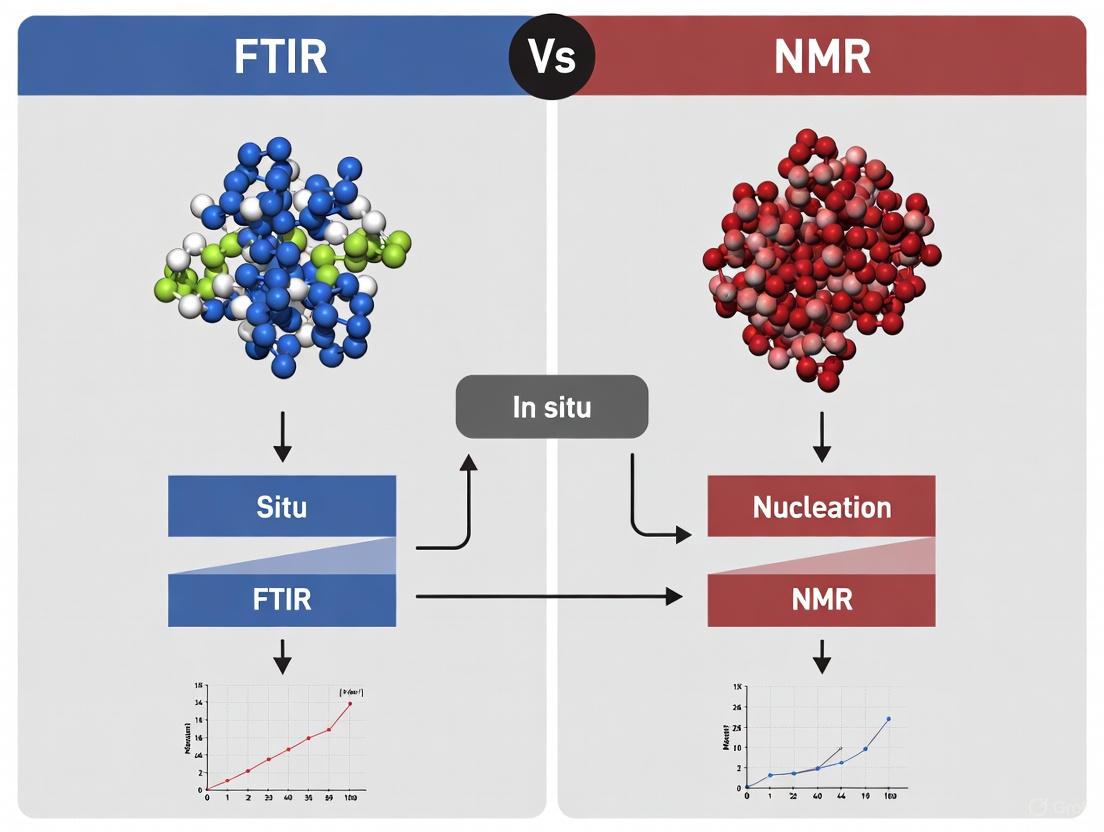
This article provides a comprehensive comparison of in situ Fourier-Transform Infrared (FTIR) and Nuclear Magnetic Resonance (NMR) spectroscopy for characterizing nucleation clusters and early-stage crystallization processes.
In Situ FTIR vs NMR for Nucleation Cluster Characterization: A Comparative Guide for Pharmaceutical Researchers
Abstract
This article provides a comprehensive comparison of in situ Fourier-Transform Infrared (FTIR) and Nuclear Magnetic Resonance (NMR) spectroscopy for characterizing nucleation clusters and early-stage crystallization processes. Tailored for researchers and drug development professionals, it explores the fundamental principles, distinct methodological applications, and practical troubleshooting for each technique. By examining their complementary strengths in monitoring kinetics, identifying transient intermediates, and validating crystal forms, this guide aims to equip scientists with the knowledge to select and optimize the right analytical tool for enhancing control over crystallization in pharmaceutical development, ultimately contributing to more robust drug formulations and processes.
Understanding Nucleation Clusters and the Role of In Situ Spectroscopy
Defining Nucleation Clusters and Pre-Nucleation Species in Crystal Formation
Understanding the early stages of crystal formation—specifically the nature of nucleation clusters and pre-nucleation species—is fundamental to controlling material properties in fields ranging from pharmaceutical development to advanced materials science. These transient molecular aggregates dictate critical outcomes in polymorphism, crystal morphology, and ultimate product stability. The experimental capture and characterization of these species present significant challenges due to their fleeting existence and nanoscale dimensions. This guide provides a comparative analysis of two powerful in situ spectroscopic techniques, FTIR and NMR, for interrogating these early formation stages, presenting objective performance data and detailed experimental protocols to inform method selection for research and development.
Comparative Technique Analysis: In Situ FTIR vs. NMR
The following section compares the core operational principles, data output, and specific applicability of in situ FTIR and NMR for studying nucleation phenomena. A summary of their comparative performance is provided in Table 1.
Table 1: Performance Comparison of In Situ FTIR and NMR for Nucleation Cluster Characterization
| Analytical Feature | In Situ FTIR Spectroscopy | In Situ NMR Spectroscopy |
|---|---|---|
| Temporal Resolution | Very Fast (bond vibration timescale) [1] | Slower (time-averaged snapshot) [1] |
| Primary Information | Molecular bonding and functional group changes [2] | Molecular structure, chemical environment, and dynamics [3] |
| Sensitivity to Binding | Directly monitors bonding interactions (e.g., H-bonding) [1] | Detects chemical shift changes from H-bonding or conformation [1] |
| Quantitative Capability | Association constant (Ka) measurement via global fitting [1] | Concentration, size, and kinetics quantification [3] |
| Sample Preparation | Minimal; no deuterated solvents needed [1] | Often requires specific isotopes or deuterated solvents |
| In Situ Integration | Compatible with flow reactors [4] and microwave irradiation [2] | Compatible with specialized setups like hyperpolarization [5] |
| Key Advantage | Fast timescale reveals dynamics and conformational changes [1] | Can distinguish between surface and core atoms in nanoclusters [3] |
| Primary Limitation | Spectral overlap can be challenging | Lower temporal resolution can miss fast dynamics [1] |
In Situ Fourier-Transform Infrared (FTIR) Spectroscopy
In situ FTIR spectroscopy probes nucleation processes by monitoring changes in the vibrational states of chemical bonds, providing a direct window into molecular interactions. Its key strength lies in its very fast timescale, which captures rapid dynamic processes and conformational changes that are often averaged out in NMR measurements [1]. This makes it exceptionally suitable for tracking the evolution of specific interactions, such as hydrogen bonding, during the formation of pre-nucleation clusters.
A prime application is measuring host-guest association constants (Ka) for interactions modeling pre-nucleation. For example, by monitoring the redshift of a C-D vibration peak from 2314 cm⁻¹ to 2130 cm⁻¹ upon chloride binding, researchers determined a Ka of 13 M⁻¹, showcasing its sensitivity to specific intermolecular forces [1]. Furthermore, FTIR integrates seamlessly with modern process intensification strategies. It has been successfully coupled with microwave irradiation to monitor the rapid synthesis of quinoxaline derivatives, identifying optimal catalysts and solvents in real-time [2]. Similarly, when combined with artificial neural network (ANN) models in continuous flow reactors, FTIR enables real-time concentration monitoring for self-optimizing reaction systems like the hydrogenation of 3-methyl-2-nitrobenzoic acid [4].
In Situ Nuclear Magnetic Resonance (NMR) Spectroscopy
In situ NMR spectroscopy offers unparalleled insights into the structural and chemical environment of atoms within nucleating species. A significant advantage is its ability to distinguish between different populations of atoms within a nanocluster. For instance, in a study on calcium fluoride (CaF₂) nanocrystals, ¹⁹F-NMR clearly discriminated between fluoride atoms located on the nanoparticle surface (-105 ppm) and those in the core (-109 ppm) [3]. The ratio of these populations allowed for the calculation of the nanocrystals' average diameter directly in solution, a metric that showed excellent correlation with TEM data [3].
This capability was leveraged in a real-time kinetic study, where sequential ¹⁹F-NMR spectra monitored the consumption of free F⁻ anions and the simultaneous growth of CaF₂ NCs, revealing that growth mechanisms (classical growth vs. particle-coalescence) can be regulated by the capping ligand used [3]. While traditional NMR can be limited by sensitivity, recent advancements are overcoming this barrier. Techniques like zero to ultralow field (ZULF) NMR combined with signal amplification by reversible exchange (SABRE) hyperpolarization have dramatically enhanced sensitivity, enabling the detection of species at low concentrations and the acquisition of 2D correlation spectra even at sub-microtesla magnetic fields [5].
Experimental Protocols for Nucleation Studies
Protocol for In Situ FTIR Monitoring of Host-Guest Binding as a Model for Prenucleation
This protocol outlines the measurement of association constants (Ka) using in situ FTIR, a method applicable to studying intermolecular interactions relevant to pre-nucleation cluster formation [1].
- Objective: To determine the association constant (Ka) between a deuterated imidazolium-based host (D-IPr·PF₆) and a halide anion guest (Cl⁻) in anhydrous acetone.
- Materials:
- Host Solution: 0.048 M D-IPr·PF₆ in anhydrous acetone.
- Guest Titrant: Tetra-n-butylammonium chloride (TBACl) in anhydrous acetone.
- Instrumentation: FTIR spectrometer equipped with a liquid cell and a titration system.
- Procedure:
- Place the host solution in the IR liquid cell and acquire a background spectrum.
- Collect a reference FTIR spectrum of the host solution before titration.
- Titrate the guest solution (TBACl) into the host solution in small, sequential equivalents.
- After each addition, acquire a new FTIR spectrum without moving the sample, ensuring continuous in situ monitoring.
- Focus on the spectral window from 2350–2000 cm⁻¹, tracking the C-D stretching vibration peak.
- Data Analysis:
- Observe the redshift of the C-D stretch from 2314 cm⁻¹ to 2130 cm⁻¹ upon chloride binding.
- Use a global fitting approach (e.g., SIVUU method) to analyze the entire spectral region, not just a single peak, for robust Ka calculation.
- The analysis for the model system provided a Ka of 13⁺²₋₄ M⁻¹ [1].
Protocol for Real-Time Nanocrystal Growth Monitoring via In Situ NMR
This protocol describes using liquid-state NMR to monitor the size and concentration of nanocrystals in real time, providing a direct method to study nucleation and growth kinetics [3].
- Objective: To monitor the real-time formation and growth of CaF₂ nanocrystals (NCs) in water.
- Materials:
- Precursors: Calcium (Ca²⁺) cation solution and fluoride (F⁻) anion solution.
- Capping Ligand: 2-aminoethyl phosphate (AEP).
- Instrumentation: High-resolution NMR spectrometer (e.g., 9.4 T) suitable for ¹⁹F detection.
- Procedure:
- Prepare an aqueous reaction solution containing F⁻ anions and AEP capping ligands in an NMR tube.
- Initiate the reaction by adding the Ca²⁺ cation solution to the NMR tube and mixing.
- Immediately place the tube in the NMR spectrometer.
- Acquire consecutive ¹⁹F-NMR spectra sequentially from reaction initiation to completion.
- Data Analysis:
- In each spectrum, identify two key peaks: the free F⁻ anion peak (-120 ppm) and the broad peak from fluoride atoms within the CaF₂ NCs.
- Deconvolute the CaF₂ NC peak into two populations: fluorides on the NC surface (~-105 ppm) and in the NC core (~-109 ppm).
- Use the ratio of surface-to-core fluorides in the formula
Diameter = (6 * V_atom * N_total) / (S_surface * N_surface)to calculate the NC diameter at each time point, where Nsurface and Ntotal are the quantified fluorine atom populations [3]. - Plot the evolution of NC diameter and free F⁻ consumption over time to elucidate the growth mechanism.
Research Reagent Solutions for Nucleation Studies
Table 2: Essential Reagents and Materials for Featured Nucleation Studies
| Reagent/Material | Function in Experiment | Example Application |
|---|---|---|
| Deuterated Imidazolium Host (e.g., D-IPr·PF₆) | Model receptor for studying binding interactions; C-D bond serves as a sensitive IR probe in a transparent spectral window. | FTIR measurement of anion binding constants as a model for pre-nucleation interactions [1]. |
| Capping Ligands (e.g., 2-aminoethyl phosphate - AEP) | Controls nanocrystal growth and stabilizes particles in solution; can dictate the growth mechanism (e.g., monomer-attachment vs. particle-coalescence). | In situ NMR monitoring of CaF₂ nanocrystal growth in water [3]. |
| Parahydrogen (pH₂) | Source of hyperpolarization for signal enhancement in NMR experiments, drastically improving sensitivity. | SABRE hyperpolarization for enabling ZULF NMR and 2D COSY experiments on low-concentration samples [5]. |
| Ionic Liquids (e.g., C₄MImPF₆) | Serves as a templating agent and solvent within a sol-gel matrix, influencing the porosity and structure of the gel for confined crystallization. | Growth of perovskite crystals within the confined pores of acid-catalyzed ionogels [6]. |
| Mild Reductant (e.g., TBAB) | Slowly reduces metal precursors to control the kinetics of cluster formation, allowing for the isolation of intermediate species. | Targeted synthesis of atomically-precise "gold quantum needles" like Au₃₃(SCTMS)₂₅ [7]. |
Experimental Workflow Visualization
The following diagrams illustrate the general workflows for conducting nucleation studies using in situ FTIR and NMR, integrating the components and steps described in the experimental protocols.
FTIR Nucleation Study Workflow
NMR Nucleation Study Workflow
The Critical Need for Real-Time, In Situ Characterization in Pharmaceutical Development
In the quest to develop more effective and stable pharmaceutical products, controlling crystallization processes is paramount. The formation of nuclei—the earliest precursors to crystals—directly influences critical quality attributes of Active Pharmaceutical Ingredients (APIs), including solubility, bioavailability, and physical stability. Traditional analytical methods often require sample removal, dilution, or processing, which can disrupt delicate equilibria and obscure the true nature of transient nucleation events. This creates a critical need for real-time, in situ characterization techniques that can probe these dynamic processes without perturbation. Among the available tools, Fourier Transform Infrared (FTIR) spectroscopy and Nuclear Magnetic Resonance (NMR) spectroscopy have emerged as powerful, complementary techniques for studying nucleation and cluster formation. This guide provides an objective comparison of their performance in pharmaceutical research contexts.
Experimental Protocols for In Situ Characterization
In Situ FTIR Spectroscopy for Host-Guest Complexation
The application of in situ FTIR to monitor molecular interactions, such as those in supramolecular host-guest systems, provides a foundational protocol for studying binding events relevant to nucleation [1].
- Objective: To measure the association constant (Ka) of a host-guest complex and observe conformational changes during binding.
- Materials: The protocol requires a host molecule (e.g., an anion receptor), a guest molecule (e.g., a halide anion), an appropriate solvent (e.g., anhydrous acetone), and an FTIR spectrometer equipped with a liquid cell [1].
- Methodology:
- A solution of the host molecule is placed in the FTIR sample cell.
- A solution of the guest molecule is titrated into the host solution in successive, controlled aliquots.
- After each addition, the entire FTIR spectrum is collected in real-time.
- The resulting spectral data, typically focusing on vibrational shifts of bonds involved in the interaction (e.g., C-D stretches in the 2350–2000 cm⁻¹ region), is analyzed [1].
- Data Analysis: The changes in the IR spectrum are globally fitted using a binding model. The SIVUU software, for instance, is an effective approach for analyzing titration data to determine Ka values and their confidence intervals, utilizing the entire spectral region for robustness [1].
Water Proton NMR (wNMR) for Protein Aggregation
Water proton NMR offers a non-invasive method to probe solute behavior, such as protein self-association and aggregation in high-concentration formulations, which is a crucial nucleation-related phenomenon in biologics [8].
- Objective: To detect and monitor protein aggregation in a high-concentration monoclonal antibody formulation directly in its primary container (e.g., a prefilled syringe).
- Materials: A commercial high-concentration protein drug product (e.g., dupilumab at 150 mg/mL), a benchtop NMR instrument with a wide bore suitable for intact syringes, and stressed samples (e.g., via thermal stress or freeze-thaw cycles) [8].
- Methodology:
- Stressed and control samples in their primary containers are placed directly into the NMR instrument.
- The transverse relaxation rate (R₂) of the water protons (¹H₂O) is measured without any sample preparation or dilution.
- The R₂(¹H₂O) value is sensitive to the tumbling rate of water molecules, which is influenced by the size and state of the solutes (proteins); increased aggregation leads to a higher observed R₂ [8].
- Data Analysis: The relaxation rates of stressed samples are compared to those of controls. An increase in R₂ indicates the formation of protein aggregates. This data can be correlated with orthogonal techniques like HPSEC to validate the findings [8].
Performance Comparison: In Situ FTIR vs. NMR
The table below summarizes the key characteristics of in situ FTIR and NMR for nucleation and cluster characterization, based on experimental data.
Table 1: Comparative Analysis of In Situ FTIR and NMR for Nucleation Characterization
| Feature | In Situ FTIR Spectroscopy | NMR Spectroscopy |
|---|---|---|
| Key Measurable | Bond vibrational frequencies and shifts (e.g., C-D, C-N stretches) [1] | Chemical shift, signal splitting, water proton relaxation rate (R₂) [8] |
| Timescale | Very fast (bond vibrations, femtosecond to picosecond) [9] | Slower (nuclear spin transitions, millisecond to second); provides a time-averaged snapshot [1] |
| Sensitivity to Changes | Individual bond lengths (~0.001 Å) and electronics; specific functional groups [9] | Molecular environment, conformation, and hydrodynamic radius (via wNMR) [8] |
| Spectral Window | "Transparent window" (1800–2500 cm⁻¹) useful for specific bonds; can observe host and guest vibrations [1] | Specific isotopes (e.g., ¹H, ¹³C); wNMR probes the entire water signal affected by the solute [8] |
| Sample Preparation | Minimal; can be performed in solution without deuterated solvents [1] | wNMR: None for intact containers. Solution NMR: May require deuterated solvents [8]. |
| Key Strength | Reveals unsymmetrical host conformations and specific interaction sites not observable by time-averaged NMR [1] | wNMR: Truly non-invasive analysis of products in primary containers; detects reversible self-association [8] |
| Primary Limitation | Lower sensitivity for very dilute solutions; overlapping bands can be challenging to deconvolute [9] | Solution NMR: Less effective for dynamic conformational changes faster than its timescale [1] |
Visualizing Experimental Workflows
The diagrams below illustrate the logical workflow for conducting nucleation and interaction studies using in situ FTIR and wNMR.
In Situ FTIR Titration Workflow
Water Proton NMR (wNMR) Analysis Workflow
The Scientist's Toolkit: Essential Research Reagents and Materials
Successful in situ characterization relies on carefully selected materials. The table below lists key reagents and their functions in the featured experiments.
Table 2: Key Research Reagents and Materials for In Situ Characterization
| Reagent/Material | Function in Experiment | Example Context |
|---|---|---|
| Deuterated Host Molecules | Allows isolation of specific C-D vibrations in a spectrally clear IR region for monitoring binding interactions [1]. | FTIR study of imidazolium-based anion receptors [1]. |
| Tetra-n-butylammonium (TBA) Salts | Commonly used counterions for anionic guests to ensure solubility in organic solvents and minimize ion-pairing effects during titrations [1]. | FTIR titrations with halide anions (Cl⁻, Br⁻, I⁻) [1]. |
| Chitosan | A biocompatible polymer used to study polymer-drug interactions; inhibits crystallization via hydrogen bonding [10]. | Studying nucleation inhibition of Ritonavir [10]. |
| Hypromellose (HPMC) | A hydrophilic polymer used as a crystallization inhibitor in supersaturated drug formulations [10]. | Comparison of polymer efficacy against chitosan [10]. |
| Histidine & Arginine Buffer | Common formulation buffers for high-concentration biologics; provide stable pH and can reduce viscosity [8]. | wNMR analysis of a commercial mAb (dupilumab) formulation [8]. |
| Polysorbate 80 | A surfactant used in protein formulations to mitigate surface-induced aggregation and stabilize the product [8]. | wNMR analysis of a commercial mAb (dupilumab) formulation [8]. |
The drive towards more complex pharmaceuticals, including poorly soluble APIs and high-concentration biologics, makes the critical need for real-time, in situ characterization undeniable. Both in situ FTIR and NMR offer powerful, yet distinct, solutions to this challenge. FTIR spectroscopy excels with its superb temporal resolution and ability to provide bond-specific information on molecular interactions and conformational dynamics during early nucleation events. Conversely, NMR spectroscopy, particularly the wNMR variant, offers the unique advantage of truly non-invasive analysis of products in their final containers, making it indispensable for detecting aggregation in sensitive biologics. The choice between them is not a matter of superiority but of strategic application. For researchers seeking to understand the fundamental molecular mechanics of nucleation, FTIR is an invaluable tool. For those needing to ensure the stability and quality of a final formulated product without compromising its integrity, wNMR presents a compelling solution. Ultimately, a holistic characterization strategy will leverage the complementary strengths of both techniques to illuminate the entire pathway from molecule to medicine.
Fourier Transform Infrared (FTIR) spectroscopy is a powerful analytical technique that identifies and quantifies the chemical composition of materials by measuring the absorption of infrared radiation, which provides information about molecular vibrations and functional groups present in a sample [11]. The core principle of FTIR is based on the Fourier transform, a mathematical technique that deconstructs an interferogram signal into its constituent frequencies, resulting in a spectrum that acts as a molecular fingerprint [11]. In situ FTIR spectroscopy represents a significant advancement beyond traditional ex situ analysis by enabling the real-time investigation of molecular changes during chemical reactions and physical processes [11] [12]. This dynamic capability allows researchers to monitor reaction kinetics, crystallization dynamics, surface interactions, and the behavior of transient intermediates under actual operating conditions, providing vital insights into material behavior that are often lost in conventional post-reaction analysis [13] [12].
The fundamental working mechanism involves an interferometer containing a beam splitter, fixed mirror, and moving mirror [14]. Infrared radiation from the source is split, reflected off the mirrors, and recombines to create an interferogram that contains infrared spectral information encoded as a function of mirror position [14]. Through the Fourier transform mathematical processing, this time-domain data is converted into a conventional frequency-domain spectrum (absorbance vs. wavenumber in cm⁻¹) [14]. For in situ applications, the experimental setup is customized to incorporate reaction conditions directly within the spectrometer's sampling compartment, often using specialized reaction cells with infrared-transparent windows or through attenuated total reflectance (ATR) configurations where the sample is in direct contact with an internal reflection element [11] [13].
Fundamental Principles and Instrumentation
Molecular Vibration Fundamentals
FTIR spectroscopy probes the vibrational modes of molecules when they interact with infrared radiation. These vibrations occur at specific frequencies characteristic of particular chemical bonds and functional groups. The fundamental requirement for IR absorption is that the vibration must cause a change in the dipole moment of the molecule [15]. The primary vibrational modes detected include:
- Stretching vibrations: Symmetric and asymmetric bond length changes
- Bending vibrations: Changes in bond angles including scissoring, rocking, twisting, and wagging motions [14]
The infrared spectrum is typically divided into:
- Functional group region (4000-1300 cm⁻¹): Where characteristic stretches (O-H, N-H, C-H, C=O, C-O) appear
- Fingerprint region (1300-400 cm⁻¹): Complex pattern unique to each molecule resulting from coupled vibrations [11]
In Situ FTIR Instrumentation and Configuration
Table 1: Key Components of In Situ FTIR Instrumentation
| Component | Description | In Situ Considerations |
|---|---|---|
| IR Source | Provides broadband infrared radiation | Stability crucial for long-term reaction monitoring |
| Interferometer | Michelson interferometer with moving and fixed mirrors | Vibration control essential for signal fidelity |
| Sample Chamber | Area where sample-reaction cell is positioned | Adapted for specialized in situ cells (flow reactors, temperature/pressure control) |
| Detector | Measures transmitted or reflected IR signal | High sensitivity detectors (MCT) for rapid kinetic data collection |
| ATR Crystal | Internal reflection element (diamond, ZnSe, Ge) | Direct contact with reaction mixture; chemical/thermal stability required |
For in situ applications, the attenuated total reflectance (ATR) configuration is particularly valuable [11]. In ATR-FTIR, the sample is placed in direct contact with a high-refractive-index crystal [11]. The infrared beam undergoes total internal reflection within the crystal, generating an evanescent wave that penetrates approximately 0.5-5 microns into the sample, interacting with the molecular vibrations at the interface [14]. This shallow penetration depth makes ATR-FTIR ideal for monitoring surface-mediated processes and reactions in highly absorbing media like aqueous solutions [13].
In Situ Experimental Workflow
The following diagram illustrates the generalized workflow for a typical in situ FTIR experiment:
Comparative Analysis: In Situ FTIR vs. NMR Spectroscopy
Fundamental Principles and Information Obtained
Table 2: Fundamental Comparison of In Situ FTIR and NMR Spectroscopy
| Parameter | In Situ FTIR Spectroscopy | NMR Spectroscopy |
|---|---|---|
| Physical Principle | Absorption of IR radiation by molecular vibrations | Interaction of atomic nuclei with magnetic fields & RF radiation |
| Information Obtained | Functional groups, molecular symmetry, chemical bonds | Atomic connectivity, molecular structure, stereochemistry |
| Interaction Probed | Changes in dipole moments (vibrational transitions) | Nuclear spin states in magnetic field |
| Key Spectral Parameters | Wavenumber (cm⁻¹), absorption intensity | Chemical shift (ppm), coupling constants, relaxation times |
| Time Resolution | Milliseconds to seconds | Seconds to hours |
| Sensitivity | High for IR-active bonds | Generally lower, requires concentrated samples |
FTIR measures the absorption of infrared radiation, which occurs due to changes in molecular vibrations and dipole moments, providing information about bond stretching, bending, and functional groups [16]. In contrast, NMR measures the nuclear magnetic resonance of specific atomic nuclei, detecting changes in nuclear spin states and providing information about the local chemical environment of those nuclei, including their connectivity to neighboring atoms [16].
Application Scope and Sample Requirements
Table 3: Application-Based Comparison Between In Situ FTIR and NMR
| Aspect | In Situ FTIR | NMR |
|---|---|---|
| Sample Types | Liquids, solids, gases, surfaces | Primarily liquids; solid-state capabilities |
| Sample Preparation | Minimal; direct analysis often possible | Often extensive; may need dissolution, enrichment |
| Concentration Requirements | µM to mM range (ATR) | mM to mM range |
| Temperature Range | Cryogenic to high-temperature (>500°C) | Typically -150°C to +200°C |
| Pressure Range | Ambient to high-pressure (>100 bar) | Typically ambient |
| Spatial Resolution | ~10-20 µm (microspectroscopy) | No inherent spatial resolution (imaging MRI例外) |
| Quantitative Analysis | Possible with calibration curves | Excellent without extensive calibration |
FTIR can analyze a wide range of samples, including liquids, gases, and solids, and is versatile for various compounds, including organic and inorganic substances [16]. NMR is primarily used for liquid and solid-state samples containing nuclei with magnetic properties, such as hydrogen (protons) and carbon-13, and is particularly well-suited for analyzing small organic molecules, biomolecules, and complex materials [16].
Experimental Protocols and Applications
Protocol: In Situ FTIR for Monitoring Crystallization Processes
The application of in situ FTIR to study crystallization mechanisms is exemplified by research on calcium silicate hydrate (C-S-H) and calcium aluminate silicate hydrate (C-A-S-H) formation, which are critical binding phases in modern cements [17].
Experimental Methodology:
- Reaction Setup: Prepare stoichiometric amounts of calcium and silicate precursors in aqueous solution at controlled Ca/Al ratio (e.g., 5:1) [17]
- In Situ Monitoring: Utilize a reaction cell with temperature control and continuous stirring
- Real-Time Data Collection:
- Collect IR spectra repeatedly (e.g., every 30-60 seconds)
- Monitor specific spectral regions: silicate bands (1200-800 cm⁻¹), water O-H stretching (3700-3000 cm⁻¹)
- Complement with solution parameter monitoring: pH, free Ca²⁺ conductivity, transmittance [17]
- Data Analysis:
- Track intensity changes, band shifts, and appearance/disappearance of spectral features
- Apply multivariate analysis for complex spectral changes
Key Findings: In situ FTIR revealed that C-A-S-H formation follows at least a two-step process involving initial amorphous globules that evolve into foil-like particles with higher crystallinity [17]. The technique demonstrated that aluminum promotes calcium binding during the prenucleation stage and slightly accelerates nucleation [17].
Protocol: In Situ FTIR for Catalytic Reaction Monitoring
A representative example comes from studies on CO₂ methanation reaction mechanisms over metal-based catalysts (Ni, Rh, Ru) using in situ FTIR [13].
Experimental Methodology:
- Catalyst Preparation: Commercial catalysts (Ni, Rh, Ru) pressed into self-supporting wafers [13]
- In Situ Cell Design: High-temperature, high-pressure reaction chamber with IR-transparent windows
- Reaction Conditions:
- Temperature programming: 25-500°C
- Gas mixture: CO₂/H₂ with controlled flow rates
- Pressure: Atmospheric to elevated pressures
- Spectral Acquisition:
- Rapid scan mode (1-5 seconds per spectrum)
- Focus on surface species region (1800-1200 cm⁻¹)
- Monitor reaction intermediates: carbonates, formates, carbonyls [13]
Key Findings: In situ FTIR identified three potential reaction pathways: (i) formate pathway involving carbonate hydrogenation, (ii) CO pathway with dissociative adsorption of CO₂, and (iii) carboxyl pathway with COOH intermediates [13]. The technique confirmed that the same mechanism applies for both conventional and sorption-enhanced methanation processes [13].
Essential Research Reagent Solutions
Table 4: Key Research Reagents and Materials for In Situ FTIR Experiments
| Reagent/Material | Function/Application | Experimental Considerations |
|---|---|---|
| ATR Crystals (Diamond, ZnSe, Ge) | Internal reflection element | Diamond: robust, broad IR range; ZnSe: aqueous compatibility; Ge: high refractive index |
| IR-Transparent Windows (CaF₂, BaF₂, KBr) | Reaction cell construction | CaF₂/BaF₂: aqueous solutions; KBr: dry samples only |
| Temperature Control System | Precise thermal regulation | Heating/cooling stages (-150°C to +600°C) |
| Flow Reactor Accessories | Dynamic reaction monitoring | Pumps, gas mixing systems, pressure regulators |
| Reference Materials (Polystyrene, CO) | Frequency calibration | Verify wavenumber accuracy and resolution |
| Deuterated Solvents (D₂O, CDCl₃) | Signal isolation in specific regions | Minimize interference from solvent vibrations |
Advanced Applications and Future Perspectives
Combined Spectroscopy Approaches
The integration of in situ FTIR with complementary techniques like Raman spectroscopy provides a more comprehensive understanding of complex systems. A notable application involves studying MXene electrodes for electrochemical energy storage, where in situ FTIR monitored intramolecular O-H vibrations of confined water while Raman spectroscopy tracked surface terminations [18]. This synergistic approach revealed the dynamic interplay between charge storage and changes in MXene surface chemistry across different electrolytes [18].
The relationship between multiple in situ techniques can be visualized as follows:
Emerging Applications and Methodological Advances
Recent advances in in situ FTIR methodology have expanded its applications across diverse fields:
- Nanoparticle-Biological Interactions: Monitoring structural changes in microorganisms exposed to nanoparticles through alterations in functional groups in biomolecules [14]
- Pharmaceutical Development: Real-time monitoring of crystallization processes, polymorph transitions, and drug release kinetics [12]
- Energy Materials: Investigating interfacial processes in batteries, fuel cells, and catalytic systems [13] [18]
- Green Chemistry: Supporting sustainable analytical practices through minimal waste generation and reduced need for extensive sample preparation [11] [12]
The future development of in situ FTIR focuses on improving time resolution (sub-millisecond), enhancing spatial resolution through nano-IR techniques, and increasing integration with other characterization methods for correlative analysis under identical experimental conditions.
In situ FTIR spectroscopy has established itself as an indispensable technique for tracking molecular vibrations and functional groups in real-time under actual operating conditions. Its ability to provide time-resolved information about reaction intermediates, structural transformations, and surface processes makes it particularly valuable for understanding dynamic systems across chemistry, materials science, and pharmaceutical development. While NMR spectroscopy offers superior atomic-level structural elucidation, in situ FTIR provides complementary information about functional group behavior with generally faster time resolution and less stringent sample requirements. The continued advancement of in situ FTIR methodology, particularly through integration with complementary techniques and computational modeling, promises to further expand its applications in understanding and designing complex chemical processes and functional materials.
Nuclear Magnetic Resonance (NMR) spectroscopy is a powerful analytical technique that exploits the magnetic properties of certain atomic nuclei to probe the molecular environment and dynamics in a sample. When placed in a strong magnetic field, nuclei with a non-zero spin absorb and re-emit electromagnetic radiation at frequencies characteristic of their chemical environment [19]. In situ NMR represents a significant advancement in this field, enabling the real-time monitoring of chemical processes and structural transformations without the need to remove samples from their native environment. This capability is particularly transformative for studying dynamic processes like crystallization, where it allows researchers to observe the evolution of solid phases and concurrent changes in the liquid phase simultaneously [20].
This guide provides a comprehensive comparison of in situ NMR methodologies, focusing on their application for probing atomic environments and dynamics during crystallization processes. We present fundamental principles, detailed experimental protocols, and comparative analyses with alternative techniques such as FTIR spectroscopy, providing researchers with the necessary framework to select the appropriate characterization tool for their specific investigations.
Fundamental Principles of NMR
At its core, NMR spectroscopy measures the interaction of atomic nuclei with a magnetic field and radiofrequency radiation. For a nucleus to be NMR-active, it must possess an intrinsic property called spin, resulting in a non-zero nuclear magnetic moment [19]. The fundamental principles can be broken down into several key phenomena:
Nuclear Spin and Magnetic Moments
Not all isotopes are NMR-active. Nuclei with an odd mass number (such as (^1\text{H}), (^{13}\text{C}), (^{19}\text{F}), (^{31}\text{P})) possess half-integer spins and are readily observable by NMR. Conversely, nuclei with even mass and atomic numbers (such as (^{12}\text{C}) and (^{16}\text{O})) have zero spin and are NMR-inactive [19]. When placed in an external magnetic field ((B_0)), these magnetic nuclei adopt specific orientations, or energy levels, a phenomenon known as nuclear Zeeman effect.
Resonance and Signal Detection
The principle of NMR involves three sequential steps:
- The alignment (polarization) of the magnetic nuclear spins in the applied, constant magnetic field (B_0).
- The perturbation of this alignment by a weak oscillating magnetic field, typically a radiofrequency (RF) pulse.
- The detection of the NMR signal during or after the RF pulse, due to the voltage induced in a detection coil by the precession of the nuclear spins around (B_0) [19].
The exact frequency at which a nucleus resonates depends not only on the strength of the external magnetic field but also on the local chemical environment. This effect, known as the chemical shift, provides a fingerprint of the chemical structure, including functional groups and bonding patterns.
Probing Dynamics and Crystallization
In situ NMR capitalizes on these principles to monitor time-dependent processes. For crystallization studies, it can selectively detect the emergence and evolution of different solid forms (polymorphs, co-crystals, etc.) based on their distinct high-resolution solid-state NMR spectra, while simultaneously tracking changes in the solution phase [20]. This allows researchers to identify metastable intermediates and understand kinetic pathways in real-time.
Experimental Protocols in In Situ NMR
The application of in situ NMR to monitor crystallization processes requires specific experimental designs and protocols to capture the evolution of both solid and liquid phases. The following section details the core methodology.
The CLASSIC NMR Strategy
A key advancement is the CryLlAllization Studies by Solid-In Combination (CLASSIC) NMR technique [20]. This approach allows for the simultaneous acquisition of data from both the solid and liquid phases in a crystallizing system within a single experiment. The workflow is as follows:
- Sample Preparation: A solution undersaturated at high temperature is prepared. For organic molecular crystals, isotopic labeling (e.g., with (^{13}\text{C})) is often essential to enhance sensitivity and enable the use of cross-polarization (CP) techniques [20].
- Loading and Thermal Control: The solution is loaded into a specialized Magic Angle Spinning (MAS) NMR rotor (e.g., a 4 mm diameter rotor with a liquid-state insert, accommodating ~25 µL) [20]. The temperature is precisely controlled.
- Induction of Crystallization: The sample temperature is lowered to create a supersaturated solution, initiating the crystallization process.
- In Situ Data Acquisition: The NMR spectrometer repeatedly acquires spectra as a function of time. For solids, the (^1\text{H}→^{13}\text{C}) Cross-Polarization (CP) sequence is used, which selectively detects the rigid solid phase while the liquid phase remains "invisible". Complementarily, direct-excitation (^{13}\text{C}) NMR can be applied to monitor the liquid phase [20].
- Magic-Angle Spinning (MAS): The sample is spun at the magic angle (54.74°) to the magnetic field to average out anisotropic interactions, resulting in high-resolution spectra [19] [20].
Table 1: Key Experimental Parameters for Representative In Situ NMR Crystallization Studies [20]
| Crystallization Process | Isotopic Labelling | NMR Frequency | Type of In Situ NMR | Time Resolution | Total Experiment Time |
|---|---|---|---|---|---|
| 1,10-Dihydroxydecane-(urea)₂ co-crystal from methanol | 13C-urea (99%) | 850 MHz | Solid-state 13C NMR | 2.67 min | 11.4 h |
| Glycine from H₂O | 13Cα,13Cβ-glycine (99%) | 300 MHz | Solid-state 13C NMR | 26 min | 13 h |
| DL-Menthol from molten liquid phase | — | 850 MHz | CLASSIC 13C NMR | 2.67 min | 2.83 h |
| Formation of MOF MFM500(Ni) from water–DMF | — | 850 MHz | CLASSIC 31P and 1H NMR | 7.1 min | 35 h |
| m-Aminobenzoic acid from DMSO | — | 850 MHz | CLASSIC 13C NMR | 44.8 min | 15 h |
Workflow Visualization
The following diagram illustrates the logical workflow and decision points in a typical in situ NMR crystallization study using the CLASSIC strategy:
In Situ NMR Crystallization Workflow
The Scientist's Toolkit: Essential Research Reagents and Materials
Successful in situ NMR experiments require specific materials and reagents tailored to the system under investigation. The table below details key components used in the featured crystallization studies.
Table 2: Key Research Reagent Solutions for In Situ NMR Crystallization Experiments
| Item Name | Function / Role in Experiment | Example from Literature |
|---|---|---|
| Isotopically Labelled Compounds | Enhances sensitivity for low-abundance or low-gamma nuclei (e.g., 13C, 15N) via isotopic enrichment. | 13C-urea (99%) used to study a co-crystal formation [20]; 13Cα-glycine to monitor glycine polymorphism [20]. |
| Deuterated Solvents | Provides a signal-less background for 1H NMR; used for field-frequency locking of the NMR spectrometer. | D₂O used in glycine crystallization studies [20]; not always required for 13C-detected solid-state NMR. |
| Magic Angle Spinning (MAS) Rotors | Holds the sample and spins at high speeds (kHz) at the "magic angle" to narrow spectral lines. | Standard 4 mm MAS rotors with special liquid-state inserts (~25 µL volume) [20]. |
| Crystallization Solvents | Dissolves solute to form initial solution; properties (polarity, boiling point) influence crystallization pathway. | Methanol, toluene, methanol-water mixtures, DMSO used in various studies [20]. |
| Model Compounds | Well-characterized systems used for methodology development and validation. | Glycine (polymorphism), 1,10-dihydroxydecane/urea (co-crystal), metal-organic frameworks [20]. |
Comparative Analysis: In Situ NMR vs. FTIR
While in situ NMR provides unparalleled atomic-level detail, Fourier-Transform Infrared (FTIR) spectroscopy serves as a complementary technique for probing molecular vibrations. The table below offers a direct comparison of their capabilities, particularly in the context of nucleation and cluster characterization.
Table 3: Direct Comparison of In Situ NMR and FTIR Spectroscopy
| Parameter | In Situ NMR Spectroscopy | FTIR Spectroscopy |
|---|---|---|
| Fundamental Principle | Measures interaction of atomic nuclei with magnetic fields/radio waves; probes nuclear spin states. | Measures absorption of infrared radiation; probes molecular vibrations and rotations [16]. |
| Primary Information | Detailed data on nuclear environment, molecular structure, connectivity, and dynamics [19]. | Identification of functional groups, molecular symmetry, and specific chemical bonds [16]. |
| Atomic-Level Insight | Directly probes specific nuclides (e.g., 1H, 13C, 31P), revealing their distinct chemical environments [19] [20]. | Probes bonds and functional groups (e.g., -OH, C=O), but cannot always distinguish complex 3D environments [16]. |
| Sample Versatility | Excellent for liquids, solids (with MAS), and amorphous materials. Requires NMR-active nuclei. | Highly versatile; analyzes gases, liquids, and solids with minimal preparation [16]. |
| Quantitative Capability | Excellent for kinetics and concentration measurements due to direct signal proportionality [21]. | Possible with careful calibration, but can be complicated by overlapping bands and absorption strength variations. |
| In Situ Monitoring | Tracks structural evolution in real-time for both solid and liquid phases (e.g., CLASSIC NMR) [20]. | Tracks appearance/disappearance of specific functional groups; less effective for complex solid-phase identification. |
| Key Application in Crystallization | Identifying different solid forms (polymorphs, co-crystals), monitoring phase transitions, and quantifying kinetics [22] [20]. | Identifying the presence of specific functional groups in nascent clusters and monitoring solute-solvent interactions. |
In situ NMR spectroscopy stands as a powerful technique for probing atomic environments and dynamics during complex processes like crystallization. Its unique capability to provide simultaneous, molecular-level insight into both evolving solid phases and the accompanying changes in the solution phase is unmatched by many other analytical methods [22] [20]. While FTIR spectroscopy offers complementary strengths in functional group identification and general molecular fingerprinting [16], in situ NMR is indispensable for elucidating detailed structural connectivity, understanding reaction mechanisms, and quantifying kinetics [21]. The continued development of specialized NMR strategies, such as the CLASSIC technique, ensures that this tool will remain at the forefront of materials science, pharmaceutical development, and chemical research, enabling scientists to unravel increasingly complex dynamic phenomena in molecular systems.
Cluster analysis represents a pivotal methodology in the study of nucleation and early-stage crystallization processes, providing critical insights into the formation and evolution of molecular aggregates. Within the context of a broader thesis on in situ characterization, this guide objectively compares the information output from Fourier-Transform Infrared (FTIR) spectroscopy and Nuclear Magnetic Resonance (NMR) spectroscopy for analyzing nucleation clusters. These techniques offer complementary perspectives on chemical and structural evolution during nucleation, with FTIR excelling in identifying specific molecular bonds and functional groups, while NMR provides detailed atomic-level structural environments and dynamics. The application of these techniques to in situ monitoring allows researchers to capture transient intermediates and dynamic processes that are fundamental to understanding crystallization pathways in materials science and pharmaceutical development [23].
The non-classical crystallization pathways observed in many systems, including calcium silicate hydrate (C-S-H) and calcium aluminate silicate hydrate (C-A-S-H), involve complex multi-step processes that benefit significantly from the combined application of FTIR and NMR. Real-time monitoring of solution parameters coupled with structural characterization has revealed that these hydrates form through amorphous intermediates that evolve into more ordered structures [17]. For drug development professionals, understanding these pathways is essential for controlling polymorphism, crystal habit, and ultimately, drug bioavailability and stability. This comparison guide examines the experimental outputs, capabilities, and limitations of FTIR and NMR spectroscopy to inform strategic selection of characterization methods for cluster analysis research.
Technical Comparison: FTIR vs. NMR Spectroscopy
The following comprehensive comparison outlines the fundamental differences in information output between FTIR and NMR spectroscopy for cluster analysis, with particular emphasis on their application in nucleation studies and pharmaceutical development.
Table 1: Comparative Technical Specifications of FTIR and NMR for Cluster Analysis
| Parameter | FTIR Spectroscopy | NMR Spectroscopy |
|---|---|---|
| Primary Information Output | Molecular bonding, functional groups, chemical environment changes [24] | Atomic environment, molecular structure, dynamics, connectivity [17] [24] |
| Key Measurable Parameters | Presence/absence of specific bonds, hydrogen bonding strength, molecular conformation [24] | Chemical shift, spin-spin coupling, relaxation times, molecular mobility [24] |
| Spatial Resolution | Micro-nano scale (when combined with microscopy) [25] | Atomic to molecular scale [25] |
| Detection Sensitivity | High for polar bonds (e.g., O-H, N-H, C=O) | High for NMR-active nuclei (e.g., ^1H, ^13C, ^27Al, ^29Si) [17] |
| Temporal Resolution | Milliseconds to seconds (rapid-scan) | Seconds to hours (depends on nucleus, concentration) |
| Quantitative Capabilities | Semi-quantitative (requires calibration) | Highly quantitative (directly proportional to nucleus number) [24] |
| Sample Requirements | Minimal, various forms (solid, liquid, gas) | Often requires dissolution, specific volume |
| In Situ/Operando Compatibility | Excellent (reactor cells with IR-transparent windows) [23] | Challenging but possible (specialized probe required) |
| Key Applications in Clustering | Water cluster identification (monomer to hexamer) [24], monitoring amorphous to crystalline transitions [17] | Probing atomic environment in amorphous globules [17], quantifying adsorbed vs. structural species [24] |
Analysis of Comparative Advantages
FTIR spectroscopy delivers exceptional sensitivity to changes in molecular bonding and hydrogen-bonding networks, making it particularly valuable for identifying the specific types of water clusters (from dimer to hexamer) present in confined environments like nano-structured materials [24]. This capability is crucial for understanding the role of water structure in the early stages of nucleation, especially in pharmaceutical systems where hydrate formation can significantly impact drug stability. The technique's compatibility with in situ monitoring under reaction conditions allows researchers to observe dynamic processes such as photocorrosion, surface intermediate formation, and ligand exchange in real-time [23].
NMR spectroscopy, particularly magic-angle spinning (MAS) NMR, provides unparalleled atomic-level insight into the local coordination environments within nucleation clusters. For instance, ^1H MAS NMR can distinguish between adsorbed water molecules and structural hydroxyl groups, quantifying their relative populations in developing clusters [24]. In cement hydration studies, NMR has revealed how aluminum incorporation promotes calcium binding during the prenucleation stage of C-A-S-H formation, slightly accelerating nucleation compared to C-S-H systems [17]. This level of detail is indispensable for establishing structure-activity relationships in functional materials and pharmaceutical crystals.
Experimental Protocols for Key Applications
Protocol 1: FTIR Analysis of Water Clusters in Confined Environments
This methodology, adapted from studies of nano-structured calcium hydroxyapatites, enables the identification and characterization of water cluster formation during nucleation processes [24].
- Objective: To identify and characterize hydrogen-bonded water clusters (H₂O)ₙ (n=1-6) during nucleation in confined environments using FTIR spectroscopy.
- Materials:
- Nano-structured material of interest (e.g., calcium hydroxyapatite, porous pharmaceutical excipient)
- Fourier-Transform Infrared Spectrometer with cryogenic capability (where applicable)
- Environmental chamber for humidity control
- High-pressure cell (for in situ studies)
- Procedure:
- Sample Preparation: For ex situ analysis, prepare the material as a fine powder mixed with dry KBr and compress into a pellet. For in situ hydration studies, use a controlled atmosphere cell with IR-transparent windows.
- Spectral Acquisition: Collect FTIR spectra in the transmission or ATR mode across the 3000–3800 cm⁻¹ region (O-H stretching vibrations) with a resolution of 2-4 cm⁻¹. For temperature-dependent studies, acquire spectra from 9 K to ambient temperature in 2 K increments [24].
- Data Processing: Perform 2D correlation analysis (2DCOR) on the spectral dataset to resolve overlapping bands and enhance peak assignment accuracy. This analysis reveals the correct number of spectral bands and identifies synchronized and non-synchronized spectral changes [24].
- Cluster Assignment: Assign resolved peaks to specific water clusters by comparison with reference spectra from water in argon matrices or hydrophobic solvents:
- Monomer: ~3700-3720 cm⁻¹
- Dimer: ~3600-3700 cm⁻¹
- Trimer to Hexamer: Progressive shifts to lower wavenumbers (~3000-3600 cm⁻¹) [24]
- Output Interpretation: The appearance and evolution of specific cluster signatures indicate the structural organization of water during nucleation. The cluster size and distribution depend on the hydration level and surface properties of the material.
Protocol 2: NMR Investigation of Prenucleation Clusters and Local Environments
This protocol outlines the use of NMR spectroscopy to probe the atomic environment and dynamics within prenucleation clusters, as applied in the study of cement hydrates [17] and nano-structured materials [24].
- Objective: To characterize the local atomic coordination, chemical environment, and mobility of species within prenucleation clusters using solid-state NMR.
- Materials:
- Sample containing prenucleation clusters (solution, gel, or solid)
- Nuclear Magnetic Resonance Spectrometer equipped for MAS
- MAS rotors (e.g., zirconia) with appropriate seals
- Procedure:
- Nuclei Selection: Select relevant NMR-active nuclei based on the system: ^1H for water/proton dynamics; ^29Si for silicate structures; ^27Al for aluminum coordination; ^13C for organic molecules [17] [24].
- Spectral Acquisition:
- Conduct ^1H MAS NMR experiments at high spinning speeds (e.g., 10-15 kHz) to resolve different proton environments. Use a single-pulse excitation sequence with sufficient relaxation delay.
- For quantitative analysis of water states, normalize the intensity of the broad water signal (ca. 5.1 ppm) to the structural OH⁻ peak at 0 ppm [24].
- For structural insights (e.g., in C-A-S-H), employ cross-polarization (CP) MAS NMR from ^1H to low-abundance nuclei (e.g., ^29Si) to enhance sensitivity and probe spatial proximity.
- Data Processing: Apply line-fitting to deconvolute overlapping signals. For ^1H NMR, integrate distinct signals (e.g., at 0.8, 1.3, and 5.1 ppm) to quantify the populations of different water states (surface structured H₂O, adsorbed H₂O) [24].
- In Situ Considerations: For true in situ NMR, specialized probes that accommodate reaction cells are required to monitor nucleation processes in real time [23].
- Output Interpretation: Chemical shifts reveal the coordination environment of nuclei. Signal intensities provide quantitative data on species populations. Relaxation times (T₁, T₂) offer insights into molecular mobility within clusters, distinguishing rigid from mobile components.
Research Reagent Solutions and Essential Materials
The following table details key reagents, materials, and instrumentation essential for conducting cluster analysis experiments using FTIR and NMR spectroscopy.
Table 2: Essential Research Reagents and Materials for Cluster Analysis
| Item Name | Function/Application | Technical Specifications |
|---|---|---|
| Deuterated Solvents | NMR sample preparation to minimize background ^1H signal | D₂O, d⁶-DMSO; Purity: 99.9% D |
| Magic-Angle Spinning (MAS) Rotors | High-resolution solid-state NMR analysis | Material: Zirconia; Sizes: 1.3 mm to 7 mm diameter |
| ATR-FTIR Crystals | Direct solid/liquid analysis with minimal sample prep | Crystal Material: Diamond, ZnSe, or Ge; Durability & IR range |
| In Situ Reaction Cells | Real-time monitoring of nucleation under controlled conditions | For FTIR: with IR-transparent windows (e.g., CaF₂, BaF₂). For NMR: Compatible with MAS rotors or flow systems [23] |
| Nano-Structured Reference Materials | Method validation and calibration | e.g., Synthetic Calcium Hydroxyapatite (Ca₁₀(PO₄)₆(OH)₂), 99.999% purity [24] |
| Argon Matrix Gases | FTIR study of isolated molecular clusters | Ultra-high purity (99.999%) for matrix isolation spectroscopy [24] |
| Complexing Agents | Sol-gel synthesis of model nano-structured substrates | e.g., various complexing agents for controlled synthesis of calcium hydroxyapatites [24] |
Integrated Workflow for Cluster Characterization
The complementary nature of FTIR and NMR spectroscopy necessitates an integrated workflow for comprehensive cluster analysis. The following diagram visualizes a logical pathway for combining these techniques to extract maximum chemical and structural information from nucleation systems.
Integrated Workflow for Cluster Characterization
FTIR and NMR spectroscopy provide fundamentally different yet powerfully complementary information outputs for cluster analysis in nucleation research. FTIR excels in delivering real-time, in situ data on molecular bonding and specific cluster types with high temporal resolution, while NMR offers unparalleled atomic-level detail on coordination environments and quantitative population dynamics, albeit often requiring more specialized conditions for in situ application. The strategic integration of both techniques, as illustrated in the workflow diagram, enables researchers to construct comprehensive models of nucleation processes from the molecular to the atomic scale. For drug development professionals and materials scientists, this multi-faceted analytical approach is indispensable for elucidating non-classical crystallization pathways, optimizing material properties, and ultimately controlling the nucleation outcomes critical to product performance and stability. The continued advancement of in situ methodologies for both techniques promises to further illuminate the dynamic evolution of clusters during active processes, closing critical knowledge gaps in our understanding of early-stage crystallization.
Practical Applications: Implementing In Situ FTIR and NMR in the Lab
Fourier Transform Infrared (FTIR) spectroscopy has become an indispensable tool for real-time, in situ monitoring of chemical and biological processes. For researchers investigating complex phenomena like nucleation cluster characterization, selecting the appropriate in situ FTIR methodology is critical for obtaining accurate, time-resolved molecular data. This guide provides a detailed comparison of the two primary FTIR techniques—Attenuated Total Reflectance (ATR) and Transmission—focusing on their practical implementation for reaction monitoring and their role in complementing other analytical techniques like NMR in nucleation research.
The fundamental distinction lies in how the infrared radiation interacts with the sample. In transmission mode, IR light passes directly through the sample, which must be sufficiently thin to avoid complete absorption of the radiation [26] [27]. In contrast, ATR mode operates by passing IR radiation through an internal reflection element (IRE) crystal; the radiation then interacts with the sample at the crystal/sample interface, penetrating only a few micrometers into the sample surface [27] [28]. This core difference dictates every aspect of their application, from sample preparation to suitability for dynamic reaction monitoring.
Technical Comparison: ATR vs. Transmission FTIR
The choice between ATR and Transmission FTIR involves trade-offs between spatial resolution, sample compatibility, and operational convenience. The table below summarizes the key technical differences.
Table 1: Technical Comparison of ATR-FTIR and Transmission FTIR for In Situ Applications
| Parameter | ATR-FTIR | Transmission FTIR |
|---|---|---|
| Spatial Resolution | Higher (sub-micrometer to micrometer scale) [26] | Lower (limited by diffraction limit) [26] |
| Sample Penetration Depth | Shallow (typically ~1-2 µm) [27] | Defined by sample thickness (often <20 µm for solids) [26] |
| Sample Preparation | Minimal; direct application of solids/liquids [27] | Extensive; requires KBr pellets or controlled pathlength cells [29] [27] |
| Aqueous Sample Suitability | High (minimal pathlength evades strong water absorption) [26] | Challenging (strong water absorption overwhelms signals) [26] |
| Primary In Situ Strength | Monitoring dynamic processes at interfaces (e.g., protein aggregation, catalysis) [30] [26] | Analysis of thin, pre-sectioned samples (e.g., tissue biopsies) [26] [28] |
| Key Spectral Consideration | Peak shifts vs. transmission spectra due to optical effects [27] | Considered the "standard" for library matching [27] |
For in situ reaction monitoring, ATR-FTIR often holds a distinct advantage. Its minimal sample preparation and robustness against water interference make it ideal for integrating with microfluidic devices, enabling real-time observation of reactions under flow [30] [26]. This capability is paramount for studying dynamic processes like the nucleation and growth of crystals or the aggregation of therapeutic proteins, where conditions must not be disturbed by sampling [31]. Furthermore, the high spatial resolution of micro-ATR-FTIR allows for depth profiling and mapping of heterogeneous samples, providing insights into spatial composition changes during a process [26].
Experimental Protocols for In Situ Reaction Monitoring
In Situ ATR-FTIR for Protein Aggregation in Biopharmaceuticals
Application Context: Monitoring the formation of protein aggregates under bioprocessing conditions, such as in low-pH elution buffers or at the air-liquid interface, is critical for ensuring the stability and efficacy of monoclonal antibody (mAb) therapeutics [30] [26].
Detailed Methodology:
- Setup Configuration: A micro-ATR-FTIR spectrometer (e.g., with a Golden Gate accessory) is integrated with a microfluidic system. The microfluidic channel is fabricated directly above the ATR crystal (often diamond) [30] [26].
- Sample Introduction: The protein formulation (e.g., IgG at concentrations up to ~200 mg/mL) is pumped through the microfluidic channel using a precision syringe or peristaltic pump, simulating flow conditions experienced during downstream processing [30].
- Stress Application: To accelerate aggregation for study, the system can be heated (e.g., to 45°C) using a temperature controller integrated into the ATR accessory. Air bubbles may be intentionally introduced to study interfacial aggregation [26].
- Data Acquisition: Time-resolved IR spectra are continuously collected (e.g., every 10-30 seconds) with a focal-plane array detector. The key spectral region of interest is the Amide I band (~1600-1700 cm⁻¹), which is sensitive to protein secondary structure [26] [28].
- Data Analysis: Spectral changes, particularly a shift in the Amide I band to wavenumbers characteristic of intermolecular beta-sheets, indicate protein aggregation. The effect of stabilizing excipients (e.g., surfactants like PS80) can be quantified in real-time by comparing aggregation kinetics with and without the additive [26].
In Situ Transmission FTIR for Chemical Kinetics
Application Context: Tracking the kinetics of fast chemical reactions with small reactant volumes, where traditional offline sampling would introduce errors and fail to capture transient species [31].
Detailed Methodology:
- Setup Configuration: An automated micro-reaction device is used. A transmission flow cell with IR-transparent windows (e.g., CaF₂) is placed in the sample compartment of the FTIR spectrometer [31].
- Sample Handling: Reactants are automatically injected (µL scale) and mixed within a microfluidic chip. The chip's micropore and microchannel structures ensure precise mixing from time zero [31].
- Data Acquisition: The reaction mixture flows through the transmission cell, and spectra are acquired at high temporal resolution from the moment of mixing. The pathlength of the cell must be carefully selected to avoid total absorption [31] [27].
- Data Analysis: The concentration of a reactant or product is tracked by monitoring the intensity of a specific characteristic absorption band over time. This allows for the determination of reaction rates and kinetics, even when the full reaction equation is unknown [31].
The following workflow diagram generalizes the setup and process for an in situ FTIR reaction monitoring experiment.
In Situ FTIR Reaction Monitoring Workflow
The Scientist's Toolkit: Essential Research Reagents and Materials
Successful implementation of in situ FTIR experiments requires specific materials and reagents tailored to the chosen methodology.
Table 2: Essential Research Reagents and Materials for In Situ FTIR
| Item | Function/Application | Key Considerations |
|---|---|---|
| ATR Crystals (Diamond, ZnSe, Ge) | Internal Reflection Element (IRE) for ATR mode [27]. | Diamond: Robust, chemically inert, broad spectral range. ZnSe: High throughput, but avoid acids. Ge: High refractive index for shallow penetration [27]. |
| IR-Transparent Windows (KBr, CaF₂, NaCl) | Windows for transmission cells or pellet preparation [29] [27]. | KBr: Hygroscopic; for pellet preparation. CaF₂: Water-resistant; for aqueous solutions. NaCl: Soluble in water; avoid aqueous samples [27]. |
| Microfluidic Chips & Flow Cells | Enable sample presentation under dynamic flow for real-time monitoring [30] [31]. | Must be compatible with ATR crystal or transmission geometry. Material (e.g., PDMS, PMMA) should be chemically resistant [30] [31]. |
| Potassium Bromide (KBr) | Matrix for creating solid pellets for transmission analysis of solids [29]. | Must be spectrophotometric-grade and kept dry due to hygroscopicity [29] [27]. |
| Protein Stabilizers (e.g., Polysorbate 80 - PS80) | Surfactant used in biopharmaceutical formulations to inhibit protein aggregation at interfaces [26]. | Concentration and efficacy at different temperatures (e.g., may inhibit aggregation at 30°C but not 45°C) are critical variables [26]. |
In Situ FTIR in the Context of Nucleation Cluster Characterization
In the study of nucleation and crystal growth, understanding the formation and evolution of pre-nucleation clusters is a central challenge [32]. While NMR spectroscopy can provide detailed structural information on molecular complexes in solution, in situ FTIR offers complementary strengths.
FTIR excels at monitoring kinetic processes and identifying the emergence of specific functional groups and secondary structures in real-time, without the need for crystallization. For instance, during the crystallization of a pharmaceutical compound, ATR-FTIR can detect the appearance of a specific carbonyl stretch or intermolecular hydrogen bonding pattern that signifies the formation of a critical nucleus or a specific polymorph [32]. This is achieved by observing subtle shifts in absorption bands corresponding to molecular vibrations sensitive to the local environment.
The integration of FTIR with microfluidics is particularly powerful for nucleation studies, as it allows for the precise control of supersaturation and the rapid mixing of reagents, enabling the observation of early nucleation events that are otherwise difficult to capture [30] [31]. When these FTIR data are combined with computational models and insights from NMR, they contribute to a more complete multiscale and multi-technique understanding of the molecular pathways leading from solution to solid crystal [32].
Both ATR and Transmission FTIR are powerful techniques for in situ reaction monitoring, yet they serve different analytical niches. ATR-FTIR is generally the superior choice for dynamic, in-situ analysis of a wide range of samples, particularly aqueous solutions, interfaces, and processes under flow, thanks to its minimal sample preparation and high spatial resolution. Transmission FTIR, while more demanding in terms of sample preparation, remains a robust method for analyzing thin, well-defined samples and is foundational for building spectral libraries.
For researchers engaged in nucleation cluster characterization, ATR-FTIR's ability to provide real-time, kinetic data on molecular assembly and structural changes under non-perturbing, controlled conditions makes it an invaluable partner to the more structural, atomic-level insights provided by NMR spectroscopy. The ongoing integration of these techniques with microfluidics and machine learning promises to further unlock the mysteries of molecular self-assembly.
Benzoxazine resins represent a class of high-performance thermoset polymers that combine the superior thermal stability and flame retardancy of traditional phenolic resins with enhanced mechanical properties and excellent processability [33]. These materials undergo a ring-opening polymerization (ROP) during curing, transforming from monomeric benzoxazine precursors into a highly cross-linked polybenzoxazine network. Monitoring this curing process is crucial for optimizing material properties, as the kinetics of the reaction directly influence the final network structure, thermal stability, and mechanical performance of the cured resin [34]. Among the analytical techniques employed to study these curing mechanisms, in situ Fourier Transform Infrared (FTIR) spectroscopy has emerged as a powerful tool for tracking chemical transformations in real-time, providing molecular-level insight into the progression of the curing reaction without disrupting the process.
The broader context of material characterization in polymer science often involves comparing multiple analytical techniques to obtain a comprehensive understanding of reaction mechanisms. While in situ FTIR excels at monitoring specific functional group transformations during benzoxazine curing, other methods like Nuclear Magnetic Resonance (NMR) spectroscopy offer complementary information about molecular structure and dynamics [35]. This case study will examine the specific application of in situ FTIR for monitoring benzoxazine curing kinetics while objectively comparing its capabilities with alternative characterization approaches within an integrated analytical framework.
Fundamental Principles of Benzoxazine Curing
Chemical Mechanisms of Benzoxazine Polymerization
The curing of benzoxazine resins primarily occurs through a thermally-activated ring-opening polymerization mechanism. The oxazine ring in the benzoxazine monomer undergoes cleavage upon heating, generating reactive intermediates that propagate to form a three-dimensional network structure with a Mannich base bridge (-CH2-N(R)-CH2-) connecting phenolic moieties [36]. This transformation involves distinct changes in chemical bonding that are highly amenable to FTIR monitoring, particularly the disappearance of oxazine ring signatures and the emergence of new bond types in the polymerized network.
The specific curing pathway and temperature can be significantly influenced by catalyst addition. For instance, titanium-containing POSS (Ti-Ph-POSS) has been demonstrated to catalyze the ring-opening polymerization of benzoxazine, substantially reducing the curing temperature while simultaneously improving the thermal stability of the resulting polybenzoxazine [36]. The titanium sites in Ti-Ph-POSS act as Lewis acids that facilitate oxazine ring opening, with the immobilized titanium atoms potentially forming covalent bonds with nitrogen or oxygen atoms in the polybenzoxazine network, thereby enhancing thermal stability.
Factors Influencing Curing Kinetics
Multiple structural factors affect the curing behavior of benzoxazine resins. The molecular backbone structure significantly impacts both curing kinetics and final material properties. For example, benzoxazines containing phthalonitrile groups exhibit a unique two-stage curing process: initial ring-opening of the benzoxazine followed by cyclotrimerization of nitrile groups to form triazine rings at elevated temperatures [34]. The steric hindrance imposed by different backbone structures can substantially alter activation energies for both the benzoxazine ring-opening and subsequent nitrile group reactions.
The incorporation of specific functional groups represents another strategic approach to modify curing behavior and final properties. Alkynyl-functionalized benzoxazines with phthalide side groups and cyano groups have been developed, where the cyclization reaction of alkynyl groups and the ring cleavage reaction of benzoxazine rings occur simultaneously during curing [33]. Interestingly, the conversion rate of alkynyl groups is significantly lower than that of the benzoxazine ring in the early stages of the curing process, demonstrating the complex competing reactions that can occur in multifunctional benzoxazine systems.
Experimental Protocols for In Situ FTIR Monitoring
Instrumentation and Sample Preparation
In situ FTIR monitoring of benzoxazine curing requires specific instrumentation configurations and sample handling protocols to ensure accurate kinetic data collection:
Spectrometer Configuration: Studies typically employ FTIR spectrometers such as the PerkinElmer Spectrum 200 or Shimadzu FTIR 8400S equipped with specialized temperature-controlled cells [37] [33]. These instruments collect spectra in the range of 4000-400 cm⁻¹ with a resolution of 4 cm⁻¹, averaging 64 scans per spectrum to ensure adequate signal-to-noise ratio for quantitative analysis.
Sample Preparation: For in situ monitoring, benzoxazine monomers are typically dissolved in appropriate solvents like DMAc (dimethylacetamide) at controlled ratios (e.g., VDMAc:mFAEN-BZ = 1:1) [37]. The solution is then cast onto potassium bromide (KBr) plates or similar IR-transparent substrates, with careful solvent removal prior to curing studies. For powder samples, the KBr pellet technique is commonly employed, where the benzoxazine monomer is thoroughly mixed with dry KBr powder and pressed under vacuum to form transparent pellets.
Temperature Programming: The FTIR instrument is coupled with a programmable temperature cell that enables linear heating ramps, typically ranging from 2°C/min to 20°C/min, depending on the specific kinetic information required [38]. Isothermal studies may also be conducted by rapidly heating to a target temperature and collecting time-series spectra.
Key Spectral Signatures and Their Interpretation
Interpreting in situ FTIR data for benzoxazine curing requires careful assignment of characteristic absorption bands that signify specific chemical transformations:
Table 1: Characteristic FTIR Absorption Bands in Benzoxazine Curing
| Wavenumber (cm⁻¹) | Assignment | Spectral Change During Curing | Chemical Significance |
|---|---|---|---|
| 1230-1240 | C-O-C asymmetric stretching | Decreases | Oxazine ring opening |
| 1020-1030 | C-O-C symmetric stretching | Decreases | Oxazine ring opening |
| 940-960 | Oxazine ring vibration | Disappears | Ring consumption |
| 1490-1500 | Trisubstituted benzene ring | Decreases | Transformation to tetrasubstituted benzene |
| 1650-1680 | C=N stretching (Mannich base) | Appears/increases | Network formation |
| 3300-3500 | OH stretching | Appears/increases | Phenolic hydroxyl formation |
| 2230-2240 | -CN stretching (nitrile-containing systems) | Decreases (at high temperature) | Triazine ring formation |
The progression of the curing reaction is typically quantified by monitoring the disappearance of characteristic oxazine ring absorptions and the emergence of new functional groups. For example, the benzoxazine ring vibrations between 940-960 cm⁻¹ provide a distinctive signature for monitoring consumption of the monomeric species [37]. Simultaneously, the appearance of broad OH stretching vibrations between 3300-3500 cm⁻¹ indicates the formation of phenolic hydroxyl groups resulting from the ring-opening process.
For specialized benzoxazine systems containing additional functional groups, complementary signatures must be considered. In phthalonitrile-containing benzoxazines, the -CN stretching vibration at approximately 2230 cm⁻¹ remains relatively unchanged during initial benzoxazine ring-opening but gradually decreases at elevated temperatures as cyano groups undergo cyclotrimerization to form triazine structures [34]. This sequential curing behavior exemplifies how in situ FTIR can elucidate complex multi-stage reaction mechanisms.
Comparative Analysis of Characterization Techniques
In Situ FTIR Versus NMR Spectroscopy
While in situ FTIR provides excellent temporal resolution for monitoring specific functional group transformations during benzoxazine curing, NMR spectroscopy offers complementary structural insights, particularly for understanding molecular architecture and hydrogen bonding interactions:
Table 2: Comparison of In Situ FTIR and NMR for Benzoxazine Characterization
| Parameter | In Situ FTIR | NMR Spectroscopy |
|---|---|---|
| Primary Information | Functional group changes, reaction progression | Molecular structure, connectivity, dynamics |
| Temporal Resolution | High (seconds to minutes) | Moderate to low (minutes to hours) |
| Sample Requirements | Thin films, KBr pellets, minimal sample preparation | Soluble fractions or specialized solid-state probes |
| Quantitative Capability | Good for relative concentration changes | Excellent for quantitative analysis |
| Hydrogen Bonding Analysis | Indirect through band shifts and broadening | Direct measurement through chemical shifts |
| In Situ Curing Monitoring | Excellent with temperature cells | Challenging, requires specialized probes |
| Sensitivity to Crystalline Structure | Limited | High with solid-state NMR |
Solid-state NMR has proven particularly valuable for elucidating the supramolecular structure of benzoxazine oligomers, providing evidence for helical conformations stabilized by intramolecular hydrogen bonds in both trimeric and tetrameric species [35]. These hydrogen bonds, characterized through analysis of proton chemical shifts and quantitative nitrogen-hydrogen distance measurements, serve as driving forces for specific molecular geometries that significantly influence material properties.
Complementary Techniques for Kinetic Analysis
Differential Scanning Calorimetry (DSC) frequently complements in situ FTIR studies by providing quantitative thermodynamic parameters for the curing process. Non-isothermal DSC measurements at multiple heating rates enable determination of activation energy (Ea) using model-free isoconversional methods such as Kissinger, Ozawa, and Friedman analyses [39] [38]. For instance, bio-based benzoxazine-epoxy systems have shown average activation energies of 105 kJ/mol (Flynn-Wall-Ozawa method) and 94 kJ/mol (Friedman method) [38], values that help contextualize the reaction rates observed via FTIR monitoring.
Rheological measurements provide additional complementary data by monitoring the viscoelastic changes during network formation. The gelation time of benzoxazine resins at various temperatures can be determined through dynamic mechanical analysis, which, when combined with DSC and FTIR data, enables comprehensive curing process design [33].
Experimental Data and Kinetic Modeling
Quantitative Kinetic Parameters from Various Benzoxazine Systems
The curing kinetics of benzoxazine resins have been quantitatively characterized across diverse chemical systems, with activation energies serving as key parameters for comparing reactivity:
Table 3: Kinetic Parameters of Various Benzoxazine Resin Systems
| Benzoxazine System | Activation Energy (Ea) | Methodology | Characteristic Features |
|---|---|---|---|
| Ti-Ph-POSS/BA-a [36] | Significantly reduced | Kissinger method | Lower curing temperature, improved thermal stability |
| Bio-based V-fa/ECO [38] | 94-105 kJ/mol | FWO and Friedman methods | Sustainable feedstock, tailored processability |
| Alkynyl-functionalized BOZ-1N [33] | 116.9 kJ/mol | DSC at multiple heating rates | High Tg (336°C), simultaneous cyclization |
| BA-a with TDA initiator [39] | ~200°C peak temperature | Non-isothermal DSC | Rapid polymerization, high crosslink density |
The data reveal how strategic molecular design and catalytic additives can substantially alter curing behavior. For instance, the incorporation of Ti-Ph-POSS as a Lewis acid catalyst significantly reduces both initial (Ti) and peak (Tp) curing temperatures in a content-dependent manner [36], enabling processing at lower temperatures while maintaining excellent thermal properties in the cured resin.
Kinetic Modeling of Complex Curing Processes
The curing kinetics of benzoxazine resins often follow an autocatalytic reaction model, where reaction products (particularly phenolic hydroxyl groups) further accelerate the polymerization process [39]. This behavior can be mathematically described using the Šesták–Berggren reaction model [SB(m,n)]:
where α represents the degree of conversion, k(T) is the temperature-dependent rate constant described by the Arrhenius equation, and m and n are reaction orders that define the autocatalytic character [39].
For more complex multi-stage curing processes, such as those observed in phthalonitrile-containing benzoxazines, the kinetic analysis must account for sequential reaction pathways with distinct activation energies for each stage [34]. In these systems, the first exothermic peak in DSC corresponds to benzoxazine ring-opening polymerization, while the second higher-temperature peak represents cyclotrimerization of nitrile groups, with each stage exhibiting different sensitivity to steric hindrance effects from the molecular backbone.
Research Reagent Solutions for Benzoxazine Curing Studies
Successful investigation of benzoxazine curing kinetics requires specific research reagents and materials with defined functions in the experimental workflow:
Table 4: Essential Research Reagents for Benzoxazine Curing Studies
| Reagent/Material | Function | Application Example |
|---|---|---|
| Bisphenol A-based BA-a | Model benzoxazine monomer | Fundamental curing mechanism studies [39] |
| Cardanol-based CA-a | Bio-derived reactive diluent | Enhancing processability [39] |
| 3,3′-Thiodipropionic acid (TDA) | Effective polymerization initiator | Reducing curing temperature [39] |
| Ti-Ph-POSS | Lewis acid catalytic nanofiller | Lowering curing temperature, improving thermal stability [36] |
| Potassium Bromide (KBr) | IR-transparent matrix material | FTIR sample preparation via pellet method [37] |
| Deuterated Solvents (DMSO-d6) | NMR solvent for soluble fractions | Structural analysis of oligomers [36] |
These reagents enable the systematic investigation of benzoxazine curing behavior under controlled conditions, facilitating direct comparison between different catalytic approaches and monomer architectures. The selection of appropriate reagents depends strongly on the specific research objectives, whether focused on fundamental mechanism elucidation, process optimization, or development of specialized material properties.
In situ FTIR spectroscopy has established itself as an indispensable technique for monitoring benzoxazine curing kinetics, providing real-time, molecular-level insight into the chemical transformations during network formation. Its strength lies in directly tracking specific functional group changes with excellent temporal resolution, enabling quantitative assessment of reaction progression under various conditions. The technique reveals complex multi-stage processes in advanced benzoxazine systems, such as sequential ring-opening and cyclotrimerization reactions in phthalonitrile-containing variants.
Within the broader context of materials characterization, in situ FTIR complements rather than replaces other analytical techniques. While FTIR excels at monitoring reaction kinetics, NMR spectroscopy provides superior structural elucidation, particularly for hydrogen bonding interactions and supramolecular organization [35]. Similarly, DSC delivers quantitative thermodynamic parameters that enrich the kinetic understanding derived from FTIR data. The integration of these complementary approaches within a comprehensive analytical strategy offers the most powerful pathway for advancing benzoxazine research and development, enabling researchers to establish robust structure-property relationships that guide the design of next-generation high-performance polymers.
Experimental Workflow and Technique Relationship Visualization
In Situ FTIR Workflow for Benzoxazine Curing Analysis
Technique Complementarity in Curing Analysis
The pursuit of efficient and sustainable synthetic methodologies is a central goal in modern medicinal and organic chemistry. This pursuit is particularly relevant for nitrogen-containing heterocycles, such as quinoxalines, which are privileged scaffolds in pharmaceutical development. This case study objectively compares the performance of in situ Fourier Transform Infrared (FTIR) spectroscopy against alternative techniques, primarily Nuclear Magnetic Resonance (NMR) spectroscopy, for monitoring and optimizing quinoxaline synthesis. The analysis is framed within a broader thesis on characterizing nucleation clusters and reaction pathways, providing researchers with experimental data to guide their selection of real-time analytical technologies.
The Case for Quinoxaline Optimization
Quinoxalines, 1,4-diazanaphthalenes, are pivotal structures in medicinal chemistry; statistics indicate that nitrogen-containing heterocyclic moieties (N-heterocycles) are present in more than 75% of FDA-approved medications [40]. The quinoxaline core is found in therapeutic agents with antibiotic, anticancer, and antiviral activities, and is also utilized in dyes, organic semiconductors, and electroluminescent materials [40] [41].
The classic and most straightforward route to synthesize quinoxalines involves the condensation of a 1,2-diamine with a 1,2-dicarbonyl compound [42]. Despite the apparent simplicity of this reaction, traditional synthetic methods often suffer from drawbacks, including long reaction times, unsatisfactory yields, and the use of metal catalysts or toxic solvents [42]. These limitations impose a significant bottleneck in research and development, driving the need for advanced optimization techniques that can reduce reliance on inefficient trial-and-error approaches [40].
Experimental Protocol: In Situ FTIR-MW Optimization of 2,3-Diphenylquinoxaline
The following section details a referenced experimental protocol for optimizing quinoxaline synthesis using a coupled in situ FTIR and microwave (MW) irradiation system [40].
Reaction Under Investigation
The model reaction is the synthesis of 2,3-diphenylquinoxaline from benzil (B) and 1,2-phenylenediamine (o-PDA) [40].
Instrumentation and Workflow
The methodology combines microwave-assisted synthesis with in situ time-resolved FTIR spectroscopy for real-time monitoring. A specialized reactor allows the IR beam to pass through the reaction mixture contained within the microwave vessel.
Table 1: Key Research Reagent Solutions
| Reagent/Category | Specific Examples | Function in the Experiment |
|---|---|---|
| Catalyst Systems | Iodine, HCl, Montmorillonite K10 | To catalyze the condensation reaction; evaluated for efficiency. |
| Solvent Systems | Acetonitrile, Ethyl Acetate, Methanol, DMSO, Water | To dissolve reactants; evaluated for reaction performance and green credentials. |
| Reactants | Benzil, 1,2-phenylenediamine (o-PDA) | Starting materials for the synthesis of 2,3-diphenylquinoxaline. |
| Analytical Standards | Purified 2,3-diphenylquinoxaline | For ex situ FTIR spectral comparison and validation. |
Procedure
- Reaction Setup: A mixture of o-PDA (1.0 mmol) and benzil (1.0 mmol) is prepared in the selected solvent (e.g., acetonitrile) in the microwave reactor equipped with an IR probe.
- Catalyst Introduction: A catalyst, such as iodine (10 mol%), is added to the mixture.
- Real-Time Monitoring: The reaction vessel is sealed and subjected to microwave irradiation (e.g., 100 W or 200 W). The in situ FTIR spectrometer continuously collects spectra throughout the reaction process.
- Data Analysis: The disappearance of the characteristic C=O stretching peak of benzil at 1656 cm⁻¹ and the emergence of the C=N stretching peak of the quinoxaline product at 1558 cm⁻¹ are monitored [40]. This allows for the construction of reaction kinetics profiles.
- Ex Situ Validation: Reaction progress is corroborated using complementary techniques like thin-layer chromatography (TLC) [40].
Figure 1: Experimental workflow for the in situ FTIR-MW optimization of quinoxaline synthesis, illustrating the integration of real-time analysis with reaction control.
Comparative Performance Data: FTIR vs. Alternative Methods
This section provides a objective comparison of real-time monitoring techniques based on experimental data from the literature.
In Situ FTIR Spectroscopy
The featured study demonstrated that the in situ FTIR-MW approach could rapidly optimize the model reaction. The system identified iodine in acetonitrile or ethyl acetate as the most efficient catalytic system, with reactions reaching completion in minutes under microwave irradiation [40]. The key performance metric was the ability to track reactant and product-specific vibrational fingerprints in real-time, such as the carbonyl and C=N stretches, providing direct insight into reaction kinetics [40].
Table 2: Quantitative Data from FTIR-Optimized Quinoxaline Synthesis
| Catalyst | Solvent | Reaction Power | Key FTIR Peaks Monitored (cm⁻¹) | Relative Efficiency |
|---|---|---|---|---|
| Iodine | Acetonitrile | 200 W | C=O: 1656 (Benzil)\nC=N: 1558 (Product) | Most Efficient |
| Iodine | Ethyl Acetate | 200 W | C=O: 1656 (Benzil)\nC=N: 1558 (Product) | Most Efficient |
| HCl | Methanol | 200 W | C=O: 1656 (Benzil)\nC=N: 1558 (Product) | Less Efficient |
| Montmorillonite K10 | Various | 100-200 W | C=O: 1656 (Benzil)\nC=N: 1558 (Product) | Variable |
In Situ NMR Spectroscopy
In situ NMR is a powerful technique for monitoring crystallization and materials formation processes, offering atomic-level detail on molecular structure and speciation in both liquid and solid phases [20] [43]. The CLASSIC (Crystallization and Liquid–Solid Interfacial Conversion) NMR strategy can simultaneously provide information on complementary changes in the solid and liquid phases during a process [20]. For example, it has been used to reveal metastable polymorphs, like the β-form of glycine, which can act as transient intermediates on crystallization pathways [20]. However, a primary limitation is its time-resolution, typically ranging from several minutes to almost an hour per spectrum, which may be insufficient for capturing very rapid reaction steps [20]. Furthermore, technical challenges and the need for specialized equipment for high-temperature/pressure studies can be significant [43].
Microdroplet-Mass Spectrometry (MS)
An alternative high-throughput screening method utilizes microdroplet reactions coupled with MS detection. This approach has been shown to accelerate the condensation reaction between 1,2-diamines and 1,2-dicarbonyl compounds, achieving ~90% conversion in milliseconds without a catalyst [42]. It excels in rapidly screening parameters like droplet volume, flow rate, and voltage to enhance reaction speed and yield [42]. While it offers unparalleled speed for condition screening, its analytical output is based on mass-to-charge ratio, which provides less direct structural information about functional group transformations compared to FTIR or NMR.
Discussion: FTIR and NMR in Nucleation Cluster Characterization
The choice between in situ FTIR and NMR extends beyond simple reaction monitoring to the fundamental study of assembly mechanisms, such as the characterization of nucleation clusters.
In situ FTIR is exceptionally suited for tracking specific functional group transformations and kinetic profiles in real-time. Its high time-resolution (spectra can be acquired in seconds) makes it ideal for following fast reactions under accelerated conditions, such as microwave irradiation [40]. Its strength lies in providing direct evidence of bond formation and cleavage, which is highly valuable for optimizing synthetic reaction conditions.
In situ NMR, particularly solid-state NMR, provides unparalleled insight into local molecular environments and short-to-medium-range structural order (0.15–1.0 nm length scale) [20] [44]. It is a powerful tool for identifying and distinguishing different solid forms (polymorphs, solvates) and for probing the evolution of both the liquid and solid phases during crystallization from solution [20]. This makes it indispensable for studying the early, often amorphous, stages of nucleation and self-assembly where long-range order is absent.
Figure 2: A comparison of the core strengths and limitations of in situ NMR and FTIR spectroscopy for studying nucleation and reaction mechanisms. The techniques offer complementary information.
Therefore, these techniques are not mutually exclusive but are highly complementary. FTIR excels in kinetic and functional group analysis, while NMR provides superior structural and speciation data. The optimal technique depends on the specific research question: optimizing reaction rate and yield versus understanding fundamental self-assembly mechanisms.
This case study demonstrates that the integration of in situ FTIR with microwave irradiation establishes a streamlined, efficient, and scalable protocol for optimizing quinoxaline synthesis. The data confirms its capability for rapid catalyst and solvent screening, significantly reducing the need for traditional trial-and-error. When framed within the broader context of nucleation cluster characterization, in situ FTIR and in situ NMR emerge as complementary, rather than competing, techniques. FTIR provides superior time-resolution for kinetic studies of specific bond transformations, whereas NMR offers unique atomic-level insights into the evolution of molecular assemblies from solution. The choice for drug development professionals should be guided by whether the primary objective is rapid reaction optimization (leaning towards FTIR) or deep mechanistic elucidation of solid-form evolution (leaning towards NMR).
Understanding the molecular-scale events during nucleation and crystal growth is a fundamental challenge in materials science and pharmaceutical development. These initial stages, where solute molecules in a supersaturated solution begin to form ordered clusters and eventually nascent crystals, dictate critical properties of the final solid form, including its polymorphism, purity, and morphology. The scientific community has long relied on a suite of analytical techniques to probe these mechanisms, primarily through ex situ methods that analyze samples removed from the reaction environment. However, such approaches risk altering or missing transient, yet critical, intermediate species. Consequently, in situ strategies that monitor crystallization within its native environment have become the gold standard. Among these, Fourier-Transform Infrared (FTIR) spectroscopy and Nuclear Magnetic Resonance (NMR) spectroscopy are two powerful, yet functionally distinct, techniques. While in situ FTIR excels at identifying specific molecular vibrations and hydrogen-bonding patterns within clusters [24], this guide focuses on the unique capabilities of liquid-state NMR for delivering simultaneous, real-time quantitative data on both solute concentration and nanocrystal size evolution directly from the solution phase.
Core Principles: What Liquid-State NMR Measures in a Nucleating System
Liquid-state NMR provides a non-invasive window into the dynamic environment of a crystallizing solution. Its application to nucleation monitoring is built on two foundational principles:
Quantitative Concentration Monitoring: The integrated signal intensity of a nucleus (e.g.,
^1H,^19F,^13C) in an NMR spectrum is directly proportional to the number of those nuclei in the detected volume. As molecules leave the solution to incorporate into a solid phase (nanocrystals or larger particles), the signal intensity of the solute in the liquid phase decreases. By tracking this intensity over time, researchers can precisely quantify the consumption of reactants and monitor the kinetics of the nucleation and growth processes in real time [45] [20].Nanocrystal Size Evolution via Surface-to-Bulk NMR Analysis: For certain nuclei, particularly in nanocrystals, the NMR chemical shift is exquisitely sensitive to the local atomic environment. Nuclei located on the surface of a nanocrystal experience a different chemical environment compared to those in the ordered, bulk-like core. This often results in two distinct NMR resonances. The ratio of the surface nuclei to the core nuclei is a direct function of the particle's size and shape. The average diameter of the nanocrystals in solution can be calculated using the following relationship [45]:
D = (6 * N_A * V_m * (I_core / I_surface) + d)^(1/3)WhereDis the nanocrystal diameter,N_Ais Avogadro's number,V_mis the molar volume of the material,I_core / I_surfaceis the ratio of the NMR signal intensities, anddis the thickness of the surface layer.
Experimental Protocols: Implementing In Situ Liquid-State NMR
Key Workflow for Real-Time Monitoring
The following diagram outlines the general workflow for a typical in situ liquid-state NMR experiment designed to monitor a nucleation process.
Detailed Methodological Breakdown
Sample Preparation and Data Acquisition:
- Reaction Mixture: The supersaturated solution containing the precursor ions/molecules is prepared directly within a standard or high-pressure NMR tube. Capping ligands (e.g., 2-aminoethyl phosphate) are often included to control nanocrystal growth and stabilize the colloids [45].
- In Situ Reaction Initiation: Crystallization can be triggered by various means after the sample is placed in the NMR magnet, including changing the temperature (e.g., cooling) or, in specialized setups, by mixing reagents inside the spectrometer [20].
- Sequential Data Collection: A series of one-dimensional (1D) NMR spectra are acquired automatically at set time intervals. For nuclei like
^19Fin CaF_2or SrF_2nanocrystals, high-resolution spectra can be obtained rapidly without the need for magic-angle spinning (MAS), as the particles tumble fast enough in solution to average out anisotropic interactions [45].
Critical Hardware Considerations:
- Standard vs. Specialist Probes: While many kinetic studies can be performed with conventional NMR probes, processes requiring high temperature and pressure (e.g., hydrothermal synthesis) need specialized, robust NMR tubes made from materials like Vespel or Torlon to withstand corrosive media and autogenous pressure [43].
- Hyperpolarization for Sensitivity: A major limitation of NMR is its inherent low sensitivity. Techniques like Overhauser Dynamic Nuclear Polarization (DNP) are being developed to overcome this. DNP uses microwave irradiation to transfer a much larger polarization from unpaired electrons (in a dissolved radical) to nuclei, boosting signal enhancements by up to 200-fold for
^13Cnuclei, which dramatically reduces acquisition time and allows for the detection of low-concentration species [46].
Comparative Experimental Data: Liquid-State NMR in Action
The power of liquid-state NMR is best demonstrated by its quantitative output. The following table summarizes key experimental data and conditions from representative studies.
Table 1: Summary of Experimental Data from In Situ Liquid-State NMR Crystallization Studies
| Nanomaterial / System | Nucleus Monitored | Key Quantitative Data | Experimental Conditions | Reference |
|---|---|---|---|---|
CaF_2 & SrF_2 Nanocrystals |
^19F |
Real-time size evolution from <2 nm to 4 nm; correlation (r²=0.989) between NMR-calculated size and TEM size. | In situ synthesis in water at ambient conditions; AEP capping ligand. | [45] |
| Glycine Crystallization | ^13C |
Detection of a highly metastable β-polymorph as a long-lived transient intermediate. | Crystallization from aqueous solution at low temperature. | [20] |
| Small Molecules & Drugs | ^13C |
Signal enhancements of 3–200x, translating to signal-to-noise gains up to 10,000x, enabling studies at natural abundance. | Overhauser DNP at 9.4 Tesla; TEMPONE radical in confined sample geometry. | [46] |
| Host-Guest Materials | ^13C |
Quantitative monitoring of guest molecule exchange kinetics between crystal and liquid phases. | CLASSIC NMR technique, monitoring both solid and liquid phases simultaneously. | [20] |
The Scientist's Toolkit: Essential Research Reagents and Materials
Successful implementation of these protocols relies on specific reagents and hardware.
Table 2: Key Research Reagent Solutions for Liquid-State NMR Nucleation Studies
| Item / Reagent | Function / Role in the Experiment |
|---|---|
Deuterated Solvent (e.g., D_2O) |
Provides a signal for the NMR spectrometer lock system to maintain magnetic field stability. |
| Capping Ligands (e.g., AEP) | Control nanocrystal growth, prevent aggregation, and stabilize colloids in solution for clear NMR detection [45]. |
| Paramagnetic Relaxation Agents | Added to the solution to selectively broaden and suppress the NMR signals of the solid phase, simplifying the analysis of the liquid phase [45]. |
| Polarizing Agent (e.g., TEMPONE) | Organic radical required for Overhauser DNP experiments to achieve massive signal enhancement [46]. |
| Specialized NMR Tubes | High-pressure/temperature tubes (e.g., Vespel) are essential for hydrothermal syntheses to ensure safety and data integrity [43]. |
Comparison with FTIR and Technique Selection
Framed within the broader thesis comparing in situ NMR and FTIR, it is crucial to recognize that these techniques are highly complementary rather than directly competitive.
Liquid-State NMR is unparalleled in providing direct, quantitative metrics on concentration and size from within the solution. Its key advantages are its quantitative nature, ability to differentiate chemical environments (surface vs. bulk), and capacity for in situ reaction monitoring without disturbing the system [45] [20]. Its primary limitations are relatively low sensitivity and the difficulty of studying rapid, non-reproducible processes.
In Situ FTIR Spectroscopy, as exemplified by studies of water clusters in argon matrices and nano-structured materials, excels at identifying specific molecular interactions and bonding. It can reveal hydrogen-bonding patterns, identify the presence of monomers, dimers, and higher-order clusters (trimers to hexamers), and characterize surface modes [24]. Its strengths include high sensitivity to specific functional groups and fast time-resolution, but it is generally less quantitative than NMR and does not directly report on particle size or solution concentration.
Therefore, the choice of technique is purpose-driven: FTIR is ideal for answering questions about molecular identity and interaction, while liquid-state NMR is the superior tool for obtaining quantitative kinetics and evolving nanoscale physical properties directly from the solution phase.
Solid-State NMR for Phase Identification and Crystall Pathway Elucidation
The quest to understand and control crystallization pathways is a fundamental challenge in materials science and pharmaceutical development. Crystallization processes are typically governed by kinetics, often resulting in the formation of metastable solid phases rather than the thermodynamically stable phase, with many systems evolving through a sequence of different solid forms before arriving at the final product [20]. While numerous analytical techniques have been deployed to study these processes, solid-state nuclear magnetic resonance (SSNMR) spectroscopy has emerged as a particularly powerful tool for providing nuclear site-specific insights into molecular structure, electronic structure, and overall crystal architecture [47]. Unlike diffraction-based methods that rely on long-range order, SSNMR provides local structural information, making it exceptionally suitable for studying disordered systems, dynamic processes, and transient crystalline forms that often occur along crystallization pathways [47]. This review comprehensively examines the capabilities of modern SSNMR strategies for phase identification and crystallization pathway elucidation, with particular emphasis on its emerging role in comparison with Fourier transform infrared (FTIR) spectroscopy for nucleation cluster characterization.
Fundamental Principles of Solid-State NMR
Solid-state NMR spectroscopy derives its analytical power from several key interactions between nuclear spins and their local environments. The magnetic shielding interaction, characterized by an anisotropic and asymmetric second-rank tensor, modifies the apparent magnetic field at the nucleus, resulting in chemical shifts reported in parts-per-million (ppm) relative to reference compounds [47]. These chemical shifts provide distinct spectral signatures for various functional groups, covalent and noncovalent bonding environments, and other structural features due to their direct relationship with electronic and orbital structure around the nucleus.
For structure elucidation, two additional interactions provide crucial information: indirect nuclear spin-spin coupling (J-coupling) and direct dipolar coupling. J-coupling between nuclear spins is mediated by intervening electrons and provides information about chemical bonding between atoms, with different values for single, double, and triple bonds [47]. Direct dipolar coupling occurs through space without electronic mediation and can provide relatively unambiguous internuclear distances under favorable conditions, with the relationship given by:
[ D{1,2} = -\frac{\mu0}{4\pi} \cdot \frac{\gamma1 \gamma2 \hbar}{r_{1,2}^3} \cdot \frac{1}{2} (3\cos^2\theta - 1) ]
where γ₁ and γ₂ are the magnetogyric ratios of the two nuclides, and r₁,₂ is the distance between them [47]. For quadrupolar nuclei (spin I > ½), which constitute over 70% of stable nuclides, the nuclear electric quadrupole interaction between the electric field gradient tensor at the nucleus and the fixed nuclear electric quadrupole moment provides information on local symmetry and bonding environment [47].
In solids, these interactions are anisotropic, producing broad spectral "powder patterns" in stationary samples. Magic angle spinning (MAS) at approximately 54.74° with respect to the applied magnetic field recovers spectral resolution by averaging anisotropic interactions, with rapid spinning frequencies (now often exceeding 100 kHz) providing resolution comparable to solution-state NMR for many systems [47] [48].
Table 1: Key NMR Interactions and Their Structural Information Content
| NMR Interaction | Structural Information | Typical Measurement |
|---|---|---|
| Chemical Shift | Electronic environment, functional groups, bonding | ppm from reference |
| J-Coupling | Bond connectivity, molecular conformation | Hertz (Hz) |
| Dipolar Coupling | Internuclear distances | Hertz (Hz) |
| Quadrupolar Coupling | Local symmetry, bonding environment | Quadrupolar parameters (CQ, ηQ) |
Experimental Approaches for In Situ Monitoring
CLASSIC NMR and Related Techniques
The Crystallization Monitoring by In Situ Solid-State and Liquid-State NMR (CLASSIC) technique represents a significant advancement for monitoring crystallization processes, providing essentially simultaneous information on complementary changes in both solid and liquid phases during crystallization experiments [20]. This approach typically begins with an undersaturated solution at elevated temperature, which is cooled to a supersaturated state where crystallization becomes thermodynamically favorable [20]. The emergence, growth, and evolution of the solid phase are monitored as a function of time by repeatedly recording the solid-state NMR spectrum throughout the crystallization process.
A key advantage of this methodology is the use of ¹H→¹³C cross-polarization (CP) NMR with magic-angle sample spinning (MAS) and high-power ¹H decoupling, which selectively detects the solid phase in heterogeneous solid-liquid systems while rendering the liquid phase "invisible" to the measurement [20]. This selectivity enables researchers to identify solid particles produced at early crystallization stages and monitor the evolution of different solid phases over time. The time resolution of these studies typically ranges from a few minutes to tens of minutes, representing a balance between adequate temporal resolution and sufficient spectral quality for solid form identification [20].
Specialized Methodologies
Several specialized NMR methodologies have been developed to address specific challenges in crystallization studies. Variable Contact Time Cross Polarization Magic Angle Spinning (VCT-CPMAS) experiments enable dynamic studies of macromolecular assemblies, with recent optimizations reducing acquisition time by decreasing the number of scans and shortening recycling times required for ¹H to ¹³C polarization transfers [49]. These optimizations have achieved a tenfold reduction in acquisition time for each kinetic point while maintaining adequate signal-to-noise ratio, allowing molecular dynamic parameters (T₁ρH, THH, TCH) to be accessed within a day [49].
For systems requiring extensive parameter optimization, the OPTO software environment addresses the bottleneck of user training and reproducibility, particularly for sophisticated multidimensional pulse sequences essential for site-resolved measurements in large biomolecules [48]. This automated approach efficiently leverages instrument time through powerful optimization algorithms including simplex and grid searches of the dozens of parameter settings required for optimal performance, enabling improvements in resolution, sensitivity, and robustness [48].
Table 2: Representative In Situ NMR Studies of Crystallization Processes
| Crystallization Process | Isotopic Labelling | NMR Frequency | Time Resolution | Total Experiment Time | Reference |
|---|---|---|---|---|---|
| 1,10-Dihydroxydecane-(urea)₂ co-crystal from methanol | ¹³C-urea (99%) | 850 MHz | 2.67 min | 11.4 h | [22] [50] [20] |
| Glycine from methanol-water | ¹³Cα-glycine (99%) | 300 MHz | 16 min | 16.8 h | [20] |
| DL-Menthol from molten liquid phase | — | 850 MHz | 2.67 min | 2.83 h | [20] |
| Formation of MOF MFM500(Ni) from water-DMF | — | 850 MHz | 7.1 min | 35 h | [20] |
Research Reagent Solutions for SSNMR Crystallization Studies
Table 3: Essential Materials for SSNMR Crystallization Experiments
| Reagent/Material | Function in Experiment | Application Example |
|---|---|---|
| ¹³C-labeled compounds | Enhanced sensitivity for in situ monitoring | ¹³C-urea for studying multicomponent crystalline phases [22] [20] |
| Magic Angle Spinning (MAS) rotors | Containment and rotation of samples at magic angle | Standard 4mm diameter rotors for in situ studies [20] |
| Liquid-state NMR inserts | Adaptation of MAS rotors for mixed solid-liquid systems | ~25μL inserts for crystallization solutions [20] |
| Cross-polarization (CP) probes | Efficient polarization transfer between nuclei | ¹H→¹³C CP for selective solid-phase detection [20] |
| Temperature control systems | Precise thermal management of crystallization | Variable temperature units for supersaturation control [20] |
Case Study: Competing Crystallization Pathways
A compelling demonstration of SSNMR's capabilities for pathway elucidation comes from a study of crystallization from a solution containing 1,10-dihydroxydecane and urea in methanol [22] [50]. Using in-situ solid-state ¹³C NMR, researchers identified two structurally diverse multicomponent crystalline phases forming at different stages of the crystallization process [22]. The initially produced phase was a urea inclusion compound, with 1,10-dihydroxydecane guest molecules included within urea host tunnel structures [22] [50]. Subsequently, a second crystalline phase identified as a stoichiometric hydrogen-bonded co-crystal (1,10-dihydroxydecane-(urea)₂) emerged [22].
Critically, the in-situ SSNMR results demonstrated that the urea inclusion compound was not an intermediate phase on the crystallization pathway to the co-crystal, as it persisted after co-crystal formation [22] [50]. However, once the co-crystal phase appeared, the subsequent crystallization process was dominated by rapid co-crystal growth rather than urea inclusion compound growth [22]. This case study highlights SSNMR's unique ability to discriminate between competing parallel crystallization pathways and identify transient intermediates that might be missed by other analytical techniques.
In Situ NMR Reveals Competing Crystallization Pathways
Comparative Analysis: SSNMR vs. FTIR for Nucleation Characterization
Within the broader thesis context of comparing in situ FTIR and NMR for nucleation cluster characterization, it is essential to understand the complementary strengths and limitations of each technique. FTIR spectroscopy operates on the principle that molecular bonds vibrate at specific frequencies when exposed to infrared light, with different functional groups exhibiting unique vibrational signatures that serve as molecular fingerprints [51]. The technique is particularly valuable for identifying functional groups, molecular composition, and in some cases, phase transformations in materials including polymers, ceramics, and composites [51].
SSNMR provides several distinct advantages for crystallization pathway studies. First, it can differentiate between polymorphs, hydrates, solvates, and co-crystals based on high-resolution solid-state NMR spectra, even when these forms coexist or transform rapidly [20]. Second, through techniques like CP-MAS, SSNMR can selectively monitor the solid phase in heterogeneous solid-liquid systems, enabling direct observation of nascent crystalline phases [20]. Third, SSNMR can provide quantitative information on kinetics, transformation rates, and the structural evolution of both solid and liquid phases simultaneously [20].
FTIR, while generally more accessible and offering faster data acquisition, is primarily limited to detecting changes in molecular bonding and functional groups without the atomic-level resolution and polymorph discrimination capabilities of SSNMR [51]. FTIR cannot selectively monitor solid phases in mixed systems unless specialized techniques like attenuated total reflection (ATR) are employed, and it provides less direct information about crystal structure and packing [51].
Table 4: Comparison of SSNMR and FTIR for Crystallization Studies
| Analytical Aspect | Solid-State NMR | FTIR Spectroscopy |
|---|---|---|
| Primary information | Local atomic environment, molecular structure | Molecular bonding, functional groups |
| Polymorph discrimination | Excellent through chemical shift differences | Moderate through subtle band differences |
| Selectivity for solid phase | Excellent with CP-MAS | Limited without specialized accessories |
| Quantitative capabilities | Good with proper experimental design | Moderate, requires calibration |
| Time resolution | Minutes to hours | Seconds to minutes |
| Sensitivity to amorphous phases | Good through broad signals | Good through distinctive patterns |
| Sample volume | Small (μL) but constrained by rotor design | Flexible, typically mg quantities |
Experimental Protocol for In Situ SSNMR Crystallization Monitoring
Based on the methodologies reported in the literature, a generalized protocol for in situ SSNMR monitoring of crystallization processes can be outlined:
Sample Preparation: Prepare a supersaturated solution of the compound of interest in an appropriate solvent. For sensitivity enhancement, isotopic labeling (e.g., ¹³C) may be necessary. Transfer approximately 25μL of the solution to a MAS NMR rotor using a specialized liquid-state insert [20].
Initial Conditions: Set the NMR probe temperature to a value where the solution remains undersaturated and acquire a reference spectrum to confirm the absence of solid material [20].
Crystallization Initiation: Adjust the temperature to establish supersaturation conditions, typically by cooling at a controlled rate. For the 1,10-dihydroxydecane and urea system, crystallization from methanol was employed [22].
Data Acquisition: Implement a time-resolved acquisition sequence with appropriate parameters. A typical ¹H→¹³C CP-MAS experiment might use:
- MAS frequency: 10-12 kHz
- Contact time: 2-5 ms
- Recycling delay: 60-120 s
- Spectral width: sufficient to cover all relevant ¹³C signals
- Time resolution: 2-30 minutes per spectrum [20]
Data Processing: Process FIDs with appropriate apodization functions, zero-filling, and Fourier transformation. For quantitative analysis, peak fitting or integration of characteristic resonances is performed [49].
Data Interpretation: Identify distinct solid phases through their characteristic chemical shifts, monitor temporal evolution of phase composition, and establish transformation kinetics through quantitative analysis of spectral intensities [22] [20].
SSNMR Crystallization Monitoring Workflow
Solid-state NMR spectroscopy has established itself as an indispensable technique for phase identification and crystallization pathway elucidation, with particular strengths in discriminating between polymorphic forms, detecting transient intermediates, and providing atomic-level structural insights. The development of in situ methodologies like the CLASSIC NMR technique has revolutionized our ability to monitor crystallization processes in real time, revealing complex transformation pathways and kinetic behaviors that were previously inaccessible. Within the comparative framework of nucleation cluster characterization, SSNMR provides complementary and often superior capabilities relative to FTIR spectroscopy, particularly for solid-phase selectivity, polymorph discrimination, and structural elucidation. As SSNMR technology continues to advance through improved sensitivity, automated optimization, and enhanced data processing methods, its role in understanding and controlling crystallization processes across pharmaceutical, materials, and chemical sciences will undoubtedly expand, enabling more rational design of crystalline materials with tailored properties and performance characteristics.
Understanding the nucleation and growth pathways of inorganic nanocrystals (NCs) under their native fabrication environment remains a central goal of materials science, as this knowledge is crucial for rationalizing novel nanoformulations with desired architectures and functionalities [3]. The growth pathways directly influence critical NC properties including crystallinity, size, morphology, and consequently, their functional performance in applications ranging from catalysis and renewable energy to nanomedicine [3]. Traditional ex-situ methods often require temporal reaction sampling, destructive energy radiation, or out-of-equilibrium conditions (drying, freezing, vacuum), which can disturb the synthesis process and provide only limited snapshots of the dynamic crystallization process [3].
Table 1: Core Techniques for In Situ Mechanistic Studies of Nanomaterial Formation
| Technique | Key Measured Parameters | Spatial Resolution | Temporal Resolution | Key Advantages | Main Limitations |
|---|---|---|---|---|---|
| 19F-NMR Spectroscopy | NC size, concentration, reactant consumption, growth mechanism identification [3] | Sub-nanometer (atomic environment) [3] | Minutes (3-min resolution demonstrated) [3] | Provides atomic-level insight in native solution; quantitative; distinguishes surface vs. core atoms [3] | Limited to systems with NMR-active nuclei (e.g., 19F) |
| In Situ FTIR Spectroscopy | Host-guest association constants (Ka), specific bond vibrations, conformational changes [52] | Molecular bond level [52] | Fast (vibrational timescale) [52] | Minimal sample prep; no deuterated solvents needed; probes bonding interactions directly [52] | Less direct for overall growth kinetics; can be obscured by solvent signals |
| X-ray Diffraction (XRD) | Crystallographic phase, unit cell parameters [43] | Long-range order (Angstroms) [43] | Seconds to minutes | Proves crystallinity and identifies phases directly | Insensitive to pre-nucleation stages and amorphous intermediates |
| Scattering (SAXS/WAXS) | Particle size, shape, size distribution [43] | Nanometer to micrometer [43] | Seconds | Statistically representative ensemble averaging | Limited chemical specificity |
In this landscape, in-situ methodologies that can probe the reaction medium in real-time without disturbance are invaluable. This guide objectively compares the application of 19F-Nuclear Magnetic Resonance (NMR) spectroscopy with other techniques, focusing on its unique capabilities for monitoring nanocrystal growth in real time, as exemplified by studies on fluoride-based nanomaterials.
19F-NMR Methodology: Principles and Experimental Protocols
Fundamental Principles of 19F-NMR for Nanocrystal Analysis
The 19F nucleus is exceptionally suited for NMR spectroscopy due to its favorable magnetic resonance properties: it is a spin-½ nucleus with 100% natural abundance and a gyromagnetic ratio close to that of 1H, leading to high signal sensitivity [53] [54]. Furthermore, the 19F chemical shift range is very wide (over 800 ppm), making it highly responsive to subtle changes in its chemical environment, such as those occurring when a fluoride ion becomes incorporated into a nanocrystal lattice [53]. This hyper-responsiveness allows researchers to distinguish between different chemical states of fluorine with high resolution.
A key capability of 19F-NMR in nanomaterial analysis is its ability to distinguish between fluoride atoms located in the core of a nanocrystal and those on its surface [3]. This distinction arises from differences in the chemical environment, relaxation properties, and crystallinity between these two sites. For example, in CaF2 NCs, fluorides at the surface and core resonate at distinct chemical shifts of -105 ppm and -109 ppm, respectively [3]. Quantifying the ratio of surface-to-core atoms via spectral deconvolution allows for the direct calculation of the NC's average diameter while it is dispersed in solution [3].
Standardized Experimental Workflow
The following diagram illustrates the general workflow for an in-situ 19F-NMR experiment to monitor nanocrystal growth:
Detailed Experimental Protocol for CaF2 Nanocrystal Growth Monitoring
1. Reaction Mixture Preparation:
- Precursors: Prepare aqueous solutions of calcium cations (Ca²⁺) and fluoride anions (F⁻). The capping ligand, such as 2-aminoethyl phosphate (AEP), is included in the aqueous reaction solution to control NC growth and stability [3].
- Initiation: The reaction is initiated by adding the Ca²⁺ cation solution to the solution containing both F⁻ anions and the capping ligand [3].
2. In-Situ NMR Setup:
- The reaction mixture is immediately transferred to a standard or high-pressure NMR tube.
- The tube is placed in a pre-heated NMR spectrometer (e.g., a 9.4T magnet). The experiment is performed under ambient or controlled hydrothermal conditions without disturbing the synthesis [3].
3. Real-Time Data Acquisition:
- Sequential 1D ¹⁹F-NMR spectra are acquired automatically from reaction initiation to completion.
- A high temporal resolution of 3 minutes has been demonstrated, allowing for close monitoring of the growth dynamics [3].
- Each spectrum captures the signal from free F⁻ anions (around -120 ppm) and the broad signal from the fluoride atoms within the growing CaF₂ NCs [3].
4. Data Processing and Quantification:
- The ¹⁹F-NMR signal of the nanocrystals is computationally deconvoluted into its core and surface components.
- The ratio of integrated areas under the core and surface peaks is used in a geometric model (Equation 1, see [3]) to calculate the average NC diameter at each time point.
- The concentration of NCs and the consumption rate of free F⁻ anions can also be quantified throughout the reaction [3].
Comparative Performance Data: 19F-NMR vs. Alternative Techniques
Quantitative Insights from 19F-NMR Studies
Table 2: Experimental Data from In-Situ 19F-NMR Monitoring of CaF2 Nanocrystal Growth [3]
| Parameter Measured | Experimental Finding | Quantitative Result | Functional Implication |
|---|---|---|---|
| Final NC Size (in water) | Diameter from ¹⁹F-NMR core/surface ratio | 4.1 nm | Correlated well with HR-TEM data (3.7 ± 0.6 nm), validating the method [3] |
| Size Calculation Robustness | Application to various nanofluorides (CaF₂, SrF₂) | High correlation with TEM (r² = 0.989) | Demonstrates the method's versatility and accuracy across different materials [3] |
| Growth Mechanism Control | NC growth pathway regulated by capping ligand | Switch between particle-coalescence and classical (monomer-attachment) growth | Directly impacts final NC crystallography and functionality [3] |
| Temporal Resolution | Time between successive NMR measurements | 3 minutes | Enables high-resolution tracking of growth kinetics in real time [3] |
Comparison with In Situ FTIR Spectroscopy
While 19F-NMR excels at providing holistic growth kinetics and size evolution, in-situ FTIR spectroscopy offers complementary strengths, particularly in probing specific molecular interactions and binding events with a very fast vibrational timescale.
Table 3: Comparison of 19F-NMR and In Situ FTIR for Host-Guest and Growth Studies
| Aspect | 19F-NMR Spectroscopy | In Situ FTIR Spectroscopy |
|---|---|---|
| Primary Observable | Chemical shift, signal intensity, relaxation times of ¹⁹F nucleus [3] [53] | Wavenumber, intensity, and linewidth of specific molecular vibrations [52] |
| Key Application in Analysis | Quantifying NC size, concentration, and growth mechanism [3] | Measuring host-guest association constants (Ka) and monitoring specific bonding interactions [52] |
| Sample Preparation | Requires NMR-active nucleus (¹⁹F); minimal sample prep post-reaction initiation [3] | Minimal preparation; no requirement for specific isotopes; does not require deuterated solvents [52] |
| Temporal Context | Excellent for kinetics over seconds to hours [3] | Excellent for fast dynamics (vibrational timescale) and conformational changes [52] |
| Information Depth | Provides quantitative data on overall growth trajectory and population averages. | Provides direct, bond-level information on host-guest interactions and conformational changes [52] |
| Representative Finding | A single nanomaterial (CaF₂) can follow different growth pathways (coalescence vs. classical) depending on the capping ligand [3] | Capable of detecting unsymmetrical host conformations that appear only during guest binding, which are averaged in NMR timescale [52] |
Essential Research Reagent Solutions
The following table details key reagents and materials required for conducting in-situ 19F-NMR experiments for nanocrystal growth monitoring, based on the protocols cited.
Table 4: Key Research Reagents for 19F-NMR Nanocrystal Growth Studies
| Reagent/Material | Function in the Experiment | Specific Example |
|---|---|---|
| Fluoride Anion Source | Provides the NMR-active nucleus (¹⁹F) that is incorporated into the growing nanocrystal. | Metal fluoride salts or HF [3]. |
| Metal Cation Precursor | Reacts with fluoride to form the inorganic nanocrystal core. | Calcium chloride (CaCl₂), Strontium nitrate (Sr(NO₃)₂) [3]. |
| Capping Ligand | Regulates growth kinetics, determines the growth mechanism, and stabilizes NCs in dispersion. | 2-Aminoethyl phosphate (AEP) [3]. |
| NMR Solvent | Medium for the reaction. A key advantage of ¹⁹F-NMR is that deuterated solvents are not mandatory. | Deionized Water, other solvents like acetone [3] [55]. |
| NMR Probe | Critical hardware component tuned to the ¹⁹F resonance frequency for optimal sensitivity. | Cryogenic probes significantly enhance signal-to-noise ratio [53]. |
In-situ 19F-NMR spectroscopy stands out as a powerful technique for the real-time, quantitative monitoring of nanocrystal growth, providing unparalleled insights into size evolution, concentration, and mechanistic pathways directly in the native reaction environment. Its ability to distinguish between growth mechanisms like monomer attachment and particle coalescence, based on robust quantitative data, enables precise rational design of nanomaterials [3]. While techniques like in-situ FTIR offer superior temporal resolution for bond-specific interactions and conformational dynamics [52], 19F-NMR provides a more holistic view of the growth kinetics and population statistics. The choice between these techniques is not one of superiority but of complementary application; 19F-NMR is the method of choice for quantitative growth trajectory analysis in fluoride-containing systems, whereas FTIR is ideal for probing specific molecular interactions and fast dynamics. Together, they provide a comprehensive toolkit for unraveling the complex processes of nanomaterial formation.
Overcoming Challenges: Best Practices and Optimization Strategies
Fourier Transform Infrared (FTIR) spectroscopy is an invaluable tool in analytical chemistry, yet its effectiveness can be significantly compromised by persistent challenges, primarily water vapor interference and sample complexity. This guide objectively compares FTIR's performance against alternative techniques and provides supporting experimental data, framed within the context of characterizing nucleation clusters in research.
The Water Vapor Interference Challenge in FTIR
Water vapor interference arises from the omnipresent gaseous water in the atmosphere of the spectrometer. Its sharp rotational-vibrational bands obscure the broader, information-rich absorption bands of samples, particularly in the critical amide I region (1700–1600 cm⁻¹) used for protein secondary structure analysis [56] [57]. This interference introduces significant artifacts and errors.
Limitations of Traditional Correction Criteria
Traditional quality-control criteria for vapor correction are visual inspections of either a "single-point" (disappearance of a characteristic vapor peak) or a "window-region" (a featureless baseline in the 1850–1720 cm⁻¹ region) [57]. However, these methods are unreliable due to a phenomenon known as absorbance-dependent water vapor interference, where the extent of the artifact in the spectrum depends on the sample's own absorbance at that frequency [57]. Consequently, a spectrum satisfying these established criteria can still be severely affected, leading to false peaks in resolution-enhancement treatments like second derivative analysis [57].
Advanced Protocol: Automated Least-Squares Vapor Subtraction
To overcome these limitations, a robust, automatic method for vapor correction has been developed.
- Core Principle: The algorithm performs a simultaneous least-squares fit of multiple independently measured vapor spectra to the raw sample spectrum, followed by their subtraction [56]. Using several vapor spectra accounts for environmental changes during the experiment.
- Residual Function: The fit employs a specialized residual function that focuses the correction on spectral regions where the sample itself does not absorb, ensuring the algorithm does not mistakenly remove sample features [56].
- Experimental Workflow:
- Collect the spectral series of the sample of interest.
- Intersperse the experiment with the collection of several (e.g., nine) water vapor reference spectra before, after, and between sample measurements [56].
- Process the raw sample spectrum using the automatic fitting script (
vaporfit.pyreferenced in the study) that executes the least-squares fitting and subtraction of the multiple vapor spectra [56].
Table 1: Comparison of Water Vapor Correction Methods for FTIR
| Method | Principle | Advantages | Limitations | Suitability for Protein Studies |
|---|---|---|---|---|
| Purging with Dry Gas | Displaces humid air within the spectrometer. | Reduces vapor concentration; relatively simple. | Does not provide complete correction on its own; requires constant gas supply [56]. | Low; insufficient for high-resolution studies. |
| Single Spectrum Subtraction | Manually subtract a single vapor spectrum from the sample spectrum. | Better than no correction; intuitive. | Highly dependent on researcher experience; arbitrary coefficient choice; poor compensation for temperature-related changes [56]. | Medium; prone to error and subjective. |
| "Whole-Spectrum" Criterion [57] | Compares the second derivative spectrum of the sample to that of liquid water. | More reliable evaluation of residual vapor interference. | A diagnostic tool, not a correction method. | High; ensures data quality post-correction. |
| Automated Least-Squares Subtraction [56] | Simultaneous fitting and subtraction of multiple vapor spectra. | Automatic, robust, not reliant on user experience; provides superior correction. | Requires collection of extra vapor spectra during the experiment. | Very High; recommended for demanding studies like protein dynamics. |
Navigating Sample Complexity with Complementary Techniques
Complex samples, such as co-amorphous pharmaceutical mixtures or biological tissues, present overlapping spectral signatures that are difficult to resolve. While FTIR can be enhanced with advanced data processing, combining it with other techniques provides a more powerful solution.
Enhancing FTIR with Chemometrics
For complex samples like blood spots for disease diagnosis, FTIR data can be processed with chemometric methods:
- Technique: Principal Component Analysis (PCA) and Orthogonal Partial Least Squares Discriminant Analysis (OPLS-DA) are used to classify spectra based on subtle biochemical changes [58] [59].
- Application Example: In diagnosing fibromyalgia, this approach achieved high sensitivity and specificity (Rcv > 0.93) by identifying unique IR signatures dominated by amide bands and aromatic ring structures [58].
The Synergy of FTIR and NMR for Structure Verification
While FTIR probes vibrational modes of bonds with a dipole moment, Nuclear Magnetic Resonance (NMR) spectroscopy provides atom-focused information dominated by chemical structure and the electronegativity of neighbouring groups [60]. This fundamental difference makes their information complementary.
A study on Automated Structure Verification (ASV) tested the ability of ¹H NMR and IR to distinguish between 99 challenging pairs of similar isomers [60].
- Experimental Protocol:
- Candidate Generation: A list of possible isomeric structures is generated, mimicking the knowledge of a synthetic chemist.
- Spectral Acquisition & Calculation: Experimental ¹H NMR and IR spectra are collected. For each candidate structure, corresponding spectra are calculated using density functional theory (DFT).
- Scoring: Each candidate's experimental spectrum is scored against its calculated spectrum using specialized algorithms (DP4* for NMR and IR.Cai for IR).
- Classification: The candidate with the highest score is classified as correct, incorrect, or the pair is left unsolved if the score difference is insufficient [60].
Table 2: Quantitative Performance Comparison of NMR and FTIR for Structure Verification [60]
| Technique | True Positive Rate | Unsolved Pairs | Key Metric |
|---|---|---|---|
| ¹H NMR Alone | 90% | 27% - 49% | Area Under Curve (AUC) ~0.75 |
| FT-IR Alone | 90% | 27% - 49% | Area Under Curve (AUC) ~0.75 |
| ¹H NMR & FT-IR Combined | 90% | 0% - 15% | Significantly outperforms either technique alone |
| ¹H NMR Alone | 95% | 39% - 70% | - |
| FT-IR Alone | 95% | 39% - 70% | - |
| ¹H NMR & FT-IR Combined | 95% | 15% - 30% | A significant step towards efficient ASV |
The data shows that while NMR and IR perform similarly when used individually, their combination drastically reduces the number of unsolved structural pairs. This synergy is because IR can be sensitive to functional groups and molecular regions that NMR is not, and vice-versa [60].
The Scientist's Toolkit: Key Research Reagent Solutions
Table 3: Essential Materials and Reagents for Advanced FTIR Analysis
| Item | Function/Application | Key Consideration |
|---|---|---|
| High-Purity Dry Gas (N₂) | Purging spectrometer to reduce ambient water vapor [56]. | Essential pre-conditioning, though not sufficient alone. |
| Deuterated Water (D₂O) | Solvent for protein studies; shifts water bending mode out of amide I region [57]. | Useful for minimizing spectral overlap from solvent. |
| ATR Crystal (e.g., ZnSe, Ge) | Enables Attenuated Total Reflectance sampling; minimal sample prep required [28] [61]. | Ideal for solids, liquids, and complex biological samples. |
| Chemometric Software | For Principal Component Analysis (PCA) and Partial Least Squares (PLS) modeling [58] [59]. | Crucial for extracting meaningful data from complex spectral datasets. |
| Reference Vapor Spectra Library | Multiple water vapor spectra for robust least-squares subtraction algorithms [56]. | Should be collected under varying conditions during the experiment. |
The characterization of nucleation clusters and evolving phases in materials science and drug development presents a significant analytical challenge, requiring techniques capable of probing dynamic processes and subtle molecular interactions. Within this context, two powerful spectroscopic methods—Fourier Transform Infrared (FTIR) spectroscopy and Nuclear Magnetic Resonance (NMR) spectroscopy—offer complementary approaches for investigating these phenomena. FTIR spectroscopy measures the vibrational states of molecules, providing a unique fingerprint based on molecular bonds and structure [62]. Its key advantages include rapid, non-destructive analysis, minimal sample preparation, and adaptability for in situ studies, making it exceptionally valuable for observing real-time transformations during processes like nucleation [23] [63]. Conversely, NMR spectroscopy, particularly static ¹H NMR at low temperatures, provides an intrinsically quantitative technique for species determination without requiring calibration coefficients, as its signal intensity is directly proportional to the number of spins [64]. This review objectively compares the performance of advanced FTIR methodologies against NMR spectroscopy for the characterization of nucleation clusters, supported by experimental data and detailed protocols.
Performance Comparison: FTIR vs. NMR Spectroscopy
Quantitative Speciation Analysis
A direct comparative study of hydrous aluminosilicate glasses provides rigorous experimental data on the performance of FTIR and NMR for quantifying water species (OH groups and molecular H₂O). The research analyzed identical glass samples using both techniques, enabling a precise evaluation of their accuracy and reliability [64].
Table 1: Comparison of Water Speciation Analysis by NMR and IR Spectroscopy for NaAlSi₃O₈ Glasses [64]
| Total Water Content (wt.%) | OH Concentration by NMR (wt.%) | OH Concentration by IR (wt.%) | Standard Deviation in OH Concentration |
|---|---|---|---|
| 1.5 - 10.0 | Variable | Variable | ~4% |
The study found an excellent agreement between the two methods for a series of hydrous NaAlSi₃O₈ glasses, with a standard deviation of only about 4% in OH concentration, demonstrating the reliability of both techniques when properly calibrated [64]. Furthermore, total water contents determined by ¹H NMR showed an exceptional agreement with results from Karl-Fischer titration, exhibiting less than 2% standard deviation, thereby confirming the intrinsic quantitative nature of NMR [64].
However, the study also highlighted a significant methodological consideration for FTIR. Depending on whether peak heights or peak areas were used to evaluate the near-infrared (NIR) spectra, relatively large deviations in water speciation (12-24% in OH content) were observed for other glass compositions (KAlSi₃O₈, LiAlSi₃O₈, LiAlSi₄O₁₀) [64]. The NMR data tended to support the use of peak areas over peak heights for such calculations, underscoring the importance of appropriate data processing in FTIR analysis.
Technical Capabilities and Operational Factors
The choice between FTIR and NMR often depends on the specific research question, required sensitivity, and operational constraints.
Table 2: Technical and Operational Comparison of FTIR and NMR for Nucleation Studies
| Feature | FTIR Spectroscopy | NMR Spectroscopy |
|---|---|---|
| Fundamental Measure | Molecular vibrations [62] | Nuclear spins [64] |
| Quantitative Nature | Requires calibration coefficients [64] | Intrinsically quantitative [64] |
| Key Strength | High sensitivity to functional groups; ideal for in situ reaction monitoring [23] [63] | Direct species quantification without external calibration; probes local atomic environment [64] |
| Sample Preparation | Minimal; works on solids, liquids, and gases with little preparation [63] | Can be complex; may require isotopic labeling (e.g., deuterated samples) [64] |
| Operational Consideration | Portable instruments available [63] | Requires low temperatures (e.g., 130-170 K) to immobilize molecules for accurate speciation [64] |
A critical advantage of FTIR is its adaptability to in situ characterization. This capability allows researchers to monitor structural and compositional transformations, such as photocorrosion, reduction/oxidation of metal species, and lattice oxygen loss, under actual working conditions, including light illumination and the presence of reactants [23]. NMR, while powerful for speciation, often requires low temperatures (170-130 K) to limit molecular mobility and achieve a well-resolved signal for reliable deconvolution, which can complicate experimental setups for dynamic process monitoring [64].
Experimental Protocols for Nucleation Cluster Characterization
Protocol for Static ¹H NMR Speciation Analysis
The following methodology, adapted from a study on aluminosilicate glasses, is relevant for quantifying species in rigid or vitrified systems like nucleation clusters [64]:
- Sample Preparation: Synthesize hydrous samples under controlled conditions (e.g., in internally heated pressure vessels). For analysis, select and load pieces directly into the NMR spectrometer without further processing to preserve speciation.
- Data Acquisition: Acquire static ¹H NMR spectra at low temperatures (between 170 and 130 K). Low temperature is crucial as it immobilizes water molecules, causing them to contribute to a well-defined "Pake doublet" signal, while structurally bonded OH groups produce a narrower, overlapping central peak.
- Spectral Deconvolution: Deconvolute the acquired spectra by fitting the distinct Pake doublet (representing H₂O molecules) and the Gaussian-shaped central peak (representing OH groups). The distinct line shapes allow for reliable quantification.
- Quantitative Analysis: Calculate the concentration of each species directly from the integrated areas of their respective deconvoluted signals, leveraging the intrinsic quantitative nature of NMR.
Protocol for In Situ FTIR Analysis of Active Sites
This protocol, informed by studies on porous materials like UiO-66, outlines how to probe active sites relevant to nucleation [23] [65]:
- Sample Preparation and Activation: Prepare the material of interest (e.g., a metal-organic framework or catalyst) and place it in a specialized in situ cell. Activate the sample by evacuation and heating (e.g., 250 °C) to remove guest molecules and surface contaminants, creating accessible active sites [65].
- Probe Molecule Adsorption: Under controlled atmosphere and temperature, introduce weakly interacting probe molecules (e.g., carbon monoxide (CO) or deuterated acetonitrile (CD₃CN)) onto the sample. These molecules will bind to specific active sites (e.g., Brønsted acid sites, Lewis acid sites) [65].
- Spectral Collection Under Working Conditions: Collect FTIR spectra continuously before, during, and after the introduction of probe molecules or reactants. This is often performed under a controlled light source to simulate photocatalytic conditions relevant to nucleation studies [23].
- Spectral Interpretation: Analyze the resulting spectra for shifts, the appearance of new bands, or changes in intensity. These changes correspond to the interaction between the probe molecule and specific active sites, providing information on the availability and nature of sites potentially involved in nucleation.
Machine Learning Integration for Enhanced FTIR Data Analysis
The interpretation of FTIR spectra is complex due to overlapping absorption bands and interfering factors like light scattering and baseline drift [62]. Machine learning (ML) has become an indispensable tool for extracting meaningful, high-level information from these complex spectral datasets [62] [66].
A typical workflow for ML-enhanced FTIR analysis involves several key stages, which can be visualized in the following diagram:
Spectral Pre-Processing
Raw spectral data must be cleaned and standardized before modeling. Key pre-processing steps include [62]:
- Baseline Correction: Removing the often non-linear baseline drift caused by scattering effects using methods like polynomial fitting or multiplicative scatter correction (MSC).
- Normalization: Scaling spectra to a standard intensity to account for variations in sample concentration or thickness, typically using the
rampylibrary in Python. - Filtering and Derivative: Applying techniques like Savitzky-Golay filtering to smooth the data and calculate derivatives, which can help resolve overlapping peaks and enhance subtle spectral features.
Dimensionality Reduction and Classification Models
After pre-processing, ML models are applied for classification. A study on differentiating crosslinked gelatins provides a robust example of this workflow [66]:
- Dimensionality Reduction: Techniques like Principal Component Analysis (PCA) and Partial Least Squares (PLS) are used to reduce the thousands of wavenumber points in a spectrum into a smaller set of latent variables that capture the most relevant variance in the data [66].
- Classification Modeling: Several models can be employed, including:
- Near Component Analysis with k-Nearest Neighbors (NCA-KNN): Finds a linear transformation to maximize KNN classification accuracy [66].
- Support Vector Machine (SVM): Maps data into a higher-dimensional space to find a hyperplane that best separates different classes [66].
- Linear Discriminant Analysis (LDA): Projects data to maximize separation between predefined classes [66].
This integrated approach has been successfully used to classify FTIR spectra of different gelatin types (with varying crosslinking degrees) with high precision, demonstrating its power for differentiating subtle structural changes—a capability directly applicable to identifying nascent nucleation clusters [66].
The Scientist's Toolkit: Essential Research Reagents and Materials
The following table details key materials and their functions as derived from the experimental protocols cited in this review.
Table 3: Essential Research Reagents and Materials for FTIR and NMR Studies
| Item Name | Function/Application | Experimental Context |
|---|---|---|
| Probe Molecules (CO, CD₃CN) | Used to titrate and characterize specific acid sites (Brønsted and Lewis) within a material via FTIR spectroscopy. | In situ FTIR characterization of acid sites in UiO-66 [65]. |
| Benzoic Acid (Modulator) | A monocarboxylic acid used in the "defect engineering" synthesis of Metal-Organic Frameworks (MOFs) like UiO-66 to control crystal growth and create defects. | Synthesis of defective UiO-66 samples for FTIR study [65]. |
| Deuterated Solvents (e.g., D₂O) | Used for deuterium labeling in ²H NMR studies to quantify species like D₂O and OD groups, or to suppress the solvent signal in ¹H NMR. | ²H NMR spectroscopic study of deuterated volcanic glasses [64]. |
| Potassium Bromide (KBr) | An IR-transparent salt used to prepare solid samples for FTIR analysis by pressing the analyte into a pellet. | Preparation of pharmaceutical gelatin samples for FTIR analysis [66]. |
| Formaldehyde | Used as a chemical crosslinking agent in model studies to create controlled crosslinks in materials like gelatin for subsequent spectroscopic analysis. | Subjecting gelatins to a formaldehyde-saturated atmosphere to induce crosslinking [66]. |
Nuclear Magnetic Resonance (NMR) spectroscopy is a powerful analytical tool, yet it faces significant challenges related to sensitivity, cost, and molecular size limitations. This guide explores these constraints and objectively compares the performance of emerging NMR technologies and methodologies against traditional alternatives, with supporting experimental data. The content is framed within research on characterizing nucleation clusters, where in-situ Fourier-Transform Infrared (FT-IR) spectroscopy often serves as a complementary technique.
For researchers in drug development and materials science, NMR spectroscopy provides unparalleled atomic-level insight into molecular structure and dynamics. However, its utility is often tempered by three persistent barriers:
- Sensitivity: The inherent low sensitivity of NMR requires concentrated samples or long acquisition times, especially for low-y nuclei or hyperpolarized samples where signal is transient [67].
- Cost: The high upfront investment and maintenance costs for high-field superconducting NMR spectrometers can be prohibitive, particularly for smaller labs and emerging markets [68].
- Molecular Size: Conventional NMR experiments suffer from rapid signal decay and broadened resonance lines for large biomolecules and complexes, complicating spectral analysis [69].
The following sections detail strategies to overcome these hurdles, providing comparative data on the performance of new approaches.
Experimental Protocols for Cited Studies
Protocol 1: Optimizing Receiver Gain for Sensitivity
Objective: To maximize the signal-to-noise ratio (SNR) and avoid analog-to-digital converter (ADC) overflow by calibrating the Receiver Gain (RG) [67].
- Sample Preparation: Prepare a standard sample of known concentration, matching the nucleus of interest (e.g., 30 mM [1-¹³C]pyruvate for hyperpolarization studies).
- Data Acquisition:
- Set the RG to its lowest value.
- Acquire a 1D NMR spectrum.
- Incrementally increase the RG and acquire a new spectrum at each step, ensuring the maximum signal intensity does not exceed the receiver range threshold (RRT) to prevent clipping.
- Data Analysis:
- Measure the signal amplitude and noise for each spectrum.
- Calculate SNR for each RG value: SNR = Signal Amplitude / Standard Deviation of Noise.
- Plot SNR versus RG to identify the optimal value that provides maximum SNR without signal compression. On some Avance NEO systems, this may be at a modest RG (e.g., 18) rather than the maximum [67].
Protocol 2: Low-Cost, Purpose-Built ULF NMR
Objective: To perform NMR polarimetry of hyperpolarized contrast media using a low-cost, integrated spectrometer [70].
- Instrument Setup: Use a purpose-built ultra-low-field (ULF) NMR spectrometer (e.g., 1–125 kHz range, ~$200 component cost).
- Pulse Sequence: Employ a standard pulse-wait-acquire-recover sequence controlled via a Windows GUI.
- Sample Analysis:
- For hyperpolarized ¹²⁹Xe: Conduct in-situ polarimetry at 40.8 kHz resonance frequency using a batch-mode SEOP hyperpolarizer.
- For hyperpolarized [1-¹³C]pyruvate: Perform ex-situ polarimetry at 42 kHz (3.9 mT magnetic field) after SABRE-SHEATH hyperpolarization.
- Data Comparison: Compare the results for polarization level and relaxation dynamics with those from a high-field (15 MHz) benchtop ¹³C NMR spectrometer.
Protocol 3: Studying Large Proteins with TROSY
Objective: To obtain high-resolution NMR spectra of very large biological macromolecules (>100 kDa) [69].
- Sample Preparation: The protein must be isotope-labeled with ¹⁵N and/or ²H. The sample should be dissolved in a suitable buffer, typically with a degree of deuteration to slow amide proton exchange.
- Spectrometer Setup: Use a high-field spectrometer (e.g., ≥ 800 MHz) equipped with a cryogenic probe.
- Data Acquisition:
- Replace conventional ¹H-¹⁵N correlation experiments (e.g., HSQC) with their ¹H-¹⁵N TROSY versions.
- For larger complexes (>200 kDa), combine TROSY with CRINEPT (Cross-Correlated Relaxation-Enhanced Polarization Transfer) or CRIPT (Cross-Correlated Relaxation-Induced Polarization Transfer) to enhance signal detection [69].
- Data Analysis: Analyze the spectra for signal dispersion and linewidth, comparing against a conventional HSQC acquired on the same sample.
Comparative Experimental Data
The following tables summarize quantitative data from studies that implemented the above protocols, demonstrating the performance of alternative NMR solutions.
Table 1: Performance and Cost Comparison of NMR Systems
| System Type | Frequency / Field | Estimated Cost | Key Applications | Sensitivity & Performance Notes |
|---|---|---|---|---|
| High-Field Superconducting [68] | 400-600 MHz | High (>$500,000) | Protein structure, complex small molecules | Highest sensitivity and resolution; high operating costs |
| Low-Cost ULF Purpose-Built [70] | 1-125 kHz / 3.9 mT | ~$200 (components) | NMR polarimetry of HP media, relaxometry | Adequate for quantifying polarization of HP ¹²⁹Xe and [1-¹³C]pyruvate |
| Benchtop (Permanent Magnet) [68] | 100 MHz | <$100,000 | Routine QC, small-molecule analysis, teaching | Reduced sensitivity vs. high-field; cryogen-free, low operating cost |
Table 2: SNR Optimization via Receiver Gain (RG) Calibration on a 9.4 T Spectrometer [67]
| Nucleus | Optimal RG Setting | SNR at Optimal RG | SNR at Max RG (101) | Performance Note |
|---|---|---|---|---|
| ¹³C | 18 | Baseline (High) | ~32% lower | Maximum SNR achieved at modest RG, avoiding potential compression |
| ¹H | 32 | Baseline (High) | ~15% lower | Signal amplitude can deviate by up to 50% from expected on some systems |
Table 3: Overcoming Size Limitations with Advanced NMR Techniques [69]
| Technique | Target Molecular Size | Key Enabling Method | Comparative Performance |
|---|---|---|---|
| Conventional NMR | < 30 kDa | Standard HSQC, INEPT | Rapid signal decay and broad lines for large molecules |
| TROSY | 20 - 100 kDa | Optimizes transverse relaxation | Significantly sharper lines and improved sensitivity for large proteins |
| TROSY-CRINEPT/CRIPT | 100 kDa - 1 MDa | Combines relaxation optimization & efficient polarization transfer | Enables observation of correlation spectra for supramolecular assemblies |
The Scientist's Toolkit: Essential Research Reagents & Materials
Table 4: Key Reagents and Materials for Advanced NMR Applications
| Item | Function / Application | Example Use-Case |
|---|---|---|
| ¹³C-labeled Amino Acid Precursors [71] | Selective side-chain labeling for proteins | Simplifies NMR spectra, provides specific atomic-level data for drug discovery (NMR-SBDD) |
| Deuterated Solvents | Signal suppression & reduction of dipole broadening | Essential for studying biomolecules in solution, especially for ¹H-detected experiments |
| Hyperpolarized Contrast Media ([1-¹³C]pyruvate, ¹²⁹Xe) [70] | Boosts NMR signal by >10,000-fold | Enables real-time metabolic monitoring and polarimetry in ULF NMR systems |
| Cryogenic Probes [69] | Enhances sensitivity by reducing electronic noise | Crucial for studying large proteins and samples at low concentrations |
| Specialized NMR Cells [43] | Withstands high T & P for in-situ monitoring | Allows study of material formation (e.g., zeolites, MOFs) under real hydrothermal conditions |
Strategic Workflows for Overcoming NMR Limitations
The following diagrams illustrate integrated workflows that combine the discussed techniques to address specific NMR challenges.
Workflow for Sensitivity and Cost Optimization
Workflow for Large Molecule Analysis
The limitations of NMR spectroscopy are being actively addressed through technological and methodological innovations. Low-cost ULF and benchtop systems are democratizing access for specific quantitative applications, while strategic instrument calibration like RG optimization provides a free and significant sensitivity gain. For large molecules, TROSY and related experiments have dramatically extended the molecular weight limit for solution-state NMR.
In the context of nucleation cluster characterization, where in-situ FT-IR is a common tool, these advances make NMR a more viable companion technique. FT-IR excels in monitoring specific functional groups and hydrogen bonding with simpler setup [64] [72], while modern NMR can provide complementary, atomic-resolution information on molecular structure and dynamics in solution, even for complex systems. The future of NMR lies in selecting the right tool and methodology for the specific research question, often as part of a synergistic, multi-technological approach.
The characterization of nucleation clusters and dynamic biomolecular processes demands analytical techniques capable of providing real-time, atomic-level resolution under native conditions. Within this domain, Fourier-Transform Infrared (FTIR) spectroscopy and Nuclear Magnetic Resonance (NMR) spectroscopy offer complementary capabilities. FTIR excels at identifying functional groups and studying chemical composition through bond vibrations, while NMR provides detailed structural and dynamic information about molecular environments [16]. For probing complex biological processes like protein folding and interactions within living cells, NMR's site-specific resolution, particularly with specialized labeling strategies, offers distinct advantages for in-situ characterization.
19F-Labeling Strategies: A Comparative Analysis
Table 1: Comparison of 19F-Labeling Strategies for Protein NMR
| Labeling Strategy | Probe Molecule | Incorporation Method | Key Advantages | Limitations | Primary Applications |
|---|---|---|---|---|---|
| Genetic Encoding | 4-trifluoromethyl-L-phenylalanine (tfmF) | Amber stop codon suppression in E. coli [73] | High signal-to-noise; >95% incorporation efficiency; commercially available [73] | Requires specialized bacterial strains and expression systems [73] | Probing protein structure, folding, and interactions [73] |
| Tyrosine Bioconjugation | parafluoroaniline (p-FA) | Three-component Mannich-type reaction (pH 6.5) [74] | Targets low-abundance tyrosine; no cysteine interference; suitable for in-cell studies [74] | Lower labeling efficiency (~50%); potential for non-covalent tag interactions [74] | Site-directed labeling for in-cell NMR; protein-ligand interactions [74] |
| Cysteine Modification | 2-bromo-N-(4-[trifluoromethyl]phenyl)acetamide (BTFMA) | Post-translational cysteine alkylation [73] | High sensitivity to solvent polarity [73] | Bulky tag may perturb structure; incompatible with native cysteines [73] | Solvent exposure studies; membrane proteins [73] |
Experimental Protocols for Key Methodologies
Rational Design of 19F-Labeling Sites with Ring Current Effects
Objective: To create structurally interpretable 19F NMR probes by engineering labeling sites in close contact with aromatic rings to exploit ring current effects, thereby improving chemical shift dispersion [73].
Materials:
- Expression plasmid for target protein (e.g., FLN5 domain)
- E. coli strains capable of amber stop codon suppression
- 4-trifluoromethyl-L-phenylalanine (tfmF)
- reagents and buffers for protein expression and purification
Procedure:
- Site Selection and Variant Design: Use protein structure prediction tools (e.g., AlphaFold) and molecular dynamics (MD) simulations to identify solvent-exposed positions where a tfmF-labeled residue can be placed near a native or engineered aromatic sidechain (Phe, His, Tyr, Trp). The goal is a perpendicular distance of ~5 Å between the CF3 group and the aromatic ring [73].
- Protein Expression and Labeling: Incorporate tfmF at the genetically specified positions in the target protein using an efficient in-frame amber suppression protocol in E. coli [73].
- NMR Data Acquisition: Purify the protein variant and acquire simple 1D 19F NMR spectra.
- Data Analysis: Measure the experimental 19F chemical shift. A significant upfield shift (shielding) from the random coil value (approximately -61.82 ppm) indicates a successful ring current interaction. A shift of -0.79 ppm, for instance, was observed for a tfmF label 4.3 Å from a phenylalanine ring [73].
- Validation: Validate the interaction and its geometry using all-atom MD simulations. Confirm that mutation of the interacting aromatic residue to alanine abolishes the secondary chemical shift [73].
Tyrosine-Directed 19F-Labeling via Mannich-Type Reaction
Objective: To achieve site-directed 19F labeling of surface-exposed tyrosine residues in proteins through a bioconjugation reaction [74].
Materials:
- Target protein (e.g., GB1, Lysozyme)
- parafluoroaniline (p-FA)
- Formaldehyde
- Appropriate buffer (reaction performed at pH 6.5)
- Purification equipment (e.g., dialysis or size-exclusion chromatography)
Procedure:
- Reaction Setup: Prepare a solution of the target protein. Add formaldehyde and the p-FA label to the solution. The reaction is carried out at pH 6.5 to minimize side reactions with other residues (e.g., tryptophan) and to drive the equilibrium toward the desired open-ring adduct [74].
- Incubation and Purification: Allow the reaction to proceed for a optimized duration (typically several hours). Remove unreacted label and byproducts through dialysis or chromatography.
- Efficiency Assessment: Analyze the conjugated protein by Electrospray Ionization Mass Spectrometry (ESI-MS) to confirm the attachment of the p-FA tag (mass increase of 123 Dalton for the open ring adduct) and determine the labeling efficiency [74].
- NMR Analysis: Acquire 1D 19F NMR spectra of the purified, labeled protein. The presence of broad peaks between -49 ppm and -50 ppm indicates successful conjugation, though sharp peaks in this region may indicate non-covalently bound label [74].
Research Reagent Solutions
Table 2: Essential Reagents for 19F NMR-based Protein Studies
| Reagent | Function | Key Feature |
|---|---|---|
| 4-trifluoromethyl-L-phenylalanine (tfmF) | Genetically encodable 19F probe | High sensitivity from 3-fold degeneracy; reduced chemical shift anisotropy; commercially available [73] |
| parafluoroaniline (p-FA) | Precursor for tyrosine bioconjugation | Enables post-translational, site-directed labeling via Mannich reaction [74] |
| 2-bromo-N-(4-[trifluoromethyl]phenyl)acetamide (BTFMA) | Cysteine-reactive 19F tag | High sensitivity to local solvent polarity [73] |
| Benzoic Acid Modulator | Defect engineer for UiO-66 MOF synthesis | Creates defined porous materials for comparative in-situ characterization studies [65] |
Workflow Visualization
Genetic 19F-Labeling with Ring Current Design
Tyrosine Bioconjugation for 19F-Labeling
Fourier Transform Infrared (FTIR) and Nuclear Magnetic Resonance (NMR) spectroscopy represent two cornerstone technologies that have revolutionized our ability to elucidate molecular structures with unprecedented precision and detail. These techniques provide complementary insights into molecular structure, dynamics, and interactions, making them indispensable across pharmaceutical, biotechnology, materials science, and chemical industries. FTIR spectroscopy, developed in the mid-20th century, leverages the interaction between infrared radiation and molecular vibrations to generate spectral fingerprints unique to specific molecular structures. NMR spectroscopy, emerging in the 1940s, exploits the magnetic properties of certain atomic nuclei to provide detailed information about molecular structure, dynamics, and chemical environment. The progression from continuous-wave to pulsed Fourier transform NMR, coupled with increasing magnetic field strengths, has transformed this technique into one of the most powerful tools for structural elucidation in chemistry and biochemistry. The complementary nature of these spectroscopic methods presents a compelling case for their integrated application, providing a comprehensive molecular portrait that neither technique could achieve independently [75].
Within the specific context of in situ characterization for nucleation cluster research—a critical area for understanding early-stage formation of molecular assemblies, pharmaceuticals, and materials—the selection between FTIR and NMR becomes particularly significant. In situ techniques have emerged as pivotal tools for unveiling the dynamic processes that govern charge storage at the material electrolyte interface, phase transitions, and interfacial phenomena. These techniques provide critical insight into ion transport kinetics, redox reactions, and interfacial phenomena, all of which are vital for optimizing material performance [76]. This guide provides a structured framework for researchers to determine the optimal spectroscopic strategy based on their specific analytical goals, sample constraints, and structural features of interest.
Comparative Analysis: FTIR vs. NMR Technologies
Core Principles and Information Content
FTIR Spectroscopy probes molecular vibrations arising from the absorption of infrared radiation by chemical bonds. When infrared radiation interacts with a molecule, specific bonds vibrate at characteristic frequencies, producing absorption bands that provide information about functional groups and molecular structure. The technique produces a spectrum that can be divided into two main regions: the functional group region (4000-1500 cm⁻¹) where specific bond vibrations appear (e.g., C=O stretch at ~1700 cm⁻¹), and the fingerprint region (1500-500 cm⁻¹) which provides a unique pattern for compound identification. The entire spectrum serves as a "molecular fingerprint" that is sensitive to changes in molecular structure, conformation, and environment [75] [77].
NMR Spectroscopy utilizes the magnetic properties of certain nuclei (such as ¹H, ¹³C, ¹⁵N) when placed in a strong magnetic field and irradiated with radiofrequency pulses. The precise resonance frequency (chemical shift) of each nucleus provides detailed information about its local electronic environment, while coupling constants and integration values reveal connectivity and quantitative relationships between nuclei. NMR is particularly powerful for determining molecular connectivity, stereochemistry, and three-dimensional structure, with advanced techniques capable of determining complete three-dimensional structures of molecules up to 50-100 kDa [75].
Technical Capabilities and Limitations
Table 1: Comparative Analysis of FTIR and NMR Technologies
| Parameter | FTIR Spectroscopy | NMR Spectroscopy |
|---|---|---|
| Primary Information | Functional group identification, molecular vibrations | Atomic connectivity, molecular conformation, stereochemistry |
| Sample Requirements | Micrograms; minimal preparation | Milligrams; often requires deuterated solvents |
| Measurement Time | Minutes to seconds | Hours to days for dilute samples |
| Aqueous Compatibility | Challenging (strong water absorption) | Excellent with D₂O |
| Sensitivity | High (microgram scale) | Moderate to low (milligram scale) |
| Quantitative Capability | Limited without careful calibration | Excellent (direct proportionality between signal and nuclei) |
| Capital Cost | Moderate | High (millions of dollars for high-field instruments) |
| Key Strengths | Rapid analysis, fingerprinting, surface sensitivity | Complete structure elucidation, atomic-level resolution, non-destructive |
| Major Limitations | Cannot determine connectivity or stereochemistry | High cost, requires significant expertise, lower sensitivity |
FTIR excels in rapid analysis, requiring minimal sample preparation and delivering results within minutes. This technology demonstrates particular strength in identifying functional groups through characteristic absorption bands, making it invaluable for initial compound characterization and quality control applications. However, FTIR faces significant limitations in structural resolution. The technique cannot definitively determine molecular connectivity or stereochemistry, often producing overlapping bands in complex mixtures that complicate interpretation [75].
NMR technology offers superior structural elucidation capabilities, providing detailed information about molecular connectivity, stereochemistry, and conformational dynamics. The non-destructive nature of NMR allows for sample recovery, a significant advantage in analyzing precious materials. Despite these strengths, NMR presents considerable operational challenges. The technology requires substantial capital investment, with high-field instruments costing millions of dollars, plus significant maintenance expenses. NMR analysis demands larger sample quantities than FTIR and often requires samples in deuterated solvents, adding complexity and cost to sample preparation. Sensitivity remains a persistent challenge for NMR, particularly for nuclei with low natural abundance or small gyromagnetic ratios [75].
Performance in Structural Elucidation
For complete molecular structure determination, NMR remains the unequivocal gold standard, providing atomic-level connectivity information that FTIR cannot match. However, for specific applications such as functional group identification and rapid screening, FTIR provides distinct advantages in speed and cost-effectiveness. Recent advances in artificial intelligence have significantly enhanced FTIR's capabilities for structure elucidation. New Transformer-based models now achieve Top-1 accuracy of 63.79% and Top-10 accuracy of 83.95% in predicting molecular structures directly from IR spectra, dramatically improving the utility of FTIR for initial structural assignments [78].
For the characterization of complex molecular systems such as layered and porous materials, combined solid-state NMR and FTIR approaches provide synergistic information that enables comprehensive understanding of surface, interfacial, and confined space processes. This integrated approach allows researchers to correlate functional group identification from FTIR with detailed atomic connectivity from NMR, resulting in more accurate and complete structural elucidation [79].
Experimental Protocols and Methodologies
FTIR Spectroscopy for Protein Dynamics Analysis
FTIR spectroscopy provides a convenient and efficient technique for protein dynamics investigation through amide hydrogen/deuterium (H/D) exchange measurements. This protocol is particularly valuable for studying the effects of protein mutation or protein and metal ion or ligand interactions on protein conformational dynamics [80].
Sample Preparation Steps:
- Protein Purification: Protein samples must be at least 95% pure and prepared in appropriate aqueous buffers. Typical buffers include Tris-HCl (50 mM Tris, 100 mM NaCl, pH 7.5) or Mops (10 mM Mops, 50 mM NaCl, and 10 mM MgCl₂, pH 7.2).
- Buffer Exchange: Transfer the protein solution to deuterated buffer (D₂O) through gel filtration or repeated dilution and concentration using centrifugal filter devices.
- Concentration Adjustment: Adjust protein concentration to 1-10 mg/mL using a lyophilizer or centrifugal concentrator to ensure optimal signal-to-noise ratio for FTIR measurement.
- Sample Loading: Place the protein solution between two CaF₂ or BaF₂ windows separated by a thin spacer (typically 50-100 μm) to create a liquid cell for transmission measurements [80].
FTIR Spectral Acquisition Parameters:
- Instrumentation: FTIR spectrometers such as Bruker INVENIO, Thermo Fisher Nicolet iS10, or Agilent Cary 600 series.
- Spectral Range: 4000-1000 cm⁻¹ with emphasis on amide I (1600-1690 cm⁻¹) and amide II (1480-1575 cm⁻¹) regions.
- Resolution: 4 cm⁻¹
- Scans: 64-256 scans per spectrum to ensure adequate signal-to-noise ratio
- Temperature Control: Maintain constant temperature using a regulated cell holder [80].
Data Analysis Procedure:
- Spectral Processing: Subtract buffer spectrum from protein spectrum followed by atmospheric compensation (water vapor and CO₂).
- Hydrogen/Deuterium Exchange Kinetics: Monitor the decrease in amide II band intensity (1540-1560 cm⁻¹) over time as amide hydrogens exchange with deuterium.
- Curve Fitting: Fit the decay of amide II band intensity to exponential functions to determine exchange rate constants.
- Secondary Structure Analysis: Deconvolute the amide I region to quantify α-helix, β-sheet, and random coil components [80].
In Situ NMR and FTIR for Energy Storage Materials
In situ characterization techniques have emerged as pivotal tools for unveiling the dynamic processes that govern charge storage at the material-electrolyte interface in energy storage applications. These methods provide critical insight into ion transport kinetics, phase transitions, redox reactions, and interfacial phenomena [76].
In Situ FTIR Experimental Design:
- Electrochemical Cell Configuration: Utilize a specially designed electrochemical cell with IR-transparent windows (CaF₂ or ZnSe) positioned close to the working electrode surface.
- Synchrotron Radiation Source: For surface-sensitive measurements, employ synchrotron-based FTIR to enhance signal-to-noise ratio for monolayer-level detection.
- Time-Resolved Measurements: Collect spectra at defined intervals during electrochemical cycling (charge-discharge processes) with rapid-scan capabilities.
- Spectral Processing: Employ difference spectroscopy techniques to highlight small spectral changes occurring during electrochemical processes [76].
In Situ NMR Methodology for Battery Materials:
- Specialized Probe Design: Utilize NMR probes specifically designed for in situ electrochemical studies with integrated electrode connections.
- Magic-Angle Spinning (MAS): Implement MAS capabilities to enhance spectral resolution for solid-state samples.
- Real-Time Monitoring: Acquire spectra continuously during charge-discharge cycles to track evolution of chemical environments.
- Isotopic Labeling: Use ⁷Li or ²³Na enrichment for enhanced sensitivity in studying alkali metal ion batteries [76].
Data Correlation Framework:
- Correlate structural changes observed via in situ XRD with lattice expansion/contraction during ion intercalation.
- Align oxidation state changes tracked by X-ray absorption spectroscopy (XAS) with electrochemical plateaus in cyclic voltammetry.
- Connect surface chemical transformations monitored by FTIR with pseudocapacitive behavior in cyclic voltammetry profiles [76].
Figure 1: Decision Framework for FTIR vs. NMR Selection
Integrated FTIR-NMR Approach
Synergistic Benefits and Workflow Design
The integration of FTIR and NMR spectroscopic data provides a more comprehensive understanding of molecular structures than either technique alone. This combined approach allows researchers to correlate functional group identification from FTIR with detailed atomic connectivity from NMR, resulting in more accurate and complete structural elucidation. Advanced data processing methods can integrate these complementary datasets to resolve structural ambiguities and confirm molecular configurations [75]. The synergistic combination is particularly powerful for challenging molecular systems where neither technique provides definitive structural assignment independently.
Recent research demonstrates that combining NMR and IR results significantly outperforms either technique alone for automated structure verification. At a true positive rate of 90%, unsolved pairs are reduced to 0-15% using NMR and IR together compared to 27-49% using individual techniques alone. At a true positive rate of 95%, they are reduced to 15-30% from 39-70%. These results represent a significant step towards efficient automated structure verification based on easily measured spectroscopy data [60]. The complementary information from these techniques arises from their different physical principles: NMR provides atom-focused information dominated by relatively short-range effects such as hybridization and covalent structure, while IR spectra originate in bond vibrations, including bonds involving atoms not observed by NMR [60].
Implementation Strategies
Sequential Analysis Workflow:
- Initial FTIR Screening: Perform rapid FTIR analysis to identify major functional groups and obtain molecular fingerprint.
- Hypothesis Generation: Develop structural hypotheses based on FTIR functional group information.
- Targeted NMR Experiments: Design specific NMR experiments (¹H, ¹³C, DEPT, COSY, HSQC, HMBC) to test structural hypotheses.
- Data Integration: Correlate FTIR band positions with NMR chemical shifts to validate structural assignments.
- Iterative Refinement: Use discrepancies between techniques to identify areas requiring additional analytical attention [60] [75].
Multimodal Computational Approaches: The emergence of large-scale computational datasets combining IR and NMR spectra opens new possibilities for integrated structural elucidation. The IR-NMR multimodal computational spectra dataset for 177K patent-extracted organic molecules provides a valuable resource for benchmarking and validating computational methodologies, developing artificial intelligence models for molecular property prediction, and facilitating the interpretation of experimental spectroscopic results [81]. These datasets enable the development of machine learning models that can jointly interpret vibrational and magnetic resonance signals, leading to more robust spectral prediction and structure elucidation.
Applications in Complex Materials Characterization: For layered and porous materials, combined solid-state NMR and FTIR approaches provide unique insights into surface, interfacial and confined space processes. This integrated strategy has proven particularly beneficial for establishing structure-property relationships in catalysts, functional materials, and pharmaceutical compounds. The approach enables researchers to monitor the strength and distribution of catalytic active sites and their accessibility at the porous/layered surface, providing crucial information for materials design and optimization [79].
Table 2: Research Reagent Solutions for Spectroscopic Analysis
| Reagent/Material | Function | Application Examples |
|---|---|---|
| Deuterated Solvents (D₂O, CDCl₃, DMSO-d6) | NMR solvent; minimizes interfering signals | Essential for NMR spectroscopy; D₂O for aqueous samples |
| ATR Crystals (Diamond, ZnSe, Ge) | Internal reflection element for FTIR | Enables ATR-FTIR measurements with minimal sample prep |
| CaF₂ or BaF₂ Windows | IR-transparent cell windows | FTIR liquid cells for protein solutions |
| Reference Compounds (TMS, DSS) | Chemical shift calibration for NMR | Provides 0 ppm reference for ¹H and ¹³C NMR |
| Deuterated Buffer Salts | Maintain pH in D₂O solutions | NMR studies of biomolecules under physiological conditions |
| Magic Angle Spinning Rotors | Solid-state NMR sample containment | Enables high-resolution NMR of solid materials |
FTIR and NMR spectroscopy offer powerful and complementary capabilities for molecular structure analysis. FTIR provides superior speed, sensitivity, and functional group identification, making it ideal for rapid screening, reaction monitoring, and initial characterization. NMR delivers unparalleled structural detail including atomic connectivity and stereochemistry, serving as the definitive technique for complete structure elucidation. The integrated application of both techniques, particularly enhanced by recent advances in artificial intelligence and multimodal computational approaches, provides the most comprehensive strategy for challenging structural problems. As spectroscopic technologies continue to evolve, with improvements in sensitivity, computational integration, and automated interpretation, the synergistic combination of FTIR and NMR will undoubtedly remain a cornerstone of molecular characterization across chemical, pharmaceutical, and materials sciences.
Technique Validation and Head-to-Head Comparative Analysis
The comprehensive characterization of complex materials, particularly in pharmaceutical development and advanced materials science, demands a multi-analytical approach where no single technique can provide a complete picture of the system under investigation. Hyphenated analytical techniques have recently received great attention as unique means to solve complex analytical problems in short periods of time [82]. This guide provides a systematic comparison of how Fourier Transform Infrared (FTIR) spectroscopy and Nuclear Magnetic Resonance (NMR) spectroscopy can be correlated with X-ray Diffraction (XRD), Differential Scanning Calorimetry (DSC), and microscopy techniques to yield complementary data. Within the specific context of nucleation cluster characterization, understanding the limitations and strengths of each method is crucial for designing robust experimental protocols that can accurately capture both molecular-level interactions and macroscopic properties. The synergy between these techniques enables researchers to bridge the gap between short-range molecular ordering and long-range crystalline structure, between chemical bonding information and thermal behavior, and between atomic-level arrangement and morphological features.
Technique Fundamentals and Comparative Capabilities
Core Principles and Measurable Parameters
Table 1: Fundamental characteristics of key analytical techniques
| Technique | Core Principle | Primary Measurable Parameters | Sample Requirements | Information Level |
|---|---|---|---|---|
| FTIR | Measures absorption of infrared radiation by molecular vibrations | Functional groups, molecular bonding, hydrogen bonding, chemical identity | Solids, liquids, gases; minimal preparation | Molecular structure, chemical bonding |
| NMR | Exploits magnetic properties of nuclei in strong magnetic fields | Molecular structure, dynamics, atomic environment, quantitative speciation | Soluble compounds (solution NMR), solids (MAS-NMR) | Molecular structure, atomic environment |
| XRD | Diffraction of X-rays by atomic planes in crystalline materials | Crystal structure, phase composition, lattice parameters, crystallite size | Crystalline solids (powders or single crystals) | Long-range order, crystal structure |
| DSC | Measures heat flow differences between sample and reference during temperature programming | Melting points, glass transitions, crystallization events, reaction enthalpies | Small amounts of solid or liquid (typically mg) | Thermal transitions, energetics |
| Microscopy | Uses various probes (electrons, light, physical tips) for spatial imaging | Morphology, particle size, surface features, elemental distribution | Varies by technique; often requires specialized preparation | Morphology, surface structure |
Analytical Complementarity and Cross-Validation Potential
Each analytical technique provides a distinct perspective on material properties, with significant overlap that enables robust cross-validation:
FTIR and NMR both probe molecular-level interactions but through different physical principles. FTIR is highly sensitive to molecular vibrations and functional groups, while NMR provides detailed information about the atomic environment and molecular structure [82] [83]. This complementarity is particularly valuable for studying hydrogen bonding networks, where FTIR can detect energy changes in hydrogen bonds [84], while NMR can quantify species concentrations through intrinsically quantitative measurements [64].
XRD and DSC both characterize crystalline materials but provide different information. XRD directly probes crystal structure through diffraction patterns [85], while DSC detects thermal events associated with crystalline transitions such as melting or solid-solid transformations [82]. The combination is particularly powerful for studying polymorphism, where different crystal structures exhibit distinct thermal profiles and diffraction patterns.
Microscopy techniques (SEM, TEM, AFM) bridge the gap between nanoscale/microscale morphology and molecular-level information provided by spectroscopic methods. For example, in situ liquid cell TEM can track nanoparticle growth in real-time [86], providing visual confirmation of processes inferred from spectroscopic data.
Experimental Protocols for Cross-Technique Analysis
Protocol for Solid-State Characterization of Pharmaceutical Compounds
The following integrated protocol demonstrates how multiple techniques can be combined for comprehensive solid-state analysis:
Sample Preparation: For comparative analysis, ensure identical sample batches are used across all techniques. For pharmaceuticals, carefully control crystallization conditions and storage history to maintain consistency [82].
Sequential Analysis Workflow:
- First Step: DSC Analysis - Use a sealed pan with 2-5 mg sample under nitrogen purge (50 mL/min). Apply a heating rate of 10°C/min from 25°C to 300°C. Identify thermal events (melting, decomposition, solid-solid transitions) to guide further analysis [82].
- Second Step: Hot-Stage Microscopy - Correlate visual changes with DSC endotherms/exotherms using a controlled heating stage to observe melting, recrystallization, or polymorphic transitions in real-time [82].
- Third Step: FTIR Spectroscopy - Prepare KBr pellets (1-2 mg sample in 200 mg KBr) and acquire spectra from 4000-400 cm⁻¹ at 4 cm⁻¹ resolution. For temperature-dependent studies, use a heated cell and monitor changes in functional group regions [82] [84].
- Fourth Step: XRD Analysis - Mount powder samples on zero-background holders and scan from 5° to 40° (2θ) with CuKα radiation. Identify crystalline phases by comparison to reference patterns [85].
- Fifth Step: Solid-State NMR - For selected samples, perform ¹³C CP/MAS NMR to probe molecular environment and confirm polymorph identity [83].
Data Correlation: Establish connections between techniques by identifying corresponding events: DSC melting endotherms with loss of birefringence in microscopy, disappearance of crystalline XRD patterns, and changes in FTIR band sharpness [82].
Protocol for In Situ Nucleation and Growth Studies
Real-time monitoring of nucleation processes requires specialized approaches:
In Situ FTIR for Reaction Monitoring:
- Use an attenuated total reflection (ATR) crystal with a flow-through cell for solution studies.
- Monitor specific vibrational bands (e.g., 1047 cm⁻¹/1022 cm⁻¹ ratio for crystallinity [84]) with time resolution appropriate to the process (typically 1-30 seconds per spectrum).
- Correlate spectral changes with reaction progress, particularly the emergence of new bands associated with product formation.
In Situ NMR for Speciation Studies:
- Utilize specialized NMR tubes capable of withstanding hydrothermal conditions for high-temperature studies [43].
- Employ the GIAO (Gauge Including Atomic Orbital) method for calculating NMR chemical shifts to assist assignment [87].
- For quantitative speciation, use low-temperature measurements (170-130 K) to distinguish rigid molecular species from mobile components [64].
Correlation with In Situ XRD:
- Perform simultaneous or sequential XRD measurements to connect molecular-level changes (FTIR/NMR) with crystalline structure development.
- For nanoparticle formation, apply Pair Distribution Function (PDF) analysis of X-ray total scattering data to monitor local atomic structure evolution [86].
Table 2: Cross-validation indicators between techniques for nucleation studies
| Technique Pair | Correlation Parameter | Interpretation of Agreement |
|---|---|---|
| FTIR vs. XRD | IR crystallinity ratio (1047/1022 cm⁻¹) vs. XRD peak intensity | Validates short-range vs. long-range order development |
| NMR vs. FTIR | Quantitative species concentration vs. IR band intensities | Confirms speciation assignments and quantification methods |
| DSC vs. XRD | Melting enthalpy vs. crystalline phase composition | Correlates thermal stability with crystal structure |
| Microscopy vs. XRD | Particle morphology vs. crystal phase | Connects macroscopic form with atomic arrangement |
Workflow Integration and Data Interpretation
Logical Relationships in Multi-Technique Analysis
The following diagram illustrates the integrated workflow for correlating data across multiple analytical techniques:
Case Studies in Technique Correlation
Pharmaceutical Polymorph Characterization
The combination of DSC, FTIR, and XRD provides robust polymorph identification:
- DSC detects distinct melting endotherms for different polymorphs [82]
- FTIR identifies subtle differences in hydrogen bonding patterns through shifts in O-H and N-H stretching regions [84]
- XRD confirms different crystal packing through distinct diffraction patterns [85]
Cross-validation occurs when the thermal events in DSC correspond with changes in FTIR spectra and XRD patterns, confirming polymorphic transitions rather than decomposition.
Nanoparticle Formation Mechanisms
In situ studies of BiOCl nanoparticle formation demonstrate how technique correlation provides mechanistic insights:
- PDF analysis of X-ray total scattering reveals local atomic structure and interlayer spacing changes during growth [86]
- Liquid cell TEM visually tracks particle size and morphology evolution [86]
- FTIR could potentially monitor precursor decomposition and surface chemistry
The correlation confirms the absence of structurally distinct intermediates and reveals widened interlayer spacing in early nanoparticles that decreases with growth [86].
Starch Retrogradation Studies
The combination of FTIR and DSC effectively monitors starch retrogradation:
- FTIR tracks the increasing ratio of 1047 cm⁻¹/1022 cm⁻¹ bands, indicating development of short-range molecular order [84]
- DSC measures the endothermic melting of recrystallized amylopectin [84]
- The correlation shows the relationship between molecular-level ordering (FTIR) and macroscopic thermal properties (DSC)
The crystallization kinetics from both techniques conform to the Avrami equation, validating the complementary measurements [84].
Essential Research Reagents and Materials
Table 3: Key research reagents and materials for cross-technique analysis
| Category | Specific Items | Function in Analysis | Technical Considerations |
|---|---|---|---|
| Spectroscopy Standards | Tetramethylsilane (TMS), KBr pellets, deuterated solvents (D₂O, CDCl₃) | NMR reference, FTIR sample preparation, solvent for NMR | TMS provides 0 ppm reference; KBr must be dry and transparent in IR [87] |
| Sample Preparation | Modulators (benzoic acid), templating agents, crystallization inhibitors | Control crystal growth, create defects, slow nucleation for study | Benzoic acid modulates UiO-66 formation rate; affects defect concentration [65] |
| Specialized Equipment | High-pressure NMR tubes, ATR accessories, hot stages, liquid cell TEM chips | Enable in situ measurements under reaction conditions | Withstand combined high temperature/pressure; allow real-time monitoring [43] [86] |
| Computational Tools | DFT software (Gaussian), PDF analysis programs, spectral interpretation tools | Predict spectra, model structures, interpret complex data | B3LYP/6-311++G(d,p) level predicts NMR/IR with good accuracy [87] |
The cross-validation of FTIR and NMR data with XRD, DSC, and microscopy represents a powerful paradigm for comprehensive material characterization that transcends the limitations of any single technique. This integrated approach is particularly valuable for studying dynamic processes such as nucleation and growth, where molecular-level interactions (probed by FTIR and NMR) must be connected with emerging structural order (revealed by XRD), thermal behavior (measured by DSC), and morphological development (imaged by microscopy). The experimental protocols and correlation strategies outlined in this guide provide a framework for researchers to design robust characterization workflows that yield mutually reinforcing data across multiple analytical dimensions. As analytical technologies continue to advance, particularly in the realm of in situ and operando measurements, the opportunities for even more sophisticated cross-technique correlation will further enhance our ability to unravel complex material behaviors across multiple length and time scales.
The molecular-level understanding of nucleation and crystal growth processes is a fundamental challenge in materials science, chemistry, and drug development. In situ Fourier Transform Infrared (FTIR) and Nuclear Magnetic Resonance (NMR) spectroscopy have emerged as two powerful analytical techniques for probing the formation and evolution of molecular clusters during nucleation. This comparison guide provides an objective analysis of their performance characteristics, focusing on information depth, sensitivity, and quantitative capabilities to assist researchers in selecting the appropriate technique for specific experimental requirements. The examination of these techniques is framed within the context of advancing nucleation cluster characterization research, particularly for understanding the early stages of crystallization from solution.
Technique Fundamentals and Information Depth
The information depth of spectroscopic techniques—referring to the type of molecular-level information they can extract—varies significantly between FTIR and NMR spectroscopy, making them complementary for nucleation studies.
FTIR spectroscopy probes molecular vibrations and provides detailed information about functional groups, hydrogen bonding, and molecular conformations through their infrared absorption characteristics. In nucleation studies, FTIR is particularly valuable for identifying specific molecular interactions in clusters. For instance, research on water clusters in argon matrices has successfully identified spectral signatures of monomers, dimers, and higher-order clusters from trimers to hexamers in the O-H stretching region (3000-3800 cm⁻¹) [24]. The technique also enables the distinction between bulk and surface water molecules in nanostructured materials, providing insight into how confinement affects molecular organization [24]. Advanced FTIR methodologies, such as two-dimensional correlation analysis (2DCOR), can resolve overlapping bands and reveal fine spectral details that might be missed in conventional one-dimensional spectra [24].
NMR spectroscopy, in contrast, exploits the magnetic properties of certain atomic nuclei to provide information about molecular structure, dynamics, and environment. NMR excels at quantifying different molecular species and tracking chemical transformations in real time. For nucleation studies, NMR can distinguish between soluble precursors, intermediates, and solid phases in heterogeneous systems [43]. The technique provides element-specific information through multinuclear approaches (¹H, ²⁹Si, ²⁷Al, ³¹P, ¹³C, etc.), offering insights into the local environment and coordination geometry of atoms within growing clusters [43]. Both liquid-state and solid-state NMR with magic angle spinning (MAS) can be employed to study speciation in solution and the structural features of amorphous or crystalline solids during crystallization processes [43].
Table 1: Comparison of Information Depth in FTIR and NMR Spectroscopy
| Aspect | FTIR Spectroscopy | NMR Spectroscopy |
|---|---|---|
| Primary Information | Molecular vibrations, functional groups, hydrogen bonding | Molecular structure, atomic environment, dynamics |
| Spectral Range | 3000-3800 cm⁻¹ (O-H stretching); 1747 cm⁻¹ (C=O stretching) | Chemical shift (ppm) specific to each nuclide |
| Cluster Identification | Monomers, dimers, trimers to hexamers [24] | Soluble precursors, intermediates, solid phases [43] |
| Surface Sensitivity | Can distinguish surface "dangling" modes [24] | Limited direct surface sensitivity |
| Hydrogen Bonding | Excellent sensitivity to H-bonding networks [24] [88] | Indirect probing through chemical shifts |
| Atomic Specificity | Functional group specificity | Element-specific through multinuclear approach |
Sensitivity and Detection Limitations
The sensitivity of analytical techniques determines their ability to detect low-concentration species and transient intermediates during nucleation, which is crucial for understanding early-stage crystallization.
FTIR spectroscopy offers relatively rapid measurement times (as short as 30 seconds) [89], enabling the detection of short-lived intermediates in nucleation processes. However, its resolution is comparatively lower than some other techniques, and conventional quantitative analysis based on the Beer-Lambert law has limitations for complex multicomponent systems due to spectral overlapping [89]. In studies of water clustering, FTIR has demonstrated sufficient sensitivity to identify different cluster sizes and surface modes, with the cluster structure and size distribution depending on hydration levels in nanoconfined environments [24].
NMR spectroscopy generally requires higher analyte concentrations and longer acquisition times compared to FTIR. While standard ¹H NMR measurements might require several minutes for adequate signal-to-noise ratio [90], this can be problematic for capturing rapid nucleation events. The sensitivity of NMR is further compromised in electrochemical or conductive systems due to RF field distortions caused by eddy currents in metallic electrodes and ionic electrolytes [90]. These effects create inhomogeneities in the amplitude and phase of the radiofrequency field, reducing the signal-to-noise ratio and quantitative accuracy. Nevertheless, specialized NMR approaches can detect components comprising as little as 0.1% of a mixture with carefully designed measurement procedures [90].
Table 2: Sensitivity and Resolution Comparison
| Parameter | FTIR Spectroscopy | NMR Spectroscopy |
|---|---|---|
| Measurement Time | 30 seconds to a few minutes [89] | Several minutes to hours [90] [89] |
| Spectral Resolution | Lower compared to NMR [89] | Excellent resolution for distinct species |
| Concentration Sensitivity | Suitable for various concentration ranges | Generally requires higher concentrations [90] |
| Limiting Factors | Spectral overlapping, peak shifts [89] | RF field distortions, signal-to-noise ratio [90] |
| Specialized Approaches | 2D correlation analysis [24] | Advanced pulse sequences, hyperpolarization |
Quantitative Capabilities and Methodological Advances
The quantitative capabilities of both techniques have been significantly enhanced through methodological innovations, though they face distinct challenges in nucleation studies.
FTIR spectroscopy traditionally relied on the Beer-Lambert law for quantification, but this approach has limitations for multivariate analysis due to nonlinearities caused by molecular interactions and peak shifts in reactive systems [89]. To address these challenges, researchers have implemented multivariate calibration methods such as partial least squares (PLS) regression and artificial neural networks (ANNs). The ANN approach, coupled with feature extraction methods like Principal Component Analysis (PCA) and Proper Orthogonal Decomposition (POD), has demonstrated particular success in handling nonlinear spectral behaviors, achieving relative errors below 5% in quantifying amine concentrations and CO₂ loading amounts in solvent mixtures [89].
NMR spectroscopy is inherently quantitative due to the direct proportionality between integrated signal intensities and the number of nuclear spins [90]. This makes quantitative NMR (qNMR) a powerful tool without requiring identical chemical standards for calibration. However, several factors can compromise this quantitative accuracy: (1) variations in relaxation times require carefully chosen pulse repetition rates; (2) RF field inhomogeneity caused by conductive materials in electrochemical cells [90]. Innovative approaches such as electrochemical qNMR (EC-qNMR) cells with specialized electrode configurations and external standards in coaxial capillaries have been developed to improve quantitative accuracy for in situ monitoring of electrochemical reactions and nucleation processes [90].
Diagram 1: Quantitative analysis workflows for FTIR and NMR spectroscopy, highlighting challenges and solutions. FTIR employs neural networks to handle nonlinear peak shifts, while NMR uses specialized cells to address RF field inhomogeneity.
Experimental Considerations and Protocols
Successful application of FTIR and NMR for nucleation cluster characterization requires careful experimental design and protocol optimization.
In Situ FTIR Experimental Protocol
For monitoring amine concentrations and CO₂ loading in solvent mixtures, a representative FTIR protocol includes: (1) preparing standard solutions of target amines (MEA, MDEA, AMP) at known concentrations; (2) collecting FTIR spectra in the relevant wavenumber range (e.g., 6660 points) using a continuous stirred-tank reactor system with an ATR-FTIR probe; (3) applying feature extraction methods (PCA or POD) to reduce data dimensionality and redundancy; (4) training artificial neural networks with the reduced datasets to predict concentrations; and (5) validating models using leave-one-out cross-validation and in-situ test sets [89]. This approach successfully handles the nonlinear peak shifts caused by chemical reactions during nucleation processes.
In Situ NMR Experimental Protocol
For studying porous materials formation under hydrothermal conditions: (1) specialized NMR cells capable of withstanding high temperature and pressure (up to 250°C and 100 bars) are essential; (2) sealed rotors for MAS-NMR or specialized tubes for liquid-state NMR constructed from diamagnetic materials (zirconia, Vespel, Teflon) prevent sample contamination and withstand corrosive media; (3) multinuclear observation (¹H, ²⁹Si, ²⁷Al, ³¹P, ¹³C) provides comprehensive information on both liquid and solid phases; (4) in situ pH monitoring can be achieved using NMR-active molecular probes whose chemical shifts are pH-dependent [43]. For electrochemical applications, specialized EC-qNMR cells with palisade gold film working electrodes and coaxial capillary inserts for external standards minimize RF field distortions and improve quantitative accuracy [90].
Table 3: Essential Research Reagent Solutions for Featured Experiments
| Reagent/Material | Function/Application | Technical Notes |
|---|---|---|
| Deuterated Solvents (D₂O) | NMR solvent for lock signal and minimal background | 99.8% deuterium enrichment for optimal performance [90] |
| External Standards (TMS) | NMR chemical shift reference | Tetramethylsilane provides reference at 0 ppm [90] |
| Amine Solvents (MEA, MDEA, AMP) | CO₂ capture and nucleation studies | ≥99.0% purity; component mixtures for 2nd-generation solvents [89] |
| Hydrothermal NMR Cells | In situ monitoring under synthesis conditions | Zirconia rotors with sealing O-rings for high T/P [43] |
| ATR-FTIR Probes | In situ monitoring of reaction mixtures | Diamond or ZnSe crystals for chemical resistance [89] |
| Electrochemical Electrodes | EC-qNMR studies | Palisade gold film on capillaries minimizes RF interference [90] |
Technical Specifications and Performance Metrics
Direct comparison of technical specifications helps researchers evaluate the suitability of each technique for specific experimental requirements.
Table 4: Technical Specifications and Performance Metrics
| Specification | FTIR Spectroscopy | NMR Spectroscopy |
|---|---|---|
| Measurement Time | 30 seconds to 3 minutes [89] | 3 minutes to several hours [90] [89] |
| Spectral Range | Functional group specific: 3000-3800 cm⁻¹ (O-H), ~1740 cm⁻¹ (C=O) [24] [88] | Nucleus specific: ¹H (500 MHz), ¹³C, ²⁹Si, ²⁷Al, ³¹P [43] |
| Temperature Range | Cryogenic (9K) to elevated temperatures [24] | Ambient to 250°C with specialized cells [43] |
| Pressure Tolerance | Standard atmospheric pressure | Up to 100 bars with specialized hydrothermal cells [43] |
| Sample Environment | ATR, transmission, reflection modes | Liquid, MAS, special electrochemical cells [90] [43] |
| Multivariate Analysis | PLS regression, ANN with PCA/POD [89] | Principal component analysis, spectral fitting |
| Relative Error | <5% with ANN methods [89] | Varies with experimental setup; improved with external standards [90] |
Diagram 2: Complementary strengths and limitations of FTIR and NMR spectroscopy for nucleation cluster analysis. FTIR offers rapid measurement and surface sensitivity, while NMR provides inherent quantitation and element-specific information.
FTIR and NMR spectroscopy offer complementary capabilities for nucleation cluster characterization, with neither technique universally superior. FTIR spectroscopy excels in rapid identification of hydrogen-bonded networks and surface species with relatively fast measurement times, while NMR spectroscopy provides inherently quantitative, element-specific information about molecular structure and dynamics. The choice between techniques should be guided by specific experimental requirements: FTIR is preferable for studying hydrogen bonding and rapid processes, whereas NMR is more suitable for quantitative analysis and element-specific speciation studies. Advanced computational methods like artificial neural networks for FTIR and specialized electrochemical cells for NMR continue to expand the capabilities of both techniques, enabling more accurate characterization of nucleation processes across diverse materials systems. For comprehensive mechanistic studies, a combined approach utilizing both techniques often provides the most complete understanding of nucleation and crystal growth phenomena.
The characterization of molecular clusters and nascent nanocrystals is a critical step in understanding and controlling material properties across pharmaceuticals, nanotechnology, and materials science. Within this domain, Fourier-Transform Infrared (FTIR) and Nuclear Magnetic Resonance (NMR) spectroscopy have emerged as two powerful, yet fundamentally different, analytical techniques. The choice between them is often predicated on the specific chemical information required, the nature of the sample, and the experimental conditions, particularly for in situ studies of dynamic processes like nucleation. This guide provides an objective, data-driven comparison of FTIR and NMR spectroscopy, framing their strengths and limitations within the context of cluster characterization research. It is designed to help researchers and drug development professionals select the most appropriate technique for their specific analytical challenges.
Fundamental Principles and Comparison
FTIR and NMR spectroscopy probe different molecular properties, leading to their distinct applications and limitations.
Core Principles and Information Obtained
FTIR Spectroscopy measures the absorption of infrared radiation by a molecule, which corresponds to the vibrational and rotational modes of its chemical bonds. It is primarily used to identify functional groups, determine chemical composition, and study molecular symmetry. [16] The technique is sensitive to changes in dipole moment during vibration.
NMR Spectroscopy, in contrast, measures the interaction of atomic nuclei (with a non-zero spin) with a magnetic field and radiofrequency radiation. It provides detailed information about the local chemical environment, connectivity, and three-dimensional arrangement of atoms within a molecule. It is indispensable for elucidating molecular structure and studying dynamics. [16]
Direct Technical Comparison
The table below summarizes the fundamental differences between the two techniques.
Table 1: Fundamental comparison of FTIR and NMR spectroscopy.
| Aspect | FTIR Spectroscopy | NMR Spectroscopy |
|---|---|---|
| Property Probed | Molecular vibrations & rotations | Nuclear spin transitions |
| Primary Information | Functional groups, chemical bonds, molecular symmetry | Atomic connectivity, stereochemistry, molecular dynamics |
| Key Applications | Chemical identification, quality control, reaction monitoring | Structure elucidation, protein folding, biomolecular interaction studies |
| Sample Form | Liquids, gases, solids, thin films | Primarily liquids; solids require specialized techniques |
| Typical Sample Preparation | Often minimal (e.g., ATR); can require pellets or mulls | Requires dissolution in a deuterated solvent |
Experimental Data and Performance Comparison
When applied to practical problems in cluster and molecular characterization, the performance of FTIR and NMR can be quantified and directly compared.
Distinguishing Similar Isomers
A 2025 study provided a rigorous experimental comparison of NMR and IR for automated structure verification (ASV), using a challenging set of 99 similar isomer pairs of drug-like molecules. The study introduced a new algorithm (IR.Cai) for scoring IR spectra and a modified NMR method (DP4*). The performance was measured by the percentage of isomer pairs that could be classified as "unsolved" at a given True Positive Rate (TPR), with lower values being better. [91]
Table 2: Performance comparison for distinguishing 99 similar isomer pairs. Data adapted from [91].
| Method | Unsolved Pairs at 90% TPR | Unsolved Pairs at 95% TPR |
|---|---|---|
| IR.Cai (IR) Alone | 27 - 49% | 39 - 70% |
| DP4* (NMR) Alone | 27 - 49% | 39 - 70% |
| NMR and IR Combined | 0 - 15% | 15 - 30% |
The data clearly shows that while IR and NMR individually show similar and somewhat limited ability to distinguish highly similar isomers, their combination significantly outperforms either technique alone, drastically reducing the number of unsolved pairs. This demonstrates the complementary nature of the structural information they provide. [91]
In Situ Analysis of Nanocrystal Growth
The capability for in situ monitoring is crucial for understanding nucleation and growth mechanisms. A 2021 study showcased the unique power of in situ 19F-NMR to monitor the growth evolution of fluoride-based nanocrystals (CaF2 and SrF2) in water in real-time. [3]
Experimental Protocol [3]:
- Setup: The reaction solution containing F- anions and capping ligands (e.g., 2-aminoethyl phosphate) was prepared in an NMR tube.
- Initiation: A solution of Ca2+ cations was added to the NMR tube to initiate the reaction.
- Data Acquisition: The tube was immediately placed in a 9.4T NMR spectrometer.
- Real-Time Monitoring: Sequential 19F-NMR spectra were acquired continuously from reaction initiation to completion, providing a temporal stack plot.
- Data Analysis: The 19F-NMR spectrum of the growing nanocrystals showed two distinct peaks: one for free F- anions (consumption tracked over time) and one for the CaF2 nanocrystal. The latter was deconvoluted into signals from surface and core fluoride atoms.
- Size Calculation: The ratio of surface-to-core 19F-atoms was used in a geometric model to calculate the nanocrystal diameter at each time point with sub-nm resolution, all without disturbing the reaction conditions.
This protocol highlights NMR's non-invasive capability to quantify size, concentration, and reactant consumption simultaneously under native synthesis conditions. While FTIR imaging has also been advanced for in-line monitoring—such as in protein chromatography or formulation studies using microfluidic channels [30]—it generally does not provide the same atom-specific, quantitative core/surface structural resolution for inorganic crystals as demonstrated by this NMR methodology.
Research Reagent Solutions
The following table details key materials and reagents commonly used in FTIR and NMR studies for cluster and nanomaterial characterization, as cited in the research.
Table 3: Essential research reagents and materials for spectroscopic characterization.
| Reagent/Material | Function in Characterization | Example Context |
|---|---|---|
| Phenylethylammonium Salts (Iodide, Trifluoroacetate, Acetate) | Surface passivators/modifiers for perovskite clusters and films; reactivity depends on cation-anion bonding strength. | Used to modify perovskite surfaces, studied via NMR and IR s-SNOM to understand passivation mechanisms. [92] |
| 2-Aminothiophenol | Precursor for Schiff base synthesis; imparts antimicrobial properties to resulting ligands and complexes. | Serves as the primary amine in the synthesis of Schiff bases, characterized by ATR-FTIR. [93] |
| Hydrofluoric Acid (HF) | Demineralization agent for soil samples; removes silicate minerals to reduce spectral interference. | Pretreatment for FTIR analysis of soil organic carbon, enhancing detection of carbohydrate and aliphatic components. [94] |
| AEP (2-Aminoethyl phosphate) Ligand | Capping ligand for nanofluorides; stabilizes nanocrystals in aqueous dispersion and dictates growth mechanism. | Used to cap CaF2 NCs, enabling high-resolution 19F-NMR studies in water and influencing growth via coalescence or classical growth. [3] |
| Deuterated Solvents (e.g., D₂O, CDCl₃) | NMR solvent; provides a deuterium lock for field stability and minimizes intense solvent proton signals. | Essential for preparing samples for liquid-state NMR analysis. |
Workflow and Decision Pathways
The following diagram illustrates a logical workflow for selecting and applying FTIR and NMR in cluster characterization, based on the research objectives and sample properties.
Decision Workflow for Spectroscopy Technique Selection
FTIR and NMR spectroscopy are not competing techniques but rather complementary pillars of modern analytical science for cluster characterization. FTIR excels in rapid functional group identification and can be applied to a wide range of sample types with minimal preparation, especially with advanced accessories like ATR. [58] [16] NMR is unparalleled in providing detailed atomic-level structural and dynamic information and has proven to be exceptionally powerful for non-invasive, in situ studies of dynamic processes like nanocrystal nucleation and growth. [3]
The most robust strategy, particularly for challenging problems involving similar isomers or complex unknown structures, is to leverage both techniques in concert. As the experimental data shows, the combination of NMR and IR significantly reduces ambiguity and provides a much higher level of confidence in structural assignment than either method alone. [91] For researchers focused on in situ characterization of nucleation clusters, the choice hinges on the specific information needed: FTIR is ideal for tracking specific bond formations, while NMR offers a unique window into real-time structural evolution and quantitative size analysis under native conditions.
Understanding the initial stages of nucleation and cluster formation is paramount in materials science, chemistry, and pharmaceutical development. The ability to characterize pre-nucleation species and monitor the crystallization pathway in real-time allows researchers to control final material properties, from pharmaceutical bioavailability to catalyst performance. Among the most powerful techniques for these in-situ investigations are Fourier Transform Infrared (FTIR) spectroscopy and Nuclear Magnetic Resonance (NMR) spectroscopy. While FTIR probes molecular vibrations to identify functional groups and bonding, NMR provides atomic-level insights into molecular structure, conformation, and dynamics [95] [61]. This guide provides an objective comparison of these two cornerstone techniques, outlining their ideal application scenarios, limitations, and practical methodologies to inform researchers' selection for specific nucleation studies.
Technical Comparison: In Situ FTIR vs. NMR Spectroscopy
The following table summarizes the core technical capabilities and typical performance metrics of in-situ FTIR and NMR spectroscopy for nucleation studies.
Table 1: Technical Comparison of In Situ FTIR and NMR for Nucleation Studies
| Feature | In Situ FTIR Spectroscopy | In Situ NMR Spectroscopy |
|---|---|---|
| Fundamental Principle | Measures absorption of IR light by molecular vibrations and rotations [61] | Measures resonance of atomic nuclei (e.g., ¹H, ¹³C, ²⁷Al, ²⁹Si, ³¹P) in a magnetic field [95] [96] |
| Key Information | Functional group identification, molecular bonding, chemical state [61] | Molecular conformation, stereochemistry, atomic environment, dynamics [95] |
| Spatial Resolution | Molecular bond/functional group level | Atomic level (0.15–1.0 nm length scale) [96] |
| Quantification | Requires calibration with molar absorption coefficients [64] | Inherently quantitative; signal intensity directly proportional to number of spins [64] |
| Sensitivity to H₂O/OH | Excellent; distinct NIR bands at ~4500 cm⁻¹ (OH) and ~5200 cm⁻¹ (H₂O) [64] | Excellent; can distinguish rigid H₂O (Pake doublet) from OH groups (narrow peak) via static ¹H NMR [64] |
| In-Situ Capability | Well-established; ATR probes enable real-time reaction monitoring [12] | Advanced; requires specialized hydrothermal cells for liquid or MAS NMR rotors for solid state under high T/P [96] |
| Typical Sample Form | Liquid, gel, solid (transmission or ATR mode) [61] | Liquid, gel, solid (requiring deuterated solvents or MAS) |
| Key Strength | Rapid, high-sensitivity fingerprinting of functional groups and reaction kinetics [12] | Unparalleled atomic-level structural elucidation and dynamics in complex mixtures [95] [96] |
| Primary Limitation | Limited structural detail and inability to resolve stereochemistry [95] | Often requires complex hardware for in-situ studies; lower sensitivity may require longer acquisition times [96] |
Experimental Protocols for Nucleation Studies
Protocol for In Situ FTIR Spectroscopy
This protocol is adapted from studies investigating water speciation in silicate glasses and nanoparticle synthesis [64] [61].
1. Objective: To identify and quantify functional groups involved in the reduction, capping, and stabilization of pre-nucleation clusters and newly formed nuclei in real-time.
2. Key Equipment & Reagents:
- Spectrometer: FTIR spectrometer equipped with a mercury-cadmium-telluride (MCT) detector for high sensitivity.
- In-Situ Cell: A suitable reaction cell, such as an Attenuated Total Reflectance (ATR) flow cell with diamond or zinc selenide (ZnSe) crystal, capable of withstanding the reaction temperature and pressure [12] [61].
- Software: Data acquisition software for rapid-scanning or time-resolved spectra collection.
3. Procedure:
- Step 1: Background Collection. Acquire a background spectrum of the pure solvent or empty cell under reaction conditions (e.g., temperature, pressure).
- Step 2: Reaction Initiation. Introduce the precursors into the in-situ cell to initiate the reaction.
- Step 3: Data Acquisition. Continuously collect spectra (e.g., 4-16 cm⁻¹ resolution, 32-64 scans per spectrum) throughout the nucleation process.
- Step 4: Data Analysis.
- Identify key absorption bands corresponding to reactant consumption, intermediate formation, and product generation. For example, in nanoparticle synthesis, bands from ~1600-1700 cm⁻¹ (C=O) and ~1000-1300 cm⁻¹ (C-O) often indicate capping agents [61].
- For quantification (e.g., OH vs. H₂O in glasses), apply the Beer-Lambert law using pre-determined molar absorption coefficients for the relevant bands (e.g., 4500 cm⁻¹ and 5200 cm⁻¹). Quantification can be based on either peak heights or integrated areas, with the choice significantly impacting results (deviations of 12-24% in OH content have been observed) [64].
Protocol for Static ¹H NMR at Low Temperatures
This protocol is derived from quantitative studies of water speciation in aluminosilicate glasses, which serves as a model for capturing species in a solidified matrix [64].
1. Objective: To quantitatively distinguish and quantify different molecular species (e.g., rigid molecular H₂O vs. mobile OH groups) within a nucleating system.
2. Key Equipment & Reagents:
- Spectrometer: NMR spectrometer with a static broadband probe and variable-temperature (VT) unit capable of cooling to ~130-170 K [64].
- NMR Tube: Standard or specialized NMR tubes compatible with low temperatures.
3. Procedure:
- Step 1: Sample Preparation. Rapidly quench the nucleating solution or suspension to "freeze" the state of the system and load it into the NMR spectrometer.
- Step 2: Temperature Equilibration. Cool the sample to the target low temperature (e.g., 170 K) and allow it to stabilize.
- Step 3: Data Acquisition. Acquire a static ¹H NMR spectrum. At low temperatures, the signal from rigid water molecules appears as a well-defined "Pake doublet," while more mobile OH groups contribute a narrower, Gaussian-shaped central peak [64].
- Step 4: Spectral Deconvolution. Fit the spectrum using a model containing a Pake doublet function for H₂O and a Gaussian function for OH groups.
- Step 5: Quantification. The relative areas under the Pake doublet and the Gaussian peak directly give the molar ratios of H₂O and OH, respectively, as NMR is inherently quantitative [64]. This method has shown excellent agreement (~4% standard deviation) with other techniques like Karl-Fischer titration [64].
Workflow Visualization
The following diagram illustrates the decision pathway and experimental workflows for the two techniques discussed in this guide.
Essential Research Reagent Solutions
Successful in-situ nucleation studies require specific materials and reagents tailored to each technique. The following table details key solutions for both FTIR and NMR experiments.
Table 2: Key Research Reagent Solutions for Nucleation Studies
| Reagent/Material | Function in Experiment | Application Technique |
|---|---|---|
| ATR Crystals (Diamond, ZnSe) | Provides internal reflection element for in-situ measurement; interfaces with reaction mixture for real-time IR data acquisition [12] [61]. | In Situ FTIR |
| Specialized Hydrothermal NMR Cells | Sealed tubes or MAS rotors made from resistant materials (e.g., zirconia, Vespel) to contain corrosive samples at high temperatures and pressures during NMR analysis [96]. | In Situ NMR |
| Deuterated Solvents (D₂O, etc.) | Provides a non-interfering NMR signal for locking and shimming the magnetic field; minimizes strong ¹H solvent background signal [95]. | NMR |
| Internal pH NMR Probes (e.g., Imidazole) | Molecular probes whose ¹⁴N chemical shift is pH-dependent; allow in-situ pH measurement under actual hydrothermal reaction conditions [96]. | In Situ NMR |
| Molar Absorption Coefficient Standards | Pre-determined coefficients (e.g., for OH and H₂O bands) essential for converting FTIR absorbance intensities into quantitative species concentrations [64]. | FTIR |
| Magic Angle Spinning (MAS) Rotors | Rapidly spins solid or gel samples at the "magic angle" (54.74°) to average out anisotropic interactions, dramatically improving NMR resolution [96]. | Solid-State NMR |
Both in-situ FTIR and NMR spectroscopy offer powerful, complementary insights into the complex process of nucleation. The choice between them is not a matter of superiority but of strategic alignment with the research question.
- Select In Situ FTIR when the study demands high-speed monitoring of reaction kinetics, functional group identification, or fingerprinting of chemical changes, especially when high sensitivity and relatively straightforward setup are priorities [12] [61].
- Select In Situ NMR when the research objective requires unraveling atomic-level connectivity, molecular conformation, stereochemistry, or detailed dynamics of pre-nucleation clusters, even in complex mixtures, and when quantitative data without extensive calibration is needed [64] [95] [96].
For the most comprehensive understanding, an integrated approach, using both techniques in tandem, can provide a multi-faceted view of nucleation phenomena that neither method could deliver alone. This synergistic application is increasingly feasible with technological advancements and is the future of precise nucleation cluster characterization.
Fourier-Transform Infrared (FTIR) and Nuclear Magnetic Resonance (NMR) spectroscopy represent two cornerstone techniques in molecular characterization, each providing distinct yet complementary insights into molecular structure and behavior. While FTIR spectroscopy probes molecular bond vibrations and functional groups, NMR spectroscopy reveals detailed information about atomic environments and molecular connectivity. The independent value of each technique is well-established across chemistry, materials science, and drug development. However, their synergistic combination creates a powerful analytical framework that significantly enhances structural elucidation capabilities, particularly for challenging characterization problems involving similar molecular structures or complex dynamic processes.
The fundamental complementarity arises from their different physical principles: FTIR captures bond-specific vibrational information, including characteristics of bonds involving atoms not readily observed by NMR, while NMR provides atom-focused information dominated by short-range effects such as hybridization, covalent structure, and neighboring group electronegativity [60]. This informational synergy enables researchers to overcome the inherent limitations of each technique when used in isolation, providing a more comprehensive view of molecular systems that is greater than the sum of its parts.
Technical Comparison: FTIR vs. NMR Spectroscopy
The table below provides a systematic comparison of the fundamental technical characteristics of FTIR and NMR spectroscopy, highlighting their complementary strengths:
Table 1: Technical comparison between FTIR and NMR spectroscopy
| Characteristic | FTIR Spectroscopy | NMR Spectroscopy |
|---|---|---|
| Physical Principle | Molecular bond vibrations | Nuclear spin transitions in magnetic field |
| Primary Information | Functional groups, bond types | Atomic connectivity, molecular structure |
| Key Spectral Regions | Carbonyl (1700-1750 cm⁻¹), Fingerprint (1500-500 cm⁻¹) | 1H (0-15 ppm), 13C (0-240 ppm) |
| Sample Requirement | Sub-milligram amounts [60] | Typically milligrams to tens of milligrams |
| Measurement Time | Seconds to minutes [60] | Minutes to hours depending on nucleus/sensitivity |
| Quantitative Capability | Moderate | Excellent |
| Key Strengths | Rapid functional group identification, sensitivity to molecular environment | Detailed structural elucidation, stereochemical determination |
FTIR excels in rapid identification of specific functional groups through characteristic absorption bands, with the entire spectrum acquisition requiring only seconds to minutes and minimal sample preparation. The technique is particularly valuable for identifying carbonyl, hydroxyl, amine, and other key functional groups that provide crucial information about molecular properties and reactivity [76]. The fingerprint region (1500-500 cm⁻¹) offers unique molecular patterns that, while not easily interpretable by simple rules, contain rich structural information that can be computationally matched against reference spectra [60].
NMR spectroscopy provides unparalleled atomic-level structural information, particularly through 1H and 13C nuclei, enabling researchers to determine molecular connectivity, stereochemistry, and conformational dynamics. The technique offers excellent quantitative capabilities and a well-established theoretical framework for interpreting chemical shifts, coupling constants, and relaxation phenomena. Recent advances in 19F NMR have expanded its utility for specialized applications such as fragment-based drug discovery, leveraging the absence of natural background fluorine in biological systems and the technique's sensitivity to molecular interactions [97].
Experimental Evidence for Synergistic Performance
Enhanced Automated Structure Verification
Recent research demonstrates that combining FTIR and NMR data significantly improves automated structure verification (ASV) systems, which test candidate structures against experimental data. A 2025 study systematically evaluated this synergy using a challenging set of 99 similar isomer pairs with molecular weights between 182-430 (average 300) [60] [98]. The isomers included variations in stereochemistry (~10%), aromatic (~35%) and aliphatic (~25%) regiochemistry, and heteroatom position (~10%), creating a rigorous test bed for distinguishing highly similar structures.
The study introduced a novel IR matching algorithm (IR.Cai) and a modified NMR analysis method (DP4*) that automatically excludes chemical shifts of exchangeable protons to improve reliability. When used individually, both techniques showed limitations in distinguishing these challenging isomers. However, their combination dramatically improved verification performance, as summarized in the table below:
Table 2: Performance comparison of individual and combined spectroscopic methods for automated structure verification
| Method | True Positive Rate | Unsolved Pairs | Performance Improvement |
|---|---|---|---|
| 1H NMR (DP4*) Alone | 90% | 27-49% | Baseline |
| FTIR Alone | 90% | 27-49% | Comparable to NMR |
| Combined NMR & FTIR | 90% | 0-15% | 44-100% reduction in unsolved pairs |
| 1H NMR (DP4*) Alone | 95% | 39-70% | Baseline |
| FTIR Alone | 95% | 39-70% | Comparable to NMR |
| Combined NMR & FTIR | 95% | 15-30% | 57-62% reduction in unsolved pairs |
The results clearly demonstrate that the complementary information from FTIR and NMR enables significantly more reliable structural verification than either technique alone. At a 90% true positive rate, the combined approach reduced unsolved structure pairs by 44-100% compared to individual techniques, while at a 95% true positive rate, it achieved a 57-62% reduction in unsolved pairs [60]. This performance enhancement stems from the orthogonal nature of the information each technique provides, creating a more robust verification system that compensates for the individual limitations of each method.
Multimodal Computational Datasets
Further evidence for the synergistic potential of FTIR and NMR comes from recent developments in computational spectroscopy, where multimodal datasets combining both techniques are enabling new capabilities in machine learning and molecular property prediction. A 2025 landmark dataset provides IR and NMR spectra for over 177,000 patent-derived organic molecules, explicitly designed to support the development of multimodal machine learning models [81].
This dataset employs a sophisticated hybrid computational approach that integrates molecular dynamics simulations, density functional theory calculations, and machine learning to generate anharmonic IR spectra and DFT-based NMR chemical shifts. The IR spectra were derived from long-timescale molecular dynamics simulations with ML-accelerated dipole moment predictions, capturing coupled vibrational modes and anharmonic behavior that arises from thermal sampling and mode coupling. The NMR data includes 1H and 13C chemical shifts computed from DFT on conformations sampled along MD trajectories, introducing realistic thermal effects into the chemical shift predictions [81].
This integrated approach represents a significant advancement over traditional harmonic approximation methods, which fail to capture overtone/combination bands and anharmonic mode coupling, leading to systematic frequency shifts and intensity errors compared to experimental results. By providing both anharmonic IR and ensemble-averaged NMR data within a unified framework, this resource specifically enables the development of AI models that can jointly interpret vibrational and magnetic resonance signals, leading to more robust spectral prediction and structure elucidation capabilities [81].
Experimental Protocols and Methodologies
Protocol for Combined FTIR-NMR Structure Verification
The experimental workflow for combined FTIR-NMR structure verification involves systematic spectral acquisition, computational prediction, and statistical evaluation:
- Sample Preparation: Prepare analyte solutions at appropriate concentrations (typically 1-10 mg/mL for NMR in deuterated solvents, and sub-milligram amounts for FTIR, depending on measurement technique) [60].
- Spectral Acquisition:
- Acquire 1H NMR spectrum using standard parameters (256 scans, 25°C, 500 MHz or higher field).
- Collect FTIR spectrum using appropriate technique (transmission, ATR, or DRIFTS) with 4 cm⁻¹ resolution and 32 scans.
- Spectral Processing:
- For NMR: Apply Fourier transformation, phase correction, and baseline correction. Reference chemical shifts to TMS at 0 ppm.
- For FTIR: Apply atmospheric correction and baseline correction. Normalize spectra to unit area.
- Computational Prediction:
- Generate low-energy conformers for each candidate structure using molecular mechanics.
- Calculate NMR chemical shifts using density functional theory (e.g., B3LYP/6-31G(d) level).
- Calculate IR spectra using DFT (e.g., B3LYP/6-31G(d) level) with frequency scaling.
- Statistical Evaluation:
- For NMR: Apply DP4* analysis, which automatically excludes chemical shifts of exchangeable protons.
- For FTIR: Apply IR.Cai matching algorithm to compare experimental and calculated spectra.
- Calculate combined probability scores using Bayesian integration of NMR and FTIR probabilities.
This protocol explicitly addresses the challenge of labile protons in NMR analysis through the DP4* modification and leverages the complementary structural information from both techniques to enhance verification reliability [60].
Reference Standards for 19F NMR Applications
For specialized NMR applications such as 19F-based screening, appropriate reference standards are essential for accurate chemical shift referencing. A comprehensive 2022 study systematically evaluated ten potential 19F reference compounds across multiple parameters [97]:
Table 3: Evaluation of 19F NMR reference compounds for screening applications
| Compound | Aqueous Solubility | Buffer Compatibility | Salt Compatibility | pH Stability | Overall Suitability |
|---|---|---|---|---|---|
| Benzotrifluoride (BTF) | Poor | N/A | N/A | N/A | Not suitable |
| 1,2-Difluorobenzene (DFB) | Poor | N/A | N/A | N/A | Not suitable |
| Hexafluorobenzene (HFB) | Poor | N/A | N/A | N/A | Not suitable |
| Potassium Fluoride (KF) | Good | Good | Poor (Mg²⁺, Ca²⁺) | Good | Not suitable |
| Trifluoroacetic Acid (TFA) | Good | Good | Good | Moderate | Limited |
| Sodium Tetrafluoroborate (NaBF₄) | Good | Good | Good | pH sensitive above 6 | Moderate |
| Trifluoroethanol (TFE) | Good | Good | Good | Good | Recommended |
| 2-(Trifluoromethyl)benzoic Acid (TFMBA) | Good | Good | Good | Good | Recommended |
| Sodium Trifluoromethanesulfonate (Triflate) | Good | Good | Good | Good | Recommended |
The study concluded that while no ideal candidate exists for all applications, TFE, TFMBA, and Triflate demonstrated the best overall combination of aqueous solubility, compatibility with common buffer components and salts, and stability under varying pH and temperature conditions [97]. These compounds provide practical reference options for 19F NMR screening in drug discovery contexts, enabling accurate chemical shift referencing essential for detecting weak ligand-binding events.
Research Reagent Solutions
The table below outlines essential research reagents and materials for implementing combined FTIR-NMR characterization protocols:
Table 4: Key research reagents and materials for combined FTIR-NMR studies
| Reagent/Material | Function | Application Notes |
|---|---|---|
| Deuterated NMR Solvents (DMSO-d₆, CDCl₃) | Provides deuterium lock for NMR field stabilization | Choice affects chemical shifts; must be dry and pure |
| Tetramethylsilane (TMS) | Internal chemical shift reference for NMR (0 ppm) | Chemically inert; volatile; referenced to 0 ppm for ¹H and ¹³C |
| 19F NMR References (TFE, TFMBA, Triflate) | Chemical shift referencing for 19F NMR [97] | Essential for accurate detection of binding events in screening |
| ATR Crystals (Diamond, ZnSe) | Internal reflection element for FTIR sampling | Diamond: robust, wide range; ZnSe: higher sensitivity for certain applications |
| Potassium Bromide (KBr) | IR-transparent matrix for transmission measurements | Must be thoroughly dried for humidity-sensitive samples |
| Computational Software (Gaussian, ADF, ORCA) | Quantum chemical calculation of NMR/IR spectra | Enables prediction of reference spectra for structure verification |
Workflow Visualization
The following diagram illustrates the integrated experimental-computational workflow for combined FTIR-NMR structure verification:
The synergistic combination of FTIR and NMR spectroscopy provides a powerful analytical framework that significantly enhances molecular structure verification and characterization capabilities. Experimental evidence demonstrates that integrating these techniques reduces unsolved structural ambiguities by 44-100% compared to individual methods, enabling more reliable identification of challenging isomeric compounds [60]. This complementary approach leverages the bond-specific vibrational information from FTIR with the atomic-level structural insights from NMR, creating a comprehensive view of molecular systems that transcends the limitations of either technique alone.
The development of multimodal computational datasets and integrated analytical protocols continues to advance the synergistic potential of these techniques, supporting the creation of more robust machine learning models and automated structure verification systems [81] [60]. For researchers in drug development, materials science, and synthetic chemistry, adopting this combined analytical approach offers a pathway to more efficient and accurate molecular characterization, ultimately accelerating the discovery and development of new chemical entities and functional materials.
Conclusion
In situ FTIR and NMR spectroscopy are not competing but profoundly complementary techniques for nucleation cluster characterization. FTIR excels as a sensitive and accessible tool for tracking specific functional group transformations and reaction kinetics in real-time, while NMR provides unparalleled, atom-level insights into structural evolution, dynamics, and the differentiation of surface versus core species. The choice between them hinges on the specific research question—whether it requires chemical identification (FTIR) or structural elucidation (NMR). Future directions point toward the increased integration of these techniques with other analytical methods, the adoption of machine learning for data analysis, and the development of more robust in-cell and in-process applications. For biomedical and clinical research, this enhanced control over nucleation and crystallization paves the way for designing APIs with improved bioavailability, stability, and therapeutic performance, ultimately accelerating and de-risking the drug development pipeline.
References
- 1. probing host–guest interactions and binding with in situ FTIR ... [https://pubs.rsc.org/en/content/articlehtml/2025/sc/d5sc01329a]
- 2. A Novel Method of Coupling In Situ Time-Resolved FTIR ... [https://www.mdpi.com/1420-3049/30/19/3875]
- 3. In situ NMR reveals real-time nanocrystal growth evolution ... [https://www.nature.com/articles/s41467-020-20512-6]
- 4. a comparative study of multi-objective Bayesian ... [https://www.sciencedirect.com/science/article/abs/pii/S0009250924012016]
- 5. Indirect Zero-Field Nuclear Magnetic Resonance ... [https://pmc.ncbi.nlm.nih.gov/articles/PMC12368839/]
- 6. Comparison of acid- and base-catalysed sol–gel synthesis for ... [https://pubs.rsc.org/en/content/articlehtml/2025/sm/d5sm00608b]
- 7. Toward Targeted Synthesis of Gold Quantum Needles [https://pmc.ncbi.nlm.nih.gov/articles/PMC12447497/]
- 8. In-situ biophysical characterization of high-concentration ... [https://pmc.ncbi.nlm.nih.gov/articles/PMC10841025/]
- 9. IR Spectroscopy: From Experimental Spectra to High ... [https://pmc.ncbi.nlm.nih.gov/articles/PMC12621253/]
- 10. Characterizing the Impact of Chitosan on the Nucleation ... [https://pmc.ncbi.nlm.nih.gov/articles/PMC10007235/]
- 11. IR-EcoSpectra: Exploring sustainable ex situ and in ... [https://pmc.ncbi.nlm.nih.gov/articles/PMC11406085/]
- 12. IR-EcoSpectra: Exploring sustainable ex situ and in ... [https://www.sciencedirect.com/science/article/pii/S2095177924000480]
- 13. In-situ FTIR analysis on conventional and sorption ... [https://www.sciencedirect.com/science/article/abs/pii/S0926860X24001777]
- 14. Fourier transform infrared spectroscopy to assess ... [https://link.springer.com/article/10.1007/s41204-016-0001-8]
- 15. Difference Between UV, IR, and NMR Spectroscopy [https://www.creative-biostructure.com/difference-between-uv-ir-and-nmr-spectroscopy.htm?srsltid=AfmBOopv4i9HcFkdNJBeDXLvw1QB1XI4hfILkWuQvbcsmyQb4SoGF2wv]
- 16. Difference between FTIR and NMR? - Rocky Mountain Labs [https://rockymountainlabs.com/difference-between-ftir-and-nmr/]
- 17. Comparative study of the early stages of crystallization ... [https://www.sciencedirect.com/science/article/pii/S0008884625000924]
- 18. In Situ Raman and Fourier Transform Infrared ... [https://pmc.ncbi.nlm.nih.gov/articles/PMC12203640/]
- 19. Nuclear magnetic resonance [https://en.wikipedia.org/wiki/Nuclear_magnetic_resonance]
- 20. in situ NMR strategies for monitoring the evolution of ... [https://pubs.rsc.org/en/content/articlehtml/2025/fd/d4fd00079j]
- 21. Mechanistic analysis by NMR spectroscopy: A users guide [https://www.sciencedirect.com/science/article/pii/S0079656522000073]
- 22. In-situ Solid-State NMR Spectroscopy Reveals Competing ... [https://www.sciencedirect.com/science/article/abs/pii/S0926204025000621]
- 23. In situ characterization of semiconductor photocatalysts [https://www.sciencedirect.com/science/article/pii/S1369702125003086]
- 24. NMR and FTIR studies of clustering of water molecules [https://www.sciencedirect.com/science/article/abs/pii/S0167732216326174]
- 25. Overview of the characterization technique groups for ... [https://pubs.rsc.org/en/content/articlehtml/2025/cc/d5cc04745e]
- 26. Using FT-IR Spectroscopic Imaging in Both ATR and ... [https://www.spectroscopyonline.com/view/using-ft-ir-spectroscopic-imaging-in-both-atr-and-transmission-modes]
- 27. FTIR: Transmission vs ATR spectroscopy | Animated Guides [https://specac.com/theory-articles/transmission-vs-atr-spectroscopy-animated-guides/]
- 28. Exploring Fourier Transform Infrared (FTIR) spectroscopy ... [https://pmc.ncbi.nlm.nih.gov/articles/PMC11182784/]
- 29. Comparison of transmission FTIR and ATR spectra for ... [https://pmc.ncbi.nlm.nih.gov/articles/PMC7054551/]
- 30. The Future of FT-IR Imaging [https://www.spectroscopyonline.com/view/the-future-of-ft-ir-imaging]
- 31. In-situ real-time monitoring of chemical kinetics by an ... [https://www.sciencedirect.com/science/article/abs/pii/S0925400523007840]
- 32. Nucleation and Crystal Growth: Recent Advances and ... [https://www.mdpi.com/2673-4591/56/1/22]
- 33. The Performance and Synthesis of Alkynyl−Functionalized ... [https://pmc.ncbi.nlm.nih.gov/articles/PMC10459290/]
- 34. Effects of the Backbone's Structures on the Curing ... [https://www.mdpi.com/1420-3049/29/23/5637]
- 35. evidence for a helical structure from solid-state NMR ... [https://pubmed.ncbi.nlm.nih.gov/12733920/]
- 36. Catalyzing Benzoxazine Polymerization with Titanium ... [https://www.mdpi.com/1420-3049/28/14/5450]
- 37. Benzoxazine Containing Fluorinated Aromatic Ether Nitrile ... [https://pmc.ncbi.nlm.nih.gov/articles/PMC6631285/]
- 38. Mechanical properties and curing kinetics of bio-based ... [https://bioresourcesbioprocessing.springeropen.com/articles/10.1186/s40643-023-00684-x]
- 39. Properties and Curing Kinetics of a Processable Binary ... [https://pmc.ncbi.nlm.nih.gov/articles/PMC10714347/]
- 40. A Novel Method of Coupling In Situ Time-Resolved FTIR ... [https://pmc.ncbi.nlm.nih.gov/articles/PMC12525907/]
- 41. Synthesis, Characterization and Biological Evaluation of ... [https://pmc.ncbi.nlm.nih.gov/articles/PMC6332220/]
- 42. A High-Throughput Screening Method for Determining the ... [https://www.frontiersin.org/journals/chemistry/articles/10.3389/fchem.2020.00789/full]
- 43. Nuclear Magnetic Resonance Spectroscopy for In Situ ... [https://www.mdpi.com/1996-1944/11/8/1416]
- 44. New in situ solid-state NMR strategies for exploring ... [https://link.springer.com/article/10.1007/s13203-016-0152-3]
- 45. In situ NMR reveals real-time nanocrystal growth evolution via ... [https://pmc.ncbi.nlm.nih.gov/articles/PMC7801738/]
- 46. Overhauser enhanced liquid state nuclear magnetic ... [https://www.nature.com/articles/s41467-024-50265-5]
- 47. NMR crystallography: structure and properties of materials ... [https://pmc.ncbi.nlm.nih.gov/articles/PMC5571798/]
- 48. Automated Optimization for Solid-State NMR Spectroscopy [https://pubmed.ncbi.nlm.nih.gov/39814553/]
- 49. Optimization of acquisition and processing times for the ... [https://www.sciencedirect.com/science/article/pii/S2215016122002916]
- 50. In-situ solid-state NMR spectroscopy reveals competing ... [https://pubmed.ncbi.nlm.nih.gov/40957379/]
- 51. Fourier transform infrared spectroscopic technique for ... [https://pmc.ncbi.nlm.nih.gov/articles/PMC12426772/]
- 52. probing host–guest interactions and binding with in situ ... [https://pmc.ncbi.nlm.nih.gov/articles/PMC12067644/]
- 53. 19F NMR viewed through two different lenses: ligand ... [https://pmc.ncbi.nlm.nih.gov/articles/PMC8496043/]
- 54. Perspectives on Applications of 19 F-NMR in Fragment- ... [https://www.mdpi.com/1420-3049/29/23/5748]
- 55. Fluorine (19F) Nuclear Magnetic Resonance Spectroscopy ... [https://www.sciencedirect.com/science/article/abs/pii/S0022354921003518]
- 56. Vapor correction of FTIR spectra – A simple automatic least ... [https://www.sciencedirect.com/science/article/abs/pii/S1386142519307632]
- 57. A New Criterion to Evaluate Water Vapor Interference in ... [https://www.mdpi.com/1422-0067/15/6/10018]
- 58. A Review of the Latest Research Applications Using FT-IR ... [https://www.spectroscopyonline.com/view/a-review-of-the-latest-research-applications-using-ft-ir-spectroscopy]
- 59. Amorphous phase separation patterns in co- ... [https://www.sciencedirect.com/science/article/pii/S0939641122002065]
- 60. the powerful combination of 1H NMR and IR spectroscopy [https://pmc.ncbi.nlm.nih.gov/articles/PMC12530135/]
- 61. Application of Fourier Transform Infrared (FTIR ... [https://www.mdpi.com/1420-3049/30/3/684]
- 62. Exploring the Steps of Infrared (IR) Spectral Analysis [https://pmc.ncbi.nlm.nih.gov/articles/PMC10574384/]
- 63. FTIR Analysis Beginner's Guide: Interpreting Results [https://www.innovatechlabs.com/newsroom/1882/interpreting-analyzing-ftir-results/]
- 64. a comparative NMR and IR spectroscopic study [https://www.sciencedirect.com/science/article/abs/pii/S0009254100003168]
- 65. In Situ FTIR Spectroscopy for Scanning Accessible Active ... [https://pmc.ncbi.nlm.nih.gov/articles/PMC10222444/]
- 66. Versatile machine learning algorithms for FTIR spectroscopy [https://link.springer.com/article/10.1007/s43621-025-01146-4]
- 67. Maximizing NMR Sensitivity: A Guide to Receiver Gain ... [https://pmc.ncbi.nlm.nih.gov/articles/PMC12059252/]
- 68. Nuclear Magnetic Resonance Spectroscopy Market Size & ... [https://www.mordorintelligence.com/industry-reports/nuclear-magnetic-resonance-spectroscopy-market]
- 69. NMR Techniques Used with Very Large Biological ... [https://www.sciencedirect.com/science/article/abs/pii/S0076687905940159]
- 70. Low-Cost Purpose-Built Ultra-Low-Field NMR Spectrometer [https://pmc.ncbi.nlm.nih.gov/articles/PMC11506762/]
- 71. NMR-driven structure-based drug discovery by unveiling ... [https://www.nature.com/articles/s42004-025-01542-x]
- 72. The use of FTIR and NMR spectroscopies to study ... [https://pubmed.ncbi.nlm.nih.gov/18246331/]
- 73. Rational design of 19F NMR labelling sites to probe protein ... [https://www.nature.com/articles/s41467-025-59105-6]
- 74. Enlarging the scenario of site directed 19F labeling for ... [https://pmc.ncbi.nlm.nih.gov/articles/PMC10716153/]
- 75. FTIR vs NMR: Comprehensive Molecular Structure Insights [https://eureka.patsnap.com/report-ftir-vs-nmr-comprehensive-molecular-structure-insights]
- 76. In-situ insights into surface and interface evolution in ... [https://www.sciencedirect.com/science/article/abs/pii/S0925838825055999]
- 77. FTIR in Assessment of Medical Devices [https://www.nelsonlabs.com/ftir-in-assessment-of-medical-devices/]
- 78. Setting new benchmarks in AI-driven infrared structure ... [https://pubs.rsc.org/en/content/articlehtml/2025/dd/d5dd00131e]
- 79. Combined solid-state NMR, FT-IR and computational ... [https://pubs.rsc.org/en/content/articlelanding/2018/cs/c7cs00358g]
- 80. Protocol for determining protein dynamics using FT-IR ... [https://pmc.ncbi.nlm.nih.gov/articles/PMC10701451/]
- 81. IR-NMR multimodal computational spectra dataset for ... [https://www.nature.com/articles/s41597-025-05729-8]
- 82. Current and potential applications of simultaneous DSC ... [https://pmc.ncbi.nlm.nih.gov/articles/PMC9261823/]
- 83. NMR as a “Gold Standard” Method in Drug Design and ... [https://pmc.ncbi.nlm.nih.gov/articles/PMC7594251/]
- 84. Evaluation of starch retrogradation by infrared spectroscopy [https://www.sciencedirect.com/science/article/abs/pii/S0268005X2100391X]
- 85. FTIR vs XRD Which analysis technique is better for your ... [https://universallab.org/blog/ftir_vs_xrd_which_analysis_technique_is_better_for_your_needs]
- 86. Insights into the nucleation and growth of BiOCl nanoparticles ... [https://pubs.rsc.org/en/content/articlehtml/2024/nr/d4nr01749h]
- 87. Spectroscopic properties (FT-IR, NMR and UV) and DFT ... [https://pmc.ncbi.nlm.nih.gov/articles/PMC10709190/]
- 88. Evidence from FTIR Difference Spectroscopy for an ... [https://pmc.ncbi.nlm.nih.gov/articles/PMC2917469/]
- 89. In-situ FT-IR quantitative analysis of amine concentrations ... [https://www.sciencedirect.com/science/article/abs/pii/S1750583619303044]
- 90. In Situ Real-Time Quantitative Determination ... [https://pmc.ncbi.nlm.nih.gov/articles/PMC8749650/]
- 91. the powerful combination of 1 H NMR and IR spectroscopy [https://pubs.rsc.org/en/content/articlehtml/2025/sc/d5sc06866e]
- 92. In situ reactive modification strategy to enhance ... [https://pubs.rsc.org/en/content/articlelanding/2025/ta/d4ta06793b]
- 93. Dataset of Fourier transform infrared (FTIR) spectra of a ... [https://pmc.ncbi.nlm.nih.gov/articles/PMC12205674/]
- 94. Article Comparison of infrared and solid-state 13 C NMR ... [https://www.sciencedirect.com/science/article/pii/S2667325824005326]
- 95. 2025 Pharma Trends: Structure elucidation services by NMR [https://resolvemass.ca/structure-elucidation-services-by-nmr/]
- 96. Nuclear Magnetic Resonance Spectroscopy for In Situ ... - PMC [https://pmc.ncbi.nlm.nih.gov/articles/PMC6119870/]
- 97. Practical Considerations and Guidelines for Spectral ... [https://pmc.ncbi.nlm.nih.gov/articles/PMC9026065/]
- 98. the powerful combination of 1 H NMR and IR spectroscopy [https://www.sciencedirect.com/org/science/article/pii/S2041652025017018]