From Linear Models to Foundation AI: A Practical Comparison of Traditional QSPR and Modern Methods in Drug Discovery
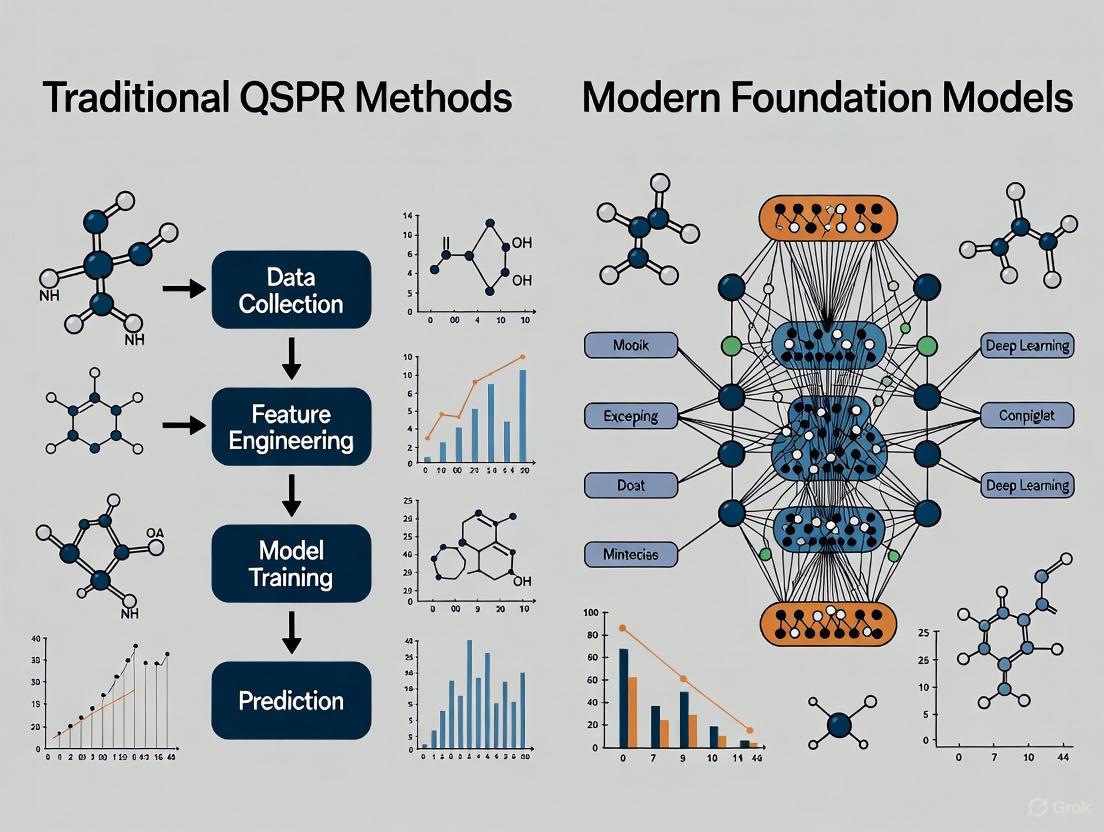
This article provides a comprehensive analysis for researchers and drug development professionals on the evolution from traditional Quantitative Structure-Property Relationship (QSPR) methods to modern foundation models.
From Linear Models to Foundation AI: A Practical Comparison of Traditional QSPR and Modern Methods in Drug Discovery
Abstract
This article provides a comprehensive analysis for researchers and drug development professionals on the evolution from traditional Quantitative Structure-Property Relationship (QSPR) methods to modern foundation models. We explore the fundamental principles of classical statistical QSPR and contrast them with the capabilities of large-scale, pre-trained AI models. The scope includes practical methodological comparisons, troubleshooting of common implementation challenges, and a rigorous validation of predictive performance across different chemical domains. By synthesizing current research and real-world case studies, this review offers a clear framework for selecting and optimizing computational approaches to accelerate materials discovery and therapeutic development.
The Evolution of Predictive Modeling: From Classical QSPR to Foundation Models
Quantitative Structure-Property Relationship (QSPR) modeling represents a foundational paradigm in computational chemistry and drug discovery. This guide delineates the core principles, statistical foundations, and established methodologies that define traditional QSPR. It further provides an objective comparison with modern foundation models, presenting experimental data that benchmark their performance in predicting key molecular properties. By detailing standardized protocols and reagent solutions, this article serves as a reference for researchers navigating the evolving landscape of computational medicinal chemistry.
Traditional Quantitative Structure-Property Relationship (QSPR) modeling is a computer-based technique that correlates quantitative measures of molecular structure with a compound's physical, chemical, or biological properties [1] [2]. Its core principle is that a molecule's structure inherently determines its behavior, allowing researchers to predict properties for novel compounds without resource-intensive laboratory experiments [1] [3]. For decades, this approach has been a cornerstone in fields like drug development, material science, and environmental chemistry, enabling the efficient screening and prioritization of compounds for synthesis and testing [1] [2]. The methodology relies on transforming a chemical structure into a mathematical representation using molecular descriptors, followed by the application of statistical or machine learning models to uncover the structure-property relationship [3]. This stands in contrast to modern, holistic AI-driven approaches that attempt to model biology in its full complexity using multimodal data and deep learning [4].
Core Principles and Statistical Foundations
The robustness of traditional QSPR rests on several well-defined principles and statistical underpinnings.
2.1 Foundational Workflow and Mathematical Representation The QSPR workflow is a sequential process that begins with molecular structure representation. Structures are commonly encoded as molecular graphs, ( G(V, E) ), where atoms comprise the set of vertices ( V ) and chemical bonds form the set of edges ( E ) [5] [1] [6]. From this graph, numerical descriptors, known as topological indices, are calculated. These indices summarize connectivity and shape, serving as the quantitative input for models [5] [6].
A key mathematical framework for generating degree-based topological indices is the M-polynomial. For a graph ( G ), the M-polynomial is defined as: [ M\left( {G;x,y} \right) = \mathop \sum \limits{\delta \le i \le j \le \Delta} e{i,j} x^{i} y^{j} ] where ( e{i,j} ) is the number of edges ( uv \in E(G) ) with ( (d{u}, d{v}) = (i, j) ), and ( d{u} ) represents the degree of vertex ( u ) [5]. This polynomial acts as a generating function; many standard topological indices can be derived from it using specific integral and differential operators [1].
The final stage involves constructing a predictive model, which is typically a linear regression or other machine learning algorithm. The general form of the model is: [ Property = f(Topological\ Index1,\ Topological\ Index2, ... ,\ Topological\ Index_n) ] where ( f ) is the function learned from the training data to correlate the descriptors with the target property [6].
2.2 Essential Research Reagent Solutions The following table details key computational tools and resources essential for conducting traditional QSPR analysis.
Table 1: Key Research Reagent Solutions for QSPR Modeling
| Tool/Resource | Type | Primary Function in QSPR | Key Features |
|---|---|---|---|
| Topological Indices [5] [6] | Mathematical Descriptor | Convert molecular graph into numerical values representing structure. | Calculated from molecular formula; based on degree, distance, or eccentricity. |
| M-polynomial [5] | Algebraic Polynomial | Generate multiple degree-based topological indices efficiently. | Serves as a unified mathematical framework for index calculation. |
| QSPRpred [3] | Software Package | End-to-end QSPR modeling, from data curation to model deployment. | Modular Python API, model serialization with preprocessing, support for multi-task learning. |
| PubChem [3] | Chemical Database | Source of experimental property data for model training and validation. | Large, publicly available repository of chemical structures and properties. |
| Linear Regression [6] | Statistical Model | Establish a linear relationship between topological indices and a target property. | Provides interpretable models with coefficients indicating descriptor importance. |
Experimental Protocols: Methodologies for Traditional QSPR Analysis
This section outlines a standard protocol for developing and validating a traditional QSPR model, using the prediction of physicochemical properties of anticancer drugs as an illustrative example [6].
3.1 Protocol: QSPR Modeling with Topological Indices
- Objective: To predict physicochemical properties (e.g., Boiling Point, Molar Refractivity) of a series of cancer drugs based on topological indices derived from their molecular structures.
- Materials:
- Methodology:
- Molecular Graph Construction: Represent each drug molecule as a connected molecular graph ( G(V, E) ), where atoms are vertices and bonds are edges. Hydrogen atoms may be omitted in skeletal formulas [1].
- Descriptor Calculation (Featurization): Calculate a set of topological indices for each molecular graph. This involves:
- Vertex Partitioning: Grouping vertices based on their degree [6].
- Edge Partitioning: Grouping edges ( E_{(i,j)} ) based on the degrees of their incident vertices [6].
- Index Computation: Applying formulas from Definitions 2.1-2.12 (e.g., Harmonic Temperature Index, Symmetric Division Temperature Index) to compute the final index values [6].
- Model Training & Validation:
- Data Splitting: Divide the dataset into training and test sets.
- Model Building: Employ a regression algorithm (e.g., Linear Regression, Support Vector Regression (SVR)) on the training set to learn the relationship between the computed indices and the target property [6].
- Performance Evaluation: Validate the model on the held-out test set. Use metrics such as the correlation coefficient (r) and standard error to assess predictive accuracy [6].
- Expected Output: A predictive model capable of estimating the physicochemical properties of new, untested drug molecules based solely on their topological indices.
The logical workflow for this protocol is summarized in the following diagram:
Diagram 1: Traditional QSPR Modeling Workflow. This flowchart outlines the standard sequence of steps for building a QSPR model, from molecular structure input to a validated predictive model.
Comparative Analysis: Traditional QSPR vs. Modern Foundation Models
The emergence of foundation models represents a paradigm shift in computational chemistry. This section compares the two approaches based on defining characteristics and performance.
4.1 Defining Characteristics and Philosophical Differences The fundamental difference lies in their approach to data representation and learning. Traditional QSPR is rooted in a reductionist philosophy, using human-defined descriptors and statistical models to investigate specific, narrow-scope tasks [4]. In contrast, modern AI-driven discovery, including foundation models, attempts to model biology holistically by integrating multimodal data (e.g., omics, images, text) using deep learning to uncover complex, system-level patterns [4].
Table 2: Comparative Framework: Traditional QSPR vs. Modern Foundation Models
| Feature | Traditional QSPR | Modern Foundation Models |
|---|---|---|
| Core Philosophy | Biological reductionism, hypothesis-driven [4] | Systems biology holism, hypothesis-agnostic [4] |
| Data Modality | Structured data; predefined chemical descriptors [4] | Multimodal data (text, images, omics, structures) [7] [4] |
| Representation Learning | Relies on hand-crafted features (e.g., topological indices) [7] | Self-supervised pre-training on broad data to learn generalized representations [7] |
| Model Architecture | Linear regression, Random Forests, SVMs [8] [6] | Transformer-based architectures, Graph Neural Networks (GNNs) [7] [9] |
| Interpretability | High; model coefficients and descriptor contribution are analyzable [8] | Low "black box" nature; requires post-hoc explainability methods [9] |
| Data Efficiency | Can work with smaller, curated datasets [8] | Requires phenomenal volumes of data for pre-training [7] |
4.2 Performance Benchmarking: Experimental Data Empirical studies directly benchmark these approaches. A 2025 study on cancer drugs compared Linear Regression (traditional QSPR) with Support Vector Regression (SVR) and Random Forest (modern ML) for predicting properties like Molar Refractivity (MR) and Molecular Volume (MV) using topological indices [6].
Table 3: Benchmarking Model Performance in QSPR Analysis of Cancer Drugs [6]
| Physicochemical Property | Best-Fit Topological Index | Linear Regression (r) | Support Vector Regression (SVR) (r) | Random Forest (r) |
|---|---|---|---|---|
| Complexity (COM) | T2(G) | 0.915 | > 0.9 | Slightly Lower |
| Molar Refractivity (MR) | ST(G) | 0.924 | > 0.9 | Slightly Lower |
| Molecular Volume (MV) | HT2(G) | Strong Inverse Correlation | > 0.9 | Slightly Lower |
| Boiling Point (BP) | HT2(G) | Strong Inverse Correlation | > 0.9 | Slightly Lower |
The results demonstrated that while advanced models like SVR achieved high correlation coefficients (r > 0.9), carefully constructed linear regression models based on topological indices remained highly competitive and often provided the best fit for the data [6]. This underscores that traditional QSPR models can be powerful and sufficient for specific tasks, offering high interpretability without sacrificing performance.
The following diagram illustrates the distinct conceptual landscapes of these two approaches:
Diagram 2: Contrasting Computational Philosophies. This diagram contrasts the descriptor-driven, reductionist nature of traditional QSPR with the representation-learning, holistic nature of modern foundation models.
Traditional QSPR is defined by its principled, descriptor-based approach to establishing quantitative relationships between molecular structure and properties. Its core strengths are high interpretability, effectiveness with smaller datasets, and a robust statistical foundation, as evidenced by its continued strong performance in predictive tasks [6]. While modern foundation models offer a transformative, holistic approach capable of navigating vastly larger chemical and biological spaces [7] [4], they do not render traditional methods obsolete. Instead, they represent a complementary toolkit. The future of computational drug discovery lies in bridging these paradigms [2], leveraging the interpretability and precision of traditional QSPR for specific problems while harnessing the power of foundation models for system-level exploration and inverse design.
The field of artificial intelligence is undergoing a fundamental transformation with the emergence of foundation models—large-scale neural networks trained on broad data using self-supervision that can be adapted to a wide range of downstream tasks [7]. These models, built predominantly on the transformer architecture, represent a significant departure from traditional machine learning approaches that required hand-crafted features and extensive labeled datasets for every new problem. In domains ranging from drug discovery to materials science, this paradigm shift is enabling researchers to tackle complex scientific challenges with unprecedented efficiency and accuracy [7] [9].
The core innovation underpinning this revolution is the transformer architecture, which utilizes self-attention mechanisms to process sequential data and capture complex relationships within input structures. When combined with self-supervised learning techniques that leverage vast amounts of unlabeled data, these models develop a deep understanding of fundamental patterns in scientific data, from molecular structures to material properties [10]. This review provides a comprehensive comparison between traditional Quantitative Structure-Property Relationship (QSPR) methods and modern foundation models, examining their performance, experimental protocols, and practical applications in scientific research and drug development.
Understanding the Technological Foundation
Transformer Architecture: The Building Block
The transformer architecture, first introduced in 2017, forms the fundamental building block of modern foundation models [7]. Unlike previous neural network architectures that processed data sequentially, transformers employ self-attention mechanisms that allow them to weigh the importance of different parts of the input data simultaneously. This capability is particularly valuable in scientific domains where complex, long-range dependencies exist, such as in molecular structures where distant atoms can influence overall properties [7] [9].
In the context of molecular science, transformers process simplified molecular-input line-entry system (SMILES) strings or graph representations of compounds, learning to capture intricate structural patterns that determine chemical properties and biological activities [11]. The architecture typically consists of encoder and decoder stacks that can be used separately or together, with encoder-only models excelling at understanding and representing input data, and decoder-only models specializing in generating new molecular structures [7].
Self-Supervised Learning: Leveraging Unlabeled Data
Self-supervised learning (SSL) has emerged as a powerful paradigm for pretraining deep learning models without requiring extensive labeled datasets [10]. By designing pretext tasks that generate supervisory signals directly from the data itself, SSL enables models to learn meaningful representations from vast amounts of unlabeled scientific information, such as molecular databases, chemical patents, and research literature [7] [10].
The two primary motivations for applying SSL in vision transformers (ViTs) and scientific models are: (1) networks trained on extensive data learn distinctive patterns transferable to subsequent tasks while reducing overfitting, and (2) parameters learned from extensive data provide effective initialization for faster convergence across different applications [10]. This approach is particularly valuable in scientific domains where labeled data is scarce and expensive to obtain, but unlabeled data exists in abundance.
Comparative Analysis: Traditional QSPR vs. Modern Foundation Models
Performance Benchmarking
Table 1: Performance comparison between traditional and modern methods across various scientific tasks
| Task Domain | Traditional Method | Foundation Model | Performance Metric | Traditional Result | Foundation Model Result | Citation |
|---|---|---|---|---|---|---|
| SARS-CoV-2 Mpro pIC50 Prediction | Classical ML | Deep Learning | Pearson r | Competitive | Top performer (Ranked 1st) | [12] |
| ADME Profile Prediction | Traditional ML | Deep Learning | Aggregated Ranking | Competitive | Significant improvement (Ranked 4th) | [12] |
| Small Tabular Data Classification (<10,000 samples) | Gradient-Boosted Decision Trees | TabPFN | Accuracy & Training Time | ~4 hours tuning | 2.8 seconds (5,140× faster) | [13] |
| Organic Solar Cell Properties | Random Forest (Baseline) | 1D CNN | Predictive Performance | Baseline | Robust performance in training and testing | [14] |
| SMILES Canonicalization | Traditional Methods | Transformer-CNN | Model Quality | Lower | Higher quality interpretable QSAR/QSPR | [11] |
Architectural and Methodological Differences
Table 2: Fundamental differences between traditional QSPR and foundation model approaches
| Aspect | Traditional QSPR Methods | Modern Foundation Models |
|---|---|---|
| Feature Engineering | Hand-crafted molecular descriptors | Automated representation learning |
| Data Requirements | Limited labeled data | Leverages large unlabeled datasets |
| Architecture | Rule-based systems, classical ML | Transformer-based neural networks |
| Training Approach | Supervised learning on specific tasks | Self-supervised pretraining + fine-tuning |
| Transferability | Task-specific models | Cross-task and cross-domain transfer |
| Interpretability | High (explicit features) | Variable (black-box characteristics) |
| Computational Demand | Moderate | High (but efficient inference) |
Experimental Protocols and Methodologies
Foundation Model Pretraining Workflow
Foundation model development follows a structured workflow beginning with synthetic data generation, where millions of artificial tabular datasets are created using causal models to capture diverse feature-target relationships [13]. This synthetic data serves as training corpus for transformer-based neural networks using self-supervised objectives, such as predicting masked portions of the input [13]. The TabPFN methodology exemplifies this approach, performing pre-training across synthetic datasets to learn a generic algorithm applicable to various real-world prediction tasks [13].
During inference, the trained model receives both labeled training and unlabeled test samples, performing training and prediction in a single forward pass through in-context learning [13]. This approach fundamentally differs from standard supervised learning where models are trained per dataset; instead, foundation models are trained across datasets and applied to entire datasets at inference time [13].
SMILES Canonicalization and QSAR Modeling Protocol
The Transformer-CNN approach for SMILES canonicalization and QSAR modeling involves a sequence-to-sequence framework where non-canonical SMILES strings are translated to their canonical equivalents [11]. The model is trained on datasets such as ChEMBL, using character-level tokenization with a vocabulary of 66 symbols covering diverse chemical structures including stereochemistry, charges, and inorganic ions [11].
Experimental protocols include:
- SMILES Augmentation: Training and inference using both canonical and non-canonical SMILES to improve model robustness [11]
- Dynamic Embeddings: Utilizing encoder outputs from the transformer as molecular representations for downstream QSAR tasks [11]
- Interpretation Techniques: Applying Layer-wise Relevance Propagation (LRP) to explain model predictions by identifying atom contributions [11]
This methodology demonstrates how foundation models can learn meaningful chemical representations without relying on hand-crafted descriptors, instead deriving features directly from SMILES strings through self-supervised pretraining.
Application Case Studies
Drug Discovery and Development
Foundation models are demonstrating significant impact across the drug discovery pipeline, from target identification to lead optimization [9]. Notable successes include baricitinib (identified through AI-assisted analysis for COVID-19 treatment), halicin (a preclinical antibiotic discovered using deep learning), and INS018_055 (an AI-designed TNIK inhibitor that progressed from target discovery to Phase II trials in approximately 18 months) [9].
In potency and ADME prediction, modern deep learning algorithms have shown statistically significant improvements over classical methods, particularly for ADME profile prediction where they significantly outperformed traditional machine learning in the ASAP-Polaris-OpenADMET Antiviral Challenge [12]. However, classical methods remain highly competitive for predicting compound potency, indicating a complementary relationship between approaches [12].
Materials Science and Energy Applications
In materials discovery, foundation models are being applied to property prediction, synthesis planning, and molecular generation [7]. For organic solar cells, deep learning-driven QSPR models using extended connectivity fingerprints have demonstrated robust predictive performance for power conversion efficiency (PCE) and molecular orbital properties (EHOMO and ELUMO) [14].
The critical advantage in materials science is the ability of foundation models to capture intricate dependencies where minute structural details significantly influence material properties—a phenomenon known as "activity cliffs" in cheminformatics [7]. This sensitivity to subtle variations enables more accurate prediction of properties in complex materials systems such as high-temperature superconductors, where critical temperature can be profoundly affected by minor variations in doping levels [7].
The Scientist's Toolkit: Essential Research Reagents
Table 3: Key computational tools and resources for foundation model research
| Tool/Resource | Type | Primary Function | Application Context |
|---|---|---|---|
| Transformer Architecture | Neural Network Architecture | Sequence processing with self-attention | Base model for foundation models [7] |
| SMILES/SEFLIES | Molecular Representation | String-based encoding of chemical structures | Input representation for chemical models [7] [11] |
| TabPFN | Tabular Foundation Model | In-context learning for tabular data | Small to medium-sized dataset prediction [13] |
| ChEMBL | Chemical Database | Curated bioactive molecules with drug-like properties | Training data for chemical models [7] [11] |
| Vision Transformers (ViTs) | Computer Vision Architecture | Image processing with self-attention | Molecular image analysis and property prediction [10] |
| Data Kernels | Comparison Framework | Evaluating embedding space geometry | Model comparison without evaluation metrics [15] |
| Layer-wise Relevance Propagation (LRP) | Interpretation Method | Explaining model predictions | Identifying important features in QSAR models [11] |
Performance Characteristics and Limitations
Data Efficiency and Training Requirements
Foundation models exhibit distinct performance characteristics across different data regimes. While SSL enables leveraging large unlabeled datasets, studies comparing SSL and supervised learning (SL) on small, imbalanced medical imaging datasets found that SL often outperformed SSL in scenarios with limited labeled data, even when only a limited portion of labeled data was available [16]. This highlights the importance of selecting learning paradigms based on specific application requirements, training set size, label availability, and class frequency distribution [16].
The data efficiency of foundation models is particularly evident in the TabPFN approach, which dominates traditional methods on datasets with up to 10,000 samples while requiring substantially less training time—outperforming ensemble baselines tuned for 4 hours in just 2.8 seconds, representing a 5,140× speedup in classification settings [13]. This demonstrates how foundation models can accelerate research cycles in scientific discovery.
Current Limitations and Challenges
Despite their impressive capabilities, foundation models face several significant limitations. Data quality and bias remain persistent challenges, as models trained on biased data sources may propagate errors into downstream analyses [7]. The performance of foundation models is also constrained by their training data, with current chemical models predominantly trained on 2D molecular representations (SMILES/SELFIES), potentially missing critical 3D structural information that influences molecular properties [7].
Interpretability presents another challenge, as foundation models often function as "black boxes" with limited transparency into their decision-making processes [9]. While techniques like Layer-wise Relevance Propagation (LRP) can help interpret predictions by identifying important atoms, the inherent complexity of these models makes full interpretability difficult [11]. Additionally, domain mismatch between pre-training and target domains can limit effectiveness, requiring careful validation and potential fine-tuning [17].
The rise of foundation models represents a significant advancement in computational science, offering unprecedented capabilities for tackling complex challenges in drug discovery and materials science. However, rather than completely replacing traditional QSPR methods, these modern approaches serve as complementary tools that augment established methodologies [9]. The optimal approach often involves integrating both paradigms—leveraging foundation models for their pattern recognition and generative capabilities while utilizing traditional methods for interpretability and validation.
As noted in recent evaluations, AI should be viewed as "an additional tool in the drug discovery toolkit rather than a paradigm shift that renders traditional methods obsolete" [9]. The success of AI applications depends heavily on the quality of training data, the expertise of scientists interpreting results, and the robustness of experimental validation—all elements rooted in traditional scientific practices. This balanced perspective ensures that the integration of foundation models into scientific workflows enhances rather than disrupts the rigorous processes that underpin scientific discovery.
Key Differences in Data Requirements and Representation Learning
The prediction of molecular properties is a cornerstone of modern chemical and pharmaceutical research. For decades, Quantitative Structure-Property Relationship (QSPR) modeling has served as the primary computational approach, relying on statistical relationships between predefined molecular descriptors and properties of interest [18]. However, the emergence of foundation models represents a paradigm shift in how machines learn from chemical data [7]. These approaches differ fundamentally in their data requirements and their approach to representation learning—the process of capturing molecular characteristics in numerical form. Understanding these differences is crucial for researchers selecting appropriate methodologies for drug discovery and materials science applications. This guide provides an objective comparison of these approaches, supported by experimental data and detailed methodological insights.
Core Conceptual Differences
Traditional QSPR Approach
Traditional QSPR methods operate on a manually engineered feature paradigm. Researchers calculate predefined molecular descriptors—such as topological indices, constitutional descriptors, or electronic parameters—and use statistical methods to correlate these descriptors with target properties [18] [19]. The representation learning is essentially performed by the human expert who selects which descriptors to include, meaning the domain knowledge is encoded in the feature selection process rather than learned from data.
Foundation Model Approach
Foundation models employ a fundamentally different philosophy. Through self-supervised pre-training on broad data, these models learn molecular representations directly from raw structural inputs like SMILES strings or molecular graphs [7]. The representation learning occurs automatically through exposure to vast chemical spaces, allowing the model to discover relevant features without explicit human guidance. This pre-trained model can then be adapted to specific property prediction tasks with relatively small amounts of task-specific data [7].
Data Requirements: Volume, Quality, and Curation
Quantitative Comparison of Data Needs
Table 1: Comparative Data Requirements for QSPR vs. Foundation Models
| Aspect | Traditional QSPR | Foundation Models |
|---|---|---|
| Dataset Size | Typically hundreds to thousands of compounds [20] | Pre-training often uses millions to billions of compounds (e.g., ZINC, ChEMBL) [7] |
| Data Modality | Primarily structured descriptor data | Diverse inputs including SMILES, graphs, sequences, and sometimes 3D structures [7] |
| Pre-training Data | Not applicable | Requires large-scale unlabeled data for self-supervised learning [7] |
| Fine-tuning Data | Entire model built from scratch with property data | Can adapt to new tasks with small labeled datasets (few-shot learning) [7] [21] |
| Curation Overhead | High demand for manual feature engineering and selection [19] | Shifted toward automated representation learning, but requires careful data quality control [7] |
Impact on Practical Implementation
The differential data requirements have profound practical implications. Traditional QSPR models can be developed for specialized chemical domains with limited data availability, making them accessible for research groups with focused compound collections [20]. Foundation models, in contrast, demand substantial computational resources for pre-training but offer greater flexibility once established [7]. Recent studies indicate that foundation models pre-trained on large datasets like ChEMBL and PubChem demonstrate superior transfer learning capabilities, effectively leveraging chemical knowledge across domains [7] [22].
Representation Learning Mechanisms
Technical Approaches Comparison
Table 2: Representation Learning in QSPR vs. Foundation Models
| Characteristic | Traditional QSPR | Foundation Models |
|---|---|---|
| Representation Type | Fixed molecular descriptors (e.g., topological, electronic, constitutional) [19] | Learned embeddings from SMILES, molecular graphs, or sequences [7] |
| Learning Process | Manual feature selection and engineering | Automated through deep learning architectures (Transformers, GNNs, etc.) [7] [23] |
| Interpretability | High - Direct relationship between descriptors and properties [18] | Lower - "Black box" nature requires specialized interpretation techniques [23] |
| Information Captured | Limited to predefined descriptor domains | Potential to capture novel, previously unquantified chemical patterns [7] |
| Architecture | Statistical methods (MLR, PLS) and classical machine learning (RF, SVM) [19] | Deep neural networks (Transformers, GNNs, CNNs, RNNs) [7] [23] |
Visualization of Representation Learning Pathways
Molecular Representation Learning Pathways
Experimental Performance Comparison
Benchmarking Studies and Results
Comparative studies provide empirical evidence of the performance differences between these approaches. A comprehensive 2020 study directly compared Deep Neural Networks (DNN) against traditional QSPR methods including Multiple Linear Regression (MLR), Partial Least Squares (PLS), and Random Forest (RF) across different training set sizes [21].
Table 3: Predictive Performance (R²) Across Different Training Set Sizes [21]
| Method | Large Training Set (n=6069) | Medium Training Set (n=3035) | Small Training Set (n=303) |
|---|---|---|---|
| DNN (Foundation Approach) | 0.90 | 0.89 | 0.94 |
| Random Forest | 0.90 | 0.88 | 0.84 |
| Partial Least Squares | 0.65 | 0.24 | 0.24 |
| Multiple Linear Regression | 0.69 | 0.24 | 0.93* |
Note: MLR showed significant overfitting on small datasets with test set R²pred of approximately zero despite high training R² [21]
Experimental Protocol for Performance Comparison
The benchmarking methodology followed in these comparative studies typically involves several standardized steps [21]:
Dataset Curation: Compounds with experimental activity data are collected from sources like ChEMBL, ensuring consistent measurement conditions and activity thresholds.
Descriptor Calculation: For traditional QSPR methods, molecular descriptors including AlogP, extended connectivity fingerprints (ECFP), and functional-class fingerprints (FCFP) are computed, typically generating 600+ descriptors per compound.
Data Splitting: Compounds are randomly divided into training and test sets, with common splits being 85%/15% for large datasets. For small dataset experiments, the training set is systematically reduced.
Model Training: Each algorithm is trained on the identical training set using the same molecular representations:
- DNN models typically employ multiple hidden layers with activation functions
- Traditional MLR and PLS use standardized regression techniques
- Random Forest implementations use ensemble decision trees with bagging
Performance Validation: Models are evaluated on the held-out test set using metrics including R², F1 score, Matthews correlation coefficient, and others to assess both predictive accuracy and robustness.
Software and Computational Tools
Table 4: Essential Tools for Molecular Property Prediction Research
| Tool Name | Type | Primary Function | Application Context |
|---|---|---|---|
| QSPRpred [22] [3] | Python Package | Comprehensive QSPR modeling toolkit with serialization | Traditional QSPR, proteochemometric modeling |
| DeepChem [22] | Python Library | Deep learning for drug discovery and materials science | Foundation models, deep learning approaches |
| CODESSA PRO [19] | Commercial Software | Descriptor calculation and BMLR modeling | Traditional QSPR with heuristic descriptor selection |
| RDKit [24] | Cheminformatics Library | Molecular descriptor calculation and fingerprint generation | Both approaches (feature generation) |
| KNIME [22] | Workflow Platform | Visual workflow design for QSPR modeling | Traditional QSPR with GUI-based approach |
- ChEMBL [7] [22]: Public database of bioactive molecules with drug-like properties, essential for pre-training foundation models
- PubChem [7] [22]: Large database of chemical substances and their biological activities, used for both training and benchmarking
- ZINC [7]: Commercially-available chemical compound collection for virtual screening, used in foundation model pre-training
- Tox21 [24]: Benchmark dataset for quantitative toxicology, commonly used for model validation
The comparison between traditional QSPR and foundation models reveals a fundamental trade-off: interpretability versus performance. Traditional QSPR methods offer transparent, interpretable models that work well with limited data but may miss complex structure-property relationships [18] [19]. Foundation models demonstrate superior predictive performance, particularly on large and diverse chemical spaces, but require substantial computational resources and present interpretation challenges [7] [23].
Emerging research indicates that hybrid approaches may leverage the strengths of both paradigms. Incorporating domain knowledge from traditional QSPR into foundation model architectures represents a promising direction [7]. Furthermore, advances in explainable AI are addressing the "black box" limitations of deep learning approaches, potentially bridging the interpretability gap [23]. As foundation models continue to evolve, their ability to leverage multi-modal data—including 3D structural information and spectroscopic data—will likely further expand their predictive capabilities across chemical and pharmaceutical domains [7].
The field of Quantitative Structure-Property Relationship (QSPR) modeling has undergone a profound transformation, evolving from early statistical approaches using human-engineered molecular descriptors to contemporary artificial intelligence (AI) methods employing self-supervised foundation models. This evolution represents a fundamental shift in how computers learn chemical information—from explicit human instruction to automated pattern discovery from large data volumes.
This guide charts this technological trajectory, comparing the performance, methodologies, and applications of traditional QSPR against modern AI approaches through analysis of experimental data and benchmarking studies.
The Historical Foundation: Traditional QSPR Methodology
Traditional QSPR modeling established the core paradigm of relating chemical structure to molecular properties through quantitative models. The earliest approaches, dating back to the 19th century, observed relationships between chemical composition and physiological effects [25]. Modern traditional QSPR emerged between the 1960s and 1990s based on key methodological pillars.
Molecular Representations and Descriptors
Traditional QSPR relied exclusively on hand-crafted molecular representations designed by domain experts to encode specific chemical information:
- Molecular Descriptors: Numerical values capturing specific physicochemical properties (e.g., molecular weight, logP) or topological features (e.g., Wiener Index, Atom-Bond Connectivity indices) [26] [27]
- Molecular Fingerprints: Bit vectors encoding the presence or absence of specific substructures or structural patterns, analogous to a "bag of words" approach in natural language processing [27]
These representations were calculated using specialized software packages like RDKit, CDK, and Dragon, which could generate hundreds to thousands of descriptors [26].
Modeling Approaches and Experimental Protocols
The experimental workflow for traditional QSPR followed a standardized protocol:
- Data Collection: Compounding experimental property data for a set of compounds
- Descriptor Calculation: Generating molecular descriptors or fingerprints for all compounds
- Variable Selection: Applying statistical methods to identify the most relevant descriptors, using techniques like forward selection, backward elimination, or genetic algorithms [25]
- Model Construction: Building mathematical relationships using linear methods such as Multiple Linear Regression (MLR), Partial Least Squares (PLS), or Principal Component Analysis (PCA) [25]
- Model Validation: Rigorously testing model performance using cross-validation and external test sets to ensure predictive capability [25]
Table 1: Key Traditional QSPR Modeling Techniques
| Method Category | Examples | Key Characteristics | Typical Applications |
|---|---|---|---|
| Linear Methods | MLR, PLS, PCA | Interpretable coefficients, assumption of linearity | Early ADME prediction, physicochemical properties |
| Variable Selection | Forward selection, Genetic algorithms | Reduces overfitting, identifies key descriptors | Model simplification, feature importance analysis |
| Validation Methods | Leave-one-out, test set validation | Estimates real-world performance | Model reliability assessment |
The Modern Paradigm: AI and Foundation Models
The contemporary era of QSPR has been revolutionized by AI, particularly through foundation models—large-scale models pre-trained on broad data that can be adapted to diverse downstream tasks [7]. This shift began gaining significant momentum around 2022, with over 200 foundation models now published for drug discovery applications [28].
The Rise of Learned Representations
A fundamental advancement in modern AI approaches is the use of learned representations instead of hand-crafted descriptors. These include:
- Sequence-Based Representations: Models like ChemBERTa process Simplified Molecular-Input Line-Entry System (SMILES) strings using transformer architectures adapted from natural language processing [29] [25]
- Graph-Based Representations: Message Passing Neural Networks (MPNNs) such as Chemprop operate directly on molecular graphs, aggregating atom and bond features to learn molecular representations [27]
- 3D Structural Representations: Models like Uni-Mol incorporate three-dimensional molecular conformation information through transformer architectures [27]
These learned representations discover chemically relevant features directly from data rather than relying on human-designed descriptors.
Foundation Model Architectures and Training
Modern chemical foundation models employ sophisticated architectures and training paradigms:
- Self-Supervised Pretraining: Models are first trained on large unlabeled molecular datasets (e.g., from PubChem, ZINC) using pretext tasks that don't require expensive experimental data [7]
- Encoder-Decoder Architectures: Transformer models can be encoder-only (focused on representation learning), decoder-only (focused on generation), or full encoder-decoder architectures [7]
- Multi-Modal Capabilities: Advanced models can process multiple data types (text, images, molecular structures) from scientific literature and patents [7]
- Transfer Learning and Fine-Tuning: Pretrained models can be adapted to specific property prediction tasks with limited labeled data [30]
Diagram 1: Foundation Model Workflow in Modern QSPR. Modern AI approaches use self-supervised pretraining on large unlabeled datasets followed by task-specific fine-tuning.
Performance Comparison: Experimental Data and Benchmarking
Comprehensive benchmarking studies reveal the relative strengths and limitations of traditional and modern AI approaches across different data regimes and molecular classes.
Accuracy and Data Efficiency
Multiple studies have systematically compared the performance of traditional descriptor-based methods against modern learned representations:
Table 2: Performance Comparison Across QSPR Approaches
| Method Category | Representative Models | Small Data Regimes\n(<1,000 samples) | Large Data Regimes\n(>10,000 samples) | Interpretability | Computational Cost |
|---|---|---|---|---|---|
| Traditional QSPR | MLR with descriptors, Random Forest with fingerprints | Competitive to superior [27] | Good but often surpassed by AI | High | Low |
| Learned Representations | Chemprop, GROVER, MolBERT | Often requires advanced techniques [27] | State-of-the-art performance | Low to moderate | High |
| Hybrid Approaches | fastprop (descriptors + deep learning) | Strong performance [27] | Competitive with pure AI | Moderate | Moderate |
| Foundation Models | Fine-tuned transformer models | Emerging capabilities with transfer learning [7] | Excellent generalization | Low without specialized tools | Very high (pretraining) |
Roughness and Generalization Challenges
The concept of "roughness" in structure-property relationships—where similar molecules have divergent properties—presents challenges for both traditional and AI approaches. The Roughness Index (ROGI) metric quantifies this phenomenon, with higher values correlating with increased prediction errors [29].
Studies evaluating pretrained chemical models found that they do not necessarily produce smoother QSPR surfaces than simple fingerprints and descriptors, helping explain why their empirical performance gains are sometimes limited without fine-tuning [29]. This suggests that smoothness assumptions during pretraining need improvement for better generalization.
Application to Emerging Therapeutic Modalities
Modern AI approaches face particular challenges with novel molecular classes like Targeted Protein Degraders (TPDs), including molecular glues and heterobifunctional degraders. These molecules often violate traditional drug-like criteria (e.g., molecular weight >900 Da) and occupy under-represented regions of chemical space [31].
Experimental findings show that global QSPR models maintain reasonable performance for TPDs, with misclassification errors for key ADME properties ranging from 0.8% to 8.1% across all modalities, and up to 15% for heterobifunctionals [31]. Transfer learning strategies, where models pretrained on general chemical data are fine-tuned on TPD-specific data, show promise for improving predictions for these challenging modalities [31].
The Scientist's Toolkit: Essential Research Reagents and Software
Table 3: Essential Tools for Modern QSPR Research
| Tool Name | Type | Primary Function | Key Features |
|---|---|---|---|
| RDKit | Cheminformatics Library | Molecular descriptor calculation and manipulation | 208 descriptors, 5 fingerprints, Python interface [26] |
| Mordred | Descriptor Calculator | High-throughput descriptor calculation | >1,600 molecular descriptors, Python implementation [27] |
| Chemprop | Deep Learning Framework | Property prediction with message passing neural networks | Graph-based learned representations, state-of-the-art accuracy [27] |
| fastprop | Deep Learning Framework | Deep QSPR with molecular descriptors | Mordred descriptors + neural networks, strong small-data performance [27] |
| QSPRpred | Modeling Toolkit | End-to-end QSPR workflow management | Data preparation, model building, serialization for deployment [3] |
| DeepChem | Deep Learning Library | Molecular machine learning | Diverse featurizers, models, and utilities [3] |
Diagram 2: QSPR Methodology Evolution. The field has evolved from traditional descriptors with classical ML to learned representations with modern AI, with hybrid approaches combining elements of both.
The evolution from traditional QSPR to modern AI approaches represents not a replacement but an expansion of methodological capabilities. Each paradigm offers distinct advantages:
- Traditional QSPR methods provide interpretability, computational efficiency, and strong performance in data-limited scenarios
- Modern AI approaches offer state-of-the-art accuracy in data-rich environments and capability with complex molecular classes
- Hybrid approaches like fastprop demonstrate that combining traditional descriptors with deep learning can achieve competitive performance while maintaining favorable computational characteristics [27]
For researchers and drug development professionals, the contemporary toolkit encompasses both traditional and modern approaches, selected based on dataset characteristics, molecular modality, and interpretability requirements. As foundation models continue to evolve, their integration with chemical knowledge encoded in traditional descriptors may yield the next generation of QSPR capabilities, further accelerating molecular discovery and optimization.
Methodologies in Practice: QSPR Techniques vs. Foundation Model Architectures
Quantitative Structure-Property Relationship (QSPR) modeling represents a foundational methodology in computational chemistry and drug discovery, enabling researchers to predict molecular properties based on numerical descriptors derived from chemical structures. The classical QSPR approach follows a well-established paradigm: molecules are encoded by numerical parameters (molecular descriptors), which then serve as input for statistical or machine learning algorithms to build predictive models [32]. For years, this field was dominated by traditional statistical methods including Multiple Linear Regression (MLR) and Partial Least Squares (PLS) regression, often coupled with various feature selection techniques to manage dimensionality. These classical approaches stand in stark contrast to modern foundation models, which leverage self-supervised training on broad data and can be adapted to a wide range of downstream tasks with minimal fine-tuning [7].
The emergence of foundation models, particularly large language models (LLMs) and their chemical counterparts, represents a paradigm shift in computational materials discovery. While early expert systems and traditional QSPR relied on hand-crafted symbolic representations, the current trend moves toward automated, data-driven representation learning [7]. This transition mirrors the broader evolution in artificial intelligence from feature engineering to representation learning. However, classical QSPR methods retain significant relevance due to their interpretability, lower computational requirements, and proven effectiveness in low-data regimes commonly encountered in chemical research [33]. This review examines the enduring role of classical QSPR workflows within the contemporary computational landscape, providing a balanced comparison with emerging foundation model approaches.
Theoretical Foundations and Methodologies
Core Algorithms in Classical QSPR
Multiple Linear Regression (MLR) serves as one of the most transparent and interpretable workhorses in classical QSPR modeling. MLR establishes a linear relationship between multiple independent variables (molecular descriptors) and a dependent variable (the target property). Its primary advantage lies in the straightforward interpretability of coefficient weights, which directly indicate each descriptor's contribution to the predicted property. However, MLR suffers from several limitations, including sensitivity to descriptor correlations and requirements for descriptor orthogonality, which often necessitates careful feature selection to avoid multicollinearity issues [32].
Partial Least Squares (PLS) Regression addresses MLR's collinearity problems by projecting the predicted variables and the observable variables to a new space, effectively finding a linear regression model by projecting both the independent variables (descriptors) and dependent variables (properties) to a lower-dimensional space using latent variables (components). This approach is particularly valuable when descriptors are highly correlated or when the number of descriptors exceeds the number of observations. PLS has proven exceptionally effective in spectroscopic data analysis and has become a mainstay in chemometrics applications within QSPR [32].
Feature Selection Strategies in QSPR
Feature selection represents a critical step in classical QSPR workflows, significantly impacting both the statistical quality and practical utility of prediction models [33]. These methods can be broadly categorized into three approaches:
Filter Methods: These techniques preselect predictors independently of the learning algorithm based on statistical measures. Common approaches include univariable p-value selection, correlation-based filtering, and information gain criteria. These methods are computationally efficient but may overlook interactions between features [33] [34].
Wrapper Methods: These strategies alternate between feature selection and model building, using the model's performance as the selection criterion. Examples include recursive feature elimination and sequential forward/backward selection. While computationally intensive, wrapper methods often yield superior performance by considering feature interactions [34].
Embedded Methods: These approaches integrate feature selection directly into the model-building process. LASSO (Least Absolute Shrinkage and Selection Operator) represents a prominent example, performing both regularization and feature selection simultaneously through L1-penalization [33].
The choice among these strategies depends heavily on study objectives, dataset dimensions, and the desired balance between computational efficiency and model performance [33]. In clinical and chemical datasets with limited samples, traditional statistical methods often outperform machine learning approaches that typically require larger datasets to perform effectively [33].
Classical QSPR Workflow
The standard workflow for classical QSPR modeling involves sequential steps from data collection through model validation, with feature selection playing a pivotal role in optimizing model performance and interpretability.
Experimental Protocols and Benchmarking
Benchmarking Classical vs. Modern Approaches
Robust evaluation frameworks are essential for objectively comparing classical QSPR methods with modern alternatives. The ADEMP (Aims, Data, Estimands, Methods, and Performance) framework provides a structured approach for simulation study design and reporting in method comparisons [33]. This framework systematically addresses:
- Aims: Comparison of variable/feature selection methods concerning predictive performance and descriptive accuracy across statistical and machine learning models.
- Data Generation: Sampling predictors from real populations with outcomes generated through multiple data-generating mechanisms (DGMs), including unpenalized logistic regression, LASSO, RIDGE, random forests, boosted trees, and multivariate adaptive regression splines.
- Estimands: Quantitative targets including model prediction error, discrimination, sharpness, calibration, and inclusion rates of true/false predictors.
- Methods: Evaluation of multiple variable selection strategies (backward selection, univariate threshold-based, k-best selection) using various scores (p-value, AIC, CAR-score, permutation importance).
- Performance Measures: Comprehensive assessment using cross-validation and holdout testing to estimate generalization error [33] [34].
Performance Comparison Across Methodologies
Empirical studies reveal distinct performance patterns between classical and modern QSPR approaches, with each demonstrating strengths in specific scenarios.
Table 1: Performance Comparison of QSPR Modeling Approaches
| Method Category | Representative Algorithms | Best-Suited Data Regimes | Interpretability | Computational Demand | Key Limitations |
|---|---|---|---|---|---|
| Classical QSPR | MLR, PLS, MLR with feature selection | Low-dimensional data, small sample sizes | High | Low | Limited complexity handling, manual feature engineering |
| Traditional Machine Learning | Random Forests, SVM, XGBoost | Medium to large datasets | Medium | Medium | Data-hungry, less effective in low-data regimes |
| Foundation Models | GPT-based models, BERT-based models, Graph Neural Networks | Very large datasets | Low | Very High | Black-box nature, extensive data requirements |
Table 2: Experimental Performance in Low-Dimensional Settings
| Model Type | Feature Selection Method | Average Predictive Accuracy | Standard Deviation | Feature Retention Rate | Training Time (relative) |
|---|---|---|---|---|---|
| Multiple Linear Regression | Backward p-value selection | 0.74 | 0.08 | 68% | 1.0x |
| Multiple Linear Regression | LASSO | 0.76 | 0.07 | 42% | 1.2x |
| Partial Least Squares | Built-in latent variables | 0.79 | 0.06 | 100% | 1.5x |
| Random Forest | Permutation importance | 0.81 | 0.09 | 85% | 3.7x |
| Graph Neural Network | Embedded attention | 0.83 | 0.11 | 90% | 15.3x |
The data clearly demonstrates that while modern methods like graph neural networks can achieve marginally higher predictive accuracy in some scenarios, classical approaches like PLS and MLR with feature selection offer competitive performance with significantly lower computational requirements and greater interpretability [33]. This advantage is particularly pronounced in low-dimensional settings common in chemical research, where the number of observations may be limited despite high-dimensional descriptor spaces [33].
The Scientist's Toolkit: Essential Research Reagents
Successful implementation of classical QSPR workflows requires familiarity with both computational tools and methodological approaches. The following table summarizes key resources available to researchers.
Table 3: Essential Tools for Classical QSPR Research
| Tool Name | Type | Key Functions | License | Best For |
|---|---|---|---|---|
| RDKit | Open-source library | Molecular I/O, fingerprint generation, descriptor calculation | BSD-3-Clause | General cheminformatics, descriptor calculation [35] |
| DOPtools | Python library | Unified descriptor calculation, hyperparameter optimization, reaction modeling | Open Access | QSPR model optimization, reaction property prediction [32] |
| mlr3fselect | R package | Wrapper feature selection, multi-metric optimization, nested resampling | Open Source | Feature selection with statistical models [34] |
| CAR-score | Statistical method | Variable selection based on correlation-adjusted relationships | Academic | High-dimensional descriptor spaces [33] |
| BORUTA | R package | Random forest-based feature selection | Open Source | Identifying all-relevant variables [33] |
Comparative Analysis and Research Applications
Performance in Specific Chemical Applications
Classical QSPR methods demonstrate particular utility in property prediction tasks where interpretability and mechanistic insight are valued alongside predictive accuracy. For instance, in pKa prediction—a crucial parameter in drug discovery—classical methods offer distinct advantages in certain scenarios:
Fragment- or Group-Based Methods: These approaches estimate pKa from substituent effects using Hammett/Taft-style linear free-energy relationships and curated fragment libraries. They are extremely fast and often highly accurate within their domain of applicability, though they may generalize poorly and miss complex chemical motifs or through-space effects [36].
Hybrid Approaches: Methods like ChemAxon's pKa plugin and the open-source QupKake model integrate physics-based features with machine learning, adding physical inductive bias to improve model generality and robustness while maintaining the ability to improve with additional data [36].
The performance advantage of classical methods is most pronounced in low-data regimes. As noted in comparative studies, "clinical data are often in the setting of low-dimensional low sample size data," where traditional statistical methods frequently outperform machine learning approaches that typically require larger datasets to demonstrate their full potential [33].
Integration with Modern Workflows
Rather than being rendered obsolete by foundation models, classical QSPR approaches are increasingly integrated into hybrid workflows that leverage the strengths of both paradigms. Foundation models excel at representation learning from massive datasets, while classical methods provide interpretability and statistical rigor [7]. This complementary relationship mirrors the integration of AI in drug discovery more broadly, where these technologies "augment traditional methodologies rather than replacing them" [9].
The emerging best practice involves using foundation models for initial feature extraction and representation learning, followed by classical statistical methods for interpretable modeling, particularly in data-constrained environments. This approach balances the representation power of modern architectures with the transparency and robustness of classical approaches [7] [9].
Classical QSPR workflows based on Multiple Linear Regression, Partial Least Squares, and feature selection methods remain vital components of the computational chemist's toolkit. While foundation models represent significant advances in representation learning and predictive power for large-scale applications, classical methods offer irreplaceable benefits in interpretability, statistical rigor, and effectiveness in low-data regimes. The most productive path forward involves strategically combining these approaches, using classical methods for interpretable modeling in well-characterized chemical spaces and foundation models for exploring complex, high-dimensional relationships in large datasets. As the field evolves, this synergistic integration of traditional and modern approaches will likely drive the next generation of advances in quantitative structure-property relationship modeling.
The field of computational drug discovery is undergoing a profound transformation, moving from traditional Quantitative Structure-Property Relationship (QSPR) methods to modern foundation model research. Traditional QSPR approaches relied heavily on hand-crafted molecular descriptors and feature engineering, which often required significant domain expertise and struggled with generalization across diverse chemical spaces. The emergence of deep learning architectures, particularly Encoder-Decoder Transformers and Graph Neural Networks (GNNs), has revolutionized how we extract meaningful patterns from molecular data by learning representations directly from molecular structures [37] [38].
This shift represents more than a mere change in algorithms—it constitutes a fundamental reimagining of molecular representation learning. Where traditional QSPR methods depended on pre-defined descriptors such as molecular fingerprints and topological indices, foundation models automatically learn relevant features from data, capturing complex nonlinear relationships that often elude manual feature engineering [38]. This capability is particularly valuable in drug discovery, where the relationship between molecular structure and biological activity encompasses intricate interactions across multiple scales.
Within this new paradigm, Encoder-Decoder Transformers and GNNs have emerged as two dominant architectural frameworks, each with distinct strengths and methodological approaches. GNNs operate natively on graph-structured data, directly modeling atoms as nodes and bonds as edges, making them particularly well-suited for capturing local atomic environments and structural relationships [39] [40]. Conversely, Encoder-Decoder Transformers excel at modeling long-range dependencies and global contextual relationships, whether applied to molecular sequences or adapted to graph structures through various attention mechanisms [41] [42].
This comprehensive comparison examines these architectures through multiple dimensions: theoretical foundations, performance benchmarks across standardized tasks, computational efficiency, and practical applicability in real-world drug discovery pipelines. By synthesizing evidence from recent benchmarking studies, head-to-head comparisons, and innovative hybrid approaches, this guide provides researchers with a framework for selecting appropriate architectures for specific molecular modeling challenges.
Architectural Foundations
Graph Neural Networks (GNNs)
Graph Neural Networks constitute a family of neural architectures specifically designed to operate on graph-structured data, making them naturally suited for molecular representation where atoms form nodes and chemical bonds constitute edges. The fundamental operation underlying most GNN variants is message passing, where information is iteratively exchanged between adjacent nodes to capture local structural relationships [40]. In each layer, nodes aggregate features from their neighbors and update their own representations, gradually building up from atomic to molecular-level features.
Several GNN variants have been developed with distinct aggregation schemes:
- Graph Convolutional Networks (GCNs) apply convolutional operations to graph data, aggregating normalized sums of neighbor features [43].
- Graph Isomorphism Networks (GINs) offer maximal discriminative power based on the Weisfeiler-Lehman graph isomorphism test, making them particularly strong for tasks requiring subtle structural differentiation [39] [40].
- Graph Attention Networks (GATs) incorporate attention mechanisms to weight neighbor contributions differentially, allowing models to focus on more relevant atomic interactions [43].
- GraphSAGE employs sampling and aggregation functions to enable inductive learning on unseen graph structures, crucial for large-scale molecular datasets [44] [40].
For molecular applications, GNNs typically represent atoms with node features (atomic number, hybridization, formal charge) and bonds with edge features (bond type, stereochemistry). Through multiple message-passing layers, these models capture increasingly complex chemical environments, ultimately generating molecular representations through readout functions that pool node-level features [39] [37].
Encoder-Decoder Transformers
The Transformer architecture, introduced by Vaswani et al., revolutionized sequence modeling through its attention mechanism that dynamically weights the importance of different input elements [42]. The encoder-decoder variant consists of two main components: an encoder that processes input sequences to create contextualized representations, and a decoder that generates output sequences by attending to both the encoded representations and previously generated tokens.
The core innovation lies in the self-attention mechanism, which computes compatibility scores between all pairs of elements in a sequence, enabling direct modeling of long-range dependencies without the sequential constraints of RNNs or LSTMs. This is particularly formulated as:
[ \text{Attention}(Q, K, V) = \text{softmax}\left(\frac{QK^T}{\sqrt{d_k}}\right)V ]
Where (Q), (K), and (V) represent queries, keys, and values derived from input embeddings [42].
For molecular applications, Transformers have been adapted through several approaches:
- Sequence-based Models: Treat molecular representations (SMILES, SELFIES) as sequences, applying standard transformer architectures to predict molecular properties [37].
- Graph Transformers: Adapt attention mechanisms to operate directly on graph structures, often incorporating structural biases through positional encodings based on molecular topology or geometry [39] [40].
- Multi-modal Architectures: Combine molecular graph features with additional chemical descriptors, leveraging the transformer's flexibility to integrate heterogeneous data types [41].
Recent innovations like Graphormer explicitly encode structural information through spatial encoding and edge encoding, bridging the gap between GNNs' structural awareness and Transformers' global receptive fields [39].
Hybrid Architectures
Recognizing the complementary strengths of both architectures, researchers have developed hybrid models that integrate GNNs and Transformers:
- Meta-GTNRP: Combines GNNs for local structural feature extraction with Vision Transformers for global semantic modeling, demonstrating strong performance in few-shot nuclear receptor binding prediction [41].
- BatmanNet: Employs a bi-branch masked graph transformer autoencoder that reconstructs masked nodes and edges, effectively capturing both local and global molecular information through self-supervised learning [37].
- GNN-Transformer Fusion: Uses GNNs as feature extractors followed by transformer layers to model long-range dependencies in molecular graphs, particularly beneficial for large molecules with complex interaction networks [45].
These hybrid approaches aim to preserve the structural inductive biases of GNNs while incorporating the expressive global attention mechanisms of Transformers, often achieving state-of-the-art performance across diverse molecular property prediction tasks [37] [41].
Performance Comparison
Quantitative Benchmarks Across Molecular Tasks
Table 1: Performance comparison across molecular property prediction tasks
| Task / Dataset | Best GNN Model | Performance | Best Transformer | Performance | Performance Gap |
|---|---|---|---|---|---|
| Molecular Property Prediction (13 benchmarks) | BatmanNet [37] | SOTA on 9/13 tasks | Graph Transformer [39] | SOTA on 6/13 tasks | +2.3% avg for BatmanNet |
| Nuclear Receptor Binding (NURA) | GIN [41] | 0.81-0.89 AUC | Meta-GTNRP (Hybrid) [41] | 0.85-0.92 AUC | +3.5% for hybrid |
| Drug-Target Interaction | GCN [37] | 0.901 AUC | BatmanNet [37] | 0.916 AUC | +1.5% for Transformer |
| Drug-Drug Interaction | GAT [37] | 0.963 AUC | BatmanNet [37] | 0.972 AUC | +0.9% for Transformer |
| Quantum Mechanical Properties (QM9) | PaiNN [39] | 0.901 MAE | 3D Graph Transformer [39] | 0.910 MAE | -1.0% for Transformer |
Table 2: Computational efficiency comparison
| Model Type | Representative Model | Training Time (hrs) | Inference Time (ms) | Parameters (M) | Memory Usage (GB) |
|---|---|---|---|---|---|
| 2D GNN | ChemProp [39] | 21.5 | 2.3 | 0.11 | 1.2 |
| 2D GNN | GIN-VN [39] | 16.2 | 2.4 | 0.24 | 1.8 |
| 2D Transformer | GT [39] | 3.7 | 0.4 | 1.61 | 2.1 |
| 3D GNN | PaiNN [39] | 20.7 | 3.9 | 1.24 | 2.5 |
| 3D GNN | SchNet [39] | 15.9 | 3.1 | 0.15 | 1.9 |
| 3D Transformer | GT [39] | 3.9 | 0.4 | 1.61 | 2.3 |
Task-Specific Performance Analysis
The performance advantages of each architecture vary significantly across different molecular modeling tasks, reflecting their inherent architectural strengths:
GNNs excel in structure-aware prediction tasks where local atomic environments and bond topology dominate structure-activity relationships. In molecular property prediction benchmarks, GNNs like BatmanNet achieve state-of-the-art performance on 9 of 13 tasks, particularly excelling in solubility, toxicity, and bioactivity prediction [37]. Their message-passing mechanism directly captures the localized nature of chemical interactions, making them particularly suitable for predicting properties emerging from molecular substructures.
Transformers demonstrate advantages in data-rich, long-range dependency tasks. Graph Transformers outperform GNNs on several quantum mechanical property predictions and binding affinity tasks where delocalized electronic effects play significant roles [39]. The global attention mechanism enables atoms to directly interact regardless of graph distance, capturing quantum mechanical effects that depend on molecular orbital interactions across the entire molecule.
Hybrid models consistently bridge the performance gap, particularly in low-data regimes. Meta-GTNRP demonstrates 3.5% average AUC improvement over pure GNNs in few-shot nuclear receptor binding prediction by combining GNNs' structural modeling with Transformers' capacity to capture global patterns across related tasks [41]. This suggests hybrid approaches effectively combine GNNs' sample efficiency with Transformers' generalization capability.
Efficiency and Scalability Considerations
Computational efficiency represents a crucial practical consideration for real-world deployment:
Training Efficiency: Graph Transformers demonstrate significantly faster training times compared to GNNs (3.9 vs. 20.7 hours for 3D models), attributed to their parallelization capabilities and optimized attention implementations [39]. This advantage grows with dataset size, making Transformers increasingly attractive for large-scale molecular screening.
Inference Speed: Transformers maintain efficiency advantages during inference (0.4ms vs. 3.9ms for 3D models), though GNNs have closed the gap through optimized inference frameworks like GraphSAGE [44] [39]. For real-time virtual screening applications, this difference can become significant at scale.
Memory Requirements: Transformers typically require more parameters (1.61M vs. 0.11-1.24M for GNNs) and greater memory utilization, potentially limiting their application to extremely large molecules or high-throughput screening environments with hardware constraints [39].
Experimental Protocols and Methodologies
Standardized Evaluation Frameworks
Robust benchmarking requires standardized datasets, evaluation metrics, and training protocols to ensure fair comparisons:
Dataset Curation: Most comparative studies employ established molecular benchmarks including QM9 for quantum mechanical properties, NURA for nuclear receptor binding, and MoleculeNet for various biophysical and physiological properties [39] [41]. These datasets undergo rigorous preprocessing including duplicate removal, structural standardization, and scaffold splitting to assess generalization.
Splitting Strategies: Three data splitting approaches evaluate different generalization capabilities: random splits measure interpolative performance, scaffold splits assess generalization to novel chemotypes, and temporal splits simulate real-world prospective validation [37] [41].
Evaluation Metrics: Task-appropriate metrics include AUC-ROC for classification tasks, Mean Absolute Error (MAE) for regression, and additional domain-specific metrics like F1 score for imbalanced data and Pearson R for correlation analysis [12] [41].
Model Training and Optimization
GNN Training Protocols: Modern GNN implementations typically use Adam or AdamW optimization with learning rate warmup and decay, gradient clipping, and early stopping [39]. Regularization techniques include dropout on node features, edge dropout, and stochastic depth. Hyperparameter optimization focuses on message-passing depth (typically 3-8 layers), hidden dimension (128-512), and aggregation function selection [37].
Transformer Training Protocols: Transformers employ similar optimizers but often require lower learning rates (1e-5 vs 1e-4 for GNNs) and larger batch sizes when possible [39]. Regularization includes attention dropout, hidden state dropout, and weight decay. Positional encoding strategies (learned, Laplacian eigenvectors, spatial distances) represent crucial hyperparameters requiring careful ablation [39].
Self-Supervised Pretraining: Both architectures benefit from self-supervised pretraining on large unlabeled molecular datasets (10M+ compounds) [37]. GNNs employ strategies like node masking, context prediction, and contrastive learning, while Transformers use masked token/language modeling objectives. BatmanNet's bi-branch masking approach demonstrates how reconstruction objectives can simultaneously capture local and global information [37].
Architectural Workflows
The workflow diagram illustrates three distinct pathways for molecular representation learning, highlighting key architectural differences and integration points. The GNN pathway (green) operates directly on molecular graphs, employing message-passing layers to capture local atomic environments before global readout functions generate molecular-level predictions. The Transformer pathway (blue) processes sequential representations (SMILES) through token and positional embedding layers, followed by encoder blocks that model global dependencies through self-attention. The Hybrid pathway combines features from both architectures, leveraging GNNs' structural awareness and Transformers' global context modeling through various fusion strategies [39] [37] [41].
The Scientist's Toolkit: Essential Research Reagents
Table 3: Essential computational tools for molecular representation learning
| Tool Category | Representative Solutions | Primary Function | Architecture Support |
|---|---|---|---|
| Deep Learning Frameworks | PyTorch, PyTorch Geometric, TensorFlow | Model implementation and training | GNNs & Transformers |
| Molecular Representation | RDKit, OpenBabel, DeepChem | Molecular graph generation and featurization | GNNs & Transformers |
| GNN Libraries | PyTorch Geometric, DGL, GraphNets | GNN model implementations | GNNs |
| Transformer Libraries | Hugging Face Transformers, Graphormer | Transformer model implementations | Transformers |
| Benchmarking Suites | MoleculeNet, OGB, TDC | Standardized datasets and evaluation | GNNs & Transformers |
| Pretrained Models | MoleculeBERT, GROVER, Pretrained GNNs | Transfer learning starting points | GNNs & Transformers |
| Hyperparameter Optimization | Weights & Biases, Optuna, Ray Tune | Model optimization and experiment tracking | GNNs & Transformers |
| Visualization Tools | GNNExplainer, BertViz, RDKit | Model interpretability and explanation | GNNs & Transformers |
The comparative analysis between Encoder-Decoder Transformers and Graph Neural Networks reveals a nuanced landscape where architectural advantages manifest differently across molecular modeling tasks. GNNs maintain strengths in structure-aware prediction tasks with limited data, leveraging their inherent molecular inductive biases through localized message passing. Transformers excel in data-rich environments requiring global dependency modeling, particularly for quantum mechanical properties and complex binding interactions. Hybrid architectures increasingly demonstrate that combining these approaches yields synergistic benefits, outperforming either architecture alone across diverse benchmarks.
For researchers and drug development professionals, selection criteria should consider multiple factors: dataset size and diversity, target properties' dependence on local versus global molecular features, computational resources, and interpretability requirements. GNNs offer greater sample efficiency for small datasets and more intuitive structural interpretability, while Transformers provide superior scalability and representation power for complex, delocalized molecular interactions. The emerging class of hybrid models presents a promising path forward, potentially obviating the need for strict architectural dichotomies.
As foundation models continue to evolve in computational drug discovery, the distinction between architectural paradigms will likely blur further through cross-pollination of mechanisms. Attention-enhanced GNNs, structure-aware Transformers, and flexible hybrid frameworks represent the vanguard of molecular representation learning, moving the field closer to comprehensive in silico molecular design and optimization capabilities.
The field of computational chemistry is in the midst of a significant transition, moving from traditional Quantitative Structure-Property Relationship (QSPR) methods toward modern foundation models. Traditional QSPR approaches rely on hand-crafted molecular descriptors and feature engineering to establish mathematical relationships between molecular structure and target properties [38]. In contrast, foundation models leverage self-supervised pretraining on broad data at scale, which can be adapted to a wide range of downstream tasks with minimal fine-tuning [7]. This paradigm shift represents a fundamental change in how machines learn chemical information, with profound implications for property prediction, molecular generation, and synthesis planning in drug development and materials science.
Property Prediction: Accuracy and Applicability
Performance Comparison Across Modalities
Table 1: Performance comparison of machine learning models for property prediction across compound modalities
| Model Type | Application Domain | Performance Metrics | Comparative Advantage |
|---|---|---|---|
| Global Multi-Task QSPR [31] | ADME prediction for traditional small molecules | MAE: 0.17-0.33 (varies by endpoint); Misclassification: 0.8-8.1% | Robust performance across diverse chemical spaces |
| Geometric Deep Learning [46] | Thermochemistry prediction | Meets "chemical accuracy" (≈1 kcal mol⁻¹); R²: 0.944-0.968 | Incorporates 3D structural information; superior for conformational properties |
| Deep Neural Networks (DNN) [21] | TNBC inhibitors & GPCR agonists | Prediction r²: 0.94 with limited training data | Superior with small training sets; reduces overfitting |
| Traditional QSAR (PLS/MLR) [21] | General bioactivity prediction | Prediction r²: 0.24-0.69; deteriorates with small datasets | Interpretable models; requires extensive feature engineering |
Experimental Protocols and Methodologies
Geometric Deep Learning Protocol: The geometric directed message-passing neural network (D-MPNN) methodology processes molecular structures as graphs with nodes (atoms) and edges (bonds) [46]. For 3D models, DFT-optimized molecular coordinates are incorporated. The model architecture involves a message-passing phase where atom representations are iteratively updated using information from neighboring atoms, followed by a readout phase that aggregates these representations for property prediction. Transfer learning strategies are employed, pretraining on large quantum chemical databases (ThermoG3, ThermoCBS) with 124,000+ molecules before fine-tuning on specific property datasets [46].
ADME Prediction Protocol: Global multi-task models are trained on extensive datasets encompassing 25 ADME endpoints [31]. The model architecture combines message-passing neural networks (MPNN) with feed-forward deep neural networks (DNN). Training follows a temporal validation scheme, using older data for training and recent experiments for testing. Model performance is evaluated using mean absolute error (MAE) and misclassification rates for risk categorization, with comparisons against baseline predictors that output mean property values [31].
Diagram Title: Geometric Deep Learning Workflow
Molecular Generation: Representations and Outputs
Molecular Representation Comparison
Table 2: Molecular representations in generative deep learning for de novo drug design
| Representation | Format | Key Advantages | Limitations |
|---|---|---|---|
| SMILES Strings [47] | Linear text string | Simple, compact; enables sequence models | Syntax constraints; may generate invalid structures |
| SELFIES [47] | Syntax-constrained string | Guaranteed molecular validity; robust generation | Less human-readable; limited adoption |
| 2D Molecular Graphs [47] | Atom/bond connectivity | Intuitive; captures structural topology | No 3D conformational information |
| 3D Molecular Graphs [47] | Atomic coordinates + bonds | Captures spatial arrangement; critical for binding | Computationally intensive; requires optimization |
Generative Model Evaluation Framework
Generative deep learning models for molecular design face the complex challenge of balancing multiple, often conflicting objectives: chemical diversity, synthesizability, bioactivity, and drug-like properties [47]. The evaluation protocol involves several critical steps: validity checks (whether generated structures correspond to real molecules), uniqueness assessment, novelty verification (against training set), and property profiling. Advanced frameworks also include synthetic accessibility scoring using tools like SAscore and SCScore, though these may struggle with subtle structural variations and building block availability [47].
For molecular graph generation, the encoding process involves constructing an adjacency matrix defining atomic connectivity and a node features matrix describing atomic properties [47]. Models typically employ variational autoencoders (VAEs) or generative adversarial networks (GANs) that learn to map between latent representations and valid molecular structures. Recent advancements focus on 3D-aware generation that captures molecular geometry essential for protein-ligand interactions.
Diagram Title: Molecular Generation and Evaluation Pipeline
Synthesis Planning: Retrosynthesis and Reaction Prediction
AI-Driven Synthesis Platforms
Table 3: AI platforms for retrosynthesis and reaction prediction
| Platform | Approach | Reported Accuracy | Key Capabilities |
|---|---|---|---|
| IBM RXN [48] | Transformer neural networks | >90% reaction prediction accuracy | Cloud-based; predicts outcomes and suggests routes |
| Synthia [48] | ML + expert-encoded rules | Not specified; reduces planning "from weeks to minutes" | Realistic, lab-ready pathways; complex route optimization |
| AI Mechanism Classification [48] | Deep neural networks | Robust with sparse/noisy data | Automated mechanistic elucidation; reduces manual derivation |
Synthesis Planning Methodologies
AI-driven synthesis planning leverages two primary methodologies: transformer-based approaches and hybrid expert systems. Transformer models like those in IBM RXN are trained on millions of reactions from databases such as USPTO and Reaxys, learning to predict reaction outcomes and propose plausible disconnections in retrosynthetic analysis [48]. These models treat reaction prediction as a sequence-to-sequence translation task, converting reactants and reagents to products.
The experimental validation of these systems demonstrates significant practical impact. For instance, the Synthia platform (formerly Chematica) reduced a complex drug synthesis from 12 steps to just 3 in one documented case [48]. Beyond route planning, AI systems now automate reaction mechanism classification, with deep learning models capable of analyzing kinetic data to identify likely mechanistic pathways even with sparse or noisy data [48].
Research Reagent Solutions
Table 4: Essential research reagents and computational tools
| Resource | Type | Function | Access |
|---|---|---|---|
| Harvard CEPDB [14] | Database | >2 million organic photovoltaic candidates; QSPR training | Public |
| ChEMBL [7] [21] | Database | Bioactivity data for drug discovery; model training | Public |
| PubChem [7] | Database | Structured chemical information for foundation models | Public |
| COSMO-RS [46] | Software | Solvation property calculation; descriptor generation | Commercial |
| fastprop [38] | Software | DeepQSPR framework combining descriptors with deep learning | Open source |
| Chemprop [48] | Software | Graph neural networks for molecular property prediction | Open source |
| DeepChem [48] | Library | Deep learning tools for drug discovery and materials science | Open source |
The comparative analysis between traditional QSPR methods and modern foundation models reveals a complex landscape where each approach offers distinct advantages. Traditional QSPR models provide interpretability and require less training data, making them valuable for focused chemical series with limited data [21] [49]. In contrast, foundation models excel at generalization across diverse chemical spaces and can leverage transfer learning to adapt to new tasks with minimal fine-tuning [7] [31].
The emerging trend points toward hybrid approaches that combine the strengths of both paradigms. Frameworks like fastprop integrate cogent molecular descriptors with deep learning to achieve state-of-the-art performance across datasets ranging from tens to tens of thousands of molecules [38]. Similarly, geometric deep learning demonstrates how incorporating 3D structural information can achieve chemical accuracy for industrially relevant compounds [46]. As these technologies mature, the integration of AI-driven property prediction, molecular generation, and synthesis planning promises to significantly accelerate the drug discovery pipeline, potentially reducing the timeline from target identification to clinical candidate from years to months [48] [47].
The evolution of quantitative structure-property relationship (QSPR) modeling has progressed from traditional single-representation approaches to sophisticated multi-modal learning frameworks that integrate complementary molecular data. This comparison guide examines the fundamental shift from using Simplified Molecular Input Line Entry System (SMILES) representations alone to employing multi-modal pipelines that combine SMILES with molecular graphs, fingerprints, and other data types. While SMILES strings provide a compact, sequence-based representation easily processed by natural language processing algorithms, they inherently lack spatial and topological information. Multi-modal learning overcomes these limitations by fusing information from multiple representations, yielding more accurate, reliable, and generalizable predictive models for drug discovery applications. Experimental data across multiple benchmarks consistently demonstrates that multi-modal approaches achieve superior performance in predicting molecular properties, with the trade-off of increased computational complexity and data integration challenges.
Table 1: Core Characteristics Comparison
| Feature | SMILES-Based Pipelines | Multi-Modal Pipelines |
|---|---|---|
| Core Philosophy | Single-representation learning | Information fusion from multiple representations |
| Typical Components | RNN, LSTM, GRU, Transformer | GCN/GIN (graphs) + NLP models (SMILES) + CNN/Fingerprints |
| Molecular Coverage | Linear, sequential structure | 2D topology + 1D sequence ± fingerprints ± 3D information |
| Information Completeness | Limited; misses spatial/topological data | Comprehensive; captures complementary features |
| Implementation Complexity | Lower | Higher |
| Data Requirements | SMILES strings only | Multiple aligned representations |
Performance Benchmarking
Quantitative evaluations across diverse molecular property prediction tasks consistently reveal the performance advantages of multi-modal architectures. The Multi-Modal Molecular Representation Learning Fusion Network (MMRLFN), which integrates graph isomorphism networks (GIN) for molecular graphs with multiscale CNN and Bi-GRU for SMILES sequences, demonstrated superior performance over mono-modal models across eight benchmark datasets covering physicochemical, bioactivity, and toxicity properties [50]. Similarly, the Multimodal Fused Deep Learning (MMFDL) model, which leverages Transformer-Encoder, BiGRU, and Graph Convolutional Network (GCN) to process SMILES, ECFP fingerprints, and molecular graphs, achieved the highest Pearson correlation coefficients and more stable performance distributions in random splitting tests on six molecular datasets including Delaney, Lipophilicity, and BACE [51].
Table 2: Experimental Performance Data
| Model/Architecture | Dataset(s) | Key Metric | Performance | Advantage Over SMILES-Only |
|---|---|---|---|---|
| MMRLFN [50] | 8 benchmark datasets (physicochemical, bioactivity, toxicity) | Various task-specific metrics | Statistically significant improvements | Enhanced comprehensiveness of molecular representations |
| MMFDL [51] | Delaney, Llinas2020, Lipophilicity, SAMPL, BACE, pKa | Pearson Coefficient | Highest scores and most stable distribution | Superior accuracy, reliability, and noise resistance |
| KEDD [52] | 13 benchmarks (DTI, DP, DDI, PPI) | Average Performance Gain | +5.2% DTI, +2.6% DP, +1.2% DDI, +4.1% PPI | Integrates structured & unstructured knowledge |
| MMSA [53] | MoleculeNet benchmark | ROC-AUC | 1.8% to 9.6% average improvement | Captures higher-order molecular relationships |
Technical Architecture & Experimental Protocols
SMILES-Specific Processing Pipelines
SMILES representations treat molecular structures as linear sequences of ASCII characters, applying natural language processing techniques for feature extraction. Common experimental protocols involve:
- Data Preprocessing: Standardization of SMILES strings using tools like RDKit to ensure consistent representation, followed by tokenization into character or word-level tokens [50].
- Model Architecture: Implementation of sequence-based models including:
- Training Protocol: Typically using teacher forcing for RNN-based models and masked language modeling for transformer architectures, with optimization via Adam or similar optimizers [50].
- Limitations: SMILES representations cannot adequately capture spatial information, topological shapes, or ring substructures where adjacent atoms in the molecular structure are separated in the linear string [50].
Multi-Modal Integration Methodologies
Multi-modal pipelines employ distinct feature extractors for each representation type followed by strategic fusion protocols:
Molecular Graph Processing:
- Graph Neural Networks (GNNs) and Graph Isomorphism Networks (GIN) operate on molecular graphs where atoms represent nodes and bonds represent edges [50].
- These networks employ message-passing and aggregation schemes to capture adjacency relations and topological information [50].
- Implementation typically involves 5-layer GIN architectures with node embeddings based on atom type and chirality, updated through iterative message passing [52].
SMILES Sequence Processing:
Fusion Methodologies:
- Feature Concatenation: Simple concatenation of feature vectors from different modalities fed into fully connected prediction networks [52].
- Advanced Fusion Techniques: Comparison of machine learning methods (LASSO, Elastic Net, Gradient Boosting, Random Forest) and stochastic gradient descent to optimally weight contributions from each modality [51].
- Sparse Attention with Modality Masking: For handling missing modality problems, particularly with novel compounds lacking complete representation data [52].
The Scientist's Toolkit
Table 3: Essential Research Reagents & Computational Tools
| Tool/Resource | Type | Primary Function | Application Context |
|---|---|---|---|
| RDKit | Software Library | Cheminformatics & molecular manipulation | SMILES standardization, molecular graph generation, descriptor calculation |
| Dragon | Software | Molecular descriptor calculation | Generates 2D/3D descriptors for traditional QSPR [55] |
| GraphMVP | Pre-trained Model | Molecular graph encoder | Extracts features from 2D molecular graphs using GIN [52] |
| ChemBERTa | Pre-trained Model | SMILES embedding | Generates semantic representations from SMILES strings [54] |
| PubMedBERT | Pre-trained Model | Biomedical text encoding | Processes unstructured knowledge from literature [52] |
| PLSR | Algorithm | Multivariate regression | Builds linear models with highly correlating descriptors [55] |
| Repeated Double Cross Validation | Validation Method | Model performance estimation | Provides cautious estimate of prediction errors for new data [55] |
Integration with Foundation Models
The emergence of foundation models represents a paradigm shift in molecular property prediction, extending beyond traditional QSPR approaches. These models, pre-trained on broad data using self-supervision and adaptable to wide-ranging downstream tasks, are increasingly applied to materials discovery [7]. Current foundation models for property prediction are predominantly trained on 2D molecular representations like SMILES or SELFIES, primarily due to the extensive availability of datasets such as ZINC and ChEMBL containing ~10^9 molecules [7]. Encoder-only models based on the BERT architecture are commonly employed, though GPT-based architectures are gaining prevalence [7]. A significant limitation is the predominant focus on 2D representations, which omits critical 3D conformational information essential for accurately modeling molecular interactions and properties—an area where multi-modal approaches show particular promise for future development [7].
The comparative analysis between SMILES representations and multi-modal learning pipelines reveals a clear evolutionary trajectory in molecular property prediction. While SMILES-based approaches provide a computationally efficient and accessible entry point for QSPR modeling, their inherent limitations in capturing spatial and topological information constrain their predictive accuracy and generalizability. Multi-modal frameworks, despite their increased implementation complexity, demonstrate consistently superior performance across diverse molecular property prediction tasks by leveraging complementary information from multiple molecular representations. For researchers and drug development professionals, the selection between these approaches depends on specific application requirements: SMILES-only pipelines may suffice for rapid screening and preliminary analysis, while multi-modal approaches are warranted for high-stakes predictions where accuracy and reliability are paramount. The ongoing integration of these paradigms with foundation models points toward a future where unified AI systems holistically understand molecular structure and function, significantly accelerating the drug discovery process.
Overcoming Implementation Challenges: Data, Interpretability, and Computational Limits
Addressing Data Scarcity and Quality Issues in Both Paradigms
Quantitative Structure-Property Relationship (QSPR) modeling has evolved significantly, transitioning from traditional statistical approaches to modern machine learning and deep learning paradigms. Despite this progression, both frameworks grapple with the fundamental challenges of data scarcity and data quality, which directly impact model reliability and generalizability. In drug discovery and materials science, the acquisition of high-quality experimental property data remains time-consuming and resource-intensive [56] [57]. For instance, in pharmaceutical development, organic solubility measurement is notoriously variable, with inter-laboratory standard deviations typically ranging between 0.5-1.0 log units, creating an inherent aleatoric limit (irreducible error) for prediction accuracy [57]. Similarly, toxicity-related endpoints present challenges due to the resources required for human and animal studies, significantly impacting data availability [58]. This article systematically compares how traditional and modern QSPR paradigms address these ubiquitous data challenges, providing researchers with strategic insights for selecting and implementing appropriate methodologies.
Traditional QSPR Approaches to Data Challenges
Traditional QSPR methodologies, including Multiple Linear Regression (MLR), Partial Least Squares (PLS), and Principal Component Regression (PCR), employ several strategic approaches to mitigate data limitations. These methods are esteemed for their simplicity, speed, and ease of interpretation, particularly in regulatory settings [59].
Data Handling and Feature Selection Strategies
Traditional models heavily rely on careful feature selection and dimensionality reduction to prevent overfitting when working with limited datasets. Techniques such as stepwise regression, bootstrapping, and residual analysis are routinely employed to enhance model stability with scarce data [59]. Variable selection methods like Least Absolute Shrinkage and Selection Operator (LASSO) and mutual information ranking help eliminate irrelevant or redundant descriptors, improving both model performance and interpretability [59]. The Group Contribution Method (GCM) represents another traditional approach that decomposes molecular structures into functional groups with predefined contribution values, though this method faces limitations when applied to structures containing groups absent from the training data [56].
Validation Frameworks and Applicability Domain
A particular strength of traditional QSPR lies in its rigorous validation frameworks. The Organisation for Economic Co-operation and Development (OECD) has established principles for QSAR model validation that emphasize a defined applicability domain, ensuring models are not applied to compounds structurally distinct from the training data [58]. Methods such as repeated double cross validation (rdCV) provide cautious performance estimates for new compounds, helping researchers understand model limitations when data is scarce [55]. These validation techniques remain relevant across both traditional and modern approaches.
Table 1: Performance Comparison of Traditional QSPR Methods with Limited Data
| Method | Training Set Size | R² (Test Set) | Key Advantages | Data-Related Limitations |
|---|---|---|---|---|
| Multiple Linear Regression (MLR) | 303 compounds | ~0.0 [21] | Simple, interpretable | Severe overfitting with small datasets |
| Partial Least Squares (PLS) | 303 compounds | ~0.24 [21] | Handles correlated descriptors | Performance drops significantly with limited data |
| Group Contribution Method (GCM) | 15,372 data points [56] | 0.917 [56] | Physically meaningful parameters | Limited to known functional groups |
| PLS with Variable Selection | 209 compounds [55] | ~0.88 [55] | Optimized descriptor usage | Requires careful validation |
Modern Machine Learning and Foundation Models
Modern approaches, including deep neural networks (DNNs), graph neural networks, and transfer learning, fundamentally transform how QSPR models address data challenges through representation learning and domain adaptation.
Advanced Architectures and Representation Learning
Deep learning models automatically learn relevant features from raw molecular representations such as SMILES strings or molecular graphs, eliminating the need for manual descriptor engineering [59]. This capability allows modern architectures to capture complex nonlinear relationships even with limited data. For instance, DNNs demonstrated remarkable efficiency in hit prediction, maintaining a high R² value of 0.94 even with significantly reduced training set numbers, outperforming traditional methods like PLS and MLR which dropped to 0.24 under the same conditions [21]. The emergence of "deep QSAR" represents the integration of these deep learning techniques with traditional QSAR modeling, leveraging large-scale virtual screening libraries and improved computational power [60].
Transfer Learning and Hybrid Approaches
A particularly powerful strategy for addressing data scarcity involves transfer learning and hybrid global-local models. Research across 300+ drug discovery projects demonstrated that fine-tuning pre-trained global models with project-specific data improved prediction accuracy by 16-27% compared to using either global or local models alone [61]. This approach remains effective even in extreme low-data scenarios with approximately 10 molecules per project [61]. Modern architectures like FASTSOLV (derived from FASTPROP) and CHEMPROP have demonstrated the ability to approach the aleatoric limit of prediction accuracy (0.5-1 log S for solubility), suggesting they are reaching the bounds of what current data quality permits [57].
Data Filtering and Quality Enhancement
Machine learning-assisted data filtering represents another innovation addressing data quality issues. One approach filters chemical datasets into "chemicals favorable for regression models" (CFRM) and those unfavorable (CNFM), building separate models for each subset. This strategy significantly enhanced prediction performance (RMSE: 0.45-0.48) for oral acute toxicity compared to models using the entire dataset [62].
Table 2: Modern ML Approaches for Data Scarcity and Quality Issues
| Method | Application Context | Performance | Key Innovation | Data Efficiency |
|---|---|---|---|---|
| Deep Neural Networks (DNN) | TNBC inhibitors & GPCR agonists [21] | R² = 0.94 (small dataset) [21] | Automatic feature learning | Maintains performance with 20x less data |
| Transfer Learning (Fine-tuning) | 300+ drug discovery projects [61] | 16-27% improvement in MAE [61] | Leverages global knowledge | Effective with ~10 project-specific compounds |
| FASTSOLV/CHEMPROP | Organic solubility prediction [57] | Approaches aleatoric limit [57] | Graph-based representations | Robust extrapolation to unseen solutes |
| ML-Based Data Filtering | Acute oral toxicity prediction [62] | RMSE: 0.45-0.48 [62] | Separates favorable/unfavorable compounds | Improves model performance on noisy data |
Experimental Protocols and Case Studies
Protocol: Transfer Learning for Project-Specific ADME Prediction
Objective: Adapt general ADME models to specific drug discovery projects with limited proprietary data [61].
Workflow:
- Pre-training Phase: Train a foundational model on large, diverse chemical databases (e.g., ChEMBL, PubChem) containing historical ADME data.
- Data Curation: Compile project-specific experimental data (as few as 10-20 compounds).
- Fine-tuning: Transfer learned weights from the pre-trained model and continue training with project-specific data at a reduced learning rate.
- Validation: Use time-split or series-based validation to assess extrapolation capability.
Key Findings: This approach achieved average improvements of mean absolute errors across all assays of 16% compared to global models and 27% compared to local models alone [61].
Protocol: Machine Learning-Assisted Data Filtering for Toxicity Prediction
Objective: Improve QSAR model performance by addressing data quality issues in acute oral toxicity datasets [62].
Workflow:
- Data Collection: Compile acute toxicity data (LD50) from sources like EPA's ToxValDB.
- Data Filtering: Implement ML classification to identify chemicals favorable for regression modeling (CFRM).
- Model Building: Develop separate regression models for CFRM and classification models for remaining compounds.
- Integration: Combine predictions from both models for comprehensive toxicity assessment.
Key Findings: The approach successfully filtered 67% of chemicals as CFRM, with regression models for this subset showing significantly enhanced prediction performance (RMSE: 0.45-0.48) for oral acute toxicity [62].
Table 3: Essential Resources for QSPR Modeling Amid Data Challenges
| Resource Category | Specific Tools/Platforms | Function in Addressing Data Challenges | Representative Applications |
|---|---|---|---|
| Chemical Databases | NIST IL Database [56], BigSolDB [57], ToxValDB [62] | Provide curated experimental data for training and benchmarking | Ionic liquid viscosity (145,602 data points) [56], organic solubility [57] |
| Descriptor Generation | Dragon [55], PaDEL [59], RDKit [59] | Compute molecular descriptors for traditional and ML models | Polycyclic aromatic compound retention indices [55] |
| Traditional QSPR Modeling | QSARINS [59], Build QSAR [59] | Implement classical statistical methods with rigorous validation | Regulatory toxicology, REACH compliance [59] |
| Modern ML Frameworks | FASTSOLV [57], CHEMPROP [57], Deep QSAR [60] | Deep learning architectures for molecular property prediction | Solubility prediction at arbitrary temperatures [57] |
| Validation Tools | Repeated Double Cross Validation [55], Applicability Domain Assessment [58] | Evaluate model robustness and domain of applicability | OECD-compliant QSAR models [58] |
The evolution from traditional to modern QSPR paradigms has substantially enhanced how researchers address data scarcity and quality issues. Traditional methods offer interpretability and rigorous validation frameworks but struggle with complex nonlinear relationships and limited datasets. Modern approaches leverage deep learning and transfer learning to automatically extract relevant features and adapt to specific domains, even with minimal target data. The emergence of "deep QSAR" marks a significant advancement, integrating the strengths of both approaches [60]. As the field progresses, addressing the aleatoric uncertainty inherent in experimental measurements will become increasingly important [57]. Future directions likely include greater integration of multi-task learning, generative models for data augmentation, and potentially quantum computing to further accelerate QSPR applications [60]. By understanding the complementary strengths of both paradigms, researchers can strategically select and implement approaches that optimally address their specific data challenges in molecular property prediction.
The pursuit of novel materials and therapeutics requires navigating an immense chemical space, estimated to encompass over 10^60 potential molecules [63]. In this endeavor, computational models have become indispensable. Two distinct paradigms have emerged: Explainable Quantitative Structure-Property Relationship (QSPR) models and foundation models. These approaches present a fundamental trade-off between interpretability and performance, a critical consideration for researchers in drug development and materials science.
Traditional QSPR models establish mathematical relationships between molecular descriptors and a property of interest, prioritizing model transparency and interpretability [5] [3]. In contrast, modern foundation models are large-scale AI systems trained on broad data that can be adapted to a wide range of downstream tasks, often achieving state-of-the-art predictive performance at the cost of operating as "black boxes" [7] [64]. This guide provides an objective comparison of these methodologies, supporting researchers in selecting the appropriate tool based on their specific needs for interpretability, accuracy, and scalability.
Methodological Foundations: A Technical Breakdown
Explainable QSPR: Transparent by Design
Core Philosophy: QSPR modeling is an empirical approach that uses statistical and machine learning methods to find mathematical relationships between a molecular structure and a property of interest [3]. Its core strength lies in its inherent interpretability.
Key Interpretability Techniques:
- Descriptor-Based Analysis: Relies on predefined molecular features such as topological indices [5]. These indices are numerical values derived from a molecule's graph structure, representing attributes like molecular size, branching, and electronic environment.
- Model-Agnostic Explanations: Employs techniques like SHapley Additive exPlanations (SHAP) and Local Interpretable Model-agnostic Explanations (LIME) to explain individual predictions, even for complex models [63] [65]. These methods quantify the contribution of each input feature to a specific prediction.
- Visualization Tools: Highlights specific molecular substructures or features strongly associated with predicted outcomes, enabling rational candidate prioritization and optimization [63].
Foundation Models: Performance at Scale
Core Philosophy: Foundation models are characterized by pre-training on vast, unlabeled datasets followed by fine-tuning on specific downstream tasks [7] [64]. This two-stage process allows them to develop generalized representations of chemical space.
Architectural Approaches:
- Encoder-Decoder Structures: Modern foundation models often decouple encoder and decoder components [7]. Encoder-only models focus on understanding input data, while decoder-only models specialize in generating new molecular structures.
- Transformer Architectures: Leverage the transformer architecture, originally developed for natural language processing, to process string-based molecular representations like SMILES (Simplified Molecular Input Line Entry System) [7] [64].
- Multimodal Integration: Advanced models can integrate multiple data modalities, including textual descriptions, molecular graphs, and spectral data, for more comprehensive molecular understanding [7].
Performance Benchmarking: Quantitative Comparisons
Predictive Accuracy and Generalization
Table 1: Performance Comparison Across Benchmark Tasks
| Model Type | Sample Benchmark | Reported Performance | Data Requirements | Generalization Capability |
|---|---|---|---|---|
| QSPR Models | Antifungal Drug Toxicity (LD50) Prediction | Strong correlation (R²) with topological indices [5] | ~10-100s of labeled examples | Limited to chemical space of training data |
| Foundation Models (MIST-1.8B) | 400+ Structure-Property Tasks | Matches/exceeds state-of-the-art across physiology, electrochemistry, quantum chemistry [64] | Pre-training: Billions of unlabeled molecules; Fine-tuning: As few as 200 examples [64] | High generalization across diverse chemical domains |
Foundation models demonstrate remarkable versatility. For instance, the MIST model family has been successfully fine-tuned for applications ranging from electrolyte solvent screening to olfactory perception mapping and isotope half-life prediction [64]. This breadth of applicability stems from their pre-training on billions of molecular structures, enabling them to learn fundamental chemical principles that transfer across domains.
Interpretability and Transparency Metrics
Table 2: Interpretability Comparison
| Aspect | QSPR Models | Foundation Models |
|---|---|---|
| Decision Transparency | High: Feature contributions are quantifiable and chemically intuitive [5] | Low: Internal representations are complex and high-dimensional [66] |
| Explanation Methods | Built-in descriptor importance; SHAP/LIME compatible [63] [3] | Post-hoc techniques like attention visualization; concept activation vectors [64] |
| Regulatory Compliance | Established validation frameworks (e.g., OECD QSAR principles) | Emerging standards under development; "black-box" nature raises regulatory concerns [66] |
| Bias Detection | Straightforward through descriptor analysis | Requires specialized fairness metrics and bias auditing frameworks [66] |
Despite their "black-box" reputation, researchers are developing interpretability methods for foundation models. For example, probing MIST models has revealed that they learn identifiable chemical concepts such as Hückel's aromaticity rule and Lipinski's Rule of Five, even though these rules were not explicitly labeled in the training data [64].
Experimental Protocols and Workflows
QSPR Modeling Protocol
Standardized QSPR Workflow:
The typical QSPR workflow begins with data collection and curation, where experimental measurements are compiled and standardized. Molecular descriptors are then calculated, which can include topological indices derived from the molecular graph structure [5]. Model training employs algorithms ranging from linear regression to more complex ensemble methods, followed by comprehensive interpretation using techniques like SHAP to quantify feature importance. The process concludes with rigorous validation against external datasets and model deployment.
Foundation Model Fine-Tuning Protocol
Foundation Model Adaptation:
Foundation model implementation follows a different pathway, beginning with large-scale pre-training on extensive molecular datasets (e.g., 6 billion molecules for MIST models) [64]. This is followed by task-specific data preparation, where smaller, labeled datasets are compiled for fine-tuning. The model then undergoes parameter-efficient fine-tuning, preserving the general knowledge while adapting to the specific task. Finally, post-hoc explainability techniques are applied to interpret model predictions, and the model is deployed for inference.
Table 3: Key Software Tools and Platforms
| Tool Name | Category | Primary Function | Interpretability Features |
|---|---|---|---|
| QSPRpred | QSPR Modeling | Comprehensive QSPR workflow management | Built-in SHAP/LIME integration; descriptor importance analysis [3] |
| MIST Models | Foundation Models | General-purpose molecular property prediction | Concept activation analysis; attention visualization [64] |
| DeepChem | Deep Learning | Molecular deep learning library | Limited built-in interpretability; requires custom implementation |
| SHAP/LIME | Explainable AI | Model-agnostic interpretation | Quantifies feature contributions for any model [63] |
The choice between explainable QSPR models and foundation models depends critically on the research context. QSPR models are preferable when interpretability is paramount—such as in lead optimization, regulatory submissions, or mechanistic studies where understanding feature contributions is essential. Their transparency facilitates scientific validation and hypothesis generation.
Foundation models excel in exploration and discovery applications where maximizing predictive accuracy across diverse chemical spaces is the primary objective. Their strong generalization capabilities and performance on complex tasks make them valuable for initial screening, multi-objective optimization, and applications involving novel chemical scaffolds.
As both approaches continue to evolve, hybrid strategies that leverage the strengths of both paradigms may offer the most promising path forward. Techniques that enhance foundation model interpretability while preserving their performance advantages will be particularly valuable for advancing drug discovery and materials science.
Computational Resource Requirements and Optimization Strategies
The field of computer-aided drug discovery is undergoing a tectonic shift, moving from traditional Quantitative Structure-Property Relationship (QSPR) methods toward modern foundation models [67]. This evolution represents a fundamental transformation in computational approaches, scaling from models trained on thousands of molecules to foundation models pretrained on billions of chemical structures [64]. Traditional QSPR methods, which rely on hand-crafted molecular descriptors and established statistical approaches, are increasingly being supplemented or replaced by deep learning architectures that automatically learn relevant features from large datasets [21] [60].
The implications for computational resource requirements are substantial. While traditional QSAR modeling could often be performed on standard workstations, modern foundation models demand significant GPU clusters, massive datasets, and sophisticated optimization strategies [7] [64]. This comparison guide examines the computational characteristics of both approaches, providing researchers with objective data to inform their methodological selections and resource planning. Understanding these requirements is essential for drug development professionals seeking to leverage computational methods effectively while managing costs and infrastructure demands.
Comparative Analysis of Computational Requirements
Quantitative Comparison of Resource Demands
Table 1: Computational Requirements Comparison Between Traditional QSPR and Modern Foundation Models
| Resource Dimension | Traditional QSPR Methods | Modern Foundation Models | Scale Difference |
|---|---|---|---|
| Training Data Size | ~103-104 molecules [21] | ~109-1010 molecules [7] [64] | 5-7 orders of magnitude |
| Model Parameters | Thousands to millions [21] | Millions to billions (e.g., MIST-1.8B with 1.8B parameters) [64] | 3-6 orders of magnitude |
| Compute Infrastructure | CPU clusters or workstations [21] | Large-scale GPU clusters [7] [64] | Fundamental architectural shift |
| Training Time | Hours to days [21] | Days to weeks [64] | Significant increase |
| Inference Speed | Milliseconds per molecule [21] | Similar milliseconds per molecule [64] | Comparable |
| Fine-tuning Capability | Limited transfer learning [61] | Extensive fine-tuning with few samples [7] [64] | Transformative improvement |
Performance Benchmarks on Drug Discovery Tasks
Table 2: Performance Comparison on Key Drug Discovery Tasks
| Task Category | Traditional QSPR Performance | Foundation Model Performance | Experimental Context |
|---|---|---|---|
| ADME Prediction | R² ~0.65 with PLS/MLR [21] | 16-27% MAE improvement via transfer learning [61] | 300+ Novartis projects, 10 ADME assays |
| Binding Affinity | Docking with classical scoring functions [68] | Deep learning SFs capture non-linearity [68] | Structure-based virtual screening |
| Multi-objective Optimization | Sequential property optimization [21] | Simultaneous multi-property optimization [64] [69] | Electrolyte solvent screening |
| Data Efficiency | Performance degrades with <100 samples [21] | Effective even with ~10 project molecules [61] | Low-data fine-tuning scenarios |
| Generalization | Limited to similar chemical space [64] | Strong out-of-domain performance [64] | Cross-domain benchmark studies |
Optimization Strategies for Computational Workflows
Resource Optimization Techniques
Modern foundation models employ several strategic optimizations to manage their substantial computational demands. Transfer learning and fine-tuning approaches enable researchers to leverage pretrained models, adapting them to specific drug discovery projects with minimal data and computational overhead [61]. This strategy demonstrates average improvements of mean absolute errors across all assays of 16% and 27% compared with global and local models, respectively, even in low-data scenarios with approximately 10 molecules per project [61].
Neural scaling laws provide another crucial optimization, guiding compute-efficient model development. The MIST project implemented hyperparameter-penalized Bayesian neural scaling laws, reducing the computational cost of model development by over an order of magnitude—saving over 10 petaflop-days of compute [64]. These scaling laws help determine the optimal balance between model size, dataset size, and computational budget, ensuring efficient resource utilization.
For generative tasks, reinforcement learning and Bayesian optimization techniques significantly enhance sampling efficiency. Models like MolDQN and GraphAF iteratively modify molecules using reward functions that integrate key properties, while Bayesian optimization operates in latent spaces to identify promising candidates with minimal expensive evaluations [69].
Architectural and Algorithmic Optimizations
Foundation models incorporate specialized architectural innovations to boost computational efficiency. The Smirk tokenization algorithm developed for MIST models comprehensively captures nuclear, electronic, and geometric features in a computationally efficient representation [64]. This approach enables the model to learn richer representations without proportional increases in computational requirements.
Multi-modal extraction pipelines represent another optimization strategy, combining text, image, and structural data to build comprehensive datasets with reduced manual curation [7]. Techniques like Plot2Spectra demonstrate how specialized algorithms can extract data points from scientific literature at scale, enhancing data efficiency [7].
Diagram 1: Computational Workflow Comparison - Contrasting traditional QSPR versus foundation model approaches in drug discovery.
Experimental Protocols and Methodologies
Benchmarking Methodology for Comparative Studies
Experimental comparisons between traditional and modern approaches follow rigorous benchmarking protocols. Studies typically employ multiple datasets covering diverse molecular properties, including quantum mechanical, thermodynamic, biochemical, and psychophysical properties [64]. The scaffold split approach ensures that models are tested on novel molecular architectures not seen during training, providing a realistic assessment of generalization capability [64].
Performance is evaluated using standardized metrics including Mean Absolute Error (MAE) for regression tasks, area under the curve (AUC) for classification, and validity/novelty metrics for generative tasks [64] [69]. Critical to these comparisons is the computational budget tracking, which accounts for both training and inference costs across different model architectures [7] [64].
Foundation Model Training Protocol
The training protocol for modern foundation models involves two distinct phases: pretraining and fine-tuning. During pretraining, models like MIST are trained on billions of molecules using masked language modeling objectives, learning general molecular representations without task-specific labels [64]. This phase requires substantial computational resources but occurs only once.
The fine-tuning phase adapts these general models to specific drug discovery tasks using task networks—typically two-layer Multi-Layer Perceptrons attached to the pretrained encoder [64]. This approach enables rapid adaptation to hundreds of molecular property prediction tasks with minimal computational overhead compared to training from scratch.
Diagram 2: Foundation Model Training Workflow - Detailed protocol for pretraining and fine-tuning molecular foundation models.
Table 3: Key Computational Research Reagents in Molecular Modeling
| Tool Category | Representative Examples | Primary Function | Computational Requirements |
|---|---|---|---|
| Chemical Databases | ZINC, ChEMBL, PubChem [7] | Provide structured molecular information for training | Storage-intensive, requires curation |
| Foundation Models | MIST family [64] | General-purpose molecular representation learning | GPU-intensive training, efficient inference |
| Traditional QSAR | PLS, MLR, Random Forest [21] | Establish structure-property relationships | CPU-friendly, lower resource demands |
| Generative Models | GANs, VAEs, Transformers [69] | Design novel molecular structures | Moderate to high GPU requirements |
| Optimization Frameworks | Bayesian Optimization, RL [69] | Guide molecular generation toward desired properties | Variable based on evaluation cost |
| Property Predictors | Deep QSAR models [60] | Predict ADMET and efficacy properties | Efficient inference after training |
The comparison between traditional QSPR methods and modern foundation models reveals a complex trade-off between computational requirements and performance benefits. Traditional methods offer computational accessibility and interpretability, while foundation models provide superior accuracy and generalization at significantly higher computational cost [7] [21] [64].
For research teams with limited computational resources or working in well-established chemical domains, traditional QSPR methods remain viable, particularly when enhanced with modern deep learning architectures [21] [60]. However, for organizations tackling novel drug discovery challenges or requiring broad coverage of chemical space, foundation models deliver substantial value despite their substantial computational demands [7] [64].
The emerging paradigm of transfer learning and fine-tuning strategies effectively bridges these approaches, allowing researchers to leverage large-scale foundation models while minimizing project-specific computational costs [61]. This hybrid approach represents the most computationally efficient path forward, democratizing access to advanced AI capabilities while managing resource constraints in drug discovery pipelines.
Mitigating Overfitting and Improving Generalization Across Chemical Space
Quantitative Structure-Property Relationship (QSPR) modeling stands as a fundamental computational tool in drug discovery and materials science, aiming to establish reliable mappings between molecular structures and their biological activities or physicochemical properties [70]. The central challenge in this field lies in mitigating overfitting and ensuring models generalize accurately across diverse chemical spaces, not just performing well on narrow training datasets. Overfit models capture noise and specific patterns from limited training data that fail to translate to new molecular scaffolds or structural classes, significantly limiting their practical utility in real-world discovery pipelines [71] [70].
The QSPR community has approached this challenge through two divergent philosophical pathways: traditional descriptor-based methods that leverage human-curated chemical features, and modern learned representation approaches that utilize deep learning to automatically generate task-specific molecular representations [72]. This review provides a comprehensive comparison of these competing paradigms, objectively evaluating their respective strategies for preventing overfitting and enhancing generalizability across expanding chemical spaces. We examine experimental evidence from recent literature to determine the strengths, limitations, and optimal application domains for each approach, providing researchers with practical guidance for method selection based on their specific dataset characteristics and generalization requirements.
Comparative Analysis of Traditional and Modern QSPR Approaches
Fundamental Philosophical Divergences
The core distinction between traditional and modern QSPR methodologies lies in their approach to molecular representation. Traditional QSPR relies on predefined molecular descriptors—human-engineered numerical representations that encode specific chemical properties such as lipophilicity, topological features, electronic properties, and steric effects [70] [59]. These descriptors have explicit chemical interpretations and are calculated using established algorithms before model training begins. By contrast, modern learned representation approaches, particularly those utilizing deep learning, automatically generate molecular representations during the training process itself [72]. These methods typically start with minimal initial information (atoms, bonds, etc.) and employ architectures like Message Passing Neural Networks (MPNNs) to learn task-specific representations through training [72].
This fundamental difference in representation learning drives contrasting generalization behaviors. Traditional descriptor-based models exhibit stronger performance in data-scarce environments because they begin with chemically meaningful representations that embed domain knowledge [72]. Learned representations require substantial training data to discover relevant chemical patterns but potentially achieve greater generality across diverse chemical spaces once sufficiently trained [72]. The recently introduced fastprop framework represents a hybrid approach, combining the mordred descriptor calculator's cogent set of molecular descriptors with deep learning to achieve state-of-the-art performance across datasets ranging from tens to tens of thousands of molecules [72].
Performance Comparison Across Dataset Sizes
Table 1: Performance Comparison of QSPR Approaches Across Different Data Regimes
| Method Type | Representative Tools | Small Data (<100 samples) | Medium Data (100-1000 samples) | Large Data (>1000 samples) | Interpretability | Computational Demand |
|---|---|---|---|---|---|---|
| Traditional Descriptor-Based | MLR, PLS, RF, GB | Strong (built-in chemical knowledge) | Moderate to Strong | Moderate (may plateau) | High | Low to Moderate |
| Learned Representations | Chemprop, CMPNN, Uni-Mol | Weak (requires extensive data) | Moderate | Strong | Low | High |
| Hybrid Approaches | fastprop | Moderate to Strong | Strong | Strong | Moderate | Moderate |
Experimental evidence demonstrates that traditional descriptor-based methods maintain a distinct advantage in small-data regimes. As noted in assessments of learned representation approaches, "linear models are about on par with Chemprop for datasets with fewer than 1000 entries" [72]. This performance gap stems from the fundamental limitation of deep learning approaches that essentially "start from near-zero information every time a model is created," inherently requiring larger datasets to effectively relearn the chemical intuition built into descriptor-based representations [72].
For larger datasets exceeding 1000 compounds, modern learned representation methods frequently achieve superior performance, particularly when encountering structurally novel compounds. For instance, the EviDTI framework for drug-target interaction prediction demonstrates competitive performance across multiple benchmark datasets (DrugBank, Davis, and KIBA), particularly in challenging class-imbalance scenarios [73]. Similarly, modern architectures like Communicative-MPNN (CMPNN) and Uni-Mol show incremental improvements over earlier learned representation approaches, with Uni-Mol's incorporation of 3D molecular information enabling better generalization across conformational spaces [72].
Experimental Validation of Generalization Capability
Table 2: Experimental Results for Generalization Across Chemical Space
| Study | Method Category | Dataset Characteristics | Internal Validation (R²/Q²) | External Validation (R²) | Key Finding on Generalization |
|---|---|---|---|---|---|
| fastprop [72] | Hybrid (Descriptors + DL) | 10-10,000 molecules | 0.99 (train) | 0.99 (test) | Statistically equals or exceeds specialized methods across benchmarks |
| Gradient Boosting with PFI [74] | Traditional (Descriptor-Based) | 317 diverse inhibitors | N/A | 0.72 (R² on external test) | Feature selection critical for generalizability |
| EviDTI [73] | Learned Representations | DrugBank, Davis, KIBA | Accuracy: 82.02% | Competitive across benchmarks | Incorporates uncertainty quantification for better decision boundaries |
| QSAR Validation Study [71] | Multiple Approaches | 44 published QSAR models | Variable | Highly variable | External validation essential; r² alone insufficient for generalization assessment |
Rigorous external validation remains essential for proper assessment of model generalizability. A comprehensive analysis of 44 published QSAR models revealed that relying solely on the coefficient of determination (r²) without proper external validation protocols can lead to overly optimistic assessments of model performance [71]. The study emphasized that "employing the coefficient of determination (r²) alone could not indicate the validity of a QSAR model," highlighting the necessity of robust validation techniques including training-test set splits and cross-validation approaches [71].
The critical importance of appropriate dataset splitting for evaluating true generalization capability is further illustrated in QSPR modeling of ionic liquid viscosity, where models evaluated with random splits performed significantly better than those evaluated with category-based splits that more accurately simulated real-world application to completely novel molecular scaffolds [56].
Methodological Approaches to Mitigate Overfitting
Feature Selection and Dimensionality Reduction
Feature selection represents a powerful strategy for mitigating overfitting in traditional descriptor-based QSPR models. By identifying and retaining only the most relevant molecular descriptors, models become less complex and more likely to capture fundamental structure-property relationships rather than dataset-specific noise. The Gradient Boosting with Permutation Feature Importance (GB-PFI) approach exemplifies this strategy, successfully identifying critical molecular descriptors from an initial set of 208 2D descriptors to develop a predictive model for organic corrosion inhibitors that generalized well to external compounds [74].
Alternative feature selection methodologies include Least Absolute Shrinkage and Selection Operator (LASSO), neighborhood component analysis (NCA), and recursive feature elimination [75] [59]. The innovative "feature blending" approach demonstrates how strategically selected feature sets can enable unified machine learning models that maintain accuracy across multiple classes of 2D materials, achieving an average root-mean-squared error of 0.12 eV for unseen data belonging to any of the participating classes [75]. This approach involves creating blended feature sets that capture both class-specific and global trends, enabling the development of generalized models applicable to diverse chemical classes.
Uncertainty Quantification in Deep Learning Approaches
Modern deep learning frameworks increasingly incorporate uncertainty quantification to improve reliability and identify domain boundaries where model predictions become less certain. The EviDTI framework for drug-target interaction prediction utilizes evidential deep learning (EDL) to provide uncertainty estimates alongside prediction probabilities [73]. This approach allows researchers to distinguish between plausible predictions and high-risk extrapolations, addressing the critical challenge of overconfidence in deep learning models that "may produce high prediction probabilities even in low confidence situations" [73].
Uncertainty quantification enables more efficient resource allocation in experimental validation pipelines by prioritizing compounds with both high predicted activity and high confidence, substantially reducing the risk associated with false positives. This methodological advancement represents a significant step toward bridging the gap between prediction accuracy and reliability assessment in modern QSPR [73].
Data Augmentation and Advanced Training Strategies
Data augmentation techniques artificially expand training datasets to improve model robustness. Delta learning represents one such approach, generating all possible pairs of molecules from available data to artificially square the dataset size [72]. While computationally expensive, this method has demonstrated improved generalization performance over standard learned representation approaches, particularly for small datasets [72].
Transfer learning and pre-training strategies offer another pathway to enhanced generalization. Models like Transformer-CNN leverage pre-trained transformer models for prediction, circumventing the need for massive task-specific datasets while offering additional benefits in interpretability [72]. Similarly, EviDTI incorporates pre-trained protein and molecular representations from ProtTrans and MG-BERT, respectively, enhancing performance on limited data [73].
Experimental Protocols for Assessing Generalization
External Validation Methodologies
Proper experimental validation requires careful dataset partitioning and application of multiple validation metrics. The following workflow outlines recommended practices for assessing model generalizability:
Diagram 1: Experimental workflow for QSPR generalization assessment
Robust external validation requires appropriate dataset splitting strategies that reflect real-world application scenarios. For true assessment of generalization to novel chemical scaffolds, category-based or scaffold-based splits are preferable to random splits, which may overestimate performance by including structurally similar molecules in both training and test sets [56]. Additionally, researchers should employ multiple validation metrics beyond R², including root mean square error (RMSE), mean absolute error (MAE), and Matthews correlation coefficient (MCC) for classification tasks, to obtain a comprehensive view of model performance [71] [73].
Domain of Applicability Assessment
Establishing the domain of applicability represents a critical component of generalization assessment. This involves identifying the chemical space regions where models provide reliable predictions and recognizing when compounds fall outside this domain. Applicability domain assessment typically involves:
- Descriptor Range Checking: Verifying that new compounds fall within the range of descriptor values in the training set [70]
- Leverage and Influence Metrics: Identifying compounds with unusual descriptor combinations that may exert disproportionate influence on models [70]
- Structural Similarity Assessment: Ensuring sufficient structural similarity between prediction compounds and the training set [70]
Uncertainty quantification in modern deep learning approaches provides an additional mechanism for applicability domain assessment, with higher uncertainty scores typically indicating extrapolation beyond the training chemical space [73].
The Scientist's Toolkit: Essential Research Reagents and Solutions
Table 3: Essential Research Tools for QSPR Generalization Studies
| Tool Category | Representative Solutions | Primary Function | Generalization Application |
|---|---|---|---|
| Descriptor Calculation | Mordred [72], RDKit [74], DRAGON [59] | Compute molecular descriptors from structures | Provides chemically meaningful features for traditional QSPR |
| Machine Learning Frameworks | Scikit-learn [74], PyTorch Lightning [72], TensorFlow | Implement ML/DL algorithms | Enables model training with regularization options |
| Specialized QSPR Platforms | fastprop [72], Chemprop [72] | End-to-end QSPR modeling | Implements specialized architectures for molecular data |
| Validation & Analysis | QSARINS [59], Scikit-learn validation modules | Model validation and diagnostics | Assesses generalization capability rigorously |
| Uncertainty Quantification | EviDTI framework [73], Bayesian tools | Estimate prediction uncertainty | Identifies domain boundaries and reliable predictions |
The comparative analysis presented herein reveals that both traditional descriptor-based and modern learned representation approaches offer distinct advantages for mitigating overfitting and improving generalization across chemical space. Traditional methods with careful feature selection excel in data-scarce environments and offer superior interpretability, while modern deep learning approaches achieve impressive performance on large, diverse datasets but require substantial data and computational resources.
The emerging hybrid approaches, such as fastprop, that combine cogent descriptor sets with deep learning architectures demonstrate particular promise, statistically equaling or exceeding specialized methods across multiple benchmarks [72]. Future methodological developments will likely focus on improved uncertainty quantification, more sophisticated transfer learning frameworks, and enhanced model interpretability techniques. For researchers seeking to maximize generalization in their QSPR models, we recommend: (1) implementing rigorous external validation with appropriate dataset splits; (2) applying feature selection to reduce model complexity; (3) considering dataset size when choosing between traditional and modern approaches; and (4) incorporating uncertainty assessment to identify domain boundaries.
As the field progresses, the integration of complementary strengths from both traditional and modern paradigms will ultimately provide the most robust solutions to the enduring challenge of generalization across chemical space, accelerating drug discovery and materials development through more reliable in silico predictions.
Benchmarking Performance: Validation Metrics and Real-World Efficacy
The accurate prediction of molecular properties is a cornerstone of modern chemical and pharmaceutical research. For decades, Quantitative Structure-Property Relationship (QSPR) models have served as the primary computational tool, establishing relationships between molecular descriptors and properties using statistical learning. However, the emergence of foundation models represents a paradigm shift, leveraging self-supervised learning on massive, unlabeled datasets to create transferable knowledge foundations. This guide provides a comprehensive comparison of these approaches, examining their performance across statistical metrics and applicability domains to inform researchers' methodological selections. The transition from traditional QSPR to foundation models mirrors the broader AI revolution in science, offering unprecedented scalability while raising new questions about domain specificity, data requirements, and validation frameworks [7].
Performance Comparison: Quantitative Metrics Across Model Architectures
Statistical Performance Across Modalities
Table 1: Comparative Performance of Traditional ML and Foundation Models
| Model Category | Architecture Examples | R² Range | MAE Performance | Key Strengths | Primary Limitations |
|---|---|---|---|---|---|
| Traditional QSPR | Multiple Linear Regression (MLR), Partial Least Squares (PLS) | 0.24-0.93 (high variance) | Variable, often higher than ML | Interpretability, computational efficiency | Poor generalization, overfitting with small datasets [21] |
| Classical Machine Learning | Random Forest (RF), Support Vector Machine (SVM) | 0.84-0.94 (more consistent) | 18-25% improvement in R² over linear models [76] | Robustness with limited data, feature importance | Manual feature engineering, domain transfer challenges |
| Deep Learning | Deep Neural Networks (DNN), Message Passing Neural Networks (MPNN) | Superior to RF and SVM in head-to-head comparisons [24] | ~30% RMSE reduction over linear models [76] | Automatic feature learning, complex pattern recognition | Data hunger, computational intensity, black-box nature |
| Foundation Models | Transformer-based (MIST, others) [64] | State-of-the-art across diverse benchmarks [64] | Comparable or superior to task-specific models | Transfer learning, multi-task capability, chemical space generalization [7] [64] | Massive pretraining requirements, specialized infrastructure needs |
Performance on Challenging Drug Modalities
Modern therapeutic modalities like Targeted Protein Degraders (TPDs) present unique challenges for prediction models due to their structural complexity and deviation from traditional drug-like properties. Recent comprehensive evaluations reveal that global machine learning models maintain surprisingly robust performance on these challenging compounds:
Table 2: Model Performance on Targeted Protein Degrader Modalities
| Property Class | Submodality | Performance Characteristics | Misclassification Error | Noteworthy Observations |
|---|---|---|---|---|
| Permeability | Molecular Glues | Lower prediction errors | <4% (high/low risk) | Comparable to traditional small molecules despite structural differences [31] |
| Heterobifunctionals | Higher prediction errors | <15% (high/low risk) | Transfer learning strategies show improvement potential [31] | |
| CYP Inhibition | Molecular Glues | Accurate classification | Low error rates | Maintains reliability despite bRo5 properties [31] |
| Metabolic Clearance | Heterobifunctionals | Good predictivity | Manageable error rates | Demonstrates model applicability beyond traditional chemical space [31] |
Foundation models like MIST (Molecular Insight SMILES Transformers) demonstrate particular strength in these challenging domains, having been fine-tuned on over 400 molecular and formulation property prediction tasks while maintaining state-of-the-art performance across diverse chemical benchmarks [64].
Methodological Approaches: Experimental Protocols and Workflows
Traditional QSPR and Machine Learning Protocols
Traditional QSPR modeling follows a well-established workflow beginning with feature engineering and proceeding to model training with rigorous validation:
Experimental Protocol 1: Classical QSPR/ML Pipeline
- Descriptor Calculation: Generate molecular descriptors (e.g., topological indices, ECFP/FCFP fingerprints, physicochemical properties) [21] [76].
- Data Splitting: Randomly divide data into training (e.g., 85%) and test sets (e.g., 15%), ensuring representative distribution of chemical space [21].
- Model Training: Implement algorithms (MLR, PLS, RF, SVM, DNN) using the training set with appropriate hyperparameter optimization [21] [24].
- Validation: Evaluate performance on held-out test set using multiple metrics (R², MAE, RMSE, AUC-ROC) [21] [24].
- Applicability Domain Assessment: Apply domain of applicability methods (leveraging, nearest neighbors) to identify reliable prediction regions [77].
A comparative study between deep learning and QSAR classifications exemplified this protocol, using 613 descriptors derived from AlogP_count, ECFP, and FCFP to generate models, with three different training set sizes (6069, 3035, and 303 compounds) to evaluate model efficiency with a fixed test set of 1061 compounds [21].
Foundation Model Workflow
Foundation models introduce a fundamentally different approach centered on pretraining and fine-tuning:
Experimental Protocol 2: Foundation Model Pipeline
- Large-Scale Pretraining: Train transformer-based architectures using self-supervised objectives (e.g., Masked Language Modeling) on massive unlabeled molecular datasets (e.g., 2-6 billion molecules) [64].
- Tokenization: Apply specialized molecular tokenization (e.g., Smirk algorithm) capturing nuclear, electronic, and geometric features [64].
- Task-Specific Fine-tuning: Adapt pretrained models to downstream tasks (e.g., property prediction) with small labeled datasets (as few as 200 examples) [64].
- Multi-Task Learning: Simultaneously train on related property prediction tasks to enhance generalization [31].
- Validation Across Chemical Space: Evaluate performance across diverse molecular families and properties to assess generalization [7] [64].
The MIST foundation model family exemplifies this approach, utilizing encoder-only transformer architectures pretrained on up to 6 billion molecules from the Enamine REALSpace dataset, then fine-tuned for specific property prediction tasks [64].
Foundation Model Workflow
Critical Evaluation: Metrics for Model Validation
Comprehensive Metric Selection
Different evaluation metrics provide complementary insights into model performance, with optimal selection depending on dataset characteristics and application requirements:
Table 3: Evaluation Metrics for Model Validation
| Metric Category | Specific Metrics | Optimal Use Cases | Interpretation Guidelines |
|---|---|---|---|
| Overall Performance | R², MAE, RMSE | Balanced datasets, continuous properties | R² > 0.8 excellent, <0.5 poor; MAE context-dependent on property range [21] |
| Classification Performance | Accuracy, F1 Score, Precision, Recall | Binary classification, imbalanced datasets | F1 balances precision/recall; accuracy misleading with class imbalance [78] [79] |
| Ranking Performance | ROC-AUC, PR-AUC | Imbalanced datasets, probability estimation | ROC-AUC > 0.9 excellent; PR-AUC preferred with high class imbalance [78] [79] [80] |
| Domain-Specific Metrics | Coverage, Y-outlier detection | Applicability domain assessment | Higher coverage with maintained performance indicates robust applicability domain [77] |
Metric Application in Practice
In comparative studies between deep learning and traditional QSAR methods, researchers typically employ multiple metrics to obtain a comprehensive performance assessment. For instance, one extensive comparison used datasets for solubility, probe-likeness, hERG, KCNQ1, bubonic plague, Chagas, tuberculosis, and malaria to compare different machine learning methods using FCFP6 fingerprints, assessing models using "AUC, F1 score, Cohen's kappa, Matthews correlation coefficient and others" [24]. The study found that "based on ranked normalized scores for the metrics or datasets Deep Neural Networks (DNN) ranked higher than SVM, which in turn was ranked higher than all the other machine learning methods" [24].
Domain Applicability: Chemical Space Coverage and Limitations
Defining and Assessing Applicability Domains
The Applicability Domain (AD) of a QSPR model defines "a part of the chemical space containing those compounds for which the model is supposed to provide reliable predictions" [77]. Proper AD assessment is crucial for reliable deployment, especially when models encounter structurally novel compounds like Targeted Protein Degraders.
Table 4: Applicability Domain Assessment Methods
| Method Category | Specific Approaches | Mechanism | Strengths and Limitations |
|---|---|---|---|
| Universal AD Methods | Leverage, Nearest Neighbors (Z-kNN), Bounding Box | Distance-based assessment of training set coverage | Implementation simplicity; may struggle with complex chemical spaces [77] |
| ML-Dependent AD Methods | Confidence intervals from Random Forest, One-Class SVM | Method-specific reliability estimation | Tightly coupled with model architecture; less transferable [77] |
| Reaction-Oriented AD | Reaction Type Control, Signature Control | Reaction-centric domain definition | Essential for chemical reaction prediction; more complex than molecular AD [77] |
| Foundation Model AD | Latent space distance, Fine-tuning performance | Transfer learning effectiveness | Emerging approach; leverages model's generalized representation [7] |
Performance Across Expanding Chemical Spaces
Traditional QSPR models face significant challenges when applied to compounds outside their training distributions, particularly for complex modalities like heterobifunctional degraders which predominantly exist beyond the Rule of Five (bRo5) [31]. Foundation models address this limitation through their pretraining on enormously diverse chemical spaces (billions of compounds) [64], creating representations that transfer more effectively to novel structural classes.
Chemical space analysis using techniques like Uniform Manifold Approximation and Projection (UMAP) reveals that TPD compounds "only partly overlap" with traditional small molecules, forming distinct clusters that challenge traditional QSPR models [31]. Despite this, global ML models maintain reasonable performance on these compounds, demonstrating that "chemical spaces of TPDs and the rest of the compounds in the test data set only partly overlap" yet models still generalize effectively [31].
Chemical Space Coverage
Research Reagent Solutions: Essential Tools for Implementation
Table 5: Essential Research Tools for QSPR and Foundation Models
| Tool Category | Specific Solutions | Primary Function | Implementation Examples |
|---|---|---|---|
| Descriptor Generation | RDKit, Dragon, MOE | Molecular fingerprint and descriptor calculation | ECFP/FCFP generation [21] [24] |
| Traditional ML Libraries | Scikit-learn, R Caret | Classical ML algorithm implementation | Random Forest, SVM, PLS implementation [21] [24] |
| Deep Learning Frameworks | TensorFlow, PyTorch, Keras | Neural network construction and training | DNN, MPNN development [24] [31] |
| Chemical Foundation Models | MIST, ChemBERTa, Mole-BERT | Pretrained models for transfer learning | Fine-tuning for specific property prediction [64] |
| Evaluation Metrics | Scikit-learn, Neptune.ai | Comprehensive model performance assessment | Accuracy, F1, ROC-AUC calculation [78] [24] |
| High-Performance Computing | GPU clusters (NVIDIA Tesla), Cloud computing | Accelerated training of large models | Foundation model pretraining and fine-tuning [24] [64] |
The comparison between traditional QSPR methods and modern foundation models reveals a complex landscape where methodological selection depends critically on research context, data availability, and application requirements. Traditional QSPR approaches retain value for well-defined chemical spaces with limited data, while foundation models offer unprecedented generalization across diverse chemical domains at the cost of computational intensity and implementation complexity. For researchers navigating this terrain, we recommend: (1) Assessing chemical space coverage requirements before model selection; (2) Implementing rigorous applicability domain assessment regardless of approach; (3) Utilizing multi-metric validation frameworks that address both statistical performance and practical utility; and (4) Considering hybrid approaches that leverage foundation model representations for traditional chemical spaces. As foundation models continue to evolve, their capacity to unify chemical prediction tasks across traditionally siloed domains represents their most transformative potential for accelerating materials and drug discovery [7] [64].
The accurate prediction of molecular properties is a cornerstone of modern chemical research and drug development. For decades, Quantitative Structure-Property Relationship (QSPR) modeling has served as the primary computational approach for estimating properties from molecular structure. However, the recent emergence of foundation models pretrained on vast chemical datasets promises a paradigm shift in predictive accuracy and generalization. This guide provides a systematic comparison of these competing methodologies, offering researchers an evidence-based framework for selecting appropriate tools for property estimation tasks. We evaluate both approaches across multiple dimensions—including predictive performance, data requirements, and practical implementation—to illuminate their respective strengths and limitations within research environments.
The fundamental distinction between these approaches lies in their treatment of molecular representation. Traditional QSPR models typically employ hand-crafted molecular descriptors or fingerprints to establish statistical relationships with target properties [7]. In contrast, foundation models learn representations through self-supervision on extensive unlabeled molecular datasets before fine-tuning on specific property prediction tasks [7] [29]. This difference in representation learning has profound implications for model performance, particularly in data-scarce scenarios common to chemical research.
Methodological Frameworks
Traditional QSPR Approaches
Traditional QSPR methodology follows a well-established workflow where molecular structures are first translated into numerical representations, followed by statistical modeling to predict properties of interest. The critical step involves featurization, where molecular descriptors or fingerprints capture structural information relevant to the target property. These features serve as input for machine learning algorithms ranging from simple linear regression to sophisticated ensemble methods [3].
Recent advancements in traditional QSPR include novel descriptor sets like norm indices, which capture interatomic connection relationships and atomic properties to predict critical properties (Pc, Vc, Tc), boiling points (Tb), and melting points (Tm) [81]. The stability of these models is typically validated through leave-one-out cross-validation, external validation, and Y-randomization tests to confirm absence of chance correlation [81]. Open-source implementations such as QSPRpred provide modular frameworks for building reproducible QSPR models that serialize both the model and required preprocessing steps for deployment [3].
Chemical Foundation Models
Chemical foundation models represent a methodological shift inspired by successes in natural language processing. These models undergo pretraining on massive unlabeled molecular datasets (often containing ~10^9 molecules) using self-supervised objectives [7]. The pretraining phase learns transferable molecular representations that capture fundamental chemical principles, which can subsequently be fine-tuned on specific property prediction tasks with limited labeled data [7].
These models employ diverse architectural frameworks and molecular representations:
- SMILES-based models (e.g., ChemBERTa): Treat molecular SMILES strings as textual data and apply transformer architectures to learn representations [29]
- Graph-based models (e.g., GIN): Operate directly on molecular graphs to capture structural relationships [29]
- Encoder-decoder architectures: Separate representation learning (encoder) from property prediction or molecule generation (decoder) [7]
A key challenge identified in recent evaluations is that foundation models do not necessarily produce smoother structure-property relationship surfaces compared to traditional fingerprints, potentially explaining their inconsistent performance gains on benchmark tasks [29].
Experimental Comparison & Performance Benchmarking
Predictive Accuracy Across Property Types
Table 1: Performance Comparison of Traditional QSPR vs. Foundation Models on Benchmark Tasks
| Property Type | Model Approach | Dataset Size | Key Metric | Performance | Reference |
|---|---|---|---|---|---|
| Critical Properties (Pc, Vc, Tc) | QSPR with Norm Indices | Large datasets from NIST/DIPPR | R² (test) | 0.969-0.998 | [81] |
| Melting Point (Tm) | QSPR with Norm Indices | Large datasets from NIST/DIPPR | R² (test) | 0.834 | [81] |
| Boiling Point (Tb) | QSPR with Norm Indices | Large datasets from NIST/DIPPR | R² (test) | 0.969-0.998 | [81] |
| Heat of Decomposition | QSPR/ML (Organic Peroxides) | Not specified | R²/RMSE | 0.90/113 J·g⁻¹ | [82] |
| Heat of Decomposition | QSPR/ML (Self-reactive) | Not specified | R²/RMSE | 0.85/52 kJ·mol⁻¹ | [82] |
| Multiple Properties | Random Forest + Morgan Fingerprints | Various MoleculeNet benchmarks | Competitive with foundation models | Mixed: superior in some tasks | [29] |
| Multiple Properties | Pretrained Graph/SMILES Models | Various MoleculeNet benchmarks | RMSE | Inconsistent improvements over baseline | [29] |
Table 2: Specialized Application Performance
| Application Domain | Model Type | Performance | Limitations | Reference |
|---|---|---|---|---|
| Ionic Liquid Viscosity | QSPR with Norm Descriptors | R²: 0.9970, AARD: 0.47% | Limited generalization, specialized software | [56] |
| Ionic Liquid Viscosity | GC + LSSVM (Paduszynski) | R²: 0.9172, AARD: 37.7% | Limited to trained functional groups | [56] |
| Ionic Liquid Viscosity | COSMO-RS + ELM | R²: 0.982 (train), 0.971 (test) | Random dataset splitting overestimates performance | [56] |
Critical Analysis of Experimental Protocols
The benchmarking methodology significantly influences perceived model performance. Several critical factors emerge from current literature:
Dataset Splitting Strategies: Comparative studies reveal that random splitting of datasets, commonly used in foundation model evaluations, often produces overly optimistic performance estimates because test sets may contain molecules structurally similar to training compounds [56]. More rigorous benchmarking requires splitting by molecular scaffolds or compound classes to better assess generalization to novel chemotypes [56] [29].
Representation Roughness Analysis: The ROGI-XD (ROuGhness Index-Cross Dimension) metric enables quantitative comparison of structure-property relationship roughness across different molecular representations [29]. Studies applying this metric show that pretrained representations do not necessarily produce smoother QSPR surfaces than simple fingerprints, potentially explaining why foundation models frequently fail to demonstrate consistent improvements over traditional baselines [29].
Data Efficiency Considerations: While foundation models theoretically offer advantages in low-data regimes, empirical evidence remains mixed. In scenarios with extremely limited labeled data (e.g., <100 compounds), traditional QSPR models with carefully selected descriptors sometimes outperform foundation models, possibly due to the domain shift between pretraining data and specialized application domains [29] [7].
Diagram 1: Comparison of QSPR and Foundation Model Workflows. Traditional QSPR (yellow) relies directly on limited labeled data, while foundation models (green) leverage pretraining on large unlabeled datasets before fine-tuning.
Software & Computational Tools
Table 3: Essential Software Tools for Molecular Property Prediction
| Tool Name | Type | Key Features | Best Use Cases | Reference |
|---|---|---|---|---|
| QSPRpred | Open-source Python package | Modular API, model serialization with preprocessing, multi-task & PCM support | Reproducible QSPR modeling, method benchmarking | [3] |
| DeepChem | Python library | Diverse featurizers, deep learning models, flexible API | Deep learning experiments, educational purposes | [3] |
| AlvaDesc | Molecular descriptor calculator | >5000 molecular descriptors, user-friendly interface | Traditional QSPR descriptor calculation | [81] |
| RDKit | Cheminformatics toolkit | Broad descriptor calculation, molecular manipulation | General cheminformatics, descriptor computation | [81] |
| COSMO-RS | Quantum chemistry-based | σ-profile descriptors, physical foundations | Ionic liquids, solubility prediction | [56] |
Validation & Applicability Domain Assessment
Robust model validation requires multiple complementary approaches beyond standard train-test splits:
Y-Randomization: Tests for chance correlations by scrambling property values and confirming model performance degrades to random guessing [81] [82].
Applicability Domain (AD) Assessment: Critical for determining whether a prediction falls within the model's reliable interpolation space. While not consistently implemented across tools, QSPRpred includes AD assessment capabilities [3].
External Validation: The gold standard for assessing predictive performance involves testing on completely independent datasets not used in model training or parameter optimization [81].
The evidence compiled in this comparison reveals a nuanced landscape where neither traditional QSPR nor foundation models universally dominate. The optimal approach depends critically on specific research constraints and objectives.
Traditional QSPR models demonstrate superior performance in scenarios with abundant, high-quality labeled data for closely related chemical series. Their advantages include interpretability, computational efficiency, and well-established validation protocols. The robust performance of novel descriptor sets like norm indices across diverse thermodynamic properties highlights continued innovation within this paradigm [81].
Foundation models offer potential advantages in low-data regimes, provided the target domain aligns well with their pretraining distribution. However, current evidence suggests their performance gains are inconsistent, and they may not learn meaningfully smoother structure-property relationships than traditional fingerprints [29]. Their substantial computational requirements and complexity may not be justified for all applications.
For research teams, we recommend traditional QSPR as the default starting point for well-defined property prediction tasks with sufficient training data. Foundation models warrant consideration when tackling prediction across diverse chemotypes with limited labeled examples or when leveraging multimodal data beyond conventional molecular representations. As the field evolves, hybrid approaches that combine learned representations with physically motivated descriptors may offer the most promising path toward improved predictive accuracy and chemical insight.
The field of molecular property prediction is undergoing a significant transformation, moving from traditional Quantitative Structure-Property Relationship (QSPR) methods to modern foundation models [83] [84]. This evolution represents a fundamental shift in approach: where traditional QSPR relies on human-engineered molecular descriptors and statistical models, foundation models leverage self-supervised pretraining on massive, diverse datasets to learn generalizable representations that can be adapted to various downstream tasks [85] [86]. This performance analysis provides a comprehensive comparison of these competing paradigms, examining their relative capabilities across critical dimensions of speed, scalability, and transfer learning effectiveness for researchers, scientists, and drug development professionals.
Traditional QSPR approaches have established the foundational principles for connecting molecular structure to properties through carefully designed descriptors and linear machine learning methods [27]. Meanwhile, foundation models represent a paradigm shift toward general-purpose models trained on broad data that can be adapted to a wide range of downstream tasks through fine-tuning or prompting [83] [85]. Understanding the performance characteristics, strengths, and limitations of each approach is essential for making informed methodological choices in research and development contexts.
The table below summarizes the key performance characteristics of traditional QSPR methods versus modern foundation models across the critical dimensions of speed, scalability, and transfer learning.
Table 1: Performance Comparison of Traditional QSPR vs. Foundation Models
| Performance Dimension | Traditional QSPR Methods | Modern Foundation Models |
|---|---|---|
| Training Speed | Fast training on small datasets (minutes to hours) [27] | Extensive pretraining required (days to weeks) [83] |
| Inference Speed | Very fast prediction (milliseconds) [27] | Moderate to fast inference [84] |
| Data Scalability | Effective on small datasets (tens to hundreds of molecules) [27] | Requires large datasets (thousands+ samples); performance degrades on small data [27] [84] |
| Architectural Scalability | Limited by descriptor computation; minimal scaling benefits [27] | Strong scaling laws; performance improves with model size and data [83] |
| Transfer Learning Capability | Limited transfer between properties; requires retraining [27] | Excellent transfer learning via fine-tuning; knowledge reuse across domains [84] [87] |
| Sample Efficiency | High efficiency on small, targeted datasets [27] | Low efficiency without pretraining; requires substantial data [27] |
| Computational Resources | Moderate resources (CPU acceptable) [27] | Extensive resources required (GPU clusters) [83] [85] |
Experimental Protocols and Benchmarking Methodologies
Traditional QSPR Experimental Framework
Traditional QSPR methodologies follow a well-established workflow centered on descriptor calculation and statistical modeling. The standard protocol involves:
Data Curation and Preparation: Molecular structures are encoded as SMILES strings or molecular graphs and standardized using toolkits like RDKit [84]. Datasets typically range from tens to thousands of molecules with associated property measurements [27].
Descriptor Calculation: Software packages such as mordred compute 1,600+ predefined molecular descriptors encompassing topological, geometric, and electronic properties [27]. This process is deterministic and computationally efficient.
Model Training and Validation: Machine learning algorithms (from linear regression to random forests) are trained on the descriptor-property relationships. Models are validated using rigorous cross-validation techniques, often with scaffold splits to assess generalization to novel chemotypes [56] [22].
Performance Evaluation: Predictive accuracy is measured using standard metrics including R², RMSE, MAE for regression tasks, and AUC-ROC, accuracy for classification tasks [56] [22].
Tools like QSPRpred implement comprehensive benchmarking frameworks that enable systematic comparison of algorithms, molecular representations, and model development strategies while addressing reproducibility through automated serialization of data preprocessing and model deployment steps [22].
Foundation Model Experimental Framework
Foundation model evaluation follows distinct protocols emphasizing transfer learning and generalization assessment:
Self-Supervised Pretraining: Models are first trained on massive unlabeled molecular datasets (e.g., 842 million molecules from ZINC20 and ExCAPE-DB for MolE) using pretext tasks like masked atom prediction [84]. This phase captures fundamental chemical knowledge without labeled property data.
Task Adaptation via Fine-tuning: Pretrained models are adapted to specific property prediction tasks using smaller labeled datasets. This typically involves adding task-specific prediction heads and updating model parameters through continued training on the target task [84] [85].
Out-of-Distribution Evaluation: Benchmarks employ strict region/sensor splitting to prevent data leakage and ensure realistic generalization assessment under distribution shift [88]. This involves training and testing on geographically distinct regions with different sensor platforms.
Comprehensive Metric Reporting: Performance is evaluated using multiple metrics (OA, AA, F1-score, Kappa) with mean ± standard deviation reported over multiple runs to ensure statistical significance [88].
The Therapeutic Data Commons (TDC) provides standardized benchmarks for systematic evaluation, particularly for ADMET properties relevant to drug development [84].
Workflow Visualization
The fundamental differences between traditional QSPR and foundation model approaches are visualized in the following workflow diagrams.
Diagram 1: Comparison of QSPR and Foundation Model Workflows
The diagram above illustrates the fundamental architectural differences between the two approaches. Traditional QSPR employs a direct, single-stage training process on calculated descriptors, while foundation models utilize a two-stage process involving broad pretraining followed by task-specific adaptation.
Performance Analysis and Benchmark Results
Speed and Computational Efficiency
Traditional QSPR methods demonstrate superior training efficiency on small to medium-sized datasets. Tools like fastprop leverage optimized descriptor calculation and conventional neural networks, enabling rapid model development and deployment [27]. This approach provides "state-of-the-art accuracy on datasets of all sizes without sacrificing speed" [27], with training times typically measured in minutes to hours rather than days.
Foundation models require substantial upfront computational investment, with pretraining costs reaching "hundreds of millions of dollars" for the most advanced models [85]. However, this initial investment can be amortized across multiple downstream applications. Once pretrained, foundation models can be efficiently adapted to new tasks with relatively modest computational budgets, though they still generally exceed traditional QSPR requirements.
Scalability and Data Efficiency
The scalability characteristics reveal a clear trade-off between small-data and big-data regimes:
Table 2: Data Efficiency Comparison Across Dataset Sizes
| Dataset Size | Traditional QSPR Performance | Foundation Model Performance |
|---|---|---|
| Small (10-100 samples) | Strong performance with appropriate validation [27] | Poor performance without substantial pretraining [27] |
| Medium (100-1,000 samples) | Optimal performance with descriptor-based methods [27] | Moderate performance with fine-tuning [84] |
| Large (1,000-10,000 samples) | Good performance with advanced descriptors [56] | Strong performance approaching state-of-the-art [84] |
| Very Large (10,000+ samples) | Diminishing returns from additional data [27] | Continued improvement with scaling [83] |
Traditional QSPR methods exhibit strong performance on small datasets but face diminishing returns as data volume increases. As noted in fastprop documentation, learned representation methods "fundamentally require larger datasets to allow the model to effectively 're-learn' the chemical intuition which was built in to descriptor- and fixed fingerprint-based representations" [27].
Foundation models demonstrate the opposite characteristic—poor performance on small datasets but strong scaling laws that enable continued improvement with increasing model and dataset size [83]. The MolE foundation model, for instance, demonstrates that "combining node- and graph-level pretraining helps to learn local and global features that improve the final prediction performance" [84], but this requires massive datasets to achieve.
Transfer Learning Capabilities
Transfer learning represents the most significant differentiator between the two approaches. Traditional QSPR models exhibit limited transferability between property prediction tasks, typically requiring retraining from scratch for each new property of interest [27]. While some descriptor information may be reusable, the fundamental model parameters do not transfer effectively.
Foundation models excel in transfer learning scenarios through their pretraining-finetuning paradigm. As described in the State of Foundation Model Training Report 2025, foundation models can be "adapted to a wide range of downstream tasks" through fine-tuning on smaller, task-specific datasets [83]. This approach leverages knowledge gained during pretraining and applies it to related tasks with limited labeled data.
The empirical results demonstrate this capability convincingly. The MolE foundation model, after pretraining on 842 million molecules, "achieved state-of-the-art performance on 10 of the 22 ADMET tasks" in the Therapeutic Data Commons benchmark [84]. This cross-task generalization represents a fundamental advantage for applications requiring prediction of multiple molecular properties.
The Scientist's Toolkit: Essential Research Reagents
The following table catalogues essential software tools and resources for implementing both traditional QSPR and foundation model approaches in molecular property prediction research.
Table 3: Essential Research Tools for Molecular Property Prediction
| Tool/Resource | Type | Primary Function | Applicable Paradigm |
|---|---|---|---|
| fastprop | Software Package | DeepQSPR framework combining mordred descriptors with deep learning [27] | Traditional QSPR |
| QSPRpred | Toolkit | Data analysis, QSPR modeling, and model deployment with comprehensive serialization [22] | Traditional QSPR |
| MolE | Foundation Model | Molecular graph transformer with disentangled attention mechanism [84] | Foundation Model |
| mordred | Descriptor Calculator | Calculation of 1,600+ molecular descriptors for QSPR [27] | Traditional QSPR |
| TDC Benchmark | Evaluation Framework | Standardized ADMET task benchmark for model comparison [84] | Both Paradigms |
| Chemprop | Software Package | Message-passing neural network for molecular property prediction [27] | Both Paradigms |
| RDKit | Cheminformatics | Molecular standardization and fundamental cheminformatics operations [84] | Both Paradigms |
The performance analysis reveals a nuanced landscape where traditional QSPR methods and modern foundation models each excel in different scenarios. Traditional QSPR approaches maintain advantages in speed, interpretability, and effectiveness on small datasets, making them ideal for focused property prediction tasks with limited data availability [27]. Foundation models demonstrate superior scalability, transfer learning capabilities, and state-of-the-art performance on well-resourced problems with substantial data, offering a powerful paradigm for organizations with computational resources and diverse molecular prediction needs [84] [83].
The choice between these approaches depends critically on specific research constraints and objectives. Organizations with limited computational resources, focused application needs, or small proprietary datasets will benefit from traditional QSPR methodologies. Larger organizations with diverse molecular design challenges and substantial resources may leverage foundation models to achieve broader predictive capabilities across multiple domains. As the field evolves, hybrid approaches that combine the interpretability of traditional QSPR with the transfer learning capabilities of foundation models may offer the most promising path forward for molecular property prediction in drug development and materials science.
In the evolving landscape of computational chemistry and drug discovery, the choice between traditional Quantitative Structure-Property Relationship (QSPR) methods and modern foundation model approaches represents a critical decision point for researchers. Traditional QSPR has long relied on statistical modeling with handcrafted molecular descriptors, while modern artificial intelligence (AI)-driven approaches leverage deep learning, massive datasets, and transfer learning to predict molecular properties. Each paradigm offers distinct advantages and suffers from particular limitations, making them suitable for different research scenarios. This guide provides an objective comparison of these methodologies, supported by experimental data and clear protocols, to help scientific professionals select the optimal approach for their specific research context within drug development and chemical innovation.
Traditional QSPR Approaches
Traditional QSPR modeling establishes mathematical relationships between molecular descriptors and physicochemical properties using statistical methods. These approaches typically employ carefully curated datasets and predefined molecular representations. The classical workflow involves calculating numerical descriptors from molecular structures, followed by feature selection and statistical model building. Common algorithms include Multiple Linear Regression (MLR), Partial Least Squares (PLS), and Principal Component Regression (PCR), valued for their simplicity, speed, and interpretability [89]. These methods operate under assumptions of linearity, normal distribution, and variable independence, which can limit their effectiveness with complex, nonlinear relationships in large chemical datasets.
Feature selection techniques such as stepwise regression, bootstrapping, and residual analysis have been developed to enhance stability and reduce overfitting in traditional models. Software packages like QSARINS and Build QSAR continue to support classical model development with enhanced validation roadmaps and visualization tools, maintaining their relevance for preliminary screening and mechanistic clarification, particularly in regulatory toxicology and REACH compliance contexts [89].
Modern Foundation Model Approaches
Modern QSPR leverages advanced machine learning (ML) and artificial intelligence (AI), including foundation models trained on broad data that can be adapted to diverse downstream tasks [83]. These approaches utilize complex algorithms such as graph neural networks (GNNs), transformers, and deep learning architectures that automatically learn relevant features from molecular representations without manual descriptor engineering. Unlike traditional methods, modern approaches excel at capturing nonlinear relationships and patterns in high-dimensional chemical spaces, enabling predictions across extensive and diverse molecular libraries [90] [89].
The integration of AI and ML has transformed QSPR from a primarily statistical modeling discipline to a data-driven science capable of virtual screening of chemical databases containing billions of compounds. Techniques such as transfer learning, few-shot learning, and federated learning have further enhanced these models' applicability in data-limited scenarios and multi-institutional collaborations without compromising data privacy [91]. Modern foundation models benefit from their ability to process and integrate diverse data modalities, including genomic information, real-world evidence from medicine, and multi-parametric optimization, pushing the frontier of personalized medicine and targeted therapeutics [89].
Performance Comparison: Experimental Data and Analysis
Predictive Accuracy Across Property Types
Experimental studies directly comparing traditional and modern QSPR approaches reveal distinct performance patterns across different property prediction tasks. Research on cancer drugs employing topological indices found that while advanced ML models showed strong performance, linear regression models surprisingly outperformed them for several key physicochemical properties.
Table 1: Predictive Performance (Correlation Coefficient r) for Cancer Drug Properties [6]
| Physicochemical Property | Linear Regression | Support Vector Regression (SVR) | Random Forest |
|---|---|---|---|
| Boiling Point (BP) | 0.901 | 0.894 | 0.872 |
| Enthalpy (EN) | 0.887 | 0.881 | 0.865 |
| Molar Refractivity (MR) | 0.924 | 0.919 | 0.903 |
| Polar Surface Area (PSA) | 0.896 | 0.890 | 0.881 |
| Molecular Volume (MV) | 0.912 | 0.905 | 0.892 |
| Complexity (COM) | 0.915 | 0.908 | 0.899 |
For thermophysical property prediction, Multilayer Perceptron Artificial Neural Networks (MLP-ANN) demonstrated superior capability in capturing complex nonlinear relationships compared to traditional methods. In predicting boiling and critical temperatures of organic compounds, MLP-ANN models showed significant advantages over Support Vector Regression (SVR) and classical statistical approaches, particularly for structurally diverse compound sets [92].
Applicability Domains and Data Efficiency
Traditional QSPR methods maintain advantages in low-data regimes and for well-defined congeneric series, where their simplified models require fewer parameters and less training data. Classical approaches like MLR and PLS provide adequate predictions with as few as 20-50 carefully selected compounds, making them suitable for preliminary studies and specialized chemical series with limited available data [89].
Modern foundation models excel when applied to diverse chemical spaces and large datasets, with performance scaling favorably with data volume. These models typically require thousands of training examples to reach their full potential but can then generalize across broad chemical domains without retraining. Foundation models pre-trained on large molecular databases can be fine-tuned for specific tasks with relatively small datasets, leveraging transfer learning to address data scarcity issues [83] [89].
Table 2: Data Requirements and Computational Resource Comparison
| Factor | Traditional QSPR | Modern Foundation Models |
|---|---|---|
| Minimum Training Set Size | 20-50 compounds | 1000+ compounds (pre-training), 50-100 (fine-tuning) |
| Feature Engineering | Manual descriptor calculation and selection | Automated feature learning |
| Computational Demand | Low to moderate (CPU sufficient) | High (GPU acceleration required) |
| Interpretability | High (transparent relationships) | Low to moderate ("black box" nature) |
| Domain Transfer | Limited to similar chemical spaces | Excellent cross-domain transfer |
Experimental Protocols and Workflows
Traditional QSPR Methodology
The traditional QSPR workflow follows a systematic, sequential process with distinct stages for descriptor calculation, model building, and validation. The detailed experimental protocol encompasses the following key steps:
Dataset Curation: Compile a homogeneous set of compounds with experimentally measured properties. Ensure chemical diversity remains limited to maintain model applicability within a well-defined chemical domain.
Molecular Structure Optimization: Generate accurate 2D or 3D molecular representations using computational chemistry software. Conduct geometry optimization to obtain minimum energy conformations.
Descriptor Calculation: Compute molecular descriptors using specialized software such as DRAGON, PaDEL, or RDKit. Descriptors span multiple dimensions including 1D (molecular weight, atom counts), 2D (topological indices, connectivity), and 3D (steric, electrostatic parameters) [89].
Descriptor Selection and Reduction: Apply feature selection techniques like stepwise regression, genetic algorithms, or LASSO (Least Absolute Shrinkage and Selection Operator) to identify the most relevant descriptors. Employ dimensionality reduction methods such as Principal Component Analysis (PCA) when dealing with correlated descriptors [89].
Model Building: Implement statistical algorithms including Multiple Linear Regression (MLR), Partial Least Squares (PLS), or Principal Component Regression (PCR) to establish quantitative relationships between selected descriptors and the target property.
Model Validation: Assess model performance using both internal validation (cross-validation, bootstrapping) and external validation with a completely independent test set. Calculate validation metrics including R² (coefficient of determination), Q² (cross-validated R²), and root mean square error (RMSE) [89].
Modern Foundation Model Methodology
The modern AI-driven QSPR workflow employs an integrated, data-centric approach with emphasis on automated feature learning and model optimization:
Data Collection and Curation: Assemble large-scale, diverse chemical datasets from public repositories (ChEMBL, PubChem, ZINC) and proprietary sources. Implement rigorous data cleaning and standardization protocols.
Molecular Representation: Convert chemical structures into machine-readable formats suitable for deep learning, including SMILES strings, molecular graphs, or 3D coordinate representations. Graph-based representations explicitly encode atoms as nodes and bonds as edges [89].
Model Architecture Selection: Choose appropriate neural network architectures based on data characteristics and prediction tasks. Options include Graph Neural Networks (GNNs) for structure-based prediction, Transformers for sequence-based approaches, and Convolutional Neural Networks (CNNs) for image-like molecular representations [89].
Pre-training and Transfer Learning: Leverage foundation models pre-trained on large-scale molecular databases when available. Fine-tune these models on task-specific data to transfer learned chemical knowledge while adapting to the target property.
Model Training and Regularization: Implement training procedures with appropriate regularization techniques (dropout, weight decay, early stopping) to prevent overfitting. Utilize hyperparameter optimization methods such as grid search, random search, or Bayesian optimization.
Validation and Interpretation: Evaluate model performance using rigorous train-validation-test splits with appropriate metrics. Apply interpretation techniques like SHAP (SHapley Additive exPlanations) and LIME (Local Interpretable Model-agnostic Explanations) to identify influential molecular features despite model complexity [89].
Essential Research Reagents and Computational Tools
Table 3: Key Research Solutions for QSPR Implementation
| Tool Category | Traditional QSPR Solutions | Modern Foundation Model Solutions |
|---|---|---|
| Descriptor Calculation | DRAGON, PaDEL, RDKit, CDK | Same tools for baseline features; automated feature learning in deep models |
| Model Building | R, Python scikit-learn, MATLAB, QSARINS | PyTorch, TensorFlow, JAX, Deep Graph Library (DGL) |
| Visualization & Analysis | Spotfire, DataWarrior, QSARINS | TensorBoard, Weights & Biases, Altair |
| Specialized Platforms | Build QSAR, CASE Ultra | Graph neural networks, Transformer models, AutoML platforms |
| Validation Tools | Y-Randomization, Applicability Domain Tools | SHAP, LIME, Counterfactual Analysis, Adversarial Validation |
Decision Framework: Selection Guidelines for Researchers
When to Prefer Traditional QSPR Methods
Traditional QSPR approaches remain the superior choice in several well-defined scenarios:
Limited Dataset Size: When working with small, congeneric series (typically <100 compounds), traditional methods provide more reliable predictions and lower risk of overfitting compared to data-hungry deep learning models [89].
Interpretability Requirements: In regulatory applications or mechanistic studies where understanding structure-property relationships is crucial, traditional models offer transparent, quantifiable descriptor-property relationships that satisfy regulatory requirements for explainability [93].
Resource Constraints: For research environments with limited computational resources or ML expertise, traditional methods provide cost-effective, implementable solutions using standard statistical software without requiring specialized GPU hardware [92].
Preliminary Screening: During early-stage exploration of novel chemical entities or when establishing initial structure-activity relationships, traditional QSPR offers rapid prototyping and hypothesis generation with minimal infrastructure investment.
When to Leverage Modern Foundation Models
Modern AI-driven approaches deliver superior performance in these scenarios:
Large Diverse Chemical Spaces: When screening extensive compound libraries (thousands to millions of molecules) or working with structurally diverse datasets, foundation models capture complex nonlinear relationships that elude traditional methods [90] [89].
Multi-task Learning: For simultaneous prediction of multiple properties or endpoints, modern architectures efficiently share learned representations across tasks, improving data utilization and prediction consistency [91].
Novel Chemical Space Exploration: When venturing into unprecedented molecular architectures or understudied property domains, foundation models can extrapolate more effectively than traditional approaches constrained by training data distribution [83].
Integration of Multi-modal Data: For problems requiring incorporation of diverse data types (structural, genomic, proteomic, literature-based), modern models provide flexible architectures for heterogeneous data integration [90] [89].
Hybrid Approaches: Bridging Both Paradigms
Emerging research indicates that hybrid methodologies combining elements of both traditional and modern approaches often yield optimal results:
Mechanistic ML Models: Integrating mechanistic understanding from traditional QSPR with the pattern recognition capabilities of machine learning creates models with both predictive power and scientific interpretability [90].
Feature Ensembling: Combining handcrafted descriptors from traditional QSPR with learned representations from deep learning models can capture both domain knowledge and data-driven insights [6].
Transfer Learning from Traditional Models: Using traditional QSPR results to pre-train or regularize modern neural networks, particularly in data-limited scenarios, improves model performance and training efficiency [89].
The choice between traditional QSPR and modern foundation model approaches represents not a binary decision but a strategic selection based on research objectives, available data, and application context. Traditional methods maintain distinct advantages in interpretability, regulatory compliance, and efficiency with small datasets, while modern AI-driven approaches excel at handling complexity, scalability, and prediction accuracy across diverse chemical spaces. The most effective research strategies will often incorporate elements of both paradigms, leveraging the interpretability of traditional methods with the predictive power of modern AI. As both methodologies continue to evolve, their thoughtful integration promises to accelerate drug discovery and materials innovation while maintaining scientific rigor and interpretability.
Conclusion
The comparison between traditional QSPR methods and modern foundation models reveals a complementary rather than replacement relationship in computational drug discovery. Classical QSPR offers interpretability and efficiency with limited data, while foundation models provide unprecedented generalization and multi-task capabilities at greater computational cost. Future directions point toward hybrid approaches that leverage the strengths of both paradigms, increased focus on 3D molecular representations, and improved methods for validating model predictions in experimental settings. For biomedical research, this evolution promises accelerated discovery timelines and enhanced ability to navigate complex chemical spaces, ultimately supporting the development of novel therapeutics for challenging disease targets.
References
- 1. TOPSIS based multi criteria QSPR modeling of antibiotics ... [https://www.nature.com/articles/s41598-025-25565-5]
- 2. opportunities for innovation in drug discovery [https://pubs.rsc.org/en/content/articlelanding/2025/md/d5md00700c]
- 3. QSPRpred: a Flexible Open-Source Quantitative Structure ... [https://jcheminf.biomedcentral.com/articles/10.1186/s13321-024-00908-y]
- 4. Beyond Legacy Tools: Defining Modern AI Drug Discovery ... [https://www.biopharmatrend.com/business-intelligence/what-is-ai-drug-discovery/]
- 5. QSPR and QSTR analysis to explore pharmacokinetic and ... [https://www.nature.com/articles/s41598-025-01522-0]
- 6. Innovative approaches in QSPR modelling using topological ... [https://journals.plos.org/plosone/article?id=10.1371/journal.pone.0317507]
- 7. Foundation models for materials discovery – current state ... [https://www.nature.com/articles/s41524-025-01538-0]
- 8. AI models for chemistry: Charting the landscape in ... [https://www.cas.org/resources/cas-insights/ai-models-for-chemistry-charting-the-landscape-in-materials-and-life-sciences]
- 9. Artificial Intelligence in Small-Molecule Drug Discovery [https://pmc.ncbi.nlm.nih.gov/articles/PMC12472608/]
- 10. A Survey of the Self Supervised Learning Mechanisms ... [https://arxiv.org/html/2408.17059v1]
- 11. Transformer-CNN: Swiss knife for QSAR modeling and ... [https://jcheminf.biomedcentral.com/articles/10.1186/s13321-020-00423-w]
- 12. Deep Learning vs Classical Methods in Potency & ADME ... [https://chemrxiv.org/engage/chemrxiv/article-details/6908c359ef936fb4a217c384]
- 13. Accurate predictions on small data with a tabular ... [https://www.nature.com/articles/s41586-024-08328-6]
- 14. Deep learning-driven QSPR models for accurate properties ... [https://www.sciencedirect.com/science/article/abs/pii/S0927025624003677]
- 15. Comparing Foundation Models using Data Kernels [https://arxiv.org/html/2305.05126v3]
- 16. Comparative analysis of supervised and self ... [https://www.nature.com/articles/s41598-025-99000-0]
- 17. A comparison review of transfer learning and self ... [https://www.sciencedirect.com/science/article/pii/S0957417423033092]
- 18. QSPR Study - an overview | ScienceDirect Topics [https://www.sciencedirect.com/topics/chemistry/qspr-study]
- 19. Current Mathematical Methods Used in QSAR/QSPR Studies [https://pmc.ncbi.nlm.nih.gov/articles/PMC2695261/]
- 20. Application of QSPR predictions models with experimental ... [https://www.sciencedirect.com/science/article/abs/pii/S0043135421009933]
- 21. Comparative study between deep learning and QSAR ... [https://www.nature.com/articles/s41598-020-73681-1]
- 22. QSPRpred: a Flexible Open-Source Quantitative Structure ... [https://pmc.ncbi.nlm.nih.gov/articles/PMC11566221/]
- 23. How is deep learning used in drug discovery? [https://synapse.patsnap.com/article/how-is-deep-learning-used-in-drug-discovery]
- 24. Comparison of Deep Learning With Multiple Machine ... [https://pmc.ncbi.nlm.nih.gov/articles/PMC5741413/]
- 25. Chemometrics tools in QSAR/QSPR studies: A historical ... [https://www.sciencedirect.com/science/article/abs/pii/S0169743915001641]
- 26. evolution of small molecule representations in drug discovery [https://pmc.ncbi.nlm.nih.gov/articles/PMC10689004/]
- 27. Generalizable, fast, and accurate DeepQSPR with fastprop [https://jcheminf.biomedcentral.com/articles/10.1186/s13321-025-01013-4]
- 28. Foundation models in drug discovery: phenomenal growth ... [https://pubmed.ncbi.nlm.nih.gov/41167387/]
- 29. Evaluating the roughness of structure–property relationships ... [https://pubs.rsc.org/en/content/articlehtml/2023/dd/d3dd00088e]
- 30. Map of foundational models for use in biotech and pharma ... [https://codeocean.com/blog/map-of-foundational-models-for-use-in-biotech-and-pharma-rd]
- 31. Application of machine learning models for property ... [https://www.nature.com/articles/s41467-024-49979-3]
- 32. DOPtools: a Python platform for descriptor calculation and ... [https://pubs.rsc.org/en/content/articlehtml/2025/dd/d4dd00399c]
- 33. Comparing variable and feature selection strategies for ... [https://pmc.ncbi.nlm.nih.gov/articles/PMC12316309/]
- 34. Feature Selection - mlr-org [https://mlr-org.com/gallery/appliedml/2025-05-05-adv-feature-preproc-feature-selection/]
- 35. A Comparative Analysis of Cheminformatics Platforms [https://intuitionlabs.ai/articles/cheminformatics-platforms-comparison]
- 36. How to Predict pKa - Rowan Scientific [https://www.rowansci.com/blog/how-to-predict-pka]
- 37. BatmanNet: bi-branch masked graph transformer autoencoder ... [https://pmc.ncbi.nlm.nih.gov/articles/PMC10783874/]
- 38. Generalizable, fast, and accurate DeepQSPR with fastprop [https://pubmed.ncbi.nlm.nih.gov/40361252/]
- 39. graph-based transformer versus GNN models - PMC [https://pmc.ncbi.nlm.nih.gov/articles/PMC12100853/]
- 40. A Comprehensive Survey on Deep Graph Representation ... [https://www.sciencedirect.com/science/article/abs/pii/S089360802400131X]
- 41. Combining graph neural networks and transformers for few ... [https://jcheminf.biomedcentral.com/articles/10.1186/s13321-024-00902-4]
- 42. Transformer Neural Networks: Ultimate 2025 Guide [https://swimm.io/learn/large-language-models/transformer-neural-networks-ultimate-2025-guide]
- 43. Comparative Analysis of Graph Neural Networks and ... [https://www.mdpi.com/2079-9292/13/23/4784]
- 44. AI trends in 2025: Graph Neural Networks [https://assemblyai.com/blog/ai-trends-graph-neural-networks]
- 45. Rethinking transformers with convolution and graph ... [https://www.sciencedirect.com/science/article/pii/S0031320325003176]
- 46. Geometric deep learning for molecular property predictions ... [https://jcheminf.biomedcentral.com/articles/10.1186/s13321-024-00895-0]
- 47. Generative Deep Learning for de Novo Drug Design A ... [https://pmc.ncbi.nlm.nih.gov/articles/PMC12308806/]
- 48. AI Revolutionizes Chemistry Research (Part 1) [https://www.dsgains.pitt.edu/ai-revolutionizes-chemistry-research-part-1]
- 49. Duality of Simplicity and Accuracy in QSPR [https://www.mdpi.com/1420-3049/30/22/4361]
- 50. An improved multi-modal representation-learning model ... [https://www.sciencedirect.com/science/article/abs/pii/S0010482523009174]
- 51. Multimodal fused deep learning for drug property prediction [https://pmc.ncbi.nlm.nih.gov/articles/PMC11046066/]
- 52. Toward Unified AI Drug Discovery with Multimodal ... [https://pmc.ncbi.nlm.nih.gov/articles/PMC10886071/]
- 53. Multi-Modal Molecular Representation Learning via ... [https://arxiv.org/html/2505.05877v1]
- 54. Drug Discovery SMILES-to-Pharmacokinetics Diffusion ... [https://arxiv.org/html/2408.07636v1]
- 55. Multivariate linear QSPR/QSAR models: Rigorous evaluation ... [https://pmc.ncbi.nlm.nih.gov/articles/PMC3962078/]
- 56. Machine learning-enhanced QSPR model for predicting ... [https://www.sciencedirect.com/science/article/abs/pii/S0009250925018135]
- 57. Data-driven organic solubility prediction at the limit of ... [https://www.nature.com/articles/s41467-025-62717-7]
- 58. Machine Learning for Toxicity Prediction Using Chemical ... [https://pmc.ncbi.nlm.nih.gov/articles/PMC12093382/]
- 59. AI-Integrated QSAR Modeling for Enhanced Drug Discovery [https://www.mdpi.com/1422-0067/26/19/9384]
- 60. Integrating QSAR modelling and deep learning in drug ... [https://pubmed.ncbi.nlm.nih.gov/38066301/]
- 61. Adapting Deep Learning QSPR Models to Specific Drug ... [https://pubmed.ncbi.nlm.nih.gov/38373038/]
- 62. Machine learning-assisted data filtering and QSAR models ... [https://www.sciencedirect.com/science/article/abs/pii/S0304389423006271]
- 63. Explainable Artificial Intelligence: A Perspective on Drug ... [https://www.mdpi.com/1999-4923/17/9/1119]
- 64. Foundation Models for Discovery and Exploration in ... [https://arxiv.org/html/2510.18900v1]
- 65. Explainable Artificial Intelligence in the Field of Drug Research [https://pmc.ncbi.nlm.nih.gov/articles/PMC12129466/]
- 66. Decoding Black Box AI: The Global Push for Explainability ... [https://trendsresearch.org/insight/decoding-black-box-ai-the-global-push-for-explainability-and-transparency/?srsltid=AfmBOopuZWpLGJzE2lwWD7Eg5xZCuPqyWWPeYXpSzVRSrkACHcpgIYqa]
- 67. Computational approaches streamlining drug discovery [https://www.nature.com/articles/s41586-023-05905-z]
- 68. Comparison Study of Computational Prediction Tools for ... [https://www.frontiersin.org/journals/chemistry/articles/10.3389/fchem.2019.00782/full]
- 69. Generative artificial intelligence based models optimization ... [https://jcheminf.biomedcentral.com/articles/10.1186/s13321-025-01059-4]
- 70. A review of quantitative structure-activity relationship [https://www.sciencedirect.com/science/article/abs/pii/S0169743924002181]
- 71. Comparison of various methods for validity evaluation ... [https://pmc.ncbi.nlm.nih.gov/articles/PMC9396839/]
- 72. Generalizable, fast, and accurate DeepQSPR with fastprop [https://pmc.ncbi.nlm.nih.gov/articles/PMC12076996/]
- 73. Evidential deep learning-based drug-target interaction ... [https://www.nature.com/articles/s41467-025-62235-6]
- 74. A data-driven QSPR model for screening organic corrosion ... [https://pmc.ncbi.nlm.nih.gov/articles/PMC10999907/]
- 75. Feature Blending: An Approach toward Generalized ... [https://pmc.ncbi.nlm.nih.gov/articles/PMC9718311/]
- 76. A machine learning framework for QSPR modeling of drug- ... [https://www.aimspress.com/article/doi/10.3934/math.20251093]
- 77. Comprehensive Analysis of Applicability Domains of QSPR ... [https://pmc.ncbi.nlm.nih.gov/articles/PMC7432167/]
- 78. F1 Score vs ROC AUC vs Accuracy vs PR AUC [https://neptune.ai/blog/f1-score-accuracy-roc-auc-pr-auc]
- 79. Understanding F1 Score, Accuracy, ROC-AUC & PR- ... [https://www.deepchecks.com/f1-score-accuracy-roc-auc-and-pr-auc-metrics-for-models/]
- 80. Choosing the Right Metrics: Recall, Precision, PR Curve ... [https://medium.com/@juanc.olamendy/choosing-the-right-metrics-recall-precision-pr-curve-and-roc-curve-explained-682259961cbe]
- 81. Property estimation of organic compounds based on QSPR ... [https://www.sciencedirect.com/science/article/abs/pii/S0009250924001350]
- 82. Predictive methods for the heat of decomposition of reactive ... [https://arabjchem.org/predictive-methods-for-the-heat-of-decomposition-of-reactive-chemicals-from-chetah-qspr-and-quantum-chemical-calculations-to-deep-learning/]
- 83. State of Foundation Model Training Report 2025 [https://neptune.ai/state-of-foundation-model-training-report]
- 84. MolE: a foundation model for molecular graphs using ... [https://www.nature.com/articles/s41467-024-53751-y]
- 85. Foundation model [https://en.wikipedia.org/wiki/Foundation_model]
- 86. Foundational Models Explained: A Deep Dive into AI [https://ubiai.tools/foundational-models-explained-a-deep-dive-into-ai-2/]
- 87. 5 Top Benefits of Foundation Models [https://www.deepchecks.com/top-benefits-of-foundation-models/]
- 88. Foundation Model Evaluation Benchmark [https://www.emergentmind.com/topics/evaluation-benchmark-for-foundation-models]
- 89. AI-Integrated QSAR Modeling for Enhanced Drug Discovery [https://pmc.ncbi.nlm.nih.gov/articles/PMC12525248/]
- 90. The dawn of a new era: can machine learning and large ... [https://pmc.ncbi.nlm.nih.gov/articles/PMC12170689/]
- 91. Advances in machine learning for optimizing ... [https://www.sciencedirect.com/science/article/pii/S1570164625000153]
- 92. Using machine learning in QSPR to estimate the boiling ... [https://www.sciencedirect.com/science/article/abs/pii/S000925092500051X]
- 93. Can Ai Revolutionize Qspr Models for the Chemical ... [https://www.cetjournal.it/index.php/cet/article/view/CET25116007]