Controlling Particle Growth in Solid-State Synthesis: Mechanisms, Methods, and Biomedical Applications
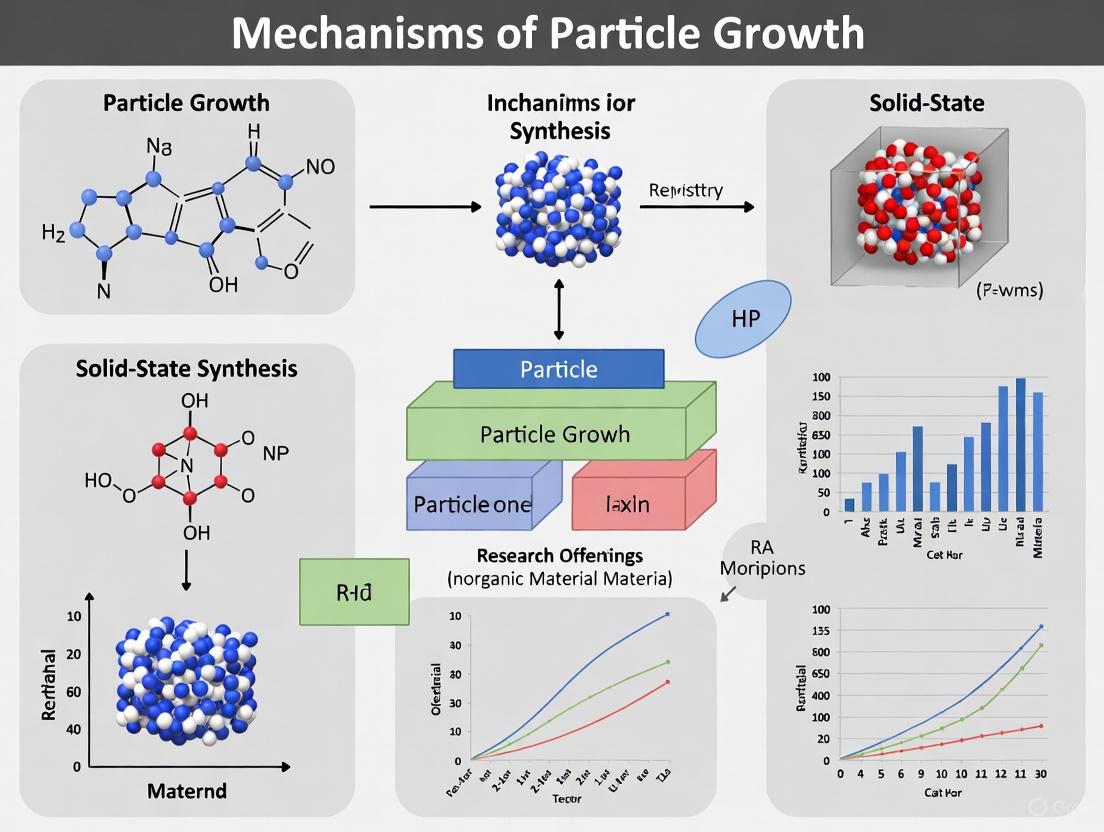
This article provides a comprehensive examination of particle growth mechanisms in solid-state synthesis, a critical process for developing advanced materials for biomedical applications.
Controlling Particle Growth in Solid-State Synthesis: Mechanisms, Methods, and Biomedical Applications
Abstract
This article provides a comprehensive examination of particle growth mechanisms in solid-state synthesis, a critical process for developing advanced materials for biomedical applications. Tailored for researchers and drug development professionals, it explores the fundamental thermodynamic and kinetic principles governing nucleation and growth, from classical models to modern solid-state transformation theories. The content details innovative methodological approaches, including mechanochemical synthesis and carbon encapsulation, for achieving precise control over particle size, morphology, and crystallinity. Practical guidance is offered for troubleshooting common issues like particle aggregation and impurity formation, alongside robust validation techniques for characterizing key material properties. By synthesizing foundational knowledge with applied strategies, this resource aims to empower the rational design of nanostructured materials for drug delivery, diagnostics, and therapeutics.
The Core Principles: Unraveling the Fundamentals of Solid-State Particle Growth
Defining Solid-State Synthesis and Its Role in Advanced Material Creation
Solid-state synthesis is a foundational method for the development of inorganic materials and advanced functional ceramics, involving the direct reaction of solid precursors at elevated temperatures to form new compounds through diffusion processes [1]. This approach is industrially relevant for producing a wide array of materials, including layered oxide cathodes for lithium-ion batteries, catalytic nanoparticles, and various functional ceramics enabling cutting-edge applications [2] [3] [1]. Unlike solution-based methods where molecular mixing can occur, solid-state reactions are governed by the physical contact and interdiffusion of precursor materials, making the control of particle size, morphology, and internal structure critically important for determining the properties of the final product [2].
The performance and cost of energy storage and conversion systems largely depend on the cathode materials, with solid-state synthesis playing a pivotal role in manufacturing commercial cathode materials including layered oxides (e.g., LiCoO₂ and LiNiₓCoᵧMn₁₋ₓ₋ᵧO₂), spinel oxides (e.g., LiMn₂O₄), and olivine-type phosphates (e.g., LiFePO₄) [2]. Among these, Ni-rich layered oxides have attracted significant interest due to their high capacity, good thermal stability, and excellent cycling performance [2]. The development of scalable and controllable solid-state synthesis techniques is increasingly critical as global demand for high-performance materials continues to grow across energy storage, catalysis, and electronics applications.
Fundamental Principles and Particle Growth Mechanisms
Thermodynamic and Kinetic Considerations
Solid-state synthesis operates under principles distinct from solution or vapor-phase methods, with reactions proceeding through diffusion-controlled mechanisms at interfaces between solid precursors [4]. The process involves heating powdered solid precursors below their melting points, enabling atomic or ionic diffusion across particle boundaries to form new compound phases [1]. While thermodynamic stability predictions using computational tools like density functional theory (DFT) can guide synthesis planning, materials that are thermodynamically stable can be challenging to synthesize due to competing byproducts that reduce target yield [5].
The prevalence of metastable materials in technologies including photovoltaics and structural alloys further complicates synthesis efforts [5]. These are typically prepared using low-temperature routes where kinetic control can prevent equilibrium phase formation, though metastable phases can also appear as intermediates during high-temperature experiments [5]. The selection of optimal precursors and reaction conditions must therefore consider both thermodynamic driving forces and kinetic pathways to successfully form desired phases, whether stable or metastable.
Three-Stage Particle Growth Mechanism
Recent research tracking real-time reaction parameters and morphological evolution has elucidated a three-stage growth mechanism in the formation of Ni₀.₈Co₀.₁Mn₀.₁(OH)₂ precursors for layered oxide cathodes [2]. The table below summarizes the characteristics of each growth stage:
Table 1: Three-stage particle growth mechanism in solid-state synthesis
| Growth Stage | Particle Size Characteristics | Primary Particle Morphology | Key Processes |
|---|---|---|---|
| Stage 1: Initial Nucleation | Formation of ~2 μm particles | Nano-needle structures | Rapid nucleation and initial aggregation |
| Stage 2: Intermediate Aggregation | Particles aggregate into larger forms | Transition from needle-like to rod-like forms | Continuous nucleation with inhibited aggregation |
| Stage 3: Final Growth | Broader particle size distribution | Smaller primary particles with denser packing | Growth constrained by energy and spatial limitations |
This three-stage process is driven by variations in reactant concentration, feed rate, and consumption dynamics [2]. As growth advances, primary particles transition from nano-needle to rod-like forms, with their growth becoming increasingly restricted by limited energy and spatial constraints, leading to dense aggregation on pre-existing structures [2]. The intermediate stage has been identified as a critical window for targeted intervention, where fine-tuning process parameters can effectively control particle coarsening and promote uniform secondary structures with intricate internal architectures [2].
Figure 1: Three-stage particle growth mechanism in solid-state synthesis
Coarsening Mechanisms in Nanoparticles
Beyond bulk materials, solid-state synthesis also encompasses the formation and stability of catalytic nanoparticles through processes like exsolution, where reducible cations precipitate from a parent oxide to form metallic nanoparticles on the surface [3]. These exsolved nanoparticles are subject to coarsening mechanisms that impact their long-term catalytic performance, primarily through two pathways:
- Ostwald Ripening (OR): Atomic species diffuse from smaller to larger particles, leading to particle growth through redissolution and ripening processes [3]
- Particle Migration and Coalescence (PMC): Mobile nanoparticles physically migrate across the support surface and sinter upon contact with other particles [3]
Recent atomic-scale investigations have revealed that nanoparticles exhibiting stronger metal-support interactions demonstrate enhanced stability against coarsening, with those precipitated above embedded nanostructures showing restricted migration and improved thermal stability [3]. Understanding these fundamental coarsening mechanisms is crucial for designing supported catalysts with optimal activity and longevity.
Experimental Methodologies and Protocols
Hydroxide Co-precipitation Method
The hydroxide co-precipitation method represents one of the most widely employed industrial approaches for preparing precursors for layered oxide cathode materials [2]. This method offers significant advantages in process robustness, producing precursors with high tap density, homogeneous morphology, and well-controlled particle size distribution when combined with high-temperature solid-state reaction [2]. The following table outlines key parameters and their optimal ranges for the synthesis of Ni₀.₈Co₀.₁Mn₀.₁(OH)₂ precursors:
Table 2: Optimal parameters for hydroxide co-precipitation synthesis
| Parameter | Optimal Range | Influence on Synthesis | Measurement Method |
|---|---|---|---|
| pH Level | 11.1 | Controls precipitation rate and nucleation | pH electrode with continuous monitoring |
| Ammonia-to-Salt Ratio | 1.0 | Affects complex ion formation | Stoichiometric calculation |
| Feed Rate | 1.2 mL/min | Influences particle residence time and growth | Flow control system |
| Stirring Speed | 1200 rpm | Promotes uniform mixing and mass transfer | Digital tachometer |
The process is governed by two main mechanisms: (1) in solution, metal ions form complex ions with ammonium that subsequently react with OH⁻ to generate hydroxide particles; and (2) a dynamic equilibrium exists between metal hydroxide precipitates and metal complexes, defined by precipitation-dissolution interactions [2]. This process follows a growth mechanism involving gradual dissolution and recrystallization, represented by:
M²⁺ + nNH₄OH(aq) → [M(NH₃)ₙ]²⁺(aq) + nH₂O
[M(NH₃)ₙ]²⁺(aq) + 2OH⁻ → M(OH)₂(s)↓ + nNH₃ [2]
When pH is too low or ammonia concentration elevated, reduced precipitation rate inhibits nucleation, while high pH or low ammonia concentration promotes nucleation [2]. Beyond pH and ammonia concentration, precursor synthesis is significantly influenced by feed rate and stirring speed, with controlled feed rate ensuring homogeneous particle size and stirring speed promoting uniform mixing and efficient mass transfer for smooth secondary particle surfaces [2].
Modulated Elemental Reactants Method
For thin-film materials, the modulated elemental reactants (MER) method creates designed precursors that function as a platform to isolate and probe how individually tunable experimental parameters influence fundamental reaction mechanisms [4]. This approach enables precise control over:
- Local compositions within the precursor structure
- Deposited layer thicknesses and sequences
- Interfacial confinement effects between different materials
Using experimentally tunable parameters to study solid-state growth mechanisms, researchers have developed a general method to create high-energy amorphous precursors and grown novel non-equilibrium superlattices in the Mo-Se and Pb-Se systems [4]. The understanding gained from these model systems has enabled the synthesis of novel heterostructures, including a (PbSe)₁(VSe₂)₁(PbSe)ₘ(VSe₂)₁ homologous series and a previously unreported ZnSe phase stabilized within (MoSe₂)₁(ZnSe)ₙ heterostructures [4].
Mechanochemical Synthesis
Mechanochemical synthesis utilizing high-energy milling (HEM) represents another non-equilibrium processing route for semiconductor materials [6]. This approach leverages physico-metallurgical and mechano-chemical stimuli through:
- Van der Waals forces causing particle agglomeration
- Plastic deformation, fracture, and mechanical kneading
- Oxidation and reoxidation of precursors
- Intermediate reactions forming crystalline, amorphous, and non-stoichiometric phases
The transformation from precursors to semiconductor materials via mechanochemical synthesis involves three significant reaction stages: (1) oxidation, including reoxidation of precursors; (2) chemical interaction between both metal and chalcogen suboxides to form stoichiometric complex oxides; and (3) chemical reduction of those complex oxides to obtain semiconductor materials [6]. Chemical models based on the Gibbs composition triangle can map this transformation pathway, providing visualization of the chemical pathway during synthesis under non-equilibrium conditions [6].
Advanced Approaches and Optimization Algorithms
Autonomous Precursor Selection
Recent advances have introduced algorithmic approaches to optimize solid-state synthesis procedures by incorporating physical domain knowledge based on thermodynamics and pairwise reaction analysis [5]. The ARROWS³ (Autonomous Reaction Route Optimization with Solid-State Synthesis) algorithm is designed to guide precursor selection for targeted synthesis of inorganic materials through the following workflow:
Figure 2: ARROWS³ algorithm workflow for autonomous precursor selection
Given a target material composition and structure, ARROWS³ forms a list of precursor sets that can be stoichiometrically balanced to yield the target's composition, initially ranking these precursor sets by their calculated thermodynamic driving force (ΔG) to form the target [5]. The algorithm then proposes that each precursor set be tested at several temperatures, providing snapshots of the corresponding reaction pathway [5]. Intermediates formed at each step are identified using X-ray diffraction (XRD) with machine-learned analysis, enabling ARROWS³ to determine which pairwise reactions led to each observed intermediate phase [5]. In subsequent experiments, ARROWS³ prioritizes precursor sets expected to maintain a large driving force at the target-forming step (ΔG'), even after intermediates have formed [5]. This approach has been validated on experimental datasets containing results from over 200 synthesis procedures, identifying effective precursor sets while requiring substantially fewer experimental iterations compared to black-box optimization methods [5].
High-Throughput Solid-State Processing
The development of high-throughput platforms for accelerated ceramics development from dry powders presents significant opportunities despite technical challenges [1]. Automated synthesis platforms must maintain phase purity while handling various processing steps including:
- Powder weighing and dispensing with precise stoichiometric control
- Milling and mixing operations for homogeneous precursor distribution
- Heat treatment under controlled atmospheres
- In-line characterization for rapid phase identification
High-throughput experimentation enables the production of large, homogeneous datasets required for machine learning applications in materials science, facilitating the identification of synthesis-composition-property relationships that can guide the development of new functional ceramics [1].
Text-Mining of Synthesis Recipes
With thousands of successful materials synthesis reports in the literature, text-mining synthesis recipes from published papers provides a potential source of expert knowledge to train machine-learning models for predictive inorganic materials synthesis [7]. Natural language processing strategies have been developed to extract synthesis information through:
- Identification of synthesis paragraphs within scientific publications
- Extraction of relevant precursor and target materials
- Construction of synthesis operations (mixing, heating, drying, shaping, quenching)
- Compilation of balanced chemical reactions from identified precursors and targets
While initial attempts to build machine-learning models for predictive materials synthesis from text-mined data faced limitations due to dataset constraints, the most valuable insights came from examining anomalous recipes that defied conventional intuition, leading to new mechanistic hypotheses about how solid-state reactions proceed [7].
Research Reagents and Materials Toolkit
Table 3: Essential research reagents and materials for solid-state synthesis
| Material/Reagent | Function in Synthesis | Specific Application Examples |
|---|---|---|
| Transition Metal Hydroxides | Precursors for layered oxide cathodes | Ni₀.₈Co₀.₁Mn₀.₁(OH)₂ for NCM811 cathode [2] |
| Ammonium Hydroxide | Chelating agent for co-precipitation | Forms complex ions with transition metals in hydroxide method [2] |
| Strontium Titanate | Parent oxide for exsolution catalysts | SrTi₀.₉₅Ni₀.₀₅O₃-δ for exsolved Ni nanoparticles [3] |
| Metal Carbonates | Precursors with high stability | Transition metal carbonates (TMCO₃) for carbonate co-precipitation [2] |
| Ammonium Oxalate | Chelating and precipitating agent | Effective co-precipitation of multiple metal ions in oxalate method [2] |
| Metal Oxides | Precursors for solid-state reactions | Y₂O₃, BaCO₃, CuO for YBa₂Cu₃O₆.₅ (YBCO) synthesis [5] |
Solid-state synthesis remains an essential methodology for advanced material creation, with continued advances in understanding particle growth mechanisms enabling more precise control over material properties. The three-stage growth mechanism identified in precursor synthesis provides valuable guidance for improving industrial fabrication processes, particularly through targeted intervention during the intermediate stage to control particle coarsening and promote uniform secondary structures [2]. Emerging approaches combining algorithmic optimization, high-throughput experimentation, and advanced characterization techniques are addressing the longstanding challenges in predictive synthesis, potentially accelerating the discovery and development of new materials for energy, catalysis, and electronics applications.
The integration of autonomous algorithms like ARROWS³ with experimental validation represents a particularly promising direction, demonstrating how domain knowledge based on thermodynamics and pairwise reaction analysis can significantly reduce the experimental iterations required to identify optimal synthesis routes [5]. As these computational and experimental approaches continue to mature, they hold the potential to transform solid-state synthesis from an empirical art to a more predictive science, ultimately enabling the realization of computationally designed materials with tailored structures and properties.
In the field of materials science, controlling the formation of new phases is fundamental to designing substances with tailored properties for applications ranging from lithium-ion batteries to structural alloys. The initial stages of phase transformations—nucleation and growth—determine the microstructure, and consequently, the performance of the final product. These processes are governed by thermodynamic drivers that define the energetic feasibility of new phase formation and kinetic parameters that dictate the rate at which such transformations occur. In solid-state synthesis, where atomic mobility is limited and reactions often proceed through multiple intermediate phases, understanding the interplay between these drivers is particularly crucial [8] [9]. This guide examines the core thermodynamic principles controlling nucleation and growth, explores contemporary challenges to classical theories, and presents advanced experimental methodologies for investigating these phenomena within the context of modern materials research.
Theoretical Foundations of Nucleation Energetics
Classical Nucleation Theory
Classical Nucleation Theory (CNT) provides the fundamental framework for quantitatively analyzing the kinetics of nucleation, which represents the first step in the spontaneous formation of a new thermodynamic phase from a metastable state [10]. The central premise of CNT is that fluctuations in a metastable system occasionally produce small regions of the new phase, and that the free energy change associated with creating these regions determines the nucleation rate. The theory predicts an immense variation in nucleation timescales, from negligible to experimentally unobservable, based on system conditions [10].
The CNT expression for the nucleation rate (R) is:
[ R = NS Z j \exp\left(-\frac{\Delta G^*}{kB T}\right) ]
where:
- (\Delta G^*) represents the free energy barrier to nucleation
- (k_B T) is the thermal energy
- (N_S) is the number of potential nucleation sites
- (j) is the rate at which atoms attach to the nucleus
- (Z) is the Zeldovich factor, accounting for statistical fluctuations [10]
The exponential term (\exp(-\Delta G^*/kB T)) reflects the probability of a fluctuation generating a critical nucleus, while the pre-exponential factor (NS Z j) constitutes the dynamic component related to atomic mobility [10].
For homogeneous nucleation of a spherical nucleus, the free energy change has both volume and surface contributions:
[ \Delta G = \frac{4}{3}\pi r^3 \Delta g_v + 4\pi r^2 \sigma ]
where:
- (\Delta g_v) is the free energy change per unit volume (negative for stable phases)
- (\sigma) is the surface free energy per unit area
- (r) is the nucleus radius [10]
This relationship produces a free energy maximum at the critical radius (rc = -2\sigma/\Delta gv), representing the minimum stable nucleus size. The corresponding activation barrier is:
[ \Delta G^* = \frac{16\pi\sigma^3}{3(\Delta g_v)^2} ]
The critical radius and activation barrier demonstrate a strong dependence on supercooling, as (\Delta gv) is approximately proportional to ((Tm - T)/Tm), where (Tm) is the equilibrium melting temperature [10].
Heterogeneous Nucleation
In practical systems, homogeneous nucleation is rare compared to heterogeneous nucleation, which occurs on surfaces, impurities, or other structural imperfections [10]. The nucleation barrier for heterogeneous nucleation is significantly reduced:
[ \Delta G^{het} = f(\theta)\Delta G^{hom} ]
where the scaling factor (f(\theta)) depends on the contact angle (\theta) between the nucleus and the substrate:
[ f(\theta) = \frac{2 - 3\cos\theta + \cos^3\theta}{4} ]
This reduction explains why heterogeneous nucleation dominates in real materials systems, including solid-state reactions where interfaces between precursor particles provide favorable nucleation sites [10].
Table 1: Key Thermodynamic Parameters in Classical Nucleation Theory
| Parameter | Symbol | Role in Nucleation | Dependence |
|---|---|---|---|
| Interfacial energy | (\sigma) | Creates energy barrier for nucleus formation | Material properties, interface structure |
| Volume free energy change | (\Delta g_v) | Driving force for transformation | Supercooling/supersaturation |
| Critical radius | (r_c) | Minimum stable nucleus size | (\sigma / |\Delta g_v|) |
| Activation barrier | (\Delta G^*) | Determines nucleation probability | (\sigma^3 / (\Delta g_v)^2) |
| Contact angle | (\theta) | Reduces barrier in heterogeneous nucleation | Surface chemistry, wettability |
Contemporary Challenges to Classical Models
Limitations of CNT in Solid-State Systems
While Classical Nucleation Theory provides a valuable conceptual framework, it has demonstrated limited success in quantitatively predicting nucleation behavior in solid-state systems, particularly at lower temperatures where atomic mobility is constrained [8]. A fundamental assumption of CNT—that all thermally-induced stochastic fluctuations are possible regardless of how far their compositions deviate from the bulk alloy—becomes problematic in kinetically-limited environments where such fluctuations may not form within relevant experimental timescales [8].
In engineering alloys and other solid-state systems, CNT often overestimates nucleation rates because it doesn't adequately account for kinetic constraints on atomic rearrangement. This limitation has motivated the development of alternative models that better represent nucleation processes in diffusion-limited regimes [8].
Geometric Cluster Model
As a complementary approach to CNT, the geometric cluster model addresses nucleation in systems where atomic mobility is severely limited [8]. Rather than assuming stochastic composition fluctuations, this model proposes that geometric clusters—statistical features inherent to any solution—serve as the origin of nuclei. These clusters become activated through a different mechanism than that described by CNT, with their activation rate determined by local atomic rearrangements rather than long-range diffusion [8].
The geometric cluster model has demonstrated success in predicting phase competition during crystallization of Al-Ni-Y metallic glasses, solvent trapping phenomena in solid-state nucleation, and precipitate number densities in Cu-Co and Fe-Cu alloys [8]. This approach represents a significant shift from the thermodynamic fluctuation perspective of CNT toward a more statistical treatment of pre-existing structural features in materials.
Experimental Methodologies for Investigating Nucleation
Advanced Characterization Techniques
Understanding nucleation mechanisms requires sophisticated characterization methods that can capture transient intermediate phases and structural evolution during solid-state reactions. Recent methodological advances have enabled unprecedented insights into these processes:
Quasi-in situ X-ray Diffraction (XRD): This technique combines ultrafast high-temperature synthesis with rapid cooling to "freeze" reaction states at defined intervals, allowing stepwise analysis of phase evolution [9]. The method establishes a sharp thermal gradient between the heating element and surrounding atmosphere, achieving cooling rates up to 10³°C/s, which effectively captures the rate-limiting nucleation step of phase evolution [9].
Real-time Reaction Parameter Tracking: For investigating nucleation in solution-based systems, simultaneous monitoring of pH, reactant concentration, feed rate, and consumption dynamics provides crucial insights into nucleation behavior [2]. This approach has revealed complex three-stage growth mechanisms in Ni₀.₈Co₀.₁Mn₀.₁(OH)₂ precursors for battery materials, where initial nucleation produces ~2 μm particles that subsequently aggregate into larger structures [2].
Table 2: Experimental Techniques for Studying Nucleation and Growth
| Technique | Information Obtained | Applications in Solid-State Synthesis | References |
|---|---|---|---|
| Quasi-in situ XRD | Intermediate phase identification, phase evolution pathways | Garnet-type solid electrolytes, Li-rich cathode materials | [9] |
| Real-time parameter tracking | Nucleation kinetics, growth stages, particle size distribution | Hydroxide co-precipitation for battery precursors | [2] |
| HRTEM & SEM | Particle morphology, crystallographic structure, defects | Single-crystal cathode exfoliation mechanisms | [11] |
| In-situ DEMS | Gas evolution, oxygen redox behavior | Li-rich layered oxides, oxygen release studies | [11] |
| FEM simulation | Stress distribution, mechanical stability | Single-crystal vs. polycrystal cathode materials | [11] |
The i-FAST Methodology for Pathway Control
The "inducer-facilitated assembly through structural templating" (i-FAST) approach represents a strategic methodology for controlling nucleation pathways in complex inorganic solids [9]. This technique addresses the challenge of undesirable intermediate phases that often become kinetically trapped in nonequilibrium states, leading to impurities in the final product [9].
The i-FAST methodology involves introducing a specific inducer that selectively reacts with precursors to form intermediate phases structurally similar to the desired target material. These intermediates then template the nucleation and growth of the final phase through epitaxial relationships [9]. For example, in synthesizing garnet-type Li₆.₅La₃Zr₁.₅Ta₀.₅O₁₂ (LLZTO), the addition of Ta-containing inducers promotes formation of cubic Li₅La₃Ta₂O₁₂ (LLTO), which shares structural homology with the target LLZTO and guides its nucleation [9].
This approach demonstrates how understanding thermodynamic favorability and kinetic preferences of intermediate phases enables controlled navigation of complex reaction landscapes in solid-state synthesis.
Diagram 1: The i-FAST methodology for controlled nucleation
Nucleation and Growth in Materials Systems
Three-Stage Growth Mechanism in Battery Materials
In the synthesis of Ni₀.₈Co₀.₁Mn₀.₁(OH)₂ precursors for LiNi₀.₈Co₀.₁Mn₀.₁O₂ (NCM811) cathode materials, a detailed analysis has revealed a complex three-stage growth mechanism governed by evolving thermodynamic and kinetic conditions [2]:
Stage 1: Initial Nucleation
- Formation of fine particles approximately 2 μm in size through rapid nucleation
- Poor crystallinity with broad XRD peak profiles
- Preferential growth along high-surface-energy crystal faces such as (101) [2]
Stage 2: Aggregation and Growth
- Assembly of initial particles into larger secondary structures
- Shift in preferential growth from (101) to (001) crystal planes
- Continuous nucleation producing smaller secondary particles alongside growing aggregates [2]
Stage 3: Growth Limitation
- Restricted growth due to limited energy input and spatial confinement
- Broader particle size distribution despite continued nucleation
- Primary particles transition from needle-like to rod-like morphology
- Increased packing density as newly formed primary particles deposit onto existing structures [2]
This growth progression is highly sensitive to synthesis parameters including pH (optimal at 11.1), ammonia-to-salt ratio (optimal at 1.0), feed rate, and stirring speed, which collectively control the balance between nucleation and growth rates [2].
Solid-State Exfoliation Mechanism
An alternative nucleation pathway has been identified in the solid-state synthesis of single-crystal Li-rich layered oxides, where an exfoliation mechanism transforms spherical secondary particles into monodisperse primary single crystals [11]. This process is regulated by the molar ratio of lithium to transition metals (Li/TM), which controls the velocity of exfoliation behavior and enables flexible synthesis switching between polycrystal and single-crystal morphologies [11].
The underlying mechanism involves two distinct lithium diffusion pathways during solid-state reactions:
- Boundary diffusion: Lithium transport along particle boundaries
- Grain diffusion: Lithium migration through crystal grains [11]
This exfoliation growth mechanism effectively suppresses irreversible oxygen release, crack formation, and phase transitions from layered to spinel structures, resulting in significantly extended battery lifespan with capacity retention of 93.6% over 500 cycles at 1C rate [11].
Diagram 2: Solid-state exfoliation growth mechanism
Research Reagent Solutions
Table 3: Essential Research Reagents for Nucleation and Growth Studies
| Reagent/Material | Function in Research | Application Examples | Key Considerations |
|---|---|---|---|
| Transition metal hydroxides | Precursor for layered oxide cathodes | Ni₀.₈Co₀.₁Mn₀.₁(OH)₂ for NCM811 synthesis | Control of particle morphology, tap density |
| Lithium sources (LiOH, Li₂CO₃) | Lithium provider in solid-state reactions | Garnet-type LLZO, Li-rich layered oxides | Excess content controls phase stability |
| Tantalum inducers | Structural template for cubic phases | Cubic LLZTO solid electrolytes | Promotes desired intermediate formation |
| Ammonium hydroxide | pH control, complexing agent | Hydroxide co-precipitation processes | Concentration affects nucleation rate |
| Molten salts (LiCl) | Flux medium for single-crystal growth | Li-rich cathode single crystals | Creates liquid environment for particle isolation |
The thermodynamic drivers of nucleation and growth represent fundamental factors controlling material synthesis across diverse applications from energy storage to structural alloys. While Classical Nucleation Theory provides essential concepts for understanding the energy barriers and critical parameters governing phase formation, its limitations in solid-state systems have motivated complementary approaches such as the geometric cluster model [8]. Advanced characterization techniques including quasi-in situ XRD and real-time parameter monitoring have revealed complex multistage growth mechanisms and enabled strategic pathway control through methodologies like i-FAST [2] [9]. The continued refinement of our understanding of nucleation energetics, particularly through the integration of thermodynamic principles with kinetic constraints, promises enhanced control over material microstructure and properties in next-generation functional materials.
In solid-state synthesis research, the competition between reaction kinetics and mass transport fundamentally determines the structural outcomes of inorganic materials. Kinetic control over particle growth is the deliberate manipulation of synthesis parameters to favor metastable, non-equilibrium states with desirable morphologies and sizes, rather than the thermodynamically most stable form. This approach is indispensable for producing advanced ceramics, battery materials, and functional nanostructures where properties are intimately tied to microstructure.
The core principle governing kinetic control is the dynamic interplay between nucleation and growth. When the rate of nucleation surpasses the rate of particle growth, numerous small particles form. Conversely, when growth dominates, fewer, larger crystals develop. Diffusion—the movement of atoms, ions, or molecules through a medium—and chemical reaction rates are the twin pillars supporting this framework. By understanding and manipulating these rates through parameters like temperature, pressure, and chemical environment, researchers can steer solid-state reactions toward precise morphological outcomes.
Fundamental Principles of Kinetic Control
The Nucleation-Growth Dilemma
The synthesis of any solid-state material begins with nucleation, the formation of stable critical nuclei from precursor phases. These nuclei then evolve into particles through growth processes. The final particle size distribution is a direct consequence of the relative rates of these two processes. A high nucleation rate coupled with a limited growth period typically yields small, monodisperse particles.
Several synthesis strategies explicitly leverage this principle. The nucleation-promoting and growth-limiting (NM) synthesis developed for disordered rock-salt cathode materials exemplifies this approach. By using a modified molten-salt method with brief high-temperature steps to promote nucleation followed by lower-temperature annealing to complete crystallization while limiting growth, this method produces highly crystalline Li₁.₂Mn₀.₄Ti₀.₄O₂ particles with well-dispersed sub-200 nm sizes and suppressed agglomeration [12].
Diffusion as the Rate-Limiting Step
In solid-state reactions, the transport of reactants to the reaction interface often controls the overall kinetics. The diffusion boundary layer (DBL), also known as the unstirred water layer or aqueous boundary layer, represents a region of stagnant fluid adjacent to a solid surface where transport occurs primarily by diffusion rather than convection. Within this layer, concentration gradients form, creating a diffusional resistance that can become the rate-determining step for dissolution, crystallization, or interfacial reactions [13].
The Nernst-Brunner model describes this phenomenon mathematically, positing that the diffusion flux (J) across this boundary layer is proportional to the concentration gradient and the diffusion coefficient (D), and inversely proportional to the boundary layer thickness (h). This relationship becomes particularly critical in pharmaceutical applications where drug nanoparticle dissolution in the DBL directly influences bioavailability [13].
Table 1: Key Parameters Influencing Kinetic Control in Solid-State Synthesis
| Parameter | Effect on Nucleation | Effect on Growth | Impact on Final Morphology |
|---|---|---|---|
| Temperature | Increased nucleation rate at higher temperatures | Accelerated growth at higher temperatures | High T often favors larger crystals; controlled ramping can optimize both |
| Pressure | Low pressure promotes precursor decomposition [14] | Limits Ostwald ripening by reducing surface diffusion | Enables smaller particle sizes at lower temperatures |
| Reagent Concentration | Higher supersaturation promotes nucleation | Provides more material for growth | Optimal balance needed to prevent excessive nucleation or growth |
| Additives/Modifiers | Can promote or inhibit nucleation sites | May selectively block growth facets | Enables precise shape control and hierarchical structures |
| Reaction Time | Determines initial nucleus density | Longer times allow for coarsening | Shorter times often yield smaller, less crystalline particles |
Experimental Strategies for Kinetic Control
Pressure-Modulated Synthesis
The application of reduced pressure during solid-state synthesis creates a powerful lever for kinetic control. Research on barium titanate (BaTiO₃) synthesis demonstrates that a low-pressure environment (0.01 MPa) significantly enhances the decomposition kinetics of BaCO₃ precursors while simultaneously accelerating the solid-state reaction rate. This approach yields a remarkable increase in BaTiO₃ conversion to 71.11% at 750°C—substantially higher than conventional methods [14].
The mechanism involves multiple kinetic advantages: reduced pressure lowers the energy barrier for BaCO₃ decomposition into reactive BaO and CO₂; promotes the formation of phase-pure BaTiO₃ with uniform particle size (90 nm) at lower temperatures (800°C); and limits grain coalescence while improving tetragonality (c/a ratio = 1.0095 at 900°C). This strategy demonstrates how manipulating physical parameters can redirect reaction pathways toward nanoscale morphologies unattainable under standard conditions [14].
Molten-Salt and Flux-Assisted Synthesis
Molten-salt methods utilize a salt medium with a low melting point to create a liquid environment that facilitates reactant diffusion at temperatures below those required for conventional solid-state reactions. The NM synthesis method for lithium-ion battery cathode materials employs CsBr (melting point: 636°C) as a flux, enabling enhanced nucleation kinetics through a solvent-mediated reaction while suppressing particle growth through optimized thermal profiling [12].
The critical innovation lies in separating the nucleation and growth stages: a brief high-temperature step (800-900°C) generates numerous nucleation sites, followed by a lower-temperature annealing step that completes crystallization without significant particle coarsening. This sequential control yields highly crystalline Mn-DRX particles with average sizes below 200 nm—addressing the fundamental limitation of conventional molten-salt syntheses that typically produce micron-sized particles requiring post-synthesis pulverization [12].
Surfactant-Mediated Morphological Control
Surfactants and modulating agents exert kinetic control by selectively adsorbing to specific crystal facets, thereby altering relative growth rates along different crystallographic directions. In the hydrothermal synthesis of ZIF-67, cetyltrimethylammonium bromide (CTAB) directs the formation of hierarchical structures with tailored morphologies [15].
The precise control mechanism depends critically on synthesis parameters: the order of reagent addition, premixing temperature (25°C vs. 100°C), and stirring speed (450 vs. 1800 rpm) all influence micelle formation and consequent templating effects. By systematically optimizing these parameters, researchers achieved ZIF-67 particles with improved crystallinity and uniform morphology, demonstrating how organic modifiers can override intrinsic crystallization tendencies to yield metastable structures [15].
Table 2: Kinetic Control Strategies Across Material Systems
| Material System | Control Strategy | Key Parameters | Resulting Morphology |
|---|---|---|---|
| Barium Titanate (BaTiO₃) [14] | Low-pressure solid-state reaction | Pressure (0.01 MPa), Temperature (750-900°C) | Phase-pure powder, 90-160 nm, high tetragonality (c/a=1.0095) |
| Li-Mn-Ti-O DRX Cathode [12] | Nucleation-promoting molten salt | CsBr flux, Two-stage temperature profile | Highly crystalline, sub-200 nm particles, reduced agglomeration |
| ZIF-67 MOF [15] | Surfactant modulation | CTAB concentration, Mixing sequence, Temperature | Hierarchical structures, controlled crystal habit |
| NCM90 Cathode [16] | Grain boundary engineering | WO₃ ALD coating, Annealing conditions | Uniform lithiation, reduced core-shell heterogeneity |
Advanced Characterization and Theoretical Modeling
Reaction-Diffusion Frameworks
The theoretical foundation for kinetic control rests on reaction-diffusion models that mathematically describe the spatiotemporal evolution of chemical concentrations. These models have recently been expanded to explain sophisticated phenomena like local inhibition and distal activation (LIDA) in chemoenzymatic systems [17].
In one demonstrated system, differential diffusivity creates spatially segregated activation: a dormant activator (urea, "ProA") diffuses rapidly through a hydrogel matrix due to its neutral charge, while an inhibitor (ATP, "IN") migrates slowly because of binding interactions with embedded nanoparticles. Enzymatic conversion of urea to ammonium bicarbonate (the active base, "A") at distant locations triggers a proton-transfer reaction far from the injection site, while the inhibitor suppresses reactivity locally. This spatial control, achieved by exploiting differential diffusion coefficients, mirrors the kinetic regulation possible in solid-state systems through similar principles [17].
In Situ Analysis of Solid-State Reactions
Advanced characterization techniques have revealed the heterogeneous nature of solid-state reactions, particularly during early-stage lithiation processes. In the synthesis of layered oxide cathodes (LiNi₀.₉Co₀.₀₅Mn₀.₀₅O₂), operando high-temperature X-ray diffraction (HTXRD) and high-resolution electron microscopy have identified a critical challenge: premature surface grain coarsening forms a dense lithiated shell that impedes subsequent lithium diffusion to the particle core, resulting in structural inhomogeneity [16].
This discovery prompted the development of a grain boundary engineering solution: a conformal WO₃ coating applied via atomic layer deposition (ALD) transforms during calcination into LixWOy compounds that segregate at grain boundaries, preventing premature coalescence of surface grains and maintaining lithium diffusion pathways. This approach preserves the route for uniform lithiation throughout secondary particles, demonstrating how mechanistic understanding of kinetic limitations enables innovative solutions [16].
Detailed Experimental Protocols
Low-Pressure Solid-State Synthesis of Nanometer Barium Titanate
Objective: Synthesize phase-pure BaTiO₃ powder with uniform particle size (90-160 nm) and high tetragonality for MLCC applications [14].
Materials:
- BaCO₃ (Guizhou Red Star Electronic Material Co., Ltd., SBET = 20.15 m²/g, D₅₀ = 1.403 μm)
- TiO₂ (Hubei Tianci Electronic Materials Co., Ltd., SBET = 25.65 m²/g, D₅₀ = 0.547 μm)
- Deionized water
Procedure:
- Precursor Preparation: Mix equimolar amounts of BaCO₃ and TiO₂ with deionized water using a sand mill for 2 hours.
- Drying: Dry the mixed slurry at 80°C for 12 hours, then pulverize and sieve through a 200-mesh screen.
- Low-Pressure Calcination: Place the mixed powder in an alumina crucible and heat in a tube furnace under low-pressure conditions (0.01 MPa) with the following temperature profile:
- Heat to 750°C at 5°C/min, hold for 2 hours (achieves 71.11% conversion)
- For complete reaction: Heat to 800-900°C, hold for 2-4 hours
- Characterization: Analyze phase purity by XRD, particle morphology by SEM, and thermal behavior by TG-DSC.
Key Kinetic Considerations: The low-pressure environment promotes BaCO₃ decomposition into reactive BaO and CO₂ at lower temperatures, increasing the solid-state reaction rate while limiting particle growth and improving tetragonality (c/a ratio = 1.0095 at 900°C) [14].
Nucleation-Promoting Molten-Salt Synthesis of LMTO
Objective: Prepare highly crystalline Li₁.₂Mn₀.₄Ti₀.₄O₂ (LMTO) particles with sub-200 nm size and suppressed agglomeration for Ni/Co-free lithium-ion batteries [12].
Materials:
- Li₂CO₃, Mn₂O₃, TiO₂ as metal precursors
- CsBr as molten-salt flux (melting point: 636°C)
- KCl, KBr, KI, CsCl, CsI for salt screening
Procedure:
- Precursor Mixing: Combine Li₂CO₃, Mn₂O₃, and TiO₂ in stoichiometric ratios with 300-500 wt% CsBr relative to the oxide precursors.
- First-Stage Calcination: Rapidly heat the mixture to 800-900°C (1°C/s ramp rate) under oxygen flow, hold briefly (10-30 minutes) to promote nucleation without significant growth.
- Second-Stage Annealing: Cool to 600-700°C, hold for 6-12 hours to complete crystallization while limiting particle coarsening.
- Washing: Remove the CsBr flux by repeated washing with hot deionized water.
- Characterization: Analyze phase purity by XRD, particle size distribution by laser diffraction, and electrochemical performance in Li||LMTO cells.
Key Kinetic Considerations: The brief high-temperature step maximizes nucleation density, while the extended lower-temperature annealing allows complete crystallization without excessive particle growth. CsBr provides optimal ion solvation and homogeneous reactant distribution due to its lower melting point and higher dielectric constant compared to potassium salts [12].
Surfactant-Modulated Hydrothermal Synthesis of ZIF-67
Objective: Achieve hierarchical ZIF-67 structures with controlled morphology and enhanced hydrothermal stability for gas separation applications [15].
Materials:
- 2-methylimidazole (2-MeIM, 99%)
- Cobalt(II) acetate tetrahydrate (Co(OAc)₂·4H₂O, 98%)
- CTAB (cetyltrimethylammonium bromide, 98%)
- Methanol (98%)
- Ultrapure Milli-Q water
Procedure:
- Solution Preparation:
- Solution A: Dissolve 2-MeIM (65.36 mmol) in 32 mL deionized water, add CTAB (0.075-0.12% w/w)
- Solution B: Dissolve Co(OAc)₂·4H₂O (2.179 mmol) in 32 mL deionized water
- Emulsification: Stir Solution A vigorously at 1800 rpm to promote CTAB micelle formation
- Mixing: Slowly add Solution B to Solution A while maintaining constant agitation
- Hydrothermal Reaction: Transfer the mixture to a 150 mL autoclave, maintain at 140°C for 24 hours
- Workup: Cool to room temperature, wash three times with methanol, centrifuge at 10,000 rpm for 10 minutes
- Drying: Dry at 60°C for 24 hours, then thermally treat at 300°C for 150 minutes under inert atmosphere to remove residual components
Key Kinetic Considerations: The order of reagent addition, premixing temperature (25°C vs. 100°C), and stirring speed (450 vs. 1800 rpm) critically affect CTAB micelle formation and consequent templating effects. Optimal conditions produce ZIF-67 with improved crystallinity and uniform morphology while maintaining hydrothermal stability [15].
The Scientist's Toolkit: Essential Research Reagents
Table 3: Key Reagents for Kinetic Control in Solid-State Synthesis
| Reagent | Function | Application Example | Kinetic Role |
|---|---|---|---|
| CsBr Flux | Molten-salt medium | NM synthesis of LMTO [12] | Enhances nucleation kinetics; lowers synthesis temperature |
| CTAB Surfactant | Morphological modulator | ZIF-67 hierarchical structures [15] | Selective facet adsorption; controls crystal growth direction |
| WO₃ ALD Coating | Grain boundary modifier | NCM90 cathode synthesis [16] | Prevents premature surface coarsening; enables uniform lithiation |
| Submicron Precursors (BaCO₃, TiO₂) | Reactants with high surface area | Low-pressure BaTiO₃ synthesis [14] | Increases contact area; accelerates solid-state reaction rate |
The strategic implementation of kinetic control principles through manipulation of diffusion and reaction rates provides a powerful methodology for tailoring particle size and morphology in solid-state synthesis. The experimental approaches detailed herein—pressure modulation, molten-salt synthesis with separated nucleation and growth stages, and surfactant-mediated morphological control—demonstrate how deliberate intervention in crystallization pathways can yield materials with optimized characteristics for specific applications.
As characterization techniques continue to reveal the complex interplay between transport phenomena and reaction kinetics at increasingly finer scales, the precision available for morphological engineering will continue to grow. The integration of computational modeling with experimental validation promises to further advance our ability to predictively design synthesis protocols for novel materials with precisely controlled architectures.
Understanding and controlling particle growth is a cornerstone of solid-state synthesis and materials science. The mechanisms that govern how particles form and evolve—layered growth, coagulation, and coalescence—directly determine the critical properties of the final product, including its purity, morphology, stability, and functionality [18] [19]. For researchers in fields ranging from pharmaceutical development to battery technology, mastering these models is not merely an academic exercise but a practical necessity for designing materials with tailored characteristics [20] [19]. This guide provides an in-depth technical examination of these classical growth models, framing them within the context of modern research and experimental practice. It synthesizes current theoretical insights with practical methodologies, offering a structured resource for scientists aiming to precisely control particulate systems.
Core Growth Models: Mechanisms and Theoretical Foundations
Particle growth progresses through distinct stages, each governed by specific physical principles. The following sections dissect the primary models, their kinetic foundations, and their synergistic roles in material formation.
Layered Growth Model
Layered growth describes the atom-by-atom or molecule-by-molecule addition of material to a crystal surface, leading to the expansion of crystal faces and the development of specific morphologies [19]. This process is fundamentally controlled by the diffusion of solute molecules to the crystal surface and their subsequent integration into the crystal lattice.
- Growth Kinetics and Surface Integration: The rate of layered growth is typically modeled as a function of supersaturation. Common mechanistic models include the Burton-Cabrera-Frank (BCF) theory for spiral growth and the Birth and Spread (B&S) model for 2D nucleation growth [19]. For instance, the (001) face of benzanilide crystals follows a two-dimensional nucleation model, where the growth rate
Gcan be described byG = kσ^n, wherekis a kinetic constant andσis the supersaturation [19]. - Solvent and Surface Interactions: The solvent environment profoundly influences growth kinetics by affecting both surface integration resistance and molecular diffusion. Strong solvent-interface polar interactions can roughen crystal surfaces, leading to increased crystal thickness, as observed in benzanilide crystallized from acetonitrile. Conversely, weak interactions facilitate smoother layer-by-layer addition [19].
Coagulation and Aggregation Model
Coagulation (or aggregation) involves the collision and attachment of two or more primary particles or clusters to form larger, often fractal, aggregates. This process is dominant in the early stages of nanoparticle formation and in colloidal systems [18] [21].
- Kinetic Framework: The population dynamics of coagulating systems are classically described by the Smoluchowski coagulation equation [18]. In a simplified form for a monodispersed colloidal system, the initial decay of the total cluster concentration
N(t)followsln(N(t)/N(0)) = -k₁₁N(0)t, wherek₁₁is the aggregation rate constant [21]. - Destabilization and Binding Mechanisms: Coagulation requires destabilizing the repulsive forces between particles (e.g., electrostatic). This can be achieved by adding salts, polymers, or oppositely charged particles. The latter form rigid monolayers that stabilize the collision radius, leading to a consistent flocculation rate independent of flocculant concentration, a key advantage for process control [21].
Coalescence Model
Coalescence is the process wherein two or more particles fuse and merge into a single, larger particle to minimize the total surface energy. This involves mass transport and is distinct from simple aggregation [18].
- Pathway in Nanoparticle Synthesis: In metal nanoparticle formation, coalescence is identified as a distinct growth pathway beyond nucleation and initial aggregation. It can lead to a drastic change in size distribution with only a small change in parameters like initial ion concentration or coalescence rate coefficient [18].
- Energetic and Kinetic Drivers: The process is driven by the high surface energy of nanoscale particles. Theoretical models incorporating coalescence show that its rate must be precisely controlled to stabilize small clusters, as even a slight increase beyond a critical threshold can abruptly shift the particle size distribution towards larger sizes [18].
The table below summarizes the key characteristics and governing equations of these three classical growth models.
Table 1: Comparative Summary of Classical Growth Models
| Feature | Layered Growth | Coagulation/Aggregation | Coalescence |
|---|---|---|---|
| Fundamental Process | Monomeric addition to crystal surfaces [19] | Collision and attachment of particles [18] [21] | Fusion and merging of particles into a single entity [18] |
| Primary Driver | Supersaturation (σ) [19] | Collision frequency & interparticle forces [21] | Reduction of surface energy [18] |
| Key Mathematical Model | G = kσ^n (Growth Rate Equation) [19] |
dN/dt = -k₁₁N² (Smoluchowski Coagulation) [18] [21] |
Population Balance Equations with coalescence kernels [18] |
| Resulting Structure | Dense, crystalline particles with defined facets [19] | Porous, fractal aggregates [21] | Dense, larger particles with reduced surface area [18] |
| Typical Stage | Later-stage crystal growth & Ostwald ripening [20] [19] | Early-stage cluster formation & flocculation [18] [21] | Late-stage growth in nanoparticle synthesis [18] |
Model Interplay and Dominance
In practical synthetic environments, these models are not mutually exclusive but operate in concert or sequentially. A synthesis often begins with rapid nucleation, followed by coagulation of nuclei and small clusters, and finally, the system evolves through coalescence and layered growth to form the final particles [18] [20]. The dominance of a particular pathway depends on reaction conditions.
For example, in the synthesis of Ni₀.₈Co₀.₁Mn₀.₁(OH)₂ precursors for battery cathodes, a three-stage mechanism is observed: initial nucleation produces ~2 μm particles, which then aggregate into larger forms. As growth advances, continuous nucleation and inhibited aggregation widen the size distribution, and primary particles undergo a transition from nano-needle to rod-like forms via layered growth [20]. Similarly, the presence of strong ligand stabilizers can impede coalescence, favoring the formation of stable, ultra-small nanoclusters, while weak ligands allow coalescence to proceed, narrowing the window of optimal conditions for sub-nano-cluster formation [18].
The following diagram illustrates the interconnected nature of these growth pathways in a typical solid-state synthesis process.
Experimental Methodologies and Quantitative Analysis
Translating theoretical models into practical synthesis requires robust experimental protocols and analytical techniques. This section details methodologies for investigating growth mechanisms and presents quantitative data from key studies.
Protocol for Investigating Crystal Growth Kinetics and Morphology
Objective: To determine the growth kinetics of specific crystal faces and understand the role of solvent in morphology modulation, using benzanilide as a model compound [19].
Material Preparation:
- Materials: Benzanilide (≥98.0% purity) and high-purity solvents (e.g., acetone, ethyl acetate, acetonitrile, ethanol).
- Solubility Measurement: Determine the solubility of the compound in each selected solvent across a range of temperatures (e.g., 10°C to 50°C) using the gravimetric method [19].
Crystallization Experiments:
- Cooling Crystallization: Prepare a saturated solution at an elevated temperature. Use a jacketed crystallizer connected to a thermostatic bath to implement a controlled cooling program. Monitor the process in situ [19].
- Single Crystal Growth for Face Indexing: Obtain single crystals suitable for X-ray diffraction via slow evaporation in different solvents to determine the crystal structure and identify facet indices [19].
Morphology and Growth Rate Analysis:
- Microscopy: Analyze the morphology of the resulting crystals using optical microscopy and scanning electron microscopy (SEM). Index the crystal faces based on the single-crystal structure [19].
- Atomic Force Microscopy (AFM): Use AFM to analyze the microscopic surface of specific crystal faces (e.g., the (001) face of benzanilide) to observe growth mechanisms like 2D nucleation and determine step heights [19].
- Face-Specific Growth Kinetics: Measure the growth rates of individual crystal faces (e.g., (111), (1-10), (020)) in different solvents by monitoring crystal dimension changes under optical microscopy. Establish kinetic equations correlating growth rate with supersaturation [19].
Molecular Dynamics Simulation:
- Solvent-Interface Interaction: Simulate the interaction energy between solvent molecules and different crystal faces to understand the molecular mechanism behind growth rate inhibition or promotion [19].
Protocol for Studying Nanoparticle Growth Kinetics with Population Balance Models
Objective: To model the kinetics of metal nanocluster formation, incorporating nucleation, monomer addition, and coalescence pathways [18].
Theoretical Framework:
- Model Definition: Define the reaction scheme, including reduction of metal ions (
M⁺toM), association/dissociation with ligands (L), nucleation (M + M -> Dimer), autocatalytic growth (Cluster + M -> Cluster), and coalescence (Clusterᵢ + Clusterⱼ -> Clusterᵢⱼ) [18]. - Rate Equations: Formulate a set of population balance equations (e.g., using the method of moments) to describe the time evolution of cluster concentrations and size distributions [18].
- Model Definition: Define the reaction scheme, including reduction of metal ions (
Numerical Solution and Parameter Fitting:
- Computational Solution: Solve the system of differential equations numerically using appropriate software or custom code. This process is computationally intensive and often requires high-performance computing resources [18].
- Sensitivity Analysis: Investigate the sensitivity of the final cluster size distribution to key parameters such as initial metal ion concentration, reduction rate coefficients, nucleation rate coefficients, and coalescence rate coefficients [18].
- Validation: Compare model predictions, such as the appearance of ultra-small nanoparticles (e.g., around 0.7 nm diameter for silver), with experimental data from literature or concurrent experiments [18].
Quantitative Data and Parameters from Growth Studies
The table below consolidates key quantitative findings and parameters from recent research on classical growth models.
Table 2: Experimental Parameters and Kinetic Data from Growth Model Studies
| System / Study | Key Variable | Reported Value / Observation | Impact on Growth |
|---|---|---|---|
| Ag Nanoparticle Kinetics [18] | Initial Ion Concentration / Coalescence Rate | Small increase beyond a critical threshold causes a drastic shift in size distribution. | Determines stability of ultra-small clusters vs. formation of larger particles. |
| Ligand Binding Strength | Strong ligands (e.g., high L/M ratio) impede coalescence. | Favors formation of stable nanoclusters (< 2 nm). | |
Nucleation Rate (kₚ,₁, kₙ) |
Fast nucleation promotes the formation of smaller clusters. | Leads to a larger number of smaller nuclei. | |
| Benzanilide Crystal Growth [19] | Solvent Polarity (e.g., Acetonitrile) | Increased surface roughness on (001) face; growth rate ratio changes. | Transforms crystal habit from plate-like to block-like. |
| Supersaturation (σ) | Growth rate G follows a power-law relationship G = kσⁿ. |
Controls the dominant growth mechanism (e.g., 2D nucleation). | |
| NCM811 Precursor [20] | Three-Stage Growth | 1. Nucleation (~2 μm particles)2. Aggregation3. Primary particle growth & densification. | Determines the internal architecture and size distribution of secondary particles. |
| Colloidal Flocculation [21] | Enhancement Factor (β) | β = α_c(a₀ + δ)³ / α_T a₀³; remained constant with varying flocculant concentration. |
Indicates a stable collision radius due to rigid particle monolayer. |
The Scientist's Toolkit: Essential Reagents and Materials
Successful experimentation in particle growth requires a careful selection of chemicals and materials. The following table outlines key components used in the cited studies.
Table 3: Key Research Reagents and Their Functions in Growth Studies
| Reagent / Material | Function in Experiment | Example System / Context |
|---|---|---|
| Metal Salts (e.g., Silver Nitrate, AgNO₃) | Source of metal ions (M⁺) for reduction and nucleation. |
Nanoparticle synthesis (Ag)ₙ [18]. |
| Reducing Agents (e.g., Sodium Borohydride, NaBH₄) | Reduces metal ions to zero-valent atoms (M⁺ -> M), initiating nucleation. |
Nanoparticle synthesis in a micromixer [18]. |
| Ligands / Stabilizers (e.g., Thiolates, Phosphines) | Bind to cluster surfaces, impart electrostatic/steric stability, and impede coalescence. | Stabilization of ultra-small silver nanoclusters [18]. |
| Organic Solvents (Acetone, Ethanol, Acetonitrile, Ethyl Acetate) | Medium for crystallization; modulates growth kinetics via diffusion and solvent-interface interactions. | Benzanilide crystal morphology study [19]. |
| Oppositely Charged Colloids (e.g., Amidine Latex particles) | Act as rigid flocculants by depositing on target particle surfaces, stabilizing the collision radius. | Flocculation of Polystyrene Sulfate Latex particles [21]. |
| Precursor Salts (e.g., Ni, Co, Mn salts) | Source of transition metals for the co-precipitation of layered oxide cathode precursors. | Synthesis of Ni₀.₈Co₀.₁Mn₀.₁(OH)₂ [20]. |
The classical models of layered growth, coagulation, and coalescence provide the fundamental framework for understanding and controlling particle formation in solid-state synthesis and beyond. As evidenced by contemporary research, these pathways are not isolated but are deeply interconnected, with their dominance shifting in response to precise synthetic levers such as supersaturation, ligand strength, ionic strength, and reagent concentration [18] [20] [19]. The ongoing challenge and opportunity for researchers lie in quantitatively modeling this complexity and leveraging these insights to design tailored materials. A mechanistic understanding, supported by advanced characterization and computational modeling, enables the rational optimization of conditions to achieve desired particle characteristics, ultimately driving innovation in drug development, energy storage, and advanced materials manufacturing.
Solid-state transformation represents a fundamental process in materials science, governing the synthesis and final properties of a wide range of advanced materials from carbon nanotubes to metallic alloys. These transformations involve atomic and molecular rearrangements within solid phases under specific thermodynamic conditions, yielding materials with tailored structures and functionalities. Understanding the mechanistic pathways of particle nucleation, growth, and morphological evolution is crucial for advancing synthesis protocols across research domains. This technical guide examines the underlying principles and experimental evidence for solid-state transformation mechanisms, with specific focus on carbon nanotube synthesis and its conceptual parallels to alloy formation, providing researchers with a comprehensive framework for designing and controlling material fabrication processes.
Within the broader thesis on particle growth mechanisms in solid-state synthesis, this analysis establishes that transformation pathways are predominantly governed by the interplay between thermodynamic driving forces and kinetic limitations. The evidence from carbon nanotube synthesis demonstrates how atomic-scale processes—including carbon diffusion, catalyst-mediated nucleation, and chiral-specific growth—culminate in macroscopic material properties [22] [23]. Similarly, solid-state alloying processes share fundamental mechanistic similarities, where diffusion-controlled phase transformations determine final microstructural characteristics. This whitepaper integrates these conceptual connections into a unified analytical framework, supported by quantitative data, detailed methodologies, and visual schematics to guide research implementation.
Fundamental Principles of Solid-State Transformations
Solid-state transformations encompass processes where solids undergo structural changes without passing through liquid or gaseous phases. These transformations are typically driven by thermodynamic potentials that favor more stable configurations, yet their realization is constrained by kinetic barriers that dictate transformation pathways and rates. The foundational principle governing these processes is the minimization of Gibbs free energy, which provides the driving force for phase transitions, recrystallization, and morphological evolution.
The mechanistic framework for solid-state transformations involves three principal stages: nucleation, growth, and coarsening. During nucleation, thermodynamically favorable configurations emerge from parent phases, often requiring surmounting an energy barrier to form stable critical nuclei. Subsequent growth stages involve the expansion of these nuclei through various mass transport mechanisms, most commonly atomic diffusion across concentration gradients or through structural defects. The final coarsening stage, often described by Ostwald ripening, involves the dissolution of smaller particles and growth of larger ones to reduce overall surface energy. In carbon nanotube synthesis, these fundamental stages manifest as catalyst-mediated nucleation of graphitic caps, longitudinal tube elongation through carbon incorporation, and eventual growth termination through catalyst deactivation [22] [23]. These processes occur across multiple temporal and spatial scales, from atomic rearrangements at catalyst surfaces to reactor-level mass and heat transport phenomena.
Solid-State Synthesis Methodologies
Classification of Synthesis Approaches
Solid-state synthesis methods can be systematically categorized based on their fundamental operational principles and the mechanisms through which they induce structural transformations. The table below outlines primary synthesis approaches, their operational foundations, and resultant material characteristics.
Table 1: Solid-State Synthesis Methods and Characteristics
| Method Category | Operational Principle | Key Parameters | Resultant Material Characteristics |
|---|---|---|---|
| High-Energy Ball Milling | Mechanical energy transfer through collisions induces structural transformations | Milling time, speed, ball-to-powder ratio, temperature | Nanocrystalline structures, amorphous phases, extended solid solutions |
| High-Temperature Solid-State | Thermal activation enables atomic diffusion and phase transformation | Temperature profile, heating rate, dwell time, atmosphere | Crystalline phases, controlled stoichiometry, micrometer-scale particles |
| Template-Confined Synthesis | Spatial confinement directs nucleation and growth | Pore size, template morphology, surface chemistry | Controlled dimensionality, oriented structures, narrow size distribution |
| Carbonization/Combustion | Thermal decomposition of precursors in controlled environments | Precursor composition, heating rate, atmosphere | Porous carbons, nanotubes, graphene structures |
Carbon Nanotube Synthesis: From Conventional to Advanced Methods
Carbon nanotube synthesis exemplifies the evolution of solid-state transformation methodologies, progressing from conventional techniques to precisely controlled plasma-assisted approaches. Conventional methods including arc discharge, laser ablation, and chemical vapor deposition established foundational principles but faced limitations in control, scalability, and energy efficiency [22]. Arc discharge utilizes high-current arcs between carbon electrodes to vaporize carbon atoms that reassemble into CNTs, while laser ablation employs high-power lasers to vaporize carbon targets. Conventional CVD involves decomposing hydrocarbon precursors on catalyst surfaces at elevated temperatures (500-1000°C), enabling carbon diffusion and nanotube growth.
Advanced plasma-assisted methods represent significant innovations in CNT synthesis, enabling enhanced control over growth parameters at reduced processing temperatures. These techniques utilize various plasma configurations including capacitively coupled plasma (CCP), inductively coupled plasma (ICP), microwave plasma (MP), and plasma-enhanced CVD (PECVD) [22]. The integration of external magnetic or electromagnetic fields further enhances CNT alignment and crystallinity by stabilizing plasma behavior and optimizing ion trajectories. Plasma-based systems leverage energetic electrons to efficiently decompose hydrocarbon precursors at lower temperatures than thermal processes, while enabling precise manipulation of growth kinetics through adjustment of plasma parameters including power, frequency, and gas composition.
Solid-State Synthesis of Perovskite Nanocrystals
Beyond carbon nanomaterials, solid-state methodologies have advanced the synthesis of all-inorganic metal halide perovskite nanocrystals, showcasing the versatility of these approaches. Techniques including high-energy ball milling, molten salt synthesis, and template-confined growth enable the production of bulk and powder nanocrystals with exceptional optical properties [24]. These solid-state routes offer advantages in scalability and avoidance of solvent-related limitations, though challenges remain in defect regulation and stability control, particularly for iodine-based materials. The mechanistic insights from perovskite nanocrystal synthesis complement understanding of CNT growth, particularly regarding the balance between nucleation kinetics and crystal growth in determining final material characteristics.
Quantitative Analysis of Synthesis Parameters
The relationship between synthesis parameters and resultant material properties forms the critical foundation for controlled solid-state transformations. The quantitative analysis below establishes correlations between processing conditions and CNT characteristics across multiple synthesis methodologies.
Table 2: Quantitative Synthesis Parameters and CNT Characteristics Across Methods
| Synthesis Method | Temperature Range (°C) | Pressure Conditions | Catalyst System | Precursor Gases | Resultant CNT Type | Typical Yield | Structural Quality |
|---|---|---|---|---|---|---|---|
| Arc Discharge | 3000-4000 | Atmospheric or inert gas | Ni, Co, Fe | Graphite electrodes | MWCNTs, few SWCNTs | Moderate | High crystallinity, metal impurities |
| Laser Ablation | 1200-1400 | Inert atmosphere (500-700 Torr) | Ni, Co, Fe | Graphite target | Primarily SWCNTs | Low to moderate | High purity, good crystallinity |
| Conventional CVD | 500-1000 | Atmospheric or low pressure | Fe, Co, Ni on support | CH₄, C₂H₄, C₂H₂, CO | SWCNTs, MWCNTs | High | Variable crystallinity, few impurities |
| PECVD | 400-800 | Low pressure (0.1-10 Torr) | Ni, Co, Fe thin films | CH₄, C₂H₂, NH₃, H₂ | Aligned MWCNTs | Moderate to high | Good alignment, moderate crystallinity |
| Microwave Plasma | 400-900 | Atmospheric or low pressure | Fe nanoparticles | CH₄, H₂, Ar | MWCNTs, DWCNTs | High | Good crystallinity, controlled diameter |
Experimental Protocols for Carbon Nanotube Synthesis
Plasma-Enhanced Chemical Vapor Deposition (PECVD) Protocol
Objective: To synthesize vertically aligned multi-walled carbon nanotubes (VA-MWCNTs) with controlled diameter and length using PECVD.
Materials and Equipment:
- Substrate: Silicon wafer with thermal oxide layer (300 nm)
- Catalyst: Thin film nickel (10 nm) deposited via electron-beam evaporation
- Precursor gases: Methane (CH₄, 99.99%), ammonia (NH₃, 99.98%), hydrogen (H₂, 99.999%)
- Diluent gas: Argon (Ar, 99.999%)
- PECVD system with RF power supply (13.56 MHz), heated substrate holder, and vacuum system
- Characterization: Scanning electron microscope (SEM), transmission electron microscope (TEM), Raman spectrometer
Procedure:
- Substrate Preparation: Clean silicon wafer sequentially in acetone, isopropanol, and deionized water using ultrasonic bath for 10 minutes each. Dry under nitrogen flow.
- Catalyst Deposition: Deposit 10 nm nickel film onto substrate using electron-beam evaporation at room temperature with base pressure below 5×10⁻⁶ Torr.
- Catalyst Pretreatment: Load substrate into PECVD chamber and evacuate to base pressure (10⁻³ Torr). Introduce H₂ (100 sccm) and NH₃ (50 sccm) at total pressure of 5 Torr. Heat substrate to 700°C at 25°C/min and maintain for 10 minutes to form nickel nanoparticles.
- CNT Growth: Introduce CH₄ (20 sccm) while maintaining H₂ (100 sccm) and NH₃ (50 sccm). Initiate RF plasma at power density of 0.5 W/cm². Maintain growth conditions for 5-30 minutes depending on desired CNT length.
- Process Termination: Turn off RF power and CH₄ flow. Cool sample to room temperature under H₂ and NH₃ flow, then purge chamber with argon.
- Characterization: Analyze CNT morphology by SEM, microstructure by TEM, and quality by Raman spectroscopy (G/D ratio quantification).
Key Parameters for Optimization:
- Plasma power density (0.1-1.0 W/cm²) controls alignment and crystallinity
- Growth temperature (400-800°C) influences graphitization and growth rate
- NH₃:CH₄ ratio affects catalyst etching and carbon supply balance
- Pretreatment conditions determine catalyst nanoparticle size distribution
Solid-State Synthesis Protocol for Perovskite Nanocrystals
Objective: To synthesize all-inorganic cesium lead halide perovskite (CsPbX₃, X=Cl, Br, I) nanocrystals using high-energy ball milling methodology.
Materials and Equipment:
- Precursors: Cesium halide (CsX, 99.9%), lead halide (PbX₂, 99.9%)
- Solvent: Anhydrous toluene for washing
- Equipment: High-energy ball mill with zirconia grinding jars (50 mL) and balls (3-10 mm diameter), inert atmosphere glovebox (O₂, H₂O < 0.1 ppm)
- Characterization: UV-Vis spectroscopy, photoluminescence spectroscopy, X-ray diffraction, TEM
Procedure:
- Precursor Preparation: In glovebox, weigh stoichiometric ratios of CsX and PbX₂ (typically 1:1 molar ratio) with total mass 1 g.
- Milling Process: Transfer precursors to zirconia grinding jar with ball-to-powder ratio of 20:1. Seal jar and transfer to ball mill. Mill at 500 rpm for 30-120 minutes with alternating rotation directions (10 minutes forward, 1 minute pause, 10 minutes reverse).
- Product Recovery: Return jar to glovebox and collect resulting powder. Wash powder with anhydrous toluene (3×10 mL) to remove unreacted precursors and byproducts.
- Drying and Storage: Dry powder under vacuum at 60°C for 2 hours and store in airtight container in dark.
- Characterization: Analyze crystal structure by XRD, optical properties by UV-Vis and PL spectroscopy, morphology by TEM.
Key Parameters for Optimization:
- Milling time controls crystallite size and reaction completeness
- Halide composition (X = Cl, Br, I, or mixtures) determines bandgap and emission wavelength
- Ball-to-powder ratio influences impact energy and reaction kinetics
- Post-synthesis annealing (if required) can enhance crystallinity
Characterization Techniques for Solid-State Transformations
Advanced characterization methodologies are essential for elucidating the structural evolution and mechanistic pathways during solid-state transformations. The table below summarizes key techniques, their specific applications, and quantitative capabilities for analyzing transformation processes.
Table 3: Characterization Techniques for Solid-State Transformation Analysis
| Technique | Fundamental Principle | Solid-State Application | Quantitative Capabilities | Limitations |
|---|---|---|---|---|
| In-situ Raman Spectroscopy | Inelastic scattering of monochromatic light | Real-time monitoring of CNT growth, defect formation, carbon structure evolution | G/D ratio quantification (crystallinity), radial breathing mode (diameter) | Limited depth penetration, heating effects at high laser power |
| Transmission Electron Microscopy (TEM) | Electron transmission through thin specimens | Atomic-scale imaging of CNT structure, catalyst nanoparticles, defect analysis | Direct diameter/chirality measurement, wall counting, defect density | Sample preparation complexity, vacuum requirements, beam-sensitive materials |
| X-ray Powder Diffraction (XRD) | Bragg diffraction of X-rays by crystal planes | Phase identification, crystallite size determination, strain analysis | Crystallite size (Scherrer equation), phase quantification (Rietveld) | Limited to crystalline materials, peak overlap in complex mixtures |
| Solid-State NMR Spectroscopy | Nuclear magnetic resonance in solids | Local atomic environment analysis, molecular motion, phase composition | Quantitative phase analysis, bond distance measurements | Low sensitivity, requirement for isotopic labeling in some cases |
| X-ray Photoelectron Spectroscopy (XPS) | Photoelectric effect with X-ray excitation | Surface composition analysis, chemical state identification, catalyst characterization | Elemental quantification, oxidation state determination | Ultra-high vacuum required, surface-sensitive (top 10 nm) |
Computational Modeling of Transformation Mechanisms
Computational approaches have revolutionized the understanding of solid-state transformation mechanisms by providing atomic-scale insights into processes inaccessible to experimental observation. For carbon nanotube growth, multiscale modeling spanning density functional theory (DFT), molecular dynamics (MD), kinetic Monte Carlo (kMC), and reactor-scale simulations has elucidated fundamental transformation pathways [23].
DFT calculations reveal energy landscapes for carbon incorporation pathways, catalytic decomposition mechanisms, and the role of catalyst composition in nucleation energetics. MD simulations model the dynamic processes of carbon diffusion on catalyst surfaces, cap formation, and tube elongation at nanosecond timescales. Kinetic Monte Carlo approaches simulate growth processes over extended timescales, capturing the statistical evolution of chiral distributions and defect formation. Recently, machine learning potentials have accelerated these simulations by combining quantum mechanical accuracy with classical MD efficiency, enabling previously intractable simulations of complex growth environments [23].
These computational approaches have identified key transformation mechanisms in CNT growth, including:
- Vapor-Solid-Solid (VSS) growth where carbon atoms diffuse through bulk catalyst particles at lower temperatures
- Surface-mediated diffusion pathways that determine chirality-specific growth rates
- Cap formation energetics that dictate nucleation probabilities and initial chiral angles
- Termination mechanisms including catalyst poisoning and overcoating
The integration of these atomic-scale insights with reactor-scale fluid dynamics and mass transport models enables comprehensive prediction of CNT characteristics under specific synthesis conditions, advancing toward property-targeted manufacturing.
Research Reagent Solutions Toolkit
The experimental investigation of solid-state transformations requires specialized materials and reagents designed to facilitate and analyze specific mechanistic pathways. The following table details essential research reagents and their functions in synthesis protocols.
Table 4: Essential Research Reagents for Solid-State Transformation Studies
| Reagent/Category | Specific Examples | Function in Solid-State Synthesis | Application Notes |
|---|---|---|---|
| Catalyst Nanoparticles | Fe, Co, Ni nanoparticles (1-10 nm) | Catalyze carbon decomposition and nanotube nucleation in CVD processes | Size distribution controls CNT diameter; support materials (MgO, Al₂O₃) enhance stability |
| Carbon Precursors | CH₄, C₂H₂, C₂H₄, CO, ethanol | Source of carbon atoms for nanotube growth; concentration affects growth rate and quality | Different decomposition temperatures and carbon yields; CO offers etching effect for purity control |
| Etching Gases | H₂, NH₃, H₂O | Remove amorphous carbon; maintain catalyst activity; control chirality | NH₃ particularly effective in PECVD for aligned MWCNTs; concentration balance critical |
| Plasma Gases | Ar, He, N₂, O₂ | Generate and sustain plasma; modify plasma characteristics; dilute precursors | Argon common for plasma initiation; oxygen additions can selectively etch amorphous carbon |
| Perovskite Precursors | CsX, PbX₂ (X=Cl, Br, I) | React to form all-inorganic perovskite nanocrystals in solid-state reactions | Halide composition determines bandgap; stoichiometric precision essential for phase purity |
| Structure-Directing Agents | Carbon templates, porous alumina, mesoporous silica | Confine nucleation and growth to control dimensions and morphology | Template removal post-synthesis without structure damage; surface chemistry affects nucleation |
| Catalyst Promoters | Thiophene, ferrocene, MoO₃ | Enhance catalyst activity or selectivity for specific CNT chiralities | Sulfur-containing promoters particularly effective for SWCNT growth; optimal concentration narrow |
Transformation Mechanism Visualization
Solid-State Transformation Pathways Comparison
Experimental Workflow for Mechanism Studies
Applications and Technological Implications
The controlled solid-state transformation mechanisms elucidated through carbon nanotube and alloy synthesis research have enabled diverse technological applications across multiple industries. CNTs with tailored properties find implementation in advanced composites, where their exceptional strength-to-weight ratio enhances structural materials in aerospace and automotive sectors [22]. In electronics, semiconducting SWCNTs enable high-performance transistors and flexible displays, while metallic variants serve as conductive additives in batteries and supercapacitors. The optical properties of perovskite nanocrystals synthesized through solid-state methods facilitate applications in photovoltaics, light-emitting diodes (LEDs), and radiation detection systems [24].
These applications directly benefit from mechanistic understanding of solid-state transformations. In composite materials, control over CNT alignment and interfacial bonding—governed by nucleation and growth mechanisms—determines stress transfer efficiency and resultant mechanical properties. In electronic applications, chirality control during synthesis—a direct consequence of nucleation energetics and growth kinetics—enables precise tuning of band gaps and charge transport characteristics. Similarly, the emission characteristics of perovskite nanocrystals correlate with crystallite size and defect density, both governed by transformation kinetics during solid-state synthesis.
Beyond immediate applications, the mechanistic principles established through these investigations provide foundational knowledge for emerging materials systems. The understanding of diffusion-mediated growth, catalyst dynamics, and structure-property relationships informs development of next-generation nanomaterials including transition metal dichalcogenides, MXenes, and complex oxide ceramics. This knowledge transfer accelerates materials innovation by providing mechanistic frameworks that transcend specific material systems.
This technical analysis has established that solid-state transformation mechanisms follow fundamental principles that transcend specific material systems, with evidence from carbon nanotube synthesis and alloy formation revealing consistent patterns in nucleation, growth, and structural evolution. The integration of advanced synthesis methodologies, sophisticated characterization techniques, and multiscale computational modeling has created a comprehensive framework for understanding and controlling these transformations at atomic through macroscopic scales. The experimental protocols, quantitative parameter analysis, and visualization tools presented provide researchers with practical resources for implementing these approaches in diverse materials systems.
As solid-state synthesis continues to evolve, future advancements will likely focus on real-time monitoring and control of transformation processes, enabling dynamic modulation of synthesis conditions to direct structural outcomes. The integration of machine learning and artificial intelligence with experimental synthesis platforms promises accelerated optimization and discovery of novel transformation pathways. Furthermore, growing emphasis on sustainable manufacturing will drive development of lower-energy transformation processes utilizing environmentally benign precursors. Through continued mechanistic investigation and methodological refinement, solid-state transformation research will maintain its central role in advancing materials innovation across technological domains.
The Critical Role of Precursors and Their Decomposition Pathways
In solid-state synthesis, the selection of precursors and their decomposition pathways is a critical determinant of the success of material fabrication, directly influencing phase purity, particle morphology, microstructure, and ultimately, the functional properties of the final product. This process is not merely a matter of supplying constituent elements but involves carefully engineered chemical reactions where precursors act as molecular architects that dictate the trajectory of solid-state transformations. The pathway from molecular precursor to final crystalline material governs the nucleation kinetics, growth mechanisms, and compositional homogeneity of advanced materials across applications from battery cathodes to solid electrolytes. This technical guide examines the fundamental principles governing precursor behavior within the broader context of particle growth mechanisms in solid-state synthesis, providing researchers with a framework for rational precursor selection and reaction pathway engineering.
Fundamental Principles of Precursor Selection
The strategic selection of precursors extends far beyond simple stoichiometric calculations, encompassing thermodynamic, kinetic, and structural considerations that collectively determine synthesis outcomes.
Thermodynamic Driving Forces
The initial ranking of precursor sets typically begins with evaluation of their calculated thermodynamic driving force (ΔG) to form the target material. Reactions with the largest (most negative) ΔG values generally proceed most rapidly, though this alone does not guarantee successful synthesis, as highly favorable reactions may also form stable intermediates that consume the available driving force and prevent target material formation [25] [5]. The ARROWS3 algorithm addresses this limitation by not only considering the initial driving force but also the predicted driving force at the target-forming step (ΔG′) after accounting for intermediate compound formation, thereby prioritizing precursor sets that maintain sufficient thermodynamic potential throughout the reaction pathway [25].
Precursor Decomposition Kinetics
The conversion reactivity of molecular precursors precisely controls the rate of solute supply during crystallization, enabling manipulation of nucleation and growth stages. Research on CdSe₁₋ₓSₓ nanocrystals demonstrates that pairs of substituted thio- and selenoureas with conversion reaction reactivity exponents (kE) spanning 1.3 × 10⁻⁵ s⁻¹ to 2.0 × 10⁻¹ s⁻¹ can be selectively combined to control microstructure [26]. The relative precursor reactivity ratio (kSe/kS) determines the resulting architecture, with ratios below 10 typically yielding alloyed compositions, while larger differences lead to abrupt core/shell interfaces [26]. This kinetic control directly influences final nanocrystal size at full conversion and elemental composition distribution.
Table 1: Key Precursor Parameters and Their Impact on Synthesis Outcomes
| Parameter | Influence on Synthesis | Characterization Methods |
|---|---|---|
| Thermodynamic driving force (ΔG) | Determines reaction feasibility and rate; more negative values generally favor faster kinetics [25] | DFT calculations, thermochemical databases [25] |
| Reactivity ratio (k₁/k₂) | Controls microstructure formation; values <10 typically yield alloys, >10 yield core/shell structures [26] | Kinetic monitoring via UV-vis spectroscopy, NMR [26] |
| Decomposition pathway | Determines intermediate phases and their stability [25] [27] | Thermal analysis (TG/DSC), in situ XRD [27] |
| Volatile byproducts | Can create porous microstructures or facilitate mass transport [28] | Mass spectrometry, porosimetry [29] |
Decomposition Pathways and Intermediate Formation
The solid-state reaction pathway is characterized by a sequence of decomposition and transformation events where metastable intermediates often determine the success or failure of target phase formation.
Competing Reaction Pathways
Different molecular precursors with similar functional groups can yield dramatically different reaction pathways and final products. In the synthesis of FeS anodes, thioacetamide and thiourea precursors—differing only by a single functional group (−CH₃ against −NH₂)—produce distinct decomposition pathways when reacted with Fe₂O₃ [30]. Thiourea leads to a more complex pathway with FeS₂ as a detectable intermediate phase, while thioacetamide reactions proceed directly to FeS without observable FeS₂ intermediates [30]. These pathway differences significantly impact final particle morphology, with thioacetamide producing aggregated nanoparticles while thiourea yields two-dimensional nanoflakes with superior electrochemical performance (388.9 mAh·g⁻¹ vs. 374.7 mAh·g⁻¹ above 1 V) [30].
The Role of Co-precursors
Co-precursors can significantly modify decomposition pathways and lower synthesis temperatures. In the solid-state thermal synthesis of hematite nanorods from ferrocene carboxaldehyde, the addition of oxalic acid dihydrate as a co-precursor enhances decomposition through a complex six-step mechanism, with only the final three steps responsible for hematite formation [27]. Kinetic analysis reveals that each step follows distinct reaction mechanisms with varying activation energies and conversion-dependent thermodynamic parameters [27]. This co-precursor approach enables hematite nanomaterial synthesis at significantly reduced temperatures compared to conventional methods.
Experimental Characterization and Methodology
Advanced characterization techniques are essential for elucidating decomposition pathways and intermediate formation during solid-state reactions.
In Situ Monitoring of Reaction Pathways
The ARROWS3 approach proposes testing each precursor set at multiple temperatures to provide snapshots of the evolving reaction pathway [25] [5]. Intermediate phases formed at each step are identified using X-ray diffraction (XRD) coupled with machine-learning analysis [25]. This experimental design enables determination of which pairwise reactions lead to observed intermediate phases, information that is subsequently leveraged to predict intermediates that will form in untested precursor sets [5]. This methodology proved successful in identifying effective synthesis routes for YBa₂Cu₃O₆.₅ (YBCO), Na₂Te₃Mo₃O₁₆ (NTMO), and LiTiOPO₄ targets while requiring fewer experimental iterations than black-box optimization approaches [25].
Thermal Analysis and Kinetic Modeling
Non-isothermal thermogravimetry (TG) profiles obtained in the 300–700 K range can reveal complex, multistep decomposition processes [27]. When reaction steps overlap, peak deconvolution methods effectively separate individual reaction steps. For the thermal decomposition of ferrocene carboxaldehyde with oxalic acid dihydrate, this approach identified six distinct steps, with only the final three responsible for hematite formation [27]. Model-free integral isoconversional methods enable estimation of activation energy values for these thermal reactions, while the master plot method identifies the most probable stepwise reaction mechanism functions for solid-state reactions [27].
Table 2: Experimental Techniques for Pathway Analysis
| Technique | Application | Key Information |
|---|---|---|
| In situ XRD with ML analysis | Identification of intermediate phases at different temperatures [25] | Crystalline phase evolution, reaction progression |
| Thermogravimetric Analysis (TG) | Decomposition step characterization [27] | Mass changes, reaction temperatures, stability |
| Kinetic Analysis Methods | Determination of activation energies and reaction mechanisms [27] | Activation energy (Eₐ), reaction model, thermodynamic parameters |
| Electron Microscopy (SEM/TEM) | Morphological and microstructural evolution [29] [30] | Particle size, shape, microstructure, elemental distribution |
Case Studies in Particle Growth Control
Precursor selection and decomposition pathways directly influence particle growth behavior across diverse material systems.
Atmosphere-Controlled Morphology Evolution
In the solid-state synthesis of LiMn₂O₄ cathode materials, atmospheric composition dramatically influences particle growth behavior and final morphology [29]. Using spherical MnCO₃ precursors impregnated with LiOH, reactions in air produce LiMn₂O₄ spheres with hollow structures, while reactions in water vapor yield angulated micrometre-sized particles [29]. Water vapor promotes uniform growth of primary particles within secondary aggregates at lower temperatures, enabling pore structure control in products synthesized below 700°C [29]. This water vapor-induced particle growth represents a valuable additive-free strategy for large-scale production of morphology-controlled particles.
Molten Flux-Enhanced Crystal Growth
The synthesis of single-crystalline lithium nickel manganese cobalt oxide (NMC) cathodes demonstrates how precursor environment controls crystal growth [28]. When calcination temperatures reach the melting point of lithium precursors (LiOH/Li₂CO₃), accelerated mass transport significantly enhances crystal growth [28]. Above 800°C, slight Li₂O evaporation further facilitates mass transport, while temperatures exceeding 900–1000°C cause vigorous lithium volatilization and phase/composition changes [28]. Single-crystalline NMC particles exhibit superior volumetric energy density and cycling stability compared to polycrystalline counterparts due to isotropic lattice expansion/contraction and enhanced structural integrity [28].
Advanced Synthesis Protocols
Microwave-Assisted Wet Synthesis
Recent advances in synthesis methodology demonstrate how alternative energy inputs can accelerate precursor decomposition and phase formation. In the synthesis of halogen-rich Li-argyrodite solid electrolytes (Li₆₋ₐPS₅₋ₐCl₁₊ₐ), a microwave-assisted wet chemical method significantly reduces reaction time compared to conventional solid-state or mechanical alloying routes [31]. This approach utilizes microwave vibrational heating to accelerate formation of Cl-integrated precursor structures even at excessive Cl⁻ ion concentrations, enabling synthesis of Li₅.₅PS₄.₅Cl₁.₅ with superior ionic conductivity (7.8 mS cm⁻¹) and low activation energy (0.23 eV) [31]. The method eliminates need for post-treatment and demonstrates excellent electrochemical performance, maintaining 85.6% capacity retention after 100 cycles with NCM622 cathodes [31].
The Scientist's Toolkit: Essential Research Reagents
Table 3: Key Reagent Solutions for Precursor-Driven Synthesis
| Reagent Category | Specific Examples | Function in Synthesis |
|---|---|---|
| Molecular Chalcogen Precursors | Thioacetamide, Thiourea, Selenoureas [30] [26] | Controlled release of S/Se during thermal decomposition; pathway modification |
| Co-precursors | Oxalic acid dihydrate [27] | Enhance decomposition of main precursor; lower reaction temperatures |
| Lithiation Agents | LiOH, Li₂CO₃ [28] | Lithium source; melting behavior creates flux for crystal growth |
| Transition Metal Sources | Metal carbonates, oxides, organometallics (ferrocene) [29] [27] | Metal cation providers; decomposition influences particle morphology |
| Atmosphere Modifiers | Water vapor [29] | Alter particle growth mechanisms; induce microstructural changes |
Precursors and their decomposition pathways serve as fundamental control points in directing solid-state synthesis outcomes, operating through complex interactions between thermodynamic driving forces, kinetic parameters, and reaction environments. The systematic approach embodied by the ARROWS3 algorithm demonstrates how learning from experimental outcomes enables intelligent precursor selection that avoids thermodynamic traps posed by stable intermediates. Beyond single-phase formation, precursor chemistry enables precise control over particle morphology, microstructure, and compositional distribution in complex materials. As synthesis science advances, the integration of computational prediction with experimental validation of decomposition pathways will continue to accelerate the development of novel materials with tailored properties across energy storage, electronics, and beyond. The methodologies and case studies presented provide researchers with both theoretical framework and practical tools for advancing solid-state synthesis through rational precursor design.
Advanced Synthesis Techniques for Controlled Particle Engineering
In the broader context of solid-state synthesis research, controlling particle growth is a fundamental challenge that dictates the final properties of synthesized materials. Mechanochemistry, which utilizes mechanical energy to induce chemical reactions and structural transformations, has emerged as a powerful tool for addressing this challenge. Unlike conventional thermal approaches that often lead to uncontrolled particle growth through Ostwald ripening, mechanochemical methods provide unique pathways for creating nanostructured materials with tailored characteristics. This technical guide explores the core principles, methodologies, and applications of ball milling for nanostructured material synthesis, providing researchers with the foundational knowledge and experimental protocols needed to leverage this technology effectively.
The transition from traditional solution-based synthesis to solvent-free mechanochemical routes represents a significant advancement in green materials chemistry. By harnessing mechanical forces through ball milling, researchers can achieve chemical transformations and create nanostructures that are often inaccessible through conventional methods, all while minimizing solvent waste and reducing energy consumption [32]. This paradigm shift is particularly relevant for solid-state synthesis research, where understanding and controlling particle growth mechanisms is essential for developing next-generation materials with optimized properties.
Fundamental Principles of Mechanochemistry
Energy Transfer and Reaction Initiation
At the core of mechanochemistry lies the principle of direct mechanical energy transfer to reactants, which provides an alternative pathway to overcome activation energy barriers. Unlike thermal energy that randomly increases molecular kinetic energy, mechanical energy in ball milling is transferred through controlled impacts and shear forces, selectively activating specific chemical bonds and reaction pathways [33]. This focused energy input can disrupt crystal lattices, create fresh reactive surfaces, and generate localized high-temperature and high-pressure zones known as "hot spots" that drive chemical transformations.
The fundamental energy requirement for a mechanochemical reaction to proceed can be described by the following relationship, where the impact energy from a single collision (Eimpact) must exceed the threshold energy (Ethreshold) required to overcome the activation barrier [33]:
Eimpact > Ethreshold = Ea/NA
This relationship highlights how mechanical forces can effectively lower the apparent activation energy for solid-state reactions, enabling transformations that would otherwise require extreme temperatures or pressures. The mechanical energy input alters the reaction kinetics and can lead to the formation of unique intermediates and products not accessible through conventional synthesis routes [34].
Particle Growth Mechanisms in Solid-State Synthesis
In conventional solid-state synthesis, particle growth occurs primarily through diffusion-controlled mechanisms at elevated temperatures, often resulting in coarse, sintered aggregates with broad size distributions. In contrast, mechanochemical synthesis operates through a complex interplay of fracture and welding processes that enable precise control over particle size and morphology [33]. The repeated fracturing of particles during ball milling creates fresh, highly reactive surfaces while simultaneously inhibiting uncontrolled grain growth through the introduction of structural defects and strain.
The kinetics of particle formation and growth during ball milling are governed by several factors, including the intensity of mechanical energy input, the duration of milling, and the properties of the starting materials. Studies on the synthesis of materials such as CuAgSe have demonstrated that mechanochemical routes can achieve complete reaction and nanostructure formation in remarkably short timeframes (as little as 7 minutes) compared to conventional solid-state methods that require hours or days of high-temperature treatment [35]. This rapid processing prevents the excessive particle coarsening that typically occurs during prolonged thermal treatment, enabling the preservation of nanoscale features.
Equipment and Methodologies
Ball Milling Equipment Configurations
Various ball milling configurations have been developed to optimize energy transfer for different material systems and synthesis objectives. The most common systems include planetary mills, mixer mills, tumbling mills, and vibratory mills, each offering distinct advantages in terms of energy intensity, scalability, and process control [33]. The selection of appropriate milling equipment is critical for achieving the desired particle size and morphology in the final product.
Table 1: Comparison of Common Ball Milling Techniques
| Ball Mill Type | Ball Movement Mechanism | Cooling Feasibility | Scalability | Acceleration Level | Collision Frequency | Stressing Energy |
|---|---|---|---|---|---|---|
| Tumbling Mill | Drum rotation | Very limited | ★★★★☆ | ~1× g | Low | ★★★☆☆ |
| Planetary Mill | Rotation in centrifugal field | Very poor | ★☆☆☆☆ | <150× g | Moderate | ★★★★☆ |
| Vibratory Mill | High-frequency vibration | △ Moderate | ★★☆☆☆ | <30× g | High | ★★★☆☆ |
| Agitator Mill | Rotating stirrer in fixed vessel | Excellent | ★★★★☆ | Several 100× g | Very High | ★★★☆☆ |
Process Parameters and Optimization
The effectiveness of ball milling for nanostructured material synthesis depends on careful optimization of multiple process parameters. These include the rotational speed, milling duration, ball-to-powder ratio, milling atmosphere, and the material and size of the milling media. Quantitative models have been developed to describe the energy transfer in planetary ball milling, where the total energy input (Etotal) can be estimated using the following relationship [33]:
Etotal = φEimpactNbfbt
Where φ represents the empirical filling degree, Eimpact is the impact energy per collision, Nb is the number of balls, fb is the collision frequency, and t is the milling time. This mathematical framework allows researchers to standardize and reproduce mechanochemical synthesis conditions across different laboratory settings, facilitating more systematic investigation of particle growth mechanisms.
The ball-to-powder ratio (BPR) is particularly critical for controlling the energy transfer efficiency and resulting particle characteristics. For instance, in the synthesis of CuAgSe, a high BPR of 73:1 enabled complete reaction within just 7 minutes of milling, producing nanostructured particles with a mean crystallite size of 12.1 nm [35]. Such optimization demonstrates how mechanical parameters directly influence the nucleation and growth processes in solid-state synthesis.
Experimental Protocols for Nanostructured Material Synthesis
Protocol 1: Synthesis of Nanostructured Aluminum Nitride (AlN)
Objective: Solvent-free synthesis of hexagonal AlN nanoparticles using aluminum and melamine as precursors [36].
Materials and Equipment:
- Precursors: Aluminum powder (99% purity), melamine (C3H6N6)
- Equipment: High-energy planetary ball mill, tungsten carbide or hardened steel milling jar and balls
- Characterization: XRD, FTIR, SEM/TEM
Procedure:
- Weigh aluminum and melamine powders in a 1:1 molar ratio (approximately 2:3 by mass)
- Load powder mixture into milling jar with ball-to-powder ratio of 30:1
- Seal jar under inert atmosphere (argon or nitrogen) to prevent oxidation
- Mill at 350-400 rpm for 4-6 hours, with periodic reversal of rotation direction
- After milling, characterize product by XRD to confirm formation of hexagonal AlN phase
- Use FTIR to verify complete reaction by disappearance of melamine characteristic peaks
Key Parameters:
- Milling time: 4-6 hours
- Rotation speed: 350-400 rpm
- Atmosphere: Inert gas (Ar or N2)
- Crystallite size: ~11 nm (after 6 hours milling)
Mechanistic Insight: The synthesis proceeds through mechanochemically-induced deammoniation of melamine, polymerization to form a carbon nitride network, and subsequent nitrogen diffusion into the aluminum structure. DFT calculations have shown that van der Waals forces facilitate melamine adsorption on aluminum surfaces through amine groups, initiating the reaction pathway [36].
Protocol 2: Rapid Synthesis of CuAgSe (Eucairite)
Objective: One-step solvent-free mechanochemical synthesis of thermoelectric CuAgSe from elemental precursors [35].
Materials and Equipment:
- Precursors: Copper powder (99%, 116 μm), silver powder (99.9%, 125 μm), selenium powder (99.5%, 74 μm)
- Equipment: Planetary ball mill (Fritsch Pulverisette 6), tungsten carbide milling chamber and balls (10 mm diameter)
- Characterization: XRD, particle size analysis, BET surface area measurement, SEM/EDX, TEM/SAED
Procedure:
- Calculate stoichiometric amounts for 5g final product: 1.27g Cu, 2.15g Ag, 1.58g Se
- Load precursors into 250mL WC milling chamber with 50 WC balls (10mm diameter, ball-to-powder ratio 73:1)
- Seal chamber under argon atmosphere
- Mill at 550 rpm for 7 minutes
- Characterize product by XRD to confirm formation of tetragonal and orthorhombic CuAgSe phases
- Analyze particle morphology by SEM and crystallite size by TEM
Key Parameters:
- Milling time: 7 minutes (significantly shorter than conventional 16-hour protocols)
- Rotation speed: 550 rpm
- Ball-to-powder ratio: 73:1
- Crystallite size: 12.1 nm
Mechanistic Insight: The extremely short reaction time demonstrates the high efficiency of mechanochemical synthesis. The product consists of agglomerated nanoparticles with irregular shapes forming clusters >20 μm, showcasing the complex particle growth dynamics under intense mechanical stress [35].
Protocol 3: Kilogram-Scale Synthesis of Pharmaceutical Co-crystals
Objective: Large-scale production of rac-ibuprofen:nicotinamide co-crystals using drum mill technology [37].
Materials and Equipment:
- Precursors: rac-ibuprofen, nicotinamide
- Equipment: Drum mill with appropriate grinding media
- Liquid additive: EtOH or other GRAS solvents for liquid-assisted grinding
Procedure:
- Weigh rac-ibuprofen and nicotinamide in stoichiometric ratio
- Load reactants and grinding media into drum mill
- Add minimal amount of ethanol (liquid-assisted grinding)
- Process for 90 minutes at optimized rotation speed
- Separate product from grinding media by sieving
- Characterize co-crystal formation by XRD and DSC
Key Parameters:
- Scale: Kilogram capacity
- Processing time: 90 minutes
- Yield: >99%
- Purity: Meets pharmaceutical regulatory standards
Significance: This protocol demonstrates the successful scaling of mechanochemical synthesis from laboratory to industrial scale, highlighting the potential for commercial application of ball milling technology while maintaining product quality and purity [37].
Table 2: Summary of Synthesis Protocols for Different Material Systems
| Material | Precursors | Milling Time | BPR | Rotation Speed | Atmosphere | Crystallite Size | Application |
|---|---|---|---|---|---|---|---|
| AlN [36] | Al, melamine | 4-6 hours | 30:1 | 350-400 rpm | Inert | ~11 nm | Semiconductors |
| CuAgSe [35] | Cu, Ag, Se | 7 minutes | 73:1 | 550 rpm | Argon | 12.1 nm | Thermoelectrics |
| KSbF4 [34] | KF, SbF3 | 24 hours | - | 500 rpm | Inert | Submicron | Ionic conductor |
| Bi4O4SeCl2 [38] | Bi2O3, Se, BiCl3 | 30 minutes | - | - | - | Nanostructured | Thermal barriers |
| Co-crystals [37] | Ibuprofen, nicotinamide | 90 minutes | - | - | Ambient | - | Pharmaceuticals |
The Scientist's Toolkit: Essential Research Reagents and Materials
Successful implementation of mechanochemical synthesis requires careful selection of precursors, milling media, and process control agents. The following table summarizes key materials and their functions in ball milling experiments.
Table 3: Essential Research Reagents and Materials for Mechanochemical Synthesis
| Category | Specific Examples | Function/Purpose | Considerations |
|---|---|---|---|
| Milling Media | Tungsten carbide (WC), Zirconia (ZrO2), Stainless steel, Agate | Energy transfer through impacts, determines contamination risk | Hardness, chemical compatibility, cost |
| Precursors | Elemental powders (Cu, Ag, Se [35]), Metal oxides, Organic compounds (melamine [36]) | Source materials for reaction, determine final composition | Reactivity, particle size, purity |
| Process Control Agents | Ethanol, Hexane, Diethyl ether [39] | Liquid-assisted grinding, control agglomeration, enhance reactivity | Volatility, chemical compatibility, safety |
| Inert Atmosphere | Argon, Nitrogen | Prevent oxidation, ensure reaction control | Purity, moisture content, flow rate |
| Milling Equipment | Planetary mills, Drum mills [37], Mixer mills | Provide mechanical energy input, contain reaction | Scalability, cooling capability, material compatibility |
Particle Growth Mechanisms and Kinetics in Ball Milling
The dynamics of particle formation and growth during mechanochemical processing differ fundamentally from thermally-driven solid-state reactions. Rather than following classical diffusion-controlled growth models, mechanochemical synthesis involves a complex balance between fracture and coalescence processes that govern the evolution of nanostructured features.
Competing Processes: Fracture vs. Welding
During ball milling, particles undergo repeated fracture through impact events, generating fresh surfaces with enhanced chemical reactivity. Simultaneously, mechanical forces can induce cold welding and agglomeration of particles. The balance between these competing processes determines the final particle size distribution and morphology. In the synthesis of KSbF4, for example, ball milling of KF precursors was shown to prevent the formation of Sb-rich intermediate phases and liquid phases that would normally lead to coarse particle growth in conventional solid-state reactions [34]. This alteration of the reaction pathway demonstrates how mechanical forces can fundamentally change particle growth mechanisms in solid-state synthesis.
Size Evolution and Stabilization
The kinetics of particle size evolution during ball milling typically follows a characteristic trajectory: an initial rapid decrease in size due to dominant fracture processes, followed by a steady-state region where fracture and welding rates balance, and eventually reaching a minimum achievable particle size determined by the material properties and milling energy. The introduction of lattice defects, strain, and the formation of nanostructured domains during milling creates a thermodynamic driving force that opposes recrystallization and grain growth, enabling the stabilization of nanoscale features that would be unstable under conventional thermal processing conditions.
Advanced Applications in Materials Science
Energy Storage Materials
Mechanochemical synthesis has proven particularly valuable for developing advanced materials for all-solid-state batteries (ASSBs). The technology enables the creation of solid-state electrolytes with enhanced ionic conductivity through the introduction of nanostructured interfaces and defect structures that facilitate ion transport [33]. Ball milling allows for the direct synthesis of composite electrode materials with intimate contact between active materials and conductive additives, addressing critical interface resistance challenges in ASSBs. Furthermore, mechanochemical methods can produce anode materials with controlled particle size and surface chemistry, optimizing their performance and stability in battery systems.
Thermoelectric Materials
The synthesis of complex thermoelectric materials such as CuAgSe [35] and Bi4O4SeCl2 [38] highlights the advantages of ball milling for controlling structural features that directly influence thermoelectric performance. In the case of Bi4O4SeCl2, post-ball-milling treatment significantly enhanced phase purity and electrical conductivity (from 0.14 S/cm to 2.26 S/cm) while simultaneously reducing thermal conductivity to 0.35 W/m·K [38]. This simultaneous improvement in electrical and thermal properties demonstrates how mechanochemical processing can optimize the key figure of merit for thermoelectric applications by controlling nanoscale structural features.
Pharmaceutical Co-crystals
The application of mechanochemistry in pharmaceutical development addresses both manufacturing and performance challenges. Drum mill technology enables kilogram-scale synthesis of co-crystals like rac-ibuprofen:nicotinamide with 99% yield and minimal metal contamination [37]. Liquid-assisted grinding techniques facilitate the formation of specific co-crystal polymorphs with enhanced bioavailability and stability. The solvent-free or minimal-solvent nature of mechanochemical synthesis aligns with green chemistry principles, reducing environmental impact while maintaining product quality and purity.
Visualization of Mechanochemical Processes
Energy Transfer Mechanism in Planetary Ball Milling
Comparative Synthesis Pathways: Conventional vs. Mechanochemical
Mechanochemical methods utilizing ball milling represent a paradigm shift in nanostructured material synthesis, offering unprecedented control over particle growth in solid-state reactions. The fundamental advantage of this approach lies in its ability to manipulate reaction pathways through mechanical energy input rather than thermal activation, enabling the formation of unique intermediates and products with tailored nanostructures. The experimental protocols and fundamental principles outlined in this technical guide provide researchers with a comprehensive framework for leveraging ball milling technology across diverse material systems.
As mechanochemistry continues to evolve, emerging applications in energy storage, thermoelectrics, pharmaceuticals, and environmental remediation highlight the transformative potential of this technology. The ongoing development of scaled-up milling equipment and advanced in-situ monitoring techniques will further enhance our understanding of particle growth mechanisms under mechanical stress, opening new frontiers in nanostructured material design. By integrating mechanochemical approaches with traditional synthesis methodologies, researchers can address fundamental challenges in solid-state chemistry while advancing the principles of green and sustainable materials manufacturing.
The synthesis of ultra-small alloy nanoparticles (NPs) that remain stable under harsh operational conditions is a pivotal challenge in advancing technologies such as fuel cells and advanced batteries. Carbon encapsulation has emerged as a powerful strategy to address the twin problems of nanoparticle agglomeration and sintering. This dynamic process involves surrounding catalyst nanoparticles with a protective layer of carbon, which acts as a physical barrier, stabilizing the nanoparticles without completely blocking their active sites. The dynamics of carbon shell formation are complex, involving processes such as carbon incorporation during metal lattice expansion at high temperatures, followed by carbon segregation and shell reconstruction during cooling [40]. When mastered, this strategy enables the creation of catalysts that are both highly active and durable, pushing the boundaries of material performance in electrochemical energy conversion and storage devices.
Fundamental Principles of Carbon Encapsulation
Carbon encapsulation involves the formation of a thin, often graphitic, carbon layer around metal or alloy nanoparticles. The core scientific principle leverages the carbon shell's dual function: it acts as a physical barrier that suppresses the coalescence and migration of nanoparticles (Ostwald ripening), while still permitting the diffusion of reactant molecules to the active metal surface.
The formation mechanism is a dynamic process sensitive to thermal conditions. In-situ studies reveal that carbon incorporation often occurs during the expansion of the metal lattice at elevated temperatures. Subsequently, during the cooling phase, carbon segregates and undergoes a reconstruction process to form the final, protective shell [40]. This dynamic is crucial for creating a stable, yet non-passivating, encapsulation.
The thermodynamic driving force for the formation of a stable solid solution in such complex systems is often described by the Gibbs free energy of mixing: ΔG_mix = ΔH_mix - TΔS_mix. A highly negative ΔG_mix favors the formation of a homogeneous phase. The high configurational entropy (ΔS_mix) in multi-component systems can stabilize solid solutions against the formation of intermetallic compounds, a principle that is also foundational to high-entropy alloys [41]. The carbon encapsulation process can be applied to stabilize a wide range of nanoparticles, from binary PtNi [40] and PtRu [42] alloys to more complex ultra-high-entropy compositions [43].
Synthesis Methodologies and Experimental Protocols
Several advanced synthesis methods have been developed to achieve precise carbon encapsulation of ultra-small, high-density nanoparticles. The key is to kinetically control the process to prevent agglomeration and ensure uniform carbon layer formation.
Solid-State Synthesis with In Situ Tracking
This method involves the high-temperature reaction of precursor materials in a solid state, with the carbon shell forming in situ from carbon-containing precursors.
Protocol for PtNi Alloy Electrocatalysts [40]:
- Objective: Synthesize high-loading, sub-3 nm PtNi alloy NPs.
- Procedure: Precursors containing Pt, Ni, and carbon are subjected to controlled thermal treatment. The process is dynamically tracked using in situ techniques like atomic-scale imaging and diffraction analysis to correlate thermal parameters with structural evolution.
- Key Observations: The carbon shell formation is not static. Carbon incorporation occurs during the Pt lattice expansion at high temperatures, followed by carbon segregation and shell reconstruction during cooling. This direct correlation between structural transformation and enhanced electrochemical durability is critical for design.
Coordinated Carbothermal Shock (CTS) Pyrolysis
This is a rapid, general-purpose synthesis technique for creating high-density, ultra-small NPs on two-dimensional porous carbon supports.
Protocol for Metal NPs on 2D Porous Carbon [44]:
- Objective: General synthesis of high-density, ultra-small NPs (e.g., Fe, Co, Ni, Cu, and multielement alloys) on 2D porous carbon.
- Materials:
- Metal Precursor: Metal salts (e.g., Co(NO₃)₂, other transition metal nitrates).
- Ligand/Carbon Source: Dimethylimidazole (2-MeIm) or other organic ligands.
- Substrate: Conductive carbon paper.
- Procedure:
- Precursor Preparation: Mix metal salt and ligand (e.g., 2-MeIm) in ethanol to form a metal-ligand coordinated complex.
- Loading: Drop the precursor solution onto the carbon paper substrate.
- Pyrolysis: Subject the loaded substrate to an ultra-fast Joule heating process (heating rate of ~10⁴ °C/s) with a peak temperature of 800–1200 °C for approximately 100 milliseconds.
- Critical Parameters: The extreme heating rate is essential. It causes explosive decomposition of the precursor, generating gases that create a porous 2D carbon film. The in situ metal-ligand coordination (e.g., N→Co²⁺) during millisecond-scale pyrolysis kinetically traps and stabilizes a high density of NPs.
- Outcome: Produces NPs as small as 1.9 nm with a high dispersion on a porous carbon film with a high specific surface area (~326 m²/g) [44].
Impregnation and In Situ Reduction for PtRu Alloys
This method focuses on encapsulating bimetallic alloys on pre-formed 3D supports for electrocatalysis.
Protocol for PtRu@C/NrGO7-OCNTs3 [42]:
- Objective: Prepare carbon-encapsulated PtRu nanoparticles on 3D nitrogen-doped carbon frameworks for methanol oxidation.
- Materials:
- Support: 3D NrGO7-OCNTs framework (Nitrogen-doped reduced graphene oxide mixed with oxide carbon nanotubes in a 7:3 weight ratio).
- Metal Precursors: H₂PtCl₆·6H₂O and RuCl₃·3H₂O.
- Carbon Source: Malic acid.
- Procedure:
- Impregnation: The NrGO7-OCNTs support is immersed in an aqueous solution containing the metal salts and malic acid.
- Rotary Evaporation: The mixture is rotary-evaporated to ensure uniform adsorption of the precursors onto the support.
- In Situ Reduction & Encapsulation: The dried material is reduced at 300 °C under a H₂/Ar atmosphere. During this step, the metal ions are reduced to form alloy NPs, and malic acid decomposes to form the encapsulating carbon shells.
- Optimization: The Ru-to-Pt atomic ratio of 0.5 and a reduction temperature of 300 °C were found to yield the optimal catalyst (PtRu₀.₅@C/NrGO7-OCNTs3) [42].
The table below summarizes the key characteristics of these synthesis methods.
Table 1: Comparison of Carbon Encapsulation Synthesis Methods
| Method | Target Nanoparticles | Key Processing Features | Particle Size / Loading | Key Advantages |
|---|---|---|---|---|
| Solid-State Synthesis [40] | PtNi Alloys | Controlled thermal treatment; In situ tracking of dynamics | Sub-3 nm; High loading | Provides direct mechanistic insight into shell formation. |
| Coordinated Carbothermal Shock [44] | Single & Multielement (Fe, Co, Ni, Cu, etc.) | Ultra-fast heating (~100 ms); Metal-ligand coordination | ~1.9–3.2 nm; High density | General, rapid, and creates porous supports for high exposure. |
| Impregnation & Reduction [42] | PtRu Alloys | Use of 3D doped carbon support; Moderate temperature (300°C) | Ultrafine; Controlled composition | Excellent for optimizing bimetallic synergies and support interactions. |
Characterization and Performance Data
Rigorous characterization is essential to link the synthesis strategy to the resulting material's properties and performance.
Table 2: Quantitative Performance of Carbon-Encapsulated Electrocatalysts
| Catalyst Material | Electrochemical Application | Key Performance Metrics | Stability Performance |
|---|---|---|---|
| PtRu₀.₅@C/NrGO7-OCNTs3 [42] | Methanol Oxidation Reaction (MOR) | Electrochemical surface area: 244.0 m²·gPt⁻¹; Mass activity: 1508 A·gPt⁻¹ (3.0x commercial PtRu/C) | Current density after 7200 s: 86.7 A·gPt⁻¹ (4.0x higher than commercial PtRu/C) |
| Carbon-encapsulated PtNi [40] | Fuel Cell Oxygen Reduction | N/A | Enhanced electrochemical durability directly correlated to carbon shell dynamics. |
| Co-N-CTS [44] | Oxygen Redox Reactions | Served as a bifunctional catalyst for oxygen evolution and reduction reactions. | Excellent stability due to strong metal-support interaction and confinement. |
The performance enhancements are attributed to several factors:
- Synergistic Alloying Effect: In PtRu, electron transfer from Ru to Pt lowers the d-band center of Pt, weakening the binding of poisoning species like CO and facilitating their oxidation [42].
- Confinement and Anchoring: The carbon shell physically limits NP growth, agglomeration, and detachment from the support [42].
- Enhanced Support Structures: 3D supports like NrGO-OCNTs provide a large surface area, high porosity, and good electrical conductivity, improving mass transport and Pt utilization [42].
The Scientist's Toolkit: Essential Research Reagents and Materials
Successful implementation of carbon encapsulation strategies relies on a specific set of materials and reagents.
Table 3: Essential Research Reagents and Their Functions
| Reagent/Material | Function in Synthesis | Example Use Case |
|---|---|---|
| Transition Metal Salts (e.g., H₂PtCl₆, RuCl₃, Co(NO₃)₂) | Precursors for the metal or alloy nanoparticle core. | Source of Pt and Ru in PtRu alloys [42]; Source of Co in CTS synthesis [44]. |
| Nitrogen-Doping Ligands (e.g., Dimethylimidazole) | Serves as a coordinating ligand and source of both carbon and nitrogen. Promotes NP dispersion. | Forms coordinated complex with Co²⁺ in CTS, leading to N-doped carbon stabilization [44]. |
| Carbon Supports (e.g., Graphene Oxide, OCNTs, NrGO-OCNTs frameworks) | High-surface-area support to anchor nanoparticles; enhances electrical conductivity. | 3D NrGO7-OCNTs3 framework prevents restacking and provides porous network [42]. |
| Sacrificial Carbon Precursors (e.g., Malic Acid) | Source of the carbon shell during thermal decomposition. | Forms ultra-thin carbon shells around PtRu NPs during impregnation/reduction [42]. |
| Molten Salts (e.g., CsBr, KCl) | Acts as a solvent in flux methods to enhance kinetics and control particle morphology. | Used in nucleation-promoting, growth-limiting synthesis of battery cathode materials [12]. |
Carbon encapsulation dynamics represent a sophisticated materials design strategy that effectively addresses the long-standing challenge of stabilizing ultra-small alloy nanoparticles. Techniques such as coordinated carbothermal shock and tailored impregnation-reduction enable precise control over particle size, composition, and the protective carbon matrix. The resulting materials exhibit exceptional activity and durability in demanding applications like electrocatalysis, as evidenced by their significantly enhanced performance metrics and longevity compared to unencapsulated or commercial counterparts. As in situ characterization techniques continue to illuminate the dynamic processes of carbon shell formation and reconstruction, the rational design of next-generation encapsulated catalysts will accelerate, paving the way for more efficient and durable energy technologies.
Appendix: Visual Workflows
Diagram 1: Carbon Encapsulation Dynamics
Diagram 2: Coordinated Carbothermal Shock Synthesis
The relentless drive toward the miniaturization of electronic components, particularly multilayer ceramic capacitors (MLCCs), has established an urgent need for sub-200 nm barium titanate (BaTiO3) powders with high tetragonality (c/a ratio) [45]. The ferroelectric properties of BaTiO3, which are crucial for its high dielectric constant, are directly linked to its non-centrosymmetric tetragonal crystal structure at room temperature [46]. However, a significant materials science challenge known as the "size effect" emerges when particle size is reduced below approximately 200 nm: the tetragonality (c/a ratio) diminishes, and the material tends to stabilize in a paraelectric cubic phase, resulting in the loss of desirable ferroelectric and dielectric properties [47] [48]. This phenomenon has been a fundamental barrier to developing next-generation electronic devices.
The core of this challenge lies in balancing two competing objectives: reducing particle size while preserving the high tetragonality essential for superior dielectric performance. For a 1 μm thick dielectric layer in MLCCs, the grain size of the sintered BaTiO3 ceramics must be less than 200 nm, requiring raw powder particles of 100-200 nm [49]. This technical whitpaper examines advanced synthesis methodologies that overcome the size effect, focusing on solid-state synthesis routes within the broader context of particle growth mechanisms, providing researchers with actionable strategies and detailed protocols for producing high-performance BaTiO3 nanomaterials.
Mechanisms of Particle Growth and Tetragonality Loss in Solid-State Synthesis
In conventional solid-state synthesis, which involves the calcination of BaCO3 and TiO2 mixtures, particle growth and tetragonality loss are influenced by several interconnected mechanisms. The process begins with Ba²⁺ ions diffusing into the TiO2 surface, forming an initial BaTiO3 layer at the BaCO3/TiO2 grain boundaries. This layer subsequently reacts with BaCO3 to form a Ba₂TiO₄ intermediate phase, which then reacts with TiO2 to yield BaTiO3 [50]. The diffusion rate of Ba²⁺ ions at the TiO2 interface is the rate-limiting step in this reaction kinetics [50].
The primary challenges in achieving simultaneous small particle size and high tetragonality include:
- Coarse Crystallization at High Temperatures: Traditional solid-state reactions require temperatures exceeding 1000°C, which promotes excessive particle growth and agglomeration [49].
- Vacancy-Induced Tetragonality Reduction: Non-stoichiometric Ba/Ti ratios lead to the formation of Ba or Ti vacancies. These vacancies cause lattice distortion and reduced tetragonality, with Ti vacancies having a more detrimental effect than Ba vacancies [45].
- Hydroxyl Group Incorporation: In aqueous synthesis routes such as hydrothermal methods, hydroxyl groups (─OH) incorporate into the oxygen sublattice, creating internal stresses that destabilize the tetragonal phase [48].
Understanding these mechanisms is crucial for developing strategies to overcome the size effect. The following sections detail specific approaches that address these fundamental challenges.
Advanced Synthesis Strategies and Methodologies
Vacancy Engineering and Stoichiometry Control
Precise control of the Ba/Ti stoichiometric ratio has been identified as a critical factor for maintaining high tetragonality in sub-200 nm BaTiO3 powders. Research demonstrates that with particle size maintained around 200 nm, varying the Ba/Ti ratio from 0.990 to 1.010 significantly impacts tetragonality, which peaks at a ratio of 1.000 [45]. The mechanism behind this phenomenon involves vacancy formation: Ba vacancies form when Ba/Ti < 1, and Ti vacancies form when Ba/Ti > 1. Using density functional theory (DFT) calculations, researchers have confirmed that both types of vacancies cause lattice distortion and reduced tetragonality, with Ti vacancies leading to more substantial lattice expansion and greater degradation of tetragonality compared to Ba vacancies [45].
Experimental Protocol for Ba/Ti Ratio Optimization:
- Materials Preparation: Use commercial BaCO3 (99.95%, D₅₀ = 100 nm) and TiO2 (98%, D₅₀ = 60 nm) as raw materials [45].
- Mixing Procedure: Mix BaCO3 and TiO2 in deionized water as solvent. Stir the mixture evenly, then sand mill with 0.1 mm diameter ZrO2 balls for 2 hours [45].
- Drying and Calcination: Dry the suspension at 120°C for 12 hours, then calcine at 1150°C for 3 hours [45].
- Characterization: Analyze tetragonality using X-ray diffraction (XRD) by examining the splitting of peaks at 2θ = 45°, particularly the (002)/(200) crystal planes [45].
This approach has successfully produced BaTiO3 ceramics with excellent reliability and X7R temperature stability (-55 to 125°C, ±15% coefficient), demonstrating the practical viability of vacancy engineering for industrial applications [45].
Two-Step Calcination with Rotary Furnace Technology
The innovative combination of two-step calcination with rotary furnace technology has demonstrated remarkable effectiveness in addressing coarse crystallization problems associated with conventional solid-state synthesis [49]. This approach enhances heat transfer efficiency and increases the point contact area between Ba²⁺ and Ti⁴⁺ ions, thereby optimizing the diffusion-nucleation-growth rate relative to the BaCO3 decomposition rate [49].
Experimental Protocol for Two-Step Rotary Calcination:
- Raw Material Preparation: Utilize BaCO3 (D₅₀ = 400 nm) and rutile TiO2 (D₅₀ = 300 nm) as starting materials. Add 3.0 wt% dispersant (BYK-103) [49].
- Milling Process: Mill the equimolar mixture in water using a sand-mill machine for 4 hours at 1500 rpm with 0.1 mm ZrO2 balls [49].
- Two-Step Calcination:
- First step: 800°C for 3 hours for complete reaction without particle growth
- Second step: 1000°C for 3 hours to enhance tetragonality
- Furnace Parameters: Maintain rotary furnace speed at 4 rpm to optimize particle contact and mixing [49].
This protocol yields BaTiO3 powders with an average particle size of 250 nm and high tetragonality (c/a = 1.00963). Ceramics sintered from these powders at 1200°C achieve a density of 96% and exhibit a high dielectric constant of 9173 at the Curie temperature (131°C), demonstrating excellent dielectric properties and reliability [49].
Advanced Milling and Raw Material Engineering
The implementation of sophisticated milling techniques and strategic selection of raw materials significantly impacts the properties of the resulting BaTiO3 powders. Using nanoscale raw materials and optimized milling parameters enables better control over particle size distribution and reduces diffusion paths during calcination [51].
Experimental Protocol for Advanced Milling Techniques:
- Raw Material Selection: Use nanoscale BaCO3 (30-80 nm) and TiO2 with controlled anatase-rutile phase fractions. The polymorph type of TiO2 significantly affects reaction kinetics, with anatase and rutile exhibiting different diffusion and reaction rates due to their distinct crystal structures [51] [50].
- Two-Step Ball Milling Process:
- Purification: Centrifuge the solid-liquid mixture, rinse with acetic acid solution, and dry at 80°C for 12 hours [51].
This methodology has successfully produced BaTiO3 particles with a uniform particle size distribution, an average diameter of 170 nm, and high tetragonality (c/a = 1.01022) [51]. The approach effectively addresses common issues of impurities and uneven particle size distribution in conventional solid-state synthesis.
Alternative Solvothermal Synthesis in Organic Solvents
To circumvent the problem of hydroxyl group incorporation inherent in aqueous synthesis routes, non-aqueous solvothermal methods using organic solvents have been developed. These approaches avoid the introduction of lattice hydroxyls that cause internal stresses and destabilize the tetragonal phase [48].
Experimental Protocol for Methanol-Based Solvothermal Synthesis:
- Reagent Preparation: Use barium hydroxide octahydrate (Ba(OH)₂·8H₂O) and titanium(IV) isopropoxide (Ti[OCH(CH₃)₂]₄) as precursors in anhydrous methanol [48].
- Reaction Procedure:
- Dissolve Ba(OH)₂·8H₂O (2.14 mmol) in 20 mL anhydrous methanol at 50°C with stirring.
- Add Ti[OCH(CH₃)₂]₄ (2.14 mmol), resulting in rapid formation of a white solution.
- Introduce oleic acid (0.643 mmol) as a capping agent and continue stirring for 1 hour.
- Solvothermal Treatment: Transfer the solution to an autoclave and treat at 100°C for varying durations (3-48 hours) [48].
- Product Recovery: Collect the powder by centrifugation, wash with water-ethanol mixture (1:1), and dry at 80°C overnight [48].
This water-free approach successfully produces spherical crystalline BaTiO3 nanoparticles (12-30 nm in diameter) without requiring post-synthetic calcination. Structural analysis confirms the predominance of the tetragonal phase through Raman spectroscopy, attributed to the absence of lattice hydroxyls [48].
Table 1: Comparison of Advanced Synthesis Methods for High-Tetragonality, Sub-200 nm BaTiO₃
| Synthesis Method | Particle Size (nm) | Tetragonality (c/a) | Key Advantages | Limitations |
|---|---|---|---|---|
| Stoichiometry Control [45] | ~200 | 1.0092 (max at Ba/Ti=1.000) | Maximizes tetragonality, improves reliability | Precise stoichiometric control required |
| Two-Step Rotary Calcination [49] | 250 | 1.0096 | Excellent dielectric properties (ε = 9173), high density | Slightly larger particle size |
| Advanced Ball Milling [51] | 170 | 1.01022 | Uniform particle size, eliminates impurities | Requires multiple processing steps |
| Methanol Solvothermal [48] | 12-30 | Tetragonal by Raman | No post-synthesis calcination, no hydroxyl defects | Small batch sizes, organic solvent handling |
Quantitative Analysis of Synthesis Parameters and Outcomes
The relationship between synthesis parameters and resulting material properties provides critical insights for optimizing BaTiO3 powder characteristics. Systematic investigation of these relationships enables researchers to strategically select processing conditions based on desired outcomes.
Table 2: Effect of Ba/Ti Ratio on Tetragonality with Constant Particle Size (~200 nm) [45]
| Ba/Ti Ratio | Tetragonality (c/a) | Observation |
|---|---|---|
| 0.990 | 1.0060 | Ba vacancies dominate, reduced tetragonality |
| 0.995 | 1.0080 | Intermediate tetragonality |
| 1.000 | 1.0092 | Maximum tetragonality, balanced stoichiometry |
| 1.005 | 1.0075 | Ti vacancies begin to form |
| 1.010 | 1.0050 | Ti vacancies dominate, significantly reduced tetragonality |
The data in Table 2 clearly demonstrates that precise stoichiometric control at Ba/Ti = 1.000 yields maximum tetragonality, with significant degradation observed as the ratio deviates in either direction. This underscores the critical importance of stoichiometric precision in overcoming the size effect.
The Scientist's Toolkit: Essential Research Reagents and Materials
Successful synthesis of high-tetragonality, sub-200 nm BaTiO3 requires careful selection of raw materials and processing agents. The following table summarizes key research reagents and their functions in the synthesis process.
Table 3: Essential Research Reagents for High-Tetragonality BaTiO₃ Synthesis
| Reagent/Material | Specifications | Function in Synthesis |
|---|---|---|
| Barium Carbonate (BaCO₃) | 99.95%, D₅₀ = 100 nm [45] | Barium source, nanoparticle size reduces diffusion paths |
| Titanium Dioxide (TiO₂) | 98%, D₅₀ = 60 nm, controlled anatase/rutile ratio [45] [50] | Titanium source, polymorph ratio affects reaction kinetics |
| Zirconia Milling Media | 0.1 mm diameter ZrO₂ balls [45] [49] | Size reduction and homogenization of raw material mixtures |
| Dispersing Agent | BYK-103 or DISPERBYK-111 [50] [49] | Prevents agglomeration, ensures uniform particle distribution |
| Oleic Acid | 90%, molar ratio OA/BT = 0.3-1 [48] | Capping agent in non-aqueous synthesis, controls particle growth |
| Anhydrous Methanol | 99.8% purity [48] | Reaction medium for non-hydrolytic solvothermal synthesis |
The synthesis of high-tetragonality, sub-200 nm BaTiO3 represents a significant advancement in functional materials for next-generation electronic devices. The strategies outlined in this technical guide—including precise stoichiometry control, two-step calcination with rotary furnace technology, advanced milling techniques, and alternative non-aqueous synthesis routes—provide researchers with multiple pathways to overcome the fundamental challenge of the size effect. The detailed experimental protocols and quantitative data presented herein offer actionable methodologies for reproducing these advanced synthesis approaches in laboratory settings.
As research in this field progresses, emerging techniques such as supercritical hydrothermal synthesis show promise for further optimizing BaTiO3 powder characteristics [46]. Additionally, the development of BaTiO3-based glass-ceramics through controlled crystallization offers alternative routes for achieving desirable microstructures and dielectric properties [52]. The continuous refinement of these synthesis methodologies will undoubtedly play a crucial role in enabling future technological innovations in electronics, energy harvesting, and related fields.
Visual Synthesis of Workflows and Relationships
Synthesis Pathways for Nano BaTiO3
Figure 1: Workflow diagram illustrating two primary synthesis pathways for producing high-tetragonality, sub-200 nm BaTiO3 powders, highlighting critical steps and parameters.
Factors Influencing BaTiO3 Tetragonality
Figure 2: Relationship map displaying key factors that positively and negatively influence BaTiO3 tetragonality, highlighting the critical importance of stoichiometric control and synthesis methodology.
Ultrasound and External Energy Fields as Process Intensification Tools
Process intensification aims to dramatically enhance manufacturing and processing efficiency, often by orders of magnitude, through significant reductions in equipment size, energy consumption, or waste generation. In solid-state synthesis—the production of inorganic materials through high-temperature reactions between solid precursors—external energy fields represent a powerful intensification approach. Conventional solid-state synthesis faces inherent limitations including slow diffusion rates, poor mixing efficiency, and difficulty controlling particle morphology and size distribution. These challenges often result in inefficient reactions, irregular particle growth, and the need for energy-intensive post-synthesis processing such as pulverization.
The integration of external energy fields, particularly ultrasound, directly addresses these limitations by enhancing mass transfer, increasing nucleation rates, and providing superior control over particle characteristics. This technical guide examines the fundamental mechanisms through which ultrasound influences solid-state synthesis processes, with particular emphasis on its effects on particle growth mechanisms—a critical consideration in materials research and drug development where precise control over particle size, morphology, and crystallinity determines final product performance.
Fundamental Mechanisms of Ultrasound in Solid Processing
Cavitation Phenomena
The primary mechanism underlying ultrasonic intensification is acoustic cavitation, the formation, growth, and implosive collapse of microbubbles within a liquid medium subjected to sound waves. This process generates extreme local conditions with transient temperatures exceeding 5000 K and pressures surpassing 1000 atmospheres [53]. In solid-liquid systems, these extreme conditions induce several secondary phenomena that profoundly impact solid synthesis and processing.
Three distinct effects drive ultrasound-mediated process intensification [53]:
- Chemical effects: Radical formation and sonochemical reactions resulting from high-temperature dissociation of vapor molecules during bubble collapse
- Mechanical effects: Microjet formation, shock waves, and shear forces generated by asymmetric bubble collapse near solid surfaces
- Transport effects: Enhanced mass transfer through acoustic streaming and microturbulence
Effects on Particle Growth Mechanisms
Ultrasound fundamentally alters classical particle growth models by affecting both nucleation and growth stages. The extreme conditions generated by cavitation significantly enhance nucleation rates through a reduction of the activation energy barrier, leading to a higher population of nucleation sites [53]. Simultaneously, ultrasound influences growth kinetics through several mechanisms:
- Fragmentation of existing crystals creates additional nucleation sites
- Enhanced diffusion of dissolved species to the crystal surface
- Prevention of agglomeration through continuous de-aggregation
- Surface smoothing through uniform dissolution of protruding structures
These effects collectively enable the production of materials with narrower particle size distributions, controlled morphology, and reduced particle size compared to conventional methods [53] [54].
Applications Across Material Classes
Metal-Organic Frameworks (MOFs)
Ultrasound-assisted synthesis has demonstrated remarkable efficacy for producing metal-organic frameworks, with significant improvements in nucleation rates, particle size control, and process efficiency. Recent advances have successfully integrated ultrasound with continuous flow reactors to overcome traditional batch processing limitations.
Table 1: Ultrasound-Assisted MOF Synthesis Performance Comparison
| MOF Material | Synthesis Method | Particle Size (μm) | Space Time Yield (kg m⁻³ day⁻¹) | Key Improvements |
|---|---|---|---|---|
| Ca-NDS (water) | Ultrasound-assisted single-phase flow | 5.9 (median) | 3.4 × 10⁴ (±1 × 10³) | Narrower particle distribution (IQR: 2.7 μm) |
| ZIF-8 | Ultrasound-assisted two-phase flow | Reduced vs. batch | Comparable or superior to batch | Uniform particle size, matched/exceeded gas sorption |
| UiO-66-NH₂ | Ultrasound-assisted two-phase flow | Reduced vs. batch | Comparable or superior to batch | Uniform particle size, matched/exceeded gas sorption |
The combination of ultrasound with two-phase flow reactors presents particular advantages for MOF production, including inhibition of reactor fouling through acoustophoretic effects that direct particles away from walls, enhanced mixing through internal droplet vortices, and precise control over residence time distribution [55]. This integrated approach maintains the benefits of cavitation-induced nucleation while enabling continuous operation—a crucial consideration for industrial-scale production.
Battery Materials
The synthesis of battery electrode materials demands precise control over particle size, crystallinity, and morphology to optimize electrochemical performance. Conventional solid-state synthesis often produces large, irregular particles requiring post-synthesis pulverization, which introduces defects and compromises crystallinity.
Disordered rock-salt cathode materials (DRXs), particularly manganese-based systems, exemplify these challenges. Their limited intrinsic lithium diffusivity (10⁻¹⁶ to 10⁻¹⁴ cm²/s) necessitates small particle sizes (<200 nm) to achieve practical capacities, yet traditional methods produce micron-sized particles with uncontrolled agglomeration [12]. Ultrasound-assisted approaches address these limitations by promoting nucleation while limiting crystal growth, directly producing electrochemically active materials without compromising crystallinity.
Table 2: Performance Comparison of DRX Cathode Synthesis Methods
| Synthesis Method | Primary Particle Size | Crystallinity | Agglomeration | Capacity Retention (%) | Voltage Loss per Cycle (mV) |
|---|---|---|---|---|---|
| Solid-state (S-LMTO) | Several micrometers | High | Significant | 38.6% | 7.5 |
| Solid-state + pulverization (PS-LMTO) | <200 nm | Defects introduced | Reduced | - | - |
| Nucleation-promoting molten salt (NM-LMTO) | <200 nm | High | Suppressed | 85% | 4.8 |
For LiMn₂O₄ spinel cathode materials, ultrasound provides additional benefits including hollow structure control and morphology tuning. Research demonstrates that water vapor-induced particle growth during solid-state reactions can be harnessed to create distinctive particle architectures, with ultrasound enhancing the uniformity and reproducibility of these structures [29].
Pharmaceutical Compounds
Sonocrystallization has emerged as a valuable technique for controlling polymorphism, crystal size distribution, and particle morphology in pharmaceutical compounds—critical parameters determining bioavailability, stability, and processing characteristics. Ultrasound application during crystallization processes enables:
- Reduced induction time through enhanced nucleation
- Narrower crystal size distribution through simultaneous nucleation events
- Polymorphic control through selective nucleation of desired forms
- Reduced agglomeration through continuous de-aggregation
For bioactive compounds, sonochemical synthesis facilitates nanoparticle production with enhanced physicochemical and biological properties. The extreme conditions generated by cavitation bubbles facilitate molecular fragmentation, nucleation, and controlled nanoparticle growth, making sonochemistry particularly suitable for pharmaceuticals, enzymes, and natural bioactive compounds [54].
Experimental Protocols and Methodologies
Ultrasound-Assisted Continuous MOF Synthesis
Protocol 1: Two-Phase Flow Reactor for MOF Synthesis [55]
Reagents and Equipment:
- Metal precursor solution (e.g., CaCl₂, Zn(NO₃)₂, ZrOCl₂)
- Ligand solution (e.g., naphthalenedisulfonate, 2-methylimidazole, 2-aminoterephthalic acid)
- Deionized water (solvent)
- Nitrogen gas (carrier phase)
- Syringe or SyrDos pumps for continuous feeding
- Ultrasonic transducers (multiple frequencies may be screened)
- Coiled flow inverter reactor (CFIR)
- Temperature control system with circulating water
Procedure:
- Prepare separate aqueous solutions of metal precursor and organic ligand at concentrations typically ranging from 0.2-0.35 M
- Connect solutions to reactor inlet using syringe pumps or continuous dosing systems
- Introduce nitrogen gas to establish segmented gas-liquid flow
- Activate ultrasonic transducers positioned on multiple sides of the reactor
- Maintain temperature between 20-80°C using circulating water system
- Collect product slurry at outlet
- Separate solid product by filtration or centrifugation
- Wash with water or appropriate solvent and dry
Key Parameters:
- Ultrasonic frequency: 20-40 kHz typically employed
- Power density: System-dependent, requires optimization
- Residence time: 1-30 minutes, depending on MOF system
- Temperature: Room temperature to 80°C
- Precursor concentration: 0.2-0.35 M demonstrated effective
Sonocrystallization Protocol for Pharmaceutical Compounds
Protocol 2: Ultrasound-Enhanced Batch Crystallization [53] [54]
Reagents and Equipment:
- API (Active Pharmaceutical Ingredient)
- Appropriate solvent or antisolvent system
- Ultrasonic bath or probe system
- Temperature control unit
- Stirring or mixing apparatus
Procedure:
- Dissolve compound in appropriate solvent at elevated temperature if necessary
- Cool solution to desired crystallization temperature
- Apply ultrasound using probe or bath system at predetermined intensity
- Maintain sonication throughout nucleation phase
- Continue crystallization with or without continued sonication during growth phase
- Isolate crystals by filtration
- Wash and dry product
Key Parameters:
- Ultrasonic intensity: 10-500 W/cm² (probe systems typically higher intensity)
- Duration: Typically 1-60 seconds during nucleation
- Frequency: 20-40 kHz commonly employed
- Temperature control: Critical for reproducible results
Quantitative Performance Assessment
Technical and Economic Comparison of Demulsification Methods
Table 3: Comparative Assessment of Physical Demulsification Techniques [56]
| Parameter | Ultrasound | Electrostatics | Microwave |
|---|---|---|---|
| Coalescence time under varying IFT | Shortest | Longest | Intermediate |
| Energy consumption (viscosity 10.6 mPa·s) | ~25 mJ | ~90 J | ~15 J |
| Energy consumption (viscosity 106 mPa·s) | ~26 mJ | ~235 J | ~61 J |
| Economic evaluation | Significant savings | Higher cost | Intermediate cost |
| Suitable water fraction range | Broad | Low water fractions | High water concentrations |
| Limitations | Effectiveness reduced above 300 mPa·s | Restricted to low water fractions | Selective heating |
The comparative assessment demonstrates ultrasound's significant advantages in energy efficiency and operational cost, particularly for applications with viscosity below 300 mPa·s. The minimal energy requirement increase with rising viscosity (from ~25 mJ to ~26 mJ) highlights ultrasound's efficiency compared to alternative methods.
The Scientist's Toolkit: Essential Research Reagents and Equipment
Table 4: Key Research Reagents and Equipment for Ultrasound-Assisted Synthesis
| Item | Function/Application | Examples/Notes |
|---|---|---|
| Ultrasonic probe system | Direct energy delivery to reaction medium | Higher intensity than baths; customizable tips |
| Ultrasonic bath | Indirect energy delivery through liquid coupling | Suitable for temperature-sensitive reactions |
| Flow reactor with ultrasonic integration | Continuous processing | Combined with CFIR for enhanced mixing |
| piezoelectric transducers | Ultrasound generation | Lead zirconate titanate (PZT) common material |
| Precursor solutions | Metal and ligand sources | Aqueous systems preferred for sustainability |
| Molten salt fluxes | Enhanced ion mobility in solid-state synthesis | CsBr (mp 636°C) for lower-temperature processing |
| Two-phase flow systems | Segmented flow to prevent fouling | Nitrogen gas as carrier phase |
Visualization of Mechanisms and Workflows
Ultrasound Mechanisms in Solid Synthesis
Ultrasound-Assisted Continuous Flow Synthesis Workflow
Ultrasound and external energy fields represent transformative tools for process intensification in solid-state synthesis, offering unprecedented control over particle growth mechanisms. Through cavitation-induced phenomena, ultrasound enhances nucleation rates, limits uncontrolled particle growth, prevents agglomeration, and enables continuous processing—advantages demonstrated across diverse material classes including MOFs, battery materials, and pharmaceutical compounds.
The integration of ultrasound with continuous flow systems presents particular promise for industrial implementation, addressing traditional limitations of batch processing while maintaining the crystallinity and performance characteristics essential for advanced applications. As research continues to refine ultrasonic parameters for specific material systems and optimize reactor designs, these intensification approaches will play an increasingly vital role in developing next-generation materials with tailored properties for energy, healthcare, and technology applications.
Calcination, a high-temperature thermal treatment process, serves as a critical step in solid-state synthesis for a wide range of advanced materials, from battery electrodes to ceramic nanoparticles. This process profoundly influences key material characteristics including crystallinity, particle size and morphology, phase purity, and defect concentration, which collectively determine the functional performance of the final product. Within the broader context of particle growth mechanisms in solid-state synthesis, calcination parameters directly govern the competition between nucleation and grain growth, two fundamental processes that dictate the microstructural evolution of materials. The deliberate optimization of temperature, time, and atmospheric conditions during calcination enables precise control over diffusion kinetics, reaction rates, and phase transformation pathways, allowing researchers to tailor materials with specific functional properties for applications spanning energy storage, electronics, and pharmaceuticals.
The intricate relationship between calcination parameters and particle growth mechanisms represents a complex interplay of thermodynamic and kinetic factors. As temperatures increase, atomic diffusion accelerates, typically leading to enhanced crystallinity and particle coarsening through Oswald ripening mechanisms. However, excessively high temperatures or prolonged dwelling times can trigger undesirable phenomena such as abnormal grain growth, particle agglomeration, and chemical decomposition, ultimately compromising material performance. Similarly, the calcination atmosphere directly influences oxidation states, defect chemistry, and phase stability, particularly for transition metal oxides. This technical guide examines the fundamental principles and practical methodologies for optimizing these critical calcination parameters, providing a comprehensive framework for controlling particle growth in solid-state synthesis.
The Impact of Calcination Temperature
Fundamental Temperature Effects on Particle Growth
Calcination temperature directly governs atomic diffusion rates, nucleation kinetics, and phase transformation dynamics in solid-state synthesis. As temperature increases, enhanced atomic mobility accelerates primary particle growth and densification while simultaneously promoting crystallization. The temperature dependence follows an Arrhenius-type relationship, where growth rates increase exponentially with temperature. However, this relationship exhibits material-specific characteristics, with each composition possessing distinct thermal stability thresholds beyond which undesirable phenomena such as exaggerated grain growth, phase decomposition, or surface melting may occur. For nickel-rich layered oxide cathode materials, research demonstrates that increasing calcination temperature from 640°C to 760°C significantly improves structural ordering, with the cation mixing parameter decreasing optimally at 760°C [57]. This optimization directly enhanced electrochemical performance, yielding a high discharge capacity of 241.6 mAh g⁻¹ with excellent Coulombic efficiency of 92.4% [57].
The thermal energy supplied during calcination must overcome the kinetic barriers for phase transformation while maintaining control over microstructural evolution. For barium titanate (BaTiO₃) nanoparticles synthesized from barium titanyl oxalate tetrahydrate (BTOT), increasing the terminal calcination temperature from 1173 K to 1273 K dramatically increased the average particle size from 56 nm to 120 nm, illustrating the profound temperature dependence of grain growth [58]. Similarly, in green-synthesized nanoceria, calcination temperature directly tuned crystallite size, strain, and defect concentration, with higher temperatures producing larger particles with improved crystallinity but diminished surface defects [59]. These examples underscore the critical role of temperature optimization in balancing crystallinity with particle size control.
Temperature Optimization Strategies
Effective temperature optimization requires systematic investigation of phase evolution, morphological changes, and functional properties across a temperature spectrum. For each material system, identifying the minimum temperature required for complete reaction is essential to prevent unreacted intermediates, while establishing the maximum temperature threshold before undesirable particle coarsening is equally critical. The optimal temperature range typically falls between these boundaries, enabling complete phase transformation while maintaining microstructural control.
Table 1: Temperature Optimization Findings Across Material Systems
| Material System | Optimal Temperature | Key Findings | Performance Outcome |
|---|---|---|---|
| LiNi₀.₉₅Co₀.₀₃Mn₀.₀₂O₂ (NCM) | 760°C | Minimal cation mixing (2.03%), enhanced crystallinity | 241.6 mAh g⁻¹ discharge capacity, 92.4% Coulombic efficiency [57] |
| BaTiO₃ nanoparticles | 1173 K | Minimal particle growth | 56 nm average particle size [58] |
| Green-synthesized nanoceria | 400°C | Highest defect concentration, maximal Ce³⁺ surface sites | Optimal antioxidant activity [59] |
| Disordered rock-salt Li₁.₂Mn₀.₄Ti₀.₄O₂ | 900-950°C (first step) | Phase-pure material with controlled particle size | ~200 mAh g⁻¹ capacity, 85% retention after 100 cycles [12] |
Advanced synthesis approaches often employ multi-stage temperature profiles to decouple nucleation from growth processes. For disordered rock-salt cathode materials, a modified molten-salt method utilizing a brief high-temperature step (800-900°C) followed by lower-temperature annealing successfully promoted nucleation while limiting particle growth, yielding highly crystalline sub-200 nm particles [12]. This strategy demonstrates how sophisticated temperature programming can overcome the inherent trade-off between crystallinity and particle size that often challenges single-stage calcination approaches.
Diagram 1: Temperature impact on material properties during calcination. Low temperatures yield small particles with potential incomplete reaction, medium temperatures achieve optimal balance, while high temperatures risk excessive growth.
The Role of Calcination Time
Temporal Evolution of Microstructure
Calcination duration directly influences reaction completeness, grain growth kinetics, and structural homogeneity. The relationship between time and particle growth typically follows a parabolic growth law, where particle size increases proportionally to the square root of time at constant temperature. This temporal dependence arises from diffusion-controlled growth mechanisms, where longer durations enable increased atomic migration and coalescence. For BaTiO₃ nanoparticles, extending calcination time from 0 to 120 minutes at fixed temperature significantly increased average particle size from 25 nm to 71 nm, demonstrating the profound impact of dwelling time on microstructural development [58]. Similar temporal effects were observed in sodium-ion layered oxide cathodes, where calcination duration governed phase distribution, surface reactivity, and electrochemical performance, with 18 hours identified as the optimal duration under specific conditions [60].
Beyond particle size control, calcination time significantly affects crystallographic ordering and defect chemistry. In layered oxide materials, sufficient time is required for lithium or sodium ions to achieve proper crystallographic ordering and minimize cation mixing. However, excessively prolonged calcination can lead to alkali metal volatilization, oxygen loss, and formation of heterogeneous phases with degraded electrochemical performance. Research on O3-type NaNi₁/₃Fe₁/₃Mn₁/₃O₂ revealed that calcination beyond 18 hours at 850°C became detrimental due to sodium loss and heterogeneous distribution throughout particles [60]. This highlights the critical need for time optimization to balance reaction completeness against deleterious composition changes.
Time-Dependent Reaction Kinetics
The kinetic aspects of calcination processes involve multiple overlapping phenomena, including precursor decomposition, intermediate phase formation, nucleation of the target phase, and subsequent grain growth. Each stage exhibits distinct temporal characteristics, with decomposition typically following first-order kinetics while grain growth often follows diffusion-controlled kinetics. Understanding these temporal relationships enables predictive control over microstructural evolution.
Table 2: Time Optimization in Material Synthesis
| Material System | Optimal Time | Too Short | Too Long | Key Analytical Methods |
|---|---|---|---|---|
| BaTiO₃ nanoparticles | 0 min (at temperature) | N/A | 120 min: size increases to 71 nm | SEM, particle size analysis [58] |
| NaNi₁/₃Fe₁/₃Mn₁/₃O₂ | 18 h | Incomplete reaction, poor crystallinity | Na and O loss, heterogeneous distribution | XRD, electrochemical testing [60] |
| LiNi₀.₉₅Co₀.₀₃Mn₀.₀₂O₂ | Not specified (with 12 h typical) | Residual cation disorder | Likely Li loss and performance degradation | XRD, SEM, electrochemical characterization [57] |
Advanced synthesis strategies often employ time-temperature profiles that accommodate the different kinetic requirements of various reaction stages. For example, rapid heating with brief dwelling may be optimal for precursor decomposition to prevent premature sintering, while extended times at moderate temperatures may be necessary for complete interdiffusion and crystallization. The modified molten-salt synthesis of disordered rock-salt materials exemplifies this approach, utilizing a short high-temperature step to promote nucleation followed by extended lower-temperature annealing to improve crystallinity without excessive growth [12]. This temporal programming enables superior control over particle size distribution and phase purity compared to isothermal calcination.
Atmosphere Control During Calcination
Oxygen Partial Pressure and Oxidation State Control
The calcination atmosphere plays a decisive role in determining oxidation states, defect chemistry, and phase composition in transition metal oxides. Oxygen partial pressure directly influences transition metal oxidation states through equilibrium thermodynamics, with higher oxygen pressures favoring higher oxidation states. For nickel-rich layered oxides, calcination in oxygen-rich atmospheres is essential to maintain Ni³⁺ oxidation states and ensure proper stoichiometry in the final product [57] [16]. Conversely, reducing atmospheres can intentionally create oxygen vacancies or lower valence states, which may enhance electronic conductivity but compromise structural stability.
Atmosphere control becomes particularly critical for materials containing manganese or iron, which can exist in multiple oxidation states with significantly different ionic radii and electrochemical properties. In sodium-ion layered oxides containing Mn, the calcination atmosphere affects Mn³⁺/Mn⁴⁺ ratios, which directly influence Jahn-Teller distortions and structural stability during electrochemical cycling [60]. Similarly, in nanoceria synthesis, the atmosphere governs the Ce³⁺/Ce⁴⁺ ratio, which determines oxygen storage capacity and catalytic activity [59]. Proper atmosphere control ensures reproducible oxidation states and consistent material properties across batches.
Specialized Atmosphere Applications
Beyond conventional oxidizing or inert atmospheres, specialized atmosphere strategies offer additional control over reaction pathways and material properties. For moisture-sensitive materials, dry air or argon atmospheres prevent hydroxide formation during calcination. In some cases, reactive atmospheres containing specific gases can introduce doping elements or create unique surface chemistries. For instance, calcination in sulfur-containing atmospheres can sulfonate surfaces, while nitrogen atmospheres at high temperatures may incorporate nitrogen into oxide lattices, creating oxynitrides with modified band structures.
The interplay between atmosphere and temperature further complicates optimization strategies. Higher temperatures typically enhance oxygen exchange kinetics, making atmosphere control even more critical. Research on sodium-ion layered oxides revealed that the larger ionic radius of sodium compared to lithium significantly alters the energy landscape of intermediate formation during synthesis, making these materials potentially more sensitive to atmospheric conditions [61]. Similarly, the synthesis of disordered rock-salt oxides requires careful atmosphere control to maintain lithium excess stoichiometry while preventing oxidation of manganese to unstable valence states [12].
Advanced Experimental Protocols
Systematic Parameter Optimization Methodology
A robust experimental approach for calcination optimization involves systematic variation of parameters while characterizing both structural and functional properties. The following protocol provides a framework for comprehensive optimization:
Protocol 1: Temperature Optimization for Battery Cathode Materials
Precursor Preparation: Synthesize transition metal hydroxide precursor Ni₀.₉₅Co₀.₀₃Mn₀.₀₂(OH)₂ via coprecipitation using a Taylor-Couette reactor for improved mixing efficiency [57].
Lithiation and Pelletization: Mix precursor with LiOH∙H₂O in stoichiometric ratio (e.g., 1:1.05 Li:TM molar ratio). Pelletize the mixture to enhance interparticle contact.
Temperature Variation: Calcine pellets at temperatures ranging from 640°C to 800°C in 20-40°C increments for fixed duration (e.g., 12 hours) under oxygen atmosphere [57].
Structural Characterization:
- Perform X-ray diffraction (XRD) to determine phase purity, crystallinity, and cation mixing (I(003)/I(104) ratio)
- Analyze particle morphology via scanning electron microscopy (SEM)
- Measure specific surface area via BET analysis
Electrochemical Evaluation:
- Fabricate electrodes with 90:5:5 active material:carbon black:PVDF ratio
- Assemble coin cells (CR2032) with lithium metal anode and appropriate electrolyte
- Perform galvanostatic charge-discharge testing between 3.0-4.3 V at 0.1C rate
- Calculate discharge capacity, Coulombic efficiency, and capacity retention
Data Analysis: Identify optimal temperature balancing structural integrity (minimal cation mixing) with electrochemical performance (high capacity, efficiency)
Protocol 2: Particle Size Control via Thermal Decomposition Kinetics
Precursor Synthesis: Prepare barium titanyl oxalate tetrahydrate (BTOT) via oxalate precipitation method [58].
Thermal Analysis: Conduct thermogravimetric analysis (TG-DTG) at multiple heating rates (2-40 K/min) to determine decomposition stages.
Kinetic Parameter Calculation: Apply Kissinger-Akahira-Sunose (KAS) model to calculate activation energy for each decomposition stage [58].
Controlled Calcination:
- Systematically vary terminal temperature (1173-1273 K)
- Adjust heating rate (10-40 K/min)
- Modify dwelling time (0-120 minutes)
Particle Characterization:
- Determine crystallite size via XRD Scherrer analysis
- Measure particle size distribution via dynamic light scattering or SEM image analysis
- Analyze morphology and aggregation state
Property Correlation: Establish relationships between calcination parameters, particle size, and functional properties (dielectric constant for BaTiO₃)
In Situ Characterization Techniques
Advanced characterization methods enable real-time monitoring of calcination processes, providing unprecedented insights into reaction mechanisms and structural evolution:
In Situ X-ray Diffraction (XRD)
- Setup: High-temperature chamber with atmospheric control integrated with synchrotron or laboratory X-ray source
- Application: Track phase evolution, lattice parameter changes, and crystallite growth kinetics during calcination
- Protocol: Collect diffraction patterns during temperature ramping and isothermal holding, then perform Rietveld refinement for quantitative phase analysis [60]
In Situ Electron Microscopy
- Setup: Environmental transmission electron microscope (TEM) or scanning TEM (STEM) with heating stage
- Application: Direct observation of particle growth, coalescence, and morphological changes at nanometer resolution
- Protocol: Heat precursor material at controlled rates while acquiring images and diffraction patterns to track microstructural evolution [16]
Coupled Thermal Analysis-Mass Spectrometry
- Setup: Thermogravimetric analyzer (TGA) coupled with mass spectrometer (MS)
- Application: Monitor mass changes simultaneously with gas evolution during thermal decomposition
- Protocol: Heat precursor while tracking mass loss and characteristic gas release (H₂O, CO, CO₂) to elucidate decomposition mechanisms [58]
Diagram 2: Comprehensive workflow for calcination parameter optimization, integrating synthesis, characterization, and iterative refinement to achieve optimized materials.
The Scientist's Toolkit: Essential Research Reagents and Equipment
Table 3: Essential Research Tools for Calcination Optimization
| Category | Specific Items | Function & Importance | Application Examples |
|---|---|---|---|
| Precursor Materials | Transition metal salts (sulfates, nitrates, acetates), Alkali sources (LiOH, Li₂CO₃, Na₂CO₃), Structure-directing agents | Provide elemental constituents with controlled purity and reactivity | NiSO₄·6H₂O, CoSO₄·7H₂O, MnSO₄·H₂O for NCM precursors [57] |
| Calcination Equipment | Programmable tube furnaces, Box furnaces with atmosphere control, Quick-fire furnaces with rapid heating capability | Enable precise temperature profiling with controlled atmospheres | Oxygen atmosphere for Ni-rich NCM synthesis [57] |
| Characterization Tools | X-ray diffractometer (XRD), Scanning electron microscope (SEM), Thermogravimetric analyzer (TGA), Surface area analyzer (BET) | Determine structural, morphological, and thermal properties | I(003)/I(104) ratio measurement for cation disorder [57] |
| In Situ Analysis | High-temperature XRD chambers, Environmental TEM, Coupled TGA-MS systems | Real-time monitoring of structural evolution during calcination | Phase transformation tracking in NaNi₁/₃Fe₁/₃Mn₁/₃O₂ [60] |
| Atmosphere Control | Oxygen, Nitrogen, Argon gas supplies, Mass flow controllers, Vacuum systems | Control oxidation states and prevent contamination | Oxygen for maintaining Ni³⁺ in NCM materials [57] |
The optimization of calcination parameters represents a critical frontier in advancing solid-state synthesis of functional materials. Through deliberate control of temperature, time, and atmosphere, researchers can direct particle growth mechanisms to achieve specific microstructural characteristics tailored to application requirements. The systematic approaches outlined in this guide provide a framework for balancing the competing demands of crystallinity, particle size, phase purity, and defect control. As characterization techniques continue to improve, particularly in situ methods that reveal real-time structural evolution during calcination, our fundamental understanding of particle growth mechanisms will further refine these optimization strategies. The continued development of sophisticated calcination protocols promises enhanced control over material properties across diverse applications including energy storage, electronics, catalysis, and beyond, ultimately enabling the design of next-generation materials with precisely tailored functionalities.
The advancement of biomedical devices is increasingly reliant on the precision engineering of functional materials at the nanoscale. Two classes of materials—solid electrolytes and catalyst nanoparticles—have emerged as particularly transformative, enabling new capabilities in targeted drug delivery, diagnostic systems, and implantable medical devices. The synthesis of these advanced materials is governed by the fundamental mechanisms of particle growth in solid-state synthesis, which determine critical characteristics such as particle size, morphology, phase composition, and surface properties. This technical guide examines the application of solid electrolytes and catalyst nanoparticles in biomedical contexts, with particular emphasis on how particle growth mechanisms during synthesis dictate final material performance in physiological environments. By understanding and controlling these synthesis pathways, researchers can engineer materials with tailored properties for specific biomedical applications, from safer battery systems for implantable devices to nanocatalytic platforms for targeted therapy.
Solid Electrolytes for Safer Biomedical Power Systems
Material Requirements and Design Principles
Solid electrolytes represent a critical advancement for power sources in biomedical devices, particularly for implantable applications where safety and reliability are paramount. Unlike conventional lithium-ion batteries that use flammable liquid electrolytes, solid electrolytes eliminate combustion risks while potentially offering higher energy density [62] [63]. The design of solid electrolytes for biomedical applications must satisfy multiple requirements: high ionic conductivity, electrochemical stability, mechanical robustness, and biocompatibility. Recent research has revealed that high ionic conductivity can be achieved through diverse lithium coordination environments rather than the single-type coordination environments traditionally sought [62].
A groundbreaking approach developed at the University of Liverpool utilizes multiple anions to construct superior ionic transport pathways. Their material, Li₇Si₂S₇I, exemplifies this strategy with a structure featuring an ordering of sulfide and iodide anions that create multiple coordination environments for lithium ions, enabling superionic conductivity [62]. This disordered structure, characterized by low symmetry and diverse lithium sites, demonstrates higher performance than more ordered structures, dramatically expanding the chemical space available for electrolyte discovery [62].
Synthesis Methodologies and Particle Growth Control
The synthesis of high-performance solid electrolytes requires precise control over particle nucleation and growth to achieve desired structural characteristics. Multiple processing routes have been developed for oxide-based solid electrolytes, each employing distinct particle growth mechanisms:
Solid-State Processing: Conventional solid-state reactions involve mixing and heating precursor powders at high temperatures (typically >1000°C). Particle growth occurs through atomic diffusion across particle boundaries, followed by nucleation and growth of the product phase. The key challenges include controlling cation ordering and preventing the formation of resistive interphases [64].
Wet-Chemical Solution Processing: Methods such as sol-gel synthesis offer improved mixing at the molecular level, resulting in more homogeneous products with lower synthesis temperatures. Particle growth occurs through hydrolysis and condensation reactions, allowing better control of particle size and morphology [64].
Vapor Deposition Techniques: Methods like oxidative Molecular Layer Deposition (oMLD) enable the growth of ultra-thin, conformal solid electrolyte films. As demonstrated by researchers at the University of Missouri, these coatings can prevent undesirable reactions between electrolyte and electrode materials while maintaining lithium-ion flow [63]. Particle growth in vapor deposition occurs through surface-mediated reactions of vapor-phase precursors.
Advanced characterization techniques are essential for understanding particle growth during synthesis. Four-dimensional scanning transmission electron microscopy (4D-STEM) has emerged as a powerful method for examining atomic structure and interphase formation in solid-state batteries without disassembling them, providing crucial insights into the reaction dynamics during synthesis [63].
Quantitative Performance Comparison of Solid Electrolyte Materials
Table 1: Performance Metrics of Solid Electrolyte Materials for Biomedical Applications
| Material Class | Example Composition | Ionic Conductivity (S/cm) | Synthesis Temperature | Key Advantages | Biomedical Relevance |
|---|---|---|---|---|---|
| Sulfide-Halide | Li₇Si₂S₇I | High (~10⁻³) [62] | Moderate | Earth-abundant elements, high conductivity | Implantable device power sources |
| Oxide Ceramics | LLZO Garnets | Moderate (~10⁻⁴) [64] | High (>1000°C) | Excellent stability, high mechanical strength | Long-term implantable batteries |
| Thin Film | oMLD-coated oxides | Varies with base material | Low to Moderate | Nanoscale thickness, conformal coatings | Miniaturized biomedical devices |
Catalyst Nanoparticles for Therapeutic Applications
Nanocatalytic Medicine: Principles and Mechanisms
Catalyst nanoparticles have emerged as powerful therapeutic agents in the rapidly growing field of nanocatalytic medicine, which utilizes nanocatalysts to initiate or accelerate chemical reactions within the body for disease treatment [65]. This approach represents a paradigm shift from conventional drug delivery, as it focuses on in situ generation of therapeutic agents rather than systemic administration. The therapeutic effect is achieved through several mechanisms:
- Fenton/Fenton-like Reactions: Catalytic generation of hydroxyl radicals (∙OH) from hydrogen peroxide (H₂O₂) abundantly present in tumor microenvironments, inducing oxidative stress and cancer cell death [65].
- Enzyme-Mimetic Catalysis: Nanozymes—nanomaterial-based artificial enzymes—catalyze specific biochemical reactions, such as the decomposition of reactive oxygen species or generation of therapeutic gases [65].
- Stimuli-Responsive Catalysis: External energy inputs (light, ultrasound, electricity) activate catalysts to produce therapeutic effects with spatiotemporal control [65].
The efficacy of catalytic nanoparticles is governed by their size, surface chemistry, and crystal structure, all of which are determined by particle growth mechanisms during synthesis. Smaller nanoparticles typically exhibit enhanced catalytic activity due to their increased surface-to-volume ratio, which provides more active sites for catalytic reactions [66].
Synthesis Approaches for Therapeutic Catalyst Nanoparticles
The synthesis of catalyst nanoparticles for biomedical applications requires precise control over particle growth to achieve desired catalytic properties while ensuring biocompatibility:
Flame Synthesis: This cost-effective industrial method produces inorganic nanoparticles (e.g., SiO₂, TiO₂, Al₂O₃) through gas-phase precursor conversion in high-temperature flame environments [66]. Particle formation follows a sequence of precursor decomposition, nucleation, surface growth, coagulation, and aggregation. The characteristics of flame-made particles are controlled by reactant mixing, composition, and time-temperature history, including rapid quenching of the gas/particle flow [66].
Wet-Chemical Methods: Solution-based approaches (e.g., coprecipitation, sol-gel, hydrothermal synthesis) offer superior control over particle size, shape, and surface functionalization. These methods typically operate at lower temperatures and enable the production of diverse nanomaterials, including polymeric nanoparticles, liposomes, solid lipid nanoparticles (SLNs), dendrimers, and metallic nanoparticles [67] [68].
Algorithm-Guided Synthesis: Advanced computational approaches like the ARROWS³ algorithm (Autonomous Reaction Route Optimization with Solid-State Synthesis) are accelerating the development of novel materials by optimizing precursor selection and reaction conditions [25]. This algorithm combines ab-initio computations with experimental outcomes to identify precursor sets that avoid stable intermediates, retaining thermodynamic driving force to form target materials [25].
Biomedical Application Performance Metrics
Table 2: Catalyst Nanoparticles for Biomedical Applications
| Nanoparticle Type | Catalytic Function | Therapeutic Application | Key Characteristics | Synthesis Methods |
|---|---|---|---|---|
| Fe-based NPs | Fenton reaction | Cancer therapy | Tumor microenvironment responsiveness | Flame synthesis, coprecipitation |
| Nanozymes (Fe₃O₄, CeO₂, MnO₂) | Enzyme mimicry (CAT, SOD) | Anti-inflammatory, neuroprotection | Multifunctional, high stability | Thermal decomposition, sol-gel |
| Photocatalysts (TiO₂, ZnO) | ROS generation under light | Photodynamic therapy | Spatiotemporal control, tunable bandgap | Flame synthesis, solvothermal |
| MOF-based catalysts | Coordination catalysis | Drug synthesis, gas therapy | High surface area, biodegradable | Solvothermal, microwave-assisted |
Experimental Protocols and Methodologies
Synthesis Protocol for Li₇Si₂S₇I Solid Electrolyte
Objective: Synthesis of Li₇Si₂S₇I solid electrolyte via solid-state reaction for biomedical power applications.
Materials and Equipment:
- Precursors: Li₂S, SiS₂, LiI (all handled in inert atmosphere)
- Carbon crucibles
- Glove box (Ar atmosphere, O₂ & H₂O < 0.1 ppm)
- Tube furnace with gas control system
- X-ray diffraction (XRD) system with non-ambient capabilities
Procedure:
- Precursor Preparation: Weigh stoichiometric quantities of Li₂S (1.392 g), SiS₂ (1.353 g), and LiI (0.667 g) in an argon-filled glove box.
- Mixing: Mechanically mill precursors in a high-energy ball mill for 2 hours to ensure homogeneous mixing at the molecular level.
- Pelletization: Transfer the mixed powder to a carbon crucible and press into pellets at 5 tons of uniaxial pressure.
- Thermal Treatment: Place the crucible in a tube furnace and heat under flowing argon gas with the following temperature profile:
- Ramp from room temperature to 550°C at 5°C/min
- Hold at 550°C for 12 hours
- Cool to room temperature at 2°C/min
- Crystal Growth for Characterization: For single-crystal XRD analysis, grow suitable crystals by slow cooling from 600°C to 300°C over 48 hours.
- Structural Characterization: Perform XRD analysis using high-resolution single-crystal XRD (e.g., Diamond Light Source I19 beamline) to determine crystal structure and identify disordered lithium sites [62].
- Electrochemical Testing: Fabricate symmetric Li|Li₇Si₂S₇I|Li cells for electrochemical impedance spectroscopy to measure ionic conductivity.
Key Considerations: The diversity of Li+ sites and anion coordination environments is critical for high conductivity, as confirmed by synchrotron XRD studies showing mobile lithium sites that change with temperature [62].
Synthesis Protocol for Fenton-Reactive Iron Nanoparticles
Objective: Synthesis of amorphous iron nanoparticles for tumor-specific catalytic therapy via flame synthesis.
Materials and Equipment:
- Precursor: Iron pentacarbonyl (Fe(CO)₅)
- Carrier gases: Methane (CH₄), oxygen (O₂)
- Flame reactor with precursor injection system
- Particle collection system (electrostatic precipitator or filter)
- Transmission electron microscope (TEM) for characterization
Procedure:
- Reactor Setup: Configure a premixed flat flame burner with controlled gas flow systems.
- Precursor Introduction: Vaporize Fe(CO)₅ and introduce into the unburnt gas mixture using a calibrated syringe pump and carrier gas.
- Combustion Conditions: Maintain H₂/O₂ flame at stoichiometric ratio with precursor dopant concentration of 0.1-1.0 vol%.
- Particle Formation: The precursor decomposes in the high-temperature flame zone (1000-1500°C), followed by nucleation, surface growth, and coagulation of iron nanoparticles.
- Particle Collection: Use an electrostatic precipitator operating at 10-15 kV to collect nanoparticles downstream of the flame region.
- Size Selection: Apply differential mobility classification to select nanoparticles of specific size ranges (typically 10-50 nm for biomedical applications).
- Surface Functionalization: Incubate nanoparticles with poly(ethylene glycol) (PEG) solutions to improve biocompatibility and circulation time.
- Catalytic Activity Validation: Assess hydroxyl radical (∙OH) generation using electron paramagnetic resonance (EPR) spectroscopy with DMPO spin trapping in the presence of H₂O₂.
Key Considerations: The large surface-to-volume ratio of nanoparticles (particularly below 10 nm) significantly enhances catalytic activity due to increased surface atoms with unsaturated coordination [66].
Research Workflow and Material Synthesis Pathways
Solid Electrolyte Development Workflow
Nanocatalytic Medicine Synthesis Pathway
The Scientist's Toolkit: Essential Research Reagents and Materials
Table 3: Key Research Reagent Solutions for Solid Electrolyte and Catalyst Development
| Reagent/Material | Function/Application | Key Characteristics | Representative Examples |
|---|---|---|---|
| Lithium Sulfide (Li₂S) | Precursor for sulfide solid electrolytes | Air-sensitive, hygroscopic | Li₇Si₂S₇I synthesis [62] |
| Metal-Organic Precursors | Vapor-phase nanoparticle synthesis | Volatile, decomposable | Fe(CO)₅ for iron nanoparticles [66] |
| Poly(ethylene glycol) (PEG) | Surface functionalization, biocompatibility | Amphiphilic, non-immunogenic | PEGylation of therapeutic nanoparticles [68] |
| Synchrotron Radiation | High-resolution structural characterization | High-intensity, tunable X-rays | Diamond Light Source I19 beamline [62] |
| ARROWS³ Algorithm | Precursor selection optimization | Thermodynamic-driven, machine learning | Autonomous synthesis planning [25] |
| Oxidative MLD (oMLD) | Thin-film coating for interface engineering | Conformal, nanoscale thickness | Protective coatings for solid electrolytes [63] |
| Functional Monomers | Polymer nanoparticle synthesis | Reactive groups for drug conjugation | Poly(lactic-co-glycolic acid) for drug delivery [67] |
The convergence of solid-state synthesis principles with biomedical device engineering represents a frontier in advanced healthcare technologies. The mechanisms of particle growth during synthesis fundamentally determine the performance of both solid electrolytes for power sources and catalyst nanoparticles for therapeutic applications. As research advances, several key trends are emerging:
First, the integration of computational guidance with experimental synthesis is accelerating materials development. Approaches like the ARROWS³ algorithm demonstrate how machine learning and thermodynamic modeling can dramatically reduce the number of experimental iterations needed to identify optimal synthesis pathways [25]. Second, the understanding of structure-property relationships is becoming more sophisticated, moving beyond simple crystallographic considerations to encompass defect chemistry, interface dynamics, and non-equilibrium structures [63] [64].
Looking forward, the field is moving toward increasingly personalized approaches, where materials are tailored to specific patient physiologies or disease states. The integration of real-time monitoring with responsive material systems will enable next-generation "smart" biomedical devices that autonomously adapt their function based on physiological cues. As synthesis control extends to the atomic scale, particularly through techniques like single-atom catalysis and molecular layer deposition, the precision of biomedical interventions will continue to increase, opening new possibilities for targeted therapies and miniaturized implantable devices.
The continued advancement of these technologies requires interdisciplinary collaboration across materials science, chemistry, engineering, and medicine. By leveraging fundamental principles of particle growth and solid-state synthesis, researchers can develop the next generation of biomedical devices that offer improved safety, efficacy, and patient outcomes.
Solving Synthesis Challenges: A Guide to Troubleshooting and Optimization
This technical guide outlines major challenges in solid-state synthesis related to particle characteristics, framed within the broader context of particle growth mechanisms. Aimed at researchers and scientists, it provides a detailed analysis of pitfalls, supported by experimental data and methodologies, to facilitate the production of high-quality particulate materials.
In solid-state synthesis, the evolution of particles from their precursors dictates the critical properties of the final functional material. The ideal pathway involves the formation of monodisperse, morphologically regular particles with a uniform size distribution. However, the inherent complexity of particle growth mechanisms often leads to significant deviations from this ideal, resulting in aggregation, irregular morphology, and non-uniform size distribution. These pitfalls are not merely cosmetic; they profoundly impact material performance by influencing properties such as packing density, interfacial reactivity, and mass transport kinetics [2]. In applications ranging from lithium-ion battery cathodes to pharmaceutical formulations, these morphological defects can lead to reduced efficiency, stability issues, and batch-to-batch inconsistency. This guide examines the root causes of these challenges within the framework of particle growth theories and presents actionable strategies for their mitigation, providing a foundation for robust and reproducible material synthesis.
Fundamental Mechanisms of Particle Aggregation
Particle aggregation refers to the formation of assemblages in a suspension, a process that leads to the functional destabilization of colloidal systems. During this process, particles dispersed in the liquid phase stick to each other and spontaneously form irregular particle assemblages, flocs, or agglomerates [69].
Driving Forces and Destabilization
The stability of a colloidal suspension is a balance between attractive and repulsive interparticle forces. Repulsive forces, often electrostatic in nature, provide a barrier that keeps particles separated. When these repulsive forces are weakened or overcome by attractive forces, aggregation occurs.
- DLVO Theory: The classical Derjaguin-Landau-Verwey-Overbeek (DLVO) theory explains colloidal stability by describing the total interaction energy between particles as a sum of van der Waals attraction and electrical double-layer repulsion [70]. Destabilization happens when the attractive potential dominates.
- Critical Coagulation Concentration (CCC): The addition of salts or other coagulants screens the electrical double-layer repulsion. The Schulze-Hardy rule states that the CCC varies as the inverse sixth power of the counter-ion charge [69]. This makes multivalent ions particularly effective coagulants.
- Non-DLVO Forces: In certain media, such as ionic liquids, additional forces become significant. Solvation forces originating from the structuring of the liquid near interfaces can provide a repulsive barrier that stabilizes particles, even in the absence of electrostatic repulsion [70]. Viscous stabilization can also occur in highly viscous liquids, where particle diffusion is slowed, reducing aggregation rates.
Growth Regimes and Aggregate Structures
The kinetics of aggregation determine the final structure of the particle assemblies. Two primary regimes exist:
- Diffusion-Limited Cluster Aggregation (DLCA): In this fast aggregation regime, particles stick to each other at every encounter. This results in loose, ramified fractal structures with a low mass fractal dimension (d ≈ 1.8) [69].
- Reaction-Limited Cluster Aggregation (RLCA): In this slow aggregation regime, a significant repulsive energy barrier exists, and only a small fraction of particle collisions lead to attachment. This produces more compact aggregates with a higher fractal dimension (d ≈ 2.1) [69].
Table 1: Aggregation Regimes and Resulting Cluster Properties
| Aggregation Regime | Kinetic Rate | Fractal Dimension | Cluster Morphology | Primary Driving Condition |
|---|---|---|---|---|
| Diffusion-Limited (DLCA) | Fast | ~1.8 | Loose, ramified, dendritic | High salt concentration, no repulsive barrier |
| Reaction-Limited (RLCA) | Slow | ~2.1 | More compact, dense | Low salt concentration, significant repulsive barrier |
Pitfall 1: Particle Aggregation
Mechanisms and Contributing Factors
Aggregation can be initiated through several mechanisms, often specific to the synthesis environment.
- In Solid-State Reactions: During high-temperature calcination, as used in the synthesis of disordered rock-salt cathode materials, uncontrolled particle growth and agglomeration are common. The high surface energy of nanoparticles drives them to sinter together to reduce their surface area [12].
- In Gas-Solid Reactions: Chemical reactions can induce asymmetric forces on particles. For example, during petcoke particle combustion, non-uniform concentration distribution of gaseous reactants and products around the particle surface creates a cohesive force, leading to particle collision and aggregation into specific structures like "I" and "L" shapes [71].
- In Liquid Suspensions (Colloidal Aggregation): Small organic molecules in aqueous media can spontaneously self-assemble into colloidal aggregates when their concentration exceeds a compound-specific Critical Aggregation Concentration (CAC). This is a common source of false positives in drug discovery [72].
Experimental Protocols for Analysis
Time-Resolved Light Scattering: This is a primary technique for quantifying early-stage aggregation kinetics [69] [70].
- Sample Preparation: Prepare a series of suspensions with varying salt concentrations or additive levels. Use a stable, monodisperse initial suspension.
- Instrumentation: Use a spectrophotometer for static light scattering (SLS) to measure scattering intensity, or a dynamic light scattering (DLS) instrument to measure the apparent hydrodynamic radius.
- Data Collection: Monitor the change in scattering intensity or hydrodynamic radius over time immediately after inducing aggregation.
- Data Analysis: In the early stages, the initial increase in scattering intensity or hydrodynamic radius is proportional to the aggregation rate constant, k. The stability ratio, W, can be calculated as W = kfast / k, where kfast is the rate constant in the fast aggregation regime [69].
Settling Tests: A simple but effective method for a qualitative stability assessment [69].
- Procedure: Prepare a series of test tubes with suspensions at different coagulant or stabilizer concentrations.
- Observation: Over time, stable suspensions remain dispersed, while unstable ones form aggregates that settle. The rate of settling and the volume of the settled bed indicate the degree and compactness of aggregation.
Pitfall 2: Irregular Morphology
Origins of Morphological Irregularity
Irregular particle morphology stems from non-uniform growth conditions during synthesis.
- Anisotropic Crystal Growth: Different crystal faces can have varying surface energies and growth rates. During the synthesis of Ni0.8Co0.1Mn0.1(OH)2 precursors, the (101) crystal face initially exhibits a faster growth rate due to its higher surface energy, leading to needle-like primary particles. The preferential growth later shifts to the (001) plane as kinetics change [2].
- Impurity Effects: The purity of starting materials significantly impacts final morphology. In synthesizing NMC 811 cathode precursors, using mixed hydroxide precipitate (MHP) containing impurities like iron and aluminum resulted in irregular particle morphology. In contrast, using purified nickel sulfate under identical conditions produced spherical particles [73].
- Uncontrolled Reaction Kinetics: In hydroxide co-precipitation, parameters like pH, ammonia concentration, and feed rate must be precisely balanced. If the precipitation rate is too high, it promotes rapid, disordered nucleation over controlled growth, leading to irregular shapes [2].
Experimental Protocols for Control
Hydroxide Co-precipitation for Spherical Precursors: This industrial method allows control over particle morphology [2].
- Reaction Setup: Use a continuously stirred tank reactor with precise control over temperature, pH, and stirring speed.
- Precursor Feed: Prepare an aqueous solution of transition metal sulfates (e.g., Ni, Co, Mn). Prepare separate solutions of sodium hydroxide (precipitant) and ammonium hydroxide (complexing agent).
- Optimal Conditions: Maintain strict parameters: pH = 11.1, ammonia-to-salt ratio = 1.0, feed rate = 1.2 mL/min, and stirring speed = 1200 rpm.
- Mechanism: The ammonium hydroxide forms complexes with metal ions, controlling the free metal ion concentration and allowing a slow, controlled precipitation via a dissolution-recrystallization mechanism, enabling the formation of dense, spherical secondary particles.
Modified Molten-Salt Synthesis for Crystalline Nanoparticles: This method limits growth and agglomeration [12].
- Precursor and Salt Mixing: Mix solid-state precursors (e.g., Li2CO3, Mn2O3, TiO2) with a molten salt flux like CsBr (melting point: 636°C).
- Two-Stage Calcination:
- Stage 1 (Nucleation): Rapidly heat the mixture to a high temperature (e.g., 800-900°C) for a brief period. The molten salt enhances nucleation kinetics but limits time for particle growth.
- Stage 2 (Annealing): Cool and anneal at a lower temperature (below the salt's melting point) to improve crystallinity without significant particle coarsening.
- Washing: Remove the salt matrix with water to isolate the primary particles.
Pitfall 3: Non-Uniform Size Distribution
Causes of Size Disparity
A broad particle size distribution arises from inconsistent nucleation and growth trajectories.
- Continuous Nucleation: If nucleation occurs throughout the reaction instead of being confined to a short initial burst, new particles are continually born while existing ones grow. This leads to a wide range of particle sizes, as observed in the later stages of Ni-rich precursor synthesis [2].
- Aggregation-Mediated Growth: When growth proceeds primarily through the aggregation of smaller particles or clusters (a cluster-cluster aggregation process), the kinetics can lead to a very broad cluster size distribution, particularly in the reaction-limited (RLCA) regime [69].
- Inhomogeneous Reaction Environment: In mechanical milling processes, factors like uneven distribution of mechanical energy, local temperature variations, and inconsistent feed of process control agent (PCA) can cause some particles to fracture or cold-weld more than others, resulting in a polydisperse powder [74].
Characterization and Monitoring Techniques
Particle Size Analysis by Laser Diffraction: This technique is ideal for measuring the volume-based size distribution of powders and suspensions.
- Sample Dispersion: For dry powders, use a dry powder disperser. For suspensions, ensure the liquid medium circulates through the measurement cell. Use ultrasonication if needed to break weak agglomerates.
- Measurement: The instrument passes a laser beam through the sample and measures the diffraction pattern, which is inversely related to particle size.
- Data Interpretation: Report key metrics like D10, D50 (median), and D90, which represent the particle diameters at the 10th, 50th, and 90th percentile of the cumulative distribution. A large difference between D90 and D10 indicates a broad distribution.
Single Particle Counting: This technique offers high resolution for tracking aggregate size distribution in suspensions during early-stage aggregation [69].
- Principle: The aggregating suspension is forced through a narrow capillary, and each aggregate is analyzed individually by light scattering or electrical resistance (Coulter counter).
- Procedure: Withdraw samples from the reacting suspension at timed intervals and inject them into the particle counter.
- Output: The instrument constructs a detailed, time-resolved histogram of aggregate sizes (e.g., singlets, doublets, triplets), allowing for the direct calculation of aggregation and breakup rates for different cluster types.
Table 2: Common Techniques for Characterizing Particle Size and Morphology
| Technique | Principle | Information Gained | Key Considerations |
|---|---|---|---|
| Laser Diffraction | Scattering of laser light by particles | Volume-based size distribution, D10, D50, D90 | Fast, robust; provides distribution over a wide size range |
| Dynamic Light Scattering (DLS) | Fluctuations in scattered light due to Brownian motion | Hydrodynamic diameter, polydispersity index | Best for sub-micron particles in suspension; sensitive to dust |
| Static Light Scattering (SLS) | Intensity of scattered light at different angles | Size, and in aggregating systems, rate constant k | Can be used in time-resolved mode to track aggregation |
| Scanning Electron Microscopy (SEM) | Focused electron beam scanning the surface | High-resolution particle morphology and size | Provides direct visual evidence; requires vacuum and conductive coating |
| Single Particle Counting | Individual analysis of particles in a flow | Detailed aggregate size distribution | Excellent resolution for early aggregates; high shear may break weak aggregates |
The Scientist's Toolkit: Essential Reagents and Materials
Successful management of particle properties relies on the strategic use of specific reagents and materials.
Table 3: Key Research Reagent Solutions for Particle Control
| Reagent / Material | Function / Purpose | Example Application |
|---|---|---|
| Ammonium Hydroxide (NH4OH) | Acts as a complexing agent to control free metal ion concentration, enabling slow, controlled growth. | Hydroxide co-precipitation of NMC cathode precursors [2]. |
| Process Control Agent (PCA) - e.g., Methanol | Absorbs on particle surfaces, reducing surface energy and preventing excessive cold welding during mechanical milling. | Fabrication of spherical Ti-6Al-4V powders from machining scraps [74]. |
| Molten Salt Flux (e.g., CsBr, KCl) | Acts as a high-temperature solvent to enhance diffusion and nucleation kinetics while limiting agglomeration. | Synthesis of sub-200 nm disordered rock-salt cathode particles [12]. |
| Versatic-10 / Cyanex-272 | Solvent extractants used to purify metal ions (e.g., Ni, Co) from impure leach solutions. | Purification of nickel sulfate from mixed hydroxide precipitate (MHP) for cathode synthesis [73]. |
| Oxalic Acid (H2C2O4) | Acts as a chelating and precipitating agent in co-precipitation, enabling effective co-precipitation of multiple metal ions. | Synthesis of NMC 811 cathode precursors [73]. |
Integrated Workflow for Particle Growth Management
A strategic approach integrating synthesis, monitoring, and correction is essential for overcoming these common pitfalls. The following diagram maps the critical control points in a generalized particle synthesis workflow.
Diagram 1: Integrated workflow for particle growth management, highlighting control points for preventing aggregation, irregular morphology, and non-uniform size.
Successfully navigating the common pitfalls of particle aggregation, irregular morphology, and non-uniform size distribution requires a deep understanding of the underlying growth mechanisms. As detailed in this guide, the interplay of thermodynamic driving forces and kinetic parameters dictates the final particle characteristics. By employing precise synthesis protocols—such as optimized hydroxide co-precipitation and modified molten-salt methods—and leveraging advanced characterization tools for real-time feedback, researchers can exert greater control over their materials. The strategic use of purer precursors, process control agents, and stabilizing additives, as outlined in the Scientist's Toolkit, provides a practical path toward synthesizing materials with tailored properties. This systematic approach to managing particle growth is fundamental to advancing the performance and reliability of materials in energy storage, pharmaceuticals, and beyond.
Combating Impurities and Incomplete Reactions in Solid-State Processes
Solid-state synthesis is a fundamental method for preparing inorganic compounds and advanced materials directly from solid precursors, operating without solvents and often requiring high temperatures to facilitate chemical reactions [75]. This technique is prized for its ability to produce materials with high purity and well-defined stoichiometry, making it indispensable for manufacturing ceramics, superconductors, magnetic compounds, and particularly in the development of electrode materials for lithium-ion batteries [75] [11]. The performance and stability of these advanced materials are critically dependent on the purity and structural integrity of the solid-state product.
Despite its advantages, solid-state synthesis faces significant challenges in controlling impurity incorporation and ensuring complete reaction conversion. The presence of impurities, even in trace concentrations, can profoundly alter crystallization kinetics, modify final product properties, and compromise performance in end-use applications [76]. In pharmaceutical manufacturing, impurities exceeding regulatory thresholds can necessitate product recalls and present substantial health risks [77]. Similarly, in energy storage materials, impurities and incomplete reactions can accelerate capacity fade and reduce cycle life [11]. The non-equilibrium processes inherent to solid-state reactions, combined with limited diffusion kinetics at lower temperatures, often result in incomplete reactions and heterogeneous products [78]. Understanding and controlling these phenomena requires a fundamental grasp of particle growth mechanisms and the specific pathways through which impurities incorporate into solid materials.
Mechanisms of Particle Growth and Impurity Incorporation
Fundamental Particle Growth Mechanisms
In solid-state synthesis, particle growth occurs through several interconnected mechanisms that govern the evolution of primary particles into the final product microstructure. The secondary particle assembly plays a crucial role in determining the overall morphology and properties of the material. Research on Ni-rich layered oxide cathodes (NCM811) has elucidated a three-stage growth mechanism during precursor synthesis: (1) initial nucleation generating ~2 μm particles, (2) aggregation of these primary particles into larger secondary forms, and (3) continued nucleation with inhibited aggregation leading to broader particle size distributions [2]. During this process, primary particles undergo morphological transitions from nano-needle to rod-like forms, with their growth becoming increasingly constrained by energy limitations and spatial confinement [2].
The internal architecture of secondary particles is governed by the complex interplay between thermodynamic drivers and kinetic limitations. In the hydroxide co-precipitation method used for cathode precursors, particle growth follows a dissolution-recrystallization pathway where metal ions form complex ions with ammonium that subsequently react with OH⁻ to generate hydroxide particles [2]. A dynamic equilibrium exists between metal hydroxide precipitates and metal complexes, defined by precipitation-dissolution interactions [2]. The intermediate growth stage has been identified as a critical window for targeted intervention, where adjustments to process parameters can effectively control particle coarsening and promote uniform secondary structures with intricate internal architectures [2].
An alternative solid-state exfoliation growth mechanism has been observed in single-crystal Li-rich layered oxides, where spherical secondary particles transform into monodisperse primary single-crystal oxides through an exfoliation process [11]. This transformation is governed by two distinct lithium diffusion pathways: boundary diffusion along particle interfaces and grain diffusion through crystal lattices [11]. The velocity of this exfoliation behavior can be regulated by controlling the molar ratio of lithium to transition metals, enabling flexible synthesis switching between polycrystalline and single-crystal products [11].
Primary Impurity Incorporation Pathways
Impurities incorporate into crystalline products through multiple mechanisms that can be categorized based on their location within the solid product and the nature of the incorporation. Understanding these pathways is essential for developing effective purification strategies.
Table 1: Mechanisms of Impurity Incorporation in Solid-State Processes
| Incorporation Mechanism | Location | Driving Forces | Impact on Product |
|---|---|---|---|
| Surface Deposition | Crystal exterior | Adsorption, inadequate washing | Surface contamination, altered dissolution |
| Inclusions | Crystal interior | Rapid crystal growth, attrition | Bulk contamination, structural defects |
| Solid Solutions | Crystal lattice | Structural similarity to host | Lattice strain, altered properties |
| Co-crystal Formation | Crystal lattice | Specific molecular interactions | New crystalline phases, altered stability |
| Agglomeration | Between particles | Particle collisions, sintering | Mother liquor entrapment, poor purity |
Lattice Inclusion mechanisms represent the most challenging incorporation pathways to control. Solid solutions form when impurities incorporate directly into the crystal lattice, either substitutionally (replacing host molecules) or interstitially (occupying spaces between host molecules) [79]. This typically occurs when the impurity shares structural similarity with the target compound, leading to uniform distribution throughout the crystal [77]. The formation of co-crystals represents another significant incorporation pathway, where impurities and target molecules form a new crystalline structure with defined stoichiometry through non-covalent interactions [77] [79]. This is particularly problematic when the resulting co-crystal has low solubility, making separation difficult [77].
Defect-mediated incorporation occurs when impurities concentrate at crystal defects, such as edge dislocations or vacancy sites [79]. These defects create localized regions with different energy landscapes that can favorably attract and trap impurity species. The face-dependent impurity incorporation further complicates this picture, as different crystal faces exhibit varying propensities for impurity uptake due to differences in surface chemistry and growth rates [79].
External Retention mechanisms include surface adsorption, where impurities physically adhere to crystal surfaces, and inclusions, where impurity-rich mother liquor becomes trapped within the crystal during rapid growth [77] [79]. Agglomeration represents another significant pathway, where impurity-rich liquid becomes entrapped between adhered particles, resisting removal through standard washing procedures [77]. The formation of inclusions can be either growth-induced (due to uneven surface development) or attrition-induced (resulting from particle collisions during agitation) [77].
Diagnostic Methodologies for Impurity Analysis
Structured Diagnostic Workflow
A systematic approach to diagnosing impurity incorporation mechanisms is essential for developing targeted purification strategies. The following workflow provides a structured methodology for identifying the root causes of poor impurity rejection during solid-state processes.
Diagram: Diagnostic Workflow for Impurity Incorporation Mechanisms
Advanced Analytical Techniques
Advanced characterization methods are essential for accurately diagnosing impurity incorporation mechanisms and informing subsequent control strategies.
Microscopy and Spectral Mapping techniques provide spatial resolution of impurity distribution. Scanning Electron Microscopy with Energy-Dispersive X-ray spectroscopy (SEM/EDX) enables elemental mapping of crystal surfaces, revealing heterogeneous impurity distributions indicative of inclusions or surface deposition [77]. Raman microscopy offers molecular-specific mapping capabilities, allowing visualization of impurity concentration gradients across crystal cross-sections [77]. This is particularly valuable for identifying face-dependent incorporation patterns, where certain crystal facets exhibit higher impurity uptake due to variations in surface chemistry [79].
Bulk Analysis Methods include Powder X-ray Diffraction (PXRD) for detecting phase impurities and co-crystal formation through identification of additional crystalline phases [77]. Thermal analysis techniques such as Differential Scanning Calorimetry (DSC) can reveal solid solution formation through deviations from expected melting point depression behavior [77]. Stepwise dissolution experiments provide critical information about impurity distribution within crystals, where homogeneous release profiles suggest solid solution formation, while rapid initial release indicates surface-localized impurities [77].
In-situ Monitoring approaches leverage emerging technologies for real-time observation of particle growth and impurity interactions. Atomic Force Microscopy (AFM) can track morphological evolution during crystallization, revealing growth instabilities induced by impurity effects [80]. Machine learning-assisted image analysis of AFM sequences enables quantitative tracking of particle growth kinetics with high temporal resolution [80]. Similarly, the combination of X-ray Photoelectron Spectroscopy (XPS) with Ar⁺-etching provides depth-profiling capabilities to characterize composition gradients from surface to bulk regions [11].
Prevention and Control Strategies
Process Parameter Optimization
Strategic control of synthesis parameters represents the most direct approach to minimizing impurity incorporation and ensuring complete reactions in solid-state processes.
Table 2: Critical Process Parameters and Control Strategies for Impurity Management
| Process Parameter | Impact on Impurities | Optimization Strategy | Experimental Evidence |
|---|---|---|---|
| Temperature Profile | Controls diffusion rates and reaction completeness | Multi-stage heating with intermediate holds | Improved phase purity in Li-rich oxides [11] |
| Precursor Stoichiometry | Affects particle growth mechanisms | Li/TM ratio control for exfoliation growth | Single-crystal formation in Li₁.₂Ni₀.₁₃Co₀.₁₃Mn₀.₅₄O₂ [11] |
| Reaction Atmosphere | Influences oxidation states and byproducts | Controlled oxygen partial pressure | Reduced oxygen release in NCM811 [2] |
| Mixing Energy | Affects mass transfer and heat distribution | Optimized stirring speed (1200 rpm for NCM811) | Uniform morphology and high tap density [2] |
| pH Control | Governs supersaturation and nucleation | Precise regulation (pH 11.1 for hydroxides) | Controlled particle size distribution [2] |
The regulated exfoliation growth mechanism demonstrated in single-crystal Li-rich cathode synthesis exemplifies how precise control of precursor stoichiometry (specifically Li/TM ratio) can direct particle growth toward desired morphologies while minimizing defect formation [11]. This approach enables transformation of spherical secondary particles into monodisperse primary single crystals through controlled solid-state exfoliation, effectively suppressing irreversible oxygen release and phase transitions [11].
In hydroxide co-precipitation for Ni-rich precursors, the three-stage growth mechanism reveals the intermediate stage as a critical control point for intervention [2]. Fine-tuning during this phase effectively manages particle coarsening and promotes uniform secondary structures with compact internal architectures, directly impacting the electrochemical performance of the final cathode material [2]. Optimal control parameters identified through this approach include pH 11.1, ammonia-to-salt ratio of 1.0, feed rate of 1.2 mL/min, and stirring speed of 1200 rpm [2].
Advanced Purification Strategies
Beyond fundamental process parameter control, advanced strategies have been developed specifically targeting impurity reduction in solid-state processes.
Crystal Habit Modification approaches leverage the face-dependent nature of impurity incorporation. By selectively promoting growth of crystal faces with lower impurity affinity, overall product purity can be improved [79]. This can be achieved through targeted additives that selectively adsorb to specific crystal faces, modifying their relative growth rates [76]. The resulting habit modification alters the surface area available for impurity adsorption while potentially creating more favorable growth geometries for impurity rejection.
Post-Synthesis Treatments provide additional opportunities for purity enhancement. Thermal annealing processes can facilitate impurity diffusion to crystal surfaces where they become more accessible for removal [78]. Selective leaching treatments using solvents that preferentially dissolve impurity phases without significantly attacking the target material can effectively reduce surface-associated impurities [77]. The effectiveness of these approaches depends strongly on the specific impurity incorporation mechanism, with surface-deposited impurities being most responsive to such treatments.
Continuous Processing strategies offer inherent advantages for impurity control compared to batch operations. The constant renewal of reaction environments in continuous systems prevents accumulation of impurities that can incorporate into growing crystals [79]. Additionally, the precise control over residence time distribution enables optimization of crystal size and habit for improved impurity rejection [79]. Implementation of mixed-suspension, mixed-product-removal crystallizers has demonstrated improved purity profiles compared to batch equivalents for several pharmaceutical compounds [79].
Experimental Protocols and Research Toolkit
Core Experimental Methodologies
Protocol 1: Solid-State Synthesis of Single-Crystal Li-Rich Layered Oxides
This protocol describes the synthesis of single-crystal Li₁.₂Ni₀.₁₃Co₀.₁₃Mn₀.₅₄O₂ via solid-state exfoliation, enabling high phase purity and minimal impurity incorporation [11].
- Precursor Preparation: Weigh stoichiometric quantities of Li₂CO₃ (Lithium source), Ni(OH)₂, Co₃O₄, and MnO₂ with careful control of Li/TM molar ratio (critical for exfoliation growth).
- Mechanical Mixing: Combine precursors using high-energy ball milling at 300 rpm for 6 hours in ethanol medium to ensure homogeneous mixing at molecular level.
- Calcination Process:
- Stage 1: Heat at 5°C/min to 500°C, hold for 5 hours for decarbonization.
- Stage 2: Increase temperature at 3°C/min to 900°C, maintain for 12 hours in air atmosphere.
- Stage 3: Natural cooling to room temperature at approximately 2°C/min.
- Characterization: Perform PXRD to confirm phase purity, SEM to verify single-crystal morphology, and XPS with Ar⁺-etching to analyze composition depth profile.
Protocol 2: Diagnostic Procedure for Impurity Incorporation Mechanisms
This systematic procedure enables identification of dominant impurity incorporation pathways in crystalline materials [77].
Washing and Sieving Analysis:
- Divide crystalline product into three equal batches.
- Apply different washing protocols: (1) minimal solvent, (2) standard process, (3) extended washing.
- Sieve each batch into distinct particle size fractions (>200μm, 100-200μm, <100μm).
- Analyze impurity content in each fraction using HPLC.
Stepwise Dissolution Profiling:
- Suspend 500 mg of crystals in 50 mL of saturated solution to prevent dissolution.
- Periodically withdraw 1 mL samples and analyze impurity concentration.
- Continue until complete dissolution, monitoring impurity release kinetics.
Cross-Sectional Mapping:
- Embed crystals in epoxy resin and prepare cross-sections by microtoming.
- Perform Raman mapping with 1μm spatial resolution across crystal sections.
- Analyze distribution homogeneity and concentration gradients.
Essential Research Reagent Solutions
Table 3: Research Reagent Solutions for Solid-State Synthesis and Impurity Control
| Reagent/Chemical | Function in Synthesis | Purity Considerations | Typical Concentration |
|---|---|---|---|
| Lithium Carbonate (Li₂CO₃) | Lithium source for cathode materials | ≥99.5% to minimize alkali impurities | Stoichiometric + 5% excess |
| Transition Metal Hydroxides | Precursors for layered oxides | Control of Fe, Na, Ca contaminants <100ppm | Stoichiometric ratios |
| Ammonium Hydroxide | Chelating agent in co-precipitation | Trace metal basis, <1ppb | Molar ratio 1.0 relative to metals |
| Hydrofluoric Acid | Surface etching agent | Electronic grade for minimal metallic impurities | 0.1-1.0% for selective leaching |
| Polyvinylpyrrolidone (PVP) | Crystal habit modifier | Low ash content, specified molecular weight | 0.01-0.1% in solution |
The control of impurities and incomplete reactions in solid-state processes requires integrated strategies addressing both thermodynamic and kinetic aspects of particle growth. The diagnosis of specific incorporation mechanisms provides the foundation for targeted interventions, whether through process parameter optimization, crystal habit modification, or implementation of advanced purification technologies. The continuing evolution of characterization methodologies, particularly those enabling spatial resolution of impurity distributions, will further enhance our understanding of incorporation pathways.
Future advancements in solid-state synthesis will likely focus on predictive modeling of impurity behavior, leveraging computational approaches to forecast incorporation tendencies based on molecular structure and crystallization conditions [76]. The integration of in-process analytics and machine-assisted image analysis will enable real-time monitoring of particle growth and impurity interactions, facilitating immediate process adjustments [80]. Additionally, the development of tailored additives that selectively block impurity incorporation sites without adversely affecting crystal growth represents a promising avenue for further purity enhancements. Through the systematic application of these strategies, researchers can advance toward the ultimate goal of complete impurity control in solid-state processes, enabling the fabrication of materials with optimized performance characteristics across diverse technological applications.
Strategies for Suppressing Unwanted Sintering and Ostwald Ripening
Sintering and Ostwald ripening are ubiquitous phenomena in solid-state synthesis and materials science, often leading to the degradation of functional materials by causing undesirable particle coarsening, loss of surface area, and structural collapse. These processes are particularly detrimental in applications ranging from heterogeneous catalysis to energy storage materials, where maintaining nanoscale features and high surface area is crucial for performance. Sintering describes the process where particles fuse together at high temperatures, while Ostwald ripening is a mass transfer process where larger particles grow at the expense of smaller ones due to differences in surface energy. Within the broader context of particle growth mechanisms in solid-state synthesis research, developing effective strategies to suppress these processes is fundamental to advancing materials design for enhanced durability and functionality. This technical guide examines the underlying mechanisms and presents a comprehensive overview of current suppression methodologies, experimental protocols, and characterization techniques for controlling microstructural evolution in synthetic materials.
Fundamental Mechanisms and Deactivation Pathways
Ostwald Ripening Mechanisms
Ostwald ripening represents a significant deactivation pathway for supported metal nanoparticles, particularly under high-temperature conditions typical of industrial catalysis. The process is conventionally considered to occur primarily through the exchange of monomers (single atoms) between nanoparticles, where atoms detach from smaller particles, diffuse across the support, and attach to larger particles [81]. This leads to a progressive increase in average particle size and a decrease in active surface area. The kinetics of this process are often described by the power-law growth equation for the average particle radius 〈R〉:
〈R〉 = (〈R〉₀ⁿ + nAt)^(1/n)
where 〈R〉₀ is the initial radius, t is time, and n and A are adjustable parameters [81]. The exponent n provides insight into the rate-limiting step: n = 3 typically indicates kinetically-limited ripening, while n = 4 suggests diffusion-limited ripening [81]. While the monomer exchange pathway dominates, recent studies have investigated the potential role of dimer (pair of metal atoms) exchange, though calculations indicate this channel generally plays a minor role compared to monomer transport [81].
Sintering Mechanisms in Functional Materials
In energy storage materials, sintering phenomena manifest during high-temperature synthesis and cycling. For layered oxide cathodes such as LiNi₀.₈Co₀.₁Mn₀.₁O₂ (NCM811), the growth mechanism of precursors during co-precipitation follows a complex three-stage process [2]. Initially, fine particles approximately 2 μm in size are generated through nucleation, which subsequently aggregate into larger forms. As growth advances, the particle size distribution widens due to continuous nucleation and inhibited aggregation, while primary particles transition from nano-needle to rod-like morphologies [2]. This progression is highly sensitive to synthesis parameters including pH, ammonia concentration, feed rate, and stirring speed, with optimal conditions typically occurring at pH 11.1, ammonia-to-salt ratio of 1.0, and controlled stirring speeds [2].
In catalytic systems such as Ni-CaO dual-function materials for CO₂ capture and utilization, sintering occurs because operating temperatures exceed the Tammann temperature of CaCO₃ (553°C) [82]. This causes both the CaO support and Ni particles to sinter and agglomerate over multiple cycles, resulting in microstructural collapse, loss of active sites, disrupted interfaces, and permanent degradation of CO₂ capture capacity and catalytic activity [82]. The interplay between sintering and other deactivation pathways such as coking creates synergistic degradation effects that further accelerate performance decay.
Table 1: Key Characteristics of Particle Growth Mechanisms
| Mechanism | Primary Driving Force | Rate-Limiting Steps | Characteristic Exponent (n) |
|---|---|---|---|
| Ostwald Ripening (Kinetically-limited) | Surface energy minimization | Monomer detachment/attachment | n = 3 [81] |
| Ostwald Ripening (Diffusion-limited) | Surface energy minimization | Monomer diffusion on support | n = 4 [81] |
| Smoluchowski Ripening | Surface energy minimization | Particle diffusion & coalescence | n = 5-7 [81] |
| Solid-State Sintering | Surface energy reduction | Lattice diffusion | Variable |
Thermodynamic and Kinetic Considerations
The thermodynamic driving force for both sintering and Ostwald ripening stems from the reduction of surface and interfacial energies. The higher chemical potential of atoms on curved surfaces of smaller particles establishes a concentration gradient that drives mass transport toward larger particles. In the specific case of calcium-looping dry reforming of methane (CaL-DRM), a key thermodynamic advantage emerges: while CaCO₃ decomposition in an inert stream requires temperatures above 900°C, the presence of CH₄ lowers this requirement to 650-750°C due to in-situ consumption of liberated CO₂ shifting the equilibrium via Le Chatelier's principle [82].
Material Design and Synthesis Strategies for Growth Suppression
Nanoscale Confinement and Interface Engineering
Spatial confinement represents a powerful approach to limit particle migration and coalescence. In Ni-CaO dual-function materials, strategies such as embedding active phases within porous scaffolds or creating core-shell structures effectively restrict particle mobility [82]. Interface engineering through the formation of strong metal-support interactions enhances anchoring sites for nanoparticles, reducing their surface diffusion and detachment probabilities. These strengthened interfaces create energy barriers that significantly inhibit both sintering and Ostwald ripening pathways [82].
Nanoparticle Self-Assembly as a Physical Barrier
A innovative approach for rapid control of diffusional growth involves the self-assembly of nanoparticles as thin coatings on growing phases [83]. This method is particularly effective under harsh conditions where traditional surfactants are unstable. After phase nucleation, suitable nanoparticles spontaneously assemble at the interface between the nucleated minority droplets and the matrix, forming a dense coating that retards diffusional transport [83]. The stability of nanoparticles at the interface is governed by:
E = πr²σ(1 - |cos θ|)²
where r is nanoparticle radius, σ is interfacial free energy, and θ is the contact angle [83]. This approach has been successfully demonstrated in Al-Bi immiscible alloys, where TiC₀.₇N₀.₃ nanoparticles effectively suppressed the rapid growth and segregation of Bi droplets, resulting in a uniform distribution of ~7.5 μm droplets instead of severe sedimentation [83].
Nucleation-Promoting and Growth-Limiting Synthesis
For disordered rock-salt Li-ion cathode materials, a modified molten-salt synthesis approach has been developed that enhances nucleation while suppressing particle growth and agglomeration [12]. This nucleation-promoting and growth-limiting (NM) method utilizes low-melting-point salts like CsBr (melting point: 636°C) to create a flux environment that promotes homogeneous nucleation while limiting Oswald ripening during calcination [12]. By employing a two-step thermal protocol with brief high-temperature exposure followed by lower-temperature annealing, this method produces highly crystalline, well-dispersed sub-200 nm particles with suppressed agglomeration, dramatically improving cycling stability compared to conventional solid-state synthesis [12].
Table 2: Comparison of Synthesis Strategies for Growth Suppression
| Strategy | Mechanism of Action | Material System Example | Key Implementation Parameters |
|---|---|---|---|
| Nanoparticle Self-Assembly | Physical diffusion barrier & coalescence suppression | Al-Bi immiscible alloys [83] | 2 vol% TiC₀.₇N₀.₃ nanoparticles, cooling rate 1 K/s [83] |
| NM Molten-Salt Synthesis | Enhanced nucleation & limited growth time | Li₁.₂Mn₀.₄Ti₀.₄O₂ DRX cathode [12] | CsBr flux, brief 800-900°C step + lower T annealing [12] |
| Hydroxide Co-precipitation | Precise control of nucleation & growth stages | Ni₀.₈Co₀.₁Mn₀.₁(OH)₂ precursor [2] | pH 11.1, NH₃/salt ratio 1.0, controlled feeding [2] |
| Elemental Doping | Modification of surface energy & diffusion barriers | Ni-CaO DFMs [82] | Dopants: Mg, Zr, Ce; concentration-dependent [82] |
Experimental Protocols and Methodologies
Hydroxide Co-precipitation for Precursor Synthesis
The synthesis of high-quality Ni₀.₈Co₀.₁Mn₀.₁(OH)₂ precursors with controlled morphology requires precise regulation of multiple reaction parameters [2]:
- Reactor Setup: Utilize a continuously stirred tank reactor with precise temperature control, pH monitoring, and separate precursor solution feeds.
- Reaction Conditions: Maintain pH at 11.1 using NaOH as precipitant, with ammonia-to-metal salt ratio of 1.0 acting as chelating agent. Temperature should be maintained at 50-60°C.
- Feed Control: Implement controlled addition of metal salt solution (NiSO₄, CoSO₄, MnSO₄) at 1.2 mL/min with vigorous stirring at 1200 rpm to ensure homogeneous mixing and mass transfer.
- Reaction Time: Monitor morphological evolution across three distinct growth stages (nucleation, aggregation, and growth limitation) over 6-12 hours.
- Characterization: Employ X-ray diffraction to track crystallinity development and scanning electron microscopy to monitor morphological changes at different time intervals [2].
Nanoparticle-Assisted Growth Suppression in Metallic Systems
For implementing nanoparticle self-assembly in immiscible alloy systems [83]:
- Nanoparticle Selection: Choose thermally stable nanoparticles based on wetting criteria - contact angle should favor interface stabilization. TiC₀.₇N₀.₃ nanoparticles are effective for Al-Bi systems.
- Dispersion Method: Utilize ultrasonic processing to disperse nanoparticles (1-2 vol%) uniformly in the melt prior to cooling.
- Processing Conditions: Cool the nanoparticle-containing melt through the miscibility gap at controlled rates (1 K/s demonstrated). The nanoparticles will spontaneously assemble at liquid-liquid interfaces during phase separation.
- Validation: Characterize resulting microstructure using backscattered SEM and TEM to confirm nanoparticle coating formation at interfaces and measure minority phase size distribution [83].
Nucleation-Promoting Molten-Salt Synthesis
For synthesizing disordered rock-salt cathode materials with controlled particle size [12]:
- Precursor Preparation: Mix Li₂CO₃, Mn₂O₃, and TiO₂ in stoichiometric ratios with CsBr flux (csBr:precursor ratio ~10:1).
- Thermal Treatment:
- First stage: Rapid heating (1°C/s) to 800-900°C with brief holding time (minutes) to promote nucleation while limiting growth.
- Second stage: Cool to ~600°C for extended annealing (hours) below the salt melting point to improve crystallinity without significant particle growth.
- Purification: Wash the cooled product with deionized water to remove CsBr flux, then dry the collected powder.
- Characterization: Verify phase purity by XRD, particle size distribution by SEM, and electrochemical performance in half-cell configurations [12].
Visualization of Mechanisms and Strategies
Ostwald Ripening Mechanisms Diagram
Nanoparticle-Assisted Growth Suppression Diagram
The Scientist's Toolkit: Essential Research Reagents and Materials
Table 3: Key Reagents for Suppressing Sintering and Ostwald Ripening
| Reagent/Material | Function | Application Examples | Key Considerations |
|---|---|---|---|
| TiC₀.₇N₀.₃ Nanoparticles | Interface stabilization & diffusion barrier | Al-Bi immiscible alloys [83] | Wettability criteria, concentration (1-2 vol%), dispersion method |
| CsBr Molten Salt Flux | Enhanced nucleation & growth limitation | Li₁.₂Mn₀.₄Ti₀.₄O₂ synthesis [12] | Melting point (636°C), precursor solubility, washing requirements |
| Ammonia Hydroxide (NH₄OH) | Chelating agent for controlled precipitation | Ni₀.₈Co₀.₁Mn₀.₁(OH)₂ precursors [2] | Concentration ratio optimization, pH control critical |
| Mg, Zr, Ce Dopants | Modification of surface energy & diffusion | Ni-CaO dual-function materials [82] | Dopant concentration, distribution homogeneity, charge effects |
| Structured Supports (Mesoporous Oxides) | Spatial confinement of active phases | Supported catalysts [82] | Pore size distribution, surface chemistry, thermal stability |
Suppressing unwanted sintering and Ostwald ripening requires a multifaceted approach that addresses both thermodynamic drivers and kinetic pathways of particle growth. The strategies discussed herein—including nanoparticle-assisted physical barriers, interface engineering, nucleation-promoting synthesis protocols, and precise control of synthesis parameters—provide researchers with a comprehensive toolkit for managing microstructural evolution in diverse material systems. Implementation of these approaches enables the preservation of nanoscale features and high surface areas under demanding operational conditions, extending functional lifetime and enhancing performance across applications ranging from energy storage to heterogeneous catalysis. As research advances, developing in-situ characterization techniques to directly observe these phenomena in real-time will further refine our understanding and control of these fundamental materials processes.
In the realm of solid-state synthesis, the control of particle growth mechanisms is paramount for dictating the final properties of materials. Mechanochemical methods, particularly ball milling, have emerged as powerful, solvent-free "green" techniques that utilize mechanical energy to induce chemical transformations and physical changes in particulate materials [84] [85]. Unlike traditional synthesis routes, mechanochemistry provides a unique pathway to manipulate particle size, shape, and internal structure through the direct application of mechanical force [85]. The optimization of milling parameters—specifically energy input, media characteristics, and process duration—is not merely an exercise in process efficiency; it is a fundamental lever for controlling the underlying mechanisms of particle growth, deformation, and mechanochemical activation. This guide provides an in-depth examination of these critical parameters, offering a technical framework for researchers aiming to harness mechanochemical synthesis for advanced material design.
Fundamental Principles of Mechanochemistry
At its core, mechanochemistry involves the initiation of chemical reactions or physical transformations through the application of mechanical energy. This process circumvents traditional activation barriers, often relying on thermal or photonic energy, by directly imparting energy sufficient to break chemical bonds or disrupt crystal lattices [85].
The formation and breaking of chemical bonds lie at the heart of these transformations. During ball milling, mechanical energy generated by the mill is transferred directly to the reactants. This energy can alter chemical bonds or disrupt lattice structures, effectively lowering the activation energy required for reactions to proceed [85]. For instance, shear stress during mechanochemical processes has been demonstrated to exponentially increase reaction yields for certain systems, confirming its role in overcoming energy barriers [85].
The energy dose concept is crucial, where the total energy supplied (Etotal) is a function of impact energy (Eimpact), the number of milling balls (Nb), collision frequency (fb), milling duration (t), and an empirical filling factor (φ), as defined by:
Etotal = φEimpactNbfbt [85]
This relationship highlights how the cumulative energy input governs the extent of transformation, making precise control of these variables essential for reproducible results in solid-state synthesis research.
Critical Milling Parameters and Their Optimization
Energy Input
Energy input is arguably the most critical parameter in milling optimization, directly influencing reaction kinetics, particle size reduction, and the degree of mechanochemical activation.
Milling Frequency and Speed: The rotational speed or vibration frequency of the mill directly determines the kinetic energy of the milling media. Higher speeds generate greater impact forces, which can enhance particle fragmentation and chemical reactivity. However, this relationship exhibits diminishing returns, as exemplified by the Knoevenagel condensation of vanillin and barbituric acid, where high-frequency milling provided progressively smaller gains in reaction efficiency [86]. Optimal speeds are material-dependent but often fall within 300-500 rpm for planetary mills, though specialized equipment can operate at extremes up to 3000 rpm [87] [88].
Quantifying Impact Energy: The kinetic energy of a single impact can be modeled as Eimpact = ½mbveffective², where mb is the mass of the milling ball and veffective is its velocity at impact [85]. Research utilizing embedded piezoresistive sensors in vibratory ball mills has enabled real-time measurement of impact forces, validating and refining these theoretical models [86].
Table 1: Optimization Ranges for Energy Input Parameters
| Parameter | Typical Optimization Range | Effect on Process | Experimental Consideration |
|---|---|---|---|
| Rotational Speed | 300 - 500 rpm (planetary); up to 3000 rpm for specialized applications [87] [88] | Higher speed increases impact energy, reducing particle size and accelerating reactions; excessive speed may cause unwanted amorphization or contamination | Monitor temperature rise; use cooling pauses (e.g., 1 min rest per 3 min milling) [89] |
| Kinetic Energy per Impact | Calculated via Eimpact = ½mbveffective² [85] | Directly correlates with particle deformation, fracture, and mechanochemical activation | Must exceed a material-specific threshold energy (Ethreshold) to initiate chemical transformation [85] |
| Total Energy Dose | Product of Eimpact, frequency, and time [85] | Cumulative effect determines final product characteristics, including crystallinity and reaction yield | Track motor power consumption; correlate with product properties [90] |
Milling Media
The selection of milling media—including material, size, and shape—profoundly affects energy transfer efficiency and potential contamination.
Media Material: The density and hardness of milling media determine their momentum and resistance to wear. High-density materials (e.g., stainless steel, zirconium oxide, tungsten carbide) impart greater impact energy, which is beneficial for hard, brittle materials. Softer media may be preferred to prevent contamination or for more delicate actives, particularly in pharmaceutical applications [88].
Media Size and Load: Smaller media beads provide more contact points and are generally more effective for ultrafine grinding, as they create a higher stress number (frequency of stress events). The ball-to-powder mass ratio is a crucial parameter, typically optimized between 10:1 and 170:1, with 100:1 being commonly employed [87] [90]. The media load also affects the energy transfer efficiency, characterized by the dimensionless parameter φ (filling degree of the jar) in energy calculations [85].
Table 2: Milling Media Selection Guide
| Media Characteristic | Options & Typical Values | Influence on Process | Research Application Notes |
|---|---|---|---|
| Material Density | Stainless steel, Zirconium oxide, Tungsten carbide, Silicon nitride [89] [88] | Higher density media increases stress intensity, beneficial for hard materials; lower density reduces contamination risk | Choose chemically inert media to prevent reaction with precursors; zirconium oxide is common for pharmaceutical nanosuspensions [88] |
| Bead Size | 0.1 mm to 20 mm diameter [88] [90] | Smaller beads increase stress frequency (number of contacts) for fine grinding; larger beads provide higher force per impact | For drug nanonization, 0.1 mm beads outperform mixtures for fast breakage with low power/heat [91] |
| Ball-to-Powder Ratio | 10:1 to 170:1 (common: 100:1) [87] [90] | Higher ratios increase milling efficiency but may raise cost and contamination risk; lower ratios may prolong process | Optimize based on specific energy consumption and target particle size; 20:1 may be sufficient for some applications [87] |
Milling Duration
Process time must be carefully balanced between achieving desired transformations and avoiding over-milling, which can lead to inefficiencies or material degradation.
Time-Dependent Transformations: Milling induces a sequence of physical and chemical changes. Initial stages typically involve particle size reduction and deformation, followed by mechanochemical activation, structural disordering, and potentially amorphous phase formation [92] [90]. For instance, in the synthesis of biochar-iron composites, optimal nickel removal performance was achieved at 12 hours, with longer durations providing diminishing returns [87].
Preventing Over-Milling: Excessive milling time can lead to particle agglomeration due to increased surface energy, contamination from media and vessel wear, and unnecessary energy consumption [87] [88]. Intermittent milling protocols, incorporating rest periods (e.g., 10-minute breaks after 15-30 minutes of milling), help mitigate temperature buildup and preserve material properties [89] [88].
Table 3: Duration Effects and Optimization Strategies
| Milling Stage | Typical Duration Range | Observed Transformations | Optimization Strategy |
|---|---|---|---|
| Initial Size Reduction | Minutes to 2 hours [88] [91] | Rapid decrease in particle size; formation of new surfaces | Monitor particle size distribution frequently; use laser diffraction or SEM [90] |
| Mechanochemical Activation | 0.5 to 36 hours, material-dependent [87] | Onset of chemical reactions, crystal structure changes, amorphization | Track reaction yield or specific markers (e.g., crystallinity by XRD) [87] [85] |
| Equilibrium & Over-milling | Beyond optimal time (varies) [87] | Particle agglomeration, contamination, decreased performance | Establish time-yield curves to identify performance plateau; balance with economic considerations [87] |
Advanced Optimization Methodologies
Systematic Parameter Optimization
Traditional one-variable-at-a-time (OVAT) approaches are increasingly being replaced by statistical design of experiments (DOE) methods that capture parameter interactions more efficiently.
Response Surface Methodology (RSM): This statistical technique models the relationship between multiple input parameters and desired responses. Central Composite Design (CCD) has been successfully applied to optimize zeolite milling parameters (speed, time, ball-to-powder ratio) to maximize surface area and enhance heavy metal adsorption capacity [89].
Box-Behnken Design: This efficient experimental design requires fewer runs than full factorial approaches. It has been employed to optimize wet milling parameters for drug nanosuspensions, simultaneously evaluating milling speed, time, and stabilizer concentration to minimize particle size and polydispersity index [88].
Intelligent Algorithm-Based Approaches
Recent advances incorporate computational intelligence for parameter optimization:
Stressing Models: These physics-based approaches quantify specific stress intensity and stress number to maximize grinding efficiency. When combined with intelligent algorithms like the Shuffled Frog Leaping Algorithm (SFLA), these models can determine optimal parameters without extensive experimental trials, significantly reducing development time and cost [91].
Stochastic Modeling: Predictive models have been developed to simulate the evolution of particle size and shape distributions during mechanical alloying. These models incorporate statistical formulations of impact energetics, friction, plastic deformation, bonding, and fracture, providing real-time insights into the milling process [90].
Experimental Protocols and Methodologies
Protocol: Wet Media Milling for Drug Nanosuspensions
This protocol outlines the optimization of efavirenz nanosuspensions, a poorly water-soluble antiretroviral drug [88].
Formulation Preparation:
- Disperse 50 mg of drug powder in an aqueous stabilizer solution (e.g., Polyvinyl Alcohol (PVA) ± sodium lauryl sulfate (SLS)).
- Stir using a magnetic stirrer at 600 rpm for 30 minutes to achieve uniform pre-dispersion.
Milling Process:
- Transfer the preliminary suspension to a milling chamber containing zirconium oxide beads.
- Mill using a planetary ball mill at optimized parameters (e.g., 400-500 rpm) for a predetermined time (e.g., 60-180 minutes).
- Implement a cyclic milling pattern: 15 minutes of milling followed by 10-minute pauses to prevent overheating.
Separation and Analysis:
- Separate the final nanosuspension from grinding beads by sieving.
- Characterize particle size and distribution by laser diffraction or dynamic light scattering.
- Assess physicochemical properties by X-ray diffraction (to detect amorphization) and dissolution testing.
Protocol: Dry Milling for Biochar-Iron Composites
This method describes the synthesis of composite materials for environmental remediation [87].
Material Preparation:
- Combine biochar (from biomass pyrolysis) and iron precursors (e.g., zero-valent iron, iron oxides, or ferric salts) at desired ratios.
Mechanochemical Synthesis:
- Load mixtures into a planetary ball mill under inert atmosphere (nitrogen or argon).
- Mill at optimized parameters (e.g., 300-500 rpm, 12-48 hours, ball-to-powder ratio of 100:1).
- For extended durations, employ intermittent milling with regular cooling periods.
Performance Evaluation:
- Characterize specific surface area by BET analysis.
- Evaluate contaminant removal efficiency (e.g., hexavalent chromium, antibiotics) through batch adsorption experiments.
- Correlate milling parameters with composite performance to identify optimal conditions.
Visualization of Parameter Optimization Workflow
The following diagram illustrates the systematic approach to milling parameter optimization, integrating both experimental and computational strategies.
Systematic Parameter Optimization Workflow
The Scientist's Toolkit: Essential Research Reagents and Materials
Table 4: Essential Materials for Milling Optimization Research
| Item | Function & Application | Research Example |
|---|---|---|
| Zirconium Oxide Beads | High-density milling media for efficient grinding with minimal contamination | Wet media milling of drug nanosuspensions [88] |
| Polyvinyl Alcohol (PVA) | Steric stabilizer to prevent nanoparticle aggregation during wet milling | Stabilization of efavirenz nanosuspensions [88] |
| Sodium Lauryl Sulfate (SLS) | Electrostatic stabilizer providing charge repulsion between particles | Combined with PVA for dual stabilization mechanism [88] |
| Inert Atmosphere (N₂/Ar) | Prevents oxidation of sensitive materials during milling process | Synthesis of pyrophoric Al-Ni composites [90] |
| Silicon Nitride Milling Jars | Wear-resistant containers minimizing metallic contamination | Dry milling of zeolite powders [89] |
| Milling Aids (Propylene Glycol, NaCl) | Reduce particle agglomeration and control particle surface properties | Synthesis of biochar-iron composites [87] |
The strategic optimization of milling parameters represents a critical frontier in controlling particle growth mechanisms for solid-state synthesis. Energy input, media characteristics, and process duration are not isolated variables but interconnected factors that collectively determine the efficiency, reproducibility, and scalability of mechanochemical processes. By integrating systematic experimental designs with emerging computational approaches—including stressing models, stochastic simulations, and intelligent algorithms—researchers can transcend traditional trial-and-error methods. This holistic framework enables precise control over particle size, morphology, and reactivity, advancing the fundamental understanding of particle growth mechanisms while supporting the development of next-generation materials for pharmaceuticals, energy storage, and environmental applications.
Interface and Grain Boundary Engineering for Enhanced Stability
In solid-state synthesis, the processes of particle growth and structural evolution are fundamentally governed by the behavior of interfaces and grain boundaries (GBs). These planar defects serve as critical sites for mass transport, chemical reaction, and phase transformation, ultimately determining the structural integrity and functional performance of the resulting materials. Interface and grain boundary engineering has emerged as a powerful paradigm for directing these inherent solid-state processes toward more uniform and stable microstructures. This technical guide examines the core mechanisms through which deliberate modification of interfaces and GBs can counteract the intrinsic heterogeneity of solid-state reactions, with particular emphasis on applications in energy storage materials and structural alloys. By framing these concepts within the broader context of particle growth mechanisms in solid-state synthesis, this review provides researchers with both the theoretical foundation and practical methodologies for implementing these advanced stabilization strategies.
Theoretical Foundations: Grain Boundaries and Interfaces in Solid-State Systems
Grain boundaries are interfaces where crystals of the same composition but different orientation meet, characterized by their five degrees of freedom (three for misorientation and two for the boundary plane) [93]. These regions exhibit distinct atomic structures, defect densities, and chemical potentials that drive unique thermodynamic and kinetic behavior compared to the bulk crystal. The strategic engineering of these regions enables precise control over mass transport and microstructural evolution during solid-state synthesis and operation.
The space charge layer represents a fundamental phenomenon at interfaces and GBs in solid-state systems, particularly in ionic conductors. This non-electroneutral region forms due to redistribution of point defects to accommodate discontinuities in chemical potential, strain, or electrostatic potential [94]. The resulting electrical double layer consists of a core GB layer and an adjacent space charge region with modified defect concentrations, profoundly influencing ionic transport properties. Computational models spanning continuum Poisson-Boltzmann formulations to atomistic ab initio molecular dynamics reveal that space charge layers in solid electrolytes can be orders of magnitude thicker than their liquid electrolyte analogs due to fixed anion frameworks and high dielectric permittivity [94] [95].
The structural complexity of GBs extends beyond electrostatic considerations to include atomic motif variations, facet-dependent energetics, and compositional heterogeneity. For instance, in body-centered cubic iron, GBs exhibit distinct trigonal prism atomic motifs that transform from flat to zigzag configurations upon boron segregation, fundamentally altering mechanical properties [93]. Similarly, in ceramic solid electrolytes, GB transport depends critically on local coordination environments and site exchange phenomena, as observed in Li(6)PS(5)Br argyrodites where Br/S site exchange reduces conductivity [94].
Table 1: Key Interface and Grain Boundary Phenomena in Solid-State Systems
| Phenomenon | Fundamental Principle | Impact on Material Properties |
|---|---|---|
| Space Charge Layer | Defect redistribution at interfaces creating potential gradients | Modifies ionic conductivity, enables dendrite propagation pathways |
| GB Structural Transformation | Changes in atomic motifs and faceting behavior | Alters mechanical strength, corrosion resistance, and embrittlement |
| Solute Segregation | Preferential accumulation of dopants at interfaces | Enhances GB cohesion, suppresses unfavorable phase transitions |
| Interfacial Reaction Heterogeneity | Spatially non-uniform reaction kinetics during synthesis | Creates core-shell structures, compositional gradients, and defects |
Case Studies in Interface and Grain Boundary Engineering
Uniform Lithiation in Battery Cathode Materials
Solid-state calcination of layered oxide cathodes like LiNi({0.9})Co({0.05})Mn({0.05})O(2) (NCM90) inherently suffers from heterogeneous phase transitions driven by solid-state diffusion limitations. This manifests as premature surface grain coarsening that blocks lithium transport pathways, resulting in structural non-uniformity with inner voids and rock salt phase impurities in particle cores [16]. Wu et al. demonstrated that conformal WO(3) coating via atomic layer deposition (ALD) on hydroxide precursors effectively addresses this challenge through *in situ* formation of Li(x)WO(_y) (LWO) compounds at GBs [16]. These stable, non-dissolvable segregation layers prevent grain merging during layered phase formation on secondary particle surfaces, preserving lithium infusion routes to particle interiors. The engineered interfaces enable more uniform lithiation, transforming inherent solid-state reaction heterogeneity into controlled structural development.
Enhanced Stability in All-Solid-State Batteries
In sulfide-based all-solid-state batteries, chemical degradation at the cathode-solid electrolyte interface creates complex interdependencies with mechanical degradation patterns. Kim et al. employed lithium difluorophosphate (LiDFP) as a coating material on LiNi({0.6})Co({0.2})Mn({0.2})O(2) (NCM) cathodes to selectively suppress chemical reactivity without altering composite microstructure [96]. This interfacial engineering approach enhanced reaction uniformity among particles and homogenized mechanical degradation, though it unexpectedly increased pore formation and tortuosity. Unsuppressed chemical degradation conversely produced significant reaction heterogeneity and non-uniform mechanical degradation with fewer pores and lower tortuosity [96]. This illustrates the delicate balance between chemical and mechanical degradation processes at interfaces and highlights the potential of coating layers to maintain active surface area by providing large-dimension lithium-conduction pathways, contrasting with geometric point contacts between cathode and solid electrolyte.
Grain Boundary Transformation in Metallic Alloys
The dramatic property enhancements induced by trace boron additions in steel exemplify the profound impact of GB engineering on structural materials. At parts-per-million concentrations, boron segregates to iron GBs and triggers structural transformations of atomic motifs from flat to zigzag trigonal prisms [93]. This GB reconstruction, directly imaged through differential phase-contrast scanning transmission electron microscopy, enhances GB cohesion and reduces low-temperature embrittlement. The efficacy of boron arises from its co-segregation behavior with carbon, where boron preferentially occupies GB sites and modifies local bonding environments [93]. This atomic-scale GB engineering transforms macroscopic mechanical properties without altering bulk composition.
Solid-State Diffusion and Reaction at Heteromaterial Interfaces
The solid-state reaction between nickel and single-crystal 4H-SiC demonstrates how interfacial processes can be harnessed for materials processing applications. Wu et al. identified a temperature threshold (550-600°C) for the reaction initiation, which produces Ni({31})Si({12}) and free carbon through rapid solid-state diffusion (<1 hour at 800°C) [97]. The reaction proceeds through specific crystallographic directions with differing activation energies for Si-faces versus C-faces, enabling strategic control of interfacial growth for precision machining of SiC substrates [97]. This exemplifies how fundamental understanding of solid-state reaction kinetics at interfaces facilitates advanced manufacturing processes for challenging materials.
Table 2: Quantitative Performance Enhancements from Interface and Grain Boundary Engineering
| Material System | Engineering Approach | Key Performance Metrics | Improvement | |
|---|---|---|---|---|
| NCM90 Cathode [16] | WO(_3) ALD coating on precursor | I({(003)})/I({(104)}) XRD ratio (indicator of Li/Ni ordering) | 1.73 (engineered) vs 1.21 (control) | |
| NCM622 | Li(6)PS(5)Cl ASSB [96] | LiDFP coating on cathode | Initial coulombic efficiency | 80.5% (coated) vs 74.8% (uncoated) |
| Steel with B doping [93] | Boron segregation at GBs | Ductile-to-brittle transition temperature | Significant reduction (qualitative) | |
| Li(_3)OCl Solid Electrolyte [94] | Grain size control | Total ionic conductivity | GB resistance dominates for grains <100 nm |
Experimental Methodologies and Protocols
Atomic Layer Deposition for Interface Engineering
The conformal WO(_3) coating process for battery cathode precursors exemplifies precise interface engineering [16]:
- Precursor Preparation: Use spherical polycrystalline Ni({0.9})Co({0.05})Mn({0.05})(OH)(2) precursor particles with controlled morphology and particle size distribution.
- ALD Parameters: Deposit WO(3) at 200°C using appropriate tungsten precursor (e.g., W(CO)(6)) and oxidant (e.g., O(3) or O(2) plasma). Cycle number determines coating thickness (10-25 cycles demonstrated).
- In Situ Transformation: During subsequent calcination, the WO(3) layer converts to Li(x)WO(_y) compounds that segregate at GBs and prevent premature grain coarsening.
- Calcination Protocol: Heat treated at 750°C in O(_2) atmosphere for 12 hours with controlled heating profile to facilitate uniform lithiation.
Mechano-Fusion Coating for Solid-State Battery Interfaces
The LiDFP coating process for all-solid-state battery cathodes employs dry processing methodology [96]:
- Coating Application: Utilize mechano-fusion method applying shear force friction between cathode particles and LiDFP coating material.
- Quality Control: Verify coating uniformity and thickness (~10 nm) through TEM analysis. Confirm composition retention using time-of-flight secondary ion mass spectrometry (TOF-SIMS) with characteristic PO(2^-) (~62.97 u) and PO(2)F(_2^-) (~100.96 u) anions.
- Conductivity Validation: Measure electronic conductivity of coated cathode (2.74 × 10(^{-9}) S/cm for LiDFP-NCM vs. 6.90 × 10(^{-8}) S/cm for bare NCM) to confirm complete surface coverage while maintaining comparable ionic conductivity (9.37 × 10(^{-5}) S cm(^{-1}) vs. 9.19 × 10(^{-5}) S cm(^{-1}) for bare NCM).
Characterization Techniques for Interface Analysis
Advanced characterization is essential for understanding engineered interfaces:
- Operando High-Temperature XRD: Monitor phase evolution and structural changes during solid-state synthesis in real-time [16].
- Differential Phase Contrast-4DSTEM: Directly image light elements (boron, carbon) at GBs alongside heavy metal columns through charge-density mapping [93].
- Atom Probe Tomography: Quantify solute segregation levels at GBs with compositional accuracy (e.g., ≈1.4 at% boron with interfacial excess of 4.8 atoms/nm(^2)) [93].
- Cross-sectional SEM/HAADF-STEM: Visualize structural uniformity from center to surface of secondary particles to assess lithiation homogeneity [16].
Diagram 1: Interface Engineering Workflow for Solid-State Synthesis. The process flow demonstrates how atomic layer deposition (ALD) coating prevents common failure mechanisms in solid-state synthesis of battery cathode materials.
The Scientist's Toolkit: Research Reagent Solutions
Table 3: Essential Research Reagents for Interface and Grain Boundary Engineering
| Reagent/Material | Function in Research | Application Examples |
|---|---|---|
| Tungsten Hexacarbonyl (W(CO)(_6)) | ALD precursor for WO(_3) coatings | Forms conformal layers on NCM hydroxide precursors that transform to Li(x)WO(y) GB segregants [16] |
| Lithium Difluorophosphate (LiDFP) | Coating material for ASSB interfaces | Creates electronically insulating, ionically conductive layers on NCM cathodes to suppress interfacial degradation [96] |
| Boron doping sources (e.g., B(2)H(6), B(_4)C) | GB segregation agent in metallic alloys | Induces atomic motif transformation at iron GBs, enhancing cohesion and reducing embrittlement [93] |
| Nickel metal cubes | Solid-state reaction partner for SiC | Enables study of interfacial reaction kinetics and diffusion mechanisms in Ni/4H-SiC system [97] |
| TEMPO ((2,2,6,6-Tetramethylpiperidin-1-yl)oxyl) | Oxidation mediator for cellulose nanofibrils | Converts primary hydroxyls to carboxylates for enhanced interfacial stabilization in Pickering emulsions [98] |
Computational Approaches for Interface Modeling
Computational methods provide critical insights into interface and GB behavior across multiple length scales. Continuum electrochemical models, including Poisson-Boltzmann and Mott-Schottky formulations, yield analytical solutions for defect profiles and potential distributions at interfaces [94]. These have been extended by Braun et al. to incorporate thermodynamic consistency with immobile anion lattices, revealing substantially thicker space charge layers in solids compared to liquid systems [94]. Further integration of mechanical effects demonstrates that stress-dependent driving forces from partial molar volumes of charged defects generate distinct space charge behaviors under tensile versus compressive loading [94].
First-principles-informed continuum models bridge classical frameworks with material-specific chemistry. Swift and Qi employed density functional theory (DFT)-derived defect thermodynamics to compute interfacial potential drops at Li(2)PO(2)N/Li and Li(2)PO(2)N/Li(x)CoO(2) interfaces, developing a Poisson-Fermi-Dirac model that unifies high-defect-density Mott-Schottky regimes with diffuse Gouy-Chapman-like regions [94]. This approach reveals how materials with high Li-site density (e.g., LLZO) form thin depletion layers while low-defect-density interlayers exhibit broader space charge regions.
Atomistic simulations directly capture structural and dynamic phenomena at interfaces. Ab initio molecular dynamics (AIMD) simulations of Li(_3)OCl GBs show increased activation energies for Li migration (0.11-0.27 eV higher than bulk), with GB resistance dominating for grains below 100 nm [94] [95]. Machine learning interatomic potentials (MLIPs) now enable large-scale simulations of complex GB structures, such as high-index twist boundaries in solid electrolytes that exhibit unexpectedly high ionic transport comparable to low-index GBs [95]. These computational advances provide unprecedented access to the nanoscale processes governing interface and GB behavior in solid-state systems.
Diagram 2: Computational Modeling Hierarchy for Interface Analysis. Multi-scale computational approaches provide complementary insights into interface and grain boundary phenomena, from continuum-level defect distributions to atomistic transport mechanisms.
Interface and grain boundary engineering represents a transformative approach for controlling solid-state synthesis outcomes and enhancing material stability. Through deliberate modification of these critical regions, researchers can direct inherently heterogeneous processes toward uniform microstructures with improved functional properties. The case studies presented demonstrate how atomic-scale interventions—from WO(_3) segregation in battery cathodes to boron-induced motif transformation in steel—generate macroscopic performance enhancements across diverse material systems. As characterization techniques and computational methods continue advancing, they will unveil increasingly sophisticated opportunities for interface engineering, ultimately enabling predictive design of solid-state materials with tailored stability, transport, and mechanical properties.
Translating success from lab-scale synthesis to reproducible gram-scale production represents a critical juncture in materials development, particularly for solid-state systems such as inorganic solid-state batteries and two-dimensional transition metal dichalcogenides (2D TMDCs). The manufacturing scalability of advanced materials is governed by at least three principal consequences of materials selection: (1) the availability, scaling capacity, and price volatility of constituent materials, (2) the manufacturing processes needed to integrate chosen materials into full cells or systems, and (3) the performance that may be practically achieved with the chosen materials and processes [99]. While lab-scale experiments often focus primarily on performance metrics, successful scale-up requires joint consideration of all these factors, as optimization in isolation can lead to fundamental barriers when attempting larger-scale production.
In solid-state synthesis research, particle growth mechanisms are profoundly influenced by kinetic parameters that change significantly with increased production volume. The transition from milligram to gram-scale production introduces challenges in maintaining consistent nucleation kinetics, crystal growth, and morphological control due to changes in heat transfer, mass transport, and reactant distribution profiles. This technical guide examines the fundamental principles and practical methodologies for navigating this transition while preserving the material properties achieved at laboratory scale.
Fundamental Principles of Scalable Particle Growth
The transition from lab-scale to gram-scale production in solid-state synthesis requires careful control over particle growth mechanisms. Research indicates that nucleation kinetics demonstrate a fundamental dependence on the parameter used to modify supersaturation, whether in solution-based or vapor-phase synthesis approaches [100]. A Nývlt-like approach can relate how multiple conditional parameters—including reaction area, precursor flux, temperature differential, crystallizer volume, and magma density—independently modify both nucleation rate and supersaturation, enabling a normalized approach for characterizing nucleation and crystal growth kinetics during scale-up [100].
Supersaturation Management in Scale-Up
Supersaturation rate serves as a critical control parameter in scalable crystallization processes. Studies demonstrate that modifying this rate directly controls induction time and saturation state, which in turn governs the metastable zone width (MSZW) at induction [100]. Increasing supersaturation rate generally reduces induction time and broadens the MSZW, which can mitigate scaling and favor bulk nucleation. This phenomenon occurs because increased supersaturation elevates volume free energy, thereby reducing the critical energy requirement for nucleation and favoring homogeneous primary nucleation mechanisms [100].
The relationship between supersaturation and particle characteristics follows predictable patterns that can be leveraged during scale-up:
- Higher supersaturation rates typically yield larger crystal sizes with broader size distributions
- High supersaturation at low supersaturation rates increases particle size while narrowing size distribution
- Increased temperature difference or magma density narrows the MSZW, providing another control mechanism [100]
Table 1: Scaling Parameters and Their Impact on Particle Growth Mechanisms
| Scaling Parameter | Impact on Nucleation | Impact on Crystal Growth | Effect on Final Particle Characteristics |
|---|---|---|---|
| Supersaturation Rate | Reduces induction time | Alters growth kinetics | Larger crystals with broader size distribution |
| Membrane Area/Reaction Area | Identical nucleation order across areas | Consistent growth patterns | Inherently scalable process [100] |
| Temperature Difference | Narrows MSZW | Modifies growth rates | Altered crystal morphology and size |
| Crystallizer Volume | Increases MSZW without changing boundary layer | Affects bulk-to-surface ratio | Changes in particle size uniformity |
| Magma Density | Narrows MSZW | Influences crystal-crystal interactions | Affects aggregation and final particle size |
Experimental Methodologies for Scalable Synthesis
Modified Spatially Confined Strategy (MSCS) for 2D Materials
The production of 2D transitional metal dichalcogenides (TMDCs) like WS₂ and MoS₂ exemplifies the challenges of maintaining precise stoichiometric control during scale-up. A modified spatially confined strategy (MSCS) has demonstrated efficacy in suppressing violent precursor evaporation and large diffusivity discrepancies that often occur at elevated temperatures [101]. This approach utilizes a configuration where the metal precursor (typically a mixture of NaCl and WO₃) is coated on a SiO₂/Si substrate, which is then covered by another substrate to create a confined reaction space.
The MSCS approach enables superior control over the crucial X:M molar ratio (where M = Mo, W and X = S, Se, Te) through:
- Local supply of metal vapor from coated substrates
- Suppressed chalcogen concentration rise between aspectant substrates
- Broadened time/growth windows for specific S:W concentration ranges
- Creation of an S:W-time (SW-T) growth diagram as a mapping guide for CVD growth design [101]
Computational fluid dynamics simulations comparing "open" (conventional CVD) and "confined" (MSCS) configurations reveal that the confined mode provides a much slower rising of S vapor concentration and smaller concentration gradient over time. Specifically, S vapor in most regions of the substrate in the confined mode reached saturation in approximately 60 seconds—about 9 times longer than the 6.7 seconds required in open mode [101]. This extended timeframe creates significantly broader growth windows (Δt₂ ≈ 9 × Δt₁ at similar S concentration ranges), enabling substantially greater regulation space for 2D WS₂ plate growth.
Route Design and Optimization for Gram-Scale Production
For pharmaceutical and specialty chemical applications, scalable synthesis must bridge the gap between drug candidate discovery and preclinical/early development requirements [102]. Effective approach begins with evaluating multiple synthetic routes against key criteria including yield, impurity profile, number of steps, raw material availability, safety, and scalability. Particular attention must be paid to isolating steps that may create bottlenecks during scale-up, such as low-yielding transformations, purification challenges, or impurity-prone intermediates [102].
Table 2: Research Reagent Solutions for Scalable Solid-State Synthesis
| Reagent/Material | Function in Synthesis | Scalability Considerations | Impact on Particle Growth |
|---|---|---|---|
| Metal Oxide Precursors (WO₃, MoO₃) | Primary metal source for TMDCs | Evaporation kinetics and vapor pressure stability | Determines metal vapor concentration and uniformity |
| Chalcogen Precursors (S, Se, Te) | Reaction partner for metal centers | Controlled release mechanisms to prevent violent evaporation | Governs stoichiometry and reaction completeness |
| NaCl/WO₃ Mixtures | Forms tungsten compounds with low melting points | Enables local supply of W vapor [101] | Creates consistent metal vapor concentration gradient |
| Transport Agents | Facilit vapor phase movement | Compatibility with confined space configurations | Affects precursor distribution and reaction kinetics |
| Substrates (SiO₂/Si) | Growth surface for 2D materials | Thermal conductivity and surface energy at scale | Influences nucleation density and domain size |
| Inert Oxide Foams/Barriers | Physical barriers to suppress metal vapor release | Maintain functionality at increased dimensions | Reduces metal vapor concentration gradient for uniformity |
Advanced synthetic technologies enable transformations that are difficult, unsafe, or inefficient in conventional batch mode. Flow chemistry, photochemistry, and electrochemical synthesis platforms provide enhanced reaction control, safety, and scalability, particularly for processes involving short-lived intermediates, high-energy steps, or requirements for precise energy input [102].
Visualization of Scalable Synthesis Workflows
The following workflow diagrams illustrate key process relationships and experimental setups for scalable synthesis, generated using Graphviz DOT language with specified color palette and contrast requirements.
Scalable Synthesis Parameter Control
Diagram 1: Parameter Control in Scalable Synthesis
Spatially Confined Strategy for 2D Materials
Diagram 2: Spatially Confined Growth Strategy
Analytical Framework for Scale-Up Transition
Process Monitoring and Control
Robust analytical control must be integrated throughout route optimization and scale-up to ensure consistent product quality. Key monitoring approaches include:
- Reaction progress tracking via HPLC, LC-MS, GC, and NMR
- Impurity profiling throughout synthesis steps
- Inline or at-line monitoring using calorimetry and IR spectroscopy for real-time process control
- KF titration for moisture content determination in solid-state systems [102]
These analytical methods support rapid decision-making and enable robust tech transfer between development scales. Implementation of validated analytical methods and comprehensive process documentation ensures reproducibility when transitioning from milligram to gram-scale production.
Crystallization and Isolation Optimization
Efficient isolation and purification protocols are essential to ensure product quality and process reproducibility at gram-scale. Key considerations include:
- Filtration optimization for particle size retention
- Extraction efficiency maximization
- Recrystallization parameter control for purity and yield
- Crystallization parameter fine-tuning to improve stability, particle size, and solid form [102]
These operations must be developed alongside route optimization to support consistent, scalable material supply from lab to kilo-lab production environments. The interplay between crystallization parameters and final particle characteristics becomes increasingly critical at larger scales, where mixing dynamics and heat transfer limitations can introduce heterogeneity.
Successful translation of lab-scale success to gram-scale production in solid-state synthesis requires a fundamental understanding of how scaling parameters affect particle growth mechanisms. The modified spatially confined strategy demonstrates how clever reactor design can maintain controlled kinetics across scales, while the Nývlt-like normalization approach enables systematic characterization of nucleation and growth behavior [100] [101]. By treating scale-up as an integrated optimization challenge—balancing materials availability, processing requirements, and performance outcomes—researchers can develop predictive frameworks for transitioning novel materials from research curiosities to viable gram-scale products.
The continuing development of advanced synthesis technologies, including flow chemistry, photochemistry, and electrochemical approaches, will further enhance our ability to control particle growth at scale. By combining these technological advances with fundamental understanding of crystallization kinetics and materials-specific considerations, the research community can accelerate the development of scalable synthesis protocols for advanced functional materials.
Characterization and Benchmarking: Validating Particle Properties and Performance
This technical guide provides an in-depth examination of essential in situ analytical techniques—X-ray diffraction (XRD), transmission electron microscopy (TEM), and scanning electron microscopy (SEM)—for monitoring particle growth mechanisms in solid-state synthesis. These techniques enable researchers to capture dynamic structural, morphological, and chemical evolution in real-time under realistic reaction conditions, moving beyond the limitations of conventional ex situ characterization. Within the context of solid-state synthesis research, this whitepaper details how these methodologies reveal critical nucleation, phase evolution, and grain growth processes, providing the foundational knowledge required to rationally design and optimize functional materials, from battery electrodes to catalytic nanostructures.
Solid-state synthesis is a cornerstone technique for manufacturing inorganic solid materials, including advanced battery electrodes and catalytic oxides [16] [61]. Unlike solution-based reactions, solid-state synthesis occurs within a "black box" of intertwined reactions, where precursors undergo complex phase transformations through nucleation, interdiffusion, and grain growth at high temperatures [9]. The final material's properties—its phase purity, particle morphology, and structural homogeneity—are profoundly influenced by these often-unobserved kinetic and thermodynamic pathways.
Traditional ex situ characterization, which analyzes samples before and after reactions, provides only snapshots and can miss critical metastable intermediates and transient phases [103] [61]. In situ characterization overcomes this by employing specialized sample environments and detectors to monitor reactions in real-time as they occur. This capability is indispensable for deciphering particle growth mechanisms, as it allows researchers to directly link synthesis parameters to the dynamic evolution of the material, enabling the rational design of synthesis protocols rather than reliance on empirical trial-and-error [9].
This guide focuses on three powerful in situ techniques—XRD, TEM, and SEM—that provide complementary insights across multiple length scales, from atomic arrangements to micrometre-scale particle morphology.
2In SituX-Ray Diffraction (XRD)
Principles and Capabilities
In situ X-ray diffraction (XRD) is a primary tool for tracking the crystallographic evolution of materials during solid-state reactions. It provides real-time information on phase formation, dissolution, and transformation, as well as lattice parameter changes, by monitoring the position, intensity, and width of diffraction peaks [9] [61].
Application to Particle Growth Monitoring
In solid-state synthesis, in situ XRD is crucial for identifying rate-limiting steps and intermediates. For instance, in the synthesis of layered LiNi0.9Co0.05Mn0.05O2 (NCM90) cathode materials, in situ high-temperature XRD (HTXRD) has been used to elucidate the sequence of phase transitions from transition metal hydroxide precursors to the final layered structure [16]. Similarly, in the synthesis of complex oxides like garnet-type Li6.5La3Zr1.5Ta0.5O12 (LLZTO), a "quasi-in situ" approach using rapid cooling and stepwise XRD has successfully captured the nucleation of key intermediate phases (e.g., LiLa2TaO6 and La3TaO7) that template the growth of the final product [9].
Experimental Protocol forIn SituXRD in Solid-State Synthesis
Key Reagents and Equipment:
- XRD Instrument: Powder diffractometer equipped with a high-temperature reaction chamber (e.g., an Anton Paar XRK or similar).
- Heating Stage: A non-reactive heating element (e.g., platinum strip) capable of controlled heating rates (e.g., 1-20 °C/min) to typical solid-state reaction temperatures (e.g., 750-1000°C) [16] [61].
- Gas Environment Control: System to maintain an oxidative (O2), inert (Ar, N2), or other controlled atmosphere within the reaction chamber.
- Precursors: Finely ground and homogenized mixture of solid precursors (e.g., transition metal hydroxides and Li2CO3 for cathode synthesis) [16].
- X-ray Source: Cu Kα or Mo Kα radiation.
- Detector: High-speed 1D or 2D detector (e.g., LynxEye, Mythen2, or a 2D area detector) for rapid data collection.
Detailed Workflow:
- Sample Loading: A thin, uniform layer of the precursor powder is spread onto the heating strip of the reaction chamber to ensure optimal X-ray penetration and thermal homogeneity.
- Environmental Purge: The reaction chamber is sealed and purged with the desired process gas (e.g., O2) for a set duration to establish the required atmospheric conditions.
- Data Collection Program: A temperature program (ramp, hold, cool) and a concurrent XRD scanning program are defined. Typical parameters include:
- Temperature ramp: 5-10 °C/min.
- Isothermal holds at key temperatures for phase stabilization.
- XRD scan range: 10-80° 2θ.
- Time resolution: A full pattern collected every 30-60 seconds, depending on reaction kinetics.
- Real-time Monitoring: The reaction is initiated, and diffraction patterns are collected continuously throughout the thermal cycle.
- Data Analysis: Sequential patterns are analyzed using Rietveld refinement to identify crystalline phases, track their volume fractions over time, and calculate lattice parameters and crystallite size [16] [9].
Diagram 1: Workflow for a typical in-situ XRD experiment in solid-state synthesis.
3In SituTransmission Electron Microscopy (TEM)
Principles and Capabilities
In situ TEM transcends conventional microscopy by allowing direct observation of materials under dynamic stimuli—such as heat, gas, or liquid environments—within the microscope column. This provides unparalleled atomic-scale insight into the dynamic processes of catalyst nanoparticles, battery materials, and other functional nanomaterials [103]. Advanced setups, known as operando TEM, simultaneously correlate atomic-scale structural changes with measured catalytic or electrochemical properties, directly establishing structure-property relationships [103].
Application to Particle Growth and Degradation
In situ TEM is uniquely powerful for visualizing particle growth mechanisms. It has been used to study the reduction and carburization of iron oxide catalysts for Fischer-Tropsch synthesis, revealing how phase transformations and nanoparticle sintering occur under relevant gas atmospheres [103]. In battery research, it has visualized the formation of a dense lithiated shell on cathode precursor particles, which can suppress further lithium transport and lead to inhomogeneity—a key challenge in solid-state synthesis [16].
Experimental Protocol for Gas-PhaseIn Situ(S)TEM
Key Reagents and Equipment:
- Microscope: (S)TEM equipped with a specialized in situ gas cell or holder. Aberration correctors are advantageous for atomic-resolution imaging.
- Gas Handling System: A manifold for introducing and mixing gases (e.g., H2, O2, CO) at precise partial pressures (typically 0.1-20 mbar within the cell).
- Heating Holder: A MEMS-based or conventional heating holder capable of ramping temperatures from room temperature to 1000°C or higher.
- Sample Preparation: Electron-transparent samples, typically prepared by dispersing powder on a MEMS chip with microfabricated heaters and electrodes or by focused ion beam (FIB) milling.
Detailed Workflow:
- Sample Loading: The sample (e.g., catalyst nanoparticles on a MEMS chip) is loaded into the in situ holder, which is then inserted into the TEM column.
- Vacuum Purge: The microscope column is pumped to high vacuum, and the gas cell is purged.
- Environmental Establishment: The reaction gas mixture is introduced into the cell at the desired pressure.
- Stimuli Application: The sample is heated to the target reaction temperature using the integrated heater.
- Real-time Imaging/Spectroscopy: Time-resolved high-resolution imaging (HRTEM), scanning TEM (STEM), and spectroscopy (EELS or EDS) are performed to monitor:
- Particle migration and coalescence (sintering).
- Surface and bulk atomic structure changes.
- Phase transformations via crystal lattice imaging.
- Elemental redistribution via EDS mapping [103].
- Data Correlation: For operando studies, the visual data is correlated with gas composition analysis from an integrated mass spectrometer to link structural changes to catalytic activity [103].
Table 1: Capabilities of In-Situ Techniques for Monitoring Particle Growth
| Technique | Spatial Resolution | Key Information Obtained | Primary Application in Solid-State Synthesis | Key Limitations |
|---|---|---|---|---|
| In Situ XRD | ~1-100 nm (crystallite size) | Phase identity, lattice parameters, crystallite size, phase fractions | Tracking phase evolution & reaction pathways in bulk powders [16] [9] | Lacks direct morphological & surface information |
| In Situ TEM | Atomic-scale (∼0.1 nm) | Atomic structure, particle morphology, chemical composition, phase transitions at nanoscale [103] | Visualizing nucleation, grain boundary dynamics, & shell formation [16] | Limited field of view, complex sample prep, potential electron beam effects |
| In Situ SEM | ~1 nm (surface) | Particle morphology, size distribution, surface topography, microstructural evolution [104] | Monitoring grain coarsening, particle sintering, & crack propagation [16] | Limited to surface/near-surface information |
4In SituScanning Electron Microscopy (SEM)
Principles and Capabilities
In situ Scanning Electron Microscopy provides direct visualization of microstructural and morphological evolution on material surfaces during solid-state reactions. Its large depth of field and ability to accommodate specialized stages (heating, cooling, mechanical testing) make it ideal for tracking processes like grain coarsening, particle agglomeration, and crack formation in real-time [104]. Environmental SEM (ESEM) further extends these capabilities by allowing observations in a gaseous environment, reducing sample dehydration and enabling the study of non-conductive samples without coating [104].
Application to Solid-State Synthesis
In the synthesis of single-crystal Li-rich layered oxides (e.g., Li1.2Ni0.13Co0.13Mn0.54O2), ex situ SEM has been pivotal in identifying a solid-state exfoliation growth mechanism, where spherical secondary particles transform into monodisperse primary single crystals [11]. Performing such analysis in situ with a heating stage would allow researchers to directly observe and control this exfoliation process in real-time. Furthermore, in situ SEM has been used to study heterogeneity in NCM90 cathode particles, revealing how premature surface grain coarsening can lead to internal voids and structural non-uniformity [16].
Experimental Protocol forIn SituHigh-Temperature SEM
Key Reagents and Equipment:
- SEM Instrument: SEM equipped with a hot-stage holder, typically using a MEMS-based heater.
- Heating Stage: Capable of temperatures up to 1200-1400°C, with precise temperature control and measurement.
- Gas Injection System: (Optional) For introducing a controlled atmosphere around the sample, available in ESEM instruments.
- Sample Preparation: Powder samples dispersed on the MEMS heater or a bulk sample mounted to ensure good thermal contact.
Detailed Workflow:
- Sample Preparation: A representative sample (e.g., a secondary particle of cathode precursor powder) is carefully placed on the heating element of the MEMS chip.
- Holder Insertion: The hot-stage holder is inserted into the SEM chamber, which is then evacuated.
- Initial Characterization: The unheated sample is imaged at high resolution at multiple magnifications to document the initial morphology.
- Thermal Program Application: A predefined thermal ramp (e.g., 10 °C/min) is initiated, with isothermal holds at key temperatures.
- Time-Lapse Imaging: Secondary electron (SE) and backscattered electron (BSE) images are captured at the same sample location at regular intervals during heating to monitor:
- Post-processing: Image analysis software is used to quantify changes in grain size, particle distribution, and surface area over time.
Diagram 2: General workflow for in-situ SEM analysis of microstructural evolution.
Essential Research Reagents and Materials
Table 2: Key Research Reagents and Materials for In-Situ Studies
| Item Name | Function/Description | Application Example |
|---|---|---|
| MEMS-based Heater Chips | Microfabricated devices for rapid & precise heating of samples inside EM columns or XRD chambers. | In situ TEM/STEM and SEM studies of particle growth at synthesis temperatures [103] [16]. |
| Gas Manifold System | Precision system for mixing and introducing reactive gases (H₂, O₂, CO) at controlled pressures. | Creating realistic environments for operando catalyst studies in TEM gas cells [103]. |
| Solid-State Precursors | High-purity metal hydroxides, carbonates, and oxides (e.g., NCM(OH)₂, Li₂CO₃). | Starting materials for solid-state synthesis of battery electrodes & functional oxides [16] [61]. |
| Atomic Layer Deposition (ALD) Coatings | Conformal ultrathin films (e.g., WO₃) used for grain boundary engineering in precursors. | Modifying solid-state reaction pathways to improve lithiation uniformity in cathode materials [16]. |
| Hybrid Pixelated Electron Detectors | High-efficiency, high-speed detectors for recording electron diffraction patterns. | Enabling low-dose ptychography and high-temporal-resolution imaging in TEM [105]. |
The true power of these in situ techniques is realized when they are used in a complementary, integrated manner. For example, a novel synthesis strategy for complex oxides can be initially probed using in situ XRD to identify the overall phase evolution pathway and optimal synthesis temperature windows [9]. Subsequently, in situ SEM can be employed to visualize the microstructural changes, such as grain coarsening and pore formation, that occur during the reaction [16]. Finally, in situ TEM can provide atomic-scale insight into the nucleation of key intermediate phases and the role of grain boundaries, revealing the fundamental mechanisms behind the observations from XRD and SEM [103].
This multi-scale, correlated approach moves solid-state synthesis from an empirical art toward a predictive science. By deploying in situ XRD, TEM, and SEM as an essential toolkit, researchers can open the "black box" of solid-state reactions, visualize particle growth mechanisms in real-time, and rationally design synthesis protocols for the next generation of advanced materials.
In solid-state synthesis research, precise control over material properties is paramount for tailoring performance in applications ranging from lithium-ion batteries to permanent magnets. The mechanisms of particle growth during synthesis directly dictate three critical attributes: particle size, tetragonality, and electrochemical surface area (ECSA). These parameters are deeply interconnected; the conditions that govern nucleation and growth during solid-state reactions influence not only the physical dimensions of particles but also their crystalline structure and electrochemical accessibility. This technical guide provides an in-depth examination of methodologies for quantifying these essential attributes, supported by current research and standardized protocols to ensure accurate characterization across diverse material systems.
Particle Size Analysis in Solid-State Synthesis
Particle size is a fundamental property that influences the reactivity, dissolution, mechanical behavior, and performance of materials in various applications. In solid-state synthesis, particle growth is a complex process governed by nucleation, coalescence, and Ostwald ripening, making accurate size characterization crucial for understanding and controlling material properties.
A comprehensive review of nanoparticle sizing techniques reveals that method selection must align with the material's physical properties and intended application [106]. Techniques can be broadly categorized into direct (microscopic) and indirect (ensemble) methods, each with distinct advantages and limitations.
Table 1: Comparison of Particle Sizing Techniques
| Technique | Principle | Size Range | Key Considerations |
|---|---|---|---|
| Electron Microscopy (TEM/SEM) | Direct imaging of particles | ~1 nm - 100 μm | Provides core size, shape, and distribution; requires vacuum conditions [106] |
| Dynamic Light Scattering (DLS) | Measures Brownian motion in solution | ~1 nm - 10 μm | Provides hydrodynamic diameter; sensitive to solvation and contaminants [106] [107] |
| X-ray Diffraction (XRD) | Analyzes crystallite size via peak broadening | ~1 nm - 100 nm | Measures crystalline domains, not necessarily entire particles [106] |
| Laser Diffraction (LD) | Measures angular variation of scattered light | ~10 nm - 3 mm | Wide dynamic range; suitable for polydisperse systems [107] |
Experimental Protocols for Particle Size Determination
Dynamic Light Scattering Protocol
For DLS measurements, the following standardized procedure is recommended based on current best practices [107]:
Sample Preparation: Dilute the nanoparticle suspension to an appropriate concentration to avoid multiple scattering effects. Filter the sample through a 0.45 μm or 0.22 μm membrane syringe filter to remove dust and large aggregates.
Instrument Calibration: Use standard latex beads of known size (e.g., 100 nm and 200 nm) to verify instrument performance. Record the intensity autocorrelation function at a scattering angle of 173° (backscatter geometry) to minimize multiple scattering.
Measurement Conditions: Perform measurements at a controlled temperature (typically 25°C) with adequate equilibration time (至少 2 minutes). Conduct a minimum of 10-15 measurements per sample with appropriate run duration.
Data Analysis: Analyze the correlation function using the cumulants method for monomodal distributions or multiple algorithms (e.g., CONTIN, NNLS) for polydisperse systems. Report the hydrodynamic diameter (Z-average), polydispersity index (PDI), and intensity-based size distribution.
Common deficiencies in regulatory submissions include inadequate method validation, improper sample preparation, and insufficient documentation of measurement parameters [107]. Method development should address these aspects specifically for challenging systems like emulsions and suspensions.
Electron Microscopy Protocol
For TEM-based size analysis, implement this optimized procedure [106]:
Sample Preparation: Apply a ruthenium tetroxide stain to polymeric nanoparticles for enhanced contrast. Deposit diluted nanoparticle suspension onto carbon-coated copper grids and allow to dry.
Image Acquisition: Capture micrographs at multiple magnifications (至少 10-15 images per sample) to ensure statistical significance. Use consistent imaging conditions (accelerating voltage, beam current) across samples.
Image Analysis: Process images using specialized software to determine particle size distribution. Implement thresholding algorithms to distinguish particles from background, followed by morphological operations to separate aggregated particles.
Statistical Reporting: Measure a minimum of 300-500 particles to ensure representative sampling. Report number-weighted and volume-weighted distributions, along with mean size and standard deviation.
A comparative study highlighted that TEM may not accurately reflect the true particle size distribution in solution due to vacuum-induced aggregation and the exclusion of stabilizing ligands from measurements [106].
Case Study: Particle Growth in Ni-rich Cathode Precursors
Real-time tracking of Ni₀.₈Co₀.₁Mn₀.₁(OH)₂ precursor synthesis reveals a three-stage growth mechanism directly relevant to solid-state synthesis [2]:
- Stage 1 (Nucleation): Approximately 2 μm particles are generated through rapid nucleation under high supersaturation conditions.
- Stage 2 (Aggregation): Primary particles aggregate into larger secondary structures, with primary particles transitioning from nano-needle to rod-like forms.
- Stage 3 (Growth Limitation): Particle size distribution widens due to continuous nucleation and inhibited aggregation as growth becomes restricted by energy and spatial constraints.
The intermediate stage (Stage 2) represents a critical window for targeted intervention to control particle coarsening and promote uniform secondary structures [2]. Process parameters including pH (11.1), ammonia-to-salt ratio (1.0), feed rate (1.2 mL/min), and stirring speed (1200 rpm) significantly influence the final particle characteristics.
Figure 1: Three-stage particle growth mechanism in Ni-rich cathode precursors with critical control parameters [2]
Quantifying Tetragonality in Crystalline Materials
Tetragonality, the deviation from cubic symmetry in crystalline materials, significantly impacts functional properties including magnetism, piezoelectric response, and superconductivity. Accurate quantification of this parameter is essential for materials design and optimization.
The Cubic Deviation Metric (CDM)
A recently developed crystallographic metric enables continuous quantification of unit cell deformation relative to a perfect cube [108]. The Cubic Deviation Metric (CDM) provides a standardized approach to compare unit cells across different compositional and structural variants, even in the presence of disorder or absence of group-subgroup correlation.
The CDM calculation incorporates all six lattice parameters (a, b, c, α, β, γ) and satisfies specific mathematical criteria: it is normalized against unit cell volume, rotationally invariant, continuous, positive definite, and reduces to zero for perfectly cubic cells [108]. This metric enables researchers to move beyond qualitative descriptors like "pseudocubic" or "orthorhombically-distorted" to quantitative comparisons.
Table 2: Tetragonality Quantification Methods
| Method | Measured Parameters | Applications | Limitations |
|---|---|---|---|
| Cubic Deviation Metric (CDM) | All six lattice parameters | Continuous comparison across material systems | Does not replace detailed group theory analysis [108] |
| High-Energy Synchrotron XRD | Lattice parameters, crystallographic texture, unit cell volume | Bulk FeNi alloys, detection of subtle structural changes [109] | Requires specialized equipment |
| Magneto-Optic Kerr Effect (MOKE) | Magnetic domain configuration, anisotropy | Verification of tetragonality in magnetic materials [109] | Indirect structural probe |
Experimental Protocol: Structural Analysis of Tetragonality
XRD with Rietveld Refinement Protocol
For quantifying tetragonality via X-ray diffraction:
Data Collection: Acquire high-resolution XRD patterns using Cu-Kα radiation (λ = 1.5406 Å) with step size of 0.01° and counting time of 2-5 seconds per step over a 2θ range of 10-90°.
Peak Indexing: Identify and index all reflection positions to determine the Bravais lattice and approximate lattice parameters.
Rietveld Refinement: Perform whole-pattern fitting using software such as FullProf or GSAS. Refine parameters in sequence: scale factor, background coefficients, lattice parameters, peak shape parameters, and atomic positions.
Tetragonality Calculation: For tetragonal systems, calculate the axial ratio (c/a). For lower-symmetry systems, compute the CDM using the refined lattice parameters [108].
For systems with subtle distortions, high-energy synchrotron XRD provides enhanced resolution. In FeNi alloys, this approach confirmed processing-induced tetragonality with c/a > 1, achieving a unit cell with smaller volume and larger c/a ratio relative to control samples [109].
Emergent Tetragonality in Fundamentally Orthorhombic Systems
In rare cases, materials may exhibit emergent tetragonality near critical points. In ErTe₃, signatures of emergent tetragonal symmetry appear close to a charge density wave bicritical point, despite the material's fundamental orthorhombic structure [110]. This phenomenon was detected through divergence of the nematic elastoresistivity approaching the bicritical point, demonstrating how external tuning parameters can induce symmetry changes at phase boundaries.
Figure 2: Pathways to tetragonality in crystalline materials and quantification using the Cubic Deviation Metric [108] [109]
Case Study: Creating Tetragonality in FeNi Alloys
The MultiDriver furnace technique simultaneously applies passive magnetic fields (≈1 T) and tensile stress during thermal treatment to promote tetragonality in bulk FeNi alloys [109]. This approach targets the two-step A1→L₁₀ phase transformation:
Step 1: Stress-induced martensitic transformation from disordered face-centered cubic (A1) to chemically disordered tetragonal (A6) structure.
Step 2: Nucleation/diffusional process producing chemically ordered L₁₀ phase from the A6 structure.
MultiDriver-processed specimens retained tetragonal crystallographic state with smaller unit cell volume and larger c/a ratio compared to control samples. Magnetic domain imaging confirmed these findings, showing large areas with uniaxial anisotropy versus the stress-modified cubic magnetocrystalline anisotropy in as-cast alloys [109].
Electrochemical Surface Area (ECSA) Measurement
Electrochemical surface area represents the active surface area accessible for electrochemical reactions, a critical parameter for electrocatalyst characterization and battery material evaluation. Traditional ECSA measurement methods face challenges related to hydrogen evolution reaction and multilayer adsorption effects.
Advanced ECSA Measurement Protocol
A novel potential holding method provides more accurate ECSA determination for platinum electrodes compared to conventional cyclic voltammetry [111]. This approach minimizes hydrogen evolution reaction (HER) and multilayer effects through precise control of holding potential and time.
Table 3: ECSA Measurement Techniques Comparison
| Technique | Principle | Advantages | Limitations |
|---|---|---|---|
| Potential Holding Method | Controlled adsorption at fixed potential | Minimizes HER and multilayer effects; consistent with Cu-UPD [111] | Requires optimization of holding parameters |
| Conventional CV (H-adsorption) | Hydrogen adsorption/desorption charge | Simple implementation; small adsorbate size [111] | Uncertain monolayer formation; HER interference |
| Copper Underpotential Deposition (Cu-UPD) | Monolayer copper deposition at underpotential | Independent validation method [111] | More complex electrolyte requirements |
Potential Holding Method Protocol
For accurate ECSA measurement using the potential holding strategy [111]:
Electrode Preparation: Polish the working electrode (Pt) with alumina slurry (0.05 μm) followed by ultrasonic cleaning in ultrapure water. Electrochemically clean in 0.5 M H₂SO₄ via cyclic voltammetry between 0.05 V and 1.2 V (vs. RHE) until stable CV profiles are obtained.
Hydrogen Adsorption Measurement: In 0.5 M H₂SO₄ electrolyte, hold the potential at a carefully optimized value (Hptl) for a specific duration (Htime) to achieve reliable monolayer adsorption while minimizing HER. Typical conditions: Hptl = 0.3 V vs. RHE, Htime = 30 seconds.
Charge Integration: After the holding period, immediately sweep the potential to 0.05 V vs. RHE and integrate the charge associated with hydrogen desorption. Subtract the double-layer contribution determined from a potential region where no Faradaic processes occur.
ECSA Calculation: Calculate ECSA using the formula: ECSA = QH / (Qref × m), where QH is the charge density of hydrogen desorption (μC/cm²), Qref is the reference charge density for monolayer hydrogen adsorption on Pt (210 μC/cm²), and m is the Pt loading (mg).
Validation with Cu-UPD: Perform copper underpotential deposition using the same potential holding strategy in electrolyte containing 0.1 M H₂SO₄ + 0.05 M CuSO₄. Hold potential at 0.3 V vs. RHE for 60 seconds, then sweep anodically to integrate the copper stripping charge.
This method yielded consistent roughness factors of 1.93 (hydrogen adsorption) and 1.97 (Cu-UPD), confirming its reliability as a standardized alternative to conventional cyclic scanning techniques [111].
The Scientist's Toolkit: Essential Research Reagents and Materials
Table 4: Research Reagent Solutions for Attribute Quantification
| Reagent/Material | Function | Application Example |
|---|---|---|
| Atomic Layer Deposition (ALD) WO₃ | Grain boundary engineering to prevent premature surface grain coarsening | Enables uniform lithiation in NCM90 cathode materials [16] |
| CsBr Molten Salt Flux | Enhances nucleation while suppressing particle growth in modified molten-salt synthesis | Production of highly crystalline, sub-200 nm disordered rock-salt particles [12] |
| Ruthenium Tetroxide Stain | Enhances contrast for TEM imaging of polymeric nanoparticles | Sample preparation for accurate particle size determination [106] |
| Standard Latex Beads (100 nm, 200 nm) | Instrument calibration and verification for DLS measurements | Quality control in particle size analysis [106] |
| Dehydrated TM(OH)₂ Precursor | Controls surface reactivity in solid-state synthesis | Promotes uniform lithiation in layered oxide cathodes [16] |
Interrelationships and Future Perspectives
The quantification of particle size, tetragonality, and electrochemical surface area reveals fundamental connections between synthesis conditions, material structure, and functional performance. In solid-state synthesis, particle growth mechanisms directly influence these attributes through several interrelated pathways:
Particle Size → Tetragonality: Smaller particles exhibit increased surface energy that can stabilize structural distortions. In Ni-rich cathode precursors, the transition from nano-needle to rod-like primary particles during growth stages influences the eventual crystalline structure [2].
Particle Size → ECSA: Reduced particle size increases specific surface area, directly enhancing ECSA. However, premature grain coarsening during solid-state synthesis can limit lithium diffusion and reduce accessible active surface area [16].
Synthesis Parameters → All Attributes: Process conditions including temperature profiles, precursor characteristics, and external fields simultaneously influence all three attributes. The MultiDriver furnace application of magnetic fields and stress during annealing promotes tetragonality while controlling particle growth [109].
Future research directions should focus on:
- Developing in situ characterization techniques to monitor these attributes in real-time during synthesis
- Establishing standardized protocols for cross-technique validation of measurements
- Implementing machine learning approaches to predict attribute relationships and optimize synthesis parameters
- Expanding the CDM framework to quantify relationships between tetragonality and functional properties across material classes
As synthesis methods evolve toward greater precision, the accurate quantification of these critical attributes will continue to enable the rational design of advanced materials with tailored properties for energy storage, catalysis, and beyond.
The synthesis of inorganic solid materials lies at the heart of advancements in various technological fields, including energy storage, catalysis, and pharmaceuticals. Among the plethora of synthesis techniques available, hydrothermal and solid-state methods represent two fundamentally different conventional approaches with distinct mechanisms and applications. This technical guide provides an in-depth comparison of these methods, with a specific focus on their mechanisms of particle growth, a critical aspect in solid-state synthesis research. Understanding these pathways is essential for researchers and scientists to select the appropriate synthesis method to achieve desired material properties, whether for high-performance battery electrodes, phosphors, or catalytic supports.
Fundamental Principles and Mechanisms
Hydrothermal Synthesis
2.1.1 Definition and Process Overview Hydrothermal synthesis involves crystallizing substances directly from high-temperature aqueous solutions under elevated pressures. [112] This method is defined by processes occurring in aqueous media at temperatures above 100°C and pressures above 1 atmosphere, typically conducted in sealed vessels known as autoclaves. [113] [112] The process fundamentally relies on the enhanced solubility and reactivity of precursors under these conditions, enabling the dissolution and recrystallization of materials that are normally insoluble at ambient conditions. [113] [112]
2.1.2 Particle Growth Mechanism The mechanism of particle formation in hydrothermal synthesis is typically solution-mediated, involving two key stages: dissolution and crystallization. [112] The process begins with the dissolution of precursors into their ionic forms in the solvent. Subsequently, when the solution reaches a supersaturated state, nucleation occurs, followed by particle growth. [112] A specific growth mechanism known as the "temperature-difference method" is frequently employed, where supersaturation is achieved by maintaining a temperature gradient between different zones of the autoclave. The nutrient dissolves in the hotter zone, and the saturated solution is transported to the cooler zone, where reduced temperature triggers supersaturation and subsequent crystallization. [113] Advanced analyses, such as the kinetics of alumina microrod growth, have established that the process can be driven by the supersaturation of gel ligands, following an improved LaMer model where competitive growth mechanisms, oriented attachment, and Ostwald ripening successively control crystal perfection. [114]
Figure 1: Hydrothermal Particle Growth Pathway. This diagram illustrates the solution-mediated mechanism of particle formation in hydrothermal synthesis, from dissolution to final crystalline product.
Solid-State Synthesis
2.2.1 Definition and Process Overview Solid-state synthesis is a high-temperature method for manufacturing inorganic solid materials, particularly metal oxide ceramics, where multiple solid compounds are mixed and heated to form new products through heterogeneous reactions. [16] Unlike hydrothermal methods, solid-state reactions occur without solvents and rely primarily on atomic diffusion across the interfaces of solid reactants. The reaction rate is intrinsically dependent on the diffusivities of the constituent atoms. [16]
2.2.2 Particle Growth and Heterogeneity Challenges Particle growth in solid-state synthesis is fundamentally governed by interfacial reactions and solid-state diffusion. The process initiates at the contact points between solid reactant particles. As the reaction progresses, the formation of a product layer at these interfaces can create a significant barrier to further diffusion, often leading to kinetic limitations and incomplete reactions. [16] A critical challenge in solid-state synthesis is the inherent heterogeneity of the reaction. Studies on layered oxide cathode materials (e.g., LiNCM) have revealed that heterogeneous phase transitions, driven by solid-state diffusion at different rates, can result in structural non-uniformity within the final product. [16] For instance, a dense lithiated shell may form on particle surfaces at relatively low temperatures, which subsequently suppresses further lithium transport to the particle core during later calcination stages, leading to a final product with spatial inhomogeneity, inner voids, and unwanted secondary phases. [16] This heterogeneity arises from the competition between mass transportation and chemical reactions during calcination.
Figure 2: Solid-State Reaction Heterogeneity. This diagram contrasts the standard pathway leading to heterogeneous products with engineered pathways that mitigate diffusion barriers for uniform lithiation.
Comparative Analysis: Process Parameters and Material Properties
The fundamental differences in the mechanisms of hydrothermal and solid-state synthesis directly lead to distinct process parameters and ultimately yield materials with different characteristics. The following table summarizes these key distinctions.
Table 1: Comparison of Hydrothermal and Solid-State Synthesis Methods
| Parameter | Hydrothermal Synthesis | Solid-State Synthesis |
|---|---|---|
| Reaction Medium | Aqueous or organic solvent [115] [113] | Solid-state, no solvent [16] |
| Typical Temperature | 120-220°C (can be up to 300°C) [113] [112] | High temperature, often >750°C up to 1000°C [16] [116] |
| Typical Pressure | High pressure (autogenous) [113] [112] | Ambient pressure (or controlled atmosphere) [16] |
| Reaction Time | Several hours to days (e.g., 5-24 hours) [112] [116] | Prolonged, often >12 hours to several days [116] |
| Driving Force | Solubility and supersaturation [113] [112] | Solid-state diffusion and interfacial reaction [16] |
| Particle Morphology | Nanoparticles, nanorods, controlled shapes [115] [114] [112] | Micrometer-scale, irregular or faceted particles [117] [116] |
| Crystallinity | High, can be single crystals [113] | Polycrystalline [16] |
| Primary Advantages | Morphology control, high purity, lower temperature, uniform mixing at molecular level [115] [112] | High crystallinity, simplicity, scalability, no solvent handling [16] [116] |
| Primary Limitations | Requires autoclaves, pressure safety, batch process [113] [112] | High energy, potential heterogeneity, irregular morphology, prolonged grinding [16] [116] |
The choice of synthesis method profoundly impacts the final material's properties. For instance, in the synthesis of LiFePO₄ for lithium-ion batteries, the microwave-assisted solvothermal (MS) method, a variant of hydrothermal synthesis, produced nanoparticles with excellent rate capability (154.5 mAh g⁻¹ at 0.1C and 118.4 mAh g⁻¹ at 10C) due to smaller particle size and lower lithium vacancy defects. [115] Conversely, solid-state synthesis often yields larger, micrometer-scale particles. [117] [116] The influence on material performance is further exemplified by phosphors Sr₈MgEu(PO₄)₇, where the solid-state route yielded the best crystallinity and the highest emission intensity compared to hydrothermal and sol-gel methods. [116]
Table 2: Impact of Synthesis Method on Material Characteristics in Cited Studies
| Material | Synthesis Method | Key Outcome | Reference |
|---|---|---|---|
| LiFePO₄ | Microwave-assisted Solvothermal (MS) | Specific capacity of 154.5 mAh g⁻¹ at 0.1C and 118.4 mAh g⁻¹ at 10C; smaller particle size, lower defect concentration. | [115] |
| LiNi₀.₅Mn₁.₅O₄ (LNMO) | Solid-State with Boric Acid additive | 1.0 mol% boric acid yielded 92.1 mAh g⁻¹ at 80th cycle with 88.2% retention at 60°C; larger, smoother particles. | [117] |
| Sr₈MgEu(PO₄)₇ Phosphor | Solid-State | Best powder crystallinity and highest intensity of photoluminescence emission. | [116] |
| Sr₈MgEu(PO₄)₇ Phosphor | Hydrothermal | Lower crystallinity and emission intensity compared to solid-state route. | [116] |
| Alumina Microrods | Hydrothermal | Controlled aspect ratio by adjusting reactant concentration, temperature, and time. | [114] |
| NCM90 Cathode | Solid-State | Inherent heterogeneity led to Li/Ni disordering and rock salt phase persistence without precursor engineering. | [16] |
Experimental Protocols
Detailed Protocol: Hydrothermal Synthesis of TiO₂ Nanorods
This protocol, adapted from a study on TiO₂ nanorods for solar cells, highlights the control over morphology and crystalline orientation. [118]
- Substrate Preparation: A fluorine-doped tin oxide (FTO) glass substrate is cleaned sequentially with acetone, isopropanol, and deionized water in an ultrasonic bath for 15 minutes each, then dried.
- Seed Layer Deposition: A TiO₂ seed layer is prepared by dissolving a titanium precursor, such as titanium(IV) butoxide (TBO), in a diluted aqueous HCl solution. The molar concentration of TBO is critical; a concentration of 0.7% has been shown to be optimal. This solution is then deposited onto the FTO substrate via spin-coating or dip-coating, followed by annealing at ~500°C for 30 minutes to form a crystalline seed layer.
- Hydrothermal Growth Precursor:
- In a beaker, mix 30 mL of deionized water with 30 mL of concentrated hydrochloric acid (HCl, 37%) under constant stirring. Note: This uses a minimal amount of HCl for a safer process. [118]
- To this mixture, add a specific volume of titanium(IV) butoxide (e.g., 0.7-1.0 mL) dropwise under vigorous stirring. A white precipitate may form but will dissolve upon further stirring, resulting in a clear solution.
- Hydrothermal Reaction:
- Transfer the final solution to a Teflon-lined stainless-steel autoclave.
- Place the seed-coated FTO substrate at an angle against the wall of the liner, with the conducting side facing down.
- Seal the autoclave and heat it in an oven at 150-170°C for 1.5 to 4 hours. The growth time directly influences the length of the nanorods.
- Product Collection: After the reaction, allow the autoclave to cool naturally to room temperature.
- Washing and Drying: Remove the substrate, which will be coated with a white layer of TiO₂ nanorods. Rinse it thoroughly with deionized water and ethanol to remove any residual ions, and then dry in ambient air or an oven at 60-80°C.
Detailed Protocol: Solid-State Synthesis of LiNi₀.₅Mn₁.₅O₄ (LNMO) with Sintering Aid
This protocol demonstrates the use of a sintering aid (boric acid) to modify microstructure in a solid-state reaction. [117]
- Precursor Weighing: Stoichiometrically weigh the starting materials: Li₂CO₃ (Lithium source), NiO (Nickel source), and MnCO₃ (Manganese source). The molar ratio should correspond to the target composition, LiNi₀.₅Mn₁.₅O₄.
- Additive Incorporation: Weigh boric acid (H₃BO₃) as a sintering agent. Additions of 0.5–1.0 mol% (with respect to LNMO) have been found optimal. [117]
- Mixing and Grinding: Combine all powders and disperse them in an inert milling medium, such as ethanol. Subject the mixture to planetary ball milling using alumina balls for 1 hour to ensure homogeneity at the molecular level.
- Drying: Dry the resulting slurry in an oven to evaporate the ethanol solvent.
- Calcination (Heat Treatment):
- Place the dried powder in an alumina crucible.
- Heat the powder in a box furnace at 500°C for 5 hours in air to pre-calcine the mixture and decompose the carbonates.
- After intermediate grinding, subject the powder to a final calcination at 900°C for 12 hours in air, then allow it to cool naturally to room temperature. The high temperature is necessary to facilitate solid-state diffusion and crystal growth.
The Scientist's Toolkit: Essential Research Reagents and Materials
Successful synthesis requires careful selection of precursors, reagents, and equipment. The following table outlines key materials used in the featured experiments.
Table 3: Essential Research Reagents and Equipment for Synthesis
| Item Name | Function/Application | Specific Examples from Literature |
|---|---|---|
| Teflon-lined Stainless Steel Autoclave | Pressurized vessel for hydrothermal reactions; Teflon liner provides corrosion resistance. | Used in hydrothermal synthesis of TiO₂ nanorods [118], ZnO nanostructures [112], and LiFePO₄. [115] |
| Titanium(IV) Butoxide (TBO) | Metal-organic precursor for titanium dioxide; hydrolyzes to form TiO₂. | Served as the titanium source for hydrothermally grown TiO₂ nanorods. [118] |
| Hydrochloric Acid (HCl) | Mineralizer in hydrothermal synthesis; controls hydrolysis and dictates crystal structure and morphology. | Used as a solvent and to create an acidic environment for the growth of rutile TiO₂ nanorods. [118] |
| Boric Acid (H₃BO₃) | Sintering aid in solid-state reactions; promotes particle growth and densification at lower temperatures. | Added in 0.5-1.0 mol% to tailor the microstructure of LNMO, yielding larger, smoother particles. [117] |
| High-Temperature Box Furnace | Provides controlled high-temperature environment for solid-state calcination and sintering. | Essential for the solid-state synthesis of LNMO (900°C) [117] and Sr-phosphors (~1000°C). [116] |
| Planetary Ball Mill | Equipment for intensive mixing and grinding of solid precursors to increase homogeneity and reaction surface area. | Used to mix and grind precursors for LNMO with boric acid. [117] |
| Transition Metal Hydroxide Precursor (e.g., NCM(OH)₂) | Common precursor for layered oxide cathode materials in solid-state synthesis. | Used in the solid-state calcination of LiTMO₂, where surface properties critically impact lithiation uniformity. [16] |
Hydrothermal and solid-state syntheses offer complementary pathways for materials creation, each with distinct mechanisms, advantages, and limitations. The hydrothermal route, governed by solution-mediated dissolution-crystallization, excels in producing nanostructured materials with controlled morphology and high purity at relatively low temperatures, making it ideal for applications where specific surface characteristics and particle size are critical. In contrast, solid-state synthesis, driven by high-temperature diffusion and interfacial reactions, is a robust, scalable method that often yields products with high crystallinity, though it faces challenges with reaction heterogeneity and particle size control. The choice between these methods is not a matter of superiority but of strategic alignment with the target material's desired structural and functional properties. Advances in understanding particle growth mechanisms, such as mitigating heterogeneity in solid-state reactions through grain boundary engineering or controlling supersaturation kinetics in hydrothermal processes, continue to push the boundaries of materials design, enabling the development of next-generation materials for research and industrial applications.
Accelerated Stress Testing (AST) for Evaluating Long-Term Stability and Durability
Accelerated Stress Testing (AST) is a critical engineering methodology used to quantify the long-term stability and durability characteristics of materials and products, including solid-state synthesized particles, in a significantly reduced timeframe. In the context of solid-state synthesis research, particularly for pharmaceutical applications, understanding particle growth mechanisms under various stress conditions is paramount for predicting product shelf life, performance degradation, and failure modes. Traditional life data analysis involves analyzing times-to-failure data obtained under normal operating conditions to quantify life characteristics. However, for many modern materials and drug products with expected long lifespans, obtaining such data under normal conditions is impractical due to extended time requirements. AST addresses this challenge by applying accelerated stress conditions to stimulate failure mechanisms and particle growth phenomena that would normally occur over much longer periods [119].
The fundamental premise of AST is that by subjecting materials to controlled, elevated stress levels, researchers can observe degradation processes and particle growth kinetics more rapidly, then extrapolate these findings to predict behavior under normal storage and usage conditions. This approach is particularly valuable in pharmaceutical development where understanding particle growth mechanisms directly impacts drug stability, dissolution rates, bioavailability, and ultimately, product safety and efficacy. Properly designed AST protocols enable researchers to identify critical quality attributes, establish appropriate storage conditions, and determine shelf life specifications while reducing development time and costs [120].
Theoretical Foundations of AST
Fundamental Principles
AST operates on several core principles that enable the extrapolation of accelerated condition results to normal use environments. The most critical principle involves identifying stress factors that accelerate relevant failure mechanisms without introducing anomalous behaviors that would not occur under normal conditions. For particle growth studies in solid-state synthesis, this means selecting stress types that genuinely influence nucleation, Ostwald ripening, phase transformation, or aggregation processes. The relationship between applied stress and material response must be quantifiable and reversible to allow meaningful extrapolation to normal storage conditions [119].
The mathematical foundation of AST relies on establishing accurate life-stress relationships that describe how degradation rates change with increasing stress levels. These models enable researchers to quantify the acceleration factor (AF)—the ratio of time-to-failure at use conditions to time-to-failure at accelerated conditions. For particle growth studies, this may involve modeling growth kinetics as a function of stress intensity. Proper model selection depends on the dominant degradation mechanism and must be validated against known physical principles governing particle behavior in solid-state systems [120].
Quantitative vs. Qualitative Approaches
AST methodologies can be categorized into two distinct approaches with different objectives and applications:
Qualitative Accelerated Testing focuses on identifying failure modes and weaknesses without quantifying life characteristics. Methods like Highly Accelerated Life Testing (HALT) subject materials to extreme, often increasing stress levels to quickly reveal potential failure mechanisms and particle growth limitations. While valuable for identifying design weaknesses and establishing operational limits, qualitative approaches do not provide data suitable for predicting product life or particle growth rates under normal conditions [120] [119].
Quantitative Accelerated Life Testing (QALT) employs carefully controlled stress conditions specifically designed to quantify life characteristics and degradation rates. QALT methodologies generate data suitable for statistical analysis and modeling of particle growth behavior under normal storage conditions. This approach requires precise control of stress parameters, systematic data collection, and appropriate mathematical models to extrapolate results to use conditions. For pharmaceutical applications involving solid-state synthesis, QALT provides the necessary rigor for regulatory submissions and shelf-life determinations [120] [119].
Table 1: Comparison of AST Approaches for Particle Growth Studies
| Aspect | Qualitative AST | Quantitative AST |
|---|---|---|
| Primary Objective | Identify failure modes and particle growth mechanisms | Quantify growth kinetics and predict stability |
| Stress Levels | Often extreme, beyond specification limits | Controlled, typically within design limits |
| Data Output | Binary (pass/fail) with failure mode identification | Continuous degradation measurements and growth rates |
| Model Requirement | Not required for life prediction | Essential for extrapolation to use conditions |
| Application in Pharma | Formulation screening and robustness assessment | Shelf-life determination and regulatory submission |
AST Methodologies and Experimental Design
Stress Factor Selection
Selecting appropriate stress factors is crucial for meaningful AST of solid-state materials. The chosen stresses must accelerate physical and chemical processes relevant to particle growth without altering the fundamental mechanisms. Common stress factors in pharmaceutical solid-state stability studies include:
Temperature is the most frequently used stress factor due to its profound effect on reaction kinetics and diffusion-controlled processes. According to the Arrhenius equation, temperature increase accelerates molecular motion, potentially enhancing particle coalescence, Ostwald ripening, and phase transformation rates. For solid-state synthesis, temperature stress must be carefully controlled to avoid triggering irrelevant degradation pathways [120].
Humidity critically influences particle growth in hygroscopic materials through moisture-mediated surface diffusion and capillary forces. Elevated humidity can promote crystal growth, polymorphic transformations, and particle aggregation through increased molecular mobility at particle surfaces. Humidity cycling can be particularly effective for studying mechanical integrity and particle bonding under varying environmental conditions [119].
Mechanical Stress including vibration, compression, and impact directly affects particle-particle interactions and can accelerate phenomena like particle aggregation, crystal fragmentation, and polymorphic transitions. For powder formulations, mechanical stress testing helps understand behavior during manufacturing, shipping, and handling [120].
Table 2: Stress Factors for Particle Growth Studies in Solid-State Synthesis
| Stress Factor | Accelerated Mechanism | Applicable Growth Phenomena | Typical Levels |
|---|---|---|---|
| Temperature | Increased molecular mobility and diffusion rates | Ostwald ripening, sintering, crystalline growth | 40°C - 80°C |
| Humidity | Moisture-induced surface mobility and capillary forces | Agglomeration, recrystallization, hydrate formation | 15% - 75% RH |
| Thermal Cycling | Differential expansion/contraction and fatigue | Particle boundary failure, surface restructuring | -10°C to 50°C cycles |
| Mechanical Vibration | Enhanced particle contacts and collision frequency | Aggregation, deaggregation, surface modification | 10-100 Hz frequency |
Experimental Design Considerations
Effective AST protocols for particle growth studies require careful experimental design to generate meaningful, extrapolatable data. The design process involves selecting appropriate stress levels, determining sampling schedules, and establishing relevant characterization endpoints.
Stress Level Selection must balance acceleration with mechanistic relevance. Stress levels should be sufficiently high to cause measurable particle changes within practical timeframes but not so extreme that they introduce anomalous behavior. A minimum of three stress levels is recommended to validate the life-stress relationship model. Stress levels should span from slightly accelerated to highly accelerated while remaining within the material's design limits to ensure the same failure mechanisms operate across all levels [119].
Test Duration and Sampling Frequency must capture the complete particle growth progression. Initial sampling should be frequent to establish baseline characteristics and detect rapid early-stage changes, with intervals gradually increasing as the rate of change decreases. The test should continue until significant particle growth is observed, preferably reaching a plateau phase where growth rates diminish, providing critical data for model fitting [120].
Characterization Methods should provide comprehensive particle analysis, including size distribution, morphology, crystallinity, and surface properties. Multiple complementary techniques are recommended, such as laser diffraction for size statistics, microscopy for morphological assessment, and X-ray diffraction for crystalline phase analysis. These measurements establish correlations between particle growth and critical quality attributes relevant to drug performance [119].
Experimental Protocols for Particle Growth AST
Temperature-Based Acceleration Protocol
This protocol describes a standardized approach for evaluating temperature-accelerated particle growth in solid-state synthesis products.
Materials and Equipment:
- Test material (solid-state synthesized powder)
- Controlled temperature chambers (±0.5°C stability)
- Analytical balance (0.1 mg accuracy)
- Sample containers (appropriate for material and temperature)
- Laser diffraction particle size analyzer
- Scanning electron microscope
- X-ray powder diffractometer
- Moisture-controlled glove box (if hygroscopic material)
Procedure:
- Sample Preparation: Pre-dry the test material if necessary and characterize initial particle size distribution, morphology, and crystalline form. Divide into representative samples of sufficient quantity for all planned analyses.
Stress Application: Place samples in temperature chambers set at a minimum of three accelerated temperatures (e.g., 40°C, 50°C, 60°C) plus one control at reference temperature (typically 25°C). Ensure samples are protected from light if photodegradation is a concern.
Sampling and Analysis: Withdraw samples at predetermined intervals (e.g., 1, 2, 4, 8, 12 weeks). For each time point:
- Determine particle size distribution by laser diffraction (perform in triplicate)
- Examine particle morphology by SEM
- Assess crystalline form by XRD
- Document visual appearance and any signs of compaction or sintering
Data Recording: Record all observations and measurements systematically, including environmental conditions during analysis. Note any deviations from protocol.
Data Analysis: Calculate particle growth rates at each temperature using time-series size data. Apply the Arrhenius equation to model temperature dependence and extrapolate growth rates to recommended storage conditions. Statistical analysis should include confidence intervals for extrapolated growth rates [119].
Humidity-Based Acceleration Protocol
This protocol evaluates moisture-induced particle growth phenomena common in pharmaceutical solids.
Materials and Equipment:
- Test material
- Environmental chambers with precise humidity control (±2% RH)
- Saturated salt solutions for specific RH levels (if chambers unavailable)
- Moisture analysis capability (Karl Fischer or similar)
- Dynamic vapor sorption apparatus (optional)
- Powder flowability tester
Procedure:
- Initial Characterization: Determine initial particle characteristics as in Protocol 4.1, plus moisture content and equilibrium moisture adsorption profile if possible.
Stress Application: Expose samples to controlled humidity environments (e.g., 30% RH, 55% RH, 75% RH) at constant temperature (typically 25°C). Include control samples with desiccant. Use hermetic containers if environmental chambers unavailable.
Sampling and Analysis: Withdraw samples at predetermined intervals (e.g., 1, 2, 4, 8, 12 weeks). For each time point:
- Determine particle size distribution
- Examine morphology by SEM, noting any signs of deliquescence or capillary bridging
- Measure moisture content
- Assess powder flow properties
- Analyze crystalline form by XRD, watching for hydrate formation
Additional Assessments: For materials showing significant humidity sensitivity, consider conducting humidity cycling studies (e.g., 12-hour cycles between low and high RH) to assess mechanical stability.
Data Analysis: Correlate particle growth with moisture content and exposure duration. Model growth kinetics using appropriate mathematical relationships (often linear or exponential based on mechanism). Identify critical RH thresholds for significant particle growth [120].
Data Analysis and Modeling
Life-Stress Relationship Models
Quantitative analysis of AST data requires mathematical models that describe the relationship between stress levels and particle growth rates. These models enable extrapolation from accelerated conditions to normal storage environments.
The Arrhenius Model is widely used for temperature-accelerated tests and expresses the rate of particle growth as:
Where k is the growth rate constant, A is the pre-exponential factor, Ea is the activation energy, R is the gas constant, and T is absolute temperature. This model assumes that the same fundamental chemical or physical process controls particle growth across all temperature ranges. For solid-state particle growth, the activation energy represents the energy barrier for the rate-determining step, such as surface diffusion or interface transfer [119].
The Eyring Model extends beyond Arrhenius by incorporating both temperature and additional stress factors, making it suitable for more complex acceleration scenarios. The basic Eyring relationship for a single stress factor is:
Where k is the growth rate, k is Boltzmann's constant, h is Planck's constant, ΔH is the enthalpy of activation, and ΔS is the entropy of activation. This model provides a more fundamental physical basis for the acceleration process and can be extended to multiple stresses [119].
For Humidity Acceleration, the modified Peck model is often employed:
Which accounts for both temperature and relative humidity effects on growth rates. The exponent n represents humidity sensitivity and varies with material properties [120].
Statistical Analysis and Confidence Intervals
AST data analysis must include statistical treatment to quantify uncertainty in life predictions. Life data obtained at accelerated stress levels are used to estimate distribution parameters at each stress level, then life-stress relationships are applied to extrapolate these parameters to use conditions. Since this involves extrapolation beyond the experimental data range, confidence intervals are essential for understanding prediction reliability [119].
For particle growth studies, repeated measurements of particle size distributions at each stress level and time point enable statistical characterization of growth kinetics. Regression analysis of growth trajectories at multiple stress levels provides the basis for extrapolation models. Residual analysis validates model assumptions and identifies potential outliers or systematic errors. Bayesian methods can incorporate prior knowledge about material behavior to improve prediction accuracy, particularly when accelerated data are limited [120].
Research Reagent Solutions and Materials
Table 3: Essential Materials for AST in Solid-State Particle Growth Studies
| Material/Reagent | Function in AST | Application Notes |
|---|---|---|
| Standard Reference Materials | Calibration of analytical instruments and method validation | NIST traceable monodisperse particles for laser diffraction; crystalline standards for XRD |
| Desiccants | Control of low-humidity environments in humidity studies | Molecular sieves, silica gel; pre-conditioned to specific RH levels |
| Saturated Salt Solutions | Generation of specific constant humidity environments | Different salts provide RH range from 10-95% at constant temperature |
| Hermetic Containers | Isolation of samples from external environment during stress application | Withstand temperature extremes; chemically inert; minimal headspace |
| Thermal Stability Standards | Verification of temperature accuracy in chambers | Materials with known melting points or phase transitions |
| Particle Separation Media | Isolation of particles for individual analysis | Low-energy surfaces to prevent particle alteration during handling |
AST Workflow for Particle Growth Studies
The following diagram illustrates the systematic workflow for designing and executing AST studies focused on particle growth mechanisms in solid-state synthesis:
AST Workflow for Particle Growth Mechanism Studies
Application to Solid-State Synthesis Research
In solid-state synthesis research, AST provides critical insights into particle growth mechanisms that govern long-term material stability and performance. Understanding these mechanisms is essential for pharmaceutical development where particle characteristics directly influence drug product manufacturability, dissolution behavior, and bioavailability.
The Ostwald Ripening mechanism, where larger particles grow at the expense of smaller particles due to solubility differences, can be accelerated by temperature and humidity stresses. AST studies can quantify ripening rates and identify formulations particularly susceptible to this growth mechanism. Similarly, sintering and fusion processes, where particles bond through diffusion at contact points, are highly temperature-dependent and can be effectively studied through thermal acceleration [120].
For polymorphic transformations, AST can reveal conversion kinetics and identify metastable forms prone to transition under storage conditions. Humidity and temperature cycling are particularly effective for studying phase transformations in hydrates and solvates. The data generated enable researchers to select the most stable crystalline form and establish appropriate storage conditions to prevent undesirable transformations during the product shelf life [119].
When applying AST to solid-state synthesis research, it is crucial to monitor multiple particle characteristics simultaneously, as growth mechanisms often involve complex interdependencies between size, morphology, and crystalline form. Advanced characterization techniques, including in situ monitoring and synchrotron radiation studies, can provide real-time insights into growth processes under accelerated conditions, validating the mechanistic assumptions underlying AST extrapolations.
The efficacy of solid-state synthesized materials for biomedical applications, particularly in drug delivery, is governed by a triad of critical performance metrics: drug loading capacity, drug release kinetics, and biocompatibility. These metrics are intrinsically linked to the mechanisms of particle growth during synthesis, which determine fundamental material properties such as surface area, porosity, and crystallinity. In solid-state reactions, the processes of nucleation and grain growth dictate the morphology and surface characteristics of the resulting particles, which in turn directly influence their interaction with therapeutic agents and biological systems [28]. A comprehensive understanding of these relationships is paramount for researchers and drug development professionals aiming to design advanced, reliable drug delivery systems. This guide provides an in-depth technical examination of these core metrics, framed within the context of particle growth mechanisms, and offers standardized methodologies for their quantitative evaluation.
Particle Growth in Solid-State Synthesis and Its Impact on Material Properties
Solid-state synthesis of biomaterials typically involves a series of heat treatments that transform a precursor medium into a crystalline product. This process is fundamentally governed by crystallization theory, which comprises two primary stages: nucleation and growth [28].
Fundamental Growth Mechanisms
Nucleation: The formation of stable, three-dimensional nuclei from a supersaturated medium (e.g., a mixture of transition metal hydroxides and lithium salts) is the initial step. The stability of a nucleus is determined by its ability to overcome the energy barrier represented by the critical radius, R [28]: R = 2γ / (ΔGchem^v + ΔGstrain^v) where γ is the interfacial energy per unit area, ΔGchem^v is the chemical driving force for phase transformation, and ΔGstrain^v is the strain energy per unit volume. Nuclei exceeding this critical radius become stable for further growth.
Mass Transport and Growth: Following nucleation, the growth of crystals is controlled by mass transportation. In solid-state synthesis, this is often accelerated when the calcination temperature reaches the melting point of lithium precursors (e.g., LiOH/Li₂CO₃), creating a liquid phase that enhances ion mobility [28].
Ostwald Ripening: In the later stages of synthesis, the system tends to minimize its overall surface energy through a process called Ostwald ripening or grain coarsening, where larger grains grow at the expense of smaller ones [28]. This phenomenon can significantly impact the final particle size distribution.
The following diagram illustrates the journey from precursor to final particle, highlighting how synthesis parameters influence growth mechanisms and ultimate particle characteristics.
Linking Growth to Drug Delivery Performance
The mechanisms of particle growth directly define the physicochemical properties that are critical for drug delivery:
- Surface Area and Porosity: Synthesis methods that promote the formation of mesoporous structures, such as using template agents like cetyltrimethylammonium bromide (CTAB), create high-surface-area particles ideal for high drug loading [121]. The model for layered particle growth during coating processes further describes how uniform growth impacts film thickness and morphology [122].
- Crystallinity vs. Amorphous Structure: Solid-state reactions often produce crystalline materials. However, the degree of crystallinity can be tuned. Single-crystalline particles, grown under conditions that favor Ostwald ripening, offer high density and structural integrity, whereas polycrystalline aggregates may have higher surface area but suffer from microcracks under stress [28].
- Surface Chemistry: The growth environment and subsequent functionalization (e.g., with amino silanes) determine the surface chemical groups available for interaction with drug molecules, profoundly affecting both loading and release kinetics [121].
Key Performance Metrics: Quantitative Analysis and Methodologies
Drug Loading Capacity
Drug loading capacity quantifies the amount of a therapeutic agent a carrier can accommodate. It is highly dependent on the surface area, porosity, and surface chemistry resulting from particle synthesis.
Table 1: Summary of Drug Loading Capacities and Influencing Factors
| Material System | Synthesis Method | Drug Loaded | Loading Capacity | Key Factor Influencing Loading |
|---|---|---|---|---|
| Amino-functionalized Mesoporous Silica Nanoparticles (MSNs) [121] | Modified Stöber process & APTES functionalization | Dexamethasone Phosphate (DexaP) | High (Quantified by adsorption models) | Electrostatic interaction between drug and amino groups; high surface area from mesoporous structure. |
| TiNbZrSn Laser-structured Alloy [123] | Femtosecond laser-induced surface structuring | Not Specified | Improved (vs. pristine sample) | Superhydrophilicity (0° contact angle) and increased surface roughness enhancing adhesion/absorption. |
| CPA-u Nanospheres [124] | Two-step one-pot copolymerization | Doxorubicin (DOX) & other antitumor drugs | Effective Encapsulation | Core-shell structure with gold nanocage core and chitosan-based copolymer shell. |
Experimental Protocol for Determining Drug Loading Capacity:
- Synthesis of Mesoporous Carriers: MSNs can be synthesized via a modified Stöber process. For example, tetraethyl orthosilicate (TEOS) is added to a solution of water, ethanol, ammonia, and CTAB template. After agitation, the template is removed via mineralization (e.g., with HNO₃:H₂O₂) [121].
- Surface Functionalization: To enhance loading, introduce amino groups by reacting the MSNs with 3-aminopropyltriethoxysilane (APTES) in anhydrous ethanol overnight [121].
- Drug Loading Incubation: Incubate the functionalized particles with a known concentration of the drug (e.g., DexaP) in a buffer solution under agitation for a defined period (e.g., 24 hours) at controlled temperatures (e.g., 4°C, 25°C, 37°C) [121].
- Quantification: Separate the drug-loaded particles by centrifugation. The amount of drug loaded can be determined indirectly by measuring the concentration of the unloaded drug in the supernatant using a technique like UV-Vis spectroscopy or HPLC. The loading capacity is calculated as the mass of drug loaded per unit mass of the carrier material.
Drug Release Kinetics
Drug release kinetics describe the rate and pattern at which a drug is released from its carrier over time. The release profile is critical for maintaining therapeutic concentrations and is governed by diffusion, carrier erosion, and environmental responsiveness. The following diagram outlines a standard workflow for conducting and analyzing a drug release study.
Table 2: Kinetic Models for Analyzing Drug Release Data
| Kinetic Model | Mathematical Formulation | Governed Release Mechanism | Application Example |
|---|---|---|---|
| Pseudo-First-Order [121] | ( qt = qe (1 – e^{-k_1 t}) ) | Desorption from the particle surface is the primary mechanism. A poor fit indicates other processes are significant. | Used to model the release of DexaP from MSNs, where it showed a poorer fit compared to other models [121]. |
| Pseudo-Second-Order [121] | ( qt = \frac{qe^2 k2 t}{1 + qe k_2 t} ) | Chemisorptive interactions between drug molecules and functional groups on the carrier surface. | Provided a strong fit for DexaP release from amino-functionalized MSNs, indicating chemisorptive binding [121]. |
| Elovich Model [121] | ( q_t = \frac{1}{\beta} \ln(1 + \alpha \beta t) ) | Assumes heterogeneous adsorption sites with different activation energies for desorption. | Applied to analyze the complex release from multifunctional, heterogeneous nanocarriers [121]. |
Experimental Protocol for Drug Release Studies:
- Setup: Place the drug-loaded particles in a dialysis membrane or directly suspend them in a release medium (e.g., phosphate-buffered saline (PBS) at pH 7.4) under sink conditions.
- Incubation: Maintain the system at a constant temperature (e.g., 37°C to simulate physiological conditions) with continuous agitation.
- Sampling: At predetermined time intervals, withdraw a sample of the release medium.
- Analysis: Quantify the drug concentration in the sampled medium using analytical techniques like UV-Vis spectroscopy or HPLC. Immediately replenish the release medium with an equal volume of fresh buffer to maintain sink conditions.
- Modeling: Fit the cumulative release data (% released vs. time) to various kinetic models (see Table 2) to determine the dominant release mechanism.
Biocompatibility and Cytotoxicity
Biocompatibility ensures that the drug delivery system does not induce adverse effects in biological systems. Cytotoxicity is a primary metric, assessing the material's toxicity to cells.
Table 3: Standardized Assays for Evaluating Biocompatibility
| Assay/Method | Function / Principle | Key Outcome Metrics | Application Example |
|---|---|---|---|
| MTT Assay [124] | Measures cell metabolic activity as a proxy for cell viability. Tetrazolium salt is reduced to purple formazan by living cells. | Cell viability (% of control); IC₅₀ value. | Used to confirm excellent biocompatibility of CPAu nanospheres, showing low cytotoxicity [124]. |
| In Vitro Cell Viability [123] | General assessment of cell health and proliferation after exposure to the material. Can use various stains or metabolic assays. | Cell viability percentage; qualitative morphological analysis. | Laser-structured TiNbZrSn surfaces showed cell viability above 80% with minimal cytotoxicity to human keratinocytes [123]. |
| Hemocompatibility Tests | Evaluates the material's interaction with blood components (e.g., red blood cell lysis, platelet activation). | Hemolysis ratio; platelet adhesion. | A critical test for intravenous drug carriers, though not explicitly detailed in the provided results, it is a standard requirement. |
| Surface Biocompatibility [123] | Assessment of surface-induced biological responses, such as apatite formation, which indicates bioactivity. | Formation of a well-defined hydroxyapatite layer. | Laser-structured TiNbZrSn surfaces developed a hydroxyapatite layer, indicating good biocompatibility for bone applications [123]. |
Experimental Protocol for MTT Cytotoxicity Assay:
- Cell Seeding: Seed cells (e.g., human keratinocytes, fibroblasts) in a 96-well plate at a standard density and allow them to adhere for 24 hours.
- Treatment: Expose the cells to a range of concentrations of the biomaterial (nanoparticles, leachates, or direct contact for surfaces) for a specified exposure period (e.g., 24, 48, 72 hours).
- Incubation with MTT: Remove the treatment medium and add fresh medium containing MTT reagent. Incubate for several hours to allow formazan crystal formation.
- Solubilization: Remove the MTT-containing medium and dissolve the formed formazan crystals in a solvent like dimethyl sulfoxide (DMSO).
- Quantification: Measure the absorbance of the solution at a specific wavelength (typically 570 nm) using a plate reader. Cell viability is expressed as a percentage relative to the untreated control cells.
The Scientist's Toolkit: Essential Research Reagents and Materials
The following table details key reagents and materials used in the synthesis and evaluation of drug delivery systems, as cited in the literature.
Table 4: Essential Research Reagents and Their Functions
| Reagent / Material | Function in Research | Application Context |
|---|---|---|
| Cetyltrimethylammonium bromide (CTAB) [121] | Template agent for creating mesoporous structures in silica nanoparticles. | Synthesis of Mesoporous Silica Nanoparticles (MSNs). |
| Tetraethyl orthosilicate (TEOS) [121] | Silicon precursor for the sol-gel synthesis of silica-based materials. | Synthesis of Mesoporous Silica Nanoparticles (MSNs). |
| 3-Aminopropyltriethoxysilane (APTES) [121] | Coupling agent used to introduce primary amine (-NH₂) groups onto material surfaces. | Functionalization of MSNs to enhance electrostatic drug loading. |
| Chitosan / Carboxymethyl Chitosan [124] | Natural, biocompatible, and biodegradable polymer forming the shell of nanocarriers. | Fabrication of core-shell nanospheres for stimuli-responsive drug delivery. |
| N-Isopropylacrylamide (NIPAM) [124] | Monomer used to create thermosensitive polymers that undergo phase transition with temperature change. | Synthesis of thermo-responsive copolymer shells in nanocarriers. |
| Gold Nanocages (AuNCs) [124] | Hollow, porous gold nanostructures acting as a core for photothermal therapy and drug loading. | Serves as a core in multifunctional nanospheres for chemo-photothermal therapy. |
| Doxorubicin (DOX) [124] | A model chemotherapeutic drug used in proof-of-concept studies for anticancer drug delivery. | Drug loading and release studies in various nanocarrier systems. |
| Dexamethasone Phosphate (DexaP) [121] | A potent anti-inflammatory and immunosuppressant drug model. | Studying controlled release from functionalized MSNs for chronic inflammation. |
| Femtosecond Laser [123] | Tool for surface structuring of metal alloys to induce topographical and chemical changes. | Creating superhydrophilic surfaces on TiNbZrSn alloy for improved drug release and biocompatibility. |
The design of effective drug delivery systems via solid-state synthesis is a multifaceted challenge that requires meticulous optimization of particle growth to achieve desired performance metrics. The interconnectedness of synthesis parameters, growth mechanisms, and final particle properties forms the foundation upon which drug loading, controlled release kinetics, and biosafety are built. By employing the standardized experimental protocols and quantitative models outlined in this guide—from kinetic fitting to cytotoxicity assays—researchers can systematically develop and characterize advanced biomaterials. A fundamental understanding of these principles is indispensable for advancing the field of precision drug delivery and translating promising nanocarriers from the laboratory to the clinic.
The pursuit of high-performance, durable, and cost-effective electrocatalysts is a central challenge in advancing proton-exchange membrane fuel cell (PEMFC) technology. Pt-based catalysts are pivotal for facilitating the oxygen reduction reaction (ORR) at the cathode, but their widespread commercialization is hindered by issues of cost, activity loss, and degradation under operating conditions [125] [126]. Alloying Pt with transition metals like Ni (PtNi) has emerged as a promising strategy to enhance activity and reduce Pt content [125]. However, these alloys often suffer from rapid degradation due to the leaching of the transition metal and the agglomeration of nanoparticles (NPs) in the acidic fuel cell environment [125] [127].
This case study examines a novel approach to this problem: the solid-state synthesis of carbon-encapsulated PtNi alloy nanoparticles (PtNi@C/C) [125]. We will quantitatively compare the durability and catalytic activity of these materials against benchmark commercial Pt/C catalysts, framing the analysis within the broader context of solid-state synthesis research, particularly the mechanisms of particle growth and stabilization. The core thesis is that in-situ carbon encapsulation, achieved through a dynamic solid-state process, can effectively suppress the predominant degradation mechanisms of PtNi alloys, thereby yielding a catalyst with superior activity and exceptional long-term stability.
Solid-State Synthesis and Carbon Encapsulation Dynamics
Synthetic Workflow and Mechanism
The synthesis of the high-performance PtNi@C/C catalyst involves a scalable, gram-scale solid-state route [125]. The process, depicted in Figure 1, begins with the ball-milling of platinum(II) bis(acetylacetonate) (Pt(acac)₂) and nickel(II) bis(acetylacetonate) (Ni(acac)₂) precursors with a mesoporous carbon support (VFS-SP0450). This step ensures uniform mixing and particle size reduction of the precursors. The mixture is then subjected to a thermal treatment under a controlled atmosphere to form the alloy nanoparticles and the protective carbon shell.
A critical insight from this research, revealed through in-situ heating transmission electron microscopy (TEM) and X-ray diffraction (XRD), is the dynamic carbon shell formation mechanism [125] [40]. During high-temperature treatment (~600°C), carbon atoms derived from the thermal decomposition of the acetylacetonate ligands are absorbed into the expanding Pt lattice. Upon cooling, these carbon atoms are released from the lattice and segregate to the nanoparticle surfaces, forming thin, dense carbon shells that encapsulate the individual PtNi alloy NPs [125]. This in-situ formed shell is pivotal for preventing nanoparticle agglomeration and metal leaching.
Figure 1. Solid-State Synthesis Workflow for PtNi@C/C. The diagram outlines the key steps, highlighting the dynamic carbon encapsulation mechanism central to stabilizing the catalyst.
The Scientist's Toolkit: Key Research Reagents and Materials
Table 1: Essential Materials for Solid-State Synthesis of PtNi@C/C Catalysts
| Item | Function/Description | Key Role in Synthesis |
|---|---|---|
| Pt(acac)₂ & Ni(acac)₂ | Metal-organic precursors. | Source of Pt and Ni metals; acetylacetonate ligands act as the in-situ carbon source for shell formation [125] [127]. |
| Mesoporous Carbon Support (e.g., VFS-SP0450) | High-surface-area support. | Provides conductive matrix for nanoparticle dispersion; its porosity is crucial for mass transport [125]. |
| Ball Mill (e.g., Planetary Micro Mill) | High-energy mixing equipment. | Ensures homogeneous mixing of precursors and support, critical for uniform particle size [125]. |
| Tube Furnace | High-temperature reactor. | Enables controlled thermal treatment in inert (N₂) or reducing (H₂/N₂) atmosphere for alloying and carbonization [125] [128]. |
| H₂/N₂ Gas Mixture | Annealing atmosphere. | H₂ content and flow rate are critical parameters for controlling the porosity and crystallinity of the carbon shell [127] [128]. |
Experimental Protocols for Performance Evaluation
Electrochemical Characterization
The evaluation of ORR activity and durability follows standardized protocols, primarily using a rotating disk electrode (RDE) setup in a three-electrode electrochemical cell [125] [126].
- Catalyst Ink Preparation: A typical ink is formulated by ultrasonically dispersing a mixture of 5 mg catalyst, 500 µL of isopropanol, and ~69 µL of Nafion ionomer solution [126] [128]. A precise volume of this ink is drop-cast onto a glassy carbon electrode to achieve a uniform film with a known metal loading (e.g., ~45 µgₚₜ cm⁻²) [125].
- Electrochemical Surface Area (ECSA) Determination: Cyclic voltammetry (CV) is performed in an Ar-saturated 0.1 M HClO₄ electrolyte, scanning between 0.05 and 1.05 V (vs. RHE) at 20-50 mV s⁻¹ [125] [127]. The ECSA is calculated from the charge of hydrogen desorption peaks, assuming a standard charge density of 210 µC cm⁻² [126].
- ORR Activity Measurement: Linear sweep voltammetry (LSV) is conducted in an O₂-saturated 0.1 M HClO₄ electrolyte at a scan rate of 5-10 mV s⁻¹ and a rotation speed of 1600 rpm. The mass activity (MA) and specific activity (SA) are derived from the kinetic current at a specific potential (e.g., 0.9 V) [125] [126].
- Accelerated Durability Test (ADT): To assess stability, the catalyst is subjected to potential cycling, typically between 0.6 and 1.0-1.1 V (vs. RHE) at a high scan rate (100-500 mV s⁻¹) in an O₂-saturated electrolyte for thousands of cycles. The degradation is quantified by the percentage loss in ECSA and MA after testing [125] [126].
Physical Characterization
- In-Situ/Operando Techniques: In-situ TEM and XRD are employed to track real-time structural changes, such as alloy formation and the dynamic carbon shell transformation, during thermal treatment [125] [40].
- Ex-Situ Microscopy and Spectroscopy: High-resolution TEM (HR-TEM) analyzes nanoparticle size, distribution, and the morphology of the carbon shell. XRD confirms alloy formation and crystallinity. X-ray photoelectron spectroscopy (XPS) can probe surface composition and chemical states [125] [127].
Results: Quantitative Comparison of Performance
Activity and Durability Metrics
The following tables consolidate quantitative data from half-cell RDE tests, providing a direct comparison between the solid-state synthesized PtNi@C/C catalysts and commercial benchmarks.
Table 2: Half-Cell (RDE) ORR Activity and Durability Performance
| Catalyst | Initial Mass Activity (MA) (A mgₚₜ⁻¹) | Initial Specific Activity (SA) (mA cm⁻²) | ECSA Loss After ADT | MA Loss After ADT | ADT Protocol |
|---|---|---|---|---|---|
| Pt₃Ni@C/C [125] | ~1.9x higher than Pt/C | ~1.5x higher than Pt/C | 11.3% | 18.9% | 90,000 cycles |
| PtNi@C/C [125] | ~1.7x higher than Pt/C | ~1.2x higher than Pt/C | Data not specified | Data not specified | 90,000 cycles |
| Commercial Pt/C (JM20) [126] | Reference | Reference | 33% (in Ar) / 43% (in O₂) | Data not specified | 10,000 cycles |
| Commercial Pt/C (JM40) [126] | Lower than JM20 | Lower than JM20 | 23% (in Ar) / 20% (in O₂) | Data not specified | 10,000 cycles |
| Pt@C/C (from Pt-pyrrole) [129] | Data not specified | Data not specified | No degradation reported | No degradation reported | Potential cycling (MEA AST) |
Table 3: Single-Cell MEA Performance and Durability
| Catalyst | Initial Performance | Voltage Loss at 0.8 A cm⁻² after AST | AST Protocol |
|---|---|---|---|
| Pt₃Ni@C/C [125] | Meets performance targets | 19 mV | 30,000 cycles |
| Commercial Pt/C [125] | Reference | 113 mV | 30,000 cycles |
| Pt@C/C₇₀₀ [129] | Good initial performance | 12 mV | 30,000 cycles |
Degradation Mechanisms and Carbon Shell Protection
The performance disparity is directly linked to the suppression of classical catalyst degradation pathways by the carbon shell. A comparison of these mechanisms is visualized in Figure 2.
Figure 2. Mechanisms of Catalyst Degradation and Protection. The diagram contrasts the vulnerability of unprotected catalysts with the stability of carbon-encapsulated PtNi, where the carbon shell acts as a physical barrier against primary degradation pathways.
For unprotected commercial Pt/C and PtNi catalysts, the primary degradation mechanisms include [126]:
- Ostwald Ripening: Dissolution of smaller particles and re-deposition onto larger ones.
- Particle Agglomeration: Migration and coalescence of nanoparticles on the support.
- Metal Dissolution/Leaching: Loss of Pt and, crucially, transition metals like Ni from the alloy.
- Carbon Support Corrosion: Oxidation of the carbon support, leading to nanoparticle detachment.
The carbon shell in PtNi@C/C directly counters these issues [125] [127] [129]:
- It physically isolates nanoparticles, preventing their agglomeration and coalescence.
- It acts as a barrier that slows the dissolution and leaching of metals.
- It anchors the nanoparticles, preventing detachment even if the underlying support corrodes.
This case study demonstrates that the solid-state synthesis of carbon-encapsulated PtNi alloys represents a significant advancement in electrocatalyst design. The key innovation is the in-situ formation of a protective carbon shell via a dynamic solid-state process, which directly addresses the fundamental challenge of nanoparticle growth and degradation.
The data unequivocally shows that the PtNi@C/C catalysts outperform commercial Pt/C benchmarks in both activity and durability. They exhibit significantly higher initial mass activity and, most notably, dramatically reduced performance decay after tens of thousands of accelerated stress test cycles. The minimal voltage loss in single-cell MEA tests, meeting and exceeding DOE targets, confirms the real-world viability of this approach [125].
This work underscores the importance of synthesis mechanism-driven design in materials science. By understanding and leveraging the dynamics of solid-state transformations—such as the temperature-dependent absorption and segregation of carbon—researchers can create sophisticated core-shell structures that are both highly active and exceptionally stable. This paradigm paves the way for the development of next-generation catalysts essential for the commercialization of durable and efficient fuel cells.
Conclusion
Mastering particle growth mechanisms in solid-state synthesis is paramount for the next generation of biomedical materials. The interplay between foundational principles—thermodynamics, kinetics, and transformation mechanisms—and advanced methodologies like mechanochemistry and encapsulation provides a powerful toolkit for engineering particles with bespoke properties. Success hinges on the integrated application of troubleshooting strategies to overcome synthesis hurdles and rigorous validation to confirm performance. Future directions point toward the intelligent design of multi-functional nanoparticles, where precise control over size, structure, and surface chemistry will unlock breakthroughs in targeted drug delivery, high-contrast imaging, and implantable medical devices. The continued refinement of in-situ characterization and scalable, green synthesis routes will further accelerate the translation of these advanced materials from the lab to the clinic.
References
- 1. Review of the opportunities and limitations for powder- ... [https://www.sciencedirect.com/science/article/pii/S0955221924006538]
- 2. Synthetic control guided by growth mechanism insights ... [https://pubs.rsc.org/en/content/articlehtml/2025/sc/d5sc04432d]
- 3. Direct atomic-scale investigation of the coarsening ... [https://www.nature.com/articles/s41467-025-61971-z]
- 4. Investigating Solid-State Reactions via Kinetic Control of ... [https://scholarsbank.uoregon.edu/items/3b5d9e41-9b8b-4488-9441-1184421c34bb]
- 5. Autonomous and dynamic precursor selection for solid- ... [https://www.nature.com/articles/s41467-023-42329-9]
- 6. Chemical models to map the transformation from precursors to ... [https://pubs.rsc.org/en/content/articlehtml/2025/mr/d5mr00061k]
- 7. A critical reflection on attempts to machine-learn materials ... [https://pubs.rsc.org/en/content/articlehtml/2025/fd/d4fd00112e]
- 8. A new approach to solid-state nucleation in kinetically- ... [https://www.sciencedirect.com/science/article/pii/S135964542400870X]
- 9. Unveiling phase evolution of complex oxides toward ... [https://pmc.ncbi.nlm.nih.gov/articles/PMC12292902/]
- 10. Classical nucleation theory [https://en.wikipedia.org/wiki/Classical_nucleation_theory]
- 11. Solid-state exfoliation growth mechanism of single-crystal ... [https://www.sciencedirect.com/science/article/abs/pii/S2405829725000947]
- 12. Nucleation-promoting and growth-limiting synthesis of ... [https://www.nature.com/articles/s41467-025-60946-4]
- 13. Mass transport analysis of the particle drifting effect in a ... [https://www.sciencedirect.com/science/article/abs/pii/S0022354925003892]
- 14. Low-pressure solid-state synthesis of nanometer-sized ... [https://www.sciencedirect.com/science/article/abs/pii/S027288422503250X]
- 15. Controlling the Hierarchical Morphology of ZIF-67 via ... [https://pmc.ncbi.nlm.nih.gov/articles/PMC12312155/]
- 16. Enabling uniform lithiation in solid-state synthesis by ... [https://pubs.rsc.org/en/content/articlehtml/2025/sc/d5sc00271k]
- 17. A chemoenzymatic reaction-diffusion system with local ... [https://pmc.ncbi.nlm.nih.gov/articles/PMC12612107/]
- 18. Kinetics of nanoparticle nucleation, growth, coalescence ... [https://www.sciencedirect.com/science/article/abs/pii/S0301010423001842]
- 19. Exploring the mechanisms of benzanilide crystal growth ... [https://www.sciencedirect.com/science/article/abs/pii/S0009250924011114]
- 20. Synthetic control guided by growth mechanism insights ... [https://pubs.rsc.org/en/content/articlelanding/2025/sc/d5sc04432d]
- 21. Initial stage aggregation of colloidal particles induced by ... [https://www.sciencedirect.com/science/article/abs/pii/S0167732225004386]
- 22. Advances in carbon nanotubes synthesis [https://www.sciencedirect.com/science/article/abs/pii/S2352507X2500143X]
- 23. Progress in computational methods and mechanistic insights ... [https://pubs.rsc.org/en/content/articlehtml/2025/nr/d4nr05487c]
- 24. Progress on solid-state synthesis and photoluminescence ... [https://pubmed.ncbi.nlm.nih.gov/40834871/]
- 25. Autonomous and dynamic precursor selection for solid- ... [https://pmc.ncbi.nlm.nih.gov/articles/PMC10618174/]
- 26. Precursor reaction kinetics control compositional grading ... [https://pmc.ncbi.nlm.nih.gov/articles/PMC6615248/]
- 27. Insights into a co-precursor driven solid-state thermal ... [https://pubs.rsc.org/en/content/articlelanding/2023/ra/d3ra07045j]
- 28. Synthesis and Manipulation of Single-Crystalline Lithium ... [https://www.frontiersin.org/journals/chemistry/articles/10.3389/fchem.2020.00747/full]
- 29. Growth behavior of LiMn2O4 particles formed by solid-state ... [https://www.sciencedirect.com/science/article/abs/pii/S0022459616303413]
- 30. Tuning Solid-State Reaction Pathways Using Molecular ... [https://www.mdpi.com/1996-1073/18/17/4623]
- 31. Microwave-assisted wet synthesis of halogen-rich Li ... [https://www.sciencedirect.com/science/article/abs/pii/S2095495625000725]
- 32. Mechanochemical ball milling as an emerging tool in chemical ... [https://pubs.rsc.org/en/content/articlehtml/2025/gc/d5gc03507d?page=search]
- 33. Mechanochemical Synthesis of Advanced Materials for All- ... [https://www.mdpi.com/2073-4360/17/17/2340]
- 34. Kinetic effects of ball-milling precursors on the synthesis ... [https://www.sciencedirect.com/science/article/abs/pii/S0272884225022278]
- 35. Mechanochemical synthesis of eucairite CuAgSe and ... [https://pubs.rsc.org/en/content/articlehtml/2025/mr/d4mr00111g]
- 36. Mechanochemical route to the synthesis of nanostructured ... [https://www.nature.com/articles/srep33375]
- 37. Mechanochemical kilogram-scale synthesis of rac- ... [https://pubs.rsc.org/en/content/articlelanding/2025/mr/d4mr00096j]
- 38. Post-ball-milling-assisted solid-state synthesis of Bi 4 O ... [https://www.sciencedirect.com/science/article/pii/S2211379725000233]
- 39. Mechanochemical activation of metallic lithium for the ... [https://www.nature.com/articles/s44160-025-00753-3]
- 40. Carbon encapsulation dynamics for the solid-state ... [https://www.protochips.com/highlighted-publication/carbon-encapsulation-dynamics-for-the-solid-state-synthesis-of-high-loading-sub-3-nm-ptni-alloy-electrocatalysts/]
- 41. Synthesis Strategies and Multi-field Applications of ... [https://link.springer.com/article/10.1007/s40820-025-01779-0]
- 42. Preparation and structural optimization of carbon- ... [https://www.sciencedirect.com/science/article/abs/pii/S0378775325002319]
- 43. Ultra-high-entropy alloy nanoparticles: beyond five ... [https://pubs.rsc.org/en/content/articlehtml/2025/qi/d5qi00884k]
- 44. Transient and general synthesis of high-density ... [https://www.nature.com/articles/s41467-023-38023-5]
- 45. Vacancy engineering for high tetragonal BaTiO 3 ... [https://www.sciencedirect.com/science/article/abs/pii/S0032591024005989]
- 46. The latest progress of nanostructured barium titanate ... [https://www.sciencedirect.com/science/article/abs/pii/S1226086X25003685]
- 47. Size effect of barium titanate: fine particles and ceramics [https://www.jstage.jst.go.jp/article/jcersj2/121/1410/121_JCSJ-GR12209/_article]
- 48. Synthesis of Tetragonal BaTiO3 Nanoparticles in Methanol [https://pmc.ncbi.nlm.nih.gov/articles/PMC12388706/]
- 49. Fabrication of BaTiO3 nanopowders with high tetragonality ... [https://www.sciencedirect.com/science/article/abs/pii/S0272884222045242]
- 50. Controlling Composite TiO 2 Powder Characteristics in the ... [https://www.mdpi.com/2076-3417/13/17/9720]
- 51. Solid-State Synthesis for High-Tetragonality, Small-Particle ... [https://pmc.ncbi.nlm.nih.gov/articles/PMC11595672/]
- 52. Barium Titanate-Based Glass–Ceramics Crystallized from ... [https://pmc.ncbi.nlm.nih.gov/articles/PMC12387398/]
- 53. Ultrasound mechanisms and their effect on solid synthesis ... [https://pubs.rsc.org/en/content/articlehtml/2025/cs/d4cs00148f]
- 54. Sonochemical synthesis of nanoparticles from bioactive ... [https://www.sciencedirect.com/science/article/pii/S1350417725003384]
- 55. Ultrasound-assisted continuous aqueous synthesis of ... [https://pmc.ncbi.nlm.nih.gov/articles/PMC12084381/]
- 56. Techno-economic comparative assessment of the ... [https://pmc.ncbi.nlm.nih.gov/articles/PMC10139994/]
- 57. Investigating the impact of calcination temperature to ... [https://www.sciencedirect.com/science/article/abs/pii/S0378775325006895]
- 58. Thermal decomposition mechanism and particle size ... [https://www.sciencedirect.com/science/article/abs/pii/S1674200125000240]
- 59. Temperature dependent microstructural defects and ... [https://www.nature.com/articles/s41598-025-14654-0]
- 60. Elucidating the phase transformations and grain growth ... [https://pubs.rsc.org/en/content/articlehtml/2025/ta/d5ta00844a]
- 61. Synthesis strategies and in situ characterization of layered ... [https://link.springer.com/article/10.1557/s43578-025-01710-8]
- 62. Solid Electrolytes: A Breakthrough for Safer, High ... [https://www.diamond.ac.uk/Science/Research/Highlights/2025/20250102-I11-Solid-Electrolytes--A-Breakthrough.html]
- 63. Mizzou researchers are cracking the code on solid-state ... [https://engineering.missouri.edu/2025/mizzou-researchers-are-cracking-the-code-on-solid-state-batteries/]
- 64. Emerging processing guidelines for solid electrolytes in the ... [https://pubs.rsc.org/en/content/articlehtml/2025/cs/d5cs00358j]
- 65. Critical learning from industrial catalysis for nanocatalytic ... [https://www.nature.com/articles/s41467-024-48319-9]
- 66. Particle synthesis in flames [https://www.sciencedirect.com/science/article/abs/pii/S1540748906003816]
- 67. Advances in nanoparticles in targeted drug delivery–A review [https://www.sciencedirect.com/science/article/pii/S2666845925001163]
- 68. Nanoparticles in Drug Delivery: From History to Therapeutic ... [https://pmc.ncbi.nlm.nih.gov/articles/PMC9781272/]
- 69. Particle aggregation [https://en.wikipedia.org/wiki/Particle_aggregation]
- 70. Particle aggregation mechanisms in ionic liquids [https://pubs.rsc.org/en/content/articlehtml/2014/cp/c4cp00804a]
- 71. Gas-solid reaction induced particle collision and aggregation [https://www.sciencedirect.com/science/article/abs/pii/S0010218021006283]
- 72. Colloidal aggregation: from screening nuisance to ... [https://pmc.ncbi.nlm.nih.gov/articles/PMC6150470/]
- 73. Morphology and Particle Size of a Synthesized NMC 811 ... [https://www.mdpi.com/1996-1073/15/16/5794]
- 74. Evolution of Morphology, Particle Size and Oxidation ... [https://link.springer.com/article/10.1007/s13369-024-09356-0]
- 75. Solid-state synthesis - (Inorganic Chemistry I) [https://fiveable.me/key-terms/inorganic-chemistry-i/solid-state-synthesis]
- 76. Crystallization in the presence of impurities: mechanisms ... [https://www.sciencedirect.com/science/article/abs/pii/S0263876225004125]
- 77. A Structured Approach To Cope with Impurities during ... [https://pmc.ncbi.nlm.nih.gov/articles/PMC7461122/]
- 78. Solid State Reaction - an overview [https://www.sciencedirect.com/topics/chemistry/solid-state-reaction]
- 79. Impurity incorporation in solution crystallization: diagnosis ... [https://pubs.rsc.org/en/content/articlehtml/2022/ce/d1ce01721g]
- 80. A General Materials Data Science Framework for ... [https://link.springer.com/article/10.1007/s40192-024-00342-w]
- 81. Ostwald ripening of supported metal nanoparticles: Role ... [https://www.sciencedirect.com/science/article/abs/pii/S0009250925001964]
- 82. Integrated CO2 capture and utilization via calcium-looping ... [https://www.sciencedirect.com/science/article/pii/S0016236125034325]
- 83. Rapid control of phase growth by nanoparticles [https://www.nature.com/articles/ncomms4879]
- 84. Unlocking the potential of ball milling for nanomaterial ... [https://www.sciencedirect.com/science/article/pii/S1226086X25000668]
- 85. Mechanochemical Synthesis of Advanced Materials for All ... [https://pmc.ncbi.nlm.nih.gov/articles/PMC12431395/]
- 86. Experimental quantification of impact force and energy for ... [https://pubs.rsc.org/en/content/articlehtml/2025/mr/d5mr00059a]
- 87. Research progress on synthesis mechanism and ... [https://www.nature.com/articles/s44296-024-00022-y]
- 88. The Impact of Process and Formulation Parameters on the ... [https://pmc.ncbi.nlm.nih.gov/articles/PMC10024318/]
- 89. Optimization of natural zeolite powder milling parameters ... [https://link.springer.com/article/10.1007/s42452-025-07621-x]
- 90. Predictive stochastic modeling of mechanically alloyed ... [https://pubs.rsc.org/en/content/articlehtml/2025/ra/d5ra03243a]
- 91. Parameter Optimization of Wet Stirred Media Milling Using ... [https://www.mdpi.com/2227-9717/13/12/3785]
- 92. Overview of milling techniques for improving the solubility ... [https://www.sciencedirect.com/science/article/pii/S1818087615000100]
- 93. Boron triggers grain boundary structural transformation in ... [https://www.nature.com/articles/s41467-025-62264-1]
- 94. Grain Boundaries in Ceramic Solid-State Lithium Metal ... [https://arxiv.org/html/2508.06866v1]
- 95. Buried No longer: recent computational advances in ... [https://www.frontiersin.org/journals/energy-research/articles/10.3389/fenrg.2025.1621807/full]
- 96. Interfacial chemistry-driven reaction dynamics and ... [https://www.nature.com/articles/s41467-025-63959-1]
- 97. Interfacial characterization and formation mechanisms ... [https://www.sciencedirect.com/science/article/pii/S1044580325005534]
- 98. Advanced nanocellulose interface engineering for ... [https://link.springer.com/article/10.1007/s44405-025-00021-0]
- 99. Manufacturing scalability implications of materials choice in ... [https://www.sciencedirect.com/science/article/pii/S2542435120305699]
- 100. Control of nucleation and crystal growth kinetics (including ... [https://www.sciencedirect.com/science/article/pii/S0376738823009055]
- 101. Modified Spatially Confined Strategy Enabled Mild Growth ... [https://pmc.ncbi.nlm.nih.gov/articles/PMC9875684/]
- 102. Scale-Up and Process Chemistry [https://selvita.com/drug-discovery/small-molecules/expertise-areas/chemistry/scale-up-and-process-chemistry]
- 103. Review Advances in in situ and operando TEM: From basic ... [https://www.sciencedirect.com/science/article/pii/S2590238525001821?dgcid=rss_sd_all]
- 104. Mineral Characterization Using Scanning Electron ... [https://www.mdpi.com/2076-3417/13/23/12600]
- 105. Sub-ångström resolution ptychography in a scanning ... [https://www.nature.com/articles/s41467-025-64133-3]
- 106. How to determine the correct size of nanoparticles?- A review [https://www.sciencedirect.com/science/article/abs/pii/S0925838825058645]
- 107. Mastering Particle Size Analysis: A Step-By- ... [https://www.complexgenerics.org/education-training/mastering-particle-size-analysis-a-step-by-step-illustration-of-techniques-and-best-practices/]
- 108. A Crystallographic Metric for Continuous Quantification of ... [https://arxiv.org/html/2508.01177v1]
- 109. Creating, probing and confirming tetragonality in bulk FeNi ... [https://www.sciencedirect.com/science/article/abs/pii/S1359645420305176]
- 110. Emergent tetragonality in a fundamentally orthorhombic ... [https://pmc.ncbi.nlm.nih.gov/articles/PMC11114214/]
- 111. Improved electrochemical surface area measurement of ... [https://www.sciencedirect.com/science/article/pii/S0013468625016068]
- 112. Hydrothermal Synthesis - an overview [https://www.sciencedirect.com/topics/materials-science/hydrothermal-synthesis]
- 113. Hydrothermal synthesis [https://en.wikipedia.org/wiki/Hydrothermal_synthesis]
- 114. Kinetics and mechanistic insights into the hydrothermal ... [https://www.sciencedirect.com/science/article/abs/pii/S0009250921003821]
- 115. Comparative study on microwave-assisted hydrothermal ... [https://www.sciencedirect.com/science/article/abs/pii/S0378775325008687]
- 116. Solid state, sol-gel and hydrothermal, the comparison of ... [https://www.sciencedirect.com/science/article/abs/pii/S0925838821027493]
- 117. Effect of boric acid in solid state synthesis on high ... [https://www.sciencedirect.com/science/article/abs/pii/S0167577X25016714]
- 118. Controlled Structure and Growth Mechanism behind ... [https://www.nature.com/articles/s41598-020-64510-6]
- 119. Introduction to Accelerated Life Testing [https://help.reliasoft.com/reference/accelerated_life_testing_data_analysis/alt/introduction_to_accelerated_life_testing.html]
- 120. Introduction to Accelerated Testing Types [https://www.hbkworld.com/en/knowledge/resource-center/articles/introduction-to-accelerated-testing-types]
- 121. synthesis, characterization, and kinetic studies [https://www.explorationpub.com/Journals/eds/Article/100895]
- 122. Particle Growth - an overview [https://www.sciencedirect.com/topics/materials-science/particle-growth]
- 123. Biocompatibility and drug release kinetics of TiNbZrSn ... [https://www.sciencedirect.com/science/article/pii/S266652392400093X]
- 124. Biocompatible and Biodegradable Nanocarriers for ... [https://www.mdpi.com/2313-7673/10/7/430]
- 125. Carbon encapsulation dynamics for the solid-state ... [https://www.sciencedirect.com/science/article/abs/pii/S0378775325016234]
- 126. Durability of Commercial Catalysts within Relevant Stress ... [https://www.mdpi.com/2073-4344/13/6/923]
- 127. Modulating Catalytic Activity and Durability of PtFe Alloy ... [https://pmc.ncbi.nlm.nih.gov/articles/PMC6835385/]
- 128. Effect of Heat Treatment on Structure of Carbon Shell ... [https://pmc.ncbi.nlm.nih.gov/articles/PMC11173419/]
- 129. Durable carbon-shell-encapsulated Pt/C catalysts ... [https://www.sciencedirect.com/science/article/abs/pii/S0360319923033281]