Controlling Nucleation and Crystal Growth via Humidity and Spin Coating: Strategies for Biomedical Materials and Drug Development
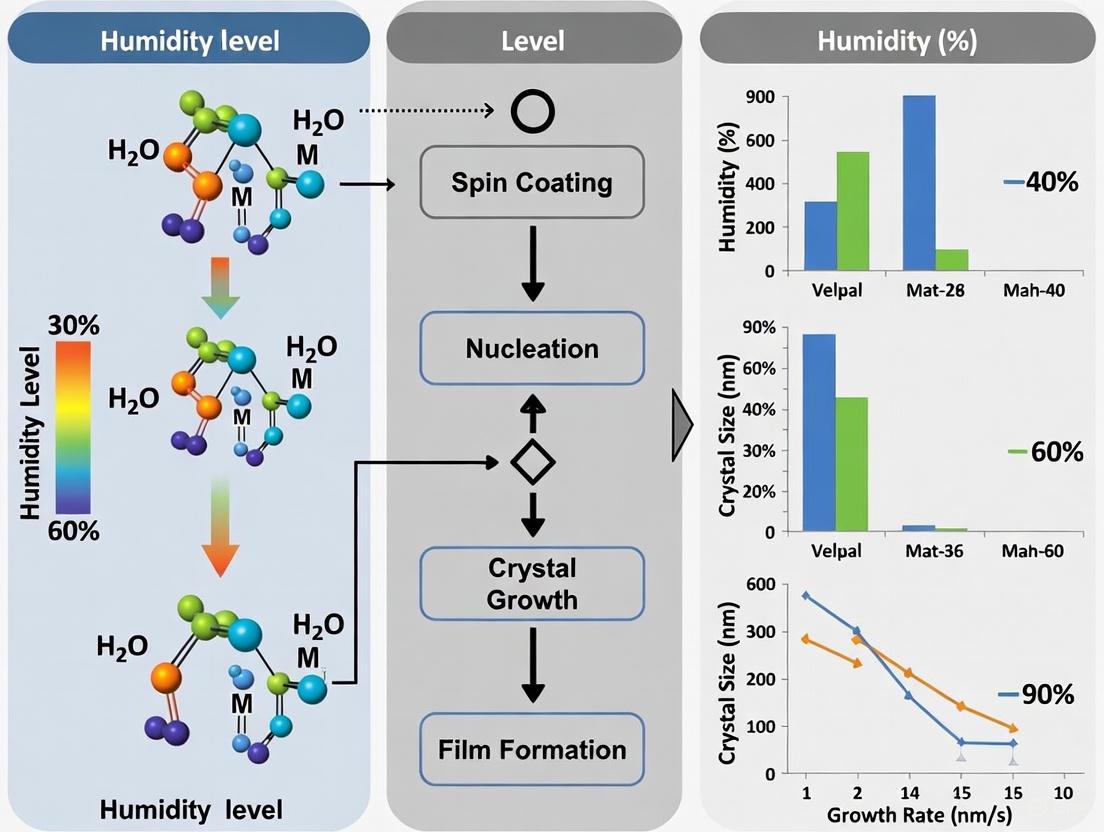
This article provides a comprehensive analysis of humidity-controlled nucleation and crystal growth during spin coating, a critical process for fabricating thin films in biomedical and pharmaceutical applications.
Controlling Nucleation and Crystal Growth via Humidity and Spin Coating: Strategies for Biomedical Materials and Drug Development
Abstract
This article provides a comprehensive analysis of humidity-controlled nucleation and crystal growth during spin coating, a critical process for fabricating thin films in biomedical and pharmaceutical applications. It explores the fundamental thermodynamic and kinetic principles governing nucleation, details advanced methodological strategies for precise environmental control, and offers practical troubleshooting for common challenges like film non-uniformity and uncontrolled crystallization. By synthesizing insights from recent research on perovskites and pharmaceutical compounds, this review establishes a unified framework for optimizing thin-film morphology, crystallinity, and stability, directly addressing the needs of researchers and professionals in drug development for creating advanced drug delivery systems and functional biomaterials.
The Science of Nucleation: Thermodynamic and Kinetic Principles in Thin Film Formation
Nucleation, the initial formation of a new thermodynamic phase or structure from a parent phase, serves as the critical first step in countless natural and industrial processes. This fundamental mechanism governs phenomena ranging from cloud formation in the atmosphere to the crystallization of active pharmaceutical ingredients (APIs). Within the broad field of crystal engineering, understanding and controlling nucleation pathways is paramount for manipulating material properties and product performance. Nucleation occurs primarily through two distinct pathways: homogeneous nucleation, which occurs spontaneously in a metastable phase without the assistance of pre-existing surfaces, and heterogeneous nucleation, where foreign surfaces or particles catalyze the phase transition by lowering the energy barrier.
The classical nucleation theory (CNT) provides a foundational framework for quantifying these processes, positing that the nucleation rate depends exponentially on the energy barrier for forming a critical nucleus. For homogeneous nucleation, this energy barrier is significantly higher than for heterogeneous nucleation, where the catalytic effect of impurities, container walls, or intentionally added seeds reduces the required thermodynamic driving force. In the context of pharmaceutical development and advanced materials manufacturing, controlling which pathway dominates directly influences critical product characteristics including crystal habit, polymorphic form, particle size distribution, and ultimately, bioavailability and stability.
This article delineates the fundamental distinctions between homogeneous and heterogeneous nucleation pathways, provides quantitative comparisons of their characteristics, and details practical protocols for investigating and controlling these processes with a specific focus on humidity-controlled crystal growth and spin-coating applications. By framing these concepts within contemporary research methodologies, we aim to equip scientists with the knowledge to precisely manipulate nucleation for desired technological outcomes.
Theoretical Foundations of Nucleation
Classical Nucleation Theory (CNT)
Classical Nucleation Theory provides a quantitative description of the nucleation process by treating the formation of a new phase through the lens of thermodynamic stability and kinetic barriers. The central concept in CNT is the critical nucleus—the smallest cluster of the new phase that has a higher probability of growing than dissolving. The free energy change, ΔG, for forming a spherical nucleus of radius r is given by the sum of a unfavorable surface term and a favorable volume term:
ΔG = 4πr²γ - (4/3)πr³|ΔGᵥ|
where γ is the interfacial tension (or surface free energy per unit area) and ΔGᵥ is the Gibbs free energy change per unit volume of the new phase, which is negative for a spontaneous process. This relationship results in an energy barrier, ΔG*, that must be overcome for nucleation to proceed. The magnitude of this critical energy barrier is:
ΔG* = (16πγ³) / (3|ΔGᵥ|²)
The nucleation rate, J, which represents the number of critical nuclei formed per unit volume per unit time, follows an Arrhenius-type dependence on this energy barrier:
J = A exp(-ΔG*/kₜT)
where A is a kinetic pre-factor, kₜ is Boltzmann's constant, and T is temperature. Research on hard-sphere systems has confirmed that CNT can successfully predict nucleation rates for both freezing and melting, despite observed asymmetries in their driving forces and interfacial tensions [1].
Homogeneous vs. Heterogeneous Nucleation
The fundamental distinction between homogeneous and heterogeneous nucleation lies in the presence of catalytic surfaces in the latter. Heterogeneous nucleation occurs on pre-existing surfaces—such as container walls, impurity particles, or intentionally added seeds—which effectively lower the interfacial energy term in the CNT equation. This reduction occurs because the effective surface area of the nucleus in contact with the parent phase is diminished when it forms on a substrate.
The energy barrier for heterogeneous nucleation, ΔGₕₑₜ, is related to the homogeneous barrier, ΔGₕₒₘ, by a catalytic factor, f(θ):
ΔGₕₑₜ = ΔGₕₒₘ f(θ)
where θ is the contact angle between the nucleus and the substrate, and f(θ) = (2 - 3cosθ + cos³θ)/4. This relationship reveals that effective nucleation catalysts are those that minimize the contact angle, thereby maximizing wettability. For complete wetting (θ = 0°), the energy barrier approaches zero, while for non-wetting surfaces (θ = 180°), the barrier equals that of homogeneous nucleation. This theoretical framework explains why in real-world systems, heterogeneous nucleation typically dominates unless extraordinary measures are taken to purify solutions and minimize surface interactions.
Quantitative Comparison of Nucleation Pathways
Table 1: Comparative Analysis of Homogeneous and Heterogeneous Nucleation Characteristics
| Characteristic | Homogeneous Nucleation | Heterogeneous Nucleation |
|---|---|---|
| Energy Barrier | High | Significantly reduced (by catalytic factor f(θ)) |
| Catalytic Surfaces | Absent | Required (impurities, walls, seeds) |
| Nucleation Rate | Lower at equivalent supersaturation | Higher at equivalent supersaturation |
| Spatial Distribution | Random throughout volume | Localized at catalytic surfaces |
| Control Difficulty | High | Moderate to high |
| Reproducibility | Low | Higher with controlled catalysts |
| Industrial Application | Limited | Widespread (seeding, templating) |
| Experimental Requirements | High purity, minimized surfaces | Defined catalytic surfaces |
Table 2: Experimental Observations of Nucleation in Different Systems
| System | Nucleation Type | Temperature/ Humidity Conditions | Observed Rate/Size | Reference |
|---|---|---|---|---|
| Hard Spheres (Freezing) | Homogeneous | Within solid-fluid coexistence (η=0.492-0.544) | Comparable nucleation rates for melting/freezing | [1] |
| Sucrose Thin Films | Likely homogeneous | 80-100°C, varying RH | Growth rate: Strong temperature dependence | [2] |
| Ice Crystal Formation | Heterogeneous (seeded) | -5.1 to -8.3°C in natural clouds | Growth rates: 0.17–0.81 µm/s (major axis) | [3] |
| Frost Formation | Heterogeneous | Sub-zero surfaces | Nucleation rate affected by surface contact angle, air humidity & velocity | [4] |
Experimental Protocols for Nucleation Studies
Humidity-Controlled Crystallization of Thin Sucrose Films
Purpose: To investigate the influence of drying parameters on the nucleation onset, nucleation rate, and crystal growth rate of sucrose under controlled humidity conditions.
Materials and Equipment:
- Sucrose solution: Prepared from ultrapure water and sucrose (purity ≥ 99.7%) with an initial water content of 9 g*g⁻¹ on a dry basis [2]
- Thin-film dryer: Equipped with precision humidity, temperature, and airflow controls [2]
- Aluminum sample platelet: With a 0.07 mm deep square cavity of 25 cm² [2]
- Polarized imaging system: Consisting of halogen light source with polarizing filter, camera with zoom lens, and rotatable polarizing filter for observation [2]
- Precision balance: For gravimetric analysis of drying kinetics (e.g., Ohaus Pioneer PX225e with 0.1 mg reproducibility) [2]
Procedure:
- Solution Preparation: Prepare sucrose solution in a volumetric flask, mix thoroughly, and allow to stand at 5°C for 24 hours to ensure complete dissolution and equilibration [2].
- Sample Loading: Pipette 1.7 g of the sucrose solution into the cavity of the aluminum platelet and insert it into the drying channel, ensuring level placement verified with a micrometer screw [2].
- Parameter Setting: Set drying air velocity to 0.3 m*s⁻¹ and establish desired temperature and relative humidity according to experimental design (e.g., 80-100°C with varying RH) [2].
- Gravimetric Monitoring: Record mass changes throughout the drying process using the precision balance to establish drying kinetics [2].
- In Situ Observation: Monitor nucleation and crystal growth using the polarized imaging system, adjusting the polarizing filter to minimize transmission in amorphous regions and maximize contrast for crystals [2].
- Image Analysis: Analyze captured images to determine nucleation onset (first crystal appearance), nucleation rate (number of new nuclei per unit time per unit area), and crystal growth rates (linear dimension increase over time) [2].
- Data Correlation: Correlate nucleation events with solution water content and supersaturation (S), defined as the quotient of the saturation water content and the experimentally measured water content [2].
Glaciogenic Cloud Seeding for Ice Crystal Studies
Purpose: To quantify vapor diffusional ice crystal growth rates in natural clouds through controlled glaciogenic seeding experiments.
Materials and Equipment:
- Uncrewed aerial vehicle (UAV): Customized for atmospheric research (e.g., Meteodrone MM-670) [3]
- Glaciogenic flares: Burn-in-place type containing approximately 20 g of silver iodide (AgI) and other ice-active compounds (e.g., Zeus MK2) [3]
- Tethered balloon system (TBS): For lifting in-situ instrumentation into cloud layers [3]
- Holographic imager: HOLIMO for phase- and size-resolved cloud microphysical properties [3]
- Cloud radars: Ka-band scanning Doppler cloud radars and W-band vertically pointing radar for remote sensing [3]
Procedure:
- Site Selection: Conduct experiments in persistent low-level stratus clouds with temperatures below -5°C and cloud base below approximately 1000 m above ground level [3].
- Background Measurement: Monitor unseeded cloud microphysical properties before seeding to establish baseline conditions using TBS and radar instrumentation [3].
- Particle Seeding: Deploy UAV upwind (1-3 km) of the main measurement site, releasing seeding particles for 5-6 minutes either stationary or flying legs perpendicular to wind direction [3].
- Plume Advection: Allow naturally advecting wind to transport the seeding plume (containing freshly nucleated ice crystals) toward the measurement site [3].
- In Situ Measurement: Capture images of hydrometeors in the seeding plume using HOLIMO mounted on the TBS as the plume passes the main site [3].
- Data Processing: Analyze holographic data to identify pristine ice crystals and measure their sizes, with residence time calculated from seeding time to observation [3].
- Growth Rate Calculation: Determine growth rates along the major axis of pristine ice crystals, reported in µm/s, with filtering methods applied to isolate conditions less affected by experimental setup [3].
Spin Coating for Thin Film Fabrication
Purpose: To produce uniform thin films for studying nucleation and crystal growth under rapid drying conditions.
Materials and Equipment:
- Spin coater: Capable of speeds from 100-6000 rpm with programmable steps [5]
- Substrate: Appropriate material (glass, silicon, etc.) cleaned thoroughly
- Coating solution: Material of interest dissolved in volatile solvent
- Pipette: For precise solution deposition
Procedure:
- Substrate Preparation: Clean substrate thoroughly to remove contaminants that might act as unintended nucleation sites [5].
- Solution Deposition: Deposit coating solution onto substrate using a pipette, either while stationary (static) or while spinning (dynamic) [5].
- Spinning Protocol: Execute spin program with appropriate speed and time parameters:
- Spin-up: Substrate accelerates to desired speed
- Spin-off: Excess fluid expelled from substrate, film thins uniformly
- Evaporation: Solvent evaporates, leaving solid film [5]
- Film Characterization: Measure final film thickness using ellipsometry or profilometry [5].
Visualization of Nucleation Pathways
The Scientist's Toolkit: Essential Research Reagents and Materials
Table 3: Key Research Reagents and Materials for Nucleation Studies
| Item | Function/Application | Example Specifications |
|---|---|---|
| Silver Iodide (AgI) | Glaciogenic seeding agent for heterogeneous ice nucleation | ~20g in burn-in-place flares, ice-active below -5°C [3] |
| Sucrose (High Purity) | Model compound for crystallization studies | ≥99.7% purity, prepared in ultrapure water [2] |
| Spin Coater | Thin film fabrication for nucleation studies | 100-6000 rpm range, programmable steps [5] |
| Polarized Imaging System | In situ observation of nucleation and crystal growth | Halogen light source with polarizing filters, camera with resolution ≥13µm [2] |
| Holographic Imager (HOLIMO) | In situ measurement of cloud microphysical properties | Phase- and size-resolved hydrometeor imaging [3] |
| Thin-Film Dryer | Humidity-controlled drying studies | Precision control of temperature, humidity, airflow [2] |
| Precision Balance | Gravimetric analysis of drying kinetics | 0.1 mg reproducibility [2] |
Applications in Advanced Materials and Pharmaceutical Development
The controlled manipulation of nucleation pathways has profound implications across multiple industries, particularly in pharmaceutical development where crystal form dictates critical performance characteristics. In humidity-controlled crystallization, parameters such as air temperature and relative humidity significantly impact nucleation onset and crystal growth rates. Research demonstrates that in sucrose thin films, growth rates show strong temperature dependence but are not significantly influenced by air humidity, while nucleation behavior is markedly affected by both parameters [2]. Specifically, drier air leads to crystallization onsets at lower supersaturation levels, while moderately humid air retards nucleation onset.
In spin coating—a technique widely used for applying thin films in organic electronics and nanotechnology—the rapid drying process creates unique conditions for nucleation control [5]. The high spin speeds (typically >600 rpm) generate substantial centripetal force that combined with solvent evaporation produces thin films ranging from a few nanometers to a few microns in thickness [5]. The technique's ability to quickly produce uniform films makes it invaluable for rapid prototyping and research, though the fast drying times can sometimes inhibit optimal self-assembly for certain nanomaterials [5].
Advanced frost formation studies provide additional insights into heterogeneous nucleation mechanisms, revealing how surface contact angles and environmental parameters (temperature, humidity, velocity) affect ice crystal nucleation and growth [4]. These findings have practical applications in refrigeration systems, aerospace, and climate science, while also contributing fundamental knowledge about nucleation processes on engineered surfaces.
The strategic control of nucleation pathways represents a cornerstone of modern materials science and pharmaceutical development. Through deliberate manipulation of experimental parameters—including supersaturation, temperature, humidity, and catalytic surfaces—researchers can direct phase transitions along desired pathways to achieve specific material outcomes. The protocols and methodologies outlined herein provide a framework for investigating these fundamental processes across diverse systems, from thin film coatings to atmospheric ice crystals.
As research advances, emerging techniques in in situ monitoring and computational modeling continue to refine our understanding of nucleation phenomena. The integration of real-time observation methods with controlled environmental parameters offers unprecedented opportunities to decipher the subtle dynamics of initial nucleus formation and subsequent growth. These developments promise enhanced control over material properties across numerous applications, ultimately enabling more precise engineering of crystalline materials with tailored characteristics for specific technological and pharmaceutical needs.
In the broader context of research on humidity-controlled nucleation for crystal growth in spin coating, understanding the fundamental drivers of crystal initiation is paramount. This process is critical for researchers and drug development professionals aiming to control the physicochemical properties of active pharmaceutical ingredients (APIs) and other crystalline materials [6]. The formation of a new crystal phase from a solution or melt is governed by thermodynamics and kinetics, with supersaturation and chemical potential serving as the primary driving forces [7]. This application note details the quantitative relationships, experimental protocols, and practical methodologies for controlling crystal initiation, with a specific focus on environments relevant to thin-film deposition techniques like spin coating.
Theoretical Foundations
Defining Supersaturation and Chemical Potential
Supersaturation describes a non-equilibrium state where a solution contains a higher solute concentration than its equilibrium saturation concentration at a given temperature and pressure. It is the essential prerequisite and driving force for crystallization [8].
The supersaturation ratio (S) for a non-ionic species can be quantitatively expressed as: [ Si = \frac{ai(T, P0)}{a^*i(T, P0)} ] where (ai) is the activity of the crystallizing compound (i) in the liquid phase, and (a^_i) is its activity at equilibrium (saturation) [8]. For practical purposes with low supersaturation, this often simplifies to the ratio of concentration to equilibrium concentration: (S_i = C_i / C^_i) [8].
The chemical potential (μ) quantifies the free energy per molecule in a given phase. A spontaneous crystallization process requires the chemical potential of the solute in the solution to be higher than in the solid crystal phase [7]: [ μi^{sol} > μi^{crys} ] The difference in chemical potential, (Δμi), is the true thermodynamic driving force. For solutions at moderate pressure, it is given by: [ Δμi(T,P) = μ{i, solute}(T,P) - μ^*{i, solute}(T,P) = RT \ln \frac{ai(T,P0)}{a^*i(T,P0)} = RT \ln S ] where (R) is the gas constant and (T) is the temperature [8]. This direct relationship links the supersaturation ratio directly to the decrease in free energy that powers the crystallization process.
The Nucleation Energy Barrier
The initial formation of a stable crystal (nucleation) must overcome an energy barrier. The free energy change for forming a spherical nucleus, (ΔGn), is the sum of a favorable volume term and an unfavorable surface term [7]: [ ΔGn = -\left[\frac{kT(4πr^3)}{V \ln β}\right] + 4πr^2γ ] Here, (k) is Boltzmann's constant, (β) is the degree of supersaturation, (γ) is the interfacial free energy, (r) is the nucleus radius, and (V) is the molecular volume.
This relationship creates a critical radius (rc). Nuclei smaller than (rc) tend to dissolve, while those larger than (rc) are stable and will grow [7]. The higher the supersaturation, the smaller this critical radius and the associated energy barrier become, thereby increasing the nucleation rate (Jn), which follows (Jn = Bs \exp(-ΔGn/kT)), where (Bs) is a kinetic factor [7].
Table 1: Key Quantitative Relationships in Crystal Initiation
| Concept | Mathematical Expression | Parameters | Significance |
|---|---|---|---|
| Supersaturation Ratio | ( S = C / C^* ) or ( S = a / a^* ) | (C): Concentration, (C^*): Equilibrium concentration, (a): Activity | Quantifies the deviation from equilibrium; the primary driver for crystallization [8]. |
| Chemical Potential Difference | ( Δμ = RT \ln S ) | (R): Gas constant, (T): Temperature | Represents the thermodynamic driving force for phase change [8]. |
| Nucleation Energy Barrier | ( ΔG_n = -\frac{kT(4πr^3)}{V \ln β} + 4πr^2γ ) | (k): Boltzmann's constant, (r): Radius, (γ): Interfacial energy, (V): Molecular volume | Determines the likelihood and rate of stable nucleus formation [7]. |
| Nucleation Rate | ( Jn = Bs \exp(-ΔG_n/kT) ) | (B_s): Kinetic pre-factor (related to solubility, diffusion) | Predicts the frequency of nucleation events per unit volume per time [7]. |
Experimental Data and Controlled Nucleation
Quantitative Effects of Humidity and Surfaces
In the context of thin-film formation, the interfaces present—such as the solution/atmosphere and solution/substrate—play a critical role. A study on the melt crystallization of ibuprofen demonstrated that nucleation time is inversely proportional to relative humidity (RH) [9]. The nucleation time followed the order RH 100% < RH 75% < RH 33% across various surfaces, including Al, Au, and functionalized self-assembled monolayers [9]. The proposed mechanism is that adsorbed water molecules at the melt/atmosphere interface create a local, unfavorable ibuprofen/water interface, thereby increasing the instability of the metastable melt and promoting nucleation to reduce this interfacial area [9].
Furthermore, the nature of the substrate surface significantly influences the crystallization kinetics and final crystal morphology. Different surfaces (e.g., Al, Au, -CH(_3), -OH, -COOH terminated SAMs) led to distinct crystallization behaviors, which could be analyzed using the Avrami equation to understand growth kinetics [9]. This is particularly relevant for spin coating, where the substrate choice is a critical parameter.
Metastable Zone and Nucleation Control
The metastable zone is the region between the saturation curve and the spontaneous nucleation curve where a solution is supersaturated but nucleation is unlikely to occur spontaneously within a practical timeframe [8] [7]. The width of this zone is system-dependent; for pharmaceuticals, it can be 20 to 40 °C, much larger than for simple inorganic salts [8]. Operating within this zone allows for controlled crystal growth without undesirable spontaneous nucleation.
Controlling the nucleation step is an efficient method for tuning API properties, influencing particle size distribution, morphology, surface energy, and mechanical properties like Young's modulus [6]. Primary nucleation is a stochastic process, making it difficult to control, whereas secondary nucleation methods offer greater reproducibility [6].
Table 2: Summary of Nucleation Control Methods
| Method | Mechanism | Key Parameters | Impact on Final Product |
|---|---|---|---|
| Seeding | Addition of pre-formed crystalline material (seeds) to induce targeted secondary nucleation [6]. | Seed amount (0.5-10 wt%), specific surface area, particle size distribution [6]. | Prevents uncontrolled nucleation; ensures process reproducibility and can control polymorphic form [6]. |
| Sonocrystallization | Ultrasound induces cavitation, effectively generating numerous nucleation sites at low supersaturation [6]. | Ultrasound amplitude, sonication time [6]. | Produces small crystals with narrow size distribution; prevents agglomeration; can promote stable polymorph [6]. |
| Antisolvent Crystallization | Adding a miscible solvent (antisolvent) reduces solute solubility, generating supersaturation [6]. | Solvent-antisolvent pair selection, addition speed, temperature [6]. | High addition rates suppress growth, yielding fine particles; affects crystal morphology and mechanical properties [6]. |
| Template-Assisted | Surfaces or particles act as heterogeneous nucleation sites, reducing the interfacial energy (γ) [6]. | Template surface chemistry (e.g., functional groups), size, solvent polarity [6]. | Can yield unusual crystal shapes (e.g., flower-like); offers good reproducibility and selectivity [6]. |
Experimental Protocols
Protocol: Investigating Humidity-Controlled Nucleation via Spin Coating
This protocol is designed to study the effect of atmospheric humidity on the nucleation density and crystal morphology of an API in a spin-coated thin film.
1. Research Reagent Solutions
- Coating Solution: Prepare a solution of the model API (e.g., Ibuprofen) in a volatile organic solvent (e.g., Ethanol or Acetone). Standard concentration: 10-50 mg/mL.
- Substrate Functionalization: Solutions for creating self-assembled monolayers (SAMs) on gold or silicon substrates, such as 1mM solutions of alkanethiols with -CH(_3), -OH, and -COOH terminal groups in ethanol.
- Cleaning Solvents: Acetone and Isopropyl Alcohol (IPA) for substrate cleaning.
2. Materials and Equipment
- Spin coater
- Environmental chamber or glove box with humidity control (for RH 33%, 75%, 100%)
- Analytical balance
- Optical microscope
- Substrates (e.g., glass slides, silicon wafers, Au-coated slides)
- Pipettes and syringes
- Nitrogen gun
3. Step-by-Step Procedure
- Step 1: Substrate Preparation. Clean substrates (e.g., sonication in acetone followed by IPA, drying with N(_2)). Functionalize a set of substrates with different SAMs according to standard protocols [9].
- Step 2: Environment Equilibration. Place the substrate on the spin coater chuck inside the humidity-controlled environment. Allow the system to equilibrate for at least 30 minutes at the target RH (33%, 75%, or 100%).
- Step 3: Solution Deposition and Spin Coating. Using a pipette, deposit a fixed volume (e.g., 100 µL) of the API coating solution onto the stationary substrate (static dispense). Immediately initiate the spin coating program: a two-step process of 500 rpm for 5-10 seconds (spread stage) followed by 2000-3000 rpm for 30-60 seconds (thin film stage) [5] [10].
- Step 4: In-situ Observation and Analysis. Immediately after spinning, transfer the substrate to the optical microscope stage within the same humidity-controlled environment. Observe and record the time at which the first crystalline nuclei appear (t_OBS) and monitor the evolution of crystal morphology over time.
- Step 5: Data Collection. For each condition (RH level, surface type), perform a minimum of 8 independent experiments to account for stochasticity [9]. Record the nucleation time and capture micrographs of the final crystal morphology.
4. Data Analysis
- Calculate the average nucleation time and standard deviation for each experimental condition.
- Plot the cumulative probability that nucleation has not occurred, P(t), against time. An exponential decay, P(t) = exp(-kt), indicates a constant nucleation rate (k) [11].
- Correlate nucleation times and crystal morphologies with RH levels and surface chemistries.
Protocol: Seeding Crystallization for API Production
This protocol outlines a standard method for achieving reproducible crystallization of an API through controlled secondary nucleation.
1. Research Reagent Solutions
- API Solution: Saturated or slightly supersaturated solution of the API in a suitable solvent (e.g., Fluticasone propionate in an organic solvent).
- Seed Stock: Suspension of micronized API crystals (seeds) in an antisolvent or the process solvent. The seed material should have a well-characterized particle size distribution and polymorphic form [6].
2. Materials and Equipment
- jacketed crystallizer vessel with temperature control
- Overhead stirrer
- Lasentec FBRM or similar probe for particle monitoring
- Heated filter funnel
3. Step-by-Step Procedure
- Step 1: Generate Supersaturation. Charge the crystallizer with the API solution. Use controlled cooling or initiate a slow, controlled addition of antisolvent to bring the solution to a supersaturated state within the metastable zone (typically at ¼ to ½ of the zone width) [6].
- Step 2: Seeding. Once the target supersaturation within the metastable zone is reached, add a precise amount (e.g., 0.5-1.0% by weight of the expected crystal crop) of the seed suspension [6].
- Step 3: Crystal Growth. Maintain the conditions (temperature, stirring) to allow for crystal growth from the seeds. The dominance of growth over new nucleation is promoted by using a sufficient amount of seeds [6].
- Step 4: Harvesting. Once the crystals have reached the desired size, separate them from the mother liquor by filtration and dry.
4. Data Analysis
- Characterize the final crystalline product using techniques like Laser Diffraction (PSD), Scanning Electron Microscopy (morphology), X-ray Powder Diffraction (polymorphic form), and Inverse Gas Chromatography (surface energy) [6].
The Scientist's Toolkit: Essential Research Reagents & Materials
Table 3: Key Research Reagent Solutions and Materials
| Item | Function / Explanation |
|---|---|
| Functionalized Substrates (e.g., SAMs on Au/Si) | Provides well-defined surface chemistries (-CH(_3), -OH, -COOH) to study the specific effects of surface energy on heterogeneous nucleation [9]. |
| Seed Suspension | A stable suspension of micronized API crystals in an inert liquid. Used in seeding crystallization to provide controlled, reproducible nucleation sites, suppressing stochastic primary nucleation [6]. |
| Solvent-Antisolvent Pair | A pair of miscible solvents where the API has high solubility in one (solvent) and low solubility in the other (antisolvent). Used to rapidly generate high supersaturation [6]. |
| Humidity Control Chamber | An enclosed environment where relative humidity can be precisely controlled and maintained. Essential for studying the impact of water vapor adsorption on nucleation kinetics in thin films [9]. |
| Polymer Template Particles | Micron or sub-micron sized particles (e.g., polymeric or metallic) used to induce and guide heterogeneous nucleation, potentially leading to unique crystal habits or shapes [6]. |
Workflow and Pathway Visualizations
Gibbs Free Energy and the Nucleation Energy Barrier
Nucleation, the initial step in the formation of a new thermodynamic phase, is a process dominated by the interplay of energy barriers and kinetic factors. Classical nucleation theory (CNT) provides the primary theoretical framework for quantitatively understanding this process, with the Gibbs free energy barrier (ΔG*) as its central component [12]. This energy barrier arises from the competition between the bulk free energy gain of forming a new, more stable phase and the surface free energy cost of creating a new interface [12]. The nucleation rate, which determines how quickly a new phase appears, depends exponentially on this energy barrier, leading to immense variation in nucleation timescales across different systems [12]. In the context of pharmaceutical development and advanced manufacturing techniques like spin coating, controlling this energy barrier is essential for directing crystal growth, obtaining desired polymorphs, and ensuring consistent product quality [9] [13].
The total Gibbs free energy change (ΔG) for the formation of a spherical nucleus of radius r is given by the sum of the volume and surface terms [12]:
ΔG = (4/3)πr³Δg_v + 4πr²σ
Here, Δg_v is the Gibbs free energy change per unit volume (negative for a stable phase), and σ is the interfacial free energy per unit area. This relationship produces an energy maximum at a specific critical radius, r*. Clusters smaller than this critical size are unstable and tend to redissolve, while those that exceed it can grow spontaneously into a new phase. The height of this critical energy barrier, ΔG*, is derived as [12]:
ΔG* = 16πσ³ / (3|Δg_v|²)
The CNT expression for the nucleation rate R combines this thermodynamic barrier with kinetic factors [12]:
R = N_S Z j exp(-ΔG* / k_B T)
Where N_S is the number of potential nucleation sites, Z is the Zeldovich factor, j is the flux of molecules to the critical nucleus, k_B is Boltzmann's constant, and T is temperature. This framework allows researchers to analyze and predict nucleation behavior in diverse systems, from ice formation in the atmosphere to the crystallization of active pharmaceutical ingredients (APIs) [14] [9].
Experimental Data and Impact of Environmental Conditions
Environmental factors such as humidity and the nature of surfaces profoundly influence the nucleation energy barrier, thereby offering pathways for controlled crystallization. The following tables summarize key quantitative findings from recent research.
Table 1: Effect of Relative Humidity (RH) on Ibuprofen Melt Crystallization Nucleation Time on Various Surfaces [9]
| Surface Type | Nucleation Time at RH 33% (min) | Nucleation Time at RH 75% (min) | Nucleation Time at RH 100% (min) |
|---|---|---|---|
| Aluminum (Al) | ~25 | ~15 | ~5 |
| Gold (Au) | ~25 | ~15 | ~5 |
| SAM–OH | ~30 | ~18 | ~5 |
| SAM–COOH | ~30 | ~18 | ~5 |
| SAM–CH₃ | ~45 | ~25 | ~5 |
Table 2: Effectiveness of Polymers in Inhibiting Crystal Nucleation and Growth of Alpha-Mangostin (AM) [15]
| Polymer | Induction Time for AM Nucleation | Ability to Maintain Supersaturation | Key Interaction Identified |
|---|---|---|---|
| Polyvinylpyrrolidone (PVP) | Longest | Effective long-term maintenance | Strongest polymer-AM interaction (methyl group of PVP with carbonyl of AM) |
| Eudragit | Intermediate | Maintained for ~15 minutes | Moderate interaction |
| Hypromellose (HPMC) | Shortest | No significant inhibitory effect | Weak interaction |
Table 3: Calculated Homogeneous Ice Nucleation Parameters in Adsorbed Water Films (Theoretical Study) [14]
| Film Thickness | Melting Point Depression (ΔT) | Critical Ice Nucleus Size (R*_iw) | Impact on Homogeneous Nucleation Onset Temperature |
|---|---|---|---|
| ~1 nm (hydrophilic surface) | Up to 5 K | Smaller than in bulk water | Shifts onset temperature 1–2 K lower than bulk value (235 K) |
| ~3.5 nm (free-standing) | Not Reported | Similar to bulk water | Bulk-like nucleation rates |
The data in Table 1 demonstrates that increased relative humidity can significantly accelerate nucleation. The study proposed that adsorbed water molecules create an unfavorable ibuprofen melt/water interface, thereby increasing the system's instability and prompting nucleation to reduce this interfacial area [9]. Furthermore, as shown in Table 2, specific molecular-level interactions between polymers and drug molecules can effectively inhibit nucleation by stabilizing the metastable supersaturated state, a critical mechanism for enhancing the bioavailability of poorly water-soluble drugs [15]. Table 3 highlights how nanoscale confinement in adsorbed water films alters the thermodynamic landscape, depressing the melting point and modifying the critical nucleus size, which is particularly relevant for atmospheric science and interfacial phenomena [14].
Detailed Experimental Protocols
Protocol: Investigating Humidity-Controlled Melt Crystallization
This protocol is adapted from studies on the effects of humidity and surfaces on the melt crystallization of ibuprofen [9].
- Objective: To quantitatively analyze the effect of relative humidity (RH) and surface chemistry on the nucleation time, crystal morphology, and polymorphic form of a model compound.
- Materials:
- Active Pharmaceutical Ingredient (API): Ibuprofen (or other suitable low-melting-point compound).
- Substrates: Aluminum (Al), Gold (Au), and functionalized surfaces (e.g., Self-Assembled Monolayers with –CH₃, –OH, and –COOH terminal groups).
- Equipment: Differential Scanning Calorimeter (DSC), Environmental Chamber or sealed desiccator with saturated salt solutions, Hot Stage with temperature controller, Optical Microscope (OM) with camera.
- Humidity Control: Saturated salt solutions or commercial humidity generator to maintain specific RH levels (e.g., 33%, 75%, 100%).
- Procedure:
- Sample Preparation:
- Melt a small quantity of the API on each substrate type to form a thin film.
- Crystallization Setup:
- Place the prepared samples inside the environmental chamber pre-equilibrated at the desired RH and a constant temperature (e.g., room temperature, 18–22°C).
- For slower growth kinetics to facilitate observation, perform experiments at lower temperatures (e.g., -20°C) with controlled, low humidity.
- In-Situ Monitoring:
- Use the optical microscope to observe the samples continuously or at regular intervals.
- Record the time at which the first crystal nuclei appear (turbid regions within the clear melt) for at least eight independent experiments per condition to ensure statistical significance.
- Document the crystal morphology during the initial growth phase and after completion.
- Post-Crystallization Analysis:
- Analyze the crystallinity and polymorphic form of the resulting crystals using DSC to determine melting enthalpy and point.
- Confirm the crystal phase using Powder X-Ray Diffraction (PXRD).
- Sample Preparation:
- Data Analysis:
- Calculate the average nucleation time and standard deviation for each surface/RH combination.
- Correlate crystal growth kinetics with the Avrami equation by measuring the projected crystalline area over time:
X_c(t) = 1 - exp(-Ktⁿ), whereX_c(t)is the relative crystallinity at timet,Kis the rate constant, andnis the Avrami exponent.
Protocol: Spin Coating of Thin Films for Nucleation Studies
This protocol provides a methodology for creating uniform thin films, a crucial step in studying nucleation under confinement and for organic electronic applications [5] [10].
- Objective: To deposit highly uniform thin films of a material from a solution onto a flat substrate using spin coating for subsequent crystallization studies.
- Materials:
- Spin Coater: Programmable spin coater capable of speeds from 500 to 6000 RPM.
- Substrates: Silicon wafers, glass slides, or other relevant flat substrates.
- Coating Solution: Solution of the material of interest (e.g., polymer, organic semiconductor) dissolved in a volatile solvent.
- Cleaning Supplies: Acetone, Isopropyl Alcohol (IPA), Nitrogen gun or duster, Pipettes.
- Procedure:
- Substrate Preparation:
- Clean the substrate thoroughly by rinsing with acetone followed by IPA.
- Dry the substrate using a stream of nitrogen to remove any residual solvent and particles.
- Secure the substrate onto the spin coater chuck using a vacuum.
- Solution Deposition (Static Dispensing):
- Pipette an excess of the coating solution (e.g., 0.5-1 mL for a 2" wafer) directly onto the center of the stationary substrate.
- Spinning Process:
- Spin-Up: Initiate the spin coater program. A typical two-step program is used:
- Step 1 (Low Speed): 500-1000 RPM for 5-10 seconds to spread the solution evenly across the substrate.
- Step 2 (High Speed): 1500-3000 RPM for 20-60 seconds to thin the film and evaporate the solvent.
- The final film thickness (
h_f) is inversely proportional to the square root of the spin speed (ω):h_f ∝ 1/√ω[5].
- Spin-Up: Initiate the spin coater program. A typical two-step program is used:
- Film Drying/Curing:
- After spinning, the film may be semi-dry. Transfer the substrate to a hotplate or oven for a post-treatment (e.g., annealing) to remove residual solvent and/or induce crystallization.
- Substrate Preparation:
- Note on Dynamic Dispensing: As an alternative, the solution can be dispensed while the substrate is spinning at a low speed (e.g., 500 RPM), which can sometimes improve uniformity for certain solutions [10].
Visualizations and Workflows
Nucleation Energy Barrier and Spin Coating Workflow
The following diagram illustrates the core concepts of the nucleation energy barrier and its relationship to the experimental process of humidity-controlled spin coating.
Diagram Title: Nucleation Energy Barrier and Spin Coating Workflow
The Scientist's Toolkit: Key Research Reagents and Materials
Table 4: Essential Materials for Humidity-Controlled Nucleation and Crystal Growth Studies
| Item Name | Function / Rationale |
|---|---|
| Functionalized Surfaces (SAMs) | Engineered surfaces with specific terminal groups (–CH₃, –OH, –COOH) to study the effect of surface energy and chemistry on nucleation kinetics and crystal orientation [9]. |
| Polymers (PVP, HPMC, Eudragit) | Used as crystallization inhibitors in supersaturated drug solutions; they suppress nucleation and crystal growth by interacting with drug molecules, thereby maintaining high bioavailability [15]. |
| Saturated Salt Solutions | A simple and reliable method to generate specific, constant relative humidity levels within a closed environment (e.g., a desiccator) for humidity-controlled experiments [9]. |
| Spin Coater | Instrument for depositing highly uniform thin films of materials from solution, essential for creating defined geometries for crystallization studies and organic electronic devices [5] [10]. |
| Differential Scanning Calorimeter (DSC) | Used to determine key thermal properties such as glass transition temperature (Tg), melting point (Tm), and enthalpy of fusion (ΔH_f), which define the temperature window for melt crystallization [9]. |
| Cold Stage with Humidity Control | A temperature- and humidity-controlled platform, often coupled with microscopy, for the direct observation and analysis of ice nucleation and frost growth processes [16] [4]. |
The LaMer model, introduced in 1950, represents a foundational theory for understanding the formation of monodisperse particles through a distinct separation of nucleation and growth phases [17]. This model postulates that monodispersity is achieved when nucleation occurs as a single, "burst" event after a rapid increase in supersaturation, followed by diffusion-controlled growth without further nucleation [17]. Within the context of humidity-controlled nucleation and crystal growth for spin coating processes, particularly for advanced materials like perovskite semiconductors, understanding and applying LaMer's principles enables precise control over thin-film morphology—a critical factor determining device performance [18] [19]. This application note details the theoretical framework, experimental protocols, and material considerations for implementing LaMer-type crystallization in controlled environments.
Theoretical Framework of the LaMer Model
The Classic Three-Stage Mechanism
The LaMer model describes a three-stage process for the formation of monodisperse colloids, visualized in the diagram below.
As depicted, the model proceeds through three critical stages [17]:
Stage I: Precursor Formation and Increase in Supersaturation: The concentration of solute monomers in solution increases, typically through a chemical reaction or a physical change like solvent evaporation. The solute concentration rises above the equilibrium solubility, creating a supersaturated state, yet remains below the critical concentration required for spontaneous nucleation.
Stage II: Burst Nucleation: Once the solute concentration surpasses the critical supersaturation threshold (C(_\text{min}) in the diagram), a rapid, "burst" nucleation event occurs. This stage is characterized by the formation of a large number of nucleation sites in a short timeframe. LaMer described this as a process where the "rate of nucleation becomes effectively infinite" [17]. The key to achieving monodisperse particles is that this nucleation event is confined to a brief temporal window.
Stage III: Diffusion-Limited Growth without Further Nucleation: Following the burst nucleation, the solute concentration drops below the critical supersaturation level. The existing nuclei then grow uniformly by consuming the remaining solute monomers from the solution. This growth phase is governed by diffusion of monomers to the particle surfaces. The absence of new nucleation events during this stage is essential for obtaining a narrow size distribution.
Connection to Classical Nucleation Theory (CNT) and Modern Interpretations
The LaMer model is intrinsically linked to Classical Nucleation Theory (CNT), which provides the thermodynamic basis for nucleation [17]. CNT describes the energy barrier to nucleation (ΔG(^*)) and the critical nucleus size (r(_c)), concepts that underpin the supersaturation thresholds in the LaMer diagram. The model's requirement for a sharp, "effectively infinite" nucleation rate has been a subject of extensive critical analysis over the past 70 years [17]. While the model provides a powerful qualitative framework, the quantitative reality of "instantaneous" nucleation followed purely by "diffusion-controlled" growth has limited experimental support, with many modern syntheses deviating from these idealized conditions [17].
Quantitative Data and Key Parameters
The following tables summarize the core quantitative relationships and parameters central to the LaMer model and its application in thin-film processing.
Table 1: Key Parameters in the LaMer Model and Classical Nucleation Theory
| Parameter | Symbol | Description | Relevance to LaMer Model |
|---|---|---|---|
| Critical Supersaturation | C(_\text{min}) | The minimum solute concentration required for spontaneous, rapid nucleation. | Defines the peak of Stage II; surpassing this triggers "burst nucleation." [17] |
| Solubility Limit | C(_\text{s}) | The equilibrium concentration of the solute in the solvent. | Defines the boundary of Stage I; supersaturation is relative to this value. |
| Nucleation Rate | J | The number of new nuclei formed per unit volume per unit time. | In the ideal LaMer model, this must be extremely high for a short duration. [17] |
| Growth Rate | G | The rate at which existing nuclei increase in size. | Should be controlled by diffusion to ensure uniform growth of all nuclei (Stage III). |
| Critical Radius | r(_c) | The minimum size of a stable nucleus; particles smaller than r(_c) will dissolve. | A concept from CNT; determines which nuclei formed in the burst will survive to grow. [17] |
| Free Energy Barrier | ΔG(^*) | The maximum free energy required to form a stable nucleus. | Determines the kinetics of the burst nucleation event (Stage II). [17] |
Table 2: Influence of Processing Parameters on Nucleation and Growth in Spin Coating
| Parameter | Effect on Nucleation | Effect on Growth | Impact on Film Morphology |
|---|---|---|---|
| Spin Speed | Higher speeds accelerate solvent evaporation, potentially leading to faster supersaturation and higher nucleation density [5]. | Influences film thinning and solvent loss; final thickness often follows h(_f) ∝ ω(^{-1/2}) [5]. | Controls final film thickness and uniformity. High speeds can lead to smoother films. |
| Solution Concentration | Higher precursor concentration increases the driving force for nucleation, potentially leading to a denser population of nuclei. | Provides more material for growth, potentially leading to larger grains if nucleation is controlled. | Directly influences grain size and film coverage. Optimal concentration is critical. |
| Solvent Properties (Vapor Pressure, Viscosity) | Volatile solvents promote rapid supersaturation, favoring a high nucleation rate. | Affects fluid dynamics during spin-off and evaporation stages [5]. | Determines crystallization kinetics, affecting grain size, pinholes, and roughness. |
| Antisolvent Treatment | Triggers immediate, massive supersaturation, inducing a LaMer-like burst nucleation event [20] [19]. | Can be tuned to control growth kinetics by forming intermediate solvent-complex phases that decompose slowly [20]. | Primary method for achieving dense, pinhole-free perovskite films with controlled grain size. |
| Substrate Temperature | Higher temperatures can accelerate solvent evaporation, increasing supersaturation and nucleation rate. | Higher temperatures provide thermal energy for crystal reorganization and grain growth [19]. | A critical knob for tuning between many small grains (high T) or fewer larger grains (low T). |
Experimental Protocols for Humidity-Controlled Spin Coating
The following section provides a detailed methodology for achieving LaMer-type burst nucleation and controlled growth during the spin coating of perovskite films, with a specific emphasis on humidity control.
Protocol: Antisolvent-Induced Burst Nucleation for Perovskite Solar Cells
This protocol is adapted from studies on the crystallization of methylammonium lead iodide (MAPI) and other perovskites, which explicitly observe burst nucleation and subsequent growth phases [20] [19] [21].
Workflow Overview:
Materials and Equipment:
- Substrates: Pre-cleaned ITO or FTO glass.
- Precursor Solution: e.g., Methylammonium iodide (MAI) and Lead iodide (PbI(_2)) in a mixed solvent of DMF and DMSO [20] [21].
- Antisolvent: Anhydrous toluene, chlorobenzene, or diethyl ether.
- Equipment: Spin coater, hotplate, programmable glove box or humidity-controlled enclosure, pipettes.
Step-by-Step Procedure:
Environment and Substrate Preparation:
- Place the spin coater and hotplate inside a nitrogen-filled glove box or a humidity-controlled chamber.
- Set and maintain the relative humidity at the desired level (e.g., <30% for standard MAPbI(_3), though some studies explore high-humidity fabrication [18]). Consistently monitor humidity.
- Pre-heat the hotplate to the required annealing temperature (typically 90-110°C).
Precursor Solution Deposition:
- Filter the perovskite precursor solution (e.g., 1.2M MAPbI(_3) in DMF:DMSO) through a 0.45 μm PTFE filter.
- Pipette the solution onto the center of the substrate (static or dynamic deposition).
Spin Coating and Critical Antisolvent Quenching:
- Stage 1 (Spreading): Initiate the spin coater program. A typical first stage is 1000 rpm for 10 seconds to spread the solution evenly.
- Stage 2 (Burst Nucleation): Ramp to a high speed (e.g., 4000-6000 rpm). At a critical time (e.g., 5-10 seconds after the start of the high-speed stage), quickly dispense the antisolvent (e.g., ~200 μL of toluene) onto the spinning film.
- Mechanism: The antisolvent rapidly reduces the solubility of the perovskite precursors, creating a massive, uniform supersaturation. This triggers a "burst nucleation" event, resulting in the instantaneous formation of a high density of MAPI nanocrystals [20]. This is the direct application of the LaMer model's Stage II.
Post-Spin Treatment and Crystal Growth:
- Immediately after spin coating ceases, the film may appear translucent or have an intermediate color.
- Thermal Annealing (Growth Phase): Transfer the film directly to the pre-heated hotplate. Anneal for 10-20 minutes.
- Mechanism: This annealing facilitates the dissolution-recrystallization of metastable intermediate phases (like the MAPI·DMSO solvent-complex) and the growth of the nucleated crystals into a dense, polycrystalline film [20]. This represents Stage III of the LaMer model, where growth proceeds without further nucleation.
Cooling:
- After annealing, remove the sample from the hotplate and allow it to cool to room temperature before further processing or characterization.
Advanced Strategy: Vacuum-Assisted Precrystallization for Scalable Coating
For blade coating—a more scalable alternative to spin coating—a vacuum-assisted precrystallization step can be used to decouple nucleation and growth, mimicking the LaMer mechanism [21].
Procedure:
- Ink Formulation: Incorporate a small amount of volatile additives like methylammonium chloride (MACl) into the perovskite precursor. MACl slows crystallization and suppresses unwanted phases [21].
- Blade Coating: Deposit the precursor ink onto a substrate at ambient temperature.
- Vacuum Precrystallization: Immediately after deposition, place the wet film under a mild vacuum for a short duration (e.g., 30 seconds). This rapidly extracts excess solvent, inducing supersaturation and nucleation, effectively creating a "frozen" intermediate state [21].
- Thermal Annealing: Transfer the film to a hotplate for annealing. The intermediate phase transforms, and crystals grow in a controlled manner, leading to high-quality films over large areas [21].
The Scientist's Toolkit: Essential Research Reagent Solutions
Table 3: Key Reagents for LaMer-Type Perovskite Crystallization
| Item | Function / Role in LaMer Model | Example in Protocol |
|---|---|---|
| DMF (Dimethylformamide) | Primary solvent for perovskite precursors. Its evaporation kinetics during spinning contribute to initial supersaturation. | Solvent in precursor ink [20]. |
| DMSO (Dimethyl sulfoxide) | Co-solvent with strong Lewis base character. Forms stable intermediate complexes with PbI(_2), which can be controllably decomposed, allowing separation of nucleation and growth [20]. | Co-solvent in precursor ink to modulate crystallization kinetics [20]. |
| Toluene / Chlorobenzene | Antisolvent. Miscible with the primary solvent but does not dissolve perovskite. Its rapid introduction is the most direct method to trigger "burst nucleation" by inducing massive supersaturation [20] [19]. | Quenching solvent dripped during spin coating to initiate nucleation [20]. |
| Methylammonium Chloride (MACl) | Volatile additive. Modifies crystallization kinetics, suppresses non-perovskite phases, and promotes larger grain growth by slowing the process, allowing for better separation of nucleation and growth stages [21]. | Additive (e.g., 10-50 mol%) in precursor ink for blade or spin coating [21]. |
| Nitrogen / Controlled Atmosphere | Inert environment. Prevents degradation of moisture-sensitive precursors and crystals during processing. Essential for achieving reproducible nucleation and growth kinetics [18] [20]. | Environment inside the glove box for all solution preparation and coating steps. |
In the realm of materials science and pharmaceutical development, environmental humidity has emerged as a critical parameter for modulating crystallization processes. Rather than being merely an environmental variable to control, deliberate manipulation of relative humidity (RH) enables precise command over crystal nucleation, growth kinetics, and ultimate morphological outcomes. The presence of water vapor significantly influences crystallization pathways by altering precursor solubilities, modifying diffusion coefficients in precursor solutions, and directly participating in crystal lattice formation through hydrate formation. This application note details how humidity serves as a crystallization modulator across diverse systems, with particular emphasis on metal halide perovskites for photovoltaics—a domain where humidity control has recently transitioned from a stability challenge to a fabrication advantage [18] [22].
The underlying mechanisms of humidity-mediated crystallization involve complex interactions at the solid-liquid-vapor interface. Water molecules actively coordinate with crystal precursors, potentially forming intermediate complexes that direct self-assembly pathways. In supersaturated solutions and thin films, humidity fluctuations create localized gradients that drive Ostwald ripening and phase segregation phenomena. Furthermore, the thermodynamic activity of water directly influences crystallization driving forces through vapor pressure differentials and solubility modifications. Understanding these principles allows researchers to exploit humidity not as a variable to eliminate, but as a powerful tool to direct crystallization toward desired structural and functional outcomes [22] [23].
Quantitative Data: Humidity Ranges and Crystallization Outcomes
Table 1: Humidity-Dependent Crystallization Outcomes in Material Systems
| Material System | Humidity Range | Crystallization Outcome | Key Performance Metrics | Citation |
|---|---|---|---|---|
| Perovskite (MAPbI₃) | Low RH (<30%) | Small cubic crystallites with void formation | Poor device performance; substantial J-V hysteresis | [22] |
| Perovskite (MAPbI₃) | Moderate-High RH (40-60%) | Larger crystals with improved connectivity | PCE up to 12.2% with P3HT HTM; low hysteresis | [22] |
| 2D/3D Perovskite Heterostructure | 45% RH (storage) | Enhanced humidity stability >85% initial efficiency retention after 800 hours | Champion PCE: 22.7%; superior carrier extraction | [24] |
| Sodium Chloride (Nanoconfined) | ~65% RH | Deliquescence (crystal to solution) | Hysteresis controlled by phase transitions | [23] |
| Sodium Chloride (Nanoconfined) | ~35% RH | Crystallization (solution to crystal) | Extreme supersaturation before nucleation | [23] |
| Lithium Borosilicate Glass | High Humidity | New crystal structures over time | Altered ionic conductivity; mechanical property changes | [25] |
Table 2: Impact of Humidity on Crystal Growth Rates in Different Environments
| System | Temperature Range | Growth Rate | Measurement Technique | Experimental Conditions | Citation |
|---|---|---|---|---|---|
| Natural Clouds (Ice Crystals) | -5.1 to -8.3°C | 0.17–0.81 µm s⁻¹ (major axis) | Holographic Imager (HOLIMO) | Glaciogenic cloud seeding | [3] |
| Sandstone Grotto Salts | Ambient fluctuations | Crystallization within 46-76% RH and 16-30% RH | Thermodynamic Modeling (ECOS-RUNSALT) | Cultural heritage preservation | [26] |
Experimental Protocols: Humidity-Controlled Crystallization
Humidity-Controlled Spin-Coating for Perovskite Films
Principle: Controlled humidity environments during spin-coating directly modulate perovskite crystal growth kinetics by regulating solvent evaporation rates and facilitating intermediate hydrate formation, ultimately governing crystal size and morphology [22].
Materials:
- Perovskite precursors (e.g., PbI₂, FAI, MAI)
- Solvents (DMF, DMSO, isopropanol)
- Substrates (ITO/glass)
- Hole transport material (e.g., P3HT)
- 2D perovskite modifier solutions (e.g., 3-pyridine methylamine iodine)
Procedure:
- Substrate Preparation: Clean ITO glass substrates sequentially in acetone, toluene, isopropanol, ethanol, and deionized water (15 min per solvent) followed by 30 min UV-ozone treatment [24].
- Environment Setup: Pre-equilibrate spin-coater enclosure to target relative humidity (30-60% RH) using precise humidity control system. Monitor with calibrated RH/temperature sensors.
- Electron Transport Layer Deposition: Spin-coat SnO₂ colloidal solution (diluted 50-fold with deionized water) at 4000 rpm. Anneal at 150°C for 10 min in dry atmosphere [24].
- Perovskite Precursor Deposition: a. Prepare 1.3 mol/L PbI₂ solution in DMF:DMSO (9:1 v/v) b. Spin-coat onto substrate at 1700 rpm in controlled humidity environment c. Thermally anneal at 70°C for 30 s to form uniform PbI₂ intermediate layer d. Deposit mixed cation solution (FAI:MAI:MACl in IPA, 60:6:6 mg/mL) at identical spin-coating parameters e. Final thermal annealing at 140°C for 15 min to complete 3D perovskite crystallization [24]
- 2D/3D Heterostructure Formation (Optional): For enhanced humidity stability, sequentially deposit low-concentration 2D perovskite modifier solutions (e.g., 0.4 mg/mL 3-PyAl in tert-amyl alcohol) via multi-step spin-coating to form graded dimensionality interfaces rather than insulating capping layers [24].
- Device Completion: Deposit hole transport layer and electrodes according to standard photovoltaic device fabrication protocols.
Critical Parameters:
- Humidity stability during process: ±5% RH
- Optimal crystal growth range: 40-60% RH for improved connectivity [22]
- Temperature consistency: ±2°C
- Annealing atmosphere: Controlled humidity or dry conditions depending on desired morphology
Nanoconfined Salt Crystallization/Deliquescence Cycling
Principle: In nanoscale confinement, salt crystallization and deliquescence occur at significantly different RH thresholds compared to bulk systems due to modified thermodynamic equilibria and kinetic limitations, enabling study of phase transitions under extreme supersaturation [23].
Materials:
- Mesoporous samples (porous silicon or anodic aluminum oxide)
- Sodium chloride (ACS reagent grade)
- Deionized water
- Custom vacuum chamber with RH control
- White light interferometry setup
Procedure:
- Sample Preparation: Fabricate mesoporous samples with controlled pore diameters (4-20 nm). Characterize pore structure using nitrogen sorption isotherms [23].
- Salt Introduction: Introduce NaCl into pore space via spontaneous imbibition of salt solutions with varying molality (0 < mᵢ ≤ m₀, where m₀ is NaCl solubility). Determine initial salt concentration using interferometric contrast loss at equilibrium RH [23].
- RH Cycling Experiments: a. Place sample in custom vacuum chamber with precise vapor pressure control b. Implement slow RH cycles (dH/dt ≈ 10⁻⁴-10⁻³/s) while tracking optical path length changes via white light interferometry c. Monitor deliquescence (solution formation) and crystallization (salt precipitation) transitions as sharp changes in water content d. Repeat cycles to establish reproducibility of phase transition RH values
- Data Analysis: Extract deliquescence and crystallization RH thresholds from interferometry data. Correlate transition points with pore size and initial salt concentration using modified classical nucleation theory that accounts for nanoconfinement effects [23].
Critical Parameters:
- RH control precision: ±0.5%
- Cycle duration: 0.5-5 hours depending on ramp rate
- Temperature stability: ±0.1°C
- Pore size characterization: Multiple complementary techniques recommended
The Scientist's Toolkit: Essential Research Reagents and Materials
Table 3: Key Research Reagent Solutions for Humidity-Controlled Crystallization
| Reagent/Material | Function | Application Example | Critical Parameters |
|---|---|---|---|
| Perovskite Precursors (PbI₂, FAI, MAI) | Light-absorbing semiconductor layer | Photovoltaic devices | Stoichiometric ratios; purity >99.99% |
| 2D Perovskite Modifiers (3-PyAl, ODAI) | Surface passivation & stability enhancement | 2D/3D heterostructures | Concentration control (e.g., 0.4 mg/mL) |
| Mesoporous Templates (poSi, AAO) | Nanoconfinement matrix | Salt crystallization studies | Pore diameter (4-20 nm); surface chemistry |
| Lithium Borosilicate Glass | Solid electrolyte material | All-solid-state batteries | Composition (54Li₂O-35B₂O₃-11SiO₂) |
| Humidity Control Salts | RH calibration standards | Environmental chambers | Saturated salt solutions for specific RH points |
Mechanistic Insights: Humidity-Mediated Crystallization Pathways
The modulation of crystallization by humidity occurs through multiple interdependent mechanisms that vary across material systems. In perovskite formation, water vapor directly participates in the crystal growth process by forming intermediate hydrate phases (e.g., MAPbI₃·H₂O) that template subsequent crystallization into the desired perovskite structure. This hydrate-mediated pathway results in significantly improved crystal connectivity and morphological control compared to anhydrous crystallization routes [22]. At optimal humidity levels (40-60% RH), the controlled dehydration of these intermediate phases enables Oswald ripening processes that minimize interfacial voids and reduce charge recombination centers in the final film.
In nanoconfined salt systems, humidity cycling triggers dramatically shifted phase behavior compared to bulk conditions. Thermodynamic analysis reveals that deliquescence (crystal dissolution) occurs at significantly lower RH values due to curvature-induced vapor pressure depression described by the Kelvin equation, while crystallization (precipitation) requires extreme supersaturation to overcome nucleation barriers in confined geometries [23]. The resulting wide hysteresis in sorption isotherms originates from the different thermodynamic governing principles for each process: deliquescence represents an equilibrium phase transition, while crystallization is a metastable process requiring nucleation initiation.
For lithium borosilicate glass solid electrolytes, humidity exposure triggers time-dependent structural reorganization through water incorporation into the glass network. This hydration process facilitates subsequent crystallization of new phases during thermal processing, ultimately altering ionic conductivity and mechanical properties [25]. The sensitivity of these materials to environmental humidity during storage underscores the importance of controlled atmospheric conditions throughout material lifecycle from synthesis to device integration.
Humidity modulation represents a powerful, versatile approach to direct crystallization outcomes across diverse material systems from photovoltaics to solid-state electrolytes. The experimental protocols outlined herein provide reproducible methodologies for exploiting humidity-controlled crystallization in both research and development settings. Future directions in this field will likely focus on real-time, in situ monitoring of crystallization processes under controlled humidity, development of dynamic humidity profiling during film formation, and extension of these principles to emerging material systems including metal-organic frameworks and organic semiconductors. As understanding of humidity-mediated crystallization mechanisms deepens, deliberate water vapor management will increasingly become a standard tool for precision materials engineering rather than merely an environmental variable to control.
Practical Strategies for Humidity and Process Control in Spin Coating
Ambient-air crystallization represents a transformative approach in the fabrication of perovskite solar cells (PSCs), turning the traditional adversary—atmospheric moisture—into a valuable asset for controlling film morphology. Conventional perovskite manufacturing requires stringent, inert environments using nitrogen-filled gloveboxes, significantly increasing production costs and complicating scalable industrial deployment [27] [18]. Recent research has demonstrated that precisely controlled humidity levels during processing can dramatically improve perovskite film quality, enhancing grain size, crystallinity, and overall photovoltaic performance [27] [28]. This application note details the underlying mechanisms, presents quantitative performance data, and provides standardized protocols for implementing ambient-air crystallization techniques, framing this advancement within the broader context of humidity-controlled nucleation and crystal growth for spin-coating processes.
The fundamental shift involves transitioning from moisture-free environments to controlled-humidity processing, where water molecules actively participate in the crystallization kinetics. This paradigm shift enables the fabrication of high-efficiency PSCs under ambient conditions with relative humidity (RH) levels of 50-60%—a previously unattainable feat with conventional methods [27] [29]. By leveraging moisture as a processing tool, researchers can achieve perovskite films with superior optoelectronic properties while simultaneously reducing manufacturing complexity and cost.
Quantitative Performance Data of Ambient-Air Processing Strategies
The table below summarizes the performance metrics of various ambient-air processed perovskite solar cells, demonstrating the effectiveness of different crystallization strategies:
Table 1: Performance metrics of perovskite solar cells fabricated via ambient-air crystallization strategies
| Perovskite Bandgap (eV) | Crystallization Strategy | Key Additive/Approach | Power Conversion Efficiency (PCE) | Humidity Conditions | Reference |
|---|---|---|---|---|---|
| 1.68 | Self-buffered molecular migration | n-butylammonium bromide (BABr) | 22.09% (record) | 50-60% RH | [27] |
| 1.53 | Self-buffered molecular migration | BABr shielding layer | 25.23% | 50-60% RH | [27] [29] |
| 1.77 | Self-buffered molecular migration | BABr shielding layer | 19.09% | 50-60% RH | [27] [29] |
| Not specified | NH₄Br incorporation | NH₄Br in MAI precursor | 19.07% (26.8% enhancement) | Ambient air | [30] |
| Not specified | Ambient temperature control | Temperature optimization (35°C) | 15.5% | 35% RH | [28] |
| Not specified | 2D/3D heterostructure | 3-pyridine methylamine iodine | 22.70% | 45% RH stability testing | [24] |
Table 2: Impact of processing parameters on perovskite film characteristics
| Processing Parameter | Impact on Nucleation | Impact on Crystal Growth | Optimal Range | Morphological Outcome |
|---|---|---|---|---|
| Relative Humidity | Regulates nucleation density | Controls growth kinetics via intermediate phase manipulation | 50-80% RH | Larger grains, reduced pinholes [27] [28] |
| Ambient Temperature | Affects nucleation rate | Influences solvent volatilization and crystal size | 35°C optimal for CsPbI₂Br | Enhanced crystallinity, grain size up to 422 nm [28] |
| Additive Concentration (NH₄Br) | Modulates reaction dynamics | Enables lattice contraction via Br⁻ substitution | 12 mg/ml | Grain size >1 μm, residue-free films [30] |
| Precursor Exposure Time | Determines nucleation window | Affects crystal maturation | 30 min optimal for BABr strategy | Improved compactness and uniformity [27] |
Experimental Protocols for Ambient-Air Crystallization
Self-Buffered Molecular Migration Strategy
This protocol enables the fabrication of high-performance PSCs under ambient conditions with wide humidity tolerance (50-80% RH) [27] [29].
Materials Required: Perovskite precursor solution (FAI, MABr, PbI₂, PbBr₂ in DMF:DMSO), n-butylammonium bromide (BABr) solution (in isopropanol, concentration optimized at 0.5-1.5 mg/mL), substrate with electron transport layer (e.g., SnO₂-coated ITO), spin coater, hotplate.
Procedure:
- Perovskite Intermediate Phase Deposition: Spin-coat the perovskite precursor solution onto the substrate using a two-step program (1000 rpm for 10 s, 4000 rpm for 30 s) in a controlled dry environment (<1% RH).
- Shielding Layer Application: Immediately transfer the wet film to the ambient environment and spin-coat the BABr solution at 4000 rpm for 30 s. This creates a protective layer that slows moisture penetration.
- Ambient-Air Crystallization: Transfer the coated substrate to a preheated hotplate (100°C) in ambient air (50-60% RH) and anneal for 30 minutes. The BABr layer buffers moisture diffusion, enabling controlled crystallization.
- Film Characterization: Confirm film quality via scanning electron microscopy (SEM) for morphology, X-ray diffraction (XRD) for crystallinity, and photoluminescence for optoelectronic properties.
Critical Parameters: The time between intermediate phase deposition and BABr coating must be minimized (<10 s) to prevent uncontrolled moisture exposure. Humidity levels between 50-80% RH yield optimal results, with the BABr concentration determining the moisture buffering capacity.
Additive-Enhanced Crystallization with NH₄Br
This protocol utilizes NH₄Br incorporation to improve film quality and open-circuit voltage in nanorod-based PSCs [30].
Materials Required: Methylammonium iodide (MAI) precursor solution, NH₄Br additive, PbI₂, two-step spin-coating system, hotplate.
Procedure:
- Precursor Modification: Incorporate NH₄Br at 12 mg/mL concentration into the MAI precursor solution. This optimal concentration was determined through systematic testing (0-15 mg/mL range).
- Two-Step Deposition: Employ conventional two-step spin-coating: first deposit PbI₂ layer (1500 rpm, 30 s), then deposit the NH₄Br-modified MAI solution (1500 rpm, 30 s).
- Ambient Annealing: Anneal the film at 100°C for 60 minutes in ambient air. The NH₄⁺ regulates reaction dynamics between MAI and PbI₂, while Br⁻ partially substitutes I⁻ in the MAPbI₃ lattice.
- Performance Validation: Conduct photovoltaic testing to verify the 26.8% efficiency enhancement compared to non-additive devices.
Critical Parameters: NH₄Br concentration must be optimized; excessive amounts (>15 mg/mL) lead to performance degradation. Ambient air annealing temperature of 100°C ensures complete perovskite crystallization without decomposition.
Ambient Temperature-Controlled Crystallization
This approach controls crystal growth through precise temperature management during spin-coating [28].
Materials Required: CsPbI₂Br perovskite precursor solution (CsI, PbI₂, PbBr₂ in DMSO), temperature-controlled spin coater, hotplate.
Procedure:
- Temperature Regulation: Pre-set the spin-coater ambient temperature to 35°C using an integrated heating system. This temperature optimally balances nucleation and growth dynamics.
- Precursor Deposition: Spin-coat the CsPbI₂Br precursor solution at 3000 rpm for 50 s under controlled temperature (35°C).
- Two-Stage Annealing: Immediately transfer the film to a 40°C hotplate for 1-4 minutes until the intermediate phase turns brown, then complete crystallization at 160°C for 10 minutes.
- Phase Verification: Confirm the formation of the photovoltaic β-phase using XRD, with characteristic peaks at 14.7°, 20.9°, 23.4°, and 29.5°.
Critical Parameters: The 35°C spin-coating temperature is critical—lower temperatures (23-31°C) prolong intermediate phase duration, while higher temperatures (40-45°C) cause excessive nucleation and reduced crystal size.
Visualization of Ambient-Air Crystallization Workflow
The following diagram illustrates the comparative workflows and key decision points for conventional versus ambient-air crystallization processes:
The Scientist's Toolkit: Essential Research Reagents and Materials
Table 3: Key research reagents and materials for ambient-air crystallization studies
| Reagent/Material | Function in Ambient-Air Crystallization | Typical Concentration/Formats | Application Notes |
|---|---|---|---|
| n-Butylammonium Bromide (BABr) | Forms shielding layer to buffer moisture penetration, enabling controlled crystallization under high humidity | 0.5-1.5 mg/mL in isopropanol | Critical for self-buffered molecular migration strategy; enables processing at 50-80% RH [27] |
| Ammonium Bromide (NH₄Br) | Modulates reaction kinetics between organic and inorganic precursors; enables Br⁻ lattice substitution | 12 mg/mL in MAI precursor solution | Optimizes film quality and open-circuit voltage; concentration-dependent performance [30] |
| Methylammonium Chloride (MACl) | Alternative crystallization modifier; accelerates nucleation while delaying growth | Varies by formulation (typically 1-10 mg/mL) | Effective additive for achieving fast nucleation and slow growth kinetics [31] |
| Phenylethylammonium Chloride (PEACl) | Facilitates 2D/3D heterostructure formation; enhances moisture resistance | 0.1-1 mg/mL in alcoholic solvents | Improves environmental stability through hydrophobic protection [24] |
| Cesium Lead Halide Precursors | Forms inorganic perovskite matrix with enhanced thermal stability | CsI, PbI₂, PbBr₂ in DMSO/DMF | Base materials for humidity-resistant inorganic PSCs; requires precise stoichiometry [28] |
| Formamidinium/Methylammonium Salts | Organic cations for hybrid perovskite formation | FAI, MAI in IPA/other solvents | Standard organic components; humidity sensitivity varies with composition [24] |
Ambient-air crystallization represents a paradigm shift in perovskite film fabrication, transforming humidity from a detrimental factor into a controllable processing parameter. The strategies outlined herein—self-buffered molecular migration, additive-enhanced crystallization, and temperature-controlled processing—enable the fabrication of high-performance PSCs under ambient conditions with RH levels of 50-80%. These approaches yield perovskite films with enhanced crystallinity, reduced defect density, and superior moisture stability compared to conventional glovebox-processed counterparts.
The quantitative data presented demonstrates that ambient-air processed devices can achieve exceptional power conversion efficiencies exceeding 25%, rivaling or surpassing traditionally fabricated devices while offering significantly reduced manufacturing complexity and cost. The expanded humidity tolerance windows enabled by these strategies address a critical barrier to scalable industrial production, allowing consistent film quality despite seasonal humidity variations.
As research progresses, the integration of machine learning for real-time humidity adaptation and the development of next-generation humidity-resistive additives will further advance this field. Ambient-air crystallization stands as a cornerstone technology for bridging the gap between laboratory-scale innovation and commercial perovskite photovoltaic manufacturing.
The fabrication of high-quality perovskite films in ambient air represents a critical step toward the scalable and cost-effective manufacturing of perovskite photovoltaics. A central challenge has been the inherent sensitivity of the perovskite intermediate phase to atmospheric moisture, which typically necessitates strict control of relative humidity and immediate thermal annealing. The self-buffered molecular migration strategy has been developed to address this challenge directly. This approach slows the spontaneous intermolecular exchange between the perovskite intermediate phase and ambient moisture by deploying a molecular shielding layer. This innovation significantly broadens the humidity and nucleation time windows available for processing, enabling the reliable production of high-efficiency solar cells under ambient conditions [27] [32].
The self-buffered molecular migration strategy has demonstrated exceptional performance across perovskite compositions with different bandgaps. The following table summarizes the key photovoltaic parameters achieved using this ambient-air processing method.
Table 1: Photovoltaic performance of n-i-p structured PSCs fabricated via the self-buffered molecular migration strategy in ambient air.
| Perovskite Bandgap (eV) | Power Conversion Efficiency (PCE, %) | Relative Humidity During Processing (%) | Key Shielding Material |
|---|---|---|---|
| 1.53 | 25.23 (record for air-processed) | 50-60 | BABr and others [27] |
| 1.68 | 22.09 (record for air-processed) | 50-60 | n–butylammonium bromide (BABr) [27] |
| 1.77 | 19.09 (record for air-processed) | 50-60 | BABr and others [27] |
The strategy's effectiveness is further quantified by its expansion of processing windows, as shown below.
Table 2: Comparison of processing windows with and without the self-buffered molecular migration strategy.
| Processing Parameter | Conventional Ambient-Air Annealing | With Self-Buffered Molecular Migration |
|---|---|---|
| Tolerable Relative Humidity Range | Narrow (typically 30-40%) [27] | Very broad (50-80% demonstrated) [27] [32] |
| Allowable Ambient Exposure Time Before Annealing | Short (requires immediate annealing) [27] | Extended (e.g., 30 minutes demonstrated) [27] |
| Nucleation Control | Fast, difficult to control | Slowed, enabling relaxed and controlled crystallization [27] |
Experimental Protocols
Protocol 1: Fabrication of 1.68 eV Bandgap Perovskite Solar Cells
This protocol details the specific procedure for creating record-efficiency, wide-bandgap PSCs using the self-buffered molecular migration strategy under ambient air conditions [27].
- Materials: CsI, PbBr₂, PbI₂, FAI, MABr, DMF/DMSO solvent mixture, n–butylammonium bromide (BABr), SnO₂ colloidal dispersion, Li-TFSI, FK209, Spiro-OMeTAD, CB.
- Procedure:
- Substrate Preparation: Clean ITO/glass substrates with sequential sonication. Apply UV-ozone treatment for 15-30 minutes.
- Electron Transport Layer (ETL) Deposition: Spin-coat a diluted SnO₂ colloidal solution onto the substrate at 4000 rpm. Anneal at 150°C for 10-30 minutes in air [24].
- Perovskite Precursor Deposition:
- Prepare a one-step perovskite precursor solution (e.g., for 1.68 eV bandgap) in a DMF:DMSO solvent mixture.
- Spin-coat the precursor solution onto the ETL in a nitrogen-filled glovebox to form the intermediate-phase film.
- Application of Shielding Layer: Immediately after spin-coating, deposit a solution of BABr in IPA onto the intermediate-phase film without annealing, using spin-coating.
- Ambient-Air Crystallization: Transfer the coated substrate to a hotplate in ambient air (50-60% RH). Anneal at 100-150°C for 10-20 minutes to crystallize the perovskite film. The exposure time before annealing can be relaxed up to 30 minutes.
- Hole Transport Layer (HTL) and Electrode Deposition: After cooling, spin-coat Spiro-OMeTAD-based HTL in a glovebox. Finally, evaporate a metal electrode (e.g., Au or Ag) under high vacuum.
Protocol 2: Generic Self-Buffered Molecular Migration for Ambient-Air Crystallization
This generalized protocol outlines the core steps of the strategy, which can be adapted for different perovskite compositions and shielding molecules [27] [32].
- Materials: Perovskite precursors (e.g., PbI₂, FAI, MAI, CsI), appropriate solvents (DMF, DMSO, IPA), shielding molecules (BABr, MACl, PEACl, CF3–PEACl, OABr).
- Procedure:
- Intermediate-Phase Film Formation: Deposit the perovskite precursor solution via your method of choice (spin-coating, blade-coating) in an inert atmosphere to form a uniform wet film.
- Shielding Layer Application: Before any thermal treatment, apply a solution of the shielding molecule (e.g., 0.4 - 4 mg/mL in IPA or tert-amyl alcohol) onto the intermediate film. Use spin-coating to ensure a uniform layer. Critical Step: Do not rinse the shielding layer.
- Buffered Crystallization in Air: Transfer the film to a pre-heated hotplate in ambient air. The relative humidity can vary from 50% to 80%. Anneal the film at the appropriate temperature (e.g., 100-150°C) for 10-60 minutes to facilitate crystallization through the self-buffered molecular migration process.
- Post-Annealing: Allow the film to cool before subsequent processing steps.
Strategy Visualization
Molecular Mechanism of the Self-Buffering Strategy
The diagram below illustrates the molecular-level function of the shielding layer in protecting the perovskite intermediate phase from moisture.
Experimental Workflow for Ambient-Air Fabrication
This workflow outlines the key procedural steps for implementing the self-buffered molecular migration strategy.
The Scientist's Toolkit
Table 3: Essential research reagents for implementing the self-buffered molecular migration strategy.
| Reagent / Material | Function / Role | Example Form/Concentration |
|---|---|---|
| n–Butylammonium Bromide (BABr) | Primary shielding molecule; forms a protective layer to limit moisture diffusion into the perovskite intermediate phase. | Solution in Isopropanol (IPA) [27] |
| Alternative Shielding Molecules (MACl, PEACl, CF3–PEACl, OABr) | Provide versatility; different molecules can induce similar buffering effects for various perovskite formulations. | Solutions in IPA or tert-amyl alcohol [27] [24] |
| Mixed Solvents (DMF:DMSO) | Dissolve perovskite precursors (PbI₂, FAI, CsI) to form the intermediate-phase film. | Anhydrous, 9:1 volume ratio [24] |
| SnO₂ Colloidal Dispersion | Forms the electron transport layer (ETL) for n-i-p structured solar cells. | Aqueous dispersion, diluted [27] [33] |
| Formamidinium Iodide (FAI) & Methylammonium Bromide (MABr) | Organic cation sources for the perovskite crystal structure. | High-purity powders dissolved in IPA [27] |
| Lead Iodide (PbI₂) & Lead Bromide (PbBr₂) | Metal halide sources for the perovskite crystal lattice. | Ultra-dry, high-purity powders [27] |
Additive engineering represents a cornerstone strategy in advanced materials science for controlling the crystallization dynamics of functional films. Within the specific context of humidity-controlled nucleation and crystal growth during spin coating, molecular additives provide a powerful lever to direct self-assembly pathways, counteract detrimental environmental variables, and achieve desired structural outcomes. This control is particularly critical for metal halide perovskites and other hybrid materials, whose crystallization is notoriously sensitive to ambient conditions such as relative humidity (RH) [18] [34]. The fundamental challenge lies in the fact that humidity fluctuations during fabrication can disrupt film growth kinetics, leading to poor morphology and compromised device performance [18]. This Application Note establishes detailed protocols for utilizing molecular agents to govern crystallization under controlled humidity, enabling robust and reproducible fabrication of high-quality crystalline films for optoelectronic applications and beyond.
Theoretical Background: Additive-Mediated Crystallization Mechanisms
The classical view of additive engineering primarily attributes improved crystal growth to nucleation control, where additives coordinate with precursor components to retard the formation of crystal nuclei, thereby leading to larger grains [35]. However, recent interdisciplinary studies combining in situ characterization, device fabrication, and simulations suggest a more nuanced mechanism for many popular crystallization agents.
Emerging evidence indicates that a significant class of additives does not predominantly impact the initial nucleation phase but rather facilitates coarsening grain growth by increasing ion mobility across grain boundaries during the annealing stage [35]. This coarsening process, governed by the Ostwald ripening mechanism, becomes the critical determinant of final grain morphology. The molecular function of these additives is often linked to their Lewis-base character, enabling coordination with lead cation sites (Lewis acids) in the perovskite precursor. This coordination, which can be probed via techniques such as [35]207Pb NMR and Fourier Transform Infrared Spectroscopy (FTIR), appears to lower the energy barrier for ion transport between neighboring crystal grains, effectively enabling larger grains to grow at the expense of smaller ones during thermal annealing [35].
This revised mechanism bridges the gap between additive engineering and post-processing techniques, establishing ion mobility as the unifying parameter that can be modulated either by molecular additives or by external physical stimuli such as thermal energy during hot-pressing [35].
Table 1: Key Crystallization Pathways Influenced by Additives and Humidity
| Crystallization Stage | Key Influencing Factors | Role of Additives | Impact of Humidity |
|---|---|---|---|
| Precursor Complexation | Solvent Donor Number, Additive Lewis Basicity | Form coordination complexes with Pb²⁺; influence colloid size [35] | Can hydrolyze precursors, disrupting complexes [34] |
| Nucleation (Spin-Coating) | Supersaturation Rate, Substrate Interface | Can be overridden by rapid solvent quenching [35] | High RH can increase nucleation density [34] |
| Crystal Growth (Annealing) | Ion Mobility, Grain Boundary Energy | Increase ion mobility, facilitate coarsening [35] | Modest RH can improve crystallinity and growth [34] |
| Final Film Morphology | Grain Coalescence, Defect Formation | Reduce grain boundary density; passivate defects [35] | Uncontrolled RH causes poor coverage, pinholes [18] |
Essential Research Reagent Solutions
The following table catalogizes critical reagents used in additive-engineered, humidity-controlled crystallization for perovskite films.
Table 2: Key Research Reagents for Additive Engineering and Crystallization Control
| Reagent Category & Name | Chemical Function | Application Note |
|---|---|---|
| Lead PrecursorsLead(II) Iodide (PbI₂) | Standard Pb²⁺ source for perovskite lattice. | High purity (>99.99%) is critical for low defect density. |
| Organic PrecursorsMethylammonium Iodide (CH₃NH₃I) | Organic cation (A-site) source for APbI₃ structure. | Sensitivity to humidity requires controlled atmosphere handling [34]. |
| Lewis Base SolventsDimethyl Sulfoxide (DMSO)N-Methyl-2-pyrrolidone (NMP) | Coordinating solvents that form PbI₂-solvent complexes (e.g., [PbI₂(DMSO)ₓ]⁰) [35]. | DMSO's higher donor number (29.8 kcal mol⁻¹) yields more stable complexes than NMP (27.3) or DMF (26.6) [35]. |
| Crystallization Additives1,8-Diiodooctane (DIO) | Lewis acid acceptor, modulates solvent coordination strength. | Primarily acts during annealing to boost grain coarsening [35]. |
| Humidity ControlDry Air / N₂ GasSaturated Salt Solutions | Creates inert, low-humidity atmosphere (<10% RH) for processing. | Essential for reproducible nucleation and preventing premature hydrolysis [34]. |
Experimental Protocols
Protocol: Humidity-Controlled Spin Coating with Additive-Enhanced Perovskite Precursor
This protocol details the procedure for fabricating methylammonium lead iodide (MAPbI₃) films under controlled relative humidity using a precursor solution containing a Lewis base additive.
Materials and Equipment:
- Substrate: Patterned ITO/glass substrates.
- Precursor Solutions: (See Table 2)
- 1.2M PbI₂ and 1.2M MAI in anhydrous DMF:DMSO (9:1 v/v).
- Additive Stock: 5 mg/mL 1,8-Diiodooctane (DIO) in DMF.
- Environmental Control: Glove box or environmental chamber with RH regulation.
- Fabrication Equipment: Spin coater, programmable hotplate.
- Characterization: Profilometer, Scanning Electron Microscope (SEM).
Procedure:
- Humidity Chamber Preparation: Purge the environmental chamber or glove box with dry nitrogen gas for a minimum of 30 minutes. Set and stabilize the relative humidity to the target value (e.g., 15-25% RH for a balance of nucleation density and crystal growth) [34]. Monitor RH with a calibrated digital hygrometer.
- Precursor Solution Preparation: Inside the controlled atmosphere, prepare the final precursor solution by mixing the PbI₂ and MAI stock solutions in a 1:1 molar ratio. Add the DIO stock solution to achieve a final concentration of 0.5% v/v relative to the total precursor volume. Stir the solution at 60°C for 2 hours before use.
- Substrate Pre-treatment: Clean ITO/glass substrates with sequential sonication in Hellmanex, deionized water, acetone, and isopropanol (15 min each). Treat with UV-Ozone for 15 minutes to ensure a hydrophilic surface.
- Spin Coating (Nucleation Stage):
- Static dispense 80 µL of the precursor solution onto the substrate.
- Execute a two-stage spin program: 1000 rpm for 10 s (spread stage), followed by 5000 rpm for 30 s (thin film stage).
- 10 seconds before the end of the high-speed spin, initiate gas-quenching by directing a steady stream of dry N₂ gas onto the spinning substrate [35]. This rapidly increases supersaturation, triggering a high density of nucleation sites.
- Thermal Annealing (Crystal Growth Stage):
- Immediately transfer the spun-coated film to a pre-heated hotplate.
- Anneal at 100°C for 10 minutes under ambient laboratory humidity (or a second controlled environment, e.g., 50-60% RH) [34]. The modest supersaturation at this elevated humidity, combined with the additive, facilitates ion mobility and grain coarsening, leading to dense, pinhole-free films with high crystallinity [34] [35].
Protocol:In SituQCM-GISAXS for Humidity-Triggered Crystallization
This advanced protocol employs simultaneous Quartz Crystal Microbalance (QCM) and Grazing-Incidence Small-Angle X-ray Scattering (GI-SAXS) to quantitatively monitor mass and nanostructural changes during humidity-induced crystallization, ideal for studying lyotropic liquid crystals or humidity-sensitive hybrid films.
Materials and Equipment:
- Model System: Dimyristoylphosphatidylcholine (DMPC) in ethanol (5 wt%) or a compatible perovskite precursor [36].
- QCM System: openQCM Q–1 with Dissipation Module and quartz wafers (5 MHz, gold electrodes) [36].
- X-ray Source: LabSAXS instrument (e.g., Xeuss 3.0) with calibrated sample-to-detector distance [36].
- Custom Humidity Chamber: 3D-printed chamber with Kapton foil windows, fed by a dual-pump RH control system (dry and humidified air streams) [36].
Procedure:
- Sensor Preparation: Spin-coat the material of interest (e.g., DMPC) onto the QCM wafer at 2000 rpm for 45 s. Ensure the ethanol solvent is fully evaporated, leaving a pure film [36].
- Instrument Alignment: Mount the coated QCM wafer into the custom humidity chamber on the GISAXS stage. Align the incident X-ray beam to achieve a grazing incidence geometry on the sample surface. Connect the chamber to the RH control system and data acquisition software.
- Data Acquisition:
- Data Analysis:
- Mass Calculation: Use the frequency shifts (Δf/n) from multiple overtones to extrapolate the areal mass density (m_f) using a viscoelastic model for films in air:
Δf/n ≈ - (2 f₀² / (n Z_q m_q)) * m_f[36]. This provides direct, quantitative data on water uptake/release. - Structural Correlation: Correlate the calculated mass changes with the evolution of scattering features ( Bragg peaks, ring diameters) in the GI-SAXS patterns to link composition with nanoscale phase symmetry and dimensions [36].
- Mass Calculation: Use the frequency shifts (Δf/n) from multiple overtones to extrapolate the areal mass density (m_f) using a viscoelastic model for films in air:
Data Presentation & Analysis
The following table consolidates quantitative data on the effects of humidity and additives on crystallization dynamics, extracted from the cited research.
Table 3: Quantitative Effects of Humidity and Additives on Crystallization
| Experimental Variable | Measured Parameter | Result / Optimal Value | Experimental Context |
|---|---|---|---|
| Relative Humidity (RH) at Spin-Coating | Nucleation Density & Film Coverage | Low RH preferred for high nucleation density and high film coverage [34]. | One-step spin-coating of MAPbI₃. |
| Relative Humidity (RH) at Annealing | Crystallinity & Device Performance | Modest/High RH (e.g., 50-60%) beneficial for improved crystallinity [34]. | Annealing of films spin-coated under low RH. |
| Critical Humidity Fluctuation Ranges | Salt Crystallization & Weathering | 46–76% RH and 16–30% RH (semi-arid); 58–90%, 42–50%, 16–30% (semi-humid) [26]. | Thermodynamic study of salt damage on sandstone. Relevant for ionic crystal systems. |
| Additive Presence (e.g., DIO) | Final Perovskite Grain Size | Increases significantly via coarsening, not nucleation control [35]. | Additive engineering in MAPbI₃. |
| Lead Complex Chemical Shift (²⁰⁷Pb NMR) | Electron Density at Pb Core (DMSO solvent) | Asymptote at ~1400 – 1450 ppm at high concentration [35]. | Probing precursor ink structure. |
Workflow and Mechanism Diagrams
The following diagram illustrates the experimental workflow for humidity-controlled spin coating with additive engineering, integrating the key stages from precursor preparation to final analysis.
The following diagram illustrates the revised mechanistic understanding of how Lewis base additives function primarily during the crystal growth stage rather than the nucleation stage.
Within the field of thin-film fabrication and crystal engineering, controlling the nucleation and crystal growth process is paramount for achieving desired material properties. This is particularly critical in applications such as perovskite photovoltaics and pharmaceutical crystal production, where crystal morphology directly influences device performance and drug efficacy. Quenching techniques are advanced triggering methods designed to rapidly induce supersaturation in a precursor solution, prompting a uniform and controlled crystallization process. The core principle of these methods involves the precise management of chemical potential and supersaturation rate to dictate the nucleation density and subsequent crystal growth [37]. In the specific context of humidity-controlled nucleation during spin coating, these techniques allow researchers to counteract the unpredictable influences of ambient moisture, thereby ensuring reproducibility and high-quality film formation. The fundamental thermodynamics are described by the tailoring of Gibbs free energy, which governs the nucleation kinetics [37].
This document details two prominent quenching methodologies—Gas-Pulse Quenching and Antisolvent Quenching—framed within a research environment that prioritizes control over crystallization dynamics. The following sections provide a quantitative comparison, detailed experimental protocols, and essential resource information to facilitate the implementation of these techniques.
Comparative Analysis of Quenching Techniques
The effectiveness of a quenching method is quantitatively benchmarked by its achieved supersaturation rate at the critical concentration, a decisive factor for producing densely-packed, homogeneous crystal films [38]. The table below summarizes key performance metrics and characteristics of the primary quenching techniques.
Table 1: Quantitative Comparison of Quenching Techniques
| Quenching Method | Typical Supersaturation Rate (s⁻¹) | Key Process Parameters | Scalability | Environmental & Safety Considerations |
|---|---|---|---|---|
| Antisolvent Quenching [38] [39] | ~10² | Antisolvent type, volume, dripping dynamics, timing | Moderate | Involves handling of liquid chemical waste |
| Dynamic Gas Quenching [38] | ~10⁻² – 10⁰ | Gas pressure, flow rate, nozzle-to-substrate distance | High | More environmentally friendly (reduced chemical use) |
| Static Gas Quenching [38] | ~10⁻⁵ – 10⁻³ | Gas pressure, chamber volume, exposure time | High | More environmentally friendly (reduced chemical use) |
| Vacuum Quenching [38] | ~10⁻³ – 10⁻¹ | Pressure drop rate, final chamber pressure | Moderate to High | Requires specialized vacuum equipment |
Experimental Protocols
Protocol 1: Gas-Pulse Quenching for Perovskite Thin Films
This protocol describes a method for crystallizing perovskite films using a controlled stream of an inert gas, such as Nitrogen (N₂), as the quenching medium [39].
3.1.1 Research Reagent Solutions Table 2: Essential Materials for Gas Quenching
| Item Name | Function/Description |
|---|---|
| Perovskite Precursor Solution | E.g., Lead iodide (PbI₂) and methylammonium iodide (MAI) in a solvent like DMF/DMSO. The active material for film formation. |
| Inert Quenching Gas (N₂) | Pressurized, dry gas used to accelerate solvent evaporation and induce supersaturation. |
| Spin Coater | Instrument for creating uniform thin films of the precursor solution on a substrate. |
| Programmable Gas Nozzle | A system to deliver a pulsed or continuous, laminar flow of gas to the spinning substrate. |
3.1.2 Step-by-Step Methodology
- Solution and Substrate Preparation: Prepare the perovskite precursor solution according to the desired stoichiometry and dissolve it in an appropriate solvent mixture (e.g., DMF and DMSO). Filter the solution using a 0.45 µm PTFE syringe filter to remove particulate impurities. Clean the substrate (e.g., ITO/glass) thoroughly and mount it on the spin coater chuck.
- Film Deposition and Spinning: Dispense a precise volume of the precursor solution onto the stationary or slowly rotating substrate. Initiate the spin-coating program. A typical two-step program involves a low-speed spread step (e.g., 1000 rpm for 10 s) followed by a high-speed spin step (e.g., 4000-6000 rpm for 20-30 s) [5].
- Gas Quenching Trigger: During the final seconds of the high-speed spin step, trigger the gas pulse. Direct a steady, laminar stream of dry N₂ gas from a nozzle positioned a few centimeters above the center of the spinning substrate. The gas flow should be maintained for a duration of 5-15 seconds [39].
- Thermal Annealing: Immediately after the gas quenching step and while the film is still wet, transfer the substrate to a hotplate for thermal annealing (e.g., at 100 °C for 10-30 minutes) to complete the crystallization process and remove residual solvent.
The following workflow diagram illustrates the key stages of this gas quenching process:
Protocol 2: Antisolvent Quenching for High-Efficiency Perovskite Solar Cells
This protocol involves the rapid application of a miscible solvent, in which the precursor solute has low solubility, to induce instantaneous supersaturation and nucleation [37] [38].
3.2.1 Research Reagent Solutions Table 3: Essential Materials for Antisolvent Quenching
| Item Name | Function/Description |
|---|---|
| Perovskite Precursor Solution | E.g., Lead iodide (PbI₂) and methylammonium iodide (MAI) in a solvent like DMF/DMSO. |
| Antisolvent (e.g., Chlorobenzene, Toluene) | A solvent, miscible with the host solvent but a non-solvent for the perovskite. It extracts the host solvent to induce supersaturation. |
| Programmable Syringe Pump | Enables precise and reproducible dispensing of the antisolvent volume during spin coating. |
3.2.2 Step-by-Step Methodology
- Preparation: Prepare and filter the perovskite precursor solution as in Protocol 1. Mount the clean substrate on the spin coater. Load a precise volume of antisolvent (e.g., 1 mL of chlorobenzene) into a clean syringe.
- Film Deposition and Timing: Dispense the precursor solution and initiate the spin-coating program. The timing of the antisolvent drip is critical and must be determined empirically. A typical window is 5-10 seconds after the start of the high-speed spin step, when the solution film is uniform and still wet but has begun to thin [37].
- Antisolvent Trigger: At the predetermined time, quickly dispense the antisolvent dropwise onto the center of the spinning substrate. Ensure the entire surface is covered by moving the syringe or using a steady stream. The film will typically change color and become translucent immediately, indicating nucleation has begun.
- Spin Completion and Annealing: Continue spinning for another 10-20 seconds to remove excess solvent. Transfer the substrate immediately to a hotplate for thermal annealing to complete the crystallization process.
The decision-making process for optimizing this protocol, particularly the critical antisolvent timing, is outlined below:
Gas-pulse and antisolvent quenching techniques represent sophisticated triggering methods for mastering crystallization in spin coating processes. While antisolvent quenching offers extremely high supersaturation rates, gas quenching provides a more environmentally friendly and potentially more scalable alternative [38] [39]. The choice of method depends on the specific requirements of the material system, desired film morphology, and the constraints of the fabrication environment. By adhering to the detailed protocols and leveraging the quantitative benchmarks provided herein, researchers can reliably integrate these advanced techniques into their humidity-controlled crystal growth studies, paving the way for highly reproducible and high-performance materials and devices.
Controlled crystallization via spin coating is a cornerstone of modern materials science and drug development. Within a research thesis focused on humidity-controlled nucleation and crystal growth, precise manipulation of spin speed, solution concentration, and thermal annealing parameters is critical for dictating final film morphology, crystal size distribution (CSD), and optoelectronic or pharmaceutical bioavailability performance. This protocol details advanced strategies for parameter optimization, synthesizing recent findings on perovskite crystallization and general crystal growth principles to provide a robust framework for reproducible fabrication of high-quality crystalline films. The fundamental goal is to actively control the crystallization pathway by steering the interdependent processes of nucleation and crystal growth through precise engineering of experimental conditions [37] [40].
The following tables consolidate optimal parameters and their quantitative effects on crystallization outcomes from recent studies.
Table 1: Optimized Spin Coating and Solution Parameters for Perovskite Crystallization
| Parameter | Typical Range | Optimal Value(s) | Impact on Crystallization | Reference |
|---|---|---|---|---|
| Spin Speed | 1,700 - 4,000 rpm | 1,700 rpm (perovskite layer); 4,000 rpm (ETL) | Influences film thickness, uniformity, and solvent evaporation rate, thereby affecting nucleation density. | [24] [27] |
| Solution Concentration | 1.3 - 1.6 mol/L | 1.3 mol/L (PbI₂ in DMF:DMSO) | Higher concentrations increase supersaturation, promoting rapid nucleation but potentially leading to smaller grains or impurities. | [24] |
| Antisolvent Concentration | Low concentration | 0.4 mg/mL (3-PyAl in tert-amyl alcohol) | Low concentration enables controlled Ostwald ripening, forming graded heterointerfaces instead of insulating layers. | [24] |
| Ambient Air Exposure Time | Immediate - 30+ min | 30 min (with BABr shielding) | A self-buffered molecular migration strategy broadens the nucleation time window, allowing for more relaxed and controlled crystallization. | [27] |
Table 2: Optimized Thermal Annealing Parameters for Crystalline Films
| Material System | Annealing Temperature Range | Optimal Annealing Condition | Key Outcome | Reference |
|---|---|---|---|---|
| PLA (Polymer) | 70 - 110 °C | 90 °C for 120 min | Notable enhancements in tensile, flexural, compressive, and impact strengths. | [41] |
| Perovskite (General) | 100 - 150 °C | 150 °C for 10 min (ETL); 140 °C for 15 min (3D Perovskite) | Standardized annealing for solvent removal and crystallization of common transport and active layers. | [24] |
| All-Small Molecule OSC | Varied (TA post-treatment) | Specific temperature profile for fiber growth | Governs dissolution of small unstable crystals and anisotropic growth of large crystals, determining BHJ morphology. | [42] |
Table 3: Environmental and Chemical Control Parameters
| Factor | Control Method | Optimal Range / Type | Influence on Nucleation & Growth |
|---|---|---|---|
| Relative Humidity (RH) | Self-buffered molecular migration (e.g., BABr) | 50-80% RH (broad tolerance) | BABr shield slows moisture diffusion, enabling high-quality crystallization in high humidity and widening the process window [27]. |
| Solvent Engineering | Mixed solvent systems | DMF:DMSO (9:1 v/v) | Intermediate phase formation (solvate) controls the evaporation rate and crystallization kinetics [24] [37]. |
| Nucleation Site Modulation | Substrate temperature pre-conditioning | Elevated temperature (~70-100°C) | Modulates chemical potential and Gibbs free energy to induce faster, more uniform nucleation [37]. |
Experimental Protocols
Protocol: Multi-Step Spin-Coating for 2D/3D Perovskite Heterojunctions
This protocol enables the formation of gradient 2D/3D architectures for enhanced stability and performance, leveraging controlled Ostwald ripening [24].
Workflow Overview:
Materials & Reagents:
- Substrate: ITO glass.
- Electron Transport Layer (ETL): SnO₂ colloidal solution.
- Perovskite Precursors: PbI₂ in DMF:DMSO (9:1 v/v); mixed cation solution (FAI:MAI:MACl in IPA).
- 2D Capping Precursor: 3-pyridine methylamine iodine (3-PyAl) in tert-amyl alcohol.
Step-by-Step Procedure:
- Substrate Cleaning: Clean ITO glass substrates via sequential ultrasonic cleaning in acetone, toluene, isopropanol, ethanol, and deionized water (15 min per solvent). Perform a 30-minute UV-ozone treatment for surface activation [24].
- Electron Transport Layer (ETL) Deposition:
- Dilute a commercial SnO₂ colloidal solution 50-fold with deionized water.
- Spin-coat onto the ITO substrate at 4000 rpm.
- Anneal the film at 150 °C for 10 minutes and allow it to cool to room temperature [24].
- 3D Perovskite Film Fabrication (Sequential Deposition):
- PbI₂ Layer: Spin-coat a 1.3 mol/L PbI₂ solution (in DMF:DMSO, 9:1 v/v) onto the substrate at 1700 rpm. Thermally anneal at 70 °C for 30 seconds [24].
- Organic Cation Layer: Deposit a mixed cation solution (FAI:MAI:MACl in IPA) onto the PbI₂ layer at 1700 rpm.
- Crystallization: Anneal the film at 140 °C for 15 minutes to form a high-quality 3D perovskite film [24].
- 2D/3D Heterostructure Formation:
- Engineer the multi-step heterojunction by sequentially spin-coating a low-concentration (0.4 mg/mL) 3-PyAl solution in tert-amyl alcohol [24].
- This step enables controlled Ostwald ripening, forming a graded 2D/3D interface rather than a discrete insulating capping layer.
Protocol: Self-Buffered Molecular Migration for Ambient-Air Crystallization
This protocol achieves high-quality perovskite crystallization under high humidity (50-80% RH), significantly broadening the nucleation time window and relaxing process constraints [27].
Workflow Overview:
Materials & Reagents:
- Perovskite Precursors: As detailed in Protocol 3.1.
- Shielding Molecule: n–butylammonium bromide (BABr). Alternatives include MACl, PEACl, CF3–PEACl, CF3–PEABr, or OABr [27].
Step-by-Step Procedure:
- Intermediate-Phase Film Preparation: Prepare a one-step perovskite intermediate-phase film (e.g., via spin-coating from DMF/DMSO solution) in an anhydrous environment (< 1 ppm H₂O) [27].
- Shielding Layer Deposition: Prior to ambient-air annealing, spin-coat a solution of BABr (or an alternative shielding molecule) onto the surface of the intermediate-phase film. This layer acts as a barrier to moisture diffusion [27].
- Controlled Ambient Exposure: Transfer the coated film to a preheated hotplate (≥ 100 °C) in ambient air with a relative humidity (RH) of 50-60% (the protocol is effective up to 80% RH). Hold the film for ~30 minutes before initiating thermal annealing. The shielding layer drastically slows the spontaneous intermolecular exchange with moisture, creating a wide, tolerant nucleation time window [27].
- Thermal Annealing: Proceed with thermal annealing (e.g., 140 °C for 15 minutes) to crystallize the perovskite film. The self-buffered process results in films with a pure phase, fewer defects, and larger grains [27].
Protocol: Thermal Annealing Optimization for Mechanical Performance
This generalized protocol for thermal annealing of polymeric materials like PLA can be adapted based on specific material requirements, using Taguchi and ANOVA methods for systematic optimization [41].
Procedure:
- Parameter Selection: Identify the key annealing parameters to optimize (e.g., annealing temperature and time).
- Design of Experiments (DoE): Utilize the Taguchi method to design an experimental matrix. For PLA, a typical range is 70-110 °C for temperature and 40-200 minutes for time [41].
- Execution and Analysis:
- Anneal samples according to the DoE matrix.
- Characterize the mechanical properties of interest (e.g., tensile, flexural, compressive, and impact strengths).
- Employ ANOVA analysis to quantify the contribution ratio of each parameter. For PLA, temperature is often the most influential factor [41].
- Validation: Identify the optimal conditions from the analysis. For PLA, this was found to be 90 °C for 120 minutes, which yielded notable enhancements in all key mechanical properties [41].
The Scientist's Toolkit: Research Reagent Solutions
Table 4: Essential Materials and Their Functions in Controlled Crystallization
| Reagent/Material | Function in Experiment | Application Context |
|---|---|---|
| DMF:DMSO Solvent Mix | Solubilizes perovskite precursors; DMSO stabilizes intermediate phases, controlling crystallization kinetics. | Perovskite film spin-coating [24] [37]. |
| n–Butylammonium Bromide (BABr) | Acts as a shielding layer to slow moisture-intermediate phase exchange, broadening humidity/time tolerance. | Ambient-air crystallization of perovskites [27]. |
| 3-Pyridine Methylamine Iodine (3-PyAl) | Reacts with the 3D perovskite surface to form a low-dimensional capping layer via Ostwald ripening. | Fabrication of 2D/3D perovskite heterojunctions [24]. |
| SnO₂ Colloidal Solution | Serves as an electron transport layer (ETL), facilitating electron extraction and hole blocking. | n-i-p structured perovskite solar cells [24] [27]. |
| Tert-Amyl Alcohol | Functions as a solvent for 2D organic salts due to its low surface tension and non-destructive coating. | Post-treatment of perovskite films [24]. |
Underlying Mechanisms and Interrelationships
The optimization of spin coating, concentration, and annealing parameters directly governs the thermodynamic and kinetic forces of crystallization, primarily by controlling the supersaturation (ΔC) level, defined as ΔC = C - C₀, where C is the actual solute concentration and C₀ is the equilibrium solubility [43] [37].
Key Interrelationships:
- Spin Speed & Evaporation: Higher spin speeds lead to faster solvent evaporation, rapidly increasing supersaturation and triggering a high density of nucleation sites. Conversely, slower spins allow for more gradual concentration increase and often lead to larger crystals [37].
- Solution Concentration: The initial solute concentration sets the maximum achievable supersaturation. Higher concentrations lead to a greater nucleation drive but increase the risk of excessive nucleation and inclusion of impurities [44] [45].
- Thermal Annealing & Growth: Annealing provides thermal energy that drives Ostwald ripening (the growth of larger crystals at the expense of smaller ones) and internal structural reorganization (e.g., increased crystallinity in polymers). The temperature and time profile must be optimized to maximize crystal growth and perfection without inducing decomposition or unwanted phase transitions [41] [42].
- Humidity as a Kinetic Controller: In ambient-air processes, moisture acts as a polar solvent that can participate in the crystallization process. The self-buffered molecular migration strategy successfully modulates its interaction, preventing rapid, destructive crystallization and enabling a more controlled phase transformation [27].
Integrated Crystallization Optimization Framework:
This framework illustrates how input parameters collectively influence the thermodynamic state of the system (supersaturation), which in turn governs the competing processes of nucleation and crystal growth to determine final material properties.
Solving Common Challenges: From Uncontrolled Crystallization to Film Defects
Preventing Dendritic Structures and Ensuring Compact Grain Growth
The formation of dendritic structures and uncontrolled grain growth presents a significant challenge in the fabrication of advanced functional materials, particularly for energy storage and conversion devices. These morphological defects severely compromise material performance by increasing charge transfer resistance, creating pathways for degradation, and reducing operational stability. Within the specialized context of humidity-controlled nucleation and crystal growth via spin coating, precise manipulation of processing parameters and chemical environment is essential to suppress undesirable dendritic growth and promote the formation of dense, compact grains. This application note synthesizes current research to provide detailed protocols and quantitative frameworks for achieving optimal material morphologies critical for enhancing device performance and longevity.
Quantitative Analysis of Dendritic Growth and Suppression
Understanding the quantitative relationships between processing parameters and morphological outcomes is foundational to controlling crystal growth. The following data, synthesized from recent studies, provides a basis for informed experimental design.
Table 1: Quantitative Parameters Influencing Dendritic Growth and Compact Grain Formation
| Parameter | System | Effect on Dendrites/Grains | Quantitative Impact | Citation |
|---|---|---|---|---|
| Cold Surface Temperature | Frost Crystal Formation | Directly influences dendritic growth mechanism | Growth rate increases with cooling in ordinary-low temp region (-30°C to ~-100°C); decreases with cooling in cryogenic region (< -100°C) | [46] |
| Spin Coating Cycles | Free-standing PCL/PEO Films | Controls final film thickness and uniformity | Thickness range: 15–141 µm for PCL; 24–228 µm for PCL/PEO blends | [47] |
| Solvent Coordination Strength | Perovskite Photovoltaics | Determines crystallization kinetics & void formation | Replacing DMSO with NMP promotes void-free buried interfaces; enables device efficiencies of 25.38% (cell) and 23.22% (module) | [48] |
| Polymer Concentration | Porous PCL Films | Governs solution viscosity and final pore structure | Optimal porous morphology at 160 mg/ml; water uptake correlates with thickness (86 to 196%) | [47] |
| Relative Humidity (RH) | ZDDP Tribofilms | Alters decomposition chemistry and film structure | Low RH (~30%): forms patchy structure (~140 nm thick). High RH (~90%): forms thin dendritic structure (~85 nm thick) | [49] |
| Intermittent Spin-Coating Time | 2D Halide Perovskites | Regulates crystal orientation and carrier transport | ISC-8s sample showed 3x enhancement in device efficiency vs. conventional spin-coated (ISC-30s) sample | [50] |
Table 2: Key Reagent Solutions for Dendrite Suppression and Compact Growth
| Research Reagent | Chemical Function | Application Note | Citation |
|---|---|---|---|
| N-Methyl-2-pyrrolidone (NMP) | Moderate coordination solvent for Pb²⁺ | Balances supersaturation rate and coordination capability; prevents DMSO entrapment and void formation in perovskites. | [48] |
| 3-Pyridine Methylamine Iodide (3-PyAl) | Organic spacer for 2D/3D perovskite formation | Creates gradient 2D/3D heterointerfaces via multi-step spin-coating; enhances humidity stability (>85% efficiency retention after 800 h at 45% RH). | [24] |
| Poly(ethylene oxide) (PEO) | Biodegradable polymer porogen | Increases solution viscosity; selectively leached to generate porous PCL films with ~47% average porosity. | [47] |
| Lithium Lanthanum Zirconium Oxide (LLZO) | Ceramic filler in composite electrolytes | Enhances mechanical strength to suppress Li dendrites; improves ionic conductivity in solid-state batteries. | [51] [52] |
| Zinc Dialkyldithiophosphate (ZDDP) | Antiwear additive | Forms protective tribofilms; relative humidity dictates phosphate chain length and structure (patchy vs. dendritic). | [49] |
Experimental Protocols for Controlled Crystallization
Protocol: Intermittent Spin-Coating for Bottom-Up Crystallization
This protocol, adapted from research on 2D halide perovskites, leverages controlled pauses during deposition to reorient crystal growth from a chaotic to a directional, bottom-up mechanism, effectively suppressing dendritic nucleation [50].
Application Scope: Fabrication of highly oriented 2D perovskite films for enhanced photovoltaic performance and stability. Primary Outcome: Transition from bi-directional to interface-initialized bottom-up crystallization, yielding significantly improved crystal orientation and charge carrier transport.
Materials and Equipment:
- Precursor Solution: PEA₂MA₃Pb₄I₁³ dissolved in anhydrous DMF.
- Substrate: ITO-coated glass with pre-deposited electron transport layer (e.g., SnO₂).
- Spin Coater: Programmable with precise timer control.
- Characterization Tools: In-situ/ex-situ GIWAXS, Time-of-Flight Secondary Ion Mass Spectrometry (TOF-SIMS).
Procedure:
- Solution Preparation: Prepare a precursor solution of PEA₂MA₃Pb₄I₁³ in DMF. Filter using a 0.45 µm PTFE syringe filter.
- Initial Deposition (Dispense and Spread): Dispense a sufficient volume of precursor solution onto the stationary substrate to fully cover the surface. Initiate the first spin-coating step at 4000 rpm for 8 seconds. This step homogenizes the solution and sets initial concentration gradients.
- Intermittent Period (Nucleation and Mass Transfer): Immediately after the first spin step, stop the chuck and allow the wet film to stand still for a defined period (8-12 seconds). This pause is critical as it enables mass transfer driven by concentration gradients, promoting interface-initialized nucleation over surface-driven crystallization.
- Final Crystallization (Solvent Removal): Without any additional treatment, initiate the second and final spin-coating step at 4000 rpm for 30-60 seconds. This rapidly removes residual solvent, locking in the formed crystalline structure and preventing re-dissolution.
- Thermal Annealing: Transfer the film directly to a hotplate and anneal at 100°C for 10 minutes to complete the crystallization process.
Troubleshooting Notes:
- Symptom: Film becomes thick, matte, and rough.
- Cause: Insufficient initial spin time (ISC time < 8 s).
- Solution: Calibrate the first spin step duration to ensure consistent final film thickness.
- Symptom: Poor crystallinity or inefficient charge transport.
- Cause: Intermittent period too long (>15 s), leading to unwanted drying or phase segregation.
- Solution: Optimize the standing time within the 8-12 second window for the specific material system.
Protocol: Solvent Engineering for Compact, Void-Free Perovskite Films
This protocol addresses the challenge of void formation at the buried interface, a common dendritic initiation point, by tailoring solvent coordination to suit scalable deposition techniques like blade coating [48].
Application Scope: Fabrication of high-quality perovskite thin-films via vacuum-assisted blade coating or spin coating without antisolvent. Primary Outcome: Formation of dense, large-grained, void-free perovskite films with improved photovoltaic performance and operational stability.
Materials and Equipment:
- Precursor Solution: FA₀.₈₅MA₀.₁Cs₀.₀₅PbI₃.
- Solvent System: DMF/DMSO (4:1 v/v) base, modified with a small volume of NMP (1-5% v/v).
- Deposition System: Blade coater or spin coater integrated with a vacuum quenching chamber.
Procedure:
- Ink Formulation: Dissolve the perovskite precursors in the mixed solvent system of DMF, DMSO, and NMP. The incorporation of NMP is critical as it partially decouples the strongly coordinated DMSO-PbI₂ complexes, enabling more rapid and controlled nucleation during vacuum quenching.
- Film Deposition: Deposit the precursor ink via blade coating or spin coating to form a wet film.
- Vacuum Quenching: Immediately transfer the wet film into a vacuum chamber. Apply a controlled vacuum to uniformly extract solvents, inducing a supersaturated state. The modified ink formulation with NMP facilitates rapid α-phase perovskite nucleation alongside controllable crystal growth under these conditions.
- Thermal Annealing: Anneal the film at 100-150°C for 10-20 minutes to complete the conversion to the desired perovskite phase and remove any residual solvents.
Key Insight: The balanced trade-off between supersaturation rate (controlled by vacuum quenching) and coordination capability (controlled by the DMSO/NMP ratio) is essential for regulating crystallization kinetics to avoid dendritic or void-filled morphologies [48].
Visualization of Experimental Pathways and Workflows
The following diagrams illustrate the core concepts and methodologies for preventing dendritic growth and ensuring compact grain formation.
Solvent Engineering Pathway for Compact Growth
Diagram 1: Solvent engineering pathway for compact grain growth. The conventional DMF/DMSO route leads to undesirable voids and dendritic structures due to strong solvent coordination and trapping. Incorporating NMP balances coordination and supersaturation, enabling the formation of compact, void-free films [48].
Intermittent Spin-Coating Experimental Workflow
Diagram 2: Intermittent spin-coating workflow for bottom-up crystallization. This multi-step process replaces the conventional single-step spin-coating, introducing a critical static pause that shifts nucleation from the surface to the substrate interface, resulting in highly oriented crystal growth and suppressed dendritic formation [50].
The strategic prevention of dendritic structures and the promotion of compact grain growth are achievable through precise control over processing parameters and chemical environment. Key methodologies include the implementation of intermittent spin-coating to guide bottom-up crystallization and the application of advanced solvent engineering to balance supersaturation and coordination kinetics. The quantitative data and detailed protocols provided herein serve as a foundational toolkit for researchers aiming to optimize material morphology in fields ranging from photovoltaics to solid-state batteries. Integrating these approaches with humidity-controlled environments will further enhance reproducibility and performance, accelerating the development of next-generation electronic and energy storage devices.
Eliminating Pinholes and Achieving Full Surface Coverage
In the field of perovskite photovoltaics and functional thin films, achieving full surface coverage without pinholes is a critical determinant of device performance and longevity. Pinholes—microscopic defects that expose the underlying substrate—act as pathways for moisture ingress and corrosive substances, leading to accelerated device degradation and failure [53]. Within the context of humidity-controlled nucleation and crystal growth, the challenge is magnified as moisture actively participates in and often disrupts the film formation process. This application note details the underlying causes of pinhole formation and provides validated, detailed protocols for their elimination, with a specific focus on spin coating and scalable deposition techniques under controlled humidity.
Understanding the Causes of Pinholes
Pinhole formation is a consequence of complex and often interdependent factors during the coating process. A comprehensive understanding of these causes is the first step toward their elimination.
- Solvent and Air Entrapment: During application, trapped air bubbles or solvent vapors can escape during the drying phase, leaving behind tiny holes [53]. The dynamics of solvent evaporation are particularly crucial; non-uniform evaporation can create solute concentration gradients across the liquid film, triggering the Marangoni effect which directly leads to film thickness non-uniformities and defects [54].
- Improper Surface Preparation: A dirty or contaminated substrate interferes with the coating's adhesion. Incomplete coverage over surface imperfections or residual particles can lead to pinholes [53] [55].
- Environmental Conditions: High humidity and temperature can drastically alter the drying kinetics of the film. Humidity can integrate into the crystal structure of moisture-sensitive materials like perovskites, instigating decomposition and defective morphology [18] [24].
- Incorrect Application Techniques: In spin coating, improper parameters (e.g., spin speed, acceleration) and formulation can lead to uneven film thickness and pinholes. In scalable methods like blade coating, the absence of an effective solvent quenching mechanism (like antisolvent dripping in spin coating) often results in residual solvent being trapped, which upon removal creates voids [48].
Table 1: Primary Causes of Pinholes and Their Mechanisms
| Cause Category | Specific Example | Mechanism of Pinhole Formation |
|---|---|---|
| Solvent Dynamics | Trapped solvent in intermediate phases (e.g., DMSO-complexes) [48] | Rapid escape of solvent during thermal annealing leaves voids. |
| Environmental | High ambient humidity [18] [24] | Disrupts film growth kinetics and induces deleterious phase transitions. |
| Application Technique | Direct transfer of spin-coating inks to blade coating [48] | Low vacuum-quenching efficiency leads to uncontrolled crystallization and voids. |
| Surface Preparation | Contaminated or poorly prepared substrate [53] [55] | Creates poor adhesion points and pathways for defect formation. |
Protocols for Pinhole Elimination
The following protocols outline targeted strategies to mitigate pinhole formation, emphasizing the control of crystallization kinetics.
Protocol: Solvent Engineering for Scalable Coating
This protocol is adapted from work on vacuum-assisted blade coating (VABC) of perovskite films, which addresses the fundamental limitation of directly transferring spin-coating formulations to scalable methods [48].
1. Objective: To reformulate a perovskite precursor ink for blade coating that achieves rapid nucleation and controlled crystal growth, resulting in dense, pinhole-free films.
2. Key Principle: Balance the supersaturation rate and the solvent coordination capability. Strongly coordinating solvents (like DMSO) retard crystallization and can become trapped, while moderate coordinators (like NMP) facilitate faster nucleation and decouple complexes [48].
3. Materials:
- Lead precursor (e.g., PbI₂)
- Organic cation salts (e.g., FAI, MAI, CsI)
- Solvents: Dimethylformamide (DMF), Dimethyl sulfoxide (DMSO), N-Methyl-2-pyrrolidone (NMP)
- Inert atmosphere glovebox
4. Experimental Procedure:
- Step 1: Baseline Ink Preparation. Prepare the standard perovskite ink (e.g., FA₀.₈₅MA₀.₁Cs₀.₀₅PbI₃) dissolved in a DMF/DMSO mixture (4:1 volume ratio).
- Step 2: Reformulated Ink Preparation. Prepare the modified ink by introducing a small volume of NMP (e.g., 2-5% by volume) into the DMF/DMSO solvent mixture.
- Step 3: Film Deposition.
- For Blade Coating: Deposit the wet perovskite precursor film using a blade coater inside a controlled humidity environment (<30% RH is recommended).
- Apply Vacuum Quenching: Immediately transfer the coated substrate to a vacuum chamber to uniformly extract solvents and induce supersaturation.
- Step 4: Thermal Annealing. Anneal the film on a hotplate at 100-150°C for 10-20 minutes to complete crystallization.
5. Validation:
- Use scanning electron microscopy (SEM) to compare the surface and buried interface morphology of films from the baseline and modified inks. The reformulated ink should yield a film with larger grains and a void-free buried interface [48].
Protocol: Multi-Step Spin-Coating for 2D/3D Heterostructures
This protocol utilizes a multi-step spin-coating strategy to create a gradient 2D/3D perovskite heterostructure, which enhances humidity resistance and reduces interfacial defects without forming an insulating capping layer [24].
1. Objective: To fabricate a pinhole-minimized, humidity-resistant perovskite film through gradient dimensionality engineering.
2. Key Principle: Sequential deposition of a low-concentration 2D perovskite precursor enables controlled Ostwald ripening and forms a graded heterointerface, which provides superior passivation and hydrophobicity compared to a standard 3D film [24].
3. Materials:
- Prepared 3D perovskite film on substrate
- 3-pyridine methylamine iodine (3-PyAl)
- Tert-amyl alcohol
- Spin coater
4. Experimental Procedure:
- Step 1: Fabricate 3D Perovskite Film. First, fabricate a standard 3D perovskite film (e.g., using a sequential deposition method with PbI₂ and organic cation solutions) [24].
- Step 2: Prepare 2D Precursor Solution. Dissolve 3-PyAl in tert-amyl alcohol at a low concentration (0.4 mg/mL).
- Step 3: Multi-Step Spin-Coating.
- Deposit the 3-PyAl solution onto the 3D perovskite film.
- Spin-coat at a specified speed (e.g., 4000 rpm for 30 s).
- Repeat this deposition process multiple times (e.g., 3-5 cycles) to build the graded interface gradually.
- Step 4: Final Annealing. Anneal the completed film at 100°C for 5-10 minutes.
5. Validation:
- Characterize the film's humidity stability by exposing an unencapsulated device to 45% relative humidity and tracking efficiency retention over time. The target device should retain >85% of its initial efficiency after 800 hours [24].
- Photovoltaic performance should show a champion device efficiency of >22.7%, surpassing conventional 3D devices [24].
The logical workflow for developing a pinhole-free film, integrating the protocols above, is summarized in the following diagram:
The Scientist's Toolkit: Key Reagents and Materials
Table 2: Essential Research Reagent Solutions for Pinhole Elimination
| Reagent/Material | Function/Application | Key Rationale |
|---|---|---|
| N-Methyl-2-pyrrolidone (NMP) | Solvent additive in perovskite ink formulation [48] | Promotes rapid α-phase nucleation and decouples strongly coordinated DMSO complexes, preventing void formation at the buried interface. |
| 3-Pyridine Methylamine Iodide (3-PyAl) | 2D perovskite precursor for multi-step spin-coating [24] | Forms a graded 2D/3D heterointerface via controlled Ostwald ripening, providing defect passivation and enhanced hydrophobicity without blocking charge transport. |
| Dimethyl Sulfoxide (DMSO) | Primary coordinating solvent in perovskite inks [48] | Strongly coordinates with Pb²⁺ to modulate crystallization kinetics; requires careful management to prevent entrapped solvent voids. |
| Propylene Glycol Methyl Ether Acetate (PGMEA) | Photoresist solvent for spin coating [54] | High-volatility solvent whose evaporation dynamics are critical for film uniformity; non-uniform evaporation leads to thickness variations and defects. |
Quantitative Data and Process Parameters
Successful implementation of these protocols requires careful control of quantitative process parameters.
Table 3: Key Quantitative Parameters for Pinhole Elimination Strategies
| Strategy / Protocol | Critical Parameter | Target Value / Range | Impact on Film Morphology |
|---|---|---|---|
| Solvent Engineering (VABC) [48] | NMP volume fraction | 2 - 5 % | Balances supersaturation and coordination for dense, large-grained films. |
| Blade coating speed | 1700 rpm (example) | Controls wet film thickness and uniformity. | |
| Vacuum quenching pressure | < 1 kPa (example) | Governs solvent evaporation rate and supersaturation induction. | |
| Multi-Step 2D/3D Coating [24] | 2D precursor concentration | 0.4 mg/mL | Ensures formation of a graded interface rather than an insulating layer. |
| Number of spin-coating cycles | 3 - 5 cycles | Allows gradual build-up of the 2D phase for optimal passivation. | |
| General Crystallization [31] | Nucleation Energy Barrier (ΔGhetero) | Minimized | Increased nucleation rate improves film compactness and uniformity. |
| Crystal Growth Rate (R) | Slowed | Delayed solute precipitation rate improves crystal quality and reduces defects. |
Controlling Crystallization Speed for a Broader Processing Window
In both advanced photovoltaics and pharmaceutical development, controlling crystallization is a critical determinant of product quality, efficacy, and manufacturability. The processing window—defined as the range of experimental conditions under which high-quality, reproducible crystals form—is often narrow, hindering large-scale production and commercialization [18] [56]. This is particularly true for metal halide perovskites in solar cells, where humidity during processing acts as a double-edged sword; it can promote crystallization but also induces degradation outside a narrow optimal range [18] [57]. Similarly, in pharmaceutical development, controlling polymorphism and crystal morphology is essential for ensuring the stability and bioavailability of active pharmaceutical ingredients (APIs) [13]. This Application Note details advanced strategies and protocols for controlling crystallization kinetics to broaden the processing window, with a specific focus on humidity-resilient techniques for thin-film fabrication. The ability to maintain crystal quality over a wider range of environmental conditions is a vital step toward robust, reproducible, and scalable manufacturing processes across multiple industries.
Key Strategies and Quantitative Data
Several advanced strategies have been developed to decouple crystallization kinetics from stringent environmental controls, thereby broadening the processing window. Key approaches include additive engineering, solvent system tailoring, and the creation of functional moisture barriers. The quantitative benefits of these strategies are summarized in the table below.
Table 1: Strategies for Broadening the Crystallization Processing Window
| Strategy | Mechanism of Action | Material/Compound Used | Key Outcome | Processing Window Improvement |
|---|---|---|---|---|
| Additive Engineering | Modifies crystallization kinetics via hydrogen bonding or new reaction routes; slows nucleation and growth [58] [59]. | Sulfolane [58] | Extended processing window for one-step antisolvent method; improved film uniformity [58]. | High device yield with long operational lifetime (>90% after 250h at 50°C) [58]. |
| 3-Cyanopyridine [59] | Suppressed δ-phase formation in two-step FAPbI3 processes; improved crystallinity [59]. | Expanded processing window time, enabling high-performance (25.12% PCE), highly reproducible devices [59]. | ||
| Solvent Engineering | Balances supersaturation rate and solvent-solute coordination to control crystal growth under scalable deposition [48]. | N-methyl-2-pyrrolidone (NMP) [48] | Promoted rapid α-phase nucleation with controllable growth for void-free, large-grained films via blade coating [48]. | Enabled high-efficiency devices (25.38%) via scalable blade-coating, bridging lab-to-fab gap [48]. |
| Moisture Barrier Molecules | Creates a crystallization-activated hydrophobic layer that allows beneficial moisture access initially, then blocks damaging humidity [57]. | Dodecyltrimethylammonium Bromide (DTAB) [57] | Enabled manufacturing from 20% to >90% relative humidity; enhanced film stability and defect passivation [57]. | Insensitive fabrication across 20% to >90% relative humidity; >94% initial PCE retention after 2602h in ambient air [57]. |
| 2D/3D Heterostructure Formation | Uses controlled Ostwald ripening to form a graded hydrophobic interface, enhancing stability without sacrificing charge transport [24]. | 3-pyridine methylamine iodine (3-PyAl) [24] | Formed a gradient 2D/3D architecture, eliminating insulating layers and improving optoelectronic properties [24]. | >85% initial efficiency retention after 800h at 45% RH, demonstrating enhanced humidity resistance [24]. |
Experimental Protocols
Protocol: Incorporating a Crystallization-Activated Moisture Barrier
This protocol describes the integration of Dodecyltrimethylammonium Bromide (DTAB) into a perovskite precursor solution to create a humidity-resilient processing window for annealing between 20% and over 90% relative humidity (RH) [57].
- Primary Materials: Formamidinium-based perovskite precursor solution (e.g., FAPbI3), Dodecyltrimethylammonium Bromide (DTAB), Dimethylformamide (DMF), Dimethyl sulfoxide (DMSO).
- Equipment: Spin coater, hotplate, glovebox (optional), humidity meter, ultrasonic bath.
Procedure:
- Precursor Solution Preparation: Add DTAB directly to the FAPbI3 perovskite precursor solution at an optimal molar concentration. The precursor is typically dissolved in a mixture of DMF and DMSO. Stir the solution overnight to ensure complete dissolution and homogeneity [57].
- Film Deposition: Spin-coat the DTAB-modified precursor solution onto the prepared substrate using a standard two-step spin-coating program (e.g., 1000 rpm for 10 s, then 4000 rpm for 30 s) [57].
- Humidity-Insensitive Annealing: Transfer the wet film to a hotplate for annealing. The annealing can be performed in ambient air with a wide range of humidity (20% to over 90% RH). A typical annealing condition is 100–150°C for 10–15 minutes [57].
- Barrier Activation: During the initial annealing stage, moisture freely enters the film, promoting the formation of the desired α-perovskite phase. As crystallization proceeds, the DTAB molecules, which are too large to incorporate into the perovskite lattice, migrate to the grain boundaries and film surface, forming a dense hydrophobic layer that "closes" the moisture entry channels and protects the film from subsequent humidity-induced damage [57].
Protocol: Multi-Step Spin-Coating for 2D/3D Heterostructures
This protocol outlines a multi-step spin-coating strategy to create a gradient 2D/3D perovskite heterojunction, which enhances humidity stability without forming charge-blocking continuous 2D layers [24].
- Primary Materials: Pre-synthesized 3D perovskite film (e.g., FA-based), low-concentration 3-pyridine methylamine iodine (3-PyAl) solution in tert-amyl alcohol (0.4 mg/mL).
- Equipment: Spin coater, hotplate.
Procedure:
- 3D Perovskite Underlayer Fabrication: First, fabricate a high-quality 3D perovskite film (e.g., FAPbI3) using a standard sequential deposition or one-step method on the substrate. Anneal to form a crystalline 3D base [24].
- Multi-Step 2D Coating:
- Deposit a low-concentration solution of 3-PyAl in tert-amyl alcohol onto the 3D perovskite film via spin-coating (e.g., 4000 rpm).
- After each spin-coating cycle, subject the film to an intermediate thermal annealing step at 100°C for 1 minute [24].
- Cycle Repetition and Final Annealing: Repeat the spin-coating and intermediate annealing cycle multiple times (exact number to be optimized). This multi-step process allows for controlled Ostwald ripening and the formation of a graded heterointerface. Conclude with a final consolidation anneal at 120°C for 10 minutes to complete the formation of the 2D/3D heterostructure [24].
The Scientist's Toolkit: Essential Research Reagents
Table 2: Key Reagents for Crystallization Control
| Reagent/Solution | Function/Explanation |
|---|---|
| Sulfolane | An additive that interacts with precursor components via hydrogen bonding, slowing nucleation and crystallization kinetics to provide a wider processing window for one-step antisolvent methods [58]. |
| 3-Cyanopyridine | An additive that decelerates crystallization kinetics in two-step processes, suppressing the formation of the photoinactive δ-FAPbI3 phase and expanding the processing window time [59]. |
| N-methyl-2-pyrrolidone (NMP) | A solvent additive that, when used in small volumes, balances supersaturation rate and coordination capability, enabling rapid nucleation and controlled crystal growth in scalable deposition techniques like blade coating [48]. |
| Dodecyltrimethylammonium Bromide (DTAB) | A molecular moisture barrier that enables annealing in a wide humidity range by initially allowing beneficial moisture penetration and subsequently forming a protective hydrophobic layer [57]. |
| 3-Pyridine Methylamine Iodine (3-PyAl) | An organic ammonium salt used to convert the surface of a 3D perovskite into a lower-dimensional phase, creating a stable, hydrophobic 2D/3D graded heterostructure via controlled Ostwald ripening [24]. |
| Dimethyl Sulfoxide (DMSO) | A strongly coordinating solvent that forms intermediate phases with Pb²⁺, retarding crystallization to improve film morphology. Its strong coordination can sometimes limit processing windows in non-spin-coating methods [48]. |
Strategic Workflow and Molecular Mechanism
The following diagrams illustrate the logical workflow for selecting a crystallization control strategy and the molecular mechanism of a crystallization-activated moisture barrier.
Diagram 1: Strategy selection workflow for broadening the processing window.
Diagram 2: Molecular mechanism of a crystallization-activated moisture barrier.
Managing Substrate Interactions and Adhesion Issues
In the specialized field of humidity-controlled nucleation for crystal growth via spin coating, managing the interface between the deposited film and the underlying substrate is a critical determinant of success. Substrate interactions and adhesion quality directly influence film morphology, crystal structure, and ultimately, the performance and stability of the resulting functional layers. Suboptimal adhesion can lead to delamination, excessive defects, and premature device failure, particularly in challenging environments. This application note provides a detailed experimental framework for controlling these critical interface phenomena, with specific consideration for processes sensitive to ambient humidity. The protocols outlined are essential for researchers in crystal growth, materials science, and drug development where precise thin-film fabrication is required.
Theoretical Foundation: Crystallization and Adhesion
The process of forming a crystalline film from a solution involves two primary stages: nucleation and growth. In the context of spin coating, nucleation is often heterogeneous, occurring on the substrate surface. The energy barrier for heterogeneous nucleation (ΔGhetero*) is described by:
ΔGhetero* = (16π/3) * (σ³v²/Δμ²) * f(θ)
where σ is the interface energy, v is the critical nucleus volume, Δμ is the chemical potential difference, and θ is the contact angle between the solution and substrate [31]. A lower nucleation energy barrier promotes a higher density of nucleation sites, leading to denser and more uniform films. The growth stage follows nucleation, and the growth rate (R) is dependent on the change in solution supersaturation (ΔC) over time [31]. The strategic objective of "fast nucleation and slow growth" is key to producing films with excellent coverage, uniformity, and high crystal quality [31].
Adhesion in these systems is governed by a combination of chemical bonding, mechanical interlocking, and physicochemical interactions at the interface. Molecular engineering of the coating material can significantly enhance adhesion; for instance, incorporating flexible chains (e.g., ether groups) or polar functional groups (e.g., carbonyl, sulfone) into polymer backbones increases chain mobility and promotes chemical bonding with metallic substrates, dramatically improving adhesion strength [60].
Key Experimental Parameters and Material Selection
The following tables summarize critical parameters and reagents for managing substrate interactions and adhesion.
Table 1: Key Spin Coating and Crystallization Parameters Influencing Adhesion and Film Quality
| Parameter Category | Specific Parameter | Influence on Adhesion/Film Quality | Experimental Consideration |
|---|---|---|---|
| Spin Coating Process | Rotation Speed (rpm) | Determines final film thickness and uniformity [47] [61]. Higher speeds typically produce thinner, more uniform films. | Must be optimized for specific solution viscosity and target thickness. |
| Solution Viscosity | Affects film thickness and morphology [47] [61]. Higher viscosity generally leads to thicker films. | Controlled by polymer concentration and molecular weight [47]. | |
| Number of Coating Cycles | Can build up film thickness and modify morphology [47]. | Multiple cycles may induce interfacial stress. | |
| Solution Chemistry | Solvent Choice | Profoundly impacts polymer adhesion to substrates like glass [62]. Affects solvent-polymer interactions and interfacial properties. | Select based on solubility parameters and substrate compatibility. Toluene showed superior PMMA adhesion to glass vs. acetone/ethyl acetate [62]. |
| Additive Engineering | Modulates crystallization kinetics (nucleation and growth rates) [31]. Additives can passivate surfaces and defects. | Used to delay growth for improved crystal quality [31]. | |
| Substrate & Environment | Substrate Surface Energy | Governs wettability and the thermodynamic driving force for nucleation [31]. | Low surface energy substrates (e.g., silicone rubber) facilitate free-standing film release [47]. |
| Interface Engineering | Using specialized underlayers or chemical functionalization to reduce nucleation barrier and enhance adhesion [60] [31]. | Chemical functionalization can be tailor-made to manipulate affinity between materials [63]. | |
| Ambient Humidity | Influences solvent evaporation rate and can induce porosity via breath figures [47]. | A critical controlled variable in humidity-controlled nucleation studies. |
Table 2: Research Reagent Solutions for Enhanced Adhesion and Crystallization Control
| Reagent Category | Example Compounds | Function / Mechanism of Action |
|---|---|---|
| Flexible Co-Polymers | Benzoheterocycle Polyimides with DDS, ODA, or RODA diamines [60] | Enhance metal substrate adhesion through increased chain flexibility and mechanical interlocking. Provide exceptional thermal stability and solvent resistance. |
| Crystallization Modulators | Methylammonium Chloride (MACl), 1,3-bis(cyanomethyl) imidazolium chloride [31] | Manipulate crystallization kinetics to achieve "fast nucleation and slow growth," leading to high-quality, uniform large-area perovskite films. |
| 2D/3D Structure Formers | 3-pyridine methylamine iodine (3-PyAl), 1,8-octanediammonium iodide (ODAI) [24] | Form 2D perovskite capping layers or gradient 2D/3D heterostructures on 3D perovskite films, enhancing humidity stability and passivating surface defects. |
| Adhesion-Promoting Solvents | Toluene (for PMMA) [62] | Solvent-specific interactions that improve the configuration of the polymer at the interface, leading to stronger adhesion to substrates like glass. |
Detailed Experimental Protocols
Protocol 1: Enhancing Polymer Coating Adhesion via Solvent Selection
This protocol is adapted from a study on PMMA coatings for glass substrates [62].
Materials:
- Substrate: Soda lime silicate glass (20 mm x 20 mm).
- Polymer: Poly(methyl methacrylate) (PMMA), average Mw ~120,000 g/mol.
- Solvents: Acetone, Ethyl Acetate, Butyl Acetate, Toluene (ACS reagent grade, ≥99.5%).
- Equipment: Spin coater, hot air oven, analytical balance, fume hood, ultrasonic cleaner.
Procedure:
- Substrate Preparation: Clean glass substrates by rinsing with reverse osmosis (RO) water, followed by sonication in acetone for 5 minutes. Dry in a hot air oven at 100°C for 10 minutes.
- Coating Solution Synthesis: In a fume hood (21.5 ± 0.2°C, 42.3 ± 11.8% RH), prepare 100 g of a 5 wt% PMMA solution in four separate glass beakers, one for each solvent. Heat solvents to 50°C on a hot plate with mechanical stirring. Slowly add 5 g of PMMA to each solvent. Cover the beaker with aluminum foil to reduce volatilization and stir until the polymer is fully dissolved and the solution is clear. Store cooled solutions in airtight glass jars.
- Spin Coating: Mount a cleaned substrate on the spin coater chuck. Using a pipette, statically dispense 150 µL of coating solution to cover the substrate surface. Run the spin coater with a two-step program: 1500 rpm for 15 s, followed by 3000 rpm for 30 s.
- Post-Treatment: Immediately transfer the coated substrate to a hot air oven and heat at 100°C for 10 minutes to remove residual solvent.
- Adhesion Testing (Qualitative): Perform the tape test according to ASTM D3359-23. Make a cross-hatch incision on the coating, apply a piece of pressure-sensitive tape firmly over the grid, and then rapidly remove it. Inspect the grid area for removal of coating; less removal indicates better adhesion.
Troubleshooting:
- Non-uniform coatings: Ensure solution is fully dissolved and homogeneous before coating. Verify spin coater chuck is level.
- Poor adhesion with all solvents: Re-evaluate substrate cleaning procedure. Consider surface activation via UV-Ozone treatment or plasma cleaning prior to coating.
Protocol 2: Fabricating 2D/3D Perovskite Heterostructures for Stable Adhesion
This protocol outlines a multi-step spin-coating strategy to create gradient 2D/3D perovskite films with enhanced humidity stability and interfacial properties [24].
Materials:
- Substrate: Pre-patterned ITO glass.
- Precursors: PbI₂, FAI, MAI, MACl, SnO₂ colloidal solution.
- 2D Precursor: 3-pyridine methylamine iodine (3-PyAl).
- Solvents: DMF, DMSO, Isopropanol (IPA), tert-amyl alcohol.
- Equipment: Spin coater, hot plates, UV-Ozone cleaner, glove box (for moisture-sensitive steps).
Procedure:
- Substrate & ETL Preparation: Clean ITO substrates sequentially via sonication in acetone, toluene, isopropanol, ethanol, and deionized water (15 min each). Perform a 30-minute UV-ozone treatment. Spin-coat a diluted SnO₂ colloidal solution at 4000 rpm and anneal at 150°C for 10 min.
- 3D Perovskite Deposition:
- PbI₂ Layer: Spin-coat a 1.3 M PbI₂ solution in DMF:DMSO (9:1 v/v) at 1700 rpm. Anneal at 70°C for 30 s.
- Cation Layer: Spin-coat a solution of FAI:MAI:MACl (60:6:6 mg/mL in IPA) at 1700 rpm.
- Crystallization: Anneal the film at 140°C for 15 min to form the 3D perovskite layer.
- 2D/3D Heterostructure Formation: Immediately after cooling, spin-coat a low-concentration solution of 3-PyAl in tert-amyl alcohol (0.4 mg/mL) onto the 3D perovskite film. This multi-step, low-concentration approach promotes a graded interface rather than a discrete insulating capping layer.
- Device Completion: Continue with the deposition of hole transport and electrode layers as required by the full device architecture.
Troubleshooting:
- Rapid perovskite degradation: Ensure all perovskite precursor steps are performed in a controlled, dry environment (e.g., nitrogen glove box).
- Poor device performance: Optimize the concentration of the 3-PyAl solution and the number of spin-coating steps to balance passivation and charge transport.
Protocol 3: Molecular Engineering of Polyimides for Superior Metal Adhesion
This protocol describes the synthesis of benzoheterocycle polyimides (BIBOPIs) designed for exceptional adhesion to metal substrates in flexible packaging [60].
Materials:
- Monomers: Benzimidazole-benzoxazole diamine (BIBO), 4,4′-Biphthalic anhydride (BPDA), flexible diamine monomers (e.g., DDS, ODA, RODA).
- Solvents: N-methyl-2-pyrrolidone (NMP), m-cresol.
- Substrate: Aluminum foil or flexible metalized polymer.
- Equipment: Three-necked flask, mechanical stirrer, nitrogen inlet, heating mantle, vacuum oven.
Procedure:
- Polymer Synthesis:
- In a three-necked flask with mechanical stirring and nitrogen purge, dissolve BIBO and the selected flexible diamine (e.g., RODA) in NMP.
- Slowly add an equimolar amount of BPDA to the solution.
- Stir the mixture to form a poly(amic acid) precursor solution.
- Chemically imidize the precursor by adding a mixture of acetic anhydride and pyridine, or thermally imidize by step-wise heating to ~300°C.
- Coating Application: Prepare a 5-10 wt% solution of the synthesized BIBOPI in m-cresol. Filter the solution. Apply to the clean metal substrate via spin coating or bar coating.
- Curing: Use a controlled thermal program to slowly evaporate the solvent and complete imidization (e.g., 80°C for 1 h, 150°C for 1 h, 250°C for 1 h, 300°C for 30 min).
- Adhesion Testing (Quantitative): Perform a pull-off test (e.g., ASTM D4541). Glue a dolly to the cured PI coating and use a portable adhesion tester to measure the tensile stress required to pull the coating from the substrate. BIBOPI-0.5RODA has demonstrated adhesion strength up to 33.3 MPa [60].
- Polymer Synthesis:
Data Visualization and Workflow
Figure 1. Experimental workflow for managing substrate interactions and adhesion, highlighting the iterative optimization process based on adhesion assessment.
Precise control over substrate interactions and adhesion is not merely a procedural step but a foundational element in humidity-controlled spin coating processes for crystal growth. By integrating strategic molecular design of coating materials, careful selection of processing solvents, and controlled crystallization kinetics, researchers can reliably produce high-quality, robust thin films. The protocols and data summarized in this note provide a actionable roadmap for achieving strong adhesion and optimal film morphology, which are critical for advancing research in photovoltaics, flexible electronics, and pharmaceutical development.
Addressing Phase Instability and Hydrate Formation in Humid Environments
Phase instability and hydrate formation present significant challenges in scientific research and industrial applications, particularly under humid environmental conditions. These phenomena critically impact the performance and viability of technologies ranging from perovskite photovoltaics to pharmaceutical solid forms. In perovskite solar cells (PSCs), moisture induces material decomposition and phase transitions, leading to rapid performance degradation [64] [24]. Similarly, in pharmaceutical development, hydrate formation can alter critical properties including solubility, stability, and bioavailability, creating substantial drug development challenges [65] [66]. This Application Note provides detailed protocols and analytical frameworks for addressing these challenges through controlled nucleation and crystal growth strategies, specifically within humidity-controlled spin-coating research environments.
Table 1: Key Parameters in Humidity-Driven Phase Instability and Hydrate Formation
| System/Parameter | Impact of High Humidity | Experimental Conditions | Quantitative Outcome | Reference |
|---|---|---|---|---|
| MAPbI₃ Perovskite Solar Cells | Reversible formation of MAPbI₃·H₂O monohydrate | Outdoor testing; ~75% RH | Temporary (V_{OC}) increase; Performance recovery via vacuum/thermal treatment | [64] |
| 2D/3D Perovskite Heterostructure | Intrinsic hydrophilicity leads to decomposition | 45% RH; Unencapsulated | >85% initial efficiency retained after 800 h | [24] |
| Slot-Die Coated Perovskite Films | Accelerated crystal growth, reduced processing window | Ambient air fabrication | PCE of 21.5% for 56.5 cm² module certified at 20.3% | [67] |
| Pharmaceutical Hydrates (ABT-072/333) | Hydrate formation decreases aqueous solubility | Computational prediction (MACH algorithm) | Crystallization can reduce solubility by >1000x vs. amorphous form | [66] |
| Deepwater Drilling Hydrates | Hydrate blockages in wellbore fluids | Static & circulating conditions | 1% P(M-VCL) KHI effectively delays nucleation & agglomeration | [68] |
Table 2: Performance Comparison of Humidity Mitigation Strategies
| Mitigation Strategy | Mechanism of Action | Application Context | Advantages | Limitations | |
|---|---|---|---|---|---|
| Parylene-C Encapsulation | Physical barrier with low WVTR | Perovskite solar cells | Prevents irreversible degradation under high humidity/temperature | Does not address intrinsic material instability | [64] |
| 2D/3D Perovskite Heterostructure | Hydrophobic surface passivation | Perovskite film fabrication | Enhances intrinsic moisture resistance; maintains charge transport | Complex fabrication; potential insulating behavior | [24] |
| Lewis Base Additives (e.g., PZ) | Immobilizes PbI₂ & FAI via coordination | Scalable perovskite coating | Improves colloidal stability & film homogeneity in ambient air | Requires precise additive concentration optimization | [67] |
| Kinetic Hydrate Inhibitors (KHI) | Delays hydrate nucleation & growth | Deepwater drilling fluids | Effective at low concentrations; operational safety | Environment-dependent performance | [68] |
| Computational Prediction (MACH) | Predicts stable hydrate structures | Pharmaceutical development | Early-stage risk assessment; atomistic insights | Computationally intensive; requires validation | [66] |
Experimental Protocols
Protocol: Fabrication of Humidity-Resistant 2D/3D Perovskite Heterostructures
This protocol details the formation of a gradient 2D/3D perovskite architecture using multi-step spin-coating to enhance humidity stability without forming insulating layers [24].
Materials:
- ITO-coated glass substrates
- SnO₂ colloidal solution
- PbI₂ (1.3 mol/L in DMF:DMSO, 9:1 v/v)
- Mixed cation solution: FAI:MAI:MACl (60:6:6 mg/mL in Isopropanol)
- 3-pyridine methylamine iodine (3-PyAl)
- tert-Amyl alcohol
- Solvents: Acetone, Toluene, Isopropanol, Ethanol, Deionized Water
Procedure:
- Substrate Cleaning:
- Clean ITO glass substrates via sequential ultrasonic cleaning in acetone, toluene, isopropanol, ethanol, and deionized water (15 min per solvent).
- Subject cleaned substrates to UV-ozone treatment for 30 minutes.
Electron Transport Layer (ETL) Deposition:
- Dilute commercial SnO₂ colloidal solution 50-fold with deionized water.
- Spin-coat the diluted solution onto ITO at 4000 rpm.
- Anneal the film at 150°C for 10 minutes and cool to room temperature.
3D Perovskite Fabrication:
- Deposit 1.3 M PbI₂ solution via spin-coating at 1700 rpm.
- Thermally anneal at 70°C for 30 seconds to form a uniform PbI₂ intermediate layer.
- Deposit the mixed cation solution (FAI:MAI:MACl in IPA) via spin-coating at 1700 rpm.
- Anneal at 140°C for 15 minutes to crystallize the 3D perovskite film.
2D/3D Heterostructure Formation:
- Prepare a low-concentration 3-PyAl solution (0.4 mg/mL in tert-amyl alcohol).
- Employ multi-step spin-coating of the 3-PyAl solution onto the 3D perovskite film to facilitate controlled Ostwald ripening and form a graded 2D/3D interface.
Validation:
- The champion device exhibits a power conversion efficiency (PCE) of 22.70%.
- Unencapsulated devices retain >85% of initial efficiency after 800 hours at 45% relative humidity.
Protocol: In Situ Performance Monitoring for Early Hydration Detection
This protocol utilizes performance parameters as early indicators of reversible hydration-induced degradation in perovskite solar cells, enabling preventative maintenance [64].
Materials:
- Encapsulated triple mesoscopic stack (TMS) MAPbI₃ perovskite solar cells or minimodules
- Data logging system for current and voltage monitoring
- Environmental chamber with humidity control
- Vacuum oven or thermal treatment stage
Procedure:
- Device Deployment and Monitoring:
- Deploy encapsulated test devices in the target humid environment or an environmental chamber with controlled relative humidity (RH).
- Continuously monitor and record open-circuit voltage ((V{OC})) and short-circuit current density ((J{SC})) in situ.
Data Analysis for Early Warning:
- Correlate increases in (V_{OC}) with rising RH levels. Laboratory XRD should confirm this is driven by reversible MAPbI₃ monohydrate formation [64].
- Identify a threshold (V{OC}) or (J{SC}) shift that indicates significant, but still reversible, hydrate formation before irreversible degradation occurs.
Preventative Maintenance Intervention:
- Upon detecting the early warning signals, initiate preventative maintenance.
- Vacuum-Induced Water Removal: Place devices under vacuum at room temperature or elevated temperature (e.g., 50°C) for a defined period to desorb water.
- Thermal Treatment: Anneal devices at a moderate temperature (e.g., 40-70°C) to facilitate the dissolution of the monohydrate phase.
- Re-measure device performance to confirm recovery to pre-hydration levels.
Validation:
- Performance recovery (return of (V{OC}) and (J{SC}) to baseline) after vacuum/thermal treatment confirms reversible hydration was successfully addressed.
- Parylene-C encapsulation is validated if it prevents the occurrence of irreversible degradation signals under the same conditions.
Protocol: Scalable Fabrication of Homogeneous Perovskite Films in Ambient Air
This protocol describes a slot-die coating strategy using a pyrrodiazole (PZ) additive to achieve high-quality, large-area perovskite films under ambient humid conditions [67].
Materials:
- Perovskite precursor solution (e.g., FA-based)
- Pyrrodiazole (PZ) additive
- Slot-die coater
- Vacuum flash-assisted solution process (VASP) equipment
- FTO/NiOx/Me-4PACZ substrate stack
- C60, BCP, and Cu for back contact
Procedure:
- Precursor Solution Preparation:
- Add PZ to the perovskite precursor solution. The additive acts as a Lewis base, forming acid-base pairs with PbI₂ and hydrogen bonds with FAI, immobilizing both and improving colloidal stability.
- Film Deposition and Crystallization:
- Process I (Slot-Die Coating): Deposit the precursor solution to form a wet film on the substrate.
- Process II (Vacuum Flash): Immediately subject the wet film to a rapid vacuum flash to extract solvents and induce supersaturation, promoting rapid nucleation.
- Process III (Thermal Annealing): Anneal the film to facilitate slow crystal growth, resulting in large, monolithic grains.
Validation:
- Dynamic Light Scattering (DLS) shows a uniform, small colloidal size distribution (<10 nm) with PZ additive.
- The resulting 10 cm × 10 cm inverted perovskite solar modules achieve a certified efficiency of 20.3% (21.5% in-lab).
- Encapsulated modules retain 94% of initial efficiency after 1000 hours of continuous operation at 65% RH.
Signaling Pathways and Workflow Diagrams
The Scientist's Toolkit: Research Reagent Solutions
Table 3: Essential Research Reagents for Humidity-Controlled Crystal Growth
| Reagent/Material | Function | Application Context | Key Mechanism | |
|---|---|---|---|---|
| 3-Pyridine Methylamine Iodide (3-PyAl) | 2D perovskite former | 2D/3D perovskite heterostructures | Forms graded 2D/3D interface via Ostwald ripening; hydrophobic protection | [24] |
| Pyrrodiazole (PZ) Additive | Colloid stabilizer & crystal growth modulator | Scalable perovskite coating | Immobilizes PbI₂ & FAI via Lewis acid-base pairs & H-bonding; ensures homogeneous crystallization | [67] |
| Parylene-C | Encapsulation material | Device protection | Provides exceptional barrier with low WVTR; prevents irreversible hydration damage | [64] |
| Kinetic Hydrate Inhibitor P(M-VCL) | Hydrate formation suppressor | Deepwater drilling fluids | Delays hydrate nucleation and prevents agglomeration in water-based systems | [68] |
| N-Methyl-2-Pyrrolidone (NMP) | Solvent additive | Perovskite ink formulation | Modulates supersaturation rate and coordination capability; promotes high-quality film formation | [48] |
| MACH Algorithm | Computational prediction tool | Pharmaceutical hydrate risk assessment | Predicts stable crystalline hydrate structures via topological approach; enables early-stage risk profiling | [66] |
Addressing phase instability and hydrate formation in humid environments requires an integrated methodology combining advanced material design, precise processing control, and proactive monitoring strategies. The protocols and data presented herein provide a robust framework for achieving controlled crystal growth and enhanced stability. Key findings demonstrate that gradient 2D/3D heterostructures and molecular immobilization strategies can significantly improve intrinsic humidity resistance in perovskites, while in-situ performance monitoring enables preventative maintenance cycles. For pharmaceutical systems, computational prediction tools like the MACH algorithm offer transformative potential for early-stage hydrate risk assessment. The continued refinement of these approaches, grounded in a fundamental understanding of crystallization dynamics at guest-water interfaces [69], is essential for advancing both energy technologies and pharmaceutical development toward commercial viability and reliability in real-world operating conditions.
Assessing Film Quality and Performance in Biomedical Applications
The pursuit of high-performance perovskite solar cells (PSCs) and other optoelectronic devices hinges on the ability to precisely control the crystallization of perovskite thin films. The crystallization pathway is particularly sensitive to ambient conditions, with humidity being a critical factor that can disrupt film growth kinetics, impact final morphology, and ultimately determine device performance and stability [18]. Within this research context, in situ characterization techniques are indispensable for unveiling the complex, real-time dynamics of crystal formation during fabrication. This Application Note details the synergistic use of Grazing-Incidence Wide-Angle X-Ray Scattering (GIWAXS) and Photoluminescence (PL) spectroscopy to monitor and understand perovskite crystallization, especially under controlled humidity conditions. GIWAXS provides nanoscale, time-resolved structural information, while PL reveals optoelectronic properties and recombination dynamics, together offering a comprehensive view of the film formation process [70] [71] [72].
Background and Significance
The quality of a perovskite film is defined by its coverage, crystallinity, and morphology. Achieving a homogeneous, monolithic structure with large, well-crystallized grains is a key objective for high-efficiency photovoltaics [73]. The common anti-solvent dripping-assisted spin-coating method involves a rapid transition from a precursor solution to a solid film, a process encompassing multiple stages and potential intermediate phases. Understanding this pathway is vital for manipulation and optimization.
Humidity plays a paradoxical role; while often detrimental, leading to rapid degradation, controlled studies in humid environments are also being explored to reduce manufacturing costs associated with inert atmospheres and to better understand crystal growth kinetics [18]. In situ characterization allows researchers to pinpoint the exact effects of humidity, be it the formation of unwanted polymorphs or the alteration of crystallization kinetics, enabling the development of humidity-resistive fabrication strategies.
Technique 1: In Situ GIWAXS
Principle and Application
Grazing-Incidence Wide-Angle X-Ray Scattering (GIWAXS) is a powerful technique for probing the crystal structure and molecular orientation of thin films. When applied in situ during spin-coating and thermal annealing, it reveals real-time crystallization pathways, including the evolution and transition of crystalline phases [70] [72]. This is crucial for identifying the formation of desirable perovskite phases (e.g., the cubic α-phase) versus undesirable non-perovskite phases (e.g., the hexagonal δ-phase or various polytypes like 4H and 6H) [70].
Key Experimental Insights
In situ GIWAXS studies have fundamentally advanced the understanding of perovskite crystallization:
- Complex Crystallization Pathways: The process for mixed perovskites (e.g., FA₀.₈₃MA₀.₁₇Pb(I₀.₈₃Br₀.₁₇)₃) involves multiple stages: from the precursor solution to the formation of a hexagonal δ-phase (2H), followed by a complex stage involving hexagonal polytypes (4H, 6H), intermediate phases (e.g., MAI-PbI₂-DMSO), and finally the target perovskite α-phase [70].
- The "Annealing Window": Correlating device performance with in situ GIWAXS data reveals a critical timeframe—the "annealing window"—during the spin-coating process. Annealing the film within this window, specifically before the onset of stage III where polytypes form, is essential for achieving high-performance devices [70].
- Manipulation via Additives: The incorporation of cesium (Cs⁺) ions can fundamentally alter the crystallization pathway. Cs⁺ promotes the direct formation of the α-phase both kinetically and thermodynamically, bypassing the formation of secondary phases and significantly widening the annealing window, thus making the fabrication process more robust [70].
Quantitative GIWAXS Data from Literature
Table 1: Crystallization stages and phase identification for FA₀.₈₃MA₀.₁₇Pb(I₀.₈₃Br₀.₁₇)₃ mixed perovskite as revealed by in situ GIWAXS [70].
| Stage | Description | Identified Phases | Impact on Device Performance |
|---|---|---|---|
| I | Precursor Solution | Amorphous / Solvated species | N/A |
| II | Early Crystallization | Hexagonal δ-phase (2H) | "Annealing window"; annealing within this stage is critical. |
| III | Complex Phase Formation | Hexagonal polytypes (4H, 6H), MAI-PbI₂-DMSO intermediate, α-phase | Formation of polytypes is detrimental; should be avoided by timely annealing. |
Protocol for In Situ GIWAXS during Spin-Coating
Goal: To monitor the real-time structural evolution of a perovskite film during spin-coating and thermal annealing under controlled humidity.
Materials and Equipment:
- Perovskite precursor solution (e.g., FA₀.₈₃MA₀.₁₇Pb(I₀.₈₃Br₀.₁₇)₃ in DMF/DMSO).
- Synchrotron radiation beamline equipped for in situ GIWAXS (e.g., Shanghai Synchrotron Radiation Facility, Advanced Photon Source) [72].
- Custom spin-coater integrated into the GIWAXS chamber, capable of anti-solvent dripping.
- Environmental chamber or glove box integrated with the setup for precise control of humidity and oxygen levels [18] [72].
- Thermal annealer integrated with the stage.
- X-ray detector (e.g., 2D Pilatus detector).
Procedure:
- Setup Configuration: Align the GIWAXS setup at the synchrotron beamline. Set the X-ray incidence angle to ~0.1 - 0.5°, typically below the critical angle for total external reflection, to maximize surface sensitivity [72].
- Environmental Control: Enclose the spin-coater within the environmental chamber. For humidity-controlled studies, set the relative humidity to the desired level (e.g., 30%-60%) using a humidity generator and continuously monitor it with a calibrated sensor [18].
- Substrate Loading: Load the cleaned substrate (e.g., ITO/glass) onto the spin-coater stage within the controlled environment.
- Data Acquisition Start: Begin the X-ray exposure and data acquisition sequence immediately prior to initiating spin-coating. Use a fast-frame-rate detector to capture rapid structural changes.
- Film Deposition: a. Dispense the perovskite precursor solution onto the substrate. b. Initiate the spin-coating program (e.g., 5000 rpm for 30 s). c. At a predetermined time (e.g., 10-15 s into the spin), trigger the automated dripping of anti-solvent (e.g., chlorobenzene).
- Thermal Annealing: Upon conclusion of the spin-coating program, immediately initiate in situ thermal annealing on the stage (e.g., 100°C for 10 min) while continuing GIWAXS data collection.
- Data Processing: Integrate the 2D GIWAXS patterns azimuthally to obtain 1D intensity vs. q plots for qualitative and quantitative analysis of phase evolution over time.
Technique 2: Photoluminescence (PL) Spectroscopy
Principle and Application
Photoluminescence (PL) spectroscopy is a non-contact, non-destructive method that probes the electronic properties of semiconductors. It involves exciting a material with photons and analyzing the emitted light, providing insights into band gap, impurity levels, defect states, and recombination mechanisms [71] [74]. Time-resolved PL (TRPL) measures the decay of the PL signal, which is directly correlated with the charge carrier lifetime, a critical parameter for solar cell performance.
Key Experimental Insights
PL spectroscopy serves as a sensitive probe of film quality during crystallization:
- Film Quality and Crystallinity: The intensity, peak position, and full-width-at-half-maximum (FWHM) of the PL spectrum are direct indicators of material quality and crystalline order. A sharp, intense PL peak at the band gap energy suggests high crystallinity and low defect density [74].
- Carrier Dynamics: TRPL is extensively used in the solar cell industry to monitor carrier lifetime. A longer carrier lifetime typically indicates reduced non-radiative recombination losses, often resulting from improved film morphology and better passivation of defects [71].
- Phase Purity and Disorder: PL is highly sensitive to the presence of different phases and disorder within a system. Shifts in the PL peak or the appearance of multiple peaks can signal the coexistence of different perovskite polymorphs or the presence of energetic disorder [74].
Quantitative PL Insights from Literature
Table 2: Key photoluminescence parameters and their significance in characterizing perovskite film quality.
| PL Parameter | Typical Measurement | Significance for Film Quality |
|---|---|---|
| PL Peak Position | ~770-800 nm (for MAPbI₃) | Indicates band gap; shifts can signal strain, phase impurities, or quantum confinement. |
| PL Intensity | Relative or absolute photon count | Higher intensity generally indicates lower non-radiative recombination and better optoelectronic quality. |
| FWHM (Full Width at Half Maximum) | < 50 meV for high-quality films | Narrower FWHM indicates higher crystalline order and reduced energetic disorder. |
| TRPL Carrier Lifetime | Hundreds of nanoseconds | Longer lifetime suggests reduced trap-assisted recombination, leading to better device voltage. |
Protocol for In Situ/Operando PL during Film Formation
Goal: To track the evolution of optoelectronic properties and carrier recombination dynamics during perovskite crystallization and annealing.
Materials and Equipment:
- Perovskite precursor solution.
- Spin-coater integrated with optical access for excitation and collection.
- Continuous-wave (CW) laser or pulsed laser diode (e.g., 405 nm, 532 nm) for excitation.
- Spectrometer with a sensitive CCD or InGaAs array for steady-state PL.
- Time-Correlated Single Photon Counting (TCSPC) module for TRPL (if using a pulsed laser).
- Environmental chamber for humidity control [18].
- Hotplate for in situ annealing.
Procedure:
- Setup Configuration: Align the excitation laser and collection optics to focus on the substrate during spinning and annealing. Ensure the laser spot size and power are optimized to avoid damaging the film or causing photo-degradation.
- Humidity Control: Seal the spin-coater within the environmental chamber and stabilize at the target relative humidity.
- Background Measurement: Acquire a background spectrum with the laser on but without the perovskite sample.
- Initiate PL Acquisition: Start continuous PL acquisition (for steady-state) or TRPL decay curve collection (for kinetics).
- Film Deposition and Annealing: a. Dispense the precursor and begin spin-coating as described in Section 3.4. b. The PL system will continuously acquire data throughout the spin-coating and anti-solvent dripping process. c. Immediately after spinning, transfer the substrate to the integrated hotplate (or anneal in place) and continue PL data collection throughout the thermal annealing process.
- Data Analysis:
- For steady-state PL: Plot the PL intensity, peak position, and FWHM as a function of time to visualize the evolution of optoelectronic properties.
- For TRPL: Fit the decay curves to exponential functions (e.g., bi-exponential) to extract fast and slow decay components, representing surface/defect-assisted and bulk recombination, respectively.
The Scientist's Toolkit: Essential Research Reagents and Materials
The following table lists key materials and reagents commonly used in advanced perovskite crystallization studies, particularly those involving in situ characterization.
Table 3: Key research reagents and materials for perovskite crystallization studies [70] [18] [73].
| Category | Item | Function / Application |
|---|---|---|
| Precursor Salts | Lead(II) iodide (PbI₂), Formamidinium iodide (FAI), Methylammonium bromide (MABr) | Core components for forming the ABX₃ perovskite crystal structure. |
| Cationic Dopants | Cesium iodide (CsI), Rubidium iodide (RbI) | Incorporated into the crystal lattice to improve phase stability and manipulate crystallization pathways [70] [73]. |
| Passivation Additives | Potassium iodide (KI), Potassium chloride (KCl) | Passivate grain boundary defects, suppress ion migration, and reduce J-V hysteresis in solar cells [73]. |
| Solvents | Dimethylformamide (DMF), Dimethyl sulfoxide (DMSO), γ-Butyrolactone (GBL) | High-boiling-point polar solvents to dissolve precursor salts. DMSO often forms intermediate phases [73]. |
| Anti-Solvents | Chlorobenzene (CB), Toluene, Diethyl ether | Dripped during spin-coating to induce supersaturation and initiate crystallization nucleation [73]. |
| Humidity Control Agents | Nitrogen gas, Desiccants, Humidity generators | To create and maintain a controlled atmosphere, either dry or at a specified relative humidity, during fabrication [18]. |
Integrated Workflow and Data Correlation
The true power of in situ characterization is realized when GIWAXS and PL are used together, either on parallel samples or, ideally, simultaneously. This allows for direct correlation between structural changes and the evolution of optoelectronic properties.
Example Correlation: A sharp increase in PL intensity and a concomitant narrowing of the PL peak FWHM, occurring simultaneously with the appearance of the α-phase diffraction peaks in GIWAXS and the disappearance of intermediate phase peaks, would provide strong evidence of a high-quality, phase-pure crystallization event. Conversely, the persistence of a broad PL peak even after the appearance of α-phase GIWAXS signals could indicate significant disorder or defect states within the crystalline lattice.
In situ GIWAXS and PL spectroscopy are cornerstone techniques for advancing the science of perovskite crystallization. They provide complementary, real-time data that bridges the gap between processing conditions (like humidity), nanoscale structural evolution, and ultimate electronic functionality. The protocols and insights detailed in this Application Note provide a framework for researchers to systematically investigate and optimize crystallization pathways, moving towards the goal of cost-effective, high-performance, and stable perovskite-based devices fabricated in ambient conditions.
Scanning Electron Microscopy (SEM) is an indispensable tool for the morphological analysis of crystalline films, providing critical data on grain size, surface coverage, and defect assessment. Within the context of humidity-controlled nucleation and crystal growth for spin-coated films, SEM analysis offers the nanoscale resolution necessary to correlate fabrication parameters with resulting microstructure. Organic-inorganic lead halide perovskites and pharmaceutical compounds are particularly sensitive to ambient conditions during deposition; humidity levels directly influence supersaturation rates, which govern nucleation density and crystal growth kinetics [34] [18]. SEM characterization enables researchers to quantitatively measure these microstructural outcomes, providing essential feedback for process optimization. This application note details standardized protocols for utilizing SEM in the morphological analysis of films, with a specific focus on methodologies relevant to humidity-controlled spin coating and crystal growth research.
SEM Applications in Morphological Analysis
SEM provides comprehensive morphological data essential for evaluating thin films and crystalline materials. Its superior resolution and depth of field, exceeding optical microscopy capabilities, allow for the identification of microscopic defects and fine microstructural details on increasingly small components [75]. When combined with Energy Dispersive X-ray Spectroscopy (EDS), SEM can also determine elemental composition and concentration, assessing features such as coating thickness, grain boundaries, and particle sizes [75].
Table 1: Key SEM Measurement Capabilities for Morphological Analysis
| Measurement Parameter | Typical SEM Technique | Data Output | Relevance to Crystal Growth |
|---|---|---|---|
| Grain Size Distribution | Secondary Electron Imaging, automated image analysis [76] [77] | Average grain diameter, size distribution histogram | Correlates with nucleation density; influenced by supersaturation controlled by humidity [34] |
| Surface Coverage & Film Morphology | Secondary Electron Imaging | Percentage coverage, pin-hole density, film continuity | Indicates completeness of crystal growth and coalescence; critical for functional layer performance [34] |
| Crystal Defect Identification | Cathodoluminescence (CL), Electron Beam Induced Current (EBIC) [78] | Identification of dislocations, grain boundaries, non-radiative recombination sites | Reveals extended defects (dislocations, grain boundaries) that strongly influence electronic properties [78] |
| Internal Strain Fields | cross-correlation Electron Backscatter Diffraction (ccEBSD) [78] | Quantitative strain tensor components, lattice rotation | Determines strain from defects or lattice mismatch, which affects stability and performance [78] |
Experimental Protocols
Sample Preparation for SEM Analysis
Proper sample preparation is critical for obtaining accurate and artifact-free SEM images.
A. Protocol for Planar Semiconductor or Perovskite Samples (for CL, EBIC, or General Imaging) [78]
- Sample Specification: Use a bulk sample with a planar surface, maximum area of 5 x 5 mm, and thickness between 0.2 and 0.5 mm.
- Cleaning: Clean the sample and sample holder with organic solvents such as ethanol or acetone.
- Surface Oxide Removal: For silicon or similar materials, remove the native oxide surface layer by immersing the sample in a solution of hydrofluoric acid (40%) and de-ionized water (1:10 ratio) for 1 minute. Flush thoroughly with de-ionized water afterward.
- Mounting for Cryo-Experiments:
- Mechanically mill indium wire into a foil matching the sample's area and ~0.5 mm thick.
- Place the indium foil on a 60°-pre-tilted sample holder and place the sample on top.
- Heat the assembly on a heating plate to ~150 °C to make the indium ductile.
- Press the sample gently onto the foil with a wooden toothpick for 1 second.
- Switch off the heater and allow the assembly to cool for approximately 30 minutes.
- Schottky Contact Formation (for EBIC): Mount the cleaned sample in a metallizing system and evaporate an appropriate metal contact (e.g., Al on p-type Si, Au on n-type Si) onto the upper surface [78].
B. General Preparation for Grain Size and Coverage Analysis [76]
- Preparation: Mechanically polish the sample to produce an optically flat, scratch-free surface.
- Etching (if required): Chemically or thermally etch the polished surface to preferentially attack amorphous regions or grain boundaries, enhancing contrast in the microscope.
- Conductive Coating: If the sample is non-conductive, apply a thin conductive coating (e.g., gold, carbon) via sputter coating to prevent charging effects during SEM imaging.
This protocol describes a semi-automated method for grain size analysis from SEM images, which is rapid and reduces human subjectivity.
- Image Acquisition: Acquire high-resolution SEM images of the sample surface. Ensure grains are distinct and entirely in focus. Calibrate the image scale using a standard.
- Image Pre-processing: Convert and crop images to remove scale bars or other non-sample features. Preserve the pixel-to-micrometer ratio as metadata for subsequent measurement.
- Edge Detection:
- Traditional Method: Apply the Canny edge detection algorithm to create masked outlines of grain borders [77].
- Advanced AI Method: Utilize a pre-trained Holistically Nested Edge Detection (HED) model, a convolutional neural network, for superior and faster edge detection, especially with less-defined boundaries [77].
- Morphological Operations: Use morphological operations (erosion and dilation) to post-process the edge-detected image. This connects broken edges, joins double lines on thick boundaries, and thins the edges to achieve clean, closed contours for each grain [77].
- Grain Size Calculation: Analyze the processed image to measure the Feret (caliper) diameter of individual grains. Software then compiles the data to generate grain size distribution and statistical parameters [76].
CL is particularly valuable for investigating the luminescence behavior of extended defects.
- Sample Preparation: Prepare and mount the sample as described in Protocol 3.1.A.
- Microscope Setup: Transfer the sample to a SEM equipped with a CL stage and detector. For semiconductors with indirect band gaps like silicon, use a cold stage to perform measurements at low temperatures (e.g., 5 K) to enhance the radiative recombination fraction.
- Data Acquisition: Acquire spectrally and spatially resolved CL signals. Defect-free regions will typically exhibit band-to-band recombination luminescence. In the vicinity of extended defects like dislocations and grain boundaries, a reduction in this signal (non-radiative recombination) or the appearance of characteristic lower-energy luminescence bands (e.g., D-lines in Si) may be observed [78].
- Data Analysis: Correlate the CL signal maps with secondary electron images to directly link specific morphological features with their optical activity and identify defect types.
Quantitative Data from Humidity-Controlled Crystal Growth
The following table summarizes key quantitative findings from research on humidity-controlled film processing, which can be characterized using the SEM protocols outlined above.
Table 2: Impact of Humidity on Nucleation, Growth, and Final Film Properties
| Processing Condition | Nucleation Density | Final Grain Size | Film Coverage | Device Performance |
|---|---|---|---|---|
| Low RH at Spin-CoatingHigh RH at Annealing [34] | High (due to high supersaturation) [34] | Large (due to modest supersaturation during growth) [34] | High [34] | Improved [34] |
| High RH at Spin-Coating [34] | Lower | Smaller | Lower | Reduced |
| Fabrication in Inert Atmosphere (Glovebox) [18] | Not specified | Not specified | Not specified | High, but with increased manufacturing cost [18] |
Experimental Workflow for Humidity-Controlled Spin-Coating and Analysis
The following workflow integrates humidity control during film fabrication with subsequent SEM analysis to establish a complete structure-property relationship.
The Scientist's Toolkit: Key Research Reagent Solutions
Table 3: Essential Materials and Reagents for Humidity-Controlled Crystallization Research
| Reagent/Material | Function/Application | Example Use-Case |
|---|---|---|
| Mesoporous Silicon [79] | A substrate with tuneable pore size (2-50 nm) for drug confinement and stabilisation of the amorphous state; surface is easily modified. | Used to load poorly water-soluble drug compounds, enhancing their dissolution rate and bioavailability by preventing crystallisation [79]. |
| Hydroxypropyl Methylcellulose (HPMC) [80] | A polymer additive used to regulate crystal morphology and control the aspect ratio of regenerated crystals during growth. | In aceclofenac (ACF) crystal regeneration, HPMC at 0.5% mass fraction effectively reduced the crystal aspect ratio by selectively adsorbing on specific crystal facets [80]. |
| Hydrofluoric Acid (HF) Solution [78] | Used to etch and remove the native silicon oxide layer from semiconductor samples prior to SEM analysis. | Critical preparation step for high-quality Cathodoluminescence (CL) and Electron Beam Induced Current (EBIC) measurements on silicon samples [78]. |
| Indium Wire [78] | A ductile, low-melting-point metal used for mounting small, fragile samples onto SEM holders, especially for cryogenic experiments. | Provides stable and thermally conductive mounting for samples during low-temperature CL or EBIC analysis without introducing significant stress [78]. |
The processing environment plays a critical role in determining the crystallization kinetics, morphological properties, and ultimate performance of functional thin films and crystals in energy and optoelectronic applications. Controlled atmosphere processing represents a fundamental division in fabrication strategies, primarily split between humidity-controlled ambient air and inert atmosphere conditions. While traditional high-performance devices often require nitrogen or argon-filled gloveboxes to eliminate moisture, growing evidence demonstrates that precisely controlled humidity can actively enhance crystal growth dynamics and morphological properties. This application note provides a systematic comparison of these competing approaches, offering quantitative data and detailed protocols to guide researchers in selecting and optimizing processing conditions for specific material systems.
Quantitative Data Comparison
Table 1: Performance Characteristics of Thin Films Processed under Different Environmental Conditions
| Material System | Processing Environment | Key Morphological Characteristics | Optoelectronic Performance | Stability Observations |
|---|---|---|---|---|
| Triple-cation Perovskite (FA₀.₇₉MA₀.₁₆Cs₀.₀₅)Pb(I₀.₈₅Br₀.₁₅)₃ | 15% RH (Humidity-Controlled) | Grain size: ~317 nm; Roughness (Ra): ~19.35 nm; Minimal PbI₂ residue [81] | PL lifetime: ~1100 ns [81] | Optimal crystallinity with defect suppression [81] |
| Triple-cation Perovskite (FA₀.₇₉MA₀.₁₆Cs₀.₀₅)Pb(I₀.₈₅Br₀.₁₅)₃ | 60% RH (High Humidity) | Grain size: ~430 nm; Roughness (Ra): ~24.11 nm; Void ratio: >1.4%; Increased PbI₂ [81] | Significant non-radiative recombination; Mid-gap states [81] | Thinner films (~222 nm); Degraded crystallinity [81] |
| Cs₂AgBiBr₆ (Lead-free Double Perovskite) | Nitrogen Glovebox (~1 ppm moisture) | Dense and uniform films; Good surface coverage [82] | Base performance reference [82] | Excellent ambient stability [82] |
| Cs₂AgBiBr₆ (Lead-free Double Perovskite) | Ambient Air (60-70% RH) without optimization | Large aggregates; Poor surface coverage [82] | PCE: 0.21% [82] | -- |
| Cs₂AgBiBr₆ (Lead-free Double Perovskite) | Ambient Air (60-70% RH) with EA Antisolvent | Dense and uniform films [82] | PCE: 1.08% (5× improvement) [82] | -- |
Table 2: Environmental and Economic Considerations of Processing Methods
| Parameter | Inert Atmosphere Processing | Humidity-Controlled Processing |
|---|---|---|
| Equipment Requirements | Nitrogen/argon-filled gloveboxes; Oxygen and moisture scavengers [18] | Humidity-controlled chambers; Environmental monitoring systems [81] |
| Operational Costs | High (continuous gas purging, maintenance) [18] | Moderate (precise environmental control) [18] |
| Scalability | Limited for large-area applications [18] | More compatible with roll-to-roll manufacturing [18] |
| Material Waste | Significant in spin coating (>90% solution loss) [83] | Reduced waste in spray coating [83] |
| Environmental Impact | Higher energy footprint [18] | Potentially greener with ambient processing [82] |
| Process Reproducibility | Excellent (highly controlled environment) [84] | Requires precise humidity monitoring [81] |
Experimental Protocols
Protocol 1: Inert Atmosphere Spin-Coating for Halide Perovskites
Principle: Complete exclusion of moisture and oxygen during film formation prevents premature crystallization and degradation of moisture-sensitive materials [18] [82].
Materials:
- Precursor solution (e.g., perovskite precursors in DMF/DMSO)
- Substrates (e.g., FTO/ITO glass)
- Nitrogen or argon-filled glovebox (O₂ and H₂O < 0.1 ppm)
- Spin coater inside glovebox
- Hot plate for annealing inside glovebox or connected transfer port
Procedure:
- Solution Preparation: Prepare precursor solution inside glovebox environment to prevent atmospheric contamination [85].
- Substrate Preparation: Clean substrates using standard protocols and transfer into glovebox using airtight containers.
- Spin-Coating: Dispense 150 μL of precursor solution onto substrate and spin-coat at 2000 rpm for 60 seconds [85].
- Antisolvent Treatment: For halide perovskites, apply chlorobenzene or toluene antisolvent during spinning to induce controlled crystallization [82].
- Thermal Annealing: Transfer immediately to pre-heated hot plate at 60-150°C for 20-60 minutes to remove residual solvent and promote crystallization [85] [82].
Quality Control: Film uniformity verified by optical microscopy; crystallinity assessed by XRD; absence of PbI₂ peaks at 12.6° indicates complete perovskite formation [81].
Protocol 2: Humidity-Controlled Ambient Processing
Principle: Precisely controlled humidity modulates crystallization kinetics, promoting favorable crystal growth and morphology while reducing manufacturing costs [18] [81].
Materials:
- Precursor solution
- Environmental chamber with humidity control
- Precision hygrometer
- Spin coater or spray coater inside controlled environment
- Ethyl acetate (green antisolvent) [82]
Procedure:
- Environmental Stabilization: Pre-equilibrate environmental chamber to target relative humidity (15-30% RH optimal for most perovskites) [81].
- Substrate Conditioning: Place cleaned substrates in controlled environment for at least 30 minutes prior to deposition.
- Solution Deposition: For spin-coating, dispense precursor and spin at optimized parameters. For spray coating, use precise nozzle pressure and substrate temperature control [83].
- Antisolvent Engineering: Apply ethyl acetate antisolvent treatment during spin-coating to counter high humidity effects and promote uniform crystallization even at 60-70% RH [82].
- Thermal Processing: Anneal at optimized temperatures (e.g., 60-240°C based on material system) to drive off moisture and complete crystallization [85].
Optimization Notes:
- 15% RH provides optimal balance between crystal growth and defect suppression for triple-cation perovskites [81].
- Higher humidity levels (>30%) require antisolvent compensation to prevent PbI₂ formation and pinholes [81].
- Hard-baking temperatures should be selected based on glass transition temperature (Tg) of the material [85].
Protocol 3: Intermittent Spin-Coating for Enhanced Crystallization
Principle: Strategic pausing during spin-coating creates concentration gradients that drive bottom-up crystallization, significantly enhancing crystal orientation and carrier transport [50].
Materials:
- Standard spin-coating equipment
- Precursor solutions (validated for 2D perovskites PEA₂MA₃Pb₄I₁₃)
- Timer for precise interval control
Procedure:
- Initial Spin Phase: Begin standard spin-coating process for first interval (e.g., 8 seconds) to homogenize precursor solution and establish initial concentration gradients [50].
- Static Incubation Phase: Pause spinning and allow film to stand undisturbed for controlled duration. This enables mass transfer driven by concentration gradients and promotes interface-initiated nucleation [50].
- Final Spin Phase: Resume spinning to rapidly remove residual solvent, locking in the formed crystal structure and preventing re-dissolution [50].
- Thermal Annealing: Proceed with standard annealing protocol.
Optimization Parameters:
- ISC-8s (8s initial spin) produces best results with largest-n phases and most efficient charge transfer [50].
- Shorter ISC times (<8s) produce thick, matte, rough films with impaired device performance [50].
- ISC method compatible with additive strategies (e.g., NH₄Cl) for further performance enhancement [50].
Workflow Visualization
Visual Workflow Comparison - This diagram illustrates the parallel workflows for inert versus humidity-controlled processing, highlighting key decision points and methodological differences that lead to distinct film characteristics.
Crystallization Pathways - This diagram compares the crystallization mechanisms under different processing environments, showing how humidity levels and antisolvent strategies direct nucleation and growth pathways toward distinct morphological outcomes.
The Scientist's Toolkit
Table 3: Essential Research Reagents and Materials for Environmental Processing
| Reagent/Material | Function | Application Notes | Environmental Considerations |
|---|---|---|---|
| Ethyl Acetate (EA) | Green antisolvent | Enables dense, uniform Cs₂AgBiBr₆ films even at 60-70% RH [82] | CHEM21 framework environmental favorability [82] |
| Dimethyl Sulfoxide (DMSO) | Precursor solvent | Suitable for lead-free perovskite systems; environmentally favorable [82] | Lower toxicity alternative to DMF/NMP [82] |
| n-Propylamine-Methanol Mixture | Chalcogenide glass solvent | Dissolves Ge–In–Se systems for solution processing [85] | Requires nitrogen glovebox handling due to hygroscopicity [85] |
| Chlorobenzene (CB) | Traditional antisolvent | Most common for Cs₂AgBiBr₆ (39% of studies); effective in glovebox [82] | Potential health/environmental risks; low threshold limit values [82] |
| Diethyl Ether | Antisolvent for triple-cation perovskites | Provides good humidity tolerance during deposition [81] | -- |
| Acetyl Acetone (AcAc) | Stabilizer for TiO₂ solutions | Prevents premature hydrolysis in spray coating solutions [83] | -- |
| Titanium (IV) Isopropoxide (TTIP) | TiO₂ precursor | Forms compact electron transport layers for inverted solar cells [83] | -- |
The choice between humidity-controlled and inert atmosphere processing involves significant trade-offs between performance, cost, scalability, and environmental impact. Inert atmosphere processing remains essential for moisture-sensitive materials and achieves benchmark performance in research settings, but imposes substantial manufacturing costs and scalability limitations [18]. Humidity-controlled ambient processing offers a promising alternative for scalable manufacturing, with precisely controlled humidity (15-30% RH) potentially enhancing crystal growth and morphological properties while significantly reducing production costs [18] [81].
Critical to successful humidity-controlled processing is the integration of antisolvent engineering (particularly green antisolvents like ethyl acetate) and advanced deposition techniques (such as intermittent spin-coating) that leverage rather than combat environmental conditions to direct crystallization pathways [82] [50]. The optimal processing strategy ultimately depends on the specific material system, performance requirements, and manufacturing scale, with hybrid approaches offering particular promise for balancing performance and practicality in commercial applications.
The crystallinity of active pharmaceutical ingredients (APIs) and polymeric carriers is a critical material attribute that directly influences the performance, stability, and efficacy of pharmaceutical dosage forms. Crystallinity determination is recognized as an indispensable step in the drug development process, as even small variations in the crystalline-amorphous ratio can significantly alter a drug's physical, chemical, and mechanical properties [86]. The degree of crystallinity affects fundamental pharmaceutical characteristics including dissolution rate, compaction behavior during tablet manufacturing, and ultimately, drug bioavailability [86].
Within the context of humidity-controlled nucleation and crystal growth research, environmental factors such as temperature and relative humidity (RH) emerge as powerful modulators of crystalline structure. As this application note will demonstrate, understanding and controlling these parameters during processes such as spin coating and film formation is paramount for achieving desired product performance. The following sections provide a comprehensive examination of crystallinity-function relationships, detailed experimental protocols for characterization, and specific methodologies for humidity-controlled processing.
Crystallinity and Drug Release Kinetics
The relationship between polymer crystallinity and drug release profile has been quantitatively demonstrated in nanocarrier systems. Research on ropinirole HCl-loaded nanoparticles fabricated from aliphatic polyesters with similar melting points but varying crystallinity revealed a clear trend: drug release rates were inversely correlated with the degree of crystallinity of the polymer matrix [87].
Table 1: Effect of Polyester Crystallinity on Drug Release from Nanoparticles
| Polyester Type | Crystallinity (%) | Drug Loading Content (%) | Mean Particle Size (nm) | Release Behavior |
|---|---|---|---|---|
| Poly(propylene azelate) (PPAz) | 29.8 | 16-23 | 164-228 | Higher release rate |
| Poly(propylene pimalate) (PPPim) | Not Specified | 16-23 | 164-228 | Intermediate release rate |
| Poly(propylene glutarate) (PPGlu) | Not Specified | 16-23 | 164-228 | Intermediate release rate |
| Poly(propylene adipate) (PPAd) | 67.5 | 16-23 | 164-228 | Lower release rate |
The mechanism behind this relationship involves the differential diffusion pathways through polymer matrices. Amorphous regions provide less restricted pathways for drug diffusion due to their more open structure and higher chain mobility, facilitating faster drug release. In contrast, crystalline domains act as physical barriers, increasing the tortuosity of the diffusion path and thereby slowing drug release [87].
The impact of crystallinity extends to amorphous solid dispersions (ASDs), where the solubility of the polymeric carrier determines how intrinsic crystallinity affects dissolution performance. For ASDs based on soluble carriers like PVP, even minor intrinsic crystallinity (e.g., 3-10%) can significantly reduce the area under the dissolution curve (AUC) because crystals formed during processing or storage are released during dissolution and act as seeds for rapid crystal growth in the supersaturated medium. Conversely, for ASDs based on insoluble carriers like HPMCAS, intrinsically formed crystals remain trapped within the polymer matrix during dissolution. The insoluble polymer acts as a diffusion barrier, markedly reducing the impact of this crystallinity on the dissolution profile [88].
Analytical Techniques for Crystallinity Determination
A suite of complementary analytical techniques is required for comprehensive crystallinity characterization. The choice of method depends on the required sensitivity, quantitative accuracy, and the physical state of the sample.
Table 2: Techniques for Crystallinity Determination in Pharmaceutical Solids
| Technique | Principle | Applications | Detection Limits | Considerations |
|---|---|---|---|---|
| X-ray Powder Diffraction (XRPD) | Measures diffraction patterns from crystal planes. | Crystalline form identification, quantitative analysis of amorphous content >5% w/w [89]. | ~5% amorphous content (absolute accuracy ±3%) [89]. | Sample preparation can affect intensity; less suitable for low-level quantification. |
| Solid-State NMR (ssNMR) | Detects local magnetic field environments of nuclei. | Quantification of crystalline defects >3% w/w [89]. | ~3% crystalline defects (estimated uncertainty ±2%) [89]. | Detects conformational defects that minimally affect XRD patterns. |
| Differential Scanning Calorimetry (DSC) | Measures heat flow associated with phase transitions. | Determination of melting point, enthalpy, glass transition, and percent crystallinity. | Varies with sample and technique. | Provides indirect measure of crystallinity via melting enthalpy. |
| Dynamic Vapor Sorption (DVS) | Measures water sorption/desorption under controlled RH. | Detection of amorphous content and humidity-induced crystallization. | Varies with sample and technique. | Relates water sorption to amorphous content; useful for stability studies. |
| Raman/FTIR Spectroscopy | Measures vibrational energy levels of molecules. | Quantification of amorphous and crystalline phases. | Varies with sample and technique. | Sensitive to molecular conformation and order. |
These techniques are most powerful when used in combination. For instance, XRPD and ssNMR should be viewed as complementary techniques; while XRPD is highly sensitive to long-range order, ssNMR can detect crystalline defects arising from molecular conformational differences that have minimal effect on crystal lattice parameters [89].
Stability and Shelf-Life Prediction
Chemical stability is profoundly affected by both the crystalline form of the API and the environmental conditions of temperature and humidity. The Accelerated Stability Assessment Program (ASAP) leverages a moisture-corrected Arrhenius equation to reliably estimate the effects of temperature and RH on degradation rates, enabling accurate prediction of shelf-life [90].
The fundamental equation is:
ln(k) = ln(A) - (Ea/RΤ) + B(RH)
Where k is the degradation rate, A is the Arrhenius collision frequency, Ea is the activation energy, R is the gas constant, T is temperature in Kelvin, and B is a humidity sensitivity constant [90].
This model explicitly quantifies the impact of RH on solid-state stability. The humidity sensitivity constant (B) has been found to range from 0 to 0.10 experimentally; a higher B value indicates greater susceptibility to moisture-induced degradation [90]. For example, with B=0.09, a shelf life of 5.0 years at 60% RH would drop to only 1.2 years at 75% RH [90].
Isoconversion Principle
A critical innovation in ASAP is the isoconversion principle, which addresses the complex, often non-linear kinetics of solid-state degradation. Instead of measuring degradation at fixed time points, this approach determines the time required to reach a fixed level of degradation (e.g., the specification limit for a key degradant) at various temperature and RH conditions [90]. This method compensates for the heterogeneous nature of solids, where API molecules may exist in different physical states (crystalline bulk, crystalline surface, amorphous material) each with their own reactivity.
Protocol for Accelerated Stability Assessment
Objective: To determine the shelf-life of a solid drug product at long-term storage conditions using an accelerated stability protocol. Materials: Drug product samples, controlled stability chambers, validated analytical method for potency/degradant. Experimental Design:
- Prepare a minimum of 5 sample sets stored open-dish to control RH at the sample level.
- Expose samples to conditions based on a screening design, for example:
- 50°C / 75% RH for 14 days
- 60°C / 40% RH for 14 days
- 70°C / 5% RH for 14 days
- 70°C / 75% RH for 1 day
- 80°C / 40% RH for 2 days [90]
- Withdraw samples when they reach the pre-defined degradation level (isoconversion).
- Quantify degradation (e.g., potency loss or degradant formation) using a validated analytical method. Data Analysis:
- For each condition, record the time to reach the specification limit.
- Calculate the rate constant k for each condition (k = specification limit / time).
- Fit the ln(k) data to the moisture-corrected Arrhenius equation using regression analysis to determine parameters A, Ea, and B.
- Use a Monte-Carlo simulation to propagate errors and predict the shelf-life at recommended storage conditions, including appropriate confidence intervals.
Humidity-Controlled Nucleation and Crystal Growth in Spin Coating
The strategic application of humidity control during solution-based film fabrication processes like spin coating is a powerful tool for manipulating nucleation density, crystal growth, and ultimate film morphology. This is particularly well-documented in perovskite film research, with direct analogies to pharmaceutical film coating.
Two-Stage Humidity Control Mechanism
Research on organic-inorganic lead halide perovskites reveals that ambient humidity exerts distinct influences at different stages of film formation [34]:
- Spin-Coating Stage (Nucleation): Low RH environments promote high nucleation density. The rapid solvent evaporation under dry conditions creates a high supersaturation state, triggering the formation of many nucleation sites. This results in films with high coverage and a smooth, continuous morphology [34].
- Annealing Stage (Crystal Growth): Modest RH during the thermal annealing step favors crystal growth with good crystallinity. A modest supersaturation during this phase allows for more controlled and ordered crystal development, leading to improved structural perfection and optoelectronic properties [34].
A recommended strategy is therefore fast nucleation followed by modest crystal growth: spin-coating under low RH to ensure complete surface coverage, followed by annealing under higher, controlled RH to enhance crystallinity and device performance [34].
Advanced Coating Strategies: Multi-Step Spin-Coating for 2D/3D Heterostructures
Advanced coating strategies can further enhance film stability. A multi-step spin-coating strategy has been developed to fabricate 2D/3D perovskite heterojunctions. This involves sequentially depositing a low-concentration organic amine solution onto a 3D perovskite film, enabling controlled Ostwald ripening and forming a graded heterointerface rather than a discrete insulating capping layer [24].
This structured approach yields a champion device with a power conversion efficiency of 22.7% and, more importantly for stability, exceptional humidity resistance. The hydrophobic nature of the gradient architecture allows unencapsulated devices to retain >85% of their initial efficiency after 800 hours at 45% RH [24]. This principle of constructing structured films with hydrophobic moieties and gradient properties is highly applicable to protecting moisture-sensitive pharmaceutical coatings.
Protocol for Humidity-Controlled Spin Coating
Objective: To fabricate a thin film with controlled crystallinity and morphology using humidity-controlled spin coating. Materials: Coating solution (e.g., polymer/drug in volatile solvent), spin coater equipped with environmental chamber or RH control, substrate (e.g., silicon wafer, glass), programmable hotplate for annealing. Procedure:
- Environment Stabilization: Place the substrate on the spin coater chuck inside the environmental chamber. Allow the temperature and RH to stabilize at the desired setpoint for the coating stage (e.g., Low RH: 10-30%).
- Solution Deposition: Dispense a consistent volume of coating solution onto the center of the substrate.
- Spin-Coating Stage: Initiate the spin program. Typical parameters include a low-speed spread cycle (e.g., 500-1000 rpm for 5-10 s) followed by a high-speed thinning cycle (e.g., 2000-6000 rpm for 20-60 s). The chamber RH must be maintained precisely throughout this step.
- In-Process Transition (if applicable): For protocols requiring different RH values between stages, initiate the RH change during the final seconds of spinning or immediately after spinning stops.
- Annealing Stage: Immediately transfer the wet film to a hotplate located in a second environment pre-equilibrated to the target annealing RH (e.g., Modest/High RH: 50-70%). Anneal at the specified temperature and time (e.g., 5-30 minutes).
- Characterization: Analyze the resulting dry film using techniques such as optical microscopy, SEM for morphology, and XRD or DSC for crystallinity.
The Scientist's Toolkit: Essential Research Reagents and Materials
Table 3: Key Materials for Humidity-Controlled Crystallization and Film Formation Studies
| Category / Item | Example Materials | Function / Application |
|---|---|---|
| Biodegradable Polyesters | Poly(propylene azelate) (PPAz), Poly(propylene adipate) (PPAd), Poly(ε-caprolactone) (PCL) [87] [47]. | Model polymer matrices for studying crystallinity-drug release relationships; substrates for biodegradable film fabrication. |
| Soluble Polymer Carriers | Polyvinylpyrrolidone (PVP K12) [88]. | Formulation of amorphous solid dispersions (ASDs) with soluble carriers, where intrinsic crystallinity significantly impacts dissolution. |
| Insoluble Polymer Carriers | Hydroxypropyl methylcellulose acetate succinate (HPMCAS) [88]. | Formulation of ASDs with insoluble carriers, which can sequester intrinsic crystals and mitigate their impact on dissolution. |
| Model Poorly Soluble Drugs | Itraconazole (ITZ), Ropinirole HCl [87] [88]. | BCS Class II model compounds for studying bioavailability enhancement via ASDs and nanoparticle formulations. |
| Spin Coating Solvents | Dimethylformamide (DMF), Dimethyl sulfoxide (DMSO), Chloroform [24] [47]. | Dissolution of polymer and drug substrates; solvent properties (volatility, viscosity) influence film formation kinetics. |
| Humidity-Control Salts | Saturated salt solutions (e.g., LiCl, MgCl2, NaCl, KCl). | Creation of stable, specific relative humidity environments in closed desiccators or chambers for controlled nucleation studies. |
| 2D Perovskite Precursors | 3-pyridine methylamine iodine (3-PyAl), 1,8-octanediammonium iodide (ODAI) [24]. | Forming hydrophobic 2D capping layers or graded 2D/3D heterostructures on films to enhance environmental stability. |
This application note establishes a clear and actionable framework for understanding and controlling crystallinity to optimize pharmaceutical product performance. The data and protocols presented demonstrate that the degree of crystallinity in both APIs and polymeric carriers is a critical quality attribute that must be carefully monitored and controlled throughout development and manufacturing. Furthermore, the strategic application of humidity control during processing steps like spin coating provides a powerful lever to engineer specific crystalline morphologies and enhance stability. By integrating the analytical techniques, stability modeling principles, and advanced fabrication protocols outlined herein, researchers and drug development professionals can systematically advance the design of robust, high-performance drug products.
Controlled crystallization is a critical process across multiple scientific disciplines, determining the functional properties and stability of solid-state materials. This application note explores the convergent principles of crystal engineering, drawing direct parallels between pharmaceutical polymorph control and advanced perovskite film fabrication for photovoltaics. Within the context of humidity-controlled nucleation and crystal growth during spin coating, we examine how precise environmental manipulation serves as a universal strategy for optimizing material performance. The transfer of knowledge between these traditionally separate fields reveals surprising synergisms, particularly in the use of humidity as a controlled variable rather than merely a detrimental factor, enabling researchers to transcend conventional processing limitations.
Comparative Quantitative Analysis of Crystallization Systems
Table 1: Comparative Performance Metrics of Humidity-Controlled Crystallization Systems
| Material System | Optimal RH% | Key Performance Metric | Improvement vs. Control | Stability Outcome |
|---|---|---|---|---|
| Evaporated FA₀.₈₅Cs₀.₁₅Pb(IₓCl₁₋ₓ)₃ [91] | 35% | PLQY: 6% | 50× increase (from 0.12%) | Enhanced stability at 85°C under illumination |
| 2D/3D Perovskite Heterojunction [24] | 45% (aging) | PCE: 22.7% | >85% retention after 800h | Superior humidity resistance |
| Sequentially Evaporated Perovskite [91] | 5-35% | Implied Voc: >100mV increase | Significant voltage enhancement | Improved operational resilience |
| CsPbI₃ Thin Films [92] | 60% (aging) | PCE retention: ~86% | 14.28% PCE loss vs. 44.46% (FAPbI₃) | Excellent humid environment stability |
Table 2: Additive Engineering Strategies for Crystallization Control
| Additive/Strategy | Mechanism of Action | Impact on Crystallization | Resulting Material Property |
|---|---|---|---|
| Pyrrodiazole (PZ) [67] | Lewis acid-base pairs + hydrogen bonding | Homogeneous colloidal distribution → consistent growth rates | Large, monolithic grains; 21.5% module efficiency |
| Supramolecular Phosphonate [93] | Self-assembled template at buried interface | Induces (100) preferred orientation | 25.34% PCE; minimal voltage deficit (0.306V) |
| Multi-Step Spin-Coating [24] | Gradient dimensionality engineering | Controlled Ostwald ripening | 22.7% PCE; >85% humidity stability retention |
| Crystallization Additives [35] | Enhanced ion mobility across grain boundaries | Facilitates coarsening grain growth | Increased grain size; reduced non-radiative recombination |
Experimental Protocols
Protocol 1: Humidity-Controlled Annealing for Sequentially Evaporated Perovskites
Background: This protocol enables significant improvement in photoluminescence quantum yield and interdiffusion completeness for sequentially evaporated perovskite films through controlled humidity exposure during annealing [91].
Materials:
- Sequentially evaporated inorganic precursor layer (Cs₀.₁₅Pb(I₀.₈₀Cl₀.₂₀)₂.₁₅)
- Formamidinium iodide (FAI)
- Compressed dry air (CDA) system with humidity control
- Nitrogen glovebox (<1 ppm H₂O)
- Hotplate with precise temperature control
Procedure:
- Deposit inorganic precursor layer via thermal evaporation onto substrate
- Evaporate formamidinium iodide (FAI) onto the inorganic precursor layer at room temperature
- Transfer the deposited film to a controlled environment chamber
- Introduce compressed dry air with precisely regulated relative humidity (0-60% RH)
- Anneal film at 100°C for 30 minutes with humidity maintained at target RH (optimal: 35% RH)
- Monitor film crystallization via color change and morphological development
- Complete device fabrication with standard electron and hole transport layers
Validation Metrics:
- Photoluminescence quantum yield (PLQY) measurement (target: 6%)
- Implied open-circuit voltage calculation (improvement >100 meV)
- Surface morphology analysis via SEM (grain size >1 micron)
- Absorptance characterization via UV-vis-NIR spectroscopy [91]
Protocol 2: Multi-Step Spin-Coating for 2D/3D Perovskite Heterostructures
Background: This sequential deposition strategy creates gradient 2D/3D perovskite architectures with enhanced stability and optoelectronic properties, eliminating discrete insulating layers through controlled Ostwald ripening [24].
Materials:
- 3D perovskite precursor solution (1.3 mol/L PbI₂ in DMF:DMSO, 9:1 v/v)
- Mixed cation solution (FAI:MAI:MACl, 60:6:6 mg/mL in IPA)
- Low-concentration 3-pyridine methylamine iodine (3-PyAl) solution (0.4 mg/mL in tert-amyl alcohol)
- ITO glass substrates
- SnO₂ colloidal solution (diluted 50-fold with deionized water)
Procedure:
- Clean ITO substrates sequentially in acetone, toluene, isopropanol, ethanol, and deionized water (15 min per solvent)
- Perform UV-ozone treatment for 30 minutes
- Spin-coat SnO₂ electron transport layer at 4000 rpm, anneal at 150°C for 10 minutes
- Deposit PbI₂ precursor layer (1700 rpm, 30s), thermal anneal at 70°C for 30 seconds
- Coat with mixed cation solution (1700 rpm, 30s), anneal at 140°C for 15 minutes to form 3D perovskite
- Sequentially deposit low-concentration 3-PyAl solution via multi-step spin-coating
- Control Ostwald ripening process to form graded 2D/3D heterointerface rather than insulating capping layer
- Complete device fabrication with hole transport layer and electrodes
Validation Metrics:
- Power conversion efficiency measurement (champion target: 22.7%)
- Humidity stability testing (45% RH, 800 hours, >85% initial efficiency retention)
- Carrier extraction efficiency quantification
- Recombination suppression analysis [24]
Protocol 3: Immobilization Strategy for Homogeneous Structural Perovskite Films
Background: This slot-die coating approach with pyrrodiazole additives enables scalable preparation of perovskite films with homogeneous structure under ambient conditions by simultaneously immobilizing lead iodide and formamidinium iodide [67].
Materials:
- Perovskite precursor solution (FAI-based)
- Pyrrodiazole (PZ) additive
- Slot-die coating system
- Vacuum flash-assisted solution process (VASP) equipment
Procedure:
- Prepare perovskite precursor solution with PZ additive (0.1-1.0 mol%)
- Conduct slot-die coating under ambient conditions to form wet film
- Implement vacuum flash-assisted solution process for rapid solvent extraction
- Control crystallization kinetics through PZ-mediated immobilization effect
- Achieve consistent growth rates across upper and lower film layers
- Anneal to form large, monolithic grains with excellent uniformity
- Characterize colloidal size distribution via dynamic light scattering
Validation Metrics:
- Module efficiency certification (target: 20.3% for 10cm × 10cm modules)
- Grain size uniformity analysis
- Defect density quantification
- Operational stability testing (65% RH, 1000 hours, 94% initial efficiency retention) [67]
The Scientist's Toolkit: Essential Research Reagents
Table 3: Key Research Reagent Solutions for Humidity-Controlled Crystallization
| Reagent/Chemical | Function | Application Context |
|---|---|---|
| 3-Pyridine Methylamine Iodine (3-PyAl) [24] | 2D perovskite formation agent | Creates graded 2D/3D heterointerfaces via multi-step spin-coating |
| Pyrrodiazole (PZ) [67] | Immobilization additive | Enhances colloidal stability and regulates crystal growth in slot-die coating |
| Supramolecular Phosphonate (MeOBTBT-POEt) [93] | Buried interface template | Induces preferred crystal orientation and reduces non-radiative recombination |
| Acetylcholine Bromide [94] | Surface passivator | Reduces surface defects in bar-coated perovskite films |
| Poly-TPD [24] | Dual-functional passivator | Simultaneous surface and grain boundary passivation with hydrophobic properties |
| n-Cyclohexyl-2-pyrrolidone [94] | Crystallization modulator | Balances rapid nucleation and slowed crystal growth in bar-coating processes |
Conceptual Framework and Signaling Pathways
Crystallization Control Pathway
Experimental Workflow Optimization
This case study demonstrates the remarkable convergence of crystallization control strategies between pharmaceutical sciences and advanced materials engineering. The deliberate incorporation of humidity as a controlled processing variable, rather than its conventional perception as a contaminant, represents a paradigm shift with applications spanning multiple disciplines. The experimental protocols and conceptual frameworks presented provide researchers with validated methodologies for implementing humidity-controlled nucleation in spin coating processes, with direct applications in developing next-generation photovoltaic materials with enhanced performance and operational stability. The transfer of these principles to pharmaceutical polymorph control offers significant potential for improved drug formulation strategies with precisely engineered material properties.
Conclusion
Mastering humidity-controlled nucleation during spin coating is paramount for advancing biomedical materials and drug formulations. The synthesis of knowledge across intents confirms that precise manipulation of environmental conditions, coupled with strategic additive use and process parameter optimization, enables the reliable production of thin films with superior crystallinity, minimal defects, and enhanced stability. The methodologies and troubleshooting frameworks developed in adjacent fields like perovskite photovoltaics provide a valuable toolkit for pharmaceutical scientists tackling challenges in polymorph control, bioavailability, and drug delivery system design. Future research should focus on developing real-time, closed-loop humidity control systems and designing novel, biocompatible crystallization additives to further translate these advanced material processing techniques into clinical and commercial pharmaceutical applications.
References
- 1. Finding the Differences: Classical Nucleation Perspective ... [https://arxiv.org/html/2401.05855v1]
- 2. Tailoring Crystallization Kinetics in Thin Sucrose Films ... [https://pmc.ncbi.nlm.nih.gov/articles/PMC11510720/]
- 3. Quantifying ice crystal growth rates in natural clouds ... - ACP [https://acp.copernicus.org/articles/25/12177/2025/]
- 4. A numerical study of heterogeneous nucleation of ice ... [https://www.sciencedirect.com/science/article/pii/S0017931024004356?dgcid=rss_sd_all]
- 5. Spin Coating: Complete Guide to Theory and Techniques [https://www.ossila.com/pages/spin-coating]
- 6. Controlled nucleation of crystallization process as an ... [https://www.sciencedirect.com/science/article/abs/pii/S0032591022002285]
- 7. 3: Physical chemistry of crystal growth [https://xray.uky.edu/Tutorials/crystal-growth/3-CG-physical-chemistry]
- 8. Supersaturation - an overview [https://www.sciencedirect.com/topics/materials-science/supersaturation]
- 9. Effects of Humidity and Surfaces on the Melt Crystallization ... [https://pmc.ncbi.nlm.nih.gov/articles/PMC3431859/]
- 10. The Ultimate Guide To Spin Coating Processes [https://coatingsdirectory.com/blog/guide-to-spin-coating-processes/]
- 11. Quantitative studies of crystal nucleation at constant ... [https://pubs.rsc.org/en/content/articlehtml/2014/ce/c4ce00344f]
- 12. Classical nucleation theory - Wikipedia [https://en.wikipedia.org/wiki/Classical_nucleation_theory]
- 13. Pharmaceutical Crystallization in drug development [https://www.syrris.com/crystallization-in-drug-development/]
- 14. Homogeneous ice nucleation in adsorbed water films - ACP [https://acp.copernicus.org/articles/25/11317/2025/]
- 15. Inhibition of Crystal Nucleation and Growth in Aqueous ... [https://pmc.ncbi.nlm.nih.gov/articles/PMC9699294/]
- 16. An improved Freezing Ice Nucleation Detection Analyzer ... [https://amt.copernicus.org/articles/18/5823/2025/]
- 17. LaMer's 1950 model of particle formation: a review and critical ... [https://pubs.rsc.org/en/content/articlehtml/2021/ma/d0ma00439a]
- 18. Humidity resistive coating strategy of perovskite film for cost ... [https://www.sciencedirect.com/science/article/pii/S2949821X24001169]
- 19. Advanced Strategies to Tailor the Nucleation and Crystal ... [https://pmc.ncbi.nlm.nih.gov/articles/PMC9043105/]
- 20. Out-of-equilibrium processes in crystallization of organic- ... [https://www.nature.com/articles/s41467-021-25898-5]
- 21. A Generalized Crystallization Protocol for Scalable Deposition ... [https://pmc.ncbi.nlm.nih.gov/articles/PMC6724353/]
- 22. Effect of relative humidity on crystal growth, device ... [https://pubmed.ncbi.nlm.nih.gov/26411485/]
- 23. Salt crystallization and deliquescence triggered by ... [https://arxiv.org/html/2510.27309v1]
- 24. Multi-Step Spin-Coating with In Situ Crystallization for ... [https://www.mdpi.com/2073-4352/15/9/774]
- 25. Effects of storage humidity on the crystal structure and ... [https://www.sciencedirect.com/science/article/abs/pii/S0022309325000596]
- 26. Quantitative analysis on the impact factors of salt ... [https://www.sciencedirect.com/science/article/pii/S129620742400092X]
- 27. Moisture-Resistant Scalable Ambient-Air Crystallization of ... [https://link.springer.com/article/10.1007/s40820-025-01851-9]
- 28. Ambient Air Temperature Assisted Crystallization for ... [https://pmc.ncbi.nlm.nih.gov/articles/PMC8199945/]
- 29. Moisture-Resistant Scalable Ambient-Air Crystallization of ... [https://pmc.ncbi.nlm.nih.gov/articles/PMC12401818/]
- 30. Enhancement of perovskite solar cell performance in ambient ... [https://pubs.rsc.org/en/content/articlehtml/2025/nj/d5nj00589b]
- 31. Manipulating the crystallization kinetics of halide ... [https://www.nature.com/articles/s43246-024-00566-5]
- 32. Moisture-Resistant Scalable Ambient-Air Crystallization of ... [https://www.nmlett.org/index.php/nml/article/view/2180]
- 33. The application of low-temperature processed metal oxide ... [https://pubs.rsc.org/en/content/articlehtml/2025/ta/d5ta04253d?page=search]
- 34. Nucleation and Crystal Growth of Organic-Inorganic Lead ... [https://pubmed.ncbi.nlm.nih.gov/25871284/]
- 35. How crystallization additives govern halide perovskite ... [https://pmc.ncbi.nlm.nih.gov/articles/PMC12603034/]
- 36. Use of Humidity Controlled Quartz Crystal Microbalance ... [https://pmc.ncbi.nlm.nih.gov/articles/PMC12044696/]
- 37. Advanced Strategies to Tailor the Nucleation and Crystal ... [https://www.frontiersin.org/journals/chemistry/articles/10.3389/fchem.2022.842924/full]
- 38. Modeling and Fundamental Dynamics of Vacuum, Gas ... [https://pmc.ncbi.nlm.nih.gov/articles/PMC11005745/]
- 39. Perovskite Thin Films Solar Cells: The Gas Quenching ... [https://www.sciltp.com/journals/matsus/articles/2504000504]
- 40. Unifying nucleation and crystal growth mechanisms in ... [https://www.sciencedirect.com/science/article/pii/S0376738825003345]
- 41. Thermal annealing optimization for improved mechanical ... [https://www.sciencedirect.com/science/article/pii/S0142941825000492]
- 42. Phase field simulations of thermal annealing for all-small ... [https://pubs.rsc.org/en/content/articlehtml/2025/cp/d4cp03486d]
- 43. Mechanistic insights and optimization strategies for perovskite ... [https://pubs.rsc.org/en/content/articlehtml/2025/sc/d4sc08145e]
- 44. CsPbBr 3 crystal nucleation and growth kinetics within ... [https://www.sciencedirect.com/science/article/pii/S3050914925000615]
- 45. Theoretical Analysis of the Factors Determining the Crystal ... [https://www.mdpi.com/2073-4352/15/7/653]
- 46. Experimental study of frost crystal dendrite growth on a ... [https://www.sciencedirect.com/science/article/abs/pii/S0140700722002687]
- 47. Influence of spin coating parameters on the fabrication ... [https://www.nature.com/articles/s41598-025-10425-z]
- 48. Balancing the supersaturation rate and coordination capability ... [https://pubs.rsc.org/en/content/articlehtml/2025/ee/d5ee03888j]
- 49. An Assessment of the Effect of Relative Humidity on ... [https://link.springer.com/article/10.1007/s11249-021-01446-6]
- 50. Implementing an intermittent spin-coating strategy to ... [https://www.nature.com/articles/s41467-021-26753-3]
- 51. Separator-free Li–S thin-film battery with spin-coated S/CNT ... [https://pubs.rsc.org/en/content/articlehtml/2025/ra/d5ra01602a]
- 52. Recent Advances in Dendrite Suppression Strategies for ... [https://www.mdpi.com/2313-0105/11/8/304]
- 53. Understanding Pinholes in Paint and Coatings: Causes, ... [https://www.linkedin.com/posts/hussien-elkaluoby-855669110_pinholes-in-paint-or-coatings-are-small-defects-activity-7357037558465241088-DiSv]
- 54. Coupled modeling of solvent evaporation and thin film ... [https://www.sciencedirect.com/science/article/abs/pii/S1359431125022549]
- 55. Pinholes [https://www.ppg.com/en-US/refinish/pinholes]
- 56. Optimization of crystallization conditions for biological ... [https://pmc.ncbi.nlm.nih.gov/articles/PMC4231845/]
- 57. Crystallization-activated moisture barrier for high-tolerance ... [https://pmc.ncbi.nlm.nih.gov/articles/PMC12551716/]
- 58. A simple one-step method with wide processing window for ... [https://www.sciencedirect.com/science/article/pii/S2542435121000891]
- 59. Additive engineering to broaden the processing window of ... [https://www.sciopen.com/article/10.26599/NRE.2025.9120175]
- 60. Tailoring substrate adhesion via flexible chain architecture ... [https://pubs.rsc.org/en/content/articlehtml/2025/ra/d5ra05693d?page=search]
- 61. A Numerical Framework for the Spin Coating of PMMA ... [https://www.mdpi.com/2079-6412/15/11/1271]
- 62. Solvent effect on PMMA coating adhesion to soda lime ... [https://link.springer.com/article/10.1007/s11998-025-01165-w]
- 63. Physical and chemical approaches to tailor 2D coating ... [https://www.sciencedirect.com/science/article/pii/S0001868625002428]
- 64. The role of MAPbI 3 hydrate in triple mesoscopic stack ... [https://pubs.rsc.org/en/content/articlehtml/2025/el/d5el00076a]
- 65. The impact of crystal habit on the pharmaceutical properties of ... [https://pubs.rsc.org/en/content/articlehtml/2025/ce/d4ce01170h]
- 66. 3D conformation and crystal interaction insights into drug ... [https://www.nature.com/articles/s42004-025-01618-8]
- 67. Scalable preparation of perovskite films with homogeneous ... [https://www.nature.com/articles/s41467-025-57303-w]
- 68. Hydrate Formation and Mitigation Methods Under Multiple ... [https://www.mdpi.com/2227-9717/13/9/3008]
- 69. Perspectives on Molecular Mechanisms of Hydrate Formation ... [https://pmc.ncbi.nlm.nih.gov/articles/PMC12147157/]
- 70. Manipulating the Mixed-Perovskite Crystallization Pathway Unveiled by In Situ GIWAXS - PubMed [https://pubmed.ncbi.nlm.nih.gov/31038236/]
- 71. What is Photoluminescence spectroscopy? [https://www.horiba.com/usa/scientific/technologies/photoluminescence-pl/photoluminescence-pl-electroluminescence-el/]
- 72. Synchrotron Radiation‐Based In Situ GIWAXS for Metal Halide Perovskite Solution Spin‐Coating Fabrication - PMC [https://pmc.ncbi.nlm.nih.gov/articles/PMC11425288/]
- 73. Control of perovskite film crystallization and growth ... [https://www.nature.com/articles/s41467-022-34332-3]
- 74. Photoluminescence [https://en.wikipedia.org/wiki/Photoluminescence]
- 75. Why You Should Use SEM for Quality Control [https://www.thermofisher.com/blog/materials/why-you-should-use-sem-for-quality-control-process/]
- 76. Grain-size analysis of mudrocks: A new semi-automated ... [https://www.sciencedirect.com/science/article/abs/pii/S0920410518310180]
- 77. Application of Deep Learning Workflow for Autonomous ... [https://pmc.ncbi.nlm.nih.gov/articles/PMC9369622/]
- 78. Comprehensive Characterization of Extended Defects in ... [https://pmc.ncbi.nlm.nih.gov/articles/PMC4927739/]
- 79. Crystallisation Behaviour of Pharmaceutical Compounds ... [https://pmc.ncbi.nlm.nih.gov/articles/PMC7150833/]
- 80. Uncovering crystal growth and regeneration mechanism to ... [https://www.sciencedirect.com/science/article/abs/pii/S1383586624013169]
- 81. Impact of the Humidity on the Structural and Optoelectronic ... [https://www.jnsam.com/article_226768.html]
- 82. Ambient and green processing of lead-free double perovskite ... [https://pubs.rsc.org/en/content/articlehtml/2025/gc/d5gc00722d]
- 83. Spray Coating Versus Spin Coating of Titanium Dioxide as ... [https://link.springer.com/article/10.1007/s11664-025-12126-9]
- 84. About crystal growth of hybrid bromide perovskite single ... [https://www.sciencedirect.com/science/article/pii/S0022024825000156]
- 85. Spin-coated Ge–In–Se thin films - RSC Publishing [https://pubs.rsc.org/en/content/articlehtml/2025/ma/d5ma00596e]
- 86. Crystallinity Determination for API Development [https://labinsights.nl/en/article/crystallinity-determination-for-api-development]
- 87. Evaluating the effects of crystallinity in new biocompatible ... [https://pmc.ncbi.nlm.nih.gov/articles/PMC3230569/]
- 88. Elucidating the effect of crystallization on drug release from ... [https://www.sciencedirect.com/science/article/abs/pii/S037851732030990X]
- 89. Studies on the crystallinity of a pharmaceutical ... [https://pubmed.ncbi.nlm.nih.gov/15858842/]
- 90. The Application of the Accelerated Stability Assessment Program... [https://pmc.ncbi.nlm.nih.gov/articles/PMC3167263/]
- 91. Interdiffusion control in sequentially evaporated organic ... [https://pubs.rsc.org/en/content/articlehtml/2025/el/d5el00017c]
- 92. Investigation of the Surface Coating, Humidity Degradation ... [https://www.mdpi.com/2079-4991/12/17/3027]
- 93. Buried Interface Regulation with a Supramolecular ... [https://pmc.ncbi.nlm.nih.gov/articles/PMC12177849/]
- 94. Efficient perovskite solar mini-modules fabricated via bar- ... [https://www.sciencedirect.com/science/article/pii/S2542435121003895]