Chemical Potential in Crystal Nucleation and Growth: From Theoretical Foundations to Advanced Applications in Drug Development
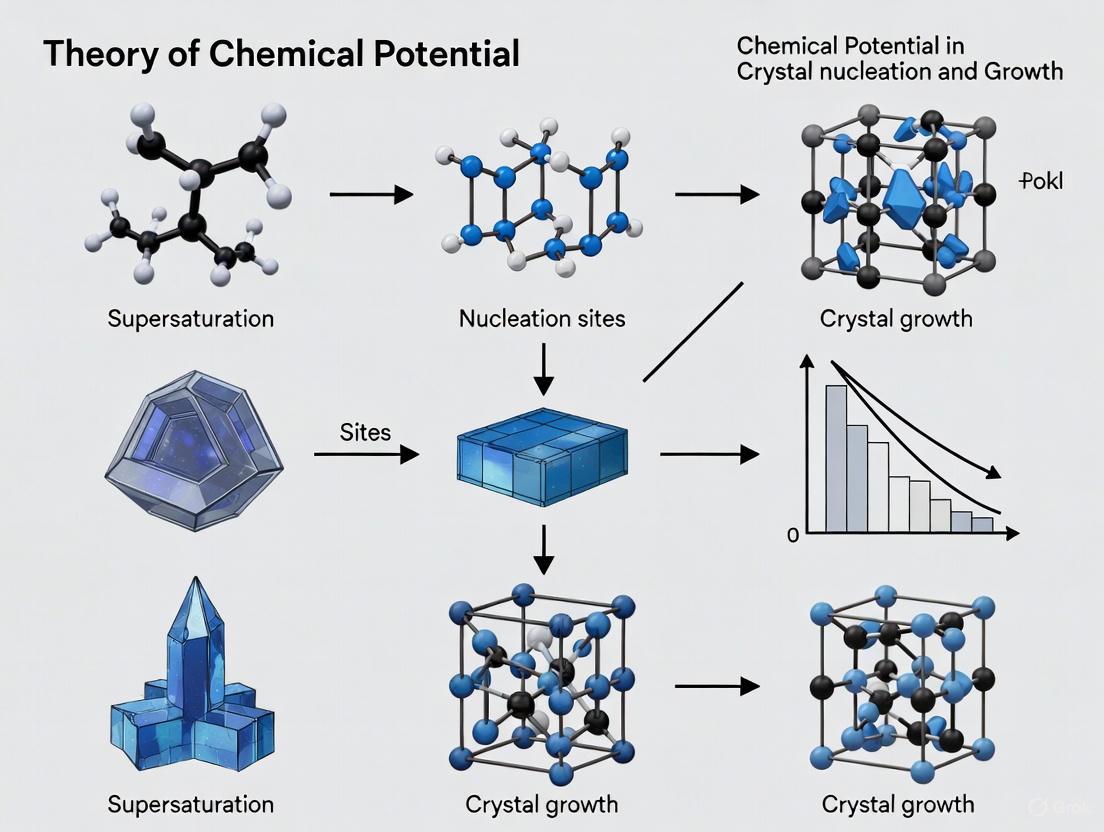
This article provides a comprehensive exploration of the theory of chemical potential and its pivotal role in governing crystal nucleation and growth.
Chemical Potential in Crystal Nucleation and Growth: From Theoretical Foundations to Advanced Applications in Drug Development
Abstract
This article provides a comprehensive exploration of the theory of chemical potential and its pivotal role in governing crystal nucleation and growth. It establishes the foundational principles of Classical Nucleation Theory (CNT), where chemical potential (Δμ) serves as the key thermodynamic driving force. The scope extends to modern methodological advances, including machine learning-driven molecular dynamics and ab initio-based approaches, which enable quantum-accurate predictions of crystallization kinetics. The article further details practical strategies for troubleshooting and optimizing crystallization conditions—critical for producing high-quality crystals in pharmaceutical development. Finally, it examines the rigorous validation of theoretical models against experimental data and compares performance across different computational and material systems. Designed for researchers, scientists, and drug development professionals, this review synthesizes fundamental theory with cutting-edge applications to empower the design of materials with tailored crystalline properties.
The Driving Force of Crystallization: Deconstructing Chemical Potential in Classical Nucleation Theory
Chemical Potential (Δμ) as the Thermodynamic Driver in Phase Transitions
Thermodynamic Foundation of the Nucleation Driving Force
The nucleation driving force, defined as the chemical potential difference (( \Delta \mu )) between a metastable parent phase and a nascent stable phase, is the fundamental thermodynamic quantity controlling phase transformations in materials science, condensed matter physics, and drug development [1]. This parameter quantifies the bulk energetic advantage, per molecule or formula unit, for transforming material from the metastable to the stable state and serves as the primary input in all modern nucleation theories and simulations [1].
The driving force is universally expressed as: [ \Delta \mu = \mu{\text{parent}} - \mu{\text{nucleus}} ] A positive ( \Delta \mu ) indicates the thermodynamic tendency for the stable phase to spontaneously form [1]. In multi-component or reactive systems, this definition expands to a stoichiometrically weighted sum: [ \Delta \mun = \mu{\text{product}} - \sumi ni \mui^{\text{parent}} ] where ( ni ) are stoichiometric coefficients, particularly relevant in systems like hydrate formation or pharmaceutical crystallization [1].
This chemical potential difference directly governs the excess Gibbs free energy for cluster formation: [ \Delta G(N) = -N |\Delta \mu| + \gamma A + \text{(elastic/strain/plastic terms)} ] where ( \gamma ) represents interfacial free energy and ( A ) is the surface area [1]. The magnitude of ( \Delta \mu ) thus controls both the thermodynamic likelihood of phase transformation and the kinetic pathways through which it occurs.
Table 1: Computational Methods for Determining Nucleation Driving Force
| Method | Key Application | Governing Equation/Principle | Considerations |
|---|---|---|---|
| Direct EOS Calculation [1] | Vapor-liquid nucleation, simple systems | ( \Delta \mu(T, S) = kB T \ln S + \Delta \mu{\text{corr}}(T,S) ) | Requires accurate equation of state; non-ideal corrections are essential |
| Thermodynamic Integration [1] | Multi-component solutions, complex systems | ( \frac{\Delta \mu(T)}{kB T} = -\int{T{\text{coex}}}^{T} \frac{h{\text{nucleus}} - \sumi ni hi^{\text{parent}}}{kB T'^2} dT' + \text{mixing terms} ) | Accounts for enthalpy differences and mixing effects |
| Force-Specific Formulations [1] | Solid-state transformations, fracture mechanics | Includes both chemical and mechanical contributions (e.g., energy release rate) | Couples chemical potential with stress/strain fields |
Quantitative Influence on Nucleation Kinetics and Energetics
Role in Classical Nucleation Theory (CNT)
In Classical Nucleation Theory, the driving force ( \Delta \mu ) is the key control parameter determining both the size of the critical nucleus and the free-energy barrier that must be overcome for stable phase formation [1] [2]. For a spherical nucleus of radius ( r ), the free energy change is given by: [ \Delta G(r) = 4\pi \gamma r^2 - \frac{4\pi}{3} r^3 \rho{\text{nucl}} |\Delta \mu| + \text{(additional terms)} ] where ( \gamma ) is the interfacial free energy and ( \rho{\text{nucl}} ) is the number density of the nucleating phase [1].
The critical radius ( r^* ) and nucleation barrier ( \Delta G^* ) derive directly from ( \Delta \mu ): [ r^* = \frac{2 \gamma}{\rho{\text{nucl}} |\Delta \mu|} ] [ \Delta G^* = \frac{16\pi \gamma^3}{3 (\rho{\text{nucl}} |\Delta \mu|)^2} ] These relationships demonstrate the inverse squared dependence of the nucleation barrier on the driving force [1] [2]. The steady-state nucleation rate ( J ) exhibits exponential dependence on this barrier: [ J = A \exp\left(-\frac{\Delta G^*}{k_B T}\right) ] where the pre-exponential factor ( A ) incorporates kinetic factors [2]. Even modest changes in ( \Delta \mu ) can therefore alter nucleation rates by orders of magnitude, highlighting its paramount importance in controlling phase transformation kinetics.
Non-Classical Extensions and Corrections
Beyond CNT, the effective driving force can be renormalized in complex systems. For nucleation in confined geometries or with significant elastic misfit: [ \Delta \mu{\text{eff}} = \Delta \mu - (e{\text{el}} + \gamma0/H) ] where ( e{\text{el}} ) represents elastic strain energy and ( \gamma_0/H ) accounts for surface adhesion effects in confined spaces [1]. This renormalization can impose a minimum nucleation threshold, suppressing nucleation below a critical ( \Delta \mu ) value that depends on system geometry and material properties [1].
Recent work has also introduced self-consistency corrections to the nucleation work: [ W{*,\text{corr}} = W^* - W1 = |\Delta \mu|(n^* - 3n^{*1/3} + 2)/2 ] where ( W1 \equiv \Delta G(n=1) ) represents the free energy change for adding a single molecule to the nucleus [2]. This correction, which can be substantial (e.g., ( 15kB T ) in lithium disilicate), significantly increases calculated nucleation rates and improves agreement with experimental and simulation data [2].
Table 2: System-Specific Expressions for Nucleation Driving Force
| System Type | Driving Force Expression | Key Parameters | Reference |
|---|---|---|---|
| Liquid-Vapor Nucleation [1] | ( \Delta \mu = kB T \ln S + \Delta \mu{\text{corr}} ) | ( S ): Supersaturation ratio; ( \Delta \mu_{\text{corr}} ): Non-ideal correction | Wu et al., 2024 |
| Hydrate Formation [1] | ( \Delta \mun = \mu{\text{hydrate}} - \sumi ni \mu_i^{\text{solution}} ) | ( ni ): Stoichiometric coefficients; ( \mui ): Component chemical potentials | Algaba et al., 2024 |
| Solid-State Transformations [1] | ( \Delta \mu = \Delta \mu{\text{chemical}} + \Delta \mu{\text{mechanical}} ) | Includes both chemical and mechanical (stress) contributions | Song et al., 2022 |
| Battery Electrodes [3] | Linked to Li+ chemical potential in electrolyte | Determines reversibility of intercalation reactions | Kondo et al., 2025 |
Advanced Experimental and Computational Methodologies
Direct Observation in Metallic Systems
Recent breakthroughs in visualization techniques have enabled direct observation of crystal growth within opaque media like liquid metals, providing unprecedented validation of theoretical driving force concepts. Using X-ray micro-computed tomography (XCT), researchers have successfully imaged the three-dimensional formation of platinum crystals inside gallium-based liquid metal solvents [4].
The experimental protocol involves:
- Sample Preparation: Dissolving 2 wt% Pt solute in Ga or eutectic Ga-In (EGaIn) solvents at 500°C to form homogeneous liquid alloys [4]
- Controlled Crystallization: Applying precisely defined cooling rates to induce supersaturation and precipitation:
- Fast-cooling: ~95°C/min (natural cooling from 500°C to ambient)
- Moderate-cooling: 10°C/min (controlled over 48 minutes)
- Slow-cooling: 1°C/min (controlled over 480 minutes) [4]
- In Situ Analysis: Utilizing XCT to non-destructively observe crystal morphology, spatial distribution, and growth patterns within the liquid metal matrix [4]
This methodology reveals that cooling rate and solvent composition significantly influence crystal morphologies and intermetallic phase formation, directly linking macroscopic processing conditions to the microscopic ( \Delta \mu ) governing nucleation and growth [4].
Experimental workflow for observing crystal growth in liquid metals
Quantum-Accurate Machine Learning Simulations
Machine learning potentials trained on quantum mechanical data now enable molecular dynamics simulations of phase transitions with first-principles accuracy at dramatically reduced computational cost. In a landmark study of aluminum crystallization, researchers employed a neural network potential trained solely on liquid-phase density functional theory (DFT) configurations, creating a "crystal-unbiased" approach that accurately predicts nucleation and growth dynamics without structural preconceptions [2].
The computational framework comprises:
- Potential Development: Training machine learning interatomic potentials on ab initio DFT data using frameworks like Deep Potential (DP) [5]
- Enhanced Sampling: Applying advanced methods like the pair entropy fingerprint (PEF) to identify emerging crystalline structures without predefined patterns [2]
- Nucleation Analysis: Calculating key parameters including critical nucleus size ( n^* ), nucleation work ( W^* ), and nucleation rate ( J ) from simulation trajectories [2]
- Theory Validation: Testing CNT predictions against direct simulation results using the expression: [ J = \rho D^* Z^* \exp\left[ -\frac{|\Delta \mu|(n^* - 3n^{*1/3} + 2)}{2k_B T} \right] ] with self-consistency corrections [2]
This approach reveals that traditional interatomic potentials often yield significant discrepancies in predicted nucleation behavior, while ML potentials provide quantitative agreement with theoretical expectations and available experimental data [2].
Table 3: Research Toolkit for Driving Force Characterization
| Tool/Category | Specific Examples | Function in Driving Force Analysis | Field Application |
|---|---|---|---|
| Computational Models | Neural Network Potentials (EMFF-2025) [5], DP-GEN Framework [5] | Enable quantum-accurate MD simulations of nucleation | Materials Science, Energetic Materials |
| Characterization Techniques | X-ray Micro-CT (XCT) [4], Calorimetry [6] | Direct observation of crystal growth; Thermodynamic parameter measurement | Metallurgy, Pharmaceutical Science |
| Theoretical Frameworks | Classical Nucleation Theory [1] [2], Non-Classical Corrections [1] | Quantitative prediction of nucleation barriers and rates | Cross-disciplinary |
| Specialized Software/Methods | Pair Entropy Fingerprint (PEF) [2], Thermodynamic Integration [1] | Crystal structure identification; Free energy calculation | Computational Physics/Chemistry |
Application Domains and Current Research Frontiers
Pharmaceutical Design and Development
In pharmaceutical development, thermodynamic characterization provides essential information about the energetic forces driving molecular interactions between drug candidates and their biological targets [6]. The binding free energy (( \Delta G )) decomposes into enthalpic (( \Delta H )) and entropic (( \Delta S )) components: [ \Delta G = \Delta H - T\Delta S ] with their balance determining binding affinity and specificity [6]. Traditional drug design often emphasizes entropy-driven binding through hydrophobic interactions, but contemporary approaches increasingly focus on enthalpic optimization to achieve better selectivity and drug-like properties [6].
Thermodynamic measurements guide this optimization through:
- Thermodynamic Optimization Plots: Visualizing the enthalpic/entropic trade-offs for compound series
- Enthalpic Efficiency Index: Normalizing binding enthalpy by molecular size or heavy atom count
- Solvent Reorganization Analysis: Quantifying the role of water displacement in binding energetics
These approaches help overcome entropy-enthalpy compensation, where improvements in ( \Delta H ) are offset by unfavorable changes in ( \Delta S ), yielding minimal net gains in binding affinity [6].
Energy Materials and Battery Technology
Recent research has identified the electrolyte lithium-ion chemical potential as a crucial design parameter for advanced batteries, quantitatively determining whether charging/discharging reactions proceed reversibly in graphite electrodes [3]. This finding provides a clear numerical standard—the "uncomfortableness" of Li+ ions in the electrolyte—that predicts electrolyte compatibility and enables rational design rather than trial-and-error development [3].
The conceptual framework shows that:
- Successful intercalation requires sufficiently high Li+ chemical potential in the electrolyte
- This metric enables computational screening of new electrolyte formulations
- Fluorinated ether solvents designed using this principle demonstrate excellent battery performance
This approach integrates chemical potential into materials informatics pipelines, dramatically accelerating the development of batteries with improved performance, lifespan, and safety for electric vehicles and grid storage [3].
Emerging Directions and Cross-Cutting Themes
Several emerging research directions highlight the expanding role of chemical potential-driven design:
Large Quantitative Models (LQMs) in drug discovery combine physics-based simulations with AI to predict molecular activity and optimize drug candidates for multiple characteristics simultaneously, including binding affinity, toxicity, and solubility [7]. These models generate highly accurate, first-principles data that address historical data sparsity issues, particularly for challenging targets like neurodegenerative diseases and cancer [7].
Multi-scale modeling frameworks now bridge from quantum mechanics to macroscopic properties. For instance, the EMFF-2025 neural network potential for energetic materials containing C, H, N, and O elements achieves DFT-level accuracy in predicting mechanical properties and decomposition characteristics while enabling large-scale molecular dynamics simulations [5]. Transfer learning approaches further enhance efficiency by leveraging pre-trained models with minimal additional DFT calculations [5].
Interrelationship of driving force concepts across disciplines
These advances demonstrate how quantitative understanding of ( \Delta \mu ) continues to enable transformative progress across materials science, pharmaceutical development, and energy technology, providing a unified framework for controlling phase transformations and molecular interactions at the most fundamental level.
Classical Nucleation Theory (CNT) provides the fundamental framework for quantitatively predicting the kinetics of phase transitions, a process critical in fields ranging from pharmaceutical crystallization to materials science. This technical guide delineates the core thermodynamic equations of CNT, focusing explicitly on the functional relationship between the change in chemical potential (Δμ) and two pivotal parameters: the work of critical nucleus formation (ΔG) and the critical radius (r). The theory establishes that both ΔG* and r* exhibit a power-law dependence on the supersaturation, defined by Δμ, fundamentally governing the nucleation rate. While CNT remains the predominant model for understanding nucleation kinetics, its quantitative predictions can deviate from experimental observations due to its underlying simplifications, prompting the development of non-classical pathways. This exposition is situated within a broader thesis on the role of chemical potential in directing crystal nucleation and growth, aiming to equip researchers with the foundational principles and mathematical tools for analyzing and controlling crystallization processes.
Nucleation is the initial, crucial step in the formation of a new thermodynamic phase—such as a crystal from a solution or a liquid droplet from a vapor—starting from a metastable state [8] [9]. The kinetics of this process are often dominated by the nucleation event itself, and the time required for nucleation can vary by orders of magnitude, from negligible to exceedingly long timescales [8]. Classical Nucleation Theory (CNT) is the most established theoretical model for quantitatively studying these kinetics [8] [10].
At the heart of CNT lies a thermodynamic battle: the formation of a new phase is driven by the bulk free energy gain associated with transferring molecules from a metastable parent phase to a more stable new phase. This gain is counteracted by the surface free energy penalty required to create the interface between the nascent nucleus and its surroundings [8] [10] [11]. The balance between these two opposing factors gives rise to a free energy barrier, ΔG. The critical nucleus size, r, is defined at the peak of this barrier, representing the smallest stable aggregate of the new phase [8] [12]. The central result of CNT is a prediction for the nucleation rate, R, which depends exponentially on this barrier [8].
The change in chemical potential, Δμ, serves as the quantitative measure of the system's deviation from equilibrium and is the fundamental driver of nucleation. It is defined as the difference in chemical potential between a solute molecule in the metastable parent phase (e.g., solution) and its state in the stable new phase (e.g., crystal), so that Δμ = μsolute - μcrystal > 0 in a supersaturated system [11]. This whitepaper will elucidate the core equations connecting Δμ to the work of formation and the critical radius of the nucleus, providing a foundational understanding for researchers aiming to control nucleation in applications such as drug development and materials synthesis.
The Fundamental Equation of Nucleation Work
The free energy change associated with the formation of a spherical nucleus of radius r is given by the sum of the volume and surface terms [8] [12]:
ΔG(r) = (4/3)πr³ ΔG_v + 4πr² γ
Here, ΔG_v is the bulk free energy change per unit volume of the new phase (a negative quantity under supersaturated conditions), and γ is the interfacial tension or surface free energy per unit area (a positive quantity) [8] [12]. This equation is universal for three-dimensional spherical nuclei.
Table 1: Variables in the Fundamental Nucleation Work Equation
| Variable | Description | Sign & Physical Meaning |
|---|---|---|
| ΔG(r) | Total free energy change for forming a nucleus of radius r | Determines thermodynamic stability |
| ΔG_v | Bulk free energy change per unit volume | Negative; driving force for phase change |
| γ | Interfacial tension (surface energy per unit area) | Positive; barrier to phase change |
To express this equation in terms of the fundamental driving force, Δμ, the chemical potential difference per molecule, we introduce the molecular volume, v. The bulk energy term can be rewritten as ΔG_v = -Δμ / v, where Δμ is positive under supersaturated conditions [11]. The number of molecules n in a spherical nucleus is n = (4πr³)/(3v). Consequently, the free energy change can be reformulated as a function of the number of molecules [11]:
ΔG(n) = -nΔμ + 4πr² γ
For a spherical nucleus, the surface area can be expressed in terms of n and the molecular volume, leading to a general form where the surface term is proportional to n^{2/3} [13] [11]:
ΔG(n) = -nΔμ + β γ n^{2/3}
The geometric factor β depends on the shape of the nucleus (e.g., for a sphere, β = (36πv²)^{1/3}) [11]. This relationship highlights the competition between the favorable, volume-proportional term (-nΔμ) and the unfavorable, surface-area-proportional term (β γ n^{2/3}).
Deriving the Critical Radius and Nucleation Barrier
The critical nucleus size, r, and the corresponding free energy barrier, ΔG, are found by maximizing the free energy function ΔG(r) with respect to the radius r [8]. This is done by taking the derivative and setting it to zero:
d[ΔG(r)] / dr = 0 => 4πr*² ΔG_v + 8πr* γ = 0
Solving this equation for r* yields the critical radius:
r* = -2γ / ΔG_v
This is a key result in CNT: the critical radius is inversely proportional to the bulk driving force, ΔGv [8] [12]. As the supersaturation and thus the magnitude of ΔGv increase, the critical radius becomes smaller.
Table 2: Key Formulae for Critical Nucleus Parameters
| Parameter | General Form (Spherical Nucleus) | Expression in terms of Δμ and γ |
|---|---|---|
| Critical Radius (r*) | r* = -2γ / ΔG_v |
r* = 2γ v / Δμ |
| Nucleation Barrier (ΔG*) | ΔG* = (4π γ r*²) / 3 |
ΔG* = (16π γ³ v²) / (3 Δμ²) |
Substituting the expression for r* back into the equation for ΔG(r) gives the height of the nucleation barrier, the work of forming the critical nucleus [8]:
ΔG* = (16π γ³) / (3 ΔG_v²)
To express this explicitly in terms of the chemical potential, we again use the relationship ΔG_v = -Δμ / v. This substitution leads to the central connection between Δμ and the nucleation work:
ΔG* = (16π γ³ v²) / (3 Δμ²)
This equation reveals that the nucleation barrier is inversely proportional to the square of the chemical potential difference, Δμ [8] [11]. A small increase in supersaturation, and thus Δμ, can lead to a dramatic decrease in the nucleation barrier. The number of molecules n* in the critical nucleus can be found by substituting r* into the relationship for n, yielding n* = (32π γ³ v²) / (3 Δμ³) [11].
Figure 1: The Logical Pathway from Chemical Potential to Nucleation Rate. This diagram illustrates the causal chain within CNT, where supersaturation determines the chemical potential difference (Δμ), which in turn dictates the critical nucleus size and the nucleation barrier, ultimately controlling the exponential nucleation rate.
The Nucleation Rate Equation
The primary kinetic output of CNT is the nucleation rate, J, defined as the number of nuclei formed per unit volume per unit time. The rate follows an Arrhenius-like expression, where the exponential term is dominated by the nucleation barrier ΔG* [8] [11]:
J = A exp(-ΔG* / kT)
Here, k is the Boltzmann constant and T is the absolute temperature. The pre-exponential factor A is a dynamic factor that incorporates N_S Z j, where N_S is the number of potential nucleation sites, Z is the Zeldovich factor (accounting for the width of the free energy barrier), and j is the flux of molecules attaching to the critical nucleus [8] [11]. While the pre-exponential factor has a weaker dependence on temperature and supersaturation compared to the exponential term, it can be estimated from kinetic theory and the Einstein-Stokes relation for diffusion in a liquid [8].
The most significant prediction of CNT is the extreme sensitivity of the nucleation rate to the supersaturation through its influence on ΔG*. For example, in computer simulations of ice nucleation, a free energy barrier of ΔG* = 275 k_B T was estimated, leading to an astronomically low nucleation rate of R = 10^{-83} s^{-1}, underscoring why homogeneous nucleation can be exceptionally slow at moderate supersaturations [8].
Experimental Protocols for Probing CNT
Validating the predictions of CNT and determining parameters like ΔG* and γ require carefully designed experiments. Two prominent methodologies are computer simulation of model systems and droplet emulsion experiments.
Computer Simulation of Nucleation
This protocol involves estimating all quantities in the CNT rate equation using computational models [8].
- System Selection: A well-defined model system, such as the TIP4P/2005 model for water, is chosen [8].
- Simulation Setup: Molecular dynamics or Monte Carlo simulations are run under controlled conditions of temperature and supersaturation.
- Free Energy Calculation: Advanced sampling techniques are employed to compute the free energy as a function of cluster size, ΔG(n), allowing direct extraction of the barrier height ΔG* [8].
- Kinetic Parameter Estimation: The attachment rate j and the Zeldovich factor Z are calculated from the simulation trajectories.
- Rate Prediction & Validation: The nucleation rate R is calculated using the CNT equation. This predicted rate can be compared against the rate directly observed in simulations to test the theory's validity for the model system [8].
Droplet Emulsion Experiments
This approach overcomes the challenges of multiple nucleation events in large volumes by studying many small, isolated droplets [9] [11].
- Emulsion Preparation: A supersaturated solution (e.g., supercooled liquid tin or a protein solution) is dispersed into a large number of microscopic, immiscible droplets within an emulsion [9].
- Isothermal Incubation: The emulsion is held at a constant temperature and supersaturation.
- Time-Monitoring: The fraction of droplets that have crystallized is monitored as a function of time, often using microscopy or light scattering [9].
- Stochastic Analysis: The nucleation time for each droplet is recorded. Since nucleation is stochastic, the dataset provides a distribution of nucleation times [9].
- Data Fitting: The fraction of uncrystallized droplets typically follows an exponential decay. The decay rate gives the nucleation rate J. The data can be fitted with models (e.g., Gompertz function) that account for the distribution of heterogeneous nucleation sites among the droplets [9].
The Scientist's Toolkit: Research Reagents and Materials
Table 3: Essential Research Reagents and Materials for Nucleation Studies
| Reagent/Material | Function in Nucleation Research |
|---|---|
| Model Protein Solutions (e.g., Lysozyme) | Well-characterized systems for studying protein crystallization kinetics and testing nucleation theories [11]. |
| Small-Molecule Organic Solutions | Used to investigate nucleation phenomena relevant to pharmaceutical crystallization [11]. |
| Micro-emulsion Media (e.g., Oil Surfactants) | Creates isolated micro-environments (droplets) for studying stochastic nucleation without cross-contamination [9]. |
| Specific Ion Additives / Impurities | Introduces controlled heterogeneous nucleation sites to study the reduction of the nucleation barrier [8] [9]. |
| Macroscopic Solid Substrates | Functionalized surfaces or crystals of different polymorphs used to study and control heterogeneous nucleation [11]. |
Limitations and Non-Classical Extensions
Despite its conceptual utility, CNT has known limitations, primarily stemming from the "capillary assumption"—the treatment of microscopic nuclei as macroscopic droplets with well-defined interfacial tensions [10]. This assumption is questionable for nuclei comprising only a few molecules. Consequently, CNT often fails to quantitatively predict nucleation rates, sometimes erring by many orders of magnitude [9] [10].
These limitations have spurred the development of non-classical nucleation theories. A prominent model is the two-step nucleation mechanism [10] [11]. This pathway involves:
- The formation of dense, metastable liquid clusters (pre-nucleation clusters) suspended in the solution.
- The subsequent internal ordering and nucleation of the crystal phase within these dense liquid clusters [11].
This mechanism helps explain phenomena that are puzzles within the classical framework, such as nucleation at lower supersaturations than predicted and the role of a dense liquid precursor [11]. It has been observed in systems including proteins, small organic molecules, colloids, and biominerals [11]. At very high supersaturations, the nucleation barrier may become negligible, leading to spinodal decomposition, a regime not described by CNT [9] [10].
Classical Nucleation Theory provides an indispensable, though simplified, quantitative framework for understanding the initiation of phase transitions. The core equations r* = 2γv / Δμ and ΔG* = 16πγ³v² / (3Δμ²) establish a profound connection: the chemical potential difference (Δμ) is the master variable controlling both the size of the critical nucleus and the magnitude of the kinetic barrier to its formation. This relationship underscores why supersaturation is the primary lever for controlling nucleation in practical applications, from the production of pharmaceutical crystals with desired size and polymorphic form to preventing pathological crystallization. While the assumptions of CNT can limit its quantitative accuracy, leading to the exploration of non-classical pathways, its core principles remain foundational for researchers. A deep understanding of the interplay between Δμ, nucleation work, and critical radius is essential for advancing the theory and practice of crystal nucleation and growth.
Nucleation, the initial formation of a new thermodynamic phase from a metastable parent phase, represents the critical first step in crystallization processes that underpin pharmaceutical development, materials science, and numerous natural phenomena. The kinetics of this phase transformation are dominated by nucleation, such that the time required to nucleate determines how long it will take for the new phase to appear—a timescale that can vary by orders of magnitude, from negligible to exceedingly long periods beyond experimental reach [8]. At the heart of this process lies the Gibbs free energy landscape, which dictates the thermodynamic driving force and kinetic barriers that molecules must overcome to form stable crystalline entities.
The chemical potential difference (Δμ) between the solute in solution and in the crystalline phase serves as the fundamental thermodynamic parameter governing nucleation. In a supersaturated solution, where the chemical potential of the solute exceeds that in the crystalline state (μsolute > μcrystal), a driving force exists for crystallization [14]. However, the formation of a crystal nucleus—a nascent ordered aggregate large enough to continue growing rather than simply re-dissolve—requires surmounting a free energy barrier. This barrier emerges from the competition between the energetic advantage of forming a more stable phase and the cost of creating a new interface [15]. Understanding how chemical potential defines this nucleation barrier through the Gibbs free energy landscape provides researchers with the fundamental principles needed to control crystallization across scientific and industrial applications.
Theoretical Foundation: Classical Nucleation Theory
Thermodynamics of Nucleus Formation
Classical Nucleation Theory (CNT) provides the most common theoretical framework for quantitatively studying nucleation kinetics [8]. The theory elegantly captures the competition between bulk and surface energy terms that gives rise to the nucleation barrier. For a spherical nucleus forming in a supersaturated solution, the total free energy change ΔG(n) as a function of the number of molecules n in the cluster is expressed as:
| Energy Component | Mathematical Expression | Physical Significance |
|---|---|---|
| Volume Term | -nΔμ | Free energy gain from phase transition; proportional to cluster volume |
| Surface Term | 4πr²γ = 6a²n²⁄³α | Free energy cost for creating interface; proportional to surface area |
| Total Free Energy Change | ΔG(n) = -nΔμ + 6a²n²⁄³α | Net result of competing effects [11] |
Where Δμ = μsolute - μcrystal > 0 in a supersaturated solution represents the chemical potential difference driving crystallization, γ (or α) is the surface free energy per unit area between the cluster and solution, r is the cluster radius, and a³ = Ω is the volume occupied by a molecule in the crystal [8] [11].
This free energy function exhibits a maximum at a critical cluster size n, representing the nucleation barrier that must be overcome for a stable nucleus to form [11]. Clusters smaller than n are energetically unfavorable and tend to dissolve, while those that fluctuate to sizes larger than n* can grow spontaneously as further growth decreases the system's free energy.
The Critical Nucleus and Energy Barrier
Differentiating the expression for ΔG(n) reveals the parameters of the critical nucleus. The size of the critical nucleus n* and the height of the nucleation barrier ΔG* are given by:
| Parameter | Mathematical Expression | Relationship to Driving Force |
|---|---|---|
| Critical Cluster Size | n* = 64Ω²γ³/Δμ³ | Decreases with increasing supersaturation |
| Free Energy Barrier | ΔG* = 32Ω²γ³/Δμ² = 1/2 n*Δμ | Decreases with increasing supersaturation [11] |
These relationships highlight a crucial inverse dependence on the chemical potential difference Δμ—both the critical size and energy barrier diminish as the supersaturation increases. For crystal nucleation from solution, the chemical potential difference can be related to measurable solution properties through Δμ = kBTln(β), where β is the degree of supersaturation [14]. This establishes the direct connection between solution conditions and nucleation thermodynamics that researchers can exploit to control crystallization.
Figure 1: Free Energy Landscape of Nucleation. The diagram illustrates the energy barrier ΔG that molecular clusters must overcome to reach the critical nucleus size n, beyond which spontaneous growth occurs.
Advanced Nucleation Theories and Mechanisms
Beyond Classical Theory: The Two-Step Mechanism
While CNT provides a foundational framework, experimental observations often reveal nucleation rates many orders of magnitude lower than theoretical predictions, prompting the development of more sophisticated models [11]. The two-step nucleation mechanism has emerged as an important alternative, first proposed for protein crystals but subsequently demonstrated for small-molecule organic materials, colloids, polymers, and biominerals [11].
According to this mechanism, crystalline nuclei appear inside pre-existing metastable clusters of several hundred nanometers, which consist of dense liquid and are suspended in solution [11]. This pathway allows systems to circumvent the high energy barrier associated with the direct formation of crystalline structures in a single step. The mechanism helps explain several long-standing puzzles of crystal nucleation in solution, including the significance of dense liquid phases observed in protein, colloid, and some organic solutions [11].
Solution-Crystal Spinodal and Polymorph Selection
At the high supersaturations typical of most crystallizing systems, the generation of crystal embryos may occur in the spinodal regime, where the nucleation barrier becomes negligible [11]. The solution-crystal spinodal concept provides insights into how heterogeneous substrates influence nucleation and the selection of crystalline polymorphs. This perspective helps explain why nucleation often occurs preferentially on surfaces or impurities—a phenomenon known as heterogeneous nucleation—where the effective barrier is significantly reduced compared to homogeneous nucleation in bulk solution [8].
The free energy needed for heterogeneous nucleation, ΔGhet, relates to that for homogeneous nucleation through ΔGhet = f(θ)ΔG_hom, where f(θ) = (2-3cosθ+cos³θ)/4 and θ is the contact angle between the nascent crystal and the substrate [8]. This explains why heterogeneous nucleation is much more common than homogeneous nucleation in practical systems, as the barrier can be substantially lower depending on the surface characteristics.
Experimental and Computational Methodologies
Quantitative Approaches to Measuring Nucleation Barriers
Researchers employ diverse methodological approaches to quantify nucleation barriers and test theoretical predictions:
| Method Category | Specific Techniques | Key Measurable Parameters |
|---|---|---|
| Computer Simulation | Umbrella Sampling, Metadynamics, Seeding Technique, FRESC Method [15] | Free energy profiles, Critical cluster size, Nucleation rates |
| Experimental Kinetics | Induction time measurements, Nucleation rate quantification [11] | Experimental nucleation rates, Crystal size distributions |
| Advanced Microscopy | Atomic Force Microscopy (AFM) of supramolecular networks [16] | Monomer organization, Network density, Island formation dynamics |
The FRESC (Free-energy REconstruction from Stable Clusters) method represents a recent innovation that stabilizes small clusters by simulating them in the NVT ensemble and uses the thermodynamics of small systems to convert the properties of stable clusters into the Gibbs free energy of formation of the critical cluster [15]. This approach is computationally inexpensive, requires only a small number of particles comparable to the critical cluster size, and does not rely on CNT assumptions or specific reaction coordinates [15].
The Scientist's Toolkit: Essential Research Reagents and Materials
| Reagent/Material | Function in Nucleation Studies | Experimental Application Examples |
|---|---|---|
| DNA-based Macromonomers | Model system for studying supramolecular network nucleation with tunable flexibility and affinity [16] | Three-point-star (3PS) motifs with controlled arm length and terminal nucleotide sequences |
| Lennard-Jones Fluids | Simple model system for computational studies of nucleation mechanisms [15] | Condensation in truncated and shifted Lennard-Jones fluids as a test case for new methods |
| Methane Hydrate Systems | Complex nucleation model with practical implications for pipeline safety [17] | Studying two-step nucleation mechanism with intermediate metastable ice-like structures |
| Protein Solutions | Biological macromolecules for studying crystallization relevant to pharmaceutical development [11] | Lysozyme and other readily crystallizable proteins for nucleation rate measurements |
| Molecular Probes | Fluorescent tags or spectroscopic labels for monitoring nucleation events | Real-time observation of crystal formation and growth processes |
Figure 2: Methodological Approaches for Studying Nucleation. The diagram shows experimental, computational, and theoretical methods used to investigate nucleation barriers and their relationships.
Quantitative Data and Parameters in Nucleation Research
Key Thermodynamic and Kinetic Parameters
Experimental and computational studies of nucleation generate quantitative parameters that characterize the process:
| Parameter | Symbol | Typical Values/Relationships | Experimental Determination |
|---|---|---|---|
| Chemical Potential Difference | Δμ | Δμ = kBTln(β), where β is supersaturation [14] | Measured from solution concentration relative to saturation |
| Interfacial Free Energy | γ | System-dependent; 0.1-10 mJ/m² for crystal-solution interfaces [8] | Derived from nucleation rate measurements or computational models |
| Critical Cluster Size | n* | n* = 64Ω²γ³/Δμ³; varies from tens to thousands of molecules [11] | Inferred from nucleation kinetics or direct simulation |
| Free Energy Barrier | ΔG* | ΔG* = 32Ω²γ³/Δμ²; typically 10-100 kBT for observable rates [8] | Calculated from measured nucleation rates |
| Nucleation Rate | J | J = K exp(-ΔG*/kBT); varies by >50 orders of magnitude [11] | Direct counting of crystals per unit volume and time |
For example, in computer simulations of ice nucleation in liquid water using the TIP4P/2005 model at a supercooling of 19.5°C, researchers estimated a free energy barrier of ΔG* = 275k_BT, an attachment frequency of j = 10¹¹ s⁻¹, and a Zeldovich factor of Z = 10⁻³, yielding a nucleation rate of R = 10⁻⁸³ s⁻¹—demonstrating the extreme sensitivity of the rate to the barrier height [8].
Case Study: Methane Hydrate Nucleation
Molecular dynamics simulations of methane hydrate nucleation reveal detailed energy dissipation parameters and barrier constraints:
| Simulation Condition | Dissipation Coefficient (γ) | Gibbs Free Energy Barrier | Nucleation Pathway Characteristics |
|---|---|---|---|
| Standard Conditions | 0.15 (fitted via Fluctuation-Dissipation Theorem) [17] | Quantified via DFT calculations [17] | Two-step mechanism with intermediate metastable structures |
| Varying Temperature/Pressure | Validated across conditions [17] | Dependent on thermodynamic parameters | Thermodynamic control over nucleation pathway |
| With Different Cage Structures | Structure-dependent variations [17] | Affected by water-guest interactions | Reaction energy barriers quantified |
These simulations demonstrate that methane hydrate nucleation follows a two-step mechanism with an initial stage where intermediate metastable ice-like structures form, followed by their gradual reorganization into a stable crystalline phase [17]. The potential energy landscape during this process exhibits rugged, funnel-like characteristics where the system undergoes an entropy-reducing energy-lowering process, creating a free energy barrier that significantly impacts nucleation rates and crystal growth kinetics [17].
Implications for Pharmaceutical and Materials Research
The control of crystal nucleation through manipulation of the Gibbs free energy landscape has profound implications for pharmaceutical development and materials science. In the pharmaceutical industry, where more than 60% of all drugs are crystalline, changes to the size, shape, structure, and uniformity of crystals can significantly impact drug performance and manufacturability [18]. Crystal uniformity is particularly critical for delivering pharmaceutical products with consistent therapeutic and safety properties [18].
Microgravity environments, such as those on the International Space Station, provide unique platforms for studying nucleation mechanisms without the confounding effects of gravity-driven forces. The reduction of convection, sedimentation, and buoyancy allows molecules to incorporate into the crystalline lattice more slowly and orderly, often producing larger, more well-ordered crystals with more consistent uniformity [18]. This approach has demonstrated promise for improving outcomes for protein-based therapeutics, as exemplified by Merck's crystallization of Keytruda in microgravity [18].
Understanding polymorph selection—the process by which a specific crystalline form is chosen from multiple possibilities—represents another crucial application of nucleation control. Since nucleation selects the polymorphic form, conditions where nucleation of a desired polymorph is faster than other possibilities must be identified and maintained [11]. The solution-crystal spinodal concept provides powerful tools for controlling polymorph selection by varying solution thermodynamic parameters [11].
The Gibbs free energy landscape, defined fundamentally by the chemical potential difference between solution and crystalline phases, governs the nucleation barriers that control crystallization across scientific and technological domains. From the classical framework of CNT to modern two-step mechanisms and spinodal concepts, our understanding of how chemical potential defines nucleation barriers continues to evolve. The integration of advanced computational methods with precise experimental approaches provides researchers with an expanding toolkit to quantify and manipulate these barriers for practical applications in pharmaceutical development, materials synthesis, and beyond. As research continues to elucidate the subtle interplay between thermodynamic driving forces and kinetic constraints, the ability to design crystallization processes with precise control over crystal size, structure, and polymorphism will continue to advance, enabling new technologies and improved products across industrial sectors.
Linking Atomic-Scale Interactions to Macroscopic Crystallization Kinetics
Crystallization, the process by which atoms or molecules arrange into a highly ordered, rigid structure, is a cornerstone of modern technology, impacting fields from pharmaceutical development to semiconductor manufacturing. The kinetics of this process—the rate at which crystals nucleate and grow—dictates critical material properties, including purity, crystal size distribution, and polymorphic form. While classical nucleation theory provides a macroscopic framework, it often lacks predictive power because it does not account for the atomic-scale interactions that fundamentally govern crystallization pathways. This guide bridges that gap, elucidating how atomic and molecular-level phenomena—chemical bonding, solvation environments, and interfacial dynamics—control macroscopic crystallization kinetics. Framed within the broader context of chemical potential theory, we demonstrate how the driving force for crystallization (Δμ) emerges from these atomic interactions and, in turn, dictates kinetic outcomes.
Fundamental Principles Linking Atomic and Macroscopic Scales
Chemical Potential as the Central Driving Force
The chemical potential difference (Δμ) between a solute in solution and in the crystalline state represents the fundamental thermodynamic driving force for crystallization. This differential is directly related to supersaturation, a macroscopic and experimentally accessible parameter. However, Δμ itself is governed by atomic-scale interactions. The interaction of a solute with its solvent and additives either raises or lowers its chemical potential in solution, thereby directly modulating Δμ [19]. For example, additives like urea can weaken hydrophobic interactions and alter electrostatic forces, thereby increasing protein solubility (raising the chemical potential in solution and decreasing Δμ), while salts often decrease solubility (lowering the chemical potential in solution and increasing Δμ) [19]. This direct manipulation of the solution environment provides a powerful method to control crystallization kinetics through the foundational concept of chemical potential.
The Role of Chemical Bonding in Crystallization Kinetics
At the atomic level, the nature of chemical bonds within the nascent crystal lattice exerts a profound influence on crystallization speed. The number of electrons shared (ES) between adjacent atoms serves as a key quantum-chemical indicator for bonding type and strength [20].
Research on phase change materials (PCMs) like GeTe has revealed that crystallization kinetics are intimately tied to the bonding character traversing the spectrum from metallic to covalent dominance. Metallic bonding, characterized by electron delocalization, facilitates fast atomic rearrangement, leading to rapid crystallization. In contrast, covalent bonding, with its highly directional and localized electron pairs, imposes a significant kinetic barrier to structural ordering, dramatically slowing down crystallization [20].
Table 1: Impact of Chemical Bonding on Crystallization Kinetics in Chalcogenide Alloys
| Material System | Bonding Character | Electrons Shared (ES) | Minimum Crystallization Time | Key Atomic-Scale Feature |
|---|---|---|---|---|
| Ge₀.₅Sn₀.₅Te | Metallic-dominated | ~1.0 [20] | 25 ns [20] | Near-perfect octahedral arrangement |
| GeTe | Mixed, slight covalency | ~1.1 [20] | 620 ns [20] | Small Peierls distortion |
| GeTe₀.₄Se₀.₆ | Covalent-dominated | >1.1 (inferred) | 1.3 × 10⁶ ns [20] | Increased electron localization |
This correlation demonstrates that tuning the stoichiometry to shift bonding type provides a powerful strategy for designing materials with desired crystallization speeds, spanning an incredible six orders of magnitude [20].
Nucleation and Growth: The Kinetic Pillars
Crystallization occurs via two primary kinetic steps: nucleation and growth. The overall transformation is often described by the Avrami model, which quantifies the fraction of crystallized material (Xₜ) over time (t): 1 - Xₜ = exp(-Ktⁿ) [21]. Here, the Avrami exponent (n) provides insight into the dimensionality and mechanism of growth, while the rate constant (K) encompasses both nucleation and growth rates [21].
- Nucleation: The formation of a stable crystalline nucleus from a supersaturated solution or supercooled melt is an activated process. The nucleation rate (J) depends exponentially on the thermodynamic barrier, as described by Classical Nucleation Theory (CNT):
J = A exp(-ΔG*/kₜT), where ΔG* is the free energy barrier, which is inversely related to (Δμ)² [19]. - Growth: Once a stable nucleus forms, it grows via the integration of molecules into the crystal lattice. Models like the birth-and-spread model describe how the growth rate (G) also depends on Δμ, often following a power-law relationship [19].
Advanced Characterization and Computational Techniques
Probing Atomic-Scale Dynamics
Understanding the link between atomistic mechanisms and macroscopic kinetics requires advanced characterization and simulation techniques that operate at relevant time and length scales.
In Situ Microscopy: Atomic-scale, in situ scanning transmission electron microscopy (STEM) allows for the direct observation of crystallization events. For instance, this method has visualized the beam-induced crystallization of amorphous MoS₂ on graphene, revealing processes such as nucleation, the co-evolution of different polymorphs (2H and 1T phases), and dynamic transformations between them [22]. This technique provides unparalleled insight into how local atomic arrangements and support interactions dictate the final crystal structure and morphology.
Molecular Dynamics (MD) Simulations: MD simulations track the trajectory of every atom in a system over time, providing a theoretical lens into crystallization. Table 2 summarizes key computational studies.
Table 2: Molecular Dynamics Simulations in Crystallization Research
| Simulation Focus | Key Atomic-Scale Insight | Macroscopic Kinetic Implication |
|---|---|---|
| GaAs Heterojunctions [23] | Crystallization kinetics and defect evolution are strongly anisotropic and depend on crystallographic orientation. | Enables fabrication of high-quality crystals via orientation engineering; informs defect-mediated growth. |
| Ge-rich GeₓTe Alloys [24] | Temperature-dependent mechanism: Phase separation followed by crystallization at 600 K vs. concurrent crystallization and Ge expulsion at 500 K. | Explains kinetics of phase separation and crystallization, crucial for the operation of phase-change memories. |
| NaCl Nucleation [25] | Nanoconfinement alters water dielectric properties, stabilizing unusual phases (hydrated, hexagonal) and promoting crystallinity. | Explains elevated melting points under confinement; provides a framework for nucleation control. |
Enhanced Sampling: Standard MD is often limited to very short timescales. To simulate rare events like nucleation, enhanced sampling methods like well-tempered metadynamics (WTMetaD) are employed [25]. These techniques apply a bias potential to force the system to overcome free energy barriers. The choice of reaction coordinates (RCs) is critical, and recent advances use machine learning (ML) approaches like the State Predictive Information Bottleneck (SPIB) to automatically identify complex, high-dimensional RCs from simulation data, leading to more accurate and efficient sampling of phase transitions [25].
Experimental Protocols and Methodologies
This section details key experimental methods for investigating crystallization kinetics from the atomic to the macroscopic scale.
In Situ Video Microscopy for Protein Crystallization Kinetics
Purpose: To simultaneously quantify nucleation and growth rates of protein crystals under different solution conditions by directly observing the crystallization process [19].
Procedure:
- Solution Preparation: Prepare a series of lysozyme solutions with varying concentrations of urea (0-1 M) and sodium chloride (0-5% w/v) to span a range of thermodynamic conditions [19].
- Sample Chamber Setup: Place a small droplet (~10 µL) of the protein solution between two glass coverslips to create a thin film for clear imaging. Seal the chamber to prevent evaporation.
- Data Acquisition: Place the chamber on a temperature-controlled microscope stage. Use a high-resolution optical microscope with a digital video camera to record time-lapse images of the crystallization process at regular intervals (e.g., every 30 seconds).
- Image Analysis:
- Nucleation Rate (J): Count the number of new crystals appearing per unit volume per unit time.
- Induction Time (tᵢ): Measure the time elapsed between the creation of supersaturation and the first appearance of detectable crystals.
- Growth Rate (G): Track the increase in the radius of individual crystals over time from the video frames.
Laser-Based Optical Testing for Ultrafast Crystallization
Purpose: To measure the minimum crystallization time (τ) of phase-change materials (PCMs) in their as-deposited amorphous state [20].
Procedure:
- Sample Fabrication: Deposit a thin film (e.g., 50-100 nm) of the amorphous PCM (e.g., GeTe-Se alloy) onto a suitable substrate.
- Pump-Probe Setup: Use a pulsed laser system ("pump" laser) to rapidly heat the amorphous film. The laser power and pulse duration are carefully controlled.
- Probe and Detection: A second, low-power "probe" laser beam (e.g., a continuous-wave laser) is focused on the same spot to monitor the reflectance in real time. The dielectric function, and thus the reflectance, changes significantly between the amorphous and crystalline states.
- Kinetic Determination: Vary the power and length of the pump laser pulses. The minimum crystallization time τ is identified as the shortest pulse duration that produces a measurable, permanent change in the probe laser's reflectance, indicating crystallization.
Machine Learning-Augmented Molecular Dynamics for Nucleation
Purpose: To simulate and analyze the nucleation process of salts (e.g., NaCl) from aqueous solution under nanoconfinement, capturing rare transition events [25].
Procedure:
- System Setup: Construct an atomic model of an NaCl solution confined between two graphene sheets. The distance between the sheets is varied to study different confinement levels.
- Collective Variable (CV) Selection: Instead of relying solely on human-intuitive CVs (e.g., ion coordination numbers), employ the State Predictive Information Bottleneck (SPIB) method. SPIB learns low-dimensional reaction coordinates (RCs) from a limited set of unbiased or lightly biased simulation data [25].
- Enhanced Sampling Simulation: Perform Well-Tempered Metadynamics (WTMetaD) simulations, using the ML-learned RCs as the biasing variables. This history-dependent bias fills the free energy minima, allowing the system to explore different states (liquid, solid, hydrated) efficiently.
- Free Energy Analysis: Use the metadynamics trajectory to reconstruct the free energy surface (FES) as a function of the RCs. The relative stability of different phases (ΔA) is calculated from the FES [25].
- Phase Identification: Classify the sampled structures using order parameters (e.g., Steinhardt bond-order parameters) to identify whether the system is in a liquid, solid FCC, hydrated (NaCl·2H₂O), or hexagonal phase.
The Scientist's Toolkit: Essential Reagents and Materials
Table 3: Key Reagents and Materials for Crystallization Studies
| Item | Function in Crystallization Research | Example Application |
|---|---|---|
| Urea | A non-specific additive that modulates protein-protein interactions, typically increasing solubility and decreasing nucleation and growth rates by altering the solution environment [19]. | Creating chemical potential (Δμ) maps in protein crystallization phase diagrams [19]. |
| Sodium Chloride (NaCl) | A common salt that screens electrostatic charges, typically decreasing protein solubility (salting-out) and increasing nucleation and growth rates [19]. | Screening initial crystallization conditions for globular proteins. |
| Phase Change Materials (GeTe, Ge₂Sb₂Te₅) | Materials with a fast, reversible transition between amorphous and crystalline states, accompanied by large changes in optical and electrical properties [20]. | Studying ultrafast crystallization kinetics for data storage and neuromorphic computing. |
| Graphene Membranes | Atomically thin, electron-transparent supports that serve as ideal confinement surfaces or substrates for in situ TEM studies [22] [25]. | Creating nanoconfined environments for nucleation studies; serving as a support for atomic-scale imaging of 2D material crystallization [22]. |
| Machine-Learned Interatomic Potentials | High-accuracy force fields trained on DFT data that enable large-scale molecular dynamics simulations with near-ab-initio precision [24]. | Simulating complex crystallization processes in alloys over nanoseconds, such as phase separation and crystal growth in GeₓTe [24]. |
Implications for Drug Development and Materials Design
The atomic-level control of crystallization kinetics has direct and profound implications for industrial applications, particularly in pharmaceuticals and advanced materials.
In drug development, controlling the polymorphic form is critical, as different crystal structures of the same API can have vastly different bioavailabilities and stability profiles. The strategy of using solution additives like urea and salt to finely tune Δμ provides a systematic method to navigate the polymorphic landscape [19]. By mapping the relationship between solution conditions, Δμ, and kinetic parameters (induction time, growth rate), pharmaceutical scientists can design robust crystallization processes that consistently yield the desired, thermodynamically or kinetically stable polymorph.
For advanced materials, the design rules are equally powerful. The requirement for ultrafast crystallization in phase-change memories is met by engineering materials like Sn-doped GeTe, whose metallic bonding character and near-ideal octahedral coordination minimize crystallization time [20]. Conversely, the need for a stable amorphous phase in ovonic threshold switches is achieved by increasing covalency through Se alloying, which drastically slows down crystallization kinetics [20]. Furthermore, the discovery of temperature-dependent crystallization pathways in Ge-rich GeₓTe (separation-first vs. crystallization-first) [24] provides crucial insights for designing the thermal processing of memory devices.
The journey from a disordered phase to a crystalline solid is a complex multiscale phenomenon, but it is one guided by deterministic principles that connect the atomic to the macroscopic. Chemical potential (Δμ) serves as the universal thermodynamic driver, but its magnitude and the kinetic pathways available are dictated by atomic-scale interactions: the number of electrons shared in a chemical bond, the dielectric environment of a nanoconfined solution, or the specific interaction of a solute with a solution additive. By leveraging advanced experimental probes like in situ microscopy and computational tools like machine-learning-enhanced molecular dynamics, researchers can now not only observe but also predict and design crystallization processes with unprecedented precision. This integrated, multiscale understanding paves the way for the rational design of new pharmaceuticals with ensured efficacy and stability, and for the engineering of next-generation materials for data storage, neuromorphic computing, and optoelectronics.
From Theory to Practice: Computational and Experimental Methods for Controlling Crystallization
Quantum-Accurate Molecular Dynamics (MD) with Machine-Learned Potentials
Molecular dynamics (MD) simulation serves as a cornerstone of computational materials science and drug development, providing atomistic resolution into the real-time evolution of atomic positions and velocities. Traditional MD approaches have long faced a fundamental trade-off: classical force fields offer computational efficiency but often lack accuracy and transferability for complex chemistries, while quantum mechanical methods like density functional theory (DFT) provide high accuracy at a prohibitive computational cost that scales as O(N³) with system size [26]. This accuracy-efficiency gap has been particularly pronounced in modeling transition metal catalysts and complex molecular systems, where precise electronic structure descriptions are indispensable [27].
Machine-learned interatomic potentials (ML-IAPs) have emerged as a transformative solution to this longstanding challenge. By leveraging high-fidelity quantum mechanical data, ML-IAPs act as surrogate models that implicitly encode electronic effects, enabling faithful recreation of potential energy surfaces (PES) across diverse chemical environments without explicitly propagating electronic degrees of freedom [26]. These data-driven potentials achieve near–ab initio accuracy while maintaining the computational efficiency required for large-scale materials modeling, thus bridging the quantum-classical divide in molecular simulations.
Within the specific context of crystal nucleation and growth research, the chemical potential landscape governs thermodynamic driving forces and kinetic pathways. ML-IAPs provide an unprecedented capability to sample these complex energy landscapes with quantum accuracy across extended time and length scales, offering new insights into nucleation mechanisms, growth rate dispersion, and crystal size distribution evolution [28] [29].
Theoretical Foundation: From Quantum Mechanics to Machine-Learned Potentials
The Electronic Structure Challenge in Transition Metal Systems
Transition metals pose particular challenges for quantum-mechanical modeling due to their partially filled d-orbitals, which enable facile electron exchange with other molecules but require precise descriptions of electronic structure [27]. This complexity often leads to multireference character in wavefunctions, where a single electronic configuration proves insufficient for accurate energy calculations. While methods like multiconfiguration pair-density functional theory (MC-PDFT) can address these challenges with high accuracy, they remain prohibitively slow for simulating catalytic dynamics—a critical requirement for predicting catalyst behavior under realistic conditions [27].
Machine Learning Architectures for Interatomic Potentials
ML-IAPs have evolved from using handcrafted invariant descriptors to modern geometrically equivariant architectures that preserve fundamental physical symmetries. Early approaches encoded potential-energy surfaces using bond lengths, angles, and dihedral angles, while contemporary methods employ graph neural networks (GNNs) that enable end-to-end learning of atomic environments [26].
A critical advancement has been the embedding of physical symmetries directly into network architectures. Equivariant layers maintain internal feature representations that transform correctly under rotations and translations, ensuring that scalar predictions (e.g., total energy) remain invariant while vector and tensor targets (e.g., forces, dipole moments) exhibit proper equivariant behavior [26]. This approach parallels classical multipole theory in physics, encoding atomic properties as monopole, dipole, and quadrupole tensors and modeling their interactions via tensor products [26].
Table 1: Key Architectural Developments in Machine-Learned Interatomic Potentials
| Architecture | Key Features | Advantages | Example Implementations |
|---|---|---|---|
| Descriptor-Based ML-IAPs | Handcrafted invariant descriptors (bond lengths, angles) | Simplicity, interpretability | Early Gaussian Approximation Potentials |
| Graph Neural Networks | End-to-end learning of atomic environments | No need for manual feature engineering | M3GNet, CHGNet |
| Equivariant Networks | Embed rotational/translational symmetries | Data efficiency, physical consistency | NequIP, MACE |
| Universal ML-IAPs | Training on diverse materials datasets | Transferability across chemical space | M3GNet, CHGNet, MatterSim |
The WASP Breakthrough: Integrating Multireference Quantum Chemistry
The Weighted Active Space Protocol (WASP) represents a significant methodological advancement by addressing the long-standing challenge of labeling consistency in multireference quantum chemistry. Developed by the Gagliardi group at the University of Chicago, WASP generates consistent wave functions for new molecular geometries as a weighted combination of wave functions from previously sampled structures [27]. As Aniruddha Seal explained, "Think of it like mixing paints on a palette. If I want to create a shade of green that's closer to blue, I'll use more blue paint and just a little yellow. The closer my target color is to one of the base paints, the more heavily it influences the mix" [27].
This innovation enables the integration of MC-PDFT accuracy with the efficiency of machine-learned potentials, delivering dramatic speedups: simulations with multireference accuracy that once took months can now be completed in just minutes [27]. For crystal nucleation research, this advancement is particularly valuable for modeling systems where electron correlation effects significantly influence potential energy surfaces.
Methodological Approaches and Implementation
Automated Framework for Potential Energy Surface Exploration
The development of robust ML-IAPs requires high-quality training data that comprehensively samples relevant regions of the potential energy surface. The autoplex framework addresses this challenge through automated exploration and fitting of potential-energy surfaces, implementing iterative exploration and MLIP fitting through data-driven random structure searching [30]. This approach uses gradually improved potential models to drive searches without relying on first-principles relaxations, requiring only DFT single-point evaluations [30].
As demonstrated in applications to the titanium-oxygen system, SiO₂, crystalline and liquid water, and phase-change memory materials, autoplex enables efficient sampling of local minima and highly unfavorable regions of the potential energy surface that must be taught to a robust potential [30]. The framework's interoperability with existing software architectures and computational workflows makes it particularly accessible for researchers investigating crystal nucleation and growth phenomena.
Training Methodologies and Data Requirements
The predictive accuracy of even state-of-the-art ML models remains fundamentally limited by the breadth and fidelity of available training data. Key considerations for training data include:
- Data Diversity: Training sets must encompass a wide range of atomic environments, including metastable states and transition pathways relevant to nucleation processes.
- Electronic Structure Quality: DFT datasets with meta-generalized gradient approximation (meta-GGA) exchange-correlation functionals offer markedly improved generalizability compared to semi-local approximations [26].
- Active Learning Strategies: Iterative optimization of datasets by identifying rare events and selecting the most relevant configurations via suitable error estimates [30].
Table 2: Common Benchmark Datasets for ML-IAP Development
| Dataset | Description | Data Scale | Benchmark Tasks |
|---|---|---|---|
| QM9 | Stable small organic molecules (C, H, O, N, F; ≤9 heavy atoms) | 134k molecules (~1×10⁶ atoms) | Molecular property prediction |
| MD17 | MD trajectories for 8 small organic molecules | ~3-4M configurations (~1×10⁸ atoms) | Energy and force prediction |
| MD22 | Large molecules/biomolecular fragments (42-370 atoms) | 0.2M configurations (~1×10⁷ atoms) | Energy and force prediction |
Workflow for ML-IAP Development and Application
The following diagram illustrates the integrated workflow for developing and applying machine-learned potentials in molecular dynamics simulations, particularly for crystal nucleation studies:
Advanced Applications in Crystal Nucleation and Growth
Chemical Potential and Nucleation Barriers
In classical nucleation theory (CNT), the formation of crystal nuclei from supercooled liquids is described by a free energy landscape that depends critically on the chemical potential difference between solid and liquid phases. The Gibbs free energy of formation for a solid cluster containing Ns particles is given by:
ΔG(Ns) = ΔμNs + γNs²/³
where Δμ = μs - μℓ represents the chemical potential difference between bulk solid and liquid phases, and γNs²/³ represents the surface term [29]. ML-IAPs enable precise computation of these thermodynamic quantities across diverse molecular environments, providing insights into nucleation mechanisms that extend beyond CNT approximations.
For systems with short-range potentials like the Yukawa one-component plasma, relevant to systems ranging from white dwarf stars to charged colloids, ML-IAPs have revealed trends toward fast nucleation and provided quantitative predictions of crystal nucleation rates and cluster size distributions as functions of temperature and screening length [29].
Growth Rate Dispersion and Crystal Size Distribution
Crystal size distribution (CSD) represents a critical property for pharmaceutical applications, where drug bioavailability depends on crystal size and morphology [28]. ML-IAP simulations have shed light on the phenomenon of growth rate dispersion (GRD), where individual crystals of identical initial sizes grow at different rates even under identical supersaturation, temperature, and hydrodynamic conditions [28].
MD simulations powered by ML-IAPs have revealed that uneven spatial distribution of crystals leads to concentration gradients, with closely spaced crystals in "nests" experiencing reduced growth rates due to local depletion of solute [28]. This molecular-level insight explains the frequently observed phenomenon where closely spaced crystals are smaller in size than separately growing crystals, directly impacting CSD evolution during crystallization processes.
Benchmarking and Validation
Performance Metrics for Universal ML-IAPs
Recent benchmarking studies have evaluated universal ML-IAPs on their ability to predict harmonic phonon properties, which are critical for understanding vibrational and thermal behavior of materials and derive from the second derivatives (curvature) of the potential energy surface [31]. Using approximately 10,000 ab initio phonon calculations, these studies reveal that while some models achieve high accuracy in predicting harmonic phonon properties, others exhibit substantial inaccuracies despite excelling in energy and force predictions for materials near dynamical equilibrium [31].
Table 3: Performance of Universal ML-IAPs on Phonon Property Prediction
| Model | Architecture Basis | Energy MAE (eV/atom) | Force MAE (eV/Å) | Phonon Frequency MAE | Relaxation Failure Rate (%) |
|---|---|---|---|---|---|
| CHGNet | Graph Neural Network | ~0.04 | ~0.07 | Moderate | 0.09 |
| MatterSim-v1 | M3GNet-based | ~0.03 | ~0.06 | Low | 0.10 |
| M3GNet | Three-body interactions | ~0.035 | ~0.08 | Moderate | ~0.15 |
| MACE-MP-0 | Atomic cluster expansion | ~0.03 | ~0.05 | Low | ~0.15 |
| ORB | SOAP + Graph Network | ~0.04 | ~0.09 | High | 0.72 |
| eqV2-M | Equivariant Transformers | ~0.025 | ~0.04 | Variable | 0.85 |
The Scientist's Toolkit: Essential Research Reagents and Computational Solutions
Table 4: Key Software Tools for ML-IAP Development and Application
| Tool/Solution | Function | Application Context |
|---|---|---|
| DeePMD-kit | Implements Deep Potential MD framework | Large-scale MD with quantum accuracy [26] |
| autoplex | Automated exploration of potential-energy surfaces | High-throughput MLIP development [30] |
| WASP | Weighted Active Space Protocol | Multireference systems, transition metal catalysts [27] |
| GAP | Gaussian Approximation Potential | Data-efficient potential fitting [30] |
| NequIP | Equivariant Graph Neural Networks | Data-efficient, high-accuracy force fields [26] |
| MACE | Higher-order body order messages | Accurate, fast, parallelizable potentials [31] |
Emerging Frontiers in Machine-Learned Potentials
The field of machine-learned potentials continues to evolve rapidly, with several promising frontiers emerging. For crystal nucleation and growth research, particularly impactful directions include:
- Light-Activated Reactions: Extending methods like WASP to light-activated reactions essential for photocatalyst design, with applications in water treatment and energy production [27].
- Multi-Component Systems: Developing potentials capable of handling complex mixtures relevant to industrial crystallization processes and biological environments.
- Foundational MLIPs: Creating pre-trained universal models that can be fine-tuned for specific nucleation and growth applications, reducing the data requirements for new systems [30].
- Interpretable AI: Enhancing model interpretability to extract physical insights and mechanistic understanding from ML-IAP simulations [26].
Quantum-accurate molecular dynamics with machine-learned potentials represents a paradigm shift in computational materials science and molecular modeling. By bridging the gap between quantum mechanical accuracy and molecular dynamics scalability, ML-IAPs have opened new possibilities for investigating complex phenomena in crystal nucleation and growth. The integration of methods like WASP for challenging electronic structures, automated frameworks like autoplex for potential energy surface exploration, and universal MLIPs for broad chemical transferability has created a powerful toolkit for predicting and engineering crystallization processes.
As these methods continue to mature and become more accessible, they promise to accelerate the design of crystalline materials with tailored properties, optimize pharmaceutical manufacturing processes, and provide fundamental insights into the molecular-level mechanisms governing phase transitions. The ongoing benchmarking and validation efforts, particularly for properties like phonon spectra that depend on potential energy surface curvature, will ensure that these powerful tools deliver reliable physical insights for crystal nucleation and growth research.
Ab Initio-Based Approaches for Predicting Surface Dynamics and Growth
The prediction of surface dynamics and growth is a cornerstone in the advancement of materials science and drug development, enabling the rational design of novel materials and pharmaceuticals. Ab initio, or first-principles, approaches have emerged as powerful tools that predict material behavior without empirical parameters, relying solely on the laws of quantum mechanics. These methods are fundamentally governed by the theory of chemical potential, which drives the nucleation and growth processes by quantifying the thermodynamic driving force for phase transformation [8]. In industrial applications such as continuous hot-dip galvanizing, the formation and growth of intermetallic particles like Fe₂Al₅ in liquid Zn can critically impact product quality, necessitating a deep atomic-level understanding [32]. Similarly, in pharmaceutical development, the crystallization of active pharmaceutical ingredients (APIs) determines critical properties like bioavailability and stability. This guide details the multi-scale computational framework that integrates ab initio calculations with higher-scale simulations to predict surface dynamics and growth phenomena with quantum-mechanical accuracy, providing a definitive resource for researchers and scientists.
Multi-Scale Computational Methodology
A robust multi-scale modeling approach seamlessly connects calculations across different spatial and temporal scales, each addressing specific physical phenomena.
Hierarchical Modeling Framework
The predictive power of ab initio-based approaches is maximized when embedded within a multi-scale hierarchy. The workflow typically proceeds as follows: Density Functional Theory (DFT) calculations provide foundational data on electronic structure, adsorption/desorption energies, and diffusion barriers [32] [33]. These parameters then inform Ab Initio Molecular Dynamics (AIMD) simulations, which model the time-dependent behavior of atoms in a liquid or solid phase, yielding critical data such as diffusivities [32]. Finally, Kinetic Monte Carlo (kMC) simulations utilize these inputs to simulate the long-time-scale evolution of surface growth, explicitly considering the actual crystal structure and stochastic nature of atomic processes [32]. This multi-scale strategy allows for the accurate prediction of macroscopic observables, such as particle growth rates, from first principles.
Foundational Ab Initio Methods
Density Functional Theory (DFT) serves as the primary workhorse for initial parameterization. It is used to calculate:
- Adsorption and Desorption Energies: The energy changes associated with an atom or molecule binding to or leaving a surface. Accurate prediction of these energies is critical for understanding growth kinetics [32] [33].
- Surface Energies and Diffusion Barriers: The energy cost of creating a surface and the energy barrier an atom must overcome to move along the surface.
Despite its widespread use, standard DFT with common density functional approximations (DFAs) can be inconsistent, sometimes leading to debates over the most stable adsorption configuration of molecules on surfaces [33]. For higher accuracy, correlated Wavefunction Theory (cWFT) methods, such as Coupled Cluster with Single, Double, and Perturbative Triple excitations (CCSD(T)), are employed. These methods are systematically improvable and offer benchmark quality for adsorption enthalpies, but at a significantly higher computational cost [33]. Recent advances, such as the automated autoSKZCAM framework, have made CCSD(T)-quality predictions more accessible for ionic material surfaces, achieving results that closely match experimental data across diverse systems [33].
Table 1: Core Ab Initio Simulation Methods
| Method | Key Function | Typical System Size | Primary Outputs |
|---|---|---|---|
| Density Functional Theory (DFT) | Electronic structure calculation | ~100-1000 atoms | Total energy, electron density, adsorption/desorption energies, diffusion barriers [32] [33] |
| Ab Initio Molecular Dynamics (AIMD) | Time-evolution of ionic positions | ~100-500 atoms | Diffusion coefficients, radial distribution functions, reaction pathways [32] |
| Coupled Cluster (CCSD(T)) | High-accuracy energy benchmark | ~10-100 atoms (embedded clusters) | Benchmark adsorption enthalpies, validation for DFT functionals [33] |
Key Quantitative Data and Experimental Protocols
The transition from qualitative understanding to quantitative prediction requires precise inputs from ab initio simulations.
Summarized Quantitative Data from Ab Initio Calculations
Ab initio simulations generate key numerical parameters that feed into growth models. The following table summarizes critical data for a model system of Fe₂Al₅ growth in liquid Zn [32].
Table 2: Exemplary Ab Initio Data for Fe₂Al₅ Growth in Liquid Zn [32]
| Computed Property | Element/Surface | Value | Simulation Method | Purpose in Growth Model |
|---|---|---|---|---|
| Diffusivity (D) | Fe in liquid Zn | 2.39 × 10⁻⁹ m²/s (500°C) | AIMD | Determines rate of solute supply to the growing interface [32] |
| Diffusivity (D) | Al in liquid Zn | 2.42 × 10⁻⁹ m²/s (500°C) | AIMD | Determines rate of solute supply to the growing interface [32] |
| Desorption Energy | Al from Fe₂Al₅ | Single reference energy (calibrated) | DFT (Molecular Statics) | Controls the kinetic rate of atomic attachment/detachment [32] |
| Desorption Energy | Fe from Fe₂Al₅ | Single reference energy (calibrated) | DFT (Molecular Statics) | Controls the kinetic rate of atomic attachment/detachment [32] |
Detailed Protocol for Ab Initio Molecular Dynamics (AIMD) for Diffusivity
This protocol outlines the steps to compute the diffusivity of a solute (e.g., Fe, Al) in a liquid metal solvent (e.g., Zn) using AIMD.
1. System Setup:
- Software: Use a package such as Vienna Ab-initio Simulation Package (VASP) [32].
- Supercell Construction: Create a cubic supercell containing ~100 atoms. Randomly replace one or two solvent atoms with solute atoms to simulate a dilute solution.
- Exchange-Correlation Functional: Select the Perdew-Burke-Ernzerhof (PBE) formulation [32].
- Pseudopotentials: Employ projector augmented wave (PAW) method pseudopotentials [32].
- Energy Cut-off: Set the plane-wave basis set cut-off energy to 277 eV [32].
- k-points: Use a Γ-point only for sampling the Brillouin zone of the liquid system [32].
2. Equilibration Run:
- Start from a random atomic configuration.
- Set the temperature to the target value (e.g., 500°C) using a thermostat (e.g., Nose-Hoover).
- Use a canonical (NVT) ensemble.
- Run the simulation for a sufficient time (e.g., 20-30 ps) until the potential energy and temperature fluctuate around a stable average, indicating equilibrium.
3. Production Run:
- Continue the simulation in the NVT ensemble for a longer duration (e.g., 100-200 ps) to collect adequate statistics.
- Set the time step to 1-2 fs.
- Write the atomic trajectories (positions and velocities) to a file at regular intervals (e.g., every 10 steps).
4. Data Analysis:
- Mean Squared Displacement (MSD): Calculate the MSD of the solute atoms from the trajectory.
MSD(τ) = ⟨|r_i(t + τ) - r_i(t)|²⟩wherer_i(t)is the position of atomiat timet, and the average is over time originstand all atoms of the same type. - Diffusivity (D): The slope of the MSD versus time gives the diffusivity via the Einstein relation:
D = (1/(6N)) * lim_(τ→∞) d(∑_{i=1}^N MSD_i(τ))/dτwhereNis the number of solute atoms.
Detailed Protocol for Adsorption/Desorption Energy via DFT
This protocol describes how to calculate the desorption energy of an atom from a crystal surface, a key parameter for kMC simulations [32].
1. System Setup:
- Surface Model: Create a slab model of the surface of interest (e.g., the dominant facet of Fe₂Al₅). The slab should be thick enough to exhibit bulk-like behavior in its center. Add a vacuum layer of at least 15 Å perpendicular to the surface to separate periodic images.
- Adsorbate Placement: Place the adsorbate atom (e.g., Fe or Al) at its most stable adsorption site on the surface.
2. Electronic Structure Calculations:
- Software: Use a package like VASP [32].
- Relaxation: Perform a full geometry optimization of the slab with the adsorbate. Allow the atomic positions of the adsorbate and the top few layers of the slab to relax, while fixing the bottom layers to their bulk positions.
- Convergence Parameters:
- Energy Cut-off: As determined from a convergence test (e.g., 277 eV [32]).
- k-point Mesh: Use a Monkhorst-Pack grid dense enough to converge the total energy (e.g., 4x4x1 for a surface calculation).
- Electronic Minimization: Ensure the total energy difference between successive steps is below a tight threshold (e.g., 10⁻⁵ eV).
3. Energy Calculations:
- E_slab+adsorbate: The total energy from the relaxed slab with the adsorbate.
- E_slab: The total energy of the relaxed bare slab (using the same computational settings).
- E_adsorbate: The total energy of an isolated adsorbate atom in a vacuum. For an atom, this is its cohesive energy, often referenced to its bulk state or calculated in a large box.
4. Energy Calculation:
- The desorption energy,
E_des, is calculated as:E_des = E_slab + E_adsorbate - E_slab+adsorbateA positive value indicates that energy must be supplied to desorb the atom.
Visualization of Workflows and Theoretical Relationships
The integration of methods and concepts is best understood through visual representations.
Multi-Scale Modeling Workflow for Surface Growth
This diagram illustrates the hierarchical flow of data and methods from the quantum scale to the mesoscale, as applied to particle growth [32].
Free Energy in Classical Nucleation Theory
This diagram depicts the central concept of nucleation barrier from Classical Nucleation Theory, which is governed by chemical potential [8].
The Scientist's Toolkit: Essential Research Reagents and Materials
Successful implementation of ab initio-based growth predictions relies on a suite of computational tools and theoretical models.
Table 3: Essential Computational Tools for Ab Initio Surface Growth Studies
| Tool Category | Specific Example | Function and Role in Research |
|---|---|---|
| DFT Software Package | Vienna Ab-initio Simulation Package (VASP) | Performs core DFT and AIMD calculations; computes electron density, energies, and forces for periodic systems [32]. |
| High-Accuracy Embedding Framework | autoSKZCAM Framework | Provides automated, CCSD(T)-quality adsorption enthalpies for ionic surfaces, serving as a benchmark for DFT functionals [33]. |
| Kinetic Monte Carlo Engine | KMOS software library | Implements lattice-based kMC simulations to model surface reaction and growth kinetics over extended timescales using ab initio inputs [32]. |
| Theoretical Model | Classical Nucleation Theory (CNT) | Provides the fundamental thermodynamic framework (nucleation barrier, critical radius) to interpret and guide atomistic simulations [8]. |
This technical guide examines the critical role of antisolvent treatment and substrate temperature control in modulating chemical potential (µ) to direct crystal nucleation and growth. The precise manipulation of these parameters enables researchers to control supersaturation, a fundamental thermodynamic driving force defined by the chemical potential difference (Δµ) between the solution and crystalline phases. Within the theoretical framework of classical nucleation theory (CNT) and Gibbs free energy, these methods provide powerful, scalable strategies for producing high-quality crystals with tailored properties in pharmaceutical, materials science, and energy applications. By systematically adjusting antisolvent addition and thermal energy input, scientists can engineer crystal size, morphology, orientation, and phase purity, thereby overcoming one of the most significant challenges in industrial crystallization.
Crystal formation from solution is governed by nucleation and growth, processes intrinsically linked to the system's chemical potential. At constant pressure and temperature, the chemical potential (µ) is derived from the Gibbs free energy (G) as described by: μ = (∂G/∂Ni)T,P,Ni≠j*
In crystallization, the key driving force is the difference in chemical potential, Δμ, between the solute in the solution and in the crystal phase. When the solution becomes supersaturated (Δμ > 0), the system gains thermodynamic favorability for the formation of a new solid phase. The rate and quality of crystallization are profoundly sensitive to the magnitude of Δμ and the pathway by which it is achieved. Excessive, uncontrolled supersaturation often leads to defects, polymorphism, or amorphous aggregation, whereas precisely controlled Δμ promotes the formation of high-quality, single-orientation crystals. Antisolvent addition and substrate temperature are two primary experimental levers for manipulating this driving force, directly influencing the kinetics and thermodynamics of crystal formation by altering the solution's chemical potential landscape [34] [35] [36].
Theoretical Framework: Nucleation, Growth, and Chemical Potential
Fundamentals of Classical Nucleation Theory (CNT)
Classical Nucleation Theory describes the formation of a stable crystal nucleus from a supersaturated solution. The process must overcome a free energy barrier, ΔGcrit, which is a function of the chemical potential difference Δμ. The total free energy change for forming a spherical nucleus of radius r is given by:
ΔG = 4πr²γ - (4/3)πr³Δμ
where γ is the effective solid-liquid interfacial energy. The first term represents the energy cost of creating a new surface, and the second term represents the energy gain from forming the bulk crystal. The critical radius r* and the critical free energy barrier ΔG* are derived from this relationship:
r* = 2γ / Δμ
ΔG* = (16πγ³) / (3Δμ²)
This model predicts that the stationary nucleation rate Js, the number of stable nuclei formed per unit volume per unit time, follows an exponential dependence on the energy barrier:
Js = A exp(-ΔG* / kBT)
where A is a pre-exponential factor, kB is the Boltzmann constant, and T is the absolute temperature. Consequently, even small changes in Δμ, induced by antisolvent or temperature, can lead to dramatic changes in nucleation rate [35] [36].
The Supersaturation State
Supersaturation is the non-equilibrium, metastable state where the solute concentration (c) exceeds its equilibrium solubility (c0). It is the practical manifestation of a positive chemical potential difference (Δμ > 0). The supersaturation ratio (S) and the associated Δμ are defined as:
S = c / c0
Δμ = kBT ln S
Supersaturation can be induced by several methods, including cooling, solvent evaporation, and antisolvent addition. Antisolvent crystallization is particularly crucial for substances with weak temperature-dependent solubility. It operates by reducing the solute's solubility (c0), thereby instantaneously increasing S and Δμ without relying on thermal energy input or mass loss [36].
Controlling Chemical Potential via Antisolvent Treatment
Mechanism and Thermodynamic Principles
Antisolvent crystallization involves adding a miscible nonsolvent (antisolvent) to a solution containing the solute. The antisolvent reduces the chemical potential of the solute in the solution by decreasing its solubility. This rapid shift pushes the system into a supersaturated state, increasing Δμ and driving nucleation and growth. The metastable zone width (MSZW) defines the range of antisolvent addition between the saturation point and the spontaneous nucleation point. Operating within this zone is critical for controlling crystal size and population density [37] [36].
The relationship between the maximum antisolvent content (Δxmax) required to trigger nucleation and the antisolvent feeding rate (RA) is derived from CNT. The nucleation rate Js at Δxmax can be described by:
Js = K (ln S)^m* (Power Law)
Js = A exp[ - (16πγ³) / (3kB³T³(ln S)²) ] (CNT)
Analysis of Δxmax(RA) data allows for the calculation of key nucleation parameters, including the effective interfacial energy γeff [36].
Quantitative Data and Process Parameters
The following table summarizes experimental MSZW and kinetic data for different antisolvent crystallization systems, illustrating how the solute-solvent-antisolvent combination and process conditions affect the outcome.
Table 1: Experimental Antisolvent Crystallization Parameters for Different Systems [36]
| Solute | Solvent | Antisolvent | Key Parameter | Value / Trend | Impact on Crystallization |
|---|---|---|---|---|---|
| Ammonium Dihydrogen Phosphate (ADP) | Water | Methanol | Nucleation constant K | ( 1.14 \times 10^{16} \, \text{m}^{-3}\text{s}^{-1} ) | Higher ( K ) indicates faster nucleation at a given supersaturation. |
| ADP | Water | Ethanol | Nucleation constant K | ( 4.92 \times 10^{14} \, \text{m}^{-3}\text{s}^{-1} ) | Lower ( K ) (vs. methanol) suggests ethanol is a "slower" antisolvent for ADP. |
| Benzoic Acid | Ethanol | Water | Nucleation order m | 2.7 | Describes sensitivity of nucleation rate to supersaturation. |
| Paracetamol | Methanol | Water | Effective Interfacial Energy ( \gamma_{eff} ) | 1.43 mJ/m² | Lower ( \gamma_{eff} ) reduces nucleation barrier, easing nucleation. |
| β-Artemether | Ethanol | Water | Induction Time | Decreases with higher ( R_A ) | Faster antisolvent addition shortens the time to visible crystal formation. |
Advanced Protocol: Membrane-Assisted Antisolvent Crystallization (MAAC)
MAAC offers superior control over antisolvent addition, minimizing local supersaturation gradients that cause irregular crystal growth [37].
Detailed Methodology:
- Setup: A hydrophobic membrane (e.g., Polypropylene, PVDF) separates the crystallizing solution (solute in solvent) from the antisolvent reservoir.
- Process: The antisolvent diffuses through the membrane pores into the crystallizing solution at a controlled rate dictated by its transmembrane flux (typically 0.0002 – 0.001 kg/m²·s).
- Control Parameters:
- Solution Velocity: Optimize flow rates (e.g., 0.00017–0.0005 m/s) to minimize boundary layers and ensure uniform antisolvent distribution.
- Antisolvent Composition: Use pure antisolvent or mixtures (e.g., 40-100 wt% ethanol in water) to fine-tune solubility reduction and Δμ.
- Temperature: Maintain a constant temperature (e.g., 298.15–308.15 K) to ensure consistent solubility and kinetics.
- Gravity/Module Orientation: Positioning the membrane module to leverage gravity can prevent crystal clogging.
- Outcome: MAAC consistently produces narrow crystal size distributions (Coefficient of Variation of 0.5–0.6) compared to batch methods (CV ~0.7), while maintaining crystal morphology and polymorphic form [37].
Controlling Chemical Potential via Substrate Temperature
Mechanism and Thermodynamic Principles
Temperature directly influences both the thermodynamic driving force (Δμ) and the kinetic rates of nucleation and growth. Pre-conditioning the coating substrate is a highly effective method to manage thermal energy input.
- Thermodynamic Effect: Temperature alters the equilibrium solubility (c0). For most systems, higher temperature increases solubility, thereby decreasing Δμ for a given solute concentration. Conversely, cooling a solution increases Δμ by reducing solubility.
- Kinetic Effect: Temperature provides thermal energy that affects molecular mobility and diffusion. According to the Arrhenius equation, higher temperatures accelerate both nucleation and growth kinetics by helping molecules overcome activation energy barriers. However, if the temperature is too high, it can suppress nucleation by reducing the supersaturation (Δμ) too much [34].
Substrate temperature control during deposition, such as spin-coating, allows for precise manipulation of the initial stages of nucleation. A warmer substrate facilitates faster solvent evaporation, leading to a more rapid increase in supersaturation and a higher nucleation density, which results in smaller, more uniform grains. A cooler substrate slows down the process, often leading to fewer nucleation sites and larger final crystal sizes [34] [38].
Quantitative Data and Interplay with Antisolvent
The effect of temperature must often be considered in conjunction with other parameters, such as antisolvent treatment timing.
Table 2: Impact of Substrate/Temperature and Antisolvent Synergy [38]
| Parameter | Condition | Observed Effect | Interpretation |
|---|---|---|---|
| Glovebox Temperature | 25 °C | Optimal AST time: 9.5 seconds | Temperature defines solvent evaporation rate and fluid dynamics, pinpointing the exact moment of peak supersaturation for antisolvent quenching. |
| Glovebox Temperature | 20 °C | Optimal AST time: 10.5 seconds | Lower temperature slows the approach to supersaturation, extending the window for effective antisolvent application. |
| Glovebox Temperature | 30 °C | Optimal AST time: 8.5 seconds | Higher temperature accelerates the process, shortening the available time for effective antisolvent application. |
| Device Performance | AST at 25°C (9.5s) | PCE of 18.9%; Trap density: 2.1 x 10¹⁵ /cm³ | Optimal Δμ control via temperature-tuned AST produces high-quality films with low defect density, leading to superior performance. |
The Scientist's Toolkit: Essential Research Reagents and Materials
Table 3: Key Reagents and Materials for Controlled Crystallization
| Item | Function / Relevance | Example Applications |
|---|---|---|
| Dimethyl Sulfoxide (DMSO) | A coordinating solvent that slows down crystallization kinetics, facilitating the formation of intermediate phases and smoother films. | Used in perovskite precursor solutions with DMF [39] [38]. |
| Cyclohexylamine (CHA) / CHAI | Additives that selectively bond to specific crystal facets, directing orientation and growth in a solvent-additive cascade regulation (SACR) strategy. | Achieving homogeneous (111) or (100) orientations in perovskite films [39]. |
| Polypropylene (PP) Membrane | A hydrophobic membrane for MAAC that controls antisolvent mass transfer, preventing local high supersaturation. | Used for glycine crystallization with water/ethanol [37]. |
| Urea | A solution additive that modulates protein-protein interactions and solubility at sub-denaturing concentrations, tuning Δμ. | Used in lysozyme crystallization to increase solubility and alter nucleation/growth kinetics [35]. |
| Sodium Chloride (NaCl) | A common salt that decreases protein solubility (salting-out), increasing Δμ to drive nucleation. | Standard precipitant in protein crystallization, often used with buffers like sodium acetate [35]. |
Case Studies in Advanced Materials and Pharmaceuticals
Case Study 1: Single-Oriented Perovskite Films via Solvent-Additive Cascade Regulation (SACR)
Objective: To fabricate perovskite solar cell films with homogeneous crystal orientation, a key factor for high efficiency and stability. Methodology: A two-step deposition process was employed with a SACR strategy.
- Solvent-Driven Templating: PbI₂ was dissolved in different solvent systems. DMF/DMSO inherently promoted a (111) orientation, while DMF/NMP favored a (100) orientation in the intermediate phase.
- Additive-Driven Facet Refinement: Additives CHA or CHAI were spin-coated onto the film before annealing. CHA enhanced the homogeneity of the (111) orientation in the DMF/DMSO system, while CHAI locked in the (100) orientation in the DMF/NMP system. Outcome: The strategy successfully produced highly ordered single-orientation films. (100)-oriented devices achieved a peak power conversion efficiency of 25.33%, while (111)-oriented devices demonstrated exceptional long-term stability, retaining >95% performance after 2000 hours. This study highlights how coordinating solvents (affecting intermediate template) and additives (affecting facet-specific growth) can precisely control crystal design [39].
Case Study 2: Tuning Lysozyme Crystallization with Urea and Salt
Objective: To systematically dissect the independent thermodynamic and kinetic effects of urea and NaCl on protein crystallization. Methodology:
- Thermodynamics: Lysozyme solubility was measured in 50 mM sodium acetate buffer (pH 4.5) with varying concentrations of NaCl and urea.
- Kinetics: Induction times and growth rates were monitored using video microscopy at selected points in the phase diagram. Outcome:
- Thermodynamics: NaCl decreased solubility (increasing Δμ), while urea increased it (decreasing Δμ). A "Δμ map" of the phase diagram was constructed.
- Kinetics: Salt reduced induction time and accelerated growth. Urea alone had the opposite effect. However, at a fixed Δμ, urea enhanced both nucleation and growth rates compared to salt alone, suggesting it lowers the energy barrier for nucleation and suppresses non-productive binding. Conclusion: Combining a nonspecific additive like urea with a salt provides a powerful strategy to independently tune the thermodynamic driving force (Δμ) and the kinetic pathways of crystallization [35].
Workflow and Conceptual Diagrams
Chemical Potential in Nucleation and Growth
This diagram illustrates the fundamental thermodynamic principle of how the chemical potential difference (Δμ) drives crystallization and influences the energy barrier.
Experimental Workflow for SACR Strategy
This diagram outlines the step-by-step experimental procedure for the Solvent-Additive Cascade Regulation strategy used to fabricate single-oriented perovskite films.
In the industrial development of a new drug substance, controlling polymorphism is a critical determinant of a product's therapeutic efficacy and commercial viability. Polymorphism, the ability of a compound to exist in more than one distinct crystalline species, affects crucial physicochemical properties including solubility, dissolution rate, and physical stability [40] [41]. With research showing that approximately 85% of marketed drugs possess multiple crystalline forms and about 70% of new drug candidates exhibit poor aqueous solubility, comprehensive polymorph screening and selection represents one of the most significant challenges in modern pharmaceutical development [40] [41] [42].
This technical guide examines the application of chemical potential principles to control crystal nucleation and growth, thereby directing polymorphic outcomes to enhance the bioavailability of poorly soluble Active Pharmaceutical Ingredients (APIs). We explore theoretical foundations, experimental methodologies, and advanced formulation strategies essential for developing robust, bioavailable drug products, framed within the context of ongoing research into chemical potential-driven crystallization processes.
Theoretical Foundations: Chemical Potential in Crystallization
Thermodynamics of Crystal Nucleation and Growth
Crystal growth from solution is fundamentally governed by thermodynamics and kinetics, beginning with the formation of a saturated solution at equilibrium. The process requires establishing supersaturation, where the chemical potential (μ) of the solute in solution exceeds that in the solid phase [14].
The relationship can be expressed as:
- Saturated Solution: μicrys = μisol = μio + RT lnγi ci
- Supersaturated Solution: μisol > μicrys [14]
This inequality creates a driving force for precipitation that persists until equilibrium is re-established. The energy barrier to nucleation (ΔGn) is described by: ΔGn = [-kT(4πr3)/Vlnβ] + 4πr2γ where k is Boltzmann's constant, β is the degree of supersaturation, γ is the interfacial free energy, r is the effective radius of the crystal nucleus, and V is the molecular volume [14].
The following diagram illustrates the energy landscape and phase transitions during crystallization:
Polymorph Stability and Bioavailability Implications
Different polymorphic forms of the same API exhibit distinct free energy states, which directly influence their solubility profiles and bioavailability potential. Metastable polymorphs typically demonstrate higher solubility and dissolution rates than their thermodynamically stable counterparts due to their higher free energy state [41]. However, this advantage is often offset by inherent physical instability, as these forms tend to convert to more stable polymorphs over time, with significant implications for drug product performance and shelf life [41] [42].
The Biopharmaceutics Classification System (BCS) provides a framework for understanding how solubility and permeability influence drug absorption. Most new chemical entities (NCEs) fall into BCS Class II (low solubility, high permeability) or Class IV (low solubility, low permeability), making solubility enhancement through polymorph control a valuable strategy for improving bioavailability [43] [41].
Experimental Approaches for Polymorph Screening and Control
Comprehensive Polymorph Screening Methodologies
Effective polymorph screening requires a systematic approach to explore the solid form landscape of an API. Current guidelines from the FDA and ICH require preliminary and exhaustive screening studies to identify and characterize all polymorphic crystal forms for each drug substance [41]. Modern screening incorporates both traditional and advanced techniques:
Traditional Methods:
- Single and multi-solvent crystallization
- Cooling and evaporation crystallization
- Slurry conversion studies
- Melt crystallization [42]
Advanced Approaches:
- High-throughput crystallization screening
- Crystal engineering and computational prediction
- Polymer-induced heteronucleation (PIHn)
- Cryosynthesis using inert gases and cryotemperatures [42]
Industry surveys of polymorph screening results provide valuable benchmarks for expected outcomes:
Table 1: Polymorph Screening Results from Industry Data (2016-2023)
| Screening Parameter | Free Forms | Salts | Overall |
|---|---|---|---|
| Number of Screens | 425 | 425 | 850 |
| Total Crystal Forms Identified | 2102 | - | 2102 |
| Average Crystal Forms per Compound | 5.5 | 3.7 | 4.6 |
| Therapeutic Areas Covered | 476 NCEs across 250 companies | - | - |
The following workflow diagram outlines a comprehensive polymorph screening strategy:
The Scientist's Toolkit: Essential Research Reagents and Materials
Successful polymorph screening and control requires specialized materials and reagents tailored to specific crystallization goals. The following table details essential components of the polymorph research toolkit:
Table 2: Research Reagent Solutions for Polymorph Screening and Bioavailability Enhancement
| Reagent Category | Specific Examples | Function & Application |
|---|---|---|
| Polymorph Screening Solvents | Water, alcohols, ketones, esters, chlorinated solvents, hydrocarbons | Systematic variation of polarity, hydrogen bonding, and dielectric constant to explore diverse crystallization environments |
| Polymeric Heteronucleants | Polyvinylpyrrolidone (PVP), Polyvinylpyrrolidone-vinyl acetate (PVP-VA), Hydroxypropyl methylcellulose (HPMC) | Selective induction of specific polymorphs through surface-template effects in Polymer-Induced Heteronucleation (PIHn) |
| Stabilizers for Metastable Forms | Hydroxypropyl methylcellulose acetate succinate (HPMCAS), Polyethylene glycol (PEG), various celluloses | Inhibition of phase transformation through surface adsorption and crystal growth modification |
| Salt Forming Agents | Hydrochloric acid, sulfuric acid, sodium hydroxide, meglumine | Formation of salt forms with enhanced solubility and physical stability for ionizable APIs |
| Nanocrystal Stabilizers | Poloxamers, polysorbates, phospholipids | Surface stabilization of nano-sized drug particles to prevent aggregation and Ostwald ripening |
| Lipid-Based System Components | Medium-chain triglycerides, mixed glycerides, surfactants, co-surfactants | Formation of self-emulsifying drug delivery systems for enhanced solubilization and lymphatic absorption |
Analytical Techniques for Polymorph Characterization
Comprehensive solid-form characterization requires a multidisciplinary analytical approach to fully understand the physicochemical properties of each polymorph. Essential techniques include:
- X-ray diffraction (single crystal and powder) for crystal structure determination
- Thermal analysis (DSC, TGA, Hot-stage microscopy) for stability and transitions
- Spectroscopic methods (IR, Raman, ssNMR) for molecular environment analysis
- Microscopy (optical, electron) for crystal habit and morphology assessment
- Dynamic vapor sorption for hydrate formation and hygroscopicity evaluation [42]
Case Studies: Polymorph Control in Pharmaceutical Development
Ritonavir: A Landmark Case in Polymorphic Transformation
The ritonavir case represents a pivotal example of the profound impact polymorphism can have on pharmaceutical products. Developed by Abbott Laboratories, ritonavir was initially marketed in 1996 as a solution and semi-solid capsule formulation containing only the originally discovered Form I [40].
Two years after product launch, a previously unknown more stable polymorph (Form II) with significantly lower solubility began precipitating from the formulated product. This unexpected phase transformation necessitated an immediate product withdrawal and reformulation, resulting in an estimated loss of over $250 million and threatening the supply of this critical HIV treatment [40].
The incident fundamentally changed the pharmaceutical industry's approach to polymorph screening, emphasizing the importance of exhaustive solid form landscape mapping early in development. Interestingly, 24 years after the appearance of Form II, a third polymorph (Form III) was serendipitously discovered during crystal nucleation studies of amorphous ritonavir, demonstrating that even well-studied compounds may harbor unknown solid forms [40].
Commercial Formulations Utilizing Amorphous Solid Dispersions
The strategic selection of specific polymorphs or amorphous forms has enabled the successful development of numerous poorly soluble drugs. The following table showcases commercially available products utilizing specialized excipients to maintain APIs in amorphous or metastable crystalline states:
Table 3: Commercial Drug Products Utilizing Advanced Formulation Strategies for Bioavailability Enhancement
| Trade Name | API | Therapeutic Category | Key Excipient/Technology | Manufacturer |
|---|---|---|---|---|
| Norvir | Ritonavir | Antiviral (HIV) | PVP-VA (amorphous solid dispersion) | AbbVie Inc. |
| Kaletra | Lopinavir/Ritonavir | Antiviral (HIV) | PVP-VA (melt extrusion) | AbbVie Inc. |
| Incivek | Telaprevir | Antiviral (Hepatitis C) | HPMCAS (spray drying) | Vertex Pharmaceuticals |
| Gris-PEG | Griseofulvin | Antifungal | PEG (solid dispersion) | Novartis |
| Cesamet | Nabilone | Anti-emetic | PVP (melt extrusion) | Valeant Pharmaceuticals |
| Prograf | Tacrolimus | Immunosuppressant | HPMC (spray drying) | Astellas Pharma |
| Sporanox | Itraconazole | Antifungal | HPMC (spray layering) | Janssen Pharmaceuticals |
| Isoptin-SR | Verapamil | Antihypertensive | HPC/HPMC (melt extrusion) | Abbott Laboratories |
Advanced Strategies for Bioavailability Enhancement
Nanocrystal Technology for Poorly Soluble Drugs
Drug nanocrystals represent a powerful approach for enhancing the dissolution rate and bioavailability of BCS Class II and IV APIs. These nanometer-sized crystalline particles (typically 100-1000 nm) provide significantly increased surface area-to-volume ratios, leading to enhanced dissolution velocity according to the Noyes-Whitney equation [42].
Nanocrystal production methodologies include:
Top-Down Approaches:
- Wet milling and dry milling
- High-pressure homogenization
- Microfluidization
Bottom-Up Approaches:
- Controlled precipitation
- Anti-solvent precipitation
- Spray drying and freeze drying
Combined Approaches:
- Nanoedge technology (precipitation followed by HPH)
- H96 technology (precipitation and homogenization) [42]
The synthesis of polymorphous nanocrystals introduces additional complexity, as the competition between crystal structure and particle size may uniquely influence solubility. In some cases, the polymorph structure affects solubility more significantly than particle size, highlighting the importance of integrated particle engineering approaches [42].
Emerging Technologies and Future Directions
The field of polymorph control and bioavailability enhancement continues to evolve with several promising emerging technologies:
Computational Prediction: Advanced modeling of crystal nucleation processes and intermolecular interactions enables more targeted experimental screening, though the process remains challenging due to the complex, non-linear nature of nucleation events [45].
Cryosynthesis: Utilization of inert gases and cryotemperatures to create novel polymorphic structures with enhanced solubility profiles [42].
Polymer-Induced Heteronucleation (PIHn): Systematic screening of polymer libraries to selectively induce specific polymorphs through surface-template effects, enabling discovery of new polymorphic forms and selective crystallization [45].
Continuous Manufacturing: Implementation of continuous crystallization processes for improved control over polymorphic form and particle characteristics.
The strategic control of drug polymorphism, grounded in the principles of chemical potential and crystal nucleation thermodynamics, represents a critical capability in modern pharmaceutical development. A comprehensive approach integrating robust polymorph screening, thorough physicochemical characterization, and appropriate formulation strategies is essential for mitigating the risks associated with solid form selection while maximizing bioavailability potential.
The case of ritonavir underscores the profound clinical and commercial consequences of inadequate polymorph understanding, while numerous successfully commercialized products demonstrate the substantial benefits of strategic solid form selection. As drug molecules continue to increase in structural complexity and molecular weight, advanced approaches including nanocrystal technology, computational prediction, and targeted crystallization will become increasingly essential for ensuring the development of effective, reliable drug products.
Future advancements will likely focus on enhancing our fundamental understanding of nucleation mechanisms, developing more predictive computational models, and implementing continuous manufacturing approaches that provide superior control over crystal form and product quality. Through the continued integration of theoretical principles with practical experimental approaches, pharmaceutical scientists can effectively navigate the challenges of polymorph control to develop optimal drug products with enhanced bioavailability and therapeutic performance.
Optimizing Crystal Quality: Advanced Strategies for Nucleation and Growth Control
In the study of crystal nucleation and growth, the chemical potential difference (Δμ) between the solute in solution and in the crystalline state serves as the fundamental thermodynamic driving force governing phase transitions. According to Classical Nucleation Theory (CNT), this driving force directly dictates the kinetics of nucleus formation and expansion [2]. The systematic refinement of solution parameters—specifically pH, ionic strength, and precipitant concentration—provides researchers with precise control over this chemical potential landscape, enabling optimization of crystallization outcomes for diverse applications from pharmaceutical development to materials science [19].
This technical guide examines the theoretical foundations and experimental methodologies for parameter-driven crystallization control, providing a structured framework for researchers seeking to manipulate nucleation kinetics, crystal growth rates, and ultimate crystal properties through targeted solution engineering.
Theoretical Foundations: Chemical Potential and Nucleation Kinetics
Classical Nucleation Theory Framework
Classical Nucleation Theory establishes a quantitative relationship between the thermodynamic driving force for crystallization and the kinetics of nucleus formation. The work required to form a critical nucleus (W*) is inversely related to the square of the chemical potential difference [2]:
[ W^* = \frac{16\pi}{3} \frac{\gamma^3}{\rho_*^2 \Delta\mu^2} ]
where γ represents the interfacial free energy, ρ* is the molecular density of the crystalline phase, and Δμ is the chemical potential difference between solution and crystal phases. The steady-state nucleation rate (J) follows an exponential dependence on this nucleation barrier [2]:
[ J = \rho D* Z* \exp\left(-\frac{W^*}{k_B T}\right) ]
where ρ is the molecular density in the solution, D* is the effective transport coefficient across the interface, Z* is the Zeldovich factor, k_B is Boltzmann's constant, and T is absolute temperature. This mathematical framework reveals how subtle manipulations of solution conditions that affect Δμ can dramatically alter nucleation kinetics by orders of magnitude.
Solution Parameters as Chemical Potential Modulators
The chemical potential difference (Δμ) is primarily governed by supersaturation, which is in turn controlled through solution parameters. pH influences ionization states and surface charges of crystallizing molecules, affecting their solubility and interaction potentials [46]. Ionic strength modulates electrostatic interactions through Debye shielding, directly impacting the second virial coefficient (B₂), a key parameter in solution thermodynamics [19]. Precipitant concentration alters solvent quality and activity, driving phase separation through exclusion mechanisms [19].
Experimental studies with lysozyme demonstrate that these parameters can be manipulated to construct a "Δμ map" across the phase diagram, providing a predictive framework for crystallization behavior [19]. When solubility is plotted as a function of the second virial coefficient, data collapses onto a master curve, confirming the fundamental relationship between solution conditions, thermodynamic parameters, and crystallization outcomes [19].
Experimental Methodologies for Parameter Optimization
Systematic Approaches to Parameter Refinement
Table 1: Key Experimental Parameters in Crystallization Studies
| Parameter | Experimental Range | Measurement Technique | Impact on Crystallization |
|---|---|---|---|
| pH | 6.8-7.5 [47] | pH electrode | Alters protein charge state and solubility; induces structural changes [46] |
| Ionic Strength | Varies by system | Conductivity meter | Modulates electrostatic interactions; affects nucleation kinetics [19] |
| Precipitant Concentration | System-dependent | Refractometry, density | Controls supersaturation level; tunes thermodynamic driving force [19] |
| Protein Concentration | 4-8% (w/w) [47] | UV absorbance, Bradford assay | Influences nucleation density and crystal size distribution |
| Temperature | 20-95°C [47] | Thermocouple, thermal camera | Affects both kinetics and thermodynamics of crystallization |
| Shear Rate | 100-1000 s⁻¹ [47] | Rheometry | Influences heat stability and aggregation behavior [47] |
High-Throughput Screening and Machine Learning Approaches
Modern crystallization optimization increasingly employs high-throughput experimentation coupled with machine learning to navigate complex parameter spaces efficiently. Kernel classification models trained on sparse experimental datasets can identify critical parameter combinations for successful crystallization with leave-one-out cross-validation accuracy exceeding 0.84 [48]. Global SHapley Additive exPlanations (SHAP) analysis further enables interpretation of feature contributions, revealing which parameters most significantly impact phase outcomes [48].
The Prediction Reliability Enhancing Parameter (PREP) approach represents another advanced methodology, significantly reducing experimental iterations needed to achieve target nanoparticle properties. This data-driven modeling technique has demonstrated successful size control in both polymerization-based and self-assembly-based nanoparticle systems within just two optimization cycles [49].
Figure 1: Workflow for Systematic Parameter Optimization in Crystallization
Quantitative Effects of Solution Parameters on Crystallization Outcomes
pH and Ionic Strength Effects on Protein Stability and Interactions
Table 2: Structural and Functional Changes in Proteins Under Different pH Conditions
| System | pH Condition | Structural Changes | Functional Impacts |
|---|---|---|---|
| Unhatched Egg Protein Isolates | Acid and alkaline shift | Reduced reactive SH content; surface hydrophobicity; altered denaturation temperature [46] | Enhanced foam stability (acid-PPI); higher viscosity (alkaline-PPI); improved emulsion stability [46] |
| Faba Bean Protein Isolates | pH 6.8 vs 7.5 | Altered solubility and heat stability; conformational changes in secondary structure [47] | Varied aggregation behavior; modified gelation properties; changed interaction potentials [47] |
| Lysozyme Crystallization | With urea and salt additives | Tuned protein-protein interactions without denaturation [19] | Controlled nucleation rates and crystal growth morphology [19] |
The interplay between pH and ionic strength creates complex effects on protein crystallization behavior. Research demonstrates that these parameters simultaneously affect protein solubility and heat stability, with their combined influence being particularly pronounced under thermal processing conditions [47]. For example, in faba bean protein isolates, the specific combination of pH and concentration significantly influences protein secondary structure and aggregation pathways during heating [47].
Kinetic Parameters in Nucleation and Growth
Table 3: Kinetic Parameters in Crystal Nucleation and Growth
| Parameter | Symbol | Theoretical Expression | Experimental Measurement |
|---|---|---|---|
| Nucleation Rate | J | ( J = \rho D* Z* \exp\left(-\frac{W^*}{k_B T}\right) ) [2] | Video microscopy; scattering techniques [19] |
| Critical Nucleus Size | n* | ( n^* = \frac{4\pi}{3} \rho* R*^3 ) [2] | Molecular dynamics simulations [2] |
| Interfacial Energy | γ | ( \gamma = \frac{3}{4\pi} \frac{n^* \Delta\mu}{R_*^2} ) [2] | Indirect calculation from nucleation data [19] |
| Growth Rate | u | ( u = \kappa \left[1 - \exp\left(-\frac{\Delta\mu}{k_B T}\right)\right] ) [2] | Direct observation; interferometry [19] |
| Induction Time | τ | ( \tau \propto \frac{1}{J} ) | Lag time until detection [19] |
Experimental studies with model proteins like lysozyme clearly demonstrate how solution additives affect these kinetic parameters. Urea and salt produce opposing effects: salt reduces induction time and accelerates crystal growth, while urea extends induction time and slows growth [19]. Strikingly, urea enables crystallization at lower supersaturation levels, and at a fixed Δμ, enhances both nucleation and growth compared to salt alone, highlighting the complex interplay between thermodynamic and kinetic factors [19].
The Scientist's Toolkit: Essential Research Reagents and Materials
Table 4: Key Research Reagent Solutions for Crystallization Studies
| Reagent Category | Specific Examples | Function | Application Notes |
|---|---|---|---|
| Buffers | Phosphate, Tris, HEPES | pH control and stabilization | Choose based on compatibility with crystallizing system |
| Precipitants | PEGs, salts, alcohols | Reduce solubility; control supersaturation | Different molecular weights for size exclusion effects |
| Additives | Urea, detergents, ions | Modify protein interactions; control kinetics | Urea modulates interactions at sub-denaturing concentrations [19] |
| Ionic Strength Modifiers | NaCl, KCl, (NH₄)₂SO₄ | Adjust electrostatic shielding | Impacts the second virial coefficient [19] |
Advanced Optimization Algorithms and Data-Driven Approaches
Contemporary parameter refinement increasingly employs sophisticated machine learning approaches to navigate complex multidimensional parameter spaces. Random Forest algorithms combined with Proximal Policy Optimization (RF-PPO) have demonstrated exceptional capability in optimizing process parameters, achieving high prediction accuracy with R² values exceeding 0.92 in pharmaceutical tablet compression studies [50].
Latent Variable Model Inversion (LVMI) provides another powerful framework for parameter optimization, particularly when dealing with interdependent variables common in crystallization systems. The Prediction Reliability Enhancing Parameter (PREP) method builds upon this approach, offering a unified metric that enhances predictive reliability by combining multiple model alignment metrics [49]. This methodology has proven particularly valuable in nanoparticle synthesis optimization, achieving target size distributions in just two experimental iterations [49].
Figure 2: Interrelationship Between Solution Parameters and Crystallization Outcomes
For decision tree-based optimization, studies with the C4.5 algorithm demonstrate that hyperparameter optimization can achieve accuracy rates exceeding 80% when appropriate mapping rules are established between dataset characteristics and optimal parameter values [51]. This approach significantly reduces time-consuming parameter tuning while maintaining robust performance across diverse datasets.
Systematic refinement of pH, ionic strength, and precipitant concentration provides a powerful methodology for controlling crystallization processes through manipulation of the underlying chemical potential landscape. By integrating classical thermodynamic principles with modern high-throughput experimentation and machine learning optimization, researchers can now navigate complex parameter spaces with unprecedented efficiency and precision. The continued development of interpretable AI models and data-driven optimization frameworks promises to further accelerate materials development and pharmaceutical innovation through targeted crystal engineering.
Additive and Impurity Engineering to Modulate Supersaturation and Kinetics
In the pharmaceutical and chemical industries, achieving precise control over crystallization processes is a critical determinant of final product quality, impacting attributes from purity and crystal form to particle size and shape. The theoretical underpinning of these processes is the chemical potential gradient, which drives the phase transition from a disordered solution to an ordered crystalline solid. Additive and Impurity Engineering has emerged as a sophisticated methodology to deliberately modulate this chemical potential landscape, thereby influencing supersaturation and the kinetic pathways of nucleation and crystal growth. A profound understanding of these interactions is not merely an academic exercise; it is fundamental to designing robust industrial processes that consistently yield materials with target properties, directly affecting drug efficacy, stability, and manufacturability [52].
This technical guide examines the core principles and practical applications of using additives and impurities to control crystallization. Framed within the context of chemical potential theory, we explore the thermodynamic and kinetic mechanisms through which foreign molecules influence crystallization outcomes. The document provides a detailed examination of experimental methodologies for diagnosing incorporation mechanisms and presents advanced model-based strategies for process control, serving as a comprehensive resource for researchers and drug development professionals.
Theoretical Foundations: Chemical Potential and Nucleation
Classical Nucleation Theory (CNT) and the Energetic Barrier
Classical Nucleation Theory (CNT) provides the foundational framework for understanding the initial stage of crystallization: the formation of a stable nucleus from a supersaturated solution. The theory posits that nucleation is governed by a competition between the bulk free energy gain of forming a new phase and the surface free energy cost of creating a new interface.
The central concept in CNT is the activation free energy barrier for nucleation (ΔG). For homogeneous nucleation, this barrier is derived from the change in Gibbs free energy (ΔG) for forming a spherical nucleus of radius *r:
ΔG = (4/3)πr³Δg_v + 4πr²γ
Here, Δg_v is the Gibbs free energy change per unit volume (negative and proportional to the chemical potential difference, and thus to supersaturation), and γ is the interfacial surface energy (positive). The first term, volume energy, favors growth, while the second term, surface energy, opposes it. This relationship results in a maximum value of ΔG, known as ΔG*, which represents the critical energy barrier that must be overcome for a nucleus to become stable [8].
The critical radius (r_c) and the activation free energy barrier (ΔG*) are given by:
r_c = 2γ / |Δg_v|
ΔG* = (16πγ³) / (3|Δg_v|²)
The nucleation rate R, a critical kinetic parameter, exhibits an exponential dependence on this energy barrier:
R = N_S Z j exp( -ΔG* / k_B T )
where N_S is the number of potential nucleation sites, Z is the Zeldovich factor, j is the monomer attachment rate, k_B is Boltzmann's constant, and T is temperature [8]. This powerful relationship reveals that even minor perturbations to the interfacial energy (γ) or the volumetric free energy (Δg_v) can alter ΔG* by orders of magnitude, leading to dramatic changes in the nucleation rate.
Moving Beyond CNT: Non-Classical Pathways
While CNT is a valuable phenomenological model, evidence from systems like NaCl nucleation in water indicates that real-world pathways can be more complex. Non-classical mechanisms, such as two-step nucleation, are increasingly recognized. In this mechanism, the system first forms a dense, amorphous cluster, within which a crystalline nucleus later develops. The free energy landscape for such a process is better described as a function of multiple coordinates, such as the amorphous cluster size (n_ρ) and the crystalline cluster size (n_c), revealing a thermodynamic preference for composite structures, especially at high supersaturations [53]. Additives and impurities can selectively stabilize or destabilize the intermediate states in these pathways, offering a powerful lever to direct polymorphic outcomes or control crystal number.
Mechanisms of Additive and Impurity Action
Foreign substances, whether undesired impurities or intentionally introduced additives, influence crystallization through a variety of mechanisms that can be broadly categorized by their effect on thermodynamics, kinetics, and the resulting crystal form. The following diagram illustrates the primary pathways through which additives and impurities impact the crystallization process.
Thermodynamic and Kinetic Pathways to Impurity Retention
The purity of the final crystalline product is compromised through three primary pathways, each with distinct mechanistic origins:
Lattice Inclusion: This occurs when an impurity molecule is incorporated directly into the crystal lattice. This can happen via:
- Solid Solution Formation: The impurity substitutes for the host molecule in the lattice, which is thermodynamically favored when the impurity is structurally similar to the target compound [52].
- Co-crystallization: The impurity co-crystallizes with the target compound, forming a distinct multi-component phase [52].
- Lattice Defects: Impurities can be trapped at dislocation sites or other crystal imperfections [52].
External Retention: Impurities can be physically adsorbed onto the crystal surface. The strength of adhesion depends on the surface chemistry of the crystal faces and the nature of the impurity [52].
Mother Liquor Entrapment: During rapid growth, solution containing impurities can be physically encapsulated within the crystal, leading to inclusions that are not part of the lattice structure. This is primarily a kinetically controlled phenomenon [52].
Modulating Crystal Habit
Crystal habit, the external morphology of a crystal, is dictated by the relative growth rates of its different faces. An additive or impurity that selectively adsorbs to a specific crystal face will slow its growth rate relative to others, leading to a change in crystal shape. This is a powerful tool for crystal engineering, as habit directly influences filterability, flowability, compaction properties, and dissolution performance of active pharmaceutical ingredients (APIs) [54]. For instance, needle-like crystals may exhibit poor flow and handling, while a more isometric habit engineered through additive selection can significantly improve downstream processing.
Experimental Protocols for Diagnosis and Control
Diagnosing the specific mechanism of impurity action is a critical step in developing effective control strategies. The following workflow outlines a systematic approach to characterization.
Detailed Methodology for Kinetic and Thermodynamic Analysis
The following protocol, inspired by studies on systems like nickel sulfate hexahydrate with ammonium impurities, provides a detailed approach for quantifying the impact of an additive or impurity [55].
Objective: To determine the crystallization kinetics (growth rate and nucleation rate) and mechanism in the presence of a specific impurity/additive.
Materials and Equipment:
- Crystallization reactor (e.g., jacketed glass vessel) with temperature control.
- Overhead stirrer with controlled RPM.
- Target compound (e.g., API) and solvent system.
- Additive/Impurity of interest.
- Seeds of known size and habit (if using seeded experiments).
- Analytical tool for concentration monitoring (e.g., in-situ ATR-FTIR, FBRM, or PVM for particle counting).
Procedure:
- Solution Preparation: Prepare a saturated solution of the target compound in the chosen solvent at a defined temperature, T_{sat}. Filter the hot solution to remove any undissolved solids.
- Impurity/Additive Introduction: Add a known concentration of the impurity/additive to the saturated solution. Ensure homogeneous mixing.
- Supersaturation Generation: For cooling crystallization, cool the solution to the desired initial temperature T_{init} to establish a known supersaturation, S = C / C_{sat}, where C is the concentration and C_{sat} is the saturation concentration at T_{init}.
- Seeding (Optional but Recommended): Introduce a known mass and size distribution of seeds at a controlled temperature to initiate growth. The seed loading ratio (weight of seeds / weight of solute in solution) is a key parameter [55].
- Isothermal Crystallization and Monitoring: Conduct the crystallization at a constant temperature (T_{init}). Monitor the process in real-time using analytical tools:
- Use ATR-FTIR to track solute concentration decay.
- Use FBRM to track particle count and chord length distribution, which informs nucleation events and growth.
- Product Characterization: At the end of the experiment, filter, wash (e.g., with a solvent like ethanol to remove adherent impurities), and dry the crystals [55]. Analyze the product using:
- PXRD to identify phase purity and potential lattice changes.
- SEM to determine crystal habit and surface morphology.
- ICP-MS or HPLC to quantify impurity uptake in the crystal.
- TGA to assess thermal properties and stability, which can be altered by impurity incorporation [55].
Data Analysis:
- Growth Kinetics: From the concentration profile, fit a growth rate model. The growth rate G is often expressed as a function of supersaturation, G = k_g σ^g, where k_g is the growth rate constant, σ is the supersaturation, and g is the growth order.
- Nucleation Kinetics: From the FBRM data, the nucleation rate B can be estimated from the rate of appearance of new particles. It is often modeled as B = k_b σ^b, where k_b is the nucleation rate constant and b is the nucleation order.
- Activation Energy: Repeat the isothermal crystallization kinetics at different temperatures. Plot ln(k_g) vs 1/T and use the Arrhenius equation, k_g = k_0 exp(-E_g / RT), to determine the activation energy for growth, E_g [55]. The impact of an impurity is revealed by its effect on k_g and E_g.
Quantitative Data from Case Studies
The table below summarizes illustrative data from model systems, demonstrating how impurities can quantitatively alter crystallization parameters.
Table 1: Quantitative Impact of Impurities on Crystallization Kinetics and Thermodynamics
| System Description | Impurity/Additive | Key Impact on Kinetics | Key Impact on Thermodynamics/Product | Primary Mechanism |
|---|---|---|---|---|
| Nickel Sulfate Hexahydrate [55] | NH~4~+ (Low conc.: 1.25-2.5 g/L) | ↓ Crystal Output Yield, ↓ Growth Rate, ↑ Activation Energy (E~g~) | Structural lattice distortion | Competitive surface adsorption; blocks growth sites |
| Nickel Sulfate Hexahydrate [55] | NH~4~+ (High conc.: 3.75-5 g/L) | ↑ Crystal Output Yield, ↑ Growth Rate, ↓ Activation Energy (E~g~) | Formation of double salt (NH~4~)~2~Ni(SO~4~)~2~·6H~2~O | Incorporation into lattice (solid solution) |
| General API Crystallization [52] | Structurally similar impurities | Can ↑ or ↓ Nucleation/Growth rates by orders of magnitude | Lattice inclusion, solid solution formation | Alters interfacial energy (γ) and critical barrier (ΔG*) |
| NaCl from Aqueous Solution [53] | N/A (Inherent mechanism) | Shift from one-step to two-step nucleation at high S | Stabilization of amorphous precursor clusters | Alters the minimum free energy pathway (non-classical) |
The Scientist's Toolkit: Key Reagents and Materials
A well-equipped laboratory for studying additive and impurity effects requires the following essential materials and analytical tools.
Table 2: Essential Research Reagent Solutions and Materials for Crystallization Studies
| Item Name / Category | Function / Purpose | Specific Examples / Notes |
|---|---|---|
| Target Compound | The primary substance to be crystallized. | High-purity Active Pharmaceutical Ingredient (API) or model compound (e.g., Nickel Sulfate Hexahydrate). |
| Solvent Systems | Medium for dissolution and crystallization. | A range of pure and mixed solvents (e.g., water, ethanol, acetone, acetonitrile) to vary solubility and supersaturation profile. |
| Tailor-Made Additives / Impurities | To deliberately modify crystallization kinetics and thermodynamics. | Structurally similar molecules, surfactants, or ions (e.g., NH~4~+ [55]) designed to interact with specific crystal faces. |
| Seeds | To control nucleation and promote reproducible growth. | Sized and characterized crystals of the target compound, often sieved to a specific size fraction [55]. |
| In-situ Analytical Probes | For real-time monitoring of the crystallization process. | ATR-FTIR (concentration), FBRM (particle count/size), PVM (particle images) [52]. |
| Ex-situ Analytical Instruments | For final product characterization. | PXRD (polymorph, phase purity), SEM (habit/morphology), HPLC/ICP-MS (chemical purity), TGA (thermal stability) [52] [55]. |
Model-Based and Advanced Control Strategies
Moving beyond empirical experimentation, model-based approaches are powerful for in-silico process design and optimization, reducing the need for extensive and costly experimental trials.
Process Modeling: Mathematical models that integrate population balance equations (PBEs) with mass and energy balances can simulate the entire crystallization process. These models can be parameterized with kinetic data (nucleation and growth rates) obtained from experiments with and without impurities. Once validated, they allow for the in-silico optimization of process parameters like temperature profiles and seed loading to maximize purity and yield while minimizing impurity incorporation [52].
Impurity Profiling and Advanced Diagnostics: Identifying the specific impurities present is crucial. Techniques like Liquid Chromatography-Mass Spectrometry (LC-MS) and Nuclear Magnetic Resonance (NMR) are used for impurity identification [52]. For diagnosing incorporation mechanisms, techniques like cross-sectional Raman microscopy or synchrotron X-ray microscopy can be used to map the spatial distribution of an impurity within a single crystal, distinguishing between uniform lattice inclusion, surface adsorption, or mother liquor inclusions in defects [52].
Additive and impurity engineering represents a sophisticated intersection of thermodynamics, kinetics, and materials science. By understanding how these foreign molecules alter the chemical potential landscape and the kinetic pathways of nucleation and growth, scientists can transition from being passive observers to active designers of crystalline materials. The strategic use of additives allows for precise control over critical process and product attributes, including polymorphism, crystal habit, size distribution, and most importantly, purity. As model-based approaches and advanced analytical techniques continue to evolve, the ability to design robust, first-time-right crystallization processes will be paramount for accelerating the development of high-value products in the pharmaceutical and specialty chemicals industries.
In the study of crystal nucleation and growth, the chemical potential difference, Δμ, between the solution and crystalline phases is the fundamental thermodynamic driving force that governs the entire process. This theory posits that for a crystal to form and grow, the system must overcome a kinetic barrier, the nucleation work W*, which is intrinsically related to this driving force [2]. However, the path from a supersaturated solution to a high-quality crystal is fraught with experimental challenges that can obscure the underlying thermodynamics and impede structural analysis. This guide addresses three pervasive pitfalls—microcrystals, ineffective data clustering, and crystal twinning—by presenting modern strategies that align experimental practice with nucleation theory. The focus is on providing researchers and drug development professionals with actionable, quantitative methods to recover structural information from problematic samples.
Theoretical Foundations: Chemical Potential in Nucleation and Growth
Classical Nucleation Theory (CNT) provides the principal framework for understanding the formation of crystals from a metastable liquid or solution. A central concept in CNT is the critical nucleus, a cluster of atoms or molecules that is in unstable equilibrium with the parent phase. The free energy change, ΔG, associated with the formation of a spherical nucleus of radius R is given by:
ΔG = (4/3)πR³ρ*|Δμ| + 4πR²γ
where ρ* is the number density of the crystal, Δμ is the difference in chemical potential between the parent and crystalline phases (the thermodynamic driving force), and γ is the interfacial free energy [2]. This relationship leads to the definition of the critical radius, R, and the nucleation work, W:
R* = 2γ / (ρ* |Δμ|)
W* = 16πγ³ / (3(ρ* |Δμ|)²)
The steady-state nucleation rate, J, which quantifies the number of viable nuclei formed per unit time and unit volume, is exponentially dependent on this nucleation work:
J = ρ D* Z* exp( -W* / k_B T )
Here, ρ is the molecular number density in the liquid, D* is an effective atomic transport coefficient, Z* is the Zeldovich factor, kB is the Boltzmann constant, and T is the temperature [2]. These equations reveal that the chemical potential difference, |Δμ|, is the primary thermodynamic variable controlling both the energy barrier and the rate of nucleation. Furthermore, the crystal growth rate, u, is also governed by the same driving force through an expression of the form u = κ [1 - exp( -|Δμ| / kB T )], where κ is a kinetic factor [2]. Understanding this theoretical foundation is crucial, as the practical strategies outlined in subsequent sections are essentially methods for managing the consequences of these fundamental relationships in complex experimental scenarios.
Pitfall 1: Microcrystals and Radiation Damage in Structural Analysis
The proliferation of microcrystals is a common outcome of nucleation conditions that produce a high density of critical nuclei. While their small size (often sub-micrometer) makes them unsuitable for conventional single-crystal X-ray diffraction, Microcrystal Electron Diffraction (MicroED) has emerged as a powerful technique for determining high-resolution structures from such samples [56].
A major challenge in MicroED, as in all electron microscopy, is radiation damage. The absorbed electron dose causes both global damage (loss of overall crystal order and high-resolution information) and site-specific damage (affecting highly sensitive residues like disulfide bonds and carboxylate moieties) [56]. Site-specific damage has been documented at doses as low as 2.59 e⁻ Å⁻² (approx. 11.6 MGy) in MicroED [56].
Quantitative Understanding of Electron Dose
A critical first step in mitigation is using correct dose terminology and conversions. The unit e⁻ Å⁻² describes fluence, not dose. The absorbed dose, measured in Grays (Gy), depends on the acceleration voltage [56].
Table 1: Terminology for Quantifying Electron Dose in Electron Diffraction [56]
| Term | Qualitative Description | Unit (X-rays) | Unit (electrons) |
|---|---|---|---|
| Flux | Particles delivered per unit time | Photons s⁻¹ | e⁻ s⁻¹ |
| Fluence | Particles delivered per unit area | Photons µm⁻² | e⁻ Å⁻² |
| Flux Density | Fluence delivered per unit time | Photons µm⁻² s⁻¹ | e⁻ Å⁻² s⁻¹ |
| Dose | Energy absorbed per unit mass | Gray (Gy; J kg⁻¹) | Gray (Gy; J kg⁻¹) |
Table 2: Dose Conversion for Pure Water at Cryogenic Temperatures [56]
| Acceleration Voltage | Absorbed Dose per e⁻ Å⁻² |
|---|---|
| 100 keV | 6.6 MGy |
| 200 keV | 4.5 MGy |
| 300 keV | 3.8 MGy |
For context, the typical dose threshold for continuous-rotation MicroED experiments is approximately 23 MGy, while site-specific damage can occur at nearly half this dose [56].
Experimental Protocol: Dose-Limited Data Processing Strategy
A proven strategy to limit radiation damage effects involves a data processing workflow that selectively uses only the initial, low-dose frames from a large number of crystals.
Workflow for Dose-Limited Data Processing [56]
- Data Collection: Acquire continuous-rotation electron diffraction (cRED) data from a large number of randomly oriented microcrystals on a cryo-EM grid.
- Frame Selection: For each crystal's data set, use only the first few frames for processing. This ensures the cumulative electron dose contributing to the final merged data set remains below the global and site-specific damage thresholds.
- Data Processing: Index and integrate the selected, low-dose frames from each crystal.
- Merging and Refinement: Merge the processed data from all crystals to obtain a complete, high-quality data set. The random orientation of the crystals ensures good angular coverage and completeness, allowing for high-quality structure refinement.
This approach leverages the large overall angular coverage from many crystals to compensate for the limited data taken from each individual crystal, thereby mitigating the effects of radiation damage that accumulate with dose [56].
Pitfall 2: Data Clustering in Serial Crystallography
Serial crystallography, which involves combining data from a large number of small crystals, is a primary solution for microcrystals in X-ray facilities. A key challenge is ensuring that only data from isomorphic crystals are merged. Ineffective clustering can merge non-identical crystal forms, degrading the quality of the final electron density map.
Experimental Protocol: Multi-Stage Clustering with KAMO/BLEND
A robust method to improve clustering efficacy is a multi-stage strategy that sequentially uses different clustering metrics, implemented using tools like KAMO and BLEND [57].
Workflow for Multi-Stage Data Clustering [57]
Stage 1: Unit-Cell Parameter-Based Clustering
- Application: Used when the individual data sets are too incomplete for intensity-based analysis.
- Method: Cluster data sets based on the similarity of their unit-cell parameters using a distance metric (e.g., BLEND's simple cell vector distance or the more sensitive NCDist).
- Outcome: This coarse clustering groups crystals with similar lattice dimensions. Merging these initial clusters produces data sets with sufficiently high completeness to proceed to the next stage.
Stage 2: Reflection Intensity-Based Clustering
- Application: Applied to the merged clusters from Stage 1, which now have higher completeness.
- Method: Re-cluster the data using the correlation coefficients between reflection intensities (with common hkl indices). This is sensitive to subtle structural differences (e.g., different ligand binding) that may not significantly alter the unit cell.
- Outcome: Produces finely segregated, homogeneous clusters of data from crystals with identical structures, ready for final merging and refinement.
This two-stage approach is more effective than single-stage clustering because it overcomes the "curse of dimensionality" and leverages the respective strengths of two complementary clustering methods [57].
Pitfall 3: Crystal Twinning
Crystal twinning, a phenomenon where two or more distinct crystal domains share a common lattice plane, is a major complication for structure determination. From a nucleation perspective, twinning can be viewed as an alternative pathway where the critical nucleus adopts a specific structural arrangement that facilitates the formation of a twin boundary. Modern research leverages advanced characterization and machine learning to understand and manage this pitfall.
Machine Learning for Twin Density Prediction
Traditional analysis of twinning relies on techniques like in-situ EBSD, numerical analysis, and finite element methods, which can be time-consuming and resource-intensive. Machine learning (ML) offers a complementary, efficient approach.
Table 3: Machine Learning Prediction of Twin Density [58]
| Input Feature | Description | Prediction Performance (R² Score) |
|---|---|---|
| Average Grain Size | The mean size of grains in the microstructure. | 0.750 |
| Average Grain Surface | A parameter related to the surface area of the grains. | 0.750 |
| Twin Boundaries Density | The density of pre-existing twin boundaries in the material. | 0.510 |
Experimental Protocol: Knowledge Graph Representation for EBSD Data [58]
This methodology uses an autoencoder to extract grain morphology features for building a knowledge graph, which is then used to predict twin density.
- Data Acquisition: Acquire Electron Back-Scattered Diffraction (EBSD) data from a prepared sample (e.g., a Mg-2Zn-3Li alloy plate) at various levels of tensile deformation.
- Knowledge Graph Construction:
- Extract the grain adjacency relationships from the EBSD data to form the graph's nodes (grains) and edges (adjacencies).
- Use an autoencoder (a type of unsupervised neural network) to process images of individual grains and extract compressed numerical vectors representing their morphology.
- Combine these morphology features with grain orientation and size codes to create a comprehensive "node embedding" for each grain in the graph.
- Model Training and Prediction:
- A Graph Convolutional Network (GCN) is constructed to learn from the structure and features of the EBSD knowledge graph.
- The model is trained to predict the density of deformation twins that form after a specified tensile deformation.
This method demonstrates that ML can effectively predict complex microstructural changes like twinning, providing a valuable tool for material design and analysis [58].
The Scientist's Toolkit: Essential Reagents and Materials
Table 4: Key Research Reagent Solutions
| Item | Function / Application |
|---|---|
| Hen Egg-White Lysozyme (HEWL) | A model protein for developing and optimizing MicroED and serial crystallography protocols [56]. |
| Human Carbonic Anhydrase II (HCA II) | Used in complex with inhibitors (e.g., acetazolamide, AZM) to study radiation damage and ligand binding in MicroED [56]. |
| Benzamidine | A small molecule ligand used in serial crystallography to test clustering sensitivity to subtle structural changes in lysozyme crystals [57]. |
| N-Acetylglucosamine (NAG) | A small molecule ligand used in serial crystallography to test clustering sensitivity to structural changes in lysozyme crystals [57]. |
| Mg-2Zn-3Li Alloy | A model material for studying the relationship between microstructure, deformation, and twinning using EBSD and machine learning [58]. |
| Sterically Stabilized Fluorescent PMMA Particles | A colloidal hard sphere model system for studying fundamental crystallization kinetics and nucleation rates via confocal microscopy [59]. |
The challenges of microcrystals, data clustering, and twinning are significant, but not insurmountable. The strategies detailed in this guide—dose-limited processing in MicroED, multi-stage clustering in serial crystallography, and machine-learning-aided analysis of twinning—provide powerful, quantitative frameworks for overcoming these hurdles. By grounding these experimental protocols in the context of chemical potential and nucleation theory, researchers can not only salvage data from problematic samples but also gain a deeper understanding of the fundamental processes at play. As these techniques continue to evolve, they will further bridge the gap between theoretical models and experimental reality, accelerating discovery in structural biology, materials science, and drug development.
The theory of chemical potential, which represents the change in free energy when a particle is added to a system, provides the fundamental driving force for crystal nucleation and growth. This chemical potential difference (Δμ) between the supercooled liquid and crystalline phases creates the thermodynamic impetus for crystallization, a relationship central to Classical Nucleation Theory (CNT) [2]. The kinetics of this phase transition—spanning from ultrafast nanosecond crystallization in metallic systems to highly stable glass formation in covalent systems—are profoundly governed by the nature of the chemical bonds between constituent atoms. Recent advances reveal that crystallization and vitrification are fundamentally linked processes that can be designed by manipulating bonding characteristics along the metallic-covalent spectrum [20]. This technical guide explores how systematic modulation of chemical bonding landscapes, informed by quantum-chemical mapping, enables precise control over crystallization kinetics for applications ranging from phase-change memory to pharmaceutical development.
Theoretical Foundation: Chemical Potential in Nucleation Theory
Classical Nucleation Theory Framework
Classical Nucleation Theory provides the fundamental link between chemical potential, interfacial energy, and crystallization kinetics. According to CNT, the steady-state nucleation rate, J [s⁻¹·m⁻³], is expressed as:
J = ρDZexp(-W*/k𝐵𝑇) [2]
where:
- ρ [m⁻³] is the number density of the liquid phase
- D* [s⁻¹] is the atomic transport coefficient across the interface
- Z* is the Zeldovich factor, characterizing the free energy curvature
- W* [J] is the work required to form a critical nucleus
- k𝐵 is the Boltzmann constant
- T is temperature [2]
For a spherical critical nucleus, the nucleation work is given by:
W* = 16πγ³/(3ρ*²Δμ²) [2]
where:
- γ is the solid-liquid interfacial free energy
- ρ* is the number density of the crystalline phase
- Δμ is the chemical potential difference between liquid and crystal phases
The critical nucleus radius follows the relationship:
R* = 2γ/(ρ*|Δμ|) [2]
These relationships establish that the nucleation kinetics depend exponentially on the cube of interfacial energy and inversely on the square of the chemical potential difference, highlighting the profound sensitivity of crystallization rates to these fundamental thermodynamic parameters.
Bonding Influence on Thermodynamic Parameters
The nature of chemical bonding directly influences the parameters in CNT equations. Metallic bonding, characterized by electron delocalization, typically results in lower interfacial energies (γ) and higher atomic mobility (D), leading to faster crystallization. In contrast, covalent bonding with directional electron localization increases the kinetic barrier for atomic rearrangement, thereby reducing D and increasing the effective nucleation work W* [20]. Phase change materials exhibit an intermediate bonding mechanism where adjacent atoms share approximately one electron—distinct from both metallic delocalization and covalent electron pairs—enabling unique crystallization kinetics [20].
Table 1: Fundamental Equations of Classical Nucleation Theory
| Parameter | Mathematical Expression | Bonding Influence | ||
|---|---|---|---|---|
| Nucleation Rate (J) | J = ρDZexp(-W*/k𝐵𝑇) | Exponential dependence on bonding-mediated W* | ||
| Nucleation Work (W*) | W* = 16πγ³/(3ρ*²Δμ²) | Dictated by bonding-dependent γ and Δμ | ||
| Critical Radius (R*) | R* = 2γ/(ρ* | Δμ | ) | Smaller for metallic vs. covalent systems |
| Corrected Work (W*,corr) | W*,corr = | Δμ | (n-3n¹/³+2)/2 | Includes single-atom free energy contribution [2] |
Quantitative Relationships: Bonding Characteristics and Crystallization Kinetics
Metallic to Covalent Transition in Chalcogenide Alloys
Systematic studies along pseudo-binary lines in phase change materials reveal dramatic crystallization kinetics variations correlated with bonding type. Research on GeTe-GeSe, GeTe-SnTe, and GeTe-Sb₂Te₃ systems demonstrates that isoelectronic replacement of Te by Se—increasing bond covalency—slows crystallization by six orders of magnitude [20]. This stoichiometry dependence follows a clear trend connecting regions characterized by metallic and covalent bonding types, with increasing covalency promoting vitrification over crystallization [20].
Table 2: Crystallization Kinetics Along the GeTe-GeSe Pseudo-Binary Line
| Composition | Minimum Crystallization Time (ns) | Relative Change | Bonding Character |
|---|---|---|---|
| GeTe | 620 | Reference | Metallic-like |
| GeTe₀.₈Se₀.₂ | 9.6 × 10³ | ~15× slower | Moderately covalent |
| GeTe₀.₆Se₀.₄ | 4.1 × 10⁴ | ~66× slower | Covalent |
| GeTe₀.₄Se₀.₆ | 1.3 × 10⁶ | ~2,100× slower | Highly covalent |
| GeTe₀.₃Se₀.₇ | 8.7 × 10⁶ | ~14,000× slower | Predominantly covalent [20] |
Conversely, alloying GeTe with SnTe enhances metallic character and accelerates crystallization, with Ge₀.₅Sn₀.₅Te crystallizing in just 25 ns—approximately 25 times faster than pure GeTe [20]. This systematic variation demonstrates the profound influence of bonding character on crystallization kinetics.
Quantum-Chemical Correlates of Crystallization Kinetics
The crystallization kinetics trends correlate strongly with quantum-chemical bonding indicators. The number of electrons shared (ES) between adjacent atoms serves as a key parameter, with perfect octahedral arrangements sharing approximately one electron between neighbors [20]. Materials with higher ES values (indicating greater covalency) exhibit slower crystallization, while those approaching the single shared electron condition display ultrafast crystallization.
The optical properties of the crystalline phase provide an experimental proxy for bonding character, with high reflectance correlating with faster crystallization kinetics. This relationship emerges because both reflectance and crystallization speed share a common origin in the nature of electronic states near the Fermi level, particularly the matrix element for optical transitions between p-dominated valence and conduction bands [20].
Table 3: Material Properties and Crystallization Correlations
| Material Property | Metallic Systems | Covalent Systems | Correlation with Crystallization |
|---|---|---|---|
| Electrons Shared (ES) | ~1.0-1.1 | >1.3 | Inverse correlation: lower ES = faster crystallization |
| Crystalline Reflectance | High | Low | Direct correlation: higher reflectance = faster crystallization |
| Liquid-Crystal Interface Mobility | High | Low | Direct correlation with crystallization speed |
| Reduced Glass Transition (Tg/Tm) | Low (<0.3) | High (>0.5) | Inverse correlation: higher Tg/Tm = slower crystallization [20] |
Experimental Protocols and Methodologies
Laser-Based Crystallization Kinetics Measurement
Objective: Determine minimum crystallization time (τ) for phase change materials as a function of stoichiometry.
Materials and Equipment:
- Pump-probe laser setup with variable power and pulse length control
- Thin-film samples of systematically varied compositions (e.g., GeTe₁₋ₓSeₓ series)
- Temperature-controlled stage
- High-speed reflectance measurement system
- Calorimetry apparatus for complementary thermodynamic measurements [20]
Procedure:
- Deposit amorphous thin films of target compositions using physical vapor deposition
- Mount samples in optical tester with temperature control
- Expose as-deposited amorphous regions to laser pulses of varying power and duration
- Monitor reflectance changes in real-time to detect crystallization onset
- Determine minimum crystallization time (τ) as the shortest laser pulse producing detectable crystallization
- Correlate τ values with stoichiometry and characterize resulting crystalline structure
- Perform parallel calorimetry measurements to determine thermodynamic parameters [20]
Data Interpretation:
- Plot τ versus composition to identify stoichiometry trends
- Correlate crystallization kinetics with optical properties of crystalline phases
- Relate kinetics to bonding indicators through quantum-chemical calculations
Machine Learning Molecular Dynamics for Nucleation Studies
Objective: Investigate crystal nucleation and growth with quantum accuracy using machine learning-potentials.
Materials and Computational Resources:
- DFT configurations for training
- Neural network potential framework (e.g., DeePMD, ANI)
- Molecular dynamics simulation package (e.g., LAMMPS, GROMACS)
- High-performance computing cluster
- Pair entropy fingerprint (PEF) method for crystal structure identification [2]
Procedure:
- Generate representative DFT configurations covering relevant phase space
- Train machine learning interatomic potential on DFT data without biasing toward crystal structures
- Perform MD simulations of supercooled liquids using ML potential
- Identify nascent crystal nuclei using advanced order parameters (e.g., PEF)
- Characterize critical nucleus size, structure, and growth dynamics
- Calculate nucleation rates from multiple independent simulations
- Compare results with CNT predictions using MD-derived parameters [2]
Data Analysis:
- Compute steady-state nucleation rates from brute-force MD trajectories
- Determine critical nucleus size using mean first-passage time analysis
- Characterize polymorph selection in nascent nuclei
- Calculate interfacial free energies from capillary fluctuation method
Interaction Potential Modification for Colloidal Systems
Objective: Investigate how softening repulsive and attractive interactions affects nucleation pathways and polymorph selection.
Materials and Computational Methods:
- Modified n-6 Lennard-Jones potentials (12-6 and 7-6 forms)
- Replica exchange transition interface sampling (RETIS) algorithm
- Seeding simulations for nucleation rate calculation
- LeaPP methodology for nucleation pathway analysis [60]
Procedure:
- Implement modified n-6 potentials: standard 12-6 LJ and softer 7-6 potential
- Establish equivalent thermodynamic driving forces (Δμ) for both systems at same supercooling
- Perform RETIS simulations to enhance sampling of rare nucleation events
- Analyze critical nucleus composition and structure using bond-order parameters
- Characterize nucleation pathways and polymorph selection (FCC vs. BCC preference)
- Compare nucleation rates using multiple methods (RETIS, seeding, CNT) [60]
Data Interpretation:
- Identify differences in nucleation mechanisms despite comparable nucleation rates
- Quantify polymorph selection in critical nuclei
- Relate interaction potential softness to structural preferences
- Establish connection between intermolecular interactions and self-assembly pathways
The Scientist's Toolkit: Essential Research Reagents and Materials
Table 4: Research Reagent Solutions for Crystallization Kinetics Studies
| Reagent/Material | Function | Application Context |
|---|---|---|
| GeTe-GeSe Thin Films | Model system for bonding-crystallization relationship | Systematic variation of covalency in phase change materials [20] |
| Modified n-6 Potentials | Computational investigation of interaction effects | Studying how potential softness affects nucleation pathways without changing driving force [60] |
| Machine Learning Interatomic Potentials | Quantum-accurate MD simulations | Bridging accuracy of DFT with scale of classical MD for nucleation studies [2] |
| Pair Entropy Fingerprint (PEF) | Crystal structure identification | Bias-free detection of emerging crystalline structures in MD simulations [2] |
| Replica Exchange TIS (RETIS) | Enhanced sampling of nucleation | Calculating nucleation rates for rare events in molecular simulations [60] |
Bonding-Dependent Nucleation Pathways and Mechanisms
The interplay between chemical bonding and nucleation mechanisms reveals fascinating complexity beyond simple kinetics. Studies with modified interaction potentials demonstrate that while nucleation rates may be comparable under equivalent driving forces, the underlying pathways and polymorph selection can differ dramatically [60].
For the standard 12-6 Lennard-Jones potential, nucleation occurs predominantly through the face-centered cubic (FCC) structure, with nascent nuclei primarily exhibiting body-centered cubic (BCC) character that converts to FCC during growth [60]. Softening the potential (7-6 form) alters critical nucleus composition and introduces two distinct nucleation pathways: one favoring BCC and another favoring FCC structure [60]. This demonstrates that polymorph selection can be controlled through modifications to intermolecular interactions without necessarily impacting nucleation kinetics.
In phase change materials, the unique bonding situation—with approximately one electron shared between adjacent atoms in crystalline phases—creates a kinetic profile distinct from both metallic and covalent systems [20]. The prevalence of fourfold rings in the amorphous phase and reduced stochasticity in nucleation further differentiate these materials [20].
Applications in Materials Design and Drug Development
The principles of bonding-mediated crystallization kinetics find diverse applications across materials science and pharmaceutical development. For phase change materials used in non-volatile memory and neuromorphic computing, design rules based on electron sharing and optical properties enable optimization of switching speed and amorphous phase stability [20]. The discovery that crystalline phase properties predominantly govern crystallization kinetics provides a crucial design principle: materials with high reflectance and near-perfect octahedral coordination enable ultrafast crystallization [20].
In pharmaceutical development, control over polymorph selection through interaction potential tuning offers strategies for producing specific crystal forms with desired bioavailability and stability [60]. The ability to modify nucleation pathways without altering nucleation rates presents opportunities for controlling solid form outcomes while maintaining manufacturing throughput.
For metallic glass formation, understanding the relationship between bonding type and reduced glass transition temperature (Tg/Tm) enables design of alloys with enhanced glass-forming ability [20]. The principle that increasing covalency promotes vitrification provides guidance for developing bulk metallic glasses with improved stability.
The systematic investigation of bonding landscapes from metallic to covalent systems reveals fundamental design principles for crystallization kinetics. Chemical potential difference (Δμ) provides the thermodynamic driving force, but the kinetic pathways are governed by bonding characteristics through their influence on atomic mobility, interfacial energy, and nucleation work. Quantum-chemical mapping of electron sharing correlations offers predictive power for designing materials with tailored crystallization behavior.
Future research directions include extending bonding-crystallization relationships to more complex multi-component systems, developing machine learning approaches that directly predict kinetics from bonding descriptors, and establishing closer connections between computational models and experimental synthesis. The integration of advanced sampling methods with quantum-accurate simulations will further enhance our ability to predict and control crystallization across the bonding spectrum, enabling next-generation materials for data storage, energy applications, and pharmaceutical formulations.
Benchmarking Theory Against Reality: Model Validation and Cross-System Comparisons
Nucleation, the initial process in first-order phase transitions, governs the formation of new phases in diverse systems ranging from crystalline materials in drug development to protein solutions in biotherapeutics. The nucleation rate—the number of critical nuclei forming per unit volume per unit time—critically influences material properties across chemistry, physics, and biology. However, calculating absolute nucleation rates remains a formidable challenge due to the rare-event nature of nucleation and the limitations of brute-force computational approaches. This whitepaper examines the persistent gap between computational predictions and experimental measurements of nucleation rates, framing this challenge within the broader theory of chemical potential in crystal nucleation and growth research. Understanding and bridging this gap is essential for researchers, scientists, and drug development professionals who rely on accurate predictions of crystallization behavior in their work.
The chemical potential difference between phases provides the thermodynamic driving force for nucleation, yet translating this driving force into accurate kinetic predictions of nucleation rates has proven problematic. Both computational and experimental approaches face significant methodological challenges that contribute to observed discrepancies. Computational methods often struggle with the rare-event character of nucleation, requiring enhanced sampling techniques, while experimental techniques must contend with the inherent coupling between nucleation and subsequent crystal growth. This paper synthesizes recent advances in both domains, provides detailed methodological protocols, and offers a framework for more meaningful comparisons between computational and experimental results.
Computational Approaches to Nucleation Rate Calculation
Established and Emerging Computational Methodologies
Computational materials science has developed numerous approaches to overcome the rare-event problem inherent in nucleation studies. Classical Nucleation Theory (CNT) provides the foundational framework, expressing the nucleation rate (J) as J = A·exp(-ΔG/kT), where ΔG is the free energy barrier to form a critical nucleus, k is Boltzmann's constant, T is temperature, and A is a kinetic pre-factor [61]. While CNT captures the exponential dependence on ΔG* reasonably well, the pre-factor A remains less understood and often contributes significantly to prediction errors [61].
Recent advances have introduced more sophisticated approaches. The Critical Cluster Equivalence Principle (CEP) offers a promising framework for computing homogeneous nucleation rates by leveraging the equilibrium properties of a small number of stable clusters in confined simulations [62]. This approach is based on the principle that these stable clusters are equivalent to critical nuclei in open, macroscopic systems at the same thermodynamic driving force. The CEP framework has demonstrated excellent agreement with established computational and experimental results for both vapor-liquid transition of argon and crystallization of sodium chloride from solution [62].
Other advanced sampling methods include Replica Exchange Transition Interface Sampling (RETIS), which efficiently samples rare transitions between states, and seeding approaches, which introduce pre-formed crystalline clusters to overcome the nucleation barrier [60]. The LeaPP methodology has also been developed to characterize complex nucleation pathways, particularly those involving polymorphic transitions [60].
Table 1: Computational Methods for Nucleation Rate Calculation
| Method | Theoretical Basis | Applications | Strengths | Limitations |
|---|---|---|---|---|
| Classical Nucleation Theory (CNT) | Expression: J = A·exp(-ΔG*/kT) [61] | General first-order phase transitions | Simple framework; Intuitive parameters | Pre-factor (A) poorly understood; Oversimplifies cluster structure |
| Critical Cluster Equivalence Principle (CEP) | Equilibrium properties of confined stable clusters [62] | Vapor-liquid transitions; Solution crystallization | Unbiased equilibrium simulations; Minimal computational effort | Recent development; Limited validation across diverse systems |
| Replica Exchange Transition Interface Sampling (RETIS) | Rare-event sampling enhanced by replica exchange [60] | Complex nucleation pathways; Polymorph selection | Direct calculation of rates; Comprehensive path sampling | Computationally intensive; Complex implementation |
| Seeding Methods | Introduction of pre-formed crystalline clusters [60] | Crystal nucleation in simple and complex systems | Direct barrier overcoming; Controlled cluster size | Potential interface artifacts; Limited by initial cluster structure |
| Kinetic Nucleation Model | Competition between aggregation and evaporation rates [61] | Protein crystal nucleation; Colloidal systems | No surface energy requirement; Incorporates fluctuation effects | Requires detailed aggregation/evaporation kinetics |
Influence of Interaction Potentials on Computational Predictions
The choice of interaction potential fundamentally affects computational predictions of nucleation rates and mechanisms. Studies comparing modified Lennard-Jones potentials (standard 12-6 versus softer 7-6) reveal that while nucleation rates can be comparable at the same driving force, the nucleation pathways and resulting crystal structures can differ significantly [60]. Softening the potential alters the critical nucleus composition and can introduce distinct nucleation pathways—one predominantly leading to body-centered cubic (BCC) structure and another favoring face-centered cubic (FCC) arrangement [60].
This has profound implications for drug development, where polymorph control is essential. The ability to modulate interaction potentials to direct nucleation toward specific polymorphs without significantly altering nucleation rates represents a powerful approach to controlling solid-form outcomes in pharmaceutical development.
Experimental Measurement of Nucleation Rates
Methodological Approaches and Their Challenges
Experimental measurement of nucleation rates faces the fundamental challenge of decoupling nucleation from subsequent crystal growth. Several techniques have been developed, each with distinct advantages and limitations:
The temperature jump technique pioneered by Galkin and Vekilov for protein crystallization attempts to decouple nucleation and growth by rapidly shifting temperature to create a short nucleation window followed by growth at different conditions [61]. This method requires careful calibration to ensure that temperature changes uniformly affect the entire sample and that the duration of the nucleation pulse is sufficiently short to prevent significant growth during the nucleation phase.
Light scattering techniques employed by Kulkarni and Zukoski determine induction times for crystal nucleation over a wide range of solution conditions [61]. These methods monitor the appearance of crystalline particles through changes in scattered light intensity but require careful interpretation to distinguish nucleation events from subsequent growth and aggregation processes.
Microcalorimetric approaches used by Darcy and Wiencek measure the enthalpy of crystallization, from which indirect estimates of crystal nucleation rates may be obtained [61]. While providing valuable thermodynamic data, these measurements necessarily conflate nucleation and growth processes, providing at best an upper bound on homogeneous nucleation rates.
Each method requires interpretation through models such as the Johnson-Mehl-Avrami-Kolmogrov (JMAK) integral, which accounts for the competing processes of nucleation and growth that simultaneously deplete dissolved solute [61].
Discrepancies in Experimental Estimates
Significant discrepancies exist between different experimental estimates of nucleation rates, even for well-studied model systems like lysozyme crystallization. Comparisons reveal differences of tens of orders of magnitude between estimates obtained through different techniques under ostensibly similar conditions [61]. These discrepancies arise from multiple sources:
- Assumptions in data interpretation: The calorimetric data of Darcy and Wiencek provides an upper bound at best for homogeneous nucleation rates, as it cannot distinguish homogeneous from heterogeneous nucleation or separate nucleation from growth contributions [61].
- Uncertainties in technique: The temperature jump method of Galkin and Vekilov has large uncertainties regarding uniform temperature distribution, precise nucleation window duration, and the assumption that no new nuclei form during the growth phase [61].
- Theoretical limitations: Interpretation of the Kulkarni and Zukoski data relies on classical nucleation theory where prefactors are poorly understood [61].
These experimental challenges highlight the critical need for researchers to understand the limitations and assumptions inherent in each methodological approach when comparing computational predictions with experimental data.
Table 2: Experimental Techniques for Nucleation Rate Measurement
| Technique | Measured Quantity | Key Assumptions | Reported Uncertainties |
|---|---|---|---|
| Temperature Jump | Number of crystals formed after rapid supersaturation change | No new nuclei form during growth phase; Uniform temperature distribution | Large uncertainties in nucleation window; Possible temperature non-uniformity [61] |
| Light Scattering | Induction times for crystal appearance | Scattering signals specifically indicate nucleation events | Difficult to distinguish nucleation from growth and aggregation [61] |
| Microcalorimetry | Enthalpy of crystallization | Heat release proportional to nucleation rate | Cannot separate nucleation from growth; Provides upper bound only [61] |
| Advanced Microscopy | Direct visual counting of nuclei | All nuclei are visible and countable; Minimal disturbance from observation | Surface effects may influence nucleation; Limited field of view |
Bridging the Computational-Experimental Divide
Systematic Comparison Framework
Meaningful comparison between computational and experimental nucleation rates requires careful alignment of thermodynamic conditions and consistent definition of measured quantities. The following workflow provides a systematic approach for such comparisons:
Diagram 1: Framework for comparing computational and experimental nucleation rates.
Critical Considerations for Meaningful Comparisons
Several critical factors must be addressed when comparing computational and experimental nucleation rates:
Chemical potential alignment: Computational and experimental systems must be compared at identical thermodynamic driving forces, defined by the chemical potential difference between phases. Studies that carefully match this driving force, such as those comparing different interaction potentials at the same supercooling and pressure, find comparable nucleation rates despite different pathways [60].
Treatment of fluctuations: Density fluctuations near critical points can enhance nucleation rates by nearly 10 orders of magnitude according to some models [61]. Computational approaches must account for these fluctuations, while experimentalists should recognize that standard crystallization conditions (e.g., 10-50 mg/ml for proteins) may not capture fluctuation-dominated regimes observed near critical points (~400 mg/ml).
Polymorph identification and characterization: Computational studies reveal that critical nuclei often differ in structure from the bulk stable phase, with BCC-rich nuclei frequently preceding FCC final structures [60]. Experimental characterization must therefore identify not just final polymorphs but also transient nucleation precursors.
System size and confinement effects: Emerging computational approaches like CEP leverage confined systems to calculate nucleation rates [62]. Researchers should recognize that confinement can alter nucleation mechanisms and rates, necessitating careful extrapolation to macroscopic systems.
Detailed Methodological Protocols
Computational Protocol: Critical Cluster Equivalence Principle
The Critical Cluster Equivalence Principle (CEP) represents a recent methodological advance for calculating nucleation rates from confined simulations [62]:
System Setup: Prepare multiple independent simulation cells under confined conditions with identical thermodynamic driving forces (chemical potential differences). Confinement can be spatial (nanodroplets, pores) or compositional.
Equilibrium Sampling: Conduct molecular dynamics or Monte Carlo simulations to sample equilibrium cluster size distributions. Sufficient sampling is required to observe stable clusters comparable to critical nuclei.
Cluster Identification: Use order parameters (e.g., bond-orientational order parameters, density-based clustering) to identify and characterize clusters within the confined systems.
Free Energy Estimation: Calculate the free energy profile as a function of cluster size using the equilibrium sampling data. The critical nucleus size corresponds to the maximum of this free energy profile.
Rate Calculation: Combine the free energy barrier with appropriate kinetic prefactors to compute the absolute nucleation rate. The CEP approach establishes that stable clusters in confined equilibria are equivalent to critical nuclei in open, macroscopic systems at the same thermodynamic driving force.
Validation: Compare results with established computational or experimental benchmarks where available. The CEP approach has demonstrated excellent agreement for both argon vapor-liquid transition and sodium chloride crystallization from solution [62].
Experimental Protocol: Temperature Jump Method with Microscopy
A modified temperature jump protocol with direct visualization provides more reliable nucleation rate measurements:
Sample Preparation: Prepare protein solutions (e.g., lysozyme) at precise concentrations using filtered, degassed buffer solutions to eliminate dust particles that can catalyze heterogeneous nucleation.
Temperature Control System: Implement a rapid temperature jump apparatus capable of shifting temperature by 2-10°C within seconds. Calibrate the system to ensure uniform temperature throughout the sample.
Nucleation Pulse: Apply a short temperature jump to create supersaturation, maintaining this condition for a precisely controlled duration (typically seconds to minutes) to allow nucleation.
Growth Phase: Return to the original temperature (or another predetermined temperature) to allow crystal growth without significant additional nucleation.
Direct Visualization: Use optical microscopy with automated image analysis to count and characterize crystals after the growth phase. Multiple fields of view should be analyzed to ensure statistical significance.
Rate Calculation: Calculate nucleation rates based on crystal counts, solution volume, and nucleation pulse duration. Perform multiple replicates at each condition to estimate uncertainties.
This protocol improves upon earlier implementations by incorporating direct visualization and precise control of nucleation windows, addressing some limitations of earlier temperature jump implementations [61].
Essential Research Reagent Solutions
Table 3: Research Reagent Solutions for Nucleation Studies
| Reagent/System | Function in Nucleation Studies | Specific Applications | Considerations |
|---|---|---|---|
| Lysozyme Solutions | Model protein for crystallization studies; Well-characterized phase behavior | Comparison of experimental techniques; Validation of computational models | High purity required; Solution conditions must be carefully controlled [61] |
| Modified Lennard-Jones Systems | Computational models with tunable interaction potentials | Studying effect of potential softness on nucleation pathways | Allows isolation of potential effects from other factors [60] |
| Colloidal Suspensions | Model systems with tunable interactions and direct observability | Experimental study of nucleation mechanisms; Comparison with simulation | Particle size and interactions must be well-characterized [60] |
| Argon and Simple Fluids | Computational benchmark systems with well-characterized properties | Validation of new computational methods; Fundamental nucleation studies | Simple systems enable high-precision comparisons [62] |
| Sodium Chloride Solutions | Model for solution crystallization from ionic systems | Studying electrolyte crystallization; Comparison of computational methods | Ion-ion and ion-water interactions must be accurately modeled [62] |
Bridging the gap between computational predictions and experimental measurements of nucleation rates requires meticulous attention to thermodynamic conditions, acknowledgment of methodological limitations, and implementation of robust protocols. The chemical potential difference between phases provides the essential unifying framework for comparing results across different systems and methodologies. Emerging computational approaches like the Critical Cluster Equivalence Principle offer promising routes to more efficient and accurate nucleation rate calculations [62], while improved experimental designs that better decouple nucleation from growth are addressing previous limitations [61].
Future progress will depend on collaborative efforts that leverage the complementary strengths of computation and experiment. Computational studies can elucidate molecular-scale mechanisms and nucleation pathways that remain challenging to observe experimentally [60]. Experimental measurements provide essential validation and reveal phenomena that may not be captured by current models. Particularly valuable are studies that systematically explore the relationship between interaction potentials, nucleation pathways, and resulting polymorph selection [60]. Such fundamental insights will ultimately enhance our ability to predict and control crystallization across diverse applications, from pharmaceutical development to materials design.
For researchers and drug development professionals, this evolving landscape offers new opportunities to leverage nucleation rate predictions in product development. By understanding both the capabilities and limitations of current approaches, scientists can make more informed decisions about which methodologies to apply to specific challenges, leading to more efficient development processes and more robust control over solid-form outcomes.
Robustness of Classical Nucleation Theory on Chemically Heterogeneous Surfaces
Classical Nucleation Theory (CNT) represents the predominant theoretical framework for quantifying the kinetics of phase transitions, including the crystallization of liquids [8]. Despite being developed nearly a century ago for homogeneous vapor condensation, its extensions to describe heterogeneous crystal nucleation—where impurities or surfaces catalyze the process—remain remarkably pervasive in interpreting experimental data across diverse fields from atmospheric science to pharmaceutical manufacturing [63] [64]. This persistence presents a fundamental paradox: CNT's standard formulation assumes pristine, chemically uniform surfaces where crystalline nuclei maintain a fixed contact angle, whereas most real-world nucleating substrates are intrinsically heterogeneous, featuring defects, grain boundaries, and chemical patches [63]. This technical guide examines the robustness of CNT when applied to chemically heterogeneous surfaces, synthesizing recent molecular-scale evidence that clarifies the theory's surprising resilience and identifying its limitations within the broader context of chemical potential in crystallization research.
Theoretical Foundations of Classical Nucleation Theory
Core Principles and Mathematical Formalism
CNT conceptualizes nucleation as a stochastic process wherein thermal fluctuations in a metastable liquid (supercooled or supersaturated) spontaneously form small crystalline clusters [8]. The theory posits that these nascent nuclei are compact, spherical entities with sharp interfaces, enabling their treatment via macroscopic thermodynamic properties [64]. The central thermodynamic quantity in CNT is the free energy of formation, ΔG(r), for a spherical nucleus of radius r:
| Energy Component | Mathematical Expression | Physical Interpretation | ||
|---|---|---|---|---|
| Volume Term | -( \frac{4}{3}\pi r^3 | \Delta\mu | ) | Free energy gain from phase transition, driven by chemical potential difference Δμ |
| Surface Term | ( 4\pi r^2\gamma_{ls} ) | Free energy cost creating liquid-solid interface with surface tension γls | ||
| Total Free Energy | ( \Delta G(r) = -\frac{4}{3}\pi r^3 | \Delta\mu | + 4\pi r^2\gamma_{ls} ) | Sum of competing effects |
This function reaches a maximum at the critical nucleus size, r* = 2γls/|Δμ|, representing an unstable equilibrium where growth and dissolution probabilities are equal [8]. The barrier height, ΔG*hom = 16πγls3/(3|Δμ|2), determines the nucleation rate per unit volume:
[ R = NS Z j \exp\left(-\frac{\Delta G^*}{kB T}\right) ]
where NS represents available nucleation sites, Z is the Zeldovich factor (accounting for post-critical cluster dynamics), and j is the attachment rate of molecules to the nucleus [8].
Heterogeneous Nucleation and the Contact Angle Model
Turnbull's extension of CNT to heterogeneous nucleation modifies the formalism by introducing a spherical-cap geometry for nuclei forming on foreign surfaces [63]. The nucleation barrier is scaled by a potency factor:
[ \Delta G^_{\text{het}} = f(\theta_c) \Delta G^_{\text{hom}} ]
where
[ f(\thetac) = \frac{1}{4}(1 - \cos\thetac)^2(2 + \cos\theta_c) ]
This factor derives from geometric considerations and depends exclusively on the contact angle θc formed between the crystalline nucleus and the substrate [63] [8]. Smaller contact angles (better wetting) correspond to smaller potency factors, significantly reducing the nucleation barrier and enhancing nucleation rates. This geometric relationship strictly holds only for ideal, chemically uniform surfaces—a condition rarely met in experimental systems where surfaces typically display chemical and topographic heterogeneity [63].
CNT Performance on Heterogeneous Surfaces: Molecular Evidence
Quantitative Findings from Simulation Studies
Recent molecular dynamics (MD) investigations have systematically probed CNT's validity on non-uniform surfaces. A 2025 study examined heterogeneous crystal nucleation in a Lennard-Jones liquid on both uniform weakly attractive (liquiphilic) surfaces and checkerboard-patterned surfaces with alternating liquiphilic and liquiphobic patches [63] [65]. Key quantitative results are summarized below:
Table 1: Nucleation Kinetics on Uniform and Patterned Surfaces [63]
| Surface Type | Temperature Dependence | Contact Angle Behavior | Nucleation Mechanism |
|---|---|---|---|
| Chemically Uniform | Retains canonical CNT prediction | Negligible size and temperature dependence | Standard spherical-cap growth |
| Checkerboard Pattern | Retains canonical CNT prediction | Pinning at patch boundaries with minimal variation | Fixed contact angle maintained via vertical growth |
These simulations revealed that nucleation rates maintained the canonical temperature dependence predicted by CNT even on chemically patterned surfaces [63]. More remarkably, critical nuclei exhibited nearly constant contact angles despite substrate heterogeneity, achieving this through a pinning mechanism at patch boundaries where nuclei grew vertically into the bulk liquid rather than spreading laterally across unfavorable domains [63] [65].
Experimental Corroborations and Challenges
Experimental studies at constant supersaturation provide additional insights, though interpretation complexities arise from poorly characterized surface impurities in most experimental systems [66]. For ice nucleation—perhaps the most thoroughly studied system—CNT often successfully interprets kinetic data despite the known chemical heterogeneity of nucleating substrates [63] [64]. However, certain regimes reveal CNT limitations:
- Full Wetting Conditions: CNT may break down in the complete wetting limit, requiring line tension corrections [63].
- Extreme Supersaturations: High driving forces can produce non-compact nucleus geometries not captured by spherical-cap assumptions [8].
- Polymorph Selection: The theory struggles to predict which crystal polymorph forms when multiple structures compete [64].
The stochastic nature of nucleation manifests experimentally in the exponential decay of survival probabilities P(t) = exp(-kt) for systems with time-independent nucleation rates [66]. Significant deviations from this behavior indicate complex nucleation scenarios involving surface transformations or competing mechanisms.
Methodological Framework for Investigating CNT Robustness
Molecular Dynamics Simulation Protocols
Cutting-edge investigations of nucleation employ sophisticated MD techniques to overcome the rare-event problem inherent in observing spontaneous nucleation on accessible computational timescales [63] [64]. The following workflow outlines a comprehensive approach:
Diagram 1: Computational workflow for investigating nucleation on heterogeneous surfaces.
Simulation Cell Configuration
Advanced studies employ a slit pore geometry with the supercooled liquid confined between two surfaces [63]:
- Nucleating Substrate: Bottom surface with defined chemical patterning
- Repulsive Wall: Top surface composed purely of repulsive particles (type C)
- Periodic Boundaries: Applied in all three dimensions to minimize finite-size effects
- System Sizes: Typically 10,000-25,000 particles, with larger systems for higher temperatures
Interaction Potentials
Table 2: Molecular Interaction Parameters for Nucleation Studies [63]
| Particle Pair | Interaction Type | Potential Form | Cut-off Radius (σAA) | Interaction Strength (ε/εAA) |
|---|---|---|---|---|
| A-A (Liquid) | Full Lennard-Jones | Truncated & shifted | 2.5 | 1.0 |
| A-B (Liquiphilic) | Weakly attractive | Truncated & shifted | 2.5 | 0.5 |
| A-C (Liquiphobic) | Purely repulsive | WCA potential | 1.1225 | 0.3 |
Enhanced Sampling Techniques
Conventional MD rarely observes spontaneous nucleation due to high free energy barriers. Advanced methods include:
- Jumpy Forward Flux Sampling (jFFS): A path sampling algorithm that efficiently traverses the nucleation barrier without requiring reaction coordinate assumptions [63]
- Metadynamics: History-dependent biasing potential that discourages revisiting configurations
- Umbrella Sampling: Targeted sampling along a predefined reaction coordinate
Experimental Validation Approaches
While simulations provide molecular insight, experimental validation remains crucial. Recommended approaches include:
- Droplet Experiments: Statistical analysis of nucleation times in emulsified systems at constant supersaturation [66]
- Microscopy Techniques: Direct observation of early-stage crystallization on patterned substrates
- Scattering Methods: Probing structural evolution during nucleation with X-ray or neutron scattering
The Researcher's Toolkit: Essential Materials and Methods
Table 3: Essential Research Reagents and Computational Tools
| Resource | Function/Purpose | Implementation Notes |
|---|---|---|
| MD Software (LAMMPS) | Molecular dynamics engine with specialized crystallization analysis | Open-source, highly parallelizable [63] |
| Enhanced Sampling Algorithms | Accelerate rare nucleation events | jFFS, metadynamics, umbrella sampling [63] |
| Bond-order Parameters (q6) | Identify crystalline structures within liquid | Steinhardt order parameters distinguish crystal-like environments |
| Lennard-Jones Potential | Model interatomic interactions in simple liquids | Well-characterized with tunable parameters [63] [64] |
| Patterned Surface Templates | Create chemically heterogeneous substrates | FCC lattices with defined patch dimensions [63] |
Implications for Applied Crystal Engineering
The robustness of CNT on heterogeneous surfaces has significant practical implications across multiple industries:
Pharmaceutical Development
Drug polymorphism affects bioavailability and stability. Understanding how surface heterogeneity influences nucleation enables better control over polymorph selection through engineered substrates [67] [64]. The pinning mechanism observed on checkerboard surfaces suggests strategies for designing crystallization templates that selectively promote desired polymorphs by creating favorable nucleation sites with controlled wettability.
Materials Synthesis and Scale Prevention
In industrial processes like oil extraction, mineral scale formation (e.g., barite nucleation in pipelines) causes operational challenges and economic losses [68]. CNT-based models incorporating heterogeneous nucleation mechanisms inform scale inhibition strategies by predicting nucleation rates under realistic flow conditions and surface chemistries.
Climate Science
Atmospheric ice nucleation occurs on chemically diverse aerosol particles with complex surface structures [63]. CNT's resilience to surface heterogeneity supports its continued use in climate models predicting cloud formation, though careful parameterization of effective contact angles remains essential.
Future Perspectives and Open Questions
Despite CNT's demonstrated robustness, several challenges merit continued investigation:
- Line Tension Effects: The influence of nucleus perimeter energies becomes significant at nanoscale dimensions, particularly on heterogeneous surfaces [63]
- Dynamic Surfaces: Most real surfaces evolve during crystallization processes (e.g., through dissolution or adsorption), creating time-dependent nucleation barriers [66]
- Multi-step Nucleation Pathways: Evidence suggests some systems crystallize through intermediate phases rather than direct liquid-to-crystal transitions, requiring CNT modifications [64]
- Polymorph Competition: Surface heterogeneity may selectively stabilize different polymorphic forms through specific interactions not captured by simple contact angle models
Future research should integrate machine learning approaches with enhanced sampling methods to systematically explore the vast parameter space of surface chemical patterns and their nucleation potency, potentially revealing design rules for surface-mediated crystallization control.
The theory of chemical potential is a cornerstone in understanding phase transitions, particularly in crystal nucleation and growth. The chemical potential difference, Δμ, between liquid and crystal phases represents the fundamental thermodynamic driving force that dictates both the nucleation work, W*, and the critical nucleus size, R*, as described by Classical Nucleation Theory (CNT) [69]. Accurately simulating these processes at the atomic scale is crucial for advancing materials science, yet the fidelity of such simulations hinges entirely on the interatomic potentials used to describe atomic interactions. Molecular dynamics (MD) simulation has emerged as a primary tool for investigating these phenomena, but its predictive power has historically been limited by the accuracy of empirical potentials [69].
Traditional empirical potentials, while computationally efficient, are often parameterized for specific structures or thermodynamic conditions, constraining their transferability and quantitative accuracy [69]. The emergence of machine-learned (ML) interatomic potentials marks a revolutionary advancement, enabling quantum-accurate molecular dynamics simulations of large systems that were previously infeasible with density functional theory (DFT) alone [69]. This technical analysis provides a comprehensive comparison between these approaches, examining their theoretical foundations, performance metrics, and implications for crystal nucleation and growth research.
Theoretical Foundations and Computational Framework
Classical Nucleation Theory and Chemical Potential
Classical Nucleation Theory provides the fundamental framework for describing first-order phase transitions. According to CNT, the steady-state nucleation rate, J [s⁻¹·m⁻³], is given by:
J = ρD*Z*exp(-W*/kBT) [69]
where ρ is the inverse molecular volume of the liquid, D* is the effective atomic transport coefficient, Z* is the Zeldovich factor, and W* is the work required to form a critical nucleus. For a spherical critical nucleus, W* is expressed as:
W* = (4π/3)γR*² = (16π/3)γ³/(ρ*²Δμ²) [69]
where γ is the interfacial free energy, R* is the critical radius, ρ* is the inverse molecular volume of the crystal, and Δμ is the chemical potential difference between liquid and crystal phases—the thermodynamic driving force for crystallization. The critical radius directly depends on this chemical potential difference:
R* = 2γ/(ρ*|Δμ|) [69]
These relationships underscore how the accurate determination of chemical potential and its temperature dependence is paramount for predicting nucleation barriers and rates.
Molecular Dynamics Potentials in Materials Modeling
Table: Classification of Molecular Dynamics Potentials
| Potential Type | Theoretical Basis | Computational Cost | Key Characteristics |
|---|---|---|---|
| Traditional Empirical | Parameterized analytical functions | Low | Limited transferability; tailored to specific conditions [69] |
| Machine-Learned (ML) | Trained on DFT configurations | Moderate to High | Quantum accuracy; applicable to large systems [69] |
| Density Functional Theory | First-principles quantum mechanics | Very High | Highest accuracy; limited to small systems [69] |
The accuracy of MD simulations relies on how well the interatomic potential describes the energy landscape. Traditional empirical potentials use fixed analytical forms with parameters fitted to experimental data or simple quantum calculations. These include Embedded Atom Method (EAM), Stillinger-Weber, and other formalisms [69]. While computationally efficient, they often fail to capture complex bonding environments and anharmonic effects crucial for accurately modeling nucleation phenomena and calculating chemical potential differences.
Machine-learned potentials represent a paradigm shift. They are trained on extensive datasets of DFT calculations, capturing the quantum mechanical energy surface with near-ab initio accuracy while maintaining the computational scalability of classical MD [69]. This enables quantum-accurate simulation of systems containing thousands of atoms at a fraction of the computational cost of direct DFT calculations.
Quantitative Performance Comparison
Accuracy Metrics for Crystal Nucleation and Growth
Table: Performance Comparison of MD Potentials in Aluminum Crystallization
| Performance Metric | Traditional Empirical Potentials | Machine-Learned Potentials | Reference Method |
|---|---|---|---|
| Nucleation Rate Prediction | Significant discrepancies across different models [69] | Consistent with ab initio expectations [69] | Experimental measurement |
| Diffusion Coefficient | Varies significantly across models [69] | Excellent agreement with experiment and DFT [69] | DFT and experimental data |
| Interfacial Free Energy | Model-dependent variations | Quantum-accurate prediction | Limited experimental data |
| Chemical Potential (Δμ) | Approximate, temperature-dependent accuracy issues | High-fidelity temperature dependence | DFT calculations |
| Computational Cost | Low | Moderate (higher than empirical) | Very High (DFT) |
Recent studies on aluminum crystallization highlight these performance differences. While traditional EAM, MEAM, and Finnis-Sinclair potentials show considerable discrepancies in predicting nucleation rates and diffusion coefficients, ML potentials demonstrate excellent agreement with both experimental data and first-principles calculations [69]. Specifically, ML-assisted modeling of aluminum has successfully computed viscosity—a cornerstone property in liquid simulations—with exceptional accuracy matching both experimental measurements and DFT calculations [69].
Thermal Diffuse Scattering and Phonon Dispersion
Beyond nucleation properties, the accuracy of MD potentials significantly impacts the simulation of thermal properties. Studies comparing molecular dynamics potentials for simulating thermal diffuse scattering (TDS) in electron microscopy reveal that traditional empirical potentials often fail to adequately account for phonon dispersion relationships [70].
The frozen phonon approximation in multislice simulations demonstrates that ML interatomic potentials better reproduce the simulated TDS than empirical potentials when benchmarked against DFT-predicted interatomic forces [70]. This has critical implications for simulating electron diffraction patterns and scanning transmission electron microscopy (STEM) images, where accurate phonon band structures are essential for capturing the directional dependence of thermal diffuse scattering.
Figure 1: Computational Workflow for MD Potential Development and Validation. This diagram illustrates the relationship between different potential generation methods and their application in materials science simulations, culminating in accuracy assessment through CNT parameter validation and experimental benchmarking.
Methodological Protocols
Quantum-Accurate MD Simulation of Aluminum Crystallization
A groundbreaking approach in crystal nucleation research employs ML models trained exclusively on liquid-phase DFT configurations without prior knowledge of crystal properties or structures [69]. This "crystal-unbiased" methodology prevents inherent biases toward specific crystal structures:
Potential Development: Train ML interatomic potential using DFT calculations of liquid aluminum configurations without incorporating crystalline data [69].
Simulation Setup: Initialize MD simulations of supercooled liquid aluminum across a temperature range below the melting point.
Crystal Identification: Apply the pair entropy fingerprint (PEF) method to detect emergent crystalline structures without predefined patterns [69].
Nucleation Analysis: Track formation and growth of crystalline nuclei using advanced order parameters.
CNT Parameter Extraction: Calculate critical nucleus size (
n*), nucleation work (W*), and nucleation rates (J) from simulation trajectories [69].Theory Validation: Compare MD-derived nucleation rates with CNT predictions using the corrected nucleation work formulation:
W*,corr = |Δμ|(n* - 3n*¹/³ + 2)/2[69]
Thermal Diffuse Scattering Simulation Protocol
For simulating thermal diffuse scattering in electron microscopy:
Phonon Displacement Calculation: Use the temperature-dependent effective potential (TDEP) method to compute phonon-governed atomic thermal displacements [70].
Force Constant Extraction: Calculate force constants from ab initio or classical MD simulations using the model Hamiltonian:
H = U₀ + Σᵢ(pᵢ²/2mᵢ) + ½Σᵢⱼ,αβΦᵢⱼαβuᵢαuⱼβ[70]Frozen Phonon Implementation: Incorporate thermal displacements into multislice simulations using the frozen phonon approximation [70].
Dynamic Range Management: Employ high dynamic range imaging to capture TDS intensity 3-5 orders of magnitude weaker than Bragg reflections [70].
Comparative Analysis: Benchmark TDS patterns generated using different MD potentials against DFT-based references [70].
Research Reagent Solutions: Computational Tools
Table: Essential Computational Tools for Quantum-Accurate MD Simulations
| Tool Category | Specific Examples | Function in Research |
|---|---|---|
| ML Potential Generators | Neural network potentials, Gaussian approximation potentials | Develop quantum-accurate interatomic potentials from DFT data [69] |
| MD Simulation Engines | LAMMPS, GROMACS, AMBER | Perform large-scale molecular dynamics simulations |
| Electronic Structure Codes | VASP, Quantum ESPRESSO, ABINIT | Generate training data for ML potentials [69] |
| Structure Analysis Tools | PEF method, order parameters | Identify crystalline structures in MD trajectories [69] |
| Phonon Calculation Tools | TDEP method, PHONOPY | Compute phonon dispersion and thermal properties [70] |
Implications for Crystal Nucleation and Growth Theory
The adoption of quantum-accurate MD simulations has profound implications for the theory of chemical potential in phase transitions. Accurate determination of Δμ—the chemical potential difference between liquid and crystal phases—is essential for predicting nucleation barriers and rates [69]. Traditional empirical potentials often yield approximate Δμ values with questionable temperature dependence, while ML potentials provide high-fidelity predictions consistent with first-principles calculations.
Furthermore, ML potentials enable rigorous testing of CNT assumptions and extensions. For instance, the incorporation of a self-consistency correction (W₁) to the nucleation work, where W*,corr = W* - W₁, was found to significantly impact calculated nucleation rates—in some cases increasing them by approximately six orders of magnitude [69]. Such refinements to classical theory are only possible with simulation approaches that accurately capture the underlying chemical potential landscape.
Figure 2: Relationship Between Chemical Potential Theory, Simulation Approaches, and Theoretical Advancements. This diagram illustrates how different MD simulation approaches connect the fundamental theory of chemical potential to outcomes in crystal nucleation and growth research, ultimately impacting theoretical development.
The advancement from traditional empirical potentials to quantum-accurate machine-learned potentials represents a transformative development in molecular dynamics simulations. For crystal nucleation and growth research, this progression enables unprecedented accuracy in determining critical parameters such as the chemical potential difference (Δμ), nucleation work (W*), and interfacial free energy (γ). ML potentials successfully bridge the gap between computational efficiency and quantum mechanical accuracy, facilitating reliable predictions of nucleation rates and growth dynamics that align with experimental observations.
The implications extend beyond nucleation phenomena to encompass thermal properties, defect dynamics, and mechanical behavior under various thermodynamic conditions. As ML potential methodologies continue to mature and training datasets expand, quantum-accurate MD simulations will increasingly become the benchmark approach for investigating phase transitions and advancing the theory of chemical potential in materials science. This computational paradigm shift promises to accelerate the design of novel materials with tailored crystallization behavior for applications across nanotechnology, pharmaceuticals, and advanced manufacturing.
Crystallization kinetics fundamentally influence the robustness and outcomes of processes across the pharmaceutical, materials, and chemical industries. The nucleation and growth of crystalline phases determine critical material properties, including crystal size distribution, polymorph selection, purity, and ultimate performance in applications ranging from drug bioavailability to soft magnetic properties in alloys [71] [72]. Despite its widespread occurrence, crystallization is a complex process that remains challenging to control, largely due to stochastic nucleation events and the interplay between thermodynamic and kinetic factors [11] [66].
This review examines crystallization kinetics through the unifying lens of chemical potential, the fundamental thermodynamic driving force for phase transformation. The chemical potential difference, Δμ, between solute in solution and in the crystal phase (supersaturation) provides the free energy reduction that drives nucleation and growth [11]. We explore how this driving force manifests across diverse material systems—from model hard sphere colloids to complex pharmaceutical compounds and functional metallic alloys. By comparing quantitative kinetic parameters and experimental methodologies, we aim to provide researchers with a foundational understanding for controlling crystallization processes across the materials science spectrum.
Theoretical Framework: Chemical Potential in Crystallization
Classical Nucleation Theory (CNT)
Classical Nucleation Theory describes the formation of a new phase through a thermodynamic balance between bulk free energy gain and surface free energy cost [11]. For a crystalline cluster of n molecules, the free energy change is expressed as:
ΔG(n) = -nΔμ + Sα
where Δμ is the chemical potential difference (supersaturation), S is the surface area of the cluster, and α is the surface free energy per unit area [11]. This relationship generates a free energy barrier, ΔG, that must be overcome for a stable nucleus to form. The critical nucleus size, n, and nucleation barrier, ΔG*, are given by:
n* = (64Ω²α³)/Δμ³ and ΔG* = (32Ω²α³)/Δμ² = (1/2)n*Δμ
where Ω is the volume occupied by a molecule in the crystal [11]. The nucleation rate J, defined as the number of nuclei forming per unit volume per unit time, follows an Arrhenius-type dependence on this barrier:
J = νZn exp(-ΔG/kBT)
where ν* is the attachment frequency of monomers, Z is the Zeldovich factor, n is the number density of molecules, kB is Boltzmann's constant, and T is temperature [11].
Beyond Classical Theory: Two-Step Nucleation and Spinodal Crystallization
Recent experimental evidence has revealed nucleation pathways that diverge from the direct solute-crystal transition assumed in CNT. The two-step nucleation mechanism proposes that crystalline nuclei form inside pre-existing metastable clusters of dense liquid several hundred nanometers in size [11]. This mechanism explains consistently observed lower nucleation rates than CNT predictions and accounts for the significant role of dense liquid phases in systems ranging from proteins to small organic molecules and biominerals [11].
At high supersaturations typical of many crystallizing systems, the nucleation barrier may become negligible, leading to crystallization via the solution-crystal spinodal [11]. In this regime, the system becomes unstable to small concentration fluctuations, enabling barrierless nucleation that profoundly impacts polymorph selection and response to heterogeneous substrates.
Polymorph Selection and Crystallization Kinetics
The competition between polymorphic forms during nucleation is governed by the relative heights of their nucleation barriers, as described by the Stranski-Totomanow conjecture [73]. In hard sphere systems, for instance, face-centered-cubic (fcc) structures are favored over hexagonal-close-packed (hcp) despite minimal free energy differences in their bulk phases because fcc has a marginally lower nucleation barrier [73]. This preference originates from structural motifs in the metastable fluid phase—particularly Siamese dodecahedra clusters that structurally resemble fcc subunits—demonstrating how local order in fluids directs polymorph selection kinetically [73].
Comparative Kinetics Across Material Systems
Quantitative comparison of crystallization kinetics parameters reveals significant variation across material systems, reflecting differences in molecular interactions, transport properties, and structural complexity.
Table 1: Comparative Nucleation Kinetics Parameters Across Material Systems
| Material System | Nucleation Barrier, βΔG* | Critical Nucleus Size, n* | Nucleation Rate, J | Experimental Method |
|---|---|---|---|---|
| Hard Sphere Colloids | ~70kBT [73] | ~80-100 particles [73] | Variable (stochastic) | Confocal Microscopy, Umbrella Sampling [73] |
| Mefenamic Acid | Not reported | Not reported | Quantified via image analysis | Direct Image Feature Extraction [71] |
| Fe80Si7B8P4Cu1 Alloy | 280-460 kJ/mol (Kissinger) [72] | Not applicable | 1.58×10^13 min⁻¹ (Kissinger) [72] | Differential Scanning Calorimetry [72] |
| Proteins | Significantly lower than CNT predictions [11] | Larger than CNT predictions [11] | 10-15 orders lower than CNT [11] | Various solution methods |
Table 2: Growth Kinetics and Transformation Models Across Material Systems
| Material System | Avrami Exponent, n | Activation Energy, Eₐ | Kinetic Model | Transformation Mechanism |
|---|---|---|---|---|
| Fe80Si7B8P4Cu1 Alloy (Isothermal) | 2.5-3.2 [72] | 372 kJ/mol [72] | KJMA Model [72] | Diffusion-controlled growth with decreasing nucleation rate [72] |
| Fe80Si7B8P4Cu1 Alloy (Non-Isothermal) | 2.71-4.18 [72] | 280-460 kJ/mol [72] | Modified KJMA [72] | Variable nucleation and growth modes [72] |
| Small Organic Molecules | Variable (1-4) | Compound-dependent | KJMA/Population Balance | Diffusion-limited or surface-integration limited |
Analysis of Kinetic Parameters
The kinetic parameters in Tables 1 and 2 reveal system-specific crystallization behaviors:
- Hard sphere systems exhibit well-defined nucleation barriers amenable to direct measurement, providing benchmark data for model validation [73]
- Metallic alloys like Fe80Si7B8P4Cu1 display complex crystallization behavior with Avrami exponents suggesting varying nucleation and growth mechanisms under different thermal conditions [72]
- Pharmaceutical systems often deviate from CNT predictions, consistent with non-classical nucleation pathways [11]
The variation in activation energies reflects fundamental differences in the rate-limiting processes: diffusion control in colloidal and molecular systems versus interface attachment and atomic rearrangement in metallic glasses.
Advanced Methodologies for Kinetic Analysis
Experimental Techniques for Kinetic Monitoring
Modern crystallization kinetics research employs diverse analytical techniques, each with specific applications and limitations:
Digital Imaging with Feature Extraction: A novel approach for small-scale crystallization experiments extracts 80 distinct image features based on image statistics, histogram parametrization, and targeted transformations [71]. This enables accurate clear/cloud point detection (mean absolute error 0.42 mg/mL versus 8.99 mg/mL for transmission methods) and crystal suspension density prediction up to 40 mg/mL using Partial Least Squares Regression (PLSR) [71].
Differential Scanning Calorimetry (DSC): Employed for studying crystallization kinetics in metallic glasses through both isothermal and non-isothermal methods [72]. Kissinger and Ozawa analyses provide activation energy estimates, while isothermal studies yield Avrami exponents that reveal nucleation and growth mechanisms [72].
Confocal Microscopy with Particle Tracking: Enables direct observation of nucleation events in colloidal hard sphere systems at the single-particle level, providing unprecedented insight into early-stage nucleation and polymorph selection [73].
The Scientist's Toolkit: Essential Research Reagents and Materials
Table 3: Key Research Materials and Their Experimental Functions
| Material/Reagent | Function in Crystallization Research | Exemplary Application |
|---|---|---|
| Mefenamic Acid | Model pharmaceutical compound with polymorphic behavior | Small-scale crystallization kinetics studies [71] |
| Diglyme/Water Mixtures | Solvent system with tunable solubility properties | Controlling supersaturation for mefenamic acid crystallization [71] |
| Fe80Si7B8P4Cu1 Alloy | Nanocrystalline soft magnetic material | Crystallization kinetics-magnetic property relationships [72] |
| Poly(methyl methacrylate) Colloids | Model hard sphere system | Direct observation of nucleation mechanisms [73] |
| Pure Elements (Fe, Si, Cu, etc.) | Precursors for alloy synthesis | Master ingot preparation for metallic glass studies [72] |
Experimental Protocols for Kinetic Studies
Small-Scale Pharmaceutical Crystallization with Image Analysis
Materials Preparation: Prepare mefenamic acid suspensions in diglyme/water solvent mixtures (70:30 to 90:10 w/w) with solute concentrations ranging from 0.014 to 0.150 g/g [71]. Use 8 mL clear glass vials with magnetic stirring at 700 rpm using PTFE-coated elliptical stirrers [71].
Experimental Procedure:
- Conduct experiments in automated parallel reactor systems (e.g., Crystalline platform) with temperature control and integrated imaging [71]
- Apply temperature programs to generate dissolution and crystallization events
- Acquire images at defined frequencies throughout the process
- Record transmission measurements at 1 Hz as a reference method [71]
Image Analysis Protocol:
- Extract 80 image features based on simple statistics, histogram parametrization, and targeted transformations [71]
- Apply Hampel filter (window size 7, nσ = 3) and Savitzky-Golay filter (order 1, window size 9) to transmission data [71]
- Detect clear/cloud points at >99.9% and <99.9% transmission thresholds, respectively [71]
- Develop PLSR models for suspension density prediction using extracted image features [71]
Isothermal Crystallization Kinetics of Metallic Alloys
Sample Preparation:
- Synthesize master ingots with nominal composition (e.g., Fe80Si7B8P4Cu1) by arc-melting pure elements and master alloys under high-purity argon [72]
- Perform remelting 4-5 times to ensure homogeneity [72]
- Produce amorphous ribbons via melt spinning (∼1.0 mm width, 20-25 μm thickness) [72]
DSC Characterization:
- Conduct isothermal experiments by heating samples rapidly (200 K/min) to target temperatures between 748-758 K [72]
- Hold at constant temperature while monitoring heat flow [72]
- Perform non-isothermal experiments at multiple heating rates (10-40 K/min) [72]
- Analyze data using KJMA model: x(t) = 1 - exp(-(kt)ⁿ) where x(t) is transformed fraction, k is rate constant, and n is Avrami exponent [72]
Structural Characterization:
- Verify amorphous structure of as-spun ribbons using XRD and TEM [72]
- Characterize nanocrystalline structure after annealing using XRD, TEM, and SAED [72]
- Correlate kinetic parameters with microstructure and magnetic properties [72]
Comparative analysis of crystallization kinetics across material systems reveals universal principles governed by chemical potential differences while highlighting system-specific behaviors arising from distinct molecular interactions and structural constraints. The chemical potential difference, Δμ, provides the fundamental driving force for crystallization across all systems, but its manifestation in kinetic parameters varies considerably.
Key insights emerge from this comparative study: (1) non-classical nucleation pathways, including two-step nucleation and spinodal crystallization, play significant roles across diverse systems from proteins to small molecules; (2) polymorph selection is kinetically controlled by structural motifs in the metastable fluid phase; (3) advanced characterization techniques enabling direct observation of nucleation events are revolutionizing our understanding of crystallization mechanisms; and (4) accurate kinetic modeling requires system-specific approaches that account for the relevant nucleation and growth mechanisms.
This foundation enables researchers to design more effective crystallization processes through controlled manipulation of chemical potential and understanding of system-specific kinetic behavior, ultimately leading to improved control over crystalline materials across pharmaceutical, materials, and chemical manufacturing applications.
Conclusion
The theory of chemical potential provides a unified and powerful framework for understanding and controlling crystal nucleation and growth. From the foundational equations of CNT to the advanced application of machine learning-potentials in MD simulations, the control of chemical potential emerges as the central lever for designing crystallization outcomes. The methodologies and optimization strategies discussed enable researchers to tackle practical challenges, such as producing high-quality protein crystals for structure-based drug design or optimizing the solid form of active pharmaceutical ingredients. Looking forward, the integration of high-fidelity computational models with automated experimental workflows promises a new era of rational materials design. For biomedical research, this progression will directly accelerate drug discovery by enabling more predictable control over crystal forms, ultimately influencing critical properties like drug stability, dissolution rate, and therapeutic efficacy. Future work will likely focus on enhancing the predictive power of models for complex, multi-component systems relevant to pharmaceutical formulations and biologics.
References
- 1. Nucleation Driving Force: Thermo & Dynamics [https://www.emergentmind.com/topics/nucleation-driving-force]
- 2. Crystal nucleation and growth dynamics of aluminum via ... [https://www.sciencedirect.com/science/article/abs/pii/S1359645425005324]
- 3. A new quantitative rule for designing better batteries [https://www.eurekalert.org/news-releases/1106226]
- 4. Observing growth of metallic crystals inside liquid ... [https://www.nature.com/articles/s41467-025-66249-y]
- 5. EMFF-2025: a general neural network potential for ... [https://www.nature.com/articles/s41524-025-01809-w]
- 6. Thermodynamic Studies for Drug Design and Screening [https://pmc.ncbi.nlm.nih.gov/articles/PMC3496183/]
- 7. How Large Quantitative Models Are Shaping the Future Of ... [https://www.sandboxaq.com/post/how-large-quantitative-models-are-shaping-the-future-of-drug-discovery]
- 8. Classical nucleation theory [https://en.wikipedia.org/wiki/Classical_nucleation_theory]
- 9. Nucleation [https://en.wikipedia.org/wiki/Nucleation]
- 10. Classical Nucleation Theory - an overview [https://www.sciencedirect.com/topics/engineering/classical-nucleation-theory]
- 11. Nucleation - PMC [https://pmc.ncbi.nlm.nih.gov/articles/PMC2995260/]
- 12. Nucleation - an overview | ScienceDirect Topics [https://www.sciencedirect.com/topics/materials-science/nucleation]
- 13. 19.2: Classical Nucleation Theory [https://chem.libretexts.org/Bookshelves/Biological_Chemistry/Concepts_in_Biophysical_Chemistry_(Tokmakoff)/05%3A_Cooperativity/19%3A_Self-Assembly/19.02%3A_Classical_Nucleation_Theory]
- 14. 3: Physical chemistry of crystal growth [https://xray.uky.edu/Tutorials/crystal-growth/3-CG-physical-chemistry]
- 15. A new method to evaluate nucleation barriers from simulation [https://arxiv.org/html/2510.25565v1]
- 16. Interface flexibility controls the nucleation and growth of ... [https://www.nature.com/articles/s41557-025-01741-y]
- 17. Energy dissipation and barrier constraints of methane ... [https://www.sciencedirect.com/science/article/abs/pii/S0167732225011274]
- 18. Crystal Growth - ISS National Lab [https://issnationallab.org/research-and-science/space-research-overview/research-areas/in-space-production-applications/crystal-growth/]
- 19. tuning solubility, nucleation, and growth by urea and salt [https://pubs.rsc.org/en/content/articlelanding/2025/cp/d5cp01614b]
- 20. The potential of chemical bonding to design crystallization ... [https://www.nature.com/articles/s41467-021-25258-3]
- 21. Crystallization Kinetics - an overview [https://www.sciencedirect.com/topics/chemistry/crystallization-kinetics]
- 22. Atomic-Scale in Situ Observations of Crystallization and ... [https://pmc.ncbi.nlm.nih.gov/articles/PMC6117750/]
- 23. Crystallization Mechanism and Interfacial Analysis of ... [https://www.sciencedirect.com/science/article/pii/S2468217925001583]
- 24. Crystallization kinetics in Ge-rich GexTe alloys from large ... [https://www.sciencedirect.com/science/article/pii/S135964542400956X]
- 25. Atomic scale insights into NaCl nucleation in nanoconfined ... [https://pubs.rsc.org/en/content/articlehtml/2024/sc/d4sc04042b]
- 26. A critical review of machine learning interatomic potentials ... [https://www.oaepublish.com/articles/jmi.2025.17]
- 27. New method improves the accuracy of machine-learned ... [https://pme.uchicago.edu/news/new-method-improves-accuracy-machine-learned-potentials-simulating-catalysts]
- 28. Theoretical Analysis of the Factors Determining the Crystal ... [https://www.mdpi.com/2073-4352/15/7/653]
- 29. Crystal Nucleation Rates in One-Component Yukawa ... [https://arxiv.org/html/2503.05902v1]
- 30. An automated framework for exploring and learning ... [https://www.nature.com/articles/s41467-025-62510-6]
- 31. Universal machine learning interatomic potentials are ... [https://www.nature.com/articles/s41524-025-01650-1]
- 32. Particle growth across the scales: A combination of ab initio ... [https://www.sciencedirect.com/science/article/abs/pii/S135964542300753X]
- 33. An accurate and efficient framework for modelling the ... [https://www.nature.com/articles/s41557-025-01884-y]
- 34. Advanced Strategies to Tailor the Nucleation and Crystal ... [https://www.frontiersin.org/journals/chemistry/articles/10.3389/fchem.2022.842924/full]
- 35. tuning solubility, nucleation, and growth by urea and salt [https://pubs.rsc.org/en/content/articlehtml/2025/cp/d5cp01614b]
- 36. Antisolvent crystallization kinetics of different substances in ... [https://www.sciencedirect.com/science/article/abs/pii/S0022024823004888]
- 37. Key Parameters Impacting the Crystal Formation in ... [https://pmc.ncbi.nlm.nih.gov/articles/PMC9964214/]
- 38. Anti-solvent treatment time approach to high efficiency ... [https://www.sciencedirect.com/science/article/abs/pii/S0927024822004718]
- 39. Solvent-additive cascade engineering enables single-oriented ... [https://pubs.rsc.org/en/content/articlehtml/2025/ee/d5ee04415d]
- 40. Polymorphism: A Major Risk That Pharma Companies Must ... [https://www.ccdc.cam.ac.uk/discover/blog/polymorphism-a-major-risk-that-pharma-companies-must-mitigate/]
- 41. Polymorph Impact on the Bioavailability and Stability of ... [https://pmc.ncbi.nlm.nih.gov/articles/PMC6331817/]
- 42. The Polymorphism of Drugs: New Approaches to ... [https://pmc.ncbi.nlm.nih.gov/articles/PMC7022426/]
- 43. Bioavailability Enhancement Techniques for Poorly Aqueous ... [https://pmc.ncbi.nlm.nih.gov/articles/PMC9495787/]
- 44. Bioavailability Enhancement Strategies & Opportunities [https://drug-dev.com/bioavailability-enhancement-strategies-opportunities/]
- 45. Crystal Nucleation - an overview [https://www.sciencedirect.com/topics/chemistry/crystal-nucleation]
- 46. Structural and techno-functional properties of pH-shifted ... [https://www.sciencedirect.com/science/article/pii/S003257912500639X]
- 47. Effect of Shear and pH on Heat-Induced Changes in Faba ... [https://pmc.ncbi.nlm.nih.gov/articles/PMC12385794/]
- 48. Kernel learning assisted synthesis condition exploration for ... [https://www.nature.com/articles/s43246-025-00867-3]
- 49. Data-driven optimization of nanoparticle size using the ... [https://pubs.rsc.org/en/content/articlehtml/2025/nr/d5nr01664a]
- 50. Process parameter optimization model for tablet ... [https://pubmed.ncbi.nlm.nih.gov/41151732/]
- 51. Research on parameter selection and optimization of C4.5 ... [https://www.nature.com/articles/s41598-025-11901-2]
- 52. Crystallization in the presence of impurities: mechanisms ... [https://www.sciencedirect.com/science/article/abs/pii/S0263876225004125]
- 53. An investigation of the kinetics and thermodynamics ... [https://pmc.ncbi.nlm.nih.gov/articles/PMC9802385/]
- 54. The impact of crystal habit on the pharmaceutical properties of ... [https://pubs.rsc.org/en/content/articlehtml/2025/ce/d4ce01170h]
- 55. Study on the effect of ammonium (NH 4 + ) as impurity and ... [https://www.nature.com/articles/s41598-025-02138-0]
- 56. (IUCr) Limiting the effects of radiation damage in MicroED ... [https://journals.iucr.org/d/issues/2025/12/00/xh5060/]
- 57. Serial crystallography with multi-stage merging of ... [https://pmc.ncbi.nlm.nih.gov/articles/PMC9254899/]
- 58. Microstructure Representation Knowledge Graph to ... [https://www.mdpi.com/2073-4352/12/4/466]
- 59. The missing billions in hard sphere nucleation - RSC Publishing [https://pubs.rsc.org/en/content/articlehtml/2025/sm/d5sm00776c]
- 60. Crystal Nucleation Kinetics and Mechanism: Influence of ... [https://arxiv.org/html/2506.16541v1]
- 61. Comparison of experimental estimates and model ... [https://www.sciencedirect.com/science/article/abs/pii/S0927775701006641]
- 62. Computing Nucleation Rates from Confined Equilibria [https://chemrxiv.org/engage/chemrxiv/article-details/68efa3e5dfd0d042d19fbe4b]
- 63. Robustness of classical nucleation theory to chemical ... [https://arxiv.org/html/2510.01420v1]
- 64. Crystal Nucleation in Liquids: Open Questions and Future ... [https://pmc.ncbi.nlm.nih.gov/articles/PMC4919765/]
- 65. Robustness of classical nucleation theory to chemical ... [https://ui.adsabs.harvard.edu/abs/2025arXiv251001420S/abstract]
- 66. Quantitative studies of crystal nucleation at constant ... [https://pubs.rsc.org/en/content/articlehtml/2014/ce/c4ce00344f]
- 67. Crystallisation: Solving crystal nucleation problem in the ... [https://www.sciencedirect.com/science/article/pii/S1749772824000186]
- 68. A quantitative description of barite thermodynamics, ... [https://www.sciencedirect.com/science/article/abs/pii/S0883292724001380]
- 69. Crystal nucleation and growth dynamics of aluminum via ... [https://www.sciencedirect.com/science/article/pii/S1359645425005324]
- 70. A comparison of molecular dynamics potentials used to ... [https://www.sciencedirect.com/science/article/abs/pii/S0304399122001632]
- 71. Direct Image Feature Extraction and Multivariate Analysis ... [https://pmc.ncbi.nlm.nih.gov/articles/PMC8990522/]
- 72. Crystallization kinetics-guided optimization of annealing ... [https://www.sciencedirect.com/science/article/abs/pii/S0925838825035741]
- 73. Crystal Polymorph Selection Mechanism of Hard Spheres ... [https://pmc.ncbi.nlm.nih.gov/articles/PMC10173683/]