Beyond Classical Theory: The Paradigm-Shifting Role of Pre-Nucleation Clusters in Aqueous Solution
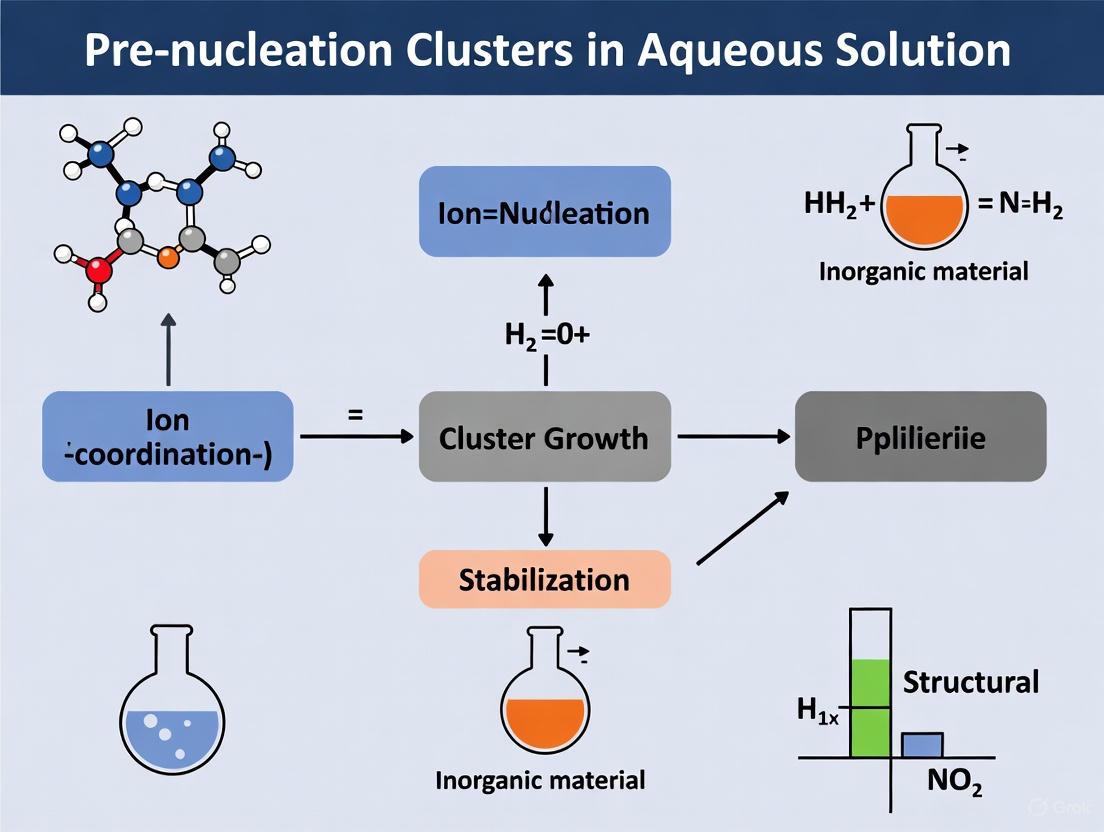
This article reviews the pivotal role of pre-nucleation clusters (PNCs) as stable solute precursors in non-classical crystallization pathways from aqueous solution.
Beyond Classical Theory: The Paradigm-Shifting Role of Pre-Nucleation Clusters in Aqueous Solution
Abstract
This article reviews the pivotal role of pre-nucleation clusters (PNCs) as stable solute precursors in non-classical crystallization pathways from aqueous solution. Challenging the long-established Classical Nucleation Theory, we explore the foundational concept of PNCs, their identification through advanced experimental and computational methodologies, and their implications for controlling crystallization outcomes. For researchers and drug development professionals, we detail how understanding PNCs enables the troubleshooting of polymorphic control, optimization of nanoparticle synthesis, and validation of non-classical pathways across diverse systems, including biominerals, pharmaceuticals, and functional materials. The synthesis of this knowledge opens new frontiers for the rational design of crystalline materials in biomedical and clinical applications.
Rethinking Nucleation: Unveiling Stable Prenucleation Clusters and Non-Classical Pathways
The Shortcomings of Classical Nucleation Theory (CNT) and the Capillary Assumption
Classical Nucleation Theory (CNT) has served for more than a century as the fundamental theoretical model for quantitatively studying the kinetics of first-order phase transitions, such as condensation, solidification, and crystallization [1] [2]. Its central merit lies in providing an intuitive and relatively simple rationalization of crystal formation by describing the competition between a volume term, which promotes the formation of the new stable phase, and a surface term, which disfavors it due to the energy cost of creating an interface [3] [2]. This framework results in a predictable free energy profile with a characteristic barrier, the height of which determines the nucleation rate [2]. However, the long-established view of nucleation is being fundamentally challenged by a growing body of experimental and simulation evidence, particularly from aqueous solution research. The observation of stable pre-nucleation clusters (PNCs) and multi-stage nucleation processes in systems ranging from biominerals to pharmaceuticals reveals significant shortcomings in the classical theory's underlying assumptions [4] [3] [5]. This in-depth technical guide examines these shortcomings, details the experimental and computational evidence that reveals them, and frames the discussion within the context of a paradigm shift toward non-classical nucleation pathways that are critical for modern scientific applications.
Theoretical Foundations of CNT and the Capillary Approximation
Core Principles of Classical Nucleation Theory
CNT describes the formation of a nascent nucleus of a new, stable phase within a metastable parent phase. The theory posits that the formation of this nucleus involves a reversible work of formation, ΔG, which is the sum of a bulk (volume) term and a surface term. For a spherical nucleus, this is given by:
[ \Delta G = -\frac{4}{3}\pi r^3 |\Delta g_v| + 4\pi r^2 \sigma ]
where ( r ) is the radius of the nucleus, ( \Delta gv ) is the Gibbs free energy change per unit volume of the transformation (driving the phase transition), and ( \sigma ) is the interfacial tension or surface energy per unit area (opposing it) [3] [2]. The competition between these two terms produces a free energy barrier, ( \Delta G^* ). The critical nucleus size, ( rc ), is found at the maximum of this free energy curve and represents the size at which the nucleus has equal probability of growing or dissolving:
[ rc = \frac{2\sigma}{|\Delta gv|} ]
Substituting ( r_c ) back into the expression for ΔG yields the height of the nucleation barrier:
[ \Delta G^* = \frac{16\pi \sigma^3}{3|\Delta g_v|^2} ]
The nucleation rate, ( R ), which is the number of nuclei formed per unit volume per unit time, then depends exponentially on this barrier:
[ R = NS Z j \exp\left(-\frac{\Delta G^*}{kB T}\right) ]
where ( NS ) is the number of potential nucleation sites, ( Z ) is the Zeldovich factor, ( j ) is the rate at which atoms or molecules join the critical nucleus, ( kB ) is Boltzmann's constant, and ( T ) is the absolute temperature [2].
The Capillary Assumption: A Critical Examination
The capillary approximation is a central pillar of CNT and the source of many of its limitations. This assumption consists of several key postulates:
- Macroscopic Properties: The nascent nucleus, even at the scale of a few molecules, is assumed to possess the same thermodynamic properties (e.g., density, structure, and interfacial tension, ( \sigma )) as the corresponding bulk macroscopic phase [1] [3].
- Sharp Interface: The nucleus is treated as having a well-defined, sharp interface with the parent phase, akin to the boundary between two bulk fluids [6].
- Constant Shape: Nuclei are typically modeled as spherical to simplify the geometric terms, implying that the shape and habit of the nucleus remain constant throughout the nucleation process [3].
This approximation allows for the simple and elegant formulation of CNT but becomes increasingly untenable as the nucleus size decreases to the nanoscale. At these dimensions, the concepts of a well-defined bulk interior and a sharp interface lose their physical meaning. The interfacial tension, in particular, is known to be size-dependent, yet CNT treats it as a constant [1] [3].
Fundamental Shortcomings of CNT and the Capillary Assumption
Despite its conceptual utility and historical success in predicting trends, CNT faces significant quantitative and qualitative discrepancies when confronted with modern experimental and simulation data. The table below summarizes the core theoretical shortcomings and their practical implications.
Table 1: Core Shortcomings of Classical Nucleation Theory
| Shortcoming | Theoretical Flaw | Experimental Consequence |
|---|---|---|
| Macroscopic Interfacial Tension | Assumes nanoscale clusters have the same interfacial energy as a flat, macroscopic interface [1] [3]. | Systematic errors in predicting nucleation barriers and rates; predictions often fail for temperature dependence [1]. |
| Neglect of Prenucleation Clusters | Assumes solute exists primarily as monomers, ignoring stable molecular aggregates present before supersaturation [4] [3]. | Inability to explain polymorph selection, nucleation pathways, and the structure of concentrated solutions [4] [5]. |
| Oversimplified Free Energy Landscape | Describes a single, size-dependent barrier. Ignores complex, multi-stage pathways and structural transitions within clusters [3]. | Fails to capture Ostwald's step rule and the prevalence of multi-step nucleation mechanisms involving amorphous or liquid intermediates [3]. |
| Constant Shape Assumption | Assumes spherical nuclei, disregarding that non-spherical or fractal aggregates may have lower energy [7]. | Incorrect prediction of critical sizes and barriers; cannot explain stable non-compact clusters observed in experiments [7]. |
The Prenucleation Cluster Challenge
A direct challenge to CNT's monomer-based assumption comes from the discovery of significant solute clustering at all concentrations, even in undersaturated solutions [4]. A 2025 study on aqueous potassium carbonate solutions demonstrated the presence of solute aggregates ranging from molecular oligomers to sub-micrometre-scale amorphous aggregates, which exhibit a glassy nature [4]. This finding directly contradicts the classical picture, where such aggregates should not form in undersaturated conditions. The study showed that crystal nucleation actually occurs within these pre-existing amorphous aggregates, supporting a non-classical two-step nucleation model [4]. In this model, amorphous aggregates form through a barrierless process, after which crystal nucleation occurs inside them, a pathway fundamentally different from the single-step, monomer-by-mondition assembly envisioned by CNT.
Complexities of the Free Energy Landscape
CNT's simple free energy profile, with a single maximum, is inadequate for describing systems where nucleation proceeds through multiple intermediates. Molecular simulation studies have revealed that nucleation can involve a cascade of structural transitions. For example, the nucleation of d-/l-norleucine from a nonpolar solution was found to proceed through a series of intermediates: initial oligomers form micelle-type structures, which evolve into hydrogen-bonded bilayers, then transition to staggered bilayers, and finally undergo solid-solid transformations to reach the final crystal structure [3]. Each of these intermediates has distinct surface and bulk energy terms, leading to a size-dependent thermodynamic stability that drives a multi-step pathway—a complexity that the single-order-parameter description of CNT cannot capture [3].
The Stability of Non-Compact Structures
The classical assumption that the most stable clusters are compact (e.g., spherical) to minimize surface area has also been challenged. Direct observation of prenucleation clusters in two-dimensional colloidal crystals revealed that non-compact clusters were more prevalent among trimers than compact ones [7]. This was attributed to the higher configurational entropy and lower Gibbs energy of formation of the non-compact structures [7]. Such findings contradict CNT's constant-shape assumption and highlight the importance of entropy, a factor often oversimplified in the classical theory, in determining cluster stability at the nanoscale.
The diagram below illustrates the fundamental differences between the classical view of nucleation and the more complex, non-classical reality involving prenucleation clusters and multi-step pathways.
Experimental and Computational Evidence
Key Experimental Methodologies
Advanced experimental techniques have been crucial in uncovering the limitations of CNT and validating non-classical pathways.
Table 2: Key Experimental Methods for Studying Non-Classical Nucleation
| Method | Key Function | Example Application |
|---|---|---|
| Laser Scattering & Microscopy | Directly observes the number and size of clusters (N(t)) over time, allowing measurement of transient nucleation rates and time-lags [1]. | Observing sub-micrometre amorphous aggregates in aqueous potassium carbonate [4]. |
| In-situ Real-time Colloidal Observation | Tracks cluster dynamics prior to critical nucleus formation in model systems where particles are large enough to visualize directly [7]. | Identifying stable non-compact trimers in 2D colloidal crystals, contradicting compactness assumptions [7]. |
| Laser-Induced Nucleation | Probing solution structure and the presence of precursors by triggering nucleation events in a controlled manner [4]. | Studying the glassy nature of solute aggregates in pre-nucleating potassium carbonate solutions [4]. |
Protocol: Direct Observation of Prenucleation Clusters in Colloidal Systems
This protocol is adapted from the work of Suzuki et al. (2025), who directly observed prenucleation clusters of 2D colloidal crystals [7].
- Objective: To seamlessly track the dynamics and morphology of prenucleation clusters prior to the formation of critical nuclei.
- Materials:
- Colloidal Particles: Polystyrene particles.
- Solution: Aqueous sodium polyacrylate solution.
- Imaging Setup: Optical microscopy system capable of high-resolution, in-situ, real-time imaging.
- Procedure:
- Sample Preparation: Disperse polystyrene particles in an aqueous solution of sodium polyacrylate to create a model system for crystallization.
- Data Acquisition: Place the sample in the imaging setup and begin continuous real-time video recording. Track the Brownian motion and interactions of individual particles and small clusters.
- Cluster Identification: Analyze the recorded footage to identify the formation of dimers, trimers, and larger clusters. Pay particular attention to the time prior to the appearance of a stable, post-critical nucleus.
- Morphological Analysis: Classify the geometry of the identified clusters (e.g., compact triangular trimers vs. linear, non-compact trimers).
- Stability Analysis: Calculate the relative prevalence and lifetime of different cluster morphologies to determine their relative stability.
- Key Analysis: The critical finding is that non-compact clusters show higher prevalence, which is analyzed by comparing their Gibbs energy of formation, taking into account their higher configurational entropy [7].
Computational and Molecular Simulation Approaches
Computer simulations have provided molecular-level insights that are often inaccessible to experiments, playing a key role in extending nucleation theory.
The Seeding Method
The seeding method is a computational technique used to test CNT predictions, particularly in regimes of lower supersaturation not accessible by brute-force simulation [6].
- Principle: A pre-formed liquid droplet (seed) of a specific radius ( R ) is inserted into a simulation box containing a supersaturated vapor. In the NVT (canonical) ensemble, mass conservation and equilibrium conditions can lead to a stable cluster size that corresponds to the critical nucleus in an infinite system [6].
- Findings: Seeding simulations of Lennard-Jones condensation have shown that while CNT can accurately predict stable cluster radii across a wide range of conditions, its performance depends heavily on the thermodynamic model used for the parent phase. Simple models like the ideal gas approximation work well at low temperatures but deviate significantly at high temperatures [6]. This underscores the sensitivity of CNT predictions to the accurate description of the metastable phase.
Free Energy Decomposition
Molecular dynamics simulations combined with free energy calculations (e.g., umbrella sampling) can decompose the association free energy between ions into its entropic and energetic components, and further into solute-induced and solvent-induced contributions [5].
- Application: This method was used to study the formation of calcium phosphate prenucleation clusters (e.g., Ca(HPO(4))(3^{4-})). The analysis revealed that the association between like-charged species (e.g., Ca(HPO(4))(2^{2-})-HPO(_4^{2-})) is driven by a favorable solvent-induced energy change, where enhanced stability and alignment of hydrated water molecules around the ions overcome the electrostatic repulsion [5]. This provides a quantitative, mechanistic understanding of a phenomenon that is inexplicable by classical models which consider only ion-ion interactions.
The Scientist's Toolkit: Research Reagent Solutions
Table 3: Essential Materials and Reagents for Prenucleation Cluster Research
| Item | Function/Description | Example Use Case |
|---|---|---|
| Aqueous Potassium Carbonate (K₂CO₃) Solutions | A simple, well-characterized model electrolyte system for studying pre-nucleation cluster formation and glassy amorphous aggregates [4]. | Laser-induced nucleation experiments; probing solution structure prior to crystal formation [4]. |
| Calcium & Phosphate Ion Solutions | Model system for studying non-classical nucleation pathways in biomineralization. Forms stable, highly charged prenucleation clusters (e.g., Ca(HPO₄)₃⁴⁻) [5]. | Investigating solvent-mediated like-charge attraction and the multi-step pathway to apatite formation [5]. |
| Polystyrene Colloidal Particles | Micron-sized model particles that act as "proxy atoms," allowing direct optical observation of clustering and nucleation dynamics [7]. | Direct, real-time visualization of prenucleation cluster stability and morphology in 2D crystals [7]. |
| Sodium Polyacrylate Solution | A polymer solution used to create tunable attractive interactions between colloidal particles, facilitating the study of crystallization in a controlled manner [7]. | Serves as the medium for colloidal crystal nucleation studies [7]. |
| Lennard-Jones Potential Model | A simple computational model for atoms (e.g., argon) defined by its length (σ) and energy (ε) parameters. Used as a testbed for simulation methods and CNT validation [6]. | Seeding simulations to test the accuracy of CNT predictions for condensation [6]. |
The shortcomings of Classical Nucleation Theory and its foundational capillary approximation are no longer mere theoretical curiosities; they have profound implications for research in aqueous solutions, particularly in fields like pharmaceutical development and biomineralization. The evidence for prenucleation clusters and multi-step nucleation pathways necessitates a move beyond the classical framework. For drug development professionals, this paradigm shift is critical. The presence of stable prenucleation clusters at undersaturated concentrations and the pathway-dependent selection of polymorphs mean that the outcome of a crystallization process is not determined solely by the final thermodynamic stability, but by the entire, complex free energy landscape navigated by clusters from the earliest stages of association [4] [3]. Understanding and potentially controlling these non-classical pathways—for instance, by designing additives that stabilize specific prenucleation clusters or by manipulating solvent conditions to influence like-charge attraction—opens new avenues for the rational design of crystalline materials, including the reliable production of specific, bioactive polymorphs of active pharmaceutical ingredients (APIs). The future of nucleation theory lies in developing quantitative models that incorporate the molecular complexity of solutions, the dynamics of cluster evolution, and the critical role of the solvent, ultimately providing researchers with a more powerful and predictive toolkit for controlling crystallization.
The initial stages of crystallization, one of the most fundamental processes in materials science, chemistry, and biology, have traditionally been understood through Classical Nucleation Theory (CNT). This framework, derived in the 1930s, posits that nucleation occurs through stochastic collisions of monomers (ions, atoms, or molecules) that form unstable, transient clusters. Only upon reaching a critical size do these clusters become stable nuclei capable of growth, with an energetic barrier dominated by the unfavorable surface energy of small particles [8] [9]. However, extensive research, particularly in the fields of biomineralization and biomimetic materials, has revealed numerous phenomena that challenge this classical view [8]. Among the most significant conceptual advances is the discovery and characterization of prenucleation clusters (PNCs)—stable, soluble species that exist in solution prior to the formation of solid nuclei and act as direct precursors to the new phase [9] [10]. The recognition of PNCs represents a paradigm shift in our understanding of phase separation, offering a non-classical pathway that is increasingly recognized as a common mechanism across diverse systems, from biominerals to pharmaceuticals and functional nanomaterials [8] [11].
Defining Prenucleation Clusters: Core Concepts and Characteristics
Prenucleation clusters are best defined as thermodynamically stable solute associations that exist in undersaturated, saturated, and supersaturated solutions. They form through a continuous, endothermic association process and lack a defined phase interface, meaning they are an integral part of the solution rather than distinct particles [8] [9]. This latter point is crucial, as it distinguishes them from the unstable, nanoscopic nascent phases envisaged in CNT.
Their key characteristics include:
- Stability: Unlike the transient clusters in CNT, PNCs represent local minima on the free energy landscape and can persist in solution for extended periods [9].
- Non-classical Structure: The internal structure of PNCs does not necessarily resemble the bulk crystal structure of the final solid phase. They are solutes with "molecular" character, whose structures may be dynamically fluctuating polymers or specific associates [8] [10].
- Role as Precursors: PNCs are not merely spectators; they are direct participants in the nucleation process, aggregating or transforming to form the first solid phases, often through intermediary amorphous states [8] [10].
The following diagram illustrates the fundamental distinction between the classical and non-classical nucleation pathways involving PNCs.
Table 1: Key Characteristics of Prenucleation Clusters versus Classical Nucleation Theory Assumptions.
| Feature | Classical Nucleation Theory | Prenucleation Cluster Pathway |
|---|---|---|
| Precursor Species | Monomers (ions, molecules) | Stable prenucleation clusters |
| Cluster Stability | Unstable, transient | Thermally stable |
| Cluster Structure | Assumed bulk crystal structure | "Molecular" character, distinct from bulk |
| Energetic Barrier | Dominated by interfacial tension | Governed by association thermodynamics |
| Phase Interface | Present for all clusters | Absent prior to liquid-liquid phase separation |
Experimental Detection and Methodologies
The identification and study of PNCs require sophisticated techniques capable of probing nanoscopic species in solution without inducing artifacts. The following experimental approaches have proven most effective.
Analytical Ultracentrifugation (AUC)
Principle: AUC subjects a solution to a high centrifugal field, separating solute species based on their buoyant mass and allowing for the direct determination of size distributions and interactions in near-native conditions [11]. Application to PNCs: In seminal work on calcium carbonate, AUC provided the first direct evidence of stable clusters with sizes of about 0.6-2 nm in supersaturated solutions, confirming they were not simple ion pairs [8] [9]. This method has since been used to validate PNCs in amino acid solutions [11].
Potentiometric Titration and Solution Thermodynamics
Principle: This method involves the controlled addition of a cation solution (e.g., CaCl₂) into an anion buffer (e.g., carbonate buffer) while meticulously recording the ion activity (e.g., Ca²⁺ potential) and maintaining constant pH [8] [10]. Application to PNCs: The titration curve deviations from expectations based on free ions alone indicate complex association. By modeling these data, thermodynamic parameters like the ion association constant for cluster formation, K(cluster), can be derived. This allows for the quantitative mapping of liquid-liquid binodal and spinodal limits in the phase diagram [10].
In Situ Spectroscopy
Attenuated Total Reflection Fourier-Transform Infrared (ATR-FTIR) Spectroscopy: This technique monitors changes in vibrational bands of solutes in real-time. For carbonate systems, the evolution of the ν₂ CO₃²⁻ band provides information on ion association and the kinetics of phase separation [10]. Stopped-flow ATR-FTIR is used to track very fast precipitation kinetics, with the time constants of band development helping to identify the spinodal limit where phase separation is barrier-less [10]. Electrospray Ionization Mass Spectrometry (ESI-MS): ESI-MS is a fast method that can detect the mass-to-charge ratios of clusters directly from solution. It has identified PNCs for amino acids and calcium carbonates, revealing the presence of oligomers beyond monomers [11]. A key advantage is its speed, allowing for rapid screening of systems that may follow a non-classical nucleation pathway [11].
Scattering and Absorption Techniques
Small-Angle X-ray Scattering (SAXS) and X-ray Absorption Spectroscopy (XAS): These synchrotron-based techniques are powerful for studying metal-based PNCs. For instance, in the synthesis of gold nanoparticles, SAXS tracked the size evolution of PNCs during the induction period, while XAS provided information on the speciation and coordination environment of Au atoms within the clusters [12].
Table 2: Key Experimental Techniques for Prenucleation Cluster Research.
| Technique | Key Measurable Parameters | System Examples | Key Insights Provided |
|---|---|---|---|
| Analytical Ultracentrifugation (AUC) | Sedimentation coefficient, size/distribution, molecular weight | Calcium carbonate, amino acids [9] [11] | Direct proof of stable clusters in solution; distinguishes clusters from ion pairs. |
| Potentiometric Titration | Ion activity product (IAP), association constants | Calcium carbonate [8] [10] | Quantifies thermodynamics of ion association; maps liquid-liquid phase boundaries. |
| ATR-FTIR Spectroscopy | Molecular vibrational fingerprints, reaction kinetics | Calcium carbonate [10] | Probes coordination environment; monitors phase separation kinetics in real-time. |
| Electrospray Ionization Mass Spectrometry (ESI-MS) | Mass-to-charge ratio (m/z) of solute species | Amino acids, calcium carbonate [11] | Rapid identification of cluster stoichiometries and oligomeric states. |
| Small-Angle X-ray Scattering (SAXS) | Nanoscale particle size, shape, and structure | Gold nanoparticles [12] | Tracks size stability of PNCs during induction period prior to nucleation. |
| X-ray Absorption Spectroscopy (XAS) | Local atomic structure, oxidation state | Gold nanoparticles [12] | Determines speciation and coordination chemistry within PNCs. |
Quantitative Model: The PNC Pathway and Phase Separation
A quantitative model for nucleation via PNCs has been developed, particularly for calcium carbonate. This model posits that ion association thermodynamics in the homogeneous phase, governed by the stability constant of the PNCs (K(cluster)), directly determines the liquid-liquid miscibility gap [10].
The model provides quantitative relationships for the spinodal and binodal limits:
- The spinodal limit (IAPspinodal), where the phase separation barrier vanishes, is defined as: IAPspinodal = [K(cluster)]⁻² [10].
- The binodal limit (IAPbinodal), which marks the boundary of the metastable zone, is related to the solubility product of the resulting polymorph (Ksp*polymorph*) and K(cluster) by: IAP*binodal* = A(*polymorph*) Ksppolymorph ln K(cluster) (where A is a constant) [10].
This framework explains why amorphous calcium carbonate (ACC) can have variable solubilities: ACC forms from the dehydration of a dense liquid precursor, which itself originates from the liquid-liquid demixing of PNCs. The exact location within the metastable zone (between binodal and spinodal) where this demixing occurs determines the water content and solubility of the resulting ACC, reconciling previously inconsistent literature values [10].
Case Studies Across Material Systems
The PNC pathway has been observed in a wide range of inorganic, organic, and metallic systems.
Calcium Carbonate (CaCO₃)
As the most extensively studied system, CaCO₃ serves as the archetype for the PNC pathway. Stable clusters form in solution and can undergo liquid-liquid phase separation to form polymer-induced liquid precursors (PILPs) or dense liquid droplets [8] [10]. These droplets then solidify into amorphous calcium carbonate (ACC), which can possess distinct short-range order (proto-structure) predisposing it to transform into specific crystalline polymorphs like calcite, vaterite, or aragonite [10]. This pathway is highly relevant for understanding biomineralization in seashells and skeletal tissues [8].
Semiconductor Quantum Dots (QDs)
In the synthesis of ZnSe quantum dots and magic-size clusters (MSCs), PNCs have been identified as key intermediates. The PNCs, described as a precursor compound (PC-299), form at moderate temperatures (~120-160°C) [13]. Upon dispersion in a solvent mixture at room temperature, these PNCs isomerize to form MSCs. At higher temperatures (~220°C), the PNCs fragment into monomers, which then feed the classical nucleation and growth of QDs [13]. This demonstrates how PNCs can be a branching point for different material outcomes.
Gold Nanoparticles (Au NPs)
The synthesis of gold nanoparticles in apolar solvents using oleylamine also proceeds via a non-classical pathway. SAXS and XAS revealed the presence of Au(III)/Au(I)-containing PNCs that remain stable in size during an induction period before rapidly collapsing to form nuclei [12]. The oleylamine ligand not only solubilizes the gold salt but also coordinates to the gold complexes, controlling the size and reactivity of the PNCs and ultimately the final nanoparticle size and structure [12].
Amino Acids
Even small organic molecules like amino acids form PNCs. ESI-MS and AUC studies have shown that a wide range of DL-amino acids exist in solution as clusters and higher oligomers in addition to monomers [11]. This suggests that non-classical nucleation via PNCs is a more common phenomenon than previously assumed, with potential implications for pharmaceutical crystallization and prebiotic chemistry.
The Scientist's Toolkit: Essential Research Reagents and Materials
Table 3: Key Research Reagents and Materials for Studying Prenucleation Clusters.
| Reagent/Material | Function in PNC Research | Example Application |
|---|---|---|
| Calcium Chloride (CaCl₂) & Sodium Carbonate (Na₂CO₃) | Primary ions for creating supersaturation in the model CaCO₃ system. | Used in potentiometric titration and AUC to study the thermodynamics and size of CaCO₃ PNCs [8] [10]. |
| Oleylamine (OY) | Multifunctional ligand: solubilizer, coordination agent for metal precursors, and capping agent. | Serves as a coordinating solvent and surface stabilizer in the synthesis of Au and ZnSe nanoparticles, controlling PNC reactivity and growth [13] [12]. |
| Diphenylphosphine (DPP) | Reducing agent and ligand in metal chalcogenide synthesis. | Employed in the synthesis of ZnSe PNCs, magic-size clusters, and quantum dots [13]. |
| Triisopropylsilane (TIPS) | Reducing agent for metal precursors. | Used to reduce gold chloride in the presence of oleylamine to form Au PNCs and nanoparticles [12]. |
| Amino Acids (e.g., DL-amino acids) | Model organic solute molecules to study clustering. | Act as simple organic systems to demonstrate the ubiquity of PNC formation using ESI-MS and AUC [11]. |
| Stabilizing Polymers (e.g., PEG, PAA) | Inhibit crystallization and stabilize amorphous precursors. | Used to study polymer-induced liquid precursors (PILPs) and the transformation of PNCs to amorphous phases [8]. |
Implications for Drug Development and Biomedical Applications
The understanding of PNCs has profound implications for the design and application of biomaterials, particularly in drug delivery.
- Advanced Drug Delivery Carriers: Calcium carbonate, which nucleates via PNCs and amorphous precursors, is a promising drug carrier due to its biocompatibility, pH-sensitivity, and high porosity [14] [15]. The PNC pathway enables the synthesis of carriers with tailored properties. For instance, amorphous calcium carbonate (ACC) is highly unstable in vivo but reacts efficiently in acidic microenvironments (e.g., tumors), releasing CO₂ for imaging and Ca²⁺ for potential immunomodulation, while also releasing encapsulated therapeutic drugs [15].
- Hybrid Carrier Design: The "yin-and-yang" complementarity of hard inorganic carriers (like CaCO₃) and soft organic carriers (like alginate hydrogels) can be leveraged. Hybrid systems combining both can be designed based on an understanding of their formation mechanisms, leading to drug delivery systems with superior performance and advanced functionalities [14].
- Polymorph Control: In pharmaceutical manufacturing, the crystalline polymorph of an active pharmaceutical ingredient (API) dictates its stability, solubility, and bioavailability. Since PNCs can be precursors to specific polymorphs via distinct amorphous intermediates, controlling the PNC pathway offers a powerful strategy for achieving desired polymorphic outcomes reliably [9] [10].
The paradigm of prenucleation clusters has fundamentally expanded our understanding of crystallization, moving beyond the limitations of Classical Nucleation Theory. The evidence is clear that for many systems—from the most abundant biominerals to semiconductors, metals, and organic molecules—the pathway to a new solid phase is not a direct leap from monomers, but a directed journey through stable, soluble clusters.
This revised physical-chemical perspective is not merely academic; it provides a powerful foundation for controlling materials synthesis across disciplines. In drug development, it enables the rational design of more effective carriers and the precise control of API polymorphism. In materials science, it opens routes to novel nanostructures with tailored properties. Future research will undoubtedly focus on refining the quantitative models of PNC-driven phase separation, extending them to more complex systems, and further harnessing this knowledge to create the next generation of functional materials for medicine and technology.
Stable cluster formation represents a critical stage in the nucleation and growth of materials, dictating the structural and functional properties of the resulting solid phase. This technical guide examines the thermodynamic and kinetic principles governing pre-nucleation cluster (PNC) stability and evolution, with particular emphasis on aqueous systems relevant to pharmaceutical development. By integrating computational simulations, experimental characterization, and theoretical modeling, we establish a unified framework for predicting and controlling cluster behavior across diverse chemical environments. The analysis demonstrates how molecular-level interactions translate into macroscopic material properties through well-defined thermodynamic pathways, providing researchers with actionable strategies for directing crystallization processes in drug development applications.
Pre-nucleation clusters represent metastable molecular aggregates that form in solution prior to the emergence of detectable crystalline phases. These transient species challenge classical nucleation theory (CNT), which posits a direct transition from individual ions or molecules to stable crystalline nuclei. Contemporary research reveals that pre-nucleation clusters serve as fundamental building blocks in non-classical nucleation pathways, particularly in aqueous systems of relevance to biomineralization and pharmaceutical crystallization [16].
The thermodynamic stability of these clusters arises from a delicate balance between molecular interaction energies and entropic contributions, creating free energy landscapes with multiple local minima corresponding to distinct cluster configurations. In the specific context of aqueous solution research, solvent-mediated interactions profoundly influence cluster stability, often enabling the formation of structurally complex assemblies that bypass intermediate states predicted by CNT. For drug development professionals, understanding and controlling PNC behavior offers unprecedented opportunities for producing specific crystalline forms with tailored physicochemical properties, including bioavailability, stability, and processing characteristics.
Theoretical Foundations of Cluster Stability
Thermodynamic Principles
The formation and stability of pre-nucleation clusters are governed by fundamental thermodynamic relationships, where the overall driving force is the reduction of Gibbs free energy. For a cluster of size (n), the free energy change (\Delta G(n)) can be expressed as the sum of bulk and surface contributions:
[\Delta G(n) = -n|\Delta\mu| + \gamma A(n)]
where (\Delta\mu) represents the chemical potential difference between dissolved and clustered states, (\gamma) is the interfacial tension, and (A(n)) denotes the cluster surface area. This relationship predicts a critical cluster size (n^*) beyond which growth becomes thermodynamically favorable. However, experimental observations of stable sub-critical clusters necessitate extensions to this classical model [16].
The spinodal decomposition mechanism provides an alternative pathway for cluster formation, occurring when the system enters a metastable region where small concentration fluctuations spontaneously grow rather than decay. Recent investigations of Guinier-Preston zone formation in model systems reveal that below specific temperature thresholds (e.g., 200 K in Al-Cu systems), spinodal decomposition between disordered and ordered phases becomes thermodynamically favorable, while no such decomposition occurs at higher temperatures [17]. This temperature dependence has profound implications for controlling cluster size distributions through thermal processing protocols.
Kinetic Considerations
Cluster evolution kinetics fundamentally influence the pathway and outcomes of nucleation processes. The Cahn-Hilliard equation provides a mathematical framework for modeling the temporal evolution of concentration fluctuations during spinodal decomposition:
[\frac{\partial c}{\partial t} = M\nabla^2\left(\frac{\partial f}{\partial c} - \kappa\nabla^2 c\right)]
where (c) is concentration, (t) is time, (M) is mobility, (f) is the free energy density, and (\kappa) is the gradient energy coefficient. Implementation of this approach enables calculation of time-temperature-transformation diagrams that guide processing conditions for obtaining targeted microstructures [17].
Molecular dynamics simulations of perylene derivatives demonstrate that clustering preferences can be dramatically reversed by catalytic surfaces, highlighting the profound kinetic selectivity achievable through interface engineering. In these systems, the specific arrangement of functional groups dictates adsorption barriers and subsequent self-assembly pathways, with hydrogen bonding and electrostatic interactions serving as primary determinants of aggregation rates [16].
Table 1: Key Thermodynamic Parameters in Cluster Formation
| Parameter | Symbol | Role in Cluster Formation | Experimental Determination |
|---|---|---|---|
| Chemical potential difference | (\Delta\mu) | Driving force for clustering | Concentration dependence of solubility |
| Interfacial tension | (\gamma) | Energy barrier to cluster formation | Contact angle measurements |
| Critical cluster size | (n^*) | Minimum stable cluster dimension | Molecularity determined from kinetic data |
| Acoustic gap | (\Delta) | Low-temperature specific heat deviation | Low-temperature calorimetry |
| Transition temperature | (T_c) | Boundary between decomposition mechanisms | Differential scanning calorimetry |
Computational Methodologies for Cluster Analysis
First-Principles Calculations
Density functional theory (DFT) provides the foundational quantum mechanical framework for determining electronic structure, total energies, and equilibrium geometries of molecular clusters. In studies of sodium clusters ((Na{39}), (Na{39}^+), (Na_{39}^-)), DFT calculations employing Vanderbilt's ultrasoft pseudopotentials within the local density approximation have revealed the profound influence of even single electrons on cluster stability and thermodynamic properties [18]. These computations typically utilize plane-wave basis sets and periodic boundary conditions, with energy convergence thresholds carefully selected to ensure chemical accuracy (approximately 1 meV/atom).
For finite-temperature properties, Born-Oppenheimer molecular dynamics (BOMD) simulations evolve the system according to forces derived from DFT calculations at each time step. The integration of Nośe-Hoover thermostats maintains canonical ensemble conditions, enabling investigation of temperature-dependent cluster behavior across relevant ranges (e.g., 120-400 K for sodium clusters) [18]. Trajectory data collected over hundreds of picoseconds provide sufficient statistical sampling for evaluating thermodynamic averages and fluctuation properties.
Classical Molecular Dynamics Simulations
Reactive force fields (ReaxFF) extend the applicability of molecular dynamics to larger systems and longer timescales while preserving chemical reactivity. In investigations of perylene pre-nucleation, ReaxFF parameters capture bond formation and breaking events through bond-order formalism, enabling realistic modeling of cluster assembly processes [16]. The total system energy incorporates multiple contributions:
[E{\text{total}} = E{\text{bond}} + E{\text{valence}} + E{\text{torsion}} + E{\text{vdW}} + E{\text{Coulomb}}]
Simulation protocols typically involve energy minimization followed by equilibration in appropriate ensembles (NVT or NPT) before production runs. For nanocrystal formation studies, systems containing thousands of atoms evolve over nanosecond timescales, with trajectory analysis focused on cluster size distributions, molecular orientation, and interaction energies [16].
Table 2: Computational Methods for Cluster Analysis
| Method | Key Features | Applications in Cluster Research | Limitations |
|---|---|---|---|
| Density Functional Theory (DFT) | First-principles electronic structure | Equilibrium geometries, electronic properties | Scalability to large systems |
| Born-Oppenheimer Molecular Dynamics (BOMD) | DFT-based dynamics with explicit temperature control | Finite-temperature properties, melting behavior | Computational expense limits timescales |
| ReaxFF Molecular Dynamics | Reactive force field with bond-order formalism | Prenucleation cluster formation, catalytic effects | Parameterization for specific systems |
| Monte Carlo Simulations | Statistical sampling of configuration space | Phase diagrams, order-disorder transitions | Dynamics not directly accessible |
| Cahn-Hilliard Equation | Phase field model for diffusion | Spinodal decomposition kinetics | Continuum approximation of molecular details |
Advanced Sampling and Analysis Techniques
Enhanced sampling methodologies overcome limitations in accessing rare events and navigating complex free energy landscapes. Umbrella sampling, metadynamics, and temperature-accelerated methods facilitate exploration of transition pathways between cluster configurations, enabling quantification of energy barriers and transition states.
Cluster analysis algorithms automatically identify and characterize aggregates within molecular simulation trajectories. The clustering toolkit in VMD, combined with custom scripts implementing density-based clustering or graph theory approaches, enables rigorous quantification of cluster size distributions, lifetimes, and structural properties. These computational tools provide direct comparison with experimental observations of pre-nucleation species.
Experimental Protocols for Cluster Characterization
Thermodynamic Measurements
Differential scanning calorimetry (DSC) protocols for cluster analysis involve controlled heating and cooling cycles (typically 1-10 K/min) with precise temperature calibration. Sample preparation requires homogeneous solutions with carefully controlled concentrations, while reference cells contain pure solvent. The measurement of heat flow differences between sample and reference during temperature ramps reveals exothermic and endothermic transitions associated with cluster formation and dissolution. Integration of peak areas provides quantitative determination of enthalpy changes, while transition temperatures indicate relative stability of clustered states.
Isothermal titration calorimetry (ITC) directly measures heat changes during incremental addition of solutions containing molecular components. For cluster studies, titration protocols typically involve 10-25 injections of 2-10 μL each, with adequate spacing (3-5 minutes) between injections to ensure return to baseline. Data analysis using appropriate binding models (e.g., multiple-site models for complex cluster formation) yields stoichiometry, equilibrium constants, and thermodynamic parameters (ΔH, ΔS) for cluster assembly processes.
Structural Characterization
Synchrotron X-ray scattering techniques probe cluster structure in solution environments. Small-angle X-ray scattering (SAXS) measurements require specialized sample cells with X-ray transparent windows (e.g., quartz capillaries) and precise temperature control. Data collection typically spans a q-range of 0.1-5 nm⁻¹, with exposure times optimized to maximize signal-to-noise while minimizing radiation damage. Pair distance distribution functions derived from SAXS data provide direct information about cluster size and morphology, while concentration-dependent studies elucidate interaction potentials between clusters.
Nuclear magnetic resonance (NMR) spectroscopy protocols for cluster analysis include diffusion-ordered spectroscopy (DOSY) to measure hydrodynamic radii of molecular aggregates, and chemical shift monitoring to detect association-induced changes in electronic environments. For quantitative analysis, temperature-controlled experiments with referencing to internal standards (e.g., TMS) ensure detection sensitivity to cluster formation events. For drug development applications, these techniques prove particularly valuable for characterizing cluster behavior of active pharmaceutical ingredients under physiologically relevant conditions.
Case Studies in Cluster Stabilization
Metallic Nanoclusters
Sodium clusters ((Na{39}), (Na{39}^+), (Na{39}^-)) demonstrate the profound electronic effects on cluster stability and thermodynamics. Multiple linear regression analysis with dummy variables has established that time, temperature, and electron count significantly affect cluster energy, with distinctive patterns for neutral, cationic, and anionic forms [18]. Time exerts a positive effect (direct ratio) on energy for (Na{39}^-) and (Na{39}), but a negative impact (inverse ratio) for (Na{39}^+), while temperature increases energy across all charge states.
Fuzzy clustering analysis of thermodynamic properties reveals that each sodium cluster segregates into three distinct groups corresponding to different temperature regimes, indicating phase-like transitions at specific thresholds [18]. Time series modeling further confirms that each cluster type exhibits characteristic energy fluctuations at different temperatures, with autoregressive fractionally integrated moving average (ARFIMA) processes effectively capturing the persistence and memory effects in these nanoscale systems.
Organic Nanocrystal Prenucleation
Molecular dynamics simulations of perylene derivatives (PERLEN08 and RELVUC) reveal fundamental mechanisms of organic nanocrystal formation. In the absence of catalysts, RELVUC displays faster clustering kinetics compared to PERLEN08, but introduction of NiO nanoparticles reverses this preference, with PERLEN08 now forming clusters more rapidly [16]. This kinetic selectivity arises from molecule-specific electrostatic interactions and hydrogen bonding patterns that dictate adsorption barriers on catalytic surfaces.
The thermodynamic stability of initial perylene clusters enhances significantly in the presence of NiO catalysts, with binding energy calculations revealing strengthened molecular adhesion to catalytic surfaces [16]. Structural analysis indicates predominantly amorphous character in pre-nucleation clusters, supporting non-classical nucleation pathways where long-range order emerges gradually from initially disordered aggregates. These findings provide atomic-scale mechanisms for experimental observations of substrate-dependent nucleation in organic semiconductor systems.
Guinier-Preston Zones in Binary Alloys
The Al-Cu system exemplifies cluster stabilization in metallic solutions, where Guinier-Preston (GP) zones represent early-stage concentration fluctuations that precede precipitate formation. Thermodynamic analysis using the CALPHAD method establishes metastable equilibrium between disordered FCC phases and ordered GP(II) structures, with free energy calculations incorporating volume changes due to atomic size mismatch between Al and Cu [17].
Monte Carlo simulations with direct introduction of effective cluster interactions demonstrate spontaneous transformation from GP(I) to GP(II) structures at 200 K, while no analogous progression occurs at 300 K [17]. This temperature sensitivity highlights the critical role of thermal processing history in determining cluster evolution pathways and ultimate microstructure development in alloy systems.
Research Reagent Solutions
Table 3: Essential Research Reagents for Cluster Studies
| Reagent/Material | Function in Cluster Research | Application Examples |
|---|---|---|
| Perylene derivatives (PERLEN08, RELVUC) | Model compounds for organic nanocrystal formation | Studying pre-nucleation cluster pathways in organic semiconductors [16] |
| Nickel Oxide (NiO) Nanoparticles | Catalytic surface for controlled nucleation | Modifying cluster formation kinetics and stability in organic systems [16] |
| Sodium cluster precursors | Metallic model systems for electronic structure studies | Investigating size-dependent thermodynamic properties [18] |
| Aluminum-Copper alloys | Binary metallic system for phase separation studies | Examining Guinier-Preston zone formation mechanisms [17] |
| Ultrasoft pseudopotentials | Computational tools for electronic structure calculations | DFT studies of cluster geometries and energies [18] |
| ReaxFF parameters | Reactive force field for molecular dynamics | Simulating bond formation/breaking during cluster assembly [16] |
Visualization of Cluster Formation Pathways
The following diagrams illustrate key concepts and relationships in stable cluster formation, created using DOT language with adherence to the specified color palette and contrast requirements.
Non-Classical Nucleation Pathway
Figure 1: This diagram illustrates the non-classical nucleation pathway through pre-nucleation clusters, highlighting the role of catalytic surfaces in enhancing formation and stabilization of intermediate species.
Research Methodology Integration
Figure 2: This diagram outlines the integrated research methodology combining theoretical, computational, and experimental approaches to develop predictive frameworks for cluster stability.
The thermodynamic framework for stable cluster formation establishes fundamental principles connecting molecular-level interactions to macroscopic material properties. Through integration of computational modeling, experimental characterization, and theoretical analysis, researchers can now rationalize and predict cluster behavior across diverse chemical systems. The documented influences of catalytic surfaces on kinetic pathways, temperature on decomposition mechanisms, and molecular structure on aggregation preferences provide actionable insights for controlling nucleation processes in pharmaceutical development.
Future advances will likely emerge from more sophisticated multiscale modeling approaches that seamlessly bridge electronic structure, molecular dynamics, and continuum descriptions of cluster evolution. Machine learning methodologies offer particular promise for identifying subtle patterns in high-dimensional parameter spaces and accelerating the discovery of optimal conditions for stabilizing targeted cluster architectures. For drug development professionals, these evolving capabilities will enable precise engineering of crystalline forms with optimized bioavailability and stability characteristics, ultimately enhancing therapeutic efficacy and product performance.
Liquid-Liquid Phase Separation (LLPS) as a Competing Precursor Pathway
The study of crystallization from aqueous solution has undergone a fundamental paradigm shift with the recognition of liquid-liquid phase separation (LLPS) as a pervasive competing precursor pathway. This phenomenon challenges the long-established classical nucleation theory (CNT), which for more than a century described crystallization as a single-step process where solutes directly assemble into stable crystalline nuclei. Within the context of aqueous solution research, evidence now overwhelmingly supports a more complex trajectory where stable prenucleation clusters (PNCs) can undergo liquid-liquid demixing, forming dense, liquid-like droplets that precede and often facilitate the emergence of solid phases [19] [20] [3].
This non-classical pathway represents a significant departure from CNT. Whereas CNT posits that the formation of a crystal nucleus is governed by a single free-energy barrier resulting from the competition between unfavorable surface energy and favorable bulk energy, the PNC pathway introduces a multi-step process. In this mechanism, thermodynamically stable populations of ion associates (PNCs) serve as the fundamental precursors to a new phase. When the solution conditions exceed a specific threshold, these PNCs can undergo LLPS, creating a metastable liquid precursor that significantly lowers the kinetic barriers for subsequent solid formation [10] [3]. This framework is not limited to biomineralization but extends to diverse systems, including small organic molecules, metallic nanoparticles, and metal-organic frameworks, establishing LLPS as a competing and often dominant pathway in aqueous solution chemistry [19] [21].
Molecular Mechanisms and Theoretical Framework
Beyond Classical Nucleation Theory
Classical Nucleation Theory provides a simplified model where the free energy of nucleus formation, ΔG, is expressed as the sum of a bulk free energy term and a surface free energy term. For a spherical nucleus, this is given by:
ΔG = (4/3)πr³ΔG_v + 4πr²γ
where r is the nucleus radius, ΔGv is the free energy change per unit volume (negative for a stable phase), and γ is the surface free energy per unit area. The critical nucleus size, rcrit, and the associated free energy barrier, ΔG_crit, are derived from this relationship [20] [3]. However, CNT faces significant shortcomings as it assumes nuclei have uniform interior densities and constant surface tension, while ignoring the potential for more complex precursor species and multi-stage processes [20] [3].
The non-classical nucleation theory incorporating LLPS hypothesizes a different energy landscape. As illustrated in the diagram below, the system must first overcome a free energy barrier (ΔG₁) to reach a metastable state of a dense liquid phase. Subsequently, a second, higher barrier (ΔG₂) must be overcome for the crystalline phase to emerge from within this liquid precursor [20].
The Prenucleation Cluster Pathway
The PNC pathway provides a specific mechanistic framework for LLPS. In this model, thermodynamically stable prenucleation clusters exist in solution prior to phase separation. For calcium carbonate, a extensively studied model system, these clusters are dynamic oligomeric associations of ions that are stable in solution [10]. A quantitative model for the aqueous calcium carbonate system demonstrates that the ion association thermodynamics in the homogeneous phase determine the liquid-liquid miscibility gap. The spinodal limit, where the barrier for phase separation vanishes, can be predicted by the macroscopically accessible ion association constant, K(cluster), according to the relationship:
IAP(spinodal) = [K(cluster)]⁻²
where IAP is the ion activity product [10]. This model successfully reconciles previously inconsistent literature values for the solubilities of amorphous calcium carbonates by accounting for their formation from liquid precursors with variable water contents.
Molecular Interactions Driving Phase Separation
The molecular-level interactions that drive LLPS are diverse and system-dependent. In organic molecular systems like citicoline sodium, studies combining Raman spectroscopy and molecular dynamics simulations have shown that solute-solvent intermolecular interactions are enhanced prior to LLPS. Molecules self-assemble into clusters in solution, and these clusters further coalesce into a dense liquid phase. Notably, the solute-solvent interactions weaken after phase separation, indicating that LLPS is triggered by the initial strengthening of these interactions [21].
In biomolecular systems, multivalent interactions are the principal drivers. Proteins with intrinsically disordered regions (IDRs) or modular interaction domains can form dense interaction networks through:
- Electrostatic interactions
- π-π stacking between aromatic residues
- Cation-π interactions
- Hydrophobic interactions [22] [23]
The sticker-and-spacer model provides a framework for understanding this process, where specific residues ("stickers") mediate adhesive interactions separated by flexible "spacer" regions that influence condensate properties [23].
Experimental Evidence Across Material Systems
LLPS as a competing precursor pathway has been observed in a remarkable range of material systems, from biominerals to small organic molecules. The table below summarizes key evidence and characteristics from diverse studies.
Table 1: Experimental Evidence of LLPS as a Precursor Pathway in Various Systems
| Material System | Key Experimental Evidence | Proposed Mechanism | Technical Methods Used |
|---|---|---|---|
| Calcium Carbonate [19] [10] | Observation of stable prenucleation clusters; variable solubility of amorphous intermediates. | PNCs → Liquid Precursor → Proto-structured ACC → Crystal | Potentiometric titration, stopped-flow ATR-FTIR, cryo-TEM |
| Small Organic Molecules (Citicoline Sodium) [21] | Detection of clusters before LLPS; changing solute-solvent interactions. | Molecular Self-assembly → Clusters → LLPS Droplets → Nucleation | PVM, Raman spectroscopy, SAXS, MD simulation |
| Metallic Nanoparticles & Oxides [19] | Formation of liquid-like precursor droplets before solidification. | Spinodal decomposition-like process in inorganic melts/solutions. | Liquid-phase TEM, scattering methods |
| Proteins & Biomolecules [22] [24] | Dynamic liquid condensates (e.g., nucleoli, stress granules) concentrating components. | Multivalent interactions → Liquid Condensates → Regulation/Pathology | Fluorescence microscopy, FRAP, FCS, NMR |
| Metal-Organic Frameworks [19] | Observation of amorphous intermediates with liquid-like behavior. | Coordination chemistry combined with solvation effects. | Scattering methods, microscopy |
Methodologies for Investigating LLPS
Core Experimental Techniques
Rigorous demonstration of LLPS requires a combination of techniques to establish liquid character and monitor dynamics.
Table 2: Key Experimental Methods for LLPS Investigation
| Method | Function & Measurement | Key Information Obtained | Research Reagent Solutions |
|---|---|---|---|
| Fluorescence Recovery After Photobleaching (FRAP) [22] | Measures mobility of fluorescently labeled molecules within condensates. | Quantifies liquid-like dynamics and internal mobility; recovery half-life (t₁/₂) indicates viscosity. | Fluorescent dyes (e.g., FITC, Alexa Fluor); transfected fluorescent protein constructs. |
| Advanced Microscopy (PVM, Cryo-TEM) [19] [21] | Direct visualization of droplet formation, morphology, and coalescence. | Confirms spherical morphology, fusion events, and liquid-like behavior. | Specific to system; often requires no additional reagents for PVM; cryo-protectants for Cryo-TEM. |
| Raman Spectroscopy & SAXS [21] | Probes intermolecular interactions and nanoscale structure. | Identifies chemical bonds and interactions; determines cluster size and structure. | High-purity solvents and solutes to avoid interference. |
| Stopped-Flow ATR-FTIR [10] | Monitors rapid kinetic changes after mixing reactants. | Tracks evolution of vibrational bands to deduce nucleation kinetics and identify spinodal limit. | High-concentration stock solutions of reactants (e.g., Ca²⁺, CO₃²⁻). |
| Molecular Dynamics (MD) Simulation [21] | Models atomistic interactions and trajectories in silico. | Reveals evolution of solute-solvent interactions and cluster formation at the molecular level. | Force fields (e.g., COMPASS II); simulation software. |
Integrated Experimental Workflow
A robust investigation of LLPS involves a multi-technique approach, as depicted in the workflow below.
Step 1: Sample Preparation and Induction. LLPS is typically induced by creating supersaturation, achieved by mixing solutions, adding antisolvents, or changing temperature/pH. For citicoline sodium, ethanol was added as an antisolvent to an aqueous solution [21]. In calcium carbonate studies, concentrated calcium and carbonate solutions are directly mixed [10].
Step 2: Initial Characterization. Process visualization tools like Particle Vision and Measurement (PVM) are used to observe the solution becoming cloudy and the appearance of spherical droplets that coalesce over time, providing initial evidence of liquid-like behavior [21].
Step 3: Dynamics Analysis. FRAP is a critical validation step. A region within a fluorescently labeled condensate is photobleached, and the recovery of fluorescence is monitored. A rapid recovery indicates high mobility and liquid character, with the recovery half-life (t₁/₂) providing a quantitative measure of condensate viscosity [22].
Step 4: Molecular-Level Analysis. Techniques like Raman spectroscopy track changes in vibrational bands to reveal evolving solute-solvent interactions [21]. Small-Angle X-ray Scattering (SAXS) provides information on the size and structure of prenucleation clusters. Molecular dynamics simulations offer atomistic insights into the interaction networks driving the phase separation [21].
Step 5: Data Integration. Information from all techniques is combined to build a comprehensive model of the LLPS pathway, from initial cluster formation to the properties of the mature liquid precursor and its role in the overall crystallization mechanism.
Implications and Future Research Frontiers
The recognition of LLPS as a competing precursor pathway has profound implications across scientific disciplines. In materials science, it offers a powerful route for the rational design of materials with controlled morphologies and properties, as seen in the synthesis of complex biomineral-inspired structures [19]. In pharmaceutical development, understanding and controlling LLPS (oiling-out) is crucial for ensuring the purity and desired crystal form of active pharmaceutical ingredients [21]. Furthermore, in cell biology and medicine, the dysregulation of biological LLPS is linked to neurodegenerative diseases and cancer, making the condensates potential therapeutic targets [22] [25].
Key research frontiers remain. A fundamental challenge lies in definitively establishing liquid character, as common techniques like cryo-TEM cannot always distinguish between liquid and solid amorphous structures [19]. There is a pressing need for integrated experimental-theoretical approaches that capture both thermodynamic and kinetic factors operating far from equilibrium [19]. Future work will also focus on systematically exploring the structure and dynamics of precursors across different mineral and molecular systems down to the atomistic and sub-millisecond scales, enabling the full potential of this non-classical pathway to be harnessed for technological innovation.
The understanding of crystallization from aqueous solutions is undergoing a fundamental paradigm shift. The long-standing classical nucleation theory (CNT), which posits a single-step mechanism where ions or molecules directly assemble into critical crystalline nuclei, is increasingly being supplanted by non-classical models that involve stable pre-nucleation clusters (PNCs) and transient intermediate phases [26]. These pre-nucleation species represent the very first molecular associations along crystallization pathways, serving as building blocks for subsequent phase separation and crystallization events. This whitepaper synthesizes recent evidence from three key material systems—calcium carbonate, calcium phosphates, and amino acids—that collectively demonstrate the ubiquitous role of PNCs in aqueous solution chemistry. Understanding these early-stage processes has profound implications for controlling crystallization outcomes across pharmaceutical development, biomineralization, and materials synthesis.
Calcium Carbonate: The Prototypical System for LLPS and PNCs
Evidence for Prenucleation Clusters and Liquid Precursors
The calcium carbonate (CaCO3) system represents the most extensively studied model for non-classical crystallization pathways. Over the past decade, overwhelming experimental evidence has demonstrated that CaCO3 crystallization proceeds through a complex pathway involving PNCs and liquid-liquid phase separation (LLPS) before forming solid amorphous calcium carbonate (ACC) and ultimately transforming into crystalline phases [26]. Significant solute clustering occurs at all concentrations, even in undersaturated solutions, ranging from molecular oligomers to sub-micrometer-scale amorphous aggregates [4].
Cryogenic transmission electron microscopy (cryo-TEM) studies of reactive mixtures prior to crystallization consistently show "liquid-like" or "emulsion-like" structures, strongly suggesting liquid-phase intermediates before solidification [26]. Supporting this interpretation, analysis of ACC particle size distributions aligns with spinodal decomposition predictions, indicating liquid-liquid phase separation followed by isomorphic transition to solid ACC [26]. The current understanding proposes that PNCs in solution undergo phase separation to form dense liquid nanodroplets, which are lean in solute. During ACC formation, these dense liquid nanoparticles aggregate, dehydrate, and eventually give rise to a rigid environment [27].
Experimental Methodologies and Protocols
Research on CaCO3 PNCs employs several well-established preparation methods, each offering specific advantages for characterizing different stages of the nucleation process:
- Direct Mixing Method: An aqueous solution of calcium chloride is mixed with a (bi)carbonate solution. This method allows precise control over precursor concentrations, initial pH of the (bi)carbonate solution, pH during the entire mineralization process (through titration with simultaneous addition of NaOH/HCl), and injection speed. It is easily implemented with various characterization techniques [26].
- Ammonia Diffusion Technique: Thermal decomposition of ammonium carbonate initiates diffusion of carbon dioxide and ammonia into an aqueous CaCl2 solution. This method provides a gradual pH change that mimics some natural mineralization processes [26].
- Kitano Method: A saturated solution of calcium bicarbonate precipitates CaCO3 upon slow evaporation of water or decrease in CO2 partial pressure. This approach is valuable for studying slower crystallization processes [26].
- Polymer-Induced Liquid Precursor (PILP) Systems: The addition of acidic polymers like poly-aspartate (PAsp) stabilizes ACC against crystallization and allows detailed investigation of amorphous precursor phases. In one protocol, 500 mL of 10 mM carbonate buffer containing PAsp (100 mg L⁻¹) is set to pH 9.8, then CaCl₂ solution (200 mM) is added at a rate of 0.4 mL/min using an automated titration setup while monitoring the calcium potential with an ion-selective electrode [27].
Table 1: Key Experimental Findings in Calcium Carbonate Prenucleation
| Finding | Experimental Evidence | Significance |
|---|---|---|
| Ubiquitous solute clustering | Detection of oligomers to sub-μm aggregates in undersaturated solutions [4] | Challenges classical monomer-based nucleation models |
| Liquid-liquid phase separation | Cryo-TEM showing emulsion-like structures; particle size distributions matching spinodal predictions [26] | Explains complex morphologies and provides low-energy pathway to solids |
| Glass nature of amorphous aggregates | Structural analysis of filamentous oligomer building blocks [4] | Reveals structural hierarchy in nucleation pathway |
| Stabilization by acidic polymers | MAS NMR showing PAsp incorporation into ACC nanoparticles forming α-helix [27] | Mimics biomineralization strategies for polymorph control |
Calcium Phosphates: Complexity in Biomineralization
Revised Thermodynamics and Cluster Speciation
The calcium phosphate (CaP) system exhibits exceptional complexity due to the multiple protonation states of phosphate ions and their varying association constants with calcium ions. Recent research has fundamentally revised our understanding of ion association in this system, with significant implications for interpreting pre-nucleation phenomena. A 2024 study revealed that the association constant for Ca²⁺ and PO₄³⁻ ions has been substantially overestimated in previous literature—by approximately two orders of magnitude—due to subtle, premature phase separation that can occur at low ion activity products, especially at higher pH [28].
The revised thermodynamics indicate that association of Ca²⁺ and PO₄³⁻ becomes negligible below pH 9.0, in contrast to previous values. Instead, the neutral pair [CaHPO₄]⁰ dominates the aqueous CaP speciation between pH ~6-10, making calcium hydrogen phosphate association critical in cluster-based precipitation in the near-neutral pH regime relevant to biomineralization [28]. These revised association constants reveal significant and previously unexplored multi-anion association in computer simulations, constituting a kinetic trap that further complicates aqueous calcium phosphate speciation.
Quantum Effects and the Posner Molecule
Remarkably, research published in 2025 has provided evidence for potential quantum effects in calcium phosphate mineralization. Studies have observed that lithium isotopes differentially alter mesoscale calcium phosphate mineralization in common biologically relevant aqueous solutions [29]. This isotope effect is entirely unexpected from classical chemistry principles but is well predicted by quantum dynamical selection—the mechanism underpinning an existing theory for calcium phosphate–mediated quantum processing.
Experiments using dynamic light scattering (DLS) to monitor the formation of amorphous calcium phosphate (ACP) revealed that while the size of ACP particles is isotope-independent, the concentration of large ACP particles is enriched in the presence of ⁷Li relative to ⁶Li under identical solution preparations [29]. This finding is significant given the proposed role of symmetric calcium phosphate molecular species, known as Posner molecules (Ca₉(PO₄)₆), which have been theorized to have phosphorus nuclear spin–dependent self-binding rates that could be differently modulated by doping with stable lithium isotopes [29].
Water-Mediated Attraction Mechanisms
Molecular simulation studies have provided crucial insights into the mechanisms enabling like-charged species to associate during CaP pre-nucleation. Free energy calculations demonstrate that the formation of key pre-nucleation species exhibits extremely distinct thermodynamic mechanisms [5]. While the association between Ca²⁺ and HPO₄²⁻ is entropy-driven, the association between similarly charged species (CaHPO₄-HPO₄²⁻ and Ca(HPO₄)₂²⁻-HPO₄²⁻) is energy-dominated, with slightly favorable entropy change [5].
These simulations highlight the unique role of water molecules in determining the formation of highly charged clusters. The enhanced stability and alignment of the hydrated water molecules around the ion species with charges of the same sign lead to substantial favorable water-induced energy change that promotes association even without any counterions [5]. This water-mediated attraction provides the fundamental mechanism enabling the formation of the highly charged clusters that serve as precursors to calcium phosphate nucleation.
Table 2: Calcium Phosphate Prenucleation Cluster Characteristics
| Cluster Type | Formation Conditions | Key Properties | Experimental Evidence |
|---|---|---|---|
| Posner molecule Ca₉(PO₄)₆ | Higher pH conditions (>9.0); theoretical interest for quantum effects | Proposed role in quantum biology; 6 phosphate nuclear spins | Lithium isotope effects on ACP formation [29] |
| Calcium triphosphate [Ca(HPO₄)₃]⁴⁻ | Near-neutral pH (6-10); biologically relevant | Forms via like-charge attraction; building block for polymeric strands | Potentiometric titration; computational models [5] [28] |
| Amorphous Calcium Phosphate (ACP) | Transient precursor to crystalline phases | "Glass" of Posner molecules; varied lifetimes from ms to hours | DLS, cryo-TEM, XRD [29] [27] |
Amino Acids: Glycine as a Model for Polymorph Control
Salt-Stabilized Metastable Phases
The crystallization of glycine from aqueous solutions provides a compelling model for understanding how solution conditions influence polymorph selection through stabilization of metastable intermediate phases. Recent investigations using single crystal nucleation spectroscopy (SCNS)—a technique combining Raman microspectroscopy and optical trapping-induced crystallization—have revealed that the presence of NaCl has multifaceted roles in glycine crystallization [30].
In pure aqueous solutions, glycine crystallization follows a non-classical pathway where very short-lived β-glycine (metastable polymorph) forms first and converts to α-glycine within approximately one second. With the addition of NaCl, this metastable β-glycine persists for over 60 minutes—a dramatic enhancement in lifetime relative to pure water [30]. Subsequently, β-glycine converts into γ-glycine rather than transforming into α-glycine as it does in pure water, with the γ phase appearing as β-glycine dissolves. This represents a significant alteration of the final crystallization product induced by salt additives.
Mechanisms of Salt Effects
SCNS studies have identified several mechanisms through which salts influence glycine nucleation pathways:
- Destabilization of cyclic dimers: NaCl disrupts glycine cyclic dimers that were previously thought to be important in nucleation, preventing direct formation of γ-glycine [30].
- Stabilization of polar surfaces: Salts stabilize the polar surfaces of β-glycine, inhibiting its conversion to α-glycine and thereby extending its lifetime [30].
- Altered crystal growth kinetics: Salts modify crystal habits and dominant crystal surfaces, effectively slowing growth and making these processes experimentally observable [30].
These findings demonstrate that pre-nucleation clusters and metastable intermediates are not merely curiosities but play decisive roles in determining final crystal structures—a crucial consideration for pharmaceutical development where polymorph identity determines material properties and bioavailability.
Experimental Approaches and Research Toolkit
Key Methodologies for Investigating PNCs
Advanced characterization techniques have been instrumental in revealing the structure and dynamics of pre-nucleation clusters:
- Potentiometric Titration with Ion-Selective Electrodes: This method enables monitoring of free ion concentrations during the addition of cation solutions to anion buffers. A modified approach that acidifies the added Ca²⁺ solution prevents local overconcentration and premature phase separation at the dosing tip, allowing accurate determination of homogeneous binding constants [28].
- Cryogenic Transmission Electron Microscopy (cryo-TEM): By rapidly freezing solutions, this technique preserves transient liquid-like precursors and clusters in their native state, providing direct visual evidence of pre-nucleation structures [26].
- Dynamic Light Scattering (DLS): This method measures particle sizes in solution ranging from 1 nm to several microns, allowing monitoring of cluster formation and growth kinetics during early stages of mineralization [29].
- Magic-Angle Spinning NMR Spectroscopy: MAS NMR provides detailed information about chemical environments and dynamics in amorphous precursor phases, such as identifying rigid carbonate environments with embedded structural water molecules undergoing restricted, anisotropic motion [27].
- Single Crystal Nucleucleation Spectroscopy (SCNS): This emerging technique uses a laser beam to confine molecules within a focused laser spot, increasing local concentration to induce nucleation while simultaneously acquiring Raman spectra with temporal resolution of about 46 ms [30].
Research Reagent Solutions
Table 3: Essential Research Reagents for Prenucleation Studies
| Reagent/Chemical | Function in Experiments | Specific Application Example |
|---|---|---|
| Poly-aspartate (PAsp) | Acidic polymer that stabilizes amorphous precursors against crystallization | Mimics acidic proteins in biomineralization; stabilizes ACC for structural characterization [27] |
| Isotopically-enriched ions (⁶Li, ⁷Li) | Probe for quantum mechanical effects in cluster formation | Differentiate classical vs. quantum effects in calcium phosphate aggregation [29] |
| Deuterated solvents (D₂O) | Medium for NMR spectroscopy and specialized optical studies | Provides transparent window for SCNS studies of glycine nucleation [30] |
| High-purity carbonate/bicarbonate buffers | pH control and carbonate source in mineralization studies | Maintain precise pH conditions during CaCO₃ titration experiments [27] [28] |
Comparative Analysis and Future Directions
The evidence from calcium carbonate, calcium phosphate, and amino acid systems reveals both common themes and system-specific variations in pre-nucleation behavior. All three systems demonstrate the importance of transient intermediate phases—liquid droplets in CaCO₃, amorphous clusters in CaPs, and metastable polymorphs in glycine—that deviate from classical nucleation pathways. Each system also exhibits unique aspects: water-mediated like-charge attraction is particularly crucial for highly charged CaP clusters, while quantum effects may play unexpected roles in CaP mineralization.
Future research directions include developing more sophisticated experimental approaches that can probe faster timescales and smaller length scales, integrating experimental findings with computational models that accurately capture ion association thermodynamics, and systematically exploring how solution conditions (pH, ionic strength, additives) modulate pre-nucleation cluster stability and transformation pathways. The long-term goal is a predictive framework that can anticipate and control multi-pathway crystallization to obtain desired microstructures in final crystal products—a capability with profound implications for pharmaceutical development, materials synthesis, and understanding biological mineralization processes.
Diagrams of Nucleation Pathways and Experimental Workflows
Non-Classical vs Classical Nucleation Pathways
Experimental Workflow for PNC Investigation
Detecting and Harassing Prenucleation Clusters: From Advanced Techniques to Real-World Applications
The study of pre-nucleation clusters (PNCs)—stable solute species existing in undersaturated and supersaturated solutions that participate in phase separation—has fundamentally challenged the long-established principles of Classical Nucleation Theory (CNT) [9]. Understanding these nanoscopic precursors is crucial for gaining control over material formation mechanisms, enabling rational design of functional materials with predetermined properties across fields ranging from biomineralization to pharmaceutical development [31] [9]. This paradigm shift has been driven by the application of advanced characterization tools capable of probing the early stages of nucleation with high spatial and temporal resolution. This technical guide details the core methodologies—in situ Small-Angle X-Ray Scattering (SAXS), X-ray Absorption Spectroscopy (XAS), Cryogenic Transmission Electron Microscopy (cryo-TEM), and Nuclear Magnetic Resonance (NMR)—that have revolutionized our ability to detect, characterize, and understand the role of PNCs in aqueous solution research.
The following table summarizes the key parameters and applications of each characterization technique in the context of pre-nucleation cluster studies.
Table 1: Overview of Advanced Characterization Tools for Pre-Nucleation Cluster Research
| Technique | Key Measurable Parameters | Spatial Resolution | Temporal Resolution | Primary Application in PNC Studies |
|---|---|---|---|---|
| In Situ SAXS | Particle size, shape, volume fraction, aggregation state [32] | ~1 – 100 nm | Seconds to milliseconds [32] | Tracking the evolution of cluster size and morphology in real-time. |
| XAS (XANES/EXAFS) | Element-specific oxidation state, local coordination, bond lengths [32] | Atomic-scale (local environment) | Seconds (QEXAFS) [32] | Identifying molecular intermediates and the local chemical environment of specific elements. |
| Cryo-TEM | Direct morphology, size, and internal structure visualization [31] | <1 nm (spatial) [31] | <1 second (by quenching) [31] | Direct visualization of transient clusters and assembly pathways in a vitrified native state. |
| Hyperpolarized NMR | Molecular speciation, ion coordination, internuclear distances [33] | Atomic-scale (bond lengths) | Milliseconds to seconds post-hyperpolarization [33] | Probing short-lived ionic species and deriving atomistic structural models of PNCs. |
Cryogenic Transmission Electron Microscopy (Cryo-TEM)
Experimental Protocol for PNC Analysis
Cryo-TEM enables the direct observation of transient structures in solution by rapidly freezing a thin layer of the reaction solution into a vitrified (glassy) state, preserving the native solution-state structures [31]. The standard protocol involves:
- Sample Preparation: A small aliquot (typically 3-5 µL) of the reaction solution is applied to a TEM grid coated with a holey carbon film.
- Blotting: Excess liquid is blotted away with filter paper to create a thin liquid film (typically 100-500 nm thick) spanning the holes of the carbon film.
- Vitrification: The grid is plunged rapidly into a cryogen (typically liquid ethane) cooled by liquid nitrogen. This ultra-rapid cooling (~10^4-10^5 K/sec) prevents ice crystal formation, vitrifying the water and trapping any solution-state structures at a specific time-point [31].
- Transfer and Imaging: The vitrified grid is transferred under liquid nitrogen to the cryo-TEM holder and maintained at cryogenic temperatures (below -170 °C) during imaging to prevent ice crystallization and beam damage. Low-electron-dose imaging techniques are used to minimize radiation damage to the sensitive hydrated structures.
Application to Pre-Nucleation Clusters
Cryo-TEM has been instrumental in visualizing non-classical nucleation pathways. For instance, in the investigation of calcium phosphate formation, cryo-TEM revealed that nucleation proceeds via nanometer-sized prenucleation species that aggregate into larger assemblies before densifying into the solid phase [31]. Similarly, studies of macromolecular self-assembly, like the formation of bicontinuous polymer nanoparticles, have relied on cryo-TEM and cryo-electron tomography (cryoET) to unravel the entire assembly pathway and internal 3D morphology of transient intermediates [31].
Diagram 1: Cryo-TEM workflow for PNC analysis.
X-Ray Absorption Spectroscopy (XAS) and In Situ Small-Angle X-Ray Scattering (SAXS)
Combined Experimental Protocol
The combination of in situ SAXS and XAS provides complementary information on the evolution of particle size/morphology and the local electronic/coordination structure of specific elements, respectively [32]. A typical simultaneous experiment involves:
- Reactor Setup: A specialized reaction vessel (e.g., a glass flask with appropriate windows transparent to X-rays) is placed in the X-ray beam path. The vessel is equipped with temperature control and stirring capabilities to mimic standard synthesis conditions.
- Data Acquisition Triggering: The X-ray data acquisition is started before the initiation of the reaction (e.g., before precursor injection).
- Simultaneous Measurement:
- XAS (QEXAFS): The X-ray energy is quickly scanned across the absorption edge of a specific element of interest (e.g., Cu K-edge at ~8979 eV). The XANES region provides oxidation state information, while the EXAFS region yields data on coordination numbers and bond lengths [32]. In quick-EXAFS (QEXAFS) mode, full spectra can be acquired in seconds.
- SAXS: Simultaneously, the scattered X-ray intensity at small angles is collected, allowing for the determination of the size, shape, and volume fraction of particles and clusters in the 1-100 nm range [32].
- Data Correlation: The data streams are synchronized with reaction parameters (time, temperature) to build a coherent picture of the nucleation mechanism.
Application to Pre-Nucleation Clusters
This combined approach was key to elucidating the mechanism of Cu₂ZnSnS₄ (CZTS) nanocrystal formation. Real-time QEXAFS at the Cu K-edge identified a key molecular copper thiolate intermediate formed immediately upon precursor injection, which later decomposed into copper sulfide nanocrystals before incorporating Sn and Zn to form the final CZTS nanorods [32]. Simultaneous SAXS corroborated these findings by tracking the appearance and growth of nanocrystals. Similarly, in situ SAXS and XAS have been used to identify the presence and evolution of PNCs during the synthesis of gold nanoparticles in apolar solvents [12].
Table 2: Essential Research Reagent Solutions for In Situ X-ray Studies of Nanocrystal Synthesis
| Reagent Category | Example Materials | Function in the Experiment |
|---|---|---|
| Metal Precursors | Copper salts, Zinc salts, Gold chloride (HAuCl₄), Calcium salts [32] [12] [9] | Provide the metal cations required for the formation of the final solid material or nanoclusters. |
| Anionic Precursors | Sulfur sources (e.g., thiols), Phosphate solutions, Carbonate solutions [32] [9] | React with metal cations to form the anionic framework of the nucleating phase or key intermediates. |
| Solvents | Water, Hexane, Toluene [32] [12] | The reaction medium; its properties (polarity, solubility) strongly influence precursor reactivity and cluster stability. |
| Ligands & Surfactants | Oleylamine (OY), Long-chain thiols [32] [12] | Multiple roles: coordinate metal precursors to control reactivity, stabilize nascent nuclei and PNCs, and cap final particles to control growth. |
| Buffers | HEPES, MES [33] | Control the pH of the aqueous solution, which is a critical parameter governing ion speciation and PNC stability. |
Diagram 2: Combined in situ SAXS and XAS workflow.
Hyperpolarized NMR Spectroscopy
Experimental Protocol: Dissolution DNP
Conventional NMR lacks the sensitivity to detect low-concentration, short-lived PNCs. Dissolution Dynamic Nuclear Polarization (dDNP) overcomes this by massively enhancing NMR signals, allowing for the study of fast precipitation kinetics [33]. The protocol involves:
- Sample Doping: The analyte solution (e.g., 0.5 M K₂HPO₄) is mixed with a glassing agent (glycerol-d₈/D₂O) and a polarizing agent (e.g., TEMPOL radical).
- Hyperpolarization: The sample is irradiated with microwaves at a high magnetic field and very low temperature (e.g., 1.4 K, 6.7 T) for a period (e.g., 2 hours) to build up enhanced nuclear spin polarization.
- Dissolution and Transfer: The hyperpolarized sample is rapidly dissolved with a hot solvent (e.g., pressurized D₂O) and transferred to the NMR spectrometer.
- Rapid NMR Acquisition: The NMR signals (e.g., ³¹P or ¹³C) are detected immediately after mixing with a second solution (e.g., CaCl₂) using small flip-angle excitations and a fast repetition rate, capturing spectra within seconds after reaction initiation [33].
Application to Pre-Nucleation Clusters
dDNP-enhanced NMR has been successfully applied to study the early stages of calcium phosphate (CaP) mineralization. By integrating the hyperpolarized ¹³P NMR "fingerprint" spectra with molecular dynamics simulations and quantum mechanical calculations, researchers derived atomistic structural models of CaP PNCs [33]. This integrated approach revealed that the Ca/P ratio within PNCs remains close to 1, and that the local coordination distances between Ca²⁺ and phosphate ions in PNCs are similar to those found in solid CaP phases, suggesting a templating role for PNCs [33].
The advent of advanced characterization tools has transformed our understanding of crystallization, moving beyond the classical model to a more complex picture involving stable pre-nucleation clusters. Each technique—cryo-TEM, in situ SAXS/XAS, and hyperpolarized NMR—provides a unique and essential vantage point. When used in combination, they offer a powerful, multi-faceted approach to deconstructing the mechanisms of nucleation and growth. This detailed mechanistic understanding is the cornerstone of the rational design of advanced materials, from high-performance catalysts and energy materials to precisely controlled pharmaceutical compounds.
The Power of Computational Modeling and Molecular Simulations
Computational modeling and molecular simulations have revolutionized our understanding of molecular processes, particularly in predicting and controlling crystallization from aqueous solutions. This technical guide examines the pivotal role of these computational approaches in elucidating the behavior of pre-nucleation clusters—thermodynamically stable molecular aggregates that exist in solution prior to crystal formation. For researchers in pharmaceuticals and materials science, controlling crystallization is paramount, as a molecule's crystal structure (polymorph) directly influences its physical properties, stability, and bioavailability [34] [35].
Traditional computational methods for crystal structure prediction (CSP) have predominantly focused on identifying the thermodynamically stable polymorph by comparing lattice free energies. However, this approach often fails to predict which polymorphs actually form under experimental conditions, as it largely neglects kinetic factors of nucleation and growth [35]. Molecular dynamics (MD) computer simulations of simple molecular models have demonstrated that a significant fraction of chiral molecules form crystals that do not have the lowest free energy, highlighting the critical role of kinetics in crystallization outcomes [34] [35].
Computational Foundations
Key Concepts and Terminology
Pre-nucleation clusters represent a nonclassical nucleation pathway where molecular assembly occurs through stable intermediates prior to crystal formation. These clusters can be defined as "thermodynamically stable molecular aggregates that exist in solution prior to the emergence of crystalline phases" [34]. Computational studies have revealed that at high supersaturation, crystal formation can be accurately predicted by considering the similarities between prevalent oligomeric species in solution and molecular motifs in the final crystal structure [35].
Polymorphism refers to the "prevalent ability of molecules to form more than one crystal structure," which represents a fundamental challenge in pharmaceutical development and materials design [34]. Understanding the kinetic factors that drive polymorph selection is essential for controlling crystallization processes.
The table below summarizes key quantitative findings from computational studies on pre-nucleation clusters:
Table 1: Quantitative Insights from Computational Studies of Pre-Nucleation Clusters
| System Studied | Computational Finding | Experimental Validation | Significance |
|---|---|---|---|
| Chiral Molecules [34] [35] | Significant fraction forms crystals without lowest free energy | Reproduction of enantiopure/racemic crystal behavior | Challenges thermodynamic dominance in CSP |
| Racemic Mixtures [35] | Kinetic considerations sufficient for chiral separation prediction | Observation of spontaneous chiral separation | Enables prediction without free energy calculations |
| Glycine Nucleation [30] | Direct α-glycine nuclei formation thermodynamically unfavored | Detection of short-lived β-glycine intermediate | Confirms nonclassical, two-step nucleation pathway |
Methodological Framework
MD simulations provide atomic-scale insights into nucleation mechanisms, though the "rare event nature of the process limits direct access to experimental timescales" [30]. To address this challenge, researchers employ enhanced sampling techniques that accelerate nucleation in a controlled manner, albeit with the caveat that they "distort timescales, making direct comparisons to experiments challenging" [30]. Additional computational considerations include finite-size effects and force field accuracy, which highlight the "ongoing need for experimental validation" [30].
The integration of artificial intelligence (AI) with enhanced sampling techniques has advanced the field, enabling researchers to "interpret nonlinear optical spectra and elucidate glycine nucleation mechanisms" [30]. These combined approaches are increasingly being extended to consider various environmental factors, "such as solvent effects, nanoconfinement, electric fields, or external surfaces" [30].
Research Reagents and Computational Tools
Successful implementation of computational studies requires both physical research materials and specialized software tools. The table below details essential components for investigating pre-nucleation clusters:
Table 2: Essential Research Reagents and Computational Tools
| Category | Item | Function/Description | Application Example |
|---|---|---|---|
| Molecular Systems | Chiral Molecules [34] [35] | Simple models reproducing real crystallization behavior | Study enantiopure/racemic crystals and polymorphism |
| Amino Acids (e.g., Glycine) [30] | Model system for studying nucleation pathways | Investigate polymorphic transitions (α, β, γ forms) | |
| Racemic Mixtures [35] | Equal mixtures of enantiomers | Study spontaneous chiral separation kinetics | |
| Solvent Systems | Aqueous Solutions [36] | Primary solvent for electrocatalytic CO2 reduction | Study pH-dependent product selectivity |
| Electrolyte Solutions [36] | H+, OH−, cations, anions in H2O | Investigate interfacial pH effects on reaction pathways | |
| Salt Solutions (e.g., NaCl) [30] | Modifies nucleation pathways and polymorph stability | Study enhanced metastability of β-glycine | |
| Computational Tools | Molecular Dynamics Software | Simulates molecular interactions and dynamics | Observe atomic-scale nucleation mechanisms |
| Enhanced Sampling Algorithms | Accelerates rare events like nucleation | Overcome timescale limitations of standard MD | |
| AI/Machine Learning Models [30] | Interprets spectra and predicts pathways | Elucidate glycine nucleation mechanisms |
Experimental and Computational Protocols
Molecular Dynamics Simulation Protocol
The following workflow outlines a standardized approach for simulating pre-nucleation clusters:
System Setup: Begin with molecular coordinate files for the compound of interest. Select appropriate force field parameters (e.g., CHARMM, AMBER, OPLS) that accurately represent intermolecular interactions, particularly hydrogen bonding and chiral centers. Solvate the system in explicit water models (e.g., TIP3P, SPC/E) and add ions to match experimental conditions [30].
Simulation Parameters: Conduct energy minimization using steepest descent or conjugate gradient algorithms until convergence. Perform equilibration in canonical (NVT) and isothermal-isobaric (NPT) ensembles to stabilize temperature and density. Run production simulations with a 2-fs time step, applying constraints such as LINCS or SHAKE to hydrogen bonds. Maintain constant temperature and pressure using thermostats (e.g., Nosé-Hoover) and barostats (e.g., Parrinello-Rahman) [34].
Enhanced Sampling: For nucleation events, implement enhanced sampling techniques such as metadynamics, umbrella sampling, or variationally enhanced sampling to overcome the rare event problem. These methods require careful selection of collective variables that describe the nucleation process [30].
Analysis Methodologies
Cluster Analysis: Identify pre-nucleation clusters using geometric criteria (e.g., distance-based clustering) or topology-based approaches. Monitor the size distribution and lifetime of clusters throughout the simulation trajectory [34].
Free Energy Calculations: Compute free energy surfaces as functions of relevant order parameters using enhanced sampling data. For racemic systems, calculate the free energy difference between homochiral and heterochiral aggregates to predict chiral separation propensity [35].
Structural Comparison: Quantify structural similarity between solution-phase clusters and crystal motifs using root-mean-square deviation (RMSD) or more sophisticated pattern-matching algorithms [35].
Data Visualization in Computational Research
Effective visualization of computational data is essential for interpreting complex relationships and communicating findings. The "grammar of graphics" remains an undervalued but crucial aspect of scientific training [37]. When presenting simulation results:
- Graphs should illustrate trends or relationships between variables, not serve as reference for precise data [37]
- Tables showcase large amounts of precise data that would clutter graphs [37]
- Multi-panel figures combine visualization formats to tell comprehensive stories [37]
For enhanced accessibility in visualizations, ensure text maintains sufficient contrast ratios: at least 4.5:1 for normal text and 3:1 for large-scale text against background colors [38] [39].
Applications and Case Studies
Glycine Crystallization with Salt Additives
Computational studies of glycine crystallization in NaCl solutions reveal intricate polymorphic behavior. Simulations show that even in pure water, direct formation of α-glycine nuclei is thermodynamically unfavored, with a short-lived β-glycine intermediate forming first [30]. The following diagram illustrates this nucleation pathway:
MD simulations demonstrate that NaCl salt exerts multiple effects: it destabilizes glycine cyclic dimers, stabilizes the polar surfaces of β-glycine, and alters crystal growth kinetics. This explains the experimental observation that β-glycine lifetime extends from approximately one second in pure water to over 60 minutes in NaCl solutions, with subsequent conversion to γ-glycine rather than α-glycine [30].
Chiral Molecule Systems
For chiral molecules, simulations of simple molecular models can reproduce the crystallization behavior of real systems, including the formation of both enantiopure and racemic crystals [35]. These studies reveal that "knowledge of crystal free energies is not necessary and kinetic considerations are sufficient to determine if the system will undergo spontaneous chiral separation" [35]. This finding suggests conceptually simple ways to improve current crystal structure prediction methods by incorporating kinetic factors and solution-phase cluster information.
The integration of computational modeling with emerging experimental techniques like single crystal nucleation spectroscopy (SCNS) creates powerful synergies for studying nucleation. SCNS combines Raman microspectroscopy with optical trapping to induce and monitor crystallization at the single-crystal level with temporal resolution of about 46 ms [30]. While optical trapping changes local concentration, making it difficult to determine critical nucleation concentrations, and interpretation of Raman spectra may require additional evidence, MD simulations can play a crucial role in validating and interpreting these experimental observations [30].
Future research directions include:
- Developing more accurate force fields through machine learning approaches
- Extending simulation timescales to directly observe nucleation events without enhanced sampling
- Integrating computational models with high-throughput experimental screening
- Exploring the effects of complex solution environments, including impurities, additives, and external fields
In conclusion, computational modeling and molecular simulations provide indispensable tools for understanding and predicting the role of pre-nucleation clusters in aqueous solution research. By moving beyond purely thermodynamic approaches to incorporate kinetic factors and solution-phase speciation, these methods enable more accurate prediction of crystallization outcomes. For drug development professionals and materials scientists, this enhanced predictive capability translates to better control over polymorph selection, crystal properties, and ultimately product performance. As computational power increases and algorithms become more sophisticated, the integration of simulation with experiment will continue to drive advances in crystal engineering and materials design.
Controlling Polymorphism and Crystal Habit via Cluster Manipulation
The crystallization of materials from aqueous solution is a fundamental process in numerous fields, including pharmaceutical development, materials science, and biomineralization. For decades, classical nucleation theory (CNT), which posits a direct pathway from soluble monomers to critical crystalline nuclei, dominated the scientific understanding of this process. However, a paradigm shift is underway, driven by the growing body of evidence for non-classical pathways involving stable intermediate phases. Within this new framework, pre-nucleation clusters (PNCs)—thermodynamically stable multi-ion complexes present even in undersaturated solutions—are recognized as crucial precursors that govern the subsequent crystallization trajectory [5] [4]. The ability to manipulate these clusters presents a powerful strategy for exerting precise control over two critical aspects of a crystalline product: its polymorphism (the existence of multiple crystal structures for the same compound) and its crystal habit (the external macroscopic shape of a crystal).
The strategic importance of this control is particularly acute in the pharmaceutical industry. The polymorphic form and crystal habit of an Active Pharmaceutical Ingredient (API) directly dictate essential properties, including dissolution rate, bioavailability, chemical stability, and mechanical behavior during manufacturing processes such as filtration, milling, and tableting [40] [41]. This whitepaper provides an in-depth technical guide on controlling polymorphism and crystal habit through the targeted manipulation of pre-nucleation clusters. It consolidates current research, presents quantitative data, details experimental methodologies, and frames these advances within the broader thesis that pre-nucleation clusters are pivotal units in aqueous solution research, offering a fundamental lever for engineering crystalline materials with desired properties.
The Scientific Foundation: Prenucleation Clusters and Non-Classical Nucleation
Beyond Classical Nucleation Theory
CNT assumes that nucleation is a one-step process where monomers assemble into a critical nucleus with a high interfacial energy, a process that is inherently stochastic and difficult to control. In contrast, the non-classical nucleation model proposes a multi-stage pathway. The first step involves the formation of PNCs, which are dynamic, solvated ionic polymers that can exist in linear chains, rings, and branched structures [5]. This is often followed by a phase separation into dense liquid-like intermediates, within which crystalline nucleation then occurs [5] [4]. This pathway significantly lowers the energy barrier for nucleation and provides a longer-lived, more manipulable intermediate state.
Thermodynamic Mechanisms of PNC Formation
The formation of PNCs can involve counter-intuitive associations, including the stable pairing of species carrying the same electrical charge. Research into calcium phosphate nucleation, for instance, has identified a pathway involving the highly charged cluster Ca(HPO₄)₃⁴⁻. Free energy decomposition studies reveal that the association between like-charged species (e.g., Ca(HPO₄)₂²⁻ and HPO₄²⁻) is not driven by entropy, but is an enthalpy-driven process mediated by structured water molecules [5]. The enhanced stability and alignment of water molecules in the hydration shells of these ions lead to a substantial, favorable, solvent-induced energy change that overcomes electrostatic repulsion. This highlights the critical role of the solvent in facilitating the formation of highly charged clusters central to the non-classical nucleation pathway.
The Link Between Clusters and Final Crystal Properties
The structure, stability, and evolution pathways of PNCs directly influence the polymorph and habit of the final crystal. PNCs can be viewed as the first "blueprint" for the emerging crystal structure. Different cluster configurations can lead to different polymorphs, as the internal order of a cluster may template one crystal lattice over another. Furthermore, additives or environmental conditions that stabilize specific cluster surfaces can directly impact the relative growth rates of different crystal faces, thereby modifying the crystal habit [40] [30]. Essentially, by manipulating the population and character of PNCs, one can steer the crystallization process toward a desired outcome from its very inception.
Quantitative Data and Experimental Evidence
The following table summarizes key experimental findings that demonstrate how specific solution conditions and additives influence pre-nucleation clusters, ultimately dictating the resulting polymorphic form and crystal habit.
Table 1: Impact of Solution Conditions and Additives on Prenucleation Clusters and Crystallization Outcomes
| System | Solution Condition / Additive | Impact on Prenucleation Clusters & Mechanism | Final Polymorph | Crystal Habit |
|---|---|---|---|---|
| Glycine (in water) [30] | None (pure water) | Formation of metastable β-glycine PNCs, which convert to α-glycine within ~1 second. Pathway is non-classical. | α-glycine | Not Specified |
| Glycine (in salt solution) [30] | NaCl | NaCl stabilizes polar surfaces of β-glycine PNCs, dramatically extending lifetime from seconds to >60 minutes. Disrupts cyclic dimer formation. | γ-glycine (grows on dissolving β-glycine) | Not Specified |
| Ascorbic Acid [41] | Water-Alcohol Binary Solvents | Changes solute-solvent interactions and surface energy of emerging clusters/crystals. Modifies relative growth rates of crystal faces. | Not Specified | Water: Cubical/PrismMethanol/Ethanol: Elongated PrismIsopropanol: Needle |
| Calcium Phosphate [5] | Aqueous Solution (Biomimetic) | Water-mediated, enthalpy-driven association of like-charged species (e.g., Ca(HPO₄)₂²⁻ and HPO₄²⁻) enables formation of Ca(HPO₄)₃⁴⁻ PNCs. | Apatitic Mineral | Not Specified |
| Potassium Carbonate [4] | None (Concentrated Solution) | Barrierless formation of filamentous molecular oligomers and glassy, amorphous aggregates at all concentrations. Crystallization occurs within these aggregates. | Not Specified | Not Specified |
Detailed Experimental Protocols for Cluster Manipulation
Protocol 1: Using Single Crystal Nucleation Spectroscopy (SCNS) to Study Salt-Stabilized Metastable Polymorphs
This protocol is adapted from studies on glycine crystallization with NaCl [30].
1. Objective: To investigate the real-time effect of salt additives on the nucleation pathway and polymorphic selection of a model compound (e.g., glycine) by stabilizing and characterizing metastable pre-nucleation clusters.
2. Materials & Reagents:
- Model Compound: High-purity glycine.
- Solvent: High-purity water (e.g., HPLC grade).
- Additive: Sodium Chloride (NaCl), analytical grade.
- Equipment: Single Crystal Nucleation Spectroscopy (SCNS) setup, integrating an optical trapping laser (often near-infrared) and a Raman microspectrometer.
3. Methodology: * Solution Preparation: Prepare a supersaturated aqueous solution of glycine. For the test condition, prepare an identical solution with a known concentration of NaCl (e.g., 0.5 M). * Optical Trapping: Load a small volume of the solution into the SCNS sample chamber. Use a focused laser beam to optically trap solute molecules in a specific location, thereby increasing the local concentration and inducing nucleation. * In-situ Raman Monitoring: Acquire Raman spectra of the trapped region continuously with high temporal resolution (e.g., 46 ms intervals). Monitor for spectral signatures corresponding to different molecular associations (pre-nucleation aggregates) and polymorphs. * Data Analysis: * Identify the characteristic Raman peaks of different glycine polymorphs (α, β, γ). * Record the sequence of polymorph appearance and their respective lifetimes. * In pure water, observe the transient appearance of β-glycine signals, which rapidly convert to α-glycine. * In NaCl solution, document the prolonged lifetime of the β-glycine phase and the subsequent appearance and growth of γ-glycine.
Protocol 2: Controlling Crystal Habit via Solvent Engineering
This protocol is based on the crystal habit modification of ascorbic acid in binary solvent mixtures [41].
1. Objective: To systematically modify the crystal habit of a target compound by altering the solvent environment, which influences the surface energy of pre-nucleation clusters and growing crystals.
2. Materials & Reagents:
- Target Compound: Ascorbic acid.
- Solvents: Water, Methanol, Ethanol, Isopropanol.
- Equipment: Crystalline PV/RR multiple reactor system or similar crystallization workstation with in-situ particle view imaging.
3. Methodology: * Binary Solvent Preparation: Create a series of binary solvent mixtures for each alcohol (e.g., water-methanol). Prepare mixtures with varying mole fractions of alcohol (x₂ = 0.2, 0.4, 0.6, 0.8, 1.0). * Crystallization Experiment: For each solvent composition, dissolve a fixed amount of ascorbic acid at an elevated temperature to create a clear solution. Initiate cooling crystallization with a controlled cooling rate (e.g., 0.5 °C/min) and stirring. * In-situ Imaging: Use the integrated particle view camera to capture real-time images of the crystals as they form and grow. * Habit Analysis: Use AI-based software to analyze the particle size and shape distribution (PSSD). Qualitatively and quantitatively describe the change in crystal habit from cubical/prismatic in pure water to elongated prismatic in methanol/ethanol and needle-like in isopropanol.
Visualization of Pathways and Workflows
Non-Classical Nucleation Pathway
The following diagram illustrates the multi-step, non-classical nucleation pathway, highlighting the role of pre-nucleation clusters and the points where external controls can be applied to influence polymorphism and habit.
Diagram Title: Non-Classical Nucleation Pathway and Control Points
Thermodynamic Mechanism of Like-Charge Association
This diagram deconstructs the enthalpy-driven association between like-charged species in solution, a key mechanism in the formation of certain PNCs.
Diagram Title: Water-Mediated Like-Charge Association Mechanism
The Scientist's Toolkit: Essential Research Reagents and Materials
Successful research into cluster manipulation requires specific tools to probe, control, and analyze the crystallization process at the nanoscale. The following table details key reagents and equipment.
Table 2: Essential Research Reagents and Equipment for Cluster Studies
| Item Name | Category | Function / Application in Research |
|---|---|---|
| Salt Additives (e.g., NaCl) | Chemical Reagent | Stabilizes specific surfaces of metastable PNCs and polymorphs; alters dielectric constant and ionic strength of solution to influence association thermodynamics [5] [30]. |
| Binary Solvent Systems | Chemical Reagent | Modifies solute-solvent interactions, surface energies, and relative growth rates of crystal faces to engineer crystal habit [41]. |
| Single Crystal Nucleation Spectroscopy (SCNS) | Instrumentation | Combines optical trapping to induce localized nucleation with Raman microspectroscopy for in-situ, real-time chemical identification of PNCs and polymorphs [30]. |
| Crystallization Workstation (e.g., Crystalline PV/RR) | Instrumentation | Provides multiple, small-volume, temperature-controlled reactors with in-situ particle view imaging for high-throughput screening of crystallization conditions and habit analysis [41]. |
| Molecular Dynamics (MD) Simulation Software | Computational Tool | Models ion association and PNC formation at the atomic level using enhanced sampling techniques; used to interpret spectroscopic data and calculate free energies [5] [30]. |
The manipulation of pre-nucleation clusters represents a frontier in the rational design of crystalline materials. Moving beyond the brute-force optimization of macroscopic crystallization parameters, this approach allows for precise intervention at the earliest, molecular stages of nucleation. As demonstrated by the controlled stabilization of metastable glycine polymorphs with salts and the engineering of ascorbic acid crystal habit with solvents, influencing PNCs directly dictates the critical quality attributes of the final product. The ongoing development of advanced experimental techniques like SCNS and computational methods ensures a deeper understanding of the thermodynamic and kinetic principles governing cluster behavior. Integrating this knowledge into industrial workflows promises to transform crystallization from an empirical art into a predictive science, enabling the robust and efficient production of materials with tailored properties for pharmaceuticals and beyond. This solidifies the central thesis that pre-nucleation clusters are not merely curiosities in aqueous solution research, but are fundamental functional units that can be harnessed for advanced materials engineering.
Gold nanoparticles (AuNPs) represent one of the most extensively studied nanomaterials in modern science, possessing unique optical, electronic, and catalytic properties that make them invaluable across biomedical, electronic, and environmental applications [42] [43]. Their distinctive characteristics, including non-toxicity, biocompatibility, inertness, and tunable physical and chemical properties, have established them as ideal platforms for numerous implementations in scientific research and industrial applications [42]. The continuously rising demand for AuNPs is reflected in the global market, which was estimated at $0.50 billion in 2024 and is projected to reach $1.11 billion by 2029, growing at a compound annual growth rate of 16.3% [44].
The synthesis of AuNPs is profoundly influenced by early-stage nucleation processes, which determine critical structural parameters including size, morphology, and crystallinity. Contemporary research has challenged classical nucleation theory by demonstrating that solute precursors form stable complexes before reaching supersaturation thresholds [4]. These prenucleation clusters (PNCs)—stable molecular aggregates that form prior to the emergence of critical nuclei—play a decisive role in directing nanoparticle formation pathways and determining final nanoparticle characteristics [7] [45]. In aqueous solutions, significant solute clustering occurs at all concentrations, ranging from molecular oligomers to sub-micrometer-scale amorphous aggregates that serve as templates for subsequent crystallization [4]. This understanding has catalyzed the development of novel synthesis strategies that exploit PNC dynamics to achieve precise control over AuNP properties.
This review examines AuNP synthesis methodologies through the lens of prenucleation cluster science, providing a technical framework for researchers seeking to manipulate early-stage nucleation processes to engineer nanoparticles with tailored functionalities for advanced applications.
Theoretical Framework: Prenucleation Clusters in Aqueous Solution
Fundamental Principles of Non-Classical Nucleation
The classical nucleation theory (CNT) has historically dominated our understanding of crystallization processes, positing that solute molecules in solution exist primarily as monomers that assemble into critical nuclei only upon reaching supersaturation conditions [4] [45]. However, advanced analytical techniques have revealed substantial limitations in this model, particularly for complex systems like nanoparticle formation from aqueous solutions.
Non-classical nucleation models propose a two-step mechanism in which amorphous or liquid-like intermediates form before crystallization occurs [4]. This framework has profound implications for AuNP synthesis, as it suggests that controlling early-stage aggregation can direct subsequent crystallization pathways. Key features of this non-classical pathway include:
- Barrierless Homogeneous Nucleation: Amorphous aggregates form without the significant energy barrier predicted by CNT [4].
- Structural Templating: The internal structure of PNCs influences polymorph selection and crystal orientation [45].
- Solution-Stable Intermediates: PNCs can persist in solution for extended periods, serving as reservoirs for subsequent growth [7].
Recent investigations using hyperpolarized NMR combined with quantum mechanical simulations have provided atomistic insights into calcium phosphate PNCs, revealing that their internal structure remains remarkably consistent despite variations in external conditions [45]. While these studies focused on mineral systems, the principles are directly applicable to metal nanoparticle formation, including gold.
Experimental Evidence and Characterization Techniques
Direct observation of PNCs has been challenging due to their small sizes and transient nature. However, innovative approaches have enabled unprecedented insights into their dynamics:
Colloidal Model Systems: Suzuki et al. directly observed prenucleation clusters of two-dimensional colloidal crystals using polystyrene particles in aqueous sodium polyacrylate solution [7]. Contrary to expectations that compact clusters would be more stable, they found that non-compact clusters exhibited higher prevalence among trimers, suggesting enhanced configurational entropy and lower Gibbs energy of cluster formation [7].
Hyperpolarized NMR Spectroscopy: Pötzl et al. utilized dissolution dynamic nuclear polarization (dDNP)-enhanced NMR to investigate calcium phosphate PNCs, demonstrating that the Ca/P ratio inside PNC tends to stay close to 1 independent of pH, while cluster sizes vary with solution conditions [45].
Advanced Simulation Methods: Integration of molecular dynamics simulations with quantum mechanical calculations has enabled the development of atomistic models of PNC structures, revealing that ion-to-ion distances within PNCs correspond to those found in solid crystalline phases [45].
Table 1: Experimental Techniques for Prenucleation Cluster Analysis
| Technique | Principle | Application in PNC Research | References |
|---|---|---|---|
| Hyperpolarized NMR | Enhanced sensitivity via polarization transfer | Tracing short-lived intermediates in solution | [45] |
| Analytical Ultracentrifugation | Sedimentation velocity analysis | Detecting stable clusters in undersaturated solutions | [45] |
| Molecular Dynamics Simulation | Atomistic modeling of molecular interactions | Predicting PNC structure and stability | [45] |
| In-situ Optical Microscopy | Direct visualization of cluster dynamics | Tracking colloidal prenucleation clusters | [7] |
Synthesis Methodologies for Gold Nanoparticles
Classification of Synthesis Approaches
AuNP fabrication strategies are broadly categorized into top-down and bottom-up approaches [43]. Top-down methods involve the physical processing of bulk gold material into nanostructures using techniques such as sputtering, laser ablation, or lithography. While these approaches can produce well-defined structures, they often suffer from limitations including non-uniformity, poor stability, and high operational costs [43]. Consequently, bottom-up approaches, which build nanoparticles from atomic or molecular precursors, have emerged as the predominant strategy for producing uniform, stable AuNPs in a cost-effective manner [43].
Bottom-up synthesis techniques are further subdivided into three main categories: chemical, physical, and biological methods [43]. The selection of a specific methodology fundamentally influences the final nanoparticle properties, including size, shape, stability, and surface functionality, making the choice of synthesis procedure of paramount importance for application-specific design.
Chemical Synthesis Methods
Chemical approaches represent the most widely employed strategy for AuNP production, offering precise control over particle characteristics through manipulation of reaction parameters.
Citrate Reduction (Turkevich Method)
The pioneering chemical synthesis method developed by Turkevich et al. in 1951 remains a foundational approach for producing spherical AuNPs [43]. This technique employs sodium citrate as both a reducing agent and stabilizer in aqueous solution at elevated temperatures:
- Protocol: A boiling solution of chloroauric acid (HAuCl₄) is treated with sodium citrate, initiating reduction of Au³⁺ to Au⁰ and subsequent nanoparticle formation [43].
- Mechanism: Citrate ions facilitate gold ion reduction while adsorbing to emerging nanoparticle surfaces, providing electrostatic stabilization against aggregation.
- Recent Modifications: Panariello et al. enhanced the traditional approach by passivating gold precursor with NaOH before citrate addition, producing highly stable, small-size AuNPs, though this requires specialized flow cells and additional reactors [43].
Two-Phase Synthesis (Brust-Schiffrin Method)
Brust and Schiffrin developed a biphasic synthesis strategy in 1994 that enables production of ultrasmall AuNPs (1-5 nm) with enhanced stability [43]:
- Protocol: Gold salt is transferred from aqueous to organic phase using a phase-transfer catalyst (typically tetraoctylammonium bromide), followed by reduction with sodium borohydride in the presence of alkanethiol stabilizers [43].
- Advancements: Microfluidic implementations have improved reproducibility and control, enabling precise manipulation of reaction parameters for consistent output [43].
Seed-Mediated Growth
This two-stage approach separates nucleation and growth processes, offering exceptional control over nanoparticle morphology [43]:
- Stage 1 (Nucleation): Gold precursor is reduced to form small clusters (<10 nm) serving as seeds.
- Stage 2 (Growth): Additional gold atoms deposit onto seeds under controlled conditions to achieve desired size and shape.
- Applications: Particularly valuable for producing anisotropic structures including nanorods, triangles, and branched morphologies [43].
Mechanochemical Synthesis Using Bifunctional Ligands
Recent innovations have introduced mechanochemical approaches that leverage bifunctional molecules as simultaneous reducing agents and stabilizers:
- 2-Propynylamine Protocol: Frank et al. demonstrated that 2-propynylamine serves as both intrinsic reducing agent and surface-stabilizing ligand in a single-step aqueous process [46]. The method involves milling HAuCl₄·3H₂O with 2-propynylamine in a 1:3 molar ratio using reactive high-energy ball milling (RHEBM) for 2.5 hours at 4°C, yielding spherical AuNPs with an average diameter of 4.0 ± 1.0 nm [46].
- Advantages: This self-mediated process eliminates need for external reducing agents or post-synthetic functionalization, while the terminal alkyne group remains chemically accessible for click chemistry applications [46].
Green Synthesis Approaches
Growing environmental concerns have stimulated development of biologically-mediated synthesis strategies that leverage plant extracts, fungi, or bacteria as sources of reducing and stabilizing agents [42] [47].
Plant-Mediated Synthesis
Plant extracts contain diverse phytochemicals—including terpenes, alkaloids, and polyphenols—that facilitate metal ion reduction while providing natural capping agents [42] [48]. This approach represents an economically viable and environmentally benign alternative to conventional chemical methods [47]. A representative example using Vicia faba (faba bean) illustrates this methodology:
- Extract Preparation: Seed coats are separated from cotyledons, milled to 0.5 mm particles, and boiled in distilled water (1:100 ratio) for 5 minutes before filtration [48].
- Nanoparticle Synthesis: Aqueous extract is mixed with metal salt solution (e.g., AgNO₃ for silver nanoparticles) and exposed to light, inducing color change that indicates reduction completion [48].
- Advantages: Utilizes agricultural waste products, operates under mild conditions, and eliminates needs for toxic chemicals [48].
Comparative Analysis of Synthesis Methods
Table 2: Gold Nanoparticle Synthesis Methods and Characteristics
| Method | Reducing Agent | Stabilizing Agent | Size Range | Key Advantages | Limitations | |
|---|---|---|---|---|---|---|
| Citrate Reduction | Sodium citrate | Sodium citrate | 10-50 nm | Simple protocol, good size control | Limited shape diversity, high temperature required | |
| Brust-Schiffrin | Sodium borohydride | Alkanethiols | 1-5 nm | Excellent size control, high stability | Organic solvents required, low yield | |
| Seed-Mediated Growth | Variable (ascorbic acid common) | CTAB common | 10-100 nm | Shape control, monodispersity | Multi-step process, surfactant removal often needed | |
| 2-Propynylamine RHEBM | 2-Propynylamine | 2-Propynylamine | 4.0 ± 1.0 nm | Bifunctional ligand, "click-ready" surface | Specialized equipment required, small scale | [46] |
| Plant-Mediated | Phytochemicals | Phytochemicals | 5-100 nm | Environmentally friendly, biocompatible | Batch-to-batch variability, slower reaction kinetics | [42] |
Experimental Protocols: Methodologies for Controlled AuNP Synthesis
2-Propynylamine-Mediated Mechanochemical Synthesis
This protocol produces monodisperse, alkyne-functionalized AuNPs suitable for bioconjugation applications [46]:
Materials and Equipment
- Chloroauric acid trihydrate (HAuCl₄·3H₂O, 99.9%)
- 2-Propynylamine (HC≡CCH₂NH₂, 98%)
- Deionized water (Milli-Q grade)
- Stainless steel milling vial and balls (5 mm diameter)
- SPEX CertiPrep 8000D Mixer/Mill or equivalent high-energy ball mill
- Centrifuge with appropriate tubes
Step-by-Step Procedure
- Reagent Preparation: Combine 0.508 mmol HAuCl₄·3H₂O and 1.632 mmol 2-propynylamine (1:3.2 molar ratio) in 30 mL deionized water [46].
- Milling Assembly: Transfer mixture to hardened stainless-steel milling vial containing two 5mm stainless-steel milling balls (0.21 g each) [46].
- Mechanochemical Reaction: Process vial contents in high-energy ball mill for 2.5 hours at 4°C to prevent overheating [46].
- Sepregation and Recovery: Remove milling balls and centrifuge resulting mixture at 3800 rpm for 30 minutes to separate liquid supernatant from solid pellet [46].
- Purification: Dry pellet at 85°C for 3 hours to remove unreacted precursors, then weigh to determine yield [46].
- Dispersion: Redisperse purified AuNPs in deionized water, yielding burgundy-colored solution characteristic of colloidal gold [46].
Characterization and Validation
- UV-Vis Spectroscopy: Confirm presence of localized surface plasmon resonance band at ~520 nm [46].
- TEM Analysis: Verify spherical morphology and measure size distribution (expected: 4.0 ± 1.0 nm) [46].
- FTIR Spectroscopy: Confirm surface functionalization by identifying amine and alkyne vibrational modes [46].
Photochemical Flow Synthesis of Silver Nanoparticles (Adaptable to Gold)
While developed for silver nanoparticles, this photochemical flow methodology can be adapted for gold nanoparticle synthesis with appropriate precursor modifications [49]:
Materials and Equipment
- Metal salt precursor (AgNO₃ for silver; HAuCl₄ for gold)
- Photoinitiator (Irgacure-2959)
- Sodium citrate (stabilizer)
- Photochemical flow reactor with LED light sources (UVB for seeds; visible LEDs for morphological control)
- Peristaltic pump and Teflon tubing
Synthesis Procedure
- Seed Solution Preparation: Prepare stock solution containing metal salt, photoinitiator, and citrate stabilizer [49].
- Flow Reactor Setup: Wrap Teflon tubing around LED light sources, ensuring proper illumination of flowing solution [49].
- Seed Formation: Pump solution through UVB irradiation zone at controlled flow rate (e.g., 3.12 mL/min for ~7.4 minute residence time) to generate nanoparticle seeds [49].
- Morphological Development: Direct seed solution through sequential LED irradiation zones with progressively longer wavelengths ("plasmon pushing") to achieve desired morphology [49].
- Product Collection: Collect final nanoparticle solution while monitoring optical properties via in-line spectrophotometry [49].
Diagram 1: Photochemical flow synthesis with sequential irradiation. This "plasmon pushing" approach accelerates morphological development by progressively matching irradiation wavelengths to nanoparticle absorbance [49].
The Scientist's Toolkit: Essential Research Reagents and Materials
Successful AuNP synthesis requires careful selection of reagents and materials that influence both prenucleation cluster dynamics and final nanoparticle properties. The following table summarizes critical components for controlled AuNP fabrication:
Table 3: Essential Research Reagents for Gold Nanoparticle Synthesis
| Reagent/Material | Function | Example Applications | Considerations | |
|---|---|---|---|---|
| Chloroauric acid (HAuCl₄) | Gold precursor | Primary source of Au³⁺ ions | Hydrate form (HAuCl₄·3H₂O) enhances aqueous solubility | [46] [43] |
| Sodium citrate | Reducing agent & stabilizer | Turkevich method, concentration affects size | Biocompatible, provides electrostatic stabilization | [43] |
| Sodium borohydride (NaBH₄) | Strong reducing agent | Brust-Schiffrin method, seed synthesis | Produces very small particles, requires rapid mixing | [43] |
| 2-Propynylamine | Bifunctional ligand | Mechanochemical synthesis | Simultaneously reduces and functionalizes, enables click chemistry | [46] |
| Tetraoctylammonium bromide (TOAB) | Phase-transfer catalyst | Brust-Schiffrin biphasic synthesis | Enables transition between aqueous and organic phases | [43] |
| Alkanethiols | Stabilizing ligands | Brust-Schiffrin method, surface functionalization | Forms strong Au-S bonds, provides chemical stability | [43] |
| CTAB (Cetyltrimethylammonium bromide) | Surfactant & shape-directing agent | Seed-mediated growth of nanorods | Concentration critical for anisotropic growth, requires careful removal | [43] |
| Plant extracts (e.g., Vicia faba) | Green reducing & capping agents | Biogenic synthesis | Composition varies by source, affects reproducibility | [42] [48] |
| Irgacure-2959 | Photoinitiator | Photochemical synthesis methods | Generates radicals under UV exposure for reduction | [49] |
Analytical Characterization Techniques
Comprehensive characterization of AuNPs requires multi-technique approaches to correlate structural features with functional properties:
Structural and Morphological Analysis
- Transmission Electron Microscopy (TEM): Provides direct visualization of nanoparticle size, shape, and distribution. Image analysis software (e.g., ImageJ) enables quantitative size distribution determination [48].
- X-ray Diffraction (XRD): Confirms crystalline structure and phase purity through identification of characteristic gold diffraction patterns ((111), (200), (220), and (311) planes) [48].
- Dynamic Light Scattering (DLS): Measures hydrodynamic diameter and size distribution in solution, providing information about aggregation state [48].
Surface and Chemical Analysis
- UV-Vis Spectroscopy: Identifies surface plasmon resonance bands that are highly sensitive to nanoparticle size, shape, and aggregation state [48] [46].
- Fourier-Transform Infrared Spectroscopy (FTIR): Detects functional groups associated with capping agents, enabling verification of surface chemistry [48].
- X-ray Photoelectron Spectroscopy (XPS): Determines elemental composition and oxidation states at nanoparticle surfaces [46].
Diagram 2: Comprehensive characterization workflow for gold nanoparticles. Multiple complementary techniques are required to fully understand structural and chemical properties.
Applications in Biomedical and Industrial Sectors
Biomedical Applications
AuNPs have demonstrated remarkable versatility in biomedical applications due to their biocompatibility and tunable surface chemistry:
- Drug Delivery Systems: AuNPs serve as nanocarriers for targeted delivery of therapeutic agents, with surface functionalization enabling precise targeting of specific tissues or cell types [43]. Stimuli-responsive systems can trigger drug release in response to internal (pH, enzymes) or external (light, magnetic fields) cues [43].
- Photothermal Therapy: The strong surface plasmon resonance of AuNPs enables efficient conversion of light to heat, facilitating localized thermal ablation of tumor cells while minimizing damage to healthy tissues [43].
- Diagnostic Biosensing: AuNP-based biosensors leverage the intense color changes associated with surface plasmon resonance shifts upon binding to target analytes, enabling highly sensitive detection of biomarkers [43].
- Proton Therapy Enhancement: In cancer radiotherapy, AuNPs act as radiosensitizers by amplifying generation of secondary electrons and reactive oxygen species upon proton irradiation, enhancing DNA damage in tumor cells while preserving healthy tissues [44].
Industrial and Technological Applications
Beyond biomedical domains, AuNPs find diverse applications across multiple industrial sectors:
- Electronics and Optoelectronics: AuNPs are incorporated into conductive inks, memory devices, and sensors due to their exceptional electrical properties and tunable surface functionality [44].
- Catalysis: Gold nanoparticles exhibit remarkable catalytic activity for numerous chemical transformations, particularly when scaled to nanometric dimensions that maximize surface area [44].
- Personal Care and Cosmetics: AuNPs are utilized in skincare formulations and beauty products for their antimicrobial properties and potential antioxidant effects [44].
The synthesis of gold nanoparticles has evolved from empirical approaches to sophisticated methodologies grounded in fundamental understanding of prenucleation processes. The recognition that solute clustering occurs before supersaturation—contradicting classical nucleation theory—has opened new avenues for controlling nanoparticle formation at the molecular level [4]. Contemporary synthesis strategies leverage this understanding to exercise precise control over AuNP size, shape, and surface functionality, enabling customization for specific applications.
Future developments in AuNP synthesis will likely focus on several key areas: (1) enhancing reproducibility and scalability of green synthesis methods to facilitate industrial adoption [42] [47]; (2) advancing mechanistic understanding of prenucleation cluster dynamics through sophisticated analytical techniques like hyperpolarized NMR [45]; and (3) integrating computational prediction with experimental validation to accelerate development of novel nanoparticle architectures [45]. As research continues to elucidate the complex relationships between synthesis conditions, prenucleation cluster behavior, and final nanoparticle properties, the deliberate design of AuNPs with tailored characteristics for emerging applications will become increasingly feasible.
The trajectory of AuNP research exemplifies how fundamental insights into molecular-scale processes can transform material design paradigms, enabling technological advances across biomedical, electronic, and environmental domains. By framing AuNP synthesis within the context of prenucleation cluster science, researchers can continue to develop innovative fabrication strategies that push the boundaries of nanomaterial functionality.
Leveraging Polymer-Induced Liquid Precursors (PILP) for Biomimetic Materials
The development of advanced biomimetic materials has been revolutionized by the understanding of non-classical crystallization pathways, which stand in stark contrast to traditional models of crystal growth. At the forefront of this paradigm shift is the Polymer-Induced Liquid-Precursor (PILP) process, a versatile mechanism that enables the creation of composite materials with complex morphologies and superior mechanical properties reminiscent of biological minerals. The PILP process describes a phenomenon where charged polymer additives sequester ions, clusters, and phases to induce liquid-liquid phase separation of a hydrated, amorphous mineral precursor [20] [50]. This process fundamentally challenges the Classical Nucleation Theory (CNT), which posits that crystallization occurs through the stochastic association of ions or molecules that form stable nuclei only after overcoming a significant free-energy barrier [8] [20].
The significance of the PILP process extends beyond academic interest, as it provides a plausible explanation for the formation of numerous biominerals, including bone, teeth, and shells, which exhibit hierarchical organization and remarkable mechanical properties not achievable through conventional crystallization routes [51] [50]. Within the broader context of aqueous solution research, the PILP process is intrinsically linked to the concept of prenucleation clusters (PNCs) - stable, solute-rich species that exist in solution before the formation of detectable nuclei [8] [52]. These PNCs represent the earliest stages of mineral formation and serve as building blocks for both classical and non-classical pathways. The relationship between PNCs and PILP is complex; while PNCs can form independently, their stabilization and directed assembly through polymer additives enable the liquid precursor phases that characterize the PILP process [52]. This interconnection provides researchers with a powerful toolkit for designing synthetic materials that replicate the sophisticated structures found in nature.
Theoretical Foundation: From Prenucleation Clusters to Liquid Precursors
The Limitations of Classical Nucleation Theory
Classical Nucleation Theory (CNT) has long served as the fundamental framework for understanding crystallization processes. According to CNT, nucleation occurs through the stochastic association of ions or molecules that form unstable clusters until they reach a critical size, beyond which further growth becomes thermodynamically favorable [8]. This critical size represents the point where the bulk energy of the nascent particle begins to balance the energetic costs associated with creating a new phase interface. The CNT model makes two key assumptions: (1) that nascent nuclei possess the same structure as the macroscopic bulk material, and (2) that the interfacial tension of small clusters equals that of macroscopic interfaces - the so-called "capillary assumption" [8]. However, a growing body of evidence from biomineralization studies and advanced materials synthesis has revealed numerous phenomena that cannot be adequately explained by CNT, including the involvement of disordered precursor phases, the existence of stable pre-nucleation clusters, and the formation of mesocrystals with hierarchical structures [8] [20].
The limitations of CNT become particularly apparent when considering biomineralization systems, where crystallization occurs under mild conditions and often results in complex morphologies that deviate significantly from equilibrium crystal habits. The inability of CNT to account for these observations has spurred the development of alternative models that collectively form the basis of non-classical nucleation theory [20]. These models share the common principle that minerals do not necessarily crystallize directly into their most thermodynamically stable phase but may proceed through intermediate stages involving stable clusters, amorphous phases, or liquid precursors [8] [52]. This conceptual shift has profound implications for materials design, as it suggests that exquisite control over crystallization can be achieved by manipulating these precursor species rather than attempting to control the final crystallization event directly.
Prenucleation Clusters (PNCs) as Fundamental Building Blocks
Prenucleation clusters represent a cornerstone of non-classical nucleation theory. These species are solutes with "molecular" character that exist in stable or metastable states within supersaturated solutions before the appearance of detectable solid phases [8]. In calcium phosphate systems, which are highly relevant to biomedical applications, PNCs have been identified as the smallest aggregates (approximately 0.87 nm in diameter) present in mineralization solutions, regardless of the presence of nucleation inhibitors [52]. Their small size enables them to access confined spaces within organic matrices, such as the gap zones within collagen fibrils (approximately 1.5 nm spacing), making them plausible candidates for initiating intrafibrillar mineralization in biological systems [52].
The formation and behavior of PNCs can be understood through a multi-step nucleation model in which ions in solution form stable clusters that subsequently densify into hydrated amorphous intermediates before ultimately transforming into crystalline phases [52]. The exact nature and stability of these clusters are influenced by solution conditions, including pH, ion concentration, and the presence of additives. The existence of PNCs helps explain numerous observations that are incompatible with CNT, including the phenomenon of liquid-liquid phase separation and the role of polymer additives in directing mineralization pathways [8] [20]. From a theoretical perspective, PNCs bridge the gap between dissolved ions and amorphous nanoparticles, providing a continuous pathway for mineralization that bypasses the high energy barriers associated with classical nucleation [8] [52].
The Polymer-Induced Liquid-Precursor (PILP) Process
The PILP process emerges naturally from the behavior of PNCs under specific conditions. When charged polymers are introduced into supersaturated mineralization solutions, they interact with PNCs and their densified hydrated intermediates to induce liquid-liquid phase separation [20] [50]. This process results in the formation of a solute-rich liquid phase dispersed as droplets within the bulk solution. These droplets are characterized by their hydrated, amorphous nature and colloidal stability, which is imparted by the polymer additives that prevent premature aggregation or dehydration [50] [52].
The PILP process offers several distinctive advantages for materials synthesis:
- Morphological Control: The liquid precursor can adapt to the geometry of confined spaces and organic templates, enabling the formation of non-equilibrium crystal morphologies [50].
- Nanocomposite Formation: The precursor can infiltrate organic matrices to create interpenetrating organic-inorganic composites that mimic the structure of natural materials like bone and nacre [51] [50].
- Low-Temperature Processing: Since the process occurs in aqueous solutions under mild conditions, it is compatible with temperature-sensitive materials and biological molecules [51].
The relationship between PNCs and the PILP process can be visualized as a continuum of stabilization and organization, where the polymers first stabilize the PNCs against uncontrolled aggregation, then promote their organization into a distinct liquid phase through spinodal decomposition or related mechanisms [20] [52]. This liquid phase subsequently solidifies, often through dehydration, and may transform into crystalline phases while retaining the morphological imprint of the precursor stage [50].
Table 1: Key Concepts in Non-Classical Crystallization
| Concept | Definition | Significance | Key References |
|---|---|---|---|
| Prenucleation Clusters (PNCs) | Stable solute species existing in solution before detectable nucleation | Fundamental building blocks that enable non-classical pathways; explain precursor stability | [8] [52] |
| Liquid-Liquid Phase Separation (LLPS) | Demixing of a solution into solute-rich and solute-poor liquid phases | Provides an alternative pathway for nucleation with lower energy barriers | [20] [52] |
| Polymer-Induced Liquid Precursors (PILP) | Liquid precursor phases stabilized by charged polymer additives | Enables morphological control and nanocomposite formation | [51] [50] |
| Amorphous Precursors | Transient non-crystalline phases that precede crystal formation | Allow shape adaptation and facilitate infiltration of organic matrices | [51] [52] |
Experimental Implementation of the PILP Process
Core Methodologies and System Setup
Successful implementation of the PILP process requires careful attention to several experimental parameters, including the choice of polymer additive, solution conditions, and mineralization substrates. The following sections provide detailed methodologies for establishing PILP-based mineralization systems, with a focus on calcium phosphate and calcium carbonate – the two most extensively studied systems due to their biological relevance.
Calcium Phosphate Mineralization for Bone-Like Composites
The replication of bone's nanostructure represents one of the most significant achievements of the PILP process. Bone is an organic-inorganic composite consisting primarily of collagen fibrils and hydroxyapatite crystals arranged in an intricate interpenetrating structure [51]. Conventional mineralization methods typically result only in surface deposition of hydroxyapatite on collagen scaffolds, failing to achieve the true intrafibrillar mineralization characteristic of native bone [51]. The PILP process overcomes this limitation through the use of polymer-stabilized amorphous precursors that can infiltrate the gap zones within collagen fibrils.
A typical experimental setup for creating bone-like composites involves the following components:
- Mineralization Solution: A supersaturated calcium phosphate solution prepared by mixing calcium chloride dihydrate and sodium phosphate dibasic in appropriate ratios. The pH is carefully controlled, often through the use of buffers, to maintain physiological relevance (typically pH 7.4) [51] [52].
- Polymer Additive: Poly-L-aspartic acid (PAsp) is commonly used as a biomimetic analog of non-collagenous proteins found in bone. The molecular weight of the polymer significantly influences the efficiency of intrafibrillar mineralization, with optimal results typically achieved in the range of 27-32 kDa [51].
- Collagen Substrate: Reconstituted collagen sponges or aligned collagen fibrils serve as organic matrices. These substrates mimic the structural environment of native bone tissue [51].
- Mineralization Chamber: A controlled environment that prevents evaporation and maintains stable temperature throughout the process (often several days) [51].
The process relies on the diffusion of the PILP phase into the collagen matrix, where it subsequently solidifies and transforms into hydroxyapatite nanocrystals within the fibrillar structure. Characterization of the resulting composites through techniques such as thermogravimetric analysis, wide-angle X-ray diffraction, and electron microscopy confirms the successful replication of bone's fundamental nanostructure, with hydroxyapatite nanocrystals embedded within collagen fibrils [51].
Calcium Carbonate Morphogenesis
The calcium carbonate system has served as a model for understanding the PILP process due to its relative simplicity and the wealth of comparative data from geological and biological crystallization studies. In biological systems such as mollusk shells, calcium carbonate exhibits complex morphologies not found in its inorganically formed counterparts, suggesting sophisticated control mechanisms that the PILP process helps to explain [50].
A standard protocol for calcium carbonate mineralization via PILP includes:
- Solution Preparation: A solution of calcium chloride is slowly added to a carbonate buffer (e.g., ammonium carbonate) containing the polymer additive [50].
- Polymer Selection: Various polyanionic polymers have been employed, including polyacrylic acid (PAA) and polyaspartic acid, which mimic the acidic proteins found in biogenic mineralization systems [50].
- Substrate Functionalization: Depending on the desired outcome, substrates may be functionalized with specific templates or patterned surfaces to direct the crystallization process [53].
Through this approach, researchers have successfully reproduced many enigmatic features of biogenic calcium carbonate, including non-equilibrium crystal morphologies, transition bars, and incorporation of high magnesium concentrations into calcite – all of which are difficult to explain through classical crystallization pathways [50].
Advanced Applications: Nanoscale Patterning and Surface-Directed Mineralization
Recent advances in the PILP process have enabled unprecedented control over mineral deposition at the nanoscale through the integration of patterned surfaces and supramolecular templates. This approach combines the dynamic adaptability of liquid precursors with the spatial precision of top-down fabrication techniques.
A cutting-edge methodology in this domain employs block copolymer (BCP) lamellar patterns with alternating hydrophilic and hydrophobic regions to direct the assembly of mineralization-directing peptides [53]. For instance, phosphorylated amelogenin-derived peptide nanoribbons can be patterned on polystyrene-block-poly(methyl methacrylate) (PS-b-PMMA) surfaces, where they retain their β-sheet structure and function to direct the formation of filamentous and plate-shaped calcium phosphate with high fidelity [53]. The experimental workflow involves:
- Surface Preparation: Creating BCP thin films with well-defined lamellar patterns through self-assembly. The stripe width can be tuned (e.g., 50 nm, 95 nm, or 150 nm PS stripes) to study the impact of confinement on the mineralization process [53].
- Peptide Assembly: Applying peptide solutions (e.g., p14P2 or p14P2Cterm at acidic pH) to the patterned surfaces, leading to selective assembly on the hydrophobic polystyrene regions due to hydrophobic and van der Waals interactions [53].
- Mineralization: Exposing the template-functionalized surfaces to calcium phosphate solutions, either through conventional ion-by-ion crystallization or via a PILP approach [53].
This methodology demonstrates that supramolecular assemblies can be integrated into predefined patterns to direct mineral formation with high fidelity, opening possibilities for creating hybrid organic-inorganic materials with precisely controlled architectures for technological and biomedical applications [53].
Diagram 1: PILP Process Mechanism
Quantitative Analysis of PILP Parameters
Influence of Polymer Characteristics
The properties of the polymer additives play a crucial role in determining the efficiency and outcome of the PILP process. Systematic studies have revealed several key parameters that must be optimized for successful implementation.
Table 2: Influence of Polymer Molecular Weight on Calcium Phosphate PILP Process
| Molecular Weight (kDa) | Intrafibrillar Mineralization Efficiency | Composite Properties | Remarks |
|---|---|---|---|
| < 10 | Low | Limited mineral content; poor mechanical properties | Insufficient stabilization of amorphous precursor |
| 10-20 | Moderate | Partial intrafibrillar mineralization; intermediate composition | Suboptimal balance between precursor stability and infiltration capability |
| 27-32 | High | High mineral content matching natural bone; optimal mechanical properties | Ideal molecular weight range for bone-like composites |
| > 35 | Variable | Often excessive extrafibrillar mineralization; composite heterogeneity | Potential steric hindrance to fibril infiltration |
The molecular weight of the polymer additive significantly affects the PILP process by influencing both the stability of the liquid precursor and its ability to infiltrate confined spaces within organic matrices [51]. For polyaspartic acid, molecular weights in the range of 27-32 kDa have been found optimal for calcium phosphate mineralization of collagen scaffolds, resulting in composites with compositions matching that of natural bone [51]. Beyond molecular weight, other polymer characteristics such as charge density, hydrophobicity, and conformation also contribute to the efficacy of the PILP process. For example, phosphorylated amelogenin-derived peptides demonstrate higher nucleation rates for calcium phosphate due to their increased affinity for mineral ions [53].
Process Optimization Parameters
Successful implementation of the PILP process requires careful optimization of multiple solution and processing parameters. The following table summarizes key variables and their impact on mineralization outcomes for calcium-based systems.
Table 3: Optimization Parameters for PILP-Based Mineralization
| Parameter | Optimal Range | Impact on Mineralization | Analytical Techniques for Monitoring |
|---|---|---|---|
| pH | 7.0-7.4 (CaP); 7.5-9.0 (CaCO₃) | Controls ion speciation, polymer charge, and precursor stability | Potentiometric titration, pH stat |
| Ionic Strength | 0.15-0.20 M | Influences PNC stability and liquid-liquid phase separation boundaries | Conductivity measurements |
| Supersaturation | 5-20× solubility limit | Affects driving force for nucleation and precursor formation | Ion-selective electrodes, solution analysis |
| Polymer:Mineral Ratio | 1:50 - 1:100 (wt:wt) | Determines extent of precursor stabilization vs. inhibition | Gravimetric analysis, spectrophotometry |
| Temperature | 25-37°C | Impacts kinetics of precursor formation and transformation | Isothermal titration calorimetry |
| Reaction Time | 3-14 days | Allows complete infiltration and transformation of precursors | Time-series sampling with SEM/TEM |
The interrelationship between these parameters underscores the importance of a systematic approach to process optimization. For instance, the optimal polymer concentration depends on the solution pH and ionic strength, as these factors influence the polymer conformation and its interaction with mineral ions [51] [52]. Similarly, the supersaturation level must be high enough to drive the formation of the liquid precursor phase but not so high as to promote spontaneous homogeneous nucleation through classical pathways [8] [20].
Characterization Techniques for PILP Systems
The complex and often transient nature of intermediates in the PILP process necessitates the application of multiple complementary characterization techniques. These methods provide insights into different aspects of the process, from the initial formation of PNCs to the structural characteristics of the final composites.
In Situ Monitoring of Precursor Formation
Understanding the dynamics of the PILP process requires techniques capable of monitoring precursor formation and evolution without disrupting the system:
- Isothermal Titration Calorimetry (ITC): Provides information about the thermodynamics of PNC and PILP formation through measurement of enthalpy changes during titration of mineral solutions into polymer-containing buffers [8].
- Potentiometric Titration: Monitors ion activities during titration experiments, revealing the formation of complex species through deviations from ideal behavior [8].
- In Situ Atomic Force Microscopy (AFM): Allows direct visualization of precursor droplets on surfaces under physiological conditions, providing information about their size distribution, stability, and interaction with templates [53].
- Cryogenic Transmission Electron Microscopy (Cryo-TEM): Preserves the hydrated state of precursors for structural analysis, enabling visualization of PNCs and amorphous intermediates [52].
Analysis of Mineralized Composites
The structural and compositional properties of materials produced via the PILP process are characterized using a suite of techniques:
- Electron Microscopy (SEM/TEM): Reveals the microstructure of mineralized composites, including the distribution of mineral within organic matrices and the crystal morphology [51] [52].
- Wide-Angle X-Ray Diffraction (WAXD): Identifies crystal phases and orientation in mineralized composites [51].
- Thermogravimetric Analysis (TGA): Quantifies the organic and inorganic components of composite materials [51].
- Photo-induced Force Microscopy (PiFM): Provides correlative nanoscale chemical imaging of organic and inorganic components, enabling visualization of peptide assembly and subsequent mineral patterning on surfaces [53].
The combination of these techniques has been instrumental in verifying the success of PILP-based approaches to biomimetic materials synthesis. For example, TEM and WAXD analyses have confirmed the intrafibrillar mineralization of collagen with hydroxyapatite nanocrystals oriented along the collagen fibrils – a hallmark of bone's nanostructure that had proven difficult to replicate through conventional mineralization methods [51].
The Scientist's Toolkit: Essential Reagents and Materials
Table 4: Key Research Reagent Solutions for PILP Experiments
| Reagent/Material | Typical Specification | Function in PILP Process | Example Applications |
|---|---|---|---|
| Poly-L-Aspartic Acid (PAsp) | Mw 27-32 kDa, sodium salt | Biomimetic polyanion for stabilizing calcium phosphate precursors | Bone-like composites, intrafibrillar mineralization [51] [52] |
| Polyacrylic Acid (PAA) | Mw 2-50 kDa | Stabilizing agent for calcium carbonate PILP | Morphogenesis of CaCO₃, replica of biogenic features [50] |
| Poly(allylamine) hydrochloride (PAH) | Mw 17.5 kDa | Cationic polymer for establishing Donnan equilibrium | Membrane-based mineralization systems [52] |
| Phosphorylated Amelogenin Peptides | e.g., p14P2, p14P2Cterm | Supramolecular templates for patterned mineralization | Nanoscale patterning of calcium phosphate [53] |
| Block Copolymer Films | PS-b-PMMA with tunable lamellar spacing | Patterning platform for directed assembly | Surface-confined mineralization [53] |
| Calcium Chloride Dihydrate | High purity (>99%) | Calcium source for mineralization solutions | Universal calcium source for CaP and CaCO₃ systems |
| Sodium Phosphate Dibasic | High purity, anhydrous | Phosphate source for calcium phosphate systems | Bone-like mineralization, hydroxyapatite formation |
| Ammonium Carbonate | High purity | Carbonate source for calcium carbonate systems | CaCO₃ morphogenesis studies |
| Dialysis Membranes | 500 Da MWCO | Size-selective barrier for Donnan equilibrium experiments | Separation of PNCs from polymer-stabilized PILPs [52] |
| Reconstituted Collagen | Type I, fibrillar or sponge form | Organic matrix for biomimetic composites | Bone-like material fabrication [51] |
Diagram 2: Surface-Directed Mineralization Workflow
Current Challenges and Future Perspectives
Despite significant advances in understanding and applying the PILP process, several challenges remain that present opportunities for future research. A primary difficulty lies in the dynamic and transient nature of the liquid precursors, which complicates direct observation and characterization of the process in real-time [20] [52]. While techniques such as cryo-TEM and in situ AFM have provided valuable insights, the development of more sophisticated analytical methods is needed to fully elucidate the transformation pathways from PNCs to liquid precursors and finally to crystalline materials.
Another significant challenge involves scaling up the PILP process for practical applications in tissue engineering and regenerative medicine. While laboratory-scale demonstrations have been highly successful, translating these approaches to clinically relevant scales requires better control over reaction kinetics and precursor stability [51] [54]. Future research directions likely include:
- Advanced Polymer Design: Development of synthetic polymers with tailored architectures and specific binding motifs to enhance precursor stabilization and provide greater control over mineralization [51] [53].
- Spatiotemporal Control: Implementation of external triggers (e.g., light, magnetic fields, or enzymatic activity) to precisely control the timing and location of mineralization [53].
- Multi-Mineral Systems: Exploration of PILP processes for complex mineral systems beyond calcium phosphate and calcium carbonate, particularly those relevant to technological applications [50].
- Computational Modeling: Enhanced molecular dynamics simulations using advanced force fields (e.g., Interface Force Field - IFF) to provide atomic-level insights into PNC structure, PILP formation, and their interactions with organic matrices [52].
The convergence of the PILP process with emerging technologies in nanofabrication, such as 3D printing and directed self-assembly, presents particularly promising avenues for creating hierarchically structured biomimetic materials with unprecedented control over composition and architecture [53] [54]. For instance, the integration of BCP patterning with PILP-based mineralization enables the creation of organic-inorganic hybrid materials with feature sizes tuned to specific biological or physical applications [53].
As research in this field progresses, the PILP process continues to solidify its position as a fundamental mechanism in biomineralization and a powerful tool for materials synthesis. By providing a pathway to create complex, hierarchical structures under mild conditions, it offers a sustainable and biomimetic alternative to conventional high-temperature materials processing methods. The ongoing elucidation of the relationships between PNCs, liquid precursors, and crystalline products will undoubtedly yield new insights and applications in the coming years, further expanding the toolbox available for designing the next generation of advanced materials.
Controlling Crystallization: Overcoming Challenges and Optimizing Processes with PNCs
The study of pre-nucleation clusters (PNCs) has fundamentally altered our understanding of crystallization pathways in aqueous solutions, challenging the long-established tenets of Classical Nucleation Theory (CNT). Within this paradigm shift, perhaps no aspect presents more complexity than the transient kinetics governing cluster formation, stability, and eventual phase transition. The lifetime dynamics of these metastable species represent a critical knowledge gap with substantial implications across materials science, pharmaceutical development, and biomineralization research. Where CNT postulated that nucleation proceeds through stochastic, unstable fluctuations of monomers [8], the pre-nucleation cluster pathway introduces a more nuanced landscape where stable solute associations exist prior to phase separation [9]. These PNCs are not merely "small nuclei" but represent solute species with distinct "molecular" character in solution, often lacking a defined phase interface [8].
Understanding the kinetic behavior of these clusters—their formation rates, transformation pathways, and lifetimes—is essential for achieving predictive control over crystallization outcomes. The transient nature of these species makes them exceptionally difficult to characterize experimentally, as they may exist on microsecond to millisecond timescales and are easily perturbed by measurement techniques. For drug development professionals, these kinetic quirks directly impact polymorph selection, bioavailability, and process scalability. This technical analysis examines the current methodologies and insights surrounding transient cluster lifetimes, providing both theoretical frameworks and practical experimental approaches for investigating these elusive precursors to crystallization.
Theoretical Background: From Classical to Non-Classical Nucleation
Limitations of Classical Nucleation Theory
Classical Nucleation Theory (CNT), derived originally for vapor-liquid transitions in the 1930s, has long served as the foundational framework for understanding phase separation [8]. CNT posits that nucleation is governed by a balance between bulk energy (favoring growth) and surface energy (opposing it), creating a free energy barrier that defines a critical nucleus size [9]. The theory makes two fundamental assumptions that have proven problematic:
- The capillary assumption: Nanoscopic nuclei possess the same interfacial tension as macroscopic interfaces [8]
- The structural assumption: Nascent nuclei have the same internal structure as the bulk crystalline phase [8]
According to CNT, sub-critical clusters are unstable and dissolve rapidly, with cluster size distributions exhibiting exponential decay toward monomeric species [8]. This framework predicts that (pre-)critical nuclei are rare species with positive formation energies, analogous to activated complexes in chemical kinetics [8].
The Pre-Nucleation Cluster Paradigm
In contrast to CNT, the pre-nucleation cluster pathway introduces a fundamentally different mechanism where stable ion associates form in solution prior to nucleation [9]. These PNCs are thermodynamically stable solute species rather than unstable fluctuations, representing a "non-classical" nucleation pathway [8]. The key distinctions of this paradigm include:
- PNCs lack a defined phase interface and thus do not exhibit conventional surface tension effects [8]
- Cluster structures may not resemble the eventual bulk crystal phase [8]
- PNCs can undergo liquid-liquid phase separation (LLPS) to form dense liquid droplets prior to crystallization [10]
- The kinetic behavior of PNCs governs polymorph selection and crystal morphology [10]
Table 1: Comparison of Classical Nucleation Theory vs. Pre-Nucleation Cluster Pathway
| Aspect | Classical Nucleation Theory | Pre-Nucleation Cluster Pathway |
|---|---|---|
| Fundamental Species | Unstable fluctuations of monomers | Stable solute associations |
| Phase Interface | Defined interface with macroscopic surface tension | No defined phase interface |
| Cluster Structure | Same as bulk crystal | Potentially different from bulk crystal |
| Kinetic Pathway | Monomer addition directly to critical nuclei | Complex pathway potentially involving LLPS |
| Size Distribution | Exponentially decaying | Potentially including stable distributions |
Experimental Methodologies for Probing Transient Kinetics
Potentiometric Titration and Solution Thermodynamics
Potentiometric titration has emerged as a powerful method for quantifying ion association behavior in pre-nucleation systems. This technique allows researchers to determine ion activity products (IAP) and construct liquid-liquid binodal and spinodal limits based on the thermodynamics of ion association [10]. In practice, dilute calcium chloride solution is added into carbonate buffer at constant rate while recording calcium potential and maintaining constant pH via titration with dilute NaOH [8].
The key measurable is the ion association constant, K(cluster), which defines the spinodal limit according to the relationship:
IAP(spinodal) = [K(cluster)]⁻² [10]
This approach has revealed that amorphous calcium carbonates (ACCs) formed under different conditions have variable solubilities depending on their formation pathway, with the highest possible solubility defined by the liquid-liquid spinodal limit [10].
Stopped-Flow ATR-FTIR Spectroscopy
The kinetic analysis of cluster formation and transformation requires techniques with high temporal resolution. Stopped-flow ATR-FTIR spectroscopy provides the capability to monitor evolution of characteristic vibrational bands (both carbonate and water) after rapid mixing of precursor solutions [10]. The time transients of normalized carbonate ν₂ vibrational bands reveal distinct kinetics that can be fitted to generic models to obtain time constants.
This method identified a minimum in time constants at specific IAP values, corresponding to the spinodal limit where the phase separation barrier vanishes and kinetics become fastest [10]. Beyond this limit, kinetics progressively decrease due to increased viscosity of gel-like precipitates.
Computational Approaches: ab initio Calculations and MD Simulations
Computer simulation provides crucial atomistic insights into pre-nucleation phenomena that are difficult to access experimentally. Ab initio calculations and molecular dynamics (MD) simulations have revealed that neutral (CaSO₄)ₘ clusters are likely growth units in calcium sulfate systems, with water-mediated ion pairing playing a critical role in cluster stability [55].
These approaches have shown that upon ion clustering, the residence time of some water molecules around Ca²⁺ is weakened while bridging waters experience enhanced stability due to dual interaction with Ca²⁺ and SO₄²⁻ [55]. This hydration behavior directly influences phase and polymorphism selection.
Additional Characterization Techniques
Several complementary methods provide additional insights into cluster behavior:
- Isothermal Titration Calorimetry: Has revealed that pre-nucleation cluster formation can be endothermic, indicating the driving force originates from entropy changes rather than enthalpy [8]
- THz Absorption Spectroscopy: Can detect changes in the hydrogen-bond network of water upon crossing the solubility threshold for amorphous phases, indicating liquid-liquid phase separation [10]
- Analytical Ultracentrifugation: Provides information about size distributions and molecular weights of solute species [9]
Quantitative Data on Cluster Kinetics and Stability
Experimentally Determined Cluster Parameters
Research across multiple mineral systems has yielded quantitative insights into the kinetic and thermodynamic parameters governing pre-nucleation cluster behavior. The following table summarizes key findings from experimental studies:
Table 2: Experimental Parameters for Pre-Nucleation Cluster Systems
| System | Temperature Range | Key Measured Parameters | Experimental Methods | References |
|---|---|---|---|---|
| Calcium Carbonate | 15-45°C | Ion association constant K(cluster);Binodal/spinodal IAP values;ACC solubilities: 2.5-7.5 mM (proto-calcite)2.0-6.0 mM (proto-vaterite) | Potentiometric titration;Stopped-flow ATR-FTIR;THz spectroscopy | [10] |
| Calcium Sulfate | Room temperature | Dominance of monodentate ion pairs;Neutral (CaSO₄)ₘ clusters as growth units | Ab initio calculations;Molecular dynamics simulations | [55] |
| Calcium Phosphate | Not specified | Evidence of stable solute precursors | Various solution techniques | [9] |
| Iron (oxy)(hydr)oxide | Not specified | Evidence of stable solute precursors | Various solution techniques | [9] |
| Silica | Not specified | Evidence of stable solute precursors | Various solution techniques | [9] |
Kinetic Parameters from Direct Mixing Experiments
Direct mixing experiments with concentrated calcium carbonate solutions have revealed crucial kinetic parameters related to the spinodal limit:
- At the spinodal limit, the phase separation barrier vanishes, leading to minimum time constants for formation (~seconds) [10]
- Progressive decrease in kinetics beyond the spinodal limit due to increased viscosity [10]
- The liquid-liquid spinodal limit represents the maximum possible solubility for amorphous calcium carbonates [10]
- ACC solubility progressively increases with mixing rate, consistent with entry into deeper metastable zones before phase separation occurs [10]
The Scientist's Toolkit: Essential Research Reagents and Materials
Table 3: Key Research Reagents for Pre-Nucleation Cluster Studies
| Reagent/Material | Function/Application | Specific Examples |
|---|---|---|
| Calcium Chloride (CaCl₂) | Calcium source for carbonate/phosphate studies | Dilute solutions (e.g., 10 μL/min addition rate) in titration experiments [8] |
| Carbonate Buffer | Controlled pH environment for nucleation | pH 9.00 for proto-calcite ACC; pH 10.0 for proto-vaterite ACC [10] |
| Sodium Hydroxide (NaOH) | pH stat titration | Maintaining constant pH during titration experiments [8] |
| Deuterated Solvents | NMR characterization of clusters | For tracing molecular environments in solution [9] |
| Hydrotropes | Modifying solubility and cluster stability | Sodium salicylate in ethyl acetate systems [56] |
| Specific Ion Electrodes | Measuring ion activities | Calcium-selective electrodes for potentiometric titration [10] |
| ATR-FTIR Crystals | Stopped-flow kinetic measurements | For time-resolved monitoring of carbonate ν₂ vibrational bands [10] |
Implications for Pharmaceutical Research and Development
The kinetic behavior of pre-nucleation clusters has profound implications for pharmaceutical development, particularly in the areas of polymorph control, amorphous solid dispersions, and bioavailability enhancement.
Polymorph Selection and Control
The recognition that different amorphous precursors (proto-calcite, proto-vaterite, proto-aragonite) lead to different crystalline endpoints provides a powerful strategy for polymorph control [10]. By manipulating solution conditions to favor specific pre-nucleation pathways, researchers can direct crystallization toward desired polymorphs—a crucial capability given the different bioavailabilities and stabilities of pharmaceutical polymorphs.
Hydration and Solubilization Effects
The observation that hydration behavior around ion-associated species influences phase selection [55] offers insights into excipient design. Hydrotropes and co-solvents that modify water structure around developing clusters may provide new mechanisms for controlling crystallization kinetics and outcomes [56].
Amorphous Stabilization Strategies
The confirmed existence of stable pre-nucleation clusters with variable water contents [10] suggests novel approaches to stabilizing amorphous pharmaceutical phases. By operating within specific regions of the metastable zone between binodal and spinodal limits, formulations could maintain drugs in highly soluble amorphous forms without crystallization.
The investigation of transient cluster lifetimes represents one of the most challenging yet promising frontiers in crystallization science. While significant advances have been made in characterizing pre-nucleation clusters and their kinetic behavior, substantial work remains to fully elucidate these phenomena. Future research directions should include:
- Development of ultra-fast structural probes capable of directly observing cluster formation and transformation on relevant timescales
- Multi-scale modeling approaches that bridge quantum calculations of ion pairing with mesoscale phase behavior
- Systematic investigation of pharmaceutical-relevant systems beyond the mineral models that have dominated initial studies
- High-throughput experimentation to map kinetic parameters across wide chemical spaces
As these methods advance, the ability to predict and control the kinetic quirks of transient clusters will transform crystallization from an empirical art to a predictive science, with profound implications for pharmaceutical development, materials design, and our fundamental understanding of phase transitions.
Strategies for Directing Solid-State Transformations from Amorphous Intermediates
The paradigm of crystallization has been fundamentally reshaped by the recognition of non-classical pathways, where amorphous intermediates play a pivotal role. Framed within the broader context of aqueous solution research, the presence and behavior of pre-nucleation clusters (PNCs) are now understood to be critical in directing these solid-state transformations [57] [8]. This guide synthesizes current knowledge to provide strategic approaches for controlling the amorphous-to-crystalline transition, a process vital for advanced material design in fields ranging from biomineralization to pharmaceutical development.
The classical view of nucleation, as described by Classical Nucleation Theory (CNT), posits a single-step process where ions or molecules directly form a critical nucleus with a bulk crystalline structure. However, this concept often fails to predict observed phenomena quantitatively [8]. In contrast, non-classical pathways involve stable, solvated pre-nucleation clusters that aggregate to form amorphous precursors, which subsequently undergo solid-state transformation to crystalline materials [57] [58]. This multi-step pathway, with its distinct energy landscape featuring multiple local minima, offers a richer toolbox for exerting control over the final crystalline product [58].
Theoretical Foundation: The Role of Pre-Nucleation Clusters
Beyond Classical Nucleation Theory
The fundamental distinction between classical and non-classical nucleation lies in the free energy profile. CNT predicts a single activation barrier, whereas non-classical nucleation occurs through metastable PNCs and amorphous phases that inhabit local free energy minima, separated by multiple activation barriers [58]. Pre-nucleation clusters are solute species with a "molecular" character in solution; they lack a defined phase interface and do not necessarily resemble the structure of the final bulk crystal [8]. Their stability is heavily influenced by the solvent, particularly water, whose reorganization during cluster formation is a key thermodynamic driver [8] [58].
The formation of minerals from aqueous solutions can be visualized as a journey through a "mountainous free energy landscape." The dissolved ions are in one valley and can traverse different routes, encountering other valleys (representing intermediate species like PNCs and amorphous phases) before reaching the mountain base (the stable crystal) [58]. This perspective highlights that depending on the solution conditions, multiple pathways are possible.
The Pathway from Ions to Solids
The early stages of mineral formation follow a progressive association of ions:
- Ion Pairs: The initial step involves the formation of solvent-separated, solvent-shared, and finally, contact ion pairs [58].
- Charged Triple-Ion Clusters (CTICs): Ion pairs grow by adding a third ion, forming charged clusters like
[Ca2CO3]2+or[Ca(CO3)2]2−in the case of calcium carbonate. The favored growth direction (cation vs. anion addition) depends on the specific mineral and solution composition [58]. - Larger Pre-Nucleation Clusters: These are stable associations of ions beyond simple ion pairs and CTICs. They have been confirmed for diverse systems, including calcium carbonate, calcium phosphates, calcium sulfates, and metal (oxyhydr)oxides [57] [58].
- Amorphous Intermediates: PNCs can aggregate to form an amorphous precursor phase, which is a metastable solid that lacks long-range crystalline order [59] [60].
- Crystalline Phase: The final step is the solid-state transformation of the amorphous phase into a crystalline material, often through a process of internal reorganization and dehydration [59] [60].
Table 1: Key Stages in a Non-Classical Nucleation Pathway
| Stage | Description | Key Feature |
|---|---|---|
| 1. Ion Pairing | Initial association of dissolved cations and anions through their hydration shells. | Forms solvent-separated, solvent-shared, and contact ion pairs [58]. |
| 2. Cluster Growth | Growth of ion pairs into Charged Triple-Ion Clusters and larger Pre-Nucleation Clusters. | Clusters are solvated, stable entities and do not have a phase interface [58]. |
| 3. Amorphous Precursor | Aggregation of PNCs to form a metastable solid phase lacking long-range order. | Provides a pathway to overcome the high energy barrier of classical nucleation [59]. |
| 4. Solid-State Transformation | Internal reorganization and dehydration of the amorphous phase into a crystal. | Can be directed by internal chemistry and external conditions to yield specific polymorphs [60]. |
Quantitative Insights and Directing Strategies
The transformation from an amorphous intermediate to a crystal is not a passive event but a process that can be strategically guided. Recent studies provide quantitative data on the factors that govern this transition.
Key Factors Influencing the Transformation
Research on amorphous/crystalline dual-phase Mg alloys has revealed that the solid-state amorphization degree depends critically on three factors: the original size of the amorphous phase, the diffusion of alloying elements (e.g., rare earth element Y), and the nature of the amorphous/crystalline interface (ACI) [61]. A significant size effect was observed; beyond a certain threshold, the amorphization degree decreases significantly as the original amorphous phase size increases. This is linked to the segregation of Y atoms, which suppresses further amorphization. This segregation requires both a larger amorphous domain and the presence of an ACI [61].
Similarly, in organic systems like sugar azides, the transformation is driven by the interplay between the molecular stereostructure and the collinear dipole arrangement of functional groups (e.g., the azide group). This interplay regulates initial helical aggregation and subsequent directional growth during the amorphous-to-crystalline transformation [60].
Table 2: Experimental Factors Directing Solid-State Transformation
| System | Governing Factor | Observed Effect | Experimental Measurement |
|---|---|---|---|
| Dual-Phase Mg Alloys [61] | Original Amorphous Phase Size | Amorphization degree decreases with increasing size above a threshold. | Molecular Dynamics/Monte Carlo simulations tracking atom positions and energy. |
| Dopant Diffusion (Yttrium) | Y segregation in larger amorphous phases suppresses amorphization. | Analysis of elemental distribution maps from simulations. | |
| Amorphous/Crystalline Interface | ACI is essential for triggering Y segregation behavior. | Simulation of interface energy and dynamics. | |
| Sugar Azides [60] | Molecular Stereostructure | Sugar backbone configuration dictates initial helical aggregation. | Circular Dichroism (CD) spectroscopy, X-ray diffraction. |
| Dipole Arrangement (Azide Group) | Collinear dipoles drive directional growth and final tube morphology. | Electrostatic potential mapping, in situ Raman spectroscopy. |
Experimental Protocols for Investigating Transformations
Protocol 1: Investigating Amorphous-Crystalline Transformation in Organic Materials (e.g., Sugar Azides) [60]
- Synthesis: Prepare the compound (e.g., GluA) via synthetic organic chemistry routes, followed by purification.
- Sample Preparation: Dissolve the compound in a mixed solvent system (e.g., MeOH/H₂O). For intermediate stages, use controlled evaporation of a droplet on a TEM grid. For the final crystalline phase, allow slow cooling or aging in a sealed vial.
- In Situ Observation: Seal the solution in a cuvette and observe the bending-to-straightening behavior during cooling using optical microscopy. Perform interval CD measurements to track chiral organization.
- Characterization:
- Morphology: Analyze samples from different stages using Scanning Electron Microscopy (SEM), Atomic Force Microscopy (AFM), and Transmission Electron Microscopy (TEM).
- Crystallinity: Use Selected Area Electron Diffraction (SAED) in TEM and X-ray Diffraction (XRD) to confirm the amorphous and crystalline states.
- Molecular Orientation: Employ polarized Raman spectroscopy and cryo-electron microscopy (cryo-EM) for detailed structural analysis.
Protocol 2: Probing the Role of PNCs in Biomineralization (e.g., Calcium Phosphate) [59]
- Solution Preparation: Use simulated body fluid (SBF) or other metastable solutions that mimic physiological conditions.
- Template-Induced Nucleation: Introduce calcifiable templates such as collagen or functionalized surfaces to induce heterogeneous nucleation.
- Monitoring Nucleation: Use a combination of analytical techniques to track the process:
- Potentiometric Titration: Track ion consumption and cluster formation prior to nucleation [57].
- Advanced Microscopy: Utilize in situ TEM or Atomic Force Microscopy to observe the initial aggregation of PNCs into ACP and subsequent apatite crystal development [59].
- Spectroscopy: Use Raman or NMR spectroscopy to identify chemical species and short-range order.
The Scientist's Toolkit: Essential Research Reagents and Materials
Table 3: Key Reagents and Materials for Studying Amorphous Intermediates
| Item | Function/Application |
|---|---|
| Simulated Body Fluid (SBF) | A metastable solution used to study biomimetic mineralization of calcium phosphates and other biominerals on various templates [59]. |
| Functionalized Surfaces / Templates | Surfaces (e.g., collagen, elastin, self-assembled monolayers) that provide a substrate for heterogeneous nucleation and study surface-induced crystallization [59]. |
| Calcium & Phosphate Salts | Precursor ions (e.g., CaCl₂, Na₂HPO₄) for studying the nucleation of calcium phosphate and carbonate systems, the most common models for PNC research [57] [59]. |
| Polymeric Additives / Inhibitors | Polymers (e.g., polyacrylic acid) used to stabilize amorphous phases, control crystal growth, and mimic the role of biomolecules in biomineralization [8]. |
| Stable Isotope Labels | (e.g., ⁴⁸Ca) Used in conjunction with techniques like NMR to trace the pathway of ions from solution into PNCs and solid phases, providing mechanistic insight [58]. |
Visualization of Pathways and Workflows
Non-Classical Nucleation Pathway
Experimental Workflow for Analysis
Directing solid-state transformations from amorphous intermediates is a powerful strategy for designing advanced materials with tailored structures and properties. The key lies in controlling the pre-nucleation stage and the subsequent stability and composition of the amorphous precursor. By leveraging insights from diverse systems—from magnesium alloys to sugar azides and biominerals—researchers can employ a suite of strategies: manipulating solution chemistry to stabilize PNCs, using interfaces and templates to guide heterogeneous nucleation, and tailoring molecular structure to dictate transformation pathways. The integration of sophisticated experimental protocols with computational modeling provides a robust framework for deepening our understanding and unlocking new possibilities in material synthesis, ultimately enabling precise control over one of nature's most fundamental processes.
The Role of Additives and Supersaturation in Steering Nucleation Pathways
The paradigm of crystallization has evolved significantly from the simplistic view of ion-by-ion addition described by Classical Nucleation Theory (CNT). A modern understanding recognizes non-classical pathways involving stable pre-nucleation clusters (PNCs) and amorphous intermediates as ubiquitous, particularly in aqueous systems. This whitepaper delineates how the interplay between supersaturation and additives strategically steers these nucleation pathways. We synthesize experimental evidence demonstrating that supersaturation dictates the thermodynamic driving force and the selection of crystallization pathways, while additives—from simple ions to complex polymers—act as potent kinetic directors by interacting with specific precursors. Within the context of a broader thesis on PNCs, we position these findings as foundational for advanced material design and optimization in fields ranging from pharmaceutical development to industrial crystallization.
Classical Nucleation Theory (CNT), derived from models of vapor condensation, has long been the cornerstone for understanding crystallization from solution [8]. It posits that nucleation occurs via the stochastic assembly of monomers (ions or molecules) into critical nuclei that possess the bulk crystal structure, with an inherent interfacial tension opposing their formation [8]. However, a "flurry of recent studies" has revealed that mineral formation is often "far more complex than envisaged by classical models" [62]. The emerging picture, supported by both experimental and simulation data, is that of "non-classical" crystallization, a multistep process involving stable pre-nucleation clusters (PNCs), dense liquid phases, and amorphous nanoparticles as precursors to the final crystalline phase [8] [63] [62].
The investigation of these pathways is not merely academic. In biomineralization and biomimetic mineralization, organisms expertly employ additives to control the formation of complex skeletal structures, a feat "which may hardly be rationalized by means of classical nucleation theory" [8]. Furthermore, the failure of CNT in quantitative predictions for many systems has spurred the development of a revised understanding where supersaturation and additives are not just parameters but active directors of the crystallization narrative [8] [64]. This whitepaper explores this intricate interplay, framing it within the critical role of PNCs in aqueous solution research.
The Supersaturation Regime: Dictating the Crystallization Pathway
Supersaturation (S) is the fundamental thermodynamic driver for any crystallization event. However, its level does not merely control the rate of a single pathway; it can instigate a switch between entirely different mechanistic routes.
Pathway Selection and Ostwald’s Step Rule
The level of supersaturation directly influences which nucleation pathway a system follows. According to Ostwald’s Step Rule, a system will preferentially transform into a metastable intermediate phase before reaching the thermodynamically stable state [65]. This is governed by kinetic competition. At high supersaturation, the formation of less stable, often amorphous, intermediates is kinetically favored. This is exemplified by the crystallization of KH₂PO₄ (KDP), where highly supersaturated solutions (achieved via containerless levitation) crystallize through a metastable monoclinic phase, while at lower supersaturations, the stable tetragonal phase forms directly [65]. This "multiple pathways of crystallization" is linked to a solution-structure transition at the molecular level, which is only accessible at high S [65].
Quantitative Control of Nucleation and Growth
Supersaturation provides the quantitative driving force for nucleation and growth. In membrane distillation crystallisation (MDC) of sodium chloride, an increase in the concentration rate shortens the induction time and raises the supersaturation at which nucleation occurs [66]. This "broadened the metastable zone width" and favored a homogeneous primary nucleation pathway [66]. Furthermore, by modulating supersaturation post-induction, the competition between nucleation and growth can be managed. Sustaining a consistent supersaturation rate after the initial nucleation event allows for crystal growth to desaturate the solvent, thereby reducing the secondary nucleation rate and resulting in larger final crystal sizes [66].
Table 1: Supersaturation Control Strategies and Their Impacts in Membrane Crystallization [66].
| Control Parameter | Impact on Supersaturation (S) | Resulting Effect on Crystallization |
|---|---|---|
| Increased Concentration Rate | Higher S at induction, broader metastable zone | Shorter induction time; favors homogeneous nucleation |
| Modulating S post-induction | Repositions system within metastable zone | Can favor crystal growth over new nucleation |
| In-line Filtration | Sustains consistent S rate by retaining crystals in bulk | Longer hold-up time, reduced nucleation rate, larger crystals |
The Molecular Mechanisms of Additives as Pathway Directors
Additives exert precise kinetic control over nucleation by interacting with specific species along the non-classical pathway. Their impact is not limited to simple inhibition; they can stabilize intermediates and redirect the entire crystallization process.
Interactions with Prenucleation Clusters and Amorphous Precursors
The presence of polycarboxylates, such as poly(acrylic acid), during the crystallization of portlandite (Ca(OH)₂) does not prevent the multistep nucleation pathway but significantly extends the lifetime of the amorphous intermediate phase [62]. This deliberate stabilization of a metastable precursor delays the transition to the final crystalline phase, providing a powerful lever for controlling crystallization kinetics. Similarly, in the synthesis of gold nanoparticles in apolar solvents, the surfactant oleylamine (OY) plays a multifaceted role: it coordinates with gold precursors to form the metal-organic PNCs, controls their size and reactivity, and finally acts as a capping agent for the mature nanoparticles [12]. This demonstrates that additives can be integral components of the PNCs themselves, directly influencing the nucleation pathway.
Inhibition of Nucleation and Crystal Growth
In pharmaceutical systems, polymers are widely used to maintain drug supersaturation. A study on indomethacin (IND) found that polymers like polyvinylpyrrolidone (PVP) and hydropropyl methyl cellulose (HPMC) inhibit both nucleation and crystal growth, but their efficacy is highly dependent on the polymer and the level of supersaturation [64]. PVP was the most effective nucleation inhibitor, but its effect was "quite limited" at very high supersaturation (S > ~9) [64]. Analysis showed that polymers affect crystallization by altering the crystal/solution interfacial free energy and the kinetic pre-exponential factor. For crystal growth, polymers primarily retard the surface integration of drug molecules, an effect that is both polymer-specific and drug-dependent [64].
Table 2: Impact of Polymeric Additives on the Nucleation of Indomethacin (IND) [64].
| Polymer | Impact on Nucleation | Impact on Crystal Growth | Key Finding |
|---|---|---|---|
| PVP K30 | Most effective inhibitor among those tested. | Strong effect at low concentrations (0.005%). | Efficacy is supersaturation-dependent. |
| HPMC E5 | Moderate inhibitory effect. | Data not specified in source. | - |
| PVP-VA64 | Less effective than PVP. | Better inhibitory effect at high concentrations (0.1%). | Affects interfacial energy and kinetic factors. |
The following diagram synthesizes the complex interplay between supersaturation, additives, and the resulting non-classical nucleation pathways, illustrating the critical decision points.
Experimental Protocols for Probing Non-Classical Pathways
Elucidating these complex pathways requires a suite of advanced, often in-situ, characterization techniques. The following methodologies are critical for capturing transient intermediates.
Titration-Based Assays for Prenucleation Studies
A powerful method for studying early-stage nucleation involves the slow co-titration of reactant stock solutions into a reservoir. In studies of calcium carbonate [8] and portlandite [62], dilute calcium and anion solutions were added at a constant rate into water while monitoring ion activity (e.g., Ca²⁺ potential, pH). This allows for a gradual increase in supersaturation at constant stoichiometry, enabling the quantitative detection of prenucleation cluster formation and the precise determination of the onset of nucleation. This setup can be coupled with isothermal titration calorimetry (ITC) to probe the thermodynamics of cluster formation, which for calcium carbonate was found to be an endothermic process [8].
AdvancedIn-SituCharacterization Techniques
- In-Situ Small-Angle X-Ray Scattering (SAXS): This technique is ideal for detecting and sizing nanoscale clusters and particles in solution. It was used to monitor the size stability of PNCs during the induction period of gold nanoparticle formation [12] and to detect amorphous nanoparticles in portlandite crystallization [62].
- Cryogenic Transmission Electron Microscopy (Cryo-TEM): By vitrifying a solution sample, cryo-TEM allows for the direct imaging of transient, non-crystalline precursors, such as amorphous calcium hydroxide nanoparticles, in their native state [62].
- X-Ray Absorption Spectroscopy (XAS) & High-Energy X-Ray Diffraction (HE-XRD): XAS provides information on the local coordination and speciation of atoms (e.g., the coexistence of Au(I) and Au(III) in PNCs [12]), while HE-XRD with Pair Distribution Function (PDF) analysis can reveal the short-range order in amorphous intermediates [62].
- Laser Confocal Microscopy with Differential Interference Contrast (LCM-DIM): This technique visualizes crystal growth mechanisms at the mesoscale. It has directly shown that the assimilation of protein clusters from solution leads to non-classical, instantaneous multilayer growth on crystal surfaces [63].
The Scientist's Toolkit: Essential Research Reagents and Materials
Table 3: Key Reagents and Materials for Investigating Non-Classical Nucleation.
| Reagent/Material | Function in Experiment | Example System |
|---|---|---|
| Poly(acrylic acid) (PAA) | A model polycarboxylate ether (PCE) superplasticizer; inhibits and delays crystallization by stabilizing amorphous precursors. | Portlandite (Ca(OH)₂) [62] |
| Polyvinylpyrrolidone (PVP) | A polymeric additive used to inhibit nucleation and crystal growth in supersaturated drug solutions. | Indomethacin [64] |
| Oleylamine (OY) | A surfactant that acts as a ligand for metal precursors, a size-controlling agent for PNCs, and a capping agent for nanoparticles. | Gold Nanoparticles [12] |
| Maleic acid-Vinyl sulphonic acid co-polymer | An additive that can act as an active center for nucleation at low concentrations and a retardant at higher concentrations. | Barium Sulphate [67] |
Implications for Pharmaceutical Development
The principles of pathway steering have profound implications for drug development, particularly in formulating supersaturating drug delivery systems. The goal is to maintain a drug in a metastable supersaturated state to enhance oral absorption. As demonstrated with indomethacin, the "rational selection of the appropriate polymer for a specific drug is critical" [64]. A polymer must effectively inhibit both the nucleation of new crystals and the growth of existing ones. Furthermore, polymorphism adds another layer of complexity; for indomethacin, the α-polymorph has higher nucleation and growth rates than the γ-form, and it is the predominant form appearing in supersaturated solutions, dictating the choice of polymer [64]. Understanding and controlling these non-classical pathways is therefore essential for developing robust and effective amorphous solid dispersions and other advanced drug formulations.
The journey from a supersaturated solution to a crystal is no longer viewed as a single leap but as a multistep voyage with distinct waypoints: prenucleation clusters, amorphous intermediates, and metastable phases. This whitepaper has established that supersaturation acts as the master switch that selects the pathway, while additives function as the skilled directors that stabilize specific intermediates and kinetically steer the process. This modern framework, centered on the role of PNCs, provides a powerful and predictive understanding of crystallization. It enables researchers across materials science, pharmaceuticals, and industrial chemistry to move from empirical recipe optimization to the rational design of crystalline products with tailored properties, ushering in a new era of precision in crystallization control.
Mitigating Impurity Incorporation and Enabling Self-Purification During Growth
The control of crystal growth in aqueous solutions is a cornerstone of pharmaceutical development, determining critical quality attributes of drug substances, from bioavailability to stability. Traditional crystallization models, governed by Classical Nucleation Theory (CNT), often fall short in explaining and controlling impurity incorporation, as they view nucleation and growth as a direct, molecule-by-molecule addition process. However, a paradigm shift is underway, driven by the recognition of nonclassical pathways involving pre-nucleation clusters (PNCs). These stable, nanoscale molecular assemblies exist in solution prior to the emergence of a stable crystalline phase and are now understood to play a decisive role in mitigating impurity incorporation and enabling sophisticated self-purification mechanisms [5] [63]. This whitepaper delineates the mechanisms by which PNCs influence crystallization pathways and provides a technical guide for leveraging these principles to achieve superior crystal purity in pharmaceutical applications.
Core Mechanisms: How PNCs Direct Purity Outcomes
The interaction between PNCs and impurities, along with their unique growth modes, provides powerful levers for purity control.
Solvent-Mediated Attraction and Selective Self-Assembly
A fundamental mechanism underpinning cluster-based purification is the water-mediated attraction between like-charged species. Contrary to classical electrostatic repulsion, in concentrated solutions, water molecules form structured hydration shells around ions. The stability and alignment of these water molecules can mediate an effective attraction between solute species carrying the same charge, enabling the formation of highly charged, stable PNCs without the need for counterions [5]. This mechanism allows for a selective self-assembly process where the specific coordination within the cluster can preferentially incorporate the target molecule over structurally similar impurities, forming a purified pre-crystalline entity.
Cluster-Assisted Growth and Self-Purification Cascades
Beyond nucleation, PNCs are directly involved in crystal growth through a nonclassical attachment mechanism. Experimental evidence from protein systems shows that the assimilation of mesoscopic, liquid-like clusters onto crystal surfaces can trigger a self-purifying cascade [63]. When a cluster merges with a crystal surface that has been poisoned by impurities, the energy and material influx from the cluster can dislodge the impurity molecules, cleansing the surface and allowing for subsequent pure crystal growth. This process demonstrates a direct, active role for clusters in maintaining and restoring crystal purity during the growth phase.
Impurity Exclusion via Metastable Intermediates
Crystallization pathways that proceed through metastable polymorphic intermediates can effectively exclude impurities. A seminal study on glycine demonstrated that in pure aqueous solutions, the metastable β-glycine forms and rapidly converts to the stable α-polymorph. However, in the presence of NaCl, the lifetime of the β-glycine intermediate is dramatically extended from seconds to over an hour, ultimately leading to the γ-polymorph. The enhanced metastability of this intermediate is key; the impurity molecules (or salt ions in this case) are excluded from the subsequent transformation and growth of the final crystal, as the transformation pathway is selective [30]. This principle can be harnessed by designing processes that navigate through such metastable states to filter out impurities.
Quantitative Data and Experimental Observations
The following tables summarize key experimental findings that quantify the impact of PNC-driven processes on crystal purity and growth kinetics.
Table 1: Purity Outcomes from Nonclassical vs. Classical Crystallization Pathways
| System | Initial Purity | Crystallization Conditions | Pathway | Final Purity | Reference |
|---|---|---|---|---|---|
| Curcumin | ~78% (with 22% DMC/BDMC) | High supercooling (ΔT = 55°C) | Particle-mediated (Spherulites) | >99% | [68] |
| Curcumin | ~78% (with 22% DMC/BDMC) | Low supercooling (ΔT = 35°C) | Classical (Needle crystals) | DMC incorporated | [68] |
| Lysozyme | 98.5% (Commercial grade) | Diffusive mass transport | Classical (Step growth) | Surface purification observed | [69] |
Table 2: Kinetic and Stability Data for PNC-Influenced Crystallization
| System | Measured Parameter | Condition 1 | Condition 2 | Reference |
|---|---|---|---|---|
| Glycine (with NaCl) | Lifetime of β-glycine intermediate | ~1 second (in pure water) | >60 minutes (with NaCl) | [30] |
| Lysozyme (110 face) | Step velocity ratio 〈110〉/〈001〉 | ~6 (High-purity, 99.99%) | ~2-4 (Commercial, 98.5%) | [69] |
| Glucose Isomerase | Loop macrostep nucleation rate | 10⁴ m⁻²s⁻¹ (With clusters) | 0 m⁻²s⁻¹ (Clusters filtered) | [63] |
Experimental Protocols for PNC and Purity Research
To investigate and apply these principles, robust experimental methodologies are required.
Inducing and Characterizing Nonclassical Growth in Organic Molecules
Objective: To produce purified curcumin mesocrystals from impure solutions via a nonclassical pathway [68].
- Materials: Crude curcumin (containing ~22% demethoxycurcumin and bisdemethoxycurcumin), isopropanol (IPA).
- Procedure:
- Prepare a supersaturated solution by dissolving crude curcumin in IPA at 60°C (solubility ~4.8 g/L).
- Rapidly cool the solution to 5°C (high supercooling, ΔT = 55°C) to achieve a high supersaturation ratio.
- Maintain isothermal conditions at 5°C under gentle, constant agitation.
- Monitor crystallization kinetics by tracking mass crystallized over time.
- Characterize the resulting spherical particles (spherulites) using HPLC for purity, and SEM/PXRD for morphology and structure.
- Key Controls: Perform parallel experiments at lower supercooling (e.g., ΔT = 35°C, T = 25°C) to produce crystals via the classical pathway and confirm impurity incorporation via HPLC.
Probing Self-Purification via Mass Transport Control
Objective: To demonstrate that diffusive mass transport conditions reduce impurity incorporation at the crystal surface [69].
- Materials: Tetragonal hen egg-white lysozyme (commercial grade, 98.5% purity), sodium acetate buffer, sodium chloride precipitant.
- Procedure:
- Prepare a growth cell where a single lysozyme crystal is grown in close proximity (a few hundred nanometers) to a glass surface.
- Use high-resolution phase contrast microscopy to observe the same crystal face under two distinct conditions:
- Convective transport: Observe the "topside" of the crystal, exposed to the well-mixed bulk solution.
- Diffusive transport: Observe the "backside" of the crystal, within the narrow gap where transport is diffusion-dominated.
- Quantify the step velocities and growth island morphologies on both sides for the same crystal.
- Compare the anisotropy and growth rates, which will be more similar to high-purity conditions on the diffusion-dominated backside due to the extended depletion zone for impurities.
Investigating Cluster-Mediated Growth and Purification
Objective: To establish a causal link between mesoscopic clusters in solution and self-purifying crystal growth [63].
- Materials: Protein of interest (e.g., Glucose Isomerase), appropriate crystallization buffer, 0.2 µm filter.
- Procedure:
- Prepare a supersaturated protein solution and split it into two aliquots.
- Test Solution: Use the solution as-is, containing mesoscopic clusters.
- Control Solution: Pass the solution through a 0.2 µm cutoff filter three times to drastically reduce cluster concentration.
- Use Laser Confocal Microscopy with Differential Interference Contrast (LCM-DIM) to monitor the (011) face of a pregrown seed crystal when exposed to both solutions.
- Quantify the nucleation rate of instantaneous, looped macrosteps (multilayer stacks) in both solutions. A high nucleation rate in the test solution and a near-zero rate in the filtered control solution confirms cluster-mediated growth.
The Scientist's Toolkit: Essential Research Reagents and Materials
Table 3: Key Reagents and Materials for PNC and Purity Research
| Item | Function/Application | Example from Research |
|---|---|---|
| High-Purity Model Compounds | Baseline studies for classical growth kinetics and step morphology. | 99.99% Lysozyme for establishing anisotropy in pure systems [69]. |
| Commercial/Grade Impure Materials | To study impurity effects and purification efficiency. | 6x recrystallized Lysozyme (98.5%); Crude Curcumin (78%) [68] [69]. |
| Specific Ionic Salts (e.g., NaCl) | To modify pre-nucleation pathways and stabilize metastable intermediates. | Used to dramatically extend the lifetime of β-glycine [30]. |
| Microfiltration Units (0.1-0.2 µm) | To selectively remove mesoscopic clusters from solution for control experiments. | 0.2 µm filter used to remove clusters and suppress looped macrostep formation [63]. |
| In-Situ Microscopy with Environmental Control | For direct, real-time observation of crystal growth and step dynamics. | Phase Contrast Microscopy; LCM-DIM [69] [63]. |
Signaling Pathways and Workflow Diagrams
Diagram 1: Purity-Determining Crystallization Pathways. This decision flow illustrates how solution conditions and the presence of PNCs direct the crystallization process toward either a pure or impure final product.
Diagram 2: Experimental Workflow for PNC-Driven Purity Research. This flowchart outlines the key stages in a comprehensive research program aimed at validating and exploiting nonclassical crystallization pathways for purification.
The understanding of crystallization is undergoing a fundamental transformation. The recognition of pre-nucleation clusters and nonclassical growth pathways provides a powerful, mechanistic framework for tackling the persistent challenge of impurity control. By intentionally designing crystallization processes that leverage solvent-mediated attraction, cluster-assisted growth, and metastable intermediates, researchers and drug development professionals can actively promote self-purification mechanisms. This approach moves beyond simple optimization of existing protocols and toward the intelligent engineering of crystallization pathways to yield products of the highest purity, with significant implications for the efficacy and safety of pharmaceutical compounds.
Optimizing Reaction Conditions to Favor Non-Classical Over Classical Nucleation
The initial steps of solid formation from solution are fundamental to fields ranging from pharmaceutical development to advanced materials synthesis. For over a century, classical nucleation theory (CNT) has provided the dominant framework for understanding this process, positing that nucleation occurs through a single-step, stochastic assembly of individual ions or molecules into a critical nucleus that then grows into a macroscopic crystal [9]. However, a growing body of research has challenged this classical view, revealing the existence and importance of stable pre-nucleation clusters (PNCs) as solute precursors in crystallization pathways [3] [9]. This technical guide examines the critical distinctions between these nucleation pathways and provides evidence-based strategies for steering phase separation toward non-classical mechanisms. Within aqueous solution research, favoring non-classical nucleation opens pathways to novel materials with controlled size, morphology, and polymorphism—factors of paramount importance in drug formulation and specialized material design.
The emergence of the non-classical perspective represents a paradigm shift in our understanding of crystallization mechanisms. Where CNT assumes that monomer association invariably leads to unstable species, the observation of PNCs reveals that stable molecular associates can exist in under- and supersaturated solutions and actively participate in phase separation [9]. This distinction is not merely academic; it provides researchers with a new set of chemical parameters to control the early stages of solid formation, enabling more precise engineering of particulate properties.
Theoretical Background: Classical versus Non-Classical Pathways
Fundamentals of Classical Nucleation Theory
Classical Nucleation Theory describes nucleation as an activated process governed by the competition between bulk and surface energies. According to CNT, the formation of a new phase creates an interface with associated energy costs that dominate at small nucleus sizes, creating a free energy barrier to nucleation [3] [9]. This barrier is described by the equation:
ΔG = 4πr²γ - (4/3)πr³|ΔGv|
Where γ is the interfacial tension, r is the nucleus radius, and ΔGv is the free energy change per unit volume. The maximum of this function defines the critical nucleus size—clusters smaller than this critical size are unstable and tend to dissolve, while those larger than critical are stable and likely to grow [9]. This model assumes that nuclei possess the same structure and interfacial properties as the bulk crystalline phase, an approximation now recognized as oversimplified for many systems [3].
The Non-Classical Nucleation Framework
Non-classical nucleation pathways diverge from CNT through several distinct mechanisms, most notably involving stable pre-nucleation clusters and multi-step nucleation processes [3] [9]. Rather than proceeding directly from monomers to crystalline nuclei, non-classical pathways often involve intermediate species that can be thermodynamically stable relative to the dispersed solutes. These PNCs represent a form of nanoscale phase separation that occurs prior to the formation of a distinct solid phase [9].
In multi-step nucleation, the system may transition through one or more intermediate phases before arriving at the thermodynamically stable crystalline structure—a phenomenon explained by Ostwald's step rule [3]. For example, molecular dynamics simulations of norleucine aggregation revealed a complex nucleation cascade progressing from micelles to bilayers to staggered bilayers before finally achieving the crystalline structure [3]. This progression occurs because intermediate structures may have lower surface energies or transformation barriers despite being thermodynamically less stable in the bulk state.
Diagram 1: Comparison of classical (red) and non-classical (green) nucleation pathways. Non-classical routes proceed through stable intermediate stages.
Controlling Factors and Optimization Strategies
The transition between classical and non-classical nucleation pathways is highly sensitive to specific reaction conditions. Research across multiple material systems has identified key controllable parameters that influence this balance, allowing researchers to deliberately favor non-classical mechanisms.
Supersaturation Management
Supersaturation represents a primary driver in nucleation kinetics, but its effects on pathway selection are nuanced. While high supersaturation generally promotes classical nucleation, moderate supersaturation often favors the formation and stability of pre-nucleation clusters [70]. This occurs because stable PNCs can exist in equilibrium with dispersed solutes below the saturation limit of the bulk phase [3]. For example, in zeolite synthesis, high supersaturation promotes amorphous intermediate formation even in seeded systems, while moderate supersaturation allows for classical, monomer-by-monomer addition [70].
Chemical Environment Design
The chemical composition of the reaction medium profoundly impacts nucleation pathways through several mechanisms:
Ligand Effects: The presence of strongly-binding ligands can effectively stabilize nascent clusters against further growth and coalescence. In silver nanoparticle formation, strong ligands favor the formation of nanoclusters by impeding coalescence and growth pathways [71]. The ligand binding strength and concentration relative to metal ions determines surface coverage on forming clusters, with high ligand-to-metal ratios promoting stabilization of smaller clusters [71].
Additives and Inhibitors: Molecular additives can selectively bind to specific crystal faces or cluster surfaces, altering interfacial energies and transformation barriers. These effects can stabilize intermediate phases or direct assembly along specific pathways.
Solvent Properties: Solvent polarity, viscosity, and coordination ability influence solute solvation, diffusion rates, and interfacial energies—all factors in pathway selection. Aqueous systems frequently exhibit rich pre-nucleation chemistry due to water's unique solvation properties [9].
Table 1: Key Parameters for Favoring Non-Classical Nucleation
| Parameter | Favorable Condition | Mechanistic Impact | Experimental Evidence |
|---|---|---|---|
| Supersaturation | Moderate levels | Permits PNC stability without rapid classical nucleation | Zeolite synthesis shows pathway dependence on supersaturation [70] |
| Ligand Strength | Strong binding ligands | Impedes coalescence and growth; stabilizes small clusters | Silver nanocluster stabilization with strong ligands [71] |
| Ligand:Metal Ratio | High ratio | Increases surface coverage, preventing further growth | High ligand:metal ratio narrows size distribution [71] |
| Reaction Rate | Slow precursor conversion | Allows PNC accumulation over direct nucleation | Controlled reduction rates in metal nanocluster synthesis [71] |
| Seeding | Crystalline seeds at moderate supersaturation | Bypasses amorphous intermediates; promotes classical pathway | Seeds convert non-classical to classical nucleation [70] |
Kinetic Control Strategies
The relative rates of nucleation, growth, and coalescence processes determine the dominant pathway and final particle characteristics:
Precursor Conversion Rate: Slow, controlled release of monomers (e.g., through slow-reducing agents in nanoparticle synthesis or controlled hydrolysis in oxide systems) promotes PNC formation by maintaining moderate supersaturation [71]. Rapid precursor conversion typically drives systems toward classical nucleation or unstable aggregation.
Coalescence Control: Nanoparticle coalescence represents a critical growth pathway that can override stabilization efforts. Research on silver nanoparticles demonstrated a drastic change in size distribution with small increases in coalescence rate or initial ion concentration beyond a threshold value [71]. Precise coalescence control is therefore essential for stabilizing small clusters against growth.
Two-Stage Processes: Implementing sequential reaction stages—first optimizing conditions for PNC formation, then triggering assembly—can decouple cluster formation from growth. This approach is exemplified by tantalum oxide systems where defined TaxOyHz clusters form in solution before consolidating into solid phases [72].
Experimental Approaches and Methodologies
Analytical Techniques for Pathway Identification
Distinguishing between classical and non-classical nucleation pathways requires specialized analytical approaches capable of probing early-stage nucleation events:
X-ray Total Scattering and Pair Distribution Function (PDF) Analysis: These techniques provide structural information about short- and medium-range order in pre-nucleation species and amorphous intermediates. PDF analysis of tantalum oxide formation revealed the connectivity and arrangement of TaxOy octahedra in sub-nanometer clusters, confirming their structural relationship to the final crystalline phase [72].
Advanced Molecular Simulation: Enhanced sampling methods in molecular dynamics simulations can overcome the rare-event problem inherent in nucleation studies, allowing direct observation of multi-step pathways. Simulations of norleucine aggregation revealed a complex cascade from micelles to bilayers to crystalline structures [3].
In Situ Monitoring: Real-time techniques such as in situ scattering, spectroscopy, and microscopy capture transient species that may be missed in ex situ analyses. In situ total scattering experiments enabled direct observation of the structural evolution from TaxOyHz clusters to crystalline L-Ta2O5 [72].
Protocol for Silver Nanocluster Formation via Non-Classical Pathways
The following methodology, adapted from research on silver nanoparticle formation, exemplifies key principles for favoring non-classical nucleation:
Materials:
- Metal salt precursor (e.g., AgNO₃)
- Strong binding ligand (e.g., thiolate compounds, amines)
- Reducing agent (e.g., NaBH₄)
- Solvent (aqueous or appropriate organic medium)
Procedure:
- Prepare separate solutions of metal salt (0.1-1.0 mM) and ligand (0.5-5.0 mM) in degassed solvent to achieve desired ligand:metal ratio (5:1 to 10:1)
- Mix solutions under inert atmosphere with vigorous stirring
- Initiate reduction by slow addition of reducing agent (0.5-2.0 eq relative to metal) via syringe pump over 1-4 hours
- Maintain reaction at controlled temperature (0-25°C) with continuous stirring for 12-48 hours
- Monitor reaction progress via UV-Vis spectroscopy and sample periodically for TEM analysis
Key Optimization Points:
- Slow reduction rate promotes PNC formation over classical nucleation
- High ligand:metal ratio ensures sufficient surface coverage
- Strong binding ligands impede coalescence and growth
- Low temperature slows kinetics, favoring pathway selectivity
Protocol for Monitoring Prenucleation Clusters in Oxide Systems
Adapted from studies on tantalum oxide formation, this approach characterizes PNCs in metal oxide systems:
Materials:
- Metal alkoxide precursor (e.g., Ta₂(OEt)₁₀)
- Anhydrous solvent (e.g., ethanol, isopropanol)
- Controlled humidity environment or precise water addition
- Acid or base catalysts for hydrolysis control
Procedure:
- Prepare metal alkoxide solution (1-10 mM) in anhydrous solvent
- Initiate hydrolysis through controlled water addition (0.5-2.0 eq per metal center) or exposure to controlled humidity
- Monitor solution immediately after hydrolysis initiation using:
- X-ray total scattering with subsequent PDF analysis
- Small-angle X-ray scattering (SAXS) for size information
- Spectroscopic techniques (NMR, Raman) for chemical environment
- For isolated clusters, use concentration techniques (evaporation, membrane filtration) followed by:
- Thermal analysis to monitor crystallization behavior
- High-resolution TEM for structural characterization
Key Analysis Methods:
- PDF analysis reveals structural motifs in PNCs
- SAXS provides size distribution of clusters
- In situ scattering during heating reveals transformation pathways
Diagram 2: Experimental workflow for studying and optimizing non-classical nucleation pathways.
Research Reagent Solutions
Table 2: Essential Reagents for Non-Classical Nucleation Studies
| Reagent Category | Specific Examples | Function in Non-Classical Nucleation |
|---|---|---|
| Strong Binding Ligands | Thiolates, amines, phosphines, carboxylates | Stabilize pre-nucleation clusters through surface coordination; impede coalescence and growth [71] |
| Metal Precursors | AgNO₃, HAuCl₄, Ta₂(OEt)₁₀, CaCl₂ | Source of metal ions or centers for cluster formation; concentration controls supersaturation [71] [72] |
| Reducing Agents | NaBH₄, ascorbic acid, citrate | Control reduction rate of metal ions; slow reduction favors PNC formation [71] |
| Structure-Directing Agents | Block copolymers, surfactants, organic templates | Direct assembly of PNCs into specific architectures; control interfacial energies [9] |
| Hydrolysis Control Agents | Acids, bases, water scavengers | Regulate hydrolysis rates in oxide systems; influence PNC structure and stability [72] |
Implications for Pharmaceutical and Materials Development
The deliberate steering of nucleation pathways toward non-classical mechanisms offers significant advantages for pharmaceutical and materials design:
Polymorph Control: Non-classical pathways often proceed through intermediate phases that can direct nucleation toward specific polymorphs. Understanding these relationships enables more reliable polymorph selection, critical for pharmaceutical bioavailability and stability [3] [70].
Size and Morphology Regulation: The stabilization of PNCs and their directed assembly allows for precise control over final particle size distributions and morphologies. This is particularly valuable for functional nanomaterials where optical, electronic, or catalytic properties are size-dependent [71].
Amorphous Material Access: Non-classical pathways frequently yield amorphous intermediates that can be isolated as final products or transformed under controlled conditions. Amorphous pharmaceutical dispersions often enhance solubility and bioavailability compared to crystalline forms.
Biomimetic Material Synthesis: Many biomineralization processes utilize non-classical nucleation pathways through the interaction of ions with organic matrices. Emulating these strategies enables synthesis of complex composite materials with hierarchical structures [9].
The recognition of non-classical nucleation pathways has fundamentally expanded the toolbox available to researchers controlling solid formation. By understanding and manipulating the factors that govern the competition between classical and non-classical mechanisms—supersaturation, chemical environment, and kinetic parameters—scientists can now exercise unprecedented control over the earliest stages of materials formation. This paradigm shift continues to open new possibilities in pharmaceutical development, functional materials design, and beyond, highlighting the enduring importance of nucleation science in advanced technology development.
Validating the Model: Comparative Case Studies and Pathway Validation
The crystallization of calcium carbonate (CaCO₃) represents a paradigm shift in our understanding of nucleation phenomena, transitioning from classical models to non-classical pathways involving stable pre-nucleation clusters (PNCs) and liquid-liquid phase separation (LLPS). As the most abundant biomineral, CaCO₃ has emerged as the foundational model system for validating these concepts, providing critical insights that extend across geological, biological, and synthetic mineralization processes [26] [8]. The experimental validation of PNCs and LLPS in CaCO₃ crystallization has fundamentally redefined nucleation theory, establishing a new physical chemical perspective based on stable solute associations rather than un-/metastable fluctuations [10].
This whitepaper examines the central role of the calcium carbonate system in elucidating the PNC pathway and LLPS mechanisms. We synthesize current evidence from experimental and theoretical studies, providing a comprehensive technical resource for researchers investigating non-classical nucleation. The principles established through CaCO₃ research provide a framework for understanding polymorph selection, morphological control, and crystallization pathways in diverse mineral systems, with direct relevance to pharmaceutical development, materials science, and biomineralization.
Theoretical Framework: From Classical to Non-Classical Nucleation
The Limitations of Classical Nucleation Theory
Classical Nucleation Theory (CNT), developed in the early 20th century, has long served as the fundamental framework for understanding crystallization from solution. CNT posits that nucleation occurs through a single-step process where dissolved ions or molecules (monomers) stochastically form unstable clusters that must overcome a critical free energy barrier to become viable nuclei [8]. This model makes two key assumptions: (1) the existence of an interfacial tension equivalent to that of macroscopic interfaces (the "capillary assumption"), and (2) that the structure of nascent nuclei corresponds to the bulk crystal [8]. However, CNT frequently fails to accurately predict nucleation rates and cannot explain numerous phenomena observed in biological and biomimetic mineralization systems [8].
The Prenucleation Cluster Pathway
The prenucleation cluster pathway represents a truly non-classical nucleation concept that challenges fundamental CNT assumptions. In this framework, solute ions form stable, solute-like associations in solution prior to nucleation—entities now known as prenucleation clusters [8]. These PNCs lack a defined phase interface and do not necessarily resemble the structure of the final crystalline phase [8]. Rather than being rare, transient species like CNT's critical nuclei, PNCs represent thermodynamically stable associations that exist as significant solution components across a range of concentrations, even in undersaturated conditions [4] [73].
For calcium carbonate, the existence of PNCs explains why the system appears to deviate from expectations based solely on ion-pair interactions [8]. The PNC pathway provides a mechanistic basis for understanding how amorphous precursors form and how polymorph selection occurs in biomineralization, where organisms exert exquisite control over crystal phase and morphology [10].
Liquid-Liquid Phase Separation in Mineralization
Liquid-liquid phase separation has been identified as a critical intermediate step in non-classical crystallization pathways, representing a paradigm shift from early single-step nucleation descriptions [26]. In LLPS, a homogeneous solution separates into solute-rich and solute-poor liquid phases, forming dense liquid droplets that act as precursors to solid phases [26] [10]. While extensively documented in organic systems, LLPS in mineral systems like CaCO₃ presents unique experimental challenges due to accelerated crystallization kinetics that limit the temporal window for detection and characterization [26].
The relationship between PNCs and LLPS has been formalized in a quantitative model where ion association thermodynamics in homogeneous phases determine the liquid-liquid miscibility gap [10]. In this mechanism, PNCs become phase-separated nanodroplets upon crossing the liquid-liquid binodal limit, with the decreased dynamics resulting from increased calcium and carbonate coordination numbers within PNCs [10].
Figure 1. Non-Classical Crystallization Pathway. This pathway illustrates the progression from undersaturated solution to crystalline material through stable PNCs and LLPS intermediates.
Calcium Carbonate as the Model System
Historical Context and Evidentiary Basis
Calcium carbonate has dominated studies of mineral liquid-liquid phase separation prior to crystallization, with LLPS "postulated then confirmed experimentally or numerically" across virtually all common preparation methods [26]. The system represents the seminal example of mineral LLPS, establishing the foundational framework for understanding liquid-liquid phase separation in inorganic crystallization [26].
Evidence for liquid-state precursors in CaCO₃ formation comes from multiple complementary techniques:
- Morphological evidence: Scanning electron microscopy (SEM) reveals solid deposits with "liquid-like" characteristics arrested during coalescence [26].
- Cryogenic transmission electron microscopy (cryo-TEM): Shows "emulsion-like" structures in reactive mixtures prior to crystallization [26].
- Small-angle X-ray scattering (SAXS): Confirms the presence of nanometer-sized clusters across both under- and supersaturated conditions [73].
- Kinetic studies: Amorphous calcium carbonate (ACC) particle size distributions align with spinodal decomposition predictions [26].
- Theoretical calculations: Molecular dynamics simulations support the formation of stable clusters and their role in nucleation [8].
The consistency of observations across these diverse methodologies provides compelling evidence for the non-classical pathway in calcium carbonate crystallization.
The PNC-LLPS Relationship in CaCO₃
The relationship between prenucleation clusters and liquid-liquid phase separation in calcium carbonate has been quantitatively formalized in a model where ion association thermodynamics determine the liquid-liquid miscibility gap [10]. In this framework, the ion activity product (IAP) defines the binodal and spinodal limits of LLPS, with PNCs serving as the fundamental precursors to the dense liquid phase [10].
The mechanism explains the variable solubilities of different amorphous calcium carbonate forms, reconciling previously inconsistent literature values [10]. According to this model, the highest possible metastability of dense liquids is reflected by the liquid-liquid spinodal limit, which presents an upper limit for ACC solubility [10]. Direct mixing experiments with concurrent IAP measurements confirm that ACC solubilities reach a maximum at the spinodal limit, providing experimental validation of the model [10].
Table 1: Key Transient Species in CaCO₃ Non-Classical Crystallization
| Species | Size Range | Characteristics | Experimental Evidence |
|---|---|---|---|
| Ion Pairs | Atomic scale | Solvent-separated, solvent-shared, and contact ion pairs | Computational studies, Raman spectroscopy [58] |
| Charged Triple Ion Clusters | <1 nm | Positively charged [Ca₂CO₃]²⁺ or negatively charged [Ca(CO₃)₂]²⁻ | Mass spectrometry, computational studies [58] |
| Prenucleation Clusters | 1-3 nm | Stable, solute-like associations without phase interface | SAXS, potentiometric titration, cryo-TEM [8] [73] |
| Dense Liquid Droplets | 3-6 nm | Liquid-phase precursors with higher density than solution | Cryo-TEM, LP-TEM, SEM morphology [26] [74] |
| Amorphous Calcium Carbonate | 10-nm to μm | Solid amorphous particles with short-range order | SEM, TEM, XRD, IR spectroscopy [26] [10] |
Experimental Validation and Methodologies
Advanced Characterization Techniques
The validation of PNCs and LLPS in calcium carbonate has required the development and application of sophisticated characterization techniques capable of probing transient species and rapid phase transitions:
Small-Angle X-Ray Scattering (SAXS): SAXS has provided direct evidence of nanometer-sized clusters in CaCO₃ solutions across both under- and supersaturated conditions [73]. At pH 7.5, scattering data indicate particles with low structural dimensionality (planar or mass fractal structures) with radius of gyration (Rg) increasing from 3.2 to 5 nm across the undersaturated region with respect to ACC [73]. At pH 8.5, data reveal spherical nanoparticles surrounded by a diffuse interface, with Rg of the core decreasing from 3.0 to 2.5 nm while the interface thickness increases from 2.9 to 4.1 nm with increasing calcium concentration [73].
Potentiometric Titration and Solution Chemistry: This method allows quantitative determination of the ion activity product defining liquid-liquid binodal limits across temperature ranges (15-45°C) in terms of initially formed ACC solubilities [10]. The technique enables tracking of calcium and carbonate binding in the prenucleation regime, revealing deviations from 1:1 stoichiometry in the presence of polymers that indicate bicarbonate entrapment [74].
Cryogenic Transmission Electron Microscopy (cryo-TEM): Cryo-TEM provides direct visualization of "liquid-like" or "emulsion-like" structures in reactive mixtures prior to crystallization [26]. Images consistently show phase-separated droplets that represent the dense liquid precursor phase, though distinguishing between amorphous solid precursors and true liquid droplets remains technically demanding [26].
Liquid-Phase TEM (LP-TEM): This technique enables direct observation of droplet coalescence dynamics, providing evidence of liquid character [26]. However, concerns remain about potential interference with the real crystallization process due to the electron beam [26].
Experimental Protocols for PNC and LLPS Investigation
Protocol 1: Potentiometric Titration for PNC Detection
- Principle: Continuous monitoring of free Ca²⁺ ions and pH during titrant addition reveals ion association prior to nucleation [10] [8].
- Procedure:
- Prepare carbonate buffer solution at constant pH (typically 9.0-10.5)
- Titrate with dilute CaCl₂ solution at constant rate (e.g., 10 μL/min)
- Maintain constant pH via automatic NaOH addition
- Record calcium potential and NaOH consumption
- Continue until nucleation event detected by rapid change in free Ca²⁺
- Data Analysis: Calculate bound Ca²⁺ from titrant addition and bound carbonate from NaOH consumption; deviation from 1:1 stoichiometry indicates alternative association pathways [74].
Protocol 2: Direct Mixing with SAXS Analysis
- Principle: Rapid mixing combined with synchrotron-based SAXS detects cluster formation and evolution [73].
- Procedure:
- Utilize rapid mixing microfluidic device coupled to SAXS beamline
- Prepare CaCl₂ and Na₂CO₃/NaHCO₃ solutions at target concentrations
- Mix solutions at controlled ratios to achieve desired IAP
- Maintain pH with appropriate buffer (e.g., HEPES for physiological pH)
- Collect scattering data immediately after mixing
- Monitor time-dependent evolution for kinetic studies
- Data Analysis: Apply unified model to deconvolute scattering features; determine radius of gyration, particle volume, and structural dimensionality [73].
Protocol 3: Cryo-TEM for Direct Visualization
- Principle: Rapid freezing preserves transient liquid and amorphous phases for electron microscopy [26].
- Procedure:
- Prepare CaCO₃ reaction solution
- Apply small aliquot (3-5 μL) to TEM grid at specific time points
- Rapidly plunge-freeze in liquid ethane
- Transfer to cryo-TEM holder under liquid nitrogen
- Image at cryogenic temperatures (-170°C to -190°C)
- Analyze droplet morphology, size distribution, and coalescence behavior
- Interpretation: Liquid character inferred from spherical morphology, coalescence events, and homogeneous internal structure [26].
Table 2: Key Experimental Techniques for PNC and LLPS Investigation
| Technique | Information Obtained | Temporal Resolution | Spatial Resolution | Key Limitations |
|---|---|---|---|---|
| Potentiometric Titration | Ion association, binding stoichiometry, nucleation points | Seconds to minutes | N/A (bulk solution) | Indirect evidence, requires interpretation models |
| SAXS | Cluster size, shape, internal structure, volume fraction | Milliseconds to seconds | ~1 nm | Ensemble averaging, complex data interpretation |
| Cryo-TEM | Direct morphology, size distribution, phase state | Seconds (snapshot) | <1 nm | Sample preparation artifacts, static images only |
| Liquid-Phase TEM | Dynamic processes, coalescence, growth | Millisecond to second | ~1 nm | Electron beam effects, specialized equipment |
| ATR-FTIR Spectroscopy | Chemical speciation, ion coordination, kinetics | Milliseconds | Molecular level | Limited structural information, overlapping bands |
Figure 2. Experimental Workflow for PNC and LLPS Investigation. Interdisciplinary methodology combining solution chemistry, scattering techniques, and direct visualization.
The Scientist's Toolkit: Essential Research Reagents and Materials
Table 3: Key Research Reagent Solutions for CaCO₃ PNC and LLPS Studies
| Reagent/Material | Function/Role | Technical Considerations | Representative Applications |
|---|---|---|---|
| Calcium Chloride (CaCl₂) | Calcium ion source for mineralization | High purity, aqueous solutions; concentration typically 1-100 mM | Standard calcium source across all preparation methods [26] |
| Sodium Carbonate/Bicarbonate | Carbonate ion source | pH-dependent CO₃²⁻/HCO₃⁻ ratio critical for speciation | Double decomposition, carbonation methods [74] [75] |
| Carbonate Buffer | Maintains constant pH during titration | Typically pH 9-10.5; critical for controlling PNC stability | Potentiometric titration studies [10] [8] |
| Polycarboxylates (PAsp, PGlu, PAA) | Polymer additives for pathway modulation | Substochiometric amounts (ppm range) strongly inhibit nucleation | Polymer-induced liquid precursor (PILP) studies [26] [74] |
| HEPES Buffer | pH maintenance for physiological studies | Negligible Ca²⁺ binding affinity; ideal for biomimetic studies | SAXS investigations at pH 7.5-8.5 [73] |
| Dimethyl Carbonate | In situ CO₂ generation for slow carbonation | Hydrolyzes to produce CO₂ gradually; controls supersaturation | Slow crystallization approaches [26] |
Implications for Polymorph Selection and Morphological Control
The PNC-LLPS pathway in calcium carbonate provides a mechanistic basis for understanding and controlling polymorph selection and crystal morphology. The model accounting for liquid-liquid amorphous polymorphism offers clues to the mechanism of polymorph selection, explaining how different amorphous intermediates lead to specific crystalline phases [10]. Specifically, proto-calcite (pc), proto-vaterite (pv), and proto-aragonite (pa) amorphous calcium carbonates form under different pH and temperature conditions, dehydrating from corresponding dense liquids to yield specific polymorphs upon crystallization [10].
The presence of additives, particularly polycarboxylates, significantly influences this pathway by facilitating kinetic bicarbonate entrapment within the dense liquid phase [74]. This entrapment alters the dehydration and solidification process of liquid precursors, leading to locally calcium-deficient sites in solid ACC that inhibit nucleation and stabilize the amorphous phase against crystallization [74]. The extent of bicarbonate binding and nucleation inhibition is proportional to polymer structure, with poly(aspartic acid) > poly(glutamic acid) > poly(acrylic acid) in effectiveness [74].
Magic-angle spinning NMR spectroscopy of poly-aspartate-stabilized ACC reveals two distinct environments: one containing immobile calcium and carbonate ions with structural water molecules undergoing restricted anisotropic motion, and another where water molecules undergo slow but isotropic motion [74]. Conductive atomic force microscopy confirms that ACC conducts electrical current, suggesting that the mobile environment pervades the bulk of ACC, with dissolved hydroxide ions constituting charge carriers [74]. These findings are consistent with colloidally stabilized interfaces of dense liquid nanodroplets, supporting the PNC pathway [74].
Research Frontiers and Outstanding Challenges
Despite significant advances, several challenges remain in fully characterizing and understanding PNCs and LLPS in calcium carbonate systems:
Demonstrating True Liquid Character: A fundamental challenge lies in definitively establishing liquid character, as cryo-TEM and X-ray scattering methods cannot distinguish between liquid and solid amorphous structures, while liquid-phase TEM observations may interfere with the real crystallization process [26].
Kinetic versus Thermodynamic Control: Understanding when and why LLPS occurs remains challenging, complicated by inconsistent reporting practices and the predominant use of thermodynamic interpretations where kinetic factors may actually govern the process [26]. Systems operating far from equilibrium may require alternative mechanisms beyond classical thermodynamic treatments [26].
Structure and Dynamics at Extreme Scales: Key research frontiers include systematic exploration of structure and dynamics across mineral systems down to the atom and sub-millisecond scales [26]. This requires integrated experimental-theoretical approaches capturing both thermodynamic and kinetic factors [26].
Towards a General Theory: While the PNC pathway provides explanatory power for CaCO₃ nucleation, a comprehensive quantitative theory for phase separation in the aqueous calcium carbonate system is still lacking [10]. Future work should focus on developing general models that can be tested for systems beyond calcium carbonate [10].
The ongoing research in these areas, exemplified by recent NSF-funded projects aiming to "decipher how the structure of salt solutions changes as their concentration increases and how this structure affects the final crystal formation," will be essential for the rational design of materials and controlled nanoparticle morphologies through PNC- and LLPS-mediated pathways [76].
Within the field of aqueous solution research, the concept of prenucleation clusters (PNCs) has revolutionized our understanding of crystallization pathways, challenging the long-standing principles of classical nucleation theory [8]. PNCs are stable, solute-rich clusters that exist in solution prior to the formation of a new phase, serving as key precursors in non-classical crystallization [8]. This whitepaper provides a comparative analysis of the role of PNCs in two distinct yet parallel systems: synthetic metallic nanoparticles for biomedical applications and natural biominerals formed through biological processes. While both systems utilize PNC-mediated pathways, they diverge significantly in their composition, stabilization mechanisms, and functional outcomes. By examining these differences and similarities, this guide aims to equip researchers and drug development professionals with the foundational knowledge to harness PNC behavior for advanced material design and therapeutic innovation.
Fundamental Concepts: PNCs and Non-Classical Nucleation
Beyond Classical Nucleation Theory
Classical Nucleation Theory (CNT) posits that crystallization begins with the stochastic formation of unstable molecular clusters that must overcome a significant energy barrier to reach a critical size and form a stable nucleus [8]. This model assumes that these nascent nuclei possess the same structure as the bulk crystalline phase and that their formation is impeded by the energetic cost of creating a new interface [8].
The discovery of PNCs has introduced a non-classical nucleation pathway where thermodynamically stable clusters form in solution before nucleation occurs [8]. These PNCs are solutes with "molecular" character in solution and do not have a distinct phase interface [8]. This pathway provides a more robust framework for understanding complex crystallization phenomena observed in both biological and synthetic systems, particularly the formation of intricate mineral structures in living organisms and the controlled synthesis of functional nanomaterials [8] [77].
Characterization of Prenucleation Clusters
PNCs exhibit several defining characteristics that distinguish them from classical nuclei:
- Size Range: Typically exist at the nanoscale, with calcium phosphate PNCs, for instance, measuring approximately 0.87 nm in diameter [52].
- Stability: They are thermodynamically stable species in solution rather than transient, high-energy intermediates [8].
- Structure: Their internal structure generally does not resemble the macroscopic bulk crystal structure that eventually forms [8].
- Pathway Versatility: PNCs can evolve into crystalline phases through various intermediate stages, including amorphous precursors and polymer-induced liquid precursors (PILPs) [77] [52].
Table 1: Key Characteristics of Prenucleation Clusters
| Characteristic | Description | Experimental Evidence |
|---|---|---|
| Thermodynamic Stability | Stable in solution prior to nucleation | Isothermal titration calorimetry shows endothermic formation [8] |
| Size Range | Sub-nanometer to few nanometers | Cryo-EM measurements of calcium phosphate PNCs (~0.87 nm) [52] |
| Structural Nature | Non-crystalline, solute-like organization | Molecular dynamics simulations [8] [52] |
| Pathway Flexibility | Can form amorphous precursors, PILPs, or direct crystals | Observation of amorphous intermediates in biomineralization [77] [52] |
PNCs in Metallic Nanoparticles
Synthesis and Mechanisms
Metallic nanoparticles (MNPs) represent a versatile class of nanomaterials with significant applications in biomedicine, particularly in cancer therapy and drug delivery [78] [79]. The synthesis of MNPs often proceeds through PNC-mediated pathways, where metal ions in solution form stable clusters before assembling into nanostructures [79].
The bioinspired synthesis of MNPs has gained prominence as a sustainable approach that mimics biological mineralization principles. This method utilizes biological templates such as plant extracts, microbial cultures, or specific biomolecules to reduce metal ions and stabilize the resulting PNCs and nanoparticles [79]. For instance, plant extracts rich in phytochemicals serve as both reducing and stabilizing agents in the conversion of metal salts into nanoparticles [79]. Similarly, microbial systems employ biosorption and bioreduction mechanisms, where functional groups on cell walls facilitate metal ion attachment and enzymatic processes convert ions to elemental form [79].
The resulting metallic nanoparticles, including silver (Ag), gold (Au), platinum (Pt), and selenium (Se) variants, exhibit unique physicochemical properties derived from their PNC precursors - including minute size (1-100 nm), extensive surface area-to-volume ratio, and tunable surface chemistry [78] [79].
Functional Applications
In biomedical applications, metallic nanoparticles leverage their PNC-derived properties for advanced therapeutic functions:
Drug Delivery: MNPs can be functionalized with targeting ligands, drugs, or DNA/RNA to achieve precise delivery to specific cells [78]. Their small size and modifiable surfaces enable enhanced permeability and retention at disease sites [78].
Cancer Theranostics: Gold and silver nanoparticles can be tuned to specific wavelengths by adjusting their size, composition, and shape, making them suitable for both imaging and photothermal therapy [78]. These MNPs effectively convert light or radio frequencies into heat, allowing thermal ablation of cancer cells [78].
Antibiofilm Applications: Metal nanoparticles exhibit potent activity against multidrug-resistant biofilms through multiple mechanisms, including reactive oxygen species generation, membrane disruption, and deeper penetration into biofilm matrices [79].
Table 2: Metallic Nanoparticles Synthesis and Applications
| Metal NP Type | Synthesis Methods | Key Applications | Mechanisms of Action |
|---|---|---|---|
| Gold (Au) | Chemical reduction, plant-mediated synthesis | Photothermal therapy, drug delivery, radiation augmentation | Surface plasmon resonance, heat conversion, gene silencing [78] |
| Silver (Ag) | Biological synthesis using microbes or plant extracts | Antimicrobial, antibiofilm, wound healing | Ag+ ion release, membrane disruption, protein binding [79] |
| Platinum (Pt) | Green synthesis using plant extracts (e.g., Atriplex halimus) | Catalytic, anticancer therapies | Reactive oxygen species generation, catalytic activity [79] |
| Selenium (Se) | Biofabrication using microorganisms | Antioxidant, anticancer, antimicrobial | ROS scavenging, targeted cytotoxicity [79] |
PNCs in Biomineralization
Biological Mineralization Systems
Biomineralization represents nature's mastery over crystal formation, producing complex mineralized tissues with precisely controlled structures and exceptional mechanical properties [8] [77]. The nacre layer of mollusk shells provides a quintessential example, consisting of mesocrystal aragonite organized into a "brick and mortar" arrangement with nanoporous structures, mineral bridges, and tablet interlocking that enhance material properties [77].
In these biological systems, PNCs play a fundamental role as primary precursor species. Research on calcium carbonate and calcium phosphate mineralization has demonstrated that PNCs are formed in solution irrespective of the presence of nucleation inhibitors [52]. These clusters represent the earliest stages of speciation development before densification into hydrated amorphous intermediates [52].
The involvement of PNCs in biomineralization helps explain phenomena that classical nucleation theory cannot account for, including the presence of disordered precursor phases in biogenic minerals and the ordered aggregation of mesocrystals in crystal growth [8] [52].
Protein-Directed PNC Assembly
Biomineralization processes are orchestrated by specialized proteomes that regulate both early nucleation stages and nano-to-mesoscale assembly of mineral structures from nanoparticle precursors [77]. For example:
In mollusk nacre formation, proteins such as C-RING AP7 and pseudo-EF hand PFMG1 form hydrogels that control the formation kinetics of PNCs and assemble amorphous calcium carbonate nanoparticles during early crystallization stages [77].
These proteins introduce functional synergy when combined, creating ordered intracrystalline nanoporosities, extensively prolonging nucleation times, and introducing additional nucleation events [77].
At specific stoichiometries (e.g., 1:1 mole ratio), these protein combinations form nanoscale aggregates that assemble into protein-mineral phases with enhanced amorphous calcium carbonate stabilization capabilities [77].
The intrafibrillar mineralization of collagen with calcium phosphate further illustrates the role of PNCs in biological systems. PNCs (~0.87 nm in diameter) are small enough to enter the spaces between triple helical strands (~1.5 nm) within collagen microfibrils directly, without requiring larger shape-adaptable precursors [52].
Diagram 1: PNC Pathway in Biomineralization. This workflow shows the non-classical nucleation pathway from ions to crystalline biominerals through PNCs and stabilized intermediates.
Comparative Analysis: Mechanisms and Experimental Approaches
Comparative Mechanisms of PNC Formation and Stabilization
While both metallic nanoparticles and biominerals utilize PNC-mediated pathways, their stabilization mechanisms and structural outcomes differ significantly:
Stabilization Mechanisms: Metallic nanoparticle PNCs are typically stabilized by synthetic capping agents (e.g., polyethylene glycol) or biomolecules in green synthesis approaches [78] [79]. In contrast, biomineral PNCs are stabilized by specialized proteins (e.g., AP7, PFMG1) that form hydrogels and control mineralization kinetics [77] [52].
Structural Outcomes: Metallic nanoparticles form discrete, individual nanostructures with tailored physicochemical properties for specific applications [78] [79]. Biominerals develop complex hierarchical architectures with mesoscale organization, such as the brick-and-mortar structure of nacre [77].
Pathway Specificity: Metallic nanoparticle formation often proceeds through direct assembly from PNCs, while biomineralization frequently involves intermediate phases like polymer-induced liquid precursors (PILPs) that enhance shape adaptability and infiltration into organic matrices [77] [52].
Experimental Methodologies for PNC Investigation
The study of PNCs requires specialized experimental approaches that can capture the dynamics of these transient species and their transformation pathways:
Cryogenic Electron Microscopy (cryo-EM): Enables direct visualization of PNCs and early nucleation events in hydrated states, as demonstrated in studies of calcium phosphate speciation [52].
Liquid Cell STEM: Allows in situ monitoring of protein-mineral complex formation dynamics and nanoparticle assembly processes [77].
Isothermal Titration Calorimetry: Measures thermodynamic parameters of PNC formation, revealing endothermic processes that indicate stable cluster formation [8].
Molecular Dynamics Simulation: Provides atomic-scale insights into PNC structure, behavior, and interactions with organic matrices, using force fields like IFF and CHARMM36 for calcium phosphate systems [52].
Potentiometric Titrations and QCM-D: Quantitative analysis of nucleation kinetics and early mineralization events, particularly useful for studying protein-mineral interactions [77].
Table 3: Experimental Techniques for PNC Characterization
| Technique | Application in MNP PNCs | Application in Biomineral PNCs | Key Information Obtained |
|---|---|---|---|
| Cryo-EM | Limited application | High-resolution imaging of calcium phosphate PNCs (~0.87 nm) [52] | Direct visualization of early precursors in hydrated state |
| Liquid Cell STEM | Monitoring nanoparticle formation dynamics | Protein-mineral complex assembly [77] | In situ observation of nucleation and growth |
| Molecular Dynamics Simulation | Metal ion reduction and cluster formation | PNC formation in collagen gap zones [52] | Atomic-scale mechanisms and dynamics |
| Isothermal Titration Calorimetry | Thermodynamics of cluster formation | Energetics of PNC formation pathways [8] | Thermodynamic parameters of cluster formation |
The Scientist's Toolkit: Essential Research Reagents and Materials
Successful investigation of PNCs requires specific reagents and materials tailored to either metallic nanoparticle or biomineral research:
Table 4: Essential Research Reagents and Materials
| Reagent/Material | Function | Example Applications |
|---|---|---|
| Poly(allylamine) hydrochloride (PAH) | Cationic polyelectrolyte for PILP stabilization | Calcium phosphate mineralization studies [52] |
| Poly-l-aspartic acid sodium salt (PAsp) | Anionic polyelectrolyte for PILP formation | Intrafibrillar mineralization of collagen [52] |
| 2-Methylimidazole | Ligand for metal-organic framework formation | Preparation of ZIF precursors for catalyst synthesis [80] |
| Plant Extracts (e.g., Atriplex halimus) | Green reducing and stabilizing agents for MNPs | Biogenic synthesis of platinum nanoparticles [79] |
| Recombinant Nacre Proteins (AP7, PFMG1) | Protein regulators of biomineralization | In vitro studies of nacre formation [77] |
| Dialysis Membranes (500 Da MWCO) | Size-selective separation of PNCs from stabilizers | Donnan equilibrium models for PNC studies [52] |
Research Protocols
Experimental Protocol: Donnan Equilibrium Model for PNC Study
This protocol isolates the effects of PNCs from stabilized PILPs in biomineralization studies [52]:
Setup Preparation: Use dialysis tubing with 500 Da molecular weight cut-off (MWCO) to create a semipermeable membrane barrier.
Solution Preparation:
- Prepare calcium source: 10 mM CaCl₂•2H₂O in ultrapure water
- Prepare phosphate source: 6 mM Na₂HPO₄ in ultrapure water
- Adjust pH to 7.4 using biological buffers
Membrane Assembly:
- Place collagen sponges or reconstituted fibrils inside dialysis tubing
- Add polyelectrolyte solutions (PAH or PAsp) to the external solution only
- Seal dialysis tubing securely
Mineralization:
- Immerse assembly in mineralization solution
- Maintain at physiological temperature (37°C)
- Allow 24-72 hours for mineralization process
Analysis:
- Process samples for cryo-EM or conventional TEM
- Perform molecular dynamics simulation validation
This model establishes Donnan equilibrium while restricting polyelectrolyte passage, enabling study of PNC behavior without interference from stabilized PILPs [52].
Experimental Protocol: Bioinspired Metallic Nanoparticle Synthesis
This general protocol can be adapted for various metal nanoparticles using plant-mediated approaches [79]:
Plant Extract Preparation:
- Wash plant material (leaves, roots, or flowers) thoroughly
- Dry and grind to fine powder
- Prepare aqueous extract (typically 1-10% w/v) using heated water or ethanol extraction
- Filter through Whatman No. 1 filter paper
Metal Solution Preparation:
- Prepare 1-10 mM aqueous solution of metal salt (e.g., AgNO₃, HAuCl₄, K₂PtCl₆)
- Adjust pH as needed for specific nanoparticle formation
Reduction Reaction:
- Mix plant extract with metal solution in defined ratio (typically 1:9 v/v)
- Incubate at controlled temperature (25-80°C) with constant stirring
- Monitor color change indicating nanoparticle formation
Purification:
- Centrifuge resulting nanoparticles at high speed (10,000-15,000 rpm)
- Wash with distilled water to remove impurities
- Resuspend in buffer or distilled water
Characterization:
- UV-Vis spectroscopy for initial confirmation
- TEM for size and morphology analysis
- XRD for crystallinity assessment
- FTIR for biomolecule capping identification
Diagram 2: MNP Green Synthesis Workflow. This experimental workflow shows the steps for bioinspired metallic nanoparticle synthesis using plant extracts.
This comparative analysis reveals that while metallic nanoparticles and biominerals share common foundations in PNC-mediated non-classical nucleation pathways, they diverge significantly in their stabilization mechanisms, structural outcomes, and functional objectives. Metallic nanoparticle synthesis typically emphasizes control over size, surface chemistry, and monodisperse populations for targeted applications in drug delivery, theranostics, and antimicrobial therapies [78] [79]. In contrast, biomineralization processes leverage PNCs and associated proteins to create complex hierarchical structures with exceptional mechanical properties through multi-step assembly pathways [77] [52].
For researchers and drug development professionals, these insights provide valuable design principles for next-generation nanomaterials. The bioinspired approach - applying lessons from biomineralization to synthetic nanoparticle systems - offers promising avenues for creating more sophisticated functional materials. Similarly, understanding the fundamental PNC behavior in both systems enables improved control over crystallization pathways for applications ranging from targeted drug delivery to tissue engineering scaffolds. As characterization techniques continue to advance, particularly in the realm of in situ monitoring and computational modeling, our ability to precisely manipulate these precursor species will undoubtedly expand, opening new possibilities for biomedical innovation.
Correlating Cluster Dynamics with Final Particle Size and Crystalline Structure
The paradigm of crystallization has progressively shifted from the classical nucleation theory (CNT) towards non-classical pathways where pre-nucleation clusters (PNCs) are recognized as fundamental solute precursors. This technical guide delineates the established correlation between the dynamics of these clusters in aqueous solutions and the critical end-product attributes of particulate solids: final particle size and crystalline structure. Within a broader thesis on aqueous solution research, the evidence consolidated herein positions PNCs not as mere spectators but as directors of crystallization outcomes, with profound implications for advanced material design, particularly in the pharmaceutical industry where these properties dictate product performance and efficacy.
For over 150 years, Classical Nucleation Theory (CNT) has dominated the understanding of crystallization, positing that solute molecules in a supersaturated solution associate randomly into unstable, transient clusters, with only those exceeding a critical size forming stable nuclei [73]. This model assumes a high interfacial energy associated with the nascent crystal nucleus. However, an accumulating body of evidence now robustly supports an alternative non-classical nucleation theory (NCNT), characterized by the existence of stable, hydrated ionic polymers known as pre-nucleation clusters [57] [73].
PNCs are thermodynamically stable, disordered, and highly hydrated entities that act as the primary building blocks for phase separation [57] [81]. They can form across a wide range of concentrations, even in undersaturated solutions, and their subsequent aggregation, dehydration, and internal restructuring ultimately dictate the nature of the resulting solid phase [4] [73]. This review provides an in-depth technical guide on how the characteristics and pathways of these clusters serve as the primary determinant for the final particle size and polymorphic structure of crystalline materials.
Experimental Evidence Linking Clusters to Crystallization Outcomes
The influence of PNCs on final material properties is demonstrated across multiple systems, with calcium carbonate serving as a key model.
Calcium Carbonate: A Model System
In-situ studies, particularly small-angle X-ray scattering (SAXS), have confirmed the presence of nanometer-sized clusters in aqueous CaCO~3~ solutions under conditions ranging from undersaturated to supersaturated with respect to all known polymorphs [73]. The characteristics of these clusters are highly dependent on solution conditions, which in turn govern the crystallization pathway.
Table 1: Characteristics of Calcium Carbonate Clusters at Different pH Values
| Solution pH | Cluster Morphology | Radius of Gyration (Rg) | Growth Mechanism | Post-Aggregation Phase |
|---|---|---|---|---|
| 7.5 | Branched/planar or mass fractal (dimensionality parameter d ≈ 2) | 3.2 to 6.0 nm | Monomer addition | Not specified [73] |
| 8.5 | Spherical core with a diffuse interface | Core: 2.5 to 3.0 nm; Interface: 2.9 to 4.1 nm | Aggregation & Dehydration | Amorphous Calcium Carbonate (ACC) [73] |
The progression from clusters to a stable crystal often involves an intermediate phase. In the CaCO~3~ system, PNCs aggregate to form Amorphous Calcium Carbonate (ACC) before crystallizing into a polymorph like calcite or vaterite [81]. The presence of additives like magnesium ions (Mg²⁺) can be incorporated into the PNC structure (forming Prc-Mg), which significantly stabilizes the ACC intermediate. This stabilization alters the kinetics, prolonging the induction time before crystallization and ultimately influencing the final crystal polymorph and morphology [81].
The Two-Step Nucleation Mechanism and Glassy Aggregates
Recent work further suggests that solute clustering is ubiquitous. A study on potassium carbonate solutions revealed that significant clustering occurs at all concentrations, forming sub-micrometer-scale glassy, amorphous aggregates through a barrierless process [4]. Within these aggregates, crystal nucleation occurs, supporting a non-classical two-step nucleation model:
- Formation of amorphous aggregates.
- Crystal nucleation within the confines of the aggregate [4]. This mechanism provides an alternative pathway for polymorph selection, distinct from CNT.
Diagram 1: Non-classical crystallization pathways from pre-nucleation clusters.
Methodologies for Investigating Cluster Dynamics
A combination of advanced experimental and computational techniques is required to characterize PNCs and link their behavior to final particle properties.
In-Situ Scattering and Spectroscopy
- Small-Angle X-Ray Scattering (SAXS): This technique is pivotal for directly observing nanoparticle size and structure in solution. As demonstrated in CaCO~3~ studies, SAXS can determine the radius of gyration (R~g~), structural dimensionality, and interface characteristics of clusters under various saturation states and pH conditions [73]. Coupling SAXS with a rapid-mixing microfluidic device allows for the observation of early nucleation events.
- Cryogenic Transmission Electron Microscopy (Cryo-TEM): Cryo-TEM analysis has revealed stable PNCs with dimensions of 0.6–1.1 nm, smaller than ACC particles, providing direct visual evidence of these precursors [81].
- Excess Spectroscopy: This method, which improves apparent spectral resolution, is used to judge the non-ideality of a system and determine the priority of intermolecular selective interactions in clustering solutions [82].
Computational Simulations
Molecular dynamics (MD) simulations and density functional theory (DFT) calculations provide atomic-level insights into the structure, stability, and dehydration processes of PNCs. Simulations have predicted the existence of "liquid-like" PNCs and their aggregation behavior, findings that are consistent with subsequent experimental SAXS data [82] [73] [81].
Impact on Material Properties and Performance
The pathway from PNCs to final solid product has a direct and critical impact on functional material properties.
Pharmaceutical Properties
In drug development, the crystal habit (shape) and particle size of an Active Pharmaceutical Ingredient (API) are critical quality attributes. The crystal habit, which is ultimately determined by the crystallization pathway initiated by PNCs, directly affects:
- Filterability
- Compaction properties
- Flow behavior
- Dissolution performance [40]
For Long-Acting Injectable (LAI) crystalline aqueous suspensions, the particle size distribution of the API is a paramount characteristic. It influences key performance metrics, including:
- Product stability
- Sedimentation and resuspendability
- Syringeability and injectability
- Pharmacokinetics and therapeutic efficacy [83]
Table 2: Impact of Final Particle Properties on Pharmaceutical Performance
| Property | Influenced by | Impact on Pharmaceutical Product |
|---|---|---|
| Crystal Habit | Solute-solvent interactions, additives, supersaturation during cluster aggregation [40] | Flow behavior, compaction, punch sticking, dissolution rate [40] |
| Particle Size Distribution | Relative rates of nucleation (fines) vs. crystal growth (larger particles) during crystallization [84] | Stability, syringeability, drug release rate, and duration of action for LAIs [83] |
Advanced Monitoring and Prediction
The industrial need to control particle size has driven the development of advanced monitoring tools. While laser diffraction and focused beam reflectance measurement (FBRM) are common, they have limitations. Recent approaches use deep learning models like Router-Guided Multimodal LSTM (RGM-LSTM) to predict particle size in real-time from process data (e.g., steam load, flow rates), achieving high accuracy (R² = 0.937) in industrial ammonium sulfate crystallization [84]. This demonstrates the practical application of understanding crystallization dynamics for process control.
The Scientist's Toolkit: Essential Reagents and Materials
Table 3: Key Research Reagent Solutions and Materials
| Item | Function in Experiment | Example Application |
|---|---|---|
| Calcium Chloride (CaCl₂) & Sodium Carbonate (Na₂CO₃) | Standard precursor ions for creating supersaturated solutions and studying CaCO~3~ PNC pathways [81]. | Model system for biomineralization and non-classical nucleation [73] [81]. |
| Magnesium Chloride (MgCl₂) | Additive ion that incorporates into CaCO~3~ PNCs and ACC, stabilizing the amorphous phases and altering crystallization kinetics and polymorph selection [81]. | Studying the inhibition of calcite formation and the promotion of aragonite or monohydrocalcite [81]. |
| HEPES Buffer | A buffer with negligible binding affinity for Ca²⁺, used to maintain physiologically relevant pH (e.g., 7.5, 8.5) during crystallization studies without interfering with cluster chemistry [73]. | Investigating nucleation at circumneutral pH relevant to biomineralizing systems [73]. |
| Potassium Carbonate (K₂CO₃) | A simple, highly soluble model solute for studying the glassy nature of amorphous solute aggregates and barrierless cluster formation [4]. | Fundamental research into the molecular-level structure of concentrated solutions [4]. |
Detailed Experimental Protocol: SAXS with Microfluidic Mixing
This protocol is adapted from studies investigating CaCO~3~ pre-nucleation clusters [73].
Objective: To detect and characterize pre-nucleation clusters in aqueous solution across a range of saturation states.
Materials and Equipment:
- Synchrotron SAXS Beamline: Equipped with a flow-through cell or capillary.
- Rapid-Mixing Microfluidic Device: For precise, milliseconds mixing of precursor solutions.
- Precursor Solutions: High-purity CaCl~2~ and Na~2~CO~3~ solutions prepared in deionized water and buffered to the target pH (e.g., 7.5 or 8.5) using HEPES buffer.
- Syringe Pumps: For precise control of solution flow rates and mixing ratios.
Procedure:
- Solution Preparation: Prepare stock solutions of CaCl~2~ and Na~2~CO~3~. The concentrations should be calculated to achieve a desired final ion activity product after mixing, spanning conditions from undersaturated to supersaturated with respect to relevant polymorphs (e.g., calcite, ACC).
- System Setup: Load the precursor solutions into separate syringes mounted on syringe pumps. Connect the syringes to the inlets of the microfluidic mixer, and connect the mixer outlet to the SAXS flow cell. Align the SAXS beam to pass through the flow cell.
- Data Acquisition: Initiate flow of the two precursor solutions at controlled rates to ensure complete mixing. Begin collecting SAXS scattering patterns (I(q) vs. q) immediately upon mixing. Continue data collection for a set duration or until crystalline phases are detected.
- Data Analysis:
- Unified Model Fitting: Fit the scattering data using a modified Unified Model (UM) to deconvolute contributions from different nanoparticle populations and larger scattering objects.
- Parameter Extraction: From the UM fit, extract parameters such as the radius of gyration (R~g~) and the dimensionality parameter (d) to infer cluster size and morphology.
- Porod Invariant Analysis: Calculate the Porod invariant to estimate the mean particle volume (V~P~) and infer the growth mechanism (e.g., monomer addition vs. cluster aggregation).
Diagram 2: Experimental workflow for SAXS cluster analysis.
The journey from dissolved ions to a crystalline solid is governed by the intricate and measurable dynamics of pre-nucleation clusters. The evidence is clear: the size, morphology, and chemical composition of PNCs, influenced by solution conditions such as pH, supersaturation, and additives, directly determine the pathway of crystallization and the resulting material's particle size and polymorphic structure. Moving beyond CNT to a PNC-centric framework provides a more powerful and predictive model for designing and controlling crystallization processes. This is especially critical in pharmaceuticals, where tailoring cluster dynamics offers a strategic lever to engineer optimal crystal habits and particle sizes, thereby ensuring the stability, processability, and therapeutic performance of the final drug product.
The Classical Nucleation Theory (CNT), derived in the 1930s, has long served as the fundamental framework for understanding crystallization from solution [8]. CNT posits that nucleation occurs via stochastic collisions of monomers (ions or molecules), forming unstable clusters that only become viable nuclei upon reaching a critical size where bulk energy gains outweigh surface energy penalties [8] [9]. This model relies on the "capillary assumption" - that nascent nuclei possess the same structure and interfacial properties as the macroscopic bulk phase [8]. However, an increasing body of experimental and computational evidence from diverse systems reveals crystallization pathways that fundamentally contradict these classical assumptions. Observations in biomineralization, pharmaceutical crystallization, and protein science consistently demonstrate the existence of stable intermediate species prior to phase separation [8] [85] [63]. These findings have spurred a paradigm shift toward non-classical crystallization mechanisms, wherein nucleation proceeds through thermodynamically stable prenucleation clusters (PNCs) and other intermediate phases rather than direct assembly of monomers into critical nuclei [8] [9]. This technical guide examines the conditions under which these non-classical pathways dominate classical nucleation, providing researchers with experimental frameworks and theoretical benchmarks for distinguishing crystallization mechanisms across material systems.
Theoretical Framework: Classical vs. Non-Classical Pathways
Fundamental Limitations of Classical Nucleation Theory
CNT provides a simplified thermodynamic model where the free energy change (ΔG) for nucleus formation depends on the balance between unfavorable surface energy (γ) and favorable bulk energy, creating an energy barrier that defines the critical nucleus size [9]. While computationally accessible, CNT suffers from several critical limitations that restrict its predictive accuracy:
- Capillary Assumption Failure: CNT assumes nanoscopic nuclei exhibit macroscopic interfacial tension and bulk crystal structure, which fails for sub-critical clusters where surface-to-volume ratios are extreme and internal ordering differs substantially from bulk crystals [8].
- Neglect of Stable Intermediates: The theory exclusively considers unstable, sub-critical clusters while ignoring the potential for thermodynamically stable pre-nucleation species [8] [9].
- Oversimplified Kinetic Factors: CNT often inadequately accounts for dehydration energies, structural reorganization barriers, and the presence of multiple activation energies in complex nucleation pathways [63].
These limitations become particularly pronounced in systems where direct experimental observations reveal stable pre-nucleation clusters, dense liquid phases, and amorphous precursors - all species undefined within the classical framework [8] [85] [26].
Non-Classical Nucleation Mechanisms
Non-classical nucleation encompasses multiple distinct pathways that share the common feature of proceeding through stable intermediate phases rather than direct monomer addition to critical nuclei. The table below summarizes the primary non-classical mechanisms with their defining characteristics:
Table 1: Key Non-Classical Nucleation Pathways
| Mechanism | Defining Features | Representative Systems | Key Evidence |
|---|---|---|---|
| Prenucleation Clusters (PNCs) | Stable solute species with "molecular" character existing before phase separation; no distinct phase interface [8] [9] | Calcium carbonate [8], Calcium phosphate [86] [33] | Ion potentiometry [8], Hyperpolarized NMR [33], Computational simulations [86] |
| Liquid-Liquid Phase Separation (LLPS) | Demixing into solute-rich droplets prior to crystallization; follows binodal/spinodal decomposition [85] [26] | Ibuprofen [85], Proteins [63], Calcium carbonate [26] | Turbidimetry [85], Cryo-TEM [26], NMR chemical shifts [85] |
| Polymer-Induced Liquid Precursors (PILP) | Additive-stabilized liquid amorphous precursors that facilitate non-equilibrium morphologies [26] | CaCO₃ with polymers [26], Biominerals [8] | Liquid droplet coalescence [26], Complex morphologies [8] |
| Two-Step Nucleation | Dense liquid phase formation followed by nucleation of crystals within the droplet [85] [63] | Proteins [63], Ibuprofen [85] | Laser confocal microscopy [63], Diffusion NMR [85] |
The relationship between these pathways and their position relative to classical nucleation can be visualized through the following conceptual framework:
Figure 1: Relationship between classical and non-classical nucleation pathways. Green nodes represent non-classical mechanisms that dominate under specific conditions.
Experimental Evidence Across Material Systems
Calcium Carbonate: The Prototypical System
Calcium carbonate represents the most extensively studied system for non-classical nucleation, providing foundational insights into PNC behavior. Key experimental evidence includes:
- Potentiometric Titration: Continuous monitoring of free calcium ions during titrations reveals distinct deviation points indicating binding of ions into stable complexes before supersaturation is reached, providing direct evidence of PNCs [8].
- Cryo-TEM Imaging: Direct visualization of liquid-like, emulsion-like structures in supersaturated solutions prior to solid phase formation [26].
- Computational Simulations: Molecular dynamics simulations with cumulative times exceeding 5 μs demonstrate that ion association occurs not only between cations and anions but also between similarly charged species, leading to PNC formation through consecutive coordination [86].
- Hyperpolarized NMR: Dissolution dynamic nuclear polarization (dDNP) enhanced NMR enables tracking of very early-stage PNCs on timescales of seconds, revealing cluster structures and dynamics previously inaccessible to conventional techniques [33].
The experimental workflow for investigating CaCO₃ nucleation integrates multiple complementary techniques as shown below:
Figure 2: Multi-technique experimental workflow for characterizing prenucleation clusters in calcium carbonate.
Pharmaceutical Systems: Ibuprofen and Flufenamic Acid
Small organic molecules used in pharmaceuticals demonstrate the relevance of non-classical pathways to industrial applications:
- Ibuprofen LLPS: Combined potentiometric titration, turbidimetry, and ¹H NMR studies reveal that ibuprofen undergoes liquid-liquid phase separation prior to crystallization. The binodal and spinodal limits of the liquid-liquid miscibility gap were quantitatively mapped, with the dense liquid phase serving as a precursor in which molecular distances resemble those in the crystal lattice [85].
- Flufenamic Acid PNCs: Liquid-phase electron microscopy (LPEM) directly visualizes pre-nucleation clusters and their evolution into crystalline structures via a two-step nucleation process in an organic solvent environment [87].
- Propranolol Hydrochloride Self-Assembly: A continuum of aggregate sizes exists across wide concentration ranges, with molecules joining and leaving aggregates on nanosecond timescales, demonstrating the dynamic nature of pre-crystalline associations [88].
Table 2: Quantitative Parameters of Non-Classical Nucleation in Pharmaceutical Compounds
| Compound | Technique | Measured Parameters | Conditions | Key Findings |
|---|---|---|---|---|
| Ibuprofen | Potentiometric titration + ¹H NMR | Binodal limit: ~2.5 mM IbuH; Spinodal limit: saturation threshold [85] | Aqueous solution, pH variation | LLPS precedes crystallization; dense liquid phase has crystal-like molecular spacing |
| Ibuprofen | PFG-STE diffusion NMR | Diffusion coefficient in dense phase: ~50% of aqueous value [85] | Room temperature | Reduced molecular mobility supports liquid precursor stability |
| Flufenamic Acid | Liquid Phase EM | PNC size: 50-200 nm; Observation timescale: seconds [87] | Ethanol solution, electron beam induced | Direct visualization of PNC pathway followed by two-step nucleation |
| Propranolol HCl | SANS + MD simulations | Aggregate lifetime: nanoseconds; Size distribution: concentration-dependent [88] | Aqueous solution, 2.5-200 mM | Continuous size distribution of aggregates with rapid molecular exchange |
Calcium Phosphates and Biomaterials
Biomineralization systems provide critical insights into non-classical pathways with relevance to physiological processes:
- Cluster Stabilization: Free energy calculations demonstrate that highly charged species play crucial roles in stabilizing PNC complexes, with water molecules either promoting or hindering ion association depending on hydration shell characteristics [86].
- Structural Preformation: Advanced hyperpolarized NMR combined with quantum mechanical calculations reveals that calcium-phosphate PNCs maintain a Ca/P ratio near 1:1 independent of pH, with local Ca²⁺-phosphate distances (~3-3.6 Å) similar to those in solid crystalline phases, suggesting a templating function [33].
- Biological Implications: The PNC pathway is particularly relevant for understanding bone and tooth formation, where organisms exert exquisite control over crystallization through non-classical mechanisms [8] [33].
When Non-Classical Pathways Dominate: Critical Conditions
The dominance of non-classical over classical nucleation pathways depends on specific system conditions and parameters. Experimental evidence reveals consistent patterns across material systems:
Solution Conditions Favoring Non-Classical Pathways
Table 3: Conditions Promoting Non-Classical vs. Classical Nucleation
| Parameter | Classical Nucleation Favored | Non-Classical Nucleation Favored |
|---|---|---|
| Supersaturation | High supersaturation | Mild to moderate supersaturation [8] [33] |
| Ionic Strength | Low to moderate | High (screening electrostatic repulsion) [86] |
| Additives | None or simple electrolytes | Polymers, biomolecules, impurities [26] |
| Temperature | Far from liquid-liquid critical point | Near liquid-liquid critical point [63] |
| pH | Systems with simple speciation | Systems with complex protonation equilibria [85] [33] |
| Interaction Strength | Weak ion pairing | Strong specific interactions [86] |
| Timescale | Fast precipitation | Slow equilibration [8] |
Molecular and Thermodynamic Drivers
The transition between classical and non-classical pathways can be understood through fundamental molecular interactions:
- Hydration Effects: Water structure and hydration forces critically determine whether ions associate into stable PNCs. Computational studies reveal that water can either promote or hinder ion association depending on the characteristics of hydration shells around ions [86].
- Charge Density: Systems with high charge density ions (e.g., Ca²⁺, PO₄³⁻) strongly favor PNC formation due to favorable interactions between highly charged species that stabilize cluster complexes [86] [33].
- Interface Energy Reduction: When the crystal-solution interfacial energy is high, systems may favor intermediate amorphous phases or liquid precursors with lower interfacial energy [8] [26].
Methodologies for Investigating Non-Classical Pathways
Experimental Techniques and Protocols
Researchers investigating non-classical nucleation pathways should employ the following methodologies, selected based on system characteristics and research objectives:
Potentiometric Titration Protocol for PNC Detection
- Prepare carbonate-free NaOH solution and standardize against potassium hydrogen phthalate
- Prepare CaCl₂ solution in high-purity water, determining exact concentration by complexometric titration with EDTA
- Use a pH-meter with combined glass electrode, calibrated with standard buffers
- Titrate CaCl₂ solution into carbonate buffer at constant rate (e.g., 10 μL/min) while recording potential
- Maintain constant pH by simultaneous titration of NaOH, recording consumption
- Analyze titration data using appropriate equilibrium models to identify PNC formation stages [8]
Liquid-Phase Electron Microscopy for Direct Observation
- Prepare solution at desired concentration in appropriate solvent
- Load into liquid cell with appropriate electron-transparent windows (e.g., silicon nitride)
- Use low electron dose rates initially to minimize beam effects
- Systematically increase dose to induce nucleation while monitoring structure formation
- Record images and videos at appropriate frame rates to capture dynamics
- Analyze temporal evolution of structures to identify intermediate phases [87]
Hyperpolarized NMR for Transient Species
- Dissolve sample in appropriate solvent mixture (e.g., glycerol-d8/H₂O)
- Add polarizing agent (e.g., TEMPOL, Ox064)
- Perform DNP polarization at low temperature (1.4 K) and high magnetic field (6.7 T)
- Rapidly dissolve with heated solvent and transfer to NMR spectrometer
- Acquire spectra with rapid repetition using small flip angles to preserve hyperpolarization
- Compare with simulated chemical shifts from computational models [33]
The Scientist's Toolkit: Essential Research Reagents
Table 4: Key Reagents and Materials for Non-Classical Nucleation Research
| Reagent/Material | Function in Experiments | Example Applications |
|---|---|---|
| Dimethyl carbonate | In situ CO₂ generation for CaCO₃ studies | Carbonate buffer preparation [26] |
| TEMPOL radical | Polarizing agent for DNP-NMR | Hyperpolarization of NMR nuclei [33] |
| Glycerol-d8 | Cryoprotectant and matrix for DNP | Hyperpolarized NMR experiments [33] |
| Hydrophilic polymers (PEG, PAA) | Inducing polymer-induced liquid precursors | PILP formation studies [26] |
| Silicon nitride membranes | Electron-transparent windows for LPEM | Liquid cell TEM observations [87] |
| Deuterated buffers | Solvent for NMR locking | Hyperpolarized NMR of mineral precursors [33] |
| Size exclusion filters | Cluster separation and purification | Isolating PNCs from solution [63] |
Implications and Applications
Pharmaceutical Development
The dominance of non-classical pathways has profound implications for pharmaceutical development:
- Polymorph Control: Understanding and manipulating precursor phases enables selective crystallization of desired polymorphs with optimized bioavailability [85] [87].
- Bioavailability Enhancement: Liquid precursor phases can concentrate poorly soluble drugs beyond classical solubility limitations, potentially improving absorption and efficacy [85].
- Process Optimization: Controlling nucleation pathways allows more reproducible manufacturing processes with reduced batch-to-batch variability [87].
Materials Design
Non-classical pathways enable novel materials design strategies:
- Biomimetic Materials: Mimicking biological crystallization processes facilitates synthesis of complex morphologies with enhanced mechanical properties [8] [26].
- Mesocrystal Formation: Non-classical pathways often lead to mesoscopically structured crystals (mesocrystals) with superior materials properties [8].
- Functional Nanomaterials: Controlled nucleation through intermediate phases enables precise morphology control in advanced functional materials [26] [89].
The dominance of non-classical nucleation pathways over classical mechanisms represents a fundamental shift in our understanding of crystallization processes. Through stable prenucleation clusters, liquid-liquid phase separation, and other intermediate states, nature achieves precise control over crystallization that often eludes classical approaches. The conditions favoring non-classical pathways - specific ranges of supersaturation, ion interactions, additive presence, and solution conditions - are now identifiable through advanced characterization techniques and computational modeling. For researchers in pharmaceuticals, materials science, and fundamental chemistry, recognizing when and why these pathways dominate provides powerful opportunities for controlling crystallization outcomes, designing novel materials, and optimizing industrial processes. As characterization techniques continue to advance, particularly in situ methods with high temporal and spatial resolution, our understanding of these complex pathways will continue to evolve, enabling increasingly sophisticated control over one of nature's most fundamental processes.
Integrating Experimental and Simulation Data for a Cohesive Validation Framework
The study of pre-nucleation clusters (PNCs) has revolutionized our understanding of nucleation and crystallization pathways in aqueous solutions, challenging the long-established Classical Nucleation Theory (CNT). Unlike the unstable, monomeric species described by CNT, PNCs are thermodynamically stable associates of atoms, ions, or molecules, typically 1–3 nm in size, that exist in solution prior to the formation of a new phase [90]. These clusters are solutes themselves, forming through dynamic chemical equilibrium in both undersaturated and supersaturated states, and play a pivotal role in the initial stages of phase separation [8] [90].
Within the broader thesis on the role of pre-nucleation clusters in aqueous solution research, this technical guide addresses a central challenge: the inherent limitations of relying solely on experimental or computational approaches. Experimental techniques often struggle to capture the molecular-level details and transient nature of PNCs, while simulation results, though atomistically detailed, can be skewed by systematic force-field errors [91]. Therefore, creating a cohesive framework that integrates both data types is not merely beneficial but essential for developing accurate, mechanistic models of nucleation. This guide provides detailed methodologies for such integration, enabling researchers to validate and refine their understanding of non-classical nucleation pathways across diverse fields from biomineralization to pharmaceutical development.
Theoretical Background: Moving Beyond Classical Nucleation Theory
The Limits of Classical Nucleation Theory (CNT)
Classical Nucleation Theory, derived in the 1930s, has been the foundational model for understanding crystallization. It posits that nucleation occurs through the stochastic formation of unstable, critical nuclei from monomeric species. These nascent nuclei are assumed to possess the same structure as the macroscopic bulk material and are governed by a trade-off between bulk energy (which promotes growth) and interfacial tension (which impedes it) [8]. The theory makes several key assumptions, most notably the "capillary assumption," which applies the interfacial tension of a macroscopic body to nascent, nanoscale nuclei. However, this assumption, along with the notion that (pre-)critical nuclei are rare species with an exponentially decaying size distribution, has proven inadequate to explain many phenomena observed in both biological and synthetic systems [8].
The Paradigm of Pre-Nucleation Clusters
The pre-nucleation cluster pathway represents a truly non-classical concept of nucleation. In contrast to CNT:
- PNCs are stable solutes in dynamic equilibrium with free ions and molecules, not transient activated complexes [8] [90].
- They do not possess a defined phase interface, meaning the fundamental concept of "interfacial tension" as used in CNT does not apply to them [8].
- Their structures are often "non-classical" and may not resemble the atomic arrangement of the final macroscopic crystal, suggesting they are distinct, solute precursors [8].
This pathway has been identified as a key mechanism in systems as diverse as calcium carbonate, calcium phosphate, iron(oxy)(hydr)oxide, silica, and small organic molecules like amino acids and pharmaceuticals [57] [92]. The ability of PNCs to aggregate, densify, or undergo internal reorganization provides a versatile alternative pathway for phase separation that helps explain the formation of amorphous precursors, mesocrystals, and complex crystal morphologies often encountered in bio-mineralization and biomimetic synthesis [8].
Integrated Methodological Framework
A robust validation framework leverages the complementary strengths of experimental and simulation techniques. The following section outlines standardized protocols for both approaches and a formal method for their integration.
Experimental Characterization of PNCs
Experimental studies of PNCs require techniques capable of probing small, dynamic species in solution without inducing artifacts.
Protocol 1: Isothermal Titration Calorimetry (ITC) for Cluster Stability
- Principle: Measures heat changes associated with molecular interactions, providing thermodynamic parameters (ΔH, ΔG, K) of PNC formation.
- Procedure:
- Prepare a dilute solution of the cationic precursor (e.g., 1-10 mM CaCl₂) in a high-purity water source.
- Place the anionic solution (e.g., carbonate buffer) in the sample cell of the calorimeter.
- Titrate the cationic solution into the sample cell at a constant, slow rate (e.g., 10 μL/min).
- Record the heat flow as a function of titrant addition.
- Maintain constant pH in the sample cell via automated titration with a base (e.g., NaOH) if necessary.
- Data Interpretation: An endothermic heat signal upon mixing indicates the formation of stable complexes, supporting the existence of PNCs. The integrated heat data is fit to an appropriate binding model to extract thermodynamic constants [8].
Protocol 2: Cryo-Transmission Electron Microscopy (Cryo-TEM) for Direct Imaging
- Principle: Rapid vitrification of solution samples preserves native solution-state structures, allowing for direct visualization of PNCs and early-stage nuclei.
- Procedure:
- Apply a small volume (3-5 μL) of the solution of interest to a TEM grid with a perforated carbon support.
- Blot excess liquid and plunge-freeze the grid into a cryogen (e.g., liquid ethane) at its freezing point.
- Transfer and maintain the grid under liquid nitrogen until observation.
- Image using a cryo-TEM holder at low electron doses to minimize beam-induced damage.
- Data Interpretation: Identify and measure the size distribution of small, electron-dense clusters (1-3 nm) present in the vitrified solution [92].
Computational Simulation of PNCs
Simulations provide atomistic detail on the structure, stability, and dynamics of PNCs.
Protocol 3: Enhanced Sampling Molecular Dynamics (MD)
- Principle: Uses atomic-level force fields to simulate the motion of atoms, overcoming the timescale limitations of nucleation events through advanced sampling algorithms.
- Procedure:
- System Setup: Construct a simulation box containing water molecules and the molecular/ionic species of interest at experimentally relevant concentrations.
- Force Field Selection: Choose a validated force field (e.g., CHARMM, AMBER, OPLS for organics; CLAYFF for minerals). The quality of the force field is critical [91].
- Equilibration: Run short simulations to equilibrate the density and temperature of the system.
- Enhanced Sampling Production Run: Perform long-timescale simulations using methods like metadynamics, umbrella sampling, or replica exchange to adequately sample the rare event of cluster formation and nucleation.
- Analysis: Identify clusters using geometric criteria (e.g., interatomic distances) and analyze their composition, lifetime, and free energy landscape [93].
Protocol 4: Quantum Chemical Calculations
- Principle: Solves the Schrödinger equation to compute the electronic structure and energy of molecular systems with high accuracy, independent of empirical force fields.
- Procedure:
- Cluster Model Building: Propose plausible initial structures for small clusters based on chemical intuition.
- Geometry Optimization: Use density functional theory (DFT) or higher-level ab initio methods to find the minimum energy structure of the cluster.
- Frequency Calculation: Confirm the optimized structure is a true minimum (no imaginary frequencies) and calculate thermodynamic corrections.
- Binding Energy Calculation: Compute the binding energy of the cluster as the difference between the energy of the cluster and the sum of energies of its isolated components.
- Data Interpretation: High binding energies and the presence of stabilizing interactions (e.g., hydrogen bonds, halogen bonds, ion pairing) indicate the thermodynamic feasibility of proposed PNCs [94].
The Data Integration Engine: Augmented Markov Models (AMMs)
The AMM framework is a statistically rigorous method to merge information from MD simulations and experimental data, correcting for systematic force-field errors.
Protocol 5: Constructing an Augmented Markov Model
- Principle: AMMs combine the transition counts from MD simulations with experimental observables into a single maximum-likelihood estimation, reweighting the simulation ensemble to match experimental data with minimal information loss [91].
- Procedure:
- Build a Markov State Model (MSM): From your MD trajectories, discretize conformational space into states and count transitions between them at a lag time
τto form a count matrixc_ij. Estimate a transition probability matrixPand the simulation's equilibrium distributionπ[91]. - Define Experimental Observables: Identify
Kexperimental observables (e.g., chemical shifts, relaxation rates, population fractions) with measured valueso_kand uncertaintiesσ_k. - Compute Forward Models: For each Markov state
i, compute the expected value of the experimental observable(e_k)_i. This links molecular structures to experimental measurements. - Apply the AMM Estimator: Maximize the augmented likelihood function:
L ∝ [ ∏ p_ij^c_ij ] * [ ∏ exp( -w_k (m_k - o_k)^2 ) ]where the first term is the MSM likelihood and the second term is the experimental error model. This yields a corrected equilibrium distributionπ^and a reweighted transition matrixP^[91].
- Build a Markov State Model (MSM): From your MD trajectories, discretize conformational space into states and count transitions between them at a lag time
- Data Interpretation: The resulting AMM provides an atomistic model of biomolecular structure and kinetics that is consistent with both the simulation data and the experimental measurements, reconciling conflicts between them.
The following workflow diagram illustrates the sequential and iterative process of this integrative framework.
Quantitative Data Synthesis
The effectiveness of an integrative approach is demonstrated by its ability to quantitatively reconcile data from multiple sources. The table below synthesizes key findings from recent studies on different material systems.
Table 1: Synthesis of Pre-nucleation Cluster Data Across Material Systems
| Material System | Experimental Findings | Simulation Findings | Integrated Model Insights |
|---|---|---|---|
| Marine Aerosols (IA-MSA-DMA) [94] | Field measurements in polar coastal regions (Aboa, Marambio) show particle formation rates that cannot be fully explained by established binary nucleation. | Quantum chemistry shows IA-MSA-DMA clusters form via H-bonds and halogen bonds, yielding ion pairs. Ternary nucleation is 4-8 orders of magnitude faster than binary. | The IA-MSA-DMA ternary nucleation mechanism shows better agreement with field measurements, explaining missing sources of iodic acid particles. |
| Pharmaceutical Diclofenac [92] | Cryo-TEM reveals dynamically ordered, liquid-like PNCs in bulk solution. Nucleation is promoted at the air-water interface. | MD simulations show interfacial enrichment of protons and ordered diclofenac-water structures drive early nucleation at hydrophobic interfaces. | Hydrophobic interfacial interactions are key drivers of self-assembly, separating the process from the bulk solution pathway. |
| Calcium Silicate Hydrate (C-S-H) [93] | Experimental data on the size and density of complexes and primary particles exist. | MD simulations show calcium accelerates assemblage of primary particles into stable aggregates, releasing water. | Simulations reveal the nucleation pathway from primary particles but highlight persistent discrepancies in the size/density of initial complexes. |
The power of integration is further quantified by its impact on correcting model predictions, as demonstrated in the AMM study.
Table 2: Correcting Model Error with Augmented Markov Models (AMMs) [91]
| Observable Type | MSM (Simulation Only) Error | AMM (Integrated) Error | Key Improvement |
|---|---|---|---|
| Stationary Populations (Equilibrium) | Significant, on the order of a few kT due to force-field inaccuracies. | Drastically reduced by enforcing consistency with experimental measurements. | Corrects systematic force-field error in Boltzmann weights. |
| Dynamical Observables (Relaxation Rates) | Incorrect kinetics and state-to-state transition pathways. | Accurately recapitulates NMR spin relaxation and other kinetic data. | Preserves dynamic information while reweighting the ensemble; reconciles conflicting mechanisms from different force fields. |
The Scientist's Toolkit: Essential Research Reagents and Materials
Successful research into pre-nucleation clusters relies on a suite of specialized reagents and computational tools.
Table 3: Key Research Reagent Solutions and Computational Tools
| Item Name | Function/Brief Explanation | Example Use Case |
|---|---|---|
| Carbonate Buffer | Maintains constant pH during titration, crucial for controlling solution speciation. | ITC studies of CaCO₃ pre-nucleation cluster formation [8]. |
| Cryogen (Liquid Ethane) | For rapid vitrification of aqueous samples, preserving transient solution-state structures for Cryo-TEM. | Direct imaging of liquid-like diclofenac PNCs [92]. |
| Evolutionary Algorithms (EAs) | Global optimization method for predicting the stable structure of initial primary particles or small clusters. | Generating initial dimeric structures for C-S-H MD simulations [93]. |
| Augmented Markov Model (AMM) Software | Implements the AMM estimator to combine simulation statistics and experimental data. | Integrated analysis of protein dynamics using PyEMMA software [91]. |
| High-Level Quantum Chemistry Code | Performs accurate electronic structure calculations to determine cluster stability and interaction energies. | Calculating binding energies and pathways for IA-MSA-DMA clusters [94]. |
Visualization of Molecular Interactions and Pathways
Molecular visualization is critical for understanding the non-covalent interactions that stabilize pre-nucleation clusters and the pathways they follow.
The following diagram illustrates the synergistic interactions within a ternary marine aerosol cluster, a key finding from integrated quantum chemical calculations and field observations.
Furthermore, pre-nucleation clusters can follow diverse aggregation pathways leading to different crystalline outcomes, a concept that is foundational to non-classical crystallization.
This guide has detailed a cohesive framework for integrating experimental and simulation data to validate the role of pre-nucleation clusters in aqueous solutions. By moving beyond the siloed application of individual techniques and embracing integrated approaches like Augmented Markov Models, researchers can overcome the inherent limitations of any single method. The provided protocols, synthesized data, and visualization of molecular pathways offer a concrete toolkit for developing quantitatively accurate, mechanistic models. As the field progresses, this rigorous, multi-faceted validation framework will be indispensable for advancing our fundamental understanding of non-classical nucleation and applying these insights to rationally design materials, control crystallization processes, and develop novel pharmaceuticals.
Conclusion
The exploration of pre-nucleation clusters has fundamentally altered our understanding of crystallization from aqueous solution, establishing a new paradigm where stable, solute-based precursors dictate the formation of solids. This non-classical framework, encompassing both PNCs and liquid-liquid phase separation, provides a more accurate and powerful model for explaining and controlling crystallization phenomena across a vast range of materials, from biominerals to pharmaceuticals. The key takeaways are the direct link between solution speciation and phase separation, the ability of PNCs to influence both nucleation and growth stages—including self-purifying mechanisms—and the critical role of kinetics in these far-from-equilibrium processes. For biomedical and clinical research, these insights pave the way for the rational design of drug polymorphs with tailored bioavailability, the synthesis of complex nanoparticle-based therapeutics, and a deeper understanding of pathological mineralization processes. Future research must focus on integrated experimental-theoretical approaches that capture dynamics at the atomistic and sub-millisecond scale, ultimately enabling the precise prediction and design of crystalline materials for advanced medical applications.
References
- 1. Nucleation Theory [https://www.sciencedirect.com/science/article/abs/pii/S0081194708606049]
- 2. Classical nucleation theory [https://en.wikipedia.org/wiki/Classical_nucleation_theory]
- 3. Thermodynamics and Kinetics of Prenucleation Clusters ... [https://pmc.ncbi.nlm.nih.gov/articles/PMC4529657/]
- 4. Nucleation begins before supersaturation: glassy solute ... [https://chemrxiv.org/engage/chemrxiv/article-details/683734cdc1cb1ecda0f99701]
- 5. Water-Mediated attraction between Like-charged species ... [https://www.sciencedirect.com/science/article/abs/pii/S0167732223003884]
- 6. A test case for classical nucleation theory in small systems [https://arxiv.org/html/2511.16798v1]
- 7. Stable non-compact prenucleation clusters of attractive ... [https://pubs.rsc.org/en/content/articlelanding/2025/ce/d5ce00500k]
- 8. Review Prenucleation clusters and non-classical nucleation [https://www.sciencedirect.com/science/article/abs/pii/S1748013211001174]
- 9. Pre-nucleation clusters as solute precursors in crystallisation [https://pubs.rsc.org/en/content/articlehtml/2014/cs/c3cs60451a]
- 10. Stable Prenucleation Calcium Carbonate Clusters Define ... [https://pmc.ncbi.nlm.nih.gov/articles/PMC7187218/]
- 11. Amino acids form prenucleation : ESI-MS as a fast detection... clusters [https://pubs.rsc.org/en/content/articlelanding/2012/fd/c2fd20060k]
- 12. The role of pre-nucleation clusters in the crystallization ... [https://pubs.rsc.org/en/content/articlelanding/2020/nr/d0nr03486j]
- 13. Formation of prenucleation clusters and transformation to ... [https://pubs.rsc.org/en/content/articlelanding/2025/nr/d5nr00265f]
- 14. Hard, Soft, and Hard-and-Soft Drug Delivery Carriers Based ... [https://pmc.ncbi.nlm.nih.gov/articles/PMC9146629/]
- 15. Unlocking the potential of amorphous calcium carbonate [https://www.sciencedirect.com/science/article/pii/S2211383523003337]
- 16. A molecular dynamics study of NiO catalyst-induced ... [https://www.sciencedirect.com/science/article/abs/pii/S0301010425002927]
- 17. Thermodynamic investigation of Guinier–Preston zone ... [https://www.sciencedirect.com/science/article/pii/S135964622500209X]
- 18. Statistical and data visualization techniques to study the ... [https://www.nature.com/articles/s41598-025-86141-5]
- 19. – Liquid into reactant-rich precursors during... liquid phase separation [https://pubs.rsc.org/en/content/articlelanding/2025/ce/d5ce00695c]
- 20. Liquid-Liquid Phase Separation in Nucleation Process of ... [https://pmc.ncbi.nlm.nih.gov/articles/PMC8854647/]
- 21. Molecular mechanism of liquid–liquid phase separation in ... [https://www.sciencedirect.com/science/article/abs/pii/S0009250922005899]
- 22. Liquid–Liquid Phase Separation: Mechanisms, Roles, and ... [https://pmc.ncbi.nlm.nih.gov/articles/PMC12628088/]
- 23. Phase separation as a key mechanism in plant development ... [https://pmc.ncbi.nlm.nih.gov/articles/PMC12173016/]
- 24. Amino acids bind to phase-separating proteins and ... [https://www.nature.com/articles/s41467-025-63755-x]
- 25. Frontiers | Liquid - liquid in cell physiology and... phase separation [https://www.frontiersin.org/journals/oncology/articles/10.3389/fonc.2025.1540427/full]
- 26. Liquid–liquid phase separation into reactant-rich precursors ... [https://pubs.rsc.org/en/content/articlehtml/2025/ce/d5ce00695c]
- 27. Investigation of the structure and dynamics of amorphous ... [https://pubs.rsc.org/en/content/articlehtml/2025/cp/d5cp01002k]
- 28. Redefined ion association constants have consequences ... [https://www.nature.com/articles/s41467-024-47721-7]
- 29. Evidence for a possible quantum effect on the formation of ... [https://pmc.ncbi.nlm.nih.gov/articles/PMC11912366/]
- 30. Enhanced polymorph metastability drives glycine ... [https://pmc.ncbi.nlm.nih.gov/articles/PMC12012503/]
- 31. CryoTEM as an Advanced Analytical Tool for Materials ... [https://pmc.ncbi.nlm.nih.gov/articles/PMC5518272/]
- 32. Insights into Nucleation and Growth of Colloidal Quaternary ... [https://pmc.ncbi.nlm.nih.gov/articles/PMC8291568/]
- 33. Hyperpolarized NMR Combined with Quantum Mechanical ... [https://pmc.ncbi.nlm.nih.gov/articles/PMC12461679/]
- 34. Pre-Nucleation Clusters Predict Crystal Structures in ... [https://chemrxiv.org/engage/chemrxiv/article-details/60f048b87e679770f54edfae]
- 35. Pre-Nucleation Clusters Predict Crystal Structures in ... [https://pubmed.ncbi.nlm.nih.gov/34918909/]
- 36. Aqueous Solution - an overview [https://www.sciencedirect.com/topics/physics-and-astronomy/aqueous-solution]
- 37. How to Present Using Visuals | The Scientist Data [https://www.the-scientist.com/how-to-present-data-using-visuals-72887]
- 38. has enhanced Text | ACT contrast | WAI | W3C Rule [https://www.w3.org/WAI/standards-guidelines/act/rules/09o5cg/]
- 39. New Rule : Text have minimal nodes (afw4f7) · Issue #571... contrast [https://github.com/act-rules/act-rules.github.io/issues/571]
- 40. The impact of crystal habit on the pharmaceutical properties of ... [https://pubs.rsc.org/en/content/articlehtml/2025/ce/d4ce01170h]
- 41. Industrial importance of controlling crystal habit [https://www.crystallizationsystems.com/news/industrial-importance-of-controlling-crystal-habit/]
- 42. A review of gold nanoparticle synthesis: Transitioning from ... [https://www.sciencedirect.com/science/article/pii/S2468519425004938]
- 43. Medical importance and pharmacokinetics of gold ... [https://pmc.ncbi.nlm.nih.gov/articles/PMC12512626/]
- 44. Gold Nanoparticles Global Market Outlook 2025-2029 [https://finance.yahoo.com/news/gold-nanoparticles-global-market-outlook-125400600.html]
- 45. Hyperpolarized NMR Combined with Quantum Mechanical ... [https://pubmed.ncbi.nlm.nih.gov/40931772/]
- 46. 2-Propynylamine as a Reducing Agent and Surface Ligand [https://pmc.ncbi.nlm.nih.gov/articles/PMC12526151/]
- 47. A review on green synthesis of nanoparticles toward ... [https://www.sciencedirect.com/science/article/pii/S2772826925000161]
- 48. Synthesis of silver nanoparticles from Vicia faba aqueous ... [https://www.nature.com/articles/s41598-025-03679-0]
- 49. A color-coordinated approach to the flow synthesis of silver ... [https://pubs.rsc.org/en/content/articlehtml/2025/na/d4na00941j]
- 50. Biomimetic Mineralization via Polymer-Induced Liquid Precursors - ADS [https://ui.adsabs.harvard.edu/abs/2019APS..MARR65001G/abstract]
- 51. Development of bone-like composites via the polymer-induced liquid-precursor (PILP) process. Part 1: influence of polymer molecular weight - PubMed [https://pubmed.ncbi.nlm.nih.gov/20359554/]
- 52. Involvement of prenucleation clusters in calcium phosphate ... [https://www.sciencedirect.com/science/article/abs/pii/S1742706120304244]
- 53. Biomimetic Mineral Synthesis by Nanopatterned ... [https://pmc.ncbi.nlm.nih.gov/articles/PMC10215289/]
- 54. Polymer-induced liquid precursors (PILPs) and bone regeneration - ScienceDirect [https://www.sciencedirect.com/science/article/abs/pii/B978008102999200017X]
- 55. Insights into water-mediated ion clustering in aqueous ... [https://pubmed.ncbi.nlm.nih.gov/28422226/]
- 56. (PDF) Cluster Formation in Hydrotrope Solutions [https://www.academia.edu/127139051/Pre_nucleation_cluster_formation_upon_ethyl_acetate_addition_to_an_aqueous_solution_of_an_anionic_hydrotrope]
- 57. Pre-nucleation clusters as solute precursors in crystallisation [https://pubs.rsc.org/en/content/articlelanding/2014/cs/c3cs60451a]
- 58. Early Stages of Mineral Formation in Water: From Ion Pairs ... [https://www.elementsmagazine.org/early-stages-of-mineral-formation-in-water-from-ion-pairs-to-crystals/]
- 59. The role of prenucleation clusters in surface-induced ... [https://pubmed.ncbi.nlm.nih.gov/21076415/]
- 60. Amorphous–Crystalline Solid Transformation-Induced Self ... [https://pmc.ncbi.nlm.nih.gov/articles/PMC12636014/]
- 61. Atomic insights into the solid-state amorphization ... [https://www.sciencedirect.com/science/article/pii/S2238785424011566]
- 62. New insights into the nucleation of portlandite and ... [https://www.sciencedirect.com/science/article/abs/pii/S0008884623001722]
- 63. Role of clusters in nonclassical nucleation and growth ... [https://pmc.ncbi.nlm.nih.gov/articles/PMC3918807/]
- 64. Impacts of Polymeric Additives on Nucleation and Crystal ... [https://pubmed.ncbi.nlm.nih.gov/31115746/]
- 65. Impact of molecular symmetry on crystallization pathways ... [https://www.nature.com/articles/s41467-024-47503-1]
- 66. Facile supersaturation control strategies for regulating ... [https://www.sciencedirect.com/science/article/abs/pii/S1383586625028497]
- 67. Effect of additives on nucleation rate, crystal growth ... [https://www.sciencedirect.com/science/article/abs/pii/002202489390855Q]
- 68. Pure Curcumin Spherulites from Impure Solutions via ... [https://pmc.ncbi.nlm.nih.gov/articles/PMC8459370/]
- 69. Step velocity in tetragonal lysozyme growth as a function of ... [https://www.sciencedirect.com/science/article/abs/pii/S0022024806004568]
- 70. Crystallization Seeds Reshape Nucleation Mechanisms [https://chemrxiv.org/engage/chemrxiv/article-details/680ba520927d1c2e66c12d42]
- 71. Kinetics of nanoparticle nucleation, growth, coalescence ... [https://www.sciencedirect.com/science/article/abs/pii/S0301010423001842]
- 72. from highly dilute solutions via cluster formation to ... [https://pubs.rsc.org/en/content/articlelanding/2021/nr/d0nr07871a]
- 73. Calcium Carbonate Prenucleation Cluster Pathway Observed ... [https://pmc.ncbi.nlm.nih.gov/articles/PMC10201568/]
- 74. Colloidal pathways of amorphous calcium carbonate ... [https://www.nature.com/articles/s41467-023-44381-x]
- 75. Advancements in the Research on the Preparation and ... [https://www.mdpi.com/2073-4352/15/3/265]
- 76. Lee receives NSF CAREER award to research how salt ... [https://news.engineering.iastate.edu/2024/01/31/lee-receives-nsf-career-award-to-research-how-salt-solution-structure-changes-affect-final-crystal-formation/]
- 77. Synergistic biomineralization phenomena created by a ... [https://pmc.ncbi.nlm.nih.gov/articles/PMC4948192/]
- 78. Advancements of metallic nanoparticles: A promising ... [https://pmc.ncbi.nlm.nih.gov/articles/PMC11459474/]
- 79. Recent Trends in Bioinspired Metal Nanoparticles for ... [https://www.mdpi.com/1424-8247/18/7/1006]
- 80. P-modulated NiP active centers and PNC support enabling ... [https://www.sciencedirect.com/science/article/abs/pii/S0926337325008380]
- 81. Qualitative discussion of prenucleation cluster role in ... [https://www.sciencedirect.com/science/article/abs/pii/S0022024817304578]
- 82. Review on the clustering behavior in aqueous solutions [https://www.sciencedirect.com/science/article/abs/pii/S0167732222019213]
- 83. The impact of particle size on properties and performance ... [https://pubmed.ncbi.nlm.nih.gov/40311688/]
- 84. Real-time particle size prediction in ammonium sulfate ... [https://www.sciencedirect.com/science/article/abs/pii/S0032591025011829]
- 85. Liquid Metastable Precursors of Ibuprofen as Aqueous ... [https://pmc.ncbi.nlm.nih.gov/articles/PMC6972611/]
- 86. Physical origin underlying the prenucleation-cluster- ... [https://pubs.rsc.org/en/content/articlelanding/2019/cp/c9cp00919a]
- 87. Non-classical crystallisation pathway directly observed for ... [https://www.nature.com/articles/s41598-020-75937-2]
- 88. Dynamic self-assembled meso-structures formed across a ... [https://www.sciencedirect.com/science/article/pii/S0021979724029850]
- 89. Carbon nanotube materials for future integrated circuit ... [https://www.sciencedirect.com/science/article/abs/pii/S1369702124001482]
- 90. 'Prenucleation Clusters ' published in 'Encyclopedia of Nanotechnology' [https://link.springer.com/rwe/10.1007/978-94-007-6178-0_380-2]
- 91. Combining experimental and simulation data of molecular ... [https://pmc.ncbi.nlm.nih.gov/articles/PMC5547628/]
- 92. hydrophobic interfacial interactions drive self-assembly [https://pubs.rsc.org/en/content/articlelanding/2025/sc/d5sc03816b]
- 93. Mechanistic insights into calcium-silicate-hydrate ... [https://www.sciencedirect.com/science/article/pii/S000888462500198X]
- 94. Mechanistic insights into marine boundary layer nucleation [https://egusphere.copernicus.org/preprints/2025/egusphere-2025-5622/]