Beyond Classical Theory: Liquid-Liquid Phase Separation as a Paradigm Shift in Biomineralization Research
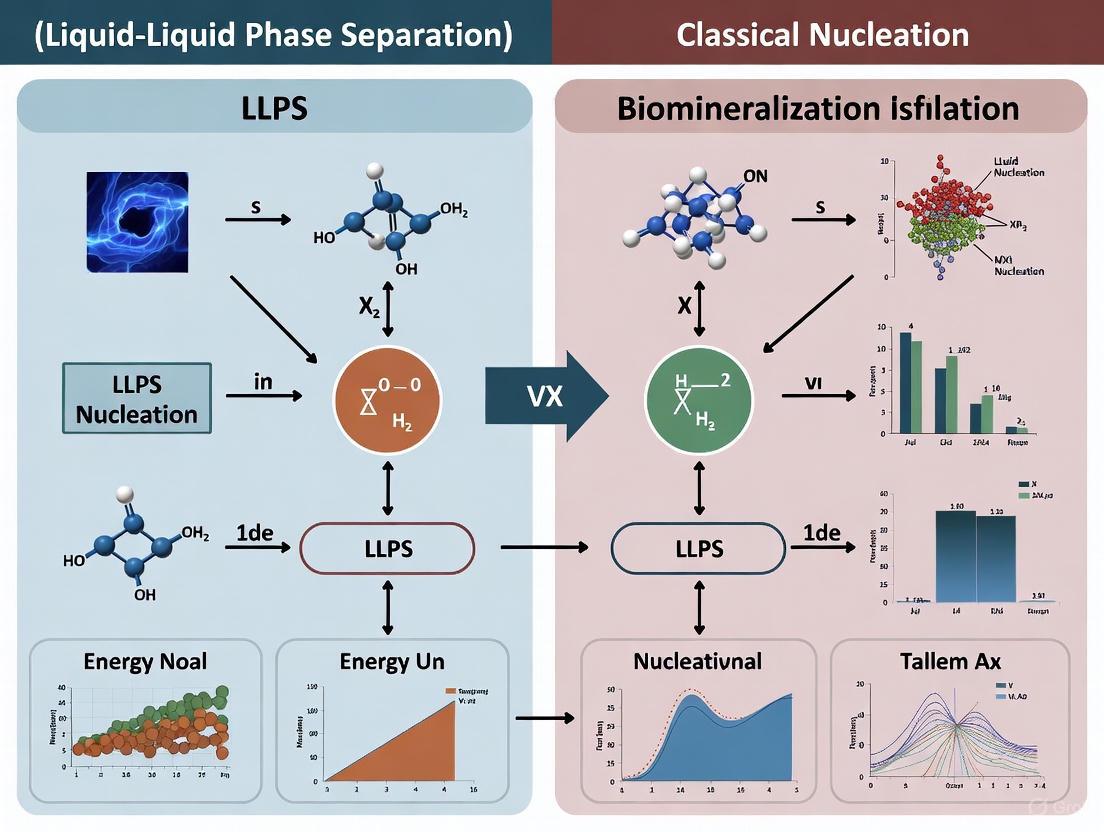
This article explores the paradigm shift from classical nucleation theory (CNT) to non-classical pathways centered on liquid-liquid phase separation (LLPS) in biomineralization.
Beyond Classical Theory: Liquid-Liquid Phase Separation as a Paradigm Shift in Biomineralization Research
Abstract
This article explores the paradigm shift from classical nucleation theory (CNT) to non-classical pathways centered on liquid-liquid phase separation (LLPS) in biomineralization. Targeting researchers and drug development professionals, it synthesizes foundational concepts, examining the limitations of CNT and the evidence for LLPS across mineral systems like calcium carbonate and phosphates. The scope extends to cutting-edge methodologies for observing these transient precursors, the significant experimental challenges in their characterization, and the application of this knowledge in designing biomimetic medical materials. By providing a comparative analysis of theoretical frameworks and validating LLPS mechanisms through recent studies, this review aims to bridge fundamental science with clinical innovation in tissue regeneration and therapeutic delivery.
From Classical Steps to Liquid Droplets: Redefining Biomineral Nucleation
The Limitations of Classical Nucleation Theory (CNT) in Biological Systems
Classical Nucleation Theory (CNT) has long provided a fundamental framework for understanding the initial stages of phase transitions, from the condensation of vapors to the crystallization of solids from solution. Its core premise is that the formation of a new phase is governed by a single energy barrier, which arises from the competition between the unfavorable surface energy of creating a new interface and the favorable bulk energy of forming the more stable phase. The critical nucleus, a cluster of a specific size, represents the top of this barrier; clusters smaller than this critical size tend to dissolve, while larger ones are likely to grow [1] [2]. This model offers an elegant, macroscopic explanation for nucleation kinetics. However, the breathtaking complexity and intricate control exhibited by biological mineralization processes (biomineralization)—such as the formation of bones, teeth, and mollusk shells—increasingly challenge the simplifying assumptions of CNT. Within the context of modern biomineralization research, a paradigm shift is occurring, moving away from a purely classical view towards one that incorporates non-classical pathways, most notably those involving liquid-liquid phase separation (LLPS) and pre-nucleation clusters (PNCs). This guide objectively compares the performance of the classical model against these non-classical alternatives, providing experimental data and methodologies that underscore the limitations of CNT in explaining the nuanced phenomena observed in living systems.
Core Limitations of CNT in Biological Environments
The application of CNT to biological systems reveals several significant shortcomings. These limitations primarily stem from CNT's macroscopic, equilibrium-based assumptions, which often break down at the molecular level and in the crowded, heterogeneous environments within organisms.
- Oversimplification of Nuclei Structure: CNT assumes that nascent nuclei are spherical, possess a uniform interior density identical to the bulk stable phase, and are separated by a sharp interface with a constant surface tension [1]. In reality, biological precursors are often non-spherical, chemically heterogeneous, and diffuse. For instance, in biomineralization, precursors like polymer-induced liquid precursors (PILPs) are liquid-like and lack a defined crystalline structure [1].
- Neglect of Stable Intermediate Species: A fundamental shortcoming of CNT is its failure to account for the existence of thermodynamically stable or metastable intermediates that precede the final crystalline phase. Research over the past two decades has conclusively shown that many minerals form through multi-step processes involving ion pairs, charged triple-ion clusters, and pre-nucleation clusters (PNCs) [3]. These PNCs, which are stable associated states of ions present before nucleation, have been observed for calcium carbonate, calcium phosphates, and iron oxides, yet they have no place in the classical model [3].
- Inability to Explain Liquid-Liquid Phase Separation (LLPS): A mounting body of evidence reveals that liquid-liquid phase separation (LLPS) plays a crucial role in the non-classical nucleation processes of many biominerals [1]. In this pathway, a homogeneous solution first separates into solute-rich and solute-poor liquid phases. The solute-rich droplets then act as precursors where nucleation can occur, a process that fundamentally differs from the single-step mechanism of CNT. These liquid intermediates can be either metastable, eventually transforming into a solid phase, or stable, remaining as a homogeneous liquid for extended periods [4]. This phenomenon is irreconcilable with CNT's direct path from solution to crystal.
- Insensitivity to Specific Molecular Interactions: CNT treats the nucleating system as a continuum, largely ignoring the specific chemical interactions—such as hydrogen bonding, electrostatic forces, and stereochemical complementarity—between organic molecules (proteins, peptides, sugars) and inorganic ions [2] [5]. In biomineralization, these interactions are not mere modifiers; they are the principal mechanisms by which organisms exert exquisite control over nucleation sites, crystal polymorphs, and ultimate mineral morphology [2].
Table 1: Core Conceptual Limitations of CNT in Biological Systems
| Limitation | CNT Assumption | Biological Reality | Key Evidence |
|---|---|---|---|
| Nuclei Structure | Spherical clusters with sharp interface and constant surface tension. | Amorphous, liquid-like, or chemically heterogeneous precursors with diffuse interfaces. | Observation of Polymer-Induced Liquid Precursors (PILPs) in calcium carbonate formation [1]. |
| Reaction Pathway | Single-step, direct formation of the stable phase. | Multi-step pathways via stable intermediates. | Identification of pre-nucleation clusters (PNCs) in calcium carbonate and phosphate systems [3]. |
| Role of Liquids | No role for liquid intermediates. | Liquid-Liquid Phase Separation (LLPS) is a common precursor. | Characterization of stable and metastable LLPS in citicoline sodium and protein systems [1] [4]. |
| Template Effects | Homogeneous or simple heterogeneous nucleation. | Complex recognition by organic matrices controls nucleation. | Proteins in bone and nacre templating nucleation via geometric and electrostatic complementarity [2] [5]. |
Quantitative Comparison: CNT vs. Non-Classical Pathways
The conceptual differences between classical and non-classical nucleation translate into distinct, measurable parameters. The following table and experimental data highlight these differences, providing a quantitative basis for comparison.
Table 2: Quantitative Comparison of Nucleation Pathways
| Parameter | Classical Nucleation Theory (CNT) | Non-Classical Pathways (LLPS & PNCs) |
|---|---|---|
| Free Energy Profile | Single activation barrier [3]. | Multi-step profile with multiple local minima and barriers [3]. |
| Critical Size Definition | A specific cluster radius (( r{crit} = -2\gamma / \Delta G\nu )) [1]. | Often a dynamic liquid droplet or a stable cluster of ions, not defined by a simple radius. |
| Dependence on Supersaturation | Nucleation rate is a sensitive function of supersaturation. | Nucleation may occur at lower effective supersaturation within dense liquid phases [1]. |
| Intermediate Species | None; only sub-critical and super-critical clusters. | Ion pairs, solvent-shared ion pairs, Charged Triple-Ion Clusters (CTICs), PNCs [3]. |
| Experimental Signature | Sigmoidal kinetics with a defined lag time [6]. | Observation of dense liquid droplets or stable clusters prior to crystal appearance [1] [4]. |
Supporting Experimental Data
Free Energy Calculations: The free energy cost of forming a spherical nucleus according to CNT is given by: [ \Delta G = \frac{4}{3}\pi r^3\rhos\Delta\mu + 4\pi r^2\gamma ] where ( \rhos ) is the solid number density, ( \Delta\mu ) is the chemical potential difference (the driving force, <0), and ( \gamma ) is the surface tension [2]. This produces a single energy barrier. In contrast, non-classical pathways inhabit a more complex free energy landscape with several valleys, representing stable intermediates like ion pairs and PNCs, separated by kinetic barriers [3].
Lag Time in Virus Capsid Assembly: CNT-based analysis of virus capsid assembly, which is treated as a nucleation-and-growth process, predicts a distinct lag time before a significant production of capsids is observed. The lag time and steady-state nucleation rate are sensitive functions of the concentration of coat proteins and the binding energy, which is itself dependent on ambient conditions like pH and ionic strength [6]. This sigmoidal kinetics is a hallmark of a nucleation-limited process, though the fixed size of capsids introduces non-universal scaling behavior that deviates from simple CNT predictions [6].
Experimental Protocols for Investigating Non-Classical Nucleation
To move beyond CNT, researchers employ a suite of advanced techniques capable of probing the early stages of nucleation and detecting metastable intermediates.
Protocol: Differentiating Stable and Metastable LLPS
Objective: To characterize and distinguish between stable and metastable Liquid-Liquid Phase Separation in a model system like citicoline sodium [4].
Sample Preparation:
- Prepare a homogeneous aqueous solution of the target molecule (e.g., citicoline sodium).
- Use two different antisolvents: one that induces stable LLPS (e.g., acetone) and another that induces metastable LLPS (e.g., ethanol).
Process Induction and Monitoring:
- Gradually add the antisolvent to the aqueous solution under controlled stirring and temperature (e.g., 30°C).
- Use Process Analytical Technologies (PAT) such as:
- Focused Beam Reflectance Measurement (FBRM): To track the chord length distribution and count particles, identifying the point of phase separation and subsequent solid formation.
- Particle Vision Measurement (PVM): To visually confirm the formation of liquid droplets and their evolution.
Phase Diagram Construction:
- For each antisolvent system, determine the binodal curve (the boundary between homogeneous solution and the LLPS region) by identifying the cloud point at various compositions.
- For the metastable system (ethanol), further identify the conditions under which the liquid droplets spontaneously transform into solid crystals.
Mechanistic Analysis:
- Molecular Dynamics (MD) Simulation: Model the solvation state of solute molecules in the presence of different antisolvents. Simulations have indicated that a solvation-enhanced state correlates with stable LLPS, while a desolvation state leads to metastable LLPS [4].
- Spectroscopy: Use Raman spectroscopy to analyze the molecular conformation and state of solute molecules within the liquid intermediates. Molecules in a metastable liquid intermediate often exhibit characteristics of a metastable state [4].
Protocol: Identifying Prenucleation Clusters (PNCs)
Objective: To detect and characterize the formation of pre-nucleation clusters in a mineral system like calcium carbonate [3].
Solution Preparation: Prepare a supersaturated solution of the mineral of interest (e.g., by mixing calcium chloride and sodium carbonate solutions) under conditions that inhibit immediate precipitation.
Probing PNCs:
- Analytical Ultracentrifugation (AUC): This technique can separate and quantify different species in solution based on their sedimentation velocity, allowing for the direct detection of PNCs that are larger than ion pairs but smaller than amorphous nanoparticles.
- Potentiometric Titration and Ion-Selective Electrodes: Monitor the free ion activity during titration. A deviation from the behavior expected for free ions indicates the presence of associated species like PNCs.
- Mass Spectrometry: In some systems, specialized mass spectrometry techniques can be used to identify the specific stoichiometry of charged clusters, such as positively charged ([Ca2CO3]^{2+}) or negatively charged ([Ca(CO3)2]^{2-}) clusters in calcium carbonate solutions [3].
- Computational Methods: Employ molecular dynamics or metadynamics simulations to model the free energy landscape of ion association, predicting the stability and structure of PNCs and other intermediates like solvent-separated and contact ion pairs [3].
Pathway Visualization: From Ions to Crystals
The following diagrams, generated using DOT language, illustrate the fundamental differences between the classical and non-classical nucleation pathways.
Classical vs. Non-Classical Nucleation Free Energy Landscape
Multi-Step Nucleation Pathway in Biomineralization
The Scientist's Toolkit: Essential Research Reagents & Materials
Successfully investigating the limitations of CNT requires specific tools and reagents designed to probe non-equilibrium and intermediate states.
Table 3: Key Research Reagent Solutions for Non-Classical Nucleation Studies
| Reagent / Material | Function in Experiment | Specific Example |
|---|---|---|
| Model Biomineralization Molecules | To study nucleation pathways under controlled, biomimetic conditions. | Citicoline sodium (for LLPS studies) [4]; Acidic amino acids (Asp, Glu) for chiral crystal control [1]. |
| Recombinant Proteins from Biominerals | To isolate the role of specific organic matrices in templating nucleation. | Recombinant nacre proteins (e.g., Pif80) for studying Ca2+-protein coacervates [1]. |
| Process Analytical Technology (PAT) | To monitor the nucleation process in real-time, tracking the appearance and evolution of intermediates. | Focused Beam Reflectance Measurement (FBRM) and Particle Vision Measurement (PVM) [4]. |
| Divalent Cations (Hofmeister Series) | To probe ion-specific effects in triggering or modulating nucleation, especially in protein crystallization. | Mg2+, Ca2+ for inducing 2D protein crystals; Zn2+, Cu2+ for studying aggregation [7]. |
| Computational Chemistry Software | To model the free energy landscape of ion association and the molecular dynamics of LLPS. | Software for Molecular Dynamics (MD) simulations to analyze solvation/desolvation states [4] [3]. |
| Antisolvents for LLPS Studies | To induce phase separation and study the stability of liquid precursors. | Acetone (for stable LLPS) and Ethanol (for metastable LLPS) in citicoline sodium systems [4]. |
Liquid-Liquid Phase Separation (LLPS) has emerged as a crucial physicochemical process that challenges long-held classical views of nucleation, particularly in the field of biomineralization. This ubiquitous non-classical pathway enables the formation of complex, hierarchical mineral structures found in biological systems—from mollusk shells to vertebrate bones—through mechanisms that defy traditional crystallization models [1] [8]. LLPS describes the phenomenon where a homogeneous solution spontaneously separates into two distinct liquid phases with different compositions and properties: a dense, solute-rich phase and a dilute, solute-poor phase [9]. Within biomineralization research, this process facilitates the creation of membrane-less compartments that concentrate mineral precursors and organic molecules, providing a controlled environment for the nucleation and growth of biominerals with exceptional precision and organization [10].
The significance of LLPS extends across multiple disciplines, representing a paradigm shift in our understanding of how living organisms orchestrate mineral formation. While classical nucleation theory (CNT) has long served as the fundamental framework for explaining crystal formation, a growing body of evidence reveals its limitations in accounting for the complex, biologically-controlled mineralization processes observed in nature [1] [8]. The non-classical pathway involving LLPS offers a more comprehensive explanation for how organisms achieve precise spatial and temporal control over mineral deposition, enabling the creation of sophisticated structural materials with remarkable mechanical properties that often surpass their synthetic counterparts [11].
Theoretical Framework: Classical Versus Non-Classical Nucleation
Limitations of Classical Nucleation Theory
Classical Nucleation Theory (CNT) has traditionally dominated the understanding of crystal formation from solution. According to CNT, nucleation occurs through stochastic fluctuations where dissolved ions or molecules assemble into spherical clusters, with the system needing to overcome a defined free-energy barrier [1] [8]. This energy barrier, described by the equation ΔGcrit = (16πγp³)/(3ΔGν²), where γp represents interface energy and ΔG_ν represents bulk energy, determines the critical nucleus size that must be reached for a crystal to become stable and continue growing [1]. CNT simplifies nucleation into two categories: homogeneous (occurring spontaneously in solution) and heterogeneous (occurring on foreign surfaces that lower the energy barrier) [1].
However, the rapid development of experimental techniques has revealed numerous shortcomings of CNT, particularly in explaining biomineralization processes. The theory's oversimplified assumptions—including uniform interior densities of nuclei, ignorance of curvature dependence on surface tension, and neglect of collisions between pre-existing clusters—limit its applicability to complex biological systems [1] [8]. Mounting experimental evidence shows that CNT-predicted nucleation processes often do not align with observed results in biomineralization, creating a critical knowledge gap in understanding how organisms control crystal formation with such remarkable precision [1].
LLPS as a Non-Classical Nucleation Pathway
The non-classical nucleation theory introduces a fundamentally different pathway where crystal formation proceeds through metastable precursor phases rather than direct assembly of ions into crystalline lattices [1] [8]. In this framework, LLPS serves as a crucial intermediate step, creating a solute-rich liquid phase that concentrates mineral precursors and significantly reduces nucleation energy barriers compared to classical pathways [1]. This mechanism enables organisms to exert sophisticated control over mineral formation through organic molecules that guide and regulate the phase separation process [10].
The thermodynamic advantage of LLPS-driven nucleation lies in its two-step energy landscape. Instead of overcoming the large single energy barrier described by CNT (ΔGcrit), the system first surmounts a much smaller barrier (ΔG1) to form dense liquid droplets via LLPS, then overcomes a second reduced barrier (ΔG_2) for nucleation within these concentrated environments [1] [8]. This sequential pathway dramatically increases nucleation rates compared to single-step classical nucleation, explaining the efficiency and precision of biological mineralization processes [1].
Table 1: Key Differences Between Classical and Non-Classical Nucleation Pathways
| Feature | Classical Nucleation Theory | LLPS-Based Non-Classical Nucleation |
|---|---|---|
| Fundamental Process | Single-step assembly from solution | Multi-step process through metastable precursors |
| Energy Barrier | Single large barrier (ΔG_crit) | Two smaller sequential barriers (ΔG1, ΔG2) |
| Nucleation Site | Throughout solution or on foreign surfaces | Within dense liquid droplets |
| Role of Polymers | Minor influence on energy barriers | Essential drivers of liquid phase formation |
| Structural Control | Limited to crystal modification | Precise morphological control through confinement |
| Precursor Species | Ions and ion clusters | Prenucleation clusters, amorphous nanoparticles |
Molecular Mechanisms and Key Players in LLPS
Intrinsically Disordered Proteins as Critical Scaffolds
Intrinsically disordered proteins (IDPs) serve as fundamental molecular drivers of LLPS in biomineralization systems. Unlike structured proteins with fixed three-dimensional configurations, IDPs lack stable secondary or tertiary structures and contain low-complexity domains (LCDs) with repetitive sequence elements that facilitate multivalent interactions [12] [10]. These proteins possess flexible regions enriched in specific amino acid residues—particularly aromatic (tyrosine, tryptophan) and hydrophobic (leucine, methionine) residues—that enable weak, transient interactions necessary for phase separation [12]. The multivalency of IDPs, characterized by multiple interacting domains or motifs, allows them to form complex interaction networks that exceed a critical threshold for phase separation [10].
The functional significance of IDPs in biomineralization is exemplified by their presence in various mineralizing systems. For instance, the matrix protein pif80 in molluscan nacre forms Ca²⁺-pif80 coacervates through LLPS, stabilizing and regulating the release of polymer-induced liquid precursor (PILP)-like amorphous calcium carbonate granules in intracellular vesicles [1] [8]. Similarly, IDPs are abundant components of otoliths (inner ear minerals) and other calcium carbonate biominerals, where they influence crystal morphology and nucleation pathways [10]. The structural flexibility of IDPs allows them to interact with numerous partners, including ions, nucleic acids, and other proteins, making them ideal regulators of complex processes like biomineralization [10].
The Role of Ions and Polymers in Modulating LLPS
Divalent cations, particularly calcium ions (Ca²⁺), play crucial roles in modulating LLPS processes in biomineralization. Recent research has revealed that divalent cations can directly influence protein phase behavior by affecting conformational states and promoting transient intermolecular cross-links [10]. For example, zinc ions strongly enhance the propensity of tau protein to undergo LLPS by lowering its critical concentration threshold, while calcium ions control the phase behavior of EF-hand domain protein 2 (EFhd2) and its interaction with tau [10]. In biomineralization systems, calcium ions interact with acidic polymers and IDPs to form complexes that undergo LLPS, creating environments conducive to mineral formation [1] [10].
Acidic polymers represent another critical component of LLPS-driven biomineralization. These polymers, often rich in aspartic acid or glutamic acid residues, interact with calcium ions through their negatively charged side chains, facilitating the formation of polymer-induced liquid precursors (PILPs) [1]. The PILP process, first identified by Gower et al., has revolutionized understanding of how organisms control crystal morphologies that deviate dramatically from equilibrium shapes [10]. These polymers not only initiate LLPS but also stabilize amorphous mineral precursors against uncontrolled crystallization, enabling their transport and deposition in specific locations before transitioning to crystalline phases [1] [10].
Diagram 1: Molecular drivers and processes in LLPS-mediated biomineralization. Intrinsically disordered proteins (IDPs), polymers, calcium ions, and RNA participate in multivalent interactions that drive liquid-liquid phase separation, resulting in dense phases that concentrate precursors and provide confined environments for controlled crystallization.
Experimental Approaches for LLPS Investigation
Advanced Techniques for Detecting and Characterizing LLPS
Fluorescence Recovery After Photobleaching (FRAP) has served as a cornerstone technique for demonstrating the liquid-like properties of biomolecular condensates. This method involves photobleaching fluorescently labeled molecules within a defined region and monitoring the recovery of fluorescence due to the exchange of molecules between the bleached area and its surroundings [13]. While classical full-FRAP and partial-FRAP experiments provide information about dynamics, they cannot reliably distinguish LLPS from alternative mechanisms like interactions with clustered binding sites (ICBS) [14]. However, the development of half-FRAP experiments, where precisely half of a condensate is bleached, enables researchers to detect preferential internal mixing—a hallmark of LLPS [14]. In these experiments, the characteristic signature of LLPS appears as an increase in fluorescence in the bleached half coupled with a simultaneous decrease in the non-bleached half, indicating rapid internal rearrangement without extensive exchange across the phase boundary [14].
The emerging MOCHA-FRAP (Model-free calibrated half-FRAP) workflow represents a significant advancement in quantifying LLPS properties in living cells. This approach probes the strength of the interfacial barrier at condensate boundaries, which is responsible for preferential internal mixing [14]. MOCHA-FRAP has been applied to study components of various cellular structures, including heterochromatin foci, nucleoli, stress granules, and nuage granules, revealing that the strength of the interfacial barrier increases progressively across these systems [14]. Another innovative methodology, LLPS REDIFINE (REstricted DIFfusion of INvisible speciEs), offers a label-free, non-invasive approach to characterize biomolecular condensates using diffusion NMR measurements [15]. This technique exploits exchange dynamics between molecules in condensed and dispersed phases to determine diffusion constants, phase fractions, droplet radii, and exchange rates without requiring fluorescent tags that might alter protein behavior [15].
Practical Workflow for LLPS Experiments
A robust experimental workflow for investigating LLPS in biomineralization contexts involves multiple complementary approaches. The initial phase typically involves in vitro reconstitution using purified components (proteins, polymers, ions) to establish baseline phase separation behavior under controlled conditions [14]. This is followed by live-cell imaging to verify that observed phenomena occur in physiological contexts, utilizing techniques like half-FRAP to distinguish true LLPS from other clustering mechanisms [14]. For biomineralization systems, the critical step involves demonstrating functional consequences—showing that LLPS directly facilitates or controls mineral nucleation and growth, rather than representing an incidental byproduct [1] [10].
Table 2: Key Experimental Methods for LLPS Characterization
| Method | Key Measured Parameters | Applications in Biomineralization | Advantages | Limitations |
|---|---|---|---|---|
| Half-FRAP/MOCHA-FRAP | Internal mixing dynamics, interfacial barrier strength | Testing if mineral precursors form liquid droplets | Distinguishes LLPS from binding artifacts | Requires fluorescent labeling |
| LLPS REDIFINE | Diffusion constants, droplet size, exchange rates | Characterizing precursor droplets without labels | Label-free, non-invasive | Limited to in vitro applications |
| 1,6-Hexanediol Treatment | Sensitivity of structures to aliphatic alcohol | Probing interaction types in mineral precursors | Simple implementation | Does not distinguish LLPS from ICBS |
| In Vitro Reconstitution | Phase diagrams, concentration thresholds | Establishing minimal components for mineralization | Controlled reductionist approach | May oversimplify complex systems |
Diagram 2: Experimental approaches for LLPS investigation. Different methodologies including FRAP, REDIFINE, and hexanediol treatment provide complementary data on dynamics, physical properties, and interaction types, enabling researchers to distinguish true LLPS from alternative mechanisms in biomineralization systems.
The Scientist's Toolkit: Essential Research Reagents and Materials
Table 3: Key Research Reagent Solutions for LLPS Experiments
| Reagent/Material | Function in LLPS Research | Example Applications | Considerations |
|---|---|---|---|
| Intrinsically Disordered Proteins (IDPs) | Scaffold molecules that drive phase separation | pif80 for nacre formation, otolith matrix proteins | Require recombinant expression and purification |
| Acidic Polymers | Induce polymer-induced liquid precursors (PILP) | Polyaspartate, polyglutamate for calcium carbonate mineralization | Length and charge density affect efficacy |
| Fluorescent Tags (GFP, YFP) | Enable visualization and FRAP experiments | Live-cell imaging of mineral precursor dynamics | May alter native protein behavior |
| 1,6-Hexanediol | Probe hydrophobic interactions in condensates | Testing sensitivity of mineral precursors | Does not distinguish LLPS from ICBS |
| Agarose Hydrogel | Stabilize droplets for prolonged observation | NMR studies of LLPS dynamics | Creates artificial environment |
| Divalent Cations | Modulate protein phase behavior | Calcium for carbonate/phosphate mineralization | Concentration critically affects phase boundaries |
Implications and Future Perspectives in Biomineralization Research
The recognition of LLPS as a fundamental process in biomineralization has transformative implications for both basic science and applied materials engineering. From a biological perspective, it provides a mechanistic framework for understanding how organisms create complex mineralized tissues with precise hierarchical organization—addressing long-standing questions about the formation of mollusk nacre, bone microstructure, and otolith patterning [1] [10] [8]. The LLPS paradigm explains how biological systems overcome nucleation barriers at near-neutral pH and low supersaturations where classical pathways would be inefficient or impossible [1].
In biomedical engineering, understanding LLPS mechanisms opens new avenues for designing innovative biomaterials. The principles of LLPS-driven mineralization are already inspiring developments in bone tissue engineering, tooth remineralization strategies, and biotemplated nanocarriers for targeted drug delivery [11]. By harnessing the capacity of LLPS to create highly organized structures from nanoscale to macroscale, researchers can develop materials with enhanced mechanical properties, biocompatibility, and functional integration [11]. Furthermore, the connection between dysregulated LLPS and pathological mineralization processes—such as gallstone formation and certain types of kidney stones—suggests potential therapeutic interventions that target phase separation mechanisms [1] [8].
Looking forward, several emerging technological vectors promise to advance our understanding and application of LLPS in biomineralization. These include superhydrophilic/hydrophobic interfacial engineering for controlling mineralization sites, hybrid composite systems that combine organic and inorganic components, and AI-optimized mineralization architectures [11]. The integration of advanced characterization techniques like REDIFINE with computational modeling and synthetic biology approaches will likely uncover deeper principles governing LLPS-mediated biomineralization, enabling unprecedented control over material synthesis and organization [11] [15]. As these multidisciplinary efforts converge, they will further establish LLPS as not merely an alternative pathway, but as a fundamental organizational principle bridging the living and mineral worlds.
The study of biomineralization has undergone a fundamental paradigm shift with the recognition of non-classical nucleation pathways, challenging the long-established Classical Nucleation Theory (CNT). Within this new framework, calcium carbonate (CaCO₃) has emerged as the seminal model system for understanding liquid-liquid phase separation (LLPS), a process now regarded as critical in the formation of structured biominerals, from mollusk shells to sea urchin spines [1] [16] [17]. CNT, which posits a direct, single-step transformation from ions in solution to a stable crystalline solid, has proven insufficient to explain the complex, highly organized architectures of biological minerals [1]. The discovery that calcium carbonate crystallization frequently proceeds through a transient, dense liquid precursor has provided a powerful alternative explanation for how organisms exert exquisite control over mineral formation [16] [18].
This guide objectively compares the classical and non-classical nucleation pathways, using calcium carbonate as the primary reference point. We synthesize current experimental evidence, detail key methodologies, and present quantitative data that have established CaCO₃ as the foundational model for LLPS in mineral systems. Understanding this pathway is not merely of academic interest; it provides a blueprint for biomimetic materials synthesis and has implications for fields ranging from carbon sequestration to pharmaceutical development [18].
Classical vs. Non-Classical Nucleation: A Fundamental Comparison
The divergence between classical and non-classical nucleation represents a fundamental difference in understanding how the first crystalline solids emerge from solution.
The Classical Nucleation Theory (CNT) Framework
Classical Nucleation Theory describes nucleation as a process driven by stochastic fluctuations where individual ions or molecules associate to form a critical nucleus. The global free energy (ΔG) of this nucleus is expressed as ΔG = 4/3πr³ΔGᵥ + 4πr²γ, where the bulk energy (ΔGᵥ) acts as the driving force, and the interface energy (γ) represents the resistance to nucleation [1]. The theory assumes that nuclei are dense, with uniform internal properties and a sharp interface with the solution. While CNT effectively describes many homogeneous and heterogeneous nucleation processes in simple systems, a growing body of evidence, particularly from biomineralizing systems, shows that its oversimplified model often fails to match experimental observations [1] [19].
The Non-Classical Nucleation Framework and the Centrality of LLPS
Non-classical nucleation theory proposes a multi-step pathway where a metastable precursor phase appears before the formation of crystalline nuclei [1]. For calcium carbonate, this pathway is often initiated by LLPS, a physicochemical process where a well-mixed solution separates into a solute-rich, dense liquid phase and a solute-poor, dilute phase [1] [12]. This dense liquid phase (DLP) is a metastable precursor that can significantly reduce the nucleation free-energy barrier compared to the direct path described by CNT [1]. The subsequent steps typically involve the stabilization of this DLP into amorphous calcium carbonate (ACC), which then undergoes dehydration and final crystallization into one of the polymorphic forms of CaCO₃ (calcite, vaterite, or aragonite) [20] [18]. This mechanism, governed by stable prenucleation clusters (PNCs) rather than stochastic fluctuations, provides a more accurate description of the complex nucleation processes observed in nature and the laboratory [20].
Table 1: Core Principles of Classical vs. Non-Classical Nucleation in Calcium Carbonate Systems
| Feature | Classical Nucleation Theory (CNT) | Non-Classical Nucleation (via LLPS) |
|---|---|---|
| Fundamental Pathway | Single-step: Ions → Critical Nucleus → Crystal [1] | Multi-step: Ions → PNCs → Dense Liquid Phase (LLPS) → ACC → Crystal [1] [20] [18] |
| Nucleation Precursor | Metastable ion association (critical nucleus) [1] | Stable Prenucleation Clusters (PNCs) that undergo liquid-liquid demixing [20] |
| Governing Energetics | Overcome a single, high free-energy barrier (ΔG_crit) [1] |
Overcome a lower initial barrier (ΔG_1) to a metastable liquid state [1] |
| Key Intermediate | None | Polymer-Induced Liquid Precursor (PILP) or additive-free Dense Liquid Phase (DLP) [1] [16] [18] |
| Role of Polymers/Additives | May act as heterogeneous nucleation sites [1] | Can participate in and stabilize the LLPS process [1] [16] |
| Explanatory Power for Biominerals | Limited for complex biological structures [1] | High; explains fine-grained control and intricate morphologies [1] [17] |
Experimental Evidence and Methodologies for Studying LLPS in CaCO₃
The establishment of CaCO₃'s LLPS pathway rests on a body of evidence gathered through diverse and complementary experimental techniques.
Key Experimental Protocols
Researchers have developed several standard methods to induce and study calcium carbonate precipitation, allowing for control over parameters like supersaturation and pH.
- The Ammonia Diffusion Technique: Surfaces or solutions of CaCl₂ are exposed to vapors from decomposing ammonium carbonate ((NH₄)₂CO₃) in a closed environment. This method slowly releases CO₂, maintaining a constant pH and allowing for gradual nucleation and growth, which is ideal for observing intermediate phases [19] [16].
- Direct Mixing Method: Solutions of calcium chloride and sodium (bi)carbonate are mixed directly. This method allows for precise control over initial concentrations, injection speed, and pH (via titration), making it suitable for kinetic studies and techniques like stopped-flow spectroscopy [20] [16].
- Kitano Method: Crystallization is induced from a saturated calcium bicarbonate solution through the slow evaporation of water or a decrease in CO₂ partial pressure. This method can mimic certain geologically and biologically relevant conditions [16].
Core Analytical Techniques and Findings
A multi-pronged analytical approach is crucial for identifying and characterizing the transient liquid precursors.
- Cryogenic Transmission Electron Microscopy (Cryo-TEM): By rapidly freezing samples, this technique preserves transient liquid states. Cryo-TEM has consistently revealed emulsion-like, liquid-like structures in reactive mixtures prior to crystallization, providing direct visual evidence for a liquid precursor phase [16].
- Liquid-Phase TEM (LP-TEM): This allows for the direct observation of dynamic processes in solution. LP-TEM has been used to visualize the coalescence of calcium carbonate droplets, a key behavior confirming their liquid character [16].
- In Situ Spectroscopy:
- Attenuated Total Reflectance Fourier-Transform Infrared (ATR-FTIR) Spectroscopy: Monitors chemical changes in real-time, such as the evolution of carbonate vibrational bands, tracking the transition from the dense liquid to ACC and finally to crystals [20] [18].
- Nuclear Magnetic Resonance (NMR) Spectroscopy: Used to study ion association and diffusion dynamics within prenucleation clusters and the dense liquid phase, providing insight into the molecular-scale interactions that drive LLPS [16] [18].
- Potentiometric Titration and Ion-Selective Electrodes: These methods track the concentration of free calcium ions during crystallization. The changes in ion activity products help define the liquid-liquid binodal and spinodal limits, which are the boundaries of the metastable and unstable zones in the phase diagram, respectively [20] [19].
Table 2: Key Experimental Evidence for LLPS in Calcium Carbonate Nucleation
| Experimental Technique | Key Observation | Interpretation & Significance |
|---|---|---|
| Cryo-TEM & LP-TEM | "Liquid-like" or "emulsion-like" structures; droplet coalescence [16] | Direct visualization of a dense liquid precursor phase prior to solidification. |
| Potentiometric Titration | Variable solubility of Amorphous Calcium Carbonate (ACC) depending on mixing rate [20] | ACC forms by dehydration of a liquid precursor; its solubility is defined by the liquid-liquid spinodal and binodal limits. |
| Stopped-Flow ATR-FTIR | Minimum kinetics time constant at a specific Ion Activity Product (IAP) [20] | Identifies the liquid-liquid spinodal limit, where the phase separation barrier vanishes and kinetics are fastest. |
| Scattering & Microscopy | Solid deposits with "liquid-like" morphologies (e.g., droplets arrested during coalescence) [16] | Suggests that solidification occurred from a liquid intermediate. |
| In Situ TEM & Spectroscopy | Observation of a hydrated bicarbonate DLP transforming into hollow, then solid, ACC particles [18] | Elucidates the chemical evolution and solidification pathway of the dense liquid phase. |
Visualization of the Non-Classical Nucleation Pathway
The following diagram synthesizes the experimental data into a coherent non-classical nucleation pathway for calcium carbonate, highlighting the role of LLPS.
Non-classical nucleation pathway of calcium carbonate, from ions to crystals, driven by LLPS. PILP: Polymer-Induced Liquid Precursor.
The Scientist's Toolkit: Essential Reagents and Materials
Research into the LLPS pathway of calcium carbonate relies on a specific set of chemical reagents and materials to replicate and study the process.
Table 3: Key Research Reagent Solutions for Calcium Carbonate LLPS Studies
| Reagent / Material | Typical Function in Experiment | Example & Notes |
|---|---|---|
| Calcium Source | Provides Ca²⁺ ions for reaction with carbonate. | Calcium chloride (CaCl₂); concentration controls supersaturation [19] [16]. |
| Carbonate Source | Provides CO₃²⁻ ions, often through controlled release. | Ammonium carbonate ((NH₄)₂CO₃) [19], Sodium carbonate (Na₂CO₃) [16], or Dimethyl carbonate [16]. |
| Acidic Polymers / Additives | To study and stabilize the Polymer-Induced Liquid Precursor (PILP) phase. | Poly(acrylic acid) [1] [16]; mimics acidic proteins in biomineralization, extending DLP lifetime [18]. |
| Functionalized Surfaces | To study heterogeneous nucleation and surface-directed crystallization. | Self-Assembled Monolayers (SAMs) with –COOH, –OH, –NH₂ termini [19]; different surfaces promote specific polymorphs and nucleation mechanisms. |
| Mineral Substrates | To investigate promotion of ikaite or anhydrous CaCO₃ nucleation. | Quartz or mica sheets; can significantly promote ikaite formation at low temperatures [21]. |
| Buffers & pH Modulators | To control solution pH, a critical parameter for PNC stability and polymorph selection. | Sodium hydroxide (NaOH) or hydrochloric acid (HCl) for titration [20] [16]; pH influences proto-ACC structure (e.g., proto-calcite vs. proto-vaterite) [20]. |
Calcium carbonate stands as the seminal and most comprehensively studied model for liquid-liquid phase separation in mineral systems. The extensive body of experimental evidence, derived from a suite of advanced in situ and ex situ techniques, firmly establishes a multi-step nucleation pathway via a dense liquid precursor. This non-classical pathway, which contrasts fundamentally with the direct route of Classical Nucleation Theory, provides a powerful explanatory framework for the controlled and intricate biomineralization processes observed in nature. The quantitative data, methodologies, and reagents detailed in this guide provide a foundation for researchers to further explore LLPS, not only in calcium carbonate but also in other mineral systems of biological, geological, and industrial importance.
The understanding of biomineralization has undergone a significant paradigm shift, moving beyond the limitations of Classical Nucleation Theory (CNT) toward the recognition of non-classical, multi-step pathways. Within this new framework, Liquid-Liquid Phase Separation (LLPS) has emerged as a critical intermediate step, representing a physicochemical process where a well-mixed fluid separates into distinct, dense liquid precursor droplets and a dilute continuous phase [16] [8]. While extensively documented in organic and proteinaceous systems, the role of LLPS in inorganic mineral systems presents unique experimental challenges due to accelerated crystallization kinetics, often reducing the observable lifetime of precursors to milliseconds or seconds [16]. This review synthesizes the expanding inventory of mineral systems exhibiting LLPS behavior, focusing on oxalates, phosphates, and metallic nanoparticles, and provides a comparative analysis of the experimental evidence, methodologies, and confidence levels supporting these findings.
Comparative Evidence for LLPS Across Mineral Systems
The following table summarizes the current evidence and confidence levels for LLPS occurrence across diverse mineral systems, based on a critical analysis of the literature.
Table 1: Evidence and Confidence for LLPS in Various Mineral Systems
| Mineral System | Supporting Experimental Techniques | Key Observations | Reported Confidence |
|---|---|---|---|
| Calcium Carbonate (without additives) | Cryo-TEM, SEM, Liquid-Phase TEM, NMR, Molecular Dynamics [16] | Liquid-like morphologies, droplet coalescence, diffusion dynamics, "emulsion-like" structures [16] | Very High [16] |
| Cerium Oxalate | Cryo-TEM, SEM, Liquid-Phase TEM [16] | Liquid-like morphologies in bulk/porous matrices, observed droplet coalescence [16] | Very High [16] |
| Metallic Nanoparticles | Cryo-TEM, AFM, Liquid-Phase TEM [16] | Liquid-like morphologies, soft droplets on substrates, liquid-like dynamics [16] | Very High [16] |
| Calcium Phosphates (Apatite) | Cryo-TEM, SEM, Liquid-Phase TEM [16] | Liquid-like morphology, dense liquid observed via LP-TEM; amorphous precursors infiltrate collagen [16] [22] | Supportive [16] |
| Barium Sulfate | TEM (after ethanol quenching) [16] | Liquid-like morphologies in static images post-quenching [16] | Suggestive [16] |
| Sulfur Hydrosols | Macroscopic emulsion behavior [16] | Thermal behavior of an emulsion [16] | Suggestive [16] |
Detailed Experimental Protocols for Key Systems
Cerium Oxalate LLPS Protocol
- Objective: To observe and characterize liquid-liquid phase separation preceding crystallization in the cerium oxalate system.
- Materials: Aqueous solutions of cerium(III) chloride (CeCl₃) and sodium oxalate (Na₂C₂O₄).
- Methodology:
- Rapid Mixing: Solutions of CeCl₃ and Na₂C₂O₄ are rapidly mixed to achieve supersaturation.
- Cryo-Fixation: At specific time intervals (e.g., seconds post-mixing), a small aliquot of the reaction mixture is vitrified by plunging into a cryogen (e.g., liquid ethane) to freeze the transient structures.
- Cryo-Transmission Electron Microscopy (Cryo-TEM): The vitrified sample is transferred to a cryo-TEM under liquid nitrogen conditions. This allows for direct imaging of the liquid droplets formed via LLPS without crystallization artifacts from drying.
- Liquid-Phase TEM (LP-TEM): A microfluidic chamber is used to contain the reaction solution within the TEM. The process is observed in real-time, where direct visualization of droplet coalescence provides definitive evidence of liquid character [16].
- Key Data: Cryo-TEM images show spherical, liquid-like droplets. LP-TEM videos capture dynamic events where two droplets contact and merge into a single, larger droplet, confirming their fluid nature [16].
Calcium Phosphate / Apatite LLPS Protocol
- Objective: To investigate the formation of amorphous liquid precursors and their role in the crystallization of apatite, particularly within a collagen matrix.
- Materials: Calcium and phosphate-containing solutions (e.g., CaCl₂ and Na₂HPO₄), often with polymeric additives or non-collagenous proteins (NCPs) like poly-aspartic acid.
- Methodology:
- Precursor Formation: Solutions are mixed under conditions that favor the formation of an amorphous calcium phosphate (ACP) precursor.
- Stabilization: Polyelectrolytes such as negatively charged NCPs act to stabilize the highly hydrated, fluid ACP phase, preventing immediate crystallization [22].
- Infiltration: The fluidic ACP precursor phase infiltrates the nanoscopic gaps and grooves of collagen fibrils, drawn in by capillary action [22].
- Crystallization: Within the confined space of the collagen fibrils, the ACP dehydrates and crystallizes into oriented hydroxyapatite (HAP) platelets, mimicking the natural bone formation process [22].
- Characterization: LP-TEM can be used to observe the dense liquid phase early in the process. Subsequent analysis by SEM and TEM reveals the final mineralized composite structure [16] [22].
- Key Data: LP-TEM may show dense liquid droplets. The final composite material shows HAP crystals embedded within and aligned with the collagen fibrils, supporting the "amorphous precursor pathway" mediated by a liquid-like phase [16] [22].
Visualization of LLPS Experimental Workflows
The following diagram illustrates the general experimental workflow for studying LLPS in mineral systems, highlighting the two primary microscopy approaches.
Diagram 1: Experimental Workflow for LLPS Characterization. This diagram outlines the two primary pathways for characterizing mineral LLPS: cryo-TEM for high-resolution snapshots of frozen droplets, and liquid-phase TEM for direct, real-time observation of dynamic behavior like coalescence.
The Scientist's Toolkit: Key Research Reagent Solutions
Table 2: Essential Reagents and Techniques for LLPS Mineralization Research
| Tool / Reagent | Function / Application in LLPS Research |
|---|---|
| Cryo-Transmission Electron Microscopy (Cryo-TEM) | Provides high-resolution, static images of liquid precursors by instantaneously freezing the solution, preserving native-state morphology [16]. |
| Liquid-Phase TEM (LP-TEM) | Enables real-time, in-situ observation of nucleation dynamics, including droplet formation, growth, and coalescence, directly confirming liquid character [16]. |
| Acidic Polymers (e.g., Poly-Aspartic Acid) | Induce and stabilize polymer-induced liquid precursors (PILPs), particularly in calcium carbonate and phosphate systems, mimicking biological control [16] [8]. |
| Non-Collagenous Proteins (NCPs) | Act as biomimetic regulators in phosphate systems; their negative charges stabilize amorphous precursors and guide infiltration into collagen scaffolds [22]. |
| Cryo-Focused Ion Beam SEM (Cryo-FIB-SEM) | Used to prepare thin lamellae from specific cellular or synthetic regions for cryo-electron tomography, allowing structural analysis in a near-native state [23]. |
| Nuclear Magnetic Resonance (NMR) Spectroscopy | Used to probe ion pairing and diffusion dynamics within pre-nucleation clusters and liquid precursors, providing insights into composition and behavior [16]. |
The inventory of mineral systems exhibiting LLPS is unequivocally expanding, with very high confidence now assigned to systems beyond the canonical calcium carbonate, including cerium oxalate and metallic nanoparticles. The study of LLPS is facilitated by a powerful suite of characterization techniques, with cryo-TEM and liquid-phase TEM being particularly definitive. The evidence supporting a role for liquid precursors in calcium phosphate mineralization is increasingly supportive, linking this non-classical pathway directly to the formation of biological apatite in bone. This growing body of work solidifies LLPS as a fundamental mechanism in non-classical nucleation, offering profound implications for the rational design of advanced materials and providing a new lens through which to understand both physiological and pathological mineralization processes.
Biomineralization, the process by which living organisms form minerals, has long been a subject of intense scientific interest. Traditional understanding of crystal formation was governed by classical nucleation theory (CNT), which posits that ions in solution directly assemble into a critical nucleus that then grows into a crystal through the sequential addition of monomers [8]. However, a paradigm shift has occurred with the recognition that many biomineralization processes follow non-classical pathways involving transient precursor phases [8]. This review examines the transformative role of organic molecules—from synthetic polymer additives to biological intrinsically disordered proteins (IDPs)—in directing these pathways through the phenomenon of liquid-liquid phase separation (LLPS).
The limitations of CNT have become increasingly apparent. As Deniz Erdemir and colleagues noted, CNT suffers from oversimplifications including the assumption that nuclei have uniform interior densities, ignorance of curvature dependence of surface tension, and neglect of collisions between pre-existing clusters [8]. In contrast, non-classical nucleation involves the formation of metastable precursor phases before the appearance of crystal nuclei [8]. LLPS has emerged as a crucial mechanism in this process, enabling the creation of highly organized biominerals with exceptional mechanical properties and biological functions [11] [10].
This review systematically compares how different classes of organic molecules influence biomineralization through LLPS, providing researchers with experimental frameworks and mechanistic insights to advance materials science and biomedical applications.
Fundamental Mechanisms: LLPS vs. Classical Nucleation
Theoretical Frameworks
The fundamental distinction between classical and non-classical nucleation pathways lies in their mechanisms and intermediate states. Classical nucleation theory describes a single-step process where ions or molecules in solution spontaneously form stable crystalline nuclei when a critical size is reached, overcoming a single energy barrier [8]. The free energy of nucleation (ΔG) in CNT is expressed as:
[ \Delta G = \frac{4}{3}\pi r^3\Delta G_v + 4\pi r^2\gamma ]
where (r) is the nucleus radius, (\Delta G_v) is the volume free energy change, and (\gamma) is the surface energy [8].
In contrast, non-classical nucleation via LLPS involves multiple steps with distinct energy landscapes. A homogeneous solution first separates into solute-rich and solute-poor liquid phases, creating a microenvironment where nucleation occurs with a reduced energy barrier [8]. This process frequently involves pre-nucleation clusters (PNCs) and amorphous precursors that subsequently transform into crystalline phases [11] [8].
Visualization of Nucleation Pathways
The following diagram illustrates the key differences between classical and non-classical nucleation pathways in biomineralization:
Polymer Additives in LLPS-Mediated Biomineralization
Polymer-Induced Liquid Precursors (PILP)
The polymer-induced liquid precursor (PILP) system, first introduced by Gower and colleagues, represents a foundational discovery in non-classical biomineralization [10] [8]. This process involves anionic polymers such as polyaspartic acid or polyacrylic acid that induce the separation of a liquid-phase mineral precursor from solution [8]. The PILP system demonstrates how simple organic polymers can mimic complex biological control over mineral formation.
The mechanism involves electrostatic interactions between negatively charged carboxylate groups on the polymer and positively charged calcium ions, leading to the formation of a dense, liquid-phase precursor that can be molded into non-equilibrium shapes before solidification [8]. This process enables the creation of complex morphologies that would be inaccessible through classical crystallization pathways.
Experimental Protocols for Polymer-Mediated LLPS
Table 1: Experimental Systems for Studying Polymer-Induced LLPS
| Mineral System | Polymer Additives | Experimental Conditions | Characterization Techniques | Key Findings | References |
|---|---|---|---|---|---|
| Calcium carbonate | Polyaspartic acid, polyacrylic acid | Ammonia diffusion, direct mixing, Kitano method | SEM, cryo-TEM, AFM, NMR | Liquid-like droplets that coalesce and solidify into complex morphologies | [8] [16] |
| Calcium phosphate | Polyglutamic acid, phosphoproteins | Simulated body fluid, physiological pH | SEM, TEM, LP-TEM | Formation of polymer-stabilized amorphous precursors | [16] |
| Cerium oxalate | Not specified | Porous matrices, bulk solution | SEM, cryo-TEM, LP-TEM | Liquid-like morphologies with demonstrated droplet coalescence | [16] |
Standard protocol for observing polymer-induced LLPS in calcium carbonate:
- Solution Preparation: Prepare 5-20 mM calcium chloride solution and an equivalent concentration of sodium carbonate/bicarbonate solution. Add polyaspartic acid (MW 5-30 kDa) to the calcium solution at concentrations ranging from 0.01-1 mg/mL [16].
- Mixing Method: Combine solutions using either (a) direct mixing with rapid pipetting, (b) ammonia diffusion technique, or (c) Kitano method (slow evaporation from calcium bicarbonate solution) [16].
- Time-Resolved Observation: Monitor immediately after mixing using light microscopy for droplet formation. For electron microscopy, apply rapid freezing (cryo-TEM) or sample at timed intervals [16].
- Characterization: Analyze droplet morphology, coalescence behavior, and transformation to amorphous and crystalline phases using SEM, TEM, AFM, or NMR [16].
The following diagram illustrates the experimental workflow for studying polymer-induced LLPS:
Intrinsically Disordered Proteins in Biological LLPS
Structural and Functional Properties of IDPs
Intrinsically disordered proteins represent a class of proteins that lack a stable three-dimensional structure under physiological conditions, existing instead as dynamic conformational ensembles [24] [25]. IDPs are characterized by their enrichment in polar and charged amino acids while being depleted in hydrophobic residues, which prevents traditional folding [25]. In the context of biomineralization, IDPs are overrepresented in mineralized tissues compared to the general proteome, suggesting their fundamental importance in controlling mineral formation [24] [26].
Key features of IDPs that facilitate their role in LLPS-mediated biomineralization include:
- Multivalency: The presence of multiple interaction domains enables the formation of complex, weak, transient interaction networks that drive phase separation [10] [25].
- Structural flexibility: IDPs can adopt various conformations to interact with different partners, including ions, mineral surfaces, and other proteins [24] [26].
- Post-translational modifications: Phosphorylation, glycosylation, and other modifications dramatically alter IDP charge states and interaction capabilities, providing regulatory control over mineralization [24] [26].
- Charge patterning: The specific arrangement of positive and negative charges along the protein chain determines phase separation propensity and material properties of the resulting condensates [25].
IDP-Driven LLPS in Different Mineral Systems
Table 2: IDP-Mediated LLPS in Biological Mineralization Systems
| Mineral System | Key IDPs | Biological Context | LLPS Characteristics | Biological Function | References |
|---|---|---|---|---|---|
| Calcium carbonate | Otolith matrix proteins, AP7 | Fish otoliths, mollusk shells | Ca²⁺-induced condensation, droplet maturation | Control of crystal polymorphism, morphological shaping | [10] [24] |
| Calcium phosphate (hydroxyapatite) | SIBLING family (OPN, BSP, DMP1, DSPP) | Bone, dentin formation | Phosphorylation-dependent separation, collagen interaction | Mineral nucleation, growth inhibition, tissue organization | [24] [26] |
| Calcium phosphate (enamel) | Amelogenin | Dental enamel | Nanosphere formation, liquid droplet assembly | Enamel prism organization, crystal alignment | [26] |
| Silica | Silaffins, silacidins | Diatom frustules | Phase-separated organic templates | Porous silica structure formation | [24] |
Experimental Approaches for IDP-Mediated LLPS
Standard protocol for investigating IDP-driven LLPS in biomineralization:
Protein Purification: Express and purify recombinant IDPs (e.g., amelogenin, osteopontin) using affinity chromatography with tags (His-tag, GST-tag). Maintain reducing conditions to prevent aggregation [24] [26].
In Vitro LLPS Assay:
- Prepare protein solutions at physiological concentrations (0.1-10 mg/mL) in appropriate buffers.
- Induce phase separation by adding calcium chloride (1-10 mM) or adjusting pH/salt concentration.
- Monitor droplet formation via light scattering, fluorescence microscopy with conjugated dyes, or differential interference contrast microscopy [10] [24].
Mineralization Assay:
- Incubate protein condensates with supersaturated mineral solutions (calcium carbonate, calcium phosphate).
- Control supersaturation levels to match physiological conditions.
- Monitor mineral formation within droplets using time-lapse microscopy, alkaline phosphatase activity assays (for phosphate minerals), or calcein staining (for calcium) [24] [26].
Characterization:
The following diagram illustrates the mechanistic role of IDPs in LLPS-mediated biomineralization:
Comparative Analysis: Polymer Additives vs. IDPs
Mechanistic Comparison
While both synthetic polymer additives and biological IDPs facilitate LLPS in biomineralization, they operate through distinct yet overlapping mechanisms. The following table provides a systematic comparison of their roles, mechanisms, and functional outcomes:
Table 3: Comparative Analysis of Polymer Additives vs. IDPs in LLPS-Mediated Biomineralization
| Parameter | Synthetic Polymer Additives | Intrinsically Disordered Proteins |
|---|---|---|
| Chemical Composition | Homogeneous repeating units (e.g., polyAsp, polyGlu) | Heterogeneous amino acid sequences with specific patterning |
| Interaction Mechanisms | Primarily electrostatic interactions with mineral ions | Multivalent weak interactions (electrostatic, π-π, hydrophobic) |
| Regulation | Concentration, molecular weight, charge density | Post-translational modifications, proteolytic processing, partner interactions |
| Liquid Precursor Stability | Hours to days | Tightly regulated temporal control (minutes to hours) |
| Biological Integration | Limited | Direct interaction with cellular machinery, matrix components |
| Specificity | Polymorph selection through surface energy modification | Precise crystal plane recognition, orientation control |
| Evolutionary Optimization | None | Millions of years of selection for function |
| Spatial Control | Limited to diffusion and surface interactions | Directed cellular secretion, compartmentalization |
| Information Content | Simple chemical information | Complex biological information encoding hierarchical structure |
Experimental Evidence and Validation
The distinct roles of polymer additives versus IDPs are supported by experimental observations across multiple mineralization systems:
Calcium carbonate formation: Polyaspartic acid induces liquid precursors that mold to container shapes, while otolith matrix proteins form species-specific otolith morphologies with precise control [10] [8] [16].
Bone mineralization: Synthetic polyelectrolytes can initiate hydroxyapatite formation, but SIBLING proteins like osteopontin and DMP1 provide spatiotemporal control integrated with cellular activity and collagen matrix organization [24] [26].
Enamel formation: Amelogenin IDPs self-assemble into nanospheres that guide the extraordinary organization of enamel rods, a level of structural hierarchy unattainable with synthetic polymers alone [26].
The Scientist's Toolkit: Essential Research Reagents and Methods
Table 4: Essential Reagents and Methods for LLPS Biomineralization Research
| Category | Specific Reagents/Techniques | Function/Application | Key Considerations |
|---|---|---|---|
| Polymer Additives | Polyaspartic acid, polyacrylic acid, polyglutamic acid | Induce liquid precursor formation in model systems | Molecular weight, polydispersity, concentration critical for reproducibility |
| Mineral Precursors | Calcium chloride, sodium carbonate/bicarbonate, ammonium phosphate | Create supersaturated solutions for mineralization | Purity, mixing method, and ionic strength affect pathway selection |
| Characterization Techniques | Cryo-TEM, liquid-phase TEM, AFM, NMR, dynamic light scattering | Visualize and characterize liquid precursors and transformation | Cryo-TEM preserves native structure; LP-TEM may introduce artifacts |
| IDP Expression Systems | E. coli, mammalian cell lines | Produce recombinant IDPs for mechanistic studies | Post-translational modifications may require eukaryotic systems |
| Phase Separation Assays | Turbidity measurements, fluorescence recovery after photobleaching (FRAP), microfluidics | Quantify LLPS dynamics and material properties | FRAP assesses liquid character through recovery kinetics |
| Mineral Analysis | Raman spectroscopy, XRD, SAED, FTIR | Determine mineral phase, crystallinity, orientation | Complementary techniques provide complete structural picture |
| Molecular Probes | Calcein (calcium), fluorescently conjugated polymers/IDPs | Track mineral ion distribution and organic phase localization | Probe size and charge should not interfere with native process |
The comparison between synthetic polymer additives and intrinsically disordered proteins in LLPS-mediated biomineralization reveals both convergent mechanisms and distinct biological advantages. While synthetic polymers have been invaluable for establishing fundamental principles and enabling biomimetic materials synthesis, IDPs represent evolutionarily optimized systems that integrate mineralization with biological regulation.
Future research directions should focus on:
- Decoding IDP sequence-grammar to identify specific motifs that control phase behavior and mineral interaction.
- Developing synthetic IDP-mimetics that capture the functional advantages of biological systems while maintaining synthetic tractability.
- Engineering spatiotemporal control into polymer additive systems for advanced biomaterials fabrication.
- Elucidating the role of LLPS in pathological mineralization and developing therapeutic interventions.
The convergence of polymer science, biophysics, and molecular biology in understanding LLPS-driven biomineralization continues to provide transformative insights with applications ranging from regenerative medicine to advanced materials synthesis. As Vekilov noted, "two-step nucleation is by now ubiquitous and registered cases of classical nucleation are celebrated" [16], highlighting the fundamental shift in understanding that has positioned LLPS as a central mechanism in materials science and biomineralization.
Capturing Transient Phases: Techniques and Biomedical Applications of LLPS
The study of biomineralization—the processes by which living organisms form minerals—has undergone a paradigm shift. The long-standing model of classical nucleation theory, which posits an ion-by-ion addition pathway, has been increasingly challenged by observations of non-classical pathways involving metastable precursors [16] [27]. Among these, Liquid-Liquid Phase Separation (LLPS) has emerged as a critical intermediate step, representing a pre-nucleation stage where a dense, reactant-rich liquid phase separates from the surrounding solution [16]. This shift in understanding has been driven largely by advances in characterization tools capable of probing these transient, nanoscale phenomena. Cryogenic Transmission Electron Microscopy (Cryo-TEM), Liquid-Phase Transmission Electron Microscopy (Liquid-Phase TEM), and Nuclear Magnetic Resonance (NMR) Spectroscopy now allow researchers to capture and analyze these previously elusive processes. This guide provides an objective comparison of these techniques, framing their performance within the central scientific debate between LLPS and classical nucleation pathways in biomineralization research.
Tool Comparison: Principles, Capabilities, and Data
The following section compares the operational principles, key performance metrics, and specific applications of Cryo-TEM, Liquid-Phase TEM, and NMR Spectroscopy in biomineralization studies.
Table 1: Comparative Overview of Advanced Characterization Techniques
| Feature | Cryo-TEM | Liquid-Phase TEM | NMR Spectroscopy |
|---|---|---|---|
| Fundamental Principle | Vitrification of solution to preserve native-state structures for imaging in vacuum [27] | Real-time imaging of samples encapsulated in liquid cells with electron-transparent membranes [27] [28] | Detection of nuclear spin transitions in magnetic fields to probe local atomic environment and dynamics [29] [30] |
| Key Strength | High-resolution imaging of hydrated, near-native structures; avoids drying artifacts [27] | Direct, dynamic observation of reactions and processes in liquid phase [27] | Atomic-level structural and dynamic information; quantitative on bulk sample [29] |
| Spatial Resolution | Near-atomic (for single particle analysis) [31] | Nanometer-scale [27] | Atomic-scale (local structure), but no direct spatial image |
| Temporal Resolution | Static (millisecond freezing) [27] | Real-time (milliseconds to seconds) [16] [27] | Timescale of atomic dynamics (microseconds to seconds) |
| Primary Application in Biomineralization | Identifying and characterizing amorphous precursors, PILPs, and final crystal morphologies [16] [27] | Visualizing dynamic nucleation events, precursor formation, and transformation pathways [27] | Probing the structure and coordination chemistry of amorphous precursors and crystalline phases [30] |
| Key Experimental Evidence for LLPS | "Liquid-like" droplet morphologies and coalescence in CaCO₃, cerium oxalate, and apatite systems [16] | Direct video of droplet coalescence, growth, and crystallization in CaCO₃ and other minerals [16] [27] | Detection of distinct local calcium environments in amorphous precursors, supporting a dense liquid phase [30] |
Table 2: Technical Specifications and Practical Considerations
| Feature | Cryo-TEM | Liquid-Phase TEM | NMR Spectroscopy |
|---|---|---|---|
| Sample Environment | Cryogenic (liquid nitrogen), vitrified ice [27] | Liquid, room temperature (or controlled) [28] | Liquid or solid-state, room temperature (or controlled) [29] |
| Sample Preparation Complexity | High (vitrification requires optimization) [27] | Moderate (liquid cell assembly and conditioning) [27] [28] | Low to Moderate (depending on isotope enrichment) |
| Radiation Damage Concerns | Moderate (minimized by low dose and cryo-condition) [27] | High (electron beam effects on sample and liquid, causing radiolysis) [27] [28] | None |
| Key Limitation | Only provides a "snapshot" of a dynamic process [27] | Electron beam can interfere with the natural process being observed [16] [28] | Inherently low sensitivity, especially for low-yield nuclei like ⁴³Ca [30] |
| Recent Technical Advance | Ultra-stable gold supports and graphene coatings to reduce beam-induced motion [32] | Improved silicon nitride membrane cells and graphene liquid cells [27] [28] | Ultra-high magnetic fields (≥23.5 T) for enhanced sensitivity and resolution [30] [33] |
Experimental Protocols for Biomineralization Research
Cryo-TEM for Capturing Transient Precursors
This protocol is designed to capture and stabilize transient mineralization precursors, such as those formed via LLPS, in a near-native state for Cryo-TEM analysis [27] [31].
- Sample Preparation: A common method for calcium carbonate studies involves the direct mixing of an aqueous calcium chloride solution with a sodium (bi)carbonate solution, allowing control over concentrations and initial pH [16].
- Grid Preparation: Apply a 3-5 µL aliquot of the reaction solution at a desired time point onto a freshly glow-discharged holey carbon grid (e.g., Quantifoil) [31].
- Vitrification: Using a vitrification device (e.g., FEI Vitrobot), blot the grid to create a thin liquid film (typically <1 µm) and rapidly plunge it into a cryogen (liquid ethane cooled by liquid nitrogen) to form vitreous ice [27] [31]. Key parameters include blot time (e.g., 2-6 seconds), humidity (>90%), and temperature (e.g., 4°C) [31].
- Data Collection: Transfer the grid under cryogenic conditions to a Cryo-TEM equipped with a direct electron detector (e.g., Gatan K3). Automated data collection software (e.g., EPU, SerialEM) is used to acquire images with a low electron dose (e.g., 50 e⁻/Ų) to minimize radiation damage [31]. The "Faster acquisition" mode in EPU, which minimizes stage movements, can significantly increase throughput without compromising resolution [31].
Liquid-Phase TEM for In Situ Dynamics
This protocol enables the real-time observation of biomineralization events, allowing researchers to distinguish between classical and non-classical growth [27].
- Liquid Cell Assembly: A commercial silicon nitride-based liquid cell is typically used. The cell consists of two chips with thin electron-transparent silicon nitride membranes (e.g., 20-50 nm thick) that enclose the liquid sample [27] [28].
- Cell Loading and Sealing: Introduce a small volume (e.g., 0.5-1 µL) of the reaction solution into the liquid cell using a syringe or pipette, creating a sealed liquid layer a few micrometers thick [27].
- In Situ Reaction Initiation: Reactions can be initiated in several ways, including:
- Imaging and Data Acquisition: Operate the TEM in scanning transmission electron microscopy (STEM) mode or use low-dose TEM protocols to minimize electron beam effects on the process. Record movies to capture dynamic events like droplet formation, coalescence, and crystallization [27] [28].
Solid-State NMR for Atomic-Level Structure
This protocol is used to obtain atomic-level structural information about both amorphous and crystalline biominerals, which is crucial for characterizing precursors [30].
- Sample Preparation: For biomineral studies, samples are often packed into a magic-angle spinning (MAS) rotor. For hydrated or sensitive phases, samples may be preserved under cryogenic conditions or via DNP-NMR approaches to enhance sensitivity [29].
- Magnetic Field Strength: Use the highest magnetic field available. Ultra-high fields (e.g., 35.2 T, corresponding to a ¹H Larmor frequency of 1.5 GHz) are critical for studying challenging nuclei like ⁴³Ca due to significant gains in sensitivity and spectral resolution [30] [33].
- Data Acquisition:
- For ⁴³Ca NMR, experiments are performed at natural abundance due to the low natural abundance (0.135%) of this isotope. Use high-power decoupling and magic-angle spinning (MAS) to improve resolution [30].
- For ¹H or ³¹P NMR in bone studies, the enhanced sensitivity allows for the investigation of the organic-inorganic interface (e.g., collagen-hydroxyapatite interactions) [29] [34].
- Spectral Analysis: Isotropic chemical shifts and signal intensities provide information on the local atomic environment, coordination number, and the presence of distinct phases in complex mixtures [30].
Visualizing Experimental Workflows
The following diagrams illustrate the logical progression and key decision points in the experimental workflows for the three characterization techniques.
Cryo-TEM Workflow for Precursor Capture - This workflow shows the rapid vitrification process used in Cryo-TEM to preserve transient states for static, high-resolution analysis.
Liquid-Phase TEM Workflow for Dynamics - This workflow illustrates the setup for Liquid-Phase TEM, enabling real-time observation of dynamic biomineralization processes.
NMR Spectroscopy Workflow for Atomic Structure - This workflow highlights the use of ultra-high field NMR to probe the atomic-scale structure of biominerals and their precursors.
The Scientist's Toolkit: Essential Research Reagents and Materials
Table 3: Key Research Reagent Solutions for Biomineralization Characterization
| Item | Function/Application | Example in Use |
|---|---|---|
| Holey Carbon Grids | Support for vitrified ice in Cryo-TEM; commonly used mesh size is 200-300. | Quantifoil grids (e.g., 1.2/1.3 µm hole size) are glow-discharged before applying protein or mineral solution [31]. |
| Apoferritin Protein Standard | Benchmark sample for validating Cryo-TEM performance and data collection parameters. | Thermo Fisher Scientific's VitroEase Apoferritin Standard (3.5-4.0 mg/mL) is used for system calibration [31]. |
| Silicon Nitride (SiN) Membranes | Electron-transparent windows for liquid cell TEM, enabling in situ imaging. | SiN membranes (20-50 nm thick) enclose the liquid sample hermetically, separating it from the microscope vacuum [27] [28]. |
| Dimethyl Carbonate (DMC) | In situ source of CO₃²⁻ ions for calcium carbonate precipitation studies. | Hydrolysis of DMC in a CaCl₂ solution (with NaOH) allows controlled study of CaCO₃ nucleation and growth [16]. |
| Magic-Angle Spinning (MAS) Rotor | Holds solid samples for NMR analysis and spins them at a specific angle to narrow spectral lines. | Used in solid-state NMR of bone or synthetic biominerals to improve spectral resolution [29] [30]. |
Integrated Analysis: Resolving the Biomineralization Pathway Debate
The debate between LLPS and classical nucleation is not a matter of which single pathway is "correct," but rather under which conditions each mechanism dominates. The complementary data from Cryo-TEM, Liquid-Phase TEM, and NMR spectroscopy have been instrumental in building a nuanced, multi-scale understanding.
For the calcium carbonate system—the most studied model—evidence for LLPS is now considered to have "very high" confidence [16]. Cryo-TEM provides still images of emulsion-like structures and morphologies suggestive of coalescing liquid droplets [16]. Liquid-Phase TEM moves beyond these snapshots, offering direct video evidence of droplet diffusion, coalescence, and eventual crystallization [16] [27]. Meanwhile, ultra-high field ⁴³Ca NMR provides atomic-level validation by resolving distinct calcium environments in pre-nucleation clusters and amorphous precursors, the structural signature of a dense liquid phase that differs from both the solution and the final crystal [30].
This synergistic use of characterization tools creates a powerful framework. Liquid-Phase TEM identifies dynamic events in real time, Cryo-TEM provides high-resolution structural detail on the intermediates formed during those events, and NMR spectroscopy deciphers the atomic coordination and chemistry within them. Together, they enable researchers to map the entire energy landscape of biomineralization, from dissolved ions through liquid precursors to crystalline phases. This integrated approach is crucial for the rational design of biomimetic materials and for understanding pathological mineralization in human disease.
The Polymer-Induced Liquid-Precursor (PILP) process represents a foundational non-classical crystallization pathway that has fundamentally challenged the long-standing dominance of Classical Nucleation Theory (CNT) in explaining biomineral formation. First reported for calcium carbonate systems, the PILP process generates liquid-phase mineral precursors through interaction between inorganic ions and acidic polymers, notably poly(aspartic acid) [35] [36]. This mechanism mirrors hypothesized liquid-liquid phase separation (LLPS) events in biological mineralization, where organisms fabricate complex crystalline architectures with precise morphological control [16] [1]. The core distinction between classical and non-classical pathways lies in their nucleation mechanisms: CNT describes a single-step process where ions directly assemble into crystalline nuclei, while non-classical theory involves metastable precursor phases that subsequently transform into crystals [1]. Within this theoretical framework, the PILP process serves as a critical experimental model system for investigating how LLPS might enable the precise biofabrication of mineralized tissues such as mollusk nacre, sea urchin spines, and tooth enamel [35] [37]. The process's ability to generate non-equilibrium crystal morphologies—including thin films, nanorods, and intricate composite structures—under ambient conditions has positioned it as a powerful biomimetic strategy for advanced material synthesis [35] [36] [37].
Comparative Analysis: PILP vs. Conventional Crystallization
The PILP and conventional solution crystallization pathways produce dramatically different outcomes in terms of mineral morphology, composition, and formation mechanism. The following comparison details these fundamental distinctions.
Table 1: Comparative Analysis of PILP Process vs. Conventional Solution Crystallization
| Characteristic | PILP Process | Conventional Solution Crystallization |
|---|---|---|
| Primary Mechanism | Non-classical pathway involving liquid-phase amorphous precursor [36] [1] | Classical nucleation and ion-by-ion growth [1] |
| Typical Morphologies | Thin films, continuous layers, nanorods, molded shapes [35] [36] | Well-faceted rhombohedral crystals (for calcite) [35] |
| MgCO₃ Incorporation in Calcite | 8-26 mol% (resembles biogenic calcite) [35] | ~8 mol% (significantly lower than biogenic ranges) [35] |
| Transformation Pathway | Amorphous Liquid Precursor → Solid ACC → Crystal [36] | Direct formation of crystalline phase from solution [1] |
| Influence of Additives | Acidic polymers induce liquid-phase separation [35] [36] | Additives typically inhibit or modify growth of crystal facets [35] |
| Macroscopic Behavior | Liquid-like droplet coalescence, wetting, capillary infiltration [35] [36] | Solid particle precipitation and growth [35] |
A key quantitative differentiator is the process's ability to incorporate high levels of magnesium into calcite, mimicking biological composition. The PILP process facilitates 8-26% MgCO₃ incorporation within the calcite lattice, closely matching the range found in biologically formed high-magnesium calcite, while conventional solution crystallization yields much lower levels (approximately 8%) under similar conditions [35]. This enhanced incorporation is mechanistically linked to the initial formation of a polymer-stabilized, magnesium-bearing amorphous precursor film, where the inhibitory effect of Mg²⁺ on the amorphous-to-calcite transformation enables non-equilibrium composition [35].
Table 2: Impact of Mg²+/Ca²+ Ratio on PILP-Derived Calcite Films
| Mg²+/Ca²+ Ratio in Solution | MgCO₃ in Calcite Lattice (mol%) | Observed Effect on Crystallization |
|---|---|---|
| Low Ratio | ~8% | Moderate inhibition of transformation; polycrystalline films [35] |
| Increasing Ratio | 8-26% | Enhanced deposition of pure precursor films; slower transformation [35] |
| High Ratio | Up to ~26% | Pronounced inhibitory effect; greatly retarded crystallization [35] |
Experimental Protocols and Methodologies
Standardized PILP Process for Calcium Carbonate Film Formation
The following protocol for synthesizing calcite films via the PILP process is adapted from established methodologies [35] [36].
Reagent Preparation:
- Prepare stock solutions of 36 mM calcium chloride dihydrate (CaCl₂·2H₂O) and 180 mM magnesium chloride hexahydrate (MgCl₂·6H₂O). Combine these to achieve the desired Mg²⁺/Ca²⁺ ratio in the reaction solution [35].
- Prepare an ammonium carbonate ((NH₄)₂CO₃) powder source placed in a sealed desiccator to generate carbon dioxide vapor [35].
- Prepare an aqueous solution of poly-(α,β)-d,l-aspartic acid sodium salt (pAsp). A typical molecular weight ranges from 2,000-11,000 g/mol, used at a concentration of approximately 20 μg/mL in the mineralization solution [35] [36].
Mineralization Setup:
- Place the combined CaCl₂/MgCl₂/pAsp solution in a small polystyrene petri dish.
- Place the dish inside a sealed desiccator containing the (NH₄)₂CO₃ powder. The system is maintained at room temperature [35].
- Carbon dioxide vapor slowly diffuses into the solution, gradually raising carbonate concentration and inducing supersaturation.
Precursor Deposition and Crystallization:
- Over 1-2 days, an amorphous precursor film deposits on the substrate (e.g., a glass coverslip placed at the bottom of the dish). This film is initially transparent and continuous [35].
- Monitor the transformation using Polarized Optical Microscopy (POM); the emergence of birefringence indicates crystallization [35].
- The resulting crystalline films are characterized by Scanning Electron Microscopy (SEM), X-ray Diffraction (XRD), and Fourier Transform Infrared Spectroscopy (FTIR) to determine morphology, polymorph, and composition [35].
Nanoscale Characterization of the PILP Phase
Advanced characterization techniques reveal the true nanostructure of the PILP phase, which is crucial for understanding its liquid-like behavior.
Cryogenic Transmission Electron Microscopy (Cryo-TEM):
- Vitrify liquid samples extracted at different stages of the process to capture hydrated state structures [36].
- Early stages show 30–50 nm amorphous calcium carbonate (ACC) nanoparticles with a nanoparticulate texture of ~2 nm subunits. These nanoparticles aggregate but do not coalesce into smooth, continuous liquid droplets, suggesting a colloidal mechanism for macroscopic liquid-like behavior [36].
Liquid-State Nuclear Magnetic Resonance (NMR) Spectroscopy:
The following diagram illustrates the experimental workflow and the transformative pathway of the PILP process, from initial solution preparation to final crystalline material.
The Scientist's Toolkit: Key Research Reagents and Materials
Successful implementation of the PILP process requires specific reagents and analytical tools. The following table catalogs essential components for a typical PILP experiment.
Table 3: Essential Research Reagents and Materials for PILP Experiments
| Reagent/Material | Function and Role in the PILP Process |
|---|---|
| Poly(aspartic acid) [pAsp] | Primary Inducer: Acidic polymer that complexes cations and induces liquid-phase separation; key to forming the precursor [35] [36]. |
| Calcium Chloride (CaCl₂) | Calcium Ion Source: Provides Ca²⁺ cations for forming calcium carbonate [35] [37]. |
| Magnesium Chloride (MgCl₂) | Dopant Ion Source: Modifies precursor stability and incorporation; inhibits calcite crystallization to enable non-equilibrium morphologies [35]. |
| Ammonium Carbonate ((NH₄)₂CO₃) | Carbonate Source: Decomposes to release CO₂ gas, slowly raising solution supersaturation for controlled precursor formation [35]. |
| Block Copolymer Films | Patterning Substrate: PS-b-PMMA lamellar patterns direct assembly of peptide templates for spatially controlled mineralization [37]. |
| Amelogenin-derived Peptides | Biomimetic Template: Self-assemble into nanoribbons that template calcium phosphate nucleation in enamel-mimetic synthesis [37]. |
Current Research Frontiers and Debates
The understanding of the PILP process continues to evolve, with active research exploring its fundamental mechanism and expanding its applications.
Revisiting the "Liquid" Nature: A significant paradigm shift is underway regarding the physical state of the PILP phase. Recent cryo-TEM evidence suggests that "PILP" is not a simple liquid droplet but rather a polymer-driven assembly of ACC clusters into 30–50 nm nanoparticles [36]. The observed macroscopic liquid-like behavior (coalescence, wetting) may arise from the small size and surface properties of these nanogranular assemblies rather than a true liquid-liquid phase separation [36]. This nanogranular hypothesis also provides a compelling model for explaining the similar textures observed in many biominerals [36].
Expansion to Other Mineral Systems: While calcium carbonate remains the most studied system, the PILP concept is being actively explored in other minerals. Notable examples include calcium phosphate (highly relevant for bone and enamel biomimetics) [37], cerium oxalate [16], and various metal oxides and sulfates [16]. This expansion demonstrates the potential generality of polymer-induced precursor pathways in inorganic crystallization.
Interplay with Prenucleation Clusters (PNCs): The relationship between the PILP process and prenucleation clusters—stable dynamic complexes of ions existing in solution before nucleation—is a subject of intense investigation. Some researchers propose that LLPS could be an inherent property of calcium carbonate during nucleation, with polymers acting as participants in the phase separation process rather than sole inducers [1]. The question of whether PNCs aggregate through LLPS to form the observed precursor phases remains a key frontier [1].
The process of biomineralization, where organisms form mineralized tissues like bone, is fundamental to bone tissue engineering. For decades, the classical nucleation theory (CNT) served as the primary model for understanding how crystals form from a solution. CNT posits that nucleation is a single-step process where ions in a supersaturated solution spontaneously form stable crystal nuclei through stochastic fluctuations; if these nuclei reach a critical size, they overcome a single free-energy barrier and proceed to grow into crystals [1]. However, a mounting number of studies have revealed that the CNT is not suitable for all nucleation processes of biominerals [1]. Its oversimplified model, which assumes uniform interior densities of nuclei and ignores collisions between pre-existing clusters, often fails to predict experimental results [1].
This shortcoming has led to the rise of non-classical nucleation theory, which involves transient metastable precursor phases [1]. Among these pathways, Liquid-Liquid Phase Separation (LLPS) has emerged as a critical intermediate step. LLPS is a physicochemical process where a well-mixed fluid separates into two distinct liquid phases: a solute-rich, dense phase and a solute-poor, dilute phase [1] [38]. In biomineralization, this results in the formation of dense, liquid-like droplets of mineral precursors that act as crystallization centers. The polymer-induced liquid precursor (PILP) process is a well-known example of LLPS, where acidic polymers stabilize liquid precursors of calcium carbonate [1] [16]. From a thermodynamic perspective, the non-classical pathway hypothetically involves overcoming a free-energy barrier (ΔG1) that is much lower than the barrier in CNT (ΔGcrit) to achieve a metastable liquid state, which subsequently transforms into a solid crystal [1]. This paradigm shift offers a powerful new framework for designing bone scaffolds that can direct mineral formation with unprecedented control, mimicking the sophisticated processes found in nature.
Theoretical Foundation: Core Mechanisms
The LLPS Pathway in Mineralization
The LLPS-mediated pathway for biomineralization is a multi-step process that differs significantly from the single-step CNT model. The journey from a supersaturated solution to a mature crystal involves several distinct stages, which are visualized in the diagram below.
Mineralization Pathway Comparison
The process often begins with the formation of prenucleation clusters (PNCs), which are dynamic, ion-assembled complexes that exist in solution before nucleation [1] [16]. Under the right conditions, these PNCs can undergo LLPS, separating from the bulk solution to form a dense liquid precursor phase [16]. This phase can be stabilized by polymers (the PILP system) or by intrinsic ion interactions [1]. In biomineralization, this dense liquid phase is frequently observed as liquid protein-calcium condensates (LPCC) when highly charged, intrinsically disordered proteins (IDPs) are involved [39]. These liquid droplets can coalesce, wet surfaces, and mold to templates, providing unique morphogenetic properties [1]. The next key step is the transition of this liquid precursor into a solid, but non-crystalline, phase—most commonly amorphous calcium carbonate (ACC) or amorphous calcium phosphate (ACP) [39] [16]. Finally, this amorphous intermediate undergoes dehydration and internal reorganization to form the final crystalline mineral [16].
Key Drivers and Regulatory Factors
The occurrence of LLPS in biomineralization is governed by a set of specific molecular interactions and environmental conditions.
- Molecular Drivers: Intrinsically Disordered Proteins (IDPs) are often key scaffolds in biomineralizing systems. Their multivalency—the presence of multiple interaction sites—and poor solubility in water drive LLPS by facilitating the formation of a dense, interacting network [38]. Electrostatic and Hydrophobic Interactions are the primary physical forces behind this process. For example, highly charged acid-rich proteins can undergo LLPS through charge-mediated interactions with calcium ions, forming liquid condensates [39]. Similarly, hydrophobic interactions can drive the coacervation of silk fibroin with surfactants to create adhesive hydrogels, a principle that can be adapted for scaffold functionalization [40].
- Regulatory Factors: The cellular and extracellular environment plays a crucial role in tuning LLPS.
- Divalent Cations: Calcium ions (
Ca2+) are not just a mineral component but active regulators of LLPS. They can mediate interactions between negatively charged proteins, influencing the formation and stability of condensates [39]. Other ions like zinc (Zn2+) can also specifically promote LLPS of certain proteins [38]. - Solution Conditions: Factors such as pH, ionic strength, and crowding agents significantly impact protein solubility and interaction valency, thereby controlling the phase boundary [38].
- Polymers and Additives: The presence of polymers like polyaspartic acid can induce and stabilize the liquid precursor phase, as seen in the PILP system, preventing its premature solidification and allowing it to be shaped and guided [1] [16].
- Divalent Cations: Calcium ions (
Scaffold Design: LLPS vs. Classical Principles
The fundamental differences between LLPS and classical nucleation theories lead to distinct strategies for designing and functionalizing bone scaffolds. The following table compares the core design principles stemming from each approach.
Table 1: Core Design Principles for Bone Scaffolds Based on Nucleation Theory
| Design Aspect | Classical Nucleation-Based Scaffolds | LLPS-Inspired Scaffolds |
|---|---|---|
| Primary Nucleation Strategy | Promotes direct heterogeneous nucleation on scaffold surfaces [1]. | Seeks to induce and stabilize liquid mineral precursors (e.g., PILP, LPCC) within the scaffold matrix [1] [39]. |
| Surface Chemistry | Focus on creating micro/nano-topographical features to lower nucleation energy barrier [41] [42]. | Focus on incorporating charged or amphiphilic molecules (e.g., IDPs, polymers) to drive liquid phase separation [39] [40]. |
| Material Composition | Often uses inert bioceramics (e.g., HA, β-TCP) as passive nucleation sites [42]. | Utilizes bioactive polymers and proteins (e.g., PLGA, SF, IDPs) that actively participate in the LLPS process [43] [39] [44]. |
| Morphological Outcome | Tends to form rigid, crystalline deposits with defined, often sharp, edges [39]. | Can create complex, smooth-edged morphologies and fused mineral structures that mimic natural biominerals [39]. |
| Key Functional Goal | Achieve strong mechanical integration through rapid bone-like apatite formation [42]. | Achieve biomimetic, hierarchical organization of mineral and control over mineralization kinetics [1] [16]. |
The practical application of LLPS principles leads to specific functionalization strategies for scaffold materials. For instance, a 2025 study demonstrated that a highly charged acid-rich protein (AGARP) undergoes LLPS to form liquid protein-calcium condensates (LPCC) under physiologically relevant conditions. Exposure of these condensates to carbonate ions triggered crystallization, resulting in complex, smooth-edged morphologies distinct from the sharp-edged structures formed via classical pathways [39]. This demonstrates the power of LLPS to create more natural and integrated mineral structures.
Experimental Data and Performance Comparison
To objectively evaluate the performance of LLPS-inspired strategies, it is essential to examine quantitative experimental data from recent studies. The following table summarizes key findings that compare mineralization outcomes and biological performance.
Table 2: Experimental Performance Comparison of Mineralization Pathways
| Study System / Material | Experimental Model / Method | Key Performance Metrics & Results | Inference |
|---|---|---|---|
| AGARP Protein (LLPS) [39] | In vitro crystallization assay; Exposure of LPCC to carbonate ions. | Morphology: Complex, smooth-edged mineral structures. Process: Protein-calcium condensates (LPCC) act as crystallization precursors. | LLPS enables control over crystal morphology, producing shapes that are distinct from and potentially more biocompatible than classical crystals. |
| Calcium Carbonate (PILP vs Classical) [1] [16] | Cryo-TEM, SEM, LP-TEM of CaCO3 formation with/without polymers. | Morphology: PILP leads to coalescing droplets and molded shapes; Classical yields faceted crystals. Kinetics: PILP involves a metastable liquid precursor. | The liquid precursor of the PILP system allows for non-equilibrium morphologies and seamless mineral fusion, offering superior morphogenetic control. |
| SF/SDBS Hydrogel (LLPS) [40] | In vivo rat model; Application to bleeding tissues. | Hemostasis: Rapid blood-clotting capacity. Adhesion: Robust wet adhesion to irregular tissue surfaces. Biocompatibility: Promoted wound healing and tissue regeneration. | LLPS-driven adhesives offer significant advantages for sealing wounds and integrating with biological tissues in wet environments. |
| 3D-Printed PLA/PDA/nCS-MCA [44] | In vitro study with mouse mesenchymal stem cells (mMSCs). | Osteogenic Markers: Upregulated Runx2 mRNA expression. Mechanical Properties: Exceptional compressive strength. Biocompatibility: Non-cytotoxic and enhanced cell adhesion. | Surface functionalization with bioactive molecules that can undergo coacervation enhances the osteogenic potential and mechanical integrity of synthetic scaffolds. |
Detailed Experimental Protocol: Demonstrating LLPS-Driven Mineralization
To provide a reproducible methodology for the field, below is a detailed protocol based on the cited research for demonstrating protein-controlled LLPS in biomineralization, as exemplified in the 2025 study on the AGARP protein [39].
Objective: To demonstrate the regulation of calcium carbonate nucleation and growth through liquid-liquid phase separation of a highly charged, acid-rich protein.
Materials:
- Recombinant Protein: Purified acid-rich protein (e.g., AGARP cloned from Acropora millepora coral).
- Calcium Solution: 100 mM Calcium Chloride (
CaCl2) in a suitable buffer (e.g., Tris-HCl, pH ~7.5-8.0). - Carbonate Solution: 100 mM Sodium Carbonate (
Na2CO3) or Ammonium Carbonate ((NH4)2CO3). - Crowding Agent: Polyethylene Glycol (PEG, MW ~8000) or similar molecular crowding agent.
- Characterization Equipment: Fluorescence Microscope (for labeled proteins), Cryogenic Transmission Electron Microscope (Cryo-TEM), Scanning Electron Microscope (SEM).
Procedure:
- Protein Solution Preparation: Dialyze the purified acid-rich protein into a low-ionic-strength buffer compatible with mineralization (e.g., 20 mM Tris-HCl, pH 8.0). Determine protein concentration spectrophotometrically.
- Induction of LLPS:
a. Prepare a physiologically crowded environment by adding a molecular crowding agent (e.g., 10% w/v PEG) to the protein solution.
b. Gently mix the protein-crowder solution with the
CaCl2solution to a final concentration of 10-20 mMCa2+. The final protein concentration should be in a range that exceeds its critical saturation concentration for phase separation (this needs to be determined empirically). c. Incubate the mixture for 5-30 minutes at room temperature. Observe the formation of liquid droplets (liquid protein-calcium condensates, LPCC) under a light microscope. For visualization, a small amount of fluorescently-labeled protein can be included. - Triggering Crystallization:
a. Carefully expose the formed LPCC droplets to a source of carbonate ions. This can be achieved by:
i. Placing a droplet of the LPCC mixture under
CO2vapor (e.g., in a desiccator with crushed(NH4)2CO3). ii. Gently layering or injecting theNa2CO3solution into the LPCC mixture. b. Monitor the process over time (minutes to hours). - Characterization and Analysis:
a. Morphology (SEM): At various time points, pipette a sample of the mixture onto a silicon wafer or glass cover slip. Rinse gently with water (or pure ethanol) to remove soluble salts and air-dry. Sputter-coat the sample with gold/palladium and image using SEM to analyze the morphology of the resulting mineral structures.
b. Liquid Precursor (Cryo-TEM): For observing the liquid phase, apply a small volume (~3-5 µL) of the LPCC mixture (before carbonate addition) to a holey carbon TEM grid. Blot and plunge-freeze the grid in liquid ethane. Image the vitrified sample using Cryo-TEM to confirm the liquid, droplet-like nature of the precursors.
c. Control Experiment: Perform a parallel experiment where crystallization is initiated by mixing
CaCl2andNa2CO3in the absence of the protein, or in the presence of a denatured protein, to observe the classical sharp-edged calcite crystals.
The Scientist's Toolkit: Essential Reagents and Materials
Translating LLPS theory into practical bone tissue engineering applications requires a specific set of reagents and materials. The following table details key solutions for researchers in this field.
Table 3: Research Reagent Solutions for LLPS-Inspired Bone Scaffold Engineering
| Reagent / Material | Function in LLPS & Scaffold Design | Key Characteristics & Examples |
|---|---|---|
| Intrinsically Disordered Proteins (IDPs) [39] [38] | Scaffold molecules that drive LLPS; regulate mineral nucleation and growth. | Highly charged, acid-rich sequences (e.g., AGARP); remain disordered upon ion binding; often require recombinant expression [39]. |
| Calcium-Source Solutions [39] [16] | Provides Ca²⁺ ions, a primary component of bone mineral and a regulator of protein LLPS. |
CaCl2 solutions are standard; concentration and buffer conditions are critical for controlling LLPS kinetics and precursor stability. |
| Polymeric Inducers (e.g., Polyasp, PAA) [1] [16] | Induce and stabilize liquid precursors (PILP phase); control mineral polymorphism and morphology. | Synthetic acidic polymers; act as biomimetics of natural acidic proteins; prevent premature crystallization [1]. |
| Molecular Crowders (e.g., PEG, Ficoll) [39] | Mimic the crowded intracellular environment; lower the concentration threshold for LLPS. | Inert polymers that exclude volume, enhancing protein-protein interactions and promoting condensate formation [39]. |
| 3D Scaffold Materials (e.g., PLGA, PLA) [43] [44] | Biocompatible, often biodegradable, matrix to provide structural support and host the LLPS process. | Synthetic polymers allow for precise control over scaffold architecture (via 3D printing) and degradation rates [43] [41]. |
| Surface Modifiers (e.g., Polydopamine) [44] [40] | Creates an adhesive, bioactive interface on scaffold surfaces to enhance wetting and integration of LLPS droplets. | Mussel-inspired coating; provides a universal secondary surface for attaching functional biomolecules [44] [40]. |
The integration of LLPS principles into bone tissue engineering represents a paradigm shift from passive to active and dynamic control over mineralization. Future research will likely focus on several key frontiers. Advanced Computational Modeling will be essential, using finite element analysis (FEA) and computational fluid dynamics (CFD) to predict scaffold permeability, wall shear stress, and the mechanical environment, thereby optimizing scaffold architecture for LLPS-driven mineral infusion [45]. The development of Smart, 4D Dynamic Scaffolds that respond to physiological stimuli (e.g., pH, enzymes, mechanical load) to trigger or guide LLPS in vivo is another promising direction, creating scaffolds that evolve with the healing process [41]. Furthermore, a major challenge in bone regeneration is establishing vascular networks within the scaffold. Future work may explore the potential of LLPS to create Compartmentalized Systems that not only deposit mineral but also co-assemble and release angiogenic factors in a spatiotemporally controlled manner.
In conclusion, the shift from classical nucleation theory to the LLPS framework provides a more accurate and powerful model for understanding and mimicking natural biomineralization. LLPS-inspired scaffold design moves beyond providing a static osteoconductive surface to creating a bioactive, dynamic environment that actively directs the formation of hierarchically structured bone tissue. By harnessing liquid precursors, researchers can achieve superior control over mineral morphology, distribution, and integration, leading to the next generation of bone grafts that offer enhanced healing, better mechanical integration, and ultimately, improved clinical outcomes for patients.
The pursuit of precision in nanocarrier-based drug delivery represents a frontier in modern therapeutics. Conventional nanocarriers, including liposomes and polymeric nanoparticles, have demonstrated improved pharmacokinetic profiles over traditional drug formulations [46]. However, their therapeutic effectiveness is often limited, with studies indicating that a mere 0.7% of administered nanomaterial drugs successfully accumulate near target tissues, while the majority distribute to normal tissues, causing off-target toxicity and unwanted side effects [46]. Furthermore, many critical therapeutic targets reside within specific subcellular organelles, necessitating delivery systems with unprecedented spatial control.
In response to these challenges, research has pivoted toward harnessing principles of biomineralization—the process by which living organisms form minerals with precise structural and functional properties [11] [47] [48]. This paradigm shift leverages two distinct nucleation pathways: the long-established classical nucleation theory (CNT) and the increasingly prominent liquid-liquid phase separation (LLPS) pathway, also known as non-classical nucleation [16] [8]. The LLPS pathway, in particular, enables the formation of dense, liquid-phase mineral precursors that offer unique advantages for drug delivery, including exceptional moldability and the ability to concentrate therapeutic agents within nanoscale compartments [16] [39] [8].
This guide provides a comparative analysis of CNT and LLPS-inspired approaches, presenting experimental data and methodologies to inform the design of next-generation mineral precursor nanocarriers. By objectively evaluating the performance characteristics of these divergent pathways, we aim to equip researchers with the knowledge to select and optimize nanocarrier systems for specific therapeutic applications.
Theoretical Frameworks: Classical vs. Non-Classical Nucleation
Classical Nucleation Theory (CNT)
Classical Nucleation Theory describes crystal formation as a single-step process where ions or molecules directly assemble into stable crystalline nuclei through stochastic fluctuations in supersaturated solutions [8]. According to CNT, the formation of these nuclei is governed by a free energy balance between the bulk energy of the new phase and the interface energy at its surface [8]. The critical concepts of CNT can be summarized as follows:
- Homogeneous Nucleation: Occurs spontaneously in solution without external surfaces.
- Heterogeneous Nucleation: Accelerated by the presence of foreign molecules or surfaces that reduce the free energy barrier.
- Free Energy Barrier ((\Delta G{crit})): The energy maximum that must be overcome for a stable nucleus to form, expressed as (\Delta G{crit} = \frac{16\pi \gammap^3}{3\Delta G{\nu}^2}), where (\gammap) represents interface energy and (\Delta G{\nu}) is the bulk energy term [8].
Despite its foundational role, CNT faces significant challenges in explaining many biomineralization phenomena, particularly the formation of complex hierarchical structures found in biological systems [8].
Liquid-Liquid Phase Separation (LLPS) and Non-Classical Pathways
Non-classical nucleation theory, particularly through LLPS, describes a multi-step pathway where a metastable liquid precursor phase forms before crystallization [16] [8]. In biomineralization, this often manifests as polymer-induced liquid precursors (PILP) or dense liquid phases that subsequently transform into minerals [16] [48] [8]. Key features of this pathway include:
- Pre-Nucleation Clusters (PNCs): Stable molecular clusters existing in solution before nucleation [16].
- Liquid Precursor Phase: A dense, liquid-like intermediate that can wet surfaces and mold to confined spaces [16] [8].
- Amorphous Precursors: Metastable amorphous phases (e.g., amorphous calcium carbonate - ACC, amorphous calcium phosphate - ACP) that later transform into crystalline materials [48] [49].
The following diagram illustrates the key distinctions between these two nucleation pathways:
Comparative Performance Analysis
The following tables synthesize experimental data from biomineralization studies to compare the characteristics and performance of nanocarriers designed using classical versus LLPS-inspired approaches.
Table 1: Fundamental Characteristics of Nucleation Pathways in Nanocarrier Design
| Parameter | Classical Nucleation (CNT) | LLPS/Non-Classical Pathway |
|---|---|---|
| Process Mechanism | Single-step ion addition to form crystalline nuclei | Multi-step process via liquid precursors and amorphous phases |
| Structural Control | Limited to crystal habit modification | Enables complex morphologies and hierarchical structures |
| Template Utilization | Surface-directed nucleation | Can infiltrate and mold to complex matrices (e.g., collagen) |
| Drug Incorporation | Mainly surface adsorption or crystal defects | High encapsulation in liquid precursor droplets |
| Release Kinetics | Burst release common | Tunable sustained release through precursor transformation |
| Biological Mimicry | Limited similarity to natural biominerals | High similarity to natural biomineralization processes |
Table 2: Experimental Performance Metrics of Mineral-Based Nanocarriers
| System Characteristic | CNT-Based Systems | LLPS-Based Systems | Experimental Evidence |
|---|---|---|---|
| Precursor Stability | Minutes to hours (unstable) | Extended stability with additives (days) | Polymer-stabilized ACC remained for >24 hours [16] |
| Mineralization Time | Rapid crystallization (seconds-minutes) | Controlled kinetics (minutes-hours) | PILP system transformation required 2-6 hours [48] |
| Penetration Capability | Limited to surface deposition | Deep tissue/infibrillar penetration | LLPS precursors enabled complete dentin infiltration [48] |
| Size Control Range | 50-500 nm | 20-1000 nm (broader distribution) | CaCO₃ droplets from 50 nm to several microns [16] |
| Drug Loading Capacity | Moderate (5-15% w/w) | High (up to 30% w/w) | Protein-loaded mineral composites showed >25% encapsulation [49] |
| Targeting Precision | Limited passive targeting | Enhanced active targeting potential | NLS-functionalized nanoparticles achieved nuclear delivery [46] |
Experimental Protocols for LLPS-Based Nanocarrier Development
Protocol 1: Polymer-Induced Liquid Precursor (PILP) System for Drug Encapsulation
Principle: This method utilizes acidic polymers to stabilize amorphous mineral precursors in a liquid-like state, enabling high drug encapsulation and controlled release [16] [48].
Materials:
- Calcium chloride (CaCl₂) solution (100 mM)
- Sodium carbonate (Na₂CO₃) or disodium hydrogen phosphate (Na₂HPO₄) solution (100 mM)
- Poly(aspartic acid) (PAsp) or poly(acrylic acid) (PAA) as stabilizer (2-10 mg/mL)
- Therapeutic agent for encapsulation
- pH buffer (e.g., Tris-HCl, pH 7.4-8.5)
Procedure:
- Prepare a calcium solution containing the therapeutic agent and polymer stabilizer
- Adjust pH to 7.4-8.5 using appropriate buffer
- Slowly add carbonate or phosphate solution under continuous stirring (500-1000 rpm)
- Maintain temperature at 25-37°C for 2-24 hours to allow precursor formation
- Isolate the formed precursors by gentle centrifugation (2000-5000 × g for 5 min)
- Wash twice with deionized water to remove unencapsulated drug
- Characterize size distribution by dynamic light scattering and morphology by SEM/TEM
Key Parameters:
- Optimal polymer:calcium ratio typically 1:50 to 1:200 (w/w)
- Initial drug concentration determines encapsulation efficiency
- pH critically affects precursor stability and transformation kinetics
Protocol 2: Protein-Mediated LLPS for Targeted Nanocarriers
Principle: This approach exploits intrinsically disordered, acid-rich proteins that undergo LLPS to form liquid protein-calcium condensates (LPCCs) as crystallization precursors [39].
Materials:
- Acid-rich protein (e.g., recombinant AGARP or similar coral protein)
- Calcium chloride solution (50-200 mM)
- Carbonate solution (50-200 mM)
- Targeting ligands (e.g., nuclear localization signals, peptides)
- Buffer solution (e.g., HEPES, 10-50 mM, pH 7.0-7.5)
Procedure:
- Dissolve acid-rich protein in buffer to 1-5 mg/mL concentration
- Add calcium solution and incubate for 10-30 minutes to form LPCCs
- Incorporate targeting ligands during or after LPCC formation
- Add carbonate solution to initiate mineralization within condensates
- Monitor crystallization by turbidity measurements (OD₆₀₀)
- Isulate nanocarriers by gentle centrifugation or filtration
- Characterize drug loading and release profiles
Key Parameters:
- Protein sequence determines phase separation propensity
- Calcium:protein ratio affects droplet size and stability
- Crowding agents (e.g., PEG) can enhance LLPS efficiency
The experimental workflow for developing LLPS-based nanocarriers is summarized below:
The Scientist's Toolkit: Essential Research Reagents
Table 3: Key Reagents for Mineral Precursor Nanocarrier Research
| Reagent Category | Specific Examples | Function in Nanocarrier Development |
|---|---|---|
| Mineral Ions | CaCl₂, Na₂HPO₄, Na₂CO₃, MgCl₂, SrCl₂ | Provide source ions for mineral formation; Mg²⁺ and Sr²⁺ can modify crystal structure and stability |
| Polymeric Stabilizers | Poly(acrylic acid), Poly(aspartic acid), Poly(glutamic acid), Phosphoproteins | Mimic natural biomineralization proteins; stabilize amorphous precursors and control mineralization kinetics |
| LLPS-Inducing Proteins | Recombinant AGARP, Pif80, other acid-rich intrinsically disordered proteins | Facilitate liquid-liquid phase separation; form liquid protein-calcium condensates as mineralization templates |
| Targeting Ligands | Nuclear localization signals (NLS), RGD peptides, Transferrin, Antibody fragments | Enable active targeting to specific tissues, cells, or subcellular compartments |
| Characterization Tools | Cryo-TEM, Dynamic Light Scattering, SEM-EDX, XRD, FTIR | Analyze morphology, size distribution, elemental composition, and crystallographic properties |
| Model Therapeutic Agents | Doxorubicin, Paclitaxel, SiRNA, Fluorescent dyes (FITC, Rhodamine) | Demonstrate drug loading, release kinetics, and biological activity |
The strategic utilization of mineral precursors, particularly through LLPS pathways, represents a paradigm shift in nanocarrier design that transcends the limitations of conventional delivery systems. Experimental evidence consistently demonstrates that LLPS-inspired approaches enable superior control over nanocarrier morphology, enhanced drug loading capacity, and improved targeting precision compared to classical nucleation-based systems.
Future research directions should focus on several key areas:
- Dynamic Responsiveness: Engineering mineral precursor nanocarriers that respond to specific physiological stimuli (pH, enzymes, redox potential)
- Multi-Scale Targeting: Integrating hierarchical targeting capabilities for tissue-, cell-, and organelle-specific delivery
- Hybrid Systems: Combining LLPS with other advanced materials (e.g., liposomes, polymeric nanoparticles) to create composite systems with synergistic properties
- Computational Design: Leveraging molecular dynamics simulations and AI-driven approaches to predict and optimize LLPS conditions and nanocarrier behavior [11] [4]
As our understanding of biomineralization mechanisms deepens, so too will our ability to engineer sophisticated nanocarrier systems that overcome biological barriers with unprecedented efficiency. The convergence of biomineralization principles with drug delivery science holds exceptional promise for realizing the full potential of precision nanomedicine.
The process of biomineralization, through which organisms form intricate mineralized tissues like bones, shells, and spines, has long been a subject of intense scientific inquiry. For decades, the classical nucleation theory (CNT) served as the predominant model, describing crystallization as a single-step process where ions directly assemble into a critical nucleus from a supersaturated solution [1]. However, a paradigm shift is underway, driven by the growing recognition of non-classical pathways involving transient liquid phases. Among these, liquid-liquid phase separation (LLPS) has emerged as a critical mechanism, bridging the fields of soft matter physics and mineral formation [16].
This review examines the transformative concept of Liquid Protein-Calcium Condensates (LPCC), using the model protein AGARP (Acropora millepora Acid-Rich Protein) to illustrate how highly charged, intrinsically disordered proteins regulate calcium carbonate nucleation and growth through LLPS [39]. We objectively compare this protein-driven process against other mineralization pathways, providing experimental data and methodologies that define the current frontier in biomineralization research.
Theoretical Frameworks: Classical vs. Non-Classical Nucleation
The Limitation of Classical Nucleation Theory
Classical Nucleation Theory posits that nucleation occurs via stochastic fluctuations of ions or molecules in a supersaturated solution, forming a critical nucleus that then grows into a crystal. The free energy of nucleation, ΔG, is described by the equation:
ΔG = (4/3)πr³ΔGv + 4πr²γ
where r is the nucleus radius, ΔGv is the bulk free energy change per unit volume (driving force), and γ is the interfacial tension (resistance force) [1]. The theory identifies a critical size (rcrit = -2γ/ΔGv) that a nucleus must reach to overcome the free energy barrier (ΔGcrit = 16πγ³/3ΔGv²) and become stable [1].
However, CNT faces significant challenges in explaining biomineralization phenomena. Its oversimplified model assumes uniform interior densities of nuclei, ignores curvature dependence of surface tension, and fails to account for collisions between multiple particles or pre-existing clusters [1]. Most importantly, it cannot explain the complex, smooth-edged morphologies and precise biological control observed in natural biominerals.
The Rise of Non-Classical Pathways and Liquid-Liquid Phase Separation
Non-classical nucleation theory proposes multi-step pathways involving metastable precursor phases before crystal formation. Among these pathways, liquid-liquid phase separation (LLPS) has gained substantial experimental support [1] [16]. LLPS describes the phenomenon where a well-mixed solution separates into two distinct liquid phases: a solute-rich dense phase and a solute-poor dilute phase [4].
In biomineralization, these dense liquid phases can function as precursors to crystallization, creating a microenvironment with high ion concentrations that significantly reduces nucleation energy barriers [1]. The resulting pathway can be summarized as:
Ions → Prenucleation Clusters → Liquid Condensates (LPCC) → Amorphous Precursors → Crystals
This paradigm shift was aptly noted by Vekilov (2020): "two-step nucleation is by now ubiquitous and registered cases of classical nucleation are celebrated" [16]. The table below compares the fundamental characteristics of these competing theories.
Table 1: Fundamental Comparison of Classical and Non-Classical Nucleation Theories
| Feature | Classical Nucleation Theory (CNT) | Non-Classical Theory with LLPS |
|---|---|---|
| Pathway | Single-step | Multi-step |
| Precursors | None | Prenucleation clusters, liquid phases, amorphous nanoparticles |
| Energy Barrier | High | Significantly lowered |
| Molecular Organization | Direct ion incorporation | Liquid intermediate stages |
| Morphological Control | Limited | High (complex shapes possible) |
| Role of Polymers/Proteins | Often passive | Active in directing pathway |
AGARP and LPCC: A Case Study in Protein-Driven Biomineralization
The AGARP Model System
AGARP, the first acid-rich protein cloned from the coral Acropora millepora, serves as an exemplary model for understanding protein-directed biomineralization through LLPS. This highly charged acid-rich protein remains intrinsically disordered even upon counterion binding, with charge-mediated interactions being key drivers of its function [39].
Formation of Liquid Protein-Calcium Condensates (LPCC)
Under physiologically relevant, crowded conditions, AGARP undergoes LLPS to form liquid protein-calcium condensates (LPCC) that function as crystallization precursors [39]. The transformation of these condensates upon exposure to carbonate ions follows this pathway:
AGARP + Ca²⁺ → Liquid Protein-Calcium Condensates (LPCC) → Exposure to CO₃²⁻ → Crystallization
The resulting crystals exhibit complex, smooth-edged morphologies that are distinctly different from the sharp-edged structures formed in the absence of the protein [39]. Under low-crowded conditions, the process diverges, with protein-calcium aggregation leading directly to amorphous calcium carbonate (ACC) formation instead of LPCC [39].
Table 2: Experimental Evidence Supporting LPCC Formation with AGARP
| Experimental Observation | Significance | Experimental Conditions |
|---|---|---|
| Liquid droplet formation | Visual confirmation of LLPS | Physiologically relevant crowded environments |
| Smooth-edged crystal morphologies | Distinct from classical crystallization patterns | Post-exposure of condensates to carbonate ions |
| ACC formation under low crowding | Alternative pathway without LLPS | Low-crowded conditions |
| Persistent intrinsic disorder | Charge-mediated interactions paramount | With counterion binding |
| Complex morphologies | Biological control over mineral formation | Compared to control crystallization |
Diagram 1: Classical vs. Non-Classical Nucleation Pathways. The non-classical pathway involving LPCC provides multiple regulatory checkpoints for biological control.
Molecular Mechanisms and Driving Forces
The ability of AGARP to drive LPCC formation stems from its biochemical characteristics. As an intrinsically disordered protein (IDP) with high charge density, AGARP exemplifies the structure-function continuum model, where biological activity arises from both structural elements and disordered regions [50]. Key mechanisms include:
- Charge-mediated interactions between acidic residues and calcium ions
- Multivalency enabling numerous weak, transient interactions
- Intrinsic disorder allowing conformational flexibility and binding promiscuity
IDPs like AGARP often contain repetitive, low-complexity sequences that promote multivalent interactions essential for LLPS [38]. Their structural plasticity enables them to act as molecular hubs, interacting with various partners through different regions—a property crucial for their role as scaffolds in biomineralization [50].
Comparative Analysis of Mineralization Pathways
PILP vs. LPCC: Distinct Protein-Driven Mechanisms
The Polymer-Induced Liquid Precursor (PILP) process, first described by Gower et al. in 2000, represents an important milestone in understanding non-classical mineralization [38]. While both PILP and LPCC involve liquid precursors, their underlying mechanisms differ significantly.
In the PILP process, acidic polymers act as inductors of liquid phase separation in the mineral system itself [1]. These polymers are thought to form a transient liquid phase by inducing the separation of hydrated ions from solution. In contrast, the LPCC mechanism involves the protein itself undergoing phase separation to form condensates that subsequently mediate mineralization [39].
Table 3: Comparison of Protein-Driven Mineralization Pathways
| Characteristic | PILP (Polymer-Induced Liquid Precursor) | LPCC (Liquid Protein-Calcium Condensate) |
|---|---|---|
| Primary Driver | Acidic polymers (e.g., polyaspartate, polyacrylate) | Intrinsically disordered, acid-rich proteins (e.g., AGARP) |
| Phase Separation | Polymer induces LLPS in the mineral system | Protein itself undergoes LLPS |
| Liquid Character | Mineral-rich liquid droplets | Protein-calcium condensates |
| Stabilization | Polymer stabilizes amorphous precursors | Protein scaffolds direct mineralization |
| Biological Relevance | Biomimetic model | Directly observed in biological systems |
| Morphological Outcomes | Complex shapes, thin films, fibers | Biologically controlled architectures |
The Role of Intrinsically Disordered Proteins
Intrinsically disordered proteins play crucial roles in biomineralization, particularly in calcium carbonate systems like fish otoliths and mammalian otoconia [38]. Their importance stems from several functional advantages:
- Large interaction surfaces providing greater "capture radius" for binding partners
- Structural plasticity enabling adaptation to various binding interfaces
- Promiscuous binding sites allowing interaction with multiple partners
- Accessibility to post-translational modifications for functional regulation
These properties make IDPs ideal for directing biomineralization processes through LLPS, as they can form dynamic scaffolds that concentrate ions and control crystal growth with spatial precision [38] [50].
Experimental Approaches and Methodologies
Key Experimental Evidence for LPCC
The demonstration of LPCC in the AGARP system relied on multiple complementary techniques that provide compelling evidence for liquid-phase precursors:
- Direct imaging of liquid droplets using microscopy techniques under physiologically relevant conditions [39]
- Morphological analysis of resulting crystals showing smooth, complex shapes distinct from classical crystals [39]
- Characterization of intrinsic disorder confirming protein remains unstructured despite ion binding [39]
Similar approaches have been applied to other biomineralization systems. For instance, in sea urchin spine formation, surface-specific vibrational spectroscopy revealed that spine-associated proteins perturb interfacial water structure during calcium carbonate mineralization, consistent with non-classical pathways involving prenucleation clusters or liquid intermediates [51].
Technical Challenges in Characterizing Mineral LLPS
Studying LLPS in mineral systems presents unique experimental challenges compared to organic systems. The primary difficulties include:
- Accelerated crystallization kinetics limiting observation windows to milliseconds or seconds [16]
- Distinguishing liquid precursors from amorphous solids using conventional techniques like cryo-TEM [16]
- Interference from experimental probes with the natural crystallization process, particularly in liquid-phase TEM [16]
To address these challenges, researchers employ a combination of techniques including cryogenic transmission electron microscopy (cryo-TEM), liquid-phase TEM (LP-TEM), NMR for diffusion dynamics, and molecular dynamics simulations [16].
Diagram 2: Experimental Workflow for LPCC Observation. Key steps in demonstrating protein-driven phase separation and its role in biomineralization.
The Scientist's Toolkit: Essential Research Reagents and Methods
Table 4: Essential Research Tools for Studying Protein-Driven Condensates in Biomineralization
| Category | Specific Tools/Techniques | Primary Function | Key Insights Provided |
|---|---|---|---|
| Model Proteins | AGARP, SpSM50 (sea urchin), other acid-rich IDPs | Study protein-mineral interactions | Molecular mechanisms of LLPS-driven mineralization |
| Imaging Techniques | Cryo-TEM, LP-TEM, SEM, AFM | Visualize precursors and morphologies | Direct evidence of liquid phases and crystal structures |
| Spectroscopic Methods | NMR, Raman spectroscopy, SFG | Probe molecular structure and dynamics | Water reorganization, ion binding, protein conformation |
| Computational Approaches | Molecular dynamics simulations, free energy calculations | Theoretical modeling of pathways | Molecular-level understanding of nucleation mechanisms |
| Experimental Systems | Carbonate buffers, controlled diffusion methods (Kitano, ammonia diffusion) | Mimic physiological conditions | Reproducible mineralization under controlled parameters |
Implications and Future Research Directions
Biological Significance
The LPCC mechanism represents a sophisticated biological strategy for controlling mineral formation with precision that far surpasses current synthetic capabilities. By employing IDPs that undergo phase separation, organisms can:
- Create specialized microenvironments with high local ion concentrations
- Direct crystal growth with spatial and temporal control
- Form complex architectures unmatched by abiotic processes
- Adapt mineral properties to environmental conditions through protein regulation
This understanding resolves long-standing questions about how organisms achieve such exquisite control over mineral formation despite operating in aqueous environments at near-neutral pH.
Biomimetic Applications and Therapeutic Potential
Understanding protein-driven condensates opens exciting avenues for materials design and therapeutic interventions:
- Bioinspired materials synthesis leveraging LLPS for novel morphologies and properties [39]
- Bone and dental tissue regeneration strategies mimicking natural mineralization pathways
- Pathological mineralization interventions targeting protein condensates in disease
- Green chemistry applications for CO₂ sequestration through controlled mineralization
The metastable nature of liquid precursors presents both challenges and opportunities for therapeutic applications, as these transient states can potentially be manipulated to redirect or inhibit pathological crystallization [4].
The discovery of Liquid Protein-Calcium Condensates and the characterization of proteins like AGARP have fundamentally transformed our understanding of biomineralization. The LPCC model represents a significant advance over both classical nucleation theory and earlier non-classical concepts like PILP by demonstrating how intrinsically disordered proteins can actively direct mineralization through phase separation.
This protein-driven condensate paradigm bridges the fields of biomineralization, soft matter physics, and cell biology, revealing universal principles of biological organization across scales. As research continues to unravel the molecular determinants of condensate composition and function [52], we anticipate further insights into how organisms masterfully control material formation—knowledge that will inspire the next generation of biomimetic materials and therapeutic strategies.
Navigating Experimental Hurdles and Optimizing LLPS Conditions
In the evolving paradigms of biomineralization and materials science, the pathway between a dissolved solute and a crystalline solid is no longer viewed as a direct, single-step process. The prevailing theory has shifted toward non-classical pathways, where liquid-liquid phase separation (LLPS) is increasingly recognized as a critical intermediate step, often preceding the formation of stable crystalline phases [16]. This LLPS process results in the formation of dense, liquid-like droplets that act as precursors to mineralization. However, a central and persistent challenge confounds researchers across disciplines: definitively distinguishing true liquid phases from amorphous solid states. These transient states can appear morphologically similar but possess fundamentally different properties and implications for material function and stability. This guide objectively compares the experimental data and methodologies used to delineate these distinct phases within the broader context of LLPS versus classical nucleation in biomineralization research.
Defining the Phases: Key Characteristics
The following table outlines the core defining characteristics of true liquid phases and amorphous solids, which form the basis for experimental distinction.
Table 1: Fundamental Characteristics of True Liquid Phases vs. Amorphous Solids
| Feature | True Liquid Phases (e.g., Condensates, PILPs) | Amorphous Solids (e.g., ACC, Glasses) |
|---|---|---|
| Internal Dynamics | High molecular mobility; liquid-like diffusion [16] | Limited to no molecular mobility; rigid, solid-like structure [53] |
| Coalescence | Can merge and fuse into a single droplet seamlessly [16] | Do not fuse; remain as distinct, separate particles [53] |
| Viscosity & Fluidity | Low viscosity; can flow and wet surfaces [39] [16] | High viscosity; no capacity for flow [53] |
| Shape | Spherical due to surface tension [39] | Irregular or spherical, but shape is static [53] |
| Thermodynamic State | Metastable liquid, prone to crystallization | Out-of-equilibrium glassy solid, prone to devitrification [53] |
Experimental Protocols for Distinction
Establishing the liquid or solid nature of a precursor requires a multi-pronged experimental approach. No single technique is sufficient; confidence is built through convergent evidence from multiple methods.
Direct Visualization of Liquid-like Behavior
The most direct evidence for a true liquid phase is observing classic liquid behaviors in real-time.
- Protocol for Coalescence Observation: Use Liquid-Phase Transmission Electron Microscopy (LP-TEM) to monitor a reaction mixture in situ. Prepare solutions of reactants (e.g., calcium chloride and sodium carbonate) and introduce them into the liquid cell holder. Image the solution immediately after mixing and continue monitoring over seconds to minutes. A positive result for LLPS is the observation of discrete droplets that, upon contact, rapidly merge and fuse into a single, larger droplet, relaxing into a spherical shape [16].
- Protocol for Surface Wetting: Apply a droplet of the precursor suspension to a solid substrate (e.g., a carbon-coated TEM grid or functionalized glass). After a controlled interaction time, rinse gently and image using Scanning Electron Microscopy (SEM). True liquid precursors, like Polymer-Induced Liquid Precursors (PILPs), will form thin, continuous films that conform to the substrate's topography, whereas amorphous solid particles will remain as discrete, particulate deposits [16].
Probing Internal Dynamics and Mobility
A key differentiator is the mobility of molecules within the phase.
- Protocol for Diffusion Measurement: Utilize Nuclear Magnetic Resonance (NMR) spectroscopy, specifically pulse-field gradient (PFG) NMR, to measure self-diffusion coefficients. For a calcium carbonate system, prepare a solution undergoing LLPS and transfer it to an NMR tube. The measured diffusion rate of water or ions within the dense phase will be significantly slower than in the bulk solution but demonstrably faster than in a solid, confirming a liquid state with high internal mobility [16].
- Protocol for Molecular Dynamics (MD) Simulation: Employ MD simulations with machine-learning interatomic potentials (MLIPs) to model the system at the atomic level. Construct a potential with accuracy close to Density Functional Theory (DFT). Simulate the behavior of ions (e.g., Ca²⁺ and CO₃²⁻) in solution, which can demonstrate the formation and stability of dense liquid phases through the dynamic clustering and dissociation of ions, providing theoretical support for liquid character [16].
Structural Characterization
While both phases lack long-range order, their short-range structure and response to stress can differ.
- Protocol for Cryo-TEM Analysis: Rapidly freeze a sample of the suspension using a cryogen like liquid ethane to vitrify the water and preserve the native state of the precursors. Transfer the vitrified sample to a cryo-TEM to image its structure without dehydration artifacts. While this technique excellently shows "liquid-like" morphologies (spherical droplets), it cannot definitively distinguish between a viscous liquid and an amorphous solid on its own, as both can appear similar in a static image [16]. It must be used in conjunction with dynamic data.
- Protocol for Mechanical Probing: Use Atomic Force Microscopy (AFM) in force spectroscopy mode. Map the surface of a deposited precursor. A true liquid phase will exhibit a softer, more deformable response to the AFM tip compared to the higher Young's modulus of an amorphous solid.
Comparative Data Across Material Systems
The challenge of distinction is universal, but the confidence in identifying LLPS varies across different material systems, as summarized below.
Table 2: Evidence for LLPS and Amorphous Solids Across Different Material Systems
| Material System | Key Evidence for LLPS | Confidence for LLPS | Relation to Amorphous Solids |
|---|---|---|---|
| Calcium Carbonate (with/without polymers) | Droplet coalescence (LP-TEM), liquid-like morphologies (SEM/Cryo-TEM), diffusion dynamics (NMR/MD), surface wetting [39] [16] | Very High [16] | LLPS droplets can solidify into Amorphous Calcium Carbonate (ACC) as an intermediate before crystallization [16]. |
| Acid-Rich Proteins (e.g., AGARP) | Formation of Liquid Protein-Calcium Condensates (LPCC) that act as crystallization precursors [39] | Supportive (Direct evidence for protein-containing liquid phases) [39] | Under low-crowding conditions, protein-calcium aggregation can lead directly to ACC, bypassing a stable liquid phase [39]. |
| Organic Semiconductor Films | Real-time in situ AFM showing droplet flattening, film coalescence, and spinodal decomposition from amorphous states [54] | Supportive (for organic materials) [54] | The process initiates from "liquid-like" amorphous droplets that evolve through a series of steps into crystalline films [54]. |
| Pharmaceutical Glasses | Observation of fast "GC" (glass-to-crystal) growth mode in the bulk and at surfaces, orders of magnitude faster than diffusion-controlled growth [53] | N/A (System exhibits amorphous solid behavior) | Demonstrates that amorphous solids can have distinct, fast crystal growth pathways not seen in liquids, highlighting their different properties [53]. |
The Scientist's Toolkit: Essential Research Reagents and Materials
Table 3: Key Reagent Solutions and Materials for LLPS and Amorphization Research
| Reagent/Material | Function in Research | Example Application |
|---|---|---|
| Polymer Additives (e.g., Polyacrylic acid) | Induce or stabilize liquid precursors (PILP process) [16] | Used to study LLPS in calcium carbonate and control crystal morphology. |
| Machine Learning Interatomic Potential (MLIP) | Enables high-accuracy molecular dynamics simulations of phase transitions [55] | Studying nucleation and growth mechanisms at the atomic level, as used for W-Cu interfaces [55]. |
| Cryogenic Preservation Agents (e.g., Liquid Ethane) | Vitrify aqueous solutions for Cryo-TEM to preserve native state structures [16] | Capturing the instantaneous structure of transient precursors in biomineralization. |
| Liquid-Phase TEM Holders | Enable real-time observation of reactions in solution within the TEM [16] | Directly visualizing droplet coalescence and crystallization kinetics. |
| Amphiphilic Organic Molecules | Model systems for studying self-assembly and non-classical crystallization [54] | Investigating multi-step growth trajectories from amorphous states to crystals. |
Visualizing the Experimental Workflow
The following diagram illustrates a generalized, integrated workflow for distinguishing liquid precursors from amorphous solids, combining multiple techniques for a robust conclusion.
Experimental Workflow for Phase Distinction > This integrated workflow combines techniques probing liquid-like behavior (green) with those analyzing solid-state properties (red). Computational methods (blue) and Cryo-TEM provide supporting evidence. A conclusive diagnosis requires convergent results from multiple techniques, such as observing coalescence with LP-TEM alongside high molecular mobility with NMR.
The distinction between true liquid phases and amorphous solids is more than an academic exercise; it is fundamental to controlling material synthesis and stability. In biomineralization, confusing a solid amorphous intermediate for a liquid precursor can lead to incorrect mechanistic models. In pharmaceuticals, it can jeopardize drug formulation stability [53]. The experimental path forward is clear: reliance on dynamic, time-resolved techniques like LP-TEM and NMR is paramount. Static imaging from methods like Cryo-TEM, while invaluable for capturing morphology, must be interpreted with caution. The most robust conclusions will always come from a convergent, multi-methodological approach that probes not just how a precursor looks, but how it moves, flows, and evolves over time.
The paradigm of crystallization has undergone a significant shift with the recognition of non-classical nucleation pathways, where liquid-liquid phase separation (LLPS) often serves as a critical intermediate step before the emergence of solid phases [56] [16]. This process, wherein a homogeneous solution separates into solute-rich and solute-poor liquid phases, represents a fundamental departure from the single-step mechanism described by Classical Nucleation Theory (CNT) [1] [8]. While extensively documented in organic and protein systems, LLPS in inorganic and mineral systems presents a unique and formidable challenge: accelerated crystallization kinetics that drastically confine the observable lifetime of precursor phases to the millisecond and second timescales [56] [16]. This temporal bottleneck complicates physical characterization and lies at the heart of the kinetics problem facing researchers today. Understanding and managing these fleeting states is not merely an academic exercise; it is essential for the rational design of advanced materials and controlled nanoparticle morphologies through LLPS-mediated pathways [56] [1].
LLPS vs. Classical Nucleation: A Paradigm Shift
Classical Nucleation Theory (CNT) has long provided the foundational framework for understanding crystallization, positing a single-step process where ions or molecules directly assemble into a stable solid nucleus [1] [8]. This process is governed by a free energy balance between the favorable energy of forming a new volume and the unfavorable energy of creating a new surface [2]. A critical nucleus size must be overcome for growth to proceed spontaneously.
However, a "mounting number of studies" have revealed that CNT's predictions often do not align with experimental results in numerous systems, an inconsistency partly stemming from its oversimplified model [1] [8]. The non-classical nucleation theory has emerged to explain these discrepancies, demonstrating that before the formation of crystalline nuclei, a metastable precursor phase—such as amorphous nanoparticles or liquid droplets—can first appear [1]. Among these precursors, dense liquid phases formed via LLPS have garnered significant interest.
The following diagram contrasts the fundamental mechanisms of these two pathways, highlighting the key intermediate stages in non-classical nucleation.
- The Kinetic Hurdle: The most significant challenge in studying non-classical pathways, particularly in mineral systems, is the transient nature of the LLPS step. Operating far from equilibrium, these systems are governed by kinetic factors that can override thermodynamic expectations [56] [16]. The reactant-rich liquid precursors can have observable lifetimes confined to milliseconds or seconds, unlike their organic counterparts which may persist for minutes or hours [16]. This narrow window drastically limits the time available for detection and analysis, creating a primary bottleneck in the field. A fundamental challenge lies in definitively establishing the true liquid character of these precursors, as common techniques like cryo-TEM and X-ray scattering cannot always distinguish between liquid and solid amorphous structures [56].
Comparative Kinetics of Mineral LLPS Systems
The kinetic stability of liquid precursors varies significantly across different mineral systems, influenced by factors such as ion type, presence of additives, and environmental conditions. The table below synthesizes data from various studies to provide a comparative overview of precursor lifetimes and key supporting evidence.
Table 1: Comparative Kinetics of Liquid Precursors in Different Mineral Systems
| Mineral System | Reported Precursor Lifetime | Key Supporting Techniques | Confidence for LLPS | Remarks |
|---|---|---|---|---|
| Calcium Carbonate (with additives) | Seconds to minutes [16] | SEM, cryo-TEM, AFM, NMR, Liquid-Phase TEM [16] | Very High [16] | Polymer-stabilized colloidal liquid; PILP process well-documented. |
| Calcium Carbonate (no additives) | Milliseconds to seconds [16] | Cryo-TEM, SEM, NMR, Molecular Dynamics [16] | Very High [16] | Debate on mechanism (condensation of ion pairs vs. pre-nucleation clusters). |
| Cerium Oxalate | Information not specified in search results | SEM, cryo-TEM, Liquid-Phase TEM [16] | Very High [16] | Direct observation of droplet coalescence via LP-TEM. |
| Metal Nanoparticles | Information not specified in search results | Cryo-TEM, AFM, Liquid-Phase TEM [16] | Very High [16] | Possible colloidal liquid; observed liquid-like dynamics. |
| Calcium Phosphate (Apatite) | Information not specified in search results | SEM, cryo-TEM, Liquid-Phase TEM [16] | Supportive [16] | Granular structure not systematically assigned to colloidal liquid. |
| Barium Sulfate | Information not specified in search results | TEM (after ethanol quenching) [16] | Suggestive [16] | Evidence based on static images after quenching and drying. |
The Experimental Toolkit: Capturing Millisecond Dynamics
Addressing the kinetics problem requires a suite of advanced characterization techniques capable of probing rapid structural and dynamic changes on their native timescales. The following table details key experimental protocols and their applications in studying transient precursors.
Table 2: Experimental Methods for Characterizing Transient Precursors
| Method | Temporal Resolution | Key Measurable | Application Example | Protocol Details |
|---|---|---|---|---|
| Liquid-Phase Transmission Electron Microscopy (LP-TEM) | Millisecond-second [16] | Direct visualization of droplet formation, coalescence, and crystallization. | Observation of CaCO₃ droplet coalescence ~500 s after mixing [16]. | A liquid cell is used to hold the solution between electron-transparent windows. The electron beam can induce artifacts, requiring careful control of dose and flux [16]. |
| Time-Resolved Small-Angle X-Ray Scattering (TR-SAXS) | Sub-millisecond-microsecond [57] | Radius of gyration (Rg), cluster size distribution, and population. | Detection of single-chain collapse and cluster formation in a prion-like domain on sub-ms timescales [57]. | Uses chaotic-flow mixers to rapidly combine reagents. Scattering patterns are collected continuously post-mixing to track nanoscale structural evolution [57]. |
| Cryogenic Transmission Electron Microscopy (Cryo-TEM) | N/A (Snapshot) | Morphology and emulsion-like structure of arrested intermediates. | Imaging of "liquid-like" structures in CaCO₃ frozen 100 ms after reaction initiation [16]. | A small volume of solution is vitrified in ethane cooled by liquid nitrogen at a precise time. This snapshot preserves transient states for subsequent imaging, but cannot distinguish liquid from solid amorphous phases [56] [16]. |
| Nuclear Magnetic Resonance (NMR) Spectroscopy | Microsecond-second | Diffusion coefficients, molecular dynamics. | Measurement of diffusion dynamics in CaCO₃ precursors [16]. | Pulsed-field gradient NMR can be used to measure the self-diffusion coefficients of ions or molecules, providing evidence of liquid-like mobility within precursors [16]. |
| Fluorescence Recovery After Photobleaching (FRAP) | Second-minute | Dynamics and molecular exchange within condensates. | Characterizing mobility of proteins inside phase-separated droplets [58]. | A high-intensity laser bleaches a fluorophore in a region of the droplet. The rate of fluorescence recovery, as unbleached molecules diffuse in, quantifies internal dynamics [58]. |
The workflow for investigating these systems often integrates multiple techniques to overcome the limitations of any single method, as illustrated below.
The Scientist's Toolkit: Essential Research Reagents and Materials
Successful experimentation in this field relies on specific reagents and materials designed to probe or manipulate the LLPS process.
Table 3: Essential Research Reagents and Materials for LLPS Studies
| Reagent / Material | Function / Application | Example Use Case |
|---|---|---|
| Acidic Polymers (e.g., PASP, PAA) | Induce and stabilize liquid precursors in the Polymer-Induced Liquid-Precursor (PILP) process. | Used to generate and study stable liquid-phase precursors of calcium carbonate, enabling observation of droplet infiltration and molding of complex morphologies [16] [59]. |
| Chaotic-Flow Mixers | Achieve ultra-fast (sub-ms) mixing of reagents to initiate reactions and study early kinetics. | Integrated with TR-SAXS to observe the collapse of protein chains and initial cluster formation immediately after a salt concentration quench [57]. |
| Liquid Cells for TEM | Provide a controlled liquid environment within the vacuum of an electron microscope for in situ observation. | Enable direct visualization of mineral precursor droplets as they form, coalesce, and eventually crystallize [16]. |
| Cryogenic Plunger | Vitrify solution samples at cryogenic temperatures to arrest transient states for post-mortem analysis. | Used to freeze samples of a reacting CaCO₃ solution at precisely timed intervals (e.g., 100 ms) for subsequent cryo-TEM imaging [16]. |
| Isotopically Labelled Compounds | Act as probes for tracking specific molecular interactions and dynamics via techniques like NMR. | Can be used to trace the diffusion and incorporation of specific ions (e.g., ⁴³Ca²⁺) into pre-nucleation clusters and dense phases [16]. |
The management of millisecond-scale precursor lifetimes remains a central kinetics problem in LLPS-mediated biomineralization research. While significant progress has been made through technological advancements like TR-SAXS and LP-TEM, the field requires continued innovation in integrated experimental–theoretical approaches [56]. Key research frontiers include the rigorous demonstration of true liquid character, which remains a fundamental challenge, and the systematic exploration of structure and dynamics across mineral systems down to the atom and sub-millisecond scales [56]. Future progress will depend on combining multiple high-resolution techniques to deconvolute effects at different length and time scales, from the initial formation of small complexes to the mesoscale assembly that leads to phase separation [57]. Mastering these rapid processes will not only close a critical knowledge gap in non-classical crystallization theory but will also unlock powerful pathways for the rational design of next-generation functional materials.
Liquid-Phase Transmission Electron Microscopy (LP-TEM) has emerged as a transformative technique for studying dynamic processes in liquid environments with nanoscale spatial resolution. Within biomineralization research, it has provided crucial visual evidence supporting non-classical crystallization pathways, such as those involving liquid-liquid phase separation (LLPS) and pre-nucleation clusters (PNCs) [27]. However, the very electron beam that enables visualization can also significantly interfere with the natural processes under observation. Understanding these artifacts is particularly crucial when studying delicate phenomena like LLPS during biomineralization, where the system's pathway—classical nucleation versus non-classical routes involving metastable liquid precursors—can be altered by experimental conditions [16]. This guide objectively compares the performance of LP-TEM under various conditions and provides a framework for recognizing and mitigating interference in biomineralization studies.
The Interference Mechanisms of LP-TEM
The primary sources of interference in LP-TEM stem from interactions between the electron beam and the liquid sample. These interactions can alter both the thermodynamics and kinetics of the mineralization process, potentially creating artifacts that are misinterpreted as natural phenomena.
Electron Beam Effects on Liquid Systems
When electrons traverse the liquid layer, they generate reactive species through radiolysis of the solvent (typically water). These species include hydrated electrons (e⁻aq), hydrogen radicals (H•), hydroxyl radicals (OH•), and hydrogen peroxide (H₂O₂) [60]. In biomineralization studies involving calcium phosphate, for instance, these radicals can interact with calcium and phosphate ions, potentially inducing premature nucleation or altering crystallization pathways [60]. The resulting processes may not represent the natural, beam-free system.
Table 1: Major Radiolysis Products in Aqueous LP-TEM and Their Potential Impacts on Biomineralization
| Radiolysis Product | Chemical Symbol | Primary Impact on Mineralization | Affected Nucleation Pathway |
|---|---|---|---|
| Hydrated electrons | e⁻aq | Reduction of metal ions, altering ion availability | Both Classical and Non-classical |
| Hydroxyl radicals | OH• | Oxidation, pH changes at nanoscale | LLPS stability, PNC formation |
| Hydrogen radicals | H• | Reduction processes, can combine to form H₂ | Cluster formation energetics |
| Hydrogen peroxide | H₂O₂ | Oxidation, can decompose to O₂ and H₂O | Polymer-induced liquid precursors (PILP) |
| Molecular hydrogen | H₂ | Bubble formation, physical disruption | All pathways, especially at high doses |
Fluidic and Physical Constraints
The physical design of LP-TEM cells introduces another layer of potential interference. Liquid cells typically consist of two electron-transparent silicon nitride membranes that encapsulate a nanoscale liquid layer [60]. This confinement can affect natural diffusion processes, concentration gradients, and hydrodynamic flow. As highlighted in a 2023 study, the geometry of the flow channel significantly influences whether convective or diffusive transport dominates, directly affecting the spatio-temporal distribution of reactants during mineralization [61]. Furthermore, membrane bulging due to pressure differentials creates variations in liquid layer thickness, leading to inconsistent image resolution and potentially altering local reaction kinetics [60].
Quantitative Comparison of Beam Effects
The extent of beam interference varies significantly with experimental parameters. The table below summarizes key quantitative findings from biomineralization studies.
Table 2: Quantified Beam Effects Across Different Biomineralization Systems
| Mineral System | Electron Dose Rate (e⁻/Ų/s) | Observed Artifact | Natural Process Compromised | Reference System |
|---|---|---|---|---|
| Calcium Phosphate | 21 (frame dose) | Beam-induced particle aggregation | Non-classical particle attachment pathway [60] | Simulated Body Fluid |
| Calcium Carbonate | Not specified (low dose) | Altered precursor phase stability | LLPS into dense liquid precursors [16] | CaCO₃ with/without additives |
| Copper Deposition | Not applicable (electrochemical) | Altered dendrite morphology | Natural electrodeposition dynamics [62] | CuSO₄ solution |
| Polymer Structures | 0.148-74.335 (frame dose) | Increased image noise/blur | Accurate size/distribution analysis [63] | PMPC-PDPA particles |
Experimental Protocols for Artifact Identification and Mitigation
Protocol 1: Controlled Dose Experiment for Biomineralization Studies
This protocol helps distinguish natural biomineralization events from beam-induced artifacts.
- Sample Preparation: Prepare your biomineralization solution (e.g., simulated body fluid for calcium phosphate [60] or calcium chloride/bicarbonate mixture for calcium carbonate [16]) and load it into the liquid cell using a precision flow system [62].
- Baseline Imaging: Identify regions of interest at the lowest possible electron dose rate (e.g., 5-10 e⁻/Ų/s) or using low-dose imaging modes. Record reference images.
- Progressive Dose Application: Systematically increase the electron dose rate in predefined steps (e.g., 10, 20, 50 e⁻/Ų/s) while imaging separate, pristine areas of the sample.
- Threshold Determination: Identify the dose at which nucleation events, particle aggregation, or phase separation behaviors significantly change in frequency or morphology. This establishes your "artifact threshold."
- Validation: Conduct correlative ex situ analysis (e.g., SEM of resulting minerals) to compare with LP-TEM observations [27].
Protocol 2: Hydrodynamic Characterization of Flow Cells
This protocol quantifies mixing efficiency in flow cells, crucial for understanding reactant delivery in biomineralization studies [61].
- Cell Setup: Assemble the liquid cell with the specific channel geometry to be characterized.
- Contrast Agent Introduction: Flow a solution containing a strong electron-scattering contrast agent into the cell at a controlled rate using a pressure-based flow controller [62].
- Intensity Monitoring: Monitor the transmitted electron intensity over time as the contrast agent flushes the initial solution.
- Temporal Analysis: Quantify key hydrodynamic indicators such as solution replacement time and mixing efficiency from the intensity data.
- Model Application: Use a numerical solute-transport model based on the realistic flow channel geometry to validate experimental findings and predict reactor performance [61].
LP-TEM Artifact Identification Workflow
The Scientist's Toolkit: Essential Research Reagents and Materials
Table 3: Key Research Reagent Solutions for LP-TEM Biomineralization Studies
| Item Name | Function/Application | Example Use Case |
|---|---|---|
| Silicon Nitride Membrane Chips | Creates electron-transparent liquid enclosure | Standard viewing window for all LP-TEM experiments [63] [60] |
| Precision Flow Controller | Controls fluid delivery and exchange | Maintaining constant reactant concentration during flow experiments [62] |
| Radical Scavengers | Mitigates radiolysis-induced damage | Protecting sensitive biological molecules or precursor phases [27] |
| Buffer Solutions (e.g., PBS) | Maintains physiological pH and ionic strength | Biomineralization studies simulating body fluids [60] |
| Cryo-Preparation Equipment | Rapid freezing for post-mortem analysis | Validating LP-TEM findings with cryo-TEM [27] [16] |
| Advanced Denoising Software | Processes LP-TEM image data | Extracting clear structural information from noisy liquid images [63] |
Pathway to Artifact-Aware Data Interpretation
The following diagram illustrates the decision process required to distinguish natural biomineralization pathways from potential artifacts in LP-TEM studies.
Interference Assessment Decision Pathway
LP-TEM provides unparalleled access to dynamic nanoscale processes in biomineralization, but its interference potential necessitates rigorous controls. The most reliable conclusions about LLPS and other non-classical pathways emerge from dose-dependent studies, hydrodynamic characterization, and correlative validation with beam-free techniques. By implementing the experimental protocols and assessment frameworks outlined here, researchers can better discriminate between true biomineralization mechanisms and technique-induced artifacts, ultimately advancing our understanding of both classical and non-classical nucleation pathways.
The field of biomineralization has undergone a significant paradigm shift, moving from the long-established Classical Nucleation Theory (CNT) to frameworks that incorporate non-classical pathways, prominently featuring Liquid-Liquid Phase Separation (LLPS). CNT describes nucleation as a single-step process where ions in a supersaturated solution spontaneously form stable crystalline nuclei upon overcoming a defined free-energy barrier, with this barrier being lower for heterogeneous nucleation on surfaces than for homogeneous nucleation in solution [1]. In contrast, non-classical nucleation theory proposes a multi-step process where metastable precursor phases form before the appearance of crystal nuclei. Among these precursors, dense liquid phases formed via LLPS play a critical role [1] [16]. In the LLPS pathway, a solute-rich liquid phase separates from the bulk solution, creating micro-droplets that act as precursors to mineralization. These droplets can significantly reduce nucleation free-energy barriers compared to CNT, fundamentally changing the kinetics and outcomes of the mineralization process [1]. Understanding and optimizing the physicochemical parameters that govern these pathways—specifically pH, ionic strength, and the presence of crowding agents—is therefore essential for controlling biomineralization in both natural and synthetic contexts.
Comparative Analysis of Nucleation Theories
Table 1: Comparison of Classical and Non-Classical Nucleation Theories
| Feature | Classical Nucleation Theory (CNT) | Non-Classical Theory (via LLPS) |
|---|---|---|
| Nucleation Process | Single-step | Multi-step |
| Key Intermediate | Critical-sized nucleus | Metastable liquid precursor (droplet) |
| Free Energy Profile | Single activation barrier | Multiple, lower activation barriers |
| Role of Additives | Often acts as a simple heterogeneous surface | Active participant in the phase separation process |
| Typical Precursor | Monomers or ions | Prenucleation clusters (PNCs) and liquid phases |
The graphical representation of the free energy landscapes illustrates the fundamental thermodynamic differences between these pathways.
Parameter Optimization: pH, Ionic Strength, and Crowding Agents
The progression from dissolved ions to a stable crystal via LLPS is highly sensitive to the solution environment. The following diagram outlines a generalized experimental workflow for investigating these parameters, leading to distinct mineral products.
The Influence of pH
pH directly controls the speciation of ions in solution and the surface charge of potential nucleators, thereby exerting a profound effect on the early stages of mineralization. Its effect is often interconnected with other parameters like ionic strength and the presence of organic molecules.
Table 2: Experimental Data on the Effect of pH and Ionic Strength
| System Studied | Parameter Variation | Observed Effect on Adsorption/Precursor Formation | Experimental Method |
|---|---|---|---|
| B. subtilis on Corundum [64] | Decreasing pH | Increase in bacterial adsorption | Chemical equilibrium modeling, batch adsorption |
| B. subtilis on Corundum [64] | Decreasing Ionic Strength | Increase in bacterial adsorption | Chemical equilibrium modeling, batch adsorption |
| Chiral Calcium Carbonate [1] | Addition of Acidic Amino Acids (Asp, Glu) at specific pH | Control over chiral toroid morphology (clockwise/counterclockwise) | Direct mixing method, SEM imaging |
| Cyanobacterial CaCO₃ Precipitation [65] | Increased extracellular pH (up to ~10.5) | Promoted CaCO₃ crystallization | Alkalization via photosynthetic CO₂ assimilation |
The Role of Ionic Strength
Ionic strength modulates electrostatic interactions between ions, pre-nucleation clusters, and surfaces. It is a critical parameter for stabilizing charged intermediates and controlling the adhesion of biological structures that facilitate nucleation.
- Stabilizing Prenucleation Clusters: For calcium carbonate, the formation of charged triple-ion clusters (CTICs) like [Ca₂CO₃]²⁺ or [Ca(CO₃)₂]²⁻ is a key step [3]. The stability and growth pathways of these and larger pre-nucleation clusters (PNCs) are highly sensitive to the ionic environment, influencing which nucleation pathway is favored.
- Modulating Bacterial Adhesion: The initial adsorption of bacteria to mineral surfaces, a form of heterogeneous nucleation, is strongly affected by ionic strength. A study on Bacillus subtilis adsorption to corundum showed that decreasing ionic strength led to increased adsorption, governed by a balance of hydrophobic and electrostatic interactions that can be modeled chemically [64].
- Affecting Interfacial Viscoelasticity: Research on E. coli adhesion using a quartz crystal microbalance (QCM) demonstrated that ionic strength alters the contact area and viscoelastic energy loss of cells attached to surfaces. For non-fimbriated cells, both frequency shift (mass loading) and dissipation shift (viscoelastic loss) increased with ionic strength on hydrophobic surfaces, suggesting a more intimate and rigid contact [66].
The Impact of Crowding Agents and Polymers
Macromolecular crowding moves beyond simple solute effects, introducing significant excluded volume effects and weak interactions that can remodel the energy landscape of biomolecules and nucleation processes.
- Polymer-Induced Liquid Precursors (PILP): The PILP process is a quintessential example of controlled non-classical nucleation. Acidic polymers or proteins can induce and stabilize a liquid-phase calcium carbonate precursor, dictating the morphology and polymorphism of the final crystal [1]. This process is central to forming complex biomineral architectures like nacre.
- Macromolecular Crowding in Cellular Environments: The interior of a cell is densely crowded, with macromolecule concentrations of 100–450 g/L occupying 5–40% of the cytoplasmic volume [67]. This crowding can:
- Destabilize native protein states and remodel the conformational energy landscape of peptides and proteins, sometimes counterintuitively promoting extended states or weak interactions [67].
- Stabilize protein-binding interactions in a cumulative manner. While the effect on a single subunit binding step may be modest (~1 kcal/mol), this stabilization is magnified in the formation of higher-order oligomers and aggregates [68].
- Promote LLPS of Biomacromolecules: Under crowded conditions, highly charged, intrinsically disordered proteins can undergo LLPS to form liquid protein-calcium condensates (LPCCs) that act as crystallization precursors. A 2025 study on the coral protein AGARP demonstrated that this LLPS occurs under physiologically relevant crowding and is a key regulatory mechanism in biomineralization [39].
Table 3: Summary of Key Research Reagent Solutions
| Reagent / Material | Function in Experimentation | Example System / Application |
|---|---|---|
| Acidic Polymers (e.g., PolyAsp, PolyGlu) | Induce and stabilize liquid precursors (PILP); control crystal morphology and polymorphism [1]. | Calcium carbonate biomimetic synthesis [1]. |
| Intrinsically Disordered, Acid-Rich Proteins (e.g., AGARP) | Model biologically relevant regulators of LLPS; form liquid protein-calcium condensates (LPCCs) [39]. | Studying coral biomineralization mechanisms [39]. |
| Synthetic Crowders (e.g., Ficoll, Dextran) | Mimic the excluded volume effects of cellular environments in in vitro experiments [67] [68]. | Quantifying crowding effects on protein binding stability and aggregation [68]. |
| Quartz Crystal Microbalance (QCM) with Dissipation Monitoring | Probe real-time viscoelastic changes and mass during adhesion of cells or precursors to surfaces [66]. | Studying bacterial adhesion dynamics at different ionic strengths [66]. |
| Cryogenic Transmission Electron Microscopy (Cryo-TEM) | Directly image and characterize transient liquid precursors and early-stage solids in a vitrified, near-native state [16]. | Observing emulsion-like structures in early CaCO₃ nucleation [16]. |
The optimization of pH, ionic strength, and crowding agents is not merely a technical exercise but a fundamental requirement for mastering biomineralization in research and application. The data and protocols synthesized here demonstrate that these parameters are powerful levers for steering nucleation down classical or non-classical pathways. By systematically comparing the outcomes across different physicochemical conditions, as shown in the provided tables, researchers can make informed decisions to design experiments that either promote or bypass LLPS. This comparative guide underscores that a deep understanding of parameter optimization is the key to replicating the elegant efficiency of biological mineralization in synthetic systems, with significant potential applications in materials science, medicine, and environmental technologies.
The understanding of biomineralization pathways has undergone a fundamental paradigm shift with the growing recognition of non-classical nucleation mechanisms, particularly those involving liquid-liquid phase separation (LLPS). This shift challenges the long-established classical nucleation theory (CNT), which posits a single-step process where ions directly form crystalline nuclei through stochastic fluctuations [1]. In contrast, non-classical pathways involve multi-step processes where metastable liquid precursors form before crystallization occurs [1] [16]. Despite the widespread reporting of LLPS across diverse mineral systems, from calcium carbonate to metallic nanoparticles, the field faces a significant challenge: inconsistent reporting practices and the lack of standardized validation protocols have created confusion and limited the reproducibility of findings [16]. This comparison guide objectively evaluates the current experimental techniques used to validate LLPS in biomineralization research, providing researchers with a standardized framework for characterizing and reporting these transient phenomena. The intricate nature of these liquid precursors, coupled with their rapid crystallization kinetics that often reduce observable lifetimes to milliseconds or seconds, demands rigorous and consistently applied characterization methods [16]. This guide synthesizes current evidence and methodologies to overcome these inconsistencies, enabling more reliable discrimination between true liquid precursors and amorphous solid phases in biomineralization research.
Comparative Analysis of LLPS Validation Techniques
A comprehensive approach to LLPS validation requires integrating multiple techniques to conclusively demonstrate liquid character. The table below compares the capabilities, applications, and limitations of key methodologies.
Table 1: Comparison of Key Techniques for LLPS Validation in Biomineralization Research
| Technique | Primary Measured Parameter | Spatial Resolution | Temporal Resolution | Key Strength | Primary Limitation |
|---|---|---|---|---|---|
| Cryo-TEM [16] | Morphology and structure | Nanometer | Milliseconds (snapshot) | Visualizes native-state "liquid-like" morphologies without drying | Cannot distinguish between liquid and solid amorphous phases [16] |
| Liquid-Phase TEM (LP-TEM) [16] | Dynamics and morphology | Nanometer | Real-time (sub-second) | Directly observes droplet coalescence and liquid behavior | Electron beam can interfere with the natural crystallization process [16] |
| Diffusion NMR (REDIFINE) [69] | Diffusion constants, exchange rates, droplet size | Molecular | Minutes (averaged) | Label-free; provides quantitative biophysical parameters (size, permeability, fraction) | Lower spatial resolution; requires technical expertise in NMR |
| Fluorescence Recovery After Photobleaching (FRAP) [69] | Recovery rate (kinetic mobility) | Micrometer | Seconds | Well-established for demonstrating liquid-like internal dynamics | Requires fluorescent labeling, which may alter phase behavior [69] |
| Molecular Dynamics (MD) Simulations [4] | Atomistic positions and interactions | Atomic | Nanoseconds to microseconds | Provides atomistic detail and thermodynamic insights | Limited timescales; results depend on force field accuracy |
Detailed Experimental Protocols for LLPS Validation
Direct Morphological Characterization via Cryo-TEM
Objective: To capture the native morphology of precursors prior to crystallization. Protocol:
- Sample Preparation: Rapidly mix aqueous solutions of reactant ions (e.g., CaCl₂ and Na₂CO₃). For direct mixing methods, control initial pH, concentrations, and injection speed precisely [16].
- Vitrification: At a predetermined time post-mixing (e.g., 100 ms to 2 minutes), apply a small aliquot (3-5 µL) of the reaction mixture to a TEM grid. Blot excess liquid and plunge-freeze the grid into a cryogen (typically liquid ethane) to vitrify the sample, preserving its native state [16].
- Imaging: Transfer the grid under cryogenic conditions to a cryo-TEM. Image the vitrified suspension at low electron doses to minimize beam-induced artifacts.
- Data Interpretation: Identify structures with "liquid-like" or "emulsion-like" morphologies, such as spherical droplets that suggest a liquid precursor [16]. Note that this method alone cannot definitively prove liquid character, as amorphous solids can appear similar.
Demonstrating Liquid Dynamics via Liquid-Phase TEM (LP-TEM)
Objective: To observe real-time liquid behavior, such as droplet coalescence and flow. Protocol:
- Cell Preparation: Use a commercial or custom-built liquid cell equipped with silicon nitride windows to encapsulate the reaction solution.
- In-Situ Reaction: Introduce the reactant solutions into the cell or mix them within the cell's liquid chamber.
- Time-Resolved Imaging: Monitor the reaction in real-time using a low electron flux to reduce beam effects. Record a video stream or a series of images over time.
- Data Interpretation: Analyze the recorded data for dynamic events that are hallmarks of liquid behavior. The most definitive evidence is the observation of droplet coalescence, where two separate droplets merge and relax into a single, larger spherical droplet [16]. This overcomes the static ambiguity of cryo-TEM.
Quantitative Biophysical Profiling via LLPS REDIFINE
Objective: To obtain label-free, quantitative parameters of the biphasic system without invasive probes. Protocol:
- Sample Stabilization: For prolonged analysis, the biphasic sample (e.g., protein or mineral precursor droplets) can be stabilized within an agarose hydrogel [69].
- NMR Data Acquisition: Perform a series of diffusion NMR experiments on the sample. The key is to vary the diffusion time (Δ) while keeping other parameters constant. The gradient strength is also varied to measure signal decay [69].
- Model Fitting: Analyze the signal decay curves using the REDIFINE model, which accounts for chemical exchange between the dilute and condensed phases, as well as restricted diffusion within the droplets.
- Parameter Extraction: The global fitting of the data acquired at multiple diffusion times allows for the simultaneous determination of [69]:
- Diffusion constants in both dilute and condensed phases (
D_dilandD_cond). - The fraction of the molecule in the droplets (
ν_cond). - The average droplet radius (
R_drop). - The permeability (
p) and exchange rates (k_cd,k_dc) between the phases.
- Diffusion constants in both dilute and condensed phases (
High-Throughput Screening via HiPPS Profiling
Objective: To systematically evaluate the LLPS ability (the "LLPS space") of proteins under various conditions. Protocol:
- Assay Design: Use a multi-well plate format to test a wide range of conditions, including different protein concentrations, buffer compositions, ionic strengths, pH values, and the presence of potential ligands or partners [70].
- Turbidity/Imaging Measurement: Monitor the formation of condensates in each well by measuring turbidity (optical density) and/or using automated microscopy to detect droplet formation.
- Threshold Determination: Identify the critical saturation concentration (Csat) for LLPS for each condition, which defines the boundary of the protein's LLPS space [70].
- Data Integration: Integrate results to understand how factors like protein-protein interaction, post-translational modification, and genetic mutation dynamically reshape a protein's propensity to undergo phase separation [70].
Visualizing Experimental Workflows and Logical Relationships
Multi-Technique LLPS Validation Workflow
The following diagram illustrates a robust, multi-technique workflow for validating LLPS, integrating the methods described above to overcome the limitations of any single approach.
The Non-Classical Nucleation Pathway in Biomineralization
This diagram outlines the sequential steps of the non-classical nucleation pathway, highlighting where LLPS occurs and how it leads to crystalline biominerals.
The Scientist's Toolkit: Essential Reagents and Materials
Successful investigation of LLPS in biomineralization relies on specific reagents and materials. The following table details key solutions and their functions.
Table 2: Essential Research Reagent Solutions for LLPS Biomineralization Studies
| Reagent/Material | Function in LLPS Experiments | Key Considerations |
|---|---|---|
| Acidic Polymers (e.g., PASP, PAA) [1] | Induce or stabilize polymer-induced liquid precursors (PILP); act as participants in the LLPS process. | Molecular weight and charge density significantly impact the stability and size of liquid droplets. |
| Calcium Chloride (CaCl₂) Solution [16] | Standard calcium ion source for carbonate and phosphate mineralization studies. | Purity is critical; solutions should be prepared with high-purity water to avoid unintended nucleation. |
| Carbonate/Bicarbonate Solution [16] | Source of carbonate ions; pH and concentration must be carefully controlled. | The (bi)carbonate solution pH is a major factor influencing nucleation kinetics and polymorph selection. |
| Intrinsically Disordered Proteins (IDPs) [38] | Scaffold molecules that drive LLPS through multivalent, weak interactions; abundant in biominerals. | Prone to aggregation; handling and storage conditions are crucial to maintain native disorder. |
| Agarose Hydrogel [69] | Stabilizes biphasic LLPS samples for prolonged spectroscopic analysis (e.g., NMR). | Provides a porous matrix that restricts droplet sedimentation and coalescence without inhibiting exchange. |
| Cryo-Protectants (e.g., Vitrification Solutions) | Facilitate rapid vitrification for Cryo-TEM by suppressing ice crystal formation. | Must be selected to avoid chemical interactions that would alter the precursor phase. |
The move toward standardized validation in LLPS research represents a critical evolution for the field of biomineralization. Relying on any single technique is insufficient to conclusively demonstrate liquid character, especially given the technical challenges such as rapid crystallization kinetics and the difficulty in distinguishing amorphous liquids from solids [16]. A robust, multi-modal approach that combines dynamic imaging (LP-TEM), quantitative biophysics (REDIFINE, FRAP), and high-throughput screening (HiPPS) is essential to build a compelling case for LLPS. By adopting the comparative frameworks, detailed protocols, and integrated workflows outlined in this guide, researchers can overcome current inconsistencies in reporting. This will not only enhance the reproducibility and reliability of future studies but also accelerate the application of LLPS concepts in the rational design of advanced materials and in understanding the fundamental mechanisms of biological mineral formation.
Evidence and Evaluation: Critically Assessing LLPS vs. Classical Pathways
The proposal that liquid-liquid phase separation (LLPS) serves as a critical intermediate step in non-classical crystallization pathways represents a paradigm shift in our understanding of biomolecular organization and biomineralization [16]. This shift has been so profound that, as noted in a 2025 review, "two-step nucleation is by now ubiquitous and registered cases of classical nucleation are celebrated" [16]. However, this rapid expansion of LLPS research in diverse fields—from neurodegenerative disease to mineral crystallization—has revealed a significant challenge: the definitive experimental establishment of true liquid character, particularly in systems with accelerated kinetics like mineral formation [16]. The fundamental challenge lies in distinguishing between true liquid droplets and amorphous solid precursors or molecules bound to clustered binding sites, as these can appear morphologically similar but form through fundamentally different mechanisms [71] [72]. This guide systematically compares the key experimental criteria and methodologies used to define liquid character, providing researchers with a framework for rigorous mechanistic distinction between LLPS and alternative assembly pathways in both biological and synthetic systems.
Core Biophysical Criteria for Defining Liquid Character
The liquid character of biomolecular condensates is established through a combination of dynamic and morphological properties. The table below summarizes the key criteria, their experimental assessments, and their diagnostic value for confirming true liquid-liquid phase separation.
Table 1: Key Experimental Criteria for Defining Liquid Character in LLPS
| Criterion | Experimental Observation | Diagnostic Interpretation | Common Caveats |
|---|---|---|---|
| Coalescence | Fusion of two droplets into one larger, spherical droplet over time [58] [16] [72]. | Demonstrates liquid-like surface tension and fluidity [72]. | Not exclusive to simple liquids; can occur in some soft glassy materials [72]. |
| Diffusion Dynamics | Fast internal molecular mobility measured by Fluorescence Recovery After Photobleaching (FRAP) or Fluorescence Correlation Spectroscopy (FCS) [58] [71]. | Indicates a dynamic liquid interior with short-range order [72]. | Recovery kinetics can be similar in LLPS and clustered binding site scenarios [71]. |
| Preferential Internal Mixing | In half-bleach experiments, a pronounced dip in fluorescence in the non-bleached half during recovery [71]. | Robustly indicates an interfacial barrier restricting exchange, a hallmark of LLPS [71]. | Requires precise quantification (e.g., dip depth) to distinguish from other mechanisms [71]. |
| Liquid-Like Morphology | Spherical, droplet-like structures observed via microscopy (SEM, cryo-TEM) [16] [72]. | Suggests liquid character due to surface tension minimizing surface area [16]. | Cannot distinguish liquid from solid amorphous phases based on morphology alone [16]. |
| Component Exchange | Reversible assembly and disassembly in response to changes in temperature, salt, or concentration [72]. | Reflects the concentration-dependent and stimulus-responsive nature of LLPS [72]. | Some gels and solids can also dissolve under specific conditions, though often not fully reversibly [72]. |
Advanced Quantitative Assays and Their Methodologies
While basic observations of coalescence and dynamics are suggestive, rigorous demonstration of liquid character requires quantitative, model-free assays that can distinguish LLPS from alternative mechanisms.
MOCHA-FRAP: A Model-Free Half-Bleach Assay
The Model-Free Calibrated Half-FRAP (MOCHA-FRAP) protocol was developed to overcome the limitations of classical FRAP, which often fails to distinguish LLPS from the alternative scenario of molecules binding to spatially clustered binding sites (ICBS) without phase separation [71].
- Experimental Workflow: The protocol involves bleaching half of a condensate and simultaneously monitoring fluorescence recovery in both the bleached and non-bleached halves. The key quantitative metric is the "dip depth"—the maximum intensity decrease in the non-bleached half. A large dip depth indicates preferential internal mixing over exchange with the surrounding phase, signifying a cohesive liquid phase with a distinct interface [71].
- Interpretation: This dip depth is a direct measure of the interfacial barrier strength. In contrast, for the ICBS model, where no separate phase exists, fluorescence recovery occurs without a significant dip in the non-bleached half, as the concentration of mobile proteins is uniform throughout the nucleoplasm [71].
Phase Diagram Construction
Generating a phase diagram is a powerful method to define the thermodynamic conditions under which LLPS occurs.
- Experimental Protocol: Systematically vary two conditions, most commonly the concentration of the phase-separating molecule and an environmental parameter such as temperature, salt concentration, or pH. For each condition, assess whether the system exists in a single, homogeneous phase or has separated into dilute and dense phases. The boundary between these two regimes is the binodal or coexistence line [72].
- Interpretation: A well-defined phase diagram demonstrates the concentration-dependence and stimulus-responsive nature of LLPS. It provides critical insights into whether phase separation can occur under physiologically relevant conditions and how valency and molecular interactions modulate the process [72].
The following diagram illustrates the logical relationship between experimental observations and the conclusive identification of a biomolecular condensate formed via LLPS.
Diagram 1: A decision workflow for concluding liquid character and LLPS formation based on key experimental criteria.
The Scientist's Toolkit: Essential Reagents and Methods
Table 2: Key Research Reagent Solutions for LLPS Studies
| Reagent / Method | Function in LLPS Research | Key Considerations |
|---|---|---|
| 1,6-Hexanediol | Aliphatic alcohol used to perturb weak hydrophobic interactions within condensates [71]. | Probes chemical nature of interactions, but does not reliably distinguish LLPS from other mechanisms [71]. |
| Fluorescent Tags (e.g., GFP, YFP) | Label proteins for live-cell imaging of condensate dynamics and turnover [71]. | Must validate that tagging does not alter the native phase separation behavior of the protein. |
| Model-Free Calibrated Half-FRAP (MOCHA-FRAP) | Quantitative bleaching assay to detect interfacial barrier and preferential internal mixing [71]. | Currently the most robust method to distinguish LLPS from the ICBS mechanism in living cells [71]. |
| Cryogenic Electron Microscopy (cryo-EM) | Provides high-resolution snapshots of condensate morphology in a vitrified, near-native state [16]. | Cannot distinguish between liquid and solid amorphous phases based on static images alone [16]. |
| Liquid-Phase TEM (LP-TEM) | Enables direct, real-time observation of droplet formation, coalescence, and crystallization in solution [16]. | The electron beam itself can interact with the sample and interfere with the natural crystallization process [16]. |
Special Considerations for Mineralization Research
The study of LLPS in mineral systems, such as calcium carbonate, presents unique challenges not always encountered in biological protein/RNA systems. The primary issue is the accelerated crystallization kinetics, which drastically shortens the observable lifetime of liquid precursors to milliseconds or seconds, making their detection and characterization exceptionally difficult [16]. This often means that evidence for LLPS is indirect, inferred from "liquid-like" solid morphologies observed after reaction using techniques like SEM [16]. Furthermore, a key challenge in the field is definitively establishing liquid character, as techniques like cryo-TEM and X-ray scattering often cannot unambiguously distinguish between a viscous liquid and a solid amorphous structure [16]. When working in mineralization research, it is critical to combine multiple lines of dynamic evidence (e.g., from LP-TEM or NMR) rather than relying solely on static morphological data.
The understanding of biomineralization has undergone a significant paradigm shift from early descriptions invoking single-step nucleation to contemporary models that establish crystallization as proceeding predominantly through multistep pathways [16]. As Vekilov aptly noted in 2020, "two-step nucleation is by now ubiquitous and registered cases of classical nucleation are celebrated" [16]. Among the transient states identified in these non-classical crystallization pathways, dense reactant-rich liquid precursors formed via liquid-liquid phase separation (LLPS) have garnered substantial research interest [1] [16]. LLPS describes a physicochemical process by which a well-mixed fluid separates into two distinct liquid phases: one solute-rich (dense phase) and one solute-poor (dilute phase) [4]. In biomineralization, these dense, liquid-like precursors are thought to play essential roles in controlling mineral formation, from the elegant architectures of molluscan nacre to the pathological mineralization processes in gallstone disease [1]. However, direct observation and characterization of LLPS in mineral systems present significant experimental challenges, primarily due to accelerated crystallization kinetics that drastically limit the temporal window for detection and analysis [16]. Consequently, the scientific community has developed varying degrees of confidence in the occurrence of LLPS across different mineral systems, which this review aims to synthesize and compare.
Confidence Level Classification Framework
The confidence levels assigned to various mineral systems are based on the quality and multiplicity of experimental evidence supporting the occurrence of true liquid-liquid phase separation. This framework classifies confidence into three primary categories:
- Very High Confidence: Supported by multiple, complementary techniques that demonstrate both liquid-like morphology and dynamic behavior. Evidence often includes cryo-TEM showing emulsion-like structures, direct observation of droplet coalescence (e.g., via liquid-phase TEM), and data on diffusion dynamics from techniques like NMR or molecular dynamics simulations [16].
- Supportive Confidence: Characterized primarily by liquid-like morphologies in bulk and porous matrices, but lacking extensive dynamic characterizations that definitively confirm liquid character over amorphous solid precursors [16].
- Tentative/Suggestive Confidence: Based on preliminary or less-direct evidence, such as macroscopic emulsion behavior or static images after quenching and drying, which may introduce artifacts. These systems often lack sub-micrometer dynamical characterizations [16].
The following sections and comparative tables apply this classification framework to major mineral systems studied in biomineralization research.
Comparative Analysis of Mineral Systems
Table 1: Confidence Levels in Liquid-Liquid Phase Separation Across Mineral Systems
| Mineral System | Confidence Level for LLPS | Key Supporting Experimental Techniques | Remaining Uncertainties & Proposed Mechanism |
|---|---|---|---|
| Calcium Carbonate (without additives) | Very High [16] | Liquid-like morphology (SEM, cryo-TEM) [16]; Diffusion dynamics (NMR, MD) [16]; Droplet coalescence (LP-TEM) [16]; Growth dynamics (SEM) [16] | Debate on whether condensation occurs via ion pairs or pre-nucleation clusters (PNCs) [1] [16] |
| Calcium Carbonate (with polymers, e.g., PILP) | Very High [16] | Liquid-like morphology (SEM, cryo-TEM, AFM) [1] [16]; Diffusion dynamics (NMR) [16]; Droplet coalescence (LP-TEM) [16] | Understood as a polymer-stabilized colloidal liquid phase [1] [16] |
| Cerium Oxalate | Very High [16] | Liquid-like morphologies in bulk/porous matrices (SEM, cryo-TEM) [16]; Droplet coalescence (LP-TEM) [16] | Well-established, with strong direct evidence [16] |
| Metal Nanoparticles | Very High [16] | Liquid-like morphologies (cryo-TEM) [16]; Soft droplets on substrates (AFM) [16]; Liquid-like dynamics (LP-TEM) [16] | Interpretation as a possible colloidal liquid [16] |
| Apatite (Calcium Phosphate) | Supportive [16] | Liquid-like morphology in bulk/porous matrices (SEM, cryo-TEM) [16]; Dense liquid (LP-TEM) [73] [16] | Granular structure not systematically assigned to colloidal liquid [16] |
| Barium Sulfate | Suggestive [16] | Liquid-like morphologies (TEM) [16] | Evidence primarily from static images after ethanol quenching and drying under vacuum [16] |
| Sulfur Hydrosols | Suggestive [16] | Macroscopic behavior of an emulsion [16] | Lacks sub-micrometer dynamical characterizations [16] |
| Oxides | Tentatively Supportive [16] | Liquid-like morphologies in bulk (cryo-TEM) [16] | Colloidal liquid postulated, but evidence is limited [16] |
| Metal Organic Frameworks | Tentatively Supportive [16] | Amorphous phase (electron/X-ray diffraction) [16]; Morphology (cryo-TEM) [16] | Early stage of research, requires further validation [16] |
In-Depth Analysis of High-Confidence Systems
Calcium Carbonate: The Paradigmatic Model The calcium carbonate system represents the seminal and most extensively studied example of mineral LLPS, forming the foundational framework for understanding the phenomenon [16]. Evidence is robust across multiple preparation methods, including direct mixing, the ammonia diffusion technique, and the Kitano method [16]. Key experimental support includes:
- Cryo-TEM and SEM Analyses: Consistently reveal "liquid-like" or "emulsion-like" structures prior to crystallization, with morphologies suggestive of arrested droplet coalescence [16].
- Liquid-Phase TEM (LP-TEM): Allows direct observation of droplet coalescence dynamics, providing crucial evidence of liquid character [16].
- Nuclear Magnetic Resonance (NMR) and Molecular Dynamics (MD) Simulations: Provide insights into ion association dynamics and diffusion within the dense liquid phase, supporting the liquid nature of precursors [16].
A key conceptual framework for CaCO₃ LLPS is the Polymer-Induced Liquid Precursor (PILP) process, first identified with acidic polymers but later found to occur in their absence [1]. In the PILP process, polymers act as promoters and stabilizers of the liquid precursor droplets, which can then mold to intricate organic matrices, enabling the formation of complex biomineral architectures [1]. More recent studies suggest that LLPS could be an inherent property of calcium carbonate during nucleation, with polymers acting as participants rather than sole inducers of the process [1]. The role of Pre-Nucleation Clusters (PNCs)—stable solute associations present in solution before nucleation—is a subject of ongoing research, with the question of whether PNCs aggregate through LLPS remaining not fully resolved [1].
Cerium Oxalate and Metal Nanoparticles These systems also command very high confidence due to robust experimental evidence. For cerium oxalate, liquid-like morphologies observed via SEM and cryo-TEM are complemented by direct observation of droplet coalescence using LP-TEM [16]. Metal nanoparticle systems are characterized not only by liquid-like morphologies in cryo-TEM but also by the soft, deformable nature of droplets deposited on substrates (as shown by AFM) and liquid-like dynamics observed in LP-TEM studies [16]. The mechanism in metal nanoparticles is often interpreted as the formation of a colloidal liquid [16].
Systems with Supporting to Tentative Confidence
Apatite (Calcium Phosphate) Calcium phosphates, the primary mineral component in bone and dentin, are classified with supportive confidence for LLPS. Evidence includes liquid-like morphologies in bulk and within porous matrices observed via SEM and cryo-TEM [16]. LP-TEM studies have also reported dense liquid phases preceding apatite crystallization [73] [16]. The proposed mechanism involves the formation of a dense liquid phase of hydrated calcium and phosphate ions, within which crystallization is nucleated [73]. Proteins such as the SIBLING family (e.g., phosphophoryn) are thought to interact with these dense liquid calcium phosphate clusters to modulate the crystallization rate within the collagen fibril matrix [73]. However, the observed granular structures have not been systematically assigned to a colloidal liquid, leaving some room for investigation [16].
Barium Sulfate, Sulfur Hydrosols, Oxides, and Metal-Organic Frameworks These systems currently reside in the suggestive or tentatively supportive categories. Evidence for barium sulfate primarily comes from TEM images of liquid-like morphologies after ethanol quenching and drying, which could introduce artifacts [16]. Sulfur hydrosols show macroscopic emulsion behavior but lack characterization at the sub-micrometer dynamical level [16]. For oxides and metal-organic frameworks, liquid-like morphologies and amorphous phases have been observed, but the evidence is not yet conclusive, and the proposed mechanisms (e.g., colloidal liquid for oxides) remain postulated [16].
Essential Experimental Protocols for LLPS Investigation
A combination of advanced techniques is required to confidently identify and characterize LLPS in mineral systems. The following protocols outline key methodologies cited in high-confidence studies.
Sample Preparation and Direct Imaging
Protocol 1: Cryogenic Transmission Electron Microscopy (Cryo-TEM) for Mineral Precursors
- Objective: To preserve and visualize the native state of transient liquid precursors and early-stage solids in solution [16].
- Procedure:
- Rapid Mixing: Use a stopped-flow device or manual pipetting to quickly combine calcium and carbonate solutions (e.g., CaCl₂ and NaHCO₃/Na₂CO₃) [16].
- Vitrification: At a predetermined reaction time (e.g., 100 ms to several minutes), apply a small aliquot of the reaction mixture onto a TEM grid and rapidly plunge-freeze it in a cryogen (e.g., liquid ethane). This process vitrifies the water, trapping the structures in a near-native state [16].
- Imaging: Transfer the grid under cryogenic conditions to the microscope for imaging. "Liquid-like" or "emulsion-like" structures in the vitrified solution are strong indicators of LLPS [16].
- Interpretation: Cryo-TEM is excellent for visualizing morphology but cannot definitively distinguish between a viscous liquid and an amorphous solid based on static images alone [16].
Protocol 2: Liquid-Phase Transmission Electron Microscopy (LP-TEM)
- Objective: To directly observe the dynamic behavior of precursors, such as droplet coalescence, in real-time [16].
- Procedure:
- Liquid Cell Assembly: Load the reaction solution into a specialized TEM holder featuring a microfluidic cell sealed with electron-transparent windows (e.g., silicon nitride) [16].
- In-Situ Reaction: Initiate the reaction within the cell, if possible, or introduce pre-mixed solution.
- Time-Resolved Imaging: Record images or videos at a low electron dose to minimize beam effects. The observation of droplets merging and relaxing into a spherical shape upon contact is definitive evidence for liquid character [16].
- Caveat: The electron beam can potentially interact with the solution and influence the process, requiring careful control experiments [16].
Probing Structure and Dynamics
Protocol 3: Molecular Dynamics (MD) Simulations
- Objective: To model ion association, cluster formation, and phase behavior at the atomic level over nanosecond to microsecond timescales [16].
- Procedure:
- System Setup: Construct a simulation box with thousands of water molecules and dissolved ions (Ca²⁺, CO₃²⁻) at experimental concentrations.
- Force Field Selection: Employ validated classical force fields or more accurate (but computationally expensive) ab initio methods.
- Sampling: Use enhanced sampling techniques to overcome free energy barriers and observe rare events like phase separation.
- Outcome: Simulations can predict whether ions remain dispersed, form stable PNCs, or undergo LLPS to form a dense liquid phase, providing a theoretical complement to experiments [16] [74].
Protocol 4: Nuclear Magnetic Resonance (NMR) Spectroscopy
- Objective: To study ion binding and diffusion dynamics within pre-nucleation clusters and dense phases [16].
- Procedure:
- Sample Preparation: Prepare supersaturated solutions of the mineral salt (e.g., CaCO₃).
- Data Acquisition: Conduct diffusion-ordered spectroscopy (DOSY) to measure the diffusion coefficients of ions and potential clusters.
- Interpretation: The presence of species with unexpectedly low diffusion coefficients can indicate the formation of large, hydrated PNCs or dense liquid phases [1].
Table 2: Key Reagent Solutions for LLPS Biomineralization Research
| Research Reagent / Material | Function in LLPS Experiments | Example Application |
|---|---|---|
| Acidic Polymers (e.g., PolyAsp, PolyGlu) | Induce and stabilize liquid precursor droplets (PILP process) [1]; Modulate crystallization kinetics [1] | Used in the classic PILP process to generate liquid precursors for CaCO₃ that mimic biogenic morphologies [1] |
| SIBLING Proteins (e.g., Phosphophoryn) | Native acidic proteins in bone/dentin; interact with calcium phosphate clusters to regulate nucleation and growth within collagen [73] | Studying the regulation of apatite mineralization in model systems and in vivo [73] |
| AGARP (Acidic Coral Protein) | Highly charged, acid-rich model protein; undergoes LLPS with calcium to form liquid protein-calcium condensates (LPCCs) that act as crystallization precursors [39] | Demonstrating the role of protein LLPS in controlling calcium carbonate nucleation in corals [39] |
| Dimethyl Carbonate | In situ source of carbonate ions via slow hydrolysis and reaction with base; allows gentle, controlled increase in supersaturation [16] | A common method for preparing CaCO₃ to study its early-stage nucleation process [16] |
| Liquid Cell TEM Chips | Microfluidic devices with electron-transparent windows that enable real-time observation of reactions within the TEM [16] | Directly visualizing the dynamics of droplet coalescence and crystallization in solutions of calcium carbonate or other minerals [16] |
The Non-Classical Nucleation Pathway
The collective evidence from high-confidence systems illustrates a general non-classical nucleation pathway that contrasts sharply with the Classical Nucleation Theory (CNT). The following diagram synthesizes this modern understanding, integrating key steps like PNC formation, LLPS, and maturation.
Diagram 1: The Non-Classical Nucleation Pathway via LLPS. This pathway contrasts with CNT's direct transition from solution to crystal, highlighting the multi-step process involving pre-nucleation clusters, liquid-liquid phase separation, and amorphous intermediates.
This comparative analysis clearly establishes a spectrum of confidence levels for the occurrence of LLPS across different mineral systems. While calcium carbonate, cerium oxalate, and metal nanoparticles are supported by robust, multi-technique evidence justifying a very high confidence classification, systems like apatite are viewed with supportive confidence, and others like barium sulfate and oxides remain in the tentative or suggestive category. The definitive establishment of liquid character—through the demonstration of dynamic properties like coalescence and diffusion—remains the key differentiator between these confidence levels.
This evolving understanding of LLPS in mineral systems represents a paradigm shift in biomineralization research, moving beyond the limitations of the Classical Nucleation Theory. It provides a powerful conceptual framework for explaining the exquisite control over mineral formation observed in biological systems and offers promising strategies for the rational design of bioinspired materials. Future research efforts should focus on integrating sophisticated experimental and theoretical approaches to capture both the thermodynamic and kinetic factors governing LLPS, particularly in those systems where confidence is currently lower. This will be essential for harnessing the full potential of LLPS-mediated pathways in materials science and for deepening our understanding of fundamental natural processes.
The process of nucleation, where the first ordered assemblies of atoms or molecules form from a disordered phase, is the critical initial step in crystallization. For decades, Classical Nucleation Theory (CNT) has provided the fundamental framework for understanding this process, describing it as a single-step activation barrier overcome by stochastic fluctuations [8]. However, advanced observational techniques have revealed that many systems, particularly in biomineralization, follow non-classical pathways featuring stable intermediate phases [16] [8]. This paradigm shift establishes the context for a critical re-evaluation of the driving forces behind nucleation, focusing on the competition between thermodynamic and kinetic control.
This review objectively compares these competing controls within the specific context of liquid-liquid phase separation (LLPS) versus classical nucleation in biomineralization research. We synthesize current experimental data, provide detailed methodologies for key experiments, and visualize the core concepts to equip researchers and drug development professionals with a practical framework for controlling nucleation pathways in their own systems.
Core Principles: Kinetic versus Thermodynamic Control
In reversible reactions or processes that can yield multiple products, the final outcome is determined by the relative influence of kinetic versus thermodynamic factors [75] [76].
- Kinetic Control favors the product that forms the fastest. This is typically the product with the lowest activation energy (Ea) for its formation pathway. Kinetically controlled products dominate under conditions that prevent the system from reaching equilibrium, such as low temperatures or short reaction times [75] [76].
- Thermodynamic Control favors the most stable product, which has the lowest Gibbs free energy (G). This product forms more slowly but is more stable. Thermodynamic products dominate under conditions that allow the system to reach equilibrium, such as higher temperatures or longer reaction times, where reversible reactions can occur [75] [76].
Table 1: Fundamental comparison of kinetic and thermodynamic control.
| Feature | Kinetic Control | Thermodynamic Control |
|---|---|---|
| Governs | Reaction rate and pathway | Final equilibrium state |
| Key Parameter | Activation Energy (Ea) | Gibbs Free Energy (ΔG) |
| Product Favored | The fastest-forming product | The most stable product |
| Dominant Conditions | Low temperature, irreversible reactions | High temperature, reversible reactions |
| Outcome | Metastable, often less ordered | Stable, often more ordered |
The following diagram illustrates how these competing controls determine the reaction pathway on a free energy surface, leading to different products.
Quantitative Comparison in Nucleation Processes
The principles of kinetic and thermodynamic control directly manifest in the measurable parameters of nucleation. The following table summarizes key parameters and how they are influenced by the two types of control, with data drawn from model systems like calcium carbonate biomineralization and ice nucleation.
Table 2: Quantitative parameters in kinetically vs. thermodynamically controlled nucleation pathways.
| Parameter | Kinetically Controlled Nucleation | Thermodynamically Controlled Nucleation |
|---|---|---|
| Driving Force (Δμ) | High supersaturation often used to overcome kinetic barrier [77] | Can proceed at a lower, sustained supersaturation [78] |
| Critical Nucleus Size | Smaller critical nucleus size possible due to high driving force [79] | Larger, more stable critical nucleus size [79] |
| Activation Energy Barrier (ΔG\u2091) | Lower effective barrier, often via non-classical pathways (e.g., LLPS) [8] | Higher barrier associated with forming stable, ordered crystal lattice [80] |
| Nucleation Rate (J) | High rate, facilitated by low barrier and high driving force [77] | Lower rate, limited by the higher energy barrier [80] |
| Metastable Zone Width (MSZW) | Broader MSZW at induction due to high supersaturation rate [77] | Narrower MSZW, as system is closer to equilibrium [77] |
| Primary Product Morphology | Amorphous or metastable crystalline phases (e.g., 1,2-addition product in HBr addition [75], ACC [16]) | Stable crystalline phase (e.g., 1,4-addition product [75], calcite [16]) |
| Temperature Dependence | Dominates at lower temperatures [75] | Dominates at higher temperatures [75] |
| Reversibility | Often irreversible on experimental timescales [75] | Reversible, system can equilibrate [75] |
| Representative System | Direct mixing of Ca\u00b2\u207a and CO\u2083\u00b2\u207b at high concentration [16] | Ammonia diffusion technique or Kitano method for CaCO\u2083 [16] |
Experimental Protocols for Pathway Analysis
Probing LLPS in Calcium Carbonate Mineralization
The calcium carbonate system is a seminal model for studying non-classical nucleation via Liquid-Liquid Phase Separation (LLPS) [16].
- Objective: To observe and characterize the formation of dense liquid precursor droplets of amorphous calcium carbonate (ACC) prior to crystallization.
- Materials: Aqueous solutions of calcium chloride (CaCl₂) and sodium carbonate (Na₂CO₃) or ammonium carbonate ((NH₄)₂CO₃) as the carbonate source. Additives like poly(acrylic acid) can be used to stabilize the liquid precursors [16].
- Method (Direct Mixing):
- Prepare a carbonate buffer solution and titrate it with a CaCl₂ solution under controlled pH, or simply rapidly mix the two solutions [16].
- The reaction is stopped at very short time intervals (from 100 ms to several minutes) using a rapid-freezing technique.
- The quenched samples are analyzed using Cryogenic Transmission Electron Microscopy (cryo-TEM) to visualize the "emulsion-like" structures of the liquid precursors without allowing them to crystallize during sample preparation [16].
- Liquid-Phase TEM (LP-TEM) can be used to observe the dynamic process in real-time, including droplet coalescence, though the electron beam may interfere with the process [16].
- Key Observations: Cryo-TEM images show spherical, liquid-like droplets that are distinct from solid particles. LP-TEM may capture the coalescence of these droplets, confirming their liquid character [16].
Statistical Analysis of Ice Nucleation Kinetics
A statistical approach is essential for quantifying the stochastic nature of ice nucleation, which is critical in biopharmaceutical manufacturing [78].
- Objective: To statistically analyze the nucleation temperature of aqueous solutions in vials at the milliliter scale and determine the kinetic parameters.
- Materials: Multiple vials (e.g., 15+ per experiment), aqueous solutions of relevant solutes (e.g., sucrose, trehalose, NaCl), a temperature-controlled bath with a constant cooling rate (e.g., 0.6 K min⁻¹), and thermocouples for each vial [78].
- Method:
- Fill each vial with 1 mL of the solution and insert a calibrated thermocouple.
- Subject all vials to a controlled cooling ramp from a temperature above the equilibrium freezing point (e.g., 0°C) to a low target temperature (e.g., -25°C).
- Record the precise temperature at which the exothermic ice nucleation event occurs for each vial in each of multiple (e.g., 12) freeze-thaw cycles.
- Compile a large dataset (e.g., ~6,000 nucleation events) to generate an Empirical Cumulative Distribution Function (CDF) of the nucleation temperatures.
- Fit the CDF using a nucleation rate model (e.g., power law expression based on the driving force Δμ, Δa_w, or ΔT) to extract kinetic parameters like the nucleation rate prefactor and its variability [78].
- Key Observations: The study demonstrates that the stochastic kinetics of ice nucleation is largely independent of the solute's chemical nature and is instead governed by the thermodynamic driving force, whether expressed as chemical potential difference (Δμ), water activity difference (Δa_w), or supercooling (ΔT) [78].
The Scientist's Toolkit: Essential Research Reagents
Table 3: Key reagents and materials for investigating nucleation pathways.
| Reagent/Material | Function in Experiment |
|---|---|
| Calcium Chloride (CaCl₂) | A common source of Ca²⁺ ions for studying calcium carbonate and calcium phosphate biomineralization [16]. |
| Ammonium Carbonate ((NH₄)₂CO₃) | Used in the "ammonia diffusion technique" to slowly release CO₂, gently increasing carbonate concentration and supersaturation [16]. |
| Poly(Acrylic Acid) (PAA) | A polymeric additive used to induce and stabilize polymer-induced liquid precursors (PILP) in mineral systems, extending their lifetime for observation [16]. |
| Cryogenic Transmission Electron Microscopy (Cryo-TEM) | A vital technique for snap-shot imaging of transient liquid and amorphous precursors in their native, hydrated state by rapid vitrification [16]. |
| Liquid-Phase TEM (LP-TEM) | Enables real-time observation of dynamic nucleation and phase separation processes, though beam effects must be considered [16]. |
LLPS as a Kinetically Controlled Precursor in Biomineralization
The discovery of Liquid-Liquid Phase Separation (LLPS) in biomineralization represents a fundamental challenge to CNT and a prime example of a kinetically controlled nucleation pathway. In this non-classical route, the system bypasses the high energy barrier of direct ion-by-ion attachment to a crystal lattice by first forming a dense, liquid-like precursor [16] [8].
This metastable liquid phase is a hallmark of kinetic control: it forms rapidly under high supersaturation and is often stabilized by organic polymers or biomolecules [16]. The liquid droplets can wet surfaces, coalesce, and eventually solidify into amorphous nanoparticles (e.g., Amorphous Calcium Carbonate, ACC) before finally transforming into a crystalline phase. This multi-step pathway, summarized in the diagram below, offers organisms and materials scientists a powerful strategy to shape complex mineral morphologies that would be inaccessible via direct thermodynamic crystallization [8].
The re-evaluation of nucleation's driving forces reveals a complex interplay between kinetic and thermodynamic control. Classical Nucleation Theory, while foundational, is insufficient to describe the diverse pathways observed in nature and the laboratory. The emergence of LLPS as a widespread kinetically controlled precursor mechanism underscores this complexity, providing a versatile route for forming sophisticated mineral architectures in biomineralization and synthetic systems.
For researchers in drug development and materials science, mastering this interplay is crucial. The choice between kinetic and thermodynamic control—mediated by parameters like temperature, supersaturation rate, and additives—dictates the outcome of crystallization processes, from the polymorphic form of an active pharmaceutical ingredient to the morphology of a functional nanomaterial. Understanding and manipulating these non-classical, kinetically trapped pathways is key to the rational design of next-generation materials.
The pathway of crystallization, whether through classical nucleation or non-classical liquid-liquid phase separation (LLPS), directly governs the ultimate morphology and functional properties of the resulting material. In classical nucleation, ions or molecules directly add to a growing crystal, often leading to sharp-edged, faceted morphologies. In contrast, the emerging paradigm of LLPS describes a process where a dense, liquid-like precursor phase separates from solution before crystallizing, frequently resulting in smooth, spheroidal, and biomimetic structures [16] [8]. This comparison guide objectively examines the morphological outcomes, experimental data, and underlying mechanisms of these two pathways, providing researchers and scientists in drug development and materials science with a clear framework for understanding their distinct implications.
Comparative Analysis of Morphological and Functional Properties
The choice of crystallization pathway imparts distinct morphological features that directly influence key functional properties, from bioavailability in pharmaceuticals to mechanical performance in materials. The table below summarizes the core differences between the two structural types.
Table 1: Comparative Analysis of Sharp-Edged Crystals and Smooth Biomimetic Structures
| Characteristic | Sharp-Edged Crystals (Classical Nucleation) | Smooth Biomimetic Structures (LLPS-Mediated) |
|---|---|---|
| Primary Formation Pathway | Classical nucleation and growth; direct ion addition to crystal lattice [8]. | Non-classical pathway involving liquid-liquid phase separation (LLPS) into a dense liquid precursor prior to crystallization [16] [8]. |
| Typical Morphology | Faceted, geometric, and angular shapes (e.g., rectangular laths, hexagonal laths) [81]. | Smooth, spheroidal, droplet-like, and often amorphous-looking structures that can coalesce [16] [73]. |
| Surface Properties | Chemically distinct crystal faces; can exhibit varying hydrophilicity/hydrophobicity between faces [81]. | Often have liquid-like surfaces; can form smooth films that mold to underlying substrates [16]. |
| Key Functional Implications | Predictable dissolution based on exposed crystal faces; can be prone to fracture along cleavage planes [81]. | Enhanced strain-rate resistance and thermal insulation; ability to form continuous films and infiltrate complex matrices [82]. |
| Common Material Systems | Small molecule pharmaceuticals (e.g., Sulfamerazine polymorphs) [81], simple inorganic salts. | Biominerals (e.g., bone mineral, calcium carbonate), polymers with additives, biomimetic composites [16] [73] [83]. |
| Representative Experimental Data | AFM measurements show distinct step heights of ~3.1 nm and ~6.7 nm on crystal terraces [84]. | Cryo-TEM shows emulsion-like droplets; SHPB tests show high-strain-rate resistance in biphasic structures [16] [82]. |
Underlying Mechanisms and Experimental Pathways
The divergent morphological outcomes are a direct consequence of the fundamentally different mechanisms governing classical and non-classical crystallization.
Classical Nucleation and Growth
The Classical Nucleation Theory (CNT) describes a process where atoms or ions in a supersaturated solution spontaneously form stable solid nuclei through stochastic collisions. Once a nucleus exceeds a critical size, it continues to grow by the ordered addition of solute units to its crystal lattice [8]. This atomically precise growth, often governed by the inherent symmetry of the crystal lattice, leads to the development of flat faces and sharp edges. This process can be homogeneous or heterogeneously accelerated on foreign surfaces [8].
Liquid-Liquid Phase Separation (LLPS) and Non-Classical Pathways
Non-classical nucleation, particularly via LLPS, challenges the single-step CNT model. In this pathway, the system first separates into two liquid phases: a solute-rich dense phase and a solute-poor dilute phase [16] [8]. This dense liquid precursor is metastable and can coalesce, wet surfaces, and be molded into non-equilibrium shapes. Crystallization then occurs within this confined liquid droplet environment, resulting in the smooth, spheroidal morphologies characteristic of the process [16]. In biomineralization, this is often facilitated by polymeric additives in a process known as Polymer-Induced Liquid Precursors (PILP) [8].
Diagram: Crystallization Pathways: Classical vs. Non-Classical
Detailed Experimental Protocols and Methodologies
Investigating Sharp-Edged Crystals via Atomic Force Microscopy (AFM)
AFM is a powerful tool for characterizing faceted crystals at the nanoscale, providing topographical and surface property data without requiring destructive sample preparation [84] [81].
- Sample Preparation: Single crystals are grown from supersaturated solutions. For pharmaceuticals like Sulfamerazine, this involves dispersing bulk powder in aqueous solution and allowing slow crystallization to form distinct polymorphs (e.g., rectangular laths for Form I, hexagonal laths for Form II) [81]. A single crystal is then mounted on a substrate.
- Imaging & Analysis:
- Topography Imaging: Operate in tapping mode to minimize sample damage. Scan the crystal surface to resolve molecular terraces, step heights, and growth spirals. Step height analysis can confirm monomolecular (e.g., ~3.1 nm) vs. bimolecular steps [84].
- Surface Property Mapping: Use force spectroscopy or PeakForce QNM mode. Measure adhesion forces and Young's modulus by performing force-distance curves at multiple points across the surface. This can reveal differences in hydrophilicity between crystal faces [81].
- Key Data Output: High-resolution images of terrace morphology, quantitative step-height histograms, and adhesion force maps comparing different crystal faces [84] [81].
Probing LLPS and Smooth Biomimetic Structures
Characterizing transient liquid precursors requires techniques capable of capturing dynamic processes or preserving the native state of the unstable phases [16].
- Sample Preparation (LLPS Observation):
- In-situ Method (for kinetics): Rapidly mix precursor solutions (e.g., CaCl₂ and Na₂CO₃ for CaCO₃) directly in a liquid-phase TEM holder or a microfluidic device coupled to an optical microscope [16].
- Cryo-Fixation (for structure): Initiate the reaction and, after a precise delay (milliseconds to seconds), plunge-freeze a droplet of the solution in a cryogen (e.g., liquid ethane). This vitrifies the water, preserving the liquid precursors in their native state for cryo-TEM analysis [16].
- Characterization Techniques:
- Cryogenic Transmission Electron Microscopy (Cryo-TEM): Image the vitrified sample. Look for evidence of liquid character, such as emulsion-like droplet structures, coalescence events, and spherical morphologies prior to the appearance of crystal lattices [16].
- Liquid-Phase TEM (LP-TEM): Observe the dynamic process of phase separation, droplet coalescence, and subsequent crystallization in real-time within the TEM liquid cell [16].
- Mechanical Testing: For solidified biomimetic structures (e.g., 3D-printed biphasic ceramics), perform Split Hopkinson Pressure Bar (SHPB) experiments to evaluate high-strain-rate resistance and use high-speed cameras to record deformation [82].
- Key Data Output: Cryo-TEM/LP-TEM images showing droplet formation and coalescence; stress-strain curves from SHPB tests; finite element simulations of mechanical performance [16] [82].
Diagram: Workflow for Characterizing LLPS-Mediated Structures
The Scientist's Toolkit: Essential Research Reagents and Materials
The following table details key reagents, materials, and instrumentation essential for research in classical and non-classical crystallization.
Table 2: Key Research Reagent Solutions and Essential Materials
| Item Name | Function/Application | Relevant Pathway |
|---|---|---|
| Atomic Force Microscope (AFM) | High-resolution imaging of crystal surface topography, step dynamics, and nanomechanical property mapping (elasticity, adhesion) [84] [81]. | Classical & Non-Classical |
| Cryogenic Transmission Electron Microscope (Cryo-TEM) | Preservation and visualization of transient liquid precursors and amorphous intermediates in their native, hydrated state [16]. | Non-Classical (LLPS) |
| Liquid-Phase TEM (LP-TEM) Holder | Enables real-time observation of dynamic crystallization processes, including LLPS and droplet coalescence, within a liquid cell [16]. | Non-Classical (LLPS) |
| Polyaspartic Acid / SIBLING Proteins | Acidic polymers that act as biomimetic additives to induce/stabilize the PILP phase in model biomineralization studies [73] [8]. | Non-Classical (LLPS) |
| Direct Ink Writing (DIW) 3D Printer | Fabrication of complex, bioinspired ceramic scaffolds and biphasic structures for testing mechanical and functional properties [83]. | Biomimetic Applications |
| Split Hopkinson Pressure Bar (SHPB) | Experimental apparatus for characterizing the high-strain-rate mechanical resistance and impact performance of materials [82]. | Biomimetic Applications |
| GelMA-SFMA Hydrogel | A composite bioink used in 3D bioprinting to create biomimetic tissue scaffolds that support cell alignment and growth [85]. | Biomimetic Applications |
The study of biomineralization has undergone a fundamental paradigm shift, moving from the long-established Classical Nucleation Theory (CNT) to non-classical pathways that incorporate complex precursor phases [1]. CNT, foundational for decades, envisions nucleation as a single-step process where ions or molecules directly assemble into a critical nucleus with the same internal structure as the final bulk crystal [86]. This model, however, relies on severe simplifications, such as the "capillary assumption," which applies the interfacial tension of a macroscopic body to nascent nuclei, and the presumption that these nuclei already possess a bulk crystalline structure [86]. A mounting number of studies across diverse biomineral systems have revealed that these assumptions often fail to predict or explain experimental observations, limiting the theory's applicability [1] [86].
This shortfall has propelled the emergence of non-classical nucleation theory, which posits that crystal formation proceeds through metastable precursor phases before the appearance of stable crystal nuclei [1]. Two of the most significant concepts in this new paradigm are Prenucleation Clusters (PNCs) and Liquid-Liquid Phase Separation (LLPS). Initially, these were often discussed as distinct pathways. However, growing experimental and theoretical evidence now supports an integrated framework where PNCs and LLPS are not mutually exclusive but are interconnected stages of a continuous mineralization process. This guide provides a comparative analysis of these integrated mechanisms, offering structured data and methodologies to inform research and drug development in biomimetic materials and biotherapeutic formulations.
Theoretical Foundation: From Classical to Integrated Non-Classical Pathways
The Classical Nucleation Theory (CNT) and Its Limitations
Classical Nucleation Theory provides a thermodynamic baseline against which non-classical pathways are defined.
- Fundamental Principle: CNT describes nucleation as a competition between the bulk energy of a new phase (which favors nucleation) and the surface energy required to create its interface (which opposes it) [1]. The global free energy, ΔG, for a spherical nucleus of radius r is given by:
ΔG = (4/3)πr³ΔGᵥ + 4πr²γₚwhereΔGᵥis the free energy change per unit volume andγₚis the surface energy per unit area [1]. - Critical Size: The nucleus becomes stable only after reaching a critical size (r_crit), where ΔG peaks. Beyond this point, growth lowers the system's overall free energy [1].
- Key Limitations: CNT's oversimplified model struggles to explain numerous experimental observations in biomineralization, including the formation of complex crystal morphologies, the prevalence of amorphous precursor phases, and the precise control exerted by organic molecules in biological systems [1] [86].
The Pillars of Non-Classical Nucleation
The following table summarizes the core concepts that form the basis of modern non-classical nucleation theory.
Table 1: Core Concepts in Non-Classical Nucleation Theory
| Concept | Definition | Key Characteristics | Relationship to CNT |
|---|---|---|---|
| Prenucleation Clusters (PNCs) | Stable, solute-rich aggregates with "molecular" character that exist in solution before nucleation [86]. | - Dynamic, stable, and do not have a distinct phase interface [86].- Their structures likely do not resemble the macroscopic bulk crystal [86].- Pathway is "truly non-classical" and aggregation-based [86]. | Directly challenges CNT's assumption that (pre-)critical nuclei are rare, unstable, and possess bulk structure. |
| Liquid-Liquid Phase Separation (LLPS) | A physicochemical process where a homogeneous solution separates into a solute-rich, dense liquid phase and a solute-poor, dilute liquid phase [38] [16]. | - Forms liquid droplets that can coalesce [16].- Creates a confined environment within droplets that can lower nucleation barriers [1].- Driven by weak, multivalent interactions [38]. | Represents a distinct, multi-step pathway where a liquid precursor precedes any solid phase, a scenario not contemplated by CNT. |
| Polymer-Induced Liquid Precursors (PILP) | A specific case of LLPS where additives (e.g., polymers, proteins) induce or stabilize liquid-phase mineral precursors [1] [38]. | - Enables the formation of non-equilibrium crystal morphologies [1].- Heavily implicated in biological systems where acidic proteins act as regulators [1]. | Demonstrates how biological systems actively employ and modulate non-classical pathways, which CNT cannot rationalize. |
An Integrated Framework: PNCs → LLPS → Nucleation
The contemporary integrated framework proposes that PNCs and LLPS are part of a sequential process. In this model, PNCs are not the direct precursors to crystals but are the building blocks that accumulate and undergo LLPS, forming a dense liquid droplet. It is within this confined, solute-rich droplet that nucleation then occurs [1] [16]. This pathway can be summarized as: Ions/Molecules → Prenucleation Clusters (PNCs) → Liquid-Liquid Phase Separation (LLPS) → Nucleation within the Dense Liquid Phase → Crystallization.
The diagram below illustrates the progression from dissolved ions to a final crystal through this integrated pathway, highlighting the key intermediate stages.
Experimental Protocols and Supporting Data
Key Methodologies for Investigating PNCs and LLPS
Validating the integrated framework requires a combination of analytical techniques to characterize the physicochemical properties of precursors and monitor dynamics in real-time.
Table 2: Key Experimental Techniques for Characterizing Non-Classical Pathways
| Technique | Application | Experimental Protocol & Insights |
|---|---|---|
| Cryogenic Transmission Electron Microscopy (Cryo-TEM) | Visualizing liquid-like precursor morphology and dynamics. | - A reactive mixture (e.g., CaCl₂ + carbonate buffer) is prepared and rapidly frozen at specific time points (e.g., 100 ms post-mixing) using vitrification [16].- Imaging reveals "emulsion-like" structures and droplet coalescence, providing direct evidence of a liquid phase prior to solidification [16]. |
| In-situ Liquid-Phase TEM (LP-TEM) | Directly observing nucleation and growth events within liquid precursors. | - A small volume of the reacting solution is sealed in a liquid cell within the TEM [16].- Enables real-time visualization of droplet formation, coalescence, and the subsequent nucleation of particles within them, offering unparalleled dynamic information [16]. |
| Analytical Ultracentrifugation (AUC) | Detecting and characterizing PNCs in solution. | - A solution titrated with CaCl₂ is subjected to high centrifugal forces [86].- Sedimentation analysis confirms the presence of stable, solute-rich species (PNCs) before the onset of nucleation, distinguishing them from simple ion pairs [86]. |
| Isothermal Titration Calorimetry (ITC) | Measuring thermodynamic parameters of PNC formation. | - Dilute calcium chloride is titrated into a carbonate buffer while keeping pH constant with NaOH, and heat flow is recorded [86].- An endothermic signal upon cluster formation provides insight into the driving forces and stability of PNCs [86]. |
Quantitative Data: Comparing Precursor Properties
The following table consolidates experimental data from key biomineral systems, highlighting the measurable properties of precursors that distinguish them from classical entities.
Table 3: Quantitative Comparison of Precursor Properties in Selected Systems
| System | Precursor Type | Reported Size / Duration | Key Evidence for Non-Classical Pathway |
|---|---|---|---|
| Calcium Carbonate (CaCO₃) | PNCs & Liquid Precursors | - PNCs: Stable in solution [86].- LLPS droplets: Lifetime of milliseconds to seconds [16]. | - Cryo-TEM shows liquid-like droplets [16]. ACC particle size distributions align with spinodal decomposition [16]. PNCs detected via AUC and ITC [86]. |
| Calcium Phosphate (Apatite) | Liquid Precursors | - Liquid droplets observed via LP-TEM and Cryo-TEM [16]. | - Granular structures and dense liquid phases are observed prior to crystallization of apatite, particularly in biomedical contexts like bone repair [16]. |
| Cerium Oxalate | Liquid Precursors | - Droplet coalescence observed in real-time via LP-TEM [16]. | - Liquid-like morphologies in bulk and porous matrices provide "very high" confidence for LLPS [16]. |
| Metal Nanoparticles | Liquid Precursors | - Liquid-like dynamics and coalescence observed via LP-TEM [16]. | - Cryo-TEM and AFM confirm soft, deformable droplets, suggesting a colloidal liquid intermediate stage during nanoparticle formation [16]. |
The Scientist's Toolkit: Essential Research Reagents
Research in non-classical nucleation often requires specific reagents to induce, stabilize, or study these transient phases. The following table lists key solutions and materials used in the featured experiments.
Table 4: Key Research Reagent Solutions for Non-Classical Nucleation Studies
| Reagent / Material | Function in Experiment | Example Application |
|---|---|---|
| Polyaspartic Acid | Inducer of PILP: An acidic polymer that mimics biomacromolecules, inducing and stabilizing the liquid amorphous precursor phase of calcium carbonate [1]. | Used in the ammonia diffusion method or direct mixing to generate polymer-induced liquid precursors (PILP) for studying non-equilibrium crystal morphologies [1]. |
| Carbonate Buffer (Constant pH) | Reaction Environment: Maintains a stable pH during titration experiments, crucial for studying the thermodynamics of PNC formation without the confounding variable of pH shift [86]. | Used in ITC and AUC experiments to precisely monitor the heat flow and sedimentation behavior associated with PNC formation in CaCO₃ systems [86]. |
| Microfluidic Impinging Jet Mixer (IJM) | Rapid Mixing: Achieves millisecond-scale mixing of organic and aqueous phases, essential for initiating homogeneous nucleation and studying the early kinetics of LNP formation or mineral precipitation [87]. | Used in nanoprecipitation protocols for fabricating Lipid Nanoparticles (LNPs) and studying the early stages of mineral LLPS where kinetics are extremely fast [87]. |
| Ionizable Cationic Lipids (e.g., DODMA) | Component for Self-Assembly: A key lipid component that promotes the self-assembly of nanostructures in response to a polarity shift, analogous to the role of ions in mineral systems [87]. | A core component of standard four-lipid LNP formulations, used to study nucleation and growth kinetics during nanoprecipitation in a microfluidic mixer [87]. |
| Intrinsically Disordered Proteins (IDPs) | Biological Scaffolds: Serve as natural, multivalent scaffolds that drive LLPS through weak interactions with ions and other biomolecules, facilitating controlled biomineralization [38]. | Studied in the context of biomineralization of calcium carbonate in systems like fish otoliths, where their phase-separating capability is hypothesized to direct nucleation [38]. |
The integration of Prenucleation Clusters and Liquid-Liquid Phase Separation into a cohesive framework marks a significant advancement in our understanding of crystallization. This model successfully explains a wider range of phenomena in biomineralization and biomimetic synthesis than Classical Nucleation Theory alone. For researchers and drug development professionals, this paradigm offers new principles for the rational design of advanced materials, from tough bioceramics for bone repair to precisely tuned lipid nanoparticles for drug delivery [88] [87].
Future progress hinges on overcoming several challenges. There is a critical need to rigorously demonstrate the true liquid character of transient precursors, moving beyond morphological inferences to direct measurement of properties like viscosity and surface tension at relevant scales [16]. Furthermore, the field must move towards integrated experimental-theoretical approaches that capture both thermodynamic and kinetic factors, especially since these systems often operate far from equilibrium [16]. Finally, the development of standardized negative datasets of proteins not involved in LLPS will be crucial for building reliable predictive models and machine learning tools to further accelerate discovery in this complex and promising field [89].
Conclusion
The investigation of LLPS in biomineralization represents a fundamental paradigm shift, moving the field beyond the constraints of Classical Nucleation Theory. The key takeaway is that transient, dense liquid precursors are a critical and widespread intermediate in forming biological minerals, offering unparalleled control over crystallization outcomes. This understanding, supported by growing evidence across diverse mineral systems, directly enables the rational design of biomimetic materials for advanced biomedical applications, from resilient bone grafts to smart drug delivery systems. Future research must prioritize the development of integrated experimental-theoretical approaches that can capture both thermodynamic and kinetic factors at atomistic and millisecond scales. Overcoming the persistent challenge of definitively proving liquid character is paramount. The convergence of biomineralization with AI-driven design and synthetic biology promises to unlock a new era of personalized medical treatments and functional materials, firmly establishing LLPS as a cornerstone concept in translational biomedical research.
References
- 1. Liquid-Liquid Phase Separation in Nucleation Process of ... [https://pmc.ncbi.nlm.nih.gov/articles/PMC8854647/]
- 2. Dynamics of Biomineralization and Biodemineralization - PMC [https://pmc.ncbi.nlm.nih.gov/articles/PMC2922683/]
- 3. Early Stages of Mineral Formation in Water: From Ion Pairs ... [https://www.elementsmagazine.org/early-stages-of-mineral-formation-in-water-from-ion-pairs-to-crystals/]
- 4. Mechanistic study on metastable and stable liquid ... [https://www.sciencedirect.com/science/article/abs/pii/S0009250923010205]
- 5. Biomineralization strategy: from material manufacturing to ... [https://www.sciencedirect.com/science/article/pii/S266654252400081X]
- 6. Classical Nucleation Theory of Virus Capsids - PMC [https://pmc.ncbi.nlm.nih.gov/articles/PMC1386774/]
- 7. Observing classical nucleation theory at work by ... [https://www.nature.com/articles/ncomms6598]
- 8. Frontiers | Liquid-Liquid Phase Separation in Nucleation Process of Biomineralization [https://www.frontiersin.org/journals/chemistry/articles/10.3389/fchem.2022.834503/full]
- 9. Liquid-liquid phase separation: Fundamental physical ... [https://www.sciencedirect.com/science/article/pii/S2667240523000193]
- 10. The Role of Intrinsically Disordered Proteins in Liquid–Liquid ... [https://pmc.ncbi.nlm.nih.gov/articles/PMC9496343/]
- 11. Biomineralization-Driven Advances in Materials Science and ... [https://pmc.ncbi.nlm.nih.gov/articles/PMC12458044/]
- 12. Frontiers | Liquid-liquid phase separation in cell physiology and cancer... [https://www.frontiersin.org/journals/oncology/articles/10.3389/fonc.2025.1540427/full]
- 13. Liquid-liquid phase separation ( LLPS ) in cellular physiology and tumor... [https://pmc.ncbi.nlm.nih.gov/articles/PMC8414392/]
- 14. Detecting and quantifying liquid–liquid phase separation in ... [https://pmc.ncbi.nlm.nih.gov/articles/PMC9758202/]
- 15. REDIFINE allows the LLPS ... | Nature Communications biophysical [https://www.nature.com/articles/s41467-025-59759-2?error=cookies_not_supported&code=a164e313-2b81-455d-9803-5d89ca8a500a]
- 16. Liquid–liquid phase separation into reactant-rich precursors ... [https://pubs.rsc.org/en/content/articlehtml/2025/ce/d5ce00695c]
- 17. - Latest Biomineralization and news | Nature research [https://www.nature.com/subjects/biomineralization?error=cookies_not_supported&code=7aaa7b37-a7e6-44c4-88fa-60581c3e034b]
- 18. Crystallization of Calcium Carbonate Via a Dense Liquid ... [https://www.pnnl.gov/publications/crystallization-calcium-carbonate-dense-liquid-phase]
- 19. Two competitive nucleation mechanisms of calcium ... [https://pmc.ncbi.nlm.nih.gov/articles/PMC4669016/]
- 20. Stable Prenucleation Calcium Carbonate Clusters Define ... [https://pmc.ncbi.nlm.nih.gov/articles/PMC7187218/]
- 21. On the nucleation of ikaite (CaCO 3 x6H 2 O) – A ... [https://www.sciencedirect.com/science/article/pii/S0009254122003837]
- 22. Biomineral-Based Composite Materials in Regenerative ... [https://pmc.ncbi.nlm.nih.gov/articles/PMC11173312/]
- 23. Visualization of lysosomal membrane proteins by cryo ... [https://www.nature.com/articles/s41467-025-64314-0]
- 24. Intrinsically Disordered Proteins and Biomineralization - PMC [https://pmc.ncbi.nlm.nih.gov/articles/PMC4875856/]
- 25. Liquid–Liquid Phase Separation by Intrinsically Disordered ... [https://pmc.ncbi.nlm.nih.gov/articles/PMC7730420/]
- 26. Intrinsically disordered proteins and biomineralization [https://www.sciencedirect.com/science/article/abs/pii/S0945053X16300087]
- 27. Exploring Biomineralization Processes Using In Situ Liquid ... [https://pmc.ncbi.nlm.nih.gov/articles/PMC11735904/]
- 28. Imaging of Hydrated and Living Cells in Transmission ... [https://pmc.ncbi.nlm.nih.gov/articles/PMC11984313/]
- 29. Solid-state NMR Spectroscopy of Next-Generation Hybrid ... [https://michaelis.chem.ualberta.ca/research/]
- 30. Pushing the limits of sensitivity and resolution for natural ... [https://pubs.rsc.org/en/content/articlelanding/2018/cc/c8cc05193c]
- 31. Efficient strategies and troubleshooting for single particle ... [https://bmcmethods.biomedcentral.com/articles/10.1186/s44330-025-00025-8]
- 32. Advancing Cryo-EM and Cryo-ET through Innovation in ... [https://pmc.ncbi.nlm.nih.gov/articles/PMC12177872/]
- 33. Ultra-High Field Nuclear Magnetic Resonance (NMR) ... [https://ijcsrr.org/ultra-high-field-nuclear-magnetic-resonance-nmr-spectroscopy-applications-at-1-ghz-and-beyond/]
- 34. Advancing atom probe tomography capabilities to ... [https://www.sciencedirect.com/science/article/pii/S1742706125002338]
- 35. Biomimetic synthesis of calcite films by a polymer-induced ... [https://www.sciencedirect.com/science/article/abs/pii/S0022024807006136]
- 36. Microscopic structure of the polymer-induced liquid ... [https://www.nature.com/articles/s41467-018-05006-w]
- 37. Biomimetic Mineral Synthesis by Nanopatterned ... [https://pmc.ncbi.nlm.nih.gov/articles/PMC10215289/]
- 38. The Role of Intrinsically Disordered Proteins in Liquid– ... [https://www.mdpi.com/2218-273X/12/9/1266]
- 39. Biomineralization Controlled by Liquid-Liquid Phase ... [https://pubmed.ncbi.nlm.nih.gov/40990046/]
- 40. An artificial liquid–liquid phase separation-driven silk ... [https://www.sciencedirect.com/science/article/abs/pii/S1742706124002630]
- 41. Advances in 3D-printed scaffold technologies for bone defect ... [https://pmc.ncbi.nlm.nih.gov/articles/PMC12042599/]
- 42. Recent advances in bone tissue engineering scaffolds - PMC [https://pmc.ncbi.nlm.nih.gov/articles/PMC3448860/]
- 43. Functionalization of 3D printed PLGA-based scaffolds for ... [https://www.sciencedirect.com/science/article/pii/S2352320425002007]
- 44. Surface engineering of 3D-printed polylactic acid scaffolds ... [https://pubs.rsc.org/en/content/articlehtml/2025/na/d4na00768a]
- 45. Advances in Computational Modeling of Scaffolds for Bone ... [https://www.mdpi.com/2673-7078/5/4/76]
- 46. Nanocarrier‐Based Systems for Targeted Delivery [https://pmc.ncbi.nlm.nih.gov/articles/PMC12371215/]
- 47. Review Biomineralization-inspired functional biomaterials [https://www.sciencedirect.com/science/article/abs/pii/S1385894724101155]
- 48. Advances in biomineralization-inspired materials for hard ... [https://www.nature.com/articles/s41368-021-00147-z]
- 49. Biomineral-Based Composite Materials in Regenerative ... [https://www.mdpi.com/1422-0067/25/11/6147]
- 50. Protein structure–function continuum model - PubMed Central [https://pmc.ncbi.nlm.nih.gov/articles/PMC10966358/]
- 51. Role of Water in CaCO3 Biomineralization - PubMed Central [https://pmc.ncbi.nlm.nih.gov/articles/PMC7877725/]
- 52. Review Molecular determinants of condensate composition [https://www.sciencedirect.com/science/article/pii/S1097276524010396]
- 53. Stability of Amorphous Pharmaceutical Solids: Crystal ... [https://pmc.ncbi.nlm.nih.gov/articles/PMC3385820/]
- 54. Multistep nucleation and growth mechanisms of organic ... [https://www.nature.com/articles/s41467-019-11887-2]
- 55. The nucleation and growth mechanism of solid-state ... [https://www.sciencedirect.com/science/article/pii/S1359836824002634]
- 56. Liquid–liquid phase separation into reactant-rich precursors during... [https://pubs.rsc.org/en/content/articlelanding/2025/ce/d5ce00695c]
- 57. A multi-step nucleation process determines the kinetics of ... [https://www.nature.com/articles/s41467-021-24727-z]
- 58. Liquid–Liquid Phase Separation: Mechanisms, Roles, and ... [https://pmc.ncbi.nlm.nih.gov/articles/PMC12628088/]
- 59. Biomimetic Model Systems for Investigating the Amorphous ... [https://pmc.ncbi.nlm.nih.gov/articles/PMC3652400/]
- 60. Biomineralization of calcium phosphate revealed by in situ ... [https://www.nature.com/articles/s42004-018-0081-4]
- 61. Quantification of reagent mixing in liquid flow cells for ... [https://www.sciencedirect.com/science/article/pii/S0304399122001735]
- 62. Liquid-phase Transmission Electron Microscopy [https://www.fluigent.com/resources-support/expertise/application-notes/characterization-of-copper-electrodeposition-in-liquid-phase-electron-microscopy/]
- 63. End‐to‐end image analysis pipeline for liquid‐phase electron ... [https://pmc.ncbi.nlm.nih.gov/articles/PMC8647920/]
- 64. Articles Experimental study of the pH, ionic strength, and ... [https://www.sciencedirect.com/science/article/pii/S0016703799003427]
- 65. Engineering light-driven biomineralization for a sustainable ... [https://www.frontiersin.org/journals/photobiology/articles/10.3389/fphbi.2025.1619812/full]
- 66. Effect of Ionic Strength on Initial Interactions of Escherichia ... [https://pmc.ncbi.nlm.nih.gov/articles/PMC94024/]
- 67. Crowding in Cellular Environments at an Atomistic Level from ... [https://pmc.ncbi.nlm.nih.gov/articles/PMC5582368/]
- 68. Effect of Macromolecular Crowding on Protein Binding ... [https://www.sciencedirect.com/science/article/pii/S000634950901039X]
- 69. LLPS REDIFINE allows the biophysical characterization of ... [https://www.nature.com/articles/s41467-025-59759-2]
- 70. A high-throughput method for exploring the parameter ... [https://www.sciencedirect.com/science/article/pii/S2666386422000315]
- 71. Detecting and quantifying liquid–liquid phase separation in ... [https://www.nature.com/articles/s41467-022-35430-y]
- 72. Considerations and challenges in studying liquid-liquid phase ... [https://pmc.ncbi.nlm.nih.gov/articles/PMC6445271/]
- 73. Biomineralization Mechanisms: A new paradigm for crystal ... [https://pmc.ncbi.nlm.nih.gov/articles/PMC3726565/]
- 74. Mitigating uncertainties in mineral exploration targeting [https://www.sciencedirect.com/science/article/pii/S0169136824000635]
- 75. 14.3: Kinetic vs. Thermodynamic Control of Reactions [https://chem.libretexts.org/Bookshelves/Organic_Chemistry/Organic_Chemistry_(Morsch_et_al.)/14%3A_Conjugated_Compounds_and_Ultraviolet_Spectroscopy/14.03%3A_Kinetic_vs._Thermodynamic_Control_of_Reactions]
- 76. Kinetic Control Versus Thermodynamic Control Of A Reaction [https://jackwestin.com/resources/mcat-content/rate-processes-in-chemical-reactions-kinetics-and-equilibrium/kinetic-control-versus-thermodynamic-control-of-a-reaction]
- 77. Control of nucleation and crystal growth kinetics (including ... [https://www.sciencedirect.com/science/article/pii/S0376738823009055]
- 78. Thermodynamics Explains How Solution Composition ... [https://pmc.ncbi.nlm.nih.gov/articles/PMC10331829/]
- 79. Nucleation Driving Force: Thermo & Dynamics [https://www.emergentmind.com/topics/nucleation-driving-force]
- 80. Theory 2 - kinetics vs thermodynamics [https://www.doitpoms.ac.uk/tlplib/glass-transition/theory2.php]
- 81. A study of sulfamerazine single crystals using atomic force ... [https://pubmed.ncbi.nlm.nih.gov/16052565/]
- 82. Integrated biomimetic biphasic structures for high-strain ... [https://www.sciencedirect.com/science/article/pii/S2215098625001430]
- 83. Three-Dimensional-Printed Biomimetic Ceramics with... Structural [https://pmc.ncbi.nlm.nih.gov/articles/PMC11943832/]
- 84. Morphological Investigation of Protein Crystals by Atomic ... [https://www.mdpi.com/2073-4352/13/7/1149]
- 85. Fabrication of 3D Biomimetic Smooth Muscle Using ... [https://pmc.ncbi.nlm.nih.gov/articles/PMC11382380/]
- 86. Review Prenucleation clusters and non-classical nucleation [https://www.sciencedirect.com/science/article/abs/pii/S1748013211001174]
- 87. Mechanistic Modeling of Lipid Nanoparticle (LNP) ... [https://arxiv.org/html/2504.10533v1]
- 88. A comprehensive review of recent advancements in ... [https://www.sciencedirect.com/science/article/abs/pii/S0048969725010630]
- 89. Comprehensive protein datasets and benchmarking for liquid–liquid... [https://genomebiology.biomedcentral.com/articles/10.1186/s13059-025-03668-6]