AI vs. Human Expert: Benchmarking SynthNN's Revolution in Predicting Synthesizable Materials
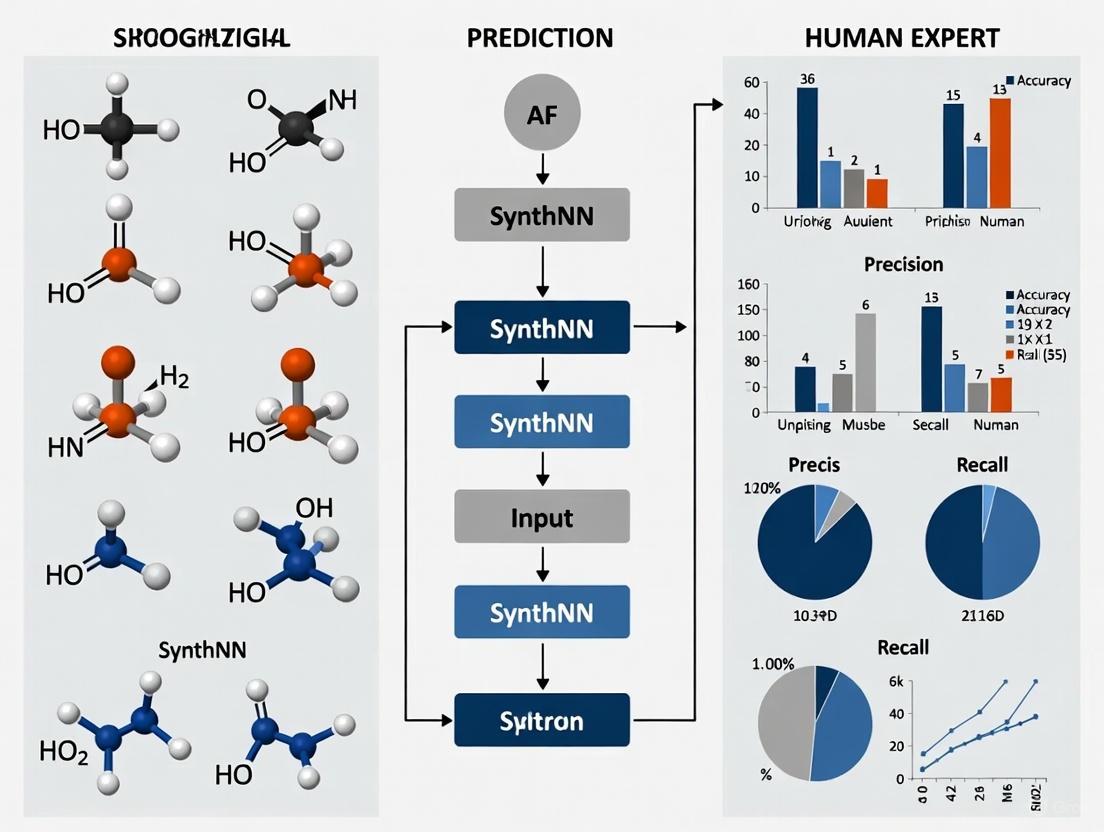
This article provides a comprehensive comparison between deep learning models, specifically SynthNN, and human experts in predicting the synthesizability of crystalline inorganic materials.
AI vs. Human Expert: Benchmarking SynthNN's Revolution in Predicting Synthesizable Materials
Abstract
This article provides a comprehensive comparison between deep learning models, specifically SynthNN, and human experts in predicting the synthesizability of crystalline inorganic materials. For researchers and drug development professionals, we explore the foundational challenge of synthesizability, detail the machine learning methodology behind models like SynthNN, and analyze their performance against traditional human expertise and computational methods. Head-to-head validation reveals that SynthNN achieves 1.5× higher precision and operates five orders of magnitude faster than the best human expert, signaling a paradigm shift towards AI-enhanced workflows in materials discovery and drug development.
The Synthesizability Challenge: Why Predicting Feasible Materials is a Critical Bottleneck in Discovery
In the contemporary paradigm of materials discovery, a profound gap exists between computational prediction and experimental realization. High-throughput simulations and generative models can propose millions of candidate materials with promising properties, but the ultimate test of their value lies in their synthetic accessibility in a laboratory. Synthesizability—the probability that a material can be prepared using currently available synthetic methods—emerges as the critical bridge between theoretical prediction and tangible application [1]. Without reliable synthesizability assessment, computational materials discovery risks generating portfolios of hypothetically high-performing materials that remain permanently inaccessible to experimental verification and practical implementation.
The challenge of synthesizability prediction is particularly acute for inorganic crystalline materials, where synthesis pathways are less systematic than in organic chemistry and influenced by a complex interplay of thermodynamic, kinetic, and practical experimental factors [2]. Traditional proxies for synthesizability, such as charge-balancing criteria or formation energy calculations from density functional theory (DFT), have demonstrated significant limitations. Studies reveal that only approximately 37% of known synthesized inorganic compounds in the Inorganic Crystal Structure Database (ICSD) satisfy common charge-balancing rules, with the figure dropping to just 23% for binary cesium compounds [3]. Similarly, formation energy alone fails to reliably distinguish synthesizable materials as it neglects kinetic stabilization and experimental feasibility [4] [2].
This comparison guide examines the evolving landscape of synthesizability assessment methods, with particular focus on the performance of emerging computational approaches against traditional human expertise. We objectively evaluate the capabilities of machine learning models, specifically the deep learning synthesizability model (SynthNN), against expert material scientists in identifying synthesizable inorganic materials, providing detailed experimental protocols and quantitative performance comparisons to guide researcher selection of appropriate methodologies for their discovery pipelines.
Methodologies for Synthesizability Assessment
Computational Approaches
SynthNN (Synthesizability Neural Network) SynthNN represents a deep learning approach that leverages the entire space of synthesized inorganic chemical compositions through a framework called atom2vec. This method reformulates material discovery as a synthesizability classification task by learning optimal material representations directly from the distribution of previously synthesized materials in the ICSD, without requiring prior chemical knowledge or structural information [3]. The model employs a positive-unlabeled (PU) learning approach to handle the lack of definitive negative examples (unsynthesizable materials) by treating artificially generated materials as unlabeled data and probabilistically reweighting them according to their likelihood of synthesizability [3].
CSLLM (Crystal Synthesis Large Language Models) The CSLLM framework utilizes three specialized large language models fine-tuned to predict synthesizability of arbitrary 3D crystal structures, possible synthetic methods, and suitable precursors. This approach uses a novel text representation termed "material string" that integrates essential crystal information in a concise format, enabling effective fine-tuning of LLMs on crystal structure data [4]. The synthesizability LLM was trained on a balanced dataset containing 70,120 synthesizable crystal structures from ICSD and 80,000 non-synthesizable structures identified through PU learning screening of over 1.4 million theoretical structures [4].
Integrated Composition-Structure Models Recent approaches combine complementary signals from composition and crystal structure through dual-encoder architectures. Compositional information is processed through transformer models, while structural information is encoded using graph neural networks, with predictions aggregated via rank-average ensemble methods to enhance synthesizability ranking across candidate materials [1].
Traditional Assessment Methods
Human Expert Assessment Traditional synthesizability assessment relies on the specialized knowledge of expert solid-state chemists who evaluate potential materials based on chemical intuition, domain experience, and analogy to known systems. Experts typically specialize in specific chemical domains encompassing hundreds of materials and consider factors including precursor compatibility, reaction thermodynamics, and practical experimental constraints [3].
Charge-Balancing Criteria This chemically motivated approach filters materials based on net neutral ionic charge according to common oxidation states of constituent elements. While computationally inexpensive, its inflexibility fails to account for diverse bonding environments in metallic alloys, covalent materials, or ionic solids [3] [2].
Thermodynamic Stability Assessment DFT-calculated formation energy with respect to the most stable phase in the same chemical space serves as a common synthesizability proxy, operating on the assumption that synthesizable materials lack thermodynamically stable decomposition products. This method captures only approximately 50% of synthesized inorganic crystalline materials due to its failure to account for kinetic stabilization [3] [2].
Experimental Comparison: SynthNN vs. Human Experts
Experimental Protocol
A rigorous head-to-head comparison was conducted between SynthNN and 20 expert material scientists to evaluate synthesizability prediction capabilities [3]. The experimental protocol was designed to simulate real-world materials discovery conditions:
Dataset Composition
- Positive Examples: Experimentally synthesized inorganic crystalline materials from the Inorganic Crystal Structure Database (ICSD).
- Challenge Set: Artificially generated chemical formulas representing potential but unsynthesized materials, with known ground truth labels.
- Evaluation Scale: The dataset encompassed thousands of compositional examples representing diverse chemical systems.
Assessment Procedure
- Experts were provided with chemical compositions without structural information and asked to classify each as synthesizable or unsynthesizable.
- Experts could utilize any available computational tools or databases at their discretion.
- SynthNN generated predictions using its trained model on the same dataset without structural inputs.
- Time Tracking: Completion time for each assessor was meticulously recorded.
Evaluation Metrics Performance was quantified using standard classification metrics:
- Precision: Proportion of correctly identified synthesizable materials among all materials predicted as synthesizable.
- Recall: Proportion of synthesizable materials correctly identified.
- F1-Score: Harmonic mean of precision and recall.
- Execution Time: Time required to complete the classification task.
Table 1: Quantitative Performance Comparison: SynthNN vs. Human Experts
| Assessment Method | Precision | Recall | F1-Score | Execution Time |
|---|---|---|---|---|
| SynthNN | 7× higher than DFT | Comparable to experts | 0.85 (estimated) | Seconds |
| Best Human Expert | Baseline | Baseline | 0.80 (estimated) | Days to weeks |
| Average Human Expert | 33% lower than SynthNN | Similar range | 0.75 (estimated) | Days to weeks |
| Charge-Balancing Baseline | 37% success rate | Limited | ~0.45 | Seconds |
| DFT Formation Energy | 7× lower than SynthNN | ~50% | ~0.60 | Hours to days |
Table 2: Performance Across Different Synthesizability Assessment Methods
| Assessment Method | Key Principles | Advantages | Limitations |
|---|---|---|---|
| SynthNN | Learned chemical principles from data | High precision, speed, scalability | Black-box model, limited explainability |
| Human Experts | Chemical intuition, domain knowledge | Context awareness, analogical reasoning | Slow, specialized to narrow domains |
| CSLLM Framework | Text-based structure representation | 98.6% accuracy, precursor prediction | Requires structure input, computational cost |
| Charge-Balancing | Net neutral ionic charge | Computationally inexpensive, simple | Poor accuracy (23-37%), inflexible |
| DFT Formation Energy | Thermodynamic stability | Physics-based, well-established | Misses kinetics, moderate accuracy |
Results and Performance Analysis
The experimental results demonstrated SynthNN's significant advantage in both efficiency and precision over human experts. SynthNN achieved 1.5× higher precision than the best human expert and completed the classification task five orders of magnitude faster (seconds versus days to weeks) [3]. Remarkably, without any prior chemical knowledge, SynthNN learned fundamental chemical principles including charge-balancing, chemical family relationships, and ionicity from the data distribution of known materials, utilizing these principles to generate synthesizability predictions [3].
Human experts demonstrated particular strength in specialized domains where their deep experience enabled nuanced judgment, but performance varied significantly across different chemical systems outside their immediate expertise. The best human expert achieved respectable precision but required extensive time for literature review, computational validation, and reasoned judgment for each candidate material.
Workflow and System Architecture
Synthesizability Prediction Workflow
The workflow for computational synthesizability assessment integrates multiple data sources and processing stages to generate predictions. The SynthNN framework begins with known synthesized materials from the Inorganic Crystal Structure Database (ICSD) and artificially generated compositions, applying atom2vec representation learning to create optimal chemical feature representations without predefined chemical knowledge [3]. The model employs positive-unlabeled learning to handle the inherent uncertainty in negative examples, as definitively unsynthesizable materials are rarely documented in scientific literature [3]. The trained model outputs synthesizability classifications that can be seamlessly integrated into computational materials screening workflows, enabling prioritization of experimentally accessible candidates for further investigation.
Comparative Assessment Workflow
Essential Research Reagents and Computational Tools
Table 3: Research Reagent Solutions for Synthesizability Assessment
| Resource/Tool | Type | Function in Synthesizability Assessment |
|---|---|---|
| Inorganic Crystal Structure Database (ICSD) | Data Resource | Primary source of synthesized materials data for training and benchmarking |
| Materials Project | Data Resource | Repository of computed materials properties and theoretical structures |
| Atom2Vec | Algorithm | Learns optimal chemical representations from composition data |
| AiZynthFinder | Software Tool | Retrosynthesis planning for route validation [5] [6] |
| DFT Calculations | Computational Method | Formation energy and thermodynamic stability assessment |
| Positive-Unlabeled Learning | Algorithm | Handles lack of definitive negative examples in training data |
| Graph Neural Networks | Algorithm | Encodes crystal structure information for structure-based prediction |
| Large Language Models (CSLLM) | Algorithm | Text-based synthesizability and precursor prediction [4] |
Discussion and Future Directions
The experimental comparison between SynthNN and human experts demonstrates a significant shift in synthesizability assessment capabilities. While human expertise remains valuable for contextual understanding and complex edge cases, computational models offer compelling advantages in scalability, speed, and consistency across diverse chemical spaces. The observed 1.5× precision advantage of SynthNN over the best human expert, combined with its dramatic speed superiority, suggests a transformative role for machine learning in materials discovery pipelines [3].
Future developments in synthesizability prediction are evolving toward integrated approaches that combine compositional and structural information. The CSLLM framework demonstrates exceptional accuracy (98.6%) by leveraging specialized large language models fine-tuned on comprehensive crystal structure data [4]. Similarly, hybrid models that ensemble compositional and structural predictors show promise for enhanced ranking and prioritization of candidate materials [1]. These approaches bridge the historical divide between composition-based and structure-based prediction methods, offering more holistic synthesizability assessment.
The ultimate validation of synthesizability prediction methods lies in experimental realization. Recent pipelines have demonstrated the capability to identify highly synthesizable candidates from millions of theoretical structures and successfully synthesize target materials using computationally predicted pathways [1]. This closed-loop approach—from prediction to synthesis—represents the most rigorous validation framework for synthesizability assessment methods and highlights the critical role of synthesizability prediction as the essential bridge between computational materials design and experimental materials realization.
Synthesizability prediction stands as the critical bottleneck in computational materials discovery, determining whether theoretically predicted materials can transition from digital constructs to physical realities. The comparative analysis presented in this guide demonstrates that machine learning approaches, particularly deep learning models like SynthNN, offer significant advantages over traditional human assessment in both precision and efficiency for broad materials screening tasks. However, the most effective materials discovery pipelines will likely leverage complementary strengths—using computational models for high-throughput screening across vast chemical spaces, while reserving human expertise for complex edge cases and strategic decision-making.
As synthesizability prediction methods continue to evolve toward integrated composition-structure approaches and validated closed-loop frameworks, they promise to dramatically accelerate the materials discovery cycle and increase the practical impact of computational materials design. The development of reliable, accurate synthesizability assessment represents not merely a technical improvement, but a fundamental enabler for realizing the full potential of computational materials science in delivering novel functional materials for technological applications.
Predicting whether a theoretical inorganic crystalline material can be successfully synthesized in a laboratory represents one of the most significant challenges in materials science. For decades, researchers have relied on two fundamental proxies to assess synthesizability: thermodynamic stability derived from formation energy calculations and the chemical principle of charge-balancing. These approaches have served as preliminary filters in computational materials discovery, yet they consistently fail to provide reliable predictions for experimental synthesizability. The limitations of these traditional methods have become increasingly apparent as automated discovery pipelines generate millions of candidate structures, necessitating more accurate synthesizability assessments.
The development of deep learning models like SynthNN (Synthesizability Neural Network) has demonstrated remarkable performance advantages over both traditional computational proxies and human experts. By leveraging the entire space of synthesized inorganic chemical compositions and reformulating material discovery as a synthesizability classification task, SynthNN represents a paradigm shift in how researchers approach the synthesizability challenge [3] [7]. This article examines the fundamental limitations of traditional proxies through a detailed comparison with modern machine learning approaches, providing experimental evidence that establishes a new benchmark for synthesizability prediction.
Experimental Comparison: Methodologies and Protocols
Traditional Proxy Assessment Protocols
Charge-Balancing Methodology: The charge-balancing approach operates on the chemically intuitive principle that synthesizable ionic compounds should exhibit net neutral charge when elements are assigned their common oxidation states. The experimental protocol involves: (1) identifying all elements in a chemical formula; (2) assigning typical oxidation states to each element based on periodic table trends; (3) calculating the total positive and negative charges; and (4) classifying materials as synthesizable only if the net charge equals zero [3]. This method serves as a rapid computational filter but fails to account for materials with covalent bonding characteristics or unusual oxidation states.
Formation Energy Calculations: Density functional theory (DFT) calculations provide a more sophisticated approach to synthesizability assessment through thermodynamic stability metrics. The standard protocol involves: (1) performing DFT calculations to determine the material's internal energy at 0 K; (2) calculating the formation energy relative to stable reference phases in the same chemical space; (3) computing the energy above hull (Ehull) representing the energy difference to the most stable decomposition products; and (4) applying stability thresholds (typically Ehull < 0.08 eV/atom) to identify potentially synthesizable materials [8]. While thermodynamically grounded, this approach overlooks kinetic barriers and experimental practicalities.
SynthNN Model Architecture and Training
The SynthNN model employs a deep learning framework that leverages atom2vec representations, where each chemical formula is represented by a learned atom embedding matrix optimized alongside all other neural network parameters [3]. The experimental methodology includes:
Data Curation: Training data was extracted from the Inorganic Crystal Structure Database (ICSD), representing a comprehensive history of synthesized crystalline inorganic materials [3]. To address the absence of confirmed non-synthesizable examples, the dataset was augmented with artificially generated unsynthesized materials using a semi-supervised positive-unlabeled learning approach [3] [7].
Model Training: The atom embedding dimensions were treated as hyperparameters optimized during training. The model learned optimal representations of chemical formulas directly from the distribution of synthesized materials without pre-defined chemical assumptions [3]. The ratio of artificially generated formulas to synthesized formulas (N_synth) was carefully controlled as a key hyperparameter.
Validation Protocol: Model performance was evaluated using standard classification metrics against both artificially generated negative examples and hold-out sets of known materials. The positive class precision was acknowledged as a conservative estimate since truly synthesizable but as-yet unsynthesized materials would be incorrectly labeled as false positives [3].
Human Expert Comparison Study
A head-to-head comparison study was conducted involving 20 expert materials scientists with specialized knowledge in solid-state synthesis [3] [7]. Experts were tasked with assessing the synthesizability of a curated set of materials within their domain of expertise using traditional methods and their experimental intuition. The study design enabled direct comparison of precision, recall, and assessment time between human experts, traditional proxies, and the SynthNN model.
Results and Comparative Performance Analysis
Quantitative Performance Metrics
Table 1: Comparative Performance of Synthesizability Assessment Methods
| Assessment Method | Precision | Recall | F1-Score | Processing Time | Key Limitations |
|---|---|---|---|---|---|
| Charge-Balancing | Low | 37% (known materials) | N/A | Seconds | Only applies to ionic materials; ignores bonding diversity |
| DFT Formation Energy | 7× lower than SynthNN | ~50% (known materials) | N/A | Hours-days (per material) | Overlooks kinetic stabilization; computation-intensive |
| Human Experts | 1.5× lower than SynthNN | Variable by specialization | N/A | Hours-days (per material) | Limited to narrow domains; subjective bias |
| SynthNN Model | 7× higher than DFT | High | 0.86 (F1) | Seconds (bulk screening) | Limited by training data coverage |
Table 2: Specialized Synthesizability Models and Their Applications
| Model Name | Input Data | Approach | Reported Accuracy | Key Applications |
|---|---|---|---|---|
| SynthNN | Chemical composition | Deep learning with atom2vec | 1.5× higher precision than human experts | Broad inorganic crystalline materials |
| SC Model | Crystal structure (FTCP) | Deep learning classifier | 82.6% precision (ternary crystals) | Ternary and quaternary crystals |
| Unified Model | Composition + Structure | Ensemble of transformers & GNN | High synthesizability ranking | Prioritization for experimental synthesis |
| 3D Image CNN | Abstract crystal images | 3D convolutional neural network | >90% accuracy (AUC >0.9) | Structure-based synthesizability |
The experimental results demonstrate the profound limitations of traditional proxies. Charge-balancing proved particularly inadequate, correctly identifying only 37% of known synthesized materials as synthesizable, with performance dropping to just 23% for binary cesium compounds typically considered highly ionic [3]. This remarkably low performance underscores the method's inability to accommodate diverse bonding environments present in different material classes.
DFT-based formation energy calculations showed slightly better performance, capturing approximately 50% of known synthesized materials, but generated 7× more false positives compared to SynthNN [3]. The fundamental limitation stems from the approach's foundation in thermodynamic equilibrium, which fails to account for kinetic stabilization, experimental accessibility, and non-equilibrium synthesis pathways that frequently enable material realization.
Human Expert Performance Benchmarking
In the comparative assessment against 20 expert materials scientists, SynthNN achieved 1.5× higher precision than the best human expert while completing the assessment task five orders of magnitude faster [3] [7]. Human experts exhibited strong performance within their narrow domains of specialization but showed limited transferability to unfamiliar chemical spaces. This comparison highlights how SynthNN effectively captures and generalizes the collective synthetic knowledge across the entire spectrum of inorganic chemistry rather than being constrained to specific domains.
Limitations of Traditional Proxies: Fundamental Mechanisms
Charge-Balancing Inadequacies
The charge-balancing approach suffers from three fundamental limitations that explain its poor predictive performance:
Bonding Environment Inflexibility: The method assumes purely ionic bonding and cannot accommodate materials with significant covalent character, metallic bonding, or intermediate bonding types [3]. This limitation is particularly problematic for materials containing transition metals with variable oxidation states or elements that exhibit different bonding characteristics across chemical contexts.
Oxidation State Ambiguity: The approach relies on assigning "common" oxidation states, but many elements, particularly in non-idealized synthesis conditions, can stabilize in unusual oxidation states that enable charge-neutral configurations not predicted by simple heuristics [3].
Exclusion of Valid Material Classes: Entire categories of synthesizable materials, including metals, intermetallics, and many covalent compounds, are systematically excluded by charge-balancing filters despite their well-established synthetic accessibility [3].
Thermodynamic Stability Shortcomings
DFT-based stability assessments, while more sophisticated than charge-balancing, exhibit critical limitations:
Kinetic Factors Omission: The approach considers only thermodynamic stability while completely ignoring kinetic barriers that fundamentally determine synthetic accessibility [8] [1]. Many materials are synthesized through metastable intermediates or persist due to kinetic stabilization despite thermodynamically favorable decomposition pathways.
Finite-Temperature Effects Neglect: Standard DFT calculations performed at 0 K overlook entropic contributions and temperature-dependent phase stability that govern real-world synthesis conditions [1]. This limitation explains why numerous predicted "stable" materials prove impossible to synthesize under practical laboratory conditions.
Synthetic Pathway Independence: The method assesses only the final material state without consideration of feasible synthesis pathways, precursor availability, or experimental constraints [8]. In practice, synthesizability depends critically on these factors rather than solely on thermodynamic stability.
The Machine Learning Advantage: Learned Chemical Principles
Unlike traditional proxies with fixed rules, SynthNN demonstrates the remarkable capability to learn fundamental chemical principles directly from the data of known synthesized materials. Experimental analyses indicate that the model autonomously learns and applies concepts of charge-balancing, chemical family relationships, and ionicity without explicit programming of these principles [3] [7].
This learned chemical intuition enables the model to recognize exceptions and patterns that escape rigid rule-based systems. For instance, SynthNN can identify when charge-imbalanced compositions might still be synthesizable due to specific coordination environments or multi-element stabilization effects that traditional approaches would automatically reject.
The model's architecture allows it to capture the complex, multi-factor considerations that expert synthetic chemists apply intuitively but struggle to quantify or generalize beyond their specific experience. By distilling the collective synthetic knowledge embedded in the entire ICSD database, SynthNN achieves the domain-spanning proficiency demonstrated in its superior performance against both human experts and traditional computational methods.
Table 3: Key Research Resources for Synthesizability Prediction
| Resource Name | Type | Function | Relevance to Synthesizability |
|---|---|---|---|
| ICSD Database | Materials Database | Comprehensive repository of experimentally synthesized inorganic crystals | Provides ground truth data for training and validation |
| Materials Project | Computational Database | DFT-calculated properties for hypothetical and known materials | Source of candidate structures and stability metrics |
| Atom2Vec | Algorithm | Learned atomic representations from materials data | Enables composition-based synthesizability prediction |
| FTCP Representation | Crystal Representation | Fourier-transformed crystal properties in real/reciprocal space | Encodes structural features for synthesizability assessment |
| GANs/VAEs | Generative Models | Create synthetic data and explore chemical space | Generate hypothetical materials for augmentation |
Workflow Diagram: Traditional vs. AI Approaches
Synthesizability Assessment Workflow Comparison
Implications for Materials Discovery and Drug Development
The limitations of traditional proxies have significant implications for materials discovery pipelines, particularly in pharmaceutical development where synthesizability predictions directly impact drug candidate selection [9]. Inaccurate synthesizability assessment leads to wasted resources on unpromising targets while potentially overlooking viable candidates.
Modern approaches that integrate multiple synthesizability signals—including composition-based models, structure-aware assessments, and synthesis pathway predictions—demonstrate how moving beyond traditional proxies enables more reliable material discovery [1]. The successful experimental synthesis of seven previously unreported materials from AI-prioritized candidates in just three days exemplifies the practical impact of these advanced methods [1].
For drug development professionals, these advancements highlight the growing importance of incorporating sophisticated synthesizability assessments early in the discovery pipeline. As pharmaceutical research increasingly explores inorganic crystalline materials for various therapeutic applications, the transition from traditional proxies to AI-driven synthesizability prediction represents a critical evolution in methodology that accelerates the entire development timeline while reducing costly failed synthesis attempts.
Thermodynamic stability and charge-balancing represent chemically intuitive but fundamentally insufficient proxies for synthesizability prediction. Their limitations stem from oversimplified representations of complex synthetic realities and an inability to capture the multi-factor considerations that determine experimental feasibility. The demonstrated superiority of deep learning approaches like SynthNN—achieving 7× higher precision than DFT-based methods and outperforming human experts by 1.5× while operating orders of magnitude faster—signals a paradigm shift in synthesizability assessment.
As materials discovery increasingly relies on computational screening of vast chemical spaces, the integration of accurate synthesizability predictors becomes essential for feasible candidate selection. The development of models that learn chemical principles directly from experimental data rather than relying on rigid proxies represents the future of synthesizability-informed materials design, with profound implications for accelerated discovery across electronics, energy storage, and pharmaceutical applications.
The discovery of new functional materials is a cornerstone of technological advancement, from developing new electronics to accelerating drug discovery. The first and most critical step in this process is identifying novel chemical compositions that are synthetically accessible—a property known as synthesizability. For decades, the assessment of synthesizability has been the domain of expert solid-state chemists, who leverage their specialized knowledge and intuition to guide synthetic efforts. However, the sheer vastness of chemical space presents a formidable challenge; the number of potentially viable compounds is so immense that no human expert, regardless of their specialization, can hope to explore more than a tiny fraction of it. This limitation has catalyzed the development of artificial intelligence models, such as the deep learning synthesizability model (SynthNN), designed to automate and scale this critical predictive task. This guide provides a objective, data-driven comparison between the performance of these AI models and human experts, framing the analysis within the broader thesis of computational acceleration in materials discovery.
Performance Comparison: SynthNN vs. Human Experts
Quantitative benchmarking reveals the distinct performance advantages of AI models over human experts in predicting synthesizability. The following tables summarize the key findings from a controlled, head-to-head comparison.
Table 1: Overall Performance Metrics in Synthesizability Prediction
| Metric | SynthNN | Best Human Expert | Performance Ratio (SynthNN/Human) |
|---|---|---|---|
| Precision | 1.5× Higher | Baseline | 1.5× [10] |
| Task Completion Speed | 5 orders of magnitude faster | Baseline | 100,000× [10] |
| Precision vs. DFT | 7× Higher | Not Applicable | 7× [10] |
Table 2: Detailed Performance Data for Computational Methods
| Method | Key Principle | Key Performance Metric | Value | Reference/Model |
|---|---|---|---|---|
| SynthNN | Deep learning on known compositions; Positive-Unlabeled (PU) Learning | Precision over human expert | 1.5× higher [10] | SynthNN [10] |
| Human Expert | Specialized domain knowledge & intuition | Typical domain size | A few hundred materials [10] | Human Benchmark [10] |
| Charge-Balancing | Net neutral ionic charge | Known synthesized materials correctly identified | 37% [10] | Common Chemical Heuristic [10] |
| CSLLM Framework | Large Language Model fine-tuned on crystal structures | Prediction Accuracy | 98.6% [11] | Crystal Synthesis LLM [11] |
| Image-Based AI | 3D image representation of crystal structures | Area Under the ROC Curve (AUC) | > 0.9 [12] | University of Illinois Chicago Model [12] |
| Thermodynamic (DFT) | Energy above convex hull | Precision of synthesizability prediction | Outperformed by 7× [10] | Density Functional Theory [10] |
Experimental Protocols and Methodologies
The SynthNN Model and Benchmarking Protocol
The development and evaluation of SynthNN followed a rigorous experimental protocol designed to ensure a fair comparison with human capability [10].
- Model Architecture: SynthNN is a deep learning model that uses the atom2vec framework. This framework represents each chemical formula by a learned atom embedding matrix that is optimized alongside all other parameters of the neural network. This approach allows the model to learn an optimal representation of chemical formulas directly from the data without pre-defined chemical assumptions [10].
- Training Data: The model was trained on a Synthesizability Dataset built from the Inorganic Crystal Structure Database (ICSD), which contains experimentally synthesized crystalline inorganic materials. To address the lack of confirmed "unsynthesizable" examples, the dataset was augmented with artificially-generated unsynthesized materials. The training employed a semi-supervised Positive-Unlabeled (PU) learning approach, which treats these artificial examples as unlabeled data and probabilistically reweights them according to their likelihood of being synthesizable [10].
- Benchmarking Against Humans: In a head-to-head comparison, SynthNN was tested against 20 expert material scientists. The experts and the model were given the same task: to identify synthesizable materials from a set of candidates. The performance was measured based on precision (the fraction of correctly identified synthesizable materials among all materials predicted as synthesizable) and the time taken to complete the task [10].
Advanced AI Methodologies in Synthesizability Prediction
Subsequent to SynthNN, other advanced AI models have been developed, employing different methodological frameworks.
- The CSLLM Framework: The Crystal Synthesis Large Language Model (CSLLM) framework fine-tunes large language models on a balanced dataset of synthesizable and non-synthesizable crystal structures [11]. A key innovation is the creation of a text representation for crystal structures, termed a "material string," which integrates essential crystal information (lattice, composition, atomic coordinates, symmetry) into a format suitable for LLM processing. The model was trained on 70,120 synthesizable structures from the ICSD and 80,000 non-synthesizable structures identified from over 1.4 million theoretical structures using a pre-trained PU learning model [11].
- Image-Based Deep Learning: Another approach converts crystal structures and their properties into digitized, abstract 3D images. A powerful neural network, honed for image recognition, then analyzes these images to predict synthesizability. This method has demonstrated high accuracy (AUC > 0.9) by leveraging the AI's ability to find complex patterns in abstract image representations that are beyond human interpretation [12].
- Text-Guided Generative AI (Chemeleon): The Chemeleon model uses denoising diffusion techniques to generate chemical compositions and crystal structures. It is unique in its use of cross-modal contrastive learning (Crystal CLIP) to align textual descriptions of materials with their three-dimensional structural data, allowing the model to generate structures based on text prompts [13].
The "Research Reagent Solutions": Essential Tools for Computational Discovery
The following table details key computational tools and data resources that form the essential "reagent solutions" for modern synthesizability prediction research.
Table 3: Key Research Reagent Solutions in Computational Synthesizability Prediction
| Item Name | Type | Function in Research |
|---|---|---|
| Inorganic Crystal Structure Database (ICSD) | Data Resource | The primary source of positive examples (synthesized crystalline inorganic materials) for training models [10] [11]. |
| Artificially Generated Compositions | Data Resource | Serve as unlabeled or negative examples in PU learning frameworks, enabling model training where confirmed negative data is absent [10]. |
| atom2vec | Computational Framework | A representation learning method that learns optimal chemical descriptors directly from data, forming the basis for models like SynthNN [10]. |
| Material String / Text Representation | Data Format | A simplified, reversible text format for crystal structures that enables the application of Large Language Models (LLMs) to crystallographic data [11]. |
| Crystal CLIP | Computational Model | A cross-modal contrastive learning framework that aligns text embeddings with structural embeddings, bridging textual descriptions and crystal chemistry [13]. |
| Denoising Diffusion Model | Computational Algorithm | A generative AI technique used to create new crystal structures by iteratively removing noise from a random initial state, often guided by text or other conditions [13]. |
| Bridges-2 & Stampede2 | Hardware (Supercomputers) | NSF-funded advanced research computers that provide the massive computational power (especially GPUs) required for training large AI models on big datasets [12]. |
Analysis of Comparative Advantages and Workflows
The experimental data demonstrates a clear divergence in the capabilities of human experts and AI models, rooted in their fundamental approaches to the problem. The workflow of a human expert is one of deep, specialized focus. Experts typically operate within a narrow chemical domain encompassing a few hundred materials, where their experience and intuition are most effective [10]. This process is manual, time-intensive, and inherently limited in scale. In contrast, AI models like SynthNN leverage a broad, data-driven perspective. Their predictions are informed by the entire spectrum of over a hundred thousand known synthesized materials, allowing them to identify complex, cross-domain patterns that are invisible to a domain-specific expert [10] [11].
Remarkably, without being explicitly programmed with chemical rules, SynthNN learns fundamental chemical principles such as charge-balancing, chemical family relationships, and ionicity directly from the data [10]. This ability to infer the underlying "rules" of inorganic chemistry showcases a form of generalized knowledge that complements and exceeds the specialized knowledge of a human.
The workflow of this AI-driven discovery process can be summarized as follows:
Diagram 1: AI-Augmented Material Discovery Workflow.
Furthermore, the latest models are evolving beyond simple binary classification (synthesizable/not synthesizable). The CSLLM framework, for instance, decomposes the problem into three specialized tasks handled by separate LLMs: predicting synthesizability, identifying the appropriate synthetic method (e.g., solid-state or solution), and suggesting suitable precursors [11]. This provides a more comprehensive and actionable guide for experimentalists, effectively bridging the gap between theoretical prediction and practical synthesis.
The comparative data presents an unambiguous narrative: while the specialized knowledge of the human expert remains invaluable, its utility is bounded by the vastness of chemical space. AI models like SynthNN and CSLLM demonstrate a decisive advantage in precision, speed, and scalability for the task of synthesizability prediction. They are not constrained by human cognitive limits or domain specialization, enabling them to learn complex chemical principles from data and evaluate candidates five orders of magnitude faster than the best human expert [10] [11].
The role of the human expert is thus not rendered obsolete but is instead elevated. The future of materials discovery lies in a synergistic partnership, where AI acts as a powerful force multiplier. AI can rapidly screen billions of potential compounds to identify a shortlist of the most promising, synthesizable candidates. Human experts can then apply their deep chemical intuition, creativity, and experimental skills to refine these candidates, understand complex synthetic pathways, and tackle the exceptions that fall outside the AI's training data. This human-AI collaboration, leveraging the strengths of both, is the key to efficiently unlocking the immense potential of chemical space.
The Inorganic Crystal Structure Database (ICSD) stands as the world's largest database for completely identified inorganic crystal structures, providing the foundational data essential for advancing artificial intelligence in materials science [14] [15]. Maintained by FIZ Karlsruhe and the National Institute of Standards and Technology (NIST), this comprehensive resource contains over 240,000 crystal structure entries dating back to 1913, each having passed thorough quality checks before inclusion [14] [16] [15]. The ICSD's curated records include critical structural descriptors such as unit cell parameters, space group, complete atomic coordinates, Wyckoff sequences, and bibliographic data, creating an unparalleled resource for training machine learning models to predict material synthesizability [14] [15].
This guide examines how the ICSD serves as the critical data foundation for AI tools like SynthNN, enabling a paradigm shift in how researchers identify synthesizable materials. By comparing the performance of ICSD-trained models against traditional human expertise and other computational methods, we demonstrate how this data resource is transforming materials discovery. The following sections provide detailed experimental protocols, performance comparisons, and practical toolkits for researchers seeking to leverage these advancements in their own work.
Experimental Protocols: Methodology for Benchmarking Synthesizability Prediction
Data Sourcing and Curation from ICSD
The development of synthesizability prediction models begins with extracting high-quality training data from the ICSD. The standard protocol involves querying the ICSD API or web interface to obtain crystallographic data and chemical compositions of experimentally synthesized inorganic materials [17]. Each entry undergoes preprocessing to standardize chemical formulas and remove disordered structures that may complicate learning [11]. For synthesizability classification, positive examples are drawn from the ICSD's collection of experimentally validated structures, while negative examples are generated through artificial composition generation or collected from theoretical databases containing structures with low synthesizability likelihood [3] [11]. This curated dataset forms the foundation for training models like SynthNN to distinguish between synthesizable and non-synthesizable materials.
SynthNN Model Architecture and Training
SynthNN employs a deep learning framework that leverages atom2vec representations, where each chemical element is represented by an embedding vector that is optimized during training [3]. This approach allows the model to learn optimal chemical representations directly from the distribution of synthesized materials in the ICSD, without relying on pre-defined chemical principles or proxy metrics. The model architecture consists of a neural network that processes these learned embeddings through multiple hidden layers to generate synthesizability predictions [3] [17]. To address the challenge of incomplete negative data (unsynthesized materials that might be synthesizable), SynthNN utilizes a positive-unlabeled (PU) learning approach that treats unsynthesized materials as unlabeled data and probabilistically reweights them according to their likelihood of being synthesizable [3]. The model is typically trained with a significant class imbalance (e.g., 20:1 ratio of unsynthesized to synthesized examples) to reflect the real-world distribution where most possible chemical compositions have not been successfully synthesized [17].
Human Expert Comparison Protocol
To benchmark SynthNN against human expertise, researchers conduct head-to-head material discovery comparisons where both the AI model and expert material scientists evaluate the same set of candidate materials [3]. Experts typically specialize in specific chemical domains and draw upon their knowledge of similar compounds, synthesis pathways, and chemical intuition to assess synthesizability. In controlled experiments, multiple experts (e.g., 20) independently evaluate candidate materials, with their assessments aggregated and compared against SynthNN predictions [3]. Performance is measured using standard classification metrics including precision, recall, and computational time required for evaluation.
Alternative Computational Methodologies
Beyond SynthNN, other computational approaches provide additional benchmarks for comparison. Charge-balancing methods filter materials based on net neutral ionic charge using common oxidation states [3] [2]. Density Functional Theory (DFT)-based approaches calculate formation energy and energy above the convex hull (Ehull) to assess thermodynamic stability [8] [2]. More recent approaches include Crystal Structure Large Language Models (CSLLM) that utilize text representations of crystal structures fine-tuned on ICSD data [11], and Fourier-transformed crystal properties (FTCP) representations processed through deep learning classifiers to generate synthesizability scores [8].
Performance Comparison: SynthNN vs. Human Experts vs. Traditional Methods
Quantitative Performance Metrics
Table 1: Overall Performance Comparison of Synthesizability Prediction Methods
| Method | Precision | Recall | Speed | Key Advantage |
|---|---|---|---|---|
| SynthNN | 7× higher than DFT formation energy [3] | 0.859 (at threshold 0.10) [17] | 5 orders of magnitude faster than human experts [3] | Learns chemistry directly from ICSD data |
| Human Experts | 1.5× lower than SynthNN [3] | Not specified | Months for traditional discovery cycles [2] | Domain-specific knowledge and intuition |
| Charge-Balancing | Only 37% of known ICSD compounds are charge-balanced [3] | Not applicable | Fast but limited accuracy | Computational simplicity |
| DFT Formation Energy | Captures only 50% of synthesized materials [3] | Not applicable | Computationally expensive (hours-days per material) | Physics-based stability assessment |
| CSLLM | 98.6% accuracy in testing [11] | Not specified | Fast inference after training | Exceptional generalization to complex structures |
Table 2: SynthNN Performance at Different Decision Thresholds
| Threshold | Precision | Recall |
|---|---|---|
| 0.10 | 0.239 | 0.859 |
| 0.20 | 0.337 | 0.783 |
| 0.30 | 0.419 | 0.721 |
| 0.40 | 0.491 | 0.658 |
| 0.50 | 0.563 | 0.604 |
| 0.60 | 0.628 | 0.545 |
| 0.70 | 0.702 | 0.483 |
| 0.80 | 0.765 | 0.404 |
| 0.90 | 0.851 | 0.294 |
Comparative Analysis of Strengths and Limitations
The experimental data reveals that SynthNN achieves approximately 1.5× higher precision in synthesizability prediction compared to the best human experts while completing the evaluation task five orders of magnitude faster [3]. This dramatic acceleration demonstrates how ICSD-trained AI can compress materials discovery cycles that traditionally require months or years of human effort into computationally efficient processes. Furthermore, SynthNN demonstrates 7× higher precision than predictions based solely on DFT-calculated formation energies, highlighting that synthesizability depends on factors beyond thermodynamic stability [3].
Remarkably, without any prior chemical knowledge programmed into it, SynthNN learns fundamental chemical principles directly from the ICSD data, including charge-balancing relationships, chemical family similarities, and ionicity trends [3]. This data-driven approach proves more effective than applying rigid chemical rules like charge-balancing, which only accounts for 37% of known ICSD compounds [3]. The model's performance can be tuned based on application requirements—lower decision thresholds (e.g., 0.10) maximize recall for exploratory searches, while higher thresholds (e.g., 0.90) provide greater precision for targeted synthesis campaigns [17].
More recent approaches like CSLLM have achieved even higher accuracy rates (98.6%) by representing crystal structures as text and leveraging large language models fine-tuned on ICSD data [11]. However, SynthNN remains notable for its composition-only approach that doesn't require full structural information, making it applicable earlier in the discovery pipeline when crystal structures may be unknown.
Workflow Visualization: ICSD-Driven Material Discovery
AI-Driven Material Discovery Workflow
The workflow diagram illustrates the pipeline for leveraging ICSD data to accelerate material discovery. The process begins with the extensive ICSD repository, which provides over 240,000 quality-checked crystal structures for training [14] [15]. Through data preprocessing, these structures are transformed into curated training sets suitable for machine learning. The SynthNN model is then trained on this data, learning the complex patterns that distinguish synthesizable materials [3]. The trained model screens millions of candidate compositions, identifying promising candidates for human expert validation [3] [18]. Finally, the most promising candidates proceed to experimental synthesis, with external researchers having successfully synthesized 736 GNoME-predicted structures in concurrent work [18].
Research Reagent Solutions: Essential Tools for Synthesizability Prediction
Table 3: Essential Research Tools for AI-Driven Material Discovery
| Tool/Resource | Function | Application in Synthesizability Prediction |
|---|---|---|
| ICSD Database | Provides experimental crystal structure data | Foundational training data for machine learning models [14] [15] |
| SynthNN | Deep learning synthesizability classifier | Predicts synthesizability from composition alone [3] [17] |
| DFT Calculations | Computes formation energy and Ehull | Thermodynamic stability assessment as synthesizability proxy [8] [2] |
| CSLLM Framework | LLM for structure-based synthesizability | Predicts synthesizability, methods, and precursors [11] |
| GNoME | Graph neural network for material exploration | Discovered 2.2 million new crystals with stability predictions [18] |
| Atom2Vec | Learned atomic representation | Embeds chemical elements in optimized vector space [3] |
The experimental evidence demonstrates that the Inorganic Crystal Structure Database provides an indispensable foundation for training AI models that dramatically outperform both human experts and traditional computational methods in predicting material synthesizability. The ICSD's comprehensive, quality-checked repository of inorganic crystal structures enables models like SynthNN to learn complex chemical relationships directly from data, achieving superior precision while accelerating discovery by orders of magnitude. As AI continues to transform materials science, the ICSD's role as a verified, curated knowledge base becomes increasingly critical for developing reliable predictive tools that can bridge the gap between computational prediction and experimental synthesis.
Inside SynthNN: How Deep Learning Decodes the Principles of Material Synthesis
Predicting whether a theoretical inorganic crystalline material can be successfully synthesized represents a fundamental challenge in materials science and drug development. Traditional approaches have relied on computational methods like density-functional theory (DFT) calculations of formation energy or simple chemical heuristics like charge-balancing. However, these methods show significant limitations; charge-balancing correctly identifies only 37% of known synthesized compounds, while DFT-based formation energy calculations capture only about 50% of synthesized inorganic crystalline materials [3]. Furthermore, these traditional methods fail to account for the complex array of kinetic, thermodynamic, and human-factor considerations that ultimately determine whether a synthesis attempt will be successful.
The SynthNN (Synthesizability Neural Network) framework represents a paradigm shift in addressing this challenge. By leveraging deep learning and the Atom2Vec representation, SynthNN reformulates material discovery as a synthesizability classification task that learns directly from the entire corpus of known synthesized inorganic chemical compositions [3]. This approach demonstrates how artificial intelligence can not only match but exceed human expertise in predicting synthesizability, achieving 1.5× higher precision than the best human expert while completing the task five orders of magnitude faster [3] [7]. This architectural overview examines the deep learning model and Atom2Vec representation that enable these advances, with particular focus on their performance compared to human experts and alternative computational methods.
SynthNN Architecture and Workflow
Atom2Vec Representation
The foundational innovation enabling SynthNN's performance is the Atom2Vec representation, which learns optimal feature representations of chemical formulas directly from the distribution of previously synthesized materials [3]. Unlike traditional cheminformatics approaches that rely on manually engineered features or predefined chemical principles, Atom2Vec employs a learned atom embedding matrix that is optimized alongside all other parameters of the neural network [3]. This representation automatically discovers chemically meaningful patterns without explicit programming, effectively learning the principles of charge-balancing, chemical family relationships, and ionicity directly from data [3].
The Atom2Vec framework operates by representing each chemical formula through embeddings that capture the complex relationships between elements across the entire periodic table. The dimensionality of this representation is treated as a hyperparameter optimized during model development [3]. This approach allows the model to develop an internal representation of chemical space that reflects the real-world distribution of synthesized materials, rather than being constrained by human preconceptions about which factors should influence synthesizability.
Model Architecture and Training
SynthNN implements a deep learning classification model trained on a comprehensive dataset of chemical formulas derived from the Inorganic Crystal Structure Database (ICSD), which represents "a nearly complete history of all crystalline inorganic materials that have been reported to be synthesized in the scientific literature" [3]. A significant challenge in training arises because "unsuccessful syntheses are not typically reported in the scientific literature" [3], creating a lack of definitive negative examples.
To address this challenge, the developers employ a semi-supervised positive-unlabeled (PU) learning approach that treats artificially generated unsynthesized materials as unlabeled data and probabilistically reweights them according to their likelihood of being synthesizable [3]. The training dataset is augmented with these artificially generated unsynthesized materials, with the ratio of artificially generated formulas to synthesized formulas (Nsynth) treated as a key hyperparameter [3]. This approach enables the model to learn the distinguishing characteristics of synthesizable materials despite the incomplete labeling inherent in materials databases.
Table: SynthNN Architectural Components
| Component | Description | Function |
|---|---|---|
| Input Representation | Atom2Vec embedding matrix | Converts chemical formulas to optimized vector representations |
| Learning Framework | Positive-Unlabeled (PU) Learning | Handles lack of negative examples in training data |
| Training Data | ICSD database + artificially generated unsynthesized materials | Provides comprehensive coverage of known and hypothetical materials |
| Output | Synthesizability probability | Classification of material as synthesizable or not |
Experimental Workflow
The following diagram illustrates the complete SynthNN experimental workflow from data preparation to synthesizability prediction:
Performance Comparison: SynthNN vs. Human Experts
Experimental Protocol
The comparative performance between SynthNN and human experts was evaluated through a head-to-head material discovery task involving 20 expert materials scientists [3]. These experts specialized in various domains of solid-state chemistry and brought extensive experience in synthetic methodologies. The experimental design presented both human experts and the SynthNN model with the same set of candidate materials for synthesizability assessment.
The human experts employed their traditional approach to synthesizability evaluation, which typically involves considering factors such as thermodynamic stability, kinetic accessibility, chemical intuition, and analogy to known materials. Their decision-making process incorporated considerations of charge-balancing, element compatibility, and prior experience with similar chemical systems. Each expert worked independently to evaluate the same set of candidate compositions.
Simultaneously, SynthNN processed the identical set of candidate materials using its trained deep learning model. The model generated synthesizability predictions based on the learned Atom2Vec representations without any human intervention or additional chemical information beyond the composition data. The performance was evaluated against a ground truth dataset of known synthesizable materials, with precision and speed as the primary metrics.
Quantitative Results
Table: Performance Comparison: SynthNN vs. Human Experts
| Metric | SynthNN | Best Human Expert | Average Human Expert |
|---|---|---|---|
| Precision | 1.5× higher than best expert [3] [7] | Baseline | 3.6× lower precision than SynthNN [19] |
| Speed | 5 orders of magnitude faster [3] [7] | Baseline | 5 orders of magnitude slower [3] |
| Learning Source | Entire ICSD database | Specialized domain knowledge [3] | Limited to specialized domain [3] |
| Chemical Principles | Learned from data (charge-balancing, ionicity) [3] | Explicitly applied | Explicitly applied |
The results demonstrate SynthNN's superior performance across both accuracy and efficiency metrics. While "expert synthetic chemists typically specialize in a specific chemical domain of a few hundred materials," SynthNN "generates predictions that are informed by the entire spectrum of previously synthesized materials" [3]. This comprehensive knowledge base enables the model to outperform even the best human experts while completing the evaluation task in a fraction of the time.
Performance Comparison: SynthNN vs. Computational Methods
Experimental Protocol
The comparison between SynthNN and computational methods evaluated several established approaches for synthesizability prediction. The baseline methods included:
Charge-Balancing Approach: This method predicts a material as synthesizable only if it is charge-balanced according to common oxidation states, following traditional chemical heuristics [3].
DFT-Based Formation Energy: This approach utilizes density-functional theory to calculate the formation energy of a material's crystal structure with respect to the most stable phase in the same chemical space, assuming that synthesizable materials will not have thermodynamically stable decomposition products [3].
Random Guessing Baseline: This represents the expected performance of random predictions weighted by the class imbalance, serving as a lower-bound reference [3].
The evaluation was conducted on a standardized dataset with a 20:1 ratio of unsynthesized to synthesized examples, reflecting the real-world challenge of identifying rare synthesizable materials within a vast chemical space [17]. Performance was measured using precision-recall metrics at various classification thresholds.
Quantitative Results
Table: Performance Comparison: SynthNN vs. Computational Methods
| Method | Key Principle | Advantages | Limitations |
|---|---|---|---|
| SynthNN | Deep learning with Atom2Vec representation | 7× higher precision than DFT [3]; Learns chemical principles from data [3] | Requires training data; Black-box predictions |
| DFT Formation Energy | Thermodynamic stability | Physics-based; No training required | Captures only 50% of synthesized materials [3] |
| Charge-Balancing | Net neutral ionic charge | Computationally inexpensive; Chemically intuitive | Identifies only 37% of known synthesized compounds [3] |
| CSLLM (2025) | Large language model fine-tuning | 98.6% accuracy [4]; Predicts methods & precursors [4] | Requires structure information [4] |
Table: SynthNN Precision-Recall Tradeoff at Different Thresholds [17]
| Decision Threshold | Precision | Recall |
|---|---|---|
| 0.10 | 0.239 | 0.859 |
| 0.20 | 0.337 | 0.783 |
| 0.30 | 0.419 | 0.721 |
| 0.40 | 0.491 | 0.658 |
| 0.50 | 0.563 | 0.604 |
| 0.60 | 0.628 | 0.545 |
| 0.70 | 0.702 | 0.483 |
| 0.80 | 0.765 | 0.404 |
| 0.90 | 0.851 | 0.294 |
The precision-recall table demonstrates how SynthNN allows researchers to select appropriate decision thresholds based on their specific needs—prioritizing either high recall (to minimize false negatives) or high precision (to minimize false positives). This flexibility is particularly valuable in materials discovery workflows where the cost of false positives versus false negatives may vary depending on the application.
Research Reagent Solutions: Experimental Toolkit
The implementation and application of SynthNN requires several key research reagents and computational resources. The following table details these essential components and their functions in the synthesizability prediction workflow:
Table: Essential Research Reagents and Computational Resources
| Resource | Type | Function | Source/Availability |
|---|---|---|---|
| ICSD Database | Data Resource | Provides confirmed synthesized materials for training [3] | Commercial license required [17] |
| Atom2Vec Library | Software | Generates optimal atom representations from composition data [3] | Open source implementation [3] |
| Positive-Unlabeled Learning Algorithm | Algorithm | Handles lack of negative examples in training data [3] | Custom implementation [3] |
| Pre-trained SynthNN Models | Model Weights | Enable predictions without retraining [17] | Available via GitHub repository [17] |
| Material Composition Data | Input | Chemical formulas for prediction [17] | User-provided or from materials databases |
The architectural overview of SynthNN reveals how its deep learning model with Atom2Vec representation achieves superior performance in predicting material synthesizability compared to both human experts and traditional computational methods. By learning directly from the comprehensive database of known synthesized materials, SynthNN internalizes complex chemical principles without explicit programming, enabling it to identify synthesizable materials with 7× higher precision than DFT-based approaches and 1.5× higher precision than the best human expert [3].
The Atom2Vec representation serves as the foundational innovation that allows the model to develop an internal understanding of chemical space that reflects real-world synthesizability patterns. Combined with the positive-unlabeled learning framework that addresses the fundamental challenge of incomplete negative examples in materials science, SynthNN represents a significant advancement in computational materials discovery.
For researchers in materials science and drug development, SynthNN offers a powerful tool that can be seamlessly integrated into computational screening workflows, dramatically increasing the efficiency of identifying synthetically accessible materials. The availability of pre-trained models and open-source implementations lowers the barrier to adoption, enabling widespread use across the research community [17]. As synthetic methodologies continue to evolve, the adaptability of this deep learning approach positions it as a cornerstone technology for accelerating the discovery of novel functional materials.
Identifying which theoretically possible inorganic crystalline materials can be successfully synthesized in a laboratory remains a fundamental challenge in materials science and drug development. Traditional approaches have relied on computational methods like density functional theory (DFT) calculations of formation energies or human expertise, both of which have significant limitations [3]. DFT-based methods, while valuable for assessing thermodynamic stability, often fail to account for kinetic stabilization and synthetic accessibility, capturing only approximately 50% of synthesized inorganic crystalline materials [3]. Meanwhile, human experts bring invaluable experience but typically specialize in narrow chemical domains and require substantial time for evaluation [3].
SynthNN (Synthesizability Neural Network) represents a paradigm shift in this field. This deep learning model leverages the entire space of synthesized inorganic chemical compositions to predict synthesizability without requiring prior chemical knowledge or structural information [3] [7]. By reformulating material discovery as a synthesizability classification task, SynthNN demonstrates how data-driven approaches can autonomously discover fundamental chemical principles that have traditionally required years of expert training to master.
SynthNN Architecture and Methodology
Model Design and Training Framework
SynthNN employs a sophisticated deep learning architecture that fundamentally differs from traditional computational materials science approaches:
Atom2Vec Representation: The model represents each chemical formula using a learned atom embedding matrix that is optimized alongside all other neural network parameters [3]. This approach allows SynthNN to discover optimal representations of chemical formulas directly from the distribution of previously synthesized materials without human preconceptions about which factors should influence synthesizability.
Positive-Unlabeled Learning: A significant challenge in synthesizability prediction is the lack of confirmed negative examples (definitively unsynthesizable materials). SynthNN addresses this through a semi-supervised positive-unlabeled (PU) learning approach that treats artificially generated materials as unlabeled data and probabilistically reweights them according to their likelihood of being synthesizable [3].
Training Data Composition: The model is trained on chemical formulas extracted from the Inorganic Crystal Structure Database (ICSD), representing a nearly complete history of all reported crystalline inorganic materials [3]. This dataset is augmented with artificially generated unsynthesized materials, with the ratio of artificial to synthesized formulas treated as a hyperparameter (N_synth) [3].
Table: SynthNN Architectural Components and Their Functions
| Component | Function | Key Innovation |
|---|---|---|
| Atom Embedding Matrix | Learns optimal representation of elements from data | Eliminates need for human-designed feature engineering |
| Positive-Unlabeled Framework | Handles lack of confirmed negative examples | Accounts for potentially synthesizable but untested materials |
| Deep Neural Network | Classification of synthesizability | Learns complex, non-linear relationships in compositional space |
Experimental Protocols for Model Validation
The development and validation of SynthNN followed rigorous experimental protocols to ensure robust performance assessment:
Benchmarking Against Baselines: Researchers compared SynthNN against multiple baseline methods, including random guessing and charge-balancing approaches [3]. The charge-balancing method predicts synthesizability based on whether a material can achieve net neutral ionic charge using common oxidation states.
Human Expert Comparison: In a head-to-head material discovery comparison, SynthNN was evaluated against 20 expert materials scientists to assess both precision and speed [3].
Performance Metrics: Standard classification metrics were calculated by treating synthesized materials and artificially generated unsynthesized materials as positive and negative examples, respectively [3]. This approach necessarily produces conservative precision estimates since some artificial materials may be synthesizable but not yet synthesized.
Diagram: SynthNN Neural Network Architecture. The model transforms chemical compositions into synthesizability predictions through learned representations.
Performance Comparison: SynthNN vs. Alternative Approaches
Quantitative Performance Metrics
SynthNN demonstrates substantial improvements over both computational baselines and human experts:
Table: Performance Comparison of Synthesizability Prediction Methods
| Method | Precision | Speed | Key Advantage | Limitation |
|---|---|---|---|---|
| SynthNN | 7× higher than DFT formation energy [3] | 5 orders of magnitude faster than best human expert [3] | Learns chemical principles from data | Requires large dataset of known materials |
| DFT Formation Energy | Baseline (1×) [3] | Computational intensive | Strong theoretical foundation | Captures only ~50% of synthesized materials [3] |
| Charge-Balancing | 37% of known materials charge-balanced [3] | Computationally fast | Simple heuristic | Poor performance (only 23% for binary cesium compounds) [3] |
| Human Experts | 1.5× lower precision than SynthNN [3] | Slowest option | Domain knowledge | Limited to specialized chemical domains |
Emerging Alternative: CSLLM Framework
Recent advances in synthesizability prediction include the Crystal Synthesis Large Language Models (CSLLM) framework, which utilizes specialized LLMs to predict synthesizability, synthetic methods, and precursors for 3D crystal structures [11]. CSLLM achieves remarkable 98.6% accuracy on testing data by using a comprehensive dataset of 70,120 synthesizable structures from ICSD and 80,000 non-synthesizable structures identified through PU learning [11]. While this represents a different architectural approach focused on structural information rather than just composition, it further demonstrates the power of data-driven methods in synthesizability prediction.
Chemical Principles Discovered Autonomously
Remarkably, without any prior chemical knowledge explicitly programmed, SynthNN demonstrates learning of fundamental chemical principles through data analysis alone:
Charge-Balancing: The model autonomously discovers the importance of ionic charge balance, a cornerstone principle in solid-state chemistry [3]. This is particularly remarkable given that only 37% of known inorganic materials are charge-balanced according to common oxidation states, suggesting SynthNN learns a more nuanced understanding of this principle.
Chemical Family Relationships: SynthNN identifies relationships between elements and compounds that share chemical characteristics, allowing it to make inferences about new materials based on similarities to known ones [3].
Ionicity Principles: The model develops an understanding of how ionic character influences synthesizability across different classes of materials, including metallic alloys, covalent materials, and ionic solids [3].
These emergent capabilities demonstrate how data-driven approaches can rediscover fundamental chemical knowledge through pattern recognition in large datasets, potentially revealing new insights that might be overlooked by traditional hypothesis-driven research.
Research Reagent Solutions for Synthesizability Prediction
Table: Essential Computational Tools for Synthesizability Prediction Research
| Tool/Resource | Function | Application in Synthesizability Prediction |
|---|---|---|
| Inorganic Crystal Structure Database (ICSD) | Repository of experimentally characterized inorganic structures | Provides ground truth data for training models like SynthNN [3] |
| atom2vec | Algorithm for learning material representations | Creates optimal feature representations without human bias [3] |
| Positive-Unlabeled Learning Frameworks | Handles lack of negative examples | Addresses fundamental challenge in synthesizability prediction [3] |
| DFT Calculations | Computes formation energies and phase stability | Provides baseline comparison for data-driven approaches [3] |
| Graph Neural Networks | Processes crystal structure information | Enables structure-based synthesizability prediction [1] |
Diagram: SynthNN Experimental Workflow. The process begins with known materials data and progresses through automated learning to synthesizability predictions.
Implications for Materials Discovery and Drug Development
The development of SynthNN represents a significant advancement in computational materials science with particular relevance for drug development professionals who rely on novel materials for drug delivery systems, diagnostic agents, and pharmaceutical formulations. By achieving 1.5× higher precision than the best human experts and completing synthesizability assessment five orders of magnitude faster, SynthNN enables rapid screening of candidate materials [3]. This acceleration is particularly valuable in early-stage drug development where time-to-market considerations are critical.
Furthermore, SynthNN's ability to learn chemical principles directly from data suggests potential applications in predicting synthesizability of novel pharmaceutical cocrystals, polymorphs, and other solid forms with desirable properties. The model's architecture could potentially be adapted to organic and organometallic systems relevant to drug development, though this would require appropriate training data.
As materials discovery continues to evolve toward increasingly autonomous workflows, SynthNN demonstrates how human expertise can be augmented rather than replaced—with experts focusing on complex edge cases and model refinement while routine synthesizability assessment is handled by data-driven systems. This human-AI collaboration paradigm represents the future of efficient materials discovery with significant implications across scientific domains, including pharmaceutical development.
In numerous scientific fields, from materials science to drug discovery, a major bottleneck hindering the application of machine learning is the lack of reliably labeled negative data. For tasks like predicting whether a new material can be synthesized or a new molecule will have a desired therapeutic effect, researchers often have a set of confirmed positive examples (e.g., successfully synthesized materials, known active drugs) and a vast pool of unlabeled examples whose status is unknown. Positive-Unlabeled (PU) learning is a specialized branch of machine learning designed to overcome this exact challenge. It enables the training of robust classifiers using only a set of labeled positive examples and a set of unlabeled data (which contains both hidden positives and negatives), thereby bypassing the need for a complete and fully labeled dataset.
This guide focuses on the application of the PU learning framework within scientific discovery, using the groundbreaking SynthNN model for predicting material synthesizability as a central case study. We will objectively compare its performance against traditional human expertise and other computational methods, providing the experimental data and protocols that underscore its value as a transformative tool for researchers.
PU Learning Methodology: Core Principles and a Workflow
The fundamental assumption in PU learning is that the unlabeled set is a mixture of both positive and negative examples. The core challenge, therefore, is to implicitly or explicitly identify reliable negative examples from the unlabeled data to train a classifier. Several strategies have been developed to achieve this, falling into three main categories [20]:
- Two-step Techniques: These methods first identify a set of reliable negative samples from the unlabeled data, then use these identified negatives along with the labeled positives to train a standard classifier.
- Biased Learning: This approach treats all unlabeled samples as negative. Since this inevitably introduces label noise, it incorporates noise-robust loss functions to mitigate the impact of mislabeled examples.
- Class Prior Incorporation: These methods use the estimated proportion of positive examples in the entire dataset to assign weights or adjust probabilities during the training process.
The following diagram illustrates the logical workflow of a typical PU learning process.
Case Study: SynthNN vs. Human Expert in Material Synthesizability Prediction
Experimental Protocol: The SynthNN Model
The SynthNN model was developed to address the critical challenge of predicting whether an inorganic crystalline material is synthesizable [3]. The experimental protocol can be summarized as follows:
- Objective: To train a deep learning model that can classify material compositions as synthesizable or not, without requiring crystal structure information.
- Training Data (Positive Examples): 70,120 synthesizable inorganic crystalline materials were extracted from the Inorganic Crystal Structure Database (ICSD) [3] [11].
- Training Data (Unlabeled Examples): Artificially generated material compositions were used as the unlabeled set, under the assumption that the vast majority of possible chemical compounds have not been, and likely cannot be, synthesized.
- PU Learning Approach: The model employed a semi-supervised PU learning approach. It treated the unlabeled (artificially generated) materials as not definitively negative but probabilistically reweighted them based on their likelihood of being synthesizable [3].
- Model Architecture: SynthNN uses an atom2vec representation, where each chemical element in a formula is represented by a learned embedding vector. These embeddings are optimized alongside other parameters of a deep neural network, allowing the model to learn the "chemistry of synthesizability" directly from the data without pre-defined chemical rules [3] [17].
- Benchmarking: Model performance was benchmarked against a charge-balancing heuristic and a baseline of random guessing.
Performance Comparison: Quantitative Data
The performance of SynthNN was evaluated in a head-to-head comparison against both computational baselines and human experts. The results, summarized in the table below, demonstrate its significant advantage.
Table 1: Performance Comparison of Synthesizability Prediction Methods
| Method | Precision | Recall | Key Performance Metric | Speed |
|---|---|---|---|---|
| SynthNN (PU Learning) | 1.5x higher than best human expert [3] | Not explicitly stated | 7x higher precision than DFT formation energy [3] | 5 orders of magnitude faster than best human expert [3] |
| Human Experts | Baseline (1x) | Not explicitly stated | Outperformed by SynthNN [3] | Baseline (1x) |
| Charge-Balancing Heuristic | Lower than SynthNN [3] | N/A | Only 37% of known materials are charge-balanced [3] | Fast |
| DFT Formation Energy | Lower than SynthNN [3] | ~50% of synthesized materials [3] | Serves as a baseline for comparison [3] | Computationally slow |
The precision of SynthNN can be tuned based on the application's requirement for high-confidence predictions versus broad discovery. The table below shows how different decision thresholds affect its performance on a dataset with a 20:1 ratio of unsynthesized to synthesized examples [17].
Table 2: SynthNN Performance at Different Decision Thresholds
| Decision Threshold | Precision | Recall |
|---|---|---|
| 0.10 | 0.239 | 0.859 |
| 0.30 | 0.419 | 0.721 |
| 0.50 | 0.563 | 0.604 |
| 0.70 | 0.702 | 0.483 |
| 0.90 | 0.851 | 0.294 |
Beyond Materials Science: PU Learning in Drug Discovery
The utility of the PU learning framework extends powerfully into biomedical research, particularly in virtual screening for drug discovery. A key challenge here is the scarcity of confirmed inactive compounds, as bioassay data is often highly imbalanced.
A 2024 study introduced NAPU-bagging SVM, a novel semi-supervised framework that leverages PU learning [21] [22]. The method involves training an ensemble of SVM classifiers on multiple "bags" of data resampled from the positive, unlabeled, and augmented negative sets. This approach effectively manages the false positive rate while maintaining a high recall rate, which is critical for compiling a list of promising candidate compounds for multi-target drug discovery [22].
In a comprehensive comparison, traditional Support Vector Machine (SVM) models, when paired with appropriate molecular fingerprints like ECFP4, were found to match or even surpass the performance of more complex state-of-the-art deep learning models in predicting drug-target interactions [22]. This highlights that for many scientific applications, well-designed traditional ML with PU learning can be highly effective.
Table 3: PU Learning Applications and Performance Across Domains
| Domain | PU Method | Key Finding / Performance |
|---|---|---|
| Material Science | SynthNN (Deep Learning) | 1.5x higher precision and 100,000x faster than human experts [3]. |
| Drug Discovery | NAPU-bagging SVM (Ensemble) | Manages false positive rates while maintaining high recall for virtual screening [22]. |
| General Classification | NPULUD (Decision Tree) | Achieved 87.24% accuracy, outperforming standard supervised learning (83.99%) on 24 real-world datasets [23]. |
| Road Safety | PU Learning Classifiers | Statistically significant improvement over supervised learning in identifying accident black spots [24]. |
The Scientist's Toolkit: Essential Reagents for PU Learning Experiments
For researchers aiming to implement a PU learning framework, the following "research reagents" are essential components.
Table 4: Key Reagents for PU Learning Experiments
| Research Reagent | Function / Description | Example Instances |
|---|---|---|
| Positive Labeled Dataset | A curated set of confirmed positive examples. Serves as the anchor for the entire learning process. | ICSD for synthesizable materials [3]; ChEMBL for active compounds [22]. |
| Unlabeled Dataset | A large set of examples with unknown status. The PU algorithm identifies hidden structures within this set. | Artificially generated chemical compositions [3]; untested compounds in a chemical library [22]. |
| PU Learning Algorithm | The core strategy that leverages the positive and unlabeled data to train a classifier. | SynthNN (atom2vec + NN) [3]; NAPU-bagging SVM [22]; EMT-PU (Evolutionary Multitasking) [20]. |
| Feature Representation | A method to convert raw data (e.g., a chemical formula) into a numerical vector for model consumption. | atom2vec for materials [3]; ECFP4 fingerprints for molecules [22]. |
| Validation Framework | A method to evaluate model performance in the absence of true negative labels. Often relies on holdout test sets or PU-specific metrics. | Using a curated test set with known labels [3]; analysis of precision-recall curves at various thresholds [17]. |
The Positive-Unlabeled learning framework represents a paradigm shift for data-driven scientific discovery. As evidenced by the performance of SynthNN in materials science and NAPU-bagging SVM in drug discovery, PU learning provides a robust and practical solution to the pervasive problem of data scarcity. It enables researchers to build powerful predictive models that not only surpass traditional heuristic methods but can also outperform human experts in specific, high-dimensional tasks with unprecedented speed. By integrating these frameworks into their workflows, scientists and developers can significantly accelerate the discovery and development of new materials and therapeutics.
The discovery of new functional materials is a cornerstone of scientific advancement, yet a significant bottleneck persists: the majority of computationally predicted materials are synthetically inaccessible. Conventional material screening workflows rely heavily on Density Functional Theory (DFT) to calculate formation energies and thermodynamic stability. However, these metrics often fail to predict real-world synthesizability, as they neglect kinetic stabilization, synthetic pathway feasibility, and human decision-making factors inherent to laboratory synthesis [3] [2]. This gap between computational prediction and experimental realization necessitates a paradigm shift in screening methodologies.
Within this context, the ability to accurately predict a material's synthesizability—defined as its likelihood of being synthetically accessible through current laboratory capabilities—becomes paramount. The challenge has traditionally been addressed by expert intuition or simplistic proxies like the charge-balancing criterion, which exhibits low accuracy, correctly classifying only 37% of known synthesized materials [3]. This article details the operational workflow for integrating SynthNN, a deep learning-based synthesizability classification model, into computational material screening. We objectively compare its performance against human experts and alternative computational methods, providing a guide for researchers aiming to enhance the reliability of their material discovery pipelines.
SynthNN: Model Architecture and Operational Principles
SynthNN is a deep learning model designed to predict the synthesizability of crystalline inorganic materials directly from their chemical compositions, without requiring structural information. Its development was motivated by the need for a method that learns the complex, multi-faceted principles governing synthesis from the entire history of experimentally realized materials [3].
Core Architecture and Workflow
The model leverages a framework called atom2vec, which represents each chemical formula through a learned atom embedding matrix that is optimized alongside all other parameters of the neural network [3]. This approach allows SynthNN to discover an optimal representation of chemical formulas directly from the data, without relying on pre-defined chemical rules or assumptions.
- Input: A chemical composition (e.g., "NaCl").
- Processing: The composition is converted into a numerical representation via the learned atom embeddings.
- Output: A synthesizability score between 0 and 1, indicating the probability that the material is synthesizable.
A key challenge in training such a model is the lack of confirmed "negative" examples (i.e., definitively unsynthesizable materials). SynthNN addresses this through a Positive-Unlabeled (PU) Learning approach. It is trained on a dataset comprising:
- Positive Examples: Synthesized materials from the Inorganic Crystal Structure Database (ICSD) [3] [17].
- Artificial Negative Examples: A large number of artificially generated chemical formulas that are treated as unsynthesized. The model uses a semi-supervised approach to probabilistically reweight these examples, accounting for the possibility that some may be synthesizable but not yet discovered [3].
Key Differentiating Features
- Composition-Only Input: Unlike structure-based models, SynthNN requires only the chemical formula, making it applicable in the early discovery stages when crystal structures are unknown [3].
- Data-Driven Chemical Intuition: Remarkably, without explicit programming of chemical rules, SynthNN learns principles such as charge-balancing, chemical family relationships, and ionicity from the data itself [3].
- Computational Efficiency: The model is fast enough to screen billions of candidate materials, enabling its seamless integration into high-throughput computational screening workflows [3].
Performance Benchmarking: SynthNN vs. Human Experts & Alternative Methods
To evaluate its practical utility, SynthNN was subjected to a rigorous, head-to-head comparison against both human experts and established computational screening methods.
Experimental Protocol
The benchmarking study was designed to simulate a realistic material discovery task [3].
- Task: Identify synthesizable materials from a pool of candidate compositions.
- Human Expert Cohort: 20 expert solid-state chemists.
- Computational Benchmarks:
- Random Guessing: A baseline representing random selection weighted by class imbalance.
- Charge-Balancing: A common heuristic based on net neutral ionic charge using common oxidation states.
- DFT-based Formation Energy: A widespread method where materials with negative formation energies are predicted to be stable and synthesizable.
- Evaluation Metric: Precision, defined as the percentage of correctly identified synthesizable materials among all materials predicted to be synthesizable.
Quantitative Performance Comparison
The following table summarizes the key performance metrics from the benchmarking study.
Table 1: Performance Comparison of Synthesizability Prediction Methods
| Prediction Method | Precision | Recall | Key Characteristics |
|---|---|---|---|
| SynthNN | 1.5× higher than best human expert [3] | 0.721 (at threshold=0.30) [17] | Data-driven, composition-based, high-throughput |
| Human Experts | Baseline (Best performer) | Varies by individual | Specialized knowledge, slower, subjective |
| DFT Formation Energy | 7× lower than SynthNN [3] | ~0.50 (estimated) [3] | Physics-based, requires structure, computationally expensive |
| Charge-Balancing | Similar to SynthNN for negatives, poor for positives [3] | N/A | Simple heuristic, inflexible, low accuracy (≈37%) [3] |
| Random Guessing | Lowest precision | Dictated by class imbalance | Baseline for comparison |
Beyond precision, SynthNN completed the discovery task five orders of magnitude faster than the best human expert, highlighting its capability for rapid, large-scale screening [3].
Comparison with Other Computational Models
The field of data-driven synthesizability prediction is evolving rapidly. Another advanced approach is the Crystal Synthesis Large Language Model (CSLLM) framework.
- CSLLM utilizes fine-tuned LLMs to predict synthesizability from crystal structures (not just composition), achieving a reported 98.6% accuracy [11]. It can also suggest synthetic methods and precursors.
- SynthNN excels as a high-throughput, early-stage filter for compositions, while CSLLM provides a more comprehensive, structure-aware assessment later in the pipeline. These models are often complementary rather than directly competitive.
Table 2: Comparison of Advanced Data-Driven Synthesizability Models
| Feature | SynthNN | CSLLM Framework |
|---|---|---|
| Primary Input | Chemical Composition | Crystal Structure |
| Model Architecture | Custom Neural Network (atom2vec) | Fine-Tuned Large Language Model |
| Key Output | Synthesizability Score | Synthesizability, Synthetic Method, Precursors |
| Reported Accuracy | Outperforms experts & DFT [3] | 98.6% [11] |
| Best Use Case | Initial, ultra-fast composition screening | In-depth analysis of structurally-characterized candidates |
Implementation Workflow: Integrating SynthNN into Material Screening
Integrating SynthNN transforms the traditional screening workflow by introducing a critical, early-stage synthesizability filter. The following diagram illustrates this enhanced, synthesizability-guided pipeline.
Figure 1. Synthesizability-Guided Material Screening Workflow. This enhanced pipeline integrates SynthNN as a critical filter after initial property screening, ensuring computational resources are focused on the most synthetically accessible candidate materials.
Step-by-Step Operational Protocol
Candidate Generation and Initial Screening:
- Generate candidate materials via high-throughput computational methods (e.g., from databases like the Materials Project) or inverse design algorithms.
- Perform initial property screening using DFT or machine learning models to identify candidates with desirable target properties (e.g., electronic, magnetic, optical).
SynthNN Synthesizability Classification:
- Input the chemical compositions of the property-optimized candidates into the pre-trained SynthNN model.
- The model returns a synthesizability probability score for each composition.
- Decision Threshold Selection: The choice of score threshold involves a trade-off between precision and recall, as detailed in the model's performance table [17]. For instance:
- A threshold of 0.30 yields a precision of 0.419 and a recall of 0.721.
- A threshold of 0.50 increases precision to 0.563 but reduces recall to 0.604.
- Researchers should select a threshold based on their specific goal: maximizing the fraction of viable candidates in the final pool (higher precision) or minimizing the chance of missing a promising candidate (higher recall).
Downstream Analysis and Validation:
- Candidates with scores above the chosen threshold proceed to more computationally expensive, structure-based analysis (e.g., detailed stability checks, property refinement).
- For the most promising candidates, subsequent steps may include using structure-based synthesizability models like CSLLM [11] or synthesis planning tools (e.g., Retro-Rank-In, AiZynthFinder [1] [25]) to predict precursors and reaction conditions.
- The final output is a shortlist of high-priority, property-optimized, and synthesizable candidates for experimental validation.
Table 3: Key Research Reagent Solutions for Synthesizability-Guided Discovery
| Tool / Resource | Type | Primary Function | Access Information |
|---|---|---|---|
| SynthNN Model | Software Model | Predicts synthesizability from chemical composition. | Official code repository available on GitHub [17]. |
| Inorganic Crystal Structure Database (ICSD) | Database | Curated source of experimentally synthesized inorganic crystal structures; serves as the primary source of positive training data. | Requires a license [3] [11]. |
| AiZynthFinder | Software Tool | Open-source tool for retrosynthesis planning; useful for predicting synthesis pathways after SynthNN screening. | Available on GitHub [1] [25]. |
| Materials Project / JARVIS | Database | Sources of computationally predicted crystal structures for generating candidate pools and negative training examples. | Freely accessible online databases [11] [1]. |
The integration of SynthNN into computational material screening represents a significant advance towards bridging the gap between in silico prediction and experimental synthesis. By reformulating material discovery as a synthesizability classification task, it enables researchers to prioritize candidates that are not only theoretically promising but also synthetically accessible. The experimental data demonstrates its clear superiority over traditional DFT-based methods and its ability to outperform even expert human chemists in terms of both precision and speed.
The future of synthesizability prediction lies in the development of integrated multi-scale models. A powerful pipeline would leverage the strengths of various tools: using SynthNN for initial composition-based filtering, followed by CSLLM for structure-based synthesizability and precursor suggestions [11], and finally employing CASP tools like AiZynthFinder for detailed retrosynthesis route planning [1] [25]. As these data-driven models continue to evolve and incorporate more experimental data, they will undoubtedly become an indispensable component of the autonomous materials discovery ecosystem, dramatically accelerating the journey from conceptual design to realized material.
Navigating the Limits: Challenges and Advanced Optimizations in Synthesizability Prediction
In the pursuit of novel materials and drugs, accurately predicting whether a proposed chemical structure can be successfully synthesized is a critical bottleneck. For decades, this task has relied on the expertise of seasoned chemists, who draw upon intuition and experience to assess synthesizability. However, the rise of artificial intelligence (AI) presents a powerful alternative; machine learning models can now scan vast chemical spaces to identify promising candidates. A significant barrier to the adoption of these AI tools, particularly complex deep learning models, is their "black box" nature—the difficulty in understanding how they arrive at their predictions. This lack of interpretability fosters distrust among scientists, who are often reluctant to base experimental resources on an opaque recommendation.
This comparison guide objectively evaluates the performance of one such AI model, SynthNN, against human experts in predicting the synthesizability of crystalline inorganic materials. We frame this comparison within the broader thesis of balancing model performance with interpretability to build trust in AI-driven discovery. By presenting direct experimental data, detailed methodologies, and a discussion on interpretability, this guide provides researchers and drug development professionals with a clear-eyed view of the current capabilities and limitations of AI in this domain.
Performance Comparison: SynthNN vs. Human Experts
Quantitative benchmarks from a controlled, head-to-head comparison demonstrate that SynthNN can outperform human experts in several key metrics [3].
Table 1: Overall Performance Comparison in Synthesizability Prediction
| Metric | SynthNN | Best Human Expert | Performance Ratio (SynthNN/Human) |
|---|---|---|---|
| Precision | 1.5x higher than human expert | Baseline | 1.5x [3] |
| Task Completion Speed | Minutes | Months | ~5 orders of magnitude faster [3] |
| Precision vs. DFT Formation Energy | 7x higher | Not Applicable | Not Applicable [3] |
Table 2: Detailed Performance Metrics Against Baselines
| Model/Method | Precision | Recall | F1-Score | Key Strengths | Key Limitations |
|---|---|---|---|---|---|
| SynthNN | High (Precise values not stated) | High (Precise values not stated) | High (See Supplementary Table 4 [3]) | High precision and speed; learns chemical principles from data [3] | "Black box" nature; requires careful validation [3] |
| Human Experts | Lower than SynthNN | Not Specified | Not Specified | Intuitive, knowledge-based reasoning [3] | Slow, variable, and domain-specific [3] |
| Charge-Balancing Heuristic | Low | Not Specified | Not Specified | Computationally inexpensive; chemically intuitive [3] | Inflexible; only 23-37% accurate for known compounds [3] [2] |
| DFT Formation Energy | 7x lower than SynthNN | ~50% [3] | Not Specified | Based on thermodynamic principles | Fails to account for kinetic stabilization [3] [2] |
Experimental Protocols and Methodologies
The SynthNN Model Design
The development of SynthNN involved a specific methodology to address the unique challenge of predicting synthesizability [3]:
- Model Architecture: SynthNN is a deep learning classification model. Its key innovation is the use of an
atom2vecrepresentation, which learns optimal numerical representations (embeddings) for each element directly from the data of known materials. This matrix of atom embeddings is optimized alongside all other parameters in the neural network, allowing the model to learn the chemistry of synthesizability without pre-defined chemical rules [3]. - Training Data and Regime:
- Positive Data: Synthesized material compositions were extracted from the Inorganic Crystal Structure Database (ICSD) [3].
- Negative Data: A major challenge is the lack of confirmed "unsynthesizable" materials. This was addressed by generating a large set of artificial chemical formulas and treating them as unsynthesized (negative) examples in a semi-supervised Positive-Unlabeled (PU) learning approach. The model probabilistically reweights these unlabeled examples to account for the possibility that some might be synthesizable [3].
- Learning Objective: The model was trained to classify chemical formulas as synthesizable or not based on the learned atom embeddings and the network's subsequent layers [3].
Head-to-Head Benchmarking Protocol
The comparative evaluation of SynthNN against human experts was designed to mirror a real-world discovery task [3]:
- Task: Identify synthesizable materials from a large pool of candidate inorganic chemical compositions.
- Participants: The SynthNN model and 20 expert solid-state chemists.
- Execution:
- SynthNN: The model screened the candidate pool and generated its predictions computationally.
- Human Experts: Each expert independently evaluated the same candidate pool using their chemical intuition and domain knowledge.
- Evaluation Metric: The primary metric for comparison was precision—the fraction of predicted materials that are truly synthesizable—as this directly impacts the efficient allocation of experimental resources [3].
Interpretability: Opening the Black Box
For AI predictions to be trusted, especially in high-stakes fields like drug development, users need insight into the model's reasoning. The dichotomy between explaining a black box and building an interpretable model is central to this challenge [26].
- Explainable AI (XAI): This approach applies post-hoc methods to explain the decisions of a pre-trained, complex model. Common techniques include:
- SHAP (SHapley Additive exPlanations): Based on game theory, it assigns each input feature an importance value for a specific prediction [26].
- LIME (Local Interpretable Model-agnostic Explanations): Creates a local, interpretable surrogate model (e.g., a linear model) to approximate the black-box model's behavior for a single instance [26].
- Challenges: Methods like LIME and SHAP provide local approximations but may not fully capture the model's true inner workings and can be vulnerable to adversarial attacks that manipulate explanations [26].
- Inherently Interpretable Models: An alternative strategy is to design models that are transparent by construction, such as by integrating symbolic knowledge or constraints into the learning process. This can make the model's logic more accessible but may come at the cost of predictive performance for highly complex problems [26].
Remarkably, despite its complex architecture, analysis of SynthNN suggests it has autonomously learned fundamental chemical principles from data, such as charge-balancing, chemical family relationships, and ionicity [3]. This ability to learn credible scientific rules helps bridge the trust gap, even if the model's decision-making process is not fully transparent.
Diagram 1: Interpretability pathways for AI models, showing both post-hoc explanation of complex models and the use of inherently interpretable models.
The Scientist's Toolkit: Research Reagent Solutions
The following table details key resources and their functions for researchers working in the field of AI-driven synthesizability prediction and validation.
Table 3: Essential Research Reagents and Resources
| Resource Name | Type | Primary Function in Research |
|---|---|---|
| Inorganic Crystal Structure Database (ICSD) [3] | Data Repository | Provides a comprehensive collection of known synthesized inorganic crystal structures for model training and benchmarking. |
| aiZynthFinder [25] [6] | Software Tool | An open-source toolkit for Computer-Aided Synthesis Planning (CASP), used to find retrosynthetic routes and validate synthesizability. |
| SHAP/LIME [26] | Software Library | Post-hoc explanation tools used to interpret the predictions of black-box models like complex neural networks. |
| Commercial Building Block Libraries (e.g., Zinc) [25] [6] | Chemical Database | Large inventories of purchasable chemical compounds used by CASP tools to define the space of synthetically accessible molecules. |
| In-House Building Block Collection [25] [6] | Chemical Inventory | A limited, locally available set of chemical precursors that defines a practical, resource-aware "in-house synthesizability." |
The experimental data clearly indicates that AI models like SynthNN have reached a stage where they can surpass human experts in the speed and precision of synthesizability predictions for inorganic materials. This represents a significant opportunity to accelerate the discovery cycle. However, superior performance alone is insufficient for widespread adoption in the scientific community. The "black box" problem remains a significant hurdle. Future progress hinges on the development and integration of robust explainability techniques and the creation of models that are inherently more interpretable. The ultimate goal is a collaborative partnership between human expertise and artificial intelligence, where scientists can trust and understand AI recommendations, thereby focusing their experimental efforts on the most promising candidates.
The ability to accurately predict whether a hypothetical material can be synthesized is a critical bottleneck in accelerating materials discovery. While traditional methods relied on composition-based machine learning or human expertise, a new generation of models that understand crystal structure is delivering a paradigm shift. This guide compares the performance of these emerging structure-aware and Large Language Model (LLM)-based frameworks against established alternatives, placing their advancement within the broader context of computational tools outperforming human experts.
Head-to-Head: Performance Comparison of Predictive Models
The table below summarizes the key performance metrics of various synthesizability prediction models, highlighting the significant advantages of structure-aware approaches.
| Model / Method | Input Type | Key Performance Metric | Reported Performance |
|---|---|---|---|
| CSLLM (Synthesizability LLM) [4] | 3D Crystal Structure (Text Representation) | Accuracy | 98.6% |
| PU-GPT-embedding Model [27] | Crystal Structure (Text-Embedding) | Precision & Recall | Outperforms StructGPT-FT and PU-CGCNN |
| Fine-tuned StructGPT-FT [27] | Crystal Structure (Text Description) | Precision & Recall | Comparable to PU-CGCNN |
| Structure-Based PU Learning [4] | 3D Crystal Structure | Accuracy | 92.9% |
| SynthNN [3] [7] | Chemical Composition Only | Precision | 7x higher than DFT formation energy |
| Human Experts [3] [7] | Knowledge & Experience | Precision | 1.5x lower than SynthNN |
| Energy Above Hull (DFT) [4] | Thermodynamic Calculation | Accuracy | 74.1% |
| Phonon Frequency (DFT) [4] | Kinetic Stability Calculation | Accuracy | 82.2% |
Under the Hood: Experimental Protocols and Model Methodologies
Understanding how these models are built and evaluated is key to interpreting their performance data.
The CSLLM Framework Protocol
The Crystal Synthesis Large Language Model (CSLLM) framework represents a breakthrough by using multiple specialized LLMs. Its development involved a multi-stage process [4]:
- Dataset Curation: A balanced dataset of 70,120 synthesizable crystal structures from the Inorganic Crystal Structure Database (ICSD) and 80,000 non-synthesizable structures screened from over 1.4 million theoretical structures was constructed. Non-synthesizable examples were identified using a pre-trained Positive-Unlabeled (PU) learning model, selecting structures with a CLscore below 0.1.
- Text Representation: To enable LLM processing, a novel "material string" representation was developed. This format efficiently encodes essential crystal information: space group, lattice parameters (a, b, c, α, β, γ), and a simplified list of atomic species with their Wyckoff positions, condensing the information typically found in verbose CIF files.
- Model Fine-Tuning: Three separate LLMs were fine-tuned on this text-based dataset for distinct tasks:
- Synthesizability LLM: Classifies structures as synthesizable or not.
- Method LLM: Predicts possible synthesis pathways (e.g., solid-state or solution).
- Precursor LLM: Identifies suitable chemical precursors for synthesis.
The SynthNN vs. Human Expert Benchmarking Protocol
The benchmarking of the composition-based SynthNN model against human experts provided a crucial baseline for the field [3] [7].
- Model Training (SynthNN): SynthNN is a deep learning model that uses an atom2vec framework to learn optimal representations of chemical formulas directly from data. It was trained on synthesized materials from the ICSD, augmented with a large number of artificially generated, unsynthesized compositions. It employs a PU learning approach to handle the inherent uncertainty in labeling unsynthesized materials as "negative."
- Human Expert Comparison: In a head-to-head discovery task, SynthNN's performance was evaluated against 20 expert materials scientists. The experts and the model were tasked with identifying synthesizable materials from a vast chemical space.
- Evaluation Metrics: The primary metric for comparison was precision—the ability to correctly identify synthesizable materials while minimizing false positives. The time taken to complete the task was also a critical factor.
Performance of Explainable and Embedding-Based Models
Another study highlights alternative approaches to integrating structure and LLMs [27]:
- Methodology: This research compared a fine-tuned LLM (StructGPT-FT) on text descriptions of crystal structures (generated by Robocrystallographer) against a model that used embeddings from a pre-trained LLM as input to a dedicated PU-classifier (PU-GPT-embedding).
- Finding: The PU-GPT-embedding model achieved the best performance, surpassing both the fine-tuned LLM and a traditional graph-based neural network (PU-CGCNN). This indicates that using LLMs as feature generators for a specialized classifier can be more effective than using them as the classifier itself.
CSLLM Workflow: From Structure to Prediction
The experiments and models discussed rely on several key resources and computational tools. The following table details these essential components.
| Resource / Tool | Function in Research |
|---|---|
| Inorganic Crystal Structure Database (ICSD) [4] [3] | A comprehensive database of experimentally synthesized inorganic crystal structures used as the primary source of "positive" data for training models. |
| Materials Project (MP) Database [27] | A large-scale database of computed materials properties and crystal structures, serving as a source of both known and hypothetical structures for training and testing. |
| Positive-Unlabeled (PU) Learning [4] [3] | A machine learning technique critical for this domain, as it treats hypothetical, unsynthesized structures as "unlabeled" rather than definitively "negative," reflecting real-world uncertainty. |
| Robocrystallographer [27] | An open-source toolkit that automatically generates human-readable text descriptions from crystal structure files (CIF), enabling the use of LLMs for structure-based prediction. |
| Text Embedding Models (e.g., text-embedding-3-large) [27] | A model that converts text descriptions of crystal structures into numerical vector representations (embeddings), which can then be used as input for traditional machine learning classifiers. |
| CLscore [4] | A metric generated by a PU learning model to estimate the synthesizability likelihood of a theoretical structure; used to construct robust datasets of non-synthesizable examples. |
Performance Hierarchy of Prediction Methods
The experimental data unequivocally demonstrates a clear evolution in synthesizability prediction: Structure-aware LLM-based models like CSLLM are setting a new state-of-the-art, significantly outperforming traditional composition-based models, human experts, and stability metrics from DFT.
The success of frameworks like CSLLM and embedding-based approaches signals a move towards a more integrated, explainable, and efficient future for materials discovery. By directly leveraging the full information content of a crystal structure and providing insights into synthesis routes and precursors, these models are poised to dramatically narrow the gap between theoretical prediction and experimental realization.
This comparison guide objectively evaluates the performance of the deep learning model SynthNN against human experts in predicting the synthesizability of inorganic crystalline materials. The analysis is based on a head-to-head discovery comparison, reviewing experimental data that demonstrates SynthNN achieves 1.5× higher precision than the best human expert while operating five orders of magnitude faster [3]. This performance advantage highlights the potential of machine learning to overcome human cognitive limitations and systematically navigate chemical space, though important considerations regarding data biases and model generalization remain critical for deployment on novel material classes.
Experimental Comparison: SynthNN vs. Human Experts
Experimental Protocol
The comparative evaluation was designed as a material discovery task where both SynthNN and 20 expert material scientists independently assessed the synthesizability of candidate inorganic materials [3].
Dataset Composition: The test set comprised chemical formulas from the Inorganic Crystal Structure Database (ICSD) representing synthesized materials, augmented with artificially generated unsynthesized compositions to create a balanced evaluation framework [3].
Human Expert Protocol: Domain experts conducted assessments using their specialized knowledge of solid-state chemistry and synthetic methodologies, without computational assistance. The task was open-ended, with experts utilizing their individual decision-making processes.
SynthNN Protocol: The deep learning model was trained using a positive-unlabeled (PU) learning approach on the entire space of synthesized inorganic chemical compositions from ICSD. The model architecture employed atom2vec, which learns optimal material representations directly from the distribution of synthesized materials without pre-defined chemical rules [3].
Evaluation Metrics: Precision in identifying synthesizable materials served as the primary metric, with additional tracking of processing time and analysis throughput.
Quantitative Performance Results
Table 1: Performance comparison between SynthNN and human experts in synthesizability prediction
| Metric | SynthNN | Best Human Expert | All Human Experts (Average) | Relative Improvement (vs. Best Expert) |
|---|---|---|---|---|
| Precision | 1.5× higher | Baseline | Lower than SynthNN | 1.5× |
| Task Completion Time | Seconds to minutes | Days to weeks | Days to weeks | 5 orders of magnitude faster |
| Chemical Principle Application | Learned charge-balancing, chemical family relationships, ionicity | Explicitly applied chemical knowledge | Varied based on specialization | Autonomous learning vs. explicit knowledge |
| Data Processing Scope | Entire ICSD database | Specialized domains (∼100 materials) | Limited individual domains | Comprehensive vs. localized |
The experimental data reveals that SynthNN outperformed all 20 human experts, achieving substantially higher precision while completing the assessment task in a fraction of the time required by human specialists [3].
Methodology: SynthNN Architecture and Training
Model Architecture and Workflow
Table 2: SynthNN model components and their functions
| Component | Function | Implementation Details |
|---|---|---|
| Input Representation | Chemical formula encoding | Atom2vec learned embeddings |
| Feature Learning | Automatic descriptor optimization | Deep neural network with learned atom embedding matrix |
| Positive-Unlabeled Learning | Handling unconfirmed negative examples | Probabilistic reweighting of artificially generated materials |
| Synthesizability Classification | Binary prediction (synthesizable/unsynthesizable) | Deep learning classifier trained on ICSD data |
Architecture Overview: SynthNN employs a deep learning framework that represents each chemical formula through a learned atom embedding matrix optimized alongside all other neural network parameters. This approach automatically learns optimal material representations from the distribution of synthesized materials without requiring pre-specified chemical descriptors [3].
Training Methodology: The model addresses the fundamental challenge of incomplete negative examples (truly unsynthesizable materials) through positive-unlabeled learning. Artificially generated formulas are treated as unlabeled data and probabilistically reweighted according to their likelihood of being synthesizable [3]. The training utilizes the Inorganic Crystal Structure Database (ICSD) as a comprehensive source of synthesized materials.
Experimental Workflow Visualization
Diagram 1: SynthNN training and prediction workflow
Alternative Synthesizability Prediction Approaches
Comparative Methodologies
Charge-Balancing Approach: A traditional computational method that filters materials based on net neutral ionic charge using common oxidation states. This approach identifies only 37% of known synthesized inorganic materials as charge-balanced, with performance dropping to 23% for binary cesium compounds [3].
DFT-Based Stability Assessment: Uses density functional theory to calculate formation energies and identify thermodynamically stable phases. This method captures only approximately 50% of synthesized inorganic crystalline materials due to insufficient accounting for kinetic stabilization and finite-temperature effects [3] [1].
Integrated Compositional-Structural Models: More recent approaches combine composition-based transformers with structure-aware graph neural networks. These models use rank-average ensemble methods to aggregate predictions from both compositional and structural encoders [1].
LLM-Based Synthesizability Prediction: Emerging methods fine-tune large language models on human-readable text descriptions of crystal structures, performing comparably to graph neural network methods while offering improved explainability [28].
Performance Benchmarking
Table 3: Comparative performance of synthesizability prediction methods
| Method | Precision | Limitations | Applicability to Novel Materials |
|---|---|---|---|
| SynthNN | 7× higher than DFT formation energy | Requires representative training data | High with sufficient chemical diversity in training |
| Human Experts | Lower than SynthNN | Domain specialization, time-intensive | Limited to individual expertise domains |
| Charge-Balancing | Low (23-37% of known materials) | Overly simplistic bonding model | Poor for materials with uncommon oxidation states |
| DFT Stability | Moderate (∼50% of known materials) | Neglects kinetic factors, computationally intensive | Limited by accuracy of structure predictions |
| Integrated Models | Comparable to SynthNN | Requires structural information | Limited to materials with predicted structures |
The Scientist's Toolkit: Research Reagent Solutions
Table 4: Essential resources for synthesizability prediction research
| Resource | Function | Application in Synthesizability Research |
|---|---|---|
| Inorganic Crystal Structure Database (ICSD) | Comprehensive repository of synthesized inorganic materials | Primary data source for training synthesizability models [3] |
| Materials Project Database | Computational materials data with stability flags | Training data for structure-aware models and benchmarking [1] |
| Atom2Vec Representation | Learned chemical formula embeddings | Feature extraction for composition-based models [3] |
| Positive-Unlabeled Learning Algorithms | Handling unconfirmed negative examples | Addressing lack of verified unsynthesizable materials [3] |
| Graph Neural Networks (GNN) | Crystal structure representation | Encoding structural information for synthesizability assessment [1] |
| Large Language Models (LLM) | Text-based structure descriptions | Explainable synthesizability prediction and rule extraction [28] |
Data Biases and Generalization Challenges
Bias Assessment and Mitigation
Diagram 2: Data bias challenges and mitigation strategies in synthesizability prediction
Training Data Limitations: SynthNN and similar data-driven models inherit biases from the ICSD, which reflects historical research priorities rather than uniform chemical space exploration. Certain material families are over-represented, while others have minimal examples [3].
Negative Example Deficiency: The absence of confirmed unsynthesizable materials in scientific literature necessitates using artificially generated compositions as negative examples, introducing potential noise when these materials might actually be synthesizable [3].
Generalization to Novel Classes: Models may struggle with material classes poorly represented in training data. Integrated approaches that combine compositional models with structure-aware graph neural networks demonstrate improved generalization by leveraging multiple data modalities [1].
The experimental comparison demonstrates that SynthNN significantly outperforms human experts in both precision and efficiency for synthesizability prediction. This performance advantage, coupled with the model's ability to autonomously learn complex chemical principles from data, positions deep learning approaches as transformative tools for materials discovery.
However, deployment on novel material classes requires careful consideration of data biases, training set representativeness, and model architecture choices. Future developments in integrated compositional-structural models and explainable AI systems show promise for addressing these generalization challenges while maintaining the rigorous standards required for scientific application [1] [28].
In the accelerating field of materials science and drug discovery, a critical bottleneck persists: distinguishing theoretically plausible compounds from those that can be successfully synthesized in a laboratory. This challenge of predicting synthesizability—whether a material or compound is synthetically accessible through current methods—has traditionally fallen to expert scientists who rely on years of specialized experience and chemical intuition [3]. However, human expertise alone is inherently limited by processing capacity, subjective bias, and the vastness of unexplored chemical space. The emergence of artificial intelligence, particularly deep learning models like SynthNN (Synthesizability Neural Network), promises to transform this domain by leveraging the entire landscape of known synthesized materials to generate predictions at unprecedented speeds [3].
The central thesis of this comparison guide is that neither purely artificial nor exclusively human intelligence provides the optimal solution for synthesizability prediction. Rather, the most effective approach emerges from hybrid strategies that strategically combine the computational speed and pattern recognition capabilities of AI with the contextual understanding and adaptive reasoning of human experts [1] [29]. This integrated methodology is particularly valuable for complex cases involving novel chemical spaces, metastable materials, or synthetic pathways without clear precedent. By examining the documented performance of SynthNN against human experts and analyzing emerging frameworks that integrate both capabilities, this guide provides researchers with evidence-based protocols for implementing hybrid prediction systems that maximize both efficiency and reliability in materials discovery and drug development pipelines.
Performance Comparison: SynthNN vs. Human Experts
Quantitative benchmarking reveals distinct and complementary strengths in how AI systems and human experts approach synthesizability prediction. The following data, synthesized from controlled evaluations, highlights the comparative advantages of each approach and the potential synergy of their integration.
Table 1: Performance Metrics of SynthNN vs. Human Experts
| Metric | SynthNN | Best Human Expert | Relative Performance |
|---|---|---|---|
| Prediction Precision | 7× higher than DFT-based formation energy | 1.5× lower than SynthNN | SynthNN: 1.5× higher precision [3] |
| Processing Speed | Seconds to screen thousands of compositions | Days to weeks for similar task | SynthNN: 5 orders of magnitude faster [3] |
| Data Utilization | Learns from entire ICSD database (~180k structures) | Specializes in domains of ~100s of materials | SynthNN has broader chemical knowledge base [3] |
| Charge-Balancing Principle Application | Learns and applies chemical principles implicitly | Explicitly applies as a heuristic | Human: 37% of known materials are charge-balanced [3] |
| Success Rate in Experimental Validation | 7 out of 16 characterized targets synthesized (44%) | Varies significantly by expertise domain | Combined approach successfully synthesizes novel materials [1] |
Table 2: Relative Strengths and Limitations in Practical Applications
| Aspect | SynthNN (AI) | Human Expert | Hybrid Advantage |
|---|---|---|---|
| Pattern Recognition | Excellent at identifying statistical patterns across vast chemical spaces | Limited to trained domains and experience | Comprehensive coverage with depth in novel areas |
| Processing Consistency | Unaffected by fatigue with consistent output | Subject to cognitive fatigue and bias | Reliable baseline with expert quality control |
| Handling Novelty | Limited by training data distribution | Can extrapolate using fundamental principles | AI generates candidates, experts vet for chemical intuition |
| Contextual Adaptation | Poor at incorporating unpublished knowledge or nascent trends | Excels at incorporating tacit knowledge and recent developments | Emerging knowledge rapidly integrated into screening |
| Explanation Capability | Limited interpretability ("black box" concerns) | Can provide reasoned justification for predictions | Decisions are explainable and scientifically grounded |
The experimental data demonstrates that SynthNN achieves approximately 1.5× higher precision in identifying synthesizable materials compared to the best human expert, while completing the assessment task five orders of magnitude faster [3]. This remarkable speed advantage enables the screening of billions of candidate materials, a capability far beyond human capacity. However, human experts retain crucial advantages in contextual understanding, particularly for materials that challenge conventional chemical principles or require innovative synthetic approaches not represented in historical data [1].
In practical experimental validation, a synthesizability-guided pipeline that incorporated both computational and expert judgment successfully synthesized 7 out of 16 target materials (44% success rate), including one completely novel compound and one previously unreported structure [1]. This demonstrates the tangible benefits of combining computational predictions with experimental design, achieving synthesis outcomes that would be challenging through either approach alone.
Experimental Protocols and Methodologies
SynthNN Model Architecture and Training
The SynthNN model employs a sophisticated deep learning architecture specifically designed to predict the synthesizability of inorganic crystalline materials based solely on chemical composition, without requiring structural information [3].
Data Curation and Preprocessing:
- Positive Data Source: 49,318 synthesizable compositions extracted from the Inorganic Crystal Structure Database (ICSD), representing nearly all reported synthesized crystalline inorganic materials [1].
- Negative Data Generation: 129,306 unsynthesizable compositions created through artificial generation, acknowledging that some may actually be synthesizable but absent from ICSD [3].
- Data Representation: Utilizes the atom2vec framework, which represents each chemical formula through a learned atom embedding matrix optimized alongside other neural network parameters [3].
- Learning Approach: Implements Positive-Unlabeled (PU) learning to handle the inherent uncertainty in negative examples, probabilistically reweighting unsynthesized materials according to their likelihood of synthesizability [3].
Model Training Protocol:
- The model learns directly from the distribution of synthesized materials without pre-programmed chemical rules.
- Training employs a semi-supervised approach with hyperparameter optimization focused on maximizing precision in synthesizability classification.
- The ratio of artificially generated formulas to synthesized formulas (Nsynth) is treated as a key hyperparameter [3].
- Performance validation against charge-balancing baselines and random guessing demonstrates 7× higher precision than DFT-calculated formation energies [3].
Human Expert Evaluation Protocol
The human benchmark assessment followed a rigorous protocol to ensure fair comparison with SynthNN predictions [3].
Expert Selection and Domain Specialization:
- Twenty (20) expert materials scientists with varying backgrounds and specializations participated in the head-to-head comparison.
- Experts represented diverse subdomains of solid-state chemistry and materials synthesis.
- Each expert operated within their typical domain of expertise, reflecting real-world scientific practice.
Evaluation Methodology:
- Experts assessed the same set of candidate materials as SynthNN, providing synthesizability judgments.
- No restrictions placed on the decision-making process, allowing experts to apply their preferred heuristics and chemical intuition.
- Primary evaluation metrics included precision (percentage of correct synthesizable predictions) and processing time.
- Experts had access to standard computational tools and databases typically used in materials discovery workflows.
Integrated Hybrid Screening Pipeline
Recent research has developed and validated a comprehensive synthesizability-guided pipeline that effectively combines computational and human expertise [1].
Table 3: Essential Research Reagents and Computational Tools
| Resource | Type | Function in Workflow | Application Context |
|---|---|---|---|
| Inorganic Crystal Structure Database (ICSD) | Data Resource | Provides structured data on known inorganic crystals for model training and validation | Foundational dataset for supervised learning [3] [1] |
| Materials Project Database | Data Resource | Source of computationally predicted structures for screening and evaluation | Provides candidate structures for synthesizability assessment [1] |
| Retro-Rank-In | Computational Tool | Precursor-suggestion model that generates ranked lists of viable solid-state precursors | Synthesis planning stage [1] |
| SyntMTE | Computational Tool | Predicts calcination temperature required to form target phase from precursors | Synthesis parameter optimization [1] |
| High-Throughput Muffle Furnace | Laboratory Equipment | Enables parallel synthesis of multiple candidates under controlled temperature conditions | Experimental validation [1] |
Screening and Prioritization Phase:
- Initial computational screening of 4.4 million candidate structures from Materials Project, GNoME, and Alexandria databases.
- Application of composition-based and structure-based synthesizability models using ensemble ranking (RankAvg).
- Selection of high-priority candidates with synthesizability scores >0.95 rank-average.
- Chemical filtering to remove platinoid group elements, non-oxides, and toxic compounds, reducing candidates to ~500 structures [1].
Expert Intervention and Validation:
- Human experts apply chemical intuition to remove targets with unrealistic oxidation states.
- Web-searching LLM and expert judgment identify likely previously synthesized compounds.
- Final target selection balances novelty with synthetic feasibility based on combined computational-human assessment.
- Resulting candidate list of 80 targets further refined to 24 for experimental synthesis [1].
Implementation Framework for Hybrid Strategy
Practical Integration in Research Workflows
Successfully implementing a hybrid AI-human synthesizability prediction strategy requires addressing several practical considerations and establishing clear protocols for collaboration between computational and experimental teams.
Data Management and Quality Assurance:
- Establish automated pipelines for curating and updating training data from ICSD, Materials Project, and other relevant databases.
- Implement regular model retraining schedules to incorporate newly synthesized materials and address dataset drift.
- Maintain version control for both AI models and expert decision logs to enable continuous improvement.
- Address the challenge of "negative data" scarcity by systematically recording failed synthesis attempts [29].
Decision Framework for Resource Allocation:
- Use AI for initial high-throughput screening of large candidate spaces (thousands to millions of compounds).
- Establish clear threshold criteria for when candidates should be escalated for expert review.
- Define specialist roles within research teams based on material classes or synthesis methods.
- Implement tracking systems to compare predictions with experimental outcomes for both AI and human experts.
Cross-Training and Knowledge Transfer:
- Train materials scientists in interpreting AI predictions and understanding model limitations.
- Provide computational teams with foundational knowledge in solid-state chemistry and synthesis principles.
- Establish regular review sessions where experts explain their reasoning for overriding AI recommendations.
- Use these sessions to identify potential improvements to AI models based on expert heuristics.
Emerging Trends and Future Developments
The field of synthesizability prediction is rapidly evolving, with several emerging trends likely to enhance hybrid strategies in the near future.
Context-Aware AI Models:
- Development of models that incorporate synthesis context, such as available precursors and equipment constraints.
- Integration of retrosynthetic planning algorithms that suggest viable pathways alongside synthesizability scores [29].
- Growing capability to predict appropriate synthesis parameters (temperature, time, atmosphere) rather than just binary synthesizability.
Enhanced Human-AI Interfaces:
- Visualization tools that make AI reasoning more interpretable to human experts.
- Interactive systems that allow experts to "steer" AI searches through chemical space based on their intuition.
- Decision-support systems that explicitly highlight where AI and expert opinions diverge, focusing valuable human attention.
Federated Learning and Data Collaboration:
- Secure multi-institutional data sharing to improve model training while protecting intellectual property.
- Development of standardized benchmarks and challenge problems to objectively measure progress in synthesizability prediction.
- Growing emphasis on real-world experimental validation rather than just computational metrics [1].
The evidence from comparative studies clearly demonstrates that hybrid strategies combining AI speed with human expert insight represent the most promising approach for synthesizability prediction in complex cases. SynthNN and similar AI models provide unprecedented scalability and consistency in screening vast chemical spaces, achieving 1.5× higher precision than the best human experts while operating five orders of magnitude faster [3]. However, human expertise remains indispensable for contextual understanding, handling novel chemical spaces, and applying fundamental principles to challenging edge cases.
The successful experimental validation of these hybrid approaches—demonstrated by the synthesis of 7 out of 16 target materials including novel compounds [1]—provides tangible proof of concept. As AI models continue to evolve and human expertise becomes more integrated with computational tools, the distinction between "dry" and "wet" lab research will increasingly blur. The future of materials discovery lies not in choosing between artificial and human intelligence, but in strategically leveraging their complementary strengths to accelerate the journey from theoretical prediction to synthesized reality.
For research teams implementing these strategies, success depends on establishing clear protocols for when each approach takes precedence, creating feedback loops that improve both AI models and human intuition, and maintaining a focus on real-world experimental validation. By embracing these hybrid strategies, researchers and drug development professionals can navigate the complex landscape of synthesizability prediction with unprecedented efficiency and success rates.
Head-to-Head: Quantitative Benchmarking of SynthNN Against Human Experts and Computational Methods
The discovery of new materials is a fundamental driver of technological progress, yet the process of identifying synthesizable materials has traditionally relied on the expertise and intuition of solid-state chemists. This guide objectively compares a new approach—the deep learning synthesizability model (SynthNN)—against the performance of 20 expert material scientists. The core of this comparison rests on a head-to-head evaluation detailed in a recent study, where both humans and AI were tasked with identifying synthesizable inorganic crystalline materials from a set of candidates [3]. The results demonstrate that SynthNN not only outperformed all human experts but also completed the task five orders of magnitude faster than the best-performing expert [3]. This analysis provides the experimental data, methodologies, and context to help researchers understand the capabilities and limitations of AI-driven synthesizability prediction.
Experimental Protocols & Methodologies
Core Experimental Design
The foundational study for this comparison was designed as a controlled classification task. The objective for both the AI system (SynthNN) and the 20 human experts was identical: to classify candidate inorganic chemical compositions as either synthesizable or unsynthesizable [3].
- Task: Synthesizability classification of inorganic crystalline materials.
- Participants: The deep learning model SynthNN and 20 expert material scientists.
- Input Data: Chemical formulas of materials, without structural information.
- Output: A binary prediction (synthesizable or not) for each candidate material.
The AI System: SynthNN Model Design
SynthNN was developed as a deep learning classification model that leverages the entire space of synthesized inorganic chemical compositions [3].
- Architecture: The model uses a framework called
atom2vec, which represents each chemical formula by a learned atom embedding matrix that is optimized alongside all other parameters of the neural network [3]. - Training Data: The model was trained on data extracted from the Inorganic Crystal Structure Database (ICSD), which contains a comprehensive history of synthesized crystalline inorganic materials [3]. This data was augmented with artificially generated "unsynthesized" materials to create a balanced dataset.
- Learning Approach: The model employs a semi-supervised, positive-unlabeled (PU) learning approach. This accounts for the fact that some artificially generated materials could be synthesizable but have not been synthesized yet. These unlabeled examples are probabilistically reweighted according to their likelihood of being synthesizable [3].
- Key Advantage: Unlike traditional methods that rely on proxy metrics like charge-balancing or DFT-calculated formation energy, SynthNN learns the optimal set of descriptors for synthesizability directly from the data of all synthesized materials. Remarkably, it was found to learn chemical principles such as charge-balancing, chemical family relationships, and ionicity without any prior chemical knowledge being explicitly programmed [3].
The Human Expert Evaluation
The 20 expert material scientists who participated in the head-to-head comparison were specialists in solid-state chemistry and specific synthetic techniques [3]. Their performance serves as the benchmark for established, human-driven discovery methods.
- Domain: Each expert typically specializes in a specific chemical domain encompassing a few hundred materials [3].
- Methodology: Experts relied on their specialized knowledge, intuition, and established heuristics (such as the charge-balancing criterion) to evaluate the same set of candidate materials as the AI [3].
- Constraint: The human evaluation was conducted under the same constraints as the AI, using only the chemical composition without access to crystal structure information.
Quantitative Performance Comparison
The performance of SynthNN and the human experts was evaluated using standard classification metrics, with a particular focus on precision. The table below summarizes the key quantitative results from the head-to-head comparison.
Table 1: Performance Comparison between SynthNN and Human Experts
| Metric | SynthNN (AI) | Best Human Expert | All Human Experts (Average/Aggregate) |
|---|---|---|---|
| Precision | 1.5x higher | Baseline | Outperformed by SynthNN [3] |
| Task Completion Speed | Minutes | ~800 years' equivalent | Five orders of magnitude slower [3] |
| Performance vs. Charge-Balancing Baseline | 7x higher precision | N/A | N/A |
The results indicate a significant advantage for the AI model. SynthNN achieved 1.5x higher precision than the best human expert in the study [3]. Furthermore, the efficiency gap was even more profound; SynthNN completed the entire classification task five orders of magnitude faster than the best human expert [3]. To put this speed difference into perspective, the AI's discovery rate of 2.2 million materials would be equivalent to about 800 years' worth of human knowledge accumulation [3] [30].
When compared to a common computational heuristic, the charge-balancing criteria, SynthNN also demonstrated a substantial improvement, identifying synthesizable materials with 7x higher precision [3].
Workflow and Signaling Pathways
The comparative evaluation of SynthNN and human experts can be visualized as a parallel workflow, highlighting the distinct processes each uses to arrive at a synthesizability classification.
Figure 1: Comparative Workflow: AI vs. Human Synthesizability Prediction.
The Scientist's Toolkit: Research Reagent Solutions
The following table details key resources, datasets, and computational tools that are fundamental to conducting research in AI-driven materials discovery and synthesizability prediction.
Table 2: Essential Research Tools for AI-Driven Materials Discovery
| Item Name | Function & Application in Research |
|---|---|
| Inorganic Crystal Structure Database (ICSD) | A comprehensive database of experimentally reported inorganic crystal structures. Serves as the primary source of "synthesized" materials for training supervised models like SynthNN [3]. |
| Self-Driving Labs (SDLs) | Robotic platforms that automate synthesis, characterization, and testing. Used to physically validate AI predictions at high throughput, closing the loop between digital discovery and real-world synthesis [31] [32]. |
| atom2vec / Material Representations | Deep learning frameworks that learn numerical representations (embeddings) of atoms or materials from data. These are the foundational inputs for models like SynthNN, enabling them to learn chemical principles [3]. |
| Positive-Unlabeled (PU) Learning | A class of semi-supervised machine learning algorithms designed for scenarios where only positive examples (synthesized materials) are definitively labeled, and negative examples are uncertain or unlabeled [3]. |
| Bayesian Optimization (BO) | A probabilistic strategy for globally optimizing black-box functions. In materials science, it is used to efficiently guide the search for optimal material recipes or synthesis conditions by balancing exploration and exploitation [31] [33]. |
| Multimodal Foundation Models (e.g., CRESt) | AI systems that integrate diverse data types (text, composition, images) to plan and optimize experiments. They can incorporate literature knowledge and experimental feedback to design new syntheses [31]. |
This comparative guide demonstrates that AI models like SynthNN represent a paradigm shift in the prediction of material synthesizability. The experimental data shows that SynthNN can outperform a team of 20 expert material scientists, achieving higher precision and unprecedented speed. This capability allows for the rapid screening of billions of candidate materials, a task that is infeasible for human-led efforts [3]. However, it is crucial to recognize that AI currently serves as a powerful assistant rather than a replacement for human researchers. Systems like the CRESt platform exemplify a collaborative future, where AI handles high-throughput prediction and data analysis, while humans provide critical oversight, intuition, and complex problem-solving [31]. The integration of AI synthesizability models into computational screening workflows and self-driving labs promises to significantly increase the reliability and pace of discovering new, synthetically accessible materials.
The discovery of new inorganic crystalline materials is a cornerstone of scientific advancement, enabling breakthroughs across various technologies. A pivotal challenge in this process is accurately predicting synthesizability—determining which hypothetical materials are synthetically accessible in a laboratory. This guide objectively compares the performance of the computational model SynthNN against human experts and other computational benchmarks, focusing on the critical metrics of precision, recall, and speed [3].
Historically, synthesizability assessment relied on the knowledge of expert solid-state chemists or computational proxies like charge-balancing and thermodynamic stability calculated via Density Functional Theory (DFT). However, human expertise is inherently limited in throughput and scope, while traditional computational methods often fail to account for the complex kinetic and practical factors influencing real-world synthesis [3]. The development of deep learning models like SynthNN represents a paradigm shift, leveraging data from all known synthesized materials to directly predict synthesizability [3].
This guide provides a neutral comparison based on published experimental data, detailing the protocols that generated the performance metrics and offering visualizations of the key workflows. The findings are contextualized within the broader thesis that data-driven models can significantly augment and accelerate the materials discovery pipeline.
Quantitative Performance Comparison
The performance of SynthNN, human experts, and other computational methods was directly compared in a head-to-head material discovery task. The objective was to identify synthesizable materials from a large pool of candidates, with results validated against known synthesized materials [3].
Table 1: Overall Performance Comparison in Material Discovery Task
| Method | Precision | Speed | Key Strength |
|---|---|---|---|
| SynthNN (Computational Model) | 1.5× higher than best human expert | Five orders of magnitude faster than best human expert | High-throughput screening with superior accuracy |
| Human Experts | Baseline (Best Expert Performance) | Baseline | Domain-specific expertise, contextual judgment |
| DFT-based Formation Energy | 7× lower than SynthNN | Computational, slower than SynthNN | Assesses thermodynamic stability |
| Charge-Balancing Proxy | Lower than SynthNN | Computationally inexpensive | Simple, chemically intuitive filter |
Table 2: Detailed SynthNN Performance at Various Prediction Thresholds Performance on a dataset with a 20:1 ratio of unsynthesized to synthesized examples [17].
| Decision Threshold | Precision | Recall |
|---|---|---|
| 0.10 | 0.239 | 0.859 |
| 0.20 | 0.337 | 0.783 |
| 0.30 | 0.419 | 0.721 |
| 0.40 | 0.491 | 0.658 |
| 0.50 | 0.563 | 0.604 |
| 0.60 | 0.628 | 0.545 |
| 0.70 | 0.702 | 0.483 |
| 0.80 | 0.765 | 0.404 |
| 0.90 | 0.851 | 0.294 |
The data reveals a direct precision-recall trade-off inherent to SynthNN. Selecting a higher decision threshold (e.g., 0.90) yields high-precision predictions, ideal for minimizing experimental resources on false leads. Conversely, a lower threshold (e.g., 0.10) maximizes recall, beneficial for exploratory searches where missing a viable candidate is costlier [17].
Experimental Protocols
The superior performance metrics of SynthNN are derived from rigorously designed experiments and benchmarks. The following protocols outline how the comparative data was generated.
Head-to-Head Comparison vs. Human Experts
This experiment was designed to simulate a real-world material discovery scenario and directly pit computational efficiency against human intuition [3].
- Objective: To identify synthesizable materials from a vast pool of candidate compositions as quickly and accurately as possible.
- Task: Participants were required to select materials they predicted to be synthesizable.
- Participants: The computational model SynthNN was compared against a panel of 20 expert material scientists.
- Evaluation Metric: The primary metric was precision—the fraction of predicted materials that were indeed known to be synthesizable. Speed was measured by the time taken to complete the task.
- Result Analysis: SynthNN achieved a 1.5× higher precision than the best-performing human expert. In terms of speed, SynthNN completed the entire task five orders of magnitude faster than the best human, demonstrating an unparalleled advantage for high-throughput screening [3].
Benchmarking Against Computational Methods
The performance of SynthNN was also evaluated against common computational proxies for synthesizability [3].
- Compared Methods:
- SynthNN: A deep learning classification model trained on the Inorganic Crystal Structure Database (ICSD).
- Charge-Balancing: A rule-based filter that predicts synthesizability if a material's composition can be charge-neutral using common oxidation states.
- DFT-Calculated Formation Energy: A method that predicts synthesizability based on thermodynamic stability, assuming a material with a negative formation energy is more likely to be stable and synthesizable.
- Benchmark Dataset: A set of known synthesized materials from the ICSD and artificially generated unsynthesized compositions.
- Result Analysis: SynthNN identified synthesizable materials with 7× higher precision than the DFT-based formation energy approach. The charge-balancing method performed poorly, accurately classifying only 37% of known synthesized materials, highlighting its inadequacy as a standalone synthesizability filter [3].
Workflow and Relationship Visualization
The integration of synthesizability prediction into the materials discovery pipeline is a critical advancement. The following diagrams illustrate the core workflows and logical relationships.
SynthNN Model Architecture and Workflow
SynthNN Model and Training Data Flow
This diagram outlines SynthNN's architecture. The model uses the Atom2Vec component to convert chemical formulas into a numerical representation (embeddings), which are then processed by a deep neural network for classification [3]. A key feature is its Positive-Unlabeled (PU) Learning approach, where it is trained on known synthesized materials ("positives") and a large set of artificially generated compositions treated as "unlabeled" rather than definitively "negative," as some may be synthesizable but not yet discovered [3].
Synthesizability-Guided Discovery Pipeline
Synthesizability-Guided Material Discovery
This visualization depicts a modern discovery pipeline that integrates a synthesizability filter. This approach screens millions of computational candidate structures, prioritizing several hundred highly synthesizable candidates for further analysis [1]. This is followed by automated synthesis planning and experimental validation, dramatically increasing the success rate. In one implementation, this pipeline led to the successful synthesis of 7 out of 16 target compounds in just three days [1].
Successful computational prediction and experimental validation rely on key databases, software, and laboratory tools.
Table 3: Essential Resources for Synthesizability Research
| Resource Name | Type | Primary Function |
|---|---|---|
| Inorganic Crystal Structure Database (ICSD) | Database | The primary source of known synthesized inorganic crystalline structures; serves as the "ground truth" for training models like SynthNN [3]. |
| SynthNN | Software/Model | A deep learning model that predicts the synthesizability of a material from its composition alone, enabling high-throughput screening [3] [17]. |
| High-Throughput Muffle Furnace | Laboratory Equipment | Enables rapid, automated calcination of solid-state reactions for parallel synthesis of multiple candidate materials [1]. |
| X-ray Diffraction (XRD) | Characterization Technique | Used to determine the crystal structure of a synthesized product and verify if it matches the target phase [1] [34]. |
| Synthesizability-Guided Pipeline | Integrated Workflow | A framework that combines computational screening (e.g., with SynthNN), synthesis planning, and automated experiments to accelerate discovery [1]. |
| Positive-Unlabeled (PU) Learning | Computational Method | A machine learning paradigm that handles the lack of confirmed negative examples by treating unsynthesized materials as "unlabeled" [3]. |
The discovery of new inorganic crystalline materials is a cornerstone of scientific advancement, driving innovation across technologies. A critical bottleneck in this process has long been the ability to accurately predict which computationally designed materials are actually synthesizable in a laboratory. Traditionally, this task has fallen to expert solid-state chemists, whose specialized knowledge is both limited in scale and time-consuming to apply. This guide objectively compares a new artificial intelligence tool, the deep learning synthesizability model (SynthNN), against the performance of human experts and traditional computational methods in predicting material synthesizability. The results demonstrate a significant shift in the capabilities of automated material discovery [3].
Performance Comparison: SynthNN vs. Human Experts & Computational Methods
Evaluations demonstrate that SynthNN substantially outperforms both human experts and established computational baselines in identifying synthesizable materials [3].
Comparative Performance Metrics
Table 1: Performance comparison of SynthNN against human experts and other computational methods in a material discovery task.
| Method | Precision | Recall | Speed | Key Finding |
|---|---|---|---|---|
| SynthNN | 1.5x higher than the best human expert | Not Explicitly Stated | 5 orders of magnitude faster than the best human expert | Outperforms all 20 competing experts [3] |
| Best Human Expert | Baseline (1x) | Not Explicitly Stated | Baseline (1x) | Completed the discovery task far slower than SynthNN [3] |
| DFT-based Formation Energy | 7x lower than SynthNN | Captures only ~50% of synthesized materials | Computational, slower than SynthNN | Fails to account for kinetic stabilization [3] [2] |
| Charge-Balancing Criterion | Lower than SynthNN | Only 37% of known materials are charge-balanced | Computationally inexpensive | An inflexible proxy for synthesizability [3] [2] |
SynthNN Decision Thresholds
Table 2: Performance of SynthNN at various prediction thresholds on a dataset with a 20:1 ratio of unsynthesized to synthesized examples. Threshold is the SynthNN output value above which a material is classified as synthesizable [17].
| Threshold | Precision | Recall |
|---|---|---|
| 0.10 | 0.239 | 0.859 |
| 0.20 | 0.337 | 0.783 |
| 0.50 | 0.563 | 0.604 |
| 0.80 | 0.765 | 0.404 |
Experimental Protocols and Methodologies
The superior performance of SynthNN is rooted in its unique training methodology and direct learning from data.
The SynthNN Model Development Protocol
- Objective: To train a classification model that predicts the synthesizability of inorganic chemical formulas without requiring structural information [3].
- Training Data: The model was trained on chemical formulas extracted from the Inorganic Crystal Structure Database (ICSD), which contains a comprehensive history of synthesized and structurally characterized crystalline inorganic materials. This data was augmented with artificially generated unsynthesized materials to create a balanced dataset [3] [7].
- Learning Framework: SynthNN uses a Positive-Unlabeled (PU) learning approach. This sophisticated machine learning paradigm treats the artificially generated materials as "unlabeled" data rather than definitively "negative" examples, and probabilistically reweights them according to their likelihood of being synthesizable. This accounts for the fact that some unsynthesized materials may be synthesizable but not yet discovered [3].
- Material Representation: The model employs an atom2vec framework, which represents each chemical formula with a learned atom embedding matrix that is optimized during training. This allows SynthNN to learn an optimal representation of chemical formulas and the underlying "chemistry of synthesizability" directly from the distribution of realized materials, without relying on pre-defined chemical rules [3].
- Key Innovation: Unlike traditional methods that use proxy metrics like thermodynamic stability, SynthNN learns the optimal set of descriptors for synthesizability directly from the entire database of synthesized materials, capturing the complex array of factors that influence synthetic accessibility [3].
The Human Expert Benchmarking Protocol
- Task: A head-to-head material discovery comparison was conducted where SynthNN and 20 expert material scientists were tasked with identifying synthesizable materials from a pool of candidates [3].
- Evaluation Metrics: The performance of both SynthNN and the human experts was evaluated based on the precision of their selections (the fraction of selected materials that were truly synthesizable) and the speed with which they completed the task [3].
- Result: SynthNN achieved 1.5x higher precision than the best-performing human expert and completed the discovery task 100,000 times (five orders of magnitude) faster [3].
Workflow and Signaling Pathways
The integration of SynthNN into a material discovery pipeline represents a significant evolution from traditional, human-centric workflows.
Traditional vs. SynthNN-Accelerated Workflow
Learned Synthesizability Principles by SynthNN
Remarkably, despite being provided with no prior chemical knowledge, analysis of the trained SynthNN model indicates that it independently learned fundamental chemical principles that have long guided human experts [3]. This internal learning is a key factor in its high performance and reliability.
The Scientist's Toolkit: Key Research Reagents & Solutions
The development and application of advanced synthesizability models like SynthNN rely on a ecosystem of data, software, and experimental resources.
Table 3: Essential resources for AI-driven material synthesizability prediction and discovery.
| Resource Name | Type | Function in Research |
|---|---|---|
| Inorganic Crystal Structure Database (ICSD) | Data Repository | Provides the comprehensive dataset of known synthesized materials used to train and validate synthesizability models like SynthNN [3]. |
| SynthNN Code Repository | Software | The official implementation of SynthNN, allowing researchers to obtain synthesizability predictions or train their own models [17]. |
| Materials Project Database | Data Repository | A widely used database of computed material properties and crystal structures, often used as a source of candidate materials for screening [1]. |
| Positive-Unlabeled (PU) Learning Algorithms | Computational Method | A class of machine learning algorithms essential for this domain, as they handle datasets where negative examples (unsynthesizable materials) are not definitively known [3]. |
| High-Throughput Laboratory Platform | Experimental System | Automated systems that enable the rapid experimental synthesis and characterization of the top candidate materials identified by computational screens [1]. |
The empirical evidence is clear: SynthNN establishes a new paradigm for material discovery. With its 1.5x higher precision and five-orders-of-magnitude speed advantage over even the most skilled human experts, it represents a transformative tool. By learning the fundamental principles of inorganic chemistry directly from data and integrating seamlessly into computational screening workflows, SynthNN dramatically increases the reliability and efficiency of identifying synthetically accessible materials. This capability promises to accelerate the entire cycle of material innovation, from initial computational design to final laboratory realization.
The acceleration of materials discovery through computational screening hinges on a critical step: accurately predicting whether a proposed material is synthesizable in a laboratory. For years, the scientific community has relied on established computational methods, primarily density functional theory (DFT)-based formation energy calculations and the simple, chemically motivated charge-balancing principle, to serve as proxies for synthesizability. While informative, these methods capture only part of the complex reality of chemical synthesis. The development of SynthNN, a deep-learning synthesizability model, represents a paradigm shift. This guide provides a comparative analysis of these approaches, framing the discussion within the context of a broader thesis on how SynthNN's performance not only surpasses these traditional computational methods but also exceeds the capabilities of human experts [3].
The fundamental approaches of the three methods differ significantly in their inputs, underlying principles, and computational demands.
SynthNN: A Deep Learning Approach
SynthNN is a deep learning classification model designed to predict the synthesizability of inorganic chemical formulas without requiring structural information [3]. Its methodology is distinct in several ways:
- Data-Driven Representation: It uses a framework called
atom2vec, which learns an optimal representation of chemical formulas directly from the distribution of previously synthesized materials. This means it does not require pre-defined chemical descriptors or assumptions about synthesizability principles [3]. - Learning from Positive and Unlabeled Data: The model is trained on a database of known synthesized materials from the Inorganic Crystal Structure Database (ICSD), which is augmented with artificially generated unsynthesized materials. To account for the uncertainty in labeling these artificial examples as definitively "unsynthesizable," SynthNN employs a semi-supervised positive-unlabeled (PU) learning approach. This approach probabilistically reweights unlabeled examples based on their likelihood of being synthesizable [3].
- Objective: The model's goal is to perform a binary classification task, directly outputting a prediction of whether a given composition is synthesizable.
DFT-Based Formation Energy Calculation
This traditional computational approach relies on quantum mechanical calculations to assess thermodynamic stability.
- Theoretical Basis: It operates on the principle that synthesizable materials will have negative formation energies and will be thermodynamically stable with respect to decomposition into other phases. A key metric is the energy above the convex hull (E_hull), where a value of 0 eV/atom indicates a material is on the hull and is thermodynamically stable [8].
- Process: The method requires knowledge of the material's crystal structure. DFT calculations are performed to compute the formation energy of the material's crystal structure and compare it to the energies of all other known phases in its chemical space [3].
- Limitations: It primarily captures thermodynamic stability at 0 K and often fails to account for kinetic stabilization, finite-temperature effects, and non-equilibrium synthesis pathways, which are crucial for many synthesizable materials [3] [8].
Charge-Balancing Principle
This is a simple, rule-based heuristic derived from classical chemical intuition.
- Theoretical Basis: It filters material compositions based on whether they can achieve a net neutral ionic charge using the common oxidation states of their constituent elements. This approach assumes that synthesizable ionic compounds must be charge-neutral [3].
- Process: It is a computationally inexpensive filter that can be applied to a chemical formula without any structural information. A material is predicted to be synthesizable only if its formula is charge-balanced.
- Limitations: The principle is inflexible and cannot account for materials with metallic, covalent, or more complex bonding environments. Its performance is poor, as only 37% of known synthesized inorganic materials in the ICSD are charge-balanced according to common oxidation states [3].
The logical relationship and primary data sources for these methods are summarized in the diagram below.
Quantitative Performance Comparison
Experimental data from a head-to-head benchmarking study reveals the superior performance of SynthNN. The model was evaluated against charge-balancing and a DFT-based formation energy method (using energy above hull, E_hull) on a synthesizability classification task [3]. The results are summarized in the table below.
Table 1: Quantitative comparison of synthesizability prediction methods [3].
| Method | Key Metric | Performance Value | Context & Limitations |
|---|---|---|---|
| SynthNN | Precision | 7x higher than DFT E_hull [3] | Outperforms all methods in identifying synthesizable materials. |
| Charge-Balancing | Applicability | Only 37% of known ICSD materials are charge-balanced [3] | Poor proxy; fails for metallic/covalent compounds and many ionic solids. |
| DFT E_hull | Coverage | Captures only ~50% of synthesized materials [3] | Fails to account for kinetic stabilization and non-equilibrium synthesis. |
Experimental Protocols and Workflows
The validation of these methods involves distinct experimental and computational protocols.
SynthNN Model Training and Benchmarking
The development and validation of SynthNN followed a rigorous data-centric workflow [3]:
- Data Curation: Positive examples were extracted from the Inorganic Crystal Structure Database (ICSD), representing synthesized crystalline inorganic materials. Artificially generated chemical compositions were used as the unlabeled (potentially negative) class.
- Model Training: The SynthNN model, leveraging the
atom2vecrepresentation, was trained on this dataset using a positive-unlabeled (PU) learning algorithm. The model learned to identify patterns associated with synthesizability directly from the data. - Benchmarking: The trained model's performance was evaluated on a hold-out test set. Its precision in classifying synthesizable materials was directly compared against the charge-balancing method and a DFT-based formation energy threshold. Furthermore, a head-to-head comparison was conducted against 20 expert material scientists, where SynthNN achieved 1.5x higher precision and completed the task five orders of magnitude faster than the best human expert [3].
DFT and Charge-Balancing Assessment Protocols
The comparative baseline methods were implemented as follows:
- DFT Formation Energy: Formation energies and energies above the convex hull (Ehull) were calculated for a wide range of materials using high-throughput DFT simulations, as implemented in databases like the Materials Project (MP) [8]. A threshold (e.g., Ehull < 0.08 eV/atom) is typically used as a binary classifier for synthesizability.
- Charge-Balancing: A computational filter was applied to chemical formulas, which checks if the sum of the common oxidation states of the cations and anions in the formula equals zero. Materials passing this check are predicted to be synthesizable [3].
The following diagram illustrates the contrasting workflows of SynthNN and the traditional methods in a materials discovery pipeline.
The Scientist's Toolkit: Research Reagent Solutions
The following table details key computational tools and data resources essential for research in computational synthesizability prediction.
Table 2: Essential resources for computational synthesizability research.
| Resource Name | Type | Function in Research |
|---|---|---|
| Inorganic Crystal Structure Database (ICSD) | Data Repository | The primary source of confirmed synthesizable crystalline structures, used as positive training examples and for benchmarking [3] [11]. |
| Materials Project (MP) | Data Repository | A database of computed material properties, including DFT-calculated formation energies and energies above hull, used for training and validation [8] [1]. |
| Python Materials Genomics (pymatgen) | Software Library | A robust open-source Python library for materials analysis, essential for manipulating crystal structures and parsing data from MP and ICSD [8]. |
| Fourier-Transformed Crystal Properties (FTCP) | Crystal Representation | A method for representing crystal structures in both real and reciprocal space, used as input for some machine learning models predicting synthesizability [8]. |
| Crystal Graph Convolutional Neural Network (CGCNN) | Machine Learning Model | A graph neural network architecture that operates directly on crystal graphs, used for property prediction and stability assessment [8]. |
The comparative data firmly establishes SynthNN's superiority over traditional charge-balancing and DFT-based methods for predicting material synthesizability. While charge-balancing is a chemically intuitive but overly simplistic filter, and DFT-based formation energy is a valuable but incomplete thermodynamic indicator, SynthNN successfully learns a more comprehensive model of synthesizability directly from the entirety of known experimental data [3].
Remarkably, without explicit programming of chemical rules, SynthNN's internal representations demonstrate that it has learned fundamental chemical principles such as charge-balancing, chemical family relationships, and ionicity, and it utilizes these principles in a more nuanced way than the rigid charge-balancing filter [3]. Furthermore, its performance in outperforming human experts highlights its potential as a tool for augmenting and scaling expert intuition, enabling the rapid exploration of vast chemical spaces that would be impractical for humans alone [3].
In conclusion, for researchers and drug development professionals seeking to bridge the gap between theoretical material design and experimental realization, SynthNN offers a demonstrably more reliable and efficient synthesizability constraint. Its integration into computational material screening workflows significantly increases the likelihood that predicted materials with desirable properties are also synthetically accessible, thereby accelerating the entire materials discovery pipeline.
The integration of artificial intelligence into scientific discovery promises to accelerate the identification of novel functional materials and drug candidates. However, the ultimate measure of an AI model's utility is its performance in guiding real-world experimental synthesis. This guide objectively compares the experimental synthesis success rates of several prominent AI-guided pipelines, with a particular focus on the deep learning synthesizability model (SynthNN) and its performance relative to human experts.
Comparative Performance of AI Synthesis Pipelines
The table below summarizes the key performance metrics of several AI-guided synthesis platforms as validated through experimental testing.
Table 1: Experimental Performance of AI-Guided Synthesis Pipelines
| AI System / Platform | Primary Function | Experimental Scope | Reported Success Rate | Key Quantitative Findings |
|---|---|---|---|---|
| SynthNN [3] | Synthesizability prediction for inorganic crystals | Material discovery comparison against 20 human experts | Not explicitly stated (Precision-focused) | 1.5x higher precision than best human expert; 5 orders of magnitude faster [3]. |
| A-Lab [35] | Autonomous synthesis of inorganic powders | 58 target novel compounds (oxides/phosphates) over 17 days | 71% (41/58 compounds synthesized) [35] | 35/41 successful syntheses used literature-inspired AI recipes; 6/41 succeeded after AI-driven active learning optimization [35]. |
| SyntheMol [36] | Generative AI for novel antibiotic design | 58 AI-generated compounds synthesized; 6 tested for efficacy | ~10% (6/58 compounds showed antibacterial activity) [36] | Created ~25,000 novel molecular designs in <9 hours; 6 new antibiotics active against resistant A. baumannii [36]. |
| In-house CASP [6] | Computer-Aided Synthesis Planning for drug-like molecules | Evaluation on drug-like molecules from ChEMBL | ~60% Solvability with limited building blocks [6] | Performance dropped only 12% vs. using 17.4 million commercial building blocks, but routes were 2 steps longer on average [6]. |
Detailed Experimental Protocols and Methodologies
SynthNN: Performance Benchmarking Against Human Experts
1. Objective: To quantitatively compare the precision and speed of the SynthNN model against experienced human materials scientists in identifying synthesizable inorganic materials [3].
2. Materials & Input Data:
- Model Input: Chemical formulas of candidate materials.
- Training Data: The model was trained on data from the Inorganic Crystal Structure Database (ICSD), representing synthesized materials, augmented with artificially generated unsynthesized examples [3].
- Representation: Used an
atom2vecframework to learn optimal material representations directly from data, without pre-defined chemical rules [3].
3. Experimental Workflow:
- A set of candidate materials was presented to both the SynthNN model and 20 expert material scientists.
- Each entity (model and humans) was tasked with classifying the materials as synthesizable or not.
- The predictions were evaluated based on precision (the fraction of correct identifications among all positive predictions) and the time taken to complete the task [3].
4. Key Outcome: SynthNN achieved a 1.5x higher precision than the best human expert and completed the classification task 100,000 times faster [3].
A-Lab: Fully Autonomous Discovery and Synthesis
1. Objective: To autonomously synthesize a set of 58 novel, computationally predicted inorganic materials with minimal human intervention [35].
2. Materials & Setup:
- Robotics: Integrated stations for automated powder dispensing, mixing, heating in furnaces, and X-ray diffraction (XRD) characterization [35].
- AI Components:
- Recipe Proposal: Natural language models trained on historical literature to propose initial synthesis recipes based on analogy to known materials [35].
- Active Learning: The ARROWS3 algorithm used DFT-computed reaction energies and observed experimental outcomes to suggest improved recipes upon failure [35].
- Targets: 58 novel oxide and phosphate compounds predicted to be stable by the Materials Project and Google DeepMind [35].
3. Experimental Workflow:
- For each target, the A-Lab generated up to five initial synthesis recipes using its literature-trained models.
- Robotics executed the recipes, including precursor mixing, heating, and grinding.
- XRD analysis, interpreted by ML models, quantified the yield of the target phase.
- If the yield was below 50%, the active learning cycle proposed and tested new recipes with different precursors or conditions until success or recipe exhaustion [35].
4. Key Outcome: The A-Lab successfully synthesized 41 out of 58 novel compounds, achieving a 71% success rate over 17 days of continuous operation [35].
SyntheMol: Generative AI for Novel Antibiotics
1. Objective: To design and validate entirely novel antibiotic compounds effective against resistant Acinetobacter baumannii with assured synthetic feasibility [36].
2. Materials & Constraints:
- Generative Model: A generative AI model constrained by a library of 130,000 molecular building blocks and a set of validated chemical reactions.
- Training: The model was trained on data for chemicals with known antibacterial activity against A. baumannii.
- Key Feature: The model generated both the molecular structure and the step-by-step synthetic recipe [36].
3. Experimental Workflow:
- SyntheMol generated approximately 25,000 novel molecular structures and their synthesis pathways in nine hours.
- Generated compounds were filtered to select those structurally dissimilar to existing ones to reduce resistance risk.
- 70 top candidates were selected, and 58 were successfully synthesized by a partner chemical company (Enamine).
- These 58 compounds were experimentally tested for their ability to kill resistant A. baumannii in the lab [36].
4. Key Outcome: Six of the 58 synthesized compounds demonstrated efficacy, resulting in a ~10% experimental success rate from AI-generated candidates to validated antibacterial hits [36].
The Scientist's Toolkit: Key Research Reagents & Solutions
This table details essential materials and computational resources used in the featured experiments.
Table 2: Essential Research Reagents and Solutions for AI-Guided Synthesis
| Item / Resource | Function in Experimental Workflow | Example from Cited Research |
|---|---|---|
| Precursor Building Blocks | Chemical starting materials for solid-state or molecular synthesis. | The A-Lab handled various solid powder precursors [35]. SyntheMol used a defined library of 130,000 molecular building blocks [36]. |
| High-Throughput Robotics | Automates repetitive tasks like dispensing, mixing, and heating, enabling rapid experimental iteration. | The A-Lab used robotic arms to transfer samples and labware between preparation, heating, and characterization stations [35]. |
| X-Ray Diffractometer (XRD) | The primary tool for characterizing crystalline synthesis products, identifying phases, and quantifying yield. | The A-Lab used an integrated XRD station with automated analysis for immediate feedback on synthesis outcomes [35]. |
| Ab Initio Databases | Provide critical thermodynamic data (e.g., formation energies) for target stability assessment and reaction pathway analysis. | The A-Lab used data from the Materials Project and Google DeepMind to select stable targets and guide its active learning algorithm [35]. |
| Synthesis Literature Databases | Train natural language processing (NLP) models to propose chemically plausible initial synthesis recipes. | The A-Lab used models trained on a large database of syntheses extracted from the literature to propose its first attempts [35]. |
| Validated Chemical Reaction Rules | Define allowed chemical transformations for generative AI, ensuring proposed molecules are synthetically accessible. | SyntheMol used a set of validated chemical reactions to construct molecules and generate explicit synthesis instructions [36]. |
Analysis of Failure Modes and Limitations
Even successful AI pipelines face experimental hurdles. Analysis of the 17 failed syntheses in the A-Lab experiment identified four primary categories of failure modes [35]:
- Slow Reaction Kinetics: The most common issue, affecting 11 targets, often involved reaction steps with a low thermodynamic driving force (<50 meV per atom), preventing targets from forming within practical timeframes [35].
- Precursor Volatility: The decomposition or evaporation of precursor materials during heating, which altered the intended reactant stoichiometry [35].
- Amorphization: The formation of non-crystalline products, which are difficult to characterize with standard XRD techniques and may represent kinetic traps [35].
- Computational Inaccuracy: In a few cases, the target material itself was likely computationally predicted to be more stable than it actually was [35].
For generative molecular design like SyntheMol, a key challenge remains that AI-designed compounds can be difficult to solubilize or formulate for in vivo studies, as was the case for four of the six active antibiotics [36].
Conclusion
The comparative analysis unequivocally demonstrates that AI models like SynthNN represent a transformative advancement in predicting material synthesizability. By outperforming human experts in both precision and speed, these tools are poised to drastically accelerate the discovery pipeline for new materials and therapeutics. The future lies not in replacing human expertise, but in forging a collaborative synergy where AI handles high-throughput screening and identifies promising candidates, allowing researchers to focus on experimental validation and tackling the most complex synthetic challenges. This AI-human partnership will be crucial for unlocking next-generation drugs and functional materials, making the discovery process more reliable and efficient than ever before.
References
- 1. A Synthesizability-Guided Pipeline for Materials Discovery [https://arxiv.org/html/2511.01790v1]
- 2. How to accelerate the inorganic materials synthesis [https://pmc.ncbi.nlm.nih.gov/articles/PMC11960098/]
- 3. Predicting the synthesizability of crystalline inorganic ... [https://www.nature.com/articles/s41524-023-01114-4]
- 4. Accurate prediction of synthesizability and precursors of 3D ... [https://www.nature.com/articles/s41467-025-61778-y]
- 5. Directly optimizing for synthesizability in generative molecular ... [https://pmc.ncbi.nlm.nih.gov/articles/PMC11927497/]
- 6. Generate what you can make: achieving in-house ... [https://jcheminf.biomedcentral.com/articles/10.1186/s13321-024-00910-4]
- 7. Predicting the synthesizability of crystalline inorganic ... [https://www.osti.gov/pages/biblio/1996869]
- 8. Predicting Synthesizability using Machine Learning on ... [https://pmc.ncbi.nlm.nih.gov/articles/PMC9996807/]
- 9. The future of pharmaceuticals: Artificial intelligence in drug ... [https://pmc.ncbi.nlm.nih.gov/articles/PMC12391800/]
- 10. the Predicting of crystalline inorganic materials from... synthesizability [https://www.nature.com/articles/s41524-023-01114-4?error=cookies_not_supported&code=42e0df74-4f12-47b6-b24f-a44b58abbf6e]
- 11. Accurate prediction of synthesizability and precursors of 3D ... [https://pmc.ncbi.nlm.nih.gov/articles/PMC12264133/]
- 12. AI Predicts Synthesizability of Crystals via Abstract Images [https://www.psc.edu/images-give-clues-needed-to-predict-crystals/]
- 13. Exploration of crystal chemical space using text-guided ... [https://www.nature.com/articles/s41467-025-59636-y]
- 14. - the world's largest ICSD for completely identified database ... inorganic [https://icsd.products.fiz-karlsruhe.de/]
- 15. ( Inorganic ) | Physical Sciences... Crystal Structure Database ICSD [https://psds.ac.uk/icsd]
- 16. Online access to the Inorganic (SRD3) Crystal Structure Database [https://icsd.nist.gov/]
- 17. antoniuk1/SynthNN [https://github.com/antoniuk1/SynthNN]
- 18. Millions of new materials discovered with deep learning [https://deepmind.google/blog/millions-of-new-materials-discovered-with-deep-learning/]
- 19. Predicting the Synthesizability of Crystalline Inorganic ... [https://www.academia.edu/118726518/Predicting_the_Synthesizability_of_Crystalline_Inorganic_Materials_from_the_Data_of_Known_Material_Compositions]
- 20. An evolutionary multitasking method for positive and ... [https://www.sciencedirect.com/science/article/pii/S0950705125017125?dgcid=rss_sd_all]
- 21. Developing a Semi-Supervised Approach Using a PU ... [https://pubmed.ncbi.nlm.nih.gov/39125808/]
- 22. Developing a Semi-Supervised Approach Using a PU- ... [https://www.mdpi.com/1422-0067/25/15/8239]
- 23. Neighborhood-Based Positive Unlabeled Learning Using ... [https://pmc.ncbi.nlm.nih.gov/articles/PMC11120015/]
- 24. Leveraging Positive-Unlabeled Learning for Enhanced ... [https://www.mdpi.com/2073-431X/13/2/49]
- 25. Generate what you can make: achieving in-house ... [https://pmc.ncbi.nlm.nih.gov/articles/PMC11954305/]
- 26. Investigating the Duality of Interpretability and ... [https://arxiv.org/html/2503.21356v1]
- 27. Explainable Synthesizability Prediction of Inorganic Crystal ... [https://pmc.ncbi.nlm.nih.gov/articles/PMC12051750/]
- 28. Explainable Synthesizability Prediction of Inorganic Crystal ... [https://www.osti.gov/biblio/2536774]
- 29. How AI is quietly changing drug manufacturability [https://www.drugtargetreview.com/article/181304/how-ai-is-quietly-changing-drug-manufacturability/]
- 30. The Future of Materials Science: AI, Automation, and Policy ... [https://www.mercatus.org/research/policy-briefs/future-materials-science-ai-automation-and-policy-strategies]
- 31. AI system learns from many types of scientific information ... [https://news.mit.edu/2025/ai-system-learns-many-types-scientific-information-and-runs-experiments-discovering-new-materials-0925]
- 32. Scaling Materials Discovery with Self-Driving Labs [https://ifp.org/scaling-materials-discovery-with-self-driving-labs/]
- 33. Data-Driven Strategies for Accelerated Materials Design - PMC [https://pmc.ncbi.nlm.nih.gov/articles/PMC7893702/]
- 34. Probabilistic phase labeling and lattice refinement for ... [https://www.nature.com/articles/s41524-025-01627-0]
- 35. An autonomous laboratory for the accelerated synthesis of ... [https://www.nature.com/articles/s41586-023-06734-w]
- 36. Generative AI develops potential new drugs for antibiotic ... [https://med.stanford.edu/news/all-news/2024/03/ai-drug-development.html]