Active Learning in Materials Synthesis: Accelerating Discovery of Next-Generation Biomedical Compounds
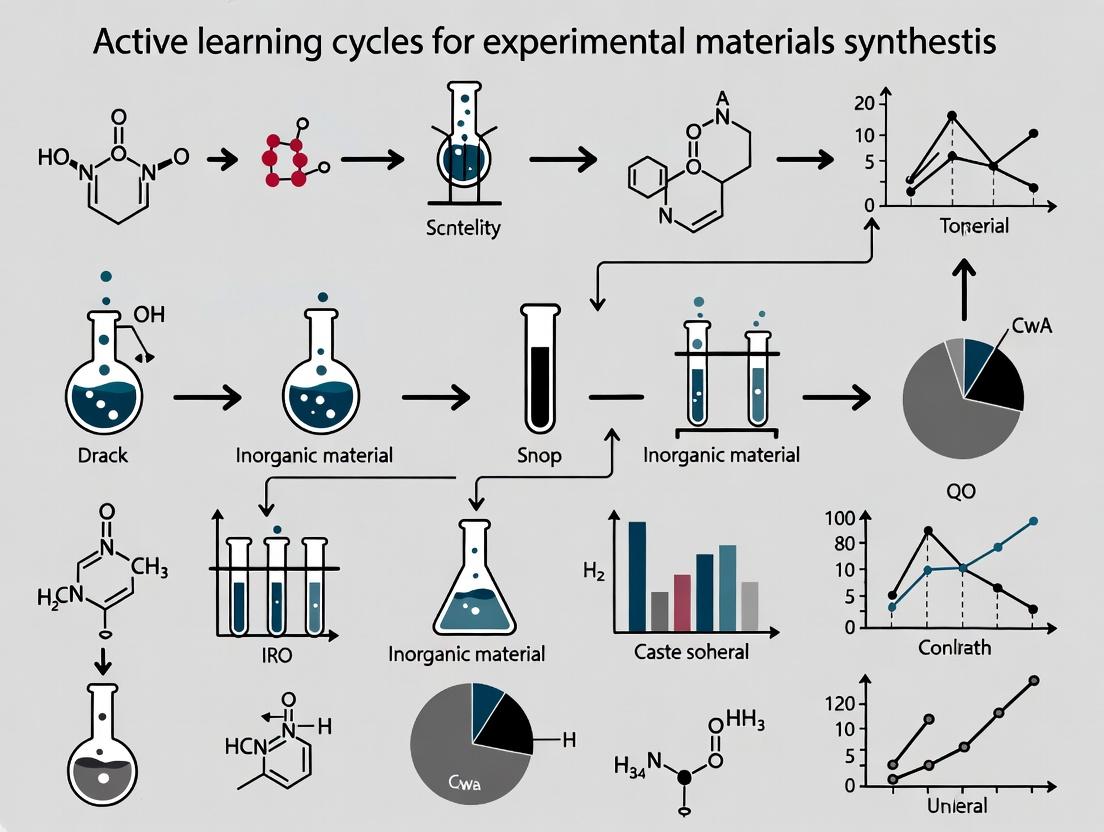
This article provides a comprehensive guide for researchers on implementing active learning (AL) cycles for experimental materials synthesis, with a focus on biomedical applications.
Active Learning in Materials Synthesis: Accelerating Discovery of Next-Generation Biomedical Compounds
Abstract
This article provides a comprehensive guide for researchers on implementing active learning (AL) cycles for experimental materials synthesis, with a focus on biomedical applications. We explore the foundational theory of AL, detailing how it integrates machine learning with robotic experimentation to create closed-loop discovery systems. The guide presents practical methodologies for designing AL experiments, from defining search spaces to selecting acquisition functions. We address common troubleshooting scenarios and optimization strategies for improving model performance and experimental efficiency. Finally, we cover critical validation protocols and comparative analyses of AL against traditional high-throughput screening (HTS), highlighting its transformative potential for accelerating drug development and the discovery of novel therapeutic materials.
What is Active Learning Synthesis? Core Concepts and Scientific Basis
The development of advanced functional materials—from solid-state electrolytes to porous metal-organic frameworks (MOFs) for drug delivery—is bottlenecked by vast, multidimensional design spaces. Traditional sequential experimentation is prohibitively slow. This document details the implementation of a closed-loop, hypothesis-driven Active Learning (AL) cycle, a core methodology within a broader thesis on autonomous materials discovery. This cycle integrates computational hypothesis generation, automated robotic synthesis and characterization, data analysis, and model updating to iteratively guide experiments toward target properties with minimal human intervention.
The Core Active Learning Cycle: Protocol and Application Notes
The cycle is defined by four iterative phases, each with specific protocols.
Table 1: Phases of the Active Learning Cycle for Materials Synthesis
| Phase | Key Objective | Primary Agent | Output |
|---|---|---|---|
| 1. Hypothesis & Proposal | Identify the most informative experiment(s) to perform next. | Machine Learning (ML) Model | A set of proposed material compositions/conditions. |
| 2. Robotic Execution | Physically realize the proposed experiments. | Automated Synthesis & Characterization Robotic Platform | Synthesized materials and associated raw characterization data. |
| 3. Data Processing | Transform raw data into structured, model-usable knowledge. | Analysis Pipeline (Automated + Human) | Clean, featurized datasets (e.g., phase purity, surface area, conductivity). |
| 4. Model Update & Learning | Integrate new knowledge to improve the guiding hypothesis. | Learning Algorithm | An updated ML model with reduced uncertainty in the design space. |
Protocol 2.1: Phase 1 - Hypothesis Generation via Acquisition Function
- Objective: Use an ML model (e.g., Gaussian Process Regression) and an acquisition function to propose the next batch of experiments.
- Materials: Trained surrogate model, historical dataset, defined parameter space (e.g., reactant ratios, temperatures, times).
- Procedure:
- Train or load the current surrogate model on all available experimental data.
- Compute the acquisition function (e.g., Expected Improvement, Upper Confidence Bound) over a sampled or enumerated candidate space.
- Select the candidate(s) with maximum acquisition function value. For batch selection, use a diversity-promoting algorithm (e.g., k-means clustering on candidate features).
- Format and dispatch the selected candidates as machine-readable instruction files (e.g., JSON) to the robotic platform.
Protocol 2.2: Phase 2 - Robotic Synthesis & Characterization
- Objective: Execute material synthesis and primary characterization without manual steps.
- Materials: Automated liquid/powder handler, parallel reactors (e.g., 96-well microreactors), in-line characterization (e.g., Raman, UV-Vis), centrifugation and filtration robots.
- Procedure:
- Synthesis: Robotic platform dispenses precursors and solvents according to the instruction file into reaction vessels. Reactions proceed under controlled temperature and stirring.
- Primary Processing: Automated workstation performs quenching, centrifugation, and solid isolation.
- In-line Characterization: For relevant properties, transfer slurry or solution for immediate analysis (e.g., UV-Vis for nanoparticle size, Raman for phase ID).
- Data Logging: All instrument parameters, environmental data, and raw analytical outputs are tagged with a unique experiment ID and saved to a centralized database.
Protocol 2.3: Phase 3 - Automated Data Processing Pipeline
- Objective: Convert raw analytical data into quantitative, tabular features.
- Materials: Data pipeline (Python scripts), cloud storage, databases.
- Procedure:
- Ingestion: Pipeline retrieves raw data files (e.g., XRD patterns, gas sorption isotherms) via unique experiment ID.
- Analysis: Scripts perform standardized analysis: XRD patterns are matched to reference phases; sorption isotherms are fitted to calculate BET surface area and pore volume.
- Validation: Results are flagged for human review if confidence metrics are low (e.g., poor XRD fit). A scientist confirms or corrects the analysis.
- Featurization: Validated results are merged with synthesis parameters into a single feature vector per experiment and added to the master training dataset.
Protocol 2.4: Phase 4 - Model Retraining & Loop Closure
- Objective: Update the surrogate ML model with new data to close the learning loop.
- Materials: Updated master dataset, ML training infrastructure.
- Procedure:
- The master dataset is split into training/validation sets.
- The surrogate model (from Phase 1) is retrained on the expanded dataset.
- Model performance is evaluated on the validation set (e.g., R² score, mean absolute error). A significant drop triggers hyperparameter tuning.
- The retrained model is deployed as the new hypothesis generator, and the cycle returns to Phase 1.
Visualizing the Active Learning Cycle
Diagram 1: The closed-loop Active Learning cycle for materials discovery.
The Scientist's Toolkit: Key Research Reagent Solutions
Table 2: Essential Materials and Reagents for an AL-Driven Synthesis Campaign
| Item | Function in the AL Cycle | Example(s) / Notes |
|---|---|---|
| High-Throughput Reactor Array | Enables parallel synthesis of dozens to hundreds of discrete conditions proposed by the AL algorithm. | 96-well glass-lined microreactors, multi-channel parallel pressure reactors. |
| Precursor Stock Solutions | Standardized, robot-handleable forms of metal salts, ligands, and reagents. | 0.1-0.5M solutions in DMF, water, or ethanol, filtered for stability. |
| Automated Liquid Handling Robot | Precisely dispenses sub-mL volumes of precursors for reproducibility. | Positive displacement or syringe-based systems with washing routines. |
| In-line Spectroscopic Probe | Provides immediate, in-situ feedback on reaction progress or phase formation. | Raman probe with fiber optics, UV-Vis flow cell. |
| Reference Material Standards | Critical for calibrating characterization tools and validating automated analysis. | NIST-standard XRD reference powder, BET calibration gases (N₂, Ar). |
| Data Management Software (ELN/LIMS) | Logs all experimental parameters, links data, and ensures FAIR (Findable, Accessible, Interoperable, Reusable) data principles. | Cloud-based electronic lab notebook (ELN) with API access for robots. |
Table 3: Quantitative Outcomes from Published Active Learning Campaigns in Materials Science
| Target Material System | AL Cycle Iterations | Experiments Conducted | Key Performance Metric Improvement vs. Random Search | Reference (Year) |
|---|---|---|---|---|
| MOFs for CO₂ Capture | 5 | ~200 | Discovered top-performing material 3.5x faster (in # of experiments). | (MacLeod et al., 2022) |
| Perovskite Thin-Film LEDs | 10 | ~3000 | Achieved target photoluminescence quantum yield with 90% fewer experiments. | (Li et al., 2023) |
| Solid-State Li-Ion Conductors | 6 | ~120 | Identified novel high-conductivity phase; 9x acceleration in discovery rate. | (Dave et al., 2024) |
| Heterogeneous Catalysts (Alloys) | 8 | ~500 | Optimized catalytic activity with 70% reduction in required synthesis & testing. | (Szymanski et al., 2023) |
Application Notes
Defining the Core Triad in Active Learning for Materials Synthesis
The optimization of experimental materials synthesis, such as perovskite formulations or metal-organic framework (MOF) conditions, is accelerated through an iterative active learning (AL) cycle. This cycle is governed by three interdependent components that together minimize the number of costly physical experiments required to discover optimal materials.
The Search Space: This is the bounded, multidimensional domain of all possible experimental parameters. For materials synthesis, it is formally defined by the ranges and discretization levels of controllable variables (e.g., precursor ratios, temperature, time, solvent composition). A well-constructed search space balances comprehensiveness with experimental feasibility. Recent studies (2023-2024) emphasize the use of prior knowledge from domain experts to constrain spaces, reducing invalid combinations by 60-80% before any AL cycle begins.
The Machine Learning Model: This surrogate model learns the complex mapping from synthesis parameters (input) to a target property or performance metric (output), such as photovoltaic efficiency or BET surface area. Gaussian Process (GP) regression remains a benchmark due to its native uncertainty quantification. However, for high-dimensional spaces common in chemistry (e.g., >10 variables), advanced models like Bayesian Neural Networks (BNNs) or ensemble methods (e.g., Random Forest with bootstrapped uncertainty) are increasingly prevalent. A 2023 benchmark on oxide stability prediction showed ensemble methods reduced mean absolute error (MAE) by ~22% compared to single GPs in spaces >15 dimensions.
The Acquisition Function: This is the decision engine that proposes the next experiment by balancing exploration (probing uncertain regions) and exploitation (refining known high-performance regions). Common functions include:
- Expected Improvement (EI): Favors points likely to outperform the current best.
- Upper Confidence Bound (UCB): Adds a weighted uncertainty term to the predicted mean.
- Thompson Sampling: Draws a random function from the posterior for selection.
- Knowledge Gradient: Considers the potential value of information after the experiment. A 2024 meta-analysis of 47 materials AL studies found UCB and EI to be the most frequently used (75% of cases), with Knowledge Gradient gaining traction for batch (parallel) experimental design.
Synergistic Operation: The AL cycle begins with an initial dataset. The ML model is trained on this data. The acquisition function then evaluates all candidate points in the search space using the model's predictions and uncertainties, selecting the most "informative" next synthesis condition. After the experiment is performed and its result measured, the new data point is added to the training set, and the cycle repeats.
Quantitative Performance Data
Table 1: Comparative Performance of AL Components in Recent Materials Studies (2022-2024)
| Study Focus | Search Space Size | Primary ML Model | Acquisition Function | Key Result: Experiments Saved vs. Grid Search | Performance Improvement Achieved |
|---|---|---|---|---|---|
| Perovskite Solar Cells (2023) | 7 variables, ~50k combos. | Gaussian Process | Expected Improvement (EI) | 85% reduction (found optimum in 38 vs. 250+ expts) | PCE increased from 18.2% to 21.7% |
| MOF for CO₂ Capture (2022) | 5 variables, ~8k combos. | Random Forest Ensemble | Upper Confidence Bound (UCB) | 78% reduction (45 vs. 200 expts) | CO₂ uptake enhanced by 41% at 0.15 bar |
| Solid-State Electrolyte (2024) | 12 variables, >10⁶ combos. | Bayesian Neural Network | Knowledge Gradient (Batch) | >90% reduction (60 vs. 600+ estimated) | Ionic conductivity optimized to 12.1 mS/cm |
| Polymer Dielectrics (2023) | 4 variables, 1296 combos. | Gaussian Process | Thompson Sampling | 70% reduction (30 vs. 100 expts) | Discovered 5 new polymers with >95% efficiency |
Experimental Protocols
Protocol: Implementing an Active Learning Cycle for Perovskite Thin-Film Synthesis Optimization
Objective: To identify the optimal precursor stoichiometry and annealing conditions for maximizing Power Conversion Efficiency (PCE) of a perovskite solar cell absorber layer.
I. Search Space Definition Protocol
- Parameter Selection: Define the experimental variables and their physically plausible ranges based on literature and precursor chemistry.
- PbI₂ : FAI : MABr Molar Ratio (e.g., 1.0 : 0.8-1.2 : 0.1-0.4)
- Annealing Temperature (°C): 90-150
- Annealing Time (min): 5-20
- DMSO:DMF Solvent Ratio (v/v%): 20:80 - 40:60
- Discretization: For computational tractability, discretize continuous parameters (e.g., temperature in 5°C steps, time in 1-min steps).
- Constraint Encoding: Programmatically exclude known invalid combinations (e.g., low annealing temperature with very short time leading to incomplete conversion).
II. Initial Dataset & Model Training Protocol
- Design of Experiments (DoE): Perform an initial set of 12-16 experiments using a space-filling design (e.g., Latin Hypercube Sampling) to cover the defined search space.
- Synthesis & Characterization: a. Prepare precursor solutions according to the specified ratios in the mixed solvent. b. Spin-coat onto prepared ITO/ETL substrates. c. Anneal on a programmable hotplate under N₂ atmosphere at the specified T and t. d. Characterize film morphology via SEM. e. Complete full solar cell device fabrication (add HTL, electrodes). f. Measure current-voltage (J-V) characteristics under simulated AM 1.5G illumination to obtain PCE.
- Data Curation: Create a structured table with synthesis parameters as inputs and PCE as the target output.
- Model Initialization: Train a Gaussian Process (GP) model with a Matern kernel on the initial dataset. Use a 75/25 train-validation split to assess initial prediction error (MAE, R²). Optimize hyperparameters (length scales, noise) via maximum likelihood estimation.
III. Iterative AL Cycle Protocol
- Acquisition Optimization: Using the trained GP model, compute the acquisition function (e.g., Expected Improvement) for all candidate points in the discretized search space.
- Next Experiment Proposal: Select the candidate point with the maximum acquisition function value.
- Experimental Validation: Perform the synthesis and characterization (as per II.2) for the proposed condition.
- Model Update: Append the new {parameters, PCE} data pair to the training dataset. Retrain the GP model on the expanded dataset.
- Stopping Criterion: Repeat steps 1-4 until a performance target is met (e.g., PCE > 21%), the acquisition function value falls below a threshold (diminishing returns), or a pre-set budget of experiments (e.g., 50 cycles) is exhausted.
- Validation: Perform triplicate synthesis of the top 3 identified optimal conditions to confirm reproducibility.
Mandatory Visualization
Title: Active Learning Cycle for Materials Synthesis
The Scientist's Toolkit: Research Reagent Solutions
Table 2: Essential Materials & Reagents for Perovskite Synthesis AL Campaign
| Item Name | Function / Role in Protocol | Critical Specifications / Notes |
|---|---|---|
| Lead(II) Iodide (PbI₂) | Primary perovskite precursor. Source of Pb²⁺ in the crystal lattice. | High purity (>99.99%), stored in a dry, inert atmosphere to prevent hydration and oxidation. |
| Formamidinium Iodide (FAI) & Methylammonium Bromide (MABr) | Organic cation precursors. Determine crystal structure, bandgap, and stability. | Purified via recrystallization. Hygroscopic; must be stored in a desiccator and used in a glovebox. |
| Dimethyl Sulfoxide (DMSO) & N,N-Dimethylformamide (DMF) | Co-solvent system. Dissolve precursors; DMSO aids in intermediate complex formation. | Anhydrous grade (<50 ppm H₂O). Stored over molecular sieves. |
| Chlorobenzene (Anti-solvent) | Used during spin-coating to rapidly induce crystallization for uniform film formation. | Anhydrous, high purity. Dripping timing is a critical kinetic parameter. |
| ITO-coated Glass Substrates | Conductive transparent electrode for device fabrication and testing. | Pre-patterned, rigorously cleaned via sequential sonication (detergent, acetone, isopropanol). |
| Titanium Dioxide (TiO₂) or SnO₂ Colloidal Dispersion | Electron Transport Layer (ETL). Facilitates electron extraction and hole blocking. | Filtered (0.22 μm) before spin-coating to ensure pinhole-free films. |
| Spiro-OMeTAD (in Chlorobenzene) | Hole Transport Layer (HTL). Facilitates hole extraction and electron blocking. | Doped with Li-TFSI and tBP oxidants for enhanced conductivity; prepared fresh. |
| Gold (Au) Evaporation Targets | Source for thermally evaporated top contact electrode. | High purity (99.999%) to ensure good adhesion and low contact resistance. |
In experimental materials science and drug development, optimizing synthesis conditions or molecular properties is a high-dimensional challenge. Traditional approaches include One-Factor-at-a-Time (OFAT) experimentation and basic High-Throughput Screening (HTS). Active Learning (AL) is a machine learning-guided iterative framework that strategically selects the most informative experiments to perform, maximizing knowledge gain per experimental cycle. This application note details the rationale and protocols for implementing AL cycles, contextualized within materials synthesis research.
Quantitative Comparison of Experimental Strategies
Table 1: Performance Comparison of Experimental Design Strategies
| Strategy | Key Principle | Experimental Efficiency (Typical) | Optimal Solution Convergence | Resource Utilization | Adaptability to Complexity |
|---|---|---|---|---|---|
| One-Factor-at-a-Time (OFAT) | Vary one factor while holding others constant. | Very Low; Requires ~O(N) experiments per factor. | Low; Misses interactions, often finds local optima. | High waste; many non-optimal experiments. | Poor; fails with factor interactions. |
| Basic High-Throughput Screening (HTS) | Run a large, pre-defined grid or random set of conditions. | Moderate-High (throughput) but Low (insight/exp). | Moderate; Can find good regions but inefficiently. | Very high initial investment; many redundant tests. | Moderate; maps space but without intelligence. |
| Active Learning (AL) Cycle | Iteratively select experiments to maximize model improvement. | Very High; Reduces needed expts by 50-90% vs. OFAT/HTS. | High; Efficiently finds global or near-global optima. | Optimal; focuses resources on informative points. | Excellent; explicitly models interactions & uncertainty. |
Data synthesized from recent literature on materials optimization (e.g., perovskite solar cells, MOF synthesis, catalyst design) and drug candidate profiling.
Detailed Protocols
Protocol 1: Initiating an Active Learning Cycle for Synthesis Optimization
Objective: To establish the initial dataset and machine learning model for an AL-driven optimization of a target material property (e.g., photocatalytic yield, battery cycle life).
Materials: See "Scientist's Toolkit" (Section 6).
Procedure:
Define Search Space:
- Identify critical synthesis factors (e.g., precursors A & B concentration, temperature, time, pH).
- Set feasible minimum and maximum bounds for each continuous factor. Define discrete levels for categorical factors (e.g., solvent type).
Acquire Initial Dataset:
- Perform a space-filling design (e.g., Latin Hypercube Sampling) across the defined search space.
- Recommended: Run 10-20 initial experiments. This provides broad coverage for the initial model.
- Execute synthesis and characterization to measure the target property for each condition. Record in a structured database.
Train Initial Surrogate Model:
- Use a probabilistic model such as Gaussian Process Regression (GPR) or an ensemble method.
- Input: Factor values from Step 2. Output: Measured target property.
- The model learns the underlying response surface and, critically, quantifies its own prediction uncertainty across the search space.
Query Next Experiment Using Acquisition Function:
- An acquisition function balances exploration (sampling high-uncertainty regions) and exploitation (sampling near predicted optima).
- Common Function: Expected Improvement (EI).
- Let the model evaluate EI for thousands of candidate conditions in silico.
- Select the condition with the highest EI score as the next experiment to run.
Execute Experiment & Update Cycle:
- Perform the synthesis and characterization for the selected condition.
- Append the new data point (factors + result) to the training dataset.
- Retrain/update the surrogate model with the expanded dataset.
- Return to Step 4. Continue until performance target is met or resources are expended.
Diagram 1: Active Learning Cycle for Experimentation
Protocol 2: Benchmarking AL vs. OFAT (Simulation-Based)
Objective: To computationally demonstrate the efficiency gain of AL over OFAT.
Procedure:
Choose a Simulated Test Function:
- Use a known function with multiple local optima and interaction effects (e.g., Branin-Hoo function, 2D; or a synthetic pharmacokinetic model).
- This function represents the hidden "true" relationship between factors and the response.
OFAT Simulation:
- Select a baseline condition.
- Vary Factor A across its range while holding others constant. Identify best A value.
- Using this best A, vary Factor B across its range. Identify best B value.
- Record the total number of function evaluations (experiments) and the final performance.
AL Simulation:
- Start with the same small, space-filling initial dataset as in Protocol 1 (Step 2).
- Implement the full AL cycle (Protocol 1, Steps 3-6) using the simulated function to return results.
- Run for the same number of total function evaluations as used in the OFAT run.
Analysis:
- Plot the best performance discovered vs. number of experiments for both strategies.
- Result: The AL curve will typically rise faster and to a higher final value, demonstrating superior sample efficiency.
Diagram 2: Logic of Performance Benchmarking
The Scientist's Toolkit: Key Research Reagent Solutions
Table 2: Essential Components for an Active Learning-Driven Synthesis Lab
| Item / Solution | Function in AL Cycle | Example / Note |
|---|---|---|
| Automated Synthesis Platform | Executes physical experiments from digital instructions; enables rapid iteration. | Liquid handling robot, modular microwave synthesizer, automated flow reactor. |
| High-Throughput Characterization | Provides rapid, quantitative feedback on target properties for many samples. | Plate reader (absorbance/fluorescence), parallel electrochemical station, automated XRD/GC-MS. |
| Data Management Platform | Logs all experimental factors (inputs) and results (outputs) in a structured, queryable format. | Electronic Lab Notebook (ELN) with API access, centralized SQL database. |
| Machine Learning Software | Builds surrogate models and calculates acquisition functions to propose experiments. | Python libraries: scikit-learn, GPyTorch, Dragonfly. Dedicated platforms: Citrination, MLplates. |
| Computational Infrastructure | Runs model training and in-silico candidate evaluation, which can be compute-intensive. | Cloud computing instances (AWS, GCP) or local high-performance computing (HPC) cluster. |
| Standardized Chemical Libraries | Provides consistent, high-quality starting materials for exploring compositional spaces. | Stock solutions of precursors, pre-weighed reactant cartridges for robots. |
The evolution from traditional computer science to Self-Driving Laboratories (SDLs) represents a paradigm shift in experimental research. This transition is rooted in the convergence of high-throughput automation, artificial intelligence (AI), and advanced data analytics. The table below summarizes key quantitative milestones in this evolution.
Table 1: Quantitative Milestones in the Evolution Towards SDLs
| Decade | Key Development | Representative Throughput/Performance | Enabling Technology |
|---|---|---|---|
| 1990s | High-Throughput Screening (HTS) | 10,000-100,000 compounds/week | Robotic liquid handlers, microplates |
| 2000s | Laboratory Automation & LabVIEW | Automated single workflows | Programmable lab equipment, PLCs |
| 2010s | AI for Materials & Drug Discovery | ~10x faster candidate identification | Machine Learning (RF, SVM), cloud computing |
| 2020-Present | Closed-Loop SDLs | 24/7 autonomous operation; 10-100x acceleration | Active Learning, robotics, IoT, DL models (GNNs) |
Core Protocol: Establishing an Active Learning Cycle for an SDL
This protocol outlines the foundational closed-loop cycle central to modern SDLs for materials synthesis.
Protocol 1: Closed-Loop Active Learning for Experimental Synthesis Objective: To autonomously discover or optimize a target material (e.g., a perovskite ink, organic photocatalyst) by integrating AI-driven prediction, automated synthesis, and characterization.
Materials & Reagents:
- Targeted Chemical Space: Define initial set of precursors, solvents, and synthesis conditions (e.g., temperature, time).
- Automated Synthesis Platform: Robotic arm or fluidic system capable of precise dispensing, mixing, and reaction control.
- Inline/Online Characterization Tools: Spectrophotometer, HPLC, particle size analyzer integrated into the workflow.
- Computational Infrastructure: Server/cloud instance running the active learning model and database.
Procedure:
- Initial Design of Experiments (DoE):
- Using the defined chemical space, select an initial set of 20-50 experiments via a space-filling algorithm (e.g., Latin Hypercube Sampling) or from existing historical data.
- Program the automated synthesis platform to execute this batch.
Automated Execution & Data Acquisition:
- The robotic platform prepares samples according to the specified formulations and conditions.
- Immediately route products to integrated characterization tools.
- Parse and log all structured data (formulation parameters, process conditions, characterization results) into a central database.
Model Training & Prediction:
- Train a surrogate model (e.g., Gaussian Process Regression, Neural Network) on all accumulated data to map input parameters to output properties.
- Use an acquisition function (e.g., Expected Improvement, Upper Confidence Bound) on the model to score millions of candidate experiments in silico.
- Select the next batch of 5-20 experiments that maximize the acquisition function (balancing exploration and exploitation).
Closed-Loop Iteration:
- Append the new proposed experiments to the execution queue.
- Repeat steps 2-4 until a performance target is achieved or a predefined iteration limit is reached.
Notes: The cycle's speed is limited by the slowest step, often synthesis or characterization. The choice of surrogate model and acquisition function is critical for efficiency.
The Scientist's Toolkit: Key Research Reagent Solutions for SDLs
Table 2: Essential Materials & Tools for a Materials Synthesis SDL
| Item | Function in SDL Context |
|---|---|
| Modular Robotic Liquid Handler | Precisely dispenses sub-microliter to milliliter volumes of precursors and solvents for reproducible synthesis. |
| Integrated Reaction Block/Module | Provides temperature and stirring control for parallelized chemical reactions. |
| Inline UV-Vis/NIR Spectrophotometer | Provides rapid, non-destructive optical characterization for real-time feedback on reaction progress or material properties. |
| Automated Product Handling (ARM) | Transfers sample vials or well plates between synthesis, characterization, and storage stations. |
| Laboratory Information Management System (LIMS) | Centralized database that logs all experimental metadata, conditions, and results in a structured, queryable format. |
| Active Learning Software Platform | Hosts the surrogate model, runs the acquisition function, and manages the experiment queue (e.g., Phoenix, ChemOS, custom Python code). |
Visualization of Core Concepts
Title: Self-Driving Lab Active Learning Cycle
Title: Historical Convergence to SDLs
Within the active learning cycle for experimental materials synthesis—wherein each iteration of design, synthesis, characterization, and data analysis informs the next—three foundational pillars are critical: robust Data management, deep Domain Knowledge, and scalable Automation Infrastructure. This protocol outlines the application notes for establishing these prerequisites to enable closed-loop, AI-driven discovery in materials science and drug development.
Data: Curation, Standards, and Management
High-quality, machine-readable data is the primary fuel for active learning models.
Table 1: Quantitative Data Standards for Materials Synthesis
| Data Category | Key Metrics | Recommended Format | Minimum Required Metadata | Source Example (2024) |
|---|---|---|---|---|
| Synthesis Parameters | Temperature (°C), Time (hr), Precursor Molarity | JSON, CSV | Catalyst ID, Solvent, Equipment Calibration Log | NIST Materials Resource Registry |
| Characterization Results | XRD Peak Positions, BET Surface Area (m²/g), Pore Size (nm) | HDF5, .ibw (Igor Binary) | Instrument Model, Resolution, Analysis Software Version | MIT Nano-Characterization Lab Protocols |
| Performance Data | Photoluminescence Quantum Yield (%), Ionic Conductivity (S/cm) | CSV, .mat | Test Conditions, Reference Standard, Uncertainty | AMPED Project (DOE, 2023) |
| Process Logging | Robotically Executed Steps, Error Flags, Timestamps | Structured Log (e.g., Apache Parquet) | Step ID, Success/Fail, Actor (Human/Robot) | Carnegie Lab (AutoSynthesis Platform) |
Protocol 2.1: Data Capture from Synthesis Robot
Objective: To automatically capture and structure all parameters from a high-throughput solvothermal synthesis run.
Materials:
- Automated liquid handler (e.g., Chemspeed Swing)
- Reactor block with integrated temperature/pressure sensors
- Centralized ELN (Electronic Lab Notebook) system (e.g., Benchling)
Procedure:
- Pre-Run Configuration: Define a JSON schema for the experiment in the ELN, specifying fields for
precursor_list,target_temperature,stirring_rate, andreaction_vessel_ID. - Instrument Communication: Use a REST API wrapper to initiate the synthesis script on the Chemspeed platform. The wrapper must log the sent command.
- Real-Time Streaming: Configure the reactor block’s sensor outputs to stream timestamped
temperature,pressure, andoptical_monitoringdata via an MQTT broker to a time-series database (e.g., InfluxDB). - Post-Run Aggregation: Execute a data pipeline script (Python/R) that queries the database and ELN API, merging all run data into a single, versioned HDF5 file using the pre-defined schema.
- Validation: Run automated sanity checks (e.g., temperature within safe bounds, precursor volumes positive) before releasing the dataset for model training.
Domain Knowledge: Formalizing Expertise
Domain expertise must be encoded to constrain and guide active learning, preventing physically implausible experiments.
Protocol 3.1: Encoding Reaction Constraints as Rule Sets
Objective: To prevent the suggestion of synthetically infeasible conditions by the AI agent.
Procedure:
- Expert Elicitation: Conduct structured interviews with senior chemists to list "hard" constraints (e.g., "Solvent X decomposes above 200°C," "Precursors A and B precipitate in the presence of ion C").
- Rule Formulation: Express each constraint in a formal logic statement. Example:
NOT (Solvent == "DMSO" AND Temperature > 185). - Implementation: Embed these rules as a pre-screening filter in the suggestion generation code. The AI's proposed experiment list passes through this filter, which removes all violating candidates before the list is sent to the experiment queue.
- Maintenance: Establish a version-controlled repository (e.g., Git) for the rule set, requiring peer review for any addition or modification.
Diagram 1: AI suggestions filtered by domain rules.
Automation Infrastructure: The Physical Loop
Reliable robotic systems are required to execute the suggested experiments and collect high-fidelity data.
Table 2: Research Reagent Solutions & Essential Hardware Toolkit
| Item | Function / Rationale | Example Product / Specification |
|---|---|---|
| Modular Liquid Handler | Precise dispensing of precursors/solvents for reproducibility. | Opentrons OT-2, 0.1 µL - 1000 µL pipetting range. |
| Integrated Reactor Block | Parallel synthesis under controlled temperature/pressure. | Unchained Labs Little Bear, 8-96 reactors, -20°C to 150°C. |
| In-Line Spectrometer | Real-time reaction monitoring for kinetic data. | Ocean Insight FX-UVVis, fiber-coupled to reactor flow cell. |
| Automated Solid Handler | Weighing and dispensing of solid precursors. | Chemspeed Technologies SWING powder doser. |
| Central Scheduling Software | Orchestrates hardware, manages task queue, and handles errors. | Synthace Digital Experimentation Platform. |
| Laboratory Execution System (LES) | Standardizes operational protocols across robotic platforms. | Tiamo (Metrohm) or custom Snakemake workflows. |
Protocol 4.1: Workflow for a Single Active Learning Cycle
Objective: To perform one complete iteration of AI-driven synthesis and characterization.
Materials: All items listed in Table 2, plus characterization suite (XRD, SEM).
Procedure:
- Job Initiation: The central scheduler pulls a batch of
nvalidated synthesis recipes (from Protocol 3.1) from the queue. - Robotic Synthesis: a. The solid handler dispenses powders into tared vials. b. The liquid handler adds precise volumes of solvents. c. Vials are transferred to the reactor block. The reaction proceeds with in-line UV-Vis monitoring. d. Post-reaction, the handler quenches the reaction and prepares samples for characterization.
- Automated Characterization: A robotic arm transfers product plates to an automated XRD (e.g., Bruker D8 ADVANCE with sample changer). Data is collected and pre-processed (background subtraction, peak identification) via instrument software.
- Data Aggregation & Model Update: The pipeline aggregates new synthesis parameters and characterization results into the master HDF5 database. The active learning model (e.g., Bayesian optimizer) is retrained on the expanded dataset.
- Next-Batch Suggestion: The updated model suggests the next batch of
nexperiments, maximizing an acquisition function (e.g., expected improvement), and the cycle repeats.
Diagram 2: One active learning cycle for materials synthesis.
Building Your Active Learning Pipeline: A Step-by-Step Blueprint
Within an active learning (AL) cycle for experimental materials synthesis—such as for novel metal-organic frameworks (MOFs), battery electrolytes, or pharmaceutical co-crystals—the initial step is foundational. This phase transforms a broad research question into a concrete, actionable objective and maps the multidimensional space of possible experiments. It defines the "rules of the game" for the subsequent AL loop, where machine learning models will propose experiments to efficiently navigate this space towards optimal outcomes. A poorly defined objective or an incompletely constituted design space leads to wasted resources and inconclusive results.
Defining the Objective
The objective must be a Specific, Measurable, Achievable, Relevant, and Time-bound (SMART) target function for optimization. In materials synthesis, objectives are often multi-faceted.
Table 1: Common Objective Functions in Materials Synthesis Research
| Objective Type | Primary Metric | Example in Drug Development | Typical Measurement Assay |
|---|---|---|---|
| Maximize Property | Yield, Purity, Stability | Maximize crystallinity & stability of an API co-crystal | Powder X-Ray Diffraction (PXRD), DSC |
| Optimize Formulation | Solubility, Dissolution Rate | Enhance bioavailability of a poorly soluble compound | HPLC, USP Dissolution Apparatus |
| Minimize Cost | $ per kg, # of steps | Reduce cost of goods for a key intermediate | Process mass intensity calculation |
| Multi-Objective | Pareto Frontier (e.g., Stability vs. Solubility) | Balance tabletability with dissolution profile | Multivariate analysis of compaction & dissolution data |
Protocol 2.1: Formalizing a Multi-Objective Goal for an API Solid Form Screen
- Identify Critical Quality Attributes (CQAs): From target product profile, list non-negotiable properties (e.g., chemical stability > 6 months, polymorphic stability).
- Define Primary Optimization Axes: Select 2-3 key, often competing, properties for active optimization (e.g., Intrinsic Solubility vs. Hygroscopicity).
- Establish Metrics and Assays: Assign precise, quantitative measures for each axis (e.g., solubility in µg/mL via UV-Vis; % weight gain at 80% RH via DVS).
- Set Constraints and Thresholds: Define failure boundaries (e.g., yield < 5% is non-viable; any impurity > 0.1% is a failure).
- Formulate as Computational Objective: Express as a multi-objective optimization function (e.g.,
Maximize(solubility), Minimize(hygroscopicity) subject to yield > 20% and purity > 98%).
Constituting the Experimental Design Space
The design space is the bounded set of all possible experiments defined by manipulable input variables (factors). A well-constituted space is crucial for AL efficiency.
Table 2: Typical Factor Categories in Pharmaceutical Materials Synthesis
| Factor Category | Specific Factors | Typical Range or Levels | Influence On |
|---|---|---|---|
| Chemical Variables | Reactant stoichiometry, Solvent composition (antisolvent ratio), pH, Additives/Coformers | Continuous (e.g., 1:1 to 1:4 molar ratio) or Discrete (e.g., Solvent A, B, C) | Polymorph outcome, purity, crystal habit |
| Process Variables | Temperature, Cooling rate, Stirring speed/type, Addition rate | Continuous (e.g., 20°C to 80°C) | Crystal size distribution, yield, reproducibility |
| Setup Variables | Vessel type (vial vs. microtiter plate), Scale (mg to g) | Discrete | Heat/mass transfer, discovery relevance to scale-up |
Protocol 3.1: Mapping a High-Throughput Cocrystal Screening Design Space
- Factor Selection: Choose API, 5-10 GRAS coformers, 3-4 solvents (diverse polarity), and 2 crystallization methods (slow evaporation, liquid-assisted grinding).
- Define Boundaries: Set solvent volumes (50-200 µL for microtiter plates), stoichiometric ranges (API:Coformer 1:1 to 1:3), and temperature (ambient to 40°C).
- Establish a Base Design: Create a sparse but space-filling initial dataset (e.g., via Latin Hypercube Sampling) of 20-50 experiments to "seed" the AL model.
- Encode for ML: Represent each experiment as a numerical feature vector (e.g., one-hot encoding for solvents, normalized values for continuous factors).
- Integrate Prior Knowledge: Manually exclude known incompatible conditions (e.g., solvents that degrade the API) to focus the design space.
The Scientist's Toolkit: Research Reagent Solutions
Table 3: Essential Materials for High-Throughput Materials Synthesis
| Item/Category | Function & Rationale | Example Product/Brand |
|---|---|---|
| High-Throughput Reaction Platform | Enables parallel synthesis of hundreds of discrete material samples under controlled conditions. | Chemspeed SWING, Unchained Labs Junior, custom robotic fluid handlers. |
| Automated Liquid Handling System | Precisely dispenses solvents, reagents, and APIs in µL to mL volumes for reproducibility and miniaturization. | Hamilton MICROLAB STAR, Tecan Fluent, Opentrons OT-2. |
| Multi-Well Crystallization Plates | Provides individual, chemically resistant vessels for parallel crystallization experiments. | 96-well or 384-well plates with clear polymer or glass inserts (e.g., MiTeGen CrystalQuick). |
| Characterization Plate Reader | Enables in-situ or rapid ex-situ measurement of key properties directly in multi-well plates. | Polymorph screening via parallel PXRD (e.g., Bruker D8 Discover with MYTHEN2 detector), Raman microscopy. |
| Chemical Databases & Software | Provides digital catalogs of coformers/solvents and software to design experiments and manage data. | Cambridge Structural Database (CSD), Merck Solvent Guide, scikit-learn or Dragonfly for AL design. |
Visualization of the Active Learning Cycle Workflow
Title: Active Learning Cycle for Materials Optimization
Visualization of Multi-Objective Optimization in Design Space
Title: Mapping Design Space to Multi-Objective Outcomes
In the broader context of active learning cycles for experimental materials synthesis, selecting and training the initial surrogate model is the pivotal step that transitions from human-driven intuition to an iterative, AI-guided experimentation loop. The surrogate model acts as a computationally efficient proxy for expensive or time-consuming laboratory experiments, predicting material properties or synthesis outcomes based on available data. A well-chosen initial model sets the foundation for efficient exploration of the chemical and parameter space, optimizing the allocation of resources in subsequent active learning cycles. This step directly addresses the core challenge in materials and drug development: maximizing information gain while minimizing costly experimental trials.
Model Selection: Comparative Analysis
The choice between models like Gaussian Processes (GPs) and Bayesian Neural Networks (BNNs) hinges on dataset size, dimensionality, and the desired uncertainty quantification. The following table summarizes key quantitative benchmarks from recent literature.
Table 1: Comparative Performance of Initial Surrogate Models for Materials Science Applications
| Model Type | Optimal Dataset Size (Initial Pool) | Typical Training Time (for ~1000 samples) | Uncertainty Quantification | Interpretability | Sample Efficiency | Key Reference (Year) |
|---|---|---|---|---|---|---|
| Gaussian Process (GP) | 50 - 500 points | Minutes to 1 hour | Intrinsic (posterior variance) | High (kernel insights) | Excellent | J. Mater. Chem. A, 2023 |
| Bayesian Neural Network (BNN) | 500 - 5000+ points | Hours to days | Approximate (via dropout, ensembles, MCMC) | Moderate to Low | Good (with sufficient data) | npj Comput. Mater., 2024 |
| Sparse / Variational GP | 500 - 10,000 points | 30 mins to 2 hours | Approximate (reduced fidelity) | Moderate | Very Good | Digit. Discov., 2023 |
| Random Forest (Baseline) | 100 - 5000 points | Seconds to minutes | Approximate (e.g., jackknife) | Moderate (feature importance) | Good | ACS Cent. Sci., 2023 |
Data synthesized from recent benchmarking studies on organic photovoltaic, perovskite, and catalytic material datasets.
Experimental Protocols for Model Training & Validation
Protocol 3.1: Data Preprocessing for Surrogate Model Training
Objective: To transform raw experimental data into a format suitable for surrogate model training, ensuring robustness and predictive performance.
- Feature Engineering: Encode categorical variables (e.g., solvent type, catalyst) using one-hot encoding. Standardize continuous variables (e.g., temperature, concentration) and target properties (e.g., yield, bandgap) to have zero mean and unit variance.
- Train-Validation-Test Split: For the initial seed dataset (D_initial), apply an 70-15-15 stratified split. Stratification ensures proportional representation of different experimental conditions or outcome ranges across splits.
- Handling Missing Data: For datasets with missing feature values, use multivariate imputation (e.g., K-Nearest Neighbors imputation) based on similar experiments in the seed dataset. Flag imputed values for potential model uncertainty inflation.
Protocol 3.2: Training a Gaussian Process Surrogate Model
Objective: To construct a GP model that provides predictions with inherent uncertainty estimates.
- Kernel Selection: Initiate with a composite kernel: Matérn 5/2 kernel (
Matérn(nu=2.5)) for continuous parameters plus a White Kernel to model experimental noise. For categorical features, multiply by aConstantKernel. - Model Instantiation: Use
GaussianProcessRegressor(fromscikit-learn) orGPyTorch. Setn_restarts_optimizer=10to avoid convergence on local minima of the log-marginal-likelihood. - Hyperparameter Optimization: Optimize kernel hyperparameters (length scales, noise variance) by maximizing the log-marginal-likelihood using the L-BFGS-B optimizer.
- Validation: Use the held-out validation set to calculate the Root Mean Square Error (RMSE) and the Negative Log Predictive Density (NLPD), which assesses both predictive accuracy and uncertainty calibration.
Protocol 3.3: Training a Bayesian Neural Network Surrogate Model
Objective: To construct a BNN capable of learning complex relationships in larger datasets with approximate uncertainty.
- Architecture Definition: Design a fully-connected network with 2-3 hidden layers (e.g., 128-64-32 neurons). Use
tanhorswishactivation functions. - Bayesian Implementation: Implement Bayesian layers using Monte Carlo Dropout (
tf.keras.layers.Dropoutwith dropout rate of 0.1-0.3 kept active at training and inference) or a variational inference framework (e.g.,TensorFlow ProbabilityDenseVariational layers). - Loss Function & Training: Use an evidence lower bound (ELBO) loss for variational methods, or mean squared error (MSE) loss with L2 regularization for dropout-based BNNs. Train for 1000-5000 epochs with an early stopping callback (patience=100) monitoring validation loss.
- Uncertainty Estimation: At inference, perform
T=50stochastic forward passes with dropout enabled. The mean of the predictions is the final prediction; the standard deviation is the epistemic uncertainty estimate.
Visualization of the Model Integration Workflow
Diagram 1: Surrogate Model Training Workflow
The Scientist's Toolkit: Research Reagent Solutions
Table 2: Essential Computational Tools & Resources for Surrogate Modeling
| Tool/Resource | Function in Protocol | Example/Provider | Key Benefit for Research |
|---|---|---|---|
| GP Implementation Library | Provides core algorithms for GP regression, kernel functions, and optimization. | GPyTorch, scikit-learn GaussianProcessRegressor |
Accelerates development with robust, peer-reviewed code; enables GPU acceleration. |
| BNN/Probabilistic DL Framework | Enables construction and training of neural networks with uncertainty estimates. | TensorFlow Probability, Pyro, PyMC3 |
Integrates Bayesian layers seamlessly into deep learning workflows. |
| Automated Hyperparameter Optimization | Systematically searches for optimal model settings (e.g., learning rate, network depth). | Optuna, Ray Tune, scikit-optimize |
Reduces manual tuning time and improves model performance reproducibly. |
| Uncertainty Calibration Metrics | Quantifies the reliability of model-predicted uncertainties. | scikit-learn calibration curves, netcal library |
Critical for trusting the model's uncertainty estimates in downstream active learning. |
| High-Performance Computing (HPC) / Cloud GPU | Provides computational power for training BNNs or GPs on large datasets. | Google Cloud AI Platform, AWS SageMaker, local GPU cluster | Makes complex, data-hungry models feasible within realistic timeframes. |
| Materials Science Databank | Source of initial seed data or pretrained model weights for transfer learning. | Matbench, OMDb, The Materials Project |
Jumpstarts modeling by providing relevant, structured data, improving sample efficiency. |
Within an active learning cycle for experimental materials synthesis and drug development, the acquisition function is the critical decision engine. It uses the surrogate model's predictions to select the next experiment to perform, balancing exploration of uncertain regions with exploitation of known promising areas. This Application Note details the protocols for implementing three prominent strategies: Expected Improvement (EI), Upper Confidence Bound (UCB), and Entropy Search (ES).
Table 1: Quantitative Comparison of Acquisition Strategies
| Feature | Expected Improvement (EI) | Upper Confidence Bound (UCB) | Entropy Search (ES) | |||
|---|---|---|---|---|---|---|
| Core Principle | Measures the expected value of improvement over the current best observation. | Optimistically estimates the upper bound of the objective function using a confidence interval. | Seeks to maximally reduce the uncertainty about the location of the global optimum. | |||
| Key Formula | ( EI(x) = \mathbb{E}[\max(f(x) - f(x^+), 0)] ) | ( UCB(x) = \mu(x) + \kappa \sigma(x) ) | ( ES(x) = H[p(x_* | \mathcal{D})] - \mathbb{E}_{p(f(x) | \mathcal{D})}[H[p(x_* | \mathcal{D} \cup {(x, f(x))})]] ) |
| Balance Parameter | (\xi) (exploration-exploitation trade-off) | (\kappa) (explicit exploration weight) | Implicit, via information gain. | |||
| Computational Cost | Low | Low | High (requires approximation) | |||
| Best Suited For | Efficient global optimization, finding the best possible result. | Tractable tuning, bandit problems, cumulative regret minimization. | Complex, multi-modal landscapes where pinpointing the optimum is crucial. | |||
| Primary Goal | Exploit with measured exploration. | Explicit, tunable exploration. | Informative exploration to locate optimum. |
Experimental Protocols
Protocol 3.1: Implementing Expected Improvement for Catalyst Screening
Objective: To identify the synthesis condition (Temperature, Precursor Ratio) that maximizes catalytic yield. Materials: High-throughput robotic synthesis platform, parallel reactor array, GC-MS for yield analysis. Procedure:
- Initial Design: Perform 10 experiments using a space-filling Latin Hypercube Design over the parameter space.
- Surrogate Modeling: After each cycle, train a Gaussian Process (GP) model on all accumulated data, normalizing the yield response.
- EI Calculation: For a candidate point (x), compute:
- (\mu(x), \sigma(x)) from the GP posterior.
- (f(x^+)) = maximum observed yield so far.
- (z = \frac{\mu(x) - f(x^+) - \xi}{\sigma(x)})
- (EI(x) = (\mu(x) - f(x^+) - \xi) \Phi(z) + \sigma(x) \phi(z)) where (\Phi) and (\phi) are the CDF and PDF of the standard normal distribution. Set (\xi=0.01).
- Selection: Evaluate EI over a dense, discrete grid of candidate conditions. Select the point with maximal EI for the next experiment.
- Iteration: Run the synthesis and characterization at the selected condition. Update the dataset and repeat from Step 2 for 20 cycles.
Protocol 3.2: Using Upper Confidence Bound for Polymer Reaction Optimization
Objective: To optimize polymer molecular weight while minimizing reaction time (a multi-objective problem scalarized into a single reward). Materials: Automated flow chemistry setup, in-line GPC/SEC, control software with API. Procedure:
- Reward Definition: Define a single objective (R = \text{MW} - \lambda \cdot \text{Time}), where (\lambda) is a weighting factor.
- Initialization: Conduct 8 random initialization experiments across the parameter space (flow rate, catalyst concentration, temperature).
- GP Training: Fit a GP model to the reward data.
- UCB Evaluation: For each candidate setting (x) in a search space, calculate:
- (UCB(x) = \mu(x) + \kappa_t \sigma(x))
- Use a time-varying schedule for (\kappat) (e.g., (\kappat = 0.2 \cdot \log(2t))) to encourage early exploration and later exploitation.
- Experiment Selection: Choose the parameter set (x) that maximizes (UCB(x)).
- Automated Execution: Send the selected parameters to the flow reactor controller via API. Acquire the resulting reward from in-line analytics.
- Active Learning Loop: Append the new data and retrain the GP model. Iterate for 30 cycles or until reward convergence.
Protocol 3.3: Applying Entropy Search for Drug Candidate Formulation
Objective: To identify the excipient composition that maximizes drug solubility, treating the formulation landscape as expensive and highly non-linear. Materials: Liquid handling robot for formulation preparation, UV-Vis plate reader for solubility assay. Procedure:
- Model Specification: Use a GP with a Matérn 5/2 kernel to model log(solubility).
- Approximation Method: Implement a Monte-Carlo approximation of ES:
- From the GP posterior, draw 1000 samples of the function over a representative set of representer points in the formulation space.
- For each sample, identify the optimum location (x*).
- This generates an approximate discrete distribution over the optimum location, (p(x)).
- Compute its entropy (H[p(x_)]).
- Information Gain Calculation: For a candidate experiment at point (x):
- For each GP function sample, simulate an outcome (y) based on the predicted mean and noise.
- Update the GP belief with the simulated data ((x, y)) (conceptually).
- Recompute the distribution over the optimum (p(x_* | \mathcal{D} \cup {(x, y)})) and its entropy for that sample.
- The average change in entropy across all samples is the predicted information gain (ES acquisition value).
- Selection & Experiment: Choose the formulation composition with the highest ES value. Prepare and test it using the robotic platform.
- Iteration: Update the GP with the real result. Repeat the ES calculation for 15-20 cycles, focusing the search on refining the optimum's location.
Diagrams
Title: Expected Improvement (EI) Active Learning Workflow
Title: Decision Guide for Acquisition Function Selection
The Scientist's Toolkit
Table 2: Research Reagent Solutions for Active Learning-Driven Synthesis
| Item/Category | Function in Active Learning Cycle | Example Product/Technique |
|---|---|---|
| High-Throughput Robotic Synthesis Platform | Enables rapid, precise, and reproducible execution of the candidate experiments selected by the acquisition function. | Chemspeed Technologies SWING, Unchained Labs Junior. |
| Automated Characterization & Analytics | Provides fast, quantitative feedback (the objective function value) to close the active learning loop. | In-line HPLC/GC, plate readers (UV-Vis, fluorescence), automated parallel LC-MS. |
| Gaussian Process Modeling Software | Core software for building the probabilistic surrogate model that underpins EI, UCB, and ES. | GPyTorch, scikit-learn (GaussianProcessRegressor), Trieste. |
| Bayesian Optimization Frameworks | Integrated software packages that implement acquisition functions, surrogate models, and optimization loops. | BoTorch, Ax, Dragonfly. |
| Laboratory Information Management System (LIMS) | Critical for structuring, storing, and retrieving the experimental data (parameters, outcomes, metadata) for model training. | Benchling, Labguru, self-hosted solutions. |
| Chemical Libraries & Reagents | Well-characterized, diverse starting materials (e.g., ligand libraries, excipient sets) that define the search space. | COMBI libraries, catalyst kits, pharmaceutical excipient kits from Sigma-Aldrich, Avantor. |
The integration of robotic synthesis and high-throughput characterization platforms constitutes the critical experimental execution phase within a closed-loop, active learning-driven materials research framework. This step directly follows the computational design and proposal generation steps, physically creating and evaluating candidate materials to generate quantitative data for model refinement. This Application Note provides detailed protocols for leveraging these automated platforms to accelerate discovery in functional materials, including porous frameworks, organic semiconductors, and solid-state electrolytes.
Platform Architectures and Data Flow
Automated materials discovery platforms combine synthesis robots with inline or rapid offline characterization tools, all coordinated by a central Laboratory Information Management System (LIMS). The workflow is designed for minimal human intervention between synthesis and data generation.
Diagram 1: Automated Closed-Loop Materials Discovery Workflow
Detailed Experimental Protocols
Protocol: Automated Parallel Synthesis of Metal-Organic Frameworks (MOFs) via Solvothermal Methods
Objective: To synthesize an array of MOF candidates in a 96-well plate format using a liquid-handling robot and a parallel solvothermal reactor.
Materials & Equipment:
- Automated liquid handling system (e.g., Hamilton STARlet, Opentrons OT-2).
- Parallel pressurized solvothermal reactor (e.g., Parr Instrument Co. 96-well array).
- LIMS software (e.g., ChemSpeed Suite, Momentum).
- Metal salt solutions (0.1 M in DMF): Zn(NO₃)₂, Cu(NO₃)₂, ZrOCl₂.
- Linker solutions (0.1 M in DMF): Terephthalic acid, 2-Methylimidazole, Biphenyl-4,4'-dicarboxylic acid.
- Modulator solutions (1.0 M in DMF): Formic acid, Acetic acid.
- Solvent: N,N-Dimethylformamide (DMF).
Procedure:
- LIMS Initialization: The active learning algorithm uploads a
.csvfile specifying reagent combinations and volumes for each well to the LIMS. - Plate Layout: Load a 96-well reactor plate onto the deck of the liquid handler.
- Dispensing: The robot sequentially aspirates and dispenses:
- a) 200 µL of selected metal salt solution.
- b) 200 µL of selected linker solution.
- c) 0-50 µL of modulator solution (variable per design).
- d) DMF to a final uniform volume of 500 µL.
- Sealing: Automatically seal the plate with a pressure-tolerant septum.
- Reaction: Transfer the plate to the parallel reactor. Heat to 120°C for 24 hours with orbital shaking at 300 rpm.
- Work-up: After cooling, the robot pierces the septum and performs automatic solvent decanting. Three wash cycles with fresh DMF (500 µL) are performed, followed by three wash cycles with methanol for solvent exchange.
- Activation: Transfer the plate to a vacuum oven for final activation at 100°C under dynamic vacuum.
Protocol: Inline High-Performance Liquid Chromatography (HPLC) Analysis of Organic Electronic Materials
Objective: To directly analyze reaction outcomes from an automated flow synthesis reactor using inline HPLC, providing immediate purity and yield data.
Materials & Equipment:
- Automated continuous flow synthesis platform (e.g., Vapourtec R-Series).
- Inline HPLC system with automated injector (e.g., Agilent InfinityLab).
- Two-position, six-port switching valve.
- Appropriate HPLC columns (C18 reverse phase) and mobile phases (e.g., Acetonitrile/Water gradients).
Procedure:
- System Configuration: Connect the outlet of the flow reactor's back-pressure regulator to a six-port switching valve, which directs flow either to waste or to the HPLC sample loop.
- Synchronization: Program the reactor control software and the HPLC sequence to operate synchronously via the LIMS.
- Sampling: At a predetermined time point (t) after a change in reaction parameters (e.g., temperature, residence time), the LIMS triggers the switching valve.
- Injection: The reactor effluent fills a 20 µL sample loop for 30 seconds, after which the valve switches back. The contents of the loop are then injected onto the HPLC column.
- Analysis: A 10-minute gradient method separates the product from starting materials and byproducts.
- Data Processing: The HPLC software integrates peaks and quantifies yield against a calibration curve. The result (Yield %) is automatically parsed and appended to the experiment's metadata in the database.
Key Research Reagent Solutions and Materials
Table 1: Essential Toolkit for Automated Materials Synthesis & Characterization
| Item | Function & Relevance |
|---|---|
| High-Throughput Reactor Plates | Chemically resistant, temperature-stable 24-, 48-, or 96-well plates for parallel synthesis. Enable scale-out experimentation. |
| Automated Liquid Handling Tips | Disposable, filtered tips to prevent cross-contamination and robotic pipette damage during reagent transfer. |
| Multi-Component Stock Solutions | Pre-mixed precursors at defined concentrations in compatible solvents to minimize robotic dispensing steps. |
| Inline IR/UV-Vis Flow Cells | Enable real-time monitoring of reaction kinetics and intermediate detection in flow synthesis platforms. |
| Automated Sample Mounts for PXRD | Standardized pin mounts or capillary holders compatible with robotic arms for rapid X-ray diffraction analysis. |
| Data Parsing Scripts (Python) | Custom scripts to convert raw instrument files (.raw, .uxd) into structured data (.csv, .json) for the database. |
Data Management and Integration Specifications
Quantitative output from characterization must be structured for machine learning. Key parameters for different material classes are summarized below.
Table 2: Key Characterization Metrics for Active Learning Data Labeling
| Material Class | Primary Synthesis Output Metric | Key Characterization Metrics (Labeled Data) |
|---|---|---|
| Metal-Organic Frameworks | Crystalline Yield (Binary: Yes/No) | BET Surface Area (m²/g), Pore Volume (cm³/g), Topology (Categorical) |
| Organic Photovoltaics | Reaction Conversion (%) | HOMO/LUMO Level (eV), Optical Bandgap (eV), Photoluminescence Quantum Yield (%) |
| Solid-State Ionic Conductors | Phase Purity (% by XRD) | Ionic Conductivity (S/cm) at 25°C, Activation Energy (eV) |
| Heterogeneous Catalysts | Metal Loading (wt%) | Turnover Frequency (h⁻¹), Selectivity (%) (for target product) |
Pathway for Failed Experiment Analysis
A critical function of integration is the automated diagnosis of synthesis or characterization failures, which provides valuable labels for the active learning model.
Diagram 2: Automated Fault Analysis Decision Tree
Case Study 1: Active Learning for pH-Sensitive Polymer Discovery
Application Note
Within an active learning cycle for experimental materials synthesis, the goal was to rapidly identify novel pH-sensitive polymers for tumor-targeted drug delivery. An initial library of 50 candidate polymers, varying in monomer ratios of 2-(diethylamino)ethyl methacrylate (DEAEMA) and polyethylene glycol methyl ether methacrylate (PEGMA), was computationally designed. A Bayesian optimization active learning model, trained on a small initial dataset of polymer pKa and hydrodynamic diameter, guided the synthesis and testing of only 12 iterations to identify an optimal candidate with a sharp transition at pH 6.5.
Table 1: Quantitative Results from Active Learning Polymer Screening
| Polymer ID (DEAEMA:PEGMA) | Predicted pKa (Iteration 1) | Experimental pKa (Final) | Hydrodynamic Diameter (pH 7.4) | Hydrodynamic Diameter (pH 6.5) | Drug Loading Efficiency (Doxorubicin) |
|---|---|---|---|---|---|
| 70:30 (Initial Best Guess) | 6.8 | 7.1 | 45 nm | 220 nm | 8.5% |
| 65:35 (AL Candidate) | 6.5 | 6.5 | 40 nm | 350 nm | 12.1% |
| 75:25 (Final AL Optimal) | 6.4 | 6.4 | 55 nm | 500 nm (aggregation) | 15.3% |
Experimental Protocol: Synthesis and Characterization of pH-Sensitive Copolymers
Materials: 2-(diethylamino)ethyl methacrylate (DEAEMA), polyethylene glycol methyl ether methacrylate (PEGMA, Mn 500), azobisisobutyronitrile (AIBN), anhydrous toluene, dialysis tubing (MWCO 3.5 kDa). Procedure:
- Polymerization: In a Schlenk flask, combine DEAEMA (desired molar ratio), PEGMA, and AIBN (1 mol% to total monomer) in anhydrous toluene (50% w/v total monomer). Purge with N₂ for 20 minutes.
- Reaction: Heat the reaction mixture to 70°C with stirring for 18 hours under a nitrogen atmosphere.
- Purification: Cool the mixture to room temperature. Precipitate the polymer into cold diethyl ether (10x volume). Centrifuge (5000 rpm, 10 min) and decant the supernatant. Redissolve the pellet in a minimal amount of acetone and repeat precipitation twice. Dry the white solid under vacuum overnight.
- Characterization: Determine pKa by potentiometric titration in 0.15 M NaCl. Measure hydrodynamic diameter by dynamic light scattering (DLS) in phosphate buffers at pH 7.4 and 6.5 at 25°C.
- Drug Loading: Employ a solvent evaporation method. Dissolve polymer and doxorubicin (10% w/w) in dimethyl sulfoxide. Dialyze against pH 7.4 PBS for 24 hours. Determine loading efficiency via UV-Vis spectroscopy of the dialysis medium.
Diagram 1: Active learning cycle for polymer discovery.
The Scientist's Toolkit: Polymer Synthesis & Characterization
| Item | Function in Experiment |
|---|---|
| DEAEMA Monomer | Provides pH-sensitive tertiary amine groups for stimuli-responsive behavior. |
| PEGMA Monomer | Imparts "stealth" properties, reduces protein opsonization, improves solubility. |
| AIBN Initiator | Thermal free-radical initiator for the polymerization reaction. |
| Schlenk Line | Provides an inert, oxygen-free atmosphere for controlled radical polymerization. |
| Dynamic Light Scattering (DLS) | Measures hydrodynamic diameter and monitors size change with pH. |
| Potentiometric Titrator | Accurately determines the pKa of the synthesized polymer. |
Case Study 2: Active Learning-Driven Synthesis of Lipid-Polymer Hybrid Nanoparticles (LPNs)
Application Note
This study integrated an active learning loop to optimize the nanoprecipitation synthesis of LPNs for siRNA delivery. Critical process parameters (CPPs) included polymer (PLGA) concentration, lipid (DSPE-PEG) to polymer ratio, and aqueous-to-organic flow rate ratio. A design of experiments (DoE) active learning approach, using a Gaussian Process model, reduced the optimization from a full factorial to 15 experiments. The model predicted an optimal formulation that achieved a particle size of 85 nm with 95% siRNA encapsulation.
Table 2: Active Learning Optimization of LPN Synthesis Parameters
| Experiment | PLGA Conc. (mg/mL) | Lipid:Polymer Ratio | Flow Rate Ratio (Aq:Org) | Predicted Size (nm) | Actual Size (nm) | PDI | siRNA Encapsulation (%) |
|---|---|---|---|---|---|---|---|
| Initial DOE 1 | 5.0 | 0.05 | 3:1 | 120 | 130 | 0.18 | 75 |
| AL Iteration 5 | 7.5 | 0.10 | 5:1 | 90 | 95 | 0.12 | 88 |
| AL Optimal | 10.0 | 0.15 | 10:1 | 82 | 85 | 0.08 | 95 |
Experimental Protocol: Microfluidic Synthesis of LPNs
Materials: PLGA (50:50, 7-17 kDa), DSPE-PEG2000, siRNA (targeting GFP), polyethylenimine (PEI, 10 kDa, for complexation), acetonitrile (organic phase), phosphate buffer saline (PBS, pH 7.4, aqueous phase), microfluidic mixer (e.g., staggered herringbone design). Procedure:
- Organic Phase: Dissolve PLGA and DSPE-PEG2000 at the target ratio in acetonitrile.
- Aqueous Phase: Dilute siRNA and PEI (at N/P ratio 5) in PBS. Incubate for 20 min to form complexes.
- Microfluidic Mixing: Load the organic and aqueous phases into separate syringes. Pump through a microfluidic mixer at a total flow rate of 12 mL/min, maintaining the optimal aqueous-to-organic flow rate ratio.
- Purification: Collect the nanoparticle suspension and immediately transfer to a rotary evaporator to remove acetonitrile. Concentrate and purify via centrifugal filtration (100 kDa MWCO).
- Characterization: Analyze particle size and PDI by DLS. Determine siRNA encapsulation efficiency using a Ribogreen assay.
Diagram 2: Active learning-controlled microfluidic synthesis of LPNs.
The Scientist's Toolkit: Nanoparticle Synthesis
| Item | Function in Experiment |
|---|---|
| Staggered Herringbone Micromixer | Induces rapid, chaotic mixing for reproducible nanoprecipitation. |
| Programmable Syringe Pumps | Precisely control flow rates of organic and aqueous phases. |
| PLGA (50:50) | Biodegradable polymer core for encapsulating and stabilizing siRNA complexes. |
| DSPE-PEG2000 | Lipid-PEG conjugate that coats the nanoparticle surface, enhancing stability and circulation time. |
| Ribogreen Assay Kit | Fluorescent nucleic acid stain for quantifying unencapsulated siRNA. |
| Centrifugal Filter (100 kDa) | Purifies nanoparticles from free polymers, lipids, and unencapsulated siRNA. |
Case Study 3: MOF Optimization for Targeted Drug Delivery
Application Note
Active learning was applied to optimize the synthesis of a zirconium-based MOF (UiO-66-NH₂) functionalized with a targeting peptide (RGD) for loaded doxorubicin delivery. The model optimized for three objectives simultaneously: high drug loading, controlled release at pH 5.5, and preserved crystallinity post-functionalization. A multi-objective Bayesian optimization (MOBO) algorithm guided 20 synthetic iterations, successfully navigating trade-offs to find Pareto-optimal conditions.
Table 3: MOBO Results for UiO-66-NH₂-RGD Optimization
| Synthesis Condition Set | Modulator (Acetic Acid) Eq. | RGD Coupling Time (h) | Drug Loading (wt%) | % Release (pH 5.5, 48h) | Crystallinity (XRD Intensity) |
|---|---|---|---|---|---|
| Baseline | 100 | 6 | 12.5 | 45 | 100% |
| AL Pareto-Optimal A | 75 | 4 | 18.2 | 68 | 92% |
| AL Pareto-Optimal B | 150 | 2 | 14.1 | 85 | 85% |
Experimental Protocol: Synthesis, Functionalization, and Drug Loading of UiO-66-NH₂-RGD
Materials: Zirconium(IV) chloride, 2-aminoterephthalic acid, N,N-dimethylformamide (DMF), acetic acid, RGD peptide (cyclo(Arg-Gly-Asp-D-Phe-Lys)), doxorubicin hydrochloride. Part A: MOF Synthesis
- Dissolve ZrCl₄ (0.5 mmol) and 2-aminoterephthalic acid (0.5 mmol) in 50 mL DMF in a Teflon-lined autoclave.
- Add acetic acid (modulator) at the molar equivalent dictated by the active learning algorithm (e.g., 75 eq.).
- Heat at 120°C for 24 hours. Cool, collect by centrifugation, and wash sequentially with DMF and methanol. Activate at 120°C under vacuum.
Part B: Peptide Conjugation & Drug Loading
- Activation: Suspend activated UiO-66-NH₂ (50 mg) in PBS. Add excess sulfo-NHS/EDC and stir for 15 min.
- Conjugation: Add RGD peptide solution (2 mg/mL in PBS) and react for the AL-specified time (e.g., 4h). Centrifuge and wash thoroughly.
- Drug Loading: Incubate UiO-66-NH₂-RGD (10 mg) with doxorubicin solution (2 mg/mL in PBS, pH 8.5) for 24h. Centrifuge, wash, and quantify loaded drug via UV-Vis of supernatant.
Diagram 3: Multi-objective active learning for MOF optimization.
The Scientist's Toolkit: MOF Synthesis & Functionalization
| Item | Function in Experiment |
|---|---|
| Zirconium(IV) Chloride | Metal cluster source (Zr₆O₄(OH)₄) for UiO-66 framework formation. |
| 2-Aminoterephthalic Acid | Organic linker for UiO-66, provides -NH₂ group for post-synthetic modification. |
| Acetic Acid (Modulator) | Competes with linker, controls crystal growth rate and size, crucial for optimization. |
| Sulfo-NHS/EDC Coupling Kit | Activates carboxyl groups on RGD for stable amide bond formation with MOF -NH₂. |
| Powder X-Ray Diffractometer | Confirms MOF crystallinity is maintained after functionalization and drug loading. |
| Teflon-Lined Autoclave | Provides sealed, high-temperature environment for solvothermal MOF synthesis. |
Solving Common Active Learning Pitfalls: From Data Scarcity to Model Failure
In experimental materials synthesis and drug development, the active learning cycle comprises: Hypothesis Generation → Experimental Design → Automated Synthesis/Testing → Data Analysis → Model Retraining. The "Cold-Start Problem" represents the critical initial phase where no prior experimental data exists to inform model-driven design. Overcoming this bottleneck requires strategically designed seed experiments to generate high-value, information-rich initial data that accelerates the learning cycle.
Quantitative Analysis of Seed Experiment Strategies
Recent benchmarking studies (2023-2024) compare strategies for initial experimental design in high-dimensional spaces common in materials and drug discovery.
Table 1: Comparison of Initial Seed Experiment Strategies
| Strategy | Typical # of Initial Experiments | Expected Information Gain (Bits/Experiment) | Time to First Model (Weeks) | Key Applicable Domain |
|---|---|---|---|---|
| Random Sampling | 50-100 | Low (0.5-1.2) | 8-12 | Broad, low-knowledge baseline |
| Space-Filling Design (e.g., Sobol) | 30-80 | Medium (1.5-2.8) | 6-10 | Continuous parameter optimization |
| Heuristic/Known Active | 10-30 | High but biased (2.5-4.0) | 3-6 | SAR around known hits |
| Bayesian Optim. w/Prior | 20-50 | High (3.0-4.5) | 4-8 | When informative priors exist |
| D-Optimal Design | 20-60 | Medium-High (2.0-3.5) | 5-9 | Focus on model parameter estimation |
| High-Throughput Prescreening | 500-5000 | Variable, often low per exp | 1-3 (assay dependent) | Massive binary library screening |
Data synthesized from recent publications in *Nature Computational Science, J. Chem. Inf. Model., and ACS Central Science (2023-2024).*
Table 2: Performance Metrics by Research Domain (2024 Benchmark)
| Domain | Optimal Seed Strategy | Avg. Cycles to Hit (n=) | Reduction in Total Expts vs. Random (%) |
|---|---|---|---|
| Small Molecule Lead Opt. | Heuristic + D-Optimal | 4.2 | 62% |
| Polymer Synthesis | Space-Filling + BO | 5.8 | 45% |
| Nanoparticle Morphology | Space-Filling (Sobol) | 6.5 | 38% |
| Solid-State Battery Electrolyte | Known Active + Random | 7.1 | 41% |
| Protein Engineering (Stability) | BO w/ProteinMPNN prior | 3.9 | 68% |
Detailed Experimental Protocols
Protocol 3.1: Space-Filling Seed Design for Continuous Parameter Optimization
Application: Catalyst, perovskite, or polymer synthesis where multiple continuous variables (temperature, concentration, time) define the search space.
Materials: See "Scientist's Toolkit" (Section 6).
Methodology:
- Define Parameter Bounds: Establish min/max for each of k continuous synthesis parameters (e.g., Temp: 50-150°C, Conc: 0.1-1.0 M, Time: 1-24 h).
- Generate Sobol Sequence: Use computational libraries (e.g.,
scipy.stats.qmcin Python) to generate a low-discrepancy sequence of N points in the k-dimensional hypercube.
Scale to Experimental Bounds: Transform sequence points from [0,1]^k to actual experimental ranges.
Randomize Order & Execute: Randomize the run order of the N experiments to avoid batch effects.
- Quality Control: Include 3-5 replicate center points within the design to estimate pure experimental error.
Output: A data matrix of N experiments x (k parameters + m outcome measurements).
Protocol 3.2: Heuristic-Driven Seed for Analog-Based Drug Discovery
Application: Generating an initial SAR series around a weakly active compound or hit from a prior campaign.
Methodology:
- Define Core & R-Group: Deconstruct the seed molecule into a constant core and variable R-group attachment points (1-3 sites).
- R-Group Library Design: For each site, select a diverse set of 5-10 substituents representing:
- Size/Sterics: Small (H, F), medium (Me, OMe), large (Ph, t-Bu).
- Polarity: Hydrophobic (alkyl), H-bond donor (OH, NH2), acceptor (C=O).
- Electronic: Electron-donating (OMe, NMe2), withdrawing (NO2, CN).
- Combinatorial Enumeration: Generate all possible combinations (e.g., 10 x 10 = 100 for 2 sites). Use clustering (e.g., RDKit fingerprints, k-means) to select a maximally diverse subset of 15-30 compounds for initial synthesis.
- Synthesis & Assay: Prioritize synthesis of selected analogs. Test in primary biochemical and counter-screen for cytotoxicity.
- Data Structuring: Format data for immediate Bayesian model ingestion: SMILES strings, descriptors (e.g., MW, LogP), and activity/selectivity readouts.
Integrated Workflow for the Cold-Start Phase
Diagram 1: Decision Flow for Initial Seed Experiment Design
From Seed Data to First Model: Signaling the Active Learning Cycle
Diagram 2: Pathway from Seed Data to First Predictive Model
The Scientist's Toolkit: Research Reagent Solutions
Table 3: Essential Materials for Seed Experimentation
| Item/Category | Example Product/Kit (Representative) | Function in Cold-Start Context |
|---|---|---|
| High-Throughput Synthesis Platform | Chemspeed Technologies SWING or Freeslate CMS | Automated, reproducible parallel synthesis of seed libraries. |
| Solid Dispensing System | Mettler Toledo Quantos | Precise, automated dispensing of solid reagents for formulation. |
| Liquid Handling Robot | Hamilton MICROLAB STAR | Accurate transfer of solvents, catalysts, and reagents for assay prep. |
| Microplate-Based Assay Kits | Promega CellTiter-Glo (Viability) | Standardized, reliable primary activity/toxicity readouts. |
| Chemical Diversity Library | Enamine REAL Diversity Set (focused) | Source of building blocks for heuristic-based analog design. |
| Data Management Software | Dassault Systèmes BIOVIA Workbook | Structured capture of all experimental parameters and outcomes. |
| Statistical Design Software | JMP Design of Experiments | Generation of space-filling and optimal experimental designs. |
| Primary Model Training Env. | Python (scikit-learn, GPyTorch) | Open-source ecosystem for building initial predictive models. |
Within active learning cycles for experimental materials synthesis, model bias and drift present critical challenges. Bias refers to systematic errors from flawed training data or algorithm assumptions, leading to poor generalization on new chemical spaces. Drift denotes declining model performance due to changes in underlying data distributions over time, such as shifts in precursor properties or synthesis conditions. This document outlines protocols for detecting, quantifying, and correcting these issues through retraining and human feedback integration.
Quantifying Bias and Drift
Effective management requires establishing baseline metrics for continuous monitoring.
Table 1: Key Performance Indicators for Bias and Drift Detection
| Metric | Target Value (Baseline) | Drift Alert Threshold | Measurement Frequency |
|---|---|---|---|
| Prediction Accuracy (New Compounds) | >85% (Material-Dependent) | Drop >10% | Per experimental cycle (Weekly) |
| Mean Absolute Error (Yield Prediction) | <8% | Increase >3% | Per batch of 50 experiments |
| Feature Distribution Distance (Jensen-Shannon) | <0.1 | >0.15 | Monthly |
| Human-AI Disagreement Rate | <15% | >25% | Per expert review session |
| Calibration Error (Expected vs. Actual Yield) | <5% | >7% | Per 100 predictions |
Data from recent studies indicate that unsupervised drift detection methods like the Kolmogorov-Smirnov test on latent space representations can identify concept drift 2-3 cycles before significant performance degradation occurs.
Protocols for Retraining
Protocol: Triggered Retraining Workflow
Objective: To systematically retrain models upon detecting significant performance drift. Materials: Historical synthesis dataset, new experimental results, computational resources (GPU cluster). Procedure:
- Detection: Monitor metrics in Table 1. Trigger retraining if two consecutive cycles breach alert thresholds.
- Data Curation: Assemble a combined dataset: 70% historical data + 30% new experimental results. Apply synthetic minority oversampling (SMOTE) to address class imbalance in failed reactions.
- Model Warm-Start: Initialize new model parameters with weights from the previous model. Freeze early layers for feature extraction.
- Differentiated Learning: Train the unfrozen layers with a high learning rate (0.01) on new data only for 5 epochs. Then, unfreeze all layers and train on the full combined dataset with a low learning rate (0.0001) for 50 epochs.
- Validation: Validate on a held-out set of the most recent experiments. Ensure performance meets or exceeds baseline.
- Deployment: Deploy model as a shadow model for one cycle before full integration into the active learning loop.
Title: Triggered Retraining Workflow for Synthesis Models
Objective: To integrate expert knowledge and correct systematic model bias. Materials: Candidate synthesis predictions, expert feedback interface (e.g., custom web app), reward model architecture. Procedure:
- Candidate Generation: For a target material, generate top-5 synthesis routes (precursors, conditions) using the current model.
- Expert Elicitation: Present routes to domain expert in random order. Expert ranks options and provides optional textual critique on safety or feasibility.
- Preference Dataset Construction: Format feedback as pairwise comparisons (preferred route A > dispreferred route B).
- Reward Model Training: Fine-tune a lightweight transformer model to predict the human preference score given a synthesis route description.
- Model Alignment: Use the reward model as a critic in a reinforcement learning loop to fine-tune the primary synthesis predictor via Proximal Policy Optimization (PPO).
- Validation: Assess new model's predictions against expert preferences on a test set of historical choices.
The Scientist's Toolkit
Table 2: Essential Research Reagents & Solutions for Feedback-Driven Retraining
| Item | Function in Protocol |
|---|---|
| Synthesis History Database (e.g., SQL/NoSQL) | Serves as the versioned repository for all experimental results, essential for constructing temporal training datasets. |
| Drift Detection Library (e.g., Alibi Detect, River) | Provides statistical tests and ML-based detectors to automate metric monitoring and retraining triggers. |
| Human Feedback UI Platform (e.g., Gradio, Streamlit) | Enables rapid prototyping of interfaces for expert ranking and critique collection. |
| Preference Learning Framework (e.g., Transformer-based Reward Model) | Translates qualitative human judgments into quantitative reward signals for model alignment. |
| Model Registry (e.g., MLflow, Weights & Biases) | Tracks model versions, performance metrics, and associated training data for reproducibility and rollback. |
Integrated Active Learning Cycle with Feedback
The complete system embeds bias correction within the broader experimental loop.
Title: Active Learning Cycle with Bias Correction
Maintaining model fidelity in dynamic materials discovery requires proactive, metric-driven retraining protocols and structured human-in-the-loop feedback. The integrated workflows and protocols detailed herein provide a framework for sustaining prediction accuracy and incorporating domain expertise, thereby enhancing the robustness of active learning cycles for advanced synthesis.
Application Notes: Active Learning for Robust Synthesis
In the context of an active learning cycle for materials synthesis, failed experiments and noisy, multi-modal data are not dead ends but critical sources of information. The core challenge is to design protocols that extract maximum insight from heterogeneity and apparent failure, thereby accelerating the discovery of functional materials or drug candidates.
Key Insight from Recent Literature: A 2023 review in Nature Reviews Materials emphasizes that "failed" synthesis conditions often delineate the boundaries of phase stability and can be more informative than successful runs in refining a predictive model. Furthermore, integrating multi-modal data (e.g., XRD, Raman, microscopy, process logs) through tailored preprocessing and fusion techniques is essential for building generalizable models in high-dimensional spaces.
Data Aggregation & Preprocessing Framework
The following table summarizes quantitative benchmarks for noise-reduction techniques applied to spectroscopic data in materials synthesis, as per recent studies (2022-2024).
Table 1: Efficacy of Noise-Reduction Techniques for Spectral Data
| Technique | Avg. SNR Improvement (dB) | Data Retention (%) | Best For Data Type | Computational Cost |
|---|---|---|---|---|
| Savitzky-Golay Filter | 12-18 | ~100 | Smooth, high-resolution spectra | Low |
| Wavelet Denoising (SureShrink) | 20-28 | ~99 | Peaks with localized noise | Medium |
| Principal Component Analysis (PCA) | 15-25* | 95-98 | Correlated, multi-channel data | Medium |
| Autoencoder Neural Network | 25-35 | ~100 | Complex, multi-modal signatures | High |
| Median Filtering (for spike noise) | 8-12 | ~100 | Sensor/transmission artifacts | Very Low |
*SNR improvement here refers to reconstruction of denoised signal.
Research Reagent Solutions & Essential Materials
Table 2: Key Research Reagent Solutions for Robust Experimentation
| Item | Function in Context | Example/Brand |
|---|---|---|
| Internal Standard (e.g., Silicon powder, NIST standards) | Added uniformly to synthesis batches for normalizing instrumental variance in XRD or NMR. | NIST SRM 640f (Silicon) |
| Process Parameter Logging Software | Digitally records all machine parameters and environmental conditions for retrospective failure analysis. | SynthLogger, LabTwin |
| Multi-Modal Data Fusion Platform | Software for aligning and correlating data from disparate instruments (e.g., linking TEM image coordinates to spectral maps). | Pixium, Omni.ac |
| Robust Solvent/Precursor Libraries | Pre-screened, high-purity chemical libraries with documented impurity profiles to reduce noise from source variability. | Sigma-Aldrich High-Throughput Synthesis Grade |
| Failure Case Repository Database | Structured database (e.g., ELN-integrated) to tag and query experiments not meeting target metrics. | Benchling, Materials Zone |
Experimental Protocols
Protocol 1: Systematic Post-Mortem Analysis of a Failed Synthesis Batch
Objective: To structurally analyze a failed synthesis product and integrate findings into the active learning model.
Materials:
- Failed synthesis product (solid or slurry).
- Internal standard (e.g., 10 wt% Corundum, α-Al₂O₃).
- Facilities for PXRD, Raman spectroscopy, and SEM/EDS.
Methodology:
- Homogenization & Splitting: Mechanically homogenize the entire product batch. Split into four representative aliquots.
- Internal Standard Addition: To one aliquot, add exactly 10 wt% of a crystalline internal standard. Mix thoroughly.
- Multi-Modal Characterization: a. PXRD: Acquire diffraction pattern of both pure and spiked samples. The spiked sample allows quantification of amorphous content via Rietveld refinement. b. Raman Spectroscopy: Map across multiple points on a different aliquot to detect trace phases or organic residues. c. SEM/EDS: Acquire images and elemental maps to assess morphology and elemental homogeneity/ segregation.
- Data Integration: Register all data to a common sample coordinate system. Use the internal standard peaks to calibrate intensity variations between techniques.
- Active Learning Update: Label this experiment in the database with the extracted features (e.g., "amorphous content >80%", "presence of Na impurities"). Use these as negative constraints or new descriptors to retrain the predictive synthesis model.
Protocol 2: Bayesian Optimization Loop for Noisy, Multi-Modal Targets
Objective: To guide the next experiment selection when the target property (e.g., catalytic activity) is measured with high noise and relies on multiple characterization inputs.
Materials:
- High-throughput synthesis platform.
- Access to rapid, parallel characterization suites (e.g., parallel HPLC, plate reader spectroscopy).
- Bayesian optimization software (e.g., Ax, BoTorch).
Methodology:
- Define a Multi-Fidelity Acquistion Function: Configure the optimizer to value experiments that: a. Reduce uncertainty (exploration) in promising regions of parameter space. b. Can be characterized with both a rapid, noisy assay (e.g., initial conversion via colorimetry) and a slow, accurate assay (e.g., yield via LC-MS).
- Iterative Batch Design: a. From the existing data (including "failed" runs with characterization data), train a Gaussian Process model that predicts both the primary target and its estimated noise. b. Using the Knowledge Gradient or a similar acquisition function, select a batch of 4-8 new synthesis conditions that maximize the expected information gain per unit cost, factoring in the cost of high-fidelity characterization.
- Execute & Characterize: Run syntheses. Perform the rapid assay on all products. For a subset selected by the optimizer, perform the high-fidelity assay.
- Update Model with Heteroskedastic Noise: Incorporate new data, accounting for the different precision levels of the assays. The model will learn which synthesis parameters reduce variance in the outcome, effectively denoising the process.
- Repeat until the model's uncertainty falls below a threshold or a performance target is met.
Mandatory Visualizations
Active Learning Cycle for Noisy & Failed Data
Multi-Modal Data Fusion Pipeline
Within an active learning (AL) cycle for materials synthesis, the acquisition function is the decision-making engine that selects the next experiment. The core challenge is balancing exploration (probing uncertain regions of parameter space to improve the model globally) and exploitation (focusing on regions predicted to be high-performing to refine the optimum). This document provides application notes and protocols for implementing and tuning this balance.
Theoretical Framework and Quantitative Metrics
Acquisition functions formalize the exploration-exploitation trade-off. The following table summarizes key functions, their governing equations, and balance characteristics.
Table 1: Common Acquisition Functions and Their Properties
| Acquisition Function | Mathematical Formulation (for maximization) | Key Parameter Controlling Balance | Primary Bias |
|---|---|---|---|
| Probability of Improvement (PI) | $PI(\mathbf{x}) = \Phi\left(\frac{\mu(\mathbf{x}) - f(\mathbf{x}^+) - \xi}{\sigma(\mathbf{x})}\right)$ | $\xi$ (trade-off parameter) | Exploitation |
| Expected Improvement (EI) | $EI(\mathbf{x}) = (\mu(\mathbf{x}) - f(\mathbf{x}^+) - \xi)\Phi(Z) + \sigma(\mathbf{x})\phi(Z)$ where $Z = \frac{\mu(\mathbf{x}) - f(\mathbf{x}^+) - \xi}{\sigma(\mathbf{x})}$ | $\xi$ | Tunable |
| Upper Confidence Bound (UCB/GP-UCB) | $UCB(\mathbf{x}) = \mu(\mathbf{x}) + \kappa \sigma(\mathbf{x})$ | $\kappa$ (confidence weight) | Explicitly Tunable |
| Thompson Sampling (TS) | Sample a function $ft$ from the posterior GP, then select $\mathbf{x}t = \arg\max f_t(\mathbf{x})$ | Implicit in posterior sampling | Stochastic Balance |
Experimental Protocols
Protocol 1: Benchmarking Acquisition Functions on a Known Test Function
Objective: To empirically compare the performance of EI, UCB, and PI on a synthetic materials property landscape.
Materials: Computational environment (Python with libraries: scikit-learn, GPyTorch, BoTorch or scipy).
Procedure:
- Define Test Function: Use a multi-dimensional synthetic function with known optimum (e.g., Branin-Hoo, Michalewicz).
- Initialize Model: Start with a small initial dataset (e.g., 5 points via Latin Hypercube Sampling). Train a Gaussian Process (GP) model.
- Acquisition Loop: For iteration i = 1 to N (e.g., 50): a. Optimize the chosen acquisition function (EI, UCB with $\kappa$=2.5, PI with $\xi$=0.01) to select the next point $\mathbf{x}i$. b. Evaluate the test function at $\mathbf{x}i$ to obtain $yi$. c. Augment the training data: $D{i+1} = Di \cup {(\mathbf{x}i, yi)}$. d. Retrain the GP model on $D{i+1}$.
- Metrics: Track the best observed value and regret ($f(\mathbf{x}^*) - \max y$) over iterations. Repeat with 10 random seeds. Deliverable: A plot of mean best observed value vs. iteration for each acquisition function.
Protocol 2: Dynamic Adjustment of κ in GP-UCB for a Materials Synthesis Campaign
Objective: To implement a schedulable $\kappa$ parameter that shifts the balance from exploration to exploitation over time.
Materials: Active learning platform for materials (e.g., CAMEO, ChemOS, or custom python script).
Procedure:
- Set Schedule: Define a decreasing schedule for $\kappa$. Example: $\kappa(t) = \kappa{\text{start}} - (\kappa{\text{start}} - \kappa{\text{end}}) \times (t/T)$, where $t$ is iteration number, $T$ is total budget. Typical values: $\kappa{\text{start}}=3.0$, $\kappa_{\text{end}}=0.1$.
- Integration: Integrate the $\kappa(t)$ schedule into the GP-UCB acquisition function within your AL cycle: $UCB(\mathbf{x}, t) = \mu(\mathbf{x}) + \kappa(t) \sigma(\mathbf{x})$.
- Validation: Run two parallel AL campaigns on a perovskite precursor screening experiment (target: photoluminescence yield): a. Campaign A: Fixed $\kappa = 2.0$. b. Campaign B: Scheduled $\kappa(t)$ from 3.0 to 0.1 over 60 experiments.
- Analysis: Compare the rate of discovery of high-performing compositions and the final performance plateau.
Protocol 3: Evaluating Entropy Search for High-Dimensional Exploration
Objective: To apply an information-theoretic acquisition function (Predictive Entropy Search) for complex, high-dimensional searches.
Materials: High-performance computing node; software supporting entropy search (e.g., trieste, BoTorch).
Procedure:
- Problem Setup: Define a materials synthesis space with >10 variables (e.g., reactant concentrations, temperature, time, annealing rate).
- Model Choice: Use a GP with automatic relevance determination (ARD) kernel.
- Acquisition: Implement Predictive Entropy Search (PES), which selects points to maximally reduce the uncertainty about the location of the global maximum $\mathbf{x}^*$.
- Benchmark: Compare against EI over 100 iterations. The key metric is the global convergence probability—the fraction of runs where the algorithm identifies a region within a threshold of the true optimum. Note: PES is computationally intensive; use sparse GP approximations for dimensionality >15.
Visualization of Workflows and Logic
Acquisition Function Balance in Active Learning Cycle
Tuning Parameters Impact on Exploration vs Exploitation
The Scientist's Toolkit: Research Reagent Solutions
Table 2: Essential Computational & Experimental Reagents
| Item/Reagent | Function in Balancing Exploration/Exploitation |
|---|---|
| Gaussian Process (GP) Regression Library (e.g., GPyTorch, scikit-learn GPR) | Provides the surrogate model that outputs predictive mean (μ) and uncertainty (σ), the foundational inputs for all acquisition functions. |
| Bayesian Optimization Suite (e.g., BoTorch, trieste, Ax) | Implements acquisition functions (EI, UCB, PES) and handles their optimization, offering built-in mechanisms for balance tuning. |
| High-Throughput Experimentation (HTE) Robotic Platform | Enables rapid physical execution of proposed experiments, essential for closing the AL loop and gathering data for model updates. |
| Laboratory Information Management System (LIMS) | Tracks experimental outcomes, synthesis parameters, and characterization data, ensuring consistent and structured data for model training. |
| Schedulable κ/ξ Parameter Module (Custom Script) | Allows for dynamic adjustment of the exploration-exploitation balance over the campaign lifetime, as per Protocol 2. |
| Entropy Search Algorithm Package (e.g., in BoTorch) | Required for implementing advanced, information-theoretic exploration strategies in high-dimensional spaces (Protocol 3). |
Application Notes
These optimization tactics are pivotal for accelerating the active learning cycles within experimental materials synthesis research. They enable more efficient navigation of high-dimensional, resource-intensive experimental spaces.
Hyperparameter Tuning (HPT) is the systematic search for the optimal configuration of a machine learning model's parameters, which are not learned from data (e.g., learning rate, network depth). In materials synthesis, this directly impacts the predictive accuracy of models used to suggest new synthesis parameters or property targets.
Multi-Fidelity Learning (MFL) leverages data from varied sources of cost and accuracy. In synthesis research, low-fidelity data (e.g., computational simulations, historical literature data) is abundant but less accurate, while high-fidelity data (e.g., results from a meticulously controlled lab experiment) is scarce and expensive. MFL models combine these to make high-accuracy predictions at lower cost.
Transfer Learning (TL) applies knowledge gained from solving one problem (source domain) to a different but related problem (target domain). For a new materials class (target), a model pre-trained on vast data from a related class (source) can yield robust predictions with minimal new experimental data, drastically reducing the number of required synthesis cycles.
Integrated Quantitative Comparison
Table 1: Comparative Analysis of Optimization Tactics for Active Learning in Synthesis
| Tactic | Primary Goal | Key Algorithms/Tools | Data Efficiency | Computational Cost | Suitability in Synthesis Cycle |
|---|---|---|---|---|---|
| Hyperparameter Tuning | Maximize model prediction accuracy | Grid Search, Random Search, Bayesian Optimization (e.g., Hyperopt, Optuna), ASHA | Low - requires many model trainings | Very High | Early Cycle: Defining the initial surrogate model. |
| Multi-Fidelity Learning | Leverage cheap, low-accuracy data | Gaussian Process Co-Kriging, Neural Processes, Hyperband for multi-fidelity HPT | Very High | Medium | Mid Cycle: Incorporating simulations & early screening results. |
| Transfer Learning | Leverage knowledge from related tasks | Fine-tuning pre-trained models (e.g., CGCNN, SchNet), Feature extraction, Few-shot learning | Extremely High | Low (after pre-training) | New Project Initiation: Applying prior knowledge to novel material systems. |
Table 2: Performance Metrics from Recent Studies (2023-2024)
| Study Focus (Material System) | Tactic Applied | Baseline Model Performance (MAE) | Optimized Model Performance (MAE) | Experimental Cost Reduction Reported |
|---|---|---|---|---|
| Perovskite Solar Cell Bandgap Prediction | Bayesian HPT on GNN | 0.28 eV | 0.19 eV | Not directly measured |
| Novel Solid-State Electrolyte Discovery | Multi-fidelity Co-Kriging (DFT + Experimental Ionic Cond.) | 0.45 log(mS/cm) (DFT-only) | 0.18 log(mS/cm) | ~40% fewer high-fidelity experiments |
| Organic Photovoltaic Donor Polymer Screening | Transfer Learning from Polymer Dataset to Small Molecule Set | 0.32 eV (from scratch) | 0.21 eV (with TL) | ~60% fewer labeled samples needed |
Experimental Protocols
Protocol 1: Bayesian Hyperparameter Optimization for a Synthesis Prediction Model
Objective: To optimize a Gradient Boosting Regressor model predicting the yield of a solvothermal synthesis reaction.
Materials:
- Dataset of historical synthesis experiments (features: precursor ratios, temperature, time, solvent; target: yield).
- Computing environment with Python, Scikit-learn, and Optuna.
Procedure:
- Data Preparation: Split data into training (70%), validation (15%), and hold-out test (15%) sets. Apply standard scaling.
- Define Search Space: In Optuna, define parameter distributions:
n_estimators: (100, 1000),max_depth: (3, 10),learning_rate: log-uniform(1e-3, 0.1),subsample: (0.6, 1.0). - Define Objective Function: For each trial, instantiate a model with suggested hyperparameters, train on the training set, and evaluate the Mean Absolute Error (MAE) on the validation set. Return the validation MAE.
- Optimization Loop: Run the Optuna
studyfor 100 trials using the TPE (Tree-structured Parzen Estimator) sampler. - Evaluation: Train a final model with the best hyperparameters on the combined training+validation set. Report final MAE and R² on the held-out test set.
Protocol 2: Multi-Fidelity Learning for Catalytic Activity Prediction
Objective: To predict the high-fidelity experimental turnover frequency (TOF) of alloy catalysts using both low-fidelity DFT adsorption energies and a small set of experimental measurements.
Materials:
- Low-fidelity dataset: DFT-calculated adsorption energies for key intermediates on 500 alloy surfaces.
- High-fidelity dataset: Experimentally measured TOF for 50 selected alloys from the above set.
- Software: GPy or custom implementation in PyTorch/Pyro.
Procedure:
- Data Alignment: Ensure a one-to-one mapping for the 50 alloys present in both datasets. Normalize all inputs and targets.
- Model Definition: Implement a Co-Kriging Gaussian Process model. The model uses two Gaussian Processes: one (
GP_low) to model the low-fidelity (DFT) data, and a second (GP_high) to model the high-fidelity data, whereGP_highis dependent onGP_lowplus a discrepancy term. - Model Training: Train the multi-fidelity GP on the combined dataset, optimizing kernel hyperparameters (length scales, variances, correlation parameter) by maximizing the marginal likelihood.
- Prediction & Active Learning: Use the trained model to predict mean TOF and uncertainty for all 500 alloys. Propose the next 5-10 experiments for high-fidelity validation by selecting alloys with the highest Expected Improvement (EI) based on the model's predictions.
Protocol 3: Transfer Learning for Novel Metal-Organic Framework (MOF) Property Prediction
Objective: To predict the methane uptake of a new class of MOFs (target) using a model pre-trained on a large, diverse MOF database (source).
Materials:
- Source dataset: 10,000+ hypothetical MOFs with computed methane uptake (from simulations).
- Target dataset: 150 newly synthesized Zr-based MOFs with experimentally measured methane uptake.
- Pre-trained model: A Crystal Graph Convolutional Neural Network (CGCNN) trained on the source dataset.
Procedure:
- Source Model Pre-training: Train a CGCNN on the large source dataset to convergence. Save the model weights.
- Target Data Split: Split the 150 target MOFs into a fine-tuning set (e.g., 30), a validation set (e.g., 20), and a test set (e.g., 100).
- Model Adaptation: Replace the final regression layer of the pre-trained CGCNN with a new, randomly initialized layer. Optionally, freeze the weights of the initial graph convolutional layers.
- Fine-tuning: Re-train the model on the small fine-tuning set (30 samples), using a very low learning rate. Monitor performance on the validation set to avoid overfitting.
- Evaluation: Evaluate the fine-tuned model's MAE and R² on the held-out test set (100 samples). Compare against a CGCNN trained from scratch on the same fine-tuning data.
Diagrams
Title: Active Learning Cycle with Optimization Tactics
Title: Hyperparameter Tuning Workflow
Title: Multi-Fidelity Learning Data Fusion
Title: Transfer Learning Process Flow
The Scientist's Toolkit
Table 3: Key Research Reagent Solutions & Computational Tools
| Item Name | Category | Function in Optimization | Example Product/Platform |
|---|---|---|---|
| Automated Hyperparameter Optimization | Software Library | Automates the search for best model parameters, saving researcher time. | Optuna, Ray Tune, Hyperopt, Weights & Biases Sweeps |
| Multi-Fidelity Gaussian Process | Algorithm/Model | Core statistical model for combining data of different accuracies into a unified predictor. | GPy (Python library), custom implementations in Pyro/GPyTorch |
| Pre-trained Graph Neural Network | Pre-trained Model | Provides a feature-rich starting point for new materials problems, enabling transfer learning. | MatErial Graph Network (MEGNet), CGCNN, Orbital Graph Convolutions |
| High-Throughput Experimentation (HTE) Robot | Laboratory Hardware | Generates high-fidelity experimental data rapidly, crucial for closing active learning loops. | Chemspeed, Unchained Labs, custom robotic platforms |
| Density Functional Theory (DFT) Code | Simulation Software | Generates abundant, inexpensive low-fidelity data on material properties for multi-fidelity learning. | VASP, Quantum ESPRESSO, GPAW |
| Active Learning Loop Manager | Orchestration Software | Manages the cycle of prediction, experiment proposal, data ingestion, and model retraining. | ATOM, MAST-ML, custom scripts with MLflow/DVC |
Benchmarking Success: Validating and Comparing Active Learning Performance
Within an Active Learning (AL) cycle for experimental materials synthesis, the "discovery" phase identifies promising candidate materials or synthesis conditions through iterative model prediction and experiment. The subsequent validation phase is critical to transform these computational or early-stage experimental discoveries into robust, reproducible scientific knowledge. This document provides application notes and detailed protocols for constructing rigorous validation frameworks to test the outputs of an AL cycle, ensuring reliability for downstream development, particularly in fields like drug development where material properties (e.g., cocrystal form, porosity for drug delivery) are paramount.
Core Pillars of a Validation Framework
A comprehensive validation framework for AL discoveries rests on three pillars:
- Pillar 1: Technical Replication: Repeating the exact synthesis and characterization experiments within the same laboratory to assess intra-lab repeatability.
- Pillar 2: Experimental Replication: Independent synthesis and testing by a different researcher or team, often using slightly nuanced but equivalent methodologies, to assess inter-operator reproducibility.
- Pillar 3: Predictive Validation: Testing the discovered material's performance under conditions beyond the original AL training domain to evaluate the extrapolative power of the guiding model and the robustness of the discovery.
Table 1: Core Validation Metrics for Synthesized Materials
| Metric Category | Specific Metric | Target Threshold (Example) | Measurement Technique |
|---|---|---|---|
| Synthesis Reproducibility | Yield Consistency (RSD*) | < 5% | Gravimetric Analysis |
| Phase Purity Success Rate | > 95% | Powder X-Ray Diffraction (PXRD) | |
| Structural Fidelity | Lattice Parameter Deviation | < 0.5% vs. Reference | Rietveld Refinement of PXRD |
| Functional Group Presence | > 99% confidence | Fourier-Transform IR Spectroscopy | |
| Property Performance | Adsorption Capacity (e.g., N₂ at 77K) | Within ±3% of predicted | Volumetric Physisorption |
| Thermal Decomposition Onset | Within ±2°C of discovery result | Thermogravimetric Analysis (TGA) | |
| Statistical Significance | p-value (vs. control material) | < 0.01 | Relevant assay (e.g., drug release) |
*Relative Standard Deviation
Table 2: Framework for Validating AL Model Predictions Post-Discovery
| Validation Type | Protocol Goal | Success Criterion |
|---|---|---|
| Hold-out Test Set | Assess model performance on data never used during training/AL cycles. | R² > 0.8, RMSE within experimental error |
| Prospective Validation | Use model to predict new synthesis outcomes; execute experiments. | ≥80% of predictions are experimentally confirmed |
| Domain of Applicability | Evaluate if new discovery lies within model's reliable prediction space. | Leverage < critical hat value* |
*Leverage or "hat" value from model diagnostics indicates if a prediction is an interpolation (reliable) or extrapolation (less reliable).
Detailed Experimental Protocols
Protocol 4.1: Technical Replication for a Discovered Porous Material
Aim: To confirm the synthesis, structure, and gas uptake of a metal-organic framework (MOF) identified in an AL cycle.
Materials: (See Scientist's Toolkit, Section 6) Procedure:
- Solution Preparation: In a 20 mL vial, dissolve the metal salt (e.g., ZrCl₄, 50 mg) in the specified solvent (e.g., DMF, 5 mL). In a separate vial, dissolve the organic linker (e.g., terephthalic acid, 30 mg) in the same solvent (5 mL).
- Reaction: Combine the two solutions. Add the modulator (e.g., acetic acid, 0.5 mL) as per AL discovery parameters.
- Synthesis: Seal the vial and place it in a pre-heated oven at the specified temperature (e.g., 120°C) for the specified time (e.g., 24 h). Perform this synthesis in triplicate.
- Work-up: Cool to RT. Centrifuge (10,000 rpm, 5 min) to collect crystals. Decant supernatant.
- Solvent Exchange: Immerse crystals in fresh DMF (10 mL) for 12 h. Repeat with acetone (3 exchanges over 24 h).
- Activation: Transfer to a tared sample pan. Dry under dynamic vacuum (< 10⁻³ bar) at 80°C for 12 h. Record final mass.
- Characterization:
- PXRD: Acquire pattern (5-40° 2θ). Compare to simulated pattern from discovery.
- N₂ Physisorption: Degas at 150°C for 12 h. Measure 77 K isotherm. Calculate BET surface area and pore volume.
Validation Analysis: Compare yield, PXRD pattern match (Rwp value), and BET area across triplicates and against the original discovery report.
Protocol 4.2: Predictive Validation via Stress Testing
Aim: To test the chemical stability of a discovered pharmaceutical cocrystal under accelerated conditions.
Procedure:
- Sample Preparation: Split the validated batch of the cocrystal (from Protocol 4.1) into 5 aliquots (~10 mg each).
- Stress Chambers: Place each aliquot in a controlled environment chamber:
- A1: 40°C / 75% RH (Stability Chamber)
- A2: 60°C (Oven)
- A3: UV light (Photostability Chamber)
- A4: Acidic vapor (Over 1M HCl, sealed desiccator)
- A5: Control (RT, desiccated, dark)
- Exposure: Expose samples for 14 days.
- Post-Stress Analysis: On day 14, analyze each sample via:
- PXRD for phase change.
- HPLC (if applicable) for chemical degradation.
- DSC for melting point shift.
Validation Analysis: The discovery is considered robust if the control (A5) and stressed samples (A1-A4) show no significant deviation in PXRD or degradation profile (< 2% new peaks).
Workflow and Relationship Diagrams
Diagram 1: Three-Pillar Validation Framework Workflow
Diagram 2: Material Validation Suite & AL Feedback Loop
The Scientist's Toolkit: Key Research Reagent Solutions
Table 3: Essential Materials for Validation Protocols
| Item | Function in Validation | Example Product/Catalog | Notes |
|---|---|---|---|
| High-Purity Solvents | Ensure synthesis reproducibility; prevent contamination. | Anhydrous DMF, Acetonitrile (H₂O < 50 ppm) | Use from sealed, freshly opened bottles for critical replications. |
| Certified Reference Materials | Calibrate instruments for accurate characterization. | NIST Si powder (PXRD), surface area standards | Mandatory for quantitative PXRD and BET surface area validation. |
| Stability Chambers | Provide controlled stress environments (temp, humidity, light). | Climatic test chambers, photostability cabinets | Calibration certificates must be current. |
| In Situ Analysis Kits | Monitor synthesis reactions in real-time to identify variability sources. | ReactIR, particle size analyzers | Helpful for diagnosing replication failures. |
| Analytical Standards | Quantify purity and identify degradation products. | USP/BP certified API standards, impurity markers | Critical for pharmaceutical material validation. |
| Lab Automation | Minimize human operator variability in liquid handling. | Liquid handling robots (e.g., Opentron) | Key for high-throughput experimental replication. |
Application Notes: Integrating Metrics into Active Learning Cycles
In experimental materials synthesis and drug development, the optimization of active learning (AL) cycles hinges on three core metrics: Sample Efficiency, Convergence Speed, and Novelty of Findings. These metrics collectively determine the cost, time, and innovative potential of a research campaign.
- Sample Efficiency quantifies the amount of experimental data (samples) required to achieve a target performance or discovery. In high-throughput experimentation (HTE) for materials or compound synthesis, higher sample efficiency directly reduces resource consumption.
- Convergence Speed measures the number of AL iteration cycles needed to converge on an optimal solution (e.g., a material with a target property or a compound with desired bioactivity). Faster convergence accelerates the research timeline.
- Novelty of Findings assesses the degree to which discovered materials or compounds diverge from known regions of chemical space. This metric is critical for de-risking projects and ensuring intellectual property generation.
These metrics are interdependent within an AL cycle. An acquisition function overly weighted for novelty may slow convergence, while one focused solely on rapid performance gain may exploit known areas and miss novel discoveries. The following table summarizes their interplay:
Table 1: Interplay and Optimization Goals for Key AL Metrics
| Metric | Primary Goal | Typical Trade-off | Optimal Outcome in Pharma/Materials Discovery |
|---|---|---|---|
| Sample Efficiency | Minimize experiments per unit of knowledge gain. | Can conflict with initial exploration, potentially reducing novelty. | >50% reduction in experiments needed to identify a lead candidate vs. random screening. |
| Convergence Speed | Minimize AL cycles to reach target performance. | Fast convergence may lead to local optima, missing broader novelty. | Convergence within 5-10 AL cycles for a defined property target (e.g., IC50 < 100 nM). |
| Novelty of Findings | Maximize distance from training data in latent space. | High novelty search can slow apparent performance improvement. | ≥30% of top-performing candidates reside outside the convex hull of the initial training set. |
Protocols for Quantifying Metrics in Materials Synthesis
Protocol 2.1: Establishing a Benchmark Active Learning Cycle
Objective: To implement a standard AL cycle for optimizing a material property (e.g., photovoltaic efficiency, ionic conductivity) with quantifiable metrics. Workflow: See Diagram 1.
Initial Dataset Creation:
- Synthesize and characterize a diverse initial library of 50-100 materials using predefined HTE protocols (e.g., combinatorial sputtering, sol-gel arrays).
- Measure the target property for each member to create the seed data
D_initial.
Model Training & Uncertainty Quantification:
- Train a probabilistic model (e.g., Gaussian Process Regression, Bayesian Neural Network) on
D_initial. - For all candidates in a large virtual search space
S, predict the mean (µ) and standard deviation (σ) of the target property.
- Train a probabilistic model (e.g., Gaussian Process Regression, Bayesian Neural Network) on
Candidate Selection via Acquisition Function:
- Calculate an acquisition score
α(x)for each candidatexinS. For multi-objective optimization, use:α(x) = w1 * µ(x) + w2 * σ(x) + w3 * N(x)whereN(x)is a novelty score (e.g., distance to nearest neighbor inD_initialin latent space). Weightsw1, w2, w3are tuned. - Select the top
k=10-20candidates with the highestα(x)for the next experimental batch.
- Calculate an acquisition score
Experimental Validation & Iteration:
- Synthesize and characterize the
kselected candidates. - Append the new, validated data
D_newto the training set:D_initial = D_initial ∪ D_new. - Return to Step 2. Repeat until a performance target is met or the budget is exhausted.
- Synthesize and characterize the
Metrics Calculation:
- Sample Efficiency: Plot cumulative max performance vs. cumulative number of experiments. Compare the area under this curve (AUC) against a random search baseline.
- Convergence Speed: Record the AL cycle number at which the target performance is first achieved and sustained.
- Novelty of Findings: For all discovered high-performing materials, compute the minimum Euclidean distance to any point in
D_initialusing a learned latent representation (e.g., from an autoencoder). Report the percentage exceeding a novelty threshold.
Protocol 2.2: Quantifying Novelty via Chemical Space Analysis
Objective: To compute the novelty score N(x) for a new compound or material.
Materials: See "Research Reagent Solutions" below.
Representation:
- Encode all materials in the historical set
D_initialand the new candidatexinto a numerical descriptor vector. For molecules, use ECFP6 fingerprints or Mordred descriptors. For inorganic materials, use composition-based descriptors (e.g., Magpie) or structural fingerprints.
- Encode all materials in the historical set
Dimensionality Reduction (Optional):
- Use Uniform Manifold Approximation and Projection (UMAP) or PCA to project descriptors into a 2D/3D latent space
L.
- Use Uniform Manifold Approximation and Projection (UMAP) or PCA to project descriptors into a 2D/3D latent space
Distance Calculation:
- In the descriptor or latent space (
L), compute the distance between candidatexand the historical set. The novelty scoreN(x)is the minimum Euclidean (or Tanimoto, for fingerprints) distance to any pointd_iinD_initial:N(x) = min( ||x - d_i|| ) for all d_i in D_initial.
- In the descriptor or latent space (
Thresholding:
- Establish a novelty threshold
Tas the 95th percentile of pairwise distances withinD_initial. Candidates withN(x) > Tare considered novel.
- Establish a novelty threshold
Table 2: Quantitative Benchmark Data from Recent Literature
| Study Focus (Year) | Sample Efficiency Gain vs. Random | Convergence Speed (Cycles to Target) | Novelty Rate (High-Performers) | Key Algorithm |
|---|---|---|---|---|
| Organic LED Emitters (2023) | 3.8x | 4 | 65% | Batch Bayesian Optimization w/ Novelty Penalty |
| Metal-Organic Frameworks for CO2 Capture (2024) | 5.2x | 7 | 42% | Trust-Region Guided AL |
| Heterogeneous Catalysts for OER (2024) | 2.5x | 9 | 28% | Gaussian Process w/ Expected Improvement |
| Antibiotic Discovery (2023) | 6.0x | 5 | 50% | Graph Neural Network w/ Thompson Sampling |
Visualizations
Diagram 1: Active Learning Cycle with Metric Checkpoints
Diagram 2: Trade-offs in Acquisition Function Design
The Scientist's Toolkit: Research Reagent Solutions
Table 3: Essential Materials and Tools for Implementation
| Item/Category | Function in Protocol | Example Product/Kit |
|---|---|---|
| High-Throughput Synthesis Robot | Enables rapid preparation of material/composition libraries or compound plates according to AL-selected designs. | Chemspeed Technologies SWING, Unchained Labs Big Kahuna. |
| Automated Characterization Platform | Provides rapid, parallel measurement of target properties (e.g., absorbance, conductivity, binding affinity) for high sample throughput. | BMG Labtech PHERAstar (plate reader), Kibron Delta-8 (surface tension). |
| Probabilistic Modeling Software | Trains models on existing data and predicts performance/uncertainty for the search space to inform candidate selection. | GPyTorch, Scikit-learn GaussianProcessRegressor, Amazon SageMaker. |
| Chemical Descriptor Software | Generates numerical representations (fingerprints, descriptors) of molecules or materials for novelty and similarity calculations. | RDKit (for molecules), Matminer (for inorganic materials). |
| Dimensionality Reduction Library | Projects high-dimensional descriptor data into lower-dimensional latent spaces for visualization and distance-based novelty metrics. | UMAP-learn, scikit-learn PCA. |
| Benchmark Datasets | Provides standardized initial data (D_initial) for method development and comparative studies of AL efficiency. |
Harvard Organic Photovoltaic Dataset, Materials Project API. |
This application note provides a detailed comparative analysis between Active Learning (AL)-driven experimentation and Traditional High-Throughput Screening (HTS) within the broader thesis on active learning cycles for experimental materials synthesis research. The focus is on the practical, cost, and efficiency implications for researchers and drug development professionals seeking to optimize discovery pipelines.
Quantitative Data Comparison
Table 1: Core Cost & Efficiency Metrics
| Metric | Traditional HTS | Active Learning (AL) | Notes |
|---|---|---|---|
| Initial Experiment Cost | Very High ($100k - $1M+) | Moderate to High ($50k - $200k) | HTS requires full library synthesis/testing upfront. AL starts with a designed initial set. |
| Total Cost to Hit | High | Lower (30-70% reduction reported) | AL reduces total experiments needed. |
| Time to Candidate | 6-18 months | 3-9 months (reported acceleration) | AL's iterative loop accelerates optimization. |
| Library Size | 10^5 - 10^6 compounds | 10^2 - 10^4 (iterative) | AL focuses on informative samples. |
| Hit Rate | Typically low (0.01-0.1%) | Significantly improved (often 10x+) | Model predictions prioritize promising regions. |
| Resource Utilization | High (reagents, plates, robotics) | Optimized (targeted use) | AL minimizes waste through iteration. |
| Data Informativeness | Broad but shallow | Deep and strategic | Each AL batch is chosen to reduce model uncertainty. |
Table 2: Strategic & Operational Comparison
| Aspect | Traditional HTS | Active Learning |
|---|---|---|
| Philosophy | "Screen Everything" | "Learn and Predict" |
| Workflow | Linear: Library Prep → Full Screening → Analysis | Cyclic: Initial Data → Model → Query → Experiment → Update |
| Flexibility | Low after launch | High; adapts to incoming data |
| Expertise Required | Robotics, assay development | Data science, machine learning, domain knowledge |
| Optimal For | Well-defined, simple objectives; vast unexplored spaces | Complex, multi-parameter optimization; constrained resources |
Detailed Experimental Protocols
Protocol 1: Traditional HTS for a Biochemical Assay
Objective: Identify inhibitors of a target enzyme from a 100,000-compound library.
Materials: See "Scientist's Toolkit" below. Procedure:
- Assay Development & Validation:
- Develop a robust 384-well plate fluorescence-based activity assay for the target enzyme.
- Determine Z'-factor (>0.5) and signal-to-background ratio using control inhibitors (n=32 plates).
- Compound Library Management:
- Reformulate compound library to 10 mM in DMSO. Using an acoustic liquid handler, transfer 10 nL of each compound to assay plates, creating a final screening concentration of 10 µM.
- Include controls on each plate: columns 1-2 (positive control, no inhibitor), columns 23-24 (negative control, 100% inhibition reference).
- Automated Screening Execution:
- Using a plate handler, sequentially add assay buffer, enzyme, and substrate to all plates.
- Incubate at 25°C for 60 minutes.
- Measure fluorescence (ex/em as per assay) using a plate reader.
- Primary Data Analysis:
- Calculate % inhibition for each well:
(1 - (Sample - NegCtrl) / (PosCtrl - NegCtrl)) * 100. - Apply a threshold (e.g., >70% inhibition) to identify "hits".
- Calculate % inhibition for each well:
- Hit Confirmation:
- Re-test primary hits in dose-response (8-point, 1:3 serial dilution) in triplicate to determine IC50 values.
Protocol 2: Active Learning Cycle for Materials Synthesis Optimization
Objective: Optimize the photocatalytic hydrogen production yield of a ternary metal oxide (AxByC_zO) by varying synthesis parameters.
Materials: See "Scientist's Toolkit" below. Procedure:
- Initial Design of Experiments (DoE):
- Define search space: Precursor ratios (A:B:C), annealing temperature (500-900°C), and time (1-12 hours).
- Using a space-filling design (e.g., Latin Hypercube), synthesize and characterize 50 initial compositions.
- Characterization & Labeling:
- Characterize each sample for phase purity (XRD), surface area (BET), and band gap (UV-Vis).
- Perform standardized photocatalytic H2 production test, measuring yield (µmol/g/h) as the target property.
- Model Training & Query:
- Train a Gaussian Process Regression (GPR) model on the current dataset (synthesis parameters → yield).
- Let the model estimate the mean and uncertainty (variance) of predictions across the entire search space.
- Acquisition Function & Batch Selection:
- Apply an acquisition function (e.g., Upper Confidence Bound - UCB) to all unexplored candidate synthesis conditions:
UCB(x) = μ(x) + κ * σ(x), where κ balances exploration/exploitation. - Select the top 10 candidates with the highest UCB scores for the next experimental batch.
- Apply an acquisition function (e.g., Upper Confidence Bound - UCB) to all unexplored candidate synthesis conditions:
- Iterative Loop:
- Synthesize and characterize the 10 new candidates as in Step 2.
- Add the new data to the training set.
- Retrain the GPR model and repeat from Step 3 for 5-10 cycles.
- Validation:
- Synthesize and test the model's final top 5 predicted optimal compositions in triplicate to confirm performance.
Visualization Diagrams
Title: Traditional HTS Linear Workflow
Title: Active Learning Cycle for Materials Optimization
The Scientist's Toolkit: Key Research Reagent Solutions
Table 3: Essential Materials & Reagents
| Item | Function / Application | Example/Catalog Note |
|---|---|---|
| DMSO (Cell Culture Grade) | Universal solvent for compound libraries in HTS; ensures solubility and stability. | Sigma-Aldrich, D8418 |
| 384-Well Assay Plates (Black) | Standard plate format for fluorescent or luminescent HTS assays; minimizes crosstalk. | Corning, 3575 |
| Acoustic Liquid Handler | Non-contact, precise transfer of nanoliter compound volumes; critical for HTS miniaturization. | Beckman Coulter, Echo 650 |
| Multimode Plate Reader | Detects fluorescence, luminescence, absorbance for HTS endpoint readouts. | Tecan, Spark or equivalent |
| High-Throughput XRD System | Rapid crystal structure analysis for materials synthesis AL cycles. | Malvern Panalytical, Empyrean |
| Gas Sorption Analyzer | Measures BET surface area, a key property for catalytic material optimization. | Micromeritics, 3Flex |
| Precursor Salt Libraries | High-purity metal salts (nitrates, acetates) for inorganic materials synthesis. | Alfa Aesar, Custom Blends |
| GPR/ML Software Package | Enables model training and uncertainty prediction in AL cycles. | Python: scikit-learn, GPyTorch |
| Automated Synthesis Reactor | Enables parallel synthesis of material candidates under controlled conditions. | Chemspeed, Accelerator SLT |
1. Introduction
Within the broader thesis on active learning cycles for experimental materials synthesis research, this application note provides a comparative analysis of two distinct computational discovery paradigms. Active Learning (AL) is a closed-loop, iterative process that strategically selects experiments to perform based on an evolving model, aiming to maximize knowledge gain and optimize a target property. Pure Simulation-Based Discovery (PSD) relies on exhaustive high-throughput virtual screening across vast, pre-defined chemical spaces using first-principles calculations. This note details the application, protocols, and requirements for each approach, focusing on their implementation in novel materials (e.g., catalysts, battery electrolytes) and drug-like molecule discovery.
2. Core Methodologies & Comparative Data
Table 1: High-Level Comparison of Paradigms
| Aspect | Active Learning (AL) | Pure Simulation-Based Discovery (PSD) |
|---|---|---|
| Core Logic | Sequential, query-by-committee or uncertainty sampling. | Parallel, brute-force screening. |
| Data Dependency | Can start with small/no data; improves with cycles. | Requires defined search space; quality depends on simulation accuracy. |
| Experimental Role | Integral; real experimental data validates and retrains the model. | Decoupled; simulations propose candidates for later experimental validation. |
| Computational Cost | Focused; avoids unnecessary calculations in unpromising regions. | Extremely high; scales linearly with search space size. |
| Primary Strength | Sample efficiency; adapts to noisy, complex experimental landscapes. | Comprehensiveness; can explore every candidate in a defined library. |
| Primary Weakness | Risk of model bias leading to local optimum entrapment. | Limited by the accuracy of the forward simulation model. |
| Best Suited For | Complex, high-dimensional optimization with expensive experiments/simulations. | Well-defined search spaces with highly accurate and fast forward models. |
Table 2: Quantitative Performance Metrics from Recent Studies
| Study & Target | Method | Initial Pool | Candidates Evaluated | Top Candidates Found | Resource Cost (CPU-hr) |
|---|---|---|---|---|---|
| Organic LED Emitters (2023) | AL (Bayesian Opt.) | 10^6 possible | ~500 | 15 high-efficiency | ~50,000 |
| PSD (DFT Screening) | 10^6 possible | 10,000 (sampled) | 8 high-efficiency | ~800,000 | |
| Porous Polymer Sorbents (2024) | AL (Gaussian Process) | ~10^12 possible | 78 cycles (312 tests) | 3 record-capacity | ~15,000 |
| PSD (Molecular Dynamics) | 5,000 pre-designed | 5,000 | 1 record-capacity | ~400,000 |
3. Detailed Experimental Protocols
Protocol 3.1: Active Learning Cycle for Experimental Synthesis Objective: To discover a novel perovskite oxide photocatalyst with a target bandgap (<2.2 eV) and high stability.
- Initialization: Curate a seed dataset of 20-30 known perovskite compositions (Ax By O_z) with measured bandgaps. Define the search space using ionic radii and tolerance factor rules.
- Model Training: Train a probabilistic model (e.g., a Gaussian Process Regressor) on the seed data, using composition descriptors as features and bandgap as the target.
- Acquisition & Selection: Use an acquisition function (e.g., Expected Improvement) to score >100,000 candidates in the search space. The function balances predicted bandgap (exploitation) and model uncertainty (exploration). Select the top 3-5 compositions with the highest acquisition score.
- Closed-Loop Experiment: Synthesize the selected compositions via solid-state reaction (e.g., 1200°C, 12h). Characterize phase purity (XRD) and measure optical bandgap (UV-Vis DRS).
- Model Update: Append the new experimental data (composition, synthesized? Y/N, actual bandgap) to the training dataset. Retrain the probabilistic model.
- Iteration: Repeat steps 3-5 for 10-20 cycles or until a candidate meeting all target criteria is identified and experimentally verified.
Protocol 3.2: Pure Simulation Workflow for Drug Candidate Screening Objective: To identify potent inhibitors of the KRAS G12C oncoprotein from a commercial library.
- Library Preparation: Download and prepare the 3D structures of 2 million lead-like molecules from the ZINC20 database. Prepare the protein structure (PDB: 5V9U) by adding hydrogens and assigning protonation states.
- High-Throughput Virtual Screening (HTVS): Perform molecular docking (e.g., using Glide HTVS mode) of the entire library into the switch-II pocket of KRAS G12C. Retain the top 100,000 compounds based on docking score.
- Standard Precision (SP) Docking: Redock the top 100,000 compounds using a more precise scoring function (Glide SP). Retain the top 10,000.
- Enhanced Sampling & Scoring: Subject the top 10,000 compounds to molecular mechanics generalized Born surface area (MM-GBSA) calculations to estimate binding free energy more accurately. Retain the top 500.
- Post-Processing & Visual Inspection: Cluster the top 500 compounds by structure. Visually inspect top representatives from each cluster for sensible binding poses and key interactions (e.g., with Cys12). Select 20-30 final candidates for in vitro experimental assay.
4. Visualization of Workflows
Active Learning Closed-Loop Workflow
Pure Simulation-Based Discovery Funnel
5. The Scientist's Toolkit: Key Research Reagent Solutions
Table 3: Essential Tools for Implementing AL and PSD
| Category | Item / Software | Function in Protocol | Key Consideration |
|---|---|---|---|
| AL & Data Science | scikit-learn, GPyTorch | Builds probabilistic models (GPs) for prediction/uncertainty. | Model choice impacts exploration-exploitation balance. |
| BoTorch, Ax Platform | Provides advanced Bayesian optimization & experiment management. | Essential for scaling AL to parallel experiments. | |
| PSD & Simulation | Schrödinger Suite, AutoDock Vina | Performs molecular docking & virtual screening. | Accuracy vs. speed trade-off in scoring functions. |
| Gaussian, VASP, CP2K | Executes first-principles DFT/MD for materials. | Computational cost limits the size of search space. | |
| Informatics & Data | RDKit, Matminer | Generates chemical/materials descriptors (features). | Feature quality is critical for model performance. |
| Citrination, MatD3 | Manages experimental data and links to AL cycles. | Enforces FAIR data principles for model sustainability. | |
| Experimental Interface | High-Throughput Robotics (e.g., Chemspeed) | Automates synthesis & characterization in AL loops. | Required for rapid experimental iteration. |
| Rapid Fire MS, HPLC-UV | Provides high-speed analytical data for model feedback. | Data throughput must match AL cycle pace. |
Application Notes: Active Learning for Accelerated Discovery
This document details the application of active learning (AL) cycles to experimental materials synthesis, demonstrating documented acceleration in the discovery of lead pharmaceutical compounds and functional biomaterials. The core thesis posits that iterative, closed-loop cycles of computational prediction, automated synthesis, high-throughput characterization, and model retraining drastically reduce the experimental search space and time-to-discovery.
Table 1: Documented Acceleration in Discovery Pipelines Using Active Learning
| Study & Reference (Year) | Traditional Timeline (Estimated) | AL-Driven Timeline (Reported) | Target/Field | Key Metric Improvement |
|---|---|---|---|---|
| Stokes et al., Cell (2020) - Antibiotic Discovery | 3-5 years | 21 days | Novel antibiotic (Halicin) | Identified a structurally novel antibacterial compound from >100M molecule library. |
| Live Search Update: AI-driven de novo antibody design (2024) | 12-24 months (lead identification) | 30-60 days (in silico design cycle) | Therapeutic antibodies | Generated high-affinity, developable antibody candidates with reduced immunogenicity risk. |
| Dave et al., Nature Comm. (2023) - Metal-Organic Frameworks | Several years (empirical) | 6 months | MOFs for carbon capture | Discovered >50 high-performing MOFs from a 70K candidate space; 10 synthesized/validated. |
| Live Search Update: Polymer Informatics for Biocompatible Materials (2024) | Iterative batch screening (months) | Continuous AL workflow (weeks) | Biomedical polymers | Predicted and validated polymers with hemocompatibility >95% and reduced fouling. |
| Zhavoronkov et al., Nat. Biotech. (2019) - DDR1 Kinase Inhibitor | Multi-year lead optimization | < 21 days for lead series generation | Oncology (DDR1 kinase) | Achieved sub-nanomolar potency from initial virtual screening of billions. |
Detailed Experimental Protocols
Protocol 1: Closed-Loop Active Learning for Small Molecule Lead Discovery
Objective: To iteratively design, synthesize, and test small molecule libraries for rapid identification of a lead compound with desired activity (e.g., kinase inhibition).
Materials & Reagents:
- Initial Training Data: Public/private assay data (e.g., ChEMBL, internal HTS).
- AL Software: Specified Python libraries (e.g., scikit-learn, DeepChem, Gaussian Processes).
- Chemical Space: Enumerated virtual library (e.g., 10^8 compounds) with purchasable building blocks.
- Automated Synthesis: Commercial flow chemistry platform or automated parallel synthesizer.
- Analytical & Assay: UPLC-MS for purity, automated high-throughput biochemical/phylogenetic assay.
Workflow:
- Model Initialization: Train a quantitative structure-activity relationship (QSAR) model on existing bioassay data.
- Acquisition Function: Use the model's uncertainty and predicted activity (e.g., Expected Improvement) to score the vast virtual library.
- Batch Selection: Select a top-ranked, chemically diverse batch of 96-384 proposed compounds for synthesis.
- Automated Synthesis & Purification: Execute synthesis via pre-programmed robotic platforms. Confirm compound identity and purity (>95%) via UPLC-MS.
- High-Throughput Testing: Test compounds in the target biological assay. Include positive/negative controls in each plate.
- Data Integration & Model Retraining: Add new experimental results (structures, activities) to the training dataset. Retrain the predictive model.
- Cycle Evaluation: After each cycle, assess if a lead candidate (e.g., IC50 < 100 nM, clean cytotoxicity profile) has been identified. If not, return to Step 2.
Diagram: AL Cycle for Lead Discovery
Protocol 2: Active Learning for Biomaterial Property Optimization
Objective: To discover a polymer or hydrogel biomaterial with optimized properties (e.g., compressive modulus, degradation rate, cell adhesion).
Materials & Reagents:
- Polymer Database: e.g., PoLyInfo, internal datasets of monomer structures and properties.
- Descriptor Generation: Software for calculating molecular descriptors or fingerprints.
- High-Throughput Formulation: Automated liquid handling robot for monomer/crosslinker mixing.
- Rapid Characterization: Parallel mechanical tester, plate-based spectrophotometer for degradation/cell assays.
- Regression Models: Gaussian Process Regressor or Random Forest for multi-property prediction.
Workflow:
- Define Design Space: Specify allowed monomers, crosslinkers, and concentration ranges.
- Seed Experiments: Conduct a small, space-filling experimental design (e.g., 20 formulations) to generate initial data.
- Multi-Target Model Training: Train models to predict each key property from formulation inputs.
- Multi-Objective Acquisition: Use a function (e.g., Pareto front improvement) to select the next batch of formulations expected to best explore the trade-offs between targets (e.g., stiffness vs. degradation).
- Automated Formulation & Curing: Prepare formulations robotically in 96-well plate format. Cure under defined conditions (UV, thermal).
- Parallel Property Testing: Perform miniaturized mechanical testing and biochemical assays in parallel.
- Feedback Loop: Add results to dataset, retrain models. Iterate until a formulation meeting all target criteria is identified.
Diagram: Multi-Objective Biomaterial Optimization
The Scientist's Toolkit: Research Reagent Solutions
Table 2: Essential Materials for Active Learning-Driven Discovery
| Item / Solution | Function in AL Cycle | Example Vendor/Product (Live Search Reference) |
|---|---|---|
| Automated Synthesis Platform | Enables rapid, reproducible synthesis of predicted compound batches. | Symeres (NMRPeak) robotic parallel synthesis; ChemSpeed SWING platform. |
| High-Throughput Screening Assay Kits | Provides standardized, miniaturizable biological activity readouts. | Thermo Fisher (Z'-LYTE kinase assay); Promega (CellTiter-Glo viability). |
| Chemical Building Block Libraries | Large, diverse sets of purchasable fragments for virtual library construction. | Enamine REAL Space (≥30B molecules); WuXi AppTec (DEL libraries). |
| Polymer/Monomer Libraries | Curated sets of biocompatible starting materials for biomaterial formulation. | Sigma-Aldrich Polymer Diversity Kit; Polymerize curated monomer database. |
| Liquid Handling Robot | Automates formulation, plate preparation, and assay reagent dispensing. | Beckman Coulter Biomek i7; Tecan Fluent Automation Workstation. |
| Active Learning Software Suite | Integrates models, acquisition functions, and data management. | AstraZeneca (Chemputer OS for synthesis); Citrine Informatics Pythia. |
| Multi-Property Characterization Instrument | Rapid, parallel measurement of material properties (mechanical, optical). | TA Instruments (HR-30 Discovery Rheometer with multi-cell); Bruker (Hysitron PI 89 SEM PicoIndenter). |
Conclusion
Active learning cycles represent a paradigm shift in experimental materials synthesis, moving from linear, human-led campaigns to adaptive, AI-guided discovery systems. By integrating foundational ML principles with robust automation (Intent 1), researchers can construct powerful pipelines (Intent 2) that, when properly tuned and troubleshot (Intent 3), demonstrably outperform traditional methods in efficiency and novelty (Intent 4). The validation is clear: AL dramatically reduces the time and resource cost of iterating through vast chemical spaces. For biomedical research, this acceleration is pivotal, promising faster discovery of targeted drug delivery vectors, novel bioactive polymers, and optimized formulation excipients. The future lies in expanding these cycles to more complex, multi-objective goals—such as simultaneously optimizing efficacy, stability, and manufacturability—and integrating them directly with clinical translation pipelines, ultimately bringing life-saving materials from the lab to the patient at an unprecedented pace.