Nucleation and Growth in Inorganic Crystal Formation: Mechanisms, Control, and Pharmaceutical Applications
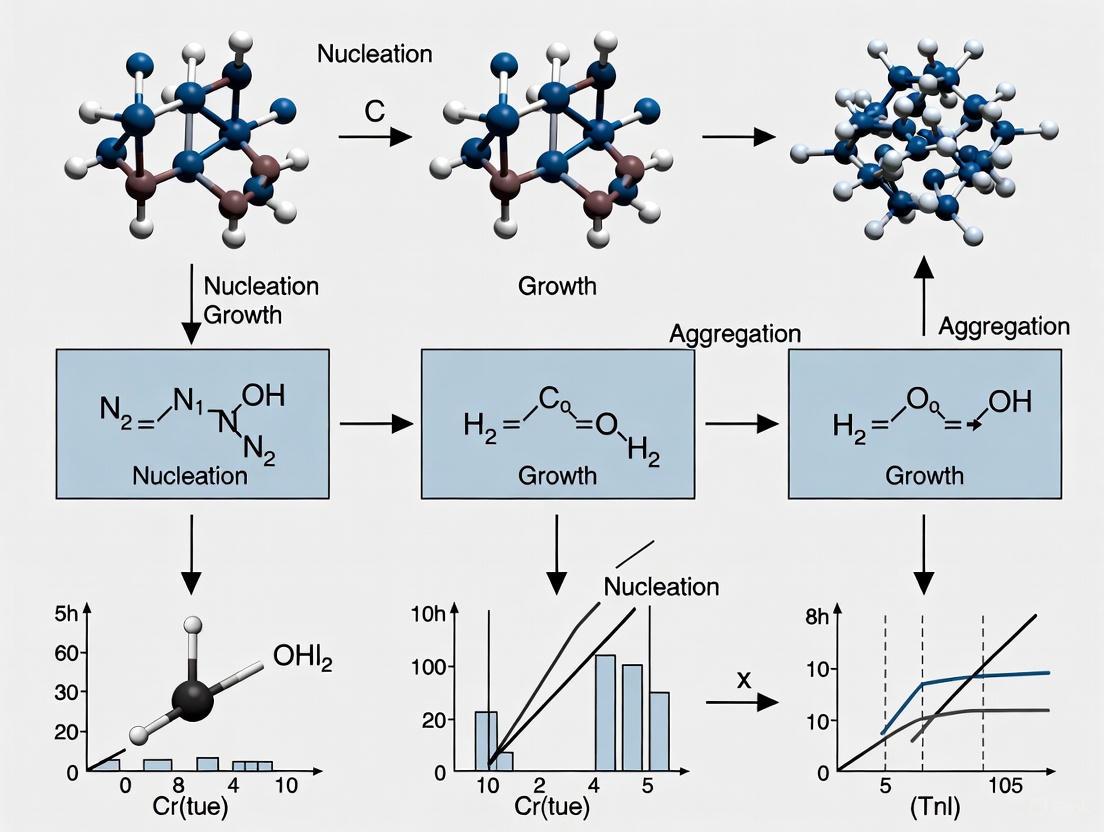
This article provides a comprehensive overview of recent advances in the nucleation and growth of inorganic crystals, with a specific focus on implications for pharmaceutical development.
Nucleation and Growth in Inorganic Crystal Formation: Mechanisms, Control, and Pharmaceutical Applications
Abstract
This article provides a comprehensive overview of recent advances in the nucleation and growth of inorganic crystals, with a specific focus on implications for pharmaceutical development. It explores fundamental mechanisms, including classical and non-classical pathways, and highlights the critical role of solvent entropy and pre-nucleation clusters. The scope extends to modern methodological approaches for controlling crystallization, from computational predictive tools like ADDICT to process intensification strategies such as membrane crystallization. Practical guidance for troubleshooting common crystal growth issues and optimizing polymorph control is presented. Finally, the article covers validation and comparative frameworks, using case studies of common gas hydrate formers to illustrate how kinetic and thermodynamic analyses ensure the selection of optimal crystalline forms for drug efficacy and stability. This resource is tailored for researchers, scientists, and professionals engaged in drug development who seek to leverage crystal engineering for improved pharmaceutical outcomes.
The Fundamental Principles of Inorganic Crystal Nucleation and Growth
Crystal nucleation, the process by which atoms, ions, or molecules first arrange into a stable solid phase, is a fundamental phenomenon governing the synthesis of materials ranging from pharmaceuticals to semiconductors. For decades, the scientific understanding of this initial stage was dominated by Classical Nucleation Theory (CNT), which posits that crystals form via the direct, monomer-by-monomer addition of building blocks to a nascent cluster [1]. Once this cluster reaches a critical size, it becomes stable and proceeds to grow. However, advancements in experimental and theoretical methods have revealed that many materials, including inorganic crystals, follow more complex non-classical pathways that deviate significantly from this classical picture [1] [2] [3]. These pathways often involve transient, intermediate phases that are absent in the final crystal structure, presenting both challenges and opportunities for controlling material properties. This whitepaper rethinks the initial stages of inorganic crystal formation by synthesizing current research on classical and non-classical nucleation, providing a technical guide for researchers and scientists engaged in crystal engineering and drug development.
Theoretical Foundations: From Classical to Non-Classical Frameworks
Classical Nucleation Theory (CNT)
Classical Nucleation Theory provides a foundational, albeit simplified, model for quantifying nucleation. CNT treats the formation of a new phase as a process governed by the balance between the volume free energy gain of forming a more stable phase and the surface free energy cost of creating a new interface. A central concept is the critical nucleus, a cluster of a specific size that has a 50% probability of either growing into a crystal or dissolving. Nuclei smaller than this critical size are unstable, while those larger are likely to continue growing [1]. The theory is mathematically elegant and allows for the calculation of key parameters such as nucleation rates and free energy barriers. However, its major limitation lies in its underlying assumption: that the nucleus is a miniature version of the final, bulk crystal, and that its structure forms through the direct, one-by-one addition of atoms or molecules from a solution or vapor [1] [2].
The Non-Classical Paradigm
In contrast to CNT, non-classical crystallization (NCC) encompasses mechanisms where nucleation does not proceed via a single step of monomer addition. A key feature of NCC is the involvement of precursor particles that are more complex than the single atoms or molecules assumed in CNT [1]. These precursors can be nanoparticles, dense liquid phases, or amorphous intermediates. Two prominent non-classical mechanisms are:
- The Pre-Nucleation Cluster (PNC) Pathway: In this pathway, stable molecular clusters form in solution before a distinct solid nucleus appears. These PNCs are dynamic entities that can aggregate and restructure, ultimately serving as building blocks for the crystalline phase [1].
- Two-Step Nucleation Mechanism: This widely observed mechanism involves the initial separation of a dense, often liquid-like phase from the solution. Within this dense droplet, which can lower the overall energy barrier for nucleation, the process of ordering into a crystal subsequently occurs [2]. As one study notes, for crystallization, this involves "the formation of a dense-solution droplet followed by ordering originating at the core of the droplet" [2].
It is increasingly recognized that real-world nucleation pathways are not purely classical or defined by a single non-classical theory. Instead, they are often an amalgamation of multiple mechanisms, with systems following the path of least resistance dictated by their specific thermodynamic and kinetic landscapes [1] [2].
Table 1: Key Characteristics of Classical and Non-Classical Nucleation Theories
| Feature | Classical Nucleation Theory (CNT) | Non-Classical Crystallization (NCC) |
|---|---|---|
| Primary Building Block | Atoms, ions, or single molecules (monomers) [1] | Complex precursors (e.g., nanoparticles, dense liquid phases, pre-nucleation clusters) [1] |
| Nucleation Process | Single-step, direct monomer-by-monomer addition [1] | Multi-step, often involving intermediate phases [2] |
| Nature of Intermediate | A single, critical-sized solid nucleus with the same structure as the bulk crystal [1] | Various metastable intermediates (e.g., amorphous blobs, liquid droplets, pre-nucleation clusters) [1] [4] |
| Pathway Complexity | Single, well-defined pathway | Multiple, system-dependent pathways; an amalgamation of mechanisms [1] |
| Energy Landscape | A single free energy barrier to overcome [1] | Multiple energy barriers associated with phase separation and ordering [2] |
Direct Experimental Evidence for Non-Classical Pathways
Advanced in situ characterization techniques have been pivotal in providing direct evidence for non-classical nucleation, moving beyond the inferential understanding provided by ex situ studies.
Liquid Phase Electron Microscopy (LPEM) of Organic Pharmaceuticals
LPEM has enabled the high-resolution observation of nucleation events in a native, liquid environment. A landmark study on the pharmaceutical compound flufenamic acid (FFA) in ethanol directly captured its non-classical pathway. The observations suggested that the system followed a Pre-Nucleation Cluster (PNC) pathway with features consistent with two-step nucleation [1]. The experiment visualized nanoscale intermediate pre-crystalline stages, providing evidence that the formation of crystalline FFA proceeded through the aggregation and reorganization of clusters rather than direct monomer addition. In these experiments, the electron beam itself was exploited to induce nucleation via radiolysis of the solvent, which altered the local chemical environment and lowered the energy barrier for nucleation [1]. This work underscores the critical role of direct observation in uncovering the complex, multi-step journey from a disordered solution to an ordered crystal.
Studies on Ionic Colloidal Crystals as Model Systems
Research using charged colloidal particles as model "ions" has offered profound insights into non-classical mechanisms, as their assembly can be directly observed with optical microscopy. A recent study demonstrated that ionic colloidal crystals form via a two-step process [4]. First, a gas-like suspension of particles rapidly condenses into metastable, amorphous blobs—a dense liquid phase. Crystal nucleation then initiates within these blobs, with a crystallization front propagating through them to form ordered crystallites [4].
Following nucleation, the crystals grow through several simultaneous, non-classical processes, detailed in Table 2.
Table 2: Non-Classical Growth Mechanisms Observed in Ionic Colloidal Crystals
| Growth Mechanism | Description | Experimental Observation |
|---|---|---|
| Monomer Addition | Individual particles from the solution (gas phase) attach to the crystal one-by-one [4] | Isolated crystals in contact with the gas phase grow at steady rates [4] |
| Ostwald Ripening | Larger crystals grow at the expense of smaller, less stable ones via particle exchange through the solution [4] | Net growth of crystals without direct contact with dissolving blobs [4] |
| Blob Absorption | Direct, rapid integration of an entire amorphous blob into a growing crystal upon contact [4] | Rapid deflation of the blob and appearance of surface waves propagating from blob to crystal [4] |
| Oriented Attachment | Two crystals fuse along a common crystallographic orientation to form a larger, single crystal [4] | Crystals align before merging; the contact region melts and re-crystallizes, eliminating the seam [4] |
Molecular Dynamics (MD) Simulations of Metal Nucleation
Computational studies have provided atomic-scale insights that complement experimental findings. MD simulations of the homogeneous nucleation of a BCC phase within FCC iron revealed that the atomic system circumvents the high energy barrier predicted by CNT by opting for alternative, non-classical nucleation processes [5]. The two key mechanisms identified were the coalescence of subcritical clusters and stepwise nucleation [5]. This demonstrates that non-classical pathways are not limited to soft or organic materials but are also highly relevant in metallic systems, highlighting their broad applicability in materials science.
Methodologies for Investigating Nucleation Pathways
Experimental Protocols
Liquid Phase Electron Microscopy (LPEM) for Organic Molecules
Objective: To directly observe the nanoscale early-stage nucleation events of small organic molecules, such as Active Pharmaceutical Ingredients (APIs), in their native liquid environment [1].
Materials:
- Liquid Phase EM Holder: A specialized TEM holder capable of sealing a liquid cell between electron-transparent windows (e.g., silicon nitride windows).
- Sample Solution: The molecule of interest dissolved in a suitable solvent. For flufenamic acid, a 50 mM solution in ethanol was used [1].
- Syringe Pump System: For loading and flowing the solution through the liquid cell, if desired.
Procedure:
- Cell Preparation: Assemble the liquid cell according to the manufacturer's instructions, ensuring the silicon nitride windows are clean and properly spaced.
- Sample Loading: Use the syringe pump to fill the liquid cell with the sample solution, avoiding bubble formation.
- Microscope Setup: Insert the holder into the transmission electron microscope. Locate a suitable area of the liquid cell for observation.
- Beam-Induced Nucleation: To initiate nucleation, condense the electron beam using the monochromator to increase the electron flux (dose > 150 eâ»/Ų/s) in the illuminated region. This exploits radiolysis to alter the local environment and induce nucleation [1].
- Data Acquisition: Acquire images or video streams at a high temporal resolution to capture the dynamics of pre-nucleation cluster formation, aggregation, and crystal growth. Use low-dose techniques where possible to minimize beam effects, though higher doses are often necessary to induce the process [1].
- Troubleshooting: A lack of nucleation events and scarring of the silicon nitride windows can indicate an absence of solution between the windows. Flushing the system with a solvent like water can dislodge particulates [1].
Continuous Dialysis for Ionic Colloidal Crystallization
Objective: To spatiotemporally control particle interaction strength and observe the resulting crystallization pathways of ionic colloidal particles [4].
Materials:
- Oppositely-Charged Colloidal Particles: Synthesized or commercial particles coated with a neutral polymer brush (e.g., polystyrene particles).
- Observation Cell: A sealed capillary or customized cell for microscopy.
- Dialysis System: A deionized water reservoir connected to the observation cell to allow for controlled salt removal.
- Salt Solutions: To prepare particles at a precisely known initial ionic strength.
Procedure:
- Particle Preparation: Disperse positively and negatively charged particles in the same salt solution at the desired initial high concentration (e.g., 100 mM) to maintain a stable, gas-like state [4].
- Mixing: Mix the two particle populations in an approximately 1:1 stoichiometric ratio and immediately transfer the mixture to the observation cell.
- Initiate Dialysis: Connect the observation cell to the deionized water reservoir. Salt will begin to diffuse out of the cell into the reservoir, leading to a gradual and continuous increase in the Debye length (λD) and the strength of electrostatic interactions between particles [4].
- Real-Time Observation: Use bright-field or confocal microscopy to monitor the assembly process as the interaction strength increases over time.
- Pathway Identification: Observe the sequence of phases: from gas, to the potential formation of amorphous blobs (two-step pathway), to the eventual nucleation and growth of crystals. The specific pathway (classical vs. non-classical) can be correlated with the locally evolving salt concentration [4].
- Post-Experiment Analysis: Characterize the final crystal structures and quality using techniques like SEM and confocal microscopy. Map these outcomes back to the interaction strength conditions that produced them.
Theoretical and Computational Framework
Classical Density Functional Theory (cDFT) has emerged as a powerful ab initio theoretical tool for predicting nucleation pathways. When combined with stochastic process theory, it can form a comprehensive theoretical description of nucleation [2]. This combined framework requires only the interatomic interaction potential as input and can predict non-classical pathways without pre-defining collective variables. The theory models the system as a fluctuating density field, n^t(r), evolving according to a stochastic equation that includes deterministic diffusion driven by free energy minimization and a stochastic noise term representing random collisions from the solvent [2]. By applying rare event techniques to this framework, researchers can compute the most probable path from a homogeneous solution to a crystalline cluster, revealing multi-step mechanisms like dense droplet formation followed by internal ordering [2].
Diagram 1: A generalized non-classical nucleation pathway showing key intermediate stages, from pre-nucleation clusters to a macroscopic crystal.
The Scientist's Toolkit: Essential Research Reagents and Materials
Table 3: Key Research Reagent Solutions and Materials for Nucleation Studies
| Item | Function/Application | Example Usage |
|---|---|---|
| Liquid Phase EM Holder | Enables direct observation of nucleation in a liquid environment within an electron microscope [1]. | Observing pre-nucleation clusters of flufenamic acid in ethanol [1]. |
| Silicon Nitride Windows | Electron-transparent membranes that encapsulate the liquid sample in LPEM [1]. | Creating a sealed microchamber for the sample solution in TEM [1]. |
| Oppositely-Charged Colloids | Model systems that mimic atomic ions, allowing direct optical observation of crystallization [4]. | Studying two-step nucleation and growth mechanisms in binary ionic colloidal crystals [4]. |
| Continuous Dialysis Setup | Provides spatiotemporal control over interaction strength by dynamically varying salt concentration [4]. | Mapping crystallization pathways as a function of Debye length in a single experiment [4]. |
| Cryogenic TEM (cryo-TEM) | Snapshots of near-native states in solution by vitrifying samples, capturing transient intermediates [3]. | Studying the isolated stages of pre-nucleation events in organic aromatic compounds [1]. |
| Mandyphos SL-M012-1 | Mandyphos SL-M012-1, CAS:831226-37-0, MF:C56H58FeN2P2, MW:876.9 g/mol | Chemical Reagent |
| (S)-Metalaxyl | (S)-Metalaxyl, CAS:69516-34-3, MF:C15H21NO4, MW:279.33 g/mol | Chemical Reagent |
Implications for Inorganic Crystal Formation and Drug Development
The paradigm shift towards non-classical nucleation has profound implications for material synthesis and control. In the context of inorganic crystal formation, understanding and harnessing these pathways allows for the precise engineering of crystal size, morphology, structure, and ultimately, material properties. The discovery of non-classical pathways involving amorphous precursors or dense liquid phases provides new levers to pull in the synthesis of complex inorganic materials, from geologically relevant minerals like calcium carbonate to advanced technological materials [2] [3].
For the pharmaceutical industry, where the crystal structure (polymorph) of an Active Pharmaceutical Ingredient (API) dictates its solubility, stability, and bioavailability, controlling nucleation is paramount [1] [3]. The presence of intermediate stages in non-classical pathways means that previously inaccessible polymorphs with more desirable properties might be present during crystallization. Direct observation of these pathways, as demonstrated with flufenamic acid, opens avenues to direct polymorph selection and improve the efficacy of drug products [1]. Furthermore, this knowledge is critical for adapting API production from traditional batch manufacturing to more efficient continuous manufacturing processes, where a deep understanding of nucleation is essential for control and reproducibility [1].
The initial stages of crystal formation are far more complex and rich than previously envisioned by Classical Nucleation Theory. Direct observations powered by techniques like LPEM and model colloidal systems, combined with advanced theoretical frameworks like cDFT, have firmly established that non-classical pathways are common across material classes. These pathways, often involving pre-nucleation clusters, dense liquid phases, and complex growth mechanisms like oriented attachment, represent the rule rather than the exception. For researchers in inorganic crystal formation and drug development, embracing this complexity is no longer optional. The future of controlled material synthesis lies in leveraging in situ characterization and theoretical guidance to decipher, predict, and ultimately direct these non-classical pathways to achieve tailored crystalline materials.
The Critical Role of Solvent and Entropy in Aqueous Crystallization
Crystallization from aqueous solution represents a fundamental process with profound implications across diverse scientific and industrial domains, from pharmaceutical development to geochemical mineralization. Traditional approaches to crystallization have predominantly focused on solute behavior, considering the solvent as a passive medium. However, contemporary research has fundamentally shifted this perspective, revealing that solvent entropy and structured water layers at molecular interfaces play a decisive role in governing nucleation and crystal growth pathways [6] [7]. Within the broader context of nucleation and growth research in inorganic crystal formation, understanding these solvent-mediated effects has become paramount for predicting and controlling crystallization outcomes. This paradigm recognizes that water is not merely a background matrix but an active participant whose reorganization during phase transitions provides critical thermodynamic driving forces that can supersede the contributions of enthalpy in many crystallizing systems [6]. The implications extend to fundamental science and applied technologies, enabling more precise control over polymorph selection, crystal morphology, and material properties in fields ranging from pharmaceutical manufacturing to environmental science.
The following sections examine the thermodynamic foundations of solvent entropy contributions, experimental evidence across protein and inorganic systems, advanced characterization methodologies, and emerging non-classical crystallization pathways. By synthesizing recent developments in this rapidly evolving field, this review aims to equip researchers with both theoretical frameworks and practical approaches for leveraging solvent entropy effects in crystallization process design.
Thermodynamic Foundations of Solvent Entropy Contributions
The crystallization process from aqueous solution is governed by the change in Gibbs free energy (ΔG), which at constant temperature and pressure can be expressed through the classic relationship:
| Thermodynamic Parameter | Symbol | Typical Range for Proteins | Contribution to Crystallization |
|---|---|---|---|
| Gibbs Free Energy Change | ΔG | -10 to -100 kJ molâ»Â¹ | Must be negative for spontaneous crystallization |
| Enthalpy Change | ΔH | -70 kJ molâ»Â¹ (lysozyme) to +155 kJ molâ»Â¹ (HbC) | Can be favorable or unfavorable |
| Total Entropy Change | TΔS | Varies widely | Must overcome entropy loss from molecular ordering |
| Protein Entropy Cost | TΔSprotein | -30 to -100 kJ molâ»Â¹ (at 298K) | Always unfavorable due to ordering |
| Solvent Entropy Gain | TΔSsolvent | +60 to +180 kJ molâ»Â¹ (at 298K) | Primary driving force in many systems |
Table 1: Thermodynamic parameters governing protein crystallization from aqueous solutions, compiled from experimental studies [8] [6].
For crystallization to occur spontaneously, ΔG must be negative, which requires that the TΔS term sufficiently outweighs any positive ΔH contribution. The total entropy change (ΔStotal) can be deconvoluted into two competing contributions:
where ΔSsolvent represents the entropy change from water restructuring and ΔSprotein encompasses the entropy loss from ordering of the protein molecules [6]. The protein entropy cost arises from the loss of six translational and rotational degrees of freedom per molecule, partially compensated by newly created vibrational modes, resulting in an unfavorable change estimated at -100 to -300 J molâ»Â¹ Kâ»Â¹ [6]. At room temperature, this translates to an energy penalty of 30-100 kJ molâ»Â¹ that must be overcome by favorable contributions.
The critical insight from recent research is that the dominant favorable contribution typically comes from ΔSsolvent, which can reach +100 to +600 J molâ»Â¹ Kâ»Â¹, corresponding to the release of approximately 5 to 30 water molecules upon incorporation of each protein molecule into the crystal lattice [6]. This release of structured water from protein surfaces represents the main thermodynamic driving force for crystallization, particularly in systems with unfavorable enthalpy changes.
Figure 1: Thermodynamic pathway of solvent entropy gain during crystal contact formation, highlighting water release as the key driving force.
The magnitude of this solvent entropy effect is substantial, with each released water molecule contributing approximately +22 J molâ»Â¹ Kâ»Â¹ when transferred from clathrate, crystal hydrate, or other ice-like structures to the bulk state [6]. This fundamental thermodynamic mechanism explains why proteins with dramatically different enthalpy signatures can successfully crystallize, provided the solvent entropy gain is sufficient to overcome both the unfavorable protein ordering and any positive enthalpy barriers.
Experimental Evidence Across Material Systems
Protein Crystallization Systems
Comprehensive thermodynamic studies across multiple protein systems have revealed striking diversity in how solvent entropy contributions manifest:
Hemoglobin C (HbC): Exhibits strong retrograde solubility with a surprisingly large positive enthalpy of crystallization (ΔH = +155 kJ molâ»Â¹), meaning crystallization is thermodynamically impossible without compensatory entropy gains. The massive entropy gain of +610 J molâ»Â¹ Kâ»Â¹ stems from the release of up to 10 water molecules per protein intermolecular contact, providing the exclusive driving force for crystallization [8] [6].
Apoferritin: Represents an intermediate case with enthalpy of crystallization near zero (ΔH ≈ 0), where the entropy gain from release of approximately two water molecules bound to each protein molecule in solution constitutes the main component of the crystallization driving force [8].
Lysozyme: Demonstrates more conventional behavior with moderate negative enthalpy (ΔH = -70 kJ molâ»Â¹), but interestingly exhibits a negative solvent entropy effect that increases solubility, highlighting that water restructuring can sometimes oppose crystallization depending on specific surface properties [6].
These case studies collectively establish that solvent entropy effects are not merely minor contributors but can serve as the dominant factor determining crystallizability across diverse protein systems.
Inorganic Ionic Materials
Recent research has revealed parallel solvent entropy effects in inorganic crystallization systems, challenging classical models that overlook solvent contributions:
Interfacial Energy Relationships: Studies of salt crystallization in membrane distillation systems have demonstrated that crystal-liquid interfacial energy (σ) directly correlates with nucleation rates and induction times [9]. Highly soluble salts with low interfacial energy require limited relative supersaturation (Δc/c) and favor heterogeneous nucleation mechanisms, while less soluble salts with high interfacial energy require substantial supersaturation thresholds (Δc/c > 1) to overcome nucleation barriers, frequently favoring homogeneous primary nucleation in bulk solution [9].
Solid Solution Systems: Research on binary solid solution-aqueous solution (SS-AS) systems like (Ba,Sr)SO₄ has established that interfacial free energy (σhkl(x)) varies systematically with solid solution composition, directly impacting growth rates according to both spiral growth and two-dimensional nucleation mechanisms [10]. This composition-dependent interfacial energy influences sectoral zoning patterns and ultimately determines the compositional partitioning during crystallization.
| Material System | Key Solvent Entropy Observation | Experimental Method | Implications |
|---|---|---|---|
| Hemoglobin C | Release of ~10 Hâ‚‚O molecules per contact (+610 J molâ»Â¹ Kâ»Â¹) | Solubility measurements, AFM | Solvent entropy can overcome strongly unfavorable enthalpy (+155 kJ molâ»Â¹) |
| Apoferritin | Release of ~2 Hâ‚‚O molecules per protein | Solubility measurements, AFM | Near-zero enthalpy systems driven entirely by solvent entropy |
| Lysozyme | Negative solvent entropy contribution | Thermodynamic analysis | Water restructuring can sometimes oppose crystallization |
| (Ba,Sr)SOâ‚„ solid solutions | Interfacial energy varies with composition | AFM, growth rate measurements | Growth mechanisms transition with supersaturation and composition |
| Highly soluble salts | Low interfacial energy favors heterogeneous nucleation | Induction time measurements | Scaling correlated with nucleation theory predictions |
Table 2: Experimental evidence of solvent entropy effects across protein and inorganic material systems [9] [10] [8].
The experimental evidence across these diverse systems underscores the universal importance of solvent entropy contributions in aqueous crystallization, while highlighting the system-specific manifestations that depend on molecular surface properties and solution conditions.
Methodologies for Characterizing Solvent Entropy Effects
Thermodynamic Measurement Approaches
Accurate determination of solvent entropy contributions requires sophisticated experimental methodologies that can deconvolute competing thermodynamic parameters:
Temperature-Dependent Solubility Studies: The temperature dependence of protein solubility enables determination of both ΔH and ΔS of crystallization through van't Hoff analysis. For HbC, this approach revealed the surprising positive enthalpy that highlighted the dominant role of entropy [11] [8]. Modern implementations use miniaturized scintillation techniques to determine temperatures at which solutions reach equilibrium with existing crystals across carefully controlled temperature gradients [11].
In-Situ Atomic Force Microscopy (AFM): Molecular-resolution AFM imaging of growing crystal surfaces provides direct visualization of growth sites and their densities, enabling calculation of crystallization free energy and correlation with water release estimates [8] [6]. This technique has confirmed excellent agreement between observed growth site densities and values calculated from crystallization free energies determined independently through solubility measurements [8].
Isothermal Induction Time Measurements: For inorganic systems and small organic molecules, determination of nucleation kinetics through induction time experiments at constant supersaturation enables application of classical nucleation theory to extract interfacial energies and critical nucleus parameters [9] [12]. This approach has been successfully applied to pharmaceutical systems like ritonavir to quantify how solvent selection affects nucleation barriers [12].
Computational and Molecular Modeling Approaches
Complementary computational methods provide molecular-level insights into solvent organization and its thermodynamic consequences:
Molecular Dynamics (MD) Simulations: All-atom MD simulations with explicit solvent models can capture the dynamic interplay between inter- and intramolecular interactions, revealing how solvent molecules organize around solute surfaces and how this organization changes during nucleation events [12]. Recent MD studies of ritonavir in multiple solvents have elucidated conformational preferences and solute-solvent interaction patterns that explain observed nucleation behaviors [12].
Free Energy Perturbation (FEP) Calculations: These specialized MD simulations quantitatively predict solvation energies across different solvent environments, providing mechanistic understanding of how solvent selection influences nucleation kinetics and polymorphic outcomes [12].
Interfacial Energy Calculations: For solid solution systems, generalized crystal growth equations incorporating composition-dependent interfacial energies enable prediction of growth rate distributions as functions of both solid and aqueous solution compositions [10].
Figure 2: Methodological approaches for characterizing solvent entropy effects in aqueous crystallization, integrating experimental and computational techniques.
The Scientist's Toolkit: Essential Research Reagents and Materials
| Reagent/Material | Function in Crystallization Research | Specific Applications |
|---|---|---|
| High-Purity Proteins (HbC, apoferritin, lysozyme) | Model systems for thermodynamic studies | Temperature-dependent solubility measurements [11] [8] |
| Atomic Force Microscopy (AFM) | Molecular-resolution imaging of growth interfaces | In-situ observation of crystal surface processes [10] [6] |
| Miniaturized Crystallization Platforms | High-throughput screening of conditions | Scintillation techniques for solubility determination [11] |
| Molecular Dynamics Software (GROMACS, AMBER) | Simulation of solute-solvent interactions | Modeling water structuring and release events [12] |
| Turbidometric Detection Systems | Monitoring nucleation induction times | Classical nucleation theory parameter extraction [12] |
| Controlled Composition Solutions | Solid solution-aqueous solution studies | Examining composition-dependent interfacial energy [10] |
| C.I. Acid Violet 48 | C.I. Acid Violet 48, CAS:73398-28-4, MF:C37H38N2Na2O9S2, MW:764.8 g/mol | Chemical Reagent |
| Santonic acid | Santonic Acid|95% | Santonic acid is a high-purity sesquiterpenoid derivative for research applications. This product is For Research Use Only. Not for human or veterinary use. |
Table 3: Essential research reagents and materials for investigating solvent entropy effects in crystallization.
Implications for Nucleation and Crystal Growth Mechanisms
Non-Classical Crystallization Pathways
Recent advances have revealed that solvent entropy effects play crucial roles in non-classical crystallization pathways that diverge from traditional models:
Pre-Nucleation Clusters: Evidence suggests that structured solvent layers influence the stability and behavior of pre-nucleation clusters, which represent thermodynamically stable intermediate species in multi-step nucleation pathways [7]. The reorganization of water molecules during the transition from dispersed clusters to amorphous precursors contributes significantly to the overall thermodynamics of nucleation.
Two-Step Nucleation Mechanisms: In many systems, nucleation proceeds through an initial dense liquid phase that subsequently orders into crystalline material, with solvent release occurring primarily during the ordering step rather than initial cluster formation [7]. This pathway can reduce the overall kinetic barrier to nucleation by separating the processes of density fluctuation and structural ordering.
Compositional Zoning in Solid Solutions: The variation of interfacial energy with solid solution composition directly impacts growth mechanisms, leading to phenomena such as intrasectorial, sectorial, and progressive zoning commonly observed in mineral systems [10]. These patterns reflect kinetic competition between different growth mechanisms (spiral growth versus two-dimensional nucleation) that are influenced by solvent entropy effects at the crystal-solution interface.
Interfacial Energy and Nucleation Kinetics
The crystal-liquid interfacial energy (σ) represents a direct manifestation of solvent entropy effects at nucleation interfaces, with profound implications for crystallization behavior:
Nucleation Rate Dependence: According to classical nucleation theory, the nucleation rate (J) depends exponentially on σ³, making it exquisitely sensitive to interfacial energy [9] [12]. Small changes in σ resulting from solvent restructuring can alter nucleation rates by orders of magnitude, explaining the dramatic impact of solvent selection on crystallization outcomes.
Polymorphic Selection: In pharmaceutical systems like ritonavir, solvent-dependent interfacial energies directly influence which polymorph nucleates under given conditions [12]. The metastable form I of ritonavir nucleates preferentially from solvents like acetone, ethyl acetate, acetonitrile, and toluene, while the stable form II emerges from ethanol, correlating with calculated solute solvation free energies and desolvation behavior [12].
Heterogeneous vs. Homogeneous Nucleation: The magnitude of interfacial energy determines the relative advantage of heterogeneous versus homogeneous nucleation pathways [9]. Systems with high interfacial energy exhibit stronger supersaturation thresholds and greater propensity for homogeneous nucleation in the bulk solution, while low interfacial energy systems nucleate more readily on existing surfaces.
The critical role of solvent entropy in aqueous crystallization represents a fundamental shift in our understanding of nucleation and crystal growth mechanisms. Rather than serving as a passive medium, water actively participates in crystallization thermodynamics through structuring at molecular interfaces and release during phase transitions. This perspective successfully unifies diverse observations across protein crystallization, inorganic materials formation, and pharmaceutical polymorph selection.
Future research directions will likely focus on quantitative prediction of solvent entropy contributions through advanced computational models, direct experimental probes of water organization during early nucleation stages, and deliberate engineering of crystal surfaces to optimize solvent release effects. The emerging recognition that solvent entropy dominates crystallization thermodynamics in many systems promises to transform industrial crystallization processes through more rational solvent selection, additive design, and process condition optimization. By placing solvent contributions at the forefront of crystallization science, researchers can overcome traditional empirical approaches and develop predictive frameworks for controlling crystallization outcomes across diverse scientific and technological applications.
As the field continues to evolve, integration of solvent entropy considerations into crystallization modeling and process design will undoubtedly yield more robust control over polymorph selection, crystal habit, and material properties – ultimately enabling next-generation technologies across pharmaceuticals, materials science, and beyond.
In the realm of inorganic crystal formation research, controlling the nucleation and growth phases is paramount to obtaining materials with desired physicochemical properties. The pathways of crystallization are governed by the competing principles of kinetic and thermodynamic control, which directly influence the manifestation of either monotropic or enantiotropic solid-state systems. Kinetic control describes reactions or processes where the product composition is determined by the rate at which different products form, favoring the species with the lowest activation energy. In contrast, thermodynamic control prevails when the product composition is determined by the relative stability of the products, favoring the species with the lowest free energy, often achieved under conditions allowing for reversibility [13].
These control mechanisms profoundly impact crystalline material design, particularly in pharmaceutical development where different polymorphs can exhibit vastly different bioavailability, stability, and processability. This technical guide examines the core principles of kinetic and thermodynamic control within the context of inorganic crystal nucleation and growth, providing researchers with methodologies to navigate and manipulate monotropic and enantiotropic systems for advanced material design.
Fundamental Principles of Kinetic and Thermodynamic Control
Core Concepts and Energetic Landscapes
The competition between kinetic and thermodynamic control arises when reaction pathways lead to different products, and the reaction conditions influence the selectivity of the process [13]. The kinetic product forms faster due to a lower activation energy barrier, while the thermodynamic product is more stable and possesses a lower overall free energy.
Key Characteristics [13]:
- Kinetic Control: Dominates under low temperatures and short reaction times where reversibility is limited. The product ratio is determined by the difference in activation energies (ΔEa) of the competing pathways.
- Thermodynamic Control: Prevails at higher temperatures with longer reaction times sufficient for equilibration. The product ratio is determined by the difference in Gibbs free energies (ΔG°) between the products.
- Reversibility: A necessary condition for thermodynamic control is sufficient reversibility or a mechanism permitting equilibration between products.
The product distribution follows distinct mathematical relationships depending on the control mechanism:
- Under kinetic control: (\ln\left(\frac{[A]t}{[B]t}\right) = \ln\left(\frac{kA}{kB}\right) = -\frac{\Delta E_a}{RT})
- Under thermodynamic control: (\ln\left(\frac{[A]{\infty}}{[B]{\infty}}\right) = \ln K_{eq} = -\frac{\Delta G^{\circ}}{RT}) [13]
Visualization of Competing Pathways
The following diagram illustrates the energetic landscape for competing kinetic and thermodynamic pathways in crystal formation:
Diagram 1: Energy landscape for kinetic vs thermodynamic control
Nucleation and Crystal Growth in Inorganic Systems
Stages of Crystallization
Crystal formation from solution occurs through three distinct stages, each governed by thermodynamic and kinetic factors [14]:
- Nucleation: The initial formation of ordered aggregates that must reach a critical size to become stable and continue growing rather than re-dissolve.
- Growth: The deposition of material from solution onto the surfaces of stable crystal nuclei.
- End of Growth: Cessation of growth due to material depletion or surface poisoning by impurities or defects.
Thermodynamics of Nucleation
The energy barrier to nucleation (ΔGn) is described by: [ \Delta G_n = \left[-\frac{kT(4\pi r^3)}{V \ln \beta}\right] + 4\pi r^2\gamma ] where k is Boltzmann's constant, β is the degree of supersaturation, γ is the interfacial free energy between nucleus and solution, r is the effective radius of the crystal nucleus, and V is the molecular volume [14].
This equation contains two competing terms: a negative volume term (proportional to r³) representing the energy advantage from decreased system free energy, and a positive surface area term (proportional to r²) representing the energy required for surface deposition. The nucleation rate follows: [ Jn = Bs \exp\left(-\frac{\Delta G_n}{kT}\right) ] where Bs is a function of solubility and kinetic parameters related to diffusion coefficients [14].
Phase Diagram for Crystallization
A simplified phase diagram for crystallization illustrates the relationship between supersaturation and the crystallization process [14]:
Diagram 2: Crystallization phase diagram
The crystallization process begins with a saturated solution at equilibrium, where the chemical potential (μ) of species i is identical in solution and crystalline states: μicrys = μisol = μio + RT lnγi ci [14]. Supersaturation (μisol > μicrys) establishes the driving force for precipitation, which proceeds until equilibrium is re-established.
Monotropic and Enantiotropic Systems
Defining Polymorphic Relationships
In crystalline materials, polymorphs can exhibit distinct relationships classified as either monotropic or enantiotropic:
Monotropic Systems: One polymorph is thermodynamically stable across the entire temperature range below melting. Transition between forms is irreversible, and kinetic control typically dominates the formation of metastable polymorphs.
Enantiotropic Systems: Different polymorphs are stable within specific temperature ranges, with a transition point where stability reverses. These systems allow reversible transformations between polymorphs, making them susceptible to thermodynamic control under appropriate conditions.
Quantitative Analysis of Inorganic Crystal Chemical Space
The combinatorial space of multi-component inorganic compounds reveals the vast possibilities for polymorph formation. Recent research has enumerated binary, ternary, and quaternary element combinations to map inorganic crystal chemical space [15]:
Table 1: Compositional Space of Inorganic Compounds
| System | Total Unique Combinations | Standard (Allowed, Known) | Missing (Allowed, Unknown) | Interesting (Forbidden, Known) | Unlikely (Forbidden, Unknown) |
|---|---|---|---|---|---|
| Binary (Að”´Bð”µ) | 225,879 | 3,627 (1.6%) | 9,837 (4.4%) | 6,354 (2.8%) | 206,061 (91.2%) |
| Ternary (Að”´Bð”µCð”¶) | 77,637,589 | 24,713 (0.03%) | 10,754,728 (13.9%) | 12,153 (0.01%) | 66,845,995 (86.1%) |
| Quaternary (Að”´Bð”µCð”¶Dð”·) | 16,902,534,325 | 16,455 (0.00%) | 2,909,418,527 (17.2%) | 962 (0.00%) | 13,993,098,381 (82.8%) |
Data sourced from combinatorial screening of the first 103 elements of the Periodic Table and their accessible oxidation states (421 species) with stoichiometric factors w,x,y,z < 7, labeled according to chemical filters and presence in the Materials Project database [15].
Chemical filters applied to distinguish plausible ("allowed") from implausible ("forbidden") inorganic stoichiometries include:
- Charge-neutrality: Based on sum of formal charges: wqA + xqB + yqC + zqD = 0
- Electronegativity balance: Requires that the most electronegative ion has the most negative charge (χanion - χcation > 0 using Pauling scale) [15]
Experimental Approaches and Methodologies
Controlling Crystallization Pathways
Different experimental parameters can be manipulated to direct crystallization toward kinetic or thermodynamic products:
Table 2: Experimental Conditions Favoring Kinetic vs Thermodynamic Control
| Parameter | Kinetic Control | Thermodynamic Control |
|---|---|---|
| Temperature | Low temperatures (slows equilibration) | Higher temperatures (accelerates equilibration) |
| Time | Short reaction times | Long reaction times |
| Supersaturation | High supersaturation | Moderate supersaturation near equilibrium |
| Nucleation | Rapid nucleation | Slow, controlled nucleation |
| Additives | Growth inhibitors for metastable forms | Catalysts for phase transformation |
| Agitation | Rapid mixing | Gentle or no agitation |
Research Reagent Solutions for Crystal Engineering
Table 3: Essential Materials for Controlled Crystallization Studies
| Reagent/Material | Function | Application Example |
|---|---|---|
| Solvent Systems | Controls solubility and supersaturation | Mixed aqueous-organic solvents for modulating nucleation kinetics |
| Structure-Directing Agents | Templates specific crystal structures | Surfactants for mesoporous material synthesis |
| Dopants/Impurities | Modifies nucleation energy barriers | Heterovalent ions for defect-engineered crystallization |
| Seeds | Provides controlled nucleation sites | Microgravity-grown crystals as optimal templates for polymorph control [16] |
| Polymeric Stabilizers | Inhibits growth of specific crystal faces | Polyvinylpyrrolidone for morphology control |
| pH Modifiers | Controls speciation and supersaturation | Ammonia hydroxide for metal oxide precipitation |
Case Study: CdS Nanomaterial Synthesis
Research on CdS nanomaterials demonstrates how thermodynamic and kinetic control can be manipulated to produce different crystalline forms. Through careful control of reaction conditions including temperature, precursor concentration, and surface ligands, researchers achieved predominantly cubic but anisotropic CdS structures, showing how kinetic control can produce morphologies that deviate from the thermodynamic equilibrium crystal habit [17].
Advanced Applications and Research Directions
Pharmaceutical Polymorph Control
The use of microgravity-grown crystals as seeds represents a cutting-edge approach to controlling polymorph formation in pharmaceuticals. Studies demonstrate that crystals grown in microgravity environments provide optimal templates for seeding additional crystallization, effectively bypassing the stochastic nucleation phase that often leads to polymorphic mixtures [16].
Recent research has shown that microgravity-grown crystals can serve as effective seeds for multiple generations of the same polymorph formation for pharmaceutical compounds including carbamazepine and atorvastatin calcium. These crystals maintain their seeding efficacy for up to 10 generations of crystal growth, providing a robust method for controlling polymorphic outcome in industrial crystallization processes [16].
High-Throughput Screening of Polymorphic Space
The vast combinatorial space of inorganic compounds [15] necessitates high-throughput approaches to mapping polymorphic stability. Automated screening platforms that systematically vary temperature, solvent composition, and supersaturation can efficiently delineate monotropic and enantiotropic relationships while identifying conditions that favor specific polymorphs.
In Situ Monitoring Techniques
Advanced characterization methods enable real-time monitoring of crystallization processes:
- Inline spectroscopy (Raman, ATR-FTIR) for polymorph identification during crystallization
- Process analytical technology (PAT) for tracking particle size and count
- Synchrotron X-ray diffraction for time-resolved crystal structure determination
The deliberate navigation of kinetic and thermodynamic control mechanisms provides researchers with powerful strategies for manipulating monotropic and enantiotropic systems in inorganic crystal formation. By understanding the fundamental nucleation and growth processes, applying appropriate experimental controls, and utilizing advanced characterization techniques, scientists can design crystallization processes that yield targeted polymorphic forms with optimized properties for pharmaceutical, electronic, and materials applications. The continued development of computational prediction methods combined with high-throughput experimental validation promises to further enhance our ability to control crystalline form in increasingly complex multi-component systems.
Pre-Nucleation Clusters and Two-Step Nucleation Mechanisms
The understanding of crystallization, a fundamental process in materials science, chemistry, and drug development, has undergone a significant paradigm shift. The long-established classical nucleation theory (CNT), derived in the 1930s, has faced challenges in explaining numerous crystallization phenomena observed in both biological and synthetic systems [18]. CNT posits that nucleation occurs through the stochastic formation of critical nuclei directly from basic monomers (atoms, ions, or molecules), with the nucleation barrier arising from competing bulk and surface energy terms [19]. This view assumes that nascent nuclei possess the same structure as the macroscopic bulk material and that interfacial tension values equate to those of macroscopic interfaces—the debated "capillary assumption" [18].
In contrast, non-classical nucleation theory recognizes pathways that diverge from these fundamental CNT assumptions. The pre-nucleation cluster (PNC) pathway represents a truly non-classical concept where solute species with "molecular" character exist in solution prior to nucleation [18]. Additionally, two-step nucleation mechanisms have been identified wherein disordered clusters or dense liquid phases form first, followed by structural reorganization into crystalline nuclei [19] [20]. These non-classical pathways provide a more nuanced framework for understanding nucleation phenomena that have proven difficult to rationalize within the classical paradigm, particularly in biomineralization, pharmaceutical crystallization, and advanced materials synthesis.
Theoretical Foundations
The Prenucleation Cluster Concept
Prenucleation clusters are stable solute species that exist in solution before the formation of crystalline nuclei. Unlike the transient, unstable clusters envisioned in CNT, stable PNCs represent distinct chemical entities with well-defined structures and properties [18]. In the calcium carbonate system, which has been physicochemically best analyzed with respect to PNCs, these clusters demonstrate stability that would be unexpected according to classical notions [18].
The formation of stable PNCs challenges two fundamental assumptions of CNT [18]:
- No distinct phase interface exists between the clusters and the solution
- Cluster structures do not resemble the macroscopic bulk crystal structure
The driving force for PNC formation arises from a balance between favorable interface energy and unfavorable bulk energy, essentially inverting the classical perspective [19]. This explains why PNCs can represent thermodynamically favored species with respect to dispersed solutes in solutions below the saturation limit.
Thermodynamics of Two-Step Nucleation
Two-step nucleation mechanisms involve the initial formation of a disordered intermediate followed by structural reorganization into a crystalline phase. The thermodynamic rationale for such pathways lies in following the pathway encompassing the lowest nucleation barrier [19].
Table 1: Comparison of Nucleation Mechanisms
| Feature | Classical Nucleation | Two-Step Nucleation |
|---|---|---|
| Initial Step | Stochastic monomer addition | Formation of disordered clusters or dense phases |
| Intermediate Species | Unstable critical nuclei | Stable pre-nucleation clusters or amorphous precursors |
| Structural Evolution | Direct formation of crystal structure | Structural reorganization within clusters |
| Dominant Energy Terms | Surface tension vs. bulk energy | Competition between multiple phases with different surface/bulk energetics |
| Polymorph Selection | Determined by critical nucleus stability | Influenced by stability of intermediate phases |
In this framework, a disordered cluster phase may possess a more favorable surface tension, making it thermodynamically preferred for small aggregates, while the crystalline structure becomes stable only for larger aggregates due to more favorable bulk packing [19]. This size-dependent phase stability drives the multi-step nucleation pathway, with the transformation between stages potentially subject to significant energy barriers that can influence polymorph selection and crystal quality.
Experimental Evidence and Methodologies
Advanced Characterization Techniques
The identification and study of pre-nucleation clusters and multi-step nucleation mechanisms has been enabled by sophisticated experimental approaches that provide real-time monitoring and characterization at relevant length and time scales.
Table 2: Key Experimental Techniques for Studying Non-Classical Nucleation
| Technique | Application | Key Insights |
|---|---|---|
| Isothermal Titration Calorimetry (ITC) | Thermodynamics of PNC formation | Revealed endothermic nature of PNC formation in calcium carbonate [18] |
| Advanced Microscopy (AFM, TEM) | Real-time observation of nucleation | Direct visualization of multi-step pathways and intermediate species [21] |
| In Situ Spectroscopy (NMR, FTIR) | Monitoring solution chemistry | Identification of molecular-scale species prior to crystallization [22] |
| Fast Scanning Chip Calorimetry (FSC) | Crystallization kinetics | Revealed temperature-dependent nucleation mechanisms in polymers [22] |
A notable example comes from real-time in situ atomic force microscopy (AFM) studies of amphiphilic organic semiconductors, which revealed a sophisticated five-step growth trajectory [21]:
- Droplet flattening - Liquid-like droplets spread on surfaces
- Film coalescence - Nanoplates merge into amorphous base films
- Spinodal decomposition - Phase separation into thick and thin islands
- Ostwald ripening - Mass transport from small to large clusters
- Self-reorganized layer growth - Crystallized film formation
This complex pathway bridges sequential classical and non-classical mechanisms and demonstrates the importance of long-range cluster migration in organic crystal formation [21].
Computational and Modeling Approaches
Computer simulation has proven indispensable for understanding nucleation at the molecular scale, providing insights difficult to obtain experimentally [18]. Molecular dynamics (MD) simulations with enhanced sampling techniques, such as well-tempered metadynamics, have enabled the calculation of free-energy profiles associated with phase transitions [20].
In urea nucleation from aqueous solution, MD simulations revealed that nucleation is preceded by large concentration fluctuations, indicating a predominant two-step process where embryonic crystal nuclei emerge from dense, disordered urea clusters [20]. These simulations also identified competition between polymorphs in the early nucleation stages, highlighting how computational approaches can illuminate the complex structural evolution during nucleation.
Advanced sampling methods are particularly valuable for studying nucleation as they overcome the timescale limitations of conventional molecular dynamics. Techniques such as metadynamics accelerate configurational sampling while allowing free energies to be evaluated and transition rates to be computed [20].
Research Reagent Solutions and Methodologies
Table 3: Essential Research Reagents and Materials for Non-Classical Nucleation Studies
| Reagent/Material | Function | Application Example |
|---|---|---|
| Calcium Carbonate Systems | Model system for PNC studies | Fundamental studies of non-classical nucleation pathways [18] |
| Amphiphilic Organic Semiconductors (CnP-BTBT) | Biomimetic self-assembly studies | Real-time observation of multi-step crystallization [21] |
| Microreactors & Continuous Flow Systems | Process intensification | Enhanced nucleation control through improved mixing and heat transfer [22] |
| Ionic Liquids (PILs, SILs) | Tailored crystallization media | Potential-driven growth of metal crystals with controlled morphology [22] |
| Membrane Crystallization (MCr) Systems | Controlled supersaturation | Simultaneous solution separation and component solidification [22] |
Applications and Implications
Pharmaceutical and Materials Science
The understanding of non-classical nucleation pathways has significant implications for pharmaceutical development and materials design. Controlling crystal polymorphism is crucial in pharmaceutical formulation as different polymorphs can exhibit varying bioavailability, stability, and processing characteristics [22]. The recognition that polymorph selection can occur during early nucleation stages, influenced by the stability of pre-nucleation clusters or intermediate phases, provides new strategies for controlling crystal form.
In materials science, non-classical nucleation mechanisms enable the design of materials with tailored properties. For example, the formation of mesocrystals—superstructures of aligned nanocrystals—through particle-mediated non-classical pathways can yield materials with exceptional mechanical properties reminiscent of biominerals [18]. Similarly, understanding the multi-step nucleation of organic semiconductors has facilitated the development of high-performance optoelectronic materials through molecular and crystal engineering [21].
Geological and Biomineralization Processes
Non-classical nucleation concepts have resolved fundamental questions in geophysics and biomineralization. The "inner core nucleation paradox"—whereby the direct nucleation of stable hexagonal close-packed (hcp) iron required an unrealistic degree of undercooling under Earth's core conditions—has been resolved through the identification of a two-step nucleation mechanism [23]. Molecular dynamics simulations demonstrate that metastable body-centered cubic (bcc) iron nucleates more readily than the hcp phase, with subsequent transformation to the stable polymorph [23]. This mechanism reduces the required undercooling and explains the feasibility of inner core formation.
In biomineralization, non-classical pathways involving pre-nucleation clusters and amorphous precursors are now recognized as fundamental to the formation of complex biological minerals with sophisticated hierarchical architectures [18]. These pathways provide organisms with greater control over mineralization, enabling the production of materials with optimized mechanical properties and morphological precision.
Visualization of Key Concepts
Two-Step Nucleation Mechanism
Diagram 1: Two-step nucleation pathway involving pre-nucleation clusters
Experimental Workflow for Non-Classical Nucleation Studies
Diagram 2: Integrated experimental workflow for studying non-classical nucleation
The recognition of pre-nucleation clusters and two-step nucleation mechanisms represents a fundamental advancement in our understanding of crystallization processes. These non-classical pathways provide a more comprehensive framework for explaining crystallization phenomena across diverse systems—from biomineralization to pharmaceutical polymorphism. The integration of advanced experimental techniques with sophisticated computational models continues to reveal the complex molecular-scale processes underlying nucleation, enabling increasingly rational design of crystalline materials with tailored properties and functionalities. As research in this field progresses, the continued refinement of non-classical nucleation theory promises to enhance our control over crystallization processes in both natural and technological contexts.
The solid form of an active pharmaceutical ingredient (API) is a critical determinant of its performance and processability. While the same chemical molecule can exist in multiple solid arrangements, or crystal forms, each form possesses distinct physicochemical properties that directly impact drug product development. These forms include polymorphs (different crystal structures of the same molecule), hydrates/solvates (crystal structures incorporating solvent molecules), and co-crystals (crystalline complexes with co-formers) [24]. For researchers working in nucleation and growth within inorganic crystal formation, understanding these principles is fundamental, as the same thermodynamic and kinetic rules govern the formation and stability of all crystalline materials, from simple ionic solids to complex pharmaceutical compounds.
This technical guide examines how crystal form influences key properties including solubility, stability, and ultimately, bioavailability. We frame this discussion within the context of crystallization fundamentals, providing experimental and computational methodologies for solid-form selection and control—a crucial process for ensuring drug efficacy and quality.
Crystal Forms and Their Fundamental Properties
Classification of Crystal Forms
A single API can exist in several solid forms, each with unique internal structures and external morphologies:
- Polymorphs: These are different crystalline arrangements of the same molecule. A classic example is ROY (5-methyl-2-[(2-nitrophenyl)amino]-3-thiophene carbonitrile), which has multiple polymorphs distinguished by their red, orange, and yellow colors [24]. The energy differences between polymorphs are typically small (a few kJ/mol), making their relative stability highly dependent on temperature and pressure [24].
- Hydrates and Solvates: These crystalline forms incorporate solvent molecules (specifically water in hydrates) into their lattice structure. The formation of hydrates is particularly relevant given the ubiquity of water in manufacturing and storage environments [24] [25].
- Co-crystals: These are crystalline materials comprising two or more different molecules, typically the API and a pharmaceutically acceptable co-former, in the same crystal lattice. Co-crystals can be engineered to improve poor physicochemical properties of an API [24].
- Amorphous Solids: These lack long-range molecular order and represent a distinct category from crystalline forms. They typically exhibit higher energy and solubility but also a greater tendency to crystallize over time [26].
Thermodynamic and Kinetic Relationships
The stability relationships between crystal forms are governed by thermodynamics and kinetics, concepts familiar from nucleation and growth research.
- Monotropy: In a monotropic system, one polymorph is thermodynamically stable across all temperatures below the melting point. The metastable form can irreversibly transform to the stable form, with the transformation often mediated by the liquid or vapor phase [24]. This presents a significant risk in pharmaceutical development, as an unexpected conversion can occur during manufacturing or storage.
- Enantiotropy: In an enantiotropic system, the relative stability of two polymorphs reverses at a specific transition temperature below their melting points. At this temperature, the free energies of the two forms are equal [24]. Understanding this relationship is crucial for processes involving temperature changes.
The following diagram illustrates the thermodynamic and kinetic decision-making process for crystal form selection and control, integrating both experimental and computational approaches.
Diagram 1: Integrated workflow for crystal form selection, combining computational and experimental approaches.
Impact on Physicochemical Properties
Solubility and Dissolution Rate
The crystal form directly affects a drug's solubility and dissolution rate—often the rate-limiting step for absorption. These properties are governed by the crystal lattice energy: more stable polymorphs with higher lattice energy typically exhibit lower solubility, while metastable forms demonstrate higher solubility [24]. This presents a formulation strategy: utilize a metastable form for enhanced solubility while managing the risk of conversion to the stable form.
Table 1: Property Differences Between Crystal Forms
| Property | Impact of Crystal Form | Typical Variation |
|---|---|---|
| Solubility | Determined by crystal lattice energy; more stable forms have lower solubility [24]. | Can differ by several-fold between forms [27]. |
| Dissolution Rate | Influenced by solubility and crystal habit/surface area [24]. | Critical for bioavailability of poorly soluble drugs. |
| Melting Point | Reflects the stability of the crystal lattice [24]. | Varies between polymorphs; used for identification. |
| Hygroscopicity | Affects stability; hydrates form at critical relative humidity [25]. | Can lead to phase transformations during storage. |
| Chemical Stability | Molecular arrangement affects susceptibility to degradation [24]. | Some forms may be more prone to oxidation or hydrolysis. |
| Mechanical Properties | Hardness and compaction behavior vary [24]. | Affects manufacturability (e.g., tableting). |
For ionic solids, solubility is further influenced by lattice energy, which depends on ion sizes and charges. Smaller ions and higher charges lead to greater lattice energies and lower solubility, though the relationship is complex due to hydration energetics [28].
Physical and Chemical Stability
The relative stability of crystal forms determines a drug's shelf life and behavior under various environmental conditions. A key concern is the potential for phase transformation during manufacturing (e.g., wet granulation, milling) or storage. For instance, a metastable polymorph might convert to a stable form, or an anhydrate might form a hydrate under high humidity conditions [24] [25]. These transformations can alter solubility, dissolution, and bioavailability. As noted by Bernstein, the most stable form of a compound may not yet have been discovered, presenting a perpetual risk in drug development [24].
Bioavailability Implications
For poorly soluble (Biopharmaceutics Classification System Class II) drugs, dissolution is the rate-limiting step for absorption. The choice of crystal form can therefore directly determine a drug's in vivo performance. Even small differences in solubility and dissolution rate can lead to clinically significant differences in bioavailability [27]. This is a primary reason regulatory agencies require thorough solid-state characterization and control of the crystal form throughout the drug lifecycle [24].
Experimental and Computational Methodologies
Crystal Form Screening Protocols
Comprehensive solid-form screening is a standard industrial practice to map the solid-form landscape and identify the most suitable form for development.
Protocol 1: Polymorph and Hydrate Screening
- Crystallization from Various Solvents: Use a range of solvents with different polarities and properties (e.g., water, alcohols, acetonitrile, toluene) [24].
- Varying Conditions: Employ multiple techniques (e.g., evaporation, cooling, anti-solvent addition, slurrying) at different temperatures [24].
- Stress Testing: Expose solid forms to elevated temperature and humidity (e.g., 40°C/75% RH) to assess stability and detect potential transformations [24].
- Analysis: Characterize all resulting solids using techniques like X-ray Powder Diffraction (XRPD), Differential Scanning Calorimetry (DSC), and Thermogravimetric Analysis (TGA) to identify distinct forms [24].
Protocol 2: Co-crystal Screening
- Co-former Selection: Choose pharmaceutically acceptable co-formers with functional groups capable of forming hydrogen bonds with the API [24].
- Preparation Methods: Use grinding (neat or liquid-assisted), solvent evaporation, or slurry crystallization [24].
- Characterization: Confirm co-crystal formation with single-crystal X-ray diffraction and spectroscopic methods like Solid-State NMR (ssNMR) [24].
Computational Prediction of Crystal Form Stability
Modern computational methods have dramatically advanced the ability to predict crystal stability and behavior under real-world conditions.
Protocol 3: Free Energy Calculation and Crystal Structure Prediction (CSP)
- Generate Putative Crystal Structures: Use computational sampling to generate a wide range of plausible crystal packings for the API [25].
- Calculate Relative Free Energies: Employ a composite approach (e.g., the TRHu(ST) method) that combines:
- Incorporate Environmental Factors: Place anhydrates and hydrates of different stoichiometries on the same energy landscape as a function of temperature and relative humidity by calculating the chemical potential of water vapor [25].
- Quantify Errors: Assign standard errors (e.g., 1–2 kJ molâ»Â¹ for industrially relevant compounds) to the computed free energies using established error propagation models [25].
These methods can accurately predict key transition points, such as the relative humidity at which a hydrate becomes more stable than an anhydrate, with experimental agreement within a factor of 1.7 on average [25].
Table 2: Key Reagent Solutions for Crystal Form Research
| Reagent / Material | Function in Research |
|---|---|
| Polymorph Screening Kit | A standardized set of solvents with diverse properties (polar, non-polar, protic, aprotic) for experimental crystallization [24]. |
| Pharmaceutically Acceptable Co-formers | A library of molecules (e.g., carboxylic acids, amides) for co-crystal screening to modify API properties [24]. |
| Hydrate Formation Chambers | Controlled environment chambers to precisely regulate temperature and relative humidity for studying hydrate-anhydrate transitions [25]. |
| Computational Chemistry Software | Software packages for Crystal Structure Prediction (CSP) and free-energy calculation (e.g., using PBE0+MBD+Fvib approaches) [25]. |
| Reference Energetic Compounds | A benchmark set of compounds with reliably known solid-solid free-energy differences for validating computational methods [25]. |
Case Studies and Data Analysis
Pharmaceutical Case Studies
Case Study 1: Radiprodil Radiprodil is a pharmaceutical compound investigated for neurological conditions. Computational CSP was used to map its crystal-energy landscape at various temperatures and relative humidities. The study successfully predicted the stability relationships between an anhydrate, a monohydrate, and a dihydrate form. The experimentally observed forms corresponded to the most stable predicted crystal structures for each stoichiometry, demonstrating the power of modern in silico methods to guide form selection and identify hydrate risks [25].
Case Study 2: Carbamazepine Carbamazepine, an anticonvulsant drug, exists in multiple polymorphs and a dihydrate. Different polymorphs exhibit different dissolution rates and bioavailability, making solid-form control essential for product performance [27]. Furthermore, molecular simulation studies on carbamazepine suggest a two-step nucleation process beginning with amorphous aggregates, with the thermodynamic stability of polymorphs depending on crystal size. This highlights the complex interplay between nucleation kinetics and crystal form stability [29].
Quantitative Stability and Solubility Data
Table 3: Experimental vs. Computed Free-Energy Differences
| Compound Pair | Experimental ΔG (kJ molâ»Â¹) | Computed ΔG (kJ molâ»Â¹) | Reference |
|---|---|---|---|
| Polymorph A / Polymorph B | 0.00 (at Ttrans) | +0.5 | [25] |
| Anhydrate / Monohydrate | 0.00 (at RHtrans) | -1.2 | [25] |
| Form II / Form III (Carbamazepine) | - | Size-dependent stability inversion predicted | [29] |
Advanced computational methods can predict hydrate-anhydrate transition relative humidities within a factor of 1.7 of experimental values on average. Without empirical correction, agreement is still within a factor of 2.4, proving the fundamental robustness of the approach [25].
The impact of crystal form on the physicochemical properties of active ingredients is a fundamental consideration in drug development that rests on the principles of nucleation and crystal growth. The selection of an optimal crystal form—whether a polymorph, hydrate, or co-crystal—directly dictates critical performance attributes including solubility, stability, and ultimately, therapeutic efficacy. A proactive strategy that integrates robust experimental screening with predictive computational modeling is essential for de-risking pharmaceutical development. As computational methods continue to advance in accuracy and accessibility, the ability to predict and control crystal form stability under real-world conditions will become increasingly integral to the efficient design of robust, effective drug products.
Advanced Methods and Applications for Controlling Crystallization
The study of nucleation and growth in inorganic crystal formation provides a powerful conceptual and technical framework for understanding complex systems across scientific disciplines. The transition from a disordered to an ordered state, governed by the principles of supersaturation, nucleation, and crystal growth, offers profound parallels to the development of addictive disorders, where maladaptive neural pathways become entrenched through reinforcement. Computational modeling serves as the critical bridge connecting these seemingly disparate fields, enabling researchers to simulate processes from atomic-scale interactions in crystal lattices to the neurocircuitry of addiction. This whitepaper explores how predictive computational tools, originally developed for materials science, are now revolutionizing our understanding and treatment of substance use disorders through projects like the ADDICT model (AI-Driven Discovery and Intervention for Compulsive Triggers).
The core connection lies in the shared focus on phase transitions—whether in inorganic systems forming crystalline structures or neural circuits transitioning from controlled use to compulsive addiction. Molecular dynamics simulations track atomic interactions during crystal nucleation, while analogous computational approaches map neurobiological changes as addiction progresses. The ADDICT framework represents the clinical application of these principles, using generative artificial intelligence to predict individual vulnerability to opioid addiction by identifying patterns in complex datasets mirroring how scientists predict crystal formation pathways from molecular interactions.
Theoretical Foundations: Nucleation and Growth Principles
Classical Nucleation Theory and Analogous Processes
Crystal nucleation begins in a supersaturated solution where molecular aggregates form nuclei that develop into macroscopic crystals through growth processes [22]. This phase separation mirrors the transition from occasional drug use to established addiction, where reinforcing experiences create a psychological "supersaturation" that precipitates pathological patterns.
Supersaturation, the metastable state driving crystallization, occurs through several mechanisms:
- Solvent Evaporation: Increasing concentration by evaporating solvent until crystallization begins [30]
- Temperature Gradient: Utilizing differential solubility between hot and cold solvents [30]
- Anti-Solvent Addition: Using binary solvent systems where the compound is soluble in only one component [30]
In addiction development, analogous "supersaturation" mechanisms include stress-induced vulnerability, repeated drug exposure increasing reward sensitivity, and environmental cues that precipitate compulsive use. The nucleation stage in both systems represents the critical transition point where system behavior fundamentally changes.
Crystal Growth Mechanisms and Neural Pathway Formation
Once nucleation occurs, crystal growth proceeds through different mechanisms:
- Diffusion-controlled growth: Continues when concentration falls below critical nucleation threshold [22]
- Surface-process-controlled growth: Occurs when diffusion from bulk to growth surface is sufficiently rapid [22]
Similarly, addiction progresses through defined stages: binge/intoxication establishes drug-reward associations, withdrawal/negative affect creates avoidance motivations, and preoccupation/anticipation cements compulsive drug-seeking [31]. These stages parallel crystal growth mechanisms where initial nucleation is followed by progressive structural consolidation.
Table 1: Comparison of Crystallization Stages and Addiction Phases
| Crystallization Stage | Addiction Phase | Key Characteristics |
|---|---|---|
| Supersaturation | Vulnerability | System primed for state transition |
| Nucleation | Initial Drug Use | Critical transition point |
| Crystal Growth | Addiction Progression | Reinforcement of new structure/pathways |
| Defect Formation | Compulsive Behavior | Entrenched maladaptive patterns |
Computational Methodologies
Molecular Dynamics Simulations
Molecular dynamics (MD) simulations provide atomistic-level insights into crystallization processes by numerically solving Newton's equations of motion for all atoms in a system. These simulations have revealed intricate details of crystal formation, including the existence of a pre-crystallization layer (PCL) - an intermediate region between disordered liquid and ordered crystal states with distinct structural properties [32].
Experimental Protocol for PCL Analysis:
- System Setup: Construct a two-phase sample containing both liquid and crystal regions (e.g., Fe-Ni-Cr alloy with ~3 million atoms)
- Simulation Parameters: Use classical MD with Finnis-Sinclair type interatomic potential; employ Nose-Hoover thermostat for temperature control
- Structure Analysis: Apply Polyhedral Template Matching (PTM) and Adaptive Template Analysis (ATA) with RMSD parameter set to 0.13
- PCL Identification: Identify atoms classified as crystal by ATA but as melt by PTM
- Validation: Verify using Bond Orientational Order (BOO) parameters Q₄ and Q₆
- Data Collection: Take 20 snapshots at 10ps intervals for statistical analysis [32]
MD simulations have demonstrated that crystal orientation significantly impacts growth rates. Surfaces with larger interplanar spacing result in slower crystal growth, while SiOâ‚‚ addition suppresses ordered structure formation by creating defect complexes [33]. These principles find parallels in addiction research, where the "orientation" of individual neurobiology and environmental factors directly influences addiction trajectory.
Predictive AI Modeling for Addiction
The ADDICT framework applies generative artificial intelligence to predict opioid addiction risk by analyzing patterns in diverse datasets. The methodology mirrors approaches used in crystal growth prediction but applies them to clinical addiction outcomes.
Experimental Protocol for ADDICT Model Development:
- Data Collection: Aggregate electronic health records incorporating genomic, social determinants of health, clinical, procedural and demographic data
- Platform Development: Create EHR foundation models within a secure platform leveraging large multi-institutional datasets
- Model Training: Employ generative AI to identify patterns predictive of opioid use disorder development
- Clinical Integration: Partner with clinical innovation centers for real-world testing and implementation
- Commercial Translation: Develop genomic and microbiome panels for clinical assessment [34]
The model aims to predict addiction risk from the moment of initial opioid prescription through the development of full disorder, enabling preemptive intervention [34].
Signaling Pathways and Neurocircuitry in Addiction
Addiction produces dramatic dysregulation of motivational circuits through a combination of exaggerated incentive salience, habit formation, reward deficits, stress surfeits, and compromised executive function [31]. These changes occur in three primary stages with distinct neurobiological substrates.
Addiction Neurocircuitry Map
The diagram above illustrates the three-stage addiction cycle with associated neural circuits and neurotransmitter changes. This framework enables computational modeling of addiction progression similar to simulating phase transitions in materials science.
Research has identified specific drug-induced pathway alterations, discovering that cocaine and morphine activate distinct subsets of neurons in the nucleus accumbens (NAc) that also respond to natural rewards. Both drugs activate D1 medium spiny neurons (involved in positive reinforcement), while morphine additionally activates D2 neurons (involved in inhibiting rewarding stimuli) [35]. This pathway-specific activation demonstrates how computational models must account for drug-specific effects even within shared addiction frameworks.
Table 2: Neurotransmitter Systems in Addiction Stages
| Stage | Neurotransmitter | Direction | Primary Brain Regions |
|---|---|---|---|
| Binge/Intoxication | Dopamine | Increase | Ventral tegmental area, Nucleus accumbens |
| Opioid peptides | Increase | Basal ganglia | |
| GABA | Increase | Ventral tegmental area | |
| Withdrawal/Negative Affect | Corticotropin-releasing factor | Increase | Extended amygdala |
| Dynorphin | Increase | Extended amygdala | |
| Dopamine | Decrease | Ventral tegmental area | |
| Preoccupation/Anticipation | Glutamate | Increase | Prefrontal cortex to basal ganglia |
| Dopamine | Increase | Prefrontal cortex | |
| Corticotropin-releasing factor | Increase | Extended amygdala |
The Scientist's Toolkit: Research Reagent Solutions
Table 3: Essential Research Materials and Computational Tools
| Tool/Reagent | Function/Application | Field |
|---|---|---|
| LAMMPS | Massively-parallel molecular dynamics code for crystal growth simulations | Materials Science |
| OVITO | Scientific visualization and analysis for atomistic simulations | Materials Science |
| Polyhedral Template Matching | Structure identification in crystallization analysis | Materials Science |
| ChEMBL | Database of bioactive molecules with drug-like properties | Addiction Research |
| DrugBank | Comprehensive medication database with target information | Addiction Research |
| Electronic Health Records | Real-world patient data for predictive model training | Addiction Research |
| Finnis-Sinclair potential | Interatomic potential for Fe-Ni-Cr alloy crystallization studies | Materials Science |
| snRNA-seq | Single-nucleus RNA sequencing for cell-type specific analysis | Addiction Research |
| Butyl crotonate | Butyl crotonate, CAS:591-63-9, MF:C8H14O2, MW:142.20 g/mol | Chemical Reagent |
| 2-Pentene, 1-bromo- | 2-Pentene, 1-bromo-, CAS:7348-71-2, MF:C5H9Br, MW:149.03 g/mol | Chemical Reagent |
Integrated Workflow: From Molecular Dynamics to Clinical Prediction
Computational Prediction Pipeline
The integrated workflow demonstrates how methodologies from materials science inform clinical addiction prediction tools. Molecular dynamics simulations of crystal growth provide the theoretical foundation for understanding phase transitions, which subsequently informs neural circuit mapping in addiction development.
This conceptual integration enables the application of generative AI techniques, originally refined for materials prediction, to clinical addiction risk assessment. The ADDICT framework represents the clinical implementation of these cross-disciplinary principles, generating real-time predictions throughout a patient's care to prevent opioid addiction [34].
The convergence of computational modeling approaches from materials science and addiction research represents a transformative development in both fields. Molecular dynamics simulations continue to advance in sophistication, now capable of identifying intermediate states like the pre-crystallization layer that provide crucial insights into transition mechanisms. Similarly, predictive models in addiction research are evolving from descriptive frameworks to proactive clinical tools.
Future developments will likely focus on several key areas:
- Enhanced Multi-Scale Modeling: Integrating atomic-level simulations with system-level predictions to create comprehensive models of both crystal growth and addiction progression
- Process Intensification Strategies: Applying microreactors and membrane crystallization approaches [22] to both materials synthesis and therapeutic development
- Real-Time Clinical Integration: Implementing predictive tools like ADDICT directly into electronic health record systems for immediate risk assessment
- Expanded Target Identification: Utilizing AI approaches to identify novel molecular targets in less-researched addiction-linked systems [36]
The theoretical framework connecting nucleation and growth in inorganic crystal formation to addiction development provides powerful insights into both processes. Computational modeling serves as the essential bridge, enabling researchers to simulate, predict, and ultimately intervene in these complex systems. As these tools continue to evolve, they promise to revolutionize both materials design and addiction treatment through enhanced predictive capability and mechanistic understanding.
Process Intensification (PI) represents a transformative engineering philosophy aimed at making chemical processes radically more efficient, compact, and sustainable by fundamentally reimagining how unit operations are combined, controlled, and executed [37]. This approach moves beyond incremental optimization to achieve order-of-magnitude gains in energy savings, waste reduction, and throughput through strategies such as combining multiple process steps into integrated units, replacing batch operations with continuous flow processes, and implementing novel equipment designs [37]. Within this framework, microreactor technology has emerged as a cornerstone intensification strategy, particularly for processes requiring precise control over reaction conditions, including the nucleation and growth of inorganic crystals.
Microreactors are microfluidic devices with channel dimensions typically ranging from 10-1000 micrometers, fabricated from materials including silicon, glass, steel, and various polymers [38] [39]. Their defining characteristic is an exceptionally high surface-to-volume ratio, which dramatically enhances heat and mass transfer rates compared to conventional macro-scale reactors [38]. This fundamental property makes microreactors exceptionally well-suited for studying and controlling crystallization processes, where precise manipulation of supersaturation—the essential driving force for nucleation—is critical [22]. The laminar flow regime predominant in microreactors, characterized by low Reynolds numbers, eliminates turbulent back-mixing and enables diffusion-controlled reactions, providing unparalleled control over the crystallization environment [39].
The integration of microreactor technology into crystallization research aligns with the broader goals of sustainable chemical development, addressing several of the twelve principles of green chemistry through improved atom economy, reduced energy requirements, and inherently safer operation [40]. For researchers investigating nucleation and growth in inorganic crystal formation, microreactors offer a platform to explore crystallization mechanisms at unprecedented temporal and spatial resolutions, enabling the rational design of materials with tailored properties and enhanced functionality [22].
Fundamental Principles of Microreactor Operation
Transport Phenomena in Microreactors
The exceptional performance of microreactors in controlling chemical processes, including crystallization, stems from fundamental scale-dependent transport phenomena. Mass transfer in microreactors is significantly enhanced due to the short diffusion paths, with mixing occurring primarily through molecular diffusion rather than turbulent eddies [40]. This characteristic is particularly advantageous for crystal nucleation, where rapid and uniform mixing can lead to homogeneous supersaturation, ensuring consistent nucleation rates and crystal size distributions [22]. The heat transfer capabilities are equally impressive, with the high surface-to-volume ratio enabling extremely rapid thermal exchanges, facilitating precise temperature control essential for managing exothermic reactions or maintaining specific supersaturation levels during crystal growth [38] [41].
The fluid dynamics within microreactors are governed by laminar flow conditions, which eliminate the unpredictable flow patterns and dead zones common in conventional batch reactors [39]. This laminar regime allows for precise control over residence time distribution—a critical parameter in crystallization processes where nucleation and growth stages often require different time scales [22] [40]. The ability to maintain separate fluid streams in parallel flow within a single microchannel enables unique experimental configurations, such as the diffusion-controlled interface reactions that can be leveraged for studying crystal formation mechanisms [39].
Scaling Strategies for Microreactors
A crucial consideration in implementing microreactor technology is scaling production from laboratory research to industrial application. Unlike conventional reactors that are scaled up by increasing physical dimensions, microreactors typically employ "numbering up" or "scaling out" strategies, where multiple identical microchannels are operated in parallel to increase throughput without altering the fundamental reaction environment [38] [39]. This approach maintains the advantageous transport properties of individual microchannels while achieving production volumes suitable for industrial applications.
Specific scaling strategies identified in research include internal numbering up (increasing channel number within a single device), external numbering up (operating multiple devices in parallel), channel elongation, and maintaining geometric similarity while managing pressure drops [38]. For pharmaceutical and fine chemical industries requiring scale factors of 100-1000, a combination of these approaches is often necessary. For instance, a reported scale-up of prexasertib monolactate monohydrate synthesis achieved a scale-up factor of 800 through internal and external numbering up (SN=40) for highly exothermic processes requiring precise heat control [38].
Table 1: Microreactor Scaling Strategies and Applications
| Scaling Strategy | Method Description | Advantages | Limitations | Typical Applications |
|---|---|---|---|---|
| Internal Numbering Up | Increasing parallel channel number within single device | Preserves beneficial hydrodynamics of individual channels | Requires advanced flow distribution management | Pharmaceutical intermediate synthesis |
| External Numbering Up | Operating multiple microreactors in parallel | Maintains identical reaction conditions across units | Connection complexity and cost increase at large scale | Fine chemical production |
| Channel Elongation | Extending channel length to increase residence time | Simpler reactor design | Increased pressure drop; potential axial dispersion | Reactions requiring longer residence times |
| Geometric Similarity | Proportionally increasing all dimensions | Familiar engineering approach | Loss of heat/mass transfer advantages at larger scales | Limited applications in microreactors |
Microreactor Technology in Nucleation and Crystal Growth Research
Enhanced Control of Nucleation Phenomena
Nucleation, the initial stage of crystal formation where molecular clusters form stable nuclei, is profoundly influenced by the local supersaturation environment—a parameter that microreactors excel at controlling [22]. The rapid heat and mass transfer capabilities of microreactors enable the generation of highly uniform and precisely controlled supersaturation conditions, allowing researchers to study nucleation mechanisms without the spatial and temporal inhomogeneities common in batch systems. Advanced computational models combined with microreactor experiments have revealed that nucleation is a multiscale problem that can be investigated through various numerical approaches, including minimum energy path (MEP) calculations, saddle point search methods, and transition path theory [22].
The application of membrane crystallization (MCr) represents a significant advancement in nucleation control within microreactor systems. This hybrid approach leverages membranes as heterogeneous nucleation interfaces, simultaneously achieving solution separation and component solidification [22]. The membrane surface provides controlled nucleation sites, reducing the energy barrier for crystal formation and enabling more uniform crystal nucleation. Research has demonstrated that MCr technology shows particular promise in desalination, wastewater treatment, and the production of high-purity solid chemicals with minimal energy requirements [22].
Microreactors also facilitate the implementation of microscale process intensification (MPI) technologies for nucleation control. By drastically reducing mixing times and achieving precise control over the nucleation-growth process, MPI enables the production of crystals with sizes ranging from nano- to micro-scale, characterized by optimal form and structural stability [22]. The distribution of supersaturation—crucial for determining crystal morphology and particle size—is predominantly influenced by micro-mixing and mass transfer, both of which are enhanced in microreactor environments [22].
Advanced Crystal Growth Manipulation
Once nucleation occurs, crystal growth proceeds through either diffusion-controlled or surface-process-controlled mechanisms, as described by the LaMer mechanism [22]. Microreactors provide exceptional control over both growth modalities. In diffusion-controlled growth, which occurs when the concentration of growth monomers falls below the critical concentration required for nucleation, microreactors maintain consistent concentration gradients across the crystal surface, leading to more uniform growth rates [22]. For surface-process-controlled growth, which dominates when diffusion from the bulk to the growth surface is sufficiently rapid, microreactors enable precise manipulation of surface reaction kinetics through controlled temperature profiles and impurity introduction.
The exceptional thermal control in microreactors has enabled new understanding of crystal polymorphism, a critical consideration in pharmaceutical development where different polymorphs exhibit varying physical properties, stability, and bioavailability [22]. Studies of polyamide 11 (PA 11) crystallization using fast scanning chip calorimetry (FSC) in controlled environments have demonstrated how temperature and nucleation density influence polymorph formation, with high nucleation densities promoting the formation of β-mesophase crystals while lower densities favor different crystal structures [22].
Recent advances in in situ observation techniques, including high-speed atomic force microscopy and electron microscopy, have been successfully integrated with microreactor platforms, allowing real-time monitoring and characterization of crystal growth processes [22]. These techniques provide unprecedented insight into the kinetics, mechanisms, and structural features of growing crystals, enabling researchers to correlate processing parameters with final crystal properties.
Experimental Protocols and Methodologies
Microreactor Crystallization Experimental Setup
Implementing microreactor technology for crystallization studies requires careful attention to system design, material selection, and operational parameters. A typical experimental apparatus consists of several key components: precise pumping systems for fluid delivery, the microreactor unit itself where nucleation and growth occur, temperature control systems, and analytical interfaces for real-time monitoring of the crystallization process [42] [39].
The choice of microreactor material is critical and depends on the specific chemical system under investigation. For organic chemistry applications involving solvents, polydimethylsiloxane (PDMS) is often unsuitable due to swelling or dissolution issues; instead, materials such as glass, poly(methylmethacrylate) (PMMA), cyclic olefin copolymer (COC), or fluorinated polymers like Teflon and FEP are preferred [39]. Silicon and stainless steel microreactors offer excellent thermal conductivity and chemical resistance for high-temperature applications [38].
Fabrication techniques range from conventional microfabrication methods to emerging approaches such as additive manufacturing. For ceramic microreactors requiring high thermal and chemical resistance, a rapid prototype process chain combining low-pressure ceramic injection molding and stereolithography has been demonstrated to produce modular reactors with inner dimensions of less than one millimeter [38].
Protocol for Investigating Nucleation Kinetics
A representative protocol for studying nucleation kinetics in microreactors involves the following steps:
Solution Preparation: Prepare saturated solutions of the target compound in appropriate solvents, followed by filtration to remove any particulate matter that might act as unintended nucleation sites [22].
Supersaturation Generation: Induce supersaturation using precisely controlled methods:
- Temperature Control: Utilize the rapid heat transfer capabilities of microreactors to create precise temperature gradients [38] [41].
- Antisolvent Addition: Employ multi-stream laminar flow to introduce antisolvents in controlled ratios [39].
- Reactive Crystallization: Mix reactant solutions to form insoluble crystalline products through chemical reaction [22].
Nucleation Monitoring: Implement real-time monitoring techniques:
Data Analysis: Correlate nucleation events with process parameters to determine nucleation rates, critical supersaturation, and surface free energy using classical nucleation theory or more advanced models [22] [43].
This protocol can be adapted specifically for studying inorganic crystal formation by incorporating appropriate solvents, antisolvents, and reaction conditions relevant to the target inorganic material system.
Representative Experimental Results
Experimental studies have demonstrated the significant advantages of microreactor systems for crystallization processes. In the continuous synthesis of a liquid crystal intermediate (EDPO), a tube-in-tube membrane-dispersion microreactor achieved a yield of 78.1% with a residence time of only 16.3 minutes at -40°C, compared to a maximum yield of 67.6% achieved in 60 minutes at -60°C in a conventional stirred tank reactor [42]. This represents not only a significant yield improvement but also substantial energy savings through less demanding temperature requirements.
In soybean oil epoxidation, a transformation that typically requires 8-12 hours in conventional batch reactors, microreactor technology reduced the reaction time to approximately 7 minutes while maintaining comparable reaction conditions [38]. This dramatic acceleration was attributed to the enhanced heat and mass transfer in microreactors, highlighting their potential for intensifying a wide range of chemical processes beyond traditional crystallization.
Table 2: Performance Comparison: Microreactor vs. Batch Reactor for Chemical Synthesis
| Process Parameter | Batch Reactor Performance | Microreactor Performance | Improvement Factor |
|---|---|---|---|
| EDPO Synthesis Yield | 67.6% (at -60°C) | 78.1% (at -40°C) | 15.5% yield increase [42] |
| EDPO Synthesis Time | 60 minutes | 16.3 minutes | 3.7x faster [42] |
| Soybean Oil Epoxidation Time | 8-12 hours | ~7 minutes | ~100x faster [38] |
| Reaction Temperature | -60°C required | -40°C sufficient | 20°C higher temperature [42] |
| Heat Transfer Efficiency | Limited by mixing and surface area | Exceptional due to high surface-to-volume ratio | Order of magnitude improvement [38] |
Implementation Framework for Research Applications
Design Considerations for Crystallization Studies
Implementing microreactor technology for nucleation and crystal growth research requires careful consideration of several design factors. Flow distribution must be optimized to ensure uniform residence time across all parallel channels when numbering-up strategies are employed, as maldistribution can lead to inconsistent crystal size distributions [38]. Material compatibility with solvents, reactants, and products is essential to prevent degradation, contamination, or channel blockage [39]. Particularly for inorganic crystal formation, selection of chemically resistant materials that can withstand potential corrosion is critical.
The integration of real-time monitoring capabilities represents a significant advantage of microreactor platforms. Various spectroscopic techniques (UV-Vis, FTIR, Raman) can be incorporated directly into the flow path through appropriate view cells or transparent reactor sections, enabling in-line measurement of concentration, supersaturation, and particle characteristics [22]. These analytical capabilities support the development of advanced process control strategies based on actual process conditions rather than predefined recipes.
Clogging mitigation is a particularly important consideration for crystallization applications where forming crystals may obstruct microchannels. Strategies to address this challenge include the use of tube-in-tube membrane dispersion systems [42], segmented flow approaches where the reaction mixture is separated by an immiscible fluid [39], and the application of periodic pulsation to disrupt crystal adhesion to channel walls.
Research Reagent Solutions and Essential Materials
Table 3: Essential Research Reagents and Materials for Microreactor Crystallization Studies
| Item Category | Specific Examples | Function in Crystallization Research | Application Notes |
|---|---|---|---|
| Microreactor Materials | Glass, Silicon, Stainless Steel, PTFE, FEP, PMMA | Provide chemical environment for nucleation and growth | Selection based on chemical resistance, temperature requirements, and fabrication needs [38] [39] |
| Solvent Systems | Water, THF, 2-MeTHF, n-Heptane, Tetrahydrofuran | Dissolve target compounds and create supersaturation | 2-MeTHF recognized as green solvent alternative [40]; solvent compatibility with reactor material is critical [39] |
| Precision Fluid Delivery | Syringe pumps, HPLC pumps, Pressure-driven pumps | Control reactant flow rates and residence times | Directly determines supersaturation generation rate [42] [41] |
| Analytical Interfaces | In-line FTIR, Raman probes, UV-Vis flow cells, Particle size analyzers | Monitor concentration, supersaturation, and particle characteristics | Enable real-time process analysis and control [22] |
| Temperature Control Systems | Peltier elements, Heating/cooling jackets, Circulating baths | Maintain precise temperature profiles | Critical for temperature-induced crystallization [38] [41] |
Comparative Analysis with Conventional Batch Systems
The advantages of microreactor technology over conventional batch systems for crystallization studies are substantial and multifaceted. In terms of process control, microreactors provide unparalleled precision in managing residence time, temperature gradients, and mixing efficiency, enabling researchers to maintain consistent supersaturation levels—a critical factor in obtaining uniform crystal size distributions [41]. This control extends to the manipulation of extremely fast reactions through "flash chemistry," where residence times as short as 0.3 milliseconds can be achieved using specially designed chip microreactors [40].
Safety considerations strongly favor microreactor implementation, particularly for hazardous reactions or processes involving unstable intermediates. The small volumes present in microreactors at any given time significantly reduce the potential consequences of runaway reactions, while the excellent thermal control prevents dangerous temperature excursions [41]. This safety advantage enables researchers to explore more extreme process conditions and investigate reaction pathways that might be considered too hazardous in conventional batch equipment.
From a sustainability perspective, microreactor technology aligns with green chemistry principles through reduced solvent consumption, lower energy requirements, and minimized waste generation [40]. The small scale of microreactors also translates to reduced quantities of expensive or rare reagents needed for process development, making research more cost-effective and environmentally responsible.
However, batch systems retain advantages for certain applications, particularly those involving slow reactions limited by intrinsic kinetics rather than transport phenomena, or processes that rely on gravity-dependent separations [41] [39]. The choice between batch and microreactor approaches should therefore be based on a careful analysis of the specific research objectives, material properties, and desired outcomes.
Future Perspectives and Research Directions
The future development of microreactor technology for crystallization research will likely focus on several key areas. Advanced automation integrating machine learning algorithms for real-time process optimization represents a promising direction, potentially enabling self-optimizing crystallization systems that can adapt to varying feedstocks or environmental conditions [37] [38]. The development of standardized modular systems with integrated sensors and control elements would lower the barrier to adoption for researchers unfamiliar with microfluidic technology.
The integration of computational fluid dynamics (CFD) with crystallization models is increasingly important for virtual process development. As demonstrated in the synthesis of EDPO, where combined density functional theory (DFT) calculations and CFD simulations successfully predicted reaction yields, this approach allows researchers to explore process conditions computationally before conducting physical experiments [42]. For crystallization processes, similar multi-scale models combining molecular-level nucleation theories with equipment-level flow simulations could significantly accelerate process development.
Emerging applications in droplet-based microfluidics offer new possibilities for studying crystallization in isolated micro-environments, eliminating wall effects and Taylor dispersion while enabling high-throughput screening of crystallization conditions [39]. The demonstration that reaction kinetics can be significantly affected by droplet size opens intriguing possibilities for controlling crystallization behavior through compartmentalization [39].
The ongoing convergence of microreactor technology with advanced analytical techniques and digital twin methodologies promises to create increasingly sophisticated platforms for crystallization research, potentially transforming our fundamental understanding of nucleation and crystal growth mechanisms while enabling the rational design of crystalline materials with precisely controlled properties.
Microreactor Advantages for Crystallization
Microreactor Scaling Approaches
Membrane Crystallization (MCr) for Enhanced Nucleation and Purity Control
Membrane Crystallization (MCr) represents a significant advancement in crystallization technology, emerging as a hybrid platform with substantial potential for controlling particulate solids production. As a fundamental separation technology, conventional crystallization faces persistent challenges in achieving accurate nucleation and growth process control. MCr addresses these limitations by integrating membrane-based separation with crystallization processes, enabling simultaneous intensification of the overall crystallization operation. This technology platform has progressed significantly in recent years, offering novel approaches to overcome the difficulties associated with traditional crystallization methods, particularly in achieving precise control over crystal formation and properties [44].
The integration of membrane processes with crystallization operations creates synergistic effects that enhance the overall efficiency and controllability of particulate production. MCr operates by establishing controlled supersaturation conditions through solvent removal via membrane interfaces, providing superior command over the crystallization kinetics and resulting crystal characteristics. This review comprehensively examines the state-of-the-art in MCr-utilized membrane materials, process control mechanisms, and optimization strategies based on diverse hybrid membranes and crystallization processes, illustrating how this technology platform addresses critical challenges in crystallization control and process intensification [44].
Scientific Foundations: Nucleation and Growth Mechanisms in MCr
Classical Nucleation Theory in Boundary Layer Control
The fundamental principles governing MCr performance are rooted in Classical Nucleation Theory (CNT), with recent research demonstrating that nucleation kinetics in membrane systems are primarily controlled by supersaturation levels in the boundary layer. Advanced non-invasive measurement techniques have revealed a log-linear relationship between nucleation rate and the supersaturation level at the boundary layer during induction, characteristic of CNT behavior. This relationship enables precise manipulation of crystallization processes by adjusting boundary layer properties through temperature (T) and temperature difference (ΔT) parameters [45].
Studies have established that temperature (ranging from 45–60°C) and temperature difference (varying from 15–30°C) effectively adjust boundary layer properties to control crystal formation. The modified power law relation between supersaturation and induction time directly links mass and heat transfer processes in the boundary layer to CNT principles. This connection provides a theoretical foundation for explaining how MCr achieves enhanced nucleation control compared to conventional crystallization methods, as the membrane interface creates a precisely manageable boundary layer environment where supersaturation can be carefully regulated [45].
Discrimination Between Scaling and Bulk Crystallization Mechanisms
A critical advancement in MCr understanding involves discriminating between primary nucleation mechanisms that lead to either desirable bulk crystallization or problematic membrane scaling. Research has demonstrated that scaling occurs through homogeneous nucleation mechanisms when the system exposes membrane pores to extremely high supersaturation levels. Morphological analysis reveals that scaling exhibits growth patterns dominated by secondary nucleation mechanisms, resulting in crystal habits distinct from those formed in the bulk solution [45].
This discrimination has practical significance, as studies have identified a critical supersaturation threshold that determines whether crystallization occurs preferentially in the bulk solution or as scaling on membrane surfaces. Operating below this threshold effectively "switches off" kinetically controlled scaling, allowing crystals to form solely in the bulk solution with preferred morphologies. For inorganic salts like sodium chloride, maintaining supersaturation control enables the production of crystals with cubic morphology while minimizing membrane fouling, a crucial consideration for process sustainability and efficiency [45].
MCr Configurations and Operational Principles
Integration with Membrane Distillation Configurations
Membrane Crystallization typically integrates with Membrane Distillation (MD) configurations, leveraging their established principles for solvent removal through vapor pressure gradients. MD operates as a thermally driven separation process that uses transmembrane vapor pressure as a driving force, providing near-complete theoretical rejection of ions and non-volatile components. The hydrophobic microporous membranes in MD systems allow only water vapor passage while retaining dissolved solutes, creating increasingly concentrated solutions that reach supersaturation levels necessary for crystallization [46].
Several MD configurations have been adapted for crystallization applications, each offering distinct advantages for specific operational scenarios. Direct Contact Membrane Distillation (DCMD) represents the simplest configuration, where the membrane maintains direct contact with both feed and permeate solutions. Air Gap Membrane Distillation (AGMD) incorporates an air gap between the membrane and a condensing surface, reducing heat loss by conduction. Sweeping Gas Membrane Distillation (SGMD) employs a flowing gas stream on the permeate side to carry vapor molecules, demonstrating a 37.5% improvement in membrane wetting tolerance according to recent studies. Vacuum Membrane Distillation (VMD) applies vacuum pressure on the permeate side to enhance the vapor pressure gradient [47] [46].
Table 1: Performance Characteristics of Different MD Configurations for Crystallization
| Configuration | Transmembrane Flux | Wetting Tolerance | Energy Efficiency | Implementation Complexity |
|---|---|---|---|---|
| DCMD | High | Moderate | Moderate | Low |
| AGMD | Low to Moderate | High | High | Moderate |
| SGMD | Moderate | High (37.5% improvement) | High | Moderate |
| VMD | Highest | Low | Moderate to High | High |
Process Intensification Through MCr Integration
The integration of crystallization with membrane processes creates significant process intensification benefits, particularly through the precise control of solution properties during mineral formation. In traditional single-step carbon mineralization approaches, the ability to adjust solution properties such as solute concentration, solvent ratio, and residence time in proximity to nucleating surfaces is limited. MCr overcomes this limitation by enabling continuous tuning of the crystallization environment throughout the mineralization process [47].
This tuning capability directly influences critical crystal properties including morphology, size, and orientation. In MCr operations, a vapor pressure gradient imposed across a microporous hydrophobic membrane induces controlled solvent volatilization and solute concentration before the solution enters the crystallizer. This process leverages the vapor pressure gradient to precisely control solute concentrations both spatially and temporally, facilitating the generation of specific crystalline products with tailored characteristics. The technology benefits from the low operating pressure and modular design of stand-alone membrane distillation, particularly when driven by low-grade waste heat or renewable energy resources, enhancing its sustainability profile [47].
Advanced Materials for MCr Membranes
Membrane Material Selection and Characteristics
Membrane selection critically influences MCr performance, with material properties determining process efficiency, crystallization control, and operational longevity. Poly(vinylidene fluoride) (PVDF) and poly(tetrafluoroethylene) (PTFE) represent the most commonly utilized membrane materials due to their inherent hydrophobicity, chemical resistance, and thermal stability. Recent research has demonstrated that membranes with lower surface energy and greater roughness more rapidly promote mineralization due to up to 20% greater vapor flux, highlighting the importance of surface characteristics in MCr applications [47].
The transition toward greener membrane fabrication processes represents a significant trend in MCr development. Traditional membrane preparation utilizing toxic solvents presents environmental challenges, prompting research into biodegradable and non-protic solvent alternatives. This green chemistry approach aims to maintain performance characteristics while reducing environmental impact, with recent studies reporting successful PVDF membrane fabrication using non-toxic solvents for application in membrane distillation and crystallization processes [46].
Table 2: Key Membrane Materials and Their Characteristics in MCr Applications
| Membrane Material | Hydrophobicity | Thermal Stability | Chemical Resistance | Surface Energy | Green Fabrication Potential |
|---|---|---|---|---|---|
| PVDF | High | Moderate to High | High | Moderate | Developing |
| PTFE | Very High | High | Very High | Low | Limited |
| Composite ZIF-8/CS | Moderate | Moderate | Moderate | Variable | High (Biodegradable) |
Advanced Composite and Modified Membranes
Recent membrane development has focused on composite materials and surface modifications to enhance MCr performance. ZIF-8/Chitosan composite hydrogel membranes demonstrate exceptional potential as high-performance separators for bioelectrochemical systems, showing significantly reduced surface resistance and effective rejection of organic contaminants and salts. These composite membranes achieve ionic conductivity of 0.099 S/cm, approaching the performance of commercial Nafion-117 (0.13 S/cm) while offering improved sustainability and cost-effectiveness [48].
Surface modification techniques further expand membrane functionality for specific MCr applications. Hydrophobicity-enhanced membranes fabricated through coconut oil-derived fatty acid coatings on commercial PVDF substrates demonstrate improved performance in carbon mineralization applications. A three-step modification process involving plasma cleaning to generate hydroxide radicals, immersion in fatty acid solution, and thermal treatment creates surfaces with optimized characteristics for crystallization processes. These advanced materials contribute to better control over nucleation and crystal growth while maintaining membrane integrity under challenging operational conditions [47].
Experimental Methodologies and Protocols
Standardized Experimental Setup for MCr Research
Robust experimental methodologies are essential for MCr research reproducibility and comparative analysis. A typical bench-scale MCr apparatus incorporates a membrane module, feed and permeate circulation systems, temperature control units, and data acquisition systems for continuous monitoring. The standard membrane cell configuration accommodates flat-sheet membranes with active areas typically ranging from 20-200 cm², although hollow fiber modules offer higher packing densities for industrial-scale applications [47].
Feed solutions for MCr experiments commonly utilize synthetic brines with precise solute concentrations, typically ranging from 1-30 wt% depending on the target application. For inorganic salt crystallization, sodium chloride solutions with initial concentrations of 0.5-1.0 M provide standardized test systems. Temperature control represents a critical parameter, with feed temperatures maintained between 40-60°C and permeate temperatures between 10-25°C to establish appropriate transmembrane vapor pressure gradients. Flow rates typically range from 0.5-2.0 L/min to balance concentration polarization effects with pumping energy requirements [48] [47].
Analytical Methods for Process and Product Characterization
Comprehensive MCr analysis requires multiple characterization techniques to evaluate both process performance and crystal products. Transmembrane flux measurement provides the primary process performance indicator, calculated by measuring the quantity of permeate collected per unit membrane area over time. Salt rejection rate determination assesses separation efficiency by comparing feed and permeate concentrations through conductivity measurements or analytical techniques like ion chromatography [46].
Crystal product characterization encompasses crystal size distribution analysis through laser diffraction or image analysis, morphological examination using scanning electron microscopy, and crystalline phase identification via X-ray diffraction. For specialized applications like carbon mineralization, additional techniques including thermogravimetric analysis and Fourier-transform infrared spectroscopy provide insights into chemical composition and conversion efficiency. These analytical methods collectively enable comprehensive understanding of MCr process effectiveness and product quality [47] [45].
Quantitative Performance Data and Techno-Economic Analysis
Performance Metrics for MCr Processes
Quantitative performance assessment provides critical insights into MCr capabilities and limitations across various applications. Recent studies on high-salinity produced water treatment demonstrate MCr's effectiveness for zero liquid discharge applications, with integrated membrane distillation-crystallization achieving 98.9% overall water recovery from initial feed salinity of 156,700 mg/L. The process successfully concentrates produced water to its saturation point of 28 wt% while precipitating recoverable salt crystals, with analysis indicating that 91% of recovered crystals comprise sodium chloride with less than 5% calcium sulfate content [48].
Lithium chloride concentration using electrodialysis demonstrates alternative MCr approaches, with optimized two-level processes achieving Li+ concentrations of 22.17 g/L in concentrated solutions and 21.17 g/L in recycled dilute solutions. These processes significantly reduce residual Li+ in discharge water to 1.08 g/L while demonstrating exceptional energy efficiency with total consumption of only 85.22 kWh/t LiCl and minimal water migration of 4.21 L/(m²·h) [48].
Table 3: Performance Metrics of MCr Processes for Different Applications
| Application | Feed Concentration | Product Concentration | Water Recovery | Energy Consumption | Key Performance Indicators |
|---|---|---|---|---|---|
| Produced Water ZLD | 156,700 mg/L TDS | 28 wt% (saturation) | 98.9% | Varies with heat source | 91% NaCl crystal purity |
| LiCl Concentration | Variable Li+ | 22.17 g/L Li+ | >99% | 85.22 kWh/t LiCl | Residual Li+ 1.08 g/L in discharge |
| Carbon Mineralization | 30% MEA with COâ‚‚ | Carbonate minerals | N/A | Dependent on configuration | Crystal morphology control |
Techno-Economic Analysis and Feasibility Assessment
Techno-economic analysis provides essential insights into MCr implementation feasibility and optimization potential. Comprehensive assessment of integrated DCMD-Cr processes with 500,000 gallons per day capacity reveals distinctive cost structures, with crystallization operating costs dominating at USD 0.50 per barrel compared to capital costs of only USD 0.04 per barrel. This cost structure highlights the operational expenditure-intensive nature of MCr processes and identifies specific targets for economic optimization [48].
Comparative analysis demonstrates MCr's economic advantages over conventional thermal processes, with electrodialysis-based lithium concentration achieving substantial cost savings of 14.66 USD/t LiCl compared to traditional evaporation methods. Economic viability further enhances through value-added byproduct recovery and renewable energy integration, potentially reducing total costs to USD 0.50 per barrel. These economic assessments establish MCr as both technically viable and economically competitive for specific industrial applications, particularly where conventional thermal processes face limitations related to scaling, corrosion, or energy intensity [48].
The Scientist's Toolkit: Essential Research Reagents and Materials
Table 4: Essential Research Reagents and Materials for MCr Experiments
| Reagent/Material | Specifications | Function/Application | Example Usage |
|---|---|---|---|
| PVDF Membranes | 0.45 μm pore size, hydrophobic | Primary separation medium | Direct Contact MDCr configuration |
| PTFE Membranes | 0.45 μm pore size, highly hydrophobic | Enhanced wetting resistance | High salinity applications |
| Monoethanolamine (MEA) | 30 wt% aqueous solution | COâ‚‚ capture solvent | Carbon mineralization studies |
| Calcium Chloride (CaClâ‚‚) | 1 M stock solution | Cation source for mineralization | Carbonate crystal formation |
| Magnesium Chloride (MgClâ‚‚) | 1 M stock solution | Alternative cation source | Diverse carbonate morphologies |
| Sodium Chloride (NaCl) | Variable concentrations | Model solute for system validation | Fundamental MCr parameter studies |
| Coconut Oil-Derived Fatty Acids | 4 wt% solution | Membrane hydrophobization agent | Surface modification protocols |
| 4-(oxan-2-yl)aniline | 4-(oxan-2-yl)aniline, CAS:1782399-77-2, MF:C11H15NO, MW:177.2 | Chemical Reagent | Bench Chemicals |
| 3-ethyl-1,2-oxazole | 3-ethyl-1,2-oxazole, CAS:30842-92-3, MF:C5H7NO, MW:97.12 g/mol | Chemical Reagent | Bench Chemicals |
Process Visualization and Workflow Diagrams
Fundamental MCr Process Workflow
Integrated Membrane Distillation-Crystallization System
Implementation Guidelines and Future Perspectives
The implementation of MCr technology requires careful consideration of multiple operational parameters to achieve optimal performance. Membrane selection must balance hydrophobicity, porosity, and chemical compatibility with feed solutions. Operational temperature optimization is crucial, as lower temperatures improve membrane wetting tolerance by 96.2% but simultaneously reduce crystal growth rate by 48.3%, requiring application-specific compromises. Configuration selection depends on target outcomes, with sweeping gas membrane distillation demonstrating 71.6% reduction in mineralization rate but improved wetting tolerance compared to direct contact configurations [47].
Future MCr development focuses on several key areas, including enhanced membrane materials with tailored surface properties, improved energy integration through waste heat utilization and renewable energy sources, and advanced process control strategies utilizing real-time monitoring and automation. The transition toward green solvent-based membrane fabrication represents another critical research direction, supporting sustainable development goals while maintaining performance standards. As MCr technology matures, integration with other separation processes and industrial symbiosis approaches will further enhance its economic viability and environmental sustainability, positioning it as a key technology for resource recovery and zero liquid discharge applications in diverse industrial sectors [44] [46].
The controlled nucleation and growth of inorganic crystals represent a fundamental challenge in materials science, with profound implications for drug development, optoelectronics, and nanotechnology. Traditional crystallization methods often lack the precision to consistently produce materials with specific morphologies and properties. Bioinspired approaches that leverage peptides and polymers have emerged as powerful strategies to direct crystallization processes with exceptional control. These methods mimic nature's ability to create complex, hierarchical mineralized structures—such as seashells and bone—through molecular recognition and interfacial interactions [49].
This technical guide explores the fundamental mechanisms and experimental methodologies through which peptides and polymers exert morphological control over inorganic crystals. We examine how these bioinspired systems operate within the broader context of nucleation and growth theory, providing researchers with practical frameworks for designing controlled crystallization processes. The integration of these approaches offers unprecedented opportunities to tailor material properties for specific applications in pharmaceutical development and advanced materials engineering [50] [49].
Fundamental Mechanisms of Morphological Control
Hierarchically Oriented Organization
Bioinspired crystallization often proceeds through hierarchically oriented organization, a multi-step assembly process distinct from classical crystal growth mechanisms. This pathway involves progressive organization from molecular building blocks to complex superstructures:
- Multi-scale ordering: Short peptide sequences such as diphenylalanine (FF) self-assemble into primary nanostructures (nanotubes, nanofibers) that subsequently organize into higher-order crystalline architectures with long-range molecular alignment [49].
- Non-classical pathway: This process bypasses the traditional Ostwald ripening mechanism, instead proceeding through oriented attachment and mesoscale assembly of pre-formed nanoscale units [49].
- Mechanical property enhancement: Hierarchical organization often produces materials with exceptional mechanical properties. For instance, Boc-FF crystals exhibit a unique combination of strength and flexibility due to their laminated architecture stabilized by hydrogen bonding and aromatic interactions [49].
The thermodynamic driver for hierarchical organization is the system's pursuit of energy minimization through progressively more ordered states, while kinetics dictates the pathway and fidelity of the assembly process [49].
Polymer-Mediated Crystallization
Polymers direct crystal morphology through various interfacial interactions and confinement effects:
- Electrostatic mediation: Charged polymers (polyelectrolytes) can direct the assembly of oppositely charged nanoparticles into crystalline superlattices. The polymer chain length critically determines the resulting morphology—shorter chains promote faceted crystals, while longer chains yield pseudospherical assemblies with internal crystalline order [51].
- Conformational effects: Flexible polymer chains with high conformational freedom enable more available interaction sites compared to rigid scaffolds, leading to earlier charge neutralization and morphological transitions during crystallization [51].
- Aggregate transformation: Amorphous polymer-nanoparticle aggregates can be converted to crystalline structures through ionic strength modulation, demonstrating the dynamic nature of polymer-mediated crystallization [51].
Liquid-Liquid Phase Separation (LLPS)
Liquid-liquid phase separation has emerged as a crucial mechanism in peptide self-assembly, mediating multistep nucleation processes:
- Pre-concentration mechanism: LLPS creates peptide-dense liquid compartments that serve as precursors for crystallization by locally concentrating building blocks [52].
- Pathway regulation: This process provides an alternative nucleation pathway that reduces kinetic barriers and enables precise morphological control over resulting nanostructures [52].
- Biological relevance: LLPS mimics compartmentalization strategies observed in cellular environments, offering bioinspired routes to complex supramolecular architectures [52].
Quantitative Data on Polymer and Peptide Systems
Polymer Length Effects on Crystal Morphology
Table 1: Influence of poly(acrylic acid) chain length on gold nanoparticle crystal morphology
| Polymer | Molecular Weight (Da) | Degree of Polymerization | Resulting Crystal Morphology | Surface Charge Transition |
|---|---|---|---|---|
| PAA1800 | ~1,800 | ~25 | Strongly faceted crystals | Sharp transition at 60% of theoretical neutralization point |
| PAA100k | ~100,000 | ~1,400 | Intermediate faceting | Gradual transition spanning 40-70% of neutralization point |
| PAA450k | ~450,000 | ~6,250 | Pseudospherical assemblies | Early transition at 40% of theoretical neutralization point |
Data derived from electrostatic assembly experiments with TMA-functionalized gold nanoparticles (4.2-7.6 nm diameter) shows that shorter polymer chains mediate formation of well-faceted crystals, while longer chains produce more rounded assemblies while maintaining internal crystalline order [51].
Characterization of Hierarchical Peptide Structures
Table 2: Mechanical and structural properties of self-assembling peptide crystals
| Peptide Sequence | Primary Structure | Hierarchical Organization | Elastic Modulus | Key Interactions |
|---|---|---|---|---|
| FF (diphenylalanine) | Nanotubes, nanofibers | Hexagonal microtubes | Not reported | π-π stacking, hydrogen bonding |
| Boc-FF | Layered crystals | Stacked lamellae | Simultaneously strong and flexible | Hydrogen bonding, aromatic interactions |
| Ac-KLVFF | Macroscopic lamellae | 2D sheets with nanoscale thickness | Not reported | Hydrophobic, electrostatic |
| Fmoc-GG | Fibrous networks | Lateral association into bundles | Not reported | π-π stacking, hydrogen bonding |
Hierarchical organization consistently enhances mechanical properties, with laminated structures exhibiting unique combinations of strength and flexibility contradictory in conventional materials [49].
Experimental Protocols
Polymer-Mediated Nanoparticle Crystallization
Objective: Assemble charged nanoparticles into crystalline superlattices using oppositely charged polyelectrolytes.
Materials:
- TMA-functionalized gold nanoparticles (4.2-7.6 nm diameter)
- Poly(acrylic acid) solutions of varying molecular weights (1.8 kDa, 100 kDa, 450 kDa)
- Ammonium carbonate (volatile salt for ionic strength modulation)
- Deionized water (pH adjusted to 11 with NaOH)
Methodology:
- Nanoparticle Preparation: Synthesize monodisperse gold nanoparticles (4.2-7.6 nm) via reduction of HAuCl4 with t-BuNH2·BH3 in the presence of oleylamine [51].
- Ligand Exchange: Functionalize nanoparticles with (11-mercaptoundecyl)-N,N,N-trimethylammonium bromide (TMA) and 1-hexanethiol (HT) in a 9:1 ratio to create positively charged, water-dispersible Au·TMA nanoparticles [51].
- Initial Aggregation: Titrate Au·TMA nanoparticle solution into PAA solution under continuous stirring. Monitor aggregation via UV-Vis spectroscopy (surface plasmon resonance shift to ~540 nm) and zeta potential measurements [51].
- Crystalline Transformation: Add ammonium carbonate to increase ionic strength temporarily, disrupting initial amorphous aggregates. Allow slow evaporation of ammonium carbonate over 24-48 hours to gradually re-establish electrostatic interactions and facilitate crystalline assembly [51].
- Morphological Control: Vary PAA molecular weight to control crystal faceting—use shorter chains (PAA1800) for faceted crystals and longer chains (PAA450k) for pseudospherical crystalline assemblies [51].
Characterization:
- UV-Vis Spectroscopy: Track aggregation state via surface plasmon resonance shifts.
- Zeta Potential Measurements: Monitor charge neutralization during titration.
- Electron Microscopy: Visualize crystal morphology and internal structure.
- X-ray Diffraction: Confirm crystalline order within assemblies.
Hierarchical Self-Assembly of Peptide Crystals
Objective: Fabricate hierarchically organized peptide crystals with controlled mechanical properties.
Materials:
- Boc-protected diphenylalanine (Boc-FF) peptide
- Solvent systems: water, tetrahydrofuran, or water/isopropyl alcohol mixtures
- Glass substrates or reaction vessels
Methodology:
- Solution Preparation: Dissolve Boc-FF peptide in appropriate solvent system at concentration range of 1-10 mg/mL [49].
- Self-Assembly Initiation: Induce assembly through solvent thermal annealing, slow evaporation, or capillary-driven assembly processes [49].
- Hierarchical Organization: Allow progressive organization from molecular building blocks to primary nanostructures (nanofibers, nanotubes), followed by mesoscale assembly into crystalline superstructures [49].
- Morphological Control: Manipulate assembly conditions (concentration, temperature, solvent composition) to control hierarchical organization pathway and resulting crystal morphology [49].
Characterization:
- Scanning Electron Microscopy: Visualize hierarchical architecture and laminated organization.
- Atomic Force Microscopy: Analyze surface topography and mechanical properties.
- Polarized Optical Microscopy: Confirm long-range molecular alignment.
- X-ray Powder Diffraction: Determine crystalline structure and layer spacing.
The Scientist's Toolkit: Essential Research Reagents
Table 3: Key reagents and materials for peptide-polymer morphological control
| Category | Specific Examples | Function in Morphological Control |
|---|---|---|
| Polymers | Poly(acrylic acid) (PAA), Polyethylene glycol (PEG), Polyethylenimine (PEI) | Mediate electrostatic interactions, provide steric stabilization, control crystal faceting |
| Peptides | Diphenylalanine (FF), Boc-FF, Fmoc-peptides, Ac-KLVFF | Self-assemble into primary nanostructures, template crystal growth through molecular recognition |
| Nanoparticles | Gold nanoparticles (4-8 nm), functionalized with TMA, carboxylates, or other charged groups | Serve as model inorganic building blocks for crystallization studies |
| Solvents | Water, tetrahydrofuran, isopropyl alcohol, dimethyl sulfoxide | Control solubility, evaporation rate, and self-assembly pathway |
| Additives | Ammonium carbonate, salts for ionic strength modulation, pH modifiers | Temporarily disrupt interactions to enable crystalline transformation |
| (2S)-2-azidobutane | (2S)-2-azidobutane, CAS:131491-44-6, MF:C4H9N3, MW:99.1 | Chemical Reagent |
| Fmoc-L-Cys(SIT)-OH | Fmoc-L-Cys(SIT)-OH, CAS:2545642-31-5, MF:C23H27NO4S2, MW:445.6 g/mol | Chemical Reagent |
Visualization of Mechanisms and Workflows
Hierarchical Peptide Self-Assembly Pathway
Hierarchical Peptide Self-Assembly Pathway - This diagram illustrates the multi-step pathway from molecular building blocks to hierarchical crystals through oriented organization.
Polymer-Mediated Crystal Engineering
Polymer-Mediated Crystal Engineering - This workflow depicts the transformation of amorphous aggregates into crystalline assemblies through ionic strength modulation, with polymer length determining final morphology.
Bioinspired approaches leveraging peptides and polymers provide sophisticated mechanisms for morphological control in inorganic crystal formation. These strategies enable precise manipulation of crystallization pathways through hierarchical organization, polymer-mediated assembly, and liquid-liquid phase separation. The experimental protocols and quantitative relationships presented in this guide offer researchers validated methodologies for implementing these approaches in diverse applications from pharmaceutical development to advanced materials engineering. As the field advances, integration of these bioinspired strategies with emerging technologies like acoustic levitation and AI-assisted design promises to further enhance our control over material architecture and properties [53] [54].
Understanding nucleation and growth mechanisms is a cornerstone of inorganic crystal formation research, as these processes dictate the final crystal structure, morphology, and, consequently, the material's properties. While ex situ characterization techniques provide valuable snapshots, they often miss transient intermediates and critical pathways involved in dynamic crystallization. In situ characterization has therefore become indispensable for elucidating these complex mechanisms in real-time under realistic synthesis conditions. This technical guide focuses on two powerful in situ techniques: Atomic Force Microscopy (AFM) and Transmission Electron Microscopy (TEM). These methods provide complementary insights, enabling researchers to probe crystallization from the earliest nucleation events to the growth of mature crystals with high spatial and temporal resolution. This knowledge is critical for the rational design of crystalline materials with tailored properties for applications in catalysis, energy storage, and pharmaceuticals.
Atomic Force Microscopy for Crystallization Studies
Atomic Force Microscopy (AFM) is a scanning probe technique renowned for its high spatial resolution and ability to operate under various environments, including ambient air and liquid cells. This makes it exceptionally well-suited for directly observing crystal growth processes in situ.
Fundamental Principles and Operational Modes
The core principle of AFM involves scanning a sharp probe (tip) mounted on a flexible cantilever across a sample surface. The interaction forces between the tip and the sample cause cantilever deflections, which are typically detected via a laser beam reflected from the cantilever onto a photodetector [55]. Several imaging modes are employed in crystallization studies, each with distinct advantages:
- Tapping Mode: The probe oscillates at its resonant frequency and intermittently contacts the surface. This mode minimizes lateral forces and is ideal for imaging soft or fragile samples, such as developing crystal surfaces, with minimal damage [55].
- Contact Mode: The probe maintains continuous contact with the surface as it scans. It offers high resolution but can potentially damage soft samples due to shear forces [55].
- PeakForce Tapping Mode: This advanced mode operates at non-resonant frequencies, generating force-distance curves at each pixel. It provides simultaneous topographical imaging and quantitative nanomechanical property mapping (e.g., modulus, adhesion), which is crucial for correlating crystal structure with mechanical properties during growth [55].
Application to In Situ Crystallization Kinetics
AFM enables the direct visualization of crystal growth, allowing researchers to monitor and quantify kinetic parameters in real-time. Its high resolution makes it possible to observe molecular-scale events on crystal surfaces [55]. Key applications include:
- Visualizing Hierarchical Structures: AFM can characterize a range of polymer crystal structures, from single crystals to spherulites and shish-kebab structures, by providing information on surface morphology, roughness, and crystal orientation [55].
- In Situ Monitoring of Crystal Growth: By operating in liquid cells, AFM can track the progression of crystal growth fronts, measure step velocities, and observe the formation and evolution of defects. This provides direct experimental data to validate and refine crystallization theories [55] [56].
- Probing Structure-Property Relationships: Coupled with techniques like nanoindentation, AFM can investigate how crystal structure influences local mechanical properties. Furthermore, in situ AFM under thermal or tensile stress can reveal how crystals respond to external stimuli, linking structural evolution to property changes [55].
Experimental Protocol for In Situ AFM
Objective: To monitor the real-time crystallization of an inorganic material from solution. Materials:
- Atomic Force Microscope equipped with a liquid cell.
- Appropriate AFM probes (e.g., silicon nitride for soft contact in liquid).
- Precursor solutions containing dissolved solute at a known concentration.
- Inert substrate (e.g., freshly cleaved mica or silicon wafer).
Procedure:
- Substrate Preparation: Clean the substrate (e.g., mica) to ensure an atomically flat, contamination-free surface.
- Liquid Cell Assembly: Place a droplet of the precursor solution onto the substrate and carefully assemble the liquid cell, ensuring no air bubbles are trapped.
- Microscope Setup: Mount the liquid cell into the AFM and engage the probe.
- Initiation of Crystallization: If required, induce crystallization by adjusting the cell temperature or by introducing an anti-solvent via fluidic tubing.
- Data Acquisition: Begin scanning in the chosen mode (e.g., Tapping Mode in fluid). Continuously acquire images of the same region to capture the nucleation and growth dynamics over time.
- Data Analysis: Use image analysis software to quantify parameters such as nucleation density, crystal growth rate, and morphological evolution from the time-lapse image series.
In Situ Transmission Electron Microscopy
In situ Transmission Electron Microscopy (TEM) transcends the limitations of conventional TEM by allowing real-time observation and manipulation of nanomaterial growth and evolution at the atomic scale under controlled microenvironmental conditions [57].
Classifications of In Situ TEM for Synthesis
In situ TEM methodologies are categorized based on the sample environment they create [57]:
- In Situ Heating Chips: Allow for real-time observation of phase transformations and crystal growth at elevated temperatures.
- Liquid Cells: Comprising silicon nitride windows, they encapsulate a liquid solution, enabling the direct imaging of nucleation and growth from solution, such as the formation of nanocrystals [57] [58].
- Graphene Liquid Cells (GLCs): Utilize graphene sheets to seal nanoliters of liquid, providing superior spatial resolution for observing growth trajectories and structural evolution [57].
- Gas Cells / Environmental TEM (ETEM): Maintain a high-pressure gas environment around the sample, ideal for studying gas-solid interactions, such as catalytic reactions on nanoparticle surfaces [57].
Insights into Nucleation and Growth
The application of in situ TEM has been transformative for understanding crystallization mechanisms [57]:
- Visualizing Nucleation Pathways: It has enabled the direct observation of both classical and non-classical nucleation pathways, including the role of intermediate phases and the dynamics of precursor aggregation.
- Growth Mechanisms: In situ TEM has been instrumental in studying phenomena like Ostwald ripening, oriented attachment, and phase segregation in real-time. For instance, it can track the atomic migration and interfacial evolution during the growth of 0D, 1D, and 2D nanomaterials [57].
- Multimodal Characterization: By integrating imaging with spectroscopic techniques like Energy-Dispersive X-ray Spectroscopy (EDS) and Electron Energy Loss Spectroscopy (EELS), in situ TEM provides correlated data on morphology, composition, and electronic structure during crystallization [57].
Experimental Protocol for In Situ Liquid Cell TEM
Objective: To observe the nucleation and growth of metal nanoparticles from a precursor solution. Materials:
- TEM equipped with a liquid cell holder.
- Liquid cell chips (e.g., silicon chips with silicon nitride viewing windows).
- Syringes and tubing for fluid injection.
- Aqueous metal salt precursor solution (e.g., Chloroauric acid for gold nanoparticles).
- Reducing agent solution (if needed).
Procedure:
- Cell Preparation: Assemble the liquid cell by placing a spacer between two chips to create a liquid cavity. Ensure the chips are clean and free of defects.
- Solution Loading: Use a syringe to load the precursor solution into the liquid cell, carefully filling the cavity without introducing bubbles.
- Holder Insertion: Insert the assembled and filled liquid cell into the specialized TEM holder.
- Microscope Alignment: Insert the holder into the TEM and align the microscope. Locate a region of interest where the liquid thickness is uniform and minimal.
- Data Collection: Start recording images or a video stream. If studying beam-induced reduction, monitor the formation of nanoparticles under the electron beam. For controlled reactions, use the fluidics system to mix the precursor with a reducing agent and observe the subsequent nucleation.
- Post-Processing and Analysis: Analyze the recorded data to track particle size distribution, nucleation rates, and growth kinetics over time. Correlate with EDS data if available to monitor compositional changes.
Comparative Analysis of Techniques
The following tables summarize the capabilities and experimental considerations of in situ AFM and TEM, providing a clear guide for technique selection.
Table 1: Comparison of In Situ AFM and TEM for Crystallization Studies
| Parameter | In Situ AFM | In Situ TEM |
|---|---|---|
| Spatial Resolution | Sub-nanometer vertical; ~1 nm lateral (probe-dependent) [55] | Atomic-scale (sub-Ångström) [57] |
| Key Strengths | Non-destructive; measures nanomechanical properties; operates in gas, liquid, vacuum [55] | Atomic-scale imaging; combined with spectroscopy (EDS/EELS); manipulation with external stimuli [57] |
| Sample Requirements | Surface roughness < ~1 μm [55] | Electron-transparent; thin samples (<500 nm for TEM); specialized holders required [57] [55] |
| Environmental Control | Excellent for liquid and gas environments [55] | High flexibility via specialized cells (liquid, gas, heating) [57] |
| Primary Information | Surface topography, mechanical properties, crystal morphology [55] | Atomic structure, crystal defects, composition, phase evolution [57] |
Table 2: Essential Research Reagent Solutions and Materials
| Item | Function in Experiment |
|---|---|
| Liquid Cell (AFM/TEM) | Creates a sealed microenvironment to contain liquid precursors and maintain hydration during analysis [57] [55]. |
| Silicon Nitride Membranes | Form the electron-transparent windows of TEM liquid cells, allowing the beam to penetrate while sealing the liquid [57]. |
| Precursor Solutions | Contain the dissolved reactants (metal ions, ligands) that will undergo nucleation and crystallization during observation. |
| AFM Probes (Cantilevers) | The nanoscale tip that interacts with the sample surface to measure topography and properties; material and coating are selected based on mode and sample [55]. |
| Microfabricated Heating Chips | Enable precise control of sample temperature within the TEM to study thermal effects on crystallization and phase transitions [57]. |
Visualizing Experimental Workflows
The following diagrams illustrate the logical workflow and key signaling pathways involved in these in situ characterization techniques.
In Situ AFM Crystallization Workflow
In Situ TEM Crystallization Signaling Pathway
In situ AFM and TEM have revolutionized the study of crystallization by providing direct, real-time windows into the dynamic processes of nucleation and growth. AFM offers unparalleled capabilities for mapping surface topography and mechanical properties under ambient and liquid conditions, making it ideal for following microstructural evolution. In situ TEM, with its atomic-scale resolution and versatile environmental controls, unveils the fundamental mechanisms and pathways directing crystal formation. Together, these techniques provide a comprehensive toolkit for researchers aiming to decipher and ultimately control crystallization across a wide range of inorganic materials. The continued development of these methods, including higher temporal resolution and integration with machine learning for data analysis, promises even deeper insights and greater control over material design in the future.
Troubleshooting Crystal Defects and Optimizing for Desired Outcomes
Crystallographic defects are interruptions in the regular periodic arrangement of atoms or molecules in crystalline solids [59]. In the context of inorganic crystal formation research, understanding these defects is crucial as they fundamentally influence the structural, electronic, and functional properties of materials [60]. The processes of nucleation and crystal growth determine many characteristics of the final crystalline phase, including the number, size, perfection, and polymorphism of crystals [61]. Defects inevitably form during these processes due to kinetic and thermodynamic factors, including interfacial stress, supersaturation gradients, impurity incorporation, and the inherent instability of growth fronts [62] [63]. This technical guide examines three particularly consequential defects—lattice strain, needle crystals, and plate-like morphologies—within the framework of nucleation and growth theory, providing researchers with identification methodologies and mitigation protocols grounded in current research.
Classification and Fundamentals of Crystal Defects
Crystal defects are traditionally classified by their dimensionality, which ranges from zero-dimensional (point) defects to three-dimensional (bulk) defects [59] [60]. The following table summarizes the primary defect categories and their characteristics:
Table 1: Classification of Crystal Defects by Dimensionality
| Defect Type | Dimensionality | Common Examples | Key Characteristics |
|---|---|---|---|
| Point Defects | 0D | Vacancies, Interstitials, Substitutional impurities [59] [60] | Affect electrical, optical, and magnetic properties; act as carrier traps [60]. |
| Line Defects | 1D | Edge dislocations, Screw dislocations [59] [60] | Cause lattice strain; enhance slip resistance leading to material hardening [60]. |
| Planar Defects | 2D | Grain boundaries, Stacking faults, Twin boundaries [59] [60] | Interfaces between crystalline regions; can cause impurity gettering [60]. |
| Bulk Defects | 3D | Precipitates, Inclusions, Voids [59] [60] | 3D macroscopic defects that can degrade structural integrity and electronic properties [60]. |
The formation of these defects is intrinsically linked to the nucleation stage. According to classical nucleation theory, the formation of a crystal embryo in a supersaturated solution faces a free energy barrier, ΔG*, described by:
ΔG(n) = -nΔμ + 6a²n²â„³α
where n is the number of molecules in the cluster, Δμ is the difference in chemical potential between solute and crystal, a is the molecular size, and α is the surface free energy [61]. Any perturbation during this critical nucleation phase or the subsequent growth can introduce defects. For instance, high supersaturation can lead to rapid, uncontrolled growth favoring dendritic morphologies or the incorporation of impurities [63] [61].
Quantitative Characterization of Target Defects
A systematic approach to defect analysis requires quantitative characterization. The following table summarizes key parameters, their measurement techniques, and typical impacts for lattice strain, needle crystals, and plate-like crystals.
Table 2: Quantitative Characterization of Lattice Strain, Needle, and Plate Defects
| Defect Type | Key Quantitative Parameters | Common Characterization Techniques | Impact on Material Properties |
|---|---|---|---|
| Lattice Strain | Burgers vector (b) [59], Dislocation density (mâ»Â²) [60], Strain field magnitude | X-ray Diffraction (XRD) [63], Transmission Electron Microscopy (TEM) [59], Raman spectroscopy [60] | Alters electronic band structure [60], reduces minority carrier lifetime in semiconductors [60], affects mechanical strength [60]. |
| Needle Crystals | Aspect Ratio (Length/Diameter), Needle density (count/unit area) [62] [64] | Scanning Electron Microscopy (SEM) [62] [64], Optical microscopy [64] | Causes filtering and handling problems [64], creates unwanted fines due to breakage [64], can lead to high etch pit density and low carrier mobility [62]. |
| Plate-like Crystals | Aspect Ratio (Width/Thickness), Plate diameter distribution, Twin density | SEM, Atomic Force Microscopy (AFM) [63], High-speed AFM [22] | Can indicate specific polymorphic forms [61], may affect dissolution rates and compactability in pharmaceuticals [64]. |
Formation Mechanisms and Experimental Analysis
Lattice Strain from Dislocations and Misfit
Lattice strain often originates from line defects, particularly dislocations. An edge dislocation forms when an extra half-plane of atoms terminates within the crystal lattice, while a screw dislocation involves an atomic plane that spirals around a line defect [59]. The direction and magnitude of the associated lattice distortion are expressed by the Burgers vector (b) [59].
In heteroepitaxial systems, such as CdZnTe films grown on GaAs substrates, misfit dislocations (MFDs) form to relieve interfacial stress caused by lattice mismatch [62]. These are primarily composed of 60° dislocations and 90° (Lomer) dislocations. The latter, being pure edge dislocations, provide twice the stress release efficiency of 60° dislocations [62]. The formation mechanism is influenced by the initial growth mode: 60° dislocations dominate in initial 2D growth, whereas 90° dislocations are more common in initial 3D growth [62].
Diagram 1: Formation of lattice strain via misfit dislocations.
Needle Crystal Morphology
Needle crystals, characterized by their high aspect ratio, are problematic in industrial settings due to difficult filtration, equipment clogging, and breakage into fine particles [64]. A primary structural driver for persistent needle growth is the presence of a one-dimensional molecular stacking motif with strong intermolecular interaction energy (greater than -30 kJ/mol) and at least 50% van der Waals contact between motif neighbors [64].
The growth mechanism of needles is atypical. Unlike typical crystal faces that grow via layer-by-layer mechanisms (e.g., spiral growth around screw dislocations), the needle tip faces often exhibit rough growth even at low supersaturations, while the side faces maintain smooth growth [64]. This results in rapid elongation along the needle axis and slow lateral growth. In the case of CdZnTe films, needle-like surface defects were linked to the intersection of twins with the film surface, which in turn form when stacking faults react with slip dislocations under stress accumulation [62].
Experimental Protocol for Analyzing Needle Defects in Epitaxial Films [62]:
- Film Preparation: Grow CdZnTe films on 2°-off (001) GaAs substrates using a close-spaced sublimation (CSS) device. Cdâ‚€.₉Znâ‚€.â‚Te polycrystalline material serves as the source. Maintain specific substrate temperatures (e.g., 350°C, 410°C, 560°C) with a source temperature of 710°C and a source-substrate distance of 3 mm.
- Morphology and Composition Analysis: Use Scanning Electron Microscopy (SEM) to examine surface topography and identify needle defects. Employ Energy Dispersive X-ray Spectroscopy (EDS) to determine the Zn content in the films.
- Structural Analysis: Use X-ray Diffraction (XRD) to confirm epitaxial orientation. Perform cross-sectional SEM and Transmission Electron Microscopy (TEM) to investigate the internal structure of the defects and their relation to the substrate interface.
- Mechanism Elucidation: Correlate the density of needle defects with growth parameters (e.g., substrate temperature). Analyze TEM images to identify the presence of twins and stacking faults at the root of the needle defects.
Plate-like Morphologies and Twinning
Plate-like crystals, another common anisotropic morphology, are often associated with planar defects, particularly twin boundaries [60]. A twin boundary is a plane of mirror symmetry in the crystal ordering. Under shear stress, part of the crystal shears sequentially, creating a region that is a mirror image of the original crystal across the twin boundary [60]. The twin boundary is a coherent interface with low energy and a stable structure, which can make this morphology particularly stable [60].
The formation of twins can be a stress-relief mechanism during growth. For example, in CdZnTe, the interaction of stacking faults with slip dislocations under stress accumulation can lead to twin formation [62]. The dominance of plate-like morphology can also be predicted to some extent by crystal structure analysis methods like the Bravais-Friedel-Donnay-Harker (BFDH) method, which considers the lattice geometry and symmetry [64].
Defect Mitigation and Control Strategies
Controlling crystal defects requires a strategic approach that targets specific stages of nucleation and growth. The following table outlines key strategies for addressing lattice strain, needle crystals, and plate-like morphologies.
Table 3: Defect Mitigation and Control Strategies
| Target Defect | In-situ Growth Control | Post-growth Processing | Process Intensification |
|---|---|---|---|
| Lattice Strain | "Defect-free regime" growth per Voronkov criteria (v/G ratio control) [60]; Vapor-pressure controlled growth for compounds [60]. | Post-growth annealing of wafers [60]. | Use of microreactors for enhanced mixing and heat transfer [22]. |
| Needle Crystals | Optimize supersaturation to avoid rough growth on tip faces [64]; Use "controllable" solvents to modify habit [64]; Two-step growth methods [62]. | Mechanical separation and classification; Milling to reduce aspect ratio. | Microscale process intensification for precise supersaturation control [22]. |
| Plate-like Crystals | Control of supersaturation and cooling profiles; Use of additives that selectively adsorb on specific faces. | Thermal cycling to promote Ostwald ripening and morphology change. | Membrane crystallization (MCr) for precise nucleation control [22]. |
Diagram 2: Overview of crystal defect control strategies.
A powerful in-situ approach for strain and dislocation control is the "defect-free regime" defined by the Voronkov criteria, which involves maintaining a specific ratio of the growth rate (v) to the temperature gradient (G) at the growth interface [60]. For needle crystals, a critical strategy is recognizing that crystal structures can be classified as "persistent" or "controllable" needle formers [64]. For controllable formers, careful solvent selection can significantly modify the crystal habit, as different solvents interact uniquely with crystal faces, altering their relative growth rates [64]. Two-step growth methods have also proven effective, where growth conditions are adjusted based on defect annihilation mechanisms at different stages [62].
Advanced process intensification strategies are emerging as powerful tools. Membrane crystallization (MCr) uses membranes as heterogeneous nucleation interfaces, allowing for precise control over supersaturation and nucleation initiation [22]. Microreactors enhance micromixing and mass transfer, reducing mixing times and enabling superior control over the nucleation-growth process, which is crucial for preventing defects related to supersaturation gradients [22].
The Scientist's Toolkit: Key Research Reagents and Materials
Table 4: Essential Research Reagents and Materials for Defect Studies
| Reagent/Material | Function in Research | Application Example |
|---|---|---|
| CdZnTe Polycrystalline Source | Source material for epitaxial growth of II-VI semiconductor films. | Used in close-spaced sublimation (CSS) to prepare CdZnTe epitaxial films for radiation detection [62]. |
| GaAs (Gallium Arsenide) Substrates | Heteroepitaxial substrate for compound semiconductor growth. | Serves as a lattice-mismatched substrate for CdZnTe film growth, enabling study of misfit dislocations [62]. |
| High-Purity Solvents | Medium for solution crystal growth and habit modification. | Used to control needle crystal morphology in "controllable" needle-forming systems [64]. |
| Dopant Precursors | Introduction of specific point defects or charge carriers. | Used in defect engineering to alter electrical properties and create specific active sites [60]. |
| Annealing Furnaces | Post-growth thermal processing for defect reduction. | Used for post-growth annealing of wafers to reduce dislocation density and strain [60]. |
| PdCl(crotyl)Amphos | PdCl(crotyl)Amphos, CAS:1334497-06-1, MF:C20H36ClNPPd+, MW:463.4 g/mol | Chemical Reagent |
Lattice strain, needle crystals, and plate-like morphologies represent significant challenges in inorganic crystal formation, with their origins deeply rooted in the nucleation and early growth stages. Effectively addressing these defects requires a multifaceted approach that combines fundamental understanding of their formation mechanisms, precise control over growth thermodynamics and kinetics, and the application of advanced characterization techniques. The ongoing development of computational models, in-situ monitoring techniques, and process intensification strategies like membrane crystallization and microreactors promises enhanced control over crystal perfection. By integrating these insights and methodologies, researchers and engineers can design crystallization processes that minimize detrimental defects, thereby tailoring material properties for specific applications in semiconductors, pharmaceuticals, and advanced functional materials.
The pursuit of high-quality crystals is a cornerstone of modern materials science and drug development. The process of crystallization, fundamentally governed by the dual mechanisms of nucleation and crystal growth, is essential for determining the structural, electronic, and optical properties of inorganic materials and for enabling the structural determination of biological macromolecules. Nucleation marks the initial formation of a stable, ordered phase from a supersaturated solution, while subsequent growth determines the final crystal size, perfection, and morphology. Systematic optimization of chemical parameters—specifically pH, precipitants, and additives—provides a powerful means to control these processes. By deliberately adjusting these variables, researchers can steer a system from undesirable outcomes like amorphous precipitation or poor-quality microcrystals towards the formation of large, well-ordered single crystals. In the context of inorganic materials research, this control is vital for tailoring materials for advanced applications in catalysis, carbon capture, and energy storage [65]. This guide provides an in-depth technical framework for optimizing these critical parameters, underpinned by the core physical principles of nucleation and growth.
Fundamental Principles of Crystallization
The Crystallization Phase Diagram
Crystallization occurs within a well-defined thermodynamic and kinetic landscape, typically represented by a phase diagram (Figure 1). A solution is initially undersaturated, where no crystallization can occur. As the concentration of the solute increases or its solubility decreases (often via the addition of a precipitant), the system enters a metastable zone. Here, the solution is supersaturated, but the energy barrier to nucleation is high; crystal growth may occur on existing nuclei, but new nucleation is unlikely. Beyond this zone lies the labile or nucleation zone, where the supersaturation is high enough to spontaneously initiate the formation of new crystal nuclei [66]. The objective of optimization is to carefully manipulate solution conditions to guide the target molecule into the metastable zone for controlled growth or the labile zone for nucleation, while avoiding rapid, uncontrolled precipitation.
Thermodynamic and Kinetic Drivers
The driving force for crystallization is the chemical potential difference (Δμ) between the solute in solution and in the crystalline state. This is directly related to supersaturation, a key parameter influencing both nucleation and growth rates [67]. Thermodynamically, a decrease in solute solubility increases the supersaturation at a given concentration. Kinetically, the rates of nucleation and growth are directly influenced by this supersaturation, but also by the energy barriers associated with forming new interfaces (nucleation) and integrating molecules into the crystal lattice (growth). Solution parameters like pH and additives directly modulate these energy barriers and interactions. For instance, a statistical analysis of crystallization databases has revealed that non-linear relationships exist between protein properties and their crystallization propensity, pointing to complex interactions that can be captured by advanced models like Gaussian process regression [68].
The Scientist's Toolkit: Key Reagents in Crystallization
A wide array of reagents is employed to modulate the crystallization process. Their primary functions are to control solubility, promote specific interactions, and maintain stability.
Table 1: Key Research Reagent Solutions for Crystallization
| Reagent Category | Specific Examples | Primary Function | Mechanism of Action |
|---|---|---|---|
| Precipitants | Polyethylene Glycol (PEG), Ammonium Sulfate, 2-methyl-2,4-pentanediol (MPD) | Reduce solute solubility | Induces macromolecular crowding; competes for solvent molecules (salting-out); binds hydrophobic patches [66]. |
| Salts | Sodium Chloride, Magnesium Chloride, various metal salts | Modulate electrostatic interactions & stability | At low concentrations, shields charges; at high concentrations, acts as a precipitant via salting-out. Can also act as ligands [67] [66]. |
| Buffers | Sodium Acetate, HEPES, Tris, MES | Control solution pH | Maintains a stable pH environment, critical for controlling the ionization state of surface residues [66]. |
| Chemical Additives | Urea (sub-denaturing), Detergents, Ligands, Reducing Agents (DTT, TCEP) | Fine-tune interactions & stability | Modulates protein-protein interactions & dielectric properties [67]; stabilizes specific conformations; prevents oxidation [66]. |
Systematic Optimization of Core Parameters
Optimization of pH
The pH of the crystallization solution is a critical parameter as it governs the ionization state of surface residues, thereby influencing the molecule's net charge, solubility, and the geometry of intermolecular contacts.
- Mechanism of Action: A molecule typically has the lowest solubility at its isoelectric point (pI), where its net charge is zero and attractive forces are maximized due to the absence of electrostatic repulsion. Consequently, biomolecules often crystallize within 1-2 pH units of their pI [66]. In inorganic systems, pH can control the speciation of precursors in solution, directly impacting the nucleation of specific crystalline phases.
- Optimization Strategy: Initial screening "hits" should be refined by creating a series of conditions around the initial pH value, using increments of 0.2 to 0.5 pH units [69]. The buffer concentration should be sufficient to maintain stability (typically below 25 mM for biomolecules) but not so high as to form insoluble salts, hence phosphate buffers are often avoided [66].
Optimization of Precipitants
Precipitants work by reducing the solubility of the solute, thereby driving the solution into a supersaturated state. The choice and concentration of precipitant are paramount.
- Salts (e.g., Ammonium Sulfate): These operate primarily through the "salting-out" effect. At high concentrations, ions compete for hydration shells, effectively dehydrating the solute and promoting aggregation and crystallization. The optimal concentration is solute-specific [66]. As shown in lysozyme studies, salt decreases solubility, reduces induction time, and accelerates crystal growth [67].
- Polymers (e.g., PEG): Polymers like PEG create a volume-exclusion effect, effectively increasing the solute concentration by reducing the available solvent volume. This macromolecular crowding increases the likelihood of productive collisions leading to lattice formation [66].
- Organic Solvents (e.g., MPD): These reduce the dielectric constant of the solution and can directly bind to hydrophobic regions on the solute, altering its solvation shell and promoting association [66].
Optimization of Additives
Additives are small molecules or ions used at low concentrations to specifically promote crystallization by stabilizing certain conformations or interactions.
- Sub-denaturing Urea: Contrary to its denaturing role at high concentrations, urea at sub-denaturing levels can significantly promote crystallization. It increases protein solubility thermodynamically but, at a fixed chemical potential difference (Δμ), can enhance both nucleation and growth kinetics. The proposed mechanism is the destabilization of non-productive protein interactions with crystal surfaces, allowing for more correct incorporation into the lattice [67].
- Reducing Agents: For biomolecules containing cysteine residues, reducing agents like Tris(2-carboxyethyl)phosphine (TCEP) are essential to prevent disulfide-mediated aggregation. TCEP is favored for its stability across a wide pH range (pH 1.5–11.1) and long solution half-life [66].
- Ligands and Cofactors: The addition of substrates, inhibitors, or cofactors can stabilize a specific, homogeneous conformation of a protein, dramatically increasing the probability of forming a well-ordered crystal [66].
Table 2: Quantitative Effects of Common Additives on Crystallization Parameters
| Additive | Effect on Solubility | Effect on Induction Time | Effect on Growth Rate | Key Finding |
|---|---|---|---|---|
| Salt (e.g., NaCl) | Decreases [67] | Decreases (accelerates nucleation) [67] | Increases [67] | Reduces solubility without a salting-in effect; drives crystallization at higher supersaturation [67]. |
| Urea (sub-denaturing) | Increases [67] | Increases (slows nucleation) [67] | Decreases (at fixed conc.) [67] | Enables crystallization at lower supersaturation; at fixed Δμ, enhances both nucleation and growth vs. salt alone [67]. |
| PEG | Decreases (via crowding) | Decreases | Increases | Effective across a wide molecular weight range; commonly used in commercial screens [66]. |
Advanced Workflows and Experimental Protocols
A systematic approach to optimization is required to efficiently navigate the multi-dimensional parameter space. The following workflow (Figure 2) outlines a robust strategy for parameter refinement.
Figure 2. A systematic workflow for the optimization of crystallization conditions. The process is iterative, relying on careful characterization and systematic refinement of parameters to progressively improve crystal quality.
Protocol for Coarse-Screen Optimization
This protocol establishes the foundational parameter ranges.
- Sample Preparation: Begin with a highly pure (>95%), homogeneous, and monodisperse sample. For proteins, assess homogeneity via dynamic light scattering (DLS) or size-exclusion chromatography (SEC-MALS). The sample buffer should be simple, with low salt (<200 mM) and glycerol (<5% v/v) to avoid interference [66].
- Setting Up Trials: Using the initial hit condition as a baseline, create a 2D grid screen. For example, vary the precipitant concentration horizontally (e.g., in 2% increments) and the pH vertically (e.g., in 0.5 unit increments). Utilize 24-well plate formats for larger drop volumes (1-2 µL) to enhance the probability of growing crystals of sufficient size [69].
- Incubation and Monitoring: Incubate trials at constant temperatures (e.g., 4°C, 20°C). Monitor regularly with a microscope. Using polarized light can help identify birefringent crystalline material.
Protocol for Additive Screening
This protocol fine-tunes crystal quality by incorporating specific additives.
- Additive Stock Solutions: Prepare a library of additive stock solutions, including salts, divalent cations, ligands, and small molecules like urea.
- Spiking into Mother Liquor: Add small volumes of these stocks into the crystallization reservoir or drop solution. The final concentration of additives should be low (e.g., 0.1-100 mM) to avoid drastic changes to the primary crystallization condition [69].
- Evaluation: Crystals grown in the presence of additives should be compared directly with control crystals. The primary metric for improvement is enhanced diffraction quality for X-ray crystallography, or improved morphology and size for materials applications.
Case Studies and Data Analysis
Case Study 1: Tuning Lysozyme Crystallization with Urea and Salt
A 2025 study on lysozyme provides a quantitative framework for understanding how urea and salt co-modulate crystallization [67].
- Experimental Methodology: Researchers systematically measured lysozyme solubility, induction time (a proxy for nucleation rate), and crystal growth rates via video microscopy across a matrix of urea and sodium chloride concentrations in sodium acetate buffer (pH 4.5).
- Key Findings: The data demonstrated that urea and salt have opposing effects on solubility but can work synergistically. When the chemical potential difference (Δμ) was held constant, conditions containing urea showed enhanced nucleation and growth rates compared to salt alone. This suggests urea lowers the energy barrier for nucleation by suppressing non-productive interactions.
- Implication for Optimization: This study highlights that additives like urea should not be viewed as simple denaturants. They can be powerful tools for facilitating crystallization at lower supersaturation levels, potentially leading to more ordered crystals.
Case Study 2: Controlling DNA Crystal Growth on 2D Surfaces
Research on the substrate-assisted growth (SAG) of DNA crystals illustrates precise control over nucleation and growth using external parameters [70].
- Experimental Methodology: Various DNA crystals (e.g., DX tiles, SST) were grown on a mica substrate. Parameters such as monomer concentration (Cm), initial annealing temperature (T), and total annealing time (t) were rigorously controlled.
- Key Findings: A distinct monomer threshold concentration (Cm-th ~5-10 nM) was required to initiate nucleation, with full surface coverage achieved at a saturation concentration (Cm-s ~20-40 nM). The average crystal size (Savg) increased proportionally with Cm up to Cm-s. Furthermore, higher annealing temperatures and longer annealing times also led to significant increases in crystal size.
- Implication for Optimization: This case underscores that controlling nucleation density is key to controlling crystal size. By carefully tuning concentration and thermodynamic/kinetic parameters (temperature, time), one can drive the system towards either a high density of small crystals (for nucleation) or a low density of large crystals (for growth).
The systematic optimization of pH, precipitants, and additives is not a mere empirical exercise but a rational strategy grounded in the principles of nucleation and crystal growth. By understanding how each parameter influences the thermodynamic and kinetic landscape, researchers can deliberately steer crystallization outcomes. As demonstrated, pH controls electrostatic interactions, precipitants control supersaturation, and additives provide fine-tuning by modulating specific interactions and stability. The integration of quantitative studies, such as those mapping the effects of urea or the parameter space of DNA crystal growth, provides a powerful dataset for guiding these efforts. The future of crystallization optimization is bright, with emerging technologies like generative models for inorganic materials design (e.g., MatterGen [65]) offering the potential to predict stable crystalline structures and their formation conditions. However, the experimental framework outlined in this guide will remain the essential foundation upon which all successful crystallization science is built.
Strategies for Polymorph Control and Avoiding Unwanted Form Transitions
The control of crystal polymorphism is a critical objective in materials science, chemistry, and pharmaceutical development. A crystal polymorph is a solid crystalline phase of a given molecule resulting from the possibility of at least two different arrangements of the molecules in the solid state [22]. The formation of a specific polymorph determines key material properties, including solubility, dissolution rate, mechanical stability, bioavailability, and electronic characteristics [71] [61]. Within the broader context of nucleation and growth research for inorganic crystal formation, polymorph selection represents the critical initial stage where thermodynamic and kinetic factors compete to dictate the ultimate crystalline form.
This technical guide examines advanced strategies for controlling polymorphic outcomes during crystallization processes, with particular emphasis on methodologies to prevent unwanted form transitions. The precise manipulation of nucleation—the initial formation of crystalline structures from solution, melt, or vapor—provides the primary leverage point for directing polymorph selection [61] [72]. By understanding and controlling the parameters that influence both nucleation and subsequent crystal growth, researchers can systematically favor the production of desired polymorphic forms while suppressing undesirable transformations.
Theoretical Foundations of Polymorph Formation
Nucleation Thermodynamics and Kinetics
Crystal nucleation begins in a supersaturated system where solute chemical potential exceeds that of molecules in the crystal (Δμ = μsolute − μcrystal > 0) [61]. The classical nucleation theory describes this process through a free energy balance between the volume free energy gain from phase transition and the surface free energy cost of creating a new interface:
ΔG(n) = -nΔμ + 6a²n²â„³α
where n represents the number of molecules in a cluster, a is the molecular size, and α is the surface free energy [61]. This relationship generates an energy barrier (ΔG*) that must be overcome for a stable nucleus to form, with the critical nucleus size defined as:
n* = (64Ω²α³)/(Δμ³) and ΔG* = (32Ω²α³)/(Δμ²) = 1/2 n*Δμ
where Ω = a³ represents the volume occupied by a molecule in the crystal [61]. The height of this nucleation barrier significantly influences which polymorph forms initially, as different polymorphs exhibit distinct interfacial energies and lattice energies.
Beyond Classical Theory: Two-Step Nucleation Mechanism
Recent advances have revealed limitations in the classical nucleation theory, particularly for macromolecular systems. The two-step nucleation mechanism proposes that crystalline nuclei appear inside pre-existing metastable clusters of several hundred nanometers, which consist of dense liquid suspended in solution [71] [61]. This mechanism explains several long-standing puzzles in crystal nucleation, including nucleation rates orders of magnitude lower than theoretical predictions and the significance of dense liquid phases in crystallization pathways [61].
For polymorph control, the two-step mechanism provides additional leverage points. The metastable dense liquid clusters can serve as organizational templates that predispose the system toward specific polymorphic forms based on their internal structure and the specific building blocks that assemble within them [71]. This mechanism has been demonstrated for proteins, small organic molecules, colloids, polymers, and biominerals, suggesting broad applicability across material classes [61].
Table 1: Key Transitions in Nucleation Theory and Implications for Polymorph Control
| Theoretical Model | Key Mechanism | Polymorph Control Implications | Experimental Evidence |
|---|---|---|---|
| Classical Nucleation Theory | Atom-by-atom addition to crystalline embryo | Polymorph selection determined by relative interfacial energies and nucleation barriers | Predicts nucleation rates based on supersaturation and surface energy parameters |
| Two-Step Mechanism | Crystalline nucleation within dense liquid clusters | Pre-nucleation clusters act as templates for specific polymorphs | Demonstrated for glucose isomerase, calcium carbonate, and various organic compounds [71] [61] |
| Solution-Crystal Spinodal | Barrier-free nucleation at high supersaturation | Enables direct polymorph selection through thermodynamic control | Explains rapid polymorph formation under high driving forces [61] |
Experimental Strategies for Polymorph Control
Supersaturation and Thermodynamic Control
Supersaturation represents the fundamental driving force for nucleation and crystal growth, defined as the degree to which a solution exceeds the equilibrium saturation concentration of a specific polymorph [22] [72]. The control of supersaturation provides a primary method for polymorph selection, as different polymorphs typically exhibit distinct solubility relationships and nucleation barriers.
Experimental Protocol: Establishing Supersaturation Profiles
Determine Solubility Curves: Precisely measure the solubility of each known polymorph across the relevant temperature range using techniques such as gravimetric analysis, UV-Vis spectroscopy, or in-situ monitoring technologies [73].
Generate Supersaturation: Create supersaturated states through:
- Cooling Crystallization: Slowly decrease temperature from the maximum solubility point at controlled rates (typically 0.1-1.0°C/min) [73].
- Anti-Solvent Addition: Introduce a miscible non-solvent at controlled addition rates (0.1-10 mL/min per 100 mL solution) to reduce solute solubility [73].
- Evaporative Crystallization: Remove solvent through controlled evaporation, typically under reduced pressure or with gas purging [72].
Monitor Supersaturation: Employ in-situ analytical techniques including:
- ATR-FTIR Spectroscopy: Track molecular association through characteristic bond vibrations.
- FBRM (Focused Beam Reflectance Measurement): Monitor particle count and size distribution in real-time.
- Raman Spectroscopy: Identify polymorph-specific spectral signatures during nucleation.
Research demonstrates that higher supersaturation levels typically favor metastable polymorphs with lower nucleation barriers, while lower supersaturation favors thermodynamically stable forms [61] [72]. This relationship follows Ostwald's Rule of Stages, which posits that systems typically crystallize initially to metastable forms before transitioning to more stable polymorphs, though exceptions exist in systems like amino acids where this rule does not consistently apply [73].
Molecular Design and Additive Strategies
The strategic introduction of molecular additives or implementation of molecular design provides precise control over polymorph selection through specific interactions with growing crystal surfaces.
Experimental Protocol: Additive Screening and Implementation
Additive Selection: Choose additives based on:
- Structural Mimics: Molecules resembling solute structure but with modified functional groups.
- Tailor-Made Additives: Compounds designed with specific functional groups to interact with crystal surfaces [73].
- Ionic Additives: Selected ions from the Hofmeister series that modify solute solubility and interaction dynamics [71].
Implementation Methodology:
- Prepare additive solutions at concentrations ranging from 0.001-1.0 mol% relative to solute concentration.
- Introduce additives prior to nucleation phase through direct addition to supersaturated solutions.
- Systematically vary additive concentration and addition timing to determine optimal conditions.
Mechanistic Studies:
- Employ single crystal analysis to determine how additives incorporate into crystal structures.
- Utilize molecular modeling to predict additive-crystal surface interactions.
- Apply adsorption isotherm analysis to quantify additive binding affinity.
Site-directed mutagenesis in protein systems or functional group modification in organic compounds enables precise control over intermolecular bonding, facilitating selective polymorph formation [71]. The effectiveness of additives depends on their relative impact on each polymorph, making understanding these differential effects crucial for control strategies [73].
Table 2: Research Reagent Solutions for Polymorph Control
| Reagent Category | Specific Examples | Function in Polymorph Control | Concentration Range |
|---|---|---|---|
| Tailor-Made Additives | L-phenylalanine for L-glutamic acid, specific inhibitors for BPT esters | Selectively inhibit or promote specific polymorphs through molecular recognition | 0.01-1.0 mol% relative to solute |
| Ionic Additives | Hofmeister series ions (SO₄²â», Clâ», SCNâ») | Modify solute hydration and interaction dynamics to favor specific polymorphs | 0.1-100 mM in aqueous solutions |
| Polymorphic Seeds | Pre-formed crystalline seeds of desired polymorph | Provide templating surfaces to direct nucleation toward specific form | 0.1-5.0 wt% relative to theoretical yield |
| Solvent Modifiers | Water-miscible organic solvents (ethanol, acetone) | Alter solvation environment and solubility parameters to shift polymorph stability | 1-20 vol% in primary solvent |
| Surfactants | Ionic (SDS) and non-ionic (Tween) surfactants | Modify interfacial energies and nucleation barriers through adsorption | 0.001-0.1 wt% in solution |
Process Intensification Technologies
Advanced crystallization platforms enable unprecedented control over nucleation and growth conditions through precise manipulation of process parameters.
Experimental Protocol: Microscale Process Intensification
Microreactor Configuration:
- Utilize microfluidic chips with channel diameters of 50-500 μm to achieve rapid mixing.
- Implement segmented flow patterns using immiscible carrier phases to create isolated reaction environments.
- Employ multi-inlet designs for controlled introduction of anti-solvents or additives.
Operating Parameters:
- Maintain flow rates between 1-100 μL/min to control residence time.
- Achieve mixing times of milliseconds versus seconds in conventional systems.
- Precisely control temperature with accuracy of ±0.1°C using integrated heating/cooling elements.
Monitoring and Control:
- Implement in-line analytical probes (UV-Vis, Raman) for real-time polymorph detection.
- Use high-speed imaging to monitor nucleation and growth events.
- Apply feedback control systems to adjust parameters based on analytical data.
Microreactors and membrane crystallization (MCr) systems enhance nucleation rates and crystal growth through improved mass and heat transfer, reduced spatial concentration gradients, and precise control over supersaturation generation [22]. These systems enable the production of crystals with optimized morphology and structural stability by controlling the distribution of supersaturation, which predominantly influences crystal morphology and particle size [22].
Advanced Methodologies for Polymorph Characterization and Control
In-Situ Monitoring Techniques
The application of advanced in-situ characterization methods enables real-time observation of nucleation and polymorph selection processes, providing unprecedented insight into crystallization mechanisms.
Experimental Protocol: Time-Resolved Cryo-Transmission Electron Microscopy
Sample Preparation:
- Prepare crystallization solutions at desired supersaturation levels.
- Apply small aliquots (3-5 μL) to specially designed cryo-EM grids.
- Utilize vitrification systems to rapidly freeze samples (within 10-20 ms) at precise timepoints after nucleation initiation.
Imaging Parameters:
- Operate microscope at accelerating voltages of 200-300 kV for optimal resolution.
- Maintain samples at cryogenic temperatures (-170°C to -180°C) throughout analysis.
- Collect images at multiple timepoints to reconstruct nucleation pathways.
Data Analysis:
- Process images using software packages such as SPARX or ImageJ [71].
- Identify and characterize pre-nucleation clusters, critical nuclei, and crystal structures.
- Correlate morphological observations with thermodynamic and kinetic data.
This methodology revealed that for glucose isomerase, polymorph selection occurs at the earliest stages of structure formation and is based on specific building blocks for each space group [71]. The technique has demonstrated that nucleation events can be driven by oriented attachments between subcritical clusters that already exhibit a degree of crystallinity, contrary to models positing metastable dense liquid as the universal precursor to crystalline states [71].
Computational Prediction and Modeling
Advanced computational approaches provide powerful tools for predicting polymorph stability and nucleation pathways, enabling rational design of crystallization processes.
Experimental Protocol: Molecular Dynamics Simulations for Nucleation Prediction
System Setup:
- Construct simulation boxes containing 1,000-10,000 molecules representing solute and solvent environments.
- Apply force fields parameterized for specific molecular systems (e.g., AMBER for biomolecules, OPLS-AA for organic compounds).
- Set initial conditions to match experimental supersaturation states.
Simulation Parameters:
- Run simulations using packages such as GROMACS, LAMMPS, or commercial alternatives.
- Employ enhanced sampling techniques (metadynamics, umbrella sampling) to overcome nucleation free energy barriers.
- Utilize collective variables describing crystallinity and molecular organization to track nucleation events.
Data Analysis:
- Identify nucleation events through order parameters (bond-orientational order parameters, density correlations).
- Calculate free energy landscapes as functions of order parameters describing different polymorphic structures.
- Determine critical nucleus sizes and nucleation rates for different polymorphs.
Computational methods have been successfully employed to predict nucleation rates, identify critical variables influencing nucleation, and understand the function of various molecules or contaminants in the nucleation process [22]. These approaches have revealed how molecular conformation differences between polymorphs influence temperature effects on polymorph selection [73].
Integrated Polymorph Control Workflows
The integration of multiple control strategies within systematic workflows provides robust approaches to polymorph management in research and development settings.
Diagram 1: Polymorph Control Strategy Selection Workflow
Diagram 2: Two-Step Nucleation Mechanism with Polymorph Selection Pathways
Table 3: Quantitative Parameters for Polymorph Control in Various Material Systems
| Material System | Critical Supersaturation Ratio (σ*) | Dominant Control Mechanism | Typical Nucleation Rate (J, mâ»Â³sâ»Â¹) | Preferred Characterization Method |
|---|---|---|---|---|
| Small Molecule Organics | 1.5-3.0 | Supersaturation control and seeding | 10âµ-10¹² | In-situ Raman spectroscopy |
| Inorganic Compounds (CaCO₃) | 2.0-5.0 | Additive strategies and pH control | 10â¸-10¹ⵠ| TEM and cryo-TEM [71] |
| Pharmaceutical Compounds | 1.2-2.5 | Tailor-made additives and polymorphic seeds | 10â´-10¹Ⱐ| PXRD and DSC |
| Proteins (Glucose Isomerase) | 3.0-8.0 | Ionic strength and specific ion effects | 10²-10⸠| Time-resolved cryo-TEM [71] |
| Polymers (Polyamide 11) | 1.1-1.5 | Thermal history and crystallization temperature | 10â¶-10¹² | Fast scanning calorimetry [22] |
The strategic control of crystal polymorphisms requires integrated approaches that leverage both fundamental principles of nucleation and growth and advanced technological capabilities. The precise manipulation of thermodynamic parameters, implementation of molecular recognition strategies, application of process intensification technologies, and utilization of advanced characterization methods collectively enable researchers to direct polymorphic outcomes with unprecedented precision.
As research continues to illuminate the complex pathways through which polymorphs nucleate and grow, the strategies outlined in this technical guide provide a framework for systematic polymorph control across diverse material systems. The integration of computational prediction, real-time monitoring, and precise process control represents the future of polymorph engineering, offering opportunities to design crystalline materials with tailored properties for specific applications in pharmaceuticals, electronics, energy storage, and advanced materials.
Seeding Protocols to Overcome Nucleation Challenges and Improve Crystal Quality
In the field of inorganic crystal formation research, the initial stages of nucleation and subsequent growth are pivotal in determining critical product qualities such as crystal size distribution (CSD), morphology, and polymorphism. Achieving consistent and desirable outcomes in industrial crystallization processes, which are fundamental to the production of pharmaceuticals, specialty chemicals, and advanced materials, requires precise control over these phenomena [74] [75]. Uncontrolled primary nucleation often presents a significant challenge, leading to excessive crystal fines, broad CSD, and operational instability [76].
Seeding, the deliberate introduction of pre-formed crystals into a supersaturated solution, is a powerful strategy to circumvent the stochastic nature of primary nucleation. By providing designated growth sites, seeding promotes a growth-dominated process, suppressing random nucleation and ensuring more uniform crystal development [75]. This technical guide provides an in-depth examination of seeding protocols, detailing the underlying nucleation kinetics, presenting optimized experimental methodologies, and exploring advanced process intensification strategies. The objective is to furnish researchers and drug development professionals with a comprehensive framework for implementing seeding techniques that enhance crystal quality, process reliability, and product performance.
Theoretical Foundation: Nucleation Kinetics and the Rationale for Seeding
Crystal nucleation is the initial formation of a distinct crystalline phase from a supersaturated solution or melt. This process predetermines essential characteristics of the final product, including the number of crystals and their size distribution [74]. In a typical unseeded (primary) nucleation scenario, the number density of crystal nuclei (N) over time (t) at a fixed supersaturation (Δμ) follows a logistic functional dependence, resulting in a characteristic S-shaped curve [74]. This kinetics is observed across diverse systems, from small inorganic molecules to large biomolecules, indicating its broad applicability.
The core challenge in industrial crystallization lies in the reciprocal relationship between the number of crystals and their final size; a higher number of growing crystals results in insufficient solute available for each crystal to reach a large size [74]. Primary nucleation is inherently stochastic and difficult to control, often leading to:
- Excessive Nucleation: A high number of small crystals, complicating downstream processes like filtration and washing [74].
- Wide Crystal Size Distribution (CSD): Product variability that adversely affects final product quality, particularly in pharmaceuticals where dissolution rates and bioavailability are critical [74] [75].
- Process Instability: Irreproducible results between batches due to the unpredictable nature of nucleation events [76].
Seeding addresses these challenges by fundamentally altering the nucleation landscape. The introduction of seed crystals provides a controlled population of growth sites, effectively bypassing the stochastic primary nucleation barrier. This promotes secondary nucleation and growth on existing surfaces, leading to a more predictable and manageable process. The kinetics of the process are thus shifted from nucleation-dominant to growth-dominant, which is essential for achieving a narrow, desired CSD [75] [76].
Table 1: Key Kinetic Parameters and Their Impact on Seeding Efficacy
| Kinetic Parameter | Description | Impact on Seeded Crystallization |
|---|---|---|
| Primary Nucleation Rate (J) | Rate at which new crystals form spontaneously from solution. | Seeding aims to suppress this; high rates lead to fines and CSD broadening. |
| Secondary Nucleation Rate (B) | Rate at which new crystals are generated from existing crystals (seeds). | Can be leveraged in seeded processes; controlled by agitation and supersaturation [76]. |
| Crystal Growth Rate (G) | Rate at which solute deposits onto existing crystal surfaces. | Seeding enhances the impact of growth kinetics; maximizing G relative to nucleation is key. |
| Nuclei Number Density (N) | Total number of crystals per unit volume formed over time. | Seeding establishes a controlled initial N; sufficient seed loading is required to dominate the process [74] [75]. |
Critical Parameters for Effective Seeding Protocol Design
A successful seeding strategy requires careful optimization of several interconnected parameters. Neglecting any one can compromise the entire process.
Seed Loading and Preparation
The quantity and quality of seeds introduced are perhaps the most critical factors. Insufficient seed loading fails to provide enough growth sites to consume the supersaturation, leading to uncontrolled primary nucleation and the formation of fines [75]. Studies on potash alum and taurine crystallization have confirmed that sufficient seed loading ensures a growth-dominated process, while insufficient loading promotes significant fines formation [75] [77]. The seed crystals themselves must be of high quality, typically composed of the desired polymorph and free from impurities or solvent inclusions. Preparing seeds often involves gentle milling and sieving to achieve a narrow, known size distribution [75].
Seed Size Distribution (SSD)
The size distribution of the seed population directly dictates the final product's CSD. Research has demonstrated that even slight changes in seed distribution can alter the final CSD by an order of magnitude [75]. Using a narrow, unimodal seed distribution is generally preferred for achieving a narrow, monodispersed final product. In contrast, a wide or bimodal seed distribution typically results in a broader final CSD, as different seed sizes experience varying growth kinetics [75]. Optimization algorithms can design specific seed CSDs to achieve a targeted final product distribution [74] [22].
Supersaturation Control
The supersaturation level at the point of seeding and during subsequent growth is a powerful control variable. Seeding should be performed within the metastable zone, where spontaneous nucleation is unlikely but crystal growth is favorable [76]. The chosen cooling profile or antisolvent addition rate must then carefully manage supersaturation to favor growth on the seeds while preventing secondary nucleation. Studies have shown that cubic cooling profiles can be effective, but the optimal profile is system-dependent [75]. Advanced strategies like Direct Nucleation Control (DNC) can be employed to dissolve any newly formed nuclei, preserving the integrity of the seeded crystal population and maintaining high enantiopurity in chiral systems [78].
Table 2: Summary of Key Seeding Parameters and Optimization Guidelines
| Parameter | Optimization Goal | Experimental Consideration |
|---|---|---|
| Seed Loading | Exceed critical seed mass to dominate the process. | Determined via material balance; validated through small-scale experiments [75] [77]. |
| Seed Size Distribution (SSD) | Narrow, unimodal distribution for a monodispersed product. | Achieved via sieving or milling; characterized by laser diffraction or image analysis [75]. |
| Seed Addition Time | When solution is in the metastable zone. | Determined from solubility and metastable zone width data [76]. |
| Supersaturation Control | Maintain levels high enough for growth but low enough to prevent nucleation. | Implement controlled cooling/antisolvent addition profiles; consider model-based control [78] [75]. |
| Agitation | Sufficient to ensure uniform mixing and mass transfer. | High agitation can increase secondary nucleation; balance is required [76]. |
Experimental Protocols and Workflow
A systematic workflow is essential for the development and characterization of a robust seeding process. The following section outlines key experimental methodologies.
Workflow for Rapid Assessment of Crystallization Kinetics
A modern approach utilizes small-scale, high-throughput experiments to rapidly map the crystallization landscape. The workflow below integrates insights from studies on α-glycine and other systems to decouple primary nucleation, secondary nucleation, and growth kinetics [76].
Diagram 1: Workflow for kinetic assessment.
Step 1: Determine Solubility and Metastable Zone Width (MSZW). Utilize instruments like Crystal16 to perform polythermal cycles. Prepare solutions at known concentrations and record the temperature at which crystals first appear (cloud point) upon cooling and completely dissolve (clear point) upon heating. Extrapolating clear points to a zero heating rate provides accurate solubility data. The MSZW is defined by the difference between the solubility and cloud point temperatures at a given cooling rate [76].
Step 2: Isothermal Induction Time Measurements (Unseeded). Prepare multiple vials of a clear solution at a fixed supersaturation and hold them isothermally while agitating. The time from achieving isothermal conditions until crystallization is detected (e.g., via a drop in transmissivity) is the induction time. Due to stochasticity, 18-25 replicates per condition are recommended. The primary nucleation rate (J) can be estimated from the cumulative probability distribution of these induction times, factoring in solution volume and a characteristic growth time (t_g) for nuclei to become detectable [76].
Step 3: Seeded Isothermal Experiments. Introduce a known mass and size distribution of seed crystals into an isothermal, supersaturated solution. Monitor the system using in-situ tools like ATR-UV/Vis for concentration or imaging (e.g., with Crystalline or EasyViewer) for crystal count and size. The desupersaturation profile reveals the crystal growth rate, while the evolution of particle count provides insight into secondary nucleation kinetics [76].
Case Study: Seeded Vacuum Membrane Distillation Crystallization (VMDC)
A detailed study on magnesium sulfate hydration illustrates the application of seeding within an advanced crystallization technology [79].
Materials and Setup:
- Material: Magnesium sulfate heptahydrate (≥99% purity) in pure water.
- Apparatus: A VMDC setup consisting of a feed tank, a recirculation pump, a hollow fiber membrane module (e.g., polypropylene), and a condensate collection system. The system is compared against a traditional evaporation crystallization (EC) setup.
Protocol:
- Feed Preparation: Prepare a concentrated MgSOâ‚„ solution in a 500 mL crystallizer.
- System Stabilization: Heat the solution to the target temperature (e.g., 92 °C) and circulate it through the membrane module. Apply a vacuum (e.g., 90.5 kPa) on the permeate side to initiate solvent removal.
- Seeding: Introduce a known quantity and size distribution of MgSOâ‚„ seed crystals once the solution reaches a predetermined supersaturation within the metastable zone.
- Process Monitoring: Continuously monitor the solution concentration, temperature, and crystal population (e.g., using laser backscattering or imaging). In VMDC, the membrane acts as both a solvent removal interface and an active surface for potential heterogeneous nucleation, which must be accounted for [79].
- Kinetic Analysis: Use the population balance equation to calculate and compare the nucleation and growth kinetics for both VMDC and EC processes. This study found that the membrane in VMDC significantly promoted secondary nucleation compared to EC, highlighting the need for process-specific kinetic data [79].
The Scientist's Toolkit: Essential Research Reagent Solutions
The table below lists key materials and instruments essential for implementing and characterizing seeded crystallization processes.
Table 3: Essential Reagents and Equipment for Seeding Experiments
| Item / Reagent | Function / Rationale | Example / Specification |
|---|---|---|
| High-Purity Analytic | The target compound for crystallization; purity is critical for reproducible kinetics. | e.g., Magnesium sulfate heptahydrate (≥99%), Potash alum (>99.95%) [79] [75]. |
| Seed Crystals | Provide controlled growth sites; must be of the desired polymorphic form. | Prepared by slow evaporation or cooling, then milled and sieved to a specific size range [75]. |
| Solvents | Medium for crystallization; choice affects solubility and metastable zone width. | e.g., Deionized water, organic solvents; must be high-purity grade. |
| Jacketed Crystallizer | Provides controlled temperature environment for the crystallization vessel. | Typically 0.5 - 2 L capacity, with accurate temperature control via a circulating bath [75]. |
| In-Situ Analytical Probe(s) | For real-time monitoring of concentration and particle population. | ATR-UV/Vis for concentration; FBRM for chord-length distribution; PVM for images [75] [76]. |
| Crystallization Process Platform | Automated system for high-throughput screening of solubility, MSZW, and induction times. | e.g., Crystal16 or Crystalline systems (Technobis) [76]. |
Advanced Applications and Process Intensification
Seeding is a cornerstone of advanced crystallization strategies aimed at process intensification and superior product engineering.
Direct Nucleation Control (DNC) for Deracemization
Seeding is pivotal in achieving enantiopure products from racemic mixtures. In Temperature Cycling Induced Deracemization (TCID), a small initial enantiomeric imbalance can be amplified to near 100% enantiopurity through repeated dissolution and growth cycles. Direct Nucleation Control (DNC) can be integrated into this process by using in-line particle monitoring. The DNC system applies a temperature cycle that intentionally dissolves any newly formed crystals of the unwanted enantiomer (distomer), ensuring that only the seeded target enantiomer remains and grows. This allows for the production of an enantiopure product with controlled particle size in a single, well-operated step [78].
Membrane Crystallization (MCr)
Membrane crystallization is an emerging technology that combines membrane-based solvent removal with crystallization. The hydrophobic membrane provides a high surface area for solvent vapor transport and can also serve as a heterogeneous nucleation interface [22] [79]. In seeded MCr, the primary role of the membrane is to generate supersaturation precisely and continuously. The introduced seeds then grow in the bulk solution. The membrane's presence can influence secondary nucleation kinetics, offering an additional lever for controlling the final CSD and producing high-purity crystal products with minimal energy consumption [22] [79].
Microscale Process Intensification
Microreactors and continuous flow crystallizers represent another intensification avenue. These systems offer enhanced mixing and mass transfer, significantly reducing mixing times compared to conventional batch reactors. This allows for precise control over the nucleation-growth process by creating a uniform supersaturation environment instantly after seed addition. The result is the production of crystal particles with narrow size distributions, optimal form, and high structural stability, spanning from nano to micro-scale [22].
The following diagram illustrates how different seed characteristics logically influence the final crystal product, integrating multiple parameters discussed.
Diagram 2: Seed parameter impact on final CSD.
Seeding is a sophisticated and indispensable strategy for overcoming the fundamental challenges of nucleation in inorganic crystal formation. By moving from a stochastic, nucleation-dominated process to a controlled, growth-dominated one, seeding enables researchers and engineers to consistently produce crystals with targeted size, distribution, and purity. The successful implementation of seeding protocols requires a deep understanding of nucleation kinetics and careful optimization of seed loading, size distribution, and supersaturation control. Furthermore, the integration of seeding with advanced technologies like Direct Nucleation Control, Membrane Crystallization, and microscale process intensification opens new frontiers for the rational design of crystalline products. As computational modeling and in-situ analytical techniques continue to advance, the ability to predict and control seeding outcomes will only improve, solidifying its role as a critical tool in modern materials science and pharmaceutical development.
Managing Supersaturation and Micro-Mixing to Control Particle Size and Distribution
In the field of inorganic crystal formation research, controlling the primary processes of nucleation and crystal growth is fundamental to engineering materials with precise particle characteristics. The management of supersaturation and micro-mixing represents a pivotal strategy for directing crystallization pathways toward desired outcomes. Supersaturation, the state where solute concentration exceeds its equilibrium solubility, provides the thermodynamic driving force for both nucleation and growth, while micro-mixing governs the molecular-scale uniformity of this driving force within a solution [80]. The interplay between these factors ultimately determines critical particle properties, including size distribution, morphology, and purity—attributes that significantly influence the performance of crystalline materials in applications ranging from pharmaceutical APIs to advanced electronic materials [81] [82].
This technical guide synthesizes current research and experimental methodologies for actively controlling crystallization processes through supersaturation and micro-mixing manipulation. Framed within the broader context of nucleation and growth theory, the content provides researchers with quantitative frameworks, validated experimental protocols, and practical strategies for achieving precise control over particle size and distribution.
Theoretical Foundations: Nucleation, Growth, and the Metastable Zone
Crystallization occurs through two primary sequential mechanisms: a nucleation event followed by crystal growth. The rate and relative dominance of each mechanism are profoundly affected by the level and uniformity of supersaturation.
- Nucleation Mechanisms: Primary nucleation involves the formation of new crystal phases from a supersaturated solution without pre-existing crystals. This can occur homogeneously or heterogeneously. In membrane distillation crystallization (MDC), for instance, high supersaturation drives a homogeneous primary nucleation pathway [83]. Secondary nucleation, in contrast, occurs in the presence of existing crystals.
- Crystal Growth: Following nucleation, solute molecules deposit onto the crystal lattice, leading to particle size increase. The growth rate is highly dependent on supersaturation levels.
- The Metastable Zone: The region between the solubility curve and the super-solubility curve defines the metastable zone, where solutions are supersaturated but spontaneous nucleation is unlikely. Operating within this zone is key to controlling crystal growth while minimizing excessive nucleation [80].
Table 1: Key Crystallization Stages and Their Dependence on Supersaturation
| Stage | Definition | Supersaturation Dependence |
|---|---|---|
| Solubility | Equilibrium concentration at a given temperature | Saturation = 1 |
| Metastable Zone | Region between solubility & super-solubility curves | Low to Moderate |
| Nucleation | Formation of new crystal nuclei | High (exponential rate increase) [84] |
| Crystal Growth | Deposition of solute on existing crystals | Moderate |
The exponential relationship between supersaturation ((S)) and nucleation rate ((J)), expressed as (J \propto \exp[-C/(\ln S)^2]), underscores why precise control is critical [84]. Small fluctuations in supersaturation can lead to orders-of-magnitude changes in nucleation rate, resulting in either unwanted fine particles or excessively large crystals.
Supersaturation Control Strategies
Supersaturation is the fundamental driving force in crystallization processes. Effective control strategies ensure this force is applied in a manner that favors growth over runaway nucleation.
Supersaturation Generation and Measurement
Common methods for generating supersaturation include cooling, antisolvent addition, evaporation, and chemical reaction. Real-time monitoring is essential for control. Refractive Index (RI) measurement is a powerful technique for this purpose, providing selective concentration measurement of the mother liquor even in the presence of suspended solids [80].
Seeding Strategies
Seeding involves adding pre-formed crystals to a supersaturated solution to provide sites for growth, thereby suppressing primary nucleation. Quantitative seed design moves this practice from an "art" to a science [85].
- Seed Loading Criterion: A model-based approach identifies the nucleation ((XB)) and growth ((XG)) capacities of a system. The optimal time for seed addition is when these capacities are equal ((XB = XG)) [85].
- Impact on Process: Seeded crystallization consistently results in lower nucleation rates and narrower crystal size distributions compared to unseeded operations [85].
Advanced Control in Membrane Distillation Crystallization (MDC)
MDC offers unique supersaturation control by using membrane area to adjust concentration kinetics. Key findings include [83]:
- Increasing the concentration rate shortens induction time and raises supersaturation at induction, broadening the metastable zone width.
- This increased supersaturation driving force favors a homogeneous primary nucleation pathway.
- Modulating supersaturation can reposition the system within specific regions of the metastable zone, allowing operators to favor crystal growth versus primary nucleation.
- Using in-line filtration to retain crystals within the crystallizer reduces scaling on equipment surfaces. This maintains a consistent supersaturation rate, leading to longer hold-up times, reduced nucleation rates, and larger final crystal sizes [83].
The Role of Micro-Mixing in Crystallization
Micro-mixing, the mixing at the molecular scale, ensures a uniform concentration field throughout the reactor. Its efficiency is paramount when the characteristic time for crystal nucleation is on the same order of magnitude as the micro-mixing time [81].
Micro-Mixing and its Impact on Nucleation
In precipitation reactions, micro-mixing controls the distribution of supersaturation and the nucleation rate of crystals, thereby profoundly affecting the particle size distribution (PSD) and morphology of the final product [81]. Research using plug-based microfluidic systems has demonstrated that nucleation is highly sensitive to mixing intensity. In winding channels where chaotic advection occurs, the area and lifetime of interfaces between reactant streams are critical [84]. These interfaces create localized regions of very high supersaturation, leading to intense nucleation.
High-Shear Reactors for Enhanced Micro-Mixing
High-shear reactors (HSRs), particularly jet-flow high-shear reactors (JFHSRs), are designed to provide intense micro-mixing. They operate with a high-speed rotor (linear velocity of 10–50 m/s) that interacts with a stator, generating strong turbulence and shear effects [81].
- Mechanisms: The extreme shear rates (up to 10^5 s^-1) in JFHSRs decrease diffusion distances and create a homogeneous concentration field rapidly.
- Outcomes: This promotes the formation of fast, homogeneous, and high levels of supersaturation, increasing the number of nucleation sites and enabling the synthesis of nanoparticles with small size and uniform distribution [81].
The Combined Effect of Shear and Supersaturation
Shear rate independently influences crystal nucleation and growth beyond the effect of supersaturation homogenization. Studies on boehmite precipitation revealed that the evolution of the specific surface area could be directly correlated with the applied shear rate [81]. This highlights the need to consider both fluid shear stress and supersaturation when designing processes for target particle size and morphology.
Experimental Protocols and Methodologies
Protocol 1: Seeded Cooling Crystallization with RI Monitoring
This protocol is widely applicable for the production of uniform crystals in pharmaceutical and fine chemical industries [85] [80].
- Objective: To achieve a target Crystal Size Distribution (CSD) by controlled desupersaturation via seeded growth.
- Materials:
- Reactors: 1 L jacketed crystallizer with agitator.
- Instrumentation: Vaisala Polaris PR53AC Sanitary Compact Process Refractometer for real-time RI measurement, Pt-100 thermal resistance for temperature monitoring.
- Chemicals: API or target compound, appropriate solvent, pre-sized seed crystals.
- Procedure:
- Prepare a saturated solution of the compound at an elevated temperature.
- Cool the solution to a temperature within the metastable zone, a few degrees above the saturation temperature as determined by the RI trend.
- Add a known mass of carefully sized seed crystals ((Cs^* = 2.17 \times 10^{-6}Ls^2), where (L_s) is the target mean mass size in μm [85]).
- Implement a cooling profile that maintains a constant, low level of supersaturation, guided by the RI measurement. The goal is to follow a trajectory parallel to the solubility curve.
- Hold the final temperature until supersaturation is depleted (RI signal stabilizes).
- Analysis: The final CSD is analyzed using techniques like laser diffraction or automated imaging.
Protocol 2: Investigating Micro-Mixing in a Jet-Flow High-Shear Reactor (JFHSR)
This protocol quantifies micro-mixing efficiency and its effect on precipitation, using barium sulfate as a model system [81].
- Objective: To correlate JFHSR operating parameters with micro-mixing time and the resulting particle characteristics of a precipitated solid.
- Materials:
- Reactors: Jet-Flow High-Shear Reactor with variable rotor speed.
- Chemical System for Micromixing: Villermaux/Dushman reaction system ((H2BO3^-), (H^+), (I^-), (IO_3^-)) [81].
- Precipitation System: Barium chloride and sodium sulfate solutions.
- Procedure:
- Micromixing Characterization:
- Feed sulfuric acid into the JFHSR containing a buffer solution of (H2BO3^-) , (I^-), and (IO_3^-).
- Vary rotor speed and acid addition time.
- Quench the reaction and analyze the product mixture spectrophotometrically to determine the segregation index ((XS)), which is then used to calculate micro-mixing time ((tm)).
- Precipitation Experiment:
- Feed barium chloride and sodium sulfate solutions into the JFHSR.
- Conduct experiments at different rotor speeds (shear rates) and reactant concentrations.
- Sample the suspension and immediately dilute or quench to stop growth.
- Micromixing Characterization:
- Analysis:
- Particle Characterization: Analyze the final particles for median size ((d_{43})) and morphology via SEM or laser diffraction.
- Correlation: Establish correlations between rotor speed, micro-mixing time ((tm)), Reynolds number ((Re)), and the primary particle size ((d{43})) [81].
Protocol 3: Microfluidic Study of Mixing on Nucleation
This protocol uses a microfluidic system to decouple mixing effects from other variables for statistically robust study [84].
- Objective: To observe the direct effect of mixing interface area and lifetime on crystal nucleation rate.
- Materials:
- Microfluidic Device: PDMS-based device with winding and straight channels.
- Carrier Fluid: Fluorinated, water-immiscible oil.
- Aqueous Solutions: Protein (e.g., thaumatin) and precipitant (e.g., 2 M KNaC4H4O6) solutions.
- Procedure:
- Generate a series of aqueous plugs (nL volume) containing the protein and precipitant, separated by a thin buffer stream, within the carrier fluid.
- Flow the plugs through winding channels at different velocities. Higher flow rates induce more rapid chaotic advection, increasing interface area but decreasing its lifetime.
- Collect the plugs in a capillary tube and incubate.
- Count the number of crystals per plug after a set incubation time.
- Analysis:
- Compare the percentage of plugs containing crystals and the number of crystals per plug across different flow rates (mixing intensities).
- Expected Result: Lower flow rates in winding channels yield more nucleation events due to the longer lifetime of the high-supersaturation interface [84].
Table 2: Key Reagents and Materials for Crystallization Experiments
| Reagent/Material | Function/Description | Example Use Case |
|---|---|---|
| Vaisala Process Refractometer | Real-time, in-situ concentration measurement of mother liquor. | Supersaturation control in API cooling crystallization [80]. |
| Villermaux/Dushman Reaction System | Quantitative characterization of micro-mixing efficiency in reactors. | Determining segregation index ((XS)) and micro-mixing time ((tm)) in JFHSR [81]. |
| Pre-sized Seed Crystals | Provide controlled sites for crystal growth, suppressing primary nucleation. | Seeded cooling crystallization to achieve target CSD [85]. |
| High-Shear Reactor (JFHSR) | Provides intense micro-mixing via high rotor speed and stator interaction. | Precipitation of nano-sized particles (e.g., BaSOâ‚„, LiFePOâ‚„) [81]. |
| Microfluidic Plug System | Creates isolated nL-volume reactors for high-throughput, controlled mixing studies. | Studying the fundamental link between chaotic advection and nucleation rate [84]. |
The precise management of supersaturation and micro-mixing is not merely a processing consideration but a fundamental requirement for advanced crystal engineering. As research continues to unveil the intricate relationships between fluid dynamics, thermodynamic driving forces, and molecular assembly, the strategies for control become more refined. The integration of real-time analytical tools, such as refractometers, with advanced reactor designs like high-shear mixers and microfluidic systems, provides scientists with an unprecedented ability to direct crystallization pathways. By applying the principles and protocols outlined in this guide, researchers and drug development professionals can systematically design crystallization processes that reliably yield particles with target sizes and distributions, thereby accelerating the development of higher-quality materials and pharmaceuticals.
Validation Frameworks and Comparative Analysis of Crystal Forms
In the research of nucleation and growth during inorganic crystal formation, the precise validation of resulting polymorphs is a critical determinant of material properties and performance. Polymorphism, the property of a solid substance to exist in multiple distinct crystalline forms, is governed by the nuanced kinetics of nucleation and crystal growth. These different forms, or polymorphs, possess identical chemical compositions but exhibit different crystal lattice structures, leading to potentially significant differences in physico-chemical properties such as solubility, dissolution rate, thermal stability, and bioavailability in pharmaceutical compounds [86] [87]. The phenomenon is particularly crucial in pharmaceutical development, where different polymorphic forms can affect processability, stability, dissolution characteristics, and ultimately, the therapeutic efficacy of the final product [87]. The characterization of these polymorphs requires a multifaceted analytical approach, combining complementary techniques to provide comprehensive structural, thermal, and spectroscopic data. This technical guide examines the principal methodologies—X-ray diffraction, thermal analysis, and spectroscopy—employed for polymorph validation within the broader context of inorganic crystal formation research.
Fundamental Principles of Polymorphism and Nucleation
The formation of specific polymorphs is intrinsically linked to the mechanisms of nucleation and crystal growth. During crystallization, molecules organize into specific crystal lattices through a process initiated by nucleation, where stable clusters of molecules (nuclei) form from a supersaturated solution or melt [88]. The subsequent crystal growth phase involves the ordered addition of molecules to these nuclei, a process whose kinetics and thermodynamics ultimately dictate the resulting polymorphic form.
The thermodynamic relationship between polymorphs can be classified as either monotropic or enantiotropic. In a monotropic system, one polymorph is thermodynamically stable across all temperatures below its melting point, whereas in an enantiotropic system, there exists a transition temperature below the melting point where the stability of the polymorphs reverses [89]. Understanding this relationship is essential for predicting polymorphic stability under different processing and storage conditions.
The kinetics of these transformations are often studied using models such as the Avrami model for isothermal kinetics or the Kissinger and Ozawa methods for non-isothermal kinetics. However, applying isothermal kinetics models to non-isothermal conditions requires careful consideration, as the limitations of such applications can lead to significant confusion if not properly addressed [90].
Core Characterization Techniques
X-ray Diffraction (XRD)
X-ray diffraction stands as the definitive "gold standard" technique for polymorph identification and characterization, providing unparalleled insights into the atomic and molecular structure of crystalline materials [91] [92].
3.1.1 Principle and Methodology XRD operates on the principle of elastic scattering of X-rays by the electron clouds of atoms in a crystalline material. When monochromatic X-rays strike a crystal lattice, they are scattered in all directions. Constructive interference occurs only at specific angles where the scattered waves are in phase, producing a characteristic diffraction pattern. This phenomenon is mathematically described by Bragg's Law: nλ = 2d sin θ, where n is an integer representing the order of diffraction, λ is the X-ray wavelength, d is the interplanar spacing, and θ is the Bragg angle [92].
The resulting XRD pattern displays diffraction intensity versus diffraction angle (2θ), with each peak corresponding to a specific set of parallel crystal planes characterized by Miller indices (hkl). This pattern serves as a unique "fingerprint" for each crystalline phase, enabling definitive identification [92]. Modern X-ray diffractometers consist of several key components: an X-ray source (typically copper or molybdenum targets), incident beam optics, a precision sample stage, a goniometer for controlling angular relationships, and a detector system [92].
3.1.2 Application to Polymorph Validation For polymorph screening, XRD enables both qualitative identification and quantitative analysis. Different polymorphs of the same compound possess distinct powder diffraction patterns due to variations in their crystal lattice structures [86]. This allows researchers to distinguish one polymorph from another with high specificity. The technique can range from simple phase identification to comprehensive quantitative analysis determining the relative proportions of different polymorphs in a mixture [86].
Two common methods for quantitative phase analysis from XRD patterns are:
- Reference Intensity Ratio (RIR) Method: Uses the ratio of the intensity of a peak from the phase of interest to a peak from a reference standard.
- Whole Pattern Fitting (WPF) Method: Employs Rietveld refinement techniques to fit a simulated diffraction pattern to the entire experimental pattern, optimizing composition and structural parameters [93].
The detection limits for quantitative XRD analysis typically range between 3-5 wt%, with accuracy decreasing significantly for components present at concentrations below 10 wt% [93].
Table 1: XRD Techniques for Polymorph Analysis
| Technique | Key Features | Detection Capability | Primary Applications |
|---|---|---|---|
| Powder XRD (PXRD) | Analyzes polycrystalline powders with random orientation; produces characteristic "Debye rings" | Qualitative: <1-2%; Quantitative: 3-5 wt% [93] | Routine polymorph identification, quantitative phase analysis [92] |
| Single Crystal XRD | Requires a single crystal of suitable size and quality; produces defined isolated peaks | Atomic resolution | Determination of precise crystal structure, unit cell parameters [92] |
| Variable-Temperature XRD (VTXRD) | XRD patterns collected at varying temperatures | Dependent on temperature stability | Study of polymorphic transitions, thermal expansion coefficients [89] |
3.1.3 Experimental Protocol: Quantitative Phase Analysis of Polymorphic Mixtures
- Sample Preparation: Gently grind the sample to a fine, homogeneous powder using an agate mortar and pestle to minimize preferred orientation effects. For loose powder, mount in a silicon zero-background holder or a glass slide sample holder, ensuring a flat, level surface [89] [93].
- Instrument Setup: Configure the diffractometer with Cu Kα radiation (λ = 1.5418 Å) operating at 40 kV and 40 mA. Set the divergence and receiving slits to appropriate sizes (typically 0.5-1.0°). Employ a continuous scan mode over the desired 2θ range (e.g., 5-40° for initial screening) with a step size of 0.02° and a counting time of 1-2 seconds per step [89].
- Data Collection: Collect diffraction patterns for all samples and reference standards under identical instrumental conditions.
- Phase Identification: Identify crystalline phases present by comparing the experimental diffraction pattern with reference patterns from databases such as the International Centre for Diffraction Data (ICDD) [93].
- Quantitative Analysis (Rietveld Method):
- Input the crystal structure models for all identified phases into Rietveld refinement software.
- Refine the scale factors for each phase, along with background, unit cell parameters, and peak shape parameters.
- The refined scale factors are converted to weight fractions using the relationship: ( Wp = \frac{Sp (ZMV)p}{\sum{i=1}^n Si (ZMV)i} ), where S is the refined scale factor, Z is the number of formula units per unit cell, M is the mass of the formula unit, and V is the unit cell volume [89] [93].
- Validation: Validate the quantification method using mixtures of known composition to establish accuracy and precision.
Thermal Analysis
Thermal analysis techniques provide critical information on the thermodynamic relationships, stability, and transformation kinetics between polymorphic forms by monitoring changes in material properties as a function of temperature.
3.2.1 Core Thermal Techniques
- Differential Scanning Calorimetry (DSC): Measures heat flow into or out of a sample relative to a reference as both are subjected to a controlled temperature program. Endothermic events (melting, desolvation) and exothermic events (crystallization, solid-solid transitions) provide information on polymorphic transitions, melting points, and enthalpy changes [87].
- Thermogravimetric Analysis (TGA): Monitors mass changes as a function of temperature or time, identifying dehydration, desolvation, and decomposition events that may accompany polymorphic transformations [87].
- Hot-Stage Microscopy (HSM): Combines thermal analysis with visual observation, allowing direct visualization of polymorphic transformations, melting, and recrystallization events [87].
3.2.2 Application to Nucleation and Growth Kinetics Thermal analysis methods can be applied to study nucleation and growth transformation kinetics. The Johnson-Mehl-Avrami-Kolmogorov (JMAK) model is frequently used for analyzing isothermal transformation kinetics, describing the fraction of transformation (ζ) as a function of time: ζ(t) = 1 - exp(-ktâ¿), where k is the rate constant and n is the Avrami exponent related to the transformation mechanism [90]. For non-isothermal conditions, the Kissinger and Ozawa methods are commonly employed to determine activation energies from the shift in transformation peak temperatures with heating rate [90] [94].
However, significant limitations exist when applying isothermal kinetics models to non-isothermal conditions. The difficulties arise from the independent variations of growth and nucleation rates with temperature, making the problem tractable only when the instantaneous transformation rate can be shown to be a function solely of the amount of transformation and the temperature [90].
Table 2: Thermal Analysis Techniques for Polymorph Characterization
| Technique | Measured Property | Polymorph-Specific Applications | Key Parameters |
|---|---|---|---|
| DSC | Heat flow difference between sample and reference | Melting point determination, identification of solid-solid transitions, glass transition temperatures, enthalpy of fusion | Onset temperature, peak temperature, enthalpy (ΔH) [87] |
| TGA | Mass change as function of temperature/time | Detection of solvates/hydrates (pseudopolymorphs), decomposition stability | Weight loss percentage, temperature of decomposition [87] |
| HSM | Visual observation under controlled temperature | Direct observation of polymorphic transformations, crystal habit changes, melting behavior | Transition temperature, crystal morphology changes [87] |
3.2.3 Experimental Protocol: DSC for Polymorphic Transformation Analysis
- Sample Preparation: Weigh 2-5 mg of sample into a standard aluminum DSC pan. Crimp the pan with a perforated lid to allow for pressure release. Use an empty, crimped aluminum pan as reference.
- Method Development: Select an appropriate temperature range based on preliminary screening (typically 25-300°C for most organic compounds). Set heating rate (common rates are 5-10°C/min) and nitrogen purge gas flow rate (typically 50 mL/min) [89].
- Calibration: Calibrate the DSC instrument for temperature and enthalpy using high-purity standards such as indium.
- Data Collection: Heat the sample according to the programmed method while recording heat flow.
- Data Analysis: Identify thermal events (endothermic or exothermic peaks) in the thermogram. Determine onset temperature, peak temperature, and enthalpy of transition by integrating peak areas.
- Kinetic Analysis (Optional): For kinetic studies, perform multiple experiments at different heating rates (e.g., 5, 10, 15, 20°C/min). Apply the Kissinger method by plotting ln(β/Tₚ²) versus 1/Tâ‚š, where β is the heating rate and Tâ‚š is the peak temperature. The activation energy (Eâ‚) can be determined from the slope of this plot (-Eâ‚/R) [90].
Spectroscopy
Spectroscopic techniques provide complementary molecular-level information by probing vibrational, rotational, and other quantum mechanical transitions that are sensitive to crystal packing and intermolecular interactions.
3.3.1 Raman Spectroscopy Raman spectroscopy has emerged as a powerful technique for polymorph differentiation, particularly valuable for its minimal sample preparation requirements and ability to probe low-frequency lattice vibrations [91].
Principle: Raman spectroscopy measures the inelastic scattering of monochromatic light, typically from a laser source. When light interacts with a molecule, most photons are elastically scattered (Rayleigh scattering), but a small fraction undergoes energy shifts corresponding to the vibrational energy levels of the molecule (Raman scattering) [91].
For solid-state materials, Raman scattering involves the creation or annihilation of phonons, which are crystal lattice vibrational waves propagating through the crystal. All peaks in a Raman spectrum of a crystalline solid are attributed to phonons, which can be classified as:
- External lattice vibrations: Low-energy modes resulting from collective motion of molecules as a whole within the crystal lattice, highly sensitive to crystal packing.
- Internal lattice vibrations: Higher-energy modes arising from coupling of molecular vibrations through the crystal, similar to but modified from molecular vibrational spectra [91].
The low-frequency region of the Raman spectrum (below 200 cmâ»Â¹) is particularly sensitive to crystal structure, making it especially valuable for polymorph characterization and screening in the pharmaceutical industry [91].
3.3.2 Infrared Spectroscopy Fourier-Transform Infrared (FTIR) spectroscopy, particularly in attenuated total reflectance (ATR) mode, is another widely used technique for polymorph identification.
Principle: FTIR measures the absorption of infrared radiation by a sample as a function of wavelength, corresponding to transitions between vibrational energy levels. Different polymorphs exhibit variations in peak positions, shapes, and intensities due to differences in hydrogen bonding, molecular conformation, and crystal packing [89].
3.3.3 Solid-State Nuclear Magnetic Resonance (ssNMR) ssNMR provides detailed information on the local chemical environment of specific nuclei (e.g., ¹³C, ¹âµN, ¹â¹F) in the solid state, making it highly sensitive to polymorphic differences.
Principle: NMR measures the resonance frequency of nuclear spins in a strong magnetic field. In solid-state applications, magic-angle spinning (MAS) is employed to average anisotropic interactions, resulting in high-resolution spectra capable of distinguishing subtle differences in molecular environment between polymorphs [87].
Table 3: Spectroscopic Techniques for Polymorph Characterization
| Technique | Spectral Range | Polymorph Sensitivity | Key Advantages |
|---|---|---|---|
| Raman Spectroscopy | 50-4000 cmâ»Â¹ | High sensitivity to lattice vibrations and molecular symmetry; different crystal forms manifest small differences in Raman peak positions [91] | Minimal sample preparation, non-destructive, ability to analyze through packaging |
| FTIR Spectroscopy | 400-4000 cmâ»Â¹ | Sensitivity to hydrogen bonding, molecular conformation, and crystal packing | Fast analysis, high sensitivity to functional groups, versatile sampling accessories |
| ssNMR | Nucleus-specific (¹³C, ¹âµN) | Extreme sensitivity to local molecular environment; can detect amorphous content | Quantitative capability, detailed molecular-level information |
3.3.4 Experimental Protocol: Raman Spectroscopy for Polymorph Screening
- Instrument Setup: Select an appropriate laser wavelength (typically 785 nm for pharmaceutical compounds to minimize fluorescence). Calibrate the instrument using a silicon standard (peak at 520.7 cmâ»Â¹). Set laser power to avoid sample degradation while maintaining adequate signal-to-noise ratio.
- Spectral Parameters: Set resolution to at least 4 cmâ»Â¹ to resolve subtle spectral differences. Accumulate an adequate number of scans (typically 64-128) to ensure good signal-to-noise ratio [91].
- Sample Presentation: Present the sample in a glass vial or on a glass slide. For heterogeneous samples, collect multiple spectra from different locations.
- Data Collection: Collect spectra over an appropriate range (e.g., 100-2000 cmâ»Â¹) to include both lattice vibrations and internal molecular vibrations.
- Data Analysis: Examine the low-frequency region (<200 cmâ»Â¹) for differences in external lattice modes. Compare peak positions, relative intensities, and spectral patterns between different batches or crystal forms. Employ multivariate analysis for complex mixtures or subtle differences.
Integrated Approach and Case Studies
Complementary Technique Integration
No single technique provides a complete picture of polymorphic behavior. An integrated approach combining multiple characterization methods is essential for comprehensive polymorph validation. The European Medicines Agency (EMA) and International Council for Harmonisation (ICH) guidelines specifically recommend the use of multiple complementary techniques for polymorph characterization, including melting point, solid-state IR, X-ray powder diffraction, thermal analysis procedures, Raman spectroscopy, and solid-state NMR spectroscopy [87].
XRD provides definitive crystal structure information but may miss amorphous content or poorly crystalline phases. Thermal analysis reveals thermodynamic relationships and transformation behavior but may not identify structurally similar polymorphs. Spectroscopy offers molecular-level sensitivity to crystal packing but may not provide quantitative phase analysis. Together, these techniques form a powerful orthogonal approach to polymorph characterization.
Case Study: Tafamidis Polymorph Characterization
A recent study on Tafamidis free acid demonstrates the power of combining multiple characterization techniques. Researchers isolated highly pure batches of Tafamidis Form 1 and Form 4 and performed comprehensive solid-state characterization [89].
Methodology:
- XRD: Structural determination using powder diffraction methods revealed that both forms are monoclinic but with distinct unit cell parameters and molecular packing. Both polymorphs contain substantially flat and π-π stacked Tafamidis molecules arranged as centrosymmetric dimers by strong O-H···O bonds [89].
- Thermal Analysis: DSC analysis showed distinct thermal behavior, with Form 1 exhibiting a single endothermic melt, while Form 4 displayed complex thermal events suggesting a solid-solid transition before melting. TGA confirmed both forms were anhydrous [89].
- Spectroscopy: FTIR-ATR spectroscopy revealed subtle but reproducible differences in the carbonyl stretching region and aromatic C-H out-of-plane bending regions, consistent with different hydrogen bonding patterns and molecular conformations in the two polymorphs [89].
- Variable-Temperature XRD (VTXRD): Used to study the thermal stability and transformation behavior, enabling determination of linear and volumetric thermal expansion coefficients. This technique provided direct observation of the structural changes during heating, complementing the DSC data [89].
This integrated approach enabled complete structural and thermodynamic characterization of both polymorphs, facilitating future quantitative phase analysis of polymorphic mixtures—an important aspect in both forensic and industrial sectors [89].
Research Reagent Solutions for Polymorph Characterization
Table 4: Essential Materials and Reagents for Polymorph Characterization
| Reagent/Material | Specification | Application/Function |
|---|---|---|
| Silicon Zero-Background Sample Holders | High-purity silicon crystal, zero-diffraction | XRD sample mounting to minimize background scattering [89] |
| Standard Reference Materials | NIST-traceable calibration standards (e.g., silicon, alumina, corundum) | Instrument calibration and quantitative analysis validation [93] |
| ICDD Reference Patterns | Certified powder diffraction files | Phase identification by pattern matching [93] |
| High-Purity DSC Pans | Aluminum, gold, or platinum crucibles with hermetic lids | Sample containment for thermal analysis |
| ATR Crystals | Diamond, germanium, or zinc selenide crystals | FTIR sampling with minimal preparation |
| NMR Rotors | Zirconia rotors with Kel-F or Vespel caps | Sample containment for magic-angle spinning ssNMR |
The comprehensive characterization of polymorphs requires a multidisciplinary approach that integrates the structural elucidation capabilities of XRD, the thermodynamic profiling of thermal analysis, and the molecular-level sensitivity of spectroscopic techniques. Within the context of nucleation and growth research, these techniques provide complementary insights into the fundamental processes governing polymorph selection and stability. As crystallization science advances, the continued refinement of these characterization methodologies—particularly in the areas of in-situ monitoring, data analysis algorithms, and high-throughput screening—will enhance our ability to control and predict polymorphic outcomes. This knowledge is essential across multiple disciplines, from pharmaceutical development where polymorph control ensures product safety and efficacy, to materials science where crystal structure dictates functional properties. The integrated application of XRD, thermal analysis, and spectroscopy remains the cornerstone of robust polymorph validation strategies in both research and industrial settings.
Nucleation and crystal growth are fundamental processes in materials science, chemistry, and geology, governing the formation and ultimate characteristics of inorganic materials. These processes begin with phase separation in a supersaturated system, where molecular proton aggregates form nuclei that subsequently develop into macroscopic crystals [22]. A comprehensive grasp of the molecular understanding of these mechanisms is essential for controlling critical material properties including particle size, morphology, and polymorphism [22].
This technical guide provides a comparative analysis of nucleation and growth kinetics across diverse inorganic systems, framed within the context of advanced materials research. We examine specific case studies—barite scaling in petroleum production, magnesium-based metallic glasses for biomedicine, and electrochemically deposited magnesium hydroxide—to elucidate universal principles and system-specific kinetic behaviors. The content is structured to equip researchers and scientists with quantitative data, standardized methodologies, and visualization tools to advance predictive control in materials synthesis and application.
Theoretical Foundations of Nucleation and Growth
Classical Nucleation Theory and Basic Concepts
Nucleation is the initial step where small clusters or 'nuclei' of a new phase form from a solution, vapor, or melt. Growth is the subsequent stage where these nuclei increase in size to form larger, macroscopic structures [95]. The formation of a new phase requires a substantial driving force, typically significant supersaturation of the fluid with respect to the solid phase [96].
- Homogeneous vs. Heterogeneous Nucleation: Homogeneous nucleation occurs spontaneously within the bulk solution due to chemical fluctuations, while heterogeneous nucleation takes place on foreign surfaces or impurities that lower the energy barrier for nucleus formation [96] [95].
- Energy Barriers: The nucleation process must overcome an energy barrier determined by the balance between the decrease in Gibbs free energy from new phase formation and the energy required to create the interface between the new phase and its surroundings [96].
- Kinetic Controls: The crystal growth stage can be classified into two primary mechanisms: diffusion-controlled growth (when monomer concentration falls below the critical nucleation concentration) and surface-process-controlled growth (when surface integration controls the rate rather than diffusion) [22].
Advanced Theoretical Frameworks
Modern understanding extends beyond classical theory to account for complex crystallization pathways. In systems with high driving forces, phase separation can occur spontaneously through spinodal decomposition, whereas at lower driving forces, the system may traverse through metastable polymorphs via the Ostwald's step rule before forming the stable phase [96]. Contemporary computational models, including molecular dynamics simulations and transition path theory, provide atomistic-level insights into the energetics, kinetics, and mechanisms of crystal formation, enabling more accurate prediction of nucleation rates and critical influencing factors [22].
Quantitative Kinetics Across Inorganic Systems
Barite (BaSOâ‚„) Scaling in Petroleum Production
Barite nucleation and growth presents significant challenges in the petroleum industry, where injection of sulfate-rich seawater into barium-containing formations induces precipitation that clogs pore networks and pipelines [96].
Table 1: Kinetic Parameters for Barite Nucleation and Growth
| Parameter | Conditions | Value/Range | Significance |
|---|---|---|---|
| Solubility Discrepancy | 0.7-1.5 M NaCl, 90°C, ~160 bar | 25-45% (vs. model predictions) | Motivated updated Pitzer parameters [96] |
| Nucleation & Growth Model | Classical nucleation theory | Compatible with PHREEQC | Predicts scale formation in oil wells [96] |
| Pitzer Parameter Applicability | Temperature: 0-300°C; Ionic Strength: up to 10 molal | High accuracy | Predicts barite solubility in NaCl solutions [96] |
| Process Implication | Mild supersaturation, high surface energy | Nucleation critically influences results | Determines accurate scaling predictions [96] |
Experimental Protocol for Barite Kinetics:
- Solution Preparation: Prepare aqueous NaCl, Naâ‚‚SOâ‚„, and BaClâ‚‚ solutions across ionic strengths from 0.1 to 10 molal.
- Parameter Determination: Fit osmotic coefficient data using Pitzer's equations to determine ion interaction parameters for the BaSO₄–NaCl–H₂O system across temperatures (25–300°C) and pressures (1–250 bar) [96].
- Solubility Validation: Conduct barite solubility experiments in NaCl-rich brines under conditions relevant to oil recovery (e.g., 90°C, 160 bar) to validate model predictions.
- Nucleation & Growth Modeling: Implement a classical nucleation theory-based model in reactive transport codes like PHREEQC, incorporating the updated Pitzer parameters to calculate supersaturation, nucleation rates, and growth rates [96].
Mg₇₂Zn₂₄Ca₄ Metallic Glass Crystallization
Metallic glasses based on magnesium, zinc, and calcium are promising biodegradable biomaterials. Their practical application requires precise control over crystallization to achieve desired mechanical properties and corrosion resistance [97].
Table 2: Crystallization Kinetics of Mg₇₂Zn₂₄Ca₄ Metallic Glass
| Parameter | Conditions | Value/Range | Significance |
|---|---|---|---|
| Avrami Exponent (n) | Isothermal annealing | 2.7 to 3.51 | Indicates diffusion-controlled growth [97] |
| Crystallization Duration | 389 K isothermal | ~25 minutes | Reflects high thermal stability [97] |
| Crystallization Duration | 405 K isothermal | ~4 minutes | Demonstrates temperature dependence [97] |
| Primary Phase | Isothermal crystallization | Mgâ‚â‚‹â‚“Znâ‚“ (P6₃/mmc) | Identifies crystallization product [97] |
| Amorphous Structure | Human body temperature | High stability | Confers suitability as a biomaterial [97] |
Experimental Protocol for Metallic Glass Crystallization:
- Alloy Preparation: Melt high-purity (99.9%) magnesium, zinc, and calcium in a resistance furnace under an argon atmosphere and cast into a cylindrical sample.
- Ribbon Production: Melt the alloy using a spinning technique under argon to produce an amorphous ribbon approximately 150 µm thick [97].
- Thermal Analysis: Perform isothermal annealing experiments using a differential scanning calorimeter (DSC) under an argon flow. Heat samples rapidly (80 K/min) to target temperatures (498 K to 513 K) and hold until crystallization is complete.
- Kinetic Analysis: Model the isothermal crystallization kinetics using the Johnson-Mehl-Avrami (JMA) equation to determine Avrami exponents, which reveal the mechanism of nucleation and growth [97].
- Phase Characterization: Use X-ray diffraction (XRD) and scanning electron microscopy (SEM) with energy dispersive spectroscopy (EDS) to identify crystalline phases and analyze elemental distribution.
Magnesium Hydroxide Electrochemical Deposition
Mg(OH)â‚‚ is a multifunctional material used in flame retardants and environmental remediation. Electrochemical deposition offers a promising, controllable synthesis route [98].
Table 3: Kinetics of Mg(OH)â‚‚ Electrochemical Nucleation and Growth
| Parameter | Conditions | Value/Relationship | Significance |
|---|---|---|---|
| Nucleation Rate (J) | Elevated current density | Increases significantly | Promotes formation of numerous nuclei [98] |
| Growth Rate | Elevated current density | Increases | Leads to larger crystal size [98] |
| Nucleation Induction Period (tᵢₙ₈) | Key nucleation step | Defined and measured | Builds initial structure for crystal formation [98] |
| OHâ» Concentration | Monitored via in situ pH sensor | Real-time fluctuation tracking | Reveals regulatory mechanism of crystallization [98] |
Experimental Protocol for Mg(OH)â‚‚ Electrochemical Deposition:
- Electrochemical Cell Setup: Utilize a 1 L electrolysis cell equipped with an online pH detection system to monitor OHâ» concentration near the cathode in real-time [98].
- Parameter Study: Conduct multi-level experiments varying key parameters: Mg²⺠concentration (0.5-2.0 M), current density (100-400 A/m²), and temperature (303-333 K).
- Induction Period Determination: Rapidly apply a predetermined current density and use the in-situ pH sensor to record the time (tᵢₙ₈) until a sustained pH change indicates stable nucleus formation [98].
- Product Characterization: Analyze the resulting Mg(OH)â‚‚ crystals for morphology, size, and crystallinity using techniques such as SEM and XRD to correlate process parameters with product properties.
The Scientist's Toolkit: Essential Research Reagents and Materials
Table 4: Key Reagents and Materials for Nucleation and Growth Studies
| Reagent/Material | Function in Research | Example Application |
|---|---|---|
| High-Purity Metals (Mg, Zn, Ca) | Base materials for alloy formation with controlled purity. | Synthesis of Mg₇₂Zn₂₄Ca₄ metallic glass ribbons [97]. |
| Dichloromagnesium Hexahydrate | Source of Mg²⺠ions in aqueous solution. | Electrolyte for electrochemical deposition of Mg(OH)₂ [98]. |
| Sodium Hydroxide | Provides OHâ» ions for precipitation and pH adjustment. | Used in conventional precipitation synthesis of Mg(OH)â‚‚ [98]. |
| Sodium Chloride | Inert electrolyte to control ionic strength and activity. | Background electrolyte in barite solubility and nucleation studies [96]. |
| Inert Atmosphere (Argon) | Prevents oxidation of sensitive materials during processing. | Used during melting and spinning of Mg-Zn-Ca alloys [97]. |
| Microreactors & Membranes | Provide enhanced mixing, heat transfer, and process control. | Process intensification in membrane crystallization (MCr) [22]. |
Comparative Analysis and Emerging Trends
The cross-system comparison reveals that despite fundamental similarities in nucleation theory, kinetic parameters and dominant mechanisms vary substantially with system chemistry, driving forces, and environmental conditions. Barite scale formation often occurs under mild supersaturation where nucleation kinetics are critical, requiring sophisticated activity coefficient models like Pitzer's theory for accurate prediction [96]. In contrast, the crystallization of Mg-based metallic glasses is characterized by diffusion-controlled growth with high Avrami exponents, reflecting a different kinetic regime [97].
Emerging trends focus on enhancing control through process intensification and advanced characterization. Microreactors and membrane crystallization technologies enable superior control over supersaturation distribution, leading to enhanced nucleation rates and crystal size selectivity [22]. The development of multi-parameter synergistic models that integrate key variables (e.g., ion concentration, current density, temperature) provides a powerful framework for optimizing electrochemical deposition processes [98]. Furthermore, the integration of in situ characterization techniques—such as microzone pH sensors for electrodeposition [98] and fast scanning calorimetry for polymer crystallization [22]—enables real-time monitoring of kinetic processes, offering unprecedented insights into nucleation and growth mechanisms.
Visualization of Experimental Workflows
The following diagrams illustrate the core experimental workflows and logical relationships for the key systems discussed in this guide.
This comparative analysis demonstrates that understanding and controlling nucleation and growth kinetics requires a system-specific approach informed by universal theoretical principles. The case studies of barite, metallic glasses, and magnesium hydroxide reveal distinct kinetic profiles and dominant mechanisms influenced by their unique chemical environments and processing conditions. The continued integration of advanced computational models, in situ characterization techniques, and process intensification strategies will further enhance our ability to predict and control these fundamental processes. This knowledge enables the rational design of materials with tailored properties for applications ranging from petroleum engineering to biomedicine, driving innovation across multiple scientific and industrial disciplines.
Gas hydrates are crystalline, ice-like compounds in which water molecules form hydrogen-bonded cages that encapsulate small guest gas molecules such as methane (CH₄), carbon dioxide (CO₂), and propane (C₃H₈) under specific high-pressure and low-temperature conditions [99] [100]. These structures are not only a critical consideration in flow assurance for the oil and gas industry but also hold significant potential for technological applications in gas separation, energy storage, seawater desalination, and carbon capture and storage [99] [100]. The most common hydrate structures are cubic Structure I (sI) and Structure II (sII), which are distinguished by the arrangement and size of their water cages and the type of guest molecules they can accommodate [101]. The formation process of these hydrates, encompassing both nucleation and crystal growth, is a fundamental example of inorganic crystallization, sharing underlying principles with other crystalline materials while exhibiting unique, complex behaviors [22] [102].
Understanding the distinct formation kinetics and thermodynamics of sI versus sII hydrates is crucial for advancing both industrial applications and fundamental crystal growth research. While hydrate thermodynamics are reasonably well-established, the understanding of nucleation and growth kinetics remains comparatively underdeveloped [99]. Molecular simulations have revealed that these processes often deviate from Classical Nucleation Theory, frequently proceeding via multi-step pathways involving metastable intermediate structures and complex energy landscapes [102]. This case study provides a comparative analysis of sI and sII hydrate formation, synthesizing recent experimental and computational findings to elucidate the distinct nucleation behaviors, growth kinetics, and structural determinants of these two prevalent clathrate hydrates.
Fundamental Structures of sI and sII Hydrates
The foundational difference between sI and sII hydrates lies in their crystalline architecture, which dictates their guest selectivity, stability, and formation kinetics.
- Structure I (sI): The sI unit cell is a cubic structure composed of 46 water molecules. These molecules form two types of cages: two small pentagonal dodecahedra (5¹²) cages and six large tetrakaidecahedra (5¹²6²) cages [101]. This structure typically accommodates smaller guest molecules such as methane (CH₄) and carbon dioxide (CO₂), which are prevalent in natural biogenic gas hydrates [103] [101].
- Structure II (sII): The sII unit cell is a larger cubic structure, consisting of 136 water molecules. It contains sixteen small 5¹² cages and eight large hexakaidecahedra (5¹²6â´) cages [101]. The larger cage size allows sII to host bigger molecules like propane (C₃H₈) and isobutane. It is also the common structure for thermogenic natural gas mixtures containing these larger hydrocarbons [101] [104].
The following diagram illustrates the distinct cage architectures and common guest molecules for each structure.
Comparative Nucleation Kinetics
Nucleation, the initial formation of stable molecular clusters from a supersaturated fluid, is a critical and rate-limiting step in gas hydrate formation. Experimental studies in stirred autoclave reactors have quantified significant differences in the nucleation characteristics of sI and sII hydrates, primarily measured by hydrate onset subcooling (ΔT₀) and nucleation rate [103] [105]. Subcooling, the temperature difference below the equilibrium dissociation temperature at a given pressure, provides the thermodynamic driving force for nucleation.
Table 1: Comparative Nucleation Parameters for sI and sII Hydrates
| Hydrate Former | Crystal Structure | Mean Onset Subcooling, ΔTâ‚€ (K) | Nucleation Rate Range (×10â»â´ sâ»Â¹) | Relative Subcooling |
|---|---|---|---|---|
| CO₂ | sI | 3.55 ± 0.66 [103] [105] | 8.7 – 66.8 [103] | Lowest |
| CH₄ | sI | 3.76 ± 0.52 [103] [105] | 3.8 – 70.4 [103] | Low |
| CH₄/C₃H₈ | sII | 5.24 ± 0.71 [103] [105] | 5.4 – 70.6 [103] | Highest |
The data reveals that sII hydrates require a significantly higher mean onset subcooling compared to sI formers. This indicates a greater energy barrier to the initial formation of the sII crystal lattice. When compared at equal subcooling levels, the nucleation rate of sII hydrates is lower than that of sI hydrates [103]. Furthermore, analysis of nucleation work shows that the energy required to form a stable sI CO₂ hydrate nucleus is 1.8 times less than that for sI CH₄ and 3.5 times less than that for sII CH₄/C₃H₈ hydrate [103]. This suggests that CO₂ is a particularly effective promoter of sI nucleation, which has implications for CO₂ sequestration and replacement technologies [104].
Comparative Growth Kinetics and Mechanisms
Following nucleation, the crystal growth stage exhibits distinct characteristics for sI and sII hydrates, impacting the overall formation rate and morphology.
- Growth Rate and Exothermicity: The crystallization of sI CH₄ and sI CO₂ hydrates results in average temperature spikes of 1.0 K and 2.4 K, respectively, due to the release of latent heat. In contrast, the growth of sII CH₄/C₃H₈ hydrates produces two smaller exothermic effects (0.01 K and 0.87 K), indicating a slower, two-stage growth process [103] [105]. The growth rate during the initial stage exhibits a positive correlation with increasing subcooling for all systems. However, the lower overall growth rate of sII hydrates compared to sI hydrates is evident [103].
- Growth Pathways: A key difference is observed in the growth behavior of CO₂ hydrate. Unlike CH₄ and CH₄/C₃H₈ systems, CO₂ hydrate growth occurs along the V-Lw-H equilibrium line, suggesting no mass transfer (diffusion) limitations. This is attributed to the higher solubility of CO₂ in water, which supports a high growth rate [103]. Molecular dynamics simulations have shown that nucleation and growth can occur via non-classical pathways, often involving metastable precursor structures that gradually reorganize into the stable crystalline phase [102]. The growth mechanism is also influenced by interfacial properties; for instance, hydrate nucleation tends to occur more easily on relatively less hydrophilic surfaces where a liquid-like intermediate water layer facilitates guest incorporation [106].
Table 2: Comparative Growth Kinetics and Physical Properties
| Characteristic | sI CH₄ Hydrate | sI CO₂ Hydrate | sII CH₄/C₃H₈ Hydrate |
|---|---|---|---|
| Average Growth Temp. Spike | 1.0 K [103] | 2.4 K [103] | Two-stage: 0.87 K & 0.01 K [103] |
| Mass Transfer Limitation | Moderate | Negligible (grows at equilibrium) [103] | Present |
| Overall Growth Rate | High | Very High | Lower [103] |
| Effect on Stirrer Torque | Largest increase [103] | Moderate increase | Most negligible effect [103] |
Experimental Protocols for Kinetic Analysis
The quantitative data presented in this study are primarily derived from standardized laboratory experiments. The following protocol outlines a typical methodology for comparative kinetics studies.
Experimental Workflow for Stirred Autoclave Experiments
The following diagram maps the sequence of key procedures in a standard batch reactor experiment for studying hydrate kinetics.
Detailed Methodology
- System Preparation: A high-pressure, jacketed batch reactor equipped with a magnetic or mechanical stirrer is used. The reactor is fitted with precise temperature and pressure transducers. The system is cleaned and dried before each experiment [103] [105].
- Loading and Purging: The reactor is loaded with a known volume of pure, deionized, and degassed water. The gas phase is purged several times with the experimental gas (e.g., CH₄, CO₂, or CH₄/C₃H₈ mixture) to remove residual air [104].
- Pressurization: The reactor is pressurized with the guest gas to a specified pressure above the equilibrium hydrate formation pressure at the initial temperature, creating a driving force for nucleation [103].
- Constant Cooling (Fast Ramp Cooling): The reactor temperature is decreased at a constant, rapid rate (e.g., 1 K/min) under intensive stirring. This continuous cooling maintains a state of increasing subcooling throughout the experiment [103].
- Nucleation Onset Detection: The onset of nucleation is identified by a sharp, sudden increase in temperature due to the exothermic nature of hydrate formation. The temperature difference between the system temperature at this point and the equilibrium temperature (ΔT₀) is recorded as the nucleation subcooling [103] [105].
- Crystal Growth Monitoring: After nucleation, the growth phase is monitored by recording temperature and pressure data. The magnitude of the temperature spike and the rate of pressure drop (indicating gas consumption) are used to quantify growth kinetics [103]. The stirrer shaft torque is also monitored to assess the impact of hydrate accumulation on slurry viscosity and agglomeration [103].
- Data Acquisition and Analysis: Data for multiple experimental runs are collected to account for the stochastic nature of nucleation. Average values and standard deviations for parameters like ΔT₀ are calculated. Nucleation rates are determined based on the probability of nucleation occurring within specific subcooling intervals [103].
The Scientist's Toolkit: Key Research Reagents and Materials
The study of gas hydrate formation relies on specific materials and reagents to create and analyze the crystalline structures.
Table 3: Essential Research Materials and Their Functions
| Material/Reagent | Function in Hydrate Research | Example Application |
|---|---|---|
| High-Purity Gases (CH₄, CO₂, C₃H₈) | Serve as guest molecules to stabilize the hydrate cages. Purity is critical for reproducible thermodynamics and kinetics. | Creating model systems for sI (CH₄, CO₂) and sII (CH₄/C₃H₈) hydrate studies [103] [104]. |
| Porous Silica Gels | Provide a confined, high-surface-area environment that mimics natural sedimentary hosts. Can promote nucleation by providing heterogeneous sites. | Studying hydrate formation and guest exchange kinetics in sediment-mimicking environments [104]. |
| Sodium Dodecyl Sulfate (SDS) | An anionic surfactant that reduces interfacial tension, enhancing mass transfer of gas into the water phase and accelerating hydrate formation. | A common kinetic promoter used to increase formation rates and gas uptake in laboratory experiments [100]. |
| Nanoparticles (e.g., Fe₃O₄, CuO) | Act as kinetic promoters by enhancing heat transfer (due to high thermal conductivity) and potentially providing nucleation sites. Often used with surfactants to prevent agglomeration. | Improving the rate of hydrate formation and increasing gas consumption in CO₂ and CH₄ systems [100]. |
| Tetrahydrofuran (THF) | A water-miscible thermodynamic promoter that forms sII hydrates at ambient pressure, effectively suppressing the equilibrium formation pressure for other gases. | Used as a proxy for natural gas hydrates in laboratory studies or to promote COâ‚‚ capture in hydrate-based gas separation processes [100]. |
Implications for a Broader Thesis on Crystal Formation
The comparative analysis of sI and sII hydrates offers profound insights for a broader thesis on nucleation and growth in inorganic crystal formation, extending beyond clathrate systems.
- Challenging Classical Nucleation Theory (CNT): The frequent observation of multi-stage growth and formation of metastable precursors in hydrates [103] [102] aligns with findings in other crystalline materials, suggesting that CNT's assumption of a direct path from liquid to stable crystal is often an oversimplification. The "funnel-shaped" energy landscape used to describe hydrate nucleation is a concept borrowed from protein folding and is applicable to other complex crystallization processes [102].
- The Role of Interfaces and Confinement: The finding that surface hydrophilicity [106] and porosity [104] dramatically alter hydrate nucleation pathways underscores a universal principle in crystallization: the properties of interfaces are critical in modulating nucleation barriers and crystal orientation. This has direct parallels in the crystallization of minerals, pharmaceuticals, and proteins.
- Multi-scale Characterization: Fully understanding hydrate formation requires correlating molecular-scale simulations (revealing cage formation and guest dynamics [101] [102]) with mesoscale observations of crystal morphology and bulk kinetic measurements. This multi-scale approach is essential for bridging the gap between molecular mechanisms and macroscopic phenomena in all crystallization research.
- Guest-Host Interactions Dictate Structure and Kinetics: The identity of the guest molecule is a primary determinant of the resulting crystal structure (sI vs. sII) and its formation kinetics [103] [101]. This exemplifies a general principle in inclusion chemistry where the geometric and chemical compatibility between host and guest fundamentally controls the crystallization outcome, similar to what is observed in zeolite synthesis and metal-organic framework (MOF) formation.
This comparative analysis demonstrates that sI and sII gas hydrates exhibit fundamentally different formation behaviors, rooted in their distinct crystal architectures and guest-host interactions. sI hydrates, particularly those formed with COâ‚‚, nucleate and grow more readily at lower subcooling, while sII hydrates require a greater thermodynamic driving force and proceed via more complex, multi-stage kinetics. These differences have direct implications for applications ranging from flow assurance, where sII-forming natural gas mixtures may present different plugging risks, to energy storage and COâ‚‚ sequestration, where the efficiency of processes like CHâ‚„-COâ‚‚ replacement is governed by these underlying kinetics [104].
From a fundamental perspective, the study of gas hydrate formation serves as a rich model system for advancing the broader field of inorganic crystal growth. The insights gained into non-classical nucleation pathways, the influence of interfaces, and the critical role of guest molecules contribute to a more nuanced and comprehensive understanding of crystallization, with principles that resonate across materials science, chemistry, and chemical engineering. Future research leveraging advanced in situ characterization techniques and multi-scale modeling will continue to unravel the complex interplay of factors governing the formation of these fascinating crystalline materials.
Regulatory and Intellectual Property Considerations for Pharmaceutical Crystal Forms
The investigation of nucleation and growth in inorganic crystal formation provides a fundamental framework for understanding the solid-state properties of Active Pharmaceutical Ingredients (APIs). In pharmaceutical development, crystal engineering has emerged as a strategic discipline that applies these principles to overcome significant physicochemical limitations of drug substances, particularly poor aqueous solubility. Research indicates that approximately 90% of discovered drugs and 40% of commercial drugs suffer from poor aqueous solubility, classifying them as Class II and IV drugs under the Biopharmaceutics Classification System [107].
The solid-state form of an API—whether polymorph, co-crystal, salt, or amorphous dispersion—directly influences critical performance parameters including solubility, dissolution rate, bioavailability, and physical and chemical stability [108]. Consequently, understanding and controlling the crystallization process is not merely a manufacturing concern but a fundamental aspect of drug design that intersects with regulatory requirements and intellectual property strategy. This guide examines the interconnected technical, regulatory, and IP considerations for pharmaceutical crystal forms, framed within the context of nucleation and crystal growth research.
Pharmaceutical Crystal Forms: Technical Foundations
Classification of Solid-State Forms
Pharmaceutical materials can exist in several solid-state forms, each with distinct structural characteristics and property implications:
- Crystalline Polymorphs: Different three-dimensional crystalline arrangements of the same molecular compound. These variations are unpredictable and result in differing physiochemical properties, including melting point, solubility, dissolution rates, bioavailability, and stability [109].
- Amorphous Forms: Non-crystalline solids where molecules are arranged in a disordered manner. These generally exhibit higher dissolution rates and solubility compared to crystalline forms but may present stability challenges [108].
- Pharmaceutical Co-crystals: Crystalline materials comprising two or more different molecules, typically the API and a co-former, in the same crystal lattice. These are engineered through non-covalent interactions to improve API properties without altering its chemical structure [107].
- Salts: Ionic compounds formed from the reaction of an acid and a base, commonly created to enhance solubility or processing characteristics.
- Solvates/Hydrates: Crystal forms containing solvent molecules as part of their structure. When the solvent is water, these are specifically termed hydrates.
Nucleation and Crystal Growth in Pharmaceutical Systems
The processes of nucleation and crystal growth fundamentally determine the solid form and physical properties of pharmaceutical materials. Crystal nucleation begins in a supersaturated solution or melt phase, forming molecular aggregates (nuclei) that serve as templates for macroscopic crystal development [22].
Recent advances in experimental techniques, including in situ microscopy and spectroscopy, have enabled real-time monitoring of these processes, providing unprecedented insight into crystallization kinetics and mechanisms [22]. According to the LaMer mechanism, crystal growth occurs through two primary pathways:
- Diffusion-controlled growth: Crystal development continues after nucleation ceases, occurring when the concentration of growth monomers falls below the critical concentration required for nucleation.
- Surface-process-controlled growth: The surface integration process controls the growth rate when diffusion of growth species from bulk to the growth surface is sufficiently rapid [22].
Table 1: Advanced Techniques for Studying Pharmaceutical Crystallization
| Technique | Application | Information Obtained |
|---|---|---|
| Acoustic Levitation | Containerless crystallization study | Phase selection, nucleation mechanisms, growth kinetics without wall effects [53] |
| Microscale Process Intensification | Enhanced micromixing | Precise control over nucleation-growth process; produces nano-to-micro scale crystals [22] |
| Membrane Crystallization (MCr) | Solution separation and component solidification | Controlled crystal nucleation using membranes as heterogeneous nucleation interfaces [22] |
| Fast Scanning Chip Calorimetry | Polymorphism studies | Crystal nucleation kinetics at high supercooling temperatures; phase structure identification [22] |
Characterization Methodologies and Experimental Protocols
Comprehensive Solid Form Characterization
Robust characterization of pharmaceutical crystal forms requires a multi-technique approach to fully understand structural and property implications:
- X-ray Powder Diffraction (XRPD): Provides a fingerprint of the crystalline structure. Patent applications should include complete XRPD spectra showing all peaks (strong, intermediate, and minor), with peak tables expressly defining the form by its characteristic reflections [109].
- Differential Scanning Calorimetry (DSC): Measures thermal transitions including melting points, glass transitions, and solid-form conversions.
- Thermogravimetric Analysis (TGA): Determines weight changes related to desolvation, decomposition, or hydrate formation.
- Spectroscopic Methods (FTIR, Raman): Probe molecular vibrations sensitive to crystal packing and intermolecular interactions.
- Dynamic Vapor Sorption (DVS): Quantifies moisture uptake and hydrate formation tendencies.
- Microscopy Techniques (SEM, HSM): Reveal crystal habit, morphology, and phase transitions.
Experimental Protocol: Deformulation of Solid Dosage Forms
The reverse engineering of pharmaceutical products (deformulation) represents a critical application of solid-state characterization in the generic drug industry. The following protocol outlines a systematic approach:
Objective: To separate, identify, and quantify individual components within a formulated drug product to understand composition including API, polymers, plasticizers, fillers, stabilizers, and other additives [110].
Procedure:
Sample Preparation and Separation:
- Begin with customized extractions using various solvents to isolate different classes of components from the formulation matrix.
- For solid formulations with polymer matrices, use selective solvents to extract and isolate the primary polymer binder from pigments and fillers [110].
Component Identification:
- Fourier Transform Infrared Spectroscopy (FTIR): Obtain chemical fingerprints of major organic components by comparing spectra to known libraries. Note: Components at low concentrations (<1%) may not be detectable [110].
- Gas Chromatography/Mass Spectrometry (GC/MS): Analyze volatile and semi-volatile components. Use pyrolysis mode (heating to ~700°C) for polymer characterization through decomposition fragment analysis [110].
- Liquid Chromatography/Mass Spectrometry (LC/MS): Characterize non-volatile and higher molecular weight materials such as surfactants, antioxidants, and stabilizers through liquid phase separation and mass spectrometric identification [110].
- Scanning Electron Microscopy/Energy Dispersive X-ray Analysis (SEM/EDXA): Determine elemental composition of inorganic components after ashing (burning off organic material) [110].
- X-ray Diffraction (XRD): Identify specific crystalline structures of inorganic components and characterize polymorphic forms [110].
Quantification:
- Use appropriate calibration standards with each analytical technique to determine component concentrations.
- Pay particular attention to minor additives present at levels below 1% that may be critical to product performance [110].
Technical Challenges: Modern drug formulations represent sophisticated systems where minor components can significantly impact performance, stability, and bioavailability. Simply identifying components is insufficient; understanding their physical arrangement (morphology) and interactions within the formulation matrix is crucial but not easily revealed by standard analysis [110].
Table 2: Research Reagent Solutions for Crystal Form Studies
| Reagent/Equipment | Function | Application Context |
|---|---|---|
| Various Solvent Systems | Recrystallization medium | Polymorph screening and selective crystal form production [109] |
| Protic Ionic Liquids (PILs) | Growth medium for metal crystals | Potential-driven crystal growth in specialized environments [22] |
| Microreactor Systems | Process intensification | Enhanced mixing and nucleation control for uniform crystal production [22] |
| Membrane Materials | Heterogeneous nucleation interfaces | Controlled initiation of crystallization processes [22] |
| Polymer Excipients | Stabilization of metastable forms | Prevention of phase transformation in formulated products [108] |
Regulatory Framework for Pharmaceutical Crystal Forms
FDA Classification of Co-crystals
The U.S. Food and Drug Administration (FDA) has issued specific guidance on the regulatory classification of pharmaceutical co-crystals, which determines the approval pathway requirements:
- Co-crystals as Drug Substance intermediates: The FDA guidance "Regulatory Classification of Pharmaceutical Co-Crystals" states that co-crystals are considered "drug product intermediates" rather than new active ingredients [111].
- Implications for Approval: This classification means that co-crystals of previously approved APIs may not require a full New Drug Application (NDA) but can be submitted as a supplement to an existing application, potentially streamlining the regulatory pathway [111].
- Data Requirements: Applicants must submit sufficient data to demonstrate the co-crystal structure and its consistency, including detailed physicochemical characterization and stability data.
Control of Solid Form in Development
Regulatory authorities emphasize the importance of identifying and controlling the solid form of the API throughout the development program and product lifecycle. The case of ritonavir in the 1990s exemplifies the critical nature of polymorph control, where several batches of capsules failed dissolution specifications due to the appearance of a new polymorphic form during production [108]. This case made polymorph identification mandatory during pharmaceutical development.
Intellectual Property Strategy for Crystal Forms
Multi-Layered IP Protection for Pharmaceuticals
Innovator pharmaceutical companies construct sophisticated, multi-layered intellectual property fortresses around their products, with crystal forms representing a crucial defensive layer:
Composition of Matter Patents: The foundation of pharmaceutical IP protection, granting exclusive rights to the physical substance itself. These typically include:
- Compound Patents: Broad protection covering the core API, often drafted as genus claims defining a class of related chemical compounds [110].
- Salt Patents: Narrower protection for specific salt forms with superior properties [110].
- Polymorph Patents: Protection for specific crystalline forms of the API or its salts [110].
Method of Use and Formulation Patents: Additional layers protecting specific therapeutic applications and delivery systems.
Data and Regulatory Exclusivity: Separate from patent protection, this provides statutory protection against competitor regulatory submissions.
Patenting Polymorphs and Crystal Forms: Strategic Considerations
The unpredictable nature of polymorph formation creates both opportunities and challenges for IP protection:
Best Practices for Polymorph Patent Applications:
- Claim Drafting Strategies: Pursue claims of varying scope including: (1) a polymorph characterized by the complete XRPD pattern; (2) a polymorph characterized by major peaks; (3) a polymorph characterized by major and moderate peaks; and (4) a polymorph defined by melting point, DSC, and/or IR spectra, either independently or together with XRPD information [109].
- Comprehensive Disclosure: Include detailed recrystallization conditions and solvent mixtures that yield the specific polymorph, along with complete characterization data (XRPD, DSC, IR spectra) [109].
- Error Consideration: Expressly recite errors in d-spacing values in claims to prevent courts from imputing inappropriate error ranges [109].
- Timing Considerations: File polymorph applications after the compound patent's priority date to maximize patent term, but before clinical results become widely published to prevent third-party filings [109].
Jurisdictional Differences:
- United States: Polymorph patents are generally permissible without requiring demonstration of unexpected properties, provided they meet standard patentability criteria [109].
- Europe: The European Patent Office typically requires demonstration of a "technical prejudice" or "unexpectedly superior properties" to obtain polymorph patents, creating a higher bar for protection [109].
- China: Recent decisions, such as the invalidation of the lemborexant crystalline patent, demonstrate rigorous assessment of both novelty and inventive step, with particular scrutiny of whether the crystalline form would be naturally produced by prior art processes [112].
The Hatch-Waxman Framework and Patent Litigation
The Hatch-Waxman Act establishes the legal framework for generic entry and patent challenges for small-molecule drugs:
- Paragraph IV Certification: Generic manufacturers can file an Abbreviated New Drug Application (ANDA) with a Paragraph IV certification, asserting that innovator patents are invalid, unenforceable, or not infringed [113].
- Artificial Act of Infringement: Filing an ANDA with a Paragraph IV certification constitutes an "artificial" act of infringement, allowing innovators to initiate patent litigation before generic market entry [113].
- 30-Month Stay: When innovators sue within 45 days of a Paragraph IV notice, an automatic 30-month stay of FDA approval is triggered, providing time for patent resolution [113].
- 180-Day Exclusivity: The first generic to file a Paragraph IV certification receives 180 days of marketing exclusivity, representing a significant financial incentive [113].
Table 3: Patent Term and Exclusivity Considerations for Crystal Forms
| Protection Type | Typical Duration | Key Features | Strategic Implications |
|---|---|---|---|
| Compound Patent | 20 years from filing | Broad protection for API structure | Foundation protection; triggers 30-month stay in Hatch-Waxman litigation [113] |
| Polymorph Patent | 20 years from filing | Protection for specific crystalline forms | Can extend protection beyond compound patent; subject to obviousness challenges [109] |
| New Chemical Entity Exclusivity | 5 years | Protection against ANDA submissions | Prevents generic competition regardless of patent status [113] |
| 180-Day Generic Exclusivity | 180 days | Exclusivity for first Paragraph IV filer | Valuable market opportunity for generic companies [113] |
Emerging Trends and Future Directions
Advanced Crystallization Technologies
Recent advances in crystallization research are enabling unprecedented control over pharmaceutical crystal forms:
- Process Intensification Strategies: Microreactors and membrane crystallization techniques enhance nucleation rates and crystal growth while improving control over particle characteristics [22].
- Computational Prediction: Advanced computational models, including molecular dynamics simulations and density functional theory calculations, are increasingly capable of predicting nucleation rates, crystal morphologies, and polymorphic stability [22].
- Containerless Crystallization: Techniques such as acoustic levitation enable study of crystallization without wall effects, providing insights into fundamental nucleation mechanisms and growth kinetics [53].
Evolving Legal Landscape
The legal environment for crystal form patents continues to evolve, with several significant trends:
- Heightened Scrutiny of Inventive Step: Patent offices globally are applying more rigorous standards for inventive step/non-obviousness of crystal forms, particularly requiring demonstration of unexpected properties compared to known forms [112].
- Inherent Disclosure Challenges: Recent cases have established that crystal forms may be deemed inherently disclosed in prior art processes if they would be "necessarily and inevitably" produced, even without explicit characterization [112].
- Biologics Considerations: The Biologics Price Competition and Innovation Act (BPCIA) establishes a different framework for biologics, with no automatic 30-month stay and a 12-year data exclusivity period, creating distinct strategic considerations for protein crystallization and formulation [113].
The development and protection of pharmaceutical crystal forms represents a critical intersection of materials science, regulatory science, and intellectual property law. Understanding the principles of nucleation and crystal growth provides the foundation for designing optimal solid forms with enhanced properties, while robust characterization methodologies enable comprehensive form identification and control.
A successful pharmaceutical development strategy must integrate technical considerations with regulatory requirements and IP protection, recognizing that crystal forms can both address fundamental performance limitations and create valuable market exclusivity. As crystallization technologies advance and the legal landscape evolves, a proactive approach to crystal form selection, characterization, and protection remains essential for maximizing the therapeutic and commercial potential of pharmaceutical innovations.
In the pharmaceutical industry, the solid-form properties of active pharmaceutical ingredients (APIs) dictate their therapeutic performance and manufacturability. Crystallization, a core unit operation in pharmaceutical manufacturing, directly impacts product stability, drug bioavailability, and overall process efficiency, with nearly 80% of APIs undergoing at least one crystallization step during manufacturing [114]. The properties of the resulting crystals—including crystal size distribution (CSD), polymorphism, and habit—govern not only the manufacturability of a compound but also its therapeutic performance [114]. This technical guide examines the critical relationship between crystal properties, drug efficacy, and processability within the fundamental context of nucleation and growth mechanisms in inorganic crystal formation, providing researchers with advanced methodologies for characterization and control.
Fundamental Principles: Nucleation and Growth in Crystal Engineering
Crystal nucleation begins in the liquid or solution phase, producing molecular proton aggregates (nuclei or embryos) that subsequently develop into macroscopic crystals through crystal growth [22]. This process initiates when the system reaches a supersaturated state, providing the essential thermodynamic driving force for phase separation [22]. The crystal growth stage can proceed through different mechanisms: (a) diffusion-controlled growth, where monomer concentration drops below the critical nucleation concentration but growth continues, or (b) surface-process-controlled growth, where surface integration kinetics dominate over diffusion rates [22].
Understanding these fundamental processes is crucial for controlling particle size, morphology, and polymorphism—all critical factors in pharmaceutical development [22]. Recent advances in experimental techniques, such as in situ microscopy and spectroscopy, now allow real-time monitoring and characterization of these processes, providing unprecedented insights into crystallization kinetics and structural evolution [22].
Critical Crystal Properties Influencing Pharmaceutical Performance
Crystal Size Distribution (CSD) and Habit
The crystal habit—the external morphology of a crystal—significantly influences critical pharmaceutical properties including filtration, compaction, flow behavior, and dissolution performance [115]. Crystal habit modification represents an economically viable approach to mitigating pharmaceutical manufacturing challenges, as the crystal habit ultimately depends on factors including solvent nature, additives, supersaturation, and crystallization environment [115].
Polymorphism and Solubility
Different crystalline forms of the same API can exhibit dramatically different physical properties, including solubility, hardness, color, optical properties, melting point, and chemical reactivity [22]. These variations play a crucial role in formulation development and final product application. The case of ABT-333 and ABT-072—two hepatitis C virus inhibitors that differ only by a minor substituent change—demonstrates how subtle molecular modifications can significantly alter conformational preferences and intermolecular interactions, leading to substantial differences in crystal polymorphism and aqueous solubility [116].
Hydrate Formation
Hydrate formation, where water molecules integrate into the crystal lattice, can substantially decrease aqueous solubility and pose significant development risks [116]. Early identification of hydrate formation tendencies is essential for avoiding unexpected solubility challenges later in development.
Table 1: Key Crystal Properties and Their Pharmaceutical Impacts
| Crystal Property | Impact on Drug Efficacy | Impact on Processability | Characterization Methods |
|---|---|---|---|
| Crystal Size Distribution (CSD) | Affects dissolution rate and bioavailability | Influences filtration efficiency and flow properties | Laser diffraction, image analysis |
| Polymorphism | Determines thermodynamic solubility and stability | Affects compaction behavior and formulation stability | XRPD, DSC, thermal analysis |
| Crystal Habit | Impacts surface area and dissolution profile | Influences punch sticking and compressibility | SEM, optical microscopy |
| Hydrate Formation | Can significantly reduce aqueous solubility | May lead to stability issues during storage | XRPD, TGA, DVS |
Advanced Methodologies for Characterization and Control
Experimental Approaches for Nucleation and Growth Analysis
Electrochemical Deposition with In Situ Monitoring
A study on magnesium hydroxide (Mg(OH)â‚‚) crystallization via electrochemical deposition demonstrates sophisticated approaches to nucleation and growth analysis. Researchers employed an in situ microzone pH sensor to monitor real-time OHâ» concentration fluctuations near the cathode during electrochemical deposition, revealing the regulatory mechanism of the nucleation-growth process [98]. This approach combines high spatial and temporal resolution with dynamic feedback, providing a powerful research method for understanding metal hydroxide electrodeposition dynamics.
Key experimental parameters investigated included:
- Mg²⺠concentration: Varied to determine impact on nucleation kinetics
- Current density: Tested across multiple levels to assess electrochemical effects
- Temperature: Controlled to evaluate thermodynamic parameters
The determination of the nucleation induction period (t_ind) proved crucial, as this parameter builds the initial structure for crystal formation and provides numerous nucleation sites, laying the foundation for subsequent crystal growth [98].
Process Intensification Strategies
Recent advances in process intensification have introduced innovative approaches to enhance crystal nucleation processes, including:
- Microreactors and continuous flow systems: Provide superior mixing, heat transmission, and process control
- Membrane crystallization (MCr): Leverages membranes as heterogeneous nucleation interfaces for initiating nucleation processes
- Ultrasound-assisted crystallization: Enhances nucleation rates and selectivity
- Reactive crystallization: Combines chemical reaction and crystallization in a single step
These intensification strategies offer significant advantages over conventional methods, including enhanced mixing at microscales, reduced mixing times, precise control over nucleation-growth processes, and continuous synthesis capabilities with minimal raw material usage [22].
Computational and Modeling Approaches
Crystal Structure Prediction (CSP) and Hydrate Prediction
Advanced computational models have revolutionized crystal property prediction through approaches including:
- Crystal Structure Prediction (CSP): Generates anhydrous crystal polymorphs to understand crystal energy landscapes
- Mapping Approach for Crystalline Hydrates (MACH): Predicts potential stable hydrates through data-driven topological approaches
- Free Energy Perturbation (FEP) combined with Molecular Dynamics (MD): Quantifies the impact of crystal packing and hydrate formation on aqueous solubilities
The application of these methods to ABT-072 and ABT-333 revealed that ABT-333 has a limited number of predicted low-energy anhydrous structures, while ABT-072 exhibits a diverse range of low-energy structures, explaining their different polymorphism behaviors [116].
Hybrid AI-Physics Models
Hybrid AI-physics models represent a cutting-edge approach to accelerating crystal property prediction for drug development. These models integrate first-principles modeling (including population balance equations, mass balances, and energy balances) with artificial intelligence to capture nucleation and growth phenomena while reducing dependency on extensive experimental parameter determination [114].
Table 2: Advanced Computational Methods for Crystal Property Prediction
| Computational Method | Application | Key Outputs | Limitations |
|---|---|---|---|
| Crystal Structure Prediction (CSP) | Polymorph screening | Crystal energy landscape, stable forms | Computationally intensive for Z'>1 structures |
| Free Energy Perturbation (FEP) | Solubility prediction | Thermodynamic solubility, hydration free energies | Requires accurate force fields |
| Molecular Dynamics (MD) | Solution behavior and surface interactions | Conformational dynamics, recrystallization tendencies | Limited timescales for slow processes |
| Hybrid AI-Physics Models | Parameter estimation and prediction | Crystal growth rates, nucleation kinetics | Integration challenges between components |
Experimental Protocols and Workflows
Comprehensive Crystallization Experimental Workflow
The following diagram illustrates the integrated experimental and computational workflow for crystal property characterization and optimization:
Detailed Experimental Protocol: Electrochemical Deposition with In Situ Monitoring
Based on the Mg(OH)â‚‚ study [98], the following protocol provides a methodology for investigating nucleation and growth kinetics:
Materials Required:
- High-purity magnesium salt (e.g., MgCl₂·6H₂O)
- Electrochemical cell with cathode and anode
- In situ microzone pH detection system
- Temperature control system
- Analytical instruments for characterization (SEM, XRPD)
Procedure:
- Solution Preparation: Prepare magnesium salt solutions at varying concentrations (e.g., 0.1M, 0.5M, 1.0M) using deionized water.
- Electrochemical Cell Setup: Assemble the electrolysis cell equipped with the online pH detection system, ensuring proper positioning of the microzone pH sensor near the cathode surface.
- Parameter Variation: Systematically vary key parameters:
- Apply different current densities (e.g., 10-100 mA/cm²)
- Maintain temperatures at predetermined setpoints (e.g., 25°C, 40°C, 60°C)
- Test different Mg²⺠concentrations
- Nucleation Induction Period Measurement: Monitor the OHâ» concentration in the vicinity of the cathode in real-time to determine the nucleation induction period (t_ind), which marks the initiation of crystal formation.
- Crystal Growth Monitoring: Continue monitoring after nucleation to track crystal growth rates and morphological development.
- Product Characterization: Harvest crystals and characterize using:
- Scanning Electron Microscopy (SEM) for morphological analysis
- X-Ray Powder Diffraction (XRPD) for polymorph identification
- Laser diffraction for crystal size distribution analysis
Data Analysis:
- Construct a multi-parameter synergistic model of "Mg²⺠concentration-current density-temperature"
- Calculate nucleation and growth rates from the real-time monitoring data
- Correlate process parameters with resulting crystal properties
The Scientist's Toolkit: Essential Research Reagent Solutions
Table 3: Key Research Reagents and Materials for Crystallization Studies
| Reagent/Material | Function | Application Example | Considerations |
|---|---|---|---|
| Deep Eutectic Solvents (DESs) | Sustainable crystallization media for modulating nucleation and growth | Regulating polymorphism, crystal habit and cocrystal formation [117] | Tunable properties based on hydrogen bond donor/acceptor ratios |
| Ionic Liquids (PILs, SILs) | Electrolyte media for potential-driven crystal growth | Electrodeposition of metal crystals with controlled morphologies [22] | Low volatility, wide electrochemical windows |
| Membrane Crystallization Systems | Heterogeneous nucleation interfaces | MCr technology for desalination, wastewater treatment, and crystallization intensification [22] | Membrane material properties critical for nucleation control |
| Microreactor Systems | Enhanced micromixing and precise process control | Manufacturing high-efficiency crystal particles with narrow size distribution [22] | Enables continuous processing with minimal material usage |
| In Situ Monitoring Systems | Real-time process monitoring | Microzone pH sensors for tracking interfacial concentration gradients [98] | Requires specialized equipment and calibration |
Molecular Structure-Property Relationships
The relationship between molecular structure, crystal packing, and resulting properties is exemplified by the case of ABT-072 and ABT-333. These structural analogs differ only by a minor substituent change—replacement of a naphthyl group with a trans-olefin—yet this modification leads to significant differences in conformational preferences and intermolecular interactions [116]. Computational investigations revealed that:
- ABT-072 with its trans-olefin exhibits more stable olefin-phenyl torsions but more strained sulfonamide torsions in crystal structures, facilitating hydrogen bonding
- ABT-333 with its naphthyl group exhibits more strained naphthyl-phenyl torsions but more stable sulfonamide torsions, prioritizing π-π interactions
- The large naphthyl-phenyl torsional barrier in ABT-333 may hinder aromatic stacking in certain structures, potentially affecting nucleation kinetics [116]
These subtle molecular-level differences translate to markedly different crystal packing arrangements, polymorphism tendencies, and ultimately, solubility and processability challenges.
The following diagram illustrates the cascade from molecular structure to pharmaceutical performance:
The correlation between crystal properties and pharmaceutical performance represents a critical frontier in drug development. Through advanced experimental techniques like in situ monitoring and process intensification strategies, combined with sophisticated computational approaches including crystal structure prediction and molecular dynamics simulations, researchers can now quantitatively link molecular structure, crystallization conditions, and final crystal properties to drug efficacy and processability. The integration of these methodologies provides a powerful framework for rational crystal engineering, enabling the design of APIs with optimized bioavailability, stability, and manufacturing characteristics. As computational models continue to advance and experimental techniques offer increasingly precise control over nucleation and growth processes, the pharmaceutical industry moves closer to predictive crystal engineering capable of accelerating development timelines and improving patient outcomes through enhanced product performance.
Conclusion
The precise control of inorganic crystal nucleation and growth is no longer a black box but a sophisticated engineering discipline central to pharmaceutical success. Mastering the fundamental principles, from classical and non-classical pathways to the underappreciated role of solvent entropy, provides the foundation for intentional design. The integration of advanced computational models, process intensification technologies, and high-resolution in situ characterization now enables researchers to navigate the crystallization landscape with unprecedented precision. As demonstrated through comparative studies and robust validation frameworks, the selection of a specific crystal form is a critical decision with direct consequences for a drug's bioavailability, stability, and manufacturability. Future directions point toward the increased use of bioinspired strategies and AI-driven design to create next-generation crystalline materials with tailored functions. For biomedical research, these advances promise not only more effective and stable drug formulations but also novel organic-inorganic hybrid materials for applications in drug delivery and tissue engineering, ultimately bridging the gap between materials science and clinical outcomes.
References
- 1. Non-classical crystallisation pathway directly observed for ... [https://www.nature.com/articles/s41598-020-75937-2]
- 2. How crystals form: A theory of nucleation pathways - PMC [https://pmc.ncbi.nlm.nih.gov/articles/PMC6450691/]
- 3. Deciphering How Crystals Form in Non-Classical Ways [https://www.pnnl.gov/publications/deciphering-how-crystals-form-non-classical-ways]
- 4. Direct observation and control of non-classical crystallization ... [https://pmc.ncbi.nlm.nih.gov/articles/PMC12003862/]
- 5. Fundamental study of nonclassical nucleation mechanisms ... [https://www.sciencedirect.com/science/article/pii/S1359645422000404]
- 6. (IUCr) Entropy and surface engineering in protein crystallization [https://journals.iucr.org/paper?ba5078]
- 7. Crystal Nucleation and Growth of Inorganic Ionic Materials ... [https://pubmed.ncbi.nlm.nih.gov/35678091/]
- 8. Solvent Entropy Contribution to the Free Energy of ... - PubMed [https://pubmed.ncbi.nlm.nih.gov/12351872/]
- 9. On the role of crystal-liquid interfacial energy in ... [https://www.sciencedirect.com/science/article/pii/S0376738825002911]
- 10. The growth mechanisms of solid solutions crystallising from ... [https://www.sciencedirect.com/science/article/abs/pii/S0009254103003838]
- 11. Solvent Entropy Effects in the Formation of Protein Solid ... [https://www.sciencedirect.com/science/article/abs/pii/S0076687903680067]
- 12. Influence of Solvent Selection on the Crystallizability and ... [https://pmc.ncbi.nlm.nih.gov/articles/PMC11220793/]
- 13. Thermodynamic and kinetic reaction control [https://en.wikipedia.org/wiki/Thermodynamic_and_kinetic_reaction_control]
- 14. 3: Physical chemistry of crystal growth [https://xray.uky.edu/Tutorials/crystal-growth/3-CG-physical-chemistry]
- 15. Mapping inorganic crystal chemical space - RSC Publishing [https://pubs.rsc.org/en/content/articlehtml/2025/fd/d4fd00063c]
- 16. Crystals, Volume 15, Issue 9 (September 2025) – 84 articles [https://www.mdpi.com/2073-4352/15/9]
- 17. Thermodynamic and kinetic control of crystal growth in CdS ... [https://pubs.rsc.org/en/content/articlelanding/2008/jm/b717656b]
- 18. Review Prenucleation clusters and non-classical nucleation [https://www.sciencedirect.com/science/article/abs/pii/S1748013211001174]
- 19. Thermodynamics and Kinetics of Prenucleation Clusters ... [https://pmc.ncbi.nlm.nih.gov/articles/PMC4529657/]
- 20. Molecular-dynamics simulations of urea nucleation from ... [https://pmc.ncbi.nlm.nih.gov/articles/PMC4291617/]
- 21. Multistep nucleation and growth mechanisms of organic ... [https://www.nature.com/articles/s41467-019-11887-2]
- 22. Nucleation and Crystal Growth: Recent Advances and ... [https://www.mdpi.com/2673-4591/56/1/22]
- 23. [2105.07296] Two-step nucleation of the Earth's inner core [https://arxiv.org/abs/2105.07296]
- 24. The Relevance of Crystal Forms in the Pharmaceutical Field [https://pmc.ncbi.nlm.nih.gov/articles/PMC9408954/]
- 25. Predicting crystal form stability under real-world conditions [https://www.nature.com/articles/s41586-023-06587-3]
- 26. 8.3 Solids – Chem&121: Introduction to Chemistry [https://openwa.pressbooks.pub/chem121lwtech/chapter/solids/]
- 27. Pharmacokinetics and dissolution of two crystalline forms ... [https://www.sciencedirect.com/science/article/abs/pii/0378517383901187]
- 28. Ionic Solids | Research Starters [https://www.ebsco.com/research-starters/geology/ionic-solids]
- 29. Molecular simulation of size-dependent crystal stability and ... [https://www.sciencedirect.com/science/article/pii/S0022354925003752]
- 30. Growing Quality Crystals [https://chemistry.mit.edu/facilities-and-centers/x-ray-diffraction-facility/growing-quality-crystals/]
- 31. Neurobiology of addiction: a neurocircuitry analysis - PMC [https://pmc.ncbi.nlm.nih.gov/articles/PMC6135092/]
- 32. Molecular dynamics simulation and analysis of pre- ... [https://www.nature.com/articles/s41598-025-97121-0]
- 33. Molecular dynamics simulation of seeded crystal growth in ... [https://www.sciencedirect.com/science/article/pii/S2590159122000334]
- 34. Researchers to Develop Predictive Model for Opioid Addiction ... [https://health.ucsd.edu/news/press-releases/2024-06-13-researchers-to-develop-predictive-model-for-opioid-addiction-in-high-risk-patients/]
- 35. Newly discovered brain pathway sheds light on addiction [https://www.rockefeller.edu/news/35742-newly-discovered-brain-pathway-sheds-light-on-addiction/]
- 36. Artificial intelligence approaches for anti-addiction drug ... [https://pmc.ncbi.nlm.nih.gov/articles/PMC12086782/]
- 37. Chemical Engineering & Process Intensification [https://www.chemcopilot.com/blog/chemical-engineering-process-intensification-rethinking-scale-sustainability-and-speed]
- 38. A Review of Microreactors for Process Intensification [https://www.mdpi.com/2673-4591/67/1/21]
- 39. Microreactors & Microfluidics in Chemistry - a Review [https://elveflow.com/microfluidic-reviews/microreactors-and-microfluidics-in-chemistry-a-review/]
- 40. Contribution of microreactor technology and flow chemistry ... [https://pmc.ncbi.nlm.nih.gov/articles/PMC5372749/]
- 41. Batch vs. Continuous Flow Chemistry: Which Process is ... [https://www.labmanager.com/batch-vs-continuous-flow-chemistry-which-process-is-more-suitable-for-your-lab-33666]
- 42. Continuous-flow synthesis of the liquid crystal intermediate ... [https://www.sciencedirect.com/science/article/abs/pii/S0009250922002299]
- 43. Crystallisation: Solving crystal nucleation problem in the ... [https://www.sciencedirect.com/science/article/pii/S1749772824000186]
- 44. Membrane Crystallization for Process Intensification and ... [https://www.sciencedirect.com/science/article/pii/S2095809920303611]
- 45. Unifying nucleation and crystal growth mechanisms in ... [https://www.sciencedirect.com/science/article/pii/S0376738825003345]
- 46. The State of the Art on PVDF Membrane Preparation for ... [https://pmc.ncbi.nlm.nih.gov/articles/PMC12029554/]
- 47. Membrane Distillation–Crystallization for Sustainable ... [https://pmc.ncbi.nlm.nih.gov/articles/PMC10621001/]
- 48. Membranes, Volume 15, Issue 9 (September 2025) [https://www.mdpi.com/2077-0375/15/9]
- 49. Hierarchically oriented organization in supramolecular ... [https://pmc.ncbi.nlm.nih.gov/articles/PMC7617026/]
- 50. Peptide-Modified Biopolymers for Biomedical Applications [https://pmc.ncbi.nlm.nih.gov/articles/PMC8267604/]
- 51. Morphology control in crystalline nanoparticle–polymer ... [https://pmc.ncbi.nlm.nih.gov/articles/PMC9291468/]
- 52. Peptide self-assembly through liquid-liquid phase separation [https://www.sciencedirect.com/science/article/pii/S2451929423002413]
- 53. CsPbBr 3 crystal nucleation and growth kinetics within ... [https://www.sciencedirect.com/science/article/pii/S3050914925000615]
- 54. LEADERSHIP PANEL - What Will Have the Most Impact on ... [https://drug-dev.com/leadership-panel-what-will-have-the-most-impact-on-drug-development-in-2025/]
- 55. Recent Progress on the Characterization of Polymer ... [https://pmc.ncbi.nlm.nih.gov/articles/PMC12526613/]
- 56. Crystallization kinetics in ferroelectric thin films: Viability of ... [https://www.sciencedirect.com/science/article/pii/0968432895000046]
- 57. In situ transmission electron microscopy characterization and ... [https://pubs.rsc.org/en/content/articlehtml/2025/sc/d5sc01214g]
- 58. In situ monitoring nucleation and growth of metal organic ... [https://www.sciencedirect.com/science/article/abs/pii/S0165993625002985]
- 59. Crystallographic defect [https://en.wikipedia.org/wiki/Crystallographic_defect]
- 60. Crystal Defect - an overview [https://www.sciencedirect.com/topics/materials-science/crystal-defect]
- 61. Nucleation - PMC [https://pmc.ncbi.nlm.nih.gov/articles/PMC2995260/]
- 62. Formation mechanism and elimination of needle defects on ... [https://www.sciencedirect.com/science/article/abs/pii/S0169433224005269]
- 63. Growth defects of organic crystals: A review [https://www.sciencedirect.com/science/article/abs/pii/S1385894721040286]
- 64. Factors Controlling Persistent Needle Crystal Growth [https://pmc.ncbi.nlm.nih.gov/articles/PMC8273860/]
- 65. A generative model for inorganic materials design [https://www.nature.com/articles/s41586-025-08628-5]
- 66. Preparing for successful protein crystallization experiments [https://journals.iucr.org/f/issues/2025/07/00/oq5003/]
- 67. tuning solubility, nucleation, and growth by urea and salt [https://pubs.rsc.org/en/content/articlehtml/2025/cp/d5cp01614b]
- 68. Statistical Analysis of Crystallization Database Links ... [https://pmc.ncbi.nlm.nih.gov/articles/PMC4079662/]
- 69. Optimization of crystallization conditions for biological ... [https://pmc.ncbi.nlm.nih.gov/articles/PMC4231845/]
- 70. Quantitative analysis of molecular-level DNA crystal growth ... [https://www.nature.com/articles/srep02115]
- 71. Molecular nucleation mechanisms and control strategies ... [https://www.nature.com/articles/nature25971]
- 72. Crystal growth [https://en.wikipedia.org/wiki/Crystal_growth]
- 73. Strategy for control of crystallization of polymorphs [https://pubs.rsc.org/en/content/articlelanding/2009/ce/b809332f]
- 74. Nuclei number density, nucleation kinetics and crystal ... [https://www.sciencedirect.com/science/article/abs/pii/S0022024820303092]
- 75. Effects of different seed forms on crystal size distribution for ... [https://www.sciencedirect.com/science/article/abs/pii/S2214785323034892]
- 76. Rapid Assessment of Crystal Nucleation and Growth Kinetics [https://pmc.ncbi.nlm.nih.gov/articles/PMC10326855/]
- 77. Phosphorylated Proteins and Control Over Apatite Nulcleation ... [https://pmc.ncbi.nlm.nih.gov/articles/PMC2748976/]
- 78. Direct design of crystallization-induced deracemization ... [https://www.sciencedirect.com/science/article/pii/S1226086X25002564]
- 79. Insights into nucleation and growth kinetics in seeded ... [https://www.sciencedirect.com/science/article/abs/pii/S0376738820313880]
- 80. Cooling crystallization monitoring and control in API ... [https://www.vaisala.com/en/blog/2025-09/cooling-crystallization-monitoring-and-control-api-production-processes-ri-measurements]
- 81. Influence of micromixing and shear on precipitation ... [https://www.sciencedirect.com/science/article/abs/pii/S0009250924009400]
- 82. 2025 Seed: Discovery of Helical Inorganic Crystals as ... [https://ccam.uci.edu/2025-seed-discovery-of-helical-inorganic-crystals-as-building-blocks-for-chiral-and-non-reciprocal-excitations/]
- 83. Facile supersaturation control strategies for regulating ... [https://www.sciencedirect.com/science/article/pii/S1383586625028497]
- 84. Using Microfluidics to Observe the Effect of Mixing on ... [https://pmc.ncbi.nlm.nih.gov/articles/PMC1766325/]
- 85. Quantitative Design of Seed Load Based on model ... [https://www.sciencedirect.com/science/article/abs/pii/S0032591018303693]
- 86. Polymorph screening [https://rigaku.com/resources/techniques/polymorphs]
- 87. Identification and quantification techniques of polymorphic ... [https://www.sciencedirect.com/science/article/abs/pii/S0731708524000785]
- 88. "Differential thermal analysis of nucleation and crystal growth ... [https://scholarsmine.mst.edu/doctoral_dissertations/1466/]
- 89. Thermal and Structural Characterization of Two Crystalline ... [https://pmc.ncbi.nlm.nih.gov/articles/PMC9656987/]
- 90. Application of thermal analysis methods to nucleation and ... [https://www.sciencedirect.com/science/article/pii/S004060319800505X]
- 91. Raman Spectroscopy and Polymorphism [https://www.spectroscopyonline.com/view/raman-spectroscopy-and-polymorphism]
- 92. XRD Explained: Principles, Analysis & Applications [https://www.technologynetworks.com/analysis/articles/x-ray-diffraction-xrd-xrd-principle-xrd-analysis-and-applications-404260]
- 93. Validating Phase Quantification of Crystalline Materials ... [https://www.mccrone.com/mm/validating-phase-quantification-of-crystalline-materials-using-x-ray-diffraction/]
- 94. Application of thermal analysis methods to nucleation and ... [https://www.sciencedirect.com/science/article/pii/S004060319603095X]
- 95. Nucleation and growth - (Inorganic Chemistry I) [https://fiveable.me/key-terms/inorganic-chemistry-i/nucleation-and-growth]
- 96. A quantitative description of barite thermodynamics, ... [https://www.sciencedirect.com/science/article/abs/pii/S0883292724001380]
- 97. Analysis of the Crystallization Kinetics and Thermal ... [https://pmc.ncbi.nlm.nih.gov/articles/PMC8296845/]
- 98. Understanding the Mechanism of Nucleation and Growth ... [https://www.sciencedirect.com/science/article/abs/pii/S0927775725022976]
- 99. An Overview of Thermodynamics and Growth Kinetics of Gas ... [https://link.springer.com/article/10.1007/s12666-023-03095-w]
- 100. Research progress on the effects of nanoparticles on gas ... hydrate [https://pubs.rsc.org/en/content/articlehtml/2022/ra/d2ra03376c]
- 101. Multiscale Interfacial Structure and Organization of sII Gas ... [https://pmc.ncbi.nlm.nih.gov/articles/PMC11945637/]
- 102. Characterizing key features in the formation of ice and gas ... [https://pmc.ncbi.nlm.nih.gov/articles/PMC6501917/]
- 103. A comparative analysis of the nucleation and growth ... [https://www.sciencedirect.com/science/article/abs/pii/S0009250925010991]
- 104. Guest exchange dynamics and structural evolution in C 3 H ... [https://www.sciencedirect.com/science/article/abs/pii/S1385894725091132]
- 105. A Comparative Analysis of the Nucleation and Growth ... [https://papers.ssrn.com/sol3/papers.cfm?abstract_id=5151570]
- 106. How Properties of Solid Surfaces Modulate the Nucleation ... [https://www.nature.com/articles/srep12747]
- 107. Crystal engineering considerations for pharmaceutical co- ... [http://pubs.rsc.org/en/Content/ArticleLanding/2025/CE/D5CE00820D]
- 108. Special Issue “Pharmaceutical Solid Forms: From Crystal ... [https://www.mdpi.com/1999-4923/17/3/312]
- 109. Polymorph Patents [https://www.sternekessler.com/news-insights/insights/polymorph-patents-2025/]
- 110. Intellectual Property Considerations in Pharmaceutical ... [https://www.drugpatentwatch.com/blog/intellectual-property-considerations-in-pharmaceutical-reverse-engineering/?srsltid=AfmBOoo0UxV5b_FUzLljFuXMYE_9y31Tvdn_c5C2xS19IuDM7hhzVmrM]
- 111. Regulatory Classification of Pharmaceutical Co-Crystals [https://www.fda.gov/regulatory-information/search-fda-guidance-documents/regulatory-classification-pharmaceutical-co-crystals]
- 112. CNIPA declares patent for crystalline form of insomnia ... [https://www.managingip.com/article/2eir58ups7vqmdxm8oo3k/sponsored-content/cnipa-declares-patent-for-crystalline-form-of-insomnia-treatment-invalid]
- 113. A Strategic Guide to Navigating Pharmaceutical Patent ... [https://www.drugpatentwatch.com/blog/a-strategic-guide-to-navigating-pharmaceutical-patent-litigation/?srsltid=AfmBOopLYFxGj6hObaS2nphxhRKEOXs6oAiX1OL-IwGxpCFOx2PsN2f4]
- 114. Hybrid AI-Physics Models Accelerate Crystal Property ... [https://www.aiche.org/resources/publications/cep/2025/october/aiche-journal-highlight-hybrid-ai-physics-models-accelerate-crystal-property-prediction-fast-drug]
- 115. The impact of crystal habit on the pharmaceutical properties of ... [https://pubs.rsc.org/en/content/articlehtml/2025/ce/d4ce01170h]
- 116. 3D conformation and crystal interaction insights into drug ... [https://www.nature.com/articles/s42004-025-01618-8]
- 117. Advances in deep eutectic solvent-mediated crystallization [https://pubs.rsc.org/en/content/articlehtml/2025/ce/d5ce00434a]