Mastering Crystal Growth: How Temperature Difference (ΔT) Controls Nucleation and Growth Rates for Advanced Materials and Pharmaceuticals
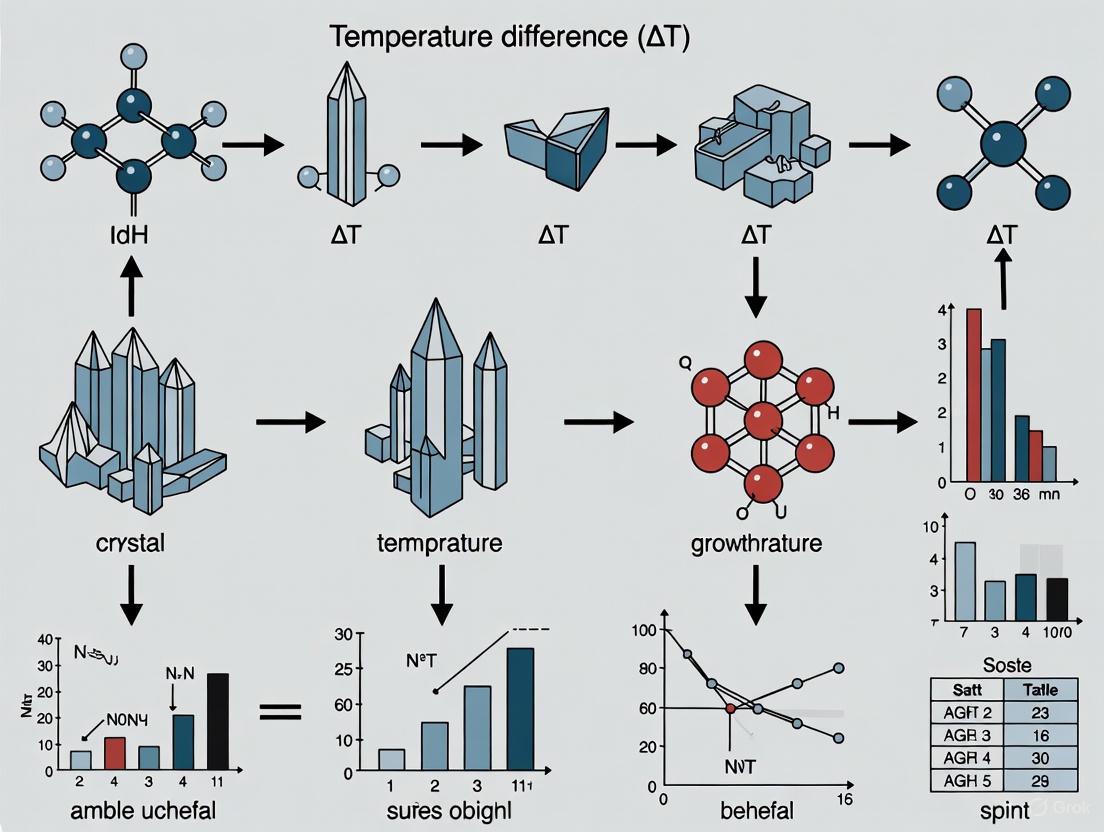
This article provides a comprehensive analysis of temperature difference (ΔT) as a critical control parameter in crystal growth processes, with specific relevance to pharmaceutical and materials science research.
Mastering Crystal Growth: How Temperature Difference (ΔT) Controls Nucleation and Growth Rates for Advanced Materials and Pharmaceuticals
Abstract
This article provides a comprehensive analysis of temperature difference (ΔT) as a critical control parameter in crystal growth processes, with specific relevance to pharmaceutical and materials science research. It explores the foundational principles linking ΔT to boundary layer supersaturation and nucleation kinetics, detailing advanced methodological approaches for precise experimental control. The content addresses common troubleshooting challenges such as scaling and unwanted homogeneous nucleation, and validates techniques through data-driven optimization and comparative analysis of growth environments. By synthesizing foundational theory with practical application, this resource equips scientists with strategies to manipulate crystal morphology, growth rates, and final material properties for enhanced drug development and advanced material fabrication.
The Fundamental Role of ΔT in Crystal Nucleation and Growth Kinetics
Linking Classical Nucleation Theory (CNT) to Boundary Layer Supersaturation
Frequently Asked Questions (FAQs)
FAQ 1: What is the precise role of boundary layer supersaturation in crystallization processes? The boundary layer is a thin region of solution adjacent to a surface (like a membrane or crystal) where concentration gradients exist. Its supersaturation level is often the primary controlling factor for nucleation, rather than the supersaturation in the bulk solution. In membrane systems, for example, temperature differences (ΔT) across the membrane can create a boundary layer with a significantly higher supersaturation level, which directly drives the nucleation rate according to Classical Nucleation Theory [1].
FAQ 2: According to CNT, how do homogeneous and heterogeneous nucleation differ within a boundary layer? CNT describes that both mechanisms involve overcoming a free energy barrier, but they differ in the location and height of this barrier.
- Homogeneous Nucleation occurs spontaneously in the bulk solution or within the boundary layer when a solution becomes highly supersaturated. It has a high energy barrier as it requires forming a new phase without a surface [2].
- Heterogeneous Nucleation occurs on a pre-existing surface (like a membrane, dust particle, or container wall). The surface catalyzes the process by lowering the nucleation energy barrier, making it the more common mechanism, especially in the constrained environment of a boundary layer [2].
FAQ 3: Our experiments show large deviations between measured and CNT-predicted nucleation rates. What could be the cause? This is a common challenge. Key troubleshooting areas include:
- Inaccurate Supersaturation Estimation: The actual supersaturation in the boundary layer can be much higher than in the bulk. Ensure your calculations account for the concentration gradient and temperature difference (ΔT) at the interface [1].
- Ion Pairing and Complexation: In aqueous solutions, ions can form pairs or complexes, reducing the concentration of free ions available for nucleation. This affects the ionic activity product (IAP) and the accurate calculation of supersaturation [3].
- Limitations of CNT: CNT treats microscopic nuclei as macroscopic droplets with well-defined surface tensions, which may not hold for very small clusters. For systems with only a few molecules, CNT can become less accurate [2].
FAQ 4: How can we experimentally measure the supersaturation in a boundary layer? Direct measurement is challenging due to the thinness of the layer. Common indirect methodologies involve:
- Induction Time Measurement: Measuring the time between achieving supersaturation and the first detection of nuclei. A shorter induction time indicates a higher boundary layer supersaturation. A modified power law can relate this to CNT parameters [1].
- Non-Invasive Techniques: Using methods like planar laser scattering (NPLS) to observe flow and structures within the boundary layer, which can be correlated with supersaturation conditions [4].
FAQ 5: What is the critical supersaturation threshold, and why is it important for controlling crystal growth? The critical supersaturation threshold is the specific supersaturation level above which rapid, uncontrolled scaling occurs (often via homogeneous nucleation), and below which controlled crystal growth (often via heterogeneous nucleation) can proceed. Identifying this threshold for your system allows you to "switch off" scaling and grow crystals with a preferred morphology in the bulk solution by carefully controlling the temperature (T) and temperature difference (ΔT) [1].
Troubleshooting Guides
Problem 1: Uncontrolled Scaling and Fouling on Membrane Surfaces
- Symptoms: Rapid formation of tenacious crystal deposits on surfaces, clogging pores and reducing efficiency.
- Possible Causes & Solutions:
- Cause: Excessively high supersaturation in the boundary layer, triggering homogeneous nucleation.
- Cause: Inadequate mixing or flow, leading to a thick, stagnant boundary layer with high local supersaturation.
- Solution: Increase turbulence or flow velocity near the surface. This enhances mass transfer and reduces the thickness of the boundary layer, preventing the buildup of extreme supersaturation [3].
Problem 2: Excessive Ostwald Ripening in Final Product
- Symptoms: Over time, small crystals dissolve and re-deposit onto larger crystals, leading to a wide and unpredictable crystal size distribution (CSD).
- Possible Causes & Solutions:
- Cause: Sustained low levels of supersaturation during the final stages of growth, which is the driving force for Ostwald ripening.
- Solution: Control the cooling or anti-solvent addition profile to ensure supersaturation is depleted more rapidly and completely. This minimizes the time the system spends in the low-supersaturation regime where Ostwald ripening dominates [5].
- Cause: The presence of a wide range of crystal sizes from the nucleation and growth phases.
- Solution: Improve control over the initial nucleation burst. Use the insights from CNT to design a seeding strategy or a controlled nucleation protocol that creates a more uniform initial population of crystals, reducing the driving force for ripening [5].
- Cause: Sustained low levels of supersaturation during the final stages of growth, which is the driving force for Ostwald ripening.
Problem 3: Inconsistent Crystal Morphology and Polymorph Formation
- Symptoms: Batches of crystals exhibit different shapes or crystal structures, leading to inconsistent product performance (e.g., in drug dissolution).
- Possible Causes & Solutions:
- Cause: Fluctuating supersaturation levels during growth, which can favor different crystal faces or polymorphs.
- Solution: Precisely control both T and ΔT. Research shows that T and ΔT can be used collectively to fix the supersaturation set point within the boundary layer, which directly influences crystal morphology [1]. Implement a feedback control system to maintain constant supersaturation.
- Cause: Secondary nucleation mechanisms generating new crystals with different habits.
- Solution: Minimize mechanical shear and crystal-impeller/crystal-crystal collisions during agitation, as these events can generate new nuclei that grow under different local conditions [1].
- Cause: Fluctuating supersaturation levels during growth, which can favor different crystal faces or polymorphs.
Quantitative Data and CNT Parameters
Table 1: Key Supersaturation Metrics and Formulas
| Metric | Formula | Description & Application |
|---|---|---|
| Supersaturation Ratio (S) | ( S = \frac{C}{C^*} ) | The ratio of the actual concentration (C) to the equilibrium saturation concentration (C*). A primary driving force in CNT [3]. |
| Relative Supersaturation (σ) | ( \sigma = \frac{C - C^}{C^} = S - 1 ) | An alternative measure of the driving force for crystallization [3]. |
| Solubility Product (Ksp) | ( K{sp} = a{Ba^{2+}} \cdot a{SO4^{2-}} ) | The equilibrium constant for a solid dissolving. Precipitation occurs when the Ion Activity Product (IAP) > Ksp [3]. |
| Saturation Ratio (Ω) | ( \Omega = \frac{IAP}{K_{sp}} ) | For ionic solutions. Ω < 1 (undersaturated), Ω = 1 (saturated), Ω > 1 (supersaturated) [3]. |
| Chemical Potential Driving Force (Δμ) | ( \Delta \mu = kT \ln(S) ) | The fundamental thermodynamic driving force for phase transformation; used to derive CNT expressions [3]. |
Table 2: Core Equations of Classical Nucleation Theory (CNT)
| Concept | Equation | Parameters |
|---|---|---|
| Homogeneous Nucleation Rate (R) | ( R = NS Z j \exp\left({\frac{-\Delta G^*}{kB T}}\right) ) | ( \Delta G^* ): Energy barrier; ( kB T ): Thermal energy; ( NS ): Number of nucleation sites; ( Z ): Zeldovich factor; ( j ): Attachment frequency [2]. |
| Free Energy Barrier (( \Delta G^* )) | ( \Delta G^* = \frac{16 \pi \sigma^3}{3(\Delta g)^2} ) | ( \sigma ): Surface tension; ( \Delta g ): Gibbs free energy change per unit volume (related to Δμ) [2]. |
| Critical Radius (( r_c )) | ( rc = -\frac{2 \sigma Tm}{\Delta Hf} \frac{1}{Tm - T} ) | ( Tm ): Melting point; ( \Delta Hf ): Latent heat of fusion. For solutions, an analogous form exists with supersaturation [2]. |
Experimental Protocols
Protocol 1: Non-Invasive Measurement of Induction Times in Boundary and Bulk Phases
Purpose: To discriminate between nucleation events occurring in the boundary layer and the bulk solution, and to relate these to the boundary layer supersaturation [1].
Methodology:
- System Setup: Utilize a membrane crystallization cell equipped with precise temperature control for both the feed and permeate sides (establishing ΔT). Include a high-resolution optical monitoring system (e.g., microscope with camera).
- Induction Time in Bulk Solution: Initiate the experiment with a uniform, undersaturated solution. Apply the thermal gradient (ΔT). Use the optical system to record the time (( \tau_{bulk} )) until the first crystals are detected in the bulk solution away from the membrane surface.
- Induction Time at Membrane Surface: In a separate but identical experiment, focus the optical monitoring system on the membrane surface. Record the time (( \tau_{surface} )) until the first crystals appear on the membrane.
- Data Analysis: A significantly shorter ( \tau{surface} ) compared to ( \tau{bulk} ) indicates that the boundary layer supersaturation is higher than the bulk. The induction times can be fitted to a modified power law (( \tau \propto S^{-n} )) to extract kinetic parameters related to CNT and quantify the effective supersaturation in the boundary layer [1].
Protocol 2: Determining the Critical Supersaturation Threshold for Scaling
Purpose: To identify the specific supersaturation level above which undesirable homogeneous nucleation and scaling occur on the membrane [1].
Methodology:
- Experimental Series: Conduct a series of crystallization experiments at a constant bulk temperature (T) but with systematically increasing temperature differences (ΔT). Each ΔT corresponds to a specific calculated boundary layer supersaturation.
- Morphology Analysis: For each experiment, analyze the resulting solid phase using microscopy and/or X-ray Diffraction (XRD).
- Threshold Identification: The critical supersaturation threshold is identified as the ΔT (and its corresponding supersaturation) at which the crystal habit shifts from well-defined, bulk-grown crystals to a tenacious, scaly deposit on the membrane surface. Below this threshold, scaling is "switched off" [1].
Research Reagent Solutions
Table 3: Essential Materials for CNT and Boundary Layer Crystallization Studies
| Reagent/Material | Function in Experiment |
|---|---|
| Model Solute (e.g., Lysozyme, Insulin) | A well-characterized substance (often a protein or salt) used to study fundamental nucleation and growth kinetics. Its crystallization behavior is of direct relevance to pharmaceutical development [5]. |
| Buffer Solutions | Used to maintain a constant pH, which is critical for controlling the solubility and charge of proteins and ionic species, thereby directly influencing supersaturation [3]. |
| Precipitating Agents (e.g., Salts, Polymers) | Agents like ammonium sulfate or PEG added to reduce solute solubility and create a supersaturated environment, providing the driving force for crystallization [3]. |
| Membrane Crystallization Cell | A core component that facilitates the creation of a controlled boundary layer. The temperature difference (ΔT) across the membrane is the primary lever for manipulating boundary layer supersaturation [1]. |
Process Visualization
Diagram 1: CNT-Based Crystallization Workflow
How ΔT and Absolute Temperature (T) Collectively Control Supersaturation Set Points
A technical support guide for crystallization researchers
FAQs: Fundamental Concepts
1. What is the fundamental role of supersaturation in crystallization?
Supersaturation is the thermodynamic driving force for both nucleation and crystal growth. It describes a state where the concentration of a solute exceeds its equilibrium saturation value, making the solution unstable and prone to precipitation [3]. The degree of supersaturation can be expressed as the concentration difference (ΔC = C - C), the supersaturation ratio (S = C/C), or relative supersaturation (σ = (C - C)/C), where C is the solution concentration and C* is the equilibrium saturation concentration [3].
2. How do absolute temperature (T) and temperature difference (ΔT) collectively influence supersaturation?
Absolute temperature (T) and temperature difference (ΔT) work in concert to adjust boundary layer properties and define the operational supersaturation set point. Research has established a log-linear relationship between nucleation rate and the supersaturation level in the boundary layer, which is characteristic of Classical Nucleation Theory (CNT) [1]. Specifically:
- Absolute Temperature (T) primarily controls crystal growth rate [1]. Higher temperatures generally increase molecular mobility and diffusion rates, accelerating growth.
- Temperature Difference (ΔT) primarily controls nucleation rate in the boundary layer [1]. Larger ΔT values create steeper concentration gradients.
By manipulating both parameters, researchers can fix the supersaturation set point within the boundary layer to achieve preferred crystal morphology and control the crystal size distribution (CSD) [1].
3. What is the critical supersaturation threshold and why is it important?
The critical supersaturation threshold is a specific supersaturation level above which scaling becomes probable. Beyond this threshold, homogeneous nucleation occurs, leading to scaling on membrane surfaces and equipment [1]. Operating below this threshold allows researchers to "switch off" kinetically controlled scaling while maintaining crystal growth solely in the bulk solution, typically resulting in preferred cubic morphologies [1].
Troubleshooting Guides
Problem: Uncontrolled nucleation and scaling on equipment surfaces
Potential Causes and Solutions:
- Cause: Supersaturation levels in the boundary layer exceed the critical threshold, promoting homogeneous nucleation [1].
- Solution: Reduce the temperature difference (ΔT) to decrease the boundary layer supersaturation. Implement simultaneous heating and cooling cycles to promote dissolution-recrystallization and prevent scaling [6].
- Cause: Inadequate identification of the metastable zone width (MSZW) for your specific system.
- Solution: Characterize the MSZW experimentally to define safe operating limits. The metastable zone is the area between the solubility curve and the supersaturation curve where spontaneous nucleation is unlikely under normal conditions [3].
Problem: Obtaining broad crystal size distributions (CSD)
Potential Causes and Solutions:
- Cause: Uncontrolled secondary nucleation throughout the process.
- Solution: Use automated direct nucleation control (ADNC), applying controlled heating and cooling cycles to dissolve fine crystals and suppress secondary nucleation [6].
- Cause: Suboptimal combination of T and ΔT for the desired CSD.
- Cause: Insufficient mixing or mass transfer during crystallization.
- Solution: Employ advanced crystallizer designs like the Couette-Taylor (CT) crystallizer, which generates Taylor vortex flow for superior heat and mass transfer, promoting uniform CSD [6].
Problem: Failure to achieve target crystal morphology
Potential Causes and Solutions:
- Cause: Supersaturation profile does not favor the desired habit.
- Solution: Implement supersaturation control (SSC) to maintain a constant supersaturation level within the metastable zone. Combine SSC with optimized seed recipes to shape the CSD effectively [7].
- Cause: Incorrect seeding strategy.
- Solution: Optimize seed loading, size, and distribution. Consider dynamic seeding, where seed is added as a control variable rather than just an initial condition, to achieve complex CSD shapes [7].
Experimental Data Reference
Table 1: Operational Parameters and Their Effects on Crystallization Outcomes
| Parameter | Effect on Nucleation | Effect on Crystal Growth | Impact on CSD | Typical Experimental Range |
|---|---|---|---|---|
| Absolute Temperature (T) | Indirect effect via solubility | Direct control; higher T typically increases growth rate [1] | Larger crystals at higher T if nucleation is controlled [1] | 45-60°C (in referenced study) [1] |
| Temperature Difference (ΔT) | Primary control in boundary layer; higher ΔT increases nucleation rate [1] | Secondary effect | Higher nucleation rate increases fine crystal count, broadening CSD [1] | 15-30°C (in referenced study) [1] |
| Supersaturation Ratio (S) | Direct relationship; higher S increases nucleation rate | Direct relationship; higher S increases growth rate | Optimal S needed for balance; too high leads to broad CSD [7] | System-dependent; must be within metastable zone [3] |
| Residence Time | Longer time increases probability of nucleation events | Longer time allows for larger crystal size | Critical for achieving target mean size in continuous processes [6] | 2.5-15 minutes (in CT crystallizer) [6] |
Table 2: Non-Isothermal Continuous Crystallization Parameters for L-lysine
| Parameter | Condition 1 | Condition 2 | Impact on Process Outcome |
|---|---|---|---|
| Temperature Difference (ΔT) | 0°C (Isothermal) | 18.1°C | Effective reduction of CSD width achieved with higher ΔT [6] |
| Rotation Speed | 200 rpm | 900 rpm | Facilitates Taylor vortex flow for improved mixing and heat transfer [6] |
| Mean Residence Time | 2.5 minutes | 15 minutes | Shorter times increase productivity but may not achieve steady state [6] |
| Flow Direction | Inner heating/Outer cooling | Outer heating/Inner cooling | Alters temperature gradients and local supersaturation profiles [6] |
Detailed Experimental Protocols
Protocol 1: Establishing Supersaturation Control in Batch Cooling Crystallization
This protocol outlines a systematic method to design a supersaturation-controlled (SSC) batch cooling crystallization process to achieve a target Crystal Size Distribution (CSD), based on the approach described by Nagy et al. [7].
System Characterization:
- Determine the solubility curve and metastable zone width (MSZW) for your compound in the chosen solvent. This can be done by measuring the concentration and temperature at which nucleation first occurs upon cooling.
- Identify crystal growth kinetics. This typically involves seeded experiments at different supersaturation levels to model the growth rate, G(S,L).
Analytical CSD Estimator:
- For a growth-dominated process at constant supersaturation, the final CSD can be estimated using an analytical solution of the population balance equation. The final crystal size, L, relates to the initial seed size, L₀, by the equation: L = L₀ + G(S) × τ, where G(S) is the growth rate and τ is the batch time [7].
Design Parameter Optimization:
- A design parameter, ξ, is introduced as a function of batch time and supersaturation. An optimization problem is solved to find the value of ξ that produces a CSD with the desired shape (e.g., narrow, monomodal, or specific multimodal distribution) while meeting the required yield [7].
Setpoint Determination:
- From the optimal ξ, calculate the required supersaturation setpoint and batch time. Alternatively, fix one (e.g., supersaturation based on MSZW limits) and calculate the other.
Implementation:
- Implement the supersaturation controller using an appropriate PAT tool (e.g., ATR-FTIR, FBRM) to maintain the solution at the target supersaturation throughout the batch.
Protocol 2: Continuous Cooling Crystallization with Non-Isothermal Taylor Vortex
This protocol describes a methodology for controlling CSD in a continuous Couette-Taylor (CT) crystallizer using a non-isothermal Taylor vortex, as demonstrated for L-lysine [6].
Crystallizer Setup:
- Utilize a CT crystallizer consisting of two coaxial cylinders with an annular gap.
- Connect independent temperature control units (e.g., thermal jackets) to both the inner and outer cylinders.
Solution Preparation:
- Prepare a concentrated feed solution (e.g., 900 g/L for L-lysine) at a temperature above its saturation point (e.g., 50°C for L-lysine with a saturation temperature of 43°C) to ensure complete dissolution [6].
System Stabilization:
- Pre-fill the crystallizer with pure solvent (e.g., deionized water). Set both cylinders to the target bulk solution temperature (Tb, e.g., 28°C) for isothermal pre-operation (e.g., 20 minutes) [6].
Non-Isothermal Operation:
- Initiate feed flow at the desired rate (e.g., corresponding to a 2.5-minute residence time) and set the inner cylinder to rotate (e.g., 200 rpm).
- Establish a temperature difference (ΔT) by increasing the temperature of one cylinder (Th) and decreasing the other (Tc), while maintaining the average bulk temperature Tb.
- Two modes can be tested:
- Mode A: Inner cylinder heating (Tih), Outer cylinder cooling (Toc).
- Mode B: Inner cylinder cooling (Tic), Outer cylinder heating (Toh).
Monitoring and Analysis:
- Use in-line probes (e.g., FBRM, PVM) to monitor chord length distribution and crystal morphology in real-time.
- Once steady state is reached, collect suspension samples from various ports along the crystallizer axis for offline CSD analysis (e.g., using video microscopy) [6].
Diagram: T and ΔT Control Logic
The Scientist's Toolkit
Table 3: Essential Research Reagent Solutions & Materials
| Item | Function / Explanation | Example from Context |
|---|---|---|
| Couette-Taylor (CT) Crystallizer | A continuous crystallizer with concentric cylinders creating Taylor vortex flow for superior mixing and heat/mass transfer [6]. | Used for L-lysine crystallization with internal temperature control on both cylinders [6]. |
| Process Analytical Technology (PAT) | Tools for real-time monitoring of crystallization processes. | Focused Beam Reflectance Measurement (FBRM) for tracking crystal counts and size; ATR-FTIR for concentration monitoring [7] [6]. |
| Seeds (Optimized Recipe) | Initial crystals used to promote controlled growth and suppress excessive primary nucleation. | Critical for CSD shaping in supersaturation control (SSC) design; can be monodisperse or a designed mixture [7]. |
| Saturation Ratio (S) / Relative Supersaturation (σ) | The calculated driving force for crystallization. | S = C/C; σ = (C-C)/C, where C is concentration and C is equilibrium saturation [3]. The key parameter for controller setpoints. |
| Metastable Zone Width (MSZW) | The concentration-temperature region between saturation and spontaneous nucleation. | Defines the safe operating limits for supersaturation control to avoid uncontrolled nucleation [3] [7]. |
| Sco-267 | Sco-267, MF:C36H46N4O5, MW:614.8 g/mol | Chemical Reagent |
| Gozanertinib | Gozanertinib, CAS:1226549-49-0, MF:C32H31N5O3, MW:533.6 g/mol | Chemical Reagent |
The Log-Linear Relationship Between Nucleation Rate and Boundary Layer Supersaturation
Within the broader research on controlling crystal growth rate through temperature difference (ΔT), understanding and controlling the initial formation of crystals—nucleation—is paramount. This technical support guide addresses the log-linear relationship between nucleation rate and boundary layer supersaturation, a cornerstone principle of Classical Nucleation Theory (CNT) that has been validated in modern membrane distillation crystallization (MDC) studies [1]. This relationship provides a powerful lever for researchers to control whether crystallization occurs homogeneously (leading to scaling) or heterogeneously in the bulk solution, and to dictate the final crystal size and shape [1] [8]. The following FAQs and troubleshooting guides are designed to help you apply this principle effectively in your experiments.
Frequently Asked Questions (FAQs)
Q1: What is the fundamental relationship between nucleation rate and supersaturation in the boundary layer?
Research has established a characteristic log-linear relation between the nucleation rate and the supersaturation level in the boundary layer [1]. This means that a plot of the logarithm of the nucleation rate against the supersaturation level produces a straight line, which is a fingerprint of CNT. The supersaturation in the boundary layer, rather than in the bulk solution, is the critical controlling factor for nucleation in systems like MDC.
Q2: How can I experimentally determine the nucleation rate in my system?
The most common and accessible method is the induction time measurement [9]. The induction time is defined as the time between creating supersaturation and the first detection of a crystal. By running multiple identical, small-scale experiments and measuring the distribution of induction times, you can calculate the nucleation rate. Automated systems like the Crystal16 can dramatically reduce the time required for these measurements using feedback control [9].
Q3: What is the critical supersaturation threshold and why is it important?
Studies have identified a critical supersaturation threshold in the boundary layer [1]. Below this value, scaling (homogeneous nucleation on the membrane surface) can be effectively "'switched-off'", allowing crystals to form solely in the bulk solution with a preferred cubic morphology. Operating above this threshold leads to homogeneous scaling, which is difficult to control and can foul equipment.
Q4: How do temperature (T) and temperature difference (ΔT) function as control parameters?
Temperature (T) and temperature difference (ΔT) are independent but complementary control parameters [1]:
- ΔT is the primary knob for adjusting the nucleation rate. A higher ΔT increases supersaturation in the boundary layer, accelerating nucleation.
- T (average temperature) can be used to adjust the crystal growth rate. Collectively, T and ΔT can be used to fix a supersaturation set point in the boundary layer to achieve a specific crystal morphology and size distribution [1].
Q5: What advanced control strategies can help regulate nucleation and growth?
Supersaturation control strategies are key for segregating the crystal phase into the bulk solution, thereby improving crystal habit, shape, and purity independent of nucleation [8]. Furthermore, techniques like non-isothermal Taylor vortex flow in a Couette-Taylor crystallizer can narrow the crystal size distribution (CSD) by promoting dissolution-recrystallization cycles, effectively removing fines and controlling the final product size [6].
Troubleshooting Guides
Issue 1: Uncontrolled Scaling (Fouling) on Membrane Surfaces
Problem: Rapid, unpredictable formation of scale on membrane surfaces, leading to blockages and process failure.
Possible Causes and Solutions:
- Cause: The supersaturation in the boundary layer has exceeded the critical threshold for homogeneous nucleation [1].
- Solution: Reduce the temperature difference (ΔT) across the membrane. This directly lowers the supersaturation level in the boundary layer, moving the system out of the homogeneous nucleation regime [1].
- Solution: Increase the average temperature (T), if process constraints allow, to modify the boundary layer properties and metastable zone width [1].
- Cause: Inadequate crystal retention, leading to deposition on the membrane.
- Solution: Implement in-line filtration to ensure crystals are retained within the crystallizer and not deposited on the membrane surface. This helps maintain a consistent supersaturation rate and reduces scaling [8].
Issue 2: Excessive Fines and Wide Crystal Size Distribution (CSD)
Problem: The final crystalline product contains too many small particles (fines) and has an overly broad size distribution, affecting filtration and product performance.
Possible Causes and Solutions:
- Cause: Nucleation rate is too high relative to the growth rate, resulting in many small crystals.
- Solution: Fine-tune ΔT and T to lower the boundary layer supersaturation, thereby reducing the nucleation rate and favoring growth of existing crystals [1].
- Solution: Implement fines destruction cycles. Using a technique like the non-isothermal Taylor vortex, apply controlled heating and cooling cycles to dissolve fine crystals and allow them to recrystallize onto larger ones, narrowing the CSD [6].
- Cause: Insufficient hold-up time after induction, not allowing for crystal growth and desaturation.
- Solution: Optimize process conditions to ensure a longer hold-up time following the initial nucleation event. This allows crystal growth to desaturate the solvent, which in turn suppresses further nucleation and results in larger crystals [8].
Issue 3: Inconsistent or Irreproducible Nucleation Rates
Problem: Nucleation induction times vary widely between identical experiments, making process development and scale-up difficult.
Possible Causes and Solutions:
- Cause: The stochastic nature of nucleation is dominating, and not enough data is being collected.
- Solution: Perform a large number of small-scale, identical induction time experiments (e.g., using a Crystal16) to build a statistically significant probability distribution from which a reliable nucleation rate can be calculated [9].
- Cause: Poor control over temperature and supersaturation profiles.
- Solution: Utilize equipment with automated feedback control to precisely manage temperature and detect crystallization events (cloud points). This ensures highly consistent experimental conditions from one run to the next [9].
- Solution: For continuous processes, ensure precise control over the residence time and mixing intensity within the crystallizer, as these are critical for achieving a consistent CSD [6].
Experimental Protocols & Data
Protocol 1: Measuring Nucleation Rate via Induction Times
This protocol is adapted from methods successfully demonstrated using automated crystallization platforms [9].
- Solution Preparation: Prepare a solution of your target compound in the desired solvent at a known concentration.
- Generate Supersaturation: For a cooling crystallization, rapidly cool the solution from a temperature where it is fully dissolved to a predetermined crystallization temperature.
- Measure Induction Time: Start a timer when the target crystallization temperature is reached. The induction time is the period until the first crystals are detected (e.g., by a drop in transmissivity) [9].
- Repeat: Conduct a minimum of 50-100 identical experiments under the same conditions of supersaturation (temperature, concentration) to account for stochasticity [9].
- Analyze Data: Plot the cumulative probability of crystallization against time. The nucleation rate can be calculated from the fitting parameters of this probability distribution [9].
Protocol 2: Establishing the Log-Linear Relationship for Your System
This protocol is based on non-invasive techniques used to relate boundary layer properties to CNT [1].
- Set Up a Membrane Crystallization System capable of independent control of feed temperature (influencing T) and permeate side temperature (defining ΔT).
- Define Experimental Matrix: Choose a range of T (e.g., 45–60 °C) and ΔT (e.g., 15–30 °C) values [1].
- Measure Induction Times: For each (T, ΔT) pair, perform multiple induction time experiments (as in Protocol 1) to determine the average nucleation rate, J.
- Calculate Boundary Layer Supersaturation: Use measured induction times and a modified power law relation to link the data to the supersaturation level in the boundary layer at the point of nucleation [1].
- Plot and Interpret: Plot log(J) against the calculated supersaturation. A straight-line relationship confirms CNT behavior and allows you to extract system-specific kinetic parameters.
Quantitative Data from Literature
The table below summarizes key quantitative findings from recent research on nucleation and crystal growth control.
Table 1: Experimentally Determined Parameters for Nucleation and Crystal Growth Control
| System / Parameter | Value / Range | Control Objective | Key Outcome | Source |
|---|---|---|---|---|
| Membrane Crystallization | T: 45–60 °C; ΔT: 15–30 °C | Fix boundary layer supersaturation | Log-linear relation confirmed; Scaling can be switched off below a critical supersaturation. | [1] |
| L-lysine Continuous Crystallization | ΔT (cylinders): 18.1 °C; Rotation: 200 rpm | Narrow CSD | Non-isothermal Taylor vortex reduced CSD via dissolution-recrystallization. | [6] |
| Control Strategy Performance | N/A | Minimize crystal size variation | Model Predictive Control (MPC) superior to PID and GMC in settling time & overshoot. | [10] |
The Scientist's Toolkit: Essential Research Reagents & Materials
Table 2: Key Materials and Equipment for Nucleation and Crystal Growth Experiments
| Item | Function / Application | Brief Explanation | Source |
|---|---|---|---|
| Automated Lag-Time Apparatus (e.g., Crystal16) | Measurement of induction times and nucleation rates. | Enables multiple, small-scale, statistically significant experiments with automated temperature and transmissivity control. | [9] |
| Couette-Taylor (CT) Crystallizer | Continuous crystallization with narrow CSD. | Generates Taylor vortex flow for superior mixing; non-isothermal operation enables fines dissolution and CSD control. | [6] |
| Focused Beam Reflectance Measurement (FBRM) | In-situ monitoring of crystal particles. | Provides real-time, chord-length distribution data to track nucleation and growth kinetics. | [6] |
| Model Predictive Control (MPC) | Advanced process control for crystallizers. | An optimization-based control strategy that handles constraints and process nonlinearities better than standard PID controllers. | [10] |
| 24, 25-Dihydroxy VD2 | 24, 25-Dihydroxy VD2, MF:C28H44O3, MW:428.6 g/mol | Chemical Reagent | Bench Chemicals |
| Antitumor agent-156 | Antitumor agent-156, MF:C48H77Cl3N5O12Pt-2, MW:1217.6 g/mol | Chemical Reagent | Bench Chemicals |
Process Visualization
The following diagram illustrates the logical workflow and control strategy for managing nucleation and crystal growth based on the principles discussed.
Discriminating Between Homogeneous and Heterogeneous Nucleation Mechanisms
Within the broader research on temperature difference (ΔT) crystal growth rate control, discriminating between homogeneous and heterogeneous nucleation mechanisms is a fundamental challenge. These distinct pathways dictate critical outcomes in industrial crystallization, from the purity of pharmaceutical compounds to the extent of membrane scaling. Homogeneous nucleation occurs spontaneously in the bulk solution when a system achieves a high supersaturation level without the aid of surfaces. In contrast, heterogeneous nucleation takes place on foreign surfaces, impurities, or membrane interfaces at significantly lower supersaturation levels [1] [11]. This technical guide provides researchers with diagnostic criteria, experimental protocols, and troubleshooting advice to identify and control these mechanisms in laboratory settings.
Diagnostic Criteria and Theoretical Framework
Key Differentiating Factors
Classical Nucleation Theory (CNT) provides the theoretical foundation for discriminating between nucleation mechanisms. The table below summarizes the core differentiators:
Table 1: Characteristics of Homogeneous vs. Heterogeneous Nucleation
| Characteristic | Homogeneous Nucleation | Heterogeneous Nucleation |
|---|---|---|
| Nucleation Sites | Bulk solution only [1] | Surfaces, interfaces, or impurities [11] |
| Energy Barrier (ΔG)* | Higher energy barrier [11] | Reduced barrier: ΔGhet = f(θ)ΔGhom [11] |
| Critical Supersaturation | Higher threshold required [1] | Occurs at lower supersaturation levels [1] |
| Spatial Distribution | Uniform throughout bulk solution | Localized at catalytic surfaces |
| Induction Time | Shorter at high supersaturation [1] | Variable depending on surface properties |
| Crystal Morphology | Distinctive habit different from heterogeneous [1] | Often influenced by substrate properties |
The contact angle (θ) between the nucleating phase and the substrate directly determines the reduction of the energy barrier through the wettability function f(θ) = (2-3cosθ+cos³θ)/4 [11]. This mathematical relationship explains why heterogeneous nucleation predominates in most practical scenarios.
Quantitative Analysis of Nucleation Kinetics
According to Classical Nucleation Theory, the nucleation rate (R) follows a predictable relationship:
R = NSZj exp(-ΔG*/kBT) [11]
where ΔG* represents the free energy barrier, kB is Boltzmann's constant, and T is temperature. The exponential dependence on ΔG* creates the dramatic difference between homogeneous and heterogeneous nucleation rates.
Table 2: Experimental Parameters for Mechanism Discrimination
| Experimental Parameter | Homogeneous Regime | Heterogeneous Regime |
|---|---|---|
| Typical Supersaturation (σ) | High (σ > 0.048 for NaClO3) [12] | Low to moderate [1] |
| Temperature Control | Critical for suppression [1] | Less sensitive |
| ΔT Effect | Induces scaling at high ΔT [1] | Promotes controlled growth |
| Nucleation Rate | Rapid increase above threshold [1] | More gradual increase |
| Crystal Size Distribution | Narrow [1] | Broader distribution |
| Boundary Layer Properties | High supersaturation in boundary layer [1] | Moderate boundary layer supersaturation |
Experimental Protocols and Methodologies
Non-Invasive Induction Time Measurement
Objective: To measure induction times in discrete domains (membrane surface and bulk solution) to discriminate nucleation mechanisms [1].
Materials and Equipment:
- Membrane distillation system with temperature control
- Non-invasive imaging (optical microscopy with reflection interference contrast)
- Temperature-controlled crystallization chamber
- High-resolution camera for time-lapse recording
Procedure:
- Prepare solutions with precise supersaturation levels using temperature control (T range: 45-60°C) [1].
- Adjust temperature difference (ΔT range: 15-30°C) to modify boundary layer properties [1].
- Simultaneously monitor membrane surface and bulk solution for nucleation events.
- Record induction times (time to first observable nucleation) for both domains.
- Apply modified power law relation between supersaturation and induction time [1].
- Analyze crystal size distributions to correlate nucleation mechanism with growth rates.
Interpretation: Shorter induction times at membrane surfaces at moderate supersaturation indicate heterogeneous nucleation, while rapid nucleation in bulk solution at high supersaturation suggests homogeneous mechanisms [1].
Nanoconfined Crystal Growth Analysis
Objective: To observe nucleation and growth at nanometric distances from a substrate using Reflection Interference Contrast Microscopy (RICM) [12].
Materials and Equipment:
- RICM setup with high-intensity LED illumination
- Glass coverslips or confining substrates
- NaClO3 or CaCO3 crystal solutions
- Spacer particles (10-80 nm diameter) to control distance [12]
- Closed chamber with precise supersaturation control (σ = c/c0 - 1)
Procedure:
- Create strictly controlled bulk solution supersaturation in closed chamber.
- Measure distance (ζ) between confining glass coverslip and crystal surface using RICM.
- For distances ζ < 125 nm, calculate height relative to local mean with sub-nanometer precision.
- Monitor nucleation of molecular layers on confined facets.
- Record propagation of two-dimensional monolayer islands.
- Analyze nucleation localization patterns relative to contact edges.
- For systems with dislocations (∼5% of crystals), observe spiral growth dynamics [12].
Interpretation: Homogeneous nucleation of molecular layers occurs even in contact with other solids, with new layers raising the macroscopic crystal. Nucleation localization shifts from random distribution to edge-concentrated as supersaturation increases due to ion depletion effects in confined spaces [12].
Figure 1: Experimental Workflow for Nucleation Mechanism Discrimination
Determination of Nucleation Rates
Objective: To quantitatively determine nucleation rates as a function of supersaturation for mechanism identification [13].
Materials and Equipment:
- Temperature gradient annealing apparatus
- Al-Cu alloy samples (3.7 wt.% Cu)
- Induction coil heating system
- Scanning electron microscope
- Image analysis software for particle size distribution
Procedure:
- Prepare homogeneous, coarse-grained Al-Cu alloy samples.
- Apply temperature gradient annealing to achieve partial melting.
- Quench samples to preserve early-stage melting structures.
- Identify former liquid regions through secondary phase formation.
- Analyze spherical secondary-phase particles (50 nm to 1 μm) from single nucleation events.
- Measure particle size distributions at different temperature positions.
- Combine microstructural characterization with numerical simulation to determine time-resolved nucleation rates [13].
Interpretation: Bimodal droplet distributions suggest multiple types of nucleation sites, with nucleation rates featuring distinct maxima at different times indicating competing homogeneous and heterogeneous mechanisms [13].
The Scientist's Toolkit: Research Reagent Solutions
Table 3: Essential Materials for Nucleation Mechanism Studies
| Reagent/Material | Specifications | Experimental Function |
|---|---|---|
| NaClO3 crystals | High purity, (001) surface orientation [12] | Model system for nanoconfined growth studies |
| CaCO3 crystals | Laboratory grade | Biomineralization and confinement studies [12] |
| Al-Cu alloy | 3.7 wt.% Cu, homogenized [13] | Metallic system for nucleation rate determination |
| Spacer particles | 10-80 nm diameter [12] | Control distance in nanoconfinement experiments |
| Glass coverslips | Optical quality | Transparent confinement surfaces [12] |
| Membrane materials | Various surface properties | Study heterogeneous nucleation at interfaces [1] |
| Darbufelone | Darbufelone, MF:C18H24N2O2S, MW:332.5 g/mol | Chemical Reagent |
| Concanamycin E | Concanamycin E, MF:C44H71NO14, MW:838.0 g/mol | Chemical Reagent |
Troubleshooting Guide: FAQs
Q1: How can we suppress homogeneous nucleation to prevent scaling in membrane systems?
A: Research demonstrates that homogeneous nucleation (scaling) occurs at high boundary layer supersaturation. To suppress it:
- Maintain supersaturation below the critical threshold through precise ΔT control [1]
- Reduce temperature difference (ΔT) to decrease boundary layer supersaturation [1]
- Implement surface modifications to promote controlled heterogeneous nucleation instead
- Operate within the "metastable zone" where crystal growth occurs without excessive nucleation [14]
Q2: What diagnostic patterns indicate a shift from heterogeneous to homogeneous nucleation?
A: Key indicators include:
- Abrupt decrease in induction time [1]
- Shift from surface-localized to bulk-phase crystallization
- Change from isolated crystals to numerous microcrystals [14]
- Alteration in crystal morphology and habit [1]
- Sudden increase in nucleation rate above supersaturation threshold [12]
Q3: How does nanoconfinement affect nucleation mechanisms?
A: Nanoconfinement creates distinctive nucleation behaviors:
- New molecular layers nucleate homogeneously even when in contact with solids [12]
- Nucleation localizes near contact edges at higher supersaturation due to ion depletion [12]
- Spiral growth from dislocations becomes skewed toward contact edges [12]
- Two-dimensional mass transport through liquid films governs growth dynamics [12]
Q4: How can temperature (T) and temperature difference (ΔT) be optimized to control crystal morphology?
A: Experimental evidence shows:
- ΔT primarily adjusts nucleation rate by controlling boundary layer supersaturation [1]
- T mainly influences crystal growth rate after nucleation [1]
- Using T and ΔT collectively fixes boundary layer supersaturation to achieve preferred morphology [1]
- Higher T with moderate ΔT promotes controlled growth over chaotic nucleation
Figure 2: Troubleshooting Pathway for Membrane Scaling Issues
Advanced Technical Notes
Theoretical Foundation of Nucleation Barriers
The critical free energy barrier for homogeneous nucleation is derived from CNT:
ΔG*hom = 16πσ³/(3|Δgv|²) [11]
where σ is interfacial tension and Δgv is the volumetric free energy change. For heterogeneous nucleation, this barrier reduces by a factor related to the contact angle:
ΔGhet = f(θ)ΔGhom [11]
This theoretical framework explains why heterogeneous nucleation dominates under most experimental conditions and provides the basis for interpreting induction time measurements and supersaturation thresholds.
Practical Implications for Pharmaceutical Development
Controlling nucleation mechanisms directly impacts drug development:
- Homogeneous nucleation produces numerous small crystals with high surface area
- Heterogeneous nucleation yields larger, more uniform crystals
- Membrane scaling from homogeneous nucleation compromises filtration systems [1]
- Crystal morphology affects bioavailability, purification, and formulation processes [14]
By applying the discrimination techniques outlined in this guide, researchers can strategically manipulate experimental conditions to achieve desired crystalline products while avoiding operational issues like membrane scaling and uncontrolled crystallization.
FAQs: Understanding Critical Supersaturation
What is Critical Supersaturation and why is it fundamental to my crystallization experiments? Critical Supersaturation is the minimum level of water vapor saturation (relative to a plane surface of pure water) required for a cloud condensation nucleus (CCN) of a given size and composition to activate and form a stable cloud droplet [15]. In the broader context of crystallization, it represents the precise threshold at which a solute in a solution begins to transition from a dissolved state to forming stable solid nuclei. This concept is vital because it directly controls the number concentration of particles that will form, whether cloud droplets or crystals. Understanding and controlling this threshold is essential for predicting and regulating the outcome of crystallization processes, influencing everything from crystal size and purity to polymorphism [15].
How does Critical Supersaturation relate to the competing mechanisms of nucleation and crystal growth? Supersaturation is the driving force for both nucleation (the formation of new crystals) and crystal growth (the enlargement of existing crystals) [8]. The position of your system within the metastable zone—the region between saturation and critical supersaturation—determines which mechanism is favored. Close to the saturation point, crystal growth is favored, leading to larger, more uniform crystals. As you approach the Critical Supersaturation threshold, the system favors a primary nucleation pathway, resulting in the spontaneous formation of many small crystals, which can lead to scaling [8]. Effective control strategies therefore involve modulating supersaturation to position the system within a specific region of the metastable zone that favors the desired outcome.
What are the practical consequences of poorly controlled supersaturation in industrial or research settings? Poor control can lead to two primary issues: scaling and inconsistent product quality. When supersaturation is too high, it broadens the metastable zone width and favors homogeneous primary nucleation [8]. This leads to the formation of a large number of fine crystals on surfaces (scaling) and within the bulk solution, which can foul equipment and introduce competition between crystal growth and nucleation mechanisms [8]. The result is often a low yield of crystals with poor habit, shape, and purity, which is unacceptable in industries like pharmaceuticals where these properties are critical.
Troubleshooting Guide: Common Experimental Problems & Solutions
Problem 1: Uncontrolled Spontaneous Crystallization (Scaling)
Observation: The experiment results in a mass of small, intergrown crystals or a glassy, syrup-like solid, often coating the vessel walls instead of forming discrete crystals.
Explanation: This occurs when the system's supersaturation rapidly exceeds the critical supersaturation threshold, pushing it deeply into the labile (unstable) zone where spontaneous nucleation is rampant [16].
Solutions:
- Controlled Nucleation: Avoid simply cooling a highly concentrated solution. Instead, try evaporating the solvent at an elevated temperature to gently generate a few crystal seeds, then control further growth by slow cooling [16].
- Seeding Technique: Cool your solution until spontaneous crystallization just begins, then gently warm it until nearly all crystals dissolve. The few remaining crystals will serve as seeds for controlled growth upon subsequent cooling [16].
- Avoid Glass Vessels: Solvent can creep up the hydrophilic walls of glass beakers, causing nucleation outside the main solution. Use polypropylene or Teflon vessels, or silanize glassware to make it hydrophobic [16].
- Modulate Supersaturation Rate: Research shows that using membrane area to adjust the concentration rate can shorten induction time and allow you to reposition the system within a specific region of the metastable zone that favors growth over primary nucleation [8].
Problem 2: Failure to Nucleate (No Crystallization)
Observation: Despite achieving a supersaturated state, no crystals form, even after prolonged waiting.
Explanation: Crystallization is often kinetically hindered. The system is in a metastable supersaturated state but lacks a nucleation site to initiate the process [16].
Solutions:
- Ultrasound: Using ultrasound, such as from a standard laboratory cleaning bath or by gently scratching the crystallization vessel with a glass rod, can often induce nucleation [16].
- Heterogeneous Nucleation: Intentional introduction of impurities or a rough surface can act as nucleation sites. Ensure your solutions are not overly pure without any acceptors for hydrogen bonds; sometimes adding a co-crystal former like picrates or triphenylphosphine oxide can help [16].
- Patience and Observation: Do not leave the crystallization vessel unattended for long periods. Watch the process closely and be prepared to change conditions if nucleation does not occur [16].
Problem 3: Inconsistent Crystal Growth and Quality
Observation: Crystals form, but they are small, imperfect, or show high levels of disorder, making them unsuitable for analysis (e.g., X-ray diffraction).
Explanation: The crystal growth process is happening too rapidly or under unstable conditions, not allowing for the orderly addition of molecules to the crystal lattice.
Solutions:
- Slow Down: "Don't hurry." If a synthesis takes months, the crystallization should not be rushed. Slow growth typically produces higher quality crystals [16].
- Use Less Concentrated Solutions: Crystallizing from overly concentrated solutions often leads to poor results. Choose a solvent or mixture where the solute has lower solubility to achieve better control [16].
- Segregate Crystal Phase: In advanced setups like Membrane Distillation Crystallisation (MDC), using in-line filtration to retain crystals within the crystalliser bulk can reduce deposition (scaling) on vessel walls. This allows a consistent supersaturation rate to be sustained, desaturates the solvent via crystal growth, and results in larger, more uniform crystals [8].
- Document Everything: Record all crystallization conditions meticulously. The note "Suitable crystals were obtained by slow evaporation of the solvent" is not helpful for reproducing results [16].
Quantitative Data & Experimental Protocols
Supersaturation Control Parameters
The table below summarizes key parameters and their impact on crystallization outcomes, derived from research data.
| Parameter | Typical Range/Value | Impact on Experiment | Reference |
|---|---|---|---|
| Critical Supersaturation | Minimum vapor saturation for CCN activation | Determines which aerosol particles form cloud droplets; analogous threshold exists for solute nucleation. | [15] |
| Supersaturation at Induction | Increases with concentration rate | Shortens induction time, broadens metastable zone width, favors homogeneous nucleation. | [8] |
| Nucleation Saturation Index (∑) | ∑ = 1.9 for CaCO₃ | Fast nucleation occurs at this level; nuclei attach to surfaces. | [17] |
| Alum Additive (for MAP) | 0 - 1.25 g/100 mL water | Controls crystal habit; higher concentrations yield sharper, needle-like crystals. | [18] |
| MAP Concentration (Seed) | 60 g/100 mL hot water | Creates a highly supersaturated solution for generating seed crystals. | [18] |
| MAP Concentration (Growth) | 45 g/100 mL hot water | A less concentrated solution for growing larger, clearer crystals from seeds. | [18] |
Detailed Experimental Protocol: Microfluidic Control of CaCO₃ Crystal Growth
This protocol, adapted from research, outlines a method for achieving precise control over nucleation and growth, minimizing scaling.
1. Objective: To nucleate calcium carbonate crystals in a limited area and obtain accurate growth rates of single polymorph crystals under stable concentration conditions [17].
2. Materials (Research Reagent Solutions):
- Microfluidic Device: Fabricated with channels (e.g., 120 µm wide, 45 µm high) [17].
- Precision Flow Controller: A pressure-driven flow control system (e.g., Elveflow OB1 MK3 controller) is critical for stable concentrations [17].
- Syringe Pumps: For introducing reagents, though pressure-driven control is preferred for stability [17].
- Calcium Chloride (CaClâ‚‚) Solution: 2 mM for stable flow, 10 mM for nucleation [17].
- Sodium Carbonate (Na₂CO₃) Solution: 2 mM for stable flow, 10 mM for nucleation [17].
- Deionized Water: For introduction into separate inlets to control mixing [17].
3. Methodology:
- Setup: Assemble the microfluidic device and connect it to the pressure controller and reagent reservoirs [17].
- Stable Flow Establishment: Introduce deionized water into one inlet and 2 mM CaCl₂ and Na₂CO₃ solutions into the other two inlets. This achieves a low, non-nucleating CaCO₃ concentration (e.g., 0.8 mM). The flow controller maintains all flow rates constant [17].
- Nucleation Trigger: Once a stable flow is achieved, switch the reagent inlets to 10 mM CaCl₂ and Na₂CO₃ solutions. This increases the saturation index (∑) to about 1.9, prompting fast nucleation. Nuclei will become visible and attach to the channel surface [17].
- Crystal Growth: After nucleation is observed, stop the flow from auxiliary inlets. The constant, pressure-controlled flow of the 10 mM solutions past the immobilized nuclei provides a stable supersaturation environment for controlled crystal growth. The growth can be monitored for extended periods (e.g., 23 hours) [17].
- Key Consideration: Research has demonstrated that syringe pumps can cause a constant deviation in flow fraction, whereas pressure-driven flow control is essential for maintaining the stable concentration required for precise growth rate measurements [17].
Workflow Visualization & Researcher's Toolkit
Experimental Workflow for Supersaturation Control
The diagram below outlines the logical decision process for managing supersaturation to avoid scaling and achieve controlled growth.
Research Reagent Solutions & Essential Materials
The following table details key materials and their functions for controlled crystallization experiments.
| Item | Function / Explanation |
|---|---|
| Precision Flow Controller | Pressure-driven systems (e.g., Elveflow OB1) provide superior flow stability over syringe pumps, which is crucial for maintaining constant supersaturation during crystal growth studies [17]. |
| Microfluidic Devices | Provide a confined environment for reagent mixing, nucleation, and growth, allowing for high-precision observation and control of crystallization parameters [17]. |
| Monoammonium Phosphate (MAP) | A common, non-toxic model compound for crystal growth studies. Can be used to grow large, high-quality single crystals or clusters by varying solution conditions [18]. |
| Alum (Potassium Aluminum Sulfate) | An additive used in MAP crystallization to control crystal habit. Increasing the alum concentration changes crystal shape from prismatic to sharp, needle-like spikes [18]. |
| Hydrophobic Vessels (Polypropylene/Teflon) | Prevent solvent from creeping up the walls and causing nucleation outside the main solution, a common problem with hydrophilic glassware [16]. |
| In-line Filtration | Used in systems like MDC to retain crystals in the bulk crystallizer, reducing scaling on walls and promoting controlled growth by maintaining consistent supersaturation [8]. |
| Evocalcet-D4 | Evocalcet-D4, MF:C24H26N2O2, MW:378.5 g/mol |
| Smarca2-IN-2 | Smarca2-IN-2, MF:C16H17N3, MW:251.33 g/mol |
Advanced Techniques for ΔT-Controlled Crystallization in Research and Development
Core Concepts: Understanding ΔT in Thermal Systems
What is Delta T (ΔT) and why is it critical for crystal growth research?
Answer: Delta T (ΔT) represents the temperature difference between two critical points in a system. In crystal growth research, controlling ΔT is fundamental as it directly governs heat transfer rates, which influence crystal nucleation and growth velocity. The formula for calculating ΔT is:
ΔT = T₂ - T₠Where T₂ and T₠are temperatures at two different measurement points [19].
For furnace systems, ΔT is often calculated as the difference between the average internal temperature and the external or room temperature. This is key to understanding the heat output and stability of your system [20]:
ΔT = (Flow Temperature + Return Temperature)/2 - Room Temperature
Example Calculation: If your furnace has an average internal temperature of 70°C and the lab room temperature is 20°C, then ΔT = 70°C - 20°C = 50°C. This scenario is referred to as a "Delta T 50" condition [20].
How does capillary thermostat technology contribute to precise thermal control?
Answer: Capillary thermostats are electromechanical safety devices that provide an external layer of protection for furnaces. They function based on the thermal expansion of a liquid within a sealed capillary system [21].
- Working Principle: A liquid-filled sensing bulb, connected via a capillary tube to an electrical switch, is attached to the furnace's external body. As the surface temperature rises, the liquid expands, mechanically actuating the switch. If a preset temperature limit is reached, the switch opens and safely shuts off power to the furnace [22] [21].
- Safety Function: This mechanism prevents the furnace exterior from reaching dangerously high temperatures, mitigating burn risks and potential damage to the instrument or surrounding materials [22].
- Configurations: Some models offer an optional over-temperature lock-out feature (e.g., Capstat-Dual). This provides a secondary, factory-preset safety cut-out that operates if the primary control switch fails, ensuring fail-safe operation [21].
Troubleshooting Guides
Furnace fails to maintain stable ΔT
| Symptom | Potential Cause | Diagnostic Steps | Resolution |
|---|---|---|---|
| Unstable temperature or inability to reach setpoint | Capillary thermostat tripping prematurely | Verify external furnace body temperature is below the thermostat's setpoint. Check for poor ventilation around furnace. | Improve airflow around furnace. Relocate capillary sensor if it is in a hotspot. |
| Faulty or damaged capillary sensor | Visually inspect capillary tube and bulb for kinks, cracks, or crushing [21]. | Replace damaged capillary thermostat assembly [22]. | |
| Excessive temperature fluctuations | Incorrect ΔT calculation for system setup | Recalculate ΔT based on actual flow/return temperatures and ambient lab temperature [20]. | Adjust system temperature settings to achieve the correct ΔT for the desired heat output. |
Unexpected furnace shutdown
| Symptom | Potential Cause | Diagnostic Steps | Resolution |
|---|---|---|---|
| Furnace shuts down during operation | External body temperature exceeded capillary thermostat limit [22] | Allow furnace to cool. Check if the thermostat resets automatically. | Ensure the furnace is operated within its specified environmental and thermal limits. |
| Over-temperature lock-out (if equipped) has been activated [21] | Check if the lock-out requires a manual reset. Investigate why the primary control failed. | Address the root cause of the over-temperature event (e.g., controller failure). Reset lock-out if applicable. |
Frequently Asked Questions (FAQs)
Q1: My research requires a very specific thermal profile. How can I ensure my furnace's ΔT is calibrated correctly for reproducible crystal growth?
A: Accurate ΔT calibration is fundamental for reproducibility.
- Measure Actual Temperatures: Use calibrated pipe thermometers or sensors to record the actual flow and return temperatures of your furnace's heating system, not just the setpoint [20].
- Monitor Ambient Conditions: Record the stable room temperature in the immediate vicinity of your experiment.
- Calculate True ΔT: Use the formula ΔT = (Flow + Return)/2 - Room Temperature to determine your real-world operating ΔT [20]. Consistently documenting and using this calibrated ΔT ensures your thermal profiles are reproducible across experiments.
Q2: The capillary thermostat on my PVT furnace keeps shutting off the system, halting my long-term experiment. What should I check?
A: This is a critical safety feature being activated. Your investigation should focus on:
- Ventilation: Ensure all vents on the furnace enclosure are completely unobstructed. Dust buildup can be a common cause.
- Sensor Placement: Verify that the capillary thermostat's sensing bulb is firmly and correctly attached to the specified location on the furnace body as per the manufacturer's manual. If it has become dislodged, it may be reading a falsely low temperature.
- Setpoint: Confirm that the thermostat's trip temperature is set appropriately for your experiment and is not set too low for the required internal temperatures.
Q3: For my drug compound crystallization, why is the industry moving towards lower ΔT values in modern systems?
A: The shift to lower ΔT values (e.g., Delta T 50 instead of Delta T 60) is driven by efficiency and control.
- Enhanced Efficiency: Modern systems, like condensing boilers, are designed to operate most efficiently at lower temperatures, reducing energy consumption [20].
- Improved Control: Lower, more stable temperatures can allow for finer control over the crystal growth process, potentially leading to more consistent crystal size and purity, which is critical in pharmaceutical development.
- Real-World Performance: Specifications based on lower ΔT values more accurately reflect the actual performance of contemporary equipment, preventing the selection of undersized equipment that cannot achieve its advertised output [20].
The Scientist's Toolkit: Essential Research Reagent Solutions
| Item Name | Function/Brief Explanation |
|---|---|
| Capillary Thermostat (e.g., EQ-CT320) | Provides an external, mechanical safety shut-off for the furnace, preventing the external body from reaching hazardous temperatures [22]. |
| Armoured Capillary Tube (Optional) | Offers additional mechanical protection for the capillary tube of the thermostat in crowded or high-traffic lab environments [21]. |
| Pipe Thermometer | Essential tool for empirically measuring the actual flow temperature of the heating system, enabling accurate real-world ΔT calculation [20]. |
| Over-Temperature Lock-out (e.g., CT-DUAL) | A secondary safety switch that provides a factory-preset, fail-safe cut-off in case of primary control failure [21]. |
| Pepluanin A | Pepluanin A, MF:C43H51NO15, MW:821.9 g/mol |
| (S)-GSK-3685032 | (S)-GSK-3685032, MF:C22H24N6OS, MW:420.5 g/mol |
Experimental Protocol: Methodology for ΔT Calibration in Crystal Growth Systems
Aim: To empirically determine the operating Delta T (ΔT) of a crystal growth furnace system to ensure accurate and reproducible thermal profiles.
Procedure:
- System Stabilization: Activate the furnace and set it to the desired process temperature. Allow the system to run for a minimum of 30 minutes, or until all readouts (e.g., internal temperatures, power draw) have stabilized.
- Temperature Measurement: a. Flow Temperature: Attach a calibrated pipe thermometer to the pipe carrying heated media (e.g., water, oil) away from the furnace (the flow line). Record the temperature once stable [20]. b. Return Temperature: Similarly, attach a second thermometer to the pipe returning the media to the furnace (the return line) and record the temperature. c. Ambient Temperature: Place a calibrated room temperature sensor in the immediate vicinity of the furnace, shielded from direct heat radiation. Record the stable room temperature.
- ΔT Calculation: Input the recorded values into the standard formula: ΔT = (Flow Temperature + Return Temperature) / 2 - Ambient Temperature [20].
- Documentation: Record the calculated ΔT, all raw temperature values, and the system setpoint in the experiment's log. This calibrated ΔT value should be used as a key parameter for replicating the experiment.
System Workflow and Diagnostics
Capillary Thermostat Safety Cut-off Logic
Designing Stagnant, Uniform Growth Environments to Minimize Experimental Artifacts
Frequently Asked Questions
What are the most critical parameters to control for a uniform growth environment? The most critical parameters are temperature stability and supersaturation control. Even minor fluctuations can drastically alter crystal growth rates and morphology. Temperature stability should exceed ±0.1°C, and supersaturation must be uniform and stable throughout the growth chamber to prevent localized variations in growth kinetics [23].
How can I minimize crystal-crystal interactions and substrate effects? To minimize these artifacts:
- Use well-separated, ultrafine capillaries instead of flat substrates or fibers to support crystals. This reduces preferred nucleation sites and epitaxial-induced strain [23].
- Ensure low crystal density in the growth chamber. The average crystal separation should be on the scale of millimeters or more to prevent crystals from impeding each other's growth through the vapor-density field [23].
My initial crystals are microcrystals or clusters. How can I optimize conditions to grow larger, single crystals? Optimization is a systematic process [24]:
- Identify initial "hits" from matrix screening.
- Prioritize conditions that produce three-dimensional, polyhedral crystals over needles, plates, or clusters.
- Incrementally refine parameters such as pH, precipitant concentration, and temperature around the initial hit conditions. For example, if a hit occurred at pH 7.0, set up new trials at pH 6.0, 6.2, 6.4, up to 8.0.
What are the signs of temperature gradients or instability in my setup? Signs include inconsistent growth rates across different crystal faces or between experiments run under supposedly identical conditions, and crystals with curved edges or hollowed ends [24] [23]. Direct measurement using multiple calibrated thermistors in the growth chamber is necessary to confirm stability [23].
Troubleshooting Guides
Problem: Unstable or Inconsistent Crystal Growth Rates
Possible Causes and Solutions:
- Cause 1: Temperature fluctuations in the experimental chamber.
- Solution: Use a cooling bath circulator with high stability (exceeding ±0.1°C) and design the growth chamber with a large thermal mass (e.g., a milled metal block) to smooth out short-term temperature variations [23].
- Cause 2: Uncontrolled supersaturation.
- Solution: Implement a dedicated vapor-source chamber with an independent thermoelectric cooler to precisely control the supersaturation (S) in the growth chamber. Actively monitor this parameter throughout the experiment [23].
Problem: Crystal Clusters or Unfavorable Morphologies
Possible Causes and Solutions:
- Cause 1: Excessive nucleation density.
- Solution: Optimize the nucleation process by adjusting the degree of undercooling (ΔT). Start with smaller ΔT to favor growth over nucleation. Techniques like matrix seeding can also help control nucleation [24].
- Cause 2: Physical interactions with the substrate.
- Solution: Transition from growth on a flat substrate or fiber to a support-free or capillary-based method. This minimizes edge-effects and strain that can influence crystal habit [23].
Problem: Poor Diffraction Quality from Seemingly Well-Grown Crystals
Possible Causes and Solutions:
- Cause 1: Internal disorder or twinning not visible externally.
- Solution: Use a dissecting microscope with polarized light to check the crystal's optical properties. Weak birefringence or irregular extinction can indicate internal disorder. Focus optimization efforts on conditions that produce crystals with strong, uniform optical properties [24].
- Cause 2: Inadequate optimization of chemical parameters.
- Solution: Systematically explore additives, such as detergents or specific ligands, which can enhance crystal perfection by interacting with the protein surface and promoting more ordered packing [24].
Quantitative Data and Relationships
The relationship between undercooling (ΔT) and crystal texture is a key quantitative aspect of crystallization kinetics. The following table summarizes how the degree of undercooling influences the competition between nucleation and growth, which in turn determines final crystal texture [25].
Table 1: Influence of Undercooling (ΔT) on Crystallization Kinetics and Texture
| Degree of Undercooling (ΔT) | Nucleation vs. Growth | Resulting Crystal Texture | Typical Experimental Approach |
|---|---|---|---|
| Small to Moderate ΔT | Growth dominates over nucleation | Coarser crystallinity; larger, fewer crystals | Slow cooling; vapor diffusion with small equilibrium disturbances |
| High ΔT | Nucleation dominates over growth | Numerous small crystals (microcrystals or showers) | Rapid cooling; fast evaporation; high supersaturation |
Essential Research Reagent Solutions
The following table details key components used in formulating crystallization experiments, particularly for biological macromolecules [24].
Table 2: Key Reagents for Crystal Growth Optimization
| Reagent / Material | Function in Experiment | Example Use Case |
|---|---|---|
| Precipitants (e.g., PEG, Salts) | Drives the sample out of solution, promoting supersaturation and nucleation. | Polyethylene glycol (PEG) of various molecular weights is used to create a crowding effect. |
| Buffers | Maintains a stable and precise pH level, critical for macromolecule stability. | A trial might systematically vary pH around a hit condition from 6.0 to 8.0 in 0.2 unit increments. |
| Additives / Ligands | Enhances crystal packing or stability by binding to the target macromolecule. | Detergents, small molecules, or ions like Mg²⺠or Ca²⺠are added to improve crystal order and diffraction. |
Experimental Protocol: Systematic Optimization via Incremental Parameter Variation
This protocol outlines a standard method for refining initial crystallization "hits" to obtain high-quality crystals [24].
Objective: To improve crystal size, morphology, and diffraction quality by systematically varying the parameters of initial crystallization conditions.
Procedure:
- Parameter Identification: Identify all chemical and physical parameters from the initial screening hit (e.g., precipitant type and concentration, pH, buffer type, temperature, additive presence).
- Solution Formulation: Prepare a matrix of new crystallization solutions. Each parameter should be varied incrementally while keeping others constant.
- Example: If the initial hit was 20% PEG 8000, 0.1 M HEPES pH 7.0, set up trials with PEG concentrations of 15%, 17.5%, 20%, 22.5%, and 25%, and pH values of 6.4, 6.6, 6.8, 7.0, 7.2, 7.4, and 7.6.
- Crystallization Trial Setup: Set up new crystallization trials (e.g., via vapor diffusion) using the newly formulated solutions. It is crucial to use a consistent sample volume and methodology.
- Observation and Evaluation: Monitor the trials regularly. Evaluate crystals based on size, three-dimensional morphology, and optical properties (using polarized light).
- Iteration: Use the best outcomes from this first round of optimization as a new starting point for further fine-tuning.
Methodology: Capillary Cryostat for Stagnant, Uniform Growth
This methodology details the use of a specialized instrument designed to minimize common experimental artifacts [23].
Objective: To grow ice crystals in a highly controlled, stagnant, and uniform environment, minimizing temperature gradients, substrate interactions, and crystal-crystal interference.
Apparatus Setup (Capillary Cryostat CC2):
- Growth Chamber (GC): A central, gold-plated copper chamber with a large thermal mass for temperature stability (fluctuations < 50 mK).
- Capillary Support: Three pure-silica glass capillaries, well-separated and extending from the ceiling of the GC. Crystals grow at the tips, minimizing contact and substrate effects.
- Vapor-Source Chambers (VSCs): Two independent chambers (above and below the GC), each containing a vapor source (ice) on a thermoelectric cooler (TEC). They allow precise and rapid control of GC supersaturation.
- Vacuum Insulation: The entire experimental chamber is surrounded by a vacuum-shroud box (< 10â»âµ Torr) for thermal isolation.
Experimental Workflow:
- Sample Loading: A crystal is nucleated at the tip of a capillary using a chosen ice-nucleation method.
- Condition Stabilization: The bath circulator and VSC TECs are set to achieve the target temperature (TEC) and supersaturation (via TVS) in the GC.
- Crystal Growth: The crystal grows affixed to the capillary in a stagnant, uniform environment. Its orientation can be manipulated to measure the growth rate of specific faces.
- Condition Modulation: The supersaturation can be rapidly changed by switching the active VSC using a sliding valve.
Core Principles and Workflows
The following diagram illustrates the logical relationship between the core goal of minimizing artifacts and the key design principles required to achieve it.
The systematic process for moving from an initial discovery to optimized crystal growth conditions is outlined in the workflow below.
Protocols for Independent Control of ΔT and Absolute Temperature Parameters
Troubleshooting Guides
FAQ: How can I resolve inconsistent crystal growth rates despite a stable absolute temperature?
Answer: Inconsistent growth rates with stable absolute temperature often result from uncontrolled or unmeasured ΔT (undercooling). The growth velocity (V) is governed by the driving force, Δμ(T), which is a function of ΔT, and the kinetic attachment term, k(T) [26].
- Primary Cause: Fluctuations in the actual sample temperature difference from the set point, even if the bath temperature is stable. This invalidates the assumed ΔT.
- Solution:
- Verify Temperature Calibration: Use a NIST-traceable thermocouple or RTD placed in a reference solution near your sample to cross-check the reported temperature of your system [27].
- Measure Local ΔT Directly: For solidification studies, ensure the temperature of the growing crystal interface and the bulk liquid are independently monitored if possible.
- Check for Thermal Gradients: Improve sample container design and agitation to ensure uniform temperature distribution. In vitrification studies, thermal gradients are a primary source of stress and cracking [28].
FAQ: What should I do if my temperature control unit (TCU) will not reach the target temperature?
Answer: A TCU failing to heat or cool properly is a common issue that halts experiments [29].
- Potential Causes and Steps:
- Incorrect Setpoint: Verify the target temperature is correctly entered on the controller [29].
- Low Fluid Flow: Check for alarms and inspect the pump. Low flow from a clogged filter, kinked hose, or air in the system will prevent efficient heat transfer. Clean filters and bleed the system [29].
- Component Failure:
FAQ: Why do my crystals crack during low-temperature phases of growth or vitrification?
Answer: Cracking is typically caused by thermal stress from excessive ΔT across the sample, leading to differential expansion and contraction [28].
- Underlying Principle: Thermal stress is directly related to the thermal expansion coefficient (α). Research shows α is inversely related to the glass transition temperature (Tð‘”) [28].
- Mitigation Strategies:
- Optimize Cooling/Heating Rates: Implement controlled ramping and annealing protocols to reduce thermal gradients [28].
- Modify Solution Chemistry: Use vitrification solutions with a higher Tð‘”. Experimental evidence demonstrates that solutions with higher Tð‘” develop lower thermal stresses and exhibit significantly less cracking [28].
FAQ: How can I improve the precision of ΔT measurement in a fluid flow system?
Answer: Accurate ΔT measurement in flowing systems is critical for heat transfer studies.
- Challenge: Sensor placement and calibration are key.
- Best Practices:
- Sensor Calibration: Calibrate all temperature sensors (e.g., Type K thermocouples) together against a standard. Use a multimeter with TC input to measure differential temperature (ΔT) directly [27].
- Surface Temperature Measurement: When measuring surface temperature with an infrared (IR) thermometer, be aware of emissivity. For low-emissivity surfaces like stainless steel, apply black matte tape or paint to the target area to get an accurate reading [27].
Experimental Protocols for Crystal Growth Rate Control
Protocol 1: Quantifying Growth Kinetics as a Function of ΔT
This protocol outlines a methodology for measuring crystal growth velocity, V, across a range of undercooling (ΔT) values, based on the joint diffusion/collision model for pure metals [26].
- Objective: To establish the functional relationship V = k(T)[1 - exp(-Δμ/kðµT)] for a given material system [26].
Materials:
- High-purity sample material (e.g., Al for metal studies).
- Temperature Control Unit (TCU) with high stability and precision.
- Custom sample cassette or crucible.
- NIST-traceable temperature sensors (e.g., Type K thermocouples).
- High-speed camera or in-situ observation system (e.g., dark-field microscope [30] or cryomacroscope [28]).
Methodology:
- Sample Preparation: Load a precise amount of sample material into the cassette, ensuring a free liquid-gas interface to replicate relevant boundary conditions [28].
- Temperature Stabilization: Set the TCU to an initial absolute temperature (T) above the melting point (Tð‘š) and hold until the sample is fully molten and stable.
- Undercooling and Growth: Rapidly change the TCU setpoint to a target ΔT below Tð‘š. The actual sample ΔT must be verified by sensor.
- Velocity Measurement: Use the high-speed camera to record the advancement of the liquid/solid (L/S) interface. The growth velocity V is calculated from the frame-by-frame displacement of the interface.
- Data Collection: Repeat steps 2-4 for a series of ΔT values to map the entire growth kinetics curve.
- Model Fitting: Fit the collected V vs. ΔT data to the joint diffusion/collision model or other appropriate kinetic models [26].
Data Interpretation:
- The growth velocity typically exhibits a maximum (Vð‘šð‘Žð‘¥) at a specific ΔT (crossover temperature).
- The data can be used to extract the kinetic coefficient k(T) and elucidate the atomic attachment mechanism (e.g., collision-dominated vs. diffusion-dominated) [26].
Protocol 2: Independent Control of T and ΔT in a Diffusion Cell
This protocol describes a system for studying crystal growth where the absolute temperature of the crystal and the ΔT at the interface can be controlled independently.
- Objective: To decouple the effects of absolute temperature (affecting kinetics, k(T)) from the effects of undercooling (affecting driving force, Δμ).
Materials:
- Two independent, linked TCUs (TCU-Crystal and TCU-Solution).
- Diffusion cell with a membrane or capillary separating crystal and solution compartments.
- Precision thermocouples for both compartments.
- In-situ observation (e.g., dark-field microscope [30]).
Methodology:
- System Setup: The crystal is seated in one compartment, whose temperature is rigidly controlled by TCU-Crystal (setting T_absolute). The solution is in the other compartment, with temperature controlled by TCU-Solution.
- Establishing ΔT: The ΔT at the interface is defined as Tsolution - Tcrystal. By adjusting TCU-Solution relative to TCU-Crystal, a precise ΔT is applied without changing the crystal's absolute temperature.
- Growth Monitoring: Use in-situ microscopy to observe and measure growth rates at the crystal interface under these independently controlled parameters [30].
- Data Acquisition: Systematically vary T_absolute and ΔT in a matrix to map their individual contributions to growth rate.
The following workflow diagram illustrates the experimental setup and control logic for this protocol:
Quantitative Data Tables
Table 1: Crystal Growth Velocity vs. Undercooling (ΔT) for Pure Metals
Data illustrating the non-linear relationship between growth velocity and undercooling, following the joint diffusion/collision model [26].
| Undercooling, ΔT (K) | Absolute Temperature, T (K) | Growth Velocity, V (m/s) | Postulated Dominant Mechanism |
|---|---|---|---|
| 10 | Tð‘š - 10 | 0.1 | Collision-limited attachment |
| 50 | Tð‘š - 50 | 2.5 | Mixed collision/diffusion |
| 100 | Tð‘š - 100 | 5.0 | Mixed collision/diffusion |
| 150 | Tð‘š - 150 | 7.5 | Diffusion-limited attachment |
| 200 | Tð‘š - 200 | 4.0 | Diffusion-limited attachment |
Table 2: Thermal Stress Response of Aqueous Solutions at Different Tð‘”
Experimental data from cryomacroscope studies showing the correlation between glass transition temperature (Tð‘”) and thermal stress cracking during vitrification [28].
| Solution Chemistry | Glass Transition Temp, T𑔠(°C) | Normalized Cracked Area (%) | Relative Thermal Stress |
|---|---|---|---|
| 49 wt% DMSO | -131 | 85% | Very High |
| 79 wt% Glycerol | -102 | 60% | High |
| 65 wt% Xylitol | -87 | 25% | Medium |
| 63 wt% Sucrose | -82 | 10% | Low |
The Scientist's Toolkit: Research Reagent Solutions
Table 3: Essential Materials for Temperature-Controlled Crystal Growth Experiments
| Item | Function/Description | Example Use Case |
|---|---|---|
| High-Stability TCU | Provides precise control of absolute temperature and cooling/warming rates. | Maintaining stable ΔT in crystal growth experiments [29]. |
| Type K Thermocouple | A standard temperature sensor for a wide range of temperatures. | General-purpose temperature and ΔT measurement [27]. |
| NIST-Traceable Calibrator | A device used to verify and calibrate temperature sensors for accuracy. | Ensuring measurement integrity for critical ΔT data [27]. |
| Vitrification Solutions | Aqueous mixtures with high glass-forming tendency and specific Tð‘”. | Studying crystal growth inhibition and thermal stress [28]. |
| Custom Sample Cassette | A holder that provides well-defined boundary conditions for the sample. | Containing samples for vitrification and crystal growth studies [28]. |
| In-situ Observation System | Microscope or camera for real-time monitoring of crystal interface. | Measuring crystal growth velocity and interface morphology [30]. |
| PSB-16133 sodium | PSB-16133 sodium, MF:C28H22N2NaO5S2, MW:553.6 g/mol | Chemical Reagent |
| ISAM-140 | ISAM-140, MF:C19H19N3O3, MW:337.4 g/mol | Chemical Reagent |
Troubleshooting Guides
Common Experimental Challenges and Solutions
Experiments controlling Crystal Size Distribution (CSD) through temperature (T) and temperature difference (ΔT) can encounter specific issues. The table below outlines common problems and their solutions.
Table 1: Troubleshooting Guide for CSD Control Experiments
| Problem | Potential Causes | Diagnosis Steps | Solutions & Preventive Measures |
|---|---|---|---|
| Uncontrolled Scaling/Fouling [1] | - Supersaturation level in boundary layer exceeds critical threshold.- Homogeneous nucleation dominant. | - Measure induction times at membrane surface vs. bulk solution.- Analyze crystal habit; scaling has distinct morphology. | - Identify and operate below the critical supersaturation threshold to "switch-off" scaling.- Use ΔT to adjust boundary layer properties and control nucleation pathway. [1] |
| Wide Crystal Size Distribution [6] | - Insufficient dissolution of fine crystals.- Ineffective recrystallization cycles. | - Monitor CSD in-situ with tools like FBRM.- Check temperature gradient and flow parameters. | - Implement non-isothermal cycles (heating/cooling) to promote dissolution-recrystallization. [6]- For continuous systems, optimize ΔT (e.g., 18.1°C) and residence time (e.g., 2.5 min). [6] |
| Poor Temperature Control [29] | - Low fluid flow or clogged components.- Damaged heating/cooling elements.- Faulty sensor. | - Verify setpoint and check for flow alarms.- Inspect filters and lines for blockages.- Cross-check sensor reading with a calibrated probe. [29] | - Clean filters and strainers regularly.- Test heater continuity and valve operation.- Schedule quarterly sensor checks and annual technician inspections. [29] |
| Low Product Yield or Purity [8] | - Competition between nucleation and crystal growth.- Crystal deposition on surfaces (e.g., membrane). | - Determine the metastable zone width.- Monitor supersaturation rate and hold-up time. | - Use membrane area to modulate supersaturation rate. [8]- Implement in-line filtration to retain crystals in the crystallizer, reducing deposition and enabling longer growth times. [8] |
Troubleshooting Temperature Control Units (TCUs)
Proper TCU function is critical for precise ΔT and T control. The following workflows detail the diagnostic process for common TCU failures.
Figure 1: A logical workflow for diagnosing and resolving the most common TCU hardware and control issues. [29]
Frequently Asked Questions (FAQs)
Q1: How do temperature (T) and temperature difference (ΔT) function as distinct control parameters in crystal growth?
Research shows that T (temperature) and ΔT (temperature difference) are independent but complementary levers for controlling crystallization. The average system temperature (T) primarily influences the crystal growth rate by affecting molecular kinetics and surface integration. In contrast, ΔT across a boundary (e.g., in a membrane system or a Couette-Taylor crystallizer) is a powerful tool for controlling the local supersaturation level in the boundary layer, which directly governs the nucleation rate. By collectively adjusting T and ΔT, researchers can fix a supersaturation set-point to achieve a preferred crystal morphology and CSD. [1] [6]
Q2: What is a proven experimental method to achieve a narrow Crystal Size Distribution (CSD) in a continuous process?
A highly effective method is continuous cooling crystallization using a non-isothermal Taylor vortex. This approach, implemented in a Couette-Taylor (CT) crystallizer, involves maintaining the inner and outer cylinders at different temperatures to create a controlled temperature gradient. This gradient establishes a non-isothermal Taylor vortex flow, which subjects crystals to repeated dissolution-recrystallization cycles. Fine crystals dissolve in warmer zones and recrystallize on larger crystals in cooler zones, effectively narrowing the CSD. Optimal parameters for L-lysine, for example, include a ΔT of 18.1 °C, a rotational speed of 200 rpm, and a mean residence time of 2.5 minutes. [6]
Q3: What is the critical supersaturation threshold, and why is it important?
The critical supersaturation threshold is a specific level of supersaturation above which undesirable homogeneous nucleation (leading to scaling and fouling) becomes dominant. Identifying this threshold for a given system is crucial because it allows operators to "switch-off" scaling by maintaining supersaturation below this value. This ensures that crystallization occurs primarily in the bulk solution, yielding crystals with a consistent and preferred habit (e.g., cubic) and preventing the formation of tenacious scale on membrane surfaces or reactor walls. [1]
Q4: Our team is observing excessive scaling in our Membrane Distillation Crystallisation (MDC) system. What control strategies can mitigate this?
Beyond operating below the critical supersaturation threshold, two key strategies are:
- Supersaturation Control via Membrane Area: Modulating the membrane area allows you to adjust the concentration rate and supersaturation kinetics without altering the fundamental heat and mass transfer in the boundary layer. This can help reposition the system within the metastable zone to favor crystal growth over primary nucleation. [8]
- In-line Filtration: Implementing in-line filtration ensures crystal retention within the crystallizer, reducing deposition on the membrane surface. This helps maintain a consistent supersaturation rate, allows for longer crystal hold-up times, and reduces the nucleation rate by allowing the solvent to desaturate through controlled crystal growth. [8]
Experimental Protocols & Data
Detailed Protocol: CSD Control via Non-Isothermal Taylor Vortex
This protocol details the continuous cooling crystallization method for achieving a narrow CSD, adapted from recent research. [6]
- Objective: To produce L-lysine crystals with a narrow Crystal Size Distribution using a Couette-Taylor (CT) crystallizer under non-isothermal conditions.
Materials:
- Couette-Taylor crystallizer (inner radius: 2.4 cm, outer radius: 2.8 cm, gap: 0.4 cm, length: 30 cm)
- Independent thermal jackets for inner and outer cylinders
- Temperature sensors and data acquisition system (e.g., LabVIEW)
- L-lysine and deionized water
- Feed pump
- CSD analysis tool (e.g., video microscope with image analysis software or FBRM)
Procedure:
- Solution Preparation: Prepare a highly concentrated L-lysine feed solution (e.g., 900 g Lâ»Â¹) in deionized water. Heat to 50°C to ensure complete dissolution. The saturation temperature for this concentration is approximately 43°C. [6]
- Crystallizer Initialization: Fill the CT crystallizer with pure deionized water. Set both cylinders to the target bulk solution temperature (Tb, e.g., 28°C) and run for a 20-minute pre-operational period. [6]
- Set Non-Isothermal Conditions: Establish the temperature difference (ΔT). For the "Tih" mode, set the inner cylinder to a high temperature (Th) and the outer cylinder to a low temperature (Tc). Adjust Th and Tc to achieve the desired ΔT (e.g., 18.1 °C) while maintaining the average Tb at 28°C. [6]
- Initiate Crystallization: Start the inner cylinder rotation at a defined speed (e.g., 200 rpm). Begin continuous feeding of the L-lysine solution at a set flow rate to achieve the target mean residence time (e.g., 2.5 minutes). [6]
- Monitor and Sample: Run the system until steady state is reached. Monitor temperatures in situ. At steady state, collect crystal suspension samples from various ports along the crystallizer's axis. [6]
- CSD Analysis: Analyze the samples using a video microscope. Measure the characteristic length of at least 500 crystals to determine the CSD and calculate the Coefficient of Variation (CV) to quantify the distribution width. [6]
The following table consolidates key operational data and findings from the cited research.
Table 2: Summary of Key Experimental Parameters and Findings
| Parameter / Finding | System / Compound | Value / Outcome | Citation |
|---|---|---|---|
| Optimal ΔT for CSD | Continuous CT Crystallizer (L-lysine) | 18.1 ± 0.2 °C | [6] |
| Optimal Rotation Speed | Continuous CT Crystallizer (L-lysine) | 200 rpm | [6] |
| Optimal Residence Time | Continuous CT Crystallizer (L-lysine) | 2.5 minutes | [6] |
| Key Control Mechanism | Non-Isothermal Crystallization | Dissolution-recrystallization cycles narrow CSD. | [6] |
| Nucleation Mechanism | Membrane Crystallization (Scaling) | Homogeneous nucleation at high supersaturation. | [1] |
| Primary Nucleation Control | Membrane Crystallization | Boundary layer supersaturation controls nucleation. A log-linear relation with rate confirms CNT. | [1] |
| Scaling Mitigation Strategy | Membrane Crystallization | Operate below a critical supersaturation threshold; use in-line filtration. | [1] [8] |
The Scientist's Toolkit: Essential Research Reagents & Materials
Table 3: Key Materials and Equipment for CSD Control Experiments
| Item | Function / Role in Experiment | Example / Specification |
|---|---|---|
| Couette-Taylor (CT) Crystallizer | Provides the platform for creating a Taylor vortex flow, enabling excellent mixing and the implementation of non-isothermal cycles for CSD control. [6] | Custom system with independently temperature-controlled inner (2.4 cm radius) and outer (2.8 cm radius) cylinders. [6] |
| Temperature Control Unit (TCU) | Precisely controls and maintains the temperatures (T and ΔT) of the crystallizer cylinders, which is fundamental to manipulating supersaturation and nucleation. [6] [29] | System capable of dual-zone control with stability of ±0.2 °C. [29] |
| Focused Beam Reflectance Measurement (FBRM) | Enables real-time, in-situ monitoring of chord length distributions, providing immediate feedback on CSD changes during the experiment. [6] | FBRM G400 (Mettler Toledo). [6] |
| Video Microscope / Image Analysis | Used for offline CSD analysis, providing high-resolution images to measure crystal size and habit. [6] | System capable of capturing and analyzing >500 crystals (e.g., Sometech IT system with Xojo software). [6] |
| Sapphire (α-Al₂O₃) Reference | A certified reference material with a well-characterized heat capacity, used for calibrating Differential Scanning Calorimeters (DSCs) for thermodynamic studies. [31] | Certified Reference Material disk. |
| Heat Transfer Fluid | The medium that transfers thermal energy to/from the TCU and crystallizer; its viscosity and cleanliness are critical for stable temperature control. [29] | Fluid meeting manufacturer's recommendations for viscosity and thermal stability. [29] |
| In-line Filter | Used in continuous systems to retain crystals within the crystallizer, prevent scaling on membranes, and manage supersaturation. [8] | Chemically compatible filter with appropriate pore size. |
| PAR-2 (1-6) (human) | PAR-2 (1-6) (human), MF:C28H53N7O8, MW:615.8 g/mol | Chemical Reagent |
| Repibresib | Repibresib, CAS:2523199-93-9, MF:C20H16N2O3, MW:332.4 g/mol | Chemical Reagent |
For researchers pursuing the development of next-generation materials, a significant technological barrier has long existed: the inability to reliably grow single crystals from materials with melting points exceeding 2,200°C. This limitation was primarily imposed by the physical properties of traditional crucible materials. Noble metal crucibles, such as those made from iridium (Ir) and platinum (Pt), have been the standard for melt-growth techniques like the Czochralski (Cz) and micro-pulling-down (µ-PD) methods. However, with melting points of 2,446°C and 1,768°C respectively, their practical operating range caps at approximately 2,100°C [32]. This ceiling hindered the exploration of high-density, high-performance complex oxides containing heavy elements like tantalum (Ta) and hafnium (Hf), which are crucial for advanced scintillators, optical devices, and semiconductors [32] [33].
Recent research has broken through this barrier with a groundbreaking approach: the use of tungsten (W) crucibles in conjunction with a carefully controlled growth environment [32] [33]. Tungsten, with its exceptionally high melting point of 3,420°C, provides the necessary thermal stability. The core innovation lies not only in the crucible material but also in the systemic solution to the associated challenges of reactivity and contamination, enabling the successful growth of crystals like La₂Zr₂O₇ (MP: 2,283°C), La₂Hf₂O₇ (MP: 2,418°C), and Lu₃TaO₇ (MP: 2,380°C) [32]. This technical brief provides a support framework for scientists integrating this high-temperature capability into their research on crystal growth rate control, particularly within the context of temperature difference (ΔT) manipulation.
Technical Specifications & Research Reagent Solutions
The following table details the essential materials and their specific functions required for high-temperature crystal growth above 2,200°C.
Table 1: Key Research Reagent Solutions for High-Temperature Crystal Growth
| Item | Function & Critical Specifications | Experimental Rationale |
|---|---|---|
| Tungsten (W) Crucible | High-temperature containment; Melting point > 3,400°C [32]. | Enables processing of melts above 2,200°C, surpassing the limits of Ir and Pt crucibles [32]. |
| Molybdenum (Mo) Crucible | Alternative high-MP container; Melting point ~2,620°C [32]. | A lower-cost option for materials with melting points below its operational limit, but with good workability [32]. |
| Deoxygenated ZrO₂ Insulators | Thermal insulation in the hot zone; Pre-treated at 2,000°C in Ar to remove desorbed oxygen [32]. | Critical for preventing oxidation of the W/Mo crucible, enabling the use of a pure Ar atmosphere instead of Ar+H₂ [32]. |
| Ar + 3% Hâ‚‚ Gas Mixture | Standard reducing growth atmosphere [32]. | Prevents crucible oxidation during growth but may not be suitable for all material systems. |
| Pure Ar Gas Atmosphere | Inert growth atmosphere when using deoxygenated insulators [32]. | Eliminates the potential reducing effects of Hâ‚‚, preserving the desired oxidation states in the crystal. |
| High-Purity Oxide Powders | Starting materials (e.g., La₂O₃, Lu₂O₃, ZrO₂, HfO₂, Ta₂O₅) [32]. | Purity (>3N-4N) is essential to minimize unintentional doping and defect formation during high-temperature growth. |
| Tungsten Seed Rod | Single-crystal initiation [32]. | Provides a lattice template for pulling down the growing crystal in the µ-PD method. |
Troubleshooting Guide: Common High-Temperature Growth Challenges
Problem 1: Crucible Reaction and Crystal Contamination
- Observed Symptom: Discoloration of the crystal, dendritic inclusions within the crystal bulk, or severe pitting and degradation of the crucible interior [32].
- Root Cause: Chemical reaction between the high-MP oxide melt and the tungsten or molybdenum crucible. This is especially prevalent under standard reducing atmospheres and with certain oxide compositions [32].
- Solution: Implement a system of deoxygenated ZrO₂ insulators. This involves pre-heating standard commercial ZrO₂ insulators at 2,000°C for 5-10 hours in an Ar atmosphere to remove absorbed oxygen. This modification allows for the use of a pure Ar growth atmosphere instead of Ar+H₂, significantly suppressing crucible reactivity and preventing the formation of tungsten-based dendritic inclusions in crystals like Y₂SiO₅ [32].
Problem 2: Inability to Achieve a Stable Melt
- Observed Symptom: The source material does not fully melt, or the melt is unstable and solidifies at the crucible's capillary die.
- Root Cause: Inefficient heat transfer from the induction coil to the crucible, or heat loss from the system exceeding the input power.
- Solution: Optimize the hot-zone configuration. Ensure the porous ZrOâ‚‚ insulators are packed tightly around the crucible and centered within the high-frequency (HF) induction coil. This maximizes coupling efficiency and maintains a stable, uniform temperature zone at the crucible's die, which is critical for initiating and sustaining crystal growth [32].
Problem 3: Polycrystalline Growth or Poor Crystal Quality
- Observed Symptom: The resulting ingot is polycrystalline or contains a high density of defects, rather than being a single, continuous crystal.
- Root Cause: This can stem from multiple factors, including (a) an unstable solid-liquid interface due to temperature fluctuations, (b) a growth rate that is too high, or (c) a poor-quality or improperly oriented seed crystal.
- Solution:
- Stabilize Growth Parameters: Use a high-precision pulling mechanism and a highly stable power supply for the HF generator to minimize fluctuations.
- Optimize Growth Rate: For complex oxides like La₂Zr₂O₇, utilize growth rates within the empirically successful range of 0.01 to 0.10 mm/min [32]. Lower rates generally favor higher perfection.
- Monitor the Interface: Use a CCD camera to visually monitor the solid-liquid interface during growth through an opening in the after-heater, allowing for real-time adjustments [32].
Experimental Protocol: µ-PD Growth of La₂Zr₂O₇ Single Crystals
This protocol details the specific methodology adapted from successful research for growing high-melting-point crystals using a tungsten crucible [32].
Step 1: Precursor Preparation and Sintering
- Obtain high-purity (>4N) La₂O₃ and ZrO₂ powders.
- Crucial Pre-treatment: Dry La₂O₃ powder at 1,100°C for 12 hours to prevent composition deviations caused by moisture absorption.
- Weigh the powders to achieve the nominal composition of La₂Zr₂O₇.
- Mix the powders thoroughly and sinter the mixture at 1,600–1,800°C for 24 hours in air using an electric furnace to form a homogeneous, single-phase precursor material. Verify the phase purity via powder X-ray diffraction (XRD).
Step 2: Furnace Preparation and Atmosphere Control
- Load the sintered La₂Zr₂O₇ precursor into the tungsten crucible. The crucible should have a Φ3 mm die at its bottom with a central Φ0.5–0.8 mm capillary.
- Assemble the hot zone using the deoxygenated ZrOâ‚‚ insulators, placing them around the crucible within the vacuum chamber.
- Place the crucible assembly in the center of the HF induction coil.
- Evacuate the chamber using a rotary pump and purge it three times to eliminate residual oxygen.
- Introduce a flow of pure Ar gas to create an inert atmosphere for the growth process.
Step 3: Melting and Seeding
- Energize the HF induction coil to heat the crucible directly until the La₂Zr₂O₇ charge melts (above 2,283°C) and the melt is visible at the bottom of the die.
- Position a Φ3 mm tungsten seed rod just below the crucible die.
- Bring the seed rod into contact with the melt droplet at the die.
Step 4: Crystal Growth and Pulling
- Initiate the crystal growth by pulling the seed rod downward at a controlled rate between 0.01 and 0.10 mm/min.
- Continuously monitor the shape and stability of the solid-liquid interface using the CCD camera.
- Maintain stable power and temperature conditions throughout the pulling process to ensure consistent growth.
Step 5: Post-Growth Annealing
- After growth is complete, anneal the as-grown crystal at 1,000°C for 12 hours in air.
- This post-growth treatment in an oxidizing atmosphere is critical for improving the crystal's optical transparency and recovering oxygen stoichiometry that may have been affected during growth in a reduced oxygen environment [32].
FAQs on High-Temperature Crystal Growth
Q1: Why can't we simply use an iridium crucible for growth above 2,200°C? The melting point of iridium is 2,446°C. While this seems sufficient, the practical operating temperature is limited by its softening point and significantly increased reactivity and erosion rates at temperatures approaching its limit. The maximum practical melting point for materials grown in an Ir crucible is approximately 2,100°C, creating a firm barrier [32] [33].
Q2: What is the primary advantage of using deoxygenated insulators? The primary advantage is the ability to use a pure Ar atmosphere instead of a reducing Ar+Hâ‚‚ mixture. This suppresses the chemical reduction of the tungsten crucible and prevents the incorporation of metallic tungsten dendrites into the growing crystal, a common source of contamination and optical defects in the final product [32].
Q3: How does this high-temperature capability relate to crystal growth rate control (ΔT)? Temperature difference (ΔT) is a fundamental driver of supersaturation (σ), which directly controls both nucleation and crystal growth rates [1]. Mastering high-temperature growth is a prerequisite for applying these principles to a new class of high-melting-point materials. Research has shown that ΔT can be used in conjunction with absolute temperature (T) to adjust boundary layer properties, fixing a supersaturation set point to achieve preferred crystal morphology and control scaling [1].
Q4: For a material with a melting point of 2,350°C, which is more suitable: a Mo or a W crucible? A tungsten crucible is strongly recommended. While a molybdenum crucible has a melting point of 2,620°C, its practical safe operating temperature for long-duration crystal growth is significantly lower. Tungsten, with its 3,420°C melting point, provides a much larger safety margin, reducing the risk of catastrophic crucible failure and ensuring greater process stability and reproducibility [32].
Visual Workflow: High-Temperature Crystal Growth Process
The following diagram illustrates the key experimental setup and workflow for the micro-pulling-down (µ-PD) method using a tungsten crucible.
Diagram: High-Temperature Crystal Growth Workflow. This illustrates the core µ-PD apparatus, highlighting the tungsten crucible, deoxygenated insulators, and controlled atmosphere, which are the critical innovations enabling growth above 2,200°C [32].
Solving Common ΔT Control Problems and Optimizing Crystal Quality
Preventing Membrane Scaling Through Supersaturation Threshold Management
Frequently Asked Questions (FAQs)
1. What is membrane scaling and why is it a critical issue in membrane-based processes like Reverse Osmosis (RO) and Membrane Distillation Crystallisation (MDC)?
Membrane scaling is the precipitation and formation of a dense layer of sparingly soluble salts (e.g., calcium carbonate, calcium sulfate) on the membrane surface [34]. This occurs when the concentration of these salts in the concentrate exceeds their solubility limit, leading to crystallization that plugs the membrane [34] [35]. Scaling causes several operational problems: it increases energy consumption due to higher required operating pressure, reduces water permeability and production, lowers salt rejection rates, and can lead to irreversible membrane damage, shortening its lifespan [34] [35]. In membrane distillation crystallisation, scaling also interferes with the control over crystal growth and product quality [1] [8].
2. What is the fundamental relationship between supersaturation and membrane scaling?
Supersaturation occurs when the concentration of a salt exceeds its equilibrium solubility level, creating the driving force for crystallization [34]. The ion activity product (IAP) relative to the salt's solubility product (Ksp) defines the supersaturation ratio (Sr). When Sr > 1, the solution is supersaturated and scaling may occur [34]. In membrane systems, concentration polarization—the accumulation of solutes near the membrane surface—creates localized zones of high supersaturation, particularly in "dead areas" with low flow velocity (e.g., under spacer mesh bunches) [36]. When a critical supersaturation threshold is surpassed, nucleation begins, followed by crystal growth and scale formation [1] [36].
3. How can temperature (T) and temperature difference (ΔT) be used to control crystallization and mitigate scaling?
Research has demonstrated that temperature (T) and temperature difference (ΔT) across the membrane are powerful tools for controlling boundary layer properties and crystallization kinetics [1]. Adjusting T (e.g., between 45–60°C) and ΔT (e.g., between 15–30°C) establishes a log-linear relationship between nucleation rate and boundary layer supersaturation, consistent with Classical Nucleation Theory (CNT) [1]. Specifically, ΔT can be used to adjust the nucleation rate, while T can be used to control the crystal growth rate [1]. This collective adjustment allows researchers to fix a supersaturation set point in the boundary layer to achieve preferred crystal morphology and, crucially, to identify a critical supersaturation threshold below which scaling can be effectively 'switched off', allowing crystals to form solely in the bulk solution with a preferred cubic morphology [1].
4. What are "dead areas" and how do they contribute to scaling?
"Dead areas" or stagnant zones are regions on the membrane surface with low cross-flow velocity, often occurring where the spacer mesh is pressed against the membrane surface in spiral-wound modules [36]. Due to reduced flow, concentration polarization is heightened in these areas, leading to salt concentrations that can be 10–20 times higher than in the bulk concentrate stream [36]. This extreme concentration creates localized supersaturation, making dead areas the primary sites for homogeneous nucleation. Once formed, crystals can be carried out of these zones by turbulent flow and sediment across the membrane surface, leading to widespread scaling [36].
Troubleshooting Guides
Problem 1: Rapid Flux Decline and Increased Pressure Drop
Potential Cause: Active scaling on the membrane surface, likely due to operating above the critical supersaturation threshold.
Investigation and Resolution Steps:
- Analyze Feed and Concentrate Chemistry: Calculate the Saturation Index (SI) or Supersaturation Ratio (Sr) for key scaling salts (e.g., CaCO₃, CaSO₄) in the concentrate stream. A positive SI or Sr > 1 indicates a high scaling potential [34].
- Adjust Operating Parameters:
- Lower Recovery Rate: Temporarily reduce the system recovery to decrease the concentration factor of sparingly soluble salts in the concentrate, moving the operating point to an undersaturated condition [34] [35].
- Optimize ΔT and T: If using MDC, refer to the table below to adjust ΔT and T to lower the boundary layer supersaturation below the critical threshold for homogeneous nucleation and scaling [1].
- Introduce an Antiscalant: Dose an appropriate antiscalant. These chemicals act through threshold inhibition, crystal modification, and dispersion mechanisms to prevent nucleation and crystal growth even at moderate supersaturation [34] [37]. The required dose depends on the concentrate chemistry.
- Membrane Autopsy: If the problem persists, autopsie a membrane element. Examine it for crystals, particularly in areas adjacent to the feed spacer, to confirm scaling and identify the scaling compounds via SEM-EDS [36].
Problem 2: Uncontrollable Crystal Size Distribution and Poor Product Quality in MDC
Potential Cause: Ineffective segregation of nucleation and growth phases, leading to excessive secondary nucleation and scaling instead of controlled bulk crystal growth.
Investigation and Resolution Steps:
- Measure Induction Times: Use non-invasive techniques to measure induction times in both the bulk solution and at the membrane surface. A short induction time at the membrane surface indicates a high risk of scaling [1].
- Implement Supersaturation Control Strategies:
- Modulate Membrane Area to Volume Ratio: This adjusts the supersaturation rate without altering boundary layer heat and mass transfer, helping to reposition the system within the metastable zone to favor growth over primary nucleation [8].
- Use In-line Filtration: Install an in-line filter to retain crystals within the bulk crystallizer, preventing their deposition on the membrane. This sustains a consistent supersaturation rate, extends hold-up time, and allows for crystal growth to desaturate the solvent, thereby reducing the nucleation rate and yielding larger crystals [8].
- Employ Advanced Crystallizer Designs: Utilize a Couette-Taylor (CT) crystallizer with non-isothermal Taylor vortex flow. Applying different temperatures to the inner and outer cylinders creates dissolution-re crystallization cycles that help achieve a narrow crystal size distribution (CSD) [6].
Problem 3: Recurrent Scaling Despite Antiscalant Use
Potential Cause: Antiscalant inefficiency due to incorrect selection, underdosing, or degradation.
Investigation and Resolution Steps:
- Test Antiscalant Efficacy: Perform laboratory tests that simulate the "dead area" conditions of your RO module, not just bulk solution tests. Determine the supersaturation value at which nucleation begins in the presence of the antiscalant. A more efficient antiscalant will delay nucleation to a higher supersaturation level [36].
- Characterize Crystal Morphology: Analyze crystals formed under scaling conditions using SEM. Efficient antiscalants typically result in smaller, more distorted crystal shapes due to adsorption on crystal faces and blockage of growth sites [37] [36]. The presence of large, well-defined crystals may indicate antiscalant failure.
- Verify Dosage and Compatibility: Recalculate the required antiscalant dose based on updated feed water analysis and maximum concentrate composition. Ensure the antiscalant is compatible with the feed water pH and other pretreatment chemicals to avoid degradation or precipitation [37].
Experimental Protocols & Data Presentation
Protocol 1: Determining Critical Supersaturation Threshold and Induction Times
Objective: To establish the supersaturation threshold below which membrane scaling is prevented, enabling controlled bulk crystal growth.
Methodology:
- Setup: A non-invasive monitoring system (e.g., turbidity, laser reflectance) is installed to detect nucleation events separately in the bulk solution and near the membrane surface in a lab-scale MDC system [1].
- Operation: A series of experiments are conducted with a model salt solution (e.g., NaCl). For each run, temperature (T) is fixed at a value between 45-60°C, and the temperature difference (ΔT) is varied from 15-30°C to manipulate boundary layer supersaturation [1].
- Data Collection: The induction time (t_ind) for both bulk and surface nucleation is recorded for each (T, ΔT) condition. The corresponding boundary layer supersaturation (S) at induction is calculated.
- Analysis: A plot of nucleation rate (J ≈ 1/tind) versus supersaturation (S) is created. The critical supersaturation threshold (Scritical) is identified as the point where surface scaling initiates, characterized by a transition in the nucleation mechanism and a sharp decrease in induction time [1].
Table 1: Exemplary Data for Induction Times and Nucleation Mechanisms at Different ΔT (T fixed at 50°C)
| ΔT (°C) | Supersaturation at Boundary Layer (S) | Bulk Induction Time (min) | Surface Induction Time (min) | Observed Dominant Nucleation Mechanism |
|---|---|---|---|---|
| 15 | Low | > 60 | > 60 | No nucleation observed |
| 20 | Moderate | 45.2 ± 3.1 | > 60 | Heterogeneous (bulk only) |
| 25 | High | 12.5 ± 1.5 | 35.5 ± 2.8 | Heterogeneous (bulk), then Surface |
| 30 | Very High | 2.1 ± 0.5 | 5.3 ± 0.7 | Homogeneous (scaling) |
Protocol 2: Controlling Crystal Size Distribution (CSD) via Non-Isothermal Taylor Vortex Crystallization
Objective: To achieve a narrow CSD in continuous cooling crystallization by implementing simultaneous heating-cooling cycles.
Methodology:
- Setup: A Couette-Taylor (CT) crystallizer is used, consisting of two coaxial cylinders with an annular gap. The inner and outer cylinders have independent thermal jackets for precise temperature control [6].
- Operation:
- The crystallizer is operated in continuous mode with a feed solution of the target compound (e.g., L-lysine).
- To create a non-isothermal Taylor vortex, the inner cylinder is set to a heating temperature (Th) and the outer to a cooling temperature (Tc), establishing a temperature gradient (ΔT = Th - Tc).
- Key parameters like rotational speed (200-900 rpm) and average residence time (2.5-15 min) are controlled [6].
- Analysis: Crystal samples are taken during steady-state operation. The Crystal Size Distribution (CSD) is analyzed using a video microscope or Focused Beam Reflectance Measurement (FBRM). The coefficient of variation (CV) is calculated to quantify the width of the CSD [6].
Table 2: Impact of Non-Isothermal Operation on L-lysine Crystal Size Distribution (Residence time: 2.5 min, Rotation Speed: 200 rpm)
| Operational Mode | ΔT (°C) | Mean Crystal Size (μm) | Coefficient of Variation (CV) | Notes |
|---|---|---|---|---|
| Isothermal | 0 | 125 ± 45 | 0.36 | Broad CSD |
| Non-Isothermal (T_ih) | 10.5 | 145 ± 38 | 0.26 | Improved uniformity |
| Non-Isothermal (T_ih) | 18.1 | 165 ± 25 | 0.15 | Optimal: Narrowest CSD |
T_ih: Inner cylinder heating, Outer cylinder cooling.
The Scientist's Toolkit: Research Reagent Solutions
Table 3: Essential Materials and Reagents for Scaling and Crystallization Control Research
| Item | Function / Application | Example / Note |
|---|---|---|
| Polymeric Antiscalants | Inhibit scale formation by threshold inhibition, crystal modification, and dispersion. Typically contain phosphonate, polycarboxylate, or polyacrylate functional groups [34] [37]. | Commercial brands: Kurita, Avista, BASF. Selection is based on feedwater composition and scaling potential [34]. |
| CNT-based Spacers | 3D-printed spacers with embedded Carbon Nanotubes mitigate scaling in Membrane Distillation by inducing cooling crystallization, delaying crystal adhesion, and promoting formation of larger, less adherent crystals [38]. | The nanoscale roughness and nanochannels are thought to strengthen hydrogen bonding, altering crystallization behavior [38]. |
| Model Scaling Solutions | Used in fundamental studies to understand scaling mechanisms and test mitigation strategies under controlled conditions. | Common salts: Sodium Chloride (NaCl), Sodium Sulfate (Na₂SO₄), Calcium Sulfate (CaSO₄), Calcium Carbonate (CaCO₃) [1] [38]. |
| In-line Filtration Unit | Used in MDC systems for crystal retention within the crystallizer. Prevents crystal deposition on the membrane, reduces scaling, and allows for controlled growth by maintaining supersaturation [8]. | -- |
| Non-Invasive Monitoring Tools | To measure induction times and monitor crystallization kinetics in real-time without disturbing the process [1]. | Techniques: turbidity meters, Focused Beam Reflectance Measurement (FBRM), particle vision microscopy (PVM). |
| AR-C117977 | AR-C117977, MF:C25H28N2O3S2, MW:468.6 g/mol | Chemical Reagent |
| OMDM-2 | OMDM-2, MF:C27H45NO3, MW:431.7 g/mol | Chemical Reagent |
Experimental Workflow and System Diagrams
Supersaturation Control Workflow
Membrane Distillation Crystallization with CNT Spacer
Addressing Substrate-Induced Effects and Crystal-Crystal Interactions
Troubleshooting Guides
Guide 1: Addressing Uncontrolled Nucleation and Scaling
Problem: Rapid, uncontrolled nucleation occurs on the membrane surface (scaling) instead of in the bulk solution, leading to poor crystal morphology and equipment fouling.
- Root Cause: Excessive supersaturation (
ΔTorTis too high) within the membrane boundary layer, triggering homogeneous nucleation [1]. - Solution:
- Adjust Operational
ΔTandT: Systematically lower the temperature difference (ΔT) and/or the bulk temperature (T) to reduce the supersaturation level in the boundary layer below the critical threshold [1]. - Verify Supersaturation Control: Confirm the supersaturation set point is fixed to promote bulk crystal growth with a preferred cubic morphology over surface scaling [1].
- Adjust Operational
- Preventive Measure: Establish a critical supersaturation threshold for your specific system and operate below it to effectively "'switch-off'" surface scaling [1].
Guide 2: Managing Substrate-Induced Strain and Defects in 2D Crystals
Problem: Transferred two-dimensional (2D) crystals, such as monolayer MoSâ‚‚, exhibit altered optical properties and reduced device performance.
- Root Cause: Non-uniform strain and defects introduced during the transfer process to a new substrate, which red-shifts photoluminescence (PL) spectra and creates carrier trapping sites [39] [40].
- Solution:
- Characterize Strain: Use Raman spectroscopy to monitor the shift in the in-plane vibration peak (
E_{{2g}}^{1}). A blueshift often indicates strain release, while a redshift suggests new strain introduction [39]. - Optimize Transfer Process: Minimize the formation of air bubbles and ripples during transfer to reduce non-uniform strain [39].
- Select Substrate Strategically: Exploit substrate-induced strain to enhance specific properties; for example, transferring MoSâ‚‚ to quartz can boost valley polarization for quantum photonic applications [40].
- Characterize Strain: Use Raman spectroscopy to monitor the shift in the in-plane vibration peak (
- Advanced Diagnosis: Use femtosecond transient absorption spectroscopy to directly probe how the substrate alters exciton dynamics and non-radiative recombination pathways [39].
Guide 3: Controlling Crystal-Crystal Interactions and Agglomeration
Problem: Crystals aggregate, form unwanted rings, or undergo unfavourable habit changes during growth, compromising product quality and uniformity.
- Root Cause: Uncontrolled secondary nucleation and physical contact between growing crystals, especially under varying thermal conditions [41] [42].
- Solution:
- Modulate Thermal Cycles: Implement periodic temperature conditions. Use low-temperature phases to promote surface nucleation and high-temperature phases for bulk growth to manage crystal interactions and ring formation [41].
- Control Supersaturation Profile: Use advanced techniques like membrane-assisted crystallization to precisely control solvency addition, inducing uniform nucleation as "self-seeding" and preventing localized high supersaturation that leads to agglomeration [43].
- Simulate Interactions: Employ 3D Phase-Field Method (PFM) simulations to model and predict multi-nucleated crystal growth, contact regions, and interaction behaviors before conducting actual experiments [41].
Frequently Asked Questions (FAQs)
Q1: How does the substrate physically influence crystal growth rates?
The substrate can create a confined interface that drastically alters local mass transport. For instance, surface crystal growth rates (u_S) can be up to 1000 times faster than bulk growth rates (u_B) in silicate glasses due to significantly higher surface diffusion coefficients (D_S) [41]. This is often due to enhanced molecular mobility and lower energy pathways along the substrate interface.
Q2: What is the most critical parameter for controlling crystal growth with temperature?
The supersaturation level, controlled by both the bulk temperature (T) and the temperature difference (ΔT), is paramount [1]. ΔT is a key handle for adjusting the boundary layer properties that directly control nucleation rate, while T can be used to fine-tune the crystal growth rate. These parameters should be adjusted collectively to establish a supersaturation set point that yields the desired crystal morphology [1].
Q3: Can substrate-induced effects be beneficial? Yes, strategically engineered substrate-induced effects can be powerful tools. For example:
- Strain Engineering: Inducing non-uniform strain in monolayer MoSâ‚‚ by transferring it to a quartz substrate can significantly enhance the degree of valley polarization and valley lifetime, a crucial property for quantum photonic devices [40].
- Interface Control: Precisely engineering the TMD/substrate interface can modulate carrier trapping processes and exciton-exciton annihilation rates, enabling the customization of optoelectronic properties for specific devices [39].
Q4: How can I quantitatively predict crystal growth behavior under varying ΔT?
Phase-Field Method (PFM) simulations are a powerful tool. You can determine phase-field mobilities (L_S for surface, L_B for bulk) that quantitatively reproduce experimental surface (u_S) and bulk (u_B) crystal growth rates across a temperature range (e.g., 873–1023 K) [41]. These validated models can then simulate growth under complex periodic temperature conditions [41].
Data Tables
Table 1: Quantitative Impact of Temperature Parameters on Crystal Growth
| Parameter | Definition | Impact on Nucleation & Growth | Experimental Range (Example) |
|---|---|---|---|
Bulk Temperature (T) |
Overall system temperature | Primary control for crystal growth rate adjustment [1] | 45–60 °C [1] |
Temperature Difference (ΔT) |
Driving force for supersaturation | Primary control for nucleation rate in the boundary layer; log-linear relationship with nucleation rate [1] | 15–30 °C [1] |
Undercooling (ΔT or T - T_m) |
Difference between operation temperature and melting temperature | Thermodynamic driving force for crystallization; used in PFM [41] | 873–1023 K (for Na₂O–2CaO–3SiO₂ glass) [41] |
Maximum Overcooling (ΔT_met) |
Maximum allowable undercooling before spontaneous nucleation | Defines the Metastable Zone Width (MSZW); key for process design [43] | Function of cooling rate (R_c) and antisolvent addition rate (R_a) [43] |
Table 2: Substrate-Induced Effects on Material Properties
| Material System | Substrate Change | Observed Effect & Mechanism | Impact on Key Property |
|---|---|---|---|
| Monolayer MoS₂ | Sapphire (as-grown) → Si/SiO₂ (transferred) | PL red-shift (≈20 meV) due to non-uniform strain and defects from transfer [39] | Altered excitonic emission, carrier trapping [39] |
| Monolayer MoS₂ | Sapphire (as-grown) → Quartz (transferred) | Enhanced valley polarization due to strain-induced symmetry breaking and reduced intervalley scattering [40] | Improved performance for valleytronic and quantum devices [40] |
| VOâ‚‚ thin films | Various (YSZ, LAO, MgO, c-ALO, ZnO) | Lattice mismatch-induced strain modifies the Metal-Insulator Transition (MIT) temperature and hysteresis [44] | Critical for tuning transition characteristics in optoelectronic devices [44] |
| Ibuprofen film | Polystyrene (PS) | Mechanical disturbance triggers instability, leading to self-assembly of chiral fibrous structures [42] | Enables construction of large-area micro/nano-chiral structures [42] |
Experimental Protocols
Protocol 1: Determining Metastable Zone Width (MSZW) for Crystallization Process Design
Objective: To experimentally determine the MSZW, defined as the maximum allowable supersaturation before spontaneous nucleation, for a given system under different operating conditions [43].
- Solution Preparation: Prepare a saturated solution of the target compound (e.g., Cefuroxime sodium) in the primary solvent at a constant temperature [43].
- Induction Method: Choose an induction method:
- Data Recording: Record the temperature (
ΔT_met) or antisolvent mass fraction (ΔX_met) at the point of nucleation for each experiment [43]. - Data Analysis: Use response surface methodology to model the MSZW as a function of
R_candR_a. Compare MSZW for different configurations (e.g., traditional vs. membrane-assisted) to evaluate process controllability [43].
Protocol 2: Characterizing Substrate-Induced Strain in 2D Materials via Raman and PL Spectroscopy
Objective: To non-destructively characterize the strain and defect state of a 2D material (e.g., MoSâ‚‚) transferred onto different substrates.
- Sample Preparation: Grow large-area monolayer MoSâ‚‚ on a sapphire substrate using Chemical Vapor Deposition (CVD). Use a wet transfer process to transfer the monolayer onto target substrates (e.g., Si/SiOâ‚‚, quartz) [39] [40].
- Raman Spectroscopy:
- Use a 532 nm laser source in a back-scattering configuration [40].
- Measure the peak positions of the in-plane (
E_{{2g}}^{1}) and out-of-plane (A_{1g}) vibrational modes. - Analysis: Calculate the peak separation. A change (blueshift or redshift) in the
E_{{2g}}^{1}peak relative to the as-grown sample indicates strain release or introduction, respectively [39].
- Photoluminescence (PL) Spectroscopy:
- Under identical excitation energy, acquire the PL spectrum at room temperature [39].
- Fit the spectrum with Voigt functions to deconvolute contributions from A-exciton, B-exciton, and trion emission.
- Analysis: A red-shift and broadening of the A-exciton and trion peaks in transferred samples suggest the introduction of non-uniform strain and defects [39].
Workflow Visualization
Diagram: Substrate & ΔT Crystal Growth Control Strategy
Diagram: Strain Characterization & Mitigation Workflow
The Scientist's Toolkit
Table 3: Essential Research Reagents and Materials
| Item | Function / Application | Key Consideration |
|---|---|---|
| Hollow Fiber Membrane | Provides precise control over antisolvent addition rate in crystallization, enabling superior supersaturation control and "self-seeding" [43]. | Pore size and surface properties determine addition uniformity and nucleation induction. |
| Specific Substrates (e.g., c-ALO, Quartz, YSZ) | Used as growth templates to induce specific strain states or epitaxial relationships in thin films and 2D materials [44] [40]. | Lattice mismatch with the growing material is a primary factor determining induced strain. |
| Polyvinyl Alcohol (PMA)/Polystyrene (PS) | Polymer supports for wet transfer processes of 2D materials or as substrates for supramolecular self-assembly studies [39] [42]. | Mechanical stability and solubility in specific solvents are critical for clean transfer. |
| RF Magnetron Sputtering System | Deposition technique for growing high-quality, stoichiometric oxide thin films (e.g., VOâ‚‚) from oxide targets [44]. | Offers better control over morphology, stoichiometry, and grain distribution compared to metal targets. |
| Phase-Field Method (PFM) Software | Simulation tool for modeling time evolution of microstructures during crystal growth, including multi-nucleation scenarios [41]. | Requires accurate determination of phase-field mobilities (L_S, L_B) from experimental data for quantitative prediction. |
Frequently Asked Questions
FAQ 1: Why combine an Artificial Neural Network (ANN) with a Genetic Algorithm (GA) for crystal growth optimization?
This combination creates a powerful framework for tackling the highly nonlinear, multi-parameter optimization problems common in crystal growth. The ANN acts as an instant predictor, learning the complex relationships between process parameters (like temperature gradients) and crystal quality outcomes (like dislocation density) from historical data or simulations [45]. Once trained, this ANN model can replace slow, computationally expensive simulations. The GA then uses this fast predictor to efficiently search a vast parameter space, evolving populations of candidate recipes over generations to find the optimal combination of inputs that minimizes defects and maximizes crystal quality [45]. This is particularly valuable for controlling crystal growth rate in ΔT research, where the interactions between parameters are complex.
FAQ 2: What are the common sources of error in the data for training the ANN?
The accuracy of an ANN is heavily dependent on the quality of its training data. Common sources of error include:
- Inaccurate or Incomplete Material Data: Neglecting the temperature dependence or anisotropy of material properties can introduce errors [46].
- Oversimplified Numerical Models: Using 2D simulations for non-axisymmetric furnace geometries or neglecting important physics (like transient behavior or turbulence) can reduce the model's fidelity to real-world conditions [46].
- Experimental Data Scarcity and Noise: In-situ measurements of key parameters are often constrained by the aggressive, high-purity growth environment. Furthermore, small, unrecorded changes in the growth recipe or equipment over time can make industrial data unreliable [46].
FAQ 3: My ANN model is not generalizing well to new experimental data. What could be wrong?
This is often a problem of data volume and variety, known as the "4V" challenge in AI. The range of useful process parameters in crystal growth is often narrow, leading to a small and non-diverse dataset that is insufficient for robust training [46]. To address this:
- Use CFD Simulations: Generate large, diverse datasets using validated computational fluid dynamics simulations to supplement your experimental data [46] [45].
- Employ Advanced Learning Techniques: Consider methods like active learning and transfer learning, which can help reduce the volume of training data required [46].
- Validate the Numerical Model: Ensure your simulation's predictions for parameters like growth interface evolution are well-validated against a baseline experiment before using it to generate training data [45].
FAQ 4: How can I define effective objective functions for the Genetic Algorithm?
The objective function is what the GA will minimize or maximize. For ΔT crystal growth rate control, effective objectives are directly tied to final crystal quality. A multi-objective approach is often best [45]. Your objective function could be a weighted sum of:
- Minimization of Dislocation Density: Dislocations act as recombination sites for carriers, degrading electronic properties [45].
- Minimization of Residual Stress: High thermal stress can cause crystal fracture [45].
- Stabilization of Growth Rate: A smooth and stable growth rate is crucial for maintaining a consistent crystal structure and minimizing defects [45].
Troubleshooting Guides
Problem: Slow or Failed Convergence of the Genetic Algorithm
- Symptoms: The GA fails to find a significantly better solution after many generations, or the population diversity collapses prematurely.
- Possible Causes and Solutions:
- Cause 1: Poorly defined parameter ranges. The search space is either too vast or does not contain the optimal region.
- Solution: Conduct a preliminary parameter study using simulations or a limited set of experiments to narrow down realistic and promising ranges for each process parameter.
- Cause 2: An inaccurate ANN predictor. If the ANN model does not correctly map inputs to outputs, the GA is optimizing based on flawed information.
- Cause 1: Poorly defined parameter ranges. The search space is either too vast or does not contain the optimal region.
Problem: The Optimized Recipe from the Framework Performs Poorly in a Real Experiment
- Symptoms: The recipe predicted to be optimal by the ANN-GA framework results in high defect density or failed growth in the laboratory.
- Possible Causes and Solutions:
- Cause 1: A "reality gap" between the data used to train the ANN and the actual experiment.
- Solution: The numerical model used to generate training data must be rigorously validated. As done in one study, compare the simulated and experimental growth interface evolution and temperature profiles at the crucible wall for your original recipe before any optimization [45]. If discrepancies are found, the CFD model must be refined.
- Cause 2: The objective function did not account for a critical real-world constraint.
- Solution: Revisit the objective function. Incorporate additional constraints into the GA, such as limiting the maximum permissible thermal stress or enforcing a minimum convexity/concavity for the growth interface.
- Cause 1: A "reality gap" between the data used to train the ANN and the actual experiment.
Problem: Excessive Computational Time for the Overall Workflow
- Symptoms: Generating the training data via simulation or running the GA optimization takes an impractically long time.
- Possible Causes and Solutions:
- Cause 1: Running high-fidelity 3D transient simulations for the entire growth process is computationally intensive.
- Solution: As a trade-off, use a reliable 2D axisymmetric transient global model to generate the ANN training data, as this can significantly reduce computational cost while maintaining acceptable accuracy [45].
- Cause 2: The GA is evaluating a very large population over many generations.
- Solution: The primary purpose of the ANN is to make this step fast. Ensure your ANN is properly optimized. You can also adjust GA parameters (like population size, crossover, and mutation rates) to balance convergence speed and solution quality.
- Cause 1: Running high-fidelity 3D transient simulations for the entire growth process is computationally intensive.
Experimental Protocol: Implementing an ANN-GA Framework for DS-Si Growth Optimization
The following table summarizes the key steps from a successful implementation of this framework for optimizing a Directional Solidification of mono-like Silicon (DS-Si) process, which can be adapted for ΔT growth rate control research [45].
Table 1: Experimental Protocol for a Data-Driven Optimization Framework
| Step | Description | Key Details & Purpose |
|---|---|---|
| 1. Baseline Experiment | Grow a crystal using an original, non-optimized recipe. | Provides a benchmark for final validation and critical data for validating the numerical model. |
| 2. Transient Global Modeling | Create a 2D axisymmetric CFD model of the growth furnace and process. | Reproduce the baseline experiment in simulation. The model must be validated against experimental temperature measurements and the growth interface shape from step 1 [45]. |
| 3. Training Data Generation | Run the validated model with multiple variations of the growth recipe. | Inputs: Heating temperatures (TC1, TC2, TC3), crucible speed (V). Outputs: Residual stress, dislocation density, growth rate for the entire ingot [45]. |
| 4. ANN Training | Train an artificial neural network on the data from step 3. | The ANN learns to act as an instant predictor of ingot properties (stress, dislocations) for any given recipe, replacing slow simulations [45]. |
| 5. GA Optimization | Run a genetic algorithm using the trained ANN as the fitness evaluator. | The GA searches for the recipe that minimizes the multi-objective function (e.g., low stress + low dislocation density) [45]. |
| 6. Experimental Validation | Grow a new crystal using the optimal recipe from the GA. | The final step to confirm the real-world performance and success of the optimization framework [45]. |
The Scientist's Toolkit: Research Reagent Solutions
Table 2: Essential Computational and Experimental Tools
| Item / Technique | Function in the Optimization Framework |
|---|---|
| Computational Fluid Dynamics (CFD) Software | To simulate the crystal growth process, capturing complex physics of heat transfer, fluid flow, and species transport for generating ANN training data [46] [45]. |
| ANN with Backpropagation | The core machine learning model that learns the non-linear relationships between process parameters and crystal quality, enabling fast prediction. Training involves adjusting weights and biases to minimize the error between its predictions and the training data [46]. |
| Genetic Algorithm Library | An optimization algorithm that uses principles of natural selection (selection, crossover, mutation) to evolve optimal process parameters over generations [45]. |
| Directional Solidification Furnace | A lab-scale furnace for growing crystals (e.g., mono-like Silicon) and validating the optimized recipes. Typically features multiple independent heating zones [45]. |
| Thermocouples | Sensors installed along the furnace to monitor temperature profiles during growth, providing critical data for CFD model validation [45]. |
Framework Workflow and System Logic
The following diagram illustrates the logical sequence and interaction between the key components of the data-driven optimization framework.
Data-Driven Optimization Framework Workflow
ANN-GA Interaction for Crystal Growth Optimization
This diagram details the core interaction between the Artificial Neural Network and the Genetic Algorithm during the optimization loop.
ANN-GA Interaction in Optimization Loop
Controlling Growth Interface Evolution and Reducing Dislocation Density
Frequently Asked Questions (FAQs)
FAQ 1: What are the key factors that control the shape of the growth interface during crystal growth, and why is this important?
The shape of the solid-liquid interface (growth interface) is primarily determined by heat transfer and is critical for obtaining high-quality crystals. A convex interface shape (curving toward the melt) is often desirable as it leads to better crystal quality and higher yields [47]. Key factors you can control are:
- Temperature Gradient: A greater temperature gradient favors a convex interface, especially in the early stages of growth [47].
- Growth Rate: A slower growth rate also promotes a convex shape [47].
- Furnace Configuration: The design of the support system and the use of elements like "cold fingers" can direct heat flow to achieve the desired interface shape [47].
FAQ 2: How does temperature difference (ΔT) influence crystal nucleation and growth?
ΔT is a major driver of supersaturation, which controls both nucleation and growth.
- Nucleation Control: Research shows a log-linear relationship between nucleation rate and the supersaturation level in the boundary layer, which is characteristic of Classical Nucleation Theory (CNT). Adjusting ΔT can directly adjust this supersaturation [1].
- Growth vs. Nucleation Balance: Using ΔT and temperature (T) collectively allows you to set a supersaturation set-point. A higher ΔT can promote faster nucleation, while T can be used to adjust the crystal growth rate independently. Identifying a critical supersaturation threshold is key to avoiding unwanted homogeneous scaling and ensuring crystals form with the preferred morphology [1].
FAQ 3: What practical methods can be used to reduce dislocation density in crystalline materials?
Several in-situ methods can effectively reduce the propagation of threading dislocations:
- Impurity Incorporation: Introducing specific elements, like tungsten, during the homoepitaxial growth of diamond can change the atomic arrangement at defect sites, inhibiting dislocation propagation. This method has been shown to reduce etching pit density from 2.8 × 10âµ cmâ»Â² to 2.5 × 10³ cmâ»Â² [48].
- Epitaxial Lateral Overgrowth (ELO): This technique uses patterned masks on the substrate to block dislocations from propagating into the growing layer, significantly reducing dislocation density in the overgrown material [48].
FAQ 4: Why might crystals grown under the same conditions have uneven sizes?
Uneven crystal size distribution (CSD) can arise from several factors:
- Non-Simultaneous Nucleation: Crystals that nucleate first have more time to grow and become larger than those that form later [49].
- Spatial Distribution: Crystals clustered together in "nests" compete for solute from the surrounding solution. This local depletion of solute causes them to grow more slowly than isolated crystals of the same size, leading to a broader CSD [49].
Troubleshooting Guides
Issue 1: Uncontrolled or Concave Growth Interface
A concave interface can lead to lower crystal yield and quality.
- Problem: The growth interface evolves from convex to concave during the process.
- Solution: Optimize thermal parameters and hardware configuration.
- Adjust Thermal Parameters: Implement a dynamic furnace temperature profile. Use a "bell-curve" profile with larger temperature gradients in the early stage and smaller gradients in the later stage of growth to maintain a convex interface for a longer duration [47].
- Modify Hardware: Use a composite support system (e.g., quartz-graphite) or a cold finger (e.g., SiC pedestal) to alter heat flow and promote a convex interface [47].
Issue 2: High Threading Dislocation Density
Dislocations degrade electronic and optical properties of crystals.
- Problem: Threading dislocations from the substrate propagate into the epitaxial layer.
- Solution: Apply in-situ defect engineering.
- Method: Incorporate a tungsten layer during growth.
- Protocol: For diamond growth using MPCVD, introduce a tungsten precursor (tungsten hexacarbonyl, W(CO)₆) with a H₂ carrier gas. Use a W/H ratio of 0.3%, CH₄ concentration of 6–7%, and a chamber pressure of 160 mbar at 1100°C. A 3 μm thick tungsten-incorporated layer can effectively inhibit dislocation propagation [48].
Issue 3: Unwanted Scaling and Irregular Crystal Morphology
Scaling on surfaces and irregular crystal habits reduce product quality.
- Problem: Homogeneous scaling occurs, producing a crystal habit different from the desired bulk phase.
- Solution: Control the boundary layer supersaturation.
- Identify Threshold: Measure induction times to determine the critical supersaturation level at which homogeneous scaling initiates [1].
- Adjust Process Parameters: Use T and ΔT to set the boundary layer supersaturation below the identified critical threshold. This effectively "switches off" scaling and allows for the growth of the preferred crystal morphology in the bulk solution [1].
Experimental Protocols & Data
| Parameter | Effect on Interface Shape | Recommended Optimization Strategy |
|---|---|---|
| Temperature Gradient | A greater gradient favors a convex shape. | Use a dynamic bell-curve furnace profile. |
| Growth Rate | A slower rate favors a convex shape. | Reduce the cooling rate during the initial growth phase. |
| Heat Transfer Configuration | Directly controls heat flow and interface shape. | Use a quartz-graphite composite support system or a SiC cold finger. |
| Reagent | Function | Application Notes |
|---|---|---|
| Tungsten Hexacarbonyl (W(CO)₆) | Precursor for in-situ tungsten incorporation. | Heated to 60°C, delivered with H₂ carrier gas at 1.5 sccm. |
| Hydrogen (Hâ‚‚) | Carrier gas and plasma source. | Maintains standard MPCVD environment. |
| Methane (CHâ‚„) | Carbon source for diamond growth. | Concentration maintained at 6-7% (C/H ratio). |
| Reagent | Typical Working Concentration | Function in Experiment |
|---|---|---|
| SYPRO Orange | 5× (10 μM) | Standard fluorescent dye reporting protein unfolding. |
| Protein Sample | 5 μM | The target of the thermal stability analysis. |
| HEPES Buffer | 20 mM, pH 7.4 | Standard biochemical buffer to maintain protein environment. |
| NaCl | 100 mM | Provides ionic strength to the solution. |
Process Visualization
Diagram: Strategies for Crystal Quality Control
Diagram: Relationship Between ΔT, Supersaturation, and Outcomes
Mitigating Unwanted Homogeneous Nucleation in Confined Spaces
Within the broader context of research on crystal growth rate control via temperature difference (ΔT), managing spontaneous, unwanted homogeneous nucleation in confined spaces presents a significant challenge for processes ranging from membrane distillation to pharmaceutical crystallization. Homogeneous nucleation, the spontaneous formation of crystal nuclei in a pure fluid absent of surfaces or impurities, is particularly problematic in confined geometries where it can lead to scaling, clogging, and compromised product quality [1] [50]. This technical support center provides targeted guidance to help researchers identify, troubleshoot, and prevent these issues in their experimental systems.
Troubleshooting Guides
Problem 1: Rapid Scaling and Fouling in Membrane Systems
Observation: Rapid formation of tenacious scale on membrane surfaces and within pores, leading to increased pressure drops and reduced efficiency.
| Possible Cause | Diagnostic Tests | Corrective Actions |
|---|---|---|
| Excessive supersaturation in the boundary layer | Measure induction times at different T and ΔT [1]. | Implement a lower ΔT to reduce the driving force for homogeneous nucleation [1]. |
| Supersaturation level above the critical threshold | Compare calculated boundary layer supersaturation to the identified critical threshold [1]. | Adjust both T and ΔT collectively to fix the boundary layer supersaturation below the critical scaling threshold [1]. |
| Inadequate nucleation control agents | Conduct screening experiments with different ionic additives. | Introduce additives like Mg²âº, which is known to postpone nucleation onset [51]. |
Problem 2: Uncontrollable Crystal Size Distribution
Observation: The resulting crystals from a batch process show a wide, unpredictable size distribution, which is undesirable for consistent drug product performance.
| Possible Cause | Diagnostic Tests | Corrective Actions |
|---|---|---|
| Simultaneous nucleation and growth | Perform crystal size distribution analysis over time [1]. | Use ΔT to control nucleation rate and T to independently adjust crystal growth rate [1]. |
| Secondary nucleation mechanisms | Perform morphological analysis of the scale/crystals [1]. | Optimize agitation and shear rates to minimize crystal breakage. Isolate growth phases from nucleation phases. |
| Stochastic nature of homogeneous nucleation | Replicate small-volume experiments to establish statistical distribution of nucleation times [50]. | Shift the mechanism from homogeneous to controlled heterogeneous nucleation using seeded crystallization. |
Problem 3: Extended Induction Times or No Nucleation
Observation: The system remains in a metastable state for prolonged periods without nucleation, delaying or halting production.
| Possible Cause | Diagnostic Tests | Corrective Actions |
|---|---|---|
| Supersaturation below critical threshold | Verify solution concentration and thermodynamic driving force calculations. | Increase ΔT carefully to elevate supersaturation to a level that enables controlled nucleation [1]. |
| Presence of nucleation inhibitors | Analyze solution for chemical impurities or additives like Mg²⺠[51]. | Modify solution chemistry or remove the inhibiting impurity. |
| Extreme confinement effects | Compare induction times in confined vs. bulk environments [51]. | Adjust confinement geometry if possible, or increase supersaturation to overcome the surface energy barrier. |
Frequently Asked Questions (FAQs)
Q1: What is the fundamental difference between homogeneous and heterogeneous nucleation in a confined space?
Homogeneous nucleation is the process where crystal nuclei form randomly and uniformly from the pure parent phase itself, without contact with external surfaces or impurities [52]. In contrast, heterogeneous nucleation occurs at preferential sites on surfaces, vessel walls, or impurities [50]. The key difference lies in the energy barrier; heterogeneous nucleation has a lower free energy barrier because the interface with the foreign surface reduces the surface energy penalty of creating a new phase [50]. In confinement, where surfaces are in close proximity, heterogeneous nucleation often dominates, but under high supersaturation, homogeneous nucleation can still occur and is often the cause of unwanted scaling [1].
Q2: How do temperature (T) and temperature difference (ΔT) function as independent control parameters?
Research has demonstrated that T and ΔT can be used to independently influence different stages of the crystallization process. The temperature difference (ΔT) across the boundary layer is a primary lever for controlling the nucleation rate. A log-linear relationship has been observed between nucleation rate and the supersaturation level generated by ΔT [1]. Conversely, the average system temperature (T) can be used to adjust the crystal growth rate after nucleation has occurred [1]. By collectively tuning T and ΔT, researchers can fix a supersaturation set point in the boundary layer that promotes desired crystal morphology while suppressing unwanted homogeneous nucleation.
Q3: Why does confinement sometimes prevent the formation of stable crystals?
Confinement can stabilize metastable phases and prevent their transformation into stable crystals through several mechanisms. Firstly, if the pore or gap dimensions are smaller than the critical nucleus size required for the stable phase, nucleation is thermodynamically suppressed [51]. Secondly, even in µm-range confinement, restricted ion transport and reduced advection can slow down dissolution and reprecipitation kinetics, preventing the transformation of amorphous intermediates (like Amorphous Calcium Carbonate) into stable crystals [51]. This kinetic trapping can lead to persistent, viscous, liquid-like precipitates that do not ripen into larger crystals.
Q4: What is the role of specific ions, like Mg²âº, in controlling nucleation?
Background electrolytes have a profound impact on nucleation kinetics. Ions like Mg²⺠affect the dehydration energy of the emerging nucleation clusters, which modifies the critical supersaturation required for a nucleus to become stable [51]. The presence of Mg²⺠has been experimentally observed to significantly postpone the onset of nucleation [51]. This is attributed to ion-specific effects that increase the free energy barrier for nucleation, making it more difficult for stable nuclei to form.
Experimental Protocols & Data
Key Experiment: Relating Induction Time and Supersaturation for Scaling Control
Objective: To directly measure the induction time for nucleation in both bulk and scaling (surface) domains and establish a critical supersaturation threshold to avoid homogeneous scaling.
Methodology Summary:
- Setup: A non-invasive technique is employed to measure induction times within two discrete domains: the membrane surface and the bulk solution [1].
- Parameter Adjustment: Temperature (T) and temperature difference (ΔT) are systematically modified (e.g., T: 45–60 °C; ΔT: 15–30 K) to adjust the properties and supersaturation level of the boundary layer [1].
- Data Collection: Induction times are recorded for each set of conditions. The supersaturation in the boundary layer at the point of induction is calculated.
- Analysis: A modified power law relation is used to link supersaturation and induction time, connecting mass/heat transfer to Classical Nucleation Theory (CNT). The crystal size distribution is analyzed to deduce nucleation and growth rates [1].
Key Quantitative Findings:
| Controlled Parameter | Impact on Nucleation Rate | Impact on Crystal Growth Rate |
|---|---|---|
| Temperature Difference (ΔT) | Adjusts rate; log-linear relation with boundary layer supersaturation [1]. | No direct conformity to CNT; can be modified by ΔT [1]. |
| Temperature (T) | Used collectively with ΔT to fix boundary layer supersaturation [1]. | Can be adjusted independently using T [1]. |
| Observation | Implication for Control |
|---|---|
| A critical supersaturation threshold was identified [1]. | Below this threshold, kinetically controlled scaling can be 'switched off,' allowing crystals to form only in the bulk solution with a preferred morphology [1]. |
| Scaling occurs through a homogeneous mechanism [1]. | Indicates exposure of pores to extremely high supersaturation levels, requiring a reduction in driving force [1]. |
The Scientist's Toolkit: Research Reagent Solutions
| Reagent or Material | Function in Experiment | Key Consideration |
|---|---|---|
| Electrolyte Solutions (NaCl, CaClâ‚‚) | Control ionic strength and supersaturation; used to study the common ion effect and ion-specific influences [51]. | Higher ionic strength can increase calcite solubility and dissolution rates [51]. |
| MgClâ‚‚ Solution | Nucleation inhibitor; postpones nucleation onset by affecting the dehydration energy of nucleation clusters [51]. | Concentration and ionic strength are critical for its effectiveness. |
| Atomic Layer Deposition (ALD) Calcite Films | Provide well-defined, polycrystalline calcite surfaces for force and reactivity measurements in confined spaces [51]. | Initial surface morphology and roughness can vary between deposition batches [51]. |
Supporting Diagrams
Diagram 1: Experimental Workflow for Nucleation Control
Diagram 2: Thermodynamics of Homogeneous Nucleation
Validating ΔT Control Methods and Comparing Growth Environments
Experimental Validation of Predicted Growth Rates and Morphologies
Frequently Asked Questions (FAQs)
FAQ 1: How does temperature difference (ΔT) directly influence crystal growth rates and morphologies?
Temperature difference (ΔT) is a primary parameter for controlling supersaturation, the fundamental driving force for crystallization. By adjusting ΔT and the absolute temperature (T), you can set a boundary layer supersaturation set-point to achieve a preferred crystal morphology [1]. Specifically, a higher ΔT generally increases the nucleation rate, while the absolute temperature (T) can be used to adjust the crystal growth rate [1]. This collective control allows researchers to fix the supersaturation within a specific range, thereby dictating whether crystals form in the bulk solution with a preferred morphology or as scale on surfaces.
FAQ 2: What are the critical signs that my experiment is operating outside the optimal metastable zone?
Operating outside the optimal metastable zone width (MSZW) often results in two observable issues:
- Excessive Nucleation (Scaling): The formation of a large number of fine crystals or a solid scale layer on the membrane or reactor surfaces indicates the system has entered the labile zone where spontaneous nucleation is prevalent. Studies show this scaling occurs through a homogeneous mechanism at high supersaturation levels [1].
- Inconsistent or Unpredictable Morphology: The appearance of crystal habits that are distinctive from the expected phase, such as dendritic, skeletal, or fibrous forms, suggests a high degree of undercooling (ΔT) and supersaturation [53]. Identifying a critical supersaturation threshold is key to "switching off" this undesirable scaling [1].
FAQ 3: My crystal size distribution (CSD) is too wide. What experimental parameter should I adjust to achieve a narrower CSD?
A wide CSD is frequently caused by uncontrolled secondary nucleation. To achieve a narrower CSD, implement a non-isothermal process with dissolution-recrystallization cycles. Recent research using a Couette-Taylor (CT) crystallizer demonstrates that applying a temperature gradient (ΔT) between the inner and outer cylinders to create a non-isothermal Taylor vortex flow can effectively narrow the CSD. Under optimal conditions (e.g., ΔT = 18.1 °C, rotational speed of 200 rpm, and residence time of 2.5 minutes), this method promotes continuous dissolution of fines and recrystallization, leading to a more uniform particle size [6].
FAQ 4: How does the cooling rate relate to the final crystal morphology?
The cooling rate directly affects the degree of undercooling (ΔT), which in turn controls the crystal morphology. Euhedral crystals, which display well-defined crystal faces, grow just below the liquidus temperature under low undercooling conditions. As the cooling rate increases and ΔT becomes larger, crystals develop more complex morphologies. In various mineral systems, the following progression is observed with increasing cooling rate: subhedral → skeletal → dendritic → spherical → bow-tie and fibrous forms [53].
Troubleshooting Guides
Problem: Uncontrolled Scaling and Fouling
- Symptom: Crystals form predominantly as scale on the membrane or reactor walls instead of in the bulk solution.
- Root Cause: The local supersaturation in the boundary layer has exceeded a critical threshold, triggering homogeneous nucleation and scaling [1].
- Solution:
- Reduce the Driving Force: Lower the temperature difference (ΔT) across the membrane or cooling surface to decrease the generated supersaturation [1].
- Identify the Threshold: Conduct experiments to determine the critical supersaturation value for your specific system. Operate below this threshold to "switch off" scaling mechanisms [1].
- Adjust Absolute Temperature: Modify the absolute temperature (T) to shift the solubility and the system's position relative to the metastable zone [1].
Problem: Inconsistent Crystal Morphology Between Experiments
- Symptom: The crystal habit (shape) varies significantly between experimental runs, even with similar starting concentrations.
- Root Cause: Inconsistent control of supersaturation and cooling profiles, leading to variations in the growth regime.
- Solution:
- Strict Supersaturation Control: Use techniques like constant-composition crystallization to maintain a stable supersaturation level throughout the experiment [54].
- Standardize Cooling Rates: Implement a programmed, reproducible cooling profile. Remember that the cooling rate is a key parameter for MSZW [54].
- Characterize Morphologies: Use techniques like Raman spectroscopy and SEM to link specific morphologies (cubic, dendritic, spherical) to your experimental parameters, creating a process-morphology map [53].
Problem: Excessive Fines in the Final Product
- Symptom: The final crystal slurry contains a high population of very small crystals (fines), leading to poor filtration and a wide CSD.
- Root Cause: High primary or secondary nucleation rates, often due to excessive supersaturation or mechanical shock.
- Solution:
- Implement Fines Removal and Dissolution: Integrate a non-isothermal Taylor vortex flow in a CT crystallizer. This setup creates cycles where fines are dissolved in a hot zone and recrystallized in a cold zone, narrowing the CSD [6].
- Optimize ΔT in Non-Isothermal Crystallizers: For a CT crystallizer, carefully control the temperature difference (ΔT) between the inner and outer cylinders, the rotational speed, and the average residence time. A ΔT of around 18 °C has been shown effective for systems like L-lysine [6].
- Use Seeded Crystallization: Introduce a population of well-sized seed crystals at a low supersaturation to dominate the growth process and suppress spontaneous nucleation.
Quantitative Data and Experimental Protocols
Key Experimental Parameters for CSD Control in a CT Crystallizer
The following table summarizes critical parameters from a recent study on controlling Crystal Size Distribution (CSD) using a non-isothermal Couette-Taylor (CT) crystallizer [6].
Table 1: Optimal Parameters for CSD Control of L-lysine in a CT Crystallizer [6]
| Parameter | Role in Crystallization | Studied Range | Optimal Value for Narrow CSD |
|---|---|---|---|
| Temperature Difference (ΔT) | Drives dissolution-recrystallization cycles; controls supersaturation profile. | 0 °C to 18.1 °C | 18.1 ± 0.2 °C |
| Rotational Speed | Governs mixing and heat/mass transfer via Taylor vortex formation. | 200 rpm to 900 rpm | 200 rpm |
| Average Residence Time | Determines duration crystals are subjected to growth/dissolution cycles. | 2.5 to 15 minutes | 2.5 minutes |
| Bulk Solution Temp (Tb) | Sets the base operating temperature for the system. | 20 °C to 32 °C | 28 °C |
Crystal Morphology as a Function of Cooling Rate
The morphology of crystals is highly dependent on the cooling rate, which determines the degree of undercooling (ΔT). The following table classifies common morphologies observed in mineral and synthetic systems [53].
Table 2: Relationship Between Cooling Rate, Undercooling (ΔT), and Crystal Morphology [53]
| Cooling Rate | Degree of Undercooling (ΔT) | Expected Crystal Morphology | Description |
|---|---|---|---|
| Low | Low | Euhedral / Subhedral | Well-defined, characteristic crystal faces reflecting internal structure. |
| Moderate | Moderate | Skeletal | Crystals with a hollow or framework structure. |
| High | High | Dendritic | Branching, tree-like crystal structures. |
| Very High | Very High | Spherical / Fibrous / Bow-tie | Radial, spherical aggregates or fibrous, needle-like forms. |
Experimental Protocol: Validating Growth Rates and Morphology Using a Non-Isothermal CT Crystallizer
This protocol provides a methodology for experimentally validating predicted crystal growth rates and morphologies by controlling ΔT, based on the work of Li et al. (2025) [6].
Aim: To validate the effect of temperature difference (ΔT) and non-isothermal cycles on crystal growth rate, morphology, and CSD.
Materials and Equipment:
- Couette-Taylor (CT) crystallizer with independent temperature control for inner and outer cylinders.
- Thermostatted bath or heating/cooling system for feed solution.
- Temperature sensors (e.g., TMP119) and data acquisition system (e.g., LabVIEW).
- Feed solution (e.g., L-lysine in deionized water).
- Analytical tools: Video microscope for CSD, FBRM for in-situ chord length distribution, SEM for final morphology.
Methodology:
- Solution Preparation: Prepare a concentrated feed solution (e.g., 900 g/L L-lysine). Heat it above its saturation temperature (e.g., to 50 °C for a solution saturated at 43 °C) to ensure complete dissolution [6].
- Crystallizer Initialization: Fill the CT crystallizer with deionized water. Set both cylinders to the target bulk temperature (Tb, e.g., 28 °C) and allow the system to stabilize for 20 minutes [6].
- Set Non-Isothermal Parameters: Establish the temperature difference (ΔT). For example, set the inner cylinder as the heating source (Tih) and the outer as the cooling source (Toc), or vice-versa. Maintain a constant Tb of 28 °C while varying ΔT from 0 °C to a maximum (e.g., 18.1 °C) [6].
- Run Crystallization: Start the inner cylinder rotation at a fixed speed (e.g., 200 rpm). Continuously pump the preheated feed solution into the crystallizer at a fixed flow rate to achieve the desired residence time (e.g., 2.5 minutes) [6].
- Data Collection: Monitor temperatures in situ. Once steady state is reached, collect crystal suspension samples from axial ports for ex-situ analysis [6].
- Analysis:
- CSD: Use a video microscope and image analysis software to measure the crystal lengths of at least 500 crystals. Calculate the Coefficient of Variation (CV) to quantify the width of the distribution [6].
- Morphology: Use SEM imaging to characterize crystal habit (e.g., cubic, dendritic) [53].
- Growth Rate: If possible, use in-situ FBRM to track crystal size evolution over time under different ΔT conditions.
Experimental Workflow Diagram
The following diagram illustrates the logical workflow for the experimental validation protocol.
The Scientist's Toolkit: Research Reagent Solutions
This table details key materials and their functions in crystallization experiments focused on ΔT control.
Table 3: Essential Materials and Their Functions in Crystallization Research
| Item | Function / Role in Experiment |
|---|---|
| Couette-Taylor (CT) Crystallizer | A continuous crystallizer with coaxial cylinders. Creates a Taylor vortex flow for superior mixing and heat transfer, enabling non-isothermal operation [6]. |
| L-Lysine / Other Model Compounds | A common model solute used to study crystallization kinetics. Its solubility in water allows for investigation of cooling crystallization and CSD control [6]. |
| Calcium Chloride (CaClâ‚‚) | A salt used in studies of non-isothermal evaporation and crystallization in droplets and thin layers, relevant for scaling phenomena [55]. |
| Poly(ethylene terephthalate) (PET) | A polymer model system for studying non-isothermal crystallization kinetics, often analyzed using DSC [56]. |
| Differential Scanning Calorimeter (DSC) | An instrument used to study thermal transitions. It is crucial for determining melting points, crystallization enthalpy, and kinetics under controlled cooling rates [56]. |
| Focused Beam Reflectance Measurement (FBRM) | A PAT (Process Analytical Technology) tool for in-situ, real-time monitoring of chord length distributions, providing insight into CSD and nucleation events [6]. |
| Video Microscope / SEM | Used for ex-situ analysis of final crystal size, distribution, and most importantly, morphology (habit) [53] [6]. |
This guide provides technical support for researchers investigating crystal growth, with a specific focus on how growth mechanisms and outcomes differ between free (unconfined) and nanoconfined environments. Understanding these differences is critical for controlling crystal morphology, size, and quality in applications ranging from pharmaceutical development to advanced materials synthesis. A key theme is the central role of temperature difference (ΔT), which directly controls supersaturation—the fundamental driving force for crystallization—in the boundary layer of a solution [1].
Free Growth occurs on open crystal surfaces exposed to a bulk solution. In this regime, mass transport and incorporation of growth units at step edges or kinks are dominant processes [57] [58].
Nanoconfined Growth takes place when a crystal grows in a space restricted to nanometric dimensions, such as within pores, between two surfaces, or in a controlled capillary bridge [59] [60]. This confinement drastically alters mass transport, leading to unique nucleation behavior and step dynamics not observed in free growth.
Troubleshooting Guides & FAQs
Common Experimental Challenges and Solutions
| Problem Phenomenon | Possible Cause | Diagnostic Steps | Recommended Solution |
|---|---|---|---|
| Unexpected Polycrystallinity | Uncontrolled heterogeneous nucleation on container surfaces [58]. | Inspect container for scratches; check for dust or impurities in solution. | Use containers with a few controlled scratches; filter solutions; introduce a single seed crystal [58]. |
| No Crystal Growth at Low Supersaturation | Absence of active growth sites (e.g., dislocations) on crystal surface [57] [58]. | Measure supersaturation level (σ). If σ is low, defect growth is likely the required mechanism. | Intentionally introduce screw dislocations or increase supersaturation to enable 2D nucleation [57]. |
| Extreme Localized Nucleation in Confinement | Depletion of ions in the center of the confined fluid film, creating a strong concentration gradient [59]. | Use RICM or similar techniques to map nucleation locations relative to the contact edge. | Reduce the system supersaturation or increase the confinement gap distance (̄ζ) to improve mass transport [59]. |
| Uncontrollable Rough Growth | Supersaturation (σ) is too high, favoring adhesive growth over layer-by-layer mechanisms [57]. | Check ΔT setting, as a high ΔT creates high boundary layer supersaturation [1]. | Systematically lower the supersaturation or ΔT to shift growth into the 2D or spiral growth regime [57] [1]. |
| Inconsistent Crystal Morphologies in Liquid Metal Solvents | Uncontrolled cooling rates leading to varied intermetallic phases and growth kinetics [61]. | Correlate crystal size/distribution from XCT scans with the applied cooling profile. | Implement a controlled, slow-cooling rate (e.g., 1°C/min) to achieve uniform and predictable crystal morphologies [61]. |
Frequently Asked Questions (FAQs)
Q1: Why does my crystal habit change when I grow it in a nanoporous material compared to a free solution? The confined geometry fundamentally alters the transport of growth units (atoms, ions, molecules) to the crystal surface. In free growth, transport is three-dimensional. In nanoconfinement, it becomes highly two-dimensional, occurring through a thin fluid film. This creates steep concentration gradients that can preferentially slow or accelerate growth on specific crystal faces, thereby changing the final habit [59].
Q2: How does temperature difference (ΔT) directly control crystal growth rates? ΔT is a primary lever for controlling the supersaturation level in the boundary layer adjacent to the growing crystal. A higher ΔT results in a higher supersaturation, which in turn increases the driving force for both nucleation and growth. This can shift the growth mechanism from defect-mediated spiral growth at low σ to two-dimensional nucleation at moderate σ, and even to rough, adhesive growth at high σ [57] [1].
Q3: What is the critical supersaturation threshold, and why is it important? The critical supersaturation threshold is the specific supersaturation level above which homogeneous nucleation becomes rampant, often leading to scaling (unwanted surface crusts) or a high density of small crystals. Operating below this threshold allows for the controlled growth of larger, higher-quality crystals, as is often required in pharmaceutical development [1].
Q4: My organic semiconductor crystals are too thick for optimal device performance. How can I fabricate ultrathin crystals? A proven method is nano-confined crystallization. This involves confining the crystallization process in a sub-hundred nanometer space, for example, by using an elastic photoresist micropillar template placed on a substrate with controlled applied pressure. This gap physically restricts vertical growth, yielding ultrathin nanobelts or nanosheets with thicknesses potentially below 10 nm [60].
Quantitative Data Comparison
The following table summarizes key quantitative differences observed under free and nanoconfined growth conditions, based on experimental findings.
Table 1: Quantitative Comparison of Free vs. Nanoconfined Crystal Growth Parameters
| Parameter | Free Growth | Nanoconfined Growth | Experimental Context |
|---|---|---|---|
| Step Height | Not applicable (N/A) for direct comparison | 0.33 nm (for NaClO₃) [59] | Measured via RICM on (001) surface. |
| Nucleation Localization | Random across the surface | Highly localized near the edge of the confined contact at higher σ [59] | Observed for NaClO₃ when σ > 0.051. |
| Critical Supersaturation (σc) | System-dependent | 1.1 ± 0.1 (for 2D nucleation of NaClO₃) [59] | Derived from nucleation rate measurements in confinement. |
| Spiral Step Behavior | Symmetric around dislocation core | Strongly skewed; steps accelerated towards the free edge and slowed towards the center [59] | Observed via RICM due to 2D mass transport gradients. |
| Cooling Rate Effect (Metals) | Influences crystal size | Governs final crystal morphology and intermetallic phases [61] | In liquid Ga/EGaIn, slow cooling (1°C/min) enables tailored shapes. |
| Typical Growth Mode at Low σ | Defect (spiral) growth [57] | Defect (spiral) growth, but with skewed dynamics [59] | Requires presence of a screw dislocation. |
Detailed Experimental Protocols
Protocol 1: Observing Nanoconfined Growth via RICM
This protocol is adapted from studies on NaClO₃ and CaCO₃ to visualize growth with sub-nanometer resolution [59].
Key Research Reagent Solutions:
- Spacer Particles: Silica or polymer particles with a diameter of 10–80 nm, dispersed between the crystal and glass. These control the confinement distance (̄ζ) and mimic a rough contact [59].
- Supersaturated Solution: Prepare a solution of your target crystal (e.g., NaClO₃) with a carefully controlled supersaturation (σ = c/c₀ - 1).
- Glass Coverslips: Cleaned to molecular smoothness for optimal imaging.
Methodology:
- Chamber Setup: Place a droplet of the supersaturated solution containing spacer particles into a closed growth chamber with a glass coverslip base.
- Crystallization Initiation: Allow a crystal to nucleate and grow to a suitable size against the glass surface.
- RICM Imaging: Use a Reflection Interference Contrast Microscope (RICM) equipped with high-intensity LED illumination and a high-resolution camera.
- Distance Measurement: The distance ζ between the crystal surface and the glass is calculated from the interference pattern in the image intensity with sub-nanometer precision.
- Data Collection: Monitor the growth in real-time. The nucleation of new molecular layers (0.33 nm for NaClO₃) will appear as rapid drops in ζ. Track the location of nucleation events and the propagation velocity of step fronts.
Protocol 2: Fabricating Ultrathin Organic Nanostructures via Confined Crystallization
This protocol is adapted from the fabrication of TIPS-pentacene nanobelt arrays [60].
Key Research Reagent Solutions:
- Photoresist Micropillar Template: Fabricated via UV photolithography using SU-8 photoresist. The pillars (e.g., 5 μm width, 12 μm height) provide the structure for confinement.
- Organic Semiconductor Solution: A solution of the target material (e.g., TIPS-pentacene) in a suitable solvent like toluene.
- Flat Substrate: A target substrate (e.g., silicon, silica) for crystal growth.
Methodology:
- Template Preparation: Fabricate a micropillar template with the desired geometry and ensure it has anti-swelling properties for the solvent used.
- Solution Application: Apply a layer of the organic solution onto the target substrate.
- Confinement: Place the micropillar template onto the solution-covered substrate and apply a controlled static pressure (optimized between 5.5–14 MPa). This creates a nano-confined gap (<100 nm) between the pillar tops and the substrate.
- Dewetting and Crystallization: As the solvent evaporates, the liquid film contracts into capillary bridges in the confined gaps. Upon supersaturation, crystals nucleate and grow.
- Growth Termination: Remove the template after solvent evaporation is complete. The vertical growth is restricted by the nanogap, resulting in ultrathin, single-crystal nanobelts.
Protocol 3: Controlling Metallic Crystal Growth in Liquid Metal Solvents
This protocol describes how to grow metallic crystals inside liquid metals and observe them in 3D [61].
Key Research Reagent Solutions:
- Liquid Metal Solvent: Gallium (Ga) or eutectic Gallium-Indium (EGaIn), which are liquid at or near room temperature.
- Solute Metal: A metal with high X-ray contrast, such as Platinum (Pt), at a known weight percentage (e.g., 2 wt%).
Methodology:
- Alloy Preparation: Thermally dissolve the solute metal (Pt) into the liquid metal solvent (Ga or EGaIn) at a high temperature (e.g., 500°C) to create a homogeneous liquid alloy.
- Controlled Cooling: Subject the liquid alloy to a defined cooling profile to induce oversaturation and precipitation. Key parameters are:
- Slow-cooling: 1°C/min to promote larger, well-defined crystals.
- Fast-cooling: ~95°C/min for finer, more numerous crystals.
- X-ray Computed Tomography (XCT) Observation: Place the liquid metal droplet on a sample holder and analyze it using XCT. This non-destructive technique generates 3D images of the internal crystal structure, morphology, and spatial distribution.
- Crystal Extraction: Apply a voltage to reduce the surface tension of the liquid metal, allowing the synthesized metallic crystals to be extracted for further analysis.
Essential Visualizations
Diagram 1: Crystal Growth Mechanisms vs. Supersaturation
This diagram illustrates how the dominant crystal growth mechanism changes with increasing supersaturation, which is directly controlled by ΔT in many experiments.
Diagram 2: Experimental Workflow for Nanoconfined Growth
This workflow outlines the key steps for setting up and analyzing a nanoconfined crystal growth experiment, incorporating elements from RICM and elastic template methods.
The Scientist's Toolkit
Table 2: Essential Research Reagent Solutions and Materials
| Item | Function / Purpose | Example Application |
|---|---|---|
| Spacer Particles | Controls the height of the confinement gap (̄ζ) between the crystal and a substrate. | RICM studies of nanoconfined growth [59]. |
| Elastic Photoresist Micropillars | Creates a deformable topographical template to define a nanoconfined space for crystallization. | Fabrication of ultrathin organic semiconductor nanobelts [60]. |
| Liquid Metal Solvents (e.g., Ga, EGaIn) | Serves as an unconventional, opaque solvent for growing metallic crystals and intermetallics. | Synthesis of platinum crystals inside a liquid metal medium [61]. |
| Seed Crystals | Provides controlled nucleation sites to avoid uncontrolled polycrystallinity and promote large single crystals. | General crystal growth practice in free solution [58]. |
| SU-8 Photoresist | Used to create robust, swel l-resistant micro-patterned templates for confined crystallization. | Manufacturing the micropillar templates for nanoconfined growth [60]. |
Assessing the Impact of Different Confinement Geometries on Growth Dynamics
Troubleshooting Guides and FAQs
Common Experimental Issues and Solutions
| Problem Phenomenon | Possible Cause | Recommended Solution | Related Parameters to Check |
|---|---|---|---|
| Uncontrolled nucleation in bulk solution, not on confined surface | Supersaturation (σ) in boundary layer is too high [1] | Reduce temperature difference (ΔT) to lower boundary layer supersaturation; use a lower bulk solution supersaturation. | Bulk solution σ, ΔT, boundary layer properties |
| No growth observed on confined facet | Supersaturation is below the 2D nucleation threshold [59] | Increase solution supersaturation above the critical threshold (σ > 0.048 for NaClO₃). | Solution concentration (c), equilibrium concentration (c₀), σ = c/c₀ - 1 |
| New layers nucleate randomly, not at contact edge | Low nucleation rate and insufficient mass transport gradient [59] | Increase supersaturation to trigger kinetic localization of nucleation near the contact edge. | σ, nucleation rate (Ï„â‚™â»Â¹), distance from edge (ζ) |
| Steps stop growing, leaving a central "cavity" | Step bunching instability; outer steps consume ions needed by inner steps [59] | Reduce supersaturation or increase confined space height (ζ) to improve ion supply to the center. | σ, ζ, number of simultaneous steps |
| Spiral growth is skewed, steps flow unevenly | Asymmetric mass transport in the 2D liquid film [59] | Ensure uniform geometry and distance to the confinement boundary; this may be a feature of the system. | Distance to contact edge (ζ), step velocity (v) |
| Scaling (fouling) on membrane or reactor surfaces | Homogeneous nucleation in pores due to extremely high local supersaturation [1] | Identify and operate below the critical supersaturation threshold to 'switch-off' scaling. | Boundary layer σ, ΔT, T |
Frequently Asked Questions
Q1: How does temperature difference (ΔT) directly influence crystal growth rate in confinement? ΔT is a primary control parameter for growth rate as it directly adjusts the supersaturation level in the boundary layer adjacent to the growing crystal [1]. A higher ΔT creates a steeper concentration gradient, increasing the boundary layer supersaturation. This exponentially increases the nucleation rate according to Classical Nucleation Theory (J ∠e^(-σ_c/σ)) and can also accelerate step flow velocity. However, excessive ΔT can lead to undesirable homogeneous nucleation and scaling [1].
Q2: What are the key differences between crystal growth on a free surface versus a confined surface? Confined growth is dominated by two-dimensional (2D) mass transport of growth units through the thin liquid film from the edges to the center of the contact [59]. This leads to distinctive features not seen on free surfaces, including skewed dislocation spirals, strong kinetic localization of nucleation near the contact edge, and directed instabilities like step bunching. New molecular layers can still nucleate and propagate, raising the entire macroscopic crystal, even when in contact with another solid [59].
Q3: My crystal morphology under confinement is inconsistent. What parameters should I focus on controlling? The confined growth morphology can be predicted from three main dimensionless parameters [59]. Precisely control these key variables:
- Supersaturation (σ): Dictates nucleation rate and location.
- Confinement Distance (ζ): Affects ion transport and the number of solid monolayers (Θ_eq) that can be formed from ions in the film.
- Geometry of Confinement: Influences mass transport pathways, leading to gradients that control growth. Using spacer particles can help standardize the distance [59].
Q4: How can I design a membrane system to exploit confinement for better control? Engineer amphiphilic oligomers that can self-assemble at interfaces (e.g., air/water) [62]. Design hydrophobic segments to align under nano-confinement and strongly polar end-groups (e.g., UPy for H-bonding) to interact with the solution. This Nano-confined Controllable Crystallization (NCC) refines pore size distribution for ultra-selectivity and boosts free volume for permeation, as demonstrated in supramolecular polymeric membranes [62].
Table 1: Key Parameters and Thresholds in Confined Crystal Growth
| Parameter | Symbol | Value / Relationship | Impact on Growth Dynamics |
|---|---|---|---|
| Critical Supersaturation for 2D Nucleation (NaClO₃) | σ_c | 0.048 [59] | Threshold for nucleation of new molecular layers on confined facet. |
| Molecular Line Tension Length Scale (NaClO₃) | Γ | 0.40 ± 0.02 nm [59] | Influences the energy barrier for 2D nucleation. |
| Minimum Step Height (NaClO₃) | z₀ | 0.33 nm [59] | Height of a single molecular growth step. |
| Nucleation Rate | J | Jc(σ) e^(-σc/σ) [59] | Exponentially dependent on supersaturation; controls frequency of new layer formation. |
| Monolayers Formable from Film Ions | Θ_eq | (ζ / z₀) * (c₀ / c_s) [59] | Indicates how many crystal layers the confined fluid can support. |
| Coverage (Excess Ions) | Θ_eqσ | (ζ / z₀) * (c₀ / c_s) * σ [59] | Key parameter for systems with 2D mass transport. |
| Water/NaCl Selectivity (NCC Membrane) | - | > 54 barâ»Â¹ [62] | Measure of separation performance in desalination membranes. |
| Water Permeability (NCC Membrane) | - | 14.8 L mâ»Â² hâ»Â¹ barâ»Â¹ [62] | Measure of flow performance in desalination membranes. |
Table 2: Experimental Conditions and Observed Outcomes
| System / Experiment | Controlled Variables | Observed Growth Phenomena & Key Findings |
|---|---|---|
| NaClO₃ / Glass Confinement [59] | Supersaturation (σ), Distance (ζ ~48 nm) | Nucleation localization shifts from random to edge at σ > 0.051; step bunching and cavity formation at σ > 0.058. |
| Membrane Crystallization [1] | Temperature (T: 45-60°C), ΔT (15-30°C) | ΔT controls boundary layer supersaturation and nucleation rate; T influences crystal growth rate; a critical σ exists to avoid homogeneous scaling. |
| Supramolecular Membrane (NCC) [62] | Oligomer end-group (UPy vs. OH), Membrane thickness (~6 nm) | UPy groups enable nano-confined controllable crystallization (NCC), leading to narrowed pore size distribution and high selectivity/permeability. |
| Spiral Growth from Dislocation [59] | Proximity to contact edge | Spiral atomic steps are skewed; steps moving toward the edge accelerate, while steps moving inward are slowed down. |
Detailed Experimental Protocols
Protocol 1: In Situ Observation of Nanoconfined Crystal Growth using RICM
This protocol is adapted from the methodology used to study NaClO₃ and CaCO₃ crystals [59].
1. Objective: To quantitatively observe the dynamics of single molecular layers growing under nanoconfinement, including step flow velocities and nucleation events.
2. Key Materials and Reagents:
- Crystal of Interest: e.g., NaClO₃ or CaCO₃ for (001) surface studies.
- Growth Solution: Supersaturated solution of the crystal material.
- Spacer Particles: Inert particles (e.g., silica, 10-80 nm diameter) to control the confinement distance (ζ) and mimic a rough contact [59].
- Glass Coverslips: For optical microscopy and as the confining surface.
- Closed Chamber: To control bulk solution supersaturation (σ).
3. Methodology: 1. Setup Preparation: Prepare a supersaturated solution with a known concentration (c). Calculate supersaturation σ = c/c₀ - 1, where c₀ is the equilibrium concentration. 2. Introduce Spacers: Disperse spacer particles into the solution to maintain a consistent average distance ((\bar{\zeta })) between the crystal and the glass coverslip. 3. Seal Chamber: Assemble the closed chamber with the crystal and solution, ensuring controlled conditions. 4. RICM Imaging: Use Reflection Interference Contrast Microscopy (RICM) with high-intensity LED illumination and a high-resolution camera. For distances ζ < 125 nm, the height (z) can be calculated from image intensity with sub-nanometer precision. 5. Data Collection: * Record the nucleation of new 2D monolayer islands (visible as rapid drops of 0.66 nm in (\bar{\zeta }) for NaClO₃). * Track the propagation of step fronts across the confined facet. * In cases with screw dislocations, observe the dynamics of spiral growth.
4. Data Analysis: * Measure nucleation rate (({\tau }_{N}^{-1})) as a function of supersaturation and fit to nucleation theory. * Quantify step flow velocity (v) as a function of orientation and position relative to the contact edge. * Analyze the localization of nucleation (random vs. edge-preferential).
Protocol 2: Controlling Nucleation and Growth via Boundary Layer Supersaturation
This protocol is derived from studies linking boundary layer properties to crystallization in membrane systems [1].
1. Objective: To use temperature (T) and temperature difference (ΔT) to adjust boundary layer supersaturation, thereby discriminating between and controlling primary nucleation mechanisms and crystal growth rates.
2. Key Materials and Reagents:
- Membrane Crystallization System or a cell with a defined heat exchange surface.
- Salt Solution: The solution from which crystals are to be formed.
- Temperature Control System: Capable of precise control of both bulk temperature (T) and a temperature difference (ΔT) across the boundary layer.
3. Methodology: 1. Set Baseline Conditions: Establish a bulk solution temperature (T), e.g., between 45-60°C. 2. Apply Temperature Difference: Impose a ΔT (e.g., 15-30°C) across the boundary layer to create a supersaturation gradient. 3. Measure Induction Times: Use non-invasive techniques to measure the induction time for nucleation in both the bulk solution and at the membrane surface. 4. Vary Parameters Systematically: Independently vary T and ΔT to observe their distinct effects. 5. Characterize Output: Analyze the crystal size distribution and habit (morphology) of the resulting crystals in both the bulk and any scale formed on the surface.
4. Data Analysis: * Relate measured induction times to the calculated supersaturation in the boundary layer using a modified power law based on Classical Nucleation Theory. * Correlate ΔT with the nucleation rate. * Correlate T with the crystal growth rate. * Identify the critical supersaturation threshold above which undesirable homogeneous scaling occurs.
Experimental Workflows and Signaling Pathways
Diagram 1: Confined Crystal Growth Experiment Flow
Diagram 2: Confinement Mechanism Impact Map
The Scientist's Toolkit: Research Reagent Solutions
Table 3: Essential Materials for Confined Crystallization Experiments
| Item | Function / Role in Experiment | Example & Notes |
|---|---|---|
| Spacer Particles | Controls the distance (ζ) between the crystal and the confining surface, creating the nanoconfined space. | Silica nanoparticles, 10-80 nm diameter [59]. Mimics rough contacts in natural systems. |
| Functionalized Oligomers | Enables nano-confined controllable crystallization (NCC) in membrane design via self-assembly. | Tetra-PCL-UPy; UPy end-groups provide strong H-bonding for oriented crystallization [62]. |
| RICM Setup | Enables in situ, sub-nanometer resolution measurement of crystal surface topography and step dynamics under confinement. | Requires high-intensity LED, high-res camera, and closed chamber for supersaturation control [59]. |
| Supersaturated Solution | Provides the driving force (σ) for crystal nucleation and growth. | Concentration (c) must be precisely known and controlled relative to saturation (c₀). |
| Temperature Control System | Manipulates boundary layer supersaturation by adjusting T and ΔT, controlling nucleation vs. growth. | Used to discriminate between scaling and bulk crystallization mechanisms [1]. |
Validating Transient Global Models with Experimental Growing Data
Frequently Asked Questions (FAQs)
1. What are the most common sources of error when correlating transient global models with experimental crystal growth data? Common error sources include inaccurate measurement of the boundary layer supersaturation, improper control of the temperature difference (ΔT), and unaccounted-for secondary nucleation. Discrepancies often arise when the model assumes ideal heat/mass transfer conditions not present in the physical setup. Ensuring that the model's spatial and temporal resolution matches the experimental data collection rate is crucial for a valid correlation [1] [63].
2. How can I control polymorphism during crystal growth experiments governed by ΔT? Polymorphic control is achieved by precisely managing the supersaturation level in the boundary layer, which is directly influenced by ΔT and the absolute temperature (T). A critical supersaturation threshold exists, below which the preferred polymorphic form (e.g., a stable cubic morphology) can be consistently grown. Operating within a well-defined "design space" of T and ΔT parameters, as per QbD principles, ensures reproducible polymorphic outcomes [1] [64] [65].
3. Why does my model predict unlimited crystal growth, while my experiments show a growth rate saturation? Classical steady-state models often predict unlimited growth, which is physically unrealistic. Transient models that incorporate the dynamics of heat and mass transfer, as well as a saturation phenomenon, are required. Experimental observations often reveal a boosting gain saturation (analogous to a growth rate limit), which can only be captured by models that account for transient effects and physical constraints within the system [66].
4. What is the most effective way to narrow the Crystal Size Distribution (CSD) in a continuous crystallization process? Implementing non-isothermal cycles (dissolution and recrystallization) within a continuous crystallizer, such as a Couette-Taylor (CT) crystallizer, is highly effective. Applying a temperature gradient (ΔT) between the inner and outer cylinders to create a non-isothermal Taylor vortex flow can significantly reduce the CSD. For example, a ΔT of 18.1°C at 200 rpm and a residence time of 2.5 minutes has been shown to produce a narrow CSD for L-lysine crystals [6].
Step-by-Step Troubleshooting Guides
Issue 1: Inconsistent Crystal Morphology Between Model and Experiment
Problem: The crystals produced in experiments have a different shape or habit from those predicted by the model.
Solution:
- Verify Boundary Layer Conditions: Measure or calculate the supersaturation in the boundary layer directly. The model must accurately reflect this value, as it controls nucleation and growth morphology [1].
- Adjust T and ΔT Parameters: Use temperature (T) and temperature difference (ΔT) collectively to fix the supersaturation set point. Crystal growth rate can be adjusted using T, while nucleation rate is controlled by ΔT [1].
- Check for Secondary Nucleation: Morphological analysis often shows that scaling is dominated by secondary nucleation, leading to habits distinct from the bulk solution. Ensure your model accounts for this mechanism. Identify and operate below the critical supersaturation threshold to "switch off" scaling [1].
Issue 2: Poor Agreement in Transient Model Validation for DC-DC Converter Thermal Behavior
Problem: A transient thermal model for a system like a Power Electronic Building Block (PEBB) does not match experimental temperature measurements.
Solution:
- Solve the Inverse Problem: Perform Parameter Estimation (IPPE) to fine-tune the model's thermal mass and heat transfer coefficients using a subset of experimental data. For instance, adjust parameters to match data from a specific power setting [63].
- Validate with Independent Data: Use the adjusted model from step 1 to simulate a different experimental run (e.g., a different power setting). Compare the simulated temperatures against the new experimental data to validate the model's predictive accuracy [63].
- Check Spatial Resolution: Ensure the model's volume elements are sufficiently fine to capture the temperature gradients around critical heat-dissipating components. A low time-consuming compact model is often more useful than a large, complex one for system design [63].
Experimental Protocols & Data
Protocol 1: Validating Nucleation and Crystal Growth Control via ΔT
This methodology outlines the use of non-invasive techniques to relate boundary layer supersaturation to nucleation kinetics, a key step in validating a transient global model for crystal growth [1].
Key Materials:
- Non-invasive induction time measurement setup
- Membrane distillation system or equivalent crystallizer
- Temperature-controlled baths for precise T and ΔT control
- Crystal size distribution analysis equipment
Step-by-Step Method:
- System Setup: Configure the experimental apparatus to allow for independent measurement of induction times at the membrane surface (scaling) and in the bulk solution.
- Parameter Adjustment: Systematically adjust the absolute temperature (T) between 45–60°C and the temperature difference (ΔT) between 15–30°C. These adjustments modify the boundary layer properties.
- Data Collection: For each (T, ΔT) set, measure the induction time. Use a modified power law relation to link supersaturation and induction time, connecting mass/heat transfer to Classical Nucleation Theory (CNT).
- Analysis: Establish the log-linear relation between nucleation rate and boundary layer supersaturation. Analyze the crystal size distribution to determine how ΔT and T separately adjust nucleation and crystal growth rates.
- Model Validation: Correlate the experimental nucleation rates and crystal morphologies with the predictions of your transient global model. The model should accurately predict the critical supersaturation threshold that limits scaling.
Protocol 2: Controlling CSD using a Non-Isothermal Continuous Crystallizer
This protocol describes an experimental method to achieve a narrow Crystal Size Distribution (CSD) in a continuous cooling crystallization process, providing robust data for model validation [6].
Key Materials:
- Couette-Taylor (CT) Crystallizer with independent temperature control on inner and outer cylinders.
- Feed solution (e.g., L-lysine at 900 g Lâ»Â¹ in deionized water).
- Temperature sensors (e.g., TMP119) and data logging software (e.g., LabVIEW).
- Focused Beam Reflectance Measurement (FBRM) probe for in-situ particle monitoring and a video microscope for offline CSD analysis.
Step-by-Step Method:
- Crystallizer Preparation: Fill the CT crystallizer with deionized water. Set both cylinders to the target bulk solution temperature (Tb, e.g., 28°C) for a pre-operational period of 20 minutes.
- Establish Flow and Rotation: Continuously pump the pre-dissolved feed solution (e.g., at 50°C) into the crystallizer at a fixed flow rate to achieve the desired mean residence time (e.g., 2.5-15 minutes). Set the inner cylinder's rotational speed (e.g., 200-900 rpm) to establish Taylor vortex flow.
- Implement Non-Isothermal Conditions: Create a temperature difference (ΔT = Th - Tc) between the inner and outer cylinders (e.g., 0 to 18.1°C), while maintaining the same average Tb.
- Reach Steady State: Operate the system until steady state is achieved, as indicated by stable FBRM chord length distributions and temperature readings.
- Sample and Analyze: Withdraw crystal suspension samples from various axial ports during steady state. Analyze the CSD using video microscopy, measuring the lengths of at least 500 crystals to calculate the mean size and coefficient of variation (CV).
Quantitative Data on CSD Control (L-lysine) [6]:
| Parameter | Condition 1 (Isothermal) | Condition 2 (Non-Isothermal, Optimal) |
|---|---|---|
| Bulk Temp (Tb) | 28°C | 28°C |
| ΔT (Th - Tc) | 0°C | 18.1 ± 0.2°C |
| Rotational Speed | 200 rpm | 200 rpm |
| Residence Time | 2.5 min | 2.5 min |
| Key Outcome | Broader CSD | Narrowest CSD achieved |
The table below consolidates quantitative data from various crystallization studies for easy comparison and model input.
| Parameter | Value / Range | Impact on Process | Citation |
|---|---|---|---|
| Absolute Temp (T) | 45 - 60°C | Adjusts crystal growth rate | [1] |
| Temp Difference (ΔT) | 15 - 30°C | Controls nucleation rate | [1] |
| Critical Supersaturation | Threshold value | Switches off scaling; enables bulk crystal growth | [1] |
| Residence Time | 2.5 - 15 min | Impacts crystal size and yield in continuous processes | [6] |
| Rotational Speed (CT Crystallizer) | 200 - 900 rpm | Governs mixing and heat/mass transfer | [6] |
| Optimal ΔT for CSD (CT) | 18.1 °C | Maximizes dissolution-recrystallization for narrow CSD | [6] |
Experimental Workflow Visualization
Experimental Validation Workflow
How T and ΔT Influence Crystal Growth
The Scientist's Toolkit: Essential Research Reagents & Materials
| Item | Function in Experiment |
|---|---|
| Couette-Taylor (CT) Crystallizer | A continuous crystallizer that uses concentric rotating cylinders to generate Taylor vortex flow, enabling superior heat and mass transfer and the implementation of non-isothermal cycles [6]. |
| Non-Invasive Induction Time Probe | Measures the time required for nucleation to occur in specific domains (e.g., membrane surface vs. bulk) without disturbing the solution, crucial for kinetic studies [1]. |
| Focused Beam Reflectance Measurement (FBRM) | Provides real-time, in-situ tracking of particle counts and chord length distributions, allowing for immediate feedback on CSD during an experiment [6]. |
| Design of Experiments (DoE) Software | A statistical tool used to systematically explore the multidimensional "design space" of process parameters (T, ΔT, concentration) and their impact on CQAs, optimizing the process efficiently [65]. |
| Process Analytical Technology (PAT) | A system of tools and frameworks (which may include FBRM, Raman spectroscopy, etc.) for designing, analyzing, and controlling manufacturing through timely measurement of CQAs [65]. |
Troubleshooting Guides and FAQs
Frequently Asked Questions
Q1: Why are my crystals developing high dislocation densities during the cooling phase of growth? High dislocation densities are primarily caused by excessive thermal stresses that induce crystallographic glide. These stresses arise from thermal gradients and the constraints imposed by the substrate or crucible during cooling. The difference in thermal expansion coefficients between your crystal and its substrate is a critical factor; a significant mismatch generates higher stress, leading to increased dislocation formation [67] [68]. Numerical analyses of GaN crystals, for example, show that dislocation density is highest around the edges of the bottom surface of the crystal, where thermal stress concentration occurs [67].
Q2: What is the relationship between dislocation density and residual stress in a crystal? There is a direct correlation between dislocation density and residual stress. Dislocations are a material's response to relieve internally generated stress. During cooling, thermal stress builds up; when it exceeds a critical value, plastic deformation occurs via dislocation generation and movement, which in turn partially relaxes the stress. Consequently, a higher residual stress state often corresponds to a higher density of dislocations [67] [69]. In a study on steel, the distribution of dislocation density was found to correlate with the measured residual stress fields [69].
Q3: How can I control crystal size distribution (CSD) and minimize defects in a continuous crystallization process? Employing a non-isothermal approach with controlled dissolution-recrystallization cycles is an effective method. Using a Couette-Taylor (CT) crystallizer where the inner and outer cylinders are maintained at different temperatures creates a non-isothermal Taylor vortex flow. This flow promotes cycles of dissolution and recrystallization, which can narrow the CSD and help manage defect formation. Key parameters to control are the temperature difference (ΔT) between cylinders, rotational speed, and average residence time [6]. For L-lysine crystals, optimal conditions included a ΔT of 18.1 °C and a residence time of 2.5 minutes [6].
Q4: What is the difference between controlled and uncontrolled crystallization in terms of final product quality? Controlled crystallization methods yield superior and more consistent product quality. A study on Nicergoline compared uncontrolled methods with controlled methods like sonocrystallization and seeding.
- Uncontrolled methods produced particles with broader particle size distributions, higher agglomeration, and heterogeneous surface characteristics [70].
- Controlled methods generated more uniform particles with reduced agglomeration and narrower particle size distributions. Sonocrystallization was particularly effective, resulting in a narrow size distribution and improved flowability [70].
Troubleshooting Common Experimental Issues
Problem: Inconsistent Crystal Size Distribution Across Batches
- Potential Cause: Uncontrolled nucleation and varying supersaturation levels.
- Solution: Implement a controlled nucleation strategy. Use seeding to provide a consistent number of nucleation sites or employ sonication to induce uniform primary nucleation [70]. Designing a programmed cooling profile or utilizing fines dissolution loops in continuous systems can also maintain consistent supersaturation [6].
Problem: High Residual Stress and Cracking in Bulk Crystals
- Potential Cause: Excessively high cooling rates leading to severe thermal gradients.
- Solution: Optimize the cooling protocol. Reduce the cooling rate to minimize thermal gradients. Alternatively, consider post-growth thermal annealing to relieve accumulated stress. Furthermore, selecting a substrate with a well-matched thermal expansion coefficient is a critical preventive measure [67] [68].
Problem: Low Reproducibility in Seeded Crystallization Experiments
- Potential Cause: Inconsistency in seed quality, quantity, or introduction time.
- Solution: Standardize the seeding protocol. Ensure seeds are of consistent size and quality. Precisely control the point of supersaturation at which seeds are introduced, and the quantity of seeds used should be optimized and replicated exactly for each experiment [70].
Quantitative Data on Dislocation and Stress
The table below summarizes key quantitative findings from research on dislocation density and residual stress in crystal systems.
Table 1: Experimental Data on Dislocation Density and Residual Stress
| Crystal Material | Growth/Processing Condition | Dislocation Density (cmâ»Â²) | Residual Stress (MPa) | Key Finding | Source |
|---|---|---|---|---|---|
| GaN on Al₂O₃ substrate | Cooling after LPE growth | Maximum: ( 4.6 \times 10^7 ) | Not Specified | Dislocation density is highly dependent on the substrate's thermal expansion coefficient. | [67] |
| GaN on SiC substrate | Cooling after LPE growth | Close to ( 1.0 \times 10^7 ) | Not Specified | Lower mismatch reduces dislocation density. | [67] |
| GaN on GaN substrate | Cooling after LPE growth | Close to ( 1.0 \times 10^7 ) | Not Specified | Homogeneous substrate yields lowest defect density. | [67] |
| AISI 4140H Steel | Deep Rolling Process | Correlated with stress | Compressive Residual Stress | A direct correlation was found between dislocation density distribution and residual stress fields. | [69] |
Detailed Experimental Protocols
Protocol 1: Analyzing Dislocation Density and Residual Stress in GaN Crystals
This methodology uses numerical simulation to analyze defect formation during cooling [67].
- Model Setup: Implement a 3D finite-element model based on an extended Haasen-Alexander-Sumino (HAS) constitutive model. This model describes the dynamics of plastic deformation via dislocation glide.
- Geometry and Meshing: Define the geometry of the crystal and the substrate (e.g., Al₂O₃, SiC, or GaN). Use a multi-region meshing technique to resolve stress gradients, with a finer mesh in the crystal.
- Material Properties: Input temperature-dependent material parameters for GaN, including elastic constants, coefficients of thermal expansion, and critical resolved shear stress.
- Boundary Conditions: Apply the experimentally measured temperature profile experienced by the crystal during the cooling process to the model.
- Computation: Solve the coupled thermo-mechanical problem to obtain the spatial distribution of stress. The dislocation density is then calculated from the plastic strain using the HAS model.
- Validation: Correlate simulation results with experimental post-growth measurements from techniques like X-ray diffraction (XRD) or etch-pit counting.
Protocol 2: Continuous Cooling Crystallization with Non-Isothermal Taylor Vortex
This protocol describes a continuous method to control Crystal Size Distribution (CSD) for L-lysine, adaptable for other compounds [6].
- Solution Preparation: Prepare a saturated solution of the target compound (e.g., 900 g/L L-lysine in deionized water). Heat the solution above its saturation temperature (e.g., 50°C) to ensure complete dissolution.
- Crystallizer Configuration: Utilize a Couette-Taylor (CT) crystallizer consisting of two coaxial cylinders with an annular gap. The inner cylinder rotates, and both cylinders have independent temperature control jackets.
- System Initialization: Fill the crystallizer with pure solvent. Set both cylinders to the target bulk solution temperature (Tb, e.g., 28°C) and allow the system to stabilize for 20 minutes.
- Non-Isothermal Operation: Establish a temperature gradient (ΔT) between the cylinders. For example, set the inner cylinder as the heating source (Tih) and the outer as the cooling source (Toc), maintaining an average Tb of 28°C with a ΔT of up to 18.1°C.
- Process Execution: Start the rotation of the inner cylinder (e.g., at 200 rpm) to establish Taylor vortex flow. Pump the feed solution continuously at a fixed flow rate to achieve the desired mean residence time (e.g., 2.5 minutes).
- Monitoring and Analysis: Use in-situ probes like Focused Beam Reflectance Measurement (FBRM) to monitor chord length distributions in real-time. At steady state, extract samples for offline analysis of CSD using video microscopy.
Protocol 3: Comparing Controlled vs. Uncontrolled Crystallization for API (Nicergoline)
This protocol outlines methods to evaluate how crystallization technique impacts final API properties [70].
- Uncontrolled Crystallization:
- Cooling Crystallization: Dissolve Nicergoline in a suitable solvent and perform cubic or linear cooling from dissolution temperature to a lower temperature.
- Evaporation Crystallization: Dissolve the compound and allow the solvent to evaporate at a constant temperature.
- Controlled Crystallization:
- Seeding-Induced Crystallization: Create a supersaturated solution. Introduce a known amount and size of pre-formed seed crystals to induce controlled secondary nucleation and growth.
- Sonocrystallization: Apply ultrasound to a supersaturated solution (e.g., 40% amplitude, with pulse cycles of 2s sonication/2s pause) to induce uniform primary nucleation.
- Characterization: Isolate the resulting crystals from all methods. Characterize them using:
- Scanning Electron Microscopy (SEM): For crystal morphology and habit.
- Laser Diffraction: For Particle Size Distribution (PSD).
- Inverse Gas Chromatography (IGC): For surface energy measurement.
- Atomic Force Microscopy (AFM): For surface roughness analysis.
Experimental Workflow and Parameter Relationships
Crystal Growth and Defect Formation Workflow
Parameter Impact on Crystal Quality
The Scientist's Toolkit: Research Reagent Solutions
Table 2: Key Equipment and Materials for Controlled Crystal Growth Experiments
| Item Name | Function/Application | Key Characteristic |
|---|---|---|
| Couette-Taylor (CT) Crystallizer | Continuous cooling crystallization with enhanced mixing and heat transfer. | Independent temperature control of inner and outer cylinders to create non-isothermal Taylor vortex flow for CSD control [6]. |
| Sonocrystallization Probe | Inducing controlled, uniform primary nucleation in batch crystallization. | Uses ultrasonic energy to generate nucleation sites; allows control over amplitude and pulse duration [70]. |
| Seeding Material | Providing controlled nucleation sites for secondary nucleation. | Crystalline material of the target compound with a defined particle size distribution, used to induce reproducible growth [70]. |
| High-Temperature Furnace with Bottom Heater | Growth of single crystals (e.g., GaN) via Liquid Phase Epitaxy (LPE). | Enables precise control over axial temperature gradients during growth and subsequent cooling [67]. |
| Focused Beam Reflectance Measurement (FBRM) | In-situ, real-time monitoring of particle count and chord length distribution. | Provides live data on crystallization progress and CSD trends without the need for sampling [6]. |
Conclusion
Temperature difference (ΔT) emerges as a master variable providing unprecedented control over crystal growth processes, from fundamental nucleation kinetics to final crystal morphology. The synthesis of research demonstrates that ΔT directly controls boundary layer supersaturation, which in turn dictates nucleation rates, while absolute temperature (T) predominantly influences crystal growth rates. This separation of control mechanisms enables researchers to precisely engineer crystal size distributions and morphologies by strategically manipulating both parameters. Future directions point toward increased integration of data-driven optimization frameworks, combining machine learning with genetic algorithms to rapidly identify ideal thermal recipes. For biomedical research, these advances promise improved control over pharmaceutical crystal forms with tailored bioavailability and stability characteristics, while materials science benefits from enhanced semiconductor crystals capable of operating at extreme temperatures. The continuing refinement of ΔT control methodologies will undoubtedly accelerate innovation across drug development, advanced materials, and energy technologies.
References
- 1. Unifying nucleation and crystal growth mechanisms in ... [https://www.sciencedirect.com/science/article/pii/S0376738825003345]
- 2. ç»å…¸æˆæ ¸ç†è®º- 维基百科,自由的百科全书 [https://zh.wikipedia.org/zh-hans/%E7%BB%8F%E5%85%B8%E6%88%90%E6%A0%B8%E7%90%86%E8%AE%BA]
- 3. Supersaturation - an overview | ScienceDirect Topics [https://www.sciencedirect.com/topics/engineering/supersaturation]
- 4. Experimental study on boundary layer of internal flow ... [https://wulixb.iphy.ac.cn/en/article/doi/10.7498/aps.73.20240713?viewType=HTML]
- 5. On the theory of crystal growth in metastable systems with ... [https://pmc.ncbi.nlm.nih.gov/articles/PMC6460066/]
- 6. Control of crystal size distribution in continuous cooling ... [https://pubs.rsc.org/en/content/articlehtml/2025/ce/d5ce00171d]
- 7. Systematic design of supersaturation controlled ... [https://www.sciencedirect.com/science/article/abs/pii/S0009250912005532]
- 8. Facile supersaturation control strategies for regulating ... [https://www.sciencedirect.com/science/article/pii/S1383586625028497]
- 9. Nucleation rate has never been easier [https://www.crystallizationsystems.com/news/nucleation-rate-has-never-been-easier/]
- 10. Modelling and control of crystallization process [https://www.sciencedirect.com/science/article/pii/S2405653716301166]
- 11. Classical nucleation theory [https://en.wikipedia.org/wiki/Classical_nucleation_theory]
- 12. Crystal growth in confinement - PMC [https://pmc.ncbi.nlm.nih.gov/articles/PMC9669051/]
- 13. Experimental determination of the nucleation rate of melt in ... [https://www.sciencedirect.com/science/article/abs/pii/S1359645414001256]
- 14. Getting crystals your crystallographer will treasure [https://pmc.ncbi.nlm.nih.gov/articles/PMC12498048/]
- 15. Critical Supersaturation → Area [https://lifestyle.sustainability-directory.com/area/critical-supersaturation/]
- 16. Tips for Crystal Growing [http://www.cryst.chem.uu.nl/lutz/growing/growing.html]
- 17. Nucleation and crystal growth [https://www.elveflow.com/microfluidics-research-summaries/nucleation-and-crystal-growth/]
- 18. Growing Crystals: How to Make Beautiful Crystals at Home [https://crystalverse.com/growing-crystals/]
- 19. » Temperature Difference – Delta T (ΔT) [https://www.merusonline.com/delta-t-temperature/]
- 20. Understanding Delta T: A Guide to Heat Output [https://www.theradiatorcompany.co.uk/advice-centre/understanding-delta-t-a-comprehensive-guide-to-radiator-heat-output/?srsltid=AfmBOoppC7Fas_7mBGRVmoAy3FIf_l434mr2JKafyNIeE4ntkvZEgkGE]
- 21. CAPSTAT Capillary Thermostats CT [https://www.heat-trace.com/products/temperature-control--monitoring/capstat-capillary-thermostats-ct]
- 22. Capillary Thermostat for Furnace External Body ... [https://mtixtl.com/products/capillary-thermostat-for-furnace-external-body-temperature-monitoring-eq-ct320]
- 23. Low-temperature triple-capillary cryostat for ice crystal ... [https://amt.copernicus.org/articles/12/6143/2019/]
- 24. Optimization of crystallization conditions for biological ... [https://pmc.ncbi.nlm.nih.gov/articles/PMC4231845/]
- 25. and decompression-induced crystallization in hydrous ... [https://www.sciencedirect.com/science/article/abs/pii/S0377027313001376]
- 26. A joint diffusion/collision model for crystal growth in pure ... [https://www.nature.com/articles/s41467-024-50182-7]
- 27. Troubleshoot Combustion and Air Pollution Control ... [https://www.aiche.org/resources/publications/cep/2020/february/troubleshoot-combustion-and-air-pollution-control-equipment]
- 28. Higher glass transition temperatures reduce thermal stress ... [https://www.nature.com/articles/s41598-025-13295-7]
- 29. Troubleshooting Common TCU Issues | Solutions [https://deltatsys.com/industry-expertise/troubleshooting-common-tcu-issues-solutions/]
- 30. Determining factors in the growth of MOF single crystals ... [https://www.sciencedirect.com/science/article/pii/S2451929422001437]
- 31. Options for Measuring Heat Capacity Using ... [https://www.tainstruments.com/applications-notes/options-for-measuring-heat-capacity-using-ta-instruments-discovery-series-dscs-ta489/]
- 32. Growth of complex oxide single crystals with high melting ... [https://www.nature.com/articles/s41598-025-12535-0]
- 33. Scientists Break the Heat Barrier: New Crystal Growth ... [https://hwbusters.com/news/scientists-break-the-heat-barrier-new-crystal-growth-method-enables-semiconductors-above-2200c/]
- 34. Membrane scaling [https://en.wikipedia.org/wiki/Membrane_scaling]
- 35. The Science Behind RO Membrane Scaling and How to ... [https://aquacomponents.sa/2025/01/09/the-science-behind-ro-membrane-scaling-and-how-to-prevent-it/]
- 36. Investigation of Scaling and Inhibition Mechanisms in ... [https://pmc.ncbi.nlm.nih.gov/articles/PMC9505956/]
- 37. Scaling and antiscalants [https://www.lenntech.com/antiscalants.htm]
- 38. CNT spacer-induced cooling crystallisation: a novel ... [https://www.nature.com/articles/s41545-025-00493-z]
- 39. Substrate-induced modulation of transient optical response ... [https://www.nature.com/articles/s41598-025-92188-1]
- 40. Enhanced valley polarization in MoS 2 via substrate-induced ... [https://pubs.rsc.org/en/content/articlehtml/2025/nr/d5nr02938d]
- 41. Phase-Field Modeling of Crystal Growth on the Surface ... [https://pmc.ncbi.nlm.nih.gov/articles/PMC9878635/]
- 42. Instability-induced crystal self-assembly in film-substrate ... [https://www.nature.com/articles/s41467-025-60635-2]
- 43. 膜辅助溶æž-冷å´è€¦åˆè¿‡ç¨‹å®žçŽ°é«˜è´¨é‡åŒ»è¯ç»“晶制备 [https://chemeng.dlut.edu.cn/info/1039/22003.htm]
- 44. Substrate-Induced Modulation of Metal-Insulator Transition ... [https://www.sciencedirect.com/science/article/abs/pii/S0040609025001725]
- 45. Data-Driven Optimization and Experimental Validation for the ... [https://pmc.ncbi.nlm.nih.gov/articles/PMC8892659/]
- 46. Application of Artificial Neural Networks in Crystal Growth ... [https://www.mdpi.com/2073-4352/10/8/663]
- 47. Evolution features and optimization of interface shape ... [https://www.sciencedirect.com/science/article/abs/pii/S0022024823004621]
- 48. Reducing Threading Dislocations of Single-Crystal ... [https://pmc.ncbi.nlm.nih.gov/articles/PMC8778734/]
- 49. Theoretical Analysis of the Factors Determining the Crystal ... [https://www.mdpi.com/2073-4352/15/7/653]
- 50. Nucleation [https://en.wikipedia.org/wiki/Nucleation]
- 51. Nucleation in confinement generates long-range repulsion ... [https://www.nature.com/articles/s41598-019-45163-6]
- 52. Homogeneous Nucleation - an overview [https://www.sciencedirect.com/topics/engineering/homogeneous-nucleation]
- 53. Relationship between Crystal Morphology and the Cooling ... [https://www.mdpi.com/2073-4352/13/7/1130]
- 54. On the metastable zone width of sparingly-soluble ... [https://www.sciencedirect.com/science/article/abs/pii/S0022024825000272]
- 55. The crystallization behavior of the aqueous solution ... [https://www.nature.com/articles/s41598-019-57169-1]
- 56. Revisiting polymer crystallization kinetics [https://www.frontiersin.org/journals/materials/articles/10.3389/fmats.2025.1619133/full]
- 57. 4: Crystal growth mechanisms [https://xray.uky.edu/Tutorials/crystal-growth/4-CG-growth-mechanisms]
- 58. Crystal growth [https://en.wikipedia.org/wiki/Crystal_growth]
- 59. Crystal growth in confinement [https://www.nature.com/articles/s41467-022-34330-5]
- 60. Nano-confined crystallization of organic ultrathin ... [https://pmc.ncbi.nlm.nih.gov/articles/PMC6718603/]
- 61. Observing growth of metallic crystals inside liquid ... [https://www.nature.com/articles/s41467-025-66249-y]
- 62. Nano-confined controllable crystallization in ... [https://www.nature.com/articles/s41467-025-57353-0]
- 63. The experimental validation of a transient power electronic ... [https://www.sciencedirect.com/science/article/abs/pii/S1359431113004936]
- 64. Pharmaceutical Crystallization in drug development [https://www.syrris.com/crystallization-in-drug-development/]
- 65. ICH Q8 Explained: A Guide to Pharmaceutical ... [https://intuitionlabs.ai/articles/ich-q8-pharmaceutical-development]
- 66. Experimental validation of an analytical transient model for ... [https://link.springer.com/article/10.1007/s42452-024-05997-w]
- 67. Numerical analysis of dislocation density and residual ... [https://www.sciencedirect.com/science/article/abs/pii/S0022024817300489]
- 68. Dislocation Density Analysis for Growth Processes of ... [https://link.springer.com/chapter/10.1007/978-3-642-79654-8_93]
- 69. Residual stress and dislocation density development in ... [https://www.sciencedirect.com/science/article/pii/S2212827118307248]
- 70. Controlled Crystallization Enables Facile Fine-Tuning of ... [https://pmc.ncbi.nlm.nih.gov/articles/PMC12566978/]