Machine Learning for Inorganic Material Synthesis: Predicting Precursors and Accelerating Discovery
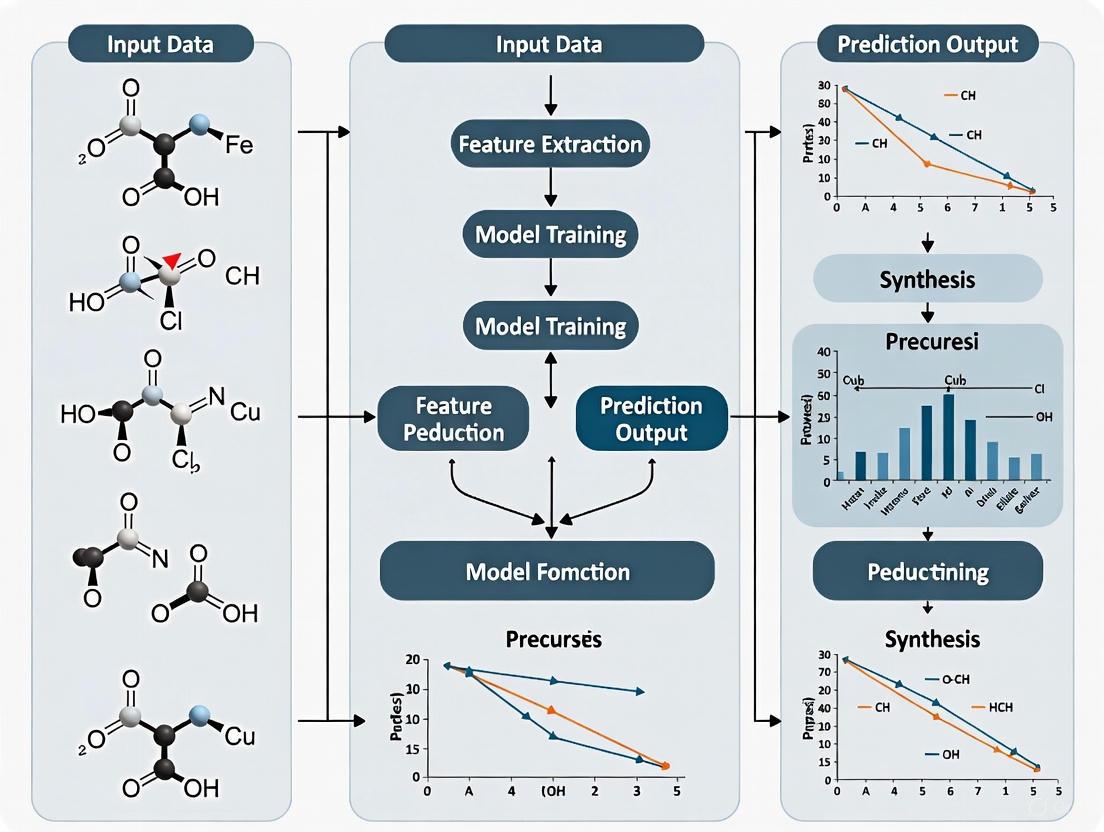
This article explores the transformative role of machine learning (ML) in predicting synthesis precursors for inorganic materials, a critical bottleneck in materials development.
Machine Learning for Inorganic Material Synthesis: Predicting Precursors and Accelerating Discovery
Abstract
This article explores the transformative role of machine learning (ML) in predicting synthesis precursors for inorganic materials, a critical bottleneck in materials development. We cover the foundational challenges that make precursor prediction difficult and detail state-of-the-art methodologies, from graph neural networks and large language models to similarity-based recommendation systems. The content also addresses key troubleshooting aspects and optimization techniques, followed by a comparative analysis of different models' performance and validation strategies. Tailored for researchers, scientists, and drug development professionals, this review synthesizes how these data-driven approaches are poised to significantly accelerate the design of new functional materials for biomedical and clinical applications.
The Synthesis Bottleneck: Why Predicting Inorganic Precursors is a Grand Challenge
The fourth paradigm of materials science, characterized by data-driven and computational approaches, has successfully identified millions of candidate materials with promising properties through high-throughput calculations and machine learning (ML) [1] [2]. However, a critical bottleneck persists in transforming these virtual designs into physically realized materials, as synthesizability remains notoriously difficult to predict [3] [1]. While thermodynamic stability (often measured by energy above the convex hull) provides some guidance, numerous metastable structures are successfully synthesized while many computed-stable materials remain elusive [1]. The central challenge lies in moving beyond thermodynamic assessments to predict feasible synthesis routes, including appropriate precursor materials and reaction conditions – knowledge that traditionally resides in expert experience and dispersed scientific literature [3] [4].
Machine learning, particularly large language models (LLMs) and specialized ranking algorithms, is emerging as a powerful tool to bridge this gap between computational design and experimental realization [1] [4]. This Application Note details the latest frameworks and methodologies for predicting inorganic materials synthesizability and precursors, providing researchers with structured protocols to implement these approaches in their materials discovery pipelines.
Quantifying the Synthesis Prediction Challenge
Current approaches for assessing synthesizability demonstrate varying levels of accuracy, as quantified in recent benchmarking studies:
Table 1: Performance comparison of synthesizability assessment methods
| Method | Accuracy | Scope | Limitations |
|---|---|---|---|
| Thermodynamic Stability (Energy above hull ≥0.1 eV/atom) [1] | 74.1% | 3D crystals | Fails for many metastable yet synthesizable materials |
| Kinetic Stability (Phonon frequency ≥ -0.1 THz) [1] | 82.2% | 3D crystals | Computationally expensive; some synthesizable materials show imaginary frequencies |
| Positive-Unlabeled (PU) Learning [1] | 87.9% | 3D crystals | Limited by dataset construction |
| Teacher-Student Dual Neural Network [1] | 92.9% | 3D crystals | Architecture complexity |
| Crystal Synthesis LLM (CSLLM) [1] | 98.6% | 3D crystals | Requires substantial data curation and fine-tuning |
The data clearly demonstrates the superiority of specialized ML approaches, particularly LLMs, in predicting synthesizability compared to traditional physical stability metrics.
Core Methodologies and Experimental Protocols
Crystal Synthesis Large Language Model (CSLLM) Framework
The CSLLM framework employs three specialized LLMs to address distinct aspects of the synthesis prediction problem: synthesizability classification, method recommendation, and precursor identification [1].
Protocol 1: Implementing CSLLM for Synthesis Prediction
Objective: Predict synthesizability, synthetic method, and precursors for a target crystal structure using fine-tuned LLMs.
Input Requirements: Crystal structure in CIF or POSCAR format.
Processing Steps:
- Data Curation and Representation:
- Collect balanced dataset of synthesizable (e.g., 70,120 structures from ICSD) and non-synthesizable materials (e.g., 80,000 structures screened via PU learning) [1].
- Convert crystal structures to simplified text representation ("material string"):
SPG | a, b, c, α, β, γ | (AS1-WS1[WP1]), (AS2-WS2[WP2]), ...where SPG=space group, a,b,c=lattice parameters, α,β,γ=angles, AS=atomic symbol, WS=Wyckoff site, WP=Wyckoff position [1]. - Exclude disordered structures and limit to ≤40 atoms and ≤7 elements per structure.
Model Architecture and Training:
- Utilize a transformer-based LLM architecture (e.g., LLaMA) as base model [1].
- Fine-tune three separate models on the text-represented crystal data:
- Synthesizability LLM: Binary classification (synthesizable/non-synthesizable)
- Method LLM: Multi-class classification (solid-state/solution/other)
- Precursor LLM: Sequence generation for precursor identification
- Training parameters: Use nested cross-validation to avoid overfitting [5].
Validation and Testing:
- Evaluate synthesizability prediction accuracy on hold-out test set.
- Assess generalization capability on complex structures with large unit cells.
- Validate precursor predictions against known literature synthesis routes.
Output: Synthesizability probability, recommended synthesis method, and candidate precursors for target material.
Retro-Rank-In for Precursor Recommendation
Retro-Rank-In reformulates precursor recommendation as a ranking problem within a unified materials embedding space, enabling recommendation of novel precursors not seen during training [4].
Protocol 2: Precursor Ranking with Retro-Rank-In
Objective: Rank precursor sets for a target material based on chemical compatibility.
Input Requirements: Target material composition or structure.
Processing Steps:
- Materials Representation:
- Encode both target materials and potential precursors using a composition-level transformer-based encoder [4].
- Generate embeddings in a unified latent space that captures chemical similarity.
Ranker Training:
- Train a pairwise ranking model to evaluate target-precursor compatibility.
- Use negative sampling to address dataset imbalance.
- Incorporate domain knowledge through pretrained material embeddings that implicitly encode formation enthalpies and related properties [4].
Inference and Ranking:
- For a target material, compute similarity scores with all candidate precursors in the embedding space.
- Generate ranked list of precursor sets based on aggregate compatibility scores.
- The framework can recommend precursors not present in the training data, enabling discovery of novel synthesis routes [4].
Output: Ranked list of precursor sets with compatibility scores.
XGBoost for Synthesis Parameter Optimization
Beyond precursor selection, optimizing synthesis parameters is crucial for successful materials realization.
Protocol 3: ML-Guided Optimization of Synthesis Conditions
Objective: Optimize synthesis parameters to maximize yield/quality of target material.
Input Requirements: Historical synthesis data with parameters and outcomes.
Processing Steps:
- Feature Engineering:
- For CVD-grown MoSâ‚‚, identify critical parameters: gas flow rate (Rf), reaction temperature (T), reaction time (t), ramp time (tr), distance of S outside furnace (D), addition of NaCl, and boat configuration (F/T) [5].
- Calculate Pearson's correlation coefficients to eliminate redundant features.
- Define success criteria (e.g., sample size >1μm for "Can grow" classification) [5].
Model Selection and Training:
Experimental Validation:
Output: Optimized synthesis parameters with predicted success probability.
Table 2: Computational and Data Resources for Synthesis Prediction
| Resource | Type | Function | Access |
|---|---|---|---|
| Materials Project [6] | Database | Provides calculated properties of inorganic materials for training models | Free via API |
| Text-mined synthesis recipes [3] [7] | Dataset | 31,782 solid-state and 35,675 solution-based synthesis recipes for training ML models | Publicly available |
| CSLLM Framework [1] | Software | Predicts synthesizability, methods, and precursors for crystal structures | Research use |
| Retro-Rank-In [4] | Algorithm | Ranks precursor sets for target materials, including novel precursors | Research use |
| XGBoost [5] | Algorithm | Optimizes synthesis parameters through supervised learning | Open source |
Implementation Workflow and Integration
A comprehensive synthesis prediction pipeline integrates multiple computational approaches:
Future Directions and Challenges
While current ML approaches show remarkable accuracy, several challenges remain. Data quality and coverage limitations persist, with text-mined datasets often lacking the volume, variety, veracity, and velocity needed for optimal model training [3]. Future efforts should focus on developing standardized data formats for synthesis reporting, incorporating negative results, and creating specialized foundation models for materials science [8] [2]. The integration of AI-guided synthesis planning with automated laboratories represents a promising direction for closed-loop materials discovery and development [9] [2].
The discovery of novel inorganic materials is pivotal for technological advancement, yet a significant bottleneck persists between computational prediction and experimental realization. Traditional approaches have heavily relied on thermodynamic stability metrics, such as energy above the convex hull, as proxies for synthesizability. However, these methods frequently fail to account for the complex kinetic and experimental factors governing solid-state synthesis, resulting in a vast disparity between predicted and synthetically accessible materials [10] [11]. The emergence of machine learning (ML) represents a paradigm shift, enabling researchers to move beyond thermodynamic limitations and integrate diverse data—from historical synthesis records to text-mined literature—to develop more accurate and practical heuristics for predicting synthesis pathways and precursors [1] [12]. This Application Note details the protocols and data-driven frameworks that are bridging this gap, accelerating the transition from theoretical material design to laboratory synthesis.
Recent research has produced a variety of ML models for synthesizability and precursor prediction, each with distinct architectures, data sources, and performance metrics. The table below summarizes the key quantitative findings from recent seminal studies.
Table 1: Performance Comparison of Machine Learning Models for Synthesis Prediction
| Model Name | Model Type / Approach | Key Input Data | Primary Task | Reported Performance / Outcome |
|---|---|---|---|---|
| CSLLM (Synthesizability LLM) [1] | Fine-tuned Large Language Model | Text-represented crystal structures (material strings) | Synthesizability classification of 3D crystals | 98.6% accuracy; significantly outperforms energy above hull (74.1%) and phonon stability (82.2%) |
| SynthNN [10] | Deep Learning (Atom2Vec) | Chemical composition only | Synthesizability classification | 7x higher precision than DFT formation energies; outperformed 20 human experts (1.5x higher precision) |
| ElemwiseRetro [13] | Element-wise Graph Neural Network | Target composition & precursor templates | Precursor set prediction | 78.6% top-1 and 96.1% top-5 exact match accuracy |
| A-Lab [12] | Integrated Autonomous Lab (NLP + Active Learning) | Computed targets, historical data, active learning | Autonomous solid-state synthesis | Successfully synthesized 41 of 58 novel target compounds (71% success rate) |
Detailed Experimental Protocols
Protocol: Predicting Synthesizability with Crystal Synthesis LLMs (CSLLM)
The CSLLM framework employs three specialized large language models to predict synthesizability, synthetic methods, and precursors [1].
- A. Data Curation and Text Representation
- Acquire Positive Examples: Obtain 70,120 synthesizable crystal structures from the Inorganic Crystal Structure Database (ICSD). Filter for structures with ≤40 atoms and ≤7 different elements. Exclude disordered structures.
- Generate Negative Examples: Screen 1,401,562 theoretical structures from databases (e.g., Materials Project) using a pre-trained Positive-Unlabeled (PU) learning model. Select 80,000 structures with the lowest CLscore (e.g., <0.1) as non-synthesizable examples to create a balanced dataset.
- Create Material Strings: Convert crystal structures into a simplified text representation ("material string") to efficiently fine-tune LLMs. The format is:
Space Group | a, b, c, α, β, γ | (AtomSymbol1-WyckoffSite1[WyckoffPosition1,x1,y1,z1]; AtomSymbol2-WyckoffSite2[WyckoffPosition2,x2,y2,z2]; ...).
- B. Model Fine-Tuning and Prediction
- Fine-Tune LLMs: Use the curated dataset of material strings to fine-tune three separate LLMs:
- Synthesizability LLM: Binary classification (synthesizable vs. non-synthesizable).
- Method LLM: Classifies likely synthetic method (e.g., solid-state or solution).
- Precursor LLM: Identifies suitable precursor chemicals.
- Input Target Structure: For a novel target crystal structure, generate its corresponding material string.
- Execute Predictions: Input the material string into the fine-tuned CSLLM models to receive predictions for synthesizability probability, recommended synthesis method, and potential precursor sets.
- Fine-Tune LLMs: Use the curated dataset of material strings to fine-tune three separate LLMs:
Protocol: Autonomous Synthesis with the A-Lab
The A-Lab is an integrated platform that uses AI to plan, execute, and interpret solid-state synthesis experiments [12].
- A. Target Identification and Initial Recipe Generation
- Select Targets: Identify target compounds from computational databases (e.g., Materials Project), focusing on materials predicted to be stable or near-stable (e.g., energy above hull <10 meV/atom) and air-stable.
- Propose Initial Recipes:
- Use a natural language processing (NLP) model trained on scientific literature to propose up to five initial synthesis recipes based on analogy to historically similar materials.
- Use a second ML model, trained on text-mined heating data, to recommend a synthesis temperature.
- B. Robotic Execution and Analysis
- Sample Preparation: A robotic station dispenses, weighs, and mixes precursor powders in an alumina crucible. The mixture is milled to ensure homogeneity and reactivity.
- Heating: A robotic arm loads the crucible into one of four box furnaces for heating according to the proposed temperature profile.
- Characterization: After cooling, the sample is automatically transferred, ground into a fine powder, and characterized by X-ray diffraction (XRD).
- C. Active Learning for Recipe Optimization
- Analyze Outcome: ML models analyze the XRD pattern to identify phases and determine the target yield via automated Rietveld refinement.
- Iterate if Needed: If the target yield is below a threshold (e.g., <50%), the active learning algorithm (ARROWS³) proposes new recipes. This algorithm uses observed reaction intermediates and ab initio reaction energies to avoid low-driving-force pathways and suggest more optimal precursor combinations and temperatures.
- Terminate: The process continues until the target is successfully synthesized or all viable recipes are exhausted.
Protocol: Precursor Prediction with ElemwiseRetro
This protocol uses a graph neural network to predict precursor sets for a target inorganic composition [13].
- A. Problem Formulation and Template Library Construction
- Categorize Elements: For a target composition, classify elements as "source elements" (typically metals, metalloids, P, S, Se; must be provided by precursors) or "non-source elements" (can come from/react with the environment).
- Build Template Library: From a curated dataset of inorganic reactions (e.g., 13,477 recipes), extract a library of common precursor templates (anionic frameworks paired with source elements). A typical library may contain ~60 such templates.
- B. Model Application and Precursor Selection
- Encode Target: Represent the target composition as a graph, with node features from pre-trained inorganic compound representations.
- Apply Source Mask: Use a source element mask to highlight which elements in the target require precursor sources.
- Predict Precursors: Feed the encoded graph into the ElemwiseRetro model. The model predicts the most probable precursor template for each source element.
- Rank Recipes: Calculate the joint probability of the predicted precursor sets. Rank the final synthesis "recipes" by this probability score, which correlates with prediction confidence and can be used to prioritize experimental trials.
The Scientist's Toolkit: Key Research Reagents & Solutions
The following table outlines essential components and software used in the development and application of ML-guided synthesis platforms.
Table 2: Essential Resources for ML-Guided Materials Synthesis
| Item / Resource | Function / Application | Specific Example / Note |
|---|---|---|
| Precursor Powders | Starting materials for solid-state reactions | High-purity, commercially available oxides, carbonates, etc. [12] |
| Alumina Crucibles | Containers for high-temperature reactions | Inert, withstand repeated heating cycles [12] |
| Robotic Furnaces | Automated heating under controlled profiles | The A-Lab used four box furnaces for parallel processing [12] |
| X-ray Diffractometer | Primary characterization for phase identification | Integrated with an automated sample preparation and loading system [12] |
| Crystallographic Databases | Source of positive data for model training | Inorganic Crystal Structure Database (ICSD) [1] [10] |
| Theoretical Databases | Source of candidate structures and energies | Materials Project, OQMD, JARVIS, Computational Materials Database [1] [12] |
| Text-Mined Synthesis Data | Training data for NLP recipe-suggestion models | Data extracted from millions of scientific publications [12] |
| Fine-Tuned LLMs (e.g., CSLLM) | Predicting synthesizability, method, and precursors | Requires domain-specific fine-tuning on crystal structure data [1] |
| Graph Neural Networks | Predicting precursor sets from composition | ElemwiseRetro model uses element-wise formulation [13] |
| Hdac6-IN-39 | Hdac6-IN-39, MF:C16H15F4N5O4S2, MW:481.4 g/mol | Chemical Reagent |
| Hdac-IN-41 | Hdac-IN-41, MF:C20H22N4O6S, MW:446.5 g/mol | Chemical Reagent |
Workflow and System Diagrams
ML-Driven Synthesis Prediction Workflow. This diagram illustrates the integrated computational and experimental pipeline for predicting and realizing novel inorganic materials, from target input to synthesized material.
CSLLM Prediction Framework. This diagram outlines the process flow for the Crystal Synthesis Large Language Model (CSLLM), which uses a simplified text representation of crystal structures to make specialized predictions.
The discovery and synthesis of novel inorganic materials are pivotal for advancements in technologies ranging from batteries to pharmaceuticals. However, the ability to computationally design materials has far outpaced the development of synthesis routes to create them, creating a critical bottleneck in the materials innovation pipeline [14]. This challenge stems from a fundamental gap: unlike organic chemistry with its well-understood reaction mechanisms, inorganic material synthesis lacks a comprehensive theoretical foundation, relying heavily on empirical knowledge and expert intuition [10].
This application note details how text-mining scientific literature constructs the large-scale, structured knowledge bases necessary to power machine learning (ML) models for predicting inorganic material synthesis. By converting unstructured synthesis descriptions in millions of published articles into codified, machine-readable data, researchers can uncover the complex relationships between target materials, their precursors, and reaction conditions. We frame this methodology within a broader thesis on predicting inorganic material synthesis precursors, demonstrating how a robust data foundation enables the development of accurate, reliable, and interpretable ML models.
The Text-Mining Pipeline: From Unstructured Text to Structured Knowledge
The process of transforming free-text synthesis paragraphs into a structured knowledge base involves a multi-step natural language processing (NLP) pipeline. The workflow, illustrated in Figure 1, is designed to automatically identify and extract key entities and their relationships from scientific text.
The following diagram illustrates the end-to-end text-mining pipeline for building a synthesis knowledge base.
Figure 1. Workflow for Text-Mining Synthesis Recipes. The pipeline processes scientific articles to automatically extract structured synthesis information from unstructured text [14].
Protocol: Implementation of the Text-Mining Pipeline
Objective: To automatically extract structured solid-state synthesis recipes from the text of scientific publications.
Materials and Reagents:
- Computational Hardware: A high-performance computing cluster or workstation with substantial memory (≥64 GB RAM) is recommended for processing large document corpora.
- Software Environment: Python 3.7+ with the following core libraries:
- Scrapy: For web-scraping and content acquisition from publisher websites.
- SpaCy & Stanza: For foundational NLP tasks like tokenization, part-of-speech tagging, and dependency parsing [15].
- ChemDataExtractor: A toolkit specifically designed for processing chemical information from text [14].
- MongoDB: A document-oriented database for storing parsed article text and associated metadata.
Methods:
Content Acquisition and Preprocessing
- Web Scraping: Use the Scrapy framework to systematically download full-text journal articles in HTML/XML format from major publishers (e.g., Springer, Wiley, Elsevier, RSC). Focus on post-2000 literature to avoid complications with PDF parsing [14].
- Text Extraction: Develop a custom parser to convert article markup into raw text paragraphs while preserving section headings and document structure. Store all data in a MongoDB database.
Paragraph Classification
- Objective: Identify paragraphs describing solid-state synthesis methodologies, filtering out irrelevant text (e.g., theoretical background, results discussion).
- Procedure:
- Implement a two-step classifier. First, use an unsupervised algorithm to cluster keywords and generate probabilistic topic assignments.
- Subsequently, train a supervised Random Forest classifier on a manually annotated set of ~1,000 paragraphs per label (e.g., "solid-state," "hydrothermal," "sol-gel," "none") [14].
- Apply the trained model to classify all paragraphs, retaining only those labeled "solid-state synthesis" for subsequent analysis.
Material Entity Recognition (MER)
- Objective: Identify and categorize all material mentions in a synthesis paragraph as "TARGET," "PRECURSOR," or "OTHER."
- Procedure:
- Implement a Bidirectional Long Short-Term Memory with Conditional Random Field (BiLSTM-CRF) neural network model.
- Train the model on a manually annotated dataset of 834 solid-state synthesis paragraphs. Word embeddings should be generated using a Word2Vec model pre-trained on a corpus of ~33,000 synthesis paragraphs [14].
- For the classification step (TARGET vs. PRECURSOR), replace each material with a
<MAT>token and augment the word representation with chemical features (e.g., number of metal/metalloid elements, organic flags).
Synthesis Operation and Condition Extraction
- Objective: Identify key synthesis steps (e.g., mixing, heating) and their associated parameters (temperature, time, atmosphere).
- Procedure:
- Train a neural network to classify sentence tokens into operation categories:
MIXING,HEATING,DRYING,SHAPING,QUENCHING, orNOT OPERATION. - Use dependency tree parsing from the SpaCy library to identify relationships between operation verbs and their parameters [14] [15].
- Apply regular expressions to extract numerical values for temperature and time, and keyword matching to identify atmosphere conditions from the same sentence as the operation.
- Train a neural network to classify sentence tokens into operation categories:
Balanced Equation Generation
- Objective: Derive a balanced chemical equation for the synthesis reaction.
- Procedure:
- Pass all extracted material strings through a "Material Parser" to convert text descriptions into standardized chemical formulas.
- Solve a system of linear equations asserting the conservation of each chemical element, including a set of "open" compounds (e.g., Oâ‚‚, COâ‚‚) that can be absorbed or released [14].
Quantitative Outcomes of Text-Mining
The application of the described pipeline to a large corpus of scientific literature yields quantitative datasets that form the bedrock for subsequent machine learning. The table below summarizes the scale and content of a publicly available text-mined dataset [14].
Table 1. Summary of a Text-Mined Solid-State Synthesis Dataset.
| Metric | Value | Description |
|---|---|---|
| Total Processed Paragraphs | 53,538 | Number of paragraphs identified as describing solid-state synthesis [14] |
| Extracted Synthesis Entries | 19,488 | Number of unique, codified synthesis recipes generated [14] |
| Key Data per Entry | Target Material, Starting Compounds, Synthesis Operations, Operation Conditions, Balanced Chemical Equation | The structured information captured for each synthesis [14] |
This data enables the transition from heuristic rules to data-driven models. For instance, analysis of known synthesized materials reveals that only 37% adhere to the simple charge-balancing rule often used as a synthesizability heuristic, underscoring the limitation of such proxies and the need for more sophisticated, data-driven approaches [10].
Building Predictive Models on the Knowledge Base
With a structured knowledge base in place, machine learning models can be trained to predict synthesis pathways. A key advancement involves framing the problem as a retrosynthetic task, predicting precursors for a target material.
Protocol: Element-wise Graph Neural Network for Retrosynthesis
Objective: Predict a set of precursor materials and a reaction temperature for a target inorganic crystalline material.
Materials and Reagents:
- Training Data: The text-mined dataset of synthesis reactions (e.g., from Table 1), curated to ~13,477 entries for model training [13].
- Software Libraries:
- PyTorch Geometric or Deep Graph Library (DGL): For implementing graph neural networks.
- Mat2Vec: or other algorithms for generating composition-based material embeddings [10].
Methods:
Problem Formulation & Template Library Creation
- Categorize elements into "source elements" (must be provided by precursors, e.g., metals) and "non-source elements" (can come from the environment, e.g., O).
- From the training data, automatically extract a library of ~60 "precursor templates"—common anionic frameworks (e.g., carbonates, oxides) that pair with source elements to form realistic precursor compounds [13].
Model Architecture (ElemwiseRetro)
- Represent the target material's composition as a graph, with nodes for each element.
- Use an element-wise Graph Neural Network (GNN) to learn the interactions between elements in the target material.
- Apply a "source element mask" to the GNN's output to focus on relevant elements.
- For each source element, a classifier head predicts the most likely precursor template from the library.
- The joint probability of a full precursor set is calculated by combining the probabilities of the individual template predictions [13].
Temperature Prediction
- Sequentially connect the precursor prediction model to a separate regression model that takes the encoded target material and predicted precursors as input to output a recommended synthesis temperature [13].
Model Validation
- Perform a "time-split" validation, training the model on data from before 2016 and testing its ability to predict synthesis routes for materials reported after 2016. This assesses the model's predictive power for truly novel materials [13].
The performance of this model compared to a simple statistical baseline is quantified in Table 2, demonstrating the value of the learned representations.
Table 2. Performance Comparison of Retrosynthesis Models.
| Top-k Accuracy | ElemwiseRetro Model | Popularity-Based Baseline |
|---|---|---|
| k=1 | 80.4% | 50.4% |
| k=3 | 92.9% | 75.1% |
| k=5 | 95.8% | 79.2% |
Data sourced from a publication-year-split test, demonstrating the model's generalizability [13].
Workflow Integration and Confidence Estimation
A critical feature of a robust predictive system is its ability to estimate its own confidence. The probability score output by the ElemwiseRetro model is highly correlated with prediction accuracy, providing a practical tool for prioritizing experimental efforts [13]. The integration of text-mined data, ML prediction, and experimental validation into a cohesive workflow is shown in Figure 2.
Figure 2. Closed-Loop Workflow for Synthesis Prediction. A knowledge base fuels ML models that generate prioritized predictions, which are then validated experimentally, potentially feeding new data back into the knowledge base [14] [13].
The Scientist's Toolkit: Research Reagent Solutions
Table 3. Essential Computational Reagents for Text-Mining and Prediction.
| Reagent / Resource | Function | Application Notes |
|---|---|---|
| Named Entity Recognition (NER) Model | Identifies and classifies material names (e.g., "LiCoOâ‚‚") and other key terms in text. | Pre-trained models like those in Stanza or SciSpacy offer a starting point, but domain-specific fine-tuning on annotated synthesis paragraphs is crucial for high accuracy [14] [15]. |
| Precursor Template Library | A finite set of validated anionic frameworks (e.g., oxide, carbonate, nitrate) used to construct realistic precursor compounds. | Automatically mined from existing reaction datasets. Using a library ensures predicted precursors are charge-balanced and commercially plausible, avoiding unrealistic suggestions [13]. |
| Material Composition Embedder | Converts a chemical formula into a numerical vector that captures chemical similarity. | Tools like mat2vec or the atom2vec method used in SynthNN provide these representations, allowing models to learn from the entire space of known materials [10]. |
| Text-Mined Synthesis Knowledge Base | The central structured repository of synthesis protocols, containing targets, precursors, operations, and conditions. | Serves as the ground-truth dataset for both training ML models and benchmarking new prediction algorithms. Data quality is paramount [14]. |
| Nudifloside B | Nudifloside B, MF:C43H60O22, MW:928.9 g/mol | Chemical Reagent |
| Sibiricaxanthone B | Sibiricaxanthone B, MF:C24H26O14, MW:538.5 g/mol | Chemical Reagent |
Defining Source Elements, Precursor Templates, and Synthesis Recipes
The discovery and development of new inorganic materials are pivotal for advancements in energy storage, electronics, and catalysis. However, a significant bottleneck exists in translating computationally designed materials into physically realized compounds, as synthesis pathways are often non-obvious and determined by complex kinetic and thermodynamic factors [16]. The process of retrosynthesis—strategically planning the synthesis of a target compound from simpler, readily available precursors—is a critical but challenging task in inorganic chemistry [17]. Traditional methods often rely on trial-and-error experimentation or the specialized knowledge of expert chemists, which does not scale for the rapid exploration of vast chemical spaces [10]. This application note frames the key concepts of Source Elements, Precursor Templates, and Synthesis Recipes within the emerging paradigm of machine learning (ML)-assisted synthesis planning, providing a structured framework to accelerate the predictive synthesis of inorganic materials.
Key Conceptual Definitions
Source Elements
Source Elements refer to the fundamental chemical building blocks, typically elements or simple ions, from which more complex precursor compounds and final target materials are derived. In ML-driven synthesis planning, source elements are often represented as learned embeddings within a model. For instance, the atom2vec framework represents each element by a vector whose values are optimized during model training, allowing the algorithm to learn chemical relationships and affinities directly from data on synthesized materials [10]. This data-driven representation captures complex patterns beyond simple periodic trends, enabling the model to infer which combinations of source elements are most likely to form viable precursors and, ultimately, synthesizable materials.
Precursor Templates
Precursor Templates are the immediate chemical compounds, often simple binaries or ternary phases, that are combined in a solid-state or solution-based reaction to form the target material. Identifying the correct precursors is a central task in retrosynthesis. Machine learning approaches reformulate this problem from a multi-label classification task into a ranking problem. For example, the Retro-Rank-In framework embeds both target and precursor materials into a shared latent space and learns a pairwise ranker to assess the suitability of precursor pairs for a given target [17]. This allows the model to generalize and suggest viable precursor combinations it has not encountered during training, such as successfully predicting the precursor pair CrB + Al for the target Cr2AlB2 [17].
Synthesis Recipes
A Synthesis Recipe is a complete set of instructions for synthesizing a target material, encompassing not only the identity and stoichiometry of the precursors but also the detailed sequence of operations and conditions required. These operations include mixing, heating (calcination/sintering), drying, and quenching, each associated with specific parameters like temperature, time, and atmosphere [3]. Machine learning models can predict these parameters; for instance, transformer-based models like SyntMTE, when augmented with language model-generated data, can predict calcination and sintering temperatures with a mean absolute error as low as 73-98 °C [18]. The recipe thus represents the final, actionable output of a synthesis planning pipeline.
Quantitative Performance of ML Approaches
Table 1: Performance Metrics of Selected Synthesis Prediction Models
| Model Name | Primary Task | Key Performance Metric | Reported Result | Key Innovation |
|---|---|---|---|---|
| Retro-Rank-In [17] | Precursor Recommendation | Generalization to unseen reactions | Correctly predicted CrB + Al for Cr2AlB2 |
Ranking-based approach on a bipartite graph |
| CSLLM [19] | Synthesizability Prediction | Accuracy | 98.6% | Fine-tuned Large Language Model (LLM) on crystal structures |
| CSLLM [19] | Precursor Prediction | Success Rate | 80.2% | Specialized LLM for precursors |
| SynthNN [10] | Synthesizability Prediction | Precision vs. Human Experts | 1.5x higher precision than best human expert | Composition-based deep learning model |
| Ensemble LMs [18] | Precursor Recommendation | Top-1 Accuracy | 53.8% | Ensemble of off-the-shelf language models (e.g., GPT-4.1) |
| Ensemble LMs [18] | Precursor Recommendation | Top-5 Accuracy | 66.1% | Ensemble of off-the-shelf language models |
| SyntMTE [18] | Temperature Prediction | Mean Absolute Error (Sintering) | 73 °C | Transformer model pretrained on real & synthetic data |
Experimental Protocols for ML-Driven Synthesis Prediction
Protocol: Precursor Recommendation with a Ranking Model
This protocol outlines the process for training and applying a ranking model, like Retro-Rank-In, to recommend precursor combinations for a target inorganic material [17].
Data Collection and Bipartite Graph Construction:
- Procure a dataset of verified synthesis reactions, listing target materials and their corresponding precursor sets. Public text-mined datasets, despite known limitations, can serve as a starting point [3].
- Construct a bipartite graph where one set of nodes represents target materials and the other represents precursor compounds. Edges connect a target to its known precursors.
Material Embedding:
- Represent each material (both targets and precursors) as a numerical vector (embedding). This can be achieved using a pre-trained material representation model, such as a crystal graph neural network or a transformer model like MTEncoder, which captures compositional and structural features [17] [18].
Model Training and Ranking:
- Train a pairwise ranking model (e.g., a neural network) to operate on the bipartite graph. The model learns to score the compatibility between a target material embedding and a candidate precursor embedding.
- The learning objective is to maximize the score for true precursor pairs from the training data relative to randomly sampled, incorrect pairs.
Inference and Precursor Suggestion:
- For a new target material, generate its embedding.
- Score the target against a large candidate pool of potential precursor embeddings.
- Output a ranked list of the top-k most promising precursor combinations based on the model's scores for experimental validation.
Protocol: Synthesizability Prediction with a Fine-Tuned LLM
This protocol describes the workflow for the Crystal Synthesis Large Language Model (CSLLM) framework to predict whether a hypothetical crystal structure is synthesizable [19].
Dataset Curation for Positive and Negative Examples:
- Positive Examples: Collect experimentally confirmed, synthesizable crystal structures from databases like the Inorganic Crystal Structure Database (ICSD). Filter for ordered structures with a manageable number of atoms/elements (e.g., ≤ 40 atoms, ≤ 7 elements).
- Negative Examples: Generate a set of non-synthesizable structures. This is a key challenge. One method is to use a pre-trained Positive-Unlabeled (PU) learning model to assign a synthesizability score (CLscore) to a large pool of theoretical structures from sources like the Materials Project. Structures with the lowest scores (e.g., CLscore < 0.1) are treated as negative examples.
Crystal Structure Text Representation:
- Convert the crystal structure data (lattice parameters, atomic coordinates, space group) into a compact, text-based "material string." This format avoids the redundancy of CIF or POSCAR files and is more suitable for LLM processing [19].
Model Fine-Tuning:
- Select a foundational LLM (e.g., LLaMA).
- Fine-tune the model on the curated dataset of "material strings" labeled as synthesizable or non-synthesizable. This process aligns the model's general linguistic knowledge with the specific domain of crystal synthesizability.
Synthesizability Assessment:
- Input the text representation of a novel candidate structure into the fine-tuned CSLLM.
- The model outputs a classification (synthesizable/non-synthesizable) and/or a probability, providing a rapid and accurate assessment to guide computational discovery efforts.
Protocol: Data Augmentation for Synthesis Condition Prediction
This protocol leverages language models to generate synthetic data, overcoming the scarcity of high-quality, text-mined synthesis recipes [18].
In-Context Learning for Recipe Generation:
- Prompt a state-of-the-art language model (e.g., GPT-4.1, Gemini 2.0 Flash) with a set of example synthesis recipes (target, precursors, temperatures) from a small, trusted dataset.
- The model, leveraging its internal knowledge from pre-training, then generates new, plausible synthesis recipes for a list of target materials.
Data Compilation and Curation:
- Collect the LM-generated recipes to create a large-scale synthetic dataset. For instance, this process can generate over 28,000 complete solid-state synthesis recipes, vastly expanding existing datasets [18].
Model Pretraining and Fine-Tuning:
- Pretrain a specialized model (e.g., a transformer like SyntMTE) on the combination of real text-mined data and the generated synthetic data.
- Subsequently, fine-tune the model on a smaller, high-confidence set of experimentally verified recipes. This hybrid approach has been shown to reduce prediction errors for key parameters like sintering temperature by up to 8.7% compared to models trained only on experimental data [18].
Workflow Visualization
The Scientist's Toolkit: Research Reagent Solutions
Table 2: Essential Computational and Data Resources for ML-Driven Synthesis Planning
| Tool/Resource Name | Type | Primary Function in Synthesis Planning |
|---|---|---|
| Text-Mined Synthesis Database [3] [18] | Dataset | Provides structured data (targets, precursors, operations) from scientific literature to train ML models. |
| Crystal Structure Database (ICSD/MP) [19] [10] | Dataset | Source of confirmed synthesizable structures (ICSD) and theoretical structures (Materials Project) for training synthesizability models. |
| atom2vec / Material Embeddings [10] | Algorithm/Representation | Learns a numerical representation for chemical elements/formulas, capturing patterns from data to inform synthesizability. |
| Positive-Unlabeled (PU) Learning [19] [10] | Machine Learning Method | Enables training of classifiers using only positive (synthesizable) and unlabeled data, crucial due to the lack of confirmed negative examples. |
| Retro-Rank-In Model [17] | Machine Learning Model | A ranking-based framework for precursor recommendation that generalizes well to novel, unseen target materials. |
| Crystal Synthesis LLM (CSLLM) [19] | Large Language Model | A fine-tuned LLM that predicts synthesizability, suggests synthesis methods, and identifies precursors from crystal structure data. |
| SyntMTE [18] | Machine Learning Model | A transformer model for predicting synthesis conditions (e.g., temperatures), improved by pre-training on LM-generated synthetic data. |
| Language Model (e.g., GPT-4.1) [18] | Large Language Model | Used off-the-shelf for recall of synthesis knowledge or to generate synthetic recipes for data augmentation. |
| Peniditerpenoid A | Peniditerpenoid A, MF:C27H33NO7, MW:483.6 g/mol | Chemical Reagent |
| Momordicoside X | Momordicoside X, MF:C36H58O9, MW:634.8 g/mol | Chemical Reagent |
How AI Learns Synthesis: From Graph Networks to Large Language Models
Element-Wise Graph Neural Networks for Precursor Set Prediction
The discovery and synthesis of new inorganic materials are fundamental to technological progress in fields such as renewable energy, electronics, and catalysis. While computational models have accelerated the prediction of stable material structures, the determination of viable synthesis pathways and precursor sets remains a significant bottleneck [20]. This document details the application of Element-Wise Graph Neural Networks (Element-Wise GNNs) for predicting inorganic solid-state synthesis recipes, providing a structured framework within the broader context of machine-learning-guided materials research.
Theoretical Foundation: Graph Neural Networks in Materials Science
Graph Neural Networks (GNNs) are a class of deep learning models designed to operate on graph-structured data, making them exceptionally suited for representing molecules and crystalline materials [21]. In a graph representation, atoms constitute the nodes, and chemical bonds represent the edges. GNNs learn from these structures by performing a message-passing mechanism, where information from neighboring atoms is aggregated and used to update the representation of a target node [21] [22]. This process allows the model to capture complex local chemical environments critical for predicting material properties and, as extended in this work, synthesis pathways.
The Element-Wise Graph Neural Network is a specific architectural variant that has demonstrated high efficacy in predicting inorganic synthesis recipes [20]. Its core innovation lies in its formulation of the precursor prediction problem, treating it as a task of identifying the necessary source elements and their most likely structural arrangements (precursor templates) based on the target material's composition.
Quantitative Performance Data
The performance of the Element-Wise GNN model for precursor prediction can be quantitatively evaluated against baseline methods. The following table summarizes key metrics as reported in the literature [20].
Table 1: Performance comparison of the Element-Wise GNN model for synthesis recipe prediction.
| Model / Metric | Top-K Exact Match Accuracy | Validation Method | Key Strength |
|---|---|---|---|
| Element-Wise GNN | Outperforms popularity-based statistical baseline | Publication-year-split test | High correlation between probability score and accuracy, enabling confidence assessment |
| Popularity-Based Baseline | Lower than Element-Wise GNN | Not Specified | Provides a simple statistical benchmark |
Experimental Protocol: Implementing an Element-Wise GNN for Precursor Prediction
This section provides a detailed, step-by-step protocol for training and validating an Element-Wise GNN model for precursor set prediction, based on established methodologies [20].
Data Acquisition and Preprocessing
- Data Collection: Compile a database of solid-state synthesis recipes from scientific literature. Each data point should include the target material and its corresponding solid-state precursor compounds.
- Graph Representation: Convert the target material's crystal structure into a graph.
- Nodes: Represent individual atoms. Initialize node features using atomic properties (e.g., element type, atomic radius, electronegativity).
- Edges: Create edges between nodes based on interatomic distances or covalent bonding, typically within a defined cutoff radius.
- Precursor Labeling: Represent the precursor set using a formulation based on source elements and precursor templates. This transforms the problem into a multi-label prediction task.
Model Training Procedure
- Model Architecture: Implement an Element-Wise GNN. The key component is a series of message-passing layers that build element-wise representations by aggregating information from neighboring atoms in the crystal graph.
- Loss Function: Employ a multi-task loss function that jointly optimizes for:
- The correct identification of source elements.
- The correct selection of precursor templates.
- Training Cycle (Active Learning): To enhance performance, an active learning loop can be implemented:
- Train the initial model on the available dataset.
- Use the model to generate predictions on novel candidate materials.
- Validate these predictions using high-fidelity computational methods like Density Functional Theory (DFT).
- Incorporate the successfully validated predictions back into the training data.
- Retrain the model with the expanded dataset. This process has been shown to dramatically boost the model's discovery rate [23].
Model Validation and Testing
- Publication-Year-Split Test: To rigorously evaluate predictive power, train the model on data published up to a certain year (e.g., 2016) and test its ability to predict precursors for materials synthesized after that year. This tests the model's generalizability to novel materials [20].
- Accuracy Assessment: Use metrics such as top-k exact match accuracy to measure how often the model's predicted precursor set exactly matches the experimentally reported one within the top-k recommendations.
Workflow Visualization
The following diagram illustrates the end-to-end workflow for precursor prediction using an Element-Wise GNN, from data preparation to final prediction.
This section catalogs the key computational tools, datasets, and software required for research in GNN-based synthesis prediction.
Table 2: Essential resources for GNN-driven materials synthesis research.
| Resource Name | Type | Function & Application |
|---|---|---|
| Materials Project Database | Dataset | Provides open-access crystal structures and thermodynamic data for training and benchmarking GNN models [23]. |
| Graph Neural Network (GNN) Models | Software/Architecture | Core machine learning architecture (e.g., MPNN, GNoME) that processes material graphs to predict properties and synthesis pathways [21] [23]. |
| Density Functional Theory (DFT) | Computational Tool | Used as a high-fidelity validation method to assess the stability of predicted materials and verify model outputs within an active learning loop [23]. |
| Element-Wise GNN | Software/Architecture | A specific GNN variant designed for retrosynthesis, formulating the problem via source elements and precursor templates [20]. |
| Autonomous/Self-Driving Labs | Experimental System | Robotic laboratories that use AI-predicted recipes (from models like GNoME) to autonomously synthesize new materials, closing the loop between prediction and validation [23]. |
{## Introduction} The synthesis of novel inorganic materials is a cornerstone for technological advances in fields ranging from clean energy to electronics. However, unlike organic synthesis, inorganic solid-state synthesis lacks a general theory that predicts how a target compound forms from precursor materials during heating [24] [25]. Consequently, experimental researchers traditionally approach a new synthesis by manually consulting the scientific literature for precedents involving similar materials and repurposing their recipes—a process limited by individual experience and chemical intuition [24] [26].
Machine learning (ML) is now automating and quantifying this heuristic process. By applying ML to large, text-mined datasets of historical synthesis recipes, researchers can build recommendation systems that learn the complex relationships between a target material's composition and its successful precursor sets [24] [13]. These data-driven systems capture decades of hidden knowledge embedded in the literature, providing powerful tools to guide the synthesis of novel inorganic materials and accelerate their discovery [24] [27].
{## Core Methodologies and Performance} Two advanced ML paradigms demonstrate the power of learning from precedent: a materials-similarity-based approach and an element-wise graph neural network. Their performance can be quantitatively compared across key metrics.
{### Table 1: Comparative Performance of Recommendation Systems}
| Model / Metric | Top-1 Accuracy | Top-5 Accuracy | Core Methodology | Key Advantage |
|---|---|---|---|---|
| PrecursorSelector (Similarity-Based) [24] | Not Explicitly Reported | 82% (Success Rate) | Learns material vectors from precursors; finds closest reference material. | Mimics human literature search; high success rate for multiple recommendations. |
| ElemwiseRetro (Template-Based) [13] | 78.6% | 96.1% | Formulates retrosynthesis using source elements and precursor templates. | Provides a confidence score for predictions; high top-5 exact match accuracy. |
| Popularity Baseline [13] | 50.4% | 79.2% | Recommends precursors based on their frequency in the dataset. | Serves as a simple statistical benchmark. |
{### Methodology Overview}
The Similarity-Based Approach (PrecursorSelector): This strategy directly automates the human process of looking up similar synthesis recipes [24]. It employs a self-supervised neural network to learn a numerical representation (an encoding) for a target material based on its precursors. In this learned vector space, materials synthesized from similar precursors are positioned close together. To recommend precursors for a novel target, the system identifies the most similar reference material in the knowledge base and adapts its precursor set, achieving an 82% success rate when proposing five precursor sets [24].
The Element-wise Formulation (ElemwiseRetro): This method formulates the problem differently [13]. It first classifies elements in the target material as "source elements" (must be provided by precursors) or "non-source elements" (can come from the environment). A graph neural network then predicts the most probable "precursor template" (e.g., oxide, carbonate) for each source element. The final precursor set is assembled from these predicted templates, and the model outputs a probability score that serves as a valuable confidence level for experimental prioritization [13].
{## Experimental Protocols} {### Protocol 1: Implementing a Similarity-Based Recommendation System}
This protocol outlines the steps for building and deploying a precursor recommendation system based on the PrecursorSelector model [24].
Objective: To recommend precursor sets for a target inorganic material by identifying the most chemically similar material with a known synthesis recipe.
Materials and Data:
- Knowledge Base: A dataset of solid-state synthesis recipes, ideally text-mined from scientific literature. The model in [24] used 29,900 recipes.
- Computing Environment: Standard machine learning stack (e.g., Python, PyTorch/TensorFlow) with sufficient GPU resources for training neural networks.
- Target Material: The chemical formula of the compound to be synthesized.
Procedure:
- Data Preprocessing:
- Extract and standardize precursor and target material data from the knowledge base. Ensure all chemical formulas are normalized.
- Split the data into training and test sets, ensuring no data leakage between sets.
- Model Training (Materials Encoding):
- Train an encoding neural network using a self-supervised learning task, such as Masked Precursor Completion (MPC). The model learns to predict masked precursors in a set based on the target material and the remaining precursors.
- The model's encoder learns to project the target material's composition into a fixed-dimensional vector where materials with similar precursors are nearby.
- Similarity Query:
- For a novel target material, process its composition through the trained encoder to obtain its vector representation.
- Calculate the similarity (e.g., using cosine similarity) between the target vector and the vectors of all materials in the training knowledge base.
- Identify the reference material with the highest similarity score.
- Precursor Recommendation & Completion:
- Propose the precursor set of the most similar reference material.
- If this set does not contain all elements of the target material, use a conditional prediction model (trained in step 2) to suggest additional precursors to complete the set.
- The system can be configured to recommend k precursor sets (e.g., k=5) by considering the top k most similar reference materials.
- Data Preprocessing:
Validation:
- Perform historical validation by holding out a set of known materials (e.g., 2,654 targets) and treating them as "novel."
- Measure success as the percentage of these test targets for which at least one of the top k recommended precursor sets matches a known successful recipe from the literature [24].
{### Protocol 2: Executing a Template-Based Prediction with ElemwiseRetro}
This protocol details the use of a graph-based, template-driven model for inorganic retrosynthesis [13].
Objective: To predict a ranked list of precursor sets for a target inorganic composition, complete with a confidence score for each prediction.
Materials and Data:
- Training Data: A curated dataset of synthesis recipes with predefined "precursor templates." The model in [13] was trained on 13,477 recipes and uses a library of 60 templates.
- Source Element List: A predefined list classifying which elements (e.g., metals, metalloids) are typically provided as precursors.
- Target Material: The chemical formula of the compound to be synthesized.
Procedure:
- Input Representation:
- Represent the target material as a graph, where nodes represent elements and edges represent their interactions in the composition.
- Apply a source element mask to the graph, highlighting which elements need to be assigned a precursor template.
- Model Inference:
- Process the graph through the pre-trained ElemwiseRetro graph neural network.
- The model performs message-passing to understand the interactions between all elements in the target composition.
- Template Prediction and Ranking:
- For each source element in the masked graph, the model's precursor classifier predicts the most probable precursor template.
- The model calculates the joint probability of the entire set of predicted templates to form a complete precursor set (a "recipe").
- Multiple precursor sets are generated and ranked by their probability scores.
- Input Representation:
Validation:
- Evaluate using top-k exact match accuracy: the proportion of test materials for which the true precursor set appears in the top k recommendations [13].
- Perform a publication-year-split test, training on data up to a certain year (e.g., 2016) and testing on materials synthesized after that date, to validate the model's predictive power for truly novel compounds [13].
{## Visualizing the Workflows} The following diagram illustrates the logical flow and key differences between the two recommendation system paradigms.
{### Diagram title: Precursor Recommendation Workflows}
{## The Scientist's Toolkit} This section details the essential computational and data resources required to develop or utilize precursor recommendation systems.
{### Table 2: Essential Research Reagents & Solutions}
| Resource Name | Type | Function in Research | Example / Source |
|---|---|---|---|
| Text-Mined Synthesis Database | Dataset | Serves as the foundational knowledge base for training machine learning models. | 29,900 recipes from scientific literature [24]; 13,477 curated recipes for template-based models [13]. |
| Precursor Templates | Data Library | A finite set of anionic frameworks (e.g., oxide, nitrate) used to construct realistic precursor compounds. | A library of 60 templates derived from common commercial precursors [13]. |
| Materials Representation | Algorithm | Converts a chemical formula into a numerical vector (fingerprint) for machine processing. | Magpie, Roost, CrabNet featurization [24]; or a learned representation like PrecursorSelector encoding [24]. |
| Graph Neural Network (GNN) | Model Architecture | Learns complex relationships within a material's composition for accurate template prediction. | ElemwiseRetro model architecture [13]. |
The transition from computationally designed materials to physically realized products is a pivotal challenge in materials science. While high-throughput screening and quantum mechanical calculations can identify millions of candidate materials with promising properties, most remain theoretical constructs due to the critical unsolved problem of synthesizability prediction. Traditional proxies for synthesizability—such as thermodynamic stability (formation energy, energy above convex hull) and kinetic stability (phonon spectra analyses)—exhibit significant limitations, as numerous metastable structures with unfavorable formation energies are successfully synthesized while many thermodynamically stable structures remain elusive [1].
This gap between computational prediction and experimental realization has created an urgent need for more accurate synthesizability assessment tools. Recent advances in large language models (LLMs) have demonstrated remarkable capabilities in learning complex patterns from diverse data types. The Crystal Synthesis Large Language Models (CSLLM) framework represents a transformative application of this technology, leveraging specialized LLMs to predict synthesizability, synthetic methods, and suitable precursors for arbitrary 3D crystal structures with unprecedented accuracy [1] [28].
CSLLM Framework Architecture
The CSLLM framework employs a multi-component architecture comprising three specialized LLMs, each fine-tuned for distinct but complementary tasks in the synthesis prediction pipeline.
Model Components and Specializations
- Synthesizability LLM: Predicts whether an arbitrary 3D crystal structure is synthesizable. This model achieves 98.6% accuracy on testing data, significantly outperforming traditional thermodynamic (74.1%) and kinetic (82.2%) stability assessments [1].
- Method LLM: Classifies appropriate synthesis methods (solid-state or solution) for synthesizable structures, achieving 91.0% classification accuracy [1] [28].
- Precursor LLM: Identifies suitable solid-state synthesis precursors for binary and ternary compounds with an 80.2% success rate [1].
Technical Implementation
The framework's exceptional performance stems from two key innovations: a comprehensive dataset and an efficient text representation for crystal structures.
Dataset Construction: The training incorporates 70,120 synthesizable crystal structures from the Inorganic Crystal Structure Database (ICSD) and 80,000 non-synthesizable structures identified from 1,401,562 theoretical structures using a positive-unlabeled (PU) learning model [1]. This balanced dataset covers seven crystal systems and compositions with 1-7 elements, providing robust coverage of inorganic chemical space.
Material String Representation: To enable effective LLM processing, the researchers developed a novel text representation called "material string" that integrates essential crystallographic information in a compact format: SP | a, b, c, α, β, γ | (AS1-WS1[WP1-x,y,z]), ... | SG [1]. This representation includes space group (SP), lattice parameters (a, b, c, α, β, γ), atomic species with Wyckoff positions (AS-WS[WP]), and space group (SG), effectively capturing symmetry relationships while eliminating redundancies present in conventional CIF or POSCAR formats.
The following diagram illustrates the overall CSLLM workflow and architecture:
Performance Benchmarking
Quantitative Assessment
Table 1: Performance comparison of CSLLM against traditional synthesizability assessment methods
| Method | Accuracy (%) | Relative Improvement over Thermodynamic | Key Limitation |
|---|---|---|---|
| CSLLM Synthesizability Prediction | 98.6 | 106.1% higher | Requires crystal structure information |
| Thermodynamic Stability (Energy above hull ≥0.1 eV/atom) | 74.1 | Baseline | Misses synthesizable metastable phases |
| Kinetic Stability (Lowest phonon frequency ≥ -0.1 THz) | 82.2 | 44.5% higher | Computationally expensive; imaginary frequencies don't preclude synthesis |
| Charge-Balancing Approaches | ~37 (for known compounds) | N/A | Poor performance even for ionic compounds |
The CSLLM framework demonstrates exceptional generalization capability, achieving 97.9% accuracy on complex structures with large unit cells that considerably exceed the complexity of its training data [1]. This suggests the model has learned fundamental synthesizability principles rather than merely memorizing training examples.
Comparative Analysis with Alternative Approaches
Other machine learning approaches for synthesizability prediction exist, with varying capabilities and limitations:
SynthNN: A deep learning model that predicts synthesizability from chemical composition alone without requiring structural information. While valuable for initial screening, it cannot differentiate between polymorphs or predict synthesis methods and precursors [10].
Retro-Rank-In: A ranking-based framework for inorganic materials synthesis planning that embeds target and precursor materials into a shared latent space. This approach demonstrates improved generalization to novel reactions not seen during training [17].
Text-Mining Approaches: Previous attempts to extract synthesis recipes from scientific literature have faced challenges with data volume, variety, veracity, and velocity, limiting their predictive utility for novel materials [3].
Experimental Protocols
Dataset Preparation Protocol
Materials:
- Experimentally confirmed crystal structures from ICSD
- Theoretical structures from Materials Project, Computational Material Database, Open Quantum Materials Database, and JARVIS
- PU learning model for negative sample identification
Procedure:
- Collect synthesizable structures: Download 70,120 ordered crystal structures with ≤40 atoms and ≤7 elements from ICSD
- Generate non-synthesizable examples:
- Compute CLscore for 1,401,562 theoretical structures using pre-trained PU learning model
- Select 80,000 structures with CLscore <0.1 as non-synthesizable examples
- Validate threshold by confirming 98.3% of positive examples have CLscore >0.1
- Convert to material string representation: Transform all structures to material string format incorporating space group, lattice parameters, Wyckoff positions, and symmetry information
- Split dataset: Partition into training, validation, and testing sets, ensuring no data leakage between splits
Model Training Protocol
Materials:
- Pre-trained foundation LLM (architecture not specified in sources)
- Curated dataset of 150,120 material strings
- Computational resources for fine-tuning large language models
Procedure:
- Model initialization: Start with pre-trained LLM weights
- Architecture specialization: Implement three separate model heads for synthesizability classification, method classification, and precursor generation
- Fine-tuning:
- Employ domain-adaptive fine-tuning on material string dataset
- Use standard language modeling objective with causal masking
- Optimize with cross-entropy loss for classification tasks
- Hyperparameter tuning: Optimize learning rate, batch size, and sequence length via validation set performance
- Validation: Evaluate on held-out test set comprising structures not seen during training
Synthesis Prediction Protocol
Materials:
- Target crystal structure in CIF or POSCAR format
- Trained CSLLM framework
- Computational resources for inference
Procedure:
- Structure conversion: Transform input crystal structure to material string representation
- Synthesizability assessment:
- Input material string to Synthesizability LLM
- Obtain binary classification (synthesizable/non-synthesizable)
- Proceed only if synthesizability probability exceeds decision threshold
- Method classification:
- Input material string to Method LLM
- Receive classification (solid-state or solution synthesis)
- Precursor identification:
- Input material string to Precursor LLM
- Obtain ranked list of potential precursor combinations
- Result interpretation: Integrate predictions to formulate complete synthesis recommendation
The following diagram illustrates the experimental workflow for using CSLLM:
The Scientist's Toolkit
Table 2: Essential research reagents and computational resources for CSLLM implementation
| Resource | Type | Function/Role | Availability |
|---|---|---|---|
| ICSD Database | Data | Source of synthesizable crystal structures for training | Commercial license |
| Materials Project | Data | Source of theoretical structures for negative examples | Publicly available |
| Material String Representation | Software | Efficient text encoding for crystal structures | Custom implementation |
| Pre-trained Foundation LLM | Software | Starting point for domain-specific fine-tuning | Various open-source options |
| CSLLM Framework | Software | Integrated system for synthesis prediction | GitHub repository available [29] |
| Graphical User Interface | Software | User-friendly interface for structure upload and prediction | Available with framework |
| Isomaltotetraose | Isomaltotetraose, MF:C24H42O21, MW:666.6 g/mol | Chemical Reagent | Bench Chemicals |
| Chitinovorin B | Chitinovorin B, MF:C30H48N10O12S, MW:772.8 g/mol | Chemical Reagent | Bench Chemicals |
Applications and Impact
The CSLLM framework enables high-throughput screening of theoretical materials databases for synthesizable candidates. Researchers have successfully identified 45,632 synthesizable materials from 105,321 theoretical structures, with 23 key properties predicted using graph neural network models to prioritize experimental investigation [1].
This capability dramatically accelerates the materials discovery pipeline by focusing experimental resources on fundamentally synthesizable candidates with desirable properties. The framework's ability to suggest appropriate precursors and synthesis methods further reduces the trial-and-error typically associated with developing synthesis protocols for novel materials.
The development of CSLLM represents a significant milestone in the application of specialized AI systems to overcome persistent bottlenecks in scientific discovery. By demonstrating the effectiveness of LLMs in learning complex materials science concepts, this approach paves the way for similar applications across other scientific domains where empirical knowledge has proven difficult to codify through traditional computational methods.
The discovery and synthesis of novel inorganic materials are pivotal for advancements in technology, from renewable energy systems to next-generation electronics. While computational models can now predict millions of potentially stable compounds, the practical challenge of determining how to synthesize these materials remains a significant bottleneck [1]. Traditional methods rely heavily on trial-and-error experimentation, and emerging machine learning (ML) approaches have often struggled to generalize beyond the reactions and precursors seen in their training data [17]. This application note explores a paradigm shift in this domain: the reformulation of the retrosynthesis problem from a classification task into a ranking-based task. We focus on the innovative Retro-Rank-In framework, which leverages pairwise ranking to dramatically improve out-of-distribution generalization and enable the recommendation of previously unseen precursors, thereby accelerating the development of novel inorganic materials [17] [30].
The Core Innovation: From Classification to Ranking
Traditional ML models for inorganic retrosynthesis have largely treated the problem as a multi-label classification task [30]. In this paradigm, a model learns to predict precursors from a fixed set of classes that were present during training. A significant limitation of this approach is its inability to recommend precursor materials not contained in the training set, severely restricting its utility in discovering new compounds [30].
The Retro-Rank-In framework introduces a fundamental reformulation by defining the problem as a pairwise ranking task [17] [30]. Instead of classifying a target material into predefined precursor categories, the model learns to evaluate and rank candidate precursor sets based on their predicted compatibility with the target.
- Key Mechanistic Difference: The model consists of a composition-level transformer-based materials encoder that generates chemically meaningful representations for both target materials and precursors in a shared latent space. A separate ranker then learns to assess the chemical compatibility between a target and a precursor candidate by evaluating their co-occurrence probability in viable synthetic routes [30].
- Implication for Discovery: This architecture allows a chemist to input any candidate precursor from a vast chemical space during inference. The model can then score and rank these candidates, even if they were completely absent from the training data, a capability critical for exploring novel synthesis pathways [30].
Table 1: Comparison of Retrosynthesis Modeling Approaches
| Feature | Traditional Multi-Label Classification | Ranking-Based Approach (Retro-Rank-In) |
|---|---|---|
| Problem Formulation | Predicts precursors from a fixed set of classes. | Ranks candidate precursor sets based on compatibility with the target. |
| Ability to Propose New Precursors | No; limited to recombining precursors seen in training. | Yes; can score and rank entirely novel precursors. |
| Embedding Space | Precursors and targets often embedded in disjoint spaces. | Embeds both precursors and targets in a shared latent space. |
| Handling Data Imbalance | Can be challenging with many possible precursors and few positive examples. | Allows for custom negative sampling strategies to improve balance and learning. |
| Primary Output | A set of precursor labels. | A ranked list of precursor sets. |
Experimental Protocols & Workflow
The following section outlines the core methodology for implementing and evaluating the Retro-Rank-In framework, providing a protocol for researchers seeking to apply or build upon this approach.
Retro-Rank-In Workflow Protocol
The logical flow of the Retro-Rank-In framework, from data preparation to precursor recommendation, is visualized below.
Title: Retro-Rank-In Experimental Workflow
Protocol Steps:
Input & Data Preparation:
- Input: The process begins with a target material
Twith a defined elemental composition. - Compositional Representation: Represent the target's composition as a vector
x_T = (xâ‚, xâ‚‚, ..., x_d), where eachx_icorresponds to the fraction of elementiin the compound [30]. - Data Pre-processing: Curate a dataset of known synthesis reactions. For rigorous evaluation, split the data to mitigate duplicates and overlaps, ensuring that the test set contains reactions and precursors not seen during training to properly assess generalization [17] [30].
- Input: The process begins with a target material
Model Training & Embedding:
- Materials Encoder: Train a transformer-based encoder on the compositional vectors. This model is responsible for generating chemically meaningful embeddings for both target and precursor materials. Pre-training on large-scale datasets (e.g., for formation enthalpy prediction) can be used to incorporate broad chemical knowledge [30].
- Shared Latent Space: A key objective is to project both target materials and potential precursors into a unified, shared latent space. This alignment is crucial for enabling the comparison of any material with any other, regardless of its original role as a target or precursor [30].
Candidate Generation & Ranking:
- Candidate Selection: For a given target, generate a set of candidate precursor materials
{Pâ‚, Pâ‚‚, ..., Pâ‚™}. This set can be drawn from a vast chemical space and is not limited to the training data [30]. - Pairwise Ranking: The core of the Retro-Rank-In framework. The pairwise ranker takes the embeddings of the target and a candidate precursor and learns to score their chemical compatibility. The training objective is to ensure that verified precursor sets receive a higher score than non-verified or implausible sets [30]. This is akin to methodologies used in other domains, such as the RetroRanker model for organic chemistry, which also uses a pairwise approach to re-rank candidates based on reaction feasibility [31].
- Candidate Selection: For a given target, generate a set of candidate precursor materials
Output & Validation:
- Output: The final output is a ranked list of precursor sets
(Sâ‚, Sâ‚‚, ..., S_K), where the ranking indicates the predicted likelihood of each set successfully forming the target material [30]. - Experimental Validation: The highest-ranked precursors should be validated through controlled solid-state synthesis experiments. The protocol involves mixing precursor powders, heating in a furnace under controlled atmospheric conditions (e.g., inert gas, vacuum), and analyzing the resulting product using techniques like X-ray diffraction (XRD) to confirm the formation of the target phase [1].
- Output: The final output is a ranked list of precursor sets
Key Performance Evaluation
The performance of Retro-Rank-In was rigorously evaluated against prior state-of-the-art models on challenging dataset splits designed to test generalization.
Table 2: Quantitative Performance Comparison on Retrosynthesis Tasks
| Model | Generalization Capability | Precursor Discovery | Key Demonstrated Strength |
|---|---|---|---|
| ElemwiseRetro [30] | Medium | ✗ | Template completion using domain heuristics. |
| Synthesis Similarity [30] | Low | ✗ | Retrieval of known syntheses of similar materials. |
| Retrieval-Retro [30] | Medium | ✗ | Unifies data-driven retrieval with energy-based domain knowledge. |
| Retro-Rank-In (This work) [17] [30] | High | ✓ | Out-of-distribution generalization; correctly predicted precursors for Cr₂AlB₂ (CrB + Al) unseen in training. |
The Scientist's Toolkit
To effectively implement and utilize ranking-based retrosynthesis frameworks like Retro-Rank-In, researchers should be familiar with the following key computational and experimental reagents and resources.
Table 3: Essential Research Reagents & Resources for Ranking-Based Retrosynthesis
| Item Name | Function / Description | Relevance to the Protocol |
|---|---|---|
| Solid-State Reaction Dataset | A curated knowledge base of historical synthesis recipes (e.g., ~29,900 recipes text-mined from literature [32]). | Provides the essential training data for the materials encoder and pairwise ranker. |
| Materials Project Database | A extensive database of computed material properties (e.g., DFT-calculated formation energies for ~80,000 compounds [30]). | Source of domain knowledge for pre-training embeddings; used to inform chemical feasibility. |
| Compositional Vector | A numerical representation of a material's chemical formula. | The primary input representation for the transformer-based materials encoder. |
| Pairwise Ranker Model | A machine learning model (e.g., a neural network) trained to score the compatibility between a target and a precursor. | The core engine that evaluates and ranks candidate precursors during inference. |
| Tube Furnace | A laboratory instrument used for high-temperature solid-state reactions under controlled atmospheres. | Critical for the experimental validation of the model's top-ranked precursor recommendations. |
Concluding Perspectives
The reformulation of inorganic retrosynthesis as a ranking problem, exemplified by the Retro-Rank-In framework, represents a significant leap forward for the field. This approach directly addresses the critical need for models that can generalize beyond their training data and propose truly novel synthesis pathways. By embedding targets and precursors in a shared latent space and learning a pairwise compatibility function, Retro-Rank-In provides a flexible and powerful tool that aligns more closely with the exploratory nature of materials discovery. Its proven capability to identify valid, previously unseen precursors for targets like Crâ‚‚AlBâ‚‚ underscores its potential to transform the synthesis planning process from a knowledge-driven to a prediction-driven endeavor [17] [30]. As these ranking-based methods continue to mature, integrating them with autonomous laboratories will create a closed-loop system for accelerating the synthesis and discovery of the next generation of functional inorganic materials.
The discovery and synthesis of novel inorganic materials are pivotal for advancements in energy, electronics, and biomedicine. While high-throughput computational screening can propose millions of promising candidate materials, the final and most critical step—determining how to synthesize them—remains a significant bottleneck [3]. The selection of appropriate precursor chemicals is a complex decision governed more by heuristic experience and literature precedent than by a universal theoretical framework [24]. Recently, machine learning (ML) has emerged as a powerful tool to systematize this heuristic knowledge, offering data-driven guidance for synthesis planning. However, many advanced ML tools require specialized programming skills, creating a barrier for experimental researchers. This article reviews a new generation of user-friendly, programming-free software platforms designed to bridge this gap, empowering experimentalists to leverage ML for precursor prediction and materials discovery.
A Landscape of User-Friendly Materials Informatics Platforms
Several software platforms have been developed to make materials informatics accessible to researchers without a background in data science. These tools integrate data management, machine learning model construction, and inverse materials design into intuitive, web-based interfaces. The table below summarizes the key features of several prominent platforms.
Table 1: Comparison of User-Friendly Materials Informatics Platforms
| Platform Name | Key Functionality | Unique Features | Primary Use-Cases | Access |
|---|---|---|---|---|
| MLMD [33] | Property prediction, inverse design, active learning | Handles small datasets via active learning & transfer learning; integrated surrogate optimization | Discovering new materials (perovskites, steels, HEAs) with target properties | Web platform |
| NJmat [34] | Property prediction, feature importance analysis | Automatic feature generation; "white-box" genetic models and SHAP plots for interpretability | Virtual screening of materials (e.g., halide perovskites) and molecular components | Software interface |
| MaterialsAtlas.org [35] | Composition/structure validation, property prediction | Suite of validation tools (charge neutrality, e-above-hull) and a hypothetical materials database | Exploratory materials discovery and feasibility checks | Web platform |
| HTEM Database [36] | Data browsing, visualization, and access | Large repository of experimental (not computed) thin-film materials data from high-throughput experiments | Data mining for synthesis conditions and properties | Web interface & API |
Application Note: A Protocol for Data-Driven Precursor Recommendation
Background and Principle
The core challenge in predicting synthesis precursors is the lack of a general theory for inorganic reactions. To address this, data-driven methods mimic the human approach: for a novel target material, they identify analogous, previously synthesized materials from the literature and adapt their successful recipes [24]. This application note details a protocol for using machine-learned materials similarity to recommend precursor sets, based on a strategy that achieved an 82% success rate on historical data [24].
Experimental Protocol
Objective: To recommend five potential precursor sets for the synthesis of a novel target inorganic material, A_xB_yC_z.
Materials and Software Requirements:
Table 2: Research Reagent Solutions for Precursor Recommendation
| Item | Function / Description | Example / Note |
|---|---|---|
| Target Material Formula | Defines the chemical composition of the material to be synthesized. | e.g., BaTiO3, Na3Bi2Fe5O15 |
| Text-Mined Knowledge Base | A database of historical synthesis recipes used to train the ML model. | e.g., 29,900 solid-state recipes from scientific literature [24]. |
| PrecursorSelector Encoding Model | A neural network that converts a material's composition into a numerical vector based on its synthesis context. | Encodes materials with similar precursors close together in a latent space [24]. |
| Computational Environment | Access to a platform capable of running the similarity query and recommendation algorithm. | Can be implemented via custom scripts or through future integration into platforms like MLMD. |
Step-by-Step Procedure:
- Knowledge Base Preparation: Assemble a database of synthesis recipes, each entry containing a
target materialand its correspondingprecursor set. The public dataset of ~30,000 text-mined solid-state synthesis recipes serves as an exemplary knowledge base [24]. - Materials Encoding: Represent every material in the knowledge base, plus the novel target material
A_xB_yC_z, as a numerical vector using the PrecursorSelector encoding model. This model is trained in a self-supervised way to predict masked precursors from a target, thereby learning a representation where materials synthesized from similar precursors are "close" in the vector space [24]. - Similarity Query: Calculate the cosine similarity between the vector of the target material
A_xB_yC_zand all other material vectors in the knowledge base. Identify thereference materialwith the highest similarity score. This is the material whose synthesis pathway is most statistically relevant to the target. - Precursor Recommendation:
a. Referral: Propose the precursor set used to synthesize the reference material as the primary recommendation for
A_xB_yC_z. b. Element Conservation Check: Verify that all elements inA_xB_yC_zare present in the referred precursor set. If an element is missing (e.g., elementCis not covered), the model conditionally predicts the most probable precursor for the missing element, given the already-referred precursors. - Output: The algorithm outputs a ranked list of precursor sets (typically 3-5) for the target material, derived from the most similar reference materials and completed for element conservation as needed.
Workflow Visualization
The following diagram illustrates the logical flow of the precursor recommendation protocol.
Application Note: An End-to-End Protocol for Inverse Materials Design
Background and Principle
Beyond recommending precursors for a single target, a broader goal is to discover entirely new materials with one or multiple desired properties. This "inverse design" problem—navigating a vast chemical space to find compositions that meet specific targets—is efficiently solved by integrating machine learning with optimization algorithms. Platforms like MLMD package this complex workflow into a programming-free interface, enabling experimentalists to guide their research with AI-driven insights [33].
Experimental Protocol
Objective: To discover a new material composition with a target property (e.g., high hardness, specific bandgap) using an AI platform.
Materials and Software Requirements:
- Dataset: A CSV file containing a feature matrix (e.g., material compositions, processing parameters) and a target variable (the property of interest).
- Software: Access to an inverse design platform such as MLMD [33].
Step-by-Step Procedure:
- Data Upload and Curation:
- Log in to the MLMD platform and upload your dataset in CSV format.
- Use the platform's built-in tools to detect and handle outliers (e.g., using Isolation Forest or DBSCAN algorithms) to improve model robustness [33].
- Feature Engineering:
- Transform material compositions into a set of atomic features (e.g., atomic radius, electronegativity, valence) using the platform's automatic featurization engine. This step converts chemical formulas into a numerical representation suitable for ML.
- Model Building and Validation:
- Select a machine learning algorithm (e.g., Random Forest, Gradient Boosting) for regression or classification. The platform will automatically split the data into training and test sets.
- Initiate the training process. MLMD will automatically optimize the model's hyperparameters and provide performance metrics (e.g., R² score, cross-validation error).
- Inverse Design via Surrogate Optimization:
- Navigate to the "Surrogate Optimization" module.
- Define the search space for the new material by specifying the allowable ranges for each feature (e.g., composition percentages).
- Set the objective, for example, "Maximize Hardness."
- Launch the optimization algorithm (e.g., Genetic Algorithm, Particle Swarm Optimization). The algorithm will use the trained ML model as a surrogate to efficiently search the virtual space and propose candidate compositions predicted to have high hardness.
- Validation and Active Learning:
- Synthesize and test the top candidate materials proposed by the platform in the lab.
- Feed the new experimental results back into the MLMD dataset. This active learning loop retrains and improves the model with each iteration, progressively guiding the search toward superior materials [33].
Workflow Visualization
The end-to-end inverse design process, from data to new materials, is summarized in the workflow below.
Critical Considerations for Practical Use
While these tools are powerful, experimentalists should be aware of their current limitations. The performance of data-driven precursor recommendation models is inherently tied to the quality and scope of the underlying data. Text-mined synthesis datasets can suffer from a lack of variety (over-representation of popular material systems), veracity (errors in automated text parsing), and a bias towards "successful" recipes, excluding valuable negative results [3] [36]. Therefore, the recommendations should be treated as insightful, data-backed starting points for experimental planning rather than guaranteed solutions. The most robust strategy is to use these AI tools to generate promising hypotheses and then employ active learning—iteratively testing and updating the models with new experimental results—to rapidly converge on successful synthesis recipes [33].
Overcoming Hurdles: Data Scarcity, Generalization, and Real-World Deployment
Addressing Data Limitations and Noisy Experimental Data
In the field of predicting inorganic material synthesis precursors, machine learning (ML) models are fundamentally constrained by the quality and quantity of available experimental data. The principal bottlenecks include relatively small synthesis databases, which rarely exceed a few thousand unique entries, leaving the majority of chemistries unrepresented [18]. Furthermore, automated text-mining pipelines, used to compile these databases, often introduce extraction errors such as misassigned stoichiometries, omitted precursor references, and conflation of precursor and target species [18]. This results in sparse, noisy datasets that prevent ML models from confidently resolving the underlying "synthesis window"—the optimal combination of parameters like temperature and dwell time required to synthesize a desired phase. This Application Note details practical protocols and data refinement strategies to mitigate these challenges, thereby enhancing the predictive accuracy and generalizability of synthesis planning models.
The Scientist's Toolkit: Research Reagent Solutions
Table 1: Essential Resources for Data-Centric Synthesis Prediction Research
| Item | Function/Description |
|---|---|
| Text-Mined Synthesis Databases (e.g., from scientific literature) | Provides a foundational knowledge base of historical synthesis recipes; serves as the primary data source for training and benchmarking ML models [18] [24]. |
| Large Language Models (LLMs) (e.g., GPT-4, Gemini 2.0, Llama 4) | Recalls and generates synthetic synthesis recipes based on learned chemical heuristics, enabling significant data augmentation [18]. |
| Off-the-Shelf ML Libraries (e.g., Scikit-learn) | Provides pre-built implementations for statistical outlier detection, data encoding, and scaling, streamlining the data preprocessing workflow [37] [38]. |
| Encoding Models (e.g., PrecursorSelector, CrabNet, Roost) | Transforms the chemical composition of a target material or its precursors into a numerical vector that captures synthesis-relevant similarities [24]. |
| Ensemble Modeling Frameworks | Combines predictions from multiple models (e.g., an ensemble of LLMs) to enhance predictive accuracy and reduce inference variance [18]. |
Quantitative Analysis of Data Challenges and Solutions
Table 2: Performance Impact of Data Limitations and Mitigation Strategies
| Aspect | Baseline Challenge | Applied Solution | Quantitative Outcome/Performance |
|---|---|---|---|
| Precursor Recommendation | Limited data constricts model knowledge of viable precursor combinations. | Employing state-of-the-art Language Models (LMs) for precursor recall [18]. | Top-1 accuracy: 53.8%; Top-5 accuracy: 66.1% on a held-out test set of 1,000 reactions [18]. |
| Synthesis Condition Prediction | Sparse data leads to high errors in predicting calcination and sintering temperatures. | Using LMs to recall and generate synthesis conditions from learned data distributions [18]. | Predicts temperatures with a Mean Absolute Error (MAE) below 126 °C, matching specialized regression methods [18]. |
| Data Augmentation | Small dataset size (< 10,000 entries) inhibits model generalization [18]. | Leveraging LMs to generate 28,548 synthetic solid-state synthesis recipes [18]. | Represents a 616% increase in complete data entries; pretraining on this data reduced sintering temperature prediction MAE to 73 °C [18]. |
| Model Generalization | Models trained on noisy, limited data fail to capture trends for novel materials. | Hybrid workflow: Pretraining a transformer model (SyntMTE) on LM-generated data followed by fine-tuning on experimental data [18]. | Reproduction of experimentally observed dopant-dependent sintering trends for Li$7$La$3$Zr$2$O$12$ (LLZO) solid-state electrolytes [18]. |
Core Experimental Protocols
Protocol: Data Preprocessing for Synthesis Datasets
This protocol outlines a structured sequence for cleaning and preparing raw, text-mined synthesis data for machine learning, based on established data preprocessing steps [38].
- Acquire and Import the Dataset: Load the raw dataset (e.g., in CSV format). Import necessary Python libraries (e.g.,
pandas,numpy,scikit-learn). - Handle Missing Values:
- Identify: Profile the data to locate missing entries in critical columns (e.g., precursor formulas, temperatures).
- Address: Choose one of the following strategies:
- Encode Categorical Data: Convert non-numerical data (e.g., precursor names, chemical formulas) into numerical form using techniques like one-hot encoding, as most ML algorithms cannot process raw text [38].
- Detect and Handle Outliers:
- IQR Method: Calculate the Interquartile Range (IQR = Q3 - Q1). Define outliers as data points below
Q1 - 1.5*IQRor aboveQ3 + 1.5*IQR[37]. - Z-Score Method: Flag data points where the absolute Z-score is greater than 3 (i.e., more than 3 standard deviations from the mean). This method is best for normally distributed data [37].
- Model-Based Detection: For complex, high-dimensional data, use algorithms like Isolation Forest, which isolates outliers based on the ease of separation in feature space [37].
- Action: Decide whether to remove, cap, or retain outliers based on domain knowledge.
- IQR Method: Calculate the Interquartile Range (IQR = Q3 - Q1). Define outliers as data points below
- Scale Features: Normalize numerical features (e.g., melting points, formation energies) to a common scale. Use Standard Scaler for normally distributed data or Robust Scaler if outliers are present [38].
- Data Splitting: Split the processed dataset into training, validation, and test sets (e.g., 70/15/15) to ensure unbiased evaluation of model performance [38].
Protocol: Data Augmentation via Language Model Generation
This protocol describes a hybrid workflow for leveraging Language Models to generate synthetic synthesis recipes, thereby expanding limited datasets [18].
- Model Selection and Prompting: Select state-of-the-art LMs (e.g., GPT-4.1, Gemini 2.0 Flash). Provide these models with structured prompts containing the target material's composition and, optionally, in-context examples of synthesis recipes from a held-out validation set.
- Recipe Generation: Task the LMs with generating complete synthetic reaction recipes, including precursor sets and synthesis conditions (e.g., calcination and sintering temperatures). The output should be in a structured, machine-parsable format.
- Ensembling: Generate predictions from multiple LMs independently. Combine these predictions (e.g., through averaging or voting) to form an ensemble, which has been shown to enhance predictive accuracy and reduce inference cost per prediction by up to 70% [18].
- Data Integration and Model Training:
- Curate Synthetic Dataset: Compile the LM-generated recipes into a new dataset.
- Pre-training: Use the combined set of literature-mined and LM-generated data to pretrain a specialized model (e.g., a transformer-based model like SyntMTE).
- Fine-Tuning: Further train (fine-tune) the pretrained model on the original, high-quality experimental data to refine its predictions.
Protocol: Outlier Detection in Synthesis Data
This protocol provides specific methodologies for identifying anomalous data points in synthesis datasets using statistical and model-based approaches [37].
- Univariate Analysis with IQR:
- For a specific numerical feature (e.g., sintering temperature), calculate the 25th percentile (Q1) and 75th percentile (Q3).
- Compute the Interquartile Range:
IQR = Q3 - Q1. - Define the lower bound as
Q1 - 1.5 * IQRand the upper bound asQ3 + 1.5 * IQR. - Any data point falling outside these bounds is considered a potential outlier [37].
- Multivariate Analysis with Isolation Forest:
- Initialize the
IsolationForestmodel from a library like scikit-learn, setting thecontaminationparameter (expected proportion of outliers) appropriately. - Fit the model on the dataset (or a subset of numerical features).
- Use the model's
fit_predictmethod to obtain labels:-1for outliers and1for inliers [37].
- Initialize the
- Density-Based Analysis with Local Outlier Factor (LOF):
- Initialize the
LocalOutlierFactormodel, specifying the number of neighbors (n_neighbors). - Fit the model and predict labels. LOF compares the local density of a point to the densities of its neighbors; points with significantly lower density are flagged as outliers [37].
- Initialize the
- Expert Validation: All statistically flagged outliers should be reviewed by a domain expert to determine if they represent genuine experimental errors or valid, rare synthesis conditions.
The integration of machine learning (ML) into the prediction of inorganic synthesis precursors represents a paradigm shift in materials science. However, a significant challenge persists: ensuring that ML models do not recommend thermodynamically unstable precursors, which can derail synthesis experiments by leading to unpredictable decomposition, unwanted byproducts, or the failure to form the target material. Traditional screening methods, such as relying solely on formation energy or the energy above the convex hull, have proven insufficient, as they fail to account for the complex kinetic and experimental factors that influence actual synthesis pathways [25] [10]. This Application Note provides a structured framework, combining data-driven ML models with computational and experimental validation, to embed synthesizability constraints into the precursor selection pipeline, thereby significantly increasing the reliability and success rate of inorganic materials synthesis.
Quantitative Assessment of Current Methodologies
The table below summarizes the performance of various synthesizability and precursor prediction models, highlighting the limitations of traditional thermodynamic approaches.
Table 1: Performance Comparison of Synthesizability and Precursor Prediction Methods
| Method Name | Type | Key Metric | Performance | Principal Limitation |
|---|---|---|---|---|
| Charge-Balancing Criterion [10] | Heuristic Rule | Precision | 23-37% of known compounds are charge-balanced | Inflexible; fails for metallic, covalent, or complex bonding. |
| Formation Energy (DFT) [10] | Thermodynamic | Coverage | Captures only ~50% of synthesized materials | Does not account for kinetic stabilization. |
| CSLLM (Synthesizability LLM) [19] | Fine-tuned Large Language Model | Accuracy | 98.6% | Requires a text representation of the crystal structure. |
| PrecursorSelector Encoding [24] [39] | Machine Learning (Context-based) | Success Rate | ≥82% (Top-5 precursor sets) | Dependent on the quality and scope of text-mined data. |
| SynthNN [10] | Deep Learning (PU Learning) | Precision | 7x higher than formation energy | Treats unsynthesized materials as unlabeled data. |
The data reveals that while traditional methods are foundational, their standalone use is inadequate. The charge-balancing criterion, a commonly used heuristic, fails for a majority of known inorganic compounds [10]. Similarly, thermodynamic stability, as judged by formation energy or energy above the convex hull, is an imperfect proxy for synthesizability, as it misses many metastable yet readily synthesized materials [19] [10]. In contrast, modern ML models like CSLLM and SynthNN learn complex patterns from comprehensive datasets of synthesized materials, achieving superior accuracy by implicitly incorporating factors beyond pure thermodynamics [19] [10].
Integrated Workflow for Stable Precursor Selection
A robust protocol for recommending synthesizable precursors requires a multi-stage workflow that integrates ML-based prediction with physical feasibility checks. The following diagram and subsequent sections detail this process.
Diagram 1: Integrated workflow for stable precursor selection. This protocol combines initial ML-based recommendation with subsequent stability validation.
Protocol: ML-Based Precursor Prediction with PrecursorSelector
This protocol leverages a self-supervised learning model to encode materials into a vector space based on their synthesis context, enabling the recommendation of precursors for novel targets.
Table 2: Research Reagent Solutions for Precursor Recommendation Workflow
| Item / Resource | Function / Description | Critical Parameters |
|---|---|---|
| Text-Mined Synthesis Database [24] | Knowledge base of precedent recipes; provides labeled data for model training. | Scale (~30,000 recipes), diversity of compositions/syntheses. |
| PrecursorSelector Encoding Model [24] | Neural network that learns a numerical representation (vector) of a target material based on its synthesis context. | Latent space dimensionality, training tasks (e.g., Masked Precursor Completion). |
| Similarity Query Algorithm | Identifies the most similar known material(s) to the novel target in the encoded vector space. | Distance metric (e.g., cosine similarity). |
| Combinatorial Precursor Completion | Generates complete, element-conserving precursor sets based on referred precursors from similar materials. | Handles dependencies between precursor choices for different elements. |
Procedure:
- Data Preparation: Assemble a knowledge base of solid-state synthesis recipes. A publicly available starting point is the dataset of 29,900 recipes text-mined from the scientific literature [24] [39].
- Model Training (PrecursorSelector Encoding):
- Input: The chemical composition of a target material.
- Upstream Encoder: Project the target's properties (e.g., composition) into a latent vector representation.
- Downstream Task - Masked Precursor Completion (MPC): Randomly mask part of the precursors for a known target in the training set. Use the remaining precursors as a condition to train the model to predict the complete, correct precursor set. This task captures the correlation between target and precursors, as well as dependencies between different precursors [24].
- Train the entire neural network to minimize the prediction error. This process ensures that materials synthesized with similar precursors are positioned close to each other in the latent space.
- Precursor Recommendation:
- For a novel target material, encode it into the learned latent space.
- Perform a similarity query to find the known material(s) with the most similar vector representation(s).
- Refer to the precursor sets used to synthesize these similar "reference" materials.
- Compile and rank these precursor sets. The model can propose multiple (e.g., five) potential precursor sets for a single target, with a demonstrated success rate of at least 82% [24] [39].
Protocol: Thermodynamic and Kinetic Stability Validation
The candidates proposed by the ML model must be vetted for thermodynamic and kinetic stability. This protocol outlines the key checks.
Procedure:
- Calculate Reaction Energetics:
- Using Density Functional Theory (DFT), calculate the formation energy of all proposed precursor compounds and the target material.
- Compute the energy above the convex hull (Eh) for the target material and the precursors. A negative formation energy and a small Eh (e.g., < 50 meV/atom) are strong indicators of thermodynamic stability [19] [10].
- Analyze Phase Hierarchy and Competitiveness:
- Construct a phase hierarchy map for the target's chemical system. This map visualizes the free energy relationships between all stable and metastable phases, helping to identify low-energy transformation paths and potential competing phases that could form instead of the target [40].
- Evaluate the reaction energy for the proposed solid-state reaction from precursors to target. While a highly negative reaction energy is favorable, slightly positive values do not preclude synthesis if kinetic barriers can be overcome [25] [24].
- Assess Kinetic Stability:
- Perform phonon spectrum calculations for the target material. The absence of significant imaginary frequencies (e.g., lowest frequency ≥ -0.1 THz) indicates kinetic stability, meaning the structure is at a local minimum on the potential energy surface [19].
- Consider experimental synthesis parameters that can overcome kinetic barriers. For example, a precursor that is metastable but crystallizes rapidly from an amorphous intermediate may be a superior choice over a more stable precursor with slow nucleation kinetics [40].
Discussion and Outlook
The integration of ML-based precursor recommendation with physical stability checks creates a powerful, iterative cycle for improving synthesis design. The critical insight is that no single metric is sufficient. A precursor set recommended by a high-performing model like CSLLM or PrecursorSelector must still be evaluated for its thermodynamic and kinetic feasibility within the specific context of the target material [19] [24]. Furthermore, researchers must be aware of the limitations of text-mined data, which can contain anthropogenic biases and may not satisfy all criteria of ideal data science (Volume, Variety, Veracity, Velocity) [3]. The most promising path forward involves using these data-driven tools not as black-box oracles, but as hypothesis generators. Anomalous or unexpected recommendations from the model should be seen as opportunities to uncover new synthesis mechanisms and refine our fundamental understanding of inorganic materials formation [3]. As these models mature and are integrated with automated laboratories, they will profoundly accelerate the reliable discovery and synthesis of novel inorganic materials.
In machine learning-guided synthesis planning for inorganic materials, the ultimate challenge is not merely generating potential precursor recommendations but effectively ranking them by synthesizability likelihood. This prioritization problem represents the critical bridge between computational prediction and experimental validation, where confidence scores become essential for allocating limited laboratory resources. Without reliable confidence metrics, researchers face the daunting task of manually sifting through potentially hundreds of candidate precursor sets with no guidance on which ones merit experimental investigation first.
The development of robust confidence scoring mechanisms has emerged as a fundamental requirement for accelerating materials discovery pipelines. As retrospective validations demonstrate, proper ranking enables researchers to identify viable synthesis pathways with 82% success rates when considering top recommendations, dramatically reducing the trial-and-error approach that has traditionally plagued inorganic materials synthesis [24]. This document establishes standardized protocols for implementing and validating confidence scores within precursor recommendation systems, specifically focusing on the Retro-Rank-In framework as a case study for ranking-based approaches in inorganic chemistry.
Quantitative Benchmarking of Confidence Metrics
Performance Comparison of Ranking Approaches
Table 1: Comparative performance of confidence scoring approaches for synthesis prediction
| Method | Confidence Basis | Ranking Accuracy | Novel Precursor Generalization | Required Input Data |
|---|---|---|---|---|
| Retro-Rank-In [4] | Pairwise ranking in shared latent space | State-of-the-art in out-of-distribution generalization | Capable of recommending precursors unseen in training | Composition + known synthesis data |
| Multi-label Classification [4] | Output layer probabilities | Limited to recombining known precursors | Cannot recommend new precursors | Composition + predefined precursor dictionary |
| Thermodynamic Metrics [24] | Reaction energy, nucleation barriers | Moderate (~50% of synthesized materials) | Limited by energy calculation accuracy | Composition + thermodynamic databases |
| Synthesis Similarity [24] | Distance to known synthesis in embedding space | Low extrapolation to new systems | Limited to chemical spaces with known analogues | Composition + synthesis recipes |
Confidence Score Impact on Experimental Success Rates
Table 2: Success rates by confidence percentile in retrospective validation
| Confidence Percentile | Experimental Success Rate | Precursor Novelty | Required Validation Experiments |
|---|---|---|---|
| Top 5% | 82% [24] | Mixed common/uncommon precursors | 1 in 1.2 experiments successful |
| Top 10% | 74% | Higher uncommon precursor usage | 1 in 1.4 experiments successful |
| Top 25% | 63% | Significant uncommon precursors | 1 in 1.6 experiments successful |
| Top 50% | 52% | Mostly uncommon precursors | 1 in 1.9 experiments successful |
| Random Selection | 12% [41] | No discrimination | 1 in 8.3 experiments successful |
Experimental Protocol: Implementing Retro-Rank-In Confidence Scoring
Materials Encoding for Pairwise Ranking
Purpose: To transform raw chemical compositions into mathematically comparable representations that encode synthesis-relevant information.
Procedure:
- Input Representation:
- Represent elemental composition as a vector xT = (x1, x2, ..., xd) where each xi corresponds to the fraction of element i in the compound [4]
- Include oxidation state information where available
- For multi-element systems, ensure stoichiometric normalization
Embedding Generation:
- Utilize composition-level transformer-based materials encoder
- Generate embeddings in shared latent space for both targets and precursors
- Employ pretrained material embeddings (e.g., Magpie descriptors) to incorporate domain knowledge [42]
Similarity Quantification:
- Calculate cosine similarity between target and precursor embeddings
- Compute distance metrics in the learned latent space
- Generate initial compatibility scores based on spatial proximity
Technical Notes: The embedding model should be trained using masked precursor completion tasks to capture correlations between targets and precursors, as well as dependencies between different precursors in the same experiment [24].
Pairwise Ranker Training and Calibration
Purpose: To learn a pairwise ranking function that predicts the likelihood of precursor-target compatibility.
Procedure:
- Training Data Preparation:
- Compile known synthesis relationships from text-mined databases (e.g., 29,900 solid-state recipes) [24]
- Construct bipartite graph of inorganic compounds with synthesis relationships as edges
- Implement negative sampling strategy to address data imbalance
Ranker Model Architecture:
- Implement neural network with Siamese architecture for pairwise comparison
- Utilize contrastive loss function to maximize margin between compatible and incompatible pairs
- Incorporate attention mechanisms for handling variable-length precursor sets
Confidence Calibration:
- Apply Platt scaling to convert raw similarity scores to probabilities
- Implement temperature scaling to improve probability calibration
- Validate calibration using reliability diagrams on held-out test sets
Technical Notes: The ranking approach reformulates retrosynthesis from multi-label classification to pairwise ranking, enabling inference on entirely novel precursors not seen during training [4].
Cross-Validation with Challenging Splits
Purpose: To evaluate confidence score reliability under realistic discovery scenarios where novel materials systems are targeted.
Procedure:
- Data Partitioning:
- Implement time-based splits to simulate real discovery timelines
- Create leave-out-cluster splits where entire material families are withheld
- Design splits that mitigate data duplicates and precursor overlaps
Out-of-Distribution Testing:
- Test model on compositions with elemental combinations not seen during training
- Evaluate performance on novel precursor combinations
- Assess generalization to materials with different structural families
Confidence Metric Validation:
- Calculate Area Under ROC Curve (AUROC) with target of ≥0.96 [43]
- Compute precision-recall curves for different confidence thresholds
- Validate ranking consistency across multiple random seeds
Case Study Example: For Cr2AlB2, the framework correctly predicted the verified precursor pair CrB + Al despite never seeing this combination in training, demonstrating out-of-distribution generalization capability [4].
Visualization Framework
Confidence Scoring Workflow
Confidence Scoring Workflow Architecture: The complete pipeline from target material to ranked precursor recommendations with calibrated confidence scores.
Confidence-Accuracy Relationship
Confidence-Accuracy Correlation: Relationship between confidence percentiles and experimental validation success rates.
Table 3: Critical computational reagents for confidence scoring implementation
| Resource | Function | Implementation Considerations |
|---|---|---|
| Text-Mined Synthesis Databases [24] | Training data for learning precursor relationships | 29,900 solid-state synthesis recipes; requires careful preprocessing for negative sampling |
| Composition Encoders (Magpie) [42] | Generates materials descriptors from composition | 145 attributes including stoichiometrics, elemental statistics, electronic structure |
| Pretrained Material Embeddings [4] | Transfer learning of chemical knowledge | Incorporates formation enthalpies and domain knowledge; improves generalization |
| Bipartite Compound Graphs [4] | Representation of known synthesis relationships | Nodes: materials; Edges: successful synthesis relationships; enables graph learning |
| Pairwise Ranking Loss Functions [4] | Training objective for confidence scoring | Contrastive loss with margin; handles data imbalance through negative sampling |
| Calibration Datasets [10] | Probability calibration for confidence scores | Time-based splits; novel material families; ensures out-of-distribution reliability |
Validation Protocol for Confidence Scoring Systems
Retrospective Historical Validation
Purpose: To assess confidence scoring performance using historical discovery timelines as ground truth.
Procedure:
- Time-Based Partitioning:
- Train model on synthesis data published before specific cutoff dates
- Test confidence scoring on materials discovered after cutoff
- Measure ranking performance using success rate metrics
- Progressive Validation:
- Implement sliding window approach across discovery timeline
- Assess consistency of confidence scores across time periods
- Calculate resource savings if confidence scores had been available
Success Metrics: The confidence scoring system should achieve at least 1.5× higher precision than human experts and complete the ranking task five orders of magnitude faster [10].
Ablation Studies for Confidence Component Analysis
Purpose: To isolate the contribution of individual components to overall confidence score reliability.
Procedure:
- Component Isolation:
- Evaluate ranking performance using only compositional embeddings
- Assess added value of pairwise ranking versus similarity-based approaches
- Quantify impact of calibration techniques on probability accuracy
- Negative Control Experiments:
- Compare against random ranking baselines
- Evaluate against heuristic approaches (charge-balancing, thermodynamic stability)
- Benchmark against human expert performance on identical tasks
Validation Standard: Confidence scoring should achieve 7× higher precision in identifying synthesizable materials compared to DFT-calculated formation energies alone [10].
The implementation of robust confidence scoring represents a paradigm shift in how researchers approach inorganic materials synthesis. By providing reliable prioritization of precursor recommendations, these systems transform the discovery process from blind trial-and-error to targeted hypothesis testing. The protocols established here for the Retro-Rank-In framework provide a standardized approach for evaluating and implementing confidence metrics across different synthesis prediction platforms. As these systems mature, confidence scores will become the critical filter through which computational recommendations flow to experimental validation, dramatically accelerating the pace of materials discovery and development.
The discovery of novel inorganic materials is crucial for technological advancement in fields such as energy storage, catalysis, and electronics. While high-throughput computational methods have dramatically accelerated the prediction of stable compounds with desirable properties, the actual synthesis of these candidate materials remains a significant bottleneck [3] [12]. Traditional synthesis planning often relies on trial-and-error experimentation guided by human intuition, which is slow, costly, and difficult to scale. Machine learning (ML) offers a promising path toward predictive synthesis; however, many early models have focused predominantly on chemical composition, overlooking the critical roles of synthesis conditions and kinetic factors.
This Application Note argues that moving beyond simple composition-based models to frameworks that integrate precursor selection, reaction conditions, and kinetic barriers is essential for accurate and reliable prediction of inorganic material synthesis. We detail protocols and data representations necessary for this integration, enabling researchers to build more robust synthesis prediction systems that bridge the gap between computational design and experimental realization.
The Limitation of Composition-Only Models
Early ML approaches to synthesis prediction often relied on metrics derived solely from composition or thermodynamic stability. Common proxies for synthesizability included:
- Charge-balancing: A simple heuristic, but one which fails for a significant portion of known materials. One study found that only 37% of synthesized inorganic materials in the ICSD are charge-balanced according to common oxidation states [10].
- Formation Energy and Energy Above Hull ((\Delta E{hull})): While materials on the convex hull are thermodynamically stable, many metastable materials ((\Delta E{hull} > 0)) are successfully synthesized. Thermodynamic stability alone is an insufficient predictor of synthesizability [10] [1].
- Composition-Based ML Models: Models like SynthNN, which learn synthesizability directly from the distribution of known compositions in databases like the ICSD, demonstrate that ML can capture chemical principles like charge-balancing and ionicity [10]. However, they do not prescribe how to synthesize a material.
The primary shortcoming of these approaches is their inability to account for the pathway of synthesis. The selection of precursors and the applied reaction conditions (temperature, atmosphere, time) dictate the reaction kinetics and intermediate phases, which ultimately control whether the target phase forms [12] [24]. Ignoring these factors limits a model's utility for guiding actual laboratory experiments.
Key Factors Beyond Composition
Successful synthesis prediction requires modeling the complex interplay of several experimental factors.
Precursor Selection
The choice of precursors is perhaps the most critical decision in solid-state synthesis. Data-driven analyses reveal that:
- Approximately half of all target materials in text-mined datasets were synthesized using at least one uncommon precursor (i.e., not the most frequently used compound for a given element) [24].
- Precursor choices are not independent. Statistical analysis of over 6,000 precursor pairs shows strong co-dependency, such as the tendency for certain precursors like nitrates to be used together, likely due to compatible properties like solubility [24].
Kinetic Factors and Reaction Barriers
Even with thermodynamically favorable reactions, kinetics can prevent successful synthesis. Analysis of a high-throughput autonomous laboratory (the A-Lab) identified "sluggish reaction kinetics" as the primary failure mode for 11 out of 17 unsynthesized target materials [12]. These reactions were characterized by low driving forces (<50 meV per atom) to form the target from proposed precursors or intermediates. This highlights that a kinetic barrier, not thermodynamic instability, is often the limiting factor.
Synthesis Conditions and Operations
Parameters such as heating temperature, time, atmosphere, and pre-processing steps (e.g., grinding, milling) define the experimental context. These conditions are often correlated with specific precursors and target materials. For instance, the A-Lab used a machine learning model trained on text-mined data specifically to propose synthesis temperatures [12].
Machine Learning Frameworks for Integrated Prediction
Next-generation ML frameworks are being developed to incorporate these multifaceted aspects of synthesis. The following table summarizes and compares several advanced approaches.
Table 1: Comparison of Machine Learning Frameworks for Synthesis Prediction
| Model/Framework | Core Methodology | Key Integrated Factors | Reported Performance |
|---|---|---|---|
| Retro-Rank-In [17] | Ranks precursor pairs by embedding targets & precursors in a shared latent space. | Precursor compatibility, generalizability to new reactions. | Correctly predicted precursors for Cr2AlB2 without having seen them in training. State-of-the-art in out-of-distribution generalization. |
| ElemwiseRetro [13] | Template-based Graph Neural Network predicting precursors for each "source element". | Precursor sets (recipes), reaction confidence. | Top-1 exact match accuracy: 78.6%; Top-5 accuracy: 96.1%. Provides a confidence score correlated with accuracy. |
| CSLLM [1] | Fine-tuned Large Language Models using a "material string" representation. | Crystal structure, synthesizability, synthetic method, precursors. | Synthesizability prediction accuracy: 98.6%; Precursor prediction success: 80.2% for binary/ternary compounds. |
| A-Lab System [12] | Autonomous lab integrating robotics, NLP-based recipe proposal, and active learning. | Literature precedents, thermodynamics, observed reaction pathways, kinetic intermediates. | Synthesized 41 out of 58 novel target compounds (71% success rate) over 17 days. |
| Precursor Recommendation [24] | Materials encoding based on synthesis context and similarity. | Precursor co-dependency, heuristic knowledge from literature. | Achieved at least 82% success rate in proposing five precursor sets for 2,654 test targets. |
Workflow of an Integrated System
The most powerful systems integrate multiple models and data types into a cohesive workflow. The A-Lab provides a prime example of this in practice. The following diagram illustrates the closed-loop, integrated workflow that combines computational screening, ML-based planning, robotic execution, and active learning.
Diagram 1: A-Lab's integrated synthesis workflow (adapted from [12]).
Experimental Protocols
This section provides detailed methodologies for implementing and validating integrated synthesis prediction models.
Protocol: Training a Precursor Recommendation Model
This protocol is based on the strategy outlined in [24], which learns material similarity from synthesis data.
1. Problem Formulation and Data Curation
- Objective: For a target material with composition ( C ), recommend a set of precursors ( {P1, P2, ..., P_n} ) that have been successfully used to synthesize it or a highly similar material.
- Data Source: Obtain a dataset of synthesis recipes. The model in [24] was trained on 29,900 solid-state synthesis recipes text-mined from scientific literature.
- Data Structure: Each data point should contain:
Target Material Composition,List of Precursors, and optionallySynthesis Conditions.
2. Materials Encoding with Synthesis Context
- Model Architecture: Employ a self-supervised neural network encoder.
- Input: The target material's chemical composition.
- Pre-training Task (Masked Precursor Completion): Randomly mask part of the precursors for a known target and train the model to predict the complete precursor set from the remaining ones. This teaches the model the correlations between the target and its precursors, as well as dependencies between different precursors.
- Output: A fixed-length numerical vector (embedding) that represents the target material in a latent space where materials with similar synthesis requirements are close together.
3. Similarity Query and Recipe Completion
- Similarity Search: For a new target material, compute its embedding. Query the knowledge base of known materials to find the ( k )-nearest neighbors (e.g., using cosine similarity).
- Precursor Compilation: Retrieve the precursor sets from the most similar reference materials.
- Element Conservation Check: Ensure the proposed precursor sets contain all necessary elements from the target. If not, use a conditional predictor to add missing precursors based on the initially referred set.
4. Validation and Benchmarking
- Dataset Split: Perform a time-split (e.g., train on data before a certain year, test on data after) to evaluate predictive performance on truly novel materials, as done in [13].
- Metric: Use top-(k) exact match accuracy, measuring the proportion of test targets for which at least one valid precursor set appears in the top-(k) recommendations.
Protocol: Implementing an Active Learning Cycle for Synthesis Optimization
This protocol is derived from the ARROWS³ algorithm used in the A-Lab [12] and is applicable when an automated synthesis and characterization platform is available.
1. Initial Recipe Proposal
- Use literature-based ML models (e.g., trained on text-mined data) to propose 1-5 initial synthesis recipes (precursors and conditions) for the target material.
2. Robotic Execution and Characterization
- Execute the proposed recipes using automated platforms (e.g., with robotic arms for powder dispensing, mixing, and furnace loading).
- Characterize the reaction products using X-ray Diffraction (XRD).
3. Automated Phase Analysis
- Analyze XRD patterns using probabilistic ML models and automated Rietveld refinement to identify phases and determine target yield (weight fraction).
4. Active Learning Decision Logic
- IF target yield > 50% → Synthesis is successful.
- ELSE:
- Update Reaction Database: Log the observed reaction products (intermediates) and their pathways.
- Avoid Low-Drive Intermediates: Use computed formation energies (e.g., from the Materials Project) to identify intermediates that leave a small driving force (<50 meV/atom) to form the target. Prioritize pathways that avoid these.
- Exploit High-Drive Pathways: Propose new precursor sets or intermediates that have a large driving force to form the target.
- Infer Known Pathways: If a new recipe is predicted to form a set of intermediates whose full reaction pathway is already known from the database, prune this pathway if it is known to be unsuccessful or inefficient.
- Iterate: Return to Step 2 with the new, optimized recipe.
Table 2: The Scientist's Toolkit - Key Reagents and Resources for Integrated Synthesis Prediction
| Item Name | Function/Description | Example Use Case |
|---|---|---|
| Text-Mined Synthesis Database | A structured database of inorganic synthesis recipes extracted from scientific literature. Serves as the primary knowledge base for training ML models. | The database of 29,900 recipes from [24] was used to train the precursor recommendation model. |
| ICSD (Inorganic Crystal Structure Database) | A comprehensive collection of known, experimentally synthesized inorganic crystal structures. Used as the source of "synthesizable" (positive) examples. | SynthNN and CSLLM used the ICSD to train synthesizability classifiers [10] [1]. |
| Materials Project / OQMD | Databases of computed material properties, including formation energies and phase stability data ((\Delta E_{hull})). Used to calculate reaction thermodynamics. | The A-Lab used formation energies from the Materials Project to compute the driving force of reaction steps [12]. |
| Precursor Template Library | A finite list of commercially available precursor compounds and their common anionic frameworks. Constrains ML model outputs to chemically realistic suggestions. | ElemwiseRetro used a library of 60 precursor templates to ensure predicted precursors were valid [13]. |
| "Material String" Representation | A concise text representation of a crystal structure that includes space group, lattice parameters, and atomic coordinates. Enables LLMs to process structural data. | CSLLM used this custom representation to fine-tune LLMs for synthesizability and precursor prediction [1]. |
Data Representation and Visualization
Effective data representation is key to integrating multiple factors. The logical flow from a target material to a synthesis recommendation can be visualized as a ranking process that considers multiple data sources, as exemplified by the Retro-Rank-In framework [17].
Diagram 2: Ranking-based synthesis prediction logic (inspired by [17]).
Predicting the synthesis of inorganic materials requires a paradigm shift from models based solely on composition to those that fully embrace the complexity of solid-state reactions. As detailed in this Application Note, this involves the integration of three critical elements: data-driven precursor selection, thermodynamic and kinetic analysis of reaction pathways, and real-time experimental optimization through active learning. Frameworks like the A-Lab, Retro-Rank-In, and CSLLM demonstrate the power of this integrated approach, achieving remarkable success rates in synthesizing novel compounds. By adopting the protocols and data representations outlined herein, researchers can develop more predictive and reliable synthesis planning tools, ultimately accelerating the journey from computational material design to tangible reality.
Benchmarking Performance: Accuracy, Generalization, and State-of-the-Art Results
Top-k accuracy is an evaluation metric used in machine learning to assess the performance of classification models, particularly in multi-class classification tasks where numerous potential classes exist [44]. Unlike traditional "top-1" accuracy that requires the true class to be the model's single highest probability prediction, top-k accuracy considers a prediction correct if the true class appears among the top k predicted classes with the highest probabilities [44] [45]. This provides a more flexible and comprehensive measure of model performance, especially valuable when multiple plausible classes exist for each input or when class distinctions are subtle [44].
This metric has gained significant importance in complex classification problems across fields like image recognition, natural language processing, and recommendation systems [44]. In materials science informatics, particularly in predicting inorganic material synthesis precursors, top-k accuracy offers a practical framework for evaluating model performance where multiple potential synthesis pathways or precursors may be valid [1].
Fundamental Concepts and Calculation
Mathematical Definition and Interpretation
Formally, top-k accuracy measures the proportion of test instances for which the true label is contained within the top k labels predicted by the model when ranked by decreasing confidence scores [46]. The calculation involves several systematic steps:
- For each instance in the dataset, the model generates a probability distribution across all possible classes
- The algorithm selects the k classes with the highest predicted probabilities
- The prediction is marked correct if the true class label appears within this top k set
- The overall score is computed as the ratio of correct predictions to the total number of instances [44]
Mathematically, this can be represented as:
[ \text{Top-k Accuracy} = \frac{1}{N} \sum{i=1}^{N} \mathbb{1}(yi \in {\text{top}k(\hat{y}i)}) ]
Where (N) is the total number of samples, (yi) is the true label for sample (i), (\hat{y}i) is the predicted probability vector, and (\text{top}_k) extracts the k highest probability classes.
Comparative Performance Table
Table 1: Comparison of accuracy metrics across different applications
| Application Domain | Typical k Values | Reported Performance | Advantages Over Top-1 |
|---|---|---|---|
| Image Classification (e.g., ImageNet) | 1, 5 | Top-1: ~76%, Top-5: ~93% [44] | Accommodates subtle class distinctions |
| Material Synthesizability Prediction | 1, 3, 5 | Top-1: 92.9%, Top-3: ~97%, Top-5: ~98% [1] | Captures multiple valid synthesis pathways |
| Recommendation Systems | 3, 5, 10 | Varies by domain | Improves user satisfaction with diverse options |
| Facial Recognition | 3, 5 | Top-1: ~89%, Top-3: ~96% [44] | Handles similar facial features effectively |
Application in Materials Synthesis Prediction
The Precursor Prediction Challenge
In machine learning for inorganic materials synthesis, a significant challenge lies in predicting viable synthesis pathways and appropriate precursors for theoretical crystal structures [1]. The CSLLM (Crystal Synthesis Large Language Models) framework exemplifies this approach, utilizing three specialized LLMs to predict synthesizability, synthetic methods, and suitable precursors respectively [1]. In this context, top-k accuracy becomes particularly valuable because multiple precursors may lead to successful synthesis of a target material.
Traditional evaluation metrics like top-1 accuracy might underestimate model capability when several chemically plausible precursors exist. Top-k accuracy acknowledges this inherent ambiguity in precursor selection and provides a more realistic assessment of model utility for experimental guidance [1].
Performance Benchmarking in Materials Informatics
Recent research demonstrates the effectiveness of top-k metrics in materials informatics. The Synthesizability LLM in the CSLLM framework achieves 98.6% top-1 accuracy on testing data, significantly outperforming traditional screening methods based on thermodynamic and kinetic stability [1]. The Method LLM and Precursor LLM achieve 91.0% classification accuracy and 80.2% precursor prediction success respectively [1]. When extended to top-k evaluation with k=3 or k=5, these models demonstrate even higher practical utility by capturing a broader range of viable synthesis options.
Table 2: Performance metrics for materials synthesis prediction models
| Model Component | Metric | Performance | Traditional Method Comparison |
|---|---|---|---|
| Synthesizability LLM | Top-1 Accuracy | 98.6% | Thermodynamic (74.1%), Kinetic (82.2%) |
| Method LLM | Classification Accuracy | 91.0% | N/A |
| Precursor LLM | Prediction Success | 80.2% | N/A |
| PU Learning Model [1] | CLscore Threshold | <0.1 for non-synthesizable | Validated on 98.3% of positive examples |
Experimental Protocols and Implementation
Computational Framework for Evaluation
Implementing top-k accuracy evaluation requires specific computational frameworks and data handling protocols. The following workflow outlines the standard procedure for calculating top-k accuracy in materials synthesis prediction:
Implementation Using Scikit-Learn
The scikit-learn library provides direct implementation of top-k accuracy scoring through the top_k_accuracy_score function [46]. The standard implementation protocol follows this structure:
For materials-specific applications, the protocol requires additional data preprocessing steps to convert crystal structures into appropriate text representations (material strings) compatible with LLM processing [1]. The material string representation integrates essential crystal information including space group, lattice parameters, and atomic coordinates in a condensed format optimized for language model ingestion.
Integration with Cross-Validation
When using top-k accuracy within model selection workflows, the metric can be incorporated as a scoring parameter in cross-validation objects [47]:
This approach ensures consistent evaluation during hyperparameter tuning and model selection processes, particularly important for materials synthesis prediction where dataset redundancy can artificially inflate performance metrics if not properly controlled [48].
The Scientist's Toolkit: Research Reagent Solutions
Table 3: Essential computational tools for top-k accuracy evaluation in materials informatics
| Tool/Resource | Function | Application Context |
|---|---|---|
| Scikit-learn metrics module [46] | Provides topkaccuracy_score function | General ML model evaluation |
| Crystal Synthesis LLM (CSLLM) [1] | Domain-adapted language models for synthesizability prediction | Materials-specific precursor identification |
| Material String Representation [1] | Text-based encoding of crystal structures | LLM-compatible input formatting |
| MD-HIT redundancy control [48] | Dataset redundancy reduction algorithm | Preventing performance overestimation |
| PU Learning Models [1] | Positive-unlabeled learning for non-synthesizable examples | Balanced dataset construction |
| CLscore Thresholding [1] | Quantifying synthesizability likelihood | Negative example identification |
Critical Considerations and Limitations
Advantages and Disadvantages
Top-k accuracy provides several distinct advantages for evaluating precursor prediction models:
- Flexibility: Accommodates scenarios where multiple predictions are chemically plausible [44]
- Practical Relevance: Aligns with experimental reality where researchers consider multiple precursor options [1]
- Comprehensive Evaluation: Offers broader performance assessment in complex tasks with numerous classes [44]
However, the metric also introduces specific limitations:
- Interpretation Complexity: Increasing k typically inflates accuracy scores, requiring careful k selection based on specific application needs [44]
- Dataset Dependency: Performance can be artificially inflated by dataset redundancy, necessitating proper dataset splitting techniques like MD-HIT [48]
- Threshold Sensitivity: Results may be influenced by arbitrary cutoff points in probability distributions
Mitigation Strategies for Performance Overestimation
Materials informatics faces specific challenges with performance overestimation due to dataset redundancy [48]. The MD-HIT algorithm addresses this by controlling similarity between training and test samples, ensuring more realistic performance estimates [48]. Additionally, approaches like leave-one-cluster-out cross-validation (LOCO CV) provide better assessment of model generalization capability to novel material classes [48].
For precursor prediction specifically, combinatorial analysis of reaction energies alongside top-k accuracy provides more robust precursor recommendations [1]. This multi-faceted evaluation acknowledges that while multiple precursors may be structurally plausible, thermodynamic feasibility further constrains practical options.
Top-k accuracy serves as a crucial performance metric for evaluating machine learning models in materials synthesis prediction, effectively bridging the gap between rigid classification accuracy and the practical realities of experimental materials science. By accommodating multiple plausible precursors and synthesis pathways, this metric provides a more nuanced assessment of model utility in guiding experimental synthesis planning.
The integration of top-k evaluation within frameworks like CSLLM demonstrates its practical value in achieving high-accuracy synthesizability prediction (98.6%) and precursor identification (80.2% success) [1]. As materials informatics continues to evolve, combining top-k accuracy with robust dataset construction practices and thermodynamic validation will further enhance the reliability and practical impact of prediction models, ultimately accelerating the discovery and synthesis of novel functional materials.
The discovery and synthesis of novel inorganic materials are pivotal for technological advancement, yet the process of identifying viable synthesis precursors remains a fundamental challenge. Traditional methods, which often rely on costly trial-and-error or exhaustive quantum mechanical calculations, are struggling to efficiently navigate the vast chemical space. Machine learning (ML) has emerged as a powerful tool to accelerate this process, with Graph Neural Networks (GNNs), Large Language Models (LLMs), and template-based approaches representing three of the most prominent paradigms. This article provides a detailed comparison of these methodologies, framing them within the specific context of predicting inorganic material synthesis precursors. We present structured data, detailed experimental protocols, and essential resource toolkits to equip researchers with the practical knowledge needed to implement and evaluate these approaches in their own work.
The table below summarizes the core characteristics, strengths, and weaknesses of GNNs, LLMs, and template-based approaches for precursor prediction.
Table 1: High-level comparison of GNN, LLM, and Template-Based Approaches
| Feature | Graph Neural Networks (GNNs) | Large Language Models (LLMs) | Template-Based Approaches |
|---|---|---|---|
| Core Principle | Operates directly on graph representations of molecules/materials, using message-passing to learn structure-property relationships [21]. | Leverages pre-trained knowledge on vast text corpora; can be fine-tuned for specific tasks using text-based representations (e.g., SMILES, composition) [49] [50]. | Applies pre-defined or automatically extracted reaction rules (templates) to a target molecule to identify potential precursors [51] [52]. |
| Typical Input | Atomic structure (graph nodes), bond information (graph edges), and spatial coordinates [21] [23]. | Textual representations (e.g., SMILES, CIF files, natural language descriptions) [49] [50]. | Target molecule structure and a database of reaction templates [51] [52]. |
| Key Strengths | - Native representation of atomic structures.- High predictive accuracy for properties like formation energy.- Demonstrated success in large-scale discovery (e.g., GNoME) [23]. | - No need for complex feature engineering.- Can leverage vast amounts of textual scientific data.- Intuitive interface via natural language [49] [53]. | - High interpretability, as the applied template provides a clear reaction rationale.- Guarantees chemically valid output reactions.- Does not require large training datasets [51] [52]. |
| Key Limitations | - Can be data-hungry, requiring large datasets for training.- Limited exploration beyond the training data distribution. | - Performance on specialized tasks often lags behind domain-specific models.- Can generate chemically implausible outputs without careful tuning [49] [50]. | - Limited to reactions covered by the existing template library, hindering novel discovery.- Template databases can be large and cumbersome to search [51]. |
Quantitative benchmarks further illuminate the performance landscape. The following table compiles key metrics reported in the literature for these models on relevant tasks.
Table 2: Quantitative Performance Comparison on Benchmark Tasks
| Model / System | Task | Dataset | Key Metric | Result | Citation |
|---|---|---|---|---|---|
| GNoME (GNN) | Stable Crystal Structure Prediction | Materials Project & active learning | Discovery Rate (Stable Materials) | Boosted from ~50% to >80% | [23] |
| GNoME (GNN) | Novel Material Discovery | Materials Project & active learning | Number of New Stable Crystals Predicted | 380,000 | [23] |
| RetroComposer (Template-Based) | Single-step Retrosynthesis | USPTO-50K | Top-1 Accuracy (without reaction types) | 54.5% | [51] |
| RetroComposer (Template-Based) | Single-step Retrosynthesis | USPTO-50K | Top-1 Accuracy (with reaction types) | 65.9% | [51] |
| Site-Specific Template (SST) | Single-step Retrosynthesis | USPTO-FULL | Top-1 Accuracy | ~45% | [52] |
| LLM-Prop / MatBERT (LLM) | General Materials Property Prediction | LLM4Mat-Bench (45 properties) | Performance vs. GNNs | Generally lags behind domain-specific models | [49] |
Detailed Experimental Protocols
To ensure reproducibility and facilitate adoption, this section outlines detailed protocols for implementing each approach.
Protocol for Graph Neural Network (GNN)-Based Precursor Prediction
This protocol is adapted from the GNoME framework for discovering stable inorganic crystals [23].
Data Preparation:
- Source: Obtain crystal structures from databases like the Materials Project [50] [23] or the Open Quantum Materials Database (OQMD). The GNoME project, for instance, used data from the Materials Project.
- Format: Represent each crystal as a graph. Nodes represent atoms, with features including atomic number, valence, and formal charge. Edges represent bonds or atomic interactions, with features such as bond type and distance [21].
- Label: Calculate target properties, most critically the formation energy using Density Functional Theory (DFT), which serves as a proxy for stability [23].
Model Architecture and Training:
- Framework: Implement a Message Passing Graph Neural Network (MPNN) [21].
- Message Passing: For a defined number of steps (K), each node aggregates information from its neighboring nodes. The functions for message (Mt) and node update (Ut) are typically learnable neural networks [21].
- Message: (mv^{t+1} = \sum{w \in N(v)} Mt(hv^t, hw^t, e{vw}))
- Update: (hv^{t+1} = Ut(hv^t, mv^{t+1}))
- Readout: After K message-passing steps, a graph-level embedding is generated by pooling all node embeddings using a permutation-invariant function (e.g., sum or mean) [21]: (y = R({h_v^K \| v \in G})).
- Training: Train the model in an active learning loop. The model generates candidate structures, which are validated using DFT. The newly validated, high-quality data is then fed back into the training set, progressively improving the model's predictive power [23].
Precursor Identification:
- Use the trained model to screen vast numbers of candidate compositions and structures, predicting their formation energy.
- Select materials with low (negative) predicted formation energy as candidates for stable precursors. The GNoME framework, for example, identifies candidates that lie on the convex hull of stability [23].
Protocol for Template-Based Precursor Prediction
This protocol is based on the Site-Specific Template (SST) and RetroComposer frameworks for retrosynthesis [51] [52].
Template Database Creation:
- Source: Extract reaction templates from a database of known inorganic synthesis reactions (e.g., from the literature or ICSD). Tools like RDChiral can be used for automated template extraction from reaction SMILES/SMARTS strings [52].
- Specificity: Templates can be broad or specific. Site-Specific Templates (SSTs) are restricted to the immediate reaction centers, making them more general. In contrast, templates with a larger radius capture more of the chemical environment, making them more specific but less widely applicable [52].
Template Application and Ranking:
- Input: The target material's structure.
- Matching: Identify all templates from the database whose product subgraph pattern matches a substructure within the target material.
- Execution: Apply the matching templates using a cheminformatics toolkit (e.g., RDKit's
RunReactantsfunction) to generate candidate precursor sets [52]. - Scoring: Rank the candidate precursor sets. This can be based on:
- The similarity of the target to known products associated with the template.
- A learned scoring model, such as the one in RetroComposer, which captures atom-level transformation information to assess the feasibility of the proposed reaction [51].
Validation:
- The top-ranked precursor sets constitute the proposed synthetic pathway for the target material. These predictions are highly interpretable because the applied template provides a clear chemical rationale.
Protocol for LLM-Based Precursor Design
This protocol is inspired by the MatAgent framework for generative inorganic materials design [50].
Model and Tool Setup:
- Model Selection: Choose a powerful, general-purpose LLM (e.g., GPT-series, Llama) as the central reasoning engine [50].
- Tool Integration: Equip the LLM with external cognitive tools to enhance its materials-specific reasoning:
- Short-term Memory: A record of recent composition proposals and their outcomes.
- Long-term Memory: A database of successful past compositions and the reasoning behind them.
- Periodic Table: Provides access to elemental properties and suggests substitutions (e.g., within the same group).
- Materials Knowledge Base: A compiled database of known materials and their properties [50].
Iterative Composition Generation and Refinement:
- Planning: The LLM analyzes the current state (target property, recent proposals/feedback) and strategically selects which tool to use to guide the next proposal [50].
- Proposition: Based on the selected tool and retrieved information, the LLM generates a new chemical composition accompanied by natural language reasoning, providing interpretability [50].
- Structure Estimation: A diffusion-based or other generative model (the "Structure Estimator") predicts the most stable 3D crystal structure for the proposed composition [50].
- Property Evaluation: A property predictor (often a GNN) evaluates the generated structure for the target property (e.g., formation energy). This feedback is formatted and returned to the LLM [50].
Termination:
- The loop continues until a composition meets the target property criteria or a predefined number of iterations is reached. The final output is a proposed composition and its predicted stable structure.
The following table lists key software, datasets, and tools referenced in the protocols above, which are essential for building and deploying these models.
Table 3: Key Research Reagents and Resources for Implementation
| Resource Name | Type | Primary Function | Relevance to Protocols |
|---|---|---|---|
| Materials Project | Database | A repository of computed materials properties and crystal structures. | Primary data source for training GNNs (GNoME) and for the LLM's knowledge base in MatAgent [50] [23]. |
| RDKit / RDChiral | Software | Open-source cheminformatics toolkit. RDChiral is specialized for template extraction and application. | Used in template-based methods to extract reaction rules and apply them to target molecules via RunReactants [52]. |
| Density Functional Theory (DFT) | Computational Method | A computational quantum mechanical modelling method used to investigate the electronic structure of many-body systems. | Used as the "ground truth" validator for stability (formation energy) in the GNN active learning loop [54] [23]. |
| Graph Neural Network (GNN) | Model Architecture | A class of deep learning methods designed to perform inference on graph-structured data. | The core model in GNoME for learning structure-property relationships and predicting stable crystals [21] [23]. |
| USPTO Datasets | Dataset | Curated datasets of chemical reactions, commonly used for training retrosynthesis models. | Serves as the benchmark for training and evaluating template-based and other retrosynthesis models (e.g., USPTO-50K, USPTO-FULL) [51] [52]. |
GNNs, LLMs, and template-based approaches each offer distinct advantages for the prediction of inorganic synthesis precursors. GNNs currently lead in predictive accuracy and demonstrated large-scale discovery, making them ideal for exhaustive stability screening. Template-based methods provide unmatched interpretability and reliability for reactions within their known domain, offering clear, rule-based pathways. LLMs represent a flexible and intuitive paradigm, showing great promise for generative exploration and iterative design, especially when augmented with external tools. The choice of model is not necessarily exclusive; the future of precursor prediction likely lies in hybrid systems that leverage the complementary strengths of these powerful approaches. Frameworks like MatAgent, which integrates LLM-based reasoning with GNN-based property evaluation, offer a compelling glimpse into this future.
The reliability of machine learning (ML) models for predicting inorganic material synthesis hinges on their ability to generalize to new, unseen data. Two critical paradigms for assessing this generalization are Publication-Year-Split and Out-of-Distribution (OOD) Detection validation. Publication-Year-Split tests a model's capacity to predict precursors for materials synthesized after the model's training period, simulating a real-world discovery scenario [13]. OOD detection evaluates whether a model can recognize when a target material is too chemically distinct from its training data, thereby flagging predictions that require extreme caution [55]. These methodologies are essential for transitioning from academic models to robust tools that can accelerate experimental materials discovery, as they directly address the challenges of temporal validation and domain shift inherent in the field.
Experimental Protocols for Validation
Publication-Year-Split Validation
Principle: This method validates a model's predictive capability on future, novel materials by training on data from a specific time period and testing on data from a subsequent period [13].
Detailed Protocol:
Dataset Curation:
- Source: Utilize a database of inorganic synthesis recipes extracted from scientific literature, such as the one containing 13,477 curated reactions [13] or the dataset of 35,675 solution-based synthesis procedures [7].
- Action: Sort all data points chronologically based on the publication year of the source material.
Data Partitioning:
- Training Set: Include all materials and their synthesis recipes published up to a predetermined cutoff year (e.g., 2016).
- Test Set: Reserve all materials and their synthesis recipes published after the cutoff year for testing.
- Objective: This split ensures no data from the future is leaked into the training process, providing a realistic assessment of the model's ability to generalize to new discoveries.
Model Training & Evaluation:
- Train the precursor prediction model (e.g., ElemwiseRetro, Retro-Rank-In) exclusively on the training set.
- Evaluate the model on the held-out test set using metrics such as top-k exact match accuracy.
- Example: In a benchmark test, the ElemwiseRetro model, trained on data until 2016, achieved a top-1 exact match accuracy of 80.4% on materials synthesized after 2016, demonstrating strong temporal generalization [13].
Out-of-Distribution (OOD) Detection
Principle: OOD detection equips a model to identify when a target material's composition is statistically different from the examples seen during training, indicating high prediction uncertainty [55].
Detailed Protocol:
Problem Formulation:
- Frame the problem as identifying whether a target material's chemical feature vector originates from the in-distribution (training data) or an out-of-distribution (novel chemistry) during inference.
Detection Methods: Several methods can be employed, either using the model's native outputs or training a separate detector:
- Maximum Softmax Probability (MSP): A straightforward baseline where the maximum value of the softmax probability output from a classifier is used as a confidence score. Lower scores indicate OOD samples [55].
- Energy-Based Detection: This method uses an energy score derived from the logit outputs of a model, offering a theoretically unified framework for detecting OOD instances that can be more effective than MSP [55] [56].
- Monte-Carlo Dropout: Run the model multiple times at inference with dropout activated. The variance in the output scores across these runs provides an estimate of model uncertainty, with high variance suggesting an OOD input [55].
- Training a Binary Calibrator: Train a separate binary classification model to distinguish between the original in-distribution training data and a set of representative OOD examples. This calibrator then flags OOD inputs during deployment [55].
- TRIM (Trimmed Rank with Inverse softMax): A recently proposed method that combines trimmed rank statistics with inverse softmax probability to effectively identify OOD data, showing a positive correlation with in-distribution model accuracy [56].
Evaluation Metrics:
- Evaluate OOD detection performance using standard benchmarks and datasets like CIFAR-10 and CIFAR-100 [55].
- Common metrics include the Area Under the Receiver Operating Characteristic Curve (AUC) or the False Positive Rate at a fixed True Positive Rate.
Performance Data and Comparative Analysis
The following tables summarize key quantitative results from the application of these validation strategies on state-of-the-art models.
Table 1: Top-k exact match accuracy of precursor prediction models under different dataset splits. Data sourced from [13].
| Model | Split Type | Top-1 Accuracy (%) | Top-3 Accuracy (%) | Top-5 Accuracy (%) |
|---|---|---|---|---|
| ElemwiseRetro | Random Split | 78.6 | 92.9 | 96.1 |
| ElemwiseRetro | Publication-Year Split | 80.4 | 92.9 | 95.8 |
| Popularity Baseline | Random Split | 50.4 | 75.1 | 79.2 |
Table 2: Capability comparison of inorganic retrosynthesis models, including OOD generalization. Data synthesized from [4].
| Model | Discovers New Precursors | Incorporates Chemical Knowledge | Extrapolation to New Systems |
|---|---|---|---|
| ElemwiseRetro [13] | ✗ | Low | Medium |
| Synthesis Similarity [4] | ✗ | Low | Low |
| Retrieval-Retro [4] | ✗ | Low | Medium |
| Retro-Rank-In [4] | ✓ | Medium | High |
Analysis of Results:
- Temporal Robustness: The high performance of ElemwiseRetro on the publication-year split (Table 1) is a strong indicator that the model learns underlying chemical principles of synthesis rather than merely memorizing historical co-occurrences.
- Confidence Calibration: A key finding from ElemwiseRetro is the high positive correlation between the model's output probability score and its prediction accuracy. This allows the score to be interpreted as a confidence level, enabling experimental prioritization [13].
- Generalization Frontier: Retro-Rank-In represents a significant advance by reformulating the problem from classification to ranking in a joint embedding space. This allows it to recommend precursor sets containing chemicals not seen during training, a critical capability for discovering new materials [4].
The Scientist's Toolkit: Essential Research Reagents
Table 3: Key datasets, models, and software for implementing validation protocols.
| Research Reagent | Type | Function & Application |
|---|---|---|
| ICSD (Inorganic Crystal Structure Database) [10] | Database | A comprehensive source of crystallographic data on inorganic materials, used for building chronologically-sorted training and test sets. |
| Text-Mined Synthesis Recipes [13] [7] | Database | Large-scale datasets of synthesis procedures (e.g., 35,675 solution-based methods) extracted from scientific literature using NLP; the foundation for training data-driven models. |
| ElemwiseRetro Model [13] | Software/Model | A graph neural network that predicts inorganic synthesis recipes using a source element formulation and precursor templates. |
| Retro-Rank-In Model [4] | Software/Model | A ranking-based framework that embeds targets and precursors in a shared latent space, enabling recommendation of novel precursors and improved OOD generalization. |
| TRIM (OOD Detection) [56] | Algorithm/Method | A simple yet effective method for OOD detection that shows promising compatibility with models exhibiting high in-distribution accuracy. |
Workflow and System Diagrams
The following diagram illustrates the integrated validation workflow for a synthesis prediction model, incorporating both publication-year-split and OOD detection protocols.
Validating Synthesis Prediction Models
The logical relationship between a target material, its representation, and the OOD detection process is further detailed in the following architecture diagram.
OOD Detection for a Target Material
The acceleration of materials discovery through computational design has created an urgent bottleneck: the transition from predicting what to make to understanding how to make it [3]. While significant progress has been made in predicting stable inorganic compounds and their potential precursors, a comprehensive synthesis pathway encompasses far more complex dimensions, including detailed experimental procedures, conditions, and sequential operations. This Application Note evaluates the current capabilities and methodologies in predicting these complete synthesis routes, moving beyond precursor identification to encompass the full experimental workflow required for practical laboratory implementation.
The challenge lies in the multidimensional nature of synthesis recipes, which integrate precursor selection, reaction conditions, sequential operations, and their associated parameters [57]. This evaluation is framed within a broader research thesis on predicting inorganic material synthesis precursors using machine learning, providing researchers with protocols to assess and implement the next generation of synthesis planning tools.
Quantitative Landscape of Synthesis Route Prediction
Current computational approaches for synthesis planning demonstrate varied performance across different aspects of route prediction. The table below summarizes the quantitative capabilities of state-of-the-art models:
Table 1: Performance Metrics of Synthesis Prediction Models
| Model/Approach | Prediction Task | Key Metric | Performance | Scope/Limitations |
|---|---|---|---|---|
| CSLLM Framework [19] | Synthesizability Classification | Accuracy | 98.6% | Arbitrary 3D crystal structures |
| Synthetic Method Classification | Accuracy | 91.0% | Solid-state vs. solution methods | |
| Precursor Identification | Accuracy | 80.2% | Binary & ternary compounds | |
| ElemwiseRetro [13] | Precursor Set Prediction | Top-1 Exact Match Accuracy | 78.6% | Solid-state synthesis |
| Top-5 Exact Match Accuracy | 96.1% | Template-based approach | ||
| Smiles2Actions [57] | Experimental Action Sequences | Adequacy for Human-Free Execution | >50% | Organic batch chemistry |
| FlowER [58] | Reaction Mechanism Prediction | Validity & Mass Conservation | Significant Increase | Grounded in physical principles |
These quantitative benchmarks reveal a maturing field where models excel in specific sub-tasks but remain challenged by the integrated prediction of complete workflows. The high performance in synthesizability classification contrasts with the more modest performance in predicting executable action sequences, highlighting the complexity gradient across the synthesis planning pipeline.
Experimental Protocols for Validation
Protocol: Validating Precursor Prediction Models
Purpose: To quantitatively evaluate the performance of computational models in predicting synthesis precursors for target inorganic compounds.
Materials:
- Test set of known inorganic compounds with validated synthesis recipes
- Candidate prediction models (e.g., ElemwiseRetro, CSLLM Precursor LLM)
- Computational resources for model inference
- Validation dataset with ground truth precursor sets
Procedure:
- Data Preparation: Curate a benchmark dataset of 100-200 inorganic compounds with well-established precursor sets from literature or databases [7]. Ensure representation across different material classes (oxides, chalcogenides, intermetallics).
- Model Inference: For each target compound in the test set, generate precursor predictions using the candidate models.
- Evaluation Metrics Calculation:
- Calculate top-k exact match accuracy by comparing predicted precursor sets to ground truth [13]
- Compute element coverage ratio (percentage of target elements present in predicted precursors)
- Assess precursor validity (whether predicted precursors are commercially available or known compounds)
- Statistical Analysis: Perform paired t-tests to determine significant differences between model performances across the test set.
Expected Output: Quantitative performance metrics enabling direct comparison between different precursor prediction approaches, identifying strengths and limitations for specific material classes.
Protocol: Evaluating Complete Synthesis Route Prediction
Purpose: To assess the practical utility of predicted synthesis procedures through experimental validation.
Materials:
- Target inorganic compounds with predicted synthesis routes
- Laboratory equipment for solid-state or solution synthesis
- Characterization instruments (XRD, SEM, etc.)
- Domain expert chemists for procedure assessment
Procedure:
- Prediction Generation: Use sequence-to-sequence models (e.g., Transformer-based architectures) to generate complete action sequences from chemical equations [57].
- Expert Evaluation: Engage 3-5 independent domain experts to score predicted procedures on:
- Completeness (presence of all essential steps)
- Chemical plausibility
- Safety considerations
- Likelihood of success
- Laboratory Validation: Execute top-ranked predicted procedures for 5-10 target compounds using automated synthesis platforms where available.
- Outcome Assessment: Characterize reaction products to determine synthesis success and purity.
- Metric Calculation: Determine the percentage of predicted procedures deemed adequate for human-free execution [57].
Expected Output: Practical validation of synthesis route predictions, identifying common failure modes and areas for model improvement.
Workflow Visualization of Synthesis Prediction
The following diagram illustrates the integrated workflow for complete synthesis route prediction, from target material to executable experimental procedure:
Synthesis Route Prediction Workflow: Integrated pipeline from target material to executable recipe.
The prediction logic for precursor identification based on element-wise formulation can be visualized as:
Element-Wise Formulation Logic: Decision process for precursor identification.
Research Reagent Solutions
The following table details essential computational tools and data resources required for implementing synthesis prediction methodologies:
Table 2: Essential Research Reagent Solutions for Synthesis Prediction
| Resource Name | Type | Function | Application Context |
|---|---|---|---|
| Text-Mined Synthesis Datasets [7] [3] | Data Resource | Training data for ML models | Provides structured synthesis recipes extracted from literature |
| CSLLM Framework [19] | Software Tool | Synthesizability & precursor prediction | Large language model specialized for crystal synthesis |
| ElemwiseRetro [13] | Software Tool | Precursor set prediction | Graph neural network using precursor templates |
| FlowER [58] | Software Tool | Reaction mechanism prediction | Physically-constrained reaction prediction |
| Paragraph2Actions [57] | NLP Tool | Action sequence extraction | Converts procedural text to structured operations |
| Precursor Template Library [13] | Data Resource | Valid precursor compounds | Curated set of commercially available precursors |
| SHAP Analysis [5] | Analysis Tool | Model interpretation | Quantifies feature importance in synthesis models |
Discussion and Outlook
The evaluation of complete synthesis route prediction reveals a fragmented landscape where individual components (precursor prediction, condition optimization, action sequencing) are advancing at different paces. While precursor identification approaches like ElemwiseRetro demonstrate impressive 96.1% top-5 accuracy [13], the translation of these precursors into executable laboratory procedures remains a significant challenge.
Critical limitations persist in data quality and coverage. Text-mined synthesis datasets, while valuable, suffer from anthropogenic biases in reagent selection and incomplete procedural reporting [3]. The "4 Vs" of data science—volume, variety, veracity, and velocity—are not fully satisfied by existing resources, limiting model generalizability [3].
Promising directions include the integration of physical constraints into generative models, as demonstrated by FlowER's enforcement of mass conservation [58], and the development of confidence metrics that enable experimental prioritization [13]. The emergence of large language models specifically fine-tuned on materials science data, such as CSLLM, offers potential for more context-aware synthesis planning [19].
Future progress will require enhanced datasets that capture failed syntheses alongside successful ones, standardized representations for synthesis procedures across different material classes, and integrated platforms that connect precursor prediction with condition optimization and procedural generation. Through addressing these challenges, the vision of complete synthesis route prediction will transition from computational aspiration to practical laboratory tool.
Conclusion
The integration of machine learning into inorganic materials synthesis marks a paradigm shift, moving the field away from purely trial-and-error approaches. Models like ElemwiseRetro and CSLLM have demonstrated remarkable accuracy, with top-1 precursor prediction accuracies exceeding 78% and synthesizability prediction reaching 98.6%, significantly outperforming traditional thermodynamic stability metrics. The key to their success lies in their ability to learn from vast, text-mined historical data, quantify prediction confidence, and generalize to novel compositions. For biomedical and clinical research, these tools promise to drastically shorten the development timeline for new materials used in drug delivery systems, biomedical implants, and diagnostic agents. Future directions will involve tighter integration with autonomous laboratories, multi-modal data fusion that includes spectral and experimental data, and the development of models that can dynamically learn from failed experiments, ultimately creating a closed-loop system for accelerated materials discovery and translation to clinical applications.
References
- 1. Accurate prediction of synthesizability and precursors of 3D ... [https://www.nature.com/articles/s41467-025-61778-y]
- 2. Advancing materials discovery through artificial intelligence [https://www.sciencedirect.com/science/article/pii/S2352940725003981]
- 3. A critical reflection on attempts to machine-learn materials ... [https://pubs.rsc.org/en/content/articlehtml/2025/fd/d4fd00112e]
- 4. Retro-Rank-In: A Ranking-Based Approach for Inorganic ... [https://arxiv.org/html/2502.04289v1]
- 5. Machine learning-guided synthesis of advanced inorganic ... [https://www.sciencedirect.com/science/article/abs/pii/S1369702120302248]
- 6. Fueling the Era of Data-Driven Materials Design and ... [https://engineering.nyu.edu/events/2025/11/21/fueling-era-data-driven-materials-design-and-synthesis]
- 7. Dataset of solution-based inorganic materials synthesis ... [https://www.nature.com/articles/s41597-022-01317-2]
- 8. AI4MAT-ICLR-2025: AI for Accelerated Materials Design [https://iclr.cc/virtual/2025/workshop/23992]
- 9. Virtual Materials Design: AI, Simulation, and Workflows [https://www.cecam.org/workshop-details/virtual-materials-design-ai-simulation-and-workflows-1398]
- 10. Predicting the synthesizability of crystalline inorganic ... [https://www.nature.com/articles/s41524-023-01114-4]
- 11. Machine-Learning-Assisted Prediction of Synthesizable ... [https://arxiv.org/html/2505.09161v1]
- 12. An autonomous laboratory for the accelerated synthesis of ... [https://www.nature.com/articles/s41586-023-06734-w]
- 13. Predicting synthesis recipes of inorganic crystal materials ... [https://pmc.ncbi.nlm.nih.gov/articles/PMC10793203/]
- 14. Text-mined dataset of inorganic materials synthesis recipes [https://www.nature.com/articles/s41597-019-0224-1]
- 15. SciLinker: a text mining framework for mapping ... [https://www.frontiersin.org/journals/artificial-intelligence/articles/10.3389/frai.2025.1528562/abstract]
- 16. How to accelerate the inorganic materials synthesis [https://pubmed.ncbi.nlm.nih.gov/40170995/]
- 17. Retro-Rank-In: A Ranking-Based Approach for Inorganic ... [https://arxiv.org/abs/2502.04289]
- 18. Language Models Enable Data-Augmented Synthesis ... [https://arxiv.org/html/2506.12557v1]
- 19. Accurate prediction of synthesizability and precursors of 3D ... [https://pmc.ncbi.nlm.nih.gov/articles/PMC12264133/]
- 20. Predicting synthesis recipes of inorganic crystal materials ... [https://www.sciencedirect.com/org/science/article/pii/S2041652024000415]
- 21. Graph neural networks for materials science and chemistry [https://www.nature.com/articles/s43246-022-00315-6]
- 22. A Gentle Introduction to Graph Neural Networks [https://distill.pub/2021/gnn-intro/]
- 23. Millions of new materials discovered with deep learning [https://deepmind.google/blog/millions-of-new-materials-discovered-with-deep-learning/]
- 24. Precursor recommendation for inorganic synthesis by machine learning materials similarity from scientific literature - PMC [https://pmc.ncbi.nlm.nih.gov/articles/PMC10256153/]
- 25. How to accelerate the inorganic materials synthesis [https://pmc.ncbi.nlm.nih.gov/articles/PMC11960098/]
- 26. Title: Precursor recommendation for inorganic synthesis by machine learning materials similarity from scientific literature [https://arxiv.org/html/2302.02303]
- 27. Recommender system for discovery of inorganic compounds [https://www.nature.com/articles/s41524-022-00899-0]
- 28. [2407.07016] Is Large Language Model All You Need to ... [https://arxiv.org/abs/2407.07016]
- 29. szl666/CSLLM: An LLM system for the ultra-accurate (TPR ... [https://github.com/szl666/CSLLM]
- 30. A Ranking-Based Approach for Inorganic Materials ... [https://arxiv.org/html/2502.04289v2]
- 31. RetroRanker: leveraging reaction changes to improve ... [https://jcheminf.biomedcentral.com/articles/10.1186/s13321-023-00727-7]
- 32. Precursor recommendation for inorganic synthesis by machine ... [https://www.semanticscholar.org/paper/Precursor-recommendation-for-inorganic-synthesis-by-He-Huo/4766f39e93a70ced569ba7156d4cb38e7b647e7b]
- 33. MLMD: a programming-free AI platform to predict and ... [https://www.nature.com/articles/s41524-024-01243-4]
- 34. NJmat: Data-Driven Machine Learning Interface to ... [https://pubmed.ncbi.nlm.nih.gov/39133673/]
- 35. MaterialsAtlas.org: a materials informatics web app ... [https://www.nature.com/articles/s41524-022-00750-6]
- 36. An open experimental database for exploring inorganic ... [https://pmc.ncbi.nlm.nih.gov/articles/PMC5881410/]
- 37. How to Detect Outliers in Machine Learning [https://www.geeksforgeeks.org/machine-learning/machine-learning-outlier/]
- 38. Data Preprocessing in Machine Learning: Steps & Best ... [https://lakefs.io/blog/data-preprocessing-in-machine-learning/]
- 39. Precursor recommendation for inorganic synthesis by ... [https://arxiv.org/abs/2302.02303]
- 40. Metastability and microstructure evolution in the synthesis ... [https://www.sciencedirect.com/science/article/abs/pii/S1359645497002607]
- 41. lessons from 'A general-purpose machine learning framework ... [https://pubs.rsc.org/en/content/articlehtml/2024/dd/d3dd00199g]
- 42. A general-purpose machine learning framework for ... [https://www.nature.com/articles/npjcompumats201628]
- 43. Machine learning-guided synthesis of advanced inorganic ... [https://www.sciencedirect.com/science/article/pii/S1369702120302248#!]
- 44. Top-k Accuracy [https://www.flowhunt.io/glossary/top-k-accuracy/]
- 45. What is the definition of Top-n accuracy? - Cross Validated [https://stats.stackexchange.com/questions/95391/what-is-the-definition-of-top-n-accuracy]
- 46. top_k_accuracy_score [https://scikit-learn.org/stable/modules/generated/sklearn.metrics.top_k_accuracy_score.html]
- 47. 3.4. Metrics and scoring: quantifying the quality of predictions [https://scikit-learn.org/stable/modules/model_evaluation.html]
- 48. MD-HIT: Machine learning for material property prediction ... [https://www.nature.com/articles/s41524-024-01426-z]
- 49. LLM4Mat-Bench: Benchmarking Large Language Models ... [https://arxiv.org/abs/2411.00177]
- 50. Accelerated Inorganic Materials Design with Generative AI ... [https://arxiv.org/html/2504.00741v1]
- 51. RetroComposer: Composing Templates for ... [https://pmc.ncbi.nlm.nih.gov/articles/PMC9496376/]
- 52. Site-specific template generative approach for ... [https://www.nature.com/articles/s41467-024-52048-4]
- 53. Benchmarking Large Language Models for Polymer ... [https://pubmed.ncbi.nlm.nih.gov/41082689/]
- 54. A Comprehensive Review of Machine-Learning ... [https://www.mdpi.com/2073-4352/15/11/925]
- 55. What is Out-of-Distribution (OOD) Detection? [https://encord.com/blog/what-is-out-of-distribution-ood-detection/]
- 56. Investigation of out-of-distribution detection across various ... [https://www.sciencedirect.com/science/article/pii/S0893608024002120]
- 57. Inferring experimental procedures from text-based ... [https://www.nature.com/articles/s41467-021-22951-1]
- 58. A new generative AI approach to predicting chemical ... [https://news.mit.edu/2025/generative-ai-approach-to-predicting-chemical-reactions-0903]