Homogeneous vs. Heterogeneous Nucleation: A Comparative Analysis of Mechanisms, Outcomes, and Applications in Drug Development
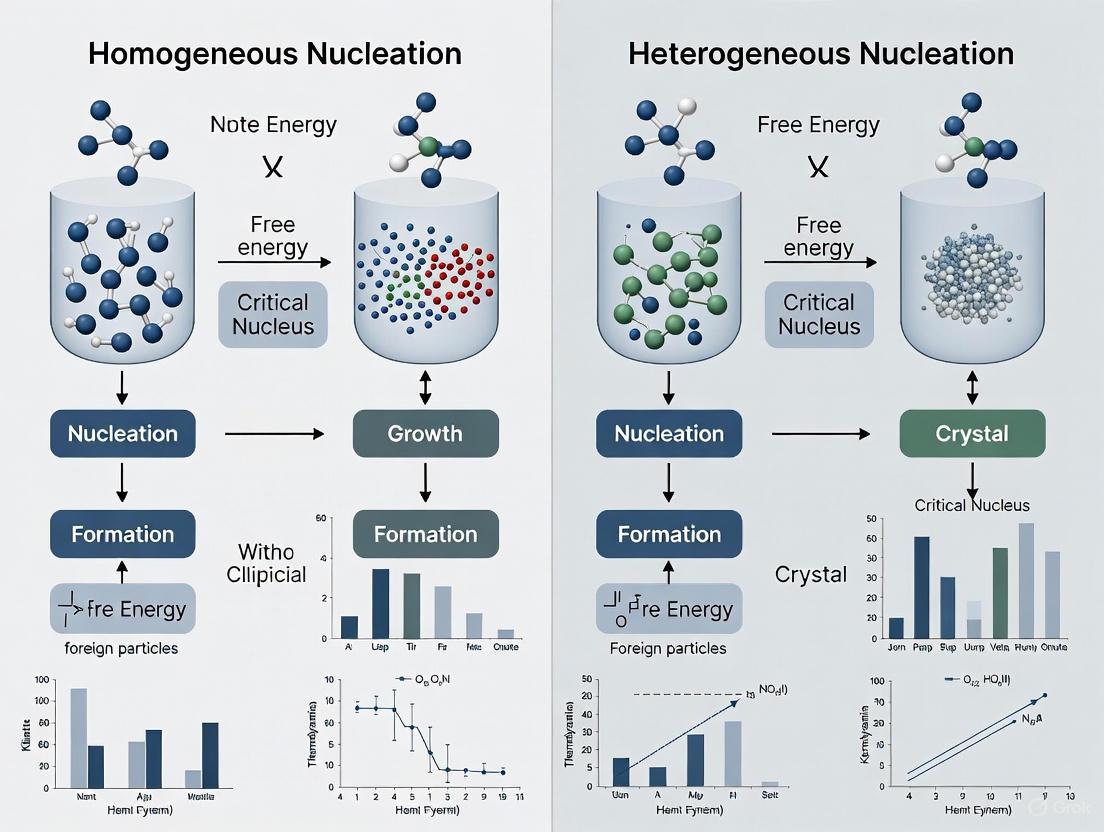
This article provides a comprehensive comparative analysis of homogeneous and heterogeneous nucleation, tailored for researchers and professionals in drug development and materials science.
Homogeneous vs. Heterogeneous Nucleation: A Comparative Analysis of Mechanisms, Outcomes, and Applications in Drug Development
Abstract
This article provides a comprehensive comparative analysis of homogeneous and heterogeneous nucleation, tailored for researchers and professionals in drug development and materials science. It explores the fundamental thermodynamic and kinetic distinctions between these two pathways, examining how energy barriers, stochasticity, and interfacial interactions dictate nucleation outcomes. The scope extends to methodological approaches for controlling nucleation, including the use of heteronucleants, engineered interfaces, and polymeric inhibitors, with specific applications in pharmaceutical crystallization and biologics processing. The review also addresses common troubleshooting and optimization challenges, such as suppressing unwanted homogeneous nucleation and selecting effective crystallization inhibitors. Finally, it synthesizes validation strategies and comparative performance metrics, highlighting how the selective promotion or inhibition of a specific nucleation pathway can enhance crystal quality, drug solubility, and process efficiency in biomedical research and manufacturing.
Core Principles: Demystifying the Energetic and Kinetic Landscapes of Nucleation
Defining Homogeneous and Heterogeneous Nucleation Pathways
Nucleation, the initial formation of a new thermodynamic phase from a metastable parent phase, serves as the critical first step in processes ranging from cloud formation to pharmaceutical crystallization. For researchers and drug development professionals, understanding the distinct pathways of homogeneous and heterogeneous nucleation is essential for controlling product purity, crystal polymorphism, and particle size distribution. This guide provides a comparative analysis of these fundamental mechanisms, supported by current experimental data and methodologies.
Homogeneous nucleation occurs spontaneously within a uniform bulk phase without the involvement of foreign surfaces, typically requiring high energy barriers to be overcome. In contrast, heterogeneous nucleation takes place on pre-existing surfaces, interfaces, or impurity particles, which significantly reduce the energy required for phase transition. The competition between these pathways directly influences critical material properties in pharmaceutical development, including bioavailability, stability, and manufacturability.
Theoretical Framework and Key Concepts
Classical Nucleation Theory Fundamentals
Classical Nucleation Theory (CNT) provides the foundational framework for quantifying nucleation processes across diverse systems. CNT describes nucleation as the stochastic formation of stable nuclei through fluctuations that overcome a characteristic energy barrier. The theory predicts key parameters including critical nucleus size, nucleation rate, and energy barrier height.
For homogeneous freezing, the nucleation rate is expressed as:
J_hom = C exp(-16πvi²γiw³ / (3kTΔμiw²)) [1]
where C is a kinetic prefactor, vi is the molecular volume of ice, γiw is the interfacial tension between water and ice, and Δμiw denotes the chemical potential difference between ice and water.
The critical radius of the ice nucleus in water is given by:
R_iw* = 2viγiw / Δμiw [1]
In heterogeneous nucleation, the presence of a foreign surface reduces the energy barrier by a factor f(θ) that depends on the contact angle θ between the nucleating phase and the substrate. This fundamental difference in energy requirements creates the competitive landscape between these pathways.
Comparative Mechanism Analysis
The following diagram illustrates the key differences and competitive relationships between homogeneous and heterogeneous nucleation pathways:
Experimental Methodologies and Protocols
Atmospheric Ice Nucleation Research
Studies of ice nucleation in synoptic cirrus clouds employ sophisticated airborne measurement campaigns coupled with modeling approaches. The Midlatitude Airborne Cirrus Properties Experiment (MACPEX) utilized the NASA WB-57F science aircraft with instrumentation including:
- Two-Dimensional Stereo (2D-S) probe: Captures shadow images of ice particles from 10 μm to over 1 mm in diameter for characterizing ice crystals in cirrus clouds [2].
- Particle Analysis by Laser Mass Spectrometry (PALMS): Provides real-time, size-resolved chemical composition of aerosol particles in the 0.15-5 μm range [2].
- Closed-path tunable diode laser hygrometer (CLH): Precisely measures ice water content by collecting both water vapor and sublimated ice particles via a subisokinetic inlet [2].
Data analysis involves ice residual analysis, where ice crystals collected from cirrus clouds are evaporated and the residual particles analyzed to infer the presence and nature of ice-nucleating particles (INPs). Large-eddy simulation models like UCLALES-SALSA resolve small-scale turbulence and microphysical interactions at resolutions down to tens of meters to capture INP-driven processes [2].
Molecular Dynamics Simulations
Molecular dynamics (MD) simulations provide atomic-level insights into nucleation behavior. Recent studies investigate heterogeneous nucleation characteristics of Hâ‚‚O on SiOâ‚‚ surfaces in multi-component systems:
- System construction: SiOâ‚‚ crystals of 20 Ã… are constructed using the SiOâ‚‚ cell in Materials Studio database [3].
- Simulation parameters: Simulations are conducted under NPT ensemble for 40 ns to investigate nucleation process within supersaturated water vapor environment [3].
- Analysis methods: Cluster evolution and interaction energies are tracked to identify nucleation mechanisms and competitive effects between homogeneous and heterogeneous pathways [3].
Colloidal Hard Sphere Crystallization
Experimental investigation of crystal nucleation in colloidal hard spheres employs:
- Laser-scanning confocal microscopy (LSCM): Tracks particle-level crystallization in real-time using fluorescent PMMA particles dispersed in gravity-matched solvent [4].
- Sample preparation: Sterically stabilized particles with size polydispersity of 5.75% prevent fractionation while delaying crystallization onset for adequate time resolution [4].
- Crystalline cluster identification: Uses local bond order parameters to identify clusters, with particles classified as crystalline if having at least 8 nearest neighbors within 1.4 × particle diameter and scalar product > 0.5 [4].
Comparative Experimental Data Analysis
Nucleation Pathway Characteristics
Table 1: Fundamental characteristics of homogeneous versus heterogeneous nucleation pathways
| Parameter | Homogeneous Nucleation | Heterogeneous Nucleation |
|---|---|---|
| Energy Barrier | High, requires significant supersaturation/undercooling | Significantly reduced by catalytic surfaces |
| Nucleation Rate | Sharp increase at threshold conditions | Gradual increase beginning at lower supersaturation |
| Spatial Distribution | Random throughout bulk phase | Localized at active surfaces/interfaces |
| Stochasticity | Highly stochastic | More predictable with known INP concentrations |
| Temperature Dependence | Strong temperature dependence below -38°C for ice [2] | Active across broader temperature range |
| Critical Cluster Size | Larger critical nuclei | Smaller critical nuclei stabilized by surfaces |
| Experimental Observation | Direct measurement challenging due to spontaneity | More easily quantified via surface analysis |
Quantitative Nucleation Data
Table 2: Experimental nucleation data across multiple systems
| System | Nucleation Type | Conditions | Nucleation Rate | Critical Size/Parameters |
|---|---|---|---|---|
| Hard Spheres [4] | Homogeneous | Φ = 0.52, MS = 0.75 | 〈J〉 = (6 ± 3) × 10â¹ mâ»Â³ sâ»Â¹ | Induction time: 395 ± 25 min |
| Synoptic Cirrus [2] | Heterogeneous (mineral dust) | Cloud-forming altitudes | INP concentration: 0.01 to 100 Lâ»Â¹ at -30°C | Depletes INPs at cloud-forming altitudes |
| Water-SiOâ‚‚ System [3] | Competitive heterogeneous/homogeneous | Multi-gas component, 40 ns simulation | Heterogeneous preferred at lower saturation | Hâ‚‚O accumulates around O atoms on SiOâ‚‚ |
| Adsorbed Water Films [1] | Homogeneous in confined geometry | 1 nm film on hydrophilic substrate | Melting point depression up to 5 K | Film must accommodate critical ice nucleus |
Competitive Interactions and Pathway Interdependence
The relationship between homogeneous and heterogeneous nucleation is not merely alternative pathways but often involves complex competitive dynamics. Research demonstrates that prior heterogeneous freezing events can shape thermodynamic conditions for subsequent homogeneous nucleation [2]. In atmospheric systems, initial heterogeneous nucleation on mineral dust INPs depletes these particles from cloud-forming altitudes, potentially enabling homogeneous freezing to dominate at the time of observation despite the presence of heterogeneous characteristics earlier in the system evolution [2].
Molecular dynamics simulations of water vapor condensation on SiOâ‚‚ particles reveal that both homogeneous and heterogeneous processes occur simultaneously, with competition between them significantly influenced by environmental conditions [3]. At lower water vapor saturation, heterogeneous nucleation dominates, while higher saturation levels promote homogeneous nucleation throughout the vapor phase [3].
The following experimental workflow illustrates how these competitive interactions are investigated in atmospheric science:
Research Reagent Solutions and Essential Materials
Table 3: Key research materials and their applications in nucleation studies
| Material/Reagent | Function in Nucleation Research | Application Examples |
|---|---|---|
| Mineral Dust Particles | Ice-nucleating particles for heterogeneous ice formation | Atmospheric ice nucleation studies [2] |
| Fluorescent PMMA Particles | Model colloidal hard spheres for direct visualization | Laser-scanning confocal microscopy [4] |
| SiOâ‚‚ Crystals | Substrate for heterogeneous nucleation studies | Molecular dynamics simulations [3] |
| cis-Decalin/TCE Mixture | Density- and refractive index-matched dispersion medium | Colloidal hard sphere experiments [4] |
| Particle Coatings (poly-hydroxy-stearic-acid) | Steric stabilization of colloidal particles | Preventing aggregation in model systems [4] |
| Fluorescent Dye (DilC18) | Particle visualization in confocal microscopy | Real-time tracking of crystallization [4] |
The comparative analysis of homogeneous and heterogeneous nucleation pathways reveals a complex interplay that significantly influences phase transition outcomes across scientific disciplines and industrial applications. For drug development professionals, understanding these mechanisms enables better control over crystallization processes critical to product performance. Current research demonstrates that rather than operating in isolation, these pathways often compete and interact in dynamic ways, with prior heterogeneous events potentially shaping subsequent homogeneous nucleation.
The experimental methodologies summarized—from airborne atmospheric measurements to molecular dynamics simulations and colloidal model systems—provide complementary approaches for investigating nucleation phenomena across scales. As research continues to elucidate the intricate relationships between these fundamental processes, enhanced predictive models will emerge, offering improved strategies for controlling nucleation outcomes in pharmaceutical applications and beyond.
Classical Nucleation Theory (CNT) provides the foundational framework for describing the kinetics of a phase transition, serving as a critical tool across disciplines from atmospheric science to pharmaceutical development. At the heart of CNT lies the concept of the free energy barrier (ΔGâº), which determines the rate at of formation of stable nuclei from a supersaturated parent phase. This activation barrier arises from the competition between the bulk free energy gain of the new phase and the surface free energy penalty required to create its interface. The height of this barrier dictates whether a system will remain in a metastable state or proceed rapidly toward phase separation, making its accurate quantification paramount for predicting and controlling nucleation outcomes in both natural and industrial processes.
This analysis focuses on a comparative evaluation of homogeneous and heterogeneous nucleation pathways, examining how the presence of foreign surfaces or particles dramatically alters the thermodynamic landscape. While homogeneous nucleation occurs spontaneously and randomly within the bulk phase without preferential sites, heterogeneous nucleation is catalyzed by existing interfaces that effectively lower the critical energy barrier. Understanding the competition and interplay between these mechanisms is essential for applications ranging from the formation of ice crystals in cirrus clouds to the controlled crystallization of active pharmaceutical ingredients (APIs). Recent research has illuminated the complex ways in which prior heterogeneous events can shape subsequent homogeneous nucleation, highlighting the dynamic nature of these processes that cannot be fully captured by static analysis alone [2].
Theoretical Foundations of the Free Energy Barrier
The CNT Formulation of ΔGâº
Within CNT, the free energy change associated with the formation of a spherical nucleus of the new phase is expressed as the sum of a volume term and a surface term. For a cluster containing n molecules, the Gibbs free energy is given by:
ΔG = -nΔμ + 4πr²γ
Where:
- Δμ is the chemical potential difference between the two phases (the thermodynamic driving force, often proportional to supersaturation)
- r is the radius of the nucleus
- γ is the interfacial tension between the nucleus and the parent phase
This function reaches a maximum at the critical nucleus size (râº), where the free energy barrier ΔG⺠is located. Clusters smaller than r⺠tend to dissolve, while those larger than r⺠are likely to continue growing. The critical size and associated energy barrier can be derived by setting d(ΔG)/dr = 0, yielding:
r⺠= 2γ/Δμ
ΔG⺠= 16πγ³ / (3Δμ²)
The height of this barrier exhibits an inverse square relationship with the driving force (Δμ), explaining why nucleation rates increase dramatically with increasing supersaturation. However, CNT's simplified treatment of clusters as macroscopic droplets with bulk properties represents a significant limitation, particularly for small nuclei where the continuum approximation breaks down [5].
Methodological Approaches for Probing ΔGâº
Experimental and computational methods for determining ΔG⺠have evolved significantly, moving beyond CNT's limitations:
Metastable Zone Width (MSZW) Analysis: A new mathematical model based on CNT enables direct estimation of nucleation rates and Gibbs free energy of nucleation using MSZW data as a function of solubility temperature and cooling rate. This approach has been validated across 22 solute-solvent systems, revealing nucleation rates from 10²Ⱐto 10³ⴠmolecules per m³s and Gibbs free energies ranging from 4 to 87 kJ molâ»Â¹ for various compounds including APIs, lysozyme, and inorganic materials [6].
Molecular Dynamics (MD) Simulations: MD provides atomistic insight into nucleation behavior by simulating the interactions between molecules. For water vapor phase change on SiOâ‚‚ particles, MD simulations model cluster evolution and interaction energies to analyze heterogeneous nucleation behavior and its competition with homogeneous nucleation across temperature and humidity conditions [3].
Quantum Mechanical Calculations: State-of-the-art quantum mechanics models (e.g., DLPNO-CCSD(T)/CBS and G3) calculate free energies of small water clusters (2-14 molecules), revealing that the ratio of experimentally extracted free energies to CNT predictions shows nonmonotonic behavior with cluster size at higher temperatures (>250K), challenging CNT's fundamental assumptions [5].
Comparative Analysis of Homogeneous vs. Heterogeneous Nucleation
Thermodynamic and Kinetic Differences
The presence of a foreign surface fundamentally alters the nucleation landscape by providing a template that reduces the surface energy penalty of nucleus formation. For heterogeneous nucleation on a flat, ideal surface, the free energy barrier relates to the homogeneous case through a catalytic factor:
ΔGₕₑₜ⺠= φΔGₕₒₘâº
φ = (2 + cosθ)(1 - cosθ)²/4
Where θ is the contact angle between the nucleus and the substrate, a measure of the surface's wettability and catalytic effectiveness. This relationship reveals that even weakly catalytic surfaces (θ approaching 180°) significantly reduce the barrier, while perfectly wetting surfaces (θ = 0°) eliminate it entirely.
Table 1: Comparative Free Energy Barriers in Different Systems
| System | Nucleation Type | ΔG⺠Range | Critical Nucleus Size (molecules) | Experimental Conditions |
|---|---|---|---|---|
| APIs & Intermediate [6] | Primary | 4-49 kJ molâ»Â¹ | Not specified | Solution, varying cooling rates |
| Lysozyme [6] | Primary | ~87 kJ molâ»Â¹ | Not specified | Solution, varying cooling rates |
| Water Clusters [5] | Homogeneous | Varies with size | 2-14 | T > ~250K and T < ~250K |
| SiOâ‚‚ in Flue Gas [3] | Heterogeneous | Not specified | Not specified | Multi-component wet flue gas, molecular dynamics simulation |
Competitive Dynamics and Sequential Interactions
In realistic systems, homogeneous and heterogeneous nucleation rarely occur in isolation, but rather compete and interact in complex ways:
Preferential Initiation: Heterogeneous nucleation typically initiates at lower supersaturations because of its reduced energy barrier. In cirrus cloud formation, for example, heterogeneous freezing on mineral dust ice-nucleating particles (INPs) occurs before homogeneous freezing becomes possible [2].
Particle Depletion Mechanism: Prior heterogeneous nucleation events can remove active nucleating particles from the system, subsequently favoring homogeneous nucleation. In synoptic cirrus, initial heterogeneous freezing on mineral dust INPs depletes these particles from cloud-forming altitudes, enabling homogeneous freezing to dominate at the time of observation despite the presence of conditions that would otherwise favor heterogeneous mechanisms [2].
Simultaneous Competition: Molecular dynamics simulations of water vapor condensation on SiOâ‚‚ particles reveal that homogeneous and heterogeneous nucleation occur simultaneously with competition between them. Heterogeneous nucleation preferentially occurs around oxygen atoms on the SiOâ‚‚ surface at lower water vapor saturation, while homogeneous nucleation requires higher supersaturation levels but then proceeds rapidly [3].
Experimental Protocols for ΔG⺠Determination
Protocol 1: Metastable Zone Width (MSZW) Analysis for Solution Nucleation
This methodology enables determination of nucleation kinetics from readily measurable MSZW data, providing a practical approach for pharmaceutical and materials science applications.
Table 2: Key Research Reagents and Materials for MSZW Analysis
| Item | Function/Application |
|---|---|
| APIs (Active Pharmaceutical Ingredients) | Model solute systems for nucleation studies [6] |
| Lysozyme | Large protein molecule for studying macromolecular nucleation [6] |
| Glycine | Amino acid model system for biological molecule nucleation [6] |
| Inorganic Compounds (8 systems) | Broadening model system diversity [6] |
| Solvents | Creating supersaturated solutions through temperature control |
| Temperature Control System | Precise cooling rate manipulation for MSZW determination |
Step-by-Step Procedure:
- Prepare saturated solutions at known equilibrium temperatures for each solute-solvent system.
- Apply controlled linear cooling rates (typically 0.1-1.0 K/min) to generate supersaturation.
- Detect nucleation onset through turbidity measurements, laser backscattering, or visual observation.
- Record the temperature difference between saturation and nucleation onset (MSZW) for each cooling rate.
- Apply the CNT-based model to extract nucleation rates, kinetic constants, and Gibbs free energies using the relationship between MSZW, cooling rate, and solubility temperature.
- Validate models by predicting induction times and thermodynamic parameters (surface free energy, critical nucleus size, number of unit cells) [6].
Protocol 2: Molecular Dynamics Simulation of Competitive Nucleation
MD simulations provide atomistic-level insights into the competition between heterogeneous and homogeneous nucleation mechanisms, particularly valuable for systems where direct experimental observation is challenging.
Computational Workflow:
- System Construction: Build the simulation box containing a spherical SiOâ‚‚ particle (20Ã…) at the center, surrounded by a multi-component gas mixture (Nâ‚‚, Oâ‚‚, COâ‚‚, Hâ‚‚O) representing flue gas conditions [3].
- Force Field Selection: Employ established interatomic potentials (e.g., Tersoff parameterization for Si-O systems) to describe molecular interactions [3].
- Ensemble Configuration: Run simulations under NPT ensemble (constant number of particles, pressure, and temperature) for sufficient duration (e.g., 40 ns) to observe nucleation events [3].
- Process Monitoring: Track the spatial and temporal evolution of Hâ‚‚O molecule organization around particles, identifying nucleation initiation sites and rates.
- Competition Analysis: Quantify the relative prevalence of heterogeneous nucleation (on particle surfaces) versus homogeneous nucleation (in the vapor phase) under varying temperature and humidity conditions.
- Energy Calculations: Compute interaction energies between Hâ‚‚O molecules and particle surfaces to understand the thermodynamic drivers of heterogeneous nucleation preference [3].
Research Toolkit: Essential Methods and Reagents
Table 3: The Scientist's Toolkit for Nucleation Barrier Research
| Tool/Reagent | Function in Nucleation Research | Representative Application |
|---|---|---|
| Deep Docking Pipeline [7] | Identifies nucleation inhibitors from ultra-large chemical libraries | Discovery of high-affinity secondary nucleation inhibitors of Aβ42 aggregation for Alzheimer's disease |
| UCLALES-SALSA Model [2] | Large-eddy simulation for atmospheric ice nucleation | Resolving small-scale turbulence and microphysical interactions in cirrus cloud formation |
| FHH Adsorption Model [1] | Describes substrate-adsorbate interactions in confined geometries | Modeling homogeneous ice nucleation in adsorbed water films on insoluble substrates |
| PALMS Instrument [2] | Provides real-time, size-resolved chemical composition of aerosol particles | Ice residual analysis in cirrus clouds to infer nucleation mechanisms |
| 2D-S Probe [2] | Captures shadow images of ice particles for size distribution analysis | Characterizing ice crystals in cirrus clouds with detection from 10µm to over 1mm |
| ZK824859 | ZK824859, MF:C23H22F2N2O4, MW:428.4 g/mol | Chemical Reagent |
| Pde4-IN-24 | Pde4-IN-24, MF:C20H18F2N4O3S, MW:432.4 g/mol | Chemical Reagent |
Visualization of Nucleation Pathways and Methodologies
The comparative analysis of homogeneous and heterogeneous nucleation through the lens of Classical Nucleation Theory reveals a complex landscape where the free energy barrier ΔG⺠serves as the critical determinant of phase transition kinetics. The experimental data compiled in this guide demonstrates that ΔG⺠values span orders of magnitude across different systems—from approximately 4 kJ molâ»Â¹ for simple APIs to 87 kJ molâ»Â¹ for complex biomolecules like lysozyme [6]—highlighting the profound influence of molecular specificity on nucleation thermodynamics.
The recognition that homogeneous and heterogeneous nucleation pathways frequently compete and interact in dynamic systems represents a paradigm shift with significant implications for both basic research and industrial applications. In atmospheric science, this understanding explains observed cirrus cloud properties that cannot be predicted by considering either mechanism in isolation [2]. In pharmaceutical development, accounting for these competitive dynamics enables better control over crystal polymorphism and particle size distribution during API manufacturing [6]. In environmental engineering, understanding the preferential nucleation of water vapor on SiOâ‚‚ particles informs strategies for fine particle removal from flue gases [3].
Future research directions should focus on developing multi-scale models that seamlessly connect molecular-level interactions with macroscopic nucleation phenomena, further refining our ability to predict and manipulate ΔG⺠across diverse applications. As computational methods continue to advance—enabled by techniques like molecular dynamics, deep docking, and quantum mechanical calculations [7] [3] [5]—our capacity to design materials and processes with precisely controlled nucleation behavior will undoubtedly transform fields from medicine to climate science.
The Stochastic Nature of Nucleation and Induction Time
Nucleation, the initial formation of a new thermodynamic phase from a parent phase, is fundamentally a stochastic process, meaning it occurs randomly with a probability that can be quantified statistically. This phenomenon is critically important across scientific and industrial domains, from the production of pharmaceutical crystals with specific bioavailability to the understanding of protein aggregation in neurodegenerative diseases. The "induction time" or "lag time"—the period between the creation of a supersaturated or supercooled state and the appearance of detectable nuclei—is not a fixed value but varies significantly even under identical conditions. This variation originates from the microscopic, random nature of molecular collisions that must overcome a specific energy barrier to form a stable nucleus.
This guide provides a comparative analysis of homogeneous nucleation, which occurs spontaneously from the bulk solution without foreign surfaces, and heterogeneous nucleation, which is catalyzed by impurities, container walls, or other interfaces. Understanding their distinct outcomes is essential for controlling crystallization processes in research and industrial applications, particularly in drug development where crystal form, size, and purity are critical to a product's efficacy and safety.
Quantitative Comparison of Homogeneous and Heterogeneous Nucleation
The core difference between homogeneous and heterogeneous nucleation lies in the energy barrier. Heterogeneous nucleation occurs at a lower energy barrier because the foreign surface reduces the interfacial energy penalty for creating a new phase. This results in markedly different experimental observables, most clearly seen in the statistical distribution of induction times and the resulting nucleation rates.
Table 1: Comparative Outcomes of Homogeneous and Heterogeneous Nucleation
| Characteristic | Homogeneous Nucleation | Heterogeneous Nucleation |
|---|---|---|
| Energy Barrier | Higher, requires greater supersaturation/undercooling | Lower, occurs at lower supersaturation/undercooling |
| Induction Time Distribution | Wider distribution, highly stochastic [8] | Narrower distribution, more predictable [9] |
| Experimental Nucleation Rate | Lower for a given temperature | Higher for a given temperature [9] |
| Nucleation Site | Randomly throughout the bulk volume | Preferentially at active sites (e.g., impurities, surfaces) |
| Resulting Crystal Microstructure | Fine, uniform grain structure | Larger, often columnar or "coast-island" structures [9] |
The data in Table 1 is supported by direct stochastic experiments. For instance, a study on lithium disilicate glass performed 284 runs under identical undercooling conditions, measuring the crystallization onset time each time. The statistical analysis revealed a heterogeneous crystal nucleation rate of (9.19 ± 0.04) × 10â»â´ sâ»Â¹, with the distribution of onset times confirming the random, stochastic nature of the process [9]. In contrast, homogeneous nucleation in the same system was observed at much larger undercoolings, with a different kinetic profile that forms a distinct "nose" on a Time-Temperature-Transformation (TTT) diagram [9].
Table 2: Experimentally Determined Nucleation Parameters in Different Systems
| System / Study | Nucleation Type | Measured Nucleation Rate | Key Parameter (e.g., Energy Barrier) |
|---|---|---|---|
| Lithium Disilicate Glass at 1173 K [9] | Heterogeneous (on PtRh-crucible) | (9.19 ± 0.04) × 10â»â´ sâ»Â¹ | Derived from induction time statistics of 284 runs |
| Racemic Diprophylline in 1 ml solutions [8] | Heterogeneous | Varies by solvent (rate determined from induction time distribution) | Energy barrier much higher in solvent with longer induction times |
| ZIF-8 Crystallization modulated by Emodin [10] | Surface-specific (capping agent) | Not directly quantified | Emodin decreases Gibbs free energy and influences crystal growth rates on {100} facets |
Detailed Experimental Protocols for Nucleation Studies
The Stochastic Approach to Measuring Induction Times
This methodology leverages the inherent randomness of nucleation by repeating an experiment numerous times under identical conditions to build a statistically significant distribution of induction times [11] [8] [9].
- Sample Preparation and Levitation: A large number (N ∼ 150–300) of identical microdroplets (1–20 μm in diameter) of a supersaturated solution are simultaneously levitated in a solvent atmosphere using a linear quadrupole electrodynamic levitator trap (LQELT). This containerless processing minimizes unwanted heterogeneous nucleation from container walls [11].
- Establishing Supersaturation: At a defined moment (tâ‚€), the environment is controlled to establish a precise state of supersaturation or undercooling in all droplets simultaneously.
- Optical Monitoring: A specialized optical system, based on the scattering of monochromatic polarized light, enables fast, simultaneous observation of nucleation events in each levitated microdroplet.
- Data Collection: The induction time for each droplet—defined as the time elapsed between t₀ and the moment a nucleus is detected—is recorded.
- Statistical Analysis: The complete set of N different induction times constitutes the nucleation statistics. This data is fitted to probability distribution models (e.g., a first-order reaction model) to extract the average nucleation rate and understand the underlying stochastic properties [11] [9].
Regulating Nucleation via Molecular Modifiers
This protocol describes an alternative approach where specific molecules are used to actively regulate the nucleation process and crystal growth, as demonstrated with the metal-organic framework ZIF-8 [10].
- One-Pot Synthesis: The reaction is set up at room temperature (∼25 °C) using an aqueous solution of 2-methylimidazole (2MI) as the reaction medium to ensure safety and simplicity.
- Introduction of Modifier: A regulator molecule, such as the anthraquinone derivative emodin, is introduced into the Zinc acetate / 2MI reaction system. The regulator is dissolved in a minimal amount of dimethyl sulfoxide (DMSO) first if needed.
- Crystallization and Modulation: The mixture is left to crystallize. The regulator molecule acts on the process by decreasing the Gibbs free energy of the system and functioning as a capping agent for specific crystal facets (e.g., {100} facets), thereby manipulating the final particle size and morphology.
- Characterization: The resulting ZIF-8 crystals are characterized for particle size and morphology using techniques like dynamic light scattering (DLS) and scanning electron microscopy (SEM). The relationship between the regulator's chemical structure (e.g., the integrity of the anthraquinone structure and the number of hydroxyl groups) and its regulatory effect is analyzed [10].
The Scientist's Toolkit: Key Research Reagents and Materials
Table 3: Essential Reagents and Materials for Nucleation Studies
| Reagent / Material | Function in Experiment | Example Application |
|---|---|---|
| Linear Quadrupole Electrodynamic Levitator Trap (LQELT) | Enables containerless processing of many microdroplets simultaneously to minimize wall-induced heterogeneous nucleation and collect induction time statistics [11]. | Stochastic nucleation experiments in supercooled liquids or solutions [11]. |
| Emodin (Anthraquinone) | Acts as a regulator of nucleation thermodynamics and a capping agent for specific crystal facets, controlling the final size and morphology of crystals [10]. | Producing size-tuned ZIF-8 metal-organic frameworks for drug delivery applications [10]. |
| Deep Eutectic Solvents (DES) | Serve as a sustainable and tunable reaction medium that can modulate nucleation kinetics, crystal polymorphism, and crystal habit [12]. | Green crystallization of pharmaceutical ingredients and biomolecules [12]. |
| Platinum-Rhodium (PtRh) Crucible | Provides a highly active surface for catalyzing heterogeneous nucleation in high-temperature melts [9]. | Studying heterogeneous crystal nucleation in lithium disilicate glass [9]. |
| Monoclonal Polarized Light Source | Enables fast, non-invasive detection of nucleation events in levitated droplets or other experimental setups by detecting changes in light scattering [11]. | Determining the exact moment of nucleation in stochastic experiments [11]. |
| ABP 25 | ABP 25, MF:C55H66ClN5O3, MW:880.6 g/mol | Chemical Reagent |
| Edpetiline | Edpetiline, MF:C27H43NO2, MW:413.6 g/mol | Chemical Reagent |
The comparative analysis confirms that the stochastic nature of nucleation is a universal principle, observable in both homogeneous and heterogeneous pathways. The key distinction lies in the magnitude of the energy barrier and the resulting statistical distribution of induction times. Heterogeneous nucleation, with its lower barrier, exhibits a narrower, more predictable distribution of induction times and higher observable rates under equivalent conditions. The choice between fostering homogeneous or heterogeneous nucleation is not merely academic; it has direct consequences on the critical cooling rates needed to form glasses, the microstructure of glass-ceramics, and the size and morphology of pharmaceutical crystals. Mastering the statistics of induction times through the described experimental protocols provides researchers with the data needed to predict, control, and optimize crystallization outcomes across diverse scientific and industrial landscapes.
The Role of Supersaturation as the Universal Driving Force
Supersaturation represents the fundamental deviation from thermodynamic equilibrium wherein a solution contains a higher solute concentration than its equilibrium solubility at a given temperature and pressure [13]. This condition creates the essential driving force required for all crystallization processes, establishing a non-equilibrium state that the system seeks to resolve through the formation of a solid phase [13]. The chemical potential difference (Δμ) between the supersaturated solution and the crystalline state quantitatively defines this driving force, with the supersaturation ratio (S) expressed as S = a/a, where a is the activity in the supersaturated solution and a is the activity at equilibrium [13].
In practical terms, for a cooling crystallization process, a solution becomes supersaturated as its temperature decreases below the saturation point, entering a metastable zone where the system remains in a liquid state despite being thermodynamically primed for phase transformation [13]. The width of this metastable zone varies significantly across different systems, ranging from just 1-2°C for simple inorganic salts to 20-40°C or more for complex pharmaceutical compounds, reflecting the kinetic barriers to nucleation [13]. Understanding and controlling supersaturation is particularly crucial in pharmaceutical development, where it directly influences critical quality attributes of active pharmaceutical ingredients (APIs), including crystal form, particle size distribution, purity, and ultimately, drug efficacy and stability [14] [15].
Theoretical Framework: Classical and Modern Nucleation Theories
Classical Nucleation Theory
Classical Nucleation Theory (CNT) provides the foundational framework for understanding nucleation kinetics, modeling the process as a balance between the free energy gain from phase transformation and the energy cost of creating new interface [16]. According to CNT, the formation of a crystalline nucleus requires overcoming a characteristic free energy barrier (ΔG*) described by the relationship ΔG(n) = -nΔμ + 6a²n²â„³α, where n represents the number of molecules in the cluster, Δμ is the chemical potential difference driving crystallization, and α is the interfacial free energy [16].
The nucleation rate (J), defined as the number of nuclei formed per unit volume per unit time, follows an Arrhenius-type dependence on this energy barrier: J = νZnexp(-ΔG/kBT) [16]. Within this equation, ν* represents the attachment frequency of molecules to the nucleus, Z is the Zeldovich factor accounting for the width of the energy barrier, n is the molecular number density, kB is Boltzmann's constant, and T is temperature [16]. This theoretical framework predicts that nucleation rates increase dramatically with supersaturation, as higher supersaturation levels significantly reduce the nucleation barrier ΔG* [16].
Advancements Beyond Classical Theory
Recent research has revealed limitations in CNT, particularly its underestimation of actual nucleation rates observed in experimental systems [16]. The two-step nucleation mechanism has emerged as an important alternative explanation, proposing that crystalline nuclei form within pre-existing metastable clusters of dense liquid hundreds of nanometers in size [16]. This mechanism, initially demonstrated for protein crystals but since validated for small organic molecules, colloids, polymers, and biominerals, helps explain several long-standing puzzles in crystallization kinetics [16].
At high supersaturation levels typical of most crystallizing systems, the concept of the solution-crystal spinodal suggests that the nucleation barrier becomes negligible, enabling direct and barrier-free formation of crystal embryos [16]. This regime provides powerful opportunities for controlling nucleation by manipulating solution thermodynamic parameters and has significant implications for polymorph selection [16].
Comparative Analysis: Homogeneous vs. Heterogeneous Nucleation
Fundamental Distinctions and Experimental Discrimination
Homogeneous and heterogeneous nucleation processes are primarily discriminated by their relationship to supersaturation levels and the presence of preferential nucleation sites [17]. Experimental studies with model proteins (lysozyme, glucose isomerase, and thaumatin) demonstrate that homogeneous nucleation dominates at high supersaturation, while heterogeneous nucleation prevails at lower supersaturation levels where surfaces facilitate the nucleation process by reducing the energy barrier [17].
Table 1: Comparative Characteristics of Homogeneous and Heterogeneous Nucleation
| Characteristic | Homogeneous Nucleation | Heterogeneous Nucleation |
|---|---|---|
| Supersaturation Requirement | High | Low to moderate |
| Nucleation Sites | Bulk solution, no preferential sites | Foreign surfaces, impurities, or interfaces |
| Energy Barrier | Higher | Reduced by surface interactions |
| Experimental Observation | Crystals form throughout solution volume | Crystals form preferentially on surfaces |
| Induction Time | Generally longer at equivalent supersaturation | Shorter due to lowered barrier |
| Surface Charge Dependence | Independent | Highly dependent on charge distribution |
The experimental discrimination between these mechanisms relies on controlled vapor diffusion experiments using platforms such as the "crystallization mushroom," which maintains identical chemical environments while testing different functionalized surfaces [17]. Research findings indicate that the superficial charge distribution of functionalized surfaces primarily affects nucleation frequency rather than the absolute charge value itself [17].
Quantitative Kinetics and Interfacial Energy
Advanced analytical approaches enable the determination of nucleation kinetics through both metastable zone width (MSZW) and induction time measurements [18]. A linearized integral model based on Classical Nucleation Theory allows researchers to determine interfacial energy (γ) and the pre-exponential factor (A) using cumulative distributions of MSZW data, with consistent results obtained from induction time measurements for systems including isonicotinamide, butyl paraben, dicyandiamide, and salicylic acid [18].
The mathematical relationship for nucleation rate follows the form derived from CNT: J = AJexp[-16πvm²γ³/(3kB³T³ln²S)] where vm is molecular volume, kB is Boltzmann's constant, T is temperature, and S is supersaturation ratio [18]. This fundamental relationship underscores how interfacial energy and supersaturation collectively govern nucleation kinetics across different experimental methodologies.
Experimental Protocols and Methodologies
Induction Time and Metastable Zone Width Measurements
The measurement of induction times and metastable zone widths provides critical experimental data for quantifying nucleation kinetics [18] [19] [15]. The standard protocol involves:
Solution Preparation: Prepare saturated solutions at known initial concentrations and temperatures [18] [15]. For pharmaceutical compounds like alpha-mangostin, this may require using biorelevant dissolution media such as 50 mM phosphate buffer at pH 7.4 with a minimal amount of co-solvent (e.g., 2-3% DMSO) to ensure adequate drug dissolution [15].
Supersaturation Generation: Create supersaturated conditions through appropriate methods:
Nucleation Detection: Monitor for nucleation events using:
Data Collection: Record the time interval between supersaturation establishment and first crystal detection (induction time, ti) or the temperature difference between saturation and detection points (MSZW, ΔTm) across multiple experimental runs to account for stochastic variation [18] [15].
Statistical Analysis: Apply cumulative distribution functions to the collected data, with the median value (50% of fraction detected nucleation events) providing the most reliable indicator for a random nucleation process [18].
Polymer Inhibition Studies
Evaluating the impact of polymeric additives on nucleation kinetics follows specific experimental protocols [15]:
Polymer Solution Preparation: Dissolve polymers (HPMC, PVP, Eudragit, etc.) in the selected dissolution media at specified concentrations (typically 500 μg/mL) [15].
Supersaturated Solution Preparation: Add a concentrated stock solution of the model compound (e.g., alpha-mangostin at 1500 μg/mL in DMSO) to the polymer solutions, maintaining final DMSO concentrations below 2% (v/v) to minimize solvent effects [15].
Nucleation Monitoring: Maintain solutions under constant stirring (150 rpm) at controlled temperature (25°C), with periodic sampling through 0.45-μm membrane filters followed by HPLC analysis to determine dissolved drug concentration over time [15].
Characterization of Interactions: Employ complementary techniques to elucidate polymer-drug interactions:
- FT-IR Spectroscopy: Detect potential molecular interactions through spectral shifts [15].
- NMR Measurements: Identify specific functional group interactions [15].
- In Silico Modeling: Predict binding affinities and interaction sites computationally [15].
- Viscosity Measurements: Confirm that observed effects stem from molecular interactions rather than bulk viscosity changes [15].
Experimental Workflow for Nucleation Kinetics Determination
Data Presentation and Comparative Analysis
Quantitative Comparison of Nucleation Kinetics
Table 2: Experimental Nucleation Kinetics for Model Systems
| Compound/System | Supersaturation Ratio (S) | Nucleation Type | Interfacial Energy (mJ/m²) | Induction Time | Key Findings |
|---|---|---|---|---|---|
| Lysozyme | High (>threshold) | Homogeneous | Not specified | Shorter at high S | Homogeneous dominance at high supersaturation [17] |
| Lysozyme | Low ( | Heterogeneous | Not specified | Longer at low S | Functionalized surfaces reduce waiting time from 2 days to 1 day [17] |
| Isonicotinamide | Variable | Both | Consistent between methods | Measured | Interfacial energy from MSZW consistent with induction time data [18] |
| Butyl Paraben | Variable | Both | Consistent between methods | Measured | Linearized integral model validated across techniques [18] |
| Alpha-Mangostin with PVP | Supersaturated | Inhibited | Not specified | Significantly extended | PVP most effective polymer for maintaining supersaturation [15] |
| Alpha-Mangostin with HPMC | Supersaturated | Uninhibited | Not specified | Minimal effect | HPMC showed negligible inhibition of nucleation [15] |
Polymer Effectiveness in Nucleation Inhibition
Table 3: Comparative Effectiveness of Polymers in Inhibiting Nucleation
| Polymer | Inhibition Effectiveness | Mechanism of Action | Key Evidence | Implications for Formulation |
|---|---|---|---|---|
| Polyvinylpyrrolidone (PVP) | High - long-term maintenance | Drug-polymer interaction via methyl group with carbonyl of drug | FT-IR, NMR, and in silico studies confirm strongest interaction | Preferred for supersaturated formulations requiring extended stability |
| Eudragit | Moderate - short-term (15 min) | Moderate drug-polymer interaction | Spectral evidence of interaction, weaker than PVP | Suitable for immediate-release formulations with shorter absorption windows |
| Hypromellose (HPMC) | Low - negligible inhibition | Minimal observed interaction with model drug | No significant spectral changes or nucleation delay | Less suitable for crystallization inhibition in this system |
| Water-Soluble Chitosan | Context-dependent | Not soluble in biorelevant media | Effective in pure water but not buffer systems | Limited application for intestinal-targeted formulations |
The Scientist's Toolkit: Essential Research Reagents and Materials
Table 4: Key Research Reagents and Materials for Nucleation Studies
| Reagent/Material | Function in Nucleation Research | Application Context | Experimental Considerations |
|---|---|---|---|
| Functionalized Surfaces | Promote heterogeneous nucleation at lower supersaturation | Protein crystallization optimization | Surface charge distribution more critical than absolute charge [17] |
| Polyvinylpyrrolidone (PVP) | Inhibit nucleation via specific drug-polymer interactions | Maintaining supersaturation of poorly soluble drugs | Effectiveness depends on interaction strength, not viscosity [15] |
| Hypromellose (HPMC) | Potential crystallization inhibitor | Supersaturation maintenance in formulations | System-dependent effectiveness; may show negligible inhibition [15] |
| Eudragit Polymers | pH-dependent nucleation inhibition | Targeted drug delivery systems | Provides moderate, short-term inhibition in some systems [15] |
| Alpha-Mangostin | Model poorly water-soluble compound | Studying nucleation inhibition mechanisms | Requires minimal DMSO cosolvent (<3%) in biorelevant media [15] |
| Lysozyme | Model protein for nucleation studies | Discrimination between homogeneous/heterogeneous mechanisms | Demonstrates clear supersaturation threshold for nucleation type [17] |
| IZ-Chol | IZ-Chol, MF:C34H55N3O2, MW:537.8 g/mol | Chemical Reagent | Bench Chemicals |
| Panclicin C | Panclicin C, MF:C25H45NO5, MW:439.6 g/mol | Chemical Reagent | Bench Chemicals |
Implications for Pharmaceutical Development
The controlled induction of nucleation through supersaturation management has profound implications for pharmaceutical development, particularly in drug delivery system optimization [14] [15]. Amorphous solid dispersions designed to generate supersaturated solutions represent a leading strategy for enhancing the bioavailability of poorly water-soluble drugs, which constitute approximately 75% of current drug development candidates [15]. In these systems, the inhibition of nucleation becomes paramount for maintaining supersaturation throughout the gastrointestinal transit time, typically 1-3 hours, to ensure adequate drug absorption [15].
The selection of appropriate polymeric inhibitors depends critically on understanding their mechanism of action at a molecular level [15]. Research demonstrates that specific drug-polymer interactions rather than bulk solution properties like viscosity are primarily responsible for effective nucleation inhibition [15]. For instance, the superior performance of PVP in maintaining alpha-mangostin supersaturation stems from specific interactions between the polymer's methyl groups and the drug's carbonyl groups, as confirmed by FT-IR and NMR studies [15].
Supersaturation Control in Pharmaceutical Development
Furthermore, the discrimination between homogeneous and heterogeneous nucleation mechanisms enables more precise control over crystal form and particle size distribution [16]. Since nucleation determines the initial selection of crystalline polymorphs, understanding how supersaturation levels and surface properties influence this selection is crucial for ensuring consistent production of the desired API form with optimal therapeutic performance [14] [16]. The recent identification of the solution-crystal spinodal regime at high supersaturations provides additional strategies for controlling polymorph selection through manipulation of thermodynamic parameters [16].
In conclusion, supersaturation serves as the universal driving force for nucleation processes, with its careful manipulation and control enabling researchers to direct crystallization outcomes for specific pharmaceutical applications. The comparative analysis of homogeneous versus heterogeneous nucleation mechanisms provides the scientific foundation for developing optimized drug products with enhanced performance characteristics.
Interfacial Energy and Contact Angle in Heterogeneous Nucleation
Nucleation, the initial step in the formation of a new thermodynamic phase, governs the kinetics and outcomes of phase transitions across diverse scientific and industrial fields. This process occurs through two primary pathways: homogeneous nucleation, which proceeds spontaneously within a uniform parent phase, and heterogeneous nucleation, which is facilitated by foreign surfaces or impurities. The critical distinction between these mechanisms lies in their energy requirements; heterogeneous nucleation typically dominates in real-world systems because it occurs at significantly lower energy barriers due to the involvement of pre-existing interfaces [20]. Within classical nucleation theory (CNT), the interplay between interfacial energy and contact angle provides the fundamental framework for quantifying nucleation barriers and predicting nucleation rates [20] [21]. This comparative analysis examines how these parameters dictate nucleation outcomes across different systems, with particular emphasis on applications in materials science and pharmaceutical development where controlling crystallization processes is essential.
The mathematical formalism of CNT establishes that the efficiency of a nucleating substrate is primarily determined by its ability to reduce the thermodynamic barrier to nucleus formation. This reduction is quantified through the potency factor, which depends on the contact angle established at the substrate-liquid-nucleus interface [20] [21]. Recent investigations continue to validate the remarkable robustness of CNT even for chemically heterogeneous surfaces, demonstrating that nuclei can maintain fixed contact angles through pinning mechanisms at domain boundaries [21]. This theoretical foundation enables researchers to systematically design and select nucleating agents for specific applications, from grain refinement in metallurgy to controlling polymorphism in pharmaceutical compounds.
Theoretical Framework: The CNT Perspective
Homogeneous Nucleation Barrier
Classical nucleation theory provides a quantitative description of the nucleation process by considering the balance between volume and surface free energy terms. For homogeneous nucleation, the free energy change associated with the formation of a spherical nucleus of radius r is expressed as:
ΔG_hom = (4/3)πr³Δg_v + 4πr²γ
where Δg_v is the Gibbs free energy change per unit volume (negative for a favorable transition), and γ is the interfacial free energy per unit area between the nascent phase and the parent phase [20]. This energy relationship produces a maximum that represents the nucleation barrier—the energy that must be overcome for a stable nucleus to form. The critical radius (r_c) and the corresponding nucleation barrier (ΔG*_hom) are derived by differentiating the free energy equation:
r_c = 2γ/|Δg_v|
ΔG*_hom = 16πγ³/(3|Δg_v|²)
These relationships reveal that the nucleation barrier is exquisitely sensitive to the interfacial energy, scaling with its cube [20]. This profound dependence explains why minor variations in interfacial properties can dramatically alter nucleation kinetics across different systems.
Heterogeneous Nucleation and the Potency Factor
Heterogeneous nucleation modifies this energy landscape by introducing a foreign substrate that reduces the surface energy component required for nucleus formation. In CNT, the nucleus typically assumes a spherical cap geometry on the substrate surface, characterized by a contact angle (θ) that reflects the balance of interfacial energies according to Young's equation [20]. The resulting reduction in the nucleation barrier is encapsulated by the potency factor:
ΔG*_het = f(θ)ΔG*_hom
f(θ) = [2 - 3cosθ + cos³θ]/4
where f(θ) represents the volume fraction of a spherical critical nucleus that would form heterogeneously compared to its homogeneous counterpart [20] [21]. This geometric factor decreases monotonically with the contact angle, approaching zero for perfectly wetting conditions (θ → 0°) and unity for non-wetting systems (θ → 180°) where the substrate provides no catalytic effect. The relationship between contact angle and barrier reduction is summarized in Table 1.
Table 1: Relationship Between Contact Angle and Nucleation Barrier Reduction
| Contact Angle (θ) | Potency Factor f(θ) | Barrier Reduction | Catalytic Effectiveness |
|---|---|---|---|
| 180° | 1 | 0% | None |
| 90° | 0.5 | 50% | Moderate |
| 30° | ~0.02 | ~98% | High |
| 0° | 0 | 100% | Perfect |
The contact angle itself is determined by the specific interactions between the substrate and the crystallizing phase. A small contact angle indicates strong affinity between the substrate and the nucleus, resulting in more effective catalytic behavior for nucleation [20]. Recent molecular dynamics studies have demonstrated that even on chemically heterogeneous surfaces with alternating liquiphilic and liquiphobic patches, the spherical cap assumption and constant contact angle premise of CNT remain surprisingly robust, with nuclei maintaining fixed contact angles through pinning at patch boundaries [21].
Comparative Analysis: Experimental Evidence
Metallic Alloy Systems
Experimental investigations in metallic systems provide compelling evidence for the critical role of interfacial energy and contact angle in heterogeneous nucleation. In magnesium alloys inoculated with spherical Zr particles, the catalytic effectiveness directly correlates with substrate size and undercooling requirements [22]. The critical undercooling (ΔT_crit) follows a predictable relationship with particle diameter (d_p):
ΔT_crit = 4γ_SL T_m/(d_p L_v)
where γ_SL is the solid-liquid interfacial energy, T_m is the melting temperature, and L_v is the latent heat of fusion per unit volume [22]. This inverse relationship between substrate size and required undercooling demonstrates how interfacial energy parameters govern nucleation behavior in practical applications.
For magnesium alloy systems, this relationship becomes quantitatively specific:
ΔT_crit = 0.719/d_p (μm)
This equation predicts that effective inoculation requires both potent substrates (small θ) and sufficient particle size, explaining why zirconium serves as an exceptional grain refiner for magnesium alloys while remaining ineffective for aluminum systems [22]. The experimental validation of these theoretical predictions across different alloy systems underscores the universal applicability of the CNT framework for metallic materials.
External Field Effects
Recent advances in nucleation control have demonstrated that external fields can modulate interfacial interactions to alter nucleation behavior. A 2025 study on the heterogeneous nucleation of aluminum on single-crystal Al₂O₃ substrates revealed that applying a static magnetic field (SMF) increased nucleation temperature by 4.7°C [23]. This enhancement was attributed to changes in crystallographic matching at the interface, which effectively reduced the interfacial energy and consequently decreased the required undercooling.
Electron backscattered diffraction and high-resolution transmission electron microscopy analysis showed that the magnetic field induced angle deviations in matching planes at the interface [23]. These structural modifications altered the orientation relationships between the nucleating crystal and the substrate, effectively changing the contact angle and improving the catalytic potency of the substrate. This research opens new possibilities for controlling solidification processes in metals through external field manipulation of interfacial properties.
Pharmaceutical and Biologic Systems
The principles of heterogeneous nucleation find crucial applications in pharmaceutical development, where controlling crystallization is essential for product performance and stability. While small-molecule drugs have traditionally dominated therapeutics, emerging modalities including nucleic acid drugs, monoclonal antibodies, and cell therapies present new nucleation control challenges [24] [25]. The structural complexity of these biological therapeutics introduces additional considerations for interfacial energy management during formulation and storage.
In nucleic acid therapeutics, delivery systems such as lipid nanoparticles (LNPs) must overcome significant interfacial energy barriers to facilitate cellular uptake and endosomal escape [25]. These challenges parallel those in classical nucleation theory, where the interface between dissimilar phases governs the kinetics of structural transformations. The development of chemical modification strategies and advanced delivery systems for nucleic acid drugs represents a modern application of interfacial energy control principles to overcome biological barriers [25].
Methodologies: Experimental Approaches and Protocols
Computational Analysis Techniques
Molecular dynamics simulations have emerged as powerful tools for investigating nucleation mechanisms at atomic resolution. Recent studies employ sophisticated sampling algorithms like jumpy forward flux sampling to overcome the inherent rarity of nucleation events [21]. Typical protocols involve:
- System Setup: Creating simulation boxes with supercooled liquids confined within slit pores formed between nucleating substrates and repulsive walls
- Interaction Potentials: Using truncated and shifted Lennard-Jones potentials with carefully parameterized interaction strengths between liquid particles and substrate particles
- Surface Patterning: Designing chemically heterogeneous surfaces with alternating liquiphilic and liquiphobic patches to mimic real-world impurities
- Analysis Methods: Tracking nucleus formation using order parameters and calculating contact angles from the spatial distribution of crystalline atoms
These computational approaches enable direct visualization of the pinning mechanism that maintains constant contact angles on heterogeneous surfaces, providing molecular-level validation of CNT principles [21].
Experimental Characterization Methods
Experimental validation of nucleation theories relies on techniques that can probe both structural and kinetic aspects of phase transitions:
- Electron Backscattered Diffraction: Characterizes crystallographic orientation relationships at interfaces with high spatial resolution [23]
- High-Resolution Transmission Electron Microscopy: Resolves atomic-scale structures at nucleation interfaces, revealing lattice matching and epitaxial relationships [23]
- Undercooling Measurements: Quantifies the thermodynamic driving force required to initiate nucleation on different substrates [22]
- Thermal Analysis: Monitors nucleation temperatures and kinetics under controlled cooling conditions
These methodologies provide the experimental data necessary to validate theoretical models and refine our understanding of how interfacial energy and contact angle govern nucleation behavior across different material systems.
Research Reagent Solutions
Table 2: Essential Research Materials and Their Applications in Nucleation Studies
| Reagent/Technique | Primary Function | Research Application |
|---|---|---|
| Zirconium inoculants | Potent nucleating substrate | Grain refinement in magnesium alloys [22] |
| Al-Ti-B master alloys | Heterogeneous nucleation catalyst | Aluminum alloy grain refinement [22] |
| Static Magnetic Field (SMF) | Interface energy modification | Altering crystallographic matching in Al/Al₂O₃ systems [23] |
| Checkerboard substrates | Model heterogeneous surfaces | Studying nucleation on chemically patterned surfaces [21] |
| Molecular Dynamics (MD) | Atomic-scale simulation | Probing nucleation mechanisms and kinetics [21] |
| Jumpy Forward Flux Sampling | Enhanced rare event sampling | Calculating nucleation rates and pathways [21] |
The comparative analysis of homogeneous and heterogeneous nucleation mechanisms reveals the profound influence of interfacial energy and contact angle on phase transition kinetics. Classical nucleation theory, despite its simplifying assumptions, provides a robust framework for predicting nucleation behavior across diverse systems, from metallic alloys to pharmaceutical compounds [20] [21]. The potency factor concept successfully captures how substrate properties reduce nucleation barriers through geometric relationships governed by contact angle.
Recent experimental and computational investigations continue to validate and refine our understanding of these fundamental relationships. Studies on chemically heterogeneous surfaces demonstrate the surprising resilience of CNT, with nucleation maintaining fixed contact angles through pinning mechanisms [21]. Meanwhile, emerging techniques for manipulating interfacial interactions, such as magnetic field application [23], offer new pathways for controlling nucleation outcomes in advanced materials and therapeutic products.
As nucleation science advances, the integration of computational prediction with experimental validation will enable more precise control of phase transitions across applications. The continuing relevance of classical nucleation theory lies in its ability to distill complex interfacial phenomena into quantifiable parameters that guide material design and process optimization in fields ranging from metallurgy to pharmaceutical development.
Visual Appendix
Figure 1: Research Framework: Interfacial Energy in Nucleation Studies. This diagram illustrates the conceptual relationships between homogeneous and heterogeneous nucleation theories, their experimental validation across different material systems, and practical applications in materials processing and pharmaceutical development.
Control and Application: Strategies for Directing Nucleation in Pharmaceutical and Material Systems
Engineered Interfaces and Functionalized Surfaces as Heteronucleants
The controlled formation of crystalline solids is a critical process across numerous scientific and industrial domains, from pharmaceutical development to atmospheric science. Within this landscape, the distinction between homogeneous and heterogeneous nucleation pathways represents a fundamental divide in crystallization outcomes. Homogeneous nucleation occurs spontaneously from a pure solution when molecules or atoms randomly assemble into stable clusters that can grow into crystals. In contrast, heterogeneous nucleation occurs on pre-existing surfaces or interfaces, which significantly lowers the energy barrier to crystal formation. This comparative analysis examines how engineered interfaces and functionalized surfaces function as heteronucleants, objectively evaluating their performance against homogeneous nucleation and other alternatives across multiple parameters including induction time, crystal quality, polymorphism control, and process reliability.
The pivotal role of interfaces in crystallization processes cannot be overstated. As Artusio highlights, "Interfaces are ubiquitous in nature and are involved in any physico-chemical process. Crystallizing a protein implies the formation of a new interface between the growing crystalline material and the liquid solution" [26]. This fundamental understanding has driven the strategic development of engineered heteronucleants that actively control crystallization initiation. The core thermodynamic principle underlying their function lies in their ability to reduce the activation energy required for nucleus formation. By providing surfaces with complementary chemical functionality, heteronucleants facilitate molecular organization, thereby accelerating crystallization onset and improving process predictability [27].
Theoretical Framework: Homogeneous versus Heterogeneous Nucleation
Classical Nucleation Theory and Energy Barriers
Classical Nucleation Theory provides the foundational framework for understanding the energetic differences between homogeneous and heterogeneous pathways. According to CNT, the formation of stable crystal nuclei requires surpassing a critical free energy barrier, which is significantly lower in heterogeneous systems due to the reduced interfacial energy when nuclei form on compatible surfaces [26]. The nucleation rate is profoundly influenced by this energy barrier, with heterogeneous nucleation occurring more readily at lower supersaturation levels compared to homogeneous nucleation [26].
The competitive interaction between these pathways has been demonstrated across diverse systems. In atmospheric science, prior heterogeneous ice nucleation events on mineral dust particles can deplete ice-nucleating particles from cloud-forming altitudes, subsequently enabling homogeneous freezing at the time of observations [2]. Similarly, in particulate removal technology, competitive effects between heterogeneous and homogeneous nucleation occur during water vapor condensation on particle surfaces, with the dominant pathway determined by environmental conditions including temperature and vapor concentration [3].
Phase Behavior and Nucleation Zones
The phase diagram for crystalline materials delineates distinct zones governing nucleation behavior, as illustrated in Figure 1. The metastable zone represents the region between solubility and supersolubility curves where crystal growth is thermodynamically favorable but nucleation is kinetically unfavorable [26]. A key distinction between nucleation pathways is that the presence of a heteronucleant expands the nucleation zone on the phase diagram, enabling nucleation at lower supersaturation levels compared to homogeneous systems [26].
Table 1: Phase Diagram Zones and Nucleation Characteristics
| Zone | Supersaturation Relation | Homogeneous Nucleation | Heterogeneous Nucleation |
|---|---|---|---|
| Undersaturated | Below solubility curve | Not possible | Not possible |
| Metastable | Between solubility and supersolubility curves | Kinetically unfavorable | Possible with efficient heteronucleants |
| Labile | Above supersolubility curve | Spontaneous but unpredictable | Controlled and reproducible |
| Precipitation | Very high supersaturation | Amorphous aggregates dominate | Can still yield crystals with optimized surfaces |
The strategic advantage of engineered heteronucleants lies in their ability to induce crystallization within the metastable zone, where homogeneous nucleation is improbable. This capability enables better control over crystal attributes including size distribution, polymorphic form, and morphology [26].
Engineered Heteronucleants: Materials and Functionalization Strategies
Polymer-Based Heteronucleants
Polymer-induced heteronucleation has emerged as a powerful approach for controlling crystallization outcomes. Research demonstrates that polymers functionalized with tailor-made additives can dramatically accelerate nucleation kinetics. In one compelling study, polymers incorporating N-hydroxyphenyl methacrylamide – a structural mimic of acetaminophen – reduced crystallization induction time from >6000 minutes (without polymer) to just 151 minutes with a 10 mol% functionalized polymer [27]. Similarly, p-acetamidostyrene-functionalized polymers decreased induction time to approximately one-hundredth of the control value [27].
The mechanism involves functional group interactions at the polymer-crystal interface that stabilize subcritical nuclei or facilitate molecular organization into critical nuclei. Notably, the same chemical functionality that inhibits crystal growth when soluble can promote nucleation when immobilized on insoluble polymers, demonstrating the context-dependent behavior of surface interactions [27].
Inorganic and Biomolecular Surfaces
Beyond synthetic polymers, inorganic surfaces and biomolecular interfaces can also direct nucleation processes. In atmospheric science, mineral dust particles such as SiOâ‚‚ serve as efficient ice-nucleating particles by providing surfaces for heterogeneous freezing of water vapor [3] [2]. Molecular dynamics simulations reveal that water molecules preferentially accumulate around specific atomic sites on SiOâ‚‚ surfaces, initiating condensation even at lower saturation levels [3].
In biological contexts, polyphenol-functionalized nanoarchitectures can form on cell surfaces through coordinated covalent and non-covalent interactions, creating engineered interfaces with specialized nucleation properties [28]. These systems demonstrate how surface chemistry and molecular recognition elements can be harnessed to control phase transitions.
Table 2: Heteronucleant Classes and Functional Characteristics
| Heteronucleant Class | Representative Materials | Functionalization Approach | Key Interactions |
|---|---|---|---|
| Functionalized Polymers | Styrene copolymers with tailor-made additives | Copolymerization of functional monomers | Hydrogen bonding, electrostatic complementarity |
| Inorganic Particles | SiOâ‚‚, mineral dust | Surface chemistry modification | Coordination, surface wettability |
| Biomolecular Interfaces | Polyphenol-metal networks | Self-assembly through coordination | Metal-phenolic coordination, π-π stacking |
| Engineered Cell Surfaces | Polydopamine coatings | Oxidative polymerization | Covalent binding, Michael addition |
Comparative Performance Analysis
Induction Time and Process Efficiency
The most quantitatively demonstrated advantage of engineered heteronucleants is the dramatic reduction in nucleation induction time compared to homogeneous systems. Controlled studies with pharmaceutical compounds provide compelling experimental evidence:
Table 3: Induction Time Comparison for Acetaminophen Crystallization [27]
| Crystallization Condition | Average Induction Time (minutes) | Relative to Control |
|---|---|---|
| No polymer (homogeneous) | >6000 | 1× |
| Polystyrene (unfunctionalized) | 1100 | ~5.5× faster |
| 1 mol% N-hydroxyphenyl methacrylamide/styrene copolymer | 243 ± 7 | ~25× faster |
| 5 mol% N-hydroxyphenyl methacrylamide/styrene copolymer | 189 ± 10 | ~32× faster |
| 10 mol% N-hydroxyphenyl methacrylamide/styrene copolymer | 151 ± 8 | ~40× faster |
| 10 mol% p-acetamidostyrene/styrene copolymer | ~60 | ~100× faster |
This acceleration directly translates to significant process advantages, including reduced operational timelines, smaller equipment footprints, and improved manufacturing efficiency. In biotherapeutic production, where downstream purification can represent up to 70% of total manufacturing costs for monoclonal antibodies, controlled crystallization via heteronucleants offers a promising alternative to traditional chromatographic methods [26].
Crystal Quality and Polymorphism Control
Beyond kinetic advantages, heteronucleants provide superior control over crystal quality and polymorphic outcomes. The presence of tailored surfaces can influence which polymorphic form crystallizes preferentially – a critical consideration in pharmaceutical development where different polymorphs exhibit distinct bioavailability, stability, and processing characteristics [27].
Research demonstrates that while soluble additives dramatically change crystal morphology, the same chemical functionality incorporated into insoluble polymers accelerates nucleation without affecting crystal morphology [27]. This decoupling of nucleation kinetics from crystal growth morphology represents a significant advantage for manufacturing processes requiring both rapid initiation and specific crystal characteristics.
In protein crystallization, heteronucleants improve the reproducibility of experiments and uniformity of crystal attributes including size, habit, and form [26]. This control is particularly valuable for structural biology applications where diffraction-quality crystals are essential.
Process Reliability and Scalability
The stochastic nature of homogeneous nucleation presents significant challenges for process reliability and scale-up. Heteronucleants address this limitation by providing consistent nucleation sites, thereby reducing batch-to-batch variability. This reproducibility advantage extends across multiple domains:
In atmospheric science, the competition between homogeneous and heterogeneous freezing significantly impacts cirrus cloud properties, with prior heterogeneous nucleation events shaping subsequent homogeneous freezing conditions [2]. In industrial particulate removal, water vapor condensation growth processes rely on controlled heterogeneous nucleation on particle surfaces to enhance removal efficiency [3].
For continuous manufacturing platforms – an emerging trend in pharmaceutical production – engineered heteronucleants offer more predictable and stable nucleation behavior compared to homogeneous systems, facilitating process control and real-time optimization [26].
Experimental Protocols and Methodologies
Polymer Heteronucleant Preparation and Evaluation
Protocol 1: Functionalized Copolymer Synthesis and Crystallization Screening [27]
Materials Preparation:
- Synthesize N-hydroxyphenyl methacrylamide or p-acetamidostyrene additives through nucleophilic substitution reactions
- Prepare binary copolymers with styrene using free radical polymerization at varying molar ratios (1, 5, 10 mol% additive)
- Confirm polymer insolubility in water by UV-vis absorbance spectroscopy
Crystallization Procedure:
- Prepare aqueous acetaminophen solutions at appropriate concentration
- Add polymer heteronucleants to solution under controlled stirring
- Conduct crystallizations in triplicate with eight replicates per condition
- Monitor crystal appearance optically every 15 minutes for solution-based studies or every 60 seconds for time-lapse photography
- Determine induction time as duration between supersaturation establishment and first crystal detection
- Characterize resulting crystals by Raman spectroscopy for polymorph identification and morphological analysis
Molecular Dynamics Simulation of Nucleation Processes
Protocol 2: MD Simulation of Heterogeneous Nucleation [3]
System Setup:
- Construct spherical SiOâ‚‚ particle (20 Ã… diameter) centered in simulation box
- Randomly distribute gas composition mimicking flue gas (Nâ‚‚, Oâ‚‚, COâ‚‚, Hâ‚‚O) with proportional relationships
- Employ NPT ensemble with temperature control (260-300 K range)
- Use established interatomic potentials (e.g., Tersoff parameterization for Si-O systems)
Simulation Parameters:
- Conduct 40 ns simulation runs to observe nucleation behavior
- Analyze Hâ‚‚O molecule accumulation around specific atomic sites on SiOâ‚‚ surface
- Quantify competition between homogeneous and heterogeneous nucleation pathways
- Evaluate effects of temperature and Hâ‚‚O content on nucleation dominance
- Calculate interaction energies to determine nucleation preferences
The Scientist's Toolkit: Essential Research Reagents and Materials
Table 4: Key Research Reagents for Heteronucleation Studies
| Reagent/Material | Function and Application | Experimental Considerations |
|---|---|---|
| Tailor-made polymer additives | Structural mimics of target compounds that provide complementary surface interactions | Must balance functionality with polymerizability; verify face-selectivity in solution |
| Styrene comonomer | Forms insoluble polymer matrix for heteronucleants | Provides mechanical support while minimizing non-specific interactions |
| Divinylbenzene crosslinker | Creates insoluble polymer networks for organic solvent systems | Controls polymer porosity and surface area accessibility |
| Silica nanoparticles | Model inorganic heteronucleants for fundamental studies | Surface curvature and wettability significantly impact nucleation efficiency |
| Polyphenol compounds | Natural building blocks for metal-coordination networks | Abundant catechol/galloyl groups enable diverse molecular interactions |
| Metal ions (Fe³âº) | Coordination centers for polyphenol-based nanoarchitectures | Concentration ratios determine network density and stability |
| Aqueous/organic crystallization solvents | Medium for nucleation and growth studies | Solvent properties strongly influence supersaturation generation and surface interactions |
| GLS1 Inhibitor-3 | GLS1 Inhibitor-3, MF:C30H32N10O2S, MW:596.7 g/mol | Chemical Reagent |
| PI-540 | PI-540, MF:C22H27N5O2S, MW:425.5 g/mol | Chemical Reagent |
The comprehensive analysis presented herein demonstrates that engineered interfaces and functionalized surfaces consistently outperform homogeneous nucleation across critical parameters including induction time, process reliability, and crystal quality control. The experimental evidence from pharmaceutical crystallization, atmospheric science, and materials engineering collectively establishes that heteronucleants provide superior control over crystallization processes compared to stochastic homogeneous nucleation.
Future developments in heteronucleation technology will likely focus on increasingly sophisticated surface designs, including biomimetic interfaces that replicate natural nucleation control mechanisms and stimuli-responsive systems that can be activated under specific process conditions. The integration of machine learning approaches with high-throughput experimentation will accelerate the discovery of novel heteronucleants tailored to specific crystallization challenges [26]. As the fundamental understanding of interface-directed nucleation continues to advance, engineered heteronucleants will play an increasingly vital role in enabling precise control over crystallization processes across scientific and industrial domains.
Polymeric Additives and Inhibitors for Crystallization Control
Crystallization control is a critical aspect of pharmaceutical development, directly impacting the purity, stability, and bioavailability of active pharmaceutical ingredients (APIs). Over 90% of all pharmaceutical products contain drugs in particulate, generally crystalline form, making crystallization processes fundamental to drug product performance [29]. Polymeric additives serve as powerful tools for manipulating crystallization outcomes through their effects on nucleation kinetics, crystal growth, and polymorph selection. This guide provides a comparative analysis of polymeric additives, focusing on their performance in controlling both homogeneous and heterogeneous nucleation mechanisms across various pharmaceutical systems.
The efficacy of polymeric additives is highly dependent on their specific interactions with target APIs and the concentration at which they are employed. These additives can significantly widen the metastable zone, elongate induction time, or completely stabilize supersaturated solutions [30]. Understanding the comparative performance of different polymers is essential for designing robust crystallization processes that consistently yield APIs with desired physical properties, including polymorphism, morphology, and particle size distribution.
Comparative Performance of Polymeric Additives
Quantitative Analysis of Polymer Effects on Nucleation and Crystal Growth
Table 1: Comparative Effects of Polymeric Additives on Crystallization Parameters
| API | Polymer | Concentration | Key Findings | Nucleation Impact | Crystal Growth Impact | Reference |
|---|---|---|---|---|---|---|
| Famotidine | PVP K12 | 1.25-5 w/w% (var. by study) | Decreased nucleation rate by orders of magnitude; enabled pure Form A in continuous crystallization | Strong inhibition | Moderate inhibition | [31] [30] |
| D-sorbitol | PVP (4-55 kDa) | Below and above c* (var. by Mw) | Significant delay of first nucleation time only above c* | Delayed initial nucleation above c* | Exponential decrease across all concentrations | [32] [33] |
| Fluconazole | HPMCAS | 10% w/w | Largest inhibitory effect on nucleation rates among tested polymers | Strong inhibition | Strong inhibition | [34] |
| Fluconazole | PVP | 10% w/w | Minor effect on nucleation kinetics | Weak inhibition | Weak inhibition | [34] |
| Fluconazole | PEO | 10% w/w | Significant increase in nucleation rates for both polymorphs | Promotion | Not specified | [34] |
| Various APIs | HPMC | Varies by system | Among most effective at inhibiting both nucleation and growth | Strong inhibition | Strong inhibition | [35] |
Impact of Polymer Concentration and Molecular Weight
Table 2: Effect of Polymer Concentration and Molecular Weight on Crystallization Inhibition
| Polymer System | Critical Parameter | Impact on Crystallization | Mechanistic Insight |
|---|---|---|---|
| PVP in D-sorbitol | Overlap concentration (c*) | First nucleation time (t0) significantly increases only when c > c* | Polymer coil overlap creates physical barrier to molecular reorganization [32] |
| PVP (various Mw) in D-sorbitol | Molecular weight (4-55 kDa) | c* decreases with increasing Mw; inhibition efficiency correlates with c* rather than specific Mw | Higher Mw polymers achieve overlap at lower concentrations [32] |
| PVP in Famotidine | Concentration-dependent | Nucleation inhibiting effect is temperature-dependent while increasing API concentration counteracts it | Mechanism manifested through H-bonding and steric hindrance [31] |
Experimental Protocols for Crystallization Inhibition Studies
Methodology for Assessing First Nucleation Time (t0)
The first nucleation time, defined as the time to form the first group of critical nuclei in fresh amorphous material, can be determined using well-established protocols. For D-sorbitol/PVP systems, the methodology involves:
Sample Preparation: Prepare amorphous composites of D-sorbitol with PVP at varying concentrations (typically ≤30 wt%), both below and above the predetermined overlap concentration (c*). Use pure D-sorbitol as a control [32].
Thermal Treatment: Heat the samples to a specified temperature (155°C used in D-sorbitol studies) in a controlled environment to erase thermal history and create a homogeneous liquid [32].
Isothermal Crystallization: Maintain samples at constant temperature while monitoring for the onset of crystallization. The first nucleation time (t0) is identified as the point where the material is no longer purely amorphous [32].
Detection Methods: Employ techniques such as synchrotron small-angle X-ray scattering (SAXS) to detect the formation of critical nuclei. Supplemental methods include polarized optical microscopy to visually confirm crystal formation [32].
DoE-Based Protocol for Systematic Parameter Investigation
For comprehensive evaluation of polymer effects on API crystallization, a Design of Experiment (DoE) approach is recommended:
Factor Selection: Identify critical process parameters including polymer concentration, temperature, supersaturation level, and mixing conditions [31] [30].
Experimental Design: Implement fractional factorial designs (e.g., 2â´â»Â¹ design) to efficiently explore parameter spaces while minimizing experimental runs [30].
Analytical Monitoring: Utilize camera-aided analytical setups to track crystal formation in real-time. Combine with off-line characterization including:
Molecular Modeling: Complement experimental data with molecular simulations to propose effect mechanisms, such as H-bonding and steric hindrance in the case of PVP with famotidine [31].
Continuous Crystallization Assessment Protocol
For evaluating polymer performance in continuous systems:
Setup Configuration: Implement a mixed suspension mixed product removal (MSMPR) crystallizer, potentially in multi-stage cascade configuration [30].
Parameter Translation: Use batch experiment results representing one residence time to inform continuous process parameters [30].
Stability Testing: Operate the continuous system for extended periods (>6.5 hours, approximately five residence times) to assess clogging potential and steady-state performance [30].
Product Characterization: Evaluate critical quality attributes including polymorphic purity, crystal habit, yield, and powder flowability across multiple residence times [30].
Mechanism Visualization
The Scientist's Toolkit: Essential Research Reagents and Materials
Table 3: Key Research Reagent Solutions for Crystallization Studies
| Reagent/Material | Function | Application Examples | Considerations |
|---|---|---|---|
| Polyvinylpyrrolidone (PVP) | Crystallization inhibitor through H-bonding and steric hindrance | Famotidine, D-sorbitol, fluconazole systems | Effectiveness depends on molecular weight and concentration relative to c* [31] [32] |
| Hydroxypropyl methylcellulose (HPMC) | Effective nucleation and growth inhibitor | Various poorly soluble APIs | Among most effective polymers for dual inhibition [35] |
| Hydroxypropyl methylcellulose acetate succinate (HPMCAS) | Strong nucleation inhibitor | Fluconazole amorphous solid dispersions | Shows superior inhibition compared to PVP at same concentration [34] |
| Polyethylene oxide (PEO) | Nucleation promoter in some systems | Fluconazole polymorph control | Can increase nucleation rates contrary to typical inhibitor function [34] |
| D-sorbitol | Model molecular liquid for nucleation studies | Fundamental crystallization inhibition mechanisms | Well-characterized system for studying first nucleation time [32] |
| Famotidine | Model API for polymorph control studies | Continuous crystallization processes | Exists in multiple polymorphs (A, B, C) with different properties [30] |
| Fpps-IN-2 | Fpps-IN-2, MF:C24H26O6, MW:410.5 g/mol | Chemical Reagent | Bench Chemicals |
| CCT129957 | CCT129957, MF:C17H15N3O3, MW:309.32 g/mol | Chemical Reagent | Bench Chemicals |
The comparative analysis of polymeric additives for crystallization control reveals several critical considerations for pharmaceutical scientists. First, the overlap concentration (c*) serves as a fundamental parameter for designing effective inhibitory systems, with significant nucleation delay occurring only above this threshold. Second, polymer performance is highly API-specific, with chemical structure dictating interaction mechanisms such as hydrogen bonding and steric hindrance. Third, the differential effects of polymers on nucleation versus crystal growth necessitate comprehensive evaluation during formulation development.
For researchers designing crystallization control strategies, the selection of polymeric additives should be guided by systematic DoE approaches that account for critical process parameters including temperature, supersaturation, and polymer concentration. The emerging methodology of translating batch results to continuous operations shows significant promise for industrial implementation, potentially enabling more efficient production of APIs with tailored physical properties. Future research directions should focus on expanding the fundamental understanding of polymer-API interactions at the molecular level and developing predictive models for polymer selection based on API structural characteristics.
Molecular Dynamics Simulations for Nucleation Behavior Prediction
Molecular dynamics (MD) simulations have emerged as a powerful computational microscope, enabling researchers to probe nucleation phenomena at unprecedented molecular resolution. This guide provides a comparative analysis of MD simulation methodologies for predicting both homogeneous and heterogeneous nucleation outcomes. Homogeneous nucleation occurs spontaneously within a uniform parent phase, while heterogeneous nucleation is facilitated by foreign surfaces or interfaces [36]. Despite the foundational role of Classical Nucleation Theory (CNT) in providing an intuitive framework for these processes, its predictions often diverge from experimental observations by many orders of magnitude, particularly for complex systems and high supersaturations [37] [4]. MD simulations bridge this gap by offering atomistic insights without relying on CNT's macroscopic assumptions, though they come with distinct computational trade-offs regarding system size, timescales, and force field requirements that vary significantly between homogeneous and heterogeneous scenarios.
The following sections present a structured comparison of MD approaches across different nucleation contexts, detailing protocols, quantitative performance, and specialized toolkits. This framework equips researchers with the necessary information to select appropriate simulation strategies for specific nucleation problems in fields ranging from pharmaceutical development to materials science.
Comparative Performance of MD Simulations Across Nucleation Systems
Table 1: Quantitative Comparison of MD Simulation Performance for Nucleation Studies
| System & Nucleation Type | Simulation Scale | Nucleation Rate | Critical Cluster Size | Accuracy vs Experiment | Computational Cost |
|---|---|---|---|---|---|
| Lennard-Jones (Homogeneous) [38] | 1-8 billion atoms | Resolved down to 10¹ⷠcmâ»Â³ sâ»Â¹ | Up to 100 atoms | Very good agreement with argon experiments | Extremely high (1.2 μs, 56M time-steps) |
| Pure Metal - Iron (Homogeneous) [36] | 1 billion atoms | Temperature-dependent (0.58Tₘ peak) | >1 nm radius | Reveals local heterogeneity in homogeneous process | High (2000 ps simulation) |
| Propylene Glycol (Homogeneous) [37] | NVT ensemble | Very high (∼10³Ⱐmâ»Â³) | Molecular clusters | Limited experimental comparison available | Moderate-High (polar molecules) |
| Hard Spheres (Homogeneous) [4] | Colloidal experiments | Varies with volume fraction | 4+ connected particles | 22 orders of magnitude discrepancy with theory | Experimental reference |
| Ice on AgI (Heterogeneous) [39] | Deep Potential MD | N/A | Molecular layers | Ab initio accuracy | High (neural network potential) |
| Ice on Graphene (Heterogeneous) [40] | Cryo-TEM with MD | N/A | ∼5 nm nuclei | Direct experimental validation | Complementary methods |
Table 2: Methodological Comparison Across Nucleation Studies
| Study | Force Field/Model | Software/Platform | Enhanced Sampling | Key Observables | Temperature Conditions |
|---|---|---|---|---|---|
| Propylene Glycol [37] | Modified OPLSAA | LAMMPS | None (conventional MD) | Cluster size distributions, supersaturation decay | 320K and 343K |
| Pure Iron [36] | Finnis-Sinclair potential | GPU-accelerated MD | None (large-scale) | Grain formation, solid fraction, CNA | 0.58Tₘ and 0.67Tₘ |
| Lennard-Jones [38] | Lennard-Jones potential | Custom MD code | None (direct) | Critical cluster size, nucleation rate | kT=0.3 to 1.0ε |
| Ice Nucleation [40] | mW water model | Not specified | None | Crystallographic structure, FFT patterns | 102K |
| Ice on AgI [39] | Deep neural network potential | Molecular dynamics | None (interface focus) | Hydrogen bonding, free energy surface | Not specified |
Experimental Protocols: MD Methodologies for Nucleation Analysis
Homogeneous Nucleation in Pure Metal Systems
Billion-atom MD simulations of homogeneous nucleation in undercooled iron melts represent the cutting edge of computational materials science. These simulations utilize the Finnis-Sinclair potential for iron interactions and employ GPU-accelerated computing to achieve unprecedented scales [36]. The protocol begins with setting up an initial simulation cell containing up to one billion atoms in the molten state. The system is then quenched to target temperatures below the melting point (typically 0.58Tₘ to 0.67Tₘ). During the simulation, common neighbour analysis identifies atoms with body-centred-cubic coordination, distinguishing solid-like from liquid-like atoms. Clusters of solid-like atoms are identified using a clustering algorithm with a cutoff distance, and grains are defined as assemblies exceeding a threshold size. The temporal evolution of grain count, solid fraction, and grain size distribution are tracked to quantify nucleation kinetics and microstructure development [36].
Vapor-to-Liquid Nucleation in Molecular Systems
MD simulations of homogeneous vapor-to-liquid nucleation employ classical NVT ensembles with explicit treatment of molecular interactions. For propylene glycol, researchers used the LAMMPS simulation engine with a modified OPLSAA force field specifically parameterized for accurate enthalpy of vaporization [37]. The simulation volume contains propylene glycol vapor mixed with air, initialized at specific supersaturation ratios. The protocol involves tracking cluster formation using a Stillinger criterion with oxygen atoms as molecular tags. Cluster size distributions are monitored throughout the simulation, with nucleation rates determined from the growth probability of clusters exceeding critical size. Supersaturation decay during simulation is accounted for in rate calculations [37].
Heterogeneous Ice Nucleation with Advanced Potentials
State-of-the-art simulations of heterogeneous ice nucleation on silver iodide substrates employ deep neural network potentials trained with ab initio accuracy [39]. The protocol involves constructing an interface between the AgI substrate and water molecules, then running MD simulations to observe the initial stages of ice formation. Key analyses include calculating the free energy surface of water molecules at the interface, monitoring hydrogen bond network reconstruction, and identifying the formation of ice-like hexagonal layers. The collaborative nature of hydrogen bonding and the propagation of structural order from the substrate into the bulk water are quantified to understand the enhancement of nucleation rates compared to homogeneous conditions [39].
Signaling Pathways and Nucleation Workflows
The Scientist's Toolkit: Essential Research Reagents and Computational Solutions
Table 3: Essential Research Reagents and Computational Tools for Nucleation Studies
| Tool/Solution | Type/Classification | Primary Function | Example Applications |
|---|---|---|---|
| LAMMPS [37] | MD Simulation Engine | Large-scale atomic/molecular modeling with parallel efficiency | Propylene glycol nucleation, metal solidification |
| OPLSAA Force Field [37] | Atomistic Force Field | Describes intermolecular interactions for organic molecules | Propylene glycol molecular interactions and clustering |
| mW Water Model [40] | Coarse-Grained Potential | Computationally efficient water modeling for ice nucleation | Ice formation on graphene substrates |
| Deep Neural Network Potentials [39] | Machine Learning Force Field | Ab initio accuracy with MD scalability | Ice nucleation on AgI with quantum accuracy |
| Finnis-Sinclair Potential [36] | Embedded Atom Method | Metal interactions for solidification studies | Billion-atom iron nucleation simulations |
| Common Neighbour Analysis [36] | Structural Analysis | Identifies crystal structure and local ordering | Grain identification in solidifying metals |
| Bond Order Parameters [4] | Crystallographic Analysis | Distinguishes FCC, HCP, BCC, and liquid structures | Colloidal crystal structure identification |
| GPU-Accelerated Computing [36] | High-Performance Hardware | Enables billion-atom simulations | Large-scale nucleation statistics |
| Vsppltlgqlls tfa | Vsppltlgqlls tfa, MF:C58H98F3N13O19, MW:1338.5 g/mol | Chemical Reagent | Bench Chemicals |
| Caffeic acid-pYEEIE | Caffeic acid-pYEEIE, MF:C39H50N5O19P, MW:923.8 g/mol | Chemical Reagent | Bench Chemicals |
This comparative analysis demonstrates that molecular dynamics simulations provide transformative insights into nucleation behavior across diverse systems, from simple Lennard-Jones fluids to complex pharmaceutical-relevant compounds. The key strategic insight emerging from recent studies is that supposedly homogeneous nucleation often exhibits unexpected heterogeneity at the molecular level [36], challenging fundamental assumptions in nucleation theory. Furthermore, the dramatic discrepancies between classical theory predictions and experimental observations – reaching up to 22 orders of magnitude for hard sphere systems [4] – highlight the critical importance of molecular-scale simulations for accurate nucleation behavior prediction.
For researchers and drug development professionals, the choice between homogeneous and heterogeneous nucleation modeling approaches depends significantly on the system complexity, available computational resources, and required predictive accuracy. While homogeneous nucleation studies benefit from increasingly large-scale simulations, heterogeneous nucleation modeling requires sophisticated interface treatments and advanced sampling techniques. The continuing development of machine learning potentials [39] and enhanced sampling methods promises to further bridge the gap between simulation timescales and experimental reality, offering new opportunities for predictive nucleation control in pharmaceutical formulation and materials design.
A significant challenge in modern pharmaceutical development is the increasing prevalence of poorly water-soluble drug candidates, with an estimated 40% of marketed drugs and approximately 90% of early-stage pharmacological compounds facing bioavailability challenges primarily due to poor aqueous solubility [41]. Within the Biopharmaceutics Classification System (BCS), these challenging molecules are categorized as Class II (low solubility, high permeability) or Class IV (low solubility, low permeability), meaning a single dose does not fully dissolve in 250 mL of aqueous liquid [42]. The scientific approach to overcoming these solubility barriers can be effectively framed through the fundamental principles of homogeneous and heterogeneous nucleation—concepts well-established in crystallization science.
In pharmaceutical crystallization, homogeneous nucleation occurs spontaneously at high supersaturation levels when the system lacks preferential nucleation sites, resulting in numerous fine particles with unpredictable morphology [43]. Conversely, heterogeneous nucleation occurs at lower supersaturation levels through the introduction of foreign surfaces or seed materials that reduce the activation energy barrier for crystal formation, promoting controlled growth and larger, more stable crystal structures [43]. This competition between homogeneous and heterogeneous crystallization pathways directly parallels formulation strategies for poorly soluble drugs, where the goal is to direct nucleation toward optimal solid-state forms that enhance dissolution and bioavailability.
Comparative Analysis of Bioavailability Enhancement Technologies
Pharmaceutical scientists have developed various physical modification strategies to improve drug solubility, broadly categorized into three main approaches: drug nanoparticles, solid dispersions, and lipid-based formulations [42]. The selection of an appropriate strategy often depends on the specific molecular characteristics of the drug substance, particularly whether it behaves as a 'brick-dust' molecule (limited solubility due to strong crystal lattice energy, indicated by high melting point) or a 'grease-ball' molecule (limited solubility due to hydrophobicity, indicated by high logP) [42].
The following workflow illustrates the strategic decision-making process for selecting appropriate bioavailability enhancement technologies based on drug properties and the fundamental nucleation principles involved:
Quantitative Performance Comparison of Technologies
Table 1: Comparative Performance of Bioavailability Enhancement Technologies
| Technology | Particle Size Range | Bioavailability Improvement | Key Advantages | Technical Challenges |
|---|---|---|---|---|
| Drug Nanoparticles (Nanomilling) | 100-1000 nm (typically targeting <300 nm) [42] | Significant increase shown for multiple drugs (e.g., danazol in beagle dogs) [42] | Increased surface area for dissolution; potential increase in saturation solubility [42] | Thermodynamic instability; potential for particle aggregation; contamination from milling media [42] |
| Solid Dispersions (Spray Drying, HME) | Amorphous state | Not quantified in search results | Creates high-energy amorphous form; molecular dispersion; inhibits crystal growth [44] | Physical stability concerns; potential for crystallization over time; manufacturing complexity [44] |
| Lipid-Based Formulations | Various (nanoemulsions, liposomes, NLCs) | Not quantified in search results | Enhanced solubilization; potential for lymphatic transport; self-emulsifying properties [41] | Limited drug loading; stability issues; compatibility with capsule shells [41] |
Table 2: Experimental Parameters for Nanomilling Process Optimization
| Process Parameter | Typical Range | Impact on Product Quality | Experimental Considerations |
|---|---|---|---|
| Milling Time | 60-120 minutes (stirred media mills) [42] | Determines final particle size distribution; excessive milling may induce degradation | Process monitoring essential to avoid over-processing |
| Milling Media | Glass, ceramics (Al₂O₃, ZrO₂), cross-linked polystyrene [42] | Affects contamination risk and milling efficiency | Material hardness and wear resistance critical for product purity |
| Drug Concentration | Up to 40% (w/w) [42] | Higher concentrations increase viscosity, potentially limiting process efficiency | Dual centrifugation shows advantages for high-viscosity formulations [42] |
| Temperature Control | Room temperature or actively cooled [42] | Prevents thermal degradation of drug and stabilizers | Critical for heat-sensitive compounds |
Experimental Protocols for Key Methodologies
Nanomilling via Stirred Media Mills
Objective: Production of drug nanoparticles through top-down comminution to enhance dissolution rate and bioavailability.
Methodology:
- Preparation of Suspension: Disperse the poorly water-soluble drug substance in an aqueous medium containing appropriate stabilizers (e.g., polymers, surfactants) to prevent aggregation. Drug concentrations up to 40% (w/w) can be processed, though lower concentrations may be optimal for initial screening [42].
- Milling Media Selection: Select appropriate milling beads based on drug properties and contamination concerns. Yttrium-stabilized zirconium oxide offers high density and efficiency, while cross-linked polystyrene or frozen water droplets minimize inorganic contamination [42].
- Milling Process: Charge the suspension into the milling chamber with grinding media (typical bead loading 50-80% of chamber volume). Process in recirculation or batch mode using a stirred media mill for 60-120 minutes, maintaining temperature control through cooling [42].
- Product Recovery: Separate milling beads from the nanosuspension using appropriate sieves or filters. The resulting nanosuspension can be characterized for particle size, size distribution, and crystalline state.
- Further Processing: For solid dosage forms, the nanosuspension can be further processed via spray drying, freeze drying, or granulation to produce powders suitable for tableting or encapsulation.
Critical Quality Attributes: Particle size distribution (targeting <300 nm for optimal bioavailability enhancement), crystalline form, dissolution profile, and long-term physical stability [42].
Amorphous Solid Dispersion via Spray Drying
Objective: Creation of amorphous solid dispersions to enhance apparent solubility and dissolution rate through formation of high-energy amorphous states.
Methodology:
- Solution Preparation: Dissolve both the drug substance and polymer carrier (e.g., HPMC, PVP, copovidone) in a suitable organic solvent or solvent mixture. Complete dissolution is essential for homogeneous dispersion.
- Spray Drying Process: Feed the solution through a spray dryer with controlled parameters: inlet temperature (typically 60-150°C depending on solvent), outlet temperature, feed rate, and atomization pressure [44].
- Product Collection: Collect the dried powder from the cyclone separator. The resulting solid dispersion should be free-flowing with low residual solvent content.
- Characterization: Analyze the solid state using differential scanning calorimetry (DSC) and X-ray powder diffraction (XRPD) to confirm amorphous nature. Determine dissolution profile and stability under accelerated conditions.
Critical Quality Attributes: Residual solvent content, amorphous content, glass transition temperature (Tg), dissolution performance, and physical stability against crystallization [44].
The Scientist's Toolkit: Essential Research Reagents and Materials
Table 3: Essential Materials for Bioavailability Enhancement Research
| Category | Specific Materials | Function/Application |
|---|---|---|
| Stabilizers for Nanosuspensions | Polymers (HPMC, PVP, HPC); Surfactants (poloxamers, polysorbates, SLS) [42] | Prevent aggregation of drug nanoparticles through steric or electrostatic stabilization |
| Carrier Polymers for Solid Dispersions | HPMC, PVP, PVPs, copovidone, Soluplus [44] | Maintain drug in amorphous state; inhibit crystallization; enhance dissolution |
| Lipid Excipients | Medium-chain triglycerides, partial glycerides, lipophilic surfactants, nanostructured lipid carriers [41] | Enhance solubilization of lipophilic drugs; facilitate self-emulsification |
| Milling Media | Yttrium-stabilized zirconium oxide, cross-linked polystyrene, glass beads [42] | Provide mechanical energy for particle size reduction while minimizing contamination |
| Solvents for Spray Drying | Methanol, ethanol, acetone, dichloromethane, water mixtures [44] | Dissolve drug and polymer for homogeneous feed solution preparation |
| KL-1156 | KL-1156, MF:C17H17NO4, MW:299.32 g/mol | Chemical Reagent |
| (Rac)-Tovinontrine | (Rac)-Tovinontrine, MF:C21H26N6O2, MW:394.5 g/mol | Chemical Reagent |
The comparative analysis of bioavailability enhancement technologies reveals a fundamental connection to nucleation theory. Formulators can strategically manipulate nucleation pathways to optimize drug performance—either by promoting heterogeneous nucleation through engineered surfaces (as in nanomilling) or by controlling homogeneous nucleation to create metastable amorphous states (as in solid dispersions). The quantitative data presented in this guide demonstrates that each technology offers distinct advantages for specific molecular characteristics, with drug nanoparticles providing proven bioavailability enhancement through increased surface area, solid dispersions creating high-energy amorphous forms, and lipid-based systems enhancing solubilization of lipophilic compounds.
Emerging approaches like Quality-by-Design (QbD) frameworks further strengthen the scientific foundation of formulation development by systematically linking material attributes and process parameters to critical quality attributes, ultimately enabling more predictable and robust outcomes in overcoming solubility challenges [44]. As the pharmaceutical industry continues to face a growing pipeline of poorly soluble drug candidates, the strategic application of nucleation principles combined with advanced formulation technologies will remain essential for delivering effective therapies to patients.
Protein Crystallization for Biologics and Structural Biology
Protein crystallization serves as an indispensable tool in structural biology and biopharmaceutical development. It enables the determination of three-dimensional protein structures through techniques like X-ray crystallography, providing crucial insights into biological functions and facilitating rational drug design [45] [46]. The crystallization process initiates with nucleation, where protein molecules in solution first form ordered clusters that can develop into macroscopic crystals. This process occurs through two primary pathways: homogeneous nucleation, which happens spontaneously in bulk solution, and heterogeneous nucleation, catalyzed by surfaces or impurities [47] [48]. Understanding the distinction between these mechanisms is fundamental for controlling crystal quality, size, and formation kinetics—factors that directly impact the success of structural determination and the development of biologic therapeutics [49] [50].
The kinetics and mechanisms of protein crystal nucleation present distinct challenges compared to small molecules. Protein molecules possess highly inhomogeneous surfaces with only a few small patches capable of forming crystalline bonds [49]. This structural complexity imposes severe steric restrictions on molecular association, requiring partner proteins to not only encounter each other but also achieve precise rotational alignment for binding site interaction [49]. This molecular-level requirement contributes to the characteristically slow nucleation kinetics observed in protein crystallization, often necessitating unusually high supersaturations [49].
Theoretical Framework: Nucleation Mechanisms
Classical Nucleation Theory and Protein-Specific Modifications
Classical Nucleation Theory (CNT) provides a fundamental framework for understanding the nucleation process, describing it as the surmounting of a free energy barrier through interphase fluctuations [49]. According to CNT, the nucleation rate J is expressed as: [J = A \exp\left(-\frac{\Delta G^}{k_B T}\right)] where (\Delta G^) represents the free energy barrier, (kB) is Boltzmann's constant, T is temperature, and A is the kinetic pre-exponential factor [49]. For protein crystals, the energy barrier exhibits a strong dependence on supersaturation ((\Delta \mu)): [\frac{\Delta G^*}{kB T} = \frac{B}{\Delta \mu^2}] This relationship highlights why high supersaturations are typically required to achieve measurable nucleation rates for proteins [49].
However, CNT alone often fails to fully explain protein nucleation behavior, leading to proposed modifications and alternative mechanisms. The Two-Stage Nucleation Mechanism (TSNM) suggests that nucleation proceeds through the initial formation of an intermediate dense liquid phase, within which crystal nuclei subsequently develop [49]. This pathway effectively splits the single high energy barrier of CNT into two lower barriers, potentially providing a more favorable route to crystal formation [49].
Comparative Analysis of Homogeneous vs. Heterogeneous Nucleation
Homogeneous nucleation occurs spontaneously without catalytic surfaces, requiring the system to overcome the full free energy barrier through molecular fluctuations alone. Experimental studies with model proteins like lysozyme reveal that homogeneous nucleation rates increase exponentially with protein concentration, but the process remains intrinsically stochastic with characteristically slow kinetics [47].
In contrast, heterogeneous nucleation occurs at surfaces, interfaces, or on impurity particles, which effectively lower the activation energy barrier for nucleus formation [48]. This catalytic effect arises from reduced interfacial energy between the nascent crystal and the foreign surface [48]. The introduction of functionalized nanoparticles has demonstrated reduction of induction times by up to 7-fold and increase of nucleation rates by 3-fold compared to control conditions [48].
Table 1: Fundamental Characteristics of Nucleation Pathways
| Parameter | Homogeneous Nucleation | Heterogeneous Nucleation |
|---|---|---|
| Energy Barrier | Higher, requires surmounting full interfacial energy | Lower, reduced by catalytic surface |
| Nucleation Rate | Generally slower at equivalent supersaturation | Accelerated due to reduced barrier |
| Induction Time | Longer time to visible crystal formation | Shorter, more rapid onset |
| Spatial Distribution | Random throughout solution volume | Localized at catalytic surfaces |
| Crystal Quality | Often more uniform internal structure | Potential for defects at interface |
| Supersaturation Requirement | Higher levels typically needed | Effective at moderate supersaturation |
Experimental Investigations and Comparative Data
Quantitative Studies of Homogeneous Nucleation
Rigorous investigation of homogeneous protein crystal nucleation reveals its stochastic nature and strong dependence on solution conditions. Systematic studies with lysozyme demonstrate that homogeneous nucleation rates follow exponential increases with protein concentration, with measurable rates typically requiring concentrations in the range of 50-100 mg/mL depending on precipitant conditions [47]. The determination of critical nucleus size—a key parameter in CNT—for lysozyme indicates surprisingly small clusters of approximately 4-6 molecules constitute the critical nucleus under common crystallization conditions [47]. This exceptionally small size deviates from CNT assumptions that presume much larger nuclei, highlighting the unique aspects of protein crystal nucleation compared to small molecule systems.
The relationship between homogeneous nucleation and liquid-liquid phase separation has emerged as a significant factor in protein crystallization. Experiments reveal a maximum in crystal nucleation rate near the liquid-liquid phase separation boundary, suggesting an important connection between dense liquid phases and nucleation enhancement [47]. This phenomenon aligns with the Two-Stage Nucleation Mechanism and provides potential pathways for controlling nucleation kinetics through manipulation of solution conditions to approach phase boundaries [49] [47].
Enhanced Nucleation Through Heterogeneous Approaches
Recent advances in heterogeneous nucleation have demonstrated substantial improvements in crystallization efficiency through engineered surfaces and nanoparticles. Functionalized nanoparticles employing bioconjugates like maleimide (MAL) and N-hydroxysuccinimide ester (NHS) create templated architectures that selectively bind specific amino acids, imposing uniform molecular orientation for subsequent crystal growth [48]. This approach expands the range of successful crystallization conditions and enables crystallization at lower protein concentrations than typically required for homogeneous nucleation [48].
Microfluidic platforms have enabled precise quantification of heterogeneous nucleation parameters, revealing dramatic enhancements compared to homogeneous controls. Using droplet-based microfluidics with integrated functionalized nanoparticles, researchers documented a 7-fold decrease in induction time and 3-fold increase in nucleation rate for lysozyme compared to control conditions without nanoparticles [48]. These platforms provide thousands of independent crystallization trials within single experiments, yielding statistically robust data on nucleation kinetics.
Table 2: Experimental Nucleation Parameters for Lysozyme Under Different Conditions
| Experimental Condition | Nucleation Rate (relative to control) | Induction Time Reduction | Minimum Effective Concentration |
|---|---|---|---|
| Homogeneous (Control) | 1.0× | Baseline | 20-30 mg/mL |
| Silica Nanoparticles | 1.8-2.2× | 2.1-2.5× | 15-20 mg/mL |
| Gold Nanoparticles | 2.1-2.6× | 2.3-2.8× | 15-20 mg/mL |
| MAL-Functionalized NPs | 2.7-3.0× | 5.0-6.0× | 10-15 mg/mL |
| NHS-Functionalized NPs | 2.5-2.9× | 4.5-5.5× | 10-15 mg/mL |
| Microgravity Environment | Variable (0.5-1.5×) | 1.0-2.0× | Similar to control |
Microgravity Crystallization as a Special Case
The microgravity environment aboard the International Space Station (ISS) represents a specialized case of nucleation control through physical parameter manipulation rather than chemical additives. Microgravity eliminates convection currents and sedimentation, resulting in diffusion-limited transport that produces larger, more uniform crystals with fewer defects [51] [50]. Statistical analysis demonstrates that microgravity-grown crystals show more uniform size distribution (KS-stat: 0.335, P-value: 1.075×10â»Â¹â°) and achieve resolution improvements of 0.23-0.30 Ã… in approximately 84% of cases [51].
Notable success stories include the crystallization of pembrolizumab (Keytruda), which produced larger, more uniform crystals with higher diffraction resolution under microgravity conditions [51]. Similarly, Plasmodium falciparum glutathione-S-transferase (Pf GST) crystals grown in microgravity exhibited higher resolution, lower mosaicity, and reduced incorporation of aggregates (p < 0.01) [51]. These improvements provide enhanced structural information for drug design, though the practical accessibility of microgravity crystallization remains limited compared to earth-based heterogeneous methods.
Methodologies and Experimental Protocols
Standardized Crystallization Techniques
Protein crystallization employs several established laboratory methods, each with specific applications and advantages:
Vapor Diffusion (sitting drop or hanging drop): In this widely used approach, a droplet containing protein and precipitant solutions is equilibrated against a reservoir with higher precipitant concentration. As water vapor diffuses from the droplet to the reservoir, the protein solution gradually reaches supersaturation, initiating nucleation [48]. Typical experiments involve placing 2-3 μL protein droplets in chambers with 500-1000 μL reservoir solutions, equilibrated at constant temperature for 24 hours to several weeks [48].
Batch Crystallization: This method involves directly mixing protein and precipitant solutions to immediately achieve supersaturated conditions, then sealing the mixture to prevent concentration changes through evaporation [48]. Batch methods are particularly useful for proteins with rapid nucleation kinetics and for quantitative studies where constant conditions are required. Experiments typically use 100-200 μL volumes in sealed tubes, with incubation periods of 72 hours or longer before analysis [48].
Microfluidic Crystallization: Advanced microfluidic platforms combine mixing and droplet generation to create numerous isolated crystallization environments within a single device [48]. These systems enable high-throughput screening with minimal sample consumption, typically generating droplets of 10-100 nL volume containing precisely controlled reagent ratios [52] [48]. The platforms integrate continuous flow mixing followed by droplet generation, allowing supersaturation to be achieved at a controlled moment immediately before encapsulation [48].
Experimental Workflow for Nucleation Studies
The following diagram illustrates a comprehensive experimental workflow for comparative nucleation studies, integrating multiple methodologies:
Diagram 1: Experimental Workflow for Nucleation Studies
Key Research Reagent Solutions
Table 3: Essential Research Reagents for Protein Crystallization Studies
| Reagent/Category | Specific Examples | Function & Application |
|---|---|---|
| Precipitating Agents | Sodium chloride, Ammonium sulfate, PEG varieties | Screen formulation that reduces protein solubility and induces supersaturation |
| Buffer Systems | Sodium acetate (pH 4.5), HEPES, Tris-HCl | Maintain specific pH conditions critical for protein stability and interactions |
| Functionalized Nanoparticles | MAL-coated gold nanoparticles, NHS-coated silica nanoparticles | Provide catalytic surfaces for heterogeneous nucleation with specific molecular orientation |
| Microfluidic Materials | PDMS chips, AquaPel coating, fluorinated oils | Create isolated microenvironments for high-throughput nucleation studies |
| Cryoprotectants | Glycerol, sodium malonate solutions | Protect crystals during cryocooling for X-ray diffraction analysis |
| Detection Reagents | UV-vis dyes, fluorescent tags | Visualize crystal formation and assess quality |
Discussion: Comparative Outcomes and Practical Applications
Performance Comparison Across Nucleation Methods
The comparative analysis of nucleation methods reveals distinct advantages and limitations for different research and application contexts:
Homogeneous nucleation provides the reference standard for fundamental studies of protein crystallization mechanisms without confounding surface effects [47]. While typically slower and requiring higher protein concentrations, it produces crystals with minimal surface-induced defects, which is valuable for high-resolution structural determination [47]. The primary limitation remains the unpredictable stochastic nature and extended timeframes often required.
Heterogeneous nucleation with functionalized nanoparticles demonstrates dramatic improvements in nucleation kinetics and reduced protein concentration requirements [48]. The covalent binding sites on specifically engineered nanoparticles impose molecular orientation that templates crystal growth, addressing the fundamental challenge of protein surface heterogeneity [49] [48]. This approach shows particular promise for industrial applications where reduced crystallization time and protein consumption directly impact process economics.
Microgravity crystallization produces exceptional crystal quality through elimination of gravity-driven phenomena [51] [50]. The diffusion-limited environment minimizes defects and results in larger, more ordered crystals, but practical implementation is constrained by cost, accessibility, and throughput limitations. This method remains reserved for high-value targets where maximum resolution is critical.
Implications for Biopharmaceutical Development
The controlled crystallization of biologic therapeutics represents an emerging application with significant practical implications. Protein crystals can enhance stability, enable concentrated dosing formulations, and potentially facilitate alternative delivery routes [50]. For patients, this could translate from intravenous infusions in clinical settings to convenient subcutaneous injections at home [50]. From a manufacturing perspective, crystalline biologics could reduce cold chain requirements and decrease storage volumes, substantially impacting supply chain economics [50].
The integration of advanced nucleation control strategies with high-throughput automation is transforming structural biology and drug discovery pipelines. Automated imaging systems combined with machine learning analysis now enable rapid quantification of crystallization outcomes across thousands of conditions [45] [52]. These technological advances, coupled with improved understanding of nucleation mechanisms, are accelerating the application of protein crystallization across research and industrial contexts.
The comparative analysis of homogeneous and heterogeneous nucleation outcomes reveals a complex landscape where methodological selection depends heavily on research objectives and practical constraints. Homogeneous nucleation remains valuable for fundamental studies and high-resolution structure determination, while heterogeneous approaches using functionalized nanoparticles offer dramatic improvements in efficiency and reduced material requirements. Microgravity crystallization represents a specialized approach for exceptional crystal quality when practical constraints are secondary to resolution objectives.
The ongoing integration of advanced nucleation strategies with structural biology workflows continues to accelerate drug discovery and biologic therapeutic development. As understanding of molecular-level nucleation mechanisms deepens, and control methodologies become more sophisticated, protein crystallization is poised to expand its critical role in both basic research and industrial applications.
Overcoming Challenges: Strategies for Suppressing Unwanted Nucleation and Optimizing Outcomes
Identifying and Mitigating Common Nucleation Failure Points
Nucleation, the initial phase in the formation of a new crystal structure from a liquid or vapor, is a fundamental process with critical implications across scientific and industrial domains. This process occurs primarily through two distinct pathways: homogeneous nucleation, which happens spontaneously within a supersaturated solution without external influences, and heterogeneous nucleation, which is catalyzed by foreign surfaces or particles. The competition between these mechanisms directly influences critical quality attributes of the resulting materials, including crystal size distribution, polymorphic form, purity, and physical stability.
Understanding the factors that govern the dominance of one pathway over the other is essential for controlling crystallization outcomes. Recent research across disciplines—from atmospheric science to pharmaceutical manufacturing—reveals that failure points in nucleation processes often occur at the intersection of these competing mechanisms. This comparative analysis examines the specific conditions, experimental signatures, and mitigation strategies for managing nucleation failures, providing researchers with a framework for optimizing crystallization processes in complex systems. The following sections present quantitative comparisons, detailed methodologies, and visual workflows to guide experimental design and failure point analysis.
Comparative Analysis of Nucleation Mechanisms
Table 1: Fundamental Characteristics of Homogeneous vs. Heterogeneous Nucleation
| Parameter | Homogeneous Nucleation | Heterogeneous Nucleation |
|---|---|---|
| Energy Barrier | High; requires significant supersaturation | Significantly reduced by catalytic surfaces |
| Nucleation Rate | Sharp increase at critical supersaturation | More gradual, occurs at lower supersaturation |
| Spatial Distribution | Random throughout bulk solution | Localized at active surfaces/particles |
| Stochastic Nature | Highly stochastic | More predictable and controllable |
| Particle Composition | Pure solute | May incorporate substrate elements |
| Crystal Orientation | Random | Often oriented due to epitaxial relationships |
| Process Control Difficulty | High | Moderate with proper surface characterization |
Table 2: Experimental Observations of Competitive Nucleation Outcomes
| System | Dominant Mechanism | Key Experimental Evidence | Resulting Material Properties |
|---|---|---|---|
| Cirrus Cloud Formation [2] | Homogeneous freezing following prior heterogeneous events | Ice residual analysis showed homogeneous characteristics despite prior mineral dust presence | Cloud properties shaped by INP depletion history |
| Pharmaceutical Lyophilization [53] | Heterogeneous (controlled nucleation) | More uniform crystal structure, reduced primary drying time (30-50% reduction) | Improved cake appearance, reconstitution time, and stability |
| Water Vapor on SiOâ‚‚ [3] | Competitive heterogeneous vs. homogeneous | Molecular dynamics shows preferential Hâ‚‚O accumulation around O atoms on SiOâ‚‚ at lower saturation | Surface curvature and wettability dictate dominant pathway |
| Lithium Disilicate Glass [54] | Homogeneous (below Tg) | Prolonged heat treatments (up to 2,212 hours) required to reach theoretical steady-state nucleation | Time-dependent nucleation rates due to structural relaxation effects |
The competitive relationship between homogeneous and heterogeneous nucleation represents a critical balance point in process design. In atmospheric science, observations from the MACPEX campaign reveal that prior heterogeneous freezing events on mineral dust ice-nucleating particles (INPs) can paradoxically shape conditions for subsequent homogeneous freezing by depleting INPs at cloud-forming altitudes [2]. This mechanism demonstrates that temporal sequencing of nucleation events can determine the dominant pathway, a consideration that extends to industrial crystallization processes.
In pharmaceutical lyophilization, the implementation of controlled ice nucleation technology directly addresses the failure points of conventional freezing methods by homogenizing ice nucleation temperatures. This intervention creates a more uniform pore structure in the freeze-dried cake, leading to improvements in critical quality attributes including reduced residual moisture, faster reconstitution times, and enhanced stability profiles [53]. The transition from stochastic natural nucleation to controlled heterogeneous nucleation represents a key mitigation strategy for one of the most common nucleation failure points in biopharmaceutical manufacturing.
Molecular dynamics simulations of water vapor nucleation on SiO₂ surfaces provide nanoscale insights into the competition between mechanisms, showing that heterogeneous nucleation preferentially occurs at specific activation sites on particle surfaces, while homogeneous nucleation dominates at higher supersaturation levels [3]. This fundamental understanding explains why process parameters that control supersaturation—such as cooling rates and concentration profiles—can determine the dominant nucleation pathway and consequent crystal properties.
Experimental Protocols for Nucleation Studies
Molecular Dynamics Simulation of Competitive Nucleation
Objective: To investigate the competitive effects between heterogeneous and homogeneous nucleation during particle condensation growth process at the molecular level [3].
Materials and Methods:
- Simulation System: Construct SiO₂ crystal (20 Å) from Materials Studio database cell; simulation box with dimensions 200 Å × 200 Å × 200 Å containing 1,469,500 atoms
- Gas Composition: Simulate multi-component flue gas with Nâ‚‚ (70.12%), Oâ‚‚ (6.585%), COâ‚‚ (15.135%), Hâ‚‚O (8.16%) to mimic industrial conditions
- Software: Employ LAMMPS MD code with INTERFACE force field
- Simulation Parameters: Run 40 ns simulation under NPT ensemble; temperature range 260-350 K; pressure 1 atm
- Analysis Methods: Cluster evolution tracking; interaction energy calculation; spatial distribution profiling
Key Measurements:
- Nucleation rate quantification at different saturation ratios
- Radial distribution functions to characterize molecular ordering
- Interaction energies between Hâ‚‚O molecules and SiOâ‚‚ surfaces
- Critical cluster size determination for both pathways
This protocol directly addresses nucleation failure points by identifying the precise conditions under which heterogeneous nucleation dominates, enabling the design of processes that avoid uncontrolled homogeneous nucleation events that often lead to inconsistent particle properties.
Controlled Ice Nucleation in Pharmaceutical Lyophilization
Objective: To evaluate the impact of controlled ice nucleation on critical quality attributes of freeze-dried monoclonal antibody drug products [53].
Materials and Methods:
- Sample Preparation: Various mAb formulations prepared according to standard biopharmaceutical manufacturing protocols
- Experimental Groups: (1) Conventional freezing, (2) Annealing protocol, (3) Controlled nucleation technology
- Freezing Parameters: Precise control of supercooling temperature; nucleation triggered at consistent, elevated temperature
- Characterization Techniques:
- Residual moisture content: Karl Fischer titration
- Reconstitution time: Visual monitoring and timer
- Product appearance: Visual inspection for cake uniformity
- Microscopic morphology: Scanning electron microscopy
- Specific surface area: BET nitrogen adsorption
- Protein purity and charge variance: SE-HPLC and icIEF
- Sub-visible particulates: Light obscuration and microflow imaging
Process Efficiency Metrics:
- Primary drying time reduction measurements
- Energy consumption calculations
- Throughput capacity analysis
This experimental approach systematically identifies and mitigates the failure points associated with stochastic ice nucleation in conventional freeze-drying, particularly the batch heterogeneity and extended process times that plague pharmaceutical manufacturing.
Visualization of Nucleation Pathways and Experimental Workflows
Diagram 1: Competitive Nucleation Pathways and Failure Points. This workflow maps the decision points where homogeneous or heterogeneous nucleation dominates, highlighting common failure scenarios and mitigation feedback loops.
The Scientist's Toolkit: Essential Research Reagents and Materials
Table 3: Key Research Reagent Solutions for Nucleation Studies
| Reagent/Material | Function in Nucleation Studies | Application Examples |
|---|---|---|
| SiOâ‚‚ Nanoparticles | Model heterogeneous nucleation surfaces | Water vapor condensation studies [3] |
| Mineral Dust INPs | Ice-nucleating particles for atmospheric studies | Cirrus cloud formation simulations [2] |
| Lithium Disilicate Glass | Model system for crystal nucleation studies | Temperature-dependent nucleation kinetics [54] |
| mW Water Model | Computational model for molecular dynamics | Simulation of ice formation pathways [55] |
| Graphene Substrates | Controlled surfaces for cryo-TEM studies | Molecular-resolution mapping of ice nucleation [55] |
| Monoclonal Antibody Formulations | Biopharmaceutical model systems | Lyophilization optimization studies [53] |
| INTERFACE Force Field | Molecular dynamics parameter set | SiOâ‚‚-water interaction simulations [3] |
Discussion: Integrated Strategies for Mitigating Nucleation Failure Points
The comparative analysis of homogeneous and heterogeneous nucleation outcomes reveals several consistent patterns across disciplinary boundaries. First, the depletion effect observed in atmospheric science—where prior heterogeneous nucleation events remove efficient ice-nucleating particles from the system, thereby enabling subsequent homogeneous nucleation [2]—has parallels in industrial crystallization processes where seed crystal effectiveness diminishes over time. This temporal dimension of nucleation competition represents a critical consideration for process design in both natural and engineered systems.
Second, the demonstrated success of controlled ice nucleation in pharmaceutical lyophilization [53] provides a template for addressing one of the most persistent nucleation failure points: stochastic and unpredictable nucleation initiation. By engineering consistent heterogeneous nucleation events, this approach transforms a highly variable process into a controlled unit operation, significantly improving product consistency and process efficiency. The reported reductions in primary drying time (30-50%) and improvements in critical quality attributes provide quantitative benchmarks for nucleation control success.
Third, molecular dynamics simulations reveal that the competition between nucleation pathways occurs at the molecular level through well-defined mechanisms [3]. Water molecules preferentially accumulate around specific atomic sites on SiOâ‚‚ surfaces, initiating heterogeneous nucleation at lower saturation ratios, while homogeneous nucleation requires higher supersaturation levels and occurs through stochastic fluctuations in the bulk phase. This fundamental understanding enables researchers to predict nucleation outcomes based on surface characteristics and system thermodynamics.
These insights collectively point toward an integrated approach for mitigating nucleation failure points across applications:
- Surface Engineering: Design or select surfaces with specific activation sites to promote controlled heterogeneous nucleation
- Supersaturation Management: Precisely control driving forces to favor desired nucleation pathways
- Temporal Sequencing: Account for historical effects in sequential nucleation events
- Multi-scale Modeling: Combine molecular dynamics with process-scale simulations to predict outcomes
The continued refinement of experimental techniques, particularly in-situ cryo-TEM with molecular resolution [55] and advanced molecular dynamics simulations, promises to further illuminate the subtle interplay between homogeneous and heterogeneous nucleation pathways, enabling more effective strategies for avoiding nucleation failure points across scientific and industrial applications.
In the development of supersaturated drug delivery systems, nucleation inhibition is a critical mechanism for preventing the crystallization of poorly water-soluble drugs, thereby maintaining enhanced solubility and bioavailability. The selection of appropriate polymeric inhibitors can determine the success of such formulations. This guide provides a comparative analysis of two commonly used polymers—Polyvinylpyrrolidone (PVP) and Hydroxypropyl Methylcellulose (HPMC)—focusing on their efficacy in inhibiting homogeneous and heterogeneous nucleation. The performance is evaluated through experimental data, mechanistic insights, and practical formulations, offering a structured reference for researchers and drug development professionals.
Polymer Properties and Proposed Inhibition Mechanisms
Polyvinylpyrrolidone (PVP) is a synthetic polymer known for its hydrogen-bonding capacity through its pyrrolidinone group, while Hydroxypropyl Methylcellulose (HPMC) is a cellulose derivative whose functionality arises from its hydroxypropyl and methoxy groups. Their distinct chemical structures dictate different primary mechanisms for interacting with drug molecules and inhibiting crystallization.
The table below summarizes their characteristic properties and proposed inhibition mechanisms.
Table 1: Properties and proposed inhibition mechanisms of PVP and HPMC.
| Property / Mechanism | PVP (Polyvinylpyrrolidone) | HPMC (Hydroxypropyl Methylcellulose) |
|---|---|---|
| Chemical Nature | Synthetic polymer | Cellulose ether derivative |
| Key Functional Groups | Pyrrolidinone (C=O, N) | Methoxy, Hydroxypropoxy |
| Proposed Mechanism | Molecular-scale interaction via H-bonding; Steric hindrance [31] [15] | High viscosity-mediated diffusion barrier; Selective crystal facet adsorption [56] [57] |
| Primary Interaction | Drug-polymer interaction in solution [15] | Polymer adsorption on crystal surface [57] |
The following diagram illustrates the conceptualized mechanisms by which PVP and HPMC inhibit nucleation and crystal growth, highlighting their distinct modes of action.
Quantitative Performance Comparison in Model Drugs
The inhibitory performance of PVP and HPMC is highly system-dependent. The following table compiles key experimental findings from studies using different model drugs, providing a direct comparison of their effectiveness.
Table 2: Comparative experimental performance of PVP and HPMC across various model drugs.
| Model Drug | Polymer Tested | Key Performance Metrics | Conclusion | Source |
|---|---|---|---|---|
| Nifedipine | HPMC (high viscosity), PVP | Nucleation Inhibition: HPMC extended induction time 2-10 fold; PVP less effective.Crystal Growth Inhibition: HPMC enhanced SHC* 3-4 fold. | HPMC grades were more effective than PVP in inhibiting both nucleation and crystal growth. [56] | RSC Adv., 2016 |
| Famotidine (FMT) | PVP | Nucleation Rate: PVP decreased the nucleation rate by orders of magnitude according to CNT* calculations. | PVP's mechanism is attributed to H-bonding and steric hindrance via molecular simulation. [31] | Int. J. Pharm., 2025 |
| Alpha-Mangostin (AM) | PVP, HPMC, Eudragit | Supersaturation Maintenance: PVP effective long-term; HPMC showed no inhibitory effect on nucleation. | Effectiveness was dictated by specific polymer-drug interaction, with PVP-AM being the strongest. [15] | Pharmaceutics, 2022 |
| Andrographolide (AG) | HPMC, PVP K30 | Crystallization Inhibition: Cellulose derivatives (HPMC) showed stronger effects than PVP. | HPMC formed stronger hydrogen bonds and adsorbed efficiently on crystal surfaces, restricting growth. [57] | Carbohydr. Polym., 2025 |
SHC: Supersaturation Holding Capacity; CNT: Classical Nucleation Theory
Experimental Protocols for Evaluating Nucleation Inhibition
To ensure reproducibility and standardized comparison, here are detailed methodologies for key experiments used to generate the data in the previous section.
Nucleation Induction Time Measurement
This protocol is used to assess a polymer's ability to inhibit the initial formation of crystal nuclei [56] [15].
- Polymer Solution Preparation: Dissolve the polymer (e.g., HPMC or PVP) in a suitable buffer (e.g., 50 mM phosphate buffer, pH 7.4) at a predetermined concentration (e.g., 500 µg/mL).
- Supersaturation Generation: Add a concentrated stock solution of the model drug in a water-miscible solvent (e.g., DMSO) to the polymer solution. The final solvent concentration must be kept low (e.g., 2% v/v) to avoid influencing nucleation.
- Incubation and Sampling: Maintain the supersaturated solution under constant agitation (e.g., 150 rpm) at a controlled temperature (e.g., 25°C).
- Concentration Monitoring: At predetermined time intervals, withdraw samples, filter immediately through a 0.45 µm membrane filter to remove any nascent crystals, and quantify the dissolved drug concentration using a validated HPLC method.
- Data Analysis: The induction time is determined as the time point at which a sustained decrease in drug concentration is observed, indicating the onset of nucleation and precipitation.
Crystal Growth Rate Assessment
This method evaluates the polymer's effectiveness in inhibiting the growth of existing crystals [56].
- Seed Crystal Preparation: Generate micronized crystals of the pure drug.
- Supersaturated Solution: Prepare a drug solution supersaturated with respect to the crystalline solubility but below the nucleation threshold.
- Growth Initiation: Introduce a known amount and surface area of seed crystals into the supersaturated solution containing the polymer.
- Kinetic Monitoring: Monitor the decrease in drug concentration over time (using HPLC or in-situ spectroscopy) as drug molecules deposit onto the seed crystals.
- Data Analysis: The initial slope of the concentration-time profile is used to calculate the crystal growth rate. The extent of inhibition is expressed as the reduction in this rate compared to a polymer-free control.
The Scientist's Toolkit: Essential Research Reagents
A selection of key materials and their functions, as identified from the surveyed literature, is provided below to aid in experimental design.
Table 3: Essential reagents and materials for nucleation inhibition studies.
| Category / Name | Function in Research | Example Application in Literature |
|---|---|---|
| Model Drugs | ||
| Nifedipine | Model poorly soluble drug for supersaturation studies [56] | Evaluating SHC of HPMC and PVP [56] |
| Famotidine (FMT) | Antihistamine drug for nucleation kinetics studies [31] | Investigating PVP's effect via CNT and molecular dynamics [31] |
| Alpha-Mangostin (AM) | Natural compound with poor solubility [15] | Screening polymer effectiveness (PVP, HPMC) [15] |
| Andrographolide (AG) | Poorly soluble traditional Chinese medicine [57] | Comparing anticrystallization effects of polymers [57] |
| Polymers & Inhibitors | ||
| PVP (K30, etc.) | Synthetic precipitation inhibitor; H-bond donor/acceptor [56] [58] | Inhibiting crystal growth of felodipine & AM [15] [57] |
| HPMC / HPMCAS | Cellulosic polymer; viscosity enhancer & crystal growth modifier [56] [58] | Effectively inhibiting nucleation of nifedipine [56] |
| Poloxamer (F68, etc.) | Surfactant-type precipitation inhibitor [57] [58] | Compared against HPMC for andrographolide [57] |
| Eudragit (EPO, etc.) | Methacrylate-based copolymer for precipitation inhibition [15] [58] | Maintaining short-term supersaturation of AM [15] |
| Analytical Tools | ||
| HPLC with UV detector | Quantifying drug concentration in solution [15] | Measuring induction time and solubility [15] |
| FT-IR Spectroscopy | Probing drug-polymer molecular interactions [56] [15] | Confirming H-bonding between PVP and AM [15] |
| NMR Spectroscopy | Elucidating specific sites of drug-polymer interaction [15] | Identifying PVP methyl group interaction with AM carbonyl [15] |
| Molecular Modelling | In silico prediction of binding interactions and mechanisms [31] [15] | Suggesting effect mechanism of PVP on FMT nucleation [31] |
The choice between PVP and HPMC is not universal but depends on the specific drug molecule and the desired mechanism of stabilization. HPMC often excels as a robust nucleation inhibitor, particularly effective at delaying the initial formation of crystal nuclei, largely due to its ability to increase viscosity and adsorb onto crystal surfaces. In contrast, PVP demonstrates superior performance in specific cases where strong, specific molecular interactions (e.g., hydrogen bonding) with the drug molecule are possible, making it a powerful crystal growth inhibitor. The decision must be grounded in a systematic experimental evaluation of the drug-polymer system, using the standardized protocols and analytical tools outlined in this guide, to ensure the development of stable and bioavailable supersaturated formulations.
The simultaneous occurrence of homogeneous and heterogeneous nucleation is a fundamental competition problem that dictates the outcome and properties of newly formed phases across scientific disciplines. From the formation of ice clouds in the atmosphere to the crystallization of active pharmaceutical ingredients (APIs), the interplay between these pathways determines critical characteristics such as particle size, crystal polymorphism, and overall process efficiency. Heterogeneous nucleation occurs on pre-existing surfaces or particles, lowering the energy barrier for phase change, while homogeneous nucleation happens spontaneously from the pure phase without external catalysts, typically requiring higher energy thresholds [2] [59]. Understanding and managing this competition is not merely academic—it represents a critical control point for technological applications ranging from climate modeling to drug development. This review synthesizes contemporary research across multiple fields to provide a comparative analysis of how these parallel nucleation events compete, interact, and can be manipulated to achieve desired outcomes in scientific and industrial contexts.
Fundamental Mechanisms and Theoretical Frameworks
Classical and Modern Nucleation Theories
The theoretical understanding of competing nucleation pathways continues to evolve beyond Classical Nucleation Theory (CNT). CNT describes nucleation as a process where stable nuclei form through equilibrium-like fluctuations, with those exceeding a critical size growing into crystals while smaller clusters dissolve [4] [59]. However, CNT frequently shows significant discrepancies with experimental data, particularly for simple model systems like hard spheres where theoretical and experimental nucleation rate densities can diverge by up to 22 orders of magnitude [4].
The limitations of CNT have spurred alternative theoretical frameworks. The two-step nucleation theory proposes a metastable intermediate phase precedes the final crystal structure, where solute molecules first form dense clusters that subsequently reorganize into ordered nuclei [59]. This mechanism is particularly relevant for protein crystallization and macromolecular systems. Meanwhile, research in atmospheric science reveals that nucleation events are not isolated phenomena but part of temporal sequences where prior heterogeneous freezing on mineral dust particles can deplete ice-nucleating particles (INPs) at cloud-forming altitudes, thereby enabling subsequent homogeneous freezing events to dominate at the time of observation [2].
The Competitive Interface
The competition between homogeneous and heterogeneous nucleation occurs across multiple dimensions. Temporally, the sequence of nucleation events can create conditions favorable for one pathway over another [2]. Spatially, molecular dynamics simulations reveal that heterogeneous nucleation dominates on particle surfaces at lower supersaturations, while homogeneous nucleation emerges in the bulk phase at higher supersaturations [3]. The relative surface areas available for each pathway, the strength of molecular interactions at interfaces, and the depletion of monomers from the system all contribute to the outcome of this competition.
Table 1: Fundamental Characteristics of Competitive Nucleation Pathways
| Characteristic | Homogeneous Nucleation | Heterogeneous Nucleation |
|---|---|---|
| Energy Barrier | Higher | Lower due to catalytic surfaces |
| Spatial Location | Bulk phase | Interfaces, particles, or specific sites |
| Temporal Sequence | Often secondary after INP depletion | Typically primary, can precondition system |
| Supersaturation Requirement | High | Moderate to low |
| Nucleus Structure | Often follows two-step pathway with intermediates | Templated by substrate structure |
| Resulting Crystal Concentration | Varies with temperature and vertical velocity | Governed by INP abundance |
Comparative Analysis Across Scientific Disciplines
Atmospheric Science: Cirrus Cloud Formation
In synoptic cirrus clouds, the competition between homogeneous and heterogeneous freezing profoundly impacts cloud properties and consequently climate dynamics. Research from the Midlatitude Airborne Cirrus Properties Experiment (MACPEX) demonstrates that ice residual analysis alone cannot capture the full complexity of this competition. Prior heterogeneous freezing events on mineral dust particles effectively precondition the atmospheric environment by depleting ice-nucleating particles at cloud-forming altitudes, thereby creating thermodynamic conditions where homogeneous freezing becomes more likely in subsequent nucleation events [2].
This temporal dimension of nucleation competition challenges simplistic classification of cirrus clouds as either homogeneously or heterogeneously formed. Model simulations using UCLALES-SALSA demonstrate that accounting for the vertical distribution of mineral dust and humidity shaped by earlier heterogeneous events is essential to reproduce observed cloud characteristics. Small-scale wave activity further influences ice nucleation efficiency and cloud properties, revealing that atmospheric dynamics interact with the fundamental competition between nucleation pathways [2].
Pharmaceutical Development: API Crystallization
In pharmaceutical development, controlling the competition between nucleation pathways is essential for obtaining desired API crystal forms with consistent bioavailability and stability. The metastable zone width (MSZW) defines the supersaturation range where crystal growth can occur without spontaneous nucleation, serving as a critical parameter for controlling this competition [60].
Recent modeling advances enable prediction of nucleation rates and Gibbs free energy of nucleation from MSZW data across different cooling rates. For APIs, nucleation rates typically span 10²Ⱐto 10²ⴠmolecules per m³·s, with Gibbs free energy of nucleation varying from 4 to 49 kJ·molâ»Â¹ [60]. Lysozyme, as a larger biomolecule, exhibits significantly higher nucleation barriers with Gibbs free energy reaching 87 kJ·molâ»Â¹ and nucleation rates up to 10³ⴠmolecules per m³·s [60]. These parameters directly influence the homogeneous-heterogeneous competition, as higher energy barriers favor heterogeneous pathways.
Polymers like Eudragit can influence this competition by interacting with drug molecules to inhibit nucleation and crystal growth through molecular interactions that depend on polymer hydrophobicity [61]. More hydrophobic polymers exhibit stronger adsorption to newly generated drug nuclei surfaces, more effectively slowing nucleation rates and maintaining supersaturated states that might otherwise precipitate through homogeneous pathways [61].
Particle Technology: Vapor Condensation
In environmental engineering, water vapor condensation on fine particles demonstrates direct competition between homogeneous and heterogeneous nucleation pathways. Molecular dynamics simulations of SiOâ‚‚ particles in multi-component flue gas systems reveal that heterogeneous nucleation preferentially occurs at lower water vapor saturation, while homogeneous nucleation emerges at higher saturation levels [3].
These competing processes occur simultaneously, with their balance determined by system conditions. Heterogeneous nucleation dominates initially as water molecules accumulate around oxygen atoms on SiO₂ surfaces, but homogeneous nucleation can prevail in the bulk phase when supersaturation is sufficiently high [3]. This fundamental competition enables optimization of fine particle removal technologies—by controlling supersaturation through cooling or humidification strategies, engineers can promote heterogeneous condensation growth that enhances particulate capture in processes like wet desulphurization and electrostatic precipitation [3].
Protein Crystallography
In protein crystallization, heterogeneous nucleation plays a crucial role in obtaining high-quality crystals for structural analysis. Heterogeneous nucleating agents interact with protein molecules to create higher local concentrations that promote pre-nucleation cluster formation [59]. This effectively lowers the energy barrier for nucleation compared to homogeneous pathways.
Diverse materials serve as effective heterogeneous nucleating agents for proteins, including natural sources like horse hair, dried seaweed powder, and minerals; short peptide supramolecular hydrogels; DNA origami structures; and nanoparticles such as nanodiamond and gold nanoparticles [59]. These agents stabilize pre-nucleation clusters and promote further growth through surface interactions, demonstrating how the homogeneous-heterogeneous competition can be manipulated through introduction of specific nucleating surfaces.
Experimental Approaches and Methodologies
Atmospheric Science Field Measurements
The MACPEX campaign employed comprehensive airborne instrumentation to study nucleation competition in cirrus clouds. The Two-Dimensional Stereo (2D-S) probe captured shadow images of ice particles from 10 μm to over 1 mm in diameter, while the Particle Analysis by Laser Mass Spectrometry (PALMS) instrument provided real-time, size-resolved chemical composition of aerosol particles from 0.15-5 μm [2]. Ice water content was precisely measured using the University of Colorado closed-path tunable diode laser hygrometer (CLH), which collects both water vapor and sublimated ice particles via a subisokinetic inlet, evaporates them in a heated absorption cell, and quantifies the resulting water vapor using a tunable diode laser [2]. Meteorological parameters including temperature, pressure, and vertical velocity were obtained from the Meteorological Measurement System (MMS), with vertical velocity measurements filtered to isolate fluctuations relevant to model-scale and mesoscale dynamics using 20 and 150 s running means [2].
Molecular Dynamics Simulations
Molecular dynamics simulations provide atomistic insights into competitive nucleation processes. Studies of water vapor condensation on SiOâ‚‚ particles employed simulated systems containing spherical SiOâ‚‚ particles (20 Ã… diameter) centered in simulation boxes with multiple gas components (Nâ‚‚, Oâ‚‚, COâ‚‚, Hâ‚‚O) representing typical flue gas compositions [3]. Simulations were conducted under NPT ensemble for 40 ns duration using established force fields: TIP4P/2005 for Hâ‚‚O, a rigid three-site model for COâ‚‚, and TraPPE models for Nâ‚‚ and Oâ‚‚ [3]. The INTERFACE force field parameters described SiOâ‚‚ interactions, with Lennard-Jones potentials governing cross-interactions between different molecule types based on Lorentz-Berthelot mixing rules [3]. These simulations tracked nucleation behavior by analyzing cluster evolution and interaction energies across different temperature and Hâ‚‚O content conditions.
Crystallization Kinetics Characterization
Colloidal hard sphere systems serve as model platforms for studying nucleation kinetics at the particle level. Laser-scanning confocal microscopy (LSCM) enables direct observation of crystallization processes in fluorescent poly(methyl methacrylate) (PMMA) particles dispersed in cis-decalin and tetrachloroethylene mixtures, with precisely matched density and refractive index [4]. Custom sample cells with wall coatings of larger PMMA particles eliminate heterogeneous nucleation on container walls [4]. Particle coordinates are determined using algorithms that localize particle positions with approximately 5% uncertainty relative to particle diameter, while crystalline clusters are identified using local bond order parameters with thresholds requiring at least 8 nearest neighbors within 1.4× particle diameter distance and scalar product >0.5 [4].
Table 2: Research Reagent Solutions for Nucleation Studies
| Reagent/Material | Function in nucleation Studies | Field of Application |
|---|---|---|
| Mineral dust (e.g., uncoated mineral dust particles) | Ice-nucleating particles for heterogeneous freezing | Atmospheric Science |
| PMMA colloidal particles | Model hard-sphere system for nucleation kinetics | Fundamental Physics |
| SiOâ‚‚ spherical particles | Substrate for heterogeneous condensation studies | Particle Technology |
| Eudragit polymers | Crystallization inhibitors that maintain supersaturation | Pharmaceutical Development |
| Short peptide hydrogels | Heterogeneous nucleating agents for protein crystallization | Protein Crystallography |
| DNA origami structures | Programmable nucleating surfaces with precise geometry | Protein Crystallography |
| Nanodiamond & gold nanoparticles | High-surface-area nucleating agents | Protein Crystallography |
| Sterically stabilized fluorescent PMMA particles | Laser-scanning confocal microscopy of crystallization | Colloidal Science |
Visualization of Competitive Nucleation Processes
Temporal Competition in Atmospheric Nucleation
The following diagram illustrates the temporal sequence of nucleation events in cirrus cloud formation, where prior heterogeneous nucleation shapes subsequent homogeneous freezing:
Spatial Competition in Molecular Condensation
The following diagram illustrates the spatial competition between heterogeneous and homogeneous nucleation during vapor condensation on particles:
Discussion and Future Perspectives
The management of co-occurring homogeneous and heterogeneous nucleation events presents both challenges and opportunities across scientific disciplines. The recognition that these pathways often exist in temporal sequence rather than simple competition—where prior heterogeneous events can precondition systems for subsequent homogeneous nucleation—represents a significant shift in understanding [2]. This temporal dimension suggests new intervention strategies where nucleation agents might be introduced not merely to catalyze formation, but to strategically shape subsequent nucleation landscapes.
Future research directions should prioritize multi-scale modeling approaches that bridge molecular interactions with macroscopic outcomes, particularly for pharmaceutical applications where nucleation competition directly impacts drug efficacy and manufacturing. The development of advanced nucleating agents with programmable properties, such as DNA origami structures with precisely controlled geometry [59], offers exciting possibilities for directing nucleation outcomes with unprecedented specificity. Similarly, the refinement of polymers that selectively inhibit one pathway over another through specific molecular interactions [61] represents a promising avenue for controlling crystallization in complex systems.
In atmospheric science, integrating the temporal competition between nucleation pathways into climate models will improve predictions of cloud formation and evolution [2]. The demonstrated sensitivity of nucleation competitions to small-scale dynamics underscores the need for higher-resolution modeling that captures these microphysical interactions. Across all disciplines, the emerging ability to precisely measure and model nucleation rates across varying conditions [60] provides a foundation for more predictive management of the competition between homogeneous and heterogeneous pathways.
The competition between homogeneous and heterogeneous nucleation represents a fundamental process with far-reaching implications across scientific disciplines and technological applications. This comparative analysis demonstrates that while the specific manifestations of this competition vary—from ice crystal formation in cirrus clouds to API crystallization in pharmaceutical development—common principles govern these processes across domains. The temporal dimension of nucleation competition, where initial heterogeneous events can enable subsequent homogeneous nucleation through particle depletion, reveals the dynamic nature of these systems beyond simple competitive exclusion.
Effective management of co-occurring nucleation events requires understanding both spatial and temporal aspects of this competition, leveraging advanced characterization techniques from molecular dynamics simulations to airborne mass spectrometry. The experimental approaches and theoretical frameworks reviewed here provide researchers with multidisciplinary tools for probing, predicting, and ultimately controlling these fundamental processes. As measurement technologies continue advancing and computational models become increasingly sophisticated, our ability to strategically manage the homogeneous-heterogeneous nucleation competition will continue to improve, enabling enhanced control over material properties, environmental processes, and industrial outcomes across diverse applications.
The competition between homogeneous and heterogeneous nucleation is a fundamental consideration in processes ranging from atmospheric science to pharmaceutical manufacturing. Heterogeneous nucleation occurs on pre-existing surfaces or ice-nucleating particles (INPs), while homogeneous nucleation happens spontaneously within a supersaturated solution in the absence of such surfaces. The outcome of this competition directly influences critical product characteristics including particle size, size distribution, crystal structure, and bioavailability. This guide provides a comparative analysis of how temperature, supersaturation, and hydrodynamics influence these nucleation pathways, supported by experimental data and methodologies relevant to researchers and drug development professionals.
Theoretical Foundations of Nucleation Pathways
Distinct Mechanisms and Their Drivers
Homogeneous nucleation involves the spontaneous formation of nuclei from a pure solution when it achieves a high critical supersaturation level, without the involvement of foreign particles. [2] This process is governed by the intrinsic properties of the solute and solvent system, particularly at the molecular level where stochastic molecular collisions overcome the energy barrier for phase separation. In contrast, heterogeneous nucleation is catalyzed by the presence of solid surfaces, impurities, or intentionally added templates, which lower the activation energy required for nucleation. [3] This pathway predominates at lower supersaturation levels because the foreign surfaces provide favorable sites for molecular attachment and cluster formation. The competition between these mechanisms is influenced by the availability of active nucleation sites and the thermodynamic driving force of the system.
Molecular dynamics simulations reveal that at the molecular level, heterogeneous nucleation initiates with Hâ‚‚O molecules preferentially accumulating around specific activation sites, such as oxygen atoms on SiOâ‚‚ surfaces. [3] These sites facilitate the organization of molecules into stable clusters at lower energy costs compared to the random collisions required for homogeneous nucleation. The interfacial energy and wettability between the solute and the foreign surface are critical parameters determining the efficiency of heterogeneous nucleation.
The Critical Role of Process Parameters
Three process parameters primarily dictate the dominance of one nucleation pathway over the other:
- Supersaturation (S) represents the thermodynamic driving force, with higher levels favoring homogeneous nucleation. [3]
- Temperature affects molecular mobility and the thermodynamic energy barriers for nucleus formation.
- Hydrodynamics governs heat and mass transfer, influencing local gradients of supersaturation and temperature.
The interplay of these parameters determines the nucleation outcome. For instance, in cirrus cloud formation, prior heterogeneous freezing events on mineral dust particles can deplete the available ice-nucleating particles (INPs), thereby creating conditions where homogeneous freezing becomes more likely in subsequent nucleation events despite the presence of other heterogeneous nuclei. [2]
Comparative Experimental Data and Analysis
Table 1: Comparative Influence of Process Parameters on Homogeneous vs. Heterogeneous Nucleation
| Parameter | Homogeneous Nucleation | Heterogeneous Nucleation | Experimental Evidence |
|---|---|---|---|
| Supersaturation Role | Requires high critical supersaturation level; dominates when S is high. [3] | Occurs at lower supersaturation; activated sites lower energy barrier. [3] | MD simulations of Hâ‚‚O on SiOâ‚‚ show homogeneous nucleation prevails at high supersaturation with simultaneous competition. [3] |
| Temperature Effect | Occurs at lower temperatures (e.g., below -38°C for pure water ice nucleation). [2] | Effective across a wider temperature range, including higher temperatures. | Cirrus cloud studies show homogeneous freezing at T < -38°C; heterogeneous occurs at warmer temperatures. [2] |
| Hydrodynamic & Mixing Influence | Rapid mixing (Flash Nanoprecipitation) creates uniform high supersaturation, favoring homogeneous and producing small, uniform particles. [62] | Slower mixing (Batch Nanoprecipitation) can favor heterogeneous growth on vessel surfaces or impurities. | Microfluidic mixing enables precise control over particle size and distribution via hydrodynamics. [63] [62] |
| Particle/Additive Presence | Independent of foreign particles; can be suppressed by prior heterogeneous events depleting condensing species. [2] | Dependent on presence and properties of INPs, templates, or impurities. [2] [3] | Prior heterogeneous nucleation on mineral dust in cirrus clouds removes water vapor, hindering subsequent homogeneous events. [2] |
| Resulting Particle Characteristics | Can lead to high number density of small particles. [2] [62] | Produces fewer, larger particles; surface properties dictate final crystal structure. | Nanoprecipitation produces nanoscale drug particles via homogeneous nucleation. [62] |
Table 2: Nucleation Outcomes in Various Experimental Systems
| System/Process | Dominant Nucleation Mechanism | Controlling Parameters | Key Outcome | Citation |
|---|---|---|---|---|
| Cirrus Cloud Formation | Heterogeneous initially, then Homogeneous after INP depletion. | Temperature, Vertical Velocity, INP availability. | Homogeneous freezing dominates observations after prior heterogeneous events deplete INPs. [2] | [2] |
| Water Vapor on SiOâ‚‚ Particles | Competitive between Homogeneous and Heterogeneous. | Supersaturation (S), Temperature. | Heterogeneous dominates at lower S; Homogeneous dominates at high S; competition occurs simultaneously. [3] | [3] |
| Flash Nanoprecipitation (FNP) for Drug NPs | Primarily Homogeneous. | Mixing time (< nucleation time), Supersaturation. | Produces small, uniform nanoparticles (NPs) with narrow size distribution. [62] | [62] |
| Batch Nanoprecipitation for Drug NPs | Can be mixed, potentially more Heterogeneous. | Slower mixing, lower supersaturation gradients. | Can lead to broader particle size distribution. [62] | [62] |
| Microfluidic Nanoprecipitation | Primarily Homogeneous due to controlled, rapid mixing. | Flow rate, channel geometry, mixing efficiency. | High reproducibility and precise control over NP size and encapsulation efficiency (EE). [63] [62] | [63] [62] |
Detailed Experimental Protocols
Molecular Dynamics Simulation for Nucleation Studies
This protocol is adapted from studies investigating the competitive nucleation of water vapor on SiOâ‚‚ particles. [3]
1. System Setup:
- Software: Utilize MD simulation packages such as LAMMPS or GROMACS.
- Molecular Model: Construct a simulation box containing a spherical SiOâ‚‚ particle (e.g., 20 Ã… diameter) at the center. [3]
- Gas Mixture: Populate the box with a gas mixture representative of the environment of interest (e.g., Nâ‚‚, Oâ‚‚, COâ‚‚, and Hâ‚‚O) using appropriate force fields (e.g., Tersoff potential for Si-O systems). [3]
- Ensemble: Conduct simulations under the isothermal-isobaric (NPT) ensemble to control temperature and pressure.
2. Simulation Execution:
- Equilibration: Allow the system to equilibrate at the target temperature and pressure.
- Production Run: Perform a sufficiently long production run (e.g., 40 ns) to observe nucleation events. [3]
- Supersaturation Variation: Repeat simulations across a range of supersaturation levels (S) by adjusting the number of Hâ‚‚O molecules or system temperature.
3. Data Collection and Analysis:
- Cluster Analysis: Track the formation and growth of Hâ‚‚O clusters around the SiOâ‚‚ particle and within the bulk gas.
- Interaction Energy: Calculate the interaction energy between Hâ‚‚O molecules and the SiOâ‚‚ surface.
- Nucleation Rate: Quantify the nucleation rates for both heterogeneous (on the particle) and homogeneous (in the bulk) pathways.
Flash Nanoprecipitation for Drug Nanoparticle Synthesis
This protocol is used for producing drug-loaded polymeric nanoparticles with high uniformity. [62]
1. Solution Preparation:
- Organic Phase: Dissolve the polymer (e.g., PLGA) and the drug (e.g., Doxorubicin) in a water-miscible organic solvent such as acetone or tetrahydrofuran (THF).
- Aqueous Phase: Prepare the anti-solvent, typically deionized water, which may contain a stabilizer like polyvinyl alcohol (PVA).
2. Mixing and Nucleation:
- Apparatus: Use a confined impingement jet (CIJ) mixer or a multi-inlet vortex mixer (MIVM).
- Process: Rapidly mix the organic and aqueous streams at high velocities. The mixing time must be shorter than the characteristic time for nucleation (typically ~100 ms). [62]
- Mechanism: The rapid mixing generates extremely high and uniform supersaturation throughout the solution, triggering a burst of homogeneous nucleation.
3. Post-Processing:
- Solvent Removal: Remove the organic solvent by evaporation or dialysis.
- Purification and Characterization: Purify the resulting nanosuspension via centrifugation or filtration. Characterize the particles for size, polydispersity index (PDI), drug loading (DL), and encapsulation efficiency (EE) using dynamic light scattering (DLS) and HPLC.
Visualization of Nucleation Pathways and Experimental Workflows
Nucleation Pathway Decision Logic
General Experimental Workflow
The Scientist's Toolkit: Essential Research Reagents and Materials
Table 3: Key Reagents and Materials for Nucleation Studies
| Item Name | Function/Application | Specific Example Use Case |
|---|---|---|
| Ice-Nucleating Particles (INPs) | Substrates to catalyze heterogeneous ice nucleation at higher temperatures. [2] | Mineral dust (e.g., uncoated) used in atmospheric studies of cirrus cloud formation. [2] |
| Poly(lactic-co-glycolic acid) (PLGA) | A biodegradable polymer used to form the matrix of drug-loaded nanoparticles. [63] | Nanoparticle synthesis via microfluidic or flash nanoprecipitation for controlled drug delivery. [63] [62] |
| Polyvinyl Alcohol (PVA) | A stabilizer and surfactant to prevent aggregation of newly formed nanoparticles. [63] [62] | Used in the aqueous anti-solvent phase during PLGA nanoprecipitation to control particle size and stability. [63] |
| Water-Miscible Organic Solvents | Dissolve hydrophobic polymers and drugs to create the organic phase for nanoprecipitation. [62] | Acetone, tetrahydrofuran (THF), or ethanol used in nanoprecipitation. [62] |
| Microfluidic Chip | A device with microfabricated channels for precise fluid manipulation and rapid mixing. [63] | Enables reproducible synthesis of nanoparticles with precise control over size and polydispersity. [63] |
| Confined Impingement Jet (CIJ) Mixer | Apparatus for achieving ultra-rapid mixing of solvent and anti-solvent streams. [62] | Used in Flash Nanoprecipitation (FNP) to achieve high, uniform supersaturation for homogeneous nucleation. [62] |
| Molecular Dynamics (MD) Simulation Software | Computational tool for modeling molecular-level interactions and nucleation events. [3] | Simulating the heterogeneous condensation of Hâ‚‚O on SiOâ‚‚ particles to study nucleation competition. [3] |
Leveraging Secondary Nucleation for Improved Process Control
The strategic control of crystallization processes is paramount in industries ranging from pharmaceuticals to specialty chemicals. Within this context, nucleation—the initial formation of a new thermodynamic phase—serves as the critical first step dictating the ultimate crystal size, shape, and purity distribution. This analysis is framed within a broader thesis comparing homogeneous and heterogeneous nucleation outcomes, focusing on the operational dominance and practical leverage of secondary nucleation. Primary nucleation, comprising both homogeneous (occurring spontaneously in a pure solution) and heterogeneous (catalyzed by foreign surfaces) types, requires high supersaturation levels to overcome a significant energy barrier [64] [65]. In contrast, secondary nucleation, defined as the formation of new crystals induced by the presence of existing crystals of the same substance, occurs at much lower supersaturation levels [66] [65]. This fundamental difference renders secondary nucleation not merely an alternative pathway, but a pivotal mechanism for achieving consistent and controllable particle formation in industrial-scale processes, often overshadowing the role of primary nucleation.
Recent and compelling experimental evidence underscores this point, demonstrating that secondary nucleation rates can exceed primary nucleation rates by at least six orders of magnitude across various systems, including sodium bromate, sodium chloride, glycine, and isonicotinamide [67]. This dramatic disparity confirms that secondary nucleation is frequently the dominant nucleation mechanism, even in environments like antisolvent crystallization where high local supersaturations were traditionally thought to favor primary nucleation. The ability of seed crystals to catalyze the formation of new crystals with identical characteristics, such as chirality, provides a powerful tool for dictating product specifications from the outset of the process [67].
Comparative Analysis of Nucleation Mechanisms
A deep understanding of the distinct characteristics of each nucleation type is a prerequisite for effective process control. The following table provides a systematic comparison of the three main nucleation mechanisms.
Table 1: Comparative Analysis of Nucleation Mechanisms
| Feature | Homogeneous Nucleation | Heterogeneous Nucleation | Secondary Nucleation |
|---|---|---|---|
| Definition | Spontaneous formation of a new phase in a pure solution, absent of any surfaces or impurities [64] | Nucleation catalyzed by the presence of foreign surfaces, particles, or impurities [64] [68] | Formation of new crystals induced by the presence of existing crystals of the same substance [66] |
| Energy Barrier | Highest; governed by the classical nucleation theory equation: $\Delta G = -\frac{4}{3}\pi r^3 \Delta G_v + 4\pi r^2 \gamma$ [65] | Reduced by a contact angle factor: $f(\theta) = \frac{(2+\cos\theta)(1-\cos\theta)^2}{4}$ [65] | Lowest; significantly lowered by the presence of a crystalline template [67] |
| Typical Supersaturation Requirement | Very High (Supersaturation Ratio > 2) [65] | Moderate (Supersaturation Ratio 1.5-2) [65] | Low (Supersaturation Ratio 1.01-1.5) [65] |
| Stochastic Nature | Highly stochastic [64] [69] | Stochastic, but more predictable than homogeneous [64] | Less stochastic and more reproducible [66] |
| Primary Industrial Influence | Often avoided due to unpredictable and rapid formation, leading to poor control [66] | Can be a source of unintended nucleation, difficult to control consistently | The dominant, leverageable mechanism for controlling crystal size distribution in continuous and seeded batch crystallizers [66] |
| Key Mechanisms | Molecular fluctuations and cluster formation in the bulk solution [64] | Surface-assisted clustering on inert foreign bodies [64] | Contact nucleation (crystal-impeller/wall/crystal collision), fluid shear, and initial breeding [66] |
The thermodynamic and kinetic principles outlined in the table directly translate into practical performance outcomes. Secondary nucleation operates efficiently at low supersaturation, which is intrinsically linked to several key advantages for industrial process control: it promotes the growth of crystals with more stable morphologies, reduces the risk of amorphous or oily phases, and can enhance final product purity by favoring the incorporation of target molecules into the crystal lattice. Furthermore, its more deterministic nature, compared to the high stochasticity of primary nucleation, makes process scaling and reproducibility more achievable [64] [66].
Experimental Data and Performance Comparison
Quantitative data is essential for validating the theoretical superiority of secondary nucleation and for making informed decisions in process design. The following table summarizes key experimental findings from recent investigations that directly compare nucleation mechanisms and the effectiveness of control strategies.
Table 2: Experimental Performance Data of Nucleation Mechanisms and Inhibitors
| Study Focus | Experimental System | Key Quantitative Findings | Implication for Process Control |
|---|---|---|---|
| Dominance of Secondary Nucleation [67] | Sodium bromate, sodium chloride, glycine, isonicotinamide | Secondary nucleation rates were >10ⶠtimes higher than primary nucleation rates under similar conditions. | Secondary nucleation is the dominant mechanism in industrial crystallizers, even in systems designed for primary nucleation. |
| Chirality Control via Seeding [67] | Sodium bromate antisolvent crystallization | Seeding with a specific crystal enantiomer yielded a close to chirally pure product with the same handedness. | Secondary nucleation enables precise control over solid-state properties like chirality, enabling techniques like crystallization-enhanced deracemization. |
| Fluid Shear Nucleation Challenge [70] | KHâ‚‚POâ‚„ solution with tethered seed crystal | No significant difference in induction times between seeded (washed) experiments (mean: 34.17 min) and primary nucleation controls (mean: 30.38 min). | The role of pure fluid shear in inducing secondary nucleation may be overestimated; rigorous controls for initial breeding are critical. |
| Kinetic Hydrate Inhibitor Performance [69] | Gas hydrate formation with KHIs (Luvicap 55W, Inhibex 501, Inhibex 713) | KHI presence changed induction time distribution from exponential to gamma; parameters A and B' in $J=A\exp\frac{-B'}{T\Delta T^2}$ both increased with KHI loading. | KHIs work by deactivating low-work nucleation sites, leaving fewer, higher-work sites active. Performance is best quantified by nucleation rate suppression at constant subcooling. |
A critical insight from recent research is the necessity of diligent experimental design when studying these phenomena. For instance, the perceived capability of fluid shear alone to induce secondary nucleation has been questioned. When researchers meticulously isolated the effect of fluid shear on a thoroughly washed seed crystal of KH₂PO₄, they found no statistically significant reduction in induction time compared to a primary nucleation control that mimicked the same fluid dynamics [70]. This highlights that effects previously attributed to fluid shear-induced secondary nucleation may have been confounded by initial breeding—the dislodging of microscopic crystalline debris from seed crystals that were not perfectly cleaned. This underscores the importance of rigorous protocols to correctly identify the active nucleation mechanism.
Essential Experimental Protocols
To ensure the validity and reproducibility of findings related to secondary nucleation, specific experimental protocols must be followed. The following workflow details a method for isolating true secondary nucleation.
Protocol: Isolating True Fluid Shear-Induced Secondary Nucleation
This protocol is designed to test the hypothesis that fluid shear alone, without crystal attrition or contamination, can induce secondary nucleation [70].
- Step 1: Seed Crystal Preparation and Immobilization: A large, high-quality single crystal (e.g., KHâ‚‚POâ‚„, ~1.0 cm) is selected. The crystal is securely attached to an inert, stationary rod, creating a "seed-on-a-stick" configuration. This immobilization is crucial to eliminate mechanical impact and attrition caused by crystal-stirrer or crystal-wall collisions [70].
- Step 2: Rigorous Seed Washing Procedure: The tethered seed crystal undergoes a meticulous washing procedure to remove all microscopic crystalline debris (fines) from its surface. This step is critical to prevent initial breeding, where these dislodged fines grow and are mistakenly counted as new nuclei. Studies show that simply washing with solvent may be insufficient; a more thorough anti-solvent wash or extended washing protocol is often required to remove all adhered particles [70].
- Step 3: Primary Nucleation Control with Mimicked Geometry: A control experiment is run simultaneously with the main experiment. In this control, an object of the same shape and size as the tethered seed crystal (e.g., a 3D-printed replica) is introduced into the supersaturated solution and subjected to identical fluid shear conditions. This control accounts for any potential nucleation catalyzed by the stagnant object or the fluid dynamics it creates, ensuring that any observed nucleation in the main experiment is truly due to the crystalline nature of the seed [70].
- Step 4: Application of Fluid Shear and Data Collection: The washed, tethered seed crystal is introduced into a well-characterized supersaturated solution. The solution is subjected to a known and controlled fluid shear field, typically by rotating the crystal or agitating the solution in a defined manner. The induction time—the time elapsed between achieving supersaturation and the first detection of new crystals—is recorded for multiple experimental runs to establish statistics [70] [69].
- Step 5: Data Analysis and Validation: The distribution of induction times from the seeded experiment is statistically compared with those from the primary nucleation control. A statistically significant shortening of the mean induction time in the seeded experiments is evidence of true secondary nucleation. According to classical nucleation theory, primary nucleation induction times in a pure system follow an exponential distribution, while systems with inhibitors or specific secondary nucleation mechanisms may follow a gamma distribution [69].
The Scientist's Toolkit: Research Reagent Solutions
Successful experimentation in crystallization science relies on a set of key materials and reagents. The following table catalogues essential items for studying and leveraging secondary nucleation.
Table 3: Essential Research Reagents and Materials for Nucleation Studies
| Item Name | Function/Description | Application Context |
|---|---|---|
| Seed Crystals (High-Purity) | Single crystals of the solute of interest, used to induce and study secondary nucleation. | Essential for all seeded crystallization experiments; size and surface quality must be well-characterized [70] [67]. |
| Kinetic Hydrate Inhibitors (KHI) | e.g., Luvicap 55W, Inhibex 501, Inhibex 713. Polymers that delay hydrate nucleation/growth. | Used in oil and gas production to study and control nucleation in pipelines; performance is quantified by nucleation rate suppression [69]. |
| Anti-Solvent | A solvent in which the solute has low solubility, miscible with the primary solvent. | Used in antisolvent crystallization to generate supersaturation and in washing procedures to remove crystal fines from seeds [70] [67]. |
| Tethered Crystal Apparatus | Setup featuring an immobilized crystal on a rod to isolate fluid shear effects. | Critical for experiments designed to study attrition-free secondary nucleation mechanisms [70]. |
| System Color Brushes (Themed UI) | e.g., SystemColorWindowColor, SystemColorButtonFaceColor. |
For creating accessible data visualization software with high-contrast themes, ensuring readability for all researchers [71]. |
The comparative analysis unequivocally demonstrates that secondary nucleation is not merely one of several nucleation mechanisms, but is, in fact, the predominant and most leverageable one in most industrial contexts. Its low energy barrier and ability to operate at low supersaturation make it intrinsically more controllable than primary nucleation. The experimental evidence confirming its rate superiority, often by a factor of a million or more, provides a compelling argument for basing process control strategies on this mechanism [67].
The path forward for advanced process control lies in the intentional design of crystallization processes that actively exploit secondary nucleation. This involves employing precise seeding strategies, carefully managing supersaturation profiles to favor secondary over primary nucleation, and engineering mixing and shear conditions to promote the desired level of crystal-crystal and crystal-impeller interactions. While the role of pure fluid shear may require re-evaluation, the overarching principle remains: by understanding, measuring, and deliberately manipulating secondary nucleation, researchers and engineers can transition from passive observation to active and precise control over particle formation, ultimately leading to more robust, efficient, and higher-yielding industrial processes.
Validation and Comparative Metrics: Assessing Nucleation Efficiency and Crystal Quality
Experimental Techniques for Measuring Nucleation Rates and Induction Times
Nucleation, the initial formation of a new thermodynamic phase, is a critical process in fields ranging from atmospheric science to pharmaceutical development. This comparative analysis examines experimental techniques for investigating two primary nucleation pathways: homogeneous nucleation, which occurs spontaneously from a pure phase without foreign particles, and heterogeneous nucleation, catalyzed on surfaces or impurities [72]. Understanding the competition and outcomes between these mechanisms is essential for advancing material design and environmental prediction [2] [3].
The induction time, defined as the period between the creation of a supersaturated state and the detectable onset of nucleation, serves as a primary experimental observable from which nucleation rates are derived [73]. This guide objectively compares modern techniques for measuring these parameters, providing researchers with a framework for selecting appropriate methodologies based on required sensitivity, system constraints, and data reliability.
Fundamental Concepts and Theoretical Background
Nucleation Rate Formalism
The nucleation rate (J) quantifies the number of stable nuclei forming per unit volume per unit time (typically mâ»Â³sâ»Â¹). Classical Nucleation Theory (CNT) describes it as an activated process with an energy barrier, expressed in the Arrhenius form [72]:
Where:
- A is a pre-exponential factor representing attachment frequency
- ΔG_crit is the Gibbs free energy barrier for forming a critical nucleus
- k_B is Boltzmann's constant
- T is absolute temperature
For homogeneous nucleation, this energy barrier depends on supersaturation (S), surface tension (γ), and molecular volume (υ) [72]:
Induction Time and Its Relationship to Nucleation Rate
Induction time (Ï„) represents a experimentally measurable period between achieving supersaturation and detecting nucleation events. In stirred solutions, the nucleation rate can be calculated from the probability distribution of induction times measured across numerous identical experiments [73]. The survival curve approach models the fraction of samples remaining unfrozen after time t, from which nucleation rate constants can be extracted across temperature ranges [74].
Comparative Analysis of Experimental Techniques
Experimental approaches for studying nucleation span multiple disciplines, from atmospheric physics to chemical engineering. The table below summarizes key techniques, their applications, and distinguishing features.
Table 1: Comparison of Experimental Techniques for Nucleation Studies
| Technique | Primary Application | Nucleation Type | Key Measurable | Spatial/Temporal Resolution |
|---|---|---|---|---|
| Automated Lag-Time Apparatus (ALTA) [74] | Supercooled aqueous solutions | Heterogeneous & Homogeneous | Survival curves, nucleation statistics | ~300 repetitions/sample, 1.08 K/min cooling |
| Pulse Expansion Wave Tube [75] | Water nucleation in carrier gases | Homogeneous | Nucleation rates under pressure | 0.06-2 MPa, 220-260 K range |
| Crystal16 with Feedback Control [73] | Pharmaceutical crystallization | Homogeneous | Induction time distributions | Multiple parallel experiments, hours to complete |
| Ice Residual Analysis [2] | Atmospheric cirrus clouds | Heterogeneous (mineral dust) | Particle composition, cloud properties | In situ aircraft measurements |
| Molecular Dynamics Simulation [3] | Water vapor on SiOâ‚‚ particles | Heterogeneous | Cluster evolution, interaction energies | Atomic-scale, nanosecond resolution |
Quantitative Performance Metrics
The following table compares quantitative parameters and performance metrics across different nucleation measurement systems, highlighting their operational ranges and outputs.
Table 2: Quantitative Parameters of Nucleation Measurement Systems
| Technique | Temperature Range | Pressure Conditions | Nucleation Rate Range | Sample Volume/Size | Key Output Parameters |
|---|---|---|---|---|---|
| ALTA [74] | ~240-273 K | Ambient | Statistically derived rate constants | 200 μL | Supercooling point (ΔT), survival curve width |
| Pulse Expansion Wave Tube [75] | 220-260 K | 0.06-2 MPa | Experimental J values for water | Not specified | Critical cluster size, non-isothermal effects |
| Crystal16 [73] | 25-60°C (typical) | Ambient | From induction time distributions | Small-scale parallel reactors | Cumulative probability plots, nucleation rates |
| UCLALES-SALSA Model [2] | Cirrus cloud conditions (~-30 to -80°C) | Upper troposphere | Competitions between mechanisms | Regional scale (LES) | INP depletion effects, cloud ice crystal conc. |
Detailed Experimental Protocols
Automated Lag-Time Apparatus (ALTA) for Supercooled Water
The ALTA employs repetitive cooling and nucleation cycles on a single sample to build robust nucleation statistics [74]:
Sample Preparation: A 200 μL sample of purified water is placed in an NMR tube. For heterogeneous studies, insoluble nucleators like AgI crystals are added.
Temperature Programming: The sample is cooled linearly below its freezing point at a controlled rate (typically 1.08 K/min) until nucleation occurs.
Nucleation Detection: The lag time (τ) and supercooling temperature (ΔT) at nucleation are recorded for each run.
Data Collection: Hundreds of repetitions (294-354 runs) are performed to account for stochastic variation.
Survival Curve Construction: The fraction of unfrozen samples N(t)/Nâ‚€ is plotted against time or supercooling temperature.
Kinetic Analysis: Data are fitted to a first-order kinetic model to extract the nucleation rate constant k(ΔT).
Induction Time Method with Crystallization Systems
For solution crystallization, the induction time method enables nucleation rate measurement [73]:
Supersaturation Generation: Solutions are temperature-cycled between dissolution (60°C) and crystallization (25°C) setpoints.
Induction Time Measurement: The time interval between reaching crystallization temperature and detected crystallization is recorded.
Multiple Experiments: Numerous identical stirred solutions are run in parallel to gather statistical data.
Probability Distribution: Cumulative probability-time plots are constructed from induction time data.
Nucleation Rate Calculation: Fitting probability distributions yields quantitative nucleation rates.
Feedback Control Enhancement: Automated detection of dissolution (clear point) and crystallization (cloud point) dramatically reduces experiment time from 70 hours to 15 hours for complete datasets.
Molecular Dynamics Simulation for Heterogeneous Nucleation
Molecular dynamics provides atomic-level insights into nucleation competition [3]:
System Construction: A SiOâ‚‚ crystal (20 Ã…) is positioned at the center of a simulation box containing water vapor and flue gas components.
Ensemble Selection: Simulations run under NPT ensemble for 40 ns to investigate nucleation.
Cluster Analysis: Water molecule accumulation and cluster formation are tracked around specific atomic sites.
Energy Calculations: Interaction energies between water molecules and particle surfaces are computed.
Competition Analysis: Simultaneous tracking of homogeneous and heterogeneous nucleation events reveals preferential pathways.
Key Research Reagent Solutions
Table 3: Essential Research Reagents and Materials for Nucleation Experiments
| Reagent/Material | Function in Experiments | Application Context | Key Characteristics |
|---|---|---|---|
| Silver Iodide (AgI) [74] | Heterogeneous ice nucleating agent | Supercooled water studies | Shifts nucleation statistics by ~7.65 K |
| Silicon Dioxide (SiOâ‚‚) Particles [3] | Substrate for heterogeneous nucleation | Molecular dynamics simulations | Preferential Hâ‚‚O accumulation around O atoms |
| Mineral Dust (e.g., Illite, Kaolinite) [2] | Ice-nucleating particles in cirrus clouds | Atmospheric science studies | Depletes at cloud-forming altitudes, enabling homogeneous freezing |
| Diprophylline Polymorphs [73] | Model compound for pharmaceutical nucleation | Crystal16 induction time studies | Enables comparison of nucleation rates between polymorphs |
| Carrier Gases (Ar, Nâ‚‚, He) [75] | Thermalizing medium in nucleation experiments | Pulse expansion wave tube | Varying adsorption behaviors affect nucleation rates |
Comparative Outcomes in Heterogeneous vs. Homogeneous Nucleation
Atmospheric Science Applications
In cirrus cloud formation, prior heterogeneous nucleation events significantly shape subsequent homogeneous freezing. Mineral dust particles acting as ice-nucleating particles (INPs) can trigger initial ice formation at lower supersaturations. These ice crystals then sediment, depleting INPs from cloud-forming altitudes and creating conditions where homogeneous freezing becomes dominant at later stages [2]. This demonstrates the competitive interaction between mechanisms, where heterogeneous nucleation initially suppresses but ultimately enables homogeneous freezing through particle removal.
Molecular-Level Insights from Simulation
Molecular dynamics reveals that heterogeneous nucleation preferentially occurs at specific activation sites on particle surfaces, with water molecules accumulating around oxygen atoms on SiOâ‚‚ surfaces. At lower supersaturations, heterogeneous nucleation dominates, while homogeneous nucleation emerges at higher supersaturations, creating competitive dynamics. The condensation process occurs through both pathways simultaneously, with the dominant mechanism determined by local supersaturation conditions and surface properties [3].
Statistical Behavior in Supercooled Water
ALTA experiments demonstrate that heterogeneous nucleation statistics are consistent with first-order kinetics across wide supercooling ranges. The entire nucleation curve can be extracted from a single linear supercooling experiment, revealing an extremely steep decrease in average lag-time with deeper supercooling. The addition of heterogeneous nucleators like AgI shifts the entire nucleation statistics to higher temperatures while maintaining the same functional form [74].
The comparative analysis of nucleation measurement techniques reveals a sophisticated experimental landscape where method selection profoundly influences observed outcomes. Automated statistical approaches like ALTA provide robust kinetic parameters for supercooled systems, while induction time methods with commercial crystallization systems offer pharmaceutical researchers high-throughput nucleation rate determination. Molecular dynamics simulations deliver atomic-scale insights into competitive nucleation processes that are inaccessible to experimental observation alone.
The interplay between heterogeneous and homogeneous nucleation mechanisms emerges as a complex, system-dependent phenomenon where prior nucleation history can dramatically alter subsequent phase transition behavior. This comparative guide provides researchers with the methodological framework necessary to select appropriate techniques, implement standardized protocols, and interpret resulting data within the broader context of nucleation science. Future methodological developments will likely focus on bridging length and time scales to provide a more unified understanding of nucleation across diverse scientific disciplines.
The control of crystal attributes—size, habit, polymorph form, and purity—represents a fundamental challenge in pharmaceutical development and industrial crystallization. These attributes collectively determine critical product characteristics including dissolution rate, bioavailability, chemical stability, and processability in final dosage forms. The pathway to crystallization, whether through homogeneous nucleation from a pure solution or heterogeneous nucleation catalyzed by foreign surfaces, exerts a profound influence on the resulting crystal population. This review provides a comparative analysis of these competing nucleation mechanisms, examining their distinct outcomes through experimental data and highlighting methodologies for controlling crystal properties across pharmaceutical and chemical systems. Understanding the thermodynamic and kinetic factors governing these processes enables scientists to design crystallization processes that consistently deliver products with desired performance characteristics.
Theoretical Foundations of Nucleation
Homogeneous Nucleation
Homogeneous nucleation occurs spontaneously from a pure supersaturated solution without the involvement of external surfaces. This process requires significant supersaturation levels to overcome the high energy barrier associated with forming stable crystal nuclei from solution. The classical nucleation theory describes this as a stochastic process where molecular clusters continuously form and dissolve until a critical nucleus size is reached, beyond which crystal growth becomes thermodynamically favorable. In the atmosphere, homogeneous freezing of water occurs at temperatures below -38°C for pure water at high ice supersaturation [2]. Similarly, in pharmaceutical systems, homogeneous nucleation often produces high crystal counts with small particle sizes but can be challenging to control due to its stochastic nature.
Heterogeneous Nucleation
Heterogeneous nucleation occurs on pre-existing surfaces or impurity particles, which effectively lower the activation energy required for nucleation by providing a template for crystal formation. This process typically dominates at lower supersaturation levels where homogeneous nucleation is unfavorable. The efficiency of heterogeneous nucleation depends on the wettability and surface chemistry of the nucleating particles, with more compatible surfaces providing more effective nucleation sites [3]. In cirrus cloud formation, for example, mineral dust particles act as ice-nucleating particles (INPs), triggering ice formation at higher temperatures and lower supersaturations than would be possible through homogeneous pathways [2]. The competition between homogeneous and heterogeneous nucleation mechanisms can significantly influence final crystal populations, with each pathway yielding distinct crystal attributes.
Comparative Analysis of Nucleation Outcomes
Crystal Size and Size Distribution
The nucleation mechanism profoundly influences crystal size and distribution. Homogeneous nucleation typically yields smaller crystals with relatively narrow size distributions due to the simultaneous formation of numerous nuclei. In contrast, heterogeneous nucleation often produces larger crystals with potentially broader size distributions, as nucleation events occur sequentially on varying surface sites.
Table 1: Comparative Crystal Size Outcomes from Different Nucleation Methods
| Compound | Nucleation Method | Average Crystal Size | Size Distribution | Reference |
|---|---|---|---|---|
| Cilostazol | Impinging Jet Crystallization | 3-5 μm | Narrow | [76] |
| Cilostazol | Conventional Antisolvent | 8-14 μm | Moderate | [76] |
| Cilostazol | Ground Material | 24 μm | Broad | [76] |
| Ice Crystals | Homogeneous Freezing | Variable with supersaturation | Narrow | [2] |
| Ice Crystals | Heterogeneous Freezing | Variable with INP type | Moderate to Broad | [2] |
Molecular dynamics simulations of water vapor nucleation on SiO₂ particles demonstrate that heterogeneous nucleation produces more controlled crystal sizes that depend on surface curvature and particle wettability [3]. The impinging jet crystallization method, which enhances mixing to generate uniform supersaturation, successfully produces cilostazol crystals with significantly reduced particle size (3-5 μm) compared to conventional methods (8-14 μm) or ground material (24 μm) [76].
Crystal Habit and Morphology
Crystal habit, or external shape, varies significantly between nucleation pathways due to differences in growth kinetics and surface interactions. Homogeneous nucleation often yields crystals with habits closer to their equilibrium morphology, governed by the intrinsic attachment energies of different crystal faces. Heterogeneous nucleation can produce crystals with altered habits due to epitaxial relationships with the nucleating surface.
The cilostazol case study demonstrates how crystallization method affects habit: conventional methods produced needle-like crystals, while optimized impinging jet crystallization created more uniform particles with improved roundness [76]. In atmospheric science, ice crystals formed through heterogeneous nucleation on mineral dust exhibit different morphologies compared to those formed homogeneously, affecting their light-scattering properties and atmospheric lifetime [2].
Polymorph Form and Stability
Polymorph selection is particularly sensitive to nucleation pathway. Different polymorphs can nucleate preferentially through homogeneous versus heterogeneous mechanisms due to variations in nucleation kinetics and activation barriers. The infamous case of ritonavir, an HIV medication, exemplifies the challenges when a previously unknown polymorph (Form II) emerged through heterogeneous nucleation, replacing the marketed form and compromising product solubility and bioavailability [77].
Table 2: Polymorph Control Through Different Nucleation Methods
| Compound | Nucleation Method | Polymorph Result | Stability Characteristics | Reference |
|---|---|---|---|---|
| Ritonavir | Ball Milling with IPA | Form II | Thermodynamically stable bulk form | [77] |
| Ritonavir | Ball Milling with Water | Form I | Becomes stable at nanoscale | [77] |
| Cilostazol | Impinging Jet Crystallization | Stable Form A | Thermodynamically stable | [76] |
| Various | Homogeneous Nucleation | Metastable forms common | Often less stable | [78] |
| Various | Heterogeneous Nucleation | Stable forms favored | Often more stable | [78] |
Ball milling experiments with ritonavir demonstrate how environmental conditions can reverse polymorph stability: milling with isopropanol (IPA) produced Form II, while water facilitated conversion back to Form I [77]. This phenomenon was attributed to crystal size, shape, and conformational effects that alter relative polymorph stability at the nanoscale.
Crystal Purity
Nucleation mechanism impacts crystal purity through different inclusion patterns. Homogeneous nucleation, often occurring at higher supersaturation, may trap impurities more readily due to rapid crystal growth. Heterogeneous nucleation can introduce impurities from the nucleating surfaces themselves, potentially compromising purity unless carefully controlled.
The presence of impurities or additives can also influence nucleation pathway selection. Small amounts of impurities may inhibit homogeneous nucleation while promoting heterogeneous pathways, or may selectively promote specific polymorphs through surface templating effects [78]. In the case of ice nucleation, the chemical composition of ice-nucleating particles (mineral dust, biological particles, etc.) significantly influences nucleation efficiency and the resulting crystal characteristics [2].
Experimental Protocols and Methodologies
Ball Milling for Polymorph Discovery
Ball milling, a mechanochemical approach, has emerged as a powerful tool for polymorph discovery and control, particularly for systems with conformational flexibility like ritonavir.
Protocol for Liquid-Assisted Grinding (LAG) of Ritonavir [77]:
- Sample Preparation: Place 100-200 mg of starting polymorph (Form I or II) in a ball mill jar.
- Solvent Addition: Add solvent at controlled concentrations (0.15-0.25 μL/mg for IPA to favor Form II; water to favor Form I).
- Milling Conditions: Process using a vibratory ball mill at specific frequencies for defined durations (minutes to hours).
- Analysis: Monitor polymorph conversion using PXRD, with Rietveld analysis for quantification. Characterize crystallite size using Scherrer analysis of PXRD peaks.
- Kinetic Profiling: Establish conversion kinetics by sampling at different time intervals.
This method demonstrated complete conversion of Form I to Form II within minutes using IPA, while conversion from Form II to Form I required extended milling (>120 minutes) with water [77].
Impinging Jet Crystallization
The impinging jet method creates rapid, uniform mixing to achieve high supersaturation before nucleation onset, enabling superior control over crystal size and distribution.
Protocol for Cilostazol Crystallization [76]:
- Solution Preparation: Prepare near-saturated cilostazol solution in N,N-dimethylformamide (DMF) with additional 2 mL DMF to prevent premature crystallization.
- Apparatus Setup: Utilize two diametrically opposed 0.6-mm-diameter nozzles connected to calibrated peristaltic pumps.
- Process Parameters: Maintain 1:2 solvent-antisolvent ratio (50 mL API solution:100 mL purified water) with controlled temperature.
- Mixing: Direct high-velocity streams from both nozzles to impinge, creating intense micromixing.
- Post-processing: Filter product immediately, flush with 40 mL purified water, and vacuum dry at 40°C for 24 hours.
This method produced cilostazol crystals with significantly smaller particle size (d(0.5) = 3-5 μm) compared to conventional antisolvent crystallization (d(0.5) = 8-14 μm) [76].
Molecular Dynamics Simulations for Nucleation Studies
Molecular dynamics (MD) simulations provide atomic-level insights into nucleation mechanisms and competition.
Protocol for Studying Water Vapor Heterogeneous Nucleation [3]:
- System Construction: Create simulation box with spherical SiOâ‚‚ particle (20 Ã… diameter) at center, surrounded by gas mixture (Nâ‚‚, Oâ‚‚, COâ‚‚, Hâ‚‚O) representing flue gas composition.
- Force Field Selection: Employ Tersoff potential for Si-O interactions, SPC/E model for water, and Lennard-Jones potentials for gas molecules.
- Simulation Parameters: Conduct 40 ns simulation under NPT ensemble at specified temperatures and Hâ‚‚O concentrations.
- Analysis: Track Hâ‚‚O molecule clustering, nucleation rates, and interaction energies. Visualize nucleation processes at different time points.
These simulations revealed that Hâ‚‚O molecules preferentially accumulate around O atoms on SiOâ‚‚ surfaces, with competitive homogeneous and heterogeneous nucleation occurring simultaneously [3].
Research Reagent Solutions and Materials
Table 3: Essential Research Reagents and Materials for Nucleation Studies
| Reagent/Material | Function in Nucleation Research | Application Examples |
|---|---|---|
| Ice-Nucleating Particles (e.g., mineral dust) | Facilitate heterogeneous ice nucleation | Atmospheric cirrus cloud studies [2] |
| Polyelectrolyte dispersants (e.g., NH4PAA) | Modify surface charge and colloidal stability | Y-TZP suspension stabilization [79] |
| Solvent-Antisolvent Systems | Create supersaturation for crystallization | Cilostazol crystallization (DMF-Water) [76] |
| Ball Milling Solvents (e.g., IPA, Water) | Control polymorphic outcomes in mechanochemistry | Ritonavir polymorph interconversion [77] |
| Silicon Dioxide (SiOâ‚‚) Particles | Model substrate for heterogeneous nucleation studies | Molecular dynamics simulations [3] |
| Crystalline APIs (e.g., Ritonavir, Cilostazol) | Model compounds for polymorphism and habit studies | Pharmaceutical crystallization research [77] [76] |
Visualization of Nucleation Pathways and Outcomes
The following diagram illustrates the competitive relationship between homogeneous and heterogeneous nucleation pathways and their influence on final crystal attributes:
Nucleation Pathway Competition
The experimental workflow for comparative analysis of nucleation outcomes involves multiple characterization techniques:
Experimental Workflow for Crystal Analysis
The comparative analysis of homogeneous and heterogeneous nucleation outcomes reveals a complex interplay between thermodynamic drivers and kinetic constraints that collectively determine final crystal attributes. Homogeneous nucleation, dominant at high supersaturation, typically yields smaller crystals with narrow size distributions but may favor metastable polymorphs. Heterogeneous nucleation, activated by foreign surfaces, generally produces larger crystals with broader distributions while favoring stable polymorphs, though it risks introducing impurities from nucleating substrates.
The selection of appropriate crystallization methodologies—from conventional solution-based techniques to advanced approaches like impinging jet crystallization and mechanochemical processing—enables targeted control over crystal size, habit, polymorph form, and purity. Emerging computational tools, particularly molecular dynamics simulations, provide unprecedented insights into nucleation mechanisms at the molecular level, facilitating more rational process design.
For researchers and pharmaceutical development professionals, these findings underscore the importance of considering both nucleation pathways when designing crystallization processes. The experimental protocols and analytical frameworks presented here offer practical approaches for correlating process parameters with material attributes, ultimately supporting the development of robust manufacturing strategies for crystalline materials with tailored properties.
The competition between homogeneous and heterogeneous nucleation is a fundamental process governing phase transitions in fields ranging from atmospheric science to pharmaceutical development. Heterogeneous nucleation occurs on foreign surfaces, impurities, or pre-existing particles, while homogeneous nucleation happens spontaneously within a pure substance itself. The outcome of this competition has profound implications for controlling crystal structures, predicting cloud formation, and designing drug formulations.
Classical Nucleation Theory (CNT) provides the foundational framework for understanding this interplay, positing that the formation of a new phase requires overcoming a free energy barrier. Heterogeneous nucleation typically dominates because the presence of a foreign substrate lowers this energy barrier compared to the homogeneous pathway. However, under specific conditions involving high supersaturation, small volumes, or prior depletion of active nucleation sites, homogeneous nucleation can become the prevailing mechanism. This guide synthesizes current research to objectively compare these competing pathways, providing researchers with quantitative data, experimental protocols, and analytical tools for predicting nucleation outcomes.
Fundamental Mechanisms and Theoretical Framework
Classical Nucleation Theory Principles
Classical Nucleation Theory describes the formation of a new thermodynamic phase through the lens of free energy dynamics. The theory identifies a critical energy barrier, ΔG*, that must be overcome for a stable nucleus to form. For homogeneous nucleation, this energy barrier arises from the competition between the bulk free energy gain of phase transformation and the surface free energy cost of creating a new interface [80]. The CNT framework provides quantitative predictions for nucleation rates and critical cluster sizes, though modern research has revealed limitations in its applicabilty to all systems [80].
The free energy change for homogeneous nucleation of a spherical nucleus with radius r is given by:
ΔGhom = - (4/3)πr³ΔGv + 4πr²γ
where ΔG_v is the free energy change per unit volume (driving force), and γ is the surface free energy per unit area [80].
Heterogeneous Nucleation Mechanism
Heterogeneous nucleation occurs when the presence of a foreign surface (substrate) reduces the energy barrier to nucleation. The extent of this reduction depends on the contact angle (θ) between the emerging nucleus and the substrate, which is determined by the interfacial energies according to the Young relation [81]:
cosθ = (γmw - γnw)/γ_nm
where γmw, γnw, and γ_nm represent the specific surface energies between melt-wall, nucleus-wall, and nucleus-melt interfaces, respectively [81].
The energy barrier for heterogeneous nucleation is expressed as:
ΔGhet = f(θ) × ΔGhom
where f(θ) = (2 + cosθ)(1 - cosθ)²/4 [82]. This factor f(θ) ranges from 0 to 1, indicating that heterogeneous nucleation always has an equal or lower energy barrier than homogeneous nucleation.
The Competitive Landscape
The interplay between these nucleation pathways depends on several factors:
- Nucleation site availability: Homogeneous nucleation can utilize any molecule in the volume as a potential nucleation site, while heterogeneous nucleation is restricted to available foreign surfaces [83]
- Energy barriers: Heterogeneous nucleation typically has lower activation energy [84]
- System depletion: In small volumes, the consumption of available material during nucleation can favor one pathway over the other [83]
- Stochastic nature: Both processes exhibit inherent randomness, with nucleation times varying significantly between identical systems [64]
Figure 1: Competitive Pathways in Nucleation. The diagram illustrates the key factors determining whether homogeneous or heterogeneous nucleation dominates in a given system.
Comparative Analysis: Key Determining Factors
Quantitative Comparison of Nucleation Mechanisms
Table 1: Head-to-Head Comparison of Nucleation Mechanisms
| Parameter | Homogeneous Nucleation | Heterogeneous Nucleation | Experimental Evidence |
|---|---|---|---|
| Energy Barrier | High ΔGΔGhom = 16πγ³/(3ΔGv²) | Reduced ΔGΔGhet = f(θ)ΔG*homf(θ) = (2+cosθ)(1-cosθ)²/4 | Contact angle dependence confirmed in metal solidification studies [82] [81] |
| Typical Under-cooling/Supersaturation | High requirement~35°C for pure water [2] | Low requirement~5°C for impure water [2] | Cirrus cloud formation studies [2]; Metal solidification [82] |
| Nucleation Sites | All molecules in volume (abundant) | Foreign particles/surfaces (limited) | Molecular dynamics simulations [83] [3] |
| Spatial Location | Entire volume of phase | Interfaces, surfaces, defects | Experimental observations in small droplets [83] |
| Nucleation Rate | Jhom = K exp[-ΔG*hom/kT] | Jhet = K exp[-f(θ)ΔG*hom/kT] | Temperature-dependent nucleation rates in nickel [83] |
| Stochastic Behavior | Highly stochastic | Less stochastic due to predetermined sites | Statistical analysis of nucleation times in tin droplets [64] |
| System Size Dependence | Favored in large volumes | Becomes relatively more important in small volumes | Microdroplet experiments [83] |
| Effect of Impurities | Inhibited by impurities | Promoted by compatible impurities | Ice nucleation studies showing mineral dust as effective INPs [2] |
Conditions Favoring Heterogeneous Nucleation Dominance
Heterogeneous nucleation typically prevails under these conditions:
- Presence of compatible nucleating agents: Surfaces with low contact angles (θ < 90°) significantly reduce the energy barrier. Effective nucleants exhibit small lattice disregistry with the crystal being nucleated [82].
- Low to moderate supersaturation: When the thermodynamic driving force is insufficient to overcome the high energy barrier of homogeneous nucleation [83].
- Larger system volumes: The probability of encountering heterogeneous nucleation sites increases with volume [83].
- Industrial and natural environments: The ubiquity of impurities, surfaces, and particles in real-world systems makes heterogeneous nucleation the dominant mechanism in most practical applications [2] [64].
A compelling example comes from atmospheric science: in cirrus cloud formation, mineral dust particles serve as effective ice-nucleating particles (INPs), triggering ice formation at relatively low supersaturations through deposition nucleation [2].
Conditions Favoring Homogeneous Nucleation Dominance
Homogeneous nucleation becomes competitive or dominant when:
- High supersaturation/undercooling: When the thermodynamic driving force (ΔG_v) becomes large enough to overcome the high energy barrier [83].
- Small confined volumes: When the probability of containing active heterogeneous nucleation sites is reduced [83].
- Prior depletion of INPs: When previous nucleation events have scavenged effective heterogeneous nucleants from the system [2].
- High purity systems: When careful purification removes most potential heterogeneous nucleation sites [2] [64].
An important case study was observed in the MACPEX campaign investigating cirrus clouds. Despite generally heterogeneous freezing characteristics on other mission days, one case showed homogeneous freezing dominance. Modeling revealed that prior heterogeneous freezing events had depleted mineral dust INPs at cloud-forming altitudes, enabling homogeneous freezing to prevail at the time of observations [2].
Experimental Protocols and Methodologies
Microdroplet Crystallization Experiments
Objective: To investigate the competition between homogeneous and heterogeneous nucleation in confined volumes [83].
Workflow:
- Droplet Generation: Create an emulsion of small, monodisperse droplets (1-100 μm diameter) of the material of interest (e.g., supercooled water or metal melt)
- Temperature Control: Cool the droplets at a controlled rate while monitoring for crystallization
- Detection: Use optical microscopy or differential scanning calorimetry to detect the phase transition
- Statistical Analysis: Measure the distribution of nucleation temperatures/times across many identical droplets
Key Measurements:
- Critical undercooling temperature for homogeneous vs. heterogeneous nucleation
- Fraction of droplets that remain liquid at very high undercooling (indicating absence of heterogeneous sites)
- Nucleation rate calculations from statistical analysis of crystallization times
Applications: This method has been applied to study nickel crystallization, showing that with decreasing droplet size, heterogeneous nucleation becomes increasingly important relative to homogeneous nucleation [83].
Molecular Dynamics Simulations of Competitive Nucleation
Objective: To observe atomic-scale details of simultaneous homogeneous and heterogeneous nucleation processes [3].
Workflow:
- System Setup: Construct a simulation box containing supersaturated vapor or supercooled liquid with immersed nanoparticles or surfaces
- Force Field Selection: Employ appropriate interatomic potentials (e.g., Tersoff for SiOâ‚‚ [3])
- Ensemble Selection: Conduct simulations under NPT or NVT ensembles with temperature control
- Trajectory Analysis: Monitor cluster formation and growth using order parameters or cluster identification algorithms
Key Analysis Methods:
- Identify critical nucleus size by monitoring cluster stability
- Calculate nucleation rates by counting successful nucleation events per unit time and volume
- Determine interfacial free energies from capillary fluctuations
- Monitor competition by tracking spatial distribution of nucleation events
Applications: MD simulations have revealed that in multicomponent systems like flue gas, Hâ‚‚O molecules preferentially accumulate around O atoms on SiOâ‚‚ surfaces, with simultaneous homogeneous and heterogeneous nucleation processes competing based on temperature and vapor content [3].
Ice Residual Analysis in Atmospheric Studies
Objective: To determine nucleation mechanisms in natural cirrus clouds [2].
Workflow:
- Sample Collection: Evaporate ice crystals collected from cirrus clouds using aircraft-mounted instruments
- Residual Analysis: Analyze chemical composition of residual particles using mass spectrometry (PALMS instrument)
- Meteorological Context: Correlate residual composition with atmospheric conditions (temperature, humidity, vertical velocity)
- Model Validation: Compare findings with cloud model simulations (e.g., UCLALES-SALSA)
Key Measurements:
- Fraction of ice residuals containing mineral dust vs. other components
- Correlation between residual type and atmospheric supersaturation
- Modeling of INP depletion effects on subsequent nucleation events
Applications: This approach revealed that prior heterogeneous ice nucleation events can deplete mineral dust INPs, creating conditions where homogeneous freezing dominates in subsequent cloud formation [2].
Figure 2: Experimental Workflow for Nucleation Studies. The diagram outlines the general methodology for investigating competitive nucleation across different experimental approaches.
The Scientist's Toolkit: Research Reagent Solutions
Table 2: Essential Materials and Methods for Nucleation Research
| Category | Specific Examples | Function in Nucleation Studies | Key Applications |
|---|---|---|---|
| Ice-Nucleating Particles (INPs) | Mineral dust (kaolinite, montmorillonite), biological INPs (Pseudomonas syringae) | Provide surfaces for heterogeneous ice nucleation | Atmospheric science, cloud physics [2] |
| Molecular Dynamics Force Fields | Tersoff (SiOâ‚‚), Lennard-Jones, mW water model | Define interatomic interactions in simulation studies | Computational nucleation studies [3] [80] |
| Nucleation Inhibitors | Antifreeze proteins, polymeric inhibitors | Suppress nucleation by modifying interface energy | Pharmaceutical formulation, cryopreservation |
| Nucleation Promoters | Silver iodide, phloroglucinol dihydrate, specific crystalline substrates | Lower nucleation barrier through epitaxial matching | Industrial crystallization, materials synthesis |
| Analytical Instruments | Particle Analysis by Laser Mass Spectrometry (PALMS), Differential Scanning Calorimetry (DSC) | Characterize nucleation kinetics and residual composition | Experimental nucleation analysis [2] |
| Computational Tools | UCLALES-SALSA, LAMMPS, PLUMED | Model nucleation processes across scales | Multiscale nucleation modeling [2] [80] |
The competition between homogeneous and heterogeneous nucleation pathways determines outcomes across diverse scientific and industrial contexts. Heterogeneous nucleation typically dominates in real-world systems due to lower energy barriers, but homogeneous nucleation prevails under specific conditions of high supersaturation, small volumes, or limited availability of active nucleation sites. Understanding this interplay enables researchers to control crystallization processes in pharmaceutical development, predict cloud formation in climate models, and design advanced materials with tailored properties. The experimental and computational methodologies outlined in this guide provide a foundation for systematically investigating these competitive nucleation scenarios across different applications.
Validating Nucleation Mechanisms through Ice Residual Analysis and LES Models
Understanding ice nucleation mechanisms—homogeneous versus heterogeneous freezing—is fundamental to predicting cloud formation, climate dynamics, and industrial processes. Accurate validation of these mechanisms relies on sophisticated observational and computational techniques. Ice residual analysis provides direct, in-situ particle composition data, while Large-Eddy Simulation (LES) models like UCLALES-SALSA dynamically model the microphysical and thermodynamic processes behind cloud formation [2]. This guide compares the capabilities, applications, and limitations of these two principal methods for nucleation research, providing a framework for scientists to select the appropriate tool for validating specific nucleation outcomes.
Comparative Methodology: Techniques at a Glance
The following table summarizes the core characteristics of each validation technique, highlighting their primary functions and respective advantages.
Table 1: Core Characteristics of Ice Residual Analysis and LES Models
| Feature | Ice Residual Analysis | Large-Eddy Simulation (LES) Models |
|---|---|---|
| Primary Function | Direct chemical identification of Ice-Nucleating Particles (INPs) in evaporated ice crystals [2] | High-resolution, process-based simulation of cloud microphysics and dynamics [2] |
| Methodology Type | In-situ observational/analytical technique | Numerical modeling and simulation |
| Key Strength | Provides empirical evidence of the INP type active at the moment of measurement [2] | Reveals the temporal history and thermodynamic conditioning leading to observed cloud states [2] |
| Inherent Limitation | Provides a single "snapshot" in time; cannot capture prior nucleation events or processes [2] | Requires validation with observational data; model accuracy depends on parameterizations [2] |
Experimental Protocols and Data Outcomes
This section details the standard experimental procedures for each method and summarizes representative data, illustrating how they complement each other in nucleation studies.
Ice Residual Analysis Protocol
1. Sample Collection: An aircraft-mounted probe, such as the Two-Dimensional Stereo (2D-S) probe, collects ice crystals from cirrus clouds while in flight. The instrument captures shadow images of particles from 10 µm to over 1 mm, using filtering techniques to mitigate shattering artifacts [2].
2. Ice Crystal Evaporation: The collected ice crystals are evaporated within the instrument, leaving behind the non-volatile residual particles that served as the Ice-Nucleating Particle (INP) or were encapsulated within the crystal [2].
3. Residual Particle Analysis: The residuals are analyzed in real-time using an instrument like the Particle Analysis by Laser Mass Spectrometry (PALMS). PALMS provides size-resolved chemical composition data for particles in the 0.15–5 µm range, identifying components like mineral dust, metallic compounds, or organic matter [2].
4. Data Interpretation: The chemical signature of the residual is used to infer the nucleation mechanism. For example, a prevalence of uncoated mineral dust suggests heterogeneous nucleation via deposition, while a lack of insoluble residuals in a high-supersaturation environment points toward homogeneous freezing [2].
LES Models Protocol
1. Initialization: The model (e.g., UCLALES-SALSA) is initialized with measured meteorological conditions (temperature, pressure, wind) and aerosol profiles from a specific case study, such as a flight from the MACPEX campaign [2].
2. Process Resolution: The model simulates small-scale turbulence, vertical velocity fluctuations, and humidity fields at high resolutions (tens of meters). It explicitly tracks the competition between homogeneous and heterogeneous freezing, the depletion of INPs through ice crystal formation and sedimentation, and the resultant cloud properties like Ice Number Concentration (INC) and Ice Water Content (IWC) [2].
3. Scenario Testing: Model runs can isolate the impact of specific factors. For instance, simulations can be performed with and without prior heterogeneous freezing events to assess their effect on subsequent homogeneous freezing [2].
4. Validation and Insight: Model outputs (e.g., INC, IWC, cloud structure) are compared against in-situ observations. Discrepancies and agreements are used to validate the model and uncover processes not apparent from observations alone, such as the history of air parcels before measurement [2].
Comparative Data from a Synoptic Cirrus Study
A case study from the MACPEX campaign demonstrates how these methods are used together. Observations from a synoptic cirrus cloud, based on ice residual analysis, suggested homogeneous freezing was the dominant mechanism [2]. However, when an LES model was applied using the same initial conditions, it revealed a more complex history.
Table 2: Complementary Findings from a MACPEX Case Study [2]
| Method | Observed/Simulated Data | Initial Interpretation | Revised Understanding via LES |
|---|---|---|---|
| Ice Residual Analysis | Predominance of homogeneously frozen ice crystals at the time of measurement. | Homogeneous nucleation was the primary formation mechanism for the cloud. | The observation was correct but incomplete. Homogeneous freezing occurred only because earlier heterogeneous events on mineral dust INPs had already depleted the INP population at cloud-forming altitudes. |
| LES Model (UCLALES-SALSA) | Simulation of INP depletion, humidity adjustments, and ice crystal sedimentation over time and space. | Not applicable—models are used for hypothesis testing. | The model reproduced the observed cloud state only by accounting for prior heterogeneous nucleation events that "pre-conditioned" the air mass, enabling homogeneous freezing later. |
The Scientist's Toolkit: Key Research Reagents and Solutions
The following table catalogues essential tools and computational resources used in nucleation research.
Table 3: Essential Research Tools for Nucleation Mechanism Studies
| Tool/Solution | Function/Benefit | Example Use Case |
|---|---|---|
| PALMS (Particle Analysis by Laser Mass Spectrometry) | Provides real-time, size-resolved chemical composition of aerosol and residual particles [2]. | Identifying mineral dust or other INPs within evaporated ice crystals during flight campaigns [2]. |
| 2D-S (Two-Dimensional Stereo) Probe | Measures ice number concentration and size distribution from 10 µm to over 1 mm [2]. | Characterizing the microphysical properties of cirrus clouds for model validation [2]. |
| CLH (Closed-path Tunable Diode Laser Hygrometer) | Accurately measures ice water content (IWC) by evaporating ice particles and detecting the resulting vapor [2]. | Providing a key cloud property metric for comparing model output with observations [2]. |
| UCLALES-SALSA Model | A Large-Eddy Simulation model with detailed aerosol and cloud microphysics modules [2]. | Simulating the dynamic competition between homogeneous and heterogeneous nucleation, and the pre-conditioning effect of past cloud events [2]. |
| FHH (Frenkel-Halsey-Hill) Adsorption Theory | A theoretical framework describing multilayer vapor adsorption on insoluble substrates [1]. | Modeling the thermodynamic properties of water films on aerosol surfaces for deposition ice nucleation studies [1]. |
| Molecular Dynamics (MD) Simulations | Models nucleation behavior at the atomic/molecular scale, revealing specific processes and change patterns [85]. | Studying the cavitation nucleation process in liquids or the fundamental mechanics of solidification at the nanoscale [85] [86]. |
Workflow: Integrating Observation and Simulation
The following diagram illustrates the synergistic relationship between ice residual analysis and LES models in a comprehensive research workflow to uncover complex nucleation histories.
(Diagram Title: Integrating Ice Analysis and LES Models)
Ice residual analysis and LES models are not competing but complementary techniques. Ice residual analysis offers crucial, empirical "ground truth" about the particles responsible for ice formation at a specific place and time. In contrast, LES models provide the dynamic context and process-level understanding needed to interpret those observations correctly, revealing the history and thermodynamic pre-conditioning that single-point measurements cannot capture. For researchers seeking to validate nucleation mechanisms, a combined approach is paramount: using LES models to hypothesize about processes and ice residual analysis to constrain and validate those models with real-world data. This synergy is essential for advancing predictive capabilities in fields ranging from climate science to pharmaceutical development.
In pharmaceutical development, the crystalline form of an active pharmaceutical ingredient (API) is a critical determinant of its performance. Properties such as solubility, stability, and dissolution rates directly influence a drug's bioavailability, efficacy, and shelf life [87] [14]. During crystallization, molecules arrange into highly ordered, repeating structures known as crystal lattices, and the specific arrangement adopted can significantly impact the API's physicochemical properties [14].
A fundamental challenge in this field is polymorphism—the ability of a single API to exist in multiple distinct crystal structures. These polymorphs, while chemically identical, can exhibit vastly different properties; one polymorph might demonstrate high solubility and rapid dissolution, while another could be more stable but poorly soluble, limiting its bioavailability [14]. To overcome the limitations of pure API crystals, advanced strategies like pharmaceutical co-crystallization have emerged. This technique involves forming a new crystalline structure comprising the API and a pharmaceutically acceptable coformer, creating a multicomponent system with optimized performance characteristics without covalent modification of the drug molecule [87] [88]. This guide provides a comparative analysis of different crystalline and amorphous forms, focusing on the key performance metrics that define their utility in drug development.
Comparative Analysis of Pharmaceutical Solid Forms
The selection of a specific solid form is a pivotal decision in drug development. The table below provides a systematic comparison of the key performance metrics for different pharmaceutical solid forms.
Table 1: Performance Comparison of Pharmaceutical Solid Forms
| Solid Form | Solubility & Dissolution | Physical & Chemical Stability | Key Advantages | Key Challenges & Risks |
|---|---|---|---|---|
| Crystalline API (Polymorphs) | Variable; depends on the specific polymorphic form. Generally lower than amorphous forms [14]. | Typically high physical and chemical stability [14]. | Predictable and reproducible properties; preferred for manufacturing and regulatory approval [14]. | Potential for polymorphic conversion; poor solubility of some forms can limit bioavailability [14]. |
| Pharmaceutical Co-crystals | Can be significantly enhanced compared to the parent API [87] [88]. Improved dissolution profile [87]. | Stability can be tailored and is often high, depending on the coformer [87]. | Can improve multiple properties (solubility, stability, mechanical properties) without altering API's chemical structure [87] [88]. | Coformer must be pharmaceutically acceptable (e.g., GRAS-listed) [88]. Requires robust process to ensure consistent form. |
| Amorphous Solid Dispersions (ASDs) | High kinetic solubility and rapid dissolution; can achieve and maintain supersaturation [89]. | Thermodynamically metastable; risk of crystallization over time, affecting performance [89]. | Superior solubility enhancement for very poorly soluble drugs [89]. | Physical instability is a major concern; requires stabilizers (polymers) to inhibit crystallization [89]. |
| Salts | Can be significantly enhanced by forming a more soluble ionized form in the appropriate pH environment. | Generally high, similar to crystalline APIs. | Well-established regulatory pathway; effective for ionizable APIs. | Performance is highly pH-dependent; not suitable for non-ionizable compounds. |
Nucleation Mechanisms and Their Impact on Crystal Properties
The initial step of crystallization, nucleation, is where molecules in a solution or melt begin to aggregate into a stable, ordered particle. The mechanism of nucleation fundamentally influences the resulting crystal form and its properties [80].
Homogeneous vs. Heterogeneous Nucleation
Nucleation can occur through two primary pathways, each with distinct outcomes:
Homogeneous Nucleation occurs spontaneously in a pure, uniform system without the involvement of foreign surfaces. It requires a high energy barrier to be overcome, leading to the formation of a critical nucleus from which a crystal can grow [80]. This process is stochastic and often results in the most thermodynamically stable polymorph due to the high energy requirement, which favors the lowest energy crystal structure.
Heterogeneous Nucleation is catalyzed by the presence of impurities, container surfaces, or other foreign particles. These surfaces lower the energy barrier for nucleation, making the process occur more readily and predictably [80]. A significant consequence of heterogeneous nucleation is its potential to promote the formation of metastable polymorphs. The foreign surface can template a crystal structure that is different from the most stable form, potentially leading to issues with consistency or offering opportunities to isolate a more desirable, higher-energy form.
The following diagram illustrates the relationship between the nucleation environment, the nucleation pathway, and the resulting crystal properties, which are central to the thesis of comparative nucleation outcomes.
Experimental Protocols for Measuring Key Performance Metrics
Robust experimental data is essential for comparing pharmaceutical crystals. Below are standardized protocols for evaluating the critical performance metrics.
Solubility Measurement Protocol
Objective: To determine the thermodynamic equilibrium solubility of a crystalline or amorphous material.
- Preparation of Saturated Solution: An excess amount of the solid API (or co-crystal) is added to a selected dissolution medium (e.g., buffer at pH 6.8, simulated gastric fluid) in a sealed vessel [89].
- Equilibration: The suspension is agitated continuously in a shaking water bath maintained at 37°C for a period typically ranging from 24 to 72 hours, to ensure equilibrium is reached [89].
- Separation: The saturated solution is separated from the undissolved solid, typically by centrifugation and/or filtration using a 0.45 µm or 0.22 µm membrane filter.
- Quantification: The concentration of the API in the supernatant is quantified using a validated analytical method, most commonly High-Performance Liquid Chromatography (HPLC) with UV detection [89].
- Solid Form Verification: The solid material remaining after equilibration should be analyzed by techniques like X-ray Powder Diffraction (XRPD) to confirm that no phase transformation (e.g., crystallization of an amorphous form, polymorphic conversion) occurred during the test.
Dissolution Testing Protocol
Objective: To measure the rate and extent of drug release from a solid dosage form or powder under specified conditions.
- Apparatus Setup: The test is performed using a USP Apparatus I (basket) or II (paddle). The dissolution medium (e.g., 500-900 mL of buffer) is equilibrated to 37°C ± 0.5°C [89].
- Sink Conditions: Ideally, the volume of medium should be 3 to 10 times the saturation volume of the drug dose to maintain "sink conditions" [89]. For ASDs and co-crystals that achieve supersaturation, non-sink conditions may be intentionally used to study their behavior.
- Initiation: The dosage form (tablet, capsule, or an equivalent amount of powder) is introduced into the apparatus.
- Sampling: Aliquots (e.g., 5-10 mL) are automatically or manually withdrawn at predetermined time points (e.g., 5, 10, 15, 30, 45, 60 minutes).
- Filtration and Analysis: Samples are immediately filtered through a 0.45 µm syringe filter to remove any undissolved particles. The drug concentration in the filtrate is analyzed by HPLC-UV or via in-situ fiber optic UV probes.
- Data Analysis: The cumulative percentage of drug dissolved is plotted versus time to generate a dissolution profile. Parameters like % dissolved at 30 minutes (Q30) and the dissolution efficiency (DE) are calculated for comparison.
Stability Assessment Protocol
Objective: To evaluate the physical and chemical stability of a solid form under stress conditions.
- Stress Conditions: Samples are placed in stability chambers under controlled conditions. Key stress factors include:
- Temperature: e.g., 40°C, 60°C.
- Humidity: e.g., 75% Relative Humidity (RH), 90% RH.
- Light: Exposure to UV or visible light as per ICH guidelines.
- Packaging: Samples are stored in open containers to assess hygroscopicity or in closed containers to isolate thermal effects.
- Monitoring: At scheduled intervals (e.g., 1, 3, 6 months), samples are removed and analyzed for:
- Physical Form: Using XRPD to detect polymorphic changes.
- Chemical Purity: Using HPLC to detect degradation products.
- Water Content: Using Karl Fischer (KF) titrimetry.
- Data Interpretation: The appearance, crystallinity, and chemical purity are tracked over time to determine the kinetic stability of the form.
The Scientist's Toolkit: Essential Reagents and Materials
Successful experimentation in pharmaceutical crystallization requires specific reagents and instrumentation. The following table details key materials and their functions.
Table 2: Essential Research Reagents and Solutions for Crystallization Studies
| Reagent / Material | Function and Application |
|---|---|
| Coformers (GRAS List) | Pharmaceutically acceptable molecules (e.g., succinic acid, urea, citric acid) used to form co-crystals with APIs to modulate properties like solubility and stability [88]. |
| Polymers (e.g., HPMC, PVP, PVP-VA) | Used in Amorphous Solid Dispersions (ASDs) to inhibit crystallization of the amorphous API, thereby stabilizing the supersaturated state and enhancing dissolution [89]. |
| Surfactants (e.g., SLS, Tween 80) | Added to dissolution media to increase wetting and solubility, helping to achieve sink conditions or to simulate biorelevant environments [89]. |
| Buffer Salts | Used to prepare dissolution media at physiologically relevant pH levels (e.g., pH 1.2, 4.5, 6.8) to evaluate pH-dependent solubility and dissolution. |
| Molecular Sieves (3Ã…) | Used in solvent-mediated grinding (liquid-assisted grinding) for co-crystal formation to control water activity, which can influence the outcome of the crystallization [88]. |
Visualization of Experimental Workflows
The core experimental processes for evaluating pharmaceutical crystals can be visualized in the following workflows.
Workflow for Co-crystal Synthesis and Screening
This diagram outlines the primary methods for preparing and initially screening pharmaceutical co-crystals.
Workflow for Performance Metric Evaluation
Once a new solid form is identified, it undergoes a systematic evaluation of its key performance metrics, as shown below.
The strategic selection and engineering of pharmaceutical crystals is a cornerstone of modern drug development. As demonstrated, the interplay between nucleation mechanisms, solid form (from stable polymorphs to engineered co-crystals and amorphous dispersions), and final product performance is complex yet manageable through rigorous scientific methodology. A deep understanding of the relationships between structure, properties, and performance—complemented by robust experimental data on solubility, dissolution, and stability—enables scientists to navigate this complexity. This comparative guide provides a framework for the evidence-based selection of optimal solid forms, ultimately contributing to the development of safer, more effective, and higher-quality medicines.
Conclusion
This analysis underscores that the choice between homogeneous and heterogeneous nucleation is not merely academic but a critical determinant of practical outcomes in drug development. Heterogeneous nucleation, with its lower energy barrier, is often the dominant and more controllable pathway, enabling the production of uniform crystals with desired characteristics through engineered surfaces and additives. However, homogeneous nucleation can prevail under specific conditions of high supersaturation or in purified systems, sometimes leading to challenges like particulate fouling. The key to optimization lies in a fundamental understanding of the competitive interplay between these pathways. Future directions should focus on advancing predictive modeling, designing next-generation smart nucleants, and integrating nucleation control into continuous manufacturing processes. Mastering these elements will significantly advance the development of more effective therapeutics and efficient manufacturing paradigms in the biomedical field.
References
- 1. Homogeneous ice nucleation in adsorbed water films - ACP [https://acp.copernicus.org/articles/25/11317/2025/]
- 2. Prior heterogeneous ice nucleation events shape ... - ACP [https://acp.copernicus.org/articles/25/13995/2025/]
- 3. Competitive effects between heterogeneous and ... [https://www.sciencedirect.com/science/article/abs/pii/S1674200125001385]
- 4. The missing billions in hard sphere nucleation - RSC Publishing [https://pubs.rsc.org/en/content/articlehtml/2025/sm/d5sm00776c]
- 5. Probing the Free Energy of Small Water Clusters [https://pmc.ncbi.nlm.nih.gov/articles/PMC9442792/]
- 6. Nucleation rate and Gibbs free energy ... [https://pubs.rsc.org/en/content/articlelanding/2025/ce/d5ce00467e]
- 7. Identification of potent high-affinity secondary nucleation ... [https://pubmed.ncbi.nlm.nih.gov/41193694/?utm_source=FeedFetcher&utm_medium=rss&utm_campaign=None&utm_content=1PS-V0JgW4M7F1ce_eMEVPhL1aQG8vVGVgy98UR5OW9iCmf9CK&fc=None&ff=20251107030417&v=2.18.0.post22+67771e2]
- 8. Measuring induction times and crystal nucleation rates [https://pubmed.ncbi.nlm.nih.gov/25865429/]
- 9. The TTT Curves of the Heterogeneous and Homogeneous ... [https://www.frontiersin.org/journals/materials/articles/10.3389/fmats.2016.00042/full]
- 10. Emodin regulates nucleation and crystal growth of ZIF-8 for ... [https://www.sciencedirect.com/science/article/abs/pii/S1385894725081872]
- 11. A statistical understanding of nucleation [https://www.sciencedirect.com/science/article/pii/S0022024898008306]
- 12. Advances in deep eutectic solvent-mediated crystallization [https://pubs.rsc.org/en/content/articlehtml/2025/ce/d5ce00434a]
- 13. Supersaturation - an overview [https://www.sciencedirect.com/topics/materials-science/supersaturation]
- 14. Pharmaceutical Crystallization in drug development [https://www.syrris.com/crystallization-in-drug-development/]
- 15. Inhibition of Crystal Nucleation and Growth in Aqueous ... [https://pmc.ncbi.nlm.nih.gov/articles/PMC9699294/]
- 16. Nucleation - PMC [https://pmc.ncbi.nlm.nih.gov/articles/PMC2995260/]
- 17. (PDF) Hetero- vs Homogeneous of Protein Crystals... Nucleation [https://www.academia.edu/20594213/Hetero_vs_Homogeneous_Nucleation_of_Protein_Crystals_Discriminated_by_Supersaturation]
- 18. Comparison of the Nucleation Kinetics Obtained from ... [https://pmc.ncbi.nlm.nih.gov/articles/PMC9099965/]
- 19. Determination of nucleation kinetics from the induction time ... [https://www.sciencedirect.com/science/article/pii/S2666647220300373]
- 20. Classical nucleation theory [https://en.wikipedia.org/wiki/Classical_nucleation_theory]
- 21. Robustness of classical nucleation theory to chemical ... [https://arxiv.org/html/2510.01420v1]
- 22. Heterogeneous nucleation on potent spherical substrates ... [https://www.sciencedirect.com/science/article/abs/pii/S1359645406006719]
- 23. Heterogeneous nucleation behavior of Al on single crystal ... [https://ui.adsabs.harvard.edu/abs/2025JaJAP..64h0907W/abstract]
- 24. Emerging New Drug Modalities in 2025 [https://www.bcg.com/publications/2025/emerging-new-drug-modalities]
- 25. Nucleic acid drugs: recent progress and future perspectives [https://www.nature.com/articles/s41392-024-02035-4]
- 26. advances and challenges in controlling protein nucleation [https://pubs.rsc.org/en/content/articlehtml/2025/ce/d5ce00767d]
- 27. Controlling Pharmaceutical Crystallization with Designed ... [https://pmc.ncbi.nlm.nih.gov/articles/PMC4308739/]
- 28. Engineering live cell surfaces with polyphenol-functionalized ... [https://pubs.rsc.org/en/content/articlehtml/2025/sc/d4sc07198k]
- 29. Crystallization processes in pharmaceutical technology ... [https://www.sciencedirect.com/science/article/abs/pii/S0022024899008192]
- 30. Development of Continuous Additive-Controlled MSMPR ... [https://pmc.ncbi.nlm.nih.gov/articles/PMC11311132/]
- 31. Complex investigation of the effect mechanism ... [https://www.sciencedirect.com/science/article/pii/S0378517325008312]
- 32. Crystallization inhibition in molecular liquids by polymers ... [https://www.sciencedirect.com/science/article/abs/pii/S0022354924000522]
- 33. Crystallization inhibition in molecular liquids by polymers ... [https://pubmed.ncbi.nlm.nih.gov/38369019/]
- 34. Effect of polymeric excipients on nucleation and crystal ... [https://pubs.rsc.org/en/content/articlelanding/2021/bm/d1bm00104c]
- 35. Use of additives for inhibition and promotion of crystallization [https://www.crystallizationsystems.com/news/use-of-additives-for-inhibition-and-promotion-of-crystallization/]
- 36. Heterogeneity in homogeneous nucleation from billion ... [https://www.nature.com/articles/s41467-017-00017-5]
- 37. Molecular dynamics simulations of homogeneous ... [https://www.sciencedirect.com/science/article/abs/pii/S0021850220302275]
- 38. Large Scale Molecular Dynamics Simulations of ... [https://www.scilit.com/publications/dccb41b20fa82e001bbecf1445024269]
- 39. Understanding the heterogeneous nucleation of ice on ... [https://pubmed.ncbi.nlm.nih.gov/41051300/]
- 40. Molecularly resolved mapping of heterogeneous ice ... [https://www.nature.com/articles/s41467-025-62900-w]
- 41. Innovative Strategies and Advances in Drug Delivery ... [https://pubmed.ncbi.nlm.nih.gov/40696549/]
- 42. Novel Strategies for the Formulation of Poorly Water ... [https://www.mdpi.com/1424-8247/18/8/1089]
- 43. Competition between homogeneous and heterogeneous ... [https://www.sciencedirect.com/science/article/abs/pii/S0043135423015014]
- 44. New Whitepaper "Bioavailability Enhancement Strategies ... [https://www.aenova-group.com/en/news-events/news/22-04-2025-new-whitepaper-on-bioavailability-enhancement-strategies-for-poorly-soluble-drugs]
- 45. Latest Forecast Shows Protein Crystallization and ... [https://www.linkedin.com/pulse/latest-forecast-shows-protein-crystallization-crystallography-qecfe]
- 46. High-resolution protein modeling through Cryo-EM and AI [https://pmc.ncbi.nlm.nih.gov/articles/PMC12590954/]
- 47. Nucleation of protein crystals: critical nuclei, phase ... [https://www.sciencedirect.com/science/article/abs/pii/S0022024801010521]
- 48. Enhancing Protein Crystal Nucleation Using In Situ ... [https://pmc.ncbi.nlm.nih.gov/articles/PMC10020963/]
- 49. On the Molecular Kinetics of Protein Crystal Nucleation and ... [https://www.mdpi.com/2073-4352/15/4/332]
- 50. Above and beyond: Our research returns to space [https://www.bms.com/life-and-science/news-and-perspectives/protein-crystallization-experiment-in-space-for-improved-patient-care.html]
- 51. Enhancing structural biology with microgravity-grown ... [https://www.news-medical.net/health/Enhancing-structural-biology-with-microgravity-grown-protein-crystals.aspx]
- 52. Protein Crystallization Market Size, Growth, Trends & ... [https://www.mordorintelligence.com/industry-reports/protein-crystallization-market]
- 53. Improving the CQAs and Lyophilization Process Efficiency ... [https://pubmed.ncbi.nlm.nih.gov/41193929/]
- 54. Effect of structural relaxation on crystal nucleation in glasses [https://www.sciencedirect.com/science/article/abs/pii/S1359645420308892]
- 55. Molecularly resolved mapping of heterogeneous ice ... [https://pmc.ncbi.nlm.nih.gov/articles/PMC12335531/]
- 56. Evaluation of the inhibitory potential of HPMC, PVP and ... [https://pubs.rsc.org/en/content/articlelanding/2016/ra/c6ra19746a]
- 57. The comparison of anticrystallization effects of cellulose ... [https://www.sciencedirect.com/science/article/abs/pii/S0144861725002917]
- 58. Influence of polymer and surfactant-based precipitation ... [https://www.pharmaexcipients.com/news/polymer-precipitation-inhibitors/]
- 59. Heterogeneous Nucleation in Protein Crystallization - PMC [https://pmc.ncbi.nlm.nih.gov/articles/PMC9944892/]
- 60. Nucleation rate and Gibbs free energy of nucleation of APIs ... [https://pubs.rsc.org/en/content/articlehtml/2025/ce/d5ce00467e]
- 61. Nucleation – Knowledge and References [https://taylorandfrancis.com/knowledge/Medicine_and_healthcare/Anatomy/Nucleation/]
- 62. Recent Advances in Different Nanoprecipitation Methods ... [https://www.scientificarchives.com/article/recent-advances-in-different-nanoprecipitation-methods-for-efficient-drug-loading-and-controlled-release]
- 63. Intelligence prediction of microfluidically prepared ... [https://www.nature.com/articles/s41598-025-21471-y]
- 64. Nucleation [https://en.wikipedia.org/wiki/Nucleation]
- 65. 10.2 Nucleation and crystal growth kinetics [https://fiveable.me/separation-processes/unit-10/nucleation-crystal-growth-kinetics/study-guide/DJoF6YDJCMTHPORC]
- 66. Secondary Nucleation - an overview [https://www.sciencedirect.com/topics/engineering/secondary-nucleation]
- 67. The unexpected dominance of secondary over primary nucleation [https://pubmed.ncbi.nlm.nih.gov/35388815/]
- 68. Nucleation: The Birth of a New Protein Phase - PMC [https://pmc.ncbi.nlm.nih.gov/articles/PMC4656876/]
- 69. High-resolution performance tests of nucleation and growth ... [https://www.sciencedirect.com/science/article/abs/pii/S0009250921003419]
- 70. The overestimated capability of fluid shear to induce ... [https://pubs.rsc.org/en/content/articlehtml/2025/ce/d5ce00323g]
- 71. Contrast themes - Windows apps [https://learn.microsoft.com/en-us/windows/apps/design/accessibility/high-contrast-themes]
- 72. Nucleation Rate - an overview [https://www.sciencedirect.com/topics/engineering/nucleation-rate]
- 73. Nucleation rate has never been easier [https://www.crystallizationsystems.com/news/nucleation-rate-has-never-been-easier/]
- 74. Heterogeneous nucleation of supercooled water, and the ... [https://pmc.ncbi.nlm.nih.gov/articles/PMC124955/]
- 75. Experimental study on pressure and carrier gas effects [https://pubmed.ncbi.nlm.nih.gov/33138427/]
- 76. Comparative Study of Different Crystallization Methods in ... [https://www.mdpi.com/2073-4352/9/6/295]
- 77. Crystal size, shape, and conformational changes drive both ... [https://pmc.ncbi.nlm.nih.gov/articles/PMC11009673/]
- 78. Open questions in organic crystal polymorphism [https://www.nature.com/articles/s42004-020-00388-9]
- 79. 当期目录 [https://www.jim.org.cn/CN/volumn/volumn_1290.shtml]
- 80. Crystal Nucleation in Liquids: Open Questions and Future ... [https://pmc.ncbi.nlm.nih.gov/articles/PMC4919765/]
- 81. Heterogeneous nucleation [https://www.tec-science.com/material-science/solidification-of-metals/heterogeneous-nucleation/]
- 82. Homogenous Nucleation - an overview [https://www.sciencedirect.com/topics/engineering/homogenous-nucleation]
- 83. Competition between homogeneous and heterogeneous ... [https://www.sciencedirect.com/science/article/abs/pii/S0022024819303203]
- 84. nglos324 - nucleation [https://www.princeton.edu/~maelabs/mae324/glos324/nucleation.htm]
- 85. Study of nucleation behavior of surface vibrations on ... [https://www.sciencedirect.com/science/article/abs/pii/S016773222502015X]
- 86. Atomic-scale insights into two-stage nucleation and ... [https://www.sciopen.com/article/10.26599/MAS.2025.9580017]
- 87. Pharmaceutical cocrystals: A review of preparations ... [https://www.sciencedirect.com/science/article/pii/S2211383521001027]
- 88. Pharmaceutical Co-Crystallization: Regulatory Aspects, ... [https://pmc.ncbi.nlm.nih.gov/articles/PMC7191238/]
- 89. Challenges and Strategies for Solubility Measurements ... [https://link.springer.com/article/10.1208/s12248-022-00760-8]